The official magazine of the Institute of Municipal Engineering of Southern Africa
Winn of the 2011 PICA Winner Non-p Non-professional writer of the year
IMESA
INFRASTRUCTURE DEVELOPMENT • MAINTENANCE • SERVICE DELIVERY
in n the e
IFME Global
eThekwini
engineering showcase
Integrated waste plant
MEDIA
Insight Shocking bridge blunders
“I believe that, as a leader, I need to know and understand every aspect of every contract” Bongi Maseko, managing member of Bongi M Construction P16 I S S N 0 2 5 7 1 9 7 8 V o l u m e 3 7 N o . 8 • A u g u s t 2 0 1 2 • R 4 0 . 0 0 ( i n c l VAT )
Clear Air and Clean Streets
The
C201 – Refreshingly Clear
When sweeping with the C201 Compact, Johnston’s “Water Curtain” technology traps small dust particles (PM10 and PM2.5) helping air quality by preventing their airborne release into the environment. Link air quality to the reduced fuel consumption of the C201 in work mode – up to 40% less fuel than other sweepers in its class – plus Eco Mode fitted as standard for in-transit fuel savings, and the Johnston C201 Compact is one of the cleanest sweepers available. Finally with an annual reduction of CO2 to 16 tonnes, the Johnston C201 is an environmental winner.
Contacts us on +27 (0)21 948 4746 email info@transtech.co.za
www.transtech.co.za
Surprisingly affordable, totally dependable
The VT650 The VT Range of truck mounted sweepers is now established as the most durable and dependable road sweeper ever produced by Johnston, a fact supported by our sweepers maintaining the highest residual value. With more than 50 years of engineering expertise and design the VT Range leads the way, offering you years of outstanding performance.
www.transtech.co.za
You can choose your VT Range options from our selection of Customer Packs and save even more time, cost and labour. Ask about our Contractor’s Pack, the Productivity Pack or our Eco Pack and you can be confident that whatever you specify, the VT Range from Johnston will provide you with the best solution in an ever demanding market.
Contacts us on +27 (0)21 948 4746 email info@transtech.co.za
CONTENTS
VOLUME 37 NO 8 AUGUST 2012
30 Concrete construction
12 Bridge blunders
37 Road rehab
34 Municipal maintenance Plant and equipment
All material options need to be explored Bituminous road binders and emulsions
30
CBPs prove popular
32
Efficient compacters
95 97
New technology for the asphalt market
Roads Mbombela municipal maintenance Road rehab on schedule Supplying innovative solutions New life for Lesotho roads Crusher purchased by small contractor
34 36 39 40 43
99 100
Eskom contract secured
Panel discussion Ten years of road infrastructure
66
eThekwini Cover Story The East London branch of Colas South Africa successfully completed a 24 km section of road between Viedgesville and Mqanduli using Rubspray 70/3.
Waste transfer station under way N2 upgrade
45 49
Risk management 50
Employers taking on more risk
Women in infrastructure
Regulars 3 5
Editor’s comment President’s comment
Cover article 6
Sealing roads in winter
Global municipal engineering IFME report back 9 Insight 12
Standards: Safety is vital
Municipal maintenance Constraints to private sector operation
Infrastructure for Africa Transformation strategy reflected Heading up international finance The ultimate passionate professional Moving onward and upward The road ahead for WISA The tenacious ‘country shapers’ Turning challenges into opportunities
Backhoe loaders launched Environmental practices in construction
in the
HOT S SEAT
27
Recycling
28
East London’s integrated waste facility
Bongi Maseko of Bongi M Construction speaks of ten years of growth and success
68
Arup Dinesh Chaithoo Dick King Laboratories Richard King
71 73
Kaytech Garth James Osborn Engineered Products Neill du Plessis
75 77
PPC Steve Croswell
79
59
Lafarge Dr Reinhold Amtsbüchler
81
60
HHO Africa John Gibberd
83
65
Bosun David Wertheim Aymes
85
93
Afrisam Mike McDonald Ammann Construction Machinery Rocco Lehman
Mpumalanga Road rehab for safety
SANRAL
55 56 57 58
Project implementation Roads and stormwater analysis
18
52 53 54
SANRAL Louw Kannemeyer
16
Martin and East Jonathan Pearce
87 89 91
IMIESA AUGUST 2012
1
Small
Improvement by us Big Benefits for you By redesigning the counter mechanism of the PSM/KSM range of water meters, Elster Kent engineers have created a near frictionless counter. The benefits for you are: • superior performance and low-flow measurement accuracy • less water goes unaccounted for, thus more revenue is generated • longer legal service life – at least 15 years
The large diameter grooved piston facilitates the passing of undissolved solids through the meter.
Elster Kent KSM & PSM Volumetric Water Meters Often copied - never equalled
JOHANNESBURG Tel: (011) 470-4900 Fax: (011) 474-0175
BLOEMFONTEIN Tel: (051) 430-2603 Fax: (051) 430-6165
The company's policy is one of continuous improvement and the right is reserved to modify the specifications without notice
DURBAN Tel: (031) 266-4915 Fax: (031) 266-9521
PORT ELIZABETH Cell: 082 458-3439
6801/11/2011
CAPE TOWN Tel: (021) 511-8465/6 Fax: (021) 511-8446
Copyright © Elster Group. All Rights Reserved. Elster and its logo, are trademarks of Elster Group.
EDITOR'S COMMENT
MUNICIPAL GOVERNANCE PUBLISHER Elizabeth Shorten EDITOR Richard Jansen van Vuuren ASSOCIATE PUBLISHER Ferdie Pieterse HEAD OF DESIGN Frédérick Danton SENIOR DESIGNER Hayley Mendelow SENIOR SUB-EDITOR Claire Nozaic SUB-EDITOR Patience Gumbo CONTRIBUTORS Dr Kobus de Plessis, Candice Landie, Kevin Wall, Rodney Burrell, Ivor Evans, Hoffie Cruywagen, Tony Stone PRODUCTION MANAGER Antois-Leigh Botma PRODUCTION COORDINATOR Jaqueline Modise FINANCIAL MANAGER Andrew Lobban (ACIS, FCIBM) MARKETING AND ONLINE MANAGER Martin Hiller ADMINISTRATION Tonya Hebenton DISTRIBUTION MANAGER Nomsa Masina DISTRIBUTION COORDINATOR Asha Pursotham SUBSCRIPTIONS subs@3smedia.co.za PRINTERS United Litho Johannesburg +27 (0)11 402 0571 ___________________________________________________
Richard Jansen Van Vuuren
T
ensure that municipalities employed qualified HE AUDITOR GENERAL, Terence chief financial officers at all levels, in Nombembe, recently revealed that compliance with the municipal minimum comonly 5% of municipalities obtained petency requirements. clean audit reports in the 2011/12 With all of this in mind, it cannot be disputed financial year. Nombembe said he was excited that the Municipal Systems Amendment Bill, that six new municipalities had joined the clean which was tabled in the National Assembly audit category, taking the total number to 13. during 2010, has a part to be play in the The municipalities with clean audits were future of municipal service delivery. A parlialocated in KwaZulu-Natal, Gauteng, Limpopo, mentary portfolio committee on cooperative Mpumalanga and the Western Cape. governance and traditional affairs has already None of the municipalities in the Eastern conducted public hearings on the bill, which Cape, Free State, Northern Cape and North heralds what should be a landmark period in West received clean audit reports. Nombembe the delivery of service infrastructure in South reported almost half (45%) obtained unqualiAfrica. The reason for this is that the bill fied audit reports with concerns. These municihas been written specifically to depoliticise palities received unqualified reports after cormunicipal bureaucratic administration. This rections were made and implemented during will ultimately ensure that provincial and local the audit process. governments appoint appropriately skilled peoNone of the country’s metros received clean ple, rather than political appointments. This is audits, while 13% of municipalities did not heartening as it could see the country moving submit financial statements in time for auditing – food for thought – considering there are MUNICIPAL AUDITS FROM A PROVINCIAL PERSPECTIVE 343 municipalities in The Western Cape has one metro municipality, five district the country. municipalities and 24 local municipalities, and had only two clean audits. The Northern Cape did not receive any clean audits from On a positive note, its five district municipalities and 27 local municipalities. KwaZuluNomembe commended Natal achieved five clean audits. The province comprises one municipalities that metro municipality and 50 local municipalities. The Eastern Cape has 45 municipalities and 10 municipal entities and received were making an effort no clean audits. Limpopo, despite its recent bad press, achieved to obtain clean audit two clean audits from its five district municipalities and 25 local statements. municipalities. Mpumalanga had the second highest number of clean audits: four from its three district municipalities and 18 local “They are moving formunicipalities. There were no clean audits from North West’s 24 ward towards the clean municipalities. Gauteng fared slightly better with two clean audits audit space by consistfrom 15 municipalities, while the Free State achieved one clean audit for a dormant municipal entity. ently committing to take ownership of municipal back to a more professionalised and politiperformance practices, insisting on adequately cally independent civil service. The bill sets qualified staff and effective performance mana platform for the establishment of uniform agement practices,” he says. and consistent systems and procedures for On a more sinister note, Cabinet has municipalities, which have been a weak point expressed concern at the poor quality of in current years. It will also prohibit political audit results revealed in the report. The office bearers from being appointed to senior Cooperative Governance and Traditional Affairs municipal jobs. minister, Richard Baloyi, has been instructed to
ADVERTISING SALES Jenny Miller Tel: +27 (0)11 467 6223 ___________________________________________________
PUBLISHER: MEDIA No. 4, 5th Avenue, Rivonia 2056 PO Box 92026, Norwood 2117 Tel: +27 (0)11 233 2600 Fax: +27 (0)11 234 7274/5 E-mail: richard@3smedia.co.za www.3smedia.co.za ANNUAL SUBSCRIPTION: R480.00 (INCL VAT) ISSN 0257 1978 IMIESA, Inst.MUNIC. ENG. S. AFR. © Copyright 2012. All rights reserved. ___________________________________________________ IMESA CONTACTS IMESA Administration Officer: Ingrid Botton P O Box 2190, Westville, 3630 Tel: +27 (0)31 266 3263 Fax: +27 (0)31 266 5094 Email: imesa@webstorm.co.za Website: www.imesa.org.za BORDER BRANCH Secretary: Melanie Matroos Tel: +27 (0)43 705 2401 Fax: +27 (0)43 743 5266 E-mail: melaniem@buffalocity.gov.za EAST CAPE BRANCH Elsabé Koen Tel: +27 (0)41 505 8005 Fax: +27 (0)41 581 2300 E-mail: elsabek@africoast.com KWAZULU-NATAL BRANCH Secretary: Rita Zaayman Tel: +27(0)31 311 6382 NORTHERN PROVINCE BRANCH Secretary: Cornel Taljaard Tel: +27 (0)82 899 8341 Fax: +27 (0)11 675 1324 E-mail: cornel@rchc.co.za SOUTHERN CAPE KAROO BRANCH Secretary: Henrietta Oliver Tel: +27(0)79 390 7536 Fax: 086 536 3725 E-mail: imesa.southcape@gmail.com WESTERN CAPE BRANCH Secretary: Erica van Jaarsveld Tel: +27 (0)21 938 8455 Fax: +27 (0)21 938 8457 E-mail: erica.van_jaarsveld@capetown.gov.za FREE STATE AND NORTHERN CAPE BRANCH Secretary: Wilma Van Der Walt Tel: +27(0)83 457 4362 Fax: 086 628 0468 E-mail: imesa.fsnc@gmail.com REST OF SOUTHERN AFRICA Representative: Andre Muller E-mail: imesa@webstorm.co.za
All material herein IMIESA is copyright protected and may not be reproduced either in whole or in part withoutt the prior written permission of the publisher. The views of contributors do not necessarily reflect those of the Institute of Municipal Engineeringg of Southern Africa or the publishers.
Municipalities under the spotlight
Winner of the 2011 PICAA Non-professional w writer riteer ooff tthe h e yyear ear
The official magazine of the Institute of Municipal Engineering of Southern Africa
IMESA A
MEDIA
INFRASTRUCTURE DEVELOPMENT ͻ MAINTENANCE ͻ SERVICE DELIVERY D E LIV LII V E R Y
Cover opportunity
arlo oworrld uipm ment Blue Drop Report card
Sol Plaatje WWTW upgrade
Excellence inn motion
In each issue, IMIESA offers advertisers the opportunity to get to the front of the line by placing a company, product or service on the front cover of the journal. Buying this position will afford the advertiser the t cover story on pages and maximum exposure. For more information on cover bookings contact Jenny Miller on tel: +27 (0)11 467 6223.
Opinion Engineering challenges
Trenchless contract completed in Port Elizabeth
S
ISSN 0257 1978 Volume 37 No.7 s *ULY s R40.00 (incl VAT)
IMIESA AUGUST 2012
3
24 - 26 October 2012 GEORGE 031 2663263
www.imesa.org.za conference@imesa.org.za
REGISTER & PAY BEFORE 31 JULY TO QUALIFY FOR EARLY BIRD DISCOUNT
2012 IMESA CONFERENCE Theme: Engineering for Change Share ideas and experiences with over 650 municipal engineers & stakeholders. Discover the latest in technology with over 60 confirmed exhibitors! Submit a paper extract for consideration to harold@george.org.za to share knowledge, and gain exposure and recognition for your contribution to engineering. Acknowledge the best in the industry by attending the Excellence Awards & Opening Function! Network and socialise with suppliers and customers during the conference and at the informal Gala Function at De Vette Mossel. Enjoy an extended weekend in the beautiful Garden Route with your partner – see website for details of the spectacular Companions Tour on offer! Choose your Technical Tour from a selection of Award Winning projects or the rare opportunity to visit PetroSA:
Eco Project: Touw River
Re-use of Waste Water: George Ultra-Filtration Plant
New Water Sources: Mossel Bay Desalination Plant
Safety / Acquisitions: PetroSA
To register or for comprehensive information visit www.imesa.org.za
PRESIDENT'S COMMENT
SUSTAINABLE COMMUNITIES
A global theme This month we will be looking at the recently held IFME World Congress and the themes discussed there by Jannie Pietersen, president of IMESA
T
HIS MONTH we will be looking back on the International Federation of Municipal Engineering (IFME) 2012 conference, which I was privileged to attend [see also article on page 9]. On both a personal and professional level, it was great to be in contact with the IFME board members who attended our own conference in Johannesburg in 2011. The conference was centred in Helsinki, but included events in Estonia and Stockholm as well. There were a number of highlights, but I was impressed most by the Stockholm inner-city renewal project, which for me prompted inevitable comparisons with urban renewal programmes in South Africa, and the effectiveness of our own Urban Renewal Tax Incentive – but that’s a discussion for another time. The theme of the conference, ‘Sustainable Communities’, struck an immediate chord with me. At last year’s conference I spoke on sustainability, and thus it was pleasing that Roger Byrne and I were asked to present a keynote paper on the implementation of sustainable infrastructure asset management as part of a national programme. This presentation is available in the conference proceedings book, which also contains many others of a uniformly high standard. We have a tendency to think of our problems as unique; in some ways this may be true, but it is often interesting and useful to hear from others how they approach similar issues in their own cities and towns. Roger and I were also part of a panel appointed to discuss the main theme. In these discussions we recognised the main global threats to sustainability as: • debt • population growth • an ageing population • climate change
• limited resources • changing technology. It has been informative to compare this list with that contained in a small booklet titled The Top Ten Risks for Local Government, published in 2011 by a leading firm of local accountants. Obviously this has a local perspective, and the list is to a degree predictable:
sustainability identified at the IFME conference. These are the threats that need to be addressed globally and, as was clear at the conference and will be evident to any reader of the conference proceedings, our profession – internationally – is at the forefront of efforts both to mitigate these threats and to address their effects.
• financial viability • inadequate standards of service delivery • dissatisfaction of the community • deficiencies in staff skills and capacity • increasing indigents and poverty • maintaining infrastructure • weaknesses in governance and accountability • excessive urbanisation • inefficient investment in capex • poor levels of compliance. Ignoring the fact that at least some of these are really a restatement of the same problem, it can be seen that, barring those relating to governance, accountability and compliance, they are all derived from, or are local manifestations of, one or other of the threats to
The South African couples attending the IFME Congress. Dr Kobus Du Plessis, Jannie Petersen and Johan Basson; with their spouses
This is as true in South Africa as it is anywhere. It is on our profession that the responsibility to ensure the future sustainability of communities will largely fall. It is a burden, which we will be able to shoulder, but we need to be prepared. As I have said before, the pillars of sustainability are: efficient asset management, skills, political stability, financial stability, freedom from corruption and sound governance – all grounded in sound morals and ethics. If we carry on our profession with this in mind, we will meet the challenges!
IMIESA AUGUST 2012
5
COVER STORY
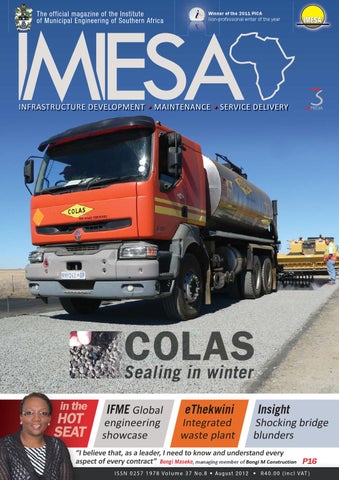
COLAS
The East London branch of Colas South Africa successfully completed a 24 km section of road between Viedgesville and Mqanduli using Rubspray 70/3.
Recent successes of Rubspray in the winter months PPROXIMATELY 300 000 ℓ of Rubspray emulsion was applied on this contract during the period from April 2012 to June 2012. The original specification for this 13.2 mm reseal contract was SBS modified bitumen conforming to the requirements for an SE-1 binder. The road was closed overnight to traffic during the first night of the seal. However, due to the cold winter temperatures (especially at night), Babereki Consulting Engineers, on the recommendation by Colas South Africa, decided to change the specification to Rubspray with a further application
A
6
IMIESA AUGUST 2012
of a light fog spray on top of the completed chipped surface. S-E1 modified binder requires a minimum road surface temperature of 25˚C before surfacing can commence. During the winter months, road surface temperatures seldom reach 25˚C. The window period for surfacing with hot binders is thus very small. When using Rubspray emulsion, surfacing operations can commence when the road surface temperature reaches 10˚C and more.
The low overnight temperatures experienced during the contract were conducive for the use of Rubspray 70/3 rather than the use of the SBS modified bitumen. This contract was completed to the satisfaction of the client, Coega Development for Eastern Cape Department of Roads and Transport, by Mapitsi Civils, Space Construction and Colas South Africa. At another contract – 20 km of 9.5 mm single seal from Hopefield to Velddrift in Cape Town – was also recently completed over a period
East London The low overnight temperatures experienced during the contract were conducive to the use of Rubspray 70/3 rather than the use of the SBS modified bitumen
COVER STORY
Hopefield The emulsion was applied at an application rate of 1.6 ℓ/m2 and chipped up
of 14 days, also using 70/3 Rubspray. The emulsion was applied at an application rate of 1.6 ℓ/m2 and chipped up. No traffic was allowed on the seal overnight. The following day a diluted fog spray was applied over the seal and the surface was opened to traffic once the fog spray had dried. In Bloemfontein, Colas is working on the Kuruman to Kathu contract where Rubspray 70/3 is used as tack coat in a 19.0 + 9.5 mm double seal. There are also several other contracts in progress in this area. These include:
entire surface. The geotextile was adhered with Coltack L emulsion at an application rate of 1.6 ℓ/m2. When the surfacing operation commenced, 70/100 penetration grade bitumen was initially used as a tack coat for the 19 mm aggregate and applied at a hot application rate of 2.2 ℓ/m2. With the cold night temperatures experienced at the time, chip loss occurred on the sections surfaced with the penetration grade bitumen. Colas recommended the use of Rubspray 70/3 as a tack coat and a trial section was placed
These trials once again showed that surfacing work can be performed successfully with Rubspray • N14 Kuruman in conjunction with Group Five • N9 Noupoort in conjunction with Haw & Inglis • N5 Bethlehem in conjunction with Raubex • Bloemfontein streets in conjunction with Razzmatazz • Harrismith in conjunction with Razzmatazz Successful trials were also carried out recently using Rubspray 70/3 on a 19.0 mm single seal in Harburg, KwaZulu-Natal on the P156/2 road on 29 May 2012. The contract involved the placement of full-width geotextile over the
WHAT EXACTLY IS RUBSPRAY?
Rubspray is a high viscosity cationic spray grade bitumen emulsion modified with SBR latex. Rubspray is used in cold, wet climates for resealing roads with surface cracks less than 5 mm without pretreatment. It can also be used in new construction and reseals where traffic accommodation is not a problem. Rubspray has much enhanced residual binder properties while the lower viscosity of the emulsion improves the flow of the binder into lightly cracked surfaces without the risk of run-off on steep inclines. Rubspray is environmentally friendly with no evaporation of paraffin or risk of explosion, making it safe to work with. It can be stored for long periods at ambient temperature without risk of polymer thermal degradation. Emulsions allow for better quality work in less than ideal conditions
on 29 May 2012. Concern was initially raised regarding the unusually high application rate of 2.85 ℓ/m2 required for the Rubspray application. Small-scale trials were initially performed on site to assess whether the Rubspray would flow excessively at the high application rate. Fortunately, the geotextile was very absorbent and very little flow-off of the binder occurred. The full-scale trial was performed on a cool
Harburg A 70/100 penetration grade bitumen was initially used as a tack coat for the 19 mm aggregate and applied at a hot application rate of 2.2 ℓ/m2
cloudy day, with occasional periods of sunshine. As it was not possible to keep the road closed overnight, the road was opened to traffic in the late afternoon. During the night some heavy rain showers occurred, but fortunately no stone loss occurred. Two months later, the section is performing very well with no sign of chip loss. Stone retention is exceptionally good due to the tenacious adhesion provided by the latex component. These trials once again showed that surfacing work can be performed successfully with Rubspray during low temperature conditions allowing contractors to spread the use of bitumen to when it is more readily available. For more information about Rubspray contact: Kobus Louw or Premala Singh • t +27 (0)21 531 6406
IMIESA AUGUST 2012
7
IMESA AFFILIATE MEMBERS
IMESA
Afri-Infra
afri-infra@mweb.co.za
Kgatelopele Consulting
AJ Broom Road Products
ajbroom@icon.co.za
Knowledge Base
Arup SA
rob.lamb@arup.com
Lektratek Water
Aurecon
Ian.VanWijk@af.aurecongroup.com
Bigen Group Africa BKS Consulting Engineers
otto.scharfetter@bigenafrica.com siyandan@bks.co.za
Makhaotse Narasimulu & Associates Maragela Consulting Engineers Much Asphalt
BMK Consulting
brian@bmkconsulting.co.za
Nyeleti Consulting
Bosch Stemele
bsdbn@boschstemele.co.za
Odour Engineering Systems
Bosch Munitech
info@boschmunitech.co.za
BVI Consulting Engineers
marketing@bviho.co.za
CBI Consulting Engineers
durban@cbisa.co.za
Civilconsult Consulting Engineers Civil & Blasting Solutions Concrete Manufacturers
mail@civilconsult.co.za jane@drillingandblasting.co.za cma@mweb.co.za
kgatelopele@wol.co.za info@knowbase.co.za general@lwt.co.za mmakhaotse@mna-sa.co.za admin@maragelaconsulting.co.za john.onraet@murrob.com ppienaar@nyeleti.co.za mathewc@oes.co.za
PD Naidoo & Associates Consulting Engineers Johannesburg@pdna.co.za Power Construction
nbarnard@powergrp.co.za
Pumptron
info@pumptron.co.za
Pragma Africa
deang@pragma.co.za
Rocla SBS Water Systems
karen.devos@murrob.co.za irene@sbsgroup.co.za
Sektor Consulting
cradock@sektor.co.za
LAustin@csir.co.za
Sight Lines
sales@sightlines.co.za
Davies Lynn & Partners
dlpdbn@dlp.co.za
SiVEST SA
Development Bank of SA
divb@dbsa.org.za
SNA Inc
Corrosion Institute of Southern Africa secretary@corrosioninstitute.org.za CSIR Built Environment
DPI Plastics EFG Engineers Elster Kent Metering EnviroServ Waste Management Geotechnologies GLS Consulting Goba Hidrostal SA Huber Technology Hydro-comp Enterprises I@Consulting Iliso Consulting Infraset Jeffares and Green Johannesburg Water
mgoodchild@dpiplastics.co.za eric@efgeng.co.za keith.bailey@za.elster.com benoitl@millenniumwaste.co.za garry@geotechnologies.co.za nicky@gls.co.za trumang@goba.co.za hstal@mweb.co.za fstammer@lantic.net dan@edams.co.za louis_icon@mics.co.za monde@iliso.com fmyburgh@infraset.com dennyc@jgi.co.za rtaljaard@jwater.co.za
Siza Water Company
garths@sivest.co.za snapta@icon.co.za tionette.bates@sizawater.co.za
Southern African Society for Trenchless Technology director@sasst.org.za SRK Consulting SSI Sulzer Pumps Wastewater Syntell Thm Engineers East London
jomar@srk.co.za francisg@ssi.co.za Sonja.Hattingh@sulzer.com julia@syntell.co.za thmel@mweb.co.za
TPA Consulting
roger@tpa.co.za
UWP Consulting
zulchl@uwp.co.za
Vela VKE WorleyParsons WSP Group Africa WSSA WRP Zebra Surfacing
capetown@velavke.co.za chris.brandsen@WorleyParsons.com dirk.hattingh@mbs-wsp.co.za nbinase@wssa.co.za ronniem@wrp.co.za andrew@zebrasurfacing.co.za
GLOBAL MUNICIPAL ENGINEERING
IFME 2012: HELSINKI
World Congress on Municipal Engineering One frequently asks whether the ver y high cost of attending an international conference is really wor th it. While this obviously depends on the delegate, it is impor tant to at least be in a position where you can gain from such an experience. By Dr Kobus du Plessis *
S
UCH AN OPPORTUNITY presented itself during the 75th IMESA conference, held in Boksburg in 2011, where the 17th International Federation of Municipal Engineers (IFME) congress (held between 4 to 7 June 2012) was advertised with an invitation to IMESA’s members to attend. Besides the obvious attraction to see Finland at a stage where the sun rarely sets (it is only dark for approximately five hours per day during June), and where an extremely functional public transport system is but one of the many things accepted as the norm, the possibility to share knowledge and to learn from international experience on issues that seem so familiar needed to be considered very carefully. IMESA is a member of IFME and the possibility to attend this event, which is only presented
every third year, needed serious consideration. After the normal visa battles associated with a visit abroad, three members of IMESA – the president of IMESA, Jannie Pietersen; an exco member of IMESA, Johan Basson, and myself – joined the approximately 380 delegates from almost 35 different countries to participate. The conference was held jointly in Helsinki, Finland; Tallinn, Estonia; and Stockholm,
Official opening in Finlandia Hall, Helsinki
• municipal engineering • asset management • traffic solutions • energy solutions. Jannie Pietersen and Roger Byrne (Australia) presented one of keynotes presentations:‘Implementing sustainable infrastructure asset management (SIAM) as part of a national programme’, while I presented a paper on ‘Integrated water demand management for municipalities: a South African perspective’, during a municipal engineering session. While transport and architecture approach plays a very important role in European countries, it was interesting to note the similarities in dealing with a political environment where decisions can rarely be considered rational. It
It was interesting to note the similarities in dealing with a political environment where decisions can rarely be considered Sweden, and the theme was ‘Sustainable Communities – Plan, Design, Construct and Maintain… for a better future’. There were 73 papers, which were presented in six groups during three parallel sessions over the three days of the conference. These groups were: • construction and renovation • urban planning
IMIESA AUGUST 2012
9
GLOBAL MUNICIPAL ENGINEERING
is very difficult to highlight specific papers as good or bad, since that depends on the interest from the delegate, but the topics covered in the papers were diverse and included: • Urban intensification across municipal borders • Extreme weather and flooding in Gothenburg • Municipal green growth strategy with excellent results • Evaluation of alternative solutions against sustainability criteria for area planning • Determining factors for choosing the bicycle as a means of transportation • Danish experience with sustainable and low carbon urban planning • Outsourcing municipal engineering services on a large scale: case evidence from two Finnish cities • Experimental studies of a device to retain pollution in urban stormwater management • Lighting master plan in action – the aim, the result, the future • How are we heading towards sustainable facilities management in Norwegian municipalities? • Metering the quality of water supply and sewage network maintenance services • Service planning – the missing link in sustainable asset management. The technical tour in Helsinki mainly related to the transport problems relating to limited available land and extremely heavy snow fall, which requires a significant fleet of vehicles to clear the roads during the long winter months. These vehicles are stored in a range of underground tunnels, which also serve as the access route for delivery vehicle to all main service providers above ground. The new tunnel system is more than 2 km long and has a cross section of 110 m2.
The technical tour to Tallinn also focused on transport problems, but the extent of the redevelopment of certain areas was clearly demonstrated with significant construction sites all over this very old city. Participants also had the very rare opportunity to be part of the very first IFME choir to perform live in the Tallinn Song Festival Grounds. In Stockholm, Sweden, the participants were briefed on and visited a variety of redevelopment projects – specifically the harbour area and the development of new open public spaces, which is very rare due to the limited land available. After three days of deliberations and three technical tours, the participants shared an appreciation for the problems that we, internationally, shared on a municipal level, including political decision-making, limited funding and increasing need for innovation in
Snow removal vehicles stored underground in Helsinki
decision-making. We also made new friends and strengthened existing ties between peers on different continents, which makes every cent spent on such an opportunity worthwhile. It also serves as a benchmark for IMESA’s own effort in knowledge sharing through its annual conference – to mention one opportunity – and it is very assuring to realise that IMESA can carry its flag high in this changing environment.
BELOW LEFT IFME choir in preparation for their performance in Tallinn, Estonia BELOW Briefing at technical excursion in Stockholm and a newly developed public open space area
IMIESA AUGUST 2012
11
INSIGHT
STANDARDS The determination
Standards have a tendency to become mundane and boring. But we should always remember that it is in doing the mundane to a consistently high standard that excellence is produced, and, more importantly, maintained. By Tony Stone
12
IMIESA AUGUST 2012
E
NGINEERING IS an exact science, an exact profession. It has to be – if it isn’t, someone, somewhere, will lose life or limb because of an engineering oversight. Why is this important? Besides the obvious reasons, the answer is simple. When that someone is you, a family member or a friend, it is no longer a distant event, void of emotion and, as a consequence, irrelevant. With the government’s massive infrastructure development plan coming down the pipeline, we need to learn from those before and those still with us.
Learning from the best – or worst A scientific principle, a standard, is the product of a problem solved or a method developed to perform a specific task that has been proven by science through empirical research involving detailed observation and analysis. When scientific principles are ignored, that is when we find ourselves in trouble. How does this happen? Through ignorance, arrogance and/or incompetence! ABOVE The aftermath Since 1831, 152 bridges around of a bridge collapse in the world have collapsed. Listed Minnesota, USA
INSIGHT
of safety and progress below are but a few of these collapses, with the reasons for the failure given: • Quebec Bridge, Canada: On 11 September 1916, the Quebec Bridge collapsed– for the second time. The first tragedy occurred in 1907 when the bridge, which was nearing completion, started to warp. At that time, an engineer on site, a witness to the tragedy, noticed the increasing distortions of key structural members. Before his eyes, and four years into construction, the south arm and part of the central section of the bridge collapsed into the St Lawrence River in just 15 seconds. Of the 86 workers on the bridge that day, close to quitting time, 75 were killed and the rest were injured. After a Royal Commission of Inquiry into the collapse, construction started on a second bridge, but when the central span was being raised into position it fell into the river, killing 13 workers. • Silver Bridge, United States (US): On 15 December 1967, the Silver Bridge in the US collapsed when it was choked with rush hour traffic. Forty-six people died. The subsequent investigation into the incident identified the cause of the collapse to be the failure of a single eye-bar in a suspension chain – due to a small defect 2.54 mm deep. It was also noted that the bridge carried heavier loads than it was originally designed for, and it was poorly maintained. • Connecticut, US: On 28 June 1983, a section of the Mianus River Bridge collapsed. Three people were killed and three others seriously injured when their vehicles fell 70 feet with the bridge section into the Mianus River. The collapse was due to the failure of the pin and hanger assembly supporting the span. Mpumalanga, South Africa: On 6 July 1989, the Injaka Bridge over the Ngwaritsane River collapsed during construction. The 300 m seven-span continuous prestressed concrete road
bridge collapsed due to incompetence and negligence. The steel launch nose was not structurally stiff enough, the temporary works slide path was incorrect, temporary bearings had been incorrectly placed, in shifting the structure forward the bearing pads were incorrectly fed and the deck slab was under-designed. Fourteen people were killed and 19 injured.
The Quebec Bridge in Canada collapsed twice, in 1907 and 1916
rusted, concrete used in its construction was too weak, there were serious welding problems and inferior steel supports that were 33% thinner than required had been used. • Castelo de Paiva, Portugal: On 4 March 2001, the Hintze Ribeiro Bridge, a steel and concrete structure, collapsed in Entre-os-Rios, Castelo de Paiva, killing 70 people, including those in a bus and three cars that were crossing the bridge during a storm. The bridge was more than 100 years old. The collapse was due to two decades of illegal but allowed sand extraction that had compromised the stability of the bridge’s pillars, as well as disregard from the responsible officials despite the warnings of divers and technicians. • Daman, India: On 28 August 2003, the Por tuguese-built Daman Bridge collapsed into a muddy Daman Ganga River due to heavy rains, throwing a school bus, 10 vehicles and pedestrians into the swirling waters. At least 28 people died, including 23 children. A subsequent judicial commission found that the bridge’s maintenance and repair, as set out in the engineer’s guidelines, had not been adhered to. • Almunecar, Spain: On 7 November 2005, a bridge on the A7 motorway that crosses the Rio Verde collapsed. Five Portuguese and one Spanish national died after a 54 m, 20 t span of the partially built bridge collapsed and plunged 67 m onto workers below. The cause was recorded as ‘unknown’. • Minneapolis, US: On 1 August 2007, the Minneapolis I-35W Bridge over the Mississippi River suffered total failure. With rush hour bridge traffic moving slowly through the limited number of lanes, the central span of the bridge suddenly gave way, followed by the adjoining spans. The structure and deck collapsed into the river and onto the riverbanks below, the
Since 1831, 152 bridges around the world have collapsed • Seoul, South Korea: On 21 October 1994, a 48 m slab between the fifth and the sixth leg of the Seongsu Bridge collapsed. Thirtytwo people were killed and 17 others injured. The concrete slab fell due to a failure of the suspension structure. This was caused by the joints of trusses in the steel structures, which supported the bridge slab, not being fully welded. The welding thickness, which should have been 10 mm, was only 8 mm. In addition, the connecting pins for steel bolts were of substandard quality. • Sichuan, China: On 4 January 1999, the Rainbow Bridge, a pedestrian bridge across the Qijang River, collapsed three years after it was built. Forty people were killed and 14 injured after falling 138 m when the steel-and-concrete bridge collapsed. Parts of the bridge were badly
IMIESA AUGUST 2012
13
INSIGHT
south part toppling 25 m eastward in the process. Approximately 100 vehicles were involved, with their occupants and 18 construction workers dropping 35 m down to the river or onto its banks. Northern sections fell into a rail yard, landing on three unoccupied and stationary freight train cars. The National Transportation Safety Board said that undersized gusset plates, which were inadequate to support the intended load of the bridge, as well as an increased surface load, caused the collapse. Thirteen people were killed and 145 injured. • Canberra, Australia: On 14 August 2010, a half-built span of the Gungahlin Drive Extension, a concrete road bridge, collapsed during a concrete pour. An investigation revealed that the main girders supporting the formwork were not braced to prevent lateral movement of the girders when subjected to the loads imposed by the concreting works. The inclination of the beams from the vertical meant that the loads in them were not carried concentrically and excessive stresses were induced through bending of the girders’ webs.
Thus the cause of the falsework failure was the inability of the main longitudinal girders to carry loads arising from the 3% crossfall of the bridge deck. • Tenggarong, Indonesia: On 26 November 2011, the Kutai Kartanegara Bridge, a suspension bridge, collapsed killing 22 people, injuring 40 and leaving 33 missing – presumed dead and trapped under the rubble at the bottom of the river. While two bridge pillars still stood, the deck was completely destroyed. At its last precollapse inspection in 2011, three structural irregularities were found: • The 10 cm horizontal displacement of the main cables’ anchor blocks • The 0.2 degrees inclination of towers
too many. Proactivity is crucial to preventing similar occurrences.
Standards in education In analysing each and every one of these disasters, scientists and engineers identified the problems and failures and put into place new or modified ‘standards’ to share the knowledge, prevent the occurrence or reoccurrence of problems and/or failures, and to serve as educational aids. Generally speaking, a standard can be defined as ‘a set of rules for ensuring quality’. The International Standards Organisation (ISO) and the International Electro-technical Commission (IEC) guidelines define a standard as a ‘document established by consensus and approved by a recognised body that provides for common and repeated use, rules, guidelines or characteristics for activities or their results, aimed at the achievement of the optimum degree of order in a given context’. Standards are adopted by an international standards body, such as the European standards body, or by a specific country’s national standards body, e.g. the South African Bureau of Standards (SABS), and these standards are made available to the public. Good standards should be:
If engineers around the world were responsible for these civil engineering disasters, nothing can be left to assumption
This bridge collapse occurred in Australia during a concrete pour
14
IMIESA AUGUST 2012
towards the river • A 72 cm main span deflection of the stiffening girder deck The bridge was undergoing repair work to counter the deflection by retightening nuts of the hangers at their lower joints when it collapsed. If engineers around the world were responsible for these civil engineering disasters, nothing can be left to assumption. We simply cannot afford it; one life lost is one
INSIGHT
• relevant and necessary, providing specific value to benefit development of a product • singular, by focusing on a specific concept • unambiguous, by not being subject to multiple interpretations • consistent, by not conflicting with other documents within its family of standards • auditable (measureable), with a quantitative exit criterion showing that the standard was followed. Good standards should also reflect best practices (things that have worked well), lessons learned (things that haven’t worked well) and the results of recent research. Rich Fields, a senior manager in mechanical engineering analysis, says that it is quite unfor tunate that standards are not well-taught in university engineering faculties. According to Fields, few engineering students are introduced to standards in university and even fewer are given an understanding of the standards development process. He also points out that too few engineering professors understand the utility and purpose of standards, the process of origin and maintenance or their impor tance and application in the workplace. These are profound statements that, if true
– and given the track record of global civil engineering disasters may be – is an indictment on the teaching profession. In 2009, the IEEE called for the integration of standards into the engineering curriculum. In Januar y 2011, the Engineering Council of South Africa (ECSA) moved for ward with its first draft of its policy proposals for the new Standards Generating Body (SGB) policy framework for the development of built environment qualifications in South Africa. The adoption of the policy proposals in 2012 is commended. Nonetheless, academics and engineers should appreciate the need for standards, get smar t on standards, get involved with an SGB such as the SABS and/or the Council for the Built Environment (CBE) to keep current and provide gained exper tise to the relevant SABS committee(s). At universities, academics should define specific points in appropriate undergraduate classes for inser tion of standards education, review SABS resources and make use of these resources in updated curricula with the creation of a graduate-level standards-focused class. Learning modules should include a historical over view of standards to demonstrate how standards have
The Tenggarong bridge collapse in Indonesia, in 2011, claimed the lives of 22 people
evolved over time, look at why standards matter, with a general introduction to standards and conformity assessment activities, a look at South African standards and legal issues in setting standards with a simple review of patent law and policies.
Hope for the future If we do not enforce adherence to standards in engineering, quality control will produce a result similar to the 2010 fiasco when several multimillion rand bridges and roads in Limpopo, were washed away within weeks of their completion. As announced in Parliament, we have a budget of R50 billion over the next few years to repair the shoddy, below standard houses built under the RDP and human settlements programmes. But, all this having been said, let us focus on the ‘life sustaining’ discipline of civil engineering and the advancement of humanity within the borders of this unique and beautiful countr y. Let us never drop our standards.
IMIESA AUGUST 2012
15
IN THE HOT SEAT
INTERVIEW WITH BONGI MASEKO OF BONGI M CONSTRUCTION
Ten years of success and
The determination of Bongi Maseko is best explained through her ten years of excellence in the construction industry. Richard Jansen van Vuuren speaks to her about building something from nothing.
Please supply a brief history of Bongi M Construction I founded the company
What have been milestone contracts for the company? The first was the
in September 2002 after being awarded my diploma in civil engineering. In addition, I had already worked for a construction contractor as well as for a consulting firm. The construction company was a small one and I had worked in most departments, which gave me a greater understanding of the work done there. Now, Bongi M Construction is a 100% black female owned entity with offices in Pretoria and Johannesburg, which is phenomenal as I founded the company without any financial backing.
appointment of Bongi M Construction by the Department of Public Works to renovate ministerial homes as well as the home of the deputy president in Pretoria. Another was the appointment of Bongi M Construction by the City of Tshwane to disconnect and reconnect water and electricity meters, which at the time was a totally new avenue of work for us. I had to attend a series of courses to better understand the contract as I believe that whenever the company is awarded a contract I need to know and understand exactly what is involved in the scope of works.
What are the main areas of activities for Bongi M Construction? We have an established presence and reputation in the water infrastructure sector, civil works and general construction.
LEFT Pouring a concrete foundation for VIP toilets BELOW The Bongi M Construction team during an induction session
16
IMIESA AUGUST 2012
Please outline three contracts that Bongi M Construction is currently involved with. We are currently busy with a renovation contract at the Carlton Centre in the Johannesburg city centre. We will be ripping out all existing partitioning, electrical cable and airconditioning systems, as well as constructing new office space. In
IN THE HOT SEAT
growth against the odds addition, we will be installing the new electrical reticulation system and the new air-conditioning system, toilet facilities and related plumbing for the client, Transnet. The Gauteng Department of Infrastructure Development has awarded Bongi M Construction a contract to renovate school classrooms. The work on this contract involves general repair and painting, as well as the upgrading of electrical reticulation. Bongi M Construction is a joint venture partner with an established construction company in the expansive Soweto Water Infrastructure Upgrade Project. I am truly appreciative that the company has joint ventured with
What is Bongi M Construction’s CIDB grading and BEE rating? Our CIDB grading is 6CEPE and 6GBPE and we have a level one BEE rating.
What significant challenges face Bongi M Construction in the medium term? We will be upgrading our CIDB rating to 7CEPE and 7GBPE as a result of turnover figures and the employment of a registered technologist.
What are the challenges, in your personal opinion, surrounding the construction industry
Emerging contractors struggle to compete with established contractors on small-scale projects us as it is an avenue of exposure for us that we would not normally receive. It is very rewarding to not just be a ‘partner on paper’ but an active member of the team.
What is the size of your team? We currently have 32 permanent employees. The number of contracted employees varies according to the projects we are busy with at the time. We contract several SMMEs as well.
Please outline your business philosophy • Do it right the first time • Quality assurance is vital • Advise clients when specifications are not in accordance with regulatory body guidelines • Maintaining a positive team spirit within the company • Ensure my staff are more than adequately trained so they can exceed expectations.
as a whole and how do you think they can be properly addressed? The poor per formance by some CIDB registered companies compromises the integrity of the CIDB grading system. Clients should submit a contractor per formance report to the CIDB on practical completion of a contract. Large contractors should be prohibited from competing with emerging contractors on smallscale projects. Corruption and lack of transparency needs to be eliminated. The awarding of contracts outside of the CIDB prescripts is a problem; the CIDB must enforce regulations. Both women and youth must be properly supported and developed within the industr y. Bongi M Construction
COMPANY ACHIEVEMENTS • CIDB Women in Construction Award 2009. • Bongi M Construction was nominated as the “Best managed black and female owned company” by Black Business Quarterly magazine (Bongi M Construction placed in the top three). • Bongi Maseko was part of the seminar that endorsed the publishing of JBCC agreements. • Bongi M Construction was nominated for a “Best established SMME” award in 2009 by Black Business Quarterly magazine. • Bongi M Construction was nominated as an “Excellent Woman in Engineering and Technology” by Group Five and the University of Johannesburg in 2011. • In 2011, Bongi M Construction won the “Best established SMME” award from Black Business Quarterly magazine. • In 2012, Bongi Maseko won a “Top Black Entrepreneur of the Year” award. • In 2012, Bongi Maseko became a CIDB stakeholder.
BONGI MASEKO IS PASSIONATE about the construction industry and has become a recognised leader in a male dominated industry. Maseko’s technical knowledge and successful delivery of quality projects, coupled with 15 years of experience, has enabled her to be a leading entrepreneur in the industry. Having started from humble beginnings, part of the Bongi M Construction’s vision is to encourage and provide employment opportunities for those with a strong interest in construction, particularly those from under privileged backgrounds.
Tel: +27 (0)11 760 3445
IMIESA AUGUST 2012
17
MUNICIPAL MAINTENANCE
CONSTRAINTS TO PRIVATE SECTOR OPERATION
Maintenance of municipal infrastructure This paper discusses the potential of the private sector to take medium- or longterm responsibility for the operation and/or maintenance of elements of infrastructure owned by municipalities. by Kevin Wall and Rodney Burrell (CSIR Built Environment)
O
VER AND ABOVE the service delivery benefits that could result, the paper also looks at the constraints to private sector involvement and what is needed to overcome them. Given local government capacity constraints, it makes no sense for municipalities not to partner with the private sector where appropriate.
Why this discussion is needed Prominent among the ‘priority areas’ causing problems is “insufficient municipal capacity due to lack of scarce skills”. This is despite “national government [having] allocated hugely significant sums of money to building capacity over the years. In seeking to answer the question why outcomes have been so disappointing, it is clear government needs to begin to do things differently.” (Ibid, pages 4 and 5.) The chapter ‘Service delivery and infrastructure’ of the same report, while placing most of the emphasis on clearing backlogs by providing infrastructure to those that don't have,
also clearly puts across the need for vastly increased and more competent operation and/or maintenance of existing infrastructure. This comes across, too, in the Department of Cooperative Governance and Traditional Affairs’ (COGTA) follow-up report on the “turnaround strategy”. (COGTA 2010) Disappointingly, however, neither report makes specific mention of the private sector as a potential resource. For instance, a scan of the 2010 report was unable to find the words ‘private’ or ‘outsource’. Yet, the minister
“Many municipalities are hampered by lack of flexibility in existing internal arrangements to deliver services and continued pressure on available human, financial and physical resources. Municipal service partnerships (MSPs) can allow a municipality to concentrate resources and management attention on its strategic core activities of planning and managing services within its municipality without having to be involved in the actual mechanics of service delivery.” (DPLG 2006, page 4) In our view, the private sector has the potential to help resolve many of the problems that municipalities periodically encounter with service delivery. In this paper, we emphasise, over other aspects of service delivery, the potential of the private sector to assist with operation and/ or maintenance of infrastructure, and that this assistance could come with significant service delivery, societal and developmental benefits – furthermore, not necessarily at additional cost. There is no reason for municipalities to believe that in order to accept the assistance of the
“Many municipalities are hampered by lack of flexibility in existing internal arrangements to deliver services”
18
IMIESA AUGUST 2012
of Finance could say: “Why is it that a soft drink company can deliver soft drinks to its thousands of outlets on time and without any leakage, and yet our clinics are without drugs and medicines, and learner support materials arrive late or never arrive at schools?” (Ministry of Finance 2009) In addition, the Department of Provincial and Local Government stated in 2006:
MUNICIPAL MAINTENANCE
private sector they have first to ‘acknowledge’ they have in some way ‘failed’. Anywhere in the world there is a limit to resources and manpower. South Africa is no different. The Institute for Local Government Management, in a notice of a ‘breakfast session’ in 2010, quoted Minister Trevor Manuel as having said: “Our priority is to meet the socioeconomic needs of all South Africans and, in particular, to alleviate poverty. We would be wrong to assume that government can meet this challenge alone.” The authors have no vested interest in the private sector; neither of us currently works, or has recently worked, for the private sector. Our interest lies only in finding ways to enhance service delivery. Personnel, equipment and systems are the means, not the end, and whether their operation and maintenance (note: their ownership is not part of this discussion) in any
Institution Of Civil Engineering infrastructure report card, the Department of Water Affairs Water Services Infrastructure Asset Management strategy and many others). • The private sector has many of the skills required, but these are seldom called upon by municipalities. If the ‘end’ is service delivery that consistently meets performance specifications, and if the responsibility for the delivery and also the ownership of the infrastructure remain with the municipality, then the question of who operates and maintains that infrastructure should depend on the answers to pragmatic questions about how best to achieve that service delivery. If a municipality is short of, for example, the technical skills to operate and maintain its entire infrastructure, would it not make sense for it to seek assistance from those who have the skills? While it is imperative that
“We would be wrong to assume that government can meet this challenge alone.” Minister Trevor Manuel particular instance should be by the public or private sector, or a mixture of the two, should be a matter of what is in the best interest of service delivery.
How best to deliver services? The service delivery functions assigned to municipalities in terms of the constitution are clear, as is responsibility for the ownership of the infrastructure. However, the constitution and other key legislation permit considerable flexibility when it comes to who operates and maintains that infrastructure. For example, water services authorities have responsibility for service delivery, but can use water services operators (as defined) – which can be public or private sector, or NGOs – as their agents. In practice, however, the use by municipalities of the private sector to operate and/or maintain infrastructure is far more limited than it could be and less than it needs to be in view of both these driving factors: • The chronic inability of many municipalities to operate and maintain their infrastructure themselves – which, while bound up with issues such as insufficient finance, has very often been shown to have a lot to do with lack of skills in the municipalities – as stated by COGTA (also the The South African
20
IMIESA AUGUST 2012
strategy, planning, financial aspects (including tariff-setting) and other key issues remain with in-house staff, why not, where appropriate, outsource some of the day-to-day operations and/ or maintenance? There should be no in-principle objections, especially if the ownership of the physical infrastructure remains under municipal control and so do user charges, levels of service, prioritisation and other policy matters. Outsourcing of operation and/or maintenance, when appropriate, can be viewed as an opportunity to improve infrastructure service operation and also as an opportunity to: • retain income in the local economy • develop human capital in the community (develop skills focused on the needs of the local infrastructure) • facilitate the participation of communities in using the opportunities and stimulating the establishment of new businesses or the growth of existing ones. In a nutshell: Whereas currently, the preferred institutional mode of delivery is municipal accountability for service delivery, municipal ownership of infrastructure and municipal operation and/or maintenance, a case can be made for trying out an alternative mode or at least for trying it out on a much greater scale than
it currently is. This could be municipal accountability for service delivery and municipal ownership of selected infrastructure, with private sector or NGO operation and/or maintenance. The MSP guideline document succinctly sets out the ‘rules’ and also the ‘purpose’ of MSPs: • While an MSP involves outsourcing municipal service delivery, a municipal council cannot outsource its accountability. Although MSPs change the means of delivering services, they do not change a municipality's accountability for ensuring that the services are delivered. • Under an MSP, a municipality’s focus shifts from managing the inputs of service provision to managing the outcomes. It becomes a contract manager rather than a resource manager. (DPLG 2006, page 3) It might seem superfluous to make this point at all, but our experience has shown that first-time hearers of the suggestion that the private sector play a greater role in operation and/or maintenance of infrastructure sometimes automatically assume that indigent South Africans will now have to pay more for services. However, there is no reason to assume this. If people currently receiving municipal services are indigent, and therefore benefit from the policy of free basic services, there is no reason why they would not continue to benefit irrespective of the institutional nature of the operator and maintainer of the infrastructure.
What the private sector could offer The private sector is not homogenous and therefore the remarks in this section relate to what, at any given time and in any given circumstances, some private sector organisations could offer. Quite possibly the same organisations would not be able to offer these service inputs at other times and in other circumstances. It is even possible that other parts of the private sector could not offer these at any time whatsoever, or in any circumstances. The CSIR recently cooperated with two organisations, one private sector and one public sector, both seeking to increase efficiency and reduce wastage. Both organisations own and operate large fleets of vehicles that are based at depots and travel to, and per form tasks at, many dispersed sites. The CSIR found great dif ferences in the will and the effor t to ensure value for expenditure. The drive to ensure value for expenditure was strong in the private sector case. For example: • supply chain management was well planned and implemented
Murray & Roberts Construction, newly created by merging Murray & Roberts Construction and Concor, is one of the largest players in the African, Middle East and South East Asian construction sectors. The company of fers a range of engineering and contracting services that include civil, building and marine construction, roadworks, earthworks, engineering and opencast mining.
building trust - creating value
Tel: +27 (011) 456-1000 Fa x: +27 (011) 590-5450 Email: info.construction@murrob.com Website: w w w.construction.murrob.com
Produced by Coralynne & Associates Tel: (011) 422-1949
SECTION
028 MANUFACTURER & SUPPLIER OF MASTS, POLES & TOWERS
1
LIGHTINGCIH STRUCTURES LeBLANC Lighting Structures is a leading supplier of STRUCTURES Masts, Towers and associated equipment for High Mast Lighting in South Africa and other African Countries and has been in operation since 1976. The company designs, fabricates and erects Monople Type Masts and Towers in seven basic product ranges • • • • • • •
E X P
Railow Masts Midhinge Masts Hydro Masts Internal and External Access Masts Monopole Transmission Masts Electricity transmission Masts Street Lighting Poles
Manufacturing Facility The Facility comprises of a 3500 square meter covered factory with extensive loading facilities and stacking space as well as 500 square meters of office space. The faciluty is well equiped with extensive plant and machinery for the handling and processing of steel plate as well as all other steel work required for the production of Monopole type structures. The production facility employs some fifty persons including qualified boiler makers, coded welders and machine operators. Quality The production facility is EN ISO 9001:2008 certified by Dekra International Engineering All monopoles and structures fabricated by the company are designed by a professional structural engineer, and detailing for fabrication is done by our own experienced staff, making use of the latest CAD drawing facilities Track Record Lighting Structures has designed and fabricated Masts for numerous customers in the Ligthting and Electrical sectors both in South Africa as well as many other countries in Africa. Services • Design and fabrication of masts from a standard range or special design to suit client specifications • Erection of Masts • Design and construction of Mast foundation • Inspection and maintenance of existing Masts and foundations • Turnkey capabilities for full site build • Technical support and as built documentation
LeBLANC Jasco Lighting Structures LeBlancJasco CTH Lighting Structures (Pty) Ltd Jasco LeBLANC Jasco Lighting Structures.co.za Structures LeBlanc Lighting Structures (pty)ltd L Reg. No. 2005/002613/07 18 Johnson Rd, Pretoriastad, Nigel PO Box 1592, Nigel, 1490, South Africa (0)87 310 1000 Fax: +27 (0)11 (0)86 699 6999 Tel: +27 (0)11 87 814-1404 86 814-1444 email: sales@lightingstructures.co.za web site: www.leblancgroup.com, www.lightingstructures.edx.co.za
SECTION
028
MUNICIPAL MAINTENANCE
• vehicle usage was tightly controlled • maintenance was carefully planned and speedily performed by qualified staff • arrival at and depar ture from sites was tracked • vehicle and equipment purchase, operation, maintenance and replacement were governed by life cycle cost considerations • accountability was strong and the incentive structure reinforced this accountability • any deviations from predetermined costs, standards and so on were reported to management, and ways were sought to improve future performance. The drive to ensure value for expenditure was weak in the public sector case, for reasons both systemic and procedural. For example: • supply chain management appeared to be weak or absent • at any one time, a large proportion of vehicles were in maintenance workshops or otherwise out of action. • measures to improve vehicle and equipment usage had been abandoned or had never been adopted • tracking of vehicle movements was haphazard • tracking of cost deviations and accountability for these was haphazard.
Why such a strong contrast with the private sector case? Frankly, receiving value for expenditure did not seem to be a consideration. Assisted, no doubt, by the weak incentives to pursue value. But why is this the case? Why is there no apparent will to improve value for expenditure of the taxpayer’s rand? We cannot answer this question. But we can suggest that if some of the methods in common use in some private sector situations were applied, where appropriate, by their public sector counterparts, productivity would improve. We hasten to add that we have chosen two particularly contrasting cases for the example above; we can point to many public sector organisations where value for taxpayers' expenditure is a strong driver and it shows in the results that they achieve. In our view, the private sector could, in appropriate circumstances, offer public sector entities four types of benefits: • Flexibility: the private sector can be contracted to provide a specific service over a specific period of time, after which the costs associated with the contract are no longer borne by the public sector entity. Resources no longer needed are not an ongoing expense to the public sector entity. • Sharing of contractual risk.
• Because the private partner would only be paid for measurable quantities and output, the public sector entity can be more certain that spending will result in predefined deliverables. • Skills: including management skills. ‘Appropriate circumstances’ would have to include competent contract documents, competent public sector client staff, competent private sector staff, adequate budgets and so on – none of which can be taken for granted.
Sharing of risk If a contract was appropriately structured, and the relationship between the municipality and
can be priced and measured • cost control: thanks to the above, the financial consequences of undertaking more or less work, or different work, can be understood both before the decision is made whether or not to proceed with the work, and after, when the entity is called to account for the expenditure. If a municipality needed a specialist skill, but did not need it all the time and indeed could not afford to retain it, it would make sense to hire this skill only when needed. A private sector contractor that is hired to undertake a specific task has to manage the entirety of the resources that it needs; failure to do so is its responsibility, not that of the municipality.
Hiring a contractor to operate and maintain, say, a water services system places the onus on that contractor to assemble and manage all the needed resources the contractor is one of equals, risks can be equitably shared. That is, the consequences of natural events, financial events, construction events, labour events and so on can be shared in a previously agreed manner and not entirely borne by the public sector, as would inevitably be the case were the public sector entity undertaking the task itself. Regarding measurable quantities and output, and payment for work done (presuming appropriately structured contracts and relationships), the following can be ensured: • transparency: work is done for an agreed price, is measured and the agreed payment flows • control of variations: if variations on the original quantities and output are required, these too
Hiring a contractor to operate and maintain, say, a water services system places the onus on that contractor to assemble and manage all the needed resources. Ordering materials on time and employing qualified staff are part of the job and the consequences of not doing so are at his cost. When the contractor makes a mistake and has to repeat work, the municipality does not pay more, whereas if the mistake was the municipality’s, it would have to bear the extra cost. The municipality buys the management – the teamwork – and the burden of resourcing and managing the team is transferred from the municipality to the contractor. We concede that these are generic statements. The advantages and disadvantages
IMIESA AUGUST 2012
23
MUNICIPAL MAINTENANCE
enumerated above would not necessarily, in respect of other municipal service delivery activities, be as apparent. It bears repeating that outsourcing requires a knowledgeable client. A municipality’s competence to monitor performance and enforce contract compliance is the key to it effectively using the private sector. But if a municipality is short on management resources, it would, in appropriate circumstances, be putting those resources it does have to more efficient use if it managed the work it outsourced rather than trying to cope with the operational issues itself.
not honouring all of their contracted obligations • union resistance • procurement processes – in particular, application of the Section 78 process of the Municipal Systems Act (South Africa 2000).
include widespread under-provision of finance for operation and particularly maintenance. This situation may be exacerbated by a tendency, for a variety of reasons, to transfer funds out of maintenance budgets during the course of the financial year. Inability to always follow acceptable accounting and payment procedures, including inability to process invoices and pay them on time, is sometimes in evidence. None of this bodes well for private sector involvement in the provision of services. Furthermore, inability to pay invoices on time presents considerable problems for outsourcing even to larger contractors. It would very likely be fatal to small enterprises, which have few reserves and might be dependent on only a few clients or even on only one client. Regarding the point, there are indications that some unions will resist any outsourcing of
Before it can consider outsourcing, a municipality must undertake the Section 78 process
Constraints to outsourcing There are four issues that, in our experience, are most frequently cited as constraints to involving the private sector in operations and maintenance of municipal infrastructure. These are: • the financial status of some municipalities • for sometimes related reasons, municipalities
24
On the first two of these points: The financial affairs of many municipalities are not in order. Many are not able to recover all of the revenues due to them. Financial constraints specific to outsourcing of operation and/or maintenance
IMIESA AUGUST 2012
4GD )MSDKKHFDMS #GNHBD With a solid track record spanning over half a century, GIBB has established itself as a partner of choice. Backed by a Level 2 BBBEE rating, GIBB provides engineering solutions to a diverse range of markets across the African continent.
0D N O K D k % W O D Q S H R D k % WB D K K D M B D marketing@gibb.co.za | www.gibb.co.za | +27 11 519 4600
MUNICIPAL MAINTENANCE
municipal service provision for fear that it could lead to retrenchment of their members.
On procurement The Department of Water Affairs, COGTA or National Treasury policy, legislation and regulations are permissive of outsourcing of infrastructure services operation and management. This outsourcing can be a public-public partnership, public-private partnership or a partnership with a non-governmental organisation (NGO) or community-based organisation. Legislation relating to outsourcing and procurement by municipalities mainly relates to procurement of private sector service providers. National Treasury and COGTA legislation and regulations are aimed at transparent and equitable procurement, and include anti-corruption measures, such as sequential approval responsibility for evaluation and adjudication committees. There are also measures to depoliticise procurement, through barring councillors from membership of certain committees, for example. We strongly support this legislation.
Before it can consider outsourcing, a municipality must undertake the Section 78 process. However, if it is not considering outsourcing, it is not required to demonstrate that it can provide the service in-house better than any outsourcing alternative could. Thus, in practice, too few municipalities go to the trouble of seriously considering alternatives to in-house operation and/or maintenance of infrastructure services. We feel that all municipalities should be encouraged to undertake Section 78 investigations in order to determine to what extent they are best able to carry out their responsibilities for operation and/or maintenance in-house – and thereafter to determine to what extent they should outsource. By denying themselves the opportunity to explore alternatives through an objective Section 78 process, these municipalities may have no reliable financial or information-supported rationale for the decisions they need to take in the interests of improving services to their customers. At very least, municipalities should be required to assess the full costs of
the in-house option, so that these costs can be better understood. It is understood that there are significant capacity constraints in some municipalities that could prevent them doing this kind of analysis at all, let alone doing it properly. On the other hand, if a municipality cannot do the analysis, it is not likely to be able to perform the service properly in-house. That should be good enough reason to investigate alternatives in these instances.
Overcoming constraints Municipalities need to be supported in their efforts to procure and contract with private sector providers. Two broad categories of measures to assist in overcoming the constraints noted above can be identified: • support in the form of people or units • support in the form of procedures, protocols, documentation and the like. This paper has been edited and abridged by the editor. If you would like the unedited version e-mailed to you, please contact the editor at richard@3smedia.co.za
IMIESA AUGUST 2012
25
N
EW
NEW NEW
N
T ew 120 ! n l l a e Th tor Excava i a d n u Hy EW
NEW NEW
J
Now reliability has a name... HPE AFRICA US
TA
RRIVE
D
J
new The all ackiB Hyunda der! hoe loa US
TA
RRIVE D
HPE Africa has a proud reputation in supplying world-leading earth moving equipment and uncompromised service to various industries, including plant hire, construction, government, mining, demolition and materials handling. To reach 110% productivity and get your business in business with the big names in heavy machinery, talk to HPE Africa today. Together we can move the world. H13091/3809
www.hpeafrica.co.za
customerservice@hpeafrica.co.za
24/7 Parts: +27 76 815 1085 24/7 Services/Workshop: +27 82 077 0793 ,IEH 3J½ GI .,& 8IP 4EXVMGO 6SEH .IX 4EVO &SOWFYVK (YVFER &VERGL 8IP 3XXS :SPIO 6SEH 2I[ +IVQER] )EWX 0SRHSR &VERGL 8IP 9RMX )ZIVKVIIR 4EVO 3GIER[E] 3PH +SRYFMI 6SEH 'ETI 8S[R &VERGL 8IP 9RMX 2SYVWI %ZIRYI )TTMRKW Sharecall: 086 022 7309
HYDRAULIC HAMMERS
SANRAL
New backhoe loaders for local market Two models of Hyundai backhoe loaders have been recently launched, namely the H930s and the H940s.
N
EIL SAULS, HPE Africa general manager, points out that South Africa has been identified as one of the largest markets for the new backhoe loader range. “The Hyundai backhoe loader range is ideal for smaller or start-up businesses that do not require large and costly earthmoving equipment from the outset. Many smaller businesses in South Africa only require a smaller machine such as a backhoe loader during the early stages, before moving on to larger excavators and loaders when they obtain larger contracts,” he explains. After-sales manager Dave Allen notes that
the new backhoe loader range supports Hyundai’s exclusive Hi-mate remote management system, which provides substantial benefits to the hire industry by making use of GPS satellite technology to continuously access vital service and diagnostic information on the machine. “Hi-mate saves time and money for the owner and dealer by promoting preventative maintenance and reducing machine downtime. For multiple machine owners such as plant hire companies, the Hi-mate fleet monitoring system provides real-time monitoring of machines plotted on a digital map, while the service status and machine location is represented
by colour coding and geographic location. If the machine icon is blue, it indicates that the machine is operating normally. If the machine icon is red, the machine has logged an alarm,” he explains. HPE Africa has also introduced the 120 t Hyundai R1200LC-9 excavator to existing and prospective clients. JJ Choi, Hyundai Heavy Industries team leader, highlights the fact that the Hyundai R1200LC-9 excavator is particularly well-suited for use in mining and quarrying applications. “The size and robustness of the Hyundai R1200LC-9 excavator makes it an ideal choice for large earthmoving projects, especially in the harsh African climate and landscape. What’s more, it is more competitively priced than similar sized competitor excavators, ultimately reducing the overhead costs of managing a larger fleet, while maintaining the highest standards of quality and reliability.” The Hyundai R1200LC-9 excavator was successfully launched internationally in 2011 and Choi is confident that it will be well-received by the local market. ABOVE A Hyundai R1200LC-9 and an Astra articulated dump truck working in conjunction LEFT The Hyundai backhoe loader range is ideal for smaller or start-up businesses that do not require large and costly earthmoving equipment from the outset
IMIESA AUGUST 2012
27
SANRAL
ENVIRONMENTAL PRACTICES
SARMA conference looks at
Construction companies need to pay more attention to global economics and environmental practices to ensure their businesses remain competitive in the future.
A
CCORDING TO Nico Pienaar, director of the Southern Africa Readymix Association (SARMA), events of recent years have shown that local construction businesses are directly affected by global economic and environmental occurrences. Local company heads therefore need to make decisions based on international trends and practices, as well as local market requirements to ensure future sustainability. “For this reason, the organisers of this year’s SARMA conference, held at Emperor’s Palace on 18 and 19 June, put together a hardhitting conference programme aimed at helping companies in the concrete, construction and related industries to identify these issues that affect the industry and find ways of profiting from resulting future trends,” says Pienaar.
Sustainability The conference was structured to assist all role players in the readymix industry, as well as building and construction industries, and all users of concrete and aggregates. Top of the agenda was finding ways of growing the construction industry by making use of the many opportunities that exist in the industry, including private and public sector projects. There will also be in-depth discussions on business leadership and management by Piet Naude, a well-known business commentator, who will examine the roles of industry leaders in a changed global economic environment. Sustainability and environmental awareness also loomed large at the top of the conference agenda. In the future, users and producers of ready mix concrete will face increasingly stringent environmental legislation. Mariette Liefrink, CEO of the Federation for Sustainable Development, identified environmental issues that will affect the construction industry.
28
IMIESA AUGUST 2012
SANRAL
sustainability
Focus on quality A recurring topic at the conference was the issue of quality throughout the supply chain from provision of readymix concrete, aggregates and sand to industr y and government’s new build plans. Alber t Moloi of Consulting Engineers South Africa looked at the requirements for readymix in government’s new infrastructural programmes and uncovered standards for aggregates on these important projects. Ron Watermeyer of Nico Pienaar, director, Soderlund & Schutte Southern Africa Readymix Engineers focused his Association attention on the new projects and looked at procurement practices as well as quality requirements, which are becoming more important in the building construction industr y. Other important issues discussed included the macro outlook for the local economy, the state of the mining industr y, environmentally friendly plants and factories, and how to save costs on production. Best practices in trucking and transportation were also discussed.
Mining & Aggregates
Industrial Minerals
Readymix
Concrete Products
Contracting International
“The introduction of a bargaining council in our industry may be good for everyone.”
IMIESA AUGUST 2012
29
Telephone: +27 21 917 8840 Facsimile: +27 21 914 1174
Collin Ramukhubathi
www.afrimat.co.za
Western Cape Aggregates Division
Area Quarry Manager
®
Growth from diversification Black empowered, JSE-listed Afrimat is one of the largest suppliers of a broad range of construction and industrial materials
Maxx Corporate Communications©
Legalities Key legislative issues were also highlighted in order to help industr y role players to identify requirements and adapt their businesses to comply. These include legislation that will affect readymix concrete deliver y, including quarr ying, environmental, safety and health legislation, as well as company documentation and record keeping obligations. “Companies that fall foul of either one of these could face severe consequences,” adds Pienaar. Another potentially contentious topic within the mining industr y is the establishment of a bargaining council for workers. Although the establishment of the council has been met with scepticism by member company representatives, Elize Str ydom of the Chamber of Mines presented new insights that shed some light on some of the positive aspects of bargaining councils. “A quick insight into the topic shows that the introduction of a bargaining council in our industr y may be good for ever yone. It could mean that ever yone has to play on a level playing field and that labour is treated the same by ever yone and paid similar wages. In that way nobody gains an unfair advantage by exploiting workers,” Pienaar points out.
SANRAL
ROAD CONSTRUCTION
Bitumen shortage highlights need The current shortage of bitumen has emphasised the need for South Africa to start reducing its reliance on asphalt roads by exploiting the full potential of concrete as road-building material.
T
HIS IS THE VIEW of Bryan Perrie, managing director of the Cement and Concrete Institute (C&CI). “It is time South Africa faced reality – bitumen production for asphalt roads, is not likely to be a top priority for oil refineries. This means that more shortages will occur in future. We believe that both concrete and bitumen have roles to play in road-building in
A stretch of freshly poured concrete being prepared for curing
30
IMIESA AUGUST 2012
this country. South Africa should develop a significant concrete road-building industry so that both types of pavement can be considered for all roads. “In addition, concrete and asphalt should be combined either vertically, horizontally or longitudinally to ensure the best attributes of each material are used to advantage. This concept has already been successfully used on a number of projects in South Africa. Concrete should be considered at the design stage to avoid major disruptions as is now
happening in South Africa,” contends Perrie. Perrie says concrete is the ideal choice for environmentally sensitive and economically sustainable highways. Concrete highways offer exceptional longevity. This long-term performance eliminates the need for frequent pavement resurfacing and rehabilitation, and the consumption of valuable resources. Concrete pavements can be designed with pervious concrete shoulders that minimise surface-water discharge. Use of optimised surface textures also allow for quieter pavements
SANRAL
for other options with excellent skid properties. Furthermore, rolling resistance is reduced on properly textured concrete pavements. The use of virgin materials and natural resources could be reduced by the incorporation of recycled materials and secondary products, such as fly ash and ground granulated blast furnace slag, into the concrete mix for road construction. “The lighter colour of concrete pavements reduces the electrical power needed to adequately illuminate roads, while the durability and wear-resistance of concrete pavements ensure that the surface characteristics that contribute to quiet, fuel-efficient and safe roadways remain intact for decades.
Concrete also offers a wide range of benefits for the construction of low-volume roads, such as required in “township” development. In addition to low maintenance costs, these advantages include: • labour-friendly and therefore suitable for labour-based community construction • skills acquired for low-volume roads can c be transferred to the building and a construction industries • only simple and inexpensive construction equipment is required s
• local materials can be used; concrete overlays are ideal for upgrading deteriorated low-volume roads. “Low-volume concrete roads in either insitu form or in the form of block paving are increasingly being used for projects ranging from township roads to multimillion rand housing developments. So we believe that the time has come for concrete to be regarded as complementar y – and not always competitive – to asphalt for road building. There is scope for both products in South Africa, par ticularly when bitumen shor tages occur,” Bryan Perrie, explains Perrie.
“It’s time to regard concrete as a complementary material for road building.” MD, the Cement & Concrete Institute
IMIESA AUGUST 2012
A CONCRETE PAVED ROAD FOR ALL Quality paved roads for every setting. Creating community skills development. SABS approved product from CMA members. For supply and technical advice visit the CMA website.
www.cma.org.za
31
WATER AND WASTEWATER PROFILE
SprayPave
Replicating success SprayPave is one of South Africa’s leading manufacturers, suppliers and applicators of bituminous road binders and emulsions.
T
HE COMPANY consistently supplies premium quality products, professionally and reliably in its quest to be the primary choice for fulfilling all bituminous requirements of the Southern African road construction and waterproofing industries. SprayPave is an innovative and fully integrated industry leader. Since its establishment over 30 years ago, it has become renowned for its dynamism and successful completion of a variety of exciting and challenging contracts. As a subsidiar y of the Basil Read Holdings group of companies, SprayPave forms an integral par t of one of South Africa’s leading construction companies. In 2006, Basil Read concluded a deal that would significantly enhance the future capabilities of its roads division when it acquired a controlling stake in SprayPave, a strategic move
32
IMIESA AUGUST 2012
that has proven to have optimal results for both companies.
World-class manufacturing To meet the high standards the company has set for itself, all products are manufactured at SprayPave’s world-class manufacturing facility located in Gauteng. In addition to its fully calibrated weighbridge and a state-of-the-art emulsion plant that facilitates the in-house production of all anionic and cationic emulsions, it is fully equipped to manufacture polymer modified binders (PMBs), as well as environmentally friendly primes and pre-coats. SprayPave’s drumming facility has been designed to accurately fill the maximum number of drums in the shortest possible time. Every pipe that makes up the product transport system is colour-coded for easy identification. The company also utilises an oil heating
system to ensure products are maintained at the ideal temperatures. The storage facility has a capacity of over 500 000 ℓ, ensuring that sufficient quantities of product are consistently and readily available to facilitate the shortest turnaround times possible.
Versatility and reach By now it is a well-known fact that SprayPave is continuously taking steps to secure its dominance within the market, as seen with the opening of its coastal branch in Botha’s Hill, KwaZulu-Natal. “Our ability to extend our reach through the acquisition of our coastal branch has certainly given us a competitive edge in our ability to supply a market that before was largely inaccessible due to both price and time restrictions,” says managing director, Steven Single. Being in close proximity to two of South Africa’s major oil refineries had already given this little plant a substantial edge; however, the decision was made last year to give the facility a complete upgrade that would be sure to engrave SprayPave’s name firmly on the KwaZulu-Natal market. To be relaunched midApril, the facility will not only produce all of the world-class products that SprayPave has come to perfect, it will also have the awe-inspiring
PROFILE
aesthetics of a proudly SprayPave plant. One addition that is sure to please many of SprayPave's coastal clients is its very own PMB plant that will allow it to manufacture the very popular SE-1 and SE-2. “In a region where the supply of PMBs has been largely monopolised for some time, we are extremely excited to offer the coastal market an alternative option to procuring a very in-demand product,” says Single. “Furthermore, we are extremely proud of our ability to not only replicate the impressive facility we have in Johannesburg, but through vision and inspiration, take it one step further and improve on it.” Extending its reach even further is the stateof-the-art, mobile emulsion plant that allows SprayPave to manufacture adequate quantities of emulsion on distant sites for lengthy periods of time, such as in Gobabis, Namibia, where it has been situated for the past 15 months. In addition, the company’s close association with all refineries in Southern Africa enables it to provide fit for purpose products to any destination in Southern Africa. Using world-class plant and equipment, SprayPave has the ability to successfully take on any project regardless of form or magnitude. From the smallest of rural roads to the largest of national routes, no job is too big or too small. Last, but certainly not least, is SprayPave’s pride: its ever-growing fleet of haulers and world-class bitumen distributors. The company currently has nine distributors, five of which are powered by modern and sought-after Scanias, and all are fitted with the technically advanced Etnyre Spray-Bar system – the impressive site of a red and white sprayer working on a road construction site is becoming ever more common. Then there are the haulers, an indication of SprayPave’s commitment to servicing their valued clients as effectively as possible. “Where many other companies focus primarily on their distributors, they are forced to rely on subcontracted haulers to transport their client’s bulk products. Naturally this creates the need to possibly charge less competitive haulage rates, as well as opens the door to potential logistical problems that are somewhat out of their control,” says commercial manager, Phil Chirnside. Operations manager, Quentin de Ridder, adds: “Although we still make use of external haulers, by not relying on them 100% we are able to plan more effectively and decrease lead times for urgent deliveries. This also allows us to mitigate any unforeseeable delays far more readily and effectively”.
SprayPave’s current hauler fleet consists of six vehicles dedicated to supplying clients, as well as distributors on site, and two brand-new haulers that will be solely dedicated to transporting bitumen from the refinery to SprayPave’s manufacturing facility
binder content, as well as diluted variants • SS60: anionic emulsion with 60% binder content, as well as its diluted variant SS30 • Opti-Prime: SprayPave’s very popular and environmentally friendly cold prime • SP1i: SprayPave’s invert cold prime
Above A glimpse of the upgraded emulsion plant at SprayPave Coastal Opposite page Not just a name, but a brand to be proud of
in Alrode South, Johannesburg. These impressive machines are powered by the latest R500 Scania horses and coupled with the most modern and technically advanced tankers. The tanks have 34 000 ℓ capacities and come fitted with EBS (electronic braking system),
• Opti-Cote: SprayPave’s answer to quality and effective pre-coating • SE-1 and SE-2: effective and reliable polymer modified binders • SC-E1 and SC-E2: effective and reliable modified emulsions.
The state-of-the-art, mobile emulsion plant allows SprayPave to manufacture adequate quantities of emulsion on distant sites for lengthy periods of time Weweler air suspension and axle lifting device, as well as a computer management system that communicates pertinent information to the cab while in transit. “We are very proud of these vehicles and are confident that they will go a long way in facilitating our requirements to achieve both logistical optimisation as well as ‘marketleading’ customer service and satisfaction,” says De Ridder.
Over and above these manufacturing products, SprayPave also supplies all-penetration grade and cutback bitumen. “All these products are manufactured according to very specific industry specifications, but what sets us apart from our competitors are our extremely high standards and exceptional housekeeping,” states Chirnside. “We are very proud of SprayPave’s growth, as well as extremely impressed with the innovative approach it has taken to get to where it is today,” says Marius Heyns, CEO of Basil Read.
An enviable range of quality products SprayPave has a wide range of bituminous products with various grades, but some of its leading products include: • CAT60, 65 and 70: catSprayPave ionic emulsions with Tel: +27 (0)11 868 5451 • www.spraypave.co.za 60%, 65% and 70%
IMIESA AUGUST 2012
33
ROADS
Seven graders for Mbombela
‘Funeral roads’ is what they used to be called, roads that were only graded when a funeral was about to take place in a certain area.
T
HESE WORDS WERE spoken by the executive mayor of the Mbombela Local Municipality, Councillor Cathy Dlamini, during a memorable occasion that took place on the outskirts of the capital of Mpumalanga province. The occasion was the handing over of seven Bell 670G graders to the municipality, and the mayor referred to the habit of only grading gravel roads in the rural areas when the need arose, such as before a funeral when many vehicles and pedestrians would be using the roads. “I want to make it clear that the Mbombela Municipality had taken a conscious decision not to outsource its maintenance services, which look after roads, stormwater drains and
ABOVE Mbombela Municipality takes its service delivery mandate seriously and has recently taken delivery of seven Bell graders to ensure that rural road infrastructure is properly maintained by the municipality LEFT Mbombela Municipality’s executive mayor, Councillor Cathy Dlamini, gets behind the controls of one of the municipality’s new Bell graders while Bell Equipment sales representative Russell Conn talks her through the specifications of the machine
34
IMIESA AUGUST 2012
ROADS
Municipality
At the handover were (from left): Leon van der Linde, manager: Bell Equipment Nelspruit; Dale Oldridge, Bell product marketing manager: graders and dozers; Councillor Bheki Zulu; Raj Singh, Bell customer relations facilitator; Charles Inggs, Bell Equipment sales representative; Bruce Ndlela, Bell director of business development; Councillor Sibusiso Mathonsi; Councillor Cathy Dlamini, executive mayor; Councillor Zayd Boroko; Councillor Maurice Mazibane; Councillor Phazamisa Mathe; Councillor Patrick Nkala; Sigananda Siboza, deputy municipal manager; Jabu Sindane, acting municipal manager; Ntsose Malokela, general manager: technical services; and Russell Conn, Bell Equipment sales representative
the like,” she added. “That is why we invested in these seven Bell Graders to ensure that our commitment to service delivery is a reality.” The mayor went on to refer to graders normally being seen as blocking one’s way on the road. She did however expect that from now on, the citizens of Mbombela would see the beauty of such a machine as it was fulfilling a promise the municipality had made in maintaining the roads on a planned and regular basis, and not only when a funeral was to take place. Representing Bell Equipment at the ceremony was Bruce Ndlela, director of Business Development for Bell Equipment Sales South Africa. He said that as a proudly South Africa original equipment manufacturer and supplier, Bell Equipment understands the needs of the government sector and is not only able to supply the equipment necessary to get the job done efficiently and cost effectively, but is also able to offer unrivalled support of its equipment. “Bell Equipment has the largest footprint of all the OEMs in South Africa with 19 customer service centres in all the provinces. With our
extensive network we are able to provide professional technical back-up and superior parts availability, supported by our stateof-the-art Global Logistics Centre based in Gauteng. This enables Bell to actively engage with some 283 municipalities in the nine provinces to address the infrastructure backlog that currently exists,” he said. N d l e l a also referred to Bell Equipment’s recent signing of a memorandum of understanding between the company, the Development Bank of Southern Africa and the National Empowerment Fund, a move that was deemed to be beneficial in assisting municipalities and emerging contractors to finance their acquisitions of earthmoving equipment, which would ultimately create more employment and aid service delivery. The Mbombela Local Municipality covers some 3 451 km2, which is crossed by 274 km of tarred roads and 2 100 km of gravel roads. Maintenance of the latter has been prioritised and the seven Bell 670G Graders will be used extensively to maintain and rebuild some of these roads.
Mbombela Municipality has taken a decision not to outsource maintenance
IMIESA AUGUST 2012
35
ROADS
R104 rehabilitation project The rehabilitation of the R104 road from the Simon Vermooten intersection in Pretoria to Bronkhorstspruit, an alternative route to the N4 toll road, will be completed by the project deadline of May 2013.
T
HIS IS THE VIEW of Jay Juganan, contracts director of Concor Roads & Earthworks, a subsidiary of Murray & Roberts Construction. The R104 runs parallel to the N4 between Pretoria and Bronkhorstspruit, and was originally constructed about 60 years ago using water-bound macadam with 150 mm rock inserts along the edges on both sides of the 42 km long road. The contract, awarded to Concor Roads & Earthworks by the South African National
36
IMIESA AUGUST 2012
Roads Agency Limited (Sanral), runs for 18 months through to 1 May next year and comprises the reconstruction of a single carriageway 13.4 m wide (including the shoulder and road reserve), turning lanes at 19 intersections and upgrading a number of culverts. “The widening of four bridges is included in the contract, but the work is dependent on the granting of water utilisation licences by the Department of Water Affairs,” says Juganan. “The existing road is being recycled as
sub-base in half widths and a new G2, bitumen stabilised layer is being placed on top of the sub-base. We are faced with the generic issue of securing consistent supplies of bitumen, but I’m confident that we will complete
A recycling train processing the existing surface of the R104 road between Pretoria and Bronkhorstspruit with the recycled material being used as sub-base overlaid at a later stage by a bitumen stabilised layer
ROADS
on schedule the project by the deadline date,” he says. Turning to safety, Juganan states that the stringent application of the Murray & Roberts ‘Stop.Think’ safety programme is yielding positive results on the project. “This approach to safety is working extremely well and is emphasised every morning in toolbox talks with all the employees. Our biggest safety challenge arose during the course of constructing the first 4 km section through Mamelodi as a result of taxis jumping the stop/go single lane sections. We held discussions with local councillors and with taxi associations, but were not able to fully resolve the issue.” Concor Roads & Earthworks site manager Mabandla Dlamini indicates that a total of 140 people are employed on the project, including subcontractors. Members of the
local community have been employed to build drainage and kerbs along the 42 km route and are also appointed to do the road marking. In addition, Concor Roads & Earthworks has entered into an undertaking to train subcontractors at local level, using the services of Seta-approved training suppliers. “We are identifying promising subcontractors to undergo generic training as well as training to develop entrepreneurial and engineering skills,” says Dlamini. Liezl Beukes, Concor Roads & Earthworks’ environmental officer on the R104 road rehabilitation project, is ensuring strict compliance with the environmental management plan. The road rehabilitation project passes through 21 wetlands and crosses four rivers: Pienaars, Honde, Forfar and Bronkhorstspruit. “The wetlands, rivers and catchment areas
The Concor Roads & Earthworks contracts director, Jay Juggenan, indicates the 6-inch rocks lining both sides of the 40-km stretch of R104; the rocks need to be removed to prevent damage to costly recycling equipment used in the rehabilitation of the alternative route between Pretoria and Bronkhorstspruit
IMIESA AUGUST 2012
37
ROADS
have been impacted negatively by anthropogenic (human) development and there have been a number of river diversions in the past during bridge building. Concor Roads & Earthworks’ approach during bridge widening will be to demarcate sensitive zones. Workers will undergo environmental sensitisation induction training. The bridges will be widened from the existing piers and therefore no work will be carried out in the river beds,” says Beukes. She explains that in terms of the environmental management plan, all trees being removed from the widened road reserve are being processed through a chipping machine and the mulch dispersed in the vegetation alongside the route. In addition, all alien plants are being removed and, in rehabilitating the road shoulders, top soil is being replaced and dressed with indigenous grass and forbs. During the course of the 18-month contract, Concor Roads & Earthworks will use 17 000 t of asphalt, 9 Mℓ of bitumen emulsion, 1.2 Mℓ of 80/100 pen bitumen, 85 000 m³ of local G2 aggregate, 45 000 m³ of local G5
38
IMIESA AUGUST 2012
ABOVE The recycling train processing the existing surface of the R104 road between Pretoria and Bronkhorstspruit with the recycled material being used as sub-base overlaid at a later stage by a bitumen stabilised layer RIGHT The overbuild along a new halfwidth section of the R104 road between Pretoria and Bronkhorstspruit is graded prior to traffic being diverted onto the new section ahead of work starting on the existing half-width section of the 60-yearold road visible in the foreground
aggregate, 8 000 m³ of seal stone, 3 000 t cement for stabilisation and 8 000 kℓ of water from a commercial source for construction purposes.
ROADS
Meeting the need for dedicated soil stabilising cement During the long period of high growth rates in cement demand in the late 1990s and early 2000s, the South African cement industr y had little incentive to formulate specialist products for the road construction sector.
Cement is effective in stabilising a wide range of soils including granular materials, silts and light clays
T
contractor customers when it comes to a road binding cement product can be summarised as a superior performance cement that offers the characteristics of a slow setting cementitious binder, extended working time, reduction in PI, suitability for different soil conditions, long-term strength and workability.
HE COMMISSIONING in 2009 of its state-of-the-art grinding station in Randfontein gave Lafarge Cement the capacity to introduce innovative new products and develop new market sectors. Sanral was starting to address the large backlog of maintenance and rehabilitation on provincial and municipal roads. Recognising the potential, Lafarge was quick off the mark to use its unparalleled technical resources to develop RoadCem, a road binding cement. Developed in cooperation with major road contractors, RoadCem is a CEM II 32.5N cement formulated from Portland cement, siliceous fly ash and blast furnace slag. RoadCem is designed to provide optimal solutions for improving the engineering properties of soil by reducing the plasticity index (PI), while also improving the unconfined compressive strength and initial tensile strength. The product modifies clay minerals and achieves increased soil strength and bearing capacity, and better volume stability by controlling the swell and shrinkage characteristics caused by moisture changes. This also enhances resistance to erosion, weathering or traffic loading. The principal road stabilisation products used are lime, Portland cement, fly ash and slag, and ratios used depend on the specific site conditions and conform to the applicable standards. Cement is effective in stabilising a wide range of soils, including granular materials, silts and light clays. A particular advantage of cement is its capability of being used in conjunction with by-products such as fly ash and slag. Cement is composed of calcium silicates and calcium aluminates that hydrate when combined with water to form the cementing compounds of calcium silicate hydrate and calcium aluminate hydrate. The reaction also releases calcium hydroxide (Portlandite). The formation of the cementitious products and calcium hydroxide make Portland cement successful in stabilising both granular and finegrained soils, as well as aggregates and miscellaneous materials. In fine-grained clay soils, a reaction between the calcium hydroxide (released during hydration) and the alumina and silica in the soils, is an important factor in the stabilisation of these clay soils. The permeability of cement-stabilised soil is greatly reduced, resulting in a moisture-resistant material that is highly durable and resistant to leaching over the long term. The needs of road construction
Engineered Solutions for Africa
Lead anode plant for Kamoto Copper mine,
TGL designs, manufactures, DR Congo. PUZ[HSSZ HUK ÄUHUJLZ T\S[P disciplinary turnkey projects for the chemical, mining, renewable energy, metallurgical and industrial markets in Africa. :DWHU 7UHDWPHQW DQG 5HFODPDWLRQ $LU 3ROOXWLRQ 0DQDJHPHQW 0LQLQJ DQG 0HWDOOXUJLFDO ,QIUDVWUXFWXUH 3URMHFWV 3URFHVV (QJLQHHULQJ 6ROLGV :DVWH 0DQDJHPHQW 3ODQW +D]DUGRXV &KHPLFDOV 0DQDJHPHQW 3ODQW $FLG +DQGOLQJ 3ODQW 3KDUPDFHXWLFDO 3ODQW 3URMHFW )LQDQFH 5HQHZDEOH (QHUJ\ *ULG &RQQHFWLRQ 3URMHFWV
CCD Thickeners for SNC Lavalin, Madagascar
35-million litre reservoir, North West Province, South Africa
TGL has projects in: Zambia, Madagascar, D.R. Congo, Botswana, Malawi, Zimbabwe, Nigeria, Ghana, Namibia, Mauritius, Mozambique
39
Contact: tel: +27 (0)11 468 5956 e-mail: tomm@thuthukagroup.com / www.thuthukagroup.com Adding value to your African project
V Squared V2/11696 Jun2012
IMIESA AUGUST 2012
thuthuka group limited
ROADS
Lesotho road gets new lease The upgrading of a 32 km gravel track to a gravel road, between Mantsonyane and Lesobeng villages in the Lesotho Highlands, with some asphalt protection presented several challenges for the professional team.
The project required heavy earthworks and rock blasting
40
IMIESA AUGUST 2012
Specialist Waste Management Consultants Sustainable and appropriate engineering solutions with integrity and professionalism. Stanford Drop-off Vissershok Waste Mana gement Facility
Gansbaai Recycling Centre
Velddrif Transfer Station
t t t t t t t t t t t t
Integrated Waste Management Plans Waste Disposal Strategies Identification and permitting of landfill sites Design of General and Hazardous Waste sites Design of Solid Waste Transfer Stations Design of Material Recovery Facilities Optimisation of Waste Collection Systems Auditing of Waste Management Facilities Development of Operational Plans Closure and Rehabilitation of Landfills Quality Assurance on Synthetic Liners Waste Recycling Plans
Herman us Materials Recovery Facility
Botrivier Dr op-off
Jan Palm Consulting Engineers Tel +27 21 982 6570
/ Fax +27 21 981 0868 / E-mail info@jpce.co.za / www.jpce.co.za
ROADS
on life
T
HE R130 MILLION project was commissioned by the Lesotho government in 2002 and was then put on hold for several years. Work commenced on the road in 2008 and took four years to complete by the consulting engineers, GIBB, and the local contractor, Lesotho Consolidated Civil Contractors. Forged through heavy mountainous terrain made up largely of basalt rock, the project required heavy earthworks and rock blasting. Additional challenges included working at high altitudes (2 743.2 m at the road’s highest point) and dealing with snow-bound terrain for two months of the year. GIBB director, Paul Taylor, says a feature of the road is an asphalt protection layer that has been laid along certain steep sections. “Laying the asphalt presented a significant challenge for the construction team,
particularly when it came to placing and compacting steep gradients of up to around 20%, numerous hairpin bends and through two mountain passes,” he says. The asphalt (40 mm standard mix) was laid along 40% of the road to counter storm erosion and traffic damage on the steep gradients and hairpin bends. “There were many moments when we thought it would be impossible to negotiate the terrain, but the contractors and their vehicles succeeded against many odds,” comments Taylor. In addition to the geographical difficulties, logistical challenges included transporting materials and supplies to areas that could only be accessed by 4x4 vehicles travelling at a snail’s pace. Notably, two bridges – one single-span and one double-span – were constructed out of
corrugated metal with diameters of up to 5 m. “This differs significantly from the reinforced concrete standard structure generally used for bridges because of the ease of construction in the steep river valleys,” says Taylor. In addition, flood protection measures were incorporated along a 2 km stretch of the road that runs along a river bed. “Essentially, the road and river run side by side, but the road has now been elevated above the floodline and given a gabion protection wall,” adds Taylor. Taylor states that the road has given the local population easier access to Maseru, a local mission hospital and other parts of Lesotho. “This remote region was previously only accessible by foot, pony or 4x4. Now people can travel at a comfortable 60 km/h as opposed to a bone-shaking 4 km/h,” he concludes.
IMIESA AUGUST 2012
ARMCO
ROAD SAFETY PRODUCTS
WIRE ROPE
ALPHA 70K TMA
QUADGUARDS END TERMINALS ISANDO 011 392 1242 | CAPE TOWN 021 531 9071 | DURBAN 031 705 6355 PORT ELIZABETH 041 486 3674 | BLOEMFONTEIN 051 432 0707 WEB: www.armcorsp.co.za
41
ROADS
Municipality to benefit from new equipment One of Pilot Crushtec’s new product offerings, the Rubble Master RM70 GO!, has been purchased by East London plant hire specialist Inyathi Plant and Civils.
T
HE AUSTRIAN-MADE machine features an all new push-button control system that has been colour-coded to make it even easier to operate. The unit supplied to Inyathi will initially be used to produce G5 material for a gravel road project in the Intsika Yethu Municipality. “Inyathi Plant and Civils is a well-established family-owned company that has been in business for more than 15 years,” says regional sales manager Nicolan Govender. Pilot Crushtec has always believed in the value of site visits and was delighted to cooperate when Inyathi owner Philip Vermeulen said he was coming to Johannesburg and wanted to see a Rubble Master in operation. “Vermeulen was so impressed at the
RM70 GO!’s capability and ease of use that he decided to buy a brand new RM70 GO! rather than opt for a refurbished used product, which was his original intention,” says Govender. The RM70 GO! was delivered and commissioned on a test site prior to being moved to the quarry where it has commenced operations. “This machine is something that we have needed for a long time and the new control system means that the RM70 GO! will be easier to operate on site. Another important factor is that Pilot Crushtec has a local sales engineer who we can contact for advice,” explains Vermeulen. Govender believes that Inyathi Plant and Civils has purchased the ideal crusher to capitalise on crushing opportunities in the Eastern Cape.
The machine’s transport weight is less than 20 t and its advanced control technology means it can be unloaded and operating at full capacity within 10 minutes of arriving on site, under the guidance of a single operator
“It is a very exciting time for the local building and construction industries as a great deal of essential infrastructure is being created in the region, including roads projects, dams and schools. The versatility of the RM70 GO! makes it ideal for processing rubble, asphalt, concrete and medium-hard natural stone,” The Rubble Master RM70 GO! is a powerful and profitable crushing solution, with a capacity of up to 120 tph while consuming as little as 15 ℓ/h of diesel.
IMIESA AUGUST 2012
43
“IT’S ALL ABOUT GETTING THE JOB DONE� THE NEW F-SERIES BACKHOE LOADERS
GET MORE FLEXIBILITY, INCREASED PRODUCTIVITY AND GREATER EFFICIENCY FROM THE NEW CATÂŽ F-SERIES BACKHOE LOADERS. The range of improvements on the F-Series include: s EXTENDED BUCKET REACH s INTEGRATED LOAD SENSING HYDRAULICS s IMPROVED VISIBILITY s REDUCED FUEL CONSUMPTION Get the job done with the new CatÂŽ F-Series backhoe loaders. For more information contact our call centre on 0800 21 22 48 or visit www.barloworld-equipment.com
Scan here to GO TO WEBSITE
&OLLOW US ON &ACEBOOK Barloworld Equipment Southern Africa Follow us on Twitter @Barloworldequip
eTHEKWINI
DURBAN’S ELECTRON ROAD WASTE TRANSFER STATION
Efficient, cost-effective transportation of waste material The eThekwini Municipality is in the process of constructing a 1 200 t/d waste transfer station to serve the Durban area.
T
HIS NEW WASTE management facility will provide a modern and mechanised means of transferring municipal general solid waste to the landfill sites efficiently and cost-effectively. Jeffares & Green, the firm of engineering and environmental consultants responsible for designing the Electron Road Waste Management Facility in Durban, was appointed to design a modern and mechanised waste transfer station (WTS) at Electron Road in Springfield Park, an industrial and commercial area north of Durban. The main structure, a refuse transfer station and compaction hall will be built on a site roughly 4 ha in size, where waste will be off-loaded, compacted and containerised for bulk transportation. The objective of the facility is to reduce the (unavoidable) expense of having to transport solid waste to landfills, which are sited further and further from the point of generation. At present, most of the waste in Durban City is disposed of at the Bisasar Road landfill site in Springfield Park, but this site is reaching capacity. When this is reached, waste collection vehicles will have to travel to the Buffelsdraai landfill site approximately 33 km away – more than double the 15 km distance that is considered an economic travelling cost for collection vehicles. These prohibitive transport costs have made the provision of a WTS financially prudent, particularly since the Electron Road site is less than 1 km from the Bisasar Road site. The reduced transportation will also reduce fuel consumption as well as wear and tear on road systems, with an overall reduction of carbon emissions.
Structure design The Electron Road WTS will comprise a main four-storey building and some 4 290 m² in
plan, in which waste will be off-loaded into compaction units, compacted into purpose-made containers for bulk transportation and then transported to the new Buffelsdraai landfill site. Associated infrastructure will include a three-storey office block adjacent to the main compaction house, which will provide facilities for Durban Solid Waste (DSW) – Cleansing & Solid Waste employees as well as an
TOP An aerial view of the waste transfer station ABOVE A schematic drawing of the project area
auditorium for educational and training purposes. Upgrading of Electron Road will provide dedicated access to the site, access roads to the various handling areas within the site, a
IMIESA AUGUST 2012
45
eTHEKWINI
A digital rendering of the waste transfer station building
compaction process that will be used for the first time in South Africa. This system was accepted as an alternative design proposed by the successful bidder, Avenge Construction. The Husmann compaction system, imported from Germany, does not use conveyors and provides an extremely quick and clean answer to waste compaction.
security building, weighbridge kiosks for the monitoring and recording of waste mass, wash bays for the waste fleet, a car park and covered waiting area at the entrance to the facility. The contract involves the construction of the structures, civil works and infrastructure, and building-related mechanical, electrical, electronic works together with the mechanical plant for the operation of the facility. The works comprises (but is not limited to): the refuse transfer station, a compaction hall, container-handling operations, offices,
46
IMIESA AUGUST 2012
weighbridge infrastructure, mechanical equipment and plant. It also contains a workshop, wash bay, diesel storage, security facilities, entrance building and weighbridges. Additionally, the design includes the maximisation of use of natural lighting and ventilation, stormwater treatment, pollution control by means of litter traps, silt traps and oil traps. Specific stormwater treatment processes were designed to control pollution and allow discharge of an acceptable effluent from the site. A unique feature of this project is the
Construction Construction on this R140 million project started on 12 March and will continue for 78 weeks, although the contractor is targeting an earlier completion date. Aveng Construction won the tender and has commenced with piling and layer works. According to Brad Wyatt, the senior contract manager, Aveng will be using a unique approach to the required 156 concrete columns. “Instead of doing 7.5 m columns in the conventional way, we will be precasting them on the ground and then lifting them into place,” he says. “This will result in outstanding
eTHEKWINI
quality, plus a safer and quicker method than the conventional way.” Another innovative construction approach will be the tilt-up wall system, which will be erected fully formed on site. Instead of conventional brickwork needing to be laid layer by layer, these walls are cast in proprietary moulds, with the same face brick finish as a conventional wall, and then erected as complete units.
Geotechnical engineering Piling is currently under way in founding conditions that are less than ideal as the site is underlain by deep alluvial deposits, which are typical of the low-lying areas in and around Durban. These harbour beds comprise unconsolidated sediments of sand, silts and clays in variable layer thicknesses, which extend to considerable depths. The soft clay horizons have a high organic content and are highly compressible, which results in long-term settlement of the clays once an imposed load is applied. The main transfer station structure imposes heavy loads (up to 2 000 kN per column [ultimate]) onto the subsoils and, for this reason, the use of shallow raft foundations was discounted due to the unacceptably high predicted settlements of up to 150 mm. The solution was to install deep pile foundations. Specialist piezocone testing was undertaken across the footprint of the structure. The piezocone equipment is a modification from the original cone penetration test (CPT), other wise known as the Dutch Cone. The results of the piezocone testing indicated that a competent founding medium of dense coarse sand was encountered only at a depth of about 25 m below ground level. Several piling options were investigated and the precast driven pile was chosen as the one most suited to the site as it is capable of extending to significant depths and is relatively quick to install. The final design included more than four hundred 350 x 350 mm precast driven piles to depths between 25 and 29 m and even beyond. Some recently driven piles have reached a depth of 39 m.
Waste being unloaded in a modern and mechanised system
Winn, a horticulturalist and rehabilitation specialist. This unit applied the philosophy of moving plant species once only and uses a rehabilitation nursery only as a backup when direct relocation is not possible. The basic principles are: • tr y and relocate species to their original aspect • import no foreign soils • relocate grasslands with original topsoil • relocate original watercourse species to wetland nurseries for future utilisation • create a similar habitat to what originally occurred • only relocate species within 50 km as per international biodiversity protocol, preferably closer. This ecosystem restoration project has created a large holding nursery for storage of indigenous vegetation that has been ‘hardened-off’ to withstand rigorous conditions with little or no maintenance. For example, a nursery of wetland plants has been grown for the future establishment of ‘leachate through wetland’ processes of water back into the environment, and these plants have been specifically hardened-off for contaminants found in the waste industry. Very little plant material could be salvaged from the Electron Road site and DSW, PRUNIT and Jeffares & Green worked closely together to develop an Autocad design of what could be provided by the holding nursery. Clearly this is not a ‘plant by numbers’ landscaping process, but rather an attempt to create a sustainable ecosystem where
Another innovative construction approach will be the tilt-up wall system
Landscaping Mariannhill Landfill Conservancy Site, just outside Durban, is considered a best-practice ecosystem restoration project and DSW will apply the same award-winning environmental approach at Electron Road. The successful process is driven by PRUNIT (Plant Rescue and Relocation Unit), headed up by Richard
every plant is selected and planted to fulfil a specific purpose. The engineered stormwater swales, rainwater harvesting and stormwater ponds have been designed to interlink and are to be planted with indigenous vegetation selected to help provide functional solutions to issues identified on site. Street furniture, lighting, signage, benches, tables and water points have been incorporated into the landscape design together with habitat creation opportunities, including bird totem poles, structures for fly traps, and bat and owl houses, linked to the rodent, insects and reptiles that are likely to establish with the operational activities of the site. A deck area has also been included on the western stormwater attenuation pond, linked to the office building on site. All in all an attempt to ameliorate environmental impacts with natural, green solutions has been made.
Green engineering initiatives Various elements have been considered over and above those already mentioned. One item that has been carefully designed is the bioswale, which is a carefully landscaped and shaped open stormwater system (channel) to enhance the remove of solids, metals and the like. Another element is the stormwater inlets designed to effectively remove litter and sediment before these reach other systems. Rainwater is going to be captured for beneficial use and for the washing of containers and vehicles on site, plus floor washing. Visual aids to monitor energy consumption in the site to create awareness are being considered. The team is constantly looking into opportunities to hand over a facility that supports sustainability and economics.
IMIESA AUGUST 2012
47
5HJLVWHU RQ OLQH ZZZ ZDVWHFRQ FR ]D ([KLELWLRQ VWDQGV VHOOLQJ IDVW 6SRQVRUVKLS RSSRUWXQLWLHV DYDLODEOH
2FWREHU (DVW /RQGRQ ,QWHUQDWLRQDO &RQYHQWLRQ &HQWUH :UHVWOLQJ ZLWK :DVWH
9LVLW RXU ZHEVLWH ZZZ ZDVWHFRQ FR ]D IRU PRUH LQIRUPDWLRQ RU FRQWDFW $QQ 2RVWKXL]HQ _ _ LZPVD #WHONRPVD QHW
eTHEKWINI
Multimillion rand upgrade on the N2 Road lanes along the N2 in KwaZulu-Natal, from the Umdloti interchange to the Tongaat Toll Plaza, are being widened to accommodate the increased traffic flow from the King Shaka International Airport.
T
HE N2 IS the primary route along the KwaZulu-Natal North Coast, linking major development nodes and cities as well as various tourist destinations. One of the recent developments in the vicinity is the King Shaka International Airport. The substantial increase in traffic on the N2 as a result of the airport places increasing pressure on the existing capacity of the N2, particularly in the project area. The need to provide capacity improvements to this section is further stressed by continual growth in infrastructure and the general commercial sector at Umhlanga and the greater Durban area along the North Coast.
Sanral awarded a R407 million contract to Group Five JV under the supervision of Vela VKE Consulting Engineers for the upgrading of N2 Section 26 from the Umdloti Interchange (11 km) to the Tongaat Toll Plaza (21 km).
Project overview The project involves the widening of the carriageways from the Umdloti Interchange to the King Shaka International Airport interchange from two lanes to four lanes in both directions, and from the King Shaka International Airport Interchange to the Tongaat Toll Plaza from two lanes to three lanes in both directions. The work will include widening the Umdloti
interchange bridges, the Umdloti River bridges, the Tugela Tributary Bridge, and the extension and rehabilitation of a number of culverts along the route. Also included are improvements to the Umdloti interchange by PROJECT TEAM Client: Sanral the widening of Civil engineer: Vela VKE two ramps, the Contractor: Group Five inclusion of traffic signals to control the movement of traffic and the rehabilitation of the Watson Highway interchange pavement. Work has already commenced and will continue for a period of 30 months up to the end of April 2014.
IMIESA AUGUST 2012
49
Proud to be part of the Joint Venture at N2 Umdloti upgrade
FYNN-JAMES JOINT VENTURE Group Five Coastal (Pty) Ltd 41 Island Circle Riverhorse Valley Effingham Durban, PO Box 201219, Durban North 4016, South Africa | Tel +27 31 569 0300 | Fax +27 31 569 0420 | Email coastal@groupfive.co.za | Website www.groupfive.co.za
James Construction 22 Oliver Cooke Avenue, Estcourt, 3310, Tel +27 36 352 4062, Fax +27 36 352 4033, Email jamcon@telkomsa.net Fynns Construction PO Box 215, Ixopo, 3276, Tel +27 39 834 1100, Fax +27 39 834 1101, Email fynnsconstruction@futurenet.co.za
RISK MANAGEMENT
COST-EFFECTIVE CONTRACTS
The case for the employer taking on more risk As employer in a contract, a local authority will understandably attempt to minimise its risks when allocating risks between itself and the contractor in the contract for execution of a project. By Ivor Evans, Binnington Copeland and Associates
E
VERY CONSTRUCTION PROJECT is unique, involving employer and contractor in the key roles required to translate the employer’s requirements into the construction project. To achieve this, the construction contract prepared by the employer will set out the rights, obligations and responsibilities of each party. The employer – in this case the local authority – allocates the risks between the parties. While the modern philosophy is for risk to be allocated to the party best able to deal with the risk, this is often ignored. Risks to be borne by the employer will be listed and all other risks are borne by the contractor. This approach invariably yields negative results and it must be seriously questioned.
exposure for the employer is not achieved. Clearly this is not in the public or national interest. Employer authorities need to be dissuaded from taking the ‘play it safe’ stance and be persuaded instead to follow a path that allocates to the contractor only those risks he can manage or control.
Procurement A form of contract, appropriate to the project, should be selected, such as the traditional employer-provided design, or contractor design and build/ construction management. The first places the least risk on the contractor, leaving him free to price his tender realistically. Conversely, the latter puts most risk on the contractor, with the possibility of claims on the employer if the scope of services and work has not been precisely specified by the employer.
Employer authorities need to be dissuaded from taking the ‘play it safe’ stance
Sources and types of risk Risk generally arises from one of three main sources: 1. circumstances outside the control of employer and contractor 2. non-compliance with statutory or standing obligations 3. activities of the parties in fulfilling their construction obligations. Employers who seek to minimise their own risks and ‘play it safe’ allocate as much risk as possible to the contractor, including risks from (1) and (2), and limiting their own risks under (3). As demonstrated below, this is completely unrealistic. It causes the tendering contractor to price for carrying risks over which he has no control nor influence, and the employer to pay for risks which may never materialise. Within the above sources, numerous types of risk are to be found, including procurement risk, ‘biddability’ risk, design risk, ‘buildability’ risk, construction risk, dispute risk, financial risk, legal risk, political risk and insurable risk. For every risk type the contractor must make assumptions or provide a contingency sum in his tender wherever he is unable to accurately identify the risk and determine a viable method of managing or mitigating the risk. His tender will become inflated; usually this will be in a pricecompetitive situation, resulting in insufficient allowance for risk to have been made or giving an artificially high tender price. On the one hand the contractor may well encounter financial difficulties leading to contract claims, while on the other hand the employer will be paying far more for the project than he should. Either way, the luxury of optimal minimum risk
50
IMIESA AUGUST 2012
Biddability Employers must ensure their tender documentation is complete and comprehensive. Vagueness or omissions of detail will generate uncertainty regarding quality and quantity of work to be supplied, with unnecessary price provisions. Where award is based on the lowest price, the contractor risks a higher chance of losses on the contract. Design Many claims for extra costs or extensions of time arise from deficiencies in the design, drawings or specifications provided by or on behalf of the employer. Employers often adopt a ‘design and supply’ or ‘design and build’ approach to avoid responsibility for such deficiencies. Projects become ‘fast track’ with design keeping pace with construction. If this is not achieved, the employer providing the design can face time and cost claims, or the contractor responsible for design will place a significant surcharge on his prices for assuming this responsibility. Buildability It follows that the design should be aimed at allowing maximum productivity to be developed by the contractor – achievable through simplicity
RISK MANAGEMENT
contractor will face an impossible task if called upon to bear them and price for such an eventuality.
and repetition. Employers should avoid unduly complex or ‘prestigious’ designs that are costly to construct or difficult to complete in the time allowed.
Construction The greatest risks arise from unknown factors in construction – most frequently adverse subsurface ground conditions, or buried obstacles or services. Employers are well advised to ensure pre-tender investigations such as drilling of trial holes or surveys of services are done with information relayed to tenderers. The employer should take responsibility for correctness of the information of the trial hole or survey at that position and nowhere else. The contractor is responsible for interpreting the nature of the material in selecting his construction equipment and determining his price. Thereafter the risk of unforeseen adverse physical conditions or artificial obstructions encountered by the contractor should be at the employer’s risk.
Insurable risks Insurances against typical risks in construction contracts include contract works, public liability, lateral support, professional indemnity and special risks (war, civil commotion and similar) insurances. While insurance does not shift legal liability, it provides an effective means of managing or mitigating the risk. Employers should ensure that the contractor arranges insurance against those risks covering work and activities for which he is responsible, and be responsible to ensure all other insurances are in place.
The employer should take responsibility for correctness of the information
Summary The allocation of risk can have a profound effect on the cost of a project being tendered for and built by the contractor. Employers should ensure that risk is realistically allocated to the party best able to deal with it. A realistic risk allocation will require the contractor to carry only those risks over which he has control and is able to manage. These risks should be stated in the tender and the contract. All other risks should be borne by the employer.
Dispute risk Frequently, the employer and/or contractor do not have a detailed understanding of the terms and conditions of the contract. The contract is executed in assumed, not actual, terms. Disputes invariably result, arising from failure by a party to comply with the contract provisions. This can include infringement of a time bar with consequent loss of rights to claim and inability by the contractor to complete the contract – with resulting extra costs for the employer. An employer must ensure that the contract is administered by his representative or agent in a spirit of collaboration and consultation with the contractor, following the terms of the contract, and providing for early warning of risks not being mitigated or controlled.
Are you aware of the risks ... ... and can you manage them ?
Financial risk When work is scarce, contractors will tender keenly to offer the lowest price and may well bid at or below cost expecting to recover their losses through claims. This raises the risk of contractor failure with abnormal cost to employers in completing the work. The employer must be extremely cautious in these circumstances where accepting the lowest price paves the way for an unacceptable high cost overrun. In foreign operations, factors such as currency exchange, devaluation, nationalisation, remittance restrictions and the like pose further risks to be borne by employer or contractor.
Whether you are an Employer, Contractor or Built Environment Professional, you will soon become aware of the many risks facing you in today’s building and construction industry. Such risks are only realised when a claim arrives, or a detrimental event occurs, which is a direct result of not having managed the risks properly, which is then too late. Very often the probability and consequential severity of the risks faced were not sufficiently assessed. Proper risk assessment is vital if risks are to be managed successfully. This calls for experience in identifying and mitigating the risks to be managed, which is applicable to all parties in the contract.
Legal risk These risks manifest themselves from the manner in which the contract is drafted. Ambiguities and omissions will cause misinterpretation by the tenderer and claims for delay or extra costs in the ensuing contract. The legal contra proferentem rule can provide for the party impacted by the ambiguity to be compensated for losses incurred, if the matter goes to court. Employers are urged to ensure that their documentation is clear and unambiguous, and also that ample opportunity is given to tenderers to raise any queries concerning uncertainties in the documentation.
Binnington Copeland and Associates specialise in risk assessment of projects, including effective ways to manage and mitigate the risks. BCA also present relevant training seminars involving risk, both public and in-house, on topics such as Contract Law, Liability and Risk, Construction Contracts Insurances and Liability, Forms of Contract, Delay, Disruption and Extension of Time, plus Dispute Avoidance and Resolution, and Construction Adjudication.
Consult with us “a little” now, to save “a lot” later.
Political risk Such risks relate to changes in legislation by government. While unforeseeable and outside the control of both employer and contractor, they should be borne nonetheless by the employer since the
IMIESA AUGUST 2012
Binnington Copeland & Associates 57 1st Avenue, Linden, Johannesburg Tel: +27 (0)11 888 6141 Email: ivor@bca.co.za w w w. b c a .c o. z a
51
WOMEN IN INFRASTRUCTURE
Engineering infrastructure development in Africa Dr Snowy Khoza is a seasoned executive and acknowledged strategist with remarkable business acumen honed from 20 years’ management experience and directorship skills in the South African public and private sector.
S
Bigen Africa Services CEO, Dr Snowy Khoza
HE IS AN INSPIRING leader, an independent thinker and a passionate community caregiver, as well as a development activist and role model. She has a proven ability to optimise company outcomes in a results-orientated work environment without compromising quality or service standards, thanks to her competence and expertise in: • strategy development • performance management • governance and ethics • strategic management • knowledge management • IT and systems management • financial management • research management • policy analysis. Before joining Bigen Africa in 2010 as the CEO, Khoza was group executive: business technologies and facilities at the Development
ACADEMIC ACHIEVEMENTS 2008 MBA, University of Cape Town 2005 Finance for Executives, INSEAD, France 2001 Utility Regulation and Strategy, University of Florida, US 2000 Global Programme for Management Development, University of Michigan, US and University of Navarra, Spain 1998 Certificate in Economics and Public Finance, University of South Africa 1996 PhD (Social Policy), Brandeis University, US 1990 MA (Social Science), University of South Africa 1986 BA Honours (Social Work), University of Fort Hare 1981 BA (Social Work), University of the North
52
IMIESA AUGUST 2012
Bank of Southern Africa, which was the culmination of a number of executive positions at the organisation, including strategy, governance and communications, knowledge management, and research and information. As a development activist and community organiser for more than 28 years, she continuously strives to create sustainable support systems for children and families in need of care, and for poor and disabled people, as well as the youth at risk and women living in marginalised black communities. Bigen Africa’s main business is infrastructure development in Africa with a focus on engineering,
University of Johannesburg, Family and Marriage Society of South Africa, Bihati Holdings and Khayalabo Investments Holdings. Her directorships included Statistics South Africa, Freight Dynamics (Transnet) and Transport World Africa magazine (editorial), and she also served on the ministerial advisory panels for the then departments of Water and Forestry, and Housing. Khoza manages a professional staff of more than 500 with 14 offices across South Africa and a further eight offices in the rest of Africa. She describes her completion of an executive MBA at the University of Cape Town while working a full time job as well as being a moth-
Snowy is an inspiring leader, an independent thinker and a passionate community caregiver management consulting and development finance. Khoza was previously the founding chair of Knowledge Management Africa, a development solutions knowledge engine for Africa, by Africans. She chaired the multibillion rand Trans-Caledon Tunnel Authority as the first black woman to fill the position. She was also a member of the National Housing Financing Corporation Board and its audit committee, and was chair of the Risk Committee. In addition, Khoza chaired the Arts, Culture, Environment and National Heritage Distributing Agency of the National Lotteries Board. Khoza resigned from these boards to focus on driving Bigen Africa’s Africa strategy. Her other chairmanships included the Water Research Commission, Centre for Social Development in Africa at the
er as the personal achievement that stands out the most in her life. Professionally, she highlights the fact that she was the first woman to chair the Board of TransCaledon Tunnel Authority and the first woman to be CEO of Bigen Africa Services. If circumstances allowed, Khoza would relish an opportunity to meet Hillary Clinton, the US Secretary of State, and the business person that has impressed her most is Dr Ruel Khoza, the chairperson of Nedbank. Her hope for the future of South Africa is to see a prosperous country where there is ‘fair’ shared growth and everyone has the opportunity to work and contribute to improving the quality of life of all. Bigen Africa t +27 (0)12 842 8700 www.bigenafrica.com
WOMEN IN INFRASTRUCTURE
CFO appointment reflects transformation strategy “These qualities make her ideal for her present role at Bigen Africa, where she is responsible for overall group financial and business planning, execution and reporting, including in the areas of facilities and procurement ser vices. We are truly delighted to have her on board.” Khoza herself is the first black woman to head this multibillion rand organisation and is a dedicated development activist. Bigen Africa, already a Level 3 Contributor according to BEE
Bigen Africa Ser vices has appointed Sulette van Graan, a registered char tered accountant and highly experienced financial manager, as its new chief financial officer.
V
AN GRAAN has more than 16 years’ financial management experience in various industries, including manufacturing, engineering consulting and audit. She has been working for Bigen Africa since 2008, where she started as an internal auditor. She was soon promoted to financial manager, with the role of financial officer falling to her after being selected as a fast-tracking management candidate. She was also invited to attend the Executive
chartered accountant holding professional registration and membership with the South African Institute of Char tered Accountants). Her areas of special expertise are audit (internal and external), financial management, team and people management, and consulting. She is driven by a need to strategise, innovate and disprove the words: “It cannot be done”. During her career, she has proved her ability to enhance
She is driven by a need to strategise, innovate and disprove the words: “It cannot be done” Development Programme at the University of Stellenbosch last year. Prior to joining Bigen Africa, she was employed by Ernst & Young, Africon International Engineering and Samcor. Her qualifications culminated in BComm (Hons) degrees in accounting and CTA from the then University of Natal, and in business management from the University of Pretoria, which she obtained cum laude. Van Graan is a highly qualified
operations, impact business growth and maximise profits through achievements in financial management. Her talents include identifying, developing and documenting financial issues and recommendations, using independent judgement. From her work experience, she has drawn the expertise needed for general management, development of financial plans as well as other financial functions. Dr Snowy Khoza, CEO of Bigen
Sulette van Graan, Bigen Africa Services' new chief financial officer
Africa, is thrilled that the ideal candidate for the role of CFO of Bigen Africa happens to be a woman. “It is my passion to see deser ving women at the helm of South African companies,” she says. “This appointment agrees with Bigen Africa’s commitment to transforming South Africa and redressing past imbalances, within and outside of the company. “Van Graan is clearly effective and accountable in a highprofile executive role. She has a proven ability to overcome complex business challenges and make high-stake decisions using experience-backed judgment. A strong work ethic, irreproachable integrity and vision mark her business approach.
Verification Agency, aims to keep increase black and female representation in the company. “My philosophy in life is that if you work hard, you will reap the benefits later,” says Van Graan. “What drives me is my desire to deliver results. My advice to young people is to work hard – do what you love doing, keep developing your skills and be an expert in your field of choice. Always keep your focus and have a sound strategy. My hope for the future of this countr y is that the economy will stabilise, and my goal for Bigen Africa is that it will grow into a multinational company.” Bigen Africa t +27 (0)12 842 8700 www.bigenafrica.com
ACADEMIC ACHIEVEMENTS 2011: Executive Development Programme, University of Stellenbosch 2008: CA (SA) – South African Institute of Chartered Accountants 2003: BCom (Hons) Accounting and CTA, University of Natal 1995: BCom (Hons) Business Management (Cum Laude), University of Pretoria
IMIESA AUGUST 2012
53
WOMEN IN INFRASTRUCTURE
Bigen Africa appoints new principal of international finance Bigen Africa has appointed Tsitsi Musasike, the first woman to be appointed as principal of international finance at the company.
M
Tsitsi Musasike, the first woman to be appointed principal of international finance at Bigen Africa
USASIKE HAS extensive experience in the financial services sector and has shown unusual ingenuity in her approach to project finance. “Not only have we found the ideal skills set for the role in Musasike, we have also found the pioneering mindset that an innovative company such as ours needs to navigate the sometimes unexplored waters of project finance on the African continent,” says Dr Snowy Khoza, CEO of Bigen Africa. “We are immensely pleased that we have been able to place a woman of such stature in this function, at the same time increasing our female representation in top management.” Musasike has an MBA from the University of Warwick and is an associate member of the British Chartered Institute of Management Accountants. Back in Zimbabwe, after graduating from the University of Zimbabwe with a BAcc (Hons) degree, she started her career as assistant internal auditor at BAT (Zimbabwe) and progressed to financial accountant at Hubert Davies and Co. Since then, she has been responsible for project accounting for the USAID
ACADEMIC ACHIEVEMENTS 2002 MBA, University Of Warwick 1993 Chartered Institute of Management Accountants , Associate member of the Chartered Institute of Management Accountants 1985 Bachelor of Accountancy (Hon) , University of Zimbabwe
54
IMIESA AUGUST 2012
Regional Economic Development Services Office (West and Central Africa) in Abidjan, Ivory Coast, and financial management for Worldwide African Investments, Gensec Bank (now Sanlam Capital Markets), the African Management Services Company and Ernst & Young Corporate Finance. Her most recent appointment was at ABSA, where she spent five years as a project finance specialist. She has also acted as independent consultant to SMEs. While refining her financial management skills at these companies, Musasike also displayed plenty of initiative through these notable achievements: • ABSA, she successfully concluded the first public-private part-
agenda for her to solve, but she will no doubt stamp her special brand of excellence on the functions she is responsible for, such as business development, fundraising, negotiations, and project and team management. We are therefore very happy to welcome her to Bigen Africa!” says Khoza. Musasike has worked at: • ABSA: Project finance specialist (April 2007 to June 2012) • Ernst & Young Corporate Finance: Senior executive (September 2004 to March 2007) • African Management Services Company: Chief financial officer (June 2004 to September 2004) Independent consultant (November 2003 to May 2004)
“We are immensely pleased that we have been able to place a woman of such stature in this function nership project outside South Africa in record time • Ernst & Young, she produced the first corporate finance brochure used for marketing the company’s skills set • She showed unusual insight in saving the USAID Office millions by resolving outstanding advances (thereby also winning an award) and by reorganising procurement procedures • BAT, she uncovered a motor vehicle trade-in racket and saved the company thousands; • Hubert Davies, she introduced computerised accounting and reporting systems • Worldwide African Investments, she computerised the accounting records for the company and its 24 subsidiaries. “We have not placed any financial emergencies on Musasike’s
• Gensec Bank (Sanlam Capital Markets): Finance manager and Head of the ALCO Desk (September 2001 to October 2003) • Worldwide African Investments: Finance manager (May 1999 to August 2001) • USAID Regional Economic Development Services Office for West and Central Africa (Abidjan, Ivory Coast): Project accountant (August 1991 to May 1998) • Hubert Davies and Co (Harare, Zimbabwe): Financial accountant (May 1988 to May 1991) • BAT (Zimbabwe): Assistant finance accountant (January 1987 to March 1988). Bigen Africa t +27 (0)12 842 8700 www.bigenafrica.com
WOMEN IN INFRASTRUCTURE
Living the engineering dream Michele Kruger has a great passion for engineering and loves oves being par t of the ser vice deliver y process, as well as being able e to make a difference to people’s lives by bringing them health and d dignity.
M
ICHELE KRUGER won the Foundation for Water Research (UK) Award for best paper by a young Southern African for her doctoral research, presented at the 2004 WISA biennial conference, held in Cape Town. After her postgraduate studies, Michele worked at various companies where her exposure included sewer master planning, hydrology and mining. She now specialises in water and wastewater treatment. She is currently an associate director at CSVwater Consulting Engineers where she is in charge of various water and wastewater treatment projects. CSV is a specialist company, which focuses the bulk of its attention on water and wastewater treatment, and on infrastructure projects. CSV is frequently called on by a number of larger and more established firms such as Proplan Consulting Engineers when they need to deliver specialist support to their existing client base. CSV delivers full civil, mechanical and electrical consulting engineering ser vices in its areas of focus. These services range from the traditional feasibility studies, design, tender compilation and project management to specialist studies and audits. In 2007, she won the title of ‘Young Engineer of the Year’, which is awarded by Consulting Engineers South Africa (CESA), and in the same year she was recognised at the Building
Women Gala Dinner and Awards, receiving the ‘Woman in Civil Engineering Award’. Recent projects she has been involved in include: • Magaliesburg WWTW: 6 Mℓ/d extension to plant • Magaliesburg WWTW: extension of admin building • Hannes van Niekerk WWTW extension: 15 Mℓ/d (civil and mechanical) • Zuurbekom WWTW: design of new plant – 40 Mℓ/d (civil and mechanical) • Hannes van Niekerk WWTW: mechanical refurbishment – design and tender documentation (mechanical)
and Midvaal Water Company: 80 Ml/d refurbishment of filter block. Michele ser ves on a voluntar y basis as chairperson of the CESA Young Professionals Forum. In addition to this, she is also ser ving as chairperson of the International Federation of Consulting Engineers (FIDIC) Young Professionals Forum, which represents Young Engineering Professionals from around the globe. She also ser ves on the FIDIC Business Practice Committee and the Programme Committee for the Centennial FIDIC Conference, which will be held in Barcelona,
She motivates other female engineers to take life on and make it happen for themselves • Flip Human emergency refurbishment – design and tender documentation • Welverdiend WWTW: 6 Mℓ/d extension • 60 Ml/d extension to the Vaalkop Water Treatment Works • Upgrading of the Bloemfhof Water Treatment Works • Tzaneen Local Municipality: process audit: WWTW • Brits water treatment plants: upgrade and extension • Dr JS Moroka Local Municipality: wastewater treatment systems, processes and compliance • Department of Water Affairs implementation of Blue Drop and Green Drop assessments
Spain, next year. Michele is also ser ving on the Engineering Council of South Africa (ECSA) Engenius Committee, whose main purpose is to motivate learners to select engineering as their career of choice. Michele has also joined the South African Water Research Commission’s Reference Group on Integrated Water Sector Skills Inter vention Map Based on a
Michele Kruger, associate director at CSVwater Consulting Engineers
Sector Skills Gap Analysis. Michele has been honoured by being asked to speak at various women in engineering symposiums, conventions and conferences where she motivates other female engineers to take life on and make it happen for themselves, giving tips on life as a trainee, specialist and professional. Her terms of office end this year on the two young professionals forums, and she is looking for ward to becoming a mom again in September. CSVwater Consulting Engineers t +27 (0)12 667 6260 www.csvwater.co.za
ACADEMIC ACHIEVEMENTS • • • •
BEng (Civil Engineering) MEng (Civil Engineering) DEng (Civil Engineering) Business management and economics (cum laude): introduction course • Professional Engineer (ECSA #20090104)
IMIESA AUGUST 2012
55
WOMEN IN INFRASTRUCTURE
Moving onwards and upwards Construction and manufacturing is not traditionally an attractive industry for women, but this is changing. Richard Jansen van Vuuren spoke to Gugu Phungule about her career, which is far removed from glamour and boardroom meetings. Gugu Phungule is a production superintendent at the PPC Lime plant in the Northern Cape
P
HUNGULE HAS A national diploma in chemical engineering and is currently employed at PPC Lime in the Northern Cape as a production superintendent. She is responsible for lime production and is responsible for:
• optimising processes • improving plant per formance
• handling customer ser vices – output and quality • developing and updating operating procedures • maintaining internal systems. In 2011, Phungule was part of a group that travelled to Europe for benchmarking purposes. The objectives of the trip were to benchmark PPC Lime with how international lime companies operate and how new technology influences operating systems and procedures. The visit covered optimisation activities being used in the lime. It also aimed to obtain information concerning the hydration of lime plant and associ-
The Women’s Forum aims to attract, nurture and advance female talent • monitoring product quality • troubleshooting
ated new technologies. Plants visited included Rheinkalk,
PPC WOMEN'S FORUM PPC established a Women’s Forum in 2011. It was launched by PPC’s CFO, Tryphosa Ramano, with the support of the CEO, Paul Stuiver. The Women’s Forum aims to attract, nurture and advance female talent to effectively lead PPC. The forum raises awareness about diversity and change, and issues affecting women in the workplace. Women’s Forum activities include the provision of professional advice and training, and promoting the advancement of women through mentorship and coaching. The forum also provides a platform to network with other female leaders in business and to share ideas, inspire and learn. PPC also hosts career days to attract women to engineering and manufacturing. It is important to expose our leaders of tomorrow, especially young women, to such information sessions so that they are equipped with the necessary knowledge to make informed career decisions and achieve their highest potential. PPC offers an attractive bursary scheme and a development programme for newly appointed graduates to ensure a successful entry and transition into the corporate world.
56
IMIESA AUGUST 2012
Flandersbach and Honnetal, Trzuskawica SA, Fassa Bortolo and Fornaci Zulian. She is currently studying for her master’s degree in business leadership through Unisa. Her other qualifications include a certificate in advanced project management from Damelin and a bachelor of technology in chemical engineering from the then Durban Institute of Technology. Between 2001 and 2003 she attended Mangosuthu University of Technology where she studied: • coaching training • assessor – NQF Level 5 • cement technology • refractor y • legal training • customer relationship management. Phungule has worked previously at the SABS as a project leader in the chemical and mining department where she ensured that standards were relevant, of good quality and user friendly. In addition, she ensured that standards were developed and maintained in accordance with the established processes, committees were representative and, where possible, consensus was achieved. It was also imperative that she adhered to standards development procedures so that standards were developed in line with established needs, deadlines and financial constraints. She has also worked at Hulett Aluminium in the coated products department as a process assistant. Through her working career she has also attended several special courses, these include: • a Level 1 first aid course • ISO9001& TS 16949 • personal effectiveness • Maximo usage training • basic financial management • fire fighting, use of fire equipment and breathing apparatus
WOMEN IN INFRASTRUCTURE
The road ahead for WISA Dot Zandberg is the acting chief executive of WISA. Richard Jansen van Vuuren spoke to her about the medium- and long-term plans she has for the institute.
Z
ANDBERG WAS initially appointed in her position in February 2011, followed by a formal appointment in October 2011 on a fixed-term contract that will expire in October 2013. She is responsible for assisting the executive board in defining priorities, implementing the strategic plan of the institute and ensuring programme and fiscal accountability. Zandberg plays a pivotal role in the longterm growth of WISA and developing long-term, mutually beneficial relationships with key stakeholders within the water sector, both nationally and internationally. WISA will be holding strategic planning workshops soon to review the goals previously set for 2015. During this workshop, the relevance of the previous strategic plan will be considered and a longterm WISA Vision 2020 strategic plan will be defined. Zandberg would like to achieve the following during her tenure: • Establish a conference unit within WISA, which will enable WISA to arrange conferences and events without the assistance of professional conference organisers, hence a reduction in the cost associated with these events. • Implement the professionalisation of the process controllers in the water sector. • Establish of further branches within Southern Africa, such as Botswana, Lesotho, Mozambique and Namibia (a branch has been opened in Windhoek). • Review the objectives of all WISA divisions and address overlapping sectors and
gaps, which will enable the organisation to establish an integrated water resource management division. • Suppor t and assist the Municipal Infrastructure Support Agency in its capacity building programmes for water services within municipalities. • Ensure that WISA will continue to assist the Energy and Water Sector Education and Training Authority with its sector skills plan updates. WISA’s current focus areas include, but are not limited to, the following: • pr ocess contr ollers professionalisation • Young Water Professionals • establishment of the Namibia
plants and animal life within these areas. The rate of population growth also contributes to this problem. In addition, most South African citizens still use water irresponsibly and are not really informed regarding the threat of water scarcity in the future. It is predicted that this problem will become eminent in 2050, thus will have a detrimental impact on the next generation of South Africans. It is therefore crucial that we educate the nation to use water more responsibly. Education at school level will contribute significantly to the awareness of water shortages. Other methods in challenging this problem include higher penalties for large water consumption activities and con-
Water reuse has become a very important aspect with regard to water sustainability in the years to come branch and the Limpopo branch, as well as to establish and launch all process controllers provincial divisions within the next six months • an international conference, themed ‘Water Reuse for Drinking Purposes’; water reuse has become a very important aspect recently with regard to water sustainability in the years to come. Zandberg outlines the largest water challenges facing South Africa as being: The scarcity of water: “Unfortunately there are still some areas in South Africa with extremely low rainfall and droughts, which impacts negatively on the citizens,
sumers which will encourage them to reuse water.” Water supply: “The lack of water infrastructure in rural areas is a major concern and challenge in South Africa. Citizens in rural areas often have to drink untreated water that contains contagions such as bacteria, viruses, etc. More emphasis should be given to ensure water availability to all citizens in South Africa. Water field treatment kits can be issued to people in rural
Dot Zandberg, acting chief executive of the Water Institute of Southern Africa
areas and it is vital to tutor them in understanding the detrimental effect that diseased water could have on their health and growth.” Acid mine drainage: “This is a significant issue in South Africa as acid water seeps into the groundwater and eventually into rivers and aquatic systems. In addition, heavy metals and salts are also leaching from the mines. This results in the pollution of groundwater, which inevitably poses a danger to human consumption, aquatic life, plants and animals. The most efficient method to address this problem would be to eliminate the pollution and danger caused by the acid mine drainage at the source, thus insuring that the necessary tools and measures are in place prior to future mining activities. Water Institute of Southern Africa t +27 (0)11 805 3537 www.wisa.org.za
WISA EVENTS WISA will be holding two events in October this year. The first is the Water Reuse Conference being held on 9 and 10 October at the Gateway Hotel in Umhlanga. This will be followed by the “Specialised Workshop on Emerging Contaminants” on 11 October at the same venue.
IMIESA AUGUST 2012
57
WOMEN IN INFRASTRUCTURE
The tenacious ‘country shapers’ Celebrating 15 years in the engineering industr y, MPA Consulting is all about credibility and excellence in ser vice deliver y. the workplace, and on 1 February 2012 achieved yet another milestone – tipping the scale of the most women employed in a technical division. “However, the respect and cooperative spirit that we get from our male counterparts within the MPA family, needs to be acknowledged and this is what makes us a winning team,” Malani stresses. “There is no disparity between gender, colour or creed at the company – our work ethics are based on a truly South African model.”
Malani Padayachee-Saman, founder and CEO – MPA Consulting
T
O MY TREASURED staff, MPA is because you are!” Those were the words of Malani Padayachee-Saman, CEO and majority shareholder of MPA Consulting, at the company’s 15-year celebration earlier in 2012. Tackling engineering projects in a male-dominated industry, Malani and her team compete on the same principles as anyone else; however, the CEO is disappointed that not as many women are actively participating in the sector as there should be. MPA, on the other hand, is a leader in the sector on transformation in
58
IMIESA AUGUST 2012
The woman at the helm Graduating from Umzinto Secondary School in KwaZuluNatal, Malani had her sights set on studying geology but opted for civil engineering instead. Obtaining a degree from the then University of Durban-Westville in 1991, her career instantly took off. “I requested a transfer from KwaZulu-Natal to Johannesburg so that I could have the privilege of working with one of the great civil engineers, Eric Hall. In 1997, MPA Consulting was founded and 15 years on, the company is a member of Consulting Engineers South Africa and widely respected in the engineering sector. When asked about her most exciting project, Malani replied without hesitation: “That would have to be the Bree Street sewer
project back in 1993/94.” The project entailed pipe jacking of a 1 200 mm diameter sewer pipeline, 14 m below ground in the busy Johannesburg CBD, without impacting on traffic flow. “I was a young engineer assigned to this massive project,” she reminisces with much excitement. “It was a huge assignment and I was thrown into the deep end, being responsible for the entire project, with the support of experienced mentors. As an engineer you are constantly challenged and you either sink or swim!” MPA is involved in cross-border work, particularly in Zambia, but is geared to take on a stronger stance in KwaZulu-Natal and the Western Cape. “Our biggest chal-
company set up a graduate programme in an effort to ensure the employment and training of graduates via MPA mentorship programme, which fully meets Engineering Council of South Africa requirements. The company also has an employment creation and development programme in place. Begun in 2011, a key driver of this programme is to empower staff to be able to reengineer every project that comes into the office. In addition, MPA started a social responsibility programme two years ago that, for now, is specifically targeted at schools. “Staff members pick schools, usually a school that they attended; in that way we have a champion internal to the organisa-
There is no disparity between gender, colour or creed at the company lenge is tapping into the private sector arena as it is so ‘mafiadriven’ – business is only done with selected companies.”
Transformation and skills development MPA has embarked on a 2479 Strategic Plan that is aligned to the 2012-2019 implementation years with the main focus been channelled into the following areas: • promoting SME growth, support and development • attraction and retention of women in the construction sector • skills development and employment creation opportunities. As such, the Level 3 BEE
tion. The first school we chose to develop was the school that I matriculated from – Umzinto Secondary. We fitted a complete science lab and offered bursaries to qualifying students,” Malani explains. “Our next project was at the Maroba Secondary school in Limpopo where we built a librar y, sponsored books and erected signage.” In light of Women’s Month, Malani concludes: “I do believe that our sector is completely oblivious towards needs of females in the sector in many respects; and unless our attitudes are changed we are not going to be retaining the many females who are now choosing this as a profession. As an organisation we aim to be the forerunner in this campaign.”
SOME COMPANY HISTORY 1997 – MPA Consulting was founded 2011 – Started an Employment Creation and Development programme 2012 – MPA tipped the scale on most women employed in a technical sector
MPA Consulting t +27 (0)11 781 9710 www.mpaconsulting.co.za
WOMEN IN INFRASTRUCTURE
Turning challenges into opportunities Following her schooling in Sudan, Eiman Karar graduated with a master’s degree from the University of Khar toum and went on to study towards a PhD in the United Kingdom .
W
HEN SHE CAME to South Africa in 1995, Eiman Karar registered at the University of Natal for the same PhD, while earning money from working with honours students in the School of Environmental Sciences at the time.. She moved to Umgeni Water to work as a soil erosion specialist to address the high siltation rate in Hazelmere Dam, KwaZulu-Natal. She cosupervised three Masters students who studied the causes and the sources of soil erosion using models and mapping as well as involving local communities. She set up the first Catchment Management Forum in the Mdloti catchment in KwaZuluNatal, which is the river in which Hazelmere Dam is located, and this became a joint effort with the then Department of Water Affairs and Forestry and others at the time. This was at the time when the National Water Act (1998) was promulgated and, in light of the Act and the formation of catchment areas, Umgeni Water decided to enhance its catchment activities and appointed her as a catchment management coordinator. She worked there for six years from 1996 to 2001, after which she was appointed as the director of catchment management at Department of Water Affairs (DWA). From the depar tment she joined the Water Research Commission (WRC) in 2005. Karar maintains education is
one of the key drivers of her success. Her education and qualifications helped her obtain jobs as well as escape the negative social and political pressure as well as the gender-based oppression in Sudan. Her high-level qualifications enabled her to enter South Africa and be absorbed at a university. This was an important factor in her career development. At Umgeni Water, she had the
how water is managed. She learnt about the different ways that women and men were treated when she was very young, growing up in a patriarchal society. When she joined the water sector she was faced with being one of few women who worked in the more technical areas of the sector. The experience she gained and the lessons she learnt during this time stayed with her and encour-
Karar feels that she is in a place at the WRC where she thrives space to put her own ideas to use. Her experience there gave her room to initiate projects that were recognised widely. She later decided to join the DWA. She feels that the Affirmative Action Act and gender policies supported her professionally when she applied for the position at DWA. The department was looking to employ more women to improve the gender balance in the department as well as to comply with the employment equity policies. This supported her and she had the necessary qualifications for the position. Through her responsibilities, she had to make sure that policies made around decentralising decision making for managing water had to be gender sensitive. Being a women, she could understand that policies will be needed for the many women out there in the urban, rural and peri urban areas to have their voices heard around
aged her commitment to support other women to grow and succeed in the sector. This doesnot mean that men donot support women to grow. Along her journey she is grateful to many insightful men who supported her starting with her father and her husband. Karar believes that women do not need to be in high positions in order to exercise good leadership and a person can lead from any position. Being gendersensitive and treating people as equals is the responsibility of
Eiman Karar (MsC Pr Sci Nat): director of water resource management at the Water Research Commission
each person, regardless of their position. She advises those in leadership positions to use the opportunity to build an equitable society in which; gender, race, religion, creed or orientation is not used to distinguidh or separate us like what happened to Sudan but rather to unite us as a diverse and colourful nation. Karar is the chairperson of the International Conference on Fresh Water Governance for Sustainable Development, which will be held at the Champagne Sports Resort from 5 to 7 November this year. Website Link: http://www.wrc. org.za/freshwater. Water Research Commission Tel: +27 (0)12 330 0340 www.wrc.org.za www.wrc.org.za/freshwater
PROFESSIONAL BACKGROUND Eiman Karar has an MSc in Environmental Sciences and a project management Diploma and is currently registered for the degree of Masters of Law. She has worked worked as a director in the Department of Water Affairs. Karar has been the co-chair of the River Basin Working Group in GEF International Water project and is a registered professional natural scientist with the South African Association of Natural Scientists and is also a member of the Water Institute of South Africa (WISA) and chair of the WISA law subcommittee. Karar is also a technical advisory group member of the Southern African branch of the Global Water Partnership.
IMIESA AUGUST 2012
59
PROJECT IMPLEMENTATION
CITY OF TSHWANE
Analysis of delays on roads and The seeds for this study were sown during years of experiencing frustrating delays on infrastructure construction projects at the City of Tshwane. By Hoffie Cruywagen, University of Pretoria
?
60
Was it a South African phenomenon or just a local government problem that was frustrating the authors? What could be done to improve the situation?
HESE AND OTHER questions were translated into problem statements and hypotheses that formed the basis of a treatise that was submitted in fulfilment of part of the requirement for the degree — Master of Science (Project Management) in the Faculty of Engineering, Built Environment and Information Technology at the University of Pretoria (UP).
T
to evaluate the global situation with regards to delays on construction projects. Secondly, a questionnaire was used to targetted personnel who formed part of the Roads and Stormwater Division (RSD) project teams (internal and external) at the City of Tshwane (COT). Thirdly, historical data on construction projects completed in the stated five year period were filtered from the records of the RSD.
Methodology The study covered a five year period ending at the end of 2010. A three tier approach was followed to collect data for the study. Firstly, a literature review was done on relevant literature
Magnitude of the problem From literature, it seems that the problem of delays are not just a South African or local government problem, it is a global challenge on construction projects in general. Many
IMIESA AUGUST 2012
authors on construction project management are of the opinion that one of the most serious challenges facing construction projects today is delays. Alkass et al. (1996) states that “Delays are the most common and costly problem encountered on construction projects.” The reasons for delays are varied, but the extent and effects are far reaching. Delays are a global phenomenon, according to Sambasivan and Soon (2007), which results in time over runs on projects around the globe. The reasons for delays are varied, but the extent and effects are far reaching
PROJECT IMPLEMENTATION
stormwater projects In addition to the negative economic implications of delays on capital projects, Odeh and Battaineh (2002) site extensive delays to be a fertile ground for costly disputes and claims. These disputes and claims will not have a positive effect on the working relationship. The environment could deteriorate into a hostile one where parties become adversaries in the project, with relationships failing. A possible breakdown in the relationships could in severe cases lead to mediation, arbitration and ultimately litigation. Alkass et al (1996) support this view and are of the opinion that delays are not only costly, but might often result in litigation.
The government sector Al-Kharashi and Skitmore (2009) see “frequent and lengthy delays” as one of the critical problems faced by the Saudi Arabian government sector. The effects of delays are however generally under estimated and the cause and effects with regards to delays are not appreciated. This is especially true at public sector institutions where officials are generally not as sensitive to the cost of capital or loss of potential income as people would be in a profit driven environment. Infrastructure development is extremely capital intensive and delays will increase the cost of the infrastructure. Escalation and the cost of capital will impact negatively on the feasibility of projects because of the time slippage. In some cases to a point where development of the infrastructure may not be affordable anymore or a reduced specification level needs to be implemented with increased maintenance cost in the long run. In addition to this, most organisations within the government sector have very rigid budget cycles. A “use it or lose it” principle is used by the COT when it comes to capital budgets. Time lost due to a specific construction delay can be magnified many times due to the fact that the delayed construction project does not match the funding profile for the project after a schedule delay, and results in possible cost overrun. In addition to the time lost, the budget has to be amended to make provision for the delay. This process is slow and with ever changing priorities. The delay could thus result in funds for a specific construction project
drying up if it experiences a schedule delay and in a worst case scenario the delayed projects could fall by the wayside and may never be completed.
Importance of study The time overrun caused by delays will have a knock-on effect that leads to cost overruns as
A “use it or lose it” principle is used by the COT when it comes to capital budgets
delays are, specific to one’s own environment. The magnitude of the effects and what can be done to mitigate or limit the effects of an individual delay needs to be determined. The capacity of the project team to predict possible
Infrastructure development is extremely capital intensive and delays will increase its cost a result of increased overheads. The client/ owner will have additional supervision cost, whereas the contractor will have to pay or use resources for an extended period of time to complete activities not completed in the time allowed for in the programme. In addition the owner will not have the use of the new facility. This could mean an extended dependence on the existing infrastructure with high maintenance costs, loss of income or production capacity. Time overrun could ultimately impair the feasibility of the project for the owner. For the contractor and the owner delays could result in missing possible new opportunities due to capital and other resources not being available. It is thus important to manage delays efficiently as it forms part and parcel of a construction project. To do this, it is essential to know what the most significant causes of
delays will lower the risk of delays occurring and limit their negative effects as they can be taken into consideration in the planning process for the project.
Results of the study The questionnaire was distributed via email and by hand to selected COT employees and consulting firm employees. About 63 possible respondents were targeted for the study. Out of this group thirty completed the questionnaire and returned it via email or delivered it by hand, representing a 47.6% response rate. Construction projects completed in the fiveyear period spanning from the beginning of 2006 up to the end of 2010 were investigated. Only conventional roads and stormwater projects were considered for the study. Expanded Public Works Programme, learnerships and maintenance contracts were
IMIESA AUGUST 2012
61
PROJECT IMPLEMENTATION
excluded from the study. These contracts numbered nineteen. The data from these two sources were analysed and some of the important findings were: •Personnel on the RSD project teams do not appreciate the amount of projects that are being delayed because of construction delays. •The time lost during the construction phase of RSD construction contracts to delays is underestimated by personnel that are involved in the projects. • All the conventional projects completed in the last five years at RSD were delayed. • The average time delay compared to the original contract time is 67%.* • Insufficient production rates and ser vices made up 50% of time lost to delays. • Weather related delays are the most frequent type of delays.
• Construction time calculation must be done on a more scientific basis. • A reward system needs to be built into the contract to motivate contractors to perform at higher production rates. • A record of contractor performance must be kept centrally on a data base at the COT to assist in tender evaluation. • The penalty clauses must be enforced.
Specific delay mitigation On a practical level the following were identified as actions that could be taken to reduce the impact of the major delay groups that were identified.
water departments to improve the quality of their as-built records. • The use of electronic services detection devises should be introduced. • All services in the road reserve must carry an X, Y and Z coordinate. • The quality of services investigations need to be improved.
Delay: low production rate In this case the contractor is not performing and is thus causing a delay by his actions or lack thereof. It would be seen as a non-compensable delay as per Loots (1995). The Contractor would thus not be entitled to any extension of time or monetary claim. The following could be used to improve the quality of contractors appointed and to motivate them to up their performance: • The procurement points system must be adapted to make provision for technical evaluation of contractors.
62
IMIESA AUGUST 2012
Delay: services related delays Services are to be expected in an urban area, but the potential risk of delay that this poses to the program could be limited by the following: • Funds should be budgeted for services location and relocation that is not connected to a specific project. • Service investigation must be made part and parcel of all feasibility studies. • Pressure should be put on electricity and
Delay: weather related delays Although this type of delay falls into the excusable delay category as per Loots (1995) and no party is at fault, the following actions could help to limit the effects of rain on the works programme: • limit stormwater construction in summer (or winter for Western Cape) • prepare budget plans that will allow for stormwater construction in winter
• start excavations for stormwater systems at the outlet to limit flooding of excavations • do not construct any structures below the 1:50 year flood line during the rainy season • make provision for temporary drainage of low points during construction • construct temporary diversions for stormwater if flow is obstructed
General delay mitigation In addition to the specific delay mitigation the following was identified as aspects that would help to limit the time lost to delays. The contract Project management is about team work and the project team is a very important part of a successful project. Yet if one thinks of the parties to a construction contract, namely the contractor and the client, with the engineer representing the client, adversaries would be an apt description rather than team members. The one’s loss is the other’s gain, because a saving to the one is loss to the other. There is no incentive to work together. The relationship starts with the tendering process that is a competitive bid that could result in the contractor tendering as low as possible to be awarded the tender and then making up for the low price by instituting claims against the client. Some of these claims could be for extension of time, because additional resources to speed up production cost more money and additional time allowed will result in increased time related items being claimed. The original delays could be amplified by disputes that could follow on this adversarial relationship. Internationally, in recent times, the relationship between clients and contractors has become more collaborative in nature. The New Engineering Contract (NEC), which was developed in the United Kingdom, is the first standard construction documentation used in South Africa that recognises this fact in using a philosophy of collaboration rather than one of opponents. This contract has been used to a limited extent at COT. The advantages of the contact could be that the contractor can be monitored more closely by COT because of the openness and the collaborative nature of the contract. This, combined with incentives for saving construction time, which will mean a saving in cost for COT, can bring construction schedules under control. A cost structure type that could be considered in combination with the NEC or other contracts is a ‘cost plus’ type contract. This will enhance the cooperation between the parties even more due to the transparency of their
PROJECT IMPLEMENTATION
costs. There will be no need to hide information or play claim games. Focus will be on the real issues of the construction project; these being time, cost and quality. It needs to be noted that the current procurement system does not make provision for cost plus type contracts and that this will have to be added as an option.
Record keeping Alkass et al. (1996) report that 70% of the effort involved in a claim is searching and organising of information. Extension of time claims should be evaluated on the facts. The facts in this case are records of variations, correspondence, minutes of meetings, progress reports etc. Gibson (2003) describes this effort as “looking for a needle in a haystack!” In certain cases during the evaluation of historic contract data on projects of COT, only part of the picture could be filtered from the contract files. Some delays had to be put down as unknown. It could be that some of the data is on the engineer’s records and it never made it to COT’s records. In other cases details of the delays are not recorded until the construction time has lapsed and the COT Finance Department demands that penalties be charged as per the contract before payment is processed. The evaluation of the delays would thus be a retrospective process that could leave the door open for the contractor to challenge the engineer’s ruling on an extension of time claim due to a lack of conclusive evidence. Meticulous records of contract payments are kept and these are generally of a high standard. The same cannot be said of time as part of the time, cost and quality balance triangle for a project. The completion date for a contract is not calculated correctly in all cases and when extension of time is granted the picture becomes even more blurred. The issue of the Practical Completion Certificate in terms of the General Conditions of Contract (GCC) is not always done with the progress in mind but the end of a financial year or penalties that have to be paid by the contractor as the main consideration. More focus needs to be put on the management of time. If all the negative side effects of delays are ignored, the saying that “time is money” will still apply within the contract. Time related costs will have to be paid even if it is only for the additional time that the engineer spends on the contract. It is recommended that a detailed report on time be included in the monthly payment certificate that will track time more closely. This report should include contractual dates, revised contractual dates, extension of time granted with motivations and
dates, extension of time claims in process and estimate of completion time. Some of this is already reported in the site meetings minutes and monthly reports, but the record of this is sporadic in some cases. Improved records of delays and extension of time allowed on the construction schedules, will make a move away from a retrospective
If the construction project knowledge is managed poorly, mistakes of the past will be repeated
develop a full knowledge management system. In the interim a basic action plan that can be implemented is to include an item in the completion report of a construction project that would read ‘lessons learned’. The information gained in this manner could be shared with people in the division through various mediums. Presentations by senior personnel on knowledge that they possess that is critical to delay mitigation could also go a long way in limiting the effects of delays.
Conclusion Aibinu and Odeyinka (2006) call delays a leakage in the construction industry. It could in fact be more than this at some municipalities. Although it might not be possible to totally eradicate the phenomenon from construction projects, some simple and basic interventions can help limit the effects of schedule delays on construction projects at municipalities. Planning for delays is not about being negative, but being realistic about the construction process. The knowledge of the risk that is posed by delays in a specific environment and type of project is of paramount importance in delay mitigation that will save time in the end. The improvements in service delivery to the people of towns and cities will be the reward for the management of delays in a constructive manner. References
system of time management to an in time system possible, which will predict the completion date of a project more accurately. This will improve the control on time with a resulting reduction in time related delays.
*the average delays include the three groups as categorised by Loots (1995) namely excusable, compensable and non-compensable delays. Abdul-Rahman, H., Yahya, I.A., Berawi, M.A. & Wah, L.W. (2008). Conceptual delay mitigation model using a projects learning approach in practice. Construction
Knowledge management At this stage there are on the one side very experienced individuals at many municipalities and on the other people with very limited experience, hence very little applicable knowledge. Many delays occur or are aggravated by the failure to anticipate problems and solve them when they occur. Knowledge management can be used to reduce the impact of construction project delays using a project learning approach. If the construction project knowledge is managed poorly, mistakes of the past will be repeated. Decision-making will be slow and incorrect, which in turn will lead to an increase in time delays according to Abdul-Rahman et al (2008). He proposes a four phase model that includes knowledge identification, sharing, exploitation and storage. It will take some time and further research to
Management and Economics, (26), 15-27. Aibinu, A.A. & Jagboro, G.O. (2003). The effects of construction delays on project delivery in Nigerian construction industry. International Journal of Project Management, (20), 593-599 Alkass, S., Mazerolle, M. & Harris, F. (1996). Construction delay analysis techniques. Construction Management and Economics, (14), 375-394. Al-Kharashi, A. & Skidmore, M. (2009). Causes of delays in Saudi Arabia public sector construction
projects.
Construction
Management
and
Economics, (27), 3-23. Loots, P.C. (1995). Construction Law and Related Issues. Kerwyn: Juta & co,Ltd. Odeh, A.M. & Battaineh, H.T. (2002). Causes of construction delay: traditional contracts. International Journal of Project Management, (20), 67-73. Sambasivan, M. & Soon, Y.W. (2007). Causes and effects of delays in Malaysian construction industry. International Journal of Project Management, (25) 517-526.
IMIESA AUGUST 2012
63
MPUMALANGA
Road rehab equals improved safety The road rehabilitation project along the N11: Section 10 involves the resealing of the national route from Middelburg to Loskopdam to increase safety along this pass.
H
HO AFRICA was appointed by Sanral to carry out the rehabilitation of 54 km of road between Middelburg and Loskopdam (N11: Section 10) in Mpumalanga. The route traverses flat to rolling terrain with very shallow cuts and fills over most of its length. There are two passes where there are deep cuts and fills. The road section through the Kranspoort Pass has a very high accident rate due to the sharp bends located at the bottom of the pass. These bends are preceded by a sustained downgrade, resulting in runaway trucks not being able to negotiate the bends. Many lives have been lost on this pass. In addition, the pass has to be closed for long periods of time when the resulting wreckage needs to be cleared. In order to improve the safety in the pass, an additional lane (crawler lane) is being added. Alignment improvements within the pass will be undertaken and the provision of an arrestor-bed is being considered. A further aspect of the project is the need to stabilise certain of the cut slopes within the pass sections. The geological structure of the rock and the orientation of the cut slopes result in generally adverse conditions with regard to cut slope stability. Scattered rock debris from the slopes can be observed in several places and there is often very little space between the cut toe and the edge of road to contain any falls of rock. The existing surfaced roadway is 7 m wide and is showing severe signs of distress. As part of the road upgrades, the road cross section is being upgraded to include a surfaced shoulder. The existing road layers are being strengthened by means of in situ recycling/cement stabilisation of the existing layers and the provision of a new crushed stone base and asphalt surfacing. The design life of the upgraded road is 20 years.
Raubex Construction appointed to carry out construction of the R80 million first portion. Work commenced in February 2012 and is scheduled to be complete in May 2013. Targeted labour requirements ensure that about 50 people from the local communities are being employed. In addition, certain empowerment contractors are benefiting from the project. Training and skills transfer also form part of the contractual requirements for the project. HHO Africa is finalising the designs for the second portion of the project and it is expected that the contract for this work will be advertised early next year.
Construction contract The road passes through two communities, namely Doornkop and Loskop Village. Safety improvements that are being introduced include the provision of pedestrian facilities as well as intersection improvements and public transport lay-bys. The contract has been divided into two construction portions with FROM TOP Temporary detour alongside construction works Sharp bends located at the bottom of transport pass Severe distress in Loskop Pass (patch repair deformation, cracking and potholes)
IMIESA AUGUST 2012
65
PANEL INTRO
SA’S ROADS INFRASTRUCTURE
by Candice Landie
10 years on
With a unique combination of first world economic infrastructure and a vibrant emerging market, South Africa is one of the most advanced and productive African countries, offering investors sophisticated financial infrastructure and exceptional investment opportunities.
S
outh Africa’s modern and extensive transport system plays an important role in the national economies of several other African states, with many of these countries using the South African transport infrastructure to trade. The most commonly used transport infrastructure
66
for doing business in the country is road and rail, and South Africa boasts an excellent road network of approximately 358 596 km. Although just over 75 000 km of this network consists of surfaced roads, projects such as the Gauteng Freeway Improvement Project and the conversion of rural roads to gravel in the
Eastern Cape are fast adding to the stretch of surfaced roads. Candice Landie facilitates this panel discussion, which looks at the state of the country’s road network and the consultants, contractors, engineers and suppliers who added to this achievement.
IMIESA AUGUST 2012
LET YOUR BRAND STAND OUT WITH 3S MEDIA
Over the last 50 years, 3S MEDIA has evolved into a modern-day print and digital media company that offers businesses and professionals in various spheres the leading edge to grow and develop their vocations, disciplines and/or companies. 3SMEDIA publishes: IMIESA IMESA Yearbook Inside Mining Infrastructure Intelligence Meetings SA miningne.ws Occupational Risk Online ReSource SA Conference Directory Transport World Africa Water&Sanitation Africa www.3smedia.co.za tel: +27 (0)11 233 2600 fax: +27(0) 11 234 7275 enquiries@3smedia.co.za No 4, 5th Avenue, Rivonia, 2191 PO Box 92026, Norwood, 2117
MEDIA
2308
PANEL DISCUSSION
ROAD INFRASTRUCTURE LOUW KANNEMEYER – Road network manager – THE SOUTH AFRICAN NATIONAL ROADS AGENCY SOC LTD (SANRAL) What contributions has Sanral made toward the improvement of South Africa’s road infrastructure over the past 10 years? Would you be able to provide the total number of kilometres covered thus far? LK Sanral has increased the network under its jurisdiction from 6 600 km in 1998 to 18 247 km in 2012, and at the same time has been able to sustain the condition of the national roads under its jurisdiction. Currently, only 6.5% of South Africa’s national roads are in poor condition, a level that is well within the accepted international norm of 10%. This means that 93.5% of South Africa’s national roads fall within the fair to very good road classification band. In the period since 1998, Sanral has resealed about 12 000 km of road, strengthened about 4 000 km, improved about 1 800 km and constructed about 250 km of new facilities.
What have been Sanral’s top five projects to date? Using the overall project value of complete projects to date, SANRAL’s top projects to date are: • Gauteng Freeway Improvement Project: The first phase of the project comprised the upgrading of 185 km of the existing freeway network in Gauteng. These improvements included lane additions to ensure a minimum of four lanes per direction, interchange upgrades, the provision of lighting and Intelligent Transport Systems. • N4 Platinum Concession: Bakwena Platinum Corridor Concessionaire is responsible for the design, finance and construction as well as ongoing operations and maintenance of 385 km of toll road between Pretoria and BelaBela on the N1, and between Pretoria and the Botswana border on the N4. • N3 Concession: N3 Toll Concession is responsible for
the design, finance and construction as well as the ongoing operation and maintenance of 430 km of toll road between Heidelberg in Gauteng and Cedara in KwaZulu-Natal on the N3. • N4 Maputo Concession: Trans African Concessionaires is responsible for the design, finance and construction as well as ongoing operation and maintenance of 471 km of toll road between Pretoria and Maputo on the N4.
There is still a long way to go before South Africa can fix its entire road network. What projects are lined up for Sanral moving forward? Is there a long-term strategy in place? At any given point Sanral has about 300 projects in design and a further 300 projects under construction in our five-year rolling works programme. Sanral’s long-term strategy has always been based on sound
asset management practice, which is internationally regarded as one of the best examples in the world. Our asset management system optimises maintenance strategy for each section of road through a 30-year life cycle cost analysis. Detailed road data is obtained from traffic speed surveys performed by Sanral’s automated road survey vehicle, which is equipped with laser, video and computer-based technologies. The technical data obtained is then analysed along with other data to generate optimised asset preservation strategies that aim to preserve the national road network at an adequate and safe level given available funding.
In your opinion, what is the current state of South Africa’s road infrastructure now as compared to 10 years ago? What issues need to be urgently addressed and what is Sanral doing in this regard? The state of South Africa’s road infrastructure has deteriorated substantially over the past 10 years. Available condition data for 37% of the network in 2008 indicated an increase in roads in poor to very poor condition from 8% (1998) to over 22% (2008) for surface roads, and 35% (1998) to over 63% (2008) for gravel roads. Current network condition assessments indicate that state of the network has worsened even further. The major issues that need immediate attention are: • the lack of asset management practice (frequent condition assessments and identification of projects based on these assessments) at most authorities
68
IMIESA AUGUST 2012
PANEL DISCUSSION
• preventative maintenance (cleaning drainage structures, crack sealing, resealing, etc.) that is not being performed by most authorities, resulting in the development of numerous potholes. Sanral is currently assisting the Department of Transport and National Treasury through the Provincial Roads Maintenance Grant (that was established with the specific aim of ensuring that sound asset management practices are established and followed again at the provincial authorities), which will result in: • routine condition assessments being performed again • projects being identified through optimised prioritisation procedures based on these condition assessments • budgets being prioritised on preventative maintenance actions that will extend network life. Sanral is also assisting with the revision of existing and drafting of new national standards (Technical Recommendations
for Highways and Technical Methods for Highways) document series with regard to asset management practice in the roads industry.
Can you shed some light on Sanrals’s mandate in relation to provincial government? The Sanral mandate has been extended from the original 20 000 km strategic network to include the 15 000 km primary network. In this regard, Sanral incorporated 2 075 km roads from the Eastern Cape in April 2012. The new Sanral network length is now 18 247 km. Sanral is currently busy with the paperwork for transfer of further 1 350 km from the North West province. This transfer of roads from provinces to Sanral is, however, dependant on the Minister of Transport/Sanral receiving a formal written request from the premier of a province for the transfer of the identified strategic and primary road network within their province.
SANRAL (the South African National Roads Agency Limited), a state-owned entity, was established in April 1998 as an independent statutory company. The purpose of the company, which is registered in terms of the Companies Act with the Minister of Transport as the sole shareholder, is to maintain and develop South Africa’s expanding national road network (currently 18 247 km) and to manage assets with an estimated value of more than R239 billion (excluding land). Replacement value is more than R300 billion. Sanral’s principal tasks are to: • strategically plan, design, construct, operate, rehabilitate and maintain South Africa’s national roads in order to mobilise the economy • generate revenues from the development and management of its assets • undertake research and development to enhance the quality of life of all South African citizens, with particular emphasis on their social and economic well-being • advise the Minister of Transport on matters relating to South Africa’s roads • finance, plan, construct, provide, operate and maintain roads in neighbouring countries upon request from the Minister of Transport and in agreement with the respective countries. These are in line with the strategic objectives of Sanral, as defined in its strategic vision: • the management of a national road network ensuring best value for money • to continuously improve the efficiency of business practices • to maintain market confidence • to carry out government’s targeted programmes to better the life of all citizens • safer roads for all. • to work in co-operative partnerships with road users, transport providers, relevant authorities and the private sector • to be a good employer managing Sanral’s business efficiently and effectively and to seek continuous improvement • to achieve international best practices • to encourage innovation in knowledge and practice • to research, discover and excel • to market its solutions to road users.
IMIESA AUGUST 2012
69
We shape a better world We believe in being at the forefront of innovation, enabling us to provide holistic, sustainable solutions for every project we engage in. www.arup.com
Project Image: Polokwane Bridge
Johannesburg +27 11 218 7600 johannesburg@arup.com
Cape Town +27 21 409 3500 capetown@arup.com
Durban +27 31 328 8700 durban@arup.com
Mauritius +230 206 0592 portlouis@arup.com
Botswana +267 395 3494 gaborone@arup.com
PANEL DISCUSSION
ROADS INFRASTRUCTURE DINESH CHAITHOO – Associate Infrastructure: Highways and Bridges – ARUP
How has Arup been involved in building South Africa’s road infrastructure over the years? DC Arup is involved throughout South Africa on different types of roads infrastructure projects, ranging from access roads to highway upgrades. We work with all the major district municipalities in South Africa, delivering services including road and bridge design, economic and financial appraisal, transport planning and traffic engineering, intelligent transport systems, environmental consulting, procurement, contract administration and construction supervision. As a multi-disciplinary firm, these services vary from province to province, and these projects may be situated in both rural and urban areas.
What have been Arup’s top five projects over the years? • As one of the host cities for the 2010 FIFA Soccer World Cup, the Polokwane Municipality required an efficient road network for transporting fans to the soccer games. Arup was appointed to lead the planning, development and implementation of a 400 m road-over-rail bridge, with associated infrastructure and approaches. • Arup was involved in the design and construction supervision of the new bridge and geometric improvements to the N14/R512 interchange. This included the new dual carriageway, rehabilitation, strengthening, reconstruction and widening of the existing single lane for doubling, geometric improvements to the existing interchange, and provision of a new post-tensioned voided deck bridge. • The company provided technical, procurement, programme
and project management services for the Coega Industrial Development Zone and deep water port. • Arup was appointed by SANRAL to conduct an economic analysis of the implications of upgrading the existing Gauteng freeway network, adding capacity, adding new roads and tolling the entire network. Three methods of economic analysis were applied: 1. Cost benefit analysis 2. Micro-economic analysis 3. Macro-economic analysis. • Century City Viaduct, Cape Town. The viaduct is a bridge taking traffic directly off the N1 Cape Town-Paarl highway onto the rooftop parking of the Canal Walk Shopping Centre. The bridge was conceived primarily to avert congestion of traffic leading out of the extensive corporate building complexes that have been established on Century Boulevard – a ring road that circles the shopping centre, with nine feeder points. Awards • Winner Bridges Category, South African • Institute of Steel Construction Awards
The age-old debate over concrete versus bitumen continues to persist. As engineers, which material do you opt for when it comes to road construction and why? This debate has been continuing for decades and will probably continue for many years to come. Concrete and bitumen products provide excellent road building materials, provided they are used in the correct application. As both products are continuously in use, neither will become redundant in the foreseeable future.
There is still a long way to go before South Africa can fix its entire road network. What projects are lined up for the company in this regard? Arup is continuously involved in the process of bidding and expressing interest for various roads infrastructure projects in South Africa. It should be noted that Arup sees roads in the context of integrated networks of people and goods; the N3, for example, is already under severe pressure from freight traffic between Durban and Johannesburg, and is set to come under even more pressure if Transnet’s plans for a new Dig out Port at Durban go ahead. Thus a key enabler for the proposed Dig out Port will be enhanced multi-modal connections to its hinterland. The government has placed renewed emphasis on this issue by prioritising interventions to enhance the Durban-Johannesburg freight corridor. Arup is involved in this process.
What is your opinion of the state of the road network and what advice would you offer local government? The state of South Africa’s roads is on the decline. If we continue transporting freight by road and do not improve the rail services, things can only get worse. SANRAL undertook some research in understanding the overall state of the roads and the findings represent a shocking statistic of poorly constructed or maintained roads. It was found
that 80% of the road network has reached its original design life. Local government is only involved primarily in urbanised areas, but the overwhelming majority of roads are provincial. The structural gap in infrastructure constitutes a very serious handicap to economic growth and subsequent poverty reduction. Transportation has a direct relationship with the level of poverty. If poverty is to tackle serious socio-economic challenges, transportation should be in the forefront of the fight against poverty. The purpose is singular and that is to address the backlog in the roads and related infrastructure development in South Africa. This will, by
Century City Viaduct, Cape Town
default, promote strategic investments in productive areas aimed at diversifying the economy. There is a need to attract foreign businesses and increase industrial enterprises. Roads and related infrastructure act as an enabler for social activities and should be prioritised in current and future budgetary considerations.
Arup is a global firm of designers, engineers, planners and business consultants providing a diverse range of professional services to clients around the world. Arup is the creative force behind many of the world’s most innovative and sustainable designs. It has more than 90 offices in over 35 countries. Arup has a number of specialist engineers across all disciplines. Dinesh Chaithoo (Arup Associate, Infrastructure: Highways and Bridges) delivers integrated transport solutions for a sustainable future with a focus on best-value and technical integrity.
IMIESA AUGUST 2012
71
Phone: +27 11 499 9400/1/2/3 E-mail: lanserac@iafrica.com info@dickkinglabs.co.za
www.dickkinglabs.co.za High quality, accurate and affordable materials testing machines for Asphalt, Soil, unbound granular & other construction materials. IPC's machines are used by National Laboratories, Universities, ng Oil Companies, Civil Engineering Contr Contractors and Consulting En Engineers worldwide 4 Point Bend Apparatus pneumatic
ANPT/SPT Asphalt Mixture Performance Tester
Servopac Gyratory Compactor
Servo - Hydraulic Universal Testing Machines
PANEL DISCUSSION
ROADS INFRASTRUCTURE DICK KING – MD – DICK KING LAB SUPPLIES
What is Dick King Lab’s core business function? DK Dick King Labs has been selling civil engineering products to local and international clients for 31 years. Our manufacturing division has skilled technicians, who are all competent force calibrators. Our associated company, Moisson Instrumentation, is SANAS accredited, with ongoing training to ensure our competitiveness to customers.
How has Dick King Labs been involved in building South Africa’s road infrastructure over the years? Due to our local manufacturing, we have more high-tech machines and expertise, which enables that division to manufacture more and more specialised products. These include the 5 000 kN concrete compression press, sieve shakers and customised electronic presses such as a paving tensile tester. We also supply various supplementar y soil, concrete, asphalt, and non-destructive testing equipment, and we have a fully developed ser vice department.
(HMA) in the laborator y that relates to field per formance. The US has led the way, starting with the Strategic Highway Research Programme and culminating in Superpave. Throughout this process, the missing link was a performancerelated laboratory test or tests that correlate well with field performance, yet are simple to run on widely available standardised commercial equipment. This deficiency was addressed by the National Cooperative Highway Research Programme (NCHRP) over the course of three projects that led to the development of the Asphalt Mix Performance Tester (AMPT). Simple performance tests are quick, economi-
many years, pavement engineers and researchers have been searching for better ways to understand and characterise the per formance of hot mix asphalt
What are the benefits of using this system? The responses measured by the AMPT are used not only to evaluate resistance to permanent deformation during the design process, but also play a key role in quality acceptance and control of HMA mixtures in the field. In addition, the dynamic modulus determined by the AMPT is
be implemented on a worldwide basis. A cooperative effort by highway agencies to implement the AMPT will allow for communication and information dissemination among agencies and increased knowledge regarding the use of AMPT for mixture design, performance assessment and structural design. Also available for the AMPT are optional accessories to perform indirect tensile dynamic modulus tests on cores from the pavement, uniaxial tension/compression fatigue tests (S-SVED: Viscoelastic Continuum Damage test) and also overlay testing. These additional accessories make the AMPT the ideal tool for pavement laboratories looking to perform all the most important advanced tests on asphalt.
Is the system user friendly?
IPC Global has now supplied more than 100 Asphalt Mix Performance Tester units
What new developments in hot mix ashalt would you like to discuss? For
savings. Further, the AMPT is applicable in a variety of climates and to different materials, thus alleviating the need for extensive calibration procedures
cal and effective methods for assessing performance of HMA mixtures designed using the Superpave system. The test methods utilised by the AMPT supplement existing test methods and performance prediction models, and may replace existing, less accurate tests resulting in tremendous cost and time
an input in the Mechanistic-Empirical Pavement Design Guide (MEPDG) (NCHRP Project 1-37A) for structural design of flexible pavements. Currently the MEPDG is being implemented across the world and the acquisition of a device such as the AMPT that can more easily provide dynamic modulus data will result in long-term cost savings. As part of the long-term plan for adoption of the Superpave mix design system, the AMPT should
IPC Global has now supplied more than 100 AMPT units worldwide and they are renowned for their reliability and easy to use design, as well as the power ful IMACS controller and UTS software. IPC Global is the leading supplier of AMPTs as part of the US Federal Highways Authority (FHWA) Pool Fund purchasing programme. Seventeen IPC Global AMPTs have been purchased as part for the FHWA Pool Purchase programme, making IPC Global by far the leading supplier. IPC Global was also the only manufacturer to be awarded orders in the most recent rounds of AMPT purchases from the FHWA Pool Fund, which included units for the US, Canada and Central America.
IMIESA AUGUST 2012
73
ROAD LONGEVITY AND PERFORMANCE
PANEL DISCUSSION
ROADS INFRASTRUCTURE GARTH JAMES – Marketing director – KAYTECH ENGINEERED FABRICS
How has Kaytech been involved in South Africa’s road infrastructure over the years? GJ Since the mid-1970s, Kaytech has been involved in the maintenance and rehabilitation of South Africa’s road infrastructure by offering different geosynthetic solutions to the common problems facing any ageing road network. The first applications of bidim as a membrane in patches and crack sealing were with the old Transvaal Roads Department in the then Eastern Transvaal where a relatively thick bidim was used with generous amounts of bitumen saturation and stone aggregate wearing coarse to
Sealgrid installation on Road P/9, R103, Colenso, KZN
form robust patches. Since then, Kaytech has refined the technology through trials, testing and experience to the use of Sealmac (our specialist paving fabric) road maintenance systems. In 1990, with the assistance of the CSIR’s Road and Transport Technology division, Kaytech developed geotextile-reinforced surfacings for low-volume roads using Sealmac paved road systems. In the late 1990s, with the assistance of well-known road engineers, an imported asphalt reinforcement interlayer technology was initiated using a specialist coated glass fibre geogrid called GlasGrid. This technology has become quite
widely accepted to the extent that a resolution was passed at a Road Pavement Forum meeting in Pietermaritzburg in 2003 to compile guidelines for asphalt reinforcement interlayers. I was fortunate enough to be part of the committee and this project was successfully completed with the publication of the guidelines in 2008 under the banner of the Asphalt Academy as TG3 – Asphalt Reinforcement for Road Construction.
Which areas have you done business in? Kaytech’s ground floor involvement in these technologies using geosynthetics has been doing business
with the old Department of Transport – now Sanral – as well as with all the provincial roads departments, the major metropolitan areas and many, many municipalities. A significant list of such installations throughout the country and the neighbouring states has been compiled over the years.
What have been Kaytech’s top five projects over the years? • Resurfacing of MR18, Durban Road, Durbanville, Cape Town (1980): 12 000 m2 of the early version of Sealmac was used with a polymer modified bitumen on a badly cracked and pumping CTB to waterproof the existing surface and act as a stress relieving
interlayer to a 35 mm continuously graded asphalt. • Reseal Mariental to Keetmanshoop, Namibia (1996): This is Kaytech biggest road project to date where 778 000 m2 of Sealmac was applied to severely crocodilecracked areas that were exhibiting pumping over 120 km of road. • Reseal N2, Section 11, Port Elizabeth (1999): Nearly 100 000 m2 of Sealmac was applied to a polymer modified tack coated surface to prevent the cracking from reflecting through the new double seal. • Rehabilitation of M4 South, Durban (2003): GlasGrid was either laid on to an 80 mm deep milled surface or between two 40 mm SBR modified base layers followed by a 25 mm SMA wearing course. • Resurfacing of N11, Section 2, Ladysmith to Newcastle (2003): Both GlasGrid and Sealgrid were placed in areas of deep milling where thick asphalt inlays and overlays were required. • Rehabilitation of P/9, R103, Colenso, KwaZulu-Natal (2011): The combined benefits of a waterproof barrier and stress-absorbing interlayer compelled the design engineer to specify Sealgrid beneath a 100mm BTB and 20mm wearing course. A total of 72 000m2 was installed.
There is still a long way to go before South Africa can fix its entire road net-
work. What projects are lined up for the company in this regard? We work constantly with the national, provincial and municipal road authorities to recommend alternative maintenance actions using tried and tested products.
What is your opinion of the state of the road network and what advice would you offer local government? South Africa is well respected In the international roads industry and has always had a very good reputation not only in terms of our road engineering expertise but the relative sophistication of our road network. However our road infrastructure is ailing and as the life blood of our economy, it requires huge investment. Over the past decade or so the allocation of funding to provincial roads and major arterials has waned to the extent that these roads are now in an average to poor condition. The longer we neglect these roads the more costly the maintenance and reconstruction will be. We are playing catch up at the moment, but I doubt if the gap is closing. The municipal roads network in the smaller cities and towns are in a general state of disrepair and besides the lack of funding, or rather the allocation of funding, the alarming concern is the dearth of engineering skills within their structures.
Kaytech has been supplying its well-known bidim nonwoven polyester geotextile to the civil engineering industry for over 40 years and commenced the manufacture thereof in 1978 at its factory in Atlantis in the Western Cape. It now also manufactures soil and asphalt composite reinforcement geotextiles, geosynthetic clay liners for water and waste containment, and nonwoven staple fibre geotextiles. The company fabricates geocontainers from composites of its geotextiles for the protection against erosion of our beaches and shores.
IMIESA AUGUST 2012
75
PANEL DISCUSSION
ROADS INFRASTRUCTURE NEILL DU PLESSIS – Marketing manager – OSBORN ENGINEERED PRODUCTS
How has Osborn been involved in building South Africa’s road infrastructure over the years? Our core range of equipment produces the vital aggregates and sands needed to produce the high-quality asphalt and concrete products used in building roads. We have a large network of branches throughout South Africa and in our neighbouring African countries, so our products are generally available countrywide. Of late, we have been able to assist the roads development industry by supplying robust and technically advanced equipment that assists the actual road contractor in supplying a far superior road surface and, at the same time, ensures that the road builder has peace of mind that the road surface is of the best quality available. Our Roadtec Shuttle Buggy is key to this process and is but one of the large line-up of road surfacing equipment Osborn now supplies. Others include road millers, asphalt pavers and our range of cold-in-place recycling plants. Osborn also offers a range of asphalt plants suitable for small, medium and large asphalt companies. Osborn also offers a full range of horizontal directional drills and auger borers that enables piping companies, cabling companies and local municipalities to drill tunnels under roads, as opposed to the old practice of digging a trench through the road itself. This adds considerably to the lifespan of the road surface.
What have been the top five roads projects where Osborn’s equipment has been used over the years? We have been involved in the R21 upgrade, the Johannesburg concrete ring road upgrade, the N12 east upgrade
as well as the N1 north to Pietersburg upgrade, to name but a few.
How does the Roadtec Shuttle Buggy assist in this regard? The Roadtec Shuttle Buggy is a material transfer vehicle that is placed prior to the actual paver in the road surfacing equipment line. The trucks delivering the warm asphalt mix will tip their loads into the shuttle buggy, as opposed to the dated practice of tipping directly into the paver. The shuttle buggy takes the now segregated and ‘not so hot’ asphalt mix from the trucks and remixes it and ensures that the whole mix is equally heated. The shuttle buggy then feeds this graded and evenly heated mix into the asphalt paver, which in turn paves the road surface. Another benefit of the shuttle buggy is that it contains a buffering capacity of 25 t of asphalt, so the trucks’ idling times, trips and overall costs are reduced.
In your opinion, what is the current state of South Africa’s road infrastructure now as compared to 10years ago? The current road infrastructure growth and development has been driven by the ailing and aged rail network and the increased demand for our commodities. The roads are still under a lot of pressure and this will continue until all the rail developments and capacities can meet the demand. South Africa’s main roads and highways are in great shape; we are, however, constantly reminded of our shortcomings when we travel on the outlying rural road networks of South Africa. These have, in my opinion, been neglected and are in dire need of renewal. In short, we should be ensuring that our new roads
are designed and specified to be tougher and last longer. Trevor Freestone of Polokwane Surfacing, a valued client of Osborn, had the following to say about the Shuttle Buggy: The Shuttle Buggy has improved our productivity and quality by: • allowing a quicker turnaround of our haul trucks • supplying a continuous flow of asphalt to the paver, thereby reducing the number of transverse joints
• non-stop paving, which minimises bumps in the road • the remix function ensures consistent temperature of the asphalt being supplied to the paver and also eliminates the risk of segregation. Our decision to purchase the Shuttle Buggy was not only based on recovering our capital by improved International Rideability Index (IRI) score. It was primarily based on improved productivity
and the delivering of top-quality asphalt with consistent compaction without segregation. The IRI bonuses will remain a bonus to us. The IRI is a measurement of the smoothness of the paved asphalt. Sanral and other road authorities have a specification for the IRI measurements. This could result in a penalty or rejection if the specified values
The Roadtec Shuttle Buggy onsite at a Polokwane Surfacing project
are not met. Only in some cases is the bonus offered for exceeding the spec. In addition, the remix function of the Shuttle Buggy delivers asphalt of consistent temperature. This eliminates under-compaction in the cooler zones and over-compaction in the hotter zones.
Osborn was founded in 1919 to provide the mining and quarry industries with a full range of crushers, feeders, screens and conveyors. Osborn is South Africa’s foremost manufacturer of mining and quarrying equipment, and the company also specialises in skid-mounted crushing and screening plants. Osborn’s mining and quarrying products are all manufactured in South Africa by its staff compliment of over 325 people. Osborn is a member of the Astec Industries group of companies, which supply the asphalt, road building, pipeline and utility trenching ranges of equipment that Osborn distributes locally in Africa.
IMIESA AUGUST 2012
77
Could you conceive of a house that is energy self-sufficient? How about one that generates 18 000 kWh per year from its solar panels and drastically cuts down water usage with its water harvesting and reuse systems? This is exactly the kind of house that leading architect, Sean Rodrigues, had in mind when he first set to work on the Nett Zero Energy House Project in Waterfall Estate. PPC shares his vision, and our support of sustainable construction and life-cycle thinking is the reason we’re supplying all the cement and aggregate for the project. Concrete is low maintenance, boasting a lifespan of at least fifty years with minimum upkeep. The thermal mass effect of the concrete means it absorbs heat from the sun in the day and releases it at night, further reducing the home’s dependency on grid-energy for heating in winter. Concrete contains almost no levels of volatile organic compounds, so emissions into the air, water and soil are low. Considering you get 15% more concrete from every bag of PPC Cement, you really can see how this vision is coming together. As you can tell, THE HOUSE OF THE FUTURE DOES EXIST. EXIST. It’s just that as far as the environment is concerned, it doesn’t. For more information, call our toll-free line on 0800 023 470 or visit www.ppc.co.za
The house of the future doesn’t exist.
TJDR52886/E
PANEL DISCUSSION
ROADS INFRASTRUCTURE STEVE CROSSWELL – Technical support manager (Coastal) – PPC CEMENT
How has PPC Cement been involved in building South Africa’s road infrastructure over the years? Which municipalities have you done business in? SC As a
cement, which is an unblended or ‘pure’ cement. This gives our customers, both contractors and ready-mixed concrete suppliers the flexibility to design their concrete mixes with optimal
materials supplier PPC does not get directly involved with road construction, but we do supply contractors and their concrete suppliers with cementitious products. As we have a national supply capability we have been able to supply road projects in all nine provinces of South Africa, as well as in Botswana, Zimbabwe and Mozambique.
My impression is that most of the deterioration is happening on provincial and municipal roads rather than on national roads
What have been PPC Cement’s top five roads projects over the years?
amounts of extender (slag or fly ash for example) to ensure that durability and environmental requirements are satisfied.
Koeberg Interchange linking the N1 and M5 freeways, Cape Town
Cape Town. We are hoping to supply two ver y large projects, which seem to be on hold at the moment, namely the N1 and N2 toll road projects in the Western Cape. There is also the
next phase of the GFIP to look for ward to.
In your opinion (and based on industry gatherings), what is the current state of South Africa’s road infrastruc-
ture compared to 10 years ago? It has been generally acknowledged that the current state of many roads is poor and that urgent action is needed. My impression is that most of the deterioration is happening on provincial and municipal roads rather than on national roads. We know that Sanral is managing roads contracts on some provincial roads as the provinces don’t have the technical capacity to do so. The current bad state of roads in general has been acknowledged and urgent action is needed.
Five of the major roads projects that we have supplied are: • Gauteng Freeway Improvement project (GFIP) • R300 reconstruction project (Cape Town) • Koeberg Interchange project (Cape Town) • Settlers Way/Hospital Bend redevelopment (Cape Town) • Bus Rapid Transport projects in Johannesburg and Cape Town Projects of this nature have many components involving cement, such as stabilisation, precast elements, ready-mixed concrete etc., and these are usually supplied by different suppliers and are used in different parts of a large project.
Does the quality of cement vary and if so, what gives PPC an added advantage? All cement sold in South Africa must comply with SANS 50197-1, but different cements are used for different applications. However, we are the only national supplier of CEM I
There is still a long way to go before South Africa can fix its entire road network. What projects are lined up for the company in this regard? PPC is currently supplying major contracts on the N7 north of
PPC’s core business function is the manufacture of cement, lime and aggregates. In South Africa, the company manufactures Portland cement, CEM I 52.5N, under the trade name OPC; Portland composite cement, CEM II B 42.5N, under the trade name SureBuild; various lime products; Ground Granulated Blastfurnace Slag in the Western Cape; and aggregates in the Gauteng area. It also manufactures cement in Zimbabwe and Botswana, and supplies aggregates in Botswana. PPC is the largest cement manufacturer in Southern Africa.
IMIESA AUGUST 2012
79
PANEL DISCUSSION
ROADS INFRASTRUCTURE DR REINHOLD AMTSBÜCHLER – Manager of Quality Department Southern Africa – LAFARGE INDUSTRIES SOUTH AFRICA How has Lafarge been involved in building South Africa’s road infrastructure over the years? RA The company works closely with contractors, specifiers and all players in the construction chain. Over 50 batch plants of the company’s Readymix concrete businesses are strategically sited throughout South Africa. Lafarge Aggregates operates 20 quarries that are strategically located throughout South Africa to service all sectors of the local construction industry. Its quarry materials fall broadly into three categories, namely road, concrete and specialised materials. Lafarge Cement’s versatile general purpose cement, Buildcrete CEM IV/B-V 32.5R, had been used for soil stabilisation on numerous road projects. In 2010, Lafarge identified a gap in the market for a cementitious roadbinder tailored to the needs of the road refurbishing and construction industry, and the company developed the innovative RoadCem CEM II/B-M (V-S) 32.5N, which is proving to be highly successful.
Which areas of the country have you done business in? Lafarge South Africa operates on a national basis. Its primary cement geographic footprint embraces the North West, Gauteng, Limpopo, Mpumalanga, Free State and KwaZulu-Natal. The Aggregates and Readymix concrete businesses’ facilities are strategically located throughout the country. Lafarge Gypsum has a national footprint.
What have been some of Lafarge’s top projects over the years? Concrete – some of the major concrete supply contracts have been: • Gauteng Freeway Improvement
Project, Package D1, N1 Freeway upgrade between Rigel and John Vorster interchanges • R300 Extension/N21 Cape Town • N1 section 14 from Fonteintjie to Wirasoord, which involved a 52 km road upgrade and 90 m bridge construction. Roadbinder cement – the Lafarge general purpose cement, Buildcrete, has been used on many soil stabilisation road projects. Projects include the ring road in Polokwane. The introduction of the specialised roadbinder cement, RoadCem, for the road construction sector has been highly successful and the product is increasingly in demand for soil stabilisation on major road refurbishment and upgrading projects such as: • 46 km of the N8 between Ladybrand and Tweespruit in the Free State • Sections 2 and 3 of the Bakwena N4 Toll Road upgrade between Brits and Rustenburg • N12 East Driefontein in Potchefstroom • N1 Stormvoel in Pretoria
cementitious binder, RoadCem, as well as the general purpose cement, Buildcrete, are widely used for soil stabilisation, which contributes to the stability and longevity of bitumen road surfaces. Lafarge can also supply any specification of concrete required for construction of road paving and infrastructure.
Does the quality of concrete vary and, if yes, what makes the concrete produced by Lafarge different from the others? There can be significant variations in the quality of concrete, since it depends on the level of sophistication of the producer’s quality control, their technical knowledge and the control exercised over raw materials. Cement and concrete from Lafarge not only comply with domestic regulatory requirements (SANS 50197) but also with the Group’s stringent international standards in keeping with the Lafarge brand name’s quality image. For example, in our local cement plants, the strength development and performance
Lafarge complies with both domestic regulatory requirements and with the Group’s stringent international standards • R33 Marble Hall to Modimolle (Nylstroom) (71 km) • N4 at Mooinooi • N17 in Trichardt, Mpumalanga
of all products are continually monitored for compliance with Lafarge’s demanding in-house standards (referred to as ‘usage quality testing’). The Lafarge South Africa Readymix business operates three regional laboratories accredited by the SANAS, including the only SANAS-accredited laboratory in Cape Town. The local Lafarge Cement business is fully supported by the unique technical and laboratory resources of Quality Department Southern Africa (QDSA) at Industria, Gauteng.
There is still a long way to go before South Africa can fix its entire road network. What projects are lined up for the company in this regard? We will continue to work with all players in the construction chain to generate solutions for the needs of South Africa’s road infrastructure. While we have a number of major cement and concrete supply contracts under negotiation around the country, one recently confirmed concrete supply contract that is now public knowledge is the upgrading of the N2, Section 26, from Umdloti Interchange to Tongaat Toll Plaza (main contractor: Group Five JV). Lafarge's Lichtenburg Cement Works in the North West
The age-old debate over concrete versus bitumen continues to persist. Why do you recommend concrete? As put forward in a recent IMIESA panel discussion, Lafarge South Africa is able to take an objective view in the debate as it serves both market segments. Our specialised
Lafarge South Africa is a wholly owned subsidiary of Lafarge, a world leader in building materials. The local company’s core businesses are the manufacture and supply of cement, aggregates, readymix concrete, plasterboard and interior building fittings.
IMIESA AUGUST 2012
81
Innovating infrastructure for life HHO AFRICA INFRASTRUCTURE ENGINEERS
Roads, Rail, Airports & Harbours Transportation & Traffic Urban & Rural Infrastructure Structures Water Engineering Geotechnical & Materials Project Management
SOUTH AFRICA - ROAD INFRASTRUCTURE TEN YEARS ON
Koeberg Interchange
R61 Port St Johns - Lusikisiki
Ugie - Langeni
Mthatha Bridge - Presidential Priority Project
14 Bree Street Cape Town Tel : +27 21 425 2870 Fax : +27 21 419 4689 E-mail : enquiries@hho.co.za Website : www.hho.co.za
Cape Town IRT
Branches Johannesburg East London, Mthatha, Queenstown & Nelspruit
PANEL DISCUSSION
ROADS INFRASTRUCTURE JOHN GIBBERD – MD – HHO Africa
How has HHO Africa been involved in building South Africa’s road infrastructure over the years? Which municipalities have you done business in? JG We have been involved in conceptual proposals, design and construction supervision of numerous SANRAL projects, and provincial and municipal projects throughout the country.
What have been HHO Africa’s top five projects over the years? • Koeberg Interchange and Table Bay Boulevard: Table Bay Boulevard is an important link of the N1 from Koeberg Interchange to Cape Town. The interchange and road required reconstruction and upgrading of various structures. HHO Africa was appointed to redesign 2 km of road by adding an additional lane on both carriageways, as well as to upgrade the systems interchange with over 200 000 vehicles passing through on a daily basis. We were commissioned by the provincial Department of Transport and Public Works as leading consultants for the upgrade, which formed part of the 2010 FIFA World Cup infrastructure transport plan. The preliminary design and contract documentation process had to be fast-tracked into a six-month period in order for the interchange improvements to be substantially complete for the big event, which we are happy to report was achieved. • Cape Town IRT: HHO Africa was appointed by the City of Cape Town to undertake the design of the first phase of an integrated bus rapid transport system for the metropolitan. The scope of work included,
but was not limited to: conceptual infrastructure design of busways, stations, depot, Nonmotorised transport (NMT) facilities and feeder infrastructure; EIA processes; detailed design of 40 km of BRT lanes and busways; detailed design of trunk stations; NMT facilities; and intersection signalisation design and accommodation of universal access infrastructure. • Ugie-Langeni Sawmill Road Project: The Ugie to Langeni project was a major infrastructure project and our role comprised the feasibility study, route determination and economic analysis of the 55 km route. Thereafter, HHO Africa was appointed for the design stages and construction supervision of the second phase mountain pass (15.3 km) section of the route, which was opened to traffic in 2008. • Gautrain Rapid Rail Project: As most people are aware, the Gautrain project is one of the largest civil engineering projects undertaken in South Africa. HHO Africa, in joint venture (JV) with Ingerop, was appointed to undertake the preliminary design of two of the design sections: Marlboro to OR Tambo International Airport and Pretoria to Hatfield. After successfully completing the preliminary design, the JV secured the detailed design of the Eufees to Pretoria and the Pretoria to Hatfield sections. • N1/N2 Winelands: We were appointed as the lead consultant for a public-private partnership between Sanral and the private sector consortium of major contractors, known as the Protea Parkways Consortium, to develop the
engineering design for the upgrading of the N1-N2 road corridor east of Cape Town – the Winelands Toll Highway Project. • Wild Coast Toll Road: HHO Africa, in consortium with a group of leading contractors, consultants and toll road operators, was appointed by Sanral to develop the toll road design and concession contract documentation for the Wild Coast Toll Road. • Century City Development Bulk Infrastructure and Transportation: HHO Africa has been involved in the traffic and transportation aspects of Century City since June 2004. This included a commuter rail station, a road interchange, a shuttle service linking all developments, a network of pedestrian walkways and access to adjacent transport networks.
As civil engineers, which material do you opt for when it comes to road construction and why? We’ve used both concrete and bitumen effectively over the years to satisfy performance and life cycle requirements. Bitumen is used in both the asphalt and seal surfacing options for urban and rural road infrastructure (national, provincial and municipal). Concrete is used for high-performance, durable low-maintenance
heavily trafficked timber-haul pavements as well as steeply graded roads infrastructure.
There is still a long way to go before South Africa can fix its entire road network. What projects are lined up for the company in this regard? JG Rehabilitation and upgrade of sections of national, provincial and municipal road networks, upgrading of several provincial roads from gravel to surfaced road, routine road maintenance and regravelling of roads.
What is your opinion of the state of South Africa’s road network and what advice would you offer local government? The country’s national road network is good and we have an excellent maintenance and upgrade programme in place. However, local government needs to acquire more skilled staff and allocate funding to the maintenance and upgrade of road infrastructure. Institutional capacity in project management from concept to completion of projects needs major improvement.
HHO Africa is a consulting civil engineering and project management company.
Koeberg Interchange and Table Bay Boulevard
IMIESA AUGUST 2012
83
Not all kerbs are the same...
Introducing the Bosun Castle Bottom Kerb. t &BTJFS UP IBOEMF t 2VJDLFS UP JOTUBMM t #FUUFS BEIFTJPO XJUI MFTT NPWFNFOU "WBJMBCMF PO 'JHVSF $ NN LFSCT Advantages of Castle Bottom Kerb, Compared to Conventional Kerbs t 5IF DBWJUJFT QSPWJEF B HSJQ GPS JOTUBMMFST XIFO MBZJOH UIF LFSCT 5IJT FOBCMFT NVDI FBTJFS IBOEMJOH t 5IF DBWJUJFT NBLF UIF $BTUMF #PUUPN ,FSC NVDI RVJDLFS BOE FBTJFS UP JOTUBMM 8IFSF VOMFWFM TDSFFE TVSGBDFT GPSDF JOTUBMMFST UP VQMJGU m MM VQ BOE SF MBZ DPOWFOUJPOBM LFSCT JU JT FBTJFS UP NBOPFVWSF B $BTUMF #PUUPN ,FSC JOUP QMBDF XJUI UIF TDSFFE CFJOH EJTQMBDFE UP UIF DBWJUJFT JO UIF LFSC t 5IF $BTUMF #PUUPN TJOLT JOUP UIF TDSFFE QSPWJEJOH NVDI CFUUFS BEIFTJPO BOE NBOZ NPSF QPJOUT PG TVSF CPOEJOH t 5IF $BTUMF CPUUPN JT MFTT QSPOF UP NPWFNFOU UIBO DPOWFOUJPOBM n BU LFSC TVSGBDFT PODF UIF CFEEJOH IBT DVSFE t 5IF n BU CPUUPN PG DPOWFOUJPOBM LFSCT EP OPU IBWF DPOTJTUFOU TVQQPSU GSPN UIF TDSFFE BT UIF TDSFFE JT OFWFS B QFSGFDU NBUDI UP UIF CPUUPN TVSGBDF PG UIF LFSC 5IF FOUJSF CPUUPN TVSGBDF NJHIU UIFSFGPSF OPU CF JO DPOUBDU XJUI UIF TDSFFE SFTVMUJOH JO LFSC CSFBLBHFT PODF XFJHIU JT BQQMJFE GSPN BCPWF 5IF SFHVMBS QPJOUT PG TVSF CPOEJOH PG UIF $BTUMF #PUUPN ,FSC BOE UIFJS QSPYJNJUZ UP FBDI PUIFS OFHBUF UIJT QPTTJCJMJUZ
E+I 17351
www.bosun.co.za
Tel 0860 267 862 info@bosun.co.za
1BUFOU 1FOEJOH
PANEL DISCUSSION
ROADS INFRASTRUCTURE DAVID WERTHEIM AYMES – CEO – BOSUN
How has Bosun been involved in building South Africa’s road infrastructure over the years? In which municipalities have you worked? DWA Bosun directly and indirectly supplied various local authorities with paving and kerbs. Among these are the cities of Johannesburg, Tshwane, Nelson Mandela Bay Municipality and various smaller municipalities such as Gert Sibande District Municipality and Steve Tshwete Local Municipality.
Some see kerbs merely as moulded pieces of concrete lining a road. What are the benefits to kerbed roads compared to roads without kerbs? Kerbs separate the road from the roadside. Barrier kerbs prevent drivers from parking or driving on areas beside a road, while mountable kerbs make it possible for vehicles to access these areas. They also provide structural support to the pavement edge and prevent the degradation of road edges. Kerbs are also used to channel runoff water into storm drains. Since kerbs add to the cost of a road, they are generally limited to urban and suburban areas, and are rarely found in rural areas except where certain drainage conditions (such as embankments or culverts) make them necessary.
What are the major considerations when selecting kerbs for projects? Firstly, it is imperative to select a kerb supplier that manufactures quality products. Apart from the SABS specification for precast kerbs, namely SANS 927, it is important to note that not all kerbs are manufactured in the
same way. Essentially, there are ‘wet cast’ and ‘dry cast’ methods of manufacturing kerbs. With the traditional wet cast method, you have certain inherent problems. Usually large stones and other aggregates settle very close to the surface of the kerb. This mean that with slight abrasion, these aggregates become exposed and this could be unsightly. Secondly, wet cast manufacturing requires vibration in order to get rid of air in the concrete. If this is not done for long enough, pin holes form on the surface of kerbs, which also negatively affects the quality of the kerbs. Dry cast kerbs have neither of these problems. Lastly, and probably most importantly, it is essential to partner with a manufacturer with the capacity to supply large projects. Wet cast kerbs are made in moulds. Production and supply are limited to the number of moulds you own. With the dry cast method, producers can manufacture large volumes quickly.
Apart from the production methods, have there been any technological developments in the design of kerbs in recent times? Bosun
•
•
•
•
kerbs, which allow for much easier handling. The cavities make the castle bottom kerb much quicker and easier to install. Where unlevel screed surfaces forced installers to uplift, fill up and relay conventional kerbs, it is easier to manoeuver a castle bottom kerb into place, with the screed being displaced to the cavities in the kerb. Kerbs are laid on a concrete screed. The castle bottom will therefore sink into the screed, providing much better adhesion. The castle bottom is less prone to movement after it has been laid on its concrete bed. Due to the flat bottom of conventional kerbs, they float on their concrete screed. Their whole surface might therefore not be in contact with the screed where it isn’t perfectly level.
There is still a long way to go before South Africa can fix its entire road network. What projects
are lined up for the company in this regard? We have many customers that specialise in road building and maintenance. They are loyal to us and we get work from them.
In your opinion (and based on industry gatherings), what is the current state of road infrastructure now as compared to 10 years ago? The toll roads are in good condition, but residential, provincial and rural roads are generally in a state that makes one want to cry. They are critical to our ability to deliver anything at all as a nation. There are so many opportunities for job creation in just cleaning road edges of grass, back-filling of eroded road edges, painting of road markings, filling of potholes, and so on. In creating these jobs, so many small businesses need to supply more paint, hand tools, etc. This, in turn, leads to more jobs.
recently launched an innovative new concept in kerbs, namely the patented ‘castle bottom’. We introduced this on Figure 8C kerbs as a trial run. If the market likes it, we will also start manufacturing our other kerbs with the castle bottom.
It is important to note that not all kerbs are manufactured in the same way Advantages of the castle bottom kerb, compared to conventional kerbs are as follows: • The cavities provide a grip for installers when laying the
Bosun is focused on the specialised manufacture and supply of dry cast concrete kerbs, a comprehensive range of paving blocks and a registered design retaining wall block system. The company’s philosophy has always been to manufacture a complete paving solution, which includes paving and kerbs.
IMIESA AUGUST 2012
85
4 9 87 / L e f t R i g h t
Build your road on solid ground. Introducing Roadstab. Your A1 Choice for road construction. New Roadstab composite cement has been speciďŹ cally designed to improve the engineering properties of soil. By reducing plasticity, it strengthens even sub-standard, in-situ soils, giving you a solid and economical base. Of course, this allows for peace of mind for your surface layers too. If you’re looking for a versatile, economical solution for all soil types, give AfriSam a call.
0860 141 141
www.afrisam.com
PANEL DISCUSSION
ROADS INFRASTRUCTURE MIKE MCDONALD – Product manager cement – AFRISAM
How has AfriSam been involved in building South Africa’s road infrastructure over the years? MM AfriSam supplied readymix concrete for construction of concrete pavements, bridges and other elements. Our aggregates material has been used in many of the road substructures to ensure that the loads are supported by a firm base. AfriSam cement is often the preferred material to use when stabilisation of soils is required for road construction purposes. To this extent, AfriSam is launching its Roadstab Cement, aimed at giving the contractor a cost-effective solution for stabilisation of soils. AfriSam has a national footprint for most of its materials. With six cement production facilities, nine cement depots, 16 quarries and aggregate operations, 40 readymix concrete plants and a dedicated Slagment plant, the company is well equipped to meet customer requirements at any given time.
What have been AfriSam’s top four projects over the years? AfriSam supplied aggregate and 200 000 t of cement to the south section of the Gautrain Rapid Rail Link project, as well as 439 000 t of 73 mm ballast by the target completion date of June 2010. At the Katze Dam project, AfriSam low-heat hydration cement was used, and 2.32 million cubic metres of concrete was used. The height of the wall was 185 m, the length of the wall along the top was 710 m and the thickness at the base of the wall was 60 m. At the Durban Harbour, AfriSam had two 36 m3/h readymix batching plants. Both plants can produce 300 m3 in an 8-hour shift. The total volume of concrete
supplied to the project was 124 000 m3. During the Gauteng Freeway Improvement Project project, AfriSam’s ‘W’ mix, with nominal cementitious content of between 400 and 450 kg/m3, was used for pavement (road) surfaces. Structural mixes were supplied for structures such as bridges. Aggregates were sourced from various quarries, with approved concrete being supplied by the Jukskei, Wynberg, Kya Sands and Spartan readymix plants. Approximately 150 m3 of readymix was poured per night. During this project, AfriSam was a major supplier of readymix concrete, base materials and cement.
are generally shorter than on the bitumen equivalent in both dry and wet conditions. Concrete pavements require relatively little maintenance and repair, resulting in further savings over the lifetime of a project. In a study by the National Research Council of Canada, reduced fuel consumption by heavy goods vehicles was observed for concrete pavements when compared to asphalt pavements. Concrete pavements have an additional advantage
AfriSam’s new Roadstab Cement has been developed to achieve superior stability across a broad range of road material types. Roadstab Cement offers enhanced performance, even with soils with a high plasticity index
How durable is concrete in road and pavement construction? Concrete pavements offer a great many benefits over the long term. In economic terms, concrete pavements are the most favourable solution when wholelife costs are taken into account. This is even more so when user costs are taken into account, as concrete requires minimal maintenance and results in less disruption to road users. Concrete pavements are safe to drive on and stopping distances
in that its light colour reflects heat away reducing the heat island effect in urban areas. This same phenomenon leads to
reduced lighting requirements, adding further cost savings.
Does the quality of concrete vary and, if yes, what makes the product manufactured by AfriSam different from the others? One of the problems that construction engineers battle with is that the quality of concrete does vary. AfriSam’s readymix concrete products are backed by a full professional team constantly monitoring and adjusting the process to ensure that you receive the best quality concrete with lowest possible variability. All the AfriSam readymix plants have ISO 9001 certification, which means that proper systems and record keeping of changes are adhered to. AfriSam’s ranges of branded and specialised readymix concrete products allow builders, developers, architects and engineers to complete construction quickly and effectively. By using readymix concrete from more than 30 plants in Gauteng, the Western Cape and KwaZuluNatal, AfriSam Readymix customers are able to maintain a competitive edge in the construction marketplace.
Founded in 1934, AfriSam is one of the most widely spread cement groups in the southern African region, with operations in South Africa, Botswana, Lesotho and Swaziland. It also holds a 62.5% interest in Tanzania-based and listed Tanga Cement Company. With an annual production capacity of 4.6 million tonnes, the company employs nearly 2 000 staff members and almost 1 000 contractors. AfriSam is a Level 2 Broad Based Black Economic Empowerment (BBBEE) contributor, making it the leading black-controlled building materials group in southern Africa. AfriSam’s readymix operation can produce almost any concrete mix required by customers from any one of its 40 readymix concrete plants across the region. The Slagment business unit, located in Vanderbijlpark, has produced slagment over the last 50 years for the construction of major structures, including buildings, dams, bridges, roads and water retaining structures.
IMIESA AUGUST 2012
87
Productivity Partnership for a Lifetime
Global 160
An innovative family firm Ammann is a leading supplier of plant and machinery, with the focus very firmly on road building. Our strengths are the forthcoming approach of a family firm that has been operating for many years, coupled with our strong and well - established international presence. Ever since 1869 we have been setting benchmarks in the road - building industry, thanks to countless innovations and solutions which are as competitive as they are dependable. For more information on compaction machines, asphalt mixing plants and pavers go to www.ammann - group.com
Ammann Construction Machinery South Africa 229 Hull Road, Rynfield, Benoni 1500 Tel. + 27 11 849 3333 Fax + 27 11 849 8889 Mobil + 27 82 554 7620 rocco.lehman @ ammann - group.com
PANEL DISCUSSION
ROADS INFRASTRUCTURE ROCCO LEHMAN – General manager – AMMANN CONSTRUCTION MACHINERY
bitumen, but bitumen is one of the main materials used in the manufacturing of asphalt. Our advanced processes, such as foam bitumen and lower temperature mixing, keep the supplied bitumen integrity intact and enhance the end product. This lengthens the life expectancy of the asphalt paved sur faces.
How has Ammann Group been involved in building South Africa’s road infrastructure over the years? Which contractors have you supplied asphalt plants to? RL Due to the extreme exclusion of international companies over
separation of the individual process stages. Each core component has its own function in the mixing process and it’s optimally aligned with the respective task. Our engineers work constantly to ensure that these core components reflect leading-edge engineering standards at all times. In
We constantly take into consideration the latest technologies and trends in asphalt production the past 20 years, Ammann was limited in its participation in the local markets. However, in the past couple of years we have been extremely active in the construction industr y, hire industr y and mining. We have supplied to mostly all the major asphalt companies such as Aveng, Much Asphalt, WBHO and too many others
With sustainability a key issue at present, what eco-friendly qualities do Ammann’s asphalt plants offer? One vital aspect for us is the clear
doing so, we constantly take into consideration the latest technologies and trends in asphalt production, such as low temperature (foam bitumen) asphalt or increased recycling.
The age-old debate over concrete versus bitumen continues to persist. What is your opinion? What of the shortage of bitumen in South Africa? As per your question it’s an age-old debate with each side having many arguments – some good and some totally irrelevant. The shortage that
we have experienced is not a totally new phenomena; bitumen has been in short supply for some time. This does make it more difficult, but it is by no means an unmanageable problem. It’s been long coming that the asphalt contractors will have to take charge of their own destiny by procuring bitumen directly from the many available international markets. This is absolutely doable and financially viable, but it does take an enormous amount of logistical planning. Concrete roads have their place, the same as bitumen, and are possibly less expensive to maintain but the initial construction is far more expensive.
Does the quality of bitumen vary and, if yes, what makes the bitumen produced by your asphalt plants different from other products in the market? There is no doubt that bitumen does have quality variances, especially imported bitumen from certain parts of the world. Our plant does not produce
In your opinion (and based on industry gatherings) what is the current state of South Africa’s road infrastructure now as compared to 10 years ago? There is no easy answer to this question. The current state of the roads is questionable and, in some cases, totally unacceptable. But we have had an explosion in roads infrastructure development with the 2010 FIFA World Cup and many other projects were undertaken at the time. The areas of great concern are the rural and municipal roads that are not totally and comprehensively maintained for many reasons, ranging from lack of funds to a simple lack of interest.
Ammann is the only manufacturer of asphalt mixing plants to develop and produce all the systems components (including controls, screens, dryers, burners, mixers and filters) in-house on the basis of an integrated concept. This enables us to offer our customers an optimised complete solution, with all elements of the plant ideally coordinated. In addition, Ammann also manufactures concrete mixing plants and mineral processing plants, together with compactors and pavers at eight of its production locations.
IMIESA AUGUST 2012
89
PANEL DISCUSSION
ROADS INFRASTRUCTURE JONATHAN PEARCE – Technical manager – MARTIN & EAST GROUP OF COMPANIES
How has Martin & East (M&E) been involved in building South Africa’s road infrastructure? JP Although our focus has traditionally been in the Western Cape, as a group we have serviced municipalities up the west coast as far as Eland’s Bay, along the south coast as far as Plettenberg Bay and as far inland as Beaufort West. Zebra Surfacing has also completed major resurfacing projects for the Windhoek municipality. More recently, the group has secured a number of large road rehabilitation projects in KwaZulu-Natal and in the Northern Cape. Since TT Innovations started trading in 2005, we have also predominantly serviced the Western Cape, but have ventured into KwaZulu-Natal, and the Southern and Eastern Cape. We have also undertaken work in Walvis Bay, Namibia.
What have been the group’s top five projects over the years? Our top five projects would probably have to include the following: • civil works at the Green Point Stadium and associated roadworks • construction of the Integrated Rapid Transport corridor routes • the rehabilitation of the main runway at Cape Town International Airport • the upgrading of the N1 south of the Huguenot Tunnel
• the reconstruction of Table Bay Boulevard. Together, these five contracts alone consumed approximately 189 000 t of asphalt, which required around 9 500 t of various grades of bitumen to produce.
What is your take on the use of concrete and bitumen in road construction? Concrete is the only other surfacing material that provides a significant challenge to bituminous surfacing, and there have been recent attempts to develop thinner, stronger concrete layers to try and compete with the cost of asphalt surfacing while providing a more durable surface. The use of concrete is not without its drawbacks – in terms of initial cost, as well as life-cycle cost and environmental impact – and the debate still rages as to whether concrete can be considered a ‘green’ option. The bitumen shortage is not unique to South Africa and we have learned some lessons from countries such as Australia in this regard. M&E has extensive experience with concrete road construction on national routes and will continue to maintain that capacity for as long as the use of concrete is being specified.
Teamwork - Zebra and Martin& East together at Du Toitslkoof
There is still a long way to go before South Africa can fix its entire road network. What projects are lined up for the company in this regard? The M&E group is heavily involved in the expansion of the Integrated Rapid Transport system with projects in Milnerton, Blaauwberg, Atlantis and Melkbos either in progress or due to start. Some municipalities are completely overwhelmed by the backlog in road maintenance. Coupled with a serious skills shortage at construction and management level, this can lead to a situation where infrastructure managers find it hard to quantify the problem and budget requests are hard to justify. One of our strategies is to provide a comprehensive service which can include any or all of the following: preparation of a tender document suitable for maintenance and reseal operations, physical assessment of roads and production of budget estimates, the engagement and development of emerging contractors, and professional application of proven surfacing materials by skilled and experienced personnel. In addition, we have developed a range of surfacing products specifically to address issues that have become common in our experience, such as the cost-effective resurfacing of lightly trafficked roads and restoring skid resistance to higher-speed routes. Unfortunately, one of the most important components sharing the road network – the
underground pipeline infrastructure – is also severely deteriorated. The effort put into maintaining road infrastructure is often wasted as a result of frequent pipeline failures.
In your opinion (and based on industry gatherings), what is the current state of South Africa’s road infrastructure now as compared to 10 years ago? It has been stated that the last comprehensive road needs study in South Africa was performed in 1983, and the SAICE Infrastructure Report Card for South Africa 2011 rated provincial paved roads as D-minus (at risk). Road infrastructure has deteriorated in the past 10 years and the backlog is growing. Institutional incapacity, lack of experienced staff, political interference and ineffective use of limited financial resources has been cited as major contributors to the lack of movement in the roads sector. We believe it is never too late to start catching up, and we work hard at retaining and developing skills, and constantly seek to understand the needs of our clients, specifically municipalities and road authorities. Keeping up with international best practice, and new products and processes has always been important to us and a strong focus on research and development continues to be one of our strengths.
The Martin & East group of companies provides general construction and specialist road construction services via Martin and East, as well as black top surfacing, road rehabilitation and road maintenance services via Zebra Surfacing. In addition, TT Innovations provides specialist solutions to underground infrastructure problems by providing innovative trenchless technology methods to their clients. These include a no-dig horizontal directional drilling system, compact pipe close fit liners and pipe cracking, among others.
IMIESA AUGUST 2012
91
5WDUETKDGT EQPVCEV FGVCKNU Surname:
SUBSCRIBE
Name: Designation: Company: Type of business:
Å– 64#&' 6'%*0+%#. 27$.+%#6+105 5# 5# & %
+P V
4C P F
7 5
7 5
Address: Code: Tel:
Fax:
Cell: E-mail:
Subscriber VAT Reg. No:
Order #:
2C[OGPV QRVKQPU
T EFT Deposit: Bank details
SUBSCRIPTION
Nedbank Branch code: 128405 Acc. number: 1284129934 Acc. type: current Acc. name: 3S MEDIA
Please use Ref: #:
T Mastercard T Visa Expiry date:
/
Credit Card Number
Last 3 digits on back of card:
T Debit order – Please contact Accounts on 011 233 2600 to organise
I have read the terms and conditions below and I agree to abide by them
Å– $ 7 5+ 0 ' 5 5 %10(' 4 ' 0 % +0 ) 2 7$ . +% #6+10 5 5# 5# & % +P V
4C P F
7 5
7 5
SACONFERENCE directory
SUBSCRIPTION SALES V Å– H subs@3smedia.co.za
Authorizing signature: Date: Contact person for payments: E-mail: Terms & Conditions Å– #NN TCVGU KPENWFG RQUVCIG CPF 8#6 Å– (QTGKIP UWDUETKRVKQPU KPENWFG CKTOCKN TCVGU Å– 6JG UWDUETKRVKQP YKNN DG CEVKXCVGF YJGP YG TGEGKXG TGEGKRV QH RC[OGPV Å– 6JG UWDUETKRVKQP HQTO ECP UGTXG CU C RTQ HQTOC KPXQKEG YKVJ C VCZ KPXQKEG to follow. Å– 2TQQH QH RC[OGPV VQ DG UGPV YKVJ UKIPGF EQR[ QH VJG UWDUETKRVKQP HQTO Å– 7PRCKF KPXQKEGU YKNN DG ECPEGNNGF CHVGT OQPVJU VJWU ECPEGNNKPI VJG subscriptions. Å– 4GPGYCN UWDUETKRVKQPU CTG CWVQOCVKECNN[ TGPGYGF QP RC[OGPV QH KPXQKEG and cancelled if not paid by the date. Å– 'NGEVTQPKE TGVWTP QH VJKU HQTO KU FGGOGF CU CP CWVJQTK\GF RWTEJCUG Fax or e-mail proof of payment to activate your subscription.
No.4 5th Avenue, Rivonia 2191 PO Box 92026, Norwood 2117
Tel: +27 (0)11 233 2600 Share Call: 086 003 3300 Fax: +27 (0)11 234-7274/5 www.3smedia.co.za
MEDIA
RECYCLING
East London’s integrated waste facility The concept of integrated waste management planning is an internationally accepted approach that recognises and embraces the need to sustainably integrate critical aspects of solid waste management.
T
HE EAST LONDON Industrial Development Zone (ELIDZ) appointed GIBB to spearhead the design of the R29 million Waste Collection and Sorting Facility (WCSF) and to implement this phase of its Integrated Waste Management Plan (IWMP). The facility, which is the first of its kind in the East London region and among the first in the Eastern Cape province, is designed to significantly reduce the volume of waste being disposed to landfills, clearly demonstrating the value and viability of practical waste management, reusing and recycling. The facility also plays a much needed role of reducing the reliance of the ELIDZ on the services of the local municipality. The project, which ran over a period of 25 months from August 2008 to September 2010, had the GIBB engineers design a facility that has the capacity to receive, sort, recycle and transport waste. The WCSF incorporates
waste collection and sorting on an open floor, as well as the use of both open-topped and compaction waste containers to transport non-recyclables to landfill. All operations take place undercover to better facilitate and optimise operations in an open and well-lit space. The private operator has also installed equipment for the baling of paper, cardboard and plastic. Currently, two-thirds of all the incoming waste is being recycled, further reflecting the environmental best practice of the function and design of the facility. In spite of the nature of the operations, the facility makes an aesthetic statement consistent with other buildings within the ELIDZ. This was achieved by incorporating architectural and landscaping services into the overall design. The WCSF will serve as an administration centre for waste management activities and will also provide a physical base for the
An aerial view of the R29 million facility
provision of a number of waste management services for ELIDZ tenants – this being consistent with the wider vision of the IWMP. The construction of the WCSF is the primary step in the implementation of the IWMP at the ELIDZ, as the facility lays the foundation for future waste management initiatives that include the widening of services to all tenants and the implementation of a waste information system. The site will become fully operational within the next few months. Client: East London Industrial Development Zone Design engineers: GIBB Fire protection: Carifro Consulting Engineers Landscape architects: Cave Klapwijk & Associates Contractor: Mpumalanga Construction Operator: Collectall
IMIESA AUGUST 2012
93
PLANT & EQUIPMENT
The people’s choice in Heidelberg The use of concrete block paving (CBP) as a road-paving material in townships is widespread, certainly more so than most realise.
T
HE CONCRETE MANUFACTURERS Association (CMA) has done some research into CBP township sites scattered across the countr y in diverse locations such as Rustenburg, George, Stilfontein and Durban. Long-term and on-going, most of them were initiated after 1994, and besides providing low-maintenance and highly durable road surfaces, are creating much-needed work for and transferring skills to local communities. One initiative, which ver y little had been heard about until recently, is situated in Heidelberg (Lesedi), Gauteng, where some 90 km of township roads have been paved and kerbed over the past 17 years. For example, all the roads in Ratanda Extension 7 and Heidelberg Extension 23 have been sur faced with CBP and are due to be completed in 2012/13. A more recent project, Jameson Park, was completed in Januar y. Currently, CBP road work is taking place at Impumelelo and paving will
ABOVE One of several CBP roads in Jordaan Park BELOW A road surfaced with concrete block paving in Ratanda Extension 8, Heidelberg
IMIESA AUGUST 2012
95
PLANT & EQUIPMENT
One of the CBP roads laid by community members in Ratanda
begin in other townships as and when funds become available. Peter Aufmkolk, paving project manager for the Lesedi Local Municipality, says the main motivation behind the CBP project was to create jobs for the town’s local communities. “Municipalities are under tremendous pressure to create work and the labour-intensive nature of CBP not only addresses this challenge
96
but fits in with government’s Expanded Public Works Programme (EPWP). There is massive unemployment in this area and although paving projects create work for a limited number of people over short periods, it is highly valued by community members. “The low-maintenance and high-durability aspects were other considerations which influenced our CBP decision and our
tender process ensures that all concrete paving blocks and concrete kerbing materials are SABS approved.” Commenting further Aufmkolk says he was initially responsible for designing the roads himself, but as from 1996, the volume of work meant that external consultants were required, and since then consulting engineers have been appointed each year. Most of the roads are 5 m wide, although some span 7.4 m and wider. The material composition of most of the roads comprises a compacted sub-grade (in-situ material), a sub-base/ base of stabilised gravel and the paving blocks. “Collapsing soils and water presented problems on some of the roads and in these instances soil up to a depth of 2 m was excavated. We replaced the soil with stone and layers of gravel 150 mm deep,” said Aufmkolk. Aufmkolk says Heidelberg’s CBP project will continue until close on 100% of its township roads are paved with CBP.
IMIESA AUGUST 2012
Reflections
An
journey through time
We take this opportunity to invite you to purchase this collectors item: Contact IMESA at 031-266-3263 or more info.
ORDER FORM For invoicing purposes: Name:
______________________
Address:
______________________ ______________________ ______________________
Postal Code: ______________________
Number:_________________ VAT Number:
Contact No:
E-mail: ______________________
______________________
Number of Hard Copies @ R455.00 Including VAT _________ Number of Soft Copies @ R200.00 Including VAT
_________
IMESA
Please complete and return to IMESA at fax 031-266-5094 or email: info@imesa.org.za
3191 Wetpaint Advertising
PLANT & EQUIPMENT
WATER AND WASTEWATER
Efficient compacting equipment The Atlas Copco Group recently added a fourth business area, Construction Technique, to strengthen its focus on specific products and customers in the construction related segments. A compactor in action
WE
RECOGNISE the importance of optimising equipment per formance for maximum productivity while keeping total cost of ownership low,” says Neville Stewart, business line manager CTO, Atlas Copco Construction Technique. “It is a delicate balance that customers face daily, and our quality range of robust compactors is built to last under optimum per formance in stringent conditions, meeting customer requirements for long ser vice inter vals and low life cycle costs.” The range includes the LT rammer series, HC hydraulic compactors, double drum rollers and for ward and reversible plates. “When deep compaction is required, our rammers are eager to take on the challenge even under the toughest conditions,” continues Stewart. “Cohesive soil and narrow spaces are no match for these hard-hitting machines that offer greater impact force and higher speed for fast, easy operation.” The balanced design of the rammers
provides excellent handling characteristics, enhanced traction and great manoeuvrability, while the patented air breather system ensures convenient star t-up. The engine is protected against impact damage, and the ridged protection frame and plate ensure improved durability. The ergonomic design and efficient shock absorbers reduces hand/arm vibrations (integrated handle stop) and fatigue for optimum operator safety and comfort. Typical applications include repair jobs, trenches and foundations. For compacting soil, trenches and embankments, as well as driving in and pulling out posts and framework, the Atlas Copco HC Hydraulic rig mounted soil compactors work quickly and economically and are easy to operate. Atlas Copco’s compact double drum rollers offer more power and smarter engineering for outstanding compaction and are well suited for smaller jobs in confined areas such as pavement construction or repair, narrow roads, playgrounds and parking lots. The effectiveness of the high speed rollers gets the job done faster and more accurately on thin granular soil layers, asphalt and wet sand. Complementing the drum rollers are the Atlas Copco for ward and reversible plates which offer more compaction competence and longer lasting efficiency due to great centrifugal force and high speed. According to Stewart this equipment is ideal for compaction of soil in confined areas such as trenches and parking lots.
IMIESA AUGUST 2012
97
Rainwater Harvesting Systems that last for more than a lifetime The world is changing around us - everyday. Technological advances demand ongoing upgrades and solutions, but not ROCLA Rainwater Harvesting Systems. Because superb design and leading-edge manufacturing processes ensure that ROCLA provides the truly permanent rainwater harvesting solution. ROCLA’s Rainwater Harvesting Systems offer an unmatched water capture and re-use solution, which greatly reduces dependence on municipal potable water. With the looming water crises, ROCLA’s revolutionary ecoRain™ system offers a sustainable and cost saving water-supply solution to Southern Africa. ROCLA Rainwater Harvesting Systems are ready for the future. ROCLA is ISO 9001/2008 certified and has the SABS mark of approval on all applicable products.
ROCLA
OUR DIFFERENCE IS CONCRETE Murray &Roberts A Murray & Roberts Company
For technical expertise and unmatched experience, contact ROCLA now on Tel: (011) 670-7600 or Fax: (011) 472-2141 Web: www.roclaproducts.co.za
Sketch 4677/12
, G IN NE N L I I M CH ICA ST MA TR 2 E 1 C , N G 0 2 vĂ€ÂˆV> G IAL ELE W I CA I r ĂŠ B R D I e ĂŒÂ… O R T Ă• E b H F -Âœ m ]ĂŠĂŠ l y TH DUS AN E S A L e ]ĂŠ Â… a i N t S D N L R p Ăƒ Ă€i V m d I O A E e R S ]ĂŠ > 5p TO T UTH 4 1 ĂŒ Ă€i m ˜ O - i S 0 ÂœĂŠ 9a
1
Ă?
ÂŤ
*, ‡, -/ ,Ê Ê Ê* ,/Ê" Ê/ Ê ‡ ,"7
INTERNATIONAL MINING, INDUSTRIAL, CONSTRUCTION AND POWER GENERATION EXHIBITION SHOWCASES NEW INNOVATIONS, PRODUCTS, SERVICES AND TECHNOLOGIES
co-locating in hall 9
Pre-registration is now open for Electra Mining Africa, the ultimate market place for all stakeholders involved in the mining, construction, industrial and power generation industries. Visitors can expect to see leading local and international industry players in the packed halls and outside precincts. It’s the ideal place to view the latest in technology and equipment, innovative products and new supplies and services. Tr a n s p o r t f o r t h e M i n i n g I n d u s t r y
Experts will be on hand to give advice, live demonstrations will be happening daily and co-located conferences and workshops will add even greater value. Electra Mining Africa is recognized as the second largest mining show in the world and the biggest trade exhibition in southern Africa with global recognition for its broad reach across mining, construction, industrial and power generation industries. Electra Mining Africa and co-located Elenex Africa, Machine Tools Africa and Transport Expo runs from 10-14 September 2012 at the Expo Centre, Nasrec, Johannesburg, South Africa.
Contact the Marketing Director at Specialised Exhibitions Leatitia van Straten leatitiavs@specialised.com +27 (0) 11 835 1565 www.electramining.co.za
PRE-REGISTER NOW FOR FREE ENTRY It’s simple – just complete the registration form at www.electramining.co.za R15 per vehicle, per day for secure parking
ĂŠUĂŠ
1-/, ĂŠUĂŠ "
-/,1 / "
ĂŠUĂŠ*"7 ,
PLANT & EQUIPMENT
New technology hits the local asphalt market
The Ammann Group is the only manufacturer of asphalt mixing plants to develop and produce all the system components – including dryers, burners, mixers, filters, screens and control systems – on the basis of one integrated system.
W
ITH ITS SOUTH AFRICAN offices situated in Benoni, Ammann Construction Machinery is able to offer customers a complete solution, with all elements of the asphalt plant ideally coordinated – from process analysis and design of the system components through to controls for all components of the plant. Although new to South Africa, the group has been operational worldwide for over 140 years and prides itself on being a leader in asphalt technology. Up to 85% of the asphalt plant components at Ammann Construction are imported from European Ammann factories, but some components are manufactured locally; not to mention locally maintained and serviced. The Gauteng-based company is a 100% South African registered business with a BEE status to match, which is an impressive achievement for an international group. “At Ammann, being environmentally friendly is a very important factor,” says Rocco Lehman, general manager at Ammann Construction Machinery. “As such, up to 25% of all asphalt produced is made from recycled materials. We are also big on retrofitting, i.e. transforming old machines/plants into new ones and giving each plant a life span of up to 20 years. This also equates to huge savings for our customers. Continuous research and development is very big within the Ammann Group.” The asphalt plants are available in various specifications, ranging from small 80 t plants to the bigger 400 t plants. Despite asphalt plants being a company focus, other construction machinery such as rammers, vibratory plates, drum rollers and road pavers are also available.
For more information, contact the South African office on +27 (0)11 849 3939 or e-mail: rocco.lehman@ammann-group.com
IMIESA AUGUST 2012
99
PLANT & EQUIPMENT
Multimillion rand project at Eskom plant secured Lighting Structures has secured a deal worth more than R12 million to design, manufacture, supply and install a range of Hi Masts at Eskom’s groundbreaking Medupi Power Station in Lephelale in the Limpopo province. Francois van Zyl, divisional MD of Jasco Carrier Infrastructure
M
EDUPI REPRESENTS the first power station to be built in the countr y in more than two decades, and as such required a significant amount of peripheral infrastructure, including specialised area and street lighting to ensure security and safe operations. Lighting Structures specialises in the engineering and design, fabrication, logistics and installation of Hi masts and street lighting poles among others. “We were awarded the tender for a number of reasons, including our engineering and design capability, ability to deliver and manufacture a quality product at short notice from our recently upgraded plant in Nigel, as well as high level focus on safety, health, environmental and quality (SHEQ) . SHEQ is critical to any project of this magnitude, and
our strength in understanding and incorporating client SHEQ requirements, and ability to work within these parameters is a significant differentiating factor for us. Thus we are able to deliver to our client a true end-to-end high
quality lighting solution at a competitive price setting us apart from the competition,” says Francois van Zyl, divisional managing director of Jasco Carrier Infrastructure. Lighting Structures was responsible for the design, supply, erection and commissioning of 98 x 30 m Rail-low masts, 14 x 40 m lattice towers and 16 x 18 m mid-hinge masts, including luminares for all structures. This included the fabrication of the masts and towers to suit the terrain, deliver y to site of all masts and towers, supply and installation of electrical distribution boards and splitter boxes in the masts and towers, earthing, civil works, as well as mast assembly and erection on site.
INDEX TO ADVERTISERS Afrimat
29
Electra Mining Africa
98
Osborn Engineered Products
76
Afrisam
86
Elster Kent Metering
2
PPC
56
PPC
78
Rocla
97
SANRAL
67
SBS Group
43 32 & 33
Ammann Construction Machinery South Africa 88
Fiberpipe
28
Gibb Engineering & Science
24
Armco Superlite
41
Group Five
49
Arup
70
HHO Africa
82
Barloworld Equipment
44
BCA Training
51
HPE Africa (High Power Equipment Africa)
26
Spraypave
35
Interbuild Africa
64
SSI
Jan Palm Consulting
40
Thuthuka Group Limited
39
Jeffares & Green
46
Transtech Manufacturing
IFC
Kaytech
74
Trenchless Technologies
OBC
Lafarge Industries SA
80
Bell Equipment Bigen Africa
52 - 54
Bosun Bricks Bongi-M Construction
84 16 & 17
Colas
100
OFC
UWP Consulting
38
Vermeer Equipment Suppliers
95
Water Institute of SA
57
58
Water Research Commission
59
Murray & Roberts Construction
21
WRP Consulting Engineers
IBC
National Asphalt
37
Zebra Surfacing
90
Concrete Manufactures Association
31
Le Blanc Jasco Lighting Structures
22
CSVwater Consulting Engineers
55
Mercedes Benz Freightliner
19
Databuild
10
Model Maker Systems
99
Dick King Lab Suppliers
72
MPA Consulting
Dynamic Fluid Control
94
ELB Equipment
42
IMIESA AUGUST 2012
25
2012
Conference & Exhibition Announcement Officially Sanctioned by the International Water Association
nd
2nd Regional African Water Leakage Summit & WDM Workshop 29 August 2012 (Workshop), 30 August & 31 August 2012 (Summit) Rotunda Hall, Bay Hotel, Camps Bay, Cape Town, South Africa & 3 September 2012 (Workshop), 4 & 5 September 2012 (Summit) DBSA Vulindlela Auditorium, Midrand, South Africa The 2012 African Water Leakage Summit will be held this year at the The Bay Hotel in Camps Bay on 30th and 31st August and at the DBSA Vulindlela Auditorium in Midrand on 4th and 5th September. Places are limited and will be allocated on a first come first serve basis. Tim Waldron from Australia, who is the chairperson of the International Water Association’s Water Losses Specialist Group will present a key-note paper at the event on behalf of the IWA. Prof. Mike Muller, visiting professor at Wits University Graduate School of Public Development Management, will also present an opening address on the importance of water loss reduction in South African. As part of this year's event and in response to previous delegate feedback, we are offering a 1-day workshop on 29 August 2012 in Cape Town and on 3 September 2012 in Midrand which will concentrate on the basics of water loss reduction as well as data acquisition and display. The summit and workshop are aimed at municipal personnel or those in government organisations who have an interest in understanding water loss management. Case studies will be presented from several municipalities, including all three finalists from the 2012 DWA Sector Awards, who have successfully implemented water demand management interventions. For further information and to register your interest in attending this event as a delegate, sponsor or exhibitor, please email: constancem@wrp.co.za or call + 27 (12)346 3496 (Constance Makola or Zama Siqalaba).
Cost of Workshop: R1140 per delegate (VAT included) Cost of Summit: R3500 per delegate (VAT included) (All WISA and International Water Association members will receive a discount: Summit - R2500 (VAT included) and Workshop - R1000 (VAT included)) Workshop: CPD Accredited (1 points) SAICEwat 11/00886/12 Summit: CPD Accredited (2 points) SAICEwat 12/01112/12
Organised & sponsored by:
A Miya Group Company
4Water Supplies (Pty) Ltd
300 000 metres of
TRENCHLESS PIPE Successfully Installed
RENOVATE EXISTING PIPES BY: +2' 7456+0) .+2.+0+0) 74' /$+'06 74' +$.1% :2#0&# +$.1% +$.+0' +$.1% 161.1% +2' #6+0) INSTALLATION OF NEW PIPES BY:
14+<106#. +4'%6+10#. 4+..+0) 7+&'& 1%- 4+..+0) 14'5 1( EFNN// '0)6*5 72 61 HNN /'64'5 +%416700'..+0)
Countrywide 08600 66 344 +0(1u64'0%*.'55T%1T<# 999T64'0%*.'55T%1T<#