The official magazine of the Institute of Municipal Engineering of Southern Africa
IMESA
MEDIA
INFRASTRUCTURE DEVELOPMENT • MAINTENANCE • SERVICE DELIVERY
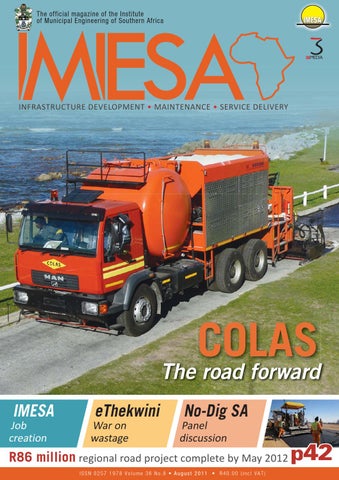
COLAS The road forward IMESA Job creation
eThekwini War on wastage
No-Dig SA Panel discussion
42
R86 million regional road project complete by May 2012 p ISSN 0257 1978 Volume 36 No.8 • August 2011 • R40.00 (incl VAT)
WE ARE CHANGING ...
NEW GOALS. NEW BRAND. SAME COMMITMENT. Our name has been synonymous with quality, innovation and delivery over our first 50 years. We are now promoting our collective group capabilities to enhance the services we offer to our growing global client base. Our rebrand brings together our evolving businesses with the same commitment, whilst our difference remains our diversity and our people. We continue to think out of the box and explore the unexplored to achieve our vision of providing innovative solutions globally.
Email: info@boschholdings.co.za www.boschholdings.co.za
Contents
VOLUME 36 NO 8 AUGUST 2011
25 42 56 78 Traffic congestion
The official magazine of the Institute of Municipal Engineering of Southern Africa
Road upgrade
IMESA
MEDIA
Government perspective 17 Transport infrastructure vital to development
Industry perspective
INFRASTRUCTURE DEVELOPMENT • MAINTENANCE • SERVICE DELIVERY
20 Consultants assist government 22 CESA’s SCE trains IMESA members
SANRAL 25 Is traffic congestion permanent? 33 Municipal road maintenance in South Africa
COLAS
The road forward IMESA
eThekwini
Job creation
War on wastage
No-Dig SA Panel discussion
42
R86 million regional road project complete by May 2012 p
42 Regional road upgrade
IMESA 9 IMESA’s role in job creation 13 IMESA coffee table book to be launched
70 The power of social marketing
Panel discussion: No-Dig SA 75 78 81 84 88
A change in attitude Overcoming misconceptions Steady increase in awarded projects Asset management drives growth Environmental aspects of trenchless technologies
95 Health and safety from every angle 97 Advanced technique assists production
Industry news
eThekwini
6 Defy the ageing process
Solid waste
Safety in construction
3 President’s comment 5 Editor’s comment
Cover story
68 SA’s busiest port upgraded 69 Keeping the pressure under control
45 Event listings and staff appointments
Regulars
Cold microsurfacing is a very cost effective solution to restore wearing course rugosity, waterproof properties and uniform appearance with minimum disruption to traffic and inconvenience to road users
Trenchless technology
People and events 49 51 52 53 54 55 55
ISSN 0257 1978 Volume 36 No.8 • August 2011 • R40.00 (incl VAT)
Blackburn B lackburn Bridge
56 61 63 65 66 67
IDC funding approvals Secure water for Mandeni Super-construction company formed World’s largest airport designed Fly ash silo constructed Adaptation programmes Cost cutting affects quality
Providing access, ensuring safety Substation upgrades Lighten up on water wastage Basic services boost living conditions Phase II of Western Aqueduct awarded Water tower for Shongweni
Road construction 99 Pothole-free concrete roads 100 Attachments for loaders and skid steers
101 Torque converter for loaders 102 KZN’s roads upgraded 103 N5 rehabilitation 105 Long-term affordability
Products and services 106 Road equipment showcase 107 Vehicle restraint system available 108 Essential armour plating for CPA disputes
109 Fleet expansion 111 Water cannon for equipment cleaning IMIESA AUGUST 2011 - 1
The Sustainable Water Resource Conference and Exhibition 2011 will serve as a platform for international thought leaders to interact and engage with leading national experts to present, debate and apply global thoughts and trends to the local environment in South Africa. The Conference follows the success of the inaugural Sustainable Water Resource Conference and Exhibition in 2010 which provided delegates with presentations from the leading industry speakers from South Africa, UK and Canada. With floods causing havoc in several South African provinces earlier this year, it may be hard to believe that the looming water crisis that was debated in Parliament in 2008 remains an issue. Engineering Council of SA vicepresident Thoko Majozi warns: “the maximum consumption that SA’s water resources can sustain will be reached in about five years”. This should sound an alarm for companies and individuals that have not yet established comprehensive water strategies. Good water management is crucial for South Africa’s growth and development. Government, municipalities and private companies need to start working together on infrastructure now.
Who should attend: r Municipal managers r Water utilities managers and operators r Water supply organisations r Water research institutions r NGO’s r Tertiary education stakeholders and students r Water flow and management product manufacturers r Water infrastructure suppliers r Technology researchers and manufacturers r Property owners and building managers r Investors and financiers r Engineers and consultants r Architects and town planners r Mining Houses
“Let’s concentrate on the causes of water shortages - mismanagement instead of wasting resources lamenting the effects of mismanagement.” David Zetland Join leading water sector decision makers and relevant industry players at the Sustainable Water Resource Conference and Exhibition as solutions to the water challenge are debated and sought. Profile your solutions, products and services at the Sustainable Water Resource Exhibition adjacent to the conference.
Contact sales@alive2green.com or call 021 447 4733
COMMENT PRESIDENT'S COMMENT
PUBLISHER Elizabeth Shorten EDITOR Richard Jansen van Vuuren CREATIVE CHIEF EXECUTIVE Frédérick Danton SENIOR DESIGNER Hayley Moore Mendelow SUB-EDITOR Danielle Hugo CONTRIBUTORS Clive Andersen, Sibusiso Ndebele, Brenda Lacey-Smith, Andile Gqaji, S Tetely, JP Maree, S Schroeder, Jan Venter, Roger Byrne, Andrew Mather, Candice Landie, HR Tyrrell, Vittorio Bollo PRODUCTION MANAGER Antois-Leigh Botma PRODUCTION COORDINATOR Jaqueline Modise FINANCIAL MANAGER Andrew Lobban (ACIS, FCIBM) ADMINISTRATION Tonya Hebenton DISTRIBUTION MANAGER Nomsa Masina DISTRIBUTION COORDINATOR Asha Pursotham SUBSCRIPTION SALES Nomsa Masina PRINTERS United Litho Johannesburg +27 (0)11 402 0571 ___________________________________________________
Sustainable job creation?
I
t gives me great pleasure to write this president’s comment, from the new head office, where we recently hosted our quarterly IMESA EXCO meeting, another first for these beautiful premises. The focus of my president’s comment this month is on job creation, and specifically how IMESA can play a significant role. See our technical director, Clive Andersen’s, article on page 9 of this edition. Historically, countries around the world, like Canada, China and Germany, have adopted job creation projects in order to assist out-ofwork citizens obtain gainful employment. One has only to think of the United States during the Great Depression. The government of the day, as part of its New Deal policy, created thousands of jobs through projects like the building of the Hoover Dam. The South African government has consistently budgeted millions of rands towards job creation in its annual budget, through initiatives such as the Expanded Public Works Programme (EPWP); however the potential associated with creating sustainable employment through the ongoing maintenance of infrastructure assets has been largely neglected. In this year’s budget speech, unlike in previous years where significant attention and resources were given to infrastructure, finance minister Pravin Gordhan announced the details of several initiatives and proposals to boost job creation in South Africa, including a R9 billion job fund and spending on skills development. In a recent article in the Financial Mail (Thursday, 26 May 2011), entitled ‘Jobs for Life’, the author makes the salient remark that ‘a healthy economy and the quality of daily life of every person are dependent on engineering infrastructure. The reservoirs, pipes, treatment works, bridges, roads, rail, harbours and electricity distribution networks must be maintained… Investing in inframa structure mainst tenance would te
ADVERTISING SALES Jenny Miller Tel: +27 (0)11 467 6223 ___________________________________________________
PUBLISHER: MEDIA No. 4, 5th Avenue, Rivonia 2056 PO Box 92026, Norwood 2117 Tel: +27 (0)11 233 2600 Fax: +27 (0)11 234 7274/5 E-mail: richard@3smedia.co.za www.3smedia.co.za ANNUAL SUBSCRIPTION: R440.00 (INCL VAT) ISSN 0257 1978 IMIESA, Inst.MUNIC. ENG. S. AFR. © Copyright 2011. All rights reserved. ___________________________________________________ IMESA CONTACTS IMESA Administration Officer: Ingrid Botton P O Box 2190, Westville, 3630 Tel: +27 (0)31 266 3263 Fax: +27 (0)31 266 5094 Email: imesa@webstorm.co.za Website: www.imesa.org.za BORDER BRANCH Secretary: Melanie Matroos Tel: +27 (0)43 705 2401 Fax: +27 (0)43 743 5266 E-mail: melaniem@buffalocity.gov.za EAST CAPE BRANCH Elsabé Koen Tel: +27 (0)41 505 8005 Fax: +27 (0)41 581 2300 E-mail: elsabek@africoast.com KWAZULU-NATAL BRANCH Secretary: Rita Zaayman Tel: +27(0)31 311 6382 NORTHERN PROVINCE BRANCH Secretary: Cornel Taljaard Tel: +27 (0)82 899 8341 Fax: +27 (0)11 675 1324 E-mail: cornel@rchc.co.za SOUTHERN CAPE KAROO BRANCH Secretary: Henrietta Oliver Tel: +27(0)79 390 7536 Fax: 086 536 3725 E-mail: imesa.southcape@gmail.com WESTERN CAPE BRANCH Secretary: Erica van Jaarsveld Tel: +27 (0)21 938 8455 Fax: +27 (0)21 938 8457 E-mail: erica.van_jaarsveld@capetown.gov.za FREE STATE AND NORTHERN CAPE BRANCH Secretary: Wilma Van Der Walt Tel: +27(0)83 457 4362 Fax: 086 628 0468 E-mail: imesa.fsnc@gmail.com REST OF SOUTHERN AFRICA Representative: Andre Muller E-mail: imesa@webstorm.co.za
All material herein IMIESA is copyright protected and may not be reproduced either in whole or in part without the prior written permission of the publisher. The views of contributors do not necessarily reflect those of the Institute of Municipal Engineering of Southern Africa or the publishers.
The official magazine of the Institute of Municipal Engineering of Southern Africa
Instit ute Africa ern zine of the al maga eerin g of South The offici cipal Engin of Muni
IMESA
MEDIA
INFR ASTR
UCT URE
DEV ELO
• MAI NTE PME NT
NAN CE
• SERV ICE
DEL IVER
Y
Jannie Pietersen, president of IMESA
create thousands of jobs and save money’. Roger Byrne and I delivered a presentation to LGSETA and National Treasury last year, where we shared our vision for a National Infrastructure Asset Management Programme that includes planned, routine and emergency maintenance. Virtually no planned maintenance is undertaken in South African municipalities. The status quo is typified by a reactive, ‘firefighting’ mentality, which is costly in terms of financial and human resources. A common refrain is: ‘We don’t have the staff or resources to change things’. We need to change our stance, however, and work together to find a proactive, innovative solution that could solve two major national problems, namely poor infrastructure asset management and maintenance and large-scale unemployment. A large pool of people exists from which municipalities could draw, for example people who run micro-enterprises or SMMEs, or unemployed people who live in townships within, or adjacent to, the municipal area in question. The training of these individuals in skills contributing to effective infrastructure asset maintenance could be undertaken by
INFRASTRUCTURE DEVELOPMENT • MAINTENANCE • SERVICE DELIVERY
Cover opportunity ORLD BARLOW ENT EQUIPM rley
A
DW together Working An oth er
imer CAT recla ds ea spearh ade gr road up
IMESA
COLAS
The road forward eThekwini
No-Dig SA
Kimbeupgrade Job War on Panel WWTW wastage discussion t ortcreation por li tra nsp pub lic R86 million regional road project complete by May 2012 inte gra ted 7 • J u l y 2 0 1 1 • .
lin k for
me 78 Volu 257 19 ISSN 0
36 No
p49
p42
In each issue, IMIESA offers advertisers the opportunity to get to the front of the line by placing a company, product or service on the front cover of the journal. Buying this position will afford the advertiser the cover story on pages 4 and 5 and maximum exposure. For more information on cover bookings contact Jenny Miller on tel: +27 (0)11 467 6223.
ISSN 0257 1978 Volume 36 No.8 • August 2011 • R40.00 (incl VAT)
IMIESA AUGUST 2011 - 3
COMMENT
From page 3
larger organisations within the municipal area. Individuals showing promise and a good work ethic could be guaranteed work (e.g. for a period of two years) while asset maintenance training programmes are being developed. The proposed solution thus provides the unemployed with a bona fide professional or trade course path. Simultaneously, it provides a source of future employees for larger authorities and organisations in the municipal area. Those who have been trained should be deployed in their communities to
mentor and supervise unskilled workers, thus broadening the base of employable people for the future. Last, but not least, it is important to mention the social benefits of a National Infrastructure Asset Management Programme. Workers would no longer be forced through economic hardship to perpetuate the destructive cycle of migrant labour, moving away from their families to seek employment in large cities. The social ills of such a system are well documented. Instead, workers would be able to
find meaningful work in their own community, for example in the neglected area of township maintenance. The social benefits are potentially as great as the practical benefits. Families would be able to stay together and communities would be empowered to uplift themselves. The promoting of a National Infrastructure Asset Management Programme is therefore a worthy endeavour for IMESA, and I would like to encourage all IMESA members to become involved.
EDITOR'S COMMENT
Infrastructure commission: more red tape An additional layer of political management, intended to help and improve the performance of State, was announced at the end of July.
T
WO NEW STRUCTURES are to be established, an infrastructure commission, chaired by the president of the country, and a job creation commission to be chaired by the deputy president. An air of uncertainty surrounds these developments as it has not been made clear how these new commissions will operate and, more importantly, no mention has been made of whether the new structure will replace or complement existing structures. To what extent will this widen the chasm between the public and private sectors? Another question that needs to be asked is: does the announcement of the infrastructure commission serve as the official death knell of the Municipal Systems Amendment Bill and, along with it, the path of good intent in terms of streamlining the process of infrastructure construction? The Gautrain route between Johannesburg and Pretoria has held sway in news headlines of late following a statement by Bombela revealing that the water seepage disruption is being caused by pipes carrying municipal
water. The water seepage is delaying the southern-most section of the line but the amount of water affecting operations is negligible. The train tunnel has been designed to accommodate ground-water permeating its purpose-built drainage system to relieve the
costs. Holes will be drilled into the floor of the affected tunnel, through which grout will be injected into the rock below to lessen the permeability of the rock and the volume of water ingress.
Does the announcement of the infrastructure commission serve as the official death knell of the Municipal Systems Amendment Bill? pressure of water that may exist or arise in the area. This water is collected in drains beneath the tracks which lead to underground sumps from where the water is pumped to the surface. Bombela will be dealing with the issue of water ingress, which will require additional engineering and involve additional associated
Richard Jansen van Vuuren, editor of IMIESA
IMIESA AUGUST 2011 - 5
COVER STORY
Defy the ageing process Colmat, a cold microsurfacing paving system, is the most economically viable facelift the road industry needs. But what is driving the demand for cold microsurfacing?
C
urrent budget restrictions now make it imperative to keep pavements watertight and operational without major reconstruction for as long as possible. Cold microsurfacing is ready to use within one hour, which makes it a very costeffective solution to restore wearing course rugosity, waterproof properties and uniform appearance with minimum disruption to traffic and inconvenience to road users. When compared to other surfacing types, microsurfacings have further advantages in that they are more environmentally friendly. These include: • Low tyre noise of the final surfacing. • No harmful emissions during application and curing. The Colmat system from COLAS offers the ultimate road-sealing solution in a complete package using Colas leading-edge technical expertise, extensive experience and support during application, and total control of the entire procurement process. As your partner throughout the process, Colas assists with aggregate selection,
6 - IMIESA AUGUST 2011
product mix design and will provide the required specialised equipment and personnel. Colas’ technical back-up and support dramatically reduces your risk and creates added confidence – especially in the application process. The Colmat system is the most cost-effective, safe and convenient remedial solution as: • Road surfaces can be sealed, cured and reopened to traffic in just one hour – under a wider range of weather conditions vis-avis conventional slurry and chip seals. • The profile and skid resistance of existing roads can be improved by the single application of a thin layer and by the filling of surface irregularities, such as wheel ruts. • Worker and pedestrian health and safety is assured during and after application, due to Colmat’s environmentally and user-friendly RIGHT Between January and April 2011 Colas placed in the region of 1 335 m3 of Colmat L microsurfacing (95 000 m2 at an average thickness of 9 mm) BELOW Colmat L has been used in Mogale City since 1994
cold mixing and laying process, and our new improved application machinery. • The Colmat process guarantees minimal disruption to traffic prior to Colmat application as there is no need for lifting of curbs and manholes and no tack-coat required. • The Colmat system is complete in itself, with no additional on-site construction plant required. • The Colmat system has four variations (Colmat N, Colmat L, Colrut and Colpave) that can be used for different applications.
COVER STORY
By definition, Colmat is a cold microsurfacing system that seals aged, damaged road surfaces; a cationic quickset bitumen emulsion mixed with selected crushed mineral aggregate, cement and water and applied with a new, improved purpose-designed machine system supplied by Colas. Colmat can be further improved by the addition of: • modifiers • fibres The material components of Colmat consist of: • Continuously graded selected crusher dust. • Quickset cationic elastomer – modified bitumen emulsion. • Water – to adjust workability . • Chemical additives – to control product breaking rate. • Cement – used as a setting agent, or to adjust grading curve. Colmat prevents the ingress of water into the underlying layers of road by filling in cracks and voids of the existing surface and also improves durability by preventing further oxidation of aged binder in the existing surface. The Colmat product range • COLMAT N – Colmat normal quickset microsurfacing without polymer. Uses: Existing surfaces carrying medium
ABOVE Colmat prevents the ingress of water into the underlying layers of road by filling in cracks and voids of existing surface
levels of traffic, and where traffic accommodation can be a problem for conventional slurry. Overlay – Urban streets and provincial roads and existing blacktop surfaces or concrete pavements in single pass from 5 to 20mm. • COLMAT L – Colmat quickset microsurfacing modified with polymer. Uses: Existing surfaces carrying a wide range of traffic. Overlay – Existing blacktop surfaces or concrete pavements in single pass from 5 to 20mm.
• COLRUT – Coarse-graded quickset microsurfacing modified with polymer. Rut filling: Filling ruts > 20 to < 50 mm to restore road profile i.e. re-profiling. Colrut is a cost-effective remedial solution for improving road safety by restoring road profile and skid resistance. • COLPAVE – Medium-set Microsurfacing modified with polymer. Medium setting polymer modified coarse slurr y ideal for: mixing in a concrete mixer and applying by hand; re-sealing small areas such as sidewalks and car parks.
For further information on Colmat, telephone Kobus Louw or Premala Singh on tel: +27 (0)21 531 6406. IMIESA offers advertisers an ideal platform to ensure maximum exposure of their brand. Companies are afforded the opportunity of publishing a two-page cover story and a cover picture to promote their products to an appropriate audience. Please call Jenny Miller on +27(0)11 467 6223 to secure your booking.
IMIESA IM IMI MIIES M ES ESA SA A AU A AUGUST UGU GU GUS UST 22011 011 - 7 011
ABS Afri-Infra AJ Broom Arup SA Aurecon Bigen Group Africa BKS Consulting Engineers Bosch Stemele Bosch Munitech BVI Consulting Engineers CBI Consulting Engineers Civil & Blasting Solutions Concrete Manufacturers CSIR Built Environment Davies Lynn & Partners Development Bank of SA DPI Plastics EFG Engineers Elster Kent Metering EnviroServ Waste Management Geotechnologies GLS Consulting Goba Hidrostal SA Huber Technology Hydro-comp Enterprises I@Consulting Iliso Consulting Infraset Jeffares and Green
hennie.basson@absgroup.com afri-infra@mweb.co.za ajbroom@icon.co.za rob.lamb@arup.com Ian.VanWijk@af.aurecongroup.com kevin.barnett@bigenafrica.com siyandan@bks.co.za bsdbn@boschstemele.co.za info@boschmunitech.co.za cask@bvigp.co.za durban@cbisa.co.za jane@drillingandblasting.co.za cma@mweb.co.za LAustin@csir.co.za dlpdbn@dlp.co.za divb@dbsa.org.za mgoodchild@dpiplastics.co.za eric@efgeng.co.za keith.bailey@za.elster.com benoitl@millenniumwaste.co.za garry@geotechnologies.co.za nicky@gls.co.za trumang@goba.co.za hstal@mweb.co.za fstammer@lantic.net dan@edams.co.za louis_icon@mics.co.za monde@iliso.com fmyburgh@infraset.com dennyc@jgi.co.za
Johannesburg Water Kgatelopele Consulting Knowledge Base KV3 Engineers Lektratek Water Makhaotse Narasimulu & Associates Maragela Consulting Engineers Much Asphalt Nyeleti Consulting Odour Engineering Systems Power Construction Pragma Africa Rocla SBS Water Systems Sektor Consulting Sight Lines Pipe Survery Services SNA Inc Siza Water Company SRK Consulting SSI Syntell Thm Engineers East London TPA Consulting UWP Consulting Vela VKE WSP Group Africa WSSA WRP Zebra Surfacing
rtaljaard@jwater.co.za kgatelopele@wol.co.za info@knowbase.co.za cbrandsen@kv3.co.za general@lwt.co.za mmakhaotse@mna-sa.co.za admin@maragelaconsulting.co.za john.onraet@murrob.com ppienaar@nyeleti.co.za mathewc@oes.co.za nbarnard@powergrp.co.za deang@pragma.co.za karen.devos@murrob.co.za irene@sbsgroup.co.za cradock@sektor.co.za sales@sightlines.co.za snapta@icon.co.za tionette.bates@sizawater.co.za jomar@srk.co.za francisg@ssi.co.za julia@syntell.co.za thmel@mweb.co.za roger@tpa.co.za zulchl@uwp.co.za capetown@velavke.co.za dirk.hattingh@mbs-wsp.co.za nbinase@wssa.co.za ronniem@wrp.co.za andrew@zebrasurfacing.co.za
IMESA
Job creation…our role “Unemployment is arguably the most important and vexing problem facing the South African economy and its governance.” By Clive Andersen, IMESA technical director: Job Creation
W
hen infrastructure service delivery is the key focus of our already stretched municipal engineers trying to manage budgets, quality, resources and timelines; the resultant job creation and poverty alleviation impacts are all too often referred to as ‘soft issues’ and, in fact, in some cases only measured or considered on project completion. However, unemployment is arguably the most important and vexing problem facing the South African economy and its governance - it is the prime cause of the deepening poverty that has characterised the postapartheid era in South Africa. Statistics in figure 1 show that unemployment has doubled since 1995. In his inaugural State of the Nation Address in June 2009, President Jacob Zuma stated: “It is my pleasure and honour to highlight the key elements of our programme of action. The creation of decent work will be at the centre of our economic policies and will influence our investment attraction and job creation initiatives. In line with our undertakings, we have to forge ahead to promote a more inclusive economy.” In light of the above, and given the large body of literature and empirical research on South Africa’s unemployment crisis and the resultant New Growth Path strategy, we, as municipal engineers, need to ask ourselves what role we should play in the implementation of the New Growth Path drivers? The government’s New Growth Path Strategy, announced in December 2010, aims to create five million jobs by 2020 and bring the unemployment rate down to 15%. In summary, the key focus areas, or ‘jobs drivers’, of the strategy include the following: 1. Substantial public investment in infrastructure to create employment in construction, operation and maintenance, as well as the production of inputs, by improving efficiency across the economy. 2. Targeting more labour-absorbing activities across the main economic sectors
– the agricultural and mining value chains, manufacturing and services. 3. Taking advantage of new opportunities in the knowledge and green economies. 4. Leveraging social capital in the social economy and the public services. 5. Fostering rural development and regional integration. Clearly, as municipal engineers we have a direct role to play in driver #1, infrastructure investment: especially in terms of construction and rehabilitation, operations, expanded maintenance and the manufacture and supply of components. One of the clear deliverables of the New Growth Path Strategy is to expand and increase employment intensities within each value chain.
At a previous IMESA EXCO meeting, a broad outline of a job creation framework was presented, with outcomes that specifically focus on how, as municipal engineers, we can increase the employment intensity rate of the infrastructure value chain within the municipal engineering environment. Just to touch on a few of the outcomes so as to highlight the job creation potential that exists: NQF 5 & 7 labour intensive construction training: Currently, LGSETA together with the National Department of Public Works and IMESA, are coordinating the training of approximately 350 municipal officials, the
FIGURE 1
FIGURE 2
IMIESA AUGUST 2011 - 9
IMESA outcome of which is to support the design and implementation of labour intensive construction within the municipal engineering environment. In fact, thousands of officials have been trained in NQF 5 & 7 since 2005; however one must ask, has this training been adequately articulated in the design and implementation of infrastructure at provincial and municipal level? As municipal engineering officials it is incumbent upon us to ensure that we maximise the benefit of this training and identify projects that can be designed and implemented using the LIC principles where technically appropriate. In addition to the above programme, IMESA will be conducting a sur vey to iden-
order to ensure participation in the grant. The funds are over and above existing capital budgets and are suitable for employment intensive programmes such as the provision of interim ser vices to informal settlements, community-based livelihood maintenance programmes, hostel maintenance, grass cutting, channel maintenance, etc. Contractor development: (the eThekwini case) In KwaZulu-Natal alone, there are 21 000 registered contractors at CIDB level 1 and less than 1 000 contractors registered at CIDB level 2. These statistics highlight the over-saturation and capacity
As municipal engineering officials it is incumbent upon us to ensure that we maximise the benefit of this training tify those consulting engineering companies who are accredited in NQF 5 & 7 so as establish available consulting engineering capacity for the programme at large and this will be made available on the IMESA website in due course. It is interesting to note that, as a result of this joint partnership project with LGSETA, IMESA has been requested to provide all CPD certificates for registered professionals attending the training. Maximise the Expanded Public Works Programme: To successfully implement the EPWP programme within the municipal sphere, it is essential that there is an approved EPWP policy in place that integrates and coordinates all sectors using well constituted institutional arrangements, a policy that drives a robust multi-year implementation strategy that interrogates both capital and operating budgets for opportunities. IMESA, through the shared knowledge platform (website), will be in a position to provide members with standardised methodologies, best practice examples, policies and documentation, e.g. EPWP compliant tender documentation and supply chain management BID committee EPWP evaluation criteria, etc. Eligible municipalities need to maximise the benefit of the EPWP2 Incentive Grant. In the first instance, ever y available job opportunity needs to be reported on in
10 - IMIESA AUGUST 2011
constraints of ‘contractors’at the lower levels, which further amplifies the sustainability challenge that faces the South African construction industr y. In eThekwini Municipality, as a result of continued quality issues with emerging contractors, a decision was taken by the deputy city manager to formalise a Contractor Development Programme (CDP) to develop existing contractors on the city’s procurement database. The CDP programme includes a fully resourced training centre funded through the EPWP incentive grant and programmes include the Department of Public Works’ Vuk’uphile NQF 4 learnership programme and various other NQF level 2 construction skills programmes, etc. In addition to classroom training, learner contractors are provided with on-site mentorship on a range of projects from atypical municipal infrastructure to agriculture-related infrastructure like ferro-cement rainwater har vesting tanks, rural aquaculture ponds/irrigation reser voirs,
rural access roads, water and sanitation and bio-digesters, etc. This will ultimately support the implementation of the city’s integrated agricultural programme (R75 million) over the next three years which in itself will generate a huge number of sustainable jobs. What this model does do is perhaps illustrate the need to have an integrated EPWP policy and implementation strategy to ensure the maximum utilisation of available resources by diverting them into other more sustainable sectors. Quality living environment: (the eThekwini case) Urban and peri-urban settlements are a reality of most municipalities. In eThekwini Municipality alone, there are over 400 informal settlements, most of which are located on land which is both unsuitable and costly to develop. Even with a robust eThekwini housing programme, not all settlements can be provided with fully ser viced low income in-situ housing in the short term. As we are all too aware, informal settlements face a range of basic challenges, which include health and safety, lack of access to basic ser vices and the perpetuation of poverty. eThekwini is therefore in the process of establishing a pro-active and broad based programme aimed at providing a range of basic interim ser vices to 166 prioritised informal settlements within the municipality with a view to addressing a range of basic health and safety issues. These prioritised settlements are those which are on the municipality’s medium- to long-term in-situ housing programme. The use of local contractors and labour is a key social and job creation deliverable of the programme, together with sustainable skills development and mentorship. The programme provides a basket of services which include: Communal ablution blocks: Basic water and sanitation is provided by means of conver ted containers which are plumbed into the water and sewer mains. One block provides ser vices for ever y 75 households and consists of a separate unit for men and women. Each unit includes toilets, showers and hand-basins with solar powered lighting. A local caretaker is responsible for routine maintenance of the units, which will eventually result in over 600 sustainable jobs. In addition to the
IMESA community blocks, 200 m radius standpipes will be provided. Basic road network and footpaths: Prioritised primar y and secondar y access roads and associated storm water controls will be provided. These consist of main transpor tation routes, as well as some smaller access ways and pedestrian footpaths, also necessar y to provide effective fire protection and other essential health and safety ser vices. This infrastructure clearly offers substantial employment potential during project construction phase. Sustainable livelihoods: A process of par ticipative livelihood engagement is being planned. The sustainable livelihood approach strives to develop community responsibility, self-help and reduced dependency and will facilitate a better relationship between the urban poor and the municipality. Practical empowerment plans are also being developed, together with local residents, which will enable them to play a
more effective role in a range of local social needs like home based care, crèche minders, local micro-enterprise and food security gardens. Appropriate training, suppor t and mentorship will be provided. The programme will also identify oppor tunities for ongoing community based maintenance programmes that will be funded with EPWP stipends. The success of the IMESA job creation framework strategy is dependent on the suppor t and par ticipation of each IMESA member and the full job creation document will be published on the IMESA website within the next few months. The intention of this ar ticle is to encourage IMESA members to share similar examples of catalytic projects or programmes that promote job creation within the municipal engineering environment so that these can be included in the framework and posted on the IMESA website. Please for ward submissions to andersenc@durban.gov.za IMIESA AUGUST 2011 - 11
Since its inception at the beginning of July, the new IMIESA weekly e-newsletter is proving to be hugely popular, with a total of 5 640 subscribers already receiving their copy directly every week.
Su ubsscribe now to the weekly IMIESA e-new wsleĆŠer or the most up-to-daate news in the indu ustry! fo To subscribe e-mail unity@3smedia.co.za | Send your press releases & event information to richard@3smedia.co.za
To advertise on the e-newsletter contact Tania Milic T:+27 (0)12 331 5168 | C: +27 (0)82 829 9285 | E-m: tania@dfcom.co.za
MEDIA
IMESA
IMESA coffee table book to be launched The 75th annual IMESA Conference takes place at the Birchwood Hotel and OR Tambo Conference Centre from 26 to 28 October. IMESA will also celebrate its 50th jubilee during this time.
I
MESA is committed to making these celebrations the most memorable events for years to come. A special coffee table book is being produced, documenting the history and progress of municipal engineering in South Africa, with special emphasis on IMESA. The content for the book was researched and compiled by Professor Johan Haarhof. Limited numbers of these books will be printed, numbered and available in hard cover. The first 100 numbered hard cover copies have been reserved as commemorative presentation copies. A further 100 numbered hard cover copies are available for pre-sale and will have names listed in the book. IMESA is printing a quality paperback version of the book that can be pre-ordered or purchased during the conference. An official launch of the book will take place at the conference and will be supported by an overview presentation by Professor Haarhof. The industry has put its full weight behind the conference and celebrations, with various sponsorships and an estimated 120 exhibition stands already sold. Registrations are proceeding actively and attendance is expected to reach between 800 and 1 000 delegates. The conference programme promises to deliver an exciting and value-added experience and all papers will be focused on the core theme of ‘Yesterday, Today and Tomorrow – Engineering of the Past into the Future’. Focus areas include: transportation and traffic engineering, sanitation, storm water management, roads, water engineering, environmental engineering and financial aspects of providing services. When asked about the quality of abstracts received by the conference programme committee, Nico van den Berg of the South African Institution of Civil Engineering comments, “Each year the content quality exceeds past
submissions and this year is no exception. We were very pleased with the effort put into all abstracts. This has in turn made it difficult to choose, but we believe we have delivered on our mandate and are confident that all delegates will find the programme thought provoking, entertaining and of excellent quality.” The gala event planned for the Thursday evening of the conference also follows the theme of ‘Yesterday, Today and Tomorrow’. The dress code for the evening is ‘sport’ – giving testimony to the important role that sport has played in infrastructural develop-
Per person single is R685.00 per night only, while the double rate is R950.00 per room. The Birchwood Hotel and Conference Centre was selected as the most suitable venue for the conference as it allows for the celebration of all aspects of the conference and golden jubilee in true style. The venue itself is an estate; all accommodation is on the ground floor and combines walkways and fresh air with the internal conference festivities. Golf carts are available to take guests to their rooms and there is ample relaxation, networking and conferencing space. This leaves one
A special coffee table book is being produced, documenting the history and progress of municipal engineering in South Africa ment and upliftment in our country. Our great stadia, the transport systems supporting these, and the roads and infrastructure that have been developed to host international sporting activities optimally bear strong witness to South Africa as a passionate, sporting nation. Attendees of the gala event are encouraged to don their makarapas, rugby jerseys, soccer, cricket or golf paraphernalia and celebrate this success together. IMESA conference delegates can claim 2.5 CPD points for attendance on all three days, earning one point for each day attended. Potential delegates are urged to book as quickly as possible even if payment is made a little later, as space is limited and IMESA would hate to disappoint anybody. Festivities have been planned for most evenings and IMESA therefore encourages delegates from out of town to consider staying over at the Birchwood Hotel. This will save on vehicle hire and fuel costs and allow delegates to enjoy themselves without the danger of driving to alternate accommodation. With this in mind, IMESA has negotiated special rates for delegates wishing to stay at the Birchwood.
with the sense that you can bask in the lovely warm October Johannesburg weather during the breaks, without having to walk miles. This year’s technical tour is a very special excursion. Delegates will be treated to a Gautrain return trip between Rhodesfield and Sandton. The trip will be preceded by a presentation on the ‘Yesterday, Today and Tomorrow’ of the Gautrain to provide the context for the trip. The excursion will be followed by a discussion, question and answer session at Birchwood over refreshments. For those delegates bringing companions/ spouses along to join the companion’s programme, IMESA has put together a good mix of cultural/historical sightseeing excursions as well as a visit to Montecasino for some retail therapy. “This commemorative period in IMESA’s life promises to be one that delivers fun, enjoyment and plenty of networking, as well as learning and sharing, and we are sure it will be remembered for years to come,” comments Gavin Clunnie, chairman of the conference local organising committee. “We look forward to meeting you there!”
IMIESA AUGUST 2011 - 13