The official magazine of the Institute of Municipal Engineering of Southern Africa
2012
WINNER Non-professional n professional wri writer of the year HIGHLY COMMENDED Publishing Excellence
IMESA
INFRASTRUCTURE DEVELOPMENT • MAINTENANCE • SERVICE DELIVERY
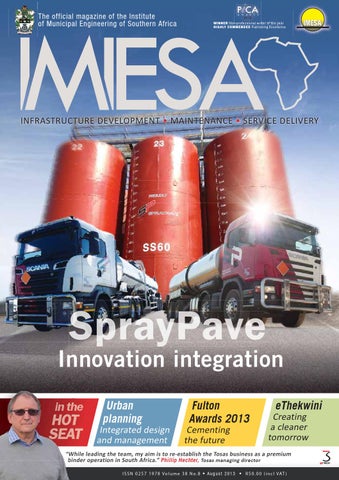
Innovation integration in th he
Urban planning Integrated design and management
Fulton Awards 2013 Cementing the future
eThekwini Creating a cleaner tomorrow
“W “While Wh leading the team, my aim is to re-establish the Tosas business as a premium binder operation in South Africa.” Phillip Hechter, Tosas managing director biin I S S N 0 2 5 7 1 9 7 8 V o l u m e 3 8 N o . 8 • A u g u s t 2 0 1 3 • R 5 0 . 0 0 ( i n c l VAT )
MEDIA
The world’s most popular water meter wins more enthusiasts
The V110 KSM incorporates all the advanced engineering attributes of its popular cousin, the PSM, plus its engineering-plastic body makes it unlikely to be stolen. Having no second hand value virtually eliminates the potential for theft. While the tough, UVstabilised, engineering-plastic body repels undesirable interest, its internal mechanism is unsurpassed for low
Elster Kent Metering (Pty) Ltd PO Box 201, Auckland Park 2006 JOHANNESBURG DURBAN CAPE TOWN BLOEMFONTEIN PORT ELIZABETH
Tel: (011) 470-4900 Tel: (031) 266-4915 Tel: (021) 511-8465/6 Tel: (051) 430-2603 Cell: 082 458-3439
Fax: (011) 474-0175 Fax: (031) 266-9521 Fax: (021) 511-8446 Fax: (051) 430-6165
and high flow accuracy in any position. Over the last six years every component in our meters has been refined and improved for greater accuracy and longevity. For the full story on our V110 KSM meter range, visit our website or call our offices. Often copied, never equaled.
Copyright Š Elster Group. All Rights Reserved. Elster and its logo, are trademarks of Elster Group. The company's policy is one of continuous improvement and the right is reserved to modify the specifications without notice www.elstermetering.co.za 8360/6/2012
Vital Connections
CONTENTS
VOLUME 38 NO 8 AUGUST 2013
72 Construction equipment
28 WWTW rehab
9
52 Fulton awards
Ser vice deliver y
The official magazine of the Institute of Municipal Engineering of Southern Africa
2012
WINNER Non-professional n professional wri writer of the year HIGHLY COMMENDED Publishing Excellence
Innovative Construction: Commendation
Water & wastewater
IMESA
INFRASTRUCTURE DEVELOPMENT • MAINTENANCE • SERVICE DELIVERY
Machine-to-machine communication
12
Integrating design, planning and management
14
Cement and concrete
eThekwini Creating a cleaner tomorrow Meeting the demands of the future Innovation integration in th he
Urban planning Integrated design and management
Fulton Awards 2013 Cementing the future
Long-term bulk water supply
eThekwini
Water cleaning technology
Creating a cleaner tomorrow
“W “While Wh leading the team my aim is to re-establish the Tosas business as a premium binder operation in South Africa.” Phillip Hechter, Tosas managing director biin
62
Concrete repair division established Setting the record straight
28
Premixes provide employment Construction industry interaction
33 35 38
MEDIA
SANRAL Incrementally launched bridge for interchange
69 72
I S S N 0 2 5 7 1 9 7 8 V o l u m e 3 8 N o . 8 • A u g u s t 2 0 1 3 • R 5 0 . 0 0 ( i n c l VAT )
Fulton Awards 2013 SprayPave forms an integral part of one of South Africa’s leading construction companies. Since its establishment over 30 years ago, it has become renowned for its dynamism as well as being an innovative and fully integrated industry leader.
Regulars 3 5
Editor’s comment President's comment
The faces behind the Fulton Awards Civil Engineering Projects: Winner Civil Engineering Projects: Commendation Building Structures: Winner Building Structures: Commendation
The complete bitumen package
6
IMESA South African challenges not isolated
9
Architectural Concrete: Winner Architectural Concrete: Commendation
54
Sustainable Concrete: Winner Sustainable Concrete: Commendation
57
Sustainable Concrete: Commendation
On the innovation path with NCRT
in th he
HO OT SE EAT
10
Innovative Construction: Commendation
Waste 74
Waste strategy introspection
Construction vehicles and equipment The building industry of tomorrow A jewel in the crown Fuel efficiency technology
55 56
Innovative Construction: Winner
Hot seat
45 49 50 52
Architectural Concrete: Commendation
Cover article
Working smarter and faster
42 44
58 59
63 65 66 68
A new partnership formed Saving time and fuel Roads are set to go ‘green’
77 79 80 82 83 85
IMESA SALGA/WRC National Benchmarking 86 Initiative Workshop
Products and services 60
Zambian roads to be upgraded
“While leading the team my aim is to re-establish the Tosas business as a premium binder operation in South Africa.” Phillip Hechter, Tosas managing director
88
10
IMIESA August 2013
1
PRE- CONFERENCE WORKSHOP ON SALGA/WRC’s NATIONAL MUNICIPAL BENCHMARKING INITIATIVE FOR WATER SERVICES
How best can you improve your operational efficiencies? How can you adopt best practice efficiency innovations by your peers? Municipal Engineers, Municipal Officials, Municipal Councillors are encouraged to contribute to a dynamic and practical workshop focusing on key municipal benchmarking learning’s and progress: improving efficiency and effectiveness through performance benchmarking, peer-to-peer operational knowledge sharing, and benefiting from municipal peer group networks
SALGA/WRC Municipal Benchmarking Initiative: for municipalities, by municipalities, to the benefit of municipalities
21 and 22 October 2013 – 08.30 to 16.30, The Boardwalk Hotel & Conference Centre, Port Elizabeth Cost per delegate: R1, 800 (incl. VAT) (2 CPD points) Registration Form and Agenda Requests: training@imesa.org.za or click the IMESA Conference Logo Enquiries: IMESA PRE-CONFERENCE: Judy Stephens @ 031 2663263 Registration closes 4 October 2013 (limited to 100 delegates) CPD Validation No.
Provider
IMESA13-C09NAT
IMESA 031 266 3263
IMESA12-S14NAT
IMESA 031 266 3263
IMESA11/L01NAT
IMESA 031 266 3263
Description 2013 IMESA Pre Conference Municipal Benchmarking Workshop The SALGA IMESA MILE MBI Water Services Master Classes 2011 IMESA Pre Conference Municipal Benchmarking Workshop
Duration
CPD Points
2 days
2
2 days
2
1 day
1
CPD Validation no. for upcoming MBI workshop; 2012 Water Services Master Classes; 2011 MBI workshop
EDITOR’S COMMENT
PUBLISHER Elizabeth Shorten EDITOR Richard Jansen van Vuuren HEAD OF DESIGN Frédérick Danton SENIOR DESIGNER Hayley Mendelow DESIGNER Kirsty Galloway CHIEF SUB-EDITOR Claire Nozaïc SUB-EDITOR Patience Gumbo CONTRIBUTORS Nicola Theunissen, Candice Landie, Frank Stevens, L Fisher-Jeffes, D Coulson, NP Armitage PRODUCTION MANAGER Antois-Leigh Botma PRODUCTION COORDINATOR Jacqueline Modise FINANCIAL MANAGER Andrew Lobban MARKETING AND ONLINE MANAGER Martin Hiller MARKETING AND EVENTS COORDINATOR Neo Sithole ADMINISTRATION Tonya Hebenton DISTRIBUTION MANAGER Nomsa Masina DISTRIBUTION COORDINATOR Asha Pursotham SUBSCRIPTIONS subs@3smedia.co.za PRINTERS United Litho Johannesburg +27 (0)11 402 0571 ___________________________________________________
Keep on trucking
I
WILL ALWAYS remember my first IMESA conference. I had been editor of IMIESA for three months and was still settling into the position. Nothing could have prepared me for the scale and intensity of the conference week. That year, the conference was held in East London and featured the IMESA Awards – as will this year’s event. In 2011, the conference was held in Johannesburg and last year George provided a unique experience: the venue of the conference was the Transnet Railway Museum! One of the reasons that I have enjoyed the conferences so much is that they are the primary events that our entire readership spectrum attends. The clients (national or local authorities), the consultants, contractors, subcontractors, suppliers and manufacturers are all there, and it is in this context where the relationship between all the individuals contributing to the greater sum is best illustrated. Looking back on 36 editions of IMIESA that I have been responsible for provides a personal timeline of interviews and project site visits for me. I can remember all of them and I’m going to miss my role as editor – partly because of an attachment you form with a magazine as an editor and partly because of the people I have had the privilege of meeting through the position. By the time you read this I will have moved on; my
ADVERTISING SALES Jenny Miller Tel: +27 (0)11 467 6223 ___________________________________________________
PUBLISHER: MEDIA No. 4, 5th Avenue, Rivonia 2056 PO Box 92026, Norwood 2117 Tel: +27 (0)11 233 2600 Fax: +27 (0)11 234 7274/5 E-mail: richard@3smedia.co.za www.3smedia.co.za ANNUAL SUBSCRIPTION: R530.00 (INCL VAT) ISSN 0257 1978 IMIESA, Inst.MUNIC. ENG. S. AFR. © Copyright 2013. All rights reserved. ___________________________________________________ IMESA CONTACTS IMESA Administration Officer: Ingrid Botton P O Box 2190, Westville, 3630 Tel: +27 (0)31 266 3263 Fax: +27 (0)31 266 5094 Email: imesa@webstorm.co.za Website: www.imesa.org.za BORDER BRANCH Secretary: Melanie Matroos Tel: +27 (0)43 705 2401 Fax: +27 (0)43 743 5266 E-mail: melaniem@buffalocity.gov.za EAST CAPE BRANCH Elsabé Koen Tel: +27 (0)41 505 8005 Fax: +27 (0)41 581 2300 E-mail: elsabek@africoast.com KWAZULU-NATAL BRANCH Secretary: Rita Zaayman Tel: +27(0)31 311 6382 NORTHERN PROVINCE BRANCH Secretary: Cornel Taljaard Tel: +27 (0)82 899 8341 Fax: +27 (0)11 675 1324 E-mail: cornel@rchc.co.za SOUTHERN CAPE KAROO BRANCH Secretary: Henrietta Oliver Tel: +27(0)79 390 7536 Fax: 086 536 3725 E-mail: imesa.southcape@gmail.com
Richard Jansen van Vuuren
adventure with IMIESA has come to an end. I trust I served you, our readers and customers, well, and that you have always looked forward to seeing what is contained in your new edition as soon as it arrives! From the September edition onwards, Nicholas McDiarmid will be the editor of IMIESA. His name may sound familiar as he is, in fact, a former editor of the magazine (2004 to 2005). In addition, Nicholas has 10 years of business-to-business publishing experience as editor, publisher, manager, writer and researcher, so I’m certain he is eager to get cracking on the magazine. On a side note, there is a detailed programme for the SALGA/WRC and IMESA Municipal Benchmarking Initiative Pre-Conference Workshop on pages 86 and 87 of this edition. Should you wish to attend this, please refer to the advertisement on the adjacent page.
WESTERN CAPE BRANCH Secretary: Erica van Jaarsveld Tel: +27 (0)21 938 8455 Fax: +27 (0)21 938 8457 E-mail: erica.van_jaarsveld@capetown.gov.za FREE STATE AND NORTHERN CAPE BRANCH Secretary: Wilma Van Der Walt Tel: +27(0)83 457 4362 Fax: 086 628 0468 E-mail: imesa.fsnc@gmail.com REST OF SOUTHERN AFRICA Representative: Andre Muller E-mail: imesa@webstorm.co.za
All material herein IMIESA is copyright protected and may not be reproduced either in whole or in part without the prior written permission of the publisher. The views of contributors do not necessarily reflect those of the Institute of Municipal Engineering of Southern Africa or the publishers.
To our avid readers, check out what we are talking about on our website, Facebook page or follow me on Twitter and have your say. The official magazine of the Institute of Municipal Engineering of Southern Africa
earr 2012 year he yea the off th writer o encce elle xce ssional Excellence Exc ofessiona blishingg Non-profe Publishing WINNERCOMMENDED HIGHLY
Instit ute Africa ern zine of the al maga eerin g of South The offici cipal Engin of Muni
2012
WINNER Non-professional n professional writer wri of the year HIGHLY COMMENDED Publishing Excellence
IMESA
IMESA
@infrastructure4
Infrastructure News
INFRASTRUCTURE DEVELOPMENT • MAINTENANCE • SERVICE DELIVERY
INFR AST
RUC TUR
E DEV ELO
PME NT
• MAI NTE
NAN CE
ERYY VER I VE DEE LIIVER D I CEE DEL ICE V VICE VIC RVIC R RV ERV EER SERV • SSE
Cover opportunity
In each issue, IMIESA offers advertisers the opportunity to get to the front of the line by placing a company, product or service on the front cover of the journal. Buying this position will afford the advertiser the cover story and maximum exposure. For more information on cover bookings contact Jenny Miller on tel: +27 (0)11 467 6223.
Innovation integration
s Urban nverrsssiiioonin tBufhhefalo planning City EMS co Infrfraaastrsttruuctu re cture he in tth
er
Wat l Water Nationa ResourceII Strategy
on biilllion R1.22 billi M BM for NMB on tio uction truc consstru
Ma M tt MacDo ottt ott o ing servic M Mo on build director off Mott 3 ourselves , managing uly 201 o.7 • J ey Naidoo “We pride e 38 N Vo l u m lives.” Demps 7 1978 25 ISSN 0
Integrated design and management Gonubie
Fulton Awards 2013 Cementing the future
eThekwini Creating a cleaner tomorrow
“W “While Wh dleading the team my aim is to re-establish the Tosas business as a premium Roa bi in binder operation in South Africa.” Phillip Hechter, Tosas managing director
upgrade
bette le tto bet p lee peop ble abl abl nab n DNA PD P haatt eenab that a d PDNA ess tth nald nald nal onal o Don Do D ccDo aacD .00 • R50
r theirr
MEDIA
I S S N 0 2 5 7 1 9 7 8 V o l u m e 3 8 N o . 8 • A u g u s t 2 0 1 3 • R 5 0 . 0 0 ( i n c l VAT ) MEDIA
V ) ( i n c l VAT
IMIESA August 2013
3
2013
IMESA CONFERENCE
nelson mandela bay PORT ELIZABETH
23 - 25 OCTOBER 2013 Theme: Municipal Engineering – Meeting Peoples’ Needs EARN 2.5 CPD POINTS BY ATTENDING
N! E P O W O N S G N I K sa.org.za O O B E N e I ONL w w w. i m
The 2013 IMESA Conference will be hosted at the brand new Boardwalk Hotel & Conference Centre on the beautiful Port Elizabeth beach front. A variety of exciting technical tours are being arranged to SA Breweries, Koega Harbour, VW Factory and Van Staden’s Wind Farm.
Register & pay BEFORE 31 July 2013 - Early Bird for IMESA members @ R4500 - Early Bird for Non-IMESA members @ R4750 Register & pay BEFORE 30 AUGUST 2013 - Late Registration IMESA members @ R4750 - Late Registration Non-IMESA members @ R5000 Register & pay AFTER 30 AUGUST 2013 - Last Minute Reg IMESA Members @ R5000 - Last Minute Reg Non-IMESA Members @ R5500
For information: Tel: 031 2663263 Email: conference@imesa.org.za
PRESIDENT’S COMMENT
ECSA REGISTRATION
The importance for municipal engineers The Engineering Council of South Africa (ECSA) has recently introduced a new registration process for engineers, technologists and technicians, which will be outcomes based with 11 clearly defined competencies.
T
HE VALUE AND importance of registration is recognised and welldocumented at various levels of government – in his Budget Speech earlier this year, Minister Pravin Gordhan mentioned the need to “professionalise the public ser vice”. In a recent article that appeared in Business Day, CEO of the South African Local Government Association (SALGA), Xolile George, stated that the loss of rare and needed skills poses a huge challenge to local government, and Mpho Nawa, the deputy chairman of SALGA, pointed out that one of that body’s recent resolutions was to professionalise the sector. I was given the opportunity to contribute to the same article on behalf of IMESA and commented as follows: “… Local government could not function without suitably qualified, registered and experienced engineers, technologists and technicians, whether permanently employed or sourced from consultants and contractors”. In terms of the Engineering Profession’s Act 46 of 2000, IMESA is registered as a voluntar y association with ECSA
and, as such, fully supports the registration process. In terms of its constitution, IMESA requires persons applying to become professional members to be registered by ECSA and graduate members to be registered (preferably) or at least eligible for registration in one of ECSA’s candidate categories. Based on the new registration process, ECSA expects candidate engineers, technologists and technicians to follow a structured programme of training and professional development. In conclusion, I’d really like to encourage municipalities to register as Commitment and Understanding (C&U) bodies with ECSA. We all need to play our part in assisting and encouraging young graduates and candidates on their vitally important road to registration. Even smaller municipalities can meet their C&U obligations by delegating certain training tasks (such as those of the super visor) to consultants and contractors in their employ as part of their appointments.
Frank Stevens, president of IMESA
11 outcomes sought are grouped under five headings: Group A Knowledge-based engineering problem solving Outcome 1
Define, investigate and analyse engineering problems
Outcome 2
Design or develop solutions to engineering problems
Outcome 3
Comprehend and apply knowledge, principles, specialist knowledge, jurisdictional and local knowledge
Group B Manage engineering activities Outcome 4
Manage (part or all) of one or more engineering activities
Outcome 5
Communicate clearly with others in the course of their engineering activities
Group C Impacts on engineering activity Outcome 6
Recognise and address the reasonably foreseeable social, cultural and environmental effects of engineering activities
Outcome 7
Meet all legal and regulatory requirements and protect the health and safety of persons in the course of their engineering activities
Group D Exercise judgement, take responsibility and act ethically Outcome 8
Conduct engineering activities ethically
Outcome 9
Exercise sound judgement in the course of engineering activities
Outcome 10
Be responsible for making decisions on part or all of engineering activities
Group E Continuing professional development
Detailed registration information can be accessed at: www.ecsa.co.za
Outcome 11
Undertake professional development activities sufficient to maintain and extend their competence
IMIESA August 2013
5
COVER STORY
30 YEARS OF EXCELLENCE
The complete SprayPave forms an integral part of one of South Africa’s leading construction companies (Basil Read Holdings Group). Over 30 years it has become renowned for its dynamism as well as being an innovative and fully integrated industry leader.
I
N AN INDUSTRY where constant challenges on both a micro- and macro scale need to be overcome, SprayPave’s everpositive culture of transforming hurdles into opportunities has ensured that the company not only survives, but thrives. Its ability to successfully manufacture, supply and apply all bituminous road binders, emulsions, primes, pre-coats and modified binders not only in South Africa but sub-Saharan Africa, is direct testament to its aforementioned culture, coupled with its ability to forge solid bonds with both customers and supplier/ service providers alike, thus translating into a recipe for organic growth TOP One of and success. SprayPave’s older sprayers still doing the company proud on-site in Springfontein RIGHT A SprayPave Scania Sprayer priming the base of one of the sections of the N12 freeway upgrade
6
IMIESA August 2013
Market share Since its inception in 1981 as a small
family-run business operating as a simple plant-hire entity, SprayPave has matured into an established ‘all-rounder’ in the industry. With its head office still situated in Alrode South, mere metres from the premises where the company originated, SprayPave’s footprint extends nationwide and further north, with successful projects being undertaken in Namibia, Mozambique, Zambia and Botswana, to name a few.
Modern finishes The company’s physical growth has amassed to a sizeable fleet of bitumen haulers and sprayers, most of which are powered by Scania trucks, and all distributors using the technically advanced Etnyre
spray bar system. The impressive site of a red and white sprayer working on a road construction site is becoming ever more common. SprayPave’s newest haulers are powered by the latest R500 Scanias and coupled with ultra-modern, technically advanced tankers. These tanks have a 34 000 ℓ capacity and come fitted with an electronic braking system, Weweler air suspension and axle lifting device, not forgetting a computer management system that communicates pertinent information to the cab while in transit.
COVER STORY
bitumen package Smart plants The company’s satellite branch in Botha’s Hill, KwaZulu-Natal, is a replica of the modern facility situated in Johannesburg and is capable of manufacturing cut-back bitumen such as MC30 – a product that some refineries have become reluctant to manufacture. With Engen recently announcing that it will no longer supply MC30, the needs of the local market will remain satisfied through the ability of the SprayPave plant to manufacture this product in abundance. The Cape Town branch will be operational toward the end of this year. Its capabilities will also be a replication to those of the Gauteng and KwaZulu-Natal plants, offering the southern region of the country world-class products and services. In addition to fully calibrated weighbridges and a state-of-the-art emulsion plant that facilitates the in-house production of all anionic and cationic emulsions, each branch is fully equipped to manufacture polymer modified binders and emulsions, and environmentally friendly primes and pre-coats. Offering supply in bulk and drummed, each branch is equipped with a proficient drumming system that has been designed to accurately fill the maximum quantity of drums in the shortest possible time. Every pipe that makes up the product transport system is colour-coded for easy identification, while the drums are filled on calibrated scales in order to ensure that each one has an accurate and equal volume of product inside. SprayPave’s mobile emulsion plant, currently situated in Zambia, has proven the benefit of having the ability to manufacture product at remote sites for months on end – so much so that the company is now in the process of commissioning similar plants that not only manufacture emulsions, but modified binders too.
in its people. The company’s dedicated team of experienced and driven staff has ensured that along with the company’s physical growth, their intellectual abilities matured equally in magnitude. Their philosophy has always been to remain ahead of the pack and to never fall into the trap of becoming slaves to antiquated
SprayPave clients are assured the utmost quality from the product they receive
People power As with most success, SprayPave’s lies greatly
policies and practices. With the bitumen market being one of constant change, SprayPave has forged enviable, life-long bonds with industry experts and innovators, locally and globally.
Product offering SprayPave has a wide range of bituminous products with various grades as follows: • CAT60, 65 and 70: Cationic emulsions with 60, 65 and 70% binder content, as well as diluted variants • SS60: Anionic emulsion with 60% binder content, as well as its diluted variant, SS30 • Opti-Prime: SprayPave’s very popular and eco-friendly cold prime • SP1i: SprayPave’s invert cold prime • Opti-Cote: SprayPave’s answer to quality and effective pre-coating • SE-1 and SE-2: Effective and reliable polymer modified binders (PMBs), which have become very popular summer binders for chip seals
• SC-E1 and SC-E2: Effective and reliable modified emulsions, which have become a very popular solution for binders required in winter seal designs • AE-1 and AE-2: Effective PMBs much like SE1&2 for asphalt surfacing • MC30, MC70 and MC300: Cutback bitumen manufactured at the KwaZuluNatal branch and will soon be manufactured at the new Cape Town branch. Over and above these manufacturing products, SprayPave also supplies all-penetration grade bitumen. All of the company’s products are manufactured under strict guidelines, in accordance with industry manufacturing and quality control standards. Each plant, including the mobile units, has fully equipped laboratories with advanced testing apparatus, which is used to monitor the quality of each and every product at certain intervals throughout the manufacturing process and upon completion. Batch samples are retained for a period of six months and customers are provided with lab certificates for every load received.
Why choose us SprayPave clients are assured the utmost quality from the product they receive. In a time when competition in the construction industry is cut-throat and the consequence of even the smallest failure can mean the end of your business, clients need to align themselves with a company that offers the complete package in terms of capability, reliability and ability to remain effective and competitive in a constantly changing environment. They need to align themselves with SprayPave!
t +27 (0)11 868 5451/2 • www.spraypave.co.za
IMIESA August 2013
7
I M E S A A F F I L I AT E M E M B E R S
IMESA
AJ Broom Road Products ajbroom@icon.co.za Arup SA rob.lamb@arup.com Aurecon danie.wium@aurecongroup.com AECOM siyanda.ngebulana@aecom.com Aveng Manufacturing Infraset cgroenewald@infraset.com Bigen Africa Group Holdings otto.scharfetter@bigenafrica.com BMK Consulting brian@bmkconsulting.co.za Bosch Stemele bsdbn@boschstemele.co.za Bosch Munitech info@boschmunitech.co.za Brubin Pumps sales@brubin.co.za BVI Consulting Engineers marketing@bviho.co.za Civilconsult Consulting Engineers mail@civilconsult.co.za Concrete Manufacturers cma@mweb.co.za Corrosion Institute of Southern Africa secretary@corrosioninstitute.org.za CSIR Built Environment laustin@csir.co.za Development Bank of SA divb@dbsa.org.za DPI Plastics mgoodchild@dpiplastics.co.za EFG Engineers eric@efgeng.co.za Elster Kent Metering keith.bailey@za.elster.com Engcor Engineers masham@engcorengineers.co.za GIBB yvanrooyen@gibb.co.za GLS Consulting nicky@gls.co.za Hatch Goba leratom@goba.co.za Herrenknecht schiewe.helene@herrenknecht.de Huber Technology cs@hubersa.com Hydro-comp Enterprises dan@edams.co.za I@Consulting louis_icon@mics.co.za Iliso Consulting monde@iliso.com Integrity Environment info@integrityafrica.co.za Jeffares and Green dennyc@jgi.co.za Johannesburg Water rtaljaard@jwater.co.za Knowledge Base info@knowbase.co.za Lektratek Water general@lwt.co.za Mhiduve cgroenewald@infraset.com Makhaotse Narasimulu & Associates mmakhaotse@mna-sa.co.za
Maragela Consulting Engineers admin@maragelaconsulting.co.za Much Asphalt john.onraet@murrob.com Nyeleti Consulting ppienaar@nyeleti.co.za Odour Engineering Systems mathewc@oes.co.za PD Naidoo & Associates Consulting Engineers Johannesburg@pdna.co.za Pumptron info@pumptron.co.za Pragma Africa deang@pragma.co.za Rocla karen.devos@murrob.co.za Royal HaskoningDHV francisg@rhdv.com SARF administrator@sarf.org.za.co.za SABITA info@sabita.co.za SBS Water Systems terri@sbstanks.co.za Sektor Consulting cradock@sektor.co.za Sight Lines sales@sightlines.co.za SiVEST SA garths@sivest.co.za Siza Water Company tionette.bates@sizawater.co.za SMEC capetown@smec.com SNA temple.d@sna.co.za Southern African Society for Trenchless Technology director@sasst.org.za SRK Consulting jomar@srk.co.za Sulzer Pumps Wastewater sales.abs.za@sulzer.com Syntell julia@syntell.co.za Thm Engineers East London thmel@mweb.co.za TPA Consulting roger@tpa.co.za UWP Consulting craign@uwp.co.za Vetasi south-africa@vetasi.com VIP Consulting Engineers esme@vipconsulting.co.za Water Institute of Southern Africa wisa@wisa.org.za WorleyParsons chris.brandsen@WorleyParsons.com WSP Group Africa dirk.hattingh@mbs-wsp.co.za WRP ronniem@wrp.co.za Zebra Surfacing andrew@zebrasurfacing.co.za
IMESA
SERVICE DELIVERY
Civil service challenges are not isolated In 2003, the United Nations (UN) General Assembly selected 23 June as the international day of commemorating the value of public service to the community. Opinion article by Frank Stevens, president of IMESA
T
HE UN APTLY named it Public Service Day – a day of recognising a competent civil service as one of the foundations of a sound democracy and a successful government. Consequently, pronouncing civil service as nothing less than a human rights issue. As part of celebrating global public service, the UN Economic and Social Council established the UN Public Service Awards to laud innovative achievements and contributions of public service institutions worldwide. More than likely there are a few citizens cognisant of the fact that the world celebrates Public Service Day. However, there are millions of disgruntled South African citizens who are deeply concerned with the level of public service this country delivers. And not without reason. We have seen parts of our country go up in flames as a result of poor service delivery. Poverty and unemployment are rife, the gaping inequality gap callously glares at government officials and citizens remain without running water and sanitation. Municipal funds are spent in dubious ways. Earlier this year, the South African Human Rights Commission (SAHRC) made a national plea to government departments amid “a serious service delivery breakdown in several parts of South Africa and a perceived lack of government accountability”. Several government departments stepped up to the plate in a “defining meeting” to address some
of the findings from the SAHRC’s National Hearing on Water and Sanitation. Report findings underlined the lack of access to water for some of the poorest communities in the country, poor water quality, the lack of sanitation services in informal settlements and poor maintenance of existing facilities, among others. I applaud this inter-governmental collaborative initiative, as well as the governmental departments that accepted the need for action, as outlined by the commission. As a South African civil servant and on behalf of IMESA, serving as the organisation’s current president, I recognise these immense service delivery challenges. They are vast and they keep us awake at night. As an organisation we aim to combat these challenges through capacity building and knowledge transfer. IMESA successfully liaised with the South African Local Government Association for the establishment of the Blue/Green Drop masterclasses to contribute to enhanced water quality and sanitation services in South Africa. Over the past few years, IMESA has increasingly tabled the importance of not only serving South African municipal engineers, but also of developing a network of support, knowledge sharing and service integration for the municipal engineering fraternity across the SADC states. As we are on the brink of opening branches in Harare, Zimbabwe, and in Mbabane,
The pipeline of young engineers and other technical staff presents a global challenge to local authorities
Swaziland, I recognise the similarities in infrastructure and service delivery challenges we share with our Southern African neighbours. Through IMESA’s collaboration with the International Federation of Municipal Engineers, we have also come to realise that the challenges we face and agonise over continuously within Southern Africa’s local authorities are not isolated to the SADC states, but are being experienced globally. The pipeline of young engineers and other technical staff presents a global challenge to local authorities. Worldwide, municipal engineers lament infrastructure maintenance and asset management problems, adequate budget spending and timeous delivery of services. I need to articulate, however, that the severity of the inequality of service provision in South Africa cannot compete with anywhere in the world. It is a challenge that government departments and associations of all levels cannot neglect or devalue. In a global context, this is a South African challenge – one we need to find proactive, combined solutions for. Let us take consolation in the fact that the South African public sector shares united service delivery challenges with the rest of the world, never forgetting that we have a unique human rights issue to fight locally.
IMIESA August 2013
9
HOT SEAT
TOSAS
On the innovation path With a new MD (Phillip Hechter) on board, Tosas, a leading manufacturer and distributor of value-added bituminous products in South Africa, is refocusing its efforts on research and development.
T
HE GROUP HAS positioned itself favourably to capitalise on a growing market demand for warm mix technology, and has established initial trials of the innovative new crumbed rubber technology (NCRT) in South Africa with great success.
New leadership – new focus On 1 July 2013, Phillip Hechter took the helm of Tosas as the company’s new MD. Hechter, previously the MD of Much Asphalt, joins Tosas with 34 years of experience in the industr y. “While the company under went changes over the past four years, which were beyond the control of the staff of Tosas, the brand remains exceptionally strong. My main objective is to reposition Tosas as a leader in the market,” says Hechter. “Together with my team, my aim is to re-establish the Tosas business as a premium binder operation in South Africa. We intend to do this through outstanding ser vice deliver y and the innovation of products into the market. That will be my key strategic focus.” Hechter will concentrate on growing the existing strong team and improving on its technical exper tise to deliver on Tosas’ pledge of being a leading bitumen modifier and distributor in South Africa. “We currently have adequate resources in terms of our sprayer fleet and modified
binder manufacturing capabilities to ser vice our client base,” he says. “Going for ward, Tosas will only improve on this existing service capacity, combining our strengths with focused research & development.”
At the forefront of binder innovation Tosas is well known for its supply of bitumen rubber. “We regard it as our flagship product,” says Johan Muller, technical manager of Tosas. “We imported the original technology from Arizona, US, in the 1980s and customised it for South African conditions. A big portion of the bitumen rubber technology applied in South Africa to date is based on the Tosas technology. It’s the only commercial bitumen rubber product that stood the test of time and became the South African benchmark,” Muller informs. Bitumen rubber technology is used on a wide-scale in
abroad. “It took the best part of 10 years to establish confidence related to the benefits of warm mix technology in South Africa, whereas internationally it has taken off tremendously,” says Muller. In 2010, Sasol Wax approached Tosas with the introduction of a combination of warm mix technology and rubber technology that was successfully used in asphalt applications in Germany. This new patented product is NCRT. When Sasol Wax approached Tosas with the proposed NCRT, the rubber technology did not have the physical appearance of the rubber crumbs that have been used with great success over 25 years in South Africa, relative to what Tosas brought into South Africa from the US in the 1980s. “We had to adapt the physical appearance and the way that it behaved relative to what the South African market was familiar with,” Muller explains. After thorough research and development in Germany and South Africa, as well as laborator y testing and trial blends, Tosas is confident that it has developed a product suited for South African road building conditions.
My aim is to re-establish the Tosas business as a premium binder operation in South Africa through outstanding service and innovation of products into the market
10
IMIESA August 2013
the US, including Arizona, Texas, Florida and California. Internationally, the Rubber Pavement Association has successfully advocated for an uptake in bitumen rubber technology in road construction in China, South America and Europe. Since the early 2000’s, warm mix technology – because of its substantial safety and environmental benefits – was also gaining momentum
All-round benefits at lower temperatures “From a technical perspective, we know that bitumen rubber outlasts any road binder. The only drawback is that it requires
HOT SEAT
with NCRT extremely high temperatures for manufacturing and application. Unfortunately, at such high temperatures it also has a short shelf life,” says Muller. Taking this challenge into consideration, in redesigning the NCRT for South African conditions, the Tosas R&D team set itself two critical goals i.e: • to improve rut resistance with the elastic behaviour of the rubber crumbs • to handle the material at lower temperatures, improving the shelf life with warm mix additives. • elimination/reduction of fumes and aerosols from rubber asphalt during laying, especially notable with regards to smell • energy effectiveness. Therefore, these attributes make NCRT a more sustainable, more environmentally friendly product from a Safety Health and Environment (SHE) context. “If you look at all the benefits of reduced temperatures when handling bituminous binders, an easy calculation is that for ever y 10oC temperature increase, the ageing rate for unmodified bitumen doubles. If you modify bitumen, you degrade the polymers, and your shelf life reduces with an increase in temperature,” says Muller. Temperatures can be reduced with conventional bitumen rubber, but the drawback is that the material can’t be pumped
because it becomes too viscous and therefore becomes too difficult to handle. One of the benefits of warm mix technology is that you can reduce the viscosity of the binder, therefore allowing suppliers to reduce the temperature during manufacturing and application of road binders. “When you combine the two technologies – warm mix and rubber technology – you can handle the material at much lower temperatures but can still pump and mix it,” says Muller. There is a spin-off benefit to all players involved in the value chain when using the NCRT binder. The manufacturers of the raw material and the asphalt producers can now reduce their temperatures. They can drop the temperatures at which they need to add aggregates and mix the material at 30oC lower than conventional bitumen and modified bitumens such as bitumen rubber. Further to that, your pavement compaction temperatures are also lower, once you have produced the asphalt mix and took it to the road. According to Muller, conventional bitumen rubber can usually not be compacted below 130oC, whereas the NCRT allows a similar drop in compaction temperatures which is associated with WMA in general. By handling the material at lower temperatures, Tosas has managed to extend Bitumen rubber blenders
the shelf life of this bitumen rubber product, once manufactured, to seven days. There are major cost benefits in this shelf life extension, not only for the manufacturer, but also for the end-user. “It reduces the requirement to have an established team on-site. You could manufacture at the fixed operation depots and then transfer the material in a tanker at reduced temperatures, transport it to site, heat it up to the required temperature and apply. The establishment costs and labour costs are therefore reduced. It also reduces the client’s exposure to risk and the need for extensive quality control,” says Muller.
Application to the South African market Hechter is confident that the NCRT will be well received on the South African market. Globally, warm mix technology has been gaining substantial momentum and since 2011, with the establishment of a Warm Mix Interest Group, the technology has also taken off in South Africa. Apart from extensive laboratory testing, Tosas partnered with Much Asphalt to trial the technology at its Roodepoort plant in March 2012. In November 2012, a successful section of NCRT was placed on the Misgund section of the N1 highway, south of Johannesburg, which was part of the Gauteng Freeway Improvement Project. “We did paramount comparisons with a standard BRASO (bitumen rubber asphalt semi open) mix, which proved the substantial benefits of NCRT,” says Muller. In conjunction with RMS, Tosas was also involved in a sprayed seal application near Upington, in the Northern Cape, and the outcome and end results were ver y positive. NCRT therefore makes the road binders tougher at ambient and high road temperatures,” Muller concludes.
t (0)11 323 2000 • www.tosas.co.za
IMIESA August 2013
11
WATER & WASTEWATER
MACHINE-TO-MACHINE COMMUNICATION
Real-time management Logging of water pressure and flow is one of the most important aspects of any water demand management (WDM) programme and one that is generally neglected if not ignored completely in most parts of South Africa.
I
N RECENT YEARS, with the advent of GSM- and GPRS-based loggers, it is now possible to capture and transmit logging information with relative ease. Such information, if used properly, can help water managers to manage their water distribution systems effectively and efficiently, and they can often identify problems before they become major crises. There is no substitute for reliable ‘realtime’ flow and pressure information and, where available, it will facilitate the analysis of minimum night flows, which was the original foundation of any proper WDM programme. Over the years, more effort seems to have been placed on high-tech electronic solutions and software that eliminates the need to visit the site or to get one’s hands dirty. Recording and analysing real logging information has, in fact, become less common as the new technology and software
12
IMIESA August 2013
models being used by municipalities is thought by many to eliminate the need for any such analyses. In reality, many water reticulation managers have lost the ability to properly manage their systems in many parts of South Africa and there is a real need to move back to the basics and start using logging results to monitor what is actually happening in the water reticulation systems and identify the problems. Reliable logging information provides a manager with real-time data on what is happening in the system as opposed to what the hydraulic models say should be happening. In many cases, the modelled flows provided by the sophisticated computer models bear little resemblance to what is being measured on the ground. Such discrepancies are not a reflection on the software models that are used to design the
reticulation systems since they are only as reliable as the information on which they are based. When the models and reality diverge, the problem is rather a reflection on the reticulation managers and maintenance personnel who are not operating the system in the manner in which it was designed. It is with this background that WRP and Vodacom have decided to work together in order to pool their respective capabilities to offer a reliable monitoring system to water consumers and water ser vice providers throughout South Africa. Vodacom and its A flow and pressure graph, logging results from a gauge in Tshwane where a leak was identified and repaired, resulting in the flow decreasing by about 50 m3/h. Such a leak costs around R6 000 per day – R180 000 per month or R2.1 million per annum – if left unattended. Leaks of 200 m3/h and even 1 000 m3/h were picked up by the system
WATER & WASTEWATER
Most of the sites provide live data for either government departments or municipalities that wish to monitor how much water they supply various subsidiar y companies have great expertise in the machine-to-machine data
transmission, which is the key to the data monitoring and analysis platform designed and operated by WRP. WRP has been developing the Zednet platform for use throughout South Africa for the past 10 years and the software is already operational, with almost 2 000 live sites throughout South Africa. Most of the sites provide live data for either government depar tments, such as the Depar tment of Water Affairs, or municipalities that wish to monitor how much water they supply to specific areas and often also the pressure supplied. The combined strength of the Vodacom and WRP offering is such that it
offers the most reliable cellular-based communication network in the countr y and also the most reliable and robust data acquisition, display and analysis software. The system is already being used and/or trialled in many parts of the countr y with the objective of improving the offering to cover a wider range of possible meters, including combination meters supplying individual consumers and town-house complexes. The equipment being used to monitor the lows and pressures is designed and manufactured in the UK and Europe, and has been tested extensively over the past 10 years to verify the expected batter y life of the units. Each unit is supplied with its own power supply, which is expected to last for up to five years. Tests undertaken for the Department of Water Affairs in extreme field conditions exceeded five years and some units were still functioning after more than six years without a batter y replacement. This eliminates the need for mains supply, which is invariably a problem issue in most parts of South Africa due to cable theft.
IMIESA August 2013
13
WATER & WASTEWATER
WATER-SENSITIVE URBAN SETTLEMENTS
Integrating design, planning and management South Africa is a rapidly urbanising country facing complex water management challenges, including significant resource shortages, environmental issues and fragmented institutional structures. By K Carden, L Fisher-Jeffes, D Coulson and NP Armitage from the Urban Water Management group, Department of Civil Engineering, University of Cape Town
W
ATER SECURITY IS of particular concern; an average supply shortfall of 17% is predicted by 2030, with the bulk of increased demand expected from cities (Barilla Group et al, 2009). A new paradigm in urban water management is required if serious economic and sociopolitical threats are to be averted. Building on initial research into sustainable drainage systems in South Africa, the Water Research Commission (WRC) is funding a study aimed at developing a strategic framework and identifying tools for a more integrated approach to managing the three urban water streams, namely stormwater, water supply and wastewater. Issues of water conservation, surface and groundwater protection, and the use of wastewater and/ or stormwater as a resource, are central to this research. This paper discusses international current thinking in terms of using water sensitive urban design (WSUD) concepts in a transition to water sensitive urban settlements (WSUS). It proposes the use of a vision and an approach to engage stakeholders; and provides examples of existing case studies to highlight critical issues for consideration in the South African context. The research aims to demonstrate how South Africa could, by way of an interdisciplinary process like WSUD – which encompasses design, planning, institutional arrangements and management – move towards the development of multifunctional urban areas that are resilient and adaptable to change. South Africa is a middle income, developing country facing a
range of challenges with respect to water management, including significant resource shortages, basic services backlogs, environmental issues and fragmented institutional structures (RSA, 2011; UNEP, 2010). Rapid urbanisation further complicates the situation as it “affects many resources and components of the environment in urban areas and beyond” (Marsalek et al, 2008). Currently, more than 60% of South Africa’s population live in urban centres that account for only 1.5% of
major threat to the country’s well-being. The critical nature of South Africa’s water situation is highlighted by Scholes (2001) who notes that “…the availability of water of acceptable quality is predicted to be the single greatest and most urgent development constraint facing South Africa”. South Africa is located in a semi-arid part of the world and has low levels of rainfall – about 50% of the global average – and this rainfall is seasonal (Barilla group et al, 2009). Fast-growing urban demand is outpacing supply; in the base case scenario undertaken by the 2030 Water Resources Group, South Africa could face an average gap of 17% between projected demand and supply by 2030, with some catchments predicted to face gaps of almost 40% (Barilla group et al, 2009). These effects could be further intensified by the effects of climate change, which is likely to be responsible for an increase in extreme weather events (droughts and floods) as well as reductions in freshwater availability and rising sea levels (Satterthwaite et al, 2007). While many countries are subject to water stress, the situation in South Africa is exacerbated by the fact that it is a developing country with major discrepancies between the rich and the poor, as highlighted by a Gini coefficient of 0.65 (CIA, 2005). Basic services do not exist for a large proportion of the population and many are living below the official poverty line – some 38% in Cape Town for example (City of Cape Town, 2008). Significant backlogs in infrastructure also contribute to
Urbanisation generates high demand and significant challenges for the delivery of basic services such as housing, water and sanitation
14
IMIESA August 2013
the country’s surface area and this figure is predicted to increase to over 70% by 2030 (Haldenwang, 2010). The result has been, and continues to be, an increasing demand for all resources, including water. While urbanisation offers important opportunities for growth and development, it also results in the natural water cycle being altered (AMEC Earth and Environmental et al, 2001) in terms of increasing surface imperviousness, changes in run-off conveyance networks and increasing water consumption (Marsalek et al, 2008). Urbanisation also generates high demand and significant challenges for the delivery of basic services such as housing, water and sanitation. The issues being faced by cities are particularly challenging in South Africa where water scarcity poses a
uppe marketing A07782
INFR SET
BUILDING DURABLE INFRASTRUCTURE
WITH PRECAST CONCRETE PRODUCTS Aveng Manufacturing Infraset produces a diverse range of precast concrete products to world-class quality standards and actively contributes to SADC infrastructure development. Our range includes concrete pipes, culverts, manholes, special precast products, various type of pre-stressed railway sleepers, turnouts, maintenance-free railway electrification masts and poles, paving blocks, retaining wall systems and roof tiles.
Aveng Manufacturing Infraset’s admired heritage is founded on innovation, technical and service excellence. Aveng Manufacturing Infraset
PIPES • CULVERTS • MANHOLES:
RAILWAY SLEEPERS • POLES & MASTS
PAVING • RETAINING WALLS • ROOF TILES
Steeldale House
GAUTENG – TEL: +27 (0)11 876 5100
NATIONAL – TEL: +27 (0)11 813 2340
ROSSWAY (MIDRAND) – TEL: +27 (0)12 652 0000
TEL: +27 (0)11 876 5500
CAPE TOWN – TEL: +27 (0)21 908 1156
KWAZULU NATAL (EFFINGHAM) –
FAX: +27 (0)11 872 1713
KWAZULU NATAL (PIETERMARITZBURG) –
TEL: +27 (0)31 569 6900
EMAIL: infrasetinfo@infraset.com
TEL: +27 (0)33 387 2236
www.infraset.com INTERNATIONAL BRANCHES SWAZILAND – TEL: +2682 518 4236 | ZAMBIA – TEL: +260 21 131 1838
WATER & WASTEWATER
issues of environmental degradation and pollution of surface and groundwater resources. Alternative approaches to conventional urban water management, which account for water supply and quality constraints as well as the impacts of extreme weather-related events, will be required if serious economic and sociopolitical threats are to be averted. One such approach, WSUD, considers the environment in conjunction with infrastructure planning, design and management at the earliest possible stage of any decision-making process (McAlister, 2007). WSUD is a multidisciplinary approach to urban water management aimed at ensuring that the urban water cycle is managed in a more sustainable manner, which in turn will improve water security. It does this by focusing on the interaction between the urban built form and water resources management (Wong, 2006). By considering all aspects of the water cycle and their interaction with urban design, WSUD aims to be the medium through which sustainable urban water
management (SUWM) can be achieved, where the sustainability objectives in this regard can be described as “satisfying water related needs‌ at the lowest cost to society while minimising environmental and social impactsâ€? (White & Turner, 2003).
Background to research The Urban Water Management research group at UCT recently completed a project on sus-
been tasked by the WRC to develop a strategic framework for WSUD in South Africa and to identify tools for a more integrated approach to urban water management, including water conservation measures, surface and groundwater protection, and the use of wastewater and/or stormwater as a resource. The research aims to provide recommendations on how to overcome obstacles to WSUD implementation, develop local guidelines and identify appropriate modelling tools. Considering that water management is itself multifaceted, an interdisciplinary team was established with academics from several disciplines (engineers, anthropologists, environmental scientists, urban planners, political scientists, landscape architects, etc.) and a number of collaborating organisations including four major municipalities (Tshwane, Cape Town, Johannesburg and eThekwini). In this way, an attempt has been made to engage a representative crosssection of those involved in the three different components of WSUD – design, planning
WSUD considers the environment in conjunction with infrastructure planning, design and management at the earliest possible stage tainable drainage systems for the WRC. The project was aimed at developing new and appropriate, practical and affordable alternative stormwater technology for South Africa. Stormwater/rainwater harvesting was identified as a potential source of water for the country. Thus, as follow-on to this project, the Urban Water Management group has
IMIESA August 2013
The Intelligent Choice 8JUI B TPMJE USBDL SFDPSE TQBOOJOH PWFS IBMG B DFOUVSZ (*## IBT FTUBCMJTIFE JUTFMG BT B QBSUOFS PG DIPJDF #BDLFE CZ B -FWFM ###&& SBUJOH (*## QSPWJEFT FOHJOFFSJOH TPMVUJPOT UP B EJWFSTF SBOHF PG NBSLFUT BDSPTT UIF "GSJDBO DPOUJOFOU
1FPQMF t &YQFSUJTF t &YDFMMFODF marketing@gibb.co.za | www.gibb.co.za | +27 11 519 4600
17
ASM LXH 15mm Brass
ASM LXHS 15mm Plastic
ASM LXH 20mm Brass
Meter in a Ground Box
The above meters are all NRCS TYPE APPROVED APPLICATION: Measures the volume of cold potable water passing through a pipeline. FEATURES: • Accurate registration across a wide flow range. • Mechanical drive for maximum reliability. • Corrosion resistant body. • Clear, easily read, liquid sealed 8 digit counter. • Registering begins at low flow rates. • Internal non return valve and strainer. • Each meter has a unique serial number. • Pulse prepared. • Inlet & Outlet threads compatible with I.S.O metric sizes. • Plastic Body Meters UV Stabilised. • Plastic Body exceeds 48bar.
MAXIMUM PERMISSIBLE ERRORS: • In the lower zone from (qmin) inclusive up to but excluding (qt) is ±5%. • In the upper zone from (qt) inclusive up to and including (qs) is ±2%. WORKING CONDITIONS: • Water temperature: 2°C ~ 40°C. :DWHU SUHVVXUH 03D EDU COMPLIANCE STANDARD: • Conforms to ISO4064 Class C Standard. • Conforms to SANS 1529 - 1. INSTALLATION REQUIREMENTS: • May be installed on a horizontal or vertical pipeline (horizontal recommended). • Pipeline must be constantly full of water during operation.
We also have a range of Bulk Water Meters: LXLC 50A (mm) ~ 500A (mm) and HHD Electromagnetic flow meters 15 (mm) - 2600 (mm) - Brass tail piece sets 15mm - 40mm as well as Brass ferrule valves 15mm - 25mm
Cape Town: Tel: 021 510 4266 | 510 8408 Fax: 021 510 8759
Johannesburg: Tel: 011 609 6336 Fax: 011 609 9531 LEVEL 2
E: info@precisionmeters.co.za | W: www.precisionmeters.co.za
WATER & WASTEWATER
and management – towards the achievement of WSUSs. The research premise as outlined in this WRC project is that the multi-objective approach offered by WSUD could offer a way forward for South Africa to meet the challenges of water resource constraints and service delivery by facilitating a change within cities from water wasteful to water-sensitive environments. South Africa presents an interesting case study for the implementation of WSUD in a context that may require very different approaches to those adopted in countries such as Australia. While the notion of WSUD is gaining momentum in some sectors, political acceptance still has to be sought and is likely to be based on the creation of ‘green’ jobs to alleviate high unemployment and on the prevention of economic decline as a result of a lack of water (Ward et al, 2012).
• water should be recognised as an economic good. WSUD brings ‘sensitivity to water’ into urban design, i.e. it aims to ensure that water is given due prominence within the urban design processes. The adoption of WSUD extends further than the purely engineering approach to the construction of specific features such as wetlands or retention basins. There are a wide range of strategies that can be used to effectively incorporate WSUD into planning and design, and these relate to three streams: sustainable water supply options (including both water conservation and demand measures, as well as water supply alternatives such as rainwater/stormwater harvesting and aquifer storage), wastewater quality improvement (and the use of treated wastewater/recycled water) and sustainable stormwater manage-
projects or programmes that promote source control and pollution prevention (NCDENR, 2007). The ultimate goal of WSUD is to achieve SUWM within the urban built form by promoting WSUSs (also referred to in this paper and in international literature as watersensitive cities). A formal definition of the concept of a WSUS is yet to be established, but it should at least ensure the following (Water by Design, 2009): • environmental protection and restoration • water supply security • public health and economic sustainability • social and institutional investment into urban water management • a diverse suite of sustainable technologies. Despite the lack of a comprehensive and broadly accepted vision for WSUSs, the concept gives an idea of the direction that needs to be taken. As urban water management develops, the goals and vision for these may shift or evolve (Centre for Water Sensitive Cities, 2011). Understanding the current state of urban water management and the associated sociopolitical drivers is important to gauge the progress towards achieving WSUSs.
Implementing WSUD in South Africa presents both opportunities and challenges
What is water-sensitive urban design? The term water-sensitive urban design comprises two parts: ‘water sensitive’ and ‘urban design’. Urban design is a well-recognised field associated with the planning and architectural design of urban environments. It covers issues that have traditionally appeared outside of the water field but nevertheless interact with or have implications for environmental effects on land and water. Wong & Ashley (2006) describe ‘water sensitive’ as being an integration of the various disciplines of engineering and environmental sciences associated with the provision of water services and protection of aquatic environments in urban areas, taking into account community values and aspirations. In a South African context it is suggested that the term should at all times acknowledge that: • water is a finite and vulnerable resource • access to water is a basic human right • the management of water should be based on a participatory approach
ment, including the enhancement of amenity and biodiversity. The strategies include a variety of design options, best planning practices and best management practices. Best planning practices are considered the best practical approach to achieving specific management objectives in the urban context (BMT WBM, 2009). They can be implemented at both the strategic and design phases of a project. At the strategic level they address broader planning and policy contexts, while at the design level they relate to the design approach (McAlister, 2007). Best management practices are defined as the components of water management that prevent, collect, treat, convey, store and reuse water to achieve SUWM (Engineers Australia, 2006). They are thus associated with WSUD implementation, either in the form of physical infrastructure or by non-structural means, e.g.
TABLE 1 Areas of interest for different stakeholders
Stakeholder
Area of interest
Politicians
Provision of basic services, job creation
City officials
Costs and ease of maintenance
Private developers
Increased profit/public image
Community interest groups
Job creation, public health and safety
Environmental interest groups
Protection of the environment
Private individuals
Additional costs/benefits per household
Why WSUD in South Africa? The promotion of water-sensitive cities in South Africa – through the adoption of WSUD – could offer the potential to mitigate the negative effects of water scarcity, manage and reverse water pollution, develop social equity, develop intergenerational equity and sustainability, and develop resilience to natural disasters and climate change within water systems. The fact that water needs to be a priority is widely acknowledged. What is missing though is a fresh approach to the planning, design and implementation of urban systems that would improve the use of water with regard to levels of consumption and quality. WSUD provides a means of doing this. Implementing WSUD in South Africa presents both opportunities and challenges. A series of workshops aimed at identifying these opportunities and challenges as well as introducing the concept of WSUD to key municipal officials was held in one local and four metropolitan municipalities around South Africa during July 2011 (Fisher-Jeffes et al, 2012). The following issues were discussed: Institutions: The fragmented ‘silo management’ of different aspects of the urban water cycle – as epitomised by stormwater management largely being undertaken by municipal
IMIESA August 2013
19
WATER & WASTEWATER
FIGURE 1 Urban water management transition states (Brown et al, 2008)
roads departments – has resulted in poor communication and integration of services. Stormwater is seen as hazardous water that needs to be disposed of as rapidly as possible, rather than a potential resource. In one workshop, it became evident that different departments within the same city were unaware of pilot projects being undertaken elsewhere in the city, making it difficult for them to learn from each other. Champions: The workshops demonstrated that identifying and supporting ‘champions’ (usually someone in a position of authority) within municipalities will likely be essential to introducing and embedding a WSUD approach in South Africa. In Cape Town, for example, an extremely proactive stormwater depar tment was instrumental in the passing of the first municipal by-laws in the country requiring the treatment of stormwater and thereby encouraging the use of sustainable drainage systems techniques. Unfortunately, the institutional silos described above have precluded these initiatives from being followed by the water and sanitation department in the city. Butterworth et al (2011) propose the use of learning alliances (“platforms that bring together stakeholders from a range of institutions: municipalities, service providers, universities, and in some cases NGOs and user groups – to think, act and learn together, using action research to test ideas”) as a means of breaking down silos within municipalities and helping to introduce innovative approaches to water management. Ecosystems goods and services: The valuation of ecosystems goods and services,
i.e. assessing the benefits arising from the ecological functioning of healthy ecosystems, has been proposed as motivation for the adoption of the WSUD approach (Butterworth et al, 2011). The South African workshops emphasised that while this approach may be useful in developed countries, it is unlikely to have as much impact within the South African context. Given the widespread poverty and inequality in this country, there could be considerable political resistance to providing added emphasis (and funding) on protecting the environment when so many people are living in inhumane conditions without basic services. In this regard, it is useful to consider how the benefits of WSUD should be present-
Adaptability: South Africa has technical capacity and skills constraints at local and national government level and it is crucial that any developments do not in the long term ‘lock’ the country into overly complex technologies. Mitigation: The impacts of urbanisation should be managed by reducing energy and carbon use. South Africa needs to manage its environmental impacts. According to the World Bank (2011) South Africa has the 42nd highest (out of 224) output of carbon dioxide per capita. This is a powerful argument for a WSUD approach. Uncertainty: There is a great deal of uncertainty about the future including, inter alia, the impacts of climate change, politics, demographics and the resulting water demand patterns. Any proposed solution must be flexible and adaptable. Capacity: There is a critical need for capacity building – initially among municipal officials in particular, but thereafter among policymakers, consultants and communities. It was concluded from the workshops that there is an urgent need for information transfer and capacity building around the notion of WSUD – initially among municipal officials in particular, but thereafter amongst policymakers, consultants and communities (Fisher-Jeffes et al, 2012). The successful implementation of WSUD in South Africa will require a combination of ‘tools’ (the identification of context-appropriate WSUD options for South Africa), ‘transfer’ (the promotion of material to assist in knowledge transfer), ‘trials’ (pilot studies to demonstrate practical results) and ‘tactics’ (to persuade power brokers within local authorities of the benefits of WSUD) in order to realise the full potential of the opportunities WSUD presents for this country (Fisher-Jeffes et al, 2012).
Stormwater is seen as hazardous water that needs to be disposed of as rapidly as possible, rather than a potential resource
20
IMIESA August 2013
ed to different stakeholders in South Africa. Table 1 indicates the likely areas of interest for the various target audiences in this regard. Equity: Includes issues of dignity, ownership and respect. In South Africa, this could easily be classified as a ‘wicked problem’ – one that has “multiple and conflicting criteria for defining solutions, solutions that create problems for others, and no rules for determining when problems can be said to be solved” (Rittel & Webber, 1973). South Africa already faces a ‘wicked problem’ in the delivery of services to the previously disadvantaged. Attempting to do this in a ‘green’ or water-sensitive manner adds another layer of complexity. It will be difficult for the government to implement ‘green projects’ when basic services do not exist, unless accomplished simultaneously.
Transitioning to water sensitive cities Brown et al (2008) developed an urban water management transitions framework that highlights the critical stages cities will go through in progressing towards water sensitivity with the adoption of WSUD (Figure 1). The framework identifies six urban water transition states and their associated sociopolitical drivers and service delivery functions. There are currently no examples of a water sensitive city anywhere in the world (Brown et al, 2008). South African cities mostly fall somewhere between the ‘water supply’ and ‘drained city’ states on the transitions
WATER & WASTEWATER
framework. This is largely as a result of the fact that there are many informal settlements in all of these urban areas where the provision and management of water-related services is often undertaken in an ad hoc and reactive manner. This raises the question of whether the vision of a water sensitive city is a realistic one for a country like South Africa. While it may not seem to be wholly achievable, it should be remembered that it is a long-term vision with no specific deadlines. Having a vision means that as far as possible, South African local authorities are encouraged to continuously attempt to improve the planning, design and management of their urban water systems in order to move ‘closer’ to becoming water sensitive cities. A vision will ensure that alternatives to conventional urban water management systems will always be considered. An alternative framework (or ‘vision’) for transitioning to WSUSs is suggested for the South African context, which takes into account the impacts of a number of unique factors on the urban water cycle (Figure 2). In particular, it accounts for the different approaches that are
required to transition in the densely settled informal areas where services are non-existent or dysfunctional. Worldwide, the ecological focus of WSUD has been a major driving force for its implementation. In Australia, for example, it came into being as a result of a combination of rising environmental consciousness, increased research and development into ecosystem management strategies as well as local urban water management policies (Brown, 2005). This is not the only driver, however; public perceptions, social amenity value and public health benefits were cited as other factors that promote the implementation of sustainable technologies (Brown & Farrelly, 2008). Society plays one of the most significant roles in advocating the principles of sustainability, as without community support there is little that can be done in the way of implementing WSUD in urban areas. This point is critical in the South African context; the apartheid policies of the past as well as the country’s neoliberal economic stance have marginalised the poor majority. The post-apartheid government has
failed to significantly improve social equity and there is significant unrest in South Africa in response to poor service delivery. A major challenge to the implementation of WSUD in South Africa will be managing the adoption of such an approach in both the formal and informal areas in the cities. Societal perceptions towards these technologies, particularly those of the poor majority, will be critical to the advancement of WSUD in South Africa, as they shape political action towards institutionalising development strategies in the country.
An example of an integrated approach to WSUD Singapore is a city state with a land area of approximately 680 km2. The country is considered to be water stressed and its water supply has been predominantly sourced from neighbouring Malaysia, supplemented by water from local catchments. Recognising that these sources were not adequate to ensure a stable and sustainable supply, Singapore began to look at alternative water supply options in the form of recycled water through the NEWater
IMIESA August 2013
21
PIPES VII - 10 Sept 2013 Bytes Conference Centre - Midrand
If you are serious about Quality, insist on the SAPPMA mark www.sappma.co.za Southern African Plastic Pipe Manufacturers Association
WATER & WASTEWATER
rivers and stormwater collection ponds feeding into Singapore’s reservoirs (Khoo, 2009). The wastewater recycling scheme uses a portion of its treated effluent to produce potable water (Luan, 2010). This NEWater currently supplies 30% of the total water demand (Singapore Government PUB, 2011). The success of Singapore’s water management initiatives can largely be attributed to strong governance (Luan, 2010). Water management has not been limited to diversifying water supply options. Singapore has adopted multiple approaches to water management policy. The approaches consist of physical infrastructure, legislation and enforcement, water pricing, public education, and research and technology (Luan, 2010). Singapore’s residents have a high level of awareness regarding water scarcity and the importance of a diverse suit of water supply options to ensure resilience (Wong & Brown, 2008). The simultaneous emphasis on supply and demand management, stormwater and FIGURE 2 South African urban water management transition framework (adapted wastewater management techniques, institutional from Brown et al, 2008) effectiveness and strong political will has a significant impact on the success of the water management system scheme and desalinated water (Khoo, 2009). Approximately half (Tortajada, 2006). of Singapore’s total land area is currently used as a catchment for stormwater with rainwater being collected by a network of drains, South African examples of selected WSUD strategies The following sections describe examples of the implementation of specific WSUD strategies at various sites throughout South Africa, highlighting some successes as well as several missed opportunities for a more integrated approach.
thuthuka group limited
Engineered Solutions for Africa
WSUD strategies for increasing amenity and biodiversity value The 10.5 ha Green Point Urban Park in Cape Town was opened in 2011 as a ‘people’s park’ – one that provides recreational, educational and ecological facilities (City of Cape Town, 2011). Water is channelled to the park from artesian wells in the suburb of Oranjezicht so as to meet the irrigation needs of a total area of 63 ha, including the urban park/‘commonage’, golf course, playing fields and the Mouille Point beachfront. It is estimated that this system saves 580 Mℓ of potable water annually. The spring water is also used to drive a hydroelectric water wheel to generate electricity for use in the park and to showcase renewable energy. The environmental education and demonstration centre incorporates green building principles and renewable energy technologies. It furthermore promotes sustainable living through interactive and experiential education programmes, exhibitions and guided tours. Unique gardens and wetland areas showcase biodiversity, endangered vegetation types and plants used for food and medicine. The Green Point Urban Park could be viewed as an example of the implementation of socially specific, people-oriented WSUD strategies, designed with people in mind and with the ultimate aim of increasing both amenity and biodiversity value.
Lead anode plant for Kamoto Copper mine,
TGL designs, manufactures, DR Congo. PUZ[HSSZ HUK ÄUHUJLZ T\S[P disciplinary turnkey projects for the chemical, mining, renewable energy, metallurgical and industrial markets in Africa.
CCD Thickeners for SNC Lavalin, Madagascar
35-million litre reservoir, North West Province, South Africa
TGL has projects in: Zambia, Madagascar, D.R. Congo, Botswana, Malawi, Zimbabwe, Nigeria, Ghana, Namibia, Mauritius, Mozambique Contact: tel: +27 (0)11 468 5956 e-mail: tomm@thuthukagroup.com / www.thuthukagroup.com Adding value to your African project
V Squared V2/11696 Jun2012
:DWHU 7UHDWPHQW DQG 5HFODPDWLRQ $LU 3ROOXWLRQ 0DQDJHPHQW 0LQLQJ DQG 0HWDOOXUJLFDO ,QIUDVWUXFWXUH 3URMHFWV 3URFHVV (QJLQHHULQJ 6ROLGV :DVWH 0DQDJHPHQW 3ODQW +D]DUGRXV &KHPLFDOV 0DQDJHPHQW 3ODQW $FLG +DQGOLQJ 3ODQW 3KDUPDFHXWLFDO 3ODQW 3URMHFW )LQDQFH 5HQHZDEOH (QHUJ\ *ULG &RQQHFWLRQ 3URMHFWV
Sustainable drainage system options (Armitage et al, 2012) Century City is an upmarket development covering an area of 250 ha in Cape Town that was designed and built in the mid-1990s.
22
IMIESA August 2013
WATER & WASTEWATER
It includes medium-high density residential and commercial areas, public transpor t interchanges, educational facilities, private open spaces, as well as a large shopping mall, a theme park and a multipurpose constructed wetland collecting stormwater runoff from the area. The wetland comprises four main treatment cells, two large seasonal salt pans and an adjoining canal network. It makes use of a sustainable drainage system ‘treatment train’ comprising rocky swales, bio-retention areas, infiltration trenches, silt traps and large retention ponds. It was constructed with the aim of conserving the rare fynbos habitat, preserving the breeding heronries of water birds, and naturally filtering and purifying water from the development’s canals. During the rainy season, base flows supplement the wetland through the canal network and underlying aquifer. The system was originally designed so that treated sewage effluent from the nearby Potsdam Wastewater Treatment Works could be used to maintain water levels in the wetland during the dry season. This practice was halted after about a year of operation, however, due to a rapid increase in phosphorous levels throughout the wetland. Water from the canal is now pumped into the wetland in the summer season. Water quality is a major problem and an ongoing maintenance and monitoring programme is required to prevent widespread ecological destruction – including annual draining and dredging, removal of alien invasive vegetation and fish species, introduction of measures to reduce nutrient loading and the removal of bird faeces beneath the heronries. In 2007, two multi-use sports fields at the University of the Witwatersrand were converted into parking areas and permeable paving was implemented, using a permeable concrete block paving (PCBP) scheme. The system appears to be able to handle most of the stormwater runoff from the site. There were, however, some design and construction errors, which have resulted in a build-up of sand and silt in the lower parking area. This clogs the paving blocks in that section, causing a portion of the infiltration capacity to have been lost. Stormwater infiltrates into the sub-base from where it is discharged, without provision for harvesting. The Anglican Diocese of Natal approached consultants in mid2009 regarding a sustainable upgrade of their Cathedral Centre parking lot. A combination of asphalt pavement and PCBP was selected for the paving system, with approximately 12% of the total drainage area being laid with permeable paving. Stormwater is temporarily stored in the base course of the paving prior to being discharged into a 375 mm diameter municipal stormwater pipe in the adjoining street. While this results in considerable attenuation of the peak storm flows and reduces nuisance conditions on-site, no consideration was given to designing an integrated system. The first major permeable paving scheme in the Western Cape – using PCBP – was implemented in 2010 at the City of Cape Town’s Grand Parade, which flanks the city’s CBD. Only 15% of the total area of the site was required to be laid with permeable pavers to handle the stormwater runoff for the entire parade surface. While the scheme has improved flooding conditions on the Grand Parade by attenuating sheet flows, no provision was made to capture and use the rainwater runoff that flows to a low-lying portion of the site where it infiltrates into the permeable surfaces and is
Many cities in South Africa have implemented water conservation/water demand management programmes
IMIESA August 2013
23
subsequently collected and discharged by a perforated drainage pipe into the stormwater system.
Water conservation/Water Demand Management Many cities in South Africa have implemented water conservation/water demand management (WC/ WDM) programmes as part of their water resources strategy planning processes and to reduce costs in the water services supply chain. While some of these schemes have made impressive savings, they are conducted in isolation from other WSUD initiatives and are therefore limited in their overall impact on the sustainability of the urban water system. Examples include: • The long-term WC/WDM strategy adopted by the City of Cape Town, which targets a saving of 323.8 Mℓ/d. This is to be achieved by way of, inter alia, a comprehensive reticulation management programme (using pressure reduction), reducing nonrevenue water, retrofitting water saving devices and leak repairs, effluent recycling, and rainwater harvesting (City of Cape Town, 2007). The city has had some success with the programme, although it is still a way off from achieving the targeted savings. Issues of budgetary constraints and limited human resource capacity to manage the programme have been suggested as reasons for this.
WATER & WASTEWATER
• The eThekwini Municipality has a WC/ WDM programme in place covering a wide range of measures for reducing losses and improving the efficiency of water use (Smit, 2010). These include billing improvements, active leak detection, pressure reduction with pressure reducing valves and advanced pressure management, and a R2 billion AC pipe replacement project (1 750 km of pipes replaced with an estimated saving of R248 million a year through reduced water losses).
to advancing the concept of WSUD (Wong, 2006b). These are: • regulatory frameworks relate to the role of local, provincial and national government departments in facilitating the implementation of WSUD in urban development and renewal projects • assessment and costing of WSUD initiatives are linked to issues related to life
challenges facing South Africa. Current urban water management strategies place little value on the environment and do not manage water resources in a sustainable manner. The concept of WSUD provides a useful methodology to deal with these issues, as it promotes sustainable development by integrating urban planning with the protection of the water cycle, ensuring that urban water management is sensitive to natural hydrological and ecological processes. The principles of WSUD can be grouped into three primary categories: • promoting the more efficient use of available or potential water resources to reduce the pressure placed on freshwater supplies • minimising the generation of wastewater • protecting and enhancing the functioning of the natural environment as well as its amenity value through effective water
Current urban water management strategies place little value on the environment and do not manage water resources in a sustainable manner
Discussion The examples from South Africa show that the implementation of individual WSUD strategies without an integrated consideration of design, planning and management components will go some way towards improving the sustainability of specific aspects of an urban water system. It is, however, unlikely to significantly influence a transition to WSUSs. There are four inter-related issues that are instrumental
24
cycle costs of these initiatives and the nexus with external benefits • technology and design to innovate and provide a range of functional technical solutions • community acceptance and governance are important to ensure broad-based support for WSUD concepts and will also have a major impact on political decision-making. Water scarcity is one of the most significant
IMIESA August 2013
The world needs fewer engineering companies. Rebranded as Royal HaskoningDHV, SSI Engineers & Environmental Consultants believes in being more than an engineering company. Our rebranding to Royal HaskoningDHV ushers in a new class of engineers and consultants, offering solutions for the sustainable interaction between people and their environment, ultimately enhancing society together.
www.rhdhv.co.za www.royalhaskoningdhv.com
WATER & WASTEWATER
management strategies – usually through the application of sustainable drainage systems. There are numerous strategies that can be adopted to meet the aims of WSUD, including, inter alia, demand management and alternative water sources based on a fit-for-purpose approach. WSUD primarily influences urban form through the application of best planning, design and management practice. Best planning practice involves the integration of land and water planning at all stages of the design process. The design process needs to incorporate a wide range of professionals that bring different perspectives, principles and strategies to the design process, and management should ensure that the needs of all affected individuals are being considered. WSUD can be incorporated at all scales of development, from an individual building to entire metropolitan regions. The critical factor for identification is how to promote the large-scale implementation of WSUD in South Africa. Pressing societal needs (such as cholera epidemics) have historically driven the development of urban water
management by providing broad-based community support for the development of water management infrastructure. One could argue that environmental degradation, resource depletion and climate change are suitable crisis drivers in this country; however, these have not yet produced the widespread and entrenched public response necessary to trigger large-scale adoption of sustainable urban water management practices. In order to successfully implement WSUD in water management strategies in South Africa there needs to be an effective agent of change. The rise of environmental consciousness has been one of the most significant influences to promoting WSUD in other parts of the world. Prominent individuals within water management institutions, who drive the process of transitioning towards sustainability, can also play an important role in institutionalising WSUD. These ‘champions’ can potentially overcome administrative inertia and institute change. One of the most important drivers, however, is the establishment of Learning Alliances. The Learning Alliance approach should form a central part of WSUD strategies.
They have the potential to transcend the institutional inertia associated with the lack of communication and cooperation between water management institutions. Learning Alliances can provide the medium through which the principles and objectives of WSUD can achieve large-scale implementation in South Africa’s urban areas.
Summary South Africa has one of the largest inequality gaps in the world and whereas service delivery and social upliftment are high on the political agenda, the challenge will be to promote this social and economic equity while simultaneously ensuring environmental sustainability. South African water management policies and legislation have identified the need for sustainable water management practices and many local authorities have begun to implement specific WSUD strategies as part of their water management systems. This paper has been edited. For the full version contact the editor: richard@3smedia.co.za
IMIESA August 2013
25
Specialist Waste Management Consultants Sustainable and appropriate engineering solutions with integrity and professionalism. Stanford Drop-off Vissershok Waste Mana gement Facility
Gansbaai Recycling Centre
Velddrif Transfer Station
t t t t t t t t t t t t
Integrated Waste Management Plans Waste Disposal Strategies Identification and permitting of landfill sites Design of General and Hazardous Waste sites Design of Solid Waste Transfer Stations Design of Material Recovery Facilities Optimisation of Waste Collection Systems Auditing of Waste Management Facilities Development of Operational Plans Closure and Rehabilitation of Landfills Quality Assurance on Synthetic Liners Waste Recycling Plans
Herman us Materials Recovery Facility
Botrivier Dr op-off
Jan Palm Consulting Engineers Tel +27 21 982 6570
/ Fax +27 21 981 0868 / E-mail info@jpce.co.za / www.jpce.co.za
PROFILE
MHLATHUZE WATER
The bulk water agent As the implementing agent in the Hlabisa Bulk Water Supply Scheme, Mhlathuze Water is instrumental in the success of the project, taking it from implementation to completion.
L
OCATED IN HLABISA Municipality, part of the Umkhanyakude District Municipality (UDM), the Hlabisa Bulk Water Supply Scheme will provide thousands of households from surrounding communities with bulk and reticulation networks. Following considerable planning in the region, UDM commissioned the Hlabisa scheme as a means of alleviating the strain on water supply to approximately 70 000 households in the Hlabisa and Ezibayeni areas. A further
Project update • 71 km of 96 km pipes installed (74%) • 9 of the 17 reservoirs are complete (58%) • 3 of the 17 reservoirs are 50% complete • 29 of the 42 reservoir chambers are complete (70%) • 110 of the 197 air valve chambers are complete (56%) • 14 of the 39 control chambers are complete (36%) • pump station No 1 is 99% complete • pump station No 2 is 10% complete.
26
IMIESA August 2013
capacity of the scheme will be allocated to the extension of bulk infrastructure. While there are a few existing water schemes within the area, many of these are dysfunctional and the Hlabisa Scheme is designed to cater for a demand of 4.1 Mℓ/d. The water source for this project is the adjacent Mandlakazi Regional Bulk Scheme, under the Zululand District Municipality (ZDM), which in turn gets its water from a private source. The feasibility study refers to the fact that bulk water supply for Hlabisa will be sourced from the adjacent Mandlakazi Bulk Water Supply Scheme in ZDM. Both the Mandlakazi and Hlabisa bulk water schemes were implemented concurrently by the ZDM and UDM, respectively.
At the helm Mhlathuze Water was appointed as the implementing agent on the R182 million Hlabisa Bulk Water Supply Scheme. In its role as implementing agent, the company will see the project through to completion. Mhlathuze Water’s responsibilities include feasibility studies, planning and execution, and project and tender management – thereby overseeing the construction tender process as part of its mandate to meet provincial socio-economic development goals. At this stage, the project is funded only under the Regional Bulk Programme from the Department of Water Mobile concrete pump pouring first lift concrete at reservoir
PROFILE
Fast facts • 51 431: the number of people in the Hlabisa area that the project will service • 18 606: the number of people in the Ezibayeni area that the project will service
Affairs (DWA), with the estimated completion date set for March 2014.
Overcoming challenges The appointment of a capable implementing agent and consulting company on the project has, so far, proved successful. “As a result of shortage of funding for the entire project, the Hlabisa Scheme was broken down into four phases, namely Southern contracts 2A and 2B, and Northern contracts 1A and 1B,” explains Sibusiso Makhanya, acting CEO of Mhlathuze Water. “Although the funding restraints have since been overcome, the greatest challenge on the project has been the failure of appointed contractors. In most cases, this was directly attributed to financial problems.” To date, R138 million of the project budget has been spent. Client satisfaction The sections of work that have been completed and paid for are of an acceptable TOP Preparations for reservoir foundations and pouring concrete blinding for reservoir floor RIGHT Preparations for formwork for reservoir walls and columns for roof support BELOW Construction of reservoir and reservoir control chamber
standard. “Although final commissioning is not yet possible and some difficulties could be experienced, we and the appointed engineers are ensuring that the client receives
the utmost value for money,” she continues. According to Makhanya, a fully representative Project Coordinating Committee (PCC) was set up in order to keep all stakeholders within the project vicinity updated. Some of the representatives forming part of the PCC include the UDM, DWA, Hlabisa Local Municipality, area councillors and consultants.
Skills creation As with any government project, skills development and job creation is as important as the end result. The execution of the Hlabisa Scheme is based on labour-intensive methods, thus providing employment opportunities to local communities – particularly residents from the rural areas who have no such opportunities. “The aim is for them, with the training envisaged, to adopt skills that may lead to economic empowerment not just for themselves but for that of their communities,” Makhanya states. From project commencement in 2009 until June 2013, a total of 3 266 people have been employed. This equates to an average employment rate of 58 people per month. Needless to say, the Hlabisa Scheme will provide these communities with more than bulk water. Mhlathuze Water has also been involved in the Mthubathuba Pipeline Project, the Nsesi Water Upgrade and the Jozini Bulk Water Supply Project.
t +27 (0)35 902 1000 • www.mhlathuze.co.za
IMIESA August 2013
27
ETHEKWINI
WORKING BEHIND THE SCENES
Creating a cleaner tomorrow The eThekwini Municipality’s KwaMashu Wastewater Treatment Works (WWTW) has undergone vast transformation since the 1960s.
O
RIGINALLY COMMISSIONED as a 15 Mℓ/d biofilter treatment plant, the WWTW has evolved into a primarily automated activated sludge facility that accommodates a flow of 65 Mℓ/d. Aecom (previously BKS) was appointed in 2010 as the engineering consultant for the upgrading of the plant. The intention of the upgrade is to increase the solids treatment capacity of the works, optimise the overall efficiency of the plant and standardise equipment, instrumentation and processes used across the municipality’s larger treatment facilities. This will allow for spares and skilled operators to be
28
IMIESA August 2013
interchangeable between sites. A common methodology regarding the monitoring and controlling of processes will also allow data collected to be comparable and thus useful in making informed operational decisions. The design of this upgrade is a multidisciplinary project that required high-level integration and a dynamic working relationship between design engineers from Aecom and the treatment works’ design engineers from the municipality’s water and sanitation service unit, as well as the operational staff at the facility, in order to meet the upgrade requirements while maintaining a live, operational facility during construction.
The first frontier of any treatment plant is accomplishing effective removal of screenings, grit and large debris. Upgrading of the inlet works included new stone traps – positioned after 150 mm trash racks – that remove large debris from the treatment process, protecting the equipment ahead. Fine mechanical step-screens as well as retractable fine screens, sized to accommodate the peak wet weather flow of 1 505 ℓ/s, were also included as part of the refurbishment of the inlet works. Washing and compacting of screenings and washing of grit before disposal were introduced in order to rid the site of debris and odour.
ETHEKWINI
ABOVE The pressure envelope encompassing the transient variations in the rising main following a fourpump trip at the raw sewage pump station, developed through a water hammer analysis BELOW Reuse of the blower room roof slab
The existing raw sewage pump station is being fitted with larger pumps and suction pipes as part of the upgrade. However, the wet well was identified as a hydraulic constraint to the pump intakes. A computational fluid dynamics analysis was thus done to model pump configurations and pump settings within the raw sewage wet well to reduce the risk of excessive turbulence and vortex formation, which could lead to cavitation and vibrations in the pumps. A water hammer analysis was also conducted on the pipeline from the raw sewage pump station to the primary sedimentation tanks to ensure that even at the highest pressures of the new design flow, the existing surge tower will be sufficient to prevent overflow while ensuring the integrity of the pipeline. The raw sludge pumps were upgraded to cater to the increased design flow, and hydrocyclones and fine sludge-screens were introduced into the raw sludge pump station for secondary grit removal of the sludge. The
thickened raw sludge pumps, which formerly fed unstabilised sludge to two existing screw presses, were upgraded to accommodate the increased design flow and a 700 m rising main was constructed from the thickened raw sludge pump station to reroute the sludge to the two newly constructed primary digesters. The primary digesters were constructed with a combined volume of 8 500 m3, allowing a design sludge hydraulic retention time of 28 days to optimise the production of biogas. Further optimisation of the digestion process was achieved by heating and mixing of the sludge as per a mesophilic digestion process. The heating process is fuelled by the biogas harvested from the digesters. Post-tensioning
The primary digesters were constructed with a combined volume of 8 500 m3, allowing a design sludge hydraulic retention time of 28 days to optimise the production of biogas
reinforcement was used in the digester walls in order to reduce the wall thickness. The use of a composite reinforcement in the structure also made for more cost-effective design. Finite element analysis was conducted to verify the structural design and ensure that the effects of the order of construction had been considered in the design. The upgrade also included the construction of a five-cell secondary digester with a capacity of 2 310 m3 for additional settling and stabilisation of sludge. Waste activated sludge is thickened before dewatering by means of a dissolved air flotation facility, in which a new unit with a sludge throughput of 100 m3/h was constructed during the upgrade. Emphasis was placed on decreasing the volume of sludge sent to landfill. A new sludge
IMIESA August 2013
29
ETHEKWINI
Elevation of the line integral convolution plot for a suction pipe in the raw sewage wet well for one of the pump design alternatives developed using a computational fluid dynamics analysis
dewatering facility was constructed to reduce the volume of sludge to be disposed of. The facility has the flexibility of being fed digested raw sludge and thickened waste activated sludge separately – or as a combined mixture. This functionality accommodates any preferences from agricultural end users. Eight screw presses are used to dewater the sludge before it is stored in steel silos for feed disposal trucks. The silos have a total capacity of 240 m3. A polyelectrolyte solution
30
IMIESA August 2013
is used as a coagulation aid before the thickened sludge is conveyed into the flocculation units feeding the dewatering process. In order to reduce operational costs, the polyelectrolyte is transported onto site in powdered form from where it is conveyed to the poly make-up units through a bulk-bag unloader and a pneumatic pump. Concentrated polyelectrolyte is diluted in line with second class water in order to enhance its mixing with the sludge feed.
The site has an existing fixed bed reactor and it is envisioned that, in the future, a greater volume of dewatered sludge may be sent to it to reduce the volume of sludge being disposed of in landfill sites. To conserve potable water usage, the second-class water system has also been upgraded through construction of additional pressurised sand filters, refurbishment of existing infrastructure, a new in-line booster pump station and reticulation system. The filtration system is capable of producing 160 m3/h. This water is used for a number of applications on-site, including facility wash water, screening and grit washers, motive water for chlorine injectors and polyelectrolyte dilution, flushing of sludge lines, spray water for dewatering equipment and in the fixed bed reactor’s quenching process.
ETHEKWINI
Care is taken to ensure that contaminated stormwater runoff is contained and prevented directly flowing into the adjacent river. This is achieved by either routing it to the stabilisation ponds or pumping it back to the head of works. Wherever possible, innovative reuse ideas were incorporated into the design. For example, the roof of the existing blower room was cut in half before being lifted off the building; it was subsequently replaced on top of the structure once an additional storey had been constructed. The civil contractor, ICON Construction, employed a British, post-war construction technique of crushing concrete rubble and debris from the demolished sludge drying beds and using this crusher run to create a stable platform in areas where the water table was relatively high. The upgrade also included refurbishment of aged buildings, replacement of old infrastructure, establishment of communication systems on the works and an overhaul of the on-site electrical services. The entire electrical and control infrastructure of the plant is
also being refurbished, from new ring mains to replacement of all existing MCCs and PLCs and a new SCADA system. A dedicated backup generator facility has been constructed Crusher run produced from concrete rubble and debris from the demolished sludge drying beds is being used for stabilisation of waterlogged ground surface
to ensure uninterrupted operation in case of power cuts. Prior to commencement of construction, a full environmental impact assessment process was followed in order to obtain an environmental Record of Decision from a competent authority. Construction is ongoing, with an anticipated completion date of June 2014 and the project has a budget in excess of R200 million.
IMIESA August 2013
31
ETHEKWINI
P255
Meeting the demands of the future Inanda Road starts at Old Main Road in Hillcrest and continues to Molweni Road, which is located in the Inanda Dam basin. Traffic volume on Inanda Road is set to increase due to several projects in the area.
F
IRST, THERE are plans in place by the Rowles Group to increase the floor area of the Waterfall Shopping Centre from 11 804 m2 to approximately 40 000 m2. Second, the properties along Inanda Road are rapidly being developed into upmarket lifestyle cluster residential homes and a golf estate. Finally, infrastructure upgrades in Old Main Road, the new link with the MR577 in Duffs Road, the proposed link to Riverhorse Industrial Estate in Nandi Drive and the proposed link between Inanda Road and Kassier Road will result in increased traffic volumes along Inanda Road. Phase 1 of the upgrade of Inanda Road was initiated by eThekwini Transport Authority, which implemented approximately 1.3 km of the project. Phase 2 of the project is being implemented by the KwaZulu-Natal Department of Transport, with VNA Consulting as the lead consultant on the project. This phase of the project takes off from the end of construction of Phase 1 and will terminate at the intersection of Link Road, which is the main intersection serving the Waterfall Shopping Centre. The length of the road being upgraded is 6 km. The project involves adding two additional lanes, slip lanes, intersection improvements, installation of taxi lay-bys, construction of retaining walls and the widening of the
vehicular bridge over the railway line. The existing road will therefore be widened to a four-lane two-way asphalt surfaced road with kerbs and sidewalks, and the formalising of access to properties along the route. At the request of the local cyclist association, the sidewalk on one side of the road has been increased to 1.5 m width to road to improve safety of cyclists using the road. The project has experienced a number of challenges. First, there have been delays in obtaining way leaves from service providers that use the road. These included electrical, telecommunications and water service providers. These have unfor tunately delayed progress. To mitigate against the delays experienced, the contractor, Martin and East, has revised its construction programme so that non-critical activities could be constructed ahead of time. The widening of road requires expropriation of land to accommodate the additional lanes and verges. Land expropriation process is traditionally a long and drawnout process. However, the commencement of upgrade
of P255 could not be delayed, owing to increased traffic congestion along the route. In order to minimise loss of time, the engineers requested permission from landowners to work in their properties, noting that the land expropriation process would continue as a parallel activity. Martin and East has also made adjustments to its programme and work methodology to make up for any potential time loss on the project. The project is 17 months from completion. ABOVE Site clearance in progress BELOW Installation of a dry stack wall
IMIESA August 2013
33
ETHEKWINI
BULK WATER SUPPLY
Long-term solution Towards the end of 2011, residents of Ballito experienced near-constant water shortages.
T
HE BULK WATER supplier to the area, Umgeni Water, then appointed Icon Construction to construct the 10.8 km 700 mm diameter pipeline from Hazelmere Water Treatment Works (WTW) to La Mercy Bifurcation,” explains Darren van Rooyen, design engineer from Royal HaskoningDHV. The R56 million pipeline project was completed in November 2012. “All the challenges experienced during the pipeline contract were overcome,” explains Peter Hope, Icon Construction’s commercial manager. “The ubiquitous landowner and way leave issues were resolved by the team. The pipe jack below the Ndwedwe Road and oil pipeline were extremely difficult and took
several weeks longer than anticipated to complete, and this nearly caused a significant delay to the project. The expediting of the steel pipe supply by Group Five Pipe, by some eight weeks, was critical – the first pipe was on-site in the tenth week of the contract period (mid-April) and 95% was laid by the end of August.” The success of the project was in large part dependent on the ability of the suppliers to keep to a regimented delivery regime. This ensured that deliveries were coordinated with production rates of the pipe laying crews at the time. Laying pipes in clay
The steel pipe used contained a 6 mm thick polyurethane coating and also featured a cement mortar lining. The bulk of the pipeline was constructed through rural sugar cane plantations and a small section cut through an urban area. The initial clearing of the alignment was undertaken with 20 t excavators, with tractorloader backhoes used to carry material from the site. Pipes were then offloaded and strung alongside the trench before being placed in the trench with side boom pipe layers. Following the root welding to the inside of the pipe joints,
IMIESA August 2013
35
ETHEKWINI
The success of the project was in large part dependent on the ability of the suppliers to keep to a regimented delivery regime The project team
36
Employer
Umgeni Water
Project manager
Xolani Chamane
Engineer
Royal HaskoningDHV
Surveyor
JC Martin Surveys
Cathodic protection consultant
PPT
Health and safety consultant
Intervention Systems
Contractor
Icon Construction
Pipe jack subcontractor
Esorfranki Geotechnical
Environmental rehabilitation specialist
Greenbelt Mapping
IMIESA August 2013
the welding team undertook the fill and cap on the outside. The welded pipe joints were then X-rayed to make sure they were free of defects before being tape-wrapped. They were also examined to ensure there were no gaps in the cement-mor tar lining inside the pipeline. Once the engineers were
ABOVE First load of pipes being delivered
satisfied with the quality of the pipeline, backfilling began. At a river crossing, Icon Construction encountered challenging wet ground conditions. This required modification to the river sand pipeline bedding used for the rest of the pipeline. In these sections, the pipe is encased in concrete and laid on stone bedding wrapped in geofabric material to strengthen the poor founding material. While the bulk of the pipeline was laid using conventional trenching methodologies, two crossings called for the deployment of trenchless techniques. The pipeline servitude required crossing of both a road and railway line, resulting in pipe jacking being
ETHEKWINI
Air valve assembly in place
subcontracted to Esorfranki. An interesting aspect of the project was the subcontracting of all the environmental and rehabilitation aspects of the endeavour to a specialist. The use of Greenbelt Mapping services, which included background work before the project began, enabled the project participants to focus on critical aspects of the construction programme. This resulted in massive time saving advantages for the consultant. “Following the completion of this pipeline contract, Umgeni Water has now also awarded a contract for the upgrading of the Hazelmere WTW and a contract for the new pump station to supply the La Mercy Reser voir. These combined projects are scheduled for completion in October 2013 and will meet the medium-term demands until the uThukela Bulk Water Supply System is operational, explains Xolani Chamane, Umgeni Water’s project manager.
IMIESA August 2013
37
ETHEKWINI
ACCESS TO WATER
Supplying clean water technology A multidisciplinary water treatment specialist, Water Purification Chemical & Plant offers a range of services that encompass the chemical aspects of drinking water treatment, the latest filtration technologies and the design of major water purification plants. 38
IMIESA August 2013
ETHEKWINI
I
NCLUDED IN THIS selection of water treatment ser vices are the design and construction of drinking water plants, which are available in modular, skid-mounted and containerised designs from Water Purification Chemical & Plant (WPCP). “Transforming raw sur face water from dams and rivers into pristine drinking water that is safe forms an important part of our business,” explains Martin Overy, WPCP’s managing director. “The company, with a commitment to the highest quality standards, has made a significant investment in the latest equipment and ongoing research, to ensure optimum efficiency and the total hygiene of every installation. “The water quality of these units conforms to SANS 241:2001 drinking water specifications.” WPCP’s modular drinking water plants are locally manufactured using non-corrodible materials, to ensure extended service life of the system. Flocculant mixing (velocity coefficients) is designed to suit the water quality of each installation. Modular drinking water plants encompass an upflow sludge blanket, which is manufactured to exact specifications from UV stabilised reinforced polyester resin or coated mild steel. These modules are available in 6 and 15 m3/h units, with a 45-degree cone for efficient sludge removal. The upflow velocity is between 1.2 and 1.5 m3/h, with a retention period of approximately one hour. Modules with inclined tube settlers have a flow rate between 50 and 160 m3/h. WPCP manufactures single and/or dual media filter units for the efficient separation of suspended and particulate solids. Advanced dual filtration technology ensures highly efficient filtration capabilities – the high dirt storage capacity of Hydro-Anthrazit and fine filter quality of silica sand combine to ensure high levels of water purity. Package modules are available in capacities of 1.5, 3, 15, 25 and 50 m3/h. Treatment plants are available in various capacities from 1.5 to 600 m3/h. Also in WPCP’s range of drinking water plants are skid-mounted units, which are suitable for applications that include small communities, farms and game ranches. These units have capacities between 1 000 and 3 000 ℓ/h, and accommodate a wide range of water conditions, from low to high turbidity. Skid-mounted units have been designed for easy portability. All equipment is secured to a rugged, portable, epoxy coated steel skid. Containerised drinking water plants, available in capacities from 6 to 24 m3/h, are also designed to handle all water turbidity conditions. Equipment is secured and housed in a newly designed robust 6 m shipping container. WPCP offers a technical advisory service, as well as maintenance contracts to ensure optimum efficiency, total hygiene and extended service life of each drinking water system. Rental options with a chemical supply are also available. The company also offers a full analytical service from its in-house laboratories, and a full range of flocculants is manufactured at the
IMIESA August 2013
39
ABOVE Containerised drinking water plants OPPOSITE Modular drinking water plants
WPCP factory in Hammarsdale, KwaZulu-Natal. Various forms of disinfection include bromine/chlorine ‘Bromochlor’ tablets via a tablet feeder, ozonation and hydrogen peroxide.
SCANIA Emergency vehicles, celebrating 100 years.
W
iith more than 100 years of experience building chassis for fire fighting vehicles. From the ground breaking DLa Special in 1912 to the popular P-series used today, Scania has a long history of supplying dependable trucks to fire and rescue crews.
1912 The year was 1912 a time when most fire crews were using horse-drawn pumps to put out blazes, it was during this phase when Scania – Vabis, a recently formed company, produced a truck known as the DLa Special. The DLa Special was the company’s first fire fighting truck, which was purchased by the Norrkoping Fire Brigade in regional Sweden. It proved such a hit with fire-fighters that they ordered another, with a 24-metre detachable ladder, three years later.
1919
1939
In 1919 Scania-Vabis produced the innovative T-1, believed to be one of the world’s first four-wheel-drive fire trucks.
By 1939 Scania-Vabis was producing the 33516.
A T-1 was the first truck purchased by the fire brigade in Sodertalje, outside Stockholm.
When the City of Eskilstuna Fire Brigade wanted to upgrade to a fleet of vehicles with turntable ladders, it chose this truck.
The vehicle remained in active service for 25 years.
One truck with a 30-metre ladder produced by Magirus in Ulm, Germany, was still in use in 1959.
FAST FACTS - CREWCABS IN NUMBERS About 5,000 Scania CrewCabs have been delivered since Scania began to build them on the normal assembly line in the mid-1990s.
S
cania is successful in markets worldwide. The broad range of components in the Scania modular system enables operators and body builders to create a vehicle specification that precisely meets customer needs.
In 2012, a total of 422 Scania CrewCabs were delivered. In addition, 300 other rescue vehicles were delivered (for example, airport rescue vehicles and hydraulic platforms). Scania has a market share of between 40 and 90 percent in the following markets:
To highlight Scania’s long association with fire fighting vehicles, a selection of vintage, veteran and modern fire trucks will be displayed in the Scania Museum, a part of Scania Visitor Centre located close to the company’s head office in Sodertalje, Sweden. The exhibition runs from 10 June until 30 August.
Ě
Sweden
Ě
Norway
Ě
Finland
Ě
Poland
Further to the museum exhibit, there will be additional events and exhibits displayed through out the year, beginning in China (May 2013) then following through to Europe. Each event will be arranged by the respective regional distributors.
Ě
Great Britain
Ě
Switzerland
Ě
Hong Kong
Ě
Malaysia
Ě
Singapore
Ě
Australia
The planned events will showcase a variety of vehicles, many of them equipped with Scania Crew Cab, an impact-tested safety cab with four entry doors and room for six to eight people.
1951 Another Scania-Vabis stand-out vehicle was the L64 produced in 1951. A fast truck fitted with a petrol engine, one of these was delivered to the Sandviken Iron Works and the City of Sandviken, which had a joint fire service. The model became popular and was delivered to several other Swedish fire brigades.
1980 In 1980 Scania produced the LB81.
2013 Today, Scania is successful in markets worldwide.
This low-built fire truck featured an automatic gearbox and a Metz turntable ladder and is still in active service in Sweden.
Scania Southern Africa Botswana, Malawi, Mozambique, Namibia, South Africa, Tanzania, Zambia, Zimbabwe
The faces behind this year's event “The biennial Fulton Awards are arguably the most prestigious awards that a project team can receive in the built environment sector in Southern Africa. Billy Boshoff, My heartiest president of the congratulations Concrete Society are extended of Southern Africa to this year’s winners. To receive a Fulton Award is a great achievement and reward for hard work and effort put into projects. Unfortunately, it was not possible to make an award to a project in the Community Structure category this year. I’d like to thank this year’s judges for their contribution, which is obviously an essential aspect of the awards and the gala event.”
The Fulton Awards began as a tribute to the late Dr Sandy Fulton for his outstanding contribution to the understanding of concrete, its development and improvement.
F
ULTON WAS unquestionably one of the doyens of the international concrete industr y, with impressive achievements in research contained in 35 published papers. He left a legacy of scientific and technological advances in the construction industr y. The Fulton Awards continue as a celebration of the life and achievements of this remarkable South African. Through the Fulton Awards, the Concrete Society of Southern
Africa recognises and rewards excellence and innovation in the use of concrete. The awards are presented to the entire team responsible for the construction of the nominated projects. The award categories for this year were: • Civil Engineering Structure • Building Structure • Architectural Concrete • Sustainable Concrete • Innovative Construction.
Adjudication panel
Sindile Ngonyama, Fulton Awards 2013 adjudication panel
42
IMIESA August 2013
Sindile Ngonyama runs the Contractor Development Programme for the National Department of Public Works. He now also plays a vital role in the Eastern Cape’s Programme Management Team to coordinate and manage the School Building Programme in the province.
Peter Kleynhans, Fulton Awards 2013 adjudication panel
As a registered professional engineer, professional planner and professional construction project manager, as well as a chartered engineer, Peter Kleynhans has a broad range of experience, spanning more than 40 years. He is a Fellow of the South African Institution of Civil Engineering as well as a Fellow, or Corporate Member, of five other professional institutions in South Africa and the United Kingdom.
John Sheath, Fulton Awards 2013 adjudication panel
In his 13 years at the Cement and Concrete Institute, John Sheath drove the intitute’s transformation into a technical marketing organisation for the cement and concrete industries. He has been the CEO of the Concrete Society of Southern Africa since January 2011.
CIVIL ENGINEERING PROJECTS WINNER | DE HOOP DAM
First world experience De Hoop Dam will be one of the biggest dams in South Africa with a total concrete volume of more than one million cubic metres.
IGNIFICANT IMPROVEMENTS in the roller-compacted concrete (RCC) mix design were implemented at the beginning of the dam construction. These led to a vast simplification of the construction process and allowed the highest construction rates ever achieved in South Africa with a peak of more than 130 000 m3 of RCC placed in one month. This resulted in the Department of Water Affairs becoming a world leader in RCC construction technology for effectively developing immersionvibrated roller-compacted concrete (IVRCC). The first international experience with IVRCC at De Hoop Dam has been extremely successful and has brought up one of the most significant contributions of the past few years to the RCC dam construction technology. A ver y workable RCC mix could be designed that allowed placement with both roller compaction and immersion vibration. During the preliminar y trials in April 2009, it was proven that the new RCC mix did not require any additional grout at the point of placement and could be directly consolidated by immersion vibration. IVRCC has been used against the formwork and rock abutment as inter face concrete in the main dam, achieving an excellent finish and an extraordinar y in-situ quality. Following this first experience, IVRCC has been further implemented in other projects.
CITATION DE HOOP DAM will be one of the biggest RCC dams in South Africa with a total concrete volume of more than one million cubic metres. The judges were highly impressed with the attention paid to reaching the optimum mix design that yielded vast improvement in the RCC. This work led to the use of immersion vibration of the RCC, which, while not new to the construction industry, was a first in RCC dam construction. IVRCC was used against the formwork and rock abutment as interface concrete in the main dam, achieving an excellent finish and a high in-situ quality. This also led to a significant simplification of the construction process and allowed one of the highest construction rates achieved in South Africa with a peak of more than 130 000 m3 of RCC placed in one month. The De Hoop Dam project is a flagship project for the Department of Waters Affairs and will address a significant part of the future water needs of the Limpopo province.
44
IMIESA August 2013
CIVIL ENGINEERING PROJECTS COMMENDATION | CHOTA MOTALA
Low maintenance cost and a long lifespan HE CLIENT INSISTED that the N3 trafThe Chota Motala incrementally launched bridge is fic not be disrupted or exposed to any situated on a new directional ramp (ramp E of the danger due to construction activities. The Chota Motala interchange) carrying traffic travelling incremental launch method was ideal for this situation, with very little risk to disrupting trafon Chota Motala road towards Pietermaritzburg over fic at any stage during construction and therefore the N3 and Chota Motala road to merge with the N3 fulfilled the client’s requirements in every aspect. towards Johannesburg. The 220 m long deck consists of a prestressed concrete box girder with seven spans varying between 25.15 and 36.05 m long, arranged symmetrically around the centre. The piers, var ying in height from 6.245 to 15.913 m, start off with a 2 m circular section and flares out over the top 6 m to a 3.6 m diameter. The pier shape reminds of a champagne flute and provides two support points to give torsional rigidity to the deck. The shape, height and location of the piers make access for maintenance or replacement of bearings difficult. Access is therefore provided through the deck. Recesses are provided in the deck diaphragm beams, soffit and top of piers for this purpose. The horizontal alignment is a 175 m diameter circle, with a straight vertical CITATION alignment of 0.5%. This results THIS AESTHETICALLY pleasing, incrementally launched concrete bridge well deserves the judges’ commendation. in a bridge geometry that is Concrete was chosen for this bridge due to its relatively lower initial cost, the need for ultimate safety during a three dimensional circle in construction, low maintenance costs and a long lifespan. Of special note was that the engineers, in the absence of an architect, paid particular attention to the aesthetics of the bridge and considered many aspects such as space, making the launching slenderness, span lengths, pier diameter, shapes of members, shadow and lighting. The result is an elegant and process extremely complicated. aesthetically pleasing civil engineering structure that showcases concrete in an excellent manner. Two methods were used to check and cross-check the bridge levels. The designers used an in-house developed computer program whereas the contractor’s temporary works designer used three dimensional drafting. Close correlation was found between the methods and this resulted in high confidence in the calculated levels. The Eberspächer AH124 system was used for launching the deck. The jacks operate on a lift and slide cycle making use of friction between the bearing plates and the deck soffit, negating the requirement for pulling sticks or other temporary works. The formwork used for the Ramp E incremental launch bridge was designed by Formscaff and was made out of steel to obtain a smooth F3 off-shutter finish. The formwork was supported on a jacking system allowing it to be raised in position for concreting and then lowered for launching.
IMIESA August 2013
45
15689 tenaka.co.za
BUILDING LEGACIES Supreme Concrete Innovation Backed by technological progress and forward thinking principles, Basil Read Roads is miles ahead of the rest in providing sustainable, affordable products in the form of concrete pavements. The Slipform Paver SP 500 is a multi-purpose innovation for paving concrete slabs at widths up to 6m.
Applications of the Slipform Paver SP 500: t t
Slipforming of continually reinforced as well as conventional dowelled pavement. It is also capable of including offset additionals such as kerbs, drains and channelling as required.
Levelling features with the Slipform Paver SP 500 t
We have retroďŹ tted a Leica 3D system which facilitates stringless operation. The paver is guided in the X,Y and Z using pre-programmed modelling fed to it via prepositioned total stations. This gives unsurpassed accuracies that are unachievable through conventional wire and sensor type operations.
From the N12 Freeway in Johannesburg to the N6 and Gonubie Road in the Eastern Cape - and now the airport runway on the Island of St Helena, Basil Read Roads’ concrete capabilities boast an enviable list of projects.
W: www.basilread.co.za E: communications@basilread.co.za T: +27 11 418 6300
ROADS
CIVIL ENGINEERING PROJECTS COMMENDATION | UTRCP
Concrete pavement for high lifetime value Prominent components of the Gauteng Freeway Improvement Project Work Package K on the N12 highway were the continuously reinforced concrete pavements (CRCP) and the ultra-thin continuously reinforced concrete pavements (UTCRCP) that Basil Read constructed with an asphalt overlay. ONCRETE PAVEMENTS were chosen prireverse-curve fan ensured a steady blast of air to deliver the fibres marily for their long life (30+ years) and directly into readymix trucks. More than 120 000 m2 of high-yield lower maintenance costs. A logical choice mesh reinforcement and over 2 200 t of rebar were placed and fixed. for one of South Africa’s most densely Other specialised equipment implemented on the project included trafficked roadways. Terramite oscillating triple-roller screeds, a customised pan mixer The more conventional CRCP, 200 mm thick with readymix batch plant capable of supplying up to 40 m3/d, a Wirtgen large amounts of reinforcing (50 t per kilometre per SP500 Slipform Paver (the first of its kind in South Africa) capable of lane), saw a 35 MPa concrete being used and was slip-forming concrete pavements at widths of up to six metres, and designed for the heavy vehicle lanes (slow lanes). a retrofitted Leica 3D guidance system made this the first stringless The idea of constructing UTCRCPs was to create a paving operation in South Africa. pavement that is “semi-flexible” – a concrete pavement strong enough to withstand the loads that a conventional concrete pavement would, but also flexible enough to handle the effects of shrinkage, dynamic traffic loads and temperature fluctuations through the seasons. This resulted in the construction of a 90 MPa, fibre-reinforced concrete pavement only 50 mm thick. Basil Read partnered with the University of Pretoria, Chryso and the Cement and Concrete Institute (C&CI), among others, with regard to research work done on fibre-reinforced concrete and its application in concrete pavements, particularly UTCRCPs. This concrete had to repeatedly reach the required strength and be consistent in quality. All efforts relating to the mix designs resulted in an in-depth look at optimisation and efficiency of materials use. Meticulous emphasis was placed on the use of silica fume, Lafarge CEM II Rapidcem (52.5N), water-reducing admixtures (in the form of Chryso plasticisers) and Chryso superplasticisers in order to boast concrete strengths of up 30 MPa within 24 hours. Hooked-end steel fibres (30 mm long, 0.5 mm thick) and 18 micron polypropylene fibres were also added to help prevent plastic shrinkage cracks. CITATION A ‘fibre blowing machine’ THE JUDGES commended this project for its innovative and unique approach to the design of and research into allowed Basil Read to introthe concrete designs for construction of the concrete pavements. Concrete was chosen for its relatively lower life cycle cost, often underestimated or even ignored by owners and constructors of roads. The resultant ultra-thin duce the 100 kg of steel fibres concrete proved to be of high strength (90 MPa +), with a reduced number of movement joints, less brittleness required for ever y cube of by using steel fibres and better spreading of load due to the mesh reinforcement. This project has shown how UTCRCP readymix. The powerful the integration of research, design, skills and science contributes to success.
IMIESA August 2013
47
BUILDING STRUCTURES WINNER | SANRAL HEAD OFFICE
Representing the core focus of the client The new South African National Roads Agency (Sanral) corporate head office is situated in Vale De Grace, Pretoria. The project design responds to the tree-lined suburban setting and incorporates the values and operational model of the client.
HE BUILDING USES architecture to express what Sanral does: make and manage the roads and bridges that form the connecting network that make our country work. Conceptualised as a ‘connector building’, the use of concrete pays reference to flowing roadways and spanning bridges, the essential outcomes of Sanral’s engineering endeavours. The concrete green roof helps to integrate the building in its suburban context. The client/occupant of the property had the following objectives for the new head office: • accommodate the organisation’s specific spatial requirements • premium-grade office specification • very energy-efficient building • good indoor environmental qualities • consider a Green Building Council of South Africa (GBCSA) Green Star design rating within budget parameters. Over and above the more conventional reasons for using concrete – it’s low maintenance and a costeffective building solution – the use of a concrete structure and a concrete roof was a very exciting choice for two overarching architectural reasons: The first being that the visual and structural properties of concrete enable a reference to the flowing roads and spanning bridges that Sanral takes such pride in designing, constructing and maintaining, and the second is that the concrete roof presents an opportunity to make a green planted roof and take advantage of the thermal mass properties of the green roof system to optimise the energy requirements of the building, which contributed significantly to the energy efficiency of the building and the GBCSA fourstar office design rating.
CITATION THIS GBCSA four-star-rated building is very worthy of the Fulton Award in the Building Structure Category. The use of concrete, apart from the the accepted reasons of cost effectiveness and low maintenance, was chosen as it provided a visual and structural reference to flowing roads and spanning bridges that typifies the projects that Sanral undertakes. Additionally, concrete was used to produce a ‘green’ roof structure, which houses a planted roof garden that takes advantage of the thermal mass properties of the concrete, as well as connecting the building to its tree-lined surburban context.
IMIESA August 2013
49
BUILDING STRUCTURES COMMENDATION | 115 WEST
A new landmark building for Sandton The new headquarters for Alexander Forbes is one of Sandton’s most innovative buildings and replaces the existing head office, which was spread over two buildings. HILE DEMONSTRATING significant roof meant that these bridges had to be lightweight and it was decided transformation and revitalising that concrete and steel will be used compositely to construct them. change, 115 West is more than Construction of these bridges had to take place as each plate was simply a new work space from where being constructed and all seven levels of bridges were supported temclients are served. Instead, the building symbolises porarily on the lower level floor slab by means of a temporary supporting Alexander Forbes’ new beginning. steel frame. The landscaped deck on ground floor utilises off-shutter The eight-storey building can accommodate 2 500 concrete planter walls to create break away and meeting areas. These people within the combined 35 000 m² office plates. areas are linked together with polished concrete walkways. In total, Six levels of parking were constructed with three 45 750 m³ of concrete and 4 974 t of reinforcement were used. entrances on different levels CITATION to increase traffic flow in and THIS ICONIC BUILDING is worthy of the judges’ commendation. It has utilised concrete in structural, architectural around the building. It is also and artistic ways. The timeline for the superstructure was eight months. In this time, a horizontal concrete area one of the first to be accredof 101 000 m2 and a total amount of 43 000 m3 of concrete was poured. Due to its advantages, self-compacting ited with a four-star Green Star concrete was used on all the vertical walls. This raised concerns due to high pressure on the formwork, so special high-tolerance boxouts were designed and manufactured for the entire project. Design V1 rating. The architecture of the building features a continuous design of fluid curves. Sections of the facade incorporate S-shaped ‘scallop’ walls. Wavy flowing lines were further incorporated throughout the interior of the building. The role of concrete in the construction of the building was critical, not only in its obvious structural application, but also for the use of concrete in specialist architectural elements. It is the expression of concrete that sets the building apart. Off-shutter concrete columns are one of the architectural features of the project. Raked and vertical columns on the ground floor are 8.5 m tall and moulded in a single cast. Selfcompacting concrete was used due to the amount of reinforcement within the column and to obtain a quality finish. Textured off-shutter concrete walls and S-shaped ‘scallop’ walls clad with Rheinzink forms part of the office facades. Randomly placed precast panels with varying sizes combined with steel wire mesh were used in the construction of the basement facades. Planters behind the mesh with creepers will, in due time, create a green wall, which will soften the look of the exposed basement. Link bridges span over the north and south atriums to link the large office plates for easy access between work spaces. The long spans of these bridges, together with the architects request to keep these bridges as thin as possible, meant suspending them from the roof. Having seven levels of bridges suspended from the
50
IMIESA August 2013
ARCHITECTURAL CONCRETE WINNER | 115 WEST
A new beginning represented The landmark headquarters for Alexander Forbes is one of Sandton’s most innovative buildings and replaces the company’s existing head office. While demonstrating significant transformation and revitalising change, 115 West is more than simply a new work space
HE EIGHT-STOREY building can accommodate 2 500 people within the combined 35 000 m² office space. Six levels of parking were constructed, with three entrances on different levels to increase traffic flow in and around the building. It is also one of the first to be accredited with a four-star Green Star Design V1 rating. The architecture of the building features a continuous design of fluid curves. Sections of the facade incorporate S-shaped “scallop” walls. Wavy flowing lines were further incorporated throughout the interior of the building. The role of concrete in the construction of the building was critical, not only in its obvious structural application, but also for the use of concrete in specialist architectural elements. It is the expression of concrete that sets the building apart. Off-shutter concrete columns are one of the architectural features of the project. Raked and vertical columns on ground floor are 8.5 m tall and moulded in a single cast. Self-compacting concrete was used due to the amount of reinforcement within the column and to obtain a quality finish. Textured off-shutter concrete walls and S-shaped “scallop” walls clad with Rheinzink form part of the office facades. Randomly placed precast panels with varying sizes combined with steel wire mesh were used in the construction of the basement facades. Planters behind the mesh with creepers will, in due course, create a green wall that will soften the look of the exposed basement. Link bridges span over the north and south atriums to link the large office plates for easy access between work spaces. The long spans of these bridges, together with the architect’s request to keep these bridges as thin as possible, meant suspending them from the roof. Having seven levels of bridges suspended from the roof meant that these bridges had to be lightweight and it was decided that concrete and steel would be used compositely to construct them. Construction of these bridges had to take place as each plate was being constructed and all seven levels of bridges were supported temporarily on the lower level floor slab by means of a temporary supporting steel frame. The landscaped deck on the ground floor utilises off-shutter concrete planter walls to create break away and meeting areas. These areas are linked together with polished concrete walkways.
CITATION THE JUDGES WERE impressed with the use of concrete in this landmark office block within the Sandton CBD and were pleased to declare this project the winner in the Architectural Concrete category. Concrete played a major part in achieving this rating. The complex architecture is technically difficult and iconic, incorporating elements such as concrete double-storey raked columns and curved scallop walls. The off-shutter, raked and vertical columns, each cast in a single pour, are an impressive architectural feature of the structure.
52
IMIESA August 2013
TJDR 54964
THE PPC
BUILDER’S APP WITH YOU ON EVERY BUILD. ;OPZ Ä YZ[ VM P[Z RPUK HWW MVY I\PSKLYZ PU :V\[O (MYPJH OVZ[Z H YHUNL VM M\UJ[PVUZ designed to help out on every job. Download it to your smartphone or tablet, for free.
Latest product developments
Planning your building or construction project? Check the weather forecast
Find your nearest PPC stockist on the easy-to-use store locator
Find out more about PPC initiatives & events
Available on:
Your questions and answers about cement & concrete
Calculate your material quantities and save with PPC Cement
Level & line it up with the spirit level
Don’t get caught in the dark, SLHK [OL ^H` ^P[O [OL 77* Å HZOSPNO[
Our strength, Your vision.
ARCHITECTURAL CONCRETE COMMENDATION | SANRAL HEAD OFFICE
Sanral's ‘connector building’ The project design responds to the tree-lined suburban setting and incorporates the values and operational model of the client, Sanral. HE DESIGN USES the architecture to The professional team was sourced by the client in an open tender express in some way what Sanral does: in mid-2009, the design and documentation process was undertaken make and manage the roads and bridges over a five-month period. The tender for the main contractor was an that form the connecting network, which open public tender that took seven weeks. Construction started in make our countr y work. Conceptualised as a ‘conmid-March 2010 and the client gained beneficial occupation in midnector building’, the use of concrete pays referMarch 2011 and had moved in by 1 April 2011. ence to flowing roadways and spanning bridges, the essential outcomes of Sanral’s engineering endeavours. The concrete green roof helps to integrate the building in its suburban context. The use of a concrete structure and a concrete roof was a ver y exciting choice for two overarching architectural reasons; the first being that the visual and structural properties of concrete enable a reference to the flowing roads and spanning bridges that Sanral takes such pride in designing, constructing and maintaining. The second reason for using concrete is that the concrete roof presents an opportunity to make a green planted roof and take advantage of the thermal mass properties of the green roof system to optimise the energy requirements of the building, which contributes significantly to the energy efficiency of the building. The requirement for high-quality concrete work was a ver y important aspect of the construction of the project because the expressed concrete is an important feature of the design. This, coupled with a tight construcCITATION tion time frame, meant there THE CONCRETE for this building was designed and constructed using a fly ash subsititute and a water-reducing was no room for mistakes. This admixture. This resulted in a 30% reduction of the quantity of cement required, thereby reducing the carbon footprint necessitated careful design colof the concrete in line with the parameters set by the Green Building Council of South Africa. Special attention was paid laboration between the profesto shaping and proportioning of the edges and corners of the concrete overhangs to give the roof a bridge-like feel and, at the same time, a high-quality, flowing, elegant roof shape. The final finish provided a straight, smooth and uniform sional teams and the contractor quality, as well as consistent colour and texture. The courtyard of the building was designed to house an urban garden teams to ensure the successful above the basement and the concrete planters, in flowing shapes were particularly aesthetically pleasing. Concrete fire outcome of the building. escapes featured high walls where the concrete has been softened and textured with a bush-hammered technique.
54
IMIESA August 2013
ARCHITECTURAL CONCRETE COMMENDATION | THE PODIUM AT MENLYN
Ancient artwork inspiration The triangular grid of the off-shutter concrete of the building was inspired by ancient engraved artworks found in the Blombos Cave on the Southern Cape coast of South Africa, as well as by the ancient Chinese tangram dissection puzzle.
CITATION THIS BUILDING comes with a commendation from the judges due to the judicious use of concrete to incorporate a third dimension to the triangular forms of the building facade, thereby placing raw concrete side-by-side with a smooth glass curtain wall. A harmonious balance is thus created in the design. The liberal use of self-compacting concrete in the construction of the building demonstrates an innovative approach to placing concrete, and the grid of triangles on the feature walls reproduced both externally and internally was particularly impressive. The beauty of off-shutter concrete is clearly displayed in this structure by the sculptural, textural and seamless appearance.
REAKING THE LENGTH of the triangular curtain wall that spans the southern facade, and anchoring the building on the northern side, the concrete feature walls amplify the triangular module of the facades. The triangular forms are now seen in three-dimensional shapes rather than the twodimensional forms of the curtain wall. An on-site sample panel explored different methodologies that could possibly satisfy the junction between the design principles and the construction parameters: • Recessed lines defining the triangular geometry meant that late removal of the shutters increased the risk of the concrete edges breaking out, which would require patching. Patching of the concrete wasn’t an option; the beauty of off-shutter concrete lies in the seamless and sculptural look and feel of its materiality. • If the shuttering was removed too soon, the concrete would not have achieved adequate strength. The perfect timing of stripping the shutters was extremely important. • The structural engineer required the concrete feature walls to be part of the structural framework of the building; the contractor was required to cast some portions of the feature wall simultaneously with the main frame of the building. • The grid of the feature walls was wrapped around all four faces of these walls. • During the construction of the sample panel, the use of different concrete solutions were explored, including fibre reinforced concrete, selfcompacting concrete or the use of premixed concrete with a smaller aggregate.
IMIESA August 2013
55
S U S TA I N A B L E C O N C R E T E WINNER | DE HOOP DAM
Reduced carbon footprint
De Hoop Dam will be one of the biggest dams in South Africa with a total concrete volume of more than one million cubic metres of concrete.
IGNIFICANT IMPROVEMENTS in the roller-compacted concrete (RCC) mix design were implemented at the beginning of the dam construction. These led to a vast simplification of the construction process and allowed the highest construction rates ever achieved in South Africa, with a peak of more than 130 000 m3 of RCC placed in one month. This furthermore resulted in the Department of Water Affairs becoming a world leader in RCC construction technology in effectively developing IVRCC (immersion-vibrated roller-compacted concrete). The first international experience with IVRCC at De Hoop Dam has been extremely successful and has been one of the most significant contributions of the past few years to dam construction technology. A very workable RCC mix could be designed that allowed placement with both roller compaction and immersion vibration. During the preliminary trials in April 2009, it was proven that the new RCC mix did CITATION not require any additional grout SUSTAINABILITY issues were paramount when designing and constructing this structure. The use of pulverised fly at the point of placement and it ash in the concrete mix up to a 70% level maximised the reduction in the carbon footprint of the concrete as well as assuring a highly compacted and dense finished product – vital requirements in a dam that has to last in excess of 100 could be directly consolidated by years. Being on a heritage site and in an ecologically sensitive area, great attention was placed on environmental issues immersion vibration. IVRCC has such as preserving protected species of flora and potential erosion. The extensive sustainability and environmental been used against the formwork plans that were implemented were also impressive. This dam will contribute to the unlocking of economic potential and improving social development in the area, and the judges had no hesitation in naming this project as the Fulton Award and rock abutment as interface winner in the Sustainable Concrete category. concrete in the main dam achieving an excellent finish and an extraordinary in-situ quality. Following this first experience, IVRCC has been further implemented in other projects.
56
IMIESA August 2013
S U S TA I N A B L E C O N C R E T E COMMENDATION | GFIP
Gauteng Freeway Improvement Project: Package E In 2008 Sanral launched the Gauteng Freeway Improvement Project (GFIP), the first phase of which was divided into a total of 15 work packages. ROUP FIVE, as lead contractor for the on coffin-shaped solid piers with enlarged tapered heads all aligned Siyavaya Joint Venture, with UWP/Nyeleti square to the bridge centre line. Joint Venture and KAS Joint Venture as consulting engineers, was awarded Rea ading Interch hang ge Package E. The 36-month project started in July A bridge at the Reading Interchange comprises a cut and cover tunnel 2008 and was substantially complete by July 2011. approximately 345 m long, to divert traffic from the R59 north directly Package E comprised the construction of 37 struconto the N12 and under-passing a widened section of the R59 south. tures along a total of 16 km on the N12 and N3. To accommodate the sharp horizontal and vertical curve of the site, These included the substantial upgrade to three the tunnel was constructed in 10 m straight segments using a movable interchanges and two busy intersections, widening shutter system that was forced to contort slightly as it followed the the highway to five lanes, the construction of three vertical profile of the road, taking the super elevation into account. The bridges including a 420 m long switch ramp and, a sloping portal faces are completed with precast concrete tiles, each 345 m long cut and cover tunnel, moving a 2.2 m one specifically designed and cast to fit the curve of the portal. diameter Rand Water pipeline to accommodate the switch ramp and the construction of two new loops N12 2 Spanning the N17 at Grey Avenue, Alberton. Structural Systems Africa, Two bridges, each spanning 150 m and 12.5 m wide, constructed either which is 50% owned by Group Five, supplied the side of the N12 over the N17 and Natalspruit River, were incrementally launching equipment, including the launching girder launched to minimise traffic disruptions on the N17 during constructhat was manufactured by Group Five Steel. In comtion. The elegant Y-shaped piers conform to Sanral’s requirements. pliance with Sanral’s brief that CITATION all structures should be funcTHE CONCRETE quality and strength were fully recognised by the joint venture team as being of paramount importance, tional, yet aesthetically pleasing, given the durability requirements for the several bridge and ramp structures and the tunnel on this project. Very tight particular attention was paid to control was undertaken on the quality of the concrete and the testing regime included durability tests such as oxygen permeability and water sorptivity. The team opted for a 60 MPa concrete for the permanent structures. This significant the design by the Siyavaya Joint project is worthy of the judges’ commendation in the Sustainable Concrete category. Venture to produce fine quality off-shutter concrete throughout the project. While the majority of the GFIP freeways were widened along the median, the entire length of Package E was also widened along the outside lanes, resulting in major earthworks either side of the busy freeways. Traffic accommodation was planned with military precision by three Siyavaya traffic safety teams that worked in close partnership with the Metro police 24 hours a day.
Ela ands Inte erch hange sw witch h ramp The incrementally launched switch ramp connecting the N3 with the N12 at the Elands Interchange comprises a nine-span single cell internally posttensioned 3.5 m deep concrete hollow box girder located on a 378 m radius horizontal curve. The deck was launched on an uphill gradient supported
IMIESA August 2013
57
S U S TA I N A B L E C O N C R E T E COMMENDATION | KOEBERG INTERCHANGE
Vital artery linking Cape Town and Bellville Western Cape provincial authorities identified the upgrade of Cape Town’s Koeberg Interchange as a priority in order to cope with the volume of traffic. HE INTERCHANGE has served as a primary artery between the Cape Town and Bellville CBDs since its construction in the 1950s, when it was designed to handle up to 500 vehicles a day. By the early part of the millennium, the interchange was carrying some 200 000 vehicles per day, with severe traffic congestion experienced daily. As a solution to the problem, consulting engineers HHO Africa designed two new intersecting ramps at a third level above the existing interchange, connecting the M5 with the N1 in a southerly and northerly direction respectively. Ramps A and B, each 10.7 m wide, carry traffic directly over the existing interchange and the multi-track railway line that runs between Cape Town and Bellville. Having started the contract in May 2008, Group Five in joint venture with Power Construction met the first immovable deadline when they completed the 640 m long Ramp A in May 2010, just two months before the start of the World Cup. Ramp B, at 690 m long, was completed some 12 months later. The bridges were constructed using precast concrete elements where possible, to maximise off-site production and minimise traffic disruptions during construction. Because of the extreme lengths required, a U-beam design was selected for the decks instead of the more conventional I-beam. To date, the U-beams are the largest ever be constructed in South Africa.
The precast concrete elements comprised: • 135 U-beams measuring from 25 to 40 m and weighing up to 84 t each • 130 T-beams, used to widen the M5, each one a different length to allow for the curve of the M5 ramp • 5 700 m of uniquely designed balustrades • 3 500 reinforced-earth panels for the ramp entrance and exit points • a number of manhole lids and other consumables for all the services. Construction was also accelerated through the use of permanent formwork speedily inserted between the webs and the gaps between the U-beam decks. To achieve the connection between the two arterials, the ramps crossed the fully operational multi-track railway line travelling between Bellville and Cape Town. This section was constructed in situ. Safety regulations dictated that construction over the railway could only take place at night. To date, the rail crossing is the longest road-over-rail span undertaken in South Africa and comprised the construction of two 68 m single span bridges, each 10.7 m wide. With much of the heavy lifting taking place at night, the use of precast concrete elements kept traffic disruption to a minimum without compromising the safety of road users or contractors.
CITATION THE JUDGES COMMENDED this project for the attention paid to the high-performance concrete mix and the sustainability requirements. A minimum of 400 kg cementitious content was maintained, the use of extenders was paramount due to the possibility of alkalisilica reaction and when slag became unavailable, new mix designs utilising fly ash had to be developed. The density of the concrete was increased further through the use of a special blend of natural sand and processed crusher sand, giving the final product the durability and longevity that is vital to this kind of structure.
58
IMIESA August 2013
I N N O VAT I V E C O N S T R U C T I O N WINNER | THE PODIUM AT MENLYN
Feature walls a part of structural framework Breaking the length of the triangular curtain wall that spans the southern facade of the Podium at Menlyn and anchoring the building on the northern side, the concrete feature walls amplify the triangular module of the facades. HE TRIANGULAR forms are now seen in three-dimensional shapes rather than the two-dimensional forms of the curtain wall. The methodology for the construction of the concrete feature walls in the end was the following: • The structural requirement for a contiguously cast concrete structure required that the down stand portions of the feature walls be cast simultaneously with the first floor slab, meaning construction with premixed concrete rather than self-compacting concrete. • The second cast (first to second floor) of the feature wall was completed using self-compacting concrete. • The second floor slab was cast using premixed concrete. • This methodology was repeated for the second to fourth floor pours. • Again, as with the most bottom portion of the wall, the most upper portion of the wall was required to be one continuous pour together with the roof slab. This portion was cast using premixed concrete. • The construction joints in the concrete walls were required at ver y specific heights in order not to impact the contractor’s programme. Following numerous meetings between parties involved, the solution that was agreed upon had no impact on the programme. • Two sets of shutters were used for the construction of three feature walls: one was used for both the eastern and western facades, and another for the construction of the fire escape stair well on the southern CITATION facade. This meant a savTHE ENGINEER REQUIRED the concrete feature walls to be part of the structural framework of the building, and hence ing of 40% on the shutterthe contractor had to cast portions of the feature walls simultaneously with the main frame of the building. This meant ing cost. that the down stand portions of the feature walls were cast simultaneously with the first floor slab. Similarly, the most • Lafarge Readymix ‘Agilia upper portion of the wall was required to be one continuous pour together with the roof slab. The methodology used for the construction of the concrete feature walls was truly impressive and resulted in the building’s entire facade grid Ver tical’ self-compacting being set out using the geometrical grid of the concrete feature walls. The creation of a three-dimensional triangle was a concrete solution was used construction feat in itself on this project. The triangular forms in the concrete facade were created by means of 35 mm as construction material. deep recesses, and triangular windows allowed natural light to filter into the internal office space.
IMIESA August 2013
59
I N N O VAT I V E C O N S T R U C T I O N COMMENDATION | MAHATMA GANDHI ROAD SEWER
Overcoming challenging design constraints The purpose of the project was to extend an existing 1 350 mm diameter concrete gravity sewer line by a distance of 230 m from the location of an existing pump station to a new location. N INITIAL STUDY was undertaken to investigate the various pipe extension installation techniques available. Some of the objectives of the study were: • to investigate installation options within the constraints of the site and alignment • to investigate known construction risks and implications thereof • to provide the suitable recommendations based on the client’s requirements. The various options for the pipe extension were: • open trench excavation and regular concrete pipe laying methodology • horizontal directional drilling (HDD) using highdensity polyethylene (HDPE) pipes • conventional pipe jacking • microtunnelling. The design considerations for the pipe extension were: • a 100-year lifespan • vertical alignment at a grade of 1%, 6 m below ground level and 4 m below the natural groundwater level • horizontal alignment could not be a straight line due to protected buildings • a highly corrosive saline external environment • a highly corrosive internal sewerage environment • an extremely dense network of existing services crossing over the alignment within the road reserve. Open trench excavations were ruled out for a number of reasons. The risk of collapse of any number of existing services was too high. Fibre optic cables and large stormwater culverts would require accommodation or rerouting. Not only was the cost to undertake this very high, but the risk and downtime of the services feeding important harbour-based industries was non-negotiable. HDD was a very strong candidate for the project. HDPE pipe scored well on its corrosion and abrasion qualities as well as being continuously welded, therefore eliminating joint issues. The reason it was ruled out was the size limitation of an HDD installation of 900 mm
60
IMIESA August 2013
CITATION SOME INNOVATIVE construction techniques were used on this project, which involved the extension of a gravity sewer by some 230 m. Given the constraints of the site, which were numerous, the team selected the pipe jacking method of construction using a microtunnel boring machine. Concrete was the chosen material for the pipe due to its strength for jacking and corrosion resistance. Due to the difficulty in gaining access in the area, the reinforced concrete pipe was designed for a 100-year lifespan. The entire pipeline extension was jacked forward from the rear of the pipeline and the judges commend the team for overcoming challenging design constraints and the innovative way that the final construction was approached.
diameter. In order to achieve the capacities this project required, two pipes would need to have been installed. In addition, the grade of an HDD installation cannot be accurately controlled under the groundwater conditions encountered. Because of the very flat grade of the gravity line, the risk of creating low points and, possibly even negative grade portions, was too high. Conventional pipe jacking was a strong contender. However, the nature of the ground conditions would have certainly resulted in collapsing of the excavation face, leading to sinkholes forming in the road above. Dealing with groundwater infiltration to the excavation face would also have been very risky. This left microtunnelling: a technique very familiar to subcontractor Coleman Tunnelling. It was found that this method, although possibly more expensive than the other techniques available, provided solutions to all the risk areas where the other methods fell short. By using this method, it was possible to: • achieve the correct grades at accuracies within the acceptable limits
• create a product with longevity by a combination of concrete pipe and HDPE lining • avoid all existing services and protected buildings • expose the environment, business and transport networks to the least possible risk • avoid collapsing soils and reduction of groundwater levels.
IMIESA August 2013
61
Coleman Tunnelling Africa (Pty) Ltd, a member of the Coleman Tunnelling International group, has remained astride with the latest technologies available throughout the international trenchless crossing market. The unlimited access to international expertise and equipment has enabled Coleman Tunnelling Africa (Pty) Ltd to effectively tender, plan and execute numerous large scale and highly specialised tunnelling works throughout the southern African region over the last five years.
The introduction of various modern tunnelling technologies by Coleman Tunnelling Africa (Pty) Ltd into the southern African market has assisted not only contractors, but also clients and design engineers to implement previously unavailable trenchless solutions to challenging projects. This can be best highlighted by the execution of the microtunnelling works on the Mahatma Ghandi Road Sewage Pump Station Project in 2012 which culminated in the nomination for the Project Of The Year Award at the London based GE Awards to which Coleman Tunnelling Africa (Pty) Ltd was invited to attend in April of this year.
COLEMAN TUNNELLING AFRICA (PTY) LTD 38 Bolton Road, Rosebank Johannesburg 2124 SOUTH AFRICA Tel 011 447 3910 Fax 011 447 0123 Email enquiries@colemantunnelling.co.za REG. NUMBER K2011/100181/07 VAT NUMBER 4630258723 +27 (0)79 388 8031 www.colemantunnelling.com
I N N O VAT I V E C O N S T R U C T I O N COMMENDATION | CRCP & UTCRCP
Oscillating triple roller screed optimisation Prominent components of the Gauteng Freeway Improvement Project Work Package K were the continuously reinforced concrete pavements (CRCP) and the ultra-thin continuously reinforced concrete pavements (UTCRCP) that Basil Read constructed with an asphalt overlay. ONCRETE PAVEMENTS WERE chosen primarily for their long life (30+ years) and lower maintenance costs. A logical choice for one of South Africa’s most densely trafficked roadways. The more conventional CRCP, 200 mm thick with large amounts of reinforcing (50 t per kilometre per lane), saw a 35 MPa concrete being used and was designed for the heavy vehicle lanes (slow lanes). The idea of constructing UTCRCPs was to create a pavement that is ‘semi-flexible’ – a concrete pavement strong enough to withstand the loads that a conventional concrete pavement would, but also flexible enough to handle the effects of shrinkage, dynamic traffic loads and temperature fluctuations through the seasons. This saw the construction a steady blast of air to deliver the fibres directly into readymix of a 90 MPa, fibre-reinforced concrete pavement, trucks. More than 120 000 m2 of high-yield mesh reinforcement and merely 50 mm thick. over 2 200 t of rebar were placed and fixed. A ‘fibre blowing machine’ CITATION allowed Basil Read to introTHE JUDGES WERE impressed by the design, planning and construction techniques on this project. duce the 100 kg of steel fibres Of particular merit was the use of the specialised equipment on the pavements, including the oscillating triple roller screed, which allowed for higher daily production rates; the concrete batching plant, which was designed to successfully required for ever y cubic metre batch large quantities of fibre-reinforced concrete; the site-made ‘Octopus’ multi-poker vibration machine; and the slipof UTCRCP readymix. The powform paver capable of forming widths of up to 6 m. This paver was also fitted with a 3D guidance system in order to er ful reverse-cur ve fan ensured eliminate the use of conventional string lines – a first for South Africa.
62
IMIESA August 2013
Your road to success Specialist Consulting Engineers
KBS Centurion, South Africa Tel: 012 661 5467 Cell: 083 422 7120 083 450 3289 koos.bultman@telkomsa.net
Water Treatment Works & Reservoirs Bridges and bridge audits Site Monitoring at all levels Structural Problem Solving Alternative Designs Waste water treatment works Level 4 BBBEE
Knowledge, experience, creativity, integrity, independence
CEMENT & CONCRETE
SPECIALIST SERVICES
Stand-alone concrete repair division established In response to increased demand for specialised concrete repair work, Concor Civils has introduced a dedicated concrete repair division as a standalone offering trading as Murray & Roberts Concrete Repair.
T
HE NEW DIVISION is headed up by Pherdy le Roux, under the guidance of Joe Rader, an expert in the innovative use of concrete. The concrete repair division is equipped to carry out the repair and rehabilitation of concrete chimney stacks, bridges and cooling towers, and to provide fast track floor coatings. For concrete chimney stacks services include, but are not limited to, concrete protection coatings, internal and external concrete repairs, using specialised access systems and a selection of repair methodologies. On bridges, the Murray & Roberts Concrete Repair team is equipped to carry out diagnostics of the bridge structure and to implement the necessary concrete repairs and protection, apply protective coatings and replace bridge bearings and repair joints. Cooling towers are repaired and rehabilitated with protective coatings, structural strengthening and waterproofing systems, while floor finishes include polyurethane and nd epoxy coatings on screeds. “Specialised concretee repair work has always been part of our civils’ service offering,” ring,” Anton Botha, MD of Concor ncor Civils, says. “However,, in recent times, our cononcrete repair workload ad has increased dramatitically and it made strateegic sense to create an independent team of professionals focused solely on this critical area of work. “Working under the banner of Concor Civils,
which has an excellent track record in this arena, the concrete repair division offers a high level of skills, complemented by a depth of technical and application knowledge. Its capabilities are underpinned by access to the Murray & Roberts Concrete Centre of Excellence set up in 2010 to raise the level of construction technology in the Murray & Roberts Group and introduce new technology to improve efficiency and reduce costs. “The innovative use of concrete is the watchword for the Centre for Concrete Excellence and this operating philosophy is carried over to the concrete repair business, establishing a significant establ market differentiator,” conmark tinues Botha. tinue “Generally, concrete “G repair work is applicationrepa specific and the solutions spec recommended by the reco new division depend on the individual requirements of the task or the me problem. This team is pr equipped to assess the eq best course of action in be each circumstance and ea to develop a sustainable solution to rectify the issue and maximise the useful life of the structure.
ABOVE The scope of work on the Kusile Project included 6 000 m3 of polyurethane red and white aviation bands, which were applied to the top 40 m of the two 204 m high chimneys BELOW Recent concrete repair work included the application of 32 000 m3 of polyurea to the external facade of the 34-storey ABSA Towers in Pretoria
“The market is looking for sustainable solutions when it comes to concrete and civils work, essentially a single source contractor. The concrete repair division will therefore also provide valuable assistance to clients involved in small civil works where a reputable contractor is required to carry out this work and where having the necessary skills and applications knowledge is essential.” Recent concrete repair project highlights include major repairs to a raw meal silo at Ulco for AfriSam, repairs to Rustenburg Waste Water Treatment plant, Bospoort Water Treatment Works, Greenside Colliery, Middelburg Ferro Chrome as well as polyurethane coating at ABSA in Pretoria and at Standard Bank in Johannesburg.
IMIESA August 2013
63
Concrete was there‌
New and independent, The Concrete Institute, created for concrete and related industries, incorporating the original School of Concrete Technology, the Information Centre and Technical Advisory services.
www.theconcreteinstitute.org.za
CEMENT & CONCRETE
Setting the record straight The Concrete Institute says a number of articles in the press containing misleading and incorrect information about the newly-formed institute and the demise of the C&CI.
I
N A PRESS statement, Bryan Perrie, managing director of The Concrete Institute and previously of the C&CI, contextualises: “The C&CI was a completely independent and unbiased organisation and recognised as such by the construction industry. The C&CI was never an association to provide services to its members nor was it mandated to do so. Its mandate and articles empowered it to provide services to the concrete construction industry on behalf of its funding members. “The decision to close the C&CI laboratory a number of years ago was unanimously agreed
on by all four of the cement producer members of the C&CI. The closure of the C&CI was precipitated by the withdrawal of funding and the resignation from the C&CI by PPC, following which the other funders – AfriSam, Lafarge and NPC-Cimpor – were compelled to resign as PPC’s withdrawal left a significant void in the structure and funding of the non-profit organisation. “Following the regrettable closure of the C&CI and the subsequent strong reaction from both the construction industry and the academic fraternity in response to a potential
loss of services, The Concrete Institute was formed. The initial funders of The Concrete Institute are AfriSam, Lafarge and Sephaku. Bryan Perrie, managing director of The Concrete Institute
IMIESA August 2013
65
CEMENT & CONCRETE
ENTREPRENEUR EMPOWERMENT
DIY premixes provide employment AfriSam has introduced a new range of branded premixed products that are expected not only to set the industry benchmark in terms of quality, but also to uplift communities around the country.
7980/E
66
IMIESA August 2013
CEMENT & CONCRETE
C
ORRECTLY FORMULATED to industry best-practice specifications, the new range consists of a Concrete Mix designed to achieve between 15 and 24 MPa after 28 days, a Screed Mix that consistently achieves between 6 and 9 MPa, and a Plaster Mix and Building Mix for mortar meant to achieve between 5 and 9 MPa. All products contain quality aggregates and AfriSam Cement to SANS 50197, ensuring end-user peace of mind. Commenting on the focus on quality, Victor Bouguenon, AfriSam’s marketing manager, says: “We are renowned for producing the highest quality products in the marketplace and the new AfriSam Premix range is no exception. We have thoroughly evaluated a number of products in the marketplace that fall short of the recommended specifications required for their particular applications. These obviously cost less to produce, resulting in a lower shelf price; however, we have to caution the consumer that these products are often substandard.” “We’re busy setting up filling and packing infrastructures at strategically located
OPPOSITE AfriSam has launched a job creation and skills transfer initiative that involves helping unskilled members of communities around the quarries to set up registered microenterprises to package the new AfriSam Premix range RIGHT Production of the new range of branded AfriSam premixed products is expected to uplift communities around the country
aggregate quarries that meet the distribution footprint requirements of our bigger strategic plan,” Bouguenon says. “The entrepreneurs have been recruited within a 10-km radius of the quarries. Each microenterprise is owner-operated and comprises a team of 10 people, many of whom have never been in formal employment before.” The first three operations are being rolled out in Gauteng, and AfriSam has provided site establishment, bag sewing machines, packing tables and other equipment via an interest-free
loan system. The company is also mentoring the new business owners and training their Premix teams in all aspects of business. The new range of AfriSam Premix cement and aggregate-based products is a natural extension of AfriSam’s Cement range and is aimed at the DIY and BIY (build it yourself) markets. The range comprises an AfriSam Concrete Mix, AfriSam Screed Mix, AfriSam Plaster Mix and AfriSam Building Mix.
IMIESA August 2013
POSSIBILITIES THAT CONNECT A CITY AT AFRISAM WE DON’T JUST BUILD BRIDGES, WE DEVELOP SOLUTIONS THAT CREATE POSSIBILITIES. Take our involvement in the Nelson Mandela Bridge in Newtown where we pumped our Flowcrete into the 47m pylons from the bottom upwards - a process never before attempted. The bridge spanning over 8 railway tracks now connects an entire city.
www.afrisam.co.za With the planet as one of our core values, we measure the carbon footprint of each and every one of our operations and products while actively striving to drive down our impact on the environment.
67
CEMENT & CONCRETE
INTERACTION
Building our country one stone at a time ASPASA is a voluntary producers association that helps to improve the quality of aggregates produced by its member companies for construction projects around the country.
T
HE ROLE THAT Aggregate & Sand Producers Association of Southern Africa (ASPASA) plays is critical, considering
ASPASA’s executive director, Nico Pienaar
68
IMIESA August 2013
that almost every structure made by man relies on aggregates for strength and stability. In fact, construction aggregates are the primary ingredients of all concrete structures and foundations (80% of concrete is aggregate), as well as being the single most important ingredient used to build roads (94% of a road is aggregate). Aggregates and sands used in construction projects are naturally occurring
minerals that are mined mainly from quarries. “As a private sector association representing producers in the industry, we uphold these aims. In addition, we strive to create an economically viable industry with good interaction between all parties involved – the industry, as well as the relevant government departments and other stakeholders,” states executive director, Nico Pienaar.
SANRAL
CONGESTION ALLEVIATION
Incremental launch solution for major bridge The Chota Motala interchange straddles the N3 freeway as a major access route to the Pietermaritzburg CBD.
T
HE INTERCHANGE HAD been operating at above capacity for quite some time, evidenced by long delays in traffic on the Chota Motala Road (R33). Of even more concern was the dangerous situation created by the backing up of traffic on the offramps from the freeway, resulting in through
traffic on the N3 suddenly being confronted by stationar y traffic in the slow lane of the highway. After evaluating several interchange upgrade options, authorities settled on a concrete bridge over the N3, which would create
IMIESA August 2013
69
TOGETHER WE CAN... That’s our ethos at Much Asphalt.
We are part of a team that delivers quality results – safely, sustainably and cost effectively.
T: +27 21 900 4400 F: +27 21 900 4468 E: info@muchasphalt.co.za www.muchasphalt.co.za
Coralynne & Associates +27 (011) 422 1949
Concor Roads & Earthworks is committed to sustaining value for all stakeholders. Operating throughout southern Africa, Concor Roads & Earthworks specialises in the construction of roads, airports, dams, railways, bulk earthworks, mine and township infrastructure development.
A Murray & Roberts Company
Its offering encompasses a range of specialised construction disciplines including crushing, roller compacted concrete, road seals, asphalt batching and paving, and it is accredited to mix and pave Nova Chip, a patented ultra-thin road resurfacing asphalt layer.
Concor Roads & Earthworks is committed to providing a healthy and safe operating environment for all stakeholders, aligned to the Murray & Roberts Stop.Think.Act. 24/7 philosophy.
Telephone 011 590 5868 www.construction.murrob.com/operations_roads.asp
SANRAL
The project team Client
Sanral and Msunduzi Municipality
Contractor
Group 5/Phambili JV
Consultants
Illiso/Aurecon JV
Bridge design
Aurecon
Launch and prestressing materials
Structural Systems
Lighting
DNA Consulting Engineers and Project Managers
a much-needed third layer of traffic at this busy interchange. Sanral and the Msunduzi Municipality then appointed Aurecon, in joint venture with Illiso, for the detailed design of the upgraded interchange, with Aurecon responsible for all bridge work. The main determining factor in the conceptual design for the bridge was the client’s requirement that any new bridge over the N3
had to be constructed without disrupting or endangering the heavy traffic on the N3 freeway. It was for this reason that Aurecon proposed the construction of an incrementally launched bridge. The incrementally launched construction method involves construction of the bridge superstructure section by section on one side of an obstacle and then launching them sequentially into their final position. Although this technique has been in use
for approximately 50 years – the first posttensioned concrete bridge constructed by launching is believed to be the one over the River Caroni in Venezuela, built in 1963 – this type of structure continues to be demanding in both the design and construction. “The incremental launch technique was considered ideal for this situation,” comments Aurecon project manager Hennie Niehaus. “With very little risk of disrupting traffic at any stage during construction, it met the client’s requirements in every respect.” Reinforced concrete was deemed to be the logical choice of construction material for the Chota Motala Bridge as it offers the lowest initial construction cost and lowest life cycle maintenance costs. The only alternative was a launched composite deck involving the introduction of open steel box girder over the whole length of the bridge and casting a concrete slab on it at a later stage.
IMIESA August 2013
As the Lead Consultants, ILISO Consulting is proud to have been part of the Project Team involved in the Improvements done on the Dr. Chota Motala Road Interchange on the N3 freeway. The combined skills of this team have led to a landmark project in Pietermaritzburg from which the road’s authorities DQG HYHU\GD\ FRPPXWHUV GHULYH EHQHÀW ILISO Consulting is a professional services company providing engineering, environmental and project management services. With over 200 highly competent technical and support staff working together, ILISO Consulting delivers sustainable high quality assets that meet the expectations of our clients. ILISO Consulting (Pty) Ltd. 203 Witch-Hazel Avenue Highveld Techno Park Centurion T 012 685 0900 E pta@iliso.com
www.iliso.com
| Environmental | Infrastructure | Management Services | Structures | Transportation |
71
SANRAL
EQUIPMENT
Working smarter and faster In 1985, Caterpillar launched its first backhoe loader model, the Cat 416A, a definitive interpretation of a multitasked workhorse and the forerunner of a groundbreaking series.
I
N FACT, TODAY there are still examples in South Africa of A-Series and 1989 era B-Series units in daily service. Since then, the Cat backhoe’s distinctive features have evolved with each successive model upgrade; recent examples being the E-Series launched globally in 2006, and E2 mid-range update rolled out in 2009. In 2012, the F-Series took over the reins as the next class leader, launched across Southern Africa in the third quarter. Sideshift model introductions focus on popular Cat 416, 422 and 428 variants within the new line-up, all of which were manufactured at Caterpillar’s Leicester factory in England. Centre pivot models are available on request.
72
IMIESA August 2013
“Together with significant body design enhancements, F-Series machines across the range come to the market with greater lift capacity, increased dump height, more bucket breakout force and increased backhoe control,” explains Barloworld Equipment product application specialist, Desigen Naicker. The loader’s arms have been redesigned and are now fully parallel (rather than divergent), improving stability and strength, as well as facilitating better bucket material retention. New one-piece counterweights further improve stability. Safety is a key design feature on all Cat machines, as is an emphasis on ease of maintenance. On the F-Series, a new battery isolator enables the operator to safely isolate the machine’s electrical power, which
also increases machine security. Oil checks, fills and other service items are now accessible from the left-hand side of the machine at ground level, while the front axle has no greasing points. A larger, 160 ℓ non-metallic fuel tank in turn extends refill intervals.Across the range, power on the go is supplied via a new Tier II Cat 3054 engine in various ABOVE An interior view of the Cat F-Series can layout displays advanced ergonomics and functionality BELOW The F-Series loader has been redesigned and the arms are now parallel, improving stability and strength to provide greater durability and performance. The extra bucket height results in longer forward reach and greater flexibility when digging, loading and dumping
SANRAL
ABOVE On the F-Series, the oil checks, fills and other service items are easily accessible from the left-hand side of the machine, reducing the amount of time the operator spends on daily maintenance duties RIGHT One-way and two-way auxiliary hydraulic lines are available for the operation of a wide array of Cat work tools, matched with a hydraulic quick coupler (seen here) or a mechanical dual lock pin grabber
kilowatt output configurations, depending on the model. The Cat 422F, for example, is powered by a Cat 3054C 56.5 kW unit, with the larger 428F backhoe loader driven by a Cat 3054CT engine that generates 68.5 kW.
Both units reach a 40 kph maximum roading speed. Boosted brakes improve machine braking to all four wheels. Cat 416F and 428Fs sold in Southern Africa feature selectable two-wheel and four-wheel drive, activated from inside the cab, while the Cat 422F is supplied with a fixed two-wheel drive mode. An electrically operated differential lock is fitted as standard on all models. “The F-Series takes backhoe loader performance to the next class with these and other design innovations, while retaining all the field-proven elements that have evolved since the A-Series debuted in 1985,” says Naicker. These include powerful, load-sensing, closed centre hydraulics; Caterpillar’s four-speed
Power Shuttle transmission, for on-the-go directional and range shifting; the signature Cat excavator-style boom; and best-in-class 205 degree bucket rotation, making it easier for the operator to dig square-end and flatbottom trenches. “Combined with latest generation features, new F-Series machines offer a formidable per formance package, which is certain to lift the game on building and construction sites across Southern Africa,” concludes Naicker.
IMIESA August 2013
73
WASTE
STRATEGY
Improving waste management South Africa leads the way in waste management in Africa, but many other countries on the continent are up to speed with their environmental legislation – usually based on World Bank standards.
T
HIS IS THE opinion of Bruce Engelsman, a partner at consulting engineering firm SRK Consulting. “Elsewhere in Africa where national waste management standards are not yet in place, South African standards are applied with the agreement of clients and authorities,” says Engelsman. This may happen when infrastructural capacity – like the logistical infrastructure – lags behind the project development boom. “Appropriate waste management is often one of the casualties, as waste is often produced prior to any meaningful waste management
which must be integrated into those of their respective district municipalities and then eventually integrated into a Provincial Waste Management Plan. As a tool to help local authorities in KwaZuluNatal, SRK Consulting was contracted by the province’s Department of Agriculture and Environmental Affairs to develop guidelines that would lead to high quality IWMPs in a standard format. “The guideline document is therefore to build capacity and guide municipalities,” says Kirsten King, senior environmental scientist for SRK in KwaZulu-Natal. “It gives the user a step-by-step approach to key issues like what information their plan needs, how the data can be obtained and how to generate information from the data.” An IWMP needs to be regularly reviewed, updated and Bruce Englesman, expanded, and must include partner at consulting engineering an implementation plan that specifies required action, firm SRK Consulting time frames and budgets, continues King. “Guidelines help all municipalities to plan and budget strategies or infrastructure being in place,” for their waste management activities in a he continues. methodical format, so that they feed easily into the integrated development plan process.” From law to action However, capacity and financial constraints Turning the law into action is, of course, the nevertheless result in many South African key challenge – and this is where guidelines municipalities in rural areas still using disposal are invaluable: to help standardise the way facilities, which are informal and unlicensed. that authorities at various levels apply the legal “In this respect, the focus of waste manrequirements and the formats in which they agement in many smaller municipalities is plan, license, monitor and report. on developing formal licensed waste disposTo ensure that our laws are well implemental facilities and extending waste collection ed, South Africa’s National Waste Management services beyond the formal urban areas,” Strategy requires local authorities to develop states King. Integrated Waste Management Plans (IWMPs),
“The cost of implementing appropriately designed landfills in Africa is high.”
74
IMIESA August 2013
Reduce, reuse, recyle There is also much work to be done in terms of implementing accepted waste management principles based on the ‘waste hierarchy’ – where waste should first be reduced, reused and recycled. Disposal in landfill sites, for instance, should be very much a last resort. Among the factors that should encourage governments all over Africa to implement the waste hierarchy is the high cost of appropriately designed landfills. “The cost of implementing appropriately designed landfills in Africa is high,” explains Engelsman. “This is often due to remoteness of locations and lack of locally available resources and products. The logistics involved in constructing landfills outside of South Africa are also cumbersome and contribute to costs and project delays.” But where there is political will, there has been substantial progress, he states. Having successfully completed two large projects in Angola, Engelsman says the Angolan authorities clearly displayed their commitment to ensure low environmental impacts when it came to waste management. “Licensing is required, as well as monitoring and follow-up auditing – and commitments made at environmental impact assessment stage are well policed,” he continues. Technology can help In addition to design standards and commitment by government authorities, there has been a recent technical innovation in lining systems that has also made its contribution to more effective waste management. Among the most important aims of responsible landfill design is to reduce the risk of contaminants migrating from impounded waste into groundwater resources. This means that
WASTE
appropriate lining systems must be used at landfill sites, as specified in the Department of Water Affairs and Forestr y Minimum Requirements Series, drafted in terms of the National Water Act of 1998. “These lining systems must provide impermeable barriers, as well as integrate leachate management and leakage detection systems,” says Engelsman. “The standards in this regard suggest that natural clay materials be used as components of composite lining systems. These clay materials themselves need to meet certain minimum requirements to ensure that they can be used to provide effective barriers, but many waste sites do not have geotechnical profiles with suitable clay materials.” To meet the specifications imposed by engineers for clay lining components, clay material may have to be transported from elsewhere – usually at considerable cost. Indeed, the cost may often retard the progress of the project or lead to downscaling of landfill capacity.
with commercially available products. Once Geofabrics again, the advantage is that these products “Alternatives to natural clay liners have are more compact and reduce the composite therefore evolved,” he states. “Geosynthetic liner thickness.” clay liners (GCLs) in particular have become popular. These consist of geofabrics that incorporate bentonite or other clay material and that collectively form a barrier of low hydraulic conductivity – the same effect as the clay liners.” The significant difference between GCL and clay liners Kirsten King, senior is their dimensions. While environmental scientist, SRK GCLs are typically one cenKwaZulu-Natal timetre thick, the minimum requirement for clay lining components can require mulIt is not just the importation of clay materitiple layers of between 20 and 60 cm thick. als that is costly, but the additional excava“Each of these components, if replaced by tion requirements to make room for constructGCLs, reduces the composite liner thickness ing thick composite clay liners. When these considerably,” he explains. costs are weighed up against the purchase “In addition, leakage detection and leachate and installation cost of GCLs, the latter is collection layers previously consisting of natuusually more cost-effective. ral sand or stone layers can now be replaced
“An IWMP needs to be regularly reviewed, updated and expanded.”
IMIESA August 2013
75
My Ammann – 100 % trustworthy.
S
V
at B isit us
ber eptem
o oth
a 1, Joh 18 – 2
29 H5. 1
Mechanic Charles Manikus with his Ammann products.
An innovative family firm Ammann is a leading global supplier of mixing plants, machines and services to the construction industry, with core expertise in road building. Our strengths are the forthcoming approach of a family firm that has been operating for many years, coupled with our strong and well - established international presence. Ever since 1869 we have been setting benchmarks in the road - building industry, thanks to countless innovations and solutions which are as competitive as they are dependable. For more information on compaction machines, mixing plants and pavers go to www.ammann - group.com
Ammann Construction Machinery 229 Hull Road, Rhynfield, Benoni 1501 South Africa Tel. +27 11 849 3333 Fax +27 86 503 3971 info.aza@ammann-group.com
nne sb
urg
CONSTRUCTION VEHICLES & EQUIPMENT
AMMANN
The building industry of tomorrow
With a core expertise in road building, Ammann is a global supplier of mixing plants, machines and services to the construction industry. Although the group offers varied equipment – some even custom-made – Ammann’s success fundamentally lies in the passion of its people.
P
ARTNERSHIP IS A living part of the company’s guiding principle ‘Productivity Par tnership for a Lifetime’. Ammann understands its business and conducts it with an abundance of enthusiasm, expertise and energy. Ammann’s offering includes compactors, asphalt mixing plants, concrete mixing plants, road pavers, mineral processing, automation/software solutions and technology such as compacting with vibratory plates, intelligent ground compaction and GPS-based compaction. Despite its diverse range, Ammann is best known locally for its mobile asphalt mixing plants. Eliminating the need for increased planning and logistics, these mobile and semi-mobile mixing plants are fast becoming the preferred choice in construction, particularly so in regions that have little infrastructure such as rural townships. “We always place emphasis on providing the best overall solution that guarantees flexibility and economical plant utilisation,” says Rocco Lehman, general manager of Ammann Group South Africa. “Thus far, more than
4 000 of our asphalt mixing plants have been installed worldwide.” Mobile flexibility aside, these asphalt mixers also boast the latest generation of core components, manufactured in Switzerland. These include screens, mixers, filters, dryer drums and burners. Also common on the market is the company’s compaction series, ranging from rammers and tandem rollers to add-on compactors and intelligent compaction systems. Owing to the innovative collaboration of experts from all areas of compaction, Ammann is able to offer clients a comprehensive range of modern compactors. “We also strive for customer satisfaction so it doesn’t matter what equipment you choose, we always aim for the best possible support,” Lehman continues. “Keeping in mind that we are living in a changing world with a lot of emphasis on the environment, we pride ourselves as a leader in this field of producing asphalt in harmony with our surroundings. It also gives the smaller developing companies the opportunity to compete in a high standard market
BlackMove II mobile plant
of producing and laying asphalt.” Amman is constantly developing new technologies and processes. The engineers and process specialists at the company are working today for advancements in the building industry of tomorrow. In conjunction with academic institutions, they are on the search for new approaches, while the group’s development departments turn these results into products for customers. As part of its quest for all things new, the Ammann Group developed the Prime 140 asphalt plant range (mobile asphalt plants), which was developed based on an interesting price-performance ratio and is ideal for locations that are more remote but still demand a high level of quality and affordability. Ammann has made great inroads over the past 25 years in Africa, but more particularly in South Africa over the past five years. “The main focus of our business is to support the industry with technology and services with our dedicated well trained staff,” concludes Lehman.
Ammann Construction Machinery South Africa t +27 (0)11 849 3939/3333 rocco.lehman@ammann-group.com
IMIESA August 2013
77
McCANN 910213
Isuzu Trucks After-Sales support means real peace of mind, 24/7.
Call 08600 ISUZU or visit isuzutrucks.co.za
CONSTRUCTION VEHICLES & EQUIPMENT
EXCEPTIONAL PERFORMANCE
Remaining a jewel in the crown The state of the truck industry in South Africa can be considered as becoming somewhat congested and competitive as more and more new manufacturers enter the market with promises of greater things.
H
AVING BEEN IN the forefront of its market segment for many years, particularly since 2007, Isuzu Trucks South Africa has obviously been doing things right, not the least of which has been its ability to read its market in great detail and subsequently offer a vehicle for just about any application. In the light- to heavy-duty range, Isuzu Truck South Africa has had no peer in recognising opportunities to fill any void that may exist in its market requirements. The backing from Isuzu Motors Japan, which has one of the longest histories of any vehicle manufacturer, has contributed greatly to the success of the local company. During the past six years, Isuzu Trucks has not only maintained its market position but has also grown its business, with the effects of the tsunami in March 2011 well behind it. Craig Uren, COO of Isuzu Truck South Africa, is upbeat about the performance of the company in the past six months. He says: “In the short six years since its inception, Isuzu Truck South Africa has performed exceptionally well, mainly as a result of a brand that has, with reliability as the foundation, developed a world standard and taken the lead in turning the world’s highest standards in diesel technologies and commercial vehicles into products.” The past six months has seen Isuzu Truck South Africa maintaining its growth pattern,
which has been synonymous with the brand year-on-year since 2009. From January 2013 to date, the company has outperformed the market with overall sales up by 11.3% compared with the corresponding period in 2012. In the medium commercial market where Isuzu is at its strongest, the gain has been from 17.4% in 2012 to 19.2% YTD in 2013. “The introduction of the automated manual transmission (AMT) into our range has contributed greatly to the demand for the products as we at Isuzu are the leader in this innovative technology in medium to heavy commercial vehicles,” comments Uren. The benefits of the AMT for operators have proven to be immense as it has helped to reduce operating maintenance costs considerably. Clutch adjustments and replacements are a thing of the past in AMT-powered vehicles, and the safety factor where the driver concentrates on the road instead of continuous gear changing makes the AMT concept high on the priority list for any operator. The transmission and engine ECM units optimise the gear selection for any terrain and road condition – the transmission ensures that a driver will always be in the correct gear ratio to suit the load. In South Africa, AMT is unique to the Isuzu N-Series in the medium range trucks and with the increasing demand, more and more models in the range are being sold with the AMT transmission as a standard feature. This
The solid reputation of the Isuzu brand cannot be questioned as the market share continues to grow year-on-year, and the technical advances built into every truck will continue to provide the multitude of customers with cost-efficient and reliable transport solutions
feature has now been extended to the heavyduty F-Series with increasing successes in the field. The AMT transmission has been in the market for some time now and the positive feedback that Isuzu Trucks is receiving on a daily basis from the market points to huge savings in operating costs. Operators have found that with the AMT, drivers have eliminated the over-revving hazards prevalent in the medium truck market where an unprofessional driver majority tend to treat trucks like light commercial delivery vehicles. Most operators prefer their drivers to remain in ‘Econo’ mode, which selects the gear most suitable for fuel economy and ensures that gear changes will occur between 1 000 to 1 500 rpm. In ‘Normal’ driving mode, gear changes occur between 2 500 to 3 000 rpm. Isuzu N-Series with AMT is now the market leader in terms of lifetime costing and minimal environmental impact. In addition, every feature on this technically advanced medium truck also makes it driver friendly.
IMIESA August 2013
79
CONSTRUCTION VEHICLES & EQUIPMENT
MACHINE COMMUNICATION
Technology unlocks fuel efficiency Engineers at Volvo Construction Equipment are developing intelligent transport systems (ITS), which could reduce fuel consumption by up to 30% in certain applications and increase safety.
F
UEL EFFICIENCY IS a top priority for construction equipment owners. That’s why hundreds of engineers in the technology function of Volvo Construction Equipment (Volvo CE) are busy working on innovations to make equipment as fuel efficient as possible. One area of technological development is machine-to-machine (M2M) and machine-to-infrastructure communication. “One of the advanced engineering projects we’re working on is wireless machine communication technology,” explains Peter Wallin, research coordinator at Volvo CE. “By increasing machine intelligence and making it possible for machines to ‘talk’ to each other, we can reduce operational costs through improved fuel efficiency, while also increasing safety and maintaining productivity. So far we’ve looked at the quarry and aggregates segment and road construction, but this technology can be used in all the applications Volvo machines work in.”
Fleet optimisation Volvo CE has conducted tests to calculate the potential fuel savings M2M communication could bring to articulated haulers working in the quarry and aggregates segment. The project monitored a hauler, loaded with rocks from an excavator, travelling to the crushing site. The machine was fitted with an internal measurement
80
IMIESA August 2013
system to verify the fuel consumption. The hauler was operated by different drivers, at both constant and varied speeds, with different amounts of idle time and both with and without stops along the way. Tests showed that when the hauler travelled faster than necessary to the crusher, and as a result had to wait before unloading, fuel consumption was up to 30% higher compared to when the hauler travelled at a constant speed and arrived at the optimum moment. “In conjunction with the tests carried out in Braås, Sweden, we’ve visited customer sites and monitored how the machines are used,” says Wallin. “Today, sites aren’t optimised and usually there isn’t a structure stating when the haulers should arrive at the crusher. When the machines are stationary, waiting to unload, they’re wasting time and money. By using M2M communication the operator would know exactly when to arrive at the crusher and what speed to travel at to get there. Through reducing machine speed and idle time we are reducing fuel consumption and wear and tear on the machine as well as facilitating an efficient flow of equipment.”
Looking to the future “The next stage of the project will be to provide the operator with information such as target speed and arrival time inside the cab,” continues Wallin.
“This live information will support and guide operators to the most fuel-efficient operation and could be presented in future concepts like heads-up displays and other innovative approaches. If all the equipment on a job site was fitted with this technology the machines could be linked to a central control point, such as a tablet device used by the site manager, to optimise the efficiency of the fleet. The results from this project will determine if, when and how this technology will reach the market.”
Active safety “An undoubted advantage of increased machine intelligence is the ability to introduce active safety,” he maintains. “Volvo has set itself the target of reducing accidents relating to its equipment to zero, and future technology like M2M communication will play a major part in achieving this ambition. For example, if we combined M2M communication technology with an automatic braking system, it would prevent the possibility of a collision between two Volvo machines, and by equipping site workers with a wireless beamer or transmitter, machines could also detect and avoid humans.”
STRATEGIC PARTNERS
CONSTRUCTION VEHICLES AND EQUIPMENT
BELL
Bell gives focus to new Finley partnership In September, Bauma Africa will provide Bell Equipment with an ideal platform to showcase how the company has strategically expanded its product range through well-aligned partnerships.
T
Born and bred right here - Bell is Africa’s very own global equipment supplier. With Bell you get machines built tough for our harsh environment and support from Africa’s most comprehensive network of people dedicated to your success. Best of all, while you are creating infrastructure and jobs, so are we.
HE FINLAY RANGE of mobile crushing, screening and recycling equipment is the latest addition to the Bell product range, providing Bell with material processing plants that complement its range of Bomag road building equipment as well as Bell Equipment’s own range of heavy equipment including articulated dump trucks, excavators, wheeled loaders, tractor-loader-backhoes, graders and dozers. The company has wasted no time in building a partnership with Finlay to ensure that Bell is best positioned to sell and support the Finlay product. According to Bell Equipment’s general manager: Bomag and Finlay, Izak van Niekerk, the company has appointed Rasheel Sukdhoe as the Finlay sales manager for Bell Equipment International Operations and Wikus Kleynhans and Ebrahim Astree as territory sales managers for Bell Equipment Sales South Africa (BESSA), focused on the Finlay
A Finlay C-1540 cone crusher, part of the range of material processing plants that Bell Equipment is now distributing and supporting in Southern Africa
Choose Bell as your equipment partner and enjoy the pride of knowing you’re not just boosting your business but helping make Africa a better place too.
82
IMIESA August 2013
product. They will support the existing BESSA sales network, which has also been bolstered with the appointment of Anton Snyman as a sales representative at Bell Rustenberg. Regarding technical and after-sales support, the company hired Sakkie du Plessis as the Finlay International Product Support manager and is in the process of hiring qualified field technicians with screening and crushing experience. In addition, existing sales and technical staff across all territories are undergoing training to ensure thorough representation. “Finlay is well respected in the mining, aggregate and recycling sectors as a crushing and screening specialist, with over 20 years of experience in the industry. The distribution agreement is a fantastic opportunity for us to complement our existing range with a world-class material processing product line. However, we need to ensure that we can provide the same strong and reliable product support to the Finlay machines as we do to the rest of our range,” states Van Niekerk.
CONSTRUCTION VEHICLES AND EQUIPMENT
WACKER NEUSON
Save fuel and time The Wacker Neuson 3503 excavator, which was awarded the ECO seal of distinction for efficient and ecological products, offers significant savings on material and time costs, thanks to some unique and innovative features.
W
ACKER NEUSON recognises its responsibility to preser ve the environment and resources, and is also aware that customers are increasingly demanding efficiency and environmental safety of its products. To draw attention to products and solutions that demonstrate how the two requirements of efficiency and environmental protection can be per fectly balanced and yet still yield a real benefit to the customer, Wacker Neuson assigns the ECO seal, which
stands for ECOlogy and ECOnomy, to not only new product solutions that are highly efficient and kind to the environment, but also existing products that have proven these abilities over time already. As one of the most power ful per formers in its class over many years, the Wacker Neuson 3503 excavator has been
The Wacker Neuson 3503 excavator offers savings of up to 25% in material and costs
IMIESA August 2013
83
CONSTRUCTION VEHICLES AND EQUIPMENT
awarded the ECO seal and boasts the unique Vertical Digging System (VDS), among many other features. “This system allows the superstructure of the machine to tilt by up to 15 degrees, in order to compensate for slopes. This makes precise vertical digging and attachment performance possible, even on the most uneven of terrain, giving cost-effectiveness and user comfort a considerable boost,” says Eugene Brown, managing director of Wacker Neuson in South Africa. At the heart of the Wacker Neuson 3503 is a fuel efficient, high-torque Yanmar diesel engine, coupled with a powerful, yet simple, hydraulic system. “The machine was originally designed to be the best option for both urban contractors and rental customers and as such needs to be able to operate quietly and efficiently, yet still have enough power for digging in all
soil conditions and being able to power any attachment suitable to its size class, ranging from augers to hydraulic breakers. Our 3503 has managed to achieve these difficult objectives,” says Brown. The unique VDS, patented by Wacker Neuson, is a stand-out feature across a selected range of its excavators. “If you can
“With the simple controls on our VDS, this discomfort for the operator can be removed, as the machine’s cab can be adjusted to be on the level, while the undercarriage will be on the angle of the embankment. Further, with only a vertical trench being dug, as opposed to the conventional way of digging out a complete angled ditch, the savings in time and backfill material quickly justify the initial expense of the VDS.” “With the ever growing miniand midi-excavator market in Southern Africa, Wacker Neuson is well poised to further capitalise on this potential through our range of innovative, hard-working and reliable excavators, all the way up to our 14-t machine, the 14504. We are excited to introduce the 3503 excavator to our market, in addition to our current models, and we are happy that we will have a 3503 on display at Bauma Africa 2013,” maintains Brown.
“The machine was originally designed to be the best option for both urban contractors and rental customers”
84
IMIESA August 2013
imagine working on the embankment on the side of a freeway and, for instance, having to dig a trench along the embankment for fibre optic cable installations, you are sure to feel the discomfort of the operator with each digging cycle, as the machine swings though the angles,” says Brown.
CONSTRUCTION VEHICLES AND EQUIPMENT
‘Green’ is increasingly the gold standard in road building and local roads are set to get greener as road builders recognise the value of more environmentally friendly asphalt technologies. OSBORN
Roads are set to go green Using the Double Barrel Green System eliminates the need for fume systems on pavers
T
HIS IS ACCORDING to Peet Eksteen, product sales manager for asphalt equipment at Osborn Engineered Products. The secret to this system can be summed up in one word: “Foam,” says Eksteen. While the benefits of warm mix asphalt – such as reduced energy consumption, lowered emissions and elimination of visible smoke – are well known in the asphalt paving industry, he notes that many warm mix production technologies have drawbacks. “Many technologies for warm mix production rely on additives, special asphalt cement (AC), special procedures and/or special AC delivery systems to achieve low viscosities at low temperatures. The additives are expensive and add significant cost-per-tonne of mix. Through the use of foam alone, which is produced by mixing a small amount of water into the AC to create microscopic bubbles, Astec’s Double Barrel Green System allows for the production of warm mix asphalt without the addition of costly commercial additives,” he states. “The process uses water and there’s also no smoke and no smell because the light oils in liquid asphalt never reach boiling point. This system boasts the ability to run up to 50% of recycle mix with a standard grade of asphalt.”
IMIESA August 2013
85
SALGA / WRC National Municipal Benchmarking Initiative Workshop IMESA Conference 2013 st
nd
21 and 22 October 2013 – The Boardwalk Hotel & Conference Centre, Port Elizabeth
Programme and Content DAY ONE: MONDAY, 21 OCTOBER 2013 08:30 – 09:00 Registration and Tea/Coffee 09:00 – 09:30 Opening Session: Welcome and Introduction 09:00 – 09:10 Welcome remarks by IMESA 09:10 – 09:20 Remarks by SALGA 09:20 – 09:30 Remarks by Benchmarking Ambassador 09:30 – 10:00 Overview of the National Municipal Benchmarking Initiative –update on key progress to-date 10:00 – 11:00 Session 1: Water Conservation and Demand Management 10:00 – 10:30 The two things you need to know to start constructing an IWA Water Balance 10:30– 11:00
Current status, key findings and emerging trends
11:00 – 11:15 Tea/Coffee Break 11:15 – 12:00 Session 1: Water Conservation and Demand Management (cont) 11:15 – 11:45Group facilitated discussion: Water Conservation & Demand Management What do I currently know? What do I need to know to move forward? How can my peer group help me? What PIs can I track? 11:45 – 12:00 Report back by groups 12:00 – 13:00 Session 2: Human Resources and Skills Development 12:00– 12:30
Which is my “real” organogram: the ideal, funded or filled organogram? Does my organogram meet my service delivery needs?
12:30 – 13:00 Current status, key findings and emerging trends 13:00 – 13:45 Lunch 13:45 – 14:30 Session 2: Human Resources and Skills Development (cont) 13:45 – 14:15Group facilitated discussion: Human Resources & Skills Development What do I currently know? What do I need to know to move forward? How can my peer group help me? What PIs can I track? 14:15 – 14:30 Report back by groups 14:30 – 15:30 Session 3: Service Delivery and Backlogs 14:30 – 15:00 How does scheme functionality impact your service delivery? 15:00 – 15:30 Current status, key findings and emerging trends 15:30 – 15:45 Tea/Coffee Break 15:45 – 16:30 Session 3: Service Delivery and Backlogs (Cont) 15:45 – 16:15Group facilitated discussion: Service Delivery & Backlogs What do I currently know? What do I need to know to move forward? How can my peer group help me? What PIs can I track? 16:15 – 16:30 Report back by groups 16:30
Closure: Day One
16:30 – 18:00 Sponsored Cocktail Networking Session Brought to you by SALGA/WRC’s Municipal Benchmarking Initiative: For Municipalities, By Municipalities, to the Benefit of Municipalities
PRODUCTS & SERVICES
CONCRETE BLOCK PAVING
Zambian roads to be upgraded The Concrete Manufacturing Association (CMA) has revealed that the Zambian government has embarked on a roads rehabilitation and infrastructure improvement programme.
P
ART OF THE programme entails ‘Pave Zambia’, the upgrading of some 2 000 km of gravel roads using concrete block paving (CBP). In addition, 90 km of pavements and paths will be surfaced with CBP. Pave Zambia is being financed by the Zambian Road Development Agency and the initial phase, which focuses on inner-city and urban roads as opposed to inter-city roads, kicks off during the second half of 2013. The government plans to make each of its 10 provinces self-sufficient in road construction, both in terms of equipment and construction capability, and Zambia’s National Construction Council has introduced a training programme to teach SME operators how to build urban roads using CBP.
FROM LEFT Tshepiso Dumasi, commercial director of Lafarge Cement Zambia; Zambia's Minister of Transport, Works, Supply and Communications, the Honourable Christopher Yaluma; and Dr. Sylvester Mashamba, executive director of Zambia's National Council for Construction; during a seminar on concrete block paving in Lusaka
INDEX TO ADVERTISERS Aecom SA 30 AfriSam 66 & 67 Ammann Construction Machinery 76 & 77 Aquadam 13 ASPASA 68 Aveng Manufacturing Infraset 16 Babcock 81 Basil Read 46 Bell Equipment 82 Bosch Stemele 31 Coleman Tunnelling 61 Concor Roads & Earthworks 70 Concrete Society of Southern Africa 42 Elster Kent Metering IFC Esorfranki 15 Gast International 34 GIBB Engineering & Science 17
88
IMIESA August 2013
Icon Construction Iliso Consulting Isuzu Jan Palm Consulting Jeffares & Green Koos Bultman Structures Lafarge Industries SA Mhlathuze Water Model Maker Systems Much Asphalt National Asphalt NPC Cement Osborn Engineered Products SA PPC Precision Meters Royal HaskoningDHV
37 71 78 25 75 62 51 26 & 27 23 69 73 43 85 53 18 24
SANRAL SAPPMA SBS Water Systems Scania Sensus SMEC SprayPave The Concrete Institute Thuthuka Group Tosas Trenchless Technologies Vermeer Equipment Suppliers VNA Consulting Wacker Neuson WPCP WRP Consulting Engineers
48 21 39 40 & 41 38 65 OFC 64 22 10 & 11 OBC 84 32 83 36 IBC
Supported by the International Water Association
Main supporting organisation Midrand event:
20 & 21 August 2013 DBSA Vulindlela Auditorium, Midrand, South Africa
Main supporting organisation Cape Town event:
MARK YOUR CALENDAR
22 & 23 August 2013 Rotunda Hall, Bay Hotel, Camps Bay, Cape Town, South Africa
WRP Consulting Engineers is pleased to announce the dates for the 2013 annual Water Leakage Summit which will be held this year at the DBSA Vulindlela Auditorium in Midrand on 20 and 21 August 2013 and at the The Bay Hotel in Camps Bay on 22 and 23 August 2013. Places for the Summit will be limited to 150 at each venue and will be allocated on a first come first serve basis. Please diarise the dates and ensure that you book your place at this year's event early to avoid disappointment. Tim Waldron from Australia, who is the chairperson of the International Water Association’s Water Losses Specialist Group will present a key-note paper at the event on behalf of the IWA on the latest international Trends on Water Loss Reduction. Dr Guenter Hauber Davidson from Australia - a specialist on Industrial Water Auditing and Water Demand Management in the Industrial Sector will also present at the summit. Feedback from the 2012 Summit was extremely positive thanks to the tremendous support from DWA, WRC, DBSA, SASOL and the City of Tshwane and the numerous specialists who kindly presented at the events. Based on the feedback we have received we therefore plan to tailor the content of all future Water Loss Summits to reflect the latest developments in Water Loss Control as well as the specific needs as suggested by the delegates. Each annual event will therefore provide new and useful information that will assist all Municipal Water Loss personnel to reduce their losses. The events are aimed at Municipal personnel and those in government organisations who have an interest in understanding water loss management. The summit will carry 2 CPD points. The cost of this year's event will again be held at the 2010 rates namely R3420 (including VAT) per person for the 2-day event. All WISA and International Water Association members attending the summit, will receive a discount on the summit.(Discounted rates for IWA/WISA members: Summit - R2736 (including VAT)). Please note that special room rates (B&B) have been negotiated with the Bay Hotel for the duration of the Cape Town event and have also been extended to the following week for those wishing to stay on in Cape Town. The Bay Hotel can be contacted directly for any bookings. For further information and to register your interest in attending this event as a delegate, sponsor or exhibitor, please email: constancem@wrp.co.za or call + 27 (12)346 3496 (Constance Makola or Zama Siqalaba). We look forward to seeing you at the African Water Leakage Summit again this year!
Ronnie McKenzie & Willem Wegelin Conference Directors, 3rd REGIONAL IWA AFRICAN WATER LEAKAGE SUMMIT 2013 CPD Accredited (2 points) SAICEwat13/01351/13
Participating organisations :
A Miya Group Company
Kent Metering( Pty)Ltd
4Water Supplies (Pty) Ltd