The official magazine of the Institute of Municipal Engineering of Southern Africa
2012
WINNER Non-professional n professional wri writer of the year HIGHLY COMMENDED Publishing Excellence
IMESA
INFRASTRUCTURE DEVELOPMENT • MAINTENANCE • SERVICE DELIVERY
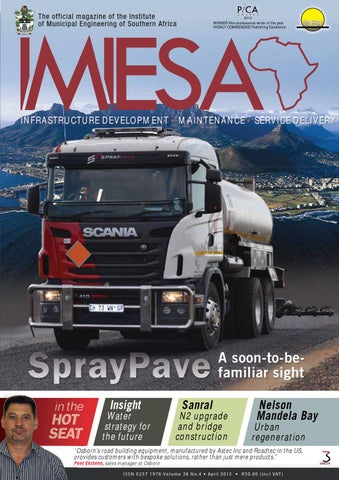
A soon-to-befamiliar sight in th he e
Insight Water strategy for the future
Sanral N2 upgrade and bridge construction
Nelson Mandela Bay Urban regeneration
“O “Osborn’s road building equipment, manufactured by Astec Inc and Roadtec in the US, p provides customers with bespoke solutions, rather than just mere products.” Peet Eksteen, sales manager at Osborn Pe I S S N 0 2 5 7 1 9 7 8 V o l u m e 3 8 N o . 4 • A p r i l 2 0 1 3 • R 5 0 . 0 0 ( i n c l VAT )
MEDIA
The world’s most popular water meter wins more enthusiasts
The V110 KSM incorporates all the advanced engineering attributes of its popular cousin, the PSM, plus its engineering-plastic body makes it unlikely to be stolen. Having no second hand value virtually eliminates the potential for theft. While the tough, UVstabilised, engineering-plastic body repels undesirable interest, its internal mechanism is unsurpassed for low
Elster Kent Metering (Pty) Ltd PO Box 201, Auckland Park 2006 JOHANNESBURG DURBAN CAPE TOWN BLOEMFONTEIN PORT ELIZABETH
Tel: (011) 470-4900 Tel: (031) 266-4915 Tel: (021) 511-8465/6 Tel: (051) 430-2603 Cell: 082 458-3439
Fax: (011) 474-0175 Fax: (031) 266-9521 Fax: (021) 511-8446 Fax: (051) 430-6165
and high flow accuracy in any position. Over the last six years every component in our meters has been refined and improved for greater accuracy and longevity. For the full story on our V110 KSM meter range, visit our website or call our offices. Often copied, never equaled.
Copyright Š Elster Group. All Rights Reserved. Elster and its logo, are trademarks of Elster Group. The company's policy is one of continuous improvement and the right is reserved to modify the specifications without notice www.elstermetering.co.za 8360/6/2012
Vital Connections
CONTENTS
VOLUME 38 NO 4 APRIL 2013
49 Trenchless technologies
29 R55 upgrade
14
41 Urban renewal
African markets
Africa
Examining pipeline lifetime
Mozambique's economy poised for recovery
14
Expanding into Africa
Angola: Cunene River water project
16
Is Smart metering enough for Africa?
17
SANRAL Bring out the Rolls Royce N2 overlay and reseal
21 26
Roads and stormwater R228 million upgrade of the R55
SprayPave is an innovative and fully integrated industry leader. Since its establishment over 30 years ago, it has become renowned for its ability to meet the demanding needs of the road construction industry.
R50 million upgrade for Umzonyana WTW Urban and rural water storage
3 5
President’s comment
The dawn of a new era
6
Insight The blueprint of our survival Part 2
9
Road building excellence
HO OT SEATT
12
Taco Voogt Ammann Construction Machinery SA
Much Asphalt John Onraët
Holger Rust TFM Transtech
36 38
Chris Munro
Vikash Narsai
39 41
71
Erosion control for landfill site
HDD: Down hole drilling success Comparing costs: Trenchless versus traditional
55
73 75 77 79
Products and services Low carbon footprint concrete
49 51
81 83
Pipes, pumps and valves Concrete piping for infrastructure project
Hot seat
35
SASTT Local company receives highest accolade
Cover article
68
VNA Consulting
When art and engineering meet
Editor’s comment
67
Concrete Manufacturers Association
Terraforce
Nelson Mandela Bay Halting the advancing dune fields
Regulars
in the
29
Water and wastewater Thirsty habits require innovation
Panel discussion Sustainable road infrastructure
Rocco Lehman
Intensive rehabilitation of Northern Cape routes 32
Cover Story
65 66
Energy efficiency reduces costs
59 63
“Osborn’s road building equipment, manufactured by Astec Inc and Roadtec in the US, provides customers with bespoke solutions, rather than just mere products.” Peet Eksteen, sales manager, Osborn
12 IMIESA April 2013
1
EDITOR’S COMMENT
PUBLISHER Elizabeth Shorten EDITOR Richard Jansen van Vuuren HEAD OF DESIGN Frédérick Danton SENIOR DESIGNER Hayley Mendelow DESIGNER Kirsty Galloway CHIEF SUB-EDITOR Claire Nozaïc SUB-EDITOR Patience Gumbo CONTRIBUTORS Candice Landie, Nicola Theunissen, Steve Apeldoorn PRODUCTION MANAGER Antois-Leigh Botma PRODUCTION COORDINATOR Jacqueline Modise FINANCIAL MANAGER Andrew Lobban MARKETING AND ONLINE MANAGER Martin Hiller ADMINISTRATION Tonya Hebenton DISTRIBUTION MANAGER Nomsa Masina DISTRIBUTION COORDINATOR Asha Pursotham SUBSCRIPTIONS subs@3smedia.co.za PRINTERS United Litho Johannesburg +27 (0)11 402 0571 ___________________________________________________
URBAN INFRASTRUCTURE
Building it “Gangman Style”
ADVERTISING SALES Jenny Miller Tel: +27 (0)11 467 6223 ___________________________________________________
PUBLISHER: MEDIA No. 4, 5th Avenue, Rivonia 2056 PO Box 92026, Norwood 2117 Tel: +27 (0)11 233 2600 Fax: +27 (0)11 234 7274/5 E-mail: richard@3smedia.co.za www.3smedia.co.za ANNUAL SUBSCRIPTION: R530.00 (INCL VAT) ISSN 0257 1978 IMIESA, Inst.MUNIC. ENG. S. AFR. © Copyright 2013. All rights reserved. ___________________________________________________
Richard Jansen van Vuuren
IMESA CONTACTS IMESA Administration Officer: Ingrid Botton P O Box 2190, Westville, 3630 Tel: +27 (0)31 266 3263 Fax: +27 (0)31 266 5094 Email: imesa@webstorm.co.za Website: www.imesa.org.za
N
BORDER BRANCH Secretary: Melanie Matroos Tel: +27 (0)43 705 2401 Fax: +27 (0)43 743 5266 E-mail: melaniem@buffalocity.gov.za EAST CAPE BRANCH Elsabé Koen Tel: +27 (0)41 505 8005 Fax: +27 (0)41 581 2300 E-mail: elsabek@africoast.com KWAZULU-NATAL BRANCH Secretary: Rita Zaayman Tel: +27(0)31 311 6382 NORTHERN PROVINCE BRANCH Secretary: Cornel Taljaard Tel: +27 (0)82 899 8341 Fax: +27 (0)11 675 1324 E-mail: cornel@rchc.co.za SOUTHERN CAPE KAROO BRANCH Secretary: Henrietta Oliver Tel: +27(0)79 390 7536 Fax: 086 536 3725 E-mail: imesa.southcape@gmail.com WESTERN CAPE BRANCH Secretary: Erica van Jaarsveld Tel: +27 (0)21 938 8455 Fax: +27 (0)21 938 8457 E-mail: erica.van_jaarsveld@capetown.gov.za FREE STATE AND NORTHERN CAPE BRANCH Secretary: Wilma Van Der Walt Tel: +27(0)83 457 4362 Fax: 086 628 0468 E-mail: imesa.fsnc@gmail.com REST OF SOUTHERN AFRICA Representative: Andre Muller E-mail: imesa@webstorm.co.za
All material herein IMIESA is copyright protected and may not be reproduced either in whole or in part without the prior written permission of the publisher. The views of contributors do not necessarily reflect those of the Institute of Municipal Engineering of Southern Africa or the publishers. blishers.
ORTH KOREA is currently dominating news headlines for all the wrong reasons yet it shares a border with a country which seems a million miles away. Apart from admiring South Korea for its booming economy as well as the success story of both Kia and Hyundai motor companies and Samsung (more specifically the SIII smartphone), I read recently of the country’s plans to build a futuristic city: Songdo. The site for this brand new city lies just west of Seoul. The Songdo International Business District is an unprecedented collaboration between real estate developers, architects and computer network company Cisco Systems. Cisco is to maintain the city’s complex communications network once it is complete in 2016. Songdo is being built from scratch using modern design, environmental standards and communication technology, and it will offer the world a glimpse of what future cityscapes will consist of, featuring a self-sustaining parkland measuring 40 ha. It will not need an external water supply system as it will have recycled plastic cisterns holding rainwater captured during the wet season
for use during the dry season. A saltwater canal will be the city’s central waterway and it will have 12 passenger diesel taxis as public transport. Turbines will pump water from the Yellow Sea into the canal, saving thousands of litres of potable water a day. Using saltwater in the canal will also prevent winter ice from forming on the waterway, which would render it useless for transportation purposes. Songdo city planners have designed the city to have 95% of its parking space underground, thus freeing up the roadways above. The city will be densely developed in the centre where the buildings will also be the tallest – giving what urban planners refer to as skyline identity. The city will be devoid of waste trucks and rubbish removal vehicles. Waste will be removed through pneumatic tubes linked to all buildings as well as to streets and parks. And last, but not least, the 90-minute commute to the nearest airport, Incheon Airport, will be cut to just 15 minutes due to the construction of the Incheon Bridge. The bridge is 18 384 m long and connects Yeongjong Island and the mainland of Incheon. Last month I spent some time in Port Elizabeth visiting some municipal projects, such as the urban regeneration initiatives surrounding and including the Donkin Reserve in the central business district as well as a national road contract on the N2 just outside the city. Articles on these projects can be found in the Nelson Mandela Bay feature on page 40 and the Sanral feature on page 21. The May and June editions of IMIESA will focus on Ekurhuleni and the City of Johannesburg respectively – so if you are busy with a project and would like to have it featured, please get in touch!
Cover opportunity
In each issue, IMIESA offers advertisers the opportunity to get to the front of the line by placing a company, product or service on the front cover of the journal. Buying this position will afford the advertiser the t cover story and maximum exposure. For more information on cover bookings contact Jenny Miller on tel: +27 (0)11 467 6223.
IMIESA April 2013
3
2013
IMESA CONFERENCE
nelson mandela bay PORT ELIZABETH
23 - 25 OCTOBER 2013 Theme: Municipal Engineering – Meeting Peoples’ Needs EARN 2.5 CPD POINTS BY ATTENDING
N! E P O W O N S G N I K sa.org.za O O B E N e I ONL w w w. i m
The 2013 IMESA Conference will be hosted at the brand new Boardwalk Hotel & Conference Centre on the beautiful Port Elizabeth beach front. A variety of exciting technical tours are being arranged to SA Breweries, Koega Harbour, VW Factory and Van Staden’s Wind Farm.
Register & pay BEFORE 31 July 2013 - Early Bird for IMESA members @ R4500 - Early Bird for Non-IMESA members @ R4750 Register & pay BEFORE 30 AUGUST 2013 - Late Registration IMESA members @ R4750 - Late Registration Non-IMESA members @ R5000 Register & pay AFTER 30 AUGUST 2013 - Last Minute Reg IMESA Members @ R5000 - Last Minute Reg Non-IMESA Members @ R5500
For information: Tel: 031 2663263 Email: conference@imesa.org.za
PRESIDENT’S COMMENT
IMESA’s comment on the 2013 Budget Speech Below is a copy of a letter sent to Minister Pravin Gordhan in response to his Budget Speech.
A
T THE OUTSET I’d like to complement you on a well-presented Budget Speech, a large portion of which involves and depends on the performance of local government. Statements such as “the need to professionalise the public service” are indeed encouraging. Having attended a live broadcast of your 2013 Budget Speech as a guest of the Durban Chamber of Commerce and after receiving input from a number of members of the IMESA EXCO, please permit me to comment on two aspects of what was covered. Expenditure on capital projects Various par ts of the speech spoke of largescale infrastructure investment (which includes dams, water networks, new homes and sanitation schemes) and the introduction of a new local government equitable share formula. IMESA urges that in addition to providing such capital funds, ample allowance is made for the operation
and maintenance of these vital and much needed assets. A recent article in Business Day, draws attention to a looming water crisis in Bloemfontein, Mafikeng, Nelspruit and Brits – due to a lack Minister Pravin Gordhan
of infrastructure maintenance – and illustrates the seriousness of the situation nationally. Education and training Mention was made several times of the reforms that will improve education, training and work
opportunities. The well-documented severe shortage of municipal technologists and engineers cannot be over emphasised. We must, however, not overlook the similar situation that exists at artisan level within municipalities. In his article published in a local Durban newspaper earlier this week, Peter Davis mentioned that “at last there is talk of bringing back technical schools where their aim is to produce skilled well-rounded tradesman (such as plumbers and welders) over a two-year period”. Ideally, municipalities (especially the larger cities) should once again offer good artisan training. In conclusion, may I Mr Minister, assure you that IMESA remains committed to being instrumental in achieving the goals of the National Development Plan and will assist its members wherever possible. Yours faithfully, FB Stevens Pr. Eng, Bsc Eng (Civil), FIMESA, FSAICE President: IMESA (Institute of Municipal Engineering of Southern Africa)
IMIESA April 2013
5
COVER STORY
WESTERN CAPE
The dawn of a new era As a subsidiary of the Basil Read Holdings group of companies, SprayPave forms an integral part of one of South Africa’s leading construction companies.
S
PRAYPAVE IS AN innovative and fully integrated industry leader. Since its establishment over 30 years ago, it has become renowned for its ability to meet the demanding needs of the road construction industry. Backed by the expertise and experience of its dynamic management team, SprayPave has successfully maintained its position at the forefront of the industry. “We are very proud of SprayPave’s growth, as well as extremely impressed with the innovative approach they have taken to get to where they are today. Furthermore, there are a number of exciting initiatives currently in the R&D phase that, when unveiled in the near future, are sure to give SprayPave an even more auspicious position and reputation within the industry”. – These words were spoken by Mr Marius Heyns, CEO of Basil Read, in October 2011– words which are on the verge of coming to fruition. Keeping abreast of worldwide trends is critical to remaining competitive on the local construction scene. Maintaining world-class
6
IMIESA April 2013
quality is one of the greatest challenges in a time when local companies in the road construction industry face a multitude of difficulties, the most evident being the increased scarcity of reliable bitumen supply. And it is not only road construction companies that are under great pressure, the ordinary road user is now also feeling the ripple effect through poorer road conditions and additional tax burdens introduced to make up for the financial deficits of road construction projects that fail to remain within allocated budgets. Then there is the introduction of the performance grading (PG) of bitumen to the local industry. A reality that will undoubtedly place further strain on the supply of bitumen through refineries failing to ensure an output of product that meets the PG standards required. So what are the options? One that many are opting for is importing bitumen, a practice that the likes of Australia have had to adopt recently. This in itself brings many new challenges, both from a logistical as well as economic standpoint. With the latter, more often
than not, playing a major role in deciding the source of bitumen to be imported, the odds of putting a lot of time, effort and money into importing a product that is significantly inferior are highly probable. Then we need to ask the question, what is inferior or subquality bitumen? Is it as simple as relying on a PG index (provided we can break from the mindset of focusing on penetration grade) to tell us this or, if the South African road construction industry is to survive, should it know more? SprayPave believes so, and it is this belief coupled with all of the above that has led SprayPave to push the boundaries of its innovative nature and take a giant leap in its evolution through the establishment of a plant in Cape Town later this year. “Our philosophy is quite simply to evolve relentlessly and never allow ourselves to be left in the wake of our competitors through being
COVER STORY
LEFT BELOW SprayPave's new Scania Horses with 34 000 ℓ haulage tankers ABOVE SprayPave's mobile emulsion plan on-site in Gobabis, Namibia
trapped in comfort zones and falling victim to antiquated policies and practices. We choose to drive the times, rather than become their slave,” says SprayPave’s commercial manager, Phil Chirnside. SprayPave Cape Town will not only offer the local market the world-class manufactur ing, supply and
application of all bituminous road binders, modified binders, emulsions, primes and precoats that sub-Saharan Africa has come to know from SprayPave’s Johannesburg plant in Alrode South and its KwaZulu-Natal plant in Bothas Hill, but it will also be introducing pioneering solutions to all of the challenges illustrated above – and much more. “The establishment of SprayPave Cape Town paves the way for some extremely exciting times, not only for Spraypave itself, but for the South African road construction industry as a whole,” says SprayPave’s managing director, Steven Single. “While the benefits of the products and services that the plant will offer will speak for themselves, we understand that the key is to educate the market on both the products being introduced as well as the technology itself,” he adds.
In order to facilitate this, as part of the roleout process for the new plant, SprayPave will be holding a number of workshops/forums, in conjunction with the South African Road Federation where all parties within the industry will have the opportunity to be introduced to the aforementioned technology and products as well as participate in Q&A sessions with experts and international speakers on the global bitumen market. “These forums will be structured so as to not only promote what we will be offering through the establishment of the Cape Town plant, but to also offer valuable knowledge to all players within the South African road construction industry so that we may all have the ‘tools’ required to not only sustain the industry, but to radically improve it, thus securing its existence and offering a far more positive ripple effect for the everyday road user,” says Chirnside. Should you wish to receive further information on the upcoming workshops, or be kept abreast of the establishment of SprayPave Cape Town, please e-mail: info@spraypave.co.za
t +27 (0)11 868 5451/2 www.spraypave.co.za
IMIESA offers advertisers an ideal platform to ensure maximum exposure of their brand. Companies are afforded the opportunity of publishing a two-page cover story and a cover picture to promote their products to an appropriate audience. Please call Jenny Miller on +27 (0)11 467 6223 to secure your booking.
IMIESA April 2013
7
I M E S A A F F I L I AT E M E M B E R S
IMESA
Afri-Infra afri-infra@mweb.co.za AJ Broom Road Products ajbroom@icon.co.za Arup SA rob.lamb@arup.com Aurecon Danie.Wium@aurecongroup.com AECOM Siyanda.Ngebulana@aecomm.com Bigen Africa Group Holdings otto.scharfetter@bigenafrica.com BMK Consulting brian@bmkconsulting.co.za Bosch Stemele bsdbn@boschstemele.co.za Bosch Munitech info@boschmunitech.co.za BVI Consulting Engineers marketing@bviho.co.za CBI Consulting Engineers durban@cbisa.co.za Civilconsult Consulting Engineers mail@civilconsult.co.za Civil & Blasting Solutions jane@drillingandblasting.co.za Concrete Manufacturers cma@mweb.co.za Corrosion Institute of Southern Africa secretary@corrosioninstitute.org.za CSIR Built Environment LAustin@csir.co.za Davies Lynn & Partners dlpdbn@dlp.co.za Development Bank of SA divb@dbsa.org.za DPI Plastics mgoodchild@dpiplastics.co.za EFG Engineers eric@efgeng.co.za Elster Kent Metering keith.bailey@za.elster.com EnviroServ Waste Management benoitl@millenniumwaste.co.za Geotechnologies garry@geotechnologies.co.za GIBB yvanrooyen@gibb.co.za GLS Consulting nicky@gls.co.za Goba trumang@goba.co.za Hidrostal SA hstal@mweb.co.za Huber Technology fstammer@lantic.net Hydro-comp Enterprises dan@edams.co.za I@Consulting louis_icon@mics.co.za Iliso Consulting monde@iliso.com Infraset fmyburgh@infraset.com Jeffares and Green dennyc@jgi.co.za Johannesburg Water rtaljaard@jwater.co.za Kgatelopele Consulting kgatelopele@wol.co.za
Knowledge Base info@knowbase.co.za Lektratek Water general@lwt.co.za Makhaotse Narasimulu & Associates mmakhaotse@mna-sa.co.za Maragela Consulting Engineers admin@maragelaconsulting.co.za Much Asphalt john.onraet@murrob.com Nyeleti Consulting ppienaar@nyeleti.co.za Odour Engineering Systems mathewc@oes.co.za PD Naidoo & Associates Consulting Engineers Johannesburg@pdna.co.za Power Construction nbarnard@powergrp.co.za Pumptron info@pumptron.co.za Pragma Africa deang@pragma.co.za Rocla karen.devos@murrob.co.za Royal HaskoningDHV francisg@rhdv.com SBS Water Systems irene@sbsgroup.co.za Sektor Consulting cradock@sektor.co.za Sight Lines sales@sightlines.co.za SiVEST SA garths@sivest.co.za SNA Inc snapta@icon.co.za Siza Water Company tionette.bates@sizawater.co.za SMEC capetown@smec.com Southern African Society for Trenchless Technology director@sasst.org.za SRK Consulting jomar@srk.co.za Sulzer Pumps Wastewater Sonja.Hattingh@sulzer.com Syntell julia@syntell.co.za Thm Engineers East London thmel@mweb.co.za TPA Consulting roger@tpa.co.za UWP Consulting zulchl@uwp.co.za VIP Consulting Engineers esme@vipconsulting.co.za WorleyParsons chris.brandsen@WorleyParsons.com WSP Group Africa dirk.hattingh@mbs-wsp.co.za WSSA nbinase@wssa.co.za WRP ronniem@wrp.co.za Zebra Surfacing andrew@zebrasurfacing.co.za
INSIGHT
WATER RESOURCE STRATEGY - PART 2
The blueprint for our survival There are significant water quality challenges in South Africa. The main contributors to water quality problems are mining, urban development, industry and agriculture. Compiled by Richard Jansen van Vuuren
R
URAL COMMUNITIES in parts of the country that are dependent on groundwater are negatively affected because of the natural mineral content exceeding recommended levels. Untreated or poorly treated wastewater is severely affecting the quality of water in many areas. Our water ecosystems are not in a healthy state. Of the 223 river ecosystem types, 60% are threatened and 25% critically endangered. Less than 15% of river ecosystems are located within protected areas, many of which are threatened and degraded by upstream human activities. Of 792 wetland ecosystems, 65% have been identified as threatened and 48% critically endangered. Furthermore, 31% of freshwater fish species indigenous to South Africa are threatened. This is of enormous concern, given the crucial role of wetlands in delivering ecosystem services such as water purification, flood regulation and drought mitigation. This situation has negative impacts on human health, on rural communities directly dependent on water-related ecosystems such as wetlands for their livelihoods and on the mainstream economy, and demands drastic intervention. Water resource quality and water quantity issues and solutions are interrelated and need to be addressed in an integrated manner. Although it is technically possible to treat water of a poor quality to a potable standard, this can be very costly. Water of bad quality also impacts negatively on farming, recreation, ecosystems and the economy.
Shared water resources South Africa shares four major river systems with six neighbouring states: Zimbabwe, Botswana, Mozambique, Swaziland, Lesotho and Namibia.
International agreements on water sharing are in place in all of these river basins, in line with SADC’s Revised Protocol on Shared Watercourses. These shared river basins raise the importance of water in the regional integration agenda in SADC. South Africa’s policy and legislation recognises international obligations in allocation protocol, which is dealt with in the support strategies.
Ethical and cultural value of water Apart from the quantitative and qualitative pressures on its physical dimensions, water demand is also growing due to the broadening perspective of water and its ecological, ethical and cultural roles. Inadequate financing and poor financial management Inadequate financing remains a key challenge. Investment in water needs to double if the required outcomes are to be achieved. A recent study by the Department of Water Affairs
ABOVE The demand for freshwater is outstripping supply
IMIESA April 2013
9
INSIGHT
revealed that the capital requirement for the entire water sector over the next 10 years, in real terms, is in the region of R670 billion and that the funding gap is R338 billion over this 10-year period. Operation, maintenance and refurbishment are also underfunded. And there is insufficient funding available for programmes such as water demand management and conservation, research, information management, skills development and effective planning. A key issue is the lack of effective financial management in water management. This includes the ring-fencing of the water ‘business’ and the need to be able to measure the actual cost of water delivery, ensuring cost recovery with appropriate protection for the poor, appropriate tariff setting, effective and long-term financial planning as well as business and project viability and the application of basic water economics. Cost recovery is essentially based on three sources of revenue: tariffs, taxes and transfers (generally from ABOVE Water resources need to be carefully managed BELOW Cost recovery for water services is essential
international donors). These three sources of income must be used to cover capital and operational costs. It is also critical that the policy should guide the allocation of financial resources so that sufficient resources are dedicated to achieving priority outcomes. Although per formance-oriented budgeting is hard to implement, and requires extensive analytic and operational changes in practice, its potential value cannot be underestimated. A comprehensive performance-oriented budget is the best option.
Shortage of human resources The lack of appropriate skills and capability in the right places has been identified as a critical challenge in the sector, from engineers, scientists and artisans to project and programme management, as well as leadership, governance and oversight. In addition to the shortage of critical and scarce skills in the right places, the water sector lacks capability to perform optimally because of the loss of institutional knowledge, experience and competency. This is of particular importance when considering the increased skills and capacity required for improved water management and governance. It must be recognised, however, that if one looks across the entire water sector, including government, the private sector and civil society, there is a range of skills, knowledge and capability in some areas that can be drawn on for the implementation of the National Water Resources Strategy 2. The challenge lies in mobilising these skills and resources to a common end while urgently building more capacity in other critical areas. Agriculture About 8.5 million people are
10
IMIESA April 2013
directly or indirectly dependent on agriculture for employment and income. The sector contributes about 3% to the GDP and 7% to formal employment. The agricultural sector is made up of commercial farmers and subsistence farmers: about 1.3 million hectares are irrigated. The New Growth Path has set a target of 300 000 households in smallholder schemes by 2020 and 145 000 jobs to be created in agro-processing by 2020. Irrigated agriculture is the largest single use of water in South Africa (60%) and it has a huge potential socioeconomic impact in rural communities. Water is the major limiting factor to the growth of this sector and poor water quality has a negative impact on agricultural exports and associated foreign income.
Energy sector Although it only uses 2% of water, the energy sector contributes about 15% to the GDP of South Africa and creates jobs for 250 000. It generates about 95% of the electricity in South Africa and also exports it to other countries in Africa. The energy sector, including Eskom is highly dependent on reliable supplies of water for the generation of electricity (steam generation and cooling processes), and an elaborate and sophisticated network of water transfer and storage schemes has been developed specifically to support this sector and ensure high levels of reliability. The water sector is, on the other hand, highly dependent on a constant and reliable supply of electricity to “move water”. Mining sector According to the South African Chamber of Mines, the mining sector contributed 8.8% directly and 10% indirectly to the GDP of South Africa in 2009. It created about one million direct and indirect jobs. The sector accounts for approximately one third of
INSIGHT
the market capitalisation of JSE and it is also the major attractor for foreign investments. The New Growth Path has set a potential employment target of 140 000 new jobs by 2020 for the mining sector. Mining and related activities require significant quantities of water while also impacting on the environment with associated potential pollution. The development of new mines in water scarce areas requires forward planning to make arrangements for the transfer of water and development of new sources.
Manufacturing sector The manufacturing sector contributed 15.5% to the GDP and 13.3% to jobs in 2009. The NGP has set a target of 350 000 new jobs for this sector by 2020. Water is an input in the manufacturing processes and it also used for cooling. Tourism sector In 2009, the tourism sector directly and indirectly contributed 7% to the GDP and it created 575 000 jobs. This sector is earmarked for high economic growth, which is expected to generate a huge number of new jobs. The NGP has set a target of 225 000 new jobs by 2015. Drinking water quality that matches international standards as well as a reliable water supply and sanitation services are critical to the success of this sector. Food and beverages sectors The food and beverage sectors are highly dependent on water for the production of their products; however, the precise contribution of the food and beverage industries to the South African economy has still to be reckoned.
risk water represents to businesses was published by the Pacific Institute. Business opportunities accompany these risks, for those companies that can deliver their products and services efficiently (low water use or no water use), or can develop technological solutions to provide clean water to the public and private sectors. First, there is physical risk to a business, which arises from decreasing water availability (water scarcity) and the reliability of supplies. The first driver of physical water risk is increased population and its resultant demand from urban and agricultural uses, coupled with water availability. The second driver is poor operation and maintenance of water systems that business is dependent on. Increased water scarcity will increase competition between business and local communities, ABOVE Increased water scarcity will increase competition between business and local communities BELOW The demand for rural water supply systems is growing
particularly between business and poor and historically marginalised communities. This potential competition and associated conflict must be effectively resolved by improved management and planning. With declining water quality, the physical risks to businesses can become acute. A decline in water quality can result in the need for pretreatment, which is an additional cost to businesses. This can be especially true when high-quality water is required in the pharmaceutical, beverage and food processing sectors. Companies can expect increased regulation of water quality, and along with increased regulation come potential constraints on availability and higher costs for quality control. Water supply-chain disruptions represent a real and to a large degree unqualified threat. Businesses are just coming to terms with the realisation that they must quantify water use and risk within their supply chain. They have been grappling with this challenge with regard to their carbon risk and seem to have made real progress in quantifying and reducing carbon in this portion of their footprint. Managing water risk within a company’s supply chain will be no small task, as most companies that outsource manufacturing can only influence, and not control the behaviour of up-stream suppliers. Source: Department of Water Affairs/National Water Resources Strategy II (2012)/Water for equitable growth and development
Committing water use sectors to sustainable water management A major gap in the management model is that water resource management is not effectively institutionalised in water sector business management. This has resulted in water-related sectors and industry not giving water the attention and priority it deserves, and a lack of ownership, commitment and self-regulation in the private sector. A recent study revealed that many South African businesses are not prepared for managing potential water risks. Water-dependent businesses can no longer take water for granted regardless of the industry sector they operate within. One of the earliest and most comprehensive discussions of the
IMIESA April 2013
11
HOT SEAT
OSBORN
Road building excellence Osborn builds its entire client philosophy on providing solutions, rather than products. Its road-building range, specifically, bears evidence of this bespoke approach.
T
HE ROAD-BUILDING sector may face many challenges, but there are also a myriad opportunities. Osborn’s road building equipment, manufactured by Astec Inc and Roadtec in the US, comprises of the flexibility and customisation to step up to the plate and provide customers with bespoke solutions, rather than just mere products. Peet Eksteen, sales manager at Osborn (Asphalt Equipment), explains how the company wraps up road building problems with just one of its Roadtec products.
Material transfer vehicles (MTV) - addressing potholes Problem 1: Material segregation “Conventional ways of road building consists of the truck dumping directly into the hopper of the paver. The gradation of the aggregate and uniformity of the asphalt mix are both very important considerations for mix stability
12
IMIESA April 2013
and road mat structure. As a truck dumps the hot mix asphalt into the paver hopper the material separates, changing the material mix and causing material segregation. When the segregated material is laid down on the road, it is compacted with poor structure, poor texture or both. The mat will not have uniform density and the surface will fail prematurely.” Problem 2: Temperature segregation “The second problem is large temperature differentials within the mix, especially during long hauls to site and on colder days. The top layer of the mix in the truck bed can have temperature variances of up to 50˚C when compared to the rest of the material. Uninsulated truck sides and tailgates also affect the mix temperature. Non-uniform
material re-blending. The remixing action tumbles the material, allowing heat to transfer uniformly throughout the mix. The Shuttle Buggy also allows for non-stop paving due to its storage capacity. This allows contractors to smooth out truck cycles, reduce haul costs, eliminate traffic congestion and lay down smoother road pavements. The Roadtec SB2500 Shuttle Buggy has storage capacity of 22.7 metric tonnes, can unload a truck at Peet Eksteen, sales manager, Osborn 907 metric tonnes/ hour and has a paver loading capacity of 544 metric Solution: The Roadtec Shuttle tonnes/hour. The reduction of segBuggy for longer lasting roads regation results in smoother, more “The Shuttle Buggy material transfer durable road surfaces. This transvehicle is designed to be the link lates into cost benefits for both the between the truck and paver. It road user and road contractor.” eliminates segregation problems, thanks to the machine's remixing action. The unique design of the remixing augers allow for compaction, ravelling, stripping and potholes can be traced back to temperature differentials in the mat used on the road. It does not take long for the natural elements to erode a newly laid road pavement if a segregated mix was used.”
“The road building market offers strong potential and new projects.”
HOT SEAT
have a lower viscosity by either the introduction of a wax, chemicals or water.
Double drum technology Problem: Many South Africa asphalt plants are unable to accomodate large percentage recycled asphalt (RA) mixes “The South African road maintenance and infrastructure upgrade markets offer strong potential for road contractors, with many new projects issued every year. It is an unfortunate reality that South African refineries cannot always supply the local market with bitumen as and when needed. Industry role players have had to revert to the importation of bitumen to meet local demands. Another option is to add a larger percentage of RA to mix designs. As RA already contains most of the bitumen needed to coat the aggregate, this reduces the amount of new bitumen needed to obtain the correct mix. Many other countries use up to 70% RA on their roads. In South Africa, however, this is too high a percentage for most local asphalt plants. The single drum parallel flow, single drum counter flow and the batch plants are not designed to accomodate such large RA percentages.”
in the outer, stationary shell. The long mixing chamber and stationary outer shell allows sequential mixing of materials. RA enters the drum in the outer mixing chamber. Adding the RA here ensures that there is no contact with the hot gas stream of the dryer. This is an important advantage because the atmosphere in the mixing chamber minimizes emissions. RA heats as it comes in contact with the hot aggregate. This allows the bitumen from the RA to help coat the heated aggregate. During this process, steam vapours from light oils and gases are drawn into the burner flame and incinerated. This process allows the Astec Double Barrel plant to meet such high emission standards, while also
processing up to 50% RA within asphalt mix designs.” Green roads - the future Problem: Chemical additives add costs during warm mix process Warm mix has really come to the fore during recent years and is regarded as the fastest growing asphalt practice worldwide. Warm mix asphalt is the same as hot mix asphalt except that it is produced and placed at lower temperatures (typically 28 to 42˚C cooler). The liquid AC is temporarily made to
Solution: The Double Barrel Green system - No need for expensive commercial additives Rather than using a mineral carrier, the Astec Green System injects water via foaming nozzles. The injection of water along with the bitumen causes the liquid asphalt to foam and expand in volume. The foaming action helps the liquid asphalt coat the aggregate at temperatures that are normally in the range of 110 to 130˚C versus traditional temperatures of 150 to 172˚C. This has significant benefits. These include improved workability of the asphalt, very little smoke or smell, longer road life, increased production and the use of less fuel. It also allows the Double Barrel plant to run significantly higher percentages of RA when compared to other plants.“protecting the environment and saving costs one mix at a time.”
ABOVE The inner workings of a material transfer vehicle BELOW Using a material transfer vehicle BOTTOM Not using a material transfer vehicle
t +27 (0)11 820 7600 www.osborn.co.za
Solution: The Double Barrel technology - Well suited for large RA percentages “The double barrel dryer/drum mixer combines the functions of a dryer and a continuous process mixer in one compact, efficient system. Drying of the virgin aggregate is the first step in the process and takes place in the inner drum. Mixing of aggregate and other ingredients follows, which happens
IMIESA April 2013
13
AFRICA
MOZAMBIQUE
Early predictions of growth prove accurate With the economy of Mozambique poised for a robust recovery, specialist geotechnical contractor Esorfranki Geotechnical is positioned to strengthen its already well-established market position in that country.
T
HEN KNOWN AS Franki Africa, the company’s first project in Mozambique was at the prestigious Mozal aluminium smelter on the outskirts of Maputo. The company was commissioned to conduct initial site investigations in late 1997 and early 1998 and when tenders for the foundation piling were invited, Franki Africa was awarded a contract for Phase 1. This was successfully completed two months ahead of schedule in March 1999 after installing over 10 000 driven cast in-situ Franki piles. On the back of the success of the first phase, Franki Africa secured Phase 2, which called for the installation of over 8 000 Franki piles and 200 large diameter auger piles supporting the silo structures. At peak, the company’s on-site crew numbered 518. This contract was also completed ahead of schedule. “Even though the country was
14
IMIESA April 2013
going through an economic downturn at the time of our involvement in the Mozal project, we became aware that Mozambique was ripe with opportunity,” Roy McLintock, MD of Esor franki Geotechnical, relates. “We took a strategic decision, based on the anticipated positive impact of the Mozal project, to establish a registered company there in July 1998 and populated it with a pilot team tasked with identifying business opportunities. These were skilled people with access to a full range of equipment to undertake any kind of local geotechnical work. “Our predictions proved accurate and our workload steadily increased. A focus beyond Maputo resulted in a contract to install Franki piles at a silo complex for a Tanzania-based client for whom we had done similar work in Dar es Salaam. We also secured foundations for various bridges in
the rural areas. Another notable contract was the provision of general geotechnical work at Tongaat Huletts’ Xinavane sugar mill where we installed various pile types in both brownfield and greenfield areas of the mill.” Esorfranki Geotechnical has also installed piling and lateral support for four embassies and numerous buildings and marine structures in Maputo. More recently, the company was involved in work relating to the infrastructure for the Moatize coalfields development for a major multinational metals and mining company. Esorfranki Geotechnical’s most recent project involved the piled foundations for rails on an 800-metre-long coal stacker at the load-out facility in Beira for the same company. This contract was extended to include the marine works and ship-loading structure foundations as part of the upgrading of the Port of Beira Quay 8. “Having established a presence in Beira, we’re now looking at other opportunities in and around this city,” says McLintock. “We’ve been at work in Mozambique for 15 years and our projects in various parts of
ABOVE Installation of 27 m CFA piles for the Beira stacker LEFT An aerial overview of the Beira stacker
the country have afforded us an exceptionally good understanding of the local culture, business environment and ground conditions, as well as the country’s customs and logistical processes. This work has also allowed our Mozambique team to establish a comprehensive geotechnical database that, coupled with in-house design capabilities, allows us to provide very competitive design solutions. “Future opportunities will centre around the Moatize coal project, port upgrades related to the export of coal and other resources, electrification, and general infrastructure upgrades.”
A Daimler Brand MBSA/104/AXOR001
TRUCKS. LEASING & FINANCING. FLEET SOLUTIONS. SERVICE & PARTS.
The Mercedes-Benz Axor. Best practice just got better. In the area of waste management, the Mercedes-Benz Axor is synonymous with best practice. It boasts a number of improvements that make it even more efďŹ cient. The instrument cluster with graphic display has been relooked for better visibility and is both more informative and functional. Automatic departure check is also available, whilst the state-of-the-art multifunction steering wheel integrates a whole host of features. Attractive yet harder wearing fabric covers the comfortable seats and Axor’s looks have been spruced up with a modern trimmed grille and larger star. Of course, you still have our nationwide support network on 24-hour standby. For more information contact your Mercedes-Benz Commercial Vehicle dealer, telephone 0800 133 355 or visit www.mercedes-benz.co.za/trucks
AFRICA
WATER TREATMENT
Cunene River Water Project As part of the master trans-frontier plan with Namibia to supply safe drinking water to underprivileged communities in Angola’s Cunene province, Marley Infrastructure was awarded a US$15 million contract by Spanish company UTE Befesa-Riogersa.
A
S ONE OF the provinces devastated by Angolan conflict, Cunene has suffered from a lack of proper supply and sanitation systems, resulting in low levels of access to clean drinking water. Only 15 to 20% of the rural population has the advantage of a dedicated water source, while the rest rely on walking far distances every day to retrieve unhealthy water from local rivers, boreholes and small dams to provide for their families. It is little wonder then that over 80% of illness and death in these communities are caused by waterborne diseases. The project consisted of the construction of a water treatment facility at Xangongo, so that water can be extracted from the Cunene River and treated, and then pumped along a 100 km pipeline to Xangongo, Mongua and Ondjiva. For the project, Marley supplied over 98 km of 630 mm PN6 HDPE pipes as well as about 2 km of 630 mm PN10 HDPE pipe – one of Marley’s largest contributions to a single project. The project, however, was not without its challenges. In addition to chief negotiations held by Marley’s managing director, Louis Albertyn, and his team to assess the critical factors and risks that the project would present, Marley’s pipes were also stringently tested for quality control to evaluate the most suitable pipe supplier according to the
16
IMIESA April 2013
ABOVE In excess of 4 800 t of HDPE pipe was supplied to the project LEFT More than 400 truckloads of pipe were delivered to the site
exacting requirements of the client. Marley came out on top with its range of HDPE pipes, which are SAPPMA-endorsed and manufactured according to sound quality standards, carrying the SABS mark for SANS ISO 4427. Logistically, transporting 15 m length HDPE pipes to Angola was no easy feat, and Marley partnered with WP Transport to ensure their safe passage. Sixteen trailers were used, each carrying 16 pipes, and proper crating and
stacking methods were taken into consideration to ensure minimal roll during transportation. The biggest challenge, however, occurred once the pipes had actually reached the Angolan border. Not only did Marley and Befesa have to make sure that all documentation for every truck was 100% in order, but WP also had to appoint a dedicated person to handle the time-consuming and rigorous customs process – the result of which was costly delays and standing time.
AFRICA
DATA INTEGRATION
Is Smart Metering smart enough for Africa?
Smart Metering systems can support various aspects of electricity distribution management and are generally recommended internationally as the way to enhance the services and financial viability of electricity utilities.
K
OBUS VAN DEN BERG, an electrical engineer at Aurecon, takes a different approach, saying it is important to understand the additional functionality of a Smart Metering (SM) system and see if it meets the specific requirements of Africa. “The extensive functionality of an SM system is not always fully appreciated,” he says. “However, collecting vast amounts of system data is in itself pointless – the value is in the management of the data. The solution lies in the integration with a highly effective Meter Data Management System (MDMS) and being able to demonstrate benefits for the consumer.”
The metering system A typical SM system will have a smart meter at the customer’s premises with a load switch and in-house display. These devices communicate
via various communications media and the data is transferred to an MDMS for storage and processing. In the metering mode, the system provides the measurement and recording functions to enable effective measurement of consumption data for billing purposes. It records data at 30-minute intervals, which enables the utility to determine when and where energy has been used. The meters can be switched between credit mode and prepayment mode remotely. Credit tokens purchased at vending outlets or online via the internet or cell phone can be transferred to the meter directly or manually through the keypad on the Customer Interface Unit (CIU) i.e. display and keyboard installed in a customer’s residence. The meter also allows the implementation of complex tariffs. The use of TOU (Time of Use) tariffs allows the utility to offer new energy products to the customers,
as well as use pricing signals to manipulate the consumption pattern of consumers to enhance energy efficiency. The ‘smartness’ of the metering system comes from being flexible and multifunctional, able to enhance the management of distribution systems and improve energy efficiency.
Advantages of a Smart Metering system Revenue management The SM system can provide accurate meter readings, timeous billing, preprocessed readings with VEE (validation, estimation and editing), and remote connect/disconnect. One of the most important challenges municipalities face in South Africa is to read meters and produce accurate bills to enable customers to pay their dues. It is not always possible for meter readers to get access to a customer’s premises, resulting in ‘no reads’ or
IMIESA April 2013
17
AFRICA
‘estimated’ readings on a customer’s bill. In the case of SM, the consumption data will be validated and any inconsistencies corrected in the MDMS before it reaches the billing system, ensuring much higher quality billing. The VEE functions allow the utility to effectively manage consumption levels, missing readings due to meter failure and energy theft due to bypassing of meters. The SM system supports functionalities such as remote connection/disconnection. If the customer does not pay their bill, a warning can be sent to the CIU. If no reaction from the customer occurs, the supply can be switched off remotely. As soon as payment takes place, the supply can be restored immediately. An especially important benefit is that accurate meter reading and billing will restore customer confidence in the utility and result in an improved payment performance.
Revenue protection (RP) Most utilities employ RP officials or contract meter auditors to visit and inspect meter installations for safety and especially tampering issues. SM systems can be this ‘guard dog’ to monitor meters 24/7 and provide reading VEE to detect anomalies, tamper detection, alarm generation, energy balancing and loss detection, and non-payment/tamper disconnection. While the visibility of meter officials motivates customers not to tamper with meters, the main challenge is the time and cost to maintain this visibility. Soon after a meter audit, customers tend to revert back to their old tampering habits or pay ‘contractors’ to ‘adjust’ their metering system! The SM system can provide a focused, enhanced and more cost-effective RP service for the utility.
Maintenance and planning For successful implementation of SM, it must be to the advantage of the customer in terms Data collected from the SM system can be of energy management, as well as the improveused to identify maintenance actions as well ment of services. The SM system opens a new as network extension and upgrade planning. communication channel to customers to inform Applications include distribution system loadthem of the actions and ing and power flow, intentions of the utilfault log system, ity without reverting power quality (PQ) to call centres and information, systhe media. tem loss measurement, parameter trending facilities, Demand control maintenance Many African counalert, job schedtries are in the uling, and meter predicament that error detection. the demand for Meter failures electricity is at can be detected times very close to immediately and or exceeds the supply the necessar y capability. The SM sysmaintenance and tem provides methABOVE Collecting vast amounts of system repair teams activat- data is in itself pointless ods of managing the ed. Customer service demand for electricity will improve due to prompt reaction to failures on the consumer side of the supply network in the distribution network. Capital and mainthrough direct control of devices such as geytenance budgets can now be based on operasers, air conditioners and pool pumps, load tional information from the SM systems rather limiting during high demand/supply shortage than ad hoc measurements in the network. crisis situations, and indirect load and energy efficiency control via TOU tariff structures. The first method enables the utility to switch off Keeping customers informed the supply to non-critical appliances such as Customers can either accept and use the air conditioners, pool pumps and hot water SM facilities or view it as a method to ‘spy’ geysers, as well as other residential loads or, on them and force them to pay for services. motivate customers to disconnect loads themWhatever the case may be, the customer selves. The second method is to use TOU tariff should be persuaded and shown that the SM structures to reflect the actual cost of energy provides essential and useful information, at a particular moment and also send a strong such as consumption feedback, cost and tariff price signal to the customer. This information information, outage warnings, bill payment enables the customer to reschedule certain information, remote disconnection/reconnecloads and save electricity cost, as well as tion, and prepayment options. improve energy efficiency.
FIGURE 1: Data flow to various functional applications
SM data flow PQ
CIU Customer Info
SM
Demand management
MDMS Maintenance Planning
RP
Load Switch
18
IMIESA April 2013
Revenue Management
MDMS
Network management
In conclusion SM has a place in African utilities to meet the needs and particular characteristics of Africa’s electricity consumers. SM is only really smart if it is carefully integrated into the distribution system with a specialised MDMS, and the system used to improve business processes, utility operations and particularly, customer services. *This article is based on the paper titled ‘When is Smart Metering really smart?’ presented at the 63rd AMEU Convention, Ekurhuleni, by its author: Kobus van den Berg (PrEng), BEng (Elec). MMedSc, MBA. Electrical engineer, Aurecon)
SANRAL
N2 SECTION 11
Bring out the Rolls Royce A professional team on a road contract in the Eastern Cape has been hampered by record rainfall during two winters and out-of-the-ordinary piling challenges for one of the bridge elements being constructed. Richard Jansen van Vuuren visited the site.
T
HE PROJECT, BEING undertaken for the South African National Roads Agency SOC (Sanral), includes both the rehabilitation of the existing N2 Section 11 from the eastern boundary of the Coega IDZ (km 56.0) to the Colchester (69.0 km), and the construction of a new carriageway to the south of the existing road. The project is referred to as the N2 Coega to Colchester project. The completed dual carriageway cross section will comprise 2 x 3.7 m lanes, a 2.5 m wide outer shoulder and a 1 m wide inner shoulder per carriageway, with a 17.4 m wide median. The project is approximately 80% complete, having commenced in November 2010. The anticipated completion date is February 2014. This contract was initiated by Sanral to improve the capacity of the N2 between Port Elizabeth and the Nanaga Interchange. This link of the N2 carries the highest volume of intercity traffic on the national road network in the Eastern Cape and reached the point where improvement was required. The need to provide an additional carriageway presented the opportunity to construct the new carriageway first while not inter fering with the traffic on the existing road. Once completed, traffic was diverted onto the new carriageway and provided unlimited access to the existing one in order for the contractor to undertake the required rehabilitation work. Undertaking the work in this way limited the impact on the travelling public substantially, which is always a concern on a multi-year project. The roadwork aspects of the contract include: • construction of mass earthworks for the new carriageway • construction of selected and sub-base layers using gravel and crushed borrow pit material. • construction of a crushed stone base and asphalt surfacing
• the replacement of existing drainage culverts smaller than 600 mm in diameter • extension or reconstruction of existing drainage culverts where required • construction of sub-surface drains and lined open drains • upgrading of the existing at-grade intersections providing access to Cannonville and Colchester • Relocation and protection of existing services • relocation and upgrading of street lighting on the section between the Cannonville and Colchester at-grade intersections • provision of drains and mitre banks • provision of all other roadwork ancillaries required, including road signs and markings, fencing and guard rails • opening and final rehabilitation of borrow pits • construction of approximately 1.6 km of surfaced access road to provide alternative access for affected parties as a result of the removal of the overpass bridge at Cannonville. The structural work under the contract includes: • construction of a new bridge over the Sundays River
Backfilling a services trench
• raising of the existing bridge over the Sundays River • extension of three agricultural underpasses • construction of an underpass • two cuttings near the Sundays River are through dunes that are situated inside the existing road reserve. The cutting will be supported by a reinforced earth retaining system.
TABLE 1 Culverts constructed during the contract
LOCATION (KM)
STRUCTURE NO.
59.00
C172
63.09
NAME
TYPE
SIZE
Uitenhage Road agricultural underpass
Major culvert underpass
2.450 m x 2.450 m in-situ concrete box culvert
C173
The Downs agricultural underpass
Major culvert underpass
3.800 m x 3.800 m in-situ concrete box culvert
64.02
C174
Cerebos
Major culvert underpass
3.800 m x 4.000 m in-situ concrete box culvert
64.92
C0291
Cannonville underpass
Major culvert underpass
4.500 m x 4.800 m in-situ concrete box culvert
IMIESA April 2013
21
SANRAL
Sundays River Bridge The N2 crosses the Sunday’s River at 64.76 km. The upgrading of the N2 to a dual carriageway therefore required the construction of a new bridge over the Sundays River to accommodate the new westbound carriageway. The existing bridge is approximately 3.2 km from the sea, with tidal movement under it. The bridge will have a similar configuration and design as the existing bridge in order to limit the hydraulic impact of multiple bridge structures as well as for aesthetic reasons. The new bridge will consist of six spans of 33.53 m with a total length of 201.2 m. The overall width
of the new bridge will be 12.5 m, which will be sufficient to allow for 3 x 3.5 m lanes and 1.0 m shoulders of the facility to be upgraded to a six-lane freeway in the future. Precast concrete F-shape parapets of 1.1 m high are to be used. The bridge is founded on exceptionally deep piles – more specifically 45 m auger piles. What made the piling more challenging was a 3.5 m boulder layer located at 36.5 m depth as well as the high water table caused by the tidal river. All the piles are socketed 5.0 m into the mudstone formation underlying the boulder layer. The initial estimate of four days per pile turned into 12 days per pile. An alternative
method was sought as it had become apparent that the initial oscillator rig was not coping with the geological demands and the piling contractor brought out what many considered as the “Rolls Royce” of piling rigs – a Bauer 36 BG equipped with a torque multiplier. The new piling rig increased the rate at which the piles were installed to achieve the original rate of four days per pile. The delays suffered as a result of the initial slower rate of pile installation was overcome by a considerable effort by the main contractor in order to accelerate the construction of the bridge in order to still complete the contract within the allowed time for completion. The new bridge is approximately 90% complete.
TABLE 2 Bridges constructed during the contract
LOCATION STRUCTURE (KM) NO. 64.76
B1215
NAME Sundays River Bridge
TYPE
SIZE
Road bridge over river
6 x 33.528 m spans
TABLE 3 Bridges to be demolished during the contract
LOCATION STRUCTURE (KM) NO. 65.29
639
NAME Cannonville Overpass
TYPE
SIZE
Road bridge over road
1 x 26.3 m span + 1 x 11.5 m span
Raising the existing bridge over the Sundays River Based on the hydraulic study, it was resolved that the bridges needed to cross the Sundays River at a level which is 2.25 m higher than the level of the existing bridge in order to provide the required freeboard in the event of a one in a hundred year flood. In this regard, the new bridge was built to new higher level and the existing bridge will be IMIESA April 2013
23
SANRAL
N2 Coega to Colchester project participants: Employer • Sanral Consulting engineers • SFC Engineers/Aurecon Joint Venture Main contractor • Concor Roads and Earthworks Suppliers • Kaytech • Concrete 4 U • Doka • Steeldale • PPC Cement • Much Asphalt • Colas • Afrimat Subcontractors • Dura Soletanche • Freyssinet • Ibhayi Contracting
24
raised to the same level once the new bridge has been completed.
Cannonville Overpass Bridge The existing Cannonville Overpass at km 65.29 provides access to 13 properties north of the N2 and forms a link between these properties and the southern residential areas of Cannonville. The bridge has a history of settlement, which caused vertical clearance problems on the N2. As a result, a dip formed in the vertical alignment of the N2 under the bridge. Correcting the vertical alignment as part of the rehabilitation of the existing N2 would require the raising of the bridge as well as attending to the bridge’s founding conditions. The aforementioned would effectively result in rebuilding the existing bridge. It would therefore be more economical to construct a new access road to replace the function of the bridge. The overpass bridge will therefore be demolished once the access road has been completed. In addition to the access road, a single lane underpass is being constructed to maintain a grade separated crossing between the northern and southern parts of Cannonville.
IMIESA April 2013
WIRE ROPE
QUADGUARDS
ALPHA 70K TMA
END TERMINALS
Isando 011 392 1242 | Cape Town 021 531 9071 | Durban 031 705 6355 Port Elizabeth 041 486 3674 | Bloemfontein 051 432 0707 Web: www.armcorsp.co.za
Eastbound carriageway The existing carriageway was built in the 1970s with a cement stabilised base course layer. This method of construction has subsequently fallen out of favour as a result of the significant block cracking that occurred in these layers due to the shrinkage of the strongly cemented material. Although the cracking in itself is not problematic it is the secondary distress that forms thereafter (washing out of material under the blocks that lead to further fragmentation of the blocks under the action of the traffic that ultimately leads to break outs, which form dangerous potholes) that is problematic. The stiffness of the existing base layer has protected the underlying pavement and as a result little deformation has taken place on this section of the road. The exception being the outer edge where the base course material was not cemented to the same extent and the mode of failure includes deformation. In order to take advantage of the high strength offered by the existing cemented base layer, it was decided to construct the new C3 subbase layer and crushed stone base layer on top of the existing road after
SANRAL
People interviewed in this article
Jan Verduyn, resident engineer: SFC Engineers/Aurecon Joint Venture
Renaldo Lorio, Sanral project manager
some of the worst areas were repaired by means of removing the distressed material and replacing it with new cement treated material as well as strengthening the outer edge that was previously not cemented to the same extent. With the existing base course now being the new subbase layer, the road would have a high load-bearing capacity. Constructing the road in this way was not only advantageous from a load-bearing point of view but also the more economical option. The surfacing for the rehabilitated road comprises a new semi-gap graded asphalt with rolled in chips between 56.0 km and 64.8 km. The bitumen used for the aforementioned comprised A-P1 binder. The section between 64.8 km and 69.0 km will be surfaced with a combination of 40 mm medium continuously graded asphalt followed by a 20 mm ultra-thin friction course material. The latter was viewed being more suitable to reduce the traffic-related noise for the adjacent residents of Cannonville and Colchester.
George Langenegger, assistant resident engineer: SFC Engineers/Aurecon Joint Venture
Junior Nortje, site agent: Concor Roads and Earthworks
Unexpected weather conditions During the course of the contract, two of the wettest years on record were experienced. The recorded rainfall was more than double the long-term average rainfall. Some 798 mm and 821 mm rain were measured on-site in 2011 and 2012 respectively, as opposed to 346 mm, which is the long term average. In October 2012 a total 271 mm of rain was measured on site while 233 mm was recorded over eight consecutive days, making it the wettest October month on record. Fortunately, it was a near coastal event and the Sundays River did not go into flood. However, in spite of the more than expected rainfall, the contractor still managed to keep the progress of the work on track and all indications are that the work will be completed within the allowed time for completion. Piles for the Sundays River Bridge are 45 m deep
Westbound carriageway The results of the centre line materials survey indicated from the start of the project to approximately km 60.00 of the carriageway is underlain by calcrete to a depth exceeding 1 m. The calcrete is generally covered with 100 to 300 mm of sand or sandy silt, typically of G9 quality. Beyond km 60.00, the underlying calcretes are replaced with deep sands and silty sands. The subgrade conditions did not require any special treatment for the construction of the new carriageway, which was constructed using a fairly conventional design comprising two cement stabilised subbase layers and a crushed stone base layer. The surfacing use for the new carriageway is the same as that used for the rehabilitated carriageway.
IMIESA April 2013
25
SANRAL
EASTERN CAPE
N2 overlay and reseal Bosch Stemele, in a joint venture with BCP Engineering, is undertaking the special maintenance of a 15 km section of the N2 to the west of Port Elizabeth.
T
HIS CAME ABOUT through a successful tender bid made to Sanral by Bosch Stemele and BCP Engineering, which sees them jointly commissioned to undertake the project. As work progressed, it became evident that further maintenance was needed and this appointment was extended to include an additional adjoining 15 km of the N2. The necessity of the project
26
became clear earlier on as this 30 km portion of dual carriageway, from Van Stadens River Bridge to the Bramlin Interchange, is in dire need of structural maintenance. The portion of road had last received maintenance in the mid-1990s, resulting in the surfacing exhibiting severe forms of distress. Bosch Stemele and BCP Engineering’s investigations showed that with minor exceptions, the layer works below the surfacing were adequate for the design life traffic if they were kept dry. The team therefore set about upgrading the surface drainage, as well as subsoil drainage,
IMIESA April 2013
JOIN OUR COMMUNITY FOR FREE Infrastructurene.ws brings together the communities from our three magazines – IMIESA, Water&Sanitation Africa and ReSource. It is a leading news hub, with in-depth articles, videos and podcasts, an events calendar, and full social media functionality.
LIKE INFRASTRUCTURE NEWS ON FACEBOOK Have your say or get the conversation started about anything and everything related to the infrastructure and service delivery industries.
Scan here to go to website
STAY IN TOUCH A weekly newsletter keeps you up to date Sign up online for our FREE weekly newsletter and get an instant summary of the latest news, events and developments in the infrastructure and service delivery industries.
The @infrastructure4 tweets will keep you updated on all the latest, exciting and, of course, interesting happenings in the infrastructure and service delivery industries.
VISIT www.infrastructurene.ws TODAY
SANRAL
in both the median and outer edges of the carriageways. The project required some special attention as much of the surrounding terrain was very flat, requiring them to pay particular attention to ensuring free flowing side drains, resulting in the need for concrete lining. This was followed by extensive repairs of the distressed roadway surfacing by milling out the top layer of asphalt and replacing it with new asphalt. This was restricted generally to the slow lanes to allow traffic flow. Selected deep structural patches were also undertaken ensuring that the road will be better equipped to withstand its traffic load. Structural assessment of the pavement indicated that a 40 m asphalt overlay was required for the Van Stadens to St Albans interchange section. Similar assessments led to opting for a surfacing seal for the St Albans interchange to the Bramlin Interchange portion. The asphalt overlay comprised a semi-gap mix, utilising an E2 polymermodified binder to improve rut resistance, with 19 mm rolled-in chips at the surface to improve skid resistance. BS Imiesa Half Page FINAL.ai
1
2013/03/15
The surfacing seal comprised a 19 mm/6.7 mm double seal with modified binder. The 6.7 mm aggregate was split into two applications, the first a choke layer to close off the 19 mm shoulder voids and the second a cover layer to provide a dense 6.7 mm carpet as the final trafficked sur face. Due to the very course texture of the existing aged asphalt, a texture correction treatment was required to the westbound slow lane. A fine slurry was applied as texture correction and it was exposed to traffic prior to seal work commencing. Bosch Stemele and BCP Engineering successfully completed the Van Stadens to St. Albans portion in December 2010 at a final contract value of R80 million. The reseal of the St Albans to Bramlin section is currently nearing completion, with the seal work expected to be completed before the start of Sanral’s winter seal embargo. The final contract value is estimated at R30 million. 8:20 AM
OPPOSITE The portion of road had last received maintenance in the mid-1990s, resulting in the surfacing exhibiting severe forms of distress ABOVE Bosch Stemele and BCP Engineering successfully completed the Van Stadens to St Albans portion in December 2010
IMIESA April 2013
27
bidim
R
ROADS AND STORMWATER
ROAD AND BRIDGE CONSTRUCTION
R228 million upgrade of the R55 After successfully completing the R200 million Phase 1 section of the infrastructure upgrade project in November 2010, SMEC South Africa was appointed as the project management consultant for Phase 2 of the project undertaken by the Gauteng provincial government. Richard Jansen van Vuuren met with SMEC South Africa technical director Tshepo Matshego on-site.
P
HASE 1 ENTAILED the construction of a dual carriageway between the N14 freeway and Wierda Road. Phase 2 involved more than R228 million worth of upgrading and rehabilitation work to the 4.2 km section of the R55 carriageway from Sunderland Ridge to Laudium, a major ar terial road between Johannesburg and Pretoria, which also connects the region to the N14 freeway. SMEC South Africa technical director, Tshepo Matshego, explained that the company’s scope of work included the upgrade of the road from a single carriageway to a dual carriageway, and the construction of two bridges over the Hennops River. To improve safety and night-time visibility, 10 km of street lighting was installed over the full length of the road, from the N14 interchange into Laudium. “The narrow 6-metre-wide single carriageway could not cope with the increased traffic volumes, and SMEC South Africa designed the works such that the appointed contractor constructed the new carriageway while leaving the existing road open to minimise the impact on traffic,” he explained. “The fully completed carriageway is world
class, and is now separated by a wide median and paved shoulder to ensure further motorist safety.” ABOVE Compacting fill as part of the shaping of the road prism to the desired levels RIGHT SMEC South Africa technical director, Tshepo Matshego BELOW Applying precoated chips to the asphalt
IMIESA April 2013
29
ROADS AND STORMWATER
ABOVE Members from the EPWP programme constructing side drains BELOW Asphalting the final layer onto the road
Matshego noted that the erection of the two bridges over the Hennops River proved to be a major challenge, due to the dolomitic nature of the soil, which is prone to sinkholes. “In order to ensure the structural integrity of the bridges, we had to make sure that the bridge piles were securely founded on subsur face rock, which was up to 25 m deep at certain points.” The piles were successfully sunk using the ODEX piling method, which involves the
30
IMIESA April 2013
application of pressurised air during excavation to remove any debris. Matshego added: “While this method proved to be successful, it took longer than anticipated to sink the piles due to the fact that pockets of underground air caused the excavation machiner y to jam. Despite this, we managed to reach bedrock with piles var ying between 8 and 25 m in depth.” Matshego highlighted the fact that unseasonably high rainfall between December 2010 and March 2011 also proved to be a major challenge. “The heavy rainfall and variability of the ground conditions delayed the piling works for five months, which in turn delayed the
progress on the two bridges crossing the Hennops River. Some isolated sinkholes also developed on the road, which required rectification and bridging by utilising geotextiles to strengthen the immediate areas.” Commenting at the official opening of the new R55 dual carriageway, Gauteng MEC for Roads and Transport, Ismail Vadi, hailed the project as an over whelming success. “The successful and timely completion of this dual carriageway ensures that road users are provided with a safe and quality alternative route to the Ben Schoeman freeway, which often sees heavy traffic volumes. I thank all contractors for the quality of the road, and its timeous deliver y,” he stated at the time. In addition to creating a more advanced and efficient road network for motorists, Matshego pointed out that Phase 2 of the R55 upgrade project also generated skills development within the surrounding communities, with more than 150 local jobs created as a direct result of the project. “All of the locally employed contractors received full training and certificates of qualification in their respective fields, which will go a long way in ensuring that they are better equipped for future employment.” Looking to the future, Vadi announced at the opening ceremony that the remaining
ROADS AND STORMWATER
sections of the R55, between Main Road in Laudium and Maunde Street in Atteridgeville, would be scheduled for rehabilitation in the next financial year at an estimated cost of R50 million. Matshego added that he was confident that SMEC South Africa is in a strong position to be awarded this extension, given the company’s excellent track record on the project to date.
RIGHT Predrilling for the piling operation at the Hennops River bridge BELOW Piling operation at the Hennops River bridge
IMIESA April 2013
31
ROADS AND STORMWATER
INTENSIVE REHABILITATION
New shoulders for Northern Cape routes Upgrading strategic routes interconnecting South Africa’s Northern Cape hinterland, Roadmac Surfacing Cape (Roadmac) is currently pressing ahead on four major road projects for Sanral.
T
HREE OF THESE contracts are on Route 27 (R27), starting at Calvinia and extending northwards beyond the town of Brandvlei. The total incremental distance is around 210 km, split equally into approximately 70 km portions that are running concurrently, requiring precise project planning and delivery. The scope of works on all sections entails the strengthening and widening of the existing road surface, plus a new reseal. Roadmac started on the initial Calvinia section some nine months ago, with the balance of the projects awarded in set phases. The middle and second section, awarded in October 2012, runs south from Brandvlei, while the third travels 70 km north from Brandvlei to Verdoorst (Section 10) and commenced in May 2012. Running parallel with these projects is a fourth Sanral widening, repair and reseal contract on the N7 between the towns of Vanrhynsdorp (km 0.00) and Bitterfontein (km 80.42), which commenced in August 2012. Upgrades on the R27 cater for rising traffic volumes, particularly from heavy vehicles servicing industries that include salt and gypsum mines surrounding Brandvlei. The current road width along the R27 is 6 m, which will now be widened by 1 m on both sides to include a full TOP RIGHT Roadmac Surfacing Cape’s recently acquired Cat RM500 rotary mixer deployed on a section of the R27 RIGHT The current road width along the R27 is 6 m, which will now be widened by 1 m on both sides to include a full width shoulder OPPOSITE From left to right: Christo Ihlenfeldt, Barloworld Equipment Bellville Cat sales professional; Christie de Klerk, plant manager, Roadmac Surfacing Cape; Charlie Backlund, MD, Roadmac Surfacing Cape; and Dieter Rencken, contracts manager, Roadmac Surfacing Cape
32
IMIESA April 2013
width shoulder. The same design approach is being constructed by Roadmac on its N7 project. “Our scope of works also includes the repair of failed sections using in-situ reclamation techniques,” explains Dieter Rencken, Roadmac Surfacing Cape’s contracts manager. Sub-base layer works on both the shoulders and in-situ repairs are being cement stabilised. Road construction material is sourced from two hard rock quarries, with on-site crushing and screening carried out by Raubex Group entity, B&E International. To meet these intensive contracts, Roadmac is deploying an extensive plant fleet. This includes the recent addition of a Cat RM500 rotary
mixer, supplied and supported by Barloworld Equipment’s Bellville operation. This Cat unit is being deployed on one of the R27 sections and there forms a key component of the construction works. Commenting on the RM500’s performance
ROADS AND STORMWATER
to date, Rencken says that the unit has shown itself to be an excellent all-rounder in both milling and mixing applications, particularly when facing tough and varied ground conditions. “In this respect, the RM500 is well-suited to the challenging demands placed on it, and we are achieving good daily advance rates in line with the construction programme.� Powered by a Cat C15 ACERT engine delivering a gross power output (SAE J1995) of 403 kW, the Cat RM500 is Caterpillar’s flagship recycler. The machine has an operating weight of approximately 28 145 kg. “Equipped with the 2.4-metre-wide Cat universal rotor, comprising 200 carbide-tipped bits arranged in a chevron pattern, the RM500 excels in reworking dense in-situ materials, cutting and mixing to a maximum depth of 406 mm, and in the process achieves the highest levels of material pulverisation and gradation,� says Christo Ihlenfeldt, Barloworld Equipment Bellville Cat sales professional. These and other technological innovations continue to drive Roadmac Surfacing Cape’s road rehabilitation business model, where the
company has experienced major growth over the past 10 years. Recently completed milestone contracts include a 17-month repair and reseal project on the N1 north of Laingsburg, which involved around 100 000 mÂł of in-situ recycling over a 70 km section.
“Given South Africa’s matured road infrastructure environment, the emphasis by national and provincial government departments is on maintenance and rehabilitation, areas where insitu recycling is the preferred approach,� adds Rencken. “It’s a fast and efficient method.� IMIESA April 2013
33
,NB@K 0DNOKD 'KNA@K %WODQHDMBD
3-%# 3NTSG !EQHB@ (previously Vela VKE) is now part of a global professional services company with over 5,000 people working in more than 70 countries throughout Africa, Australia, Asia, the Middle East, the Pacific, North and South America. In 2012, %MFHMDDQHMF .DVR 2DBNQC Q@MJDC 3-%# @S MTLADQ MHMD HM g4GD 4NO AX -@QJDSh KHRS ENQ 7@SDQ. SMEC is proud to be part of a leading water consultant with a proven track record in delivering complex and large-scale projects.
VVV RLDB BNL
Recent projects include Botterkloof Dam, the Lesotho Highlands Water Project, the Mokolo Crocodile Water Augmentation Project, Kobong Pumped Storage Scheme and Kruisvallei Hydro Power. 3-%# provides solutions for dams, water resources, water supply, waste water, river structures, irrigation and hydrological investigations. &NQ LNQD HMENQL@SHNM OKD@RD UHRHS VVV RLDB BNL NTQ ATRHMDRR RDBSNQR V@SDQ
[ Water Solutions ] [ In Africa, water is a scarce and valuable resource. With over 30 years of experience, Robor delivers Áexible, efÀcient and customised steel pipe solutions and products to the water industry. ] Our innovative technology ensures superior water pipeline performance, even in the harshest environments. In addition, Robor offers a variety of value added steel pipe and complete pipe systems perfectly suited to the conveyance of water and sewage, including lined, coated and uncoated steel pipe, as well as Àttings and jointing systems.
Value added services for complete water solutions include: • Lining and coating • Jointing systems • Air ducting • Fire protection solutions • Robotic and submerged arc welding facilities • On-site services and training • Technical support
For more information: Tel: +27 (0)11 971 4300 • E-mail: watersolutions@robor.co.za • www.robor.co.za
WATER AND WASTEWATER
WATER USAGE
Thirsty habits require ongoing innovation
A
CCORDING TO PETER Shepherd, partner and principal hydrologist in the Johannesburg office of SRK Consulting (SA), the problem is further exacerbated by the uneven distribution and seasonability of rainfall, with 43% of rain falling on just 13% of the land. Also, the major urban and industrial developments are some distance away from the country’s larger water courses. He says that per capita water consumption in urban areas, where about 25% of our water is used, is about 200 ℓ/d – an unsustainable quantity for our available resources. “We are not a country with unlimited water resources and our water usage will exceed our available freshwater within the next 20 years,” states Shepherd.
TOP Off channel storage dam – part of the Lebalelo water supply scheme RIGHT Peter Shepherd, partner and hydrologist, SRK Consulting (SA) BELOW Our water usage will exceed our available freshwater within the next 20 years
As citizens in a semi-arid countr y, South Africans are wasteful water users, using as much as five times more water per person than they should.
“We urgently need to review our water usage habits,” he explains. “The more water we use, the more we have to find and we are running out of cheap and easy places to source water.” South Africa already transports water over great distances – about 10% of our water originates from Lesotho – and it becomes more expensive as these distances grow. “Our gardens are where a lot of our water is used, so we need a more ‘water-wise’ approach to how we design our gardens and choose our plants,” says Shepherd. “Being vigilant about water leaks is also vital; we could be losing in excess of 20% of our water supply through unattended leakages and ageing infrastructure, despite good progress being made to renew and improve municipal infrastructure.” He says South Africans could learn from neighbouring countries like Botswana, where most low-cost houses are built with rainwater tanks and innovative methods are used to catch run-off that can infiltrate water into underground water systems. South Africa boasts top-class hydrological skills, which have ensured that the country has found ways to keep the taps on. “We have some of the best hydrologists in the world, who have also developed very good modelling tools for us to understand and address our water-related challenges,” he continues. An important factor that strengthens the country’s ability to manage scarce water resources is the solid statistical platform that underpins national strategies and the application of technologies. “However, our hydrology skills base is ageing steadily and there are not enough qualified youngsters coming through to fill the gaps that are forming,” says Shepherd. “The good news is that this is a broad and
exciting field for young South Africans to consider as a career, and the demand for skills is high.” There is plenty of potential – researching and understanding more about fields like groundwater flow, modelling, yields and sustainable exploitation, for example. Even beyond hydrology itself, there are a range of disciplines involved in the water cycle, each of which is fertile ground for new skills development. “Hydrologists are engaged in quantifying volumes in surface and groundwater resources, and planning the size of dams, for instance,” states Shepherd. “Biodiversity experts would then examine the in-stream flow requirements to estimate how much water is needed to stay in the river to sustain downstream water users. Environmental and social scientists would explore the impact of a dam on downstream users, nearby villages and others affected by the project. Only then could engineers get to the design stage, and work with the contractor to actually build the dam.” The hydrology profession, he maintains, is not doing enough to foster awareness among school leavers, and promoting the potential areas of work in the field of water management. “School children know what a lawyer or accountant does, but few school leavers know what a hydrologist is,” he adds. “We’re not doing ourselves any favours by our reticence to better publicise the vast opportunities in this exciting field of work.”
IMIESA April 2013
35
WATER AND WASTEWATER
WATER DEMAND
Umzonyana WTW to receive R50 million upgrade The 100-year-old Umzonyana Water Treatment Works (UWTW) is to be refurbished in a R50 million upgrade project, which will increase its treatment capacity by 30 Mℓ/d – from 120 to 150 Mℓ/d.
T
HE BUFFALO CITY Metropolitan Municipality has appointed Royal HaskoningDHV as the consultants on the project. “The UWTW was built in the early 1900s as the main water supply to the borough of East London and has been progressively enlarged from the initial small, slow sand filtration plant to the existing sophisticated treatment works with an output of 120 Mℓ/d of purified water,” explains project manager Victor Helberg. The aim of the project is to meet the increased drinking water demand caused by new developments and the increasing number
36
IMIESA April 2013
of households in Buffalo City Metropolitan Municipality (BCMM) area. This project will ensure that the required volumes of clean water for BCMM’s communities can be provided at the lowest possible cost, thus enabling the municipality to fulfil its mandate of being the Water Services Authority (WSA) and provider (WSP) to its constituents. This upgrade, which is calculated to meet the anticipated water demands for the next 15 years, will involve the designs and implementation for additional sedimentation tanks, sludge ponds, upgrading of the Mdantsane pump station Number 2, new chlorination and
ammonia plants as well as the completion of the new inlet works. “The project is especially challenging as portions of previous upgrade work were designed by other consultants and construction of certain works has been started but not completed,” says Helberg. “Part of our remit is to investigate and incorporate those portions of works into the new upgrade to ensure their effective and beneficial use,” he explains. BELOW An aerial view of the Umzonyana Water Treatment Works
WATER AND WASTEWATER
Sedimentation tanks There are six sedimentation tanks with varying capacity from 9.7 to 43.8 Mℓ/d. To increase treatment capacity as well as improve final water quality, additional sedimentation processing is required.
and the new works will include installation of a reflux valve on a 525 mm AC rising main, upgrading of pump motors with new switch gear, as well as a possible upgrading of the adjacent substation.
safety of process controllers, especially at night. “We will put forward an improved solution to the client, which addresses current shortcomings as well as investigating and recommending other forms of ammonia for use at the UWTW,” states Helberg.
Sludge lagoons/ponds Currently, there are three sludge lagoons built in rocky outcrops situated above in the north part of the Umzonyana Dam where supernatant is drained back into the dam. Sludge lagoons fill up quickly, hence construction of additional capacity nearby is needed, including appropriate fencing around new and existing lagoons.
Chlorine dosing plant The existing plant will be replaced by a new construction, which is envisaged to be detached from the main building. The design of the new plant will be future focused to accommodate upgrades and compatible with the proposed modular form of design where plant trials (1/3) for flocculent can be run parallel to regular chemical (2/3), dosing efficiency, etc.
Upgrading of the Mdantsane pump station Number 2 This pump station comprises two pump sets,
Ammonia dosing plant The current position of this plant is awkward in terms of deliveries, hourly inspections as well as
Completion of the new inlet works “The 900 mm diameter siphon from the dam was due to be replaced by a 1 200 mm diameter outlet from the bottom of the dam but the construction was never completed and this work is part of our scope of works,” says Helberg. Also construction of new holding tanks of flocculent to suit the increased capacity and dosage trends is part of the works. Completion of the new inlet works includes the refurbishment of the existing +/-1 km by-pass canal around Umzonyana Dam, together with fencing of the dam perimeter. The project was awarded to Royal HaskoningDHV early in November 2012 and work has commenced, with an anticipated completion date of December 2014.
The aim of the project is to meet the increased drinking water demand caused by new developments and the increasing number of households
IMIESA April 2013
37
The world needs fewer engineering companies. Rebranded as Royal HaskoningDHV, SSI Engineers & Environmental Consultants believes in being more than an engineering company. Our rebranding to Royal HaskoningDHV ushers in a new class of engineers and consultants, offering solutions for the sustainable interaction between people and their environment, ultimately enhancing society together.
www.rhdhv.co.za www.royalhaskoningdhv.com
WATER AND WASTEWATER
URBAN AND RURAL
Cost-effective water storage solutions SBS Water Systems has announced the launch of its Proudly South African SBS Tanks product range.
S
BS IS A LEVEL two BBBEE business specialising in liquid storage solutions. Established in 1998, SBS is well positioned within the industr y to manufacture, supply and install its new product range. Using advanced design facilities in collaboration with leading structural engineers within South Africa, SBS has designed a range of tanks suitable for the harsh South African climate and for export into Africa and worldwide. SBS Tanks capabilities range from 12 kℓ to 3.3 Mℓ and are installed with a 75-year warranty. In 2012, SBS announced its accreditation to the Proudly South African campaign and is proud to establish itself as a business that
locally manufactures and supplies a range of tanks instead of importing them. ISO 9001: 2008 is the international standard for quality management systems and certification to this standard provides a competitive edge to companies, enabling them to assure confidence in their products and ser vice. ISO 9001:2008 provides structure and is focused towards customer satisfaction and continual improvement. SBS is moulding a company culture of excellence by implementing the ISO 9001:2008 standard in its operations. SBS is looking for ward to incredible growth, and there is no doubt that exciting times lie ahead. “The customer is our benchmark and SBS is completely focused on exceeding customer expectations and ISO 9001:2008 is the per fect tool,” explains Delayne Gray, managing director of SBS. SBS is expected to hang its ISO 9001 flag high by November 2013. “We have worked hard on the process of manufacturing our own tanks and aim to supply both our new and current customers a costeffective product of premium quality,” concludes Gray. BELOW SBS’s biggest tank being installed at Baynesfield (3.3 Mℓ) BOTTOM The entire process of installation at the Baynesfield site took only 13 days
38
IMIESA April 2013
NELSON MANDELA BAY
ENVIRONMENT
Solutions for Nelson Mandela Bay dune field issue Dune fields, south-west of Nelson Mandela Bay have doubled their advance rate over a 20-year period between 1989 and 2009.
A
STUDY CONDUCTED by consulting engineering company GIBB on the Noordhoek dune fields revealed that the rate at which the dunes were advancing nearly doubled from 14 to 25 m per year over the 20-year period. The study also revealed that should growth continue at this rapid rate, in approximately 10 years, dune sand will begin to swamp
maturation ponds. Gibb was commissioned by the Nelson Mandela Bay Municipality to evaluate the risk that the migration of the Noordhoek dune field had on the Cape Recife Wastewater Treatment Works (WWTW) and other infrastructure in the region. The mandate from the municipality stipulated that two alternative management methods be investigated, one being the stabilisation of the Noordhoek
dune field and the other, the relocation of the infrastructure in the area. With approximately 26 000 m3 of sand being blown inland every year – the equivalent of around 5 000 truckloads – naturally removing accreting material was not possible. Even if the means to do so was available, the causative coastal processes of long-shore drift and wind cannot be stopped, as more sand will always arrive. IMIESA April 2013
The Intelligent Choice 8JUI B TPMJE USBDL SFDPSE TQBOOJOH PWFS IBMG B DFOUVSZ (*## IBT FTUBCMJTIFE JUTFMG BT B QBSUOFS PG DIPJDF #BDLFE CZ B -FWFM ###&& SBUJOH (*## QSPWJEFT FOHJOFFSJOH TPMVUJPOT UP B EJWFSTF SBOHF PG NBSLFUT BDSPTT UIF "GSJDBO DPOUJOFOU
1FPQMF t &YQFSUJTF t &YDFMMFODF marketing@gibb.co.za | www.gibb.co.za | +27 11 519 4600
39
NELSON MANDELA BAY
Historically, convict labour and the introduction of alien plants originating from Australia were used to stabilise dunes. This process has been used in South Africa since 1845. Today, because of weed regulations based on the Conser vation of Agricultural Resources Act of 1983, this process is now prohibited under the National Biodiversity Act. The current industr y best practice is to only stabilise areas when absolutely necessar y, and even then only using indigenous plant species. While this method is not in contravention of any legislation, successful stabilisation takes at least 5 years and is costly and labour-intensive. Therefore due to costs and legislative constraints, the process
of large-scale dune stabilisation is one that could not be considered as the preferred solution for this problem. At first the relocation of the maturation ponds and other infrastr uctur e to the north of the WWTW was the only alternative to the stabilisation of the dune field using appropriate techniques. Abandoning of the existing maturation ponds has considerable
advantages, as it allows for the reinstatement of natural coastal processes, offers a permanent solution unaffected dune sand and requires no ongoing financial expenditure and staff commitment to dune stabilisation work. Unfor tunately, the creation of a new pond proved rather costly owing to unfavourable topography that required major earthworks and pumping of effluent to overcome gravity. However, during the course of the study, another option 3 emerged from the research. While abandoning of the existing maturation ponds has considerable advantages, a proposed upgrade of the WWTW presented the oppor tunity to extend the existing deliver y of treated effluent for irrigation purposes to more users than just the nearby Nelson Mandela Metropolitan University and the Humewood Golf Course. A return effluent scheme supplying water to inner city and beachfront lawns, flower beds and trees, has long been on the cards. The improvement in quality would now render this a safe and highly desirable option. Adopting the recommendations made by the coastal specialist from GIBB’s Environmental Sector, the Nelson Mandela Bay Municipality has now appointed a team of engineers from the Infrastructure Sector to commence with the design for the WWTW upgrade.
With approximately 26 000 m of sand being blown inland every year – the equivalent of around 5 000 truckloads – naturally removing accreting material was not possible
*Photograph by Richard Jansen van Vuuren LEFT The Noordhoek dunefield ABOVE A typical view of the dunes surrounding Algoa and St Francis Bays
40
IMIESA April 2013
NELSON MANDELA BAY
URBAN LANDSCAPE
When art and engineering meet Donkin Reserve has a rich history and is both a part of the origins of Port Elizabeth as well as the recently designed and constructed Route 67 Arts and Culture Heritage Route through landmarks within the centre of the CBD. By Richard Jansen van Vuuren
D
ONKIN RESERVE IS essentially a small open public space that was proclaimed by the founder of the city, Sir Rufane Donkin. It measures roughly the size of two small city blocks. Perhaps the most outstanding feature of the Donkin Reserve is the touching memorial to Sir Donkin’s wife. This pyramid-shaped structure bears a plaque with the inscription: “To the memory of one of the most perfect of human beings who has given her name to the town below.” As local development drivers, the Mandela Bay Development Agency in conjunction with the National Lottery Distribution Fund launched a public art campaign in 2009 on the Donkin
ABOVE View of the 470 m2 mosaic situated between the pyramid and the Great Flag celebrates the multicultural heritage, diverse histories and abundant fauna and flora that characterise the city and the Eastern Cape province
Reserve. The project is a phased initiative that will ultimately see 67 pieces of public art strategically placed around the Port Elizabeth
CBD. The project consists of four phases; the fourth is currently nearing completion. “Phase 3 was by far the most interesting of
he Mandela Bay Developas well as the existing harbour. While What is the ment Agency (MBDA) the metropolitan area covers roughly Mandela Bay was established in 2003 by 1 950 km², the mandate area is only Development the Nelson Mandela Bay 10.39 km². However, since 2007, the Agency? Municipality (NMBM) with MBDA has been mandated to extend support of the Industrial its geographical reach to include other Development Corporation (IDC) and is a parts of the metropolitan area, such as New special-purpose development company that Brighton, Uitenhage and Despatch, the Happy has become the driving force behind urban Valley area and the new stadium precinct. regeneration in Nelson Mandela Bay. The It is well known that Port Elizabeth has hisagency operates under a mandate in terms of torically gone through a long period of urban its articles of association and service delivery decay and decentralisation from the inner agreement with the NMBM. While the MBDA city. The rationale for the establishment of falls under the local authority, it operates as a the agency in 2003 was to create a specialseparate entity, but works closely with relevant purpose vehicle that would reverse the trend municipal directorates. of urban decay and bring people and busiIts aim is to project-manage the regeneraness back into the inner city by leveraging tion of the Port Elizabeth CBD with a view to existing assets. promoting economic and tourism developIn 2002, a number of planning studies were ment against the backdrop of urban renewal. undertaken for the metro, including a vision The mandate area of the MBDA includes the for the inner city and the downtown study that central area of the city, including the CBD, focused on the CBD. A major recommenda-
T
IMIESA April 2013
41
NELSON MANDELA BAY
the phases, consisting of the construction of the wheelchair access path, more fondly called the snake path by the locals,” explains Rober t McSporran from Aecom’s local branch. “This phase consisted of approximately 240 m of retaining walls, with a mixture of both fair-faced concrete and reinforced concrete cavity stone masonry retaining walls. The snake path was designed to grades to confirm to the latest requirements for the disabled in terms of grades, providing easy access from Chappell Street to the top of the reserve,” he continues. Central in the reser ve is a massive
LEFT TOP A view from inside the Tower Sculpture acts as a beacon to announce the journey through the Donkin Reserve and responds to its surrounding elements to allow wind and light to bring it to life LEFT BOTTOM The access paths and steps overlook the harbour area of Port Elizabeth
flagpole measuring 60 m high, 45 m of which was manufactured in Dubai, with the remaining 15 m manufactured locally. “The foundation for the flagpole consisted of a 50 m3 concrete base measuring 6 m x 6 m x 1.2 m and a stub column of 1.7 m x 1.7 m x 1.5 m. The flagpole has a diameter of 1 150 mm at the bottom and 170 mm at the top. The South
“Donkin Reserve is a heritage monument that is steeped in the colonial history of the Nelson Mandela Bay Municipality”
42
IMIESA April 2013
NELSON MANDELA BAY
A life-size laser-cut steel figure of Nelson Mandela heads a voting line that evokes a memory of voters as they were seen during South Africa’s first democratic elections
African flag flies proudly and measures 15 m x 10 m and is made from parachute material,� states McSporran. The project also included small items like
the wetland stair way, which required a complex Vierendeel stress mechanism for the design of the raking beams. All planting and landscaping within the Donkin Reser ve
tion of those studies was the spending over R3 million on renovaWhat is the establishment of a developtions to the Athenaeum Building in Mandela Bay ment agency to implement a Belmont Terrace, converting it back to Development number of the projects idenits former glory and hoping to develop Agency? tified at that time. In 2004, it as an arts and crafts hub that will the MBDA commenced with be used seven days a week, attracting its first catalytic project: the Environmental residents and tourists to it and to the surUpgrading of Govan Mbeki Avenue. rounding areas. Current projects being undertaken by the • Strand Street redevelopment: A first phase MBDA include: of the upgrading of Strand Street saw the • Donkin Reserve environmental upgrading: reopening of old Jetty Street, albeit in the The environmental upgrading of the Donkin form of a pedestrian link between Vuyisile Reserve has been about creating an activity Mini Square and Strand Street. This has space that means something to all residents been achieved by breaking out the old of the city. Apart from being a space to use concrete deck that covered and boxed in for activities, it is also designed as a central the bus station and introducing a new open hub of art works and links right down to stairway. Vuyisile Mini Square, the central Strand Street via the proposed Route 67 city’s main square and the heart of its Art Journey, which will tell the history and planned cultural precinct, will now be linked growth of the city in parallel with a celebrato the historic Campanile. tion of Nelson Mandela’s life. • Kings Beach redevelopment: MBDA is cur• Upgrading of the Athenaeum: The MBDA is rently in the process of awarding a tender
IMIESA April 2013
43
More Stainless and Aluminium than you have ever dreamed of. In the Stainless steel and aluminium business one name comes to mind Âż UVW PRUH WKDQ RWKHUV 6WDOFRU 7KHUHÂśV JRRG UHDVRQ IRU WKLV 2YHU WKH ODVW \HDUV ZH KDYH SURYHQ WKDW ZH DUH DEOH WR GHOLYHU Âż UVW WLPH HYHU\ WLPH ELJ RU VPDOO QHDU RU IDU 6WDOFRU LV GHGLFDWHG WR VXSSO\LQJ TXDOLW\ SURGXFWV DQG WRWDO VHUYLFH WR RXU FOLHQWV )RU HYHU\WKLQJ IURP VKHHW WR WXEH WR DQJOH DV ZHOO DV D KXJH UDQJH RI H[WUXVLRQV LQ DOXPLQLXP VWHHO DQG VWDLQOHVV VWHHO :KHQ \RX ZRUN ZLWK 6WDOFRU QRW RQO\ GR \RX JHW TXDOLW\ PDWHULDO EXW DOVR WKH FRPPLWPHQW RI D JURXS RI SHRSOH ZKR ZLOO GR HYHU\WKLQJ SRVVLEOH WR HQVXUH \RX DFKLHYH \RXU REMHFWLYHV BUILD WITH US AND WE WILL BUILD WITH YOU. For more information visit www.stalcor.co.za or call Stalcor: Germiston 011 871 6900 Cape Town 021 928 2500 KwaZulu Natal 031 579 7500
Stainless Steel,Aluminium and Carbon Steel Suppliers
NELSON MANDELA BAY
consists of indigenous flora, which requires minimal maintenance. All watering is done through an irrigation network supplied from an on-site underground borehole. “Route 67 is a celebration of Nelson Mandela’s 67-year role in South African politics and brings tourists to the historical centre of the city,” explains Mandela Bay Development Agency’s (MBDA) planning and development manager, Dorelle Sapere. The MBDA was formed by the Nelson Mandela Bay Metro (NMBM) as a development agency for the municipality and has been tasked to implement various urban renewal initiatives and projects in the metropolitan’s area. “Route 67 will ultimately comprise 67 different pieces of art that represent each year of Madiba’s contribution to public life and each piece will represent a specific period during these 67 years through quotes, media articles and historic events that helped shape South Africa into what it has become today. The MBDA is aiming to make people of the metro become more aware of what public art can do towards creating an interactive urban space and also to ABOVE LEFT The wheelchair access ramp to Donkin Reserve features crosses that represent people standing in the long queues to vote in the 1994 democratic elections. More than 3 000 of Nelson Mandela Bay’s youth left their marks on the path to indicate their roles as future voters BELOW The mosaic stairs that interlink with the wheelchair ramp into Donkin Reserve represent an experiential journey that starts in darkness and turbulence, and progresses to a new dawn and explosion of colour, hope and new beginnings
44
IMIESA April 2013
NELSON MANDELA BAY
used to exhibit art pieces of over 200 local artists,” highlights Sapere.
engender a feeling of pride in the city. Furthermore, the creative industr y in South Africa is a largely untapped one and if correctly managed, will be able to become a key driver for employment, social upliftment and economic development,” explains Sapere. “Donkin Reser ve is a heritage monument that is steeped in the colonial histor y of the NMBM. As such, the redevelopment of this public open space into one that celebrates the Father of the Nation and the freedom struggle is ver y symbolic of how we as a people and countr y have progressed since independence as we now want this public space to become embraced by all the people of Nelson Mandela Bay. We therefore see this precinct becoming a vibrant centre for all residents to visit and interact with the various public art pieces as well as to come and visit the Balcony of the City with its panoramic views. We are also in the process of creating a heritage precinct where we have just recently refurbished the Athenaeum Club building just across the road, which is currently being
* All photographs by Richard Jansen van Vuuren
for a makeover of the annual maintenance costs need to What is the city’s premier beachfront be offset by creating other revenue Mandela Bay area, King’s Beach. An generating activities on the land Development RFP was issued inviting surrounding the stadium while, at Agency? consortia of specialist the same time, utilising that land to consultants in the fields maximum advantage. This project of urban design/landscape architecture, therefore has two components: market civil engineering and transportation planresearch and planning, and then implening to review existing plans for the King’s mentation. The first component involves Beach area and then to prepare fresh an in-depth market research investigation plans for the area’s redevelopment as designed to ascertain exactly what the well as to oversee the implementation real market wants in the area and can thereof. The net result, it is hoped, will be sustain. Once complete, the results of the the re-creation of one of the jewels in the research will be used in the preparation city’s tourism crown, attracting not only of a master plan that identifies specific the spending power of outside visitors but sites for specific uses and activities in the drawing the city’s own residents to enjoy areas around the stadium, all of which and appreciate the area again. will form part of a revenue stream that will • Nelson Mandela Bay Stadium Precinct: assist in sustaining the stadium as a viaSince its completion, the iconic Nelson ble, business operation. The implementaMandela Bay Stadium has become one tion will involve marketing the different of Nelson Mandela Bay’s great identifying sites to prospective developers who will, features and is something that residents over time, develop the sites as identified are really proud of. However, its high in the master plan.
IMIESA April 2013
SPECIAL OFFER FOR IMIESA READERS
The TotallyConcrete Expo will give you the tools and solutions to manage large infrastructure projects and deliver them on time and on budget.
Visit www.totallyconcerete.co.za and register before 30 April 2013. Quote code: DP002 and receive over R1000 off the gold pass registration fee!
Get practical solutions for municipal project delivery, facilities management and pan-African infrastructure development.
Register 4 delegates and get a
5th delegate 5
free Special rates
Share
for government
hours of elite
experiences
45
and parastatals
with peers from
20
countries
Community development: Learn how to apply cutting edge concrete innovation and engineering to boost community benefits and environmental sustainability
Skills development: Gain 3 CPD points and fulfil more than 50% of your annual CPD quota by attending just 1 event
Speedy delivery: Find the right materials and expertise to ensure efficient service delivery and complete projects on budget and on time
Access over 80 international speakers HE Thembelani Thulas Nxesi Minister, Ministry of Public Works, South Africa
Platinum sponsor
Joe Osae Addo Independent Architect, Ghana
Silver sponsor
Itumeleng Dlamini Executive Director, Master Builders Association, South Africa
Webster Mfebe Executive Director, South African Federation of Civil Engineering Contractors, South Africa
Conference and exhibition
Bronze sponsors
4 – 5 June 2013 Endorsing Associations
As part of
Media partners
Organised by
Sandton Convention Centre, Johannesburg, South Africa • •
ENGINEERING COUNCIL OF SOUTH AFRICA
Pre-conference seminars: 3 June 2013 Site visits: 6 – 7 June 2013
Eng. Joseph Makoju President, Cement Manufacturers Association, Nigeria
Ismail Vadi MEC Roads and Transport, Gauteng province, South Africa
Three ways to be part of the most prestigious and influential week in the African construction industry: • Register online www.totallyconcrete.co.za/conference/register • Download the registration form and return via fax to + 27 21 702 4340 • Contact the TotallyConcrete Expo team directly at registration@totallyconcrete.co.za or +27 21 700 4300
Visit www.concrete.TV for the latest news and information about cement and concrete. www.facebook.com/TotallyConcrete
@totallyconcrete
http://linkd.in/XnbnNB
http://bit.ly/XFjmqz
www.totallyconcrete.co.za
19 to 20 June 2013 Killarney Countr y Club, Jhb.
The experts speak out on infrastructure delivery Attend the Public-Private Infrastructure Forum to unpack the issues further.
I
NFRASTRUCTURE DELIVERY IS top of the government’s agenda and will be spearheaded by the National Planning Commission, which is chaired by the Minister in The Presidency. The Public-Private Infrastructure Forum, to be held on 19 and 20 June at the Killarney
the Presidential Infrastructure Coordinating Commission (PICC). EXPERT SPEAKERS from government, state-owned entities and the private sector will be invited to give presentations on what the challenges are, what progress has been made to date and what future solu-
environment and maintain current structures through its Presidential Infrastructure Coordinating Commission and Infrastructure Delivery Improvement Programme • how the Infrastructure Delivery Management System (IDMS) has been developed and will be rolled out across the country
THE EXPERTS Nazir Alli, CEO of South African Roads Agency Limited (Sanral)
Dr Oswald Franks, CEO of the Engineering Council of South Africa
Country Club, Johannesburg, affords a further critical platform for addressing the important topic of infrastructure delivery and how it can be implemented. Ron Watermeyer and Abe Thela (deputy president of CESA) will be among the high-profile speakers. Watermeyer will fur ther explain the Infrastructure Delivery Management system (IDMS) and its ISO standard developed from the cidb toolkit and standard for uniformity. He will explain how this system will be rolled out in Cape Town and other metros. The Public-Private Infrastructure Forum will focus in greater depth on how the public and private sectors can work together to ensure the successful implementation of the Infrastructure Plan, spear-headed by
SAVE BY BOOKING EARLY!
Frank Stevens, President of the Institute of Municipal Engineering of Southern Africa
tions are being proposed. Delegates from the public and private sector will be able to pose questions to the expert speakers. Thereafter both speakers and delegates will participate in workshop sessions to identify sustainable solutions to the issues affecting infrastructure development. THE FORUM WILL FOCUS ON • problems and solutions for government implementation of the Infrastructure Plan • problems and solutions for capacity building, skills development and job creation • problems and solutions for delivery of the infrastructure plan by the private sector. FIND OUT • how government plans to transform the built
To find out more, please contact Tazz Porter tazz@connect.co.za t +27(0)11 467 6224 f 086 502 4906 www.infrastructurene.ws
Gerard Naidoo, Programme manager for growth and contractor development at the cidb
Abe Thela, Deputy president of Consulting Engineers South Africa
• how the cidb’s National Contractor Development Programme will develop skills to deliver on infrastructure goals • how IMESA and SAICE are assisting with capacity building to ensure that there are the necessary engineering skills in municipalities and on tender boards • how ECSA is repositioning the organisation to align with the goals of the Infrastructure Plan • how CESA, SAICE and SAFCEC can solve problems with execution and deliver y, and assist government in rolling out the Infrastructure Plan • what future opportunities will be available in the construction sector • how the public and private sector can work together… AND MUCH MORE!
SASTT contact details: Web: www.sastt.org.za President: Michael king Tel: (021) 417 2900 Fax: (021) 417 2999 E-mail: mike.king@smec.com Honorary director: Joop van Wamelen Tel: (012) 567 4026 Fax: 086 668 4026 E-mail: director@sastt.org.za
PIPE JACKING
AUGER BORING "Pioneers and leaders in South African Trenchless Technologies"
YOU ARE NEVER AN ILLUSION IN OUR WORLD
FOR FURTHER INFORMATION CONTACT: Tel: (011) 206 2000 Fax: 086 517 8122 Email: jacked@wkc.co.za www.jackpipe.co.za JACKED PIPELINES a division of WK CONSTRUCTION (PTY)LTD
SASTT
ANNUAL PROJECT AWARD
Local entity receives highest accolade Subsurface pipeline construction and rehabilitation company Trenchless Technologies has been awarded the International Society for Trenchless Technology (ISTT) 2012 Annual Project Award. and involved the rehabilitation of 570 m of 450DN sewer using SPR EX technology, as well as 560 m of 840DN sewer using SPR PE spiral wound technology. The pipeline rehabilitation took place concurrent with an urban environmental upgrading project involving decorative paving and resurfacing works on the surface above the
T
HE AWARD WAS presented in recognition of a contract that the company undertook for the Mandela Bay Development Agency involving the rehabilitation of two parallel sewers located in the heart of Port Elizabeth’s CBD. Trenchless Technologies’ managing member Sam Efrat says that the ISTT Annual Project Award is the highest accolade available worldwide in the trenchless technology industry and is chosen from nominations received from companies that are members of the 30 ISTT-affiliated trenchless societies across the globe. The contract was undertaken by Trenchless Technologies in conjunction with Afri-Coast Consulting Engineers, Sekisui Rib Loc Australia (part of SPR Asia), subcontractor Tuboseal as well as consultant Pipes and Engineering Advice and Services. Efrat explains that this was the second phase of a two-phase project – phase one was completed in 2009
existing pipes. Further downstream, the 450DN and 840DN sewers increased in capacity to 525 mm and 1 000 mm in diameter. Phase two involved the rehabilitation of these two sewers. Efrat explains that what made this project unique
LEFT Phase 1: 450 cast iron pipe before cleaning ABOVE Trenchless Technologies’ managing member Sam Efrat BELOW Phase 1 (before): 840 concrete sewer with deep sill worn away at pipe base
was its location – the 525DN sewer was located beneath one of Port Elizabeth’s busiest and most heavily congested streets, Govan Mbeki Avenue. Additionally, the 1050DN sewer was located underneath a newly constructed Bus Rapid Transport (BRT) lane. Considering that the BRT and road lanes are utilised every day, only non-destructive trenchless techniques could be employed for the rehabilitation of these pipelines. Efrat explains that condition assessments were carried out on both sewers using CCTV inspection and cutting of windows from the sewers for physical inspection.
IMIESA April 2013
49
SASTT
It was ascertained that the 525DN sewer was severely corroded around its entire circumference due to acidic effluent with pH values measuring as low as 3.3. The sewer’s mortar had corroded out of the construction joints and was no longer watertight. Additionally, the 1050DN sewer was severely corroded above the water line and the reinforcement was exposed and corroded away at places. Particularly severe deterioration occurred at the sides and invert of the sewer due to a combination of corrosion and erosion along the sections of the sewer where the fluid velocity was high. Efrat explains that this corrosion is typical of what occurs in a sewer downstream of a rising main where there is an accumulation of gas due to long retention times. He points out that it was estimated that sections of the sewer would collapse within 10 years. Speaking on the technology used by
50
Trenchless Technologies on the project, Efrat explains: “Altogether the project used five different trenchless techniques: spiral wound expanded to a close fit, spiral wound in-place, ambient cured-in-place pipe (CIPP), UV CIPP and pipe bursting. The contract was awarded based on utilising spiral wound technology, namely SPR EX for the 525 sewer and SPR RO for the 1050 sewer. However, during the project unforeseen site conditions, such as a 15 m 90-degree radius bend on the 525 pipe and a 43 m length of 800 mm diameter pipe was discovered where the 1 000 sewer reduces in size, which required the introduction of additional ambient cure and UV CIPP methods. Additionally, pipe bursting of a 225DN clay lateral pipe became necessary as a cracked and leaking lateral 225DN clay pipe was preventing plugging and over-pumping at a critical manhole.” Efrat adds that the wide range of technologies used on this project allowed for a complete ‘no-dig’ solution that enabled rehabilitation to take place entirely through access chambers. What’s more, the solution was design-compliant and the risk was lower as the entire process could be reversed in the event
of unforeseen problems. With CIPP, once the liner cures, it is extremely difficult to remove in the event of a failure, whereas with spiral wound it is far easier to remove your liner if you have a failure, thus your risk is lower. Despite the challenges encountered, the combined team managed to pull off the successful rehabilitation of the two sewer pipelines without any disruptions to traffic or the public. “This project is an excellent example of using trenchless technology options to address unanticipated site conditions allowing the project to be completed successfully without excavation and site disruption,” maintains Efrat. LEFT Phase 1: 450 cast iron pipe after cleaning BELOW Phase 1 (after): 840 concrete pipe after relining with Rib Loc Ribline
IMIESA April 2013
Trenchless Technology Specialists
Our range of services include: • Pipe Bursting • Horizontal Directional Drilling • Pipe Rehabilitation • Slip Lining
• • • •
Pipe RO[ming CCTV Inspection Dewatering Industrial Pipe Cleaning
• • • •
HDPE Welding Deep Excavation and Shoring Underground Service Detection Close-fit lining: COMPACT PIPE
For more information you can contact us: +27 (0)21 761 3474 F +27 (0)21 797 1151 E info@tt-innovations.co.za www.tt-innovations.co.za
SASTT
HORIZONTAL DIRECTIONAL DRILLING
Downhole drilling success A recent drilling project crossing under the N1 in Centurion, near the active Gautrain high speed rail, proved tricky until the right contractor for the job, armed with the right equipment, managed a breakthrough.
T
HE PROJECT INVOLVED the installation of four ducks of 110 mm in diameter over a distance of 130 m through solid rock, crossing under N1 in Centurion and under the very active Gautrain rail lines. “Several companies had failed and the project had been waiting for a year or two for the right contractor,” says Robert ‘Chico’ Garcia, JCS Pipeline’s operations and horizontal directional drilling (HDD) manager, adding that the evidence of previous contractors’ attempts to get all the way across were cleary visible.
Challenging conditions The biggest challenge on-site was the hard rock. “South Africa has some of the hardest rock in the world,” says Garcia. The majority of the bore was solid rock, tested at over 300 MPa. The continuous traffic on the N1 was also challenging, according to Garcia, as well as the fact that the drilling had to cross under the tracks of the Gautrain line. “All of these are very different obstacles that not everybody can overcome, but we did,” states Garcia. The equipment of choice in this challenging context was a downhole hammer supplied by Vermeer’s alliance partner Pioneer, on a Vermeer D130 x 150 drill rig, which Craig Burnie, MD at Vermeer Equipment Suppliers, says was sourced from Vermeer’s Beijing Factory. The rig itself was designed for large-diameter HDD projects and, according to Burnie, has “the features and power needed for demanding job site conditions”. In addition, the open-top vice increases visibility for the operator and offers the ability to set large tooling in the vice with ease. The hammer in this case was used to traverse the approximately 130 m of solid subsurface rock, after the initial hole was opened to a diameter as prescribed by the consulting engineers. “Using the hammer was Step 1 – the hammer is only 160 mm in diameter – but
it allowed us to get all the way across, which then allowed us to proceed with the rest of the project,” explains Garcia. The entire drilling process took only 15 days for Garcia and his team from JCS Pipelines, with the pilot bore itself done in only a couple of days. Several days were required for a sizeable single jump to the final 355 mm hole opener (rock reamer). “The hammer and rig worked very well in the South African conditions,” adds Garcia.
Training essential “Not many people have the experience to use the hammer and the related equipment. This takes a lot of specialised skill,” warns Garcia,
adding that the hammer and rig that Vermeer supplied were supported by training from a Pioneer specialist from the US, with Vermeer‘s assistance, who showed Garcia and his team exactly what the hammer and rig were capable of. This allowed the already highly skilled team to push the equipment to the limits of its capabilities on-site in order to deliver on time and according to exacting specifications. “I was very impressed with the team from Vermeer. They always give us outstanding service and their aftersales service is also excellent,” concludes Garcia. The entire drilling process on-site took only 15 days
IMIESA April 2013
51
PROFILE
GLOBAL EXPERTISE
Shaking up South Africa's “situation normal” Coleman Tunnelling’s late founding member, John Coleman, is considered to have been a pioneer of trenchless technology and was a founding member of the Pipe Jacking Association, originally established in the UK. Under his leadership the company expanded its market base over several decades, undertaking projects throughout Europe, Asia and Africa.
I
N 2011, an office was opened in South Africa trading under the name Coleman Tunnelling Africa. Coleman Tunnelling offers a wealth of expertise in trenchless technologies. This has been demonstrated by numerous kilometres of completed tunnels (of varying diameters, lengths and methodology) that have been constructed in all types of ground conditions over the years. “We
52
IMIESA April 2013
have remained abreast of latest technology by investing in modern equipment and training, thus ensuring that we can continuously offer our clients cost-effective and innovative trenchless crossing solutions,” explains South African contracts manager, Luke Woodhams. Coleman Tunnelling offers various trenchless technologies, from conventional
hand-excavated tunnels to mechanised tunnelling, with on-site staff that have the skill set to ensure efficient implementation, which they have mastered over many years of working on projects around the world in all types of ground conditions. The use of modern technologies significantly reduces the amount of time that an excavation face is open at the head of the tunnel; this reduces the disruption
PROFILE
of the local in-situ strata which, in turn, limits the risk of settlement above the length of the tunnelling activities. In addition, it limits the number of people operating within the danger zone. “Ground conditions dictate the mode of tunnelling for each and every crossing and we strive to carry out these crossings in the safest and most cost-effective way,” says Woodhams. Coleman Tunnelling Africa has introduced auger boring, mechanised excavated tunnels – “digger shields” – and microtunnelling. To date, Coleman Tunnelling has carried out three major projects in South Africa utilising modernised techniques, namely: Transnet New Multi-Product Pipeline – this project can be broken down into two separate contracts. For the 16 and 24-inch pipelines, we installed a total of 1 500 m respectively. The tunnels were installed in all types of ground conditions ranging from running sands to hard
rock. To cope with the varying ground conditions and the tight programme of works, we mobilised four auger boring crews. Mahatma Gandhi Road Project – this project consisted of 221 m of 1200ND precast concrete pipes with a MDPE liner sewers with a design curve radius of 353 m. The proposed tunnel was constructed under existing live road and sewers throughout the length of the tunnel in saturated/tidal sands; as stated previously, the ground conditions dictated the method of tunnelling, therefore on this project we introduced microtunnelling using AVN1200 Microtunnel so as to allow continued use of the road above while tunnelling along the road and underneath the existing services. Sasol Gauteng Network Pipeline Projects – this project consisted of 21 crossings totalling 946 m of 900ND precast concrete jacking pipes in various types of ground conditions. To cope with the demanding programming of works we mobilised two auger boring crews.
OPPOSITE 36-inch auger bore in running sands in Angola. Bored from a sheet piled cofferdam into a receiving sheet piled cofferdam ABOVE LEFT 36-inch auger bore under the N3 highway (Sasol Gauteng Network Pipeline) ABOVE RIGHT 200 mm nominal diameter drill and blast pipe jack (Olifants River Water Resources Development Project Phase 2. Steelpoort) BELOW LEFT Recovery of the AVN1200 microtunnelling machine for the Mahatma Gandhi Sewer Project (Durban) BELOW RIGHT 42-inch auger bore using a rock head for the Gully Crossing on the BTC/SCP Pipeline
Luke Woodhams t +27 (0)79 388 8031 e-mail: enquiries@colemantunnelling.co.za
IMIESA April 2013
53
ADVERTORIAL
Corrocoat SA’s linings and coatings can be tailored to suit almost any environment. Advantages include impressive savings when compared to overall life cycle costs, reduced downtime and increased life expectancy.
FLUIGLIDE FRICTION REDUCING ENERGY COATING SYSTEMS – INCREASED EFFICIENCY Electrical power costs savings are possible by the use of new technology in coating materials, aimed at maximising the performance of pumping systems. Water pumps can be fine-tuned to either increase volume or decrease pressure and/or save electrical pumping costs. Corrocoat has a proven fluid efficient lining, namely Fluiglide. Fluiglide offers dual benefits; the system not only achieves a notable increase in overall efficiency levels, but also provides an effective corrosion barrier, preventing a premature drop in performance due to nodular growth and surface corrosion. Performance tests carried out by water authorities verify and quantify these benefits and indicate that short-term payback times of less than a year can be expected. Introduced in 1985, the system has been applied to pumps, inlet pipework and discharge manifolds in pump stations worldwide. Over an expected lifespan of 20 years, only 2.5 to 3% of the cost of pump operation relates to the purchase price of equipment, with a further 2 to 2.5% attributable to maintenance costs. The remaining 95% is consumed in the cost of the electrical power to run the unit. With the ever-increasing cost of energy over the life of a pump the potential savings from the average 4 to 5% improvement in fluid efficiency achieved by the Fluiglide system, fast payback on the initial lining costs can be expected. Visit www.corrocoat.com. Reduce electrical pumping costs and save money
PIPELINE MAINTENANCE USING PIPE PIGGING TECHNIQUES Pipelines transport large quantities of raw water, potable water, sewage etc. Just as with any other technical component, pipelines can deteriorate with time and eventually fail due to corrosion or block up with scale or sediment. Pigging techniques for mechanical and chemWATER FLOW RESTRICTED BY CORROSION INCREASED WATER FLOW AFTER CLEANING MECHANICAL CLEANING BUILD AND DEBRIS USING PIPE PIGGING TECHNIQUES ical cleaning can be used for the removal SCALE REMOVAL IN SCRAPER PIG FRONT OF CLEANING PIG of old internal bitumen linings, crumbling cement mortar linings as well as mud, algae and biofilms. Removal of fat and sediment from sewer lines can also be achieved. Using pigging techniques instead of water jetting means that much longer pipelines can be cleaned while buried under ground. New confined space legislation will no longer allow man access into pipelines of 600 NB or less. Several Corrocoat materials have SABS potable Water Certification
New lining material developments, revised application methods and modified pigging equipment have made it possible to apply thick film linings as corrosion barriers to the internals of pipes using pigging techniques.
Simply put, rehabilitating pipelines as long as 20 km can now be achieved, creating a structural GRP pipe within an existing steel or concrete pipe. These new materials offer chemical, temperature and abrasion resistance for the internal protection of pipelines. As part of the larger worldwide Corrocoat Corrosioneering Group, comprising more than 47 operations across five continents, Corrocoat SA has the necessary resources and research and development capabilities to offer turnkey corrosion engineering solutions to all spheres of industry, regardless of project size or complexity.
• www.corrocoat.co.za
54
IMIESA April 2013
t +27 (0)11 845 4247 – Johannesburg +27 (0)31 465 2024 – Durban +27 (0)21 945 2416 – Cape Town
SASTT
COMPARING COSTS
Trenchless versus traditional This article compares costs and discusses the factors that impact a project and the environment and society that should be considered when selecting the appropriate pipeline construction methodology. By Steve Apeldoorn: Australasian Society for Trenchless Technology
T
HE POTENTIAL USE and application of trenchless technology in rehabilitation or renewal of water services in Australasia is staggering, with an
estimated 96 000 km of sewer and sewer pressure mains approaching or exceeding their design life. This situation is akin to other western nations;
Trenchless technology is recognised as environmentally and sociably acceptable IMIESA April 2013
55
SASTT
Trenchless technology eliminates disruption of services
56
the American Society of Civil Engineers (ASCE) estimated that it would cost US$1.3 trillion (R12.04 trillion) over the next five years to
maintain current underground infrastructure systems (R Mohammed et al. Oct 2008). Growth in the use of trenchless technologies comes as communities become more aware of the impact of infrastructure development and renewals on our social and ecological environments, and as the ageing pipelines in our built up and congested urban areas require replacement. Trenchless technology is recognised as an environmentally and socially acceptable method of construction, particularly in comparison with traditional open excavation alternatives, but comparing the costs between trenchless and open cut methodologies on a dollar to dollar basis can be difficult and inaccurate when we consider the total cost to the community. The amount of money paid for installation or renewal of water and wastewater pipelines by local authorities does not represent the total cost to society, broader consideration of all costs – both project and social costs – should be given when selecting the best method for constructing or renewing piped infrastructure.
IMIESA April 2013
• GRUNDOMAT soil displacement hammers for pipes up to ND 150 - extremely precise due reciprocating chisel head.
• GRUNDODRILL HDD systems for steerable bores up to ND 600 - with percussive hammer for stony soils.
• GRUNDORAM ramming machines for steel pipes up to ND 4000 - also applicable vertically for ramming sheet piles.
• FÖCKERSPERGER PIPE AND CABLE PLOWS for trenchlessly plowing in pipes up to OD 225 and cables in open terrain.
• GRUNDOBURST static pipe bursting systems for the replacement of pipes up to ND 1000
• PRIME DRILLING - Midi & Maxi HDD rigs for pipes up to 1400 mm.
ALL THIS AND MORE ONLY FROM TT. TT sales partner in South Africa:
Reef Trenchless Technology SA (Pty) Ltd
· 19 Shamrock Road, Primrose, P. O. Box 2168 · Primrose 1416 · South Africa Phone: +27 (0)11 828 2397 · 828 5782 · Fax +27 (0)11 828 7981 · E-Mail: reefpneu@mweb.co.za · www.reeftrenchless.com
SASTT
Trenchless technology can be up to 25% less expensive than open excavation
The question: “What is the cost of trenchless construction or renewal projects relative to conventional open-cut methods?” is the most frequently raised question by potential trenchless users, but unfortunately it is also the most difficult to answer. The cost of both open-cut and trenchless methodologies is affected by many factors, such as the location of the pipeline, its depth, size and also the local availability of the various trenchless technology methodologies. The cost of a pipeline construction or renewal project can be divided into several components. The costs fall broadly into the costs paid by the utility as direct and indirect construction costs, and those paid for by society at large, termed social costs, that are a result of the project being undertaken. The direct and indirect costs are those most often associated with the “project costs” or “construction costs”, which are usually relatively straightforward to estimate using standard estimating methods and are greatly represented proportionally by the construction cost fees tendered by contractors. The cost of any particular rehabilitation or renewal method, open-cut or trenchless method varies significantly dependant on the site conditions. The variability of costs and uncertainty of what cost items are included or not included in project estimates, makes comparing the cost between open-cut and trenchless methods difficult and there is little recent published data available. A published case study in 2008 compared the potential cost of open excavation versus pipe bursting to replace the sewer network in the City of Troy in Michigan, US, concluded that the trenchless method of renewal if implemented would be 25% less expensive than open excavation (R. Mohammed et al. 2008). The study had a number of caveats and areas for further research: sewer laterals and lateral connections had not been considered as part of the comparison study, nor had the possible effects of ground condition variability. Approximately 70% of the cost of open excavation construction is simply excavating and replacing the ground dug up during the process (R. Mohammed et al. 2008). However, it does not always necessarily translate that trenchless technology is one third the cost of open excavation. In some cases the cost of construction using trenchless technology exceeds that of open excavation particularly in greenfield and
shallow conditions. Trenchless technologies do, however, have a tendency to become better priced than the open-cut options in higher density urban areas where access, traffic control and the cost of reinstatement of surfaces become more expensive per meter of pipe and where pipe depths are greater requiring expensive shoring and significant increases in excavation resources. In the paper “Minimizing Environmental Impact through Trenchless Construction” (Ariaratnam et al. 2008), it was also concluded in the case study that the expected reduction in greenhouse gas emissions by use of horizontal directional drilling (HDD) was around 97%. Another important social cost factor that should also be considered in a comparison is the visual impact on the environment. Trenchless technology projects have a far smaller
IMIESA April 2013
57
impact on the project zone, not only reducing the disruption that may be caused but also the stress and effect on the lifestyle of the inhabiting community, particularly during large and long duration projects.
uppe marketing A07782
INFR SET
BUILDING DURABLE INFRASTRUCTURE
WITH PRECAST CONCRETE PRODUCTS Aveng Manufacturing Infraset produces a diverse range of precast concrete products to world-class quality standards and actively contributes to SADC infrastructure development. Our range includes concrete pipes, culverts, manholes, special precast products, various type of pre-stressed railway sleepers, turnouts, maintenance-free railway electrification masts and poles, paving blocks, retaining wall systems and roof tiles.
Aveng Manufacturing Infraset’s admired heritage is founded on innovation, technical and service excellence. Aveng Manufacturing Infraset
PIPES • CULVERTS • MANHOLES:
RAILWAY SLEEPERS • POLES & MASTS
PAVING • RETAINING WALLS • ROOF TILES
Steeldale House
GAUTENG – TEL: +27 (0)11 876 5100
NATIONAL – TEL: +27 (0)11 813 2340
ROSSWAY (MIDRAND) – TEL: +27 (0)12 652 0000
TEL: +27 (0)11 876 5500
CAPE TOWN – TEL: +27 (0)21 908 1156
KWAZULU NATAL (EFFINGHAM) –
FAX: +27 (0)11 872 1713
KWAZULU NATAL (PIETERMARITZBURG) –
TEL: +27 (0)31 569 6900
EMAIL: infrasetinfo@infraset.com
TEL: +27 (0)33 387 2236
www.infraset.com INTERNATIONAL BRANCHES SWAZILAND – TEL: +2682 518 4236 | ZAMBIA – TEL: +260 21 131 1838
PIPES, PUMPS AND VALVES
PRECAST PRODUCT
Concrete piping for massive infrastructure project Just under 5 000 m of precast concrete stormwater piping is what it will take to drain Waterfall City, currently under construction and earmarked to become Midrand’s new CBD.
T
HE PRECAST CONCRETE pipes were specified by the Johannesburg Roads Agency (JRA) for what is seen as one of Gauteng’s largest infrastructure projects to date. The initial Waterfall City development will comprise 800 000 m² of lettable space when completed in 2018. The stormwater piping project began in November 2011 and will be completed in November 2012. Measuring between 450 and 1 950 mm in diameter, the pipes discharge into three water channels. Manholes are being constructed at all other areas where pipe direction changes. According to KC Ooijkaas of C-Plan Consulting
Engineers, the company handling Waterfall City’s infrastructural planning and civils project management, all the roads are being built to JRA’s standards for which concrete stormwater piping is mandatory. “Precast concrete is the best material for stormwater drainage, which is why it forms part of the JRA road-building specifications,” says Ooijkaas. Besides fairly steep gradients, other engineering challenges include outcrops of rock and a high water table. Stone bedding comprising 19 mm imported aggregate is providing additional founding stability.
The pipes are connected with ogee joints and are rendered waterproof through the application of a water-based damp seal on 20 mm of piping surface on either side of the joints. They are then covered with A4 bidem sheeting and a second coating of damp seal. In addition to precast concrete piping, precast concrete wing walls have been installed at Waterfall City’s three discharge points. Recently introduced to the local market by Rocla and JRA approved, precast wing walls A 5 t precast concrete wing wall and concrete toe prior to installation
IMIESA April 2013
59
PIPES, PUMPS AND VALVES
offer much quicker installation, a lower material requirement, no formwork and no waste. They are installed by crane, and depending on ground conditions, take between 15 minutes to an hour to install. By contrast in-situ wing walls take a minimum of two days to construct and require seven days to cure. Craig Waterson, sales and marketing director of Rocla, comments that wing walls direct stormwater into a flow path, which results in the least amount of turbulence. “Precast concrete wing walls are supplied with a separate precast concrete toe that keys the entire unit to the ground. The toe also reduces the risk of soil scouring below or to the side of the toe,” advises Waterson. CMA president and acting director, Taco Voogt, says that besides its durability and long lifespans, precast concrete piping is far less dependent on embedment material than a flexible pipe. Because precast concrete piping is rigid, contractors don’t incur the same sort of difficulties with it as they do with the proper installation of flexible pipe products. These difficulties become even more pronounced when working in trenches. “There is a great deal of knowledge on concrete and its related per formance, as opposed to new piping materials on which field knowledge is scant. If you want value for your money and aim to get it right the first time, concrete is the route to go. We can’t afford to have reworks in South Africa,” maintains Voogt. RIGHT Two 1 950 mm pipe sections prior to being connected by an in-situ built manhole BELOW Sections of 650 mm concrete pipe are aligned with laser beams prior to joining and sealing
IMIESA April 2013
61
PROFILE
SPECIALIST TECHNOLOGY
Pipeline power As economies of scale tighten within the construction industry, clients are leaning toward cutting costs wherever they can. Group Five Pipes’ long-term success rate on two of its corrosion coatings – polyurethane and BituGuard – ensures the longevity of its steel pipes is increased; further contributing to sustainable infrastructure.
S
INCE ITS INCEPTION in 1991, Group Five Pipe (G5P) has supplied pipes to numerous clients, including the City of Cape Town, the Department of Water Affairs, Bloem Water, Umgeni Water, Mhlathuze Water and Rand Water. Since being awarded the first job to supply pipes to Rand Water, the company’s relationship with this water authority has grown to such an extent that the duo have jointly developed new methods for stiffening pipes and for coating pipes. The team even submitted a joint overseas tender to design and build a pipeline.
Design and research The biggest cost when manufacturing large steel pipes is obviously the cost of the steel. Selecting the cheapest combination of steel grade and thickness is of great importance if the cost of a pipeline is to be kept to the minimum, BELOW LEFT Large diameter pipes ready to be delivered to site
62
IMIESA April 2013
without compromising on quality. Pipes have to be designed to carry the forces from the ground while also being able to withstand internal pressures from liquid or gas. Thus the controlling factor when selecting wall thickness for large diameter pipes is often the stability of the pipe walls; however, thick-walled pipes use a lot of steel and can be very expensive. Rather than relying on thick walls, pipe stability can be achieved by using a thinner wall thickness and ‘stiffening’ the pipes at regular intervals along the pipeline. G5P has designed equipment for making pipe stiffeners, which can be welded onto the outside of pipes. The company’s first job for Rand Water was awarded in 1993. G5P, which was over 10% cheaper than other tenderers, were awarded the contract to manufacture 35 km of 2 960 mm diameter pipes. Many of the pipes were made from steel, which needed to be stiffened to prevent the pipes from deforming due to the vacuum inside. The traditional means, using steel channels, was an expensive stiffening method and G5P devised a technique for making trapezoidal stiffeners from relatively cheap steel coils. Rand Water worked with G5P on the development of trapezoidal stiffeners, which are, today the standard stiffener used for large diameter steel pipes. The company’s design and research not only cover pipe-making equipment, but also includes other areas of pipe manufacture, such as coatings and linings. Conventional
coatings (such as polyurethane or epoxy with a polyethylene rock shield over the epoxy) can add considerably to the overall price of a pipeline. In order to be able to offer clients a variety of coatings, G5P teamed up with Danish company Phonix and Shell in Holland to develop and test a polymer modified bituminous coating called BituGuard. G5P has recently completed a content for DWA requiring 26 km of 711 mm diameter pipe using BituGuard as the coating.
In the pipeline G5P’s impressive work speaks for itself, with the company being awarded two jobs for the Department of Water Affairs in Limpopo – 50 km of pipe for Valdezia and Vuwani. To add to this, G5P has also just been awarded 29 km of pipe for Lower Thukela, with 3 km of pipe scheduled thereafter for Mhlathuze Water in Richards Bay and another Rand Water project totaling 16 000 t. All of these pipes are polyurethane-coated. The company also recently completed BituGuard-coated pipelines – 23 km of pipe for Bushbuckridge. G5P prides itself on offering clients costeffective pipe supply solutions with high-quality workmanship, coupled with the latest developments in pipe-making techniques. G5P was also instrumental in introducing a polyurethane pipe coating to the local market, which other pipe manufacturers may soon be offering.
t +27 (0)21 386 1923 • +27 (0)16 362 2236 em pipes@groupfivepipe.co.za www.groupfivepipe.co.za
PIPES, PUMPS AND VALVES
ENERGY EFFICIENCY
Reducing costs and improving productivity In today’s competitive economic environment, plant operators across all industries are looking for ways to minimise costs while improving productivity.
S
KF ENERGY Monitoring Service – Pump Systems can help plant operators achieve these important and often elusive goals. Industry assessments show that energy costs for pump systems can be cut by 20% or more simply by improving pump system efficiency. These reductions in energy use
translate to lower operating costs. But the benefits of optimisation don’t end there. For example, shaft misalignment is responsible for up to 50% of all costs related to rotating machinery breakdowns. Accurately aligning shafts can prevent pump breakdowns and reduce unplanned downtime that results in a loss of production. SKF Energy Monitoring Service – Pump
ABOVE Industry assessments show that energy costs for pump systems can be cut by 20%
Systems is a comprehensive energy management programme that plant operators can use to carry out routine measurements and energy efficiency monitoring in pump systems. Pump Systems in parallel with a condition monitoring programme can assist in determining when to rebuild or modify pumps to restore efficiency and reduce associated costs. IMIESA April 2013
63
,-,. / 0 ( /1 / 0 2 . 3 4 0 / /1
! " # $ $%% &' ( ) * *+ * * *+
Pressure Pres s sure e pipe pipes pes Sewer wer & drainage dra ainag ge pipe pipe e
Valves Cast iron fittings Fabricated fittings
Durafuse e electrofusion electro o fus s ion n and butt-fusion butt-ffusion
Flanges Worldpoly dpoly dp poly butt fusion n welding welldin ng equipment quipment uipmen nt
YOUR PIPING SPECIALIST
Galvanised fittings Thomas pipe products
O-PVC Piping Specialist
Sizabantu Piping Systems is primarily a marketing and sales company, which whic supplies a comprehensive range of quality piping & drainage solutions to the Agricultural, Africa. g cu tu a , Civil, C , Mining, g, Industrial dust a & Builders u de s Merchants e c a ts Markets a ets in Sout Southern e Af Having H i a combined bi d 200 years experience i iin the th h plastic l tii pipe i iindustry, d t the th h Sizabantu Piping Systems management team is able to the highest standard of service. We have achieved a B-BEEE level 4 rating (Empowerdex rated B-BBEE Certificate) and have operations in Gauteng (Johannesburg & Centurion), Limpopo, Northwest Province, Central Province, Eastern Cape, Western Cape and Kwa Zulu Natal.
Please contact us KZN T +27 31 7929500 F +27 31 7002108 | Gauteng T +27 11 2372200 F +27 11 2372222 Nelspruit T +27 13 7552707/ 7552708 F +27 13 7532800 | Mozambique T +27 82 554 2281 Polokwane T +27 15 293 1527 F +27 15 293 1167 | Bloemfontein T +27 51 434 2226 F +27 51 434 1225 Klerksdorp T +27 18 462 5564 F +27 18 462 5567 | Eastern & West Cape T +27 21 976 632 C +27 82 574 6329 F 086 544 8453
www.sizabantupiping.co.za
PIPES, PUMPS AND VALVES
PIPELINE LIFETIME
Unlocking energy efficiency and savings Plastic pipes have proven to be a cost-effective, maintenance-free and environmentally friendly product. Combine these qualities with a unique airbased system to manufacture PVC-O pipes and you have a product that could revolutionise the bulk water and distribution industry.
T
HE MAIN FACTORS that determine energy efficiency throughout the life cycle of a pipe are the type of raw materials used, the production process, the finish of the product and its useful life. The advantages of Oriented PVC (PVC-O) pipes, manufactured by Spanish company Molecor, are not just limited to their technical and operational features. Yolanda MartĂnez, quality and product manager at Molecor, highlights the other benefits.
Raw materials and production PVC-O pipes are manufactured by means of a conventional extrusion process, followed by molecular orientation. The basic extruded pipe undergoes stretching under specific temperature and pressure conditions. This produces a laminate structure on the inside of the pipe, which significantly enhances its mechanical properties while maintaining its chemical properties. Efficiency during use The useful life of a pipe for the transportation BELOW 24 km O-PVC bulk water line being installed in Delareyville, North West province
of water is relatively long; a lifespan of 50 years is assumed for research purposes, but in reality this could be considerably longer.
Optimisation of transport Thanks to the lighter PVC-O pipe weight, arising from the reduced thickness of the wall, more liquid can be transported. This results in fuel savings and a minimisation of CO2 emissions. Efficiency in installation costs Its lighter weight results in less labour and machinery required for installation. There is a considerable reduction in the installation time, which gives rise to associated savings. Bearing in mind that the price of a PVC-O pipe also has competitive advantages when compared to those manufactured with other materials, the total cost can be reduced by over 50%, depending on the materials used and the diameters to be installed. Efficiency during operation PVC-O pipes have a greater hydraulic capacity of up to 40%, meaning that more water is transported with the same energy consumption. This increased hydraulic capacity is partly due to the larger internal diameter afforded by reducing the wall thickness during molecular orientation. In addition, the fact that the material is not as rough means that the smooth interior of the pipe minimises
load loss and enables fluids to circulate at a higher speed. Simply put, these pipes represent a very eco-friendly solution because of their greater contribution to sustainable development of the planet.
Long useful life The laminate structure obtained during the molecular orientation process in the manufacturing of PVC-O pipes provides a significant enhancement in their mechanical properties, resulting in fluid transportation with great resistance to impact and external loads. It also makes them highly resistant to the propagation of cracks towards the interior of the pipe. Optimisation of water resources Supply networks manufactured with traditional materials register a high percentage of leakages, due to lack of water-tightness in unions and breakages produced by pipe deterioration. In many cases, this means that pipes have to be replaced just a few years after installation. With PVC-O pipes, there is no need to be concerned about the nature of the soil where the pipes are to be embedded; protective coatings are not required, either internally or externally, and the pipe is not affected by corrosion, thereby preventing the release of oxides and metals to the water, which in the case of drinking water could give rise to a public health problem if quality limits for human consumption are exceeded. Local piping solutions company Sizabantu Piping Systems has partnered with Molecor and offers the new PVC-O pipe, in addition to standard uPVC, MPVC, solid Wall HDPE, structured wall HDPE and composite HDPE pipes.
IMIESA April 2013
65
PIPES, PUMPS AND VALVES
LOCAL MANUFACTURER
Expanding its reach into Africa Following a strong financial performance last year, pinch and knife gate valve manufacturer Atval is looking at consolidating its success by focusing on expansion across Africa.
A
TVAL IS ONE of only a handful of local companies that manufacture their entire range of valves entirely in-house. These products offer drop-tight sealing against numerous media – including liquids, gases, vacuum, pulp and slurries – and are available in sizes from 25 to 1 500 mm, with working pressures of up to 40 bar and operating temperatures ranging between -20 and 120˚C. Atval’s managing director, Ted Atkins, says he believes that the company is a world leader in the manufacture of pinch valves. “The technology is entirely developed in South Africa in conjunction with the local Atval operations director, Mark Atkins (left) and MD, Ted Atkins
66
IMIESA April 2013
mining industry, which requires valves to handle slurries at higher pressures than anywhere else in the world. The pinch valve is an ideal product for this application because of its full unrestricted flow pattern and the use of gum rubber as an abrasion resistant closing membrane.” Atval’s operations director, Mark Atkins, highlights the fact that pinch valves are specifically designed for both low- and highpressure applications, in addition to abrasive transpor t systems and fluid and powder metering and flow control. “The Atval ranges of pinch valves are ideally suited for heavy-duty service in applications such as mining, chemical plants, mineral dressing plants, fertiliser plants, sewage water works, power stations, cement works and general industries.”
According to Mark, the Atval range of knife gate valves has been developed to complement the range of pinch valves and, in many instances, they are supplied together to the same processing plants. He explains that Atval’s simple yet innovative design includes a one-piece body, knife-edged blade and field replaceable seats to ensure ease of maintenance. “The valve gets its name from the blade or gate, which has a ‘knife-like’ cutting edge. The gate moves perpendicular to the direction of flow, providing a guillotine action that enables it to shear through semi-liquid media.” Ted points out that Atval has developed a reputation for being a preferred manufacturer of high-quality products since its establishment in 1985, despite the continued influx of cheaper products imported from Asia in recent years. As an experienced local manufacturer, Atval has gained an in-depth understanding of the requirements of the local market, thereby ensuring that customers are provided with superior quality products that are specifically designed for African conditions. As a result, the lifetime cost of the product offers considerable value for money for Atval customers. Mark notes that Atval experienced particular growth in the African mining sector during the course of 2012. “Having gained a number of high-profile mining contracts across Southern Africa, our main focus for 2013 is on expanding into sub-Saharan Africa by highlighting the proven capabilities and benefits of our products through carefully selected distribution partners in countries where we anticipate the greatest potential for growth. We are actively searching for these partners, and distributorships are available in certain areas.”
PANEL DISCUSSION
ROAD CONSTRUCTION
Sustainable road infrastructure
C
OMPANIES INVOLVED IN the construction and maintenance of roads are again faced with the inevitable of a bitumen shortage within the first half of the year as all three refineries that supply the by-product will be shutting down simultaneously for maintenance. Some contractors and suppliers will import the material at high cost while others will have to find innovative and resourceful ways to cope with the ripple effect of the shortage. This again
raises the issue of concrete being the material of choice for road construction as it is no secret that local bitumen supply is becoming less and less of a priority for the refineries, and it is estimated that within five years there will be no supply at all. This IMIESA panel discussion will consist of two parts: the first highlighting what contractors, suppliers and manufacturers of bitumen-based road construction and maintenance products will be doing to not only address the short-term issue
at hand, but also the long-term challenge. The second will highlight what innovative, tried and tested or traditional products and services with regard to the use of pavers, kerbing, drainage and bridge construction and rehabilitation are being used to build and maintain South Africa’s roads. South Africa’s extensive road network plays an important role in the country’s economic future and that of several African countries – how will you be involved in securing a viable future? IMIESA April 2013
67
TO RECEIVE 1. PRINT
2. PC C and tablets
The official magazine of the Institute of Municipal Engineering of Southern Africaa
Winner of the 2011 PICA Non-p professional writer of the year
3. Smartphones
IMESA A
INFRASTRUCTURE DEVELOPMENT Íť MAINTENANCE Íť SERVICE DELIVERY
The official magazine of the Institute of Municipal Engineering of Southern Africaa
Winner of the 2011 PICA Non-p professional writer of the year
IMESA A
Ro Roy oyal oy yal al Ha Has H a s kon ko in ing n g DHV ng D DH Planning the future
in the
HO OTT SEA EAT
IMESA CESA Excellence Awards 2012
INFRASTRUCTURE DEVELOPMENT Íť MAINTENANCE Íť SERVICE DELIVERY
SAGI Trackin ng growth
“FFo or me passion, perseverance, hard work and integrity are a key to on ne puts their mind to� n to Gwendolyn Mahuma Mahuma, executive ti director di t r off C Capital it l S I S S N 0 2 5 7 1 9 7 8 Vo l u m e 3 7 N o. 1 1 ! !
MERCEDES-BENZ Powers pothole solution in n th he e
HOT SEA S EAT AT
Water in Africa Sustainable operations
SASTT Trenchless technology
Housing Finance solutions
“W We provide a complete service for precast reinforced ho ollow core slaabs bs� Melinda Esterhuizen, Esterhuizen Echo Group marketing director
P16
MEDIA
I S S N 0 2 5 7 1 9 7 8 V o l u m e 3 7 N o . 9 s 3 E P T E M B E R s R 4 0 . 0 0 ( i n c l VAT )
Email your details to subs@3smedia.co.za to receive a copy of IMIESA every month.
To receive your digital copy of IMIESA every month go to www.3smags.co.za
To receive your digital copy of IMIESA every month go to www.3smags.co.za
PANEL DISCUSSION
TH HE SU USTAINAB BILITY OF ROAD D INFRAS STRUCT TURE E Taco Voogt | Technical Director | CONCRETE MANUFACTURERS ASSOCIATION
In light of the current asphalt shortage, IMIESA spoke to the technical director of the Concrete Manufacturers Association (CMA), Taco Voogt, about how concrete block paving (CBP) could provide a more viable and sustainable roadsurfacing alternative. In the first instance, what I think we need to establish is do CBP manufacturers have the capacity to make up the shortfall in asphalt supplies? TV The short answer is an emphatic yes. There is more than sufficient cement, sand and aggregate – the basic ingredients
Apart from alleviating the asphalt shortage, are there any other factors to be considered when taking the CBP route? Undoubtedly. As has been demonstrated in Chatsworth and other townships, sustainability is one of the major considerations in choosing CBP. Cost, closely allied to sustainability, is another and so are poverty alleviation, safety and aesthetics.
Could you elaborate?
used to manufacture concrete blocks – to supply South Africa’s needs. In fact, the industry carries considerable spare capacity and production could easily be stepped up to meet increased demand.
Is CBP a viable roadbuilding alternative? Very much so. The first public roads to be surfaced with CBP were in Chatsworth, Durban, 49 years ago. These roads have been essentially maintenance-free and have provided double the service life of a good asphalt surface. Moreover, they are still in very good condition. There are countless other examples where CBP has been used for public roads, especially in urban areas.
68
IMIESA April 2013
Let’s look at sustainability first, because I think it is the most important aspect. As we well know, most local governments are under severe budget constraints and in many cases are unable to maintain their existing road networks, largely paved with asphalt. We also know that CBP is essentially maintenance-free, provided it is laid in compliance with best-practice standards. What’s more, the initial capital outlay on CBP roads is only marginally greater than the asphalt equivalent. Therefore it makes sense for all new urban road projects to be surfaced with CBP. The saving on maintenance would be huge and would very quickly offset any higher capital spend. This is by no means pie-in-the-
sky. The Royal Bafokeng Administration (RBA) is saving some R13 million (R42 000 per kilometre) annually on the maintenance – or lack thereof – on concrete block paved roads in North West Province. The programme began in 1996 when the RBA chose CBP to surface the roads of 28 villages on the outskirts of Rustenburg. CBP is also spearheading a poverty alleviation and road resurfacing project in George. The local municipality is resurfacing its deteriorating low-trafficked suburban asphalt roads as well as some gravel roads with CBP in all residential areas. This ongoing project began in 2001 and some 53 km of roads at an average width of five metres have been resurfaced with CBP since then. In addition, 49 km of pavements 1.5 m wide have been surfaced with CBP. The project also includes a small percentage of roads and parking areas in the CBD as well as some servitudes and footpaths. And in a new housing project in Klapmuts, Western Cape, half the
roads and access-course surfaces have been paved with CBP. A high water table and unstable sub-grade material (earth) meant that asphalt was only used where the water table was deemed low enough and the sub-grade sufficiently stable by the main contractors. The contract included a 10-year latent defect clause and this was the main reason why CBP was deployed in the sections where the sub-grade was unstable. The company believed that asphalt roads would have begun cracking after only five years. There are countless other examples of local governments opting for CBP as the most cost-effective and sustainable solution, and not only in South Africa. Ripon, a city east of San Francisco in California, US, has standardised on CBP for all new roads. This decision was prompted by the destruction of a new asphalt road by heavy-truck traffic a few months after its completion. In addition, Ripon’s cost of LEFT This CBP road surface in Chatsworth still looks good after 49 years BELOW One of several CBP roads in Jordaan Park, an upmarket suburb in Heidelberg (Lesedi)
PANEL DISCUSSION
self-explanatory, but are there any other aspects which advance the cause of CBP? Yes. For example,
maintaining its existing asphalt road structure was US$4.24 million (R39.21 million) a year, whereas the revenue available to meet that requirement was only US$710 000. Building better roads that required less maintenance was deemed to be part of the solution and the council opted for CBP as the standard road material. Another deciding factor was that in addition to the structural stability, pavers offered a significant and pleasing visual contribution.
How does CBP assist with poverty alleviation? Laying roads with CBP lends itself to the government’s Expanded Public Works Programme. It is labour intensive and offers the unskilled and unemployed an opportunity of acquiring a marketable skill and earning capacity. Over the years, thousands have benefitted from CBP projects. The income earned has a multiplier effect, stimulating economic activity in other sectors of local communities. Moreover, it imbues residents with homes on CBP roads with a new-found pride in their communities and this is reflected with cleaner streets and better-maintained houses.
Could you describe how CBP contributes to greater safety? As we are aware, road-safety is high on the government’s agenda and CBP contributes significantly in this regard. First, the chance of aquaplaning on wet surfaces is
greatly reduced with CBP roads. The two to three millimetre water sheet often found on asphalt roads during heavy downpours is virtually non-existent, especially when the pavers are bevelled. One may find an isolated water channel crossing a CBP road, but not water sheeting over an extended area. Permeable paving installations, which are specifically designed to soak up stormwater, are even more effective at dispersing surface water and can be installed on sections of road where water channels are likely to form. CBP also offers better braking owing to its rough texture and broken (channelled) surface. In addition, it provides better road marking with coloured and luminous concrete pavers. They offer constant and maintenance-free signage, unlike painted surfaces which require regular maintenance.
Besides urban and township roads, what other applications lend themselves to CBP? We would
individual paving blocks can be lifted during the laying of water pipes and underground cabling, and then replaced with no visible sign of disturbance, unlike tar surfaces which must dug up and then patched. Another plus for CBP for road surfaces is that it is very easy to construct pavements and cycle paths adjacent to the roads at very little extra capital. Proper pavements and kerbing have an uplifting effect on communities, enhancing pride of ownership among residents in surrounding properties.
Does the CMA offer any advice, technical or otherwise, on the installation of CBP? The CMA has numerous technical manuals and audiovisual aids, which are available at a nominal cost. For instance, we have published a general booklet on the advantages of CBP and last year we published our Stepby-step guide to Perfect Paving, aimed mainly at the unemployed township dweller, who, by using the manual, can develop a useful income-producing skill. While its principal objective is to generate employment opportunities, the manual is sufficiently informative and technical to be of used as refresher material for contractors,
both large and small. It is also being offered to training and technical institutions as course material. The DIY user too will find the manual of considerable benefit. We have also published a booklet which compares the cost of CBP with premix asphalt paving, and we offer several specialist manuals. These include: CBP Drainage, Specification and Installation, and Site Management and Laying. We also offer paving-design software – Lockpave for conventional paving and PermPave for permeable installations.
Finally, where do you see the greatest growth opportunities for CBP? Irrespective of the supply situation for asphalt, we believe that all new urban and rural roads should be surfaced with CBP. It makes socio-economic and environmental sense and would free up muchneed funding for other areas. All it requires is a mind-shift on the part of local authorities to step up a process that many have already begun. ABOVE A CBP road under construction in Phumelela (formerly Vrede) using members of the local community to do laying work BELOW A close-up of an open-channel drain paved with concrete block paving in Lefaragatlhe, one of the 28 Royal Bafokeng villages in North West province where CBP has been used extensively
like to see major intersections paved with CBP. The acceleration and breaking of heavy trucks destroys tarred intersections fairly quickly. Intersections paved with CBP last a lot longer. Then there is the noise factor. As a vehicle moves from a tarred to a CBP surface the change in the road’s noise can alert a driver that a crossing is imminent.
You mentioned aesthetics, which I think is
IMIESA April 2013
69
Productivity Partnership for a Lifetime
An innovative family firm Ammann is a leading supplier of plant and machinery, with the focus very firmly on road building. Our strengths are the forthcoming approach of a family firm that has been operating for many years, coupled with our strong and well - established international presence. Ever since 1869 we have been setting benchmarks in the road - building industry, thanks to countless innovations and solutions which are as competitive as they are dependable. For more information on compaction machines, asphalt mixing plants and pavers go to www.ammann - group.com
Ammann Construction Machinery South Africa 229 Hull Road, Rynfield, Benoni 1500 Tel. + 27 11 849 3333 Fax + 27 11 849 8889 Mobil + 27 82 554 7620 rocco.lehman @ ammann - group.com
PANEL DISCUSSION
TH HE SU USTAINAB BILITY OF ROAD D INFRAS STRUCT TURE E Rocco Lehman | General Manager | AMMANN CONSTRUCTION MACHINERY SA Please give a brief background to Ammann Construction Machinery South Africa RL The Ammann
extensive and complete range of compaction equipment and asphalt pavers.
Group has been indirectly involved in the South African market for the past 25 years through dealerships mostly supported by Europe. When markets worldwide were under extreme financial pressure in late 2011, Ammann took the bold step to enter the South African and subSaharan African markets by opening a dedicated local office: Ammann Construction Machinery South Africa.
What are the company’s views on sustainable construction? Being a leader in the asphalt industry brings about a more serious global issue: the environment. We pride ourselves in being at the forefront in development with greener technologies such as warm mix asphalt and various options for the extensive use of recycled asphalt. Asphalt plants are now marketed and sold directly to clients, and parts and services are also operated by the Ammann South Africa technical team, which is supported by more than 100 years of extensive experience in the asphalt industry.
Ammann Construction Machinery South Africa has been tasked with marketing a full range of products throughout the subSaharan region.
What areas of the road construction industry are you currently focusing on? Ammann Construction Machinery South Africa has been tasked with marketing a full range of products throughout the sub-Saharan region. The company is renowned as a supplier of high-quality and technologically superior asphalt plants with an
What about your smaller machinery such as rollers and pavers? The compaction and paver products will be distributed and serviced by a network of
dealers. This decision has been made with the customer in mind. Carefully selected regional dealers understand the customer base in the areas they service and will offer the Ammann customer a complete service package with Ammann Construction Machinery in support.
You recently held an open day for clients and suppliers. What were the highlights of the day? The
highlight of the day was having all our customers attending the plant visit with a live paving demonstration. BELOW Inside a European manufacturing facility BOTTOM Ammann construction machinery SA's road construction machinery on display
Ammann Construction Machinery South Africa has been operational for more than two years, although Ammann has been operational for more than 140 years and involved in the South African market for the past 25 years. We pride ourselves as the leader in asphalt technology. Ammann is a leading global supplier of mixing plants, machines and services to the construction industry, with core expertise in road building. Ammann offers products and services that meet customer expectations and distinguish themselves from the competition through greater customer benefit. We express our values of independence, sustainability, credibility, quality, commitment and flexibility through our actions towards customers, employees, suppliers and the general public. Ammann is a long-term partner you can rely on.
IMIESA April 2013
71
TOGETHER WE CAN... That’s our ethos at Much Asphalt. We are part of a team that delivers quality results – safely, sustainably and cost effectively.
T: +27 21 900 4400 F: +27 21 900 4468 E: info@muchasphalt.co.za www.muchasphalt.co.za
A Level 3 BBBEEE contributor
PANEL DISCUSSION
TH HE SU USTAINAB BILITY OF ROAD D INFRAS STRUCT TURE E John Onraët | Marketing Director | MUCH ASPHALT Why is asphalt the dominant road material? JO That’s simple: price, availability, speed of application, variety of product options and noise reduction. We believe there is a place for both concrete and bituminous roads – it largely depends on the
ods of short supply. Since October 2011, the industry has imported several bulk shipments of bitumen and this will escalate in the future. The South African government has recently announced a full rebate on the duty for imported bitumen. There are also plans to establish
spreading characteristics as well as a high resistance to permanent deformation, which enables the construction of thinner asphalt pavements for roads and airports exposed to severe traffic conditions. Cold mix asphalt is sold in bulk or bagged for the filling of potholes, trench reinstatement and emergency road repairs.
What makes Much Asphalt’s products advantageous for specification?
pavement design requirement of any particular road project. It is, however, a fact that the majority of roads worldwide are built using bituminous surfacing and we do not see this changing in the foreseeable future. Studies in the US show that on average, asphalt pavements are more cost effective than concrete pavements over a 40-year period.
What is your response to the country’s bitumen shortage? The South African market consumes between 400 000 and 450 000 t of bitumen per annum. The combined production capacity of the four bitumen-producing refineries in South Africa can meet this requirement. However, scheduled maintenance shutdowns, which can last between four and eight weeks, coupled with regular unscheduled plant breakdowns, result in periodic shortages. Unfortunately, the local refineries are all old (30+ years) and regular plant breakdowns have become the norm. The industry is becoming more comfortable with importing bulk shipments of bitumen during peri-
bulk bitumen storage facilities at strategic points in South Africa.
What recycling and reuse initiatives are in place in the bitumen industry? With milling, crushing and screening equipment now readily available, as well as warm mix asphalt (WMA) technology being introduced to the local market, recycling has become the norm with up to 40% being required by clients as reclaimed asphalt (RA) reintroduced into asphalt mixtures.
Are there any unique technologies used in your products? Yes, we manufacture WMA, cold mix asphalt, high modulus asphalt and special bitumen modified mixes. WMA is manufactured at substantially lower temperatures than hot mix asphalt (HMA), resulting in a significant range of benefits during production and paving. Trials based on continuously graded WMA have shown quality performance to be equal or even superior to that of HMA. On the other hand, high modulus asphalt, introduced to the local market in 2011, has superior load
We have an extensive quality assurance programme, the most up-to-date manufacturing equipment, and we are able to satisfy a huge variety of customer product requirements. Mobile mixing plants give us the capability to supply asphalt to the most remote locations. Much Asphalt's Central Laboratory (Cenlab) in Eerste River, Cape Town, has achieved South African National Accreditation System (SANAS) quality systems accreditation every year since 2006.
looking for new skills, as well as SMMEs, emerging contractors, and local and provincial government departments wishing to educate their own staff and contractors. The aim is to establish a uniform, industry-wide standard for high-quality hand-laid HMA.
What three recent projects have you been involved in? Most of the Gauteng Freeway Improvement Projects, N2 Coega to Colchester, and the N12 to Tom Jones. In addition, we have current or recent projects at most of the country’s airports. LEFT Much Asphalt plant and head office in Eerste River, Cape Town BELOW WMA plant, Much Asphalt Benoni
What added value do you provide your customers? Much Asphalt launched its Best Practice Workshops on Hand-laid HMA in 2006, facilitated by technical experts within and outside the company. The programme continues to attract large numbers of delegates due to significant demand by individuals
Much Asphalt is Southern Africa’s largest commercial supplier of an extensive range of hot and cold asphalt products to the road construction industry.
IMIESA April 2013
73
PANEL DISCUSSION
TH HE SU USTAINAB BILITY OF ROAD D INFRAS STRUCT TURE E Holger Rust | Director | TERRAFORCE How do your products aid in the construction of road and bridge side retaining walls? HR Terraforce products feature strongly in the development and improvement of infrastructure projects. Bridge abutments, and roadside retaining and stabilisation feature prominently in the line-up of projects that we are proud of.
What make Terraforce’s hollow reversible interlocking concrete blocks unique? Terraforce pioneered the reversible, one-block retaining system on five continents. The system allows for variations in appearance, smooth scalloped or flat elevation as well as rock face finish. Further, the system is suited for creating various features such as corners and curves without having to resort to accessory blocks. Wall inclinations are not fixed, which helps in adapting to site conditions, while the design of these walls can be easily adjust to suit most sites. The walls can be designed to be plant supportive too.
What erosion control methodology does the company offer? Our Terrafix blocks have been on the market for almost 30 years now and have proven to be a most reliable erosion control system. The blocks have been used in applications with extremely high water velocities in river beds and have survived where other systems failed.
aid with roadside landscaping? Some of the largest landscaping/terracing projects ever undertaken with our blocks are in the Persian Gulf region, for obvious reasons. A one-block system has its advantages insofar as expensive equipment and stock levels are kept in check while the installation process is relatively easy to master.
BELOW CAPTION PLEASE. CAPTION PLEASE. CAPTION PLEASE. CAPTION PLEASE.
What other infrastructure applications does your product feature, such as the work done on landfill sites? Infrastructure applications include slope protection, strip roads and parking areas with permeable pavers, culvert wing walls and stormwater control, stormwater attenuation measures, toe walls and more.
Tell us about the company’s biggest and most recent infrastructure project. The biggest installations done with Terraforce blocks are all abroad – Dubai, Qatar and Turkey. Locally, our licensee Remacon supplied 67 000 L11 blocks to Cradlestone Mall near Krugersdorp, which rank as one of the biggest projects in recent times. During 2012, our blocks were used at a number of solid waste
Our blocks were used at a number of solid waste and wastewater management facilities
How do your products
and wastewater management facilities, including the Kuilsriver solid waste management facility and
Cape Flats Wastewater Treatment Works.
won the Terraforce trophy for the most sustainable project.
Tell us about the company’s most recent awards.
How long has Terraforce been in business? Ter-
Terraforce and its partners have consistently won the premier awards at the biannual CMA Awards for Excellence. We are proud of our achievements in this regard, particularly the years 2006 and 2008 when we won multiple awards. In 2012, we
raforce was founded in Cape Town 33 years ago and is now represented on five continents. Our business is still growing, in spite of the ‘reverse engineers’ who like to pitch up their tents in very close proximity to our campsite.
Terraforce is a well-known and award-winning Cape Town-based company that offers interlocking concrete blocks (earth-retaining blocks) for environmental landscaping and concrete retaining walls. The company is a Level 4 BBBEE contributor. Terraforce pioneered the hollow reversible interlocking concrete block that is unmatched in its versatility, both in application and elevation. The wide range of plantable retaining wall blocks is tailored to create environmentally friendly domestic or industrial installations and to support sustainable development in soil stabilisation. Walls can range from light gravity walls to geogrid reinforced earth-retaining or heavy gravity double-skin walls.
IMIESA April 2013
75
Clear Air and Clean Streets
The
C201 – Refreshingly Clear
When sweeping with the C201 Compact, Johnston’s “Water Curtain” technology traps small dust particles (PM10 and PM2.5) helping air quality by preventing their airborne release into the environment. Link air quality to the reduced fuel consumption of the C201 in work mode – up to 40% less fuel than other sweepers in its class – plus Eco Mode fitted as standard for in-transit fuel savings, and the Johnston C201 Compact is one of the cleanest sweepers available. Finally with an annual reduction of CO2 to 16 tonnes, the Johnston C201 is an environmental winner.
Contacts us on +27 (0)21 948 4746 email info@transtech.co.za
www.transtech.co.za
Surprisingly affordable, totally dependable
The VT650 The VT Range of truck mounted sweepers is now established as the most durable and dependable road sweeper ever produced by Johnston, a fact supported by our sweepers maintaining the highest residual value. With more than 50 years of engineering expertise and design the VT Range leads the way, offering you years of outstanding performance.
www.transtech.co.za
You can choose your VT Range options from our selection of Customer Packs and save even more time, cost and labour. Ask about our Contractor’s Pack, the Productivity Pack or our Eco Pack and you can be confident that whatever you specify, the VT Range from Johnston will provide you with the best solution in an ever demanding market.
Contacts us on +27 (0)21 948 4746 email info@transtech.co.za
PANEL DISCUSSION
TH HE SU USTAINAB BILITY OF ROAD D INFRAS STRUCT TURE E Chris Munro | Managing Director | TFM TRANSTECH LEFT Johnston VT650/1 mounted on an Iveco SWB truck chassis with dual steering (for LH and RH sweeping in any direction) and automatic transmission – the most effective package for nearly every sweeping application. This sweeper is painted in “Springbok colours”, a true champion
municipalities in Southern Africa, the Johnston VT651 has to be the better choice.
TFM Transtech is renowned for its waste management solutions, but what sweeper products do you offer? CM We’re fortunate to have the world’s top and class leading sweeper brands in our fold. Our Johnston sweeper range includes both compact purpose-built machines as well as truck mounted vacuum sweepers in model and size configurations, designed and built for every sweeping task and the toughest applications. The Johnston CN201 and CN401 models offer high performance efficiency and economy within a “compact” package that enables them to work in highly congested (inner city) vehicle traffic areas, even during peak and business hours – and dare I say they are very attractive machines too! Our Madvac PS300 walk-behind sweeper is designed for use in high volume pedestrian areas, on pavements and difficult to reach spaces – anyone who has ever visited many of the world’s major cities will have seen these machines scurrying around doing their job at all times. The Johnston VT range of truck mounted sweepers, which we also like to refer to as our full-size machines in deference of their volumetric payload capacity and heavy duty suction capability,
are particularly suited to municipal and road construction work. The VT range also extends to highly specialised machines including airport and runway sweepers.
What makes the VT range best suited for municipal clean-ups? As mentioned, it’s capacity and performance. Moreover the VT651, our most popular model has proved to be extremely versatile and durable in all manner of different applications, such as the nature of municipal work. The VT range, which delivers consistent high performance, also enables contractor work such as road planning and dirt pick-up around construction sites and access roads. Johnston has a unique design hopper (void), which creates a cyclone effect in the system for efficient filtering of dust and debris particles, prior to discharge to the air, through filter mesh screens – this makes it ideal for construction sites as well. This unique design is a standard feature of all Johnston VT sweepers. Our VT sweeper models can be mounted on a wide range of well-known truck chassis (makes). This is important in terms of “user friendliness” and wider service and spare parts availability. Where economic realities dictate, such as with
How do the Johnston sweepers fare in terms of sustainability? Very well indeed! For example, the VT range comes with an optional water reticulation system that recycles excess water in the body space into the suction nozzle. This not only conserves water and reduces dust emissions, but also extends on-the-job time. This range is the first Europe-manufactured equipment to achieve full PM10 test compliance in stringent air quality tests on whole vehicle emissions (European standards). There is the option of a high-power auxiliary engine, which further reduces emissions. The VT range has a heavy-duty Wearsaf fan for superior suction power. The fan speed is automatically adjusted to deliver airflow and suction pressure to match sweeping demands, thereby keeping noise emissions to a minimum while conserving fuel. With regard to the compact range of sweepers, all our equipment comfortably meets emission standards, while most also
comply with international dust emission limitation legislation.
What makes TFM Transtech's range of equipment so versatile? We manage to offer a full and complete range of sweepers within the constraining realities of the markets where we operate. What I mean is that in our part of the world we do not have the luxury (and must decidedly avoid) the attraction of too much choice. The main reasons for this has already been mentioned but the importance for a sweeper to be durable, with a long life expectancy that can be achieved only through ease of maintenance and assured spare parts supply, cannot be over emphasized. It pains one to sometimes come across sweepers in remote areas that have been rendered obsolete totally unnecessarily for the said reasons. Africa’s geographic realities places us far from many specialised service requirements – necessities that are often not even rated that highly in the “Western world” when a purchase decision is made. However, here this is vital and we believe that TFM Transtech offers a range of machines that are specifically suited for our environment, backed with the support of people that understand the market and that have been in the industry locally for many decades.
TFM Transtech is a Cape Town-based company that sells and provides after-sales support for a wide range of waste handling municipal equipment throughout South Africa. The company believes that nothing is more important than the quality and accessibility of service. As such, it offers mobile support units that visit customers on a full-time basis, every day of the week. TFM Transtech’s client base ranges from local government and municipalities to leading contractors countrywide. Its products include some of the best equipment and internationally acclaimed global brands.
IMIESA April 2013
77
PANEL DISCUSSION
TH HE SU USTAINAB BILITY OF ROAD D INFRAS STRUCT TURE E Vikash Narsai | CEO | VNA CONSULTING In terms of sustainable road management, what expertise does VNA Consulting offer the industry? VN At VNA, we believe that understanding road infrastructure is key to sustainable management thereof. As proud partners of the ARRB Group (Australia) and Grontmij (Europe), we have invested massively in leading world-class network survey technology to enhance road and bridge interventions. The company offers solutions that utilise network survey and asset management technologies to ensure we give our clients only the best service. All our personnel undergo stringent training and testing with respect to their core functions. This has assisted in the optimal execution of our business. In addition, specialist pavement management equipment provides accurate and significant data of the road infrastructure and performs non-destructive, non-intrusive testing on road pavement layers and surfaces.
Tell us more about VNA’s involvement in the 17 000 km of roads in KwaZulu-Natal. VNA was
tasked by the KwaZulu-Natal Department of Transport (KZN DOT) to undertake a complete network analysis of both the paved and unpaved road network. The client requested only a visual condition index (VCI) and a bearing capacity analysis. Using the Hawkeye 2000 and Falling Weight Deflector (FWD), we were able to acquire information for 7 300 km of paved roads and 10 000 km of unpaved roads. Images from the Hawkeye were analysed in-house and a VCI report was drafted. The rutting, texture and international roughness index data collected with the laser profiler supplemented the visual assessments, while the FWD analysis proved useful in identifying roads with structural capacity deficiencies.
Your website speaks of modern infrastructure requiring integrated solutions. How does this apply to the local roads and bridges sector? Modern infrastructure is more than just building a road, school, infrastructure for water, or providing electricity. It’s about providing an integrated solution that fosters growth and ensures continuous
BELOW Image of road from Hawkeye Survey Vehicle.
development, either human or resource related. To enable growth and development, access through local roads and bridges needs to be provided. Communities and individuals can only flourish if they are given the opportunity to interact and enrich themselves through self-development. Local roads and bridges play a crucial role in linking communities and providing access to public and social amenities.
VNA prides itself on asset management technology through the collection of data and scientific assessments thereof. Briefly explain this process. The information is stored electronically and accessed at an office, with the advantage of going back and forth through the data without having to revisit the site. Images are captured at intervals of 20 m, while profiles (IRI, RUT, TEXTURE) are recorded between 1 and 25 mm intervals. All data is geo-referenced with sub-meter accuracy. The Hawkeye is also used to identify and record roadside inventory for asset management. The data is also non-destructive, so layer thickness and bearing capacities can be tested by the Ground Penetration Radar (GPR) and FWD as opposed to the conventional method of digging up test pits. In comparison to the conventional method of visual assessments, our method of assessment rules
out the subjectivity as it has a high level of repeatability.
What is your view of South Africa’s road infrastructure and what suggestions would you propose to local government? During our assessment of the 7 300 km of paved roads, we observed that the network maintained post-1994 by the KZN DOT has since deteriorated to an extent where a high degree of rehabilitation is required. In initiating the Pavement Management System (PMS) for KZN DOT, we utilised all our asset management equipment to obtain scientific data in order to validate the condition of the road network by inputting this data into the RosyCam, which is a PMS that optimises the network and produces a report on prioritisation of repair. These outputs are then modelled around budget constraints and repair strategies. We believe that local government should use such systems to ensure the longevity of its network – most of the paved road network across all provinces has reached the end of its design life (25 years). Government’s priority should be focused on conserving the road network by ensuring that adequate funding is set aside for maintenance and upkeep.
VNA Consulting is a professional built environment and infrastructure management service provider that serves the building and civil engineering fraternity through its niche product lines in management consulting, design, and asset management techology solutions. This allows for the transformation of its clients’ needs into real-time solutions that are practical and usable. The business is focused around a full cycle professional service ranging from project or programme management, engineering and design, through to information, which will enable efficient infrastructure delivery.
IMIESA April 2013
79
PRODUCTS AND SERVICES
GREEN CONSTRUCTION
Low carbon footprint concrete Lafarge’s Low CO2 concrete, or ‘green’ concrete, has been developed to support contractor clients in meeting South Africa’s increasingly stringent environmental protection standards, which are aimed at reducing the carbon footprint of the built environment.
I
T IS BECOMING the norm for prestigious office building projects to be designed and built to achieve both ‘Office Design v1’ and ‘As Built v1’ Green Star ratings from the Green Building Council of South Africa. Progressive developers are setting targets for low energy usage, greener footprint buildings and every aspect of design, construction and materials is coming under scrutiny for its impact on the environment. While concrete is intrinsically ‘green’ by virtue of being chemically inert and almost infinitely recyclable, Lafarge Readymix offers a range of mix options to improve the carbon dioxide (CO2) emission and sustainability performance of concrete even further. “The challenge is to achieve the physical properties expected from concrete, in terms of strength, workability, durability and an aesthetically attractive finish while securing the ‘green’ credits necessary for the target Green Star SA rating,” explains Darren Jacobs, Lafarge regional quality manager. “We create concrete that meets all the end users’ per formance expectations, although we use a fundamentally different mix design approach to gain the added sustainability benefits.” Improving the CO2 performance of concrete focuses primarily on reducing the impact of the high CO2 emissions arising from the traditional cement clinker production process. By incorporating clinker replacement products with negligible carbon footprints in the concrete mix, such as fly ash or slag, CO2 performance is enhanced and the consumption of non-renewable raw materials and fossil fuels reduced. Fly ash is a reactive cementitious by-product of South Africa’s pulverised coal-fired power
stations, while slag is a by-product of the steel manufacturing industry. The Green Star SA rating system is currently the only rating system in South Africa for sustainable construction. “For concrete as a construction material, the Green Star ratings vary depending on whether the product is conventional in-situ concrete, precast or stressed concrete,” explains Jacobs. “However, the same principle applies to all applications where a single ‘green’ credit is awarded for achieving a minimum percentage clinker reduction and a further credit for an even higher specified clinker reduction. Depending on the application, we can earn clients a third credit by incorporating recycled aggregate in the concrete.”
Currently, for a standard structural application, a single ‘green’ credit point is awarded if the clinker content of the concrete is reduced by 30%, and a second point is awarded if the clinker content is reduced by 60% compared with a standard reference mix. Lafarge has a range of low CO2 mixes, to suit the application and meet the requirements of the customer. These products are in line with the Green Star SA rating system and offer solutions with reduction in clinker content up to 60%, as well as the replacement of virgin natural stone with recycled aggregates.
BELOW LEFT Agilia is a selfcompacting concrete BELOW RIGHT Hydromedia is an innovative stormwater drainage solution
IMIESA April 2013
81
PRODUCTS AND SERVICES
EROSION CONTROL
Saving the slopes Topsoil on the slopes of a landfill site alongside New England Road, Pietermaritzburg, was being eroded by rain and strong winds, resulting in blockage of surface drains at the base of the slopes.
T
HIS BLOCKAGE CAUSED excessive surface water to build up, with subsequent damage to site infrastructure, while the resultant run-off was polluting the nearby Msunduzi River.
The rainfall drainage system at the landfill site under strain
Envitech Solutions, which specialises in landfill engineering, specified Kaytech’s environmentally friendly SoilSaver as the solution to this destructive, costly chain of events. Although an alternative might have been
hydroseeding directly onto the slopes, the first heavy rainfall would have resulted in seeds being washed down to the base and the slopes left bare of vegetation. Made from woven 100% jute yarn with a IMIESA April 2013
83
Specialist Waste Management Consultants Sustainable and appropriate engineering solutions with integrity and professionalism. Stanford Drop-off Vissershok Waste Mana gement Facility
Gansbaai Recycling Centre
Velddrif Transfer Station
t t t t t t t t t t t t
Integrated Waste Management Plans Waste Disposal Strategies Identification and permitting of landfill sites Design of General and Hazardous Waste sites Design of Solid Waste Transfer Stations Design of Material Recovery Facilities Optimisation of Waste Collection Systems Auditing of Waste Management Facilities Development of Operational Plans Closure and Rehabilitation of Landfills Quality Assurance on Synthetic Liners Waste Recycling Plans
Herman us Materials Recovery Facility
Botrivier Dr op-off
Jan Palm Consulting Engineers Tel +27 21 982 6570
/ Fax +27 21 981 0868 / E-mail info@jpce.co.za / www.jpce.co.za
PRODUCTS AND SERVICES
coarse 65% open mesh structure, SoilSaver serves to conserve moisture and holds seeds and soil firmly in place. Once vegetation is established, SoilSaver decomposes without drawing on valuable nitrogenous reserves, unlike many other natural materials. In fact its residue is beneficial by adding fibres, which actually improve the quality of the soil and hence the vegetation. SoilSaver, which is extremely effective in a wide variety of erosion control applications in any climatic conditions, is supplied in lightweight bales that are easily handled by one person. It is simply rolled out and pegged down at intervals without the necessity of equipment or skilled labour. Seeding can be done before or after SoilSaver is laid, with or without prior mulching. The contractor commenced with the project in mid-September 2012, covering the
landfill slopes with a total of 39 800 m2 of SoilSaver. The company had previous experience with Kaytech products and by following advice on installation procedures, encountered no problems. Despite inclement weather for almost two weeks, the project was completed a month later. Fortunately, the rain was light enough not to damage the slopes prior to the installation of SoilSaver and the installation was hassle free. Having halted the adverse chain of events, numerous benefits have emerged – the major one being the minimisation of environmental impact. With minimal erosion occurring due to the stabilisation of the slopes, the surface run-off is significantly decreased, resulting in far less pollution of the Msunduzi River. The surrounding community will benefit from the minimisation of the harsh visual impact of a closed landfill site that will soon be covered in a blanket of green grass. From an economical and time-saving aspect, the Msunduzi Municipality will benefit greatly due to the considerably decreased maintenance costs for the stormwater drainage system, as well as little or no damage to site
TOP AND ABOVE The slope of the landfill before and after the installation of the jute yarn LEFT The installation process
infrastructure along New England Road. As a cost-effective, environmentally friendly product, which is easy to transport and simple to install with minimal labour required, Kaytech’s SoilSaver has proven to be a winner.
INDEX TO ADVERTISERS Ammann Construction Machinery SA 70 Armco Superlite 24 Aveng Manufacturing Infraset 58 Aveng Manufacturing 22 Babcock 82 Bell Equipment 25 Bosch Stemele 27 Concrete Manufacturers Association 68 & 69 Coleman Tunnelling 52 & 53 Corrocoat 54 Dynamic Fluid Control 60 Elster Kent Metering IFC Esorfranki 19 Fiberpipe 61 Gibb Engineering & Science 39 Group Five Pipe 62
84
IMIESA April 2013
Horizontal and Vertical Drilling
57
Sizabantu Piping System
64
Jan Palm Consulting Engineers
83
SMEC Vela VKE
33
Kaytech
28
Spraypave
Lafarge Industries
80
Mercedes-Benz SA
15
Much Asphalt
72
Model Maker Systems
44
National Asphalt
31
Osborn Engineered Products
12, 13 & 55
Reef Trenchless Technology
56
Robor
34
Royal HaskoningDHV
37
Sanral
20
SBS Water Systems
38
SIKA
42
SFC Engineers
23
OFC
Stalcor
43
Terraforce
74
The Rare Group t/a Rare
63
Totally Concrete Expo
45 & LI
TFM Transtech
76
TT Innovations
50
Vermeer Equipment Suppliers VNA Consulting
OBC 78
Watertec Africa/Pumps Valves & Pipes Africa 2013 LI WK Construction
48
WRP Consulting Engineers
IBC
Your one-stop data acquisition solution for water utilities
WEB BASED DATA ACQUISITION, DISPLAY AND ANALYSIS SOFTWARE (PROUDLY DESIGNED AND DEVELOPED IN SOUTH AFRICA)
• GPRS/GSM based • Flow and Pressure Logging • Level Monitoring • Identification of leakage through MNF Analysis • Real time data monitoring • Identification of pressure problems • Automatic Meter Reading and Display • Provides live data to aid network management
Client:
Client:
Client Client
NTU
uS/cm
Purification Works
Turbidity
Conductivity
Daily Water Use
Critical Point Pressure Flow
Meter Reading
• Zednet can be linked to existing GSM and GPRS data logging systems. • Updates immediately on receipt of data from data loggers. • Data can be exported in any required format. • Virtually any type of data can be captured eg. flow, pressure, TDS, conductivity, water levels etc. Receive alarm notification on your standard cell phone via sms text, or e-mailed to your preferred IP address. • Can be used to store and display all historical logging data.
http://www.zednet.co.za
Flow (m3/h)
Pressure Press ure (m) (m)
Meter Readings
Consumption (Kl)
Regulo PRV 01