www.infrastructurene.ws
IMESA The official magazine of the Institute of Municipal Engineering of Southern Africa
INFRASTRUCTURE DEVELOPMENT • MAINTENANCE • SERVICE DELIVERY
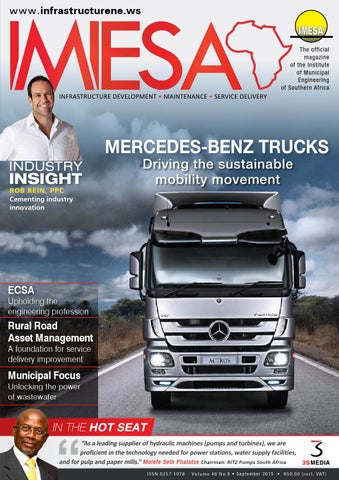
MERCEDES-BENZ TRUCKS INDUSTRY
INSIGHT ROB REIN, PPC Cementing industry innovation
Driving the sustainable mobility movement
ECSA
Upholding the engineering profession
Rural Road Asset Management A foundation for service delivery improvement
Municipal Focus Unlocking the power of wastewater
IN THE HOT SEAT “As a leading supplier of hydraulic machines (pumps and turbines), we are proficient in the technology needed for power stations, water supply facilities, and for pulp and paper mills.” Molefe Seth Phalatse Chairman: RITZ Pumps South Africa ISSN 0257 1978
V o l u m e 4 0 N o . 9 • S e p t e m b e r 2 0 1 5 • R 5 0 . 0 0 ( i n c l . VAT )
84179/E
REAL CAT® MACHINES NEED REAL CAT PARTS
No matter how hard they try, competitors just can’t deliver genuine Cat quality. Make sure you’re using genuine Cat® parts - the only parts built specifically for your Cat machine. Find out why genuine is important at www.barloworld-equipment.com Making sure you have easy access to genuine service.
© 2015 Caterpillar. All Rights Reserved. CAT, CATERPILLAR, BUILT FOR IT™, their respective logos, “Caterpillar Yellow,” the “Power Edge” trade dress as well as corporate and product identity used herein, are trademarks of Caterpillar and may not be used without permission.
CONTENTS www.infrastruc
turene.ws
IMESA The officia l magaz ine of the Institu te of Munici pal Engine ering rn Africa Southe of
INFRASTRUCTURE
MAIN DEVELOPMENT •
TENANCE • SERVI
CE DELIVERY
-BENZ TRUCKS MERCEDESthe sustainable Driving ent mobility movem
INDUSTRY
T INSIGH , PPC ROB REIN try Cementing indus innovation
VOLUME 40 NO. 9 SEPTEMBER 2015
26
Rob Rein, sales and marketing executive at PPC, speaks to IMIESA about PPC’s pivotal role in the industry. P18
PIPES Park Station sewer upgrade
INDUSTRY INSIGHT Regulars
ECSA
Editor’s comment President’s comment Africa round-up Index to advertisers
Upholding the engineering profession
Rural Road t Asset Managemen ce A foundation for servi nt delivery improveme
Municipal Focus Unlocking the powe of wastewater
r
IN THE HOT SEA
T
es), we are nes (pumps and turbin facilities, er of hydraulic machi “As a leading suppli stations, water supply logy needed for power Pumps South Africa proficient in the techno se Chairman: RITZ Molefe Seth Phalat 0 mills.” paper 2015 • R50.0 and 9 • September and for pulp olume 40 No. 8 ISSN 0257 197
Roads 3 5 8 96
Cover Story ( i n c l . VAT )
V
From the company’s earliest days, the development of fundamental technologies for particularly efficient, environmentally compatible vehicles has been a recurring theme in the history of the Mercedes-Benz brand. P6
Mercedes-Benz Trucks – Driving the sustainable mobility movement
6
Municipal Feature Unlocking the power of wastewater 10
Hot Seat Ritz Pumps – Pump it up
14
Professional Development Upholding the engineering profession
16
Industry Insight PPC – Cementing industry innovation 18
Pipes & Pipelines
HOT SEAT In this month’s Hot Seat, Molefe Seth Phalatse, chairman of RITZ Pumps South Africa, shows how this small company – with only eight employees – is able to maximise its resources to create value and supply high-quality pumps. P14
55
ROADS Leave it to Lafarge
The future for plastic pipes Gaining ground in Africa Park Station sewer upgrade Divisional Hot Seat: In the trenches Dynamic new flow transmitter with 3D flow profile from NIVUS Small industry, massive impact Asset management at the click of a button Significant milestone for Western Aqueduct Phase 2 NuWater's African expansion continues Sustainable solutions for a greener future
61
23 24 26 30 32 33 38 40
Rural road asset management Leave it to Lafarge
Bauma Conexpo Africa 2015 African opportunities Showcasing a full offering Extreme hoisting 101 Diverse applications for a diverse audience Off-road fleet acquisitions Quarrying industry to push for autonomy A multilingual approach to concrete education Quality concrete at reduced operating costs Emoyeni Mall on stable ground Celebrating one year of industry innovation Hydro cutting for improved road surfaces Creating learning possibilities Energy efficiency – More than an R-value
57 59 61 65 67 69 70 73 74 76 77 78 81
Human Settlements First Sibaya land parcels released
83
SHEQ Drugs in the workplace Caution: Health and safety under construction
CESA Aon Engineering Excellence Awards
Celebrating engineering excellence
44
Technology & Innovations
47
South African infrastructure competition goes international
BAUMA | VEHICLES & EQUIPMENT Extreme hoisting 101
49 55
74
87 89
91
94
BAUMA | CEMENT & CONCRETE Emoyeni Mall on stable ground
EDITOR’S COMMENT
Change, technology, and elections – IMESA 2015
PUBLISHER Elizabeth Shorten EDITOR & ASSOCIATE PUBLISHER Nicholas McDiarmid SENIOR JOURNALIST Beatrix Knopjes JOURNALISTS Liesl Frankson, Frances Ringwood HEAD OF DESIGN Beren Bauermeister DESIGNER Ramon Chinian CHIEF SUB-EDITOR Tristan Snijders SUB-EDITOR Morgan Carter CONTRIBUTORS Siva Chetty, Rob Dyer, Rhys Evans, Albie Hanekom, Priska Myburgh, Henk Oosterdijk CLIENT SERVICES & PRODUCTION MANAGER Antois-Leigh Botma PRODUCTION COORDINATOR Jacqueline Modise FINANCIAL MANAGER Andrew Lobban MARKETING & DIGITAL MANAGER Esther Le Roux MARKETING SPECIALIST Philip Rosenberg ADMINISTRATION Tonya Hebenton DISTRIBUTION MANAGER Nomsa Masina DISTRIBUTION COORDINATOR Asha Pursotham SUBSCRIPTIONS subs@3smedia.co.za PRINTERS United Litho Johannesburg +27 (0)11 402 0571 ___________________________________________________
W
ITH ONLY A month to go to the IMESA 2015 Conference, being held in Cape Town from 28 to 30 October, the many voices and dynamics of the people, institutions, and organisations involved in public infrastructure come to mind. And, this year, I have definitely heard a common thread; when obstacles endure, change becomes necessary – and that change begins at home. The theme of this year’s conference is ‘Changing the face of the Municipal Engineer’; to quote IMESA: “With all the challenges facing our industry today – whether economic, social, environmental, or political – we need to adapt and be innovative. This starts with the local authorities, where most of us perform some function to serve our communities. But it goes beyond the government corridors – it stretches into the ideas and solutions created by each engineer in South Africa.” IMESA conferences are always landmark events, and they continue to be the gathering point for all stakeholders with a vested interest. I have observed, especially while attending other industry conferences, a great interest from companies who previously have not seen themselves as stakeholders. Notably, the role of the municipal engineer in utility services seems to be gaining attention; companies providing technology solutions for asset management, energy management, as well as those who facilitate those technologies, are seeing the value and market potential of local government. Noting the theme of change, what technical changes does the municipal engineer face today? Noting IMESA’s roll-out of its asset management registry and management programme, the role of information technology in designing, implementing, building, monitoring, managing, maintaining, and replacing public infrastructure assets is central, and has come a long way since we all adopted email as the ‘next big thing’.
ADVERTISING SALES Jenny Miller Tel: +27 (0)11 467 6223 E-mail: jennymiller@lantic.net ___________________________________________________
PUBLISHER: MEDIA No. 9, 3rd Avenue, Rivonia 2056 PO Box 92026, Norwood 2117 Tel: +27 (0)11 233 2600 Fax: +27 (0)11 234 7274/5 E-mail: nicholas@3smedia.co.za www.3smedia.co.za ANNUAL SUBSCRIPTION: R550.00 (INCL VAT) ISSN 0257 1978 IMIESA, Inst.MUNIC. ENG. S. AFR. © Copyright 2015. All rights reserved. ___________________________________________________ IMESA CONTACTS HEAD OFFICE: Manager: King Singh P.O. Box 2190, Westville, 3630 Tel: +27 (0)31 266 3263 Fax: +27 (0)31 266 5094 Email: admin@imesa.org.za Website: www.imesa.org.za BORDER Secretary: Celeste Vosloo Tel: +27 (0)43 705 2433 Fax: +27 (0)43 743 5266 Email: celestev@buffalocity.gov.za EASTERN CAPE Secretary: Susan Canestra Tel: +27 (0)41 585 4142 ext. 7 Fax: +27 (0)41 585 1066 Email: imesa.easterncape@gmail.com KWAZULU-NATAL Secretary: Penny Pietersen Tel: +27 (0)31 266 3263 Fax: +27 (0)31 266 5094 Email: imesakzn@imesa.org.za NORTHERN PROVINCE Secretary: Rona Fourie Tel: +27 (0)82 742 6364 Fax: +27 (0)86 634 5644 Email: imesanorth@vodamail.co.za SOUTHERN CAPE KAROO Secretary: Henrietta Olivier Tel: +27 (0)79 390 7536 Fax: +27 (0)86 629 7490 Email: imesa.southcape@gmail.com WESTERN CAPE Secretary: Erica Albertse Tel: +27 (0)21 444 7114 Fax: +27 (0)21 444 9470 Email: Erica.albertse@capetown.gov.za FREE STATE & NORTHERN CAPE Secretary: Wilma Van Der Walt Tel: +27 (0)83 457 4362 Fax: +27 (0)86 628 0468 Email: imesa.fsnc@gmail.com
Nicholas McDiarmid
To our avid readers, check out what we are talking about on our website, Facebook page or follow us on Twitter and have your say.
@infrastructure4
www.infrastructurene.ws
www.in
All material herein IMIESA is copyright protected and may not be reproduced either in whole or in part without the prior written permission of the publisher. The views of contributors do not necessarily reflect those of the Institute of Municipal Engineering of Southern Africa or the publishers.
With many systems on the market, and almost unlimited potential for development, choosing the right system for the right infrastructure can seem like quite a crazy jungle of choices. As part of IMIESA magazine’s ongoing development of focus, we began our focus on information technology some time back now, and it has been particularly heartening to be covering the actual implementation and use of these systems – most recently that of the City Power’s use of load management technology through smart metering. This theme will be developed through all applications and, by this time next year, we will have a library of information for all engineers working in the public infrastructure space to draw from. Following on from that, 3S Media has been hard at work developing content and a platform for its recently acquired continuing professional development product, CPD on Demand. An indispensable tool for all engineers, it is convenient and practical to ensure ongoing ECSA registration, while keeping up to date with the latest in engineering technical, regulatory, and practical information. Visit www.infrastructurene.ws/cpdondemand to discover a practical and affordable solution that fits right in with today’s busy schedule. Next year is a local government election year, and there is no doubt that more new build and maintenance projects are to be rolled out, leading up to these elections. There is a general sense that this may be one of the most contested elections we have yet seen in South Africa, for many reasons. There can be no doubt that the more capacitated the municipal sector, the better off we all are, and it would be good to see this as a general driving principle. I look forward to seeing you all in Cape Town and hearing about what is happening in your part of the world.
frastruc
turene.w
INFRASTRUC
IMESA
s
OPMENT TURE DEVEL
TOSAS
• MAINT
ENANCE
• SERVIC
E DELIVE
The official magazine of the Institute of Municipal Engineering of Southern Africa
INFRASTRUCTURE DEVELOPMENT • MAINTENANCE • SERVICE DELIVERY
RY
ber the rub d Where the roa meets
MERCEDES-BENZ TRUCKS INDUSTRY
INSIGHT ROB REIN, PPC Cementing industry innovation
Driving the sustainable mobility movement
ECSA
Upholding the engineering profession
ggles Power Struy engineering African energ
ussion Panel Discruction,
Rural Road Asset Management
Cover opportunity In each issue, IMIESA offers advertisers the opportunity to get to the front of the line by placing a company, product or service on the front cover of the journal. Buying this position will afford the advertiser the cover story and maximum exposure. For more information on cover bookings contact Jenny Miller on tel: +27 (0)11 467 6223.
A foundation for service delivery improvement
Municipal Focus
Road constce, and equipment maintenan
Unlocking the power of wastewater
l Focus Municipa Bay
Mandela ipality Nelson n Munic Metropolita
IN
Infrastructure News
IMESA
The official magaz ine e of the Institut pal of Munici Engine ering rn Africa of Southe
IN THE HOT SEAT
that are lt products sive T SEAT ffective aspha cing labour-inten Asphalt THE HO Much er of cost-e al, ut sacrifi a numb roads, witho Director: Plant & Technic “We have st to these • Augu ideally suited ds.” Herman Marais 8 V o l u m e 4 0 N o . 8 7 metho 257 19 ISSN 0 construction
2015
“As a leading supplier of hydraulic machines (pumps and turbines), we are proficient in the technology needed for power stations, water supply facilities, and for pulp) and paper mills.” Molefe Seth Phalatse Chairman: RITZ Pumps South Africa
.00 • R50
( i n c l . VAT
ISSN 0257 1978
V o l u m e 4 0 N o . 9 • S e p t e m b e r 2 0 1 5 • R 5 0 . 0 0 ( i n c l . VAT )
IMIESA September 2015
3
Visit us at the IMESA Exhibition 28-30 October 2015 GrandWest Cape Town Stand 38
[ Water Solutions ] [ In Africa, water is a scarce and valuable resource. With over 30 years of experience, Robor delivers exible, efcient and customised steel pipe solutions and products to the water industry. ] Our innovative technology ensures superior water pipeline performance even in the harshest of environments. In addition, Robor offers a variety of value added steel pipe and complete piping systems perfectly suited to the conveyance of water and sewerage. Our range includes but is not restricted to, lined, coated and uncoated steel pipe, ductile iron pipe, as well as ttings and jointing systems.
Value added services for complete water solutions include: • Lining and coating • Jointing systems • Fire protection solutions • Robotic and submerged arc welding facilities • On-site services and training • Technical support
For more information: Tel: +27 (0)11 971 1600 • E-mail: watersolutions@robor.co.za • www.robor.co.za
PRESIDENT’S COMMENT
IMESA
Countrywide optic fibre roll-out
Duncan Daries, IMESA president
One of the biggest challenges currently facing municipalities and road authorities is the roll-out of optic fibre cabling.
T
HAT THE COUNTRY has prioritised this is a given, as it is vital in maintaining a competitive edge in attracting investment and for a thriving economy.
Why is this an issue? Within municipal areas, road reserves primarily have to accommodate the actual road for vehicular and pedestrian access purposes. Secondary, but equally important, road reserves have to accommodate: • basic services such as water, foul sewer, stormwater, electricity, and street lights – including their supporting infrastructure such as manholes, valves, fire hydrants, and control boxes • telecommunications infrastructure. The road reserve width is, therefore, a constraint when it comes to accommodating all these services and, for proper governance, it is necessary that the road authority is the final arbiter of where these services are located within the road reserve to ensure that all these services can be rendered. Most authorities, therefore, prescribe where these services are located when areas are developed or services are retrofitted. In the era when there was only one telecommunications service provider/authority (Telkom), the accommodation of its cables was never a problem, other than excessively large manholes that were constructed in some
locations. However, this has since changed with over 400 ECNIS licenses issued by Independent Communications Authority of South Africa (Icasa) in terms of the Electronic Communications Act of 2005. In Cape Town, we are aware of at least 14 ECNIS license holders who can install and own telecommunications infrastructure. The lead up to the 2010 World Cup and the rapid implementation of telecommunications infrastructure to support the event was a great learning experience for municipalities. As each telecommunications infrastructure service wanted to install their own service, the cities soon ran out of space. Roads and road verges were constantly being trenched and post-trench reinstatement failures were difficult to apportion blame to. The City of Cape Town began an initiative to create a coordinating body consisting of the known role players in the telecommunications industry. From this initiative, they developed a policy and guidelines to the issuing of wayleaves to telecommunication infrastructure applicants.
Management and wayleave process – City of Cape Town • a two-stage process comprising a wayleave and a construction permit • tariffs for wayleaves, permits, and damages deposit • one trench principle, accommodating multiple service providers
• regular district engineer office coordination meetings • a registered civil engineering practitioner must be appointed by the service provider to oversee and sign-off on construction and reinstatement work in the road reserve • a master plan of each ECNIS licence holder network must be submitted and made available on GIS for coordination purposes – not only the core network but also the secondary and FTTX networks • the built information, with coordinates, must be submitted at sign-off of completion certificate. The approach to exercising road authority duties and responsibilities, in terms of national and provincial legislation as well as municipal by-laws, has been challenged in court by service providers in terms of the Electronic Communications Act. It is, therefore, worthwhile for readers to familiarise themselves with the following 2 cases: • Sanral vs Telkom in the KZN High Court – Oct 2010 • Msunduzi Municipality vs Dark Fibre Africa (RF)(Pty) Limited in the Supreme Court of Appeal, Bloemfontein – Oct 2014 The City of Cape Town tasked its official, Ian McDonald PrEng, to make presentations to both Salga and the Roads Coordinating Body concerning this issue. I can report that the National Depar tment of Transport has successfully been engaging with Icasa and that the following proposals have been
accepted as a starting point for onward discussions: • Establish and agree on a common approach in managing service applications including alignment with TRH 27 proposals. • Set up standard application and approval processes, including placement position within road reserve prism. • Develop and obtain approval for tariffs to be levied for wayleave and permit process as well as rates for damages deposits in terms of the MFMA – section 17(3)(a)(ii). • Prohibit trenching across roads – service providers must make use of trenchless technology methods – penalty rate included in schedule of tariffs. • Ensure that all new developments – including low-income housing – make provisions for ducting to be installed at construction stage. • Develop a rental tariff for the existence of optic fibre cables – rate per metre or per line speed or other. Other than this conventional trenching and laying of cables, another service provider is currently pursuing the placement of communications cables within sewer and stormwater conduits. This service provider wants its primary network located within these conduits but will still require traditional trenching for its secondary network, which links up its clients. The governance and practicality around this initiative is of great concern to municipal engineers.
IMIESA September 2015
5
COVER STORY
From the company’s earliest days, the development of fundamental technologies for particularly efficient, environmentally compatible vehicles has been a recurring theme in the history of the Mercedes-Benz brand.
Mercedes-Benz Trucks
M
ERCEDES-BENZ TRUCKS has been the first to bring numerous relevant technologies to production and market maturity, and continues to develop them further, even to the level of alternative technologies such as hybrids and fuel-cell drive systems. Outstanding innovations have been regarded as milestones in the development of more efficient and environmentally compatible commercial vehicles. The Mercedes-Benz powertrain strategy not only offers an impressively wide range of available technologies, but also the greatest possible flexibility in their use. Even within all the conceivable transitional scenarios, it optimally meets the varied requirements of different customers and markets. Keeping in line with Mercedes-Benz’s innovative technology, fuel economy in vehicles can be improved in many ways, including increasing engine efficiency, reducing aerodynamic drag, rolling friction, and improving fuel consumption.
New efficiency and safety enhancements Following on the success of the hypoid rear axle for the current Actros range, Mercedes-Benz
6
IMIESA September 2015
Driving the sustainable mobility movement engineers have come forward with new efficiency and safety enhancements on the Actros on-highway truck tractors that focus on driveline optimisation and safety. Many of these enhancements, such as Telligent Stability Control and the driver airbag, have been incorporated as standard on the model range for 2015, from the Actros 1844LS/36 DD 4x2 to the flagship Actros 2658LS/33. Two new additions to the range, with varied horsepower, are the Actros 2641LS/33DD, for applications within the medium- to longhaul segment, and the Actros 2646LS/33, which replaces the 2644LS/33. The increased power and torque in these upgraded models are now more accessible and useable due to the optimised directdrive transmission driveline. The introduction of this transmission (on the 410 hp, 460 hp, and 540 hp engines),
on the 6x4 tractor, further optimises the driveline, which is a welcome innovation to complement the hypoid axle previously introduced. The G281-12, with 12 forward and 4 reverse gears, is a direct-drive, powershift, constant-mesh automated manual transmission with integrated engine, transmission, and clutch control for improved shifting times and high/shift comfort.
Intelligent solutions The Telligent Stability Control feature, which is now standard on 4x2 and 6x4 airsuspended prime movers, is a complete package of systems covering all aspects of operation in the Actros. Intelligent systems monitor and regulate the vehicle’s functions, giving drivers a safer, smoother ride, prolonging the life of the vehicle. One of the significant features of the Telligent technology is the braking system,
COVER STORY
which is a standard specification. It comprises a dual-circuit brake system, with internally ventilated disc brakes all round, ABS, ASR, and auxiliary brakes such as the engine brake and retarder. The system relays each signal at lightning speed, much quicker than any mechanical system could. It allows braking power to be applied more sensitively, as in passenger cars. The braking force is optimally distributed between tractor and trailer according to the load. The Telligent brake system also ensures that the brake pads on the different axles do not wear at significantly different rates. Telligent Stability Control also recognises potential instability, such as skidding or swer ving, and counteracts it where possible. Systematic adjustment of engine torque, precisely measured tractor braking, and control of the trailer brake system helps the driver to avoid tricky situations. The enhanced, additional safety feature inherent in the airbag integrated in the steering wheel is linked to a control unit that ignites several propellants within a period of 30 milliseconds as from a precisely defined minimum deceleration in the event of an impact.
One propellant deploys the airbag and a fur ther propellant activates the pretension device and draws the safety belt as close as possible to the driver’s body. In the event of an accident, kinetic energy is absorbed, preventing direct contact between the upper body and steering wheel. With the optional Telligent Safety Pack, Mercedes-Benz Trucks offers the ultimate in safety, with active protection that no other manufacturer can currently offer in the local market. The pack consists of Telligent Distance Control and Active Brake Assist II. The Telligent Distance Control system consists of a radar sensor and control unit, which controls the vehicle speed and supports the driver in automatically maintaining the distance from a vehicle detected in front of it.
Putting the brakes on road accidents
Brake Assist II evaluates the traffic situation in front of the vehicle up to a distance of 200 metres. The system uses vehicle data for this purpose and also monitors the distance from vehicles ahead, as well as their speed. If the system detects the risk of a potential rear-end collision with a vehicle ahead, the driver is informed by means of a three-stage escalating warning system, corresponding to the actual situation. This warning gives the driver sufficient time to react. If there is no reaction from the driver to the collision warning, Active Brake Assist II automatically initiates emergency braking (full braking application) if there is a vehicle ahead. The warning concept for Active Brake Assist II is designed to allow drivers to take action themselves to avert critical situations. Mercedes-Benz Trucks continues to be the driving force for sustainable mobility in the future and is working intensively on further developments in all areas.
Active Brake Assist II uses the existing radar system of the Telligent Distance Control system, which assists the driver when an accident hazard is detected and reduces the vehicle speed by staged braking intervention. During driving, Active
IMIESA offers advertisers an ideal platform to ensure maximum exposure of their brand. Companies are afforded the opportunity of publishing a two-page cover story and a cover picture to promote their products to an appropriate audience. Please call Jenny Miller on +27 (0)11 467 6223 to secure your booking.
www.mercedes-benz.co.za
IMIESA September 2015
7
AFRICA ROUND-UP
INFRASTRUCTURE NEWS FROM AROUND THE CONTINENT were substandard, while some were based on the low capital provided for construction. According to him, the Ministry of Public Works has several infrastructure projects lined up, including the connection of roads to county capitals as well as other major trade hubs.
ETHIOPIA CCECC to construct Hawassa Industrial Park for $246 million China Civil Engineering Corporation (CCECC) concluded a $246 million deal for the construction of the Hawassa Industrial Park. The project, with MH Engineers as consultant, will be completed in nine months, with a focus on garment manufacture and agro-industry. Construction of the Hawassa Industrial Park includes 35 factory sheds and 19 buildings, which will be used as exhibition halls, food courts, dormitories, and for other purposes in the first phase. This phase will cover 100 ha, while the remaining phase will add 200 ha more. "The number of factories intended to be included in the first cycle of the Industrial Park project is 35. Nevertheless, the government requires the construction of more buildings in the park," says Kalkidan Betre, CCECC engineer: Quality & Safety.
KENYA
NIGERIA China to partner with Yobe on infrastructure China Civil Engineering Corporation (CCECC) concluded a $246 million deal for the construction of the Hawassa Industrial Park
director Flora Okoth said work is expected to be complete in 18 months from the contract signing date, on 1 July 2014. Lebanon-based firm Zakhem International won the contract. The six local and international banks are CFC Stanbic, Citibank, Commercial Bank of Africa, Co-operative Bank, Rand Merchant Bank (a division of FirstRand Bank Limited London Branch), and Standard Chartered Bank. The loan is one of the largest commercial bank financing ventures ever entered into by a Kenyan parastatal without government guarantee.
LIBERIA $1.99 billion needed for infrastructure development Liberia is looking at a bill of nearly $2 billion for infrastructure development, which includes the rehabilitation and construction of roads and bridges. This is according to William Gyude Moore, Liberia's Minister of Public Works. Speaking at the House of Representatives recently, he told plenary that, since 2006, more than $700 million has been spent on the development of roads in the country. Minister Moore admitted that most of the roads constructed
$350 million secured for new Mombasa-Nairobi pipeline Kenya Pipeline Company (KPC) has secured a $350 million loan to finance the construction of a new 450 km oil pipeline from Mombasa to Nairobi. The state-owned oil distributor will upgrade to a 20 inch ultramodern, multiproduct oil pipeline to replace the more than 30-year-old 14 inch pipeline currently in use. Speaking during the loan signing with a consortium of six banks, KPC acting managing
8
IMIESA September 2015
Kenya Pipeline Company (KPC) has secured a $350 million loan to finance the construction of a new 450 km oil pipeline from Mombasa to Nairobi
The Chinese government will partner with the Yobe State government in the areas of agriculture and infrastructure development, Chinese ambassador to Nigeria Gu Xian Jie has said. “The Chinese government is interested in partnering with Yobe to develop infrastructure and agriculture and to work with it to develop education. These are key areas of sustainable economic development,� he said. The ambassador noted the effort of the Yobe State government in improving the living conditions of the people of the state, especially in the areas of road construction and education, despite prevailing security challenges and the threats of Boko Haram. Gu asked governor Ibrahim Gaidam to continue to provide security to Chinese companies working in the state even as he pledged to make the Chinese firms working in the state more conscious of their corporate social responsibility. On his part, governor Ibrahim Gaidam, who thanked the Chinese ambassador for his government's support to Nigeria in general and Yobe in particular, said the state government will continue to work with the security agencies in the state to ensure that the environment is safe for the Chinese and other nationals working in Yobe State.
AFRICA ROUND-UP
Liberia is looking at a bill of nearly $2 billion for infrastructure development, which includes the rehabilitation and construction of roads and bridges
RWANDA Rwanda, Burundi, and Tanzania plan joint railway project Rwanda, Burundi, and Tanzania are looking for investors to participate in the building of a new 1 661 km standard-gauge railway, expected to cost about $7.6 billion. The partners, through the Rwanda Transport Development Agency (RTDA), are seeking expressions of interest from firms to finance, design, construct, operate, and maintain the railway under a publicprivate partnership. RTDA director general Guy Kalisa said interested firms will be evaluated, to shortlist potential private partners, prior to issuing the request for proposal documents for the project. The new standard gauge railway line is to be constructed from Dar es Salaam to Isaka, in northern Tanzania, and Kigali, in Rwanda, with a link to Burundi running from Keza to Musongati, through Gitega.
TANZANIA Experts call for firm slum infrastructure support Dar es Salaam's population is growing at an average of 8% per annum, with most people residing in slums with no tap water,
sewerage systems, or solid waste facilities. Visiting Professor David Hulme, from Brooks World Poverty Institute in Manchester, said the problems of infrastructure and service delivery in slums are so complex that government alone cannot solve them. "These problems can only be solved by collective community action involving the civil society and private sector," Prof Hulme said during an EcoPoor Dialogue held in Dar es Salaam recently. He advised that private investment is required in supplying slum dwellers with water, sewerage systems, and garbage treatment plants to support government investments. Over 70% of Dar es Salaam settlements are unplanned, while less than 5% of the population has access to formal sewerage system. Currently, about 60% of the city's residents have access to clean tap water, while the
40 % without access are mainly slum-dwellers.
UGANDA Uganda seeks $145 million World Bank loan for oil roads Uganda's parliament has recommended a loan request of $145 million from International Development Association (IDA) of the World Bank Group to be approved to finance the Albertine region districts road connectivity development project. The project will focus on improving the connectivity of the region, providing basic infrastructure and planning at local government level, and investing in institutions and people to prepare them for potential employment opportunities that are anticipated to Dar es Salaam's population is growing at an average of 8% per annum, with most people residing in slums with no tap water, sewerage systems, or solid waste facilities
result from growth and development of the region. The loan will finance the upgrading of a 100 km stretch of road. The total project financing will be $153.89 million; comprising an IDA credit of $145 million and an $8.89 million contribution from the government of Uganda, to be implemented over a period of five years.
ZAMBIA Eurobonds – result of investor confidence Zambia has successfully issued the targeted amount of $1.25 billion on a Eurobond, reportedly for infrastructure development. The Eurobond, with a coupon rate of 8.97%, has an eleven-year average life, with repayments in 2025, 2026, and 2027. The latest $1.25 billion, therefore, brings the total Eurobond debt to $3 billion. Speaking to the media, Deputy Finance Minister Christopher Mvunga says the funds will be used in infrastructure-related projects in the road, energy, education, health, water, and transport sectors in order to better the lives of the Zambian people. Amid loan repayment obligations, the government will still need to continue constructing roads, building hospitals and schools, and providing other public goods as well as ser vices. Any default by the country, in terms of the loan repayment, would greatly dent the country's credit-worthiness, which the government administrations, past and present, have worked hard to attain.
IMIESA September 2015
9
MUNICIPAL FEATURE
Unlocking the power BY SIVA CHETTY, ROB DYER, AND HENK OOSTERDIJK*
of wastewater
The eThekwini Municipality has several wastewater treatment works (WWTWs). The WWTWs treat domestic and a small amount of industrial effluent, through the aerobic treatment of the liquid fraction and the anaerobic digestion of the solids fraction.
T
HE ANAEROBIC DIGESTER produces biogas, which has about 65 % combustible methane. Some of the biogas is used to heat the digester so that it operates optimally and the rest, about 65%, is flared. eThekwini Water and Sanitation intends to use the biogas more beneficially, in a combined heat and power (CHP) system, to gain advantage from a renewable energy source. The CHP plant will generate ‘green’ electricity. In this way, the works can reduce the consumption of coal used to produce electricity at Eskom. The Northern Wastewater Treatment Works (NWWTW) has been selected as an appropriate works, with a current treatment capacity of 56 Mℓ/day, as a potential site to implement a methane-gas-to-electricity project, using the CHP system. The NWWTW is located in the northern area of Durban. It has an installed capacity of 70 Mℓ/day, with current average dry weather flow of 60 Mℓ/day. The NWWTW consists of primary sedimentation, activated sludge treatment, and anaerobic digestion. The secondary effluent is clarified in a system of secondary clarifiers and then discharged into the environment, after chlorination. The waste-activated sludge, from the aerobic process, and the primary sludge are anaerobically digested in three anaerobic digesters (Figure 1). The digesters are heated to mesophillic temperature (37OC) using about 40% of the biogas generated. The remaining biogas, comprising approximately 65% CH4 and 25% CO2, is flared into the atmosphere. The digested sludge is dewatered and transpor ted to land application. Electricity is primarily used in the aeration plant and pumping equipment throughout the works. The activated sludge plant’s power consumption is about
10
IMIESA September 2015
480 000 kWhr per month, which is about 70% of the treatment works’ total consumption.
*The authors: Siva Chetty, principal water technology consultant, Royal HaskoningDHV; Rob Dyer, senior planning engineer, eThekwini Water and Sanitation; and Henk Oosterdijk,
Scope of feasibility study
senior consultant: Waste Management &
A feasibility study was undertaken, from September 2013 to April 2014, to investigate the following: • undertake sludge production study • undertake process configuration investigation to maximise biogas production • undertake gas-to-energy study • u nder take technical evaluation of possible options • undertake economic evaluation of possible options.
Energy Technology, Royal HaskoningDHV
Project benefits The project is the first of its kind in the eThekwini Municipality and will have several benefits, such as: • stopping the release of global warming gases, such as methane and nitrous oxides – methane and nitrous oxides respectively have 23 and 296 times the global warming potential compared to carbon dioxide • increasing the use of non-renewable energy sources such as from biosolids • increasing energy efficiency • transferring waste heat from generator sets to heat up digester to mesophillic temperature of 37OC • anaerobic digester technology is a good example of appropriate technology in the green economy and sustainable green energy production • affording the possibility of future registration with the clean development mechanism in the future • aligning to the new regulations on carbon tax. The utilisation of biogas represents a shift
Figure 1 Anaerobic digestion plant at the NWWTW
from non-renewable, fossil-fuel-based energy towards renewable, bio-based energy. It will lay the foundation to view wastewater treatment as a green energy factory. It has been reported (Guo, Koornneef and Lue, 2009) that as much as 25% of the cost of treatment is attributable to energy costs, primarily in the form of electricity. The use of electricity consumption from a non-renewable resource, such as coal, is a problem in terms of climate change impact. It will lower the carbon footprint of the WWTWs, as the green electricity generated from the biogas will offset the need for nonrenewable, coal-based electricity. Although
MUNICIPAL FEATURE
CO2 is also released in the course of biogas combustion and COD reduction, the CO2 released is not taken into account, as it is considered biogenic (Gupta et al., 2012). The project intent is also to investigate the potential to enhance the operation of the digesters in order to maximise gas production and transform the secondary sludge (waste-activated sludge). Transforming the sludge makes it more amenable to anaerobic digestion and gas production. The on-site power generation will assist the treatment works in operating even where there are mains power supply outages. This will ensure full treatment is achieved, which will ensure compliance with the discharge permit and protection of the environment.
Figure 2 Combined sludge feed to anaerobic digesters in series
Figure 3 Gas conditioning system (Source: Northern WWTW in Johannesburg)
Maximisation of biogas production Several options were considered to maximise biogas production so that more green electricity can be generated. Considered options are outlined in Table 1. After an in-depth consideration of the technical and economic evaluation (Visser, 2014) of the different scenarios in Table 1, the alternative configuration 2 (Number 7) resulted in the best value-for-money option. This option is shown in Figure 2. This mode represents a close to plug flow configuration with resultant higher biogas production by about 8% to 10%.
Technical options investigated for biogas utilisation Several biogas utilisation options were investigated. The possible options are: • boiler • gas-engine-based combined heat and power unit •m icro gas turbine • f uel cell. The description, advantages, and disadvantages for the biogas system are summarised in Table 2. From the screening level economic evaluation, the option of the gas-engine-based CHP unit offered the most favourable economic return. Based on this screening exercise, the CHP option was explored in more detail in terms of its technical capability and economic viability.
Technical description of the CHP solution The biogas produced from the three digesters goes through a conditioning system, and
is then fed into the biogas-fired engines, to be wholly consumed. The purpose of gas conditioning is to remove hydrogen sulfide and siloxanes. These chemicals would cause damage to the gas engines if not removed. The gas conditioning system is shown in Figure 3. After conditioning, the gas is pumped into the generator. The generator has two outputs: heat and electrical energy. The excess heat generated from the generator engine block and exhaust is transferred into a cooling water circuit, through a system of heat exchangers. The heated water is used to heat up the digesters. The electrical energy produced undergoes voltage transformation and is then synchronised into the NWWTWs electrical grid. The CHP system is shown in Figure 4.
Technical data and CHP equipment sizing The design basis is the size of the works, as determined by the works inflow capacity and the settleable solids in the primary sedimentation process. The amount of biogas production is based on the sludge TABLE 1 Scenarios considered for maximisation of biogas production
Scenario Existing situation
Number 1
Description In this scenario, the existing situation is continued. The only difference is that an operating temperature of 37°C is assumed; this is the optimal temperature for mesophilic digestion.
Thermophilic digestion 2
The existing configuration is used. The operating digester temperature is 55°C.
Thermal treatment 1
3 (a) or 3 (b)
The existing configuration is used. WAS is pretreated thermally prior to digestion. The treatment type is based on the Cambi or a similar system. The digesters are operated at 37°C (option a) or 55°C (option b).
Thermal treatment 2
4
Same as scenario 3 a/b, but with another thermal treatment method based on the Thermocrack system developed by Royal HaskoningDHV.
Plug flow digestion
5
One digester is revamped to a plug flow digester consisting of three or four compartments with internal recycle. From this digester, the sludge is fed to the two remaining digesters operating in parallel mode. Again, digestion temperature can be 37°C (option a) or 55°C (option b).
Alternative configuration 1
6
Raw sludge and WAS are mixed and fed to the three digesters, which are operated as mesophilic (option a) or thermophilic (option b) parallel-operated digesters.
Alternative configuration 2
7
Raw sludge and WAS are mixed and fed to the three digesters, which are operated as mesophillic (option a) or thermophilic (option b) series-operated digesters. This way, a more plug-flow-type of operation is achieved.
IMIESA September 2015
11
MUNICIPAL FEATURE
loading into the primar y digesters, its volatile solids content, and the temperature and residence time in the digesters. The methane content of the biogas is based on actual sampling and analysis of the biogas stream. The methane content is used to estimate the calorific value of the biogas. The electrical efficiency is a function of generator size. The key technical data for the CHP system is presented in Table 3.
Figure 4 Combined heat and power system
Capital investment The capital investment is required for: • biogas conditioning • heat distribution system • digester reconfiguration • reciprocating gas engine • electrical connectivity • control and instrumentation. The estimated value is about R25 million. The applicable rate of exchange was €1.00 = R14.50. The operating costs are made up of maintenance (15c/kWh), labour, capital charges, and gas conditioning, and would amount to R2 million per annum. The savings would be due to reduced consumption of electricity from the Eskom grid. Figure 5 indicates the differential between expenses versus income from savings in electricity generated.
TABLE 2 Biogas utilisation options
System Boiler
Description The biogas is the main fuel supply to the boiler. The boiler can generate medium pressure.
Advantages High energy conversion efficiencies can be achieved. Hot water can be used for digester heating and local use.
Disadvantages Apart from digester heating, there has to be a demand for hot water in the plant or nearby.
CHP
Combined heat and power (CHP) is the simultaneous generation of usable heat and power (usually electricity) in a single process. Reciprocating gas engines are used to drive an alternatorgenerator system.
Suitable for WWTWs, as both the heat and electricity can be consumed on-site. High energy conversion and use efficiency; reduces carbon footprint of the works.
High initial capital investment and ongoing operating and maintenance costs.
Micro gas turbines Micro turbines (30–500 kWe) are increasingly being applied for generating power from biogas.
Variable speed, highspeed operation, compact size, simple operability, easy installation, low maintenance. Can accept relatively high levels of hydrogen sulphide (H2S) up to 5 000 ppm.
The noise levels are high. The electrical efficiencies are lower than for reciprocating engines by about 10%. The smaller systems (< 1 000 kWe) are more expensive than CHP equivalent.
Fuel cells
Fuel cells cleanly and efficiently convert chemical energy from hydrogen-rich fuels into electrical power and heat. The electrochemical process is virtually absent of pollutants.
The use of fuel cell technology for commercial operations is still in the development phase. Several types of fuel cells exist but all require extensive purification of the biogas.
Economic analysis There is a net gain in the investment taken over the 20-year analytical period. The NPVbased economic analysis clearly shows that the payback period is strongly influenced by the revenue from electricity saved, which is determined by the annual rate of increase in electricity charges. The current electricity increase is 8% per annum as set by the National Energy Regulator of South Africa (Nersa). However the increase over the last five years has been 60%, which is equivalent to an annual average increase of 12% per annum. In a recent media article (Mercury, May 2014) Eskom applied for a tariff increase of 16% per annum to sustain its electricity generation and supply mandate. Hence the increase of 12% and 16% per annum is a likely scenario. On the basis of a 12% electricity increase per annum, and investment of R25 million, the payback is expected to be less than 10 years with an internal rate of return (IRR) of 18%. Over a 20-year investment period, the net gain will be about R52 million.
12
IMIESA September 2015
Fuel cells produce energy electrochemically — without combusting the fuel. When a hydrogen-rich fuel, such as clean natural gas or renewable biogas, enters the fuel cell stack, it reacts electrochemically with oxygen (i.e. ambient air) to produce an electric current, heat, and water.
MUNICIPAL FEATURE
Operating and maintenance strategy One gas engine/generator is capable of 8 059 continuous operating hours per year. This provides an equipment availability of 92%, which shall also be guaranteed by the operator. The remaining 701 hours per year are used for scheduled maintenance. It is recommended that the major engine overhaul (rebuild) is under taken ever y 60 000 operating hours, which is equivalent to six to eight years. Maintenance can be distinguished as scheduled and unscheduled maintenance. Scheduled maintenance, like oil and filter and spark plug changes, can be planned in advance. This shall be planned in off-peak hours in order to minimise lost revenue. Unscheduled maintenance (breakdowns and consequent repairs) cannot be planned and, as such, can happen at any moment. The maintenance contract shall cover the whole 60 000 operating hour cycle, including the large overhaul (at 60 000 to 64 000 operating hours). Thereafter, the gas engine/generator set can be considered as new, and the maintenance schedule cycle starts again. It is recommended that the supply contractor be engaged for a sufficiently long time (say, 10 years) so that it is responsible for the major ser vice and maintenance requirements. If this does not happen, the municipality may inherit the economic risk of having to undertake the repairs itself at exorbitant costs. Further, a new operator may impose severe cost penalties as
it may doubt the previous operating and maintenance coverage. The following reasons are provided why the contractor shall have an extended (10-year) operating and maintenance contract: • The eThekwini Water Ser vices Unit does not have the experience and WWTW-level mechanical, electrical, and power engineering technical skills to operate and maintain the CHP. As can be seen, the maintenance programme can be onerous and it is not the core business activity of the EWS. • A maintenance contract for a shorter period is possible but has an associated risk that another contractor may not be willing to take over the contract due to a poor maintenance record or will only take over at high costs. • A contract covering only the first three years of operating shall have a lower specific price than a contract that covers years four to eight. • A long-term contract ensures the contracted operator operates the plant optimally by ensuring the scheduled maintenance occurs as planned. If the factor y-scheduled maintenance is not carried out, it could be possible for the genset to incur greater costs sooner, thereby having a negative effect on the financial returns.
Value-for-money assessment The economic analysis has shown that the savings from the generated electricity covers the operational and maintenance expenses for the CHP plant. In addition,
Figure 5 NWWTW: differential between expenses vs income from savings in electricity generated
TABLE 3 Key technical data for the proposed CHP system
Average works inflow
50 000 m3/day
Biogas production Methane content Maximum electrical output Electrical efficiency
5 500 m3/day 65% 690 kWe
Thermal efficiency
45%
39%
Annual works generation 5 092 MWh/y Annual works consumption
7 920 MWh/y
Generation/consumption 64% Carbon footprint reduction
4 665 t/y
there are some savings to pay off the capital investment in less than 10 years.
Conclusion The feasibility study into the use of biogas from the NWWTW for green electricity production has been an exciting development. It has generated a new body of knowledge in areas such as enhanced biogas production, carbon footprint reduction, the notion of WWTWs as renewable energy factories, economics of renewable energy systems, and operating and maintenance strategies for CHP systems. The study has highlighted that the economics of CHP systems as applicable in a medium-sized WWTW can be marginal at lower power price increases. This is true in the context of South Africa, where electricity has been ver y affordable compared to global prices for electricity. Further, the lack of subsidies for greener and more sustainable fuels, and the weakening of the South African rand have also contributed to making such projects marginal, in terms of return on investment. The positive news is that a CHP system is a ver y appropriate choice of technology for a WWTW, as both the heat and power can be locally consumed, thereby increasing the overall use efficiency to over 80%. In addition, the renewable energy generated can have a substantial reduction in the carbon footprint of the WWTW, by as much as 35%. Finally, the consideration of biogas for power generation is the first step in positioning the WWTW as an energy factor y. For a full list of references, please contact the editor.
IMIESA September 2015
13