www.transportworldafrica.co.za ENDORSED BY
Intraregional supply chain soluĆ&#x;ons from producer to consumer
Commercial Vehicles Law and Accidents
Supply Chain Logistics Peak Transport Operations
Logistics
Non-Tariff Barriers
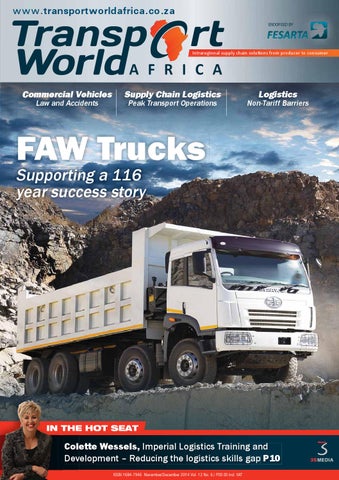
FAW Trucks
Supporting a 116 year success story
IN THE HOT SEAT
Colette C ol Wessels, Imperial Logistics Training and Development – Reducing the logistics skills gap P10 D ev ISSN 1684-7946 November/December 2014 Vol.Mar/Apr 12 No. 2013 6 / R50.00 incl. VAT ISSN 1684-7946 Vol. 11 No. 2 / R40.00 incl. VAT
Get your costs in perspective. Over time, the speed of response and proficiency of your finance and insurance providers can have a big impact on your bottom line. So isn’t it better to use a specialist partner who from the moment you pick up the phone, understands that lost time equals lost revenue? There is a better way.
www.tra
nsportwo
rldafrica.c
o.za ENDORSED BY
Intraregional
Commercia l Vehicles Law and Accident s
Intraregional supply chain solutions from producer to consumer onsumee r
supply chain
soluƟons from
producer to
consumer
Supply Cha in
Logistics Peak Tran sport Operatio ns
FAW Truc ks
Logistics
Non-Tariff
Barriers
Supportin g a 116 year succes s story
COVER STORY ORY Y FAW Trucks cks – Supporting ing a 116-year ear success story ory
INSIDE
P6 6
THIS ISSUE E
IN THE HOT SE AT
C lette We Col ssels, Imp eria Developme nt – Reducin l Logistics Training and g the logistic s skills gap ISSN 1684-79 46 Novemb P10 er/Dece ISSN mber 1684-79 2014 Vol.Mar/Apr 46 12 No. 2013 6 / R50.00 Vol. 11 incl. VAT No. 2 / R40.00
REGULARS
FUEL
Editor’s Comment Go back to basics and save lives FESARTA Closer cooperation is needed for overloading Cover Story FAW – Ross Demolition’s 116-year success Regional News
2 5 6 8
Game-changing innovation in the fuel industry
HOT H SEAT S
Colette Wessels Imperial Logistics Training and Development executive
P10
FMCG transport Recognising SA’s Truck Driver of the Year
Future of connected fleets Challenges and opportunities
22 23 25 29 30
CORRIDORS 32
NTBs still a big problem
LAW 12
Legal implications of a truck accident
PORTS Terminal plays pivotal role in Cape economy
FLEET MANAGEMENT 14 15 16 17
Road Transport Management System Real-time communication Finance company established Putting driver’s health first
COMMERCIAL VEHICLES 18 18 19
Future Truck launched Assembly plant opens Refurbished Kempston Road plant revealed
INSURANCE
R650 million fuel storage facility
34 36
GOODS IN TRANSIT Cargo insurance vital
37
TRAINING Strategic logistics investment
38
DRUGS Testing drivers for drugs
39
AIR CARGO 20
Transporter insurance – the hazard warnings
12
21
LOGISTICS
Dealing with peak transport operations
IN THE
incl. VAT
Air freight recovery strengthens
40
19 25
TWA | Nov/Dec 2014
1
EDITOR’S COMMENT
Go back to basics and save lives
Publisher Elizabeth Shorten Editor Simon Foulds • simon@3smedia.co.za Head of design Hayley Mendelow Senior designer Frédérick Danton Designer Kirsty Galloway Contributors Barney Curtis, Andrew Evans, Rhys Evans
H
Editor in action
opefully the recent tragic accident on the N12 near Alberton will make everyone sit up and start acting positively. Over the years there have been many studies to ascertain how and why we have so much carnage on our roads. But not much seems to come from them. In an ideal world all drivers and operators need to go back to basics and stick to the rules of the road. That is my theory, but we all know that it is not going to happen. It is scary how many car drivers do not realise that a fully laden truck needs more distance to slow down. Maybe one aspect that needs to be driven home to car drivers is that every time they cut in front of a truck they are literally playing Russian roulette with not only their lives but also those around them. The law needs to hold companies liable as well. After all, it is they who place that driver behind the wheel of the truck. Both driver and owner should ensure the truck is roadworthy before leaving the yard. This needs to be drilled into every driver and operator. If not then the full wrath of the law should take its course. Courtesy, politeness and respect for the law of the roads will ensure we cut the carnage down. It is up to everyone to play their part. If we do, the roads will be a safer, more enjoyable place to drive. In this issue we find out what the law says about who should be held responsible in the event of an unroadworthy truck causing an accident. We look at considering implementing the RTMS ethics into your transport operation and at improving FMCG delivery operations. Find out more about the terminal port at Cape Town, the new fuel terminal there, and what Africa should be doing to grow its economy and on the logistics side when dealing with peak transport operations in the fourth quarter. As always, a varied read. Enjoy!
Simon Foulds
2
TWA | Nov/Dec 2014
& Mario Landman Chief sub-editor Tristan Snijders Sub-editor Beatrix Knopjes Client services & production manager Antois-Leigh Botma Production coordinator Jacqueline Modise Marketing manager Hestelle Robinson Digital manager Esther Louw Distribution manager Nomsa Masina Distribution coordinator Asha Pursotham Financial manager Andrew Lobban Administrator Tonya Hebenton Printers United Litho JHB • t +27 (0)11 402 0571 Advertising sales Hanlie Fintelman • h.fintelman@lantic.net t +27 (0)12 543 2564
No. 4, 5th Avenue Rivonia PO Box 92026, Norwood 2117 t: +27 (0)11 233 2600 f: +27 (0)11 234 7274
www.3smedia.co.za Annual subscription: R300 (incl VAT) subs@3smedia.co.za ISSN 1684-7946 © Copyright. All rights reserved. All articles herein Transport World Africa are copyrightprotected and may not be reproduced either in whole or in part without the prior written permission of the publisher. The views of contributors do not necessarily reflect those of the publishers.
Shell Lubricants Fleets
SHELL SPIRAX S6 AXME 75W-90 CONVERTS INVESTMENT TO CASH The Shell Spirax S6 AXME gives fleet owners everywhere a glimpse of the future savings that converts their investments in the correct oil to cash for their companies.
The premium Spirax S6 AXME has been developed to enable drivers and fleet owners to reduce their overheads by switching to a synthetic formulation to enhance wear protection, long oil life and efficiency, thus saving your company a significant amount of money. Globally, companies have reported on the benefits of using the Spirax S6 AXME, citing doubling oil-drainage intervals, reduction of lubricant consumption, fuel consumption and maintenance costs. TGT00038
Benefits of Spirax S6 AXME: Reduced friction for improved fuel efficiency Exceptional wear, pitting and corrosion protection for longer transmission life Longer oil-drain interval for reduced maintenance costs and better value All-climate, year-round performance
Email address: Website: SA relevant material: Contact No:
Lubesenquiries-za@shell.com www.shell.com http://www.shell.com/zaf/products-services.html 0800 027 027
PAGE STRAP
FESARTA COMMENT
by Barney Curtis, chief executive officer, FESARTA
Closer cooperation is needed for overloading Prior to the load charter for operators along the Northern Corridor being launched at a workshop on load limits and overloading control in Kampala, Uganda, FESARTA requested the scope of discussions to be expanded.
O
UR REQUEST WAS to include a discussion on the self-regulation system (RTMS) as adopted in South Africa, plus other outstanding issues in load limits and load control within the East and Southern African regions. This was agreed upon and I attended this event hosted by the Trade and Transport Authority of the Northern Corridor courtesy of the sub-Saharan Africa Transport Policy Programme.
The Vehicle Load Control Charter The contents of this charter were predominantly focused on the Kenyan transport sector. In Kenya, 95% of all goods are moved by road. It was accepted by all the relevant parties in Kenya. Unfortunately no fruitful discussions were held with the developers of this charter regarding the RTMS in South Africa. This is, in my opinion, a missed opportunity. This is not to say the charter is inferior to the RTMS, but I believe there should have been closer cooperation between the two systems to agree on the best options applicable to both regions. Unlike the RTMS, this load charter did not include: • standards to which consignors, transporters and consignees had to comply • compulsory auditing of transporters by professional auditors (at accreditation and on an annual basis) • a national steering committee.
It was also suggested that transporters who signed the Vehicle Load Control Charter should be members of a relevant transport association within their country. Uganda is also looking at adopting this particular charter and discussions have started with the country’s government in this regard.
Standard in East Africa The relevant national road transport associations in the region have also called on the East African countries to adopt this charter. It is my understanding that all the relevant transport associations are studying the contents in order to discuss it with their relevant members. For this to be possible it will have to be overseen by the Trade and Transport Authority of the Northern Corridor. FESARTA recommended that there also be closer cooperation between the developers of the charter and the RTMS going forward because both systems can benefit from constructive feedback and dialogue.
TWA | Nov/Dec 2014
5
COVER STORY
FAW TRUCKS
Ross Demolition’s 116-year success
6
TWA | Nov/Dec 2014
COVER STORY
”Survival of the fittest through business acumen, keeping your promises and a resilient attitude manifested by every employee – that’s the recipe for success.“
T
HIS IS THE message from a company that has been going strong for 116 years. Ross Demolition, headquartered in Cape Town, has prospered and survived many tough economic times spanning four generations of a family of engineers. All of them have been dedicated businessmen with not only a belief in inspirational leadership, but also in strong fiscal discipline, commitment and honesty. Since it was established in 1898 by Henry T Ross, the Ross Demolition group has followed a consistent motto: ‘On time, every time’. They also don’t shy away from any opportunity, as they maintain that no job is too big or too small. At present, Robert Ross and his son, John Ross, manage the family-owned business, which engages in contract demolition work across the whole of South Africa and subSaharan Africa, on a contract basis. While this is only one of six ‘arms’ of their business operations, it – like the other five divisions – depends heavily on a competent and efficient fleet of trucks to ensure all projects remain profitable, and continue to uphold their irrefutable reputation for delivering on their promises. This is why their fleet of FAW vehicles, mainly extra-heavy tipper trucks, is integral to their success. The FAW reputation for durability and efficiency matches that of Ross Demolition. “Our first FAW trucks to join the RD fleet were purchased to specifically service contracts in Africa where uncomplicated, easy-to-drive/maintain trucks were the main criteria for getting our excavation contracts done with minimum downtime,” explains Robert. “At present, we operate 28 FAW units, mostly the proven and robust 28.280FD tippers. I am very happy with the operational efficiencies that we are getting. In most cases, we are realising superb fuel consumption at 2.3 litres to 2.8 litres per kilometre. “Working in difficult and dusty uneven terrain, steep gradients on- and off-site, and moving heavy payloads, we opted for a shorter wheelbase configuration and a 400 litre fuel tank adjustment. The Euro II Weichai WD 615.50 engines give us a respectable 206 Kw with an effective torque of 1 160 Nm to pull payloads, some beyond the prescribed 12-tonne parameter. “The FAW trucks have succeeded admirably in all our initial trials. The first units coped beyond our expectations and, as a result, we’ve deployed them on all our operations locally and cross border, from confined inner-city projects to distant mass excavation sites.” Ross Demolition also provides the construction industry with mine rehabilitation, plant hire, tricky asbestos removal and earthmoving services. However, one of the most rewarding undertakings to have emerged over the last years, is the
material recycling business done by Ross Demolition. “In every site we clear, we recycle 98% of all the materials used – bricks, wood, windows, steel, glass, roof trusses – you name it, we recover it and resell this to the ‘secondary’ construction tier who are desperate for affordable, good second-hand material. We have five depots from where this recycled material is sold. It’s great to know we are contributing to preserving resources and the environment, and helping other entrepreneurs make a decent living in the construction industry,” says Robert. Robert Ross recalls some of the most amazing projects undertaken by Ross Demolition. “We’ve imploded the Athlone Cooling Towers, as well as the largest building ever in Cape Town, which always has great spectator value. One of the most challenging projects was working against the clock when we had to demolish the Valkenburg Bridge within a total time frame of only eight hours. Beginning at midnight, by 08:00 we had completely dismantled the bridge, removed all the debris and cleared the site so that traffic on the N2 route could resume in the morning. “Another remarkable project was the Portside 101 Project; the deepest excavation project ever undertaken in Cape Town. The Portside 101 Project covered a full city block on the foreshore and required 90 000 cubic metres of rock to be blasted out and removed from the site. The site was commissioned for a 32-storey building, 142 metres high, which today stands proudly as the tallest building in the Cape Town CBD.” “Our fleet of FAW trucks is efficient, robust and reliable. Our drivers are well trained. We employ sound fleet management systems, like trackers, and so on, to monitor and ensure we get the necessary performance to maintain our margins,” explains John. “With the recessionary times and the pressures prevailing in the construction industry, competition is fierce and margins are tight. We need our fleet to run at the highest uptime rate possible with the minimum of problems in vehicle maintenance and service requirements. Our FAW fleet stays on the road, is not demanding in its simplicity of operation and is particularly great for our bottom line with its low maintenance costs and minimum downtime. These benefits are crucial to our profit margins,” concludes Robert.
TWA offers advertisers an ideal platform to ensure maximum exposure of their brand. Companies are afforded the opportunity of publishing a two-page cover story and a cover picture to promote their products to an appropriate audience. Please call Hanlie Fintelman on +27 (0)12 463 2564 or e-mail her at h.fintelman@lantic.net to secure your booking.
OPPOSITE AND ABOVE The proven and robust 28.280FD tippers
TWA | Nov/Dec 2014
7
REGIONAL NEWS
Read more on www.transportworldafrica.co.za
SOUTH AFRICA
R24 billion 10-year deal signed with Transnet
A 10-YEAR CONTRACT for transporting coal on rail has been signed between Transnet and the South African coal unit of mining company BHP Billiton. This agreement makes the Australia-based miner the first major customer to commit to a long-term take-or-pay contract with the South African state-owned freight transport company. It is also a massive boost for certainty around Transnet’s capacity expansion programmes on the export coal line. Transnet is adding close to 10 million tonnes in capacity on the line from the current 73 million to 81 million tonnes, over the next seven years. The agreement with BHP equates to a contract value of approximately R2.4 billion per annum and R24 billion over the 10-year period. Take or pay contracts are crucial to Transnet’s capital investment programme as they provide revenue certainty – a key consideration for raising funds in the capital markets. Take or pay contracts mean that Transnet commits to providing trains and a customer is obliged to pay whether they have product or not. Crucially, the long-term contracts provide a massive boost to South Africa’s credentials as an investment destination, as they confirm the mining sector’s confidence in the country. For Transnet, this is an indication of strengthening relations with customers, particularly with regards to partnering on future plans. BHP is one of Transnet’s and South Africa’s largest coal exporters. Transnet is confident that agreements with the remaining 28 customers will be formalised by the end of November this year. Transnet has been in negotiations with the industry over the last 20 months and most customers have agreed to the terms. All exporters moving through the Richards Bay Coal Terminal (RBCT) will sign individual contracts of 10 contract years, commencing on 1 April 2014 and terminating on 31 March 2024. Transnet Freight Rail has committed to moving 810 million tonnes of coal over the period, including a performance guarantee.
8
TWA | Nov/Dec 2014
SOUTHERN AFRICA
Smooth flow of cargo THE MAPUTO CORRIDOR Joint Operating Centre (JOC) has been officially launched by Transnet and port and rail operators in Swaziland and Mozambique. The centre is a major milestone for the three countries in their drive to provide a seamless flow of cargo services to their customers. The JOC enables Transnet, through its rail freight division, Transnet Freight Rail, Mozambique rail and port operators respectively, Caminhos de Ferro de Moçambique and Maputo Port Development Corporation and Swaziland Railway to establish common operating and maintenance philosophies. These efforts are aimed at enhancing operational efficiencies on the freight corridor, which runs from Mpumalanga in South Africa through Swaziland to the Port of Richard’s Bay and the Port of Maputo in Mozambique. The JOC houses representatives from all four partners under one roof, focusing on the integration of planning and operations, and managing all cross-border operations and stakeholders. The JOC has already realised significant efficiency gains. These include an impressive 24% reduction in dwell time at Komatiepoort, and an unprecedented 57% reduction in dwell time at the ports in Maputo. In the JOC’s first year of operation, Freight Rail’s volumes to Mozambique grew from 2.6 mtpa to 4.5 mtpa.
EAST AFRICA
Creating 2 346 jobs and generating $78.38 million in first year
THE EXPORT PROCESSING Zone (EPZ) in Tanzania continues generating revenue and creating jobs for the region with another 13 new local and foreign companies being allowed to start businesses within its Special Economic Zones. Dr Adelhelm Meru, the Economic Processing Zone Authority director-general, says: “Once these new companies start operations, about 2 346 jobs will be created and $78.35 million will be generated in the first year.” Over the last five years, the country has generated $450 million net profit from goods exported from the country’s EPZ. Since these were established within Tanzania, over $700 million has been invested in the country in the process creating 14 000 direct jobs. The EPZ scheme became operational in 2002 when Tanzania set aside 16 150 hectares of land for the development of Special Economic Zones in three of its cities in an attempt to attract foreign investment.
REGIONAL NEWS
SOUTH AFRICA
Accelerating owner-driver projects THE LATEST PHASE in an innovative scheme giving drivers ownership of a business, while realising a company’s enterprise development objectives, is bearing fruit. Adcock Ingram Critical Care recently handed owner-drivers the keys to their vehicles enabling them to distribute Adcock Ingram products along allocated territories. The company has empowered the drivers through training in various standard operating procedures, new logistics technologies and business management skills, to ensure these new entrepreneurs get the best shot at business success. Adcock Ingram Critical Care is a major supplier of life-saving medicines to hospitals and all the vehicles are branded with messages and images relating to the Critical Care mission and range of products. Tobie Krige, head: Logistics at Adcock Ingram says: “Due to the nature of the products produced by the Critical Care facility, distribution takes place directly from the Aeroton site. I am passionate about this programme and have seen how it changes the lives of the new business owners.” The launch of this Critical Care fleet of 17 vehicles augments an existing fleet of 25 vehicles, with owner-drivers already delivering the Adcock Ingram range of products from the main distribution points in Midrand, Cape Town and Bloemfontein.
Meshack Matswi, one of the first-phase and now established owner-drivers, talks about his experiences and the value of being a director: “This is a serious business and the opportunity to be a business owner and employer most certainly has its rewards. I have been able to grant my youngest son his greatest wish and that is to train as a professional soccer player through the Brazilian Soccer School Academy. Without this opportunity offered by Adcock Ingram, I would not have been in the financial position to do this.” Krige states “We believe in adding value to life and are committed to helping combat unemployment. There is a great entrepreneurial spirit shared by our owner-drivers and it is amazing to see how much dedication and effort people can put into something when given the chance.”
SOUTHERN AFRICA
Processing 50 million tonnes of cargo by 2020 THE CARGO PROCESSING capacity at the Port of Maputo will increase from 40 million to 50 million tonnes by 2020. This is according to Osorio Sales Lucas, president of the Maputo Port Development Company (MPDC), who was speaking at the launch of the Joint Operation Centre (JOC) of the Maputo Corridor. Three new docks will also be constructed along with dredging to increase the depth of the port from its current 11 m to 14 m, enabling larger draft vessels to moor at the port. Lucas says: “A tender will be announced in the coming months to ensure that new dredging operations are carried out by a company with capacity to carry out the work. Meanwhile Italeni, Transnet Freight and Rail’s new dredger, is due to arrive in Maputo for maintenance dredging. “Portos e Caminhos de Ferro de Moçambique also plans to invest $1 million in infrastructure and rolling stock to allow most of the cargo sent to the Port of Maputo to arrive by rail, rather than by road as is currently the case.” The MPDC, a partnership that includes South Africa’s Grindrod and DP World of the United Arab Emirates as its main shareholders, handled 17 million tonnes of cargo in 2013 and is expected to increase this to 19 million tonnes this year. The JOC – which has been in operation since 2013 – coordinates the operations of Transnet Freight Rail, CFM, Swaziland Railway and the MPDC.
EAST AFRICA
$100 million invested in upgrading one-stop border posts IN SPEARHEADING trade integration across East Africa, Trademark East Africa has invested $100 million in upgrading the one-stop border posts within the region. This will ease cross-border trade and improve business competitiveness by reducing the time spent to clear cargo in transit. So far, construction at the Holili-Taveta one-stop border post at the Kenya-Tanzania border is complete, paving the way for controls that will save time and money for traders ferrying goods into northern Tanzania. It is expected to be officially opened in 2015. States Frank Matsaert, CEO at Trademark East Africa: “We are already working on the Busia and Malaba border posts to upgrade the facilities, as well as working towards improving the management of work processes and eventually easing transit times in East Africa.”
TWA | Nov/Dec 2014
9
HOT SEAT
IMPERIAL LOGISTICS
Reducing the logistics skills gap Skills training is an important aspect of growth within a company, as well as for growing the economy. In this issue’s Hot Seat, we put Imperial Logistics Training and Development executive Colette Wessels on the spot about the importance of skills development and the initiatives being taken at Imperial Logistics. In your experience, has the skills gap broadened? Research and experience indicates that it has not changed much, entry/operational level skills are relatively easy to obtain, however the talent challenge remains at senior and executive management level. This is due to technical competence being relatively easy to attain, and a number of managers lack the leadership and strategic ability for transition to senior/ executive level. Transformation remains a challenge in the traditional ‘crucial and scarce’ skills categories, such as engineering and IT programming/ architecture development. The well-published problem within the education system in South Africa does not help in alleviating the skills problem. The bureaucracy and other challenges, such as resources, entrenched in the processes of sector education and training authorities often limit the efficiency of these bodies in addressing skills development in certain sectors.
What measurements are taken to minimise the skills gap? Industry level: bursary schemes are available in the fields of logistics and supply chain management together with selected commercial
10
TWA | Nov/Dec 2014
disciplines. Workplace experience programmes are available to young graduates. A partnership with educational institutions and professional bodies supports staff in promoting their careers. Company level: we have developed numerous customised leadership programmes to build technical and general managerial competence. Internal and external short courses are facilitated for professional development.
educational promotes added opportunities. It is important that both the private sector and industry partners do more to profile logistics and transport sectors at school level. An initiative such as the Road Freight Bargaining Council is an informative and valuable expedition. The Transport Education and Training Authority drafted a career guide for the sector.
Are there sufficient industry training options and how does the company take advantage of these? Over and beyond
How has training and development evolved at Imperial Logistics? When
our internal programmes, we have partnered with numerous private and public education institutions and training providers. These include universities, FET colleges, professional bodies such as SAPICS, ECSA and CIMA, as well as other private providers. Additionally, we leverage grants to fund skills development in maintaining close relations with the relevant sectors in education and training authorities.
Are there any current opportunities in pursuing a career in transport? Opportunities have grown remarkably in this industry. Our assistance in offering tertiary
we recognised the need to move to the next level and establish an accredited in-house training facility to upskill our people, the Imperial Logistics Academy was born. The academy provides customised, integrated training and development programmes
that are aligned with national qualifications, as well as practical short courses to address specific skills development and career advancement needs.
What about training in the rest of Africa? In line with Imperial Logistics’ vision to expand its African footprint, the Imperial Logistics Academy is affiliated with the Imperial Health Sciences Supply Chain Academy, one of Africa’s leading providers of training and development for people working in the continent’s public health supply chain. As Imperial Academy’s African partner, it offers training and skills development beyond South Africa’s borders, to health and logistics practitioners in public health facilities, government health departments and private logistics companies.
HOT SEAT
IMPERIAL LOGISTICS
Academy boosts supply chain skills Reflecting its commitment to addressing South Africa’s critical skills shortage, logistics and supply chain leader Imperial has launched the Imperial Logistics Academy.
T
HE ACADEMY IS THE natural next step in the evolution of the group’s education and development efforts, comments chief executive officer Marius Swanepoel. “Imperial has always strived to be an employer of choice as well as a learning organisation, so we’re not new to training. Our multifaceted learning and development framework has garnered numerous accolades and awards over the years, including the SAPICS Corporate Educator of the Year award and the South African Graduate Recruiters Association’s Graduate Employer of Choice award. We recognised the need to move to the next level and establish an accredited inhouse training facility to upskill our people, so the Imperial Logistics Academy was born,” he explains. The academy provides customised, integrated training and development programmes aligned with national qualifications, as well as practical short courses to address specific skills development and career advancement needs. “In addition, the academy enables graduates to enter the supply chain and logistics industry through graduate development and learnership programmes,” Swanepoel expands. “A dedicated graduate development manager engages with further and higher education institutions on a continuous basis to reach graduates around the country. Guest lecturing is offered, and the academy also participates in career days, to maintain a close relationship with higher and further education institutions. A key strategy is
to build a pipeline of graduates, to feed into the Imperial Logistics internships and bursary schemes,” he states. All training is customised to reflect the Imperial approach and encompass Imperial Logistics’ best practice. “Subject matter expertise drawn from within the organisation enhances the training programmes,” Swanepoel notes. “Skilled Imperial Logistics people contribute to content development and offer guest lecturing and mentorship. This means that skills are transferred both internally within the group and externally, to develop the broader supply chain industry.” In line with Imperial Logistics’ vision to expand its African footprint, the Imperial Logistics Academy is affiliated with the Imperial Health Sciences Supply Chain Academy, which is one of Africa’s leading providers of training and development for people working in the continent’s public health supply chain. “As the Imperial Logistics Academy’s African partner, it offers training and skills development beyond South Africa’s borders, to health and logistics practitioners in public health facilities, government health departments and private logistics companies,” says Swanepoel. Also complementing the Imperial Logistics Academy’s offerings is its collaboration with Ikaheng HR Services, a group company that focuses on operator and legal compliance training. The Imperial Logistics Academy also aims to drive industry cooperation, partnerships and knowledge sharing. The Academy is closely affiliated with the Transport Education and Training Authority, as well as other leading industry associations, such as the Road Freight Association, SAPICS and CIMA. “At Imperial Logistics, we believe that the right solutions and services are meaningless without skilled people to adopt, implement and support them. Through the Imperial Logistics Academy, we aim to get the best from our people and help them get ahead, as well as advancing the supply chain and logistics industry as a whole,” he concludes.
TWA | Nov/Dec 2014
11
LAW
Legal implications of a truck accident The horrific accident on the N12 near Alberton in October was described by Ismail Vadi, MEC for Transport in Gauteng, as looking like the aftermath of a bomb explosion.
T Alta Swanepoel, manager at Alta Swanepoel and Associates
HE DRIVER WAS arrested shortly after the accident and Minister of Transport Dipuo Peters also called for the truck owner to be arrested. This has raised questions about what the law says about who should ultimately be held responsible and prosecuted: the driver or the owner of the vehicle? At the same time what should a driver do if he realises the vehicle is unroadworthy? TWA speaks to Alta Swanepoel, from Alta Swanepoel and Associates, who specialises in the field of road traffic and transport legislation and does training for both traffic officials and the transport industry. Swanepoel says: “The Act makes both the driver and operator (owner of certain vehicles) responsible. This is explained in Section 45, Regulation 265 and Section 49. “Section 50 of the Act gives the MEC for Transport power to suspend vehicles and Section 51 places a burden of proof on the operator to show he has done everything reasonable to comply with legislation.” Should a driver realise the vehicle is unroadworthy during a pre-trip inspection, what can he do, especially if he fears losing his job? “He should inform the operator immediately because if the driver causes an accident in the unroadworthy vehicle, he is considered guilty. An employer may not force an employee to do something criminal. “A driver cannot be technically fired for refusing to drive an unroadworthy vehicle because he is not doing something that warrants a dismissal.
“It is very risky for truck operators who do not maintain their vehicles, as they are ultimately responsible both criminally and civilly. Section 89 of the Act makes it an offence to not comply with the law regarding unroadworthy vehicles.” What follows are some of the relevant sections from the National Road Traffic Act 93 of 1996 operators and CEOs should take note of:
Section 49: Duties of the operator The operator of a motor vehicle shall: (C) Exercise proper control over the driver of such motor vehicle to ensure the compliance by such driver with all the relevant provisions of this Act, in particular the provisions regarding: (i) the requirements in respect of the professional driving permit referred to in Section 32 (ii) the loading of such vehicle as prescribed by or under this Act. (D) Ensure that such motor vehicle complies with the fitness requirements contemplated in Chapter V. (E) Conduct his or her operations with due care to the safety of the public. (F) If dangerous goods or substances are conveyed, ensure that all requirements for the conveyance of such goods or substances, as prescribed in: (i) any other law in relation to such goods or substances; and (ii) this Act. (G) Take all reasonable measures to ensure that such motor vehicle is operated on a public road in compliance with the provisions for the loading and transportation of goods as prescribed by or under this Act.
Section 50: Power of CEO in respect of motor vehicles, drivers and activities of operators 1. The chief executive officer concerned may, on account of any evidence regarding the state of fitness of a motor vehicle in respect of which an operator is registered, produced to him or her in accordance with Subsection (4), by written notice: (A) Notify such operator that such motor vehicle is suspected of being unroadworthy and that the operator should forthwith take adequate steps to ensure its continued roadworthiness in accordance with Chapter V.
12
TWA | Nov/Dec 2014
LAW
(B) Require from such operator to indicate in writing what precautions he or she has taken to ensure the continued roadworthiness of such motor vehicle in accordance with Chapter V. (C) Direct such operator to produce such motor vehicle for inspection, examination or testing at a time and place specified in such notice. (D) Suspend the operator card issued in respect of such motor vehicle, if such motor vehicle has been examined or tested under paragraph (c) and found to be unroadworthy in terms of Chapter V, for such period as such motor vehicle is so unroadworthy. 2. The chief executive officer concerned may, on account of the record of a driver of a motor vehicle in respect of which an operator is registered, by written notice: (A) Inform such operator that it is suspected that he or she does not exercise proper control over the driver under his or her authority as required by Section 49. (B) Require such operator to indicate in writing what precautions he or she has taken in order to ensure proper control over drivers under his or her authority. (C) Require such operator to produce for examination the records regarding drivers which an operator is required to keep in terms of this Act. (D) Direct that the driver concerned be retested in terms of Section 25. 3. The chief executive officer concerned may, if the record of an operator indicates that such operator does not comply with the provisions of this Act, by written notice: (A) Direct such operator to carry out his or her duties in terms of Section 49 properly. (B) Appoint a person whom he or she deems fit, to investigate the activities or specific activities of such operator and direct the person so appointed to make a written recommendation to him or her regarding what measures should be taken in respect of such operator. (C) Direct such operator to appear before him or her or before any other person appointed by him or her, in order to furnish reasons for his or her failure to carry out his or her duties in terms of Section 49 (D) notify such operator: • that an operator card shall only be issued to him or her on such conditions as the chief executive officer may deem fit
• that no further operator card shall be issued to him or her for such period as the chief executive officer may specify in the notice • that the operator card or cards relating to such motor vehicle or vehicles as the chief executive officer may determine in respect of which he or she is registered as the operator is or are suspended until that chief executive officer is satisfied that the grounds for the suspension have lapsed. Provided that: (AA) The period of any suspension under subparagraph (iii) shall not exceed 12 months. (BB) Any decision by the chief executive officer under this paragraph shall only be taken on the basis of a recommendation by a person appointed under paragraph (B). (CC) The chief executive officer shall, within 21 days after the date of the notice, in writing furnish such operator with the reasons for his or her decision.
One of the countless accidents on our highways
Section 51: Act or omission of manager, agent or employee of operator 1. Whenever any manager, agent or employee of an operator commits or omits an Act which would have constituted an offence in terms of this Act if the operator had committed or omitted such Act, that operator shall, in the absence of evidence that: (A) He or she did not connive at or permit such Act or omission. (B) He or she took all reasonable measures to prevent an Act or omission of the nature concerned. (C) That an Act or omission of the nature of the Act or omission charged did not fall within the scope of the authority of or the course of the employment as such manager, agent or employee, be deemed himself or herself to have committed or omitted that Act and be liable to be convicted and sentenced in respect thereof. 2. Whenever any manager, agent or employee of an operator commits or omits any Act which would have constituted an offence in terms of this Act if such operator had committed or omitted it, such manager, agent or employee shall be liable to be convicted and sentenced in respect thereof as if he or she were such operator. The Adjustment of Fines Act equals one year imprisonment to R40 000 = Max fine therefore 6 x R40 000 = R240 000.
TWA | Nov/Dec 2014
13