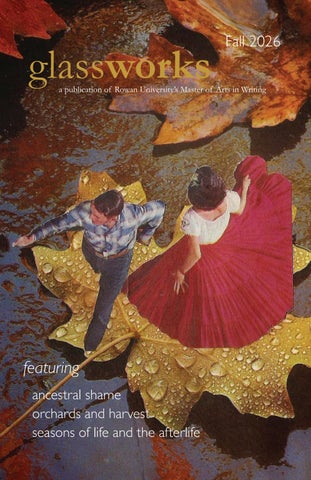
glassworks
Fall 2026
a publication of Rowan University’s Master of Arts in Writing
featuring ancestral shame orchards and harvest seasons of life and the afterlife
Cover art: “Autumn Hymn” by Maria Pianelli Blair
EDITOR-IN-CHIEF Katie Budris
The staff of Glassworks magazine would like to thank Rowan University’s Master of Arts in Writing Program and Rowan University’s Writing Arts Department
MANAGING EDITOR Cate Romano
Cover Design & Layout: Katie Budris
Glassworks is available both digitally and in print. See our website for details: RowanGlassworks.org
Glassworks accepts literary poetry, fiction, nonfiction, craft essays, art, and photography. See submission guidelines: RowanGlassworks.org
Glassworks is a publication of Rowan University’s Master of Arts in Writing Graduate Program Correspondence can be sent to: Glassworks c/o Katie Budris Rowan University 260 Victoria Street Glassboro, NJ 08028 E-mail: GlassworksMagazine@rowan.edu Copyright © 2026 Glassworks Glassworks maintains First North American Serial Rights for publication in our journal and First Electronic Rights for reproduction of works in Glassworks and/or Glassworks-affiliated materials. All other rights remain with the artist.
ASSOCIATE EDITORS Bella Bisicchia Adam Buckley Kara Knauss Erica Lee Desirae Mack Emily Mendelsohn Meg Nielsen Erin Roca Samantha Szumloz Edward Valderrama FICTION EDITORS Emily Mendelsohn Meg Nielsen Janaye Roberts Gianna Vanore NONFICTION EDITORS Samuel Costello Laura Del Viscio Samantha Grasso Erica Lee POETRY EDITORS Adam Buckley Dimitrius DeMarco Desirae Mack Samantha Szumloz ASSISTANT EDITORS Editing the Literary Journal Fall 2026 students
glassworks Fall 2026
Issue Thirty-Three
MASTER OF ARTS IN WRITING PROGRAM ROWAN UNIVERSITY
Issue 33 | Table of Contents Art Maria Pianelli Blair, Autumn Hymn | cover AJ Dent, Seafare Outpost | 7 Maria Pianelli Blair, Wealth and Women out of Gold | 11 Craig Stover, Sentinel: First Warrior | 22 Maria Pianelli Blair, Fragility | 28 AJ Dent, Milkweed City | 37 Craig Stover, Sentinel: Pink Dawn | 41 AJ Dent, After Two | 45 Craig Stover, Sentinel: Black Light | 56
Fiction Shannon Frost Greenstein, Kevin Doesn’t Believe in God | 30 Shannon Kelly, Death Games with the Midwestern Man | 46
Nonfiction Ansley Haines, Searching for Change | 12
Poetry Kristen Park, Counting the Months | 3 J. Alan Nelson, Microplastics | 4 Matthew Perry, The Swim | 6 Jake Onyett, Theory | 8
Madame Garbage Lady | 10
Brian McKee, Common Ground | 20 Jennifer Randall Hotz, After the Miscarriage | 21 Matt Zambito, There Will Be a Wikipedia Page for This
Poem One Fine Day | 23
Everything for Sixty Miles Around | 24 Scott Waters, Weeding | 26 Vikki C., Queerness of Our Species | 38 Maureen Clark, Sunday Afternoon | 40 Zorina Exie Frey, remember me | 42 Jonathan Fletcher, The First Time I Heard
the Words Saddam Hussein | 44
John Davis, Ignition | 54 Luigi Coppola, Let’s Talk About the Night You Tried to Die | 55 E.B. Schnepp, we share in that appetite | 57
in the land of milk and holly | 58
The History of Glassworks
The tradition of glassworking and the history of Rowan University are deeply intertwined. South Jersey was a natural location for glass production—the sandy soil provided the perfect medium, while plentiful oak trees fueled the fires. Glassboro, home of Rowan University, was founded as “Glass Works in the Woods” in 1779. The primacy of artistry, a deep pride in individual craftsmanship, and the willingness to explore and test conventional boundaries to create exciting new work is part of the continuing spirit inspiring Glassworks magazine.
glassworks 2
Counting the Months Kristen Park
In the garden, there are stones waiting to be picked— or maybe what I remember are the portraits in the east wing of the museum, listening. Some of us can’t help but watch the sculptures with arms outstretched and palms facing up. And I’m listening to voices on the sidewalk after taking photos of paintings on the overpass. Because maybe I’ve just learned how to write my name in the cement, in front of the row home where my dear neighbor boils water on the stove in the mornings. I keep a mental list of things I consider home, telling no one—except the bus driver who will take me there. And these are the mouths of tunnels where I said goodbye to my friends, with a museum map in my hands and wrinkled stone in my pocket. Or maybe it was my friends who said goodbye to me, as I stepped onto the bus and the years spun into the wheels.
glassworks 3
Microplastics J. Alan Nelson
drift like unspoken regrets into the day’s unguarded mouth, thousands ingested, inhaled, the tiniest burrowing deepest, not drowned but settled, in liver’s shadowed loft, lung’s ashen rafters, kidney’s stone basin, brain’s pleated coast. A 2022 study pierced the veil: in seventy-seven percent of donors, plastic particles already rode the blood, entering, traveling, circulating, silent passengers in the red river. Humans swallow these silent flecks, stomach cradles them hours, a dim procession through esophagus to intestine’s winding river, then most cast out in dark feces, yet some breach the guarded walls, slip into the current, no spark visible, only presence. Smaller particles cling longer, resisting the flow, adhering like old grief to the lining. We carry them regardless, spare moments folded in hip pockets, a real bat fixed in resin, rare, mesmerizing, inert.
glassworks 4
With twenty-two million years unfolding daily in plastic’s slow unraveling, the body turns archive, each organ a witness tree etched with unseen sediment, blood itself a moving ledger. What slips in quietly remains. What enters the stream circulates. What was once outside now pulses inside us.
glassworks 5
The Swim Matthew Perry
The surging water tasted coarse, almost rocky against his gums. He spit and closed his mouth. His spittle dribbled down his chin. No lookout saw the man with ashen skin, chattering jaw, and tired hazel eyes searching. His splashing masked his parched cries, as he struggled to grasp what he has lost. A ship veered close. He screamed. The waves tossed more briny water down his ragged throat. The oars and rudder rested. The ship’s slow float went on to Cyprus, calmly unaware. Night fell, so no ship could see. Still, he dared to swim on. Burning and gold, the moon shone as it waxed. His weary-hearted groan echoed his arms that pumped like wings. Waves dissolved his waning strength. He grappled for resolve with grasping breaths, in between each wave-slam. As Sisyphus climbed, Icarus swam.
glassworks 6
Seafare Outpost AJ Dent
glassworks 7
Theory Jake Onyett
Happy for them to burn the body— the hard part is over now. Relax. Walk away into the miserable sunlight. Egalitarian as ever, warm as oblivion. Think nothing more of the practical, only the theory. Until handed the ashes and the bill, itemized for parts and labor— urn, casket, care and oven. Trust her gown was burned before her body, lever pulled with all due respects. Her hair combed and nails polished before her eyeballs exploded like retinal yolks. Trust they scraped the bricks to give us every unearned ash. Every cent of our money’s worth. Clipped her name to a tray slotted like lunch leftovers in a cafeteria trolley. Relax. Let the mind race to next meals, cheap distractions, kid-friendly explanations that toe the bright line between truth and terror.
glassworks 8
Curse night and day in equal measure, consider yourself a worthy son, consider if the verdict still matters, if not to her, then to anyone.
glassworks 9
Madame Garbage Lady Jake Onyett
eating your yogurt calmly in your compact electric vehicle. The sun shines on you and your payload of rotting fish, dismembered cardboard boxes, rinds of blue cheese and reddish fruit. The sunlight bathes you on this little human-carved canyon called Via dei Mille, your favorite music like white tumors spitting tremulous spores into your eardrums. The flies will come to rest on your everything. But not for long, Madame Garbage Lady, because you have finished your yogurt, licked the silver spoon clean. And I want to ask, if I may, with a knock on your windshield before you leave, about the tax documents covered in coffee grounds and clumps of cum binding long strands of brown hair, shredded with scissors by an otherwise honest, left-handed man— can you please piece together my address for me from what remains?
glassworks 10
Wealth and Women out of Gold Maria Pianelli Blair
glassworks 11
Searching for Change Ansley Haines
I was born hungry. I was raised to be a thief. My ability to eat relied on a form that lay on my mother’s dining table, forgotten and hidden under stacks of unopened mail. Buried under overdue bills and unfiled taxes was a free lunch form, each line item a request for information my mother was not willing to give. “Why do they need this information?” She held the form rolled between her fingers, a cigarette with no ash. “I’m not filling this out.” Her eyes were on the “annual income” line, cheeks red with the shame that poverty so often delivers. “Just fill it out.” An angry teen. “Ask your father to do it.” An angry mother. “You agreed, Mom. You said you would.” “Well,” she dropped the folded paper amongst the sea of envelopes, “I don’t remember saying that.” Her feet, heavy on stained vinyl floors, carried her from the conversation and into her room, where she burrowed into her bedsheets. Our talk wore her out, she told me. To be demanded from so aggressively simply took everything out of her. What more could I possibly expect of her as she does her best?
glassworks 12
She described fingers worked to their bones behind her locked door, the ache of muscles that haunted her after hours of standing upright at the cash register, the gratitude she expected from her daughter with a gnawing stomach. “Can you get some toilet paper?” A request after her diatribe. “Where?” A bite after her lecture. “Your father’s house.” Single mother reliant on an ex-husband with a guilt complex. ~ We often stole napkins from fast food restaurants—it was a tired game, but a successful one. My mother went through the drive-thru, ordering a cup of water, and sent me into the restaurant armed with an excuse of “my mom is ordering in the drive-thru, can I just get some napkins?” She was too tired, she told me, to venture out into town for a cup of water. I inherited my mother’s shame as my cheeks burned while I pilfered rolls of Great Value bath tissue from my father’s bathroom cabinets. My stepmother commented on the way the household burned through so many essentials. I bit my lip bloody to prevent my mouth from admitting I was the arsonist. ~
Instead of sitting amongst peers surrounded by food I could not afford, I fled to the classrooms of teachers who shared my lunch period. Under the guise of catching up on classwork, I retreated to their rooms for treasured moments of reprieve. I often spent more time distracting them from their planning periods and interrupting well deserved solitude than working on assignments.
“I inherited my mother’s shame as my cheeks burned
Ansley Haines | Searching for Change
Hunger gnawed at my stomach throughout long school days. Because she spent long nights in seedy bars with insidious men, dinners at my mother’s house left much to be desired. The menu often featured unseasoned, congealed boiled chicken and red onions. Or, on occasion, a rusted can opener was left on the counter for cans of green beans and Vienna sausages. My least favorite was frozen lasagna, still cold in the middle.
while I pilfered rolls of Great Value bath tissue from
”
my father’s bathroom cabinets. “Don’t you dare turn the oven back on. It takes too much money to heat it up.” I ate my meals with burnt spoons, tasting ash with each gelatinous bite. ~ Typical cafeteria gruel began to look like a fine delicacy. Fried chicken, always appearing to me as dry and slightly overdone, became a fantasy—rare, beautiful, tasty. Frozen hamburger patties and boxed milk quickly became a contender for my choice if I was ever forced to decide on a last meal. Vending machine Pop-Tarts called their siren songs to me as I passed the lunch room on my way to English and Math.
Feet propped on other students’ desks, I asked them questions and learned their home hobbies and children’s names. I avoided their gazes when they asked if I had eaten, and mumbled “already ate” responses when they pressed harder into their questions regarding what I had “packed for lunch.” I worried that they would read through my thinly veiled lies, that they would notice how my hands shook. All the while my stomach groaned, complaining that it was a deserted space ready to be filled. ~
glassworks 13
My tenth grade drama teacher, a small woman with a sharp wit and little patience, was the first to press my thin explanations for missed lunches. Sunlight filtered through her classroom window, casting rays of light through the steam of her asparagus and salmon. “Want some?” She held her fork above her Tupperware container. My mouth watered as my eyes glanced from the geometry sheet I was struggling to concentrate on.
It was time to find a new lunch hideout. ~ Atop a plywood cabinet filled with stale cereal and chipped dishes, my mother had a copper pitcher filled with coins. It was heavy, the bearer of pocket change and a meager rainy day stash. The vessel called to me on the afternoons I arrived home with a headache and an empty stomach, desperate for something to warm
“I stowed $1.25 in my pocket, a squirrel preparing for winter scarcity . . . The soft jingle of my pocket sounded
”
like the blare of an alarm system telling of an intruder. “I’m good.” I moved my hands to my lap, watching my pencil abandon me and roll to the ground. “I know you’re hungry.” “I told you, I already ate.” My voice teetered into a tremble, afraid of discovery. “When?” “Earlier.” “Hm.” She lifted a thin asparagus stalk to her mouth. “I don’t really like eating at school.” I forced my eyes back on the paper in front of me, avoiding her gaze. “Hm,” she repeated. “Yeah,” a hollow word around a flimsy defense.
glassworks 14
my aching belly. Many times I had watched her throw change into the open mouth of the pitcher— I listened to it land, a metal drop in a copper bucket. It was a rainy morning when my desperation led to action. The coins were loud as they clanged together, knocking into each other and the walls of their home. “Shh,” I whispered. The change did not listen, continuing their complaints as they shifted. I stowed $1.25 in my pocket, a squirrel preparing for winter scarcity. My shaking hands made quick work of counting the quarters into my palms. The soft jingle of my pocket
avoiding her for days on end following our previous lunch conversation. “Hm,” she replied. I took a bite, savoring the sweetness of the dough in my hands. “Besides,” I said around a mouthful of artificial flavor, “my mom would kill me if she knew I was eating this. Makes it all the more fun, y’know?” If only she knew. “Hm,” was her only reply. My pocket felt empty without the rattle of my contraband coins. ~ I got braver with my stealing, taking extra nickels and dimes to store in a mock savings account inside my bookbag. Slowly I had accumulated enough change to enjoy vending machine lunches a few days out of the week, oscillating between teachers’ classrooms so I could avoid being caught by anyone willing to call my mother with questions. Halfway through the school year my steady diet of packaged snacks grew tired. I still went home hungry and I developed a growing anxiety that my mother would discover that her money had gone missing. The thought of telling someone of my desperation gnawed at my brain as my hunger gnawed at my belly, but the shame of asking for help felt too great of a
Ansley Haines | Searching for Change
sounded like the blare of an alarm system telling of an intruder. I watched my mother’s door, pupils trained on the knob, waiting for the turn that would indicate the end of my pursuit of vending machine hot fries. Blessedly, it stayed still. I ran the entire mile to my bus stop, just in case my thieving had somehow been detected. ~ I felt rich walking through the halls of my high school, coins clacking a jolly tune as I transitioned from class to class. I was Robin Hood, and my precious change was my band of merry men. When it finally came to lunch I strode to the vending machine, all composure, as if my mouth was not flooded with saliva at the thought of eating something from a bag instead of a can. Quickly, desperately, I chose a Honey Bun and waited for it to drop from its coil. Slowly, calmly, my beloved treat fell into the chamber where my open hand waited. “Lunch,” I declared as I walked into my theater teacher’s classroom. I displayed my treat as if it were a trophy, opening the package to impress her with the scent of stale sugar. “That’s not lunch.” She pointed her fork in the direction of my food. “That’s dessert.” “Well, for me, it’s lunch. I’m not that hungry today.” She made no mention of my
glassworks 15
burden. I continued to steal toilet paper from my father, and the guilt of my betrayal kept me from requesting a boost from him for my meager backpack stash. Despite my fear of being caught, I continued to take from the copper pitcher. My hands smelled of pennies for hours after my burglaring— blood money. My lips curled into an ironic smile, thinking of the cost I would pay for my thievery. Blood money indeed. I skipped lunch on most of my school days again, trying to accrue enough change to afford a hot school lunch like my peers. I stole 25¢ a day, quietly slipping my hand into the pitcher right before I slammed the screen door shut to signal my bus stop departure. How quickly theft became part of my daily routine…how slowly my funds accumulated. ~ It was a square pizza day when I could afford to eat what the food ladies served. Disappointed by a cheap frozen meal, but boosted by the thought of midday hunger satisfaction, I stepped into line behind my classmates. Down the line we went. “I’d like an apple, please.” “No thank you, none for me, thanks.” “Are there any more pear slices left?” “I ain’t eatin’ that crap.” My peers’ words floated around
glassworks 16
me, this commonplace experience so easy for them. I jingled my coins, anxious to pay and consume my hard-stolen food. Finally, after an eternity of deliberation between skim and whole milk, the student in front of me checked out. My turn. Proudly I slid my tray to the cash register, smiling at the lunch lady in charge of payment. Her cheeks were wrinkled, her gray hair curly under a plastic hairnet. The recipient of many kids’ teasing, she was in no mood for my cheerful disposition. I held an outstretched palm of pennies and quarters out to her. She counted. My stomach growled. The square pizza cooled in front of me. Please hurry. I urged her with my eyes. I’ve been looking forward to this for weeks. “You’re short.” This didn’t quite feel like the time for bullying. I knew students were rude to her but that wasn’t my fault. A snarky response knocked at the edge of my throat, but I swallowed it in favor of avoiding detention. I stared at her. She returned my stare. The student behind me shifted, a new, proud owner of secondhand embarrassment. “What do you mean?” I tried to smile, unsure as to why she continued to stare at me. Why couldn’t she just take my payment and move on? What did stature have
“My heart hammered in
my chest as I approached the register. I counted my change in my pocket, feeling the shape of the coins to confirm I would be able to afford the few
”
dollars it took to eat.
I hid in the bathroom for the rest of the period, swiping at tears that simply could not stop. ~ It was another week before I stole enough to truly afford a school
lunch. I waited until the period was almost over to avoid other students overhearing if I didn’t have enough money again. I chose a different line, cheeks pinkening at the thought of my previous miscount. I was sheepish as I made my meal choices. Chicken nuggets, please. I’ll have the carrots. May I have strawberries instead? Oh, plums are the only option today? Yes, that’s fine too. Thank you. Yes ma’am, I would love an ice pop. Thank you. The ladies smiled at me, at my manners, commenting at my politeness. “Haven’t seen you before,” the final woman said, handing me my grapeflavored dessert. “I usually take my lunch.” “Ah, Mom’s too busy today to pack you something?” “Yep.” A smile I prayed would be convincing enough to move on. A smile returned, convinced. My heart hammered in my chest as I approached the register. I counted my change in my pocket, feeling the shape of the coins to confirm I would be able to afford the few dollars it took to eat. My legs were weak underneath me as I typed my student number into the pad. The lady, younger than the other woman I had previously abandoned with my unpaid food, watched my shaking fingers.
Ansley Haines | Searching for Change
to do with anything? “You don’t have enough money.” You don’t have enough money, you don’t have enough money, you Don’t Have Enough. “Oh. I’m—” My cheeks burned. Tears pricked my eyes. “I’m sorry.” Her mouth, and the lines surrounding it, tipped downward. “I can—” she started, but I didn’t hear the rest of what she had to say. Abandoning my unpaid tray I hurried away, fist tight around the coins that were not, could never be, enough.
glassworks 17
“Didn’t eat breakfast,” I told her, the same watery smile on my face. “Just really hungry today! Growing girl and all.” She told me the total, the same as last time. Round two. Slowly, I gave her my money, counting in my brain with each coin passed between us. Then, as if she materialized from nowhere, the older woman from the week prior was at the register beside the young woman taking my quarters. “Sweetie,” she licked her lips as she talked, wrinkled mouth soft around the word, “don’t you remember your account is settled?” She was angry at me for leaving that food. I should’ve brought it back or offered to throw it away. I should’ve given her the money that I had. Was my account negative now? Did I owe double? I swallowed thickly. “Oh, I’m so sorry. I didn’t think—” She held a finger to stop me from talking. “No, your account is covered.” I bulldozed through my apologies, not processing the words she said. “I can pay, I swear, just take this and I can bring the rest tomorrow.” My hands had grown sweaty. I hoped they couldn’t smell the tinge of wet pennies. I held the coins to them, a peace offering and a down payment. “No, sweetie.” I wished she would
glassworks 18
stop calling me that. “Your lunches are covered. You’re good. You’ve got enough to last you for the school year.” My ears rang. “No ma’am, I’m sorry, I just have enough to cover today’s lunch. I can pay for the one the other day, too, just give me a few days—” I was thankful no one stood behind me. “Sweetie,” she had turned her softness to sternness, “your account is settled. It’s free. Enjoy your lunch, come back tomorrow. We’re having tacos.” The younger woman, bewildered by our exchange, waved me on with a cautious hand. Awestruck by luck and worried it was a system fluke, I requested one additional pass through the line for seconds. The ladies in front of me obliged with two pitying smiles. I didn’t even care. ~ I walked through my drama teacher’s door smelling of the cafeteria. “Hungry?” Her typical question. “Not at all.” My typical answer. “That’s good to hear.” She smiled. “Hm.” I grinned. ~ I will never know how my lunch tab was covered. The form sat on my mother’s table as it always had, and I was never brave enough to ask the food ladies how my account suddenly had enough to cover my costs. I still carried change in my pocket, the
Ansley Haines | Searching for Change
same stolen coins from the day we had chicken nuggets, just in case. I am still in contact with my theater teacher, and I reach out once every blue moon. She has never claimed her generosity, and I have never confirmed that she was the anonymous benefactor who funded my meals. My thieved coins have turned into earned bills now, but I still carry a few with me. I want to be ready to help just in case someone else steals nickels and dimes from their mothers to pay for their meals.
glassworks 19
Common Ground Brian McKee
We’d bring home half a peck, hand picked. Tasting one or two, leaving their bodies for deer after biting, sandy mouthed each season from the sugar on our tongues. Pippin, Fuji, Gala and Rome. Granny Smiths that we snagged from the limits of our tip-toes for the pies, soft spots to probe and skipping the worm rot, tart mess on the soles of our shoes. Beaked knives brought out to pare, we bent over buckets, cores and seeds and skin. The hollow percussion of tossing the wastage, steamed fruit stilling in the peened steel pan, burping on the flame, the handle angled in. I knocked it off once, and almost lost my skin.
glassworks 20
After the Miscarriage Jennifer Randall Hotz
That summer, he sits on the stoop out back, spends hours studying the mountain, surveys shadows shifting on its purple flanks, remembers their hikes: her ponytail’s swish, the little jig she dances when they reach the summit. She hasn’t been up there in months, never looks outside anymore, resents him finding solace in anything beyond their pain. One morning, he pulls her from their bed, puts on her shoes, caresses her hand as he leads her out to the trail, both of them stumbling forward, seeking any clear path ahead.
glassworks 21
Sentinel: First Warrior Craig Stover
glassworks 22
There Will Be a Wikipedia Page for This Poem One Fine Day Matt Zambito
Did you hear the government’s banning apples because the president loves pears? They’re not, but wouldn’t it be ridiculous to have to have relatives who believed that to your house for Thanksgiving? Formerly an Idahoan, I loved to laugh in Idaho at how funny it felt to choose to live in an amber-waves place obsessive about voting pro-potato, about murdering wolves, about sustaining a zeitgeist of downright crippling panic over pacifism. In France, toddlers learn a potato is une pomme de terre (“an apple of the earth”), and I learned that just now (thanks smartphone!). Oh!— but they can listen in if they want to, and you know who “they” are if you reside in any of the map-dots teeming with baguette boulangeries, or municipal debt collectors, or the Web. But they don’t read poems! If you’re not in a safe space, then (my dear readers of these words, of these Braeburns of my eyes I adore precisely enough not to blog about but not enough not to long for an encyclopedia entry about, yes, my fellow daydream believers) you can find yourself in the safest space imaginable if you imagine it right now.
glassworks 23
Everything for Sixty Miles Around Matt Zambito
“The temperature at the center of the Sun is about 27 million °F. […] [If] a pinhead could be brought to the same temperature as the material at the core of the Sun, heat from the pinhead would set fire to everything for 60 miles around.” —from the Reader’s Digest Book of Facts, 1987 edition If I could do anything at all with the head of a single pin— and I mean anything at all (cure the world of capitalism; create a peephole on a door to Heaven; send myself to Hell, Michigan)—I would do what physicists figured out about the power of our star’s incandescent, fusional plasma, and I’d do it smack-dab in the crotch of my nemesis, Tod. Despite the odds stacked against getting granted a second wish, if I could do two anythings-at-all with the head of a single pin, I’d repeat the fiery party trick on the newsy second day one February in Punxsutawney, so, we, the people, might all see
glassworks 24
the light, all see our shadows, all get the prognosticated message not to stare at the heads of pins but to—since human egos burn the same as harmless marmots— give the Sun its proper due.
glassworks 25
Weeding Scott Waters
You could take those pills, knowing exactly how you’ll feel afterward, or eat that last piece of carrot cake, or click on a seedy website or, bless you, drink your partner’s gin you promised to leave alone or place the bet to end all bets or fire up that bong or prance in your hot pink thong on the patio with a middle finger aimed at the neighbors or do any one of a thousand forbidden or unforbidden things that reliably work and then don’t work— but instead you jerk on your rubber gloves
glassworks 26
try pulling weeds those thin green shoots that worship the rain and surrender in your hands waving a thousand stubborn white flags.
glassworks 27
Fragility
Maria Pianelli Blair
glassworks 28
glassworks 29
Kevin Doesn’t Believe in God Shannon Frost Greenstein
I stop to tug up my knee socks for the umpteenth time, cursing the fact that I have an older sister, cursing the fact that I have to wear her hand-me-downs. My backpack teeters off my back as I bend, slipping to hang painfully from my wrist, spilling an array of mechanical pencils and neon highlighters and tubes of lip gloss in varying shades onto the concrete below. “Hey, guys, hold up!” I call to my friends, who have made it to the end of the block in the two seconds it took me to adjust my sagging socks and dump the contents of my bag upon the ground. They stop, lounging against the lampposts and bike stanchions with an ennui only teenagers can achieve. The new girl Jess comes to help me, scooping up makeup and writing utensils while I hold open the bag. The sun beats down and we hurry to join the boys, who all look uncomfortably hot in their ties and V-neck sweaters. “Dude, you should have given up your lip crap for Lent,” observes Nick. “How many do you have?” “I gave up chocolate,” I say piously, ignoring the question about lip products, which—in all fairness to Nick—my mother has also been known to pose. We restart our languid walk to the park, that
glassworks 30
afterschool oasis of cheap playground equipment and tired greenery, a group of high-schoolers gloriously free from oversight or obligation, who would rather not go home. “F*ck, it’s hot for April,” Mike complains. “Keep saying the eff-word and you’ll end up in Hell,” warns Jess. “I hear it’s even hotter there.” “Oh, f*ck that, I’m just going to live forever,” Mike declares staunchly, inhabiting the exclusive real estate of someone who has just been through Confession and is unburdened by the oppressive weight of sin. I laugh and turn my face up to the sun as we turn the corner. I love the late spring—its scent, its promise of summer, and the freedom of vacation. We bicker and banter and lackadaisically flirt—as friend groups are wont to do— ultimately falling into an argument about who sucks more, the boys’ football team or the girls’ basketball team. We are pretty cleanly divided right down gender lines as to that topic, and are debating too exuberantly to notice the figure that has drawn up behind us. “Hey, guys.” I turn at the sound of the voice and immediately recognize Kevin, the junior class cross-country
only acceptable response for a world-weary suburban teen with a solid trust fund. “You headin’ that way?” “Nah. I have practice. I just need to pick up my sister first.” Kevin’s family was perfectly normal before cancer—two boys, one little sister, a dog, an investment banker, and a stay-athome-mom. They attended Mass every week. They hosted an annual Fourth of July barbecue, resplendent with sparklers and hand-cranked ice cream. Kevin’s mom was a classroom parent and a food drive volunteer and a field trip chaperone; we all liked Kevin’s mom. “I saw you placed at Districts,” I pipe up, after a quick internal debate about whether I should say anything at all. Kevin and I are in the same study group for trigonometry, but we rarely exchange words that aren’t “secant” or “cosine;” I always feel extremely selfconscious around Kevin. “That’s so awesome.” As seventh grade stretched into eighth, we didn’t see much of Kevin’s mom anymore. She would occasionally turn up at a church function or a choir concert—gaunt and bald, sporting a kerchief and a port and a tremulous smile—but she was no longer a volunteer or chaperone; Kevin’s house was
Shannon Frost Greenstein | Kevin Doesn’t Believe in God
star and oddly-popular loner. He is devastatingly handsome, with eyes that are blue enough to render him a creepy resident from Village of the Damned. Everyone knows about Kevin. We’ve all been in school together for years, some of us since kindergarten, here at Archbishop McHenry. We were all confirmed together; we all took turns playing sheep and Wise Men and the Virgin Mother in the annual Christmas pageant. We all remember who wet their pants in second grade; we all remember who threw up on stage during the middle school talent show. And we all remember when Kevin’s mom died. “Bro,” Greg greets Kevin, as Kevin pulls abreast of me and falls into step with the group. They fistbump awkwardly above my head as we turn the corner, our group moving as a single entity and taking up a disproportionate amount of the sidewalk. “You guys goin’ to the park?” Kevin inquires. We were in seventh grade when Kevin’s mom got cancer. Archbishop McHenry is a close-knit community, and there was therefore a community-wide response when the news of her diagnosis broke— house calls, meal trains, prayer circles in various living rooms, and countless candles at the altar. “Yup. Nothing else to do in this f*cking town,” Nick snorts, the
glassworks 31
no longer the place students would congregate for homemade cookies after school. None of us kids were privy to medical information, of course— cancer in the Catholic community carries a secret stigma of shame, the details of which are shared only in undertones, cloistered behind closed doors—but we all knew she was getting worse. We all knew it wasn’t good. And while I don’t ever recall hearing the word terminal… there came an unidentifiable point at which we all knew how things were going to end. “Thanks,” Kevin responds perfunctorily. Since the beginning of high school, he has dominated every race in which he participates, slogging past all the seniors to take home a staggering array of honors… but I’ve never seen him celebrate a
The park shimmers across the street, late afternoon sunlight streaming through the clouds to illuminate the rusty metal play structures like the fingers of God. We dart over the road, Jess and I giggling unhingedly, the boys strutting between speeding vehicles with an easy disdain, a display of invincibility that would be more at home in a Nat Geo documentary about apex predators. We slow our pace on the other side of the street, finally arriving at the motley collection of benches and bushes and basketball nets that is our reprieve from homework and chores and the pressures of being seventeen. “Got any smokes?” Mike inquires, and I roll my eyes. I would literally be crucified if I came home smelling like cigarettes, as would most of us be; of course no one has smokes.
“The park shimmers across the street, late afternoon
sunlight streaming through the clouds to illuminate the
”
rusty metal play structures like the fingers of God. victory. He usually ignores the final standings, disappearing right after the race and leaving the coach or a less successful teammate to collect his medal. It’s like he doesn’t see cross-country as a competition; it’s like he doesn’t realize winning should make him happy.
glassworks 32
“Mike!” Jess admonishes. Mike grins and opens his mouth— presumably preparing to say something that will make Jess’s voice even more shrill—but stops when Kevin clears his throat and raises his hand for a farewell fist-bump. “I gotta go get my sister,” he says
were all aware of his brother’s disciplinary problems and his sister’s weekly appointments with a grief counselor; we all saw the unraked leaf piles in their yard and their lawn going to seed. Kevin’s dad’s first DUI was splashed across the cover of our local paper—below the fold, but even still—and his second came to light on social media even before the ink on the police report was dry. “Sh*t,” I sigh, collapsing on the nearest bench, the word practically foreign on my lips, so unaccustomed am I to swearing. But this situation definitely calls for a swear. When Kevin came back to school freshman year, everything was different. He didn’t volunteer in class. He didn’t go on dates. He didn’t attend parties or see movies or hang out with anyone at the diner. Instead, he joined the cross-country team; instead, he just started to run. “Good going,” Nick congratulates me sarcastically. Inundated by a wave of humiliation, I groan aloud, drowning in the guilt and sheer mortification that is a high school faux pas. “What?” asks Jess in a hushed whisper. “What is it?” “Kevin doesn’t believe in God,” Greg reveals in a low voice, handling the words as
Shannon Frost Greenstein | Kevin Doesn’t Believe in God
by way of explanation. “See you guys later.” Kevin’s mom died over the summer between eighth and ninth grade. Most of us learned about it the next morning at church. For the rest of that summer, we all frequented Young Life pool parties and volunteered at Vacation Bible School and sat through high school orientation, but Kevin was nowhere to be found. “Go in peace!” Greg says with a sardonic grin. “Thanks be to God!” I reply automatically, conditioned by a lifetime of liturgy, more focused on a gaggle of preschoolers attempting to ascend the slide than the conversation at hand. Then I realize what I’ve said; then I freeze. There is an uncomfortable silence, an awkwardness that is visceral and thick. “Uh…” I try to recover, unable to meet anyone’s eyes. I finally decide to overcompensate and flash Kevin a wide smile. “See you later!” The smile feels synthetic. My face is growing hot. Jess looks baffled. Greg just looks embarrassed. Kevin’s face is impassive. “Bye,” he says shortly, and continues down the sidewalk, towards Archbishop McHenry’s elementary school. After Kevin’s mom died, it was hard not to notice the signs that his perfectly-normal family was imploding. Thanks to the churning of the church-lady gossip mill, we
glassworks 33
delicately as a live land mine, lest it explode and reveal itself; lest it unleash this dirty skeleton unto the world. “He doesn’t?” Jess is baffled; shocked. I suddenly remember that she started at Archbishop McHenry only last year. There’s no way she could have known. For the rest of us, Kevin’s atheism is his infamy. We’re all aware of it; even the seniors know. Some of us were in class with Kevin freshman year—the day he jumped up from his seat, ripped up the exam in front of him, and screamed at Sister Catherine that there is no God—but we know enough not to talk about it at school. Whenever Kevin’s meltdown does come up, it somehow feels wrong to talk about it. It feels like looking at someone naked out in public…that same kind of pity and unease. “Like…he doesn’t agree with the Holy Trinity? Or, like, he’s agnostic or something?” Sounding like she halfway suspects we are putting her on, Jess offers a tentative smile, conveying her willingness to cooperate—to a certain extent—with whatever this new tomfoolery might be. “He doesn’t believe in God,” Greg reiterates. “He just thinks there’s nothing.” “But what does he think happens after we die?” she persists.
glassworks 34
“Nothing, I guess. He probably thinks we just…die.” Still crumpled on the bench, I look down the street where I can still see Kevin’s silhouette, his maroon pullover conspicuous like a beacon. Unbidden, a memory of his mother surfaces in my consciousness, the time in fifth grade when she was the ersatz cashier at the Scholastic Book Fair and I could not afford the paperback I wanted. Just like good Catholic families don’t talk about cancer out in the open, so, too, do they not discuss the precarious finances of their neighbors. Outwardly, my classmates have never been aware that my family trudges through life below the poverty line; but in truth, they’ve likely all inferred it from the beginning. My thrift-store wardrobe and second-generation shoes speak in a manner that no proper churchgoer would ever dare. But Kevin’s mom didn’t care about any of that. She flashed me a smile and rung up my book at half price—bringing a finger to her lips in a shushing gesture—then handed me a plastic bag and shot me a thumbs-up. Kevin’s mom is dead, my inner monologue reminds me, and seventeen years of Christianity immediately conjure up the reassuring concept of Heaven—Jesus and the angels, everlasting paradise, reunification with everyone any of us have ever lost. Death and Heaven are
“. . . but try as I might,
I cannot picture Kevin’s
mom in Heaven. Try as I might, I can picture only her lifeless body, rotting in the ground.
”
“…yelled at Sister Catherine and stormed out, right after she died. Now he doesn’t take religion class or go to confession or anything,” I hear Nick explaining to Jess. Then there is a pause. “Hey, are you ok?” Nick is staring at me. I shake my head briskly like a dog with wet fur, trying to dislodge the mental image that has raised gooseflesh on
the exposed flesh of my arms and thighs. “Yeah, I’m fine,” I say, still vaguely shaken. I am not accustomed to being held hostage by my conscious mind. It has never before been the case— when grappling with the anxiety of mortality—that the notion of Heaven hasn’t fixed everything like a magic balm. “At least Kevin beats the entire Cardinal O’Hara cross-country team now,” Mike points out. This statement is both sinful and true; but moreover, the mention of our bitter rivals serves to ground me somewhat. Taking deep breaths, focusing on the memory of our last homecoming game, I feel the discomfort of my disquietude slowly start to ebb away. “That’s awful,” Jess ultimately pronounces. I presume none of us know for sure if she’s talking about Mike’s blasphemy or Kevin’s dead mom, but we all nod in agreement nonetheless. Several seconds pass. Everyone has fallen silent, processing their own individual thoughts about deities and death and whatever comes next. The preschoolers abandon the slide and rush the rickety jungle gym, covering the metal structure like a swarm. A cool breeze bisects
Shannon Frost Greenstein | Kevin Doesn’t Believe in God
essentially synonymous in my brain; any good Catholic will tell you the same. Kevin doesn’t think there’s a Heaven, my brain continues next, and I’m suddenly blinded by a vision of Kevin’s mother: eyes closed, in repose in a coffin, most definitely deceased. I attempt to recapture the warmth of my previous thought— the comforting notion of eternal life in the Kingdom of the Lord— but try as I might, I cannot picture Kevin’s mom in Heaven. Try as I might, I can picture only her lifeless body, rotting in the ground.
glassworks 35
the sunbeams; somewhere, a car engine backfires. “Let’s make a TikTok,” Greg suggests, and we are all suddenly present in the moment once again. Jess fixes her hair. Nick unbuttons the top of his shirt and loosens his tie. I dig through my bag for lip gloss, my thoughts of Kevin dissipating like a mist. They take with him the picture of his dead mother entombed in the ground, and my faith in the afterlife rekindles brighter with every passing moment. We film the video, then lounge about the park for the rest of the afternoon, finally departing when the looming prospect of dinnertime can no longer be ignored. We see Kevin only once more, walking back from the elementary school with his adolescent sister in tow, both of them looking down at the ground as they walk. This time, we don’t say anything to him at all.
glassworks 36
Milkweed City AJ Dent
glassworks 37
Queerness of Our Species Vikki C.
Male penguins raise three young, said the headline. The two had chased the female off, right after she’d laid eggs. By dusk, the couple had planned the whole family. Another cruelty to convention. Another soft survival. It isn’t for us to know if the mother is still alive, so the story pickaxes at unknowns, becoming thinner as days glow and contract. The moment we chose each other, the soft down between us began to molt, leaving the bare cage of our hands, the bony lamps of our shoulder blades. There’s no word for such quickening anymore. My own weather froze the feather I witnessed on my way out to Portobello—but never enough to fix it to the icy ledge. The same ledge I was known to lean out from—man-watching with a bear’s hunger. The tiny plume lifted sharp on a white wind, sailing off to the place where the tender ring. Later, I read that the mother penguin was found, circling her young—but now thinks them all corrupt. The two males clean out of sight—still famed for their strange deed. It’s unclear who abandoned whom, only that things circled, our feet slipping beneath dun grass —till we raised each other again, out of more-than-human nature.
glassworks 38
That Sunday, armed with market flowers and brown paper bags, I brought back your favourite fish for supper—though you were unlikely to attend. I hoped we’d dine again. Late light flooding the kitchen. Scent of herbs and fatigue, the fish glittering on the large wooden board. Its one marble eye turning from clear to cloudy —a small heaven, keenly looking out for your return.
glassworks 39
Sunday Afternoon Maureen Clark
half a dozen blue jays shook the pine trees at the edge of the pasture a game of tag mom’s eyesight is failing but even she caught the flash of blue feathers as they burst from the needles and branches strange how everything looks like a message from dad these days remember this . . . remember this . . . one bird flew directly at the window and we all ducked but it pulled up landed on the redwood railing strutted along until it was sure we had seen its extreme blueness times like these exaggerate my mother’s frailty every day she is unhappy lonely and so am I listening to her wishing she could be alive while she’s still alive
glassworks 40
Sentinel: Pink Dawn Craig Stover
glassworks 41
remember me Zorina Exie Frey You know who I am. The girl your teacher made you play with. Last one you picked on your team; The girl with the gaped tooth. unkept hair, Buster Brown shoes. silly personality. Few friends. The girl with no penny in my loafers n outdated wringer washer ma never restored. I bet you didn’t know I’d come to class without showing up n leave without moving; having died of every insult, ew ‘n shun. I adopt cruelty for protection shoving the feminine kid ya’ll hated more than me. I didn’t know he was gay. I am that nappy-head girl in your fourth-grade class without indigo Jordache or stone-washed Guess pants. The girl who glowed up a bit in high school with the Salt ‘n Pepa Jheri fighting unwanted gropes ‘n beer-laced tongues, blocking hits to my face; remember I’m the girl ya’ll called dyke. ‘cause I kept my knees locked.
glassworks 42
A Trans Girl spurs “Silly Whore,” provoking a weekly brawl with me ‘n all I see is another man to fight ‘n payback from the kid my teacher made me play with.
glassworks 43
The First Time I Heard the Words Saddam Hussein Jonathan Fletcher
Young fingers around my Game Boy, I tapped the maroon action buttons with my right thumb, the 4-way black D-pad with my left. As Bush talked on the TV about repelling Saddam from Kuwait, I tried to turn and fit the falling Tetris blocks— each monochrome, irregularly shaped— into the patterned grid below. I didn’t know anything about Iraq except that it was far away. I didn’t know anything about war except that it happened long ago. I liked Fatal Fury, Street Fighter II. I liked to kill. I liked to win. I didn’t yet know what losing could look like. Or that the word cartridges could mean something other than small gray rectangles inserted to play.
glassworks 44
After Two AJ Dent
glassworks 45
Death Games with the Midwestern Man Shannon Kelly
“Do more people die from heat or cold?” Aaron asked. “Cold,” I said, but you couldn’t blame me. It was Iowa, March, and we had just walked twelve minutes northwards to a cafe, so I could easily make the leap from the stiffness of my toes to dying. When Aaron and I played those guessing games over dinner or walks, they did sometimes veer dark. That day, the day after a friend’s wedding, we also tried to guess which animal killed the most people. “Bees,” I said. “Bees?” I loved his eyelids, truly. There was so much room for expression there. He had deep grin lines, too, like he never stopped laughing. “People are allergic to them,” I defended myself. “No wait. Mosquitos. Malaria.” Aaron had a better relationship with death than I did. Maybe it was that he grew up in the Midwest, camping with his parents in state parks on weekends, so he knew all the ways you needed to keep warm. We had this exact conversation many times: “Don’t you ever get worried?” There were his eyes again, asking why would I?
glassworks 46
“About wasting your life. You know, your purpose. Being remembered. Etcetera.” “We’re all going to die someday.” “Okay, then. Do you want to be buried or cremated?” Maybe if he thought of his body being destroyed it would knock some fright into him. “Take my body out with the trash. Oversized pick-up.” Sometimes, I thought dying was the only thing he believed in. But he also believed in irony. He once told me about a trip where his wallet fell from the ski lift into the snow below. As an emergency team resuscitated a man who had taken a bad fall, he swung overhead. Even though the man died, someone had returned Aaron’s wallet to the lodge’s front desk. This nonchalance about death should have rubbed off on me, but it never did. On the way to the wedding venue yesterday, an accident stalled us on the highway for forty-five minutes. He called his friends and laughed at the way we would have to walk up the aisle after the bride. “This better be good.” He looked over at the police cars and ambulances. Someone better be hurt,
The corners were tight, and you had to keep an ear out for another family member as you rounded onto a landing. And then there was the fact that Val had never managed to throw anything away in her life. Their basement was filled with every one of Aaron and Devin’s school yearbooks, old childhood sleds, cases upon cases of soda for upcoming parties. Aaron threw away some sodas with funny, off-brand names like Mr. Pepperhead. “She’ll just buy more that will go flat before we use them. Vicious circle.”
“Take
my
body
out with the trash.
Shannon Kelly | Death Games with the Midwestern Man
that’s what he meant. I, on the other hand, too sentimental and too romantic, got choked up when the bride and groom planted a tree after their vows. “Unless that gets axed down by a disgruntled employee,” Aaron said to me while clapping. I don’t want you to get the wrong idea about him, though. He was selfless and straightforward. When he noticed I was cold in his poorlyinsulated Philadelphia apartment, he turned up the thermostat. He then went to the stove and opened the oven door. The first time he did it, I shifted my head impossibly forward in speculation. “Getting into something, Sylvia?” “While we wait for the floor radiators,” he said. One of his warming tricks again. I had hoped during my first visit to Iowa that his family or home would reveal the inner workings of this cool attitude, void of worry. ~ “Don’t mind the makeshift bedroom.” Val, Aaron’s mom, had recently had hip surgery. Her books, newspapers, and record player surrounded a large recliner in the corner of the living room. Val had been retired for about seven years after making a living as a florist, a bakery owner, and a columnist for the local newspaper. Their house wasn’t conducive to easy climbing with four flights of stairs, but it wasn’t a grand house.
”
Oversized pick-up.
Some family members were coming over for a game night. Val and Devin spread blocks of cheese and crackers on a wooden board, asking each other to try something, even if it was soft cheese straight from their fingertips. “Mexican train dominoes,” Val said. “Emma, honey, have you ever played?” I shook my head. “You’re fast. I’m sure you’ll get the hang of it.” She didn’t say this as a compliment. Almost the opposite, in fact.
glassworks 47
Their family members filed in just how I liked it. It was something I had always admired about a person, maybe because I wasn’t able to do it: when someone had the ability to make themselves at home in someone else’s. Not in a rude way. But I liked that when Cousin John arrived with his husband, also John,
If I learned enough about them, if I integrated myself into their chain of rhyming names, and if I learned the rules to this train game, they would keep me around. “She knows how to play,” Devin would say twenty years from now in defense of my invitation, like I was the last keeper of an ancient language.)
“. . . I remembered thinking: I may have learned the rules of their games, but I still didn’t know how to play.” they immediately hung up their own coats in the closet. Val’s brother’s ex-wife, who was also named Val, didn’t even knock when she came in, just shouted “Hello!” so no one had to come down the stairs to get her. (I also liked how all of their names sounded together in a string—Val, Val, Hal, Devin, Aaron, John, John. It was as if they were reverberations off of each other, connected not just through blood, obligatory, but through sound and calling.) Aunt Val distributed facedown dominoes as the rest of us sat on the floor cross-legged. “So you stay in touch with Aunt Val? Even though she’s not married into the family anymore?” I whispered to Aaron. He gave me an incredulous look. “She loves this game.” (It was comforting. I remember thinking: God forbid we break up, at least I wouldn’t be shunned.
glassworks 48
“Aren’t you supposed to block someone now?” I asked one of the Johns. But no one responded. They were talking over one another. And laughing. And it seemed that winning and cunningness wasn’t on their minds. After the first round, we stretched our legs in the kitchen. I sat with one of Devin’s friends, Grace. “Sweetie, what do you do for work again?” Val (Mother, not Aunt) asked me. “I’m a technical writer for a medicine manufacturer,” I said. They both nodded their heads and smiled politely. I shifted in my chair and picked up another almond in silence. “Gracie, what does your husband do again?” Val asked, reaching for a meatball skewer. “Garage doors.” “Really?” She was super excited. “Oh, that’s great to know. Give us his number.”
pointed to the beautiful Brooklyn brownstone on screen. I looked it up online. “It sold a few years ago for eleven million dollars.” She went to open the back sliding door, like she needed the winter Iowan air to clear the pretentiousness out of her home. While I watched her, I noticed there were some differences between her and my own mother. It’s not that Val didn’t care about her appearance. Truthfully, my mother cared too much about hers. I was raised by someone with an extreme fear of getting older, and who hadn’t registered the lasting effects left on me by her expressing dissatisfaction with its inevitability. I remember sitting in the backseat of the car as my mother flipped down the mirror, pressing her finger to her eyelids and dragging the skin in an upwards direction towards her temples. “I need to get an eyelift,” she would say. I now find myself doing the same almost every night after plastering on several skin serums. Val kept her hair short and uncolored. She didn’t wear makeup or contacts. She didn’t get her nails manicured. She did things. She knitted Aaron scarves and Devin hats. She kept scrapbooks of everything—college roommates, parents’ anniversary parties. She baked and entered state fairs with
Shannon Kelly | Death Games with the Midwestern Man
I didn’t know what ‘doing’ garage doors meant. He installed them? He fixed them? Here, people did things, and if I didn’t do a physical thing— cars, food, roads—then I was out of the loop. I was the odd one out. I laid in bed that night and overthought the evening. Every move I had made. Questioning what had been perceived as pretentious (calling pop “soda,” throwing away half-finished pieces of cheese, telling them how to play their precious game) and what, if anything, would be read as sincere. Between my dreams, I remembered thinking: I may have learned the rules of their games, but I still didn’t know how to play. ~ Val and I watched Moonstruck on the couch while it snowed outside. She ordered Hal to put down salt on the driveway and to bring up the shovel from the basement. “Aaron just texted,” I said, holding a mug of hot chocolate. “He may be staying over at his friend’s house. Depending on the roads.” “He might not have a choice,” she said. She probably wasn’t too happy about her son choosing to be with friends instead of with her on one of his rare visits home. I got the feeling that she was left with me to look after, like I was a lost kid in Disney World who was waiting for their parents to pick them up at the Visitor’s Center. “How much do you think that’s worth now?” She
glassworks 49
homemade caramels and won. She read books about Pamela Anderson and controlling your mind and murder mysteries. She was an avid Denver Nuggets fan and paid astronomical streaming subscription fees to watch live games. This was judgment. Last night, too, with no-job Gracie and her garage-doing husband. And the judgment came from a place of envy, as it usually does. Why couldn’t I be content, like I saw so many people were, with a skinny house and little hobbies? Game nights, classifying cheese as fancy if it costs over seven dollars. Val was still overlooking the tree line in her backyard, talking about one of her neighbors who had just gotten scammed out of her possessions by a moving company. “She forwarded the lawyers all her correspondence with the quote unquote ‘moving company.’ She’s a widow. Lost her husband last year, and that’s all she had of him. Everything is gone. Their wedding photos. Antiques. She was moving to Florida to be with her daughter.” “That’s a sin,” I said, like this expression was a staple in my vernacular. Truthfully, I had only heard it from my mother, used in similar situations. My mother also used expressions like “my cup runneth over,’” but always against the grain of the natural conversation, and I wondered now if Val could
glassworks 50
hear the fakeness in my voice like I sometimes heard in my mother’s. “All gone. All of it. And you know what? Those scammers are keeping it somewhere as ransom. If she pays enough, she’ll see it again.” “You think?” She picked up a scrapbook from underneath the side table. “It’s things like this that you cannot replace,” Val said. “I would pay a lot of money to get this back.” There it was. The history. The bible of How to Raise Children Who Do Not Fear Death. The playbook of Being Content with the Small Stuff in the Middle of Nowhere. I eyed it on the coffee table, and planned to study it under the guise of laughing at Aaron’s baby photos. But then the lights flickered. We looked up to the receded lighting and then to each other. “Sweetie, can you grab some dish towels and place them near the back door?” Val asked while she fished around in the junk drawer for halfburnt Yankee Candles. I stuffed the rags where the wind came in. When I looked through the foggy window, I saw something curled up next to one of their mum planters. I flicked on the porch light. Their eyes bobbed up. “There’s an animal on the deck.” Val came up behind me. We slipped on boots. The animal didn’t run away at the sound of the door opening. It was a cat. Val scooped it up in her jacket and it only gave out
“Why couldn’t I be content, like I saw so many
people were, with a skinny
”
house and little hobbies?
“I never said we should.” I kept the kitten between me and the ottoman, sprawling my legs out to create the shortest fort. If the kitten had any energy, it could climb right around me. I covered it partly in a knitted blanket. The electricity went out completely then. I grabbed the kitten on either side of its body. Through the candlelight, Val crouched down and placed the bowl of milk next to the cat. It bowed its head to the bowl. I couldn’t be certain it was actually lapping anything up. Any sounds of its soft tongue making ripples would have been caught up by the wind outside. Val passed me some pillows for my back. She sat directly above me on the couch.
“So you didn’t grow up with animals, then?” “We had two dogs. Black Labs. I wish I could have cats.” I sneezed right on cue. It was as if all this combined (hearing Hal snoring on the lounge chair downstairs, my admission of childhood, the safety of the dark, the fact that we couldn’t see each other’s faces anymore) had given Val the courage to ask questions I had suspected she had been wanting to ask since the beginning of our visit. “Do you think you and Aaron will move here?” she asked the dark room. “He’s been talking to a few companies out here,” I answered diplomatically. “And do you want kids?” No way to lessen the blow. “No.” “You don’t?” How to put it? “Are you afraid of anything?” “Flying.” “Don’t you think all fears are really fears of death? Don’t you think that’s true?” “So you don’t want kids because they will die?” I ran my hands over the kitten’s head, allergies be damned. “Maybe I’ll worry too much.” “That’s exactly what happens.” “Is it overpowering?” “Yes.”
Shannon Kelly | Death Games with the Midwestern Man
one meek hiss. I couldn’t tell right away Val’s attitude towards the cat. She went to heat up some milk on the stove, but said in a stern voice to me, “Don’t pet it.” “I can’t. I’m allergic.” “Well, we can’t put it back out there in the storm.”
glassworks 51
For all the directions my mind could have gone, I thought of the executives at the medical research company I worked for. About how the higher-ups didn’t want to own up to any of the medicines’ side effects: hot flashes, increased risk of heart attacks, higher blood pressure. They could push people to death and sleep soundly. Ignorance was the defense. “As a kid, you can feel, even if you don’t understand it or can’t put words to it, that your parents didn’t want you. Maybe I’ll be the same.” The candles’ flames were touching the bottom of the wax. Our shadows dimmed against the walls and were as low as the animal on the ground.
strange happened (like they usually do when your senses are heightened). I felt each carpet thread underneath my toes, and I felt completely calm, by the calmness Val radiated, by the home she had created, for once a safety net and not the broken glass I was used to tiptoeing around. The laundry closet’s wooden knob was smooth where it had been rubbed by hands over years. I could see, when I opened the door, little Aaron climbing atop of the washing machine for loose change so he could chase the ice cream truck. Devin, a bit older, rummaging through laundry looking for weed she left in her jacket before her mother found out. Val resting her head in her hands while pulling out dryer sheets because the
“. . . a household held up by the past. The past, their
currency. I saw, in the darkness, comfort that could be
”
held within the walls.
“In our days, it wasn’t about want,” she said. “Lost girl.” “What do we do with her?” I asked. “I’ll set up a box for the night,” she said. “Can you use the flashlight and get the other candles upstairs? They’ll be above the washing machine,” she finally set aside niceties and ordered me like one of her children. When I went upstairs, something
glassworks 52
kids were being too much and Hal was across the country on business. I felt, while I felt around for the tea lights, a household held up by the past. The past, their currency. I saw, in the darkness, comfort that could be held within the walls. Where was my comfort? Was it held in a ransom I never agreed to? And how much would I have to pay to see it again? In broken relationships, as it turned out. Aaron
Shannon Kelly | Death Games with the Midwestern Man
eventually broke up with me. He couldn’t handle all of my anxiety. The panic attacks, the obsessions, the rituals. I don’t blame him, either. The course, Emma! You stupid girl! You should have never forgotten the course of the Earth and the steadiness of the Sun. My Eastern spirit, his burying lack of empathy. When I went back downstairs, Val was hunched over with a candle in one hand, cupping the cat’s ear in another. She whispered reassurances to it I wasn’t privy to. It occurred to me then that by moving the cat inside with us, there were so many more welcomed mistakes—feeding it the wrong milk at a too-hot temperature, separating it from its mother scent swept up by the wind—than leaving her in the snow for the night. As it turned out, cold killed more. In the morning, Aaron sat at the kitchen island. He sipped coffee in his clothes from the night before, petting the cat on his lap, like we never thought of him not arriving home. “How were the roads?” I ran my hands through his graying hair. “Fun. Icy. Like a game.”
glassworks 53
Ignition John Davis
Because it’s winter I’m trying to hotwire the engine of my car the way my father did years ago when Mother lost the one car key in the snow in the mountains. He growled, lioned, arched his shoulders flexed his paws hissed out anger pried into the steering column with a screwdriver sparked the starter wire to the battery wire revved the engine until it hummed the way I want my engine which is my body to hum as I run over snow. But to get going feel the wind soft as gauze to lion myself spill my breath against the cold like exhaust get the anger out after losing myself in work be my father be the hum.
glassworks 54
Let’s Talk About the Night You Tried to Die Luigi Coppola
inspired through collaboration with artist Dohyun Baek You wandered, you wander still, through those moonhummed corridors where your shadow slipped its leash and danced ahead of you, teasing. You thought to step out of yourself, unbutton the burden, yet every doorway folded back into dawn’s sly grin. Bent sunflowers curled and swayed in the windless dark, petals whispering no as you pressed your cold to the warm, grainy hearts. You felt the skin of the world peel from you: skinned but never wounded, revealing only a brighter, bewildering you beneath. You rotted splendidly, ceremonially, in a red-white-blue haze of impossible decay, but rot refused its script; incense curled around you, suturing the air, mending what you had sworn unmade. Barbwire vines coiled tender, refusing to cut, only guiding you toward the next shimmering threshold where failure glowed like ambers. And you, second-person pilgrim of the near-gone, found the night itself blinking wide, astonished you’d tried to leave it. For even your dying dreams, unruly and luminous, insisted on returning you to your self once more to listen.
glassworks 55
Sentinel: Black Light Craig Stover
glassworks 56
we share in that appetite E.B. Schnepp have I mentioned the graves? the way they always feel so hungry, I can imagine them reaching for any body that stretches across their length and I don’t know if it’s the earth that wants; the void beneath the warm body made by the gradual decomposition of what has already been bequeathed, anxious to fill itself. to be, even if for just a moment, warm again. or if it’s the body; the interred one or the one draped across the first playacting the same. exhuming a similar longing. they’re both grasping after that embrace.
glassworks 57
in the land of milk and holly E.B. Schnepp the point of resurrection is never the after, the life lived with knowledge of the beyond, it’s about the act. forcing breath back into a body, the power required to perform it. nothing is known about the resurrected in the wake of a life they’re forced to live again. nothing I’ve said is sacred, but the blood. the violence it takes to move a story forward —and I haven’t forgotten you, lazarus. the secret of your bones, your death and if you lost that too in your second gasp at life. I won’t keep you here, in this solemn swampland, but I’ve been gone so long; the miles, my mind, my eye can only turn to the banks of that river. I can only linger; trespass.
glassworks 58
Artwork Maria Pianelli Blair is a writer and multidisciplinary artist based in New Jersey. Her artwork has been published in Contemporary Collage Magazine, Talon Review, FEELS Zine, Moss Puppy, 45th Parallel, and elsewhere. She has been featured in galleries and virtual exhibitions, and nominated for the Best of the Net Antholog y. Her writing has appeared, or is forthcoming, in Blood + Honey, Querencia Press, Lost Balloon, Rat Bag Lit, Rawhead Journal, Jersey Devil Press, and Pile Press, among other publications. Visit her at: mpianelliblair.com AJ Dent is a Seattle-based poet, photographer, and visual artist, whose creations are driven by outdoor adventures and internal tumult. Her work has appeared in numerous publications, including The Stranger, Fruitslice, and Poets Reading The News. She is currently a member of the Common Area Maintenance writers collective. Say hi via Instagram: @digitalaj Craig Stover holds a BFA from University of the Arts ‘93 and has produced and curated 100+ visual art exhibitions. He has served as a Studio Assistant for Sam Maitin and Elizabeth Osbourne, and has worked with numerous arts organizations including Creative Artists Network (now the CEVA), The Philadelphia Art Alliance, Woodmere Art Museum, The Snyderman Galleries, The Avenue of the Arts, and The Arts & Business Council. He also served as Executive Director for Allens Lane Art Center for which he won the Bartol Award for Educational Excellence. Having previously taught printmaking and painting at Haverford College, he currently teaches art at Perkins Center for the Arts and Main Line Art Center in the Philadelphia area.
Fiction Shannon Frost Greenstein (she/they) resides in Philadelphia with her family and cats. She has authored Through the Lens of Time (2026), a forthcoming fiction collection with Thirty West Publishing, and These Are a Few of My Least Favorite Things (2022), a book of poetry
glassworks 60
Shannon Kelly graduated with an undergraduate degree in English Writing with an emphasis on fiction from the University of Pittsburgh. Her work has been published in Flash Fiction Magazine and Prosetrics Magazine. Shannon currently resides in Delaware County, Pennsylvania, where she cooks vegan meals, admires dogs, and tries not to spiral.
Contributors | Issue 33
from Really Serious Lit. Shannon is a former Ph.D. candidate in Continental Philosophy and a multi-time Pushcart Prize nominee. Her work appears in McSweeney’s, Pithead Chapel, Nimrod Journal, and elsewhere. Shannon’s passions include Friedrich Nietzsche, antiracism, the Seven Summits, the Hamilton Soundtrack, and acquiring more cats. Find her at: shannonfrostgreenstein.com
Nonfiction Ansley Haines lives in the American South with her wonderful husband, beautiful children, two snore-y dogs, and one ornery cat. Her works can be found in Grande Dame Literary, MiniMAG, and Brief + Incorrect. She can be found online @helloansley and in-person wearing mismatched socks for the thrill of it.
Poetry Vikki C.’s writing appears in Grain Magazine, The Inflectionist, The Ilanot Review, TIMBER, EcoTheo Review, Psaltery & Lyre, Action, Spectacle, Heavy Feather Review, ONE ART, The Blue Mountain Review, IceFloe Press, Pinhole Poetry, and elsewhere. She’s a Pushcart Prize, Forward Prize, Best of the Net, and an Orison Best Spiritual Literature nominee, and was shortlisted in The Bridport Prize. In The Blueprint of Her Iris (IceFloe Press, 2025), a hybrid collaboration, is her third collection. Vikki served as a contributing editor at The Winged Moon Magazine (renamed Anteroom) and guest edited the IceFloe Press hybrid 2026 series “Process/Marginalia/Otherworlds.” Connect with her at: linktr.ee/vikki_c._author
glassworks 61
Maureen Clark’s first book This Insatiable August was released by Signature Books in 2024 and received Best Poetry Book of 2024 from AML. Her memoir Confessions of a Once Upon a Time Mormon Girl comes out June 15th from Hypatia Press. Luigi Coppola—poetry, music, rum & Coke. Featured at Glastonbury & Bloomsbury Festival, Tate Modern, Southbank Centre, Poetry Archive Worldview winner, Bridport shortlist, Ledbury & National longlist, Lost Souls & Farrago Slam Champion, music as The Only Emperor, YES booklet, and Broken Sleep Books debut Even God Gets Distracted Sometimes out now. His poem “Let’s Talk About the Night You Tried To Die” was inspired by artwork by Dohyun Baek. Art and multimedia for the poem can be viewed here: linktr.ee/LetsTalkAboutTheNight John Davis is the author of Gigs, Guard the Dead, and The Reservist. His work has appeared in DMQ Review, Iron Horse Literary Review, and Terrain.org. He lives on an island in the Salish Sea and performs in several bands. Jonathan Fletcher holds an MFA in Creative Writing from Columbia University School of the Arts. His work has been featured in numerous literary journals and magazines, and he has won or placed in various literary contests. A Best Microfiction, Best of the Net, and Pushcart Prize nominee, he won Northwestern University Press’s Drinking Gourd Chapbook Poetry Prize contest in 2023, for which his debut chapbook, This is My Body, was published in 2025. Currently, he serves as a Zoeglossia Fellow and lives in San Antonio, Texas. Zorina Exie Frey is a Pushcart Prize recipient holding an MFA in Creative Writing Poetry and Creative Nonfiction from Converse University, a bachelor’s degree in mass communications, and a web design certificate from Indiana University South Bend. She is published in The Journal of Poetry for Therapy, Introduction to Afrofuturism: A Mixtape in Black Literature & Arts, and swamp pink. She has presented academic papers at the National Council of Black Studies, the International Conference on Poetry Studies, and the Furious Flower Conference. Zorina is also a fellow of the Southern Vermont Writers’ Conference
glassworks 62
Jennifer Randall Hotz’s work is featured in Orange Blossom Review, Red Rock Review, Whale Road Review, Rust & Moth, and The MacGuffin, among other publications. She won first place in poetry for the Virginia Writers Club 2023 Golden Nib Awards. Find her at: jenniferrandallhotz.com
Contributors | Issue 33
and Martha’s Vineyard Institute of Creative Writing. She currently teaches English Composition in Maryland.
Brian McKee is a poet living in Virginia’s Shenandoah Valley, where he works in tourism, teaches creative writing at a homeschool co-op, and is passionate about bringing poetry into public spaces within his community. His poems have appeared in Muleskinner Journal, with work forthcoming in Neologism Poetry Journal. J. Alan Nelson, a poet, journalist, lawyer and actor, has been nominated for a Pushcart Prize, Best of the Net, and Best Microfiction. He played the lead in the viral video “Does This Cake Make Me Look Gay,” the verbose “Silent Al” in HBO’s Emmywinning SXSWestworld, and narrated New York Times videos on AIDS programs in Africa. Jake Onyett is an U.S. Navy veteran who was born in Canada, raised in the United States, and lives in Italy. His poetry appears in Abstract, Apricity, Chiron Review, MacQueen’s Quinterly, Painted Bride Quarterly, Pang yrus, Sheila-Na-Gig, and elsewhere. He is an MFA candidate at NYU. Kristen Park is a Korean and Chinese American poet from Brooklyn and central New Jersey. She holds a BS from Johns Hopkins University. Matthew Perry is a poet from Prescott, Arizona. He studied at Embry-Riddle University and Benedictine University. His poetry has previously been published in Dirt Freckles.
glassworks 63
E.B. Schnepp is a poet currently residing in Chicago. Their work has been featured in Poetry Daily and can be found in Gulf Coast, Mid-American Review, and Iron Horse Review, among others. Their chapbook, Blueberries Stain Like Blood, is out from Bottlecap Press. Scott Waters is a poet and singer-songwriter living in Oakland, California. He graduated with a Master’s Degree in Creative Writing from San Francisco State University. Scott has published previously in Passages North, Chiron Review, Third Wednesday, Tipton Poetry Journal, and many other journals. Scott’s second poetry chapbook, Train of Thought, was published in 2025 by Kelsay Books, and his poetry has been nominated for the Pushcart Prize. Matt Zambito is the author of The Fantastic Congress of Oddities, and two chapbooks, Guy Talk and Checks & Balances. New poems appear in swamp pink, Tampa Review, Heavy Feather Review, The MacGuffin, Slipstream, and elsewhere. Originally from Niagara Falls, he has lived in Ohio, Idaho, Washington, and New York, where he now resides with his rescue dog, Sadie.
glassworks 64
Contributors Art
Poetry
Maria Pianelli Blair
Vikki C.
AJ Dent
Maureen Clark
Craig Stover
Luigi Coppola John Davis
Fiction
Jonathan Fletcher
Shannon Frost Greenstein
Zorina Exie Frey
Shannon Kelly
Jennifer Randall Hotz Brian McKee
Nonfiction Ansley Haines
J. Alan Nelson Jake Onyett Kristen Park Matthew Perry E.B. Schnepp Scott Waters Matt Zambito