GASnews
SPRING 2022 VOLUME 36 ISSUE 1
®
Make a Fused Glass Sink with Lisa Vogt April 21
INSIDE
Live, Interactive Web Workshops No Traveling Required!
Glass Casting with Dennis Brady April 26 Behind the Scenes: The Early Years of the Studio Glass Movement Lecture with Henry Halem April 28
Making Waterslide Decals with Scott Ouderkirk May 24
4
Taking Shape: The Evollution of the Glass Art Society
7
Paradigm Shifts and Placemaking in Scandinavian Glass:
Revaluation and Redefinition at a Time of Change
11 Interview with Audrey Handler 15 For Us, By Us: A Snapshot in Time of the Impact/Influence
of both Technological Developments and Environmental
Footprint of the Glass Art Society
Asian Context
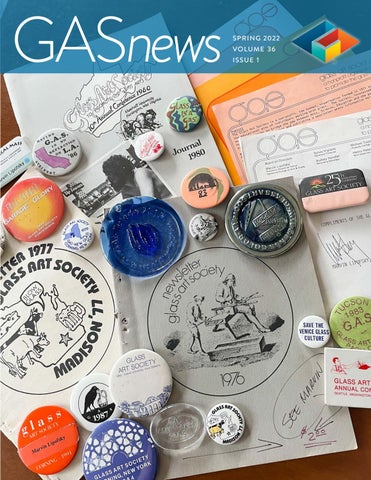
22 GAS Opportunities Cover: A collection of historical Glass Art Society items from past conferences. Photo Credit: Lauren Bayer
GAS news
Fused Glass Lilies with Dale Keating May 12
Letters from the Editor and Executive Director
18 Emerging Voices: Female Artists Working with Glass in East
Roughing It— Alcohol Ink on Stained Glass with Cathy Claycomb May 3 Vitrigraph—Pouring, Pulling, Playing with Dennis Brady May 5
3
GASnews is published four times per year as a benefit to members.
Glass Art Society Board of Directors 2021-2022
Contributing Writers: Shane Fero, Maja Heuer, Jennifer Hand, Eddie Bernard, Sunny Wang
President: Jessica Jane Julius Vice President: Nadania Idriss Vice President: Heather McElwee Treasurer: Mike Saroka Secretary:Lisa Zerkowitz
Editor: Michael Hernandez Graphic Design: Mae Quach Staff Brandi Clark, Executive Director Lauren Bayer, Communications Manager Mae Quach, Communications Assistant Cathy Noble-Jackson, Part-time Bookkeeper
Marketing for Artists Lecture with Joseph Cavalieri May 26
Ben Cobb Caitlin Vitalo Eric Goldschmidt Glen Hardymon Michael Hernandez Purmima Patel Frederik Rombach Lynn Read Debra Ruzinsky Leo Tecosky Demetra Theofanous Sunny Wang Martha Zackin Paige Morris (North American Student Representative) Ibrahim Erdogan (International Student Representative)
Coldworking with Dennis Brady May 31
Visit the Glass Expert Webinars® link under “What’s New” at www.GlassArtMagazine.com for more details and local times.
2
700 NW 42nd Street #100, Seattle, WA 98107 USA Phone: 206.382.1305 Fax: 206.382.2630 E-mail: info@glassart.org
Web: www.glassart.org
©2020 The Glass Art Society, a non-profit organization. All rights reserved. Publication of articles in this newsletter prohibited without permission from the Glass Art Society Inc. The Glass Art Society reserves the right to deny applications for Tech Display, advertising participation, GAS membership or conference participation to anyone for any reason.
GASNEWS
SPRING 2022
VOLUME 36, ISSUE 1
DIRECTOR’S LETTER
EDITOR’S LETTER As we celebrate the landmark 50th Anniversary of GAS and reflect on the state of the art, GASnews will look to the founders, the trailblazers, and the torch-holders from across the field who have left a lasting mark, and whose marks are still being chiseled, in the glass arts. Following the theme of the recent GAS Conference, Between Here and There, this issue looks at trends, influences, and the individuals with significant impact on the trajectory of the field, developing a focus on where, specifically and collectively, glass as a medium is moving and changing shape. In the following pages, writers examine and make connections to major shifts and impacts on our collective growth in artistic approach, energy awareness, and diversity within the glass arts community. This issue of GASnews explores the trajectory of our organization, expanding global network, and shifting trends in the glass community. With stories and insight into the development of the Glass Art Society, Shane Fero’s writing engages with voices of GAS founders and his own viewpoint of major shifts in the evolution of a growing organization. Sunny Wang describes and brings attention to the experiences of emerging and established East Asian women from the glass field, focusing on how education, opportunity, and perception have shaped their professional careers and growth. Examining the development and shifts in glassmaking in Scandinavia, Maja Heuer offers insights on the shift from the resonance of factory glass production in the region to new models for the address of the medium and expanding practices in making and engaging with glass.
For all super interested glass people of today: That’s how Mark Peiser and Fritz Dreisbach started out the invitation to the first GAS conference, and I think it still encompasses our community 50 years later. As we’ve been preparing for GAS’s 50th anniversary, we have spent a lot of time looking at the past - why GAS was founded, what the founders were doing at the time, and how people were working with glass. What we realized through all this self-reflection is that the spirit of GAS is still very much alive and strong within the glass community. In 1971, 17 young glass enthusiasts came together at Penland School of Crafts to celebrate their love of glass and to share their knowledge and experiences with each other, that’s still why we still come together now! As a community, we are growing and changing, but we are still coming together to celebrate the shared love of this magical material and to learn from each other. We have also been looking toward the future and the role we want to play in it. We spent last year crafting a new mission, vision, and values, and from that, we created a new strategic plan. Much like our community, our organization is growing and changing, and I am terribly excited for what’s next. We are proud of the role that GAS played in the American Studio Glass Movement, but we are even more excited about the role it can play in the future and in the Global Glass Movement. We hope you will join us and be part of that future!
Brandi P. Clark Executive Director
Michael Hernandez GASnews Editor
GASNEWS
SPRING 2022
VOLUME 36, ISSUE
1
3
TAKING SHAPE: THE EVOLUTION OF THE GLASS ART SOCIETY by Shane Fero The Glass Art Society is currently celebrating its 50th anniversary. Throughout the organization and its membership, many have identified the need to develop a written history that documents the inception and early development of GAS. This is important to understand the origins of the organization, but also to gain perspective on how trends emerged, the climate of the medium changes, and priorities shift over time. The idea of the GAS History Committee originated at the St. Petersburg Conference in 2019 when Fritz Dreisbach, Mark Peiser, and I met with the GAS board to discuss the importance of documenting the organization's rich history. It was agreed upon, and the History Committee was established. Unfortunately, the pandemic in 2020-21 delayed the process until now. Time is of the essence to document our history. Many of the early "pioneers" have passed away, and with them, their memories of that time and place. As planning began for the recent conference in Tacoma, this process was reinvigorated. For this issue of GASnews, we felt it was timely and relevant to bring attention to the efforts of GAS, its founders, and the History Committee, and to begin to discuss the motivations and efforts that led to the establishment of the organization, how the organization grew in its early years, and some significant trends that developed as the organization into what it is today. Preservation There have always been efforts at preserving the history of GAS. We have around 160 boxes of GAS records and videos at the Rakow Library. There are many articles and presentations in past GAS Journals for those willing to research it. Susan Rossi-Wilcox, a former Board member and GAS Journal editor from 20082012, was instrumental in organizing these efforts. In 2005, the GAS History Project felt it essential to create a series of oral/ video histories from those that make up the early founders and members of GAS, and in 2008, they began collecting those stories at the conference in Portland, Oregon and have continued at nearly every conference
4
since Collecting and documenting is not an easy undertaking and not one we take lightly. Nevertheless, we believe that our members should be aware of this history. Beginning: GAS 1 In 1970, a group of glassblowers, Fritz Dreisbach, Mark Peiser, Marvin Lipofsky, and Joel Myers, attended an NCECA (National Council for Education in the Ceramic Arts) conference held in Oakland. NCECA is dedicated to the ceramic arts through education, community building, research, and creative information. This was a good opportunity to convene with similar motivations, but being attached to NCECA was not relevant for their own needs as equipment and resources were different. They discussed the need to form their own organization to get the requisite information to glass artists. The small group agreed that such an organization for studio glass could be beneficial for the early neophytes working with hot glass. Later that year, Dreisbach and Peiser were invited by Marvin Lipofsky to attend The Great California Glass Symposium at the California College of Arts and Crafts. “It was there in Jim Wayne's living room after a long day of visiting a few glass studios in the
area that I presented an idea for forming an organization that modeled itself along the lines of NCECA.” Pieser declared, “You guys out here (on the west coast) have different approaches and solutions to your work, equipment, and techniques than we do in North Carolina, so we should get together and talk about it, share our knowledge," and the ideas that developed in its wake were to become the core ideas of what was to shape the Glass Art Society. As Peiser explained, "When Fritz and I returned to Penland, we approached Bill Brown, the Director of the Penland School, with the idea of holding a national meeting there. Bill agreed, but due to the school's limited facilities, it would be limited to 20 attendees. Brown also would provide a small grant from the ACC (American Crafts Council) to supplement the costs of the meeting. Mark Peiser, Fritz Dreisbach, and Bill Bernstein organized the first meeting of the Glass Art Society. In 1971, a group of glassblowers went to the NCECA conference in Toronto. Afterward, they took a road trip down to Penland in Fritz's yellow Chevy Suburban, including Ruth Tamura, Michael Taylor, Bob Held, George Thiewes, and Audrey Handler. Fritz's excellent and well-known
GAS 1 and GAS 2 posters, hand-drawn.
GASNEWS
SPRING 2022
VOLUME 36, ISSUE 1
poster announced and commemorated the first GAS meeting.¹ "By all accounts,” Peiser recounted, “that gathering was a great success at sharing knowledge of technical, commercial, and philosophical concerns," explained Peiser. Dreisbach saved half of the money from the ACC grant, which he felt should be the seed money for a similar conference a year later. Planning for a meeting the following year, 1972 was agreed upon by all who attended that first historic meeting. Growing: GAS 2-4 This second conference was also limited to about 20 attendees,² including Henry Halem and Marvin Lipofsky, with Audrey Handler the only woman in attendance. Henry, Marvin, Audrey, and other early participants would become significant forces in the future formation of the organization. After that second meeting at Penland, they expanded the base membership of GAS to now include glass students, as well as studio artists and teachers. A location needed to be found that could accommodate the added membership if a third meeting were to be held. Halem presented the idea that perhaps they could have a meeting at a glass factory. Halem, teaching glass at Kent State University in Ohio, lived an hour away from the Fenton Art Glass factory in Williamstown, WV. He offered to meet with Frank Fenton to propose the idea of GAS meeting at his factory and blowing glass on the factory floor. It was decidedly critical to the membership that they have the ability to blow glass and share their processes during the conference. The group agreed that Halem would collect slides of blown work produced by the GAS membership and show Mr. Fenton what our group had accomplished. Halem arranged the meeting with Fenton and showed him the slides of our off-handblown work. Those images persuaded Mr. Fenton that a meeting at his factory could be arranged. Halem recalled, "Mr. Fenton was very skeptical of what we were doing but did give me the time to make my presentation. After my presentation, when the lights went back on, Mr. Fenton was very impressed with the skill level displayed in our work and remarked as such.” A total of 77 glass artists/craftsmen attended GAS 3. The Fenton meeting was so successful that it was agreed upon that we should meet again at the Fenton factory the following year. “The main problem with GASNEWS
SPRING 2022
having the GAS meeting at the Fenton factory,” as Halem recounts, “was that we could not blow glass at the factory because we were not in the union…” That problem was eventually solved for GAS 4 when Driesbach suggested to Halem that we have our meeting over Labor Day when the factory was closed. Halem presented Driesbach's idea to Fenton, and the union agreed to that plan. “And the rest,” as Henry Halem says, "was history." At this second meeting in 1974, we were finally able to blow glass on the factory floor, and it became apparent that we had made such an impression on the factory workers that a few of them secretly joined us on the floor to blow glass—despite it being against union rules. Expansion + Inclusion Because of Halem's meticulous planning of the conference and its success, he was elected as the first President of GAS, serving until 1976. These first 4 GAS meetings/conferences laid the groundwork for its eventual success as an organization. Eventually, GAS became more inclusive in its membership and programming. Many founders became ambassadors of the organization, traveling around the US to universities, studios, and conferences to promote GAS, and share techniques and other information. Through these exchanges, GAS grew to embrace a wider range of approaches to glass and a membership that spanned the country, and eventually the globe. Beginning in 1989 with Toronto, Canada, GAS would expand to international conferences. These were pivotal for bringing new membership and programming to the organization. However, due to the financial burden of producing and organizing across borders, there have only been six international conferences to date. A major area of growth in GAS was the introduction of new ways of working with glass. Beyond the emphasis of hot glass processes, Marvin Lipofsky first promoted stained glass into GAS as a step to expanding the scope of conference presenters. A range of techniques, from flame- to coldworking, would soon follow. There were few flameworkers in the early days of GAS. Some of the early presenters were Paul Stankard, Ginny Ruffner, Hans Godo Frabel, Frederick Birkhill, and Sally Prasch. Flameworking participation increased, including an artist presentation by Susan Plum at the Toledo Conference in 1993 and demos at the new Bill Brown Glass Studio at Penland in 1995. Also, at VOLUME 36, ISSUE 1
the 1995 25th Anniversary conference, Robert Mickelsen and I organized a lecture, "Flameworking: A Worldwide Perspective," introducing the history of the technique to GAS members. There was an obvious growth in flameworking, with many demonstrations at the Boston conference in 1996 that Sally Prasch and Kristina Logan organized. After that, flameworking became more or less mainstream in GAS, and it was mirrored in the glass arts community worldwide. Coldworking, kiln casting, slumping, fusing, neon, pate de verre, mixed media, jewelry, engraving, lighting, cold construction, and design increasingly gained focus in GAS conferences and membership. During the 2000s, there were other notable changes to GAS's direction and programming at the conferences. The Lecmo was introduced as a new hybrid, combining the physicality of the demo with a lecture. It became more popular as participants could more easily interact with the artist as they were demonstrating. Green energy panels and lectures became regular to the schedule, offering conversations and technical advice on efficiency, ethical practice, and cost-reducing devices. This continues to be an essential part of conferences. Students became more important to GAS over the years, and GAS added a student representative to the Board makeup to give students more of a voice. Recently, there was an additional Board Student Representative added. The student exhibitions and awards became a critical feature to promote the outstanding work of artists beginning their careers to a larger glass audience. GAS developed portfolio reviews with established artists, critics, and gallery owners, where artists could meet one-on-one with them for critiques and advice about their work. Demographics The demographic of early GAS events and the membership was weighted heavily toward white males. The balance of gender and racial representation would develop slowly, reflecting the growth in field of glass art in the US. However, there was diverse representation in GAS from the early gatherings. The women in attendance at the first gathering, Audrey Handler and Ruth Tamura, would have significant and longstanding influences on the development of the organization and the field of Glass Art. Other women have also had a major role in the formation and management of
5
of individuals, and provide space and opportunities for underrepresented groups. Programming through demos, lectures, and panels that address these concerns have become common in recent conferences. Closing GAS was born in the spirit of community, exchanging techniques and information, and a love for working with glass. The organization has spread across the globe, and just as in the early days, the networking aspect of membership, especially at conferences, is a career builder with the connections for information exchange, opportunities for jobs, teaching possibilities, exhibitions, and friendships. As we look back to our amazing gathering in Tacoma and to our next conference in 2023, I know many are eager to get back to what we do best; sharing and growing our understanding of the medium and celebrating the accomplishments from the glass art field while making friends and memories. This article would not be possible without the stories of Fritz Dreisbach, Henry Halem, Audrey Handler, and Mark Peiser. It has always been a great learning experience and a lot of fun connecting with the founders of GAS. Thanks to all of you and to Beth Hylen and Sally Prasch for their contributions. Shane Fero is an artist, educator, and writer living and working in Penland, NC Betwen Here + There: 50 Years of Glass Art Society. The 50th Anniversary Pop-Up Exhibit for the 2022 GAS conference in Tacoma, WA. Photo Credit: Lauren Bayer
GAS as a non-profit organization, including Sylvia Vigilletti, the first Treasurer of GAS, who was instrumental as membership expanded—managing records, keeping the funds in order, and securing our non-profit status. Susan Stinsmuehlen-Amend was the first female President from 1984-86, followed by Suzanne Frantz (1989-90) and Ginny Ruffner (1990-1991). Since 1984, GAS has had nine female Presidents, and notably, all of the Executive Directors of GAS have been women.³ Although GAS does not require its members to identify their gender, it has been noted that the recent trend in membership is that women may make up a slight majority. The Board of Directors makeup has had a majority of women over the past couple of decades. The transformation speaks to the inclusion
6
of women not only in GAS but also in the Studio Glass Movement and the glass art community worldwide. Through the reflection of the staff, Board, and membership of GAS, it became apparent that the field of glass art has not been as accessible and inclusive to a wide demographic. GAS has made significant efforts to develop its programming, membership, and other areas of service toward becoming a more inclusive organization. Over the past decade, an institutional priority has been developed to promote BIPOC and LGBTQIA artists within our field. The Diversity, Equity, Inclusion, and Accessibility committee was formed to look critically at all aspects of the organization and address both the awareness and embrace of a broad range GASNEWS
Footnotes: (1) GAS 1 attendees included Bob Barber, William Bernstein, Bill Boysen, Jack Brewer, Jerry Chappelle, David Cornell, Dick Craft, Fritz Dreisbach, Dudley Giberson, Audrey Handler, Robert Held, Tom McGlauchlin, John Nygren, Mark Peiser, Ruth Tamura, Michael Taylor, and George Thiewes, (2) GAS 2 attendees included Bob Barber, William Bernstein, Bill Boysen, Jerry Chappelle, Fritz Dreisbach, Dudley Giberson, Audrey Handler, Robert Held, Dick Huss, Tom Kekic, John Lewis, Marvin Lipofsky, Tom McGlauchin, Bob Ness, John Nygren, Mark Peiser, James Tanner, George Thiewes, and Jan Zandhuis. (3) GAS Executive Directors included Bonnie Starek (1988-1990), Alice Rooney (1990-1996), Penny Berk (1996-2004), Pamela Koss (2004-2018), and Brandi P. Clark since 2019.
SPRING 2022
VOLUME 36, ISSUE 1
PARADIGM SHIFTS AND PLACEMAKING IN SCANDINAVIAN GLASS: REVALUATION AND REDEFINITION AT A TIME OF CHANGE by Maja Heuer The beginning of the 21st century presented the European glass industry with new situations and structural changes that led to a paradigm shift in the sector. After the 2008 financial crisis, several larger and smaller European glassworks shut down for a variety of reasons, including the globalisation of trade and production, changing patterns of consumption, and the introduction of new materials on the market. Other reasons were linked to the international energy crisis and to increases in production costs and wages. While the situation was similar in Eastern European countries, such as in Poland, the Czech Republic, Slovakia and Hungary, Scandinavia was especially hard hit by these developments, forcing the closure of several glassworks that were part of the Orrefors Kosta Boda brand in 2013. The changing conditions in the glass industry called for a re-thinking on all fronts, leading to new developments in training and education, production, design, research, and to the creation of new institutions and forums for glass. While the industry was confronting what was perhaps its most serious crisis, municipalities, regional initiatives, studio glassworks, individual practitioners, artists and makers were stepping up their activities, resulting in the creation of new glass centres, and the establishment of creative spaces and cooperative collaborations around glass in different parts of the Scandinavian countries. From 2010 to 2020, the Scandinavian glass scene underwent a transformation, supported by international reports, studies and projects, which paved the way for a reorientation and innovative collaborations in the northern countries. A report titled “Making Value”, published in England in 2010, showed that more makers than expected had started to GASNEWS
SPRING 2022
Glass is tomorrow-workshop in product development in Boda. Makers: Matti Klenell (SE), Pia Wüstenberg (UK), Fredrik Nielsen (SE), Jeremy Wintrebert (FR), Nathalie Dewez (BE), Eino Mäkelä (FI), Dina Baitassova (FR). Project leader: Lise Coirier, Promateria, 2013. Photo Credit: Maja Heuer
work with a research and interdisciplinary focus within sectors such as biotechnology, technology, materials science and digital and communications technology, which challenged conventional norms, created new perspectives on handicrafts and generated innovation and growth. In 2012, the Swedish government commissioned a “Kingdom of Crystal” study to explore the future potential for glass and to create a new structure focusing on education, research and fresh ideas to promote the development of a new, innovative glass production. One outcome of this study was the “Smart Housing” research project, hosted by the Scandinavian Glass Research Institute, which looked into the architectural potential of glass with new interactive elements, such as Smart Glass. In addition, the research institute started to investigate the potential VOLUME 36, ISSUE 1
of glass as a chemical material and to explore new, innovative areas of use. One of the key figures in this development in glass was Zandra Ahl. The Swedish professor, artist and author was already an important voice at the beginning of the 21st century in the debate on the status of craft. With her concept-based works she challenged the modernistic, stripped-down style that was the norm. In 2010, she founded the research school at Konstfack, the University College of Arts, Crafts and Design in Stockholm, with the aim to provide a stimulating and productive context for interdisciplinary artistic research. This also influenced the development of glass field, and a number of glassmakers began to focus on research, the manufacturing process and materiality.
7
The Aalto University in Finland was also actively developing their interdisciplinary research. Several interesting crossdisciplinary projects in the field of artistic research involving glass are currently in progress, and in the years to come, these activities are expected to expand in all of Scandinavia. Two different EU projects looked at innovations in the glass field and explored new business and collaboration models for makers, institutions and companies. The EGE – European Glass Experience was a collaborative project between the Murano Glass Museum, the Finnish Glass Museum, The Glass Factory in Sweden, the Spanish Glass Museum in Segovia and the Stained Glass Museum at Witrazu in Poland. The project, which ran from 2011 through 2015, aimed to find new ways of producing art glass through direct collaboration with contemporary artists. The project Glass is Tomorrow (20112015), which examined the historic contexts of glass production, involved a collaboration with historic glassmaking places such as Novy Bor in the Czech Republic, Nuutajärvi in Finland or the Boda glassworks in
Sweden. Leading designers, glassmakers and companies met over several years to make prototypes that reflected the historical context of each place. The prototypes were later sold to the participating companies for production and commercial distribution. To some extent, the project served as a matchmaking platform to exchange knowledge between designers, production centres and companies, and to demonstrate an innovative business model for the glass production of the future. As one of the first responses to the decline of the glass industry in the Swedish Kingdom of Crystal, The Glass Factory in Boda was founded in 2011 through an active placemaking process. The municipality in Emmaboda collaborated with the company Design House Stockholm and several makers to create a hub for Swedish glassmaking. Housing a museum and hot shop, this new glass centre promotes creative developments in the field of glass through exhibitions, artistic residencies with production opportunities, international projects and workshops, and through collaborations with interdisciplinary partners from Sweden and other countries.
In Denmark, the extensive glass centre Holmegaard Vaerk with a glass museum, hot shop, research facilities and exhibition spaces opened in 2018. It has become one of Scandinavia’s leading glass centres and provides a platform for innovation and exciting revaluations in the field of glass. In addition, the biennale European Glass Context on the island of Bornholm and the glass department of The Royal Danish Academy have become other important places for the development and the evolution of glass in Scandinavia. In Norway, the S 12-Open Access Studio and Gallery, founded in 2011 by the artist Æsa Björk, has long been a major glass forum. It offers residencies for artists, exhibitions, workshops, seminars and courses, and collaborates with numerous international partners. With the recent move to the city of Bergen, S12 plans to diversify its activities and to focus more on providing training for professional glass artists living in Norway. This is of particular importance as in Norway, there are neither institutions of higher education in the arts that offer a glass programme, nor facilities to work with glass.
Hot shop at the glass center Holmegaard Vaerk, 2021. Makers: Björn Friborg and Jonas Noel Niedermann. Photo Credit: Emilia Therese
8
GASNEWS
SPRING 2022
VOLUME 36, ISSUE 1
The first placemaking-event in the hot shop in Boda glasbruk to create the glass centre The Glass Factory, which was founded 2011. Makers: Fredrik Nielsen and Christopher Ramsey, 2010. Photo Credit: Björn Friborg
GASNEWS
SPRING 2022
Spekulo is part of a sustainable development in the Finnish glass field through placemaking, the next step being the creation of an interactive space for makers. In recent years, artists have started to research and to deconstruct the historical norms of the glassmaking process questioning and redefining current methodologies in manufacturing by experimenting with innovative processes of production. One example is the feminist Swedish craft group Boom! founded in 2015 by Ammy Olofsson, Nina Westman, Matilda Kästel, Erika Kristofersson Bredberg and Sara Lundkvist. The group uses a portable furnace allowing glassmaking to become a place of interaction. The mobile furnace is coming to places creating new contexts rather than the traditional way where the context comes to the place of making glass. Boom! takes their craft to different sites and places. They have created different contexts such as at the Stockholm Craft Week where they interacted with children visiting the VOLUME 36, ISSUE 1
www.TheFlowMagazine.com
In Finland, the Finnish maker-based association Spekulo-Association of New Finnish Glass is a prime example of the process of placemaking in times of paradigm shifts, with a crumbling industry leaving the preservation and development of glass and its immaterial cultural heritage to independent makers. The association was founded in 2018 by designers Anu Penttinen, Helmi Remes, the artist Gina Salaris and the master glassblower Jaakko Liikanen. In 2017, hot glass was declared a protected immaterial cultural heritage in Finland at the initiative of two groups of makers in both Riihimäki (Lasismi) and Nuutajärvi as part of an EU project. Spekulo’s priority is to bring together glassmakers in Finland by providing an open-source platform for sharing skills and knowledge, for creating new connections, promoting and informing makers, interest groups and the public and acting as a match-maker between makers and clients/ companies to create new jobs. The foundation of the national association
On the Cover of the Spring 2022 issue of The Flow®, Crab, by Jason Dunks Photo by the Artist.
A Glass Journal for the Flameworking Community
502.222.5631 theflow@theflowmagazine.com
9
fair. Another context they worked in was the Detox – Clean it up! project at the Rejmyre ArtLab. Here, they worked with remnants and waste of glass production. Boom! uses placemaking as a way to create spaces and places for glass through a participatory process, wherever they travel. While on the one hand, the importance of the place of glassmaking in history is becoming increasingly clear, contemporary artists are also starting to examine glass from a broader, sociological perspective, often focussing on the context of glassmaking in different locations within glassmaking regions. Ingela Johansson is a Stockholm-based artist, whose research-based artistic practice often blends site-specific topics with her interest in social history and the collective memory of a historical place. She
grew up as the child of a master glassblower in the glassmaking region of Småland. By showing the historical, social and political aspects of glassmaking in Europe, she seeks to expose and challenge the political, ethical, or social systems and the writing of history about them, all of which influence our everyday lives. Her interdisciplinary approach combines various aesthetic strategies and media to create an engaging body of work, often including film. In recent years, glass has entered a period of transition in Scandinavia. New initiatives by makers, artists, regional districts and municipalities have led to the creation of a new glass scene in Scandinavia based on new creative places where glass centres and organisations have increasingly taken on the role of incubators for future developments in the
glass field, opening up new opportunities for glassworkers, creating new business models and promoting international collaboration and projects. In Scandinavia, it is no longer a production in large units that serves as a basis for contemporary glass practices, but rather an international, experimental, place- and research-oriented activity, often interdisciplinary and on a project basis. By deconstructing glass as a material practice, the makers explore innovative possibilities for the craft, breaking down the structures and norms in today’s glass tradition, and expanding the view of glass, its production and its evolution. Maja Heuer is the Founder of The Glass Factory Boda, and Curator at Kalmar Iäns Museum in Sweden. Norske Glasskunstnere had its founding meeting at S12 during its latest seminar 21-23.okt 2021. The picture shows representatives from many of the glass studios in Norway today, 2021. Photo Credit: Aesa Björk
BOOM! 2018. Makers: Sara Lundkvist, Matilda Kästel, Erika Bredberg, Nina Westman, Ammy Olofsson, Bim Eriksson (illustrator). Photo Credit: Hans Runesson
10
GASNEWS
SPRING 2022
VOLUME 36, ISSUE 1
INTERVIEW WITH AUDREY HANDLER by Jennifer Hand
“Every Day Was an Adventure” Audrey Handler Muses on the Beginnings of the Glass Art Community An iconically cheeky Guerilla Girls poster titled The Advantages of Being a Woman Artist lists, as benefit number four, “Knowing your career might pick up after you’re eighty.” Audrey Handler, now 87, has the poster up in her studio. “It sings to me,” she says. Handler has been a part of the art glass community since it began to coalesce from individual experiments and studios into the vibrant, passionate craft family of today. Only in recent years, though, has her instrumental work as a collaborator, educator and maker begun to receive the attention it is due. Pairs, recently acquired by the Chrysler Museum of Art to fill out its encyclopedic glass collection, is delightfully representative of her style: Skilled making, a hint of fantasy, feminist conceptual undertones and a nod towards the compromise of teamwork. Pairs is one of many works that museums are newly honoring as a nod to Handler’s place in glassy history, as the first woman in an academic glass program in the US, among the first to teach hot glass at Penland, and, perhaps most relevant to the publication you’re reading, one of the founders of the Glass Art Society itself. Fifty years have passed since the first glassy gathering at Penland in 1971. Since then, Handler has seen a world of change in the field – most of it for the good. In a recent correspondence, Handler shared her thoughts on the early days of the glass art community and what it was like to be one of the few women shaping the contours of the medium. Jennifer Hand: Can you tell me about your experience as part of the first group of students working with hot glass at University of Wisconsin Madison?
GASNEWS
SPRING 2022
Audrey Handler and student looking at glass formulas at Penland circa 1974. Note Handler’s amazing t-shirt with Wonder Woman reciting the formula for glass – any volunteers to bring this model back into circulation? Photo Credit: Image courtesy of Audrey Handler
Audrey Handler: I was the oldest by about 4 to 6 years. In those early days, my classes at UW were made up of all men and we were graduate students. There were no undergraduate classes in glass. Some of us were married. I was 31 with 3 young children. My husband [at the time] was a Professor of Law at the University of Wisconsin. VOLUME 36, ISSUE 1
I was treated well by Fritz Dreisbach who respected my desire to learn and saw that I was serious about glass. The others seemed to treat me as this woman to be tolerated. At one point in the beginning of the class year we were cleaning up the studio and a second-year student asked me to wash the curtains. I asked him if he was married. He said yes. I told him to give
11
the curtains to his wife. The curtains came down and never were washed or put back up. I have wondered if this was to be a metaphor for things to come. When I asked if I could help in building the new furnace I was told to just watch. They often asked me to go get coffee and donuts. I only did this if I too wanted coffee and donuts. Professor Littleton asked me to take notes during class. Since I was doing this anyway I was happy to do it. He never asked for the notes. Harvey often called the glass lab and asked me to bring the class out to his farm in Verona and “by the way stop and get some sweet rolls for the class.” After class I was asked by Harvey to help him prepare lunch for the students. We would go out into his kitchen to prepare the food. I really enjoyed this alone time with my Professor. We all loved our class time out at our Professor’s home and studio. He showed us his glass collection and we learned about glass history (we
didn’t realize that we too were making glass history). I would say that for the most part I was treated fairly for that time period. Probably because I was older and a professor’s wife. But I did have to prove that I was serious and good enough to be in this class. I did feel that I was considered a woman first and an artist in glass very much second. I do not think that Harvey expected me to continue after one session. He did not know how tenacious and determined I was to succeed and how much I loved blowing glass. I loved the physicality of actually working with this incredibly difficult medium. Every day was an adventure. We all purchased our own blow pipes. They were Putsch pipes from Germany. Most of the tools were too big for my hands. Harvey had a smaller pair of cut off shears which he sold to me. I used ice picks and needle nose pliers and anything else I could find to work the glass. My kitchen metal meat pounder became a glass tool.
JH: Soon after graduation, you began teaching classes of your own. What was it like being a woman teaching glass in the late 60's and early 70's? AH: After graduation I was asked to teach a class at Penland School of Crafts in North Carolina. This was my first glass teaching job. It was a 3 week course and my class was mostly men. When it was known that Penland had hired a woman glass instructor, I was told by one of the men that no man would take my class.
www.GlassArtMagazine.com
Handler demonstrating with balloon on blowpipe. Handler: “As an example of fun, I had my students put a balloon on the end of their blow pipe to see how it felt to expand that first bit of air. To feel the letting go of pressure.” Photo Credit: Image courtesy of Audrey Handler
The early pipes were iron and blackened our hands. The married guys said their wives complained about their dirty hands. So one of them recommended that we all chrome plate our blow pipes. We did. I was happy to do this and so glad that one of the guys had suggested it. Can you imagine how much teasing I would have gotten if I had suggested this? Of course in later years we bought stainless steel pipes which solved the problem.
On the cover of the March/April 2022 issue of Glass Art®, Josh Simpson, Megaworld, Also one of the many featured artists in this issue, Photo by the artist.
For the creative professional working in hot, warm, and cold glass
502.222.5631 info@GlassArtMagazine.com
12
GASNEWS
SPRING 2022
VOLUME 36, ISSUE 1
“Men don’t want to be taught by a woman.” The men in my class said when they saw in the catalogue that a woman was teaching the class they were delighted. It would be a good change from the macho guy classes. I came to Penland alone and made all my students assistants and gave them specific jobs to do in class so they would be completely involved in all aspects of running a glass studio. Jobs changed and the students were happy to be so involved. As the glass studio grew and expanded in complexity, Penland later had a glass assistant assigned to the glass shop, but not in the early years because all the male instructors brought their own assistants. I found out later that Bill Brown, the director, told the guys they didn’t need assistants. “If Audrey can do it, you can do it.” JH: How do you think your experience as a woman in the early studio glass days influenced the way you taught your own workshops? Did you teach the way you had been taught, or find other ways of connecting with your students? AH: I found my own way. I treated everyone equally as much as possible. No job as my assistant was too difficult for a woman to do. We helped each other. If one woman could not...pick up a 50 lb bag of sand then two women were sent to do it. I did continue teaching glass history in all my classes as Professor Littleton had done as I felt this was very important. Slide shows and films were always part of the class as were demonstrations. I gave attention to each student during their blowing times. Safety was a big topic and concern. In each glass workshop, I was asked to give a lecture to the all the students at the school. I usually had my students participate in the beginning of my talks in some way. We put on skits or they played music, something to enhance my talk. I never felt that teaching should be without a bit of humor. We had fun, but we were also very serious about learning this art form.
GASNEWS
SPRING 2022
Handler’s Pairs was recently acquired by the Chrysler Museum of Art, while Pear in a Cherry Chair was acquired by the Bergstrom Mahler Museum of Glass in 2018. The latter work demonstrates the longstanding collaboration between Handler and her second husband, John Martner, a scientist-turned-master woodworker. The diminutive cast silver figures, trompe-l’oeil woodwork and clever wordplay lend hints of playful surrealism to the composition. Photo Credit: Chrysler Museum of Art
VOLUME 36, ISSUE 1
13
JH: What are some changes you've seen in the studio glass community from its genesis to today? AH: Many more women are now in glass and we may outnumber the men. Private glass studios have popped up all over the world and glass classes are taught in private and public places. But I am beginning to wonder if we are teaching these new glass artists how to make a living. Many of them will have to have another profession in order to survive. The direction seems to be in non-functional and much more intellectual art forms. Not a bad thing but hard to sell in any market. I know...as I was one of the early ones to use glass and other materials in the 1970’s and to tell a story with my glass sculpture. It was not accepted and difficult to sell let alone exhibit until the Corning Museum exhibition New Glass in 1979 which included my “Wedding Breakfast”. JH: The work of starting the Glass Art Society is the kind of network-building, administrative labor necessary for a thriving arts community, but it doesn't always get the same acclaim as do artists pushing boundaries of big and beautiful in the medium. You were a major part of getting GAS running. What made you decide to invest in a pursuit that would help the careers of others while taking time away from your own? AH: I never felt that anything I did for glass took time away from my own pursuits. These times always enriched me. I learned so much. My kids were proud of their glass blowing mom. I attended the first meeting of GAS at Penland. This spark was eventually to bring together glass artists from all over the country with all kinds of new ideas. We discovered that the East coast was doing things very different from the West coast. As we expanded we brought together all fields of glass artists, not just glass blowers. Collectors, museum directors and all those interested in glass from all over the globe came to our GAS
14
conferences. Paul Gardner, the curator emeritus of the Smithsonian Institution, loved the glass artists and came to all our glass conferences. He became a very special friend of mine. What fun and how exciting?! In the very beginning, we just needed a vehicle to expand our collective knowledge. JH: Any last thoughts? AH: Since there were few jobs in glass [in the 1970s] and definitely not for a woman, I set up my own studio in an old cheese factory that I rented in 1970 until I purchased the building in 1975. I set up my studio myself to prove . . .that a woman could run a glass blowing studio and build her own equipment, furnace, annealers, benches, etc. Women have historically been overlooked. But that is definitely not the case now. We are an exceptionally talented force to be dealt with.
new: also available as ePaper
It’s worth noting another poster in Audrey’s studio: Rosie the Riveter pausing for lunch with a sandwich in hand and the caption “We Can Do This” writ large. Handler was without a doubt one of the key figures who paved the way for women in the glass art scene. Her pragmatic can-do capability would make Rosie proud indeed. For more on the history of the Glass Art Society and Handler’s experiences, see Victoria Ahmadizadeh Melendez’ recent piece in Urban Glass QuarterlyGlass, and stay tuned for The Glow Up, A Constellatory History of Women in Glass, Hand’s upcoming masters thesis project with the MA in Critical Craft Studies Program at Warren Wilson College. Jennifer Hand (she/her) is an artist, writer, curator, mother and veteran based in Norfolk, Virginia. Follow her for musings on glass geekery and work/parent/ life imbalance at @xojenniferalexis or jenniferalexishand.com.
+ NEW GRADUATE REVIEW 2021
4 issues a year
GERMAN/ENGLISH
subscribe easily online:
www.neuesglas-newglass.com info@neuesglas-newglass.com
GASNEWS
SPRING 2022
VOLUME 36, ISSUE 1
FOR US, BY US: A SNAPSHOT IN TIME OF THE IMPACT/ INFLUENCE OF BOTH TECHNOLOGICAL DEVELOPMENTS AND ENVIRONMENTAL FOOTPRINT OF THE GLASS ART INDUSTRY by Eddie Bernard When I first began building glassmaking equipment in 1995, it was dubious whether one could make a lifelong career producing specialized products for such a specific field. It always seemed like the market was bound to collapse at some point, or it would eventually be flooded with an excess of used glassmaking equipment without enough demand for the new. Back then, we were still transitioning from typewriters and rolls of film to personal computers and digital cameras. We didn’t have the Internet, search engines, social media, reality shows, online meeting spaces, or YouTube. Cell phones were extremely rare, and sending a fax was probably the closest thing to text messaging. When travelling, many of us carried our three-ring binders full of pictures and slides to be able to show each other in person what we’d been up to, and we swapped big video tape cassettes of amateur-recorded demonstrations and watched them together at parties on a bulky VHS tape player…life was grand! The way we live, learn, make, and communicate went through a lot of rapid changes. Adapting to these changes meant embracing new technologies. This has been a major influence on our niche market, and I’m still building equipment 27 years later. As energy prices have risen and fallen, and risen again, we’ve gained and lost, and regained interest in our environmental impact, as if saving money was the answer to saving the environment. In some ways it is--in others it is not. When it comes to saving the planet, making art from glass has some reflecting to do. Some of us have made equipment-building part of our daily activity, and, as a whole, we’ve done our level best to bring cost-effective energy efficiency to our energy intensive art form. I agree with my peers, Cheyenne Malcolm GASNEWS
W S PI N R ITNE G R 202 1 42
Digital rendering of a Wet Dog Glass recuperated round day tank coupled with a batch/cullet preheater and an air-toliquid heat exchanger used to heat methanol in a biodiesel refinery in 2009.
of Canned Heat and Phil Vincent of Mobile Glassblowing Studios, that there is some level of responsibility that lies with the studio owner/operator in the daily use of the equipment we build. A door left open on a highly efficient furnace will still waste heat…unless it’s doubling as a glory hole! Most conversations around our environmental impact revolve around energy efficiency, which in turn revolves around glass melting equipment. It makes sense when we consider that most melt furnaces stay hot 24/7. Other practices are more tolerable of “on demand” equipment such as fusing ovens, flameworking torches, and coldworking machinery. There have certainly been improvements made in equipment design which have helped reduce energy consumption. Examples include the use of microporous insulation, variable speed combustion air blowers, hot air recuperation, and automated flue dampers. VOLU UM M EE 23 56 ,, II SS SS U U EE 41
Some of today’s gas-fired furnace designs use as little as 10-15% of the gas used by the average home-built furnace of 25-50 years ago, and as little as 5-10% of the electricity. Electric furnaces allow operators to take advantage of more sustainably produced energy such as solar, wind, or hydro power in areas where it is available. Mobile glass furnaces, while limited in thermal insulation thickness by the standard 32” door opening width, answer the call by providing the option of turning on and off daily. It doesn’t seem fair to compare the mere 3,500 BTUs of heat energy required by a modern bottle plant to produce a twelve-ounce bottle with the estimated 200,000 to 400,000 BTUs required to blow a glass bottle by hand. Making something more complex is vastly more energy intensive, so our best way to justify our use of so much energy must be to justify the use of glass to make art objects by hand and keep a craft alive.
15 5
Air-to-liquid heat exchanger in the ductwork above the University of Louisville furnace to reclaim heat for heating an adjacent common space.
If we were to put environment as top priority, how much of what we do now would we still do? If we ask ourselves what we can change about our individual practices to reduce our impact, the answer will most likely be lots of little things that would make a meaningful dent when combined. Over the years, I’ve researched and crunched math, learned from and taught people about the ways in which we could potentially lessen our environmental impact. Some glassmaking disciplines are easier to address than others. In coldworking, for example using natural lighting and renewable energy sources and reusing water and abrasive grit are impactful practices. In warm glass, one might add the use of natural ventilation to keep the studio cool, use well insulated
16
kilns with modern proportional temperature control systems, re-use wax and plaster from spent molds, and package the work in sustainable packing materials. Once we get into the melting of glass, as we do in flameworking and hot glass studios, our energy use rises exponentially, and this is where it becomes economically difficult to do things much differently than we currently do. I don’t see flameworkers switching back to burning whale oil or kerosene and pumping a bellows with their feet, nor do I see many glassblowers showing much interest in doing the extra work of collecting and cleaning recycled glass or used vegetable oil. That said, there is certainly inspiration to be found by those willing to look.
GASNEWS
The first time I saw anything I could call “sustainable” was before many of us ever used that word. It was 1992 at Leon Applebaum’s studio in upstate New York where I saw an array of water piping installed near the furnace to heat water for a hot tub. Brent Kee Young has done something similar for many years in his private Cleveland studio, whereby the heat reclaimed above the furnace is circulated through a heat emitter that heats the extents of the studio space through the winter. Heat can be reclaimed to keep driveways free of ice, as is done at the Toledo Museum of Art’s Glass Pavillion. It can also be returned directly to the process from which it came, by using a recuperator and/or by preheating cullet or batch before charging it into the furnace. In the biofuels category, there are a few options for those interested in the reuse and/or capture of alternative energy sources. Take for example WVO (waste vegetable oil), a nearly carbon neutral fuel. Hugh Jenkins fires his small furnace in Honolulu on WVO, using a novel burner system of his own design. Timm Muth at Jackson County Green Energy Park in North Carolina burns both landfill gas and WVO and has developed a special burner for small glass art furnaces and glory holes, supplying them to clients in the US, Belgium, New Zealand, and Swaziland. There are several other studios burning landfill gas that have existed for 15-20 years or more. Burning landfill gas replaces the escape of methane into our atmosphere with a much less damaging carbon dioxide while giving off useful heat in the process. Anselm - KItengela Hot Glass, just outside of Nairobi, Kenya, has experimented with several biofuels, one of them being coffee bean husks. And, Christian Thornton and his team in Oaxaca, Mexico have done a fantastic job of piecing together a dazzling array of community, heat reclamation and reuse, biomass anaerobic digester, recycling, solar power, and mescal distillation. I could go on and on with alternative energy models and innovators from around our global glass community. My takeaway
SPRING 2022
VOLUME 36, ISSUE 1
is that we will work with what is available, especially if, and sometimes only if, it makes economic sense. We do have bills to pay. The best course of action is, as always, to reduce first, reuse second, recycle third, and then work with the most sustainable options we can afford. The glass art community is a for-us-by-us team of doers and social learners. From a physical infrastructure point of view, there are more community-access glass studios than ever before, which is valuable both in terms of pooling resources to increase accessibility to the material, and to local knowledge and mentorship. The innovations that have made significant contributions to our community, influenced by, and developed in collaboration with evolving technologies do not stop at the flame, and are not limited to economic or environmental concerns. Our history, experiences, communication, and ideas are more accessible, and more available to a worldwide community and audience. While we’ve come a long way from our three-ring binders and VHS taped demos, we owe a lot to our tenacious note takers and amateur videographers. Our elders have preserved much of even the earliest conversations ever had in the glass arts.
GASNEWS
W S PI N R ITNE G R 202 1 42
They did that by writing or typing on paper while someone was talking, by taking care of that paper, and by submitting it to the Rakow Library. They’ve safeguarded slide carousels, printed pictures, newspaper clippings, sketches, each other’s mailing addresses—you name it, they did it. They had fun and took great pride in doing it. (If I’m talking about you, please substitute “you” in place of “they.”) This spirit to document experiences and ideas has evolved greatly through the rapid progress in digital technology, social media, and video conferencing. Technology didn’t just wake up this morning and look in the mirror and see what it saw 50 years ago. Technology is a bunch of tiny innovations lent and borrowed and applied in different ways, and it usually isn’t regarded as technology if it doesn’t afford an improvement in our lives. Technology builds upon itself, and the only way to know for sure what’s coming next is to watch movies set in the future. All jokes aside, if you want to know what’s coming next, I recommend you visit GEEX (Glass Education Exchange) at https:// geex.glass/ Eddie Bernard is the Co-Owner of Wet Dog Glass in Star, NC
VV OO LU LU MM E E3 62 ,5 ,I SI S S UU E E1 4
17 5
EMERGING VOICES: FEMALE ARTISTS WORKING WITH GLASS IN EAST ASIAN CONTEXTS by Sunny Wang, PHD Erika Tada, Weaving the Time, H10×W60×D60cm, Pâte de Verre, 2012. https:// www.tadaerika. com/
Gender has the power to shape experience, particularly in traditional cultures that tend to have stricter boundaries and expectations based on gender identity. It is increasingly understood and accepted that gender is not a binary arrangement between female and male but rather represents a full spectrum of identity and experience. However, it may prove useful to explore how artists working in glass who identify as female may or may not share common concerns and navigate societal and cultural expectations in East Asian contexts. The perspectives of these artists are best represented by the actual voices of the artists themselves. The following investigation prioritizes the firsthand experiences of female artists by listening to and valuing their perspectives recorded through interviews. Rui Sasaki, Erika Tada, Ayako Tani, Su-yeon Kim, and Meng Du (Moe) generously shared reflections on their careers as artist working with glass. I
18
also share my own experiences as a female artist working with glass in Taiwan and Hong Kong over several decades. It should be made clear that female artists are not somehow required to explore themes related to their gender, nor should they be defined by their gender. For some artists, gender is in the foreground and an ongoing concern, while for others the issue of gender is not a priority. Interviews with female artists working in glass in East Asia confirm this varied relationship with gender. It is not the responsibility of female artists to work on themes related to femaleness, nor are they somehow less female if gender is not a major issue in their artistic journey. The physical demands of working with glass certainly plays a role in how women working with the medium have been positioned, or perhaps marginalized. The heavy physical labor that is required in many glassmaking techniques is often viewed as more suitable for men than GASNEWS
women, and this is evident in the East Asian context. My own experience in glassmaking in East Asia has included stereotyped expectations of what is ‘male’ or ‘female’ work. For example, the hotshop environment, with heavy industrial equipment and the requirements of challenging physical labor, may traditionally appear a more ‘male’ space. Modern machinery, such as lifts and platforms, has helped address some of the physical challenges in glassmaking studios. In my own experience, female artists working with glass have become much more accepted than in the early years of the studio glass movement in East Asia. A major moment in the history of glass as a contemporary artistic medium in East Asia was the first Glass Art Society annual conference in Asia held in 1998 in Seto, Japan. By this time, I had already been working in glass factories and studios in Taiwan.
SPRING 2022
VOLUME 36, ISSUE 1
My first job at a glass factory in Taiwan was in 1995. My male coworkers were shocked by my presence and I received a lot of attention, not all of it positive. Those working with glass in East Asia at that time were almost exclusively male. Now, most of my students studying glass at the university level identify as female. Clearly, the field has changed to become more inclusive and welcoming of women. However, pinpointing exact reasons for this development can be elusive. One cause leading to more young women engaged in the visual arts in Hong Kong, and perhaps other areas of East Asia, is family expectations. Families are more accepting of women exploring careers that may not bring financial success. However, there is more pressure for young men to be financial providers and resistance to pursuing careers that risk financial instability, such as becoming an artist. In this sense, young women have more freedom than their male counterparts to explore careers in the visual arts. The financial uncertainties involved in the life of an artist are more accepted for women rather than male “bread winners.” However, implicit in this reasoning is that women in potentially unstable careers, such as professional artists, can always just be financially dependent on incomeearning men. On the one hand there is more freedom in career choice, but on the other there is an implicit societal and patriarchal expectation of financial dependence on men. Another familial concern is how parents will be provided for by their children in old age. In a traditional Chinese context, for example, sons are assumed to be the providers for elderly parents while daughters are not expected to carry this financial responsibility. Therefore, there is a perception of lessened risk to parents when a daughter pursues a career that may not be financially rewarding, such as becoming an artist. The role of women in visual arts education, including glassmaking, is a concern for several artists interviewed in this study. Erika Tada provides insights into gender-related concerns in arts education, GASNEWS
W S PI N R ITNE G R 202 1 42
Ayako Tani , Ghost, Lampworked borosilicate glass and wood frame, Size varies, 2010, European Museum of Modern Glass collection, Museum Kunstplast collection. https:// www.ayakotani. com/
Rui Sasaki, Weather Mirror, glass, phosphorescent crystal mixture, mirror, foot switch, 2021. Photo Credit: Kichiro Okamura. https://rui-sasaki.com/
stating, “As a glass educator based in Japan and the U.S., I feel that Japan lags behind the rest of the world in achieving internationalization and gender equality in Japanese society. At universities with strong traditions, there is an imbalance where the majority of students are female while most of the faculty members are male. I believe that there is a need for women to take leadership and enliven the field of education.” This gap between female students and their primarily male teachers in visual arts education is also observable in other contexts.
VOLU UM M EE 23 56 ,, II SS SS U U EE 41
Rui Sasaki shares similar concerns about the gender imbalance in arts education in Japan, stating, “there is still a male-dominated society in teaching positions at university-level education, especially in art, design, and craft (in glass as well).” She does see positive developments, observing, “even though I believe that it is a much better situation compared with 10 years ago.” She also states, “I strongly feel that many people who have been in professional fields in art for a long time have started hiring more young and female educators and featuring female artists in art museums in Japan.”
19 5
Suyeon Kim, Forest of Stools, Late night, 2021. https://suyeonkim.weebly. com/forest-ofstools.html
Su-yeon Kim speaks to the situation in South Korea, stating, “The representation of young female artists in glass is rare in the Korean glass community. Korea has a small glass community, and most glass artists have learned glass art from universities. There were more male students in the glass programs in universities studying glass in the past. And also, women in Korea in the past often experienced a career break after marriage or childbirth. Due to this, currently established glass artists in Korea are primarily male and there are few female glass artists in their mid-career. However, these days, women have more opportunities to continue their careers. Also, students in the glass program keep declining, but most students are female. For this reason, there has been a change in glass art institutions in Korea; female glass artists have started to teach in institutions where male artists mainly taught. As a female artist working in Korea, I believe that it inspires upcoming students interested in glass art and eventually increases the population of female glass artists.” The critical and changing role of women in glass education is addressed by a number of respondents.
20
A number of other social concerns were mentioned by artists interviewed for this study. Rui Sasaki reveals how age is an issue in the Japanese education system, stating “In education, we unbelievably care about age so much compared with the US and Europe. Therefore, I feel that the matter of age is sometimes one of the obstacles for us.” The Chinese artist Meng Du mentions an issue that affects so many women globally, stating the difficulty of “financially balancing life and work.” A number of respondents reveal challenges related to contemporary glass as a relatively new medium in East Asia. Meng Du states, “Compared to ceramics and wood, glass is a relatively new material for art-making in China. Artists are therefore not limited by the technical aspect of craft, which I believe will be a huge room for the artists to explore and experiment. I have been back to China for five years already, however, there is still a long way to go for the glass community to set up studios or institutes for the artists and students to work and practice.” Rui Sasaki observes, “I do not feel any hesitation or barriers against maledominated societies in Japan as an artist but I can see more challenges towards GASNEWS
JOIN US ON MAY 22
learn more at traveltacoma.com/TAG
SPRING 2022
VOLUME 36, ISSUE 1
Far Left: Meng Du, Through the leaves of the book Chapter I No.1, Kiln-worked glass, tea, silver leaf, multi-media, L24 x W16 x H40 cm, 2020. Photo Credit: Puffer Hu Left: Meng Du, Through the leaves of the book Chapter I No.2, Kiln-worked glass, tea, silver leaf, multi-media L23 x W16 x H38.5 cm, 2020. Photo Credit: Puffer Hu. http://www. mengduwork.com/
our specific insights to see the world in glass as art.” Su-yeon Kim observes, “the population of the glass art community is much smaller than in other craft areas in Korea. Most young glass artists in Korea are just starting their careers after graduating from university and developing and refining their artwork.” The situation in Hong Kong is similar in that glass is a new medium in the visual arts with few artists working with the material. An issue that affects artists working in glass of all genders in East Asia is the difficulty of obtaining materials. Su-yeon Kim states, “a challenge to being a glass artist in Korea in general is the cost of materials. Every glass material is imported in Korea, so it is much more expensive. And most of the time they are out of stock so you need to order ahead of time to prepare artwork. This influences less accessibility and makes upcoming students think glass art is hard to make and an expensive material. With limited material access, it is challenging for me to encourage students GASNEWS
W S PI N R ITNE G R 202 1 42
to get interested in glass and create diverse glassworks.” Meng Du also observes that “the obstacles are everywhere for me to actually access the material.” An aspect of the artist’s journey that appears important to all respondents is internationalization. Connections to a global network of artists working in glass is an essential and highly valued part of their professional lives. Many of the artists were trained in the West and maintain close contacts with fellow artists working in glass abroad. Meng Du, for example attended graduate school at Rochester Institute of Technology, Su-Yeon Kim attended graduate school at Southern Illinois University, Carbondale, and I studied at graduate school at Australian National University and University of South Australia. Concerning her education abroad, Su-Yeon Kim states, “I understood more and learned about the Studio Glass Movement when I started studying glass in the States. This experience impacted how I make artwork, using glass as a material to VOLU UM M EE 23 56 ,, II SS SS U U EE 41
create my original voice visually. With this perspective, I focus on how glass relates to my work, why it must necessarily be glass, and how to build-up a story and visually communicate with the viewer.” In relation to attending a GAS conferences, Kim continues “when I started my career as a glass artist in South Korea. I experienced a strong bond and positive energy between the glass artists worldwide.” Ayako Tani was similarly influenced and inspired by the international aspect of GAS, stating “At GAS, I saw the diversity in artists, techniques, and expressions in glass, and it helped expand my professional network. GAS was such a great stage to share my research outcomes with an international audience which is otherwise difficult to reach.” Erika Tada also highlights the value of international exposure at GAS, remarking, “For international artists, attending the Glass Art Society conference will expose us to new artists and their ideas on creating glass art. The dialogue which we have with
21 5
the other artists and people at the GAS will give us the opportunities to expand our artistic vision.” Rui Sasaki also observes the important role of GAS in terms of maintaining international relationships, stating, “Since I left the US for Japan 10 years ago, it has been harder for me to keep getting in touch with my glass friends outside of Japan and know about updated information about glass internationally.” Clearly GAS is an important means of connecting artists working in East Asia to the wider global community in their field. The responses of female artists interviewed in this study are greatly varied, as one would expect since the female experience is far from monolithic. However, there are a number of shared observations including the importance of women in visual arts education and the generally improving situation for women working with
glass in East Asia. International networks, for which GAS is often cited as a catalyst, are seen as critical. The relative newness of glass as a medium in contemporary art presents challenges in various East Asian contexts. Technical concerns, such as the need to import materials and associated high costs, are seen as limiting factors in the accessibility and growth of fine art glass. Some respondents made little or no mention of how their gender influences their artistic practice. This could be viewed as a positive development in that being a female artist working with glass in East Asia is decreasingly experienced as unusual or limiting.
GAS OPPORTUNITIES To access the Glass Art Society’s up-to-date opportunities, just click on the links below.
Sunny Wang, PhD, is an artist and Associate Professor, Academy of Visual Arts, Hong Kong Baptist University.
PILCHUCK GLASS SCHOOL
50 YEARS
CALLS FOR ENTRY
JOB POSTINGS
CLASSES + WORKSHOPS
EVENTS
The premier podcast featuring conversations with the world’s finest artists working in glass.
www.talkingoutyourglass.com
EXHIBITIONS
ENROLL NOW FOR SUMMER + FALL 2022 WORKSHOPS!
AWARDS + NOMINATIONS
FOLLOW US!
22
GASNEWS
SPRING 2022
VOLUME 36, ISSUE 1