GASnews
SPRING 2020 VOLUME 32 ISSUE 2
Glass Expert Webinars®
Robert Mickelsen
INSIDE
Live Two-Hour, Interactive Web Workshops with Renowned Glass Artists Link to Class Recording Never Expires!
21 Bocci Design Methodology 24 GAS Opportunities
Photographing Glass Lecture Cathy Claycomb Sticks and Stones
Lisa Vogt Fusing for the Adventurous
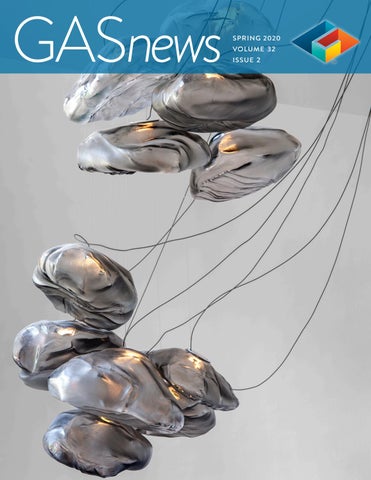
Cover: Bocci, 73 Semi-Rigid, swagged installation view. Photo by Harry Fricker.
GAS news
Joseph Cavalieri Marketing for Artists, Lecture Bonus: Artists’ Residencies Lecture
9 In Praise of Subtlety
18 Women's Work: Women at the Lamp
Robert Mickelsen NewCreating Images with Impact
Cathy Claycomb Roughing It – Alcohol Ink w e N on Stained Glass
5 Wondrous Strange: Women Redefining Scandinavian Glass
15 The Product of Higher Education
Gil Reynolds Flow Bar and Advanced Pattern Bars
Lisa Vogt Watercolor Techniques w Neand Advanced Fusing Design
4 Letter from the Editor
Permanence
Rick Silas The Art of Ice Glass
Denny Berkery The Copper Foil Method
4 Letter from the Executive Director
12 The Women of Tiffany Glass Company: A Struggle for
Scott Ouderkirk Making Waterslide Decals
Corina Tettinger Floral Beads with Fun Fancy Stamens
3 An Important Message
GASnews is published four times per year as a benefit to members.
Glass Art Society Board of Directors 2019-2020
Contributing Writers: Jennifer Detlefsen, Maia Stern, Jay Macdonell, Lieselotte Elliehausen, Phoebe Stubbs, Beth Hylen.
President: Natali Rodrigues Vice President: Nadania Idriss Vice President: Jessica Jane Julius Treasurer: Heather McElwee Secretary: Caitlin Vitalo
Editor: Michael Hernandez Graphic Design: Mae Quach Staff Brandi Clark, Executive Director Lauren Bayer, Communications Manager Kristen W. Ferguson, Development & Membership Manager Jenna Green, Operations & Program Manager Mae Quach, Administrative Assistant Cathy Noble-Jackson, Part-time Bookkeeper
Dennis Brady Glass Casting
Ben Cobb Kelly Conway Matt Durran Glen Hardymon Mike Hernandez Nadania Idriss Karen Mahardy Lynn Read Debra Ruzinsky Mike Saroka Masahiro Nick Sasaki Demetra Theofanous Lisa Zerkowitz Paige Morris (Student Representative)
Barbara Becker Simon Hollow Flameworked Beads Susan Hirsch
New A Four Layer Enamel Filled Fused Glass Forest Scene Gil Reynolds Mold Making Magic Visit the Glass Expert Webinars® link under “What’s New” at www.GlassArtMagazine.com for more details and local times.
2
2208 NW Market St., #200, Seattle, WA 98107 USA Phone: 206.382.1305 Fax: 206.382.2630 E-mail: info@glassart.org
Web: www.glassart.org
©2018 The Glass Art Society, a non-profit organization. All rights reserved. Publication of articles in this newsletter prohibited without permission from the Glass Art Society Inc. The Glass Art Society reserves the right to deny applications for Tech Display, advertising participation, GAS membership or conference participation to anyone for any reason.
GASNEWS
SPRING 2020
VOLUME 32, ISSUE 2
AN IMPORTANT MESSAGE Days before we were set to publish this issue of GASnews, we received a letter from Nate Watson, Executive Director of Public Glass. Not only do we whole-heartedly support Nate in his statement, we also believe that his impactful words cannot wait for our next issue. We are therefore honored to feature his letter in its entirety below. In this moment when all communities must ask, "how did we get here?" I think that it’s a meaningful statement in itself to say that I am one of two African Americans leading nonprofit glass organizations, and one of three helping to guide University glass programs in the entire United States. After sitting back and watching "our" glass community respond to the lynchings of Brown people and observing the social media-based processing of our complicity through inaction and a pervasive lack of inclusion, I've decided to put my heartache aside to share what it feels like from my perspective. With all of the wealth, privilege, and supposed progressive elements within our arts community, how could we let ourselves fall so far behind when it comes to supporting equity and opening doors for everyone? Even when compared to the lack of representation across the Art World as a whole, the glass community looks really bad. No words, propping up of black faces, or sudden unburying of works by black artists will solve this. We were wrong all along to be content amongst ourselves, content to peddle in shiny things with little connection to the realities of the world that is burning our eyes open now. We as artists, who are tasked with interpreting our collective condition, did not do our jobs, and the industry that supports us did not do theirs. The glass galleries did not look toward and support our futures, and our institutions looked to the past and the same sources for self-congratulation again and again until last week. In the last few days my projects, my body, and the images of my Black and Brown colleagues have become all too popular in the social media posts of the many glass companies and organizations around the country who are trying to make a statement about how "woke" they are. If you use our bodies in your catalogues, in your posts, and in your applications for larger grants, YOU are responsible for helping to create a way forward for the many who have not been offered a seat at your table. The leading nonprofit glass organizations from coast to coast who have been working on issues of access and diversity, lifting new voices, and supporting emerging artists for years with little to no contribution from our industry's biggest donors and institutions have joined together to create the Give to Glass Campaign. We've united due to the devastating financial impacts of COVID-19 on our programs and studios, but also because our own glass community has never fully appreciated the value of what we've been working for all along. In this moment when everyone has something to say about social justice, I ask‌.Do you see us now?! If you as an individual or an institution have made a declaration about where you stand, then it's your moral obligation to support change in our glass community. Words raise awareness, but contributions provide the resources for REAL CHANGE! Donate to Give to Glass, to Crafting the Future, or to any organization that is versed in fighting for those whose lives are compromised and voices muted, and for God's sake, please VOTE! If there is no action behind your statements, then please stop using our names, our black bodies, those of our youth, and the objects made from our alienation and pain, and step aside to let us build our own house.
Nate Watson Executive Director / Public Glass SF Glass Faculty / California College of the Arts Founding Member / Related Tactics Collective GASNEWS
W S PI N R ITNE G R 202 1 40
VV O OLLU UM MEE 2352,, IISSSSUUEE 42
3
DIRECTOR’S LETTER
EDITOR’S LETTER
Dear GAS Members,
Fellow Members,
As artists, most of us like to focus on process—it's where technique and skill lie, so that does make sense. While there are artists that can make a living on process through teaching, most depend on the product to make their living and move their careers forward. Like no other time in history, we are all going through a similar hardship. The COVID-19 pandemic and all of its rippling impacts are affecting artists, educators, collectors, individuals, and organizations alike. It is affecting people across the globe, changing the way the world works and the way it views many things. It is hard to imagine that the need for product—for both artists and consumers—isn't being reevaluated. What does the future look like for our community if there is a shift away from the importance of the product? How do artists create products if restrictions limit how people can work in the hot shop? Now, when we are faced with more questions than answers, it is hard to imagine what our community's future will be. Artists are extremely good at problem-solving and innovation, so I feel confident artists will continue to grow and thrive. As we saw with our swift pivot to a Virtual Conference last month, we have new and interesting doors opening up to us all of the time. Opportunity is ever-present, but we may need to shift our perspective in order to find, appreciate, and take advantage of it. Our new situation may also provide the push we need to look at our environmental impact and reassess the way we choose materials with which to make our products. Locally sourced materials and innovative methods of working may lead us to a new space where creating products is more sustainable from both a practice and an environmental standpoint. While things are undeniably challenging right now, we are resilient, and every day we are finding new and better ways to move forward. We will gather, we will work together, we will make things, and we will be better because of what we’re going through now.
Around the world, people are examining the product of history and social structures, health and engagement, authority and protest. Idealistically, people are collectively trying to understand where there is injustice and redefine civil contracts that will pave the way for us to live and grow as citizens of cities, countries, and humanity. We are experiencing a revolution that will affect nearly every part of our lives and how we engage with each other. Many studios, schools, and factories are already rethinking how they will produce and engage in their practices and how they will interact with their audiences. Throughout history, artists and makers have shown that the objects they produce are a record of their community's economic, social, and technological state. Our place in history will be marked by how we move forward together through engagement and communal experiences, and in what we produce to share our skills, ideas, and voices. While the momentum of research and investigation for this issue began at a very different time than we are collectively living in now, in its pages, you will find a strong emphasis on industry politics. Jennifer Detlefsen highlights some of the brightest talents in Scandinavian glass, all women whose ideas and objects are redefining their field. Looking back, Maia Stern discusses the lesser-known women of Tiffany Glass, whose work ethic and execution challenged the factory's nature of production. Also, in this issue, writers have focused on product makers that are addressing the scope and nuance of glass objects. Jay Macdonell provides an insider's look into the Bocci company's design approach that simultaneously explores materiality and methodology. And, Phoebe Stubbs highlights two artists whose approach is conscientiously focused on the process and the experience of the people that engage with their products. This Spring issue of GASnews looks at the way Product manufacture, design, and politics have impacted the industry and objects that represent and define the makers and their impact on the world.
Cheers,
Enjoy!
Michael Hernandez GASnews Editor
Brandi P. Clark Executive Director
4
GASNEWS
SPRING 2020
VOLUME 32, ISSUE 2
WONDROUS STRANGE: WOMEN REDEFINING SCANDINAVIAN GLASS by Jennifer Detlefsen Scandinavian design has long been prized for its sleek aesthetic, bold primary colors, and no-nonsense utilitarianism. The glassmaking traditions in Sweden, Norway and Denmark have strong connections to their centralized craft schools, including the Konstfack University of Arts, Crafts and Design in Sweden and the Royal Danish Academy of Fine Art Design School in Bornholm. These institutions are renowned for producing makers whose precision is a testament to the rigors of their technical training. As the dominance of the 1950s modernist movement waned, this region experienced the birth of a studio movement that decentralized glassmaking. New expressions in glass were able to emerge— but were still in large part fettered by a common, almost morally-based aversion to embellishment. It is only relatively recently that Scandinavian glassmakers have begun to step away from the canonical purity of design that so characterizes their region and embrace the intentional eccentricity of mixed media, kitsch, and performancebased work in their product offerings. The Scandinavian women profiled here are finding ways to synthesize their hardwon technical skills with unique methods of personal expression. The results are smashing stereotypes and redefining the very idea of "product" in our changing world. Karen Nyholm lives and works in the picturesque seaside town of Ebeltoft, Denmark. The studio she shares with her husband, Ned Cantrell, is walking distance from the Glasmuseet Ebeltoft as well as the studios of Steffen Dam and Micha Karlslund, both of whom influenced her path as an artist. Nyholm started blowing glass in 1998, at first focusing chiefly on tableware and functional items like the ones she was trained to make during her education at Bornholm. "Functional products are how glass started for me," she notes—at the GASNEWS
SPRING 2020
Above: Carafes in jewel-toned colors are a staple of Karen Nyholm’s product line. She delights in getting lost in the process of making these familiar objects in between more sculptural projects. Photo Credit: Karen Nyholm Left: Karen Nyholm’s sculptural work abounds with imagery of hearts, skulls and brains – reminders that death is a part of life, and not something to be feared. Photo Credit: Karen Nyholm
beginning of her career, even pieces that were not strictly functional were based on the idea of a bowl or vessel. Her experience interning for Dam and Karlslund provided her first glimpse of artmaking outside of the structure of school. Dam, an autodidact, had a wildly different process from anyone else she'd seen blow glass. "He was a toolmaker—self-taught, just fascinated by glass. Already that early on in my glass career, I had rules that you use the tools in a certain way, you put them on the bench in a certain way—but Steffen does things his own way, and that worked for him!" Karlslund came from a more formal glass background. Still, it was her intuitive art-making process and her layered use of imagery that most stuck with the young artist—along with the couple's inspiring way of living and working together. VOLUME 32, ISSUE 2
In 2003, Nyholm attended what she describes as the "super-session" at Pilchuck Glass School that followed the GAS Conference in Seattle. A class with Kiki Smith and Dante Marioni was her first experience seeing sculptural glass. "In Denmark, no one was working with glass like that at that time, and it opened up this whole new world of what the material could do." With a strong framework in technical glassmaking, Nyholm was able to take this fresh inspiration back home and start innovating in her own practice. Bornholm had provided her with an introduction to a lot of different techniques: stained glass, sand casting, blowing, paté de verre. She began building and layering those techniques to make distinctive, more personal works. "Because hot glass is such
5
Catherine Rahn, Diver and installation of glass Sea Stars (1998), blown glass near Wakaya Island, Fiji. Photo: Cat Holloway, courtesy of William Warmus
Frida Fjellman’s oversized geometric gems in luscious colors are immensely popular and fit as well in high-fashion boutiques as they do in her ominous installation artworks. Photo Credit: Nathan Gallagher
a difficult material, you have to have rules to be able to make anything in glass. But for me, the better I am at making glass, the more I can break the rules." She relied on that structure in the hectic years of starting a family and credits days of making her jewel-toned decanters with preserving her sanity during the demands of early motherhood. The ability to turn off her brain, keep her skilled hands active, and end the day with a kiln full of beautiful objects was a reward unto itself. She emphasizes that what kept her motivated was her love for making, a passion for shape and color, and being creative. "I still like the products—I especially like making the products—but when I make them, I'm a craftsperson, and when I'm making my sculptural work, that's when I'm an artist." Now that her children are more independent, Nyholm has had time to return to making more personal work. A recent exhibition at the Glassmuseet by the arch-weirdos of the glass world, the De La Torre brothers, was fresh inspiration to push the boundaries in her practice. "Their work–it's not pretty, it's not glassy, it's
6
all over the place, and I love it. In Danish glass, everything is supposed to be nice— nice shapes, nice colors—so there's such freedom in their way of making." Nyholm's studio has an attached gallery boutique where she gets immediate feedback on new ideas, and she considers that immediacy a double-edged sword. Some of her favorite works explore the importance of death as part of life. It is inspired by Day of the Dead imagery and the connections within our bodies. Skulls, brains, and anatomically correct hearts in vivid colors provoke extreme reactions, both negative and positive, in her audiences. "It varies—some people are disgusted, but others...get it. They see the beauty in the contrast." Frida Fjellman's work straddles a glorious line between traditional fine glass craft and Lynchian absurdity. Fjellman is best known for her works involving light and was featured in 2019's New Glass Now exhibition. Raised surrounded by Scandinavian values of sparse design and dogmatic rejection of decoration, Fjellman actively seeks subversion in her attention to adornment. Her iconic design takes the GASNEWS
archetypal decoration of a chandelier, the crystal, and enlarges it to the point of absurdity. Her clusters of oversized gems in luscious candy-colors evoke a range of emotions and styles. "I find the chandelier fascinating because depending on how it's presented, how you use the colors, it can be vulgar, or cute, or pop art; really beautiful or completely tasteless." She likens this design process to painting and delights in tweaking her display choices in her Stockholm studio, where she has the freedom to experiment. This solitary arrangement suits her much better than the school environment that she chafed against at Konstfack, which she describes as having been excessively competitive. She still relies on some of the technical knowledge she gained there; specifically, the mold-making skills she uses for her blown glass components were developed while in school. Fjellman's education at Konstfack has been supplemented over the years by courses at Pilchuck Glass School and the Studio at the Corning Museum of Glass. At Pilchuck, she studied plasma and neon, both electrifying components in a
SPRING 2020
VOLUME 32, ISSUE 2
mixed media arsenal that translates as well to public art as it does in her solo exhibition spaces. In all of her works, Fjellman pulls from a long list of macabre and surreal references, starting with the hypnotic visual psychology of David Lynch. Fjellman credits her time abroad as a fellow at Wheaton Village and a trip to the Metropolitan Museum of Art's Tiffany Collection with her discovery of ornamental Victorian glass. The reverence for décor, color, and intricacy overwhelmed her visual palette. Fjellman describes, "We don't have any of these things in Sweden— you just wouldn't see it. So, when I came across this style, I went crazy for it." Other detectable notes in her ominous installation artworks are the original versions of fairy tales which she read in her youth—stories she revisited with her own children, only to be shocked at their violence and misogyny. She is also fascinated by the constructed environments of old museums, specifically natural history museums and the taxidermy creatures that haunt their halls. Despite such unnerving references lurking in her reservoir, Fjellman is regularly awarded public art projects to round out her practice and is currently waiting on travel restrictions to subside so she can complete a project for a school in Norway. A large-scale cast-aluminum tree branch suspended from the ceiling, intertwined with her twinkling emblematic mega-gems, will hover above a "pond" of polished black stone in this installation. Fjellman considers public art projects like this one to be a way for artists to stay relevant in our disposable culture. She is categorically uninterested in competing with mass-market produced wares; instead, she hopes the stakeholders in public art derive a feeling of ownership when they see her artwork in their place of business, in their park, or on their commute. "That is a different kind of product," she explains, "one that builds community through a sense of shared experience. For Stockholm-based BOOM! Glass Group, their product is quite literally empowerment. BOOM! describes itself as a "female separatist group exclusively for artists working with glass, whose aim is GASNEWS
SPRING 2020
Karlyn Sutherland, Light Study, Toyama, 2019. Photo: Karlyn Sutherland Fjellman’s fascination with light has led her to explore the possibilities of neon in her artworks and injects a sense of the uncanny into her created environments. Photo Credit: Patrick Miller
Patricia Sichmanova, Untitled. Photo: Patricia Sichmanova
BOOM! Glass Group’s collaborative installations are an extension of their passion for teamwork and maker pride. Photo Credit: BOOM!
to create new opportunities for a feminist platform in their chosen craft." With live glass demonstrations, collaborative installations, performances, and publications, BOOM! uses glass as a tool for shaking up the status quo in their field. The five Swedish glass artists that comprise BOOM! are Ammy Olofsson, Nina Westman, Erika Kristofferson-Bredberg, Matilda Kastel, and Sara Lundkvist. Swedish glass pioneer Ulla Forsell is also an honorary member of BOOM!, and is one of many influences that the artists credit. All five women attended Konstfack for their craft education, though not concurrently, and were brought together VOLUME 32, ISSUE 2
by a mutual need to find connection and reflection in the male-dominated world of craft. Their love for togetherness began as casual Thursday-evening meetings arranged by Erika to be a time where glassy women could come together and share their experiences. They used this time to talk about the female role models that were largely missing from the glass curriculum in their courses and to share resources that fill this gap. In their earliest group exhibition in 2016, dynamite crates served as pedestals to tie their disparate works together. An early BOOM! residency at The Glass Factory Boda
7
culminated in a collaborative performance utilizing mechanics and electronic skills that they had learned in a course taught by Harriet Auriell—another key influence. As their connection grew, their collaborations deepened, leading up to "Kvinnomaskinen" at Gustavsbergs Konsthall in 2019, where each member contributed an element of their own production to create one massive work. The resulting sculpture was a RubeGoldbergian motion machine complete with an exploding glitter bomb and a bicyclepowered glass music box. "It's more than a collaboration—it's a combination of components that creates a new creature," Westman explains. Perhaps their proudest project, though, is a bright pink mobile glass studio named Spajsy—pronounced like "Spicy" in English. None of the five women had any formal training in furnace fabrication, but by reading, asking around, and a little guesswork, they used their individual strengths and skills to build what can only be described as the world's cutest and fiercest feminist mobile glass furnace. The successful completion of this ambitious undertaking was a major confidence boost
for the women and their journey together. They documented the colorful path to Spasjy's completion in a graphic novel, which attempts to be a comprehensive and comprehensible how-to guide to making your own furnace. Its cheekily illustrated pages, pop-pink graphic design, and unicorn mascot motif make it radically different from the musty, dated literature they had to comb through to scrape the knowledge together for their own endeavor. The title of the graphic novel is, of course, "Empowerment." For a group that mostly focuses on demonstrations, performance, and fine art sculpture, this book is a remarkably saleable object; even nonSwedish speakers will find themselves enticed by its glossy cover and engaging drawings. Since its completion, Spasjy and her pink unicorn-clad trailer have provided BOOM! with a platform for reaching children and new audiences with the magic of hot glass. They explain, "We want to be the role model that we lacked when we were younger." They use glass as a tool to develop self-esteem, as well as starting a conversation about being a doer and a
maker. Each workshop has a framework to stay organized and ensure the quality of the interaction; stickers are a popular perk, as well as a button-making machine for anxious students waiting their turn to have a relic of the experience. As a group, they believe that their willingness to share their strengths and knowledge makes BOOM! a whole that is greater than the sum of its parts, commenting, "If you're generous with your time and your gifts, the dynamic spirals upwards." Whether through delightful, comic-gory kitsch, surrealist place-making, or punkrock art intervention, these three groups are giving their communities a valuable, tangible product. Both Denmark and Sweden's commitment to supporting their creative classes are incalculably important in that equation and begs the question of what could be accomplished if other countries followed their lead. Jen Detlefsen is a maker, mother, writer, veteran, and lover of all things weird.
Studio Magazine illuminates craft, making, and design in North America.
Published by Studio Parasto Backman with comics by Emma Rendel, “Empowerment” documents the Fab Five’s journey to build “Spasjy,” their fantastic pink mobile glass studio. Photo Credit: Empowerment, 2018, Studio Parasto Backman, Emma Rendel with BOOM! Glass Group.
8
GASNEWS
Image: Elizabeth French
Subscribe Today studiomagazine.ca/subscribe
SPRING 2020
VOLUME 32, ISSUE 2
IN PRAISE OF SUBTLETY by Phoebe Stubbs Far Left: Michael Ruh juice glasses and summer pitcher. Photo credit: Yeshen Venema, yesh&tash studio Left: A collection of Yoko Yamano’s glasses —Red wine glass, Tall Bottle, Mini glass, Amber wine glass. Photo credit: Masahiro Sambe
In a world saturated with high-end, machine-made glassware, handmade tableware created in a minimal aesthetic requires of the buyer a deep appreciation of craftsmanship and subtlety. Studying the differences between handmade tumblers or jugs reveals what someone’s signature mark or form is—what a making style looks like. Cultivating a discreet style in glassmaking is an extraordi-nary process, and not one often discussed by students in glass. It takes time to develop in the maker, echoes their worldview and experience, but is also present in them all along. I spoke to two makers with hybrid making histories and cultural references, both with a focus on minimal aesthetics and an insistence on beautiful, utilitarian objects. Michael Ruh was originally from the US but studied at IKA Mechelen, Belgium, and now runs a studio in London with his wife and business partner Natascha Wahl, selling glassware direct to clients, and to shops and galleries around the world. Yoko Yamano, originally from Japan, studied glass in Sweden, first at Kosta, then at Konstfack, GASNEWS
SPRING 2020
and also worked for a Japanese tableware design company. She makes her work in Stockholm, and sells to galleries, shops and restaurants internationally. In the age of $100,000 college degrees, I wanted to talk to artists who have chosen this difficult business path to ask what their production practices have taught them. I question the system that asks students to spend so much on a college degree, when you can get paid to become a good glassmaker by working. I fear that the years it takes to develop aesthetic nuance will be lost with courses too expensive to pay for with production incomes. These glassmakers’ experiences have revealed to me a rich landscape of learning and thinking, where education, and development of a business ideology and aesthetic style, comes in many easy to overlook forms. Yoko Yamano describes her work as having “traces of the private quirks of people in different cultures and contexts”. She makes customized tableware and functional objects, stemming from an interested in mass-produced craft. Having worked as a VOLUME 32, ISSUE 2
tableware designer for a Japanese company after graduating from an MA in glass, she travelled to different glass factories around the world. She would see objects lined-up “almost like an army, but looking closely,” she insisted, “individuals came through— there are small differences, tiny details, pieces are almost the same but not.” It is this idea of “small uniqueness” that her tableware explores, working in a small team, and producing every piece without a mold. When she moved to Sweden from Japan in 2001, an early observation was seeing glassware used all year. “In Japan ‘glass’ is summer wear, only used for cold food and drinks. Most people haven’t seen melted glass and consequently know it as a cold material.” In Småland, glass was enjoyed in the long, dark winter, and this, she thinks, along with the public’s familiarity with seeing blown glass, has contributed to “knowledge of glass as a warm material.” This subtle cultural shift influenced her desire to create objects for specific customs, fitting with a person’s context, habits and singular way of life.
9
Michael Ruh shapes the thick glass handle on a pale pink summer pitcher, its final stage before being annealed. Photo credit: Paul Driver
Yamano’s focus on repetition of forms made freehand rejoices in fusing the Scandinavian under-standing of massproduced art glass, accessible to all, with the more American and Japanese glass traditions celebrating uniqueness. A functional object, she stresses “can also be a unique piece. Human touch always adds something. It doesn’t work if a person isn’t using it.” It’s important to her that each person uses an object she makes in their own way, so repetition is never the same. Ruh’s aesthetic evolves from his early artistic interests, involving a deeply ingrained process of observation and reflection, embedding these within “objects
that sneak up on the viewer and with time reveal more and more of themselves.” During a BA in fine art, his work focused on installation, natural landscapes and records he kept of his subtle interventions. Today, his glassware still retains the essence of these ideas. He remains “fascinated by the reflection, capture and transiency of light made manifest by glass.” He is “driven to create utilitarian objects that don’t strike the viewer as something obvious.” His style emerged while working as an assistant. “When I was working as a glass assistant,” Ruh explained, “all of my personal work was non-functional. I would sometimes forfeit lunch to make a piece of
Yoko Yamano working at the bench at STHLM GLAS in Gustavsberg, Sweden. Photo credit: Masahiro Sambe
10
GASNEWS
my own and the least time-consuming thing to make was something functional, like a drinking glass. I was fascinated with mark making on the interior of the vessel. I was motivated by the memory of the patterns made by water having receded from sandbanks, or the markings made by tiny leafless shrubs that scratched a record of a tumultuous winter storm in crusted snow. I wanted to create a record of my interaction with the glass, scribing lines to articulate that physical intervention.” Both glassmakers have a clear respect for the practicalities and daily routines studio life involves. For Yamano, working in a small team to produce work highlights shared, physical knowledge, “We need to know each other in the team. We repeat and train to acquire the art of blowing glass in our bodies, as intuition and muscle memory. We can’t rely on habit though, but need to meet the glass in a flexible manner,” she stresses, bringing it back to the material, “because glass is liquid and moves.” Her experience as a glassware designer, travelling to studios around the world and seeing factories of handmade glassware, has both inspired her work and developed a deep studio ethic, formed as much by what she does not wish to repeat about those environments. Yamano described these conditions: “Sometimes workers were treated badly, and the air in some factories wasn’t good. There was a lot of waste.” She resolved to ensure good relationships between assistants, who are fairly paid, and she strove to waste less. “I make work only in clear glass, and I keep my atelier small—if things don’t sell at exhibitions, after some time I may simply re-melt them. I learned what my capacity is. My work stays within my capacity”. Michael Ruh talked about the practicalities of learning in a production studio, “I interrupted my training in Belgium in order to start a job as an assistant in a production studio in London. The job in London is where my ‘real’ formal glass training began. There were no conversations about composition or intent or creativity, nor were they welcomed by my employers. It was just straight forward glass assisting. I learned
SPRING 2020
VOLUME 32, ISSUE 2
more making skills in the production studio in half a year than I had in my entire time at the applied arts school. I knew for certain I wanted my own studio, and the time I spent as an assistant was an invaluable training period. Not just in glassmaking, but also packing and shipping, materials management, studio maintenance, health and safety compliance, prepping for trade shows, as well as customer contact and relationship management.” Some of the lessons might seem uninteresting to a new graduate fresh from the artistic freedom granted in education, but the lessons always reveal themselves as more important than their humble appearance. Ruh reflects, “A production studio is a business, and any business is dynamic. It gives you training in finding your story and telling it. I suppose that's branding. If you sell your work at trade shows, you learn a lot about communicating with your clients and making manifest your thoughts to them: showing them your range.” He added, “At a trade-show you learn to listen.” For both artists, the ways you model your studio has broader implications for how you are seen and see yourself in the world. The lessons learned through production aren’t always fun. Ruh reflects on the role of the assistant, “It’s all the stuff you don’t learn in school... Yes, you’ve got to keep working even when it’s hot in the studio. You will learn how much standing is involved with assisting and no you can’t sit down… You will learn that production is sometimes boring, and you learn to work through it, and still find the headspace to think of your own work.” However, some of the moments he learned most about glass are communal, bigger than process or skill. Before Michael and Natascha had their own studio, some friends from Norway, Kari Håkon-sen and Vidar Koksvik, invited them for a weekend workshop hosted at the factory where they were working for the summer. He describes a place of making and communal joy, “There were demonstrations, skills exchanges and animated conversations. There was also a party. It began at night in the darkened GASNEWS
SPRING 2020
Michael Ruh’s salad bowls. Photo credit: Yeshen Venema, yesh&tash studio
A collection made by Yoko Yamano especially for Gastrologik. https://gastrologik.se. Photo credit: Masahiro Sambe
factory. Music in the distance, ethereal, coming closer, but slowly. Voice, trumpet, rhythm. As the musicians entered, five makers gathered glass from the furnace and worked at their benches. It was like watching the traces of a moving sparkler in the dark, only big-ger. Slow and mesmerising, colliding and bonding. The trumpet got passed around, we sang sounds from deep within. The glass from the makers cracking, abandoned to cool on the floor of the shop.” And the broader lesson, “glass is the vein of our kinship.” From speaking with these two makers, I sense a deep appreciation for the everyday, subtle lessons. It’s been a pleasure to focus on the work they make and how it came into the world. Thinking about quiet, VOLUME 32, ISSUE 2
handmade objects, and the processes and communities that go into making them, can be transformative—an appreciation of the humbleness of glass’ tactility, the way it shapes your actions in the world, and it’s sometimes quiet relationship to joy. Michael Ruh’s work can be seen at michaelruh.com. Yoko Yamano’s website is yokoyamano.com Phoebe Stubbs is a writer and glass artist based in London, UK. She spreads her time between her art studio, her glass company, Gather, and small publishing imprint, Pink Jacket.
11
THE WOMEN OF TIFFANY GLASS COMPANY: A STRUGGLE FOR PERMANENCE by Maia Stern Far Left: The Voyage of Life, Tiffany Interior mosaic of the Wade Memorial Chapel Cleveland, OH Photo: Tim Evanson Left: Flight of Souls, Tiffany Window from the Wade Memorial Chapel Cleveland OH. Photo: Tim Evanson
Women occupied unusual positions of importance, power, and economic status in the Tiffany Glass Company despite a plethora of obstacles they faced. Lewis Comfort Tiffany, head of the company, championed the woman he employed in many ways. Despite this, his capitalist motivations surrounding the employment and conditions of the women workers, ultimately undercut his entire workforce. As most women were desperate for work, Tiffany was able to drive them to work at a faster pace by offering uncommonly high wages. In this way, the Tiffany Glass Company provided women with a place where they could advance their careers and economic standing by exploiting gender divisions in the working class. This undermined the unionized male workforce, which, through its sexism, excluded the female workers. A power struggle formed between the two groups and, in part, played out in the factories at Tiffany Glass Co. In this article, we will delve into the labor and economics of the female workers behind Tiffany windows, lamps, and luxury objects, particularly looking at how they were able
12
to maintain their position and uncommon power in an industrial setting. In 1885, Lewis Comfort Tiffany departed from the family business of silver and jewelry to pursue his own interests establishing the Tiffany Glass Co. He used this departure to reinvent and restructure the art-artisan industrial factory to produce high craft and art goods. With a background in painting and chemistry, Tiffany developed a unique technique called Favrile glass.[1] This newly invented glass was made by layering color and fumed metal oxides resulting in sheet glass with delicate hues and mesmerizing iridescent surfaces. Tiffany worked in a more inspired, experimental, artful way than was common in an industry where numbers, cost, and efficiency were prioritized. The colors, movements of nature, and the beauty of light influenced Tiffany, and his work and factory focused on these themes.[2] In this spirit, Tiffany employed workers who would embrace this experimental methodology. He accomplished this, in part, by hiring unskilled workers, people who were not constrained by the history or correctness of GASNEWS
the trade, but instead were fresh, moldable, and open to his unusual approach. Many of these workers were women. This ethos of looseness in concept and training became central to the incorporation of women in the company, eventually establishing a women's department. At the turn of the 20th century, women's suffrage was well underway, and young women were beginning to leave their family homes to pursue careers and education before marriage. This caused an influx of women looking for work especially in urban centers like New York. Some of these women sought formal training at institutions like The Metropolitan Museum of Art School which taught industrial design courses covering color, composition, design, and architectural draftsmanship to both men and women. Even with this formal training, the cultural status of gender equity was such that women were not accepted into craft guilds like the Glazieries Union. This dynamic eventually enabled Tiffany to turn to a female workforce after his male workers—all unionized—began demanding more rights. Tiffany also believed that
SPRING 2020
VOLUME 32, ISSUE 2
women had an elevated ability to see the nuances of color[3] and was excited by a perceived artistic naturalistic spirit that he felt resulted from a less formal training. Tiffany also understood that women, due to their exclusion from the unions, constantly needed to prove their importance and skill in order to maintain their positions, and took advantage of this desperation for stability by pitting them against the unionized workers. By 1892, Tiffany established the Women's Glass Cutting Department [4], initially employing only seven women. Within two years, it had expanded to thirty-six workers [5]. Lacking the support of a union, the "Tiffany Girls" benefited from certain freedoms but also dealt with hardships and uncertainty that unionized male workers did not have to confront. Lead by manager and designer, Clara Driscoll, the female workers were constantly battling to maintain their place and importance in the company. The Women's Glass Cutting Department took care of selecting and cutting glass for many famous Tiffany windows, including some prominent pieces such as the Jay Gould Memorial Chapel Window. They also cut for lamps and luxury goods such as ink pots, desk sets, and tea screens. Women undertook much of the labor from the making of patterns to cutting, shaping, and assembly preparation and some, like Ms. Driscoll, even worked as designers. The women struggled for work and would make sure to always have new commissions being sent into their studio in order to prove their necessity to the company. In a letter written by Clara Driscoll to her family in 1902, she describes being called into the office to ask if the women could produce six landscape windows in just six days. The unionized men had refused the request, but in order to bolster her departments prowess and prove their indispensable vitality to the company, Ms. Driscoll accepted the work on behalf of the Women's Department. [6] Following that commission, the women banded together putting in extra work hours even without additional pay. It was this sort of pace breaking work that was GASNEWS
W S PI N R ITNE G R 202 1 40
Tiffany Ink well and Trivet Photo by: Tim Evanson
required continuously of the women for them to maintain their position in the company. During the first four years of the Women's Department the workers were paid on average a weekly wage of $7.50 to $9, no matter how many hours they put in. This pay was high compared to the other women workers at the time. In 1905, only 5% of women 16 years and older were making between $8 and $9 dollars, 38% of women were making only $3-$5. [7] The high pay was a strong incentive for the women to work hard and keep their jobs. In 1896, Clara Driscoll and her superiors implemented a contract system for the "Tiffany Girls" and the bookkeeping shifted into the direct supervision of Ms. Driscoll and the Women's Department. Nathalie Houghton, Eons Erosion, Installation, 2015 In Hot thissculpted contract, if a piece was finished glass, grit, projection, pedestal, earlier theHoughton. required time, the color Photo:then Nathalie Imagery provided of Nathalie selector—a morecourtesy prestigious job Houghton than the glass cutting position—would earn the difference between her partners wages and the remaining time, further motivating the selector to complete the job quickly. Additionally, the contract enacted a rating system in which the selectors rated the skill, speed, and quality of the cutters they worked with. These ratings would then be used to determine who was given a raise.[8] In this way the contract drove the women to work harder and faster producing more for Tiffany and Co. with minimal cost to the company. In observations like this, it is important to consider Lewis Comfort Tiffany's role. Was he unusually supportive of VV O OLLU UM MEE 2352,, IISSSSUUEE 42
Tiffany Wisteria Lamp Image Courtesy of Wikimedia Commons
women's labor? Tiffany did hire women, pay them significantly above average, and gave them the freedom to design and wield artistic direction. Still, we clearly see his capitalist drive as he searched for ways to increase sales without having to pay significantly more to the unionized workers. Instead, he found ways to exploit the women workers, for he knew they would do whatever was necessary to keep their department and jobs running. During the early years, the "Tiffany Girls" became Lewis Comfort Tiffany's go-to team for both extremely detailed and rushed orders. The Women's Department became increasingly involved in the mosaic works, including extremely large full
13 5
The Voyage of Life, Tiffany Interior mosaic of the Wade Memorial Chapel Cleveland, OH. Photo: Highsmith, Carol M.
interiors like the stunning Wade Memorial Chapel in The Lake View Cemetery in Cleveland, OH. These women perfected an innovative approach, creating individual panels that seamed together following the shape of the imagery making the seams nearly invisible; and their role in the company even more valuable. Inspired by these large scale mosaics, Ms. Driscoll and the "Tiffany Girls" began to produce mosaic lamp bases furthering their contribution to the success of the company. Under constant pressure to make a profit, Clara Driscoll and the women workers began to spend enormous amounts of time working on the smaller, lower price point luxury goods, designing and producing the glass while their male counterparts at the factory in Corona, NY would produce the metal components and soldering. The women constantly adapted and shifted their skills and repertoire to best fit the needs of the company in order to ensure their viability. In 1903, the men's Union Glass Cutters feeling threatened by the increasing success and power of the Women's Glass Cutting Department demanded that the women stop working on any windows. The women's eagerness to work at expedited paces in order to prove themselves—like in the case of the six windows mentioned by Clara in her letter home—undermined the union's ability to secure jobs. Because the
14
women would work for longer hours for no additional pay, Tiffany would allocate the jobs to the women's department. Losing the prestigious production line of glass windows would have been a devastating blow to the Women's Department. The long, drawn-out battle resulted in the women maintaining their right to work on windows, lamps, mosaics, etc. just as they always had, however, they were no longer allowed to grow their department. Instead, they were only allowed to replace women as they left their positions, which was common due to Tiffany's policy to only employ unmarried or widowed women. During this attempted coup by the union, the Tiffany Glass Co., executives expressed support for their women workers but only half-hearted solidarity for their actual needs. Initially, the company was willing to give up the women's right to windows but stood firmly against firing the women,[9] demonstrating a complicated relationship to their workforce. Although Tiffany provided some opportunity for women in their moment of need, his ultimate concerns revolved around the success of his company and profits. In effect, Tiffany chose to stand with the nonunionized employees because they were a force that he could continue to exploit. Tiffany's support of the nonunionized worker was to the detriment of both the unionized male workforce and the nonunionized female workforce. GASNEWS
Over the course of the Tiffany Glass Company's run, Lewis Comfort Tiffany hired over a hundred women. He paid them well, gave them creative license and supported their designs. Still, he never fully supported the women as evidenced by the outcome of the union strike, his policy of only employing unmarried or widowed women, and his capitalist drive and demands. As a result, a strong sisterhood developed among the women in the Tiffany Glass Co. It was their bonded effort that allowed the women of the Tiffany Glass Company to work through the constant trials of being female in a male's world and persevered. As the company shifted and grew, restructured, and moved sites, the Women's Glass Cutting Department persisted and remained vital; growing, innovating design and product lines, and maintaining an economic position that was uncommon and highly desired amid a sexist capitalist society that ultimately worked against their success. Notes: [1 - 2] "Louis Comfort Tiffany ." Louis Comfort Tiffany - World's Most Comprehensive Collection. The Charles Hosmer - Morse Museum of American Art. Accessed April 24, 2020. [3 - 6] Eidelberg, Martin P., Nina Gray, and Margaret K. Hofer. A New Light On Tiffany: Clara Driscoll and the "Tiffany Girls". London: New-York Historical Society, in association with D. Giles Ltd., 2007. [7] United States. Bureau of the Census. Census of Manufactures: 1905. Washington: Govt. print. off., 1908. [8] Eidelberg, Martin P., Nina Gray, and Margaret K. Hofer. A New Light On Tiffany: Clara Driscoll and the "Tiffany Girls". London: New-York Historical Society, in association with D. Giles Ltd., 2007. [9] Dorr, Rheta Child, "Making Glass Mosaics," New York Evening Post, January 6, 1904.
Maia Stern earned her MFA at Southern Illinois University Carbondale in May 2020. She received her BFA in glass from Cleveland Institute of Art in May 2015. Stern’s work was recently on display at ArtSpace304 in Carbondale IL for her MFA solo exhibition. Her sculptural works span a variety of media with an emphasis on cast glass exploring topics of story, mythology, escapism, and self.
SPRING 2020
VOLUME 32, ISSUE 2
THE PRODUCT OF HIGHER EDUCATION by Lieselotte Elliehausen Makenzie Bryce, Untitled, 2019. Mold-blown glass, plaster, paint, icing, sprinkles. Photo: Makenzie Bryce
The possibility of pursuing studio glassblowing at a university level was not even an option until well into the twentieth century. Glass fabrication in the United States has only recently made the transition from a largely productionbased medium to a material and a range of processes that have blossomed in the fields of both functional design and sculpture. While the concept-driven curriculums of many university-level art programs embrace the sculptural principles of the studio glass movement, the foundational principles of production glass have shaped many of their approaches to developing material fluency. The Glass Lab at California State University Chico's Arts and Humanities Department has massive windows that stretch from floor to ceiling, giving curious students outside a glance into the school's hot glass studio's inner workings. Thirdyear Media and Design major Anne Chamberlain recalls being fascinated with watching glass students work in the hotshop before her curiosity with the subject led her to sign up for a glass class GASNEWS
W S PI N R ITNE G R 202 1 40
at Chico. Chamberlain now finds herself on the other side of the wall of windows and is a part of a close community of students at Chico seeking university education in glass. While she is not a glass major, Chamberlain finds that working with glass has significantly affected her studio practice. She has noticed that her approach to glass and graphic design have come to influence each other. Chico's glass program has given her a lot of freedom to work with glass sculpturally, and Chamberlain believes that her program places a greater emphasis on sculpture than production work. Even if Chico's program may not place as much emphasis on functional objectmaking as it does sculpture, Chamberlain has access to knowledge and opportunities to explore production provided to her by her faculty. She mentions that the city of Chico has a sizable glass community. Many students end up working for professional studios locally as well as having access to jobs and internships through connections provided by the university. Institutional glass education also offers new perspectives to students who VV O OLLU UM MEE 2352,, IISSSSUUEE 42
have had previous experience in the field of production glass. Kent State University senior, Makenzie Bryce had experience in production glass before joining Kent's glass program. Bryce states, "The glass program had opened up this whole new idea to me." The university education experience enabled her to explore glass conceptually. Bryce is a cultural anthropology major and a glass minor and explains her focus in both fields have converged organically over her course of study at Kent. For Bryce, Kent State's glass program has struck a happy balance between technical and conceptual. This model allowed her to investigate the sculptural properties of glass, but the program could just as easily enable students to develop a strong portfolio in production. Bryce believes that "... what's essential is to have faculty members capable of helping students no matter which direction they take." The glass program at Kent State has not only offered students like Bryce the freedom to explore the conceptual properties of glass. The program also
15 5
has strong technical, product-oriented foundations. Students at Kent can seek out even more connections at the university's glass club. Bryce states that during her time as president and member, she was able to attend art fairs and festivals, sell work in markets, and tour other programs. Many universities now have glass clubs as a means of pursuing productionoriented endeavors. Hannah Wheeler, a senior at Columbus College of Art and Design, says her school's glass club allows students to cover production more in-depth than in-studio classes. CCAD's glass club provides students with the experience of making functional objects. The money from the work that is sold goes back to benefit the program. Glass clubs, like CCAD's, allow the exploration of production without competing with the sculpturedriven curriculum. This doesn't mean that the tenets of production have been lost in undergraduate glass programs. Many schools use club activities to develop an awareness of production approaches to making, in addition to promoting, staging, and selling glass. However, university-level glass programs offer many opportunities that are not as accessible as that of career training in production. Students receive ample opportunity to experiment with glass both conceptually and tangibly, as opposed to being focused on a marketable outcome. A concept-driven program builds a foundation in glass fabrication, but it also challenges why students choose to make work with glass. This aligns with the university's greater art program goals, which bears the responsibility of providing an environment for the next generation to create the future of art. While glass clubs offer a chance to explore the market of production glass—selling tableware, pumpkins, and paperweights are possible outside of college—they don't provide the same challenges as building a conceptual portfolio. Wheeler believes that the repetitive nature of production is a helpful foundation in glass fabrication. She states that the production approach gave her solid steps
16
Brita Filter image from Kickstarter. Photo: Kyle Mickleson
VCU senior Eliza Booke working in the hotshop. Photo: Lieselotte Elliehausen
to help her create objects such as cups, bottles, and bowls. However, she does believe CCAD's glass program values sculpture as much as technical skill development, and the program's faculty has encouraged her to experiment and push the limits of glass. Wheeler is an illustration major, and her access to glass education has introduced her to a new medium to create what she calls "illustrative glass art." Wheeler explains that working with glass had her providing creative solutions she may not have considered with 2D illustration. CCAD's glass education offers students such as Wheeler the space to investigate and hone their creative process and in a way that will positively impact their futures. GASNEWS
For Eliza Booke, a craft and material studies major at Virginia Commonwealth University, process also has an essential role in her glass education. Booke believes her university's Craft and Material Studies program allows her to focus on her personal skill development. She states, "At VCU, we call ourselves 'craft majors. I think that term has created a culture where we have a lot of respect for process and experience over product." Booke says she is not focused on making the best work of her life; instead, she is taking her time at VCU to learn the 'material language' of glass and integrate those lessons into her life outside of glass. She believes that VCU's glass program has the right balance between creating sculptural work and striving to make
SPRING 2020
VOLUME 32, ISSUE 2
Hannah Wheeler, 2019. Blown glass, scent, digital illustration on cardstock, and augmented reality. Photo: Hannah Wheeler
well-crafted functional objects and that students' work in the program reflects the technical skills they are learning. Booke also touches on the challenges of learning how to work with glass during school. She mentions that it is challenging to have a strong concept but struggle against her technical limitations to create work. However, she believes this struggle is essential to learning how to make meaningful work with the material. Booke recalls that she used to think her undergrad time would be her only time to develop the skills to make work. But, throughout her time spent in the program learning from professors, graduate students, and other members of the VCU glass community mentorship, she has realized the sheer number of opportunities for a young person working with glass, regardless of which path she may want to take. While institutions may place different emphasis on the roles of product and conceptual work in their programs, it is clear that the foundations of production glass are evident in many programs. Whether schools choose to embrace the culture of production or promote a more sculpture-oriented school of thought, students are often not steered GASNEWS
W S PI N R ITNE G R 202 1 40
away from what they choose to pursue. Of course, there are differences in how programs balance these concerns. But, their commonality in approaches rejects the idea that sculpture and production are incompatible, exemplified in the conversation and crossover between traditional technique and the formal and spatial address in the work of so many
students, alumni, and faculty of glass institutions. Lieselotte Elliehausen is pursuing a BFA in the Craft and Material Studies program at Virginia Commonwealth University with a concentration in glass and wood.
Hannah Wheeler, 2019. Blown glass, scent, digital illustration on cardstock, and augmented reality. Photo: Hannah Wheeler
VV O OLLU UM MEE 2352,, IISSSSUUEE 42
17 5
WOMEN'S WORK: WOMEN AT THE LAMP by Beth Hylen Say the word “glassblower” and this is the image many people have: hot, sweaty, muscular, male—they don’t realize there is a long tradition of women working in factories and in cottage industries, melting glass in a flame from a lamp or torch. In one industry that changed the world, skilled women lampworkers dominated the field. Old-time engravings document women lampworking beads as early as the 1700s. One edition of Antonio Neri’s The Art of Glass shows women working at the flame in 1756. Most other translations of this book show men around the table instead. During the 1600 and 1700s, and continuing long into the 20th century, cottage industries using lampworking were common. Generally, glassblowers in cottage industries worked at home using lampworking benches that were small enough to fit conveniently in a corner of the worker’s room. The father was likely to pump the bellows that added oxygen to the flame for the rest of the family, with women and children around the table together. In addition to lampworking, the mother and older children were often responsible for finishing fine items. Women commonly made beads and artificial pearls in Europe and the United States. Imagine working in long skirts while pumping the bellows that supplied air to the flame and working molten glass! As early as the mid-1600s, some European lampworking families or individuals began to travel with their portable equipment, doing demonstrations while they displayed and sold their wares. One popular American itinerant glassmaker was Madam Nora, who entertained audiences spinning glass and modeling glass ships. She led a troupe of lampworkers (including men) for many years, and the Rakow Library is fortunate to have several broadsides advertising her shows. By the mid-1800s, women were increasingly employed in factories and their jobs were becoming more skilled, and in some cases, their expertise was preferred over men.
18
The 1756 edition of Neri shows women working glass around a lampworking bench. Kunckels, Johann. Glassmacher Kunst.
For example, the H. K. Mulford Company in Glenolden, near Philadelphia, trained 20 women, aged 17 to 20 for a new factory where they made glass packaging used to store chemicals. The women worked from 7:15 am to 5:00 pm, making vials and bulbs over Bunsen burners, paid by the piece with earnings from $4.00 to $12.00 per week, according to how many vials they could make in an hour. In a 1902 Philadelphia newspaper, their manager exuded: “The girls are infinitely more careful and painstaking than men have ever thought of being, and they are achieving results never before known in the trade.” One of the women made 300 test tubes in a day! The “model little factory” produced more than a thousand gross of vials and bulbs a month, entirely by these young women. Women lampworkers had a significant impact in the production of incandescent light bulbs. Edison manufactured electric lamps at his laboratory in Menlo Park, New GASNEWS
Jersey, beginning in 1879, but the rural location meant he had difficulty recruiting workers. Around 1880 he began hiring school-aged girls and boys, and soon relied on female lampworkers to assemble and finish light bulbs. By 1889, hundreds of girls and women were employed in Edison’s factories, a tradition that continued for nearly fifty years, throughout the transition to General Electric Company, until bulb making became fully automatic. Early incandescent manufacturers in England also employed women to meet the growing “immense” demand, using traditional cottage industry methods. They lampworked the “little oval glass globes” and assembled the bulbs. An 1882 newspaper reported: “Glass-blowing …is an art which a neat-fingered girl will readily learn…. I saw a young woman at work making these crystal spheres…. She had been taught in a private laboratory…and hoped now to teach many others, and so to open up this branch of
SPRING 2020
VOLUME 32, ISSUE 2
Old-time engravings, like this Diderot print document women making beads by lampworking. Emailleur à la lampe, et peinture en émail, contenant planches simples. 1777.
industry to her own sex. It is possible for any girl, after being once properly taught what is required, to make and finish any number of these little glass cases in her own home….” By 1926 the Corning Glass Works Ribbon Machine could produce up to 300 light bulbs per minute, but as W. T. Levitt explained, “…a lampworker was necessary to assemble [the bulbs] …into a finished product. In early incandescent factories, the hand lampworkers were responsible for almost the entire assembly of the incandescent lamp.” And these lampworkers were almost entirely women. Charles Neill’s 1911 Report on Condition of Woman and Child Wage-earners in the United States, vol. III: Glass industry describes the employment of women and girls in making incandescent electric lamps. By then there were numerous factories assembling the lamps. He states: “There are few industries in which women form so large GASNEWS
SPRING 2020
Beadmaker in long skirts at the torch Guillaume Louis Figuier, Industrie du verre et du cristal. About 1870.
a proportion of the working force, and there is almost no other in which there has been the same degree of adaptation of processes to the special abilities and aptitudes of women.” In his survey, a table comparing the age and sex of the workers in eight factories in the United States, shows that 78.2% of workers surveyed were females 16 years of age, and over 1.7% were females under 16. Apparently, most of the men were hired for their ability to do night work, or to do work indirectly connected with the production of the lamps. Neill details the carbon-filament manufacturing process, from the bulbs arriving wrapped in tissue paper and packed in wooden boxes, to the complicated steps producing the five parts of the lamp: the “bulb,” the “carbon filament,” and small glass tube or “stem” within the bulb, the “leading-in wires,” and the metallic “base.” VOLUME 32, ISSUE 2
For example, female lampworkers added glass tubes at the top of the bulb by hand to evacuate the gases using an all-glass vacuum pump made by the workers. Also, the filament was hand sealed into the bulb and stems or filament mounts that were fabricated by hand from glass tubing. However, the work was demanding, as Neill explains: “The two chief characteristics of the electric lamp industry, the minuteness of the work and the extreme speed with which the operations are performed, while not peculiar to it, are found to exist in a degree almost without parallel in any other industry…Out of this combination of speed and minuteness, linked as they are at times with other undesirable conditions, arise nearly all the evil effects attributable to the industry.” He compared the “delicate operations” of the lamp makers to a housewife threading a very fine cambric needle. Repeating that
19
Far Left: Scientific American highlighted women making incandescent light bulbs 1895. Left: Advertisement for Madam Nora’s troupe. About 1876.
20
To discover more about women and glass, watch for the Corning Museum of Glass series of blog posts Women in Glasshouses, exploring the roles women played in the American glass industry of the early 20th century, coming Summer 2020. Notes: - On Edison and women: Paul Engle. Conciatore - On Madame Nora: Rebecca Hopman - On the history of lampworking: Beth Hylen and Erick Goldschmidt, International Flameworking Conference (2017). - Bristol Mercury & Daily Post… March 8, 1882. p, 6 “Manufacture of Incandescent Lights” Scientific American, v. 72, no. 15, April 13, 1895, pp. 225, 230. - Levitt, W. T. “Modern Aladdins” in The Bulletin of the American Ceramic Society in November 1934, p. 309. - Neill, Chas. P. Report on condition of woman and child wage-earners in the United states, vol. III: Glass industry. Washington: Government Printing Office, 1911. (Senate Document 645) Notes: Chapter XIX: Employment of Women and Girls in Making. Incandescent Electric Lamps, pp. 459-502.
Beth Hylen is a reference librarian at the Rakow Research Library, The Corning Museum of Glass.
GASNEWS
www.TheFlowMagazine.com
one simple action two or three thousand times a day, at piece rate, forced an “undue concentration and feverish eagerness to hurry” to increase your earnings in each tenhour shift. The women could be fined if they didn’t meet the output goal or for imperfect work or breakage. Pay rates differed according to the tasks assigned and those requiring skilled hot glass processes often received a higher wage. At least from the time of Neri and Diderot we can document women’s involvement in lampworking, continuing to today. The invention of the light bulb changed human existence by illuminating homes and industries, making a wide range of human activities possible at night. Women played an important part in the production of these early bulbs. Lampworking was also essential for the production of X-ray tubes, radio tubes and incandescent lamps, neon signs, thermometers, syringes, and industrial and laboratory glassware. Clearly there are many more stories to explore about women working in these fields.
On the Cover of the Spring 2020 issue of The Flow®, Fish Sculpture by Mauro Vianello.
A Glass Journal for the Flameworking Community
502.222.5631 theflow@theflowmagazine.com
SPRING 2020
VOLUME 32, ISSUE 2
BOCCI DESIGN METHODOLOGY by Jay Macdonell I have been involved with the design community in some capacity for my entire career, from designing product lines for existing studios to project management for organizations, artists, architects, and designers. These design briefs mostly revolved around drawings based on set parameters to dictate results. Working as a Gaffer at Pilchuck Glass School tasked a different skillset. Often ideas were scripted, with a clear understanding of outcomes designated from scale drawings or digital renderings. Still, at times, there was a more open-ended approach, experimental or experiential in nature. “What if I hit it with a hammer? It will break. Can I do that? Yes, just let me roll my pants down first…” One summer, I was asked to teach a class in Lighting Design and Iteration. I asked Omer Arbel (Artistic Director for Bocci, a design and architecture firm based in Vancouver and Berlin) to come to campus and lead a master-class in design methodology. He was gracious enough to accept and interact with the class as a visiting designer, leading them in a design project that was later installed in the Trojan Horse. Omer’s methodology reminded me of the explorative process-driven interactions I had helped facilitate with Pilchuck’s Artists in Residence program as a Gaffer and Educational Coordinator. I continue that level of exploration as Bocci’s Manager of Material Explorations, primarily at their Vancouver studio. For this issue focused on Product, GAS asked me to write about how we approach design within the Bocci framework and considering Omer’s methodology as an interesting study in a non-linear design. So, what is Bocci? Bocci is the creative hub of a constellation of companies structured to realize ideas of varying scale and across a broad spectrum of contexts and environments. Based between Vancouver and Berlin, Omer Arbel cultivates a fluid position between the fields of architecture, sculpture, invention, and GASNEWS
SPRING 2020
design themed through an investigative practice of intrinsic mechanical, physical, and chemical material exploration. At its heart, these branches function through a process-driven methodology. Omer comes with relational interests—What happens if we combine these material/ processes/concepts? Teams, working in different areas of expertise and tangential focuses, then take this direction and begin the free exploration of every aspect of the relationship. Building off the diverse skills, experience, and curiosity of the team, various iterations and tangents are explored. Omer witnesses and reviews the results and brings outside forces to bear, while expanding or narrowing the field of exploration. From this point, concept briefs are initiated and carried forward. I have 16 active briefs open, 16 different directions that span materiality and intent. Explorations stay open until they are exhausted or branch to fruition. Once a piece reaches a point of solidity, Omer will assign a number to the exploration.
When he feels the piece is complete, he will then decide what position it will occupy within the practice. If it is to be a lighting or design-based Bocci product, the Industrial Design team will then work on creating hardware that will work and be rigorous to the piece and Omer’s intent. If it is to be part of the art practice, exhibitions and partnerships are planned. The architecture practice draws on all of these processes to inform structures and scaled spatial explorations. The following two examples illustrate a process approach resulting in quite different outcomes due to the materials, scope, and scale: 44 - Discarded bonded sand used in foundry production is broken up and poured into containers. Aluminum is then poured into the aggregate flowing around the pieces freezing and taking the form based on pathways of intent. The sand is cleaned off, and pieces are hung and used to conduct low voltage to the light connected between the structures. https://bocci.com/44-series/
44. Photo by Fahim Kassam
VOLUME 32, ISSUE 2
21
41.0v. Photo by Fahim Kassam
41.0v - Now, take this same methodology to an architectural scale. Hay bales wrapped in plastic are piled up, and expanded foam is sprayed on them, filling the spaces in between. The hay is removed, and the result is a dynamic structure sculpturally activating space. https://vimeo.com/371010404/ ace0de939a The next three examples utilize a fabric
methodology to determine form in lighting, sculpture, and architecture: 73 - As a part of a long-term exploration of interactions between fabric and material memory, 73 is a fixture that combines high-temperature ceramic fabric and blown glass. Glass is blown into the fabric, the form taking its structure and texture from the fabric’s restrictive spatial parameters. The pieces then utilize a semi-rigid coaxial
suspension system to activate the parts and space beyond the fixture alone. https://bocci.com/73-series/ 75.10 - Concrete sculpture resultant from time-based performances. Concrete is poured into an interior/exterior fabric mold. Due to the hydraulic pressure of the scale and shape, a new formula of concrete and pour/cure methodology had to be developed. Poured in one continuous
73. Photo by Harry Fricker
22
75.10. Photo by Fahim Kassam
GASNEWS
SPRING 2020
VOLUME 32, ISSUE 2
session spanning hours to match cure and pour rates, the process was a performative representation of an architectural time scale. A second performance takes place, showing the deconstruction of the form by cross-sectioning to reveal the interior/ exterior of the structure. The conceptual arc was completed by removing them from the performance phase and showing the resultant pieces in-situ. https://omerarbel.com/projects/75-10/ 75.9 - Winner of the 2019 World Architectural Festival Prize for Future Project of the Year, 75.9 takes this methodology to an architectural scale. Built in a rural setting with a living roof line, the house employs a fabric formwork deployed within minimal plywood rib structures, yielding walls and columnar roof forms. The trumpet shape of the columnar elements is hollow, allowing the planting of mature trees on the occupied roofscape, and their differing height and position describe a cinematographic narrative of domestic habitation. https://omerarbel.com/projects/75-0/ Explorations on these two exemplative processes are ongoing, but they both represent the Bocci design process. No drawings, preconceived ideas, or expectations of results beyond the process itself leads to a process-based solution to achieve the end result. This process means that the results can inform all three branches of the practice. As these experiments are crucial to the design process and inform future directions, documentation is a priority above recording the results.
75.10. Photo by Fahim Kassam
75.9. Photo by Fahim Kassam
GASNEWS
SPRING 2020
VOLUME 32, ISSUE 2
23
75.9. Photo by Fahim Kassam
Processes are documened through photography, video, and timestamped extensive notes, which are then recorded and archived. Physical findings are catalogued, crated, and stored in the archive as well. This way, notes and images can be accessed at any time through an online archive system, and physical evidentiary ephemera can be retrieved easily. How does this work in a practical sense? To start, you need a highly adaptable team of creatives that are explorers as much as they are technically proficient. The people who tend to gravitate to Bocci are as excited by failure as they are by success. That success has solidified the design ethos into a sustainable model that feeds the interests and creative nature of the practice. It is a labour and capital-intensive process, but one that has resulted in a robust cannon that stands separate from much of the global design marketplace.
project manager, design consultant, and gaffer. He sits on multiple non-profit boards, including Berlin Glas eV. He is the material explorations manager for Bocci, a process-based design and architecture firm based in Vancouver and Berlin. instagram | @jaymacdonell website | jaymacdonell.com
GAS OPPORTUNITIES To access the Glass Art Society’s up-to-date opportunities, just click on the links below.
JOB POSTINGS CLASSES + WORKSHOPS EVENTS
Jay Macdonell balances personal explorations with working for various artists, designers, and architects as a
24
CALLS FOR ENTRY
EXHIBITIONS GASNEWS
SPRING 2020
VOLUME 32, ISSUE 2