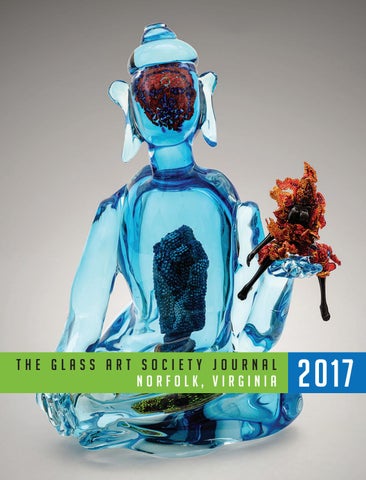
THE GLASS ART SOCIETY JOURNAL NORFOLK, VIRGINIA
2017
46th Annual Conference Reflections from the Edge: Glass, Art, and Performance Norfolk, Virginia, June 1-3, 2017
N O R F O L K
GAS Board of Directors 2016-2017 President Vice President Vice President Treasurer Secretary
Cassandra Straubing Natali Rodrigues Stephen Rolfe Powell Roger MacPherson / John Kiley Tracy Kirchmann
Alex Bernstein Kelly Conway Matt Durran Michael Hernandez Jessica Julius Ed Kirshner Jeff Lindsay
Marc Petrovic Charlotte Potter Lynn Read Masahiro Nick Sasaki Jan Smith David Willis Ian Messenger Schmidt, Student Representative
Staff Pamela Figenshow Koss, Executive Director Kassaundra Porres, Executive Assistant Erika Enomoto, Communications Coordinator Salena Hill, Office & Volunteer Coordinator Cindy Mackey, Event Planner* Ted Cotrotsos, Graphic Designer* Kristin Solomon, Journal Editor* Conference Logo Designer Catalone Design Co., LLC, Norfolk Logo Designer* Conference Photographer Heather Baigelman* *part time / contract
GAS 2017 Norfolk Conference Co-Chairs Virginia Hitch Colin McKinnon Charlotte Potter Robin Rogers Diane Wright
Conference Jurors & Reviewers
2 0 1 7 2
Saxe Emerging Artists Jurors: Adam Holtzinger, Mireille Perron, Shannon Stratton Student Scholarship Jurors: Tim Detweiler, James Labold, Susan Warner International Student Exhibition Jurors: Wayne Strattman, Joyce Scott, Julia Rogers Portfolio Reviewers: Clare Belfrage, Laura Donefer, Beccy Feather, Katya Heller, Helen Lee, Richard Marquis, John Miller, Zach Puchowitz, Karen Willenbrink-Johnson, Jennifer Crescuillo, Scott Darlington, Jen Elek
Conference Auctions GAS Live Auctioneer: Scott Freeman Norfolk Auction Committee: Chris Clarke, Jessica Jane Julius, Jeff Lindsay, Heather McElwee, Jan Smith
GAS Board of Directors 2017-2018 President Natali Rodrigues Vice President Tracy Kirchmann Vice President Stephen Rolfe Powell Treasurer John Kiley Secretary Jessica Julius Kelly Conway Matt Durran Glen Hardymon Michael Hernandez Nadania Idriss Jeff Lindsay Heather McElwee
Lynn Read Debra Ruzinsky Masahiro Nick Sasaki Jan Smith Demetra Theofanous David Willis Caitlin Vitalo, Student Representatives
THE GLASS ART SOCIET Y • 2017 JOURNAL • NORFOLK, VA
Published by: The Glass Art Society, 6512 23rd Ave NW, Suite 329, Seattle, WA 98117 USA www.glassart.org Editor in Chief: Kristin Solomon GAS Executive Director: Pamela Figenshow Koss Design: Ted Cotrotsos Design, Seattle, WA Printing: The Sheridan Press, Hanover, PA Conference Photographer: Heather Baigelman Copyright © 2017 by The Glass Art Society No part of this publication may be reprinted or otherwise reproduced in any form without the written permission from the Glass Art Society. The opinions expressed in the GAS Journal are those of the annual conference presenters and do not necessarily reflect the beliefs of the Glass Art Society, its Board of Directors or staff.
Copies of this GAS Journal may be ordered from the Glass Art Society at a cost of $30 USD (includes shipping & handling, to GAS members in the US, Canada, or Mexico) or $35 (to GAS members in all other countries.) For non-members, the GAS Journal prices are $40 (US, Canada, and Mexico) and $45 (all other countries. Most past issues are available at the same cost. A 10% discount is given on orders of five or more. Inquiries of over-the-counter sales and quantity-orders are welcomed. Copies of articles may be purchased for .50 per page. An order form can be found at the back of this journal. Upon request, the Journal is available to libraries and educational institutions for a minimal fee and shipping & handling costs. For information about the Glass Art Society, please contact us at 6512 23rd Ave NW, Suite 329, Seattle, WA 98117 USA. Our office hours are Monday through Friday, 9 am to 5 pm, Pacific Standard Time Tel: 206-382-1305 • Fax: 206-382-2630 Web: www.glassart.org • Email: info@glassart.org
REFLECTIONS FROM THE EDGE: GL ASS, ART, AND PERFORMANCE
Cover Images: (F): Joyce J. Scott, Buddha (Fire and Water), 2013 (B): Wayne Strattman, Crush, Kill, Destroy, 2011 All permission for photographic reproduction is the responsibility of the author. Unless otherwise noted, the photographs were taken and provided by the artist. Dimensions, when available, are usually given in inches or feet as height x width x depth. The 2017 GAS Journal is supported, in part, by awards from the Corning Incorporated Foundation and the National Endowment for the Arts. Without their support, this publication would not have been possible.
3
C O N T E N T S G A S IN N O RF O L K President’s Message by Cassandra Straubing . . . . . . . . . . . . . . . . . . . . . . . . . . . . . . . . . . . . . . . . . . . . . . . . . . . . . . . . . . . . . . . . . . . . . . . . . . . . . . . . . . . . . . 7 Norfolk Co-Chair Letter by Virginia Hitch, Colin McKinnon, Charlotte Potter, Robin Rogers, and Diane Wright . . . . . . . . . . . . . . . . . . . . . . . . . . . . . 8
GLA S S ART SO CI E T Y AW AR DS Lifetime Achievement Award: Interview with Honoree Joyce J. Scott by GAS Journal Editor Kristin Solomon . . . . . . . . . . . . . . . . . . . . . . . . . . . . . . . . Lifetime Membership Award: Acceptance Speech by Wayne Strattman . . . . . . . . . . . . . . . . . . . . . . . . . . . . . . . . . . . . . . . . . . . . . . . . . . . . . . . . . . . . . . . International Student Exhibition Awards . . . . . . . . . . . . . . . . . . . . . . . . . . . . . . . . . . . . . . . . . . . . . . . . . . . . . . . . . . . . . . . . . . . . . . . . . . . . . . . . . . . . . . . . . . . . GAS 2017 Student Scholarships. . . . . . . . . . . . . . . . . . . . . . . . . . . . . . . . . . . . . . . . . . . . . . . . . . . . . . . . . . . . . . . . . . . . . . . . . . . . . . . . . . . . . . . . . . . . . . . . . . .
10 12 13 13
REFLEC TIONS FROM THE EDGE Keynote Lecture: “Uncle Glass” An Interview with Keynote Speaker: Artist Mark Dion . . . . . . . . . . . . . . . . . . . . . . . . . . . . . . . . . . . . . . . . . . . . . . . . . . . Labino Lecture: Seeing Our History and Our Future with Glass: Four Centuries of Mysteries by John C. Mather . . . . . . . . . . . . . . . . . . . . . . . . . . . . . Saxe Emerging Artist Presentation: From Technician to Magician: The Pursuit of Making Objects Speak by Rebecca Arday . . . . . . . . . . . . . . . . . Saxe Emerging Artist Presentation: Interface by Julia Chamberlain . . . . . . . . . . . . . . . . . . . . . . . . . . . . . . . . . . . . . . . . . . . . . . . . . . . . . . . . . . . . . . . . . . . Saxe Emerging Artist Presentation: Does it Have a Good Foundation? And What About the Roof? by Gina Zetts . . . . . . . . . . . . . . . . . . . . . . . . . . . Strattman Lecture: Glass as Conception: Contemporary Artists & Experimentation by Kimberli Gant . . . . . . . . . . . . . . . . . . . . . . . . . . . . . . . . . . . . . Technology Advancing Glass Lecture: Investigating the Possibilities of Mold-less Pâte de Verre by Anna Mlasowsky. . . . . . . . . . . . . . . . . . . . . . .
15 17 19 21 23 25 27
LEC TURE S Blow Harder: Language, Gender, and Sexuality in the Hot Glass Studio by Karen Donnellan and Suzanne Peck . . . . . . . . . . . . . . . . . . . . . . . . . . . . 30
D EMO N ST RAT I O N S HOT GLASS Fertility by Mitchell Gaudet. . . . . . . . . . . . . . . . . . . . . . . . . . . . . . . . . . . . . . . . . . . . . . . . . . . . . . . . . . . . . . . . . . . . . . . . . . . . . . . . . . . . . . . . . . . . . . . . . . . . . . Interdependent Connections by Dawn Passineau . . . . . . . . . . . . . . . . . . . . . . . . . . . . . . . . . . . . . . . . . . . . . . . . . . . . . . . . . . . . . . . . . . . . . . . . . . . . . . . . . Comparing and Contrasting the Nuanced Practices of Blown Glass Symmetrical Objects and Asymmetrical Hot Sculpted Objects by Marc Petrovic . . . . . . . . . . . . . . . . . . . . . . . . . . . . . . . . . . . . . . . . . . . . . . . . . . . . . . . . . . . . . . . . . . . . . . Contemporary Cameo Glass Informed by the Masters by Heather Hartle . . . . . . . . . . . . . . . . . . . . . . . . . . . . . . . . . . . . . . . . . . . . . . . . . . . . . . . . . . . . COLDWORKING Through the Looking Glass by Luisa Restrepo . . . . . . . . . . . . . . . . . . . . . . . . . . . . . . . . . . . . . . . . . . . . . . . . . . . . . . . . . . . . . . . . . . . . . . . . . . . . . . . . . . . . . FLAMEWORKING The Sound of Silica by Sally Prasch. . . . . . . . . . . . . . . . . . . . . . . . . . . . . . . . . . . . . . . . . . . . . . . . . . . . . . . . . . . . . . . . . . . . . . . . . . . . . . . . . . . . . . . . . . . . . .
34 35 37 39 41 43
LEC - M O S
Kinetic Glass As Performative Object by Bandhu Dunham . . . . . . . . . . . . . . . . . . . . . . . . . . . . . . . . . . . . . . . . . . . . . . . . . . . . . . . . . . . . . . . . . . . . . . . . . . . . There’s No App For That: An Approach to Flexible Free-Form Kiln Casting by Ione Thorkelsson . . . . . . . . . . . . . . . . . . . . . . . . . . . . . . . . . . . . . . . . . . . . . A Study on Cut Gold Leaf Decoration on Ancient Gold Sandwich Glass by Hidetoshi Namiki & Yasuko Fujii . . . . . . . . . . . . . . . . . . . . . . . . . . . . . . . . . Abel Valerie is a Whore for Likes by Avery Shaffer . . . . . . . . . . . . . . . . . . . . . . . . . . . . . . . . . . . . . . . . . . . . . . . . . . . . . . . . . . . . . . . . . . . . . . . . . . . . . . . . . . . . . Cameo Engraving with Hand Tools by Ryan Tanner . . . . . . . . . . . . . . . . . . . . . . . . . . . . . . . . . . . . . . . . . . . . . . . . . . . . . . . . . . . . . . . . . . . . . . . . . . . . . . . . . . . The Adhesive Savant: How to Make It Stick by Susan Taylor Glasgow. . . . . . . . . . . . . . . . . . . . . . . . . . . . . . . . . . . . . . . . . . . . . . . . . . . . . . . . . . . . . . . . . . . .
4
THE GLASS ART SOCIET Y • 2017 JOURNAL • NORFOLK, VA
45 47 49 51 53 63
P A N ELS Green Panel: Green Technology and Social Entrepreneurship in the South: The Jackson County Green Energy Park and The Olio as Green Community Glass Studio Models. Panelists: Tracy Kirchmann (moderator), Rebeccah Byer, and Timm Muth . . . . . . . . . . . . . . . . . . 67 Green Panel: Facets of Teaching by Timm Muth . . . . . . . . . . . . . . . . . . . . . . . . . . . . . . . . . . . . . . . . . . . . . . . . . . . . . . . . . . . . . . . . . . . . . . . . . . . . . . . . . . . . . 69 Performance Panel: Performance Anxiety: A Critical Lens on Glass Performance Art Panelists: Ben Wright (Moderator), Thor Bueno, John Roach, and Erica Rosenfeld . . . . . . . . . . . . . . . . . . . . . . . . . . . . . . . . . . . . . . . . . . . . . . . . . . 70 Willson Panel: So What If Its Glass: Rebranding a Medium. Panelists: Claire Oliver (Moderator), Donna Davies, Dr. Matthew McLendon, Laurence Sibrack . . . . . . . . . . . . . . . . . . . . . . . . . . . . . . . . . . . . . . . . . . . . . . . . . . . . . . . . . . . . . . . . . . . . . . . . 73
P ER F O RM AN CE S & SP E C I AL E V E N T S Unbreakable Remix: Shattered Reflections of Diversity in Glass by Tracy Kirchmann . . . . . . . . . . . . . . . . . . . . . . . . . . . . . . . . . . . . . . . . . . . . . . . . . . . . Where Darkness Meets Light by Hannah Kirkpatrick. . . . . . . . . . . . . . . . . . . . . . . . . . . . . . . . . . . . . . . . . . . . . . . . . . . . . . . . . . . . . . . . . . . . . . . . . . . . . . . . . . “Sending” performed by Bylta by Allison Hoag . . . . . . . . . . . . . . . . . . . . . . . . . . . . . . . . . . . . . . . . . . . . . . . . . . . . . . . . . . . . . . . . . . . . . . . . . . . . . . . . . . . . . . . Torch Talk Live by Mike Mason. . . . . . . . . . . . . . . . . . . . . . . . . . . . . . . . . . . . . . . . . . . . . . . . . . . . . . . . . . . . . . . . . . . . . . . . . . . . . . . . . . . . . . . . . . . . . . . . . . . . . . Because That’s Where the Money Is by Marcy Horwitz . . . . . . . . . . . . . . . . . . . . . . . . . . . . . . . . . . . . . . . . . . . . . . . . . . . . . . . . . . . . . . . . . . . . . . . . . . . . . . . .
76 79 81 83 84
REMEMBR ANCE S
In Memoriam: Pino Signoretto (1944-2017): The Legacy of a Maestro by Tess McShane . . . . . . . . . . . . . . . . . . . . . . . . . . . . . . . . . . . . . . . . . . . . . . . . In Memoriam: Ulrica Hydman Vallien (1938-2018) by Robert Silberman . . . . . . . . . . . . . . . . . . . . . . . . . . . . . . . . . . . . . . . . . . . . . . . . . . . . . . . . . . . . . . In Memoriam: Lucartha Kohler (1938-2017) by the Kohler family with assistance from Shane Fero and Anna Boothe . . . . . . . . . . . . . . . . . . . . In Memoriam: Joe BenVenuto (1962-2017) by Tess McShane . . . . . . . . . . . . . . . . . . . . . . . . . . . . . . . . . . . . . . . . . . . . . . . . . . . . . . . . . . . . . . . . . . . . . . . .
87 88 89 90
G A S 2017: CONFERENCE E V EN T S & PROGR AM
46th Annual GAS Conference Program . . . . . . . . . . . . . . . . . . . . . . . . . . . . . . . . . . . . . . . . . . . . . . . . . . . . . . . . . . . . . . . . . . . . . . . . . . . . . . . . . . . . . . . . . . . . . 92 Technical Display Vendors . . . . . . . . . . . . . . . . . . . . . . . . . . . . . . . . . . . . . . . . . . . . . . . . . . . . . . . . . . . . . . . . . . . . . . . . . . . . . . . . . . . . . . . . . . . . . . . . . . . . . . . . . 94
G A S 2 0 17 AC K N OW L E DGE ME N T S
Conference Committee, Donors, and Volunteers . . . . . . . . . . . . . . . . . . . . . . . . . . . . . . . . . . . . . . . . . . . . . . . . . . . . . . . . . . . . . . . . . . . . . . . . . . . . . . . . . . . . 97 Glass Art Society Fund Donors . . . . . . . . . . . . . . . . . . . . . . . . . . . . . . . . . . . . . . . . . . . . . . . . . . . . . . . . . . . . . . . . . . . . . . . . . . . . . . . . . . . . . . . . . . . . . . . . . . . . . 98 Glass Art Society Upper-Level Members . . . . . . . . . . . . . . . . . . . . . . . . . . . . . . . . . . . . . . . . . . . . . . . . . . . . . . . . . . . . . . . . . . . . . . . . . . . . . . . . . . . . . . . . . . . . 100 GAS Award Recipients, Conferences, Board Members, and Editors . . . . . . . . . . . . . . . . . . . . . . . . . . . . . . . . . . . . . . . . . . . . . . . . . . . . . . . . . . . . . . . . . . . 102 GAS Membership Information . . . . . . . . . . . . . . . . . . . . . . . . . . . . . . . . . . . . . . . . . . . . . . . . . . . . . . . . . . . . . . . . . . . . . . . . . . . . . . . . . . . . . . . . . . . . . . . . . . . . . . 104 Back Issues of the GAS Journal . . . . . . . . . . . . . . . . . . . . . . . . . . . . . . . . . . . . . . . . . . . . . . . . . . . . . . . . . . . . . . . . . . . . . . . . . . . . . . . . . . . . . . . . . . . . . . . . . . . . 104
T H E C O N F E RE N CE IN P HO T O S . . . . . . . . . . . . . . . . . . . . . . . . . . . . . . . . . . . . . . . . . . . . . . . . . . . . . . . . . . . . . . . . . . . . . . . . . . . . . . . . . . . . . . . . . . 105 A D VER T I SE RS . . . . . . . . . . . . . . . . . . . . . . . . . . . . . . . . . . . . . . . . . . . . . . . . . . . . . . . . . . . . . . . . . . . . . . . . . . . . . . . . . . . . . . . . . . . . . . . . . . . . . . . . . . . . . . . . . 109 GAS IN S T.PE T ERSBURG : 2019 CONFERENCE PREVIEW . . . . . . . . . . . . . . . . . . . . . . . . . . . . . . . . . . . . . . . . . . . . . . . . . . . . . . 116
REFLECTIONS FROM THE EDGE: GL ASS, ART, AND PERFORMANCE
5
GAS IN NORFOLK
GAS Executive Director Pamela Koss addressing attendees at the Live Auction.
6
THE GLASS ART SOCIET Y • 2017 JOURNAL • NORFOLK, VA
President’s Message By Cassandra Straubing
Cassandra Straubing
The Glass Art Society thanks everyone who participated in and attended the 2017 GAS conference in Norfolk, VA. For three days, we explored a slightly different conference grid, showcasing one of the leading trends of our practice – Glass Performance! Alongside the Chrysler Perry Glass Studio and Corning’s Mobile Unit, we also had a separate off-site location known as the 3-Ring Circus, made up of three mobile glass furnaces for daytime demos and evening performances. Work/Release is a local artist space and bar that was dedicated to the conference flame demo site, taking us into the wee hours of the morning with performance and collaboration! With a total of eight evening enactments in all, ranging from hot glass Magic Shows, youth performances, and a flame-worked Glass Orchestra, it was nothing short of AMAZING! And based on popular demand, the Board of Directors, in conjunction with Norfolk’s Glass Wheel Studio gallery, hosted the first-ever juried Member Exhibition. It was a HUGE success! Upon experiencing a marvelous three days of extraordinary glass, we returned home motivated and filled with fresh ideas for making that elevated us to new levels of creativity and fed our inner artistic soul! Thank you for joining us as we celebrated Reflections From The Edge: Glass, Art, And Performance.
Cassandra Straubing President of GAS Board of Directors
REFLECTIONS FROM THE EDGE: GL ASS, ART, AND PERFORMANCE
7
Norfolk Co-Chair Letter By Virginia Hitch, Colin McKinnon, Charlotte Potter, Robin Rogers, and Diane Wright
Virginia Hitch
Colin McKinnon
Charlotte Potter
Robin Rogers
Diane Wright
Dear Glass Art Society Members, It is with fond memories and gratitude in our hearts that we thank each of you who ventured to Norfolk to experience the 2017 Glass Art Society Conference, Reflections from the Edge: Glass, Art, and Performance! During your visit we hope that you found time to take in the expansive compendium of art at the Chrysler Museum of Art, home to one of the largest glass collections in the country. For this unique conference we were pleased to work collaboratively with GAS to launch a number of new programs and initiatives that were very well received. The first ever Juried Member’s Show took place at Glass Wheel Studio, showcasing many inspiring and captivating works by talented artists from the around the world. Thank you to everyone who participated in the exhibition as well as the International Student Exhibition which was hosted in the Norfolk Arts city gallery, it was exciting and refreshing to see so many diverse approaches to making with this captivating material. The addition of evening performances was a hallmark to the Norfolk conference. In these presentations artists explored the notion of using glass as a performance material, creating involved, dramatic and well-rehearsed experiences for the audience. This experimental and performative approach is something we champion at the Chrysler Museum and we hope you found it inspiring and memorable to see this important trend in the field featured at a GAS conference. We would like to extend our appreciation to all of the very talented artists and presenters who shared their ideas and passions with all of us in demonstrations, lec-mos, panels, and lectures. It was an honor for the city of Norfolk to be the debut of Corning Museum of Glass’s newest iteration of the Hot Glass Roadshow. Thanks to Corning for providing this exceptional venture as a demonstration stage. We would be remiss to not recognize our incredibly generous sponsors who made the event possible, namely, Wall, Einhorn & Chernitzer, Suburban Capital / The Patricia and Douglas Perry Foundation, Carolyn and Richard Barry, Calvert and Harry Lester, Suzanne and Vince Mastracco, Lisa and Dudley Anderson, Colin and Patt McKinnon, Virginia and John Hitch, Tidewater Community College, Commune | Work Release and the Rutter Family Art Foundation, Glass Wheel Studio, Hurrah Players, PUSH comedy club, The City of Norfolk, Downtown Norfolk Council, Visit Norfolk, Mayor Kenny Alexander, Virginia Arts Festival, O’Connor Brewing Company and Smartmouth Brewing Company, and of course the staff and leadership at the Chrysler Museum of Art.
8
It was our great pleasure to have GAS honor two outstanding artists and friends of the museum at the conference. Joyce J. Scott, was presented with the Lifetime Achievement Award for Exceptional Achievement and contributions to the Studio Glass field. Her challenging and timely work is proudly represented in the collection at the Chrysler Museum and she has been a featured lecturer at the Perry Studio in the past. Wayne Strattman was bestowed with the Honorary Lifetime Membership Award for outstanding service to the Glass Art Society. Wayne has been kind enough to share his knowledge in the Perry Glass Studio as a workshop instructor. Our inspiring keynote speaker was conceptual artist Mark Dion, and the Strattman lecture was presented by Chrysler Museum Curator of Modern and Contemporary Art Kimberli Gant. Hank Adams delivered the Littleton lecture, and Dr. John C. Mather, a senior Astrophysicist at NASA, gave the Labino lecture. Their insightful words perhaps helped us all garner a new understanding and appreciation of what most of us would agree is the most interesting material on the planet, glass! While in our city, we hope you enjoyed the local cuisine, colorful NEON Arts District, and spectacular weather. The closing night party at the Chrysler Museum was one to remember, with the collections open to explore and the front garden available for networking and hanging out with friends, old and new. Please come back to visit anytime.
Virginia Hitch
Colin McKinnon
Robin Rogers
Diane Wright
Charlotte Potter
THE GLASS ART SOCIET Y • 2017 JOURNAL • NORFOLK, VA
GL ASS ART SOCIE T Y AWARDS
Conference attendees surround Lifetime Achievement Award Honoree Joyce J. Scott.
REFLECTIONS FROM THE EDGE: GL ASS, ART, AND PERFORMANCE
9
LIFE T IME ACHIE V E M E N T AWA RD
Interview with Honoree Joyce J. Scott by GAS Journal Editor Kristin Solomon Kristin Solomon: Tell us about your history with the Glass Art Society and how you have benefited from being a part of this community? Joyce J. Scott: This is my second GAS conference. I was asked to come to one a while ago as a presenter. Of course that was wonderful for me because it gave me the opportunity to meet more glass artists and extend those friendships. I have been working with glass artists for a long time. I think that is, in fact, why they wanted to show my work. It is such an honor to be celebrated by the Glass Art Society, because as someone who is not first person glass, meaning I don’t blow glass, I usually have someone else do that work for me. Since I work only with the casting of it, I don’t have all of the knowledge. It’s very heartwarming for me to be honored by people because of the way I manipulate glass. KS: At the conference, in your presentation you told us that you’ve been an artist since in vitro and that you came out with the best-looking placenta. Tell us about how you began your craft and how you have evolved as an artist. JS: Well my mother, Elizabeth Caldwell Talford Scott, was my first art teacher. She is a nationally known textile and quilting artist. The reason why I say ‘in vitro’ is because she carried me, she taught me, and she fertilized me with art. When I came out, I started making art at a very young age. By the time I was five years old, my mom taught me how to embroider with beads, how to do a little quilting, and a little messing around. I have always been involved in art. My father didn’t exactly get it, in fact, he didn’t get it at all, but he taught me how to be selfsufficient and how to budget. My parents were share-croppers in North and South Carolina, who came to the Mid-North. We call it ‘up south’ in Baltimore where we came for a better life-style, to get away from the violence and to have some kind of future. My parents developed in me this desire for knowledge and gave me enough freedom to become an artist. My mom always seized every opportunity for me to be in any kind of arts program. I also had a supportive community. Throughout my time in school before there were gifted and talented projects, my teachers would give me supplies at the end of the school year. I’d work all summer making something and come back and show it to them.
10
KS: Storytelling is clearly your forte. You shared in your presentation that you come from a long line of storytellers. How do you carry on that tradition? How do you weave stories into the narrative of your work? How does your personal history and culture inform your work?
Joyce J. Scott
I was always in the arts intensive programs. My senior high school art teacher is the person who helped me get my scholarship to the Maryland Institute College of Art. That was in 1966, when it was still a very small school. It is now one of the top four art schools in the United States. However at the time, because of its size, it allowed me to have a lot of really self-centered one-on-one artwork teaching. It helped me develop what I wanted to be. I can tell you that I thought I was going to be a painter, but they told me to stop painting for the betterment of myself and the entire human race. I always thought I’d be a teacher, until I actually became a teacher when I was studying art education. During my student teaching, I realized that if I taught in the public school system, I’d be a 700 pound alcoholic. So I just went along with the other hippie flower children and I was lucky enough to get a scholarship. That’s where I did my graduate degree in crafts. I have always been on this sojourn for art. I was a camp counselor in an arts camp. I was always doing something to pursue art. My parents didn’t always get it because I was a bit more adventurous than they were. When they took me to the arts camp, they were driving me to a part of Maryland that was in the mountains and in the woods. They had done their best to get out of the woods. They were frightened for me, but they realized more and more that I could have this kind of life, so they supported me. My mother wholeheartedly, my father begrudgingly, but he did support me because I kept excelling.
JS: Well certainly, the fact that my work is socially and politically oriented. Not all of it is, but probably a major amount of it. It’s a way of having that kind of dialogue. These assertions are ways to invite people into whatever I feel are interesting or important subjects. It is a teaching form in some ways. Also storytelling, because I believe that as an artist I should never let the art part of my work suffer for the content, so I like the idea that my work is inviting to people to look at it, peruse and try to investigate what’s going on, how I made it, what’s happening and be involved in what the story is, figure out a story or make up a new one. I use titles that generally give an inkling or an explanation to what I am doing. I know you can’t tell me how to think, and I don’t believe I can tell anybody else how to think either. What it does is allow me to help expand the conversation. Sometimes artists are just seen as loopy individuals who spend their time making artwork, luxuriating, and sucking up paint fumes, but we are just like everybody else. We pay taxes. We have children. We have jobs. The concerns that everyday humans have, we have as well. We just have a different avenue to express our love, joy, and concerns. KS: Your art makes strong commentary on serious social and political injustices. Yet it has a humorous aspect too, a playful part about it that makes it so dynamic. How do you keep your sense of humor in such dark subject matter? How do you see that tension play out in your work? JS: Well, first of all, I think humor is often based on the tragic. I say this because it’s always used in humor writing, like slipping on a banana peel. Just think how funny that is even though somebody may have gotten seriously hurt. You know how when you know somebody is about to be doing something foolish and you say, “Don’t do it.” You can’t help yourself. You are laughing while you are asking them, “Are you hurt? You damn fool!” That is really a big part of dealing with really extreme issues or scary hurtful
THE GLASS ART SOCIET Y • 2017 JOURNAL • NORFOLK, VA
issues, because I feel that laughing is a whole different way of grieving. You’re submitting, and you’re usually very open when that is happening, and this is a way for yourself to seep in, to jump in, like ‘Harry Pottering’ a person, with all those incantations and stuff. KS: We are celebrating your lifetime achievement as an artist, so looking back on your life; can you recall some of the highlights of your career? What were some of the most challenging moments and some of the most rewarding? JS: Any time someone would say, ‘Joyce, here is a kind of support for what you are doing.’ First, of course, financial support is always good, but somebody just giving you a nod, saying you know what, I may not like everything you do; I know I do not understand everything you do, but thank God you are somebody who is in the pursuit of creativity. That means a lot to me. Last year, I got a residency at a new arts organization called the Motor House, which is a studio downtown that allows me to do more outreach. I make larger pieces and I do mentoring. I have a little group of jewelers. We get together and work things out. Sometimes I help the graduate students finish their thesis. That’s a big deal for me, in the sense that I have a stipend for it, and I also get to share with others. The second thing I got last year was the Baker Award, which is a $50,000 award for Maryland artists. When I went to the Baltimore Museum of Art for one of the public ceremonies, I got applause like I was an athlete, like I was an Oriole or a Raven. They were not only honoring me, they were remembering me. I saw people in the audience that I’ve known since I was in elementary school or that I taught or that I had done work with. That was amazing. And then well of course number three was the MacArthur and that was just the crème de la crème for me. The MacArthur was a surprise for me because at 68, I thought I’d be too old to get it. I was a geezer in charge. I think this says to younger artists that this does not have to be a thing where you retire. I have not had many times when I wasn’t doing well. What I might have had were times when I wasn’t making a lot of money. That doesn’t mean I wasn’t consistently making artwork and in pursuit of exhibitions, galleries, and trying to make money. Because I have always been a studio artist, I knew that’s what my life would have to be. These are amazing things, but the times that were probably my very best are the ones that I shared with my mom. My mom of course as an artist was always right there with me. Probably my greatest sadness is that she wasn’t alive when I received the MacArthur.
KS: Next year will be a historic conference in Murano. Tell us about your experience working in Murano at The Berengo Studio, the Venice Biennale and your Maryland to Murano project: Neckpieces and Sculptures. JS: I can tell you that Italy was another push in my adulthood. I was there by myself. I didn’t go with a crew and I didn’t go with a friend. I was there for two different residencies. The first time I went, my translator got sick on the first day, and after that Berengo would come in and talk for me, maybe an American would come in, and everyone else thought they spoke English, but they didn’t. So we had, not a bumpy time, but I think a slower time. We made so many wonderful things. I had some things that were not as successful as I’d like because I was attempting to blend beads from other parts of the world with Italian glass. My second time, I found old Italian beads. I worked up all kinds of beadwork. This time when we gathered them up or cast with them, it was successful because they were chemically compatible. It pushed me once again with my mad scientist experimentation into a new way of playing with beads and with glass. Of course, gathering beads into glass is not a new thing, but being the glass artist and the bead artist who is making the beadwork that’s being united with the glass is a different thing. That is a great journey for me. It’s just exactly what I want to do. It was also great because I was working with people who are very different from me. I was working in a traditional Italian studio where it’s the men who do all the glassblowing. Since the Berengo Studio is a contemporary studio, they are meeting women all the time. And that’s a thing for them. I am sure it was possibly, if not the first time or one of the few times, they had been with an African American woman. That was a thing too. I don’t know if it was breaking a culture barrier as much as it was just opening the door wider. When I walked in, it was a unique way for all of us to figure out how to do things. Especially since I work with imagery that’s African and African American. There is a also a film of me singing opera in Berengo’s boat on the canal from that time, which was just like me as Gina Lollobrigida. KS: Unfortunately, the part people who didn’t’ attend the conference this year will miss out on is your incredible presence and voice. It will be the hardest to capture in writing, because you’re not just a visual artist, it’s so evident from your stage presence that you are also a gifted performer with a powerful voice. How did you discover your song? What compels you to sing?
REFLECTIONS FROM THE EDGE: GL ASS, ART, AND PERFORMANCE
JS: My mom and dad were singers. Both sides of our family sang in church. My mom would sing every once in a while in a club or somewhere, so singing has always been a natural part of my day. Last year, I lost my singing voice for a while. I had to go to therapy and I really did not know how essential it was to my every day. When you can’t sing a song the way you’d like to, just by hearing it on the radio or on TV, all of these things become precious to you. It’s one of the easiest ways to meet a person and have a conversation. I have used music as a way to explain things to people even when they are arguing with me, or just not in agreement. You can choose songs or you can mellow out the atmosphere by singing or by using those melodies that somebody else enjoys or loves. It’s another form of breathing. It is one of the best things you can do because it’s a beauty and a joy that someone else gets and it’s free. You are not putting pressure on anybody. Also for me I am a person that has problems with barriers, so it’s a thing that allows me to just be Joyce. I think people should know that I was a singer and a performance artist for years. That also formed what I did, because if I couldn’t make it work as a performing artist, I would really make it work as a visual artist, and sometimes the two would overlap. KS: What does the future hold for you? What are you currently working on? What will we see next from “MacJoyce”? JS: I am working on a giant exhibition at Grounds for Sculpture, a sculpture park in Hamilton, New Jersey right outside of Princeton. It’s a mini retrospective of my work from the last seven years, two outside site-specific installations and one on the inside. One is a 15-foot mud and hay bentonite carving of Harriet Tubman holding a 10-foot gun. In another area, next to the gallery, I am doing another 10-foot laser cut Harriet Tubman, holding a glass gun that was made with Tim McFadden at McFadden Studios in Baltimore, with quilts on the ground, in front of a tree with glasswork and beaded figures hanging from the tree. The inside installation is Harriet’s closet. A third Harriet will be Harriet Tubman as a large beaded Buddha. This is the second year or more that I have been working on this project which is coming to fruition in October of 2017 at the public opening and will be on display for four months giving the soiled Harriet Tubman time to dissipate. That will be her memory. For a long time, she was forgotten, so this dirt will make her become a mound of earth. There will also be a catalog and a lot of public programming. This is a real deal for me because it’s so much work and a different kind of work than what people have seen from me in a very long time. I have done installations before, but this has all coalesced into one large exhibition. 11
LIFE T IME MEMBERS HI P AWA RD
Acceptance Speech By Wayne Strattman
Wayne Strattman and Cassandra Straubing
12
Thank you Cassandra, the Board, and especially the membership for this award. This is a most appreciated and unexpected honor. Actually, this is the second time GAS has surprised me. The first was almost 17 years ago, when seemingly out of the blue, I was asked to be a Board member. I’ve always considered myself the ultimate outsider. In terms of glass education, having trained as an engineer, I probably have less formal glass instruction than anyone in the room. Joining the Board, I felt like a lot of new Board members often do, trying to catch a fast moving train of Board activities without much context. Being entirely self-taught, I didn’t know the leading artists, schools, or showing venues. Like many new members, I struggled to make a contribution, but I quickly realized that I should use my outsider’s perspective to help GAS. Ever since, I have been fortunate to participate in a number of initiatives. One of those initiatives that I feel the closest to is the Critical Dialogue lecture series now in its twelfth year. We are an organization that uniquely organizes ourselves around our medium, which can leave us myopic in our view of what we are doing. The Critical Dialogue lecture endeavors to bring in critics, writers, and philosophers, specifically from outside the glass world, to show us where they see us in the larger contexts of history, other cultures, and the fine arts world. I’ve participated in the creation of a few other initiatives, the Board designated investment fund, and most recently the Technology Advancing Glass (TAG) grant. The TAG grant provides funds to help our creative membership develop innovative technologies for future glass artists. Most of all, I’d like to take this opportunity to thank GAS for something I think is of critical importance at this time and place in history. Something I’m spending more time working on and that is creating community – real face community (not of the cell phone screen variety.) While thinking about what I’d say today, I ran across the text of a speech given by the United States Surgeon General, where he states that the leading health issue in the
Western world isn’t cancer, diabetes, or heart disease, but an issue that’s rarely given voice in our society – loneliness and alienation. Roughly 40% of our population in the United States and the United Kingdom report serious daily loneliness and alienation from society. Many people report that they do not have a single close friend. This division within our culture has led to rapidly rising health issues including the increase in depression, suicide, opioid use, and a host of other health problems. What is the solution? Groups like GAS that regularly work to bring people physically together face-to-face help break down these barriers. So, I’d like to ask a favor between my short remarks and the next speaker. In the few intervening moments, take the opportunity to do yourself, your organization, and your society a favor and not take out your cellphone to check your texts and emails. Have the courage to turn to the person sitting next to you, stick out your hand, and introduce yourself. Take a chance to perhaps make a new friend. In my 27 years of coming to the annual GAS conferences, I’ve yet to meet a person who isn’t worth knowing and talking to. Thank you. __________________________________ Wayne Strattman received the first PhD by published papers from the University of Sunderland in glass and the neon arts. The PhD recognized his many years of work making sculptures, doing research, writing, and advocating for neon and other advanced forms of lit glass sculpture. His Boston-based company, Strattman Design, has been a world leader for decades in building museum displays, custom sculpture, and innovative lighting products for commerce and industry. Strattman is a former Glass Art Society board member. In support of the organization, he initiated and endowed the Strattman Critical Dialogue Lecture series, co-funded the Technology Advancing Glass ( TAG ) grant program, and started and helped to maintain neon exhibitions at GAS conferences since 1997.
THE GLASS ART SOCIET Y • 2017 JOURNAL • NORFOLK, VA
2017 International Student Exhibition Awards
FIRST PLACE
THIRD PLACE
Fumi Amano, “Message”, Virginia Commonwealth University $1,000 cash award from The Corning Museum of Glass Membership to GAS and free conference pass to 2018 conference $250 gift certificate for Steinert Industries Inc.
Caitlin Vitalo, “Pillow Talk”, Tyler School of Art Membership to GAS and 25% off conference pass $500 gift card to Glass Axis $100 gift certificate for Steinert Industries Inc. $100 cash award from Tenfold Glass
SECOND PLACE Kit Paulson, “Bury Me Not on the Lone Prairie”, Southern Illinois University Membership to GAS and 50% off conference pass $850 gift certificate to Pittsburgh Glass Center $150 gift certificate for Steinert Industries Inc. $125 cash award from InSites
HONORABLE MENTIONS Nichole Vitchner, “From the East”, Columbus College of Art and Design Drew Mattei, “Unfortunate Creature”, Temple University Hattie Billingham, “One in Four”, NCAD Dublin Emily Lamb, “Catharsis”, Virginia Commonwealth University
INTERNATIONAL STUDENT EXHIBITION AWARD DONORS $1,000 or more: The Corning Museum of Glass $500- $999: Pittsburgh Glass Center, Glass Axis, Steinert Industries, Inc.
GAS 2017 Student Scholarships We thank jurors Adam Holtzinger, Mireille Perron, and Shannon Stratton
General Student Scholarships
Becky Winship Flameworking Scholarship
Suzanna Whiteside, Virginia Commonwealth University School of the Arts Heather Clancy, Cleveland Institute of Art Elliott Todd, Tyler School of Art Sasha Kotler, Bezalel Academy of Arts and Design, Jerusalem Suhyeon Kang, Rochester Institute of Technology
Emily Lamb, Virginia Commonwealth University School of the Arts
High School Scholarship Beck Socia, Brien McMahon High School
Each year, the Glass Art Society recognizes the achievements and potential of those members currently enrolled as full-time students in undergraduate and graduate programs. Applications are evaluated by a jury of art professionals, and selected students are awarded scholarships to attend the annual GAS conference in order to learn, connect, and grow as artists. REFLECTIONS FROM THE EDGE: GL ASS, ART, AND PERFORMANCE
13
REFLECTIONS FROM THE EDGE
The Unbreakable Glass Squad performance at the 2017 Norfolk Conference.
14
THE GLASS ART SOCIET Y • 2017 JOURNAL • NORFOLK, VA
K E Y N OT E LEC T U RE
“Uncle Glass” An Interview with Keynote Speaker: Artist Mark Dion GAS: During your keynote address at GAS Norfolk, you said that while you are not principally a glass artist, you feel allied to the world of glass art, like a good uncle. What did you mean by that?
Mark Dion
Mark Dion: Actually, I think I said I am like an enthusiastic supportive eccentric uncle to the glass art world. I used to be an amiable cousin, but now I am too old to be a cousin, so I’m a favorite uncle type. GAS: How did you become “Uncle Glass”? Mark Dion: My introduction to the world of glass art originates from my friendship with Rachel Berwick the Glass Department Director at the Rhode Island School of Design (RISD) and her devotion to the department. In addition to sharing significant thematic and formal issues in our artwork, Rachel and I were also colleagues teaching together for some years at the Yale Graduate School of Sculpture. There we honed our methodologies and tactics as art educators, which Rachel then applied when migrating to RISD Glass. Over the years, I have been a guest lecturer and have lead critiques for the program more often than any other art school in the world. GAS: What first attracted you to glass? Was it the alchemical aspects of the process? Mark Dion: Yes, it felt a great deal like alchemy. My first visit to the hot shop mesmerized me with the seductive beauty of glasswork. The teamwork, the ambience of productive collaboration, the novelty of the processes, and the sheer spectacle of red hot liquid glass never fails to amaze me. RISD Glass is an experimental studio and laboratory for me. There, I have attempted (under expert assistance) to make jellyfish, domes, bell jars, and a giant ship model in a bottle. Not all of these experiments have been successful. However, they were marvelous learning experiences for the class, team, and myself. Since then, I have taken glass seriously and looked with great care at institutions with glass art collections. I have even been able to work in glass museums like the Museum of American Glass at Wheaton Arts and Cultural Center.
Mark Dion, Concerning the Elephant Bird, 2016, courtesy the artist and Tanya Bonakdar Gallery, New York
GAS: Can you talk more about your experience working with glass artists? Mark Dion: Yes, my most salient connection with RISD Glass has been with the wonderful interns, assistants, and apprentices they have placed with me over the years. Knowing me so well, Rachel expertly paired me with energetic and talented artists. Many of them have become life-long friends. Some of these artists first assisted me in my 2001 exhibition “New England Digs” (Curated by Denise Markonish
REFLECTIONS FROM THE EDGE: GL ASS, ART, AND PERFORMANCE
and project managed by Bob Braine), while others came to me to develop specific projects. The list of RISD Glass interns I have worked with includes: Leslie Reed, Kate Wall, Micah Roufa, Carina Cheung, and Bryan Wilson. Working side by side with these brilliant young artists opened my practice to new techniques, technologies, and ideas. It has had a lasting positive influence on my practice. These artists have been my ambassadors to the glass art world.
15
GAS: You mentioned working with the Museum of American Glass, what did you do with them? Mark Dion: I was part of an ambitious and challenging exhibition called “Emanation: Art + Process”, organized by Kristen Qualls. Artists were asked to come into the museum and explore the collections and produce something in response. The Museum of American Glass is an amazing institution. It presents the history of glass, but not in a linear and exhaustive manor. The history of glass is totally fascinating, but often difficult to convey in a compelling way. What makes the history so interesting is that there are material artifacts from the entire story. It’s a history of things. The tale of the evolution of technology, style shifts, and innovations are imminent in the objects themselves. Glass is a material that has a fundamental popular narrative. Glass has been a part of everyday life for so long and in so many ways. It is easy to develop a project touching a variety of topics from marketing, industrial design, and global commerce to display, collecting, culture, laboratory science, photography, and tourism. The museum is an excellent example of how to take a social historic approach to such a complex material-based exhibition program. I made a work entitled “The Broken Bottle”, which is a meditation on the impossibility of collecting institutions to adequately deal with the vast amount of labor entailed in collecting, protecting, researching, ordering, restoring, and displaying collections. There is more collection, research, and maintenance at Wheaton Arts than an army of curators could attend to, even if they had their entire lives to devote to it. Yet like most cultural institutions, Wheaton Arts is understaffed, underfunded, and really challenged because they cannot do all the things they wish to do. In my project, I constructed a model restoration studio in the museum’s setting, which seemed devoted to the reconstruction of a single broken bottle. It was a carefully constructed and detailed installation, which rewarded careful viewers. I brought my Columbia University Fine Arts graduate students to the Wheaton Arts Glass Studio to have an encounter with the wonderful and inspiring Hank Adams. I hoped to spread my enthusiasm for glass to my students. Hank had them casting glass in no time and they were really turned on by the hands on approach.
16
Mark Dion, Marine Invertebrates, 2013, courtesy the artist and Tanya Bonakdar Gallery, New York
GAS: Tell us about your residency at Pilchuck. Mark Dion: Last summer, my wife, artist Dana Sherwood and I were artists in residence at Pilchuck. We had the honor of working with Dante Marioni who is such an exceptional artist and highly intelligent and amiable guy. Dana figured out how to get the best out of the collaboration with Dante, Carina, Mikey and Bryan. We worked to produce amazing elaborate habitats for her cakes and animals. At first, I struggled making glass harpoon heads related to my upbringing in the land of Yankee whaling. Later we made a series of amazing elephant bird-like eggs, which I worked into a number of different sculptures and curiosity cupboard works. We had a remarkable time in the creative enclave of Pilchuck. Listening to the other fellows speak about their work, seeing the production around us, and making prints; it was an extraordinarily furtive experience to be surrounded by artists, but also eye opening to spend time with masters of glass. THE GLASS ART SOCIET Y • 2017 JOURNAL • NORFOLK, VA
L AB IN O LEC T U RE
Seeing Our History and Our Future with Glass: Four Centuries of Mysteries By John C. Mather
Mount Wilson 100 inch telescope, used by Edwin Hubble.
Abstract For 400 years, astronomy has grown along with glass technology. Almost everything we know of the universe beyond Earth, we know because of glass and marvels lie ahead!
Galileo In 1609, Galileo pointed his 33x telescope at the heavens and changed the world forever. With just two glass lenses, one convex and one concave, he showed that Jupiter has satellites, the Moon has craters and mountains, Venus has phases like the Moon, and that the Sun has spots. None were as Aristotle said they would be. Galileo, the most famous scientist in Europe, stood his ground despite being confined to house arrest. If Aristotle had been alive in 1609, he would surely have been thrilled with the new discoveries.
Big Glass and the Expanding Universe Generations of astronomers built bigger telescopes with bigger glass, first with lenses and then with mirrors. With a 100-inch diameter mirror, the Mount Wilson Telescope was the largest in 1929 when Edwin Hubble drew the first graph showing that distant galaxies recede from us with a speed proportional to distance. Divide the distance by the speed and measure the age of the universe. (A galaxy is a collection of hundreds of billions of stars like the Sun, orbiting a common center and held together by gravity.) Thus the Big Bang theory was born, better described as the Expanding Universe
The James Webb Space Telescope, to be launched in October 2018.
story. Based on Einstein’s equations of general relativity, it had been predicted by Alexander Friedman in 1922 and by Georges Lemaître in 1927, but Einstein was sure they were wrong.
Palomar’s 200-Inch Glass By the 1940s the largest telescope in the world was on Mount Palomar, with a mirror 200 inches in diameter. Ten thousand people went to watch the pouring of the 20-ton Pyrex glass mirror into its mold at Corning. (The first casting failed, and is kept in the Corning Museum.) Astronomers hoped this new telescope would help them see gravity slowing down the expansion of the universe. However, it was not until 1998 that we learned that it is now expanding faster and faster, something we attribute to “dark energy.”
Hubble Space Telescope The space age began with Sputnik in 1957, followed by spy satellites with glass mirrors. The Hubble Space Telescope (HST), launched in 1990, was similar. If you want to see the great Hubble glass mirror, visit the National Air and Space Museum in Washington, DC, there is a backup mirror there that was made correctly.
After the Hubble, the James Webb Space Telescope After astronauts repaired the Hubble, we soon learned that even it was not large and powerful enough to answer our questions. By 1995, a committee had written a beautiful report “HST and Beyond”, calling for an even
REFLECTIONS FROM THE EDGE: GL ASS, ART, AND PERFORMANCE
larger telescope capable of observing infrared light. Why infrared? It would enable us to see even farther back in time by looking even farther away into the expanding universe. The most distant galaxies appear to be receding from us so fast that the light has shifted from ultraviolet to infrared, with wavelengths ten times longer than when it was emitted. Secondly, infrared lets us see objects that are too cool to emit visible light. A human being emits about 500 watts of infrared power and could be seen at an immense distance. Third, infrared lets us see inside dusty clouds of gas in space, where new stars are growing and turning on as we speak. The longer wavelengths are able to bend around the dust grains and continue on unimpeded. Now the new challenge was how to build such a powerful telescope? It would have to be larger than the largest rocket, so it would have to be folded up and deployed after launch. It would have to be protected by a giant umbrella (a sun-shield) to keep it cold, so it would not glow and emit its own infrared light. It would have to go far from Earth, a million miles away, so the Earth’s heat and light would not interfere with the observations. Then, we would have to find an international team to build it. We built a partnership comprised of NASA and the European and Canadian space agencies. We chose a team of companies led by Northrop Grumman to construct most of the observatory. The instruments (cameras and spectrometers) convert the incoming light into digits to relay 17
On the ground, astronomers are already building three giant telescopes, far larger than anything we have today. One would use seven circular glass mirrors, each over 8 meters (about 25 feet) across, functioning as one. The other two would use hundreds of smaller hexagonal mirrors. Can you imagine a telescope with a mirror so large that it almost spans the width of a football field? That would be the European Extremely Large Telescope, already under construction in Chile.
The Future is Glass
The Hubble Space Telescope, launched in 1990 and repaired and upgraded 5 times by astronauts.
back to Earth, and they come from the United States, Europe, and Canada. This telescope is the James Webb Space Telescope (JWST), named after NASA’s second administrator, the man who went to President Kennedy with the plan for the Apollo to put a man on the moon in less than a decade. He is a true hero of the space age, though he never flew into space. He also persuaded President Kennedy to support space science and initiated probes to Mars and the outer solar system. We owe him a great debt. The new telescope is made without glass mirrors. Instead, it uses polished metal, the ultralight material beryllium, coated with gold, which is the best reflector for infrared light. The mirror is far too large to launch in one piece, so it’s divided into 18 hexagons. Each one is positioned by motors, so it functions as one giant mirror in space. The whole mirror is 6.5 meters in diameter, which is about 21 feet. It is protected by a five-layer sunshield of thin metallized plastic film, as large as a singles tennis court. What will we see? The telescope is so sensitive that it could measure the heat and the reflected sunlight from a bumblebee, hovering at the distance of the Moon. With this astonishing tool, we will examine every kind of object that emits infrared light, ranging from planets, dwarf planets, asteroids, and comets in our own solar system to the most remote galaxies and black holes. Our purpose is to know more about our own history. How is it possible that the Universe went from a hot situation of incredible temperature and density, to its present state, with 18
stars, planets, and people? We will know soon. The telescope launch is planned to launch in October 2018 from the European launch facility on the north coast of South America in French Guiana. The European Space Agency is buying the rocket, the dependable Ariane 5.
After the James Webb Space Telescope After the JWST, what’s next? NASA is planning the Wide Field Infrared Survey Telescope (WFIRST), capable of seeing 100 times as much sky as Hubble or Webb at one bite. WFIRST will discover rare objects and hunt for the effects of dark matter and dark energy, and also for planets orbiting other stars. WFIRST’s mirrors are made of glass.
And after that? Astronomers will produce their priority list for space telescopes in 2020. They could ask for a telescope much larger than the JWST, capable of seeing Earth-like planets orbiting Sun-like stars. They could ask for a smaller version with a remote star-shield, also capable of seeing Earth-like planets. They could ask for a telescope working at much longer wavelengths, capable of seeing how planets form in dust clouds. Or, they could ask for an X-ray telescope that can hunt for material falling into black holes at incredible temperatures. Some of them would use glass mirrors, ultra thin and ultra precise. The future of astronomy is bright with glass! __________________________________ John C. Mather is the Senior Project Scientist for the James Webb Space Telescope at NASA Goddard Space Flight Center. Mather earned his BA in 1968 from Swarthmore and his PhD in 1974 from UC Berkeley. He led the proposal effort for the Cosmic Background Explorer satellite (COBE). The COBE team measured the primordial heat with extraordinary accuracy and Mather received the Nobel Prize in Physics in 2006.
The European Extremely Large Telescope, with an aperture of almost 40 meters, is under construction in Chile.
THE GLASS ART SOCIET Y • 2017 JOURNAL • NORFOLK, VA
SA X E EMERGI N G A R T I S T PRES E N TAT I ON
From Technician to Magician: The Pursuit of Making Objects Speak By Rebecca Arday I have long been fascinated by the power that objects have to capture events and tell stories of memory. As glass artists, we work with a material where heat and time constitute circumstances that enable our work to come to be. I am captivated by the material’s ability to capture and convey these moments. Many of the objects that I reference as inspiration fall into the category of memory objects. I find the idea that memory objects are “experiences and feelings living in the guise of things” very poetic.1 Memories are also sometimes referred to as objects that are stored in a brain space. As if they are like books sitting on shelves waiting to be retrieved. I think about this translation of intangible to physical in my work. I often utilize found objects because they provide a framework for me – a physical history that provokes my imagination. They give me a
Rebecca Arday, The Cure, 2015, kilncast glass, 6” l x 3” w x 4.5” h
Rebecca Arday, Memento Mori, 2008, blown, hot sculpted, engraved, and mixed media, 6” l x 6” w x 15” h. Photo: Elizabeth Lamark, ETC Photography
platform to develop associations in response to existing information about their experience in the world. In turn, my experiences influence my perception of them and what they could be. In my earlier work, I collected makeup compacts and vanity objects, searching out those that bore a monogram, or showed sense of use. Monograms particularly fed my method of deducing how I might alter and add to an object’s story. As a graduate from the School for American Crafts at Rochester Institute of Technology, my academic upbringing emphasized my already innate respect for craftsmanship. When I was little, my dad took up collecting antique glass as a hobby. I would tag along with him, exploring the antique malls. I was immediately fascinated by glass and how the pieces were made. Over time, my curiosity grew for the small, mysterious, and elaborate pieces from the Victorian Era. Victorian era mourning jewelry draws my attention with its ability to communicate so much about the human experience of grief, love, and memory and at such a small scale. The custom of mourning attire and jewelry was meant to express private grief in a public way
REFLECTIONS FROM THE EDGE: GL ASS, ART, AND PERFORMANCE
that everyone could understand. I find a lot of poetry in these “loaded” objects and I strive to give that depth to my work. Most often, my artwork is comprised of small pieces that require an intimate viewing experience. Also, I often employ illusion – mimicking other materials to give viewers a moment to question what they are seeing, and maybe even elicit a double-take. I find that glass is an extremely adaptive and transformative material. Another common thread in my work is the linkage between art and science. I love that glass has this duality. The imagery I used in my early cameo pieces was derived from Renaissance anatomy drawings. The drawings were meant to serve a practical purpose, illustrating and mapping for medical practitioners, but the resulting artworks speak beyond the documentation of body parts. Artists infused the drawings with elements of life and human experience – sorrow, curiosity, and wonder. The pieces resonate to me on many levels. In addition to anatomy drawings, I also look at anatomy models, namely those from La Specola in the Museum of Natural History in 19
Florence. The decadence of the display inspired a series of work I made at the Bullseye Glass Factory in Portland, Oregon combining my own body with the objects that I collected. Through casting with powder, I was able to mimic the softness and translucency of skin, much like the wax models. The pieces were set on handmade doilies that gave them a stage and sense of place. My collection includes gloves, which interest me as a protective layer or second skin. Pieces in the series used personified gloves to illustrate moments in relationships. Configurations were made into trompe l’oeil pâte de verre castings speaking to the fragility and preciousness of communication. Lovers’ eye portraits have influenced my work as well. I find they express the same sentiments of mourning jewelry – love, longing, and remembrance. In contrast, they exude mystery in their anonymity. Meant for intimate viewing, these portraits of a singular eye were created so that only the commissioner of the piece would know the subject. In several pieces, I have extracted parts of the body using rubber and alginate to give lifelike detail. Even so, despite the high-resolution, with the isolation of each part comes namelessness. Other protective barriers in my collection include the elaborate display cases of daguerreotype and ambrotypes. I take molds of patterns from broken ones that are now void of purpose and create elaborate and ornamental protective skins on life castings that I’ve taken of my family and myself. In the past two years, I’ve begun a new series of work that is mostly thinking about mind space. Still looking to science for inspiration, I had been reading about the psychological theory “interference.” Related to the over-accumulation of thoughts, this theory states that memory can be intercepted by new information, which can cause a loss of sense of reality and truth. In these new works, I am using a motif of a rabbit to symbolize memory, over-population, reproduction, and fertility. One technical avenue I am pursuing these days is the use of 3-D modeling and printing. It came into my work when I started working with the intangible idea of memory. Due to its elusive nature, it made sense to me to model these pieces in virtual space. Further, when I was already set to work on pieces revolving 20
around the rabbit motif, I found out that the first 3-D scanning done was of a terra-cotta rabbit, now known famously as the Stanford Bunny. It seemed kismet. I work with several types of software now, mostly ZBrush, Rhino, and Meshmixer. ZBrush was the first software I learned because I was fascinated by its ability to wrap images around objects. I took an image of neurons from an article about the development of a cure for Alzheimer’s disease and textured the surface of the rabbit, using it to alter the form. On one side, the image clearly emerges, on the other side it degrades. These pieces reference the veiled statues carved in marble by Raffaelle Monti. I like the visual back and forth of the image obscuring and emerging from the form simultaneously. Monti’s sculptures inspired a number of other pieces that I made most recently using waxed fabric. I drape cast crystal rabbits with the fabric and blend it into the surface, so that it goes translucent and looks as if it could be glass. The work allows change with the passage of time in response to environment. Though the folds are formed with intention, there is high possibility that the fabric will warm and change shape as time goes on, similar to the way our memories shift. Parallel to my digital studies, it is still essential for me to make by hand. Working between real and digital worlds, I have a wider scope of possibilities. I consider my computer to be a tool like a kiln, an environment for creation. I consider it also collaborative, because I often find that interesting things emerge unexpectedly that I could not have constructed of my own volition. The digital environment gives me freedom to move quickly through configurations until I find gems. Since my ultimate goal is to bring pieces into the real world, working by hand gives me the material knowledge to understand what is ultimately achievable. As a maker in pursuit of distilling ideas into objects that speak, I am excited about the possibilities and future discoveries as I continue forward down this path.
Rebecca Arday is an artist and educator working in glass and mixed media. She is based in Rochester, New York, where she is part of the team at More Fire Glass Studio and an adjunct professor and studio resident at Rochester Institute of Technology in the glass department. Her work has been exhibited internationally, has been published in the Corning Museum of Glass New Glass Review and is included in the permanent collection of the Glasmuseet Ebeltoft. She has taught at Pilchuck Glass School and Penland School of Crafts. Visit www.rebeccaarday.com
1. Amy, Chaloupka.“Hiding Places Memory in the Arts,” in Hiding Places: Memory in the Arts.
THE GLASS ART SOCIET Y • 2017 JOURNAL • NORFOLK, VA
SA X E EMERGI N G A R T I S T PRES E N TAT I ON
Interface
By Julia Chamberlain I make glass castings, fused pieces, and photographic works that examine the physical relationship between people and technology. I’m interested in investigating these ideas in glass through the themes of physical manifestation and human touch. Technology has a glassy sleekness to it in general, from phone screens to shiny new tech headquarters buildings. I’m interested in how the presence of humans interferes with that perfection. As a tech industry worker, in addition to being a lifelong glass artist, my work examines Seattle’s tech-fueled construction boom as both a means of survival and a force driving art out of the city. The Seattle Times recently reported that Seattle has been home to the most cranes in the country for the past two years.1 I’m interested in construction cranes because they are present all over the city, visually striking, and a symbol of rapid development. My piece Building is about how temporary and yet impactful cranes are to the city’s skyline. I used silkscreen printing to separate a half-constructed building from its cranes, layering glass powder fused on plate glass to create 3-D relief over a cloudy white sky. By presenting the cranes as part of the background separate from the buildings, I imagined them being gone. Without the cranes, it’s difficult to tell if the building is being constructed or demolished. The series of works I’ve made about construction relate to Seattle’s tech boom. Last year, roughly 2.5 million square feet of new office space was completed and double that amount is currently under construction.2 I find something interesting about how technology demands so much space, so many resources, and brand new construction, although it is digital and non-physical. As a
Julia Chamberlain, Corporeal Data (Elgin Marbles) (pictured next to original Nereid statue), 2016, cast glass from 3D printed file, 3 x 3 x 4 inches. Photos: Left: courtesy of the artist. Right: The British Museum
response to this paradox, I cast clear lead crystal glass replicas of common construction materials like screws, particleboard, and post anchors. The transparency of clear glass gives these objects an eerie half-presence and the illumination it allows reveals stunning forms and surfaces that were byproducts of these objects’ production. Construction Materials II (Particle Board) reveals every individual wood chip pressed together with a machined pattern of grooves on the reverse side. The glass forms also speak to fragility, not just for the objects losing their functionality as tools, but also for the fragility of the global economic forces driving the construction boom. My piece Construction Materials III (Six Screws) balances six delicate lead crystal glass screws carefully into a pile barely holding together.
Julia Chamberlain, Construction Materials III (Six Screws), 2016, cast lead crystal glass, 4 x 3 x 1 inches. Photo courtesy of the artist
REFLECTIONS FROM THE EDGE: GL ASS, ART, AND PERFORMANCE
Manifestation of digital data has been another guiding force in my work. It began when I was given access to a scan of a human jawbone from the Ice Age that I 3-D printed and cast in glass. It felt strange to handle a piece of skeleton from thousands of years ago with the help of the internet, advanced software, and robotic machinery. Still, there was something so human about looking down to notice that the grooves in my fingerprints were the same size as the lines on the object’s surface left over from the 3-D printing process. As an Emerging Artist in Residence at Pilchuck Glass School, I collected 3-D scans from natural history museums publicly available over the internet. From my collection I cast a series of pieces made using scans of reliquaries, graves, and looted objects. In Corporeal Data (Elgin Marbles), I recreated a Nereid statue taken from the Parthenon to Britain by the Earl of Elgin at the beginning of the 19th century.3 These historical institutions all have the noble goal of increasing access to their artifacts, yet to actually gain access you would need a computer with adequate RAM, software to view, edit, and prepare the file for printing, as well as a 3-D printer, costing hundreds or thousands of dollars. This series turned the idea of “access” on its head by taking ancient objects available on the internet and reverting them back to a precious form using fragile cast glass.The availability of new technology has made something that was previously done with weight and 21
respect suddenly very easy to do. While 3-D scanning and printing has had many positive results, it has also changed our relationships with physical objects, our past, and how we approach preservation. I still believe that these efforts have a vital impact for people around the globe, for historical and cultural education, and generating copies in case of destruction by human conflict or environmental change. If anything, the creators of this technology should strive harder to develop new ways of presenting objects that build context and empathy across cultures and time. In addition to the abstract ideas of technology and data, I’m interested in how we all actually touch our devices every day. We leave behind a unique record of our lives on our touchscreens and keyboards that I try to capture with glass. During a residency at S12 in Bergen, Norway, I noticed the dependence I had on my phone in a foreign country where I didn’t speak the language. I would constantly flip through multiple applications to perform conversions of language, money, temperature, metric units, and time, not to mention the connection it represented to home. My phone was always covered in fingerprints and streaks captured in the plaster and powders I was using in the studio, changing every few minutes when I used a different app. This realization inspired my piece Touch Archive, in which I
used every app in my phone for a few minutes and photographed the fingerprints left behind by skin oils. The user interface design of every different app produced wildly different records of taps, swipes, and gestures like pinching and zooming. The applications pictured in this article show me listening to a voicemail, checking my calendar, and navigating a map of Seattle. I’m very interested in the give-and-take of humans shaping technology and technology shaping us in return. Numerous studies have reported that our brains have been losing short term memory and getting stronger in other areas. On the other side, artificial intelligence is continuously learning to understand what humans are saying to them, to “think,” and to emulate us. I’ve made a few works using computer keyboards to represent humans and autonomous machines. In one of my pieces, I recorded which finger I normally use to type each letter on a keyboard, made a glass casting of a finger for every key, and installed the fingers coming out of a laptop screen at such an angle that the glass fingers type every letter on the keyboard at once. I’m interested in exploring how we learn to interact and build habits with technology, and how technology learns from us in ways we fundamentally can never understand. Glass has been very important to my work because it has both the ability to be a
translucent stand-in for mass and a ubiquitous material that we encounter almost everywhere. I love getting to use the unique physical qualities of a glass surface and the meaning of building windows and glass touchscreens in my work. Glass also gives me the ability to make cast objects with breathtaking surface textures brought to life with transparent illumination. Though I also make works using different materials, glass is my material of choice and represents the incredible network of artists I am privileged to work among. I am very grateful to the Glass Art Society for this opportunity and hope to continue to develop relevant and impactful works in the glass art community for years to come. 1. Rosenberg, Mike. “Record construction frenzy sweeps downtown Seattle; more building to come.” The Seattle Times, March 10, 2017. http:// www.seattletimes.com/business/real-estate/ record-construction-frenzy-sweeps-downtown- seattle-with-more-building-to-come/. 2. Rosenberg, Mike. “Downtown construction projects reach new peak.” The Seattle Times, March 11, 2017. http://www.seattletimes.com/business/real-estate/ downtown-construction-projects-reach-new-peak/. 3. “The Nereid Monument.” The British Museum. Accessed July 15, 2017. http://www.britishmuseum. org/research/collection_online/collection_object_ details/collection_image_gallery.aspx?partid=1& assetid=543898001&objectid=460589.
__________________________________ Julia Chamberlain is a visual artist based out of Seattle, WA. Her cast glass and performance work focuses on the relationship between technological objects and human touch. Chamberlain has been an artist in residence at Pilchuck Glass School and S12 in Bergen, Norway. Her glass work has been featured in New Glass Review and Sculpture magazine, exhibited nationally, internationally, and in multiple public art installations. She received her Bachelor of Fine Arts from the University of Washington in 2015.
Julia Chamberlain, Touch Archive (Phone, Calendar, Google Maps), 2015, iPhone, fingerprints, photograph, dimensions vary. Photo courtesy of the artist
22
THE GLASS ART SOCIET Y • 2017 JOURNAL • NORFOLK, VA
SA X E EMERGI N G A R T I S T PRES E N TAT I ON
Does it Have a Good Foundation? And What About the Roof? By Gina Zetts “The ache for home lives in all of us, the safe place where we can go as we are and not be questioned. It impels mighty ambitions and dangerous capers. We amass great fortunes at the cost of our souls, or risk our lives... Hoping that by doing these things, home will find us acceptable or failing that, that we will forget our awful yearning for it.” ― Maya Angelou
Experience: The necessity of a home As humans, it is in our nature to want a home, a point of origin to start from and safe place to return at the journey’s end. When that place has been lost, we risk becoming lost too. When our economic decisions overshadow our human and cultural needs, we risk far more than just losing the building we call home or the streets that collectively makeup that location. We risk losing our values, morals, history, and even future. Like many artists, I have been a maker for as long as I can remember. I came to glass as my primary medium at age nineteen, while attending Alfred University. During my undergraduate studies I focused on the female figure as a means of storytelling. After completing my BFA, I moved to California.
Gina Zetts. Saudade, 2015, 11° x 9.S’ x 4.S-, glass, brass, enamel, cast glass, fabricated brass
Two years later, I married my husband Spencer. The year after that, I uprooted our lives moving us back to the East Coast, so I could start graduate school. All of this movement and change during my twenties had a profound effect on the work that I would create in graduate school and after. In the beginning of what would become my thesis work, I was particularly interested in the architecture of vulnerable locations. Places that have been forgotten or abandoned because of tragedy or economic failure. Locations that are in liminal states of existence or are no longer present at all. I became engulfed in researching stories of what I saw as being avoidable human disasters.
Influences: The place to build a home
Gina Zetts. Modified Consumption. 2014. 66 h x 32 w, lampworked glass, cast glass, poplar chair
When I look at the derelict oil pumps that spot the pristine landscape of my parent’s backyard and my childhood home; I cannot help but feel a sense of nostalgia. The road that I lived on for the first eighteen years of my life was called Derrick Road just outside of the hamlet of Derrick City, Pennsylvania, where my grandmother was the elementary school cook. Oil rigs, crude storage barrels, pump houses, lease roads, and the smell of the refinery that stretched the length of the valley have all been irrevocably interwoven into my psyche as reminders of home. These objects also stand as a bittersweet and sometimes even painful reminder of the impact that this industry
REFLECTIONS FROM THE EDGE: GL ASS, ART, AND PERFORMANCE
has had on my childhood home. Issues of environmental concern often fall victim to the hope of economic success in places like this, which have little else to offer beyond the natural resources they were built upon. The locations that I have chosen to represent in my work are places that I know of through personal experience or have come into contact with through research via the National Trust for Historic Preservation, National Priorities List of Superfund Sites, and the Environmental Protection Agency (EPA). They are locations with significant and vital historical relevance to the American ethos that are at risk and in peril. The issues in each place I choose center around the connection to broader global environmental and cultural issues. Each work takes on a specific location or group of locations that have shared a similar fate. Some of the works represent a singular location while others embody a multitude of places. Each location has been chosen because its story has a universal quality – it could be anyone’s home. Locations such as Centralia, Pennsylvania, Treece, Kansas, and Picher, Oklahoma were once championed as ideal American towns. Places that contained the natural resources responsible for winning World War II, coal, zinc, and other essential minerals. Through the over mining and unsafe environmental practices of obtaining these resources, these towns have become so unsafe that the EPA deemed them uninhabitable. They are no longer municipalities 23
the loss. Rife with feelings of guilt it is easier to brush those communities away as a footnote in history. I was once told, “art is a suggestion, not an action.” Art is not burdened with offering a solution, but rather an offer of possibilities. It is a catalyst for action. __________________________________
Gina Zetts, Love Canal, 2013, blown glass. fused glass, decals, oil paint, found objects. 43” x 7” x 12”
and do not have postal codes. The people who called these places home now face the reality that the place in which they invested their lives in no longer exists. The streets and buildings have crumbled or been bulldozed. The only thing that remains are addresses scrawled on old postcards and envelopes, photos of houses that no longer exist, and fading memories which will die with the last generation of residents.
Symbolism: The materials to build a home “Perhaps home is not a place but simply an irrevocable condition.” – James Baldwin Developing a visual language is essential to every artistic practice. My personal language is centered on imagery and objects that have an innate intrinsic value, objects that manifest themselves in simple forms such as tea cups, wooden chairs, compasses, suitcases and clovers. These simple images are used to create an experience of transcendence. They create a social narrative about loss and longing. Ordinary objects used as moments of reflection on place and time, space and location. There is a haunting beauty in the simultaneous transparency and physical weight of glass that is unparalleled in any other physical material. Glass is an almost universal indicator of fragility. It is a charged material that is simultaneously common and preciously cherished. It readily evokes feelings of nostalgia as well as a sense of loss. Although I use all forms of glass making processes in my work, I tend to rely most heavily on casting. It is a method of working that is greatly informed by traditional sculpting practices. It is a discipline that I appreciate, as it takes a certain amount of time 24
and focus. Like the level of research necessary in the development of this work conceptually, the physical technique is a necessary factor in helping the viewer to draw connection and desire to further invest in the concept of the work. Other materials used in my work, such as, vintage linens and luggage hold a powerful narrative quality showing the wear and tear of their history and experiences. The recreation of actual historical objects such as tea cups and an old farmhouse chair remove those objects from their former context and place them as recognizable, yet somehow foreign objects far from their former lives. The use of embroidery, pencil drawings, and other traditional craft methods become important tools for conveying the story of the work. They are common and relatable modes of creating imagery, yet these modes of communication are also quickly becoming nostalgic as technology changes the way we produce goods and communicate stories.
Gina Zetts was born and raised in Northern Pennsylvania. She holds a BFA in Sculpture from Alfred University and an MFA in Glass from the Rochester Institute of Technology. She has been a Niche Award Finalist, UncommonGoods Glass Award Finalist, recipient of Alfred University’s Purchase Award, and winner of the Bronze Award in the Bullseye Glass Co. Emerge 2014 competition. Her work has been featured in New Glass Review and American Art Collector Magazine. She has shown at the Burchfield Penney Art Center, Bellevue Art Museum, Bullseye Gallery, and the Pittsburgh Glass Center. Zetts has worked as an instructor and teaching assistant at the Pennsylvania Governor’s School for the Arts, Alfred University, The Rochester Institute of Technology, the Pilchuck Glass School, Bullseye Glass Co., and Public Glass in San Francisco. She currently lives and works in El Sobrante, CA with her husband and collaborative partner, Spencer Pittenger.
Materials and Process: Building the home We shape our dreams, values, and expectations in the locations that surround us. These are the places that give us that sense of home, wonder, connection, comfort, or sometimes emptiness and loss. The spaces that we occupy shape our very sense of humanness. When these places fail us, it can feel indicative of our own weaknesses, imperfections, and fragility. When we experience natural disasters that we consider “acts of god” it is easy to find sympathy for communities in peril, but when those disasters are a result of our own economic pursuits, such as oil spills and chemical contamination it is harder to come to terms with
Gina Zetts
THE GLASS ART SOCIET Y • 2017 JOURNAL • NORFOLK, VA
S T R AT T MAN LEC T U RE
Glass as Conception: Contemporary Artists & Experimentation By Kimberli Gant In 1920, French artist Maurice Marinot wrote, “…the two essential qualities of glass are transparency and fragility.” 1 His statement, made almost a century ago, is still relevant today as it encompasses how contemporary artists Brendan Fernandes, Ebony Patterson, Titus Kaphar, and Maria Magdalena CamposPons consider the medium of glass within their respective oeuvres. All four of these artists recently started experimenting with glass to expand conversations about life and death, gender, sexuality, race, and the economy within their works. Their use of glass is less about the technical applications of the material than its ability to convey the artist’s multifaceted concepts. This essay is a very short introduction into how these artists navigate this new avenue of their respective practices. Brendan Fernandes, a Canadian artist based in Chicago, Illinois, has a studio practice blending performance with sculpture, photography, installation, and drawing. His work addresses the malleability of the human form, queerness, and personal and cultural authenticity. His recent projects, Standing Leg (2014) and Free Fall (2016) extend performance with film, installation, and now glass. Standing Leg (fig. 1) is an installation of a film of Fernandes dancing with a wooden ballet foot stretcher with several crystal sculptures of the artist’s foot arch placed on cement mounts. Fernandes was a professional ballet dancer, requiring a perfect arch, so the stretcher painfully molded his foot into the correct form. Standing Leg alludes to similarities between the human body and glass; both being highly pliable and fragile and the belief they each have an ideal look. Fernandes’ newer piece Free Fall (fig. 2) rearticulates his comparison of humans and glass through presence and absence. He created forty-nine crystal hangers representing the victims from the tragic Orlando night club in 2016. These ubiquitous objects symbolize the deceased. They hold jackets/coats with no one to claim them. Moreover, just as hangers are easily overlooked, the lives of those killed were just as easily ignored by the person who took them. In using crystal, Fernandes calls attention to glass’ materiality, it is just as strong as it is easily shattered, again likening glass to human life. Ebony Patterson, a Jamaican artist based in Lexington, Kentucky, creates installations
María Magdalena Campos-Pons, Alchemy of the Soul, Elixir of the Spirits, 2015, Glass, metal, acrylic, Peabody Essex Museum, Museum purchase made possible by the Nancy Tieken Memorial Fund and the Elizabeth Rogers Fund, 2015. © 2016 Peabody Essex Museum, Salem, MA. Photo: Allison White.
and jacquard tapestries investigating masculinity and “bling culture” within Jamaican and African-American societies. Her 2016 piece …andbabiestoo… (fig. 3) emphasizes the violence against young women and children within Jamaica’s lower socioeconomic classes. The large tapestry lies just above the ground, an untraditional placement for fabric works, atop numerous child-size trucks and cars. The imagery comprises bikes, balls, stuffed toys, and popular animated figures, such as Hello Kitty and Dora the Explorer. Overlaying the images are a dozen frosted glass shoes: flip-flops, heels, and hi-tops. They are strewn about the canvas as if left there in a hurry, invoking questions about the unseen owners. Patterson’s most obvious insinuation is Cinderella, though the artist’s version has no happy ending. The artist read about over a dozen horrific deaths of children and teenagers in Kingston between January and April 2016. Shot up bodies were left in the street and partial human remains were found in garbage bags. The shoes and images, referencing the innocence of childhood, take a sinister tone here due to the absence of any children. Just as the shoes have no value without the owners, the owners
REFLECTIONS FROM THE EDGE: GL ASS, ART, AND PERFORMANCE
had no value to their killers. Patterson’s use of glass also stresses the instability of the material and human life. By frosting the glass, the artist makes the shoes more visible against the tapestries’ intense color palette, bringing awareness to the absence of the owners. As the deceased should have been more visible to avoid their deaths, their class and young age made them invisible and thus vulnerable. …andbabiestoo… becomes an artistic memorial to those deceased young people and asks viewers to pay closer attention to those most exposed within our society. Titus Kaphar is an African-American painter based in New York City. His works are figurative, with manipulated canvases. Sections are taken out or individuals are obscured. Or in some cases, two canvases are layered on top of each other, with the outer layer rolled up or bent to reveal the secondary one. Kaphar stages his images in this way to present the idea of a “hidden” story behind the focal narrative. His images address themes such as police shootings of African-American men to dismantling established historical narratives. In 2016, Kaphar began experimenting with glass because of his desire to question the symbolism 25
resilient, despite being highly flexible. Fernandes, Patterson, Kaphar, and CamposPons each show glass’ ability to be highly conceptual because of its physical potential in shifting state and the possibility of revealing and concealing. Though some artists may focus purely on the material’s technical attributes, the artists discussed here understand how those same qualities can be abstracted to present complex ideas applicable to numerous situation. No matter what approach an artist takes, glass can and will continue to open one’s mind to its ever-expanding possibilities. 1. Maurice Marinot, “Pensées sur le verre,” in Maurice Marinot, Troyes 1882 - Troyes 1960: Penser en verre, edited by Coédition Musée d’art Moderne, Troyes and Somogy éditions d’Art (Paris: Musée d’art Moderne, 2010): 158. 2. Personal correspondence with artist Titus Kaphar, New York, May 26, 2017. Brendan Fernandes, Standing Leg, 2015, video performance (solo performed by Brendan Fernandes with wooden ballet foot-stretcher). Dimensions variable. Duration: 00:05:14 loop. Courtesy of the artist and Monique Meloche Gallery
of sculptural monuments of so-called American heroes such as George Washington. To Kaphar his project was about “translating the stories of these men, while neither glorifying their feats, nor diminishing their flaws.” 2 He began working in glass because he felt the material was the best medium to represent the notion of complexity, because the material can show positive and negative space. George Washington is a repeated figure in Kaphar’s practice due to his mythology as a general and first president of the United States. Kaphar wanted to treat him as a person, a privileged individual, a husband, and a slave owner. In essence, he was imperfect, with both affirmative and destructive qualities. The artist’s representation of the first president comes through in A Pillow for Fragile Fictions (2016) (fig. 4). It is a glass-blown bust of Washington sleeping sideways on a marble pillow. Kaphar made the work from glass to symbolize Washington as primarily an ideal trope, but if one looks closer, also having flaws. The bust is partially filled with a brown liquid, comprising molasses, rum, lime, and tamarind; all trade products during the late eighteenth century fueling the burgeoning United States economy. The pontil mark is pronounced with a stopper, again indicating commercialization, but also suggesting access to the former president’s mind during sleep. In opening the stopper, a viewer could access Washington’s fragile and perhaps fictional dreams, thoughts, and desires. Cuban artist Maria Magdalena CamposPons, based in Boston, Massachusetts, has a practice spanning all media, from photography, painting, and sculpture to performance, instal26
lation, and film. Her work centers on themes of migration, history, memory, and identity between Cuba, the Caribbean, the United States, and West Africa. In 2016, Campos-Pons had a solo exhibition entitled Alchemy of the Soul at the Peabody Essex Museum in Salem, Massachusetts. The main piece, sharing the same title as the exhibition, was a single installation of six monumental glass sculptures in various colors within one room (figs 5-6). Each sculpture resembled the outline of an interconnected chemistry set, a few of which contained a brown, bittersweet smelling liquid made of rum, the final result when processing sugar. Campos-Pons references sugar throughout her oeuvre because of Cuba’s harsh legacy of eighteenth and nineteenth century sugar plantations. Untold numbers of enslaved populations were forced to work in the plantations their whole lives, often dying early due to unsafe and unforgiving conditions. Alchemy of the Soul suggests the sugar factories Campos-Pons remembers as a child dotting parts of Cuba. These spaces were haunted, yet beautiful ruins. They were emblems of a ghastly society based on enslavement, but as the artist recollects, produced wonderful items. Campos-Pons created the sculptures from glass due to the plantation’s dual nature; the sensuousness of the glass seduces the viewer before they are confronted with horrible history of the structures’ symbolism. In addition, the artist found a conceptual parallel between sugar and glass, “...liquid to solid, solid to liquid; transparent, translucent, material and immaterial.” 3 Both glass and sugar can change their fundamental chemistry during processing, and they are both
3. Joshua Basseches, “Transforming Pain into Beauty: The Alchemy of Maria Magdalena Campos-Pons,” in Alchemy of the Soul: Maria Magdalena Campos- Pons, edited by Basseches, Joshua, Pick, Nancy and Allen, Esther (Salem, MA: Peabody Essex Museum, 2016); 52.
Kimberli Gant, PhD is the McKinnon Curator of Modern and Contemporary Art at the Chrysler Museum in Norfolk, Virginia. She was previously the Mellon Doctoral Fellow in the Department of Arts of Global Africa at the Newark Museum, in Newark, New Jersey. She has held curatorial positions at the University of Texas’ Warfield Center for African and African Diaspora Studies (2013), The Contemporary Austin (2012), and the Museum of Contemporary African Diasporan Art (MoCADA) in Brooklyn, New York. She has curated numerous exhibitions including Wondrous Worlds: Art and Islam Through Time and Place (2016), De-Luxe (2012), and There is No Looking Glass Here: Wide Sargasso Sea Re-Imagined (2010). Kimberli received her PhD in Art History from the University of Texas Austin (2017), and holds both a MA and BA in Art History from Columbia University (2009) and Pitzer College (2002).
THE GLASS ART SOCIET Y • 2017 JOURNAL • NORFOLK, VA
T ECHN OLOGY ADVA N C I N G GL AS S LEC T U RE
Investigating the Possibilities of Mold-less Pâte de Verre By Anna Mlasowsky In the spring of 2014, while in residence at the Bullseye Resource Center in the Bay Area of California, I stumbled into what would occupy my investigative interest over the next few years. While working on a large wall piece titled “Rorschach,” I was mixing up batches of black glass enamel to create the inkblot patterns of the piece. I spilled a jar of the enamel paint. As I wiped it up with a paper towel, I remembered the organic burn out technique used in ceramics where organic material is dipped into slip casting clay. The clay-soaked material turns the firing into solid clay objects, as the original material burns away. I put the enamel-soaked paper towel in the kiln and fired it, which turned into the first mold-less pâte de verre object I created. I did it with little intention, other than a curiosity of what would happen. I had no idea what would come from that moment of spilling that enamel. Now over three years later, I’ve arrived at a stage where things have become a bit more complex. I’ve developed a variety of glass pastes with specialized characteristics to fulfill specific requirements. One glass paste has the consistency of whipped cream that can easily be spread onto a surface. It stays in place and does not run off. I saw the need to develop a type of gluing paste with a worklife long enough to complete the joining process that would dry into a hard non-flexible material. This was an important product to develop, as I started working on pieces created out of components. It reduces stress on the joints of pieces while being handled before firing. I have also devel-
Studio scenes of the making process of the brush on glass paste, 2014. Photo: Anna Mlasowsky
oped another paste that behaves like clay. It’s just as moldable as clay and can be rolled out into sheets, cut with cookie cutters, pushed through an extruder, and handmolded into the desired object. For two years, I worked through trial and error in my studio. I pushed my way through challenges that had to be solved like how to support the pieces during the firing, what binders will burn out stain free, how to construct the supporting structures onto which the pastes are applied and how to solve drying and firing
Anna Mlasowsky, The Boat, 2014, 10 cm x 54 cm x 40.6 cm, fused Glass Powder. Photo: Sarah Douglas
REFLECTIONS FROM THE EDGE: GL ASS, ART, AND PERFORMANCE
shrink problems. Two years earlier, when I applied for the TAG Grant in the summer of 2014, I had only started working on this method and had not much more than a vague idea of what might be possible. Seeing the potential, but also the amount of resources it would take to become serious about developing this process; I submitted my application to the TAG Grant. Without the commitment I had entered into through receiving the TAG Grant, I probably would have abandoned the project at some point. It has been a very difficult process. In the summer of 2016, I started the Specialty Glass Residency at the Corning Inc. Research Facility in Sullivan Park, New York. There, I was introduced to material scientists who had explanations and answers. Together we refined pastes and created new ones. The last half of this year was the most exciting time, because I was no longer alone and without tools and materials in a less than ideal studio situation, but I had the resources of a facility where any chemical is available and measuring techniques and charting were a given part of the process. It was an environment set up to do just what I needed. I applied to the TAG Grant to help with the development of rapid prototyping for this project because a lot of my time was taken up 27
real space. I found it hard to model on the computer inside a grid, without any physical reference, which is usually the case when sculpting in the real world. Anything you model in VR can be plugged into other existing programs and turned into templates for laser cutting or 3-D printing. I hope this technology will continue to be refined with more features as it opens up a new way of sculpting forms quickly, without the restraint of gravity and materiality before producing them in the real world. Two parts of the TAG Grant project, the development of the pastes and the application of rapid prototyping needed to happen in tandem to be able to create new forms. In the future, I hope to refine this technique. There are still a lot of problems to be solved and questions to be answered before it is an easily applicable process. Depicting a number of 3D models created in virtual reality, 2017. Photo: Anna Mlasowsky
by creating pastes. Removing the plaster silica mold form creating pâte de verre, I had to come up with other materials onto which the glass paste could be applied. The first paste I developed was the spreadable paste. Cardboard was an easily moldable material out of which almost anything can be constructed. In the beginning, I would cut the cardboard models by hand. I spent days cutting, creasing and folding up three-dimensional geometric forms onto which I could brush the glass paste. This was highly inefficient and time consuming. I started creating the cardboard forms in the 3-D modeling program Rhino and laser cutting the cardboard. Rhino can turn any 3-D structure into a flat layout that can be imported into the laser-cutter operating program. In either program, you can assign details of your layout to be on the cut layer and the etch layer. The etch layer will create a partial cut into the material, which can be used as crease lines. Moving the creative process of the cardboard into the digital realm simplified the labor of the making process. The incredible advantage of 3-D modeling is the relative speed in which anything can be created. No actual materials and resources are being used to figure out a form and changing your mind about what you make doesn’t mean that you have to throw away lots of materials. You can just change your model. Making decisions before they become physical reality is an incredibly helpful feature. Unfortunately, the learning curve for these programs and machines is long and slow and the speed at which these programs get upgraded makes it 28
hard to follow along. Also the availability to the general public of such technologies is still lacking. I was fortunate enough to be able to use the Maker Space at the Human Centered Design and Engineering Program at the University of Washington, both as a Graduate student and as alumni. With the development of the clay-like paste I needed to make my own tools to be able to extrude the paste into shapes. I created dies for a simple extruder through which the pastes are pushed. I have been using an OtherMill, which is a small desktop milling machine. The drawback of this machine is the speed at which it can cut. Milling my own tools required me to learn an additional number of programs. In the Maker Space at the University of Washington, I was introduced to Virtual Reality modeling. It’s the newest technology and is still in the process of becoming a great tool. Virtual Reality modeling or VR modeling can be learned in an extremely short period of time. The modeling happens in a three-dimensional space. You as the maker, become part of the computer generated space, wearing a large headset with glasses and headphones and holding remote controls that feature buttons. Two cameras track your motion and through your headset you see a virtual rendering of your hands. The controls let you draw and paint in the virtual space and through your headset you can see everything appear in front of you. Being able to virtually sculpt in a three-dimensional space, instead of a flat screen in front of you, helps you create complex objects that are proportioned in relation to the
Born 1984 in Germany Anna Mlasowsky received her BA in Glass from the Royal Danish Academy in 2011 and an MFA in Sculpture from the University of Washington in 2016. She has been an artist-in-residence at The Creative Glass Center of America, The Toyama City Institute of Glass Art in Japan and The Corning Museum of Glass. Her work has been shown in international competitions and has been included in museum collections such as The Corning Museum of Glass, The European Museum of Modern Glass Art, and the Glasmuseum Ebeltoft. She won the UK Glass Prize in 2013, the Otto Waldrich Preis, and the Emerge Silver Award in 2014. This year Anna received an Artist Trust Fellowship, was one of the Emerging Voices in Craft Award recipient and is soon starting the Emerging Artist residency at Centrum. Anna has recently completed the Specialty Glass Residency at the Corning Inc. Science Center.
THE GLASS ART SOCIET Y • 2017 JOURNAL • NORFOLK, VA
L EC T U R E S
Hank Adams giving Littleton Lecture at 2017 Norfolk GAS Conference.
REFLECTIONS FROM THE EDGE: GL ASS, ART, AND PERFORMANCE
29
LEC T URE
Blow Harder: Language, Gender, and Sexuality in the Hot Glass Studio By Karen Donnellan and Suzanne Peck We proposed this lecture because there is much celebrating of the glass community amongst its members and much grumbling about the historical and current inequity in that community. We wanted to address both of these conversations from an informed and research-based platform. We hold the idea that grumbling about perceived problems in the community won’t amount to change without information to support it. We want to establish the parameters from which we approached this topic and the platform we intend to speak from. We are not scholars of linguistics, women’s studies, gender politics or feminist theory. We are artists, educators, curators, writers, females, feminists, and passionate glass community members. Our focus on language is a slice of a much larger conversation which looks like “the location and implication of gender, misogyny, and patriarchal hierarchies in the hot glass studio.” What are the words that might be worth considering in the light of that larger conversation? This list is a group of words that our research tells us are the most frequently identified as problematic: flashing, moile, glory hole, jacking, jack and crack, bonk off, necking, blow, blowing, blow harder, blow softer, blow partner, suck, suck harder, get ‘er hot, paddle the bottom, wet my paper, turn pipe, stuff the cup, hot box, glove up, and just the tip. No matter how benign the intention, the words we use are weighty devices. Not just to deliver information, but to set the emotional tenor of the space and the interactions therein. We’d like to celebrate these interactions, as well as investigate any difficulties that this language might produce.
Definitions, History, and Etymology The following is an excavation of three of the highest ranked problematic terms as identified by respondents in our survey and conversations: GLORY HOLE Participants in our survey responded most strongly to the phrase Glory Hole. This is, presumably, because of the linguistic relationship to a location for anonymous sexual activity. Used in this way, Glory Hole is defined as a hole between stalls in a toilet, through which the penis may be put for oral or anal sex, The Dictionary of American Slang, 2007. The use of the term Glory Hole in the glass context first 30
Suzanne Peck and Karen Donnellan
appears in literature in 1849, according to the Oxford English Dictionary. It was first defined as the heating port in a glass furnace, distinct from the gathering port. Since then we can trace the linguistic history to today’s usage, a free standing reheating chamber used in studio glass settings. We can infer from these two distinct definitions and histories that Glory Hole’s perceived problematic usage in the glass lexicon appears to be nothing more than an unfortunate homonym, unrelated save for the words themselves. MOILE Moile is another word that was frequently cited as a problematic word in the hot glass studio. The glass linguistic history remains uncertain. The closest we come to the possible ancestor of the glass term for Moil comes, again, from the Oxford English Dictionary which cites it as a possible bastardization of the French word Meule, the word for a millstone, or small cone, pyramid, or haystack. The connection to cone or haystack might have referenced the shape of what the studio glass community understands as Moile. This possibly etymology reveals nothing towards why this word is perceived as problematic. We conclude that the trouble stems from Moile’s phonic
relationship to Mohel, the person who performs circumcisions in the Jewish faith. The main problem is the reference, not the word itself. They are, from what we uncovered in our research, not actually connected. GAFFER Gaffer is the one word that we dug into that actually has lexicographical roots in paternalism. We discovered that Gaffer is a throwback to an out-of-fashion word for grandfather. In the book American Glass, gaffer is defined as: “The head glassmaker, sometimes called master blower, of a shop of three to seven persons; the most experienced and skillful of whom is responsible for the quantity and quality of the shop’s output. A corruption of grandfather, as the master glass-worker is known in England.” The Oxford English Dictionary supports this etymological root as well. We think this is noteworthy. The word that we use for the person running the team in the hot glass studio has its roots in a male dominated hierarchy. This isn’t surprising, as almost all industries were male dominated at their onsets. We propose that there may be a possible trickle down effect of its origins in masculinity, even if people using this word are unaware of its original usage. We propose that there has been a historical seepage resulting in
THE GLASS ART SOCIET Y • 2017 JOURNAL • NORFOLK, VA
our current studio landscape. These problematic words are not, save for gaffer, derived from their sexual or gendered counterparts. It’s the combination and association that makes them sexy. The words themselves are benign.
Survey and Conversations In addition to cataloging and defining problematic words, we also put together an online survey that was distributed to glassblowers around the world in an attempt to gather data regarding people’s relationship to the language we use in the hot glass studio. We also hosted informal conversations with community members in our areas. While the survey was not perfect – no surprise given that we are not pollsters or statisticians. We believe that the main ideas were confirmed by the results. Many of the more detailed questions were too complex to unpack in this article. We will focus on the main questions for now: Is the hot shop a sexual environment? If so, is language a contributing factor? Is the language, then, problematic? There were two additional lenses we were interested in examining the data with. The first was through the stated gender of the respondents and the second was the respondents stated experience with the material. We will take you through our findings from those main questions, first looking at the whole population and then through the lenses of gender and experience. We had 338 respondents, 100 of whom only filled out the first page of demographic information. The data we are using here is derived from the 238 people who completed the survey in its entirety. 65% think the studio is a sexual environment. Slightly more women than men feel that the studio is sexy and as our respondents experience with the process matures, there is a slight decrease in feeling the sexy studio vibe. 75% answered somewhat or yes that the language contributes to this sexualized environment. Again, slightly more women than men feel that language is a contributing factor. Respondents with more experience also showed a slight decrease in thinking the language makes the studio sexy. 38% of respondents either occasionally or frequently find the language to be problematic.
Not a majority but still over a quarter finds it to be a problem and therefore surely worth investigating. Gender and experience didn’t affect these responses by much. Overall, the majority of respondents think that the hot shop is a sexualized place and the language is a contributing factor. Beyond these important questions, we also asked our respondents for personal anecdotes, opinions about specific words and phrases and any thoughts therein. There were a lot of notable responses. We will explore just a few here. (The selection process for these anecdotal quotes was demographic blind.) Cis-female, 0-5 years: “My girlfriend and I met in our current glass program, so making innuendos in the studio helped get the ball rolling.” Cis-female, 20+ years: “Oh my God, it’s been so long and the sexism so pervasive that [language is] one of the reasons I’m not in the hot shop that much anymore.” Cis-female, 5-10 years: “As a young glassblower I was a bit seduced into having sex with a man much older than me... an experienced glassblower who I might otherwise have disregarded as unintelligent and inappropriate. But because of the context, where he was a ‘skilled’ craftsperson and I was learning the craft, it felt sexual despite the ten-year age gap. Marver sex was involved.” Non-binary, 5-10 years: “You’re seeing a problem that doesn’t exist, courting controversy for the attention it brings to you personally.” The data that we gained from the survey was interesting, but we wanted to flesh out the anecdotal elements. Where we found we could tease out this line of questioning in the informal conversations we hosted in our local communities. From these conversations we selected a group of salient responses that we feel are good indications of the routes we travelled. Cis male, 20+ years: “If you change the words can you imply sex anyway because getting on your knees and blowing mimics something else.”
Individual words are not a problem, but
REFLECTIONS FROM THE EDGE: GL ASS, ART, AND PERFORMANCE
these words in aggregate become more sexy, more naughty, and possibly, more problematic as a whole.This can lead to discomfort and alienation of the individual. In turn the robustness of the personal and community experience is compromised. Cis male, 10-20 years: “Every time you teach, you have to go through the experience of it being awkward. It is particularly awkward for me when I teach ‘suck bowls’. I don’t have any language I feel comfortable with in that situation. From the position at the top of the chain of power, barking ‘suck’ at someone is really uncomfortable.” The conversations inevitably veered into the territory of hierarchy in the hot glass studio. We attempted to keep these conversations to the topic of language but they always seemed to split into discussions of power structures, hierarchy, gender and physicality… but how does language – our shared lexicon – play a role in this hierarchy? This broadens the topic from the specific language we use in the studio to the way we use language in general. Language is a powerful tool to shape and control the environment and the people in it. This holds even more true in the hot shop because of the natural hierarchy of an American studio glass hot shop team. Cis male, 5-10 years: “Have you ever met someone who has been offended by these words? I have NEVER met anyone who has felt that way.” Cis female, 10-20 years: “If one person feels that way, it’s important to have this conversation. Often it’s the ‘victim’ who stays quiet; it’s those who aren’t harmed that can’t see where harm might happen. If one person is uncomfortable, it’s probably not an isolated incident.” This is probably the most enlightening element that came out of these conversations. Over and over we heard “Have you really ever met anyone who is bothered by the language of the hot shop – I’ve never been offended, this is not a problem for me” and hearing murmurs of assent from the group. It occurred to us – How lucky? How lucky that most people have not bristled at this language? In an effort to democratize the experience and to shine a little
31
light on places where people clearly don’t think to look – these comments further cement the need for the conversation that we are having. Cis female, 20+ years: “I’ve been second guessing my language since that survey came out. Changing the language, using synonyms – it was just confusing. It was annoying.” This person mentioned that they had read the article by Anna Riley in GAS News about this lecture went online and took the survey and then talked about it with her assistants. She decided to spend a whole day in the hot shop trying to use non-sexualized language. Of course it would be annoying! This language works. It works because it’s agreed on and it is the lexicon with which we teach and learn. We don’t necessarily want the language to change, but the fact that this person had an annoying day trying to change the language means that she was addressing the language as a tool for change. Acknowledgement may be more important than actual lasting change. If there is any agenda to this conversation is that there will be a ripple of consideration of language, or inequality or creating spaces for OTHER that might not have happened without it.
Lexicon We propose to heighten our awarenesses. Am I aware of my perceived role in the chain of command? Am I in power? Am I abusing this status? Am I engendering community with the language I’m using? Are there times where the words I’m using make people uncomfortable? Am I just a jerk? Let’s nurture the notion of expansion. “Vigorously resist the urge to dismiss the gender problem. Make the effort and make the effort and make the effort until you no longer need to, until we don’t need to keep having this conversation. Change requires intent and effort. It really is that simple.” – Roxane Gay
__________________________________ Karen Donnellan is an Irish-born artist based in New York. She earned a bachelor of design from the National College of Art and Design, Dublin, and an MFA from the Rochester Institute of Technology. Donnellan has exhibited internationally at venues including the Irish Museum of Contemporary Art, Dublin; Tushanwan Museum, Shanghai; and the Burchfield Penney Art Center, New York. She is a past recipient of the Langley Kenzie Endowment Award and recently presented a solo exhibition at the Kitchen Table Gallery in Philadelphia, Pennsylvania. Donnellan is assistant professor of sculpture and co-director of the National Casting Center at Alfred University, New York. Suzanne Peck is a visual artist, writer, educator, and curator living in New York City. She received her BA from The Colorado College and her MFA from Rhode Island School of Design. Her work considers themes of skin, touch, intimacy, and material, with a healthy scoop of irreverence on top. She likes to think as much as she likes to make and is most delighted when she can practice both simultaneously. Glass and art have been the major engines driving Suzanne around the globe, and she has taught and exhibited all over the United States and abroad. Her work can be found at suzannepeck.com and in private collections around the world.
The hot shop is sexy, for some people. The language is sexy, for some people. For some of those people it is a problem, for others not so much. And for others it’s celebratory. In conclusion: Language is inert. It is the mouths that form them that can be problematic. Check your problematic mouth. 32
THE GLASS ART SOCIET Y • 2017 JOURNAL • NORFOLK, VA
D E M O N S T R AT I O N S
Clare Belfrage demo at the Chrysler-Perry Glass Studio.
REFLECTIONS FROM THE EDGE: GL ASS, ART, AND PERFORMANCE
33
HO T G L AS S DEMO
Fertility
By Mitchell Gaudet I was born and raised in New Orleans, Louisiana. In 2018, the city will celebrate its 300 anniversary. This year at the GAS conference in Norfolk, Virginia I built a sculptural figure made out of glass and steel. I was influenced by the statue of Artemis of Ephesus, a historical symbol of fertility. The figure references the creative force New Orleans has been to not only the music and culinary arts, but to the visual arts as well. I am always searching on eBay for stuff. Five years ago, I saw a 1800s side arm glass press for sale and bought it for $350. It’s a wonderful old machine from a time when things were built to last. I have always wanted to use it in some way, but it just sat in the corner of my shop for years. When I was invited to give a demonstration at the 2017 GAS conference, I though it was an unusual request, as I am a glass artist who primarily casts hot glass. What I do in the hot shop is typically more work than performance. It’s the end result of a long process of idea, design and frustration. It is also rather boring. These three unrelated things from the past, present, and future pushed me to accept the invitation to give a demonstration. I fabricated a steel armature in the shape of Artemis of Ephesus and used the glass press to make components to hang on the armature. I liked the idea of the glass press with its very maniacal look being used to build a very voluptuous multiple-breasted female form. I would need to cast around 80 components to complete my vision. I would pour and then press the glass into graphite molds of breast, dart, flower, and face shapes. These pressed castings would then be hung on the armature positioned next to the press. Due to the size and my desire to forgo the drama of getting something into the annealer, (Most glass demos I watch are anticlimactic and ruined by the quick look and panicked hustle to the ovens.) I thought to have a few helpers torch the assembled glass components on the armature to keep them intact while casting more. The finished work would then be allowed to break apart, but the guilt of having some poor assistants do the
34
Mitchell Gaudet demonstration at the 2017 Norfolk GAS Conference. Photo: Heather Baigelman
torching and my pet peeve of the love affair we all have with the torch; (loud, hot, often in the way, and always overused) I was able to forgo that by simply laying copper mesh on top of the hot glass in the graphite mold, then pressing the two together. Basically making crude safety glass parts. Since I needed no assistants at all, I thought that it could be refreshing for the audience to see some old geezer struggling, possibly fail and make an ass of himself. Too many demos I’ve seen leave me with the feeling that I have no skill. I wanted to make the people watching my demo feel good about themselves. Unfortunately due to the wonderful Chrysler glass studio, tech support, glass temperature, audience participation, GAS folks, my wife Erica’s advice and luck there was no drama and little failure.
__________________________________ Mitchell Gaudet has sculpted glass for over thirty years. Born in New Orleans, he received a BA from Louisiana State University and MFA from Tulane University. In 1991, he founded Studio Inferno, a glass studio and artists space. He is influenced by the patina and pace of New Orleans, found objects, and historical objects of desire. His primary material and method is hot cast glass, which he uses to abstract and compose his collages. Gaudet has exhibited work throughout the United States and has taught at Pilchuck Glass School, Glass Furnace in Istanbul, Toyama Institute of Glass in Japan, and The Glass School in Bornholm. He is currently living on luck, with his artist wife Larkin in the Bayou Sauvage marsh.
THE GLASS ART SOCIET Y • 2017 JOURNAL • NORFOLK, VA
HO T G L AS S DEMO
Interdependent Connections By Dawn Passineau Introduction While exploring unconventional forms of connectivity, and pushing the material of glass, I experimented with new ways of connecting two pieces of blown glass without a glass-onglass bond. I wanted the pieces to retain their independence while also forming a lasting bond of interdependence, connected yet separate, joined yet flowing and dynamic. Like a friendship or relationship, each entity is distinct and independent in itself, yet together they contribute to a greater unity. Having discovered a way of creating a ball and socket joint, as a means of connecting individual glass elements, I strive to further the artistic potential of this method. This innovative process of making connections with glass elements may also have unlimited technological, medical, and design applications. The utilization of a ball and socket joint is found in nature, especially in anatomy, providing flexibility between solid links of bone. They are also commonly used in a variety of industrial applications, providing diversity in linkage and articulation systems. In contrast, creating a ball and socket solely out of glass was something I wanted to tackle.
Dawn Passineau demonstration at the 2017 Norfolk GAS Conference. Photo: Heather Baigelman
Interest
Beginning Exploration
Demonstration
As an artist, I am intrigued with the balance of individualized and collective emotional perils that are inherent in being human, regardless of social, cultural, or economical differences. From birth to death, we are challenged to discover our own worth and unique gifts, while simultaneously, more than anything; we need the support and connection of others. I find a relationship that resonates with these struggles in the ball and socket joint. Like the interdependent connections of the ball and socket joint, humans seek and need connections while also searching for individualism, all the while being part of a greater whole. My work as a 3-D multimedia artist is greatly influenced by the concepts of birth, sickness, and death and their accompanying hardships. During those challenging times, one needs comfort. Whether it is another individual, a memory, the touch of a hand, an embrace, or a warm blanket, one needs something in order to heal or to let go. Even if only for a brief moment, I strive for my work to make my audience feel comfort and contentment through multisensory installations and therapeutic objects.
In 2012, I came up with the process for making glass ball and socket joints at Pilchuck Glass School during a multimedia class under Lance Friedman. This prototype was further developed during a summer assistantship for an exhibition at the Chrysler Museum of Art, Glass Studio later that same year. After a broad scope experimentation and refinement, I was asked to consider demonstrating my glass ball and socket technique at the GAS conference in 2017. When I first began making glass ball and socket joints, I intended them to be used as tactile objects to reduce stress similar to stress balls, worry stones, fidgets etc. Most of my work revolves around the idea of comfort, which peaked my interested in pursuing this concept and incorporating it into my body of work promoting relaxation. Building upon these objects, I am currently working on a video installation centered on human touch and comfort using these hand-held comfort pieces, which can give a feeling of relaxation, calmness, and contentment.
My presentation at GAS illustrated my technique of making a glass ball and socket joint. The first segment demonstrated how a glass socket could be formed around a metal ball. The second segment involves making both ball and the surrounding socket out of glass. I began by showing how metal can be incorporated into these forms by creating a glass socket and inserting a metal ball threaded onto a pipe. The pipe was then unscrewed before annealing. After annealing, to complete the work, I attach various rods by screwing them back into the threaded ball. In order to prevent the metal from fracturing the glass, the metal ball needed to be previously heated-soaked thoroughly. No resist is needed due to the metal being just warm enough to not crack the glass but not too warm to stick to the glass. Next, I demonstrated using the glass-onglass resist technique by creating both the ball and socket out of glass. The ball is blown and powdered with a resist several times in order to create a complete barrier between the ball and the socket. Handing it off to be kept warm,
REFLECTIONS FROM THE EDGE: GL ASS, ART, AND PERFORMANCE
35
then I proceeded to make the socket side. With this form, I pop a hole in the tip. Then I open the hole up and caliper to the size of the ball I have created, while still keeping the lip tucked in. The last step is key. While my assistant is heating the ball, I am only heating the lip of the socket side in preparation for the connection. When both pieces are at optimal heat, my assistant brings the ball over and holds it in the center of the socket. At this time, I use wet newspaper to close the lip around the ball until there is no way for the ball to slip out. Simultaneously, my assistant and I crack off our sides of the pipes and the piece is ready for the annealer.
Experimentation I have also worked with graphite spray and powder, plaster, silica, and calcium carbonate because I was interested in finding out what other types of resists could work to create connections such as these. However, I always came back to talc as the optimal resist, because it washes off and creates an almost clear glass finish. Since discovering this technique, I have expanded on the ball and socket joint idea and experimented with other forms. Some of these include multiple ball and socket joints connected into a chain and large spheres with small ball and socket appendages. Another variation is a socket that has notches carved along its edge for the placement of the arm, which then allows for more movement and greater rotation. I have worked on other shapes using this same resist technique, such as a spool form with a movable ring.
36
Dawn Passineau was raised in Amherst Junction, Wisconsin. She holds a BFA in Sculpture with an emphasis in Glass from the University of Wisconsin, Stevens Point. In 2011, she studied abroad at the Glasfachschule glass school in Zwiesel, Germany. In 2012, she completed a glass assistantship at the Chrysler Museum of Art in Norfolk, Virginia. Upon receiving her degree, Passineau sought opportunities to assist artists and instructors and to further her knowledge of glass and other mediums at the Corning Museum of Glass, Pilchuck Glass School, and Penland School of Crafts. Passineau has taught glass workshops at Bergstrom-Mahler Museum of Glass in Neenah, Wisconsin. She also taught as an Artist-in-Residence from 2015-2017 at the Renaissance School for the Arts in Appleton, Wisconsin.
THE GLASS ART SOCIET Y • 2017 JOURNAL • NORFOLK, VA
HO T G L AS S DEMO
Comparing and Contrasting the Nuanced Practices of Blown Glass Symmetrical Objects and Asymmetrical Hot Sculpted Objects By Marc Petrovic My impromptu demo was more of a hot glass Lec-Mo than a traditional demo. The demonstrations focused more on educating the audience by identifying the basic similarities and differences of making symmetrical and asymmetrical forms.
Mass and Heat
Understanding mass and heat is crucial to successfully executing a desired form. Through chalk talk, I wrote these key words on the concrete to keep them at the forefront of the audience’s consciousness. In the most basic of forms, mass and heat retention or loss is readily predictable. That is to say, the larger the mass of hot glass gathered, the longer the heat will be retained. Inversely, large masses of cooler glass take longer to heat up once the core heat is lost. This becomes more complicated, but no less predictable when extremities are pulled from or added to the main mass. Extremities are the first to cool down and the first to heat up. This is predictable and repeatable. I can only shake my head when I hear a beginner say, “It did this.” Glass does not do anything other than react to the forces we as makers exert on the glass. The forces that glass reacts to are heat, rotation speed, and angle of the pipe in direct response to the constant presence of gravity. Proper rotation speed is important for the successful execution of both symmetrical and asymmetrical work. Thinly blown hollowware benefits from heat and quick rotation speed while the object is being tooled. However, the quick and constant rotation speed that is so beneficial to blownware can be catastrophic to asymmetrical forms. Quickly rotating a piece with extremities will cause those areas to pull outward from the main mass and distort the form. In the case of working asymmetrical forms, I prefer a soft flipping over motion from one side then the other, rather than a constant rotation. Think of trying to reheat a form similar to a sheet of paper. Unlike a cylinder, once a flat form like this gets hot, it loses its structural integrity. Constant rotation, even slow rotation, will cause this form to twist and fold on itself. In this instance, I would heat the flat sheet with its edges up and down, allowing for the greatest amount of structural integrity. I would flip it over only as often as needed to maintain form.
Marc Petrovic
I prefer all of my sculpting to happen with intent at the bench and not in the glory hole while reheating. Boyd Sugiki is famous for espousing the virtues of B.U.H., or Build Up Heat. This is crucial for symmetrical and asymmetrical forms alike. Taking your time making frequent, but short duration reheats allows the core to build up an effective heat profile that allows the artist a greater ease with which to work the material. Hotsculpting and blowing require the glass to be hot when worked, but overheating delicate extremities and details in the glory hole will destroy them. Glory holes are a very effective means of reheating glass, but they are limited. They are only capable of heating glass in a linear fashion. Reheating chambers generally have a heat cut off just outside the door. Anything inside and past the door gets extremely hot. Predictable, but limited, this type of heating profile best serves symmetrical
REFLECTIONS FROM THE EDGE: GL ASS, ART, AND PERFORMANCE
forms that can be worked in even and entire cross sections. Contemporary glassworkers implement a wide range of torches that allow for a much greater degree of control in heating hot-glass forms. The gases used and the flame head size dictate how much heat and how defined of a heating profile these torches may exert. These torches are most effective when the artist understands the heat profile of the piece at hand, its main mass, any of its extremities, and the desired outcome they wish to achieve. By combining the point-specific heating benefits of torches and the overall heating profile of the reheating chamber, contemporary glassworkers have the ability of unparalleled control over the objects they make. This has allowed for greater range of scale, from the extremely large to the very small, and with an incredibly high level of detail. It only takes basic knowledge and understanding of the desired outcomes,
37
as well as what may be done to achieve these outcomes. In the hot studio there must be a constant rotation of execution and evaluation. Being a keen observer is required for success. Success in the process itself is more about understanding how the material reacts to the forces we place upon it than the perfect execution of enumerated steps. It requires a constant dance between observation, reaction, and execution. I made several small and quick physical samples to support my assertions on the similarities and differences between symmetrical and asymmetrical hot-glass objects. I started by blowing a simple clear tumbler. I stressed affecting the heat profile for the tasks at hand, as well as rotation speed and tool contact. Prior to transferring the piece, we flattened the bottom while demonstrating the effortlessness that is required if the gaffer maintains a good heat profile and introduces enough heat to the mass of glass at the bottom of the cup. Rotating the blown form quickly minimizes tool contact time in any specific area and prevents excessive cooling from the tool. This speedy rotation also allows the form to open up into the tool, taking advantage of centrifugal force. Finally, for this demo, I spoke about the importance of temperature in relationship to the pontil. A clean detachment is very dependent on the temperature of the bottom of the form and the pontil when it is thermally shocked and broken away. After the tumbler demonstration, I spoke at length on adding bits. Glass artists seem more prone than any other artist to use a specific material and accept without question what the material gives them. Case in point, I cannot tell you how many glass hands I have seen that look like hamburger patties with hot dogs for fingers. The hot-glass joint that occurs from adding bits is such a strong visual in the final object. It is unlike the joining of any other material. There is a way it can be affected that does not appear to be just stuck on. I demonstrated the attachment of three bits. I attached the first bit fresh from a quick marver and reheat, then pointed out the attachment to the audience. I pointed out that the attachment was visually quite different than one would expect to see if the hand were carved from wood or cast in bronze. Why do glassmakers accept this without question? Next,
38
I showed the difference of preheating the area of attachment first with an oxygen/propane torch. I used the torch to draw a circular area of greater heat at the attachment point. Then I added the bit exactly as the previous bit had been. After a quick reheat, I was able to show the audience how surface tension, one of the great material qualities of glass, allowed the joint to be fluid and seamless. For the final bit, I added a bit like the previous two, but after reheating I used the oxygen/propane torch to draw out the seam line using surface tension once again. The main difference between the two final bits was the timing of the introduction of the hot torch. This greatly impacts the heat profile of the added appendage. It needs to be understood and considered when working the material. For my final demonstration, I hotsculpted a small solid glass hand. I talked about proportions. When working out of a single mass without the application of bits, one needs to be sure to proportion enough glass to every aspect of the piece. The initial form is most often shorter than the desired finished length, but proportionately correct in volume. The squatness of the form will be remedied through the constant heating and linear pulling of the glass forms during the working process. I mentioned the importance of preheating tools to minimize chill. This applies to all of the tools I use, including shears. I also demonstrated how I might spot heat an area with a torch, not only to eliminate a bulging area, but also to compress and form a thicker area, such as a knuckle joint if desired. I ended the demo by heating the break off area with a torch and cutting in a restriction with straight shears. After a final reheat, I waved my glass hand to the crowd, and knocked it off into the annealer.
__________________________________ Marc Petrovic graduated from the Cleveland Institute of Art in 1991. He has been a full-time studio artist until his recent appointment in 2014 as the assistant professor and chair of glass at the Cleveland Institute of Art. Although Petrovic primarily works with glass, a material most commonly viewed as a craft medium, he strives to make content-driven work that stresses ideas above the seductiveness of the material. Petrovic’s work is in the permanent collection of The Museum of Arts and Design, The Corning Museum of Glass, Museum of Glass in Tacoma, Washington and the Niijima Museum of Glass. He works closely and sometimes collaboratively with his wife Kari RussellPool, who is also a CIA graduate and artist. They have two wonderful children, Phoebe and Kay, and two above average dogs, Pixie and Roux. Petrovic joined the Glass Art Society Board of Directors in March 2014.
THE GLASS ART SOCIET Y • 2017 JOURNAL • NORFOLK, VA
C O LDWORK I N G DEM O
Contemporary Cameo Glass Informed by the Masters By Heather Hartle
Kiln Forming the Vessel. Photo by the artist
Cameo Blank. Photo by the artist
Initial Carving. Photo by the artist
The Chrysler Museum of Art exhibits an impressive collection of nineteenth-century cameo glass. The pieces created by George and Thomas Woodall are of particular interest to me. These two brothers are celebrated masters of cameo glass. They directed a team of artisans for Thomas Webb and Sons in the Stourbridge area of England during the late 1800’s and early 1900’s. The Chrysler Museum is fortunate to have collected two sets of companion pieces by the Woodall brothers. Before the Race and The Race are two raisin-colored, opal white, overlaid blown vases depicting scenes from a horse race. The Intruders and The Attack are raisin-colored with opalescent white overlay blown plaques, each depicting elaborate scenes featuring a female figure and two playful putti. Images can’t do justice to the exquisite detail in these works and I encourage everyone to seek out these and the many other cameo works in the collection. The Woodall brothers worked in concert, with George concentrating on the figures, and Thomas creating the elaborate border designs. Their cameo pieces exhibited at The Chrysler Museum have always provided me with inspiration and enthusiasm for the creation of my cameo glass art. The production of cameo glass during the Woodall’s time was aided by the development of a soft-leaded glass that made engraving fine detail easier, as well as, the acid etching process for relatively quickly removing unwanted cameo layer. Teams of gaffers would create multiple blown blanks for a project, hoping to create at least one piece acceptable
to begin the multi-stage engraving process. After drawing the design on the blank, a resist was painted on the areas that the designers wanted to protect from the acid bath. Pieces may be returned to the acid bath multiple times to reveal elements in the design. Once the design had been sufficiently roughed in, the detail work would begin, using a steel graver hand tool and a copper-wheel engraving lathe. My approach for the creative process mirrors that of the Woodall brothers, but with the help of updated equipment. The production of blanks I work with involves a multi-stage kiln process. First I make a sandwich of base color and opal white layers. This sandwich is then dropped through a ring that is suspended five to seven inches above the kiln shelf. The drop vessel is cut from the collar. It is either used in this shape or further shaped in the kiln over a stainless steel vessel mold. A pattern of resist is produced from a drawn image and applied to the glass vessel. Then it is sandcarved to remove unwanted cameo layer. Some stage blasting is performed to define design elements. Engraving the detail begins employing copper, stone, and diamond-wheels. I also use a motorized hand tool when necessary. Fire Dragon, the artwork I present to demonstrate my process, was inspired by the Woodall piece, Dragon Bowl in the Chinese Taste. This Woodall piece is a mold-blown bowl resulting in a three-dimensional raised dragon encircling the bowl. Several images showed here chronicle the stages of the creation of Fire Dragon through the engraving process to the completed piece.
The selection, creation, and maintenance of these tools in the course of working on a piece of glass are an art form in itself. There are advantages and disadvantages to working with each of the three types of engraving wheels. Each type of wheel is attached in some way to a spindle that is rotated by the engraving lathe. The copper-wheel can be shaped relatively easily to accomplish a specific task. During engraving, the wheel is loaded with an abrasive/ oil mixture that is doing the actual glass cutting in the shape of the copper-wheel. Different mesh sizes of abrasive will leave different surfaces on the glass. Stone-wheels can also be shaped easily to suit the engraver’s purpose. The stone material is embedded with different mesh sizes of silicon carbide or aluminum oxide, similar to those used in oil with the copper-wheel. The advantage in using these wheels is the ability to create the size and shape wheel needed for the task and the low expense. The disadvantage is the need to frequently dress, or reshape the wheel due to the softness of the material. Diamond-wheels are made of hard metal and most often sintered with diamonds of different mesh sizes. Coarse diamond-wheels work very fast, but leave the glass with a rough surface requiring more finishing work. Finer diamondwheels work slower, but can give a finish closer to the copper-wheels and stone-wheels. The advantages of working with diamond-wheels are the speed of cutting. If they are well cared for, they will last a lifetime without the need for reshaping. The disadvantage is that they are quite expensive and therefore a limited selection of
REFLECTIONS FROM THE EDGE: GL ASS, ART, AND PERFORMANCE
39
Engraving in Progress. Photo by the artist
wheel sizes and shapes is affordable. Engraving is a solitary meditative process that appeals to me for the ability to create detailed imagery in glass. It is very satisfying to watch my design gradually emerge before my eyes, knowing that my every movement of the glass to the wheel has resulted in this transformation. __________________________________
Heather Hartle, Fire Dragon, 2016, Lead Crystal, 4¼” x 5” x 5”. Photo by the artist
Heather Hartle currently resides in Williamsburg, Virginia. Hartle has been creating cameo glass designs for the past 12 years. She began to learn the art of wheel engraving in 2009. She was fortunate to have Jiří Harcuba as her first teacher and inspiration, among many others that have influenced her along the way. Her formal education and previous work experience in the sciences and basic research explain her attraction to the technical aspect of working with glass and engraving lathes. She was a co-owner of a gallery and teaching facility in Williamsburg, Virginia for six years. Hartle has been a member of Virginia Glass Guild for 23 years and served on the Board for most of that time.
40
THE GLASS ART SOCIET Y • 2017 JOURNAL • NORFOLK, VA
C O LDWORK I N G DEM O
Through the Looking Glass By Luisa Restrepo
Above: Luisa Restrepo, Proportion of Excess I, 2013 Slumped and mirrored glass, 90 cm x 86 cm x 20 cm. Photo: el taller Right: Luisa Restrepo, Not Arbitrary, Jewelry collection, 2016, Mirrored blown borosilicate glass / brass, variable dimensions. Photo: el taller
The history of mirrors begins with a still body of water, such as a lake or liquid in a bowl. The first known man-made mirror dates from 6200 BC at the Catal Hüyük site in modern day Turkey. It was a highly polished obsidian surface, slightly convex. In the following centuries, Egyptians and Sumerians created metal mirrors using copper, bronze, gold, and silver. In Central America, the Olmecs and Moche, amongst other ancient cultures, used polished stone like anthracite, slate, pyrite, and obsidian. It was not until the fifthteenth century that Murano glassmakers discovered how to back flat glass with a tin-mercury amalgam. Mirrors initially were used to reflect oneself, as portals to the divine or demonic, to create illusions, and to look into the past or future. In various projects, I use mirrors. I don’t use them to reflect reality, but to distort it, translate it as pattern, fraction, mutilate, or combine different planes in space. The initial idea that mirrors were doors to parallel realities is what I am most interested in. I don’t necessarily mean this in a magical sense, but in the way we each perceive life and reality differently. I started using mirrors while in the process of the “Proportion of Excess” project. While working on some pieces, I realized that under
certain conditions, it’s not only the mind or the body that suffers a change or loss of proportion in form, values, priorities, etc. Their perception of reality is also distorted. I started working with big and medium-sized slumped mirrors that would distort the reflected space around the spectator. The space changes depending on your height, how close you get, which angle you are looking from, and many other variables. Many interpretations of the same space happen simultaneously. We perceive reality how we wish to see it. How we see ourselves as part of that reality is subjective. With this in mind, I designed a jewelry line of mirrored blown borosilicate glass called “Not Arbitrary.” I wanted to distort the space reflected. Some of the blown shapes are complex and mirroring the inside can be tricky. The key to any good mirroring, like many glass processes, is cleaning. Take your time cleaning the glass. Borosilicate blown forms are pretty clean to begin with, so I go straight and use the glass cleaner by Angel Gilding, which creates a chemical reaction on the surface of the glass and prepares it to receive the rest of the chemicals. Also before you get started have all your chemicals measured and ready to use. You don’t want the piece to dry in between
REFLECTIONS FROM THE EDGE: GL ASS, ART, AND PERFORMANCE
the cleaning and silvering; any dry watermarks will show. After the glass is clean, I proceed to use the tin for silver. Here I take a little more time than recommended, from a minute to two depending of the piece. This way I make sure the tin reaches every crease and fold evenly. It is important to wash off the excess of tin and you should take your time doing it. The silver solution, silver reactor, and silver reducer are then mixed and applied. This will usually take around five minutes. You can see how the solution goes from amber to sparkly silver. The thickness of the coat is important, so stick to the five minutes. Wash the excess again, let it dry, and apply lacquer to protect the mirror. No matter how small the opening is in your blown glass or if you are going to seal it afterwards, always protect the mirror with lacquer or cement to make sure it doesn’t change color or decay overtime. The second part of the demo was about masking and creating pattern with the mirror solution on the glass. This is part of a new project I am working on now, What We Don’t See, a series of mirrors with some un-mirrored parts where you see your reflection incomplete. You may not see your eyes, your mouth, or even your whole face. I use vinyl or liquid silicone for 41
masking. Again, preparation and cleaning is everything. For masking the glass, it has to be perfectly clean to ensure the vinyl or silicone will stay in place through the mirroring process. For this, I use a mix of equal parts of distilled water, isopropyl alcohol, and white vinegar. Clean the glass thoroughly then apply the masking. Vinyl is more immediate as you can proceed to do the mirroring right away. For the liquid silicone, after you paint a thickish layer onto the surface, you need to let it dry from two days to a week. The drier it is, the easier it will be to pill off when you are done. After the masking is applied you still have to clean the glass with the glass cleaner. For the mirroring I usually look for a tray that is just a little bit bigger than my piece so I can immerse the glass in the solution. Because of the masking you need to be able to move the glass around enough so the solution touches the whole surface evenly. Again, for the tin for silver I will do one to two minutes just to make sure it reaches all points and for the silver solution, reducer and activator mix I do five minutes. For better results always bevel the glass, any chips or marks from your cut will make the mirror go funny around the edges. Also when cleaning make sure you clean the edges and back as good as the front. Because the glass is immersed in the solution any grease or dirt from sides or back will affect the chemicals. When the glass is dry apply the lacquer and before it dries peel off the masking so you get a perfectly
sharp edge of your drawing or pattern. This technique allows you to play with the mirrored and not mirrored surface in interesting ways, also merging the planes of the space reflected with the space seen through the glass. Mexico has played an interesting role in the path my practice has taken and the way my creative process has developed. I studied glass in England, where I also worked for a few glass artists. Then I worked for a short time in Seattle. When I first moved to Mexico, it was easy to find a job in a glass studio, but hard to develop my career. Most of the materials and tools have to be imported, which makes everything a lot more expensive and that can be challenging for an emerging artist. After a couple of years of some struggle, I realized that, yes, everything has to be imported and is expensive, but in Mexico there is a great network of small scale and well priced manufacturers and makers. This allows me to explore many possibilities in glass that involve techniques that I have not mastered and equipment that I don’t own. Without proper ventilation in my studio, mirroring in large formats would be a health hazard and should be avoided. Also, I’m not a lampworker. All the pieces for the “Not Arbitrary” jewelry collection are made for me. Every time a new piece is designed, I work with the lampworker to make sure I get what I want and then they fabricate them for me. To have such a network of makers has allowed me to be very experimental with my work and my studio has become more of a
Luisa Restrepo, What we don’t see series, 2017 Mirrored glass, 20 cm x 15 cm x 6 cm. Photo: el taller
Luisa Restrepo, Proportion of Excess II, 2015 Slumped and mirrored glass, 130 cm x 130 cm x 20 cm. Photo: el taller
42
laboratory of ideas. Some pieces I do make, but others I completely outsource. The same with multiples, I will do (if I can) the prototypes and have other shops do the inventory. This allows me to keep a small and simple operation and allows me to play and experiment. I’m always looking for the most appropriate solution for my ideas.
Luisa Restrepo is a glass-artist and jewelry designer from Colombia. After concluding her studies in Medellin and England, Restrepo founded “el taller” in 2005 in Mexico City where she still resides. In her work, Restrepo examines rhythm, repetition, pattern and anomaly, proportion and excess. Supported by different scholarships, she has attended various workshops and has been part of the residency programs at North Lands Creative Glass and Wheaton Arts. She has also won the first Colombian Glass Biennale and shows both nationally and internationally.
THE GLASS ART SOCIET Y • 2017 JOURNAL • NORFOLK, VA
FL A M E WORK IN G DE MO
The Sound of Silica By Sally Prasch I’ve always been interested in the sound of glass and glass instruments. Beside my glass artwork, I also work as a scientific glassblower. In this field, we work with many different compositions of glass. I often find myself tapping the glass before working to see what the tone sounds like. This tone is the sound of the glass resonating. When exposed to external sound waves at this frequency, the glass will vibrate much more readily than it will at other frequencies. For my demonstration at this year’s GAS conference, I hung three tubes of the same length, diameter, and wall thickness. One tube was soft glass, another borosilicate, and the last one was quartz. We could clearly hear the differences in tone by tapping the side of each tube with wood. The soft glass had a short tone quality, the borosilicate sounded like a clunk, and the quartz rang clearly for many minutes. When you hit the top of the tube with an open palm, it produces two tones. One tone is due to the resonance of the air inside the tube. Thus it depends on the tube’s dimensions, but not its material. The other tone results from the natural resonance of the tube itself. Again, the fused quartz had the longest ring. I brought two examples to demonstrate the vibrations of glass, one that uses low frequency and one that uses high frequency. I placed two speakers aimed away from each other in a wooden box with holes on top. We pumped air into and out of the spaces in the box by playing a sine wave tone through the speakers. Then I put a sheet of plate glass above the box supported at the nodes, so that the center of the glass was pushed up while the ends were pulled down and vice versa. Playing a sine wave through the speakers at the glass’ resonant frequency (around 30 Hz) caused it to vibrate substantially. With enough power, the glass could even break. While the glass is moving too quickly to see with the naked eye, its apparent motion can be slowed down or even stopped by using a strobe light. Another example I demonstrated involved a wine glass placed directly in front of a speaker. The glass was tapped to determine its resonant frequency and a sine wave at that frequency was played through the speaker. While this was a much higher frequency than the one that was used in the plate glass demonstration, a strobe light
Sally Prasch Glass Instruments
was still able to slow down the apparent motion until the vibrations in the wine glass were visible. Again, the glass can be broken if enough power is applied. It can become painfully loud due to the higher frequency, where our ears are more sensitive. Panpipes, bells, horns, and triangles are a few examples of the many instruments I brought to show the different sounds that can be made with different types of glass. Not only do I love to hear the sound of glass by making musical instruments, I also use the oscillation of glass for scientific glassware. One of the experiments I helped to conduct involved hanging a fifteen pound piece of pure silica from a fiber optic. I did not think it could be done, but the physicists I worked with made the calculations and told me that it could. So, we hung the quartz from a fiber optic that I pulled, put it into a vacuum chamber, and then pinged it. It rang for three months.
REFLECTIONS FROM THE EDGE: GL ASS, ART, AND PERFORMANCE
I concluded my demonstration at the GAS conference by making a glass bell with all glass components. At first, we rang it when it was still hot and it did not sound very loud. However, it sounded great once it cooled, thus showing how temperature also plays a role in the sound of silica. __________________________________ Sally Prasch is perhaps the perfect blend of advanced technical skill and intuitive creativity. Her background is in both scientific glassblowing and fine art. She began her career at the age of 13 apprenticing for Lloyd Moore and continued her education receiving a BFA in ceramics and glass, a degree in applied science and a certificate in scientific glass technology. Prasch teaches and shows her work throughout the world.
43
L EC - M O S
Wayne Strattman presenting his Lec-Mo at the 2017 Norfolk GAS Conference.
44
THE GLASS ART SOCIET Y • 2017 JOURNAL • NORFOLK, VA
LEC -MO
Kinetic Glass As Performative Object By Bandhu Dunham Glass that moves evokes unique emotional responses. A special mix of delight and anxiety are added to the usual reactions one might have to kinetic art, because glass has extraordinary beauty as well, often, as fragility. This lec-mo explored some of my own techniques in constructing kinetic glass sculpture as well as, kinetic projects by a selection of other artists. In addition to interesting technical aspects, we talked about themes related to performance: the role of the artist, the art object, and the spectator. Is there something to be gained by defining (or violating) the boundary between passive observation and active participation in the “performance” of the object, particularly in glass? Can we, through kinetic glass, share some portion of our creative process with the otherwise uninitiated audience? My aim is not to answer any questions definitively, but perhaps to generate even more questions for us all to ponder going forward. Audience participation in art is a recurring theme. It is clear to me that art cannot be neatly nailed down to one particular mode or function. The history of modern art is littered with self-important little manifestos in which the promoters of a certain style or movement claim some sort of exclusive mantle for themselves. People just want to be understood and taken seriously. Sometimes prattling on with theories
Leana Quade, Coils, 2017, furnace-worked glass. Photo: Courtesy of the artist
Bandhu Dunham, Kinetic Engine #2, 2003, lampworked glass, 35” tall. Photo: artist
will help an audience engage and appreciate the work, sometimes not. How much simpler to just engage the audience as participants! After all, they already are anyway. I feel that with kinetic glass sculpture, especially the kind where the viewer gets involved (for example, by turning a crank) I can transmit to the audience some degree of the joy, tension, and drama I experience as I work with glass in its molten state. In the case of my functioning steam engines, the heat and puffing vapors contribute to that as well. (Fig.1) While art cannot be nailed down to one thing or another, clearly one of its functions is to engage the imagination. We make art because our imagination is captivated by an image or a vision of something that the cosmic forces of the universe have assigned us to create. Sometimes we think we are in charge, which the cosmic forces find quite amusing. For the audience, the artist creates an experience that offers an escape from or an elevation of ordinary experience. The imagination is engaged by the artwork (whatever the medium) and new creative impulses are developed. These may take the form of ideas, thoughts, and perhaps action. This process may
REFLECTIONS FROM THE EDGE: GL ASS, ART, AND PERFORMANCE
be deep and subtle enough that it nourishes, realigns, and transforms internal elements of the viewer’s being. The poet and scientist William Anderson put it this way, “Works of art are storehouses of psychic energy, and they transmit this energy according to the quality of attention we bring to them. The effects of this energy can be described as happiness, awareness, tranquility, or a willing surrender of our private concerns to a universal experience. This energy is extremely volatile and frequently we dissipate it the moment we receive it. Every now and then, we experience certain works of art so deeply that the memory of them returns again and again to persuade us the energy is not lost but has been transferred to us and stored in the depths of our nature. There is a certain point on coming into contact with a work of art when one seems suddenly to connect with its emotional or symbolic message. Unless there is this connection that rivets attention upon the work, it makes no more than a shallow impression. A further state follows which depends on the enjoyer surrendering himself to the impressions received and attending at the same time to the effect these impressions have on him. This is the equivalent of the discriminatory functions 45
Zoe Garner, The Experiments, 2012, lampworked glass, magnets. Photo: Courtesy of the artist
David Licata, lampworked glass shawl, 2016, Photo: Courtesy of the artist
of interpreting and selecting which the artist brings to his inspiration. Beyond this is another stage, in which the barriers separating the inner life of the enjoyer and the essence of the work of art seem to dissolve, and the enjoyer is conscious of being united with the particular mood and insight out of which the work was created.” 1 In my presentation, I showed images of my own work and that of other artists, including 46
Leanna Quade, Zoe Garner, Matty White with Justin Jenicke, and David Licata. Quade’s delicate yet flexible coils stand playfully somewhere between a spirograph and a slinky. It’s impossible to resist touching them. Are they really glass? Everyone wants to know. Yes, of course they are. They force the spectator to reexamine what glass seems to be. (Fig. 2) Her documentary video, “Release,” brought everyone to the edge of their seat with the quite literal tension in a thin sheet of tempered glass being bent – and bent and bent and bent – until it exploded in a cloud of shards. (Fig. 3) Zoe Garner’s “Experiment” used the invisible force of magnetism to create an engaging and mysterious comment on the historical role of glass in scientific research. (Fig .4) At the 2015 Degenerate Flame Off competition, a short stop-motion animation by Matty White and Justin Jenicke was composed over 10 hours with glass figures heated, bent, and photographed frame by frame. The playful result is a virtual kinetic performance that once again stretched the limits of what we think glass can be and do (Fig. 5 see the video at: https:// www.youtube.com/watch?v=SeWOqVXC4Rc.) We also watched a short video of David Licata’s laboriously constructed glass shawl on an otherwise scantily clad model. Her sinuous dance showcased the dynamic effect of thousands of interlinked glass rings: each one rigid, but integrated into a fluid whole. (Fig. 6) This video was also relevant to our discussion of James Joyce’s assertion that kinetic art is either didactic or pornographic. Regarding my own work, I had a couple of finished pieces on hand and showed some images of my techniques. (Fig. 7) Constructing kinetic sculpture often requires somewhat precise alignment of different components, and so I showed some of the jigs and clamps that I use to accomplish this. (Fig. 8) We viewed a short video showing the progressive fabrication of my piece, Hair Saloon, which I created in stages while teaching at Osaka University of Arts (see the video at this link: https://www.youtube.com/watch?v= 4ob4i57hnmQ) I enjoy the dreamy, impractical, playfulness of putting pieces together the way a kid builds a fort, starting at one end and adding pieces according to spontaneous inspiration and available resources. On the other hand, it is sometimes more advisable (especially on large or more complex projects) to plan things out in more detail. Therefore, I am learning three-dimensional modeling techniques. I showed some of my current projects including a large outdoor metal marble machine. These were generated through Autodesk Fusion 360,
a sort-of free program that is powerful for creating 3-D models, fabrication drawings, and files suitable for 3-D printing. Computer modeling is part of the future for me, but I also have mixed feelings about the dangers of losing the playful edge inherent in less professional fabrication techniques. So I continue to dance between these methods to keep the creative juices flowing. (Fig. 9) 1. William Anderson, “The Central Man of All The World,” Parabola, Volume XIII Number 1, November 1988. 8-9.
Bandhu Dunham began to teach himself lampworking techniques in 1975, while still in high school. He is now an internationally respected glass artist, author, and teacher. His work is in the permanent collections of museums all over the world, including the Corning Museum of Glass, The Museum of Arts and Design, the Sandwich Glass Museum, Museum für Glaskunst, Niijima Glass Art Center, and the Osaka University of Arts. Dunham’s Contemporary Lampworking books are the authoritative, standard instructional texts in his field. He regularly teaches workshops at craft schools and private studios in the United States and abroad.
THE GLASS ART SOCIET Y • 2017 JOURNAL • NORFOLK, VA
LEC -MO
There’s No App For That: An Approach to Flexible Free-Form Kiln Casting By Ione Thorkelsson
Ione Thorkelsson, Three-footed bowl, 1993, cast glass, 16 cm diam x 11.5 cm ht. Photo: artist
I first began working with glass as a glassblower in the early 1970s when the studio glass movement was still fairly young and my studio was on the Canadian prairies, far from any center of glass activity. In the 1980s I began experimenting with kiln casting. I was getting all my information on technique from magazine articles and books. None of the information was from ‘how to’ instructions but were rather descriptive in nature: the odd mold formula, but mostly bits and pieces of rather sketchy information. Consequently, my methods were a bit off-kilter, a bit unorthodox, and innovative by default. There may have been more information out there at the time but I had no way of knowing about it. This meant lots of experimenting and lots of trial and error. Sometimes, there are advantages to working in isolation. One being: it’s easier to break the rules if you don’t know the rules. The first rule I broke was using the lost wax technique without the wax. Somewhere I read that it was possible to pour a mold over an organic object such as a pinecone and simply burn out the pinecone and cast glass directly into the void. I started my experiments with plant material. Then I moved on to chicken feet, pouring plaster over the frozen foot, firing it, and then vacuuming out the ash residue. Later, I learned the lost wax method. So now I refer to these original
Applying hot glue, 2017. Photo: artist
experiments as my ‘lost chicken foot’ casting technique. I wanted to combine the cast feet with blown forms (fig.1) and came up with the ‘lost hot glue’ technique based on the discovery that, while not a reliable method for permanently attaching glass to glass, ordinary hot glue will hold glass shapes together and will burn out leaving no residue. The glue bond releases easily on contact with water, which is a big disadvantage if you are working in a very humid climate (I have glued pieces together in high humidity and come back to find everything in pieces on the floor) but extremely useful if you are playing with different configurations and want to make adjustments: just spray with water and separate. Clean up is easy. In addition, the glue is inexpensive and readily available. Hot glue can be used on its own in several ways. It can be used to fill voids. For example, you can draw directly on the glass with the glue gun. Also, you can insert hot glue directly into a silicone mold. The glue, once cooled, will reproduce the mold features accurately and releases easily from the silicone mold. Then it can be attached to the glass with more hot glue or by heating the glass and pressing the form directly onto the glass to be re-fired. Broom straws are inserted into the glue to allow fumes to escape and the glued area is covered with a
REFLECTIONS FROM THE EDGE: GL ASS, ART, AND PERFORMANCE
plaster/silica face coat. It is possible to skip the face coat if the glass pieces are well fitted and very little glue is used. To fire my assembled piece I pack it in luto (luto or ‘ludo’ is ground up fired plaster/ silica molds.) This technique was developed through trial and error in an attempt to make a waterless mold. This method had the added advantages of avoiding unwieldy plaster molds, especially for hollow forms, and eliminating flashing. Again, I developed this technique only out of necessity, because I thought I had read somewhere that it was possible to pack molds in sand or luto. And it worked. There was a problem finding a container that would hold the luto and make it through multiple firings. I had a potter make me a large ceramic shape, which broke on the first firing. For a while, I used black stovepipe. It worked, but crumbled after a single firing. Then I was given the stainless steel casing from a dismantled kiln, which proved to be the perfect gauge of steel for making rings to contain the luto. I use small stainless bolts to secure the steel rings and can adjust the diameter to the appropriate size for each piee. The rings can be stacked by simply nesting one ring into the top of another, so that the size of the kiln becomes the only limiting factor to the size of the work (fig 3). The stainless rings are flexible and reusable. With careful calculations 47
Applying facecoat of bondo layer, 2014. Photo: artist
Packing form with luto inside stainless steel containment ring , 2014. Photo: artist
Ione Thorkelsson, Synthia’s Closet, 2014, cast glass, feather shafts, plastic tube, LED light, 25 cm diam. Photo: artist
it is possible to make sprueless cast glass. The big disadvantage of using luto was the dust. The process was dangerously dusty. In fact I abandoned this method for some time because of the dust and resorted to standard lost wax techniques. However, I ran into problems again when the pieces got larger and the shapes more irregular. I was either having molds crack or the mold was surviving and cracking the glass, because the glass in the pieces I was making was fairly thin with lots of inside cavities, the molds were very heavy. Packing was the obvious solution and I soon realized that 48
if I dampened the luto while I removed it and stored it in airtight containers it would be damp when I went to pack the next piece and there would be no dust to contend with. I now use two types of luto: one with more silica to permit shrinkage for the inside areas and the regular luto for the outside. I use this packing method for most of my large work that is cast from wax models as well. I make a mold over the wax just thick enough to survive being handled and steamed and then pack it in luto. This means I have no mold failure, I use much less material and, because the molds are not heavy, I can
handle most pieces by myself. For my most recent show, a walk-in installation called Synthia’s Closet (fig. 5.) I felt I needed the visceral affect of the kiln fired blown glass, spheres this time. To accomplish the desired effects, I returned to some of these techniques that had fallen into disuse. It was a very enjoyable process of rediscovery. First, I returned to blowing. I borrowed a studio and began to make spheres. I wanted to make changes to the sphere surfaces using the hot glue and packing techniques but I could not find a way to thin the glue enough to dip the spheres for a thin coat. As it happened, I had been following online posts by Cynthia Morgan and read about her ‘bondo’ recipe (half beeswax and half lard). Using this mix hot I could accomplish the changes I was looking for (fig.4). The bondo was coated with a plaster/ silica face coat and the spheres were packed in luto. Warning: even though bondo burns out clean it gives off toxic and foul smelling fumes. Use good ventilation. The trick is figuring out the exact volume of bondo you have added to the sphere. This is critical since this same exact volume has to be replaced with added glass. For the spheres, it is possible to simply use strategically placed excess glass on the blown form. This brings me very close to my dream of making sprueless cast glass. In this lecmo, I discuss two or three techniques I use in my practice. I have no idea whether other artists have spontaneously discovered them, but I suspect there is a vast repertoire of contingency-driven improvisations out there waiting to be documented. __________________________________ Ione Thorkelsson’s career parallels the history of the Studio Glass Movement in Canada. She established a hot glass studio in 1973 with the indispensable advantage of knowing too little to realize how difficult setting up your own studio would be, back at a time when batching and home-built equipment was a necessity. In the late 1980s she began an internal migration from the fast medium of hot glass to that most unspontaneous of media, cast class. Thorkelsson’s most recent solo show is Synthia’s Closet, an installation investigating recent developments in synthetic biology. In 2010, she was honored to receive the Governor General’s Award in Visual Arts.
THE GLASS ART SOCIET Y • 2017 JOURNAL • NORFOLK, VA
LEC -MO
A Study on Cut Gold Leaf Decoration on Ancient Gold Sandwich Glass By Hidetoshi Namiki & Yasuko Fujii Introduction In previous glass studies, ancient gilded glass vessels were generally sub-classified by the way that the gold leaf was combined, with or without a covering layer of glass. Therefore, the earliest Hellenistic gold sandwich glass rings or inlays dated to the 4th century BC are often cited to be a forerunner of the later gold sandwich glass, such as Hellenistic bowls dated around 3rd to 1st century BC and late Roman medallions dated around 3rd to 4th century AD. Instead, we focus on the gold leaf and its decoration techniques divided into these three categories: embossed, kirikane, and scratching.
Schematic diagram of the two steps of the Kirikane and Scratching techniques.
Embossed Technique Though we have not studied at close hand, nor attempted to reproduce this type, we consider that the earliest gold sandwich glass examples, such as Hellenistic glass rings or inlays, may be described as using embossed gold foil, which is thicker than gold leaf and the shape of which remains as stamped.
Kirikane Technique We noticed that the main common feature of the cut gold leaf decoration of the nineteen extant Hellenistic gold sandwich bowl pieces, both complete and fragmentary, apart from three examples depicted in poor quality photographs or unpublished, consists of combining multiple pieces of cut gold leaf. Furthermore, our study of ten pieces at close hand has confirmed that they have areas where tiny gold leaf pieces are overlapped and curved lines that are made by bending long thin gold leaf strips. Based on these observations, we assume the following two-step decoration process (figures 1 & 2): the first step is to prepare geometrical pieces (triangle, square, or lozenge) or thin strips, cutting them out from gold leaf. The second step is to apply the pieces onto the glass surface using a soft tool, such as a brush. Namiki, in his experimental studies of the reproduction of a Hellenistic gold sandwich bowl from Canosa in the British Museum, showed that there are at least three methods that may be used for the second step: overlapping, outlining, and bending. In addition, with methods 1 and 2, two tools must have been used at the same time, one to apply glue onto the surface of the glass, and another to apply the gold leaf pieces.
Decoration process of Kirikane technique, 2017, Š Hidetoshi Namiki
Decoration process of Scratching technique (the last procedure illustrates the Sliding technique), 2017, Š Hidetoshi Namiki
REFLECTIONS FROM THE EDGE: GL ASS, ART, AND PERFORMANCE
49
Kirikane technique can only work with gold leaf. The thinnest available gold leaf is 0.1 μ, and it is translucent, but Namiki found that under 0.2μ the gold is easy to destroy at a high temperature, and over 0.5μ it is hard to cut, so that the thickness of the gold leaf used for Hellenistic Kirikane may be assumed to be around 0.25 to 0.4 μ. We have no information about the type of adhesive used on Hellenistic bowls. We can only point out that the three methods of application mentioned above require an adhesive. Therefore, a vegetable adhesive, such as gum Arabic might be suitable, which is sticky, permits a long working time and would burn away when exposed to high temperatures. We have chosen the Japanese term kirikane to indicate the Hellenistic cut gold leaf decoration because there is no name for this technique in the West. The Hellenistic cut gold leaf decoration technique does not seem to have been inherited by the Romans after the 3rd century AD, nor by any modern Western country. However, kirikane survives in Japan to the present day. A fragment from the wooden sculpture of Buddha, excavated in Hadda and dating to the 3rd century AD, shows that this technique was used in its decoration, and leads Namiki to believe that kirikane may have arrived in Japan via Afghanistan.
Scratching Technique Around 460 examples of late Roman gold sandwich medallions are reported. Among previous studies, Daniel Howells’ recent contribution, published in 2015, is important for its technical and experimental reproductions in collaboration with the Roman Glassmakers, Mark Taylor and David Hill. According to Howells’ sub-classification, which is based on the type of inserted gold decoration, there are three categories: 1 “Cut and incised”, 2 “Brushed” and 3 “Gilt glass trail inscription”. On the other hand, we sub-classify it by gold decoration technique: scratching technique and gilt glass trail technique. Therefore, our term scratching includes both Howells’ type 1and 2 (we do not consider type 3 in our presentation, because it is not a cut gold leaf decoration.) To compare the different processes with kirikane, the scratching process can also be explained in two steps (figures 1 & 3): the first step is to apply a complete leaf of gold onto the glass surface and the second step is to scratch off unwanted gold leaf using a pointed tool. Some pieces with a double border decoration (such as reciprocal and serrated borders), which is composed of tiny triangular or semicircular pieces facing each other, remind us 50
of the Kirikane technique. However, the geometrical pieces on late Roman medallions are not made by applying pre-cut pieces. For example, to make a serrated border, one must first incise the outline of the border in a zigzag pattern on the gold leaf surface, then using a soft tool (brush) wetted with water, slide a portion towards the rim. We call this the “sliding technique”. Therefore, the first step is the same as scratching, not kirikane. There is no example where the entire decoration was made only by sliding; the central decoration motif is made by scratching, and additionally and particularly, sliding was only used to create a double border. The scratching technique, like kirikane, can only work with gold leaf whose thickness is assumed to be the same, around 0.25 to 0.4 µ. During Namiki’s experiments, he made reproductions of the same medallion using different thickness of gold leaf: one in 0.1 μ and another in 0.25 μ. He found that after fusing each medallion with its covering sheet of glass, the thinner gold leaf was burnt away and only a trace of the decoration remained. As for the adhesive used for late Roman medallions, Howells indicated two possibilities: rabbit skin glue and gum arabic. One proof that gold leaf is not fused onto a base of the vessel but is applied using adhesive, is the use of the sliding technique.
Conclusion According to our study on cut gold leaf technique from Hellenistic to late Roman gold sandwich glass, we can list the following three points here: 1. It may be sub-classified into three categories: embossed, kirikane and scratching. We should not consider the earliest Hellenistic example with embossed technique as being the origin of the later gold sandwich glass with kirikane and scratching techniques. The latter can only work with gold leaf (around 0.25 to 0.4 µ) and their decoration is made by cutting or scratching. 2. The difference between Hellenistic kirikane and late Roman scratching techniques may have already been noticed in previous glass studies. However, our ongoing study from 2010, a part of which will be published in Annales of AIHV 20, will be the first to clearly and concisely point out their differences. In addition, we suggest for the first time that there is an additional technique to scratching, the sliding technique for the double border decoration. 3. Cut gold leaf decoration of gold sandwich glass shows radical differences between the
Hellenistic and late Roman periods. This may be due to their decoration and motif. Kirikane is suited to continuous ornamental motifs and scratching is suited to figural representations. In any case, this fact will become one of the important elements when considering the date and production places for ancient gold sandwich glass or the continuity and discontinuity of Hellenistic and Roman glass production.
Hidetoshi Namiki was born in 1979 and holds a PhD in Japanese Painting and Conservation from Tokyo University of the Arts. A Special Researcher of Arts and Science LAB, Tokyo University of the Arts and a master of kirikane, a traditional Japanese cut gold/silver leaf decorative technique.
Yasuko Fujii was born in 1971 and holds a PhD in Ancient Roman History (Roman Glass) from Sophia University, Tokyo Japan. Fujii published her thesis “A Study of Iconography on Roman Glass around the 4th Century” (in Japanese) in 2009.
THE GLASS ART SOCIET Y • 2017 JOURNAL • NORFOLK, VA
LEC -MO
Abel Valerie is a Whore for Likes By Avery Shaffer Abel Valerie is a Whore for Likes is an examination of the importance of digital spaces and the affirmative possibilities of polymediation on artistic process and identity creation. My journey into social media is tied to my development of self and identity. I was born into a conservative evangelical family in North Carolina. I attended art school at East Carolina University, where I also studied different religions and discovered the work of Joseph Campbell, which began my personal hero’s journey. Afterward, I landed in Greensboro, North Carolina, where my boyfriend George and I bought a stained glass company from a couple ready for retirement. While designing there, I began to learn the ancient technique of working with vitreous enamels. After seven years, George and I dissolved our romantic relationship, but remained in business together. I found myself in a period of reinvention. Meanwhile, Internet dating sites began to proliferate focusing on sharing photographs and quick sexual encounters.
Avery Shaffer, Man In Bed, 2007, Stained glass, vitreous enamels, lead came, gilded reclaimed frame, 47” x 30” x 3”
Avery Shaffer, Romanesque(er), 2014, Kiln-formed glass, vitreous enamel, synthetic polymers, with aluminum mount, 36” x 36” x 2”
Pre-Internet, masculine sexuality and intimacy were all but hidden from gay men. The web made gay porn accessible and allowed men from all over the world to distribute their selfphotographic explorations. I used one of those sites to create images and explore my personal development on a welcoming virtual stage. It was affirming, erotic, and enlightening. I finally felt whole in my skin and unashamed to be fully me. Finding success in this self-discovery, I wanted to further explore photographic forms in social media, so I utilized Instagram to create an avatar of sorts – Abel Valerie. This character pushed boundaries and spoke with a boldness that I hesitated to combine with my commercial work and with my partnered status. Abel Valerie does not shy from the fact that sexuality and the act of sex are ultimately what make a homo, a homo. He moves past the problematic western tales that present us as malformed misfits awaiting martyrdom and takes us into a new era of storytelling that includes quantum physics, bara manga, and integral theory. While he does not claim to answer our mythic needs, he finds in our acts a place of revelry. In this space we seize our own power. Sex Magic! Gilles Herrada’s The Missing Myth heavily influenced the creation of Abel Valerie. Herrada explores the origins of homosexuality in the
REFLECTIONS FROM THE EDGE: GL ASS, ART, AND PERFORMANCE
primate world through the rise of the great religions, which elevated male and female duality to the “sacred” act of procreation and ignored and even demonized all other forms of sexuality and gender. Through the removal of all non-binary expressions from the mythic structure, an entire sub-group lost its sacredness. Herrada calls for artists to become active participants in the creation of new stories that represent all people.1 I had a connection to stained glass and its historic use of color and light to tell stories of faith. I had a connection to sexuality and the body. The Internet gives me a community where I can share these connections and virtual spaces to continue my exploration. I am not alone in exploring these ideas. Artists of various genres are exploring identity creation and creating new role models at a faster rate than ancient forms of communication could ever allow. I’d like to share with you about a few friends who are on similar journeys. BIQTCH PUDDIN’ Instagram - @biqtchpuddin Steven Glen Diehl is the he son of a Navy captain, an avid video gamer, and a performance major from Savannah College of Art and Design. He chose drag as his form of performance art partly because he personally doesn’t find mythic representation in Western culture. He 51
Avery Shaffer, Starseed/Iku~Iku!!, 2015, kiln-formed glass, vitreous enamel, synthetic polymers, vinyl decal on aluminum mount, 36” x 36” x 2”
embraces the fantasy culture of videogames and anime, both influenced by eastern aesthetics where western macho beauty norms are not the sole measurement of gender. His mythic search borrows from international aesthetics, thanks to the world of technology. He uses costume and the magic of hair and makeup to take up all sorts of space on the spectrum of performative gender. Steven uses social media, and especially Facebook live, which is a popular platform with drag performers, as a way of sharing his real life adventures in drag, getting feedback on looks, and promoting the shows that he performs in. Building his network is also an important part of his social media usage. It earns him gigs when out of town and increases his popularity at events, including winning Dragula in Los Angeles, California this year. KELSIE MCNAIR Instagram - @withlavandlace Kelsie says that she learned quickly in her usage of social media that she can imply a certain lifestyle or character. While she has much in common with her online persona, she creates the lifted character of a girl interested in the language of flowers and their life-giving ethos. She has an ability to find things in nature and turn them into compositions that become beauty or become stored digital impulses for later works of art. This “character” is an aesthetic muse for herself and others aspiring to a higher level of beauty creation and sharing. When I met Kelsie she was running a brick and mortar business in Norfolk called With Lavender and Lace that sold vintage clothing and novelties. Instagram showcased items in the shop and fashion looks, and brought many clients to her business – 52
virtually and in real time. Eventually she closed that business and moved everything online, coinciding with the success of her pressed flower phone cases. MICHAEL THE III Instagram - @michael_the_iii Mike Rinaldi’s explores queering the Internet and questioning other people’s social media explorations. He said, “Your life is not those photos you show. When I see people use Instagram in the more normal way, it is not their entire life so what they choose to show is a form of rate your life experiences put before the judgment of likes.” He seeks to highlight the differences between reality and the social media world. “There is no fun in truly tricking the viewer,” he says.2 He enjoys showing that something is obviously fake and mixing that with truth; until you just take it all as truth because you are unsure. It is like Fake News. Michael uses nudity and the body for attention. He says, “It’s a fact that nudity on any platform is going to get someone’s look or glance – it’s part of our human nature.” The Currency of Likes A person’s identity online is heavily influenced by who follows you, and whom you follow. Marketing guru Seth Godin says, “A tribe is a group of people connected to one another, connected to a leader, and connected to an idea. For millions of years, human beings have been part of one tribe or another. A group needs only two things to be a tribe: a shared interest and a way to communicate.” 3 Kelsie is leading a tribe of women; Michael, a tribe of gay men; and Biqtch, a tribe of gay men and drag queens. My tribe is other men who are queering mascu-
linity. Each one of us uses social media and the currency of likes to feed our artistic exploration and sometimes our bank accounts. An outsider can easily judge our frequent posting as pandering, but these popular photos get attention because they resonate with our tribes. For me and the tribe I connect to online, many of whom grew up feeling outcast and invisible, those likes are an act of affirmation and ultimate presence. What might appear as exhibitionism or be labeled as narcissism is often the acting out of a new explorer. Digital connectivity, a networked act of empowerment outside the norms of patriarchal hierarchies, provides a queerification of the art system both in process and in distribution. Perhaps a school or a studio gave you a safe place in which to take artistic and personal risks, but these opportunities are temporal. Digital spaces give us the ability to continue exploration and growth in a continuous and rigorous way with feedback from our synergistic peers replacing the feedback of our former professors. 1. Gilles Herrada, The Missing Myth: A New Vision of Same Sex Love (New York: Select Books, Inc, 2013). 2. Michael Rinaldi of Michael the iii, interviewed by Avery Shaffer via FaceTime, May 20, 2017. 3. Seth Godin, Tribes: We Need You to Lead Us (New York: Penguin, 2008).
Avery Shaffer, an artist and designer working in glass and social media, received his BFA from East Carolina University with a concentration in Painting. His glass studio, Ellenburg and Shaffer creates nationally prominent commercial work. In his personal exploration, Shaffer uses large wall-mounted glass pieces to explore gay identity and the male form. Using his online persona, Abel Valerie, he has created a body of work including the warehouse party/shows of: Who is Abel Valerie, Starseed, and Everlast, which have taken the virtually interactive component into real time.
THE GLASS ART SOCIET Y • 2017 JOURNAL • NORFOLK, VA
LEC -MO
Cameo Engraving with Hand Tools By Ryan Tanner In this article, I will go over a very brief history of cameo engraved glass and how I find the use of hand rotary tools among other modern equipment to be very useful in replicating techniques of the past. Cameo engraving is known to be an extremely difficult and time-consuming process requiring many expensive tools. However, the good news is that my version of a contemporary engraving studio can be created with relative ease on your schedule and budget.
History and Context Cameo glass has a sporadic history. We see some of the strongest concentrations of skill and appreciation for the technique in Ancient Rome, 17th century China, and by the middle of the 19th century in England. As the contemporary glass studio movement has reinvigorated the study and practice of many past techniques, cameo engraving has also returned to the spotlight. The process of making cameo glass has varied throughout history from the creation of the blanks (a layered glass canvas that can be carved) to the methods of engraving. Most ancient cameo is attributed to being carved by an engraving lathe, a stand-alone arbor that grinds glass with abrasive wheels. However, my biggest inspirations in the technique used an entirely different process. By the late 1800s, there was a concentration of master cameo engravers coming from Stourbridge, England, who created their work using a range of tools and the employment of many assistants. Using the work of George and Thomas Woodall as an example, their process would begin with a team of glassblowers. Once the piece was created at the furnace and the design was plotted out on paper, the image would be transferred onto the glass. A team of acid etchers would then paint on a pitch-like resist as a stencil to be used in combination with hydrofluoric acid to begin removing the outer color layer of glass to its proper level. This process was very slow, but it allowed the craftsmen to create multi-level etchings of great detail. Once the acid etching was complete, engravers would then carve in the final details of their work using sharp, hardened-steel hand tools. The glass formulas used in the 19th Century had a higher concentration of elements (including lead) that made the glass soft enough to be carved by such equipment.
The Revival By the early 20th century, cameo glass went back into dormancy due to an influx of cheaper imitation techniques that devalued the work and caused factories to close. Today, the art of cameo glass is experiencing yet another renaissance, thanks to the studio glass movement. Much of the work done in the 1800’s in England cannot be easily transferred into an independent artist’s studio due to health concerns. New technology is taking the place of earlier methods. In many ways, the contemporary engraver has many advantages over their predecessor. For example, factories in the past could not purchase glass color from an independent producer or find shared databases of formulas. Even the creation of a stable cameo blank was a challenge of epic proportions. Today there are many methods of fusing layers of glass together in a kiln, hot shop, or on a torch. This article will focus on the engraving process, but there is a plethora of information to aide you in the process of layering glass in your particular studio setup.
Ryan Tanner (Rye) and Mike Raman, engraved tube, 2017, lampworked glass, cameo engraving. Photo: Bang Le
Establishing a Studio My studio is both cheap and easy to replicate. Creating a safe and comfortable workspace is extremely vital in pursuing any artistic practice over long periods of time. The biggest hazards I have encountered in my studio are dust accumulation and creating an ergonomic workspace that keeps my back relatively free of pain. Make sure you’re as comfortable as possible, wear a respirator, and clean your workspace regularly.
Replacing Acid Etching with a Sandblaster There is a very good chance you will not find an acid-etching bath in your local glass studio. A sandblaster can do the same job. In my personal practice I do not use any stenciled sandblasting techniques. Instead, I use a sandblaster as a way to create a ‘tooth’ on the glass that I can draw on. Pencil and marker will not stick to smooth glass, but the rough surface of sandblasted glass will hold them. This is how I plot my design. I start with pencil, which can be erased. I then go over the lines with a permanent marker, which will hold on through the engraving process. I draw a simple outline of where I want the main
REFLECTIONS FROM THE EDGE: GL ASS, ART, AND PERFORMANCE
Ryan Tanner (Rye) and Stephan Peirce, engraved tube, 2017, lampworked glass, cameo engraving. Photo: Bang Le
53
Ryan Tanner (Rye) and Justin Carter, engraved tube, 2017, lampworked glass, cameo engraving. Photo: Bang Le
subjects of my engraving to be. This part doesn’t have to be perfect, as I will have ample time while engraving to hone my details.
Engraving Using Hand Tools Like the Woodalls, I am interested in attaining the finest level of detail I can possibly reach. As we draw with a pencil in hand and the paper fixed in place, I find the process of engraving with a hand tool very intuitive. Although we are not able to engrave soda-lime glass formulas with steel tools, we have a range of modern hand rotary tools that can handle the job in a very similar way. In combination with diamond burrs, these machines are able to carve glass at a relatively fast and efficient rate. To be perfectly honest, a large variety of rotary tools that I use are not recommended for use with water. Unfortunately, keeping the piece wet (if not submerged in water) while engraving is extremely important, so pneumatic tools are the best bet. Sets of diamond burrs can be purchased for less than a round of beers at the bar. I don’t mind the cheap ones. I find that they work just fine. I can replace them regularly without stressing out my budget. I use anything from a bowl to a cake pan as a basin to hold the water that I carve in. I keep the piece on the very surface of the water using an old towel or t-shirt. They both work as padding and an adjustable cradle for the piece. By engraving on the surface of the water, less liquid splashes out of the basin from the highspeed rotation of the tool. 54
The Process
Ryan Tanner. Photo: Stephanie Lifshutz
My first step is to carve over the lines that I made with my marker. This establishes the main design that I will continue to define using a sharp acute-angled burr. Once I have engraved my general outline, I begin removing the glass and bring my imagery to its proper depth in the design by using larger rounded burrs. It’s important to not lose your guidelines, so you need to either engrave them deep enough or keep going over the lines as they get close to being erased. It’s also very crucial to not color over your lines or in this case, carve into places you didn’t mean to. Pick a burr that can fit into the shapes you are trying to make. Spherical and wheel shaped burrs are very good at removing material. However, they often don’t match up to the profile you’re trying to engrave, so I use these in safer spaces, where I won’t risk going over the lines of my composition. Essentially, this process repeats until the work is finished. By going back and forth between larger bits that remove material and finer bits that help define lines and structure, I am able to make my work come to life. This may be a brief description to a very elaborate process, but it’s important to utilize your own style and approach to the art and know there is no right or wrong way to engrave. Any more assertions of what you should or shouldn’t do while carving glass would be more detrimental than helpful. Experiment with patterns, colors, layering, and style; I guarantee you will find yourself in a very unique and expressive world of your own.
Ryan Tanner was born in Fairfax, Virginia. He began working with glass in 2007 during his study at Virginia Commonwealth University. There he found an affinity for the material almost instantly and began expanding his studies nationwide at studios such as Pilchuck Glass School, and Corning Museum of Glass. In 2008 he began his research into the history of cameo glass engraving in an attempt to recreate past techniques, a passion he still pursues to this day. Ryan now passes on the techniques he has developed through demonstrations at various educational facilities such as Tyler School of the Arts, The Chrysler Museum of Art, Salem Community College, and Virginia Commonwealth University. Aside from his studies in cameo glass, Ryan Tanner’s current work strives to memorialize the energy that is poured into artists workspaces through the documentation of their practice and collection of the remnants they produce. His work has been published in the New Glass Review 31 and New Glass Review 36, Corning Museum of Glass, and Emerge 2012, Bullseye Glass Company.
THE GLASS ART SOCIET Y • 2017 JOURNAL • NORFOLK, VA
Wayne Strattman, Crush, Kill, Destroy, 2011
REFLECTIONS FROM THE EDGE: GL ASS, ART, AND PERFORMANCE
55
Hank Murta Adams, Herman, 2003
Julia Chamberlain, Input Interface, 2013
56
THE GLASS ART SOCIET Y • 2017 JOURNAL • NORFOLK, VA
Karen Willenbrink-Johnsen, Peacock, 2016
Richard Marquis, Heart Teapot, Crazy Quilt Teapot, Crazy Quilt Coffeepot,1988-90
REFLECTIONS FROM THE EDGE: GL ASS, ART, AND PERFORMANCE
57
Joyce J. Scott, Cobalt, Yellow Circles, 2010
58
THE GLASS ART SOCIET Y • 2017 JOURNAL • NORFOLK, VA
Rebecca Arday, Pout Purse, 2012
Gina Zetts, The Apartment, 2013
REFLECTIONS FROM THE EDGE: GL ASS, ART, AND PERFORMANCE
59
Mark Dion. Blood Red Coral, 2013
60
THE GLASS ART SOCIET Y • 2017 JOURNAL • NORFOLK, VA
Dante Marioni, Green in Purple Trio, 2016
REFLECTIONS FROM THE EDGE: GL ASS, ART, AND PERFORMANCE
61
Marta Klonowska, Bestiarium: Maki, 2011
Fumi Amano, Message, 2016
62
THE GLASS ART SOCIET Y • 2017 JOURNAL • NORFOLK, VA
LEC -MO
The Adhesive Savant: How to Make It Stick By Susan Taylor Glasgow I’ve worked in mixed media since day one, stitching, nailing, screwing, and gluing. Within the last decade, the advancement of adhesives has opened amazing creative opportunities. Adhesives that stay clear! Glues that don’t fail over time! I finally feel there is a reliable adhesive now for any crazy idea I might have. I discussed my favorites in my lecmo at the Norfolk GAS conference. I don’t claim to be knowledgeable about all of the adhesives out there. Nor can I (or even the manufacturer in most cases) predict all of the undesirable chemical reactions that might occur in nontypical (artistic) applications. However, I can speak on my experience with adhesives that I have tested, use extensively, and trust. The most important rule of adhesives is to allow enough time for testing, set-up, and full cure. None of these steps should be rushed “Beauty First” Slipper on Glass Pillow, glass, mixed media. Photo: Taylor Glasgow Studios
“What Fairy Tales Are Made Of ” # 9, Aqua, glass, mixed media. Photo: Taylor Glasgow Studios
and they can often take days. Give yourself and the bond enough time to fully cure. Set-up time is not full cure and the bond is weak until fully cured. When determining which adhesive might be best for your application, take the time to research and read the full instructions. Take care when mixing two-part adhesives correctly and work at room temperature. There is a sense of panic when you’re holding your fragile object in place with one hand, glue everywhere, you can’t reach your clamps, and the clock is ticking. Do a test with exact materials and practice in your work set-up station. Assemble a kit that will allow you to have a consistent glue-up station with all your tools and solvents handy: clamp and bracing tools, waxed paper, paper towels, toothpicks, gram scale, curing light, heat box, level, small disposable brushes and spatulas for cleaning and touch-ups, acetone, isopropyl alcohol, mineral spirits, etc. You get the idea. Life favors the prepared. I have reviewed each of my favoite adhesives with these ten categories: Adheres Best To, Ideal Prep & Work Set-up, Pros, Cons, Set Time, Cure Time, Activator, Solvent, Removal After Cured, and (known) Reactions. My favorites are Silicone Caulk, PC-11, Hxtal, UV, Welbond, Hang Your Glass.
REFLECTIONS FROM THE EDGE: GL ASS, ART, AND PERFORMANCE
Silicone Caulk Preferred Brand: GE 100% Silicone Caulk Preparation cleaning = acetone, then isopropyl alcohol. Adheres Best To: glass, ceramic, roughened plastic, metal (not galvanized), wood, and fiber Ideal Prep and Work Set-up: Clean surfaces to be bonded with Acetone (if the material allows) and/or isopropyl alcohol. Cover the work surface. Invest in a good caulk gun with tip snippers, puncture rod, and easy action. Do a mock-up gluing to around glue site to prevent silicone over-spill beyond the application site. Use duct tape to hold materials together. Have mineral spirits, paper towels, small spatula-like scraping tools for clean-up of extra silicone, small brush dipped in mineral spirits for clean up of silicone. Do not move until cured. Pros: Fills voids, remains clear over time, UV resistant to color change and becoming brittle, solvent resistant when cured, flexible and provides cushioning, inexpensive, and readily available. Cons: Messy and difficult to apply without overspill, small workable window, difficult to remove wet or cured, requires mineral spirits to clean over-spill and mineral spirits might damage adjoining materials, 8-hour set-up, shelf life 63
of about 1 year, not paintable, not sandable, requires application to sufficient surface area, not reliable for weight bearing applications, peels away from slick plastics, clear but not invisible and must be concealed aesthetically. Set Time: Approximately 8 hours at 72 degrees. Cure Time: 24 hours - 2 weeks at 72 degrees. Refer to instructions. Activator: Moisture in the air Solvent: Wet: mineral spirits. Removal After Cured: Scraping, CRL Silicone Remover by US Aluminum, 900-1000 degree heat to burn off in vented area. Reactions: Will not cure if fully enclosed. If enclosed with Hxtal chemical fogging will occur.
“Floral Garden” Hanging Brassiere on Glass Hanger, glass, mixed media. Photo: Taylor Glasgow Studios
PC-11 2-Part Epoxy Preparation cleaning = acetone, then isopropyl alcohol. Adheres Best To: glass, ceramic, metal, plastic Ideal Prep and Work Set-up: Clean surfaces to be bonded with Acetone (if the material allows) and/or isopropyl alcohol. Cover the work surface. Do a mock-up gluing to determine bracing and clamp requirements. Apply lowtack masking tape to areas around glue site to prevent over-spill beyond the application site. Have acetone, paper towels, small spatula-like scraping tools for clean-up of extra PC-11, small stiff detail brush with acetone on it for clean-up. Do not move until cured. Pros: Fill voids, waterproof, long workable time, long shelf life, white ceramic-like texture, can be tinted with acrylic paint, can be painted, sandable, adheres with a small point of contact, highly viscose with little clamping required, inexpensive. Cons: Must be cleaned with acetone, not clear, must be mixed correctly, not sold everywhere and may need to be ordered. Set Time: 6 hours at 72 degrees Cure Time: 12-24 hours at 72 degrees. Refer to manufacturers instructions. Activator: 2-part chemical reaction 1:1 Solvent: Acetone Removal After Cured: Acetone, scraping, sanding, heating to 900 degrees in vented area to burn off. Reactions: None known 64
Hxtal NYL-1 2-Part Epoxy Resin Preparation cleaning = acetone, then isopropyl alcohol. Adheres Best To: Everything. Including Vaseline coated waxed paper. Ideal Prep and Work Set-up: digital gram scale, toothpicks, waxed paper, heat box or kiln with level surface (if necessary). Clean surfaces to be bonded with Acetone (if the material allows) and/or isopropyl alcohol. Cover the work surface with waxed paper. Do a mock-up gluing to determine bracing and clamp requirements. Use UV adhesive or glue-gun to hold pieces in place. Do final gluing in location of heat box or kiln. Do not allow bracing to come in contact with Hxtal. To thicken Hxtal, mix and leave covered for 6-12 hours until desired viscosity is achieved, thickening does not affect integrity. Pros: Adheres to everything, only a small area of contact needed, UV resistant to yellowing, can be polished like glass, archival, will support weight with enough surface area in contact, long working time, clear, most applications are invisible, will heal a crack when freshly mixed. Thickened, it will fill voids, solvent resistant when cured. Can store mixed Hxtal in freezer for up to 3 days.
Cons: Long curing time that often requires heat, gram scale needed for mixing, no solvent removes Hxtal, adheres to everything including work surfaces and bracing, slippery, and becomes more so when heated until it cures, expensive, must be ordered, 1-year shelf life. There is antidotal evidence that chipping of the glass may occur if the finished object/Hxtal is frozen because the Hxtal may expand more than the glass. Set Time: Will thicken at 3-6 hours at 100-110 degrees, but not “set” until cured. Cure Time: 8-12 hours at 100-110 degrees. Up to 7 days at room temperature. Activator: 2-part chemical reaction Solvent: Limited success with “Attack”, sold by His Glassworks. Use acetone or alcohol to clean up over-spills while setting up. Removal After Cured: scraping, 900-1000 degree heat to burn off. Reactions: Will react with silicone caulk in an enclosed area causing chemical fogging.
UV Adhesives Preferred brands: Nano 470, Safe2Bond Preparation cleaning = Acetone, then isopropyl alcohol. Adheres Best To: clear glass to glass, glass to some stiff clear plastics.
THE GLASS ART SOCIET Y • 2017 JOURNAL • NORFOLK, VA
Ideal Prep and Work Set-up: Source of UV needed for 1-3 minutes. Clean surfaces to be bonded with Acetone (if the material allows) and/or isopropyl alcohol. Cover the work surface. Do a mock-up gluing to determine bracing and clamp requirements. Pros: Clear, often invisible, fast cure, readily available, inexpensive, any light source will generally work, sunlight works great, solvent resistant when cured, burns off cleanly in kiln, ideal for tacking objects for fusing and while using Hxtal. Good for broad area lamination in locations with UV exposure (does not yellow). Cons: Not Hxtal. One of the materials must be clear for UV to activate adhesive. Have had failures over time (after 2 years small contact area indoor exposure and after 3 years of exterior exposure). Areas not in direct contact with materials must be cured with bright sunlight to harden. If not, adhesive will not cure and remain tacky. Not reliable in weightbearing situations. Set Time: Not set until cured Cure Time: 1-3 minutes under UV light. Requires longer sunlight exposure if not in direct contact. Activator: UV light, sunlight Solvent: Clean up with alcohol before cured. Removal After Cured: Apply acetone, soak in HOT water and Dawn dish soap, then gently pry apart. Scrape off reside. Alternatively, Heat to 900-1000 degrees to burn off. Reactions: None known
Water-based Adhesive Preferred Brand: Weldbond Preparation cleaning = isopropyl alcohol Adheres Best To: Multi-use water-based adhesive bonds to wood, ceramic, foam, stone, glass, some metals, not plastic. Ideal Prep and Work Set-up: Clean surfaces to be bonded with isopropyl alcohol. Cover the work surface. Do a mock-up gluing to determine bracing and clamp requirements. Have water, alcohol, paper towels, small spatula-like scraping tools for clean-up of extra Weldbond, small stiff detail brush with water on it for clean-up. Do not move until cured. Pros: Water clean-up, dries clear, acid-free, inexpensive, works well for interior applications on a broad range of materials, easy clean-up.
Cons: May need to be ordered, not water-proof and will fail if exposed to high humidity/moisture. Not reliable in a weight bearing situation. Very long cure time on non-porous materials. Pieces of laminated glass/metal over 3 inches may take weeks to cure in the center. Set Time: Varies greatly depending on material. Non-porous materials (glass, metal, etc.) may take days to set up. Cure Time: Varies greatly depending on material. Refer to instructions for porous material, allow extra set/cure time for nonporous materials. Activator: Dehydration/evaporation Solvent: Water Removal After Cured: Water, scraping Reactions: None known
Hang Your Glass Adhesive with Activator Preparation cleaning = acetone Adheres Best To: Flat glass, flat metals, flat glazed ceramics. Ideal Prep and Work Set-up: Clean surfaces to be bonded with acetone. Level work surface if necessary. Cover the work surface. Do a mock-up gluing to determine bracing and clamp requirements. Have low-tack masking tape available to prevent components from sliding. Follow provided instructions carefully. Pros: Professes to bond stronger than glass, cures quickly, weight bearing capabilities, needs only a small amount of surface area. Cons: Transparent yellow in color, must be concealed. Adhesive not in contact with materials never cures, turns brown in color, and remains tacky. Surfaces must be flat and have full contact. Precise cleaning required, activator required. Only works with flat, non-porous materials. 1-year shelf life. Set Time: 5-10 minutes Cure Time: 48-72 hours Activator: Activator required Solvent: Acetone before cured Removal After Cured: 475 degree heat, scraping Reactions: Possible failure if not cleaned properly with 100% acetone and if not applied exactly as instructions indicate.
REFLECTIONS FROM THE EDGE: GL ASS, ART, AND PERFORMANCE
Susan Taylor Glasgow was born in Superior, Wisconsin in 1958 and grew up just across the tip of Lake Superior, in Duluth, Minnesota. She migrated south with the geese to the University of Iowa, graduating with a BFA in design in 1983. After working in graphic design for a short period, Taylor Glasgow turned to the sewing skills passed on to her by her mother and opened a dressmaking shop. In 1997, Taylor Glasgow sold her dressmaking shop to pursue her original interest in art, focusing on glass. Utilizing her skills as a seamstress, she developed a unique approach to glass, stitching glass components together and incorporates clay and fiber to her work to create complex forms and imagery. Her work is in the permanent collections of several national and international museums, including the Chrysler Museum, and is represented by Heller Gallery in New York City and Habatat Galleries in Royal Oak, Michigan.
65
PA N E L S
Performance Panelists: Ben Wright, Charlotte Potter, John Roach, Thor Bueno, and Erica Rosenfeld.
66
THE GLASS ART SOCIET Y • 2017 JOURNAL • NORFOLK, VA
G REEN PANEL
Green Technology and Social Entrepreneurship in the South: The Jackson County Green Energy Park and The Olio as Green Community Glass Studio Models Panelists: Tracy Kirchmann (moderator), Rebeccah Byer, and Timm Muth
Tracy Kirchmann
Rebeccah Byer
Timm Muth
Glass is a material that has humbled each of us, individually and irrevocably. We pursue this material in production and process, through mastery of ancient techniques, artistic innovations, and biomedical advances. We root our relationships through our communications and connections with one another, through this material. It drives us and inspires us. We are so fully enchanted with glass that we largely ignore what it requires of us. We are willing to dedicate an incredible amount of energy to glass as a material. The inherent investment, laborious process and necessary infrastructure that glass requires of us becomes another way for us to connect, collaborate, and innovate. We find solidarity in our labor of love. We find meaning in our struggle, through one another. We find opportunity in the challenge before us and this requirement becomes a point of individual and community pride that connects us. As a community, we all agree on one basic fact; glass takes massive amounts of energy to fuel the furnace itself, as well as individual energy to troubleshoot equipment and keep up with industry materials. The majority of every glass-based conversation inevitably comes home to a meditation on the monthly utility bill. This affects glass artists from every age, sex, and class. It affects education in all institutions across the gamut, from the highest level of academic institution to neighborhood youth programs. This tremendous financial cost for fossil fuels, as well as the inherent sacrifice of innumerable hours producing glass and maintaining the studio equipment is staggering. In addition to the economic factors, the majority
of glass artists are also aware of the environmental costs in the production of glass. Despite the tremendous environmental impact of glass production, a large number of glass artists are acutely aware of the ways our energy use has a tremendous environmental impact. The notion of using alternative energy and increasing the efficiency of glass equipment coupled with environmental consciousness of our community, produced our Green Glass movement. Individually and collectively, artists, equipment builders, and educators have sought to reduce the overhead of fossil fuels, create more efficient equipment, and develop new ways of manufacturing to insure the life of the studio glass movement. We have also sought to mitigate our impact on the natural world through the dual efforts to both reduce cost and environmental impact. Our community began to gather at the annual Glass Art Society Conference as the GAS Green Panel. Eddie Bernard, former Board member and owner of Wet Dog Glass Equipment created and lead the first Green Panel discussion. The Green Panel was a tremendous success and after its first foray into the GAS conference program, quickly became a standard annual conference program. This annual meeting of the minds in the context of the annual GAS conference began to yield new collaborations and economic opportunities. We forged new bonds and galvanizing our commitment to technology, ecology, and glass, where we came together to listen, collaborate and learn about each other’s efforts to reduce the overhead of glass production, as well as investigate how we can mitigate the environ-
mental impact. The natural inclination of glass folk to collaborate and educate each other has inspired innovations in energy use, not only just to create monetary gains, but also to be stewards of our community. Through our inherent necessity we have educated, cooperated, and innovated materials and processes that are scientifically relevant to much larger energy dependent industries. Our small tribe of artists, scientists, and collectors created the change we wanted to see in our own studio practice and community. As the Green Panel has continued to grow, we have featured many studios and artists that have innovated their production process through a variety of environmental technologies. We have seen the brilliant recuperators of Charlie Correll, Wet Dog Glass and Hugh Jenkins. These systems focused on the recycling of waste heat to preheat the furnace air or additional appliances. We have seen the stunning green technology of Christian Thornton of Studio Xaquoite in Oaxaca Mexico, who has innovated off-hand glass manufacturing with recycled glass recipes for soft glass, as well as using handmade solar concentrators and waste vegetable oil to power his production studio. Every year since its inception, The GAS Green Panel has humbled and amazed even the most skeptical of our members. Inspiring, educating and illuminating the studio glass movement as a leader in environmental mitigation to other high-energy industries. This years Green Panel highlights two projects from the Southern United States, both located in North Carolina.
REFLECTIONS FROM THE EDGE: GL ASS, ART, AND PERFORMANCE
67
The Olio The Olio is a 501c3 non-profit organization that is owned and operated by Rebeccah Byer, in Winston-Salem, North Carolina. Rebeccah started the Olio in 2013 after moving to Winston-Salem from Chicago. She established The Olio as a non-profit glass studio and social enterprise focused on community arts, empowerment, and environmental sustainability. The Olio builds social capital through the arts and entrepreneurship, using an inclusive, immersive, and sustainable approach to life and business. Byer immediately created a Youth Apprentice Program for 14-24 year olds facing barriers at the studio. Studio apprentices were trained not only in the daily operations of the glass studio, but are also involved in the studios recycling of post consumer waste glass as a substitute for specialty manufactured soft glass batch or studio nuggets. Most glass studios use a specifically manufactured recipe of soft glass, but The Olio sources post consumer bottles as its main ingredient. The local community provides clean bottle glass, and a variety of clear glass containers to the studio for free. This serves a dual purpose: the Olio gets a free stream of raw material for the furnace while the local community gets to actually recycle their glass waste. Since glass recycling requires melting glass, very few waste management companies actually recycle the glass. Most often glass is ground up and sold to a few commercial manufacturers as cullet, but very few companies or municipalities actually recycle glass. The community of Winston-Salem gladly provides The Olio with an incredible amount of post-consumer glass to fill the furnace. Rebeccah Byer then adds a flux mixture developed specifically for their waste stream that is developed and produced by Christian Thornton of Studio Xaquixe. Thornton’s studio in Mexico has long been a leading innovator in all areas of green glass technology. Thornton studied the recycling of glass in Washington State for years to develop his strategic post-consumer glass cullet system. Thornton is capable of specifically tailoring a recipe of fluxes that can be added to the recycled cullet to reformulate the materials composition into soft glass. The Olio is the only studio in the United States that is using the 99% post-consumer glass recipe, but they describe incredible results. Byer describes the process as easy. Once the glass material is added to the furnace a small proportional scoop of Thornton’s custom flux recipe is added. The cooking time is faster and uses significantly less energy than batching, plus it dramatically cuts the cost of the raw glass material. (Contact 68
Christian Thornton directly through his website for more information his recycled glass formula at: http://www.xaquixe.mx) Byer is particularly enchanted with the ways the recycling process engages the community to invest in The Olio. Community members come to the studio to drop off their glass and immediately feel like they are a part of the studio community. These same glass donors then sign up for classes and buy merchandise made from the glass they donated. Youth interns are employed cleaning the post-consumer glass and preparing it for the melting process. Through this work the Youth Interns not only learn about the process of recycling glass, but also develop knowledge of the inner workings of the glass studio, which can lead them to future employment opportunities. The process of the community driven glass recycling at The Olio creates a bond between the members of the outside community and those who work and create glass at the studio. People both working in the studio and those who drop off their glass are connected by this process, as well as the symbiotic relationships that are developed as a part of this social engine. Customers of the studio are excited about the symbiotic relationship between glass recycling, creative enterprise and the creation of employment opportunities that they create collaboratively. Customers love knowing that the glass art they buy from The Olio is made from recycled material, as well as the socially conscious benefits of the Youth Apprenticeship Program. As a teaching facility, The Olio is not only able to teach about the manufacture of glass and glass art as a process, but they are also able to teach the science behind the recycling and the benefits of creating social capital in their own community. The Olio is able to add an additional curriculum of science and recycling to their school field trips and community classes. Byer describes the cycle of glass creation at The Olio as one that is fueled and supported by the same community that it ultimately serves. The studio benefits from their community, while also enhancing the culture around them through the arts, education, and social entrepreneurship. The glass recycling program has become so successful that Buyer is looking into creating an additional non-profit that can use this process to create additional new employment opportunities in her community. Employees who process the post-consumer waste find an additional layer of meaning in their labor, knowing that the glass they process fuels the community art programming of The Olio. Every strata of the educational, economical, and environmental aspects
of this recycled glass process feed the symbiotic sense of community that feed this glass studio. Jackson County Green Energy Park Community, environmental mitigation, and engineering are all focused through the lens of community art through our next GAS 2017 Green Panel participant. The Jackson County Green Energy Park uses reclaimed methane from a capped county landfill in Dillsboro, North Carolina to fuel artists’ studios, greenhouses and maker spaces. Located in the beautiful mountains of Western Carolina, the county owned and operated project is equal parts arts incubator and energy innovation lab. Engineer and Director of the Jackson County Green Energy Park (JGEP) director Timm Muth shared the mission, vision, and scope of the projects potential with us at the Norfolk GAS Green Panel. JCGEP utilizes clean, renewable energy resources to encourage economic development, provide environmental protection, and offer educational opportunities that together will help lead towards a more sustainable future for Western North Carolina. The Green Energy Park houses a blacksmithing and metals studio with three methane gas forges and a methane gas art foundry. The park also has a beautiful glass studio with two methane gloryholes, an electric glass furnace, and recuperation system from furnace waste heat to heat the buildings. The glass studio also has a state-of-the-art cold working facility, and lampworking studio. In partnership with Western Carolina University, a number of interns and graduate assistants have helped develop these alternative energy art studios, to support emerging artists, create educational opportunities, and galvanize the local community through art. I was blessed to be able to work with Timm for my entire graduate program at Western Carolina University. Through a graduate research grant I was able to dedicate 25 hours a week to help build the glass studio. We were able to offer college level glass classes through WCU to art students, 10 years after the on-campus glass program was closed down. Working with Timm, the artists and staff of the Green Energy Park was an unparalleled opportunity for me as a graduate student. The JGEP is a one of a kind innovation lab where artists like myself could also develop and create new ways of working with an engineer. Timm Muth collaborates with artists and art communities to demonstrate the viability of energy alternatives with an emphasis on access. University students, artists from all over the
THE GLASS ART SOCIET Y • 2017 JOURNAL • NORFOLK, VA
world, and local rural community members can collaborate and innovate on site. The Green Energy Park holds a space for the innovation and collaboration necessary for our survival artists in the fire arts. The park’s multi-faceted community of metals, glass, and ceramic artists share their own practice through crossdisciplinary conversation. Another group of WCU ceramic department graduates collaborated with Timm to build a ceramic kiln that runs on waste vegetable oil based on a design found at Penland School of Craft. Timm was able to design an atomizer with the WCU ceramic grads, based on a WVO burner system for the ceramic kiln. After the great success of the WVO ceramic kiln, they asked themselves why they could not expand this experiment to the glass studio. Timm excitedly began working on developing an atomizer and burner system to replace the gas burner in a gloryhole. Directly before the 2017 GAS conference, Timm hosted a pre-conference green glass event, where the attendees tested and strategized for the improvement of the WVO gloryhole. The team of collaborators and GAS members were able to make the WVO
glory hole a dramatic success. The WVO glory hole was able to reach temperatures of well over 2300 degrees F, as well as powering this hole for a full eight hours on just four gallons of used vegetable oil. Timm’s engineering background enables him to approach potential problems with a unique perspective. Combining his knowledge with artists from our glass community has also resulted in unparalleled collaboration. Baby Dragon Mobile Glassblowing Studios Prior to the Norfolk Conference Timm collaborated with the owners of Mobile Glassblowing Studios. Phil Vinson and Chuck Wells are the creators of the innovative Baby Dragon mobile glassblowing studios, which have enabled accessibility to glass in our community on an unprecedented level. Baby Dragons are small portable glass blowing studios that allow artists to turn equipment on and off on demand. These furnaces heat up in a few hours and glass is ready to blow until the crucible is empty. Baby Dragon owners take these furnaces to art shows and create glass on sight. Non-mobile studios are able to use the Baby Dragon furnaces to
make glass and then turn off their studios, to keep from paying the constant utility bills we come to expect. These furnaces are total game changers in the glass community, by creating new economic and glass access opportunities for artists of all calibers. Since their initial collaboration, Mobile Glassblowing Studios and the Jackson County Green Energy Park have begun to collaborate on the development of a WVO burner system specifically for Baby Dragons. The hope is that after some collective research and development, the JCGEP and Mobile Glassblowing Studios will be able to mass market a viable and sustainable WVO glass furnace. The combination of the inherently revolutionary accessibility of the Baby Dragon Furnace, coupled with the use of WVO as a free and readily accessible renegade fuel source is a real actuality. This spirit of collaboration, community, and staggering engineering breakthroughs are the heart of our glass society. It’s humbling to know the same forces that created the essence of studio glass, will also continue to sustain us and move us in the future.
G REEN PANEL
Facets of Teaching By Timm Muth Most glass artists, whether happily or grudgingly, end up being teachers at some point. Whether that means talking over their shoulder to a passing tour group or training apprentices to help them, it’s going to happen. Frankly, it’s easy to get people interested in glass. We all know that it’s fascinating stuff. It’s an amorphous crystalline solid that moves magically from solid to liquid and back again. And you talented glass artists out there make some amazing things with it. We probably tour several thousand kids a year through the Green Energy Park. For most of them, the highlight is watching the glass artists at work. While few of them will grow up to be artists themselves, that instant when they see the molten glass for the first time and their jaws drop open, can be a transformative moment, opening up a world of teaching opportunities. Most artists that I know will take the time to teach their visitors a bit about glass: its long history, how it’s made, what each of their tools are for, and so on. It’s fantastic that they’re willing to share their knowledge and passion with young inquisitive minds, but that’s just
the launching point for a whole realm of educational opportunities. As an engineer and not a glass artist, I instinctively look at all the many facets of the glass process. I try to answer the questions that pop into my head then I share that insight with the kids. Why is glass so hard? Because it’s made out of rock (quartz)! Why does it shatter easily sometimes? Because when it’s cold and thin, the amorphous structure prevents any plastic deformation and the crystals shear rather than bending. Why does that lady cool her pipe off? Why does a bubble form when the blowpipe is capped? Why is it orange when you dipped it into green color? How do you trap bubbles inside? How do you get red glass? Why do you use an annealer? Why are some tools metal and others are wooden? Why? Why? Why? And that’s how we capture those young minds, how we give them some information to gnaw on and ponder. Sure, the glassblowing process will fascinate them and that’s great in and of itself. But they’ll also go home thinking about heat transfer, crystal formation, material stress, states of matter, insulation, combus-
REFLECTIONS FROM THE EDGE: GL ASS, ART, AND PERFORMANCE
tion, and high-energy incandescence. They gain some insight into how the advent of metal tools (i.e. blowpipes) vastly expanded the capabilities of the early glassblowers. Then we bring in the energy component and we get them thinking about carbon footprint, renewable energy use, and the impact of their energy choices. Many kids and adults (myself included) don’t necessarily learn well in a traditional teaching environment. No one likes to be preached at, but bring them into the studio, where they’ve got fire in their faces and dangerously hot materials all around, and suddenly all the neurons are firing. They’re paying attention and actually learning – something not easily accomplished these days. So take advantage of that unique learning environment that we all share. Don’t just hand out patent boring answers. Give them a cool answer, an interesting answer, and then pose a new question of your own for them in return. Don’t be surprised if you learn something yourself!
69
PERF ORMAN CE PANE L
Performance Anxiety: A Critical Lens on Glass Performance Art Panelists: Ben Wright (Moderator), Thor Bueno, John Roach, and Erica Rosenfeld
Thor Bueno demo at the Norfolk conference
Ben Wright: Our panel was comprised of a range of talented and outspoken artists, all of whom to varying degrees are intimately involved with this scene. Thor Beuno, a founding member of the seminal performance group the B-team has remained an active and relevant performer over three decades and provided the essential historical context for our discussion. By contrast, John Roach, an established performance and sound artist, has been newly introduced to glass as a material and community through opportunities at Pilchuck Glass School and UrbanGlass. His “outsider” perspective nicely complimented the rest of the panels more glassy backgrounds. Erica Rosenfeld and Charlotte Potter are important voices on the recent emersion of performance glass groups, venues, and opportunities. As co-founder of the Burnt Asphalt Family, Erica spoke particularly eloquently on the advantages and joys of performing in a collaborative group, which is clearly one identifiable trend within the movement. Charlotte was able to add insight as both artist and administrator from her position leading the Chrysler Museum’s programs, which have rapidly become the central institutional venue producing and promoting performance as an integral and engaging element of their public educational mission. The overlapping and complimentary knowledge bases of our panelists allowed us to move through a wide range of material in the discussion, which was followed by a prolonged, lively and at times argumentative question and 70
John Roach
answer question session. The panelists have briefly summarized their experiences below. Taken together these blurbs give an excellent impression of the personalities involved and the key points covered by the panel. The hands still raised and passion elicited is strong evidence that this conversation was long overdue and hopefully will act as a launching pad for further discussion, research, documentation, and dissection of what it means to be a glass performance artist currently, historically, and most importantly moving into the future. Ben Wright holds a BS in Evolutionary Biology from Dartmouth College, a BFA in Craft from the Appalachian Center for Crafts, and an MFA from Rhode Island School of Design. His background in Biology figures strongly in his artwork, which delves deeply into the ever-evolving relationship between humans and their environment. Through work ranging from interactive visual installations to sonic landscapes, he engages all of his viewer’s senses and often bridges the gap between art and science. Wright is both a thinker and a maker who has curated recent exhibitions at the Islip museum and the American Museum of glass and has taught his unique approach to art making at numerous schools including Pilchuck Glass School, Penland School of Craft and the University of the Arts in Philadelphia and abroad in Germany, Poland, Australia, Turkey, Denmark and Japan. He is currently the Director of Education at UrbanGlass in Brooklyn, New York.
Thor Bueno: As a founding member of the B Team, it is definitely a trip to look forward through the eyes of a first generation instigator and see current interest and progression evolving within the glass performance genre. It seems a re-generation is well under way. Lots of theatrical glassblowing venues are sprouting up around the globe promoting glassblowing as performance. It’s a huge difference from when we first started. By providing budgets, rehearsal time, and a team of helpers, these world-class institutions are giving previously unheard of opportunities for glass artists to “step up to the microphone.” A problem facing the new generation within these custom theatrical venues is that all the rules have previously been broken. Audiences now enter an event with preexisting expectations, so it makes it much more difficult to impress them. Growing pains will follow as glass artists acknowledge early conceptual genres and adapt historical premise to suit their own performance goals using hot glass. Some early B Team influences were Survival Research Laboratories and others such as Chris Burden. Once this emulation process approaches completion, glass artists can begin to create truly original performance artworks that have a good reason to feature hot glass. Thor Bueno is half Icelandic and half Spanish/Basque. He grew up surfing in southern California and started blowing glass in 1979. Studying as a painter with Italo Scanga, he received a BFA from University of
THE GLASS ART SOCIET Y • 2017 JOURNAL • NORFOLK, VA
Charlotte Potter
Erica Rosenfeld
California at San Diego and an MFA in Glass from Alfred University. He went on to blow glass in eleven different countries. His work includes sculptural, decorative, and functional objects, installations, and performance-based artworks. As a founding member of the B Team (a glass art performance organization), Thor received a grant from the Louis Comfort Tiffany Foundation and a Bessie Award from the New York Dance Theater Workshop. His work has been exhibited at the Frieze Art Fair (London), Muskegon Art Museum (Muskegon, Michigan), Boise Art Museum (Boise, Idaho), and more. He has been an instructor at Pilchuck Glass School and resident artist at Penland School of Crafts.
face of absurd and often contradictory commands, were boiled into the objects until they were destroyed by the percussionists. Sound is often the driving force in my work. This is an additional buffer that distances the work from the idea of a demo. In many cases, such as my work with percussionists, the final result is rarely the final crafted object. Instead, there is a conduit between the choices of the glassblowers and the resulting possibilities that they afford a percussionist. In past performances, there was a temporal gap between the hot shop object-making and the subsequent sound performance. However, in an upcoming performance, I aim to close that gap by having the glassblowers create objects in the same space that the performers will play them. My goal is to create a direct connection between the decisions of the glass artists and the way they impact the sounds that the audience hears.
John Roach: Not long ago, I wouldn’t have associated my practice with glass, let alone glass performance. An invitation to be an Artistin-Residence at Pilchuck changed that. The residency created deep connections between my interests in material transformation, glass, and the way that glassblowers connect to that materiality. The divide between “performance” and “demonstration” that was discussed at length at the Performance Anxiety Panel never really factored into my thinking. I see the action of the glassblowers, within the context of my projects, as inherently of interest, because of its performative quality. For example, this is why in my project Gene Splicing, I gave the glassblowers sets of instructions generated from lines of DNA data collected from two percussionists. In the end, their choices, made in the
John Roach is an interdisciplinary artist who engages the difficult and slippery questions provoked by sound. His work uses numerous strategies including sound installation, networked performance, participatory events, and collaborations with musicians, scientists, and glass artists. The circuitous and sometimes contrary approach he employs, calls to mind one of his early influences, the author and provocateur Alfred Jarry. His experimental and exploratory process, while fanciful, always aims to present an altered relationship between sound and its source. John’s work has been exhibited in venues in the United States,
REFLECTIONS FROM THE EDGE: GL ASS, ART, AND PERFORMANCE
Belgium, Greece, Spain, Hungary, and Mexico and he has been awarded residencies at The Tacoma Museum of Glass (2017), The Marble House Project (2017), Glazenhuis Museum (2016), Pilchuck Glass School (2015), NARS (2015), Triangle Artists Workshop (2015), and Wavefarm (2007). Charlotte Potter: There were a number of important and vital discussion points that were touched upon during the Performance Anxiety Panel. Clearly this is a topic worthy of someone’s dissertation and we were unable to unpack all of the swirling notions and questions about this reemerging platform for artists, who employ glass as a primary medium. Here are a few of the sticking points for me: Definitions: What makes a performance as opposed to a demonstration? What is performing art vs. performance art? Definitions are used liberally. Digging into the exact intent of the artist seems the truest way to decipher an educational demo vs. performance art. History: There is a rich history of performance art that emerged out of the 60s and 70s. Synonymously at this time Pilchuck Glass School was becoming established and there were a number of incredible experiments happening on the grounds. It would be very interesting for someone to research and develop a comprehensive history of performance art and glass- because if we can point to our forefathers and mothers we do not have to continue to retread the same paths but rather build new ones. 71
Documentation: Performances can be consumed a number of ways, either by experiencing it in person or through documentation after the fact. For better or for worse, in this digital age, the documentation typically reaches larger audiences than the performance itself. Can documentation fully reflect the artist’s intent? At the Chrysler Museum we create highlight reel’s which function similarly to a preview for a movie. It will focus on a number of compelling moments from the evening and the artist is given the raw footage to edit as they see fit. My call to action would be for all artists to submit their performance documentation to the Rakow library at the Corning Museum so that there is one comprehensive resource for future generations. Charlotte Potter is the Glass Studio Manager and Programming Director at the Chrysler Museum of Art. A conceptual artist and designer, she received a BFA from Alfred University and an MFA from the Rhode Island School of Design. Ms. Potter has developed and directed the acclaimed Third Thursday Performance Series, which now reaches a worldwide audience. Her work is an investigation of the interstices of human connection and has been exhibited internationally at institutions such as the Oklahoma City Museum of Art, Boston MFA, and the Shelburne Museum and is in the collections of the American Museum of Glass, Chrysler Museum of Art, Museum of Jurassic Technology, and the Frieda and Henry J. Neils House designed by Frank Lloyd Wright. Potter is working towards exhibitions at the Wichita Museum of Art and Toledo Museum of Art. She is on the board of the Glass Art Society and co-chair of the Norfolk GAS conference. Erica Rosenfeld: It was an honor and a pleasure to be on the panel. The group of people chosen to speak truly came from different backgrounds and perspectives, which led to a lively discussion about performance that takes place in the “glass world.” The questions posed to us were poignant and thoughtful. They forced us to think about the evolution of this exciting “genre.” The dialogue would have benefited from being a bit longer and if we had a larger and more diverse audience. I constantly think about how “glass performance” fits into the larger context of the art world. It absolutely does. Also, it has the
72
ability to bring the glass movement to a wider audience and make it into something less esoteric. Does it have to be a genre onto itself? Can we just call it performance? I am really not sure. I think discussions like the one we had will help us determine some answers. Although glass performance has been happening for decades, we are still in the nascent stages of speaking and writing about this topic. The fact that GAS highlighted performance and called it “a leading trend” helped us to understand the urgency in unpacking the many layers of this sect of the glass world. This panel only began this effort. One of many things I took from the discussion is that we need to define the many aspects of glass performance. We need a clearer definition of the difference between a glass performance and a demo. This topic created the most dialogue between the audience members and the panelists. Performance is inherent to the process of blowing glass. There are usually spectators and most of the time an emphasis on showmanship. For spectators and even the maker there is an element of drama and danger that lends itself to being performative. I am not sure that we will ever find an answer. Erica Rosenfeld lives and works in Brooklyn, New York. Embracing the cultural histories of glassmaking, cooking, and crafting, Erica’s work celebrates community-centric, obsessive, labor-intensive ritual. Her hybrid artistic practice has centered on performative, sculptural, and social aspects of glass and food making. Erica is a founding member of The Burnt Asphalt Family, an artists’ collective with the mission to create unique, performance-based installations that reinvent objects and redefine the relationships of audience and performer, observer and participant. Her own work is held in private and public collections nationally and has been featured in exhibitions at the Museum of Arts and Design, New York, Kentucky Museum of Art, Louisville, Kentucky, Racine Art Museum, Racine, Wisconsin, Museum of American Glass, Millville, New Jersey and the John Michael Kohler Arts Center, Sheboygan, Wisconsin. Rosenfeld has taught at Pilchuck Glass School, UrbanGlass, The Corning Museum of Glass, and Worchester Center for Crafts.
THE GLASS ART SOCIET Y • 2017 JOURNAL • NORFOLK, VA
WIL L SON PANEL
So What If Its Glass: Rebranding a Medium Panelists: Claire Oliver (Moderator), Donna Davies, Dr. Matthew McLendon, Laurence Sibrack Robert Willson fund was established in 2001 for an annual GAS conference lecture that would address sculpture and glass and this year were very pleased to present a panel discussion. Introduction by Claire Oliver My name is Claire Oliver and I am the President of the Claire Oliver Gallery in New York City. I’m happy to serve as moderator here, for what I am certain will be a spirited debate on the subject of glass Fine Art and the relationship each has played and can or could play with the other in terms of our common misconceptions, our preconceptions, and the visual cannons. I will post some questions here first and then introduce each of our panelists, in turn to expound on their positions on the subject and that will be followed by a discussion amongst the panelists. Pre-Renaissance Western artists receive little individual credit for their work. In many non-western cultures, traditional forms have always been prized over innovation. Where do we get our contemporary notions of art versus craft? Visual arts encompass a wide array of aesthetic production. This is appreciating objects and their makers. Why are we so conditioned by our culture and history to change the definition of what fine art truly is? Why is it that certain mediums have an edge and are even elevated to rock star status in the eyes of the general public? In the history of art value placed on innovation is the exception not the rule. In many cultures today, the value of the work is in preserving the high standards of the visual traditions instead of changing them. Thanks to forward-thinking curators of glass, such as Tina Oldknow. The Corning Museum of Glass has a long history of venturing outside the predictable, to give a voice to artists who work with glass for the properties it holds, allowing the artist’s concept to be fully expressed. Sometimes the glass is not created by the artist at all, but by glassblowers commissioned by the artist to make what the artist envisions. The artists and artisans working in the glass movement today need to decide for themselves the fate of the medium of their choice and how they choose to push it forward if indeed that is what they choose to do. There are certainly painters that are not artists, but skilled craftsman who can recreate what they see in front of
(L-R): Laurence Sibrack, Donna Davies, Dr. Matthew McLendon, and Claire Oliver (Moderator).
them to perfect detail. Is it not just as much a craft then, as paint, as glass? And what is the new idea, concept, or the mission statement that creates a new work of art? Our panel will address the changing role medium plays in the visual arts. In today’s art market, what role does medium play in what an artist or artisan chooses to work with? And what is the viewing public’s conception of the quality and importance of that artist? Why have other mediums with a shorter history than studio glass such as video or performance art enjoy the relatively equal footing with the likes of painting or sculpture? What would need to happen to change the assumptions of glass as a medium conceptually, not a means to an end? Perhaps most importantly, does the glass community even want this to happen? Do they, as generations of makers, value preserving traditions instead of changing them? Dr. Matthew McLendon I think why Claire asked me to be on this panel is specifically because I am not a glass curator. I have not spent my life working in a medium specific way. I do not have a deep knowledge of glass. We might say I have a burgeoning knowledge of glass. In the time that I worked at the Ringling Museum, I was able to meet a wide number of collectors, dealers, and artists from across the country, who have a deep passion and commitment for glass. I am speaking as a bit of a provocateur and as someone outside of the field looking at glass perhaps with a slightly different perspective. Glass seems to be at a crossroads looking back on the founders and principles of the studio movement and tied in some ways to a notion of craft, which is I think an incredibly problematic word that can be
REFLECTIONS FROM THE EDGE: GL ASS, ART, AND PERFORMANCE
argued as outdated. As a curator, the artists working in glass that I find most interesting are those who employ glass in service to a vision or concept. For me, concept, like technique or lifelong engagements, must be rooted in active investigation and must evolve. In conversations I’ve had with artists, collectors, and dealers, there’s been a tendency to shape discussions in terms of rigorous craft or technique and aesthetic quality. That’s fine, but for me, it’s not enough. This preoccupation with aesthetics, I find to be particular in the conversations I have with glass collectors, glass artists, or artists working in glass that I don’t necessarily have to the same level with the other fields in which I engage. Speaking broadly, I feel that in some corners of the glass culture I see far too much replication without evolution. So where does responsibility lie? Well, I think artists bear some of the responsibility, for I am always going to skew pro-artist. I believe the curator is always there to support and enable the artist. I also feel a great deal of responsibility rests on the shoulders of collectors or dealers, specializing in glass, to help guide and shape your artists careers. Looking at historic models of stable rosters of artists and space for the artist to experiment challenge and evolve. I don’t think it’s only in the sphere of artists working in glass that this is problematic. I actually think this is problematic across the art market today, but that is a whole other discussion. I have heard lament from some dealers that 50 years on the “Fine Art world” (again, a very problematic term) still looks down on glass as craft and to that I say if you want to be accepted, you perhaps need to think about adapting in some ways. I have witnessed some 73
practices, such as, dealers who specialize in glass that take and give extremely deep discounts on works of art, which undermines artist and collector bases. I’ve also seen auctions at which there is a valuation of art during the auction process, which I find problematic, in addition to the fact that the auctions sales don’t follow the typical pattern of auctions that you would find elsewhere in the art market for collectors. Glass is one of the most tightly knitted collecting bases I have ever encountered. There are certainly pros to this connection that you all have. However, I want to challenge you as collectors to widen your horizons and to be more promiscuous than how you’re looking at art and experiencing art. I have talked with my colleagues in the museum world who are committed to bringing glass into our collections who very much believe that glass should be on equal standing with other forms of art, especially Contemporary Art. We find oftentimes collections, so closely replicate the collections of their friends that it then becomes challenging when you want to donate to a museum, unless you are a glass museum that wants to have a very deep collection of a large number of artists. It is very difficult when you are offered five objects by the same artist from five different collectors, all with only slight variations. I would challenge you to rethink your relationship to collecting, to widen your horizons to rethink your relationship to dealers, the market, and the artists. We’re all here for the purpose of expanding the horizons of glass and supporting the artists who are working in glass, but perhaps it is time to change the models in which that is undertaken. Donna Davies My history is as an art historian. That’s where I started. My passion was a bit all over the place, certainly in contemporary art and also in Native American Art. I was exploring contemporary Native American as a thesis topic and and possibly to pursue as a PhD. I saw a piece by Tony Jojola, an Isleta Pueblo Native American, in a magazine and it just struck me as a very traditional Pueblo form in glass. There was something that completely grabbed me and I called the gallery in Albuquerque and they connected me with Tony. Remarkably we had a conversation and he said you know you should talk to this artist named Preston Singletary. This was 1996 and I was a grad student. We had a conversation and that led to another conversation. Preston said you should talk to these artists and I suddenly found that I had a thesis topic on my hands with no one who wanted to help me. I was really in no man’s 74
land. I was talking about glass in an art history department that did not understand what in the world I wanted to explore. Why did I want to explore this medium? Why did it have anything to do with Native American Art? In some ways, they were absolutely correct. As an art historian, if I were in those shoes, I probably would have said what is the precedent for this? I kind of didn’t care and I just thought the topic was really quite fascinating because I was having these conversations with Preston and Tony and other artists. Then I went to Seattle and really got the bug. So it was a really fascinating journey for me and a very interesting time, where I felt like I was bridging two worlds, as I feel like I am a little bit now as a former dealer as well, but it was fascinating because the Native American art historians were really quite skeptical of what I was exploring with something quite new and someone in particular like Preston was coming against a lot of criticism that he was taking very traditional forms, that were traditionally made in wood, as are other tribal pieces, and using very traditional colors and form lines and making them in glass, which was incredibly interesting. There were two signs that I saw in this realm, which were glass artists who are not getting the recognition that they deserved and Native American artists who at some level never got the recognition they deserved. Native American historical objects were really treated as functional archaeological pieces and not as art forms, which they absolutely were and then I could bore you to tears going into my Master’s thesis, but they were quite painterly and they were using glass. When I moved to Chicago, I met Bonnie Marks and Ken Saunders and they hired me as their director. I really tapped into this glass history that I know so much about. It was so different from my experience at Gerald Peters, I went from talking about the conceptual side of why this art was important to having very in-depth conversations with collectors about how a piece was made, which was equally as fascinating to me, but it was it was a noted difference. It was a young field in many ways, so it’s somewhat easy to put into a frame where an artist sits in the contemporary glass movement, but we were talking a lot about how it’s made, the technique. That was always really striking to me. Now on the other side of things, in my current position as Director of SOFA and other art fairs that we run, I am learning about how pieces are being collected and seeing the scope of contemporary glass. I think there’s so much more that’s going
to happen in the next 10 to 20 years. That’s why we are having this conversation. I agree with Matthew in many ways. I think as a former dealer, I do recognize other dealers and understand and hope that others do push the artists to go beyond what’s been successful. I’ve seen and had these conversations with the artists. Sure, that was a great series, you had a good run, but everybody has one and everybody’s seen it. Really push through to really tap into why that’s important. Taking in an historical perspective, it will be seen in a bubble in a way if we don’t push beyond and see what else is possible. Laurence Sibrack My wife and I have been collecting contemporary glass art for 25 years I have thought about the role of the artist working in glass. To the artists and the makers in the crowd, I really consider you all artists or sculptors that happen to be working in the medium of glass and not pigeonhole you as just “glass artists”. I think you think creatively, you think like artists no matter what your medium is. On the idea of craft versus Fine Art, process is very important, but the end product and the concept that the artist is trying to get across and the object that they present it with is clearly important. In terms of glass, it’s so young. It’s 54 years old. It’s fairly primitive. The artists at this time didn’t know how to work with the medium and what has evolved over the last many years is astounding. So the questions are, does medium matter? To the artists and the artists that are in the audience today. I think it matters a lot. As a collector that meets with so many of the artists, I agree with Matthew that the relationship that the collectors have with artists in this glass world is key. It’s the making of glass. It’s that passion that so many artists that came from ceramics, theatrical design, or architecture have found in the making of art. So it is important to them. As for the museums, I don’t think it should matter. Craft materials have been slighted, but I think it’s changing. As for the fine art galleries, there is a relatively poor acceptance of glass as a medium especially from the artist known as a “glass artist”, so we do have to branch out. Does the glass gallery fit in with the Fine Art gallery or is it labeled as a stereotype? How have the art fairs received sculpture made from glass? Again, I think it’s changing a lot, but we’re not there yet. So how can we make that happen? These are just a few of the observations that I made to try to bring together the Fine Art world of sculpture and hopefully to challenge your thinking a little bit and open this up for discussion.
THE GLASS ART SOCIET Y • 2017 JOURNAL • NORFOLK, VA
P E R F O R M A N C E S & S P EC I A L E V E N T S
Magic with Eddie “The Great Flambeau” Bernard
REFLECTIONS FROM THE EDGE: GL ASS, ART, AND PERFORMANCE
75
PERF ORMAN CE
Unbreakable Remix: Shattered Reflections of Diversity in Glass By Tracy Kirchmann “Dehumanization, although a concrete historical fact, is not a given destiny but the result of an unjust order that engenders violence in the oppressors, which in turn dehumanizes the oppressed.” – Paulo Freire, Pedagogy of the Oppressed The Unbreakable Glass Squad performance at the 2017 Norfolk Conference was the culmination of a rich and deeply intentional educational praxis experience through glass as a medium. As an educator, I see glass as an inherently transformational material and process. However, I also know that merely teaching kids from marginalized communities how to blow glass is not enough for me. Freire encapsulates my goals as a teaching artist in another statement, “The teacher is of course an artist, but being an artist does not mean that he or she can make the profile, can shape the students. What the educator does in teaching is to make it possible for the students to become themselves.” – Paulo Freire, We Make the Road by Walking: Conversations on Education and Social Change Project Background In 2014, The Minkoff Foundation in collaboration with Little Black Pearl Art and Design Academy (LBPA) and the Glass Art Society created the first national exhibition for At Risk Youth Glass Programming as a part of the Chicago Glass Conference. LBPA hosted six incredible youth organizations that have specific programs to engage underserved youth. This exhibition gave these organizations, students, and their instructors the opportunity to highlight the incredible power of their programming. As a part of that exhibition, LBPA glass students worked for 6 months to create an interactive and performance-based exhibition that illustrated the realities of their existence as young black students on the Southside of Chicago. Students created works of glass that illustrated the most pressing issues in their lives including: racism, poverty, gun violence, the injustice of the prison system, educational inequity, gang warfare, and the loss of many loved ones. These students experience deep catharsis through the process of making glasswork that acknowledges these realities in their lives. This exhibition and performance was a groundbreaking opportunity for these 76
Nate Blanton stuns the crowd with their own reflections in a mirror of his own making. Photo: Heather Baigelman
students to talk about the issues they face, as well as create responses to them. They poured their hearts and minds into this body of glasswork and were empowered from the engagement in this process. Even more transformational was the experience of students sharing their art and experiences with an audience. The event had over 300 attendees. The student performers were elated to see the outpouring of empathy, opportunity, and accolades for what they created. The audience was astounded. The students found their voices and a vehicle to tell their own story. It was life changing for them. As an educator, this experience rooted me solidly in the investigation and commitment to critical consciousness through glass pedagogy. Developing Groundbreaking Curriculum When the Glass Art Society was soliciting proposals for the 2017 Norfolk Conference, the topic of the At Risk Youth Panel came up. I suggested that we consider a performance to align with the theme of the conference Reflections from the Edge, based on a conversation that I had with my former student Nkosi Barber. Nkosi suggested that instead of hosting a conventional panel, GAS should create an opportunity for young people to speak for
themselves about their culture, experiences, and obstacles. As an educator and Chair of the GAS At Risk Youth Committee, I offered to help him develop his idea and facilitate the project. Our relationship began as teacher and student when Nkosi was a high school student. Over the years, we have continued to grow together. Now Nkosi is a young teacher with his own students. We were both excited to have the opportunity to work together collaboratively on this performance, and for Nkosi to be able to expand his skill set as an artist and educator. Creating a performance for the conference expanded our abilities as both teachers and students exponentially. Thinking of the maximum potential impact this work could have beyond the conference, Nkosi and I began to plan ways that we could use this opportunity to create a beneficial program for our students. We decided to develop a curriculum to guide our students that we could eventually share with the larger glass community at the GAS Norfolk conference. We had more than enough potential students, but we needed the studio time and funding to create the optimal conditions for our project. We wrote a request for funding to the Robert Minkof Foundation that outlined the necessary budget for the 18 week glassblowing
THE GLASS ART SOCIET Y • 2017 JOURNAL • NORFOLK, VA
program, which would prepare the students for the performance in Norfolk. We agreed to meet every Sunday for four hours leading up to the conference. The financial support of The Minkoff Foundation paid for the students travel expenses, studio time, transportation to and from the conference, as well as a modest stipend. Dismantling Opression Through Relationship Based Education Nkosi and I both know from working together over the years with at risk students, that everything we do has to be based in solid relationships. Our curriculum focuses on relationship building as a part of its core foundation. Relationship based education is rooted in honesty, trust, and educating through praxis. I have known four out of the five Unbreakable Squad participants for over seven years. I was their glass teacher at LBPA. I know their grandparents and parents and even taught their siblings. I integrated myself into their lives as a mentor by listening to them and making myself vulnerable to them as well. I helped to connect them with whatever additional resources they needed. I was there in tragedy and triumph, through struggle and success. This level of mentoring is exactly what is missing in public schools and is what is needed for us to move forward. Engaging marginalized communities and teaching them glass is not enough. It's all or nothing. As a mentor, I am required to have skin in the game for my students and for their success. The systemic issues that impact the lives of my students are not easily untangled or addressed. In my class, I aim to tackle economics, social justice, tools for academic success, and entrepreneurship. Most of the students do not have art classes in school, so we added a significant amount of art history to our curriculum that was directly related to our project goals. I treat my high school students, as if they are in a university BFA art program. We draw and analyze art. We create exhibitions and document their work. I treat them like my favorite and most inspirational higher education teachers taught me. It’s imperative that we understand the inherent responsibility in this undertaking. It’s critical when working with oppressed people, that as a teacher you take on responsibility for your students’ self liberation. This becomes the most important aspect of their education. Finally, we made space for social justice in our program design to take on the issues that pervade our students lives. This is essential, because rarely is there an opportunity for discussion about the inequity of under resourced communities, nor acknowledgement
The Unbreakable Glass Squad left to right: Nkosi Barber, Laverne Smith, Tracy Kirchmann, Chloee Watts, Antonia Williams, and Nate Blanton. Photo: Heather Baigelman
of the inequality. I created this space for my students by, first of all, personally acknowledging my simultaneous privilege and inequity as a white woman. We examine identity, race, and present societal struggles through the lens of social justice. We watched movies to explore topics such as the prison industrial complex and the over policing of minority neighborhoods. The participants gathered information themselves on relevant topics and shared their own research through our Facebook page. We used social media to mine our own data and store it for the purposes of the performance. The UNBREAKABLE REMIX Performance The Unbreakable Glass Squad illustrated their specific triumphs and struggles as young black youth in Chicago through their four act performance on the evening of Saturday, June 3, 2017 at the 46th Annual GAS Conference in Norfolk, Virgina. Act One: Misconceptions This act illustrated the common misconceptions of young black youth. The Squad did their best to at first embody the stereotypes commonly placed on urban people of color: the thug, the welfare mom, the drug addict. From this starting point the Unbreakable Glass Squad, then began to dismantle this illusion. For the duration of this act, participants created cast glass hand guns and placed them unannealed on a wall of hooks. These guns exploded, fell apart and
REFLECTIONS FROM THE EDGE: GL ASS, ART, AND PERFORMANCE
broke emulating the anxiety of the real violence we experience in our city. Act Two: Reality This act was intended to not only show the beneficial aspects of the communities our participants call home, but also to illustrate their own humanity to our audience. We sought to illustrate their real lives, their relationships and their dreams. This was mostly done through the video projection and through the students contributions of their own family photographs. The Squad made a hot sculpted glass heart and used it to light a large hand-illustrated $100 bill on fire, showing that poverty is only one aspect of their oppression. Act Three: History This act was intended to reveal the systematic and historic reasons that ghettos were created in urban areas, following the abolition of slavery, and post Jim Crow. For this piece they created a hot sculpted black power fist to illustrate the strength of the black community and used this fist on the end of the punty to incite the crowd to join them in the exhaultation of black life. Act Four: Reflections The final act was the powerful conclusion of the journey. What now? The students made mirrors and held them up to the audience asking what part they play in the oppression that they experience first hand everyday. We asked 77
what are you doing to end oppression or racial injustice? How will you support these young people? How will we as a glass community bridge the gap to allow more diversity in our community? The squad affectionately referred to this moment of reckoning as “What's your part?” because that's what they felt they were asking each audience member. Where do we go from here? They outlined their goals for their performance in the following artist statement, which was included in their self-published performance program: “Chicago is a city divided. The irrevocable clash between wealth and disparity, police and citizen, white and black, perpetrator and victim, perception and reality, dark history and brilliant future - possibility is a staggering wonder to behold. Through the recognition and reflection of these two entities, we witness the simultaneous beauty and turmoil of our people and neighborhood streets. We offer this reflection to you, with the understanding that it is only through the fire of catharsis, that we have any hope for redemption.” – The Unbreakable Glass Squad Art Performance and Social Practice Teaching underserved students the art of glass making and visual language is only part of the equation. We have to work to acknowledge the privilege inherent in ourselves and in our own community as well as work tirelessly to scaffold genuine diversity. None of these high school programs for black, brown, and marginalized communities mean anything if there are not inroads to real educational opportunities, professional growth, and meaningful work in
glass. We have to make room for previously unheard voices, fresh new perspectives, and the weight of the experiences of those other than ourselves. If we can not consciously commit to seeing ourselves in the reflection that The Unbreakable Squad showed us in their performance, than we are ultimately doomed to perpetuate the same cycle of oppression and repression that has plagued us since the beginning of time. Our current social, economic and political climate demands more of us than the status quo. Our community will continue to prosper and grow from our dedication to continuous growth, with the acknowledgement that oppression anywhere is a threat to all of humanity everywhere, even within our tiny glass society. The curriculum and resulting Unbreakable Performance was the manifestation of critical consciousness practice for both myself and in each of my students. Through praxis, and the combination of historical fact with social practice, my students came to be empowered with the information to understand their own specific gifts and simultaneous plight as young black native Southsiders. Although they have always witnessed injustice and white supremacy, understanding the systematic decisions to underfund, segregate, and demonize their communities gave this information new context. Paulo Freire describes this phenomenon in the Pedagogy of the Oppressed, “For apart from inquiry, apart from the praxis, individuals cannot be truly human. Knowledge emerges only through invention and reinvention, through the restless, impatient, continuing, hopeful inquiry human beings pursue in the world, with the world, and with each other.”
Nkosi Barber performing at the 2017 Norfolk GAS Conference. Photo: Heather Baigelman
78
We believe that those who have the least, deserve the best. We believe we can begin to close the gap of injustice and inequality through acknowledgement, empathy, and education. We believe in the inherent wisdom of young people and their ability to see the simple truth. We believe in the beauty of art and culture. We know that through art, we can communicate directly to the hearts and minds of other human beings. We have experienced this firsthand and we know that we can replicate it. Conclusion Our primary goal was to create an incredible 60 minute performance for the attendees of the GAS conference, with students that need this experience. The collateral beauty of this experience is that through the creative pursuit of our goal and through the support of the Minkoff Foundation, we will also accomplish so much more. Through the Unbreakable Program we were able to foster a young non-traditional educator, Nkosi Barber in project management and education. We enabled five young people to have a safe, supportive and healthy creative learning environment one day a week. We were able to take our students (most of whom have never been outside of Chicago) to Norfolk, Virginia. The Unbreakable Glass Squad was able to experience a professional conference and interact with college students and educators from all over the world. We were able to demonstrate to these five students that their voices and their lives matter. We were able to show our students the pay off that comes with hard work, focus, and determination. We were able to share our programming with the entire glass community as an educational resource to perpetuate all these truths we experience everyday, both inside and outside of the glass community. This curriculum in its entirety and the video of the Unbreakable Glass Squad performance at GAS Norfolk is available at the Robert M. Minkoff Foundation website, www.rmmfoundation.org. The Unbreakable Glass Squad is Nkosi Barber, Laverne Smith, Nathaniel Blanton, Chloe Watts, Antonia Williams and Tracy Kirchmann. We sincerely hope to continue to use performance and glass as a way to heal ourselves and our communities through critical consciousness, as well as a way to find meaning ourselves. We want to thank Andrew Page and Robert Minkoff of the Minkoff Foundation, our fiscal agent Kathy Goetz-Wolf at Tomorrow Unlimited for her unending support and vision in making this project a reality, and finally the Glass Art Society for the opportunity.
THE GLASS ART SOCIET Y • 2017 JOURNAL • NORFOLK, VA
PERF ORMAN CE
Where Darkness Meets Light By Hannah Kirkpatrick “Where Darkness Meets Light” is a performance that utilizes glass and optics to tell a story of the loss of a loved one. Through the use of camera obscura techniques, optical devices, and shadow imagery, the story traces the recollection of the transitional time in my life and relationship with my father from this known world into another. Paul S. Kim composed specific music for violin and cello for the performance. The musicians play an important role in the performance, not only as musical performers, but also as moving agents or characters that take upon the visual role as the protagonist of the story. A camera obscura is a simple optical device or natural phenomena where light travels through a small hole into a dark space. The light bends as it passes through the hole. What is composed or seen in the lighted space is projected into the dark space on a surface as an image in real time. The image, from the light flipping, is upsidedown and horizontally reversed and sometimes may take a few seconds for a viewer to adjust to seeing it in the dark. The camera obscura is about transforming light and creating ethereal imagery. For this reason, I thought it would be a fitting device to tell the story about loss and recollection. To make the recollection more abstract, I used thousands of pinholes to create as many images of the same light source; each showing a dimmer and slightly different variation depending upon the distance from that source. The installation was created out of four pegboard walls and one solid wood panel with a pattern of drilled holes in the outline of a stained glass window. Tracing paper was suspended 2’ in front of these walls and faced toward the audience as a projection surface to catch the light. One of the pegboard walls had a hidden door that the violinist opens and passes through midway through the performance. The installation structure was 20’ long, 8’ tall, and 6’ wide. Composer Paul S. Kim and I worked together to create this performance. I gave him a loose trajectory of how I would like the story to unfold and fold up again temporally, musically, and visually. He worked on eight compositions for the scenes that follow below. Kim performed as the protagonist violinist during the first performance in April 2017 with Ian Robinson playing the cello on the side stage. For the GAS Performance, Grant Gilman stood in for Paul
Adagio scene. Photo: Echard Wheeler
S. Kim at the GAS performance. Kishi Bashi, a Norfolk native and world-renowned artist who creates music with violin and loop board, augmented Paul’s music adding sound as well as transitions between scenes. During each of these scenes, the seven member light crew and I moved and danced with different light sources made from glass. The physical, visual, and material description of each scene is as follows:
Scene 3: Struggle As the music transitions to a faster pace and frenetic tempo, the light crew adds more neon, clamp lights, colored gels, light from molten glass and the furnace, and an oxygen propane torch. They all move with the rhythm of the music. The oxygen propane torch, set on a loud and bushy setting, adds its own sound to the music, as it came on in a blast and faded out toward the end of the song.
Scene 1: Meditation This opening scene uses a blue neon waveform, the glowing light from the furnace door, and a curtain slowly rising like undulating waters to reveal the neon blue and orange glowing light.
Scene 4: Silhouette During this cello solo, the violinist becomes an acting protagonist in the story by standing up and walking through the installation. He walks past a stained glass image made up of pinholes and colored gels to a door that he pushes open revealing a strong light on him and creating a dramatic silhouette on the tracing paper. He raises his hand to his face, as if the light blinded him, slowly adjusting he steps through the door, and prepares for his own solo.
Scene 2: Blinking light A flashing red neon light signaled in tandem with the beat and structure of the music. As the song carries through, the neon signal intensifies. Midway though the scene, a performer at the back of the audience begins a search towards the stage with a flashlight, passing through the area between the tracing paper, pegboard, and the hidden door within the installation, now closer to the beckoning red light. Her flashlight light, once a focused beam, is now fractured as she steps behind the wall.
REFLECTIONS FROM THE EDGE: GL ASS, ART, AND PERFORMANCE
Scene 5: Adagio The violinist plays a solo standing in the doorway with a light cast upon him, a lone silhouette on tracing paper. When he finishes playing, he closes the door. The lights turn out.
79
__________________________________ Hannah Kirkpatrick was born in 1989. She originally hails from New Jersey. Kirkpatrick received her BFA from the Rhode Island School of Design in 2011. Focusing on the relation of time, analog technology, and phenomena, Kirkpatrick uses light and glass as her primary materials for investigation. She was awarded a fellowship at the Creative Glass Center of America in 2012, People’s Choice Award for Gallery 1708’s “InLight Richmond 2014”, and curated “Writing Lightly”, an exhibition focused on language and light as material, through the Rutter Family Art Foundation. Kirkpatrick exhibits her work internationally and has created large-scale projects for the Norfolk Public Art Commission and Glass Wheel Studios. She currently lives and works in Norfolk, VA at the Chrysler Museum of Art Glass Studio. Further information can be found at www.hannahkirkpatrick.com Musicians and Light Crew (left to right): Ashley Berkman, Kelsie McNair, Mollie Hansen, Grant Gilman, Kishi Bashi, Ian Robinson, Hannah Kirkpatrick, Elean Yang, William Perry, Aliya Zafar, Kimberly McNinnis. Photo: Echard Wheeler
Scene 6: Where Darkness Meets Light The cello starts a “call and response” piece between the violin and itself. When the violinist’s turn comes to play, his image, no longer a silhouette, appears true on the tracing paper. The audience can see his face and violin in action. This image is created is by using a large glass lens adhered to the pegboard over a larger half-inch diameter hole. The bigger hole allows more light to pass through and the lens focuses on the larger and more detailed image.
I would like to thank Paul S. Kim, Ian Robinson, Grant Gilman, Kishi Bashi, Aliya Zafar, Ashley Berkman, Elean Yang, Kelsie McNair, Kimberly McKinnis, Mollie Hansen, William Perry, Fann Chau, Yinan Chu, Jen Detlefsen, Kari Schneider, Samuel Spees, Amy Young, Echard Wheeler, The Glass Arts Society, The Chrysler Museum and Glass Studio Team for all of their assistance in the creation, performance, and documentation of “Where Darkness Meets Light”.
Scene 7: Acceptance The violinist drifts backwards to play, the audience now only seeing his pixilated silhouette through the pegboard holes. As he plays, the light crew tapes many long black paper strips over the panels of the pegboard, as if to create a barrier. Scene 8: Shimmer The violinist and his silhouette step out of sight and only his music can be heard in the distance. The light crew, candles in hand, set a dim and starry-like moment as a fan blows wind through the paper strips. This causes the candles to twinkle in the twilight moment of our performance as they are slowly snuffed out with the fading sounds of the music. 80
Hannah Kirkpatrick
Conductor, composer, and violinist Paul S. Kim is the Director of Orchestral Studies and Violin Instructor at Old Dominion University, Music Director of the Orchestra of the Eastern Shore, and Orchestra Conductor of the Czech Music Camp for Youth. Paul has composed over twenty original works. Kim arranged Radiohead songs for the string quintet SYBARITE5 that were performed on NPR’s Performance Today and at Carnegie Hall. Kim is also a violinist with the Roanoke Symphony and has performed across the United States and internationally around the globe. Kim holds graduate music degrees from the University of Virginia, the University of Maryland, and the Shenandoah Conservatory.
Paul Kim
THE GLASS ART SOCIET Y • 2017 JOURNAL • NORFOLK, VA
PERF ORMAN CE
“Sending” performed by Bylta By Allison Hoag Bylta presented a performance entitled “Sending”, a verb meaning to emit or transport in English and in Icelandic, a noun, meaning transmission. With the help of Toledo area artists and Bowling Green State University students, the “Sending” performance connects musical and glass creative practices through harnessing the semi-conductive properties of glass to play and create a real time composition, using the Makey Makey device as a bridge. In this performance, Bylta intended to expose the energy that flows between earth, each other, and physical material to reveal creativity as a greater sense of connection. The premiere of “Sending” took place at the Chrysler Museum's Perry Glass Studio in Norfolk, Virginia on May 18, 2017 in the Third Thursday series. Other performances were held at UrbanGlass in Brooklyn, New York on May 20, 2017 and at the GAS Conference in Norfolk, Virginia at the Corning Hot Glass Roadshow mobile stage on June 2, 2017. Performers in “Sending” include: Allison Hoag, Tinna Thorsteinsdóttir, Davis Hartman, Lauren Rusch, Emily Cale, Jackie Polofka, Ben Fasciano, Keegan O’Brien, Tess Healy, Adam Lewton, and Jess Broderson. This performance series served as an ongoing investigation into creating a space to connect: across artistic disciplines, in new ways to a familiar practice, and with the embodied act of creating. Two members of the performance group, Tinna and Alli, met in 2014 while on residency at S12 in Bergen Norway. They began working together by investigating both musical and glassworking practices. Tinna is a performance artist, pianist, and director of the Cycle Music and Art Festival. She is from Reykjavík, Iceland. In investigating their respective practices, they grappled with the endpoints of the experiences created from musical and physical artworks. For instance, when performing a musical work, the audience can be completely connected and physically moved by the performance, but is left afterward with nothing but the memory of it. Conversely, as someone experiences a finished artwork, the synchronicity, the cumulative failures and experimenting, the magic of the moment of success, all of these integral moments are invisible when viewing a finished object. Through investigating these areas of lack, the hot shop performance became a platform
Bylta team performing “Sending” at the 2017 Norfolk GAS Conference. Photo: Heather Baigelman
not only to connect disciplines of glass and music, but to simultaneously create residue from a musical performance and place importance on the movements of the maker equally with the object created. In searching to connect glass and music, we discovered a device called a Makey Makey, which uses conductivity across any number of materials to trigger buttons on a computer when a circuit is completed. This device led to an ongoing evolution of trial, error, and invention toward finding ways to connect the hot glass to the performer, then to the computer, to simultaneously activate sounds as glass forms are created. As a result of our investigation, we created a series of sculptural Instruments made to activate the Makey Makey device. As performers wearing special conductive shoes connect to the metal tracks, a microcurrent is allowed to travel through the wiring to metal pads, through the human body, across various metal tools, and connect through the semi-conductive material of glass when it is over about 1200 F. When this microcurrent completes a circuit in the Makey Makey, it triggers a button in the computer that play an array of sounds that Tinna has composed. In creating a system of a conductive hot shop, the Makey Makey serves as a prosthetic
REFLECTIONS FROM THE EDGE: GL ASS, ART, AND PERFORMANCE
that physically expresses the energy that runs through the human body, instrument, glass (as a semi-conductive material), and earth when these elements connect in the creative process. Simultaneously through the creation of forms, we are not merely triggering sounds; performers are creating a real time composition. In this real time composition, the score becomes the steps of creating a glass form, but each time the object is formed, the composition changes, based on variations of the performers’ movements, and the conductive lifetime based on the heat of the glass. In the realm of New Music, real time composition creates a platform to engage with an entirely unique moment, a moment that focuses on the relationship between the musician and the instrument. In essence, a completely ephemeral moment that can never be recreated identically. This relationship between maker and material, translates to that of performer and instrument within this performance. The performers move not only to react to the needs of the molten glass, but also to influence the musical composition. Through real time composition, there are no moments of failure within the performance, just a relationship of performers with the present tense of the performance itself, where one is unencumbered 81
by the pressure of the practice makes perfect constructs of musical and glass related skill. In addition to the performer’s activation of sounds, it was important to Tinna and Alli to give glass a voice within the composition as well. Not only does the heat of the glass determine the length of the sound being produced, but in certain instances, the forms being created also emit sounds adding to the composition, through being left to cool outside of the annealer and breaking throughout the performance, in a rhythm that is purely stochastic and discovered as it occurs for both performer and audience. The most valuable element of the Bylta hot shop performances is utilizing the performance as a space created for shared discovery. We created a platform where we could reinvent the capacity of the different artistic fields; a spacious environment for rich collaboration and constant evolvement emerged, where everyone involved contributed a valued voice of discovery within the group. In both glassmaking and music, we create rule systems that we abide by within our practices. The construction of the conductive musical hotshop invited all involved to reorganize our preconceived notions of how to interact with the material and each other. __________________________________
Bylta team performing “Sending” at the 2017 Norfolk GAS Conference. Photos: Heather Baigelman.
Alli Hoag works across mediums of glass, installation, video, and performance to investigate the uniquely human desire to connect with the world outside of our perceptual and physical abilities. Hoag completed her BFA in glass at the University of Hawaii at Manoa, and graduated from Alfred University in 2012. She has exhibited both internationally and nationally, with solo exhibitions recently at UrbanGlass, New York and at the University of North Georgia. She was recognized as a 2015 Saxe Emerging Artist by the Glass Art Society, and serves as assistant professor of glass at Bowling Green State University.
82
THE GLASS ART SOCIET Y • 2017 JOURNAL • NORFOLK, VA
SPECIAL E V EN T
Torch Talk Live By Mike Mason Torch Talk is a glass arts show broadcast weekly on YouTube since 2015. The show features demonstrations, discussion, and event coverage with an emphasis on borosilicate flameworking. The group associated with the show has grown to over 15,000 members: an incredibly active forum for the serious, silly, and everything glassy in between. While Torch Talk is open to all forms of glassworking, many in our community identify as pipemakers or create functional work alongside their other explorations. It is a historic time for pipemaking, one where the ever-increasing level of design and artistry is being recognized and embraced by a wider world. Just last year, the first pipe was made at a GAS Conference by Salt. During this year’s conference, the creation of functional art was featured in half the flameworking demonstrations and both collaboration sessions. We had the honor of capturing this moment and much more. I filmed and broadcast both flameworking collaborations, four of the demonstrations, and the GAS Member Exhibition at Glass Wheel Studio. My partner Will Young shot throughout the conference doing live broadcasts for our Facebook community and producing the “GAS Uncut” film for the Torch Talk channel. Over eleven hours of footage is available for viewers
Visualization of broadcast audience by geographic location.
worldwide. These videos have about 7,000 total views at the time of this writing. While the majority of our audience is based in the United States and Canada where borosilicate flameworking is strongly established, the analytics on these broadcasts also offer insight into the international community. Glassworkers from over thirty countries tuned into these broadcasts with notable views from Australia, Belgium, Germany, Hungary, Italy, Japan, New
Zealand, Switzerland, Turkey, and the United Kingdom. It is our hope that in sharing this event with the world we might foster unity among all glassmakers. The 2017 GAS Conference was a beautiful and inspirational experience, maybe a bit of that magic found its way to the footage. __________________________________ Mike Mason is a flameworker based in Norfolk, Virginia. He is the student of Loren Stump, Kiva Ford, and Matt Eskuche among others. His work explores geometric millefiori and unique possibilities with cane. He co-hosts Torch Talk, a weekly show discussing glass arts with live demos and an emphasis on borosilicate flameworking. Mason coordinates the philanthropic efforts of the community around the show. In 2016, he generated 33,000 meals for people in need through their Hunger Fund.
Still from broadcast of Calvin Mickle’s flame demo. Photo: Mike Mason.
REFLECTIONS FROM THE EDGE: GL ASS, ART, AND PERFORMANCE
83
SPECIAL E V EN T
Because That’s Where the Money Is By Marcy Horwitz Center for Scholars. Don’t forget to check your state’s arts commission for grants to individual artists. • The Web. Query “Who’s funding artists in [your locale]?” You’ll be amazed at the results! (Hint: skip the ads!) All of these databases offer you the opportunity to customize your search. You can specify applicant type (“individual”), key words (“artist”), geographic limitations (“Virginia,” “Richmond”), and more so that you can narrow the list of potential funders. And if you get bitten by the grants research bug, The Grantsmanship Center offers trainings and publications that can seriously enhance your ability to find funders; go to tcgi.org for more information.
Elements of a Successful Proposal Sometimes you’ll be given a hard-copy application form to complete. Sometimes you’ll be directed to an online portal to complete an application. Sometimes, you won’t have any guidance at all. What information do you share with a potential funder to win a grant? A typical proposal from an individual might have these components: When famous bank robber Willie Sutton was asked why he kept robbing banks, he answered, “Because that’s where the money is.” And that’s why “we” (glass artists) go to foundations for funding, because that’s where the money is. There are more than 140,000 corporate and private foundations in the United States. Let’s get the bad news out of the way first. The vast majority of them can’t give grants to individuals. Most foundation grants are given to organizations, places like museums that have legal standing as 501(c)(3) non-profits. 501(c)(3) is a term for organizations that have acquired tax exemption status, which is determined by the Internal Revenue Service. As an individual artist, you might consider partnering with a 501(c)(3) organization to write a grant. The partnering 501(c)(3) organization can act as your fiscal sponsor. As a sponsor in your grant application, you can expect your partnering 501(c)(3) organization to ask for 10% or more for writing the proposal and managing the approved grant.
84
Finding Grants for Individuals If you choose to go it alone, take heart. There are some foundations that give to individuals or teams of individuals. How do you find them? Grant writers use a variety of sources. These are some of my favorites: • The Foundation Directory Online. FDO gives you useful profiles about foundation and corporate funders, websites, and more. It’s expensive to own, but you can access it for free. Go to http://foundationcenter.org/ ask-us/find-us, put in your ZIP code and you’ll be given a list of nearby public and university libraries where you can access the Directory at no charge. • The Catalog of Federal Domestic Assistance (cfda.gov) is a comprehensive database that lists Federal grant opportunities. In addition to the usual suspects, like the National Endowments for Art and the Humanities, the Catalog lists competitive grants from every office from the Department of Agriculture to the Woodrow Wilson International
• Abstract: A brief summary of your request. • Background: A succinct statement of your professional accomplishments and/or education. • Description: What are you proposing to do? • Objective: What do you want your project to accomplish? • Methods: How will you accomplish your project? • Budget: Ah, the very word makes many artists quake in fear! But the budget is perhaps the most important part of your proposal. It tells the funder exactly how you’re going to spend his or her money. A budget projects two kinds of informa- tion: where you expect to get your income for this project (cash and in-kind gifts) and how you expect to expend contributed funds (cash and in-kind gifts). A typical budget for an art project might include:
THE GLASS ART SOCIET Y • 2017 JOURNAL • NORFOLK, VA
• Personnel expenses • Salaried personnel: Be sure to factor in at least 25% in payroll costs. If you’re paying someone $10,000 in salary, you’ll need to budget an additional $2,500 to cover Social Security, Medicare, Federal Withholding tax, etc. • Contracted personnel: If you’re paying an independent contractor $10,000, that’s your contracted personnel cost, because independent contractors are responsible for their own taxes. • Non-personnel expenses • Space How much of your studio space will be devoted to this project? For how many days/weeks/ months? • Materials. • Utilities. • Marketing • Travel and accommodations • Shipping I usually prefer to write the budget first. Once I know where the money is going, I can truly “see” the project.
And then you hear from the funder
• @#$&*! Your proposal has been declined! Thank the funder for its consideration. • Again, a handwritten note is best. • Invite the funder to your open studio or to the opening of some other work that you’ve done. • Ask the funder for a critique of your proposal (if you respect the funder’s ability to understand your work.) If you’ve just been declined by a corporate funder whose core business is natural gas, you might not learn too much from a review of your work, but if your funder is an active collector or patron of the arts, there is value in hearing their opinion. You didn’t become a glass artist to become a grant writer, but the ability to write a persuasive and compelling grant proposal is a valuable skill. Give it a try! __________________________________ Marcy Horwitz wrote her first successful grant proposal in 1973 and hasn’t yet written her last. With a BA from Clark University in Worcester, Massachusetts, Marcy has spent her entire working life in non-profit administration. In Richmond, she was Director of Development for the Richmond Children’s Museum and Lewis Ginter Botanical Garden before creating Marcy Horwitz & Associates, Inc. in 1997.
You’ll get one of two responses: • Joy! Your proposal is granted! What needs to happen next? • Thank the funder for its support. A handwritten note is best. (No emails, texts, or tweets, please.) • Ask if and how the funder wants to be publicly acknowledged. • Keep the funder in the loop. Invite them to your studio at an appropriate point in the process and to the public showing of the finished work.
REFLECTIONS FROM THE EDGE: GL ASS, ART, AND PERFORMANCE
85
REMEMBRANCES
Pino Signoretto. Photo: Amber Hauch
86
THE GLASS ART SOCIET Y • 2017 JOURNAL • NORFOLK, VA
I N M EMORIU M
Pino Signoretto (1944-2017): The Legacy of a Maestro By Tess McShane “In reality everything has an end, either because it ends up existing, sometimes because it just fails! One thing is certain, art, my art will never fail… even if the fire of my burning furnaces should cool down.” – Pino Signoretto Pino Signoretto was more than a master of glass, glass was a part of his soul. Anyone who saw him at work was astounded by what he could do when it was fluid – he made sculpting glass look effortless. “I describe myself as a visionary,” said Signoretto. “I love drawing and creating images and sculptures with glass.” Born in 1944 in a small town near Venice, Signoretto started working with glass at the age of 9, perhaps this is why he knew it so well – he and glass were old friends – he called it “the unrivaled master of my life.” At the age of 14, he began working with some of the great masters including Alfredo Barbini, Livio Seguso, Ermanno Nason, and Angelo Seguso. In 1960, at the age of 16, he had acquired the complete mastery of the trade and became a master glassmaker. In 1978, at the age of 34, Signoretto opened his own studio in Murano. His studio went through many transitions over the years, but his children and grandchildren continue his legacy on the island. In 1985, Signoretto traveled to Aumori, Japan thus beginning a long series of trips there, including a special demonstration in the presence of the imperial family. Throughout the years, he collaborated with artists and architects around the world including: Dali, Vedova, Licata, Kruft, Dal Pezzo, Vitali, Pomodoro, Willson, Koons, Kummer, Vercrysse, Quinn, Chihuly, and more. He also taught at several glass schools in the United States and worldwide and was a beloved mentor to countless glass artists, young and old. He was known for experimenting and encouraging students to push past boundaries. “Whenever I tried to get beyond a certain point, there was always a wall created by those before me. They would say, ‘You can’t do this, you’re not supposed to try that,’” said Signoretto “I want to take away that barrier between teacher and student.” Over the years he received the following: two Gold Medals at the Foyer des Artistes, in France; the Venice Biennale Trophy; the Award
Scultura Vetro Murano; Honorary Award of European Economic Community; and the Mam-Maestro d’Arte e Mestiere, which is given to the seventy-five best Italian artisans. Maestro Pino Signoretto died suddenly in Murano, Italy on December 30, 2017 at the age of 73. Prior to his death, he was aware that he had been chosen to receive the distinguished Lifetime Technical Achievement Award for Exceptional Contributions to the Studio Glass Field at the 47th Annual Glass Art Society Conference in Murano. His family accepted the award posthumously at the event and participated in a wonderful memorial demonstration on the main stage. The Glass Art
REFLECTIONS FROM THE EDGE: GL ASS, ART, AND PERFORMANCE
Society and the glass community around the world grieves his loss but are grateful for the art and legacy he leaves behind. Pino Signoretto defied what most thought could be achieved in glass. His willingness to share his love of this magical medium continues on in the many friends, colleagues and students he mentored over his lifetime.
87
I N M EMORIU M
Ulrica Hydman Vallien (1938-2018) By Robert Silberman Ulrica Hydman Vallien began her professional career in ceramics, not glass. When she and her husband, Bertil, first moved to the “Kingdom of Crystal” region in Sweden, she set up a ceramics studio and made functional wares as well as fanciful figures and architectural forms. She earned favorable recognition for her ceramics, but after she turned to glass she achieved enormous success, from Stockholm to New York to Tokyo and points in between. With her electric red hair and equally striking personality, she became a celebrity in Sweden. Yet anyone who was fortunate enough to encounter her in person, at an exhibition opening, for example, or as a teacher at Pilchuck, would know that behind the bravura was an individual of exceptional understanding and generosity. Hydman Vallien spoke of the pleasure in art that makes it possible “to fly away to another kingdom.” Her art creates a world all its own, all her own, open to all. Hydman Vallien loved Matisse and other modernists, but her major influence was folk art, and she developed a personal style that had a similar vitality and charm. Her glass work, such as the popular “Tulip” series, brought a bright-colored simplicity and freshness back to Swedish glass by providing an alternative to the classic formal crystalware that was starting to seem more 19th century than 20th, let alone 21st. Instead of staid products that recall your greatgrandparents’ Victorian wedding presents, Hydman Vallien’s designs offered a distinctly contemporary spirit. Hydman Vallien relished the challenges and rewards of creating designs that would appeal to a large audience. Like Bertil, she felt a great sense of responsibility toward all their co-workers whose well-being depended on the creation of successful designs. All the same, her artistic sensibility encompassed more than crowd-pleasing sweetness and light. If she fashioned delightful egg cups in the form of little birds or decorated vases with butterflies, she also introduced an assortment of other critters, some suggesting monstrous mutations. Snakes, in particular, became Hydman Vallien’s signature element. She always insisted, with her usual sly, provocative candor, that snakes did not bother her at all. But she knew they added a little sinister edge to her art, along with
88
fluid forms that could be wrapped seductively around a vase or the stem of a martini glass. Hydman Vallien made lyrical images celebrating the joys of friendship, love, and family life. Like the best fairy tales, however, her work also conjures up darker visions, nightmares as well as dreams, fears as well as hopes. One of Hydman Vallien’s major achievements was to revitalize the art of painting on glass. She was an innovator who developed new methods for using enamels with overlays so that her painting could be in the glass. For all the repeated motifs and concerns, she always tried new approaches, a good commercial strategy but, more importantly, a way to stay engaged and continue to grow. She had the self-confidence and boldness necessary to take on new challenges, from designs for textiles and rugs to the decoration of the tail section of a commercial airliner. One group of unique works involved painting faces on large blocks of discarded glass, creating angular, powerful sculptures with an almost mythical force, as if excavated from ancient tombs. Hydman Vallien became known for cheerfully colored flowers and bright red hearts, but she used only black and white in her “Caramba” series, a daring, risky move. She was not afraid of using gold, exploiting the sense of luxury and the visual brilliance, but with a hint of impish irony. One
of her last great series, “MINE,” set aside figuration. Hydman Vallien infused colors into the casual tableware forms to create a dreamy, fascinating look: so simple, so masterful. As always with the loss of such an artist, we can only regret not being able to see one more work, one more surprise, one more demonstration of singular imagination and skill. Yet we must be grateful for what she gave us: all those flowers and animals, those friends, lovers, and families – that magical realm to which we can still fly away. __________________________________ Robert Silberman is a professor in the Department of Art History at the University of Minnesota, a curator, and a critic. He received a fellowship from the American-Scandinavian Foundation to study Studio Glass in Sweden. COPYRIGHT ©2018 GLASS: The UrbanGlass Art Quarterly (www.glassquarterly.com). All rights reserved. This article originally appeared in the Summer 2018 edition of GLASS (#151). Permission to reprint, republish and/or distribute this material in whole or in part for any other purposes must be obtained from UrbanGlass (www.urbanglass.org).
THE GLASS ART SOCIET Y • 2017 JOURNAL • NORFOLK, VA
I N M EMORIU M
Lucartha Kohler (1938-2017) By the Kohler family with assistance from Shane Fero and Anna Boothe Lucartha Kohler had a long and successful career spanning forty years as a pioneering glass artist, teacher, and author. She was a founding member of the Glass Art Society, and enjoyed immensely serving as a teacher, mentor, and friend to many young aspiring artists throughout her career. Kohler studied visual arts at Carnegie Mellon Institute, Moore College of Art, and Penland School of Crafts. She began her career as a fashion designer in Philadelphia, Pennsylvania. In the 1960s, she moved to the historic glass area of southern New Jersey where her life-long affair with glass as material for her art began. She specialized in glass casting but worked and taught in various other techniques including beadmaking, mosaics, glassblowing, and slumping. Kohler was intrigued by how light interacted with glass and often incorporated temples, icons, goddesses, and other spiritual connections and symbolism in her work. Her later glass pieces often included natural elements, including a series with cast leaves that she had gathered and used to document the places she had travelled. Although she had an affinity towards glass as a medium, she expanded into other materials including epoxy, wood, and metal. An early inspiration was Louise Nevelson. Kohler was unafraid of taking on challenges – including making her own furniture or doing her own construction projects in her combined home/studio space. Lucartha exhibited her work in more than 100 shows across the United States, Japan, and Hungary, received many awards and commissions, and her work is included in important glass collections. She also taught workshops both nationally and internationally, and was especially fond of her time spent at the Glass Furnace Glass School in Istanbul, Turkey in 2002. She was an adjunct faculty at the University of the Arts in Philadelphia
(1999-2009) and faculty at Fleisher Art Memorial, an art school run by the Philadelphia Art Museum (1994-2009). She regularly taught courses at The Studio at the Corning Museum of Glass. She authored two books about glass art that were considered seminal works in her field, Glass: An Artist’s Medium (1998) and Women Working in Glass (2003). Lucartha Kohler, 79, died peacefully on Saturday, December 16, 2017 in the Duke Hospice-Hock Family Pavilion. She is survived by her siblings Betsy Crist and William Donges, her children: Frank Robert Kohler of St. Simons Island, Georgia, Elizabeth Kohler of Underhill, Vermont, Rebecca Kohler of Carrboro, North Carolina, and Kathryn Kohler Amory of Boston, Massachusetts, one daughter-in-law Susan Kohler, two sons-in-law, Todd Toensing and Robert Crook, and eleven grand-children. In her lifetime, Kohler helped to elevate and advance GAS and the glass arts. She paved the way for many glass artists who now walk in her footsteps.
“Judgement” by Lucartha Kohler
REFLECTIONS FROM THE EDGE: GL ASS, ART, AND PERFORMANCE
89
I N M EMORIU M
Joe BenVenuto (1962-2017) By Tess McShane
Joe BenVenuto was born on October 30, 1962 in Pittsburgh, Pennsylvania. He began blowing glass in Cincinnati, Ohio in 1991. Eventually, he traveled west and landed in Seattle in 1995 to join the growing glass movement. Joe became a member of William Morris’ team and quickly became a member of the Pilchuck family. He worked with and assisted many artists as a glassblower and coldworker, including Preston Singletary. For more than two decades, he worked and contributed to the glass arts community both in the United States and abroad, including work in Japan, Australia, and New Zealand. Eventually, he opened his own coldworking studio in the Greenwood neighborhood of Seattle. As an artist, his work emphasized form and design and often played with surface texture, much of it was heavily influenced by his love of nature and the environment. He was an avid gardener, mushroom hunter, and beekeeper. In addition to glass, he also appreciated a good tattoo.
90
He taught a number of classes at Pilchuck and Penland, was a lecturer on coldworking at the 2011 GAS conference, and demonstrated at the Niljima International Glass Art Festival in Japan. Diagnosed with anaplastic astrocytoma in 2016, his disease progressed quickly. Prior to his death, in a testament to the love people felt for Joe, the glass community rallied around him to raise funds for alternative treatment. With the money raised, he spent the last year of his life travelling, seeing his family and friends, and doing what he loved. Joe passed away at his home on December 19, 2017. He is survived by his mother, three brothers, three children and four grandchildren. A memorial was held on March 10, 2018 at Pilchuck Glass School. Joe represented the everyman glass artist and was loved by many around the globe. He was the person who helped whoever needed it. In turn, the glass community surrounded him with their love and help when he needed it the most.
THE GLASS ART SOCIET Y • 2017 JOURNAL • NORFOLK, VA
CONFERENCE EVENTS & PROGRAM
Model flaunts Susan Taylor Glasow’s glass dress at the Glass Wheel Studio at the 2017 GAS Member Juried Exhibition.
REFLECTIONS FROM THE EDGE: GL ASS, ART, AND PERFORMANCE
91
Glass Art Society’s 46th Annual Conference Program Corning, New York, May 30 - June 3, 2017 __________________________________
Tuesday, May 30 Glass Art Society Collectors Tour: A tour of numerous private collections around Norfolk, Virginia and a curator led tour of the Chrysler Museum’s glass collection with an exclusive demonstration hosted by Perry Glass Studio. __________________________________
Wednesday, May 31 Norfolk Marriott Registration/T-shirt Sales/Info Table Auction Piece Drop-off Education & Professional Resource Drop-off Goblet Grab Piece Drop-off & Preview World Trade Center Student Exhibition Piece Drop-off Day of Glass Chrysler Perry Glass Studio CMoG Hot Glass Roadshow Three Ring Circus Commune NFK and Work/ Release Gallery MacArthur Center Space 208 Lumens Neon Exhibition Chrysler Kaufman Theater Film Screening: Monir Glass Wheel Studio GAS Juried Member Exhibition Chrysler Museum of Art An Evening with the Glass Art Society: A Glass-Inspired Celebration __________________________________
Thursday, June 1 Norfolk Marriott Registration/T-shirt Sales/Info Table Auction Piece Drop-off Goblet Grab Piece Drop-off & Preview Education & Professional Resource Center Technical Display Professional Development Workshop MacArthur Center, Space 208 Lumens, Neon Exhibition World Trade Center Student Exhibition Piece Drop-off Glass Wheel Studio GAS Juried Member Exhibition USS Wisconsin Opening Reception Chrysler Kaufman Theater Film Screening: Monir 92
Commune NFK and Work/Release Gallery Flame Collaboration Demonstrations, Lectures, Lec-Mos, and Panels Heather Hartle, Chrysler Education Lab Demo: Cold – Contemporary Cameo Glass Informed by the Masters John Miller, Perry Glass Studio Demo: Hot – Max it Out Grant Garmezy, CMoG Hot Glass Roadshow Demo: Hot – Hot Scupting with Multiple Components Nanda Soderberg, Three-Ring Circus Demo: Hot – Transforming Found and Recycled Glass in the Hot Shop Daniel Benway, Commune NFK and Work/ Release Gallery Demo: Flame – Flameworking with Borosilicate Murrine Nathan Gorman, Chrysler-Education Lab Demo: Cold – Sand Carving Through Hollow Forms Karen Willenbrink-Johnsen, Perry Glass Studio Demo: Hot – Live Your Passion! Richard Jolley, CMoG Hot Glass Roadshow Demo: Hot – Idea to Actualization Thor Bueno, Three-Ring Circus Demo: Hot – Way Too Hot and Way Too Fast 2 Stroke, Commune NFK and Work/Release Gallery Demo: Flame – If Your Glass Teacher Didn’t Teach You About Pipes You Got Robbed Norfolk Marriott Opening Ceremonies & Lifetime Achievement Membership Award Acceptance by Wayne Strattman Lifetime Achievement Award: Joyce J. Scott Keynote Address: Mark Dion, Adventures of the Culture of Nature
__________________________________
Friday, June 2 Norfolk Marriott Registration/T-shirt Sales/Info Table Goblet Grab Piece Drop-off & Preview Auction Piece Drop-off Education & Professional Resource Center Technical Display Goblet Grab Q&A and Poster Presentations in Education Resource Center Portfolio Review Auction Preview MacArthur Center, Space 208 Lumens, Neon Exhibition World Trade Center Student Exhibition Piece Drop-off Glass Wheel Studio GAS Juried Member Exhibition International Student Exhibition & Sales International Student Exhibition Awards Gallery Hop Downtown Murano, Norfolk’s NEON Arts District, and Olde Town Portsmouth Commune NFK and Work/Release Gallery Flame Collaboration Demonstrations, Lectures, Lec-Mos, and Panels Ryan Tanner, Push Theater Lec-Mo: Cameo Engraving with Hand Tools Bandhu Dunham, Hurrah Players Theater Lec-Mo: Kinetic Glass as Performative Object Jan Janecký, Jaroslav Šára, and Michal Vlček, Chrysler Education Lab Demo: Cold – Kolektiv: Greater than the Sum of Its Parts Leo Tecosky, Perry Glass Studio Demo: Hot – A Typical Typography
Hannah Kirkpatrick, Perry Glass Studio Performance: From Pinhole to Pixel
Jen Elek, CMoG Hot Glass Roadshow Demo: Hot – Blown Glass Constructing Inside the Annealing Oven
Scott Darlington, CMoG Hot Glass Roadshow Performance: Tweezer Venus
Jamestown Glassblowers, Three-Ring Circus Demo: Hot – Glass in the New World
Unbreakable, Three-Ring Circus Performance: UNBREAKABLE REMIX: Youth Speak Glass
Beccy Feather, Commune NFK and Work/Release Gallery Demo: Flame – Boro Brain Freeze
Mike Mason and Will Young, Commune NFK and Work/Release Gallery Special Event: Torch Talk Live
Ione Thorkelsson, Push Theater Lec-Mo: There’s No App For That: An Approach to Flexible Free-Form Kiln Casting
THE GLASS ART SOCIET Y • 2017 JOURNAL • NORFOLK, VA
Susan Taylor Glasgow, Hurrah Players Theater Lec-Mo: The Adhesive Savant: How to Make it Stick Kolectiv, Chrysler Education Lab Demo: Cold – Kolektiv: Greater Than the Sum of Its Parts Mitchell Guadet, Perry Glass Studio Demo: Hot – Fertility Dante Marioni, CMoG Hot Glass Roadshow Demo: Hot – Glassblowing Dawn Passineau, Three-Ring Circus Demo: Hot – Interdependent Connections
__________________________________
Saturday, June 3 Norfolk Marriott Registration/T-shirt Sales/Info Table Education & Professional Resource Center Technical Display GAS Membership Meeting & 2018 Preview Live and Silent Auction Preview Pick-up Pieces: International Student Exhibition Silent Auction MacArthur Center, Space 208 Lumens, Neon Exhibition
Zach Puchowitz, Commune NFK and Work/Release Gallery Demo: Flame – Body Parts
World Trade Center International Student Exhibition & Sales Pick-up Pieces: International Student Exhibition
Willson Panel, Norfolk Marriott Claire Oliver (moderator), Donna Davies, Dr. Matthew McLendon, & Laurence Sibrack Panel: So What if It’s Glass: Rebranding a Medium
Glass Wheel Studio GAS Juried Member Exhibition Chrysler Kaufman Theater Film Screening: MURANO The Unbearable Lightness of Glass
Karen Donnellan and Suzanne Peck, Norfolk Marriott Lecture: Blow Harder: An Exploration of Language, Sexuality, and Gender in the Glassblowing Studio
Chrysler Museum of Art Closing Night Party
Littleton Lecture: Hank Adams, Norfolk Marriott Lecture: Affixed and Conjoined Labino Lecture: Dr. John Mather, Norfolk Marriott Lecture: Seeing Our History and Our Future With Glass: Four Centuries of Mysteries Green Panel Tracy Kirchmann (moderator), Rebeccah Byer, and Timm Muth Panel: Green Fuel for Social Practice: Sustainability and Social Entrepreneurship Eddie Bernard, Perry Glass Studio Performance: An Evening of Magic with Eddie “The Great Flambeau” Bernard Byita, CMoG Hot Glass Roadshow Performance: Sending Flock the Optic, Three-Ring Circus Performance: The Psycho Cycle Migration Experience: A Journey with the Flock Group members: Abram Deslauriers (aka DJABC), David King (aka MC Mummmbles), and Liesl Schubel (aka Stitch) Ancient Truth Investigators Commune NFK and Work/Release Gallery Mike Mason and Will Young, Commune NFK and Work/Release Gallery Special Event: Torch the Talk Live
Demonstrations, Lectures, Lec-Mos, and Panels Wayne Strattman, Push Theater Lec-Mo: Beyond Neon: Lit Glass Sculpture! Yasuko Fujii & Hideotoshi Namiki, Hurrah Players Theater Lec-mo: The Kirikane Technique on Hellenistic Gold-Sandwich Glass Matthew Fine, Chrysler Education Lab Demo: Cold – Great Casting…Now What? Clare Belfrage, Perry Glass Studio Demo: Hot – Nature from Close Up
Richard Marquis, Perry Glass Studio Demo: Hot – Something Easy: Maybe a Crazy Quilt Teapot circa 1980? David Walters, CMoG Hot Glass Roadshow Demo: Hot-Stretching the Canvas Hank Adams, Three-Ring Circus Demo: Hot – Audit Sally Prasch, Commune NFK and Work/Release Gallery Demo: Flame – The Sound of Silica Strattman Lecture: Kimberli Grant, Norfolk Marriott Lecture: Glass as Conception: Contemporary Artists and Experimentation Technology Advancing Glass (TAG) Lecture, Norfolk Marriott Introduction: Wayne Strattman Lecture: Anna Mlasowsky, Investigating the Possibilities of Mold-less Pate de Verre Performance Panel, Norfolk Marriott Ben Wright (moderator), Thor Bueno, John Roach, and Erica Rosenfield Panel: Performance Anxiety: A Critical Lens on Glass Performance Art Saxe Emerging Artists Presentations, Norfolk Marriott Rebecca Arday, Between Technician and Magician Julia Chamberlain, Interface Gina Zetts, Does it Have A Good Foundation? And What About the Roof? Mike Mason and Will Young, Commune NFK and Work/Release Gallery Special Event: Torch Talk Live
John Kiley, CMoG Hot Glass Roadshow Demo: Hot – Know Your Craft Marc Petrovic, Three-Ring Circus Demo: Hot Calvin Mickle, Commune NFK and Work/Release Gallery Demo: Flame – Burd Shape/Character Avery Schaffer, Push Theater Lec-Mo: Abel Valerie is a Whore for Likes Marta Klonowska, Hurrah Theater Lec-Mo: Glass Art Society’s 46th Conference Luisa Restrepo, Chrysler Education Lab Demo: Cold – Through the Looking Glass
REFLECTIONS FROM THE EDGE: GL ASS, ART, AND PERFORMANCE
93
Technical Display Vendors Exhibitors listed alphabetically
Ryan Balk and Jeff Lindsay
ABR Imagery #40 Ross Thackery 3808 W Vernal Pike Bloomington, IN 47404 T 812-339-0147 rossglass@cs.com abrimagery.com Angel Gilding #12 Sarah King 1945 Gardner Rd Broadview, IL 60155 T 708-383-3340 sarahk@angelgilding.com angelgilding.com ARTCO #5 & 6 Malcolm Spann 348 N 15th Street San Jose, CA 95112 T 408-288-7978 sales@artcoinc.com artcoinc.com Bullseye Glass Co. #8 & 9 Mitch Miller 3722 SE 21st Ave Portland, OR 97202 T 503-232-8887 mitchmiller@bullseyeglass.com bullseyeglass.com 94
Canned Heat Glass #44 Cheyenne Malcolm 1331 NE 46th Ave Portland, OR 97213 T 208-867-9517 vetrovita@gmail.com cannedheatglass.com Covington Engineering #38 Dan Drouault 715 West Colton Ave Redlands, CA 92374 T 877-793-6636 sales@covington-engineering.com covington-engineering.com Cutting Edge Products #21 Jeff Lindsay 24 Bellarmine Court #1 Chico, CA 95928 T 530-342-1970 info@redhotmetal.net redhotmetal.net Digitry Company Inc. #27 Richard Tenney 449 Forrest Ave #9 Portland, OR 4101 T 207-774-0300 glassart@digitry.com digitry.com
East Bay Batch & Color #4 James Meyer 169 S First St Richmond, CA 94804 T 510-233-0708 ebbatch@aol.com ebbatchcolor.com Euclid Kilns #17 Geoff Farrow 1120 Speers Rd Oakville, ON L6L 2X4 T 800-296-5456 gfarrow@euclids.com euclidkilns.com Friedman Glassworks #26 Charles Friedman 2841 NW 70th St Seattle, WA 98117 T 206-781-0608 charlesf@friedmanglassworks.com friedmanglassworks.com Gaffer Glass USA Ltd #1 & 2 Hallynd Hall 19622 70th Ave S Bay #4 Kent, WA 98198 T 253-395-3361 manager@gafferglassusa.com gafferglassusa.com GlassRoots #25 Barbara Heisler 10 Bleeker St Newark, NJ 07102 T 973-353-9555 bheisler@glassroots.org glassroots.org Hang Your Glass #30 Poppy Mussallem P.O. Box 4534 Carmel, CA 93921 T 650-353-4642 info@hangyourglass.com hangyourglass.com High Volume Oxygen #19 Marc Kornbluh 500 W South Street, #4 Lincoln, NE 68522 T 402-990-6144 exec@highvolumeoxygen.com highvolumeoxygen.com
THE GLASS ART SOCIET Y • 2017 JOURNAL • NORFOLK, VA
His Glassworks, Inc. #35, 36, 37 Mark Bolick 2000 Riverside Drive #19 Asheville, NC 28804 T 800-914-7463 mbolick@hisglassworks.com hisglassworks.com Hot Glass Color & Supply #22 & 24 Cyrena Stefano 2225 5th Ave Seattle, WA 98121 T 206-448-1199 cyrena@hotglasscolor.com hotglasscolor.com Jasen Johnsen Tools #15 Jasen Johnsen 6371 Ershig Rd Bow, WA 982323 T 360-766-4198 Jasen@willenbrinkjohnsen.com Jim Moore Tools for Glass #28 Jim Moore P.O. Box 1151 Port Townsend, WA 98368 T 360-379-2936 glasstools@olympus.net toolsforglass.com Mobile Glassblowing Studios, LLC #3 Philip Vinson P.O. BOX 1083 Americus, GA 31709 T 229-352-9988 pvinson.mgbs@gmail.com mobileglassblowingstudios.com National Torch #14 Craig Hamernik 1590 99th lane Blaine, MN 55449 T 763-786-4020 c.hamernik@premierind.us nationaltorch.com Olympic Color Rods #43 Mark Hood 818 John Street Seattle, WA 98109 T 206-343-7336 cherylg@glasscolor.com glasscolor.com Palmer Tools #20 Steve Palmer 10506 Crestridge Dr Minnetonka, MN 55305 T 952-546-6025 starglassworks@comcast.net palmertool.com
Paragon Industries L.P. #32 Shelia Collins 2011 S Town East Blvd Mesquite, TX 75149 T 972-288-7557 shelia@paragonweb.com www.paragonweb.com Penland School of Crafts #29 Nickolaus Fruin P.O. Box 37 Penland, NC 28765 T 828-765-2359 glass@penland.org penland.org Pilchuck Glass School #46 Tina Aufiero 1201 316th St NW Stanwood, WA 98292 T 360-445-3111 taufiero@pilchuck.com pilchuck.com Pittsburgh Glass Center #7 Paige Ilkhanipour 5472 Penn Ave Pittsburgh, PA 15206 T 412-365-2145 paige@pittsburghglasscenter.org pittsburghglasscenter.org Spruce Pine Batch #31 Tom Littleton PO Box 159 Spruce Pine, NC 28777 T 828-765-9876 spbatch@yahoo.com sprucepinebatch.com Steinert Industries, Inc. #47 & 48 Laura Cheges 1507 Franklin Ave Kent, OH 44240 T 330-678-0028 laura-cheges@steinertindustries.com steinertindustries.com Sunspots Batch #11 Doug Sheridan 202 S Lewis St Staunton, VA 24401 T 540-885-0678 doug@sunspots.com sunspots.com Sweetwater Glass #45 Art Reed 6411 Fall Clove Rd Delancey, NY 13752 T 845-676-4622 artlindareed@catskill.net
REFLECTIONS FROM THE EDGE: GL ASS, ART, AND PERFORMANCE
The Studio of The Corning Museum of Glass #13 Karen Vaughn One Museum Way Corning, NY 14830 T 607-438-5100 thestudio@cmog.org cmog.org/glassmaking/studio Tool Boy #39 Jim Clark Box 396 Cupar, SK S0G 0Y0 T 306-539-5277 bigplywood@hotmail.com UrbanGlass #16 Cybele Maylone 647 Fulton St Brooklyn, NY 11217 T 718-625-3685 Cybele@urbanglass.org urbanglass.org Virginia Glass Guild #18 Heather Hartle P.O. Box 2134 Yorktown, VA 23692 T 757-229-6775 president@virginiaglassguild.org virginiaglassguild.org Wale Apparatus Co., Inc. #41 & 42 Dan Brucker 400 Front Street Hellertown, PA 18055 T 610-838-7047 dbrucker@waleapparatus.com waleapparatus.com Wet Dog Glass, LLC #33 & 34 Angela Bart Bernard PO Box 96 Star, NC 27356 T 910-428-4111 angela@wetdogglass.com wetdogglass.com
95
ACK NOWLEDGEMEN TS
Karen Willenbrink-Johnsen Demo at the Chrysler-Perry Glass Studio.
96
THE GLASS ART SOCIET Y • 2017 JOURNAL • NORFOLK, VA
The Glass Art Society Thanks and Acknowledges Our 2017 Conference Committee, Donors, and Volunteers Thanks to our sponsors, without whose help the conference would not be possible.
Norfolk Conference Committee Virginia Hitch • Colin McKinnon • Charlotte Potter • Robin Rogers • Diane Wright
PRESENTING SPONSORS
Emerging Artists Rebecca Arday • Julia Chamberlain • Gina Zetts
Chrysler Museum of Art Will Einhorn & Chernitzer P.C. Suburban Capital Carolyn and Richard Barry Anonymous The Cityof Norfolk Calvert and Harry Lester Suzanne and Vince Mastracco VENUE PARTNERS
Chrysler Museum of Art The City of Norfolk Corning Museum of Glass Rutter Family Art Foundation Glass Wheel Studio Tidewater Community College Work/Release TRANSPORTATION SPONSOR
Visit Norfolk Virginia and John Hitch Colin and Patt McKinnon Lisa Shaffer Anderson and Dudley Buist Anderson The Glass Art Society Journal is supported in part by an award from the National Endowment for the Arts and the Corning Incorporated Foundation.
Emerging Artists Jurors Adam Holtzinger • Mireille Perron • Shannon Stratton Student Scholarship Jurors Tim Detweiler • James Labold • Susan Warner International Student Exhibition Jurors Wayne Strattman • Joyce Scott • Julia Rogers Portfolio Reviewers Clare Belfrage • Laura Donefer • Beccy Feather • Katya Heller • Helen Lee • Richard Marquis • John Miller • Zach Puchowitz • Karen WillenbrinkJohnson • Jennifer Crescuillo • Scott Darlington • Jen Elek Auction Donors: The auction is an important source of support for the annual conference: Clare Belfrage • Eddie Bernard • Jen Blazina • Deborah Carlson • Teresa Childers • Kelly Conway • Bandhu Dunham • Matt Durran • Wesley Fleming • Glen Hardymon • Heather Hartle • Alli Hoag • Richard Jolley • Jess Julius • John Kiley • David King • Jeff Lindsay • Patricia McGlauchlin • Sibylle Peretti • Charlotte Potter • Lynn Read • Luisa Restrepo • Natali Rodrigues • Julia and Robin Rogers • Erica Rosenfeld • Masahiro Sasaki • Ian Schmidt • Nanda Soderberg • Wayne Strattman • Susan Taylor Glasgow • Leo Tecosky • Ione Thorkelsson
GAS International Student Exhibition Award Donors Gifts of $1000+ The Corning Museum of Glass Gifts of $500-$999 Pittsburgh Glass Center Glass Axis Steinert Industries, Inc. Work Exchange Signe Ballew • Jen Blazina • Paris Bretherick • Brandie Centi • Stacy Chomicz • Nicole-Jean Clark • Jeremie Draper • Lynn Fry • Michelle Gaduyon • leckie Gassman • Morgan Gilbreath • Betty Gowans • Margaret Halpin • Oi Ying Valerie Ho • Zachary Hoffman • Haley Jelinek • Katie Kust • Julie Larkin • Misty Long • Ellen Mahnken • Stephanie McCune • Andy McKay • Robert Murray • Raven Nelson • Robert Nuckols • Corynne Nuckols • Keith Oliver • Alexander Perez-Lopez • Kathryn Rauch • Beverly Reed • Amy Rieg, Carolyn Riley • Michael Robbins • Kimberly Rose • Robin Short • Ben Smith • Frank Stansberry • Savannah Stone • Rachael Strittmatter • Suzanne Tofalo • Jade Usackas • Elizabeth Zumpano Volunteers Dana Adams • Chris Fockler • Miriam Palmer • Steve Suhring Presenters Who Donated Honoraria Donna Davies • Mitchell A. Gaudet • Heather Todd Hartle • Marta Klonowska
Goblet Grab Donors: Victoria Ahmadizadeh • Lyman Babbitt IV • Beau Barrett • William Blew • Kurt Carlson • Jerry Catania • Lynne Clayton • Michele D’Amico • Davin Ebanks • Shane Fero • Nickolaus Fruin • Adam Frus • Mitchell Gaudet • Chris Giordano • Eric Goldschmidt • William Gudenrath • Bronwen Heilman • Katrina Hude • Viki Keating • Marc Kornbluh • Kyle Lavery • Jeff Mack • Trevor McKee • Jessi Moore • Steve Palmer • Kit Paulson • Ian Schmidt • Erica Simon • Kalli Snodgrass • Wayne Strattman • Jeremy Unterman • John Volpacchio • James Woodson
REFLECTIONS FROM THE EDGE: GL ASS, ART, AND PERFORMANCE
97
GLASS ART SOCIETY FUND DONORS Contributions cover the period from July 1, 2016 to September 30, 2017 The GAS Journal is supported in part by an award from the National Endowment for the Arts and the Corning Incorporated Foundation. Becky Winship Flameworking Scholarship Fund Established in 2002 by David Winship and Lisa Bieber of Winship Designs, with funding currently continued by Glasscraft, Inc. to support conference attendance for students whose work includes flameworking. Martha Giberson Baquere Jean-Pierre, Verrerie Contemporaine Michael Souza, Princeton University Carrie Strope, High Volume Oxygen / Calyx Glass Helene Vanderschelden, Passionately Created Jane and Robert Willis, Jane Willis A.A.A. David Winship, Glasscraft, Inc. Community Partnership Fund Funds special arts-related project or program for under-served populations (i.e. at-risk youth, developmentally disabled, minorities, veterans, etc.) in the conference host city. Edward Kirshner, Aurora Sculpture James Manshardt Terri Sigler, Chaotic Joy Glassworks Dominick Labino Lecture Fund Established in 1993 by GAS to continue the legacy of Dominick Labino in furthering the technical and aesthetic quality of glass art by sponsoring a lecture at each conference. Mark Bolick, His Glassworks, Inc Thomas Brooks, Brooks Photography of Toledo Sandra Christine, Quintal Studio Andrew Kurtz Michele MacFarlane, Contemporary Studio Glass James Manshardt Mary Reidmeyer, Missouri S&T Natali Rodrigues Sherry Selevan Terri Sigler, Chaotic Joy Glassworks Robert and Mrs. Margaret Van Andel GAS in CERF (Craft Emergency Relief Fund) Aids artist-members of GAS faced with career threatening catastrophe. Claire Bateman, Running Fox Studio Anna Bowman Dave Braun Deborah Carlson, Shooting Star Glass Studio Alison Chism, ChismGlass Marty Christy-Burt, Marty Christy Glass Chad Clark Lorne Covington Clifton Crofford, SiNaCa Studios Mary Devlin Miriam Di Fiore Sharon Freas, Art by Fire Barbara Grauke, Cuesta Glass Matt Janke, Janke Glass Studio 98
Grant Garmezy demo at the CMoG Hot Glass Roadshow.
Michael Kelly, Rochester Institute of Technology Alan Lemieux, Alan Lemieux Designs Robin Levin Kathy Little, klittleglass Lucy Lyon, American Glass Studio Suzanne Mears, SWM Art Mary Reidmeyer, Missouri S&T Leslie Rowe-Israelson, Twin Vision Studio Glass Judith Schaechter Karin Schwarzer, Karin Schwarzer Studio LLC Sherry Selevan Doug Sheafor, AlBo Glass Ruth Siegel Terri Sigler, Chaotic Joy Glassworks Joshua Solomon Frank Stansberry James Stone, Stone and Glass Vincent Tancredi Dan Terrible Rebecca Terrible Yilmaz Yalcinkaya, The Glass Furnace GAS International Emergency Relief Fund “GAS in CERF” fund is not available to international members, so under this fund all artist-members outside of the U.S. are eligible to apply. Polly Brumder Miriam Di Fiore Habibou Diallo Dania Jundi Lucy Lyon, American Glass Studio Michele MacFarlane, Contemporary Studio Glass James Stone, Stone and Glass
General Student Scholarship Fund Provides support for student members who could not otherwise afford to attend the annual conference. Herb Babcock, Babcock Design Studio Steve Barsten Mark Bolick, His Glassworks, Inc Dave Braun Elizabeth Corea Benjamin Grabstein Heather Hartle, Engraved Inspiration James F. Howard Jeep Johnson Katherine Kazlauskas Martha Pahler Natali Rodrigues Judith Schaechter Morton Silverman Dana Smith, Four Winds Studios Vali Steele Carrie Strope, High Volume Oxygen / Calyx Glass Pamina Traylor Hilbert Sosin Fund for Professionalism in the Glass Arts Established in 1995 by GAS to support educational endeavors within the GAS membership that benefit the organization as a whole. Herb Babcock, Babcock Design Studio Natali Rodrigues
THE GLASS ART SOCIET Y • 2017 JOURNAL • NORFOLK, VA
Littleton Lecture Fund Established in 2015 by John Littleton and Kate Vogel, the Littleton Lecture Fund supports lectures by innovative artists who push the envelope and use their creativity, knowledge, and influence to educate others within the field of glass. Glen Hardymon, g glass Robert Judelson John Littleton, Littleton-Vogel, Inc. James Manshardt Allegra Marquart Natali Rodrigues Robert Willson Fund Established in 2001 with the initial contribution by Mrs. Margaret Pace Willson for an annual GAS conference lecture addressing sculpture and glass. Herb Babcock, Babcock Design Studio Steve Barsten Sandra Christine, Quintal Studio Matthew Cummings, Pretentious Beer & Glass Co. Ingrid de Bertier Tina Oldknow Natali Rodrigues, Alberta College of Art and Design Brady Steward, Ice Moon Studios, Inc. Saxe Emerging Artist Lecture Fund Established in 2015, this fund sponsors a lecture that gives artists with promising talent the opportunity to introduce their work to a large audience of established artists, educators, collectors, art historians, and critics. Steve Barsten Natali Rodrigues Davira Taragin, Davira S. Taragin & Associates LLC Takako Sano International Student Scholarship Fund Established in 1999 by GAS to support the attendance of one non-USA student at each annual conference. Steve Barsten James Manshardt Leonardo Nagata Nomana Rajan Malik, Nomi Rajan Natali Rodrigues Carrie Strope, High Volume Oxygen / Calyx Glass Technology Advancing Glass (TAG) Grant Fund Assists the advancement of the glass arts by providing an annual grant to an artist or group of artists to fund research to advance the field of glass art. Sandra Christine, Quintal Studio Marty Christy-Burt, Marty Christy Glass Steven Clark
Peter Houk, Peter Houk Etched Glass James Manshardt Donald Polensky, Lockheed Martin Natali Rodrigues Unrestricted Funds General donations help support the organization wherever it is needed most. Roche Diagnostics James K Asselstine, Dorflinger Factory Museum Herb Babcock, Babcock Design Studio Alex Bernstein, AGB Glass David Blake, Spirit Pieces, LLC Diane Cooper Cabe Molly Cadranell, Glass Roots Robert Cappelli Kelly Conway, Corning Museum of Glass Vanessa Cutler, Vanessa Cutler Jennifer Detlefsen Nancy Earley, The Corning Museum of Glass Alan Eusden, The Corning Museum of Glass James Flaws Steve Funk J. Brooke Gardiner, Objet de Glass David Graeber, Graeber Art Glass Lelia Graham Webb Carol Green Corey Hampson, Habatat Galleries Audrey Handler, Handler Glass Frederick Heath Katya Heller, Heller Gallery Virginia Hitch Geoff Isles, Benevolent Dictator Tom Kasten Sarah King, Angel Gilding Edward Kirshner, Aurora Sculpture Barbara Leasure Leonard Leight Harry Lester Gabrielle Lewis Anita LoMonico, ASL DreamWorks Susan Longini Brian Mace Roger MacPherson, MacPherson Construction & Design, LLC Kelly Makuch, Kelly Makuch Studio Gayle Matthias Heather McElwee, Pittsburgh Glass Center Libby McKee, Berkshire Hathaway Home Services Realtor Colin McKinnon Oriana McKinnon James Mensching Elizabeth Miles Dani Montague, Montague Gallery Michael Moran, MtM Design LLC Joel Philip Myers, Stranden 21
REFLECTIONS FROM THE EDGE: GL ASS, ART, AND PERFORMANCE
Eduardo Prado Andreas Renner Chris Rifkin, CLR Design Alice Rooney Nathan Sambar, Glassybaby Dorothy Saxe Jane Short Jan Smith, Bergstrom-Mahler Museum Elaine Sokoloff Amanda Sterling, Corning Museum of Glass Steve Suhring Pamina Traylor Ursula Ullmann, OPTUL Spezialglas GmbH Richard Waitzer John Walsh William & Dina Weisberger Cheryl White, Glass Wheel Studio Ristiina Wigg, Karol Wight, The Corning Museum of Glass Yilmaz Yalcinkaya, The Glass Furnace Carol Yorke Wes Young, iblow.glass Wayne Strattman Critical Dialogue Lecture Fund Established in 2001 with an initial contribution from Wayne Strattman for a critical dialogue series to bring knowledge, intrigue, and new or controversial viewpoints to GAS conferences. Steve Barsten Frederick Birkhill, Frederick Birkhill Studios LLC Doni Hatz, Doni Hatz Designs James Manshardt Natali Rodrigues Terri Sigler, Chaotic Joy Glassworks Wayne Strattman, Strattman Design Carol Yorke Kayleigh Young, Kayleigh Young Glass GAS apologizes to anyone who was incorrectly listed or inadvertently omitted.
99
Glass Art Society Upper-Level Members As of July 2017, the Glass Art Society has 1,779 members. The following GAS members contributed upper-level memberships from July 1, 2016 - September 30, 2017. Benefactors ($1000) Mary G Hagood Heather Horton Doug and Pat Perry Chris Rifkin Erick Schmidt Shi Sen-Bin Patrons ($500) Matt Eskuche James Flaws Andy Hord Richard Jolley Tom Littleton Kim Saul & Jim Schantz Andreea Virag Corporate Members ($275) ABR Imagery American Craft Council American Glass Guild Art by Fire Atlanta Hot Glass Bobby Sharp Glassworks Canberra Glassworks Carlisle Machine Works, Inc. CMOG Rakow Research Library Covington Engineering Denver Glass Machinery, Inc Duncan McClellan Gallery East Carolina University Eastern National - Jamestown Glasshouse Edinburgh College of Art Library Farbglashütte Reichenbach GmbH FOCI Minnesota Center for Glass Arts Genninger Studio, GLASAKADEMIN Gaffer Glass USA Ltd Glass Wheel Studio Habatat Galleries Hammerton High Volume Oxygen - Kornbluh Design His Glassworks, Inc Hot Glass Color & Supply HotGlassExchange Imagine Museum Inspired Fire Glass Studio & Gallery John Lewis Glass Studio Kent State University School of Art Kenta Yasui Glass Art Studio Kirra Galleries Kokomo Opalescent Glass Hot Glass Studio Larkin Refractory Solutions Magneco/Metrel Meilahn Glassworks 100
GAS conference attendee Polly Holt at interactive exhibit.
Mobile Glassblowing Studio Montague Gallery LLC Morris County School of Glass Niche Modern LLC North Lands Creative Olympic Color Rods Paragon Industries Pittsburgh Glass Center Pratt Fine Arts Center Ransom & Randolph Red Hot Metal Inc. Rob Stern Art Glass S12 Gallery and Open Access Studio SiNaCa Studios Soneva Art and Glass Spezialglashütte Kugler Colors GmbH Spiral Arts, Inc.
Spirit Pieces STARworks Glass LLC Tacoma Art Museum TD Glass LLC The Corning Museum of Glass The Glass Door LA The Glass Underground The Melting Point, LLC The Robert M. Minkoff Foundation, Ltd. The Works Glass Studio Tom Marosz the artist UM- Dearborn Alfred Berkowitz Gallery Wale Apparatus Co., Inc. Wet Dog Glass, LLC YAYA Zack-ri House
THE GLASS ART SOCIET Y • 2017 JOURNAL • NORFOLK, VA
Sponsors ($120) Simon Abrahms Giovanni Angi James K Asselstine Tina Aufiero Cristine Baena Philip Bailey Philip Baldwin Beth Barclay Carolyn Baum Ann Bauman Alex Bernstein David Bernstein William Bernstein Frederick Birkhill Barbara Boroff Dave Braun JJ Brown James Burts Ramiro Camarillo Charles Cannon Amber Carman Kathryn Chaston Laura Cheges Sandra Christine Marna Clark Lynne Clayton Cynthia Corio-Poli Vittorio Costantini Lynn Davis Mary Devlin Jeremie Draper Lori Engle Louise Erskine Debra Fenzl Sharon Frankel John Frus Mitchell Gaudet Tina Gittelson Anthony Glander Michael Glaser Susan Glass Andrew Goerdel Adam Goldberg Colleen Grebus Slate Grove Alex Hamerman Bill Hamilton Corey Hampson Glen Hardymon Richard Harned Ralph Harvey Margaret Hayes Frederick Heath
Katya Heller Burton Hoffman Mark Holford Peter Houk Trevor Huber David Huchthausen Lori Hultman Celia Hunt Matt Janke Karen Johnese Tom Kasten Staci Katsias Allan Katz Sarah King Edward Kirshner Thomas Kreager Ellie Lainer Sophie and Guillaume Le Penher Leonard Leight Jon Liebman John Littleton Anita LoMonico Susan Longini Eric Lovell Greg Lueck Jay Macdonell Susan Magdanz Paula Mandel James Manshardt Heather McElwee Colin McKinnon Marilyn Meier Philip Melemed Jeffrey Mentuck Isabell Merker James Meyer Cecilia Miller Merrick Miller Mark Mitsuda Richard Moiel Jim Moore Annie Morhauser Andrew Morris Nick Mount Roger Myers Francesco Nason Scarpa Martie Negri Paul Parkman Barbara Paull Jerry Paulson Davide Penso Marc Petrovic Stephanie Pew Spencer Pittenger
REFLECTIONS FROM THE EDGE: GL ASS, ART, AND PERFORMANCE
John Price Jacob Price Svetlana Putintseva Toni Rabbers Nomana Rajan Malik Carlyn Ray Lynn Read Art Reed Mary Reidmeyer Walt Riehl John Riepma Karen Rotenberg James A. Russell Susan Russell Jenny Pohlman and Sabrina Knowles Fred Sanders Judith Schaechter Rick Schneider Amy Schwartz Mike Sievers Morton Silverman Gaye Smith Paul Smits Scott Snow Christopher Stever Tove Stimson James Stone Cassandra Straubing Ed & Barbara Streeter Boyd Sugiki Ruth Summers Stephanie Trenchard Margy Trumbull Robert and Margaret Van Andel George Weiss Jr Jane and Robert Willis Sandy S. Wilson Anders Wingard Patrik Winkler James Woodson William Worcester Kenta Yasui Carol Yorke Laurie Young
101
GAS Award Recipients, Past Conferences, Chairs, Site Coordinators, Editors, Directors, Board Members, and Officers The Glass Art Society honors individuals who have made outstanding contributions to GAS HONORARY LIFETIME ACHIEVEMENT Established in 1993, this award recognizes exceptional achievement in glass art. 2017 Joyce Scott 2016 James Carpenter 2015 Paul Stankard 2014 Dan Dailey 2012 Joel Philip Meyers 2012 Bertil Vallien 2011 Ann Wolff 2010 Dan Klein (1938-2009) 2010 Mark Peiser 2009 Marvin Lipofsky 2008 Henry Halem 2007 Jiří Harcuba 2006 Ann Robinson 2005 Richard Marquis 2004 Paul Marioni 2003 Dale Chihuly 2002 Fritz Dreisbach 2002 Finn Lynggaard 2001 Thomas Buecher 2000 Klaus Moje 1999 Ludwig Schaffrath 1998 Kyohei Fujita (1921-2004) 1998 Alice Rooney 1997 Lino Tagliapietra 1996 Jaroslava Brychtová 1996 Stanislav Libenský (1921-2002) 1995 Erwin Eisch 1994 Itoko Iwata 1994 Sybren Valkema (1916-1996) 1993 Dominick Labino (1910-1987) 1993 Harvey Littleton HONORARY LIFETIME MEMBERSHIP IN GAS This award was established in 1977 to recognize outstanding service to GAS. 2017 Wayne Strattman 2016 Jutta-Annette Page 2015 Mary B. White 2014 Shane Fero 2012 John Steinert 2011 Scott Benefield 2010 Tom Philabaum 2009 John Leighton 2008 Laura Donefer 2007 Michael Rogers 2006 Penny Berk 2005 Lani McGregor 2005 Dan Schwoerer 2004 Robert Carlson 2003 Daniel Crichton (1946-2002) 102
GAS conference attendee admiring artwork .
2002 2001 2000 1999 1998 1997 1996 1995 1994 1993 1993 1993 1992 1992 1988 1988 1988 1986 1984 1982 1982 1982 1980 1980 1979 1977 1977 1977 1977
Takako Sano (1939 - 2006) Mark Peiser Ginny Ruffner Josh Simpson Dan Dailey Susanne Frantz David Jacobs (1939-2007) Jack Schmidt Audrey Handler Henry Halem Joel Philip Myers Sylvia Vigiletti Robert Kehlmann Susan Stinsmuehlen-Amend Fritz Dreisbach O.J. Gabbert (1918-1992) Elizabeth “Libby” Labino ( -2008) Marvin Lipofsky Andries Copier (1901-1991) Erwin Eisch Frances Higgins (1912-2004) Michael Higgins (1908-1999) William H. Blenko, Jr. Paul V. Gardner (1908 -1994) Thomas S. Buechner (1926-2010) William Brown (1923-1992) Frank M. Fenton (1915-2005) Dominick Labino (1910-1987) Harvey Littleton
ANNUAL CONFERENCE (YEAR, SITE, CHAIRS, and SITE COORDINATORS): 2017 Norfolk, Virginia: Virginia Hitch, Colin McKinnon, Charlotte Potter, Robin Rogers, Diane Wright 2016 Corning, New York: Ellen Corradini, Steve Gibbs, Angus Powers, Michael Rogers, Chris Sharkey 2015 San Jose, California: Steven Aldrich, Susan Longini, Cassandra Straubing, Demetra Theofanous, Dorothy Saxe, honorary co-chair 2014 Chicago, Illinois: Trish & Glen Tullman, Deb and John Gross, Angie West 2012 Toledo, Ohio: Margy Trumbull, Jack Schmidt, Herb Babcock, Jutta-Annette Page (GAS Board Liaison) 2011 Seattle, Washington: Chuck Lopez, Joanna C. Sikes, Cyrena Stefano, Paula Stokes. 2010 Louisville, Kentucky: Merrily Orsini, Ché Rhodes, J. Page von Roenn, Brook Forrest White, Jr. 2009 Corning, New York: Rob Cassetti, Nancy Earley, Marshall Hyde 2008 Portland, Oregon: Jeremy Lepisto, Lani McGregor, Dan Schwoerer 2007 Pittsburgh, Pennsylvania: Randi Dauler, Ron Desmett, Karen Johnese, Kathleen Mulcahy 2006 St. Louis, Missouri: Jessica Cope, Jim McKelvey, Tracy Varley 2005 Adelaide, Australia: Alison Dunn, Matthew Larwood, Pauline Mount 2004 New Orleans, Louisiana: Mitchell Gaudet and Mark Rosenbaum 2003 Seattle, Washington: Penny Berk. 2002 Amsterdam, The Netherlands: Durk Valkema 2001 Corning, New York: Elizabeth Whitehouse and Peter S. Aldridge 2000 Brooklyn, New York: John Perreault and Brett Littman 1999 Tampa, Florida: Susan Gott and Lenn Neff 1998 Seto, Japan: Takako Sano and Michael Rogers 1997 Tucson, Arizona: Thomas A. Philabaum and Leah Wingfield 1996 Boston, Massachusetts (Massachusetts College of Art): Alan Klein and Linda Ross 1995 Asheville, North Carolina: Richard Eckerd and Katherine Vogel 1994 Oakland, California: Mary B. White and John Leighton
THE GLASS ART SOCIET Y • 2017 JOURNAL • NORFOLK, VA
1993 Toledo, Ohio: Jack A. Schmidt 1992 Mexico City, Mexico: Ana Thiel 1991 Corning, New York: Stephen Dee Edwards 1990 Seattle, Washington: Ginny Ruffner 1989 Toronto, Ontario, Canada: Daniel Crichton and Laura Donefer 1988 Kent, Ohio (Kent State University): Henry Halem 1987 Philadelphia, Pennsylvania: William Carlson 1986 Los Angeles, California: Christine Robbins and Susan Stinsmuehlen-Amend 1985 New Orleans, Louisiana: Susan Stinsmuehlen-Amend 1984 Corning, New York: William Warmus 1983 Tucson, Arizona: Kate Elliott and Susan Stinsmuehlen-Amend 1982 New York, New York: Dan Dailey 1981 Seattle, Washington: Walter Lieberman 1980 Huntington, West Virginia: Marvin Lipofsky and Henry Halem 1979 Corning, New York: Marvin Lipofsky and Henry Halem 1978 Asilomar, California: Marvin Lipofsky 1977 Madison, Wisconsin: Audrey Handler and Fritz Dreisbach 1976 Corning, New York: Joel Philip Myers and Henry Halem 1975 Toledo, Ohio: Henry Halem, Joel Philip Myers, Fritz Dreisbach, Jack A. Schmidt 1974 Marietta, Ohio/Williamstown, West Virginia (Fenton Glass): Henry Halem 1972 Penland, North Carolina: Fritz Dreisbach, William Brown, William Bernstein, Mark Peiser PAST PRESIDENTS: Cassandra Straubing, 2015-2017 Roger MacPherson, 2014-2015 Jutta-Annette Page, 2012-2014 Jeremy Lepisto, 2010-2012 Shane Fero, 2006-2010 Anna Boothe, 2004-2006 Michael Rogers, 2002-2004 Scott Benefield, 2001-2002 John Leighton, 1998-2000 Bonnie Biggs, 1996-1998 Robert Carlson, 1994-1996 Josh Simpson, 1992-1994 Stephen Dee Edwards, 1991-1992 Ginny Ruffner, 1990-1991 Susanne K. Frantz, 1988-1990 Richard Harned, 1987-1988 William Carlson, 1986-1987 Susan Stinsmuehlen-Amend, 1984-1986
Fritz Dreisbach, 1982-1984 Dan Dailey, 1980-1982 Marvin Lipofsky, 1978-1980 Fritz Dreisbach, 1976-1978 Joel Philip Myers, 1975 Henry Halem, 1972-1974 PAST MEMBERS of the GAS BOARD OF DIRECTORS: Robert Adamson, Rik Allen, Pat Bako, Paula Bartron, Scott Benefield, Lucy Bergamini, Eddie Bernard, William Bernstein, Bonnie Biggs, Anna Boothe, Robert Carlson, William Carlson, Robin Cass, Jon Clark, Chris Clarke, Nelly Bly Cogan, Daniel Crichton, Dan Dailey, David Donaldson, Laura Donefer, Fritz Dreisbach, Paulo DuFour, Richard Eckerd, Stephen Dee Edwards, Shirley Elford, Kate Elliott, Shane Fero, Susanne K. Frantz, Lance Friedman, Beth Ann Gerstein, Suzanne Greening, Rudy Gritsch, Bill Gudenrath, Henry Halem, Audrey Handler, Caryl Hansen, Richard Harned, Kim Harty, F. G. (Rick) Heath, Henry Hillman, Jr., Susan Holland-Reed, Dinah Hulet, Geoff Isles, BJ Katz, Robert Kehlmann, Ki-Ra Kim, Ruth King, Alan Klein, Kim Koga, Thomas Kreager, Barbara Landon, Peter Layton, Jiyong Lee, John Leighton, Jeremy Lepisto, David Levi, Robert Levin, Beth Lipman, Marvin Lipofsky, Martha Lynn, Jay Macdonell, Roger MacPherson, Caroline Madden, Andrew Magdanz, Paul Marioni, Steven Maslach, David McFadden, Robert Mickelsen, Craig Miller, Kathleen Mulcahy, Joel Philip Myers, Jutta-Annette Page, Nina Paladino, Mark Peiser, Tom Philabaum, Charlotte Potter, Kirstie Rea, Ché Rhodes, Chris Rifkin, Christiane Robbins, Michael Rogers, Alice Rooney, Linda Ross, Susan M. Rossi-Wilcox, Ginny Ruffner, Tommie Rush, Jack Schmidt, Michael Schunke, Daniel Schwoerer, Maura Shenker, Josh Simpson, Susan Stinsmuehlen-Amend, Raquel StolarskiAssael, Wayne Strattman, Joanne Stuhr, Ruth Summers, Elizabeth Swinburne, Michael Taylor, Ana Thiel, Cappy Thompson, Pamina Traylor, Durk Valkema, Peter VanderLaan, Sylvia Vigiletti, Kate Vogel, William Warmus, Jack Wax, Richard Whiteley, Mary B. White, Acquaetta Williams, Tina Yelle, Harumi Yukutake
Donnellan (2010-2011), Tracy Kirchmann (2009-2010), Drew Smith (2007-2009), Andrew Erdos (2006-2007), Shara Burrows (2005-2006), Susan Clark (2004-2005), Laura Luttrell (2003-2004), Benjamin Wright (2002-2003), Megan Metz (2001-2002), Eric Dahlberg (2000-2001), Catherine Hibbits (1999-2000), Chad Holliday (1998-1999), Nicole Chesney and Brent Sommerhauser (1997-1998), Johnathon Schmuck (19961997), Maura Shenker (1995-1996), Boyd Sugiki (1994-1995), Robert Gardner (1993-1994) PAST EXECUTIVE DIRECTORS OF GAS: Pamela Figenshow Koss, 2004-present Penny Berk, 1996-2004 Alice Rooney, 1990-1996 Bonnie Startek, 1988-1990 PAST GAS JOURNAL EDITORS: Kristin Solomon, 2017 Kim Harty, 2014-2016 Susan M. Rossi-Wilcox, 2008-2012 Susanne K. Frantz, 2002-2007 Tina Oldknow, 1996-2001 Ron Glowen, 1992-1995 Caryl Hansen, 1989-1991 Christiane Robbins, 1984-1988 Robert Kehlmann, 1981-1983 Marvin Lipofsky, 1976-1980 Jan Williams, 1975 PAST GASnews EDITORS: Michael Hernandez, 2017-present Kim Harty, 2013-2016 Geoff Isles, 2009-2013 Kate Dávila, 2007-2009 Dana Martin, 2006-2007 Shannon Borg, 2005-2006 Tamara Childress, 2003-2005 Peter VanderLaan, 2002-2003 Scott Benefield, 1998-2002 Robert Carlson, 1994-1998 Nelly Bly Cogan, 1993 Marvin Lipofsky, 1976-1989
PAST STUDENT REPRESENTATIVES: Ian Schmidt (2016-2017), Emily Kuchenbecker (2015-2016), Amanda Wilcox (2014-2015), Jon Rees (2013-2014), Shannon Piette (2012-2013), Jessi Moore (2011-2012), Karen
REFLECTIONS FROM THE EDGE: GL ASS, ART, AND PERFORMANCE
103
GAS Membership Information Purpose: The Glass Art Society (GAS) is a 501c3, nonprofit, international, organization founded in 1971 whose mission is to encourage excellence, to advance education, to promote the appreciation and development of the glass arts, and to support the worldwide community of artists who work with glass. GAS holds an annual conference, publishes the Glass Art Society Journal, and GASnews, a quarterly online newsletter. Membership: Application for membership is open to anyone interested in glass. Members are entitled to vote, hold office, and enjoy all other rights and privileges as determined by the GAS bylaws. Membership is for one year and includes all GAS publications plus access to members-only pages on the GAS website.
BASIC MEMBERSHIP BENEFITS PACKAGE • Membership for one person with one set of mailed materials • One profile on website (login, bio, contact info, website link and image gallery) • Four issues of the online newsletter, GASnews • Access to all Members’ Only information on the GAS website with personal login • Access to GAS Classifieds & submit your own listings for free • Weekly Digest email
• Access to the searchable GAS Online Member Directory showcasing member profiles • Access to database information and mailing lists • One member eligible to attend annual conference • Eligibility for GAS in CERF Fund or GAS International Emergency Relief Fund • Eligibilty to apply for Technology Advancing Glass grant • Annual Journal • Voting rights
DISCOUNTS • Discount on GLASS Quarterly Magazine,* Glass Art Magazine, and The Flow Magazine subscriptions • Domestic Shipping and Printing discounts with FedEx Office* • LTL Freight Discounts through PartnerShip • Hertz and Alamo Rental Car discounts • Domestic & Travel Insurance benefits* *For US-based members only
The information above reflects 2016 membership benefits. GAS reserves the right to change membership fees or update benefits at any time. The Glass Art Society reserves the right to deny applications for GAS membership, advertising participation, Technical Display, or the conference from anyone for any reason.
MEMBERSHIP LEVELS $40 USD – Student: Basic membership benefits (proof of student status required) $70 USD – Individual: Basic membership benefits Below levels provide benefits for two people at the same address/business with one set of mailed materials and two separate member online profiles. $120 USD – Sponsor: Basic Benefits for two people plus: Donation acknowledgement in Journal $275 USD – Corporate: Basic and Sponsor Benefits plus: One free custom mailing list of up to 500 names; 10% off members’ price for one 1/2 column GASnews ad per year; 25% off one annual full-conference pass $500 USD – Patron: Basic, Sponsor, and Corporate Benefits plus: Total 50% off one annual full-conference pass $1,000 USD – Benefactor: All benefits stated at the Patron Level plus: Total of one free annual full-conference pass OFFICE HOURS: Monday - Friday, 9:00 am to 5:00 pm Pacific Standard Time.
Back Issues of the GAS Journal Some previous issues of the Glass Art Society Journal are available for sale. The Table of Contents of all the issues is available by contacting the GAS office directly. Recent issues (200-2016) are available online (in a pdf form) for members at www.glassart.org A GAS Journal order form can be printed from the GAS website or orders can be taken by phone. Paying online is preferable (Mastercard and Visa), but payment can also be made by check (drawn from a USA bank only), money order. Prices include shipping & handling: A 10% discount is offered when five or more journals are purchased. Members: $30 USD Canada, USA, and Mexico $35 USD All other countries Non-members: $40 USD Canada, USA, and Mexico $45 USD All other countries 104
GAS Journals available for purchase: 2017, Norfolk, VA 2016, Corning, NY 2015, San Jose, CA 2014, Chicago, IL 2012, Toledo, OH 2011, Seattle, WA 2010, Louisville, KY 2009, Corning, NY 2008, Portland, OR 2007, Pittsburgh, PA 2006, St. Louis, MO 2005, Adelaide, SA, Australia 2004, New Orleans, LA 2003, Seattle, WA 2002, Amsterdam, The Netherlands 1999, Tampa, FL 1996, Boston, MA 1995, Asheville, NC 1994, Oakland, CA 1993, Toledo, OH
1992, Mexico City, Mexico 1991, Corning, NY 1990, Seattle, WA 1989, Toronto, ON, Canada 1988, Kent State, OH 1987, Philadelphia, PA 1986, Los Angeles, CA 1985, New Orleans, LA 1983, Tucson, AZ The following GAS Journals are no longer in stock: 1984 Corning; 1997 Tucson; 1998 Seto, Japan; 2000 Brooklyn; and 2001 Corning. For additional information contact: Glass Art Society 6512 23rd Avenue NW, Suite 329 Seattle, Washington, USA 98117 Tel: 206.382.1305 Fax: 206.382.2630 Email: info@glassart.org Web: www.glassart.org
THE GLASS ART SOCIET Y • 2017 JOURNAL • NORFOLK, VA
Beccy Feather demonstrating at the flameworking demo area.
Doug Perry, Dante Marioni, Pat Perry, Pamela Koss at the Gala.
Jan Janecky, head of the painting studio of Kolektiv Ateliers, demonstrating.
GAS attendees at a demonstration at the Chrysler Museum Glass Studio Hotshop.
GAS attendees enjoying one of the many exhibits at the conference.
Laura Donefer with a student during portfolio review.
Jonathan Davis, Joe Blanchard, and Emily Anixter at the Student Exhibition.
REFLECTIONS FROM THE EDGE: GL ASS, ART, AND PERFORMANCE
105
Calvin Mickle demonstrating flameworking.
John Kiley demonstrating on the Corning Road Show.
A piece by Leo Tecosky at the auction.
Sharon Owens, Jill Gard, Mark Petrovic, Deborah Carlson, Jeff Lindsay, and David Willis at the Gala.
Gas attendees at the Goblet Grab.
106
Susan Sanders at the silent auction.
Nancy Callan, Greg Fidler, and Mel Douglas.
THE GLASS ART SOCIET Y • 2017 JOURNAL • NORFOLK, VA
Gas attendees on the USS Wisconsin during the opening reception.
Models wearing Glass Skin by Suzanne Peterson during the Members exhibition at Glass Wheel Studio.
Co-chair Charlotte Potter at Wednesday night’s Gala at the Chrysler Museum of Art .
Leo Tecosky at the Chrysler Museum Glass Studio with assistant Kari Schneider.
John Mather, Co-chair Colin Mckinnon, and Pamela Koss.
Gerard Conn, Alex Bernstein (GAS Board Member), and Carole Yorke.
Jamie Katz and Spencer Pittenger at the Opening Night Party.
REFLECTIONS FROM THE EDGE: GL ASS, ART, AND PERFORMANCE
107
Attendees at the Pre-conference Gala.
GAS Attendees at the Opening Night Party. on the USS Wisconsin.
Dorothy Saxe, Elmerina Parkman, Tom Kasten, & Paul Parkman at the Opening Night Party.
Flock the Optic Performance Troupe: David King, Abram Deslauriers, Leisl Schubel.
GAS Staff (L-R) Pamela Jaynes, Laurie Streiner, and Kassandra Porres.
108
Cabel and Mary Jane Birdsong, Lelia Graham Webb, Mary Nell and Stephan Gordon.
THE GLASS ART SOCIET Y • 2017 JOURNAL • NORFOLK, VA
REFLECTIONS FROM THE EDGE: GL ASS, ART, AND PERFORMANCE
109
110
THE GLASS ART SOCIET Y • 2017 JOURNAL • NORFOLK, VA
REFLECTIONS FROM THE EDGE: GL ASS, ART, AND PERFORMANCE
111
112
THE GLASS ART SOCIET Y • 2017 JOURNAL • NORFOLK, VA
REFLECTIONS FROM THE EDGE: GL ASS, ART, AND PERFORMANCE
113
114
THE GLASS ART SOCIET Y • 2017 JOURNAL • NORFOLK, VA
REFLECTIONS FROM THE EDGE: GL ASS, ART, AND PERFORMANCE
115
T HANK YOU The GAS Journal is sponsored, in part, by the National Endowment for the Arts and the Corning Incorporated Foundation. Without their support, this publication would not have been possible.
Thank you for continuing to support the Glass Art Society. We look forward to seeing you in St. Petersburg.
116
THE GLASS ART SOCIET Y • 2017 JOURNAL • NORFOLK, VA