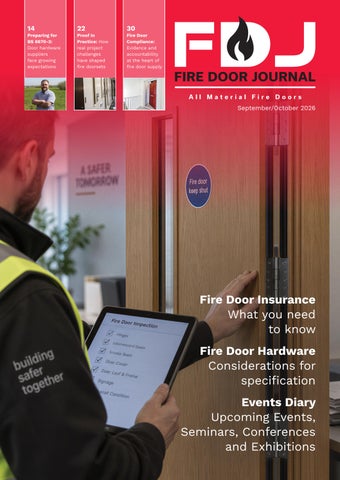
14
Preparing for BS 8670-2: Door hardware suppliers face growing expectations
22
Proof in Practice: How real project challenges have shaped fire doorsets
30
Fire Door Compliance: Evidence and accountability at the heart of fire door supply
September/October 2026
Fire Door Insurance What you need to know Fire Door Hardware Considerations for specification Events Diary Upcoming Events, Seminars, Conferences and Exhibitions
Submissions Deadlines and Remaining Issue Dates: The November/ December Journal Submissions Deadline (editorial) 2nd November Print Edition Publication Date 23rd November (week commencing) Digital Edition Publication Date 20th November
The Digital Newsletters Publication Dates 29th September 27th October 23rd November 15th December
A call for continual improvement This is an interesting appointment to undertake, as by working with one client, I am able to work with many. Many that I already have had the pleasure of working with over the years, and even more I am yet to meet, listen to, and share stories with. In my experience, certainly when I started writing online, written content is not very forgiving. Print, even less so. At least social media has edit & delete buttons, even then, a slight technical blunder or keyboard fisticuffs can land you in a screenshot that gets ‘forwarded many times’. Cue the see-no-evil monkey emoji. There is a balancing act to be had with technical writing: show enough personality and authenticity to survive being deemed AI, while maintaining enough machine-like technical precision to survive any scrutiny.
That precision matters now more than ever. Across our sector, the call for continual improvement is clear, demanding clarity and transparency to drive what matters most: safer outcomes, above all. This said, achieving that requires genuine inclusion, and I want to encourage you to be part of the discussion. I am of the belief that we need a diversity of opinions and voices to challenge longheld assumptions. Different stances exist for good reason, whether driven by professional judgment, practical experience, or commercial interest, as examples. Independent journalism should be the space that fosters those rigorous professional discussions, grounding them in technical accuracy and a sharp distinction between opinion and statement of fact. If I am to lead with transparency, there is no better time to say this. My approach as technical editor will be to keep things as simple as possible: uphold the editorial guidelines.
A published article may not be representative of my personal views, those of Iron Out Ltd, or those of the FDJ. What it will have, where it applies, is verifiable claims, arguments with visible reasoning, and explicit opinions—so that you, dear reader, have total clarity on what is being stated. And if, for any reason, my humanity shows and something slips through the net (and stages of quality assurance)—or if you simply have a counter-opinion— please, send me the screenshot. Just don’t forget the monkey emoji.
Bryony Matthews Iron Out Ltd
www.firedoor-journal.co.uk | 3
Industry Perspective
We want to hear from you!
“What’s the biggest issue currently facing the fire door industry?” Fire door safety is an industry facing constant change, from evolving legislation and standards to questions surrounding competence, compliance, specification, installation, inspection and ongoing maintenance. But which of these challenges is having the greatest impact? For the next Industry Perspective feature, we’re putting one straightforward question to professionals from across the sector: What’s the biggest issue currently facing the fire door industry? You are invited to share your views, draw on your own experiences and highlight the challenges you are seeing first hand. Tell us about your different priorities, concerns and perspectives and demonstrate why open discussion across the industry is so important. 4 | www.firedoor-journal.co.uk
Participation is open to all industry professionals, and this feature focuses on professional opinion and personal insight. Want to have your say? Submit up to 150 words alongside a headshot, your full name, job title, company name, and a 1-to-2 sentence author biography. Please send your submission by 2nd November 2026 to: editor@firedoor-journal.co.uk. Please note: Selected submissions will be featured alongside a diverse range of industry perspectives to foster representative views and professional discussion. Selected contributions may appear in print and may also be published across our digital and social media channels.
Contents 4
We want to hear from you! What’s the biggest issue currently facing the fire door industry?
9
Join the Fire Door Journal Contributor Mailing List
14 The new expectations for door hardware suppliers - supporting the BS 8670 Series 24 Digital Records - Beyond the check what happens when a fire door needs attention? 26 Fire Door Inspection - Thousands of fire door inspection reports are being produced, but what happens next? 28 The next chapter for Fire Door Journal 38 Flush beading in healthcare applications 50 Digital Compliance - the fire door industry goes digital
Disclaimer Whilst every effort is made to ensure the accuracy of editorial content published in Fire Door Journal, the opinions, advice and technical information contained within contributed articles are those of the individual authors or contributing organisations and do not necessarily reflect the views of the publisher or editorial team. Fire Door Journal accepts no responsibility for any loss, damage or liability arising from the use of information contained within the publication. Readers should always refer to the latest legislation, standards, manufacturers’ guidance and competent professional advice before making technical, legal or commercial decisions. All contributors are responsible for ensuring that the information they submit is accurate, current and does not infringe any copyright, intellectual property or other legal rights. Editorial Guidelines Promotional Content: Articles that primarily promote a company, product or service are welcome but will be clearly identified as Advertorial content. This ensures transparency for our readers while allowing contributors to showcase their expertise, products and services. Technical and Legislative Articles: All technical or legislative content will clearly identify the author or contributing organisation to provide readers with transparency regarding the source of the information. To obtain a copy of The Fire Door Journal Editorial Guidelines, please email: editor@firedoor-journal.co.uk. You can also find a copy of this on our website.
Please recycle this magazine so we can continue to use recycling in our effort to help the environment.
Correction Notice: The inspection frequencies for fire doors were misstated in the July 2026 edition, Pg 32. Under the Fire Safety (England) Regulations 2022, checks are required quarterly for communal doors and annually for flat entrance doors. The online version of this article was updated on Aug 3, 2026, to reflect this correction.
Editor All Editorial Content Enquiries / Submissions & Contributors editor@firedoor-journal.co.uk Christina Lazenby Publisher / All Enquiries M: 0333 369 0001 christina@firedoor-journal.co.uk Kate Carnall Graphic Design / Ad Specifications kate@hook-a-duck.co.uk Production Artwork Enquiries / Deadlines / Specifications production@firedoor-journal.co.uk Sales Enquiries & Ad / Advertorial Bookings sales@firedoor-journal.co.uk Directory Listings Inclusion / Amendments & Upgrades directory-listing@firedoor-journal.co.uk
www.firedoor-journal.co.uk | 5
Events Diary Events, Seminars, Conferences & Exhibitions 21-25 September British Woodworking Federation's Fire Door Safety Week 2026 | Nationwide / Online The annual campaign returns with a full programme of free webinars covering fire-door testing, competence, regulation, inspection, remediation and sustainability. https://www.firedoorsafetyweek.co.uk 22 September FIM Expo South West | Sandy Park, Exeter Free-to-attend regional fire-industry exhibition organised by the FIA, alongside a CPD-accredited conference. Manufacturers, installers, maintainers and end users will be represented. 9.30am–3.30pm. https://www.fia.uk.com/event/fim-expo-southwest-2026.html 22 September Building Safety Conference | London Topics include Building Safety Regulator developments, construction-product reform, fire regulation, Approved Document B, competence, the Golden Thread and building safety case management. Speakers include representatives from MHCLG and the Building Safety Regulator. https://www.westminsterinsight.com/conferencesand-events/building-safety/
7 October ASFP Wales Seminar | Hilton Cardiff Passive Fire Updates: The Latest Regulatory Changes, Best Practice and Industry Insights. Sessions include construction-product reform, implementation of the Building Safety Act and “Managing Competence: Who's Accountable?” https://asfp.org.uk/events/asfp-events/wales-seminar 19-20 October Fire Prevention & Safety Summit | London Heathrow The Fire Prevention & Safety Summit brings together fire-protection suppliers and key decision-makers through one-to-one meetings, networking and expertled discussions. https://totalsecuritysummit.co.uk/fire-preventionand-safety-summit/ 5 November FIRE Conference 2026 | London + Online Organised collaboratively by the Institution of Fire Engineers, Fire Protection Association, National Fire Chiefs Council and Fire Sector Confederation. The programme includes “Is the Building Safety Act working?”, “Driving competence across the sector” and “What should Government's 2027 priorities be?” https://nfcc.org.uk/event/fire-conference-2026/
29 September – 1 October UK Construction Week Birmingham | NEC Birmingham
12 November ASFP Awards 2026 | The Belfry Hotel & Resort
The UK's major built-environment event. This year's programme covers building safety, regulation, retrofit, skills, digitalisation and sustainability, alongside 300+ exhibitors and six stages.
Celebrating excellence, innovation, competence and leadership in passive fire protection. There is also an ASFP Jim O'Hagan Charity Open earlier the same day at Sutton Coldfield.
https://www.ukconstructionweek.com
https://asfp.org.uk/events/asfp-events/asfp-awards-2026
6 | www.firedoor-journal.co.uk
Events Diary Events Including Training & CPD 24-25 November HOMES UK 2026 | ExCeL London
28 October FIM Expo North East | The Catalyst, Newcastle
The event covers housing development, asset management, building safety, compliance and maintenance. Its dedicated Residential Building Safety Theatre includes sessions on fire risk, information sharing with fire and rescue services and the Building Safety Act.
Free-to-attend FIA exhibition showcasing fire-industry products and developments. It runs alongside an FIA CPD-accredited conference with keynote speakers and panel discussions. 9.30am–3.30pm. Open to Members and None-Members.
https://www.homesevent.co.uk
Have an event to share? Let us know: editor@firedoor-journal.co.uk
https://www.fia.uk.com/event/fim-expo-north-east-2026.html 29 September Fire Doors: Conducting Basic Fire Door Checks | Online A two-hour TPI training course covering Regulation 10 of the Fire Safety (England) Regulations 2022, the role of a fire door and identifying common faults requiring remediation. 2–4pm. Open to Members and nonemembers. https://www.tpi.org.uk/training-and-qualifications/training-courses/ webinars/w12-flat-front-doors-conducting-basic-fire-door-checks/ 25-26 November London Build 2026 | ExCeL London One of the UK’s largest built-environment exhibitions, with fire safety, health & safety and building regulation among its conference themes. For 2026 it is moving to ExCeL and is expected to feature 650+ exhibitors and 900+ speakers across 17 CPD stages. ASFP is also attending. https://www.londonbuildexpo.com
New RIBA-approved CPD explores why door hinge specification deserves more attention Hinges account for only a small proportion of the cost of a typical door assembly, yet they play a critical role in how doors perform throughout their lifespan. A new RIBA-approved CPD from hinge specialists SIMONSWERK explores the factors that influence hinge specification, helping architects understand how considerations such as door properties, applied hardware, environment and fire safety requirements can all affect hinge selection.
"Specifying Door Hinges: Balancing Design, Performance and Compliance" covers two RIBA core curriculum areas, legal, regulatory and statutory compliance, and design, construction and technology. The CPD provides a practical framework that architects can use to support early design decisions and discussions with specialist suppliers. The presentation also includes project examples to demonstrate how hinge specification responds to different architectural requirements. Commenting on the new CPD, Andrew Kite, Managing Director at SIMONSWERK UK, said: "The aim of this CPD is to give
architects greater confidence when approaching hinge specification, helping them understand the key influencing factors, ask the right questions early and make more informed decisions." The session runs for approximately 45 minutes and is available in person at your practice or online. For details or to book, contact cpd@simonswerk.co.uk or visit uk.simonswerk.com/en/ architecture/riba-approved-cpd. www.firedoor-journal.co.uk | 7
Events Diary
Fire Aware
A1S Group opens its RIBAaccredited and IFE-validated CPD on fire and smoke curtains
Commit to a moral culture for safety
Fire curtain manufacturer A1S Group is running its accredited CPD seminar, "The Functionality, Design and Compliance of Fire and Smoke Curtains", online for architectural specifiers, fire engineers, and main contractors. A1S Group, which manufactures fire curtains, smoke curtains and fire shutters in the UK, has developed a one-hour CPD seminar for the professionals who specify them. The session is accredited by the RIBA and holds CPD validation from the Institution of Fire Engineers. The seminar is delivered online by the company's technical team and covers three areas: • The regulations and standards that apply to fire and smoke curtains, and the common misconceptions surrounding them • How fire and smoke curtains are installed, operated and maintained • The common applications for each product type, and how each performs A recurring theme in the sessions is the distinction between BS 8524-1 & 2 and BS EN 16034, and what each means in practice for a specifier signing off a fire strategy. The seminar sets out where each applies rather than offering product recommendations. Andy Martin, Sales Consultant at A1S Group, said: “The feedback from our CPD sessions has been consistently positive. Attendees regularly
tell us that the content is genuinely educational rather than product-led, providing clear, impartial insights into the key issues and challenges currently shaping the industry. These are the same questions and discussion points we encounter on almost every project we support, so developing a dedicated CPD programme was a natural way to address them in greater depth. By focusing on knowledge sharing rather than sales messaging, our CPD gives contractors, architects and fire engineers practical, actionable guidance that delivers real value and can be applied with confidence in their day-to-day work.” Mick Speight, Director at A1S Group, said: “We are committed to investing in knowledge and raising standards across the industry. Fire and smoke curtain regulations continue to evolve, yet the market does not always receive a clear explanation of what has changed, why it matters and how it should be applied. We believe betterinformed specifiers make better decisions, regardless of which manufacturer they ultimately choose. This CPD has been developed to provide that clarity and help support safer, more compliant buildings.” The seminar is free to attend, lasts one hour, and carries CPD points for attendees. Sessions run online on scheduled dates throughout the year. View upcoming dates and register at: https://a1sgroup. zoholandingpage.eu/fdjcpd/
8 | www.firedoor-journal.co.uk
Growing fire safety advocates Fire Aware says the only way to ensure cultural change is for organisations large and small in the construction and built environment sector to recognise that the public are relying on their moral approach for their safety. Fire Aware CEO Gavin Skelly says the duty holders in multiple sectors affected by fire safety legislation should raise their own standards of best practice to meet and even exceed legal requirements. Skelly said: “Our own members are proud to commit to a Code of Conduct and our specific charters which take the safety process beyond legislation. This is a vocation, not a job, and we should never place other corporate drivers before that. “As we continue to seek methods to improve fire safety in the post-Grenfell era, we all need to commit to taking actions and changing behaviours. This includes the way we procure products and services, how we install fire safety equipment and materials and how we assess safety in our buildings. “The public has a right to know they are safe as they inhabit and move about our buildings in large cities and towns. This includes shopping malls, hospitality venues, stadia, healthcare buildings and public infrastructure. “This applies to any sector which has a responsibility to protect people as part of its remit, and committing to meeting that responsibility is key to progress.” Dame Judith Hackitt – who authored the Hackitt Review – has called for cultural change through moral and ethical behaviours, recently supported by the new independent Building Safety Regulator (BSR) that was created to ‘promote competence and higher standards.’ Skelly said all of those involved in the design, construction, management, maintenance and letting of the built environment also need to understand that they have an obligation to fire safety even if their business is not directly connected with fire specialisms. Fire Aware is a recognised membership body serving the built environment and related sectors with a common aim to work and trade responsibly to all best practice standards in the interests of the safety of the general public. See www.fireaware.org.
Join our dedicated PR and marketing mailing list to stay aligned with our editorial calendar.
Want to feature your brand, products and industry updates in Fire Door Journal?
Join the Fire Door Journal Contributor Mailing List Upcoming Issue Prompts & Market Insights
First Dibs on Commissioned Features
Monthly Pitch Reminders
Receive regular updates on upcoming issue themes, copy deadlines, and editor notes on current industry trends.
Gain advance insight into Fire Door Journal’s editorial plans, with early notification of opportunities for expert commentary, case studies, feature contributions and article commission requests.
A quick monthly prompt to send in your latest product launches, company mergers, testing milestones, new hires, and events.
Scan the QR code here to sign up or submit your details at: editor@firedoor-journal.co.uk www.firedoor-journal.co.uk
Fire Door Insurance – What You Need To Know Article Contributor: Daniel White, Executive Director of Consort Insurance This article first appeared in the July 2026 issue of the Fire Protection Association’s Fire & Risk Management Journal.
Cover that closes the gap:
Insurance across the fire door supply chain Fire doors are among the most scrutinised elements of building safety in the UK, yet they remain one of the least compliant. According to the Fire Door Inspection Scheme’s (FDIS) latest publicly available inspection data, based on more than 100,000 inspections, 75% of fire doors failed to meet the required standard1. The most common issues were excessive gaps around the frame (77% of failures), poor maintenance (54%) and defective smoke seals (37%), while nearly a third (31%) were linked to incorrect installation2. More concerning still, the industry has made little progress: the failure rate has barely shifted since FDIS’s 2019 survey, which found that 76% of inspected fire doors were non-compliant3.
This context is particularly significant from an insurance perspective. Each fire door defect can be attributed to a specific party within the contractual chain of responsibility, including manufacturers, designers, installers, inspectors, and building owners responsible for ongoing maintenance. The Building Safety Act 2022 has materially heightened the legal and financial consequences associated with non-compliance, replacing the previous maximum £5,000 fine for breaches of building regulations with the possibility of unlimited fines and custodial sentences of up to two years4. In addition, it extended the limitation period for enforcement action in respect of non-compliant work from one year to ten years. It also introduced provisions for personal criminal liability for directors and managers where offences are committed with their consent, connivance, or neglect. Against this backdrop, Professional Indemnity (PI) insurance becomes a central mechanism for transferring exposure arising from fire doorrelated advice, design, certification, and inspection activities, alongside Public and Products liability and a range of more peripheral covers. This article examines how these insurance arrangements respond to that evolving risk landscape, and where material gaps in cover tend to arise.
10 | www.firedoor-journal.co.uk
Daniel is responsible for the fire protection specialism at Consort with their PaD insurance product
Professional Indemnity insurance PI responds to claims arising from professional advice, design, specification, certification, or inspection. In essence, it covers the "intellectual" rather than physical components of fire door work. Any party within the fire door supply and assurance chain that issues surveys, certificates, specifications, fire risk assessments or design recommendations typically requires PI cover, and it is now routinely a tender prerequisite.
Fire Door Insurance – What You Need To Know When reviewing existing policies, four features are particularly worth considering: 1. Aggregate versus any one claim limits: A single building with a systemic defect, such as wrong cores, incorrect intumescent strips, or gaps beyond tolerance, can generate dozens of individual claims from one root cause. An aggregate limit means one bad project can exhaust the entire year’s cover. 2. Contractual liability and conditions precedent: Fire door contracts increasingly include enhanced indemnities, “fitness for purpose” obligations, or specific certification requirements (e.g. BWF Certifire, Q-Mark or other third-party accreditation schemes). Standard PI wordings often exclude liabilities assumed under contract that go beyond the common law duty of care. If your contracts commit you to more than your policy covers, your business may be carrying that uninsured exposure. 3. Retroactive date: Where PI is purchased after a period of trading or following a change of insurer, the retroactive date becomes critical and needs checking carefully. Fire door defects may remain latent for years, often emerging during post-incident investigation or later fire risk assessments. Work completed prior to the retroactive date is typically excluded in full.
Identifying a defect is only part of the professional obligation; firms must be able to demonstrate that risks, limitations and recommended remedial actions were clearly communicated to the client. With limitation periods under the Building Safety Act extending as far as 30 years in certain circumstances5, inspection reports, certification records, maintenance logs and correspondence may prove critical in evidencing what was known, what advice was given and where responsibility lay at the time. The PI market has also shifted materially in recent years. Following a prolonged hard market, conditions have softened and insurers are generally showing a greater willingness to engage with fire safety-related risks. Full fire safety exclusions are now, thankfully, rare rather than standard. This is positive for buyers, but it cuts both ways. Softer terms make it easier to negotiate the wording fixes above, but they also mean firms renewing on autopilot may be retaining legacy gaps where improved terms are now available to address them.
Liability and the efficacy problem Public and Products Liability insurance responds to third party injury or property damage caused by your work or product. This is straightforward when the damage is physical and the cause is obvious. Fire doors present a more complex risk profile because their function
is passive: they are designed to remain inert until the moment they are needed. If they fail at that moment, the resulting damage is caused by the fire, the smoke and the building, not by the door itself in any conventional sense. The door’s failure is a failure to prevent harm, rather than an active cause of it. This is the efficacy problem, and it is where standard liability wordings tend to fall short. Many liability policies draw a distinction between causing damage and failing to prevent it. Where a product or service does not perform its intended function, and there is no separate physical damage to trigger cover, insurers may seek to treat the claim as falling outside the scope of the policy. In practice, this can mean that where a fire door fails to achieve its rated 30or 60-minute performance due to specification or installation defects, resulting in fire or smoke spread, insurers may characterise that as a pure efficacy failure claim, falling outside what the liability policy was written to cover. This is a frequent source of coverage dispute. While PI may respond where professional advice or design input is implicated, parties operating without PI, or those facing allegations of defective manufacture or installation, may find that neither PI nor liability policies respond cleanly. This can result in a policy trigger, creating uncertainty between insurers regarding causation, leaving a dispute over which policy should respond, if either.
4. Runoff cover: As PI is written on a claims-made basis, cover ceases when the policy lapses unless run-off arrangements are explicitly secured. This is particularly relevant in cases of business closure, merger, retirement, or sale, where historic liabilities may still emerge long after trading has ceased. These exposures also underline the importance of documenting not only what defects were identified, but how they were communicated. www.firedoor-journal.co.uk | 11
Fire Door Insurance – What You Need To Know Practical implications To mitigate these exposures, several policy considerations are critical: • Ensure liability wordings are reviewed for explicit or silent Efficacy exclusions. • Where PI and liability policies are placed separately, have your broker provide you with the confidence that both wordings are reviewed in conjunction rather than in isolation, as gaps love to live in the seams between policies. • For manufacturers and suppliers, confirm whether Products Liability extends to the costs of removal, replacement, or rectification of defective fire door systems (often referred to as “Product Recall” or “Rectification cover”). In high-rise environments, replacement costs can significantly exceed the value of the components themselves. A useful diagnostic question is whether your broker can clearly explain how your policies would respond to a scenario in which a fire door fails to achieve its rated performance during a fire event. If this can’t be articulated succinctly, it’s indicative of unresolved coverage ambiguity that needs to be reviewed before renewal, not after a claim.
Wider cover considerations Management Liability/Directors & Officers insurance: In light of the Building Safety Act 2022, directors, managers and other officers may be prosecuted alongside the corporate entity where an offence is committed with their consent, connivance or as a result of their neglect, with exposure to unlimited fines and custodial sentences.6 Standard management liability policies may provide cover for defence costs arising from regulatory investigations and prosecutions, but limits and whether criminal defence costs are included at all, vary considerably. For directors of fire door manufacturers, installers or inspection bodies, this is no longer a peripheral consideration. Cyber insurance: Increasingly relevant for firms holding digital compliance records, certification databases, golden thread documentation and any element of personal data. A ransomware attack that locks a firm out of its fire door inspection records ahead of a Building Safety Regulator audit creates its own compliance problem on top of the IT one. Three questions worth putting to a broker now, rather than after a claim: 1. How are we covered for Efficacy, on a silent or explicit wording basis? 2. Does the PI policy’s retroactive date reach back far enough, and what happens to it if the business stops trading? 3. If something goes wrong on a high-risk building, is a director personally covered for a Building Safety Regulator investigation? For insurance purposes, the key question is often not just who installs and then owns the fire door, but who has the duty to inspect, maintain, certify, or advise on it when the defect arose. That party may ultimately bear responsibility for resulting losses or remediation costs.
Information Sources 1
Fire Door Inspection Scheme (FDIS) (2022) FDIS survey finds three-quarters of UK fire doors do not meet the required standard. Available at: https://www.fdis.co.uk (Accessed: 15 June 2026).
2
Ibid.
3
Fire Door Inspection Scheme (FDIS) (2020) Fire door inspection data 2019. Reported by LocalGov, 18 June 2020. Available at: https://www.localgov.co.uk (Accessed: 15 June 2026).
12 | www.firedoor-journal.co.uk
4
UK Government (2022). TSO@Blackwell and other Accredited Agents EXPLANATORY NOTES Building Safety Act 2022. [online] Available at: https://www.legislation.gov.uk/ukpga/2022/30/pdfs/ ukpgaen_20220030_en.pdf (Accessed 15 Jun. 2026).
5
Ibid.
6
Ibid.
Opinion Piece – BS 8670-2 Article Contributor: Iain Banks, Product Marketing Manager at Allegion UK
Preparing for BS 8670-2: The new expectations for Door Hardware Suppliers With BS 8670-2 on the horizon, door hardware suppliers face growing expectations around competence and product stewardship. In this article, Iain Banks, product marketing manager at Allegion, discusses how the in-development Code of Practice presents both challenges and opportunities for manufacturers and suppliers and, if implemented in the spirit intended, should help strengthen the industry and improve confidence in specialist door hardware. The latest regulatory reform resulting from Dame Judith Hackitt’s report, Building a Safer Future, which influenced an extensive overhaul of building safety legislation, BS 8670-2, is perhaps the most relevant and consequential for product manufacturers and suppliers. At consultation stage at the time of writing, the in-progress Code of Practice looks set to cover core competence criteria for those involved with construction products and the information relating to them throughout their lifecycle and provide recommendations for applying these to competency frameworks.
Supporting the BS 8670 Series Our understanding is that BS 8670-2 is designed to complement the wider BS 8670 series, which highlights competence for those involved with building safety. This family of related standards is best understood when viewed together, as they address different elements of the built environment ecosystem. BS 8670-1:2024 covers the core criteria for building safety roles and the competence required to perform the work. This framework covers the required skills, knowledge, experience and behaviours industry professionals need to deliver their roles safely and effectively. By doing this, this standard is intended to promote individual responsibility and accountability. Specifically addressing what competency entails for all individuals working in the supply and management of construction products, it appears that BS 86702 places emphasis on demonstrable understanding, transparent product information, auditable traceability and documented performance claims.
14 | www.firedoor-journal.co.uk
Five Levels of Specialised Competence The intention of BS 8670-2 seems to be to remove ambiguity and the potential for dangerous assumptions about construction products by making demonstrable product knowledge an expectation. For suppliers, the new guidance covers understanding the safety and performance of products, knowledge of legal obligations, understanding how products interact with systems and buildings, awareness of limitations and potential risks, and documenting this in a clear and auditable way. Featuring five levels of proportionate competence from E to A, the Code progresses through stages of expected competence, with the highest level requiring full and complete product understanding and responsibility. This staged framework is important for door hardware suppliers, as competence becomes hierarchical, rolespecific and highly specialist.
Opinion Piece – BS 8670-2
Iain Banks
With almost 23 years in the door hardware industry, Iain’s expertise spans everything from fire-rated door hardware to architectural ironmongery. Over Iain’s career in the industry, he’s seen a welcomed shift towards increased safety across all sectors and a greater awareness of the role of door hardware. As product marketing manager, Iain ensures the right products go into the proper channels, are tested to the correct standards, and are fully compliant.
Unlocking Higher Standards for Suppliers Along with technical product knowledge and knowing whether a product is suitable for a particular application, suppliers should expect to provide clear, verifiable information about where products are made and how they are tested. This improved supply chain transparency will also help raise industry standards by keeping counterfeit and uncertified products out of the market, promoting product integrity, and ensuring specialist door hardware is suitable and safe. Once published, BS 8670-2 is intended to provide a Code of Practice that could underpin competence schemes; both the Industry Competence Steering Group (ICSG) and the Building Safety Regulator (BSR) will be important stakeholders in how any standard is implemented, so suppliers should prepare.
Building a Safer Market Many door hardware manufacturers already invest in technical depth, and BS 8670-2 offers an opportunity to have this expertise recognised, acknowledged and rewarded, elevating suppliers with genuine expert product knowledge. As a result, the new Code of Practice hopes to deliver a more expert-led and safer construction products market. Early preparation for this new Code of Practice will put suppliers in the best position to meet purchasing expectations, show competent product stewardship and improve safety outcomes. Those suppliers who review and improve their product data, traceability processes and technical knowledge now will be better placed to meet rising expectations across the supply chain. Door hardware manufacturers and suppliers hold an important and safety-critical position in the building sector, and BS 8670-2 supports benchmarking this. Therefore, the new Code of Practice will likely elevate important standards, increase specification confidence, offer technically knowledgeable services greater recognition and reward, and, crucially, help create safer buildings for everyone.
The views expressed and any opinions stated in this article are solely those of the contributor and do not necessarily reflect the official position or policy of Fire Door Journal or its affiliated organisations.
www.firedoor-journal.co.uk | 15
Women In Industry
Women In Industry Nicola John Managing Director FDM Training and Development I lead FDM’s operations, strategy and finances. I also design courses and qualifications with awarding bodies, and liaise with industry and government to drive skills, compliance and growth. Nicola John is also part of The Fire Door Journal Industry Panel.
About You Tell us a little about yourself and your current role.
How did your career journey lead you into the fire safety/fire door industry? I was working for a private training provider when I was approached by one of my students’ employers to work for his building maintenance
company to help grow the business. At the time, I’d been working delivering leadership and management training for a while and decided to go back into industry for a new challenge. We worked in social housing maintenance, doing planned works, reactive repairs, and 24-hour callouts. A business opportunity arose for us to open a door manufacturing business in our region, and I managed this project from inception
16 | www.firedoor-journal.co.uk
through 3 factory moves and significant growth, producing both standard and fire doors for the social housing, new build, and retrofit sectors in Wales.
Was this an industry you always intended to work in, or did you find it unexpectedly? It was a very unexpected turn when I entered the construction/built environment world, but
I loved the fast-paced, change-management challenge that running a multifaceted business presents. Lots of jobs on the go, with lots of different tradespeople offering our customers solutions, make each day a different challenge, which I really enjoyed. Each role since then has evolved in response to the needs of the business, or in the case of FDM, to industry needs, providing solutions to meet the needs of the customer base.
Women In Industry
Career & Professional Development What has been the proudest moment of your career so far? Setting up FDM in such a short period of time and getting so much industry support from our collaborators, who generously supply product and learning materials and help to make a difference to industry competence. Dame Judith Hackitt’s endorsement of what we had set up, how we’re embracing the changes needed for industry, and leading the way with FDM was also a proud career highlight.
Have there been any significant challenges you’ve had to overcome, and what did they teach you? Throughout a career in a maledominated environment, there are challenges, and if you are in a solutions-based business, you’ll always have challenges to overcome. However, the greatest rewards, but also challenges, have come from the fire door training journey, as not everyone embraces change when it comes from someone other than themselves. It has taught me to be more resilient and to trust my gut; just because someone’s in a position of authority doesn’t mean they are always right, and to surround myself with people who also want to see change. Thankfully, there are plenty of people who provide support and guidance even when things seem difficult.
What skills or qualities do you believe have been most important to your success?
Leadership & Industry
I’m not afraid to make decisions. I’m very considered in my approach, can think strategically, and can see a problem and come up with workable solutions that I can turn into an achievable plan that delivers results. I’m also not afraid to “put my head above the parapet” or to challenge when I think something is not right. Treating team members as individuals, assessing their skill sets, and getting the best from them to achieve our goals are also skills I’ve developed over my career. Sometimes, to my detriment, I detest injustice and want everyone to always “do the right thing” – this certainly comes from being a police detective’s daughter.
What advice would you give to women considering a career in fire safety or the wider construction and manufacturing sectors? I’d say it’s a very rewarding career; you can make a difference to people’s lives when working with a lifesaving product, in whatever capacity you work within the industry. Analyse your own skills, utilise them daily to get results, and you’ll have a fulfilling career. We all like to feel that we are making a difference and that we’re in charge of our own destiny. I’d also say being nice is not a weakness; you can be firm but always respectful to others – this is something I have tried to do throughout my career.
“Analyse your own skills, utilise them daily to get results, and you’ll have a fulfilling career. We all like to feel that we are making a difference and that we’re in charge of our own destiny.”
What does good leadership mean to you? Communication is key - with your team, your peers, your customers and the wider industry. You should have a clear plan and communicate that clearly and often when leading. It’s about being approachable and listening to others, making informed decisions, and communicating your decisions and reasoning to the people who matter. Choosing a team with complementary skills who all contribute to the goals of the organisation or project really helps make leadership fulfilling.
What changes would you still like to see across the industry? I’d like to see more collaboration and speed of implementation of frameworks. We know what we have to do as an industry, and many organisations are already embracing new ways of working and demonstrating compliance and competence. We should be sharing best practices and supporting innovative practices emerging in our industry.
What do you think makes the fire door sector such an important industry to be part of? We have the opportunity to drive change and make the built environment safer for any resident or workplace that has a fire door. The safety of residents in their homes has always been a main driver for me to start and continue the work we do at FDM.
www.firedoor-journal.co.uk | 17
Women In Industry
Family & Work-Life Balance Balancing work and personal life can be challenging. How do you manage it? I’ve always been a working parent (for some of my career a working single parent). Feeling guilty unfortunately comes with the territory, and at different times in my career I’ve got it right and sometimes wrong! But my children, who are now all grown up with families of their own, all have a strong work ethic. They also know
that being a career professional is in my DNA, and I truly enjoy the challenges of being a company director.
throughout my career who’ve given me the confidence and support to push boundaries and challenge things when necessary.
I also enjoy holidays, travel and spending time with my family – who are genuinely my favourite people on earth. This recharges the batteries, making you a better leader and colleague at work.
Do you think attitudes towards flexible working have improved in recent years?
What support – whether from employers, colleagues or family – has made the biggest difference to your career? My children have always been my biggest supporters, and now I have 6 grandchildren who also give me strength when I need it. There have been many influential people
18 | www.firedoor-journal.co.uk
There has been some improvement; however, we still have a long way to go regarding flexible working from both the employer and employee sides. Flexible working works best when there is give and take from both sides. In my experience, people at any level in an organisation do their best work when they feel listened to, supported, and communicated with.
PRACTICAL AND THEORETICAL FIRE DOOR TRAINING FOR THE WHOLE SUPPLY CHAIN Regulated Qualifications L3 Diploma Fire door inspection qualification L3 Diploma Fire door installation qualification GQA Level 2 NVQ Diploma in
In person accredited courses Fire door installation course Fire door repair and maintenance course Fire door inspection training course Responsible persons course Fire door awareness course
associated industrial services
Fire door procurement course
occupations (construction) Passive
Fire Service Fire Door Awareness
Fire Protection V2
Course FDM Training accademy Bury Orbital 60, Dumers Ln, Bury, BL9 9UE
01619600139 fdm.info@allegion.com
Delivery Report
OPSS’s 2025/26 report highlights door closers in case study The Office for Product Safety and Standards (OPSS) has highlighted fire doors and associated hardware as part of its ongoing work to improve the safety and compliance of construction products and accountability throughout the construction product supply chain.
The retailer subsequently introduced corrective measures, including emails to customers, instore notices and online information explaining the importance of checking the relevant fire door specification and identifying when additional protection may be necessary.
OPSS is the UK’s national product regulator and sits within the Department for Business, Innovation, Science and Trade. Its role includes protecting people and places from product related harm and improving compliance with product safety and construction product requirements.
Readiness: the wider lesson
Its latest report outlines a combination of proactive and reactive casework across the construction sector.
Prioritising enforcement measures Using a risk-based targeting model, OPSS intervened in cases involving potentially non-compliant products including fire doors, plywood, concrete beams and heat-soaked toughened glass. This work was backed by an extensive programme of product testing. Products examined included insulation, cement, vapour barriers and, significantly for the fire door sector, door closer devices. OPSS also carried out inspections of manufacturers to check production controls and assess supporting product documentation. Alongside proactive investigations, the regulator undertook reactive compliance work, supported cases led by local authorities and strengthened enforcement activity at ports and borders.
Website pages were also amended to remove fire-door and fire-rating claims, with customers instead advised to consult the fire door manufacturer.
The case demonstrates an important principle for the sector: correct and comprehensive product information is not a future requirement, but a current one. A component cannot be considered in isolation from the system into which it is being installed, and purchasing and installation decisions need to be based on appropriate evidence and information. OPSS is also encouraging wider cultural change within the construction products sector. This has included supporting Construction Products Association guidance on declarations of performance and guidance from the Guild of Architectural Ironmongers (GAI) aimed at helping fire door hardware manufacturers and distributors provide clear, consistent and comprehensive product information. OPSS has additionally sponsored the development of PAS 2000:2026, a construction products sector code of practice intended to help suppliers demonstrate that they have taken reasonable steps to place safe construction products on the UK market.
For the fire door industry, one case study provides a particularly useful example of how regulatory scrutiny can extend beyond the physical product to the way products are described, marketed and specified.
Fire door closers under scrutiny OPSS raised concerns with a retailer over an own brand range of concealed door closers from a major trade supplier that were being marketed for use on 30-minute fire-rated doors. The concern was that the product information did not make it sufficiently clear that the closers require additional intumescent material to help the fire door perform as intended.
Source: Office for Product Safety and Standards (OPSS) Delivery Report 2025/26
https://www.gov.uk/government/publications/opss-delivery-report-2025-2026/opss-delivery-report-2025-2026 20 | www.firedoor-journal.co.uk
EN 2029 GET READY IN ADVANCE. Future-proof your fire door specifications with Pyroguard Advance – UK manufactured fire safety glass engineered for modern fire door systems and upcoming regulatory expectations. Certified to BS and EN standards, it delivers EW classification with 30 and 60 minutes fire resistance, including larger pane sizes. DESIGNED FOR FIRE DOOR APPLICATIONS HIGH PERFORMANCE & COMPLIANT UK MANUFACTURED, NATIONWIDE SUPPLY APPROVED FOR COMPOSITE DOORS
CHOOSE ADVANCE. STAY COMPLIANT.
For more information visit www.pyroguard.eu
Advertorial – Timber Fire Doorsets Article Contributor: Mike Clancy, Sales & Commercial Director of West Port
Proof in Practice
How real project challenges have shaped the fire doorsets that West Port manufactures Every building brings its own requirements. Door sizes change. Glazing and ironmongery vary. So can the fire, smoke and security performance required. The challenge isn’t simply selecting a fire door. It’s specifying a complete doorset that suits the opening, is supported by the right evidence, can be manufactured consistently, and installed and maintained as intended. When the brief goes beyond fire Many of West Port's developments have come from solving exactly that kind of problem. For one local authority, that meant unusually tall 2.7-metre fire doors with a bespoke glazed design, developed to achieve the required grey mottled laminate finish. A different challenge arose for Wolverhampton Homes, an Arm’s Length Management Organisation (ALMO) managing around 19,000 homes on behalf of the City of Wolverhampton Council. The wall itself was built using either 25mm or 35mm timber studwork, finishing at 52.5mm and 62.5mm respectively once plastered and with the architraves fitted. Both were too shallow for West Port's standard 94mm frame, so a new 70mm frame was developed to suit. Wolverhampton Homes sponsored the subsequent fire testing, with two complete wall and doorset assemblies constructed and tested at Cambridge Fire to BS 476-22:1987 over two days. Required to provide 30 minutes of fire resistance, the 52.5mm assembly achieved 51 minutes, while the 62.5mm assembly achieved 54 and 56 minutes across its two doorsets. Even when the surrounding wall construction eventually gave way, the West Port fire doorsets were still holding. That's what bespoke manufacturing means in practice: understand the building, establish the performance required, then develop and validate a timber doorset solution within the scope supported by testing and assessment. For clients and specifiers, that approach provides greater confidence that the proposed solution is supported by evidence relevant to the actual project configuration.
The evidence has to cover more than fire West Port has built an extensive portfolio of its own primary test evidence, supported by Field of 22 | www.firedoor-journal.co.uk
West Port fire doorset undergoing fire resistance testing at Cambridge Fire
Application assessments, covering FD30, FD60 and smoke-control applications across flat entrance, communal and utility doorsets and fire screens. That breadth matters: door dimensions, glazing, ironmongery, seals and other components can affect performance. The investment in primary testing is deliberate, giving West Port greater control over the scope it can support and providing specifiers, contractors and building owners with a wider range of evidenced configurations from which to develop compliant solutions. 2026 marks 25 years of West Port working with Secured by Design, with its FD30 and FD60 front entrance doors holding security accreditation alongside their fire performance. Manufacture is also independently third-party certified by BlueSky and supported by ISO 9001-controlled processes and UKCA compliance, assuring consistent manufacture. The company is also a BWF and Fire Aware member and an LHC-audited
Advertorial – Timber Fire Doorsets is added throughout its life, creating a traceable record for inspections and audits, including Golden Thread requirements where they apply.
The next change is already under way From 2 September 2029, subject to transitional arrangements, Approved Document B in England will stop referencing the BS 476 National Classes for fire resistance. For doorsets, that means moving to the European testing and classification route: EN 1634-1 and EN 13501-2.
West Port FD30 timber fire doorset in situ
manufacturer, recognised across the wider industry and public sector. Its fire doorsets are manufactured in Britain, with FSC® (FSC®C017295) and PEFC (COC853909) certification for traceable timber sourcing. This capability underpins West Port's partnerships with specialist installers. West Port develops and manufactures the doorset a project needs, while the installer brings the on-site relationships and technical understanding to deliver it across public and privatesector projects throughout the UK.
Complete before it reaches site West Port manufactures fully factory-finished timber fire doorsets from its 175,000 sq ft factory. Each is CNC-machined for accuracy, with glazing and ironmongery fitted in-house, finishing carried out under controlled conditions, and the complete doorset checked before dispatch. This aims to reduce avoidable site variation and gives installers a more consistent, documented product, supported by installation manuals to help ensure it is installed as specified.
For fire door manufacturers, the transition’s scale is significant, with ranges requiring new evidence to support specification under the European route. West Port is already progressing that work across its product families rather than waiting until the deadline. For customers and specifiers, that means greater certainty: the evidence needed to specify West Port doorsets under the new requirements is being built now, helping protect product choice and project continuity as 2029 approaches. Fire Door Safety Week puts the focus on the fire door once it's in a building. For a manufacturer, the work happens earlier. It starts with understanding what a project requires, establishing the primary test evidence to support it and making sure the doorset is manufactured consistently. That is proof in practice: not simply a fire doorset, but everything proven and controlled before it reaches site. Tel: 01900 814 225 Email: sales@west-port.co.uk www.west-port.co.uk
The complete fire door's lifecycle The regulatory direction since the Grenfell Tower tragedy, reinforced by the Building Safety Act, is towards demonstrable competence, controlled change, accurate records and traceable evidence. For fire doorsets, delivering tested performance consistently at manufacture is only part of the picture. Accurate information needs to continue through installation, inspection and maintenance. A partnership with Contactless Check Solutions (CCS) supports that continuity. An RFID tag fitted at the factory links each doorset to a digital record containing its manufacturing data and supporting documentation. Installation, inspection and maintenance information
Timber fire doorsets in production at West Port’s Maryport factory
The views expressed and any opinions stated in this article are solely those of the contributor and do not necessarily reflect the official position or policy of Fire Door Journal or its affiliated organisations. Requests for further details regarding West Port’s primary test evidence, Field of Application assessments, or product specifications can be directed to sales@west-port.co.uk. References including FSC and PEFC can be verified via their respective public registers.
www.firedoor-journal.co.uk | 23
Advertorial – Digital Records Article Contributor: Andrew Tyas, Managing Director of Contactless Check Solutions (CCS)
Beyond the check What happens when a fire door needs attention? For Responsible Persons and compliance teams overseeing thousands of fire doors across multiple flats, floors, and blocks, finding a problem is just the beginning. Managing what happens next becomes a complex compliance trail. Which doors need attention, and what action has been taken? Crucially, is there evidence to show the issue has been resolved? Compliant fire doors help contain fire and smoke, protecting escape routes and giving occupants vital time to evacuate – and, most importantly, save lives. During this year’s Fire Door Safety Week, CCS helps turn “Check it, close it” into clear action by providing a traceable digital history of every inspection, issue, and remedial action, because protection starts at the door.
ASSESSING CONDITION: Establishing where the door stands For a fire door already in service, CCS RFID technology can be retrofitted subject to supporting evidence, linking the physical door to its individual digital record. An inspection using a mobile device establishes the door’s condition and creates a reliable starting point for its digital history. The CCS RFID tag can record the inspection status as Pass, Fail, Overdue, or Unchecked. Where a door fails, the identified defects are captured. Where access has not been achieved, the door remains Unchecked, rather than being recorded as though an inspection has taken place. This is particularly relevant to flat entrance doors. Under Regulation 10 of the Fire Safety (England) Regulations 2022, Responsible Persons in relevant residential buildings over 11 metres must use best endeavours to check flat entrance fire doors at least every 12 months and keep a record of the steps taken where access has not been granted. The CCS solution supports capturing this digitally with time-stamped photographic evidence. Failing to meet fire safety duties can lead to enforcement action and, in serious cases, prosecution, reinforcing the importance of clear evidence of inspection and maintenance.
24 | www.firedoor-journal.co.uk
A fire door being checked using a CCS RFID tag and mobile device.
REPAIR: Managing what needs attention One failed door may be straightforward. Ten, fifty, or hundreds across different buildings are a different challenge. One UK university Facilities Manager, who wishes to remain anonymous, describes the system as giving its estates team “full visibility of every fire door across the campus.” The CCS Site Status Summary Report provides a clear view of fire door status across multiple buildings, showing where doors have failed and why. Teams can use this to plan remedial work. Where repair in situ is appropriate, government guidance states that the work should be undertaken by a competent contractor as soon as reasonably practicable, taking account of the risks identified. A specific CCS repair report records the work against the individual door, including who carried out the repair, photographs, details of the remedial work, and any components changed – all digitally. “Having the ability to prove to Health & Safety and Fire Risk Assessors that regular maintenance inspections and repairs are being undertaken is invaluable.” Health & Safety Officer at a Local Authority (Anonymous)
Advertorial – Digital Records VERIFY: Confirming the outcome Recording a repair as complete is not the same as confirming the subsequent condition of the door. Using CCS, the door is reinspected and the result added to its individual record alongside the original inspection findings,
CCS Site Status Summary Report showing fire door status across multiple sites.
repair report, and photographs. The result is a continuous, defensible audit trail of what failed, what was done about it, and whether the door subsequently passed inspection.
REPLACE: What if repair is not appropriate? Not every failed fire door can be repaired. Where replacement is required, the digital record for the new doorset can begin at manufacture. Through its Data Partner Programme, CCS supports UK fire door manufacturers in incorporating RFID tags at the point of production. Manufacturing data, certification, and drawings, where applicable, can then be added before it reaches site. Installation information and photographs can be added, followed by subsequent inspection and maintenance information. A digital history can begin as soon as RFID technology is fitted and being fitted during manufacture, can support cradle-to-grave traceability. Where evidence is recorded against the individual door throughout its lifecycle, the principles of the Golden Thread can also be supported. CCS RFID tag installed within a fire door.
CONNECT: Working with established systems The latest development from CCS is a Customer Application Programming Interface (API), designed to work with customers’ existing technology. Many customers use other systems to manage their properties, assets, and compliance information. Through the CCS API, these systems can securely access agreed site and address information. The connection is read-only, meaning the information can be viewed but cannot be changed, removing the need to enter the same details more than once. The aim is straightforward. Reduce repeated data entry and improve consistency between systems in real time. Access remains customer-specific, revocable, and read-only. CCS has also achieved Cyber Essentials certification, providing further assurance around the cyber-security measures used to protect the platform data and customers.
Andrew Tyas is Managing Director at Contactless Check Solutions (CCS), with more than 20 years’ experience in the fire door industry. His expertise spans fire door manufacturing, sourcing, legislation and compliance, giving him a practical understanding of the challenges customers face and what they need from effective fire door management
Effective fire door compliance comes down to having the right information, at the right time, and being able to prove it.
Tel: 0161 646 0110 | Email: sales@ccs-fire.com | www.ccs-fire.com The views expressed and any opinions stated in this article are solely those of the contributor and do not necessarily reflect the official position or policy of Fire Door Journal or its affiliated organisations.
www.firedoor-journal.co.uk | 25
Advertorial – Fire Door Inspection Article Contributor: Robert Evans, Director of Trifecta Fire Door Solutions
Thousands of Fire Door Inspection Reports are being produced, but what happens next? A Wirral fire door company’s answer to ‘that’s not our area’: help to find someone who can.
inspection reports into fully priced, prioritised schedules of works. But a plan is only useful if someone can act on it.
Since the introduction of the Fire Safety (England) Regulations 2022, responsible persons have placed increased emphasis on routine fire door inspections in residential buildings. Every year, thousands of fire door inspection reports identify defects that require remedial work. Yet for many building owners, facilities managers and compliance professionals, the inspection is only the beginning of the challenge. Knowing which defects need urgent attention, deciding whether a door can be repaired or must be replaced, finding competent contractors and obtaining realistic budgets can often prove more difficult than the inspection itself. That’s the gap we set out to close with a service that converts
“We realised that many organisations don’t simply need an inspection; they need a practical route to completing the work.” 26 | www.firedoor-journal.co.uk
Advertorial – Fire Door Inspection “This approach comes at a time when awareness of fire door safety and compliance continues to grow across the construction and property management sectors.” Tom Evans, Fire Door Installer and Inspector at Trifecta Fire Door Solutions, believes many organisations need more support after an inspection: “Inspecting fire doors is only half the job. The real challenge begins when a building owner receives a report identifying dozens or even hundreds of defects and must decide what needs repairing first, what needs replacing, who should carry out the work and how much the programme is likely to cost. We realised that many organisations don’t simply need an inspection; they need a practical route to completing the work. That’s why we’ve created our inspection report conversion service and started building our network nationally.” Instead of leaving building owners to interpret lengthy inspection reports, the service reviews every identified defect and produces a structured programme of remedial works. The resulting document enables organisations to consider relevant fire safety information in context, budget accurately, prioritise repairs and obtain competitive quotations from contractors. We believe this bridges one of the biggest gaps in the fire door compliance process, enabling efficient movement from inspection to complete remedial works. Based in Wirral, Trifecta Fire Door Solutions provides fire door inspections, repairs, maintenance, installations, and compliance support for commercial property owners, housing associations, healthcare providers, educational establishments, and public sector organisations throughout the Northwest of England. “This approach comes at a time when awareness of fire door safety
and compliance continues to grow across the construction and property management sectors.”
I help this person succeed?’ When enough people adopt that mindset, networking stops being transactional and becomes a community built around trust, reciprocity and abundance.”
Although we continue to expand our own regional operations, we recognised that many enquiries originate from areas outside our normal service coverage. Rather than simply declining those enquiries, we saw an opportunity to start connecting building owners with contractors closer to their own locations. As organisations undertake more regular fire door inspections, many are finding that identifying defects is only one part of achieving compliance. “You don’t build relationships by asking ‘what can I get from this person’,” Tom says, “You build them by asking ‘how can
For Tom, the relationships built outside Trifecta’s own patch matter just as much as the work done within it. Trifecta operates on the belief that there is plenty of work to go around. By actively encouraging relationship-building among service providers, trade contractors, and adjacent passive fire specialists nationwide, the goal is to foster a network where companies support each other, share knowledge, and ensure fire safety standards are met efficiently. If this approach helps even one organisation move more quickly from identifying fire door defects to having them properly repaired, then we’ve achieved exactly what we set out to do. If you work in fire door or passive fire installation, repair or maintenance and want to be part of that network, Tom would like to hear from you. The views expressed and any opinions stated in this article are solely those of the contributor and do not necessarily reflect the official position or policy of Fire Door Journal or its affiliated organisations.
www.firedoor-journal.co.uk | 27
Fire Door Journal – Future Plans
The Next Chapter for Fire Door Journal
By Christina Lazenby, Publisher, Fire Door Journal Fire door safety is far more than a subject for a trade publication. That is why our plans for Fire Door Journal (FDJ) go considerably further than simply producing a trade magazine. Our ambition is to develop FDJ into an independent, trusted source of information and technical knowledge hub for everyone involved in the specification, manufacture, installation, inspection, maintenance and management of fire doors. We want it to be informative, technically valuable and interactive. We want to ask questions as well as answer them, encourage professional discussion and give people throughout the industry an opportunity to share their knowledge and experiences. And at the heart of those plans is our ambition for FDJ to become increasingly reader funded.
Why reader funded journalism matters Trade publishing has traditionally relied heavily on advertising. Advertising will continue to have an important role in FDJ, allowing businesses to
subjects easier to understand without oversimplifying them. That is something we intend to make a defining characteristic of FDJ.
Turning reading into professional development
Christina Lazenby
Bryony Matthews
communicate with the people who specify, purchase, install and manage their products and services.
Iron Out as Technical Editor.
However, editorial and advertising perform very different functions. Our aim is for subscriptions to support the journalism, research and technical content our readers receive. A reader funded model gives us greater editorial independence – allowing us to investigate the subjects that matter, ask questions where necessary and publish information because it is valuable to our readers. That independence is particularly important in a safety critical sector. Readers therefore need information they can trust.
Bringing technical expertise to the Journal An important part of our future is the appointment of Bryony Matthews of
28 | www.firedoor-journal.co.uk
Bryony is a highly experienced and knowledgeable architectural ironmonger and fire door safety expert. Her practical understanding of the industry will add another dimension to the technical content we provide. Bryony's involvement will enable us to explore technical subjects in greater depth, while making complicated issues accessible and useful. We don't simply want to report that a standard or piece of legislation has changed. We want to explore what that change actually means in practice. What should an installer know? What should an inspector be looking for? What does it mean for somebody maintaining a building? What are the common mistakes or misconceptions? Good technical journalism should make complicated
Another exciting part of our plans is Continuing Professional Development (CPD). We are exploring ways in which selected technical articles published in FDJ could help readers gain points or hours towards their CPD. People working within fire safety operate in an environment where legislation, standards, guidance, products and expectations surrounding competence continue to evolve. Learning cannot stop when somebody receives a qualification. Knowledge needs to be maintained and developed throughout a career. Our vision is therefore to introduce carefully selected content that provides structured learning – technical articles that don't simply give readers something interesting to read but actively help improve their professional knowledge. We are looking at how readers could demonstrate that they have read and understood
Fire Door Journal – Future Plans qualifying material and potentially gain recognised CPD points or hours as a result. There is work to be done before we can announce exactly how this will operate, and it is important that anything carrying a CPD element has genuine educational value. But it is an area we are very keen to develop.
Keeping the industry informed Alongside technical and educational material, FDJ will continue performing one of the fundamental roles of specialist journalism: keeping readers informed. We'll cover the latest industry news, legislation, regulations, standards, consultations, technical developments, training opportunities and changes affecting the fire door sector. For busy professionals, the problem isn't always that information isn't available. Often, there is too much information spread across too many places.
Admittedly, becoming the publisher of FDJ has been particularly challenging. Fire door safety is an incredibly technical and complex sector, and with life safety at its heart, there is a responsibility to make sure that what we publish is relevant, accurate and genuinely useful. I am learning all the time and embracing that challenge, helped enormously by the knowledge and experience of our Technical Editor, Bryony Matthews, and our panel of industry experts. Having access to people who live and breathe fire door safety gives me the confidence to ask questions, learn from their expertise and ensure the Journal continues to develop in the right direction. I don't believe a publisher needs to pretend to know everything – but they do need to surround themselves with people who have relevant demonstrable competence, listen to their readers and never stop learning. Publishing has changed enormously over the past 30 years of my personal experience. We've moved from an industry dominated by print into websites, digital editions, email, newsletters and social media. But one thing hasn't changed: good publishing is about understanding your audience. The strongest trade publications become part of the industries they serve. They understand the companies and the people, recognise commercial pressures
14
Preparing for BS 8670-2: Door hardware suppliers face growing expectations
22
Proof in Practice: How real project challenges have shaped fire doorsets
30
Fire Door Compliance: Evidence and accountability at the heart of fire door supply
September/October 2026
Those are the questions we want our journalism to answer.
Rising to the Challenge Although FDJ is developing, publishing certainly isn't new territory for me.
That is exactly what I want for FDJ.
Building the future together The next chapter will be built around five principles: independence, technical credibility, education, current information and industry participation. Reader funding will help us protect our editorial independence. Our contributors expertise will strengthen our technical content. Our CPD plans will aim to turn reading into meaningful professional development. Our news coverage will keep readers informed, while our questions and discussions will give the wider industry an opportunity to participate. Ultimately, I don't want the Journal to be something people simply receive. I want it to be something they use.
Our job is to identify what matters, bring it together and, importantly, put it into context. What has changed? Who does it affect? What does it mean in practice? What should you be doing differently?
while retaining editorial judgement and understand that their responsibility is ultimately to their readership.
Fire Door Insurance What you need to know Fire Door Hardware Considerations for specification Events Diary Upcoming Events, Seminars, Conferences and Exhibitions
That is the future we are working towards, with our readers and the wider industry helping us to build it. Christina Lazenby is Publisher of Fire Door Journal and has more than 30 years' experience in B2B publishing and specialist industry publications.
www.firedoor-journal.co.uk | 29
Advertorial – Fire Door Compliance Article Contributor: Mark Atkinson, Sales Director at Hurst Plastics
Evidence and accountability at the heart of fire door supply As legislative demands tighten, Mark Atkinson, Sales Director at Hurst, underscores the company’s continued commitment to responsible fire door supply, compliance and installer support during this year’s Fire Door Safety Week. Since its launch in 2013, Fire Door Safety Week has been instrumental in raising awareness of the vital role that fire doors play in protecting life and property. As regulations tighten postGrenfell, compliance must be clearly evidenced, from specification through to installation and maintenance, with the whole supply chain held accountable at every stage. As a manufacturer and supplier that understands the importance of properly tested and supported products, Hurst is fully committed to playing its part but also assisting its customers and the wider supply chain throughout the compliance journey. Our UKCA conformity marked Neuma fire door range has been developed to combine verified product performance with the technical information and practical support required to satisfy a tougher regulatory environment. Triple certified for fire, smoke and security, with an average fire resistance time of 44 minutes, the range exceeds the 30-minute
Mark Atkinson is the Sales Director at Hurst and is celebrating 30 years with the business
benchmark associated with FD30s fire doors. Third-party tested under the BM TRADA Q-Mark scheme, the range is also available with Secured by Design accreditation, alongside weather performance to BS 6375, U-values as low as 1.6 W/m²K and noise reduction of up to 33dB. A choice of colours, together with fully tested fanlight and sidelight arrangements, is also available for projects that demand both high performance and strong aesthetics. Following the introduction of the Building Safety Act, suppliers have a duty to help customers take responsibility for their specific role in the fire door supply chain. This means providing reliable test evidence, clear product information and a record of the products supplied.
30 | www.firedoor-journal.co.uk
At the centre of the Act is the ‘golden thread’ of documentation running throughout a building’s lifecycle. Maintaining this resource has practical implications for fire door manufacturers, fabricators and installers, as well as developers, landlords and building owners and at Hurst, we have made it our mission to make the relevant information as accessible as possible. As well as helping to establish accountability, good documentation can provide evidence that the correct products and processes have been used and our customer portal, Hurst Live, is designed to support this requirement. Underscoring Hurst’s view that responsible fire door supply extends way beyond the factory floor, our customers can use
Advertorial – Fire Door Compliance the platform to access historical orders, specification information and documentation, enabling accessible and effective compliance management. For those responsible for specifying, supplying or installing fire doors, this traceability can help demonstrate that decisions were made on the basis of appropriate evidence, while creating a clear record to refer back to, throughout a building’s lifecycle. As fire doors are tested as complete assemblies, installation can have a direct bearing on whether a product achieves the expected level of performance in a building.
At Hurst, we supply detailed installation guidance with our fire doors, providing installers with clarity and helping to increase both confidence and consistency on site. Our technical team can also assist customers with more complex projects, providing help with specification, test evidence and associated documentation. This practical focus is particularly relevant as demand increases for compliant fire doors across new-build housing, high-rise developments, social housing refurbishments and planned maintenance programmes.
As demand grows, so too does the importance of ensuring fire doors are specified, installed and maintained correctly. Compliant, competently installed and correctly maintained fire doors must be backed by technical guidance, certification, documentation and traceability to ensure they perform as intended. Fire Door Safety Week is a timely reminder that everyone across the supply chain has a part to play in maintaining fire safety standards and helping to safeguard life and property.
For more information, visit www.hurstdoors.co.uk, email info@hurstdoors.co.uk, or call 01482 790790 https://www.facebook.com/HurstDoors https://www.linkedin.com/company/hurst-plastics-ltd/ https://x.com/HurstDoors The views expressed and any opinions stated in this article are solely those of the contributor and do not necessarily reflect the official position or policy of Fire Door Journal or its affiliated organisations.
www.firedoor-journal.co.uk | 31
Fire Door Journal Industry Panel
Industry Panel Get acquainted with our Expert Panel, here to answer your questions and discuss the topics that matter, value your opinions and listen to your ideas. You are invited to submit technical questions, requests for general advice and comments. This will provide the panel with the opportunity to share their perspectives and respond where appropriate, share their thoughts and offer guidance where they can.
• Specialist training courses to ensure fire doors are installed, maintained and inspected by competent professionals • Fire risk assessments and compartmentation surveys to ensure fire doors are installed and maintained correctly
George Edwardes Technical Director, Fire Protection Association
• Full scale fire testing at our laboratory to both British and European furnace test standards.
As the FPA’s Technical Director George oversees the strategic direction and delivery of the FPA’s technical services, supporting its mission to reduce fire risk and improve safety standards across the built environment. The FPA is deeply involved in the assessment, testing and training related to fire doors, providing:
George and the FPA continue to support industry, insurers, and regulators with evidencebased guidance and technical expertise, helping to ensure that fire doors fulfil their critical role in protecting lives and property.
Please send your questions and comments to: editor@firedoor-journal.co.uk
Nicola John Managing Director, Fire Door Maintenance Training and Development (FDM by UAP Ltd)
As the Managing Director of the Fire Door Training Academy, Nicola is passionate about elevating fire safety standards. The award winning academy, housed in a stateof-the-art training centre, is dedicated to equipping professionals with the knowledge and skills needed to ensure fire doors are installed, inspected, and maintained correctly. Their mission statement is to significantly improve safety and standards in the fire door industry. The recent legislative changes underscore the critical importance of fire safety in buildings. The demand for specialised training in fire door inspection, installation and maintenance is unprecedented. Nicola’s team comprises fire safety experts, educators and support staff, committed to elevating fire safety standards. FDM was established to address the growing need for high-quality fire door training after the Grenfell tragedy, ensuring professionals across the industry have the skills and confidence to meet evolving fire safety regulations. Since launch, FDM has partnered with over 50 industry
32 | www.firedoor-journal.co.uk
leaders and top suppliers of door sets and components, including Falcon Timber, GGF, Mann McGowan, Lorient, PDS, IG Doors, Sentry, Strongdor, NorDan, and many more. A round table was recently hosted at FDM head quarters, composing of an indomitable team of fire safety experts, including the esteemed Dame Judith Hackett, resulting in The Fire Door Maintenance Report. You can obtain a free copy of this report. Please email the publisher of Fire Door Journal to receive your electronic copy.
Raising Standards in the Fire Door Industry fdmltd.co.uk
1
Fire Door Journal Industry Panel
Chris Champion Journalist An experienced and professional journalist and Editor with significant experience across a wide variety of businesses including the composite door and fire door industry, the window, door and glass industry in general, landscaping products and manufacturing. Experienced presenter and speaker at seminars, conferences and exhibitions with many television and radio appearances. Skilled interviewer and writer of editorial material, articles and press releases. 60 years of work experience with 35 years at Director level.
Mike Rigby Managing Director, MRA Research and the MRA Team Members
Rob Mottram Head of Product and Compliance, Robust
Have a question for our panel? Email to: editor@firedoor-journal.co.uk
Mike Rigby Founded Michael Rigby Associates (now MRA Research, MRA Building Markets Reports, and MRA Data Services) in 1991 to bring new insight and direction to the building materials, construction and home improvements sector. With a background in both consumer and trade markets, including 10 years in marketing and research at Dulux paints, time as head of marketing at a national builder’s merchant, and as marketing director of a national home improvement company, he understands the challenges facing the home-improvement and construction industries. Mike’s experience of fire safety: Mike was involved in PR for the Passive Fire Protection Federation for several years in the 2000’s. Exova, the Fire Service, ASFP, the Government and other bodies were PFPF members, so he heard the inside stories and went to Westminster with the chair and deputy chair when the Government tasked the PFPF with leading one of its task forces. The Lakanal House fire, a prequel to Grenfell, and a fire in the Channel Tunnel occupied the team for a
With over 10 years of industry experience, Rob has extensive expertise in door systems, hardware, product innovation, and testing and certification. At Robust, he leads the Research and Development and Drawing teams, overseeing the design, development and testing of door systems while driving innovation and ensuring compliance. Rob is a qualified Certificated Standards & Regulations Advisor (CertSRA) and holds GAI Diplomas in Door Systems (RegDS) and Access Control (RegAC).
long time. The PFPF was eventually merged with the ASFP. Mike also worked on PR for a leading group of passive fire protection products. MRA produced the ‘Fire Door Quarterly Trends’ survey for the BWF and its fire door scheme for 10 years, which appeared in BMN magazine. When Grenfell occurred, the Government knew so little about fire doors and fire safety that they sent a bunch of officials to one of Mike’s clients to learn about fire doors. After the Grenfell Inquiry, Judith Hackitt tasked the CPA to consult the industry on it’s Marketing (loose and unsubstantiated claims), and the CPA asked MRA Research to consult the industry on the new code (which is now run by the CCPI - Code for Construction Product Information). Since then MRA Research has worked on a research project on specifiers and fire products for a large international, and has just conducted fire safety research for another large group. Mike is a member of the Market Research Society, a liveryman of Worshipful Company of Builders’ Merchants, and Worshipful Company of Marketors.
www.firedoor-journal.co.uk | 33
Fire Door Journal Industry Panel
Wojciech Brożyna Managing Director, Aluprof UK
Bryan Bultema Managing Director, ODL Europe
Steve Goodburn Business Development Director, Pyroguard
Ian Glenister Technical and Sales Manager, DoorCo
Wojciech Brożyna is Managing Director of Aluprof UK, a supplier of aluminium systems for windows, doors, and façades. With more than 20 years’ experience in the fenestration and construction industry, he has played a key role in delivering safe, sustainable, and high-performance solutions across the UK and Ireland.
Bryan Bultema is Managing Director of ODL Europe, part of the global ODL corporate group with over 80 years of experience in developing high-performance building products. Based in Bootle, Liverpool, ODL Europe is focused on building value into building products and setting higher standards for safety, performance and sustainability.
Wojciech, one of the directors of the Council for Aluminium in Building (CAB), has been actively engaged with industry institutions and trade bodies, strengthening collaboration across the sector. He promotes compliance, innovation, and education to ensure Aluprof’s systems meet the highest technical and fire safety standards.
As a panelist for the Fire Doors Journal, Bryan shares insight into how the fire door sector is evolving to meet stricter regulatory requirements and growing expectations for reliability and traceability. Under his leadership, ODL Europe has invested in advanced solutions that provide consistent performance and assurance across the supply chain.
Steve Goodburn is Business Development Director at Pyroguard, a global manufacturer of firesafety glazing solutions. With extensive experience in Business Development, Key Account Management and manufacturing operations, Steve brings both commercial insight and technical expertise to the sector. He is a strong advocate of a systembased approach to passive fire protection, recognising the need for fire doors to be tested and certified as complete assemblies.
Ian Glenister has worked across a range of sectors within the fenestration industry over the last 40 years including Production, Quality, Operations, Sales Management and Certification. With knowledge across commercial, retail and trade sectors, Ian’s knowledge of fenestration as a whole is vast, making him the perfect candidate to spearhead DoorCo’s fire door operation.
Wojciech works closely with architects, contractors, and specifiers to raise awareness of fire door performance, certification, and regulatory requirements, supporting safer building design. His focus lies in combining technical expertise with practical guidance to help the industry meet Gateway 2 obligations and wider responsibilities under the Building Safety Act.
Central to this approach is the Guardsman FD30 Fire Door slab. Developed in collaboration with Capstone Engineering and fire door fabricators, the Guardsman is a nextgeneration GRP composite fire door designed to deliver dependable performance every time. Tested under UKASaccredited conditions, it consistently exceeds its FD30 classification, achieving burn times of up to 70 minutes. Constructed with Agrifiber cores, FSC® certified timber and durable GRP skins, it combines safety with sustainability and long-term resilience.
34 | www.firedoor-journal.co.uk
A regular contributor to industry debate, Steve has authored RIBA-approved CPD materials and delivered presentations to architects, specifiers and manufacturers on the correct specification of fire-resistant glazing. He has also driven product innovation, including the launch of Pyroguard Advance for timber and steel fire-door systems. Passionate about safety and design, Steve views the fire-door industry as a unique responsibility: safeguarding lives while supporting architectural creativity.
Since the Grenfell tragedy and the subsequent MHCLG investigation, DoorCo have actively been working towards a fire door solution to meet the needs of the supply chain in the changing world of fire doors and with an emphasis on consistency. Working closely with key suppliers including their slab manufacturing partner, DoorCo Korea, Ian has been the project lead for one of the largest and most successful type testing fire door projects in the UK.
Fire Door Journal Industry Panel
Gareth Jeffries Commercial Sales Director, Permadoor & Wrekin (Epwin Group)
Karen Trigg Business Development Manager, South East, Allegion UK
Gareth Jeffries is the Commercial Sales Director of Permadoor and Wrekin, part of the Epwin Group. Permadoor, the UK’s original composite door manufacturer, specialises in the design and supply of high performance composite fire doors for the social housing and affordable homes sector. Renowned for innovation, the business is committed to compliance, sustainability and product performance.
Karen started her journey in the architectural ironmongery sector in 1994 and has built an established career grounded in technical expertise and customerfocused service. Drawing upon 30 years of industry experience, Karen supports architects, contractors, door manufacturers and end users with expert guidance on fire door hardware specification and performance and remains committed to raising awareness on key themes such as fire safety, building regulations and testing standards.
With more than seven years at Permadoor and extensive experience in the building materials sector, Gareth plays a pivotal role in driving strategic growth. He ensures the business remains ahead of evolving Building Safety Act requirements and stricter regulations, while aligning the needs of specifiers, contractors and building managers with innovation in compliance and performance. Passionate about raising standards, Gareth provides invaluable insight into how regulation, sustainability and safety can be translated into practical solutions that deliver safer, more sustainable homes and genuine peace of mind for all stakeholders.
Since joining Allegion UK in 2017, Karen has advised local authorities, architectural ironmongers and manufacturers on all aspects of fire safety and door hardware, ensuring projects are equipped with the most suitable, effective and compliant fire door hardware solutions. Karen is also a strong advocate for continued education and professional development, holding qualifications such as DipGAI and DipFD that complement her extensive industry knowledge. Her passion for fire safety performance makes her a trusted voice for those committed to delivering safe, secure and accessible buildings.
Jonny Millard Managing Director, UK Fire Door Training Jonny Millard is the Managing Director of UK Fire Door Training. A qualified teacher and fire door inspector, Jonny founded the company with a clear mission: to raise standards in fire safety training while keeping training affordable and accessible. What began as a small family business has grown into
a nationwide provider in the fire door competence landscape. Training over 10,000 professionals across installation, inspection and maintenance. UK Fire Door Training is recognised for its high- quality practical courses, delivered in purpose-built centres and through mobile rigs that bring hands-on learning directly to clients nationwide. Alongside its practical courses, the company provides an extensive library of online CPD and compliance courses, ensuring that learners at every level can stay current with legislation and best practice. Every course is created and delivered by industry experts, combining technical precision with real-world application.
a fully tested fire door system. His expertise spans the manufacture of GRP, ABS, and steel composite doors within timber and PVC-U frames.
Owen Jones Technical Director, Distinction Doors Ltd Owen Jones brings over 30 years of experience in the construction products industry, having begun his career with IG Limited in 1990. He later joined IG Doors Ltd as Technical Development Manager, contributing significantly to its growth into one of the UK’s largest composite door set manufacturers. Since 2021, Owen has served as Technical Director at Distinction Doors Ltd, where he leads the technical development and supply of composite door blanks and components, including
A Chartered Engineer and BFRC-accredited thermal simulator, Owen is committed to advancing product standards and safety. He was instrumental in founding the Association of Composite Door Manufacturers (ACDM), serving as Technical Director and Vice Chairman, and currently chairs the ACDM group within the GGF. Owen has contributed to key industry initiatives, including post-Grenfell discussions with MHCLG, and has held roles on several BSI committees, notably chairing the latest revision of BS 8529 for composite doors. His collaborative approach and technical insight make him a respected figure in the sector and a trusted voice in regulatory development.
www.firedoor-journal.co.uk | 35
Government Consultation Recommendations
GAI calls for greater recognition of the profession The Ministry of Housing, Communities and Local Government (MHCLG) launched a call for evidence to inform future policy on those working in the building professions, trades and occupations. This call for evidence ran from 12:15pm on 20 May 2026 to 11:59pm on 12 August 2026. Following post-Grenfell regulatory overhauls, the government is examining skills, culture, and accountability across the entire building lifecycle. Engaging with these initiatives is crucial for industry practitioners; without ground-level operational insight, future policies risk missing the mark where it counts. Crucially, the consultation sought a wide-ranging view from everyone directly employed in the trades, alongside clients, manufacturers, educators, and adjacent sectors like insurance and legal services.
Questions to Explore To build this new strategy, the government posed targeted questions about everyday realities on the ground and areas that professionals rarely get a direct platform to address. As examples, the consultation asked respondents to examine what most influences behaviour and decisionmaking during design and specification work, where the most material gaps in skills and knowledge lie during occupation and maintenance, and what core proficiencies are required in manufacturing. Product systems such as doors and building hardware are central to these discussions, as they directly dictate safety-critical characteristics like means of escape and fire compartmentation.
Recognising Specialist Expertise As a trade body representing architectural ironmongers, the Guild of Architectural Ironmongers (GAI) engaged
with its members and the sector to respond to the consultation. The GAI submitted 12 recommendations grouped around core areas, proposing that the specification of safety-critical products and systems be formally recognised as a distinct professional discipline. The GAI stresses that competent specialists must be brought in early during design stages, before procurement and budget constraints become locked.
The Greatest Challenge Evidence gathered from GAI members indicates that the industry’s greatest challenge remains the consistent implementation, verification, and enforcement of safety requirements throughout the building lifecycle, rather than a lack of standards on paper. The GAI’s submission focuses heavily on how competence and accountability work in practice. Ultimately, if someone is making a decision that could affect the performance of a life-safety system, there needs to be confidence that they have the necessary knowledge and competence to make that decision. For fire doors, the right expertise needs to be involved at the right time – and remain influential throughout the life of the building.
https://gai.org.uk/Common/Uploaded%20files/GAI/TechnicalPublic/Call_for_evidence_Aug_2026.pdf 36 | www.firedoor-journal.co.uk
The Guardsman Fire Door A standout solution in fire door safety • UKAS Accredited: BS EN 1634-1 – internal and external use. • Exceeds FD30: Average 52 mins, up to 70+ mins fire resistance. • Building Safety Act Ready: Traceable, verifiable performance. • Agrifiber Core: Renewable, stable and consistent. • Long-life Durability: PAS 24 security, 2mm GRP skins, 25-year guarantee.
For more information call 0151 399 0299 or visit www.odleurope.com
Opinion Piece – Specifying Glazing in Healthcare Article Contributor: Steve Goodburn, Business Development Director, Pyroguard
Specifying fire-rated glazing in healthcare Steve Goodburn, Business Development Director at Pyroguard, a global manufacturer of fire safety glass, looks at the key considerations when specifying fire-rated glazing for doors in hospitals and healthcare environments. “Healthcare environments present some of the most demanding requirements for fire safety. Hospitals often have complicated layouts and vulnerable patients who may be bed-bound and unable to self-evacuate. This places enormous weight on one design element that can be overlooked until something goes wrong – compartmentation. It is in creating effective compartmentation that fire-rated glazing needs to be considered as a critical part of a building’s passive fire protection strategy.
More than glass Glazing can provide significant practical and
Steve Goodburn
aesthetic benefits within healthcare environments. Vision panels can improve visibility through doors, while larger areas of glazing can introduce natural light and create an open environment. Fire-rated glazing sits silently in the background to contain fire and smoke long enough for safe evacuation should the worse ever happen. However, glazing in fire doors creates additional consideration as it must be capable of delivering the required fire performance as part of a complete system. Fire doors support compartmentation strategies and are essential in healthcare buildings as they have a "stay-put" or phased evacuation policy, due to the fact that many patients simply cannot be moved quickly. As a result, buildings are divided into a series of fire-safe zones to protect
38 | www.firedoor-journal.co.uk
patients who cannot be evacuated. Achieving this depends on correct specification of fire safety glass systems, from E-rated glass (protecting against flame and smoke) through to EI-rated glass, which adds insulation against radiant heat. When fire safety glass is incorrectly specified the consequences can be life threatening.
Design details that matter Beyond the glass itself, the way it is detailed can make a meaningful difference to both function and feel. Flush beading, for example, removes the traditional
protruding timber or metal bead around glazing, creating a surface that is easier to clean. Some door designs go a step further by incorporating secondary glazing, allowing the glass to sit flush with the face of the door. In this case, the fire-rated pane is often positioned as the central pane within a triple-glazed unit. This creates a single flush surface that is easier to clean thus removing difficult to access areas where dirt and dust can accumulate. This offers significant advantages in healthcare environments, where infection control and ease of cleaning are
Opinion Piece – Specifying Glazing in Healthcare crucial. By reducing the protruding edges associated with conventional glazing, flush beading combines the practical demands of fire safety with the requirements of maintaining hygiene. Achieving this flush glazing design can present additional challenges during fire testing, as traditional glazing beads play a crucial role in protecting glazing during a fire. Flush beadings change the way the glass responds to heat, meaning the complete door and glazing system must be tested to demonstrate it can maintain the required fire performance. Pyroguard Advance addresses this challenge and has been successfully fire tested for use with flush beadings. Another design consideration is the move away from
Georgian wired glass, which had previously been a preferred choice for glazing in fire-rated doors and like for like refurbishments. Its distinctive appearance can still be found in many older healthcare buildings, but advances in fire safety technology means specifiers now have better options. Modern cuttable fire safety glass, such as Pyroguard Advance, offers improved fire performance without the traditional look of embedded wire, giving specifiers a more contemporary product with better performance and aesthetics that can still be processed with ease on site. For healthcare managers or estates teams weighing up refurbishment options, this matters as it means that fire-rated glazing no longer has to look like traditional
fire-rated glazing. It can provide a more appealing residential aesthetic that so many modern healthcare environments are now aiming for, while still meeting rigorous fire safety standards.
Fire safety in healthcare environments Fire safety glazing has come a long way over the decades. With advanced technology, there is more design freedom to balance safety with
aesthetics. From high clarity glass to flush beading options, modern glazing solutions can support the practical demands of healthcare environments where ease of cleaning, hygiene, fire safety and contemporary aesthetics and wellbeing are essential. The crucial consideration for the healthcare sector is making sure fire safety glass in fire doors is specified correctly, in line with the building’s fire strategy and as a complete certified system.”
Find out more about Pyroguard Advance and flush beading for fire-rated doors: https://www.pyroguard.eu/fire-rated-doors/
The views expressed and any opinions stated in this article are solely those of the contributor and do not necessarily reflect the official position or policy of Fire Door Journal or its affiliated organisations.
www.firedoor-journal.co.uk | 39
Building Safety Reform
Final report from the interim Chief Construction Adviser The outgoing interim Chief Construction Adviser has used her final report to deliver a clear message to the construction industry: progress on building safety has been made since the Grenfell Tower tragedy, but ”we cannot forget the loss of 72 innocent lives.” She continues: “There is further work to do, and everyone has a part to play.”
Construction products firmly under the microscope
Published on 10 September 2026, the final report by Thouria Istephan reflects on work undertaken during the interim adviser’s term. Appointed following a key recommendation of the Grenfell Inquiry (on which she served as a panel member), Istephan’s term focused on establishing firm foundations for the upcoming permanent Chief Construction and Scientific Adviser (CCSA).
Competence, culture, and accountability
Her final report highlights areas requiring continued attention: construction product regulation; a single construction regulator; standards and competence, including behaviours; evidence gathering and learning from near misses; and the establishment of the permanent CCSA role.
Istephan’s report draws a vital distinction: regulatory frameworks must be matched by cultural change. In her own words:
“I urge everyone to consider what more they can do.” 40 | www.firedoor-journal.co.uk
Recalling the Grenfell Tower Inquiry’s findings regarding systematic dishonesty surrounding cladding and insulation, the report argues that an urgent, wider reform of the entire construction products regime is necessary. The Government’s Construction Products White Paper is highlighted as a vital milestone, targeting critical areas for improvement such as rigorous testing and certification, clear product information, and strengthened standards.
The report points to ongoing government measures, including the call for evidence on a strategy for built environment professions, trades, and occupations (read more about the call for evidence on page 36) and proposals to establish a single construction regulator.
“I urge everyone to consider what more they can do, from government to clients, from manufacturers to professionals. In delivering new buildings, cost and programme are of course important, but so is safety. Integral to delivering quality in buildings is that they are safe for those who live in and occupy them.
Building Safety Reform This cannot be compromised and we must all hold ourselves accountable. Accountability means that we all accept our duty to make buildings safe and take action to do this.”
Learning before failure: The value of near-miss reporting Another key theme of the report is how the industry identifies and responds to risk. Reflecting on the missed warning signs identified by the Grenfell Inquiry, Istephan urges the sector to remain vigilant, learning proactively from near misses and emerging risks rather than waiting for major incidents to occur.
Chief Construction and Scientific Adviser to provide independent technical and scientific insight, the broader framework of reform continues to evolve. Grenfell Inquiry progress reports continue to be published. On 10 September, the government published the sixth progress update on the Grenfell Tower Inquiry Phase 2 recommendations. Since the last update in May 2026, a further 9 recommendations have been completed, bringing the total to 30 out of the 58 Phase 2 recommendations (alongside 3 remaining Phase 1 recommendations). With regard to construction product regulation, the interim adviser’s context is further supported by ongoing policy milestones:
The report emphasizes the role of Collaborative Reporting for Safer Structures UK (CROSS-UK), a confidential system allowing professionals to voice fire and structural safety concerns. For fire door specialists, this carries a direct lesson: an incorrectly specified component, a recurring installation flaw, or an unexpected audit finding may look isolated at first glance. But sharing that intelligence can unmask wider, systemic faults across the supply chain. A healthy safety culture must encourage questioning and reporting, long before an incident happens.
The Grenfell Tower Inquiry Progress Report September 2026 states: “The Construction Products Reform White Paper consultation closed in May, as well as the General Safety Requirement for Construction Products consultation to regulate products that are not currently covered by the current regime for construction products. We are working to analyse consultation responses to inform and refine reform proposals including how government intends to progress work to address Inquiry recommendations 13, 14 and 24.
The road ahead
We intend to publish the government responses to both consultations later this year, and to bring forward legislation when Parliamentary time allows.”
As the Ministry of Housing, Communities and Local Government works towards appointing a permanent
Read the reports at gov.uk.
S of t war e u f or u s u b c ontr actors
Golden thread starts at the door D g stluorcyo nufyourvro uforu yyou you instll
www.firedoor-journal.co.uk | 41
Fire Door Hardware – Considerations for Specification Article Contributor: Sarah Sienkiewicz, Selectrite Hardware
Beyond the leaf Ask a specifier or installer for a door’s fire rating should be and they’ll answer without hesitation. Ask what’s holding that rating together, and the conversation often gets more vague. Closers, coordinators, intumescent seals, door holders and fire bolts are just some examples of the hardware that makes a fire rating meaningful in practice. However, hardware tends to get treated as an afterthought on the spec sheet. Hardware is not an optional extra
suitable and can be used as part of a compatible, tested assembly, not simply rated individually and assumed to work together.
A fire door's certification covers the whole tested assembly, not the leaf in isolation. Each piece of hardware has a specific job within that assembly: closers ensure the door shuts fully and reliably every time; coordinators sequence double doors so they close in the correct order; intumescent seals sit dormant until heat triggers them to expand, sealing the gap against smoke and flame; door holders keep doors open safely in daily use, releasing them the moment a fire alarm activates.
A competency problem, not just a component one Most hardware failures we've described here aren't product failures. They're competency gaps: someone fitting, specifying, or maintaining a component without fully understanding its purpose. As a UK manufacturer and distributor, that's the gap we spend as much effort closing: helping everyone who specifies, fits and maintains our hardware understand why each component matters. Because a closed fire door has one important job: contain smoke and fire long enough to keep people safe.
Miss any of the required components, mismatch it, or let it degrade unnoticed, and the assembly's real-world performance can fall well short of its rating, Each of these looks like nothing from a glance in a corridor: a coordinator left off a double door because the leaves "shut fine anyway," an intumescent seal painted over during redecoration, a closer left unadjusted after months of use so the door no longer latches. However, each one is a doorset performing differently to how it was tested and certified.
Why this matters Under current fire safety and Building Safety Act expectations, responsible persons are increasingly required to evidence not just that a door is fire-resisting,
Beyond the leaf - Fire door with missing component | Copyright Selectrite Hardware
but that it is fit for purpose, including that components are compatible. This is information a specifier or installer needs to be able to hand over to the responsible person, component by component, when asked. Practically, this means hardware selection belongs in the fire strategy conversation from the start, not bolted on once the door itself is chosen. It means checking that every component is
42 | www.firedoor-journal.co.uk
Before the next fire door specification: • Treat hardware selection as part of the fire strategy. • Confirm every component is suitable for the intended application. • Check that all operational functions of the door are considered (such as sequential closing for double doors) and ensure the specification reflects the use of the door. • Obtain supporting evidence for every component and installation instructions.
uaplimited.com
Advertorial – Product News
New electromagnetic door closer gets the green light A new electromagnetic door control solution has been brought to the market to make busy buildings safer, more accessible and easier to maintain. The AR9798 from ARRONE, a HOPPE Group brand, helps eliminate unnecessary maintenance calls by featuring a green LED voltage light on the switch box to indicate that there is a connection to a power source. This light shows green when the optimum voltage between 2024 volts is being received, giving installers, building users and maintenance teams reassurance that there is a good and reliable connection to the power source. If the voltage drops below 20 volts, the light goes out, helping facilities teams identify whether an issue is electrical or mechanical which in turn minimises costly callouts to the wrong party. The closer’s hold-open and free-swing functions allow easy movement throughout a building while still ensuring doors will swiftly close in the event of a fire.
where accessibility and ease of movement are important, including care homes and healthcare settings. Conversion between the two settings is a simple process involving the removal of only two fixings from the arm of the closer. Compared to the standard method for changing the whole arm set, which can typically take 10-15 minutes, this new process takes significantly less time and reduces the risk of incorrect transition. Many electromagnetic door control solutions feature just an electronic release whereby the unit operates as a standard mechanical closer and closes the door if the fire alarm is activated or power is lost, but the AR9798 also includes manual release. This allows the door to be closed by pushing or pulling it to release the magnet without forcing or damaging the mechanism and gives facilities teams and building users a more practical way to manage buildings during everyday use. Rob Adams, technical manager for ARRONE, said: “Busy buildings need doors that are easy to move through in everyday use but that
In hold-open mode, the AR9798 holds the door open at a set angle between 80 and 160 degrees, enabling people to move more easily through high-traffic areas such as corridors in schools, hospitals, offices and public buildings. In free-swing mode, the door can move with little to no resistance, making it suitable for environments
can still close reliably when fire safety depends on it. “We’ve designed the AR9798 to incorporate all the best features that are out there in the current market to make it the go-to choice for specifiers, installers and facilities teams while still having that reassurance that it meets industry standards and regulations. The new concept of the voltage indicator light complements these features and helps to make installation and ongoing management more straightforward.” The AR9798 is adjustable across power sizes three to six using the spring tension rather than moving the closer around the door, giving specifiers, installers and distributors flexibility across a range of applications. It has been tested to BS EN 1154 and BS EN 1155 and is suitable for 30-minute and 60-minute timber fire door applications as well as standard non-fire doors. Available in satin stainless steel, silver enamel and black finishes, the AR9798 supports design flexibility across public, commercial, healthcare and education environments. How-to videos showing installation and conversion between the holdopen and swing-free functions are also available by visiting www.hoppe.co.uk.
For further technical information and specific application guidance, please contact HOPPE directly. The views expressed and any opinions stated in this article are solely those of the contributor and do not necessarily reflect the official position or policy of Fire Door Journal or its affiliated organisations.
44 | www.firedoor-journal.co.uk
Advertorial – Product News
Robust UK extends its RISER-DOR range Robust UK, a leading manufacturer of steel door solutions, has announced that it has added a fire-rated and smoketested double doorset option to its RISER-DOR range. Now available as double doorsets with up to one hour of fire resistance, RISER-DOR provides vital protection by helping to contain the spread of fire and smoke while maintaining safe access to essential building services. RISER-DOR has also been independently smoke-tested to BS EN 1634-3, for both its single and double doors, further extending its appeal for use in commercial, educational and industrial settings. Sitting flush within the wall, RISER-DOR provides discreet and quick access to services such as electrical wiring, plumbing and HVAC systems, which are housed within vertical shafts in multi-storey buildings. Designed to protect against both fire and smoke, RISER-DOR delivers enhanced safety performance for service shaft applications where maintaining compartmentation is crucial. Fire-rated to E120 for single doorsets and E60 for double doorsets, RISER-DOR helps preserve the integrity of the service shaft by preventing the passage of fire and smoke between floors. Its bi-directional fire performance means it can both contain a fire within the shaft and prevent flames from entering the
opening, helping to protect essential building services and support safer evacuation routes, and is therefore compliant with Approved Document B. Rob Mottram, Head of Product and Compliance at Robust UK, says: “Independent testing of our RISERDOR now ensures proven protection against the spread of fire and smoke for both single and double doorsets. This latest news means RISER-DOR offers customers a greater choice of doors for applications requiring both fire and smoke protection, while delivering enhanced safety and compliance.” Manufactured from Magnelis® steel, RISER-DOR offers superior corrosion resistance and is available from Robust with a warranty of up to 10 years. The material forms a self-healing protective layer on cut edges, significantly enhancing durability and extending the product’s lifecycle. Robust’s RISER-DOR solution provides a modern look that seamlessly blends with the interior, with concealed pivot hinges and frames, and minimal visible hardware. All while maintaining full functionality with a three-point locking system operated with a T-bar key. Each RISER-DOR is made to order to fit exact specifications and can be polyester powder-coated as standard, finished in any colour to achieve a modern appearance. For additional information on RISER-DOR, visit https://www.robust-uk.com/product/riser-dor/ or contact Robust at sales@robust-uk.com or call 01782 592900.
The views expressed and any opinions stated in this article are solely those of the contributor and do not necessarily reflect the official position or policy of Fire Door Journal or its affiliated organisations.
www.firedoor-journal.co.uk | 45
Advertorial – Passive Fire Stop Systems
Astroflame Fire Stop Solutions:
Fire protection in building and construction projects Astroflame is a trusted supplier of highquality Built-In Fire Protection Systems and Construction Products, dedicated to safeguarding lives and property across the globe. For more than 30 years, we’ve specialised in Passive Fire Protection an essential component in modern building design. Our products help slow the spread of fire, smoke, giving occupants vital time to escape and helping to minimise property damage.
Passive Fire Protection Products For Fire Doors
Our Products We provide a comprehensive range of intumescent and fire rated passive fire stopping products designed for use in walls, floors, ceilings, doors, ducts, and other fire-rated structures. Delivering protection against fire while ensuring performance in air and water permeability, acoustic insulation, and structural movement.
Intumescent Passive Fire Protection Products
Our diverse range includes: • Door Protection: Fire Seals, Letterboxes, Door Viewers, Fire Grilles and more. • Fire Stopping Solutions: Fire Collars, Wraps, Pillows, Socket Box Protection and more. • Safety and Lighting Protection: Downlight fire hood, Covers, Canopies and more. • Mastic and Foams: Intumescent Acrylic, Fire Mastics, Blue 60 and more • Door Finger Protection: PVC Finger Guards, Roller blind Guards, Glass Guards and more. • Draught Proofing and Acoustic Products: Astrodraft, Raven, Schlegel and more.
Scan to view the full range of products
Lighting Protection Products & More As passive fire protection specialists, we stay ahead with continuous innovation bringing you the latest fire safety developments and tailor-made solutions to meet your construction project’s needs. Astroflame’s products carry UKCA and CE markings, with European Technical Approvals supported by Certifire and UL-EU accreditations. All testing meets rigorous British (BS) and European (EN) Standards at approved facilities, including Warrington Fire, IFC and UL laboratories. Product testing and certification remain at the heart of our development process, ensuring our customers receive the most reliable and compliant fire protection solutions available. Explore our continually updated product range at www.astroflame.com. For all enquiries, trade accounts or assistance, please contact us at sales@astroflame.com or call our team on 01329 844500.
46 | www.firedoor-journal.co.uk
Specialist Provider of
Fire Door Training UK Fire Door Training is a specialist provider of fire door training, trusted by thousands of learners and organisations nationwide. All programmes are written by qualified industry professionals and delivered through high-quality practical and online options that reflect current industry standards.
Our Courses • Practical Fire Stopping Installation • Combined - Practical Installation, Inspection & Maintenance • Practical Fire Door Maintenance • Practical Fire Door Inspection
Our Centre Gain access to hundreds of valuable tips and tricks to help you succeed in your career.
• Practical Fire Door Installation • Regulated courses available • Online courses available
“Our courses are designed from years of professional experience in the industry.”
UK Fire Door Training’s Centre is a purpose-built facility dedicated to practical fire door and fire stopping training. It has been developed to provide hands-on, expert-led courses in inspection, installation and maintenance, giving professionals a high-quality learning environment designed to support learning, compliance and set learners on a path to competence.
The most reviewed fire door training provider in the country, holding more than 700 five-star Trustpilot reviews with an overall rating of 4.9. No other organisation in the sector comes close to this level of transparency, independent feedback or proven learner satisfaction.
To find out more visit: https://ukfiredoortraining.com/browse-our-courses/
Ask us anything - call 01902 943171
Case Study – Fire Safety Glass
Pyroguard delivers fire safety glazing for landmark Eindhoven redevelopment Pyroguard, a specialist independent provider of fire safety glass, has delivered a comprehensive fire safety glazing solution as part of the major redevelopment of the TX Building at Strijp-T in Eindhoven, The Netherlands. Originally constructed in 1929 for Philips and recognised as one of Eindhoven’s most significant industrial landmarks, the TX Building has undergone an extensive transformation to create 56,000 m² of contemporary workspace for high-tech businesses. The redevelopment combines the preservation of the building’s historic character with modern standards for safety, performance and occupant wellbeing. A key challenge for the project team was creating open, lightfilled interiors while meeting stringent fire safety requirements across multiple occupancies. To achieve this, Pyroguard supplied more than 2,000 m² of fire safety
glass through glazing specialist Glasdesign for use in internal partitions, stairways, escape routes and fire compartmentation zones throughout the building. The design vision centred on maximising daylight and visual connectivity within the vast industrial structure, while ensuring safe evacuation in the event of a fire. To support this objective, Pyroguard Protect T-EW30/13-1 and T-EW60/13-1 were specified throughout the development. The toughened fire safety glass provides reliable fire integrity and radiant heat control while maintaining high levels of transparency, helping preserve the open character of
48 | www.firedoor-journal.co.uk
the refurbished building. The specification also achieves a 1B1 impact classification and offers strong acoustic performance and UV stability, contributing to a safe and comfortable environment for occupants. All glazing was installed within timber framing systems, allowing the project team to retain and enhance the building’s authentic industrial aesthetic. To support the use of fire-resistant glazing within the timber framing systems, an overall assessment was undertaken by fire safety consultancy Peutz. This validated the proposed installation approach, including the use of pinned glazing beads, ensuring the system met the required fire performance criteria.
Case Study – Fire Safety Glass
For areas requiring enhanced fire protection, Pyroguard Protect T-EI30/18-2 and T-EI60/25-3 were used to provide integrity and insulation performance. In addition to acting as a barrier against flames and smoke, the glazing helps limit heat transfer, supporting compartmentation strategies and helping to maintain safer escape routes in the event of a fire.
Stefan van Gerven, Benelux Sales Director at Pyroguard, said: “The TX Building is an important part of Eindhoven’s industrial heritage and its transformation represents a significant investment in the city’s future as a centre for technology and innovation. Our role was to help create safe, compliant and visually open spaces that respect the character of the original building while meeting
the performance expectations of a modern multi-occupancy workplace.” Sander Pieters, CEO at Glasdesign, says: “This was a technically demanding project that required a glazing solution capable of meeting stringent performance requirements while respecting the architectural vision for the building. Pyroguard’s broad product range, technical expertise and collaborative approach helped us deliver a solution that balanced safety, transparency and the preservation of the building’s historic character.” The redevelopment has carefully retained the building’s distinctive architectural identity while significantly improving its performance and functionality. Alongside the refurbishment of the existing structure, three new five-storey office towers have been constructed above the original hall and connected by a full-length access walkway. The result is a landmark destination for technology-led businesses that honours nearly a century of industrial history while providing a safe, modern environment for future generations of occupiers.
For more information about Pyroguard, please visit www.pyroguard.eu www.firedoor-journal.co.uk | 49
Advertorial – Digital Compliance Article Contributor: Jim Kerr, Managing Director of Door Data Systems
Record-breaking growth as the fire door industry goes digital Door Data Systems reports record-breaking client growth as the fire door industry goes digital Door Data Systems is welcoming reports a record-breaking number of new clients to the platform, with manufacturers and installation contractors increasingly choosing digital solutions to improve efficiency, reduce administration and strengthen fire door compliance. This continued growth reflects a wider change across the fire door industry. Businesses no longer want fragmented paperwork, disconnected spreadsheets or records that become difficult to locate once a door leaves the factory or an installation is complete. They need one reliable system that protects the information attached to each door throughout its lifecycle. Designed and developed for the fire door industry by the fire door industry, Door Data Systems provides an easy-to-use, costeffective platform that helps every
stakeholder fulfil their duties and maintain a clear Golden Thread of information. For manufacturers, the system can work seamlessly alongside existing manufacturing software through dedicated API connections. This allows door information to move directly into Door Data Systems, reducing duplication and saving valuable administration time. Fast setup and door uploading make it easier to create accurate digital records, while full training and ongoing support help teams introduce the system smoothly.
50 | www.firedoor-journal.co.uk
Jim Kerr
Each door carries its own permanent digital identity, bringing together product specifications, certification, fire resistance information, component details and supporting documentation. This creates a complete record that can follow the door from manufacture through installation, inspection, maintenance and ongoing management. Installation contractors can record benchmarked installations quickly while working on site. The app
Advertorial – Digital Compliance offers 100% offline capability, allowing teams to continue capturing information in areas where mobile signal or Wi-Fi is unavailable. Installers can record installation details, photographs, sign-offs and supporting evidence against the correct door. Once the work is complete, the full installation record can be transferred digitally
to the client, together with the relevant documentation for each door. This provides a seamless handover and gives building owners and facilities management teams immediate access to the information they need via their own Free to view and use dashboard. The record-breaking number of organisations coming on board demonstrates a growing
demand for simple, practical technology that supports better working practices without adding unnecessary complexity. As manufacturers and installers face increasing expectations around accountability, traceability and information management, Door Data Systems continues to provide a joined-up solution built around the real needs of the industry. Disclaimer: The views expressed and any opinions stated in this article are solely those of the contributor and do not necessarily reflect the official position or policy of Fire Door Journal or its affiliated organisations.
www.firedoor-journal.co.uk | 51
Opinion Piece Article Contributor: Jonny Millard, Managing Director of UK Fire Door Training
The Fire Safety Industry should expect more from educational resources
By Jonny Millard, Managing Director, UK Fire Door Training UK Fire Door Training has built what we believe is the UK’s first interactive 3D fire door anatomy and learning hub. It contains approximately 19,000 words of technical learning content, interactive 3D models, an exploded fire door assembly, a fire test simulation and knowledge checks. The anatomy content has also been independently reviewed by separate reviewers, with 134 pages of scrutiny taken into consideration during the development phase. And it is completely free. anatomy.ukfiredoortraining.com That matters to me because I think the fire safety industry should expect more from educational resources. A PDF can be useful. A presentation can be useful. A webinar can be useful. Conventional training will always have an important place.
The idea started with a human body I was scrolling through X when I came across an interactive anatomy resource. You could examine the human body in three dimensions, isolate structures, move around them and connect the explanation directly to the thing being explained. It was immediately engaging. And almost immediately, I thought about fire doors. We ask people to understand doors as physical systems:
But in 2026, none of those things should define the ceiling of our ambition. Learners now live in a world of interactive software, sophisticated visualisation and immediate access to information. Fire safety education should not be exempt from that progress. Fire Door Anatomy is our attempt to show what happens when you stop asking what the industry normally does and start asking what it could do. 52 | www.firedoor-journal.co.uk
leaves, frames, hinges, closers, seals, locks, latches, glazing and signage. We expect installers, inspectors, building managers and others to understand not just what those things are, but how they interact, what evidence sits behind them, what can go wrong and why apparently small details can matter. Yet much of that learning is still delivered through flat images, text, slides and diagrams. There is nothing inherently wrong with those formats. I just could not see why we should stop there.
Jonny Millard
The more I thought about the idea, the less interested I became in whether the industry would expect something like this. I wanted to know why it should have to wait. So we built it.
Opinion Piece This is not a pretty model with some marketing copy attached Open Fire Door Anatomy and within seconds you can explore ten common fire door and escape door components in three dimensions. You can rotate the assembly, move around it, select components and start pulling it apart to see how the pieces relate to one another. From there, learners can move between the physical object and the technical information behind each component. They can investigate function, materials, specification, relevant standards, common defects and inspection considerations. They can pull apart an exploded assembly and look inside a door closer. Visual appeal can get somebody through the door, but it cannot educate them on its own. If someone becomes curious about an intumescent seal, there should be enough depth to take them beyond simple identification. If they recognise a closer, there should be an opportunity to understand how it works. We did not want to build a gimmick. We wanted to build something that rewarded attention.
Then we let people break the door One of the most important parts of the project is the fire test simulation. Learners can configure a specimen, introduce faults and run an educational simulation to explore the consequences. They can investigate oversized gaps, unsuitable glazing, missing intumescent protection around a lock and illustrative changes in temperature, pressure and failure behaviour. The simulation does not predict the real-world performance of a fire door and it is not intended to. Its purpose is educational. It gives
people a way to experiment with cause and effect.
considered in the context of the tested or assessed construction.
That matters because fire door education can sometimes become a list of rules. Rules are necessary, but understanding is better. If somebody can see why a detail matters, the knowledge is more likely to stick.
That is exactly what proper review should do. There is little value in asking somebody to review your work if what you actually want is reassurance. We wanted challenge. We wanted people who understood the subject to look closely enough to find weaknesses and help us make the resource better.
That is what we wanted the simulation to do.
We also wanted the work challenged
I am proud of the ambition behind Fire Door Anatomy. I am just as proud that we were prepared to put it under that level of examination.
If you are going to put something substantial into the industry, you should be prepared for people to scrutinise it.
I had to become a beginner again
So we did. Our brief to reviewers was not limited in any sense. We needed reviewers to test not only functionality and what the technology can do but assess the content and any areas that have limitations, areas for improvement and more. Comments were recorded, considered and mapped to changes. One example was the treatment of timber charring. A reviewer challenged the use of detailed charring rates, interpolation and calculations because they risked giving learners a misleading sense that real fire performance could be reduced to a simple calculation. We removed that level of detail and retained the underlying principle, making it clear that performance has to be
There is another part of this project that matters to me personally. I did not begin it as a software developer. I had to get to grips with unfamiliar development systems, new ways of working and AI technologies that are rapidly changing what a small organisation, or even a determined individual, can create. I had to learn enough to make decisions, recognise when something was wrong, challenge outputs and understand what was possible next. It was occasionally frustrating. Mostly it was absorbing, and enormous fun. I think we sometimes make serious work sound far more solemn than
www.firedoor-journal.co.uk | 53
Opinion Piece it really is. This project came from curiosity, a degree of obsession with what the technology could do and the momentum that comes when solving one problem immediately exposes another possibility. And part of it existed for the least sophisticated reason imaginable. I thought I could build it. So I did. And I loved building it. That experience has changed my expectations of what we can create.
AI is not the interesting part The interesting question for me is not whether AI can generate more content. It is what happens when subject expertise, educational judgement and new technological capability are brought together properly. These technologies have changed what a small organisation can realistically build, but expertise still determines what is worth teaching, where simplification becomes misleading, what is technically wrong and what requires external scrutiny. That combination is where I think the next generation of fire safety education becomes genuinely interesting.
Why give it away?
That is what I mean when I talk about fire door knowledge at scale. Build something useful enough that people want to share it, substantial enough that they return to it and accessible enough that somebody outside your existing customer base can use it immediately. Free access removes one barrier. Good design removes another. Technical depth gives people a reason to stay.
This is the beginning, not the destination
or a huge development team before experimenting with better ways to teach something. Our ambition is not to be marginally better than what already exists. It is to operate at a completely different level of thinking about how fire safety education should be designed, delivered and experienced. Fire Door Anatomy is probably the clearest expression yet of how we think about education, but I do not want it to become a monument. I want it to become the baseline.
None of this is an attack on traditional learning. We run classrooms, deliver practical training, assess people, use presentations and produce written resources. Those formats still have enormous value. The point is simply that they should no longer represent the limit of what we imagine education can be.
Over the next twelve months, UK Fire Door Training intends to release new products, tools and services every few weeks, building on the systems, capabilities and ideas developed through this project.
Learners increasingly expect digital experiences to be interactive, visual and accessible. If we can use new technology to make a difficult subject easier to explore without sacrificing technical depth, we should. A specialist training company no longer needs to wait for an enormous technology budget
Open it. Pull the door apart. Explore the components. Look inside the closer. Break the test specimen. Read the technical content. Challenge it. Learn something.
Fire Door Anatomy is free. anatomy.ukfiredoortraining.com
By the time the industry has finished discussing this release, we intend to be showing it the next one.
Because I believe high-quality fire door knowledge should travel. UK Fire Door Training is a commercial training business. We believe deeply in structured teaching, practical experience and proper assessment. But not every useful piece of knowledge needs to sit behind a payment screen. A building manager should be able to understand terminology in an inspection report. An installer should be able to revisit a component. A learner should be able to send something useful to a colleague. An experienced practitioner should be able to use a resource to explain an issue to somebody else. Disclaimer: The views expressed and any opinions stated in this article are solely those of the contributor and do not necessarily reflect the official position or policy of Fire Door Journal or its affiliated organisations.
54 | www.firedoor-journal.co.uk
KEEPING YOUR CUSTOMERS SAFE AND SECURE IN THEIR HOMES HOUSE BU I L D E R S
H O US I NG A S S OC I AT I O N S
LOCA L AUT H O R I T I ES
ENHANCED SECURITY SOLID CORE FINAL ESCAPE DOOR SAFE, SECURE AND BUILT FOR HIGH-FREQUENCY USE Trusted by the UK’s leading housing associations, councils and housing developers, Unity Doors’ panic bar doorsets provide a reliable, compliant escape solution for buildings where public access and emergency egress are critical.
KEY FEATURES:
IDEAL FOR :
•
Fully compliant with EN 1125
•
•
Unique external access system
•
Suitable for high-frequency applications
Designed for outward-opening single exit doors in buildings where public access is required and panic situations can reasonably be anticipated.
•
Panic bar hardware
•
•
Endurance tested to 200,000 cycles
•
Grade 1000N security level
•
Standard horizontal bar projection up to 150mm
A dependable solution for housing, communal areas, public buildings and high-traffic environments, combining ease of emergency exit with robust security and long-term performance.
•
Type A push bar panic device
•
Third-party certified to PAS 24:2022
VIS IT T HE W EBS IT E Visit the Unity Doors website to discover more about our doorsets. SCAN ME
Unit 1 Newent Business Park, Newent GL18 1DZ, United Kingdom Registered in England and Wales No: 12429038
un i t yd o o rs . com en qu ir ies @ u n it yd oors. com + 4 4 ( 0 ) 1 531 822 5 85
PART OF THE
ASTROFLAME
Classifieds
M A N U FA C T U R E R S O F PA S S I V E F I R E S T O P P R O D U C T S
PASSIVE FIRE STOP SYSTEMS
P A S S I V E
F I R E
S T O P
PASSIVE FIRE PROTECTION
S Y S T E M S
ASTROFLAME Fire Stop Solutions CE & UKCA Products | Fire Door Protection Finger Protection | Fire Stop Products | Lighting Protection | Mastic & Sealants | Safety Products Scan to view the full range of products
Contact our sales and technical team for more information:
01329 844 500 | sales@astroflame.com | astroflame.com © Copyright Astroflame is a registered Trade Mark. All rights reserved. Astroflame (Fireseals) Ltd. Unit 8, The I.O Centre, Stephenson Road, Segensworth, Fareham, PO15 5RU
Fire Door Journal magazine FINAL.indd 1
56 | www.firedoor-journal.co.uk
COMPOSITE FIRE DOORS 18/03/2026 14:21:03
Classifieds FIRE DOOR SAFETY GLASS
SOFTWARE & IT
READY FOR THE NEXT GENERATION OF FIRE DOOR COMPLIANCE UK MANUFACTURED ENGINEERED FOR FIRE DOOR APPLICATIONS TESTED SYSTEM PERFORMANCE TECHNICAL SUPPORT YOU CAN RELY ON
Supporting safer fire door solutions.
www.pyroguard.eu
SOFTWARE & IT
www.firedoor-journal.co.uk | 57
Now Launched! A dedicated directory for the fire door and passive fire protection sector is now available. Designed as a practical reference for specifiers, contractors, Responsible Persons, manufacturers, inspectors and building owners, the Fire Door Safety Industry Directory is a free resource for finding suppliers across the industry. The Directory brings together companies from every stage of the fire door lifecycle, making it easier to source products and services from one place.
Secure your free standard listing The Fire Door Safety Industry Directory is now compiled. Feature your business - standard listings are free of charge - just email us with your company name, website and telephone number and the category you wish to be in. You can also fill your details in online by visiting the website. Email: directory-listing@firedoor-journal.co.uk Visit: www.firedoor-journal.co.uk
Want to stand out? Upgrade to a Featured Listing
Disclaimer: Listings have been compiled from publicly available information and industry sources. While every effort has been made to ensure accuracy, Fire Door Journal cannot guarantee that all information is current. If you wish to amend, update or remove your listing, please contact us: directory-listing@firedoor-journal.co.uk.
• Larger company profile • Company logo • Contact details • Website • Product or service overview • Priority positioning • Print & digital exposure
58 | www.firedoor-journal.co.uk
Scan to Subscribe
Subscribe to Fire Door Journal for the latest industry news, technical insight, regulatory updates and exclusive content.
re !
he n a c S
Thank you for supporting independent, reader-funded journalism! Your paid for subscription lets us prioritise quality content over advertising.
Join a growing community of professionals who prioritise safety, performance and compliance in every project.
As a subscriber, you’ll get: Subscription Costs • Updates on fire door regulations and standards. • Installation and maintenance best practices. • Expert interviews, case studies, technical advice and product reviews. • Upcoming industry events and training opportunities. • A Panel of Experts available to answer all of your fire door related questions. • Digital Edition direct to your inbox bimonthly, six editions per year. • Print Edition posted to your chosen address, six editions per year. • Digital Newsletter direct to your inbox, monthly, twelve editions per year.
• Annual corporate subscription pricing: Sole Traders / Individual Copes £40 +VAT • Corporations / Multiple Copies (min order x 2 copies): £30 +VAT per copy
To Subscribe Please fill in the online form – Scan QR Code to go to Subscriptions Page or click this link: https://firedoor-journal.co.uk/subscriptions/
PEEL & STICK TEMPLATE FOR E A S Y, AC C U R AT E INSTALLATION
Simplify fitting and reduce installation time with Accufit self-adhesive installation templates. Supplied with Briton door closers to promote door performance and product life.
Templates provided for door mount, parallel arm and transom mount applications.
To learn more please scan the QR code
BRITON.CO.UK TRUSTED SINCE 1907
WITH
Tel. 0330 8080 617 contactus@allegion.com