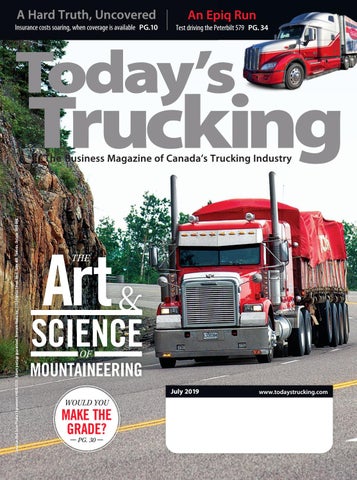
A Hard Truth, Uncovered
An Epiq Run
Insurance costs soaring, when coverage is available PG.10
Test driving the Peterbilt 579 PG. 34
Canadian Mail Sales Product Agreement #40063170. Return postage guaranteed. Newcom Media Inc., 5353 Dundas Street West, Suite 400, Toronto, Ontario M9B 6H8.
The Business Magazine of Canada’s Trucking Industry
Art & THE
SCIENCE OF
MOUNTAINEERING
July 2019
WOULD YOU
MAKE THE GRADE? — PG. 30 —
www.todaystrucking.com
leads the way Great isn’t simply a promise, it’s our purpose. It’s why we’re looking to the future, developing new technologies and focusing on our customers’ growing needs. It’s what makes us ready for the road ahead and why Great Doesn’t Stop. GreatDane.com
Great Dane and The Oval are registered trademarks of Great Dane LLC. 741 DMD 0319.
Contents July 2019 | VOLUME 33, NO.7
7 9 23 25
John G. Smith Rolf Lockwood Alan S. Cofman Mike McCarron
NEWS & NOTES
Dispatches
10
28
30
34
13 PIC’s Path Alberta’s Partners in Compliance looks for a path forward
17 18 19 20 21 22 23 46
Truck Sales Stat Pack Logbook
Features
Heard on the Street
10 A Hard Truth, Uncovered
Pulse Survey
Truck insurance prices are soaring, when coverage is available at all
Trending Legal Faces
In Gear
By John G. Smith
28 Drafting Debate Platooning trucks are possible, but will they deliver the benefits?
By John G. Smith
30 The Art and Science of Mountaineering You can drive down a mountain 100 times too slowly, but only once too fast
39 Pulling Wires Trailer electrical systems involve more than lights alone
44 Product Watch
By Jim Park
34 An Epiq Run Test driving Peterbilt’s Model 579, and trying to maintain 11 mpg
By Jim Park
For more visit www.todaystrucking.com JULY 2019
3
Never stop evolving. It’s time to future-proof your fleet. For more than 20 years, the companies of Trimble Transportation have been helping fleets across the country stay ahead of the technology curve. Now PeopleNet, 10-4 and TMW are evolving together under one purpose: To make the movement of freight and goods all throughout the supply chain safer and more efficient than ever before. Take it from all of our real customers. To maximize the performance of your business – you should never stop evolving. And with Trimble, you never will.
“We have to evolve to stay relevant. Our customers demand it. And Trimble gives us that kind of leverage.” - Shaun Mains Sunrise Logistics
See how we are helping our customers evolve at transportation.trimble.com/evolve.
Letters The Business Magazine of Canada’s Trucking Industry
PUBLISHER Lou Smyrlis lou@newcom.ca • 416/510-6881 VICE PRESIDENT, EDITORIAL Rolf Lockwood, MCILT rolf@newcom.ca • 416/614-5825 EDITORIAL DIRECTOR, TRUCKING AND SUPPLY CHAIN John G. Smith johng@newcom.ca • 416/614-5812 CONTRIBUTORS: Steve Bouchard, Alan S. Cofman, Derek Clouthier, Mike McCarron, Jim Park, Sonia Straface, John Tenpenny DESIGN / LAYOUT Tim Norton, Frank Scatozza production@todaystrucking.com • 416/614-5818 SALES AND MARKETING CONSULTANT Anthony Buttino anthonyb@newcom.ca • 514/292-2297 SALES AND MARKETING CONSULTANT Nickisha Rashid nickisha@newcom.ca • 416/614-5824 QUÉBEC ACCOUNTS MANAGER Denis Arsenault denis@newcom.ca • 514/947-7228 CIRCULATION MANAGER Pat Glionna 416/614-2200 • 416/614-8861 (fax) PRODUCTION MANAGER Alicia Lerma alicia@newcom.ca • 416/510-6845
Kenneth R. Wilson Award Winner
MEDIA INC.
5353 Dundas Street West, Suite 400, Toronto, Ontario M9B 6H8 416/614-2200 • 416/614-8861 (fax) CHAIRMAN AND FOUNDER Jim Glionna PRESIDENT Joe Glionna VICE PRESIDENT, PUBLISHING Melissa Summerfield CHIEF FINANCIAL OFFICER Peter Fryters DIRECTOR OF CIRCULATION Pat Glionna
Today’s Trucking is published monthly by NEWCOM MEDIA INC., 5353 Dundas Street West, Suite 400, Toronto, Ontario M9B 6H8. It is produced expressly for owners and/or operators of one or more straight trucks or tractor-trailers with gross weights of at least 19,500 pounds, and for truck/trailer dealers and heavy-duty parts distributors. Subscriptions are free to those who meet the criteria. For others: single-copy price: $5 plus applicable taxes; one-year subscription: $50 plus applicable taxes; one-year subscription in U.S: $90 US; one-year subscription foreign: $180 US. Copyright 2019. All rights reserved. Contents may not be reproduced by any means, in whole or in part, without prior written consent of the publisher. The advertiser agrees to protect the publisher against legal action based upon libelous or inaccurate statements, unauthorized use of photographs, or other material in connection with advertisements placed in Today’s Trucking. The publisher reserves the right to refuse advertising that in his opinion is misleading or in poor taste. Postmaster: Address changes to Today’s Trucking, 5353 Dundas Street West, Suite 400, Toronto, Ont., M9B 6H8. Postage paid Canadian Publications Mail Sales Agreement No.40063170. ISSN No. 0837-1512. Printed in Canada.
Member
Ontario SPIF regs will sideline older trucks Many people may not be aware of this, but those running trucks manufactured before July 1, 2011 may be on the chopping block when it comes to hauling 53-foot trailers as of January 2021. Your truck will only meet SPIF (Safe, Productive, Infrastructure-Friendly weights and dimensions) criteria if it is less than 15 years old. This will be devastating for many independent owner-operators like myself who prefer the older trucks for their simplicity, durability and sustainability. I have been working on a 1978 Kenworth W900A for more than seven years only to find out that, when ready, it will be limited to 48-foot trailers with the current 244-inch wheelbase. As I drive down Highway 401, I would estimate three out of 10 trucks are older than 2011 models. The extreme option is to leave the country, and move to a U.S. state like Texas, where having a nice truck and working hard is actually a good thing. Imposing regulations like SPIF forces small businesses out so the larger firms gain more market share. — Jaspal Singh By email
Local access regs are too restrictive Well, it’s another day here behind the wheel, another day of disregard for truckers. It seems that so many towns and municipalities are not accepting the fact that truckers are people, too. There are barriers put in place to stop us from access to facilities, washrooms, or a coffee. If I can’t stop somewhere in my work vehicle to spend my cash, then why would I want to stop there when I’m on holidays? Yes, I do get frustrated with the way that we are viewed. Thirty-five years driving, and like Rodney Dangerfield said, I/we can’t get no respect. Electronic logging devices (ELDs) are coming, but the trucker-friendly facilities are nowhere in sight. — BF Johnson By email
Email: johng@newcom.ca
SEND YOUR LETTERS TO: Newcom Media Inc., 5353 Dundas Street West, Suite 400, Toronto, Ontario M9B 6H8
Top 100 list missed Shandex Can you please put us on the list for next year? In reviewing the numbers, we would have placed 95th this year. We have 66 tractors, 301 trailers, five owneroperators, and 92 employees. We do full truckload,, LTL, dedicated contract work, temperaturecontrolled freight, and offer warehousing. — Bill Shannon Director of Transportation Shandex Truck, Pickering, Ont. ED: You’re absolutely right, Bill. Thanks for letting us know. If we missed any other qualifying fleets, we hope they will contact us as well. JULY 2019
5
Spec Your Trailer With the DEFENDER Harness and LED Lighting System. Stay lit and stay on the road with the only harness and LED lighting system guaranteed* for 10 years against corrosion. With heavyduty terminals, integrated moisture barrier, advanced silicone seals, modular design, and a patented hard-shell J560 connector — DEFENDER stops corrosion before it starts. When you need to deliver, drive with DEFENDER.
816-765-2000 • www.pmlights.com
Exclusive advances in modular harness technology make DEFENDER ® virtually impervious to moisture and corrosion.
Scan for DEFENDER ® Demo Video
*See dealer for details.
Editorial By John G. Smith
The Clock is Ticking Canada’s ELD mandate is now on the way. It’s time to put the paper logbooks behind you.
E
veryone knew that Canada was preparing to mandate electronic logging devices (ELDs). It was only a matter of time before the rules took hold. Now we have a timeline. Last month, just as this magazine was heading to press, Transport Canada announced that it will mandate ELDs by June 2021 – largely mirroring rules the U.S. has had in place since December 2017 and enforced since April 2018. But there will be differences in the rules on each side of the border. While the U.S. is allowing pre-existing automatic onboard recording devices (AOBRDs) until December 2019, there will be no such grandfather clause in Canada. Every ELD sold in Canada will also need to be certified by an independent third party, although the specific technical standards and testing regime have yet to be unveiled. South of the border, it’s up to device suppliers to confirm whether their systems comply with the 460-page technical standard published by the U.S. Federal Motor Carrier Safety Administration (FMCSA). But some of the equipment that emerged under the looser regulatory environment has been prone to tampering. Depending on the device, for example, some drivers have actually been able to edit their driving time. While Transport Canada’s announcement applies only to federally regulated carriers, the Canadian Council of Transportation Ministers and First Ministers has already committed to rolling out the regulations at a provincial and territorial level as well. Nobody should be caught completely off guard by these rules. The draft text was first unveiled in Canada Gazette Part 1 as early as December 2017. In fact, Canada has been working on the underlying technical standards for years, even before the U.S. announced its own mandate. But for those who have been sticking with paper logs, now is the time to begin choosing, installing, and introducing ELDs.
There is an undeniable learning curve, particularly when it comes to preparing customers for the new operating realities. The hours of service rules established in 2005 remain unchanged, but an ELD places an unwavering focus on any equipment moves that take place outside allowable duty cycles. There is no room to absorb unusually long dwell times at a loading dock; no more turning a blind eye to various delays and fudging the lines in a logbook to make things work. “As we learned from the previous era of paper logbooks, the non-compliant segment of our industry – while a minority – have a history of finding workarounds of the rules,” added Canadian Trucking Alliance president Stephen Laskowski. “We must ensure that there are no gaps or opportunities to manipulate the technology, and that compliance is the only option.” With ELDs on their way, however, it’s also time for industry lobby groups to join forces and call on governments to review the hours of service rules themselves. Rigid rules and inflexible technologies can be a troublesome mix. Look no further than the U.S. experience for proof of that. Look for the August edition of Today’s Trucking for a full report on Canada’s march toward ELDs. TT
“Last month, just as this magazine was heading to press, Transport Canada announced rules that will mandate ELDs by June 2021.”
John G. Smith is the editorial director of Today’s Trucking. You can reach him at 416-614-5812 or johng@newcom.ca.
JULY 2019
7
It’s more than a trailer. It’s an East.
With East, you get more than a flatbed trailer. You get the ideal balance of lighter weight and strength for more payload and maximum life. Because we use proven, longlasting components, our flatbed trailers not only perform well but require less maintenance and minimize operating expenses when compared to competitive brands. Whether it’s our MMX, our BST or the BST II, our aluminum flatbed trailers have some of the highest resale value in the industry. You’ll get more than a trailer with East.
EastMfg.com • 888-405-3278
Lockwood By Rolf Lockwood
Renewable Interest Renewable natural gas – biomethane – seems like a tidy solution to me
C
limate change deniers, anti-vaxxers, that whole crowd of people who deny science and distrust intellectuals in general are, well, kinda nuts. We’re suddenly in a world where “inconvenient truths” are labeled “fake news” and thus dismissed. It’s stupid, indeed insufferable. One of my daughters, the night before I’m writing this in midJune, had to be pulled by her friend from a party for fear of an argument turning into fisticuffs. Literally. She was arguing with a 60-something woman who claimed, among other truly bizarre notions, that climate change is in fact a fraud perpetrated by Muslims aiming to disrupt western democracies. I kid you not. Didn’t know we had bona fide crackers in Toronto, did ya? Maybe you did, and maybe I shouldn’t be so naïve. People like that woman can vote, sad to say, and worse yet, they reproduce. So I fear for my girls’ futures, and especially for my new granddaughter. What sort of world will they be living in 10 or 20 or 30 years from now? I don’t think it’s a pretty picture. All of which is a rather emotional preface to chatting about renewable fuels to make our trucks roll down our highways without contributing emissions that do us harm. I believe that we need to double our efforts to get off the diesel train as soon as we can. I believe that climate change is real, and dangerous. Don’t get me wrong. I love diesel, even love the smell, and I expect it will power most of our longhaul trucks – and a lot of short-haulers, too – for quite a while to come. It is, after all, a mighty efficient fuel, and it’s almost infinitely cleaner now than it was just 10 years ago. But it’s still a fossil fuel. And don’t forget that we have to import most of it, despite our own reserves. For a while it was thought that natural gas was something of a saviour, being plentiful and relatively cheap. But it’s a fossil fuel as well, and doesn’t pack as much energy punch as the equivalent amount of diesel. Infrastructure is an issue, but not an impossible one. I believe there’s some doubt about its cold-weather performance, plus the extraction process gets no love, and probably shouldn’t. Not surprisingly, natural gas truck sales have trailed off in the last couple of years.
What could revive them is renewable natural gas, RNG for short. Also known as biomethane, it differs from traditional sources of natural gas because it’s derived from renewable sources such as decomposing organic waste in landfills, wastewater treatment, and agriculture. It’s then distributed through the natural gas pipeline and made available as either liquefied natural gas or compressed natural gas. RNG is completely interchangeable with conventional natural gas. It’s a sustainable, drop-in fuel that can replace, or blend with, natural gas. Think about that. An environmentally supportable fuel that can be home-grown at your local landfill. It can even be a circular solution, as it is for some refuse haulers. Republic Waste has several operations in which material brought to a landfill is processed as methane to fuel the very trucks doing the carriage. Neat and very tidy. RNG production in North America more than doubled between 2015 and 2018, and that growth is now being helped by United Parcel Service. The giant courier outfit just dramatically increased its commitment to RNG by contracting with Clean Energy Fuels for 170 million diesel-gallon equivalents (DGEs) of Redeem RNG through 2026. It’s the largest such deal ever. This woudn’t work for everyone, but until we see batteries or fuel cells that can affordably power our longhaul machinery – and that’s not going to be soon – RNG strikes me as the most useful alternative to diesel out there. Let the deniers think what they may. TT
“Think about that. An environmentally supportable fuel that can be home-grown at your local landfill.”
Rolf Lockwood is vice-president, editorial, at Newcom Media Inc. You can reach him at 416-614-5825 or rolf@todaystrucking.com. JULY 2019
9
A Hard Truth, Uncovered Truck insurance prices are soaring, when coverage is available at all By John G. Smith Many Toronto-area aggregate haulers are angry, and there’s no mistaking the target of their wrath. A recent protest in the form of a slow-moving truck convoy included signs that proclaimed “commercial insurance sucks,” and “honk if you hate your truck insurance.” They’re among the growing list of Canadian fleets and owner-operators facing higher premiums as insurers re-evaluate the risks they’re willing to cover. And that’s when businesses can even find someone to take their money. Some insurance companies are simply stepping away from industry sectors thought to represent an unacceptable risk – like the aggregate haulers operating in densely populated urban areas. Jagroop Singh, an owneroperator and president of the protesting Ontario Aggregate Trucking Association (OATA), confirms his members’ typical
10
TODAY’S TRUCKING
insurance rates have increased by double digits in recent years. It’s why the group is now looking for a political solution, and formed the convoy to apply some public pressure. But the insurance sector is under pressure of its own. The performance of transportation-related insurance portfolios has been “less
Toronto-area aggregate haulers took to the streets on May 1 to protest higher insurance premiums. (Photo: OATA)
than stellar,” says Todd MacGillivray, vice-president of transportation at Northbridge Insurance. “The performance of aggregate haulers has been worse.” Some of that sector’s challenges can be linked to a condo building boom, leading to frequent trips along city streets where trucks are more likely to interact with cyclists
PIC’s Path PG. 13
Executive Insights PG. 14
The Drive to Clean PG. 15
and pedestrians, he says. Trucking-related insurance claims have generally been rising above original projections because of factors such as pricey legal settlements and technology-laden trucks that can be costly to repair. Average claims in Northbridge’s transportation portfolio increased 9% between 2014 and 2018, while average physical damage costs were up 28.5%. To compound matters, rates that were charged to aggregate haulers were lower than they should have been, MacGillivray adds. Challenges are not limited to the aggregate haulers, either. “Anything that’s basically weird and wonderful is difficult to insure,” says Patti Corbishley, senior account transportation executive and project manager with Bryson and Associates Insurance Brokers in Ajax, Ont. Such examples tend to fall outside the realm of 53-foot van trailers and include the likes of livestock trailers, auto haulers, and fuel haulers. Even the commercial haulers of travel trailers can find it harder to secure coverage these days. “This is the hardest market that I’ve seen in 33 years,” she says of her time in the business.
But history has a way of repeating itself. The ebb and flow of insurance rates tends to follow a cycle of aggressive rate cuts by insurers who want a piece of trucking-related revenue, an unexpected surge in claims, decisions to step away from unprofitable businesses, and the higher rates charged by those who remain. One of the most notable examples came with 1985’s abrupt collapse of the United Canadian Insurance Company, which at the time was one of the trucking industry’s largest insurers.
Three years’ experience As the market tightens, insurers are also taking a harder line on the rules established to minimize risk. For smaller operations, this can mean limits on things like hiring new drivers with less than three years’ experience. That was an unwelcome surprise for Peter LaRocque of JPL Storage in Haileybury, Ont. His 29-year-old son, Clyde Earl, is training to take over the family’s portable storage operation that uses a pair of tractor-trailers to deliver containers to driveways and construction sites. The family invested $8,000 in a 200-hour truck driver
Clyde Earl earned his AZ licence to support the family business. But Peter LaRocque of JPL Storage in Haileybury, Ont. says insurance is effectively unavailable for new drivers working for small businesses.
training course, well beyond Ontario’s mandatory minimum, and Earl secured both an 89% average grade and a Class AZ licence. They even secured a $6,000 tax credit to offset the cost. The only trouble is that Earl is essentially uninsurable if he wants to drive one of JPL’s trucks. “We’re now up to 12 companies that have declined to insure him,” says a clearly frustrated LaRoque. Each company has said the only option is Facility – essentially
an insurer of last resort funded by the insurance industry itself. Insurance on both JPL tractors and a pickup is scheduled to renew for around $7,500. Allowing Earl behind the wheel of a 2010 International would cost about $20,000 under a Facility policy, and even that would only allow less than 80 km of travel per month. It won’t even cover the container, trailer or load. Full coverage would push annual premiums above $30,000. Traditional insurance would
JULY 2019
11
Dispatches
Ă€ÂœÂ“ `Ă€ÂˆĂ›iĂ€Ăƒ ĂŒÂœ ĂŒÂ…i L>VÂŽ ÂœvwVi >˜` iĂ›iĂ€ĂžĂŒÂ…ÂˆÂ˜} ˆ˜ LiĂŒĂœii˜] ĂƒÂˆÂ“ÂŤÂ?ˆvĂž] Ă•Â˜ÂˆvĂž >˜` >“Â?ˆvĂž ĂžÂœĂ•Ă€ iÂ˜ĂŒÂˆĂ€i ĂƒĂ•ÂŤÂŤÂ?Ăž VÂ…>ˆ˜ iVÂœĂƒĂžĂƒĂŒi“ ĂœÂˆĂŒÂ… ĂŒÂ…i ÂŤÂœĂœiĂ€vĂ•Â? ÂˆÂ˜Â˜ÂœĂ›>ĂŒÂˆÂœÂ˜Ăƒ Âœv "Â“Â˜ÂˆĂŒĂ€>VĂƒ "˜i°
Simplify.
Unify.
Amplify.
Platform Evolved.
Ă?ÂŤiĂ€Âˆi˜Vi ˜iĂ?ĂŒÂ‡}i˜ Â?iĂ›iÂ?Ăƒ Âœv ĂƒiVĂ•Ă€ÂˆĂŒĂž] Ă€iÂ?ˆ>LˆÂ?ÂˆĂŒĂž >˜` ĂƒV>Â?>LˆÂ?ÂˆĂŒĂž ĂœÂˆĂŒÂ… > Ă€iĂ›ÂœÂ?Ă•ĂŒÂˆÂœÂ˜>ÀÞ VÂ?ÂœĂ•`‡L>Ăƒi` ĂƒÂœÂ?Ă•ĂŒÂˆÂœÂ˜ ĂŒÂœ }ÂˆĂ›i ĂžÂœĂ•Ă€ yiiĂŒ “>˜>}i“iÂ˜ĂŒ ĂŒiV…˜œÂ?Âœ}Ăž > VÂœÂ“ÂŤiĂŒÂˆĂŒÂˆĂ›i >`Ă›>Â˜ĂŒ>}i°
(QT OQTG KPHQ XKUKV QOPKVTCEU EQO QT ECNN 12
TODAY’S TRUCKING
be limited to larger businesses that might be willing to hire him. There is simply more support for younger drivers in a fleet environment, Corbishley says, explaining why larger fleets might have more flexibility than an owner-operator or small business. “You typically have a safety manager on board. It’s not just an owner wearing five or six different hats.â€? “Why did I pay to train him so he can work for someone else?â€? Laroque asks. “We need him in our business. We need him to be able to drive the trucks.â€? He’s particularly frustrated at the limits now that Ontario has established mandatory entry-level training for any would-be truck drivers. What’s the point of setting the limits at 103.5 hours if the new drivers can’t be insured by small businesses that have jobs to fill? “Somebody needs to step up to the plate and change the regulations so that some of these new trainees with the proper training or whatever can become insured,â€? he says. There’s no mistaking the higher risks that come with newly minted drivers, however. “The propensity for a claim is drastically higher than it is with someone who has three years’ or five years’ experience,â€? says Northbridge’s MacGillivray. “The bell curve is quite steep in those early stages ‌ it’s quite substantial.â€? Winnipeg-based Rick Geller of Claims Pro says the three-year benchmark was originally established in the 1990s, when he was on the North American Equipment Dealers Association’s insurance committee. Actuaries poured over 115,000 commercial driving records at the time, looking to the likelihood of crashes within a year. They found that drivers with less than three years of experience were three times more likely to have a crash, he says. “But it was never, ever intended to be a laser pointer as to whether that’s a safe driver or not. It was to be a best practice guideline,â€? Geller says. “You need to do a deeper dive on exactly who you’re hiring, and maybe a little more stringent road test, and maybe some sort of training – defensive driving training – before you hire them.â€? — Peter LaRocque, JPL Storage That’s why larger fleets are able to hire those with less time behind the wheel. “It’s no secret that the results on the trucking industry in terms of insurance haven’t been good, and they haven’t been good for awhile, and the insurance companies are struggling to find that laser pointer in terms of is this a safe carrier or not,â€? Geller says. “I think there’s an element of the normal cycle that the insurance industry goes through, but I think there’s a larger element – that this becomes a matter of survival for the insurance industry. And I don’t think you’re going to see a relaxing any time soon.â€? Says Corbishley: “Insurance is all about money. It’s money in and money out ... you need them to make money to be there.â€? TT
“Somebody needs to step up to the plate and change the regulations so that some of these new trainees with the proper training or whatever can become insured.�
Dispatches
PIC’s Path Alberta’s Partners in Compliance (PIC) safety program looks for a path forward By Derek Clouthier Alberta’s Partners in Compliance (PIC) program appears to be at a crossroads. With funding becoming more of a concern, and the program’s overall direction uncertain, there is plenty of work to be done if PIC is going to grow and have a meaningful impact on the industry as a whole. Since the Alberta Motor Transport Association (AMTA) introduced the program, it has given members a path to achieve the highest safety standards in Alberta, arguably the highest standards in the country, as well as a tool that lets customers and carriers know about these achievements. Carriers display their PIC memberships like a badge of honor along with a program-related licence plate. Benefits of the program include weigh scale bypass opportunities, using Drivewyze apps that are recognized at 25 fixed and 31 mobile weigh station locations across the province. PIC members also get an Alberta Safety Fitness rating of "excellent", free vehicle inspection licence applications, and several other perks, not the least of which being the knowledge and pride that they are operating as safely as possible. Despite everything PIC offers, concerns remain as to whether it makes sound business sense to be part of the program. Bob Hill, owner of Hill Bros. Expressways, is a long-time PIC member, and though he has kept in good standing with the program, he sometimes questions its purpose. “I always hoped that maybe the industry and shippers would recognize the safer companies for their safety records,” Hill said. “What I found was that to be a PIC carrier costs money and a lot of hard work, which increased our rate and left us with no way to compete with the non-PIC carriers.”
As noble as PIC’s goals are, cost will often dictate a customers’ decision on which carrier to hire for a job. Hill does not shy away from saying, “there is no benefit to Hill Bros. being a PIC carrier.” During the PIC annual general meeting in April, AMTA president Chris Nash said the program has been at a “slow boil” over the past year due to the
Carriers display their PIC membership like a badge of honor along with a programrelated licence plate.
extreme highs and lows the industry faced, the most prominent of which was the Humboldt Broncos tragedy. An Alberta-based carrier and truck driver were involved in that fatal crash. With PIC being overshadowed by these events, Nash said it is now time to “make the move forward” and determine where the program will go in coming years. A central focus of the AMTA when it
comes to PIC is how the program can stretch beyond its current membership base – which constitutes 66 carriers out of approximately 25,000 that operate in Alberta – and impact the broader industry. To have this kind of influence, PIC needs to have its finances in order, too. Acting PIC director Andrew Barnes said the program is in good standing and does not need any funding at this time. There are even discussions about cutting PIC's funding committee, reducing oversight to an executive committee, advisory council, and a handful of ad hoc working groups. For this and other reasons, many PIC members feel the program has become a “bare-bones operation” – something disheartening considering its high safety standards and achievements. Alberta’s past NDP government cut all PIC funding, and as Hill described it, put the program “on life-support.” In addition to suggesting the government use trucking-related fines and penalties to help fund PIC, Hill feels more needs to be done to prove the program’s worth. Allowing only PIC carriers to haul dangerous goods, alcohol, and longcombination vehicles – and reducing licensing fees for PIC members and increasing them for poor performers – are a few he has proposed. “If consideration is not given to these items it will be clear there is no desire to have an impact on the industry, and the program will not make it past the next two years, let alone 10 years,” said Hill. Since the end of 2017, when funding was cut by the government, keeping the PIC program afloat has primarily been up to the AMTA, in addition to membership fees. The association contributes around $453,000 annually to keep PIC running. But there is a projected shortfall in PIC’s finances of nearly $85,000 for 2019. Barnes believes the program’s reserve funds should last about three years, and that there is no better time than the present for PIC to explore additional ways it can affect the industry as a whole. TT JULY 2019
13
Dispatches
Executive Insights Fleet leaders cite labor shortage as top concern, want uniform enforcement on existing regulations By John G. Smith Senior Canadian fleet executives have overwhelmingly identified a labor shortage as the trucking industry’s top concern – and they see higher wages, better working conditions, and immigration as solutions. The findings emerge through a Nanos Research report that was based on an extensive survey of 32 executives through the Canadian Trucking Alliance (CTA). “Participants most frequently proposed wage increases and better working conditions as solutions to the labor shortage,” says the draft report, obtained by Today’s Trucking. “They noted that it should be ensured that drivers get more respect, and that the industry adapts to the expectations of younger workers, such as better work-life balance.” “The average age in the industry is probably over 50 years old. It’s harder to find drivers under 30 who want to do the job,” said one respondent. The driver shortage is expected to lead to a greater reliance on “relay” drivers for longhaul routes, as well as increased immigration, the executives said. Better infrastructure to support longhaul drivers, and more efficient client interactions, were other steps the executives said could make a difference. The driver shortage has come at a cost in the form of lost business opportunities. But the executives also saw benefits in the related capacity crunch. “Although the driver shortage is an issue for service provision mentioned by many, they also noted that it results in a capacity crunch, which drives up rates and favors carriers,” the report says.
A positive economic outlook In general, the executives had a positive economic outlook, expecting that tight capacities could drive rates higher, offsetting some of the rising costs and potential economic slowdowns in the near term.
14
TODAY’S TRUCKING
Most approved of recent regulatory efforts focusing on mandatory entrylevel training (MELT), electronic logging devices (ELDs), hours of service, and a foreign worker program. But ELDs and MELT were also seen as factors that could intensify the driver shortage. The surveyed executives said they would like to see greater enforcement of taxation-related regulations and hours of service. The Canadian Trucking Alliance has recently sounded the alarm about fleets that misclassify drivers as independent contractors to bypass source deductions in a process that has become known as Driver Inc. “When people start abiding by the rules, it will strengthen the industry because it undercuts the rates and hurts the industry as a whole,” one respondent said. Safety, training and environmental regulatory changes were all cited as factors that would drive non-compliant and smaller companies out of trucking altogether.
Electronic logging devices were unanimously supported because they were seen as a way to level the playing field and improve safety. Most of the fleets already use ELDs, and the federal government recently announced plans to mandate the devices by June 2021. Looking 10 years into the future, many of those who were surveyed expected changes such as new driver-assisting technologies and a move toward autonomous trucks, although drivers are still largely expected to have a role to play. “If we automate more things, we will be able to stay more competitive. Right now, it’s a people-driven industry. Prices are going up and the only gains we can make are through technology,” one respondent said. A shift to alternative fuel sources such as electric drivetrains, as well as technologies to support logistics activities, were also identified as changes to come. The survey included 32 businesses, which collectively operated 12,057 trucks and employed more than 20,522 full and part-time drivers in 2018. They transported more than 8 million loads during the year. This is the first wave in a three-year intelligence gathering project involving the Canadian Trucking Alliance and Nanos Research. TT
Aggregate Participant Profile 32 organizations participated in the research
Over 8,071,000 loads carried in 2018
Over 12,057 trucks operated in 2018
Over 31,528
Over 20,522
full- and part- time employees in 2018
full- and part- time drivers in 2018
Source: Canadian Trucking Alliance
Dispatches NEWS BRIEFS
TFI International closing Highland
DynaCERT chief engineer Robert Maier explains his company’s HydraGEN system to Ontario Transport Minister Jeff Yurek (center) and Environment Minister Rod Phillips. (Photo: John G. Smith)
The Drive to Clean Ontario has ended emissions tests for cars, but a new system for trucks is still in the works Ontario continues to rework its emissions testing program for heavyduty vehicles following a decision to cancel Drive Clean tests on light-duty models. The light-duty tests came to an end April 1, as the provincial government cited broad improvements in emissions controls. Just 5% of passenger cars failed the tests in 2017, compared to the 16% that failed when the program was introduced in 1999. Regulators stressed that heavy-duty diesel vehicles have not fared as well because mandatory standards have not been as stringent. It's why trucks at least seven years old, and with gross weights above 4,500 kg (9,900 lb.), are still required to pass annual Drive Clean emissions tests before registrations are renewed. But this testing regime is set to change. “In the near future we’ll be starting to roll out both the increased inspection – which will incorporate Ministry of Transportation as well as Ministry of Environment – and then working with the industry as well as with other stake-
holders around what the standards will be,” Environment Minister Rod Phillips told Today’s Trucking, citing work with the Ontario Trucking Association. “Our plan is again to try to get out of the way of the kind of duplication and look at all the inspections that are happening, and all the inspections that the trucking industry is required to look at,” he said. “How can we do more of the kind of work we want to do – which is to make sure we’re getting the inspections done – and increasing significantly the number of inspections without adding an additional burden in terms of time.” Phillips made the comments following a tour of DynaCERT, a Toronto-based manufacturer that’s producing a system which injects hydrogen into engine air intakes in the name of enhancing combustion. “This is the kind of company, the kind of technology we are hoping to inspire,” Phillips said, referring to his government’s environment strategy. “We just have a lot of confidence in the entrepreneurial spirit of companies like this one.” TT
TFI International is closing its Highland Transport truckload and intermodal operation, effective June 28. Drivers received news of the closure through a satellite message from Terry Gardiner, vice-president of operations, which was shown to Today's Trucking. The notice was in stark contrast to a message sent out on May 10, which said the Highland, Roadfast, and Laidlaw fleets were going to merge. All three are operated by TFI International. “It was not an abrupt closure. It’s been in the works for a while. We’ve been working with drivers and salaried staff. We have been working with the white collar workers, the blue collar workers, and the owner-operators and offering as many as possible continued employment with other TFI divisions,” said Brent Neill, vice-president of human resources for TFI International in Ontario. “I’m feeling pretty confident the majority of people will be relocated [within TFI].”
Manitoulin purchases Trident Freight Manitoulin Transport has purchased Trident Freight Logistics, marking its first logistics-related acquisition in B.C. Trident focuses on the mining, heavy machinery, steel and pipe, and railroad industries. It also has a significant presence in over-dimensional and temperature-controlled work, Manitoulin says. Trident will continue to operate under its existing name.
H&R merges with iHaul, sheds intermodal biz Alberta’s H&R Transport and B.C.’s iHaul Freight have merged to create iHaul Freight Systems. The combined entity will run more than 170 highway tractors and employ over 185 people once the agreement is finalized. “This merger and partnership will JULY 2019
15
Dispatches > NEWS BRIEFS create one of the largest operating carriers in Western Canada and will allow us to seamlessly service our customers all over North America,” said iHaul general manager Tri Quach. iHaul will manage operations out of Alberta and B.C. In a separate deal, CN has acquired H&R Transport’s intermodal division. H&R Transport was established in
1955 in Lethbridge, Alta., and has been run by the Foder family over the last 60 years.
Challenger opens training academy Challenger Motor Freight will train a new generation of drivers through a newly
established Challenger Transportation Training Academy (CTTA). Approved by the Ontario Ministry of Training, Colleges and Universities (MTCU) as a registered private career college, the school will be based out of Cambridge, Ont. The new academy was launched through a partnership with KRTS Transportation Specialists.
Ocean Trailer finishes renovations
Career Opportunities in Trucking and Logistics in store for you REGISTRATION IS NOW OPEN Saturday, September 14, 2019 • 11 AM – 5 PM International Centre | Conference Centre | 6900 Airport Rd, Mississauga, ON
GET YOUR RESUME READY! Professional drivers, mechanics, warehouse staff, office staff and more
Event Sponsors
FREE ENTRY • FREE PARKING
www.rttnexpo.com To exhibit, contact Kathy Koras kathy@newcom.ca or Manan Gupta manan@newcom.ca
16
TODAY’S TRUCKING
Ocean Trailer has finished renovations at its Winnipeg location. The facility now boasts 14 service bays, tire service, two 24-hour mobile repair trucks, pickup-and-delivery service, and a full-service wash bay. It also offers 80 truck parking spots, and a fleet of more than 820 rental trailers. It’s located at 415 Lucas Ave.
Carbon tax funds to come for trucking Revenue from the national carbon pricing system – sometimes referred to as the carbon tax – will be available to support fleets that invest in environmentally friendly trucking technologies, the Canadian Trucking Alliance (CTA) reports. Technologies to be included in the program, and related funding amounts, have yet to be set. The CTA had asked for carbon pricing funds during consultations before the release of the 2019 budget this spring. “From the beginning of the carbon tax discussions, CTA consistently stated any mechanism used to collect revenue under the carbon pricing system must make sense for the industry,” said CTA chairman Scott Smith. “By investing a portion of the revenues generated from the carbon pricing system in a way that encourages market penetration of carbon-reducing technologies for diesel trucks, the Government of Canada has achieved an environmental policy that assists businesses of all sizes in purchasing clean energy technology while also supporting our collective goal to reduce carbon emissions.”
Dispatches
Orders continue slide, but sales strong Retail truck sales remain strong, but the orders that secure spots on assembly lines are still down considerably from last year. Class 8 truck orders hit a 31-month low in April, reaching 14,800 units for North America – a 6.2% decline compared to March, but down 57% compared to April 2018, ACT Research reports. ACT president and senior analyst Kenny Vieth says the drop can largely be linked to a backlog of orders that have yet to translate into manufactured vehicles. “Of course, contracting freight volumes, falling freight rates, and strong Class 8 capacity additions suggest that the supply-demand balance will become an issue later this year,” he said. When it came to Canada’s retail sales this April, Freightliner led the way with 964 units, WardsAuto reports. International held the top spot in Class 7 with 286 units. Freightliner had the top position in Class 6 with 57 trucks, while Ford accounted for 391 Class 5 trucks.
Canada – April 2019 SALES CLASS 8
U.S. – April 2019
MARKET SHARES
SALES
April
YTD
April %
YTD %
CLASS 8
Freightliner Kenworth Volvo Truck International Peterbilt Western Star Mack Other Total CLASS 7
964 545 539 393 358 213 177 0 3,189 April
3,442 1,651 1,594 1,422 1,101 813 571 0 10,594 YTD
30.2 17.1 16.9 12.3 11.2 6.7 5.6 0.0 100.0 April %
32.5 15.6 15.0 13.4 10.4 7.7 5.4 0.0 100.0 YTD %
International Peterbilt Freightliner Hino Kenworth Ford Total CLASS 6
286 213 87 120 58 5 769 April
922 642 463 377 162 26 2,592 YTD
37.2 27.7 11.3 15.6 7.5 0.7 100.0 April %
Freightliner Hino International Ford Isuzu Kenworth GM Peterbilt Total CLASS 5
57 44 30 9 3 2 0 0 145 April
207 192 130 25 11 8 0 0 573 YTD
391 206 120 129 6 1 0 0 0 0 853
1,098 545 340 320 7 1 0 0 0 0 2,311
Ford Hino Isuzu Dodge/Ram Freightliner International Mitsubishi Fuso GM Kenworth Peterbilt Total
Source: WardsAuto
www.total-canada.ca
MARKET SHARES
April
YTD
April %
YTD %
Freightliner International Peterbilt Kenworth Volvo Truck Mack Western Star Other Total CLASS 7
8,209 3,537 3,842 3,755 2,199 1,924 558 0 24,024 April
33,795 12,902 12,743 11,955 7,943 5,729 1,841 0 86,908 YTD
34.2 14.7 16.0 15.6 9.2 8.0 2.3 0.0 100.0 April %
38.9 14.8 14.7 13.8 9.1 6.6 2.1 0.0 100.0 YTD %
35.6 24.8 17.9 14.5 6.3 1.0 100.0 YTD %
Freightliner International Peterbilt Kenworth Ford Hino Total CLASS 6
2,769 1,220 681 546 145 144 5,505 April
9,691 4,929 2,334 1,649 1,007 643 20,253 YTD
50.3 22.2 12.4 9.9 2.6 2.6 100.0 April %
47.8 24.3 11.5 8.1 5.0 3.2 100.0 YTD %
39.3 30.3 20.7 6.2 2.1 1.4 0.0 0.0 100.0 April %
36.1 33.5 22.7 4.4 1.9 1.4 0.0 0.0 100.0 YTD %
International Freightliner Ford Hino Kenworth Isuzu Peterbilt GM Total CLASS 5
1,862 1,256 2,929 526 282 78 3 233 7,169 April
8,428 7,522 6,981 2,231 957 338 12 537 27,006 YTD
26.0 17.5 40.9 7.3 3.9 1.1 0.0 0.0 100.0 April %
31.2 27.9 25.8 8.3 3.5 1.3 0.0 0.0 100.0 YTD %
45.8 24.2 14.1 15.1 0.7 0.1 0.0 0.0 0.0 0.0 100.0
47.5 23.6 14.7 13.8 0.3 0.0 0.0 0.0 0.0 0.0 100.0
Ford Dodge/Ram Isuzu Freightliner Hino GM International Kenworth Peterbilt Mitsubishi Fuso Total
4,596 1,414 468 412 284 147 19 16 0 0 7,356
16,767 4,127 1,694 1,461 839 201 34 24 4 0 25,151
62.5 19.2 6.4 5.6 3.9 2.0 0.3 0.2 0.0 0.0 100.0
66.7 16.4 6.7 5.8 3.3 0.8 0.1 0.1 0.0 0.0 100.0
JULY 2019
17
Dispatches
StatPack
$175 million FOR AXLETECH Meritor is set to acquire AxleTech for $175 million in cash, subject to regulatory approvals. AxleTech’s offerings include a full product line of independent suspensions, axles, brakes and drivetrain components. It generated US $248 million in revenue during the 2018 calendar year.
100 years IN BUSINESS Parts for Trucks celebrated 100 years in
192 SEVERE INJURIES Ontario’s transportation and warehousing sector recorded 192 severe injuries in 2018, almost double the 98 seen in 2017, the Ontario Workplace Safety and Insurance Board (WSIB) reports. There were also 2,060 sprains, strains and tears compared to the 1,268 seen in 2017. Reported bruises and contusions totaled 433, up from 133, while 388 fractures outpaced the 191 reported the year before.
business this spring, and now counts itself as one of North America’s largest truck and trailer service providers and parts distributors. It has 19 warehouses, six service facilities, and three mounted-equipment shops. The Dartmouth-headquartered business pushed westward with the recent acquisition of Malmberg Truck Trailer Equipment, with locations in Ottawa and Gatineau, Que.
400,000 TRUCKS PRODUCED Daimler Trucks North America’s manufacturing facility in Daltillo, Mexico, recently celebrated is 10th anniversary – and the production of its 400,000th truck. The celebrated vehicle was a new Cascadia. The plant opened in 2009 following a US $300 million investment.
3.78 TRUCKS PER SPOT LOAD There was plenty of competition for spot loads this April. TransCore Link Logistics reported 3.78 trucks per load on its load board, up 36% over the 2.70 trucks per load seen in March. In April 2018, there were 1.32 trucks per load.
545 REASSIGNED BORDER OFFICERS About 545 U.S. Customs and Border Protection officers have been temporarily reassigned to process migrants, pulling resources from the Canada-U.S. border, the Canadian Trucking Alliance reports. The shift comes as the U.S. government looks to stem the flow of migrants crossing the border at Mexico.
18
TODAY’S TRUCKING
Dispatches
L gbook2019
22-25 Joint TAC-ITSC Conference and Exhibition Halifax, N.S. www.tac-atc.ca
22-26
SAVE THE DATE SATURDAY, SEPTEMBER 14, 2019
Commercial Vehicle Safety Alliance Annual Conference and Exhibition Biloxi, Miss. www.cvsa.org
30-Oct. 2 Canadian Transportation Equipment Association 56th Annual Manufacturers’ Conference Mont-Tremblant, Que. www.ctea.ca
FREE ENTRY | FREE PARKING International Centre | Conference Centre 6900 Airport Road, Mississauga, ON
WWW.RTTNEXPO.COM
JULY 12-14
SEPTEMBER 14 -19
519 Loud N’ Proud Truck Show and Shine Orangeville Fairgrounds Orangeville, Ont. www.519loudnproud.com
Technology and Maintenance Council Fall Meeting Raleigh Convention Center Raleigh, N.C. www.trucking.org
AUGUST 1-4 Rodeo du Camion Notre-Dame-du-Nord, Que. www.elrodeo.com
THE FLEET TECHNOLOGY SHOWCASE October 28-31, 2019 • Georgia World Congress Center, Atlanta, Georgia
OCTOBER 5-9 American Trucking Associations Management Conference and Exhibition San Diego Convention Center San Diego, Calif. www.trucking.org
16 Surface Transportation Summit Mississauga, Ont. www.surfacetransportationsummit.com KEEP YOUR FLEET IN
THE FAST LANE CAN’T-MISS NEW SHOW FEATURES
³ Connectivity Zone ³ ‘Ask the Expert’ Workshops 3 On-Floor Education Theaters ³ ³ Off-Floor Conference Programs
13-17 Commercial Vehicle Safety Alliance North American Inspectors Championship Pittsburgh, Pa. www.cvsa.org
REGISTER NOW with code
TODAY19
for your free expo hall pass!
Q The biggest class 4-8 vehicle manufacturers in one place Q 500+ exhibitors
22-24
Q 530,000 sq. ft. of exhibitors expanded to two halls
The Great American Trucking Show Dallas, Texas www.truckshow.com
Q Enhanced educational programming
nacvshow.com JULY 2019
19
Dispatches
Heard Street on the
Leanne Quail
Gerard Lecours of Guilbault Group accepts his Driver of the Year honors.
Quail named Recruiter of the Year Leanne Quail, the operations manager at Paul Quail Transport, was
Guilbault’s Lecours named Driver of the Year
named National Recruiter of the Year during the recent National Recruiting and Retention Symposium. The honor was based in part on her innovative approaches through a program known as Smart Start, which has helped successful job candidates obtain funding to earn an AZ licence and secure a job at the fleet. Quail also participates in the Private Motor Truck Council of Canada’s Young Leaders Group, the Fleet Safety Council, the Truck Training Schools Association of Ontario, and various community associations.
Gerard Lecours, a driver-instructor who has worked with Groupe Guilbault for 24 years, has been named the Volvo Trucks Quebec Driver of the Year. The honor was recognized during the 68th annual meeting of the Quebec Trucking Association. Lecours drives routes in Quebec, the Maritimes, and Ontario, and has traveled 4.6 million km without a collision. He has also participated twice in the provincial truck driving championships, and is one of the association’s Road Ambassadors.
Emily Poladian to lead Firestone Industrial Emily Poladian has been named president of Firestone Industrial Products (FSIP), moving up from a role as director of fleet sales – truck bus and retread tires. She succeeds Craig Schneider, who has been appointed president – diversified products for Bridgestone Americas. In the role she will manage more than 1,500 employees around the world.
Perlstein to lead Kinedyne sales, marketing Roger Perlstein is the new vice president – sales and marketing at Kindedyne, a maker of cargo control products. The 20-year veteran of sales and marketing has experience in the industrial, manufacturing and transportation sectors. In the new role he will oversee all of the company’s sales and marketing efforts in Canada and the U.S.
20
TODAY’S TRUCKING
Robin Kendrick
Kendrick to lead Accuride Robin Kendrick has been named president and CEO of Accuride, and will continue to hold a seat on the board of directors where he has served since March 2018. Before joining Accuride, Kendrick was president and general manager of BorgWarner’s Turbo Systems business. Jason Luo had served as interim president and CEO since January 2019, and now assumes the role of chairman of the board.
Dispatches
Pu se Reader Survey Tell us your thoughts on ... Insurance
Think of insurance like an umbrella. It’s meant to cover you when conditions are bad. Of course, some umbrellas cover you better than others. In this month’s Pulse Survey, we asked about your experience with truck insurance.
In the last 12 months, has your business had to submit an insurance claim?
For which of the following have you submitted an insurance claim in the last 12 months? 58% 39% 8% 5% 2%
YES
N/A – We’re self-insured
NO
33 % 61 %
6%
Have you ever declined work because of the related insurance costs?
3% 3% 1% 0%
Nothing Collision Cargo damage Cargo theft Spill or other environmental damage Employee injury Vehicle theft Facility damage (i.e. flooding, vandalism) Cyber attack
Has your insurance company identified strategies that would help to control or reduce insurance claims?
In the last 12 months, how have your insurance premiums changed? 28% 20% 13% 37% 2%
Have you ever changed your deductible limits to control the cost of insurance premiums?
YES
51
N° 100
IN SU RA NC
Increased more than 10% Increased 5-10% Increased up to 5% Stayed the same Decreased
NO %
49 %
E CL AI M
Have you ever changed a hiring decision because of the cost of insurance?
YES
18 %
NO
82 %
YES
48
NO %
52
YES %
Today’s Trucking Pulse surveys are conducted once per month, covering a variety of industry issues. To share your voice in future surveys, email johng@newcom.ca.
40 %
NO
60 %
Next month: ELDs JULY 2019
21
Dispatches
Trendingg on German highway to charge electric trucks Early efforts to electrify trucks have largely involved plugging into charging stations or filling fuel cells with hydrogen. But one initiative in Germany seems to have more in common with a street car, drawing energy from overhead wires. A new electrified eHighway for trucks, developed by German conglomerate Siemens, allows hybrid trucks to charge their batteries while traveling at speeds of up to 90 km/h. The hybrid truck’s electric drive is powered through an overhead line via a pantograph. While the overhead line (OH) truck is connected to the overhead line, it operates with its electric motor and simultaneously charges its battery. Drawing on the energy stored in the battery, the OH truck can continue operating electrically and emissions-free after leaving the overhead line on the highway. And in case the battery is nearly depleted, the truck can continue its journey using its diesel engine. It’s ultimately meant to support the goal of reducing greenhouse gas emissions. “The most cost-effective measure to decarbonize road freight in Germany would be to build 4,000 km of electrified highways,” said Patrik Akerman, head of eHighway business development for
@todaystrucking Your go-to social media source
.com
Siemens Mobility, during a presentation at the International Transport Forum Summit in Leipzig, Germany. Citing a 2018 study by Federation of German Industries (BDI), Akerman said the costs could be covered through 11% of existing road tolls paid by trucks, and that 80% of trucks would then have an incentive to switch from diesel to electric. Through the system developed A 10-km stretch of the by Siemens, a hybrid truck’s elecA5 autobahn between the tric drive is powered through an Frankfurt airport and a nearby overhead line via a pantograph. industrial park was equipped with the related system late last year. Testing will continue until 2022, after which a decision will be made on whether or not to expand the project, which has so far cost the government $21 million. Two more eHighway tracks are already being built. One is in the northern region of Schleswig-Holstein, the other is in Baden-Württemberg, in southwest Germany. — John Tenpenny
25.5K FOLLOWERS
If you’re not following us on Twitter, you’re missing out on some interesting discussions in the world of trucking. From regulations to product news, we have you covered.
HERE ARE A FEW EXAMPLES OF TWEETS POSTED BY TODAY’S TRUCKING THIS MONTH
KEEP IN TOUCH
May 23
June 4
Lane Keep Assist, from @ DaimlerTrucksNA, isn’t self-steering technology, but it will help a #truck stay in its lane. Check out this #video from Equipment Editor Jim Park to see what we mean. https://www.todaystrucking. com/daimlers-lane-keep-assist-helpskeep-trucks-in-lane/ …
. @Michelin’s airless tires, autonomous vehicles, electric people movers, and plenty of other #transportation tech is on display at #MovinOnConnect in Montreal. Check out this report from John G. Smith. https://www.todaystrucking.com/ airless-tires-autonomous-tech-andfuture-of-mobility-at-movinon/ …
22
TODAY’S TRUCKING
May 28 Every @Drive4Bison employee is featured on the fleet’s 50th anniversary trailers. #trucking
facebook.com/ TodaysTrucking
@todaystrucking
TodaysTrucking1
Legal
Set up a separate trust account for brokered loads By Alan S. Cofman
C
arriers expect to be paid for the freight they move. There’s no surprise there. But the businesses that broker or sub-broker loads might be surprised to learn they can be held liable for ensuring freight-related payments get to carriers that turn the wheels. Canadian courts take breaches of this responsibility seriously, and in some cases will hold corporate officers and directors personally liable when carriers are not paid. Under the federal Bills of Lading Act and provincial legislation such as Ontario’s Mercantile Law Amendment Act, unpaid carriers can sue shippers, consignees, or both. These carriers can even file lawsuits when someone has actually paid a freight bill. The latter situation might occur if a vendor or shipper has gone bankrupt and the consignee doesn’t want to pay again, or if a shipper has paid an intermediary such as a freight forwarder or another carrier that hasn’t distributed the funds. In these situations, the law will protect the carrier that performed the work – not the aggrieved shipper or consignee. In many cases, the law will even help carriers collect fees that have been paid to someone else who has been involved in transporting the freight. In Ontario, the Highway Traffic Act technically requires freight-related payments to
“It’s a good idea to set up a separate trust account for brokered or sub-brokered work.” be held in a designated trust account for carriers that perform the work. Prior to 2006, brokers actually had to obtain a surety bond to comply with the trust-related obligations. The current Ontario law is not limited to registered load brokers. It applies to everyone. However, the parameters are not well defined and there is little in the way of case law to help interpret the rules. For example, the legislation does not specifically say whether you can maintain a single bank account as a type of holding account, or whether payments can co-mingle with the money collected for other jobs. Presumably a single account is allowed, otherwise the obligation could become unwieldy for freight forwarders that deal with large volumes of business.
Another uncertainty is whether a contract could include language to sidestep the obligation. For example, a freight forwarder might require a carrier to sign an umbrella agreement that recognizes the money will not be held in trust – despite the Ontario statute’s wording. The contract might also say the freight forwarder is entitled to deduct chargebacks because of claims or other reasons. The courts have yet to weigh in on this issue. The situation is even more complicated in other provinces. While those jurisdictions may not have statutes that require money to be held in trust, their courts might impose such an obligation because of an existing contractual relationship. The courts
might also find that someone was negligent in the way the collected freight was handled. Given all of these factors, it’s a good idea to set up a separate trust account for brokered or sub-brokered work, and to ensure everyone involved sets up a system to ensure compliance. This is particularly true for anyone conducting business in Ontario. Forwarders and brokers might also consider addressing the issue in any standard form agreements with carriers. TT Alan S. Cofman is an associate with Fernandes Hearn LLP in Toronto, and can be reached at 416-203-9500. This article is intended for information purposes only and does not constitute legal advice.
JULY 2019
23
BARRIER DOOR® ONE-PIECE GASKET
Rear door gasket design optimizes thermal performance. The light weight Utility Barrier Door is designed to seal better than any other door in the industry. Utility’s one-piece gasket is fabricated from dual durometer rubber and is designed to eliminate more potential entry points for heat and moisture to enter the reefer. In tandem with Utility’s industryleading foam-in-place insulation, the 3000R® delivers the industry’s highest level of thermal performance. Find a dealer at UtilityTrailer.com
© 2 019 Utilit y Tr a ile r M a nu fac tu r ing C o.
Open Mike
Membership in ‘Club Captive’ has its benefits By Mike McCarron Cultural importance
W
hen I was still trucking for a living, one of my biggest frustrations was insurance. This frustration reached epic proportions shortly after being honored at a glitzy reception as one of our insurance companies’ “top” fleets. Before we could find a spot in reception to hang the plaque, we were rewarded with a 20% premium increase! Vividly, I recall losing my mind on their president as he tap danced around the fact that our increase was all about paying for the sins of other trucking companies. Let me understand, Mr. Prez: “Our premiums are rising because of all the lousy carriers that you choose to underwrite – and get commission from?” That’s when I realized it was time for our fleet to put its money where its mouth was by applying to join an insurance captive. Insurance captives are a
way for best-in-class carriers (which apparently we were) to lower their costs by eliminating class underwriting while retaining profits and investment income. Simply put, when you join a captive you become a minority partner in an insurance company owned and managed by like-minded carriers. Joining a captive proved to be an excellent return on our investment in safety while helping us become a better carrier. And I had no idea what a competitive weapon it would become during a hard insurance market like the one that exists today. Here’s what I learned while being a member of the exclusive "Club Captive", where only the trucking industry’s finest and safest need apply.
Own an insurer There is more to a captive than writing an annual premium cheque. Being in a captive
means you’re in the insurance industry. Committee time is expected as you and your partners manage the bottom line and screen new applicants. As a captive owner, the fastest way to lose money is to accept lousy carriers into the club. However, many carriers told me that the ability to insulate themselves from the ups and downs of the private insurance market is the biggest advantage of being in a captive, and well worth the risk and time.
Membership is exclusive Good captives are selective. They have to be, because members and business partners who aren’t up to snuff are bad for business. Captive owners have a vested interest in their members’ success and safety. As a result, you have all these fabulous operators in one room willingly sharing their knowledge and best practices.
Getting accepted by Club Captive requires a lot more than excellent safety and financial performance. Carriers that I spoke with stressed the applicant’s ability to work with the other partners and have a shared vision of how things should be done. Like any good club, a captive will toss you out if your actions no longer align with the other members. That’s one of the beautiful things about being part of a captive. They are self-policing and hold their members to a higher safety standard.
Small carriers accepted There is a misconception that Club Captive is only for the biggest carriers. In fact, there are lots of well-run small carriers that are turning to captives in this hard market. Other than the fear of rejection, a carrier has nothing to lose by applying to join. There is no better way to learn what it takes to be best in class than to be judged by the best in class. Membership really does have its privileges. TT Mike McCarron is the president of Left Lane Associates, a firm that creates total enterprise value for transportation companies and their owners. He can be reached at mike@ leftlaneassociates.ca, 416-551-6651, or @AceMcC on Twitter.
JULY 2019
25
Dispatches Tandet Logistics was recently honored by National Truck Tank Carriers (NTTC) with the Heil Trophy, recognizing the safest fleet under 24 million km.
‘Safety Starts Here’ Safety is a priority at Tandet Logistics. When you haul hazardous materials, it has to be. By John G. Smith The drivers at Tandet Logistics face safety-related reminders at every turn, and not just in the form of hazardous material placards attached to the tankers. Stickers promoting a message of “safety starts here” adhere to trucks, toolboxes, and the front door to the head office itself. “It’s not just the big things you do. Sometimes it’s just the little things,” says Tandet president Scott Tilley, referring to the stickers. “Wherever you are, safety starts here – and it continues from here.” The message is particularly relevant given the nature of Tandet Logistics’ cargo. Truck crashes can be messy at the best of times, but this division’s equipment is responsible for hauling loads of chemicals, plastics, oil and waste. Even a minor incident would be a cause for concern. A safe fleet is merely the price of admission when working with goods like these. Tandet Logistics, though, is also standing apart from its peers. It was recently honored by National Truck Tank Carriers (NTTC) as North American Safety Champions among those running 5-7 million miles (8-11 million km) per year,
26
TODAY’S TRUCKING
and secured the Heil Trophy as the safest fleet running under 15 million miles (24 million km). It has earned the association’s Safety Contest Grand Award six times since 2005, and last year recorded a mere 0.150 accidents per million miles (0.09 per million km). No single measure is credited for the success. Tilley says it’s a combination of the right people, training, and a willingness to embrace any challenge as a learning experience. “We don’t hide it, we don’t bury it, we actually bring it out to the fore,” he says, referring to the way any errors are addressed. “We’re in a business that is constantly fraught with danger, with risk ... Our drive is to narrow the gap on the risks that we have.”
Dashcams and telemetry Tandet’s intense focus on driving activities recently took on a literal meaning, when the fleet began to install telemetry-tracked dashcams from Isaac Instruments. Some drivers and owner-operators balked at first, but the systems have already shown their worth, Tilley says.
He offers the example of a Tandet truck that was running down a six-lane highway in Texas. The camera captured a car that was passing in the median ... with someone riding on the roof. Then it showed the person falling and rolling across several lanes of traffic into the truck’s path. The truck managed to stop. The would-be accident victim got up and ran away. Without the video evidence, it would have been hard to believe. “There are everyday things that happen – that cars, and vans and pickup trucks do in front of our trucks – that we see now,” Tilley says, referring to the way a gyroscope will trigger a recording after any hard braking or cornering. “Cornering is a key element in what we do, because we have live loads,” he adds. “Because they move, the action of a hard brake means that there’s a surge against the front of the tank. The action of turning quickly means that the load will shift as it crawls up the wall, as the liquid moves over in the tank.” Such videos are also being used as a training tool, giving teams examples that can be used during teachable moments long before equipment is scheduled to return to the fleet yard. Drivers review selected video clips with a coach before journeys are completed, rather than following traditional reviews that were once completed four to six months after the fact.
Dispatches “We can get it to them when it’s fresh in their minds. If we wait two weeks until they get back, they don’t remember the incident, they don’t remember the situation,” Tilley says. It isn’t the only way technology has been embraced. Tandet was an early adopter of electronic logging devices, while in-cab computers are used to complete driver vehicle inspection reports and feed the all-important maintenance concerns directly to maintenance teams. Not every technical rollout has been a success, though. An early generation of radar systems was so prone to false warnings that a senior driver completed just one trip and begged to have it removed. But even that technology has improved. Today, Tandet trucks are spec’d with optional features including blind spot warnings and lane departure warnings. “Those are things that we’re embracing today to help the driver. The driver is still in charge of the vehicle – and in my opin-
ion always will be. But ultimately there are driver assistance systems that will allow him to be a little bit safer,” Tilley says.
Safety as a journey Safety is an ongoing journey in this operation. Driver-focused coaching is delivered in person and online, depending on the topic. And when it comes to loading and unloading procedures, the lessons always come during face-to-face time with a trainer. The final few feet of every journey presents unique challenges, after all. Tandet’s goods don’t simply roll on and off the trailer on a forklift. It’s also why Tandet established detailed acceptance forms that are used to acknowledge a receiver’s instructions and directions. Nothing is loaded or unloaded before those are signed. Customers pushed back at first, but they came to realize that it was about ensuring the right product was transferred into the right containers, and that the containers had the required capacity,
Tilley says. “We don’t get the overflows. We don’t get mixes. We don’t get contaminations.” Drivers who have honed all the related skills are obviously vital to the operation. “When you’re a tank truck driver you tend to be the cream of the crop,” Tilley says. Of course, this also means investing in steps to retain the personnel. He refers to practices like open-door policies and the safety and performance incentives for those who do the right things, whether they’re reflected in customer feedback forms or the cleanliness of a truck. Tandet is more than willing to share its safety-related insights with others, too. The fleet has played an active role in training first responders across Ontario, exposing them to equipment through programs offered at locations like the Fire and Emergency Services Training Institute (FESTI). Because safety begins by sharing information like that. TT
GET TO KNOW THE NEW INDUSTRY STANDARD
11 or 12
1,850 LB.-FT.
750,000 MILES
SPEEDS
TORQUE CAPACITY
LUBE CHANGE INTERVAL
The Groundbreaking Endurant™ Automated Transmission A clean sheet design allowed us to produce the lightest heavy-duty transmission on the market, yet give you the ability to haul up to 110,000 pounds Gross Vehicle Weight. Available in 11-speed direct drive or 12-speed overdrive models and with single or dual PTO mounts, Endurant protects your investment with breakthrough innovations like a transmission fluid pressure sensor and clutch life prognostics. And uptime is maximized thanks to the industry’s longest lube change interval and IntelliConnect™ Remote Diagnostics.
Learn more at eatoncumminsjv.com/endurant
©2019 Eaton Cummins Automated Transmission Technologies. All rights reserved.
JULY 2019
27
Drafting Debate Platooning can deliver fuel savings, but will the connected tractor-trailers work in real life? By John G. Smith
T
ailgating tends to be discouraged. Just don’t tell those who research the benefits of platooning. In the ongoing search for better fuel economy, engineers have found ways to connect tractor-trailers through electronic handshakes, automatically maintaining tight following distances that improve aerodynamic drag. Drivers in the lead trucks remain responsible for traditional acceleration and braking, but those to the rear leave some of their work in the hands of semi-autonomous systems. And when the connections are maintained, there’s no question that platoons will work. Several tests have demonstrated that trucks to the rear can improve their fuel economy by as much as 10%, and even those in the lead position can see fuel economy increase close to 4%, the North American Council for Freight Efficiency (NACFE) reports. In a real world setting, the fuel savings can average close to 4% across two trucks that maintain following distances of 40 to 50 feet, it says. Transport Canada says 6% fuel economy gains are possible in platoons of three tractor-trailers, when each weighs 65,000 lb. and runs 17.4 meters or 0.6 seconds behind the truck ahead of them at highway speeds. And that’s without the benefit of side skirts or boat tails. Tests on a track in Blainville, Que. realized fuel sav-
28
TODAY’S TRUCKING
ings as high as 14.2% when such equipment was run in a controlled setting. Daimler Trucks and Buses remains unconvinced. The truck OEM recently announced it was abandoning platoon-related research. Any fuel savings realized by established platoons tend to disappear as trucks break and reestablish their following distances in real traffic, said global head Martin Daum. “We won’t start another project on platooning for fuel efficiency.” Others continue to explore the idea, though. Volvo Trucks North America and
FedEx are still running platoons along NC 540 in North Carolina. Each of these platoons includes a trio of tractors pulling double 28-foot trailers and spaced 1.5 seconds apart. And the platoons are realizing fuel economy gains despite the times they need to break up and re-establish themselves to make way for other traffic. Aerodynamic drag, after all, accounts for about 25% of the fuel a truck consumes, the manufacturer notes. “There are many miles that trucks can operate – on long distances, on interstates – where they can take advantage of the technology and the use case that will allow for a significant volume of time and distance,” says Keith Brandis, Volvo’s vice-president – product planning. “We do not plan to platoon through New York City.” “We’re very interested in hub-to-hub operations,” he adds, referring to the natural fit between platooning and such planned and organized truck routes. “Let’s say trucks are departing from the terminal within a reasonable time of one another. They’re in the same fleet. You can get the agreement between the drivers and the loads. They’re going to run on the same portion of the highway for an extended period of time.” “We think that’s where it can start first. Then we can look at other types of planned, organized platooning efforts – maybe contract carriers and the like,” he says.
Volvo Trucks North America and FedEx are realizing fuel savings through platooning tests in North Carolina. (Photo: Volvo)
Drafting Debate Canadian platooning tests Tests haven’t been limited to U.S. highways. Late last year, PIT Group, Transport Canada, Auburn University, and Minimax Express Transportation joined forces to test platooning on a 1,000-km route through Montreal, La Tuque, TroisRivieres, and Blainville, Que. But PIT Group’s parent organization, FPInnovations, also broke new ground with a test on forestry roads in Riviereaux-Rats, Que., traveling between a Resolute Forest Products logging site and a sawmill 75 km away. That platoon traveled 70 km/h with following distances set at 20 meters, and the next stage in this test is scheduled for July. The fuel economy benefits are clearly limited by heavier equipment and lower speeds that are a reality on uneven logging roads. In these settings, the focus is more about productivity and looking for ways to limit the number of drivers required for specific tasks, says Edouard Proust, advanced vehicle engineer at FPInnovations. “Having a driver in the lead vehicle simplifies things – and probably speeds up adoption [of autonomous technologies] as well, by reducing the risks and reducing the technological needs,” he says.
Resource road challenges Still, resource roads present some unique challenges. Last year’s tests discovered that highway-focused platooning equipment tends to rely too heavily on foundation brakes, which would be a problem when driving heavier logging trucks, Proust says. GPS signals also disappeared for a few seconds at a time in remote areas, and that could be “problematic” for technologies that rely on such connections, he adds. Tight following distances that work on a well-paved highway could also be a challenge on a gravel road, slinging debris and rocks at vehicles to the rear. It’s one of the reasons why the logging-related test maintained a 60-meter following distance – and took the time to ensure that connections could be maintained if distances had to stretch beyond that. It was also difficult to maintain pre-set
following distances on the resource road’s steep grades. “The systems available today are not necessarily set up for that kind of environment,” Proust explains. “The following vehicle does not necessarily have control over the lead truck. It’s more the other way around.” Trucks in a rear position might require some level of control to ensure the gaps stay within an acceptable range, he says. The challenge of maintaining a set
And tractors aren’t the only consideration in the tests on both continents. “We need to know the trailers to a much larger extent,” Brandis explains. “An older trailer, with maybe worn brakes, has a different stopping distance than a brand new trailer with welladjusted brakes and predicted braking. Those kinds of variables have to be considered.” So far, the North American tests have focused on new trailers with Maintaining strict following distances on a logging road was a challenge. But it’s an issue to be addressed on highways, too. (Photo: PIT Group)
following distance is not unique to logging roads, either. Those involved in the highway-focused research are also fine-tuning equipment to account for the “slinky effect” that occurs on rolling terrain, says Brandis. Gaps expand and then close again. “How do we manage both the lead and the following trucks so you minimize that effect?”
Europe studies mixed platoons Similar tests are ongoing across the Atlantic Ocean. Volvo is one of the manufacturers participating in Europe’s Ensemble initiative, which is looking to set the standards needed for platoons that mix different equipment brands. And it's no small matter when you consider the unique approaches and technologies applied to tools such as adaptive cruise control. There needs to be a communications protocol that establishes a handshake between different technologies, Brandis says. “We don’t have all the industry standards aligned.”
well-maintained brakes and predictable handling characteristics alike. Then there’s the question of how platoons might run in northern climates, where winter represents “completely different questions and problems,” Brandis says, referring to factors like obscured lane markings and ice. Ron McLane, the marketing head for the platooning system designers at Peloton, adds that any emerging systems need to consider human factors as well. During the recent Movin’On summit on sustainable transportation, he discussed the need to inform drivers in rear vehicles about the road ahead. It’s why his company’s platoons are equipped with dedicated vehicle-to-vehicle radios. Video monitors display the road ahead so drivers understand why a platoon is braking or changing lanes. After all, the research into platooning continues to move ahead. We just don’t know what direction the final systems will take. TT JULY 2019
29
Consider how much energy is required to get a loaded truck to the top of a mountain grade. An equal amount of energy must be dissipated in the form of heat to bring the truck safely down the mountain.
The Art and Science of Mountaineering
T
You can drive down a mountain 100 times too slowly, but only once too fast
his story stems from a horrific truck crash that occurred on Interstate 70 near Denver, Colo. in late April. An apparently out-of-control truck careened down an 8-km stretch of steep highway at 135 km/h before slamming into a line of stopped traffic. Four people died in ensuing By Jim inferno. A dozen others were seriously injured. The speed limit for trucks on that hill is posted at 70 km/h, yet witnesses have video showing the truck scorching past a runaway-truck ramp at well over 100 km/h. The investigation into the crash was ongoing at the time of this writing, but the driver’s level of experience has already been called into question. Published reports indicate the driver, 23-year-old Rogel Lazaro Aguilera-Mederos of Texas, had his commercial driver’s licence (CDL) for less than three years and had only recently operated outside his home state. There’s no indication of how much mountain driving experience he had, but it’s safe to say he didn’t get any mountain-related experience when took his CDL course in Houston. If anything, he may have read the 1.5 pages on the subject in the Texas CDL training manual. Which isn’t much different from what many Canadian CDL trainees get. There are few areas in this country that have hills, never mind mountains, big enough for related training. That
30
TODAY’S TRUCKING
said, many newly minted Class A and Class 1 drivers eventually find themselves in places like B.C. and Colorado and Western Pennsylvania and West Virginia without the benefit of a thorough understanding of how to manage long downhill grades in heavy trucks. “Far too many commercial drivers today bet the house while descending Park steep grades,” says Larry Hall, a veteran B.C.-based owner-operator and organizer of a group calling itself ADEPT (Assembly of Drivers, Educators and Professional Truckers). They’re trying to raise entry-level driver training standards across Canada. “Equipment today provides a false sense of security. With upwards of 600 horsepower of engine-braking ability, there seems to be little or no concern for the ‘what if’ scenario. What if the engine brake fails? What if you come around a corner and traffic is stopped, or there is an animal standing in the lane? Those drivers have no Plan B,” he says. Entry-level driver training is a hot topic today in Canada, with several provinces moving to establish programs that can adequately prepare new drivers for the real world. While most agree that it’s a step in the right direction, entry-level training is just that. Mountain driving, like winter driving, is an advanced driving skill. “Mountain driving requires a level of skill higher than most entry-level drivers can safely manage,” says Ed Popkie, president
Mountain Driving of the 5th Wheel Training Institute in New Liskeard, Ont. “Our students graduate with the skills they need to safely handle city, highway and regional work. Asking them to cope with mountains at that early stage of their learning curve would probably be too much for most entry-level drivers.” Popkie says there have been a greater number of truck crashes on Ontario’s Hwy. 11 between Martin River and Hearst in recent winters, many of which he attributes to inexperience. “Drivers are crossing over the centerlines in long curves, and they are trying to pass in [the] limited number of passing lanes we have here,” he says. “Those moves suggest to me the drivers aren’t familiar with the risks of driving on two-lane roads. There’s very little room for error around here – and in the mountains. “I’d like to believe that carriers would pair new drivers with experienced drivers to ease them into these advanced driving situations,” he adds. “But every winter we see plenty of evidence that suggests otherwise.”
How do flat-landers teach mountain driving? Aside from the question of whether or not advanced driving skills can or should be taught in an entry-level program, there’s the problem of geography. You can’t do much more than lecture trainees about mountain driving in much of Canada. The requisite terrain simply doesn’t exist. Andy Roberts owns and operates a driving school called Mountain Transport Institute in Castlegar, B.C., which is located in the Kootenays in the southeastern part of the province.
It’s quite literally surrounded by mountains. MTI offers tractor-trailer driving instruction on several levels from a four-week entry-level course to an eight-week advanced course. It also offers a week-long mountain driving program that includes four hours of classroom instruction, two hours of shifting in a simulator, and 24 hours of in-truck instruction on any of the four mountain passes located near the school. Perhaps surprisingly, even B.C. does not include any formal mountain driving training in its existing CDL training or testing. Roberts says the B.C. driver’s handbook contains a couple of pages of decent information on the topic, but drivers are not necessarily tested on the material, and there’s no mountain component to the driving test in a province with more mountains than anywhere else in Canada. “My entry-level program includes at least one trip down a mountain grade, and my advanced students get two days out there,” Roberts says. “It’s not ideal, but at least the entry-level driver gets some exposure to the driving techniques required to drive safely in the mountains.” Drivers exposed to mountains for the first time face a dilemma. They often don’t know what lays ahead, and therefore won’t be aware of what speed they should be traveling. Some grades have signs that display a profile of the hill; some signage offers ambiguous warnings like, “Use Lower Gear” or “Slow Down". But lower than what, or how slow? An Arizona company recently completed a six-month trial of a technology designed to provide drivers guidance and warnings
How speeds, weights, and grades affect brakes e are all familiar with brakes. We use them to stop. But in engineering terms, a brake is used to convert kinetic energy (motion) into thermal energy (heat) through the friction between stationary parts (brake linings) and moving parts (brake drums or rotors). The brake drum and the lining material are designed to dissipate that converted energy. But excessive heat that cannot dissipate quickly enough with eventually overwhelm the brakes’ capacity, rendering them less and less effective, and eventually useless. The normal operating temperature of a properly functioning brake is about 250 C (500 F). A hot brake that produces a distinctive odor usually accompanied by white or blue smoke is about 425 C (800 F).
W
Dangerously overheated brakes can reach temperatures of 1,000 C (1800 F) or higher. These will glow cherry- to bright-red, and then there’s serious risk of a wheel-end or tire fire. Several things happen to hot drum brakes that will reduce their stopping ability – a condition often referred to as brake fade. Most lining materials lose some friction capability at high temperatures. Poor-quality linings may lose up to a third of their effectiveness at temperatures above 325 C (600 F). On top of that, cast iron brake drums expand as they get hot. The diameter of the drum can increase by as much as forty thousandths (.040) of an inch when really hot. An accepted rule of thumb suggests that for every .020 of an inch the drum
expands, the push rod has to travel an additional 1/4 inch to maintain lining-to-drum contact. If a brake was not properly adjusted to begin with, things can go downhill pretty fast. The laws of physics work against truck brakes in other ways, too. It’s accepted that if truck weight is doubled, stopping power must be doubled. But if speed is doubled, stopping power must be increased four times. If both weight and speed are doubled, stopping power must be increased eight times. In practical terms, this means a fully loaded truck descending
a hill at 100 km/h will require eight times the stopping power of a lightly loaded truck traveling at 50 km/h. Or, the brakes on the faster heavier truck will be doing eight times as much work as the brakes on the slower lighter truck. In other words, the brakes must absorb or dissipate eight times as much heat. Even small increases in speed can make a big difference. An increase in speed from 80 to 100 km/h – an increase of 25% – would increase the stopping distance on level ground by 56%. You can guess what happens on steep hills at a high speed.
*Much of the technical detail here comes from a book called “Air Brakes from the Driver’s Seat” by Allan C. Wright, published in 1999. It’s now out of print, but in 2004 he assigned the book’s copyright to the Insurance Corporation of British Columbia, and it’s since been incorporated into the ICBC publication “Driving Commercial Vehicles”. JULY 2019
31
Mountain Driving braking only, saving the service brakes for possible emergency stops. “In about half of the slope runs, drivers reduced their speed by using brake snubbing to slow the truck, but did not get down to the recommended safe descent speed,” says Lawrence. “Many times, we saw drivers running 20 mph or more over the recommended safe descent speed, driving right past a runaway truck ramp that the Arizona DOT says is used about twice a week by runaway trucks. For some reason, drivers seem more willing to accept ‘advice’ regarding speed in curves, but they are much more cavalier about slopes.” The problem, Lawrence says, is that drivers are not provided an accurate recommended safe speed based on location, road geometry and vehicle dynamics. “The signs say, ‘slow down’, but not to what speed.”
about the proper speeds to use on slopes and curves. Research indicated drivers were operating perilously close to the rollover thresholds of their trucks, and operating much faster on hills than proper mountain driving techniques would suggest. Road-Aware Safety Systems combines detailed GPS maps and accurate three-dimensional road geometry with known values on vehicle dynamics (truck configuration and load center of gravity, etc.) to determine safe travel speeds. “Our data showed all drivers were running very close to the tip-over threshold on the curves, and well above ‘enginebrake-only’ speeds on the slopes,” says Garth Lawrence, the company’s managing director. “After we briefed the drivers on the risks of excessive speed they did slow down in the curves, but they continued to drive faster than the recommended speed on the hills.” Recommended speed in this case was calculated by the Road-Aware application, and was based on the weight of the load, the steepness of the slope, and the engine's retarding power. Drivers were urged to descend the grades using engine
Safe mountain descents According to Roberts, drivers should come down a grade using only the engine brake to maintain the descent speed. He says drivers should not need to use the
Service Brake Performance Curve Comparison Standard Type 30 Brake – Normal Temperature (250°C) vs
Standard Type 30 Brake – High Temperature (425°C) (at 100 psi Air Pressure) 4000
Normal Temp. High Temp.
FORCE OUTPUT (pounds)
3500 3000 2500 2000 1500 1000
ADJUSTMENT LIMIT
500 0
FREE STROKE
0.00
0.50
POWER STROKE
1.00
1.50
OVERSTROKE
2.00
2.50
3.00
STROKE (inches)
This chart shows the approximate output force exerted by the brake chamber's push road against the slack adjuster at the clevis pin. As the brake drum expands with higher operating temperatures, the push rod must travel further to exert the same force. Once it hits the readjustment limit at two inches, the output force begins to decline. Eventually the force disappears altogether when the piston reaches its stroke limit.
32
TODAY’S TRUCKING
service brakes to slow the truck if they are driving at the appropriate speed. The engine brake provides the most retarding power at a higher rpm, so keep the engine speed in the 1,800- to 2,000-rpm range. If this slows the truck too much, use Position 1 or 2 on the engine brake rather than upshifting to a higher gear. “If you need a service brake application to check the speed, you’re in too high a gear,” he says. “Conversely, if you are running the engine brake at 1,500 to 1,600 rpm on Position 3, you’re in too low a gear. “The steepness of the grade will vary, so toggle the engine brake between the three positions to maintain a safe, steady speed,” says Roberts. “Use Position 3 on the steeper portions, and toggle back to Position 2 or 1 on the less-steep portions of the hill. If you’re in the right gear you should not need to apply the service brakes to slow the truck.” In recent years, much emphasis has been placed on keeping engine speeds as low as possible to conserve fuel, so 1,8002,000 rpm may be forbidden territory for some drivers. You are not using any fuel when using the engine brake (no more than you would at idle). With the engine brake on, the engine is acting like a big air compressor that’s driven by the momentum of the truck via the drive wheels. Keep the engine speed high, and don’t worry about fuel economy. Some automated transmissions are programmed to upshift automatically when engine speed reaches a certain point. While running the engine at 1,8002,000 rpm, you may need to place the transmission in “manual” or “hold” mode to prevent an upshift. If you are going too fast to begin with, even at high rpm, the weight and speed of the truck – coupled with the steepness of the grade – may eventually cause the transmission to upshift to protect the engine from overspeeding. Obviously, the problem there is not an inadequate engine brake. It's that the truck is going too fast for the engine brake to maintain a safe speed. “If you get into the wrong gear, the time to fix that is at the top of the hill before the brakes get too hot,” adds Roberts. Drivers were once told to “use the same gear to come down the hill that you used
Mountain Driving
5 Tips to Descend a Mountain Grade n Make sure your brakes are properly adjusted and in good working order before venturing into mountainous terrain. o Slow way down or stop in a brake check area at the top of the hill while the brakes are still cool. p Proceed down the hill in a gear that allows the truck to maintain a speed where the engine rpm is in the 1,800- to 2,000-rpm range in any of the three engine brake positions, depending on the steepness of the grade – and without making a service-brake application.
q Avoid the temptation to upshift if you are seemingly going too slow. Use the engine brake to control vehicle speed. The grade might get steeper around the next curve. r Ignore the speed other drivers are doing. They may be lightly loaded, inexperienced, or driving dangerously fast for conditions. when climbing the hill”. But that doesn’t always apply today. “Engines are more powerful than they once were and may be capable of climbing faster than they can safely be driven down the hill,” Roberts says. “Besides, you may have a different load on coming down than when you went up the hill, or you may have never been on that hill before.” The best course of action is still to
choose a gear that will allow the truck to maintain a speed where the engine rpm is in the 1,800- to 2,000-rpm range in any of the three engine brake positions, depending on the steepness of the grade.
What about disc brakes? All the technical detail we have discussed here, so far, relates to drum brakes.
Drum brakes are subject to brake fade because excessive heat can change the lining’s friction properties, and the drum expands as it gets hotter. Disc brakes are fundamentally different in that the rotor, which rotates between two brake pads, expands toward the friction material as it gets hotter, shortening the application stroke and actually improving brake performance. If the tractor has discs and the trailer has drums, or vice versa, an imbalance situation could result where the discequipped vehicle is doing more of the work, causing the brakes to wear faster. However, even with disc brakes, the weight and speed considerations still apply. A loaded truck barreling down a hill will need a longer distance to stop than when it's operating on level ground. If you stick with Roberts’ advice on how to descend a mount grade, it won’t matter if you have discs or drums because you won’t be using any brake on the hill anyway, right? TT
ALUMINUM FLATBEDS BUILT IN CANADA
Ontario: 519.878.4051
www.alutrec.com JULY 2019
33
In Gear
39 Pulling Wires 42 Movin’Forward 44 Product Watch
EQUIPMENT NEWS, REVIEWS, AND MAINTENANCE TIPS Peterbilt’s Model 579 was destined to become the company flagship from the moment it was introduced in 2012.
An Epiq Run Testing Peterbilt’s Model 579, and reaching 11 mpg By Jim Park Seven years have passed since my first drive in a Peterbilt Model 579. That particular truck was built right around the time the model was unveiled at the 2012 Mid-America Trucking Show. And it's safe to say the truck has only improved with the passing of time. Designers added the Epiq aero-trim package in 2015, which included a roof fairing bridge to reduce the gap between truck and trailer; enhanced chassis fairings; rubber wheel closeouts on the front wheel wells; a bumper dam; and a bumper-to-hood seal to improve the frontal profile. At the time, Peterbilt said that version would be up to 8% more efficient compared to Epiq-less 579. In 2019, following a further few refine-
34
TODAY’S TRUCKING
ments, the Model 579 can now claim to be the most fuel-efficient truck to ever wear the Peterbilt badge. While the classic-styled Model 389 was top-of-the-heap back then – and still maintains a very strong following today – fleets and even owneroperator priorities have shifted to the more aerodynamic cab designs. The Model 579 was destined to become the company flagship from the moment it was introduced. This particular trip wasn’t as much a “new-features” test drive as an opportunity to get out and experience the latest and greatest from Peterbilt. The truck was in Scottsdale, Ariz. for a sales meeting, so public relations manager
Nick Smith asked if I wanted to go for a ride and deliver it back to the factory in Denton, Texas. I flew out Thursday afternoon and picked up the truck Friday morning. Nick and I spent the next two days driving about 1,600 km from Scottsdale to Denton. Our route took us on AZ 87 from Scottsdale to Payson, then AZ 260 and AZ 377 up to Holbrook where we picked up I-40 eastbound. We ran I-40 east to Amarillo, Texas, where we swung southeast on US 287 and rode that practically right to the Peterbilt factory in Denton. I don’t know what the engineers had in mind when they spec’d the truck’s powertrain, but I suspect it was a fairly generic truckload application, operating on flat to rolling terrain with a cruise speed of 65-70 mph (105-115 km/h) at a gross combination weight of 80,000 lb. or less. At 65 mph, the engine turned 1,100 rpm, just 100 rpm above a seemingly
In Gear
SPEC’ SHEET 2019 Peterbilt 579 Epiq 80-inch Ultraloft sleeper (upper and lower bunk) platinum interior Peterbilt LX driver premium driver and passenger seats (leather) Premium sound system Thermal insulation package Premium pocket spring mattress
Powertrain Paccar MX-13 455 hp @ 1,600, 1,650 lb-ft @ 900 (2017 emissions) Paccar 12-speed automated transmission 0.77 OD (11th gear direct) Meritor RPL 25 SD driveline
Front end Meritor MFS+12E 12,500-lb. w/ 3.5” drop Taper leaf springs, 12,500-lb., w/ shocks Sheppard HD94 power steering Air-disc brakes, pre-set aluminum hubs Bridgestone R 283A 16-ply 295/75R 22.5
▲ The 579 dash layout is attractive and functional, and there’s plenty of room overhead and between the seats for even the largest drivers. ▲
Rear end
The living quarters are roomy and quiet. The upper bunk can serve as additional storage space when not occupied by a co-driver.
Paccar 40,000-lb. drive axle, 2.64:1 ratio Peterbilt low air-leaf suspension 40,000-lb., 52-inch spread Air-disc brakes, pre-set aluminum hubs Bridgestone R 283A 14-ply 295/75R 22.5
Weight reduction and fuel savings Aluminum frame and crossmembers Holland no-lube aluminum 5th wheel AMT neutral coast enabled Aerodynamic 123-inch BBC aluminum cab Aero close-out under cab/sleeper sides Aero-optimized sun visor Roof fairing close-out and trailer bridge Aero bumper, cab fairings w/18-inch extenders Chassis fairings quarter fender to back of sleeper w/ rubber skirts, FlowBelow rearaxle fairings and wheel covers
Wheelbase: 236 inches Dry weight: 17,600 lb. GCW as driven: 77,380 lb. hardwired downshift point. It turned 1,200 rpm at 70 mph, leaving 200 rpm before dropping out of peak torque. I found the transmission hunted a bit while at 65 mph in the rolling hills, but held 12th gear nicely on flat ground. The 455/1,650 MX-13 did better than I expected it would on the 6% and 7% grades through the Mazatzal Mountains in central Arizona. I pulled the grades on AZ 87 in 8th or 9th gear at 30-40 mph
This spiffy ladder stows in the front rail of the upper bunk and deploys with the release of a catch. There are suitably placed grab handles on the right- and left-hand cabinets.
(around 50-65 km/h) at a gross weight of about 77,600 lb. Coming down said grades, I ran 7th gear at 1,800-2,000 rpm, toggling the engine brake between first and second position. The 579 has disc brakes all around so I wasn’t worried about stopping. I just wanted to drive the descents as they should be done to see how well the 13-liter engine held me back. Overall, driving a Model 579 is a real treat. The visibility is fantastic. It’s really
The sleeper control panel includes HVAC and audio controls, power outlets, door locks and light switches. Up above there’s room for a standard-sized microwave.
quiet (67.2 dB on my iPhone sound meter app), and the Peterbilt air-leaf suspension shakes out all the rough stuff before it gets to the cab and the driver’s seat. And I always give top marks to Peterbilt’s steering geometry. You can’t go wrong with a Sheppard steering gear, and this 579 was no exception. Firm and sure-footed on the highway and not too firm for maneuvering in tight quarters. The physical aspects of driving the JULY 2019
35
In Gear ³ 2019 Peterbilt 579 Epiq
Some Phenomenal Fuel Mileage
This truck was obviously spec’d for fuel efficiency with a downsped driveline, modest power, and a plethora of aero devices. The trailer was decked out in aero, too, with a mustache-type gap reducer, side skirts, a trailer tail and rib tires. Over a 505-mile (808 km) leg on the second day of the trip, the average fuel economy shown on the dash display was 10.2 mpg (23.1 L/100km). During that leg, I had the mileage up to 11.1 mpg (21.2 L/100km) for more than 150 miles. I ran that leg mostly without cruise control and kept the speed close to 65 mph (105 km/h) despite the 75-mph (120 km/h) speed limit. The gross combination weight of the truck was 77,380 lb. (35,100 kg), weighed upon our arrival at the factory in Denton with less than a quarter of a tank of fuel. The previous day, running through the mountains in Arizona and cruising on the highway at 70 mph (112km/h) and occasionally up to 75 (120) through New Mexico, my average for the day was 7.8 mpg (30.1 L/100 km). I’m not sure which had a greater impact on my fuel economy, the hills or the extra speed, but clearly the combination of the two had a detrimental effect. The terrain on the second day was mostly flat with sections of rolling hills. We descended from an elevation of 4,600 feet above sea level in Santa Rosa, N.M. to 675 feet in Denton, a drop of nearly 4,000 feet over 800 km. We also had a stiff tailwind of about 20-25 mph (30-40 km/h) for much of the first two-thirds of the trip, but the winds diminished in the evening over the final 240 km. Those conditions certainly didn’t hurt my fuel economy. I drove the truck pretty gently, taking my foot off the pedal on any downslope to gain some free, gravity-fed momentum and letting the truck slow down on the uphill side, backing off the throttle a little rather than powering up to maintain 65 mph (105 km/h). I like to think this driving style had some impact on the overall fuel economy, but without a side-by-side comparison there’s no way to determine how much. If I had to guess, I’d say about 1-1.5 mpg overall. We had ideal conditions to turn in some great fuel consumption numbers, and the truck rose to the occasion. ▼
You’ll find an extended story about my 11.1 mpg trek across west Texas at http://bit.ly/2Kd0Uc4
36
TODAY’S TRUCKING
In Gear truck are very good, with all the commonly used controls within easy reach. This one had steering-wheel mounted cruise and radio controls. Even the cup holders were in the right place, though the driver’s cup holder rattled a little. My only beef with the dash layout comes from reaching for the headlight switch. Call me old-fashioned, but I still like to flash the lights for a passing driver, and the headlight switch is down low on the left side of the A-panel. To reach it, you have to squeeze your hand between the turn-signal stalk and the grab-handle mounted on the forward door post. Not a deal breaker, just a little awkward.
Living quarters While I did not spend a night in the truck, I did have a good poke around inside the 80-inch UltraLoft sleeper, and it’s all it’s hyped-up to be. We had the double-bunk version, and the upper bunk remained stowed except to pull it down a take a few pictures. It deploys easily and stows with a fairly light push as only about 1/3 of the upper bed flips down. In the up position with a single driver, that space turns into storage. Even with the upper bunk in the down position, the space above the lower bunk isn’t cramped or claustrophobic. The wardrobe cabinet on the right side is tall enough to begin with, but the hangar bar is mounted even higher in the cabinet. Drivers can also hang tall shirts in there without any worry about the garments dragging on the cabinet bottom. The microwave cabinet can accommodate a near-full-size appliance, not the little shoe-box-sized ovens we sometimes find in trucks. And speaking of larger appliances, the right-hand wall can fit a 32-inch flat-screen TV. That’s huge. The other feature I really liked was the new thermal insulation package. While it’s said to maintain the internal temperature longer, it’s also a great noise attenuator. It’s quiet in there, even parked next to a roaring reefer. It also helps with the road noise, generally making the driving environment extremely quiet. In fact, the external profile of the sleeper, coupled with the aero cab and hood, nearly eliminates wind noise. I was
doing some narration for a video with the driver-side window up and down at highway speed and you could barely tell the difference. That lack of wind noise is a hallmark of a well-designed aeroshaped cab and sleeper. This trip from Scottsdale to Denton was the longest run I’ve made since I stopped driving in 1998. With two 500-
mile days, I probably deserved to be tired at the end of the shift, but I wasn’t. That’s a walk in the park for most drivers, but I’m fat and happy now behind my desk and rarely get anymore than a few hours in a test truck. The 579 is a very nice truck to drive and I turned my back on it wanting a little more, rather than kicking stones at it as I walked away. TT
REACH CANADIAN SHIPPERS
ADVERTISE IN
MAGAZINE
Get your message in front of those who have freight to move. Advertise in Canadian Shipper magazine — the most-trusted and widest-reaching Canadian publication for shippers.
NATIONAL ADVERTISING Delon Rashid Director of Business Development 416-459-0063
QUEBEC ADVERTISING Anthony Buttino Director of Business Development 514-292-2297
canadianshipper.com
JULY 2019
37
THE FLEET TECHNOLOGY SHOWCASE October 28-31, 2019 • Georgia World Congress Center, Atlanta, Georgia
KEEP YOUR FLEET IN
THE FAST LANE CAN’T-MISS SHOW FEATURES
³ The biggest class 4-8 vehicle
³ Connectivity Zone featuring ELD
manufacturers in one place ³ 500+ exhibitors ³ 530,000 sq. ft. of exhibit space expanded to two halls
and peripheral devices ³ ‘Ask the Expert’ Workshops ³ 3 On-Floor Education Theaters ³ Off-Floor Conference Programs
REGISTER NOW with code
TODAY19 for your free expo hall pass!
nacvshow.com
In Gear Trailer connectors that remain plugged into their sockets most of the time are not immune to corrosion. It may be even worse if you operate where corrosive de-icing fluids are used.
Pulling Wires Caring for trailer electrical systems involves more than lights alone By Jim Park As trailers become more complex – thanks to onboard telematics and diagnostics systems, more auxiliary equipment, and more-sensitive electronics – maintenance demands will become more complex as well. We are already running close to capacity in terms of circuits coming from the tractor, hamstrung by the limits of the traditional seven-pin trailer connector. But engineers are thinking beyond seven pins to 15 pins, and even self-supporting trailer electrical systems that can power auxiliary systems onboard the tractor. That’s a bit of a role reversal. How often do drivers report an ABS fault on the trailer, only to have technicians discover a lack of power from the seven-pin connector’s center pin? That pin is the only route for power to support the ABS system, automatic inflation systems, telematics and more. At times there can be a lot of power traveling through that line ... or not. If the fuse is blown, nothing on that circuit works. Or if the connector is badly corroded, voltages can be compromised, resulting in fault codes and poor performance.
“When someone says they’re having an issue with their ABS, or they can’t charge their lift gate, the first place I look is at that center pin,” says Gerry Mead, executive director of innovation at Phillips Industries. “Everything except the lighting comes across that pin. About half of the trucks I check for trailer electrical problems are hooked to tractors with a blown fuse or a badly corroded center pin.” Corrosion on the J560 plug and the trailer pigtail is a big problem, especially in areas where a lot of road de-icer is used. The tractor end of that cable is hardly ever pulled out and inspected, tested and cleaned. Checking that connection is more important than ever with all the multiplexing and power line communications (PLC) data traveling back and forth along those circuits. There are wiring solutions out there that will solve a lot of these problems, but some fleets are reluctant to try something new. Even with all the sealed connectors on the market, fleets still seem to prefer a metal plug on the J560 trailer connector, Mead says. “If it’s price, the
extra cost for a premium connector is only about 10%. That’s not a lot to pay to reduce those sorts of problems.” And Mead believes loads on the current connector will increase as more technology is added to the trailer, which will make corroding pins more of an issue going forward. “The seven-way J560 is antiquated and we’re going to have to go to a 15 pin, the European standard, sometime soon,” he says. “It’s gotta happen. I mean, we’re used up. There’s a lot we could do with that 15-pin connector.” Solar panels used to power various trailer systems could even be pushed forward to the tractor to charge batteries or power electric HVAC systems.
Liftgates, APUs, and more Solar panels can also make a big difference for liftgates. There’s one big problem with liftgates. They are usually at the back of the trailer, while the alternator is way up front. But a solar array on the roof could offer a direct path to power. Liftgate batteries are typically charged by the tractor, but voltage can be limited by such things as an under-sized alternator or corroding cables. Those that travel short distances between stops may not be able to optimize charging without idling. Solar panels could solve many of those issues and save batteries from lifelimiting deep discharges. Bob Doane, chief technology officer with the solar energy provider eNow, says an American auto parts distributor saw a big difference in battery life after adding a small solar panel array to trailer roofs. “AutoZone was replacing its flooded-acid liftgate batteries about every eight to 10 months,” he says. “We have had the solar panels on a group of test trailers for 30 months now and they haven’t had to replace a single battery.” Not only can solar keep the batteries topped up, the associated electronics can optimize charging. “We can put in all the current possible in [a] bulk charging mode until the battery reaches its optimum voltage of 14.2 to 14.4,” says Doane. “Then we shift to absorption mode, where the JULY 2019
39
Lighter. Stronger. Smarter.
PROLAM introduces the lightest composite Ђ ˢˢ˥ ˔˩˔˜˟˔˕˟˘ ˜ˡ ˧˛˘ ˜ˡ˗˨˦˧˥ˬʔ ˃˥ˢ˟˔ˠ ˛˔˦ ˗˘˩˘˟ˢˣ˘˗ WINGOLITEʟ ˔ ˖ˢˠˣˢ˦˜˧˘ Ђ ˢˢ˥ ˧˛˔˧ ˢˣ˧˜ˠ˜˭˘˦ ˪˘˜˚˛˧ ˦˔˩˜ˡ˚˦ ˪˜˧˛ˢ˨˧ ˖ˢˠˣ˥ˢˠ˜˦˜ˡ˚ ˢˡ Ђ ˢˢ˥ ˦˧˥˘ˡ˚˧˛ʟ ˦˧˜˙˙ˡ˘˦˦ ˔ˡ˗ ˗˨˥˔˕˜˟˜˧ˬʡ
Classic
OPTION 1
To maximize the weight savings ˔ˡ˗ʢˢ˥ ˦˧˥˘ˡ˚˧˛ ˢ˙ ˬˢ˨˥ ˗˥ˬ ˩˔ˡ Ђ ˢˢ˥˦ for heavy cargo like paper rolls, automotive parts, beverages, etc.
Hybrid
OPTION 2
Sometimes, it may be better and smarter ˧ˢ ˥˘˜ˡ˙ˢ˥˖˘ ˢˡ˟ˬ ˦ˣ˘˖˜Ё ˖ ˔˥˘˔˦ ˢ˙ ˧˛˘ Ђ ˢˢ˥ʟ ˧˛˘˥˘˕ˬ ˥˘˗˨˖˜ˡ˚ ˧˛˘ ˧ˢ˧˔˟ ˖ˢ˦˧ ˔ˡ˗ without compromising its durability.
˃˥ˢ˧˘˖˧ ˬˢ˨˥ ˜ˡ˩˘˦˧ˠ˘ˡ˧ ˪˜˧˛ ˃˅˂ʿʴˀʔ ʼ˙ ˬˢ˨Ϟ˥˘ ˣ˟˔ˡˡ˜ˡ˚ ˢˡ ˔˗˗˜ˡ˚ ˖ˢˠˣˢ˦˜˧˘ Ђ ˢˢ˥˦ ˧ˢ ˬˢ˨˥ Ђ ˘˘˧ ˢ˙ ˗˥ˬ ˩˔ˡ ˧˥˔˜˟˘˥˦ ˔ˡ˗ ˪˔ˡ˧ ˧ˢ ˠ˔˞˘ ˦˨˥˘ ˬˢ˨ ˚˘˧ ˧˛˘ ˠˢ˦˧ ˕˔ˡ˚ ˙ˢ˥ ˬˢ˨˥ ˕˨˖˞ʟ ˖ˢˡ˧˔˖˧ ˃˅˂ʿʴˀ ˧ˢ˗˔ˬʔ
100% SFI Certified Floors Available Only From Prolam
ˣ˥ˢ˟˔ˠЂ ˢˢ˥˦ʡ˖ˢˠ
In Gear voltage is held steady, but the current is dialed back. That ensures the battery plates do not become sulphated through overcharging.” It’s common these days to see tractors with solar panels on the hood and the roof of the sleeper. Montreal-based Groupe Robert extended the duty cycle of electric HVAC systems with the 600 watts generated by six flexible solar panels and four deep-cycle batteries. Duty cycles once limited to six hours were extended to 10 hours. Imagine what an array two or three times that size on the roof of the trailer could do. According to Phillips’ Mead, an electric climate control system powered by solar cells on the roof of a trailer costs less than half what a diesel APU will cost over its life – even less when you take maintenance into account. “In my fleet days, I would keep a trailer for 10-12 years versus four to five years for a tractor,” he says. “That’s twice the payback time for the solar cells versus the tractor-mounted APU. And there’s literally no maintenance for the solar cells. Even if a few cells are damaged in a tree strike or something, the rest of the panel keeps working. With a 15-pin tractor-trailer connector, we wouldn’t even have additional cables to hook up.” There’s more potential for trouble inside the J560 connector. Thousands are replaced every year due to poor maintenance.
Electrical maintenance Until we have 15-pin connectors between tractors and trailers, and current flowing both ways between the vehicles, correct cable sizes and state-of-the-art electrical maintenance will continue to be the keys to reliable trailer electrical systems. Not to put too fine a point on it, most electrical maintenance isn’t rocket science. And let’s not confuse basic electrical maintenance with electronic troubleshooting, which truly is a science. “Basic electrical maintenance may seem pretty basic, but it requires disciplined techs following proper
procedures,” says Darry Stuart, a fleet maintenance consultant and frequent moderator at the Fleet Talk and Fleet Forum sessions during American Trucking Associations Technology and Maintenance Council meetings. “It’s easy to take shortcuts, and since most techs don’t really like doing battery maintenance, you have to require them to do the work properly. Whether or not to disconnect the cables, clean the connectors, and load test the batteries should not be left to the technician’s discretion. That work has to be done at each and every PM. No ifs, ands or buts.” TT
5 ways to get ahead of trailer wiring problems ntil someone develops a cable-free electrical system for vehicles, we’re stuck with wires. And wires are generally not a problem until some outside force disturbs or damages them. They are subject to chaffing from contact with nearby surfaces, or even from within the wiring harness itself, and the insulation can crack with old age. Once the insulation breaks open and moisture gets in, it’s all over but the shouting. Corrosion will eventually eat right through the copper conductor, but the immediate problem could be a change in resistance. Sensitive electronics require precise voltages, and when you get a drop in voltage or an increase in resistance, sensors pick up the change in values and start throwing fault codes. That leaves your technicians trying to determine whether they have a faulty component, a faulty sensor, or a faulty wire. Troubleshooting such problems requires tons of valuable shop time.
U
“Corrosion in wiring can result in some very large diagnosis and repair costs, intermittent and frustrating circuit failures, frequent breakdowns, and premature component failures,” says Trent Siemens, director of maintenance at Paul’s Hauling in Winnipeg. “Fleets would be much further ahead trying prevent those problems from occurring rather than wasting time tracking the problems down and repairing them.” Here are five tips to help minimize potential problems arising from wiring problems: n Pay close attention to cable routing and possible sources of chaffing- and vibration-related damage during the truck’s pre-delivery inspection. Solve the problems before the truck goes into service, and if necessary, take the cable routing issues up with the OEM or the dealer to prevent future problems. o Create a wiring repair policy so that all technicians repair wiring in exactly
same way. There are procedures for repairing various sealed connectors supplied by the manufacturers. Follow them. If there’s dielectric grease or some other insulator inside a connector, make sure you refill the repaired connector. p Establish a policy and procedure for repairing or replacing connectors. Don’t use non-sealed butt connectors. These are fast and simple but offer no protection from corrosion. Use soldered and/or crimped connections with double-walled heat-shrink tubing to seal and insulate the connection. q Train your technicians on how to use multimeters and other diagnostic tools. Make sure they intimately understand Ohm’s law, battery load testing, parasitic drains, voltage drops and current draws. r Finally, take every single probe-style circuit tester in your shop and grind the tip to a dull point. Make sure your techs clearly understand that they should never pierce wiring insulation when diagnosing circuit issues. JULY 2019
41
In Gear
Movin’ Forward Movin’On Summit offered a view of transportation methods to come By John G. Smith The annual Movin’On Summit is a free-flowing think tank of sorts, sharing ideas about sustainable transportation against a backdrop that looks something like the setting for a post-apocalyptic movie. Maybe the exhibit at a modern art museum. Attendees at the Montreal event park themselves on benches and swings, and huddle together in meeting rooms assembled using everything from chip board to strips of thick plastic curtains. Buskers perform from the rafters, and umbrella-wielding mimes sneak behind unsuspecting visitors below. This is clearly not your typical trade show. But there is nothing typical about many of the vehicles on display, either. An electric Lion 8 Class 8 truck is parked next to Einride’s autonomous T-Pod – a cab-less electric vehicle that looks something like a massive toaster on wheels. A van rolling up and down a nearby laneway has no driver to speak of. The closest thing to a traditional Class 8 truck, a CAT Inc. unit powered by natural gas, sits in the middle of a test track used to demonstrate electric scooters and bikes. The discussions and displays alike are designed to get people thinking about the future of transportation.
Michelin’s airless tire In some cases, the future is closer than some people realize. Michelin used Movin’On as the backdrop to unveil Uptis (Unique PunctureProof Tire System) – an airless car tire being developed in conjunction with General Motors and to enter production as early as 2024. “Michelin Uptis brings the potential of enormous environmental benefits,” Group Michelin executive vice-president research and development Eric Vinesse said, referring to the value of eliminating the waste
42
TODAY’S TRUCKING
caused by tires that are damaged or develop irregular wear before their useful lives are done. About 200 million tires are scrapped around the world every year as the result of punctures, damage from road hazards, or improper air pressure that causes uneven wear, Michelin notes. The tire features a series of open ribs
currently restricted to 15 km/h during tests in Sweden. Most of the movements are dictated through the vehicle’s artificial intelligence (AI), although teams can also control some activities using remote controls located 120 km away, said Einride chief operations officer Niklas Reinedhal. But do you trust the idea of autonomous vehicles? One Movin'On seminar explored how trust could be restored in such equipment in the wake of high-profile crashes involving some of the first cars with autonomous controls. “Maybe we need to position this more at the expectation level – what is the definition of safety?” said Hadi Zablit, senior
Michelin will be involved in testing Sweden’s Einride autonomous vehicles in France. An earlier prototype based on the same platform is used to haul logs.
in the place of air, and is made possible by new materials ranging from enhanced rubber compounds to a resin-embedded fiberglass that offers exceptional mechanical and thermal properties, Vinesse added.
Autonomous vehicles The company also announced that it will begin testing the Einride autonomous vehicles within a confined area at its facility in Clermont-Ferrand, France. The plan is to also test it on local streets with regulatory approval. The truck – if it can still be called that – can travel up to 200 km on a charge and is designed to carry as many as 18 pallets and 16 metric tonnes of freight. While it can travel at speeds up to 80 km/h, it’s
vice-president of an alliance between Renault, Nissan and Mitsubishi. It seems like an obvious thing to define. Safe drivers don’t hit things, hurt people, or run off the road. But the issue is more complex than that. While autonomous systems need to perform as well as a very good driver, they won’t be perfect, Zablit explained. “I would not say a ‘flawless’ driver.” Instead, he said it’s about finding technology that not only anticipates what others might do, but can operate on roads where some drivers comply with established rules and others don’t.
Funding and focusing Representatives of vehicle manufacturers and fuel suppliers alike also discussed the
In Gear challenge of making business decisions in the context of commitments to fight climate change. Total, the world’s fourth-largest oil and gas company, now wants to supply any energy source linked to mobility, said senior vice-president – strategy, marketing and research Philippe Montanteme. Against that backdrop, the company has invested in everything from electric vehicle charging stations (acquiring France’s G2mobility) to biodiesel capabilities. The challenge for suppliers is to motivate managers to invest in technologies that don’t offer a direct payback in the near term, he said. Montanteme also stressed the need to embrace new energy sources while still improving the efficiency of vehicles that run on traditional fuels. “We cannot change in one day,” he said. Solutions might even differ from one city to the next. The increasing focus on sustainability and environmental protection is already leading BMW Group to focus on a vehicle’s entire carbon footprint from the moment it rolls off the assembly line to the time it’s recycled. “This is something we are driving through our portfolio now,” said Ursula Mathar, BMW’s vice-president of sustainability and environmental protection. The focus has the OEM exploring strategies like car sharing services – something that could actually require fewer cars on the road but maximize the way they’re used. “Electrification is needed – and not in 10 or 20 years, but it’s needed now,” Mathar added, referring to the need for politicians to support the underlying infrastructure like charging stations.
The business balance In the meantime, financial representatives were showing growing interest of their own in backing environmentally sustainable business initiatives. “We face high expectations to act and we’re prepared to take a stance and act,” said Sophie Javary, a vice chairman at the BNP Paribas bank, based in France. Private investors are looking to back such investments as well, she said, referring to a manifesto signed by 415 institu-
tional investors representing $32 trillion in investments. They’re ready to put their money behind sustainable activities. “We need bold and we need fast action,” said Miguel Gaspar, deputy mayor of Lisbon, Portugal, referring to the 2030 greenhouse-gas-slashing commitments included in the Paris Accord. “It’s not happening fast enough, and we have to
discuss how can we change faster.” But finding the political will to support plans that reduce trucking-specific emissions – rather than initiatives involving public transit or personal cars – could be one of the biggest challenges of all. “There is definitely a difference between passengers and freight,” he said. “Passengers vote and boxes don’t.” TT
FIRE IT UP! WITH
ENTER TO WIN!
*
Have your next service performed by the experts at your local TruckForce Service Center before July 31, 2019 and enter to win*
1 of 10
-JHIUXFJHIU BOE QPSUBCMF GSPN DPPLPVU UP IBOHPVU
BioLite FirePits
Locations Coast to Coast in the United States and Canada Find your local TruckForce® Service Center by calling 800.494.4731 or by visiting www.TruckForceService.com Supported By These Quality Brands:
*Contest entry open from May 15th to July 31st, 2019 at participating TruckForce® Service Centers only. No purchase necessary. Items may not be exactly as shown. See in-store or on-line for official contest rules and regulations. Void where prohibited by law.
JULY 2019
43
PRODUCTWATCH WHAT’S NEW AND NEWS FROM SUPPLIERS
For more new product items, visit PRODUCT WATCH on the web at todaystrucking.com
ENGINES
Jake brake now standard on A26 Jacob Vehicle Systems’ 5783A engine brake is now standard equipment on International Trucks’ A26 engine. Jacobs has supplied a compression release engine brake for the 13-liter engine since 2009. Not only is it standard on the A26 engine, but the Jacobs Engine Brake is also a factory-installed option on International LT Series longhaul trucks, RH Series regional haulers, and the HV and HX Series of severe-service trucks. www.jacobsvehiclesystems.com DIAGNOSTICS
Medium-duty Kenworths supported with TruckTech+
Kenworth medium-duty conventional trucks now come with the option of TruckTech+ Remote Diagnostics. The system will be available in new Kenworth T270, T370, T440 and T470 models equipped with Paccar’s 6.7liter PX-7 engine, 8.9-liter PX-9 Paccar engine, or Cummins Westport L9N natural gas engine. With the diagnostic systems, fleet managers and dealers alike will have
44
TODAY’S TRUCKING
insights into real-time engine health information, and fleets will also be able to track truck locations. The option comes with a free two-year subscription to the service, although longer terms are available for a fee. www.kenworth.com SUSPENSIONS
High-capacity suspension for heavy-haul, off-highway Link Mfg.’s new high-capacity Triton Tri-Drive Air Suspension is engineered for multi-axle, heavy-haul, and offhighway applications such as mining and logging. The suspensions can be combined for a variety of carrying capacities, including a 35K single drive, 70K dual drive, and 105K tri-drive configuration. The mounting system features extra-wide weight-bearing brackets that deliver yaw stability for balanced handling. The ride quality itself is enhanced using high-mounted air springs and under-slung spring saddles, which allow plus or minus four inches of articulation to minimize roll. A military-grade beam also helps to handle punishing terrain, the company says. Longitudinal and lateral control rods, meanwhile, help to ensure proper axle tracking and alignment. The trailing beams are interconnected with a torsion bar as well, to improve ride stability. Dual-height control valves help to maintain optimum ride heights independent of
load levels, and all units are fitted with heavy-duty shock absorbers. Maintenance needs are further minimized with polyurethane bushings that eliminate lubrication requirements. They’re also more resilient than natural rubber bushings. www.linkmfg.com TIRES
Severe Series tire for mixed service Cooper Tire is expanding its Severe Series product line by adding a new mixed-service wide-base all-position tire. The WBA promises long miles to removal in the face of harsh operating conditions found in construction applications like mixers and dump trucks. The five-rib designs come with 23/32nd tread depths and a zigzag-shaped rib in the center. The end result is a tire designed to offer exceptional traction and cornering around slippery construction sites, the company says. Special cut-, chip-, and chunkresisting compounds combine with Cooper’s Scrub Guard to help withstand scrubbing, curbing damage, and other typical obstacles. Notched ribs around the tire circumference and a stoneejecting ledge help to battle penetration by sharp rocks and stones. Grooved walls also contain a dual “shelf� to help with tread stability, to minimize squirming during cornering. And tie bars are incorporated to stabilize the center rib. The tire is available in 385/65R22.5 and 425/65R22.5 sizes, in load range L. www.coopertire.com
National Advertisers Alutrec www.alutrec.com Canadian Shipper www.canadianshipper.com East Manufacturing Corp. www.EastMfg.com Eaton eatoncumminsjv.com/endurant Great Dane GreatDane.com Meritor MeritorPartsXpress.com
33 37 8 27 2 47
North American Commercial Vehicle Show 38 www.nacvshow.com Omnitracs 12 www.omnitracs.com Peterbilt back cover www.peterbilt.com Peterson Manufacturing 6 www.pmlights.com PROLAM 40 www.prolamfloors.com
Road Today & Truck News Jobs Expo 16 www.rttnexpo.com Total Canada 17 www.total-canada.ca Trimble 4 transportation.trimble.com/evolve TruckForce Service Center 43 www.TruckForceService.com TruckPro 36 www.truckpro.ca Utility Trailer 24 www.UtilityTrailer.com
COMPANIES IN THE NEWS A
G
N
Accuride . . . . . . . . . . . . . . . . . . . . . . . . . . . . . 20
Groupe Guilbault . . . . . . . . . . . . . . . . . . . . 20
Nissan . . . . . . . . . . . . . . . . . . . . . . . . . . . . . . . 42
ACT Research . . . . . . . . . . . . . . . . . . . . . . . . 17
Groupe Robert . . . . . . . . . . . . . . . . . . . . . . . 41
Northbridge Insurance . . . . . . . . . . . . . . . 10
AxleTech . . . . . . . . . . . . . . . . . . . . . . . . . . . . 18
H
O Ocean Trailer . . . . . . . . . . . . . . . . . . . . . . . . 16
B
H&R Transport . . . . . . . . . . . . . . . . . . . . . . . 15
Bison Transport . . . . . . . . . . . . . . . . . . . . . . 22
Highland Transport . . . . . . . . . . . . . . . . . . 15
P
BMW Group . . . . . . . . . . . . . . . . . . . . . . . . . 43
Hill Bros. Expressways . . . . . . . . . . . . . . . . 13
Parts for Trucks . . . . . . . . . . . . . . . . . . . . . . 18
BNP Paribas . . . . . . . . . . . . . . . . . . . . . . . . . 43
I
Paul Quail Transport . . . . . . . . . . . . . . . . . 20
Bryson and Associates
iHaul Freight Systems . . . . . . . . . . . . . . . . 15
Peloton . . . . . . . . . . . . . . . . . . . . . . . . . . . . . . 28
Insurance Brokers . . . . . . . . . . . . . . . . . . . . 10
International. . . . . . . . . . . . . . . . . . . . . 17, 44
Peterbilt . . . . . . . . . . . . . . . . . . . . . . . . . . . . . 34
C
J
Phillips Industries . . . . . . . . . . . . . . . . . . . . 39
CAT Inc. . . . . . . . . . . . . . . . . . . . . . . . . . . . . . 42
Jacob Vehicle Systems . . . . . . . . . . . . . . . 44
PIT Group. . . . . . . . . . . . . . . . . . . . . . . . . . . . 28
Challenger Motor Freight . . . . . . . . . . . . 16
JPL Storage . . . . . . . . . . . . . . . . . . . . . . . . . . 10
R
Claims Pro . . . . . . . . . . . . . . . . . . . . . . . . . . . 10
K
Renault . . . . . . . . . . . . . . . . . . . . . . . . . . . . . . 42
CN. . . . . . . . . . . . . . . . . . . . . . . . . . . . . . . . . . . 15
Kenworth . . . . . . . . . . . . . . . . . . . . . . . . . . . . 44
Road-Aware Safety Systems . . . . . . . . . . 32
Cooper Tire . . . . . . . . . . . . . . . . . . . . . . . . . . 44
Kinedyne . . . . . . . . . . . . . . . . . . . . . . . . . . . . 20
Roadfast . . . . . . . . . . . . . . . . . . . . . . . . . . . . . 15
D
KRTS Transportation Specialists . . . . . . 16
S
Daimler Trucks North America. . 18, 22, 28
L
Siemens . . . . . . . . . . . . . . . . . . . . . . . . . . . . . 22
DynaCERT . . . . . . . . . . . . . . . . . . . . . . . . . . . 15
Laidlaw . . . . . . . . . . . . . . . . . . . . . . . . . . . . . . 15
T
E
Link Mfg. . . . . . . . . . . . . . . . . . . . . . . . . . . . . 44
Tandet Logistics . . . . . . . . . . . . . . . . . . . . . 26
Einride. . . . . . . . . . . . . . . . . . . . . . . . . . . . . . . 42
Lion Electric Co. . . . . . . . . . . . . . . . . . . . . . . 42
TFI International . . . . . . . . . . . . . . . . . . . . . 15
eNow . . . . . . . . . . . . . . . . . . . . . . . . . . . . . . . . 39
M
Total . . . . . . . . . . . . . . . . . . . . . . . . . . . . . . . . 43
F
Manitoulin Transport . . . . . . . . . . . . . . . . 15
TransCore Link Logistics . . . . . . . . . . . . . 18
5th Wheel Training Institute . . . . . . . . . . 30
Meritor . . . . . . . . . . . . . . . . . . . . . . . . . . . . . . 18
Trident Freight Logistics . . . . . . . . . . . . . 15
Firestone Industrial Products . . . . . . . . . 20
Michelin . . . . . . . . . . . . . . . . . . . . . . . . . 22, 42
V
Ford . . . . . . . . . . . . . . . . . . . . . . . . . . . . . . . . . 17
Minimax Express Transportation . . . . . 28
Volvo Trucks North America . . . . . . . . . . 28
FPInnovations . . . . . . . . . . . . . . . . . . . . . . . 28
Mitsubishi . . . . . . . . . . . . . . . . . . . . . . . . . . . 42
W
Freightliner . . . . . . . . . . . . . . . . . . . . . . . . . . 17
Mountain Transport Institute . . . . . . . . . 30
WardsAuto . . . . . . . . . . . . . . . . . . . . . . . . . . 17
JULY 2019
45
Faces
A Survivor’s Story Jacobs calls on truckers to help in the fight against human trafficking By Sonia Straface Beth Jacobs was just 16 years old when she was drugged, taken against her will, and trafficked at a truck stop for the first time. She knew the man who offered her a ride home after she missed a bus in downtown Minneapolis one afternoon. He offered her a drink from his McDonald’s cup. But then she passed out, and when she came to it was already night. Something wasn’t right. “I asked him where we were and he said, ‘We’re at a truck stop,’” she said. “And then he said, ‘Baby, do you know what I am?’ And I said, ‘No.’ And he said, ‘I’m a pimp.’” Jacobs says she laughed because she was terrified and nervous, and told the trafficker she wasn’t that type of girl and wanted to go home. When she tried to leave, he pulled her back into the car by her hair. “He said, ‘No, bitch. I didn’t ask you. I own you.’” That’s when the trafficker told her that she had to go to a man’s truck and sleep with him. “I didn’t want to,” she said. “But he was beating on me and I didn’t have a choice. I couldn’t run to the building because we were too far away in the parking lot.” Jacobs said the truck driver raped her. And when he was finished, went back to the trafficker to ask for a discount because Jacobs “cried too much.” “[The trafficker] beat me up there in the parking lot,” she said. — Beth Jacobs “And he told me he’d kill me if I ever lost him anymore money.” For the next six years, Jacobs was trafficked and sexually abused at truck stops, motels, and anywhere else her trafficker could think of. She was robbed of all of her possessions. Her escape came when she was arrested on prostitution charges and bailed out by a friend. She found her way to a women’s support group, and that’s when she found the tools to get her life back together. Today, Jacobs is a field trainer and survivor leader for Truckers Against Trafficking (TAT) – a nonprofit organization that is working to educate and empower truck drivers across America to combat human trafficking on the road. The organization, including Jacobs herself, teaches truck drivers to look out for the common red flags that are linked to human trafficking, and equips them with the skills on how to report these crimes.
So far, thanks in large part to TAT, the National Human Trafficking Hotline has received close to 2,300 calls from truck drivers reporting more than 600 cases involving more than 1,100 human trafficking victims. Jacobs said she hopes her story has an impact on even more truck drivers than it already has. Her advice to truck drivers is if they witness anything suspicious, to call the local authorities or the human trafficking hotline right away. Common red flags include minors offering sex, bruising and injury on the sex worker, and cars and RVs parked in truck stops, “I know some people are hesitant to do so because they don’t know exactly what they’re seeing. But they should call anyway. The worst thing that can go wrong is that they’re wrong. But what If they’re right in their suspicions? It’s better to be wrong than not call at all, in my opinion. Nobody called for me. And Beth Jacobs
“We need more people to know that truck stops are not horrible places anymore, and that truck drivers will not stand for these crimes.”
46
TODAY’S TRUCKING
I would hate for that to happen to others,” she said. “We need more people to know that truck stops are not horrible places anymore, and that truck drivers will not stand for these crimes.” In addition to her work with TAT, Jacobs also successfully aided in getting a vacating law passed in the state of Arizona, when she was fired for having a criminal record for prostitution as a result of being trafficked. According to Arizona law, she had to disclose her conviction after the fact. So she spoke out, fought the system, and won. To report suspicious activity where you believe human trafficking could be involved, call the newly created Canadian Human Trafficking National Hotline toll-free at 1-833-900-1010 or the US National Human Trafficking Hotline at 1-888-3737888. TT
COALESCING AIR DRYER CARTRIDGES
EASY REPLACEMENT
Breathe longer life into your truck with WABCO Coalescing Air Dryer Cartridges from Meritor. Essential to vehicle performance, these coalescing cartridges do more than remove moisture from the air— they also remove 99.9% of oil aerosol contaminants produced by compressors and engines. And that helps protect key components— brake valves, emission controls and automated manual transmissions—as well as your investment. Learn more at MeritorPartsXpress.com
SPIN-ON/SPIN-OFF
DESIGN
COMPLETE SUPPORT FROM
INDUSTRY LEADER
99.9% OF OIL AEROSOL
REMOVED
©2019 Meritor, Inc.