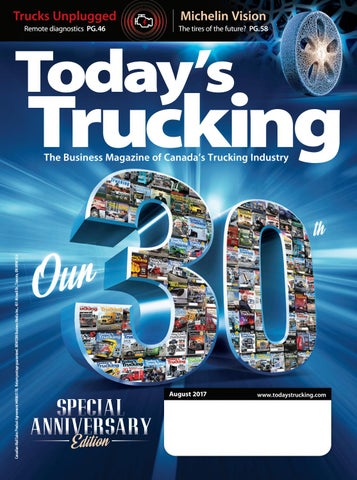
Trucks Unplugged
Michelin Vision
Remote diagnostics PG.46
The tires of the future? PG. 58
Canadian Mail Sales Product Agreement #40063170. Return postage guaranteed. NEWCOM Business Media Inc., 451 Attwell Dr., Toronto, ON M9W 5C4.
The Business Magazine of Canada’s Trucking Industry
August 2017
www.todaystrucking.com
The corner office redefined.
Competitive financing available through Daimler Truck Financial. For the Freightliner Trucks dealer nearest you, call 1-800-FTL-HELP. FTL/MC-A-1459. Specifications are subject to change without notice. Copyright © 2017 Daimler Trucks North America LLC. All rights reserved. Freightliner Trucks is a division of Daimler Trucks North America LLC, a Daimler company.
Have a seat behind the wheel of the new Cascadia® and take it all in. The sleek design of the ergonomic dash. Large LCD display. Controls at your fingertips. All housed in Freightliner’s quietest cab for maximized driver comfort. You’ve worked hard to get here. Take a look outside your office window and enjoy the ride. Experience it for yourself by taking a virtual tour at freightliner.com/corneroffice.
TOTAL RUBIA OPTIMA CK-4 & FA-4 HEAVY-DUTY ENGINE OILS TO TAKE YOU FURTHER. EVERY DAY
TOTAL RUBIA OPTIMA 1100 15W-40
TOTAL RUBIA LD EXTRA 10W-30
TOTAL RUBIA OPTIMA 1100 FE 10W-30
Follow us on
www.total-canada.ca
Total Canada
Energizing performance. Every day
Contents
August 2017 7 9 11 29 33
|
VOLUME 31, NO.8
Letters John G Smith
12
Rolf Lockwood Heather Ness Mike McCarron
page 34
NEWS & NOTES
Dispatches 18 Jobs for Life? Court ruling among top legal issues
20 22 23 24 25 26 27
Stat Pack Truck Sales Pulse Survey
38
46
Logbook Trending Heard on the Street Truck of the Month
In Gear
Features 12 Driver in Waiting Ahmad Al Rasoul escaped Syria. Now he wants to get back behind the wheel.
By Peter Carter
34 Cheers to Years rs Today’s Trucking has reflected a changing industry
42 Rent a Wrench Understand your true maintenance costs when deciding what to outsource By Eric Berard
51 Cummins Connects 53 Product Watch 56 Guess the location, win a hat
By Rolf Lockwood
38 Log Jam Owner-operators face some hard questions about Electronic Logging Devices
By Jim Park
46 Trucks Unplugged Diagnostic data is on the air, and there is more to come
By John G. Smith
For more visit www.todaystrucking.com AUGUST 2017
5
MERITOR® RPL DRIVELINES Reduce maintenance costs and save on your bottom line with Meritor ® Permalube™ RPL drivelines. The first permanently lubricated driveline in the North American market, RPL drivelines eliminate lubrication costs and offer the lowest lifecycle costs, extended U-joint life (1.5 million miles and counting) and easy serviceability. Good for your wallet. Good for the environment. Run With The Bull.
meritor.com/ truckdrivelines
©2017 Meritor Meritor, Inc.
Letters The Business Magazine of Canada’s Trucking Industry
Email:
PUBLISHER Joe Glionna joe@newcom.ca • 416/614-5805
johng@newcom.ca
VICE PRESIDENT, EDITORIAL Rolf Lockwood, MCILT rolf@newcom.ca • 416/614-5825 EDITOR John G. Smith johng@newcom.ca • 416/614-5812 CONTRIBUTORS: Eric Berard, Steve Bouchard, Peter Carter, Mike McCarron, Jim Park, Nicolas Trépanier DESIGN / LAYOUT Tim Norton, Frank Scatozza production@todaystrucking.com • 416/614-5818 SALES AND MARKETING CONSULTANT Anthony Buttino anthonyb@newcom.ca • 416/458-0103 SALES AND MARKETING CONSULTANT Nickisha Rashid nickisha@newcom.ca • 416/614-5824 QUÉBEC ACCOUNTS MANAGER Denis Arsenault denis@newcom.ca • 514/947-7228 CIRCULATION MANAGER Pat Glionna 416/614-2200 • 416/614-8861 (fax) PRODUCTION MANAGER Lilianna Kantor lily@newcom.ca • 416/614-5815
Thanks for CVSA videos Re: CVSA Inspection video series (todaystrucking.com) Please let me start by thanking you for posting this video series. I was talking with our operations manager yesterday, and mentioned to him that some of the training videos that I had seen were not as good as this series. Thank you again for posting the videos, publishing a great magazine, and website that I visit at least once a day. — Brad Gable McClay’s Transportation, Oxford Enterprises Ingersoll, Ontario
SEND YOUR LETTERS TO: Newcom Business Media, 451 Attwell Dr., Toronto, ON M9W 5C4 If we publish your letter, we’ll even send you a Today’s Trucking hat as our thanks.
The noise is exhausting Re: Fight the Good Fight (June 2017)
Kenneth R. Wilson Award Winner
NEWCOM BUSINESS MEDIA INC.
By John G.
Maybe it would help if we eliminate straight pipe exhaust systems and noisy tires. I have trucks passing me and can’t even hear my own radio.
Fight the Good Figh t
Recent deb ates about tru prove you can (and sho ck restrictions uld) fight city hall f the signs are any
I
indica find a way to live witho tion, municipalities would rather ut trucks. Jake brake No parkin s. No trucks running count g. No idling living in the on this street erparts. Leave . No midst of a or that. It’s unchallenge Remember song by the a well-organiz like we’re d, and any the lyrics? Five Man ed community number of “Do this. Electrical Consider the sign?” activist restrictions Don’t do Band. just two that. Can’t could emerg truck-relat right now. Like it or you read ed fights e. not, there that are will alway The munic municipal ongoing s be politicians ipal counc ing to its and the trucks an uneasy truce betwe il in Thun munity. Our decades-old der that travel en industry’s debate about Bay, Ontario is return and could vehicles have throu with the gener ban heavy to share their gh a comal public, vehicles from restrictive truck section of loud when and trucks workplaces routes, Arthu thoro compared will r Street. Do ughfares includ always appea just a little to the four you know Even longst r big and ing a further down wheel what else the road? can be found angry neigh anding corporate citizeners around them. Santo bors. Truck relli’s Truck s stops may yards, shops can face the wrath Stop and its related initially be of , warehouses 35 established poor zonin about them? employees. What and truck on the outsk g practices often allow irts of town, to them and Travel south subdi but leave little east buffer in betwe visions to sprawl up only a matte to Prescott, Ontario and next r of time before en. Once that you “those damn happens, it’s munity mayo will find a compoliticians trucks”. begin fieldin It doesn’t g calls about ban all hazar r who wants to take much dous cargo an engine to shatter Highway from brake in the the truce, 401 durin either. The middle of call about g stormy weather. It bark of the night noise bylaw doesn’t seem can lead to require an s. A close area leads ter that to matan angry extra call or collisi people to that the indus layer of training when the drivers of such trucks think on in the Scheduled wrong try report courier delive of every truck as compared s just one that defini a rolling mena to their peers, traffic flows. ries are seen spill ng such “bad ce. They all becom as weather” wouldper 40,000 shipments, The gener ipal electio e convenient barriers to smooth al public or n campaigns be virtually targets durin has has so-called wedge impos as would-be to to be protected, move. It g municsible. councillors is possible issues that but freigh between Do trucks look for the often define to strike the two provide a a reasonable t also goals, but ensuring valuable servic winning campaigns. will respon we all have balance that d. “Just e? a role to related discu the trucking indus As frustrating not in my backyard.” “Sure,” most reside play in try’s voice ssions nts as such fights is always Get seriously. et informed. . hts can be, heard in Busin usinesses Sign up. Get they all wherever are unden revenue and esses involved. And it’s needed. iably an impor need to be taken local jobs, fight the good tant but Your indus – and will fight try is depen usually repres residents can be blind source of tax ding on you. to that reality ent more TT votes than their busine John G. Smith ss-
— W. Duyvestyn Brampton, Ontario
“Trucks become convenient targ ets during election campaigns.”
451 Attwell Dr., Toronto, ON M9W 5C4 416/614-2200 • 416/614-8861 (fax) CHAIRMAN AND FOUNDER Jim Glionna PRESIDENT Joe Glionna VICE PRESIDENT, OPERATIONS Melissa Summerfield CHIEF FINANCIAL OFFICER Peter Fryters DIRECTOR OF CIRCULATION Pat Glionna
Today’s Trucking is published monthly by NEWCOM BUSINESS MEDIA INC., 451 Attwell Dr., Toronto, ON M9W 5C4. It is produced expressly for owners and/or operators of one or more straight trucks or tractor-trailers with gross weights of at least 19,500 pounds, and for truck/trailer dealers and heavy-duty parts distributors. Subscriptions are free to those who meet the criteria. For others: single-copy price: $5 plus applicable taxes; one-year subscription: $40 plus applicable taxes; one-year subscription in U.S.: $60 US; one-year subscription foreign: $90 US. Copyright 2017. All rights reserved. Contents may not be reproduced by any means, in whole or in part, without prior written consent of the publisher. The advertiser agrees to protect the publisher against legal action based upon libelous or inaccurate statements, unauthorized use of photographs, or other material in connection with advertisements placed in Today’s Trucking. The publisher reserves the right to refuse advertising which in his opinion is misleading, scatological, or in poor taste. Postmaster: Address changes to Today’s Trucking, 451 Attwell Dr., Toronto, ON M9W 5C4. Postage paid Canadian Publications Mail Sales Agreement No.40063170. ISSN No. 0837-1512. Printed in Canada.
Member
Editorial Smith
Anti-truck rhetoric should stop Re: Fight the Good Fight (June 2017)
You can reach
is editor of Today’s Trucki him at 416-61 Truckin ng. g. 4-5812 or johng@newco m.ca. m.ca
I just wish that the general public would understand how the supply chain works. The whole rhetoric about closing off Highway 102 in Thunder Bay is pure bull manure. Restricting too many routes to trucks will cause a major hazard. I do understand trucks must avoid residential areas due to the dangers of kids playing or adults getting out of their driveways to go to work. What I don’t get is when a perfectly good route with lots of room gets closed off from semis. I regularly deliver beer to stores, and general freight, too. There are times where I have to just ignore the “no truck” zones just to deliver from point A to point B safely. Barring that, the alternatives would be driving over cars, or heaven forbid, do a blindside with a quad axle on a busy thoroughfare just to avoid that “no truck route”. What needs to be done is educate the public on what a semi truck is. Not listen to those “ambulance chasers” or ostriches who think they learned a few things about trucking from some anti-trucking group. A reasonable balance can be struck. But how can you reason with politicians that have no sense of logic? I had a chuckle once when a couple was eating at a truck stop in Pass Lake, saying trucks should be off the highways and be banned. I just pointed to the car hauler outside, and to my reefer, and politely said, “Those trucks are my people. The car you drove in was brought in by a trucker. The milk you’ve squirted on your cappuccino was a load I probably delivered. The beer you’ve been talking about, chances are one of us delivered it.” TT June
2017.ind
d 9
JUNE 2017
9
— Danno Cardinal Sault Ste Marie, Ontario AUGUST 2017
7
The shape of trucks to come
You recognize big change when you see it. The new Volvo VNL looks fast even before it starts rolling. On the road, turbo compounding and streamlined aerodynamics help to save up to 7.5 % more fuel. Inside, drivers will notice remarkably enhanced work and living spaces. A new 70-inch sleeper featuring a reclining bunk and telescopic ladder. A game-changing, one-of-a-kind steering wheel, a high-end infotainment system and the most ergonomic seats on the road—just a few of the innovations deďŹ ning the shape of trucks to come. For a more complete picture, check out the Top 10 Stories at volvotrucks.ca
INTRODUCING THE NEW VOLVO VNL
Editorial By John G. Smith
An Uber Struggle Uber disrupted the taxi industry, but trucking won’t be that easy
T
he role of a road warrior on the Today’s Trucking editorial team takes me across North America, and at times these stops don’t include a personal car. If I want to keep moving, the options have been limited to the kindness of companies I visit, shoe leather, or taxis. Until I uploaded the Uber app on my phone. I am admittedly a late convert to ride sharing, but it is unlike anything I ever experienced with a cab. Taxi companies have left me stranded, failed to show up at appointed times, or sent cars held together by little more than Bondo and bailing wire. The Uber app displays cars that are nearby and tracks them every block along the way. Once the ride is done, my credit card is automatically billed and an invoice is uploaded by email. No more need to negotiate fares or calculate tips. It’s a model that has allowed Uber to disrupt and outright threaten the taxi industry wherever it has a presence. And now the company has a taste for trucking. The first step was to acquire Otto, which plans to retrofit trucks to drive autonomously, and made headlines by delivering 2,000 cases of Budweiser beer in a demonstration run. In midMay, meanwhile, Uber unveiled Uber Freight with the promise of transforming the way loads are booked and moved. That is undeniably closer to its core business. As similar as the vehicle-sharing options might appear, the trucking industry represents a tougher haul for this software developer. What Uber has unveiled is essentially a load board, albeit with a brand recognized outside of trucking. When I reached out to Uber to describe the difference, a spokeswoman replied: “Uber Freight is an app, available for download on iOS and Android, that matches trucking companies with loads to haul. Its mission is to make the day-to-day lives of truck drivers easier by providing transparent pricing, fast payment, and the ability to simply book a load at the touch of a button.”
As I said. A load board. Even if the company finds success with that, and can address a sexual harassment scandal that has shaken its executive suite, the existing Uber model isn’t about to truly disrupt the trucking industry. When tackling taxis, Uber was able to tap into fleets of underutilized cars. Everyone with a vehicle became a potential competitor to cab drivers. In contrast, trucks are highly utilized. Fleets that park their equipment against a fence for extended periods of time face bigger threats than an app. Still, there are some lessons to be learned from the taxi industry. Uber’s disruptive presence is about more than providing cars at cheap rates. It used software and data to provide a better experience for customers, and taxi companies failed to respond. Truck fleets that fail to find new ways to connect with customers and their loads will lose business, whether it’s to Uber or someone else. And while the Uber model might be limited when it comes to booking 53-foot van trailers or reefers, the idea of car-sharing services could still play a disruptive role in last-mile deliveries of small packages. Amazon is already testing this in select markets, through a service known as Amazon Flex. Yes, there are threats on the horizon. Uber threats. Even if they emerge through a company other than Uber itself. TT
“What Uber has unveiled is essentially a load board, albeit with a brand recognized outside of trucking.”
John G. Smith is editor of Today’s Trucking. You can reach him at 416-614-5812 or johng@newcom.ca.
AUGUST 2017
9
Perfect Harmony.
SmartAdvantage Powertrain. ™
The Most Fuel-Efficient Powertrain You Can Buy. What happens when two world-class companies combine their expertise to optimize fuel economy and performance? You get the SmartAdvantage Powertrain. Cummins X15™ with available ADEPT™ technology includes SmartTorque2 and SmartCoast,™ and is rated at 400 hp to 500 hp (298-373 kW). Paired with the Eaton® Fuller Advantage® 10-Speed Automated Transmission, it thinks and works as one unit – reading gross vehicle weight (GVW), road speed, grade, gear and more, then optimizing shift points, for maximum fuel efficiency and driver comfort. Thanks to an expanded portfolio featuring the choice of small-step overdrive or direct drive transmissions and up to 1850 lb-ft of peak torque, the SmartAdvantage Powertrain is now the ideal way for more fleets than ever to save. It’s available in the most fuel-efficient trucks from the OEM of your choice. See how much your business could be saving at SmartAdvantagePowertrain.com. ©2017 Eaton Corporation. All rights reserved. Eaton, Fuller and Fuller Advantage are registered trademarks of Eaton. Cummins and the “C” logo are ©2015 Cummins Inc., Box 3005, IN 47202-3005 U.S.A. registered trademarks of Cummins Inc. All trademarks, logosColumbus, and copyrights are those of their respective owners.
Lockwood By Rolf Lockwood
Three Decades! With this issue we celebrate our 30th anniversary
H
allelujah! Somehow we’ve made it, with this very issue, to the 30th anniversary of Today’s Trucking magazine. As its founding editor in 1987, and for quite a few years its only editor, I’ll happily admit to being proud of that accomplishment. Magazine publishing is a tough business so this is no small feat. Granted, it’s not as tough as trucking has become, but it’s no walk in the proverbial park either. Yet I never had any doubt whatsoever that we’d make it. I wasn’t new to this game, after all. I’d been editor of other trucking publications for several years before accepting Jim Glionna’s invitation to join him and three others in launching this enterprise. Aside from Jim and myself, Tony Hohenadel is the only original player left (Tony and I are no longer partners, incidentally, soldiering on as employees). Wilson Smith retired several years ago, while Phil Knox has passed on. Russ Davies, not a partner, was also one of the founders. Tony and Phil created Truck & Trailer magazine, which was born a month before Today’s Trucking, and it’s still thriving too. The company is now a family affair, with Jim semi-retired but an active chairman, having handed over the management reins to his very capable son, Joe, now president. I had faith in our various skills but the truth is we succeeded in spite of ourselves. Despite many years of truck publishing experience collectively, we didn’t know how much we didn’t know. About running a business, in particular. We were shocked, for instance, to realize that even some of the big outfits we had as advertisers didn’t pay their bills in 30 days, or 60, or even 90. Things were lean for a while, and the major banks refused to help. But we made it through, and by year three we had started to sail. We were winning the readership battle against our competitors and advertisers were climbing on board. Well, we were sort of sailing, because that’s to ignore all the disruptions presented by recession, deregulation, and free trade
in those early days. The industry was rocked, so we were too. In a very real sense, the history of Today’s Trucking mirrors the history of modern trucking. We grew with you, changed with you, as I’ve written in the feature story on page 34. And some of you grew up with us, I was reminded recently by my old friend Chris Hall, long-time beer hauler at Sleeman’s and prime mover at the Clifford Antique and Classic Truck Show (see page 27). He told me that he and many others, guys in their 40s mostly, were teenagers or even younger when I started writing about trucks. They followed me from my earlier magazines and into Today’s Trucking, he said. First as kids simply drawn to trucking, then as working professionals. I can’t tell you how heartwarming it was to hear that. I’ve enjoyed 30 years in this editorial chair for a bunch of reasons, but none is more significant than the idea that I’ve helped young people learn about trucking and then find a career here. It’s certainly a tougher, harder place than it was three decades ago, but it remains a good place to be. Every other industry has changed in much the same way, remember, and I can’t think of an exception. Certainly not publishing. Thanks for coming along on this ride with me and our magazine. We’re not going anywhere, so stay close as we negotiate a path through our collective future. If you think the last 30 years have been full of change, hold on to your seats. We may need each other more than ever. TT
In a very real sense, the history of Today’s Trucking mirrors the history of modern trucking
Rolf Lockwood is vice-president, editorial, at Newcom Business Media. You can reach him at 416-614-5825 or rolf@todaystrucking.com. AUGUST 2017
11
Ahmad Al Rasoul has been a truck driver since he was 22, but has to wait before applying the skills in Ontario. (Photo by Peter Carter)
Driver In Waiting Ahmad Al Rasoul escaped Syria. Now he wants to get to work. By Peter Carter Truck driver Ahmad Al Rasoul knew it was time to leave Syria the day the bedroom where his two-yearold son Joseph was sleeping got destroyed by a bomb. Miraculously, young Joseph remained unscathed, albeit covered in ashes.
12
TODAY’S TRUCKING
Rasoul, 46 at the time, and his wife Rasmia Al Mekhlef, had four other children and lived in Homs, a community badly wracked by the Syrian civil war. You’ve probably seen the skeletal remains of Homs buildings on the news. Since he got his licence at
22, Rasoul had been a truck driver and loves the work. He hauled goods around Syria, Saudi Arabia, Qatar and other Middle East countries in a variety of rigs, most recently a Mercedes Actros with a double bunk, microwave, TV and air conditioning, though sometimes the AC was overwhelmed by the desert sun. Those afternoons, he says, he would pull over at a mosque and have a nap. His only driving offence, he says, was a speeding ticket in Saudi Arabia. The speed limit was 80 kilometers per hour.
He says he was nabbed for going 81. “There are cameras everywhere and they are very strict there.” Some trips would be away from home for up to 15 days at a time, but he says, “I lived like a king.” Rasoul, now living in an apartment in Toronto, spoke with Today’s Trucking through an interpreter. The day after the bomb hit, the family piled into his cousin’s sedan and moved to a rural part of the country, eventually seeking refugee status in Lebanon. There, Rasoul landed part-time work as a dump truck driver, but the hours were few. Mostly, he fed his family by picking olives. “Every day you had to fight to survive,” he says. The family stayed in Lebanon three years until a phone call came from the United Nations, asking if he and the family – by this time one daughter bigger – wanted to move to Canada. “I thought, ‘Are you kidding me?’” And thus Rasoul was part of the first wave of the 25,000 Syrian refugees Canada welcomed. As recently as mid-June, when he spoke to Today’s Trucking, Rasoul was attending English classes but still not working. He
Speed limiter safety PG. 14
Safety ratings flaw PG. 15
Stability mandate PG. 16
wants to drive truck. Like he did before. Unfortunately for him there is no way to prove that he has truck driving experience, so he must start fresh, as if he had never driven anything before. In Ontario, that means going through the graduated licensing system. The first step is a written test, which can earn you a G1 licence for a car. With a G1, you can drive only with another licensed driver in the vehicle. Step two is a road test, which can yield a G2 licence. A G2 lets you drive alone but with some restrictions, and not commercially. And if you’re a first-time driver –or a refugee with no documentary evidence of your history because your home city has been destroyed – you must wait a full year before trying for the full licence. Exceptions can be made and the yearlong waiting period foregone, for refugees who can deliver proof of previous experience. Rasoul’s waiting period ended in mid-July. That means he can obtain his full car licence. But ever since July 1, because of Ontario’s new Mandatory Entry Level Training regime, everybody who wants to obtain a truck licence must undergo a minimum of 103.5 hours
of training with a private career college registered with the Ministry of Advanced Education and Skills Development, an Ontario college of applied arts and technology, or recognized authorities like carriers with training programs under the Ontario Ministry of Transportation’s Driver Certification Program. So if Rasoul had proof of his previous experience, he would probably be driving professionally now. As it is, he remains determined to find a carrier willing to help him with the training, or better yet, somebody who will hire him to work around the shop while he completes the mandatory schooling. “My family is grateful to Canada. But I don’t want
to be idle,” he said. “I just want to start working and support my family as soon as possible.” In the meantime, a Canadian volunteer who met Rasoul in Canada is trying to get Ontario’s one-year graduated-licence rule changed. Omar Khan, a volunteer with a refugee-assistance program called The Together Project, has challenged the one-year barrier by taking it to the Ontario Human Rights Commission. “Ontario’s the only province like this,” observed Khan, a computer engineer. “And we’re not saying to give these people a licence. We just want them to be able to take the test. “If you aren’t a refugee or have some access to an
embassy, you don’t need to wait this one year. You can just get a stamp from your embassy saying the licence you have is valid. We think this policy amounts to discrimination.” Khan has challenged the Province of Ontario to produce some empirical proof that the one-year waiting period has some measurable affect on safety. The Human Rights Commission will hear the case on November 28 and 29 of this year. “The thing is, Ahmad’s just one driver, but there are tons more like him. And I hear there’s a shortage of truck drivers,” Khan says. “Wouldn’t it make sense that the companies who need drivers would want to see this rule changed?” TT
TRAINING FEES
Test fees rise with mandatory training Ontario introduced its Mandatory Entry Level Training (MELT) regime for hopeful Class A truck drivers on July 1 – making it the first jurisdiction in North America to introduce such an initiative. The minimum of 103.5 hours of training can be delivered by a private career college, provincial college of applied arts and technology, or those recognized under the Ontario Ministry of Transportation’s Driver Certification Program. It isn’t the only thing that changed, though. The fees for Class A, B, C, D, E and F road tests increased to $96.75, while the written test fees have increased to $23.25.
AUGUST 2017
13
Dispatches
Ontario collisions dropped with limiters Speed-related, at-fault collisions involving large commercial vehicles fell by a whopping 73% after speed limiters were mandated in Ontario, according to a recent study by the Ontario Ministry of Transportation.
In contrast, collisions involving other vehicle drivers dropped 30%. The study also concluded there is no evidence that speed limiters contributed to an increase in other truck-related collisions such as rear-end crashes – dealing a blow to one of the key arguments against the settings. Trucks were rear-ended in 10.3% of total collisions
Double Down.
When it comes to your engine, “okay” doesn’t cut it. You need to play your strongest hand. Howes Meaner Power Kleaner and Diesel Treat get you going and keep ke you going all year round. With unsurpassed performance guaranteed, unsurp you’re a winner every time.
#1
Selling Anti-Gel in Canada and the U.S.
3X
The Cleaning POWER of Competing Products!
1-800 GET HOWES (438-4693) • www.howeslube.com
14
TODAY’S TRUCKING
from 2006-08 and 10.47% of total collisions from 2010-12. Based on the results, researchers are calling for increased enforcement and enhancing the readers that enforcement teams use to pull data from Electronic Control Modules.
Unexpected braking, tailgating blamed A chain of events – including tight following distances and the unexpected application of another truck’s emergency brakes – ultimately led to the death of a truck driver on the Metropolitan Expressway, Quebec’s workplace health and safety board has determined. Gilbert Prince, a driver with Enterprise Gestion Georges and Robert, died at the scene of the August 9, 2016 collision on Route A40. Smoke from the resulting fire was reportedly seen as much as 30 kilometers away. It all began when a Bombardier fuel truck stopped unexpectedly on Lajeunesse Street, according to Commission des norms, de l’équité, de la santé et de la sécurité du travail (CNESST). The cube van that was following it was able to stop in time, but a Givesco flatbed to its rear ended up hitting the back of the cube van. Prince’s fuel tanker collided with those. Prince was trapped in his heavily damaged cab. The fire ignited under that. Another driver involved in the collision was unable to free him. The emergency brakes on the Bombardier truck were triggered by a safety switch, when a metal door began to open. Fasteners on the door’s locking mechanism were improperly tightened and had vibrated loose, CNESST says. To compound matters, Prince was traveling too close to the flatbed. Given the weights and speeds involved, he would have needed 76.7 meters to stop. He was traveling only 31 meters to the rear. The Bombardier truck had faced this issue in the past – once on January 26, and three times on January 29, CNESST says. Two of those times it happened on the same highway. Used for refueling at an airport, it wasn’t on the road again until August 9. The day of the crash.
Dispatches
Fuel-saving fleets running to show
U.S. safety rating system flawed: report
Seven fleets that collectively operate about 11,000 power units and 26,000 trailers have signed on to participate in Run on Less – a North American Council for Freight Efficiency demonstration that runs September 6-28 and wraps up at the inaugural North American Commercial Vehicle Show in Atlanta, Georgia. Participating businesses include Albert Transport, PepsiCo’s FritoLay division, Hirschbach, Mesilla Valley Transportation, Nussbaum Transportation, Ploger Transportation and U.S. Xpress. It’s a cross section that includes dedicated private routes and irregular for-hire routes, and mixes the 7,000-truck US Express with three 1,000-tractor fleets, two midsize fleets and an owner-operator. While trucks used by dry van and reefer operations typically achieve seven miles per gallon (33.6 liters/100 kilometers), these trucks will likely reach close to nine miles per gallon (26 liters/100 kilometers) during the demonstration, he said. They’re collectively expected to cover about 55,000 kilometers during the event. Daily results from the road show will be posted at www.runonless.com.
The U.S. National Academies of Sciences, Engineering and Medicine is calling on the Federal Motor Carrier Safety Administration (FMCSA) to replace the Safety Measurement System (SMS) that determines which carriers are at a
high risk of future crashes. The report cites several problems with data quality, but also says that the system is “conceptually sound”. The FMCSA was forced by earlier legislation to remove carrier crash indicators and Hazardous Materials Compliance Behavior Analysis and Safety Improvement Categories (BASICs) from
More collision claims in legal pot states After legalizing the recreational use of marijuana, Colorado, Oregon and Washington saw collisions rise about 3% when compared to other states, according to a new analysis from the Highway Loss Data Institute. The institute says its analysts accounted for differences in the rated driver population, insured vehicle fleet, mix of urban versus rural exposure, unemployment, and weather and seasonality. Colorado experienced the largest jump in claims, 14% higher than nearby Nebraska, Utah and Wyoming. Washington’s claim frequency was 6.2% above Montana and Idaho. Oregon was 4.5% higher than Idaho, Montana and Nevada. AUGUST 2017
15
Dispatches adds. “Including vehicle miles traveled data by state and month will enable SMS to account for varied environments where carriers travel – for example, in icy winter weather in the north. In addition, there is information available in police narratives not represented in the data used that could be helpful in understanding the contributing factors in a crash.”
a public website. But carrier BASICS relating to crash data, investigation results, and measures remain. “FMCSA should continue to collaborate with states and other agencies to improve the collection of data on vehicle miles traveled and on crashes, data, which are often missing and of unsatisfactory quality,” the academy
WE’LL HELP YOU
GET IT RIGHT
THE HOLLAND ELI-te™ FIFTH WHEEL COUPLING ASSISTANT ELI-te™ Coupling Assistant can be spec’d with the FW35 Series
™
SAF-HOLLAND introduces the ELI-te™ fifth wheel coupling assistant. Technology Enhanced for Safety Minded Fleets • A failed coupling attempt triggers flashing red warning lights alerting drivers to hazards before they happen. • A successful coupling turns on highintensity inspection lamps in the fifth wheel throat making lock inspection easier and more reliable. The HOLLAND ELI-te™ fifth wheel coupling assistant will help drivers GET IT RIGHT. www.safholland.us 519.537.3494 © 2017 SAF-HOLLAND, Inc. All rights reserved.
16
TODAY’S TRUCKING
FAILED MODE Red Flashing Warning Lights
SUCCESS MODE Bright Lock Inspection Lights
WATCH THE ELI-te™ VIDEO
Stability controls being mandated Electronic Stability Controls, which help to trucks keep from rolling over in tight turns, will now be mandated on new vehicles with Gross Vehicle Weight Ratings above 26,000 pounds. That aligns with rules already in place south of the border. The Canadian rules first apply to U.S.-made three-axle tractors effective August 1, and will roll out to other vehicles between that point and August 1, 2019. “Roll stability systems help protect against loss-of-control accidents by automatically intervening, by reducing engine torque and engaging the engine retarder, while automatically applying drive axle and trailer brakes. The activation takes place before the driver is aware of the need,” said Geoff Wood of the Canadian Trucking Alliance. About 660 truck rollovers occur in Canada every year.
Albrechsten named to Order of Canada Winnipeg’s Paul Albrechsten of Paul’s Hauling was invited to join the Order of Canada on the eve of Canada Day, in an honor that comes a year after he was named to the Order of Manitoba. The fleet president and CEO immigrated from Denmark at the age of 24, with just $50 in his pocket, and began working for 90 cents an hour as a field mechanic in Virden, Manitoba. He lived in tool sheds to save enough money to buy two trucks in two years, and founded Paul’s Hauling in 1956. Albrechtsen is now widely recognized for his philanthropic work, donating millions to the Riverview Health Centre Foundation and the St. Boniface Hospital Research Centre. Other industry leaders named to the Order of Canada have included Trimac founder Bud McCaig, Manitoulin Transport founder Doug Smith, Joe Shannon of Seaboard Transport, and Armour Transport founder Wes Armour.
Dispatches
The Timken company, producers of engineered bearings and mechanical power transmission products, is acquiring Groeneveld Group, an automatic lubrication manufacturer, for approximately US $280 million. “The acquisition of Groeneveld will further expand our presence in the auto-
you’ve come to depend on quality parts from the industry’s leading brand names to keep you moving. Visit one of our national network of locally owned and operated TruckForce® Service Centers for the quality parts you expect installed by skilled technicians. RODUC YP T IT
E
S
Timken acquires auto lube maker
At home or on the road,
L
Vocational truck manufacturer Gin-Cor Industries and upfitting equipment specialist DEL Equipment have entered into a strategic partnership. “The decision to partner with Gin-Cor Industries is a key step in my succession plan,” says Paul Martin, chairman of DEL Equipment. “We want to give the business and all of our employees the best opportunity to carry on the legacy my family has created.” Gin-Cor becomes an equity partner and member of the board of directors of DEL Equipment, and is responsible for finding ways to improve DEL locations across Canada. DEL Equipment president Paul Martin takes on the role of chairman as part of the deal. GinCor Chief Executive Officer Luc Stang becomes president and Chief Executive Officer of both companies.
DEPENDABLE QUALITY
DS
Gin-Cor partners with DEL Equipment
equipment and heavy trucks.” Over the last five years, Timken has diversified its portfolio beyond bearings, adding gearboxes, chain, belts, couplings, lubrication systems, industrial clutches and brakes, and a variety of industrial services to its portfolio. Brands include Timken, Philadelphia Gear, Drives, Lovejoy and Interlube.
AD
N
Canada Border Services Agency is reviewing all Administrative Monetary Penalty System (AMPS) charges linked to Advanced Commercial Information system outages. The penalties being reviewed occurred within the hour before an outage and two hours after an outage was corrected. Refunds will be issued if the penalties are deemed to be unfair. The Canadian Trucking Alliance, which had worked with the agency to establish the review, reports that refunds are already flowing back to carriers. The alliance and agency will also be reviewing other solutions in coming months.
matic lubrication systems space, which we entered in 2013 with our acquisition of Interlube,” said Richard G. Kyle, Timken president and Chief Executive Officer. “Groeneveld will bring a strong brand and management team, a global customer base, and an industry-leading product portfolio that has an attractive market position in off-highway
QUA L
Border penalties to be reviewed
IN G BR
A
Find your nearest TruckForce® Service Center in the US or Canada by visiting www.truckforceservice.com Supported by these and other quality brands:
For information on becoming a TruckForce® Service Center, call 800.494.4731 TruckForce® Service Center is a registered mark of VIPAR® Heavy Duty
AUGUST 2017
17
Dispatches
ELDs, driver ‘jobs for life’ cited as top legal issues
Jobs for life?
Last year’s Wilson v. Atomic Energy of Canada ruling by the Supreme Court essentially guarantees drivers who cross provincial borders “a job for life”, the lawyer said, referring to the federally regulated workers. Citing the Canada Labor Code, the court ruled that non-managerial employees with more than 12 months of service can’t be terminated without reason, no matter how generous a severance package is. But establishing just cause to termi-
nate someone involves proving serious misconduct, habitual neglect of duty, or incompetence, Devine added. Even a bad accident or missing work is not proof of incompetence. It’s why she recommends hiring federally regulated workers on fixed one-year contracts, and completing performance reviews before the terms are done. ▲
▲
BIG NEWS ABOUT THE HUSKYPRO CARDLOCK NETWORK
Canadian fleets face new legal challenges this year in the face of plans to rework the North American Free Trade Agreement, and a Supreme Court ruling that seems to offer federally regulated drivers a job for life. And those were just two of the looming threats identified by Isaacs and Company’s Heather Devine, when briefing the Private Motor Truck Council of Canada on legal issues.
Mandated Electronic Logging Devices
The pending U.S. mandate for Electronic Logging Devices applies to cross-border drivers as of December 18, but Devine suggested the devices could also be mandated for all Canadian drivers quicker than expected. Rushing through a series of rules to mirror approaches in the U.S. would be an effective bargaining tactic in North American Free Trade Agreement negotiations, she said. “I’ve heard that there are those discussions.”
Rick Geller
Autonomous questions not limited to tech: Geller Questions surrounding the future of autonomous vehicles are not limited to how such technology would actually work, and Rick Geller has identified a long list of related issues that have yet to be addressed. “We really need to bring some focus to what it is that we’re trying to accomplish with this technology,” said the vice president – transportation industry leader with Marsh Canada, during a presentation to the Private Motor Truck Council of Canada’s annual meeting. It’s an important distinction. While some people see autonomous technology as a tool to compensate for a lack of skill or training, others view it as a potential “guard rail” against other threats, he said. “You have to look at the technology itself, but you also have to look at that broader ecosystem that supports it,” Geller added, referring to required gains in everything
18
TODAY’S TRUCKING
Dispatches Heather Devine
reasonable-grounds, post-incident, and random testing, as well as tests that are part of a rehabilitation plan. Legal testing regimes also recognize addiction as a human rights issue, requiring employers to pay for medical assessments and treatment, offering Employee Assistance Programs, and allowing people to return to their jobs after treatment. Fleets are expected to pay for care after treatment, and the medical costs related to the disability, too. ▲
▲
Legalized marijuana
Also on the horizon for Canadian carriers is the pending legalization of recreational marijuana. Devine stresses the value of pre-employment,
IT’S NOW DOUBLED IN SIZE
Distracted driving
Federal Transport Minister Marc Garneau has promised a national standard to crack down on distracted drivers using cell phones, she said. In the meantime, fleets will want to review their policies, educate employees, and discipline those who run afoul of the rules. And take care of the language, Devine said, noting that she has seen policies that could be misinterpreted to mean that drivers should text dispatchers while on the road. TT
from communication to infrastructure. Each could affect the rate of any rollouts. Changes in infrastructure can be measured in decades. In the meantime, existing vehicles will need to share space on the same roads. There are ethical issues to consider as well. Picture an autonomous truck traveling in the center lane of a highway when it identifies a threat ahead of it. To the left is a motorcycle, and to the right is an SUV. If the computer is programmed to protect the truck driver, it might choose to steer toward the motorcycle. If it is programmed to protect other motorists, it may choose to sacrifice itself against the threat ahead of the truck. “These are very real ethical decisions that need to be made,” he said. Even the approach to the programming will make a difference. A rule-based system is programmed to execute commands based on specific information. Artificial intelligence, however, learns through experience. If engineers steer toward the latter model, there’s the question of whether a truck has the latest version of the technology, he says. For that matter, the advanced technology could cause different skills to erode. “If we’re going to ask technology to start driving the trucks and we’re going to ask people to sit back and go make a sandwich or knit, when you don’t use skills, they degrade,” he said. Drivers could even begin to think of themselves as invincible, taking unwanted risks. There may also be times when drivers are asked to take over controls, which could present its own set of challenges. In one research project by the U.S. Department of Transportation, tests explored warnings as visual, audible and haptic alerts, as well as countdowns. Shaking seats did the best job at grabbing attention, Geller said, citing the results. But when the countdowns began, most people tried to finish the tasks they were doing before acting on the warnings. It isn’t the only reason warnings might be needed. Drivers could be confused about the mode in which a vehicle is operating, Geller said. They could be surprised by actions that a truck takes. TT AUGUST 2017
19
Visit any Husky or Esso cardlock. Enjoy Husky pricing, service and rewards. Husky has launched a coast-to-coast commercial fuel network of more than 150 cardlocks. Use your HuskyPRO card and earn myHusky Rewards at Husky and Esso cardlocks across Canada.
Visit HuskyRoadSolutions.com
Dispatches
65
StatPack
MPH
90,000 KILOMETERS PER YEAR
Crete Carrier Corporation, based in the midwestern U.S., has increased maximum driving speeds to 65 miles per hour from 62 miles per hour (105 vs. 100 kilometers per hour). The lower speeds had been adopted in the name of safety and fuel economy. But according to Crete, “technology such as collision mitigation, roll stability, and adaptive cruise control have improved safety.” Fuel consumption, meanwhile, is being improved through equipment spec’s and optimized routing.
The heavy-duty trucks run by Canada’s private fleets average about 90,000 kilometers per year, according to a recent benchmarking survey conducted for the Private Motor Truck Council of Canada. Their U.S. counterparts that belong to members of the National Private Truck Council average 160,000 kilometers per year. The Canadian trucks averaged 6.01 miles per gallon (39 liters per 100 kilometers) along the way.
$200,000 RAISED BY WALKERS A 90-member team from Maxim Truck and Trailer raised more than $200,000 as part of CancerCare Manitoba’s Challenge for Life. Chief Executive Officer Doug Harvey headed up the team and was named the event’s top fundraiser.
9% OF EMISSIONS Transportation accounts for 24% of Canada’s emissions, a report by the Pembina Institute concludes. Freight – including moves by road, rail, ship and plane – accounted for 10.5% of emissions in 2015. Heavy-duty trucking accounted for 9% of that.
$162,000 FOR CANCERCARE A 114-strong team of Bison employees and family members raised more than $162,000 in the fight against cancer through corporate fundraising, personal initiatives, and a June 10 barbecue that netted more than $21,000. It was all part of the 10th annual Challenge for Life, supporting the CancerCare Manitoba Foundation. The carrier has raised more than $860,000 for the cause over eight years.
20
TODAY’S TRUCKING
31
VOLUME INCREASE Canadian and cross-border loads performed well this May, according to the TransCore Link Logistics Canadian Freight Index. Year-overLo ye year, freight volumes jumped 31% compared to M May 2016. Load volumes in May 2017 were the se second-highest ever recorded during the month.
$78,000 FOR KIDS Two truck convoys in Newfoundland and Labrador – one in St. John’s and another in Corner Brook – raised $78,000 for the Janeway Children’s Hospital Foundation. The convoys are organized by industry personnel who call themselves the Just for Kids Transportation Group. The St. John’s convoy included 116 trucks, while 46 trucks participated in the Corner Brook event.
From dawn to dusk,
from beans to boulders . . .
East keeps you moving. Because you’re up at dawn. Because you’re hauling heavy loads. Because you need versatility. East delivers the Genesis® smooth-sided dump trailer, designed with the ideal balance of low weight for more payload and heavy-duty strength for durability. East will lower your cost of operation to deliver maximum return on your investment. Whether it’s a frame or frameless dump trailer, you can depend on East. Visit us at www.EastMfg.com, or call us at 888-405-3278.
Dispatches
Truck production on the rise ACT Research reports that North America’s Class 8 truck production hit an 18-month high this May, as backlogs dropped nearly 7,000 units when compared to April. “Annualized, May’s production rate equals a full-year production of 263,000 units,” said Kenny Vieth, president and senior analyst. “The second quarter of 2017 is effectively filled, and of the units of production planned in Q3 only 18,200 build slots were empty,” he added. “Q4 remains wide open, with nearly 70% of the quarter’s planned build slots remaining unfilled.” As of May, Class 8 sales for the beginning of the year reached 9,209 units in Canada and 67,021 units in the U.S. Freightliner continues to dominate these Year to Date sales on both sides of the border, at 31.9% in Canada and 38.2% in the U.S. International continues to be the dominant player in Class 7, with 32.7% of Canadian sales, while Hino holds 45.8% of Class 6, and Ford accounts for 52.1% of Class 5.
Canada – May 2017 SALES CLASS 8
22
MARKET SHARES YTD
May %
YTD %
716 418 329 297 254 212 169 0 2,395
2,936 1,377 1,352 1,122 914 836 672 0 9,209
29.9 17.5 13.7 12.4 10.6 8.9 7.1 0.0 100.0
31.9 15.0 14.7 12.2 9.9 9.1 7.3 0.0 100.0
CLASS 7
May
YTD
May %
YTD %
International Hino Freightliner Kenworth Peterbilt Ford Total
131 113 60 59 47 6 416
587 457 333 192 184 41 1,794
31.5 27.2 14.4 14.2 11.3 1.4 100.0
32.7 25.5 18.6 10.7 10.3 2.3 100.0
CLASS 6
May
YTD
May %
YTD %
Hino International Freightliner Peterbilt Ford Kenworth Total
52 22 11 27 5 2 119
263 144 113 30 20 4 574
43.7 18.5 9.2 22.7 4.2 1.7 100.0
45.8 25.1 19.7 5.2 3.5 0.7 100.0
CLASS 5
May
YTD
May %
YTD %
Ford Hino Dodge/Ram Isuzu International Mitsubishi Fuso Freightliner Kenworth GM Peterbilt Total
358 150 180 117 6 2 0 0 0 0 813
1,687 609 561 357 12 4 3 2 0 0 3,235
44.0 18.5 22.1 14.4 0.7 0.2 0.0 0.0 0.0 0.0 100.0
52.1 18.8 17.3 11.0 0.4 0.1 0.1 0.0 0.0 0.0 100.0
TODAY’S TRUCKING
www.easterncanada.cummins.com
www.westerncanada.cummins.com • Wholesale parts distribution • Retail parts sales • Engine and power generation equipment sales • Maintenance & Repair
U.S. – May 2017
May
Freightliner Kenworth International Peterbilt Volvo Truck Western Star Mack Other Total
Eastern Canada
SALES CLASS 8 Freightliner Peterbilt Kenworth International Volvo Truck Mack Western Star Other Total CLASS 7 Freightliner International Peterbilt Kenworth Ford Hino Total CLASS 6 Freightliner Ford International Hino Kenworth Peterbilt Total CLASS 5 Ford Dodge/Ram Isuzu Freightliner Hino GM International Mitsubishi Fuso Kenworth Peterbilt Total
MARKET SHARES
May
YTD
May %
YTD %
6,900 2,454 2,414 1,537 1,351 1,176 405 11 16,248
25,574 10,609 9,368 7,091 6,443 6,070 1,837 29 67,021
42.5 15.1 14.9 9.5 8.3 7.2 2.5 0.0 100.0
38.2 15.8 14.0 10.6 9.6 9.1 2.7 0.0 100.0
May
YTD
May %
YTD %
2,508 1,240 496 400 167 149 4,960
11,623 5,474 2,162 1,676 766 697 22,398
50.6 25.0 10.0 8.1 3.4 3.0 100.0
51.9 24.4 9.7 7.5 3.4 3.1 100.0
May
YTD
May %
YTD %
1,794 1,101 1,131 535 210 31 4,802
9,135 8,998 6,736 2,723 883 127 28,602
37.4 22.9 23.6 11.1 4.4 0.6 100.0
31.9 31.5 23.6 9.5 3.1 0.4 100.0
May
YTD
May %
YTD %
4,192 1,543 464 368 212 36 12 10 0 5 6,842
19,193 7,388 1,984 1,002 798 138 102 44 9 9 30,667
61.3 22.6 6.8 5.4 3.1 0.5 0.2 0.1 0.0 0.1 100.0
62.6 24.1 6.5 3.3 2.6 0.4 0.3 0.1 0.0 0.0 100.0
Source: WardsAuto
Dispatches
Pu se Reader Survey Tell us your views on ... Electronic Communications We live in a connected world. Drivers and operations teams now communicate using everything from smartphones to dash-mounted displays. Driver and vehicle performance can even be monitored in real time. But how connected is your business?
Does your business have a formal policy that limits the use of handheld devices when behind the wheel?
In the past month, have you personally reviewed or sent an email or text when behind the wheel?
“Can you hear me now?”
YES
YES
67.4 % “Can’t talk now. I’m driving.”
NO
32.7
42.9 %
Which of the following devices are used by your drivers in the course of their work duties? 30.6% 18.4% 14.3% 10.2% 8.2% 6.1% 2.0%
Smartphone BYOD (they bring their own devices) CB radio Electronic Logging Device Portable GPS unit /navigation system Dedicated display /interface for telematics Digital camera
Results are rounded to the nearest 1/10th percent.
NO
57.1%
%
Which of the following does your company monitor remotely, while a truck and driver are on the road? 20.9% 16.3% 14.0% 7.0% 7.0% 4.7% 4.7% 4.7%
Vehicle location Hours of Service status Delivery status Critical events (ie hard braking, overspeed) Idle time Engine faults /diagnostic codes Vehicle inspections Workflow data (ie customer signatures)
Are you expected to monitor work-related emails or voicemails during days off?
YES
58.7 Today’s Trucking Pulse surveys are conducted once per month, covering a variety of industry issues. To share your voice in future surveys, email johng@newcom.ca.
NO %
41.3 %
Next month: Management Styles AUGUST 2017
23
Dispatches
L gbook2017 RODEO DU CAMION Notre-Dame-du-Nord, Quebec www.elrodeo.com
7-11 North American Inspectors Championship Hyatt Regency Orlando Orlando, Florida www.cvsa.org
13-16 PEOPLENET/TMW SYSTEMS IN.SIGHT USER CONFERENCE Gaylord Opryland Resort and Convention Center Nashville, Tennessee www.tmwsystems.com
24-26 GREAT AMERICAN TRUCKING SHOW Kay Bailey Hutchinson Convention Center Dallas, Texas www.gatsonline.com
SEPTEMBER 7-9 NORTH AMERICAN TRAILER DEALERS ASSOCIATION’S TRADE SHOW AND CONVENTION Indiana Convention Center Indianapolis, Indiana www.natda.org
24
TODAY’S TRUCKING
12 BRITISH COLUMBIA TRUCKING ASSOCIATION’S GOLF TOURNAMENT Meadow Gardens Golf Club Pitt Meadows, B.C. www.bctrucking.com
12-14
Georgia World Congress Center Atlanta, Georgia www.nacvshow.com
FTR TRANSPORTATION CONFERENCE www.ftrconference.com
15-16 National Private Truck Council National Safety Conference
OCTOBER 10-12 SAE THERMAL MANAGEMENT SYSTEMS SYMPOSIUM Plymouth, Michigan www.sae.org Photo: NPTC
AUGUST 3-6
25-28 North American Commercial Vehicle Show
Dulles, Virginia www.nptc.org
18-21 TECHNOLOGY AND MAINTENANCE COUNCIL FALL MEETING AND NATIONAL TECHNICIAN SKILLS COMPETITION Orlando World Center Marriott Orlando, Florida www.trucking.org
11 SURFACE TRANSPORTATION SUMMIT International Center Mississauga, Ontario www.surfacetransportationsummit.com
11-13 NATIONAL TRAILER DEALERS ASSOCIATION’S ANNUAL CONVENTION TPC Sawgrass Marriott Ponte Verda Beach, Florida www.ntda.org
Log your events Do you have an event you’d like to see listed in this calendar or on the interactive online calendar?
416-614-5812
www.todaystrucking.com
johng@newcom.ca
Contact John G. Smith
Dispatches
Trendingg on
.com
Face time with Facebook founder In what some people believe is Facebook founder Mark Zuckerberg’s trial run at politics, he’s touring America to get a feel for the people. Last month, he found himself at the Iowa-80 – also known as the world’s biggest truck stop – where he tried to get up close and personal with drivers. Then, as you might expect, the 34-year-old billionaire recounted the whole affair on Facebook. Here’s an excerpt of what he had to say: “In Iowa, I stopped by one of the major truck stops. It’s like a small city where truckers on long trips can take a break, get something to eat, get a haircut, do laundry, get their truck washed – or their dog washed! – and even go to the dentist. I asked the truckers what’s changed over the last few decades. When the truckers I met started driving, you logged your driving hours on pieces of paper. Now it’s electronic and automatic, which makes it harder to drive more hours than you’re supposed to. Some people said they want to work longer, but they feel like regulations are getting in the way of their freedom and doing what they want to do. It’s tough because those regulations try to keep people on the road safe. I asked a number of truckers what they think about self-driving cars and trucks and what they think about the future. Everyone
@todaystrucking Your go-to social media source
Mark Zuckerberg stopped at the Iowa-80 truck stop to gain insights into the lives of truckers. (Facebook photos) I met was skeptical self-driving trucks would replace jobs for different reasons. Some thought it would be impossible to pack all the sensors you need to deal with things like weather into trucks. Others thought computers could handle the interstate but not the last mile to the store. And some truckers think we’ll end up with something like autopilot on planes – with trucks driving themselves with people in the cab. From all the research I’ve seen, I’m confident we’ll solve these problems. But it’s interesting that people in the industry don’t believe this will happen soon. Finally, I asked truckers what their biggest challenge was. Their answer: cars. So next time you’re annoyed by a truck on the road, just know that they probably feel the same way about you.”
21.5K FOLLOWERS
If you’re not following us on Twitter, you’re missing out on some interesting discussions in the world of trucking. From regulations to product news, we have you covered.
HERE ARE A FEW EXAMPLES OF TWEETS FROM AROUND THE INDUSTRY THIS MONTH
KEEP IN TOUCH facebook.com/ TodaysTrucking
American Trucking @TRUCKINGdotORG We support a do-no-harm update & modernization of #NAFTA that would bolster the North American #supplychain.
Meredith V @MiltonMere Had the pleasure of talking w/professional driver Mr. Dan Bezpaly of @home_hardware today...7.5 million accident-free kms in his career!!
Today’s Trucking @todaystrucking We have a new 20-part #video series exploring each stop in a @cvsa Level 1 inspection. #roadcheck Check it out at http://www.todaystrucking.com/ video-trucking-tips
@todaystrucking
TodaysTrucking1 AUGUST 2017
25
Dispatches
Heard Street on the
Promotions for policy team The Canadian Trucking Alliance (CTA) and the Ontario Trucking Association (OTA) have promoted key policy staff including Geoffrey Wood, Jonathan Blackham and Lak Shoan. Wood becomes senior vice president – policy for both groups. Blackham becomes director – policy and public affairs, and Shoan is director – policy and industry awareness programs. “These individuals are a key part of the driving force that makes both OTA and CTA highly effective in policy circles,” said Stephen Laskowski, president.
Larry Cox, 71 “Rest in Peace, Dad. We have it covered.” With those words,
Polaris Transportation Group president Dave Cox winds up his father Larry’s death notice. The elder Cox, who founded Polaris in 1994, passed away on June 14 at the age of 71. “He was the consummate entrepreneur and took many risks that paid off, accelerating our success,” the younger Cox said.
Vitale leading TP Commercial Alex Vitale will apply more than 20 years of tire industry experience as the new Chief Executive Officer for TP Commercial Solutions LLC North America. Born in Italy and raised in the U.S., Vitale has worked with leading international companies in the U.S., Canada, Europe and emerging markets (Middle East, Africa, Russia, Eastern Europe, South America). Prior to this appointment Vitale was the general manager AGRO/ OTR Global for Pirelli Tires. He has also held leadership roles at British Columbia-based Kal Tire and Goodyear Tire and Rubber.
Four named to private hall Four drivers were inducted into the Private Motor Truck Council of Canada’s Hall of Fame for Professional Drivers, supported by CPC Logistics Canada. Andre Goyette of Cardinal Health Canada has covered more than 3 million kilometers of accident-free driving in his career, and never received a moving violation. Gerald Cormier of Superior Propane has logged 72,000 truck hours in his 36 years on the job. Home Hardware Stores had two drivers named to the hall. James Wigood has worked for the company for 36.5 years and amassed more than 6.5 million kilometers of accident-free driving in the last 30 years. Dan Bezpaly has four decades with the company, and in the last 37 years as an accident-free driver has covered 7.5 million kilometers.
Vetter moves higher at Huayi Robert Vetter is the newly appointed east region fleet sales manager for Huayi Tire Canada. He began his career 50 years ago as a truck and bus tire specialist with Firestone Canada, and served a series of successive roles at Goodyear Canada, Bridgestone Firestone Canada, and American Pacific Industries. He was named to the Tire Dealer Association of Quebec’s Hall of Fame in 2009.
26
TODAY’S TRUCKING
Don Anderson, 80 Don Anderson loved trucks, and almost 100 trucks representing friends – and even some of his competitors – took a trip down Toronto’s Highway 404 in a fitting tribute to his legacy. The founder of Don Anderson Haulage, and a long-time member of the Ontario Trucking Association, died on Canada Day at the age of 80. The successful entrepreneur began his career with a single gravel truck in 1960, later expanding to specialized industries such as infrastructure, oil and gas, and energy. The business grew to about 100 trucks overall. He earned the Ontario Trucking Association’s Service to Industry Award about a decade ago.
Dispatches
Hutton Transport’s immaculate 1957 White Mustang 9000T
Kevin Trafford’s Peterbilt 359 beside his ’72 359 with Detroit V12 power
Chris Hall’s 1952 Kenworth 825, a seven year labor of love
Phil Langevin’s Western Star with its gleaming stainless-steel bunk
Truck(s) of the Month
Clifford’s Classics Shine On In spite of rain and loads of mud on Saturday, July 1, the eighth annual Antique and Classic Truck Show organized by the Great Lakes Truck Club was another success. Back in 2010 the show’s first running attracted 80 trucks and the organizers, a straight-shooting bunch of truck lovers, were a little surprised to have that many. This year there were 260, despite weather and competing 150th Canada Day celebrations. “For me it is a plan coming together,” said Chris Hall, a club founder, past president, and one of its main driving forces. “When we conceived the show I wanted old-truck owners to be able to restore an old classic, then have a place to showcase it. Now people build trucks specifically to debut at Clifford.” In fact, Hall used this year’s show to debut his own truck – a tandem-axle 1952 Kenworth Model 825, with a rare super-
charged Cummins NHRS 320. The build took seven years of off-and-on work. Down to the last detail, it’s been restored to the way it was when it left the factory. The KW 825, incidentally, became the Model 900 in 1956 and then morphed into the W900 in 1964. Kenworth was the show’s featured marque this year, and there were lots of them there, including a sizeable bunch of cabovers. Other highlights of this year’s show included Phil Langevin’s Western Star with its bright and shiny stainless-steel bunk, all the way from Ottawa. Another was the immaculate 1957 White Mustang 9000T owned by Hutton Transport of Uniondale, Ontario. And Peterbilt devotee Kevin Trafford of Tara, Ontario, showed off his latest, a Model 359 sitting beside his ’72 359 with 12 Detroit cylinders. TT
Do you have an unusual, antique, or long-service truck to be profiled? Send your Truck of the Month ideas or photos to johng@newcom.ca, or mail Today’s Trucking Magazine, 451 Attwell Drive, Toronto, ON, M9W 5C4
AUGUST 2017
27
YOUR MOST IMPORTANT DESTINATION IS RIGHT HERE. To you, your most important customer is waiting for you at home. We understand. That’s why Shell ® ROTELLA T4 Triple Protection is our most advanced Shell ROTELLA ever, with exceptional wear protection and resistance to oxidation 50% longer than the previous generation. All of which means less downtime, and more time with those who can’t wait a second longer for you to arrive. Find out more at www.shell.ca/rotella ®
®
THE ENGINE OIL THAT WORKS AS HARD AS YOU.
Compliance
Quiet, but not silent U.S. has plenty of regulatory changes in the works By Heather Ness Unified Registration System (URS) The Unified Registration System (URS) is still suspended indefinitely. We don’t have a timeline from FMCSA as to when the system will be fully implemented. However, when this rulemaking lands – for good – you can expect a new online-only form that will replace the MCS-150, process agent filing requirements for all private carriers, and insurance filing requirements for private carriers of hazardous materials and for-hire carriers of exempt commodities, just to name a few changes.
W
hile it’s been relatively quiet on the U.S. rulemaking front as far as new regulations, we’re not hearing crickets just yet. In fact, there’s plenty going on. If you’re a cross-border carrier, there are a few rules – some new, some not – that you’ll need to be aware of in the coming months.
HVUT/2290 The U.S. federal Heavy Vehicle Use Tax (HVUT) applies to vehicles with a taxable gross weight of 55,000 pounds or more. You’re required to file and pay the tax if you’re operating into the U.S. with such vehicles, and the due date is approaching quickly. Each state enforces this tax when a motor carrier registers vehicles, and a motor carrier
must prove the tax was paid to plate the vehicles. Since the provinces could give a hoot if you pay a U.S. tax, you’re required to carry the proof of tax payment (Schedule 1) when entering the U.S. If you were operating taxable vehicles into the U.S. as of July 1 of this year, you need to file Form 2290/Schedule 1 and pay by August 31. You become subject to the tax when first using a taxable vehicle on a U.S. public roadway. If you don’t operate a taxable vehicle in the U.S. until later this year, your filing due date may be later. See Instructions to Form 2290 (www.irs.gov/pub/irs-pdf/ i2290.pdf) for more details.
ELDs Ready or not, here they come. December 18 still stands
as the deadline for the U.S. Electronic Logging Device (ELD) mandate. You may have come across some misinformation or rumors on the ELD mandate. Perhaps you heard that the Trump administration will wipe out this rule, or that it doesn’t apply to Canadabased carriers and drivers operating into the U.S. Or maybe you heard that the Federal Motor Carrier Safety Administration (FMCSA) computer system won’t be ready. The facts are, the U.S. ELD mandate is still in effect and it does apply to Canada-based drivers that operate into the U.S. The FMCSA has also indicated that it will be ready and enforcing the rule starting December 18. Now is the time for you to prepare.
Unified Carrier Registration (UCR) Similar in name but very different in concept is the Unified Carrier Registration (UCR). This is the annual fee paid to operate in interstate commerce into the U.S. Filing for 2018 starts soon – in October 2017 – and fees should be lower than you’ve paid in previous years. You read that right, fees will likely be lower due to overcollection of fees in 2016 and 2017 (estimated so far). The FMCSA is currently working on a rulemaking that will make it official. You can use the official UCR filing site at www. ucr.in.gov to file when the time comes. TT Heather Ness is the editor of Transport Operations at J.J.Keller and Associates. Contact her at transporteditors@jjkeller.com AUGUST 2017
29
DDC-EMC-ADV-0033-0417. Specifi cations are subject to change without notice. Detroit Diesel Corporation is registered to ISO 9001:2008. Copyright © 2017 Detroit Diesel Corporation. All rights reserved. Detroit™ is a brand of Detroit Diesel Corporation, a subsidiary of Daimler Trucks North America LLC, a Daimler company.
Maximum fuel efficiency. Front to back. The Integrated Detroit™ Powertrain is our most fuel-efficient combination of Detroit components, designed to work together for maximum performance and lower operational costs. Advanced product features include Intelligent Powertrain Management (IPM4)—the next level of predictive technology with the Detroit™ DT12™ transmission—and our innovative Axle Lubrication Management (ALM) system, available in the new Freightliner Cascadia. These innovations help to set the industry benchmark for integrated technologies that deliver on power, uptime, and optimum fuel economy. All supported with a 24/7 customer call center and hundreds of authorized service locations in North America. When you demand it all, Demand Detroit. demanddetroit.com/IDP
VS
SALES TALK Scientific evidence and cold, hard facts are the best foundation for your investment decisions. At PROLAM, we’ll answer all of your questions and provide you with the facts that show why our trailer floors and moisture protection solutions have been the best in the industry for the past 20 years. We believe that the relationships we build with our clients must be based on open communication and honesty. Your success is our success.
We don’t just talk the talk We walk the walk
PROLAM HAS A 20-YEAR TRACK RECORD IN DELIVERING PRACTICAL, PROVEN AND AFFORDABLE SOLUTIONS THAT PROTECT YOUR TRAILER FLOORS AGAINST MOISTURE DAMAGE. OUR ULTIMATE GOAL? TO SAFEGUARD YOUR VEHICLE INVESTMENTS AND IMPROVE YOUR LONG-TERM BOTTOM LINE. OUR BRANDS
prolamfloors.com
Open Mike
The cure for first-shipment-itis By Mike McCarron
B
ased on the feedback I got from my June column it would appear that “first-shipment-itis” is more rampant in the industry than I thought. In case you missed it, the term refers to the pain you get from a customer’s first shipment because of a lousy rate or unexpected curveball. Unfortunately, many truckers will kill a customer relationship instead of finding a cure for what ails it. Before I offer my remedy, it’s important to understand that your company brand must embrace every new shipper like it’s potentially your biggest account – regardless of the growing pains. Here’s where to start:
Information overload While running MSM Transportation, we used ISO 9002 corrective actions to figure out that bad information was the root cause of most service problems. It’s amazing the correlation between garbage information and poor service. That’s why there will always be a higher probability of warts on the first shipment. Build systems that produce orders with no blanks. At MSM we went so far as to tie our customer service bonuses to the quality of information that the team collected. It not only improved the service on Shipment 1 but also on Shipments 2, 3, 4 and beyond.
Attack both ends Every new shipper comes with a great side effect: a new consignee that you can turn into a new customer. Our research into “first-shipmentitis” at MSM revealed that a lack of consignee information is a painful symptom. The problem becomes magnified when you deliver to the wrong address. While shipments were in transit (and we had leverage), we made a point to call the consignee to introduce ourselves, confirm the information, and provide a contact should things go awry. It made a great first impression and gave sales a leg up when they called. Why? Unless you’re the cheapest guy on the block, you secured the first shipment for a reason. Something wasn’t working with Joe Trucker, and now it’s your turn to screw it up. Find out why you got the business. Often the shipper is the real culprit, and if you
can help solve their problems you’re more likely to have a healthy long-term relationship.
Humanize your brand Even if the dung hit the fan on the first shipment, you must humanize your brand. When you connect on an emotional level the customer will respect you regardless of how many days the truck was late. At MSM I mailed a thankyou letter (yes, mail) to every new shipper and consignee, and it really set the table for future discussions. Where possible, we had an employee arrive with the driver for the first pick-up or delivery with a box of Timmy’s in tow. Our clinical research showed that shippers love jelly donuts as much as we loved Shipment 2.
How’d we do? Canadians aren’t complainers, which is why I’m no fan of customer surveys. That is, until I spoke at a conference last summer with awardwinning author and business
consultant John Warrillow. He measures customer satisfaction with one simple question: “Would you recommend our service to a friend or colleague?” Lose the form and pick up the phone. If the customer says yes, it’s time to talk about Shipment 2. If they say no, it’s also time to talk about Shipment 2. It just means the conversation is going to take a little longer! There will always be bad customers, but don’t pull the plug on an opportunity based on one shipment. New customers are your lifeline. If you don’t figure that out, you’ll be chasing your sales tail forever. TT Mike McCarron is the president of Left Lane Associates, a firm that specializes in growth strategies, both organic and through mergers and acquisitions. A 33-year industry veteran, Mike founded MSM Transportation, which he sold in 2012. He can be reached at mike@leftlaneassociates.ca, 1-888-204-8434, or @AceMcC on Twitter. AUGUST 2017
33
The Business Magazine of Canada’s Trucking Industry
YEARS AND COUNTING Today’s Trucking is 30 years old as of this issue. What’s changed in three decades? 34
TODAY’S TRUCKING
30 YEARS AND COUNTING ▼ Jim Glionna (left) takes to the podium when introducing the first Today’s Trucking team.
By Rolf Lockwood
B
efore we published the first issue of this magazine, we argued hard about the wisdom of buying a fax machine. That’s how long ago 30 years actually is. Now, in 2017, only doctors and real estate agents seem to use faxes, but in 1987 it was a technology in its infancy, soon to be ubiquitous and then mostly gone. But there we were, five guys trying to launch this enterprise from scratch, and the expense of a fax machine was an issue. I mention that $1,200 (yes, that much) tool because it was emblematic of the birth and subsequent growth in technologies that would change all our lives – and would soon dominate trucking. The fax moment was by no means the biggest challenge we faced. That designation could be applied to any of several early battles but one seemed to override all others: we were neophytes as businessmen. All of us – our leader Jim Glionna, plus partners Tony Hohenadel, Wilson Smith, Phil Knox, and myself – had already proven ourselves adept at various aspects of the magazine-making game. We were joined by Russ Davies, not a partner but a key in those first years as a sales co-ordinator. Jim’s wife Pat Glionna managed the circulation side of things. Collectively we started with 90 years experience in the truck publishing trenches, but we had to learn how to run a business. Called New Communications Group at the outset, the company changed its name several years ago to Newcom Business Media. Alongside Today’s Trucking we also launched Truck & Trailer magazine, a non-editorial tabloid for truck and trailer dealer advertisers. First published in May of 1987, it’s still thriving. The inaugural issue of Today’s Trucking arrived in August 1987, all copies mailed to a list of truck owners – owner-operators and fleets alike – developed at significant expense. Within three years the magazine was established as the industry leader in advertising sales terms. We were alive and doing well. Not incidentally, Jim’s son Joe Glionna now runs the company, and very ably. It’s a far cry from what it was 30 years back, with 22 magazines and/or directories, not just two. Plus trade shows and conferences.
THE COMING STORMS But what a start. The more-or-less simultaneous deregulation of trucking beginning in 1988, the launch of the original Free Trade Agreement in 1989, and the recession that began in 1990 all conspired to render every assumption about trucking worthless. Virtually overnight, countless new, innovative and energetic players entered the freight-hauling game, while old, established carriers began to wither. Only the machinery of trucking stayed the same. As I wrote in my column this month (Lockwood, page 13), the birth of this magazine really mirrors the birth of the modern Canadian trucking industry. We entered the fray just as deregulation began to take hold, and that changed everything. Everything. The disappearance of entry controls was in the air long before the federal Motor Vehicle Transport Act was passed in 1987 because the U.S. had already bitten this giant bullet in 1980 with its own Motor Vehicle Carrier Act. That allowed quite a few Canadian outfits to gain 48-state authority south of the border, when many didn’t have a hope of winning a licence through a provincial transport board up here. Impatience with that antiquated system, essentially run by old boys’ clubs that kept out new entrants with ease, led to the rise of so-called “leasing companies” – also known as “gypsy”carriers – running outside the law but welcomed by a growing number of shippers. Fed up with frequently lousy service and freight rates that they couldn’t influence, many shippers looked to the free-enterprise spirit – plus lower costs and better Free trade came shortly after Today’s Trucking launched.
AUGUST 2017
35
30 YEARS AND COUNTING responsiveness – presented by opportunistic owner-operators and small fleets who did without operating authorities. Many old-guard carriers prospered in the new age while dozens of others couldn’t handle the strain and just never did manage the competition very well. We were still weeding out weak ones years later in what seemed like a never-ending purge. Back when we launched, 30-year-old family companies were just starting to be run by the sons and daughters of the founders, adding the handover challenge to all the others these new owners and managers faced. Quite a few of them stumbled, though some helped forge a new style of trucking.
THE FLAG BEARER One of those new players, profiled in that first issue of ours, was at the time a smallish former ‘leasing’ outfit with about 125 power units. And then it grew. As of last March it was in 11th place in the Today’s Trucking Top 100 for-hire carriers list with more than 10 times as many tractors, and it’s been ranked there or higher for many years. Its history is really the essence of post-deregulation Canadian trucking. Challenger Motor Freight is that fleet, an upstart in 1987 but a powerhouse for many years now. It’s still run by Dan Einwechter, who launched the company with one truck in 1974 as DS Leasing, ably assisted by vice-chairman Gene Moser who joined the company in 1990. It was and remains based in Cambridge, Ontario, but in 2005 the company built a large and very modern new headquarters building. Challenger has been named one of Canada’s 50 Best Managed Companies several times. Einwechter has also proven himself an industry leader, having served as chairman of both the Canadian
Dan Einwechter, right, and Challenger vice-chairman Gene Moser pose at the groundbreaking ceremony for the company’s new headquarters building in 2004.
Trucking Alliance and the Ontario Trucking Association. This massive success doesn’t surprise me, and in fact when I was looking across the country for an up-and-coming fleet to write about in our first issue, Challenger became the obvious choice. Just as I was prescient in choosing to profile Challenger in 1987, Einwechter’s comments in the story showed a good understanding of what was to come. “The industry’s changing,” he said at the time. “Now we’re in a totally different environment. Safety is predominant. There are systems and procedures and controls on fuel mileage. We have
THE ISSUES IN Deregulation wasn’t the only big news of the day. In that inaugural issue I also covered western grain hauling – the truck vs. rail fight – and the future of the owneroperator. The former battle was ultimately won by our side but the latter remains a question mark at best, with owner-op numbers shrinking in recent years. Free trade was, of course, a huge topic back then, covered in that first issue. The coming demographic challenge was
36
TODAY’S TRUCKING
1987
also in the news, with a driver shortage looming. I wrote about a speech by American Trucking Associations vice president Lana Batts in which she said the trucking industry would have to change its image and working conditions if it wanted to attract younger drivers. That one certainly hasn’t gone away, and she could probably deliver a similar speech today without seeming outdated. She also predicted, incidentally, a decrease in LTL
volumes and a massive increase in both truckload and intermodal freight. Rate-cutting, she added, would continue to be an issue. Got those right, too. Truth is, most of those topics remain on our agenda. Free trade certainly, but also demographic realities. The industry is radically different now, but surprisingly similar as well. That’s true of the machinery of trucking, too, at least on the surface. Underneath? Not so much.
30 YEARS AND COUNTING
“ Itamar Levine, Vice president and general manager at Freightliner Manitoba
I believe that the industry has done a very good job with technological advances, compared to 30 years ago.
“
EDI [Electronic Data Interchange] coming on board because major shippers want it... The ‘ma and pa’ approach – and we had it when we started 10 years ago – can’t cut it any more. Not unless you’re in Timbuktu and the only carrier in town.” The truth is that Einwechter is in some senses responsible for hastening the onset of deregulation, at least in Ontario, largely because he had the support of his customers. In 1985, two years before the introduction of legislation to deregulate trucking, he won an amazingly broad operating authority – the right to haul goods to and from the province of Ontario. In an era when existing for-hire carriers used provincial transport boards to keep new entrants out, usually with ease, that wide-open Challenger licence rocked the establishment. And subsequent applicants had a much easier time because a precedent had been set. How did Einwechter pull that off? “That was sheer determination and a lot of hard work,” he told me in the course of preparing this article. “That was eight months of my life devoted to being in my lawyer’s office more days than not, more weekends than not. “We had 31 witnesses. I had to cajole my customers into supporting us, had to draft a ton of legal arguments. So it was tough. “And it cost me hundreds of thousands of dollars,” he says.
“I also believe that some of the key maintenance-reducing features – lighting, wheel ends, tire inflation systems, drivelines, brake components, etc. – have made a significant difference in the life of a fleet owner. “One last thought: a dry-van trailer today is light-years ahead of a similar trailer 30 years ago. Today’s composite vans are THE NEW TECHNOLOGIES much lighter, stronger, offer far more interior space, and require Whole books could be written on the technology of trucking a fraction of the maintenance that a trailer needed 30 years ago.” in the last 30 years. Signalled by our fax machine moment, the Obviously we’re way ahead of where we were when this digital future was just being born. Electronic engine controls magazine was launched, both on the were suddenly on the scene – mistrusted by all hardware front and elsewhere, but many and sundry at the time – and it wasn’t going to issues – especially insufficient or even stop there. crumbling infrastructure – remain. We I interviewed Mack’s chief engineer Richard still don’t really know how to deal with Gibson in that first issue, who said our future drivers and the shortage of qualified and trucks would be fascinating. He said we’d soon willing applicants. Same with technicians see electronically controlled transmissions, in the shop. ultra-low rear-axle ratios, composite materials, Safety compliance, just starting to anti-lock brakes, pre-adjusted wheel bearings, enter the frame 30 years ago, is now a brake-lining wear sensors, even 50,000-mile oil huge factor in trucking life. And not necdrain intervals. He saw it all. essarily a good one. That 1987 issue also contained an article Free trade has been thrown into the wondering aloud if we were on the verge mix again, just to confuse things. of producing million-mile engines. Turns out What hasn’t changed, I’d say, and we were. Einwechter agrees, is the terrific people of I sought perspective on all this from Itamar Rolf Lockwood trucking. They were less stressed in 1987, Levine, long-time director of fleet assets at 1987-1999 plus 2004-05 that’s for sure, but they remain an engagBison Transport and nowadays vice president ing bunch of folks. Sadly they don’t have and general manager at Freightliner Manitoba. Stephen Petit time for three-hour lunches any more. Here’s what he had to say: 1999-2004 This magazine hasn’t changed, either. “I believe that the industry has done a very And it won’t. Our commitment to servgood job with technological advances, compared Peter Carter ing readers is exactly the same now as it to 30 years ago, in providing drivers with a 2005-2016 was 30 years ago. Yours truly won’t much improved level of comfort, visibility, ride guide Today’s Trucking through the next quality, handling, etc. And we’ve also certainly John G. Smith three decades, but that commitment made great progress in enhancing driver safety 2016-present will remain. That’s a promise. TT by means of technology such as ABS.
YEARS, FOUR EDITORS
AUGUST 2017
37
Photo: PeopleNet
Log Jam BY JIM PARK
The U.S. deadline for Electronic Logging Devices approaches. Owner-operators and small fleets face some hard questions.
T
here are still plenty of questions being posed by drivers, owner-operators and small fleets as the industry moves ever closer to the U.S. mandate for Electronic Logging Devices (ELDs). Here are a few things to consider before the December 18 deadline arrives.
What type of device do I need? Owner-operators working under contract to a motor carrier will probably have to use the brand and model of device dictated by the carrier. Who pays for the device and the associated fees will have to be decided by the parties involved. Owner-operators working under their own authority will have to acquire their own Federal Motor Carrier Safety Administration-compliant ELD. Since the owner-operator in this case is also the carrier, there will be two accounts – one as a fleet manager (the back end) and one as a driver (the in-cab device). The rule requires those accounts to be separate. Fleet management software options may or may not be needed. That extra functionality is not required. But options such as fuel tax reporting or electronic trip inspection reports can help to manage even a single-truck operation. At their most basic, ELDs must record Hours of Service, and must be physically or electronically connected to the truck to capture things like key on and off time, and distance traveled. But the connection must always be maintained when the truck is operating. Devices that link to the truck’s Electronic Control Module with a cellular connection could face dropped signals. Displays also vary between devices, and the data can be transferred to roadside inspectors several ways. The Record of Duty Status (RODS) can be printed if the device is equipped with a printer, downloaded to a USB device, or transferred by Bluetooth or email. The device can also be handed to the officer, but the data must still be exportable in some recognized format. The rule does not require real-time data to be transmitted the
38
TODAY’S TRUCKING
back office, which would require a satellite or cellular link. “The regulation only requires that the data be submitted to the carrier [the owner-operator’s office computer] within 13 days,” says Alexis Capelle, ELD program manager at Continental. As for the device itself, smartphones and tablets are permitted if they are physically or electronically tethered to the truck’s electronic control through the dataport. Dedicated devices have the same requirement. The device must be secured to the dashboard while the truck is operating, and must be tamper-proof. Options for owner-operators range from full-scale devices to apps with connecting hardware.
ELDs in Canada Canadian carriers operating in the U.S. will have to comply with the U.S. rule as of December 18, 2017. The picture is less clear for carriers operating solely in Canada. Canada will introduce the technical requirements needed to support Electronic Logging Devices (ELDs) later this year, but any mandate probably won’t take effect until sometime in 2018 at the earliest. Even then, a Canada-wide mandate is not yet assured. If they do decide to mandate the devices, provincial regulatory timetables could push compliance dates out by a year or more. One rule that will require specific changes for Canadian operators is “personal conveyance.” As Jean-Sébastien Bouchard, vice president - sales and marketing at Isaac Instruments points out, the U.S. rule imposes no limit to the distance operators can drive. “Canada imposes a 75-kilometer limit while under personal conveyance,” he says. “If the driver exceeds 75 kilometers in one direction, the ELD must automatically revert to driving.” There are other uniquely Canadian requirements, too, like a display that shows not only hours driven for the day but how many hours are available for the day. That is not required in the U.S.
Log Jam If I work for a driver service or temporary driver pool, how do I transfer my logs from one carrier to another? The short answer is you can’t. This is known in the ELD world as interoperability, and in drafting its rule, regulators chose not to address it. “Nobody has made provisions to accept data from one ELD brand to another,” says Capelle. A driver working for Carrier A this week and Carrier B next week would have to print out the previous seven or 14 days worth of logs from Carrier A and manually enter them into Carrier B’s ELD. Paper copies of the last week’s logs might pass a roadside inspection, but would be insufficient in an audit because Carrier B’s system would not show the hours worked by the driver in the previous week. Tracy Clayson, managing partner for business development at In Transit Personnel, isn’t aware of any easy solution. “About 10% of our workforce fits into that category, and I know it’s going to be a problem for them,” she says. “We’re looking at all our options, but any solution really has to come from the ELD vendors doing Photo: ISAAC Instruments something about interoperability.”
1
2
What happens to my logs if I leave a carrier, or if I need them later for income tax purposes? Carriers are required to maintain the electronic records for six months. Those accounts will remain active for the time the logs must be retained by the carrier, even if the driver no longer works there. PDF copies of the logs can be downloaded and retained by the driver for later use.
Do I need to buy an ELD before December 18, 2017? If you are currently running or plan to acquire a compliant Automatic On-Board Recording Device (AOBRD), you will have until December 16, 2019 to transition to an ELD. This approach is being recommended by many ELD suppliers since it allows two There are no provisions requiring data to be transferred from one ELD brand to another.
Photo: Continental
3
Does the device comply with the regulations?
Can the device manage Canadian rules?
Which device should I buy?
Ask providers for written guarantees that the device is compliant, and factors that suggest the company will be in business for years to come.
Since you will be running under Canadian rules at least some of the time, the device better cope with the difference between our rules and the U.S. rules, such as the 13-hour driving day, cycle switching, North of 60, and off-duty deferrals.
There are many devices already on the market, and more will come before the December deadline. Decide what you want from your device – whether it’s for bare-bones Hours of Service compliance or a broader fleet management tool. Consider the growth potential of your business and whether you might eventually need a fleet management solution. Some options can be switched on as needed; others may not be available.
5 5
things to consider when buying an ELD
4 Is your data protected from damage or loss of the device? Who hasn’t dropped a smartphone into a toilet? Is that the end of 12 days worth of Hours of Service data? Data should be stored in a separate off-device location, or easily uploaded to the office computer on a regular basis, whether via the internet, cellular connection, or satellite. The latter two options may result in additional fees, but the peace of mind might be worth the added cost.
Will the provider still be in business a year or more into the mandate?
“When you look at [the] list of registered devices, only a handful of them are actually ELDs,” says Alicia Bedard, director of marketing at BigRoad, referring to the 62 company names that had registered at the time this was written. “A lot of marketing money is going into this one-time shot at selling a whole bunch of ELDs, and customers always ask us why we aren’t on the list, and why some of the other big names in the business are not there either. It’s pretty simple, we’re not yet ready to self-certify. So how can all those others claim to be ready? You want to buy from a company that you know will be there and you can trust.” AUGUST 2017
39
Log Jam
Buyer Beware How does an Electronic Logging Device (ELD) buyer ensure that a particular device is compliant? Big fleets turn to the IT department or hire a third-party auditor. If you’re a much smaller fleet or an owner-operator without such resources, you need to ensure the device you choose complies with all 516 pages of the American regulation. The U.S. rule requires ELD providers to “self-certify” that a product meets the requirements. There’s a list of documents the suppliers must forward to the
U.S. Federal Motor Carrier Safety Administration (FMCSA) to have that device included on a list of “registered” ELD devices. That’s not much help to consumers because FMCSA does not actually verify compliance. The list of registered devices is much like the U.S. Environmental Protection Agency’s SmartWay list. Simply being on that list is no guarantee that the device actually complies. Buyers will be in a tough spot if a particular ELD is discovered to be non-compliant after the fact. Drivers will be allowed to
years of breathing room while governments, vendors, and enforcement officials sort out compliance requirements. “I’m telling everyone I speak with to get an AOBRD as soon as they can so they can skip right over the crunch in December,” says Fred Fakkema, vice president of compliance at Zonar Systems. “It will take at least a year to get enforcement officials trained on the 80 to 100 devices that will be on the market by the end of the year. It’s going to be a mess at roadside for a long time to come.” “When the time comes, all we will require is a firmware upgrade and the device will transition from an AOBRD to an ELD,” he says. “When the customer is ready, they can request the upgrade.”
use paper logs temporarily, but motor carriers will have eight days from notification to replace all their non-compliant devices with compliant ones. Once the devices are in service and FMCSA begins auditing carriers for compliance, non-compliant devices will become known and they will be removed from the list. It will be up to carriers and owner-operators to check if their device is still on the list. Experienced data service providers are warning buyers to be
wary of low-cost devices that will likely flood the market before the end of the year. “It’s a nightmare scenario for carriers and particularly owner-operators who do not have the resources to determine which systems are compliant or not,” says Alexis Capelle, ELD Program Manager at Continental. “The fact that a vendor is on FMCSA’s list means nothing. There will be a lot non-compliant product on the market and a lot of vendors who never intend to be compliant.”
Link to FMCSA’s list of registered devices: https://3pdp.fmcsa.dot.gov/ELD/ELDList.aspx
able device should begin with finding something that looks, feels and works like a logbook. “There are lots of devices on the market with lots of bells and whistles, but the only legal requirement of an ELD is [Hours of
Service] compliance,” he says. “It may not be immediately obvious which devices will prove to be compliant, but you can certainly narrow the search by eliminating options you don’t need and aren’t required to have.” TT
It’s coming Word emerged in mid-June that the U.S. Supreme Court had declined to hear a challenge to the U.S. Department of Transportation’s ELD mandate brought by the Owner-Operator Independent Drivers Association, removing what many believe was the last possible opportunity to scuttle the mandate. The group had argued it violated constitutional protections from warrantless searches and seizures. ELDs now appear imminent, so drivers and owner-operators better start planning to integrate the devices into their businesses. Robin Doherty, president of Edmonton-based Verigo, a supplier of ELD software, says the search for a suitAUGUST 2017
41
In Gear
46 Trucks Unplugged 51 Cummins Connects 53 Product Watch
EQUIPMENT NEWS, REVIEWS, AND MAINTENANCE TIPS
Increasingly complex hardware has led many fleets to consider outsourcing select maintenance activities.
Rent a Wrench Understand your true maintenance costs when deciding what to outsource By Eric Berard Maintenance is a fact of life whether it involves a preventive oil change or roadside repair. But the question of whether the work should be completed in a fleet shop or by a subcontractor will be a matter of careful number crunching and personal preference. “Peace of mind has a price,” admits
42
TODAY’S TRUCKING
Christian Wafer, fleet management consultant and president of Flotte-Expert in Montreal. “Absence of trouble comes with a price. If you want to transfer that burden [to] someone else’s shoulders, you’ll have to pay for it.” One of the biggest reasons to embrace full-service leasing or outsourced mainte-
nance contracts, however, is the promise of a predictable budget for such costs. “You kind of flatline their costs. It allows them to predict their costs, to do budgeting and to know what they’re going to spend,” says Jim Lager, Penske Truck Leasing’s senior vice president – sales. Leasing companies are not the only sources of such support, of course. Such contracts are also offered through truck dealerships. And both types of businesses will want to ensure that service bays remain active. Some third-party providers will even conduct the maintenance in a fleet’s existing
In Gear Will your third-party vendor have quick access to required parts?
facilities, whether it involves filling nowidled service bays or parking mobile units in a fleet yard.
Know your costs Wafer doesn’t have any problem with the concept of outsourcing maintenance, but he insists that fleet managers have to carefully crunch their costs
Skills shortages will intensify in the face of increasingly complex equipment.
before deciding to hand over the work. “Often times, people have the impression to save a lot of money by maintaining their vehicles themselves,” he says. “The sad part is that they’ll also often make a decision to outsource maintenance, or not, on skewed parameters.” The costs certainly involve more
than hourly wages alone. “Let’s say you find a supplier is too expensive because he charges you $100 an hour for a job that you can do in house for half that amount. Are you sure your $50 amount is accurate?” Wafer asks. When work is conducted in a third-party shop, every hour is spent on a task. In contrast, the $50 per hour
BE A MEMBER R ͞FORE RE͟ ͟ A DAY Y Join us at the PMTC fall golf tournament and enjoy: x Access to a private golf course x Free on-course beverages x ZĞŐŝƐƚƌĂƟŽŶ ŐŝŌ ĨŽƌ ĞĂĐŚ ƉůĂLJĞƌ x Best in class prize table x Free BBQ lunch and clubhouse dinner x ŚĂƌŝƚLJ ƌĂŋĞ͕ ƉƵƫŶŐ ĐŽŶƚĞƐƚ͕ ,ŽůĞ ŝŶ KŶĞ ĐŚĂůůĞŶŐĞ ƌŝƚLJ ƌĂŋĞ͕ ƉƵƫŶŐ ĐŽŶƚĞƐƚ͕ ,Ž ƚ͕ ,ŽůĞ ŝŶ KŶĞ ĐŚĂůůĞŶŐĞ ŐĞ
& ͗ ΨϮϳϱ н ,^d d
TOURNAMENT SEPT 25th
Described as the ^d 'K>& dKhZE D Ed value in the industry! ƌĞŐŝƐƚƌĂƟŽŶ͗ 905-827-0587 / info@pmtc.ca www.pmtc.ca
AUGUST 2017
43
In Gear paid to an in-house mechanic also has to account for vacations, public holidays, or when completing other job-related activities like washing up and storing tools. Even if a mechanic spends just 15 minutes a day on the latter activity, that lost time is multiplied by every person on the shop floor. Those minutes become hours, and the hours become lost days
over the course of a budget year. “It’s not a bad thing in itself, but you need to calculate this loss of productivity to get the real picture of your hourly costs. Because the rate that the outsourcer charges you takes all these details into account,” Wafer says. The hidden costs don’t end there. Hourly rates paid to third-party
shops also cover overhead costs such as heating, lighting, and upgrading the tooling needed to repair evolving technology. Human resources matters such as hiring and training technicians are also transferred into someone else’s hands – and those costs continue to rise in the face of skills shortages and increasingly complex equipment. Meanwhile, any capital that would otherwise be spent on land and shop space can also be unleashed for core business activities. Like moving freight. “There are many, many aspects I think most customers overlook because it’s [maintenance] not their core business. It’s not their area of expertise. And while they focus on an hourly labor rate or whatever it might be, they are really losing sight of the big picture,” agrees Penske’s Lager.
Outsource what you seldom do
Keeping your fleet on the road. AT WAJAX, WE SPECIALIZE IN KEEPING YOUR FLEET ON THE ROAD. With locations across the country, we are the # 1 source for all your on-highway transportation needs, from our large parts inventory to our service expertise, we keep you moving. For more information call 1.888.717.7131.
\\ Together We Get More Done 44
TODAY’S TRUCKING
wajax.com
Few fleet shops can be experts in body work, engines, transmissions, air conditioning units, trailer doors, and the various other systems on a truck. “You need to choose your battles. You can’t do everything by yourself and be good at it at the same time,” says Wafer. It’s why he suggests a good place to start is by outsourcing maintenance jobs that are rarely seen. “You’re not saving any money if your technician loses valuable time trying to figure out what’s wrong with a turbo because it’s not his specialty, contrary to your dealer’s technician who might be doing this all day long,” he says. Penske’s Larger says this is especially true when it comes to the components on late-model engines, which come with evermore-complex emissions systems. “You have all this electronics and all this technology on trucks that become very complex. And I think many fleet operators who were able to do it themselves in the past, or manage it themselves, simply find themselves not able to anymore,” he says. “They don’t have or are not willing to make the investment in the diagnostics equipment or other equipment that’s necessary to keep a fleet operating efficiently and up and running.”
In Gear Added visibility Even if fleets outsource maintenance activities, they still need to monitor the work that is being completed, and that’s where a shop’s Service Relationship Management (SRM) platform comes into play. “Most communications today are done by e-mail, phone and even by fax, and there’s a whole bunch of other information that is captured in paper documents or siloed applications,” says Michael Riemer, Decisiv’s vice president – product and channel marketing. “What we do is we add a layer of communication and collaboration so that all of that information can be available to the parties that are engaged in a service event, so that information can flow seamlessly back to the systems of records at those same business entities.” It helps to establish a level of trust
between the fleet managers and the third parties that conduct outsourced repairs, he says. “We need to ensure that level of transparency and visibility – and do it both in real time to alert you of potential issues, but also give you reporting after the fact to be able to look at things you might want to change from a process perspective.”
Wafer still stresses the value of personal contact, however. Unscheduled spot checks can ensure that suppliers are complying with specific clauses in the service agreement. Just remember that there are limits to how often you’ll want to stop by. “Trust is a two-way street,” he says. “You want to be fair with your suppliers.” TT
Weigh. Pay. Get Going. Time is money, and CAT Scale’s Weigh My Truck app is the fastest way to
Communications involve more than physical documents.
weigh. It’s a game changer that streamlines the weighing process, payment, and provides valuable back end data for fleets. IT’S THE FASTEST WAY TO WEIGH!
Find out more about how this app can revolutionize how your drivers weigh. 1-877-CAT-SCALE (228-7225) catscale.com | weighmytruck.com Now accepting:
AUGUST 2017
45
In Gear
Justin MacDonald, a service technician with Papé Kenworth – Redmond (left), reviews findings with Central Oregon Truck Company Kenworth T680 and COTC maintenance shop foreman Travis Seeger.
Trucks Unplugged Diagnostic data is on the air, and there is more to come By John G. Smith One of Central Oregon Truck’s T680s had already crossed into Canada this March when the news arrived: Something seemed wrong with the fuel pressure. Sensorgenerated warnings are never exactly welcome news, but Pape Kenworth was able to confirm the fuel system was already due for some scheduled maintenance. It looked like the driver could complete the southern leg of the trip to Denver. The engine had other ideas. The electronic warnings began to increase. Everyone decided it was best to schedule the work before the trip was done. Troubleshooting trees have been firmly rooted in fault codes for years. The data that shines a Malfunction Indicator Light (MIL) or triggers another type of warning can steer technicians to look at specific components or complete specific repairs. But manufacturers are rolling out increasingly sophisticated diagnostic platforms
46
TODAY’S TRUCKING
that make it possible to tap into sensor data without plugging in a scan tool. Fault codes are now being fed to fleet managers, dealerships, and call centers alike. Forget about the lamp on a dash. The data from late-model engines is feeding reports through text messages, emails, or web portals. Drivers don’t need to call dispatchers to report warning lamps; fleet managers learn about issues at the same time, in some cases with a call from a central call center or dealership team that monitors the details. Central Oregon Truck managers received word about the fuel pressure issue by email, generated through Kenworth’s TruckTech+ system. Personnel at the dealership offered a watchful eye.
Remote access “Any fault code that’s generated, we can get information back to the operator in
less than 10 seconds,” says Lori Cobb, Cummins’ vice president – connected solutions, referring to her company’s Connected Diagnostics system. If the problem relates to a missed regen cycle, the warnings can even come with a “de-rate timer” that tells fleet managers how long the truck can continue before the engine power is dialed back. It’s not the only emerging issue that can be identified through remote diagnostics. Andrew Dondlinger, Navistar’s vice president – connected solutions, refers to a coolant leak as an example. Drivers have been known to top up reservoirs when warnings are triggered on the dash. The problem is that can leave maintenance teams blind to the underlying problem. Techs might not check hoses or clamps when the equipment rolls into the service bay for other issues, or not think about warning drivers to stop the practice that can introduce unwanted air into the system. Not all fault codes and warning indicators require a truck to be parked. But fleets still need to know about the issues that are emerging before they can make informed business decisions. The Kenworth system, for example, divides
In Gear codes into four categories, from information and service soon, to service now or stop the truck. “I wouldn’t say there were codes that were necessarily being ignored [before remote diagnostics came along]. It’s more about having the fleet understand the severity of the fault,” says Greg Treinen, sales and marketing manager – connectivity with Daimler Trucks North America, referring to the value of the systems. All too often, drivers were heading to shops whenever they saw a check engine light, only to find a repair could have waited. “It’s kind of giving them that information or that insight into helping them make that initial decision whether to take the truck in right away or they can keep going,” he says. Fleets aren’t the only ones that have something to gain. Real-time data streams also help manufacturers to detect warranty issues earlier than ever. “In the past, in order to hear about those issues, you’d have to wait until you had a dealer call or customer call,” Dondlinger says. It can also take two or three months for warranty paperwork to make its way through every channel. “Now we’re able to see that [issue] within minutes, hours and days.”
Still, as valuable as the data can be, it’s possible to have too much of a good thing. Email boxes can be jammed by information about so-called faults that include the “ghost codes” which simply resolve themselves. Suppliers are taking different approaches to solving that, using everything from filters to limit the types of reports that are generated, to having a live body interpret the data before calling in the news. “Sometimes you don’t have enough data, or sometimes it’s too much data. You’ve got to add the knowledge piece to it. Data is good, but information is what matters,” says Conal Deedy, Volvo Trucks North America’s director – connected vehicle services. “When you take and understand a fault code plus some other information, we have a very high degree of certainty that this is exactly what needs to be done, and here’s what parts need to be used to fix it, here’s the type of mechanic you might need.” “Many of them aren’t a severe-type
code,” Dondlinger explains, describing the readings that can emerge. “Ghost codes come and go, and they shouldn’t be there at all.” Even when the filters are in place, he says most fleets limit themselves to reviewing the data about twice a day, just to confirm the equipment that will be available for dispatching. “The combination of both email and the portal seems to work best, allowing fleet managers to quickly triage issues with the email before deciding if they want to dive deeper and look for more information,” says Kurt Swihart, Kenworth marketing director. Cobb finds that larger fleets are more likely to prefer emails that are sent through to a central maintenance group rather than drivers. “They know what route that driver is on; the sensitivity of the load,” she says. Smaller fleets can actually be the ones most willing to embrace more of the electronic feedback, because they have a chance to absorb all the information. ... continued on page 49
Data and information Remote diagnostics is about more than a stream of sensor data. It’s about finding ways to transform it into useful information, and often involves live personnel monitoring the information before it actually reaches truck owners. Data from Mack’s GuardDog system, for example, is monitored by OneCall agents who will help decide if a code is an immediate threat or can be addressed later. “We put them in a position to make a better business decision,” says David Barbue, vice president – connected vehicle and uptime services. The systems are also becoming increasingly refined. Mack’s first GuardDog Connect system tracked about 50 fault codes, he says. “We’ve more than tripled the number of codes and quadrupled the number of parameters.” Through a partnership with GeoTab it has even been able to extend the support back to EPA10 engines.
Prioritized fault codes can help to ensure fleets are not overwhelmed with data.
AUGUST 2017
47
Canada’s Largest Inventory of New and Used Trucks and Trailers Visit us on the web at truckandtrailer.ca • 1-877-682-7469
Canada’s #1 Source for Heavy Trucks and Trailers
In Gear Predictive maintenance The ultimate goal is to generate warnings that predict different issues before any warning lights or outright failures. And it is possible. Cummins engines in mining equipment, for example, draws on things like temperature readings to determine trouble spots to come. “The on-highway space, we’ll get there, but you have to collect the healthy heartbeat data,” Cobb says. Put another way, engineers need an exact idea of how a healthy engine performs before they can create algorithms that raise the alarm as problems begin to develop. This will help to protect against “false positives” that suggest problems are on the way when everything is fine. Think of it as knowing the difference between heartburn and the warning signs of a heart attack. “When we have the ability through seeing how that vehicle is being used, and how it is performing, we can be much more proactive in the whole maintenance and repair process to make it really efficient,” Deedy agrees. The secret is in the combination of codes. Maybe it’s a specific coolant and turbocharger temperature that suggests a failing turbocharger. But Dondlinger says Navistar wants to be at least 85% confident in such readings before calling equipment into a shop. Otherwise, there’s the danger of swapping out something like an injector that still has plenty of life in it. “There’s a lot of data and a lot of time to analyze before you get to that certainty level,” he says. Then there’s the matter of pulling together information from other sources, such as the location of nearby dealers that have the parts needed for a related repair. As remote diagnostic systems are integrated into dealerships, there is the promise of checking to see if parts are available, and ensuring bays and techs are ready for the work. But there are challenges even when everyone is on an electronic system. Navistar inventory reports, for example, are only generated once per day. Maybe the turbo on the shelf was used hours before, on another repair. Determining in real time whether
technicians or service bays are available is another issue. Take it a step further, and it’s conceivable that data about the truck could be cross-referenced to an Electronic Logging Device to schedule repairs during resets or breaks, Dondlinger muses. Daimler is exploring how the data might be used to customize mainte-
nance schedules or service intervals, Treinen says. A focus on the engine or aftertreatment system could determine the best time for an oil or filter change. Think of it as proactive maintenance rather than predictive maintenance. “We’re looking at what we can do with that data,” he says. “There’s a whole list of things.” TT
PREMIUM BRANDS. LOCAL EXPERTS. THE RIGHT PEOPLE. THE RIGHT PARTS. THE RIGHT PLACES. There’s no beating the ease of doing business with your trusted local truck parts distributor. As part of North America’s Leading Truck Parts Network®, your local VIPAR Heavy Duty Parts Professional offers the brands you want and the expertise you need, with the strength and resources of a network of over 620 locations throughout the U.S., Canada, Mexico, and Puerto Rico.
FIND A VIPAR HEAVY DUTY PARTS AND SERVICE PROFESSIONAL AT VIPAR.COM
AUGUST 2017
49
Goes to extremes to protect your engine. Mobil Delvac™ Extreme diesel engine oil offers proven protection for up to double OEM-recommended ODI’s. It maximizes the uptime of your fleet and makes your business more efficient. Learn more at mobildelvac.ca
Results may vary based on vehicle/engine condition, driving and environmental conditions. Consult OEM or ExxonMobil before implementing extended ODI’s. © 2017 Exxon Mobil Corporation. Mobil and Mobil Delvac are trademarks or registered trademarks of Exxon Mobil Corporation or one of its subsidiaries.
In Gear
Photo: Cummins
Linebarger says competitors will struggle to scale up from passenger cars.
Furber said, in an apparent nod to Tesla’s plans to introduce a Class 8 electric vehicle by September. “For a long-haul vehicle, we think that’s out quite way into the future,” says Chief Technical Officer Jennifer Rumsey, referring to the challenges of battery size and weight. “We are looking at mild hybridization.” Cummins engineers are looking well beyond electrification, too. “We see a trend away from diesel and we will continue to evolve,” said Rumsey. Identified long-term options range from biofuels to synthetic fuels and hydrogen. “Natural gas has big potential,” she added. Don’t expect diesel to be abandoned anytime soon, however. Cummins officials say they are working on an engine that is smaller and lighter than the X15, which will target aerodynamic conventional and cabover trucks used in markets such as China, Mexico and Brazil, all of which are preparing to adopt tighter emissions standards in the next two years. Linebarger stressed that Cummins is also approaching business in a differmaterial handling, and underground ent way. environments, according to Cummins. “We will actively look for ways to While the current U.S. administration disrupt ourselves,” he added. recently pulled out of the Paris Climate A new Growth Office has been estabAccord, and proposed funding cuts lished to evaluate hundreds of ideas to the U.S. Environmental Protection and see how they can be Agency, Linebarger stressintegrated. That recently es that cities have been led to the creation of the primary drivers behind the Eaton Cummins electrification. That’s Automated Transmission where lawmakers are lookTechnologies joint vening to control emissions, ture. Cummins is also reduce noise, and relocate — Tom Linebarger, working with Microsoft traditional fueling staCummins Chief on a new natural gas fuel tions, he said, responding Executive Officer cell, currently being tested to a question from Today’s in Seattle. Trucking. “All those get It’s looking at more better with electrification.” than hardware, too. Cummins will be Cummins executives, meanwhile, involved in launching a smartphonesay they are well positioned to bring based Electronic Logging Device in such technologies to market – thanks the coming weeks. That’s one of the to existing relationships with Original projects under a new digital accelerator Equipment Manufacturers and an that will guide projects from concept established global service network. stages to commercialization, “Our competitors will not be able Linebarger said. TT to scale up from the passenger car,”
Cummins Connects
Manufacturer commits to electrification and more Cummins is pledging to launch a fully electrified powertrain in 2019, and a range-extended electric powertrain in 2020. But senior executives stress that these rollouts will be for urban transit vehicles, and that electrified long-haul trucks are still years from reality. “We are not just a diesel engine company,” proclaimed Chief Executive Officer Tom Linebarger, during a recent conference call. “Technology is what we do. Innovation is what we do.” An internal electrification business group is combining Cummins expertise with selected partners, as they collectively develop power storage, related electronics, and traction motors. With the falling cost of batteries and electronics, vehicle electrification is already economically viable when combined with the right duty cycles and operational characteristics, said Julie Furber, electrification business development executive director. Examples of those applications are found in urban,
“We are not just a diesel engine company.”
AUGUST 2017
51
NORTH AMERICAN COMMERCIAL VEHICLE SHOW
Where the
leaders of today,
share their ideas for tomorrow. Join the industry’s most influential executives at the first truck show of its kind. Leading manufacturers of commercial vehicles and parts will announce and showcase their newest technologies and innovations. This is a show you’ll want to be at.
September 25th by invitation only September 26th - 28th Atlanta, GA
REGISTER TODAY
at www.nacvshow.com
Show Organizers: Confirmed 2017 Exhibitors: Bendix, Cummins, Detroit, Eaton, Freightliner, Hendrickson, Mack, Meritor, Navistar, SAF Holland, Volvo, Western Star and more…
PRODUCTWATCH WHAT’S NEW AND NEWS FROM SUPPLIERS
For more new product items, visit PRODUCT WATCH on the web at todaystrucking.com expectations for mileage, traction, or driver satisfaction. The design’s sipes and grooves play a role in extending the life of the 28/32� tread. “Full-depth matrix siping� turns into ever-wider grooves as the tire wears, helping to retain biting edges and traction throughout the tire’s service life. The casing, meanwhile, is protected through a cooler-running rubber compound at the belt package and a sidewall that’s treated to resist ozone-related damage. And a protector ply across the width of the tire helps to protect against penetration-related damage. The X Multi D will initially be released as an 11R22.5 with a load range of G or H, and an 11R24.5 with a load range of H. A 275/80R22.5 Load Range G comes in September, and two other sizes come next year. There are also plans to release a related retread. www.michelintruck.com
Regional Drive Tire Michelin’s X Multi D comes with a ‘confidence guarantee’ Michelin has unveiled a new drive tire for urban and regional eets – the X Multi D – that comes complete with a new “conďŹ dence guaranteeâ€?. Designed for operations that typically run routes of less than 650 kilometers, the new offering promises to boost removal mileage by 65% when compared to the XDE M/S that it replaces. Michelin also says that the X Multi D’s traction can help a truck reach road speeds 80% faster than tires from a leading competitor.
Promoted features include a long-lasting tread, all-weather traction, scrub resistance, and a durable casing. The threat of scrub-related damage is tackled with a co-extruded rubber compound, while teardrop-shaped grooves at the bottom of the sipes are introduced to prevent torque-related cracks and heel-to-toe wear. The company is so conďŹ dent in the X Multi D that it promises to refund the difference in price over a competing premium tire if the product fails to meet
HEAVY-DUTY SCAN TOOL BOSCH HDS 200 SUPPORTS CLASS 4-8 DIAGNOSTICS
Bosch has unveiled its HDS 200 heavyduty scan tool to support those working on Class 4-8 trucks – whether the users are in an aftermarket shop that occasionally repairs such vehicles, a dedicated heavy-duty operation that needs a second triage tool, or a mobile repair unit. Bosch HDS 200 kit
AUGUST 2017
53
Product Watch The tool’s color display graphs live data from SAE-standard MIDS/ PIDS (Message Identifiers/Parameter Identifiers), shows definitions of diagnostic trouble codes, and is HD-OBD compatible. It also offers a Global OBD II Quick Test for gasoline and diesel engines. Users have the option of recording
data to play back information in English, Spanish and French, as well as using imperial or metric measurements. The Bosch HDS 200 Heavy Duty Scan Tool kit includes a nine-pin Deutsch cable, six-pin Deutsch cable, 16 pin HD/ OBD II cable, USB cable, quick start guide, and carrying case. www.BoschDiagnostics.com
Simple. Safe. Secure. Printable.
VDO RoadLog™ ELD www.vdoroadlog.com
Simple • VDO RoadLog provides simple, automated compliance
VDO and RoadLog – Trademarks of the Continental Corporation
• Faster, easier inspections
54
• Fast data transfer • Easy access to your data • Simple, easy installation
Safe
Printable
• Compliance now and in the future
• Shares only the data required for compliance
• Backed by Continental – a global leader in ELD technology
• Keeps your tablet or cellphone data private
• No inspection hand-off needed – RoadLog fixed unit eliminates chances of dropping or damaging the device
(855)-ROADLOG roadlog-sales@vdo.com
TODAY’S TRUCKING
Secure
• Provides the security and accessibility of the cloud
• Instant log printout – looks like a traditional logbook chart • Thermal printer means no ink needed • No data transfer worries during inspections
• Secure data transfers • Security of a standalone device
with Available ly fees th n o m no
IN-CAB REEFER CONTROLS CAB COMMAND CONTROLS FOR CARRIER TRANSICOLD SUPRA
Carrier Transicold Supra refrigeration units can now be controlled from inside a cab using Cab Command. Building on the capabilities of its predecessor, Cab Command comes in a compact design that conforms to the universal DIN specification for installation in a dash. It also has an optional surface-mount bracket for those who would rather have the controls located in an overhead console, or underneath, or on top of the dash. Features include a backlit LCD display that offers operating information including setpoint, compartment temperature,
operating mode and status. A tactile keypad allows users to adjust temperatures and change operating modes, among other settings. The controller is now standard for single-temperature and multi-temperature Supra units, and is backwards compatible to older models. www.carrier.com/truck-trailer
TRAILER DIVIDERS SECURITY DIVIDER AND DECK BOARD FROM ANCRA
Ancra’s new Security Divider and Deck Board comes in the form of lightweight high-density polyethylene panels that can be configured as a deck board or secure bulkhead. Compared to typical plywood sheets, the panels are lighter and splinter-proof, the company says. They’re secured in place using lockable E-Beams, and support double-decked loads when needed. Each panel also includes hand slots for easy handling. The Security Divider and Deck Board comes with a three-year warranty, and can be purchased as a kit that includes two lockable E-beams and two panels. The panels can also be purchased separately. www.ancra.com
Product Watch RETREAD WARRANTY
DISC BRAKES
DOUBLE COIN TBR COVERAGE EXPANDED
BENDIX ADB22X BRAKES NOW STANDARD ON LT
Huayi Tire Canada has increased the warranty on new Double Coin TBR tires to seven years and three retreads. That’s two years longer and one extra retread compared to the warranty that covers the tires built to this point. It has also added one extra retread to all Double Coin OptiGreen Series FuelEfficient TBR tires. www.huayitirecanada.com
International is making air disc brakes standard on all axles for all models of the International LT series. Available in 6x4, 6x2, and 4x2 configurations, LT Series trucks fitted with Bendix ADB22X brakes are now
ELD PLUG-AND-PLAY ELD FROM POLAK
The pending U.S. mandate for Electronic Logging Devices can seem complex, but Pollak is looking to simplify things with the new EZ-ELD. The plug-and-play device is fitted into a truck’s diagnostic port, and the driver connects through a mobile app. There’s no need to worry about the type of On Board Diagnostics port that is used, either. The EZ-ELD comes with three interchangeable connectors, making it easier to switch between vehicles, too.
There are nine-pin, six-pin, and OBDII connectors on board. It can store up to six months of data right on the device, ensuring that drivers have access to it in remote locations. Drivers who are slip seating, meanwhile, can scan the QR code linked to the unit, and sync with the vehicle they’re operating. Back in the office, fleets can use the related software to manage different drivers and devices. There’s even an instant messaging feature. www.ez-eld.com
available for order. International is the first North American truck OEM to make air brakes standard equipment on all axles of a long-haul tractor, the company notes. The Bendix ADB22X air disc brake features a patented lightweight design that significantly reduces stopping distance and extends brake system life.
If you’re there, we’re there... coast to coast
The most trailers. The most locations.
Ready to go when you are! 1 855 327 9757 trailerwizards.com AUGUST 2017
55
Product Watch Complementing the straight, stable stops that air disc brakes provide is greater reliability, thanks to a design that nearly eliminates brake fade or degraded stopping power. www.internationaltrucks.com
LONGHAUL TIRE PENTATHLON D FIRST OF EMERGING PIRELLI FAMILY
Pirelli’s new Pentathlon D, the first in its emerging Pentathlon family of tires, has been designed for long-haul drive applications.
The SmartWay-verified tire reduces rolling resistance with a specialized undertread compound. Mileage, meanwhile, is improved with a dual layer tread compound. An optimized pattern and something known as “3SB belt evolution” will ensure even wear, the company adds. And its patented Spiral Advanced Technology for Truck (SATT) combined with “Hexa Bead Wire” combine to support retreading. www.pirelli.com/commercial/us
LUBE PACKAGING
STRAP FEATURES
Users of Liquid Wrench’s new Pro Penetrant and Lubricant will know exactly where they’re applying the material thanks to FlashSight – an LED light mounted above the spray nozzle. The penetrating oil itself is said to cut through rust, grease and corrosion, while still being safe on metal, painted surfaces, plastic and rubber. And it helps to protect all metals including copper, brass and bronze. It will be available in 11-ounce cans through AutoZone stores. www.rscbrands.com
SLING THE STRAP WITH TOSS ‘N TIE
Ever need to sling a strap or chain over a load? Ancra says it has a safer and easier approach in the form of the new Toss ‘N Tie. The device’s ball – which looks something like a yo-yo – is attached to the end of one of the company’s cargo straps or chains, and then thrown over the load. Then it’s a matter of going to the other side of the trailer, grabbing the cord, and pulling the tiedown into place. www.ancracargo.com
LIQUID WRENCH CANS INTEGRATE LED LIGHT
YOU CAN’T GET THERE FROM HERE Truckers Over There
DO YOU KNOW WHERE THIS IS?
The “Truckers” sign that appeared in the July installment of You Can’t Get There from Here left many readers baffled. But it’s near the intersection of Ontario Highways 7 and 115, in front of Shrubby’s Pit Stop Diner. Do you know where this site to the right can be found? The first 10 readers to correctly identify it will win a Today’s Trucking cap. Send your guesses to johng@newcom.ca. July Answer:
Shrubby’s Pit Stop Diner in Peterborough, Ontario.
YOU CAN’T GET THERE FROM HERE c/o Today’s Trucking Magazine 451 Attwell Drive, Toronto, ON M9W 5C4 Phone: 416-614-5812 • Fax: 416-614-8861 Or email: johng@newcom.ca P.S. If you call your answer in, don’t forget to leave your contact details!
56
TODAY’S TRUCKING
National Advertisers Alberta Motor Transport 41 www.amta.ca Cat Scale 45 www.catscale.com Continental Tire 54 www.vdoroadlog.com Cummins Inc./Eaton 10 www.SmartAdvantagePowertrain.com Cummins Canada 22 www.cummins.com Detroit Diesel Engines 30-31 www.DemandDetroit.com East Manufacturing Corp. 21 www.EastMfg.com Freightliner 2-3 www.freightlinertrucks.com Hino 40 www.hinocanada.com
Howes Lubricator 14 www.howeslube.com Husky 18, 19 www.HuskyRoadResolutions.com Imperial Oil 50 www.mobildelvac.ca Isaac Instruments 15 www.isaac.ca Mack Trucks 59 www.macktrucks.com/NewMack Meritor 6 www.meritor.com/truckdrivelines North American Commercial Vehicle Show 52 www.nacvshow.com Peterbilt back cover www.peterbilt.com PMTC 43 www.pmtc.ca
Prolam www.prolamfloors.com SAF Holland www.safholland.ca Shell www.shell.ca/rotella Total Canada www.total-canada.ca Trailer Wizards www.trailerwizards.com Truck & Trailer www.truckandtrailer.ca TruckForce Service www.TruckForceService.com Vipar www.vipar.com Volvo Trucks North America www.volvotrucks.ca Wajax www.wajax.com
32 16 28 4 55 48 17 49 8 44
COMPANIES IN THE NEWS A ACT Research . . . . . . . . . . . . . . . . . . . . . . . . . . 22 Albert Transport . . . . . . . . . . . . . . . . . . . . . . . 15 Amazon . . . . . . . . . . . . . . . . . . . . . . . . . . . . . . . . 9 Ancra . . . . . . . . . . . . . . . . . . . . . . . . . . . . . . 53, 56 B Bendix . . . . . . . . . . . . . . . . . . . . . . . . . . . . . . . . . 55 BigRoad . . . . . . . . . . . . . . . . . . . . . . . . . . . . . . . 39 Bison Transport . . . . . . . . . . . . . . . . . . . . . . . . 20 Bombardier . . . . . . . . . . . . . . . . . . . . . . . . . . . . 14 Bosch. . . . . . . . . . . . . . . . . . . . . . . . . . . . . . . . . . 53 Bridgestone Firestone Canada . . . . . . . . . 26 C Cardinal Health Canada . . . . . . . . . . . . . . . . 26 Carrier Transicold . . . . . . . . . . . . . . . . . . . . . . 53 Challenger Motor Freight . . . . . . . . . . . . . . 38 Continental . . . . . . . . . . . . . . . . . . . . . . . . . . . . 38 CPC Logistics Canada . . . . . . . . . . . . . . . . . . 26 Crete Carrier Corporation . . . . . . . . . . . . . . 20 Cummins . . . . . . . . . . . . . . . . . . . . . . . . . . 46, 51 D Daimler Trucks North America. . . . . . . . . . 47 Decisiv . . . . . . . . . . . . . . . . . . . . . . . . . . . . . . . . 45 DEL Equipment . . . . . . . . . . . . . . . . . . . . . . . . 17 Don Anderson Haulage . . . . . . . . . . . . . . . . 26 E Enterprise Gestion Georges and Robert . 14
F Facebook . . . . . . . . . . . . . . . . . . . . . . . . . . . . . . 25 Flotte-Expert . . . . . . . . . . . . . . . . . . . . . . . . . . 42 Freightliner Manitoba . . . . . . . . . . . . . . . . . . 38 G Gin-Cor Industries . . . . . . . . . . . . . . . . . . . . . 17 Goodyear Canada . . . . . . . . . . . . . . . . . . . . . . 26 Groeneveld Group . . . . . . . . . . . . . . . . . . . . . 17 H Hirschbach . . . . . . . . . . . . . . . . . . . . . . . . . . . . 15 Home Hardware Stores . . . . . . . . . . . . . . . . 26 Huayi Tire Canada . . . . . . . . . . . . . . . . . 26, 55 Hutton Transport . . . . . . . . . . . . . . . . . . . . . . 26 I In Transit Personnel . . . . . . . . . . . . . . . . . . . . 39 International. . . . . . . . . . . . . . . . . . . . . . . . . . . 55 Isaac Instruments . . . . . . . . . . . . . . . . . . . . . . 38 Isaacs and Company . . . . . . . . . . . . . . . . . . . 18 K Kal Tire . . . . . . . . . . . . . . . . . . . . . . . . . . . . . . . . 26 Kenworth . . . . . . . . . . . . . . . . . . . . . . . . . . . . . . 46 L Liquid Wrench . . . . . . . . . . . . . . . . . . . . . . . . . 56 M Mack Trucks . . . . . . . . . . . . . . . . . . . . . . . . . . . 47 Marsh Canada . . . . . . . . . . . . . . . . . . . . . . . . . 18 Maxim Truck and Trailer . . . . . . . . . . . . . . . 20 Michelin . . . . . . . . . . . . . . . . . . . . . . . . . . . 53, 58
N Navistar . . . . . . . . . . . . . . . . . . . . . . . . . . . . . . . 46 Nussbaum Transportation. . . . . . . . . . . . . . 15 O Otto . . . . . . . . . . . . . . . . . . . . . . . . . . . . . . . . . . . . 9 P Paul’s Hauling . . . . . . . . . . . . . . . . . . . . . . . . . 16 Penske Truck Leasing . . . . . . . . . . . . . . . . . . 42 PepsiCo Frito Lay . . . . . . . . . . . . . . . . . . . . . . 15 Pirelli Tires . . . . . . . . . . . . . . . . . . . . . . . . . 26, 56 Ploger Transportation. . . . . . . . . . . . . . . . . . 15 Polaris Transportation Group. . . . . . . . . . . 26 Pollak . . . . . . . . . . . . . . . . . . . . . . . . . . . . . . . . . 55 S Superior Propane . . . . . . . . . . . . . . . . . . . . . . 26 T Timken . . . . . . . . . . . . . . . . . . . . . . . . . . . . . . . . 17 TP Commercial Solutions . . . . . . . . . . . . . . . 26 TransCore Link Logistics . . . . . . . . . . . . . . . 20 U U.S. Xpress. . . . . . . . . . . . . . . . . . . . . . . . . . . . . 15 Uber Freight . . . . . . . . . . . . . . . . . . . . . . . . . . . . 9 V Verigo . . . . . . . . . . . . . . . . . . . . . . . . . . . . . . . . . 41 Volvo Trucks North America . . . . . . . . . . . . 47
AUGUST 2017
57
Faces
Michelin Americas Truck Tires Chief Operating Officer Ralph Dimenna
Michelin Man Michelin Americas’ Ralph Dimenna talks sustainability and tire data Michelin’s view of the future came to Montreal this June when the tire maker’s Movin’ On conference explored the potential of sustainable transportation. Consider just one prototype – the Visionary Concept – that was unveiled in the form of a wheel that doesn’t need air. The idea was to design an ultra-durable tire, complete with a biodegradable tread that a 3D printer could replenish or update in minutes. Such a wheel would even share data about tread wear and other weather-related traction needs. It’s undeniably futuristic, but issues like environmental sustainability and connected data are shaping today’s tire market as well. “When it comes to tires, we absolutely believe in retreadability,” Michelin Americas Truck Tires Chief Operating Officer Ralph Dimenna said in a wide-ranging interview, referring to one sustainable idea. “We put so much technology into that asset, to not retread is simply a misuse of a huge amount of materials.”
58
TODAY’S TRUCKING
Retreading isn’t always an option with low-priced import tires that, following a surge in market share between 2010 and 2015, now account for about 1/3 of tire sales. “You’re talking 10-12 kilogramsa-tire difference between a Uniroyal tire
Visionary Concept
and competing imports. That’s a massive amount of material you’re throwing away if you’re not retreading,” Dimenna added. A new generation of data-hungry fleet managers recognize such differences particularly well. “The fleets that understand that the best have a very disciplined strategy of
what they buy new on their trucks; how they move that product from the steer to the drive to the trailer; what they replace; how often they retread; how many retreads they get. The fleets that track that, they do a better job of maintaining control of the cost of their operations, and really provide a better value – not just to the environment, but to their customers.” As far as tires have progressed when it comes to delivering such value, there is more to come. “We’re nowhere close to the end of technology of tires,” he explained, citing changes in materials during his own career. “Nobody dreamed we’d be able to make the types of tires we make today.” But advances in products alone are not enough. Gone are the days when a better model was enough to secure a sale. “You have to combine product with a set of services and solutions around the product, so the individuals that are experiencing the product understand what they are experiencing,” Dimenna said. Buyers are becoming increasingly sophisticated, too. “It’s more sophisticated, more demanding in the sense of, ‘Show me the data. Prove to me that you’re helping my operations.’ Because they’re measuring everything,” he said. No longer are buyers asking for a tire that can run between Montreal and Miami and last 475,000 kilometers. “Now the conversation is, ‘Why am I having more tire failures in Iowa than I do in Nebraska?’” Internal conversations are evolving as well, as Michelin digs into the benchmarks that define dealer performance. “We reward those who perform,” he says. It makes a difference when distances between two locations and a road call are equal. “The guy who performs the best, he gets the call. That’s a very strong motivating factor for a dealer.” And the company continues to move forward based on ideas that emerge from events like Movin’ On. Maybe the data collected through an RFID tag could lead to a new approach. “I start to think, ‘Why can’t I do this tomorrow, in this particular piece of my commercial trucking business?’” he said. “You leave with so many different ideas.” TT
September 13, 2017. The New Mack. See it ďŹ rst. MackTrucks.com/NewMack