Safe Bets
Source the right PPE for your service bay
Predict a Roll
Canada Post Publications Mail Agreement No. 43008019
Predictive cruise harnesses the hills
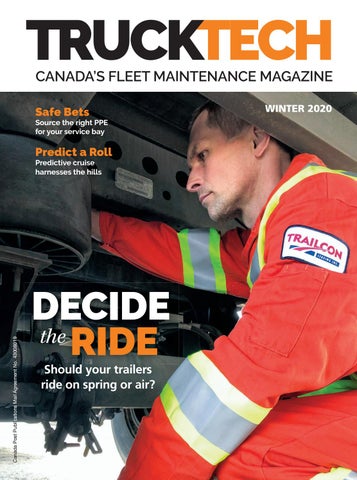
DECIDE the RIDE Should your trailers ride on spring or air?
WINTER 2020
FEATURES is written and published for owners, managers and maintenance supervisors of those companies that operate, sell and service trucks, truck trailers, and transit buses.
Safe Bets
WINTER 2020 • VOL. 5 NO. 4
Choosing the right PPE for your service bay By John G. Smith
PG.
6
Editorial Director John G. Smith johng@newcom.ca • [416] 614-5812 Contributing Editors Derek Clouthier, Abdul Latheef, James Menzies, John G. Smith Managing Director Trucking and Supply Chain Group Lou Smyrlis lou@newcom.ca • [416] 510-6881 Creative Director Tim Norton tim@newcom.ca • [416] 510-5223 Art Director Frank Scatozza frank@newcom.ca • [416] 510-5223
Decide the Ride
Production Manager Alicia Lerma alicia@newcom.ca • [416] 510-6845
Should your trailers ride on air or have a spring in their step? By James Menzies
PG.
8
NEWCOM MEDIA INC. 5353 Dundas Street West, Suite 400 Toronto, ON M9B 6H8 416/614-2200 • 416/614-8861 [fax]
Chairman and Founder Jim Glionna President Joe Glionna Vice President, Publishing Melissa Summerfield
Predict a Roll Harness hill power by using predictive cruise control By John G. Smith
12
Editorial ......................... 3 Quick Fix ........................ 4 Techs Talk..................... 14 2 TRUCKTECH
WINTER 2020
ADVERTISEMENT
Chief Financial Officer Trish Saltys Director of Circulation Pat Glionna Truck Tech is published by Newcom Media Inc. The contents of this publication may not be reproduced or transmitted in any form, either in part or full, including photocopying and recording, without the written consent of the copyright owner. Nor may any part of this publication be stored in a retrieval system of any nature without prior written consent.
PG.
DEPARTMENTS
Vice President, Editorial John G. Smith
10
For the garages of tomorrow, predictive maintenance will be at the forefront of equipment maintenance.
Cover: Przemek Chmielewski, Trailcon trailer technician, inspects a suspension. (Photo: James Menzies)
EDITORIAL
Electric Drives Early fleet tests will be the key to successful EV rollouts BY JOHN G. SMITH
There is no denying the recent surge in activity around battery electric vehicles (BEVs). Established and emerging OEMs alike are now releasing electric trucks into the wild, gathering the all-important intel that will determine exactly how such equipment performs beyond the reaches of a test bench. Not surprisingly, much of this work is anchored in Europe and California, home of particularly aggressive commitments to reduce emissions. But Canada is playing its own role in the electric vehicle evolution – and it’s not limited to a $1.8-billion investment that will see BEVs produced at Ford’s Oakville Assembly Complex. CN recently ordered 50 trucks from Quebec-based Lion Electric Co. Loblaw, meanwhile, has ordered its first Freightliner eCascadia tractors, expected to enter service beginning in the first quarter of 2022. Then there’s the ongoing work to produce electric vehicle components at Quebec’s Nordresa Motors and Dana TM4. Before anyone accuses me of going all Elon Musk-ie, I recognize there are few electric trucks on the road today. In higher weight classes, the numbers amount to merely dozens of units across North America. But as small as such numbers appear, early truck orders – and the teams which support them – play a critical role in determining what broader electric rollouts will look like. They’ll help define operations that can work with today’s limited ranges, and answer some of the everyday challenges that need to be addressed. Roger Nielsen, president and CEO of
Daimler Trucks North America, offers questions around regenerative braking strategies as just one example. “If their cruise is set at 60 mph, do they want the truck to coast to 62 mph before the regenerative braking kicks in, or would they rather the truck go down the hill at 60 mph and use that energy they get by it kicking in early to recharge the battery?” he asked during a recent online briefing. “We are always having trade-off discussions.” Wayne Scott, Loblaw’s senior director – maintenance, told me he’s particularly interested in seeing how his company’s diminishing grocery loads might further extend promised battery ranges. Then there are the questions surrounding where such vehicles can be practically based, and the charging support they’ll require. Such issues might represent the biggest challenges of all. There is a big difference between the rollout of commercial chargers and the systems used to rejuvenate an electric car’s battery in a home garage. Forget the AC systems rated at less than 50 kW. Commercial applications will be a decidedly DC affair. Automotive-grade CCS DC fast chargers can bring a 100 kWh battery up to an 80% charge in less than 20 minutes, delivering around 1,000 volts and 500 amps and drawing 250-500 kW of power. Proposed commercial vehicle chargers will deliver 1,500 volts and 3,000 amps to charge 500 kWh batteries in 20-30 minutes and require 4.5 megawatts of power. Forward-thinking fleets need to begin thinking about where such power will be available to support wider
(Illustration: iStock)
rollouts. Not every existing yard or warehouse will suffice. But it would be a mistake to discount a role for electric commercial vehicles because of the limitations and unanswered questions of today. A broader rollout of electric vehicles will come relatively quickly in applications like last-mile deliveries, refuse collection, port drayage activities, and utility fleets. Look no further than the recent Throne Speech as an indicator of government support to come. It reinforced Canada’s commitment to reach net-zero emissions by 2050. And the Liberal government has made several references to a “green” economic recovery in the wake of Covid-19. Incentives to develop electric fleets would help achieve both targets. As the inevitable financial support emerges, the trucks will continue to evolve. More fleets will experiment with the offerings. And it will all power a broader interest in future electric trucks. WINTER 2020 TRUCKTECH 3
QUICK FIX Traton strikes deal for Navistar Traton SE, the truck and bus division of Volkswagen AG, said Oct. 16 it has reached an agreement in principle to acquire Navistar International. Traton, which already owns 16.8% of the American truck manufacturer, will buy the rest of Navistar stock at US$44.50 per share. “We are looking forward to completing our due diligence and obtaining the necessary approvals in respect of this exciting deal in order to welcome the new Traton family member,” said Traton CEO Matthias Grundler. At that price, the company is valued at $4.4 billion.
New emissions focus by 2022
Prices for used vocational trucks strengthened, up about 1% compared to the same period last year. Ritchie Bros. reported prices across most categories in the U.S. and Canada are at, or slightly above, 2019 levels.
B.C. plans truck dimension review A planned review of B.C. vehicle widths and lengths is on hold pending a provincial election, but the process is still scheduled to move forward this fall as long as the elected government doesn’t change course. The review is expected to consider whether to increase maximum heavy-haul trailer widths, and explore other topics such as the use of apron trailers to reduce overall heights, maximum term permit widths, and axle track widths that apply to hauling manufactured homes, says Jan Lansing, manager commercial transport – commercial vehicle safety and enforcement, for the B.C. Ministry of Transportation and Infrastructure. Topics around dimensions are expected to include increasing the maximum wheelbase for semi-trailers, clarifying the treatment of steerable semi-trailers, the treatment of remote versus manned steering trailers, and maximum load lengths for term permits.
Calgary blitz yields poor results (Photo: iStock)
Ontario plans to have a new truck emissions inspection regime in place by early 2022, under a series of regulatory changes currently in the works. The province has committed to updating its periodic vehicle inspection program to include safety and emissions-related checks alike – part of a broader effort to crack down on those who manipulate exhaust and emissions systems. “It’s kind of like the old Drive Clean, but more focused on commercial vehicles,” Ontario Ministry of Transportation senior vehicle standards engineer Joe Lynch explained in a presentation during the Private Motor Truck Council of Canada’s online conference.
Kennaugh takes helm at Trout River DLH Group has named Stephen Kennaugh the president and CEO of Trout River Industries, its live-bottom trailer manufacturing division in Prince Edward Island. Kennaugh joined Trout River Industries in 2017 as financial controller, and was promoted to COO in 2018. He takes over the role of president from Darrin Mitchell, who is leaving the company.
Used truck prices stable Prices for used truck tractors are stable in Canada, according to a market report from Ritchie Bros., with prices for the three months ending Sept. 30 steady compared to the same time period in 2019. 4 TRUCKTECH
WINTER 2020
Only 22 of 158 commercial vehicle inspected by Calgary Police Service and Alberta Sheriffs passed inspections during a threeday blitz Sept. 22-24. The inspections were both random and targeted, Calgary Police told TruckTech. A total of 99 units were placed out of service, 37 required attention, and 112 violation tickets were written. Among the most egregious violations were: a driver operating a Class 8 truck without a supervisor and without the appropriate licence; a vehicle with cracked rotors; a truck with 75% of its brakes out of adjustment; broken leaf springs; and numerous heavily overloaded vehicles.
Bendix buys Dana out of JV Bendix Commercial Vehicle Systems has bought Dana out of a Bendix Spicer Foundation Brake (BSFB) joint venture that’s been in place since 2004. Dana had controlled a 20% interest in the joint venture. Bendix says it will immediately incorporate the wheel-end business and change the name to Bendix Commercial Vehicle Systems effective Jan. 1, 2021.
Walmart plugs in to Tesla order Walmart Canada is more than tripling its initial order for Tesla Semis, as the retailer looks to convert 20% of its fleet to electric vehicles by 2022. The 130 trucks represent the largest known order for the yet-built Tesla units in Canada, and is one of the largest reservations for battery-electric commercial trucks overall. Walmart Canada’s day cab fleet returns to the dock every night, and comfortably operates within the Tesla Semi’s
QUICK FIX promised operating range and gross vehicle weights, says Francis Lalonde, Walmart Canada’s vice-president – transportation. “We’re way, way, way south of the 500-mile [800-km] limit.”
Covid stalls fuel cell test An Alberta project that will put hydrogen fuel cell-powered electric trucks on the road has been pushed back due to the Covid-19 pandemic. The first fuel cell trucks, to be operated by Bison Transport and Trimac Transportation, were initially supposed to be on the road in July, with on-highway testing running until December 2022. But the pandemic put the design stage on hold, and testing will now run from October 2021 until April 2023. “The timetable for the design and build phase was impacted by Covid,” said Marcel Pouliot, Trimac’s vice-president – industry and regulatory affairs.
LUBRICANTS
Discover Total Heavy-Duty Rubia Optima Range
Maximetal maximizes St-Georges, Que.-based utility truck manufacturer Maximetal is adding 10,000 sq.-ft. to its operations to keep pace with surging demand. The new site will be around the corner from its existing 35,000 sq.-ft. main plant. It plans to increase its workforce by 10-15% in the coming months. “Expansion has been in the mid-term plans for a while now based on increasing demand for our fire apparatus. With a recent significant increase in demand for our utility trucks it became clear that the time to execute was now,” said Maximetal director of business development Christopher Sapienza.
President’s choice is an eCascadia
One of the earliest eCascadia prototypes was brought to Canada for a recent test in B.C. (Photo: Loblaw)
Loblaw is scheduled to secure Canada’s first Freightliner eCascadia trucks, placing an order for five of the electric vehicles that will begin production in the first quarter of 2022. Canada’s largest grocer, which has made a broad commitment to reduce greenhouse gases, is already participating in a related customer group offering insights into test units. And last year it was instrumental in bringing one of the first eCascadia prototypes to B.C. for a test run. “It’s on the boards, so we’re all pretty excited about it,” says Nova Truck Centres president and CEO Peter Macgillivray, referring to the deal. The first two units are to be delivered in 2022, with the remaining three to come in successive years. WINTER 2020 TRUCKTECH 5
total-canada.ca
PERSONAL PROTECTIVE EQUIPMENT
SAFE BETS
Source the right PPE for your service bays BY JOHN G. SMITH Trucking-related safety discussions often look to address on-road dangers, but there are plenty of threats closer to home. Look no further than service bays for proof of that. The hoses and cords? Tripping hazards. A spinning grinder? Watch out for the airborne debris. Handling a grease-coated part? Watch your grip. Working on trailer marker lights? It’s a long way down, isn’t it? “Most of the types of injuries we see in shops are things like slips, trips and falls, and then the musculoskeletal injuries from repetitive motion – and that’s very relative to the type of work that they’re doing in the shop,” says Budd Phillips, prevention field services manager at Worksafe BC. “What are we seeking to try to control and mitigate? Let’s define them and understand where they may occur and what may generate them.” The “relative” nature of the work is an important factor to consider, especially when it comes to protecting technicians from the related safety risks. “It’s about finding the right PPE (personal protective equipment) for the task,” says Monica Thomsen, executive director of the Nova Scotia Trucking Safety Association. “What are my injuries? Are they musculoskeletal? Then what am I not doing for my employees to stop these strains?” With a seemingly endless catalogue of products that can protect personnel, choosing the best options can seem like a daunting task, and an expensive one at that. But Thomsen stresses that the choices should focus on the shop’s specific experience. “Look at your trending and your risk,” she says. “What injuries are they having? What’s going on in the shop? If it’s 6 TRUCKTECH
WINTER 2020
Protective eyewear options can effectively block debris while also preventing fogging. (Photo: istock)
hands, you focus on hands and what’s causing it.” It’s even possible to ensure employees are not helping themselves to more of the supplies than they need. “You can put control measures in place. You can put limits on the vending machines,” Thomsen says. Besides, the price of the appropriate PPE will always be cheaper than the consequences of dealing with an injury.
Work gloves Something as seemingly simple as work gloves can be appropriate for one job, but fall short when it comes to the needs for the next. When working in one large shop, for example, Thomsen noticed workers were using disposable nitrile gloves. The problem was, purchasing teams had selected shiny options that lack the grip mechanics need. “Dexterity is a key thing in a mechanic. Anyone that’s handling
(parts), they need the dexterity to still do their job and not have the bulk.” The same consideration applied when choosing cut gloves, and she tracked down options that were less cumbersome for users. “They wore them all day,” she said, referring to the benefits that come with comfortable PPE.
Safety glasses The dust and debris that falls from equipment surfaces presents a threat of its own, and drives much of the demand for protective eye wear. But there is a clear difference between the various choices. “You don’t just buy the box of safety glasses,” Thomsen says. Here, she recommends looking for options that incorporate foam to stop dust particles from getting under the frame, but also features that will keep the safety glasses from fogging. Phillips is seeing more examples of
PERSONAL PROTECTIVE EQUIPMENT eyewear incorporating an edge to help offer a protective seal when grinding.
Protective footwear Most shops require employees to wear some type of protective footwear, but the best choices look beyond steel toes. In one location, for example, Phillips discovered that boots were actually creating a hazard of their own. Deeply lugged treads were catching on the steel grating in a stairway. “Do we actually give a recommendation?” he asks, referring to guidance that should come along with footwear allowances.
Hearing protection Threats are not always limited to the naked eye. “We’re seeing a resurgence in hearing loss,” Phillips explains. “Have you done a noise survey, and if so, what are you doing that you’re trying to mitigate it?” The large box of foam ear plugs may not be the answer, though. Custom-molded versions can be vented and make it easier to hear coworkers.
sider: “Do I need to be at heights to do that work? … Is there a way that you can do that work without being up there?” Some facilities have found the best answers in customized solutions. Thomsen, for example, refers to Irving shops that include platforms and mid rails, supporting those who need to
access the tops of trailers. Phillips points to maintenance teams who worked on coal haulers, and created a ladder system that formed an A-frame, ensuring access between a platform and the box 12 feet below. It’s all about finding the safest path to a task.
WE CALL IT TRAILERCARE. It’s our fleet management service that has everything you need to keep moving: preventative maintenance, repairs, and emergency response – all backed by technology that gives you the full picture.
Respirators When risks involves fumes and vapor, it’s a matter of choosing an appropriate respirator, complete with the fit tests to ensure an appropriate seal. “One of our challenges is getting them to wear it. It’s uncomfortable,” Phillips says. But here he’s seen employers shifting to PAPR systems that use a blower to draw air through a filter rather than lung power. It costs more upfront, but the savings come through the added protection.
TrailerCare by trailcon.com | 855.ROAD.RPR
Fall protection As important as harnesses will be, there might also be a better way to prevent falls. “One of the things that we often find is there’s a jump right to putting people into a harness and a lanyard,” Phillips says of the work that occurs 10 feet above grade. But guardrails and handrails might deliver an added sense of security. There’s even another question to conWINTER 2020 TRUCKTECH 7
TRAILER SUSPENSIONS
DECIDE the RIDE Debate between spring and air ride continues BY JAMES MENZIES
The debate over spring versus air ride trailer suspensions is far from over, even if air ride has emerged as the decisive winner in the marketplace. Some fleets are taking a fresh look at the virtues of spring suspensions and view them as an opportunity to reduce maintenance and lower costs. Scott Bartlein, fleet manager for Barry Trucking, gave a balanced view of both suspension types when speaking at the fall meeting of the American Trucking Associations’ Technology & Maintenance Council. He noted cargo packaging and load securement equipment has evolved over the years, providing better cargo protection. Spring suspensions are lighter, affording the opportunity to increase payload. Bartlein said they’re two to four times less expensive to maintain than air ride, and if you’re pulling double trailers, they’ll place less demand on your tractor’s air system. Spring ride suspensions are also easier to inspect, which can lead to more effective pre- and post-trip inspections, and potentially fewer roadside violations. On the other hand, air ride makes sense for cargo that’s fragile or lightweight, especially if it’s coming off a potentially
Przemek Chmielewski, a trailer technician with Trailcon Leasing, inspects a trailer suspension. (Photo: James Menzies)
8 TRUCKTECH
WINTER 2020
TRAILER SUSPENSIONS rough sea journey. There are also customers who demand their freight move on air ride suspension-equipped trailers. Some may even pay extra for the privilege. “I’m not bashing air ride,” Bartlein said. “I think there’s a need for them. All I’m saying is, as fleets we want to keep an open mind. One size doesn’t fit all and we need to take a fresh look at technologies.”
A Breadner Trailers technician services a trailer suspension. (Photo: Supplied)
Schneider’s stance Last year, Schneider published a white paper around a study it conducted comparing spring to air ride suspensions. The findings were surprising. “When it comes to trailing equipment, air suspensions are a hot topic, and some believe that air ride is better than conventional leaf spring suspension. In turn, those shippers and carriers are unnecessarily paying more for a system that provides similar or equivalent ride quality,” Schneider wrote in the white paper. It found in comparing the two types of trailers that air ride suspensions did not guarantee a smoother ride. “It’s a myth,” the fleet declared. “Knowing this, Schneider can’t justify spending more on air ride and recommends shippers don’t, either.” The company’s study found ride quality at the front of the trailer was a function of tractor suspension, with the trailer suspension having little impact. Ride quality at the rear of the trailer, using an industry standard spring suspension, was very close to the four most popular air suspensions tested by Schneider. In fact, under some circumstances, the spring ride suspension provided a better ride quality. Schneider concluded that with LTL shipments or light loads, the benefits of air ride were “minimal at best.” It also touted spring ride’s benefits, such as being less prone to mechanical issues over its lifecycle, its longevity – generally lasting the life of the trailer – and being immune to certain failures such as punctured, leaking or collapsed air bags. “Not only are air ride suspensions more expensive to purchase and maintain, which could translate to inflated expense to the shipper, but more importantly, they do not guarantee superior ride quality,” Schneider concluded.
(Source: Schneider)
But, not so fast… Suspension manufacturer Hendrickson, on the other hand, cites data of its own showing air ride does, in fact, provide a smoother ride among other benefits. The company notes more than 70% of fleets have spec’d air ride suspensions on one or more trailers, for a variety of reasons. It also says air ride suspensions have grown their market penetration from about 12% in 1987 to nearly 70% today. Hendrickson says benefits include: improved ride quality, better cargo protection, greater flexibility to haul more loads, higher resale value, improved fuel economy, and extended tire life. Measuring vibration over a variety of roads, Hendrickson found spring suspensions performed worse than Hendrickson’s
(Source: Hendrickson) WINTER 2020 TRUCKTECH 9
ADVERTISEMENT
The Advent of Predictive Maintenance For the garages of tomorrow, predictive maintenance will be at the forefront of equipment maintenance. The combination of the Internet of Things and Big Data managed by a Computerized Maintenance Management System (CMMS) will extend the life of your trucks by improving operating parameters and avoiding interruptions. PREVENTIVE MAINTENANCE, which dominates the tasks of existing garages, consists of maintaining equipment at regular intervals based on normal operation. In this sense, it advocates the replacement of parts by precaution, reducing the number of failures your assets may go through. With curative maintenance, the truck is repaired only after the failure is detected. The transportation, loading, delivery or other activity must be stopped, making turnaround times critical.
HOW PREDICTIONS WORK Nowadays you can put many sensors on a truck to measure operating parameters. This builds up data directly from the weakest elements. The retrieved information paints the contours of predictive maintenance based on the continuous analysis of an equipment’s health and the detection of signals that warn of failures, such as the viscosity of oils, vibration of components, voltage variations, etc.
EXCHANGE SPEED
THE NOT SO DISTANT FUTURE
Identifying sensor data allows for continuous monitoring and immediate detection of operating deviations. In a predictive maintenance environment, your system knows your trucks condition in real time at any given time. All this information at your fingertips with optimized operations of your equipment offer you several advantages: fewer incidents, limited risk of serious failure, longer service life for trucks, better response planning, reduced down time, and reduced inventory.
Predictive maintenance requires a greater investment than curative and preventive maintenance since it involves the establishment and management of a fleet of connected objects in addition to storage and processing infrastructure data. With a steady decline in costs, within a few years, this model will become increasingly accessible to businesses and will position itself as a key facet of maintenance management software to provide managers with all the analytical tools and real-time interpretations.
)OHHW PDLQWHQDQFH VRIWZDUH VROXWLRQV :RUN RUGHUV
'DVKERDUG
0HFKDQLF V PRGH
:DUUDQWLHV DQG FODLPV
,QYHQWRU\
3ODQQLQJ
8QLWV
+LVWRU\
7LUH PDQDJHPHQW
)XHO IXLOG PDQDJHPHQW
GDWDGLV FRP
TRAILER SUSPENSIONS own, and other, air ride suspensions on rough, secondary and highway routes. “Minimizing the road forces and vibration reflects how well the suspension helps isolate or protect a trailer from potential damage,” Hendrickson wrote in a white paper. “If a suspension has a lower natural frequency, it reduces the forces transmitted to the trailer, thus improving the ride quality. Air suspensions in general can achieve very low natural frequencies.” In its study, Hendrickson found a typical spring suspension has natural frequencies ranging between 2 Hz and 5 Hz, depending on load and other factors, while an air ride suspension can produce natural frequencies below 1.5 Hz.
Canadian fleets prefer air ride Here in Canada, air ride dominates fleet orders. This could be because of our rougher roads, or the fact Canadians in general tend to call for a more robust trailer spec’ due to the more challenging climate. John DeJong, fleet manager with Trailcon Leasing tells TruckTech that 75-80% of its new trailer orders come equipped with air ride suspensions. “Customers are demanding air ride,” he said. “It is perceived to be a better suspension. A lot of (shippers) out there will only load on air ride because of the perception it protects the load better.” Bob Breadner, president of Breadner Trailer Sales, agrees that there’s very little demand for spring ride suspensions in Canada. “We have seen some interest, but not enough to call it a trend as of yet,” he said of spring suspension-equipped trailers. Breadner Trailer Sales ran a pilot within its own fleet several
years ago, putting spring ride suspension trailers into service for the delivery of new assets to customers. “Our drivers didn’t like it,” Breadner said. “When empty they found they didn’t operate as well (as air ride).”
Maintenance requirements But with air ride suspensions comes increased maintenance requirements – and sometimes headaches. “Air ride does have more components to maintain,” Breadner said, rhyming off: air valves; air lines; air bags; leveling vales; and shocks. All these should be regularly inspected to prevent roadside failures. “I do believe spring ride will lead to reduced roadside infractions because of how simple they are compared to air ride,” Breadner said. “There are less items to maintain and less items to put the equipment out of service.” DeJong agreed, noting: “Spring is a lot easier – you just check the springs and bolts, see if they’re loose. Maintenance on spring is considerably less, not to mention the cost of purchasing right from the start.” Air ride suspensions can be problematic later in life, with air bags suffering cracking and dry rot, and emerging leveling valve problems. Sliding bogeys can overextend air bags and damage shocks. DeJong said there are so many different types of air bags on the market, it’s important to spec’ the best ones available. What you choose to do with your trailers at the end of their service life is also a consideration. Air ride-equipped trailers with life left on them are easier to sell, while spring suspension trailers are better-suited for storage.
Trailer Matchmakers How OEMs find the right components for their trailers Ever wonder what goes into the decisions behind which components come on your trailer? For an OEM, it’s a complex evaluation that takes many factors into account. Mark Ehrlich, senior director of engineering for Wabash National, gave a Technology & Maintenance Council study group some insight into the decision-making process. “The selection criteria is pretty intricate,” he said, referring to the evaluation of components such as suspensions, sliders, and wheel ends. “We are looking at multiple attributes in concert together to come up with the best result in terms of value.”
Those considerations include performance, safety, ride quality, weight, longevity, maintenance requirements, warranty duration, replacement parts availability, and more. Data is heavily relied on by the trailer manufacturer to make those decisions. Trailer makers also consider the complexity and cost of installation on their assembly lines. In the case of a suspension, Ehrlich said Wabash considers the warranty and its construction. Is it corrosionresistant? Are maintenance requirements reduced, for example, by using a mechanical fastener that doesn’t
require torquing? Are wearable parts readily available in the aftermarket? For the slide rail, the OEM considers longevity and examines the welds to ensure it won’t be prone to fatigue cracking. Ehrlich is wary of slide rails where welding has been done in high-stress areas. For wheel end components, Wabash wants to match up warranty with the lifecycle of the trailer. It wants to see long-lasting bearings and larger roller sizes. Lubrication requirements are also important, as are the wheel seals. “They’re a very inexpensive part in comparison to the rest of the trailer, but the wheel seal can cause a lot of cost later on if it fails,” Ehrlich noted. Inner and outer bearings that are the same part number can simplify maintenance for end users.
WINTER 2020 TRUCKTECH 11
PREDICTIVE CRUISE CONTROL trip, or restricted speed limits in place during World War 2, the end result offered the added benefit of relatively steady speeds and enhanced fuel economy. Traditional cruise control systems still face some challenges, though, especially in hilly terrain. If an engine calls on more fuel to maintain speed during an uphill climb, the setting is still in place as a truck crests the top of the rise. As equipment builds up speed on the downward slope, engine brakes might need to engage to keep things under control. The need for extra fuel emerges once again when the truck struggles up the next hill.
Predictive cruise control
Volvo’s predictive cruise control adjustments are made based on locations mapped during previous journeys. (Illustration: Volvo Trucks)
PREDICT A ROLL Predictive cruise control harnesses the power of terrain BY JOHN G. SMITH Cruise control has long been identified as a tool to enhance fuel efficiency. But the story of Ralph Teetor suggests something else was afoot when it came to helping drivers maintain steady speeds without touching a foot to pedal. Teetor, who secured a patent for cruise control in 1945, couldn’t actually drive. The future member of the Automotive Hall of Fame lost his sight after 12 TRUCKTECH
WINTER 2020
a childhood accident and relied on friends like Harry Lindsay to chauffeur him about. As his family told the story, Lindsay tended to slow down as he talked and sped up when he listened. The rides were jerky because of it. The idea for the first cruise control known as the Speedostat was born. Whether the device was inspired by Teetor’s legendary desire for a smoother
The latest generation of predictive cruise controls has refined the process, basing decisions on GPS coordinates and harnessing the power of kinetic energy like a child pedaling a bicycle. “The system increases speed prior to going up a hill to stay in top gear, and then rolls down the hill as long as possible before re-engaging the driveline,” explains Johan Agebrand, Volvo Trucks North America director – product marketing. With the precise coordinates and calculations that account for engine loads, the throttle eases just as the truck approaches the crest of the hill, harnessing the vehicle’s momentum across the peak and down the other side. Before hitting the bottom, the acceleration returns to gain some added momentum for the work ahead. The greatest benefits are along routes with rolling hills, and grades that run 1-4%, Agebrand says. “Even ‘flat’ roads present opportunities for predictive cruise to control fuel consumption,” adds Aaron Peterson, Navistar’s chief performance engineer – heavy product platform. “In mountainous terrain, there are still opportunities for predictive cruise to contribute (because) new elements like predictive gear shifting and predictive braking have been incorporated.” It isn’t the only way such systems tap into more than the throttle alone.
PREDICTIVE CRUISE CONTROL “Unlike conventional cruise control, which attempts to maintain a consistent set speed with little variation, IPM (Intelligent Powertrain Management) not only allows the vehicle to increase and decrease speed around the set cruise speed, similar to what you might do while riding a bike, but it also decouples the engine and transmission to coast with the engine at idle running speed in downspeeding/coasting conditions, referred to as E-coasting,” says Leonard Copeland, product marketing manager at Detroit.
Mapping approaches Manufacturers differ in their approach to reading the terrain, though. Daimler Trucks North America and International Trucks, for example, pre-map territory and hills. In contrast, Volvo Trucks’ mapping draws on each individual truck’s experience. The predictive cruise control known as I-See matches GPS coordinates to a gradeability sensor in the Volvo I-Shift automated manual transmission, recording loads and road speeds along the way. This data is used to adjust the cruise control whenever the vehicle drives by the same location. For the drivers equipped with any predictive cruise control, the difference might only be noticed by a change in a dash display that shows underspeed or overspeed settings – the speed differentials that need to be reached before adjustments begin. “You have your engine ECU, you have your transmission ECU, and usually some form of vehicle ECU and your driver information display,” Agebrand says of the overall predictive cruise control systems.
Training needs There are some training needs to consider, in part to ensure that drivers let the predictive cruise control do its job. If the truck is rolling over the crest of a hill a little faster than normal, say by 1-2 mph, that’s normal. “If you start rolling over faster, don’t go over on the brake pedal,” Agebrand says. An extra economy setting, mean-
while, will let the vehicle slow down a little more heading up the hill. He describes the process like riding a mountain bike. “Don’t get into the pedal,” he says of the downward journey. “Let the truck do the work.” “You never need the brake in many cases,” he adds, offering the example of rolling terrain that never sees more than a 2% grade. “You utilize the whole hill.” Peterson adds that the software itself is further enhancing the action by gently accelerating and decelerating rather than suddenly adjusting speeds. When everything operates the way a driver expects it should, those behind the wheel are more likely to engage the cruise control and achieve the fuel economy benefits.
Fleets have the option of increasing or decreasing set speeds to further boost fuel economy. (Illustration: Daimler Trucks North America)
GPS signals can be dropped, of course. When that happens, the systems revert to a traditional cruise control logic, Peterson says. No driver intervention is required. But drivers need to understand the limits as well. “Cruise control operation, while typically being one of the safest driving modes with a full suite of safety features, is not recommended in inclement weather where wheel slip is possible,” says Copeland.
Fuel-saving benefits Some routes will also see greater fuel-saving benefits than other journeys. In a north-south route along the U.S. East Coast, it’s possible to boost fuel efficiency by 1-2% over time. Even on a flat route there’s still going to be a 0.5% savings, Agebrand says, noting the natural grades that vary on any road. Canadian users may even have a benefit over their U.S. counterparts with such systems. Agebrand says an ideal load would have a gross vehicle weight of 110,000-120,000 lb., admittedly heavier than the 80,000-lb. gross vehicle weights that are more commonplace on U.S. interstates.
Maintenance needs Some of the few maintenance needs tend to be traced to the way additional systems are integrated into the predictive cruise controls. “Cruise control systems now receive inputs from the collision mitigation braking systems,” Peterson says as an example. “These inputs support the adaptive cruise control strategy that adjusts vehicle speeds to other vehicles in their path. If there is a fault in the collision mitigation system, then the cruise control system can be inoperative.” In other words, all of the switches and sensors need to be working upstream. “For example, a faulty ECU or a broken clutch or neutral start switch will make standard cruise control inoperative,” Copeland says. Fleets also have the options of increasing or decreasing set speeds in the name of further boosting fuel economy by adjusting the upper and lower hysteresis values, harnessing more kinetic energy from the hills. “No matter what the upper hysteresis is set at, the vehicle will not fuel the truck above the set road speed limit,” Copeland stresses. “Decreasing of the lower hysteresis is limited on vehicles built after January 2021 due to GHG Phase 2 regulations,” he adds. The systems continue to evolve. WINTER 2020 TRUCKTECH 13
TECHS TALK
Learning Process Armour service manager finds success in training and attitudes BY ABDUL LATHEEF
“I have looked at trucks with big eyes since I was three or five years old,” said Dean Arseneault, as he recalled growing up in the logging village of Rogersville, N.B. Back then, a lot of big rigs crisscrossed the village, piquing his interest in trucking. His father, Romeo Arsenault, had also owned a shop for 20 years. The path into the service bay was not a direct one, however. He initially set his sights on a view through the windshield. The younger Arseneault passed his Class 1 test the day he turned 18, but nobody wanted to hire a truck driver that young. He still managed to drive for about six months, but the lumber industry was going downhill as well. That was when he decided to take a slight detour from the original career path and pursue a mechanic’s job through a course at the New Brunswick Community College in Bathurst. “I have never looked back,” said the 47-year-old. In 1993 he joined Armour Transportation Systems in Moncton, N.B., as a technician, immediately exposing him to one of the largest fleets in the region. The learning process never stopped. He became a Red Seal-certified technician, eligible to practice the trade anywhere in Canada, and completed a series of training courses when the opportunities presented themselves. Today he is service manager of the fleet that now has 11 shops across Atlantic Canada. The operation counts close to 1,000 trucks, 3,500 trailers, and more than 2,000 employees. Working at Armour has been a great 14 TRUCKTECH
WINTER 2020
Dean Arseneault (Photo: Supplied)
experience and privilege, Arseneault said, referring to it as a people-focused company. One of the biggest challenges these days involves finding qualified apprentices, the next generation of workers who will step into the service bays. But he knows what to look for in the search for a good mechanic. “I have always been a big fan of having a great attitude. If you have a great attitude and you have limited skills, we will teach you the skills,” he explained. “But if the attitude and the willingness are not there, it is more difficult.” There are still some people who are eager to learn and adapt in such a role, he said. They can still be found. Collectively, the Armour shops hire three to five apprentices every year. His personal learning process continues as well. He is a regular attendee at seminars organized various organiz-
ations, taking the steps to improve his own skills and pass along knowledge to members of his staff. And while Armour conducts most of its training in-house, it occasionally flies in experts to deliver tailored programs. There are also the online courses offered by OEMs such as Volvo and Daimler, to offer further insights. Arseneault attributed his success to his “great maintenance team,” and said the best thing about working in trucking is the camaraderie. “The trucking industry is like a big family. It doesn’t matter which province you are in. You feel welcomed,” he said. Even his own family plays a role in his career success. His wife Sylvette, and children Julie and Mathieu, are always there at his side. “This would not have been possible without their support,” Arseneault said of his success.
More with Less. Volvo D13 with Turbo Compounding
The Volvo VNL featuring the D13 with Turbo Compounding gives you greater fuel efficiency and increased performance for your application. Using Turbo Compounding, the VNL recovers an additional 50hp to get up to a 7.5% increase in fuel efficiency. Learn more at volvotrucks.ca/en-ca/trucks/powertrain/d13tc
the volvo vnl
3DUWV PDQDJHU
0HFKDQLF
6KRS IRUHPDQ
2ZQHU
2XU )OHHW PDLQWHQDQFH PDQDJDPHQW VRIWZDUH LV VSHFLILFDOO\ PDGH IRU HYHU\ RSHUDWRU LQ ERWK WKH ZRUNVKRS DQG FRPSDQ\ :KHWKHU \RXUVHOI PHFKDQLF VKRS IRUHPDQ DFFRXQWDQW RU SDUWV PDQDJHU XVHV 0,5 57 DOO RI WKH PRGXOHV DUH PDGH WR IDFLOLWDWH \RXU ZRUN RQ D GDLO\ EDVLV
‹ 'DWD'LV ,QF
*R WR GDWDGLV FRP RU FDOO XV DW