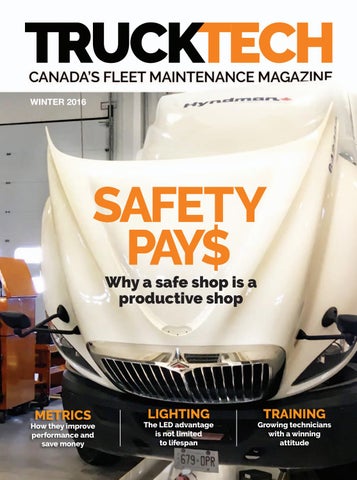
WINTER 2016
SAFETY PAY$ Why a safe shop is a productive shop
METRICS
How they improve performance and save money
LIGHTING
The LED advantage is not limited to lifespan
TRAINING
Growing technicians with a winning attitude
The new gold standard in engine oil. New Mobil Delvac™ diesel engine oil is technology redefined. It’s a full suite of new products that help protect your engine and maximize the uptime of your fleet. Its proven protection goes beyond OEM-recommended ODI’s, making your business more efficient and your life a little easier. Discover our new API CK-4 diesel engine oils at mobildelvac.ca
© 2016 ExxonMobil. All trademarks used herein are trademarks or registered trademarks of Exxon Mobil Corporation or one of its subsidiaries. Imperial Oil, licensee.
is written and published for owners, managers and maintenance supervisors of those companies that operate, sell and service trucks, truck trailers and transit buses.
WINTER 2016 VOL. 1 NO. 02 VICE PRESIDENT, EDITORIAL Rolf Lockwood rolf@newcom.ca • (416) 614-5825 CONTRIBUTING EDITORS James Menzies, John G. Smith, Dave Nesseth, Derek Clouthier GROUP PUBLISHER Lou Smyrlis lou@newcom.ca • (416) 510-6881 CREATIVE DIRECTOR Tim Norton tim@newcom.ca • (416) 510-5223 PRODUCTION MANAGER Kim Collins kim@newcom.ca • (416) 510-6779
COVER STORY
SAFE SHOPS = SMART MAINTENANCE NEWCOM BUSINESS MEDIA INC. 80 Valleybrook Drive, Toronto, ON M3B 2S9 416/614-2200 • 416/614-8861 (fax) CHAIRMAN AND FOUNDER Jim Glionna PRESIDENT Joe Glionna VICE PRESIDENT, OPERATIONS Melissa Summerfield CHIEF FINANCIAL OFFICER Anthony Evangelista DIRECTOR OF CIRCULATION Pat Glionna Truck Tech is published by Newcom Business Media Inc. The contents of this publication may not be reproduced or transmitted in any form, either in part or full, including photocopying and recording, without the written consent of the copyright owner. Nor may any part of this publication be stored in a retrieval system of any nature without prior written consent.
SPARKLING CLEAN: The maintenance bay at Hyndman Transport’s new Ayr, Ont., headquarters.
It’s the little things that tend to literally trip up shop technicians – slips, sprains, strains and falls. Add them all up and they affect shop productivity. Here’s how to make sure they don’t happen in your shop.
Features LEADERS SPEAK: Darek Mowinski 10 Inside the mind of the first Canadian to win Ryder’s Top Technician competition. UNDER THE MICROSCOPE 16 Good maintenance practices are an investment but hidden problems can prove to be budgetary boat anchors. Metrics – the collecting and organizing of cost data – can show fleet maintenance managers where they can do better. And now they are more powerful than ever. IS YOUR SHOP IN SHAPE? 20 Maintenance is generally the third highest cost in a transportation company. So any reduction in costs goes right to the bottom line. Here’s five ways to make maintenance your competitive advantage.
10 trucknews.com
16
LIGHTEN THE LOAD 23 While LEDs enjoy long lifespans, they can benefit from some careful maintenance practices. From how to wash away road grime to protecting the power supply that feeds them, here is what you need to know. INTRODUCING THE TRAILER ELECTRIC 26 Electric standby for reefers is nothing new as a technology. So why is the adoption rate – or untapped potential – so low in the North American food industry? And is that about to change?
Departments Editorial ....................................................5 The View with Lou ....................................7 Quick Fix ...................................................8 Equipment Watch ...................................28 Inside the Numbers .................................30
23 Winter 2016 TRUCKTECH 3
BECAUSE YOUR BOTTOM LINE COUNTS,
RELY ON MICHELIN.
®
You can carry more while saving fuel which helps you to reduce your costs and increase your income. For a reliable traction in all seasons, adopt the MICHELIN ® X One® XDN ® 2 tire today.
©2016 MNA(C)I. All rights reserved. The “Michelin Man” is a registered trademark licensed by Michelin North America, Inc. (C14032)
Editorial
Best shop training options? Traditional training brings a retention rate of 20-25% but modern options easily triple that figure By Rolf Lockwood
Last issue I talked about the ever increasing need for continuous training in the shop, as if that wasn’t obvious with rapid changes in technology and the burden of compliance resting heavily on the fleet super’s shoulders. Nobody will disagree with that idea but not everyone can act on it. So how best to do it for maximum effect? It’s no longer feasible for most shops to send their people away for a few days to some distant classroom, and even finding time at home base can be tough. Yet the old ways are still with us to a perhaps surprising extent. They’re being supplemented and in some cases replaced by web-based options, though not at a blistering rate. Traditional training, with a teacher in a classroom, a video being played or slides being shown, is essentially a one-way process with not too much interaction. There’s very often no test at the end, no measurement of a trainee’s comprehension. And the information retention rate is just 20 to 25%. Not so hot. Hands-on interactive workshops are much more effective. Instructor-led, popular with technicians themselves, they have a mix of printed materials, video demonstrations, and participation in tasks like fault diagnosis, usually with real trucks and components. Everyone seems to agree that it’s the best approach, and retention can be above 80%. That is, if you can gather technicians together in one place, either in your own shop or by sending them to off-site sessions. The disadvantages of this method
Internet-based training is a good choice if the challenge of finding a quiet space can be met include not having access when you want it, time off the job, and cost — in lost productivity and the burden of travel, plus the cost of the training itself. Such disadvantages are likely one of the main reasons why not enough training is done. Distance learning is the opposite, with the training distributed in several ways, including the old standard correspondence course. Essentially it’s simply reading and answering questions, but retention is said to be low at about 20%. Computer-based training using CD/
DVD programs is now pretty common and, done well, can heighten interactivity with the trainee, which in turn increases the information-retention rate — as high as 75%. The programs are often feature-rich with sound and video. Disadvantages may include difficulty in controlling the distribution of the CDs or DVDs. Like, who has them? Nor can they be updated. Interactivity with a trainer is difficult because each CD operates in isolation on a PC. Tracking the trainee’s progress can also be tough. Worse yet, not every shop has an accessible computer or a quiet place in which to park a laptop. Internet-based training is a logical alternative, if the challenge of finding a quiet space can be met. Retention of 75% or so is claimed, largely because it can be very interactive and can use all manner of video and animation. As well, communication amongst trainees and trainers can theoretically be accomplished through real-time chat, discussion groups, and news postings. Trainee feedback surveys are easy to do and comprehension testing can be easily collected and stored in a central database. Detractors say the online approach has a fatal flaw in that there’s normally no instructor present to talk with, to clarify difficult points. So that’s the shop covered but it’s not only technicians who need training in new technologies and the latest rules and regs. Drivers, I would argue, are woefully undereducated in these crucial areas. I’ve had a lot of discussions about this lately and I’ll get into them next time out. TT Winter 2016 TRUCKTECH 5
The View with Lou
Face the future Advanced truck technologies are making for a more efficient and safer trucking industry. What challenges do they pose for technicians? By Lou Smyrlis Over the last few years every industry has become a tech industry. Technology has become the lifeblood of the best companies today. Those were the words of Justin Bailie, co-founder of trucking software provider Rose Rocket and one of the younger members of a panel of industry leaders I hosted recently on the future of trucking. His words ring so true of the best managed companies in our industry. To lead often means you have to leverage investments in technology and I see that trend intensifying. Think of the technologies becoming mainstream today – automated transmissions, disc brakes, collision mitigation systems. They are all making for a more efficient and safer industry that is attractive to a wider labor pool than it was 20 years ago. Yet technological breakthroughs such as electronic stability control and forward-looking collision mitigation systems are also causing distinct challenges for maintenance professionals because of their complexity. Two decades ago the rock stars on your shop staff could jump in and repair the engines and manual transmissions of the time. But today, as Mark Poland, maintenance manager with Sheehan’s Truck Centre pointed out, you can have technicians spend a great deal of time in school and still not have a complete understanding of everything they need to know. We need to move towards technicians trained specifically on certain systems to deal with the increasing complexity. If only the complexity issues could be solved within the walls of your own shop. Trucking is an industry on wheels. What if there is a failure to a trucknews.com
What if there is a failure to a safety system in a remote area? Is there likely to be a technician available with the parts necessary to fix it? safety system in a remote area? Is there likely to be a technician available with the parts necessary to fix it? As panelist Jim Pinder, corporate fleet director, Erb Group of Companies pointed out, if the truck rolls into one of these remote areas with a drum brake issue, it’s no problem. They’ve seen drum brakes for decades, they know how to fix them. What happens when they roll in with a disc brake issue? With some of the more advanced technologies they may not even want to attempt repairs.
Makes you want to think long and hard about investing in advanced technologies, despite their many benefits. But maintenance managers are starting to get a grip on the situation and there are developments that are helping them do so. Paul Kudla, regional vice president, Volvo Trucks, and also on the panel, pointed to one key development: the sophistication of remote diagnostics and their growing ability to assist technicians with troubleshooting before the truck even breaks down. With fault codes sent for analysis to Volvo’s Uptime Centre, for example, truck OEMs basically know what’s wrong with the truck, and the best course of action, before you do. And if it’s an issue that does come through your shop doors, Pinder foresees a future where his technicians have built up enough history with the rich data they’re receiving from the truck that they would be able to make a much faster decision about what the likely problem is than ever before. They would be able to narrow it down to two or three items rather than going through a diagnostics tree that could take all day. But perhaps the most promising sign of what’s ahead is the attitude of the young people entering our industry. They see the constant change brought about by technology as the norm. Consider the words of another panelist from the Millennial generation, Vania Agostinho, truck and coach apprentice with Carrier Centers, when I asked her what she thought of all the new technologies she will be dealing with during her career: “I would be lying if I said it didn’t scare me a little bit. But it’s exciting at the same time.” TT Winter 2016 TRUCKTECH 7
QUICK FIX
Keeping up with the pace of change As trucks become more complex, finding and developing technicians to work on them becomes more challenging When Vania Agostinho first considered a career as a heavy truck and coach technician, she thought trucks were “big dumb machines that you want to get away from because they’re slow.” However, having embarked on a career as a technician – she’s currently a truck and coach apprentice with Carrier Centers – she thinks differently. “In reality, they’re so much more than that,” she said of her initial impressions. “Being a part of this industry has opened my eyes. I wish there was more exposure for kids in high school to learn about the industry.” As a millennial, Agostinho is representative of the next generation of technicians who will be tasked with repairing and maintaining the next generation of increasingly complex trucks. She was part of a recent Fast Forward: A Deeper Look Inside the Future of Trucking event hosted by Newcom Trucking Group and the Toronto Area Council of CITT. The event, held at Maritime-Ontario’s Brampton, Ont. headquarters was sponsored by MobilDelvac. Agostinho said she initially pursued an education in broadcasting and then found work at a brake bending factory before returning to school to pursue a career that was more to her liking. She said it’s important young people get an accurate portrayal of the industry and the profession. “When you talk to people about the industry…they tell you, it’s heavy lifting. It’s this and that. You’re a girl and you’re going to be constantly dirty. So you get a lot of negative comments that affect the way you think. For me, I put it off and I did a lot of factory jobs and they were things that weren’t fulfilling to me,” she said. To find people like Agostinho, Marc 8 TRUCKTECH
Winter 2016
Poland, maintenance manager with Sheehan’s Truck Centre, said his organization has had to be more creative in reaching out to them and to respond more quickly than in the past. “There is a huge shortage of technicians this industry is dealing with,” he said. “We need to make sure if we’re posting an ad that we get it on as many computers or smart devices as we can. If you manage to get the contact information of a technician, you need to follow up quickly. In the past, you
By James Menzies and collision mitigation systems are some of the technologies fleets are increasingly investing in, and all bring additional maintenance challenges. Paul Kudla, regional vice-president with Volvo Trucks North America, said remote diagnostics are helping by assisting technicians with troubleshooting before the truck even breaks down. “We know what’s wrong with the truck before you do,” he said. “Our big goal with remote diagnostics was to reduce downtime.”
“I’m receiving e-mails from my trucks, telling me they have a potential problem.”– Jim Pinder, Erb Group could send a follow-up e-mail. That’s not quick enough anymore. Now we’re to the point where you are texting to set up interviews with technicians.” Poland believes in visiting high schools and getting students into the trucks. “It’s getting in front of them and making them aware our industry even exists,” he explained. He’s also a big believer in investing in apprentices and doesn’t like to see poaching from competitors. Jim Pinder, corporate fleet director with the Erb Group of Companies, said the traditional source of mechanics – family farms – have practically disappeared. “As an industry, we need to change our thought process as per where we’re getting these people from,” Pinder said. As trucks become more complex, Poland said more specialized technicians are required. Automated transmissions, disc brakes
With remote diagnostics, fault codes are sent for analysis to Volvo’s Uptime Center in Greensboro, N.C. From there, the fleet manager is advised on the best course of action, including the closest dealership with the required parts. “I’m receiving e-mails from my trucks, telling me they have a potential problem,” said Pinder. The next big advance the trucking industry will see could involve further automation, whether through multitruck platoons or self-driving trucks. Kudla said platooning will be seen in the near future while autonomously driven trucks are further into the future – and he hopes the driver is never completely replaced. The prospects of working on self-driving trucks or trucks that travel in platoons is exciting to Agostinho, if a little unnerving. “I would be lying if I said it didn’t scare me a little bit,” she admitted. “I’m going to be in the middle of it all, hopefully. But it’s exciting at the same time.” TT trucknews.com
PIT Group testing ELDs Montreal-based PIT Group will independently test Electronic Logging Devices (ELDs), as fleets prepare for a U.S. mandate that begins in December 2017. “A growing number of suppliers are self-certifying ELDs,” said Yves Provencher, director of the PIT Group. “But suppliers that come to us for ELD verification will differentiate themselves in the market because our testing is thorough and unbiased, and it will cover the most up-to-date requirements in the ELD rule.” While carriers can outsource such tests, they are still ultimately responsible for complying with the regulations, says Duane DeBryune, a Federal Motor Carrier Safety Administration spokesman.
Maxim lands Trout River Maxim Truck and Trailer has acquired a majority interest in Trout River Industries, Prince Edward Island’s manufacturer of live bottom and shuttle floor trailers. “I’m excited at the opportunity of marrying a manufacturer like Trout River in the East, who make the best live bottom trailers, with a manufacturer like Arne’s Welding in the West, who make the best steel dump and lowbed trailers,” said Maxim president Doug Harvey. Darrin Mitchell and Harvey Stewart will continue to manage Trout River’s operations. Manco Manufacturing has been established to oversee the manufacturing arm of Harvey’s enterprises, and will be led by Andre Granger.
CarriersEdge releases inspection training CarriersEdge has released a full suite of online vehicle inspection training, with modules covering Driver Vehicle Inspection Reports, inspection practices, inspecting the truck, and inspecting the trailer. “Industry statistics continue to show that many top violations related to brakes, lights and tires could have been easily avoided with proper pre-trip, en-route and post-trip driver inspections,” said Jane Jazrawy, CEO of CarriersEdge. “Our new vehicle inspection courses, based on information from industry experts as well as the CVSA and FMCSA, help make sure drivers gain a full understanding of the importance of inspections and how to properly complete them.”
HollyFrontier buys Petro-Can lube biz HollyFrontier, a U.S.-based oil refiner, is buying Petro-Canada’s lubricants business for $1.13 billion. Petro-Canada began the auction in June. Suncor, which merged with PetroCanada in 2009, is looking to pay down debt incurred through recent acquisitions, such as the $4.24 billion it spent to purchase Canadian Oil Sands in March. Its Mississauga-based lubricants division produces more than 350 lubricants for industries ranging from beauty products to heavy manufacturing.
Volvo steering recall complete All of the 16,000 Volvo trucks that faced a steering shaft defect have been successfully recalled, regulators have announced. The recall affected certain 2016-17 VNL, VNX and VNM models, including about 2,800 units in Canada.
Groshong to lead Wabash tank trailers Gordon Groshong has been named senior product manager – aluminum at Wabash National Corporation’s tank trailer business. The operation designs and manufactures Walker, Brenner, Beall and Bulk branded tank trailers. In the new role, Groshong will be responsible for supporting the sales and development of all the tank business’ aluminum products. He spent 33 years in the tank trailer industry, most recently as director – operations for Wabash National’s Portland operations, where Beall trailers are made. trucknews.com
If a roll pin was missing, the lower steering shaft could disconnect from the junction block, causing drivers to lose control.
Hang up the Galaxy Note 7 While carrying the Samsung Galaxy Note7 smartphone aboard a commercial vehicle has not been banned, the U.S. Federal Motor Carrier Safety Administration is recommending precautions for anyone carrying the phone in a cab. The U.S. Consumer Product Safety Commission warns that the lithium-ion battery in the Samsung Galaxy Note7 smartphones can overheat and catch fire, posing a serious burn and fire hazard. The recall affects nearly two million Samsung Galaxy Note7 smartphones.
Ryder fuels mobile service Ryder System has launched a mobile fuel delivery service for off-duty fleets in select locations across Canada and the U.S. The company currently has 435 fueling locations and 6,400 fuel network partners. Ryder’s mobile fuel solution offers a web portal to manage the delivery transactions. Each completed fuel transaction is then loaded into a customer’s customized online dashboard, where reports can be downloaded to help manage vehicle operations, fuel use and cost. TT Winter 2016 TRUCKTECH 9
LEADERS SPEAK
Winning Ways Ryder tech discusses his 20-year career and championship ways By John G. Smith
D
arek Mowinski of Windsor, Ontario has learned a lot during his 20 years at Ryder. What began as an entry-level position on the fuel island has evolved into a career in the service bay. Now he has some bragging rights, too. Mowinski is the first Canadian to win the company’s Top Technician competition, surpassing 5,000 peers and securing the $50,0000 prize. Truck Tech caught up with Mowinski to discuss the competition, truck maintenance, and some lessons the broader industry could learn.
Truck Tech – First of all, congratulations on your win. Have you competed in Top Technician before? Mowinski — The program just had its 15th anniversary this year, and initially it was available to the U.S. employees only. Then in 2010 it was expanded to Canadians as well, and it was the first time I wrote the online exams. I qualified for the [hands-on tests] in 2011 for the first time and every year since then. This year was my third time in the national final. Truck Tech – Tell us how the competition works. Mowinski — There’s an online test of 50 questions that’s open to everybody – for air brakes, hydraulic brakes, tires, electrical, air conditioning, and 10 TRUCKTECH
Winter 2016
ways. There’s procedures to follow. You verify the complaint first. Even though it’s an engine code, you don’t want to just jump in and hook up the computer. You might have a code that’s related to engine power boost, but there’s a clamp loose. Instead of getting complicated and trying to run tests, you just tighten the clamp and see how it goes. Truck Tech – When did you realize, “Hey, I might actually win this thing”? Mowinski — You know from years past that the results come very close. I felt very optimistic, but I wouldn’t say confident, that I have it locked up. I compete in Iron Man, and from things like that I have an attitude that there’s no point worrying about what others are doing. You can only control what you can do and stay focused on that. There’s no point looking around. Focus on your own stations and do what you can. Gather as many points as you can. Truck Tech – Do you have any specific plans for the $50,000 prize?
Preventive Maintenance. If you score 70% or over, you move on to Level 2, which is also online. It is two hours, and there’s not a lot of time to dwell on it. There are eight guys per [handson] regional final. The winner of each regional final gets to go to the national. Truck Tech – What challenges do you face at the national level? Mowinski — The Ryder trainers do a pretty good job of mixing it up every year. You better be ready for everything! Some years there would be an issue with the air conditioning system. It could be a defective temperature sensor, or there could be a problem with the pressure sensor, or there could be nothing wrong. There’s time limits and a lot of components to inspect. You have to move quick, but you have to move in precise
Mowinski — I always wanted to go to New York at Christmas time. My wife and I will do the trip and we’ll get our daughter and go see some shows in New York. Some of it will probably go to her school, and hopefully there will be some left over for investing. Truck Tech – How did you decide to become a truck technician in the first place? Mowinski — Life decided it for me. When I first came to Canada 20 years ago, I heard that Ryder was hiring. They often start you at the fuel island and bring you in. That’s how I started. That’s how most technicians in my shop started. You work on the fuel island for awhile, come into the shop as a lube technician, and then sign up for apprenticeship. Truck Tech – You’ve had a 20-year career there. That’s a long time with any employer. Mowinski — A lot of techs in our shop in Windsor, they have a lot of years. trucknews.com
My manager has been with the company 22 years. Everyone is over 10 years. Truck Tech – What makes Ryder a great place to work? Mowinski — There is a great focus on safety. You see the company cares about you and about your wellbeing. They create an environment that is appealing. The pay is very competitive. They have a very good basket of benefits. Also, there’s a lot of career opportunities. Truck Tech – What specific path have you followed? Mowinski — I’m much more comfortable staying on the floor and being a technician. That directs me in learning, in developing, in getting well-acquainted with the new systems. That’s where my ambition lies. Truck Tech – What do you think is the secret to running an effective service bay? What makes things run smoothly where you are? Mowinski — Ryder developed a lot of resources. The tools that are used for service are right next to the bay. There’s no need to look for a fuel filter or oil filter wrench. There are convex mirrors in the back on the wall so I can look [at] my reverse lights and brake lights. The important information, you don’t have to look for it. You want to know where you want to torque that oil pan plug to, and there’s a chart for that. You don’t have to log into the manual from the vendor. And when dealing with issues, you want a system you can depend on — a diagnostic process, verifying complaints, gathering the information, looking at the systems, picking up probable causes, verifying the repairs. Truck Tech – How do you keep up with the evolving equipment that comes in for service? Mowinski — You need to study more than what you see in a shop on a daily basis. If you’re not familiar with the principles of operation, you can’t fix it. In Canada, to retain status, you have trucknews.com
ONE SECRET TO A SMOOTH RUNNING SERVICE BAY: Make sure the tools used for service are right next to the bay so there’s no time wasted looking for them, says Ryder’s top technician Darek Mowinski
to keep up with the training, so there are different training modules Ryder will assign to you. Most of us go beyond the minimum.
You need to study more than what you see in a shop on a daily basis. If you’re not familiar with the principles of operation, you can’t fix it. Years back, few customers had things like Wingman, and adaptive cruise, and collision avoidance. Now more and more fleets are deploying them because of the safety benefits. Truck Tech – How has the increasing application of electronics changed your role? Mowinski — There’s a bigger need to be as sure as possible that the diagnostics are correct. It’s not only Ohm’s Law — the relation between the voltage, the amperage, and the resistance. We’re
talking about digital networks, and you have to understand if the problem is being reported by J1939 or J1708. If it’s the CAN Bus, which one is it? Is it the engine or the cab? You need to know where the problem is generated. A NOx sensor, the biggest issue for just about everybody these days, is a mini computer. You’ve got a 12-volt supply to it, and you’ve got a ground, and there’s two wires that [communicate] with the aftertreatment control module. You can’t treat it as a temperature sensor. Truck Tech – Everybody wants to attract new techs. As someone who has been in the industry for 20 years now, what do you think the industry could do to attract, recruit and retain more people just like you? Mowinski — I think what Ryder is doing is very effective. When you go off to a trade school, they will help you. They will accommodate you. They will top off your wage. We have two apprentices here. One goes to school every Monday. The day he’s missing, Ryder is paying him the wage. In the great scheme of things that’s not a huge cost for a company, but for an individual making a decision to go to school to get on with the apprenticeship, that is a big deal. When I went to school years back, most apprentices that were there with me didn’t have the same support I had with Ryder. You see they do care. TT Winter 2016 TRUCKTECH 11
SHOP SAFETY
Safety Pays A SAFE SHOP IS A PRODUCTIVE SHOP BY JAMES MENZIES
W
alk through Challenger Motor Freight’s maintenance facility in Cambridge, Ont. during a shift change and you’re likely to see a scene straight out of a professional sports locker room. Technicians will be stretching, grunting, bending and reaching as a team leader shouts out instructions and encouragement. “We have a mandatory pre-shift exercise regime we do,” says Chris Iveson, director of maintenance with Challenger. “We have about 15 minutes every single day, before anybody goes out onto the shop floor, when the team leader has a toolbox meeting and then they go through 10 minutes of physical stretching. We brought it into place five years ago and have seen a massive reduction in strains and sprains.” As the trucking industry, and society
12 TRUCKTECH
Winter 2016
in general, have adopted a more safety-conscious approach to the workplace, the types of injuries afflicting truck and trailer technicians have changed. No longer are eye injuries the most predominant type of injury. “It used to be, when working on the floor, I would be at the hospital once or twice a year getting something pulled out of my eye,” Iveson recalled. “A number of years ago, it became very uncool not to have safety glasses on. It became part of the culture and today we see some eye injuries but not to the extent it used to be.” Gordon Leffley, a consultant with Workplace Safety & Prevention Services in London, Ont., said it’s the little things that tend to literally trip up technicians, in the form of slips and falls and sprains and strains. “It’s the simple stuff that gets us,” he
says. “We tend to underestimate the weight of things and the mechanic physically has to get into some pretty awkward positions in order to do the work. When changing a battery, you sometimes have to get into an awkward position to do that properly and it’s not necessarily the weight of the battery, it’s the position the joints and limbs have to be in when doing the work that creates the issues.” This is where limbering up before a shift is invaluable. There is also a strong correlation between shop cleanliness and safety. “When it comes to vehicle maintenance, housekeeping is a bit of a problem,” acknowledges Leffley. “They tend to locate stuff where it’s convenient and not necessarily the right place.” Darry Stuart, a self-proclaimed limited time executive for the fleet maintenance industry through his firm trucknews.com
EVERYTHING HAS ITS PLACE: Chris Iveson, director of maintenance at Challenger Motor Freight, returns a squeegee to its assigned spot along the wall.
DWS Fleet Management, often visits shops to introduce improved processes and systems. He rhymes off some of the things that make him cringe: “Light cords. Dirty floors. Bulletin boards that haven’t been rearranged in years. Dirty bathrooms. Ugly locker rooms. Coolant barrels all over the place. Vices that don’t work. Lights that don’t work. Plugs that don’t work. Coffee cups on ledges. Just visual housekeeping stuff that’s usually the telltale (of an unsafe shop) right out of the gate. I can go into a shop and in 30 minutes tell you exactly how they are operating.” Stuart is a big proponent of shop cleanliness. “A shop needs to look like a supermarket,” he says. Floors and walls should be painted and kept clean, Stuart says. If you have a dirty shop, he reasons, you won’t attract the best talent to work there. “When a guy walks through the door, if it’s an ugly shop and he takes the job, you have to question whether he is any good,” he points out. A clean shop is not only a safe shop, it’s also a productive shop. “I do not believe you can make people work harder,” Stuart says. “I think what we have to do is remove every single obstacle in their way to being productive. Brooms and shovels in each bay, good lighting, floor is painted, parts where they belong and everything thinking about minimum steps. All those things are critical. In a trucknews.com
dirty shop, people are always fumbling around trying to figure out where to find something. I measure every single minute and if you take wasted steps away, you create productivity.” At Challenger, the maintenance operation underwent a good-to-great initiative to determine where hazards lay and where productivity could be improved. “We went through the exercise of step-counting for quite a while,” Iveson says. “Timing and counting steps
a fit. We changed culture and we expect people to have the ability to change somewhat, going from a culture where at five o’clock air hoses get dropped and you walk out the door, to a culture that says before you go home, you make sure the shop is clean, tidy and safe.” All Challenger technicians sign a Clean Shop Agreement upon their hiring, confirming their commitment to the culture. Leffley’s job with Workplace Safety & Prevention Services has taken him
“A shop needs to look like a supermarket.” – Darry Stuart, DWS technicians walked to do regular tasks. Some of the results we got were horrific, how much walking people were doing when they could be physically at the truck if we had tools better located. We learned a lot from that.” Today, every tool at Challenger’s maintenance shop has its place. Homes for the tools are labeled and an outline of the tool has been painted on the rack so a supervisor or technician can tell at a glance whether the tool is in use or hasn’t been put back in its rightful spot. Such a program takes buy-in from all technicians, Iveson acknowledges. “We realized some of the people who worked for us, shouldn’t work for us,” Iveson says of the good-to-great process. “That’s okay. Not everybody is
through many maintenance facilities, good and bad. What does he like to see? “Shops that have all their air lines and power cords as retractable drop cords as opposed to lying on the floor or hanging on the nearest fire extinguisher,” he says. “When they’re needed, they’re there and when the mechanic is done with it, he pulls a drop cord and it is retracted out of the way. There are no tripping hazards.” Some shops have designed special platforms for working on the higher parts of the vehicle, reducing the risk of falling off ladders. Challenger spent about $4,000 to fabricate such a platform exclusively for removing decals on the roof fairings of its tractors before selling them. Winter 2016 TRUCKTECH 13
We put more proďŹ t in your payload.
Because maximum payloads are what your business is all about.
Boost your payload with an East BST or BST II aluminum flatbed or drop deck trailer, rated to handle loads up to 80,000 pounds distributed. In addition to maximizing payload, East delivers strength and durability to meet the needs of all types of flatbed and drop deck trailer applications. By incorporating lighter weight and longer lasting components into each and every trailer, East has earned the reputation of having higher resale value. With the combination of light weight, strength and high load ratings, you gain versatile load options. You can depend on East. Visit us at www.EastMfg.com or call us at 888-405-3278.
Major safety issues Leffley has encountered include the use of homemade hoists for removing engines, transmissions and other heavy components. “We’ve had problems with people using homemade connection gear to lift (components),� he says. In one case, a chain snapped, whipped around and killed the technician who was operating it. “Another common problem with vehicle maintenance is using the hoist to lift something over a person,� he says. “That should never be done. There have been a couple of fatalities related to that.� Leffley says maintenance managers should inspect all lift devices – including chains and slings – at least once a year. Inspection records should be kept. “Many vehicle repair companies keep records of their invoices but they don’t keep records of their inspections,� he says. “It’s something the Ministry of Labour will look for, particularly if there has been an accident or complaint related to lifting devices.� Leffley has also seen issues related to chemical storage. In one instance, several barrels containing various chemicals were laid side by side on a barrel rack, sharing a common drip tray below. Turned out, some of the chemicals weren’t compatible and they created a dangerous situation when they mixed in the drip tray. “Think about how you’re storing stuff,� says Leffley. “There are a number of rules around the storage of compressed gas cylinders, propane, paint and solvents that have to be thought through.� Shop safety also extends to the perimeter of the building. At Challenger, walkways are clearly marked and drivers and technicians know to watch for pedestrians in those areas. Blind spots have been eliminated. Concrete has been laid anywhere trailers are dropped so technicians and drivers don’t have to crank up dolly legs on soft surfaces. Many of these safety initiatives were implemented in the original design of the building, including some that are borderline luxurious, such as heated floors that will de-ice a tractor in minutes so technicians can squeegee melted snow and water into the drain. “It costs a fair bit of money but it pays dividends down the road,� Iveson says. trucknews.com
KEEP IT NEAT: At Challenger, every tool has a home and bright yellow outlines indicate at a glance whether the tool is in use or has not been returned. Technicians sign a Clean Shop Agreement, committing to the program. “Safety is a partnership,� says Iveson. “Having a circular motion of feedback constantly coming in is extremely important and showing staff you will act on things that are important to them as soon as possible is huge.� TT
One inexpensive and simple way shop supervisors can improve safety is simply to ask technicians on the floor for suggestions. Challenger has monthly safety meetings but also encourages technicians to bring up issues at any time.
48,&.),770 21%2$5' 2,/ &+$1*( 6<67(0 )$67(5 6$)(5 &/($1(5 √ 4FSWJDF NPTU NBDIJOFT JO MFTT UIBO NJO √ &MJNJOBUF IPU PJM TQJMMT PO ZPVS UFDIOJDJBOT √ &MJNJOBUF FOWJSPONFOUBM GJOFT √ (BJO IST NBDIJOF BWBJMBCJMJUZ QFS TFSWJDF -JOF UP PJM GJMUFS
2VJDL'JU5. 2VJDL'JU5. B TJNQMF FGGFDUJWF SFQFBUBCMF XBZ UP DIBOHF PJM USBOTNJTTJPO IZESBVMJD GMVJET UISPVHI B TJOHMF HSPVOE MFWFM GJUUJOH VUJMJ[JOH UIF QBUFOUFE 31. 1&355. QSPDFTT UP 1VSHF -JOF UP FOHJOF TVNQ
GJMUFST &WBDVBUF UIF TVNQ 3FGJMM UIF FOHJOF BVUPNBUJDBMMZ 5JNFTUBNQ UIF TFSWJDF FWFOU.
5FM TBMFT!GMPDPNQPOFOUT DPN XXX GMPDPNQPOFOUT DPN
'PS 5PUBM -VCF 4PMVUJPOT
*2 :,7+ 7+( )/2
Winter 2016 TRUCKTECH 15
METRICS
Under the Microscope Effective maintenance metrics are powerful tools for improving performance and saving money By Carroll McCormick
G
ood maintenance practices are an investment, but hidden problems are budgetary boat anchors. Metrics – the collecting and organising of cost data – are more powerful than ever, and can show fleets where they can do better. Traditionally, maintenance metrics had titles like “maintenance expense as a percentage of revenue,” “maintenance expense per mile,” or “tire expense per mile.” Their usefulness, however, varied. A metric might lump together 16 TRUCKTECH
Winter 2016
many subcategories, therefore hiding bad actors. Metrics figures might only be issued annually, revealing problems only long after the fact. And knowledge of one’s own maintenance costs leaves unanswered how well the shop is doing compared to its industry peers and competitors. “The metrics years ago were not as sophisticated as they are today. The metrics were there - reviewing documented schedules of maintenance, mostly on a yearly basis. With today’s
electronic data records, you can track and compare your expenses by asking the system. It is much more accurate information and a lot more data supports the decisions,” says Vic Wintjes, owner of Brampton, Ontario-based Vw Transcon Service. He consults in commercial fleet maintenance, quality control and training. In 1994 Wintjes was honoured with the Canadian Fleet Maintenance Manager of the Year award. The thinking on metrics has evolved, as have the possibilities, thanks to trucknews.com
better computer programs and potent data-sharing possibilities. Here are some of the sounds of the cerebral rock-cracking that makes today’s metrics so useful for understanding maintenance operations and acting on them. Keep it simple. Start with a manageable number of metrics - ones likely to reveal high-return, low-hanging fruit. “If you look at shop software there are so many things you can look at. We want to look at metrics where we can drive costs out. Shop managers don’t always have time to look at everything and figure everything out,” says Brian Taylor, the president of Ayr, Ontariobased Liberty Linehaul Inc. Michael Riemer, vice president, product and channel marketing with Reston, Virginia-based Decisiv, suggests these three metrics (just another word for measurements, in his mind) in one of his blogs: (1) “Preventive maintenance (PM) currency: Are you up to date on scheduled maintenance? Have you been consistently up to date over time?” (2) “PM performance: How many breakdowns or unscheduled repairs are your assets experiencing between PMs? What is the proportion of unscheduled versus scheduled events?” and (3) “Downtime and time out of service …” To these he adds (4) Cost and frequency of VMRS-coded operation by make, model, year and mileage; and (5) Cost and frequency of breakdown events. This is far more precise and revealing than “maintenance expense per mile.” Say you have a PM schedule with a 30,000-mile interval. Mark when you do it on time, and when you don’t. This gives you your PM currency. If it’s only 77 percent, say, you should up your game. PM currency is a quantitative look at your PM activity. PM performance (breakdowns between PMs) exposes the quality and effectiveness of your PM program. For Riemer, it’s all about actionable information. “We have been a big proponent of a different way of thinking for the past five years, because the traditional metrics … mask a lot of issues, issues that go right to the bottom line.” Another valuable metric to set up
inGauge and the Inter-Fleet Comparison A carrier can do a fine job of monitoring and managing its maintenance activities with metrics, but can it fully understand how well it is doing without comparing itself to other, similar carriers? This is an important way to validate a fleet’s performance outside its universe of one, and is what Ayr, Ontario-based Liberty Linehaul Inc. has recently begun doing with inGauge, a brainchild of the Truckload Carriers Association and other industry veterans. The inGauge platform not only provides metrics and tools for analyzing maintenance activities within a fleet, but shows carriers how they are performing alongside their peers. This can motivate them to be more profitable and efficient. “What we are doing has never been done in trucking before,” says Chris Henry, program manager, TCA InGauge. By collecting metrics data from subscribers and what inGauge calls Best Practices Groups – non-competitive but similar companies; e.g., refrigerated and dry van, inGauge presents monthly results on gauges that allow fleets to compare themselves to their peers within a performance range and chosen time interval. “When you log in, every metric you choose to follow is displayed on the screen in the form of a gauge. It shows the top performer and the worst performer. Your performance is displayed against them,” Henry says. inGauge also has a knowledge library with 18 categories, such as strategy management, and driver turnover. “Each category has presentations that allows you, hopefully, to improve on a different topic,” Henry adds. Liberty already had the drill-down capabilities, but the inter-fleet gauges are new. “We can pick 100 trucks in southern Ontario, or 100 trucks in North America. You can change this on a fleet. We can create those gauges and comparables,” says Brian Taylor, president, Liberty Linehaul. “It is easy to read and see our monthly performance. It kind of jumps out at you. Hopefully, we can get a better idea of where we can improve our costs. “Say we are at the top of the fleets in one area. OK, we maybe should look at areas where we are not so good, look for opportunities to lower maintenance costs. You can improve your weakest links. I always say we are allocating resources to the areas that need the greatest improvement, the low-hanging fruit.” Chris Gerber, vice president, Liberty Linehaul, who has been test-driving inGauge this past year, adds, “inGauge gives you a bigger picture. I’m excited about 2017.
is one that compares repair estimates with actual repair costs, what Riemer terms estimate-invoice mismatches. If the spread between the actual repair cost and the estimate is, say, less than five percent, approve it automatically. But if it is over five percent, there should be an alert. “Let me understand the actual cost immediately, versus what I approved, rather than only finding out 45 days later and having a difficult time figuring out what was actually approved,” Riemer advises. Other metrics, and there are many, include length of repairs, and notifications of when repairs are complete, as opposed to discovering that your truck
was repaired yesterday - one of many variations on the downtime theme. The point is to be able to drill down, find problems, and act to drive them out. Metrics can easily make comparisons between individual assets and groups. Marc Poland, service manager with Sheehan’s Truck Centre in Burlington, Ontario, comments, “A fleet can look for spikes in unit costs and compare them to other trucks’ costs. For example, it can determine that [a cost] was due to poor-quality brake lining.” The drill down might look like this, Poland says: “‘Wow, we are spending a lot on [insert manufacturer] day cabs.’ Click. ‘It appears that the cost is in brakes. Let’s dig into what Winter 2016 TRUCKTECH 17
STRAIGHT TALK TRAILER SUSPENSIONS Short cam shaft makes for reduced weight and performance. This simple alignment feature is quick and easy. Axle alignment adjustment capability is .25” at hanger. The Securelok pivot n helps to nut m maintain pivot clamping force. This system is highly resistant to loosening under vibration. SPIF compliant, parallelogram self steer keeps the dual draw key king pin in correct position for maximum performance and life expectancy. 337 lbs lighter than conventional steer axle with 9” of lift. Put the best on you equipment.
Email a request for more information to:
YES@ridewellcorp.com
18 TRUCKTECH
Winter 2016
is being done with brakes.’ Click. ‘It looks like we are replacing a lot of steer brake linings on this group of trucks.’” This the maintenance manager can sink his fangs into. The Erb Group of Companies is a New Hamburg, Ontario-based carrier. It runs 140 straight trucks, 760 tractors and day cabs, and 1,200 refrigerated trailers. Erb is moving from a 35-year old custom-written software package to an off-the-shelf package that will let the company penetrate far deeper into its maintenance operations, or “slice and dice a lot more,” as Jim Pinder, corporate fleet director, puts it. Offering a taste of the power to come, Pinder says, “With the new system we
a few trucks, or is a trend developing?” Metrics can also help reduce expensive road repairs. Take, for instance, a reefer that won’t start. Because Erb wants to meet a delivery schedule, it authorises a battery replacement. Now swap this reactive action with information from a metric with drill-down capabilities. “Look at reefers six years old, with lots of belts and pulleys, primarily one for the alternator. Say that we see a trend with this group of reefers, with belts failing prematurely,” Pinder says. Thus informed, the shop can organise to do some less-expensive belt replacements instead of throwing batteries at the problem. “We want to make sure that maintenance is not seen as
“We want to make sure that maintenance is not seen as a liability, but as a component of the company’s overall success” – Jim Pinder will track labour, overtime, third-party repairs (this is all lumped now) – just looking at the money we are putting in the maintenance side. We will get daily reports and look for exceptions. You are looking for specific items that will start to present themselves. We will be able to track that data and make real business decisions.” Erb will also start using more Vehicle Maintenance Reporting Standard (VMRS) codes, which describe fleet assets and activities, including maintenance. “We had used the VMRS codes at a very high level (three digits). We will go to nine digits, which allows us to drill down to individual components. We are struggling with warranties, but with nine-digit VMRS, we can track them down.” Erb wants to use metrics to be more proactive, and less reactive. “It is the reactive that costs you money. We might buy 150 trailers at a time. If you have some with a problem, the [others in the set] might have the same problem. Bring them in and look at them. We buy stuff in groups like that; for example, fourty trucks. [Say] we see certain elements coming up; for example, fuel economy dropping, or driver having to add a lot of oil. Is it just
a liability, but as a component of the company’s overall success,” Pinder says. Small fleet owners may rely on gut feelings, experience and a watchful eye to spot problem areas. But it seems hard to imagine even an owner/operator not benefitting from at least a couple of metrics, from, say, those offered by TCA inGauge, which include inter-fleet comparisons. “Smaller companies that didn’t used to be data-driven are now data driven and looking outside their bubble,” says Chris Henry, program manager, TCA InGauge. It needn’t be difficult. “We provide an uncomplicated data template on which operators provide their financial and operational data. For more sophisticated carriers, we provide an Application Program Interface that provides automated uploading of data,” Henry says. And as fleets grow and assets become more widely-distributed, well-fed metrics skunk gut feelings. “We’ve definitely moved beyond gut feelings. It has to be a combination of experience and data collection,” Pinder says. “Someone that was successful years ago can continue to be successful, but slice and dice now is a better tool that you can look at.” TT trucknews.com
PREVENTIVE MAINTENANCE
Shop shape 5 ways to make maintenance your competitive advantage By Sonia Straface
N
o matter which way you slice it, a good maintenance program is crucial to the success of your transportation business. That’s according to the truck repair experts at Master Fleet LLC, who gave a presentation to attendees at the PeopleNet/ TMW insight user conference in Nashville recently. Tom Anderson, vice president of finance and operations, David Hooper, director of commercial fleet management (southeast region) and Kimm Dewitt, general manager, told attendees that maintenance is an area that more need to pay attention to. And no matter the size of your fleet or how many technicians you have on your payroll, any company can make maintenance its competitive advantage with some simple steps. “Maintenance is generally the third highest cost in a transportation company,” Anderson said. “This means the cost of maintenance is controllable. Think about how many decisions you and your company makes that impact your maintenance costs. The thing about maintenance costs is, as soon as you make reductions, it goes right to your bottom line.”
20 TRUCKTECH
Winter 2016
ȦƱ`Ʊ 7IZMI[ TVIZIRXMZI QEMRXIRance program and checklist
“We consider a good PM program the backbone of your maintenance program… period,” explained Hooper. “A good PM program is your opportunity to control your costs because you can capture a piece of equipment and control it before it breaks down on the road. We used to think that PM was a necessary evil, and something that you just had to do…but it’s actually your opportunity to maintain equipment before it costs you more later. It is the foundation of a good maintenance program.” Hooper explained that a good PM program starts with a carefully written PM checklist. He admits that many shops never review or refer to their checklists. “Do your checklists make any sense?” he asked. “When was the last time you actually looked at them because it needs to be comprehensive in nature…especially when it comes to how the tech is moving around the truck. How many times is that technician going under that
trucknews.com
truck? You have to augment the process. Make sure that technician is not wasting a lot of steps. We’ve always developed our PM sheet so our techs flow around the entire vehicle one time, which means no wasteful time and steps.”
ȶƱ`Ʊ Set out and publish clear repair stances Hooper said that an effective maintenance program will operate like a doctor’s office instead of an emergency room – so trucks are coming in for routine check up, not just when they break down. Having your shop operate like a doctor’s office means having published repair stances that are known by everyone in the shop, Hooper said. He said meetings should be conducted so everyone knows things like what to do if you notice a chip in the windshield. Rules need to be set so that if the chip is larger than a dime, for example, the chip needs to be filled or the windshield needs replacing before a crack occurs, he explained. “I’ve been in the industry a long time, I’ve run some shops, I know when to replace brakes,” he said. “But it’s more important to me to know that those techs on the floor know when to replace brakes and for those repair stances to be discussed, published and laminated in that tech’s toolbox. Because repair stances are something that need to be understood all the way to the floor level. It shouldn’t just be passed from one foreman to the next.” He added that shops need to think about making these stances standardized so the tech on day shift makes the
same call as the tech on night shift. To get started on your repair stances, Hooper advised to look at the DOT maintenance criteria. “But that should be the least amount of repair stances you have,” he said. “So that’s where you start. The company criteria will vary from shop to shop. For example, are you running to Texas? When are you going to start fixing air conditioning and what are you going to do about climate control? That’s how you make decisions that should be published.”
ȴƱ` Ʊ 7IGVYMX JVSQ XIGL schools
Much like on the driving side of the transportation industry, maintenance shops are struggling to hire young people who want to be a technician. “It’s getting harder to recruit technicians. Not only is it competitive, but the generation today is different from when I grew up,” said Dewitt. To combat the shortage, Dewitt said that shops need to have a clear strategy in place for hiring younger people. He said that shops should focus their attention on schools first to educate young people about the trucking industry. “If you have a tech school close to your shop, establish a relationship with that school,” he said. “So anytime you can attend their events, like an open house, you should go. You want to get in front of these kids and their parents and educate them on the industry. That will help them with their decisions in the future and maybe give trucking a second glance.”
FAST
ȏƱ`Ʊ Hire based on attitude not just skill
“I think all of us would like to hire a tech that has all the skill to diagnose and repair everything right the first time,” said Dewitt. “As well as someone who has the right attitude and can get along with everyone and is good with customers. Unfortunately, those people aren’t the ones looking for jobs.” Dewitt said that when faced with the challenge of hiring someone with skills with a bad attitude, versus someone who doesn’t have the best skill set, but has a positive attitude, he will hire the tech with the better attitude. “It’s easier to train them to get the technical skills, than to train someone with skills into having the right attitude,” he said.
ȍƱ`ƱOrganize the shop Finally, Dewitt said that an easy way to help your maintenance shop run smoothly is to put simple things in place to make it organized. This includes putting numbers on your bay doors if you have multiple bays (so techs aren’t wasting time locating a truck) and creating a visual workspace when it comes to displaying tools. “A visual workspace eliminates wasted time,” he said. “So, if you have a place for everything, that becomes an expectation and sets a tone in your shop. With a visual workspace, everybody knows where everything goes and where they can find it. Plus, you can tell if something’s missing from your shop.” TT
Brought to you by the editors of Newcom Trucking Group, in partnership with Imperial Oil – Mobil Delvac™
FORWARD PART II
A DEEPER LOOK INSIDE THE FUTURE OF TRUCKING
DOWNLOAD YOUR FREE COPIES IN THE KNOWLEDGE CENTRES SECTION OF
www.trucknews.com
trucknews.com
Winter 2016 TRUCKTECH 21
LIGHTING
Lighten the Load The advantages of LEDs are not limited to lifespans alone By John G. Smith
I
t almost seems unfair to compare LED lamps to their incandescent counterparts. Barring any physical damage, an LED stop/tail/turn lamp can last the life of a vehicle, potentially glowing for more than 50,000 hours before going dark. “Their solid-state construction makes them impervious to moisture and debris, as well as shock and vibration -- and they won’t degrade due to a truck’s range in voltage,” says Truck-Lite spokesman Andrew Liuzzo. Compare that to an incandescent bulb, which might come with a B50 rating of 5,000 hours, and stop/turn functions lasting about 1,200 hours. “It is important to note that a B50 rating allows up to 50% of the lamps being tested to fail and still carry the same rating. Furthermore, the test lamps are not exposed to shock/vibration or any other environment before receiving the rating,” Liuzzo adds. Not only that, but the life of an incandescent lamp rated at trucknews.com
12.8 volts will “decrease exponentially” with every one-volt increase from truck electrical systems, which are known to range from 9.5 to 14.2 volts. One Truck-Lite test bench demonstrates the differences particularly well. “We’ve actually got two of the very first ones off the line in our lab, and they’ve been flashing since 1993,” says Liuzzo. It helps to explain how roughly 70% of trucks and trailers are now fitted exclusively with LEDs. Before the price gap between the options began to close, thieves were even known to steal away with the superior-performing bulbs in the dead of night. The advantage of the low power needs is experienced from one end of a tractor-trailer configuration to another. An incandescent signal and clearance lamp can require 90% more current than an LED model. If the power has to flow to the back end of a Long Combination Vehicle or set of triples, the differences
can be particularly dramatic. “It’s much easier on your alternators,” adds Tim Gilbert, Peterson Manufacturing’s director of heavyduty sales, referring to another LED advantage. “Because the amp draw is so much less, the wire gauge in the harness can be reduced, saving cost and weight.” While they enjoy long lifespans, LED lamps can benefit from some careful maintenance practices when it comes time to wash away any road grime. Polycarbonate lenses should be cleaned with mild soap and water, mineral spirits, or methyl, isopropyl or isobutyl alcohol. In contrast, Lysol or Ajax cleaners, gasoline, acetone, or lemon-based cleaners can damage the surface of a lens. Of course, not every fleet uses LEDs in every location. Some parts managers prefer to focus on initial purchase prices rather than the Total Cost of Winter 2016 TRUCKTECH 23
LIGHTING
POWER SAVER: LED lights not only last longer they take less power to run. An incandescent signal and clearance lamp can require 90% more current than an LED model. Ownership, especially in positions that are prone to physical damage. Other operations choose incandescent bulbs in tough-to-reach positions because they generate extra heat that can melt away snow. “Yes there’s concern about cost and snow-covered lamps, but with [roadside inspections] it’s a heck of a lot easier to wipe some snow off the lens of a lamp than it is to replace a lamp that’s bad,” Gilbert says. The irony is that a lamp’s warmer temperatures can actually cause ice to accumulate, Liuzzo says. “The fact that [LEDs] run cooler actually discourages ice accumulation, as there is no heat source to attract and melt snow around the lamp.”
Protect the power Still, the bulbs themselves are only part of the consideration. Any light is only as effective as the power supply that feeds it. “The lights are only as good as the harness system,” Gilbert explains. “It’s like a garden hose. The further away you get from the source, the less pressure you have. The same thing happens with electricity. The further away you get from the source, the less voltage you’re going to see.” The incandescent lamps at 24 TRUCKTECH
Winter 2016
the back end of a set of triples can seem dim, where their LED counterparts will shine bright because they don’t require the same amperage. The output of the light is only one of the advantages. Consider a configuration in which the power needs to pass across a pair of dollies and three trailers. If the driver has to stand on the brakes in slick conditions, there is the question
the battle against corrosion, especially when it comes to forming barriers between connectors and corrosive de-icing compounds that love to wick up wires. When it comes time for replacements, choosing a silicone-sealed, weather-resistant Packard or Deutschstyle connector will make a difference. Those working with PL3 or PL10 plugs and standard harnesses can help to seal against the elements with dielectric grease, although there can be too much of a good thing. “Just a thin film on the blade is all you need. If you use too much, you’re going to have a hydraulic effect where it pushes the seal out,” Gilbert explains. Truck-Lite has even tackled the issue with a multi-purpose maintenance spray that lubricates, cleans, and combats corrosion. Excessive layers of grease are not the only issue that can be traced to a service bay. Anyone who probes through insulation will create a path for corrosive materials. “Any time you open up the jacketing on that wire, you can bet that you have allowed a way for the corrosion to start, and it can be as small as a little pin hole from a test light,” Gilbert says. If given the chance, he would ban such tools altogether. And anyone who cuts back on
“The fact that [LEDs] run cooler actually discourages ice accumulation, as there is no heat source to attract and melt snow around the lamp.” of whether there will be enough power to support every anti-lock brake module, Gilbert says. A full set of LEDs and premium harnesses will help to maintain the required power from one end of the vehicle to the other. With incandescent lights, the wiring might deliver as little as nine volts to the back of the trailer, observes Mark Assenmacher, Peterson’s director of marketing. Differences in the underlying wiring harnesses are particularly apparent in
wires until they find corrosion and then uses heat-shrink butt connectors has simply delayed the inevitable, he adds. “If it looks really, really fresh, you might be OK just cutting it and putting some heat shrink over it. But if it looks like corrosion has started, you’re probably pretty much done ... You almost have to replace the whole harness when that starts if you really want to stop the corrosion.” Manufacturing teams at Grote, meanwhile, stress the need to protect the path of the wiring itself. If the trucknews.com
wire needs to pass through a hole in the trailer wall, the edges of that hole should be covered with a grommet or similar material, the company says.
Bulb differences There are even differences in the replacement bulbs themselves to consider, because not all LEDs are created equal. Assenmacher refers to differences that can be seen in cutaways. “It’s like comparing a 1960s’ transistor radio to an iPad,” he says, referring to the hand-soldering, limited content, and cellulose boards found in cheaper versions. Just don’t discount an LED that appears to have fewer diodes than its predecessor. Lighting standards can now be met with fewer diodes, Grote says. That can make a difference in costs, since the diodes account for more than 60% of the price tag. Even the colors can make a difference here.
Amber LEDs include more diodes than red versions because the amber color is simply harder to penetrate. But the differences in lighting quality can be seen during installation procedures. Some lights will only deliver the required color and photometrics when “clocked” in a 12:00 position, Gilbert says. Most of Peterson’s marker lights – and all of its tail lights – can be aligned in any direction. “Buyer beware, because if you buy that inexpensive light that is put together with Super Glue and you find out that you mounted it wrong, you could find yourself in trouble because the visibility wasn’t there,” he says. Seemingly inexpensive incandescent bulbs can also carry another unexpected cost. “Some of the trailer manufacturers out there who are standard on LED lights, if you go in there and ask them to put incandescent
WIN the race AGAINST downtime
lights on, they charge you a premium for it,” Gilbert says. The light which comes from an LED is superior, too. “We kind of avoid saying ‘brighter’,” Liuzzo explains, referring to headlamps. “It registers across a much broader spectrum than the halogens would.” He even makes a case for how LED headlamps can help to fight fatigue, because the light itself falls into a “melatonin suppression” zone that can help prevent drowsiness. Even the quality of the light will last longer. Forward-facing halogen lamps can lose 25% of their lumen output in the first 100 hours. Its LED counterpart might drop 7% in 25,000 hours, Liuzzo says. “Even though one of these halogen lights is illuminated, you might not realize how much it’s depreciated.” “The goal,” he stresses, “is to produce lighting that anybody can just plug in and just forget about and trust.” TT
ModulT Air Disc Brake Win the race against time with the new Haldex w ModulT air disc brake. Its It ts unique brake pad retai retainer design simplifies pad replacement. Th The entire air brake design replacement is optimized to minimize the number of tools required for the job and reduce maintenance time. The lightweight 22.5-inch trailer brake delivers the durability and performance you’ve come to expect from Haldex. Win the race against downtime with Haldex ModulT. See for yourself how easy maintenance can be at Haldex.com/en/North-America
Haldex.com 800-267-9247
trucknews.com
Winter 2016 TRUCKTECH 25
TECHNOLOGY
Introducing the
Please standby…. BY DAVE NESSETH
E
lectric standby for reefers is nothing new as a technology. That’s why Bill Maddox is a bit perplexed at its low adoption rate — or untapped potential — in the North American food transport industry. Europe’s adoption of electric standby technology has been much stronger than North America’s, said Maddox, service and training manager for Carrier Transicold. He believes this is in part due to Europe’s historically higher diesel prices, rounded out by the continent’s earlier push towards curbing greenhouse gas emissions. Now, as U.S. and Canadian fleets prep for stricter emissions regulations, Maddox thinks electric standby may finally get its due. “With the electric architecture, you only run what you need to run during those given times,” said Maddox, who shared his electric views with delegates at the Technology and Maintenance Council’s (TMC) fall meeting in North Carolina. “So, if you’re cooling, you run your compressor and fans. When you’re heating? You don’t need that compressor, so you shut if off, and you just have your electric heat. I hate to use the term ‘simple technology’, but it’s pretty straightforward,” said Maddox. But if it’s so simple, why hasn’t it been more widely adopted? Vancouver-based reefer maker Volta Air Technology thinks that the popularity of three-phase power plugs, combined with initial installation costs, may have led some fleets to overlook the obvious benefits of electric standby. After all, said Volta’s product design engineer, Peter Johnston, not all customers are going to be equipped with split-phase plugs. That’s why Volta’s moved 26 TRUCKTECH
Winter 2016
to a standard 15-amp unit that has greater plug-in compatibility and lower installation costs, although not quite as much power. “We’ve finally made it simpler now,” Johnston told Truck Tech. “It’s the standard plug you have in your kitchen. People are seeing the calculations of saving from these units. These vehicles are designed to drive, not be idle.” Johnston said his company has seen a wider interest since it began offering a standard breaker. He estimates that more than 70% of the trailers Volta sells now have electric standby. To illustrate savings from what Volta calls a “no-idle” system, the company breaks it down this way: assuming 10 reefer deliveries from one truck in a single day, with 15 minutes between deliveries, and a 30-minute pre-cool cycle, the vehicle will burn approximately 1,300 litres of fuel. The environmental impact of this day’s work is about three tonnes of carbon dioxide, said Johnston. Carrier’s Maddox, meanwhile, breaks down potential savings from electric standby a little bit differently. He said to consider that diesel fuel costs in some spots of the U.S. hover around $2.80 per gallon. Under full load conditions, he said a company is looking at about $2.10 to run that reefer for an hour. With electric standby, he said that running that same reefer would cost just $1.10, a 55% savings, said Maddox, who thinks it’s a smart option for those fleets worrying about fluctuating diesel prices. “Electrical has been very stable over the years with its pricing,” noted Maddox. As an example, Maddox said that electric standby capability has saved
the New England Produce Center some 268,000 gallons of diesel per year worth $590,000. Mile Hi Foods, based in Denver, Colorado, experienced a 21% reduction in engine hours thanks to standby, he said. Maintenance savings is the other key component to electric standby, said Maddox. When the reefer is plugged in for pre-cooling, or it’s waiting to be picked up for delivery, it’s driving down engine run time, he said. “We’ve seen cases with up to 30% savings per run hour just with maintenance alone,” said Maddox. Of course, diesel is also noisy. With electric, all you hear is the compressor and fans, said Maddox. While the electric power will still be tied to a carbon footprint, Maddox said the general greenhouse gas impact by the reefer will also be lessened through electric standby capability. If a plug isn’t quite your speed to power your reefer, the sun may be. Solar power, while still more popular for powering components and accessories like lift gates, is slowly becoming more of an overall power option, or at least a valid way to “top off ” a reefer’s standard battery, explained Bob Doane, chief technology officer for Rhode Island’s eNow Inc. “Solar does offer some unique features. Mainly is that it produces power as long as light is present, which means it can be totally independent from other power sources,” said Doane. “For instance, if a trailer’s just sitting in a yard unattached from other power sources, it can still generate power. You have to know what your energy needs are for what you want to power,” he added TT trucknews.com
Advertisement
Imperial describes how
new CK-4 and FA-4 oils will benefit fleets Recently, Imperial Oil introduced its lineup of enhanced Mobil Delvac™ diesel engine oils, which are formulated to meet or exceed the API’s CK-4 and FA-4 category requirements. It consists of improved versions of the current Mobil Delvac offerings, including Mobil Delvac 1300 Super, an advanced synthetic Mobil Delvac 1™ ESP 5W-40, as well as the new premium synthetic blend Mobil Delvac Extreme oils. With the API to start licensing new CK-4 and FA-4 oils on December 1, Today’s Trucking caught up with Dave Stewart, Lead Automotive Products Technical Advisor, Imperial Fuels and Lubricants. Below is a condensed version of the discussion.
Q1
How will new Mobil Delvac oils compare with previous CJ-4 versions? Stewart: In extensive testing, and comparing
Q2
What steps should fleet owners take as they switch to the new CK-4 and/or FA-4 oils?
Stewart: It’s important for fleet owners to know that PC-11 will NOT change many of the best practices that help drive their success. And, the only change that most fleet owners will see is how CK-4 or FA-4 oils can deliver better performance than a previous CJ-4 counterpart. As they transition to CK-4 or FA-4 oils, fleet owners should work closely with their lubricant supplier to ensure they choose the right lubricant based on specific engines and common operating conditions.
DID YOU KNOW “Mobil Delvac™ 1300 Super diesel engine oil has the ability to extend oil drain intervals by up to 50 percent beyond OEM recommendations. This means trucks can stay on the road and be productive for longer periods of time.”‡
our API CK-4 and API FA-4 engine oils to our CJ-4 Mobil Delvac 1300 Super and Elite formulations, we have achieved: ` 80 percent improvement in high temperature viscosity control, helping to protect engines from severe operating conditions;* ` 50 percent improvement in oxidation resistance, helping to enhance engine life by reducing deposit formation of sludge and varnish;* and ` 20 percent improvement in wear protection, which can help enhance engine durability and keep engines running more efficiently for longer periods.† These outstanding results can be credited to the extensive testing and research we have done to support the development of these oils. To date, we have conducted more than 50 million kilometers of on-road testing with leading fleets and equipment manufacturers. While both CK-4 and FA-4 oils provide these improvements, the FA-4 oils, designed for engine model years 2017 and newer, will provide additional potential for fuel economy benefits. Ultimately, these new Mobil Delvac™ oils will provide balanced performance between the improvements in wear protection and fuel economy. ‡ Results may vary based on vehicle/engine condition, driving and environmental conditions. Consult OEM or Imperial Oil before implementing extended ODIs.]
Q3
Will the new oils produce different oil analysis results? And how much data is needed before a fleet owner tries to optimize drain intervals? Stewart: There will be some slight
variations in oil analysis results between CJ-4 and CK-4/FA-4 oils, such as additive levels. But, the biggest testing results fleet owners will see are various improvements in oxidation stability and enhanced viscosity control. Before considering oil drain optimization programs, we’d suggest that fleet owners take advantage of our Mobil Serv™ Lubricant Analysis and have at least two or three oil drains using the OEM recommended intervals. This will help set an appropriate baseline to evaluate engine performance with the new oils and determine if an optimized oil drain interval program can be started.
Want to know how new Mobil Delvac CK-4 and FA-4 oils will compare to the previous CJ-4 ones you used, visit mobildelvac.ca
* Based on a comparison of Volvo T-13 engine test results. † Based on comparisons of Cummins ISM and Mack T-12 engine test results. Consult owner’s manual before using an API FA-4 approved oil.
EQUIPMENT WATCH 7MHI (SRXVSP SǺIVW QSVI than a dozen new items to its FleetLine product line Ride Control, under the brand name Gabriel, introduced 15 new items to its FleetLine ride control product line for a wide range of heavy-duty makes and models. Intended for makes such as Mack, Western Star and Kenworth, FleetLine shocks are designed as a direct replacement for commercial OE shocks and meet or exceed OE specifications and quality standards, with valving rates that compensate for initial truck suspension softening and a pre-loaded piston ring. The new FleetLine product line also has an improved anti-corrosion coating and improved misting reduction seal, which Gabriel says reduces oil loss by 70% over time.
Noregon makes vehicle tracking easier Noregon announced that TripVision will now be available on the Geotab marketplace,
which the company says is the go-to source for top organizations requiring GPS fleet management and vehicle tracking solutions. TripVision is a fault guidance service that provides real-time vehicle health monitoring for all heavy-duty truck makes and models, providing detailed actionable fault information, a safety and health score and location information to fleet dispatchers. To learn more about the Geotab marketplace and its complement to MyGeotab, visit www.geotab.com/ marketplace.
Meritor announces the Opti-Lite brake drum Meritor has announced the release of its new Opti-Lite brake drum+, designed for linehaul pli and weight-sensitive applications, such as tanker/trailer and freight. Opti-Lite drums are offered in the most common wheel-end configurations for steer, drive and trailer axle applications.
Alliance grows its fan clutch and clutch product lines Alliance Truck Parts has ‘significantly expanded’ its fan clutch and clutch product lines, with the fan clutch line now featuring more than 2,000 part numbers and the clutch line offering ing over 300. “Our customers have been looking for additional product offerings within our fan clutch and clutch lines,” said Catherine Auckland, director of aftermarket marketing for Daimler Trucks North America. “With the expansion of these product lines, our product mix now includes some of the newest technology on the market.” Alliance’s all-makes fan clutch product line now includes complete fan drives, rebuild kits, spring-engaged DM-style fan clutches and air-engaged fan clutches. The newly-improved clutch line features all-makes clutch assemblies, install kits, flywheels and complementary components, as well as new technology, such as Easy Effort and AutoSet Clutches. All heavy-duty clutches will also include a two-year, unlimited-mile nationwide warranty.
28 TRUCKTECH
Winter 2016
The new drum offers a reduction in vehicle weight by more than 200 lbs in a tandem axle tractor/trailer combination when compared to full-cast drums. Visit www.meritor.com and search for publication number SP-16169 for more information.
Navistar gets to core SJ ǼIIXWƶ VIQER EGXMZMXMIW Navistar launched its new Core Advantage program, which includes new tools, such as the Core Management System (CMS), in an effort to help fleets manage core and remanufacturing activities. Those who utilize the program will be able to see and run purchase reports, history, core eligibility and fallout rates. “Remanufacturing is great for the environment and great for business,” said Chintan Sopariwala, general manager of core and remanufacturing operations, Navistar. “Remanufactured parts offer a low cost alternative to new parts without sacrificing on product quality or warranty. Last year alone, Navistar recycled over 70 million pounds of used truck components and we have even more aggressive plans to increase this number.” To learn more about this program, fleets can contact Navistar Core operations at 1-800-758-3771 or e-mail corecustomerservice@navistar.com.
Mitchell 1 software up to date with 2016 data Mitchell 1’s TruckSeries software – a labor estimating, diagnostic trouble code procedures and repair information tool – is up to date with 2016 data. In addition to offering truck service technicians with fast, complete and accurate solutions for every stage of the repair process, TruckSeries also provides a transmission service and fault code index in the repair module to give technicians a quick way to access transmission information for medium- and heavy-duty trucks. trucknews.com
The web-based software not only includes fault codes, diagnostic and procedure information, but also covers procedural service information for all makes of vehicles to help maximize shop productivity with the use of thousands of color wiring diagrams for electrical issues and photos for real-world views. For more information about Mitchell 1 products call 1-888-724-6742, visit www. mitchell1.com, or locate an independent service representative at www.mitchellrep.com.
Phillips Industries brightens up your life Phillips Industries is now offering brighter, more efficient LED dome lamps for commercial trailers. Available with or without motion sensors, Phillips says the new lamps – Permalite XB LED – are up to two times brighter than competitive lamps, with 20 LEDs and 2,200
Uniroyal rolls out new QEVX;E] ZIVMǻIH HVMZI XMVI Michelin announced the addition of the Uniroyal LD10 for commercial trucks, a SmartWay-verified long-haul drive tire. It is available in two sizes, 275/80R22.5 with load range G and 11R22.5 with load range H. Michelin says the Uniroyal LD10 has an enhanced fuel-efficient compound designed for long, even wear and its three key features — pyramidal steel belts, insulating belt edge strips and a heavy-gauge inner liner — work together to reduce stress, promote endurance and protect the tire’s casing.
Chevin attributes this growth in part to applications such as FleetWave, which it says has become increasingly useful in a time when there is more need for technicians. Chevin says its software helps improve scheduling, boost productivity and increase staff retention by streamlining maintenance scheduling, integrating data and offering mobile capabilities to attract younger, techsavvy technicians.
Autonomous driving systems for commercial vehicles in development lumens. They are also multi-volt, running on a 12 or 24 volt system, feature an aluminum housing with powder coated finish and a clear polycarbonate lens, and are able to work in temperatures ranging from -40 to 80 degrees Celsius. For more info go to www. phillipsind.com to learn more.
Chevin sees growth through its FleetWave application Chevin Fleet Solutions says due to its software on technician workforce management and job planning capabilities, the company is seeing steady growth in the adoption of its products. trucknews.com
Eaton’s Advanced Driver Assist System (ADAS) will include the Dock Assist feature, allowing for self-docking of commercial trucks. Announcing the new autonomous system during the 66th annual IAA Commercial Vehicles Show, Eaton said Dock Assist uses software upgrades to communicate with the control modules in its automated, manual and dual-clutch automated transmissions by controlling the truck’s speed and electronic brake and eliminating damage to the trailer, loading dock and vehicle driveline. ADAS comes in two forms – Dock Assist and Autonomous Auto-Docking, which is currently in the concept stage. With the flick of a switch, Dock Assist works with the driver to help position a
truck with or without a trailer into the loading dock. Autonomous Auto-Docking involves a tractor or tractor-trailer combination being self-parked in a parking area or loading dock using GPS to aid the vehicle in finding its destination without driver intervention.
Stemco launches new air disc brake pads Stemco has released a line of air disc brakes. The new Lunar includes two conventional air disc brake pads. Lunar is an aftermarket air disc pad made to fit form and function
as well as or better than original equipment. Lunar HP is built for extreme heavy-duty applications that demand extra performance while delivering improved stopping power. Stemco says each part number has been tested to ensure it performs within a narrow tolerance of original equipment manufacturer parts in accordance with ECE Regulation 90. For more information, visit www. stemco.com. Winter 2016 TRUCKTECH 29
INSIDE THE NUMBERS
Canadian carriers warming up to renewing their fleets in 2017
Percentage of fleet expect to replace by end of 2017 20% of fleet
20% Percentage of fleet expect to replace by end of 2016 30% of fleet or more
44% No replacements
15%
10% of fleet
21% of respondents
8%
20% of fleet
30% of fleet or more
No replacements
49% of respondents
12%
31%
Plans to purchase new trucks in 2017 by fleet size
10% of fleet
Top carriers (500+ trucks)
Current trade-in cycle for heavy duty vehicles
Large carriers (100-499 trucks)
88%
Medium carriers (25-99 trucks)
87%
Small carriers (5-24 trucks)
80%
2-3 years 10 years or more
6%
4-5 years
17%
100% of respondents
34% of respondents
6-7 years
22%
Main brand of heavy duty vehicle currently in fleet
11% 8-9 years
Freightliner
Plans to purchase new trucks in 2017 by region
25% of respondents
International
14%
Kenworth
16%
Mack
6%
Peterbilt
12%
Eastern Canada
79% of respondents
Central Canada
84%
Volvo
14%
Western Canada
69%
Western
6%
Overall
79%
Other
6%
30 TRUCKTECH
Winter 2016
Source: Equipment Buying Trends Survey 2016, Newcom Trucking Group Research trucknews.com
NOR 23 HOURS OF DARKNESS NOR THE FAILED MISSIONS OF TRUCKERS’ PAST NOR ACTS OF GOD. . . SHALL STAY ME AND THESE CHAINED-UP WHEELS FROM REACHING THE FINAL OUTPOSTS OF THIS VAST FRONTIER Lisa Kelly on History® Network’s Ice Road Truckers®
Delo® user since 2005
UNCOMMON JOBS REQUIRE UNCOMMON TOUGHNESS
Chevron Products are available from the following locations:
CHEVRON CANADA LIMITED 1200-1050 West Pender St. Vancouver BC V6E 3T4 Toll Free: 1 (800) 822-5823 canada.deloperformance.com
CATALYS LUBRICANTS 7483 Progress Way Delta BC V4G 1E7 Toll Free: 1 (855) 946-4226 catalyslubricants.ca
NORTHERN METALIC SALES (GP) 9708-108 St. Grande Prairie AB T8V 4E2 Tel: (780) 539-9555 northernmetalic.com
HUSKY ENERGY CORPORATION 707-8th Ave. S.W. Calgary AB T2P 1H5 Tel: (403) 298-6709 huskyenergy.ca
UFA 4838 Richard Rd. S.W. Suite 700 Calgary AB T3E 6L1 Tel: (403) 570-4306 ufa.com
CHRIS PAGE & ASSOCIATES LTD 14435-124 Ave. Edmonton AB T5L 3B2 Tel: (780) 451-4373 chrispage.ca
RED-L DISTRIBUTORS LTD 9727-47 Ave. Edmonton AB T6E 5M7 Tel: (780) 437-2630 redl.com
49 NORTH LUBRICANTS 1429 Mountain Ave., Unit 2 Winnipeg MB R2X 2Y9 Tel: (204) 694-9100 Fax: (204) 775-0475 49northlubricants.com
CASE ’N DRUM OIL INC 3462 White Oak Road London ON N6E 2Z9 Toll Free: 1 (800) 265-7642 www.cndoil.ca
TRANSIT LUBRICANTS LTD 5 Hill St. Kitchener ON N2G 3X4 Tel: (519) 579-5330 transitpetroleum.com
R. P. OIL LTD 1111 Burns St. East Unit 3 Whitby ON L1N 6A6 Tel: (905) 666-2313 rpoil.com
CREVIER LUBRIFIANTS 2320, Rue de la Métropole Longueuil (QC) J4G 1E6 Tél : (450) 679-8866 crevier.ca
NORTH ATLANTIC REFINING LTD 29 Pippy Place St. John’s NL A1B 3X2 Tel: (709) 570-5624 northatlantic.ca
Un produit de la compagnie Chevron © 2016 Chevron Canada Limitée. Tous droits réservés. Toutes les marques de commerce sont la propriété de Chevron Intellectual Property LLC ou de leurs détenteurs respectifs.
NEITHER RAIN, NOR SNOW
Uptime means road time. enjoy the view.
Uptime saves you more than just money. It saves your trust, reputation, and business. That’s why we created Volvo Trucks Uptime Services. We connect you to immediate live support from a Volvo agent whenever you need it with our 24/7 Volvo Action Service. Our Remote Diagnostics predicts, identiďŹ es, and reports a service event, reducing diagnosing time by as much as 70%. Our team locates and sends ahead the parts you need, reducing repair time by up to 22%. And our coast-to-coast Volvo Dealer Network connects it all. Know the road ahead. Learn more: Uptime.VolvoTrucks.ca
volvo trucks uptime services
Volvo Trucks. Driving Progress