SUMMER 2017
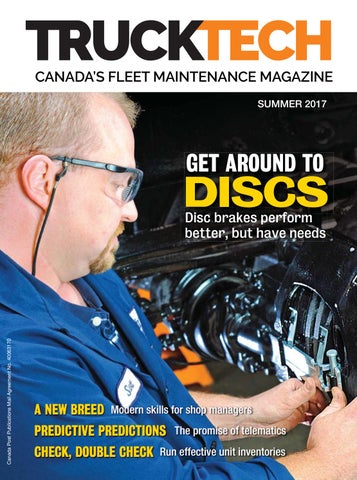
GET AROUND TO
DISCS
Canada Post Publications Mail Agreement No. 40063170
Di b Disc brakes k perform f better, but have needs
A NEW BREED Modern skills for shop managers PREDICTIVE PREDICTIONS The promise of telematics CHECK, DOUBLE CHECK Run effective unit inventories
is written and published for owners, managers and maintenance supervisors of those companies that operate, sell and service trucks, truck trailers and transit buses.
SUMMER 2017 VOL. 2 NO. 2 VIce President, Editorial Rolf Lockwood rolf@newcom.ca • (416) 614-5825 Contributing Editors James Menzies, John G. Smith, Nicholas Camilleri, Derek Clouthier Group Publisher Lou Smyrlis lou@newcom.ca • (416) 510-6881 Creative Director Tim Norton tim@newcom.ca • (416) 510-5223 Production Manager Kim Collins kim@newcom.ca • (416) 510-6779
COVER STORY
GET AROUND TO DISCS NEWCOM BUSINESS MEDIA INC. 80 Valleybrook Drive, Toronto, ON M3B 2S9 416/614-2200 • 416/614-8861 (fax)
Today’s disc brakes outperform drum designs, but they still have some unique maintenance needs.
CHAIRMAN AND FOUNDER Jim Glionna PRESIDENT Joe Glionna VICE PRESIDENT, PUBLISHING Melissa Summerfield CHIEF FINANCIAL OFFICER Anthony Evangelista DIRECTOR OF CIRCULATION Pat Glionna Truck Tech is published by Newcom Business Media Inc. The contents of this publication may not be reproduced or transmitted in any form, either in part or full, including photocopying and recording, without the written consent of the copyright owner. Nor may any part of this publication be stored in a retrieval system of any nature without prior written consent.
Bendix believes discs will be on 27% of trucks and 20% of trailers as early as 2020.
Features Leaders Speak: Stephane Godbout The outspoken president of SG Consulting says today’s fleet maintenance managers require a whole new skill set.
Editorial ....................................................5 15
Inside the Numbers ................................30
18
Check, Double Check A well-planned unit inventory will ensure nothing is overlooked.
21
Smooth Operators Automatic Lubing Systems keep equipment on the move.
22
18
Quick Fix ................................................. 7 Equipment Watch ...................................27
Predictive Predictions Remote diagnostics has changed how trucks are repaired, but the full potential of telematics and its role in maintenance has yet to be tapped.
15 trucknews.com
Departments
27
22 Summer 2017 TRUCKTECH 3
YOU TAKE CARE OF YOUR BUSINESS. WE’LL TAKE CARE OF YOUR TIRES.
®
A FLEET TIRE MAINTENANCE PROGRAM THAT HELPS YOU MAXIMIZE UPTIME AND GET THE MOST OUT OF YOUR TIRES.
$
REDUCE COSTLY DOWNTIME AND OPTIMIZE PERFORMANCE
Identify and address immediate tire needs that lead to downtime, low mileage and high fuel costs. ACCURATE, ACTIONABLE REPORTING
Comprehensive dashboards and reports for effective decision making.
To find a MICHELIN TIRE CARE provider near you, see your local Michelin Representative or visit michelintruck.com/tirecare. ®
™
©2017 MNA(C)I. All rights reserved. The “Michelin Man” is a registered trademark licensed by Michelin North America, Inc. (C14959)
Editorial
Not Good Enough Some experts call ignorance about brake adjustment a ‘powder keg’ By Rolf Lockwood
There’s too much ignorance out there regarding brake slack adjustment, and especially automatic slack adjusters. An old story that just won’t go away. We’ve all seen imperfect results from Commercial Vehicle Safety Alliance inspection blitzes, and this year’s International Roadcheck is starting as I write this (June 6 to 8). So brake adjustment issues and outof-service rates are top of mind. The OOS rate for brake adjustment usually hovers around 10%, maybe 15% for all brake-related violations in North America. Should we be surprised? Maybe not. The CVSA did a survey a few years ago that was pretty unsettling. It found that a shockingly low number of drivers have a clear understanding of air brakes and their adjustment, and I fear that we haven’t come far enough since. How bad was it? Well, only 15 truck drivers — out of 4,055 polled — aced the survey designed to find out how much they knew about brake adjustment. The CVSA said the responses revealed an overwhelming misunderstanding about the importance of brake adjustment and the right ways to do it. The auto slack myth was especially alarming in that study, which found that 2,179 drivers (53%) thought that automatic slack adjusters never go out of adjustment. While this might accurately reflect things in a well maintained fleet, CVSA explained, it might also display a false sense of security regarding their vehicles. A common mistake, said CVSA, is when unqualified drivers and mechanics manually readjust auto slacks in the same way you’d take a wrench to a manual adjuster. Once properly installed, an automatic slack adjuster
A shockingly low number of drivers have a clear understanding of air brakes shouldn’t need manual adjustment. If it’s found to stroke beyond the maximum allowed, this pretty much always indicates other problems that need to be repaired by qualified brake service folks. Manually adjusted auto slacks have been known to slip back out of adjustment after just a few brake applications, and confused drivers who get caught down the road can’t understand why. You can also damage an auto slack and strip the gears inside by manually adjusting it. But the practice persists, and I trust the observations of several brake and maintenance experts I’ve spoken with who uniformly speak of this as a powder keg.
One veteran safety and compliance consultant tells me he’s “disturbed by the ignorance that exists amongst owners, drivers, maintenance, safety and compliance personnel...when it comes to the ‘old wisdom’ that surrounds manual slack adjusters and how they all keep trying to get that old square peg (manual slack) to fit in that new round hole (auto slack).” I wrote about this a while back in my column in the American magazine Heavy Duty Trucking. (see truckinginfo.com) and made the same points I’ve made here. It got a lot of e-mail response, but I was shocked to see that a good portion of those messages told me I was way off base. I wasn’t. I’m not. “Wrong, wrong, wrong,” wrote one commenter. You adjust an auto slack “…exactly how you would field-adjust a manual slack adjuster.” But another one, an expert employed by a brake supplier, called the article “Right on target.” He went on to say, “I once had an experienced technician in a major transit bus garage tell me, ‘Automatic slacks are not really automatic. We have to adjust them all the time.’ “There is no surprise that this same fleet suffers terrible brake life and a large number of their units are found to be over-stroking,” he wrote. Check out this Technical Bulletin from Bendix Spicer Foundation Brake, which clearly says, “The manual adjustment of automatic slack adjusters is a dangerous practice that could have serious consequences.” Go to https://tinyurl.com/yclmbsna, then search Technical Bulletin No: TCH005-014. That’s the last word on this one. TT Summer 2017 TRUCKTECH 5
#DeloDrives PERFORMANCE
Introducing the Next Generation of Heavy Duty Diesel Engine Oil ®
®
Delo 400 with ISOSYN Advanced Technology
Up to 35% Better Oxidation Control*
Up to 68% Better Wear Protection*
Up to 46% Better Piston Deposit Control*
Up to 60% Better
Component Durability*
ChevronDelo.com
*As compared to previous generation HDMO product test limits. © 2017 Chevron Canada limited. All rights reserved. All trademarks are property owned by Chevron Intellectual Property LLC or their respective owners.
Chevron Products are available from the following locations:
CHEVRON CANADA LIMITED 1200-1050 West Pender St. Vancouver BC V6E 3T4 Toll Free: 1 (800) 822-5823 canada.deloperformance.com
CATALYS LUBRICANTS 7483 Progress Way Delta BC V4G 1E7 Toll Free: 1 (855) 946-4226 catalyslubricants.ca
NORTHERN METALIC SALES (GP) 9708-108 St. Grande Prairie AB T8V 4E2 Tel: (780) 539-9555 northernmetalic.com
HUSKY ENERGY CORPORATION 707-8th Ave. S.W. Calgary AB T2P 1H5 Tel: (403) 298-6709 huskyenergy.ca
UFA 4838 Richard Rd. S.W. Suite 700 Calgary AB T3E 6L1 Tel: (403) 570-4306 ufa.com
CHRIS PAGE & ASSOCIATES LTD 14435-124 Ave. Edmonton AB T5L 3B2 Tel: (780) 451-4373 chrispage.ca
RED-L DISTRIBUTORS LTD 9727-47 Ave. Edmonton AB T6E 5M7 Tel: (780) 437-2630 redl.com
49 NORTH LUBRICANTS 1429 Mountain Ave., Unit 2 Winnipeg MB R2X 2Y9 Tel: (204) 694-9100 Fax: (204) 775-0475 49northlubricants.com
CASE ’N DRUM OIL INC 3462 White Oak Road London ON N6E 2Z9 Toll Free: 1 (800) 265-7642 www.cndoil.ca
TRANSIT LUBRICANTS LTD 5 Hill St. Kitchener ON N2G 3X4 Tel: (519) 579-5330 transitpetroleum.com
R. P. OIL LTD 1111 Burns St. East Unit 3 Whitby ON L1N 6A6 Tel: (905) 666-2313 rpoil.com
CREVIER LUBRIFIANTS 2320, Rue de la Métropole Longueuil (QC) J4G 1E6 Tél : (450) 679-8866 crevier.ca
NORTH ATLANTIC REFINING LTD 29 Pippy Place St. John’s NL A1B 3X2 Tel: (709) 570-5624 northatlantic.ca
QUICK FIX
Retreaders worried about Chinese tires A U.S. International Trade Commission decision not to enact tariffs on Chinese truck and bus tires is threatening jobs in the U.S. retreading industry, the Tire Retread and Repair Information Bureau says. Truck tire retreading has historically represented half of the replacement tire market in the U.S., but the share dropped to 44% in 2016, representing 4 million fewer retreads. The reason, the bureau says, is “low-cost, low-quality Chinese tires.” “The various supplier and manufacturing industries that support the retread industry, such as materials and equipment companies, tire repair manufacturers, and tire rubber recyclers, have all been negatively impacted by this decline. While these low-quality Chinese tires may have similar initial costs as retreaded tires, their total cost-per-mile over the life of the tire is significantly higher than retreaded tires,” the group says in a recent bulletin.
Crevier Group acquires Quebec’s Gaz-O-Bar A subsidiary of Crevier Group has acquired the Gaz-O-Bar service station network in Eastern Quebec, strengthening its position in the province’s Lower St. Lawrence and Gaspe regions of Quebec. Thirty-three service stations are involved in the deal. Gaz-O-Bar’s retail segment includes card-based supply sites ( for trucks) and corporate and affiliated sites. It will continue to oversee service station convenience stores in Trois-Pistoles, Rivière-du-Loup, Dégelis, Rimouski, Pointe-au-Père, Matane and MontSaint-Hilaire, and other commercial activities, including the distribution of heating oil and transportation of petroleum products.
UAP heavy parts on acquisition spree UAP’s heavy vehicle parts division has acquired Belcher Pièces de Machinerie, trucknews.com
Ritchie Bros. turns equipment to riches Attracting 13,800 bidders from over 60 countries around the globe, the Ritchie Bros. Edmonton auction held in April managed to sell 8,650 items (File photo) for a combined $184 million. Roughly 66% of the bidders in the auction registered to participate online and purchased $105 million of equipment. In addition, Canadians were the purchasers of 86% of the equipment, with 50% of the equipment purchased by Albertans. International bidders from countries such as Finland, New Zealand, and Japan purchased 14% of the items.
a seller and distributor of heavy machinery parts for construction, mining, agriculture and forestry industries. And it will retain the staff and a related location in St-Augustin-deDesmaures, Quebec. Last December, it acquired Buy-Rite Truck Parts and GPICS, both in the Greater Toronto Area. It has also picked up Service de Freins Montreal Ltée (Freno) distribution activities. UAP’s heavy vehicle division includes more than 100 Traction stores, 125 TruckPro repair shops, six TW and CADEL warehouses, and MTC, a leaf spring manufacturing plant.
Train secures Terberg rights Train Trailer Rentals has secured Canadian distribution rights for Terberg Special Vehicles shunt trucks, a European design currently available in more than 90 countries. “The North American market is ready for a new competitor in this space,” says Shawn Rogers, Train Trailers’ national sales manager. “Becoming Terberg’s exclusive distributor for Canada allows us to offer their quality shunt trucks for lease, sale or rent at very competitive rates.”
U-joint videos now online SKF has released an online video showing how to inspect and replace a U-joint on a commercial vehicle, using the rear driveshaft U-joint on a 2017 Freightliner Cascadia for the demonstration. “Through videos like this offered on our YouTube channel skfpartsinfo.tv, SKF is aiming to help fleet technicians deliver reliable performance and maximum ser vice life, ultimately minimizing truck downtime,” said Brian Jungmann, marketing communications manager.
Maxim fined for employee injury Manitoba’s Workplace Safety and Health has fined Manitoba-based Maxim Transportation Services nearly $50,000 after an employee suffered burns in a workplace incident in 2014. That September, a Maxim employee burned his face and left forearm while using an oxygen-acetylene cutting torch to create a hole on the top of a metal 45-gallon barrel. As the torch pierced the top of the barrel, flames shot out of the filler hole burning the worker. According Summer 2017 TRUCKTECH 7
QUICK FIX to Workplace Safety and Health, the barrel was not properly purged of its flammable contents prior to the employee using the torch on it. Maxim pled guilty to the charge of failing to ensure, so far as reasonably practical, the safety, health, and welfare of its worker and was ordered to pay $48,750 in fines and surcharges.
and will now lead related development, engineering and manufacturing. “These product lines will enable Carrier Transicold to provide a superior line of APUs and battery comfort systems for trucks and APUs for locomotives,” said Tom Ondo, vice president and general manager,
Carrier Transicold, Truck/Trailer/Rail Americas. “With this acquisition, we are expanding our offerings to include anti-idling technologies that contribute to greater operator comfort as well as reduced fuel consumption while meeting operational and sustainability goals.” TT
Mack’s Vision sets triage practices Those who pull into a service bay in one of Mack’s six certified uptime centers in Canada can thank one dealer in particular for the steps taken to diagnose a challenge. The triage process – used to identify the nature of repairs and ensure quicker work is not delayed behind more time-consuming projects – was developed by the Vision Truck Group, said Dayle Wetherell, vice president – Mack Trucks Canada, during a media briefing at ExpoCam. There are 91 uptime centers overall. The detailed diagnostic process includes an initial assessment completed in two hours, and then steers trucks to an uptime bay for shorter diagnostics or repairs, or an advanced bay dedicated to longer repairs.
Retreading, repair guidelines online The Tread Rubber and Tire Repair Materials Manufacturer’s Group has published new Recommended Practices for retreading and repairing tires, with details now published at www.retread.org. The content can be viewed online for free, while PDF downloads and hard copies are available for a fee. The practices cover everything from solvent-based cements to extruder operation, recommended tools, and more.
Carrier Transicold picks up IMPCO lines Carrier Transicold has acquired selected IMPCO product lines including the ComfortPro Auxiliary Power Unit (APU) from Westport Fuel Systems – trucknews.com
Summer 2017 TRUCKTECH 9
Show Organizers:
Confirmed 2017 Exhibitors:
NORTH AMERICAN
COMMERCIAL VEHICLE SHOW
Where the
leaders of today, share their ideas for tomorrow.
Join the industry’s most influential executives at the first truck show of its kind. Leading manufacturers of commercial vehicles and parts will announce and showcase their newest technologies and innovations. This is a show you’ll want to be at.
Monday, September 25th by Invitation Only Tuesday, September 26th – Thursday, September 28th doors open to all Please visit our website in the coming weeks for full details
Atlanta, GA www.nacvshow.com
Bendix, Cummins, Detroit, Eaton, Freightliner, Hendrickson, Mack, Meritor, Navistar, SAF Holland, Volvo, Western Star and more…
FEATURE
Get Around to Discs Today’s disc brakes outperform drum designs, but they still have some unique maintenance needs By John G. Smith
(Bendix photo)
D
isc brakes perform better than drum designs by several measures. There is no questioning how they can help in the fight against brake fade, caused when overheated drums expand beyond the reach of friction material, 12 TRUCKTECH
Summer 2017
and Preventive Maintenance can be completed in just minutes. Benefits like these have simply been slow to attract equipment buyers, likely because of premium price points. Bendix Spicer Foundation Brake reports that discs were installed on a
mere 16% of truck wheel ends last year, and just 6% of trailers. But Keith McComsey, the company’s director of marketing and customer solutions – wheel ends, expects the spec’ to become much more popular than that. In a hurry. Picture disc brakes on 27% of trucknews.com
trucks and 20% of trailers as early as 2020. Several underlying trends could prove him right. Truck manufacturers have already introduced the designs on steer axles to help meet mandated 250-foot stopping distances. Add disc brakes to other axles and the stops become even shorter. Using disc brakes on a steer axle and drums on the drives, a truck will typically stop within 215 feet when traveling at 95 kilometers per hour, McComsey says. Put discs on all wheel ends and the typical stopping distances drop to about 200 feet. “We used to run drum brakes when we did stability demos because it’s what most of our trucks and trailers had. Obviously, you’re doing a lot of braking consistently, and we would sometimes have to stop demos to let the brakes cool,” adds Fred Andersky, director of customer solutions and marketing – controls at Bendix Commercial Vehicle Systems. “With air disc brakes on them, we run demos all day long – 24/7, 365 – because they’re always there in terms of performing.” Interest in underlying safety systems could build further interest, combining the superior stopping performance with quick-acting electronics. And platooning vehicles will require following distances that, in another era, would have been considered tailgating. Disc brakes will likely be needed to support that future option.
Dropping prices Prices for the components are actually shrinking within the midst of it all. When SAF-Holland unveiled its P89 air disc brake for air and mechanical suspensions last year, it managed to slash traditional price premiums in half. Now the superior performance is available for an extra US $700 per axle when compared to drums. WABCO, meanwhile, recently opened a new US $20-million plant in South Carolina that for the first time brings production of its air disc brakes to North America. At 145,000 square feet, it has the capacity to produce about 200,000 brake units per year, notes Jon Morrison, WABCO’s president – Americas. “We trucknews.com
“With air disc brakes on them, we run demos all day long – 24/7, 365 – because they’re always there in terms of performing.” do our own machining of disc brake housings and holding brackets, so that’s new for us in that facility.” Existing costs offer paybacks of 3.5 to four years, Morrison says. Bring that payback down closer to two years – in part because of potential maintenance savings – and adoption rates could surge. One of the missing links, says Morrison, is a closer working relationship between brake designers and truck manufacturers. “In many cases, you’re just putting a disc brake on a drum brake setup. If you configure the wheel end to really be optimized for a disc brake setup, then that’s going to give us the best opportunity for a total cost reduction, down into a range that those that are on the fence would now start working toward disc brakes,” he explains. “[Today’s] disc brake is basically assembled to a drum brake configuration. We have this torque plate that has to go on an adaptor in order to be able to hold the mounting bracket, so that is a big cost driver. If you redesigned the whole wheel end to accommodate a disc brake you can eliminate that torque plate combination.” No matter what drives the adoption of disc brakes, there are several benefits for those who work in a shop. “You can do a disc pad change in 15 minutes once you have the tire off,” says Andersky. “On a drum brake it can take an hour, hour and a half to do.” That’s if the friction material needs to be changed in the first place. “Depending
what your trade cycles are, you may never have to change the friction on a new vehicle that you have,” he says.
Unique needs Still, such brakes are not maintenance-free. And disc brakes introduce some new procedures into brake jobs. (New rotors anyone?) The first and foremost step is to monitor pad wear, Andersky says. “You want to change the pads. You don’t want to change the pads and the rotor.” The latter situation becomes an issue if the friction material is allowed to wear too low. As advanced as the disc brakes are, the changes are quite simple. Kevin Pfost, a product specialist with Bendix Spicer Foundation Brake, demonstrates the process within minutes. “What you’re going to need is a pair of pliers, and a 10-millimeter wrench, and a good set of eyes. You need to do a great inspection,” he says, referring to a maintenance procedure that involves checking the tappets, guide pin boots, caliper movement, and guide pin movement. It just requires a bit of care, Pfost adds, as he removes a rubber cap that fits over the shear adaptor, which is used to back off and adjust the brake. “If you get too monstrous on this, you can break the shear adaptor,” he warns. If that happens, the caliper will need to be replaced. Pulling out a 10 millimeter wrench, he begins the counter-clockwise turns which pull back the tappets inside the caliper. “That gives you the clearance you need,” he says. Pulling off a retaining clip, flat washer, pad retaining pin and a pad retaining bar – all items that are found in a new pad installation kit – the pad slides out of position. Inspections of surrounding components don’t take much time, either. Tappets, for example, should completely turn inside their bushings. “If they’re seized up, what’s going to happen is every time that tappet starts to rotate out, the boot is going to start to turn and it’s going to destroy itself. Once [the boot] destroys itself, you’re Summer 2017 TRUCKTECH 13
going to have a hard time because contamination will get into the caliper,” he says. Pushing the caliper inboard, he shows off the guide pin boots and how they should be checked. Any holes or damage here will cause a caliper to seize, which will keep a pad from moving. Then it’s a matter of looking at the caliper itself. “As long as it moves freely up and down, we’re good to go. If you have any kind of movement of the caliper on the guide pins, you’ll need to measure the guide pin bushing wear, just like the cam bushing,” he says. “If it’s moving around on the guide pins, you’ll probably need to rebuild the caliper or buy a reman.” And when it comes time to remove and replace the pads, debris in the related carrier can be cleaned out with a wire brush. “Get that clean again before you put new pads in,” Pfost says. “Ensure there’s no damage on the carrier where the pad sits. You don’t want any damage that may catch the edge of the pad as it slides along.” Anti-seize compounds should be avoided as well, he adds, noting how they can attract dust and dirt – creating what is essentially a rubbing compound that can damage the pads. “Make sure they’re clean, dry, oil-free, no anti-seize, none of that blue silicone that they use on the hydraulic pads for noise. You don’t need any of that,” he says. Rotors, meanwhile, should be checked for cracks or any other deformities that might take the brakes out of service. If the rotor is worn down
The price premiums for disc brakes could drop dramatically with a closer relationship between brake designers and truck manufacturers, says WABCO’s Jon Morrison. (John G. Smith photo) to less than half its original measurement, it needs to be changed. Other than comparing the thicknesses of inboard and outboard pads and checking condition of the rotor, Preventive Maintenance checks involve releasing the drive axle parking brake and inspecting the caliper movement. “As long as the caliper slides on the guide pins, you’re good to go,” Pfost says, referring to inspections that should happen at least every Preventive Maintenance cycle or any time a wheel is pulled. “People sometimes get into their head that they don’t have to do any maintenance for a year or two, but tell me what truck you don’t do maintenance on.” “It’s all visual inspection and caliper movement that you have to be cognizant of,” he says. “The brake
FAST
stroke doesn’t need to be measured because the push rod is internal. You’re not going to measure pad thicknesses, and neither is [a Department of Transportation inspector]. He’s going to look at your rotors. He’s going to be looking if there are any cracks or any deformities in them. He’s going to look at the back side of the rotor that’s in the wheel to see if it’s still clean. If the guide pin is seized up at all, one side of the rotor is going to be rusty and the other side isn’t. He’s going to look for loose mounting bolts, air leaks. “He’s going to look in the wheel just like you are during the PMs,” Pfost adds. “He’s going to look for inconsistencies between inboard and outboard pads. He’s going to look for wheel seal leaks. Other than that, he can’t measure stroke, and neither can we.” TT
Brought to you by the editors of Newcom Trucking Group, in partnership with Imperial Oil – Mobil Delvac™
FORWARD PART II
A DEEPER LOOK INSIDE THE FUTURE OF TRUCKING
DOWNLOAD YOUR FREE COPIES IN THE KNOWLEDGE CENTRES SECTION OF
www.trucknews.com
14 TRUCKTECH
Summer 2017
trucknews.com
LEADERS SPEAK
A NEW
BREED Why managing fleet maintenance today requires a whole new skill set By James Menzies
Truck Tech: You have some strong opinions about remote diagnostics and its impact – or lack thereof – on fleet maintenance. How big an impact has remote diagnostics had on maintenance? Godbout: I don’t even think you can use both words in the same sentence. Remote diagnostics does nothing for maintenance. Nothing at all. Remote diagnostics advises you of an upcoming failure. It doesn’t advise you on an upcoming service or the life expectancy of a specific component. But in my opinion, there’s a (potential) benefit for remote diagnostics to be involved much more with maintenance. trucknews.com
Truck Tech: How far away do you think we are from seeing remote diagnostics becoming more predictive in nature? Godbout: We, as end users, have to push the manufacturers so they provide us with better predictive remote diagnostics. That’s what we need. Truck Tech: When you visit fleets today, what are some of the biggest mistakes you see in their maintenance operations?
S
tephane Godbout, president of SG Consulting, provides fleets and dealers with consulting services and best practices around purchasing, training, and equipment maintenance. Before launching SG Consulting, he worked for numerous fleets, and most recently with a truck and trailer leasing company in Montreal, where he managed 3,500 assets and oversaw a $12-million annual budget. He has more than 25 years of experience in the fleet management business. Truck Tech caught up with the outspoken leader to discuss remote diagnostics, managing cost per kilometer, why it’s important to develop relationships with manufacturers, and how to address the technician shortage.
35,000 cycles. Why doesn’t a chip in my starter tell me at 30,000 cycles that I’m getting to the maximum life expectancy and offer me the possibility of changing it in a predictive manner, instead of being stuck on the road at 4 o’clock on a Sunday morning?
Dallas Walker, Toronto mechanic
I always refer back to my car. My car has no dipstick for oil; my car tells me exactly when it’s time to change oil. If an air filter can be changed on air restriction alone, why is engine oil any different? Why can’t engine oil be analyzed by the engine on restriction, and as it becomes dirtier, then something pops out and says, ‘You have reached the maximum life expectancy of the engine oil, now it’s time to change’?” But today, there is engine oil being dropped from trucks that are about 40-45 liters of capacity – for no reason. And that engine oil is only one aspect of what I call predictive remote diagnostics. Let’s say my starter is designed for
Godbout: Most fleet maintenance managers are not managers. They’re mechanics or foremen who had a good attitude and got to the next level. But to be a manager, you have to understand way more than how to turn a wrench and undo bolts. You have to understand the financial aspect of it, the accounting aspect, and everything that’s involved in fleet management. In my last foray, I always told my partners, ‘If you don’t let me buy the trucks, I won’t be held accountable.’ If you are buying trucks with cardboard brakes, you are setting me up for failure. Usually, in a fleet, somebody is buying the trucks and somebody else is managing the maintenance costs and these people don’t talk. And a lot of people still buy the cheapest there is, but cheap is not inexpensive. If there was such thing as a tire that would cost a million dollars, I would buy the goddamn tire. Because I know I would probably run 4 million kilometers with it. I always tell my customers that the objective of the shop is to be empty. Mechanics playing cards. That’s when a shop is lucrative. But that’s an ideal, and I think a lot of owners don’t have the knowledge of fleet management, aside from what the accountant is telling them. Summer 2017 TRUCKTECH 15
STRAIGHT TALK
LEADERS SPEAK
TRAILER SUSPENSIONS Short cam shaft makes for reduced weight and performance. This simple alignment feature is quick and easy. Axle alignment adjustment capability is .25” at hanger.
The trucking industry must get out the message that a truck technician today spends as much or more time working on a computer as they do turning wrenches, Godbout insists.
Longest life and highest performance pivot bushings. SPIF compliant, parallelogram self steer keeps the dual draw key king pin in correct position for maximum performance and life expectancy. 337 lbs lighter than conventional steer axle with 9” of lift. Put the best y on your equipment.
Email a request for more information to:
YES@ridewellcorp.com
The first thing I do when I walk into a fleet, is I establish a weekly meeting with the fleet manager and the accounting people, and the owner. We look at four lines of cost: tires, parts, labor, and external repairs. On a weekly basis, not a monthly basis. If you pull out financial statements two weeks after month end, you’re sitting down six weeks after the fact to question actions you’ve taken six weeks ago that you probably don’t remember. If you look at the numbers on a weekly basis, they give you an indication of where exceptions come from and enable you to target your actions to correct what’s going on. If you present just four lines of expenses to a manager, even if he’s no rocket scientist, that’s quite easy to understand. Accountants have a bad habit of pulling into meetings with 20-sheet financial statements and the poor manager’s not saying a word because he feels shame in not knowing what he’s looking at. Meanwhile, you’re still doing stupid things in the shop because you have not been proactive. Truck Tech: What can a fleet do to control the costs of components and tires? They cost what they cost, no?
16 TRUCKTECH
Summer 2017
Usually, in a fleet, somebody is buying the trucks and somebody else is managing the maintenance costs and these people don’t talk. And a lot of people still buy the cheapest there is, but cheap is not inexpensive. Godbout: I don’t agree with the fact they cost what they cost. I look at everything from a cost-per-kilometer basis. The acquisition price is only one parcel of information you need to take into consideration when you make decisions regarding components and aftermarket components like tires and parts. A lot of people rely on distributors, not manufacturers, which have the objective trucknews.com
Stephane Godbout says today’s fleet maintenance manager must understand accounting practices, in addition to how to best repair vehicles.
of clearing the highest margin. Take this example: It’s month end and I have my distributor rep come in and he says, ‘I have a great special on truck lights. If you buy so many, I’ll give you a great price.’ The guy is doing that so he’ll get his monthly quota and get his bonus. But is that (specific) truck light the best for me? The managers don’t know that. I like to tie in with the manufacturers – nobody else apart from the manufacturers – who know better how their product is going to behave and how to better support your fleet. Not the distributors. Distributors are the Walmart of parts. We need distributors, don’t get me wrong, but they should be used on a procurement basis only, not on a technical basis. The manufacturers want to be as close to the end user as they can. When you have that relationship, you might pay $20 more for a booster. But maybe you’ll get an extended warranty and get a lower cost per kilometer. There was a fashion a couple years ago that everybody was buying Chinese tires. Well, excuse me, if you’re in the business of running trucks, the last thing you want is a cheap tire to have the truck in your shop every second week to change tires again. What you need to do is, you need to buy reputable tires, know what trucknews.com
the casing warranties are, do scrap-outs. When you retread, go to the plant and see what is being rejected and work with operations to see why they’re rejected. Is it driver abuse? Low air? What is it? Truck Tech: The role of the maintenance manager is evolving rapidly, and I’m sure you’re seeing a different breed of maintenance manager today. What makes a successful fleet maintenance manager today? Godbout: You have to have a good knowledge of what comprises all aspects of fleet management: the shop floor, mechanic productivity, parts procurement, third-party relationships with suppliers, and have a very good knowledge of how accounting works. I think these are the key ingredients to a successful fleet maintenance manager. It’s probably one of the only jobs that you can’t really get training on. You can’t go to college and get a fleet manager degree. Truck Tech: We can’t end this conversation without touching on the shortage of skilled technicians and the lack of young people getting into the trade. What’s the answer to fixing that?
If there was such thing as a tire that would cost a million dollars, I would buy the goddamn tire. Because I know I would probably run 4 million kilometers with it. Godbout: One of the things our industry lacks is any form of recognition for technicians. You’ve been to TMC (Technology & Maintenance Council). You’ve been to SuperTech. How come there’s no Canadian SuperTech? We don’t do anything to show our kids that truck maintenance is not being soaked in oil and grease all the time, that we have mechanics in dealerships and fleets that don’t even open their toolbox – they work with a laptop all day long. By having those types of competitions, we could bring awareness of our skills to another level. TT Summer 2017 TRUCKTECH 17
DIAGNOSTICS
Predictive Predictions Remote diagnostics has changed how trucks are repaired, but the full potential of telematics and its role in maintenance has yet to be tapped. By James Menzies
T
ruck technicians and fleet maintenance managers generally don’t look back fondly on the era of unreliability that defined the arrival of early exhaust aftertreatment systems. However, if there’s one lasting benefit that emerged, it’s that the systems’ widespread reliability issues also gave birth to the concept of remote diagnostics. “If it was not for the nightmare of emissions aftertreatment, I don’t believe telematics would be as evolved as it is today,” says Stephane Godbout, president, SG Consulting. “Telematics 18 TRUCKTECH
Summer 2017
were put there to temper the problems that were arising.” Remote diagnostics, now offered by all heavy-duty engine manufacturers, offer fleets a new, more-proactive way of diagnosing fault codes and scheduling repairs. Instead of taking the truck off the road every time a fault code appears, remote diagnostics allows engine manufacturers to assess the problem remotely and then advise the maintenance manager or vehicle operator of the most appropriate course of action. Often, this involves continuing on to complete a scheduled delivery
and managing the repair during the next scheduled visit to the shop. For more-urgent matters, the truck can now be directed to the nearest dealership with the required parts and available service bay. “For us, remote diagnostics is allowing customers to receive fault code information without having to plug into the vehicle,” says Sherise Rivera, marketing analyst - connectivity, Daimler Trucks North America. “Every truck has the hardware,” adds Steven De Sousa, regional service director, Volvo Trucks Canada, who, trucknews.com
along with Rivera and Godbout, addressed this topic in April during a panel at the Canadian Fleet Maintenance Summit in Montreal, Quebec. Remote diagnostics has also expedited repairs by allowing dealerships to improve throughput at their facilities. In the case of Volvo and Mack, a triage process has been established at dealers recognized as Certified Uptime Centers, which prioritize fast repairs rather than relying on the traditional first-in-firstserved approach. By combining remote diagnostics with the Certified Uptime Center concept, Mack has seen diagnostic time reduced by 70%, repair times by 21%, and check-in times by more than 40 minutes, and overall shop efficiency has improved by 24%, according to David Pardue,vice president - connected vehicles and uptime services with Mack. But while the benefits of remote diagnostics are hard to dispute – at least by those fleets that take advantage of them – some maintenance managers are now asking for more. Specifically, there’s a general hunger in the market for more predictive diagnostics, which would not only assess already present fault codes, but also predict when parts and components are at risk of failure. After all, replacing a part in the shop during a scheduled service appointment is always preferable to being stranded at roadside by that same part. Michael Riemer, vice-president products and channel marketing with service management platform Decisiv, tells Truck Tech the transition from remote to predictive diagnostics won’t be simple. “In order to truly be able to get to a predictive state, you’ve got to know what happened, what the symptoms were, what the fault codes were, and then what actually got fixed and how long it took,” Riemer explains. “Most OEMs don’t really have visibility into that today, because they don’t have visibility into the repairs that are taking place in their service networks.” However, he noted both OEMs and third-party providers are taking steps to fill that void and to provide truly predictive diagnostics by analyzing breakdown and repair events. In the meantime, Riemer sees an opportunity for OEMs trucknews.com
to help fleets transition to more usagebased maintenance cycles, which can themselves be predictive in nature. “I think one of the things people are looking at in the near-term, with particular OEMs, is more around what I call condition-based or usage-based maintenance schedules,” Riemer explains. “Today, the maintenance schedule is fairly generic, typically based on some anticipated application, and has some implied mileage or engine hours or idle hours or time. Typically, those aren’t the best predictors of when things should be maintained. If you actually know
“I go in shops today, and I still see trucks that need brakes, their batteries replaced, alternators replaced, fan clutches replaced, but the trucks don’t talk to us on those matters.” – Stephane Godbout, SG Consulting how the asset is being used, you can do a better job of providing guidance about when the next scheduled maintenance event should occur.” Further down the road, when truly predictive diagnostics is available to fleets, there could be the potential for some conflict between parts suppliers and fleet maintenance departments, Riemer warns. What happens, for example, when a fleet starts pulling a part early because its own data – or that provided by a third party – shows it tends to wear out before the warranty has expired? “There are the OEMs, who say they know your assets best, so they’ll be able to tell you when things should be changed. Then there’s the third-party
entities that are investing lots of money into creating predictive algorithms,” Riemer says. “The problem is, if that asset’s under warranty and you replace the turbo before it’s broken, does the OEM honor that as a broken item or not? I don’t think they will, because their point of view will be that they know what’s best for the asset, and we can’t really trust a third-party algorithm to say when you should replace that turbo.” Fleet maintenance managers will also be challenged to find the right balance between pulling parts early to avoid roadside breakdowns, but not so early as to leave miles on the table, which also incurs an expense. Another frustration for maintenance professionals such as Godbout is that, so far, remote diagnostics has been limited to the powertrain. He envisions a day when the concept will be applied to the entire vehicle, including brake and charging systems. “I go in shops today, and I still see trucks that need brakes, their batteries replaced, alternators replaced, fan clutches replaced, but the trucks don’t talk to us on those matters,” Godbout says. “I dream that one day I’ll be able to bring a truck in the shop and perform a complete scan of the vehicle to identify and prevent possible failures. (Today’s) methods are based on finding failed components and not the ones that are about to fail, and I think that hurts us all.” Rivera says OEMs such as Daimler Trucks North America are working to include more than just the powertrain in their remote diagnostics capabilities, but she adds it’s not easy. “We are asking, how can we move beyond the engine and aftertreatment system, but it’s very complex,” she admitted, referring to the vast number of parts on a commercial truck that are not designed by the vehicle manufacturer. But Godbout said an expansion beyond the powertrain, and the move towards more predictive remote diagnostics, are what’s needed to allow telematics to really improve maintenance procedures in a meaningful way. “I don’t want my engines talking (more),” he said. “Just make it reliable and make it work. Tell me about those other components.” TT Summer 2017 TRUCKTECH 19
MOST PEOPLE JUST SEE TRUCKS. YOU SEE OPPORTUNITY. You aren’t most people. You can see the potential in your business and you’re working hard every day to realize it. We see it too. That’s why Shell ROTELLA T4 Triple Protection is our most advanced Shell ROTELLA ever, with exceptional wear protection and resistance to oxidation 50% longer than the previous generation. So you can keep working harder to take your business even farther. Learn more at www.shell.ca/rotella ®
®
THE ENGINE OIL THAT WORKS AS HARD AS YOU.
®
YARD CHECKS
Check, Double Check A well-planned unit inventory will ensure nothing is overlooked By Nicholas Camilleri
I
t can seem like a simple process: Grab a clipboard and a pen, put on your brightest safety vest, and step into the yard to complete a unit inventory. While some smaller maintenance shops just have to peek out a window to see what work is ahead of them for the day, many larger shops deal with acres of equipment, leading to groans from mechanics and shop foremen alike. “It’s not the most glamorous topic in the world, but it is a critical element to ensure that the shop runs efficiently and that those customer needs are met,” says Tony Popple, senior director of maintenance vision for Penske Truck Leasing in the U.S. “If you don’t know what’s outside your window, you can’t effectively work in the shop itself.” And it involves more than writing down unit numbers. “A yard check is more than just taking a look at how many tractors are in the yard. It’s about taking a good look at the entire property and building. We’re also looking at the perimeter of the lot, looking for breaches and ensuring our assets are secure,” he explains. “We look at our equipment. If we see glass on the ground it’s a pretty good indication that either something was run into or something was broken into.” At Penske, service management staff trucknews.com
and supervisors conduct yard checks at the start of every shift. “You really don’t know what you can work on, or prioritize a day’s work, unless you have that information,” Popple said. “If I’m running the shop floor and I have a good picture of what’s in the yard available to work on, and I know what my customer’s requirements are, it enables me to reconcile my schedule.” Most customers will schedule a unit for service or repairs ahead of time, but with the large volume of units that move through Penske facilities, Poppler says some equipment may unknowingly be dropped in the yard. The check will ensure service staff know what exists. One way a shop can improve the process is to stage yards so it’s easier to anticipate where equipment will be, he says. Many Penske shops separate their equipment into different sections. For instance, in one area they will have a “shop line” where units will be staged for repairs, while another section of the yard will be dedicated to units that are ready to go. Technology has slipped into the process as well. At Penske, prior to conducting yard checks, managers or supervisors use the company’s in-house service platform to print out a list of what should be in the yard. The individual conducting the yard
check will then check off units as they are spotted, while also adding units that have been dropped off unannounced. The new results are then entered back into the system, and the cycle repeats at the beginning of the next shift. Still, wandering through a truck yard can also present some potential dangers. Popple stresses that those doing the work should be aware of their surroundings. “You could have a fleet of trucks that are getting ready to dispatch when you’re going out there to do the yard check, so you’re going to have a traffic flow that you have to be aware of,” he says. “You could have fuel being dropped, you could have vendors delivering tires, so you have to stay visible and make sure you know what’s going on.” Like Penske, many repair shops will likely end up performing yard checks in the early morning or evenings when it’s still dark outside. Even if it’s just five minutes out in the yard, individuals should use reflective apparel and flashlights so they remain visible. If there is ice on the ground, studded slip-ons will help to prevent injuries from slips and falls. “Even though it may not be the most practical environmental situation, it really needs to get done if you really want to be productive and take care of customer needs,” Popple says. TT Summer 2017 TRUCKTECH 21
AUTOMATIC LUBING SYSTEMS
Smooth Operators Automatic Lubing Systems keep equipment on the move By Harry Rudolfs
D
id you know that the modern Class 8 highway tractor has 33-35 lubrication points, and that a tri-axle dump truck has 44 or more of them? Without an Automatic Lubrication System (ALS), the technician under the truck might miss a few. Automatic Lubrication Systems provide lubrication to multiple service points from a pump/reservoir located in a centralized location. More important, they deliver precise, measured amounts of lubricant to suspension and brake parts while the vehicle is in motion, something else a technician can’t do. The concept has been around on-road trucks for decades, most likely since the 1970s. But its genesis can be traced back to 1937 when Lincoln Engineering introduced a parallel system for industrial machinery that was adopted by the “Yellow Iron” sector – the one that includes heavy off-road vehicles used in mining, forestry and construction. George Tackaberry and Sons Construction of Athens, Ontario owns hundreds of pieces of equipment with all kinds of lubrication demands. “We’ve been after dad (George) to go for an auto-lubing system but he doesn’t believe in it,” says son Charlie
22 TRUCKTECH
Summer 2017
Tackaberry. “He’s old school and he believes in doing things by hand. But shop time is expensive, too, and so is hiring someone to do the greasing.” But the fleets that have installed ALS have done so because they work — and save time and money. According to one frequently cited study, 53% of bearing failures are due to improper lubrication. Kevin Garretson, fleet manager of Peter Hodge Transport of Milton, Ontario, knows what life without ALS can be like. His company has installed auto-greasers on all its trucks and rolling equipment, including tankers and tri-axle dump trailers. “A few trucks didn’t have them and at 20,000 mile intervals we noticed some king pin, tie rod and drag link wear that would eventually become problems,” he says. There are certainly plenty of these devices available from various manufacturers. One can get an aftermarket ALS in any truck from a Class 3 curbside van to a two-storey, off-road behemoth. The delivery systems and configurations also vary, but every auto-lube system has the same five basic components: controller/ timer, pump/reservoir, supply lines, metering valves, and feeder lines. Simply put, the controller activates the system and initiates the lubrication
cycle, while the pump/reservoir stores and provides the lubricant to the system. The supply line carries the lubricant to the metering valves that measure and dispense the product into the feeder lines which, in turn, supply the lubricant to the specific components. Auto-greasers primarily use either electric or pneumatic power sources (drawn from the air supply). Electric timers initiate the cycle based on timed intervals, applying lubricant after two hours of running time, in most cases, depending on the vehicle’s vocation. But trailer greasing systems may have a mechanical component, dispensing a shot of lube to the slack adjusters and brake cams after 20 or so brake applications. A Class 8 tractor with an integrated ALS would receive lubrication at the following points: spring pins, king pins, tie rods, steering drag links, cross shafts, slack adjusters, brake shafts and cams. The fifth wheel and its pivots are also serviced by the same system. The plate usually has four holes through which the lubricant is extruded, providing an even application to the fifth wheel surface and trailer underside. Trailers, in general, have fewer lubrication points than tractors, but these can multiply with the addition trucknews.com
Automatic Lubrication Systems can apply precise amounts of grease where required while the vehicle is in motio – something no technician can do. (Flo Components photos) of more axles and more features, such as walking floors and conveyors. More lubrication points may require a bigger reservoir and a more-powerful pump. One of two basic principles are at work on most auto-lubrication systems: parallel and progressive. The parallel system pumps the product into a supply line that feeds into branches of injectors. Each injector services one application point and can be adjusted according to the amount of lubricant required at that point. The injectors operate simultaneously but are independent of each other. The progressive system is slightly more complicated but arguably more foolproof. This is a two-step operation that first delivers the lubricant to a primary metering valve, which in turn redirects the product to secondary valves, allowing for progressive metering to each application point. According to Mike Deckert, vice president of Flo Components in Mississauga, Ontario, “The parallel system works like the brake system on the car, creating a hydraulic pressure that pumps grease through the supply lines, but the progressive is more like a waterfall – the lubricant is dispensed through one-way valves.” The parallel system will continue to deliver lubricant to a feeder line even if a component is not accepting it, while the progressive will shut itself off if that happens. This could save an expensive repair should a bearing run dry. On most ALS, a visual or audio warning will let the operator know if there is a malfunction and that the system is not operating. trucknews.com
“In a parallel system if one bearing stops taking grease you’ll never know about it, whereas the progressive system is self-monitoring. If one component isn’t taking grease, it backs up the system and shuts down,” says Deckert. “It all depends upon your requirements and what you want for a final outcome.” The type of lubricant used can vary according to climate and job description. For instance, in southern Ontario an off-road application will typically
on trailers are smaller and harder to access, and found most often tucked up under the frame and above the axles. According to Deckert, different systems are available to suit different needs. “At the very least there should be a pressure gauge on the supply line, so the technician can see if it’s hitting the right pressure,” he says. “The supplier should also supply some training to company p y technicians and provide them with ith a one page printout on service requirements. ments.”
Fleets that have installed ALS have done so because they work – and save time and money. According to one frequently cited study, 53% of bearing failures are due to improper lubrication. use EP 2 grease, while the on-road will use a more-fluid EP 00 or 0 grade of lubricant. Off-road vehicles in northern climates generally go with EP 2 in the summer and EP 0 in the winter. Trucks can be ordered with ALS, but the unit is usually installed by technicians from the supplier, either at the dealership or in the company’s shop. Care has to be taken that no extra holes are drilled in the frame, but with most model trucks, the canisters fit nicely behind the cab and can be easily accessed for replacement. The reservoir is most often transparent so the driver or technician can see that the plunger is working and that there is lubricant remaining in the reservoir. The grease canisters
Deckert points out that installing auto-greasers on trucks doesn’t mean that the devices are maintenance-free. “What we’re doing is taking the grease gun out of the technician’s hand and giving him some wrenches and a flashlight,” he says. And there is still handheld greasing to be done when the truck arrives back in the shop, he adds. “Some of our trucks might be out for two or three weeks at a time so it’s nice to know they’re getting lubricated during that time,” adds Garretson. “We haven’t really had any problem with them. Broken lines sometimes, that’s all. We get them installed when we buy the truck new and five years later, when we sell it, they’re still working.” TT Summer 2017 TRUCKTECH 23
Discover what more than 900,000 visitors did last year
We deliver
MORE BLOGS
MORE VIDEOS
MORE NEWS
truck news.com
STAY UP TO DATE ON INDUSTRY NEWS, TRENDS AND EQUIPMENT RELEASES Visit the industry's most popular website
TIRES
Pressure Points H ighway tires are built for a predictable world, with the steady speeds and gentle curves that should lead to regular wear patterns. But maintenance techniques play an important role in ensuring the conditions that deliver such regular wear as well as the casing life that promotes retreading. The same tire care plays a critical role in the performance of safety-related components from brakes to collision mitigation systems, according to Bendix Commercial Vehicle Systems. “If you think of the approach to safety system maintenance like a hierarchy, tire upkeep – much like the actual tires on a vehicle – is the foundation upon which other systems rest,” explained Jon Intagliata, Bendix’s product manager for Tire Pressure Monitoring Systems (TPMS). “Getting the best performance from drum brakes, air disc brakes, full-stability systems, and advanced driver assistance technologies requires tires that are in good shape and at the correct inflation pressure.”
“When you’ve got a pair of tires sideby-side on an axle, if one is running at a lower pressure, it’s essentially got a different circumference than its neighbor – which means that as the
axle rotates, that tire’s going to drag and experience excess wear, increasing the chance that it’s going to fail prematurely.” It’s one of the reasons why dual tires are best replaced in sets. TT
www.trucknews.com/videos/
TMTV
Monitor pressure Underinflated tires generate higher temperatures and stress casings, increasing the likelihood of a failure. The Technology and Maintenance Council of the American Trucking Associations has determined that a tire underinflated by 20% will see its life shorten by 30%. It’s also estimated that 90% of blowouts can be traced to underinflation, while about half of emergency road calls are related to tires, Bendix notes. The council also found that underinflation by as little as 10% can shed 1.5% from a vehicle’s fuel economy. In addition to tire gauges, Tire Pressure Monitoring Systems can keep a watchful eye on any tires that stray from cold inflation pressures.
Balance the duals
650,000+ views
New online episode every Thursday
“Another pressure-related issue is that of dual-tire imbalance,” Intagliata said. trucknews.com
Summer 2017 TRUCKTECH 25
SURFACE TRANSPORTATION SUMMIT
OCTOBER 11, 2017 International Centre 6900 Airport Road, Mississauga, ON
PLEASE PLAN ON JOINING CANADA’S TOP TRANSPORTATION EXECUTIVES FOR A DAY OF EDUCATION & NETWORKING. We have created an agenda that truly addresses the many challenges facing both Shipper and Carrier executives.
2017 Summit Agenda Brought to you by:
The Donald Trump Effect and The Economy in 2018: What trends will impact your business? Fast Forward – an inside look at the Future of Transportation Shipper-Carrier Roundtable Effective Strategies to Improve the Profitability of your Trucking Business Bridging the Generational Gap
Association Partners:
Our Sponsors:
Table Topics: Shipper Carrier Collaboration Best Practices in Cross-Border Freight Transportation Best Practices in Recruiting, Developing and Training Top Talent for your Business Preparing for Changes to NAFTA and Border Policies How to successfully Navigate a Rail Claim with the Canadian Transportation Agency
GOLD
Best Practices in Developing a Driver Recruitment and Retention Strategy Major Issues in Transportation Across Canada SILVER SPONSORS
Motivational Speaker - How to Build a Successful Business and Brand
• REGISTRATION: 7:30 am • PRESENTATIONS: 8:20 am sharp
REGISTER NOW AT
www.surfacetransportationsummit.com AND QUALIFY FOR THE EARLY BIRD RATE
#sts17
EQUIPMENT WATCH Stemco launches Qwiktie tie rod assembly
Mobile-diagnostic app compatible with Nexiq Blue-Link Mini The new Nexiq First-Link mobile app gives drivers and service technicians easy access to diagnostic and vehicle information for commercial vehicles and equipment. Using Nexiq Blue-Link Mini as a triage tool in conjunction with First-Link, which monitors the vehicle’s health status and helps increase uptime, drivers can use the app on their smartphone to understand the cause of an illuminated check-engine light. And in the shop, technicians can utilize the information gathered by the app for vehicle service and repair. The Nexiq Blue-Link Mini plugs into the vehicle’s diagnostic connector and is a mobile vehicle interface that can be used on Android and iOS devices to communicate with heavy-duty vehicles and wirelessly access basic diagnostic information.
Stemco released the Qwiktie rod assembly, which fits more than 80% of the straight tie rod lengths and styles on the market. “Many of our customers said that due to a lack of stocked tie rod cross-tubes for their vehicles, mechanics would often improvise and struggle to rebuild them rather than take the truck out of service, due to the time it would take for a replacement part to arrive,” said Alejandro Ayala, Stemco segment business leader, suspension. “When we heard this, we knew there would be a strong demand for a nearly universal tie rod assembly that would allow dealers to reduce their overhead stock and eliminate the need for maintenance personnel to improvise repairs. The Qwiktie assembly is a performance solution that meets this need.” The assembly includes several features, including finer threads and increased clamping and tube strength to hold alignment longer and reduce stress on other components.
other attributes, quickly identifying outliers across thousands of transactions, and then drilling into the actual service events and even to the asset level details.” Decisiv says it provided the first Internet of Things (IoT) Platform as a Service for commercial asset service management. Insite 2.0 leverages visualization through Tibco Jaspersoft and Amazon Redshift million-gigabyte, data warehouse technologies. Decisiv customers access Insite as part of their standard subscription including a customary set of dashboards and reports based on user segment and can interactively filter on specific visualizations and drill down to specific service events and assets.
Decisiv announces new visualization platform
Michelin looks to improve tire care
Decisiv Inc. released its new visualization platform, Insite 2.0, which is now in pilot testing and expected to be released during the second quarter of 2017. “With our new visualization platform, Decisiv’s fleet, OEM, lessor and managed maintenance service provider customers can search, analyze and build network-wide dashboards and reports analyzing dwell time, performance, compliance and other actionable information,” said Dick Hyatt, president and CEO of Decisiv. “Imagine having a completely interactive ability to filter based on specific locations, types of repair, and
Michelin Americas Truck Tires has added radio frequency identification (RFID) technology to its commercial truck
trucknews.com
tires and retreads, as well as upgraded its Tire Care maintenance program to include new features to improve visibility, assurance, and ease of maintenance. “Michelin is the first manufacturer to integrate RFID into its full commercial truck tire portfolio. Technology is transforming the trucking industry and Michelin is leading this effort to improve fleet performance and bottom line,” said Ralph Dimenna, COO of Michelin Americas Truck Tires. “We continue to drive innovation for fleets by integrating technology and enhancements to our services that add significant value to our fleet customers’ business.” Michelin’s Tire Care program was introduced in 2015 to help fleets identify and address tire issues that lead to downtime, low mileage, high fuel costs, and safety risks. During the past year, 20% of vehicles inspected in the program comprised a red tag event, or critical issues that required immediate attention, while 63% reported a yellow tag event, an issue that results in extra long-term costs. Some of the upgrades to the Tire Care program include better hardware and software, an actionable fleet dashboard, red tag resolutions, pricing options, self-fit, and a road-ready option.
Summer 2017 TRUCKTECH 27
EQUIPMENT WATCH Mitchell 1 introduces Manager SE Truck Edition Shop Management Software Mitchell 1 has introduced the Manager SE Truck Edition, management software for repair shops that service all makes of Classes 4-8 trucks. The software helps medium and heavy truck repair companies streamline the repair process, improve communication inside the shop, engage with customers, track performance, and increase revenue per repair order. Some of the key features of Manager SE Truck Edition include built-in business reporting, an interactive work-in-progress dashboard, customer engagement tools, appointment scheduling, and plate-to-VIN decoding. The software integrates with Mitchell 1’s TruckSeries repair information, giving independent truck repair shops immediate access to repair information, trouble code diagnostic procedures, labor estimating, and management tools on one platform. Combined with the ProPack customer communication toolbox, truck repair shops can quickly build customer inspection worksheets specific to their needs.
Noregon announces debut of new data analytics service
Noregon has added its scalable data analytics service to help businesses transform raw data into more usable information. Known for its JPRO product line and TripVision, Noregon said the new data analytic service will help companies improve decision-making and operational efficiencies. 28 TRUCKTECH
Summer 2017
Mack upgrading its legacy models with modern connectivity Mack is helping its older model vehicles not equipped with GuardDog Connect telematics hardware get connected. Making the announcement at the Work Truck Show March 15, Mack, along with its partner Geotab, will maximize customer uptime with the connectivity solution. “The benefits of Mack’s uptime solutions are proven, with significant reductions in diagnostic and repair times,” said David Pardue, Mack Trucks vice-president of connected vehicles and uptime services. “We are pleased to partner with Geotab and offer those same benefits to customers who own Mack legacy vehicles.” A Geotab telematics device installed on the truck will connect with the Mack Uptime Center that will monitor the same vehicle codes as GuardDog Connect. When an issue is found, Mack OneCall agents evaluate and provide the customer’s designated contact information through Mack Asist, an online communications and service portal, as well as schedule parts and service bay availability for repair. When released in 2014, Mack’s GuardDog Connect was made standard on its Pinnacle and Granite model trucks. Phillip Swaim, director of Mack’s network fixed operations, said there are about 50,000 legacy Mack truck presently on the road that did not have GuardDog Connect, but will now be able to reap the same benefits thanks to the Geotab connectivity device. Compatible will all model year 2011 and newer trucks equipped with Mack engines, Mack’s GuardDog Connect service for its legacy vehicles were available for order starting May 1.
“Given Noregon’s deep understanding of the data produced by vehicles and our nearly 25 years of experience using analytics to transform that data into useful information, it made sense for us to extend our abilities to assist others,” said Dave Covington, Noregon’s Chief Technology Officer. “This service is tailored to our customers’ needs, with a focus being placed on solving complex problems and providing valuable insights that allow our customers to better run their business.” The company said the service will allow companies to supplement existing information to identify opportunities related to fuel efficiency, maintenance programs, driver behavior, and vehicle purchases and leases. Noregon’s data analytics services are customized to fit the various needs of customers and offers insight into events from the past, present, and predicted future. The company said it will assist customers
with descriptive, predictive, and prescriptive analytics to provide a full range of options.
Allison Transmission announces FuelSense 2.0 Allison Transmission has unveiled its new Fuel Sense 2.0 featuring DynActive Shifting, which the company says provides up to 6% additional fuel savings compared to its original offering. “This latest technology further reduces fuel consumption in all segments of a vehicle’s duty cycle,” said Heidi Schutte, vice president of marketing and sales for the Americas. “FuelSense 2.0 offers increased specification flexibility and delivers the best economic value to our customers.” Those working in distribution saw a 6.3% fuel savings using the new software, while those in refuse experienced a 6% benefit, transit 4.3% trucknews.com
and construction dump 2%. Designed for construction and distribution vehicles, as well as city and school bus and refuse, available packages for the new software include FuelSense 2.0, 2.0 Plus and 2.0 Max, with each including DynActive Shifting. DynActive Shifting meets the driver’s power demands by using various inputs, which include but are not limited to vehicle system losses, configuration, mass, acceleration rate and operating grade. FuelSense 2.0 Plus and Max each offer improved neutral at stop, which lowers fuel consumption and emissions by reducing or eliminating the load on the engine when the vehicle is stopped. There is a standard and premium version available. Max includes enhanced acceleration rate management, a feature that mitigates aggressive driving by automatically controlling engine torque.
1YFIV ǻRIV ǻPXIVW attack contaminants, allergens and odors
Bosch announces new high-pressure leak tester
OTC introduces new heavy-duty application
Bosch’s new HPT 500 high-pressure diagnostic leak tester can be used on heavy-duty vehicles, as well as turbocharged passenger cars. The heavy-duty solution produces leak detection smoke up to 30 psi, producing higher pressures than standard machines and simulates truck boost to safely test with the engine off. The HPT 500, which is capable of testing an entire system in 15 minutes, boasts a durable the company says. The tester has dual operating modes to alternate between smoke- and air-only cycles to confirm repairs, and features a flow control valve, remote shut-off, a flow gauge and system pressure and test pressure gauges. It includes a bottle of vapor-producing fluid, remote control key fob, 100-240V AC plug, and a hex key.
OTC, which makes vehicle electronic diagnostics equipment, announced the new 4240A 30-ton king pin pusher set to assist technicians when changing the king and brake anchor pins on heavy-duty vehicles. OTC says the set removes straight and tapered king pins faster than traditional methods, and accommodates most models of trucks and buses, providing up to 30 tons of force. Anchor pins can be removed using the hydraulic cylinder and included adaptor. The tool uses the hydraulic force of a hollow-center cylinder to replace corroded kingpins, ranging from 7/8” to 2” in diameter and up to 11-1/4” in length. The 30-ton king pin pusher set is available through OTC distribution partners in North America and comes with a lifetime warranty. TT
For Total Lube Solutions,
*2 :,7+ 7+( )/2 √ Autogreasers for Your Mobile Equipment √ Fluid Handling Equipment for Your Garage √ Our Mobile Workshops Come to You Luber-finer says its line of Extreme Clean HD cabin air filters remove up to 98% of bacteria, dust, pollen, mold spores, and exhaust gases from incoming air. Using carbon activation, as well as baking soda to remove unpleasant odors, the line of air filters clean and purify the air coming into the cab, maintaining a safe and healthy environment for the vehicle’s operator. Contaminants like pollen and mold spores enter the cab through air conditioning, heating, and ventilation systems and can multiply to concentrations between five and eight times higher than normal, resulting in polluted air for the driver. The Extreme Clean HD is available in 16 part numbers covering all major over-theroad trucks. trucknews.com
Tel 1.800.668.5458 sales@Glocomponents.com www.Glocomponents.com Components by:
Summer 2017 TRUCKTECH 29
INSIDE THE NUMBERS with LOU SMYRLIS
Plan on continuing to use offshore tires
TREAD CAREFULLY Offshore tires from places such as China and India have made considerable inroads among Canada’s motor carriers over the past decade. Our latest Tire Buying Trends Survey of more than 200 carriers across the country shows that almost half of the carriers surveyed have used such offshore tires in the past 12-month period. The offshore tires have been primarily used at the trailer position with price being the top reason for their use. However, 40% of carriers who have tried them do not plan on continuing to use them, our annual survey shows.
Yes, to a greater extent
17%
Yes, to a more limited extent
13%
Yes, to the same extent
29%
No, will not continue to use
40%
Tire position offshore tires used 65% Trailer
YES 49%
NO 51%
6% Steer Have used offshore tires Hav res past 12 months 29% Drive
YES 24%
NO
76%
Wou replace brand name Would tires with offshore tires
4.30
Main reason would switch to offshores (scale of 1 to 5)
3.73
YES 33%
3.42
3.28
NO
67%
2.53
30 TRUCKTECH
Summer 2017
ALL OF THE ABOVE
Wou Would use offshore brands ands instead of retreading brand name casings
TRIAL
68% QUALITY
32%
NO
PRICE
YES
RETREADABILITY
Retread Ret offshore brands nds
trucknews.com
The new gold standard in engine oil. New Mobil Delvac™ diesel engine oil is technology redefined. It’s a full suite of new products that help protect your engine and maximize the uptime of your fleet. Its proven protection goes beyond OEM-recommended ODI’s, making your business more efficient and your life a little easier. Discover our new API CK-4 diesel engine oils at mobildelvac.ca
© 2016 ExxonMobil. All trademarks used herein are trademarks or registered trademarks of Exxon Mobil Corporation or one of its subsidiaries. Imperial Oil, licensee.
Updates on the y. Introducing Remote Programming.
Taking a vehicle out of rotation to perform software and parameter updates can decrease productivity. So we changed the way those updates are performed. Now with Remote Programming a driver simply pulls over, connects to the Volvo Uptime Center, and the upgrade is done over the air. Available soon on all GHG 2017 Volvo powertrains. No downtime. No stopping you. Learn more at remote.volvotrucks.ca
UPTIME THROUGH CONNECTIVITY