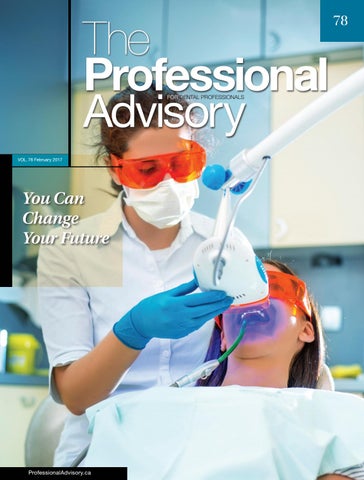
The Professional Advisory
78
FOR DENTAL PROFESSIONALS
VOL. 78 February 2017
You Can Change Your Future
ProfessionalAdvisory.ca ProfessionalAdvisory.ca
TPA 78.indd 1
2017-01-23 1:45 PM
Contents
3
You Can’t Change Your Past, But You Can Change Your Future Ralph Crawford BA., DMD
4 6 8
Rent Rip-Offs Revisited Ian D. Toms B.Sc. (Hons) Jennifer J. Miles B.A., HBA, M.B.A., Masters in Property Economics
The Morning Huddle Dr. Ron Weintraub
Tax Traps When Selling Your Dental Practice to Your Children
David Chong Yen CPA, CA, CFP Louise Wong CPA, CA, TEP Eugene Chu, BAFM, MAcc, CPA, CA
Biographies Ralph Crawford is an Honours Graduate from the University of Manitoba and has enjoyed a varied dental career. Prior to being editor of the Canadian Dental Association Journal from 1989 to 1997, he operated a Winnipeg private practice concurrently with being a clinical instructor at the University of Manitoba. He served as President of both the Manitoba Dental Association and Canadian Dental Association. Ian D. Toms is a nationally recognized real property lease consultant with over 27 years experience. He is considered an authority on tenancy issues, lease features, facilities and technicalities, and the art of tenancy negotiation. Ian has drafted and negotiated thousands of lease arrangements for national retail and medical professional tenants in 16 states and 8 provinces, with a specific emphasis on the GTA. Dr. Ron Weintraub is the founder of Innovative Practice Solutions (IPS) and former owner and founder of Bayview Village Dental Associates and Downtown Dental Associates. He practiced dentistry from 1963-2004 and has consulted on behalf of major dental suppliers, manufacturing companies, as well as individual dental offices for over 20 years. In 2004, Ron gave up clinical practice in order to focus solely on Practice Management.
10
Staging a Dental Practice Colin Ross MBA
David Chong Yen and his chartered accounting firm currently advise hundreds of dentists and healthcare professionals on tax, estate and financial planning, valuations and accounting. David obtained his Bachelor of Arts degree from the University of Toronto, attained his Chartered Accountant’s Designation while working at an international firm and has subsequently completed the CICA In-Depth Tax Courses.
12
Associate Agreements From the Principal’s Perspective
Colin Ross is a Partner in Professional Practice Sales Ltd. (www. ppsales.com), which specializes in the valuation and sale of dental practices. He can be reached at (905) 472-6000 or 1-888-777-8825 or e-mail at: colin.ross@ppsales.com
Legends of The Great Succession
David Rosenthal is a senior lawyer whose law practice is devoted to business, corporate and healthcare law for dentists. David advises dentists on a broad range of legal matters, with particular emphasis and legal advice on purchases and sales of practices, corporate reorganizations and professional corporations. David also speaks frequently about such matters, including guest lectures at the faculties of dentistry.
David E. Rosenthal BA., LL.B
14
Mark McNulty BA, CFP®, CM®
Mark McNulty is President of McNulty Group, a firm responsible for managing $300 million of Ontario dentists’ retirement savings. McNulty Group helps professional families transition from a life of successful practice to a stress-free retirement by using a holistic approach of practice and personal retirement planning. Mark is the author of The Transition Coach 2.0–A Canadian Dentist’s Guide to a Perfect Retirement, and The $6 Million Dentist: Successful Succession in 7 Modules.
The Professional Advisory | VOL. 78 February 2017
TPA 78.indd 2
2017-01-23 1:45 PM
3
“The Professional Advisory consists of a group of six independent professionals who provide services to the dental profession, each of whom specializes in a different field. They have gathered to keep each other informed of the latest developments relating to the profession, and to produce this publication which is designed to provide expert information and advice solely for dentists and their advisors.”
Notes from the editor:
You Can’t Change Your Past, But You Can Change Your Future Ralph Crawford BA., DMD
crawford@dccnet.com
R
ecently while wandering through a busy shopping mall properties. Whatever your tax experience has been in the and passing by a variety type store that sold stationary, past, David Chong Yen and Louise Wong’s article, Tax Traps cards and office supplies my eye caught a plaque-like sign When Selling Your Dental Practice To Your Children, cerdisplaying sage advice: You can’t change your past, but you tainly shows more profitable changes for the future. Whatever a dentist’s working arrangement has been in can change your future. As the wise words kind of bounced around in my mind, and gave thought to some of the things the past, David Rosenthal’s article, Associate Agreements that happened down through the years, the truth was very From the Principal’s Perspective, considers the numerous evident, “You bet: you can’t change the past but you can issues to consider when hiring an associate dentist. And certainly these issues can change any dentist’s future. Ron change the future”. Coming home from shopping with thoughts of the past Weintraub makes it clear that whatever the past may be and future still in mind I turned to the faithful computer to you can’t change it but The Morning Huddle is a win-win find the saying’s origin. And there it was – Reggie Dabbs of exercise that can certainly help change the future of any Ft. Myer’s, Florida. Reggie was born in Tennessee to an un- practice. Rent Rip-Offs of the past, there’s not much you can wed teenager who turned to her former teacher Mrs. Dabbs do about them. However, Ian Tom’s advice on retaining a whom she recalled saying, “If you ever need anything call highly qualified and experienced lease expert can do a great me.” Mrs. Dabbs and her husband took the teenager un- deal to change your future – save stress, time and money. der their care until Reggie was born and ultimately adopt- We are aware that there are dentists whose financial planed him and gave him the Dabbs name. After graduating ning in the past has not been much of a success. However, from college Reggie began public speaking and since 1987 in reading Mark McNulty’s Legends of the Great Succession has been a very popular in-demand public school speaker it is evident from the interviews with two of his clients that helping teenagers meet their problems head-on and over- indeed, you can change your financial future. We are told that Reggie Dabbs is fast becoming one of come them. Just stop for a moment and think about what our lives most in-demand speakers to help teenagers meet their are like right now. Isn’t it the truth: You can’t change your problems head-on and shares with them frequently past, but you can change your future. And isn’t that what The You can’t change your past, but you can change your future. Professional Advisory is trying to do – help dentists change And for all of us within the dental community, we too are their future so that they themselves, their patients and their thankful for the advice. families have lives that are even morePractice fulfilling Colin Ross is a Partner in Professional Salesand Ltd. more (www.ppsales.com), which specializes in the valuation and sale of dental practices. He canColin be reached (905) 472-6000 or 1-888-777-8825 rewarding. Consider Ross’atarticle regarding Staging a or e-mail at: colin.ross@ppsales.com Dental Practice where in selling a practice staging can result in prices as much as 20 per cent higher than un-staged
VOL. 78 February 2017 | The Professional Advisory
TPA 78.indd 3
2017-01-23 1:45 PM
4
Rent Rip-Offs Revisited
Ian D. Toms B.Sc. (Hons)
Y
our landlord will not contact you to let you know that you are overpaying rent. You must know how your lease works and compare your lease rent calculation mechanism against rent statements annually to ensure that you are not overpaying Additional Rents. Consider the following three factual case studies based on recent client transactions: A. Our client leases approximately 1,700 square feet of
ground floor retail space in a building located in southeast Toronto, from a large Real Estate Investment Trust (REIT). When we originally negotiated the offer to lease additional rent elements were carefully orchestrated to only include certain costs, and be based on an equitable share of the costs shared by the entire building. When our team reviewed the annual additional rent statement, it indicated that the additional rent was significantly more than estimated during the original negotiation. Examination of the additional rent statement and comparison to the lease indicated that an administration charge of 15 per cent was being added by the landlord to additional
Jennifer J. Miles B.A., HBA, M.B.A., Masters in Property Economics
rent payable; but the lease did not include the 15 per cent administration charge. The charge resulted in an additional cost annually of approximately $6,000 for our client. We contacted the landlord, whose initial response was that this was a standard charge and was payable regardless of what the lease said. The tenant did not pay this administration fee; the Chief Financial Officer (CFO) of the REIT actually entered into the premises and demanded payment in front of staff and patients, and threatened to lock the tenant out unless payment was received within a certain period of time. Our team followed up with the CFO reminding him that he had violated the tenants’ rights; he offered to “cut a deal” as he had already posted the amounts in the financial statements and could not retroactively correct public shareholders statements. In the end the landlord backed down, removing the costs from the annual statements. B. Our client leases office space in a mixed-use plaza which
had been acquired by a large national Real Estate Investment Trust a couple of years ago. The tenant received a huge
Suite identification: 0101 Applicable Number of Days for the Tenant: 365 Area
% Days
Expense Amount
Denominator
Prorata Share
Annual Prorata Amount
Admin Tenants Fee Additional Fee
% Installments Admin Billed Fee
Net Difference
1,176 01/12/2011 30/11/2021
100.00 Hydro
270,173
86,204
1.99%
5,378.07
949.07
6,327.15
15.00
5,760.00
567.15
1,176 01/12/2011 30/11/2021
100.00 Realty Tax
548,410
86,204
1.99% 10,916.64
1,926.47
12,843.11
15.00
11,724.00
1,119.11
1,176 01/12/2011 30/11/2021
100.00 Rec Operating Exp*
680,666
86,204
1.99% 13,549.35
2,391.06
15,940.41
15.00
12,408.00
3,532.41
29,844.06
5,266.60
35,110.67
29,892.00
5,218.57
This charge is not permitted under the lease
The Professional Advisory | VOL. 78 February 2017
TPA 78.indd 4
2017-01-23 1:45 PM
5 INVOICE Code
Description
Amount
cb-final
50% gas adj on 2015 Final Chargeback Billing
cb-final
50% hydro adj on 2015 Final Chargeback Billing
additional rent bill and asked us to conduct an audit to discover where these charges were coming from. Our review indicated that the lease clearly states that hydro charges are to be estimated for each new year and paid for by the tenant by monthly installments. No hydro charges were added by the landlord to the monthly additional rent for two years amounting to an “oversight” of over $12,000.00! After identifying the issue through an additional rent audit and pointing out the error to the landlord we negotiated a settlement under which the landlord agreed to cover 50 per cent of the cost. Our client will save over $6,000.00 in total. C. Our client leases approximately 1,500 square feet in a
mixed-use plaza in a small town in southwestern Ontario. His landlord is an individual who does not follow what the lease agreement indicates. As reported in additional rent statements, the landlord “habitually” spends $20,000 each year on repairs and yet the plaza is tired, worn out and in dire need of a facelift. “Coincidentally” repairs for the 2010 and 2011 operating years were only $0.91 apart!! Suspicious? Janitorial costs went from $1,000 to $2,000 to $19,000 per year over a five year period. Wait a minute, the 2011 janitorial costs were $1,967. Simply add a 0 and presto! You come up with the 2016 annual years’ costs of $19,067! Overall, this year’s common area maintenance costs are almost identical to 2011. Very creative! How does the insurance cost increase from $10,000 to $12,000 to $25,000 over five years? Shouldn’t a business person shop around for a better rate if they get a 150 per cent increase?
($196.26) ($2,596.64)
Sub-Total
($2,792.90)
GST/HST
($ 363.07)
Total Due
($ 3,155.97)
As our client has the option to examine the landlord’s source documents on five days advance written notice, we look forward to reporting on the outcome of our audit. Does your lease give you this right? We have hundreds of examples from client files, which go to show that every tenant needs to understand their obligations as well as their opportunities, and how they are being charged for rent. Each tenant needs to know their rights and what their obligations are and how and when they are being billed. You audit your bank statements, why not your lease? Retaining a highly qualified and experienced lease expert, familiar with the market climate and conditions to review your lease and additional rent installment statements will save you stress, time and money.
You audit your bank statements, why not your lease?
Please send comments to info@realtyleaseconsultant.com
This article was prepared by Ian D. Toms, B.Sc. (Hons) and Jennifer J. Miles, B.A., HBA, M.B.A., Masters in Property Economics. Realty Lease Consultants, Inc. has been preserving realty leasehold value since 1986 and can be reached at (705) 743-1220, by email info@realtyleaseconsultant.com, or through the website at www.realtyleaseconsultant.com.
VOL. 78 February 2017 | The Professional Advisory
TPA 78.indd 5
2017-01-23 1:45 PM
6
The Morning Huddle:
An Indispensable Tool for Improving Professional and Financial Outcomes on a Daily Basis
Dr. Ron Weintraub
A
s a result of an unintended consequence of today’s complex layers of practice environment, we have initiated a daily huddle as an indispensable tool for improving our professional and financial outcomes. For those who have not yet participated in or observed the advantages of having a daily huddle, exploring the commitment, barriers and benefits will be valuable.
WHAT CONSTITUTES A TEAM HUDDLE? Essentially, a team Morning Huddle is a short gathering of all team members to review the activities assigned to patients’ exposure to the office as well as to highlight any problems that arose from the previous day’s schedule. A designated leader is appointed to be in charge of the program, perhaps the treatment coordinator, office manager or clinical team leader. In some offices, we rotate responsibilities on a weekly basis through the attending staff. We suggest that it not be the dentist, as this tends to limit the frank interchange of ideas and issues from the team. We want to encourage full participatory dialogue. The absolute prerequisite for a successful huddle is prior preparation by the individuals involved. The participants and their commitment could include the following: A. The hygienist arrives at The Morning Huddle having briefly audited the charts of the day’s patients which provide an opportunity for the hygienist to request assistance to provide support for full mouth probing and charting. In addition, the assistant is available to take radiographs, full mouth series, panoramic x-rays (PAN), or full periodontal charting as needed. B. Clinical Assistants similarly review the upcoming patient load with the view to any special requirements related to previous appointment and potential problems. C. Greeters and Dismissers also acquaint themselves of any balances on accounts and review any family
members of patients who may be overdue. Generally, the team members should be informed of family milestone events that were mentioned in the previous appointment. D. Communal discussion ensues by the complete team who will communicate with an individual patient or family on whether previously recommended treatment has not been accessed or inquire as to how the patient is managing with newly acquired prosthesis.
WHAT ARE THE BARRIERS TO INITIATING THE MORNING HUDDLE? The Morning Huddle requires increased time commitments to prepare for and deliver a short information meeting prior to the onslaught of patients. Sometimes, resistance to committing to giving extra time for preparation for the day with The Morning Huddle poses an obstacle to imposing yet another obligation to the team. Typical excuses and concerns revolve around objections such as the following: 1. I don’t want to get to the office 15 minutes earlier; 2. I don’t want to take the time from my production schedule; 3. I don’t think we will gain anything; 4. Some team members start at different times of the day; 5. I don’t want to pay staff extra for their time; or 6. A standard response from people who resist change at any cost: “We have been operating without a Huddle for many years; I don’t think we need one.” To this, our favorite rejoinder to highly integrated staff that in reality regarding this subject is they “don’t know enough to know what they don’t know”. Actually, however, the advantages of The Morning Huddle, more than anything, displaces the myth of being too busy to incorporate it into our schedule.
The Professional Advisory | VOL. 78 February 2017
TPA 78.indd 6
2017-01-23 1:45 PM
7
WHAT ARE THE BENEFITS OF THE MORNING HUDDLE? The benefits of the Morning Huddle on both the team and patients’ perception is positive. The Team’s Perception
All staff members have a clear indication of what they have to prepare for the arrival of each patient in their department. For example: • Has the lab delivered the case as promised for today’s appointment? • Does the patient need to be questioned about having taken his/her pre-medications as directed? • Are there any prior medical concerns, and what is their status? Typically, the meeting begins with yesterday’s feedback, internal and external concerns from the doctor’s and hygienist’s schedule followed by a discussion of today’s schedule – confirmation with the view to looking for opportunities for moving patients from hygiene into any late openings in the doctor’s schedule. In addition, the team reviews any emergency patient information to choose the best time to schedule these emergencies and specific exams.
The preparation for the day encourages a positive impression of a confident patient-focused office.
Patients’ Perception
The beneficial effects of “Operation” Morning Huddle are apparent not only to clinical and administrative personnel, but also to the importance of patients’ perspective. The preparation for the day encourages a positive impression of a confident patient-focused office. Within a group setting, this format remedies and prevents glitches in patients’ exchange with the team. Moreover, with everyone in attendance, it prepares the future of the day by avoiding costly mistakes to staff performance. The team understands and offers assistance contributing to a surprise-free clinical day as one can reasonably expect from a dental practice.
The Morning Huddle is a win-win exercise; therefore, a serious attempt should be made to implement this modality as an integral part of the everyday practice going forward. Avoid a “muddle” day by instituting a Morning Huddle for a reduced stress day.
Please send comments to drronips@rogers.com
Ron Weintraub is a founding partner with the Bayview Village & Downtown Dental Associates and brings over thirty-five years of knowledge and experience in the practice of general dentistry to The Professional Advisory. Large companies such as Patterson Dental, Ash Temple Ltd, Henry Schein Arcona, & the former Canadian Dental Co. have benefited from his insight. As owner of Innovative Practice Solutions, Ron advises dentists on practice enhancement, practice purchases, sales, location evaluations, associate buy-ins, and business mergers. Dr. Weintraub can be contacted at (905) 470-6222 Ext. 221 or drronips@rogers.com.
VOL. 78 February 2017 | The Professional Advisory
TPA 78.indd 7
2017-01-23 1:45 PM
8
Tax Traps When Selling Your Dental Practice to Your Children
Louise Wong CPA, CA, TEP
T
here’s a special sense of pride when your child decides to follow in your footsteps and pursue the same career path as you. For dentists whose children are in dental school or are considering pursuing a career in dentistry, there is also another significant benefit: you get to leave your legacy in the hands of your children. From a practical perspective selling your practice to your child can be an ideal situation. You get to work side by side with your child prior to, during and after the transition which reduces the rate of patient attrition. Your staff have probably watched your children grow up right in front of their eyes and are at ease with the idea of your child taking over which reduces staff turnover. You do not have to look for a buyer or really go through the process of selling your practice. Your ideal successor was already waiting in the wings the day they were born. The entire situation would appear to be a win-win for the family. The tax laws however take a different view and failing to plan appropriately for this sale could result in a financial nightmare for both you and your child. The Canada Revenue Agency (CRA) have very specific rules when it comes to related party transactions (i.e. purchases and sales among family members). Tax rules which would not apply if you were to sell your practice to an unrelated third party find a way to rear their ugly heads into situations when the buyer and seller are related. In general the following two scenarios could occur: 1) 2)
Parent wins, child loses Child wins, parent loses
David Chong Yen CPA, CA, CFP
Parent Wins, Child Loses
In this scenario, the parent would sell the shares of their corporation the same way as if the buyer was a stranger. Assuming the parent and the shares qualified, they would be able to claim the Capital Gains Exemption (CGE) on their shares and potentially save up to $220,000 in taxes for each equity shareholder that was holding the shares. While there’s nothing out of the ordinary for the parent as a seller, on the flip side, the child as the buyer is now restricted in how they can buy the shares. In order for the parent to qualify for the CGE, the child must purchase the shares personally. In other words, the buyer cannot be the child’s corporation. There is an important distinction when a buyer is an individual versus a corporation. When the buyer is an individual, the loans used to fund the purchase are personal and must be repaid out of personal after-tax dollars. When the buyer is a corporation, the loans can be repaid from corporate after-tax profits. Since personal taxes can be as high as 53.53 per cent versus corporate taxes of 15 per cent, this puts an immense financial burden on the child. On a two million dollar loan, the additional cost to repay the loan for the child would be 1.95 million dollars. Child Wins, Parent Loses
In the reverse situation where the child was able to buy the shares using a corporation, each parent would not be able to claim the CGE and therefore would each be paying up to $220,000 in additional taxes on the sale of their practice shares. On a sale of two million dollar practice with two equity shareholders (both parents), this would be about
The Professional Advisory | VOL. 78 February 2017
TPA 78.indd 8
2017-01-23 1:45 PM
9
$440,000 in additional taxes. The benefit is your child would be able to use cheap after-tax corporate dollars to pay back the bank loan which would reduce the cost by 1.95 million dollars. Is there a win-win situation?
This will depend a lot on specific details of your family’s financial situation. Several key questions to consider are as follows: • How much does your child need to borrow from the bank to buy the practice? • Does the parent have multiple dental practices? • Has the parent already used their CGE? • How many equity shareholders are there? • Is the child already a shareholder of the parent’s corporation? • Does the parent want to relinquish 100 per cent of the corporation or only a portion to the child? • Will the parent forgive the proceeds? • Will the parent stay as shareholder after the transition? In many cases, there may not be a 100 per cent win-win situation for both parent and child due to the tax rules surrounding related parties. However, there may be a better solution involving tax maneuvers and tax reorganization provided the family is flexible and compromises can be made. Most importantly, you also need time. We have said it many times before: you need to plan several years in advance before you sell your practice. Selling your practice to your child is no different. Despite not having to locate a buyer and having your child ready to take over, it may take longer for the entire transaction to unfold than if you were to sell to a stranger. This is not a process that should be rushed. Planning for the sale of your practice is critical; in the case of selling to your child, your family’s legacy and overall tax bill depends on it.
Tax rules which would not apply if you were to sell your practice to an unrelated third party find a way to rear their ugly heads into situations when the buyer and seller are related.
Please send comments to david@dcy.ca
This article was prepared by David Chong Yen*, CPA, CA, CFP, Louise Wong*, CPA, CA, TEP and Eugene Chu, BAFM, MAcc, CPA, CA of DCY Professional Corporation Chartered Accountants who are tax specialists* and have been advising dentists for decades. Additional information can be obtained by phone (416) 510-8888, fax (416) 510-2699, or e-mail david@dcy.ca/ louise@dcy.ca/eugenechu@dcy.ca. Visit our website at www.dcy.ca. This article is intended to present tax saving and planning ideas, and is not intended to replace professional advice.
VOL. 78 February 2017 | The Professional Advisory
TPA 78.indd 9
2017-01-23 1:45 PM
10
Staging a Dental Practice
Colin Ross MBA
I
n the real estate market, staging has become a huge part of the successful sale process. Staging is the act of preparing a space for sale with the goal of making the property more appealing to a larger group of potential buyers. Successful staging results in sale prices between 6-20 per cent higher than un-staged properties. In the dental market, staging is an important element in preparing an office for sale, yet it is rarely implemented. In many cases, dentists simply wake up one morning and decide to list their practice, or even more astonishing, get a knock on their door from a random buyer and are convinced to sell to that buyer. In these cases, there is little chance to properly stage the practice, and even if successful, the selling price was likely not maximized. Selling a dental practice should be a strategically planned event, should be under your timeline, should include a group of experts, and should be implemented well in advance of the actual event. Ideally the planning process should begin 2 - 5 years before the actual sale. Dental practice staging can be grouped into two categories – Early Preparation Staging Period and Time of Sale Staging Period. In the Early Preparation period, which could be anywhere from one to as many as ten years prior to a sale, the focus is to address the big picture business elements. In the Time of Sale staging period, the techniques focus on cosmetic and operational features.
EARLY PREPARATION PERIOD Lease: The premise lease terms must be reviewed far enough in advance of the sale to be able to negotiate changes, and to eliminate the potential for your landlord to affect a sale. The premises lease should have a term of at least 10 years remaining at the time of sale (including renewal options), be void of a demolition clause, and have conditions that are reasonable for uninterrupted operations.
Employees: If you have an associate, he or she must be on
a contract. It is also becoming more common to have employees on employment contracts. While some dentists do not want to rock the boat with employees, these contracts definitely improve practice value by limiting the potential liability from employees. Equipment and Practice Assets: We generally don’t
recommend upgrading equipment immediately prior to a sale. However, if you have a 5+ year window, there may be some benefit to upgrading equipment and décor, and there is always a benefit to adopting productive technology. Any changes should be neutral in nature with the need to be attractive to a large audience. Be careful of overspending and don’t forget that the assets are never the most important part of a practice value (it is location, patients and profits). Corporate and Accounting Structure: Many sales have
been disrupted by poor accounting and poor corporate structure. In a typical sale, the buyer will dig deeply into the accounting and corporate structure. If too many questions arise, and the numbers don’t add up, the deal may fail or at least the values will be questioned. To take advantage of the small business capital gains exemption, the seller will incorporate and sell shares. While dentists can incorporate at the time of sale, there may be advantages of incorporating well in advance of the sale. Incorporation may also include various complex share issues, including adding family members, cleansing the non-income producing assets, and re-payment of shareholder loans. Operations and Management: In advance of a sale, con-
sider how efficient and functional the business side of your practice is working. This could start with a Valuation to determine your current value, and discover areas that require attention. The practice operations may include employee
The Professional Advisory | VOL. 78 February 2017
TPA 78.indd 10
2017-01-23 1:45 PM
11 manuals, patient communication techniques, collections, especially with respect to co-payment, a strong hygiene program. Your hygiene side should receive focus. If started early enough, practices could benefit from consultants, new patient marketing programs, or increases in practice hours. The benefit is an improved bottom line, and any incremental expenses are one time only.
TIME OF SALE PERIOD Declutter and Cleaning: A classic residential real estate technique that also applies to your dental practice. Many older offices become cluttered, and possibly look unclean. A cluttered office implies that it is disorganized or the owner doesn’t care. The office should be cleaned, decluttered, small repairs made, repainted, filters changed, etc. It should show pride of ownership. Purging: Chart purging should be completed in advance of a sale. Many offices have charts in one area, so a patient who last visited the office 10 years ago is still beside an active patient. The active chart area should have charts for patients seen in the past three years, and an area for those who have fallen out of the practice. This purging provides a chance to recover those patients prior to moving them to the inactive file. Accounts Receivable: This is a huge concern for buyers.
A large Accounts Receivable (AR) implies a lack of management, and potentially insurance fraud from not collecting co-payments. In the practice management software all old AR should be written off and all efforts must be pursued to collect as much as possible. Further there needs to be clear evidence about your collection policy. Many practices put signs at the front desk highlighting your co-payment collection policy. If you don’t collect co-payment or at least demonstrate an attempt to collect, it is presumed that those patients are not loyal to the practice. Bookings and Production: At the time of sale, dentists
sometimes take their foot off the gas and let bookings and production slide. While understandable, this is the worst thing that you can do. During the sale process, the office must run at current levels, and extra care must be taken to ensure that the schedule stays very full.
Selling a dental practice should be a strategically planned event, should be under your timeline, should include a group of experts, and should be implemented well in advance of the actual event.
Think like a buyer. Be critical of your practice and take steps to make it better. In a best case scenario, this should start well in advance of the actual selling decision. The process should involve working with experts (Accountants, Lawyers, Equipment Specialists, Brokers, Consultants, etc.). Even if you cannot undertake this process well in advance, there are some short term techniques that can make your practice more attractive to a wider group of buyers and therefore command a higher selling price.
Please send comments to colin.ross@ppsales.com
Colin Ross is a Partner in Professional Practice Sales Ltd. (www.ppsales.com), which specializes in the valuation and sale of dental practices. He can be reached at (905) 472-6000 or 1-888-777-8825 or e-mail at: colin.ross@ppsales.com
VOL. 78 February 2017 | The Professional Advisory
TPA 78.indd 11
2017-01-23 1:45 PM
12
Associate Agreements From the Principal’s Perspective
David E. Rosenthal BA., LL.B.
T
here are many issues to consider when hiring an associate dentist. An associate agreement (Agreement) is the legal contract that details the arrangements between the dentist who owns the practice (Principal) and the associate dentist (Associate) hired to work at the practice. This article is part 1 of 2 which considers some of those issues from the Principal’s perspective. A surprising number of Principals do not enter into proper written associate agreements to document this important relationship and they do so at their peril. While a verbal agreement may be legally enforceable, it is not sufficient. A written agreement between the parties is critical to protect the Principal’s interests and deal with the various matters that should be clearly set out in writing. In addition, not having an appropriately written and signed Agreement between the Principal and Associate can be a serious detriment and obstacle when the Principal sells the dental practice.
Most Agreements specifically state the Associate is not an employee and will personally pay all taxes and satisfy all other governmental requirements. However, simply making that statement in the Agreement is not sufficient. The relationship of Principal and Associate will be determined based on what the actual facts show the relationship to be, not just what the words in the Agreement say. CRA may audit and assess the Principal on the basis that their Associate was, in fact, an employee. If CRA were successful the Principal could be responsible for the statutory deductions the Principal failed to make as an employer, such as income tax, Canada Pension Plan and Employment Insurance. In addition there could be penalties and interest. There are several factors that CRA will examine in determining the relationship of Principal and Associate and whether is it an independent contractor or employer/employee relationship.
Relationship
1. Control – who controls the patient flow and scheduling, the hours of work, the nature and quality of work and the right to determine staffing needs.
In almost all situations the Associate works at the Principal’s dental practice as an independent practitioner. Principals and/or Associates can be individual dentists or dentistry professional corporations. This article does not deal with dentistry professional corporations. But there may be many potential tax benefits so it is always worthwhile to contact with your tax advisors to determine whether to use a professional corporation as the Principal. As an independent practitioner the Associate is operating his or her own separate business and is self employed. The Principal pays the Associate a gross amount and the Associate must then remit from that gross amount the required taxes to Canada Revenue Agency (CRA). The Agreement needs to clearly specify the independent contractor relationship between Principal and Associate. Very few dentists treat their Associates as employees.
2. Ownership – who owns and supplies the equipment and instruments required by the Associate and who bears the costs related to their use and maintenance. 3. Chance of profit/risk of loss – who assumes the financial risk. Is the Associate entitled to his/her full remuneration regardless of the financial health of the practice and whether or not the patients pay for the dental treatment. 4. Integration – is the Associate acting on behalf of the Principal and connected with the Principal’s dental practice in all aspects.
The Professional Advisory | VOL. 78 February 2017
TPA 78.indd 12
2017-01-23 1:45 PM
13
It may be that some Principal/Associate arrangements are considered as employer/employee relationships. This makes a properly drafted Agreement, which clearly reflects the Associate as an independent contractor, extremely important from the Principal’s perspective and for the Principal’s protection. The Agreement should detail what the Associate, as an independent practitioner, is responsible to pay for, including licences, memberships, insurance, educational courses, seminars, and other expenses applicable to the Associate. The Agreement should detail all services and facilities the Principal will provide to the Associate, including the use of the premises, equipment, dental supplies, staff and services. Staff and services might include receptionists, chairside assistants, dental hygienists, management, administrative, bookkeeping and collection services. If special equipment or specific staff is required (such as a designated operatory or designated chairside assistant or hygienist) this should be detailed in the Agreement. Often the Agreement stipulates that the Principal will provide the certain standard equipment and routine dental supplies and it is the Associate’s cost where the Associate requires further specialized items.
A surprising number of Principals do not enter into proper written associate agreements to document this important relationship and they do so at their peril.
Part 2 of this article continues in the next volume of The Professional Advisory and will address Associate remuneration, non-competition covenants and termination of the Agreement. Please send comments to david@drlaw.ca
David Rosenthal is a senior lawyer with Spiegel Rosenthal Professional Corporation whose practice is devoted to corporate, commercial and business law, with special emphasis on advising dentists. He can be reached at (416) 865-0736 or e-mail to david@drlaw.ca.
VOL. 78 February 2017 | The Professional Advisory
TPA 78.indd 13
2017-01-23 1:45 PM
14
Legends of The Great Succession – An Excerpt from my book, The $6 Million Dentist
Mark McNulty BA, CFP®, CIM®
I
mentioned at the start of this book that some of the greatest financial minds I know are those of dentists. I have had the benefit of learning from a financially savvy group of dentists during the past 20 years. These experiences have had a great impact on my life, my business, and the families I work with at McNulty Group. In writing this book, I took the opportunity to ask four of these individuals a series of questions. With so many dentists not able to reach their financial goals, I wanted you to hear firsthand how this group has been able to achieve such a high level of financial success. Please note: confidentiality is vitally important in my business, so each contributor will remain anonymous. As well, I felt that some of their more specific experiences had to be removed as they might be too revealing. Each contributor is a client of our firm.
DR. ONE The first contributor is a client and also somewhat of a mentor for me. He is a classic “millionaire next door” type, humble and not flashy in the least. Dr. and Mrs. One have $3 million in retirement savings, have personal use real estate (home and cottage) worth $1 million and spend less than $100,000 per year after-tax. They are both in their early sixties. They retired in their late fifties.
tight as most earnings went back into the practice. My practice co-owner and I initially relied on the financial advice of the accountant for the practice where he initially associated. I found out within a year or so that the advice from that accountant was quite poor. I began doing more and more reading on my own about money, investing, financial controls, and practice management. Since then, I always have some financial reading on the go. I began investing through a friend who had achieved a very impressive net worth at an early age through various types of real estate investing. We did very well for several years, but then over a three year period all the real estate investments failed. I began investing again, but no longer included real estate, and no longer invested as part of a group (too many conflicting goals). I had been continuously setting aside savings every year. I started over through a recommended broker at a well-known brokerage house. Over time, I began to see that my buy-and-hold temperament did not fit with his company’s sell-what-is-on-the-shelf-today approach. I was also learning the costs of high fees the hard way. My goal, financially, was to have enough saved for a very basic rest-of-my-life retirement by age 50, a workable life by 55, and a comfortable life by 60. We track our finances closely, so we had and have a good idea of retirement spending needs. We met our goals.
1. How did you achieve your financial success?
2. What advice would you give your colleagues about their practice?
I have always been goal oriented – usually with written goals… I fall into the delayed gratification group. I associated for two years and saved heavily for setting up my own practice. The early years of my own practice were financially
Start tracking office and home finances better and earlier planners do better. Prepare, revise, and monitor an annual office budget to point out office problem areas and opportunities early on.
The Professional Advisory | VOL. 78 February 2017
TPA 78.indd 14
2017-01-23 1:45 PM
15
DR. TWO Dr. Two is close to what I would call a “financial activist”. He has very strong views about our society’s desire for consumption and need to “keep up with the Jones”. This passion has done well for him and his wife on two fronts. They are very well off financially, with a retirement portfolio in excess of $8 million and are only in their mid-fifties. When they retire (shortly), they will be able to live off the income the portfolio generates – and live a life most people would envy. 1. How did you achieve your financial success?
Working a lot and living conservatively seems obvious, but it’s a big part. Saving using conservative investments, and not losing the savings. I used GICs to save up enough to allow me to utilize investment firms that have low management fees. It was difficult and time consuming to save the first million, but after that the savings came more quickly and seemed easier. 2. What advice would you give other dentists who want to reach your level of financial success?
In order to save much of what you make, you may have to look like you don’t have a lot saved. Be comfortable with yourself and avoid the pressures to look well off or compete. Stay away from complex “saving” or tax plans. Much of my savings were in GICs for over a decade, much to my banks and financial planners chagrin. Nobody can lose you money faster than a financial planner. I was lucky I found this out early and with modest sums of money. You may have to look for a good financial planner, the not so good ones will find you.
With so many dentists not able to reach their financial goals, I wanted you to hear firsthand how this group has been able to achieve such a high level of financial success.
3. What advice would you give your colleagues about their practice?
Very simple advice: Keep the office conservative. Watch overhead. Be friendly, nice, honest and keep the patients’ best interests at heart. Also, to grow a practice you have to be there. My interviews with Dr. Three and Dr. Four, who have combined retirement savings of $12.5 million, will be included in the next issue of the Professional Advisory. Stay tuned. Feedback can be sent to info@mcnultygroup.ca
Mark is President of McNulty Group, a firm responsible for $300 million of Ontario dentists’ retirement savings. McNulty Group helps professional families transition from a life of successful practice to a stress-free retirement by using a holistic approach of practice and personal retirement planning. In addition to multiple television and radio appearances, Mark is the author of The Transition Coach 2.0–A Canadian Dentist’s Guide to a Perfect Retirement and The $6 Million Dentist: Successful Succession in 7 Modules.
VOL. 78 February 2017 | The Professional Advisory
TPA 78.indd 15
2017-01-23 1:45 PM
Advisory TheProfessional Advisory FOR DENTAL PROFESSIONALS
The Professional Advisory
63
FOR DENTAL PROFFESSIONALS
VOL. 63 February 2014
Progressus – a going forward, advance
Visit our website at www.professionaladvisory.ca to view current issue and complete archives.
ProfessionalAdvisory.ca
TPA 63.indd 1
14-01-31 1:52 PM
Left to right: David Rosenthal, BA., LL.B. Spiegel Rosenthal Professional Corporation Barristers and Solicitors Ron Weintraub, DDS Innovative Practice Solutions David Lind Principal, Broker of Record Professional Practice Sales Ltd. Ian D. Toms, B.Sc. (Hons) Broker of Record Realty Lease Consultants Inc. Mark McNulty, BA, CFP, CIM Director, Private Client Group McNulty Group, HollisWealth David Chong Yen, CPA, CA, CFP DCY Professional Corporation Chartered Accountants
TPA 78.indd 16 TPA_FP.indd 1
2017-01-23 1:45 PM 14-03-26 3:56 PM