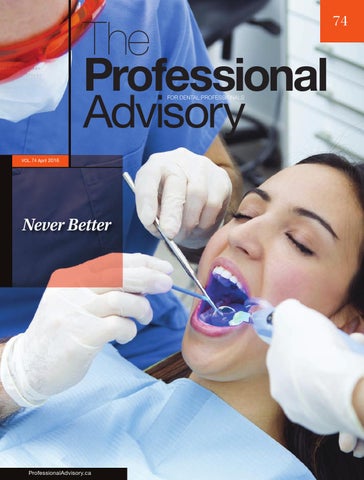
The Professional Advisory
74
FOR DENTAL PROFESSIONALS
VOL. 74 April 2016
Never Better
ProfessionalAdvisory.ca
TPA 74.indd 1
16-03-24 12:33 PM
Contents
3 4
Never Better
Ralph Crawford BA., DMD
Legal Matters When Purchasing a Dental Practice
David E. Rosenthal BA., LL.B
6 8 10
My Mother’s Portfolio Mark McNulty BA, CFP®, CM®
How to get out of your lease Ian D. Toms B.Sc. (Hons)
Retaining a NewlyAcquired Patient Group and Team to Justify the Significant Purchase Cost Dr. Ron Weintraub
12
Estate Planning: Anticipating Hidden Liabilities
David Chong Yen CPA, CA, CFP Louise Wong CPA, CA, TEP
14
Should I Stay or Should I Go? David Lind
Biographies Ralph Crawford is an Honours Graduate from the University of Manitoba and has enjoyed a varied dental career. Prior to being editor of the Canadian Dental Association Journal from 1989 to 1997, he operated a Winnipeg private practice concurrently with being a clinical instructor at the University of Manitoba. He served as President of both the Manitoba Dental Association and Canadian Dental Association. David Rosenthal is a senior lawyer whose law practice is devoted to business, corporate and healthcare law for dentists. David advises dentists on a broad range of legal matters, with particular emphasis and legal advice on purchases and sales of practices, corporate reorganizations and professional corporations. David also speaks frequently about such matters, including guest lectures at the faculties of dentistry.
Mark McNulty is President of McNulty Group, a firm responsible for managing $250 million of Ontario dentists’ retirement savings. McNulty Group helps professional families transition from a life of successful practice to a stress-free retirement by using a holistic approach of practice and personal retirement planning. Mark is the author of The Transition Coach 2.0–A Canadian Dentist’s Guide to a Perfect Retirement, and The $6 Million Dentist: Successful Succession in 7 Modules. Ian D. Toms is a nationally recognized real property lease consultant with over 27 years experience. He is considered an authority on tenancy issues, lease features, facilities and technicalities, and the art of tenancy negotiation. Ian has drafted and negotiated thousands of lease arrangements for national retail and medical professional tenants in 16 states and 8 provinces, with a specific emphasis on the GTA. Dr. Ron Weintraub is the founder of Innovative Practice Solutions (IPS) and former owner and founder of Bayview Village Dental Associates and Downtown Dental Associates. He practiced dentistry from 1963-2004 and has consulted on behalf of major dental suppliers, manufacturing companies, as well as individual dental offices for over 20 years. In 2004, Ron gave up clinical practice in order to focus solely on Practice Management. David Chong Yen and his chartered accounting firm currently advise hundreds of dentists and healthcare professionals on tax, estate and financial planning, valuations and accounting. David obtained his Bachelor of Arts degree from the University of Toronto, attained his Chartered Accountant’s Designation while working at an international firm and has subsequently completed the CICA In-Depth Tax Courses.
The Professional Advisory | VOL. 74 April 2016
TPA 74.indd 2
David Lind is the Principal and Broker of Record at Professional Practice Sales Ltd., which was established in Ontario in 1991 and is a leader in dental practice valuations and sales. Prior to joining PPS, David lead the healthcare business for CIT Financial Ltd. This gave him a strong understanding of the personal and professional needs of dentists as they entered and exited the profession.
16-03-24 12:33 PM
3
“The Professional Advisory consists of a group of six independent professionals who provide services to the dental profession, each of whom specializes in a different field. They have gathered to keep each other informed of the latest developments relating to the profession, and to produce this publication which is designed to provide expert information and advice solely for dentists and their advisors.”
Notes from the editor:
Never Better Ralph Crawford BA., DMD crawford@dccnet.com
L
And that is what Professional Advisory and its dedicated ast January, my wife Olga and I attended the 132nd annual meeting of the Manitoba Dental Association contributors strive for issue after issue, year after year, to (MDA) in Winnipeg. Counting the 1964 meeting we at- make the practice of dentistry Never Better. Mark McNulty tended while I was a fourth-year dental student, it was our in managing My Mother’s Portfolio step-by-step outlines a 53rd meeting. The interesting factor is that for the bulk of all Never Better approach to financial stability. David Chong those 132 years, the meeting has always been scheduled Yen and Louise Wong’s Estate Planning: Anticipating Hidfor the end of January. No longer living in Manitoba, we den Liabilities warns that you don’t want to fall short of a now call the annual Winnipeg trip our “winter holiday”. For finish line but strive for Never Better planning to successthose not familiar with MDA happenings, the question of- fully cross the finish line. How To Get Out Of Your Lease ten arises, “Why the end of January?” The reason is pretty requires a thorough understanding explains Ian Toms as basic. It’s called attendance. Throughout over a century of he outlines four Never Better approaches of getting out of a meetings, the regular attendance of registered dentists at- tenancy before the term end. How about the Legal Matters When Purchasing a Dental tending some part of the MDA annual has exceeded over 90 per cent. That is a figure not matched by very many dental Practice? David Rosenthal outlines a carefully formulated organizations and also, if it’s consistently 90 per cent, why 17 point Never Better legal checklist to consider when at this point of decision. Should I Stay or Should I Go is what would you want to change the date? Of course, we really enjoy meeting former classmates David Lind considers when selling a dental practice and and friends from throughout the years and one of the in- he carefully deals with the various practice components teresting aspects is the traditional MDA response of “Never that contributes to a Never Better conclusion. PurchasBetter” when asked “How are you?” or “How are things go- ing a dental practice is never simple and Ron Weintraub ing?” Never better has been the Manitoba norm for many outlines a Never Better strategy when Retaining a Newlyyears. It all started in 1969 when Ross McIntyre was taken Acquired Patient Group and Team to Justify the Significant on as MDA executive secretary – the first non-dentist in that Purchase Cost. Life is never simple, nor are the various components very important role. Apart from his exceptional management style, Ross’ ‘never better’ response was perpetually of dentistry, but learning and striving with a Never Better indicative of his outgoing friendly manner throughout his attitude can only improve the joys of living within a better entire 42 years of service. And it remains within so many of world. us Manitobans to this day. Thinking of life in general, isn’t Never Better the role all of us should be thinking as we make ourSales wayLtd. through Colin Ross is a Partnerabout in Professional Practice (www.ppsales.com), which specializes in the valuation and sale of dental He can reached at (905)tasks? 472-6000 family,practices. society and ourbedaily working It’soran1-888-777-8825 approach or e-mail at: colin.ross@ppsales.com day-by-day where you don’t settle for mediocrity but strive to make happenings around you to go another step forward to be better. VOL. 74 April 2016 | The Professional Advisory
TPA 74.indd 3
16-03-24 12:33 PM
4
Legal Matters When Purchasing a Dental Practice David E. Rosenthal BA., LL.B.
E
arlier this year the Ontario Dental Association held an all-day seminar in Toronto regarding purchasing a dental practice. The seminar was sold out and virtually all attendees remained for the entire day. I was one of the speakers and discussed legal matters when purchasing a dental practice. My handout included a checklist of legal matters to consider when purchasing a dental practice. Such checklist, together with the handouts by the other speakers, provide excellent learning resources for dentists. Outlined below is a checklist of some of the legal matters to consider when purchasing a dental practice:
1. Carefully review the appraisal of the vendor’s
2.
3. 4.
5. 6. 7.
practice with your own professional advisors. Conduct your own due diligence including a detailed patient chart audit. This is critical. When a dental practice is valued, typically the tangible hard assets comprise only about 20 per cent of the total practice value while the goodwill is valued at approximately 80 per cent of the total practice value. Goodwill includes the patient lists, custody and control of all patient records and files (including patient billing records and treatment plans), patient charts, X-rays and models, and use of any dental practice names. Given such value of goodwill it is imperative the purchaser completes a detailed patient chart audit and satisfies himself or herself of the number and quality of the active patient charts and lists. Determine what you are buying – shares or assets. Understand the allocation of purchase price to different asset classes if purchasing assets and the tax effect of such allocation to the purchaser. Determine the taxes payable by purchaser on various asset classes if purchasing assets. Use a dentistry professional corporation as purchaser. Add family members as non-voting shareholders of the purchaser corporation.
8. Review the vendor’s cost share
agreement or partnership agreement, if applicable, and determine if any changes are required as a condition to the purchase. 9. Review the vendor’s existing arrangements with the current associates working at the practice, including: a. Understand why the existing associate is not purchasing the dental practice. b. Do proper written agreements exist with the associates? c. Are associates bound by non-solicitation and non-competition covenants? d. Can the associate agreements be transferred and assigned to the purchaser? e. Are changes required to associate agreements as a condition to purchase? 10. Carefully review the vendor’s premises lease to determine: a. The term of lease is at least 10 years, including renewal options b. For renewal options is rent to be fair market rent to be agreed, or failing agreement by arbitration c. W hether ‘danger’ clauses exist, including: i. relocation - landlord right to relocate the practice within the building or plaza ii. demolition - landlord right to terminate the lease early if building to be demolished or substantially renovated iii. termination – landlord right to terminate lease when vendor sells the practice and requests landlord consent to transfer lease to purchaser d. Whether changes are required to the premises lease as a condition to purchase.
The Professional Advisory | VOL. 74 April 2016
TPA 74.indd 4
16-03-24 12:33 PM
5
11. Review the vendor equipment leases and other material
agreements that the purchaser may be required to take over on purchase. 12. Carefully review all staff arrangements the vendor has, including: a. Do proper written agreement exist for all staff, whether dental hygienists, chairside assistants and others working at the practice? b. Is notice to terminate an employee limited to Employment Standards Act (Ontario) minimums or does common law extended notice periods apply? 13. Determine if the purchaser will retain all staff after closing and on what terms: a. Understand purchaser legal obligations regarding staff going forward b. Require the vendor to pay all or a portion of any termination costs of staff for several months after the closing date; the typical arrangement is a 50/50 sharing of staff terminations by the vendor and purchaser for the first three months from the purchase c. Implement new proper written agreements with all staff immediately after closing if the vendor only had verbal arrangements with the staff 14. Ensure the vendor agrees not to solicit patients after closing and not to compete with the purchaser within a reasonable geographic distance and for a reasonable amount of time after closing. 15. To assist in transition of patients to the purchaser, retain the vendor as an associate after closing with a proper written associate agreement. 16. Understand your rights and obligations (and the vendor rights and obligations) in the definitive legal purchase and sale agreement. 17. Hire industry recognized professional advisors who focus on advising dentists in purchasing dental practices.
It is imperative the purchaser completes a detailed patient chart audit and satisfies himself or herself of the number and quality of the active patient charts.
Please send comments to
David Rosenthal is a senior lawyer with Spiegel Rosenthal Professional Corporation whose practice is devoted to corporate, commercial and business law, with special emphasis on advising dentists. He can be reached at (416) 865-0736 or e-mail to david@drlaw.ca.
VOL. 74 April 2016 | The Professional Advisory
TPA 74.indd 5
16-03-24 12:33 PM
6
My Mother’s Portfolio M
y mother is retired, in her late sixties, and is the definition of a snowbird as she is currently living at her Florida home. My grandmother on my mother’s side is now 97 years old, so my mother is expected to live for a long time. As her son, portfolio manager and retirement planner, that means we have to make sure her money lasts as long as she does. In addition to my mother, my firm works with 95 other families in similar circumstances. The amounts may be different but the strategies are the same. So, I would like to walk you, the reader, through how we invest my mother’s money. As you can imagine, the decisions our team makes around our clients’ portfolios have a dramatic impact on their ability to enjoy a great retirement. We need to get them right. I have often been asked what I, as a portfolio manager, personally invest in. The answer is that the majority of my portfolio is invested in small capitalization companies around the world. The portfolio is volatile but I add money to it all the time. I am going to be working for at least another twenty years. For the most part our firm, McNulty Group, works with dentists who are retired or will be retiring within the next ten years. We don’t believe you should be in a growth portfolio until you retire, then move to a portfolio that will finance your retirement. The majority of our clients are already invested in the positions that will carry them through retirement. Therefore, the more appropriate question to ask is what I invest my mother’s money in. Another reason I like people to look at my mother’s portfolio is that I do not have to consider her risk tolerance. She has the benefit of an advisor (me) she can trust, who will make the best decisions by using my intimate knowledge of her financial circumstances. And I have the benefit of a client who does not worry or question our decision-making. In other words, the decisions we make on my mother’s portfolio are unencumbered. Being a portfolio manager, I need to account for each client’s “temperament”. That means I have to make a judgement and get the client’s agreement about how much of a decline
Mark McNulty BA, CFP®, CIM®
in their portfolio they can handle. The problem is that the amount of risk we can take depends on our mood. When stock markets are up, everyone views themselves as a risk-taking investor. When stock markets are down, we are all suddenly risk averse. If a stock drops (as all stocks do at some point) and the investor is losing sleep over it, then they will likely miss out on a great buying opportunity as they are being guided by emotion. While the families we work with are generally easy-going, I can tell you that by far my mother is the least engaged, and as such she has no emotional influence on the portfolio. Below is a summary of my mother’s investment assets if she were to have a $1 million portfolio (it would not be appropriate to share the true value of her portfolio, but you will be able to gain an understanding of the strategy by looking at the various weightings of the investments):
CASH AND SHORT-TERM GICS: $440,000 Reasoning: This is the most conservative we have been on
fixed income in the twenty years I have been in the business. I wrote an article recently for The Professional Advisory (you can find it on the website www.professionaladvisory.ca) called The Coming Bond Crisis. While we are only getting an average yield of 1.7 per cent, we are much more interested in not losing money right now than making a higher income. It should be noted this strategy has worked since we implemented it in October 2015, as high yields have sold off significantly. We do not expect to be in this position for much more than a year.
The Professional Advisory | VOL. 74 April 2016
TPA 74.indd 6
16-03-24 12:33 PM
7 EQUITIES $190,000 split evenly between various Canadian stocks Reasoning: The majority of my mother’s portfolio is invested in the stock market. While she is retired and withdrawing money from the portfolio, she still has a longterm time horizon. The conservative nature of our fixed income will be available to fund her living expenses should stock markets decline. However, over the long term stocks have the greatest opportunity to outpace inflation. $200,000 Currency hedged S&P 500 (largest 500 companies in the US) Reasoning: The US economy is in the best economic condition of any of the developed world. It has a much more diversified stock market than Canada. However, we gained on the currency from $.95 to $.70 as we held US stocks for the past few years. In 2016, we locked in our currency gain but maintained our exposure to the US stock market. $20,000 Berkshire Hathaway Reasoning: While we sold most of our direct US stocks, we
could not bring ourselves to divest out of Warren Buffett’s track record. $50,000 Edgepoint Global Portfolio Reasoning: The manager of this mutual fund has a strong
The most successful investors I have ever met do not employ a buy and hold strategy. They employ a buy and buy more strategy.
track record of outperformance and also for the most part invests in stocks outside the indices we are already in, which provides further diversification for the portfolio. $50,000 Black Creek International Equity and $50,000 MSCI EAFE Ishares (currency hedged) Reasoning: Non-North American stock markets have declined significantly and while they are more volatile, it is likely they have more opportunity for growth over the next decade given the US economy has already recovered. What’s more important than the current holdings is the discipline we employ for making investment decisions on my mother’s portfolio. Each quarter the portfolio weightings are balanced back to the current percentages. This allows for counter-cyclical buying and selling. When Canadian stocks
sell off and decline below 19 per cent of the portfolio, we sell a segment of the portfolio that has advanced and buy back in. No emotion involved. The most successful investors I have ever met do not employ a buy and hold strategy. They employ a buy and buy more strategy. That is why I do it for Mom.
Feedback can be sent to info@mcnultygroup.ca
Mark is President of McNulty Group, a firm responsible for $250 million of Ontario dentists’ retirement savings. McNulty Group helps professional families transition from a life of successful practice to a stress-free retirement by using a holistic approach of practice and personal retirement planning. In addition to multiple television and radio appearances, Mark is the author of The Transition Coach 2.0–A Canadian Dentist’s Guide to a Perfect Retirement and The $6 Million Dentist: Successful Succession in 7 Modules.
VOL. 74 April 2016 | The Professional Advisory
TPA 74.indd 7
16-03-24 12:33 PM
8
How to get out of your lease Ian D. Toms B.Sc. (Hons)
M
ost tenants focus on finding exactly the right premises and carefully negotiating their lease to protect their interests for years to come. Time passes and occasionally tenants decide to reverse the process – negotiating out of, instead of into, their lease. For example, a tenant may decide to partner or amalgamate with another practice in a different location, relocate to more appropriate premises, or close an operation that is not economically viable. This article explores exit strategies associated with ending the tenancy without lease expiration. There are four approaches to getting out of a tenancy before the end of the term. Which approach is correct is based on probability of success, timeline, and cost.
Assigning the lease to a third party. Typically, the smoothest and least costly approach to ending a tenancy early is to find a third party who wants to lease the premises by taking assignment of the existing lease, or entering into a new replacement lease. A suitable replacement tenant may be identified by asking the landlord, or advertising the space on the open market. Occasionally, an incoming tenant will actually pay the exiting tenant for the opportunity to take over the premises and the existing leasehold improvements, but typically the exiting tenant does not want to leave behind leasehold improvements to help their own competition. The landlord is often entitled to any rent premium between that which has been agreed to and the amount the successor agrees to pay. This approach is clean; the exiting tenant often has no remaining liability for any lease terms or conditions. The landlords consent and cooperation is required. The cost is often minimal. Occasionally an exiting tenant actually makes money on the transfer. Problems include finding the replacement tenant, and negotiating the “deal” because both the incoming tenant and the landlord have negotiating advantage. Subleasing the premises to a third party. A “second best” approach to exiting a premises early is to find and sublease the premises to a third party. The landlords consent and cooperation is required. Parties may be looking for an opportunity to lease space, especially in high profile developments.
Subleasing is an alternative if the landlord will not agree to outright assignment. Again, the incoming party may actually pay for the leasehold improvements and the opportunity, and again the landlord may share some or all of the premium or upside realized in the rent and leasehold improvement sale. A strong downside to the sublease approach is that the existing tenant is still firmly “on the hook” – if the subtenant falters, the primary tenant will be responsible. The probability of finding a suitable subtenant is low, the time line for success is unpredictable, and the exiting tenants negotiation leverage position weak. Closing. Some tenancies actually close and continue to pay the rent for a period of time, usually the remainder of the current term. This can be an expensive proposition, and most landlords will not agree because they want the day-to-day activity in their development. This approach requires the landlords consent and cooperation. The time line is definite. Breaking the lease. This is a game of hardball. We call
these files “extractions” as they are bloody, painful, messy and leave a hole. There are two primary approaches: 1. O pen negotiation – In this approach, we call the landlord, explain the situation, and ask for cooperation to cut a “deal”. The leverage position is negative. Why would a landlord agree to release a tenant who has promised to pay rent for an extended period of time for no reason in the landlords favour? Minimizing the expense of an extraction can be accomplished by: 1) identifying and ad-
The Professional Advisory | VOL. 74 April 2016
TPA 74.indd 8
16-03-24 12:33 PM
9
ministering a “buy out” or other form of early termination provision, 2) identifying and exploiting a technical flaw in the lease such as an error by the landlord in the tenants favour, or 3) maximizing the weight of perceived or real leverage tools such as “the tenant has no assets”, or “the tenant is bankrupt”, or “the landlord has a moral or legal obligation to minimize tenants pain”. This approach has the advantage that it is unlikely to end up in litigation, the timeline is certain, and the probability of success is high. Even with little or no leverage, landlords will often consider an early exit in return for a lump sum payment of rent, especially in markets with a low vacancy rate. 2. “ Midnight run” – In this approach, the tenant attempts to break the lease by grabbing the premises assets and running, often during the night, which is why it’s called a “midnight run”. This approach can and will lead to litigation. Most leases prohibit the tenant from removing the assets, leaving before the end of the term, and not being continuously open and operating. However, the approach does create an immediate and certain solution, and creates a leverage position in which the landlord has to sue the tenant and chase the assets, which many landlords are reluctant to do. Some tenants prefer to ask for forgiveness rather than permission.
Most leases prohibit the tenant from removing the assets, leaving before the end of the term, and not being continuously open and operating.
Each of these approaches requires a thorough understanding of lease terms and conditions, and the implications of the chosen approach. Please send comments to
Mr. Toms is president and Broker of Record of Realty Lease Consultants Inc. He has been creating and preserving realty leasehold value since 1986 and can be reached at (705) 743-1220, by e-mail at ian@realtyleaseconsultant.com, or through his web site at: www.realtyleaseconsultant.com.
VOL. 74 April 2016 | The Professional Advisory
TPA 74.indd 9
16-03-24 12:33 PM
10
Retaining a Newly-Acquired Patient Group and Team to Justify the Significant Purchase Cost Dr. Ron Weintraub
P
rior to consummating the purchase of a potentially transitioning practice, due diligence requirements have to be performed. In addition, a full game plan needs to be in place to execute the changeover in a minimally disruptive and alienating manner. To accomplish a smooth transition, key human resource assets should be dealt with clearly from the start, involving the former operator/owner dentist and the key team players.
FUTURE ROLE OF THE FORMER OPERATOR/OWNER DENTIST The future role of the former operator/owner dentist is usually prescribed in the legal Agreement of Purchase and Sale. Questions pertinent to establishing their involvement include the following: 1. What is the stipulated period of time that the previous owner, Dr. X, will commit to the future of the practice? 2. What is the understanding regarding the limits of Dr. X’s involvement with patients of record; for example, the necessity to turnover for treatment to the new owner a portion of his/her patients of record.
TYPES OF PRACTICES TO PURCHASE There are two distinct types of practices to purchase: Type A – Highly personalized patient link to the former incumbent, and Type B – a location driven practice with patients who are comfortable seeing either the former owner or an associate. Our discussion is limited to Type A. In Type A, careful planning should be incorporated in the process of distributing patients previously seen solely by Dr. X. This plan helps avoid transferring patients feeling as if they are being forced to move in the process and gives them the perception that this is now a totally different practice, thus causing them to reconsider their alliance. An effective strategy to combat this view is to work alongside the former owner
to transfer the trust and goodwill that has been developed. Oftentimes, the former owner stays on for a protracted period of time for as many days per week as desired; however, such a plan impedes the actual transitioning to the new owner’s style and philosophy of practice. Therefore, exercising caution helps avoid ending up with the practice containing too few patients being winnowed from the former owner/incumbent. Another reason to avoid the former owner’s excessive involvement is the proposed upgrades in treatment philosophy of the new owner being thwarted over time. Prior to completing the purchase, an understanding should be reached to satisfy Dr. X’s needs while being actively engaged in working collegially to co-treat patients. Transitioning is often sensitive to the presence or absence of the former incumbent. The vast majority of the purchase price is justified by access to the previous patient base. In a transition, it is not necessarily beneficial for the former incumbent to remain in a very active capacity indefinitely because there may not be enough patient flow to keep the new owner productive as well. The ideal context would be to have the practice operate as a true group practice with patients getting the benefit of each provider’s clinical strength; for example, formerly, patients were possibly referred out for endodontic, orthodontic, and implant procedures. If the new owner of the practice has a proficiency in any of these areas, it could result in a win-win scenario for patient and practitioner for patients to be treated in-house. The ultimate departure of the former owner should be handled very sensitively after a mutually respectful agreement.
The Professional Advisory | VOL. 74 April 2016
TPA 74.indd 10
16-03-24 12:33 PM
11
3. Clinical Assistants
Clinical Assistants can be a reassuring link to the former operation, and they can assure patients that the quality of service they will receive will not diminish in the new owner’s treatment plan. Despite caution having been exercised prior to purchasing a practice, patients’ expectations need to be met by the new owner to bring to bear a comparable skill set previously available in the practice. The ideal transition is one that is minimally disruptive of patients’ prior rationale for entrusting their oral health to this facility. Defining roles of the former owner/dentist, hygienist, administrative personnel, and clinical assistants lead to a positive change.
ROLES OF LONG TERM TEAM MEMBERS Long-term team members also need to be included in the transition plan. 1. Hygienist
The hygienist often has a significant relationship with longterm patients. It is important that the hygienist has a contract with a non-compete clause to protect the goodwill that the new owner has purchased. 2. Administrative Personnel
It is a mistake to underestimate the impact of long-term administrative employees who have an affect on the transitioning patient population. They play a significant role in reassuring the transferring of loyalty and trust of patients to the new owner. It behooves the new practice owners to take time to explain their treatment philosophy in terms of how it is patient-focused and respectful of the treatment that patients have received over the years of their association with the practice.
The vast majority of the purchase price is justified by access to the previous patient base.
Please send comments to
Ron Weintraub is a founding partner with the Bayview Village & Downtown Dental Associates and brings over thirty-five years of knowledge and experience in the practice of general dentistry to the Professional Advisory. Large companies such as Patterson Dental, Ash Temple Ltd, Henry Schein Arcona, & the former Canadian Dental Co. have benefited from his insight. As owner of Innovative Practice Solutions, Ron advises dentists on practice enhancement, practice purchases, sales, location evaluations, associate buy-ins, and business mergers. Dr. Weintraub can be contacted at (905) 470-6222 Ext. 221 or drronips@rogers.com.
VOL. 74 April 2016 | The Professional Advisory
TPA 74.indd 11
16-03-24 12:33 PM
12
Estate Planning: Anticipating Hidden Liabilities David Chong Yen CPA, CA, CFP Louise Wong CPA, CA, TEP
M
any dentists believe they will have no liabilities when they retire. They often forget the largest hidden liability; taxes. Here are two common areas where hidden liabilities could arise.
REGISTERED RETIREMENT SAVINGS PLANS (RRSP) For dentists who contribute the maximum amount possible, an RRSP worth $1 million is not unusual. This also comes with a tax liability of potentially more than half a million dollars. On top of the taxes, you could also lose tax benefits such as Old Age Security (OAS). OAS pays you up to $570 per month when you turn 65 and is reduced when your income exceeds $72,809 annually. Avoid this situation by considering the following RRSP withdrawal strategies: Early and Often
If you are under 65 years old and want to receive all OAS payments, consider taking out a significant portion of your RRSPs before you become eligible for any government benefits. This works best if you are an early retiree with little to no income and have a large RRSP. In some cases, you may want to start withdrawing as early as your 50s. This may reduce the overall taxes on your RRSPs and preserve your OAS benefits. Match your RRSPs with expenses
Expenses tend to fluctuate even during retirement. You may decide to make a big purchase or help your loved ones purchase a home at some point in time during your retirement. Taking out sufficient RRSPs to fund these expenses may be more tax efficient than waiting until you turn 71 and are forced to make withdrawals. You get to use the money when you need it the most, even if it means paying taxes earlier.
Defer until the end
For those dentists who don’t need their RRSP, are still working past 60 and want to avoid taxes for as long as possible, you can defer your RRSP withdrawals until age 71. At this point, your RRSP becomes a Registered Retirement Income Fund (RRIF) and minimum withdrawals must be made. The amount you must withdraw will depend on several factors and could be reduced depending on your spouse’s age. Deferring withdrawals does delay the tax burden initially, but may result in more overall taxes in the long run. Your large RRIF withdrawals combined with Canada Pension Plan, investment income and possibly business or employment income, may also prevent you from ever receiving OAS benefits.
OTHER RRSP TIPS Forego or reduce your RRSP contribution
If your RRSPs are already large and you want to receive OAS payments, invest in a tax free savings account (TFSA) or non-registered investment instead of RRSPs. Withdrawals from a TFSA do not affect your eligibility for OAS and while income from non-registered investments could affect your OAS, the principal investment does not affect your OAS. Contribute to a Spousal RRSP
If your spouse doesn’t have a large RRSP, you can contribute to their RRSPs while claiming a tax deduction for yourself. Two people withdrawing $500,000 each in RRSPs will result in less tax than one person withdrawing $1 million.
The Professional Advisory | VOL. 74 April 2016
TPA 74.indd 12
16-03-24 12:33 PM
13
WILLS Another area where hidden liabilities could arise is due to a poorly drawn up will. Wills form the basis of your estate plan and should be updated to reflect your desires as they change. The first hidden liability is probate fees. These fees amount to approximately 1.5 per cent of the value of your assets and are charged in order to distribute assets from your estate. Here are some ways you can minimize probate fees: Double wills
If you have a corporation (PC, HSC/TSC, rental company etc.) consider double wills; one will for the corporation and another will for your personal assets. Probate fees would still apply to your personal assets, but would not apply to your corporation shares. On a practice worth $1 million, this could save you about $15,000 in probate fees.
Taxable upon death?
BENEFICIARY ASSET
Spouse
Others
Charities
Personal Cash
No
No
No
RRSPs/RRIFs
No
Yes
Yes
Life insurance proceeds
No
No
No
Investments (non-registered, public companies)
No
Yes
No
Rental property
No
Yes
Yes
House
No*
No *
No*
Cottage
No
Yes**
Yes**
Select beneficiaries and Successor-holders
Ensure you select beneficiaries for your RRSP/RRIF and life insurance policies as probate fees are avoided if a beneficiary has been assigned. For TFSAs, you can name your spouse as a “successor-holder.” This avoids probate fees and simplifies paper work upon death. If you do not have a spouse or wish for someone else to receive your TFSA, assign a beneficiary.
*Home will not be taxable if it is designated as the principle residence ** Assumes cottage is not designated as the principle residence
Distribute the right assets to the right people
Death triggers the sale of all your assets which means a potentially significant tax bill. Certain assets can be transferred to certain people without immediate tax consequences. Distributing the right assets to the right people in your will could mean significantly less taxes and significantly less headaches upon your death. Review the chart below:
Crossing the finish line
After a long career, you don’t want to fall short of the finish line at the very end. Taking the time now to plan will allow you to cross the finish line and achieve your financial goals even if you are not physically present.
Please send comments to
This article was prepared by David Chong Yen, CPA, CA, CFP and Louise Wong, CPA, CA, TEP of DCY Professional Corporation Chartered Accountants who are tax specialists and have been advising dentists for decades. Additional information can be obtained by phone (416) 510-8888, fax (416) 510-2699, or e-mail david@dcy.ca / louise@dcy.ca. Visit our website at www.dcy.ca. This article is intended to present tax saving and planning ideas, and is not intended to replace professional advice.
VOL. 74 April 2016 | The Professional Advisory
TPA 74.indd 13
16-03-24 12:33 PM
14
Should I Stay or Should I Go? David Lind
T
he 80s rock group The Clash made the saying “Should I stay or should I go” famous with the release of the song with that name in 1981. Around the same time, dentists wondered the same thing with respect to their practice. They still do to this day. That is, upon the sale of my practice – should I stay and associate with the buyer, or should I go? This is naturally one of the topics we discuss very early with our selling clients. Most have an opinion on it but we have found that many would like our opinion on the subject. While there is no answer that is right for every situation – in general, it is better to stay. The main objective for the buyer is to transfer the goodwill to themselves. This task becomes easier if the previous owner of the practice is there to assist and provide guidance. It is also effective if the buyer is introduced by the seller to the patients in a positive light. It is important to note that what the buyer does after being handed the goodwill “on a silver platter” is not the seller’s responsibility. Smart buyers will not make quick changes, they will not diagnose huge cases, and they will certainly not comment on the dentistry in the patient’s mouth! They will act professionally, be friendly, and earn the trust and respect of the patients and staff every single day. Just as it is the main objective of the buyer to assume goodwill, we also find it is the main objective of the seller to ensure that someone will care for their patients and their staff as they have done. The transition period will be a time of immense change for all constituents: buyer, seller, staff and patients. Change can cause stress but it is the one constant most of us have in our lives now, so we become adept at dealing with it. When the process is handled well with open and honest communication, the results can be very rewarding. Here is a quote from a client who recently sold his practice, “The transition process was flawless and the match has been perfect.” Why did this transition go so well? And, of equal importance, why do others not go as smoothly? In this case, the seller had been preparing for the sale of his practice for a few years. He had the facility in good shape, had a very good team, had his legal and accounting factors all organized, and
he was mentally prepared. His practice life and personal life were ready for the change. I mention the personal side because it is also very important. He was going to have more time on his hands and he knew what he was going to do with it. He was looking forward to the change. He also knew what he wanted in a buyer. When the right one was found (who was not the highest bidder incidentally), he was very helpful during the diligence and closing process. Further, he helped her assimilate into the practice and gave her guidance with patients and treatment planning. He let her deal with the staff and important decisions relating to the practice, while always being available if needed. The process was smooth, we have a happy buyer and seller and the practice is flourishing. We know of situations where sellers, who intended to stay for a year or two after closing, are still there ten years later because they are enjoying it so much. There are times when things do not go so well for the dentist who decides to stay. We can learn from those situations too. Most of the problems seem to come down to the three “F’s” – fit, form and function. Fit – It is important that the buyer and seller have similar philosophies regarding practice management and patient
The Professional Advisory | VOL. 74 April 2016
TPA 74.indd 14
16-03-24 12:33 PM
15
treatment. One of the first things we often do, even before legal documents are drafted, is facilitate an in-depth meeting to help determine the “fit”. Form – The physical plant of the office is what it is. The seller, staff and patients are all used to it. Buyers must resist the temptation to make large changes to the facility in the first six months. Focus on the goodwill first. Function – This is a two-way street. The buyer has to be will-
ing to assume control. The dentist selling has to be willing to give up control. This is far easier said than done. Control has been the trouble spot for many situations that should have worked. If you are not willing to let go, then you are not ready to sell. Expect the buyer to do things differently than you do. That does not make them wrong. It is vitally important that you are mentally prepared to let go of the day-to-day management of the practice and accept that things will change. Be open, the changes may be good!
Control has been the trouble spot for many situations that should have worked. If you are not willing to let go, then you are not ready to sell.
If you cannot let go of control but you want to sell, then perhaps the answer to guitarist Mick Jones of The Clash’s original question is clear to this day …”You should go”. Please send comments to
David Lind is a Principal and Broker of Record in Professional Practice Sales Ltd. (www.ppsales.com), which specializes in the valuation and sale of dental practices. He can be reached at (905) 472-6000 or 1-888-777-8825 or e-mail at: david.lind@ppsales.com
VOL. 74 April 2016 | The Professional Advisory
TPA 74.indd 15
16-03-24 12:33 PM
Advisory TheProfessional Advisory FOR DENTAL PROFESSIONALS
The The Professional Professional Advisory Advisory
73
63
FOR DENTAL PROFESSIONALS
FOR DENTAL PROFFESSIONALS
VOL. 73VOL. February 2016 2014 63 February
Progressus Seek Wise – a going Counsel
Visit our website at www.professionaladvisory.ca to view current issue and complete archives.
forward, advance
ProfessionalAdvisory.ca
ProfessionalAdvisory.ca TPA 63.indd 1
TPA 73.indd 1
14-01-31 1:52 PM
16-01-25 3:48 PM
Left to right: David Rosenthal, BA., LL.B. Spiegel Rosenthal Professional Corporation Barristers and Solicitors Ron Weintraub, DDS Innovative Practice Solutions David Lind Principal, Broker of Record Professional Practice Sales Ltd. Ian D. Toms, B.Sc. (Hons) Broker of Record Realty Lease Consultants Inc. Mark McNulty, BA, CFP, CIM Director, Private Client Group McNulty Group, HollisWealth David Chong Yen, CPA, CA, CFP DCY Professional Corporation Chartered Accountants
TPA 74.indd 16 TPA_FP.indd 1
16-03-24 12:33 PM 14-03-26 3:56 PM