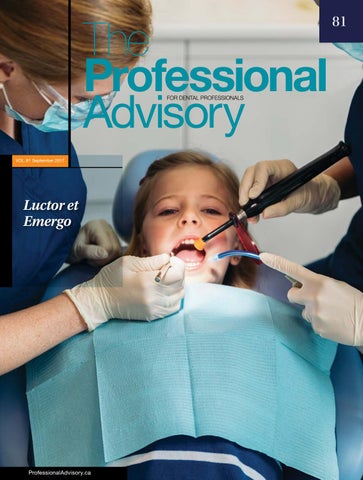
The Professional Advisory FOR DENTAL PROFESSIONALS
VOL. 81 September 2017
Luctor et Emergo
ProfessionalAdvisory.ca ProfessionalAdvisory.ca
81
Contents
3 4
Luctor et Emergo
Ralph Crawford BA., DMD
Buffet Buys Into Home Capital – Should You Follow The Oracle of Omaha? Mark McNulty BA, CFP®, CIM®
6 8
The Lease
Ian D. Toms B.Sc. (Hons) Jennifer J. Miles B.A., HBA, M.B.A., Masters in Property Economics
The High Cost of Employing Inexpensive Staff Dr. Ron Weintraub
10
Rising Interest Rates – What To Do?
12 14
Hygiene as a Value Driver
David Chong Yen CPA, CA, CFP Louise Wong CPA, CA, TEP Eugene Chu, BAFM, MAcc, CPA, CA
David Lind
Associate Agreements From the Associate’s Perspective – Part 2 David E. Rosenthal BA., LL.B
Biographies Ralph Crawford is an Honours Graduate from the University of Manitoba and has enjoyed a varied dental career. Prior to being editor of the Canadian Dental Association Journal from 1989 to 1997, he operated a Winnipeg private practice concurrently with being a clinical instructor at the University of Manitoba. He served as President of both the Manitoba Dental Association and Canadian Dental Association. Mark McNulty is President of McNulty Group, a firm responsible for managing $300 million of Ontario dentists’ retirement savings. McNulty Group helps professional families transition from a life of successful practice to a stress-free retirement by using a holistic approach of practice and personal retirement planning. Mark is the author of The Transition Coach 2.0–A Canadian Dentist’s Guide to a Perfect Retirement, and The $6 Million Dentist: Successful Succession in 7 Modules. Ian D. Toms is a nationally recognized real property lease consultant with over 27 years experience. He is considered an authority on tenancy issues, lease features, facilities and technicalities, and the art of tenancy negotiation. Ian has drafted and negotiated thousands of lease arrangements for national retail and medical professional tenants in 16 states and 8 provinces, with a specific emphasis on the GTA. Dr. Ron Weintraub is the founder of Innovative Practice Solutions (IPS) and former owner and founder of Bayview Village Dental Associates and Downtown Dental Associates. He practiced dentistry from 1963-2004 and has consulted on behalf of major dental suppliers, manufacturing companies, as well as individual dental offices for over 20 years. In 2004, Ron gave up clinical practice in order to focus solely on Practice Management. David Chong Yen and his chartered accounting firm currently advise hundreds of dentists and healthcare professionals on tax, estate and financial planning, valuations and accounting. David obtained his Bachelor of Arts degree from the University of Toronto, attained his Chartered Accountant’s Designation while working at an international firm and has subsequently completed the CICA In-Depth Tax Courses. David Lind is the Principal and Broker of Record at Professional Practice Sales Ltd., which was established in Ontario in 1991 and is a leader in dental practice valuations and sales. Prior to joining PPS, David lead the healthcare business for CIT Financial Ltd. This gave him a strong understanding of the personal and professional needs of dentists as they entered and exited the profession.
David Rosenthal is a senior lawyer whose law practice is devoted to business, corporate and healthcare law for dentists. David advises dentists on a broad range of legal matters, with particular emphasis and legal advice on purchases and sales of practices, corporate reorganizations and professional corporations. David also speaks frequently about such matters, including guest lectures at the faculties of dentistry. The Professional Advisory | VOL. 81 September 2017
“The Professional Advisory consists of a group of six independent professionals who provide services to the dental profession, each of whom specializes in a different field. They have gathered to keep each other informed of the latest developments relating to the profession, and to produce this publication which is designed to provide expert information and advice solely for dentists and their advisors.”
3
Notes from the editor:
Luctor et Emergo Ralph Crawford BA., DMD crawford@dccnet.com
L
For the average dentist dealing with associate agreeast May I participated in a truly wonderful weekend of celebration. With my classmates we celebrated our 60th ments the legal issues can be quite complex. In his artianniversary of receiving our Bachelor of Arts degree from cle Associate Agreements From The Associate’s Perspective the College of Notre Dame in Wilcox Saskatchewan – about David Rosenthal outlines the various terms and issues that 50 kilometers south of Regina. The College was originally lead to a successful Agreement. Who can operate a successfounded in 1920 by the Sisters of Charity of St. Louis. In 1927 ful dental practice without staff? Ron Weintraub in his arFather Athol Murray – known as Pére Murray throughout his ticle The High Cost Of Employing Inexpensive Staff outlines career – joined the College and instilled within the total edu- five highly effective steps for the dentist to follow as they cation system the Greek philosophy of developing the mind, struggle to engage cost-effective well-prepared support body and spirit. From the outset Pére Murray’s motto and staff. Are you struggling to purchase the best investments? firm belief was “Luctor et Emergo” – Struggle and Emerge. Mark McNulty’s Buffet Buys into Home Capital – Should As students more than 6o years ago we learned what Luctor You Follow the Oracle of Omaha? concludes that the cleanet Emergo was all about and to this day the motto is rein- est and most effective way to benefit from Buffet’s abilities forced and aids the College to produce the finest students is to buy Hathaway and enjoy the value creation. Interest through a balanced program that emphasizes the value of rates are always a struggle! However, David Chong Yen and Louise Wong’s article Rising Interest Rates – What To Do? good character, leadership and community living. And when we think about it isn’t Luctor et Emergo what clearly outlines four important steps to manage your debt. For most of us – in that age group – upon looking back life is all about. To achieve anything of value do we not have to make an effort, toil and strive in order to emerge with suc- over 60 years’ time seems to have passed quite quickly and cess so we can gain the goal we have in mind. And looking at you wonder where all the time went. But looking back 60 The Professional Advisory doesn’t every issue, every article. years, along with your companions, at a special occasion create Luctor et Emergo as it encourages readers to embrace such as receiving a university degree, you home into numerthe knowledge and worthiness that assists them to emerge ous things and occasions that took place and influenced our with the success they have in mind. Consider Dave Lind’s lives to this date. My classmates and I were quick to express article Hygiene as a Value Driver. As he deals with a renewed and agree that Luctor et Emergo never really left us. It’s a focus on hygiene services readers will emerge with deserved challenge to all who embrace it. success when the times comes to sell the practice. Who ever thoughtColin premises be so complex times a Ross is aleases Partnercould in Professional Practiceand Salesat Ltd. (www.ppsales.com), which specializes in the valuation and sale of dental practices. He can be reached at (905) 472-6000 or 1-888-777-8825 real struggle to understand. To everyone’s’ benefit Ian Toms’ or e-mail at: colin.ross@ppsales.com The Lease deals very effectively and emerges with some of the basic required lease terms and conditions.
VOL. 81 September 2017 | The Professional Advisory
4
Buffet Buys Into Home Capital – Should You Follow The Oracle of Omaha?
Mark McNulty BA, CFP®, CIM®
T
his past month, Warren Buffett announced that his company, Berkshire Hathaway, was indirectly acquiring a $400 million stake in Home Capital, the Canadian alternative mortgage lender. This prompted many individual investors to think that it would be good to jump in with him – after all, he is one of the greatest investors in history. Good idea, right?
Not so fast.
Back in late 2014, Home Capital was riding high. The Canadian housing market was in full flight and the mortgage broker’s stock was trading over $50 a share, up from $20 just three years earlier. Home Capital had achieved rarified air, becoming the new darling of the Canadian stock market. Through the first half of 2015, Home Capital stock remained between $40 and $50. However it all came to a crashing halt in July of that year, when the Ontario Securities Commission (OSC) announced that 45 brokers at Home Capital were suspended over falsified mortgage data. Home Capital spent the next twenty-one months dealing with fallout. After an initial drop to around $30 a share, the stock remained in a range between $25 and $40… until it got worse. In
The Professional Advisory | VOL. 81 September 2017
April of 2017, the OSC announced it was pursuing an administrative proceeding against Home Capital. The stock fell from $22.23 on April 19 to a low of $5.68 the next day. The company endured a run on its GICs (or Guaranteed Investment Certificates) and top management changes. Since then, the company has received some liquidity support and emergency funding, helping the stock rebound to around $16 a share by June. Enter Buffett. On June 21, he announced his intention to make the equity injection into Home Capital. The stock jumped immediately from $14.94 to $19 on the news, as Buffett’s support was deemed gold for confidence that the company’s troubles were over. But before jumping in, consider what you would pay compared to the deal Buffet received. You and I would pay market price for Home Capital, or around $17 today. Buffet’s equity deal is in two tranches. In the first, for a 20 per cent equity stake, Berkshire will pay $153,225,739 for 16,044,580 shares, or $9.55 a share, a 36 per cent discount to the market. In the second tranche, Berkshire will invest another $246 million for 24 million shares, or $10.30 a share. Overall, Berkshire’s total 39 per cent stake will be acquired for about $10 share. This is 40 per cent below the $17 a share you and I would pay today.
5
This discount covers a great deal of risk for Berkshire. As discussed above, following directly in Warren Buffet’s path is not easy for the average investor. Just blindly buying whatever he gets into usually means you would be buying in at significantly higher prices than he did, and taking on much more risk. Such are the advantages enjoyed by very large investors. In Home Capital’s case, the company’s troubles are by no means over… it may take many years to regain investor confidence and for the stock to recover. Warren Buffett takes risks putting his money to work and gets rewarded for it (when they work), and we as investors should applaud his astuteness and willingness to take these risks. But in making our own investment decision to follow his path, particularly in retirement accounts, it is imperative to keep in mind that we would be taking inherently higher risk than Buffett. As a CNBC commentator said, “only Warren gets those kinds of deals”. The cleanest and most efficient way to benefit from Buffett’s abilities is to buy Berkshire Hathaway and enjoy the value creation he achieves for his company. We have held BRK.B as a core holding since 2014 and have enjoyed double-digit gains over the period.
Just blindly buying whatever he gets into usually means you would be buying in at significantly higher prices than he did, and taking on much more risk.
Feedback can be sent to info@mcnultygroup.ca
Mark is President of McNulty Group, a firm responsible for $300 million of Ontario dentists’ retirement savings. McNulty Group helps professional families transition from a life of successful practice to a stress-free retirement by using a holistic approach of practice and personal retirement planning. In addition to multiple television and radio appearances, Mark is the author of The Transition Coach 2.0–A Canadian Dentist’s Guide to a Perfect Retirement and The $6 Million Dentist: Successful Succession in 7 Modules.
VOL. 81 September 2017 | The Professional Advisory
6
The Lease
Ian D. Toms B.Sc. (Hons)
T
enancies are typically based on some form of written lease. In some instances, the offer to lease is the “lease”, never being replaced by a formal lease; in other cases, the lease was signed decades before and has been assigned, amended and renewed many times over the years. This article considers some basic lease terms and conditions, and current issues affecting these terms and conditions.
LEASE DOCUMENT The lease document itself can be a few pages to hundreds of legal sized pages. This document describes the terms and conditions of the tenancy throughout the entire time the tenant occupies the premises, which may be decades. Current issues:
• Very comprehensive and sophisticated leases are now common. The forms are based on a structure which has been around for hundreds of years, but as the value of real estate increases, landlords become more sophisticated, and word processing and communication becomes more efficient, the power and complexity of leases increases accordingly. • Challenging to understand all of the implications of all of the provisions, included or not, which may be triggered years later by circumstances that an unsophisticated or inexperienced party would or could not envision, to the detriment of the tenant.
TENANT The tenant is the entity which leases the space from the landlord and is responsible for complying with terms and conditions. Typical “tenants” include a person or persons, a business company, or a professional corporation.
The Professional Advisory | VOL. 81 September 2017
Jennifer J. Miles B.A., HBA, M.B.A., Masters in Property Economics
Current issues:
• Professional corporations as tenants have become more common for a number of important reasons. Consequently, tenants have been attempting to assign their lease to professional corporations and have been encountering challenges from uncooperative landlords. Provisions of your assignment clause enabling you to assign your lease to your professional corporation, or a business corporation, are extremely important. • Personal covenants are being required by landlords, either directly with the person as tenant, or as an indemnitor. Realize that by agreeing to a personal covenant, the landlord benefits by having a more secure tenancy, but the tenant, all of the tenants personal assets, and the tenants family are “on the hook”, in some cases long after the lease is assigned. • Assignment clauses are causing severe trouble by prohibiting practice sales, enabling the landlord to take and keep the proceeds from practice sales, enabling the landlord to change the lease and/or terms and conditions of the lease at the time the lease is assigned.
LANDLORD The landlord is the entity which leases the space to the tenant and may be the owner or an agent of the owner. Current issues:
• Institutional landlords are the “norm”. These large institutions governed by non-negotiable financial and operating policy which is not tenant friendly. • Leasing representative with little or no control or authority to do anything are employed by large landlords making lease negotiation challenging if not impossible.
7 TERM The term of the lease is the length of time the tenant may remain in the premises. Typically, the term is five years, and the tenant may have optional rights to extend or renew the term for an extended period of time, typically a total of 20 years. Technically, the term can be any length of time ranging from days to hundreds of years. Current issues:
• Early termination clauses in favour of the landlord triggered by the landlord’s wish to remodel, redevelop, or sell the property, or the tenants wish to assign the lease when it sells the practice. This clause is a “kiss of death” clause, effectively destroying the ability to finance the practice. • No options to renew or extend the term are being agreed to by some landlords, limiting the tenancy and effectively limiting the value of the practice to good will only. • Financing against premises assets is prohibited by some leases, effectively eliminating the tenant’s ability to secure financing against leasehold improvements.
This document describes the terms and conditions of the tenancy throughout the entire time the tenant occupies the premises, which may be decades.
USE The use clause describes what the premises may be used for, and often what it may not be used for. Current issues: Current issues:
• Very limited or very broad restrictive use clauses are now becoming more common which can both be very cumbersome because either you can’t use the premises for new procedures, or the clause is so vague it is non-enforceable. • No exclusive provision is becoming more common as institutional landlords want more control over their property, or wish to protect themselves against challenges by tenants claiming that their exclusive has been violated.
• Minimum rents are creeping up steadily especially in new properties. What was $12 per square foot in 1987 is now $42 in 2017, an increase of about 4.3 per cent per annum cumulative increase, well above inflation. • Additional rents are creeping up steadily, well in advance of inflation, in large part because real estate values and therefore real estate taxes have increased dramatically.
RENT
• Premises size is reducing both by tenants seeking new space, and by landlords building new plazas. This reduced premise size requires careful planning and efficient use of space by the tenant.
Rent is usually a based or minimum rent plus a share of the landlord’s costs of operating the property including tax, maintenance and insurance, calculated on a per square foot per annum basis, payable in equal monthly installments.
Contemporary lease negotiations are well beyond the capacity of inexperienced parties; what you as the tenant or your representative do not know can and will hurt you
Please send comments to info@realtyleaseconsultant.com
This article was prepared by Ian D. Toms, B.Sc. (Hons) and Jennifer J. Miles, B.A., HBA, M.B.A., Masters in Property Economics. Realty Lease Consultants, Inc. has been preserving realty leasehold value since 1986 and can be reached at (705) 743-1220, by email info@realtyleaseconsultant.com, or through the website at www.realtyleaseconsultant.com.
VOL. 81 September 2017 | The Professional Advisory
8
The High Cost of Employing Inexpensive Staff
Dr. Ron Weintraub
W
e are often engaged in assisting some practices to create greater success for an office that has been in a fixed position for a period of time. Success, generally defined, is meeting one’s goals within the existing office. One important aspect of running a successful office is dependent upon an attentive and well-trained staff.
INVESTIGATING OPPORTUNITIES ANALYSIS As we investigate for our opportunities analysis, it is often apparent that one of the chief impediments to growth is an undertrained, ineffective support staff frequently with little experience outside of the subject office. The rationale for these findings is that an underperforming practice cannot afford to hire superior, top level staff as they would attract higher salary cost. This evaluation is often based on the financial advice that ideally human resources (HR) staff costs to run around 25 per cent of the gross production. A low producing practice, however, in carrying this forward, will attract only marginally competent individuals who will be able to play a negligible role in increasing customer service and operating effectiveness as well as patient referrals, all of which lead to higher gross production and collections with fewer last minute cancellations and “no shows”. This highlights the truism that other than practioners’ professional acumen, nothing has as much of an impact on patients’ satisfaction as attentive, well-prepared staff interactions.
DETERMINING THE VALUE OF A WELL-TRAINED STAFF The cost of enhancing staff performance becomes a circular argument, i.e., “I cannot afford to embellish my team at a higher cost because it will leave too little for my family’s needs”. What is missing from that proposition is the
The Professional Advisory | VOL. 81 September 2017
lack of understanding of the difference between price and value. This concept is crucial to decision making regarding all phases of the dental practice. For example, what is the more costly approach? Would purchasing an inexpensive barbecue for $200.00 that might last for one season or spending $375.00 for a quality name brand with all the attendant superior features allowing it to function well into the future with the potential of service for four to five years be a wiser investment? Even taking into account the present value of money, we think it is obvious that it is more economical to acquire the initially more costly high quality item than the seemingly bargain one. This kind of decision-making is somewhat analogous to hiring decisions within the dental office. We start with a careful diagnosis of the practices HR needs to move forward. Following an appropriate evaluation protocol, we move from the needs diagnosis to assessing the existing skill set of the present staff for their ability to fulfill the job requirements. For many reasons, the preferred route is to maintain existing staff and provide appropriate training for them. If our treatment plan shows that implementing a treatment coordinator role would be beneficial in order to move ahead, we advise filling the role from in-house. Should no one currently in administration have a dual clinical/administrative background be available to be trained in this role, we would have to go outside to find the individual who has or can acquire these skills and employ them to multitask with other management roles.
CONSIDERING THE NEEDS OF SMALLER PRACTICES Many smaller practices cannot sustain a full time staff member dedicated solely to office manager and/or treatment coordinator role. As a result, we must find and cre-
9
ate a highly skilled reception/recare coordinator/office manager/treatment coordinator who can fulfill all of these roles for a cost of probably $23 to $40 an hour range. Many offices are currently spending $22 to $33 per hour on marginally successful support staff who have been in the practice for a long time. Although they enjoyed increasing raises in salary, the increases were the result of longevity rather than heightened performance. A 33 per cent increase in salary commitment, therefore, could yield financial results that cover the payroll impact as well as significantly increase practice efficiency and financial gross collections. Engaging A Cost-Effective Well-Prepared Support Staff
Follow these steps to engage a cost-effective, well-prepared support staff: 1. Have definitive job descriptions for the functions that are required; 2. Evaluate without bias, the skill set of existing team members; 3. Establish where training is accessible to upgrade existing staff personnel or get involved in a credible interview process to determine what human resources are available to fill the defined deficiencies; 4. When hiring new staff personalities, set up a system of metrics for the whole team to be able to determine quickly whether team members are fulfilling their mandate, therefore justifying their salary; 5. Within the three month grace period for new hires, decide whether the new addition to the staff can justify the agreed upon salary.
Adding quality to your staff, however, is an investment as opposed to just an increased financial obligation.
Making staff changes requires a leap of faith to get out of a comfort zone and take on more salary costs. Adding quality to your staff, however, is an investment as opposed to just an increased financial obligation. We often paraphrase the words of an ancient sage to the idiomatic expression “if you pay peanuts you get monkeys�. You will probably shortcut the ability to move forward by not providing the highest possible quality support staff to assist in growing the financial and professional success of the practice. Please send comments to drronips@rogers.com
Ron Weintraub is a founding partner with the Bayview Village & Downtown Dental Associates and brings over thirty-five years of knowledge and experience in the practice of general dentistry to The Professional Advisory. Large companies such as Patterson Dental, Ash Temple Ltd, Henry Schein Arcona, & the former Canadian Dental Co. have benefited from his insight. As owner of Innovative Practice Solutions, Ron advises dentists on practice enhancement, practice purchases, sales, location evaluations, associate buy-ins, and business mergers. Dr. Weintraub can be contacted at (905) 470-6222 Ext. 221 or drronips@rogers.com.
VOL. 81 September 2017 | The Professional Advisory
10
Rising Interest Rates – What To Do?
Louise Wong CPA, CA, TEP
A
ll parties must come to an end. The low interest rate party hasn’t completely ended, but the music is slowly being turned down. After seven years of historically low interest rates, the Bank of Canada has raised interest rates by a quarter of a per cent. If you have an outstanding loan, your monthly expenses just increased. With the Bank of Canada hinting at more increases in the next year, here are some steps to manage your debt: 1. Take an inventory of all your debts
Take note of all your outstanding debts. This could include credit cards, student loans, car loans, line of credits, home mortgage and business loans (personal). You will want to identify the following: • What’s the interest rate? • Is the interest tax deductible? • Variable or fixed interest rates? • Open or closed loans? 2. Prioritize your debt repayment
Once you have an inventory of your debts, repay your debt with the highest interest rate first. How do you know which one is the highest? Use the chart on the next page to help you. Focus your attention on the loans with the highest after-tax interest rate. Take into account whether a loan has a fixed rate, which doesn’t change when interest rates go up or down or a variable rate, which does change as rates fluctuate. Generally, variable rates are better in the long run when rates are stagnant or on the decline. Locking into fixed rates is better when interest rates are expected to rise. If you expect rates to increase, consider prioritizing payments on your variable loans since the rates on your fixed loans won’t
The Professional Advisory | VOL. 81 September 2017
David Chong Yen CPA, CA, CFP
be changing. If you are looking to borrow some money, ask your lender for both fixed and variable rates and compare which one would work better for you. You may have to pay more for a fixed rate loan. Consider the additional interest as a form of insurance so you can sleep better at night. Finally, take into account whether a loan is open or closed. Open means there is no penalty for prepayment, whereas closed means paying back debt sooner could trigger fees and penalties from the lender. It may make sense to pay down a closed loan first even though the interest rate on an open loan is higher if the window of opportunity to prepay a closed loan is only available for a limited time. An open loan can be prepaid at any time without penalty. 3. Convert non tax deductible interest into tax deductible interest
Your after tax interest rate could be cut in half if the interest is tax-deductible. In order to do so, the loan must be used to generate income. Here are some scenarios where you could convert non-tax deductible interest into tax-deductible interest: 1) Sell investments to pay down non-tax deductible debt, re-borrow the money and use it to re-purchase the investments which were generating income. You will have the same amount of debt as before and same assets, but your interest would be tax-deductible. 2) Use equity in your home to borrow against your house and earn investment income. Your debt will rise, but so will your assets and payments against the loan will be tax-deductible. Please be aware of the risk involved.
11 Debt
Interest rate
Tax deductible
After-tax interest rate *
Credit card
20%+
Maybe, if used for business expenses
9.29% to 20%+
Student loans (Government)
5.45% (Prime + 2.5%)
Tax credit
4.36%
Line of credit
2.95% (Prime) – 3.45% (Prime + 0.5%)
Maybe, if loans used to generate investment income
1.37% – 3.45%
Student loans (non-government)
2.95% (Usually prime)
No
2.95%
Car loans (Auto Manufacturer)
0% – 4.99%
Maybe
0% – 4.99%
Home mortgage (National bank)
1.95% – 5%
Generally no
1.95% – 5%
Business loans (personal)
2.95% (Prime)
Yes
1.37%
*assumes personal tax rate at 53.53%
Consult an accountant prior to doing these maneuvers as specific and appropriate documentation needs to be considered. 4. Focus on your cash flow and adjust expectations
Both you and your spouse should sit down and make a budget. People generally only follow a plan if they are involved in making it, hence budgeting should be a family activity. Estimate what your cash outflows will be for the upcoming year including all debt repayments. Use the current interest rate you are paying and add one or two per cent to it. This gives you some wiggle room if interest rates do rise rapidly. There’s no harm in planning for higher expenses, there are consequences for not being ready when they come. You don’t have to panic just yet; we are still at historically low interest rates. It will take time and a disciplined approach to chip away at the mountain of debt you have accumulated. It’s better to start now than wait until the party is really over.
There’s no harm in planning for higher expenses, there are consequences for not being ready when they come.
Please send comments to david@dcy.ca
This article was prepared by David Chong Yen*, CPA, CA, CFP, Louise Wong*, CPA, CA, TEP and Eugene Chu, BAFM, MAcc, CPA, CA of DCY Professional Corporation Chartered Accountants who are tax specialists* and have been advising dentists for decades. Additional information can be obtained by phone (416) 510-8888, fax (416) 510-2699, or e-mail david@dcy.ca/ louise@dcy.ca/eugenechu@dcy.ca. Visit our website at www.dcy.ca. This article is intended to present tax saving and planning ideas, and is not intended to replace professional advice.
VOL. 81 September 2017 | The Professional Advisory
12
Hygiene as a Value Driver
David Lind
M
any practices claim to be focused on hygiene, but few execute very well on this mission. This article will focus on the ongoing reasons to consider a renewed focus on hygiene and on the value creation this focus will have when you sell. Hygiene normally accounts for roughly 30 per cent of the gross revenue of a dental practice. We have seen this number range from 15 – 55 per cent. If we consider the impact this range will have on a practice that grosses $1,000,000 in total revenue with 1,700 patients, the case for focus on hygiene becomes compelling. At 15 per cent of gross the hygiene side of the practice produces $150,000 in revenue and the dental side produces $850,000. This is only $88 per patient per year in hygiene revenue. While you might think someone would see this as untapped potential, the more likely sentiment is that the patient base is non-compliant and the future revenue stream is therefore uncertain. There would also be serious concerns about the $500 per patient annually that the doctor is billing. This is far higher than average and would leave people thinking they could not reproduce those results as there is likely treatment being performed that they either can’t or won’t do. Further, the net profit of this practice would be negatively impacted because it costs less to produce hygiene revenue, therefore, hygiene revenue is more profitable for the overall practice. This is primarily due to the cost of the provider. A hygienist typically bills three times what they are paid or roughly $120/hour. This equals 33 per cent of their gross as compared to the 40 or 45 per cent you pay yourself or an associate to produce revenue. This also highlights the reason that you should not do your own hygiene. You are too expensive to perform this kind of work! Besides, hygienists are much better than dentists at hygiene. This low hygiene producing practice would be pe-
The Professional Advisory | VOL. 81 September 2017
nalized from a value perspective by roughly 20 percent due to the above factors. That is $250,000 to $360,000 in today’s market. Certainly this is something to avoid! At the other end of the spectrum is the practice that derives 55 per cent of its revenue from hygiene. In this case the practice would generate $323 per patient annually from hygiene. This would be close to or at the maximum hygiene revenue per patient, and would indicate an older, very compliant patient base. I would expect a high percentage of patients to be on a three or four month recall schedule. Contrary to how high patient production is viewed on the dentistry side of the practice, this high hygiene production would be viewed as very positive by prospective buyers. They would assume the patients are of high dental I.Q., that they are loyal to the practice and that they do not mind paying out of their pocket for good dental care. They would also make the assumption that there is untapped potential in the charts because the dental revenue is so low compared to hygiene. This practice would also enjoy a strong bottom line profit due to the high percentage of lower cost (as previously discussed) hygiene revenue being performed. The other intangible factor that would be appealing in this type of practice is the profit being generated through other provider’s time rather than by the owner. Purchasers are happy to pay a premium for that. All of the above factors would contribute to this practice realizing a premium of 25 to 35 per cent over the standard 30 per cent hygiene practice. This equals $325,000 to $455,000 premium on the sale price. This is certainly an undertaking worth pursuing. There are also other reasons that make hygiene extremely valuable. • The schedule for hygiene is generally booked much further out then the dentist’s which makes the practice appealing.
13
• The revenue can continue when the dentist is not there • Most hygienists are good at diagnosing (or confirming your diagnosis) and some patients appreciate the confirmation coming from someone with nothing to gain. • If the dentist has serious health problems, the goodwill of the practice can be preserved by the hygienist’s continuing to see the patients until the practice is sold or the dentist recovers.
Hygiene normally accounts for roughly 30 per cent of the gross revenue of a dental practice. We have seen this number range from 15 – 55 per cent.
If you and your team can focus on bringing your hygiene percentage up over 30 per cent you will reap rewards during the time you own the practice and also have a more marketable practice to sell when the time comes. If you are not sure how to go about improving your hygiene production, I would encourage you to consult with a Dental Practice Consulting firm who can guide you to increased profits and value generation. Please send comments to david.lind@ppsales.com
David Lind is a Principal and Broker of Record in Professional Practice Sales Ltd. (www.ppsales.com), which specializes in the valuation and sale of dental practices. He can be reached at (905) 472-6000 or 1-888-777-8825 or e-mail at: david.lind@ppsales.com
VOL. 81 September 2017 | The Professional Advisory
14
Associate Agreements From the Associate’s Perspective Part 2
David E. Rosenthal BA., LL.B.
I
n volumes 80 of The Professional Advisory I wrote about associate agreements from the associate’s perspective. This article continues to explore those issues from the associate’s perspective. An associate agreement (Agreement) is the legal contract that details the arrangements between the dentist who owns the practice (Principal) and the associate dentist (Associate) hired to work at the practice.
PROFESSIONAL DENTAL GOODWILL The most valuable asset a Principal owns is the professional dental goodwill of the dental practice. That goodwill includes the patient lists, custody and control of all patient records and files (including patient billing records and treatment plans), patient charts, x-rays and models, and use of any dental practice names. When a dental practice is valued, typically the goodwill is valued at approximately 75 to 80 per cent of the total practice value. Given such value of goodwill, it is no surprise that the Principal will take appropriate measures to protect that asset. An associate can expect the following provisions to be contained in the Agreement: Staff – The staff of the dental practice are the Principal’s responsibility and the Principal makes all decisions regarding staff. Typically the Agreement will state that the Associate has the use of a chairside assistant as reasonably required but as the Principal deems appropriate. However, if the Associate has very specific staff requirements, then such specifics should be detailed in the Agreement. The Agreement will contain a non-solicitation covenant whereby the Associate agrees not to solicit staff of the prac-
The Professional Advisory | VOL. 81 September 2017
tice, meaning the Associate will not offer employment or entice the staff away from the Principal for a certain time period. The time period is typically one or two years after the Agreement is terminated. Non-Solicitation of Patients – It is the patient’s right to choose their dentist or to change dentists and move their patient charts. The Agreement cannot restrict patients’ rights to choose their dentist or limit the access of patients to their dental charts or records. However, the Agreement can provide that the Associate agrees not to solicit patients of the practice for a certain time period. The time period is typically one or two years after the Agreement is terminated. Solicitation means the Associate does something proactively to try to get the patients to move their business and charts somewhere else. It is not solicitation if a patient of their own choice decides to choose another dentist. Even in the case of a verbal associate agreement, the Regulations under the Ontario Dentistry Act specifically state the Associate shall not solicit or cause or permit the solicitation of the Principal’s patients. The Regulations require the Principal to provide to any patient who requests it the business address and telephone number of the Associate, provided the Principal has or could reasonably obtain such information. Non-Competition – The Agreement will very likely in-
clude a non-competition covenant whereby the Associate agrees not to compete with the Principal within a specified geographic radius for a specific time period time after the Associate stops working at the practice. The comments below are intended only for general practitioners since there are different rules that may apply for specialists.
15
A non-competition covenant will only be enforced if it is reasonable both in geographic scope and time limit. That may be only a few kilometres in a densely urban practice or 10 kilometres or more in a rural setting. The amount of time the clause remains in effect is also important. A new Associate will be little or no threat to the Principal if the Associate left the practice within a trial period of three months, and generally only a minor threat if they leave within one year. From an Associate’s viewpoint a “phased-in” non-competition clause is reasonable. It could provide that the non-competition restriction: (i) does not apply to the Associate for the first three months of the association; (ii) applies for a period of one year after termination if the Associate departs within one year; (iii) applies for a period of two years after termination if the Associate leaves after one year. Termination of Agreement – If the arrangement is not working for whatever reason the Associate must be able to terminate the arrangement promptly, typically upon one to three months prior written notice.
When a dental practice is valued, typically the goodwill is valued at approximately 75 to 80 per cent of the total practice value.
In summary, the Associate should review the Agreement carefully and consult with his or her own professional advisors to ensure the Associate understands the Agreement and all rights and obligations before signing it. Please send comments to david@drlaw.ca
David Rosenthal is a senior lawyer with Spiegel Rosenthal Professional Corporation whose practice is devoted to corporate, commercial and business law, with special emphasis on advising dentists. He can be reached at (416) 865-0736 or e-mail to david@drlaw.ca.
VOL. 81 September 2017 | The Professional Advisory
TheProfessional Advisory FOR DENTAL PROFESSIONALS
The The Professional Professional Advisory Advisory
80
63
FOR DENTAL PROFESSIONALS FOR DENTAL PROFFESSIONALS
VOL. 80 June 2017
VOL. 63 February 2014
Being knowledgeable Progressus is a–natural a going instinct for forward, humans advance
Visit our website at www.professionaladvisory.ca to view current issue and complete archives.
ProfessionalAdvisory.ca
ProfessionalAdvisory.ca ProfessionalAdvisory.ca TPA 63.indd 1
TPA 80.indd 1
14-01-31 1:52 PM
2017-05-24 2:37 PM
Left to right: David Rosenthal, BA., LL.B. Spiegel Rosenthal Professional Corporation Barristers and Solicitors Ron Weintraub, DDS Innovative Practice Solutions David Lind Principal, Broker of Record Professional Practice Sales Ltd. Ian D. Toms, B.Sc. (Hons) Broker of Record Realty Lease Consultants Inc. Mark McNulty, BA, CFP, CIM Director, Private Client Group McNulty Group, HollisWealth David Chong Yen, CPA, CA, CFP DCY Professional Corporation Chartered Accountants