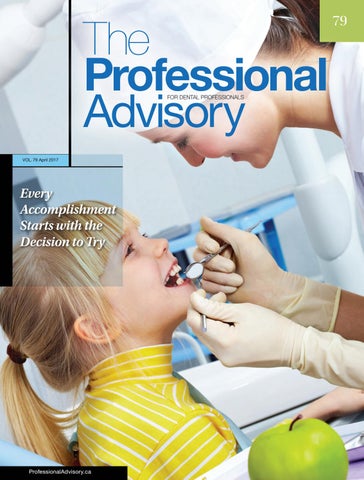
The Professional Advisory
79
FOR DENTAL PROFESSIONALS
VOL. 79 April 2017
Every Accomplishment Starts with the Decision to Try
ProfessionalAdvisory.ca ProfessionalAdvisory.ca
TPA 79.indd 1
2017-03-27 4:34 PM
Contents
3
Every Accomplishment Starts with the Decision to Try Ralph Crawford BA., DMD
4
Legends of The Great Succession continued
6
The Life of a Tenancy – Part 1 – Site Selection
8
Mark McNulty BA, CFP®, CIM®
Ian D. Toms B.Sc. (Hons) Jennifer J. Miles B.A., HBA, M.B.A., Masters in Property Economics
Buying or Selling a Practice? Factors to Consider
Biographies Ralph Crawford is an Honours Graduate from the University of Manitoba and has enjoyed a varied dental career. Prior to being editor of the Canadian Dental Association Journal from 1989 to 1997, he operated a Winnipeg private practice concurrently with being a clinical instructor at the University of Manitoba. He served as President of both the Manitoba Dental Association and Canadian Dental Association. Mark McNulty is President of McNulty Group, a firm responsible for managing $300 million of Ontario dentists’ retirement savings. McNulty Group helps professional families transition from a life of successful practice to a stress-free retirement by using a holistic approach of practice and personal retirement planning. Mark is the author of The Transition Coach 2.0–A Canadian Dentist’s Guide to a Perfect Retirement, and The $6 Million Dentist: Successful Succession in 7 Modules. Ian D. Toms is a nationally recognized real property lease consultant with over 27 years experience. He is considered an authority on tenancy issues, lease features, facilities and technicalities, and the art of tenancy negotiation. Ian has drafted and negotiated thousands of lease arrangements for national retail and medical professional tenants in 16 states and 8 provinces, with a specific emphasis on the GTA.
Dr. Ron Weintraub
10
Costly Tax Mistakes to Avoid/Seizing Tax Saving Opportunities
David Chong Yen CPA, CA, CFP Louise Wong CPA, CA, TEP Eugene Chu, BAFM, MAcc, CPA, CA
12 14
Is it Time to Move? David Lind
Associate Agreements From the Principal’s Perspective – Part 2 David E. Rosenthal BA., LL.B
Dr. Ron Weintraub is the founder of Innovative Practice Solutions (IPS) and former owner and founder of Bayview Village Dental Associates and Downtown Dental Associates. He practiced dentistry from 1963-2004 and has consulted on behalf of major dental suppliers, manufacturing companies, as well as individual dental offices for over 20 years. In 2004, Ron gave up clinical practice in order to focus solely on Practice Management. David Chong Yen and his chartered accounting firm currently advise hundreds of dentists and healthcare professionals on tax, estate and financial planning, valuations and accounting. David obtained his Bachelor of Arts degree from the University of Toronto, attained his Chartered Accountant’s Designation while working at an international firm and has subsequently completed the CICA In-Depth Tax Courses. David Lind is the Principal and Broker of Record at Professional Practice Sales Ltd., which was established in Ontario in 1991 and is a leader in dental practice valuations and sales. Prior to joining PPS, David lead the healthcare business for CIT Financial Ltd. This gave him a strong understanding of the personal and professional needs of dentists as they entered and exited the profession. David Rosenthal is a senior lawyer whose law practice is devoted to business, corporate and healthcare law for dentists. David advises dentists on a broad range of legal matters, with particular emphasis and legal advice on purchases and sales of practices, corporate reorganizations and professional corporations. David also speaks frequently about such matters, including guest lectures at the faculties of dentistry.
The Professional Advisory | VOL. 79 April 2017
TPA 79.indd 2
2017-03-27 4:34 PM
3
“The Professional Advisory consists of a group of six independent professionals who provide services to the dental profession, each of whom specializes in a different field. They have gathered to keep each other informed of the latest developments relating to the profession, and to produce this publication which is designed to provide expert information and advice solely for dentists and their advisors.”
Notes from the editor:
Every Accomplishment Starts with the Decision to Try Ralph Crawford BA., DMD
crawford@dccnet.com
R
ecently I attended the annual general meeting of the choice when you make a decision to try. Mark McNulty concondo complex where we live. In attendance was rep- tinues outlining two more examples where his clients have resentation of 41 of the 44 owners. The meeting went along achieved outstanding financial success. No doubt success quite well with a review of the past year activities and the and accomplishment began with a decision to try what acceptance of the new budget. There were however sever- works best. Ron Weintraub’s Considerations to Prepare a al items on the agenda dealing with maintenance and re- Practice for Transition takes us through the most important pairs of the buildings that caused considerable discussion. steps for a successful transition where all – dentists, staff In fact a great deal of discussion. Finally, after a lot of pros and patients – benefit. In his Associate Agreements From the Principal’s Perspecand cons, if, buts and ands, two important motions were tive David Rosenthal continues on with the many aspects of eventually passed. What really caught my attention was at the end of the office transition – remuneration, solicitation, competition, meeting when I overheard one of the owners say “Every ac- termination and sale of practice. There are many importcomplishment starts with the decision to try.” I asked him ant decisions to try and make work. Who can avoid taxes? where the statement came from and he didn’t know, saying, Obviously no one, but the good news is that David Chong “I have no idea. I’ve used it for years but I don’t know its Yen and Louise Wong show us Costly Tax Mistakes to Avoid derivation.” My curiosity was aroused and I headed to Goo- and Seizing Tax Saving Opportunities. Accomplishing good gle. Here I found dozens of references to the famous saying, results starts with a decision to try for the best result. Is It among them John F. Kennedy and Gail Devers a three time Time to Move? asks David Lind and he clearly deals with the Olympic gold medallist. But no derivation – but it doesn’t aspects facing those dentists making this decision. The best matter. The expression is outstanding. If we don’t make a advice for a decision to try is draw on the experience of your valid decision to try something new or different we accom- lawyer, accountant and broker to advise you. Outlined in this issue – and all issues – of Professional plish nothing. And to my mind that’s where The Professional Advisory Advisory is thoughtful guidance on accomplishing successcomes in. Issue after issue brings to its readers knowledge, ful dental practices. Consider each article with a goal to try innovation and accomplishments that ultimately can only to accomplish the best you can. improve your practice values, life skills and aSales satisfactory Colin Ross is a Partner in Professional Practice Ltd. (www.ppsales.com), which specializes in the valuation and sale of dental practices. He can be reached (905) Jennifer 472-6000 orMiles’s 1-888-777-8825 well-being. Consider Ian Tomsat and arti- or e-mail at: colin.ross@ppsales.com cle on the The Life of a Tenancy. They tell us that you have only one choice to get it right. You can only make the right
VOL. 79 April 2017 | The Professional Advisory
TPA 79.indd 3
2017-03-27 4:34 PM
4
Legends of The Great Succession – An Excerpt from my book, The $6 Million Dentist CONTINUED
Mark McNulty BA, CFP®, CIM®
I
mentioned at the start of this book that some of the greatest financial minds I know are those of dentists. I have had the benefit of learning from a financially savvy group of dentists during the past 20 years. These experiences have had a great impact on my life, my business, and the families I work with at McNulty Group. In writing this book, I took the opportunity to ask four of these individuals a series of questions. With so many dentists not able to reach their financial goals, I wanted you to hear firsthand how this group has been able to achieve such a high level of financial success. Each contributor is a client of our firm. Drs. One and Two were discussed in the last issue of The Professional Advisory.
DR. THREE Dr. Three and his spouse are another “millionaire next door” type. They have a modest lifestyle, live in a small town and aren’t very interested in “keeping up with the Jones’ .” Their retirement portfolio is over $3.5 million and the practice will be selling in the next few years for around $700,000. Dr. Three and his spouse are both 60 years old. How did you achieve your financial success?
Slowly, over time, with a plan – everything advocated in the first six modules of this book. The first thing we (my wife and I) did was clear our student debts. Even then, it was clear that interest paid (even when deductible) would never be as good as interest earned. This was accomplished as a result of two key factors. The first was to find positions that would pay relatively well, and then go there to work. The second was to live completely within our means. We never had personal credit card debt that couldn’t be cleared interest-free. If we
couldn’t pay for it now, we didn’t buy it. Our student debts were cleared in less than two years. The next key is to get advice to help with investing/saving (and continue to live within your means). Not all investment advisors are created equal and different advisors may be right for different times. You will need a plan, it needs to make sense to you, and it needs to be monitored closely. Regardless of the result of the plan, you need to understand why it is or isn’t working. The rest is time and discipline. Another key is having a life partner with the same goals. This is the core of your team – choose carefully.
DR. FOUR I spoke with Dr. Four at his hotel in Toronto as he and his wife prepared for a trip to visit one of their adult kids in the U.S. Dr. and Ms. Four have a retirement portfolio closing in on $9 million. Dr. Four was in dentistry for 40 years. 1. Focus on the bottom line
a. “Financial success is not measured by practice gross, but your net income.” Dr. Four always ran a lean practice with only a few staff. The staff were loyal and well compensated. If a snow day occurred or there was a decline in production for some reason, Dr. Four’s net income was not as much affected as those of his colleagues who had large practices and many “mouths to feed.” b. “We have never parked a Mercedes or Cadillac in our practice parking lot.” 2. Investing
a. “Blue-chip, dividend-paying stocks are not a gamble.”
The Professional Advisory | VOL. 79 April 2017
TPA 79.indd 4
2017-03-27 4:34 PM
5
At the foundation of his financial success and investment strategy is a select group of blue-chip, dividend-paying stocks in Direct Reinvestment Programs (DRIPs). Like clockwork every quarter, he adds another $5,000 to certain stocks. b. “Companies like Bank of Montreal are not going out of business. When 2008 came, the stock was down 40 per cent. This was a great time to be adding to our holdings.” c. When Dr. Four saw a good opportunity, he invested in it and never sold.
I have had the benefit of learning from a financially savvy group of dentists during the past 20 years.
Other Legends:
While this is a great group of contributors, there are another dozen or so I didn’t ask to contribute in the interests of space. However, I can tell you each has the same traits: 1. They are “patient-first” at all times. 2. They pay themselves first – they first pay debt or save money before taking a big vacation or spending money on a car. 3. They track their practice and personal finances. 4. They rely on good advice from other professionals, but still participate and hold their advisors accountable.
Feedback can be sent to info@mcnultygroup.ca
Mark is President of McNulty Group, a firm responsible for $300 million of Ontario dentists’ retirement savings. McNulty Group helps professional families transition from a life of successful practice to a stress-free retirement by using a holistic approach of practice and personal retirement planning. In addition to multiple television and radio appearances, Mark is the author of The Transition Coach 2.0–A Canadian Dentist’s Guide to a Perfect Retirement and The $6 Million Dentist: Successful Succession in 7 Modules.
VOL. 79 April 2017 | The Professional Advisory
TPA 79.indd 5
2017-03-27 4:34 PM
6
The Life of a Tenancy – Part 1 Site Selection
Ian D. Toms B.Sc. (Hons)
R
ecently our firm encountered a lease written and executed in 1893 with a term of 999 years expiring in 2892. Our client is a sub-sub tenant under this lease. This lease will affect tenancies for a very long period of time. More typically, the life span of a lease is 20 to 30 years. This life span consists of a number of steps, each no less critical than any other. The life cycle of a tenancy begins with a site selection, and progresses through an offer to lease, to a lease, through periodic lease renewals, often to assignment, and eventually to end. This article presents the first in a series of articles that will explore the various stages in the life cycle of a tenancy. The first stage in any tenancy is site selection. You only have one chance to get it right. A mistake at this stage may lead to years of frustration and disappointment. Site selection is the process used to choose the most suitable site for a new practice. The practitioner must select the general geographic area they wish to practice in based on where they want to live, who they want to treat, and whether there are enough candidate patients in the area to provide for a viable practice. Do you want a high volume modest treatment practice, or a low volume big treatment practice? The first step in a site selection is to look at how the people in a “trade area” live and move around. A “trade area” is defined based on socio-economic and geographic boundaries. Typically, these boundaries are not related to political boundaries. To understand the potential patient population, demographic data such as age, income, cultural background and population growth must be evaluated based on the trade area. It can then be used in conjunction with the location of competition and other factors such as new housing starts, potential annexation and anticipated
Jennifer J. Miles B.A., HBA, M.B.A., Masters in Property Economics
changes to mass transit to identify your ideal trade area. Transportation routes are also relevant. How do you expect your patients to access your clinic? Are there major auto routes, subway stops, bus lines or commuter train stations nearby? You must consider not just where your potential patient candidates move, but how and why. For example, bedroom communities may present great demographics but because at least one adult is away during the day, a clinic in this location may not perform as well as a clinic in an area where the bedroom community members are travelling to. Similarly, a location that is highly visible from a major commuter highway may get noticed but this alone does not ensure success. Most of the people who see it will not be from the area or interested in treatment at the time. It is best to consider several different areas for comparison, especially against a known or “proven” trade area. If the demographics in a proven area support a certain ration of clinics per capita, the same should apply to an under-serviced area. Once a trade area is defined, potential sites for the new clinic must be identified. The next step is to define what type of property you want to practice in. Do you want to be in office space, enclosed strip mall, anchored plaza, free standing or owned premises? How big and what shape should your space be? How many parking spaces and what signage do you need? What other amenities do you want? After the trade area, prime locations and property type are defined, a thorough search should be conducted to identify and inventory all possibilities complying with the criterion established above. This inventory must be completed “on-line”, in the field, and by contacting landlords
The Professional Advisory | VOL. 79 April 2017
TPA 79.indd 6
2017-03-27 4:34 PM
7
who do not typically list with brokers or even advertise space for lease. In some cases, a visit to a municipal office to examine planning maps will provide the contact information for developers building new space. These locations need to be assembled with basic information and plotted on a base map in order to rank the properties and identify the most likely opportunities. Typically, the top two or three properties are given more consideration by looking closely at the rent, cost to build, lease details, proximity to parking, etc. Again, comparing potential locations gives the opportunity to choose. An offer to lease is prepared, presented and negotiated for the top choice property and in some cases the second choice concurrently to ensure a solid “plan B� is available. There are so many variables to consider in site selection that the guidance of a seasoned and very experienced professional can be a tremendous asset to sort through and clarify priorities.
If the demographics in a proven area support a certain ration of clinics per capita, the same should apply to an under-serviced area.
Please send comments to info@realtyleaseconsultant.com
This article was prepared by Ian D. Toms, B.Sc. (Hons) and Jennifer J. Miles, B.A., HBA, M.B.A., Masters in Property Economics. Realty Lease Consultants, Inc. has been preserving realty leasehold value since 1986 and can be reached at (705) 743-1220, by email info@realtyleaseconsultant.com, or through the website at www.realtyleaseconsultant.com.
VOL. 79 April 2017 | The Professional Advisory
TPA 79.indd 7
2017-03-27 4:34 PM
8
Buying or Selling a Practice? Factors to Consider
Dr. Ron Weintraub
W
hen buying or selling a practice, most listed practices have had a thorough review of past financial performance via The Evaluation. Although it may seem that you are ready to “make a deal,” there are certain factors you need to consider. 1. What is the number of active patients? 2. What is the production of the Hygiene Department? 3. What is the gross production of the participating dentist? 4. How do the various services such as diagnostic and comprehensive restorative aesthetic components breakout? 5. Have you conducted a review of the current expense profile? 6. What are the hours of the current operation?
ADDITIONS TO THE EVALUATION The main value of the goodwill portion of the acquisition is largely based on the “survivability of the patient component;” therefore, you need to question what is not readily apparent from The Evaluation documents. Here are a few tips to explore. a. Analyze the distance patients travel to seek treatment at this facility. b. Ask yourself how committed patients may be personally to the incumbent practitioner. This varies within distinct practice types. Base your question on the following information: • Location focused practice: This is the easiest transferable patient group to transition and yields the highest percentage of patients staying with the practice post sale. • The team-oriented practice: The practice where patients interface successfully with the whole team who would presumably stay on because of shared relationships with team members and, therefore, have less of an impact on having the principal dentist about to leave.
• The extensive associate provider practice (assuming non-compete and non-solicitation documents are in place) does not present as great a challenge to introducing a new principal. • The owner-focused practice: Such a practice often features high profile, highly skilled practitioners with great relationships and trust from loyal patients. The practitioner has attracted a large patient following from a significantly larger geographic area. They are happy to attend the facility as long as they see that particular individual. This population is at risk for significant attrition once the former principal leaves or retires. Another guideline to observe is how well the prospective new purchaser fits the existing demographic and expectation of the current patient base; for example, a newly minted graduate might want to be cautious purchasing a highly sophisticated practice operated by a seasoned clinical leader as the driving force. These recommendations suggest that careful vetting of the evaluation information is needed to get underneath the raw data. Even though the statistics may satisfy a good accountant, it doesn’t tell the complete story. We often counsel our clients who are prospective purchasers to get involved with what we call Evaluating the Evaluation.
CONSIDERATIONS TO PREPARE A PRACTICE FOR TRANSITION Packaging the most compelling facts at the time of evaluation and placing practices on the market requires prior planning (ideally three to four years in order to maximize the value). The three-year practice production history is often used as criteria of practice performance; consequently, most focus should be placed on the increase of the next three years of both gross and net revenues while the opportunity exists.
The Professional Advisory | VOL. 79 April 2017
TPA 79.indd 8
2017-03-27 4:34 PM
9
Getting patients ready for the dentists/owners eventual retirement also requires planning. Doctors should tell their patients truthfully that they would attempt to sell the practice to someone who would value the current treatment philosophy; therefore, they would endeavour to leave patients in �good hands�. Practitioners should return the trust that long standing patients have placed in them and honestly try to live up to this statement. Preparing patients for the change in ownership provides added assurance to prospective purchasers that patients would stay; therefore, the practice should yield a higher goodwill assessment. Assuming sufficient patient count to allow the incumbent to stay with the practice for an agreed upon period of time with the express purpose of introducing the purchaser and advocating for patients to remain is crucial.
POSSIBILITY TO ENHANCE FINANCIAL PERFORMANCE Effort to expand the in-house offerings of some procedures that would routinely have been referred previously now could possibly be (as it has in the last two years) part of the purview of a younger professional cohort. To do this, the owner might introduce part-time specialists or a general practitioner with a particular interest in these areas. This could not only result in increased revenue over the remaining active ownership years but also could appeal to a contemporary group of potential purchasers from a professional satisfaction standpoint. With this in place, staffs need the training to indicate to patients that the office is now able to offer the possibility of treating their friends or family whereas previously they may have thought the office was too busy to accommodate their referrals. In this vein, engaging a part-time associate to allow the offering of weekend and evening appointments makes the practice more accessible, thereby increasing the patient load. Another part of the long-term preparation is checking the optimal use of signage to increase patient flow. If the idea of getting practice-management assistance to enhance the financial return were a consideration, this would be an ideal time. Initially, new owners should avoid significant changes
Packaging the most compelling facts at the time of evaluation and placing practices on the market requires prior planning.
to the physical plant. The formerly satisfied current patients who were unaware of a need for change may resent such changes; however, added touches are small additions to the waiting area such as TV and coffee station often seen in contemporary start-ups produce an increased comfort level for the prospective purchaser. It is apparent that Evaluating the Evaluation is an important factor for the vendor and the practice purchaser.
Please send comments to drronips@rogers.com
Ron Weintraub is a founding partner with the Bayview Village & Downtown Dental Associates and brings over thirty-five years of knowledge and experience in the practice of general dentistry to The Professional Advisory. Large companies such as Patterson Dental, Ash Temple Ltd, Henry Schein Arcona, & the former Canadian Dental Co. have benefited from his insight. As owner of Innovative Practice Solutions, Ron advises dentists on practice enhancement, practice purchases, sales, location evaluations, associate buy-ins, and business mergers. Dr. Weintraub can be contacted at (905) 470-6222 Ext. 221 or drronips@rogers.com.
VOL. 79 April 2017 | The Professional Advisory
TPA 79.indd 9
2017-03-27 4:34 PM
10
Costly Tax Mistakes to Avoid/ Seizing Tax Saving Opportunities
Louise Wong CPA, CA, TEP
A
s another tax filing deadline approaches, by reflecting on the past year, avoiding mistakes and seizing tax savings opportunities, you can reduce your tax bill. Here’s a list of tax mistakes that could prove to be costly. Closing the door on certain tax expenses
You don’t always automatically qualify for tax breaks. Certain expenses have conditions in order for you to benefit. For example, child care expenses require the lower income spouse to have earned income (e.g. salary or business income). If your income includes only dividend and investment income, you may not be eligible to claim child care expenses of up to $8,000 per child (age six or under). Another example is registered retirement savings plans (RRSPs); if you have historically always taken out dividend income from your Professional Corporation (PC), you may not be able to contribute to an RRSP. RRSP contribution room is based on the prior year’s earned income (e.g. salaries or business income), if you have only ever had dividend income, then you won’t have any RRSP contribution room. Not using your family in the tax savings game
Many dentists know what income splitting is, but not all of them do it efficiently. For example, many dentists will pay an adult child attending University $40,000 in dividends while paying themselves and their spouse $100,000 each. While the dentist is income splitting, they are doing so inefficiently. The family’s overall tax bill would be reduced if all three family members received $80,000 each instead. On the flip side, some dentists split too much income with their
David Chong Yen CPA, CA, CFP
family members. Too high an income means government benefits such as old age security and guaranteed income supplement might be reduced or taken away completely. Failing to document and keep records of your tax transactions
Many dentists issue shares of their PC to their family members, but not all family members actually buy and pay for those shares. The shares may only cost $1 each, but until the shareholder writes a personal cheque to the PC for those shares, they are not shareholders and cannot receive dividends. Another trap is when shareholders use a joint bank account to deposit dividends. Dividend cheques should be deposited into each shareholder’s own personal bank account, not a joint account if you wish to further increase tax savings through income splitting. The lower income spouse should invest their income and the resulting investment income will be taxed at the lower income spouse’s tax rate. The richer spouse should pay for all personal expenses, including vacation, private school fees, food, accommodation, etc. Having separate accounts will help to prove the source of the money used for investment purposes. If all monies went into a joint account, it may be impossible to prove the source of money used for investment purposes. By documenting your transactions and creating a clear audit trail, this prevents future headaches with the tax department (CRA). Claiming unreasonable expenses
Taxpayers are allowed to claim reasonable expenses in-
The Professional Advisory | VOL. 79 April 2017
TPA 79.indd 10
2017-03-27 4:34 PM
11
curred to earn income to reduce their taxes, but this doesn’t mean every expense qualifies. For example, paying your spouse a high salary when they don’t work at your clinic is a risky maneuver that could be challenged by the CRA. Instead, consider issuing dividends to your spouse who is a shareholder which cannot be challenged by the CRA. Overly aggressive expenses for meals and entertainment, auto expenses, travel expenses and home office expenses are often on CRA’s radar. Review these expenses regularly and speak with your accountant to determine if and when these expenses qualify for a tax break and how these expenses compare with other dentists. Living in the extremes
Some dentists leave significant money inside their PCs in order to defer taxes for as long as possible, taking out less than $40,000 per year. For those low income dentists who have cash in their PCs, consider taking out more money to make use of the low tax brackets every year. The last federal 2016 budget reduced the tax rates on those making between $45,000 and $90,000. Having too much cash/investments affects your ability to claim the capital gains exemption and may make it more expensive to take out the cash in the future when you have a shorter time frame to do so. Taking out $1 million in a single year before the sale of your PC will result in more taxes than taking out $100,000 each year for the next 10 years. On the other end, those dentists who are regularly taking out $220,000 or more should consider using other shareholders including parents and children in the tax savings game.
There’s no such thing as the perfect tax plan; personal circumstances, tax laws and economic conditions change year-to-year.
There’s no such thing as the perfect tax plan; personal circumstances, tax laws and economic conditions change year-to-year. However, this shouldn’t stop you from reviewing your tax plan and looking for ways to save taxes. Recognizing mistakes from the past is the first step to realizing tax opportunities for the future. Please send comments to david@dcy.ca
This article was prepared by David Chong Yen*, CPA, CA, CFP, Louise Wong*, CPA, CA, TEP and Eugene Chu, BAFM, MAcc, CPA, CA of DCY Professional Corporation Chartered Accountants who are tax specialists* and have been advising dentists for decades. Additional information can be obtained by phone (416) 510-8888, fax (416) 510-2699, or e-mail david@dcy.ca/ louise@dcy.ca/eugenechu@dcy.ca. Visit our website at www.dcy.ca. This article is intended to present tax saving and planning ideas, and is not intended to replace professional advice.
VOL. 79 April 2017 | The Professional Advisory
TPA 79.indd 11
2017-03-27 4:34 PM
12
Is it Time to Move?
David Lind
R
ecently we have been consulting with a couple of clients that have been faced with the decision of moving their practice late in their careers. This article is primarily directed to dentists faced with this decision who are contemplating a sale within five years. If you have more time, then other factors will guide your decision. One of the biggest contributors to value in a dental practice is its location. Naturally a poor location is also one of the biggest detriments to achieving the full potential value of the practice. The other factor that is increasingly becoming a big impediment to value is a “bad” lease. A bad lease is one that will not give you and the future owner of your practice unfettered access to the premises for at least 10 years. Unfettered means no demolition clause, reasonable assignment clause, and reasonable renewal language. Also, if there is a re-location clause, it must be at the landlord’s expense and to a location that is similar in exposure and access as the current premises. If you don’t have these attributes in your lease you have some tough decisions to make. If you don’t know, you should find out! The first and least expensive option is to retain a lawyer or lease negotiator and try to fix the problems in the lease. This is usually attempted at renewal time. Landlords are quite reluctant to remove or amend clauses that give them flexibility, but it is worth a try. If that fails, then you must decide whether you stay in your current premises or consider moving to a nearby location. Moving a dental office is a very expensive and time consuming undertaking. An average four operatory office would cost $250,000 to $300,000 to build out plus any new equipment that was required. Therefore, the first consideration is, can I stay and what happens to my practice value if I do? Every circumstance is different, so I will generalize in order to be brief. The decision to stay is based upon the notion that if you move, you would not recover the cost to
move in the event of a sale in the near future. To determine this you must know what your practice is worth now, in the current location, with the bad lease, and then project what it would be worth in a new location with a good lease but after spending hundreds of thousands of dollars to move. If you stay, you will run the risk of being asked to leave at some point in the future. If you have a modest practice billing $400,000 or less, this may be your best choice. A practice like that is considered a good “bolt-on” acquisition for a local dentist who may have excess capacity in his/her premises. I wrote about mergers being a viable option in issue 54 of the Professional Advisory (Please send me an e-mail if you’d like a copy). Further, the costs involved to relocate a smaller practice are disproportionately expensive so it would very likely be better to stay, take the risk and merge when the time comes. On the other hand, if you had a bigger practice, like the two that we have been working with, the decision to move becomes easier. In one case, the practice was located in a high-end indoor mall on the retail concourse level. The landlord did not want to renew the lease, so bumped up the rent significantly and would not offer more than a three year term. The landlord proposed moving to an adjoining business tower. Our clients rent would drop by 75 per cent! We analyzed the current and new patient data. We determined that it was a traditional non-assignment office that got 90 per cent of its new patients by referral from existing patients. The existing patients were loyal, compliant, long term patients that we hypothesized would not mind the extra 100 yard walk indoors to the new office. The old office was dated and had no natural light. The new office is fresh, modern and has natural light in each operatory. The investment this client made will be completely recovered in the event of a sale due to the long term lease and dramatic improvement in cash-flow.
The Professional Advisory | VOL. 79 April 2017
TPA 79.indd 12
2017-03-27 4:34 PM
13
A bad lease is one that will not give you and the future owner of your practice unfettered access to the premises for at least 10 years. In the other case, the client has a very strong solo practice with exceptional business metrics. He has been in a location that has had a demolition clause in the lease for many years. We valued the practice several years ago and reduced the value due to the demolition clause as most buyers would move it out of that location. His lease is now up for renewal and there is a suitable office to move to in the next building. We analyzed the cost-benefit of moving and determined that by removing the dark cloud of the demolition clause, creating a new fresh office with some modern technology, and doing all this a couple of years before he sells will yield very positive results. The investment will increase the value by more than enough to offset the cost. As I mentioned every situation is unique. There are people that can help you analyze your specific circumstance to help you make intelligent decisions at a critical time in your professional life. Draw on the experience of your lawyer, accountant and broker to advise you. Please send comments to david.lind@ppsales.com
David Lind is a Principal and Broker of Record in Professional Practice Sales Ltd. (www.ppsales.com), which specializes in the valuation and sale of dental practices. He can be reached at (905) 472-6000 or 1-888-777-8825 or e-mail at: david.lind@ppsales.com
VOL. 79 April 2017 | The Professional Advisory
TPA 79.indd 13
2017-03-27 4:34 PM
14
Associate Agreements From the Principal’s Perspective Part 2
David E. Rosenthal BA., LL.B.
T
here are many issues to consider when hiring an associate dentist. An associate agreement (Agreement) is the legal contract that details the arrangements between the dentist who owns the practice (Principal) and the associate dentist (Associate) hired to work at the practice. In volume 78 of The Professional Advisory I wrote about associate agreement from the Principal’s perspective. This is Part 2 of the article, which continues to explore those issues from the Principal’s perspective. Remuneration
The Associate is typically paid based on a percentage of the Associate’s collected billings. The standard going rate for general dentistry is 40 per cent of collected billings. A specialty practice Associate may command a higher percentage. From the Principal’s perspective, paying the Associate on a monthly basis is easiest as third party laboratory invoices are typically received on a monthly basis. The definition of collected billings in the Agreement is critical. Collected billings typically means the gross billings for dental services rendered by the Associate to patients of the dental practice for which payment has been received by the Principal, after deducting laboratory fees. The definition of collective billings should also specify whether the Associate’s gross billings includes the dentist examination fee for dental hygiene services where the examination has been performed by the Associate. Patients often pay for dental services by credit card. Credit card companies charge approximately two per cent as a processing fee. Although two per cent credit card processing charges may seem like a minor amount, this can become a large expense over the long run. So in addition to deducting laboratory fees, another deduction might be
credit card processing fees incurred by the Principal to collect such payments. Note that the definition refers to collected billings. If a patient does not pay an account, then it is not included in the calculation of collected billings. The Associate is not paid the percentage until the invoice is actually paid by the patient. If a bad debt is incurred for a fee previously included in the Associate’s gross billings and paid to the Associate (such as a patient’s cheque not being honoured at the bank), the Agreement should specify that such amount is deducted from the amount then owing to the Associate, or the Associate must repay the amount to the Principal. The Agreement should specify the Associate agrees to endorse any patient or third party (insurance company) cheques to the Principal so that billings and collections will be done through the Principal’s accounting system and bank account. Non-Solicitation and Non-Competition
The most valuable asset a Principal owns is the patient list. To protect that asset the Agreement should contain a non-solicitation covenant whereby the Associate agrees not to solicit patients (or staff ) of the practice. The Agreement should also include a non-competition covenant whereby the Associate agrees not to compete with the Principal within a specified geographic radius for a specific time period after the Associate ceases to work at the practice. The comments below are intended only for general practitioners since there are different rules that may apply for specialists. A non-competition covenant will only be enforced if it is reasonable both in geographic scope and time limit. That may be only a few kilometres in a densely urban practice or 10 kilometres or more in a rural setting. The amount of time
The Professional Advisory | VOL. 79 April 2017
TPA 79.indd 14
2017-03-27 4:34 PM
15
the clause remains in effect is also important. In the case of a new Associate, there will likely not be a threat if the Associate leaves the practice within a trial period of three months, and generally only a minor threat if they leave within one year. A “phased-in” non-competition covenant is reasonable. It could provide the non-competition restriction: (i) does not apply to the Associate for the first three months of the association; (ii) applies for a period of one year after termination if the Associate departs within one year; (iii) applies for a period of two years after termination if the Associate leaves after one year. Termination of Agreement
If the arrangement is not working for whatever reason the Principal must be able to terminate the arrangement promptly, typically upon one to three months notice, and not be obligated to retain the Associate for an extended time period.
The most valuable asset a Principal owns is the patient list.
Sale of Practice
Ideally the Agreement will provide that the Principal can assign the Agreement to a third party purchaser of the dental practice upon notice to the Associate, and further provide that the Associate consents to such assignment. Not having an appropriately written and signed Agreement between the Principal and Associate can be a serious detriment and obstacle when the Principal sells the dental practice.
In summary, a properly drafted written associate agreement is essential from the Principal’s perspective. The Principal should consult with his or her professional advisors to ensure the Agreement contains the appropriate provisions to protect the Principal’s dental practice.
Please send comments to david@drlaw.ca
David Rosenthal is a senior lawyer with Spiegel Rosenthal Professional Corporation whose practice is devoted to corporate, commercial and business law, with special emphasis on advising dentists. He can be reached at (416) 865-0736 or e-mail to david@drlaw.ca.
VOL. 79 April 2017 | The Professional Advisory
TPA 79.indd 15
2017-03-27 4:34 PM
Advisory TheProfessional Advisory FOR DENTAL PROFESSIONALS
The Professional Advisory
63
FOR DENTAL PROFFESSIONALS
VOL. 63 February 2014
Progressus – a going forward, advance
Visit our website at www.professionaladvisory.ca to view current issue and complete archives.
ProfessionalAdvisory.ca
TPA 63.indd 1
14-01-31 1:52 PM
Left to right: David Rosenthal, BA., LL.B. Spiegel Rosenthal Professional Corporation Barristers and Solicitors Ron Weintraub, DDS Innovative Practice Solutions David Lind Principal, Broker of Record Professional Practice Sales Ltd. Ian D. Toms, B.Sc. (Hons) Broker of Record Realty Lease Consultants Inc. Mark McNulty, BA, CFP, CIM Director, Private Client Group McNulty Group, HollisWealth David Chong Yen, CPA, CA, CFP DCY Professional Corporation Chartered Accountants
TPA 79.indd 16 TPA_FP.indd 1
2017-03-27 4:34 PM 14-03-26 3:56 PM