SOLIDWASTE &RECYCLING Canadian Mail Sales Product Agreement #40063170. Return postage guaranteed. NEWCOM Media Inc., 5353 Dundas Street West, Suite 400, Toronto, Ontario M9B 6H8.
Serving Canada’s collection, hauling, processing, and disposal industries
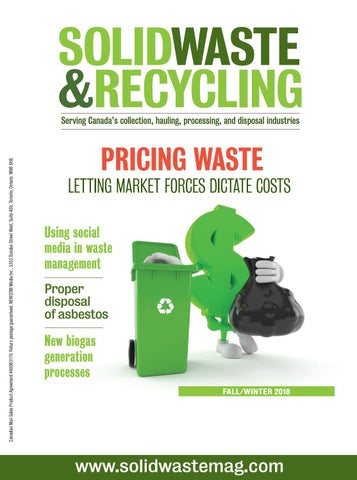
PRICING WASTE
LETTING MARKET FORCES DICTATE COSTS Using social media in waste management Proper disposal of asbestos
New biogas generation processes FALL/WINTER 2018
www.solidwastemag.com
MAKE CLEAN PAPER WITH
POSITIVE SORTING
Reach your 0.5% www.vdrs.com/positive-sorting
203 967 1100 | vdrs.com | info@vdrs.com
SOLIDWASTE &RECYCLING is Canada’s trusted source for information on the collection, hauling, processing, and disposal industries.
FALL/WINTER 2018 VOL. 23 NO. 2 Editor Emily Atkins emily@newcom.ca (416) 614-5801 Editorial Director John G. Smith johng@newcom.ca (416) 614-5812 Group Publisher Lou Smyrlis lou@newcom.ca (416) 510-6881 Creative Director Tim Norton tim@newcom.ca (416) 510-6881 Art Director Michael Chimienti mike@newcom.ca (416) 510-6813 National Sales Manager Delon Rashid delon@newcom.ca (416) 459-0063
COVER STORY
PRICING WASTE PROPERLY Market pricing will make waste management more efficient
NEWCOM MEDIA INC. 5353 Dundas Street West, Suite 400 Toronto, ON M3B 2S9 416/614-2200 • 416/614-8861 (fax)
How-To ........................................................ 16
Being Social Using social media to communicate effectively
PRESIDENT Joe Glionna
VICE PRESIDENT, PUBLISHING Melissa Summerfield
CHIEF FINANCIAL OFFICER Peter Fryters
DIRECTOR OF CIRCULATION Pat Glionna Solid Waste & Recycling is published by Newcom Media Inc. The contents of this publication may not be reproduced or transmitted in any form, either in part or full, including photocopying and recording, without the written consent of the copyright owner. Nor may any part of this publication be stored in a retrieval system of any nature without prior written consent. Postmaster: Address changes to Solid Waste & Recycling, 5353 Dundas Street West, Suite 400, Toronto, Ontario M9B 6H8. Postage paid Canadian Publications Mail Sales Agreement No.40063170. ISSN No. 1483-7714. Printed in Canada.
Opinion .................................5 Briefs: Across Canada ...........6
CHAIRMAN AND FOUNDER Jim Glionna
Departments
Biogas.......................................................... 19
Gas and grow
Briefs: Around the Globe ......9
New technologies improve process of converting organic waste to biogas and natural fertilizer Asbestos ...................................................... 25
A lurking danger Proper disposal of residual asbestos is critical to preventing disease
16
19
25 Fall/Winter 2018 3
200 TONS
OF CONSTRUCTION
DEBRIS SHREDDED IN 3 HOURS
AM RTH ERI
DISTRIB VE
EXCLUSI CA
+
GERM
AN Y
OR FOR NO UT
EXCLUSIVE NORTH AMERICAN PARTNER OF HAAS RECYCLING SYSTEMS HAAS TYRON 2000 XL is the perfect tool for high volume waste reduction. With adjustable shaft speeds and independant shaft control in both forward and reverse, you can make quick work out of even the toughest materials. shred-tech.com | 1.800.465.3214
Follow Us On
Capacities can range from 25 tons per hour to 100 tons per hour, depending on the application and material. Contact us today for more information.
EDITORIAL
A new mandate Hello. It’s a great pleasure to be taking on the reins of Solid Waste & Recycling magazine. Even as a seasoned business journalist with experience in three continents gained over more than 20 years, it’s always an exciting time taking over a new publication. Learning the details of an industry and its market forces, policy concerns and public image never gets old. And in the world of waste management I am quickly coming to understand just how fascinating, complex, and swiftly changing your industry is. I’m looking to you to help me shape the future issues of this magazine. It’s meant to be about you, to educate you, and to stir up dialogue about the best ways to get things done. It should bring new insights to both emerging and existing issues. My mandate here is to bring diverse voices to these pages and share experiences and success stories from home and
around the world that might have practical application in your business. I want to ensure that you are kept up to date with the latest developments in products, services and ideas that have the potential to make your business more efficient. Please reach out to me to talk, introduce an idea, a story lead, or to let me know how you think the magazine can be better. I’m always open to suggestions for improvement. I can be reached at 416-614-5801; emily@newcom.ca or though LinkedIn at emilyatkinsgroup. I very much look forward to hearing from you and collaborating to keep Solid Waste & Recycling magazine a thriving, vibrant reflection of its industry. Talk soon, Emily Atkins
SOLIDWASTE&RECYCLING E-NEWS Emailed news. Not recycled. Subscribe at www.solidwastemag.com
Visit solidwastemag.com Fall/Winter 2018 5
Your bottom line doesn’t care if it’s cold. The new Mobil Delvac 1™ range of synthetic engine oils helps protect your fleet and your business.
See our new products at mobildelvac.ca
BRIEFS: Canada News
Walmart Foundation announces new funding The Walmart Foundation is making $1.89 million available to fund proposals from eligible non-profit organizations working to reduce food waste in Canada. The foundation is seeking proposals from qualified organizations that have experience in formulating, proposing, and implementing food waste reduction efforts. Requests between US $300,000 and $1 million are being considered. This announcement is part of the Walmart Foundation’s commitment
to award $19 million to organizations that help reduce food waste and strengthen food banks in Canada. Previous grants awarded include a total of US $6.3 million granted to organizations leading and innovating in food waste reduction and charitable food recovery. The announcement builds on the retailer’s commitment to reduce waste in its own operations and achieve zero waste in key markets, including Canada, by 2025.
B.C. proposes organics changes
Jail time for PCB violations
The British Columbia government is proposing changes to the province’s Organic Matter Recycling Regulation. The government says the changes will “support the processing of organic waste, which will reduce the burden on landfills, and give transparency and clarity to British Columbians who are affected by composting and land used for this purpose.” The updated regulation will apply to compost facilities and land application of organic matter, and will align with the Agricultural Waste Control Regulation and the Contaminated Sites Regulation. The proposed amendments address: opportunities to increase public transparency and information sharing; additional requirements to improve notification, including with local government; requirements to engage with First Nations; and increased rigour around the authorization process. The proposed regulatory updates are part of a broader suite of actions being taken to prevent and divert organics from disposal in B.C. An Organic Matter Recycling Regulation (OMRR) intentions paper has been posted at http://tinyurl.com/SWR-BC-Organic for public comment until Nov. 8, 2018. Q
Applications are being considered in three areas: Stopping waste from occurring in the first place; redistributing food to people; and repurposing waste as energy, agriculture and other products. Today, 244 of Walmart Canada’s stores send organic waste for composting or anaerobic digestion so it doesn’t end up in municipal landfill. Q
The director of an Ontario-based company is doing time for violating PCB regulations. On Aug. 21, 2018, Collingwood Prime Realty Holdings Corp. and its director, Issa El-Hinn, were sentenced in Ontario for offences under the Canadian Environmental Protection Act, 1999, related to contraventions of the PCB Regulations. The court sentenced El-Hinn to a 45-day jail term for failing to comply with an environmental protection compliance order. The court also sentenced the corporation and El-Hinn to pay a combined penalty of $420,000 to be directed to the federal Environmental Damages Fund. In 2015, an investigation revealed that two electrical transformers and eight electrical capacitors contained higher-than-allowable PCB levels and that the equipment had not been sent for destruction to an authorized facility. The defendants pleaded guilty to 10 counts of contravening the PCB Regulations, and one count of failing to comply with an environmental protection compliance order. The company’s name will be added to the Environmental Offenders Registry. Q
Fall/Winter 2018 7
BRIEFS: Canada News
Feds supporting plastics innovation As the country’s single-largest purchaser of goods and services, the federal government is using procurement in a new way to help Canadian small business owners commercialize their ideas and solve complex government challenges. Through the Innovative Solutions Canada program, government departments are inviting small businesses to come up with innovative solutions in response to specific challenges around plastics. Businesses may receive up to $150,000 to refine their research and development, and if accepted into Phase 2, receive up to $1 million to develop a working prototype. The government may then act as a first customer, helping these small businesses commercialize their innovations, scale up their business and create good jobs. The seven challenges are: 1. Develop smart packaging design and other solutions to reduce plastic waste; 2. Find new ways to separate mixed plastics for recycling;
3. Identify ways to reduce and recycle plastic construction waste; 4. Find plastic-free ways to get fish from fish farms and the ocean; 5. Find innovative new ways to manage old fishing equipment and debris and remove it from our waters; 6. Turn leftover plant material from agriculture or forestry into compostable bioplastics; 7. Identify sustainable new ways to recycle or reuse glassfibre-reinforced plastic. Correctional Services Canada and Crown-Indigenous Relations and Northern Affairs Canada have also committed to launching plastic innovation challenges later this fall. Program funding will come from the 20 departments and agencies participating in Innovative Solutions Canada. Together, the funding from the departments and agencies represents an annual $100-million investment over the course of five years. Learn how to apply at: http://tinyurl.com/SWR-innovation Q
EXPELLO AUTOMATIC DRAIN VALVES ELIMINATE FREEZE UP AND PROTECT AIR BRAKE SYSTEMS FROM CORROSION. Protects Air Brake systems Automatically removes:
k Moisture k Dirt k Oil 8 www.solidwastemag.com
AIR BRAKES NEED EXPELLO! Contact us today Sales@Expelloairproducts.com or call 800.766.4243 For more information go to: www.Expelloairproducts.com
“Cannavore” to be cannabis digester’s handle “The Cannavore” has won Micron Waste Technologies Inc.’s contest to name its cannabis digester. The name was chosen following a contest that collected 2,379 product name submissions from entrants in Canada and the United States. Pending confirmation of compliance with contest rules, the prize will go Jack Ponte of Ontario. “We’d like to thank Mr. Ponte and everyone who entered the Digester Naming Contest,” said Micron president Alfred Wong. “The creativity of entries made choosing a winner very difficult, but ‘The Cannavore’ edged out the competition with its combined cleverness, simplicity and originality.” The Cannavore digester, an industrial-grade cannabis waste processor, pulverizes and renders plant waste in combination with a proprietary blend of microbes and enzymes designed and developed by Micron. Effluent from the digester is further treated to derive clean greywater which can be re-used in growing operations. Alternatively, the treated regulatory-compliant greywater from the Cannavore digester, which meets municipal discharge standards, can be safely discharged. Active Pharmaceutical Compounds (ACBs) in cannabis waste are denatured on site at cannabis cultivation facilities by a Micron-developed biotechnology
process, eliminating risk of public and ecosystem exposure. ACB-free bio-solids from the Cannavore are saleable as livestock fodder. The company’s first Cannavore digester was delivered to Aurora Cannabis Enterprises Inc.’s facility in Mountain View County, Alta., on June 28, 2018. The 55,200-sq.ft. cultivation and production facility each year produces 4,800 kg of premium cannabis over multiple production cycles. The Aurora Mountain Cannavore digester was the first of several to be commissioned by Aurora, subject to the technology meeting certain milestones per a collaboration agreement announced Dec. 2017. “The Cannavore unit is progressing well through optimization of several distinct capabilities – cannabis waste digestion, wastewater extraction and purification, the denaturing of active pharmaceuticals, and the calibration of all sensors and software, including remote operation,” said Micron chief technology officer Dr. Bob Bhushan.
Value Village phases out plastic Discount and used clothing retailer Value Village, also known as Village des Valeurs in Québec, will phase out plastic bags from stores across Canada and the United States by the end of 2018. In place of the plastic bags, shoppers are encouraged to use reusable totes or paper bags at all stores. Eliminating the purchase of plastic bags will keep millions of plastic bags out of landfills and oceans for years to come. This
The Cannavore digester employs industry-specific computer software developed by Micron and B.C. Research Inc. to provide for logic, remote access, data management and equipment control. The software will allow Micron to remotely control its units with real-time diagnostics and analysis at any location worldwide. Micron has won 10-year intellectual property protection for innovative features unique to its unit, which processes both food waste and cannabis plant waste on a commercial scale. The company’s design patent is also pending in the United States. Both the Cannavore digester and the Organic Food Waste Digester systems were based on Micron’s propriety biomass waste processing platform, which it claims realizes up to 35 per cent in cost efficiencies and emits 58 per cent fewer greenhouse gas emissions than conventional waste management methods. Q
is in addition to the more than 700 million pounds of clothing and textiles Value Village keeps out of North America’s waste stream each year. “For the last 60 years, Value Village has been committed to reducing North America’s clothing footprint by extending the life of garments,” said Tony Shumpert, vice-president of recycling and reuse at Value Village. “The decision to phase out plastic bags from our stores was a natural next step in our journey to improving our communities and our planet.” Q Fall/Winter 2018 9
BRIEFS: Around the Globe
No more plastic-wrapped Carlsberg
An infinitely recyclable polymer Colorado State University (CSU) chemists have announced in the journal Science another major step toward waste-free, sustainable materials that could one day compete with conventional plastics. Led by Eugene Chen, professor in the Department of Chemistry, they have discovered a polymer with many of the same characteristics that make plastics useful, such as light weight, heat resistance, strength and durability. But the new polymer, unlike typical petroleum plastics, can be converted back to its original small-molecule state for complete chemical recyclability. This can be accomplished without the use of toxic chemicals or intensive lab procedures. Polymers are a broad class of materials characterized by long chains of chemically bonded, repeating molecular units called monomers. Synthetic polymers today include plastics, as well as fibers, ceramics, rubbers, coatings, and many other commercial products. With the help of a seed grant from CSU Ventures, the chemists are optimizing their monomer synthesis process and developing new, even more cost-effective routes to such polymers. They’re also working on scalability issues on their monomer-polymer-monomer recycling setup, while further researching new chemical structures for even better recyclable materials. Q 10 www.solidwastemag.com
glues the cans together. A world first for the beer industry, it will reduce the amount of plastic used in traditional multi-packs by up to 76 per cent. Three years in the making, the Snap Pack were available in the U.K. this September, then rolled out in other markets. Q
AI trash can in development A company better known for selling office furniture is planning to debut an artificial intelligence-enabled trash can that will be able to sort waste into recyclable and non-recyclable streams. The trash can, known as Oscar, is being developed by Autonomous, which until now has specialized in ergonomically friendly furniture. Oscar’s development is being funded by a Kickstarter campaign. The can will have a motion sensor that triggers a hatch to open. When a piece of trash is placed in the hatch, Oscar will use cameras and an extensive database of photographs to identify whether the item is recyclable or not. Once it decides, the item will be spun off to one of two holding bins. If Oscar has trouble with an item, the user can teach it what to do, and that data will be shared with all the other Oscar cans, which are connected to the cloud via Wi-Fi. Autonomous says it hopes that Oscar will be smarter than humans who incorrectly classify one in four items they put into the recycling stream. Q
Credit: Courtesy of PBS.
Beer-maker Carlsberg has unveiled a new Snap Pack, which is set to reduce plastic waste globally by more than 1,200 tonnes a year – the equivalent to 60 million plastic bags. The Snap Pack replaces the plastic rings used around Carlsberg’s six packs with a technology that
Degrading plastics emit GHGs Researchers from the University of Hawai‘i at Manoa School of Ocean and Earth Science and Technology (SOEST) have discovered that several greenhouse gases are emitted as common plastics degrade in the environment. The study, published in PLOS ONE, reports the unexpected discovery of the universal production of greenhouse gases methane and ethylene by the most common plastics when exposed to sunlight. The research team tested polycarbonate, acrylic, polypropylene, polyethylene terephthalate, polystyrene, high-density polyethylene and low-density polyethylene (LDPE)—materials used to make food storage, textiles, construction materials, and various plastic goods. Polyethylene, used in shopping bags, is the most produced and discarded synthetic polymer globally and was found to be the most prolific emitter of both gases. Additionally, the team found that the emission rate of the gases from virgin pellets of LDPE increased during a 212-day experiment and that LDPE debris found in the ocean also emitted greenhouse gases when exposed to sunlight. Once initiated by solar radiation, the emission of these gases continued in the dark. Q
ONLINE COURSE
Municipal market-based tools for sustainable development
Ocean plastics collection launched
Credit: The Ocean Cleanup
Earn a certificate!
Workers attach the three-metre skirt to the pipe before it is launched.
The world’s first ocean clean-up system launched from San Francisco Bay on Sept. 8. The Ocean Cleanup, a Dutch non-profit organization, launched the clean-up system – “System 001” – for a two-week trial 240 nautical miles off shore before continuing its journey toward the Great Pacific Garbage Patch, 1,200 nautical miles off shore, to start the clean-up. The Ocean Cleanup conducted hundreds of scale-model tests, a series of prototypes, research expeditions and multiple iterations before launching its first full-scale cleanup system. System 001 consists of a 600-metre-long U-shaped floating barrier with a three-metre skirt attached below. The system is designed to be propelled by wind and waves, allowing it to passively catch and concentrate plastic debris in front of it. Due to its shape, the debris will be funnelled to the centre of the system. Moving slightly faster than the plastic, the system will act like a giant Pac-Man, skimming the surface of the ocean. The Ocean Cleanup anticipates that the first plastic will be collected and returned to land within six months after deployment. This will mark the first time that free-floating plastic will have been successfully collected at sea. After returning the plastic to land, The Ocean Cleanup plans to recycle the material into products and use the proceeds to help fund the clean-up operations. The Ocean Cleanup aims to scale up to a fleet of approximately 60 systems focused on the Great Pacific Garbage Patch over the next two years, with the anticipation that the full fleet can remove half of the plastic in the patch within five years. This is in line with The Ocean Cleanup’s ultimate goal: reducing the amount of plastic in the world’s oceans by at least 90 per cent by 2040. Q
This course offers a unique approach, combining experts on market-based tools with municipal practitioners. Live webinars and self-directed exercises will cover topics such as: SOLID WASTE With Lindsay Tedds and Andrew Duffield
WATER & WASTEWATER With Justin Leroux and Carl Yates
TRAFFIC CONGESTION With Nancy Olewiler and Daniel Firth
Register today for the fall 2018 session:
" , ޖ0 )ѷ
WASTE PRICING
Pricing waste properly A proposal to manage Canadian waste more efficiently By Dale Beugin and Jonathan Arnold
R
educe, Reuse, Recycle. This simple heuristic has guided waste-management policy in Canada for decades. Yet despite its grip on how we think about waste management, it paints an incomplete picture of the complex challenges and opportunities facing our waste management systems. Instead, we need to think bigger. How can we make our waste management systems more efficient? How can we reduce costs and increase benefits for municipalities, taxpayers, and the environment? A recent report by Canada’s Ecofiscal Commission takes a closer look at these issues and, in a nutshell, finds that our solid-waste management systems can and should rely more on market forces.
Economic challenges and opportunities Waste management professionals need little convincing that Canadian communities face big challenges in how they manage their waste. China’s recent import ban on recycled materials has turned the global recycling market on its head. At the same time, Canadians are among the biggest generators of waste in the world. It’s also no surprise that there’s no free lunch in waste management: the more waste we produce, the costlier it is to manage. Building and operating 12 www.solidwastemag.com
landfills is expensive, especially with increasingly stringent environmental standards. Finding sites for new landfills is a lengthy and grueling process: few people want more landfills in their community. And since one-third of Canadian landfills operate at or near capacity, many communities will soon reckon with a shortage of landfill space and high replacement costs. Diversion and prevention of solid waste present clear opportunities, but these options can also be costly. Facilities that process organics and recyclables are expensive to build and operate, as are the programs that collect this waste from the curb. There are also limits to how much solid waste consumers and producers are willing or able to eliminate through prevention. All these factors present important challenges to governments. Why do Canadians generate so much solid waste, and why does so much of it get landfilled? How can governments discourage waste disposal while minimizing the costs of waste diversion and prevention? What is the optimal balance between waste disposal, diversion, and prevention? Or more practically, what policies can help get our waste systems closer to that optimal split?
More efficient systems Creating more-efficient waste management systems requires that we go beyond traditional yardsticks of
progress. Waste diversion targets, for example, establish long-term goals, but they tell us little about the complex trade-offs associated with actually achieving these goals. Reducing disposal is important, yet it is not always the best solution; depending on context and existing levels of service, diversion can be very expensive. And in some cases, excessive waste disposal is a symptom of deeper, more systemic issues. Instead, we argue that governments should pursue a broader objective: improving the overall efficiency of our waste management systems. More-efficient systems deliver greater benefits of waste management at lower costs. Critically, these costs and benefits must include both financial and environmental factors. But there is no single model of an efficient waste management system.
One-third of Canadian landfills operate at or near capacity, many communities will soon reckon with a shortage of landfill space.
In practice, the efficient balance solid waste markets. Each of these 2. Landfills do not charge large waste between waste disposal, diversion, and issues makes waste management generators the full cost of disposal Waste disposal prices are more transprevention depends on many factors, systems inefficient: including local context, current techparent for the commercial sector, nologies, and even international 1. Most Canadian households do not including businesses, large buildings, pay directly for waste management institutions, and industry. Commermarkets for recyclable materials. Households typically pay for waste cial waste is typically hauled directly to collection through property taxes or landfills, where waste generators pay a Addressing six problems The best way to improve efficiency is as a monthly fee. In other words, the fee to dump their waste based on the to make waste-management systems amount residents or businesses pay weight or type of waste being tipped. In many cases in Canada, however, work more like well-functioning for waste management has – in many markets. As we find in our report, cases – no connection with the quantity the fee for disposing of every tonne however, waste-management markets or composition of the solid waste they of garbage is less than the full cost, encouraging waste generators to are not normal, well-functioning generate. As a result, households tend to landfill more waste than they would markets. Prices for waste management – where they exist – do not typically generate and dispose of more solid otherwise. Fees in Canada often do not reflect the full costs and benefits waste than they otherwise would if reflect the long-term costs of landfilling associated with waste management they paid directly for the service. Low – that is, the future costs of building new waste disposal prices also weaken landfill sites when existing ones reach services and materials. We identify six interconnected the incentive to divert waste through capacity. Similarly, fees often exclude some of the social costs of landfilling, problems that cascade throughout recycling or composting. Fall/Winter 2018 13
WASTE PRICING
such as environmental risks to water and soil, greenhouse gas emissions, and impacts on local property values due to odour and unsightliness. 3. The porous boundaries of solid waste management systems make it difficult for municipalities to price waste disposal at its full cost The boundaries of solid waste management systems are porous. Unlike municipal water and wastewater systems, where municipalities have near complete control over treatment and distribution infrastructure, solidwaste systems – and the flows of waste within them – are more decentralized. These porous boundaries can make it difficult for municipalities to charge the full cost of waste disposal, as it can encourage waste to be exported to jurisdictions with lower tipping fees. While waste exports aren’t necessarily a problem in and of themselves, they can undermine a municipality’s ability to recover its costs. Building, maintaining, and closing landfills is capital intensive, meaning that a large portion of disposal costs is fixed. When waste exports increase, municipalities generate less revenue to cover these costs. Waste exports can also undermine environmental outcomes if waste is exported to landfills that are less secure or to systems that put less emphasis on waste diversion and resource recovery. 4. Markets alone may provide inadequate waste diversion opportunities for some materials Even if communities address Issues 1 to 3 and charge the full cost of waste disposal, the private sector would not necessarily provide adequate diversion alternatives. Collection and management systems for diversion often make financial sense only when operated on a broader scale. Achieving this scale can be difficult, particularly in small, rural, and northern communities. Persistently high contamination rates may also stymie waste diversion 14 www.solidwastemag.com
Persistently high contamination rates can stand in the way of waste diversion projects.
opportunities. Service providers have limited control over how waste is sorted before they collect it, relying on households and businesses to separate their waste correctly. But despite better education and awareness, contamination rates are as high as 25 per cent in some communities, which increases processing costs and reduces the value of diverted materials. Tighter restrictions imposed by China have amplified these problems and made recycling markets more unpredictable, leading many companies to shut down across North America. 5. Municipal pricing policies have limited effect on goods manufacturers If waste management services were priced according to their full cost – in all jurisdictions – consumers would have clear incentives to purchase goods made with less packaging or from materials that are easier to recycle. Producers, in turn, would have incentives to design and manufacture goods that generate less waste.
Contamination as high as 25 per cent increases costs.
But even if individual municipalities charged residents directly for waste disposal, and even if these prices approached the full net cost of the service, prices would have a negligible impact on upstream production. Waste is priced locally, and Canada may be too small to affect global manufacturers. 6. Extracting and processing natural resources generates negative environmental externalities further upstream
The majority of consumer goods produced in the economy use virgin materials, extracted and processed from the natural environment. These processes, however, can cause significant environmental damages that are unpriced or underpriced in markets. This effectively subsidizes the use of virgin materials and distorts markets further downstream for recycling, reuse, and prevention. Firms have an incentive to use more virgin materials and fewer recycled and reused materials in their manufacturing processes.
New policies needed Policies that address these six issues can make our waste markets work better, improving the overall performance and efficiency of waste management systems in Canada. To this end, our report lays out several recommendations for governments. It also includes a detailed case study on the City of Calgary that explores these challenges and solutions in practice (see inset, below).
Improving efficiency starts with smarter disposal pricing. First, this means charging tipping fees at landfills that reflect the full cost of the service – including both financial and social costs. Second, it means adopting pay-as-you-throw programs in municipalities, which charge residents directly for the amount of garbage they generate. Both policies encourage waste diversion and prevention, while allowing waste generators to find the cheapest way of doing so. Yet relying on municipal pricing policies is not enough to address the six issues above. In particular, Extended Producer-Responsibility (EPR) policies have a key role to play. EPR policies require manufacturers to manage the waste generated from their products and provide marketbased incentives to make products and materials that generate less waste in the first place. They can, in other words, help overcome key challenges in waste markets that disposal pricing policies alone cannot. Other
complementary policies that target organics, such as municipal collection programs or backyard composting programs, also have an important role to play. Ultimately, the case for improving waste management is an economic one. The EcoFiscal Commission report and related online course have more on how municipalities and provincial governments can better utilize market-based tools to manage solid waste.
Dale Beugin is the executive director of Canada’s Ecofiscal Commission. Jonathan Arnold is a senior research associate with Canada’s Ecofiscal Commission.
Case Study: Assessing Calgary’s Waste Management System Overall, the City of Calgary has made considerable progress in how it manages its waste. It increased landfill tipping fees to better reflect the cost of service. It has also proposed a pay-as-you-throw program for households, strengthening the link between how much waste people produce and how much they pay. A new organics collection program is also helping divert a significant quantity of waste from its landfills. Progress at the provincial level, however, has been slower. Most notably, Alberta is the only province that does not have legislated extended producer responsibility (EPR) programs and is falling behind in its commitments under the Canada-wide Action Plan for EPR. If Alberta were to follow the lead of other provinces, such as B.C., and implement full EPR, it would make producers financially and physically responsible for managing the waste generated from their products. An EPR program for residential recycling would also reduce costs to municipalities that would no longer have to provide these services.
Fall/Winter 2018 15
SOCIAL MEDIA
Being social By Kara Kuryllowicz
A
Credit: Quinte Waste Solutions
cross Canada, organizations that provide waste and recycling services to residential, industrial, commercial and institutional customers are more social than ever, simply because it makes good business sense. According to Sherpa Marketing’s 2017 Canadian Riding along on the collection route helps social media Social Media Statistics report, approximately 22.7 million managers understand the challenges of the job Canadians had a social media account by the end of 2017, a number that has grown by 300,000 annually for the past two years. Data show that 63 per cent of Canadian social media Quinte West, which provides curbside recycling, commerusers engage regularly with brands and products and 48 per cial recycling, household hazardous waste collection and cent with non-profit organizations. waste electronics collection to about 180,000 residents “Social media is now an expectation and for the past five in nine municipalities, started a lot earlier. QWS began years, Emterra has used Twitter and Facebook to inform, posting to Twitter in 2009, then Facebook in 2013 and educate and influence 10 per cent of Canada’s population and Instagram in 2015. relied on LinkedIn to connect with our peers, colleagues and “Social media gets the information out effectively, particpotential recruits,” says Janice Rendflesh. ularly when used in conjunction with tradiShe’s responsible for corporate communicational media, such as radio, newsprint, flyers and posters with a presence at everytions with Burlington, Ont.-based Emterra Group, which provides recycling resource thing from fall fairs to schools and seniors’ management and waste disposal solutions residences, because people need to get our nationwide. messages repeatedly,” says Rachel Revoy, Elsewhere in Canada, Recycle BC, a Quinte Waste Solutions’ communications non-profit organization that has provided coordinator. She notes a staggering majority packaging and paper recycling services to of residents still prefer flyers delivered by over 1.8 million households (more than 98 Canada Post. But, “social media is instantaper cent of British Columbia) since 2014, neous and typically costs 10 per cent of what launched its social media program on it costs to reach residents using more tradiFacebook, Twitter and YouTube that same tional means.” year. It added Instagram last year and In its most northern, rural municipalicontinues to use LinkedIn to learn, share ties, QWS focuses primarily on traditional industry news and recruit. media, because where Internet is available, “Social media allows Recycle BC to it is often slow and pay-per-use, if residents quickly, consistently and inexpensively even opt to connect. educate and inform residents province-wide Organizations such as QWS, Emterra to support recovering a clean stream of recyand Recycle BC typically share information ranging from news, announcements, schedclable materials,” says Lyndsey Chauhan, director of marketing communications at uling changes and pick-up day reminders, to Recycle BC. “The various media – including updates on recyclable versus non-recyclable social, traditional and event-based – convey materials and products. different information and enable a range of This needle was found interactions to help us best connect with Benefits on the sorting line by a residents.” Proactive, responsible organizations also Quinte Waste Solutions In Ontario, Quinte Waste Solutions, in rely on social and traditional media to worker. 16 www.solidwastemag.com www.solidwaste www solidw mag ma
Credit: Quinte Waste Solutions
Waste management companies use social media to inform and support cost cutting
influence and educate customers to help protect their truck drivers and operators, increase their pickup and sort line efficiencies and maximize the volume of salable recyclables collected. For example, the ongoing QWS #Don’tWishRecycle campaign tells residents that wishing it were recyclable doesn’t make it so. In a recent post, the wish-recycling fairy explains why paper cups can’t be recycled and that medical waste – such as needles, syringes and bandages – endangers lives. Since the campaign’s launch, the QWS sort line manager reports there have been fewer hazardous and sharp items. “Customers need to know that because every piece of Blue Box material is collected and sorted by hand. Sharp objects and items like diapers are hazardous to our employees,” says Revoy. “The real people who sort our waste are also our neighbours, friends and family members – they shouldn’t have to be on guard every second they’re at work.” As further proof that education and explanation can help change behaviours, a 2015 QWS campaign with the Beer Store and Ontario’s bottle return program increased glassbottle returns to the Beer Store once residents understood re-use requires less energy than recycling. It also saves QWS about $85,000 annually in glass transportation costs and reduces the risk of glass cuts to material recovery employees.
Talking to the front lines Social media and communications managers like Revoy, Rendflesh and Chauhan boost their own knowledge of their companies’ and employees’ challenges by attending the drivers’ early-morning meetings, riding along on daily collection routes and walking the facilities’ sort lines. Revoy has found the drivers and sorters talk more readily and openly face-to-face, particularly after seeing how her ability to influence and inform their customers can make their daily tasks safer and easier. Chauhan also points out that Recycle BC’s ongoing in-field visits consistently deliver the many photo opportunities social media demands. “Get out from behind your desk and computer screen and interact with people in real life,” says Revoy. When Quinte residents meet Revoy at a plowing match or a Recycling 101 workshop at the local library, they’re more comfortable asking questions, such as what they should do with pop-out pill packs. Emterra’s Rendflesh points out that every employee is a customer, from her CEO to the frontline employees, and that astute communications managers participate in their conversations early on. “Get out there and connect with people to have your finger on your organization’s pulse, e,” says Rendflesh. “Initially, “Initially you may catch them off guard, d, but they’ll get used to yyou showing up.” Kara Kuryllowicz is a freelance writer. riter.
Social Media 101: Tips from Canadian Pros 1) Create and post only top-notch content. “Good content is the only option,” says Rendflesh. “If you waste their time, they lose trust in you and they won’t come back, let alone engage and share it.” Every organization has great stories, so curate your own content. 2) Mix it up because people love variety: news, schedule changes, reminders, events, and feel-good stories. 3) Be straightforward and use plain, not waste industry, language. “Recycling can be complicated so make it easy for residents to understand and learn,” says Chauhan. 4) A consistent brand and voice are crucial because you need to touch someone up to 15 times to have them recognize, then remember, your company and message. “Someone may be drawn to a flyer one day and Facebook the next,” says Rendflesh. “Give them options but make sure they know it’s your brand and your message.” 5) Focus on select platforms because quality posts and reliable, authentic engagement take time and effort. “I’d rather be outstanding on a few channels than mediocre on many,” Rendflesh says. 6) Leverage partnerships to maximize reach and impact. Recycle BC has a Community Events Team and regularly visits and partners with community-based recycling organizations as well as those with a broader reach, such as the Vancouver Whitecaps FC. Elsewhere, Emterra’s “Make Your Contribution at the Curb” program donates $1 from every tonne collected to Niagara Health Foundation’s Walker Family Cancer Centre through its partnership with the Region of Niagara. “We all promote it for the common good to donate funds to a community organization and encourage residents to recycle more,” says Rendflesh. 7) Boost posts to carefully targeted audiences, based on their geographic locations, demographics and personal interests. “You can see real time engagement data and participate in two-way communication in a way that you can’t with traditional media advertising and do it more affordably,” says Rendflesh. 8) Be positive to boost engagement and entrench loyalty, whether you’re encouraging and recognizing residents for their recycling efforts or sharing the story of the three-year-old boy who got his dream visit from an Emterra recycling truck on his birthday. This Facebook post, the first Emterra ever boosted, showed a 4,100 per cent increase in engagement over a regular un-boosted post, thanks to the paid promotion, comments, likes and shares. 9) Strategically schedule and time your posts. Determine when your target demographic is most likely to be online and thinking about recycling and waste. 10) Rely on social media’s instant, often passionate feedback, via likes, shares and comments, to find out what followers love and hate, then react according. “Keep watch to continuously improve,” says Revoy. 11) Keep posts open to maximize likes, shares, comments and other interaction. 12) Relocate negative messages away from the public space to direct messaging to handle issues more privately. “Control and manage the situation, while responding in a timely, professional manner and always stay on message,” says Rendflesh. 13) Pay attention to keep learning. Follow other companies, non-profits, and even athletes and celebrities to see what boosts interaction and engagement. 14) Like your audience, social media is always changing, and is never one-size-fits-all, so test your platforms’ latest features to see if they work for you. As Rendflesh says, “What have you got to lose?”
Fall/Winter 2018 17
A full line of haulers, recyclers and roll-offs at the ready. Whether you’re rolling through tight jobsites or managing tight schedules, our fuel-efficient, low-maintenance severe-duty trucks have got your back. And, thanks to their 2,500-square-inch windshields, contoured hoods, and steel-reinforced day cabs, they’ve got your front as well— ensuring unmatched operator visibility, safety, and, of course, loads and loads of productivity.
To learn more about how Freightliner trucks can deliver more productivity, visit Freightliner.com/refuse.
Competitive financing available through Daimler Truck Financial. For the Freightliner Trucks dealer nearest you, call 1-800-FTL-HELP or visit Freightliner.com. FTL/MC-A-1495. Specifications are subject to change without notice. Copyright © 2018 Daimler Trucks North America LLC. All rights reserved. Freightliner Trucks is a division of Daimler Trucks North America LLC, a Daimler company.
TECH TALK: BIOGAS
Gas and grow Converting organic waste to biogas and natural fertilizer By Jim McMahon
New technologies supporting continuous-flow dry anaerobic digestion with subsequent biomethane upgrade deliver improved efficiency in biomethane and digestate output
Plant process, from organic waste to energy Legend for plant process
T
he production of biomethane as a fuel, and digestate as an organic fertilizer through the process of anaerobic digestion, plays a critical role in realizing environmental and economic benefits. Conversion of biowaste to energy and usable digestate uses waste as a resource. The process decreases the volume of waste, thus saving natural resources such as land and water. It makes a contribution to long-term environmental and climate protection efforts by reducing carbon dioxide (CO2) emissions, and by reducing the need for natural gas through drilling, thereby offsetting fossil carbon emissions. It also protects the air and climate because it reduces the greenhouse gases coming from landfill. Such a process effectively delivers a closed and environmentally friendly carbon cycle. Anaerobic digestion is a multi-step biological process with four fundamental steps: hydrolysis, acidogenesis, acetogenesis and methanogenesis. Throughout this process, large organic polymers that make up biomass are broken down into smaller molecules by microorganisms. Upon completion of the anaerobic digestion process, the biomass is converted into biogas, namely methane (CH4) and carbon dioxide, as well as into digestate – liquid and solid. Organic waste – lawn and tree cuttings, and food waste such as fruit and vegetable leftovers and peelings – is recovered as source segregated organic (SSO) waste. This ensures that it does not come into contact with any contaminants. In addition to the production and collection of biomethane, the anaerobic digestion process recovers and
recycles the nutrients contained in this organic material. From the produced digestate, top-grade solid compost is produced, which is made available to nurseries, farmers and market gardens. The process also produces liquid digestate, which is distributed for agricultural use as a certified organic liquid soil conditioner.
Continuous dry anaerobic digestion Continuous dry anaerobic digestion is capable of producing the highest biogas yield from organic input material. One of the most efficient of these processes is Kompogas continuous dry anaerobic digestion, developed by Hitachi Zosen Inova, a global EPC (engineering, procurement, construction) contractor for thermal and biological energy-fromwaste (EfW) plants. Different from other anaerobic digestion processes due to the plug flow (which keeps slugs of material separate from one another throughout the process), the Kompogas Fall/Winter 2018 19
TECH TALK: BIOGAS
IT’S TOUGH TO EXTEND DRAIN INTERVALS TO 1900 HOURS BUT NOT FOR DURON™
digester creates an extremely efficient microorganism environment, which separates and optimizes the different steps of biomass degradation throughout the process, much better than conventional anaerobic digestion, making for very stable microbiology inside the reactor. The process recirculates approximately one-third of the digestate, rich in thermophilic microorganisms, from the output and back up front into the digester, to activate and accelerate the anaerobic digestion process of the fresh material fed into the digester. This allows a perfect adjustment of the hydrolysis/acidogensis rate in the digester feeding section, and facilitates high bioprocessing efficiency within the system. With conventional anaerobic digestion, the key steps of hydrolysis, acidogenesis, acetogenesis and methanogenesis are completely mixed. Each step takes place at the same time and at the same place in the digester. This does not permit optimum conditions for the microorganisms to digest the organic material.
Organic waste is shredded before being fed into into the anaerobic digester
TM
Owned or used under license.
If required, additional process water creates the optimal consistency for decomposition, with humidity residing around 70 per cent. A specially developed heating system regulates the temperature during processing at 131 F (55 C). The thermophilic microorganisms decompose the organic matter and produce carbon-neutral biogas. An anaerobic digestion retention period of 14 days at 131 F (55 C) and the plug flow, ensure that spores and bacteria are eliminated. The digestate is completely sanitized during processing, and the biogas potential is fully exploited by the time the substrate comes out of the digester, meaning the system does not require
any upstream pasteurization, compared to other solutions. Once biomass is received, a shredder chops the organic matter into small pieces, which then are sieved to a maximum particle size of about two inches to remove impurities such as stones, plastics and metal. The prepared biomass is then automatically conveyed to the digester feed-in point. The process uses a horizontal plug-flow digester. The organic material is transported inside the digester, where it moves horizontally through the system. A slowly turning agitator ensures that the substrate is optimally mixed within the digester, and the biogas bubbles are permitted to vent for highyield formation of methane. Once through the dry anaerobic digestion processes, digestate is separated into a solid and a liquid phase. The solid digest can be treated further to produce high-quality compost that is used as organic fertilizer. Similarly, the liquid digestate is collected for use within the digester and as organic fertilizer.
With DURON protecting your engine you could achieve drain intervals* of up to 1900 hours in even the most demanding of operations. That’s the kind of drain intervals we call tough. And it’s all proven in the real ^VYSK ^P[O Ä LSK [LZ[PUN VU [V\NO jobs like yours.
WE’VE TALKED TOUGH. NOW WE’VE PROVEN IT. DURON.™ THE TOUGHER. THE BETTER.™
Biomethane upgrade The raw biogas produced in the anaerobic digester, which is approximately 56 per cent methane, is collected, and can be used directly for power and heat generation in combined heat and power cogeneration units (CHP). It can also be used for heat generation in highly efficient gas-fired condensing heating systems. But before distribution into the natural gas grid, the biogas must be upgraded, undergoing either physical (membrane) or chemical (amine scrubbing) processing. One system that uses these technologies is BioMethan upgrade, developed by HZI. The raw biogas is dried, then desulphurized, using membrane-based gas permeation, and the low-calorific carbon dioxide is subsequently separated using membrane modules. These consist of several thousand extremely fine hollow fibers – the ends are embedded in resin and bundled in stainless steel pipes. Their above-average carbon dioxide and methane selectivity allows for methane purity of 97 per cent and methane slip of below 0.5 per cent. Alternately, the gas goes through a heat-driven amine scrubbing process. The raw biogas is dried, desulphurized, and the low-calorific carbon dioxide is separated, with the CH4 upgraded to natural gas quality – so-called biomethane. Amine scrubbing is a highly efficient and economical process technology, with methane purity of up to 99 per cent and methane slip of below 0.1 per cent. The membrane process has an electricity demand of 0.24 kWh/m³ biogas. The amine scrubbing process
HEAVY DUTY DIESEL ENGINE OILS
FIND OUT MORE. THE SOONER. THE BETTER. DURONTHETOUGHERTHEBETTER.COM *Extending drain intervals should always be undertaken in conjunction with an oil analysis program.
See where the industry is going. Solid Waste and Recycling Readers Save! Register with code VP39 and save 25% on the conference program and get FREE Exhibit Hall admission. wasteexpo.com
Big innovation is big business. You’ll find both at WasteExpo. The numbers don’t lie. You can see how big data is becoming a vital component of the industry. Over the past 50 years, we’ve helped usher in more significant innovations in the solid waste and recycling industry than any other event. And the future looks even more promising. Here are some more numbers for you—14,000 of your peers, 609 exhibitors and 60+ educational sessions are waiting for you—all in the same place. WasteExpo. It doesn’t get any bigger or smarter than this. Visit wasteexpo.com to learn more. Produced by:
Conference & Special Events: May 6-9, 2019 • Exhibits: May 7-9, 2019 Las Vegas Convention Center (South Halls) • Las Vegas, NV, USA
In Collaboration wIth:
TECH TALK: BIOGAS
Press cake is stored and stabilized for subsequent composting
has an electricity demand of 0.24 kWh/mÂł biogas; and a heat demand of 0.6 kWh/mÂł biogas. Which gas upgrade process is more applicable for a given situation will depend on several factors, including: the quality of biomethane required; availability of heat; cost of electricity; and the biomethane slip. Injected into the natural gas grid, biomethane is efficiently stored and transported to the nearest, most suitable location. This flexibility is beneficial for both municipalities and large industries in generating energy, providing an economical heat supply, and improving their carbon footprint. Due to its high quality, biomethane is perfectly compatible with existing technical facilities. It is comparable with compressed natural gas (CNG), and is used as a renewable fuel in natural gas vehicles. Comparatively, for the same amount of heat or electricity generated, the biomethane produced from upgrade processes produces 80 per cent less greenhouse gas emissions compared to burning natural gas as a fossil fuel. For many municipalities and their residents who are largely environmentally conscious, biomethane is preferred over natural gas.
Integration of the processes Conventional plants providing anaerobic digestion with subsequent biomethane upgrade are typically constructed using process systems from different suppliers. Resulting limitations in system continuity and design flexibility can inhibit overall plant performance. With the continuous dry anaerobic digestion and upgrade processes both provided by the same supplier, plant design flexibility and operational efficiency can be optimized for maximum production. This allows plant operators to more efficiently design for both small-batch or large-scale production operations. Continuous dry anaerobic digestion coupled with biomethane upgrade contribute to a versatile energy mix, along with reducing dependency on natural gas imports, and ultimately contributing to the reduction of climate change due to reduced carbon dioxide emissions. Recent improvements in these systems’ technologies, design flexibility and operational performance have made major strides toward supporting these initiatives. Jim McMahon writes on environmental technology. Fall/Winter 2018 23
October 24 – 25, 2018 Enercare Centre, Toronto, ON www.cwre.ca
2 Events in 1
SAVE THE DATE! JOIN US FOR THE NEXT EDITION! OCTOBER 9-10, 2019 • ENERCARE CENTRE • TORONTO
Where key buyers from all segments of the industry find the latest innovations. Composting Systems / Components • Construction & Demolition Waste / Scrap Recycling • Incineration / Gasification / Thermal Technologies • Infrastructure Redevelopment / Public Works • Landfill Operations / Systems • MRFs / Transfer Stations / Storage / Containers • Natural Gas Vehicles (NGV) / Compressed Natural Gas (CNG) • Recycling Equipment / Services • Trucks & Transportation Equipment / Heavy Equipment • Waste Treatment / Disposal • Software / Technology / Education
Municipal / Construction Equipment • Traffic & Road Safety / Control • First Responders Equipment, Supplies / Services • Water / Wastewater / Infrastructure / Utilities / Asset Management • Sustainability / Green Buildings / Environment
ASBESTOS
A lurking danger Proper disposal of residual asbestos critical to preventing disease By the Mesothelioma Cancer Alliance
F
a highly aggressive cancer impacting hundreds of thousands of houses and or decades, Canada had the linings of the internal organs, most public buildings still contain the mineral, a longstanding love affair commonly the lungs, but can affect the especially if they were last renovated with asbestos, but that all heart or abdomen in rare instances. before 1990. Asbestos is a known carchanged in 2011. In the If you suspect that you may come into cinogen closely tied to several debilitatblink of an eye, the country’s contact with the mineral on the job site, ing, chronic and fatal diseases, including asbestos mining industry came to a it’s best to take the right precautions asbestos-related lung cancer, asbestosis, screeching halt following the closure of to prevent exposure. Be careful with and mesothelioma. Mesothelioma is its last two mines, both based in Quebec. Today, the country is pushing for a full use ban of the toxic mineral and is making strides toward an asbestos-free future. Asbestos has been used to make products strong, long-lasting and fire-resistant. Production and use of asbestos have declined However, despite a renewed since the 1970s. Before 1990, asbestos was mainly used for insulating buildings and homes against cold weather, noise and for fireproofing. It may also be found in some auto parts. push to protect Canadians from coming into contact with asbestos, the real danger Building is often found much closer to insulation home. Asbestos was, at one time, Cement added to thousands of homeand plaster Floor and building products, ranging ceiling tiles from gaskets and rope used to insulate furnaces to vinyl Car and truck floor tiles and popcorn ceilings brake pads adorning homes across North House siding America. Known for being especially strong and capable of resisting heat and most chemical reactions, the mineral also found its way into consumer products. From the slow cooker in your kitchen to the ironing board in your closet, if it came into contact with high temperatures, Furnaces it likely included asbestos. and heating Millions of tons of the systems mineral were mined and sold over the years, though both its use and production in Canada TIPS: began to wane in the 1970s. z Avoid disturbing asbestos materials yourself — there are no significant health risks if materials containing asbestos are tightly bound in products
ASBESTOS IN THE HOME
Utility at a high cost Unfortunately, reaping the mineral’s benefits also comes at a huge price. It’s very likely that
and in good condition; sealed behind walls and floorboards; isolated in an attic; and left undisturbed z Before doing any major renovations, remodelling or demolitions, reduce your risk of exposure in the home by hiring a professional to test for asbestos z If asbestos is found, hire a qualified asbestos removal specialist to get rid of it before beginning work z Asbestos may be found in some replacement car parts; be sure to check with your auto parts dealer before doing any work yourself © Her Majesty the Queen in Right of Canada, as represented by the Minister of Health, 2017 | Cat.: H14-233/2017E-PDF | ISBN: 978-0-660-23779-4 | Pub.: 170291
Fall/Winter 2018 25
ASBESTOS items and materials likely to contain the mineral and wear the right personal protective equipment (PPE) to get the job done safely, including disposable suits, gloves and a half-face respirator mask. In addition, be careful around crumbling building materials known to contain asbestos, and remove them with as little disruption as possible. Make sure disposal bags are strong, airtight and well-marked to avoid confusion and accidental exposure.
Preventing exposure It’s incredibly important to remember when working with and disposing asbestos-containing materials that there are rules and regulations in place to prevent accidental exposure from occurring. According to the Ontario Ministry of Labour, work areas must not allow eating, smoking or drinking to occur on the site, compressed air cannot be used to remove dust or clean tools or areas, and wetting agents must be used with water to prevent asbestos fibers from becoming airborne. During the disposal process, asbestos must be cleaned up at regular intervals and immediately following the end of work. All containers leaving the worksite for disposal have to be airtight, clearly marked as asbestos containers, and cleaned up with a HEPA-filter vacuum or wet cloth to remove any extra traces of asbestos from the container. In addition, asbestos waste that leaves the worksite must be handled and hauled by a licensed waste hauler, and the landfill must be alerted prior to the waste actually being dropped off.
Landfill operations Landfill operators have their own rules and regulations that are strictly enforced. For example, landfill operators have to make sure new asbestos disposals are covered with compacted fill within the same day. They must also clearly mark disposal areas at the site and ensure proper signs are posted. Asbestos fill sites are not to be disturbed once covered, as excavating the area where asbestos is contained could allow 26 www.solidwastemag.com
During the disposal process, asbestos must be cleaned up at regular intervals and immediately following the end of work.
The landfill must be alerted before asbestos waste is dropped off. the fibers to become airborne and put employees or the general public at risk of inhalation. It may seem like a lot of trouble to go through just to prevent asbestos from entering the air, but these rules are in place to protect people. If you suspect that someone isn’t doing due diligence or the worksite is unsafe, speak with a supervisor or contact Employment and Social Development Canada to file a report. The reason these regulations are in place is to prevent workers and the general public from accidentally ingesting or inhaling the fibres. When asbestos enters the body, it becomes trapped deep in the lung tissue and
eventually becomes lodged in the mesothelium, or lining, of the internal organs. In 2013 alone, almost 600 Canadians were diagnosed with mesothelioma and nearly 500 died from it. Asbestos may soon become a thing of the past, but the sad truth is that it’s a lot closer to us than we think. It may not be mined or produced anymore, but decades of poor decisions are still capable of causing a wide range of problems today. By taking the correct actions to prevent asbestos from affecting others and following the established rules, we can reduce the number of asbestos-related diseases diagnosed nationwide.
)LHOG 7HVWHG &XVWRPHU $SSURYHG //XII 3LFNLQJ ,GOHUV DUH VSHFLÀFDOO\ GHVLJQHG WR ÀW XII 3LFNLQJ ,GOHUV DUH VSHFLÀFDOO\ GHVLJQHG WR ÀW VHDPOHVVO\ LQWR \RXU VFUHHQLQJ DQG ZDVK HTXLSPHQW Housing a Triple Labyrinth Seal and sealed for life SKF Ball Bearing, Luff’s patented polymer endcap design offers the ultimate in strength, durability and performance.
High Moisture Seal (HMS) provides maximum bearing protection in high moisture environments to ensure a longer lasting roller and improved performance.
Anti-lock Shield (SAL) prevents excess debris and material from jamming and seizing the rollers in high spillage areas.
Luff Industries has partnered with SKF to provide its customers with the best components available.
Please contact us today for more information on SKF Equipped Rollers
Contact Luff Industries today to Increase your Conveying Performance TF: 1.888.349.LUFF (5833)
IDLERS
E: info@luffindustries.com
PULLEYS
W: www.luffindustries.com
IMPACT BEDS
ACCESSORIES
Peterbilt’s Model 520 is built to withstand the harsh demands mands of the refuse industry. The rugged aluminum cab and fuel-efďŹ cient PACCAR MX-11 1 engine deliver outstanding performance and best-in-class durability for increased uptime. The Model 520 is now available in four cab conďŹ gurations for optimal versatility: left-hand drive, right-hand drive, dual-sit drive and right-hand stand-up. Whether commercial or residential, the Model 520 provides the tools your drivers need to succeed day in and day out.