Canadian Mail Sales Product Agreement #40063170. Return postage guaranteed. NEWCOM Media Inc., 5353 Dundas Street West, Suite 400, Toronto, Ontario M9B 6H8.
Leachate treatment
Textile diversion
Dump culture
Shaking up reverse osmosis 18
Debranding uniforms 22
Yellowknife's landfill scavengers 27
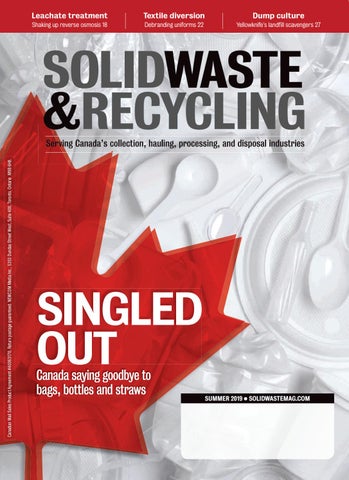
SINGLED OUT
Canada saying goodbye to bags, bottles and straws
SUMMER 2019 • SOLIDWASTEMAG.COM
We all want to run faster and get higher throughput. But at a certain speed, paper and light materials start to float around the belt. Until now. Introducing!
DEFT AIR
DEFT AIR provides a steady airflow to stabilize light materials on the conveyor. Conveyor can accelerate while Deft Air maintains the relative speed of the material, keeping it still on the belt. Optical sorters increase their accuracy, and you increase your throughput and purity.
We work on solutions for you every day!
203 967 1100 | vdrs.com | info@vdrs.com
SOLIDWASTE &RECYCLING is Canada’s trusted source for information on the collection, hauling, processing, and disposal industries.
SUMMER 2019 VOL. 24 NO. 2 Editor Emily Atkins emily@newcom.ca (416) 614-5801 Editorial Director John G. Smith johng@newcom.ca (416) 614-5812 Group Publisher Lou Smyrlis lou@newcom.ca (416) 510-6881 Creative Director Tim Norton tim@newcom.ca (416) 510-6881 Art Director Elaine Borg elaine@newcom.ca National Sales Manager Delon Rashid delon@newcom.ca (416) 459-0063
COVER STORY
SINGLED OUT Canada saying goodbye to bags, bottles and straws
NEWCOM MEDIA INC. 5353 Dundas Street West, Suite 400 Toronto, ON M3B 2S9 416/614-2200 • 416/614-8861 (fax)
CHAIRMAN AND FOUNDER Jim Glionna
PRESIDENT Joe Glionna
VICE PRESIDENT, PUBLISHING Melissa Summerfield
CHIEF FINANCIAL OFFICER Peter Fryters
Leachate management ............................... 18
Good vibrations Landfill saves big with innovative treatment
Departments Opinion .................................5 News......................................6
Textiles ........................................................ 22
Flying fabric
Innovations ..........................30
Repurposing uniforms diverts tonnes from landfill
DIRECTOR OF CIRCULATION Pat Glionna
Recycling ..................................................... 24
Shredding for efficiency
22
Pre-shredding parts for recycling speeds up processes at BMW plant Municipalities .............................................. 27
The salvage lifestyle Solid Waste & Recycling is published by Newcom Media Inc. The contents of this publication may not be reproduced or transmitted in any form, either in part or full, including photocopying and recording, without the written consent of the copyright owner. Nor may any part of this publication be stored in a retrieval system of any nature without prior written consent. Postmaster: Address changes to Solid Waste & Recycling, 5353 Dundas Street West, Suite 400, Toronto, Ontario M9B 6H8. Postage paid Canadian Publications Mail Sales Agreement No.40063170. ISSN No. 1483-7714. Printed in Canada.
Yellowknife's culture of 'shopping' at the dump
24
27 Summer 2019 3
BUT SOMEBODY HAD TO REINVENT THE REFUSE TRUCK.
The Freightliner EconicSD. Next-level safety. Prepare for exceptional safety. Offering an innovative driver environment built for maximum comfort and safety, the EconicSD™ also comes standard with the Detroit™ Assurance® collision mitigation systems and Side Guard Assist. Equipped with the powerful Detroit™ DD8™ engine, the EconicSD is available with side-, rear- or front-load SUITE OF SAFETY SYSTEMS NOW COMES STANDARD
options and offers groundbreaking visibility, pushing every limit of what a refuse truck can be.
To learn more, visit Freightliner.com/EconicSD
Competitive financing available through Daimler Truck Financial. For the Freightliner Trucks dealer nearest you, call 1-800-FTL-HELP. FTL/MC-A-1545. Specifications are subject to change without notice. Copyright © 2019 Daimler Trucks North America LLC. All rights reserved. Freightliner Trucks is a division of Daimler Trucks North America LLC, a Daimler company.
EDITORIAL
Wake up and smell the rot The recent media frenzy created by the diplomatic row over 100 containers of household waste masquerading as plastic for recycling has pulled back the curtain on the recycling industry for many in Canada. For the month of May 2019 the 'recycling crisis' dominated the news cycle. The posturing and drama created by Philippine president Rodrigo Duterte recalling his diplomats and threatening to dump the putrid containers in front of the Canadian consulate in Manila started mainstream media outlets digging into the recycling business. Good for them. People need to know what really happens to the plastics, diapers, food waste and all the rest that they casually toss in the blue bin. For too long it's been more of a 'black box' – it goes in the bin and disappears and we all feel good in the belief that it's being recycled. It's no secret that single-stream recycling programs create more contamination. And with the China 'ban' turning into a
'ban-wagon' as more countries introduce stricter import controls the pressure is on the major waste generators – like Canada – to clean up their act. The bottom line is that we only recycle about 10 percent of the plastic we dispose of in this country. The new ban on single-use plastics has been hailed as a positive step towards containing plastic waste (see "Canada's plastics ban" p.10), but the question remains how will it affect people's blue box habits and the market for recycled plastics. With less single-use plastic headed for the blue bin will people be more or less careful of what they discard? Will returnable containers end up in the waste stream instead because returns are a hassle? The creation and roll out of the plastics ban is going to take serious thinking and planning, hopefully with the full input of the waste disposal and recycling industries. Emily Atkins 416-614-5801 | emily@newcom.ca
SOLIDWASTE&RECYCLING E-NEWS Emailed news. Not recycled. Subscribe at www.solidwastemag.com
Visit solidwastemag.com Summer 2019 5
NEWS
Vehicle plastic recycling demo succeeds An end-of-life vehicle (ELV) recycling demonstration project has proved that recovering thermoplastic polyolefin (TPO) from ELV bumpers is feasible. Launched in 2015 in the U.S., the ELV Project was designed to study the viability of collecting and recycling plastic car parts, including car bumpers, to eventually be broken down and used as materials to make new products. The results of the final two phases of the project were recently released by
Ear End lybird s A Pric ug 15t ing h
Don’t miss
the summit that delivers! OCTOBER 16, 2019 International Centre 6900 Airport Road, Mississauga, ON
surfacetransportationsummit.com
REGISTRATION NOW OPEN!
6 www.solidwastemag.com
the Plastics Industry Association (PLASTICS). “Finding innovative ways to recycle and reuse plastics has a direct impact on the amount of plastic that ends up in landfills,” said PLASTICS interim president and CEO Patty Long. “By developing lasting, sustainable end markets for these materials, even those extracted from scrap cars and trucks, PLASTICS is giving scrap materials a new life through recycling.” Over the course of the three phases of research for the ELV Project, four plastic bales, from four different sources, were processed by three plastics recyclers across the U.S. Each bale sample met the range of quality that would make it eligible for use in a wide range of applications. From these findings, PLASTICS was able to create a directory of automotive recyclers who specialize in using ELV materials. Following phases II and III, PLASTICS will share case studies from the ELV Project. There is a vested interest from brand owners in using recycled ELV bumpers in their manufacturing and design process. “The results from the ELV Project indicate that there is technology and a market to recycle plastic from vehicles,” said PLASTICS’ vice-president of industry affairs Kendra Martin. “The properties of the material were very close to what we would see from a recycler – we saw a lot of promise in the material and we think if the collection and the stream can be scaled up, then there will be a lot of use for it in the market,” said Meagan Marko, product line manager for Noble Polymers, LLC, one of the member organizations involved in the ELV Project. Q
A million tons of fertilizer Biosolids and organics solutions firm Lystek International will have produced and sold more than one million tons of its LysteGro biofertilzer by the end of 2019. LysteGro is a U.S. EPA Class A quality, high solid, liquid biofertilizer produced through low-temperature thermal hydrolysis of diverted biosolids and organics. Together, Lystek-enabled treatment plants can produce over 395,000 tons annually. Q
SW&R founding editor opens consultancy Guy Crittenden, the award-winning founding editor of Solid Waste & Recycling, is returning to help organizations with their communication and strategic planning needs. Crittenden left his position in late 2014, to travel and write a book – The Year of Drinking Magic: Twelve Ceremonies with the Vine of Souls – that won the 2018 Silver Medal from the US Independent Book Publisher Awards. He also volunteered with the Amazon Rainforest Conservancy (ARC). As principal of Crittenden Communications he will help clients in sectors such as CleanTech, green energy, environmental services and sustainable packaging. Q
Athletes to climb plastic podiums
Plastics recycler expands to Ontario FedDev Ontario is contributing up to $3 million to Enviroplast Inc., a manufacturer that specializes in recycling plastic. Headquartered in Montreal, Quebec, the company is expanding its operations to Ontario by establishing a recycling facility using first-in-Canada technology in Vaughan. The new facility is expected to be operating by the spring of 2020, with new recycling lines capable of handling 11,000 tonnes of plastic annually. FedDev Ontario is providing a repayable contribution of $3 million towards Enviroplast Inc.’s total project cost of $10 million. This project will leverage up to $7 million in other private investment. Q
Apps for dinner Major Canadian grocery chains Loblaw and Sobeys have introduced systems for selling marked down produce and fresh items that are close to their expiry date. Each company has partnered with an app developer to build a system that lets consumers shop online for discounted food that’s still good but might otherwise be wasted. Through its subsidiary IGA, Sobeys launched the FoodHero app in Montreal, with plans to roll it out to five other stores then across the province. Loblaw also launched the Flashfood app across 139 Maxi and Provigo stores in Quebec. It plans to introduce the app to customers at more than 250 stores, including Real Canadian Superstore locations in Western Canada, Loblaws and Zehrs stores in Ontario, and all Atlantic Superstore locations. Both apps are updated with new food items daily, and allow customers to shop with their device and pick up orders in store. Both Loblaw and Sobeys have set a goal of reducing food waste in their operations by 50 percent by 2025. Q
For the first time in Olympic and Paralympic Games histories, all medal podiums will be created entirely from recycled materials. The Tokyo 2020 Podium Project is inviting Japanese to collect their plastic items, like shampoo and dish detergent bottles, and take them to various collection locations. P&G will handle the plastics and will also leverage recycled plastic waste recovered from the ocean to contribute to the creation of the podiums. The goal is to collect 1.5 million pieces of plastic packaging consisting of polyethylene and polypropylene plastic to produce recycled plastic resin. Together with the Tokyo 2020 organization, P&G is planning to unveil the podiums in June 2020. Once the Tokyo 2020 Games conclude, P&G’s intent is to recycle the podiums once again, to create new P&G packaging. Q Summer 2019 7
NEWS
Loop and Loblaw partner in Toronto The reusable packing partnership recently announced between Loblaw Companies and Loop, a subsidiary of New Jersey-based Terracycle that partners with retailers to reduce waste in their product and purchase cycles, will start in Canada with a single retailer based entirely in Toronto. From early 2020, pilot program participants will be able to shop for Presidents Choice products in reusable packaging through the Loop + Loblaw website. Similar integration is in use by Loop in partnerships in other countries, with Carrefour in France, Walgreens and Kroger in the United States, and Tesco in the UK, for example. Home delivery and pick-up via Loop’s reusable tote will be the only usage option at the outset, though both parties say that additional online integration and eventual in-store availability are longer-term goals. “In the next phase, products are ordered through a retailer’s website, and delivered and picked up in the same way,” says Lauren Taylor, global vice-president of creative and communications for Loop Global. “The future model is integrated in store, where the consumer buys the products in store and drops off empty containers.”
“Ultimately, our goal would be to have durable package options for customers shopping online and in our stores,” adds Catherine Thomas, senior director of external communication for Loblaw Companies Limited. Loop is currently active in Paris and New York and is preparing for launches in London, Tokyo, Germany and California as well as Toronto. Start-up and operating costs in the Canadian market have not been announced, and Loop is not able to provide estimates for how long its reusable containers will remain viable or how much waste will be diverted from landfill. “We don’t have an expected percentage of packaging that won’t be reusable,” Taylor says. “However, we do know that each package has a life cycle. Once it’s pulled from circulation, it will be recycled.” Taylor says that Loop’s goal is to reach a national scale in Canada, but Thomas offers a more conservative outlook. “Right now, we’re finalizing the details of a pilot in Toronto,” she says. “It’s premature for us to speculate beyond that.” Q
RECYCLE.AB.CA
Joint venture makes bio-plastics from diesel
LyondellBasell, one of the largest plastics, chemicals and refining companies in the world, and Neste, the world’s largest producer of renewable diesel from waste and residues, have produced several thousand tonnes of
bio-based plastics which are approved for food packaging production. The joint project used Neste’s renewable hydrocarbons derived from sustainable bio-based raw materials, such as waste and residue oils to
create bio-based polypropylene and bio-based low-density polyethylene at a commercial scale. The products are being marketed under the Circulen and Circulen Plus brands, the new family of LyondellBasell circular economy brands. LyondellBasell’s cracker flexibility allowed it to introduce a new renewable feedstock at its Wesseling, Germany site. That feedstock was converted directly into bio-based polymers. An independent third party tested the products using carbon tracers and confirmed they contained over 30 percent renewable content. Cofresco, a company of the Melitta Group and Europe’s leading supplier of branded products in the field of household film, plans to use the Circulen Plus bio-based polyethylene to create sustainable food packaging materials. Q
Planning to prevent injuries Implementing a musculoskeletal disorder (MSD) prevention plan at the organizational level can lead to a measurable reduction in work-related injuries, according to a case study presented by Ontario Power Generation (OPG) at the 2019 Workplace Safety and Prevention Services Partners in Prevention Conference in Toronto. The utility, which employs 10,000 people in various workplaces, faced an average lost time injury rate of 40 to 50 percent due to MSDs in the 1990s and early 2000s. Lisa Beech-Hawley, manager of OPG’s Health and Safety Program outlined the shift that took place within the company beginning in 2007. At that point, implementing an MSD prevention program was identified as a priority by leadership, and it was filtered down to workers using a systemic approach before becoming a fundamental building block of the utility’s culture. “People didn’t report hazards for MSDs proactively,” Beech-Hawley said. “They didn’t report them until after someone was injured. “This wasn’t a one-time fix-all. We did a lot of things, and we couldn’t have done it all at once. Eventually, all of it led to results.” The first stage, which Beech-Hawley said kicked off the process in 2007, was getting buy-in and support from senior
leadership for integrating an MSD prevention plan into the corporate culture and ironing out a prevention strategy implementation plan. By 2008 and 2009, MSD prevention training was mandatory for new hires, a series of safety meetings was rolled out to better inform workers on how to identify potential MSDs, and proactive reporting was encouraged. Between 2010 and 2012, a database of equipment was established to help workers better understand what was available to assist them at various job sites, and a separate database was created to track successes around ergonomic changes at workstations. Recently, new media have been employed to implement OPG’s iCare messaging platform through videos, internal communication apps, anniversary milestone recognition, and other tools. “We went from about 40 to 50 percent of all of our injuries being MSD down to about 23 percent,” Beech-Hawley said. “When we started this journey, everybody looked at the big, burly guy in coveralls, and if he complained about his sore knee or sore back, they called him a wimp. “Now, it might not be perfect, I'm sure, but people feel comfortable reporting.” Q Summer 2019 9
PLASTICS FEATURE
Singled OUT Canada C anada saying saying goodbye goodbye to to bbags, ags bottles botttless and d straws straws By Guy Crittenden
10 www.solidwastemag.com
he Canadian government has proposed a national ban on single-use plastics, to take effect as soon as 2021, after planned consultations with provinces and other stakeholders. The ban is intended to move Canada toward a sustainable “circular economy” and harmonize Canadian rules with a similar ban recently enacted by the European Union. (See sidebar, page 13) These actions also further the Canada-wide Zero Plastic Waste Action Plan which aims to coordinate waste reduction efforts among the provinces and territories. The plan contemplates assigning responsibility for the cost of collection and recycling of plastic materials to manufacturers and retailers. European-style extended producer responsiblity (EPR) is set to arrive in Canada. Announcing the ban, Prime Minister Justin Trudeau stated, “By recycling or reusing these plastics, we can reduce pollution, generate billions of dollars in revenue, and create approximately 42,000 jobs across the country.” Items proposed to be banned or for EPR management include plastic straws, cutlery (e.g., at fast food outlets), disposable takeaway containers, “balloon sticks” and Q-tips, and shopping bags. Also mentioned were polystyrene foam and plastic bottles. The list is expected to expand. The announcement was received favourably by most stakeholders in government and industry, who recognize the writing is on the wall for convenience materials that consume non-renewable fossil fuels, contribute to greenhouse gases, and may enter the world’s oceans where they contaminate ecosystems. Experts say that by 2050 there’ll be as much plastic in
Innovative solutions the ocean as fish. Even the plastics producers are onboard. “Plastics are key to our modern and sustainable way of life, but they do not belong in the environment,” said Carol Hochu, president of the Canadian Plastics Industry Association (CPIA). “We understand the urgency of the problem and are committed to being part of the solution.” However, replacing single-use plastics poses practical challenges for certain industries and will impact commercial and municipal recycling programs.
Scope of the problem Canadians produce over three million tonnes of plastic waste per year. According to Greenpeace’s Sarah King, only about eight or nine per cent of this waste is diverted to recycling, and not all of that even gets recycled (due to contamination). In addition to harmonizing Canada’s rules with those of the EU, impetus for a ban comes from the recent closure of markets in Asia that will no longer accept shiploads of this material. (See editorial, page 5.) According to the Recycling Council of British Columbia (RCBC), the three million tonnes of plastic waste Canadians toss represents around $8 billion in lost value each year. A third of all plastics used in Canada are single-use items and packaging. The numbers are staggering: they include up to 15 billion plastic bags annually and more than 50 million straws used on a daily basis.
Challenges and opportunities The primary plastics and petrochemical industries have been preparing for a ban for some time. For instance, Nova Chemicals Corp. supports efforts to encourage more recycling, and is proceeding with a $2-billion expansion of its Sarnia, Ont. polyethylene complex, now under construction. In central Alberta, Inter Pipeline Ltd. and Pembina Pipeline Ltd. are both building projects to turn propane into polypropylene plastic at a cost of $3.5 billion and $4.5 billion respectively. The forest products industry hopes to
A number of companies are poised to capitalize on providing technical solutions to organizations that will need to reduce and even eliminate plastics from their products and packaging. Here are just a few: Carbon Engineering in Squamish, BC (carbonengineering.com): Has a technology that pulls carbon from CO2 in the air and converts it into a plastic product. Copol International in Sydney, Nova Scotia (copolinternational.com): Winner of the Canadian Plastics Innovation Challenge, this firm is developing biodegradable food packaging. Loop Industries in Terrebonne, Quebec (loopindustries.com): Commercializing a chemical depolymerization process to break PET into its monomers (ethylene glycol and dimethyl terephthalate) for remanufacturing PET. Pyrowave Inc. in Montreal, Quebec (pyrowave.com): Uses a proprietary microwave depolymerization technology to recover styrene monomer from post-consumer polystyrene for the production of polystyrene. Enerkem in Montreal, Quebec (enerkem.com): The company’s facility in Edmonton, Alberta employs a gasification process that recovers the hydrocarbons in waste, and converts them to methanol and ethanol which could be used as inputs to plastic production.
capitalize on the changes. Domtar paper has shifted to making specialty paper products, such as the takeout bags at Tim Hortons, and certain single-use plastic items like coffee stir sticks can be substituted with wooden ones. Cardwell Grove senior policy analyst Usman Valiante said in an interview EPR is a kind of property rights scheme that won’t just affect recycling programs; it will change what kinds of materials producers choose for their products and how they use them. “They‘ll design packaging that’s easier to recycle,” he said, “or at least reduce the amount of plastic used.” Valiante authored a timely report for the Ottawa-based Prosperity Institute. A Vision for a Circular Economy for Plastics in Canada: The Benefits of Plastics Without the Waste and How We Get It Right, released in February, sets out an all-encompassing and practical plan for accomplishing the government’s
plastics ban and related goals. Valiante refers to the “decarbonization” of the economy and the coming evolution of a sustainable lifecycle for these modern materials. He acknowledges that change will not be easy for plastics, not least because “downcycling” means a sizeable portion of recovered plastic is only recycled once before disposal.
Municipalities According to Dave Gordon, senior advisor-waste diversion, with the Association of Municipalities of Ontario (AMO), recycling costs are steadily increasing and performance has stalled for municipalities already dealing with challenges from disposal capacity. “Local governments also face increasing challenges from a rapidly evolving and ever-more complex packaging stream,” Gordon said. “AMO welcomes EPR for the Blue Box.” Summer 2019 11
There’s no such thing as a slow summer in the trucking business. The Mobil Delvac 1™ range of synthetic engine oils helps protect your fleet and your business by extending oil drain intervals.
See all of our oils at mobildelvac.ca
PLASTICS FEATURE
The EU Directive Industry observers know changes in the waste stream composition will require technical and other alterations in municipal and commercial programs. A reduction in plastics will create space in recycling bins for other materials. But the real gains will stem from the shift to EPR and solutions such as material substitution and design for the environment (DfE). The Blue Box was arguably the answer to “How can we recycle more?” and “How can we divert more materials from disposal?” Today, the question is more “What would a sustainable society look like?”, which is leading to a shift away from municipally-led end-of-life management for packaging and other materials, in favour of performance targets for industry, to harness the innovative creativity and efficiency of the market. Fresh ways of doing things are already emerging. (See item on Loop’s container reuse program, page 8.) EPR for the Blue Box already exists in British Columbia. “EPR programs,” Usman Valiante comments, "achieve some of the highest rates of recycling in Canada.” In 2017, 73.9 percent of plastic beverage containers supplied into BC were collected and managed by Encorp Pacific via a deposit-return system. The BC Used Oil Management Association (BCUOMA) recovers and recycles 82.5 percent of plastic used oil and antifreeze containers in the province. The RecycleBC program has induced $20 million in capital investments. George Heyman, BC’s Minister of Environment and Climate Change Strategy, said his is the only province in Canada where industry is 100 percent financially responsible for the collection and recycling of materials introduced into the marketplace. “British Columbians lead the nation in recycling, served by 22 industry-led recycling programs,” he said in a statement. “Every year, 315,000 tonnes of plastics are diverted from BC’s landfills to be recycled in BC, which means the vast majority are not shipped elsewhere to be processed, and they no longer
Canada’s proposed single-use plastics ban — while still short on details — is modelled on the European Union’s wide-ranging ban that the European Parliament supported in this March in a 560-35 vote. The directive bans 10 of the most common forms of plastics found on Europe’s beaches, with other measures to come. The ban takes effect in 2021 after it’s passed by all the EU legislatures. The ban includes: single-use plastic cutlery (forks, knives, spoons and chopsticks); single-use plastic plates; plastic straws; Q-tip sticks made of plastic; plastic balloon sticks; and, Oxo-degradable plastics and food containers and expanded polystyrene cups. The ban doesn’t include plastic bags, which were already covered by a 2015 European directive that requires member states to limit their use. It requires member countries to reduce the use of plastic food and beverage containers and to introduce more stringent labelling for products like wet wipes, sanitary napkins and cigarette filters, explaining the environmental impacts of improper disposal of these items (that some people don’t realize contain plastic). Some other products will not be banned but subject to new design and label requirements, while producers will be under tougher waste management obligations to minimize their use. The legislation aims to achieve a 90 percent recycling rate for plastic bottles by 2025. By that same year, at least a quarter of plastic bottles must be made from recycled material. Bottle caps will need to be attached to their host bottles so as not to get separated and evade the recycling process. In 2029 plastics producers must contribute to the cost of litter cleanup. The European Commission created a 54-point plan to shift towards a circular economic model in 2015 and learned in March 2019 that all 54 measures had been put in place by member states. The EU has estimated the changes will cost the bloc's economy €259 million to €695 million per year ($291 million to $781 million.) The European Parliament has said plastics production is now 20 times higher than it was during the 1960s.
pose a threat to our environment.” Most municipalities applaud BC’s program, but want EPR to be implemented properly. “Ultimately we’d like to combine the best practices from different jurisdictions,” Dave Gordon said. “We know the process must be iterative and all the desired changes won’t come immediately.” Gordon suggests programs need accessibility targets and transparency for establishing, measuring, reporting and verifying performance. Programs need properly resourced oversight and an enforcement mechanism or body. While mainstream media has focused on the ban on items like plastic straws,
any requirement to achieve high diversion rates (e.g., 90 percent) for plastic beverage containers will compel provinces like Ontario to adopt a deposit-return system for used non-alcoholic beverage containers. Ontario is one of only two provinces without such a system, though its beer, wine and spirits containers are on deposit. This will alter what’s in the Blue Box considerably. Coincidentally, a report released in June entitled Better Together from Eunomia Research and Consulting found, contrary to previous assumptions, that a deposit-return system for non-alcoholic beverage containers, alongside improvements in the Summer 2019 13
REGISTER TODAY Global Waste Management Symposium The #1 Resource for Solid Waste Management Research & Content
February 23 – 26, 2020 Hyatt Regency Indian Wells Resort and Spa Indian Wells, CA
*'$ ./ ) 4 '$)" -. 1 Ѻ "$./ - 2$/# * р /* . 1 ‫ڦ‬фп / 222ѵ2 ./ .4(+*.$0(ѵ *( */ ǻ $. *0)/. ))*/ *( $) ) /#$. $. !*- ) 2 - "$./- /$*). *)'4ǹ
Powered by:
Strategic Partner:
PLASTICS FEATURE
Blue Box program, would recycle an additional 118,000 tonnes of materials every year, while generating overall savings of $12 million for Ontario. Clarissa Morawski is managing director of the European consulting firm Reloop, which played a role in developing the new EU Directive and sponsored the Eumonia study. “What’s different now compared to a few years ago is new technology like reverse-vending machines that make it easy for consumers to redeem containers for deposit,” Morawski says. (For instance, special bar codes can be generated for each customer.) “Plus, the major brand owners are getting on board with deposits as they realize it’s the only way to hit high diversion rates and get back the clean recycled material they need,” she says.
Supermarkets & restaurants Supermarket chains and grocery stores will be impacted by a single-use plastics ban, especially in regard to the plastic wrap used for vegetables (without which spoilage rates may increase) and such things as meat trays. Grocery industry association reps say the cost of non-plastic packaging is generally more expensive. For instance, a compostable meat tray currently costs about 10 cents per unit, whereas traditional Styrofoam costs only about one cent. The new corn-based packaging costs about four cents. A ban on plastic grocery bags, or EPR for their full lifecycle management, is a game changer, and a vibrant debate is likely to ensue since some experts say bag bans may actually increase plastic use as customers switch to reusable bags that they may use only a few times. The implications of a single-use plastics ban may be more dire for fast food restaurants, which have enjoyed the multi-decade privilege of providing “convenience” to customers without commensurate responsibility for the downstream impact of their packaging. Still, leaders in the space know bad publicity isn’t good for business, especially
with initiatives such as the Canadian Plastic Polluters Brand Audits finding the top five polluting corporations to be Nestlé, Tim Hortons, PepsiCo., The Coca-Cola Company and McDonald’s. Restaurants Canada (the trade association of the foodservice industry) recommends a number of strategies to reduce wasteful single-use items in its members’ outlets. As well, it advises members to be aware of the types of different plastic and their relative merits and drawbacks. Conventional plastics, biodegradable (or Oxo plastics, which are banned in some places) and “bioplastics” (made from natural substances such as corn starch
In the US and Canada, these three companies accounted for 64 percent of all plastic pollution identified in clean-up operations, according to the campaign group’s analysis. In response, these companies are among 250 major brands pledging to cut all plastic waste from their operations. Starbucks and McDonald’s have teamed up to build a better cup that can be both recycled and composted. Their new cup will be shared open source and not proprietary. In December 2018, Nestlé announced the creation of the Nestlé Institute of Packaging Sciences to develop sustainable packaging materials and
“By recycling or reusing these plastics, we can reduce pollution, generate billions of dollars in revenue, and create approximately 42,000 jobs across the country.” or vegetable fats/oils) have benefits and attendant problems. “Compostable” plastics go further than simply breaking down: they provide the earth with nutrients in the form of compost or humus. But what’s acceptable differs from one compost facility to the next. Plastics with recycled content (postconsumer or post-industrial) are viewed positively as they create demand for materials collected through residential recycling programs.
Major brand owners The impact of eight million tonnes of bottles and plastic waste entering the oceans each year has driven international developments such as a partnership between The Ellen MacArthur Foundation and the United Nations Environment Programme (UNEP). Three of the brands that have signed up to the partnership’s commitment – Coca-Cola, PepsiCo and Nestlé – were recently named the world’s worst plastic polluters, according to an index by the Break Free From Plastic movement that analyzed 187,000 pieces of waste collected in 42 countries.
collaborate with industry partners to scale-up research and innovation. Through the institute, Nestlé is forming partnerships with packaging specialists including Danimer Scientific and PureCycle Technologies. The company began eliminating all plastic straws in its products in February, and plans to transition its Nesquik chocolate milk brand from plastic to paper. Nestlé has pledged to eliminate all single-serve plastic from its water production lines and make all packaging recyclable or reusable by 2025. With 100 different water bottling operations in 34 countries, each capable of producing up to 1,200 bottles per minute, that's a significant reduction. Canada’s proposed single-use plastics ban (however it plays out) is part of a global change that’s well underway, and will help the country not only clean up the environment but also remain competitive. Guy Crittenden is principal of Crittenden Communication, which specializes in writing and marketing for clients in the environmental sector. Summer 2019 15
THE FLEET TECHNOLOGY SHOWCASE October 28-31, 2019 • Georgia World Congress Center, Atlanta, Georgia
nacvshow.com
KEEP YOUR FLEET IN
THE FAST LANE CAN’T-MISS NEW SHOW FEATURES
³ Connectivity Zone ³ ‘Ask the Expert’ Workshops ³ 3 On-Floor Education Theaters ³ Off-Floor Conference Programs
REGISTER NOW with code
40-*%8"45&19 for your free expo hall pass!
The biggest class 4-8 vehicle manufacturers in one place 500+ exhibitors 530,000 sq. ft. of exhibitors expanded to two halls Enhanced educational programming
LEACHATE MANAGEMENT
Good Vibrations New Zealand landfill saves $1.6 million a year with innovative onsite leachate treatment By Greg Johnson
O
ne of the most important problems with designing and maintaining a landfill is managing the leachate generated when water passes through the waste. The leachate consists of many different kinds of organic and inorganic compounds that may be either dissolved or suspended. Regardless of the nature of the compounds, they pose a potential pollution problem for local ground and surface waters.
Landfill risks Landfills around the world manage leachate differently. Some in developed areas are allowed to haul and discharge to the public sanitary sewer. In this case, the leachate is diluted with town sewage water and then treated using conventional means and discharged to surface waters. By diluting the high strength leachate with town water, conventional biological methods are relatively effective. However, there is a cost for hauling and a tipping fee for disposal when this method is used. Also, the willingness of town sewer treatment plants to accept this waste is always a risk for landfill operators. Some landfills are told to pay more for discharge, or are given limits on certain pollutants that can cause problems for the town biological system. Some landfills simply store the leachate in large ponds that keep getting bigger and bigger. In undeveloped areas, landfill operators might use whatever means are necessary to get rid of the waste, including discharging 18 www.solidwastemag.com
The North Waikato Regional Landfill (NWRL) near Auckland New Zealand was using large holding tanks to store leachate.
New Logic supplied a pilot Vibratory Shear Enhanced Processing (VSEP) system for testing with the landfill's leachate.
Credit: New Zealand government
raw waste to rivers or spraying on surrounding land. Some landfills have tried to reinject leachate into the landfill with a closed circuit set up where the hydraulic loading continues to increase. Landfill failures caused by this have occurred many times, even causing fatalities, as was the case in Bogota, Colombia in 1997.
Onsite treatment Because of these risks, landfills have sought onsite treatment options. Sequential Batch Reactors (SBR) are a type of activated sludge biological treatment system that can be used. This method will treat the effluent, but may not produce water that can be discharged to local surface waters. Thermal evaporation is a second option, although this may require special air discharge permits and can be expensive to operate unless methane gas from the landfill is available and can be used as the energy source. Reverse Osmosis (RO) membranes are able to remove all types of pollutants from the leachate. However, conventional spiral membrane modules have many limitations on what can enter the membrane elements. These spiral membranes are almost never used for leachate treatment because of the very extensive pretreatment of the effluent that is required.
Mounting costs The North Waikato Regional Landfill (NWRL) near Auckland New Zealand was facing mounting costs for leachate disposal. This landfill is a state-ofthe-art, lined sanitary landfill that will cover an area of 87 hectares and will be filled to a depth of 70 metres when completed. It opened in 2005. It was collecting and storing leachate in large holding tanks. The leachate was then transported by truck and discharged to a local town sewage treatment plant. The initial volume of leachate from
The Black Mudfish is an endangered species that inhabits the streams where the processed leachate is discharged.
the landfill was about 150 cubic metres per day and the cost for hauling was about $19 per cubic metre resulting in an annual cost of about $1 million for leachate disposal. Each year, with the expansion of waste volume and land area used, the volume of leachate expands as well. It was expected that the volume could reach 300 m3/day with a cost exceeding $2.2 million by 2020. The owner and operator of the landfill, EnviroWaste, began looking at onsite treatment options for the leachate in early 2013. They considered biological treatments such as SBR digesters; physical/chemical methods; thermal evaporation using landfill gas for energy; and, membranes. The landfill had a methane gas capture and purification system in place. Evaporation was not favoured because it would consume a significant portion of the gas produced, diverting it from its intended use making electricity supplied to the national power grid. Another critical factor was that the treatment method used for this landfill would need to reduce ammonia and boron to very low levels for surface water discharge. For that reason, the biological and the chemical/physical options were removed.
Vibration to the rescue The next option considered was a reverse osmosis membrane. New Logic Research manufactures a Vibratory Shear Enhanced Processing (VSEP) system to eliminate fouling problems. The VSEP membrane module vibrates the membrane back and forth in an oscillating motion, reversing direction 50 times per second, to create massive shear right at its surface. This design also has a wide channel between the membranes to allow for high suspended solids loading without plugging. In August of 2013, New Logic supplied a pilot VSEP system for testing with the landfill's leachate alongside three polishing spiral RO units using a Boron selective membrane. Results from the primary VSEP RO unit and showed that the system could achieve the desired targets for treated water for surface water discharge. With these results, EnviroWaste applied for a discharge permit. The discharge was to be to two small streams in close proximity to the landfill that would flow through storm water retention ponds. A study was done on the aquatic life inhabiting these streams. A little fish called the Black Mudfish was the primary concern. Due to Summer 2019 19
150 TONS OF MUNICIPAL SOLID
WASTE SHREDDED IN 3 HOURS
INDUSTRIAL
SHREDDING EQUIPMENT {
wood waste | construction and demolition debris | pallets | railway ties cable reels | paper rolls | green waste | mattresses | tires | aluminum e-waste | white goods | food waste | domestic, industrial & bulky waste
{
EXCLUSIVE NORTH AMERICAN PARTNER OF HAAS RECYCLING SYSTEMS
HAAS TYRON 2000 XL is the perfect tool for high volume waste reduction. With adjustable shaft speeds and independent shaft control in both forward and reverse, you can make quick work out of even the toughest materials.
Contact one of our experts today! 1.800.465.3214 | Shred-tech.com Follow us on:
LEACHATE MANAGEMENT
Testing showed the leachate would not harm the Black Mudfish.
a decline in habitat, this fish is endangered and is on a watch list for controlling populations. The environmental consultant reviewed the water quality the VSEP system would produce and determined there would be no harm to the Black Mudfish or other aquatic life. The regulatory agency issued a permit for discharge with the following limits: Parameter Conductivity (mS/m) Boron Sodium Iron Ammonia
Maximum Value 20 < 0.5 mg/L < 1.0 mg/L < 0.2 mg/L < 0.5 mg/L
Construction began on the VSEP treatment plant in November of 2015 and the final system installation and commissioning occurred in June of 2016. The plant consisted of a six-module VSEP system as the primary stage of filtration, followed by four stages of RO spiral membrane systems. At the time of commissioning, the plant was processing 450 m3/day of raw leachate with no pretreatment.
Removing the water The VSEP technology was proven to be an effective means of onsite treatment of the leachate, processing more volume than was needed and achieving 65 percent recovery of treated
water that could be discharged to the local streams. VSEP was able to meet all of the discharge limits and produced especially low levels of boron at 0.015 mg/L (with a 0.5 mg/L limit) and ammonia at 0.11 mg/L (with a 0.5 mg/L limit). The VSEP permeate has the added benefit of being used during dry periods for dust control. About 35 percent of the volume does remain as a concentrated leachate. One option considered to address this waste was to evaporate it. This evaporation option was improved because the evaporator size and gas consumption would be much lower, having to evaporate 35 percent of the volume instead of 100 percent. Continuing to haul this remaining leachate was also considered. At present, the VSEP concentrate is being recirculated back to the landfill. Envirowaste may consider the evaporation option in the future if this recirculation of leachate proves to be more difficult than expected. Nearly all of the other 24 VSEP leachate projects installed use a similar method of recirculating the concentrate. The problem with leachate in a landfill is that the volume keeps growing. Rainwater gets in and moisture from the trash adds water to the volume. There is no outlet for this water. The salts and other materials in the leachate are a fixed amount. So the problem is really a water balance issue. Having plastic
liners, landfills are like giant water balloons. If the liquid volume gets to be too great they can burst. You can store leachate in ponds, but as the volume of leachate increases, the pond size must increase. What VSEP can do is to remove water at the same rate or at a faster rate than it is arriving to the landfill. Think of the leachate collection system as a giant batch tank. Except this batch tank constantly has water added to it from rainfall. So if the VSEP acts like a kidney and just pulls water out of the loop, the materials and solids do not concentrate in the collection system because VSEP is removing water at the same rate it arrives. The decision to install the VSEP system has saved EnviroWaste a great deal of money. The VSEP treatment costs are projected at $4.35/m3 compared to the $19/m3 that was paid previously. When processing 300 m3/day, the company is saving $1.57 million per year. The total installed project cost was about $4.35 million and the investment will pay for itself in about 2.8 years. Since the system has now been installed and running for three years, the company is already benefiting from these cost savings. Greg Johnson is a chemical engineer and CEO of New Logic Research (NLR). He has been responsible for the development of the VSEP technology since 1992. Summer 2019 21
TEXTILES
Flying fabric Air Canada repurposes uniforms to divert 66 tonnes of clothing from landfills By Catherine Leighton Kelly, a volunteer at Brands for Canada 'debrands' uniforms.
U
pdating a corporate logo is a great way to modernize a company’s image and reflect the evolution of the brand. But for a company that also wants to maintain an image as a sustainable brand, rebranding can be risky, as it may require scrapping assets already in inventory. Organizations typically have detailed guidelines in place to ensure their logos are always displayed in the proper formats. Once a brand has been updated, all items with the former logo and colour scheme need to be recalled, and require end-of-life management. Reutilizing clothing with old logos is challenging because companies are reluctant to allow products with outdated branding to remain in circulation. Partners in Project Green member Air Canada faced this challenge after re-designing their logo in 2017. The airline needed to update a wide range of products featuring the old logo and colour scheme. This included the company’s uniforms – material with outdated branding that the company nevertheless wanted to keep from ending up in landfill. 22 www.solidwastemag.com
The clothing consisted primarily of business-style attire: collared shirts, blouses, dresses, blazers, and dress pants. It would clearly be of great value to various agencies, employment centres and other organizations dedicated to helping members of vulnerable communities find work. But for security reasons, Air Canada could not donate items that displayed their branding. Air Canada logos could be used to impersonate staff, and allow unauthorized persons access to secure areas at airports. Faced with this challenge some companies might have thrown up their hands and taken the easy route of shipping the material to landfill. Air Canada, however, was committed to finding a sustainable solution. With the help of Partners in Project Green’s Material Exchange program, the airline connected with Brands for Canada, a charity that provides new clothing and personal care items donated by participating brands to people living in poverty. “At Air Canada, we work to leave less waste behind from our operations and do more in our communities,” said
Chelsea Quirke, manager, environmental management waste programs for the airline. “When it came time to change to our new uniforms, we worked with Partners in Project Green and Brands for Canada to ensure that our uniforms were handled securely and in an environmentally sustainable way.” “It was particularly important to us and our employees that the uniforms did not end up in the landfill,” she added. “Through the program with Brands for Canada, we are able to ensure that our uniforms are given a second life and that we’re giving back to the community.” Brands for Canada distributes these materials through selected social service agencies serving a wide variety of people in need: abuse survivors, the homeless, at-risk youth, immigrants and refugees, people living with physical or mental disabilities, and individuals enrolled in job training or job search programs. With one in seven Canadian families living below the poverty line, Brands for Canada works with over 200 brands to donate $42 million worth of clothing and personal care items to families each year. “Brands for Canada is extremely
After the logos were removed, pilots' uniforms were transformed into classic dark suits.
“Through the program with Brands for Canada, we are able to ensure that our uniforms are given a second life and that we’re giving back to the community.” excited about our new program with Air Canada. This exceptional donation of new coats, work wear and business attire will provide invaluable care packages to help support thousands of Canadian families living below the poverty line,” said Helen Harakas, executive director of Brands for Canada. Brands for Canada has the capacity to de-brand donated materials by removing or covering up logos. For example, they remove shirt collar tags and return these to the donating organization to maintain brand integrity. When it is not possible to remove a logo entirely, Brands for Canada can create a new look by removing or embroidering over signature components of the original design. Brands for Canada used more than 10 different de-branding techniques to cover up or remove the old Air Canada logo from the donated uniforms.
During the process, Brands for Canada developed design concepts and samples for Air Canada’s inspection, to confirm confidence and ensure that security around the logo was addressed. For Air Canada pilot jackets, Brands for Canada carefully removed the gold brocade, the gold buttons and colour tag, transforming the uniform into a traditional dark suit jacket. Flight attendant dresses proved a little more challenging as Air Canada logos were embroidered directly onto the fabric, and could not be removed without damaging the clothing. To get around this obstacle, Brands for Canada developed a new embroidery design, a Celtic knot, to conceal the logo. Air Canada sent four truckloads of goods – approximately 50,000 items in all – to Brands for Canada. The exchange diverted approximately 66 tonnes of clothing from the landfill.
Chelsea Quirke (r), manager, environmental management waste programs at Air Canada and Seamus Clarke, a longtime Brands for Canada volunteer and CEO of United in Change. United in Change provides services and support to Brands for Canada.
Overall, Air Canada’s textile program has diverted 284 tonnes of material, equivalent to roughly the weight of two empty 787-9 Dreamliner jet airliners. Once the material was de-branded, Brands for Canada used their distribution channels to donate the clothing to community groups in Ontario, Quebec, Manitoba, and British Colombia. “This Material Exchange demonstrates how collaboration between Partners in Project Green members can greatly benefit both parties and improve sustainability,” says Dianne Zimmerman, senior manager of Partners in Project Green with the Toronto and Region Conservation Authority (TRCA). “We are proud of Air Canada’s commitment to finding sustainable solutions for their textiles, and thrilled that Brands for Canada was able to develop such innovative de-branding solutions to ensure this material was properly re-used. Catherine Leighton is coordinator, waste management, Partners in Project Green, Community Engagement and Outreach, Toronto and Region Conservation Authority. Summer 2019 23
PROCESS IMPROVEMENT
Shredding for efficiency BMW plant finds pre-shredding aluminum scrap saves time and space By SWR Staff
I
n the light alloy foundry at the BMW Group's plant in Landshut, Germany, all scrap products such as punching waste and sprue systems are recycled and then remelted. But the process in place recently was unwieldy. The scrap was manually collected in containers and removed from the basement of the foundry. The process was labour-intensive and because the parts were large – up to two metres by 1.4 metres – the collection bins needed frequent emptying. The light alloy foundry at the BMW Group plant in Landshut is one of the most modern foundries in the world. Every year, around five million aluminum casting components, such as engine parts or structural pieces for the vehicle body, are produced there using five different casting processes, with a total weight of 84,000 tons. As in all areas of the company, the aluminum foundry works with maximum efficiency in order to keep the scrap rate as low as possible. So, when it came time to renew the casting cells in the foundry hall, the company took the opportunity to look at the processes as well as the equipment involved.
A custom solution
The shredded material now takes up less than half the volume of the scrap in the old system.
24 www.solidwastemag.com
Erdwich Zerkleinerungs-Systeme GmbH from Igling in Upper Bavaria, Germany, has decades of experience in the construction of recycling plants. It got the order to plan and commission the metal shredder. But when their staff arrived on site they found a surprise. Richard Adelwarth, project manager at Erdwich Zerkleinerungs-Systeme GmbH, reports: "When we visited the site, it quickly became clear that the solution requested in the project tender would not have the desired effect. We carried out many trials and consulted another company in the industry in order to be able to offer an optimum solution.” The project brief was to design a plant that enabled the collection and shredding of the foundry's aluminum waste
directly from the press. For this task, the recycling expert adapted an RM 1350 pre-shredder to the local conditions. This machine is characterized by fast and easy maintenance, long service life, optimum shredding and high throughput. To date, seven systems with soundproof enclosures have been installed for the eight casting cells and punch presses in the plant. "Loading takes place in free fall. The moulds, which are to be returned to the melting process, now fall from the pressing plant directly into the hopper of the pre-shredder and then into a container measuring 1.4m by 1.4m by 90 cm," Adelwarth explains. When the container is full, it is transported outside, emptied into a large container; and this in turn is brought to the smelter. The shredding process has reduced the volume of cast parts by 50 to 60 percent, which means that the disposal containers have to be emptied far less frequently and thus require less time and manpower. The pre-shredders were adapted to the special conditions prevailing on site. The drives of the machines, for example, had to be mounted on one side instead of the usual two to accommodate the columns of the building, which were located in the installation area and therefore required a narrower design. In addition, the crushing tools themselves and their arrangement within the cutting chamber were adapted to the on-site conditions.
Safety modifications In cooperation with the technical department of the BMW Group, Erdwich also developed a sophisticated safety system for monitoring the condition of the machine. The standard version of the RM 1350 already has a safety system. This includes a PLC controller with automatic reverse and cut-out control, so that the machine is protected from damage in the event of overload or bulky solid parts. In addition, each shaft is equipped with an energy-optimized frequency
The shredder's housing had to be adapted to the site.
The RM 1350 shredder was adapated to work best with the BMW plant's processes.
converter, which ensures that the two cutting gear shafts are driven separately. This enables optimum adaptation to the shredding process. The safety system was extended with new custom features. "Both the filling level of the removal box located in the basement and the monitoring of the shredder itself are now displayed transparently, so that a quick response can be made if necessary," Adelwarth said.
Future potential With all the casting cells replaced, a conveyor belt system could be installed to further optimize the disposal process. With the conveyor system the
shredded rejects would no longer to be collected in containers that have to be removed and emptied by hand. Instead, the rejects would be transported directly into the large container via a conveyor belt. In this way, scrap products and punching waste from all casting cells could be disposed of simultaneously and without additional effort or manpower. As for the work completed, the BMW foundry has gained efficiency by reducing the number of person hours required to move the scrap metal to the remelting location. Choosing to shred the material as it comes off the press has streamlined operations and improved safety at the same time. Summer 2019 25
NEED MARKETING? AD VE RTI S I NG S TR ATE G Y ❘ PR OMOTION S ❘ DESIG N ❘ VIDEO
USE THE INDUSTRY’S CREATIVE EXPERTS! Whether you need impactful branding, well thought-out advertising, lead generating promotions, videos with “wow” or SEO, we’ve got the talent, know-how, and expertise to meet your marketing objectives. Not only do we publish Solid Waste & Recycling magazine, our experts can apply their knowledge to connect you with your target audience.
SEE WHAT WE CAN DO FOR YOU N E W C O M . C A / C R E AT I V E C R E AT I V E @ N E W C O M . CA
Credit: Still from the documentary Salvage.
MUNICIPALITIES
Perusing the Yellowknife dump.
The salvage lifestyle Yellowknife's evolving culture of 'shopping' at the dump By Dean Campbell
W
hen filmmaker Amy Elliot showed up in Yellowknife for the first time in 2009, she arrived after finding and reading a series of articles called “Tales from the Dump” by Walt Humphries, a longtime Yellowknife local, and an ardent salvager at the city dump. “I have always been interested in the transitory nature of stuff,” said Elliot. That curiosity led her to discover that Yellowknife had a thriving culture of salvaging items from the dump. Hailing from New York, it was a long way to go for a story, but Elliot had been
unable to find a closer option. Over the next five years, she made multiple trips to film the evolving story of the dump and its transition from a freewheeling past to a more carefully managed present. The story is showcased in her new documentary, “Salvage”.
Frontier mentality Understanding the tradition of salvage in Yellowknife demands an understanding of the city’s history as a frontier outpost up to its current stature as the capital city of the Northwest Territories. Yellowknife was home to a tough, self-sufficient
culture where repair, reuse, reimagination, and repurposing were all used to take an object well beyond its typical expected lifespan. But as larger corporations began to set up offices and bring staff to Yellowknife, southern ways of doing business began to influence the city. Salvaging became more of a taboo and now many choose to order from Amazon what they can’t buy in town. The days of citizens being able to freely roam the dump came to a close as the city implemented what it calls a 'three-cell' system. Items deemed worthy of salvage are organized into three areas within the dump. At any given time, one cell is open to the public, while the other two are either emptied or filled by dump staff using heavy equipment. The process isn’t ideal, but the city feels the situation is safer now. Summer 2019 27
October 9 – 10, 2019 Enercare Centre, Toronto, ON www.cwre.ca
VISIT US AT WASTE EXPO E XPO BOOTH #2648 #26 48
Canada’s ONLY trade show serving the waste, recycling and public works markets Register for your FREE Expo pass at www.cwre.ca/ads1
co-located with
Credit: Still from the documentary Salvage.
MUNICIPALITIES
Safety concerns Michael Auge, manager of sustainability and solid waste, grew up in Yellowknife and can recall the free-for-all nature of the dump in the past. He pointed to greater concerns over safety as perspectives have shifted over the years. “We’re in a more litigious society now,” said Auge. “The three-cell system isn’t complicated and allows us to keep visitors away from our machinery to cut down the risk. At the same time, there are opportunities to do things better.” Sorting things to go into the salvage area depends on the judgment of those dropping off garbage, so a lot of items that might have been salvaged previously never get to the three cells. Construction and demolition materials are not included in the salvage area, but Auge has seen first-hand how much could be reused from that section of the dump. “The more waste we can get out of the landfill, the better,” said Auge. “There are lessons we can take from both inside and outside of the solid waste industry. Places like ReStores are an ideal way to reroute things that otherwise would end up at the dump.” Financial constraints have also hampered efforts that could help divert material, though Auge sees a clear need that could really improve the practice of salvaging or prevent items from showing up in the garbage in the first place. “We need more resources and people who can help educate the public on what can be salvaged and how to sort refuse,” he said. One such person might be Humphries, a prospector and Yellowknife resident, and the author of the “Tales from the Dump” column. “It takes a lot of effort to find and operate a mine, and process material into finished products,” said Humphries. “People throw things away every day without realizing the value of that metal and how we could recycle it.” Appliances, clothing, non-perishable foods, car parts, and many other items
Salvager Al Shearing prepares to go on the hunt at the Yellowknife dump.
were routine finds in the past, but often go uncaptured in the current system. “We’ve started a food rescue program because we were able to prove food was going to waste,” said Humphries. “But what happens to valuable things in dumps where there is no salvaging? Are employees pocketing the stuff to sell it? That’s lost revenue for the city.” Humphries is optimistic about the new leadership at city hall following a recent municipal election. Where the previous council was strict in cracking down on salvaging, Humphries is quietly hopeful the new council will be better allies. “Myself and a few others are working with the new administration to improve access to the dump,” said Humphries, of the small and informal group of salvagers lobbying the city. “When it comes to education, I’d like to see it be mandatory for school groups to get to see a dump, to see a sewage treatment plant so they can understand what happens to our waste.” Though school trips to these facilities are only a dream, city staff are working to develop a better process, pulling on recommendations from a recent strategic plan commissioned by the city of Yellowknife. A massive document, there are only a couple of pages that speak to salvaging, but like
the dump itself, there’s huge value hidden away in the report. In southern Alberta, the town of Okotoks has been working with the Foothills Salvage and Recycling Society (FSRS) to divert usable items into a community store that helps fund community programming. The Yellowknife report suggests the FSRS system as one it could adopt. Auge sees potential in the idea and is working to find solutions that can be implemented with minimal impact on the budget. Though Humphries and other salvagers have stayed an informal group, the drive for change may see development of an advocacy group modeled after the FSRS, to not only lobby for better solutions, but work to make those answers reality. As all sides in Yellowknife work towards a better municipal landfill, the questions surrounding how we treat things we no longer use are reaching a broader audience. “Salvage” is on the film festival circuit, having premiered at SXSW in Austin, Texas. “People are starting to ask if it’s time to think differently about items. They’re extrapolating out to what things might be like in their own dumps,” said Elliot. “Hopefully more people will become curious about what’s out there that can live on rather than being thrown out.” Summer 2019 29
INNOVATIONS
THE FUTURE IS ELECTRIC BEVs are entering the waste collection marketplace By Emily Atkins
Electric vehicles get a lot of ink as sustainable transport for people. And automakers are spending piles of money on their development, trying to overcome issues of range and cold weather performance. What's less in the mainstream are fleet applications for EVs. But this is where they have the potential to shine. In waste management, the predictability and routine of urban residential collection routes make this a great potential use for electric vehicles. EVs are quieter, generate low emissions, require less maintenance and can be charged while off shift, making them likely winners in the cost-efficiency calculation. Here's an overview of three recently introduced electric options.
Mack Trucks
Lion Electric and BEV
Amrep
Mack Trucks's new battery-electric truck will be making its debut with the New York City Department of Sanitation in 2020. “Built on our decades of experience in powertrain innovation, the electric LR delivers a powerful yet quiet, zero-emission solution designed to tackle one of the most demanding applications in one of the largest cities in the world,” said Jonathan Randall, Mack Trucks senior vice-president, North American sales and marketing. The Mack LR BEV is powered by Mack’s integrated electric powertrain consisting of two 130-kW motors producing a combined 496 HP and 4,051 lb.-ft. of torque available from zero RPM. Power is sent through a twospeed Mack Powershift transmission and put to the ground by Mack’s proprietary S522R 52,000-lb. rear axles. All of the LR BEV’s accessories, including the hydraulic systems for the Heil DuraPack 5000 body, are electrically driven through 12V, 24V and 600V circuits.
Quebec-based Lion Electric and Boivin Evolution (BEV) unveiled their fully electric Class 8 truck in June. They claim the truck is the first in the world to combine an electric powertrain and electric automated collection hopper. The truck has a range of 400 km or a full day of operation (1,200 homes) on a single charge. Overnight charging when electricity rates are lower helps it deliver savings of up to 80 percent on total energy costs. It also delivers 60 percent lower service costs, and has longer lasting brakes thanks to regenerative braking. All hopper and arm movements are powered by the battery that drives electric motors for each function. The unit can be self-sufficient with its own battery pack, and no need of power from the chassis. It can also be integrated on a LION8 chassis to optimize the battery pack size and energy consumption, for a full working day (1,000 carts). A full recharge takes four to eight hours.
Amrep has partnered with commercial electric vehicle manufacturer, BYD (Build Your Dreams) to develop and deliver the waste industry’s firstever commercially sold all-electric refuse trucks in residential refuse operation. A Class 8R automated side-loader (ASL) all-electric truck will be used by Waste Resources, Inc. to serve the City of Carson, California. Seattle, Washington is set to receive the first rear-loading electric refuse truck. The truck was designed to meet hauler and regulatory demands for more environmentally friendly equipment. With a body built by Amrep and a cab and chassis by BYD, it uses a propriety electric propulsion system designed specifically for refuse service and Amrep’s patented integrated automatic arm, which optimizes weight distribution and allows for high payloads.
30 www.solidwastemag.com
FIELD TESTED. CUSTOMER Approved.
Increase your Conveying Performance from the Inside Out
Idlers are built with Luff’s patented polymer end cap design that offers the ultimate in strength, durability and sealing performance. A triple labyrinth seal and sealed for life ball bearing ensure a longer lasting roller. Optional High Moisture Seal offers the maximum bearing protection in high moisture environments to ensure a longer lasting and improved performance. Optional Anti-lock Shield prevents excess debris and material from jamming and seizing the rollers in high spillage areas.
Luff Industries has partnered with SKF to provide its customers with the best components available.
Please contact us today for more information on SKF Equipped Rollers Contact Luff Industries today to Increase your Conveying Performance TF: 1.888.349.LUFF (5833)
E: info@luffindustries.com
W: www.luffindustries.com
Peterbilt’s Model 520 is built to withstand the harsh demands mands of the refuse industry. The rugged aluminum cab and fuel-efďŹ cient PACCAR MX-11 1 engine deliver outstanding performance and best-in-class durability for increased uptime. The Model 520 is now available in four cab conďŹ gurations for optimal versatility: left-hand drive, right-hand drive, dual-sit drive and right-hand stand-up. Whether commercial or residential, the Model 520 provides the tools your drivers need to succeed day in and day out.