Waste collection
Drink up
Facilities on fire
Trucking’s most dangerous job 14
Beverage container recycling 18
Search and destroy hot spots 25
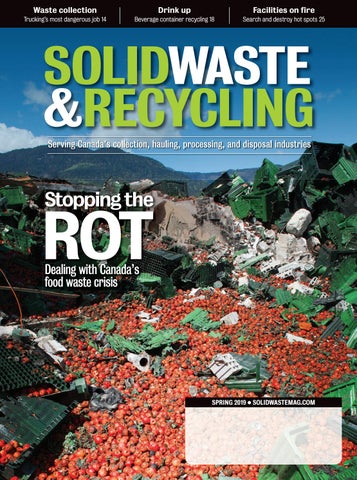
Stopping the
ROT Dealing with Canada’s food waste crisis
SPRING 2019 • SOLIDWASTEMAG.COM
Consulting and equipment sales to help recyclers PD[LPL]H SURÀ WV The most advanced technology LQ WKH LQGXVWU\ WR RXWÀ W \RXU WXUQNH\ RU UHWURÀ W SURMHFW Decades of experience in: Single stream Plastics Glass cleanup C&D MSW Waste to fuel and more
Waste Expo Booth # 1233 203.967.1100 | vdrs.com | info@vdrs.com
FEATURING Bollegraaf Lubo TOMRA Walair
SOLIDWASTE &RECYCLING is Canada’s trusted source for information on the collection, hauling, processing, and disposal industries.
SPRING 2019 VOL. 24 NO. 1 Editor Emily Atkins emily@newcom.ca (416) 614-5801 Editorial Director John G. Smith johng@newcom.ca (416) 614-5812 Group Publisher Lou Smyrlis lou@newcom.ca (416) 510-6881 Creative Director Tim Norton tim@newcom.ca (416) 510-6881 Art Director Elaine Borg elaine@newcom.ca (416) 614-0117 National Sales Manager Delon Rashid delon@newcom.ca (416) 459-0063
COVER STORY
STOP THE ROT The crisis of food waste in Canada
NEWCOM MEDIA INC. 5353 Dundas Street West, Suite 400 Toronto, ON M3B 2S9 416/614-2200 • 416/614-8861 (fax)
CHAIRMAN AND FOUNDER Jim Glionna
PRESIDENT
Safety .......................................................... 14
Dangerous driving
Opinion .................................5
Waste collection is one of the most dangerous jobs in trucking
Briefs: Across Canada ...........6 Briefs: Around the Globe ......9
Joe Glionna
VICE PRESIDENT, PUBLISHING Melissa Summerfield
CHIEF FINANCIAL OFFICER Peter Fryters
DIRECTOR OF CIRCULATION
Departments
Recycling ..................................................... 18
Drink up! Cross-Canada beverage container recycling update
Pat Glionna
Fire safety .................................................... 25
18
Facilities on fire Early detection is key to preventing major fires
Solid Waste & Recycling is published by Newcom Media Inc. The contents of this publication may not be reproduced or transmitted in any form, either in part or full, including photocopying and recording, without the written consent of the copyright owner. Nor may any part of this publication be stored in a retrieval system of any nature without prior written consent. Postmaster: Address changes to Solid Waste & Recycling, 5353 Dundas Street West, Suite 400, Toronto, Ontario M9B 6H8. Postage paid Canadian Publications Mail Sales Agreement No.40063170. ISSN No. 1483-7714. Printed in Canada. Waste collection
Drink up
Search and destroy
Trucking’s most dangerous job 14
Beverage container recycling 18
Preventing facility fires 25
25
Stopping the
ROT Dealing with Canada’s food waste crisis
14 Spring 2019 3
EDITORIAL
Waste not Did you know that about 30 per cent of the world’s usable food is wasted? That’s an alarming figure, especially as we are increasingly aware of food shortages in some parts of the world and food insecurity in many others, including right here at home. Our feature on page 10, “Stop the rot”, examines the issue through the lens of a report recently prepared by Value Chain Management International (VCMI) and Second Harvest. I strongly recommend reading the feature and then taking a look at the report, especially the technical annex. Not only is the report thoroughly researched and extremely well written, the technical document lays out a blueprint for solving the crisis. It pulls no punches, placing responsibility for a culture of waste firmly on many parties in the supply chain. For those in waste management and recycling, especially on the organics collection, recycling or disposal side, it’s
worth a read. If the food production industry and governments pick up on these suggestions, your reality as service providers for organics waste collection and disposal will surely change. While the report does not advocate sudden or drastic change, increases in waste pricing, organics bans and enforced access to green bin programs are some of the ideas it suggests could help alleviate the crisis. The report also highlights that finding solutions to food waste needs to be a collaborative effort from both government and industry. I’d be interested in hearing what members of the waste management and recycling industries think about its findings and recommendations. Please drop me a line with your thoughts. Emily Atkins 416-614-5801 | emily@newcom.ca
SOLIDWASTE&RECYCLING E-NEWS Emailed news. Not recycled. Subscribe at www.solidwastemag.com
Visit solidwastemag.com 4 www.solidwastemag.com
BUT SOMEBODY HAD TO REINVENT THE REFUSE TRUCK.
The Freightliner EconicSD. Next-level safety. Prepare for exceptional safety. Offering an innovative driver environment built for maximum comfort and safety, the EconicSD™ also comes standard with the Detroit™ Assurance® collision mitigation systems and Side Guard Assist. Equipped with the powerful Detroit™ DD8™ engine, the EconicSD is available with side-, rear- or front-load SUITE OF SAFETY SYSTEMS NOW COMES STANDARD
options and offers groundbreaking visibility, pushing every limit of what a refuse truck can be.
To learn more, visit Freightliner.com/EconicSD
Competitive financing available through Daimler Truck Financial. For the Freightliner Trucks dealer nearest you, call 1-800-FTL-HELP. FTL/MC-A-1545. Specifications are subject to change without notice. Copyright © 2019 Daimler Trucks North America LLC. All rights reserved. Freightliner Trucks is a division of Daimler Trucks North America LLC, a Daimler company.
BRIEFS: Canada News
Toronto zoo to get digester ZooShare Biogas is adding new digester technology to its existing biogas plant in Toronto with funding assistance from the federal government. Up to $2.7 million will be made available for the project, which turns animal waste from the Toronto Zoo into agricultural fertilizer. Funding will help ZooShare install new self-cleaning digester technology that separates organic material and contaminants like plastics. The project consists of a 16-metre-diameter sealed digester tank; a 36-metre sealed storage tank; several smaller processing tanks, a control building and a containerized 500 kW generator. The project will also divert food waste from landfills – turning it in-
Lystek lands municipal contracts
Lystek International and long-term customer the City of Guelph, Ont. have entered into a 10-year contract. Lystek will continue to provide the city with year-round management of its biosolids program, including receipt of the material, storage, marketing and distribution of the city’s LysteGro biofertilizer product. Guelph and Lystek partnered over 10 years ago to demonstrate and commercialize Lystek’s first low temperature Thermal Hydrolysis Process (THP). The company also renewed its contract with the City of North Battleford, Sask. for another five years. The city was the first community in Western Canada to adopt the THP technology. “From the initial deployment of the award-winning Lystek system here at the city in 2014 and throughout the following five years of our relationship with Lystek, they have consistently demonstrated exemplary customer service and the ability to fulfill our goal to divert our biosolids from landfill and produce a marketable, Class A fertilizer product local farmers both want and need,” said Stewart Schafer, director of utility services for North Battleford. Q 6 www.solidwastemag.com
stead into a commercially viable commodity – and will reduce carbon pollution. Project plans estimate the annual inputs to be 2,000 tonnes of manure from the zoo, and 12,000 tonnes of liquid slurry from grocery stores and other commercial facilities in the area. An additional 2,000 tonnes a year of fats, oils and greases may also be accepted. ZooShare works with nearby farms that can use the resulting product as a high-nutrient, viable alternative to chemical fertilizers. The biogas plant has a capacity of 500kW and will generate 4.1 million kilowatt-hours for the Ontario grid each year. Q
Forestry biomass research funded The Service de recherche et d’expertise en transformation des produits forestiers (SEREX) will receive $280,000 from Canada Economic Development (CED) for Quebec Regions. This funding, awarded under CED’s Quebec Economic Development Program, is aimed at accelerating the completion of industrial projects to develop products with a small environmental footprint arising from forest resource processing, particularly products made from residual biomass (sawdust, wood chips, bark). Established in 1998, SEREX is a nonprofit organization. Relying on close collaboration between educational institutions and businesses, SEREX benefits from the specialized expertise of technologists, engineers and other specialists, as well as the most sophisticated laboratory equipment in the field. In addition to applied research services, it provides technical assistance and training and also specializes in sustainable chemistry, renewable energy and green construction. Q
Calgary expands methane collection Federal funding of up to $5.9 million will help Calgary’s Waste & Recycling Services expand its landfill gas collection systems. The East Calgary Waste Management Facility will install new wells to collect landfill gas, distribution piping for wells, and mechanical and electrical upgrades to expand the volume of landfill gas collected.Q
Standard Auto Wreckers again Canadian-owned
The Gold family has re-acquired Standard Auto Wreckers from Fenix Parts Inc. Goldy Metals Incorporated will now operate the automotive recycling business in Ontario. Fenix, operated by a group of auto industry veterans, retains its existing business in the United States. Kenneth Gold, CEO of Goldy, noted “we are excited to have this opportunity to return to running a business that we love. We wish the Fenix organization success as well.” Standard Auto Wreckers has deep roots in Ontario, particularly in Toronto where the business was first started by Ken Gold’s uncle in the early 1960s. Ken took over the business in 1979 and was joined by his son, David Gold, over 25 years ago. When Goldy sold the business to Fenix in 2015, David remained president of the Canadian operations. Now that Goldy has reacquired Standard Auto Wreckers he will continue to lead the business. Q
Ontario mulling plastics ban The Ontario government is seeking public feedback on its “Reducing Litter and Waste in Our Communities: Discussion Paper”, which expands on commitments made in the government’s environmental action plan. The paper poses questions that will help guide future decision-making to divert more waste from landfill. Currently, Ontario generates nearly a tonne of waste per person every year and our overall diversion rate has stalled below 30 per cent over the last 15 years. The government believes Ontario needs to reduce the amount of waste generated and divert more waste from landfill through proven methods like the curbside Blue Box Program, existing and emerging municipal green bin programs and other waste recovery options. Feedback on the discussion paper will help the province to move forward with an approach to reducing litter and waste. The comments process is open until April 20, 2019 at: https://ero.ontario.ca/notice/013-4689 Q
Funding for AI sorting system Waste Robotics will receive $1.4 million from Sustainable Development Technology Canada (SDTC), to develop a sorting system that uses cutting-edge technology and artificial intelligence (AI) to separate commercial waste more efficiently. The high-capacity, multi-arm robot waste sorting system will improve the costeffectiveness of organics and recyclables collection and sorting. The system will aid in diverting tens of thousands of tonnes of organic material from landfills every year. The funding will help further Waste Robotics’ effort to become a world leader in robotic waste and recycling sorting solutions. “Everyone knows what it’s like to recycle waste in their home. This robot will help cities do it on a massive scale in a really cool, high-tech way, resulting in less garbage in our landfills,” said Leah Lawrence, president and CEO, SDTC. Q
Spring 2019 7
WHAT’S PROTECTING YOU? Visit us at booth #4299
The preferred choice for municipalities to champions of industry for 30 years
Atomization
Waterless Vapor
Topical
Injection
ODOR-ARMOR® products are used in a wide range of commercial and industrial applications to combat nuisance odors. Formulations have been developed with industry ZWLJPÄJ VIQLJ[P]LZ HUK [OLU TH[JOLK [V KLSP]LY` Z`Z[LTZ [OH[ JHU TH_PTPaL JVZ[ LɉJPLUJ` reliability and performance.
*HSS )LUaHJV [VKH` [V ÄUK V\[ OV^ [OL` JHU WYV[LJ[ `V\
benzaco.com
ADVANTAGES OF ODOR-ARMOR®: à ® 0UK\Z[Y` ZWLJPÄJ MVYT\SH[PVUZ à ® )YVHK ZWLJ[Y\T LɈLJ[P]LULZZ à ® ,JVUVTPJHS HWWSPJH[PVU YH[LZ à ® 5VU [V_PJ HUK biodegradable
HERE WE GROW AGAIN... New location in Ontario now open!
BRIEFS: Around the Globe
Alliance commits US$1B to end plastic waste Nearly 30 companies have come together as the Alliance to End Plastic Waste (AEPW). The group of multinational companies from the plastics and consumer goods sectors launched the organization to advance solutions to eliminate plastic waste in the environment, especially in the ocean. The AEPW has committed over US$1 billion with the goal of investing $1.5 billion over the next five years to help end plastic waste in the environment. The alliance will develop solutions intended to minimize and manage plastic waste and promote solutions for used plastics. “Everyone agrees that plastic waste does not belong in our oceans or anywhere in the environment,” said David Taylor, chairman of the board, president and CEO of Procter & Gamble, and chairman of the AEPW. “This is a complex and serious global challenge that calls for swift action and strong leadership. This new alliance is the
most comprehensive effort to date to end plastic waste in the environment. I urge all companies, big and small and from all regions and sectors, to join us.” The Alliance is a not-for-profit organization that includes companies that make, use, sell, process, collect, and recycle plastics. This includes chemical and plastic manufacturers, consumer goods companies, retailers, converters, and waste management suppliers. The Alliance has been working with the World Business Council for Sustainable Development as a founding strategic partner. “Unfortunately, nearly 80 per cent of all post-consumer plastics in Canada end up in landfills mainly as a result of improper sorting, contamination and the limited diversion tools at our disposal. This represents a terrible waste of energy and precious resources,” said Bob Masterson, president and CEO of the Chemistry Industry Association of Canada (CIAC).
“The chemistry and plastics industries strongly support the transition to a more circular economy – one that prioritizes durability and longer product life cycles while increasing the recovery of materials at their end of life. CIAC congratulates the Alliance in this leap toward a more sustainable economy for our industry’s products,” said Masterson. In the months ahead, the Alliance will make investments to drive progress in four key areas: Infrastructure development to collect and manage waste and increase recycling; Innovation to advance and scale new technologies that make recycling and recovering plastics easier and create value from all post-use plastics; Education and engagement of governments, businesses, and communities to mobilize action; and, Clean up of intense areas of plastic waste already in the environment. Q
National Sword forcing new technologies into U.S. MRFs
Scalable waste management
With China’s National Sword regulation imposing restrictions on the import of solid wastes, U.S. single-stream recycling material recovery facilities (MRFs) are left with few options for processing their vast quantities of recycling materials. MRFs are facing strategic investment decisions regarding processing equipment. Processing technologies such as optical sorting, robotics, and Artificial Intelligence (AI) will be among the top choices, according to a new report by Frost & Sullivan. Some of the strategies that these players will adopt include: • Retrofitting new, advanced screens and sorters. Additional investments in smart systems and AI will drive their long-term growth. • Employing contract models that incorporate more effective inspection processes to improve recycling habits. • Upgrading to screens, non-wrapping screens, and sorting, especially optical and colour optical sorting. • Leveraging up-selling and cross-selling opportunities. “Although National Sword has quickly increased the number of project and retrofit opportunities in the U.S., many budget-constrained MRFs will adopt a wait-andwatch approach. This technology and fiscal shyness of end users will prompt players to develop local sales plans,” said Seth Cutler, principal consultant for energy and environment at Frost & Sullivan. “Differentiation will mostly be based on the quality of services, with vendors’ sales staff serving as consultants and providing tailored solutions to plant operators.” Q
TriCiclos has won the Dell Circular Economy People’s Choice Award for creating a scalable waste management, recycling and recovery model for businesses and citizens. The system was created in Chile 10 years ago and now also operates in Brazil, Columbia and Peru. As well as collaborating with civil society partners to drive new, effective waste management regulations, TriCiclos also developed innovative technologies to assist companies to diagnose and improve their waste portfolios. Over 33,000 tonnes of waste material has been moved from landfill through the model, avoiding 140,000 tonnes of CO2 emissions. TriCiclos is a certified B corporation in Brazil, providing reverse logistics, waste collection, and more. Q Spring 2019 9
FOOD WASTE
Stop the rot Addressing the crisis of food waste in Canada By Kara Kuryllowicz & Emily Atkins
E
very year a whopping 35.5 million tonnes of food is lost or wasted along the entire food chain in Canada. However, 11.2 million tonnes of that food loss and waste is avoidable, and contains edible, surplus food that could be rescued. Nationwide, that lost or wasted food is worth an extraordinary $49.5 billion, representing 52 per cent of the money
10 www.solidwastemag.com
Canadians spend on food, and three per cent of GDP. The greenhouse gas (GHG) footprint of this loss is 56.5 million tonnes of CO2 equivalent. Finding solutions for this avoidable food loss is vital, especially as four million Canadians, including 1.4 million children, can’t readily access affordable food. “The economic, environmental and social impact is huge and unsustainable,” says Martin Gooch, CEO, Value
Chain Management International (VCMI) in an interview. “Unless the waste and food industries take the lead and initiate change, governments will eventually force them to undertake mandatory actions.” These findings are presented in The Avoidable Crisis of Food Waste, a report released earlier this year by VCMI, a public and industry voice on food waste reduction, and Second Harvest, Canada’s largest food rescue organization, with Walmart Foundation funding. It notes food loss and waste (FLW) is normal in Canada, and is accepted as a business cost by food growers, processors, manufacturers, hotels, restaurants and institutional providers. “The root causes of the FLW that occurs in Canada include a culture of
accepting waste,” the report’s technical annex says. “A direct correlation can be drawn between some business and governmental decisions and the creation of avoidable FLW. Other root causes of FLW include the true cost of FLW not being internalized by industry and consumers. In addition, there is no common template for redistributing food that would otherwise go to landfill or non-food use.” Specific causes include low tipping and landfill fees as well as conservative best-before dates that result in the disposal of safe, edible food; demand for aesthetically perfect food; the expectation of 100 per cent on-shelf availability and food industry reluctance to donate useable surplus food. “FLW is an indication of inefficiency that drives up costs and lowers productivity, leading to higher prices,” the report notes. “The food industry is highly competitive and landfill is easy and the fees are cheap,” says Gooch. “By and large, when businesses look at food costs they don’t factor in disposal costs, because the financial reporting systems don’t connect to it. Disposal is seen as a budget item not a strategic opportunity.”
Food loss vs Food waste Food Loss: Discarding of edible and inedible commodities and foods during the production, processing and manufacturing of food or beverages for human consumption prior to their distribution and sale in retail or foodservice. Includes commodities used in the production of beverages. Examples include barley used in the production of beer and spirits, grapes used in the production of wine, carrots used in the production of fruit juice. Food Waste: Discarding of edible foods and beverages (and inedible parts) during distribution retail, foodservice, households and during redistribution. Includes beverages, unless explicitly stated otherwise.
Gooch says. “If we increase tipping fees we need to communicate to industry organizations, ‘here is what you can do about it and here is where you get help’. [We need to] help the waste management industry develop new business models and develop new technology, such as dehydrators. Tipping fees are outside the haulers’ control and they’re facing competitive issues. They’re all subject to the same environment, but if they lease a dehydrator, the tipping fees decrease and they’re send less waste to landfill. The leased dehydrator provides income and they are adding value for the customer.”
Waste management practices The report notes numerous reasons for wasteful decision make. First, it’s too cheap and easy to send food waste to landfills. Low tipping fees make other options economically unviable for food producers. Waste management companies bear some of the responsibility as well. “Waste management is big business and profitable, partly because organic waste is heavy and therefore expensive to transport,” the report says. Lack of access to industrial green bin programs is another roadblock. Respondents to the research study says that lack of access prevented them from taking a more responsible approach to managing the organic waste stream. “Widespread change would have to take place in a very structured manner,”
Waking up to value While the report notes that food waste is viewed by some in the food industry as beneficial because it supports sales, others are realizing that food waste reduction is socially and environmentally responsible and that it can also reduce costs and add value. “Waste that’s not used beneficially is a lost opportunity for revenue and carries a disposal cost, so we use as much as we possibly can,” says Paul Lansbergen, president of the Fisheries Council of Canada, which represents companies that harvest and process fish and seafood. Other food producers are increasingly sensitive to the issue, and are being pushed by the problem of recalls to ensure they have complete end-toend supply chain visibility on their
product. Heavy hitters like Unilever, Nestle, Tyson and Dole, are beginning to use blockchain technology to track food from source to store. In reaction to the romaine lettuce e-coli scare which resulted in the destruction of tonnes of the leafy greens late last year, Walmart has introduced a compliance initiative requiring its suppliers to use blockchain tracking. These initiatives will help to reduce food waste by creating a more efficient, faster and transparent food supply chain. Farther down the chain, foodservice businesses also feel the pinch from wasteful practices. With margins hovering about the four per cent mark, “Food waste is always top of mind for foodservice operators because ultimately, it affects our bottom line,” says Roberto Sarjoo, director of marketing and communications for industry association Restaurants Canada. “Our Q3 2018 Restaurant Outlook Survey showed eight out of 10 Canadian foodservice businesses are well aware of how environmental sustainability is becoming a necessity for profitability.”
The role of government No single level of government has responsibility or accountability for food waste. This leads to a maze of overlapping policies, legislation and regulations that corporations have to figure out for themselves. There are no national policies, regulations or Spring 2019 11
FOOD WASTE
Online Resources The Avoidable Crisis in Food Waste report can be accessed at: https://secondharvest.ca/research/the-avoidable-crisis-of-food-waste/ Love Food Hate Waste Canada: www.lovefoodhatewaste.ca
legislation regarding landfill regulations and tipping fees. “An example of a lack of consistency, just at the municipal level, includes that the organic tipping fees of neighbouring municipalities can differ by hundreds of dollars per tonne. That provincial or territorial jurisdictions jointly govern landfill regulations and waste management infrastructure means achieving change can take years and rests on the lowest common denominator,” the report notes. Likewise there are no standardized policies or regulations governing the emissions created from the processing
and disposal of food. And, there is no linkage between “landfill regulations and tipping fees to investment of public funds in the knowledge, skills and infrastructure required to reduce FLW through prevention, redistribution, recycling and reuse.” This gap occurs because it would require cooperation between different levels of government and different departments. Emterra Group, based in Burlington, Ont. provides recycling resource management and waste disposal solutions nationwide. They collect organics forevery municipality in which they operate. The municipal, residential,
institutional and commercial split varies widely with peak demand in areas that have banned all organics from landfills and in locations that don’t receive organics collection as part of their municipal collection program. “Our organics fees vary municipalityto-municipality depending on which organics processing facilities the materials go to,” says Paulina Leung, vice-president, corporate strategy and business development, Emterra Group. “Food waste collection and processing is very different across Canada. There is no cookie-cutter response. If there were provincial policies on food waste recovery, more could be done to divert these valuable materials from the landfill.”
The governmental toolbox At the municipal level, numerous jurisdictions across the country are taking action. But while increasing collection of organics helps to divert it
RECYCLE.AB.CA
from landfill, and reduces the carbon footprint, municipalities are learning that they also have to educate citizens about what is waste and what is not. To that end, the National Zero Waste Council was founded in 2013 uniting Metro Vancouver and Canada’s six largest metro regions. Part of that initiative is “Love Food Hate Waste Canada”, which aims to prevent residential food waste at the source. In the United Kingdom, where the program originated, it reduced avoidable household food waste by 21 per cent in the first five years. Metro Vancouver also has an aggressive “Food Isn’t Garbage” campaign with tips and resources for residents and businesses and continues to improve its disposal ban inspection and enforcement. In January 2015, Metro Vancouver implemented an organics disposal ban to divert 80 per cent of total waste from landfill by 2020 and encourage residents and businesses to separate food waste from garbage. “We concluded a ban combined with education would be the most effective method for encouraging waste diversion. Simply increasing tipping fees has the potential of unintended consequences and is not as direct a tool as a disposal ban,” says Paul Henderson, general manager of solid waste services at Metro Vancouver. “While there is still much room for improvement, the organics disposal ban has increased the amount of organics diverted from disposal and increased the implementation of food waste collection programs.” The government of Quebec is unveiling an updated strategy on organics, which is expected to ultimately include a disposal ban. The province has also invested more than $550 million in 12 composting and anaerobic digestion facilities that will start up before December 31, 2022. “Funding programs, incentives, information and support are part of the strategy we use to increase the recovery and recycling of organics as a basis for a disposal ban implementation,” says Sophie Langlois-Blouin,
“We can’t afford to keep doing what we’re currently doing. We need to compete on added value not just cost.”
vice-president of operations at the government’s oversight body, Recyc-Quebec. Currently, 474 of the 1,108 municipalities in Quebec collect residential and some small-business organics. However, organic material represents more than 40 per cent of the five million tonnes of residual materials that are landfilled or incinerated annually. Toronto has been diverting organic waste through its Green Bin program since 2002, but hasn’t considered a ban on organics in landfill. “We rely on financial incentives to divert waste from landfill because it’s expensive space with a finite capacity and identifying new landfill sites is a massive challenge,” says Matt Keliher, Toronto’s general manager of solid waste management services.
Where to from here Resolving the issue of Canada’s food loss and waste is not a short-term project. The Avoidable Crisis of Food Waste sets out a matrix and timeline for actions by industry, industry organizations and government that start now and extend beyond 2022. They propose prevention at source, redistribution of excess food all along the food supply chain, and remediation of waste management practices. Industry is encouraged to immediately identify solutions to divert FLW from landfill; engage employees; and, work to find ways to transform otherwise inedible FLW into edible products. Governments are exhorted to
review reuse and recycling infrastructure needs alongside cost-benefit analysis; identify best practices in redistribution; highlight gaps in infrastructure that impede reuse and recycling; and increase funding for development of solutions that will transform otherwise wasted food into edible products. “Change isn’t easy,” Gooch says. “We can’t afford to keep doing what we’re currently doing. We need to compete on added value not just cost. We need industry to take the lead if they don’t want government telling them what to do and forcing them to do it. Banning food waste would make a huge difference, but we think it would create too many issues for the industry. You need to take the time to develop the infrastructure and systems. And figure out what you’ll do with the products such as bioenergy. If you don’t change, you’re going to be a dinosaur that’s left behind wondering what happened.” Ultimately, the reduction of food waste represents an opportunity to not only do something that is sustainable and socially responsible, it also comes down to the bottom line. The report concludes: “Reducing FLW…represents an opportunity for businesses along the entire food chain to improve their financial performance and competitiveness. These opportunities arise from cost reduction, competitive positioning and resource efficiency; thus, providing businesses an opportunity to improve performance in all three pillars of sustainability – environment, economy and society.” Spring 2019 13
SAFETY
Dangerous driving Waste collection is one of the most perilous jobs in trucking By John G. Smith
H
ang Vo was known to use Toronto’s homeless shelters, but in the pre-dawn hours of January 12, 2019 she took refuge in a laneway between two office buildings. The driver of a reversing garbage truck didn’t see her lying there. Vo wasn’t the only person killed by a waste collection vehicle this winter. A Toronto man died in a suspected hit and run just two days later. A 79-yearold woman was struck and killed on Jan. 22 as a truck emerged from a Montreal alley. As well, the driver of a garbage truck was killed Jan. 12 after being hit by a train in Delta, B.C. As of Jan. 22, the Solid Waste Association of North America (SWANA) had counted 17 such fatalities across the U.S. and Canada. Executive director David Biderman says the total is “unprecedented” in his 20 years around the industry. The numbers also reinforce an inescapable truth about refuse and recyclable material collectors – they face one of the most dangerous jobs in trucking. The threats are not limited to cyclists and pedestrians around the trucks. Thirty collectors died on the job in the U.S. during 2017, and preliminary numbers suggest 2018 may have been worse. The U.S. Department of Labor already ranks the work as the fifth-deadliest job overall, above rates recorded by police and firefighters. Provinces track injury rates in different ways, often lumping waste management employees in with other truck drivers. But Biderman is confident Canadian operations would generate a similar ranking on this side
14 www.solidwastemag.com
of the border. Separate injury rates tracked in B.C., for example, match the rates in the U.S. and England.
What makes driving a garbage truck so dangerous? Several factors contribute to the dangers. “People probably don’t realize it’s an extremely skilled role,” says Roger Davis, the corporate director of risk management for Emterra Environmental, which oversees a fleet of 950 vehicles stretching from B.C. to Ontario and into Michigan. “They do it in an environment in close proximity to traffic. They do it in residential areas. And they have to operate heavy equipment…it does make it a little more challenging.” A residential collector might need to jump on and off a truck 800 times per day, exposing them to passing vehicles in the process, Biderman adds. There are motorists who run lights, squeeze up the right side of turning trucks, or dart into oncoming traffic because they become impatient with slow-moving collection equipment. Sixty percent of the waste and recycling workers who died on the job in Canada and the U.S. in 2017 were killed during collection activities. Half of those killed at landfill sites were the drivers working on or around trucks. Two spotters – employees meant to guide trucks along a safe path – were killed as well. The on-road threats are so common that 23 states have increased the penalties for those who hit collection workers or rear-end garbage trucks. The approach is much like Ontario’s Move Over legislation, but that
provincial law focuses on tow truck operators and emergency responders. Efforts to expand Ontario’s scope have gone nowhere. The threats are not limited to traffic collisions, either. The University of Waterloo’s Centre of Research Expertise for the Prevention of Musculoskeletal Disorders says an average bag of garbage weighs 16.5 lb., with a typical worker lifting nine of those per minute. It wears bodies down.
Truck options as a safety solution Part of any strategy to reduce the risks will involve equipment. Davis, for example, stresses the value of well-researched specs established through the American National Standards Institute (ANSI). Some equipment choices go further still. Automatic side loaders, for example, rely on mechanical arms rather
Credit: Mack Truck
Credit: Mack Truck
Good visibility out of a waste collection truck cab is key to safe operation.
Automatic side-loaders improve safety for waste collectors, but may have limited use in tight urban streets.
than swampers to load waste onto a truck. But the configurations are not always appropriate. There’s little room for individual bins in densely populated urban centres, and the arms can also damage the tree canopies stretching over streets. Rear-loading refuse vehicles continue to be the most popular option because of everything from price points to versatility, says Curtis Dorwart, refuse product manager at Mack Trucks. Such vehicles can even be used to compact bulky white goods, rather than limiting themselves to the materials that fit into the confines of a specific bin. “The versatility is phenomenal,” he says. No matter what vehicle style is selected, however, there are many options to help enhance overall safety.
“It seems like everyone has their secret sauce,” Dorwart says, referring to the multiple variations that are available. The challenge is striking a balance between price and effectiveness. “You don’t want to put a price on safety, but at the same time you’ve got to be wise enough to say what makes sense based on the risk,” he says. Video cameras used to eliminate blind spots are becoming increasingly popular – so much so that Mack is now prewiring its LR vehicles to be fitted with Lytx video-based telematics systems. Depending on vehicle configurations, camera lenses can be aimed in any direction, and there’s a growing interest in systems that stitch together a bird’s-eye view showing all sides of the truck after a bit of calibrating.
“We currently have back-up cameras, side-view cameras, and hopper cameras on our collection vehicles,” says Matt Keliher, general manager – solid waste services at the City of Toronto. “Newer vehicles [purchased in 2018] now include the 360-degree camera on them.” But even camera systems have their limits. Nobody wants to overwhelm operators with too much information, Dorwart explains. Large monitors can also create blind spots of their own. Additional proximity mirrors, meanwhile, can reflect images of threats at a truck’s bumper, along the curb, or behind doors. (New York City has gone so far as to mandate crossover convex mirrors.) Even a simple relay circuit can be used to ensure radios are turned off when a truck shifts into reverse. Spring 2019 15
150 TONS OF MUNICIPAL SOLID
WASTE SHREDDED IN 3 HOURS
INDUSTRIAL
SHREDDING EQUIPMENT {
wood waste | construction and demolition debris | pallets | railway ties cable reels | paper rolls | green waste | mattresses | tires | aluminum e-waste | white goods | food waste | domestic, industrial & bulky waste
{
EXCLUSIVE NORTH AMERICAN PARTNER OF HAAS RECYCLING SYSTEMS
HAAS TYRON 2000 XL is the perfect tool for high volume waste reduction. With adjustable shaft speeds and independent shaft control in both forward and reverse, you can make quick work out of even the toughest materials.
Contact one of our experts today! 1.800.465.3214 | Shred-tech.com Follow us on:
Credit: Mack Truck
SAFETY
Last year, Halifax city council decided the devices were so important that they approved $238,000 to install the equipment on 83 collection trucks owned by GFL Environmental and Regroup. The barriers won’t save every vulnerable road user, though. Three-quarters of Canada’s fatal collisions that involve heavy trucks and pedestrians or cyclists involve the front of the vehicle, according to the 2015 National Collision Data Base.
The power of awareness
Rear- and side-view cameras can help to eliminate blind spots, but many other driver assistance systems are designed with highways in mind.
Tech tools for drivers Dorwart describes decidedly highertech options like the warnings and automatic braking of advanced driver assistance systems (ADAS) as a “hot button” issue. But he stresses that tools like electronic stability controls, collision mitigation systems, and lane departure warnings are typically designed with highways in mind, rather than collection speeds that hover around 30 km/h. Imagine the constant buzzing of lane-departure warnings in urban
settings, whenever they cross a painted strip. “That’s just going to drive their operators nuts,” he says. Will side guards keep pedestrians and cyclists safe? Given the nature of the work, some operations are incorporating physical barriers meant to keep pedestrians and cyclists from sliding under a truck’s wheels. Municipalities including Halifax, Montreal, and New York City are all mandating side guards for this purpose.
As important as equipment can be, a driver’s skills can be one of the most important tools of all. “The unfortunate situations we have had recently, especially where third parties have been [injured], it’s all about situational awareness,” Davis says, referring to the trucks that work in densely populated areas and amidst high traffic volumes. “That’s where the training comes in.” Drivers for the City of Toronto, who collect waste from 115,000 single-family homes per day, all receive 80 hours of in-vehicle training with the same equipment they’ll operate. That is supported with monthly tailgate sessions to discuss safety-related topics. Emterra’s risk management department, meanwhile, hosts daily “huddles” to highlight safety issues of the day. Of course, not every operation has those training resources. “Smaller haulers have a disproportionate number of fatal accidents,” Biderman says. “They don’t have the bandwidth to do safety as well as large, national companies.” For its part, SWANA is distributing safety-related information at locations including landfills, transfer stations, and recycling depots. Canadian locations will be included in the communication efforts this year as well. There is still work to do. “It absolutely has got better,” Davis stresses, referring to the changes that he’s seen since the 1990s. “But it’s still a risky business.” Spring 2019 17
RECYCLING
Drink up! Beverage container recycling update By Samantha Millette & Jason Wilcox Figure 1: Provincial Recycling Rates, All Non-Refillable Containers (2016)
Performance: How did we do?
100%
(Continued on page 20) k
18 www.solidwastemag.com
86%
100% 100%
82% 79% 80%
82%
80% 83% 82%
81% 73%
71%
100%
62%
100% 100%
45%
100% 100% 100%
I
NT
PE
NL
NB
NS
e r)
l) dr
ink
s&
be
ol)
ho
oh
lco
n-a
(no
f t(s o
QC
ON
ON
(al c
e r)
SK
(be MB
AB
100%
BC
When it comes to single-use beverage containers, Alberta achieved the highest recycling rate in 2016 at 86 per cent. Ontario’s recycling rate for non-refillable, non-alcohol containers for that year was only 45 per cent, the lowest in the country. This comes as no surprise; regardless of material type, these containers have always been recycled at higher rates in jurisdictions that have deposit return schemes (DRS).
100%
YT
C
anadians should be proud of their success when it comes to recovering beverage containers. In 2016, approximately 10 billion non-refillable beverage containers sold in Canada were collected for reuse and/or recycling. This is just one of the findings in the ninth edition of CM Consulting’s Who Pays What report, released in October 2018. Produced since 2002, the report provides a comprehensive overview of container recovery programs in each province, including the latest data on performance and costs. The report also delves into the economic and environmental benefits of beverage container reuse and recycling, processes, end-markets, and the use of recycled content.
Note: Reliable performance rates for non-deposit containers in Manitoba and Quebec were not available for 2016.
Financial Incentives Drive Returns - The higher the deposit, the higher the return rate In 2008, Alberta had a total recovery rate of 75 per cent for all non-refillable containers combined. The province raised the deposit from five to 10 cents on containers up to one litre, and from 20 to 25 cents on containers over one litre. The recovery rate jumped immediately to 82 per cent in 2010, and by 2016 had climbed to 86 per cent (see Figure 2). In contrast, rates in British Columbia, where deposits have remained low – at five cents for non-alcohol containers up to one litre and 20 cents for containers over one litre – have increased only marginally, from 80 per cent to 82 per cent over the same time period.
If we look at recycling rates for aluminum cans and the different deposit levels on those cans in three jurisdictions (BC, Alberta, and Quebec), we can clearly see the effect that higher deposits have (see Figure 3). In Alberta, where the deposit on all small aluminum cans is 10 cents, the recycling rate rose from 80 per cent to 91 per cent from 2008 to 2016. In British Columbia, where the deposit for beer cans is 10 cents, but the deposit for soft drink cans is only five cents, the rate has remained stagnant in that time frame. In Quebec, the recycling rate for small aluminum cans is much lower than in either BC or Alberta because both beer and soft drink cans carry only a five-cent deposit.
Figure 2: Recycling Rates for All Non-Refillable Containers, British Columbia vs. Alberta (2008-2016)
Figure 3: Recycling Rates for Deposit-Bearing Aluminum Containers in BC, Alberta, and Quebec (2008-2016)
BC
100%
BC - Soft Drink: 5-cents/Beer can: 10-cents AB - All cans: 10-cents since November 2008 QC - All small cans 5-cents
AB
95% 95%
90% 85% 80% 75% 70%
86% 80%
82%
91% 86%
87%
85% 80%
75%
80%
75% 70%
65% 60%
90%
71% 66%
65% 2008
2010
2012
2014
2016
60%
2008
2010
2012
2014
2016
Spring 2019 19
RECYCLING
IT’S TOUGH TO EXTEND DRAIN INTERVALS TO 1900 HOURS BUT NOT FOR DURON™
Looking at material-specific recycling rates, aluminum cans are recycled at a rate of approximately 71 per cent nationally. Non-refillable glass bottles showed a slightly lower recycling rate at 68 per cent. The clear underperformer when it comes to single-use containers is PET bottles, with a national recycling rate of only 59 per cent. It’s important to note that when contamination is factored in, the overall amount of PET and glass actually recycled is even lower. This is because, even in DRSs, all bales of beverage containers experience some level of yield loss due to the caps, labels, and glue that remain on the containers after sorting. Some of these losses are fines, which can be sold as a by-product, but most are disposed of in landfill. Determining those downstream losses is a critical step to attaining real recycling values. This is clearly outlined in the Canadian Standards Association’s Recycling Guideline as well as being a legislative change within the European Union’s new Waste Framework Directive. As in previous years, refillable beer bottles continue to be recycled at a very high rate, both nationally and on a provincial level. Across Canada, approximately 95 per cent of all refillable beer bottles are collected for recycling, and all provinces achieve a recycling rate of 91 per cent or higher. Unfortunately, statistics from the Brewers Association of Canada show that there has been a dramatic decline in the use of such refillable containers: from 2009 to 2017, nationwide market share for beer sold in glass bottles dropped from 59 per cent to 30 per cent of all hectolitres sold. Several factors are attributable to this decline, including a shift in the retail landscape towards larger retailers or “big box” stores, lack of policies in place to promote refillables, and changes in the relative costs of container materials.
Away-from-home collection
TM
Owned or used under license.
The last decade has seen a significant shift in the way Canadians consume beverages. It is estimated that 30 to 40 per cent of beverages are consumed and discarded away-fromhome (AfH), and as the millennial generation continues to grow as a percentage of Canada’s total population, this number is likely to rise.
With DURON protecting your engine you could achieve drain intervals* of up to 1900 hours in even the most demanding of operations. That’s the kind of drain intervals we call tough. And it’s all proven in the real ^VYSK ^P[O Ä LSK [LZ[PUN VU [V\NO jobs like yours.
Besides the obvious environmental benefits, beverage container recycling programs generate significant economic benefits as well.
WE’VE TALKED TOUGH. NOW WE’VE PROVEN IT. DURON.™ THE TOUGHER. THE BETTER.™
In an effort to encourage the recycling of these containers, a number of Canadian jurisdictions, including the province of Manitoba, the City of Richmond (B.C.), and the City of Regina (Saskatchewan) have launched pilot projects and long-term programs aimed at collecting these containers. Until December 31, 2016, the province of Quebec also had a program which provided funding to municipalities to install recycling equipment in public spaces.
Economic and environmental benefits In 2016, the recycling and reuse of beverage containers in Canada saved 18.1 million GJ of energy and avoided over 1.1 million tonnes of GHG emissions. This is equivalent to taking more than 245,000 cars off the road. Besides the obvious environmental benefits, beverage container recycling programs generate significant economic benefits as well. Although sometimes difficult to quantity, these benefits must be considered if we are to understand the full picture of beverage container recycling costs in Canada. In addition to job creation and economic growth, DRS are good for municipal budgets. While DRS may divert potential sources of revenue from curbside programs, they also result in significant net cost savings, resulting from the reduced or avoided costs of collection, treatment, and disposal from the municipal waste management system. Who Pays What presents a compilation of 27 studies that examined the quantifiable costs and benefits to municipalities of implementing or expanding a DRS for beverage containers. Although different in scope, location, author, and year, each study reported significant cost savings for municipalities, even after lost material revenue was taken into account.
HEAVY DUTY DIESEL ENGINE OILS
FIND OUT MORE. THE SOONER. THE BETTER.
DURONTHETOUGHERTHEBETTER.COM *Extending drain intervals should always be undertaken in conjunction with an oil analysis program.
See where the industry is going. Solid Waste and Recycling Readers Save! Register with code VP39 and save 25% on the conference program and get FREE Exhibit Hall admission. wasteexpo.com
Big innovation is big business. You’ll find both at WasteExpo. The numbers don’t lie. You can see how big data is becoming a vital component of the industry. Over the past 50 years, we’ve helped usher in more significant innovations in the solid waste and recycling industry than any other event. And the future looks even more promising. Here are some more numbers for you—14,000 of your peers, 609 exhibitors and 60+ educational sessions are waiting for you—all in the same place. WasteExpo. It doesn’t get any bigger or smarter than this. Visit wasteexpo.com to learn more. Produced by:
Conference & Special Events: May 6-9, 2019 • Exhibits: May 7-9, 2019 Las Vegas Convention Center (South Halls) • Las Vegas, NV, USA
In Collaboration wIth:
RECYCLING
From North America to Australia and across Europe, over 40 jurisdictions worldwide have implemented DRSs for beverage containers, and Canada is clearly among the leaders. What’s New? Improved quality control at Alberta depots: In 2016, Alberta became the first province in Canada to implement Tomra’s automated counting machines in a processing facility. Installed for quality control purposes, this technology resulted in increased performance related to the Alberta Beverage Container Recycling Corpooration’s (ABCRC) auditing of material shipped from Alberta depots. These machines have also resulted in increased system efficiencies because they require less space, less energy, and allow for quicker and more accurate counts that the previous counting technology. Milk containers added to Saskatchewan’s program: As of April 1, 2017, “ready-to-serve” milk containers are included in the same deposit system as other beverage containers accepted at SARCAN depots. (Previously, the recycling of milk containers was covered under the province’s multi-material recycling program, which launched on January 1, 2016.) The addition of milk containers to Saskatchewan’s deposit program means that in addition to a refundable deposit, milk containers are now subject to an environmental handling charge (EHC). Deposit rate increases in Saskatchewan: Another change affecting Saskatchewan’s deposit program in 2017 was the increase of some of the deposit refund amounts. As of April 1, 2017, the deposit/refund amount for larger (one-litre or greater) plastic and aluminum/tin/metal containers is 25 cents, up from 20 cents. Gabletop cartons and aseptic containers have also seen their deposit levels increase from five cents (all sizes) to 10 cents for containers less than one litre and 25 cents for containers one litre or greater. The deposit amount for glass containers remains unchanged. This is the first time deposit refund amounts have increased in 25 years. There have also been changes to the non-refundable EHC. Effective April 1, 2018, the EHC costs consumers five cents for tetra cartons (up from three cents), seven cents for aluminum cans (up from five cents), eight cents for plastic jugs/ bottles (up from six cents), and nine cents for glass containers (up from seven cents). NWT’s amended beverage container regulations come into effect: On February 1, 2016, amended Beverage Container Regulations came into effect. One of the key changes
to the program is a net increase to container handling fees. Changes to these fees were necessary in order to allow the program to be self-sustaining. The new Regulations also simplify container categories. In the past, surcharge amounts were based not only on the type and size of the container, but also on the contents, with alcohol containers being a different category. There are only two main categories now, based on size: up to one litre and more than one litre. Encorp Atlantic launches new pilot project: As part of a series of pilot projects aimed at making the redemption process more convenient for its customers, Encorp Atlantic launched a new initiative in April 2017 called Re360. The Re360 recycling boxes, now being used at four redemption centres are a natural extension of the Express Bags, which were used in a pilot project from May 2015 to May 2017. Customers who use the new green boxes are given priority service when they drop off their containers, and do not have to wait in line to receive a refund. For each box filled with 60 containers, customers receive a $3 cash payout on the spot.
Conclusion Over the past few years, there has been renewed interest in DRS as a tool to collect high quantities of beverage containers, which has evolved to now include aseptic containers, gable top cartons, and even coffee cups. From North America to Australia and across Europe, over 40 jurisdictions worldwide have implemented DRSs for beverage containers, and Canada is clearly among the leaders.
Samantha Millette is an environmental consultant specializing in the areas of waste management research, policy, and planning. She is the owner of SAMI Environmental.
Jason Wilcox is based in Barcelona and serves as the Projects Manager for CM Consulting. Working for CM since 2008, he has closely managed special projects related to modelling future diversion scenarios for clients that include large multi-national corporations as well as industry stewardship organizations. Spring 2019 23
October 9 – 10, 2019 Enercare Centre, Toronto, ON www.cwre.ca
VISIT US AT WASTE EXPO BOOTH #2648
Canada’s ONLY trade show serving the waste, recycling and public works markets Register for your FREE Expo pass at www.cwre.ca/ads1
co-located with
FIRE SAFETY
Facilities On Fire Detect and destroy hot spots before the flames take over By Treena Hein & Emily Atkins
I
n 2018 371 waste and recycling industry fires were reported in Canada and the U.S., including a major fire at a recycling facility outside Calgary in July. However, that number is likely low. According to Ryan Fogelman, vice -president of strategic partnerships at Michigan-based Fire Rover, the real number may be over 1,800. It’s no surprise that number of fires at waste and recycling facilities is higher now compared to years past. Increased summer temperatures may be a factor, says Fogelman, but mainly it’s larger volumes of material due to growing population rates and China’s National Sword policy restricting waste imports. Increasing numbers of small, hardto-detect lithium-ion batteries in everything from greeting cards to Christmas sweaters and disposable electronics like Apple earbuds – which each have three – compound the problem. They cause up to half of recycling facility fires.
Fire detection basics There are only a couple proven ways to detect a fire or pre-fire hot spots. Bryan Staley, president and CEO at the California-based Environmental Research & Education Foundation (EREF), says he’s heard of some firms posting a ‘watchperson’ after hours to watch for fire-starts. Fogelman, however, believes thermal cameras are a necessity, “but you need to use top-of-the-line thermal cameras that can sense temperature differentials.” He points out that there
Many of North America’s 1,800-plus recycling and waste facility fires every year are preventable, with the right technology.
are many sources of heat in a waste or recycling facility – equipment running hot for example, and some places use heat in their processes – and that software programs associated with thermal cameras are not yet at the level where they can definitively ‘decide’ in all cases when a fire is close to starting or has started. “Each facility is generally a very complex environment in terms of heat, so you need human verification of what the camera is picking up,” Fogelman says. “With our system, we get many, many alerts every day analyzed by our team. There are numerous false alarms
but it’s better to be safe than sorry.” His company sells fire detection and suppression systems specifically for the waste and recycling sector. They use the FLIR A310F thermal camera that can detect and pinpoint abnormal heat sources down to the size of a pixel. And that means temperature accuracy within two degrees Fahrenheit. It has installed systems at over 100 facilities in the USA since 2015 with no major fire incidents at any of them since, and is about to sell its first two systems in Canada, in Edmonton. Facilities do sometimes have sprinklers installed, but if a sprinkler system Spring 2019 25
FIRE SAFETY
TST Fire software then calculates the coordinates of the hot spot, based on the combined thermal images, and an alarm is generated. Upon activation in the waste bunker control room, the water canon is directed at the detected hot spot and the fire is extinguished. “A critical factor for putting out a fire is to have an early response. And that we can achieve with the FLIR cameras. We can even put out a fire before it starts,” says Robert Berger from the fire protection solution company Incendium, which is supplying the fire extinguishing system for Jönköping.
When detection fails In these side-by-side shots of a recycling yard, the right-hand image shows the bright heat signatures as seen through an infra-red camera.
is set up so that the structural columns of the facility and workers and /irefighters are protected, the amount of heat required to set it off would mean a fire is already well under way. Even if a sprinkler system is placed to detect the heat of a fire start, Fogelman does not believe currently marketed systems are sufficient. He typically recommends the use of a pre-wetting foam agent, possibly in combination with water spray that employees can manually or remotely apply. Staley notes that in addition to foam and water sprinklers, he has heard of facilities isolating a hot or burning mass by pulling it away using machinery, or “if the fire is not on a tipping floor and is away from good access to water, some fires are controlled/extinguished by placing soil on them.”
Success story At Sweden’s Jönköping Energi, which burns waste and biomass to make electricity, spontaneous combustion is a 24/7 threat in its storage areas. “Apart from the environmental consequences and the obvious safety risks for people at the plant, a fire outbreak in a waste bunker can be a very costly affair. If a fire should break out, we need to shut 26 www.solidwastemag.com
down the plant immediately,” says Magnus Olsson, the company’s plant manager. “These shutdowns cost us quite a lot of money, up to half a million Swedish Crowns a day.” The plant was using an aspiration-based smoke detection system. It pulls in air from the environment, which is then analyzed for the presence of smoke. But the system was not fast enough. In fact, for this system to generate an alarm, smoke actually has to make physical contact with the smoke sensor, which is usually installed high up in the ceiling of the waste bunker. By then, a fire will already have developed into something uncontrollable. A new tender was put out for fire detection and suppression. A contract was awarded to Termisk Systemteknik, a distributor of FLIR thermal imaging cameras and provider of fire detection systems. They installed two FLIR A615 cameras in protective housings mounted on pan tilt systems, one at each end of the bunker. They are controlled via dedicated TST Fire software from Termisk. When a hot spot is detected by one of the two cameras, the other camera is directed at the hot spot as well. The
No matter what the cause of a fire, most waste disposal and recycling companies don’t focus on detection and what to do during the first ten minutes after that, before the fire fighters arrive. Fogelman says employees should be trained to prepare for the arrival of firefighters, part of a larger ‘combinational approach’ to fire risk that Fogelman created with Jim Emerson, from a firm called Starr Technical Risk Agency. Employees should be ready to connect fire hoses to water, roll out hose and so on.
Insurance angle Some or all of these actions will not only greatly reduce the chance of major fire, but also may mean better evaluations from insurance firms. “Insurance companies are running from this industry because of the fire risk, so taking these approaches may keep you insured,” Fogelman says. “I highly recommend that you engage your insurance provider early in the process of assessing and developing a fire protection strategy. It puts you in the best place possible for understanding which investments in equipment, training and tactics make the most sense for your operation and will give you the most gain in terms of lower insurance and preventing fires. This is especially true if you have multiple facilities with multiple types of risks.”
IT TAKES GUTS
TO IMPROVE YOUR CONVEYING PERFORMANCE Housing a Triple Labyrinth Seal and sealed for life SKF Ball Bearing, Luff’s patented polymer endcap design offers the ultimate in strength, durability and performance.
High Moisture Seal available for applications with excessive moisture, wash down and areas with potential for fine particle contamination.
Luff Industries has partnered with SKF to provide its customers with the best components available.
Please contact us today for more information on SKF Equipped Rollers
Contact Luff Industries today to Increase your Conveying Performance TF: 1.888.349.LUFF (5833)
IDLERS
E: info@luffindustries.com
PULLEYS
W: www.luffindustries.com
IMPACT BEDS
ACCESSORIES
Peterbilt’s Model 520 is built to withstand the harsh demands mands of the refuse industry. The rugged aluminum cab and fuel-efďŹ cient PACCAR MX-11 1 engine deliver outstanding performance and best-in-class durability for increased uptime. The Model 520 is now available in four cab conďŹ gurations for optimal versatility: left-hand drive, right-hand drive, dual-sit drive and right-hand stand-up. Whether commercial or residential, the Model 520 provides the tools your drivers need to succeed day in and day out.