JULY/AUGUST 2016 | WWW.PLANT.CA | $12
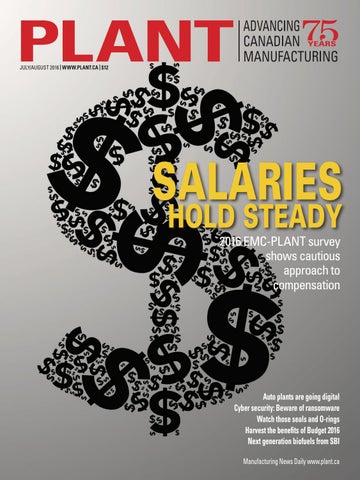
SALARIES HOLD STEADY 2016 EMC-PLANT survey shows cautious approach to compensation
Auto plants are going digital Cyber security: Beware of ransomware Watch those seals and O-rings Harvest the benefits of Budget 2016 Next generation biofuels from SBI Manufacturing News Daily www.plant.ca
PLANT_JulyAug16_AMS.indd 1
2016-07-29 7:58 AM
WORK SAFER AND MORE EFFICIENTLY with the new FLIR® CM174 clamp meter with built-in thermal imaging camera. Featuring Infrared Guided Measurement (IGM) technology, the CM174 visually points you to the precise location of potential electrical issues. You’ll find problems faster, get more done, and boost your credibility. TO SEE IGM IN ACTION GO TO WWW.FLIR.CA/CM174
PLANT_JulyAug16_AMS.indd Plant_Feb_Flir.indd 1 2
2016-07-29 2016-01-27 7:58 8:57 AM
27 8:57 AM
CONTENTS
July/August 2016 Vol. 75, No. 05
FEATURES 26 THINK LEAN Extending lean through your value chain from supplier to customer expands the benefits. 28 PRODUCTION Siemens software is changing the way automotive manufacturers make vehicles. 30 APMA CONFERENCE Automotive parts manufacturers learn there are opportunities to grow the Canadian industry. 32 RETIREMENT Most workers will jump to another company for better pension benefits.
12 COMPENSATION
The 2016 EMC-PLANT salary survey shows executive compensation rising at a cautious pace.
33 ANNIVERSARY A look back at the 1970s and some manufacturing highlights from PLANT. 34 ALTERNATIVE FUELS SBI aims to process non-food plant oils to produce renewable fuels such as diesel.
CIEN 35 SENSORS Make the right capacitive or thermal MEMS choice for high-vibration applications. SUPPLY LINES 18 INVESTMENT How manufacturers can make the most of programs and incentives in Budget 2016.
19 CYBERSECURITY Guard against ransomware attacks that will lock computers or networks.
37 PRODUCT FOCUS: Pumps and valves 39 PRODUCTS AND EQUIPMENT 41 PLANTWARE
DEPARTMENTS 4 6 7 8 10 20 SEALING DEVICES Tips for maintaining seals and o-rings to protect pumps and valves.
24 CCOHS SAFETY TIPS Repetitive strain injuries affect employee performance even when duties are light.
Editorial News Careers Feedback Markets: Automation, Connected Devices 11 PLANT Pulse 41 Events 42 Postscript COVER IMAGE: THINKSTOCK
PLANT—established 1941, is published 8 times per year by Annex Business Media. Publications Mail Agreement #40065710. Circulation email: stelian@annexnewcom.ca Tel: 416-442-5600 ext 3636 Fax: 416-510-5170 Mail: 80 Valleybrook Drive, Toronto, ON M3B 2S9. Occasionally, PLANT will mail information on behalf of industry-related groups whose products and services we believe may be of interest to you. If you prefer not to receive this information, please contact our circulation department in any of the four ways listed above. Annex Privacy Officer: privacy@annexbizmedia.com Tel: 800-668-2374.No part of the editorial content of this publication may be reprinted without the publisher’s written permission. ©2016 Annex Publishing & Printing Inc. All rights reserved. Performance claims for products listed in this issue are made by contributing manufacturers and agencies. PLANT receives unsolicited materials including letters to the editor, press releases, promotional items and images from time to time. PLANT, its affiliates and assignees may use, reproduce, publish, re-publish, distribute, store and archive such unsolicited submissions in whole or in part in any form or medium whatsoever, without compensation of any sort. This statement does not apply to materials/pitches submitted by freelance writers, photographers or illustrators in accordance with known industry practices. Printed in Canada. ISSN: 1929-6606 (Print), 1929-6614 (Online)
www.plant.ca
PLANT_JulyAug16_AMS.indd 3
PLANT 3
2016-07-29 7:58 AM
EDITORIAL
Our automotive challenge
C
anada’s automotive sector is looking at a dim future and although most of the manufacturing business is in Ontario, all of Canada should be concerned. The sector adds 17 billion value-added dollars annually to GDP. The problem is product investments. They’re heading south, leaving Canada with about 3% of North American output, well below the number of vehicles sold in this country. And there won’t be much of an industry without significant new product mandates from the Detroit Three, Honda and Toyota. Jerry Dias, chief of Unifor, the union that represents Canadian autoworkers, knows this and intends to hold the Detroit Three’s feet to the fire when contract negotiations begin. GM, for example, more than doubled its profit in Q2, and thanks to this bounty, Dias intends to secure a product mandate for the automaker’s Oshawa plant, which employs 3,000 people and is in danger of being shuttered. Unifor can look forward to some hard slogging. Ontario is no longer a lower-cost jurisdiction for auto assembly. The dollar has cycled to a lower level, yet a lot of the new production is heading for southern US states or Mexico where a worker makes about $40 a day compared to $32 an hour at Canadian plants; plus government incentives are attractive and plentiful. Ontario Premier Kathleen Wynne made a lot of her government’s involvement convincing GM to hire up to 1,000 engineers in Canada to help develop self-driving car technology. But Ontario is also hindering the cause by ramping up other costs, such as a cap and trade emissions scheme, sky-high hydro rates and various regulatory fees, while Ottawa is offering higher CPP costs. Even Ray Tanguay, former chief of Toyota in Canada who was appointed last year by the Ontario and federal governments to be an advisor to the sector, has noted the challenges he faces dealing with foreign investor concerns regarding such contentious government initiatives. Speaking of challenges, how about that Trans-Pacific Partnership (TPP) deal, which a new report from the Canadian Centre for Policy Alternatives says will have negative consequences for the sector. It opens up North America to increased competition from low-cost countries, and eliminates an advantage Canada had as part of NAFTA. The TPP also eliminates a 6.1% tariff on Japanese imports after five years. Not so in America where the tariff will be phased out after 20 years for cars, and 30 years for trucks. That means Japanese investment will likely go to the US to avoid tariffs, and why not? They’ll be exporting to Canada duty-free. Advantage USA (and thank the Harper government for such inspired negotiating). Tanguay is working on a strategy that he will present to both levels of government later this year, but the Canadian Automotive Partnership Council (CAPC) already outlined some advice in a 2013, 28-page report that offers a good starting point. Among its recommendations are these: governments need to provide tangible support measures to attract investment (see Mexico); co-ordinate all stakeholders at one window (again, see Mexico) so investors are dealing with one point of contact; reduce the cost of labour, which includes items such as employment insurance, employer health tax and workers compensation premiums; do something about transportation gridlock, especially around the GTA; and sort out regulatory tangles between the provinces and the US. Ottawa and the Wynne governments would be wise to avoid the usual bureaucratic dithering and act on Tanguay’s and CAPC’s recommendations with alacrity. As of 2012, the automotive sector accounted for about 11% of Canada’s GDP, 120,000 direct jobs, more than 400,000 jobs when spin-offs are added, plus $56 billion in assembly and $27 billion in parts shipments. That will be a big hole to fill if Canada’s automotive industry is allowed to whither and die. Joe Terrett, Editor Comments? E-mail jterrett@plant.ca.
4 PLANT
Publisher Michael King 416-510-5107 mking@plant.ca, mking@cienmagazine.com Editor Joe Terrett 416-442-5600 ext. 3219 jterrett@plant.ca Associate Editor Matt Powell 416-510-5145 mpowell@plant.ca Art Director Andrea M. Smith National Account Manager Ilana Fawcett 416-510-5202 ifawcett@plant.ca Account Coordinator Barb Vowles 416-510-5103 bvowles@annexbizmedia.co Editorial Advisory Board Robert Hattin, ProVantage Automation | Ron Harper, Cogent Power | Greg MacDonald, Wentworth International Services | Roy Verstraete, Anchor Danly Annex Business Media Vice President Tim Dimopoulos (416) 510-5100 tdimopoulos@annexbizmedia.com President & CEO Mike Fredericks Circulation Manager Beata Olechnowicz 416-442-5600 ext. 3543 bolechnowicz@annexbizmedia.com Subscription Price Canada $72.50 per year, US $146.95 (US) per year, Foregin $166 (US) per year. Single Copy Canada $12.00. Add applicable taxes to all rates. Combined, expanded or premium issues, which count as two subscription issues. Mailing Address Annex Business Media 80 Valleybrook Dr., Toronto, ON M3B 2S9 plant.ca Tel: 416-442-5600, Fax: 416-510-5140 Customer Service Silva Telian 416-442-5600 ext. 3636 stelian@annexnewcom.ca
We acknowledge the [financial] support of the Government of Canada.
July/August 2016
exairSKE PLANT_JulyAug16_AMS.indd 4
2016-07-29 7:58 AM
PLT_Exa
The Secret To Keeping Electronics Cool! NEMA 12 Cabinet Coolers The NEMA 12 Cabinet Coolers for large heat loads up to 5,600 Btu/hr. are ideal for PLCs, line control cabinets, CCTV cameras, modular control centers, etc.
A bad choice could cost you thousands! Look Familiar? When hot weather causes the electronics inside a control cabinet to fail, there is a panic to get the machinery up and running again. The operator might choose to simply open the panel door and aim a fan at the circuit boards. In reality, the fan ends up blowing a lot of hot, humid, dirty air at the electronics and the cooling effect is minimal. If the machinery starts functioning again, the likelihood of repeated failure is great since the environment is still hot (and threatens permanent damage to the circuit boards). Worse yet, that open panel door is an OSHA violation that presents a shock hazard to personnel.
• Measures 8" (203mm) high • Mounts top, side or bottom • Enclosure remains dust-tight and oil-tight
NEMA 4 and 4X Cabinet Coolers Coolers Cabinet NEMA 4 and 4X Cabinet Coolers for large heat loads up to 5,600 Btu/hr. They are ideal for PLCs and modular controls. • Enclosure remains dust-tight, oil-tight and splash resistant • Suitable for wet locations where coolant spray or hose down can occur
Type 316 Stainless Steel Cabinet Cabinet Coolers Coolers Type 316 Stainless Steel Cabinet Coolers for NEMA 4X applications are available for heat loads up to 5,600 Btu/hr. • Resists harsh environments not suitable for Type 303/304 • Ideal for food and chemical processing, pharmaceutical, foundries, heat treating and other corrosive environments
Stop electronic downtime with an EXAIR Cabinet Cooler® System! The complete line of low cost Cabinet Cooler Systems are in stock and can ship now. They mount in minutes through an ordinary electrical knockout and have no moving parts to wear out. Thermostat control to minimize compressed air use is available for all models. All Cabinet Coolers are UL Listed to US and Canadian safety standards.
www.exair.com/18/44018.htm
The only compressed air powered cooler that is CE compliant!
Mini NEMA 12, 4, and 4X Cabinet Coolers
High Temperature Cabinet Coolers
The mini NEMA 12, 4 and 4X Cabinet Coolers for small heat loads up to 550 Btu/hr. are ideal for control panels, relay boxes, laser housings, and electronic scales.
High Temperature Cabinet Coolers for NEMA 12, 4 and 4X applications are available for heat loads in many capacities up to 5,600 Btu/hr.
NHP Cabinet Coolers keep a slight positive pressure on the enclosure to keep dirt from entering through small holes or conduits. For use in nonhazardous locations.
• Measures 5" (127mm) high
• Suitable for ambients up to 200°F (93°C)
• Uses only 1 SCFM in purge mode
• Ideal for mounting near ovens, furnaces, and other hot locations
• For heat loads up to 5,600 Btu/hr.
• Mounts top, side or bottom • Enclosure remains dust-tight and oil-tight
“It took us three days to get a replacement computer cabinet and
Jeff Hauck, Lasercraft Inc. Cincinnati OH
exairSKECad_red_PLcorrect.indd 1 PLT_Exair_JulyAug.indd 1 PLANT_JulyAug16_AMS.indd 5
Watch The Video!
The Real Solution!
we didn’t want to risk another heat failure. Fans weren’t an option since they would just blow around a lot of hot air. Freon-type air conditioners like those on some of our other machines were a constant maintenance project of their own. We purchased EXAIR’s Model 4330 NEMA 12 Cabinet Cooler System since it was easy to install and requires no maintenance.”
Non-Hazardous Purge Cabinet Coolers
• NEMA 12, 4 and 4X
If you would like to discuss an application, contact: 11510 Goldcoast Drive, Cincinnati, Ohio 45249-1621
(800) 903-9247
fax: (513) 671-3363
www.exair.com/18/440.htm @exair
7/15/16 2:27 PM 2016-07-18 7:58 2016-07-29 9:57 AM
NEWS
CME calls for CPP tax relief
BULLETINS Airbus Helicopters Canada has expanded the 5,000 square-foot support and services department at its Fort Erie, Ont. facility by 65%. Many of the AS350/H125 aircraft the aerospace manufacturer made are coming due for overhaul. There are currently 522 AS350/H125s flying in Canada. Ballard Power Systems has signed a $2.5 million technology licensing deal with China’s Guangdong Nation Synergy Hydrogen Power Technology Co., granting it exclusive rights to build and market the company’s FCgen-H2PM fuel cell backup power systems. Synergy plans to sell the 1.7 and 5 kilowatt backup power systems to Chinese telecommunications companies. Mortimer’s Fine Foods is investing $6.8 million to expand its St. Catharines, Ont. meat pie-processing plant. The expansion includes plans to automate the facility’s packaging line, creating 14 jobs. The Ontario government is contributing 10% of the project costs. Battery-maker Electrovaya has penned an MOU with German e-mobility OEM Litarion GmbH to supply the company with its lithium-ion battery modules. The e-mobility segment includes electric cars or smaller vehicles such as e-bikes. FedDev Ontario has invested $5.76 million to support the Vineland Research and Innovation Centre’s new Collaborative Greenhouse Technology Centre. It brings together research institutions, business and academia to bring new technology in the robotics, automation and greenhouse industries to market. Packaging and tissue product manufacturer Cascades Inc. based in Kingsey Falls, Que. has shuttered its de-inked pulp mill in Auburn, Me. The Auburn Fiber plant, which opened in 1998 and employed 45 people, closed in early July. Ventripoint’s Toronto development and manufacturing centre has been awarded ISO 13485:2003 registration through third-party registrar, Intertek Testing Services NA. The certification will help Ventripoint get regulatory approvals to supply its medical devices globally.
6 PLANT
PLANT_JulyAug16_AMS.indd 6
HMCS Victoria returns home from operations with the US Navy in February. PHOTO: GOVERNMENT OF CANADA
$14.5M sub support contract For fire control systems in Victoria-class vessels OTTAWA — Lockheed Martin has been awarded a $14.5 million contract by the federal government to support the submarine fire control system installed on the navy’s four Victoria-class submarines, and their trainers. The fire control system is described as “critical for the submarine weapon firing capability” as well as for providing a tactical picture of all acoustic and non-acoustic sensors. It rapidly synthesizes sensor data and classifies, identifies and neutralizes potential adversaries on the surface and under water. Lockheed Martin will also incorporate modernized, layer-based displays, support of advanced sonar processing upgrades, remote control and image display of the search and attack periscopes, precision electronic navigation, and a deeper integration to electronic support measure systems. Canada picked up the four diesel-electric submarines designed in the UK (late 1970s) in 1998. But since taking delivery, they have been plagued by problems. In June, the HMS Windsor, the only functioning vessel of the four, was forced back to port with engine trouble. It was on its way to a NATO exercise in the North Sea.
AP&C expands Montreal operations FARNBOROUGH, UK — Advanced Powders & Coatings (AP&C) is investing $31 million to expand its existing operations and build a second plant in Montréal. The company, which manufactures metal powders for industrial sectors including aerospace, currently employs close to 85 people in Boisbriand. The new, more automated facility will increase capacity and create 106 new jobs over the next three years. More than half of the new hires will start in 2017. AP&C’s high-purity titanium powders are used in various metal applications, such as additive manufacturing, injection moulding, isostatic pressing and coatings.
OTTAWA — Canadian Manufacturers & Exporters (CME) is calling on the federal and provincial governments to provide businesses with tax relief to offset the impact of higher Canada Pension Plan (CPP) premiums. The CPP expansion is to be financed by a 1% increase in premiums paid by businesses and their employees, but CME contends it will increase premiums by 32% for any worker earning $82,700 in 2025. Employees will receive a tax deduction for a significant portion of their increased payments, but CME notes no relief has been proposed for businesses. “By the time the CPP enhancement is fully implemented, it will cost Canadian manufacturers nearly $1.9 billion in new taxes,” said Mike Holden, CME’s chief economist. “Payroll taxes like the CPP are among the most damaging to the Canadian economy.” CME also warns companies that already offer generous private pension plans to their workers may scale back those plans or eliminate them to compensate for the higher tax burden. It wants federal and provincial governments to reduce other corporate taxes to compensate manufacturers for the $1.9-billion payroll tax hike.
Schaffler embarks on $13.1M expansion in Stratford, Ont. Auto components maker to boost automation, capacity STRATFORD, Ont.— The Canadian wing of German bearing manufacturer Schaeffler Group is launching a $13.1 million expansion project at one of its two plants in Stratford, Ont. Using private funds, as well as a $1.3 million investment from the province, Schaeffler Canada is adding two new assembly lines, buying new equipment and investing in automation at its facility in the southwest Ontario city. The company expects to add 44 jobs at the facility where more than 400 employees work. The expansion, to be comlpeted by 2018, will
increase production capacity and improve quality control at the rolling bearings plant.
Schaeffler manufactures bearings and other intricate components for the PHOTO: SCHAEFFLER auto industry.
July/August 2016
2016-07-29 7:58 AM
Beau’s goes national with its craft beers Popular Lug Tread Lagered Ale to roll out across the country
A Beau’s retail location where you can buy Lug Tread Lagered PHOTO: BEAU’S Ale.
OTTAWA — Beau’s All Natural Brewing Co. Ltd. is going national. The Ottawa-based craft brewer, which has built a local market for its craft beers
over the past 10 years, will extend its distribution network thousands of kilometres from its home base in the quiet 2,000-person town of Vankleek Hill, Ont. Lug Tread Lagered Ale, it’s most popular brew among beer drinkers in Ontario, has been sold in Quebec since last year and will go on sale in most Canadian provinces by September. The beer is already available in New Brunswick and PEI and will be on shelves in Manitoba, BC and Alberta by the end of the summer. Lug Tread will be in stores in eight of the 10 Canadian provinces by the end of the year and throughout the country next year. Other brews will follow. The company once said it would keep its beer within a one-day drive of the manufacturing plant, but Beau’s said recent acquisitions of craft brewers by big beer conglomerates have forced it to review its position. Beau’s recently opened ownership in the brewery to the company’s employees.
Bionic knee-brace bound for Canadian military HALIFAX — Spring Loaded Technology has completed a delivery of 60 UpShot bionic knee braces to the Department of National Defence as part of a $1 million contract awarded under the Build in Canada Innovation Program. The military-grade braces use
a liquid spring technology that absorbs shock and reduces impact on soldiers’ knees, and are powerful enough to help lift more than 100 pounds of body weight. Spring Loaded, based in Burnside, NS, will provide 190 knee braces to the Canadian military for field
CAE discloses $180M in new contracts FARNBOROUGH, UK — Canadian simulator manufacturer and training company CAE Inc. announced $180 million in new contracts at the Farnborough International Airshow in the UK. The Montreal-based company said the string of deals includes the sale of nine fullflight simulators to airlines in Asia. CAE will build three of the training devices for a joint venture with AirAsia, one Airbus A320 simulator for ChongQing Yu Xiang Aviation in China, as well as five full simulators for undisclosed customers in North America, the Middle East and Asia. The company also signed a 10-year pilot training agreement with Vietnam Airlines, a seven-year training deal with Asiana Airlines, and training centre/technical support contracts with India’s Jet Airways and an unnamed US airline.
www.plant.ca
PLANT_JulyAug16_AMS.indd 7
testing. A commercial version of the military-grade UpShot called the Levitation Knee Brace improves strength, mobility and endurance by storing energy as the leg bends, and returning it as the leg straightens.
Arctic patrol vessel engines delivered to Irving Shipbuilding GE propulsion systems run on hybrid diesel/electric PETERBOROUGH, Ont. — GE Peterborough’s marine solutions wing has completed the first four diesel generators and engines for the Royal Canadian Navy’s Offshore Patrol Ships. The industrial giant shipped the ice- and cold weather-ready components to Irving Shipbuilding Inc.’s yard June 14, completing one part of its contract with the Halifax-based firm leading the $25 billion project. The Arctic patrol ships will run on hybrid diesel/electric propulsion, according to the Canadian Navy. The ships will be powered by a pair of 4.5 megawatt main propulsion engines and four 3.6 megawatt generators. GE said it has begun acceptance testing on the first propulsion motor designed for the vessels. It expected to ship the component in early July. Ontario steel skid and machining suppliers are being used to complete the contract. Under the seven-year agreement with Irving, GE will deliver and commission the electrical power and propulsion systems for six ice-capable Arctic patrol ships.
CAREERS Morgan Solar has appointed Mike Andrade CEO. Andrade has 30 years of experience in the technology industry, most recently as president of diversified markets at electronics man- Mike Andrade ufacturer, Celestica. He takes the helm from Asif Ansari, who has transitioned into the role of executive advisor to the board. Morgan is a manufacturer of solar module and Balance of System (BOS) components based in Toronto. Canadian Manufacturers & Exporters has appointed Michel Raymond divisional vice-president of the Nova Scotia division. Prior to joining CME Nova Scotia, Raymond was health, safety and environment lead at Pratt & Whitney Canada. He has been the CME board’s vice-chair for the past two years. Ontario’s largest electricity transmission and generation provider has a new executive vice-president of customer and corporate affairs. Ferio Pugliese comes from WestJet, where he has held senior leadership roles since 2007. Hydro One, based in Toronto, serves 1.3 million customers across Ontario. Lithium X Energy Corp. has appointed Eduardo Morales COO. He joins the company with 36 years of experience in the chemical engineering industry, most recently as president of Rockwood Lithium Latin America, where he was responsible for bringing one of the world’s largest lithium brine operations online. Lithium X is an exploration and development company for the lithium battery industry based in Vancouver. Ritchie Bros., an industrial auctioneer based in Burnaby, BC, has appointed Sarah Raiss to its board of directors. Raiss is currently a corporate director at Loblaw Companies and Vermillion Energy. She is a former chair of the Alberta Electric System Operator and a past director of Shoppers Drug Mart. Raiss retired from TransCanada Corp. in 2011, where she was executive vice-president of corporate services.
PLANT 7
2016-07-29 7:58 AM
NEWS
McCain to upgrade NB fry plant
FEEDBACK PHOTO: THINKSTOCK
$65M expansion includes a new production line and equipment
SUPPORTS DISRUPTION Re: Prepare to be disrupted, PLANT, May-June 2016. I think this disruption is long overdue. It should have happened when our economy was good, but our last government did not care about this issue. If we care about the health of our children and grandchildren, we need to do this, and the sooner the better. I agree with the federal government’s plans, including economic initiatives. We have to live healthy to enjoy life, not just make money. Moe Khan Toronto, Ont.
CARBON TAX BURDEN Re: Ontario gives CO2 the boot, PLANT, May-June 2016. I am in Manitoba and work at a plastics factory. Almost all our power (96%) is generated from hydro-electric dams (remainder supplied by two thermal generating stations, four remote diesel stations and wind). That would mean (almost) a 0% carbon foot print, right? Yet our government wants to follow Ontario’s lead with a carbon tax! We already pay double what gas is worth in taxes, plus municipal, road, provincial and myriad tire, pop can and enviro charges. I am close to retirement and I will pay 95% less tax living in Roatan, Honduras than here. People ask, “what about your health care?” A root canal is $150, an MRI is $200 and comprehensive health insurance is $100 a month. If this is how I feel as a consumer, imagine how a business works with those factors when considering where to build or expand.
FLORENCEVILLE-BRISTOL, NB — McCain Foods (Canada) is investing $65 million in an expansion of its Florenceville-Bristol French fry plant in New Brunswick, and expects to create up to 50 new jobs. The frozen food manufacturer is adding a new production line to meet growing demand for its hash brown patties and similar potato products. The 32,000 square-foot expansion includes the installation of new manufacturing equipment and technology. Jeffery DeLapp, McCain’s regional president, North America, said the new line will serve retail and foodservice customers in Canada, the US and other export markets.
H2O acquisition firms foothold in the US QUEBEC CITY — H2O Innovation Inc. has acquired a wastewater treatment firm for US$17 million to establish its position in the US market. Utility Partners LLC operates and maintains water and wastewater treatment plants for small and mid-sized cities in six US states. It has 450 employees at facilities in New England, and along the Gulf Coast, in California and Nevada. Frédéric Dugré, H2O Innovation’s president and CEO, said the deal is a “significant step” in building up the company’s operation and maintenance business. Innovation said it expects the deal to create cost-savings and cross-selling opportunities.
Dale McCarthy, McCain’s vice-president of Integrated Supply Chain, North America, noted that the expansion will stimulate economic growth in the area and will have a significant impact on New Brunswick potato growers. Construction is to begin immediately with production underway in late 2017 or early 2018.
BIOX buys idle Sombra biodiesel plant TORONTO — BIOX Corp. will breath new life into an idle 50-million-litre biodiesel facility in Sombra, Ont., a few kilometres outside the province’s refining capital of Sarnia, Ont. Owned by Methes Energies Canada Inc., the 21-acre Sombra plant was built in 2009, but financing issues and tough market conditions prevented it from reaching full production capacity. Along with the US$4.5 million purchase price, the Hamilton-based company, will invest $5 million on upgrading the plant and bringing it back online. BIOX, which also operates a 67-million-litre biodiesel plant in Hamilton, plans to improve the efficiency of the Sombra site over the next 12 months, and install new equipment that will allow it to produce fuel from a wider range of feedstocks, such as animal fats and recycled cooking oils. BIOX says the increased capacity will be used to contribute to Ontario’s Greener Diesel program. Ontario has mandated all diesel used in the province contain 3% biofuel by this year and 4% by 2017.
Viking acquires amphibious aircraft rights Gains global manufacturing rights for all Bombardier’s waterbomber variants VICTORIA — Viking Air Ltd. has acquired Bombardier’s global portolio of amphibious aircraft, including the CL-415 waterbomber and the CL-
Terry Manick, Selkirk, Man. We’d like to hear from you. Send comments to jterrett@plant.ca with your name, address and phone number. Comments will be edited. The CL-415 waterbomber in action.
8 PLANT
Aerial view of McCain’s Florenceville-Bristol plant. PHOTO: MCCAIN FOODS
PHOTO: VIKING AIR
215/CL215T models, for an undisclosed amount. The Bombardier 415, designed more than 50 years ago, is the only western aircraft purpose-built for firefighting. Viking has secured the manufacturing rights for all variants of Bombardier’s amphibious aircraft, and will assume responsibility for product support, parts and service for the fleet of more than 170 waterbombers with 21 operators in 11 countries. Support will be handled out of a recently repurposed 50,000 square-foot facility in Calgary. Viking, based in Victoria, provides utility aircraft support and services, and manufacturer of the Twin Otter utility aircraft. It has more than 330 employees at facilities in BC and Alberta.
July/August 2016
SCA_Pla PLANT_JulyAug16_AMS.indd 8
2016-07-29 7:58 AM
Plant_SC
Better you hear it from us
Tork EasyCubeTM Intelligent Restroom System Keep a step ahead with Tork EasyCubeTM Intelligent Restroom System. Digital sensors at your restroom’s entrance and in the towel, tissue and soap dispensers take the guesswork out of restroom maintenance. By transmitting real-time data to an easy-to-use web app, you will know exactly when refills are needed and exactly how many visitors have entered. Smart technologies help keep restrooms clean and always ready for use – a difference that people notice! Learn more about Tork EasyCube at easycube.sca-tork.com or email us at TorkEasyCube@sca.com
www.tork.ca © 2016 SCA North America LLC. All rights reserved. ®Tork is a registered trademark of SCA North America LLC, or its affiliates.
SCA_PlantCanada.indd 1 Plant_SCATissue_JulyAug.indd 9 1 PLANT_JulyAug16_AMS.indd
7/11/16 9:19 AM 2016-07-14 2016-07-29 10:56 7:58 AM
MARKETS
AUTOMATION
A BII+E report looks at the future of automation and what it means for Canadian jobs. BY PLANT STAFF
A
utomation will transform traditional occupations in more areas than manufacturing, and 42% of the labour force is likely to be affected in the next 10 to 20 years, according to a study by the Brookfield Institute for Innovation + Entrepreneurship (BII+E) at Ryerson University. The report cites the recent rise of artificial intelligence for automation, which is infiltrating cognitive, non-routine tasks and occupations. A significant percentage of Canadian jobs are at a high risk of being replaced by automation, said Sean Mullin, executive director of BII+E. “However, we don’t believe that all of these jobs will be lost. Many will be restructured and new jobs will be created as the nature of occupations change due to the impact of technology and computerization.” Low risk jobs are linked to high skill levels and higher earnings, such as management and jobs in science, technology, engineering and math (STEM). They’re expected to create many new jobs for Canadians in the coming years. Most high-risk occupations are in office support and general administration; sales and services; transportation and distribution; lower skilled technical occupations in health, natural and applied sciences; and labourers/ assemblers in manufacturing and construction. Less than 1% of jobs are fully automatable, and most of those are in manufacturing, machine operation and related production work. Canada’s employed labour force is comprised of a large number of occupations that require highly skilled workers who command high wages and are
10 PLANT
PLANT_JulyAug16_AMS.indd 10
Less than 1% of jobs are fully automatable, and most are in manufacturing.
An automated
FUTURE
ROBOTS WILL BE DOING MUCH MORE OF THE WORK at a low risk of being negatively affected by automation. The report says these occupations are to grow much faster than the rest of the labour force. Approximately 36% of the labour force is at a low risk of
automation and those areas with the lowest risk are projected to produce nearly 712,000 new jobs between 2014 and 2024. Ontario has the lowest proportion of high-risk jobs, and PEI the highest at more than 45% over
PHOTO: THINKSTOCK
the next 10 to 20 years. The report includes a detailed appendix that lists occupations, how much of their jobs are automatable, average wages, number of jobs and risk factors. Good news for manufacturing managers: only a 3% probability of automation in the next 10 to 20 years; and ditto for industrial engineers, manufacturing technologists and technicians. Visit http://brookfieldinstitute.ca/automation for a copy of The Talented Mr. Robot: The Impact of Automation on Canada’s Workforce. Comments? E-mail jterrett@plant.ca.
CONNECTED DEVICES
Smarter manufacturing Segment will reach $112 billion by 2020
C
anadian companies take note: it’s time to get smart about manufacturing – your global competitors will be plugging into connected devices in a big way over the next five years. Smart manufacturing is a young market with significant revenue opportunity, reports BCC Research. Global double-digit growth for connected devices is anticipated over the next five years. The market research firm based in Wellesley, Ma. says the network of machines containing embedded technology that allows them to communicate with each other is based primarily on the recent growth of the Internet of Things (IoT). The global market should reach $392 billion by 2020, up from $159 billion in 2015, reflecting a five-year compound annual growth rate (CAGR) of 19.8%.
In North America the segment should hit $112 billion by 2020, up from $47 billion in 2015, with a five-year CAGR of 19%. Asia-Pacific will grow from $59 billion in 2015 to $151 billion in 2020. Government mandates and greater eco-consciousness are driving IoT investments in Western Europe and Asia-Pacific, where improving manufacturing efficiencies is a strong incentive. Global investments in smart manufacturing will average a five-year CAGR of 20% to reach $392 billion in 2020, with the Asia-Pacific region representing about 38%. BCC Research predicts high tech and aerospace will see the strongest growth through 2020. Adoption levels will differ, but should be stronger overall in the discrete segment where smart manufacturing is expected to ultimately lead to mass-customization. Network and semiconductor manufacturers foresee more than 50 billion connected devices by 2020, with potentially half used for manufacturing.
July/August 2016
2016-07-29 7:58 AM
Sales growth slowed in June
RBC’s PMI notes manufacturing volumes are up
M
anufacturing slipped into a lower gear by the end of the second quarter, according to the June RBC Canadian Manufacturing PMI. The purchasing managers index registered a 51.8 for the month, down from May’s 52.1 (above 50 denotes growth), which is the weakest pace of improvement since March, the bank said. “While the slowdown in the growth of manufacturing during June is disappointing, Canadian manufacturers did indicate a marginal upturn in new business volumes,” said Craig Wright, RBC’s senior vice-president and chief economist. “Currency weakness and stronger US demand should drive further exports; however, growing economic uncertainly means the roller coaster we’ve experienced recently in the Canadian export market will likely continue.” The monthly survey, conducted in association with Markit, a global financial information services company, and the Supply Chain Management Association (SCMA), ties in with a recent Bank of Canada survey of senior managers from 100 companies between May 9 and June 8. It found businesses anticipating minimal sales growth over the next 12 months. Companies affected by the slump in the energy sector reported new orders have shown little improvement from a year ago. RBC’s report cites almost no change in export orders for the month, a contrast to growth seen over the first few months of the year. And stocks of finished goods dropped at a survey-record pace. Manufacturers noted subdued client demand and uncertainty about the economic outlook have encouraged tighter inventory management at their plants. That uncertainty also eased the pace of hiring, which nonetheless extended the current period of net job creation to four months. The National Bank of Canada said in its monthly economic monitor that uncertainties created by Brexit may cause a slowdown in overall global growth, hurting commodity prices and Canada’s export volumes. Looking ahead, the bank has lowered its Canadian GDP growth forecasts to 1.2% this year and 1.7% for 2017.
www.plant.ca
PLANT_JulyAug16_AMS.indd 11
billions of dollars 1,700 1,680 1,660 1,640 1,620 1,600 1,580 1560 1,540 1,520 1,500 1,480
Apr. 2011
2.6%
2012
2013
2014
2015
How much the Conference Board of Canada’s Composite Leading Index rose in April. It suggests better times ahead for Canada’s economy six months from now as oil prices continue to recover, and financial markets and consumer confidence rebound.
Apr. 2016
GDP RISES IN APRIL Canada’s economy took a tiny step forward in April as GDP edged up 0.1%, thanks in part to a 0.4% gain from manufacturing after declining in February and March. Statistics Canada reports the rise in manufacturing output was attributable to non-durable goods manufacturing (0.9%), up for the third consecutive month. Petroleum and coal products, chemicals and, to a lesser extent, beverage and tobacco products advanced but there was a notable decline in plastic and rubber products manufacturing.
6.5 MILLION
The number of deaths worldwide linked to air pollution, the fourth greatest threat to human health, after high blood pressure, bad diets and smoking. The Paris-based International Energy Agency warns the number that could grow in coming decades unless the energy sector steps up its efforts to slash emissions.
$250 MILLION
24%
What the Finance Department in Ottawa says it will cost taxpayers once the CPP premium increase is fully phased in to offset the additional financial burden its expansion will eventually place on low-income earners.
The amount of underground economic activity – about 2.4% of GDP – mostly from residential construction (27.8%), retail trade (12.5%), and accommodation and food services (11.7%). “Underground” is market-based economic activities that escape measurement because of their hidden, illegal or informal nature. Statistics Canada notes some illegal activities, such as drugs and prostitution, aren’t part of this mix.
Percentage of small and medium-sized businesses planning to hire over the next three months, compared to 12% who will be cutting jobs, according to the Canadian Federation of Independent Business, June Business Barometer.
$45.6 BILLION
PLANT 11
2016-07-29 7:58 AM
COMPENSATION
Holding
STEADY CAUTION IS HAVING AN IMPACT ON EXECUTIVE PAY
The 2016 EMC-PLANT salary survey shows executive compensation continues to rise but a more circumspect pace. BY JOE TERRETT, EDITOR
PHOTO: THINKSTOCK
C
12 PLANT
PLANT_JulyAug16_AMS.indd 12
anadian manufacturers, you are a careful lot. Annual outlook and compensation surveys show you to be optimistic much of the time, but your confidence is tempered with caution; and it turns out, with good reason. Last year was supposed to represent a manufacturing revival as the US economy finally sputtered back to life, with the lower-value loonie backing the promise of increased non-commodity exports. And all of this in spite of oil and gas companies putting the breaks on investments as they cope with too-low prices. Yet the boost has failed to materialize and manufacturers continue to hold back on investments in plants and technology. Meanwhile, Canada’s economic performance limps along with recalculated projected growth in the vicinity of the low end of a per cent (National Bank of Canada’s latest is 1.2% for this year, 1.7% in 2017). Nonetheless, business was pretty good last year for many
manufacturers, although they are for the most part being careful with executive compensation, according to the results of the latest national salary benchmark survey conducted by the Excellence in Manufacturing Consortium (EMC), a not-forprofit organization based in Owen Sound, Ont., and PLANT magazine, an Annex Business Media publication. The survey gathered a total of 1,032 responses from executives and senior managers (686 answering all of the compensation questions) in a sector dominated by small and medium-sized enterprises (87.2%) who shared personal information about salaries and bonuses, and how their businesses are faring. Each year’s respondent sample is different so results don’t always align with the previous year’s group, for a variety of reasons, but the results do provide a general measure that will give you an idea how your pay compares.
July/August 2016
2016-07-29 7:58 AM
Demographics Location, average salary, % of replies
91%
Y
Those working full-time in manufacturing
87% 71%
Respondents who are SMEs
YT/NT/NU $90,000 <1%*
BC $120,119 8%
AB $121,916 9%
SK $84,200 1%*
NL $105,000 1%*
MB $99,915 3% ON $119,510 51%
NB $122,081 4%
National average
694 respondents
NS $106,610 3%
* Small sample. View responses of 2% or less with caution.
686 respondents
Under 25 0.6% 26-35 5.5% 36-45 18.3% 46-55 39% 56-65 32.6% Over 65 4%
PEI $316,000 <1%*
QC $102,556 13%
$ 113,285 AGE
Companies that are not unionized
REVENUE
$1M to <$5M 18.7% $5M to <$10M 15.2% $10M to <$30M 24% $30M to <$50M 12.3% $50M to <$100M 9% $100M to <$250M 6.8% $250M to <$500M 3.5% $500M to <$1B 4.1% $1B plus 6.2%
EMPLOYEES
Less than 50 36.5% 50-249 39.9% 250-499 10.8% 500-999 4.8% 1,000-4,999 4.8% 5,000 or more 3.2% 687 respondents
This year’s sample shows average remuneration across manufacturing (all categories combined) will rise 1.9% to $113,285, compared to 1.6% in 2015 when the inflation rate was 1.6%. What does our average manufacturing leader look like? Mostly male (83%), between 46 and 65 years of age (almost 72%); and three-quarters of them have management roles rather than own-
www.plant.ca
PLANT_JulyAug16_AMS.indd 13
ership or partnership positions. The typical manufacturer has been in the business 23 years, 15 of those at his/her current com-
their employment situation, but 19% say more responsibilities have been added to the workload because of reduced staff,
IN ONTARIO, CAP AND TRADE OFFERS ANOTHER POTENTIALLY HUGE COST OF DOING BUSINESS… pany and 10 in the same job. Almost two-thirds of respondents (64%) report no change to
which is consistent with previous surveys. Most (39%) have a university degree that for 64.7% is
a bachelor of arts and they pull a 47.3-hour workweek. As was the case with last year’s sample, respondents are a little less optimistic about earning higher revenues this year (55% over 2015 revenues compared to 57% over 2014), but 59% intend to invest in new production equipment and processes over the next five years, 51% say they will hire new employees and 38%
IMAGES: THINKSTOCK
657 respondents
PLANT 13
2016-07-29 7:58 AM
COMPENSATION
Salary Comparisons Hours/ Job title
Industry
CEO/President Vice-president Owner/Partner Director Plant manager Plant engineering Materials manager Maintenance manager Design engineering Production/Operations manager Purchasing/Supply manager Administrative management Logistics manager Safety manager Technician/Technologist Quality assurance manager
Aerospace product, parts $123,000 $120,477 $107,800 $95,750 $89,750 $74,500 Beverage and tobacco product Chemical $122,952 $113,444 $106,264 Clothing manufacturing $67,000 $66,286 $63,500 Computer, electronic product $86,647 $84,161 $78,796 Durable goods $120,643 $124,314 $112,229 $113,615 $107,288 $102,071 Electrical equipment, appliance, component Environmental $89,636 $89,830 $84,983 Fabricated metal product $114,849 $111,580 $119,648 $108,158 $103,723 $97,306 Food manufacturing Furniture, related product $91,846 $79,374 $73,626 $65,000 $60,000 $90,000 Leather, allied product Life sciences $141,394 $132,639 $160,457 Machinery $116,631 $113,060 $109,626 $116,322 $121,821 $119,003 Miscellaneous manufacturing Motor vehicle $108,429 $103,429 $101,943 $130,333 $120,000 $116,667 Motor vehicle body, trailer $176,959 $150,807 $125,644 Motor vehicle parts Non-durable goods industries $158,600 $245,950 $232,550 Non-metallic mineral product $118,571 $114,143 $233,571 $132,981 $127,703 $123,331 Paper manufacturing $120,250 $120,167 $111,583 Petroleum and coal product $117,299 $114,295 $119,022 Plastics and rubber products Primary metal $110,167 $108,507 $101,193 $94,361 $90,699 $91,341 Printing, related support $73,000 $71,000 $71,000 Railroad rolling stock $69,890 $64,890 $59,890 Ship and boat building $129,833 $122,667 $117,833 Textile product mills $108,630 $104,490 $99,150 Transportation equipment $124,651 $124,112 $123,429 Wood product Did not answer
49 50 51 48 49 47 43 48 45 48 44 46 45 45 44 44
Bonuses and incentives in 2016 686 respondents
40%
9%
10%
13%
0
1%-3%
4%-5%
6%-10%
$89,840
$90,453
$102,351
$116,543
8%
5%
11%-15%
16%-20%
20+%
$135,789
$143,021
$245,737
say they will add new lines of business. Manufacturers continue to have concerns. Cost control tops the list again for 51%, while 42% identified skills issues, both leading the list since the salary survey began six years ago.
9%
represents manufacturers from across Canada. Indeed, the global adjustment, tacked on to a manufacturer’s monthly bill (to cover price and market rate differences, plus conservation and demand management programs) was, at
COMPANIES HAVE TO BALANCE THE RISING COST OF BENEFITS WITH THE NEED TO ATTRACT AND RETAIN KEY PEOPLE… Technology upgrades (31.9%) and capacity utilization (27%) follow. Chief among cost concerns in Ontario, where most of Canada’s manufacturers operate, is the price of electricity. “Energy costs are huge. You start talking about that and the whole room starts to shuffle,” says Al Diggins, president and general manager of EMC, which
14 PLANT
PLANT_JulyAug16_AMS.indd 14
$60 per megawatt hour (MWh), six times higher than a decade ago, says a 2014 Fraser Institute report. The rate has since jumped to more than $107 per MWh (as of May for Class B users). “Companies are being cautious about what they’re doing because of where costs are, and there’s a bit of uncertainty,” says Scott McNeil-Smith, EMC’s di-
rector of strategic planning and communications, and president of the Canadian Manufacturing Network. “All business owners are potentially facing a new pension plan forced on them either by the government of Canada or the province of Ontario with changes to the CPP, and a proposed Ontario pension plan.” In Ontario, cap and trade offers another potentially huge cost of doing business, he adds. “Not knowing where that’s going to end up is something that’s playing on people’s minds.” So it’s not surprising caution is tempering executive pay. The 2016 sample is all over the place with a few titles not too far ahead of the inflation rate, some in the neighbourhood and others looking at decreases. CEOs and presidents continue to score at the higher end (5.1%)
2% <1% 4% 1% 2% 1% 5% 2% 14% 8% 2% <1% 2% 5% 10% 1% <1% 4% <1% 1% 2% 2% 10% 2% 5% <1% 1% 1% 1% 6% 6%
Gender
686 respondents
$85,854 $84,761 $79,252 replies 16%
2016
$204,231 $169,020 $133,132 $128,509 $111,159 $144,741 $92,222 $95,738 $90,939 $103,604 $82,449 $87,559 $73,888 $71,180 $76,457 $85,544
% 2016 2015 2014 replies
$122,333
2015
$230,653 $178,894 $152,736 $138,897 $115,376 $102,163 $98,778 $98,635 $93,873 $90,740 $86,128 $83,822 $78,775 $77,186 $77,121 $75,228
686 respondents
$118,556
2014
$242,375 $170,306 $147,682 $145,221 $119,835 $103,389 $100,889 $99,057 $98,964 $93,133 $88,733 $86,755 $81,138 $80,611 $77,839 $76,639
week
2016
2014
2015
2015
2016
2014
686 respondents
$119,072
replies 79%
after a 12.9% advance last year, but owners and partners report a 3.3% decrease. This follows a 14.7% increase last year. Vice-presidents took a hit, down 4.8% compared to a 5.8% increase
July/August 2016
2016-07-29 7:58 AM
Age
respondents 686 Under 25 26-35 36-45 46-55 56-65 Over 65
Years of experience 686
espondents
1 to 5 6 to 10 11 to 19 20 to 29 30+
Company revenue 686 respondents
$1M to just less than $5M $5M to just less than $10M $10M to just less than $30M $30M to just less than $50M $50M to just less than $100M $100M to just less than $250M $250M to just less than $500M $500M to just less than $1B $1B plus
last year, while plant managers will get a 3.9% raise compared to the 3.8% they received in 2015. Directors are expecting 4.6% following an 8.1% increase in 2015. Design engineers are looking at 5.4% this year while safety managers are anticipating 4.4% and administrative management 3.5%.
% 2016 2015 2014 replies $55,400 $73,731 $101,066 $118,793 $130,137 $105,643
$49,625 $69,370 $98,959 $117,916 $123,492 $100,767
$44,625 $66,097 $91,889 $126,142 $116,660 $97,400
1% 5% 18% 38% 31% 3%
% 2016 2015 2014 replies $88,977 $96,247 $93,986 $120,074 $134,338
$80,412 $103,083 $91,714 $120,530 $129,200
$74,069 $90,388 $87,505 $116,322 $133,886
6% 9% 19% 29% 35%
% 2016 2015 2014 replies $81,904 $107,711 $125,714 $127,441 $133,073 $120,603 $125,490 $152,246 $147,330
$81,883 $104,899 $116,745 $121,986 $128,850 $132,286 $114,393 $143,924 $148,695
$89,665 $99,455 $108,788 $116,001 $120,707 $150,768 $133,257 $132,016 $163,135
17% 14% 22% 11% 8% 6% 3% 4% 6%
decreases (although the samples for each were very low) and several were virtually unchanged, including: environmental; and petroleum/coal products; wood products and clothing manufacturing. Transportation equipment jumped an impressive 14.8%. What’s driving compensation?
BONUSES USED TO BE AT THE DISCRETION OF MANAGERS, NOW IT’S COMMON FOR THEM TO BE MORE STRUCTURED… Purchasing/supply managers follow at 3%, logistics managers at 2.9%, production operations managers at 2.6% and materials managers at 2.1%. On the low end are quality assurance managers (1.9%), plant engineers (1.2%), and technicians/technologists (0.9%). Most salaries based on industry show increases, durable and non-durable goods registered
www.plant.ca
PLANT_JulyAug16_AMS.indd 15
On street level, the number two concern: skills. Companies need to attract the right people, who are hard to find, and there is plenty of competition out there for their services. “A lot of companies are training the people they’ve got,” Diggins says. “The key thing is finding the right skill sets in management so they are building those skills because they want to
hang on to those people.” Compensation is central to hiring and retaining people, but it’s not just about the money. Companies have to balance the rising cost of benefits and the application of incentives with the need to attract and retain key people.
Balancing benefits “We’re seeing big changes in benefits, a lot centring on certain prescription drugs, such as catastrophic and [certain] anti-inflammatory drugs that cost tens of thousands of dollars a year; we’re seeing restrictions and some cost sharing,” says Diggins, who notes benefits is one area that has taken a hit in recent years as costs go up for employers. But there’s new thinking centring on balancing costs with what people want; and he says that’s pushing benefit providers and companies to offer more types of benefits. McNeil-Smith is heading up EMC’s MFG GPS project, which is developing a comprehensive database that combines industry market capabilities and needs with data from colleges and universities to provide ongoing, real-time labour market information (www.emccanada.org). The data from that project is showing variations in benefits and incentives such as training, wellness
programs, life insurance, paid sick leave, other employee supports (such as scholarships) employee assistance programs and flex benefits. Hays Canada, a global recruitment specialist based in Toronto, sees the price of benefits going up as companies seek people with rare skill sets. Many companies are also increasing the proportion of what the cover for positions that are supervisory and higher, says Rowan O’Grady, president of Hays Canada. “The idea of the 80/20 split that was the standard a few years ago, is less common now. It’s quite normal to see 100% coverage of benefits in the manufacturing industry.” In more cases, benefits start on day one, skipping the usual probationary period. Other benefits of note are starting with three weeks vacation and some kind of RSP match. O’Grady says bonuses used to be at the discretion of managers, now it’s common for them to be more structured and based on results and output such as KPIs. Hays did a survey and found the benefit with the greatest impact is vacation – the one thing that would entice people to take less salary. “If companies are thinking about what they could do that would increase the likelihood of attracting and
PRIORITY DISCONNECT The 2016 Hays Salary Guide survey confirmed a disconnect exists between what surveyed companies offer and what current staff and potential candidates consider to be important. Here are some findings: • Career progression is the number one employee expectation and 29% will leave a company that doesn’t support their goals. • 7 7% of Canadian employers have moderate to extreme difficulty recruiting talent. • 61% of employers have moderate to extreme difficulty holding onto staff. • W hile half of employers recognize the importance of career development goals to their employees, they choose instead to focus on salary, company culture and benefit packages. • 42% of employers feel that the skills shortage has resulted in productivity issues. • 4 9% of employers find social media to be an effective tool for recruiting staff.
PLANT 15
2016-07-29 7:58 AM
COMPENSATION keeping people, vacation would trump almost anything else,” O’Grady says. Fifty-four per cent of those responding to the EMC-PLANT survey reported a portion of their pay made up of bonuses and incentives with those showing the highest percentage (20% or more) earning $245,737. Forty-six per cent report perks or extras such as profit sharing (44%), a vehicle of some kind (31%), other enticements (29%), access to private health care (14%), stock options (10%) and club memberships (8%). In this year’s sample, owners, senior executives, plant managers and materials managers top the $100,000 a year. CEOs and presidents are the highest earners averaging $242,375, followed by vice-presidents ($170,306), directors ($145,221), owners/ partners ($147,682), plant managers ($119,835), plant engineers ($103,389) and materials managers ($100,889). Maintenance managers came up a bit short at $99,057, followed by design
engineers ($98,964). At the low end are technicians/ technologists (close to $78,000) and quality managers (close to $77,000). Predictably, it’s the top ex-
trolling ownership stake, 4% are equal partners and 7% are minority owners. In addition to those with a university degree, 27% have a college diploma, 19% a trade or
COMPANIES WILL BE LOOKING TO FILL SOME OF THEIR GAPS WITH MILLENNIALS, PERCEIVED BY OLDER GENERATIONS AS LAZY… ecutives and senior plant floor leaders putting in the most time. Owners and partners register the longest hours at 51 per week, followed by vice-presidents (50), CEOs and presidents (49) and directors (48). Plant managers register an average 49 hours with plant production/operations managers following at 48 hours. Most (66% who say it’s very important) put work-life ahead of all other desired work conditions but just ahead of compensation (62%) and job security (57%). Aside from those that have a management role only in their companies, 9% have a con-
Management Issues
technical diploma, 12% a high school education or less and 4% a CEGEP. Higher education pays the best. University grads score the highest wage rate at $134,798, 21% ahead of the next best-paid group, CEGEP who average $109,557. Sixty-five per cent of the companies pay for educational courses, 49% cover memberships in professional associations and 41% pay for professional certification programs. Twenty-four per cent don’t pay for any education upgrades or association memberships. Investing in the business is the
highest priority for respondents over the next five years. Fifty-nine per cent will put money into new production equipment and processes, 51% will hire new employees, 38% are adding lines of business, 28% intend to enter new geographic markets and 27% are expanding their plants. Asked about what skills they need most to do their jobs, 50% of senior executives and managers cited management/supervisory skills, followed by industry specific (39%), financial (37%) and communication (35%). Additional training requirements include financial (for 27%) productivity/continuous improvement and and technical skills (24%). Most respondents (76%) are 46 to 65 or older. Of the total, 39% are 46 to 55, 33% are 56 to 65 and 4% are older. Just 6% are 26 to 35 and 18% are in the 36 to 45 group. Under 25s account for 0.6% of the total. EMC’s MFG GPS is in the final stages of an employer study that has been talking directly to
• Most important skills / • More training needed 697 respondents
Most significant issues
39%
834 respondents
Cost control
42%
Technology upgrade
27%
4% 16 PLANT
PLANT_JulyAug16_AMS.indd 16
Other
36%
16%
35%
19%
33% 31%
Sales skills
30%
Interpersonal/problem solving
27%
11%
Planning (forecasting, demand)
10%
Technical skills (software, programming)
8%
13%
Communication
13% 16% 18% 24%
26%
25%
Environment/CSR Transportation
27%
Analysis
Overseas sourcing Outsourcing
9%
12%
Global market expansion Financing for capital acquisitions
10%
18%
20%
37%
Negotiation skills
IT issues Financing for working capital
12%
22%
Supplier relationship management Risk management
14%
25%
Forecasting Resource/asset management
19%
31%
Financial (budgeting, accounting)
Capacity utilization Reorganization
22%
51%
Industry specific technical skills
Skills shortage
19%
50%
Management/supervisory
21%
Project management
19%
Productivity/continuous improvement
24% July/August 2016
2016-07-29 7:58 AM
companies across Canada and gives a detailed picture of the labour market. Companies that participate in the GPS survey have access to dynamic reports, with a range of filtering options that slice and dice the data in a variety of ways. McNeil-Smith says there are 40,000 companies in the system, 15,000 are identified for the labour market topic, and drilling deeper, there are 1,760 employer studies completed with another 1,000 in progress.
Recruiting millennials The project has a long reach covering 50 to 60 regions and some 80 occupations. They provide a picture of in-demand skills, hard to recruit for occupations, and what comparable competitive companies are doing and spending to fill gaps, all of which will help companies devise effective strategies to meet their needs. What are the key findings? Well, no surprise here. Manufacturers are aging. It’s showing 20% of those working for sur-
veyed companies are 55 or older. “So what that tells you is 20% of their employees can retire now,” says McNeil-Smith, who identifies filling those gaps as the biggest challenge. “In some areas, they don’t have the programs to develop the necessary skills. So their strategies for recruiting will be to hire outside the region.” Companies will be looking to fill some of their gaps with millennials (18 to 34 as of 2015), perceived by many older folks as lazy, entitled and under-motivated. But O’Grady doesn’t think they’re much different from anyone else. “There’s a feeling that the younger generation is very difficult and lost, but that has been said of every generation since the beginning of time.” They have to be engaged differently though, and companies need to adjust recruitment efforts accordingly. He recommends starting with a digital strategy. “Putting an ad in local newspaper, or and ad on Workopolis
What companies pay for 692 respondents
Educational courses
49%
65.3%
Membership in professional associations Professional certification programs
24%
41%
None of these
Changes next 5 years 869 respondents
Investing in new production equipment/processes
51%
59%
Hiring new employees Add/enter new lines of business
28%
Enter new geographic markets
24%
Acquiring other companies or lines of business
Expanding plant size
Downsizing employees
8%
PLANT_JulyAug16_AMS.indd 17
10% 7%
Downsizing plant size Closing of company
www.plant.ca
27%
Merging with another company Downsizing lines of business
4%
38%
2%
OFFER NON-FINANCIAL INCENTIVES Manufacturers need to pay close attention to what’s important to employees, and what competitors offer, says ADP Canada. The workforce management firm suggests mid-sized companies that need to hang on to top talent offer retirement support along with non-financial incentives. Consider the followingg where applicable: • Working remotely. Some employees who don’t have to be on the premises all the time may appreciate the flexibility of working from home regularly or on a casual basis. • Flextime. It allows workers to manage busy home and work commitments, decreasing the likelihood of them jumping ship. • Compressed work weeks. Some companies offer the option of working a little longer for four days so they can take a fifth day or half-day off. Consider special summer hours that let employees slip out a little early on Fridays. • Extra time off. Offering someone extra time away from the office to unwind is a nice way to say thank you for long hours to show appreciation for good work. • Gift of giving back. Give employees time to volunteer in their communities or provide donation-matching programs.
or Monster doesn’t really get in front of the right people and doesn’t convey the right message. Figure out what your message is, what your value proposition is as an employer, and the channels of communication to use. It could be job boards but it’s also going to be social media; and which social media channels, because different populations of people are on different ones.” He says the plan must be consistent and tied into your website. Use engaging material such as videos, plus pictures and diagrams. “Build a network of the right kinds of people and engage with them over a period of time.” Culturally, he says millennials expect communication and probably more so than previous generations. But it has to go beyond the typical trickle-down from the boss. Living in a world of social media, they are accustomed to interacting online, commenting and expressing opinions. They see communication occurring boss down, but also bottom up and laterally. “Organizations need to figure out how they might get the opinion of people at that level and ask themselves, ‘Am I listening to what they are saying, am I trying to cross pollinate ideas, do they have a voice?’ ” He also deflates the notion mil-
lennials are not ambitious. Baby boomers believed advancement came from working hard and doing your best. “Nowadays, young people want you to show them a career path, what they need to do to achieve it and what happens when they do…they want to see the evidence.” O’Grady says they also want to work in an environment where relationships are not overly formalized, where they can say “hi” to the boss and have a chat; and where the environment isn’t unnecessarily formal and hierarchical. They’re seeking casual and friendly, serious and hard working. “People all want the same things, whether they’re 20 or 60,” O’Grady observes. “They want to be challenged, they want progression, to learn things, to be fairly rewarded, to be respected, to know what’s going on, and they want to have a voice.” The level to which executive compensation advances in the future will depend on how successful companies are at meeting the economic and market challenges, while filling the skills gaps that are widening as waves of baby boomers take their leave. Understanding and appealing to the incoming generation will be key achieving their objectives. Comments? E-mail jterrett@plant.ca.
PLANT 17
2016-07-29 7:58 AM
INVESTMENT
Welcome to the
FUTURE
GETTING THE MOST OUT OF BUDGET 2016
There are programs and incentives available to manufacturers for R&D and clean energy investments. BY MARTHA ONER AND GLEN GILBERT
I
f there’s one message manufacturers can take away from the most recent federal budget, it’s this: the future is now. If you’ve been waiting for the perfect time to invest in R&D – or reposition your company towards a cleaner, greener future – the federal government has introduced several new funding programs and incentives that make billions of dollars available. Three programs directly impact the manufacturing sector: the CME Smart Green Fund, SD Tech Green Fund and Low Carbon Economy Trust (see Funding for Manufacturers). There is approximately $77 million available to companies that invest in clean air, water and climate change projects that improve sustainability, productivity and competitiveness. But the budget also includes investments
Use the next year to identify ways your business can align PHOTO: FOTOLIA with new government incentives.
in other areas that could have positive indirect impacts on manufacturing, including nearly $200 million from Natural Resources Canada for research, development and the demonstration of clean energy technologies. It’s also committed to investing in infrastructure for alternative transportation fuels; technologies to reduce greenhouse gas emissions in the oil and gas sector; and academic research, which could potentially benefit manufacturers that develop collaborative applied research partnerships with universities. If you’re among the forward-thinkers eager to use government funds to help propel your business forward, here are a few ways to seize the opportunity. Plan for the future. Most tax incentives and funding programs outlined in the budget take effect in the 2017-18 fiscal year, with more expected to roll out in the following years. This means you have time to get your ducks in a row and you should use it wisely. Reflect on your existing operations, identify areas where you can become more sustain-
able and explore ways to align those business initiatives with recently announced government incentives and programs. This shouldn’t be done blindly. Ensure every new initiative or project fits into your overall business strategy, and takes you one step closer to achieving long-term goals. Apply now. Manufacturers typically have to respond to market forces swiftly, which all too often means they’re already on top of a project before applying for funding. This may be too late to qualify for some of the budget’s proposed funding programs, which require companies to apply for funds before making any investments.
Accelerate adoption
BUDGET 2016
CME Smart Green Fund The CME SMART funding program from Canadian Manufacturers & Exporters, in partnership with the Ontario government, is initiating a $25 million Green SMART fund for SMEs. This will directly support capital requirements or manufacturing programs designed to improve sustainability, reduce emissions, save water/electricity, and could also work effectively in combination with SR&ED.
18 PLANT
PLANT_JulyAug16_AMS.indd 18
SD Tech Green Fund Aimed at improving productivity and competitiveness, Sustainable Development Technology Canada (SDTC) has introduced $50 million in funding (over four years) to support projects focused on clean air, water and climate change at up to 33%. Low Carbon Economy Trust A $2 billion fund available to projects that reduce carbon emissions.
IMAGE: THINKSTOCK
FUNDING FOR MANUFACTURERS
These programs are designed to encourage manufacturers to invest more, and accelerate the adoption of clean energy equipment and practices, but the requirements may make some manufacturers leery. After all, the application process alone will likely be lengthy, not to mention approval and funding. This doesn’t have to be a deterrent. The key is to build realistic timelines into your business plan. Consider how long it will take to thoroughly research the funding options at hand and position projects so they align with funding requirements. It’s also wise to factor in enough time to fill out the application, ask necessary questions and get approval. These steps will increase your chances of acquiring available government funds and allow you to gauge the ideal time to launch a specific project or invest in new equipment. Get creative. No changes were made to
July/August 2016
2016-07-29 7:58 AM
CYBERSECURITY the federal government’s existing Scientific Research & Experimental Development (SR&ED) program. Canadian-controlled private corporations (CCPCs) are still eligible through investment tax credits (ITCs) to receive a refund of up to 35% of the first $3 million of qualified SR&ED expenditures. Keep this in mind if you are denied approval or did not have time to complete the application process in advance. With so much federal money earmarked for R&D across the 2016 budget, there are plenty of other funding opportunities available, you just have to be creative. One way to do this is by partnering with granting councils and universities, which are to receive $95 million per year in additional funding for academic research by finding new ways to commercialize new technologies or use these institutions as outsourced R&D houses. Regardless of whether you opt to partner with a university or handle your R&D in-house, document every step of the process. Any piece of technical or financial evidence supporting your efforts, such as project planning documents, testing plans, laboratory notebooks or records of trial runs, greatly increase your chances of reclaiming R&D investment dollars. Think ahead. Many of the optional clean and green technologies today will be the legislative requirements of tomorrow – requirements you’ll be forced to meet, whether you’re financially prepared or not. Get ahead of the tech curve and define your competitive position on the world stage, while the government is helping to foot the bill. Martha Oner is Grant Thornton Canada LLP’s national leader of R&D and Government Incentives. Glen Gilbert is a partner in the firm’s Tax Services division. Visit www.grantthornton. ca. Comments? E-mail mpowell@plant.ca
www.plant.ca
PLANT_JulyAug16_AMS.indd 19
Many organizations are emboldening attackers by paying the ransom. PHOTO: THINKSTOCK
Beware of
RANSOMS HOW TO AVOID BECOMING A VICTIM
Attackers lock a user’s computer or network until a ransom, typically in bitcoin, is paid. BY IMRAN AHMAD
C
ybersecurity analysts are declaring 2016 to be the year of ransomware attacks. This malware locks a user’s computer, files or network until specific actions demanded by the malware are performed and payment of a ransom made in bitcoin (an untraceable virtual currency). It will enter your business systems via a compromised website, through unpatched systems, by social engineering or phishing attacks. Many organizations are paying the ransom, emboldening the attackers to target other organizations and seek similar or larger ransoms. In a recent Symantec report, Canada was identified as one of the top five countries targeted by ransomware. Once installed, the malware encrypts files and folders. Victims are usually unaware of the malware until they can no longer access their data or they see
ransom messages. The attackers then demand payment for the key code needed to unencrypt the locked files.
How to protect yourself There are measures that will protect your company from ransomware attacks or, at least, mitigate the consequences. Here are a few: Stay up-to-date. Vulnerable applications and operating systems are the target of most attacks. Keep your operating system and software (anti-virus and firewalls) up-to-date and scan all software downloaded from the internet prior to installation. Back up often. Have a data back-up and recovery plan for all critical information. Perform and test regular backups to limit the impact of data or system loss and to expedite the recovery process. Keep data on a separate device and store backups offline.
Enable your popup blocker. Pop-ups are a tactic used by attackers. Clicking on an infected popup can install malicious malware onto your network. Exercise caution. Avoid clicking on links inside e-mails, and avoid suspicious websites. Conduct regular employee training to ensure safe practices are employed while browsing the internet, and to not follow unsolicited links in e-mails. Notify authorities. Ransomware is a serious form of extortion and while local police departments may not be equipped to deal with these types of attacks, it’s important to inform the Canadian Cyber Incident Response Centre. Organizations may also have to report breaches of personal information that result in a “real risk of significant harm” to an individual. Cyber-risk insurance. It covers extortion, including ransomware. Ensure limitations are clearly understood. Should you pay? There is no simple answer to this question. Payment doesn’t guarantee attackers will provide a valid decryption key, the encrypted information won’t be corrupted or the key itself won’t contain malware. To date, there have been no reported Canadian prosecutions of hackers for ransomware attacks. The often remote nature of the crime puts criminal and civil remedies largely out of reach and it’s unlikely this will change in the short term. Avoid paying the ransom if you can, as it typically empowers the attacker and makes your organization a target for future attacks. Imran Ahmad is a lawyer at Miller Thomson LLP in Toronto, where his work focuses on cyber threats and related security incidents.Visit www.millerthomson.ca. Comments? E-mail mpowell@plant.ca.
PLANT 19
2016-07-29 7:58 AM
SEALING DEVICES Improper installation and malfunctions lead to system problems and failures.
M
any pump and valve system problems are caused by incorrect applications and operation. But even if those are not the reason for premature failure, improperly installed or malfunctioning mechanical seals, lip seals, oil seals and/or O-rings are often to blame. Dave Milne, a technical sales representative of the Flow Solutions Group, Flowserve Canada Corp., in Toronto, addressed these issues at a workshop hosted by the Hamilton Section of the Society of Tribologists and Lubrication Engineers (STLE). Mechanical seals are generally viewed as a consumable or wear component of a machine or system that needs to be frequently repaired or replaced. There are many causes for rotating equipment failure, but the largest (69%) is the failure of sealing devices resulting from operational, mechanical, system design or seal component issues (see Causes of seal failure). The basic steps in seal failure analysis are the collection of operating and failure data, examination of the pump and the system and examination of the seals. Find data from operations, pump data sheets and files, and from seal drawings. Ask when this data was last updated and look at possible causes such as changes in temperature, pressure, chemicals, additives, modifications of seal chamber and re-rating of equipment. Gather real data on pressure, flow and operating temperature. Note where the data is coming from – pump suction, pump discharge, tank – and when the data was collected (current, variable cycle, comparison to other data). Check when and how the leakage occurred and find the reasons, which could include: static at start-up; no static but dynamic at start-up; no initial leakage, but gradually increasing leakage; no initial
20 PLANT
PLANT_JulyAug16_AMS.indd 20
Always check for corrosion and erosion.
PHOTO: THINKSTOCK
Pumps and
VALVES WATCH THOSE SEALS AND O-RINGS
leakage but sudden catastrophic failure; no leakage most of the time, but erratic leaks; no dynamical leakage, but static leakage; and intermittent leaks. Examine a seal to see what’s right and what’s wrong, then record all observations in writing, take real measures, take photos and keep all parts.
Finding the failure Examine all connections, auxiliaries, instrumentation, tubing, piping and valves in the system. Examine seal parts as well. Components often fail because of a mechanism. It leaves clues that help to determine the cause of failure. Be sure to check for corrosion and erosion. In both conditions surfaces appear matted and dull. The symptoms are excessive seal static and/or dynamic leakage and causes can be improper seal
material, fluid contamination or excessive flush rate. Corrective actions include the review of service conditions (upset, startup, shut-down), review of seal selection and application (seal material, removing contaminates), or a laboratory study looking at chemical analysis of the pumped product, material identification and physical properties, such as temperature, pressure and speed. Fretting corrosion from damage to dynamic O-ring and seal sleeve also occurs. It’s caused by excessive static and/or dynamic seal leak. Fretting corrosion damage also results from constant back and forth motion of secondary seals in contact with a moving part, which removes the oxide metal surface coating that normally protects a sleeve. Correct fretting corrosion by examining, reducing and/or
eliminating causes of excessive vibration; review mechanical soundness; apply protective coatings of hard facing alloys; upgrade the base material of shafts and sleeves to a material that does not depend upon protective coatings or corrosion resistance; and replace spring pusher type seals with non-pusher type seals. Dynamic O-ring hang-up occurs when solids build up to impede movement. The
SEAL FAILURE CAUSES • Operational issues (40%) stemming from incorrect startup or shut-down, dry-running or parallel operation. • Mechanical issues (24%) caused by faulty shaft alignment, coupling balance, pipe strain or bearing failure. • System design issues (19%) traceable to insufficient cooling, dual seal auxiliaries, or incorrect flush arrangements. • Seal component issues (9%) caused by poor seal face material, incorrect seal type for the application, wrong elastomer selection, or hang-up. • 8% of failures are due to miscellaneous causes. Source: Milne, Flowserve Canada Continued on page 22
July/August 2016
2016-07-29 7:58 AM
PLNT_AU
PLANT EXPO
September 27 2016 Bingemans Centre, Kitchener, Ontario
PLANT
E P
PLANT OPERATIONS PRODUCTION AND AUTOMATION
This one-day tabletop show will bring together buyers and specifiers from the industries your company is trying to reach… Automotive Food Processing Plastics Chemical Processing Mining Oil & Gas Utilities Aerospace Custom Fabricators And more… Put your products in front of hundreds of potential buyers including… Plant Managers Engineers Technologists Plant Operations Production Managers Designers Maintenance Managers Safety Managers Purchasing Managers And more…
Don’t miss out – Reserve your table today! To view more information go to www.PLANTExpo.ca
EXHIBIT SALES HAVE STARTED AND SPACE IS FILLING QUICKLY! To discuss sponsor and exhibitor options, contact Mike King, Publisher
Presented by:
416-510-5107 mking@plant.ca
PLNT_AUG_PLNTEXPO_LAZ.indd PLANT_JulyAug16_AMS.indd 21 1
2016-07-29 16-07-27 9:43 7:58 AM AM
SEALING DEVICES
Pumps and valves Continued from page 20
spring’s closing force is disrupted and heavy leakage soon develops. Always conduct a physical inspection of seals, O-rings and gaskets for chemical attack (swelling or shrinkage), degradation (compression or extrusion) and excessive heat (soft or brittle appearance). Symptoms of chemical attack on O-rings are excessive static and/or dynamic seal leakage, which swell O-rings or make them look melted or eaten away. They can also be bubbled, hardened or blistered. Causes include incorrect O-ring material selection and improper lubricants used at installation. Review seal selection and application by checking material compatibility, product concentration and temperature, external source of flush media and the installation procedure. O-ring thermal damage symptoms are static and/or dynamic seal leakage. In this case, the elastomer exhibits radial cracks, an increase in hardness and a brittle, charred or flaky appearance. Teflon shows a black or blue discoloring. The causes are localized overheating of the elastomer, misapplication above
the elastomer temperature limit, system and/or cooling water upsets, and suction/discharge valve operation problems. To correct the damage, review seal selection and application. Examine the cooling to the seal chamber, confirm the elastomer selection, check for blocked or obstructed flush piping, look at the heat exchanger and the cooling water supply, and check for signs of seal face heat build-up (dry running, flashing). There’s also face distortion, showing non-uniform but concentric wear patterns and high spots at two or more places. This is caused by improper seal design or assembly, clamped face and gland fasteners, improper cooling, debris or deposits underneath seal faces and distortion from poor surface-supporting surface finish that leads to face distortion. Distortion is corrected by reconditioning (lapping) the seal face, stud tightening (use cross-tightening method), and by checking the stationary face support, clamping areas and front to back dimension.
Damage symptoms Carbon blistering is characterized by small circular sections
TROUBLESHOOTING SEALS • Solutions for thermal degradation include decreasing operating temperature, adjusting seal material to accommodate higher temperatures. • To solve chemical degradation, upgrade to a compatible lip seal material. • For alack of lubrication, increase the amount. Over- or under-lubrication stresses seals. Decrease or regulate the internal pressure. • Solutions for carbonized lubrication are decreasing the lube temperature and upgrading to a lubrication with increased temperature capabilities. • Common O-ring failure modes are extrusion, over-compression and explosive decompression. • Solutions for extrusion include decreasing housing clearances, decreasing application pressure and using a back-up ring. • To solve over-compression problems, decrease the O-ring cross section and adjust O-ring material for chemical resistance, thermal resistance and compression set. • If an O-ring suffers explosive decompression, slowly release system pressure and adjust material for a higher modulus or hardness. Source: Patrick Rhodes, Garlock Sealing technologies
22 PLANT
PLANT_JulyAug16_AMS.indd 22
Damaged o-rings will show a black or blue discolouring.
that appear raised and highly polished, located on the mating seal surface. The raised areas promote mating seal face leakage by separation. The symptoms may be a leak-free seal during static conditions, but dynamic leakage increases with time, until excessive leakage begins. The condition occurs mainly in vaporizing products and is more common with a high number of starts and stops. Review operating conditions and seal selection for corrective action. Look at vapor pressure and pumping temperature. Reduce frequent starts and stops, check mating seal face cooling and circulation, and lower the total unit loading at mating seal faces. It occurs when generated heat is not adequately removed, resulting in product boiling and flashing. Vaporization is caused by seals operating near or at pumping pressure, excessive pressure acting on mating faces, or inadequate cooling and lubrication of mating seal faces. This shortens seal life, but rarely causes catastrophic failure. However, it creates possible safety problems (steam burns). If vaporization is present, the seal exhibits dynamic puffing, popping or blowing of product vapour at the seal faces. Correct problems checking for blocked or obstructed seal flush,
PHOTO: THINKSTOCK
inadequate flush rate (increase rate if necessary), reduce seal chamber temperature with a cooling jacket or seal cooler, and check the seal design. Consider using high hydraulic balance faces or laser-modified face profiles. If the pump operates close to the vapor pressure, increase the pressure by installing a close clearance bushing in the seal chamber to restrict the flush liquid from flowing back into the pump. Milne provided recommendations for improving mechanical seal systems. Document and provide a report addressing modification to seal materials, changes in seal design, corrections to seal support system and piping plans, repairs to rotating equipment, refinement to installation techniques, adjustments to start-up and/ or operation, and monitor the performance after changes. He says it is important to understand the root causes of failure modes, to look at equipment condition, review pump operating procedures and seal support systems, inspect mechanical seal components, make changes based on requirements, and document all changes. — Steve Gahbauer Comments? E-mail jterrett@plant.ca.
July/August 2016
2016-07-29 7:58 AM
Plant_IFP
TH
F O
S
E POWE R N NE O I T
W SO LU
To meet the competitive demands of the fluid power industry, adapting quickly is critical to your success. IFPE 2017 combines all of the new solutions and essential resources you need to increase efficiency, contain costs and improve the performance of your hydraulic and pneumatic systems and applications.
Gain the power of smart solutions. REGISTER TODAY at IFPE.com Show Owners:
Co-located with:
INTERNATIONAL FLUID POWER EXPO
March 7–11, 2017 Las Vegas, Nevada, USA
Plant_IFPE_JulyAug.indd 1 23 PLANT_JulyAug16_AMS.indd
2016-04-25 7:58 2016-07-29 3:17 AM PM
CCOHS SAFETY TIPS Without treatment, RSIs become constant and affect an employee’s job performance even when handling light duties.
R
epetitive strain injury (RSI) is a serious health concern that afflicts many workers who perform the same task or movement continuously. The term encompasses a variety of painful injuries that affect tendons, tendon sheaths, muscles, nerves, joints and other soft tissues, causing persistent or recurring pain in the neck, shoulders, forearms, hands, wrists, elbows and lower limbs. These injuries lead to lost productivity, higher compensation costs and increased healthcare costs. Statistics Canada reported more than 2 million Canadians had an RSI serious enough to limit their normal activities in 2000-01, and 55% of these injuries were caused by work-related activities. Pain is the most common of several symptoms that include joint stiffness, muscle tightness, redness and swelling of the affected area. Some workers also experience pins and needles, numbness and skin colour changes. Symptoms usually develop gradually and the injury progresses in stages ranging from mild to severe, eventually causing longer periods of pain. Without treatment, they become constant and affect job performance, even when performing light duties. At this stage the condition may be irreversible so it’s key that symptoms are addressed immediately. Causes include gripping, holding, bending, twisting, clenching and reaching. Other contributors are awkward postures and fixed body positions, excessive force concentrated on small parts of the body such as the hand or wrist, and a fast pace of work with insufficient breaks or recovery time.
Mechanize tasks RSIs are best tackled at the source. Focus on eliminating repetitive work through job design, which may involve mechanizing certain tasks. Structure jobs so workers rotate between various tasks where they do something completely different using different muscles groups. When it’s not practical to eliminate a repetitive task, provide a well-designed workstation that’s adjusted to fit the worker’s body size and shape. Set it up to accommodate standing, sitting or sitting-standing positions. Provide appropriate, carefully maintained tools and equipment to reduce the force needed to complete tasks and prevent muscle strain. Equipment that helps with tasks that require holding elements (vices and clamps)
24 PLANT
PLANT_JulyAug16_AMS.indd 24
Pain is the most common symptom of RSI.
PHOTO: FOTOLIA
Watch for
REPETITIVE STRAIN INJURIES ELIMINATE THEM AT THE SOURCE save a great deal of muscular effort in awkward positions. Because RSIs develop slowly, train workers to understand what causes them, how to recognize symptoms and prevent injury. Workers also need to know how to adjust workstations to fit their tasks and needs. Encourage them to take short, frequent rest breaks to relax muscles and to control muscle tension throughout the shift. Many RSI cases resolve themselves once the source of the problem is eliminated. And keep in mind prevention and control mea-
sures are more likely to be effective if they’re established with the participation of workers and employers. This article was provided by the Canadian Centre for Occupational Health and Safety (CCOHS). The not-for-profit federal corporation provides information, training, education and management systems to promote the health and safety of Canadian workers. Visit www.ccohs.ca. Comments? E-mail jterrett@plant.ca.
July/August 2016
2016-07-29 7:58 AM
PLT_Car
SYSTEM Same great product, but with these advantages: • Exclusively made in the USA • Complete interchangeability with all components of the Ball Lock Mounting System ®
• Now lower price! • Available from stock
Booth W-1663
www.carrlane.com/carrlock
Ball Lock® is a registered trademark of Jergens, Inc.
PLT_Carrlane_JulyAug.indd 1 25 PLANT_JulyAug16_AMS.indd
2016-07-20 7:58 2016-07-29 3:11 AM PM
THINK LEAN Applying lean through your value chain puts your plant on the road to enterprise excellence. BY RICHARD KUNST
M
arketing creates a need, sales sells the solution, operations fulfills the requirements and finance tallies the profit. All businesses follow the same model but where is lean applied most? Typically, it’s operations, where waste has the most visibility because there’s too much inventory, not enough or it’s not the right stuff. That’s a good place to start but you can apply lean through your entire value stream from supplier community to customers. Here’s the typical product/program realization methodology: • Commercial viability. Does it complement our vision, mission and capability? • Product definition. Define the product/program to satisfy the customer requirements. • Process definition. How are we going to make or service the product/program. • Validation. Test our hypothesis to ensure we can meet rate and profit projections. • Continuous improvement and feedback. Reflections to improve the process/product. Use value stream mapping during the process definition phase to determine production lead time, and where and how much inventory will be stored. This is also an excellent opportunity to engage the sales organization. It has an important task other than selling – preventing or eliminating buyer stress. Purchasing departments are looking for more value, reduced lead times and stress-free relationships with suppliers. Begin by educating your sales team on the various attributes of your lean toolbox, then add the tools as part of the selling strategy. Customer kanban (scheduling for lean and just-in-time manu-
26 PLANT
PLANT_JulyAug16_AMS.indd 26
Engage your sales team with lean and inventory management to eliminate buyer stress.
Extend your
VALUE STREAM
FROM SUPPLIER COMMUNITY TO THE CUSTOMER facturing) may not be suitable for all of the products or services you provide but it will calm a significant portion. Offer to place some of the products on kanban, which you’ll monitor from a remote location.
Calming with kanban This can be applied with flair. In one case a web camera viewed the customer’s inventory location. Constantly monitoring the levels made it possible to jump on production even before the purchase order arrived and quickly react to changes in demand. It’s effective and brings the customer closer to your operation. If unusual demand appears from another customer, inventory is increased to support customer A while freeing resources and capacity to satisfy
customer B. Another great set of tools is TPM and visual work instructions, particularly if you provide a substantial piece of capital equipment. Just like you, your customer does not want any unexpected equipment malfunctions. Providing a simple but effective TPM checklist supported with visual work instructions allows early detection of potential problems, leading to pre-emptive action without putting in a panic order for replacement parts. Meanwhile, back in the office you need to break the cadence with administrative operations. It’s well hidden since we pass information between computers and systems. Typically office personnel work to complete tasks daily. If you establish virtual gates during the day chances are
PHOTO: FOTOLIA
the information flow will increase proportionally. So instead of an eight-hour cadence, work to four or two hours and watch your velocity increase. Logistics is the muscle that binds all of the stakeholders together. Recently Wal-Mart announced that it was taking control of the logistics to retrieve products from its suppliers. Once the cadence of your material flow is established, the application of lean tools truly begins to make sense. This ranges from your milk run strategy, remote distribution centres, standard work, kanban, 5S and others. Look at your internal and external material conveyance to see if they resemble a cab service or bus route. If it’s more cab, you have a significant opportunity to harvest as you migrate to a bus methodology. Lean is all about opening capacity and increasing product flow velocity. Apply these thought starters and you’re on the way to enterprise excellence. Richard Kunst is president and CEO of Cambridge, Ont.-based Kunst Solutions Corp., which helps companies become more agile, develop evolutionary management and implement lean solutions. Visit www.kunstsolutions.com. E-mail rkunst@ kunstartofsolutions.com. Comments? E-mail jterrett@plant.ca.
July/August 2016
2016-07-29 7:58 AM
MIC13H PLT_Mot
Upgrade your manufacturing capability without replacing your machine with the new Eaton Vickers AxisPro proportional directional valve designed specifically for machine control using on-board motion control, intelligent diagnostics, robust plug and play software and like-for-like replacement. It’s a simple solution to enhancing the productivity of your machinery. And, you can find Eaton Vickers AxisPro proportional directional valves at your local Motion Canada location. Our local sales and service specialists are experts in application and technical support, providing the parts and the know-how you need to stay up and running.
The brands you count on from the people you trust…that’s Eaton and Motion Canada.
Call. 800-526-9328 Click. www.MotionCanada.com Visit. Over 50 Locations
©2016 Motion Industries, Inc.
MIC13H Eaton AD Plant/ JULY.indd 1 PLT_MotionIndustries_JulyAug.indd PLANT_JulyAug16_AMS.indd 27 1
7/22/16 2:59 PM 2016-07-26 2016-07-29 11:06 7:58 AM
PRODUCTION Automation and digitization are ushering in a new reality for global automakers focused on customization and operational efficiency.
Volkswagen’s Wolfsburg plant in Germany uses Siemens production software. PHOTO: SIEMENS AG
BY PETRINA GENTILE
T
he auto industry is shifting into high gear as it braces for more changes in the future thanks to the proliferation of electric and autonomous vehicles, new composite materials, and a growing demand for personalized cars. This changing landscape is forcing automakers to re-evaluate production processes and adopt flexible, innovative and efficient methods of manufacturing to remain competitive and respond quickly to market demand. Many manufacturers are embracing change with software from Siemens, which is helping car producers adapt to industry changes by connecting product design to automation technology and production. Automation and digitization are driving innovation in widespread areas of the automotive market. A holistic approach is key to reaping the benefits. “The barriers are coming down and everything is happening in an overlapped staged way. The safe way is to do everything first in a digital world with software,” says Joris Myny, Siemens Canada Ltd.’s senior vice-president. Traditionally, product design, automation technology, and production were separated processes. But Siemens’ software allows manufacturers to link those previously unconnected processes so everything happens concurrently. The processes start to intersect, increasing the amount of communication and data exchange between all departments to improve flexibility, increase productivity and lower costs. Siemens’ software is deployed on everything from design and planning to engineer-
28 PLANT
PLANT_JulyAug16_AMS.indd 28
Adopting the digital
AUTO PLANT
SIEMENS SOFTWARE CHANGES THE WAY CARS ARE MADE ing and service. While German automakers such as Volkswagen, Mercedes-Benz and BMW have embraced the technology, adoption among North American manufacturers has been slow. But there’s tremendous opportunity for Canadian auto plants to cut production costs, improve quality, increase productivity, and reduce the time to market by adopting the software. There’s even greater potential in Ontario to capitalize on growing opportunities, especially in the software and IT fields. The province could be the next high-tech hub with software experts working in the auto sector – a move that will be crucial if Canada is to remain competitive in the auto-manufacturing space. The life of a car starts in the
digital world with Siemens NX CAD software. Engineers and designers create a digital twin of a car so they can simulate almost anything – from a virtual wind tunnel to test a vehicle’s drag to sound design, replicating the deep growl of exhaust pipes. Daimler AG uses the software to design and develop new Mercedes-Benz vehicles and to simulate movements, such as the path of a convertible top to optimize clearances, angles and forces.
Engineering simluation Europe’s biggest OEM, Volkswagen, uses Siemens Tecnomatix software in production planning at its Wolfsburg, Germany plant, where the Tiguan and Golf models are built. It simulates a virtual production line to see how it will run and how much time it will
take to produce a part. Besides shortening cycle times, it also considers energy consumption and adjusts robot movements to optimize energy use later in the production process. Volkswagen has been using Tecnomatix since 2002. Robots are added to a line via drag-anddrop into a planning scenario where it’s visible in a 3D layout. Computer-simulated production planning reduces costs, improves quality, permits optimal use of resources and minimizes problems at start up. It also fosters creativity by allowing people to experiment, see and fix errors before reaching the actual production line. BMW deploys Siemens’ Totally Integrated Automation Portal (TIA Portal) to make automation more efficient. While production is moving, a wealth of data is collected via sensors and pumped into the cloud and across the globe so it’s easily accessible. Algorithms allow Siemens engineers to see patterns and provide feedback to the automakers. The data is valuable. “Google collected lots of data on their users and then they started to figure out – what can we do with it? We can profile for advertising, but we can also see behaviour. It’s the same in a machine environment,” Myny says. “You can analyze and see a correlation between energy usage and when lines come active to stagger production and avoid peaks in energy consumption – and avoid paying hefty surcharges. With analytics and developments such as the Internet of Things, you’re able to connect every element of your product and production processes.” There are other benefits, too. Digitization reduces the number of physical prototypes a facility requires. Doing so cuts development times and shortens time to market, Myny notes. Continued on page 30
July/August 2016
2016-07-29 7:58 AM
Plant_Ro
Organize your workspace for a lifetime
Modular Drawer System INNOVATION
•
DURABILITY
•
FLEXIBILITY
Other Rousseau product lines >
Your Quality Storage Solution 1.866.463.4270
Plant_Rousseau_MayJune.indd 291 PLANT_JulyAug16_AMS.indd
• info@rousseaumetal.com • rousseaumetal.com
2016-04-15 7:58 2016-07-29 2:11 AM PM
PRODUCTION
APMA CONFERENCE
Adopting the digital auto plant Continued from page 28
“In the last 20 years, the costs for a new car platform have been cut in half,” Frische says. Canadian manufacturers such as General Motors are implementing Siemens software to remain competitive globally and cut costs, but there’s another bonus: a chance to develop a skilled labour force with tech savvy people proficient in data management, writing algorithms and software analytics – welcome news for Canadian auto plants losing business to Mexico. “There’s a whole new area in that manufacturing space that’s software related where you don’t need to go to Mexico. You can find these bright tech-savvy people in Canada, the US or Germany. Accelerating the pace at which technology is adopted will give manufacturers an edge globally. Not those who will save $1 per hour to produce in Bangladesh instead of China.” Siemens is also working on a solution with the Canadian government alongside several universities and colleges. The goal is to build a manufacturing house of software experts similar to the tech hub Blackberry created in the Kitchener-Waterloo area in Southern Ontario (to keep software/IT grads at home) who can handle that data in the cloud and create apps, and a virtual manufacturing layer. Canada appears to be on the right track. From what Myny has seen, adoption of new technologies including production software is accelerating. Industry 4.0 is a game changer, and there are new rules. Manufacturers have opportunities to not just play by the rules, but to define them. Petrina Gentile is a Toronto-based business writer who covers the automotive industry. E-mail pgentile2@gmail.com. Comments? E-mail mpowell@plant.ca.
30 PLANT
PLANT_JulyAug16_AMS.indd 30
Chrysler’s ARDC research centre in Windsor, Ont.
All in on
AUTO ONTARIO AFFIRMS COMMITMENTS TO AUTO, ENVIRONMENT There are plenty of opportunities to grow automotive manufacturing as government and industry commit to securing them. BY MATT POWELL, ASSOCIATE EDITOR
F
resh from announcing an $85.8 million investment in Fiat Chrysler Canada, Ontario premier Kathleen Wynne affirmed her government’s commitment to the automotive manufacturing sector and its drive to make the province greener. In a fireside chat moderated by Automotive News publisher and editor Jason Stein at the 2016 Automotive Parts Manufacturers’ Association (APMA) conference in Windsor, Ont., Wynne told the crowd of 350 delegates the investment in Fiat Chrysler’s Windsor manufacturing plant is the kind the province must make as it rolls out its plans for a low-carbon economy. “We must encourage innovation that eliminates anxieties over new technologies, like electric and hybrid vehicles,” Wynne said. The funding will go to Fiat Chrysler’s ARDC research centre, for training at the Windsor As-
PHOTO: FCA
sembly Plant, and for technology enhancements to produce the new Chrysler Pacifica Hybrid minivan. It’s part of a project to safeguard the facility, where FCA has invested more than $2 billion and created 1,200 jobs over the past 18 months (bringing the total to 4,000) in a rejuvenated border city that not so long ago suffered from Canada’s highest unemployment rate. ARDC employs 180 people performing road simulation, extreme weather, corrosion control and headlight testing. It works with McMaster University, the University of Waterloo and the University of Windsor researching critical challenges for the industry, including advanced powertrains and light weighting. The Pacifica is the industry’s first electrified minivan and will be built exclusively in Windsor. It delivers an estimated range of 48 kilometres on zero-emission electric power. “As a government, we have to be conscious of the realities of business today, and that requires Ontario to be at the forefront of making investments like the one we’ve made in Fiat Chrysler,” Wynne noted. The conference, which brought together leaders and representatives across Canada’s auto parts supply chain, got a facelift this year, featuring a revamped one-day, more interactive format. Much of the talk focused on Canada’s ability to attract new automotive investment, why it’s bypassing plants here for Mexico and the southern US, and the development of sustainable technologies, including sessions on light weighting and electric propulsion systems, and how to make them more affordable.
Cautious optimism The industry’s outlook is best described as cautiously optimistic, as the auto sector adjusts to an endless wave of change. As is tradition, IHS Automotive’s managing director Michael Robinet opened the one-day conference with an industry outlook presentation that warned downward trends in emerging markets will have global production implications. Continued on page 32
July/August 2016
2016-07-29 7:58 AM
PLT_Mar
PUT BULK WHOLESALE WORKWEAR TO WORK FOR YOU Set up an uninterrupted wholesale supply of compliant industrial workwear and PPE to keep workers safe, comfortable and productive.
Each facility has its own requirements, but every plant needs to be safe. Reduce risk hazards and improve productivity with a consistent supply of high-performance workwear and protective equipment. Maintaining an on-site inventory of high-quality wholesale workwear will improve safety, resulting in less downtime for workers and business. Longer lasting workwear and PPE will also reduce replacement frequency and cost, while comfortable workwear helps improve productivity. Mark’s Commercial outfits thousands of Canadian businesses with top brands in safety wear and gear through streamlined apparel programs. Corporate wholesale supply programs, online ordering, direct delivery and a dedicated Client Services Team make Mark’s Commercial the only wholesale workwear supplier you’ll need when safety matters most.
See our Digital Guide markscommercialguide.ca
PLT_Marks_JulyAug.indd 1 31 PLANT_JulyAug16_AMS.indd
CYAN
MAGENTA
MARK’S COMMERCIAL
001
2016-07-25 7:58 2016-07-29 9:19 AM
INDUSTRY
All in on auto Continued from page 30
This will be particularly true among countries Canada is working with to sign free trade agreements, such as the EU (still reeling from Brexit) and Japan – a key player in the Trans-Pacific Partnership. Meanwhile, India and China will drive global economic growth at rates triple that of the 2.6% world average in 2015. North American light vehicle sales will increase in 2016 to 17.8 millon units, up from 17.5 million in 2015. Sales will jump another 400,000 units in 2017 to 18.2 million before falling off to 18 million in 2018, followed by further decreases through 2022. Robinet suggests the drop off is the result of weak customer demand, legislated content related to emissions reductions and urbanization. Global production will increase 3% between 2015 and 2019 until slowing considerably to 1.9% until 2022. The NAFTA production mix is also changing in favour of global automakers. The Detroit Three (General Motors, Ford and Chrysler), which in 2000 made up 77% of NAFTA production, will see their share fall to 47% by 2022 as German and Asian OEMs eat into the market. From 2015 to 2025, German OEMs will boost NAFTA production 49% and the Asian Four by 58%. The Detroit Three’s share falls by 39%, a decline that Robinet blames on a lack of capacity and competitors shifting vehicles they’ve traditionally imported to add to their North American offerings. Wynne said the Ontario government is committed to uncovering innovation to address industry needs by focusing on regional manufacturing clusters, such as the Great Lakes region. After her remarks, she headed across the Detroit River to meet with Mich-
Ontario Premier Kathleen Wynne at the 2016 APMA conference in Windsor, Ont.
igan Gov. Rick Snyder and officials from Ford Motor Co. “A regional structure is the route we have to take to leverage partnerships with producers in the US – partnership is how we innovate,” Wynne said. On June 10, Wynne and Prime Minister Justin Trudeau were at General Motors Canada in Oshawa, Ont. to announce the creation of 700 engineering and software development positions to advance the automaker’s autonomous vehicle technologies.
Investment opportunities Ray Tanguay, the former Toyota Motor Manufacturing Canada chief who has been tapped by the federal and provincial governments to identify investment opportunities with global producers, also attended the APMA event. Known for his commitment to lean manufacturing, he said attracting foreign investment in Ontario’s auto plants depends on having the most competitive supply chains. Tanguay was part of a keynote panel alongside Jonathon Azzopardi, president of Laval
RETIREMENT
Compensation: It’s more than salary Most workers will jump ship for better pensions As the federal and provincial/territorial governments plan for the rollout of an enhanced Canada Pension Plan (CPP), retirement benefits such as pensions or group RRSPs can be a deciding factor in a job change, according to an ADP Canada sentiment survey. The workforce management firm based in Toronto said 77% of the 876 Canadian workers it polled say they would consider jumping ship if, all other things being equal, another employer offered retirement support. Here are some highlights: • Employees in BC are the most likely to consider leaving their job (88%) if retirement saving support or pensions were offered elsewhere. • Those who work for companies in the 51 to 500-employee range are more likely to leave than those working for larger companies (74%) or small firms with five to 50 workers (70%). • Employees in Quebec (69%) are least likely to leave compared to the national average. • 78% of millennial workers would opt for a job change.
PHOTO: GOVERNMENT OF ONTARIO
International, and Charles Daly, president and CEO of the Woodbridge Group. Both Azzopardi and Daly run companies that are major players in the automotive mould and die segment. The discussion was moderated by automotive industry analyst Dennis DesRosiers. Tanguay said one of his challenges as automotive advisor is appeasing foreign investor concerns regarding contentious government initiatives such as Ontario’s cap and trade emissions reduction plan and the Ontario Retirement Pension Plan. “Investors don’t like uncertainty, and you appease that by having the facts and figures to support the case that Ontario is a great place to invest,” he said. “We can’t promote things that are going to hurt industry.” DesRosiers also touched on the vulnerability of General Motors’ Oshawa assembly plant, where the automaker has yet to commit to a new vehicle. He was curious to know if Ontario’s auto parts supply chain can survive without local OEM assemblers. Daly, whose company manufactures urethane and particle foam technologies for car seats, and seat frame components, said the uncertainty in Oshawa should be an incentive for parts suppliers to explore global opportunities. However, even without plants like GM’s Oshawa facility, the auto parts sector can survive, and even thrive. Azzopardi, whose company manufactures compression moulds in Windsor, called on government to go all in on manufacturing to help secure the industry’s future in Canada. “Roll out the red carpet for manufacturers, because if you don’t, someone else will,” he said. The session made it clear government and industry must address changes related to investment, innovation and climate change, and limit the turbulence. Comments? E-mail mpowell@plant.ca.
32 PLANT
PLANT_JulyAug16_AMS.indd 32
July/August 2016
2016-07-29 7:58 AM
ANNIVERSARY
Decade of
DISRUPTION HIGHLIGHTS FROM PLANT IN THE 1970s Canadian manufacturers tackle the metric transition, embargoed oil, crazy inflation and computerization.
T
he 1970s proved to be a time of economic, social, political, technological and metric “disruption” for Canadians. It will be most remembered for the upheaval that followed the October crisis. The radical nationalist Front de liberation du Quebec (FLQ) abducted British diplomat James Cross and Quebec labour minister Pierre Laporte, who was subsequently murdered by his kidnappers. Prime Minister Pierre Trudeau unleashed the War Measures Act, which revoked habeas corpus and other rights nationally, until the criminals were brought to justice. It was also a decade that heralded change. The February 1970 issue of PLANT Administration and Engineering looked at Canada’s inevitable conversion to the metric system. Because it was …shall we say… “of the time”, the fellows at PLANT chose a silhouette of a seemingly naked, reclining woman to compare her 36-24-36 figure in imperial and metric measurements. That vector wouldn’t work today because, to paraphrase current Prime Minister Justin Trudeau, “it’s 2016.”
www.plant.ca
PLANT_JulyAug16_AMS.indd 33
Those most opposed to the changeover to metric were industries engaged in mechanical engineering, which were heavily invested in their plants, technologies and designs. The automotive industry also had “far reaching” interests in the standards of the day. In 1973, OPEC imposed an oil embargo, which jacked up the price per barrel by 400%. Meanwhile, economic growth was stagnating between 1973 and 1975 during a US recession, although PLANT noted in its January 1974 issue that industrial production in 1973 showed a major expansion, increasing 8.5% over 1972’s levels. The forecast for 1974 was for a “somewhat less aggressive tempo.” In March 1974, PLANT reported on a Canadian Manufacturers Association meeting that pondered the “Economics and realities of scarcity.” At issue were rising inflation and unemployment, the scarcity of materials and escalating prices. Concern that materials were
The February 1979 issue describes how a Sperry Univac 90/30 revitalized a UK automaker.
OPEC launched an oil embargo against the US, Canada, Japan, the UK and the Netherlands in response to American involvement in the Yom Kipper War.
going to the highest bidders, thus driving up price inflation, prompted A.R. McMurrich, Stelco’s vice-president of marketing, to note “this can only result in chaos.” He called for some form of control.
Wages and prices Trudeau, who opposed the wage and price controls proposed by the federal Progressive Conservative party, and won an election over it, relented in 1975 when the inflation rate hit 10.9% with no sign its ascent would slow. By 1978, the program was viewed as a failure and phased out. The integration of computerization into manufacturing took off in the 1970s and was an ongoing topic in many of the decade’s PLANT issues. Coverage demonstrates just how far we’ve come. By 1978, the Digital Equipment Corp. had advanced the technology used by industry with its VAX model. With 4 GB of virtual memory, hundreds of times the capacity of most digital computers, it became the defacto standard for industry, sciences, engineering and research, and vaulted Digital into position as the second largest computer firm in the world. The February 1979 issue ran a story that illustrated what was to come. A British automaker turned its business around by employing a Sperry Univac 90/30
PHOTO: THINKSTOCK
system to handle production and inventory control. It allowed the Hestair Dennis Ltd. plant near London to get better control its 45,000 parts numbers and provide an early warning when shortages were pending. Profits rebounded from a $1.8 million loss on sales of $14 million in 1972, to a profit of $4.6 million on sales of $39 million in 1978. Industrial computers weren’t cheap and not for the little guy. The Sperry Corp., a US electronics manufacturer, aimed its Sperry Unis 1100 at companies with sales of $5 million or more ($17.5 million today), but sales of $40 million ($140 million) to $200 million (almost $700 million) would allow a firm to make best use of the technology. Leasing the smallest hardware configuration would cost $4,000 a month ($14,000) and software would run $275 (about $1,000) to $750 a month ($2,600). Industrial computers allowed plant managers to plan, make decisions and solve problems based on current rather than historical information. They also led to the promise of Industry 4.0, the Industrial Internet of Things and the gathering of data across multiple channels and locations in real time, offering manufacturers of today much improved productivity and profitability. Comments? E-mail jterrett@plant.ca.
PLANT 33
2016-07-29 7:58 AM
ALTERNATIVE FUELS A full-scale biorefinery will convert non-food plant oils and fats into renewable fuels such as diesel. BY PLANT STAFF
A
n Edmonton company is heading into the final stretch of a project to build a full-scale biorefinery that will convert non-food canola oil and waste fats into next-generation, renewable transportation fuels. They’ll replace or blend with conventional fuels, such as renewable diesel, gasoline and jet fuel. And SBI BioEnergy Inc. (SBI) says it will do so at a much lower cost than producing conventional, petroleum-based fuels thanks to a proprietary process (PICFTR) that doesn’t use hydrogen, water or chemicals or produce waste. The process achieves additional efficiencies by operating continuously rather than in batches. The technology also produces a co-stream of high-purity glycerine, a value-added chemical used to manufacture food products, pharmaceuticals and cosmetics. “This is new technology, invented in Alberta. It comes at the right time in the right place and the market is huge,” says chemist Inder Pal Singh, SBI’s founder, president and CEO. He says Alberta is currently importing 300 million litres per year of renewable diesel, primarily from overseas, to blend with conventional fuel. The company has been working towards scaling up its catalytic processing technology for the past three years, helped along with $1.4 million in funding from Alberta Innovates Bio Solutions (AI Bio). The provincial government agency leads and co-ordinates science and innovation in Alberta’s agriculture, food and forest sectors. SBI has also received $460,000 from Alberta Innovates Technology Futures. The Climate Change and Emissions Management Corporation (CCEMC) has earmarked
34 PLANT
PLANT_JulyAug16_AMS.indd 34
Alberta Premier Rachel Notley (white jacket) joined SBI to launch its plant in March.
SBI’s next-gen
BIOFUELS PROCESS ELIMINATES WASTE AND CUTS COSTS $10 million for the almost $24.5 million project (which includes $4.5 billion for building costs) that will create 35 jobs using revenue from Alberta’s carbon levy. A demonstration refinery in the Edmonton Research Park will have the capacity to produce up to 10 million litres of renewable fuel annually. SBI aims to be in in production by the end of the year.
Going commercial The next move is to build a fullscale commercial biorefinery that produces up to 240 million litres annually by 2018. Feedstocks include off-grade canola oil, waste cooking oil, animal fat from rendering plants and “tall oil,” a natural byproduct from wood pulp operations. Other non-food oilseeds (such as camelina and carinata mustard) from crops grown on marginal land unsuited
for food production can also be used. Singh says its capital costs are up to 75% lower and operating costs about 50% lower compared to biorefineries; and the biodiesel provides the company with a carbon intensity advantage because the production process is waste free. The final products are carbon negative, with a rating of -14 grams of carbon per megajoule of energy consumed. Conventional diesel fuel has a carbon intensity of about 94 grams per megajoule. SBI’s biodiesel will cost about 50% of conventional diesel, which has fluctuated between $0.89 to $0.99 per litre from January to April. Singh says the company will explore global opportunities, but will first tap Canada’s domestic market in an effort to reduce its dependency on diesel imports, which total about 600 million
PHOTO: SBI
litres per year. Global expansion will depend on the availability of feedstock, but he says the benefits will come back to Canada because the company plans to keep its operations in the Edmonton-area. The chemical structure of SBI’s renewable fuels is identical to petroleum-based products. SBI sees this a step up from other alternative fuels such as biodiesel. For these reasons, Singh says refiners will typically choose renewable diesel over biodiesel because it blends freely with the petroleum. Biodiesel options require more infrastructure for storage, transportation and blending. The Alberta government is looking to reduce greenhouse gas emissions and SBI’s technology is expected to cut more than 112,000 tonnes by 2020 – the equivalent of removing 23,000 cars from the road for one year.
What’s PICFTR? Process intensifying continuous flow-through reaction is a catalyst-based process adapted for the production of biodiesel from a variety of feedstocks. The recyclable catalyst (SBI-2710) has a long, active life and is unaffected by the presence of water.
Comments? E-mail mpowell@plant.ca.
July/August 2016
2016-07-29 7:58 AM
CIEN EQUIPMENT NEWS CANADIAN INDUSTRIAL
SENSORS
SUPPLY LINES
A wireless IO system.
PHOTO: SIGNALFIRE
REP BY AXE SignalFire Wireless Telemetry has contracted manufacturer rep Automation X Engineers (AXE) in Ottawa to represent its wireless remote monitoring and control products in Ontario and Quebec. AXE handles the wireless instrument and automation market across many industrial verticals where SignalFire, a Hudson, Ma. manufacturer of long-distance, outdoor wireless communication devices, is growing its brand awareness. Memsic’s MXC6244AU compact MEMS sensor is immune to vibration.
Capacitive or
THERMAL? MAKING THE RIGHT MEMS CHOICE FOR HIGH-VIBRATION
Understand the key principles of each technology and how these devices measure inclination.
D
esign engineers involved in the development of heavy equipment that operates in high shock and vibration environments need to make some choices regarding the type of accelerometer used to measure inclination. Accelerometers measure pitch and roll using two (2D) or three orthogonal (3D) axes. In most cases, designers have a
www.plant.ca
PLANT_JulyAug16_AMS.indd 35
choice between capacitive-based or thermal MEMS (microelectromechanical systems) accelerometers, based on variables such as sensor structure, resonance, reliability, stability, bandwidth, power consumption and cost. Here’s what they need to know. Accelerometers can directly measure the acceleration due to gravity along 1, 2, or 3 orthogonal axes. Inclination is calculated
PHOTO: MEMSIC
from the amount of acceleration due to gravity that’s being measured on the axes. A single 2D accelerometer measures both pitch and roll for a range of 0 ±180 degrees. Three-axis or two 2D accelerometers are needed for both pitch and roll over the full range that describes an object’s gravitational orientation (0 ±90 degrees of pitch and 0 ±180 degrees of roll). In most cases, two 2D accelerometers are the better choice because many 3D devices have degraded performance on the Z-axis. A 3D capacitive MEMS accelerometer with a cantilevered beam structure measures force on a surface’s mass by using capacitive sensing techniques. A 2D thermal MEMS accelerometer uses a monolithic approach that integrates the sensor and electronics onto the IC, which is then hermetically sealed in a package. The thermal
NEW BOSCH SITE Bosch Rexroth Canada moved its BC location from Burnaby to a new facility in Port Coquitlam. The company’s fluid power and factory automation pros are housed in a 6,500 square-foot site with improved hydraulic repair shop facilities and warehouse capabilities powered by improved process flow based on 5S. Bosch manufactures industrial products.
US OFFICE Cimcorp has expanded its North American operations beyond Grimsby, Ont. to Norcross, Ga., where it has opened its Cimcorp USA office. The Finnish manufacturer and integrator of turnkey robotic gantry-based technology said the US location provides Cimcorp a local home base in the Southeast market, where there is growing demand for intralogistics, warehouse automation and manufacturing.
Continued on page 36
PLANT 35
2016-07-29 7:58 AM
SENSORS
Capacitive or thermal? Continued from page 35
sensor uses the movement of the heated gas molecules to detect acceleration. These devices have no flexing or moving parts, which make them more durable. The key differences between the two technologies are directly related to the sensor transducer. Wideband transducers (>5 kHz) used by capacitive MEMS accelerometers have a mechanical resonant frequency near 2 kHz for low-g devices. When vibration energy is larger than the capability of the sensor transducer or near the resonant frequency of the sensor structure, clipping or resonance occurs. In some cases, the clipping or resonance may cause a massive DC offset shift, particularly on the Z-axis, and the sensor is unable to recover the signal in high-vibration environments. One way to isolate the accelerometer from the vibration energy
is to use a suspension system, consisting of rubber bushings or springs and dampers at the mounting location. Another approach is to use a less sensitive device with stiffer cantilever beams that has a higher resonant frequency and will withstand larger mechanical shocks and vibration. But these techniques add cost, sacrifice performance and require a longer design time. Even if the vibration energy can be mitigated to a suitable level the wide bandwidth will allow higher frequency vibration to alias (down convert) into the measurement. The solution may require heavy oversampling and more microprocessor horsepower to apply heavy DSP filtering that will remove the out-of- band energy and prevent the aliasing. Mechanical shock or impact energy also affects aliasing and sensor resonance, preventing the
DEPENDABLE.
RELIABLE. AIR / WATER SERVICES
QUALITY WHEN IT MATTERS MOST. every time.
WASHDOWN
POWER SOURCE
VACUUM
WELDING GAS
FOR OUR COMPLETE LINE OF
HOSE, CORD, & CABLE REELS:
WWW.COXREELS.COM | 800.269.7335
Thermal accelerometer uses heated gas as “proof mass.”
accelerator from making accurate measurements. Mechanical shock of sufficient magnitude causes the cantilevered beams to touch and become stuck together, causing the output to remain constant. In extreme cases the beams move past their mechanical stops and can be damaged.
Measuring acceleration Loss of calibration is another challenge. The shock can slightly change the characteristic of the device. If either the device’s zero g bias or sensitivity changes, it makes the calibration invalid. Using the movement of heat to measure acceleration in a thermal MEMS accelerometer acts like a front-end low-pass filter, mitigating the adverse effects of vibration impact energy. Structure of the sensors is related to reliability. Capacitance-based accelerometers require a two-die solution – one for the sensor element and the other for the ASIC. In most cases, the sensor element requires a much larger geometry than the ASIC die. A thermal sensor integrates the sensor and electronics on a single monolithic IC, resulting in a smaller, more reliable device. With no moving parts, the thermal MEMS device exhibits no variance due to shock and vibration that could impact any stored calibration. Thermal MEMS devices also exhibit no measureable resonance, delivering immunity to vibration; no temperature hysteresis; excellent zero-g offset stability; and 50,000 g shock tolerance, all for greater reliability.
36 PLANT PLT_Coxreels_MayJune.indd 1
PLANT_JulyAug16_AMS.indd 36
PHOTO: MEMSIC
However, capacitive MEMS accelerometers do offer a low-power advantage, particularly for power critical applications such as battery-operated devices. Thermal MEMS sensors typically consume 3 milliwatts of power. Capacitive MEMS accelerometers also excel in bandwidth for higher frequency applications, typically above 100 Hz, for high-g sensing applications, such as crash detection for airbag deployment. On the other hand, thermal MEMS accelerometers are suited for sensing low-g (<10g), low frequency (<30 Hz) accelerations. Capacitive MEMS at low-g typically have a resonant frequency in the low kHz range. If there is energy at or near the resonant frequency of the MEMS structure in the application it can cause measurement problems, resulting in a bias error and thus an invalid acceleration. Back-end low-pass filtering can’t fix the problem if the front-end amplifier of the MEMS device is overloaded. Bottom line, thermal MEMS accelerometers are well suited for inclination sensing. Their monolithic design means high shock survivability and reliability in demanding environments. This is an edited version of a whitepaper by Memsic Inc., based in Andover, Mass., a developer of MEMS sensors components and system integration technologies. E-mail jfennelly@ memsic.com. Visit www.memsic.com. Comments? E-mail jterrett@plant.ca.
July/August 2016 2016-05-26 11:41 AM
2016-07-29 7:58 AM
PRODUCT FOCUS
PUMPS&VALVES 24/7 PERISTALTIC PUMPING SERVICE
BOOST IN-LINE PRESSURE
Watson-Marlow’s 530 peristaltic-cased pumps for metering and transfer applications operate 24/7 without interruption. A bright colour display and intuitive menu structure checks control parameters to provide visual status. Integrated PROFIBUS networking capabilities with two-way, real-time communications speeds up diagnostics and response to minimize plant downtime. Four drive options and nine pump head variants allow manual operation to fully automated control, including linking up to 16 pumps and providing real-time communication. Flow rates are from 0.000026 to 0.92 gpm. The pumps are fitted with either continuous tubing pump heads, or with LoadSure tube element pump heads for pressures up to 101.5 psi. Watson-Marlow Fluid Technology Group makes peristaltic and sinusoidal pumps and associated fluid path technologies. It has offices worldwide, including Canada. www.watson-marlow.com Real-time communications.
A new member of KSB Pumps’ Movitec series of in-line pumps for pressure boosting applications delivers flow rates as high as 192 m3/h and has a maximum head of 128 m. The Movitec 125 covers a variety of applications including process and manufacturing industries, building services, irrigation systems and food and beverage processing. The pump’s bearings, with ultra-hard tungsten carbide wearing surfaces, are lubricated by the pumped fluid. The impellers are made of corrosion-resistant stainless steel, and the lower body is a sturdy casting. Cartridge-type mechanical seals simplify maintenance. The pumps are rated at 80% efficiency and handle temperatures ranging from -20 to 140 degrees C. KSB Pumps Inc., based in Mississauga, Ont., is a member of the KSB Group, a global manufacturer of pumps, valves and systems. www.ksb.ca
Cartridge-type mechanical seals.
MINI CLAMP VISES Perfect for Five Axis Machining
• Unique design allows clear tool access to 5 out of 6 workpiece sides. • Manual or hydraulic actuation. • Fixed jaw or concentric clamping. • Small, but with a large holding capacity, and excellect rigidity and durability. View all of our machining vises at:
www.clrh.com
Fenton, MO 63026
(636) 386-8022
PLANT 37
www.plant.ca PLT_FluidMeeting_JulyAug.indd 1
PLANT_JulyAug16_AMS.indd 37
PLT_CarrLane1_4_JulyAug.indd 1 2016-07-26 10:20 AM
2016-07-20 3:20 PM
2016-07-29 7:58 AM
PRODUCT FOCUS PR CLASS HANDLES DIVERSE DISPLACEMENT JOBS The Scientific Systems Inc.’s PR Class dual-headed, positive displacement piston pumps handle a wide range of preparative and semi-preparative chromatography, SMBC (simulated moving bed chromatography), and many process and industrial applications. Features include an integrated prime-purge valve, outlet filter, drip tray, leak sensor, pulse dampener, pressure monitoring, interEasy, active keypad control and complete PC control and status monitorbuilt-in ing through RS-232 and Micro USB 2.0 ports. maintenance. Easy maintenance is built-in, with automatic piston wash and easy access to check valves, pistons, and seals for greatly reduced downtime. Standard fluid path materials are stainless steel and PEEK, with optional titanium. Jacketed heads are also available for temperature-controlled processes. The 100 and 300 ml/min. versions reach pressures up to 4,000 psi. Scientific Systems, based in State College, Pa., specializes in precision machining and high-pressure fluid technology. www.ssihplc.com
FITTINGS FOR PNEUMATICS
EASY MAINTENANCE FOR WEAR INTENSIVE PUMP NETZSCH Pumps’ full service-in-place version of its NEMO progressive cavity pump handles wear-intensive applications. The maintenance-friendly pump provides full access to all rotating parts via a housing Provides full that opens. access to parts. Parts re-install without disconnecting the pump from the piping or removing the motor. No special tools are needed to lift the NEMO’s rotor-stator unit, which significantly reduces installation and maintenance time. NETZSCH Pumps North America LLC is a pump manufacturer with a Canadian office in Barrie, Ont. https://pumps.netzsch.com/us
AutomationDirect’s NITRA pneumatics includes G-thread push-to-connect fittings and flow control valves. The components are made with strong Elbow fittings from 4 to 10 mm. thermoplastic (PBT) or nickel-plated brass bodies and stainless steel tube gripping claws. The O-ring is pre-applied to seal. The elbow fittings bodies from 4 to 10 mm, rotate after installation to allow for variations in piping direction. Working pressure is -29.5 in. Hg to 150 psi with a working temperature of 32 to 140 degrees F (0 to 60 degrees C). Polyurethane or nylon 12 tubing is easily connected into the fitting. AutomationDirect is a distributor of industrial automation products based in Cumming, Ga. www.automationdirect.com
VALVE SUPPORTS THREE INSTRUMENTS Multiport (NVA) and Block & Bleed (BBV) needle valves from Winters Instruments are made with a one-piece corrosion-resistant 316 stainless steel or carbon steel body, rated up to either 6,000 or 10,000 psi. The multiport valves have three output ports that accommodate up to three different instruments, thus reducing the Three output ports. amount of connection points to the system and the number of isolation valves required. BBVs drain the media trapped between the instrument and the connection before it’s removed from the system. Both valves are used in refineries as well as liquid petroleum gas and processing plants. Winters Instruments, with an office in Toronto, is a global manufacturer of pressure and temperature instrumentation. www.winters.com
38 PLANT
PLANT_JulyAug16_AMS.indd 38
LUBRICANT-FREE PUMPING
Equipped with a 1/6 hp motor.
The Rocker 430 vacuum/pressure pump from New Star Environmental is driven by pistons but doesn’t need lubricant, regular oil changes or maintenance. A Prote filter cartridge prevents large amounts of liquid from entering the pump while filtering particles and moisture. A built-in thermal protection device automatically shuts off an overheating pump and resumes working when the temperature cools down. The pump is equipped with a 1/6 hp motor and provides maximum power of 34 lpm (110 V), 28 lpm, (220 V) and maximum pressure of 80 psi and -630 mm Hg of maximum vacuum. New Star Environmental, based in Roswell, Ga., makes environmental monitoring products. www.newstarenvironmental. com/rocker-430
MINIMIZE WATER PUMP VIBRATION CARLO GAVAZZI’s RSWT three-phase soft starter for water pumps up to 75 hp provides balancing on all phases, to minimize vibrations during starting Reduces risk of cavitation. and stopping of centrifugal pumps, and to minimize the inrush current. The RSWT reaches optimization within three to six starts with less water hammering and a reduced risk of cavitation. There’s a single adjustment setting for the V00/V01’s soft-starting and stopping time, and the V10/V11 includes Class 10 overload protection, plus soft starting and stopping times that are set individually for more accurate control. CARLO GAVAZZI, based in Mississauga, Ont., is a manufacturer of industrial automation products. www.GavazziOnline.com
July/August 2016
2016-07-29 7:58 AM
PRODUCTS MATERIAL HANDLING DUST-FREE MATERIAL TRANSFER
Drums from 30 to 55 gal.
Flexicon’s TIP-TITE mobile drum dumper transfers bulk materials dust-free into process equipment and storage vessels. The unit accommodates drums from 30 to 55 gal. weighing up to 750 lb., from 36 to 48 in. high. A hydraulic cylinder raises the carriage, sealing the rim against the discharge cone. A second cylinder tips the carriage-hood assembly and drum, stopping at a predetermined dump angle of either 45, 60 or 90 degrees. As the assembly approaches its fully-tipped position, the discharge cone outlet creates a dust-tight seal by mating with a gasketed receiving-ring inlet fitted to existing process equipment or to the lid of an optional hopper with integral pneumatic, tubular cable or flexible screw conveyor. When the discharge cone is seated against the gasket, a pneumatically-actuated slide gate valve opens, allowing material to enter the receiving vessel. Flexicon is a manufacturer of material handling equipment based in Bethlehem, Pa. www.flexicon.com
MACHINING FASTER PROCESSING FOR CAST IRON COMPONENTS Walter’s M2025/M2026 octagon finishing face mills ensure large cast iron components are flat. The face mills have 16-edged octagonal peripheral inserts and three, four-edged, wiper inserts.
The basic shape of the wiper inserts is negative and the cutting edge geometry positive. Convex edge wiper inserts boost surface quality. All inserts are preciSuperior surface finish. sion ground and changed quickly thanks to wedge clamping of the octagonal inserts. Wiper cutting edges don’t require any adjustments. They’re completely ground and are available in WAK15, WKP25S, WHH15. Walter is a manufacturer of metalworking tools based in Waukesha, Wis. www.walter-tools.com
COMPRESSED AIR THERMAL STORAGE BOOSTS ENERGY SAVINGS Kaeser Compressor Inc.’s Secotec dryers condense and remove moisture before it attacks your system, operating only when necessary using a thermal storage medium to reduce energy consumption. The refrigerant compressor cools the medium to predetermined temperatures before cutting it off to cool the air and condense water vapour. The thermal storage medium contains a phase-changing material (PCM) Pressure loss with 98% higher reduced to 1.8 psi. capacity than conventional storage media. Thermal energy is stored as the PCM cycles from a solid to a liquid state to maintain a more stable outlet dew point, improving moisture control. The dryers’ internal design reduces pressure loss to 1.8 psi (compared to more than 2.9 psi). They also include Sigma Control Smart, a micro-processor
PLANT 39
www.plant.ca PLT_UESystems_JulyAug.indd 1
PLANT_JulyAug16_AMS.indd 39
2016-07-27 3:00 PM
2016-07-29 7:58 AM
PRODUCTS based controller that controls the thermal storage process. It has an alarm and service message memory, as well as remote on/off control capability. Kaeser is a manufacturer of compressed air equipment based in Boisbriand, Que. www.kaeser.ca
CONNECTORS M12 X CONNECTORS TRANSMIT TO 10 GBPS Binder’s M12 Xcoded connectors have new receptacles and cordsets that meet CAT6A specifications with data transmission rates up to 10 Gbps for industrial communications and networks, video surveillance and applications requiring an ethernet connection Male and female receptacles with dip solder angled contacts provide more versatility for panels and for mounting the connector to a board.
HOLD
Meet CAT6A specifications.
The M12 CAT6A connectors have eight contacts and conform to DIN IEC 610762109. Each connection supports up to 10 Gbps, 0.5 A-rated current and 60 V-rating. When fully mated, the connection is IP67-rated to protect against liquid and foreign object ingress. Binder-USA is a connector manufacturer based in Camarillo, Calif. www.binderusa.com
GRIPPERS EGP GETS A GRIP Schunk’s EGP electric small part gripper is compact, weighing only 110 g with a stroke of 3 mm
MORE
WITH CREFORM 42mm PIPE.
Simplify and strengthen structures. Creform unique 42mm pipe is 2-1/2 times stronger than standard 28mm pipe so structures can be built in less time using less material. Build wide-span, heavy-duty, high-capacity structures as simple, open designs using less bracing and joints. And structure possibilities are virtually limitless because 42mm/28mm transition joints give you access to all of Creform’s 700-plus 28mm components and accessories. Let Creform show you how to hold more using our 42mm pipe and joint system.
w w w. c r e f o r m . c o m • 8 0 0 - 8 3 9 - 8 8 2 3
40 PLANT
CRE-393 3.875x5.375.indd 1 Creform_CdnPlant_Jan.indd 1
PLANT_JulyAug16_AMS.indd 40
per finger. There’s also an optional “speed” version. By reducing the internal gear ratio, it exchanges grip force for speed. The EGP 25 closes in 0.03 sec. They’re powered by maintenance-free servomotors and a junction roller guide maximizes efficiency in pick and place applications. The EGP 25 Speed accepts screws on the side or at the base to increase flexibility within a system. To increase dynamics and energy efficiency of higher-level systems, the gripper housing is made of aluminum for IP30-rated protection. Schunk is a German manufacturer of Servomotorclamping and powered. gripping systems with an office based in Mississauga, Ont. www.us.schunk.com
TEST AND MEASUREMENT
3-contact alarm module.
rately. Vögtlin Instruments is a Swissbased manufacturer of precision flow instrumentation. www.voegtlin.com
WELDING WELD WORKCELL HANDLES HEAVY PIECES Yaskawa Motoman’s ArcWorld 2000 robotic welding workcell handles large workpieces up to 5 m in width and payloads up to 6,300 kg. The powerful, pre-engineered unit handles low- to medium-volume manufacturers with a medium to high mix of parts. It handles labour intensive jobs that require large parts of heavy deposition welding. The manufacturing workcell is configured with one or two six-axis Yaskawa welding robots and is directed by a DX200 controller. Scalable from a single-sta-
METERS MEASURE GAS FLOWS TO 480 SLPM Vögtlin Instruments AG has re-engineered its three-contact alarm module with a remote reset for its red-y compact 2 series gas mass flow meter, for measurements from 0-10 sccm to 480 slpm. The meter operates on a single AA battery for up to six months, a Micro-USB power supply or a 12- 30 VDC power supply. Users to set more than 20 flow units and adjust up to 50 variables without connecting the unit to a computer. They come with up to three different gases or gas mixtures and provide a measurement range of up to 100:1 with ±1% accuracy of full scale. Three contacts with relays switch up to 1 A, 30 VDC, and two optical isolate input channels reset an alarm remotely. Each alarm contact is set sepa-
12/3/15 4:08 PM 2015-12-08 2:46 PM
Adapts to production demands.
tion layout, the workcell adapts to changing production demands. Two layouts are configured with a “blank station,” allowing end user supplied equipment to be installed. Peripherals such as torch cleaners or tip-changing stations are installed in a fenced centre zone that provide access for maintenance. A fence-mounted wire way eases cable management. Yaskawa Motoman is a robotics manufacturer based in Miamisburg, Ohio. www.motoman.com
July/August 2016
2016-07-29 7:58 AM
PLANTWARE
Web-based HGO system.
GUIDE STREAMLINES ROBOTIC DESIGNS Festo’s Handling Guide Online (HGO) allows engineers to design an electric robotic handling system and download a CAD model with a data sheet in as little as five minutes. The process has been simplified for slide and gantry systems by modularizing components based on an analysis of more than 700 different project applications. The web-based system uses data keyed in by users to draw predefined, standardized content that develops customized options. The HGO provides data describing the application requirement, such as 3D movements for a pick and place solution. Payload weight, the type of axis (electric or pneumatic), working stroke or motor position is added. Festo is a manufacturer of industrial automation technology with Canadian operations in Mississauga, Ont. www.festo.com
MATCH GEARBOXES TO MOTORS
Better decision making. Regal Beloit Corp. has developed, through two of its divisions, product software for design engineers to create and download perfectly matched gear/motor configurations. The free download handles automatic part number generation, reverse part number lookup, 3D PDF data sheets, 2D drawings, and it embeds into any existing website or online catalogue. Designers start with the gearbox and find a motor match or vice versa. The software works on all web browsers and is downloadable in multiple CAD formats. Hub City manufactures a range of gears, reducers, speed increasers and mounted bearings. Regal is a Beloit, Wis. manufacturer of power transmission products. www.hubcityinc.com/HeraDriveMarathon.html
www.plant.ca
PLANT_JulyAug16_AMS.indd 41
Industrial Literature Reviews THE MOST COMPREHENSIVE CATALOGUE IN THE TIMING BELT INDUSTRY
INDUSTRIAL EXHAUST FANS, IMMEDIATE DELIVERY
BRECOflex’s 184-page B212 polyurethane timing belt catalogue focuses on a wide range of products and gives detailed, technical information including full scale drawings to confirm tooth shape. Also included is a preview of backings, weldon profiles, pulleys and accessories. BRECOflex offers unmatched lead times for standard and custom products. www.brecofl ex.com. BRECOflex CO., L.L.C.
N.R. Murphy carries a large inventory of industrial Exhaust Fans in a vast range of sizes. The most popular designs, arrangements and sizes are fully built and ready to ship. When an unusual requirement turns up, they have the experience and manufacturing capacity to quickly modify or build a new fan. Free catalogue, includes N.R. Murphy’s line of fans, specifications and guidelines. Contact N.R. Murphy for this free reference information. www.nrmurphy.com N.R. Murphy Limited
AIR OPERATED CONVEYORS
THERMAL IMAGING: INDUSTRIAL PROBLEM SOLVING
Line Vac air operated conveyors are the low cost way to transport complex shapes, bulk solids and waste Units eject a small amount of compressed air to produce a vacuum on one end and high output flows on the other for instant response. Construction is aluminum, Type 303 or Type 316 stainless steel. New wear resistant models with high conveying rates are also available. www.exaur.com EXAIR Corp.
EVENTS Oil Sands Trade Show & Conference DMG Sept. 12-13, Fort McMurray, Alta. The conference will examine timely sector issues. Visit https://oilsandstradeshow.com. IMTS AMT Sept. 12-17, Chicago The International Manufacturing Technology Show (IMTS) presented by the Association for Manufacturing Technology (AMT) features more than 2,000 exhibitors. Co-located with Industrial Automation North America, Industrial Supply North America, ComVac North America, Motion, Drive & Automation North America and Surface
Take a thermal look at your problem: Download the FLIR Automation Guidebook to learn how automated thermal imaging can help you solve safety and process control problems. http://www.flir.ca/ automation/content/?id=65833 Flir
Technology North America. Visit www.imts.com. MainTrain 2016 PEMAC Sept. 19-22, Mississauga, Ont. The Plant Engineering and Maintenance Association of Canada’s (PEMAC’s) 18th annual conference. Visit www.maintrain.ca. Advanced Manufacturing Canada SME Nov. 2-3, Toronto This conference and exhibition covers automation and robotics, additive manufacturing/3D printing, materials and software. Companies will learn how to produce products faster and at lower cost while maintaining quality standards. Visit www.advancedmfg.ca.
PLANT 41
2016-07-29 7:58 AM
POSTSCRIPT
A dirty little secret behind electric cars BY GWYN MORGAN
D ELECTRIC CARS ARE ONLY AS “GREEN“ AS THE FUEL USED TO GENERATE THE ELECTRICITY THEY CONSUME...
42 PLANT
oes the car of the future really need to be electric to be environmentally responsible? On a recent trip to Hawaii, the car service sent a beautiful Tesla to pick us up at the airport. The driver told us how proud he was to be driving a “zero-emissions” vehicle. This prompted me to ask him what powers the car? When he replied “electricity,” I asked how that electricity was generated. Looking at the windmills on the ridges above us, he said, “Those windmills I guess.” I informed him that Hawaii’s hundred-plus windmills generate only 5% of the state’s power. The other 95% comes from carbon emissions-intensive diesel-fuelled power plants. Then I explained that each time an energy source is changed to another form, an efficiency loss occurs. The largest loss comes when the diesel is burned in the power plant and the electricity is sent to the Tesla’s charging station. The next loss occurs when the car’s battery charger converts the AC electricity to chemical energy stored in the battery. The final loss occurs when that chemical energy is converted to DC power and delivered to the electric motors driving the wheels. Combined, these efficiency losses consume some 75% of the energy originally contained in the diesel fuel, leaving just 25% to power the Tesla. But what if that diesel fuel was burned in an internal combustion engine? The latest turbo-diesel engines approach 50% thermal efficiency, so the car would use only half as much diesel and emit half the emissions. This anecdote conveys two realities. First, electric cars are only as “green” as the fuel used to generate the electricity they consume. Second, sometimes it’s environmentally better to burn the fuel in the car than the power plant. How does that first reality apply to electric cars in Canada? BC, Manitoba, Quebec and Newfoundland generate the vast majority of their electricity from hydro, so it’s thumbs up for electric cars. Coal supplies most of the electricity in Alberta, Saskatchewan, Nova Scotia and PEI. A roughly equal mix of hydro, coal, fuel oil and natural gas fuels New Brunswick’s electricity. So electric cars are not green in those five provinces. That leaves Ontario, the province that just announced a $7-billion Climate Action Plan featuring generous subsidies to promote “an electric car in every driveway.”
On the surface, the fact that some 80% of Ontario’s electricity is generated by hydro and nuclear makes electric cars look green. But it’s not that simple. Those millions of new electric cars will require a massive expansion of Ontario’s power systems. So what’s really important isn’t the current fuel mix but rather what would fuel all that new electricity. The plan makes bold assertions about expansion of wind and solar but the governing Liberals’ last grand green plan was disastrous, enriching wind and solar companies with huge subsidies while driving Ontario from one of North America’s lowest power-rate jurisdictions to one of the highest. And since the wind is unpredictable, and since Ontario’s winter daylight hours are short and summer days often cloudy, essentially all wind and solar must be backed up by reliable facilities. Billions have already been spent on back-up natural gas-fuelled power plants and many more billions would be required to power all those new electric cars.
Another emissons solution That’s where the second reality from my Tesla anecdote applies, not just in Ontario but across the country. Even in provinces where electric cars are actually green, not everyone wants to put up with the “range anxiety” of plug-in cars. Given that the CO2 emissions intensity of natural gas is 25% lower than gasoline or diesel fuel, the emissions reduction from switching a large portion of the country’s vehicle fleet to natural gas would be dramatic. Moreover, toxic particulate and nitrogen oxide emissions are eliminated with clean-burning natural gas. What a huge leap forward for meeting Canada’s atmospheric emissions reduction targets! The Canadian Natural Gas Vehicle Alliance is working to accomplish this vital objective. The International Association for Natural Gas vehicles estimates that there are more than 20 million natural gas-powered vehicles already on the road. Rather than profoundly flawed and enormously costly transportation schemes like Ontario’s plan, low-carbon-intensity, clean-burning natural gas offers Canadians the biggest single opportunity to reduce atmospheric emissions. Gwyn Morgan is the retired founding CEO of EnCana Corp., which produces, transports and markets natural gas, oil and natural gas liquids. Distributed by Calgary-based Troy Media © 2016. Comments? E-mail jterrett@plant.ca.
July/August 2016
CO710_R PLANT_JulyAug16_AMS.indd 42
2016-07-29 7:58 AM
Plant_Sp
SUPERIOR SPRAY. SERIOUS RESULTS.
US$100,000
70%
REDUCED OIL USE
ANNUAL SAVINGS
An automotive company is using AutoJet® spray systems to improve the lubrication of metal blanks prior to stamping. The system’s hydraulic PulsaJet® nozzles provide uniform oil application without compressed air. Overspray has been eliminated and oil use has decreased by 70%.
A steel tube manufacturer reduced scrap rate and eliminated the need for expensive compressed air using WindJet® air cannons. The blow-off system removes metal chips and cutting fluids from finished products quickly and efficiently. The system paid for itself in less than nine months.
90%
DECREASE IN DOWNTIME
A processor using TankJet® motorized tank cleaners eliminated 11 hours of manual cleaning per tank. The units are equipped with an adjustable ball fitting to allow flexible positioning of the spray turret in the tank to ensure complete coverage. Cleaning is now completed in less than one hour.
TALK WITH YOUR LOCAL SPRAY EXPERT TO FIND OUT HOW WE CAN HELP IMPROVE YOUR PROCESSES Our local experts and Spray Technology Centers are right where you need them – in your area. We’re standing by and ready to help optimize your lubrication, drying and cleaning operations, maximize your production time and lower your operating costs.
For unmatched service and support, visit spray.com/localexpert or call 1.800.95.SPRAY.
CO710_Results-Tap_GenIndustry-1_PLANT-CAN_9x12_070816.indd 1 Plant_SprayingSys_JulyAug.indd PLANT_JulyAug16_AMS.indd 43 1
7/8/16 11:41 AM 2016-07-20 7:58 2016-07-29 3:00 AM PM
CLICK PLCs
The mighty micro with a pico price!
Get Ethernet with just a simple CLICK!
PLCs
The new CLICK Ethernet PLC units come with a 10/100 Mbps multipurpose Ethernet port for faster networking and control. Use the built-in Ethernet port to program your system, network your CLICK, or communicate with Ethernet-enabled devices like PLCs, HMIs, and VFDs. The new CLICK PLCs will easily integrate into existing networks and provide a simple, cost effective solution for your application.
HMIs
VFDs
•
(1) 10/100 Mbps Ethernet port, (1) RS-232 serial port (an additional RS-485 serial port is available on CLICK Ethernet Standard PLC units starting at $149)
•
Modbus RTU, ASCII, and Modbus TCP communication protocols
•
8 discrete input points and 6 discrete output points built in, capable of expanding to a total of 142 discrete or 48 analog I/O points
•
FREE programming software with a simple but practical instruction set
•
2 year warranty
FREE TRAINING
Each CLICK PLC unit purchased comes with a coupon for 30 days free of in-depth online video training.
Get more than you paid for . . .
www.CLICKplcs.com
Orders over $49 get FAST FREE SHIPPING Our shipping policies make it easier than ever to order direct from the U.S.!
Fast free standard shipping* is available for most orders over $49 U.S., and that includes the brokerage fees (when using an AutomationDirect nominated broker). Using our choice of carrier, we can reach most Canadian destinations within 2 to 3 days. Order by 6pm ET and in-stock orders ship the same day! *2-day free shipping does not apply to drop-ships, or orders requiring LTL transport, but those shipments can take advantage of our negotiated super-low flat rates (based on weight) that include brokerage fees. See Web site for details and restrictions at: www.automationdirect.com/canada
To see all products and prices, visit www.automationdirect.com All prices shown are U.S. Dollars
Order Today, Ships Today! * See our Web site for details and restrictions. © Copyright 2015 AutomationDirect, Cumming, GA USA. All rights reserved.
PLT_AutomationDirect_JulyAug.indd PLANT_JulyAug16_AMS.indd 44 1
1-800-633-0405
the #1 value in automation
2016-07-20 7:58 2016-07-29 3:06 AM PM