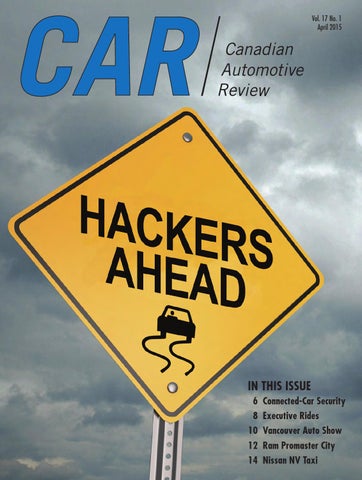
Vol. 17 No. 1 April 2015
IN THIS ISSUE 6 8 10 12 14
C01_Cover.indd 1
Connected-Car Security Executive Rides Vancouver Auto Show Ram Promaster City Nissan NV Taxi
15-04-08 1:54 PM
MEET THE TEAM BEHIND YOUR TEAM. At Ford Fleet, leadership matters. It’s in our vehicles, such as the all-new, awardwinning 2015 F-150 and the new full-size Transit van. Our people lead through experience, too. We will take the time to understand your needs, select the right vehicles and provide maintenance plans that maximize productivity and minimize costs. It’s no wonder that more companies choose Ford Fleet.* Make our team yours. Visit www.fleet.ford.ca or contact us at 1.800.668.5515
2016 ESCAPE
THE ALL-NEW 2015 F-150
2015 SUPER DUTY
2015 TRANSIT
Vehicles may be shown with optional features. *Based on 2014 YTD HIS Registrations data for the Business. ©2015 Ford Motor Company of Canada, Limited. All rights reserved.
53905_MAG_B2B_R0_8.125x10.875.indd 1 C02-05_News.indd 2
3/19/15 10:22 11:22 AM AM 15-04-09
9/15 11:22 AM
Fuel cell cars a long way off
The Toyota Mirai
Research firm IDTechEx says fuel cell cars are a long way from being commercially viable. Franco Gonzalez, EV analyst at IDTechEx explains, “Fuel cells will not be competitive with conventional engines in up-front cost for at least 15 years. Indeed, they need very expensive new hydrogen fuelling infrastructure in addition.”
“So far, compared to a regular car, the fuel cell car offers bottom end range of only 300 miles, unimpressive acceleration and fuel cost, probably a poor resale price and diversion to refuel with the hydrogen from non-sustainable sources (just as electricity and gasoline to charge cars usually comes from non-sustainable sources). “The Toyota Mirai is very much a work in progress with its poor headroom in the back due to passengers sitting on the large hydrogen tanks. Many find it ugly due to the huge air scoops at the front for the extra radiators cooling the fuel cell”. “Meanwhile, the year is approaching when affordable battery cars arrive with the same lack of pollution at point of use, the same 300 miles range but acceptable resale price due to being simpler and lasting longer. In 2020, or not long after, that could provide lift-off in sales way beyond fuel cell cars. Indeed, fuel cell cars perpetuate the bad practice of putting platinum in a consumer product and they still need a supercapacitor or battery to do the heavy lifting. For example, the Toyota Mirai launched in 2015 has a 1.5kWh NiMH battery”. “So far, fuel cells are usually only range extenders for hybrids though one day they may manage all load variations. Even then they will need separate devices to accept the energy harvesting from braking, shock absorbers and photovoltaics.”
Chevrolet commits to Bolt 80 VALLEYBROOK DR, TORONTO, ONTARIO M3B 2S9 PHONE: 416-442-5600 FAX: 416-510-5140
www.PurchasingB2B.ca
Vol. 17, No. 01
APRIL 2015
EDITOR: Emily Atkins (416) 510-5130, eatkins@purchasingb2b.ca ART DIRECTOR: Sandy MacIsaac smacisaac@purchasingb2b.ca PUBLISHER: Dorothy Jakovina (416) 510-6899, djakovina@purchasingb2b.ca PRODUCTION MANAGER: Karen Samuels (416) 510-5190, ksamuels@purchasingb2b.ca CIRCULATION MANAGER: Barbara Adelt (416) 442-5600 x 3546, badelt@purchasingb2b.ca
ANNEX PUBLISHING & PRINTING INC. VICE-PRESIDENT: Tim Dimopoulos (416) 510-5100, tdimopoulos@annexweb.com PRESIDENT & CEO: Mike Fredericks mfredericks@annexweb.com CAR, established 1991, is published twice annually (April and October), by Annex Publishing & Printing Inc.. © Contents of this publication are protected and may not be reproduced, in whole or in part, without the written consent of the publisher or editor. From time to time we make our subscription list available to select companies and organizations whose product or service may interest you. If you do not wish your contact information to be made available, please contact us via one of the following methods. Phone: 1-800-668-2374, Fax: 416-442-2200, Mail: Privacy Officer, 80 Valleybrook Drive, Toronto, ON M3B 2S9. NOTICE: CAR accepts no responsibility or liability for claims made for any product or service reported or advertised in this issue. CAR receives unsolicited materials including letters to the editor, press releases, promotional items and images from time to time. CAR, its affiliates and assignees may use, reproduce, publish, re-publish, distribute, store and archive such unsolicited submissions in whole or in part in any form or medium whatsoever, without compensation of any sort. Printed in Canada Publications Mail Agreement No. 40069240
The Bolt EV concept was revealed at the Detroit Auto show.
Chevrolet has confirmed production of its next-generation pure electric vehicle, based on the Bolt EV concept. It will be built at General Motors’ Orion Assembly facility near Detroit, Michigan. GM North America President Alan Batey made the announcement ahead of the Chicago Auto Show. The Bolt EV concept was introduced at the North American International Auto Show in Detroit in January. “The message from consumers about the Bolt EV concept was clear and unequivocal: Build it,” said Batey. “We are moving quickly because of its potential to completely shake up the status quo for electric vehicles.” Leveraging the battery technology found in the Chevrolet Volt and Spark EV, the Bolt EV concept was developed as a game-changing, long-range pure electric for all 50 states, designed to offer more than a GM-estimated 200 miles of range at a target price of around $30,000. Start of production and additional details will be announced later. APRIL 2015 CANADIAN AUTOMOTIVE REVIEW | 3
C02-05_News.indd 3
15-04-09 10:22 AM
Goodyear’s highway hero A truck driver who saved a law enforcement official from being strangled by a prisoner has been named the 32nd Goodyear Highway Hero. Chosen from three finalists, Clinton Blackburn of Morehead, Kentucky, accepted the 32nd Goodyear North America Highway Hero Award during the MidAmerica Trucking Show in March. Blackburn was driving near Elizabethtown, KY, last year when he observed a sheriff’s cruiser lurch toward the highway median and abruptly stop. He pulled up to investigate and noticed that the car’s driver side door was open. Inside, the driver, Spencer County jailer Darrell Herndon, was being strangled from behind by a prisoner, who was leaning over the back seat. Blackburn struggled with the prisoner in an effort to free Herndon. During the melee, the prisoner pulled Herndon’s gun from its holster.
Blackburn grabbed the barrel of the gun and pointed it toward the car’s dashboard. The prisoner then tried to point the gun at Blackburn, who turned the weapon around and aimed it at the prisoner. “Clinton’s brave, decisive actions ensured that Darrell would be home with his family that night,” said Gary Medalis, marketing director, Goodyear Commercial Tire Systems. “Clinton acted without regard for his own safety, literally putting himself in harm’s way to save another person,” Medalis continued. “His decision to get involved is a powerful example of the selflessness and courage exhibited by professional truck drivers. He has earned the right to be called a Goodyear Highway Hero.” As the 32nd Goodyear Highway Hero Award winner, Blackburn receives a special Highway Hero ring, a $5,000 prize and other items.
Connectivity matters Bluetooth connectivity and voice recognition issues are the most frequently reported problems after three years of ownership, according to the JD Power 2015 US Vehicle Dependability Study (VDS). Study findings show that technology is playing an increasingly critical role in owners’ perceptions of overall vehicle reliability, which, in turn, is impacting their likelihood to repurchase the same brand next time around. The study, now in its 26th year, examines problems experienced during the past 12 months by original owners of 2012 model-year vehicles. Overall dependability is determined by the number of problems experienced per 100 vehicles (PP100), with a lower score reflecting higher quality. The study has been enhanced in 2015 to better measure the quality of today’s vehicles, particularly related to new technologies and features now being offered. The study covers 177 specific problem symptoms grouped into eight major vehicle categories. The top two problems reported by owners are Bluetooth pairing/connectivity and built-in voice recognition systems misinterpreting commands. These are also the most frequent problems reported by owners at 90 days, according to the JD Power 2014 US Initial Quality Study. “As we’ve seen in our Initial Quality Study, owners view in-vehicle technology issues as significant problems, and they typically don’t go away after the ownership honeymoon period is over,” said Renee Stephens, vice-president of US automotive at JD Power. “Furthermore, early indications from our upcoming 2015 US Tech Choice Study show that vehicle owner expectations of advanced technology capabilities are growing. Owners clearly want the latest technology in their vehicles, and they don’t hesitate to express their disapproval when it doesn’t work. Their definition of dependability is increasingly influenced by usability.”
Because issues with technology impact overall dependability, they also impact repurchase intent. The study finds that 56 percent of owners who report no problems with their vehicle say they “definitely will” purchase the same brand next time, compared with 43 percent of those who report three or more problems. Together with the fact that 15 percent of new-vehicle buyers indicate they avoided a model because it lacked the latest technological features—up from just four percent in 2014—technology clearly plays a key role in affecting future purchase decisions.
Key Study Findings Among owners who experienced a Bluetooth pairing/connectivity problem, 55 percent say their vehicle would not recognize their phone, and 31 percent say the phone would not automatically connect when entering their vehicle. “At the three-year point, many owners are thinking about replacing their vehicles, and we find that how they feel about their current vehicle’s quality and dependability impacts their intent to consider purchasing the same brand again,” said Stephens. “Oftentimes, the issues owners experience can be resolved with a software update or, in the case of Bluetooth pairing problems, dealers can step in to help. In cases such as these, proactively reaching out to owners presents an opportunity for automakers and their dealers to engage with customers in a positive way.”
4 | CANADIAN AUTOMOTIVE REVIEW APRIL 2015
C02-05_News.indd 4
15-04-09 10:22 AM
I
A c o g m
L 1
It… is about being local and global. ARI is known and trusted by fleet decision-makers throughout Canada to streamline operations and control costs. We know that every customer has unique fleet challenges. Through our six regional offices, three 24-7 maintenance call centres and Canada’s largest vendor network—we dig deeper and go further to deliver customized solutions. Across Canada, North America, and the globe—our fleet management expertise is around the corner. Learn more about ARI’s professional fleet management services: 1-800-361-5882 | www.arifleet.ca
C02-05_News.indd 5
15-04-09 10:22 AM
HACKING THE CONNECTED CAR
Insight into a new threat to auto owners and drivers
T
oday’s cars are computers on wheels. Like their stationary cousins, connected cars run millions of lines of code every day, and that technology delivers a better driving experience. There’s a flip side to progress: like computers, today’s connected cars can be hacked. What’s to stop criminals from electronically taking over millions of cars? Today’s answer: they have little motive. Experience to date seems to bear this out. Praveen Narayanan, research manager for automotive and transportation for consulting group Frost & Sullivan, states unequivocally: “No actual hacks have happened in the real world.” Andy Rowland pours cold water on Narayanan’s news. “The skill level required to hack a car isn’t as high as you might imagine,” says the head of customer innovation, global mining, oil & gas, automotive & AMEA for BT Technology, Service and Operations. Rowland cites 2014 reports of a 14-year-old who hacked into a vehicle using $14 worth of parts from an electronics store. His was
one of many successful “white hat” (i.e. ethical) hacks into myriad computers embedded in today’s vehicles. But even he doesn’t mention actual incidents of the black-hat variety. So the world’s drivers seem safe from criminal hackers – for now. Concerns over car-focused cybercrime seem a logical consequence of the proliferation of in-vehicle technologies. To compound the problem, many of the electronic control systems (ECUs) that help deliver these improvements must share data with other components to do their jobs. For instance, adaptive cruise control, lane departure warnings and collision avoidance systems receive information from onboard radar and/or cameras. The benefits of sharing data are obvious, but there’s a risk: hack into one ECU, the thinking goes, and the car’s security safeguards topple like dominoes. Narayanan distinguishes between two types of targets for cybercrime. One is the back-end systems that aggregate customer information gathered from vehicles and other sources. These data sets may
6 | CANADIAN AUTOMOTIVE REVIEW APRIL 2015
C06-07_Security.indd 6
15-04-08 3:24 PM
By Luigi Benetton
rival those of Home Depot and Target, themselves high-profile victims of criminal hackers, in size and value, especially if they contain credit card data. “Through telematics and wireless connectivity, cars are collecting and processing enormous amounts of data,” warns Vincent Gogolek, executive director of B.C.’s Freedom of Information and Privacy Association (FIPA), in a press release. “More and more of this data is personal information, and some of it reveals intensely private details of a person’s life.” Narayanan’s second set of targets are the cars themselves. But does the criminal’s cost-benefit calculation add up? Who stores credit card numbers in a car? Unless the vehicle itself is a luxury model sure to fetch a handsome price from unscrupulous buyers, compromising a car’s onboard systems doesn’t seem to promise much financial gain for the effort. Rowland offered other motives. He suggests criminals might use computing devices to extort money by, for instance, locking drivers in or out of their cars. A higher-reward scenario: Criminals “could hold a manufacturer to ransom. Crash 100 computers and it’s very annoying. Crash 100 new cars in central London and it’s a brand disaster.” Scenarios involving large-scale loss of life, injury and property damage get people’s attention. Yet several factors must align for such attacks to work. Cars in motion would have to be connected to the Internet and, via that connection, criminals must be able to access systems like brakes, throttle, engine, adaptive cruise control and so forth. Otherwise, they could not control such an attack. Having attacks go wider than a given brand might not be feasible, given the fact that different OEMs use different computing platforms, so what works on one make of vehicle likely won’t work on another. (It’s the reason, for instance, that malware that functions on Windows-based computers doesn’t work on Macs.) “It’s a lot of effort” for little payback, Narayanan says. However, automakers may leave their proprietary “infotainment” systems behind in favour of Android Auto or Apple CarPlay hookups. “Entertainment systems look old after a couple of years,” Rowland says. “It’s not their core competency,” Narayanan adds. Automakers may homogenize other systems too. If they do, criminals may get a larger, more Windows-like target to shoot for. The idea isn’t far-fetched; certain futurists predict that autonomous vehicles will talk to each other and to surrounding infrastructure. Carmakers are largely mum on the subject of automotive information security. However, they are all likely working, overtly or not, to safeguard their products. Several have already hosted white-hat hacking events to find vulnerabilities. (The 14-year-old mentioned above made his mark at such an event.) How are they using the knowledge they glean? Using data from these events and other sources, automakers are likely hardening the operating systems and other software in their vehicles. They can also keep unauthorized apps from installing themselves on vehicles. Autos
may require digital certificates for any apps people want to install in cars. Automakers may require third-party app developers to register with them before they can produce apps for vehicles. The libertarians among tech-savvy drivers might balk at this “walled garden” approach. If they do, expect automakers to point out the differences between an app crashing a phone and an app crashing a vehicle. Automakers will “bake” privacy into their data-gathering processes to both appease privacy advocates and prevent security breaches. Automakers may soon gather threat intelligence, using big data in a secure cloud platform to monitor activity in real time. Similar systems might alert automakers to suspicious activity within specific vehicles, much like certain building alarm systems already do. There’s also an information sharing and analysis centre (ISAC) in the works. Automakers may use this voluntary mechanism to share intelligence on security threats and vulnerabilities affecting computercontrolled systems in vehicles. The Society of Automotive Engineers has reportedly established a security committee and is drafting “standards and best practices to help ensure electronic control system safety.” Certain standards may evolve into cybersecurity ratings that mirror crash-test ratings auto buyers currently use to compare the relative safety of different vehicles.
“Criminals could hold a manufacturer to ransom. Crash 100 computers and it’s very annoying. Crash 100 new cars in central London and it’s a brand disaster.” Drivers also play a part in their own information security. Automakers may educate drivers on best practices like: • ensuring apps and other files on their phones or storage devices (e.g. USB memory sticks, SD cards) do not contain malware that could compromise the connected vehicle. • wiping personal data from a vehicle’s infotainment systems before selling it or, if in a rental car, before returning it. Drivers who can do without the benefits of connected cars may choose to avoid the risks as well. Automakers continue to cater to such drivers by turning out relatively low-tech new models. Edmunds. com recently identified eight 2015 models it considers “unconnected” (i.e. no cellular connectivity, keyless ignition or other hackable networked systems). C.A.R. APRIL 2015 CANADIAN AUTOMOTIVE REVIEW | 7
C06-07_Security.indd 7
15-04-08 3:24 PM
THRILLING AND CHILLING Photo: Infiniti Canada
Executive rides for every style and budget INFINITI Q50 AWD: VALUE-PRICED DRIVER’S CAR
Base price: $39,950 As tested: $41,485 Engine: 3.7L, 6-cylinder Transmission: 7-speed automatic Power: 328 HP Fuel Economy: (L/100km): 12.5 city; 8.7 highway
Photo: Emily Atkins
With the looks of a mild-mannered sedan and a price to match, the Infiniti Q50 is something of a ringer. Inside, this nearly base model is understated and elegant, with sleek leather accented by contrasting stitching and faux carbon fibre details. Connectivity is excellent, but with two giant touchscreens dominating the cockpit, there’s a lot to look at besides the road. With a more optioned car the dual display probably comes in handy, allowing for concurrent viewing of navi and phone or entertainment info. There’s also a great sound system, even in this base model. But it’s in the driving that the Q50 punches above its price point. The 3.7-litre engine and seven-speed automatic are well-paired, and driven in sport mode the car is quick, handles beautifully and delivers flawless downshift revmatching. These are attributes usually found on considerably pricier European sport sedans, so it’s a pleasant surprise to find them so well executed in the Q50. This car is comfortable and extremely well appointed at the base level. Add the superb drivability and it’s a hard package to ignore.
2015 MERCEDES AMG GT S: SPEEDY AND SEXY This new car arriving on Canadian shores this spring is the replacement for Mercedes AMG’s SLS. And although the long snout and grille leave no doubt of its Mercedes heritage, aft of the front fenders the car is all curves, sporting a generous, rounded rump. It’s a gorgeous beast and it even sounds sexy. The growl from the 4-litre, V8 twin turbo powerplant will shivers down the spines and turn the heads of enthusiasts everywhere. The AMG GTS is a true sports performance car, competing with the likes of the Porsche 911, but this vehicle is extremely comfortable for a long drive. With four programmable drive modes, you can go from grand tourer to rocketship with the touch of a button. You can also build your own profile using parameters for engine, transmission, dampers, stability control and exhaust. For a sportscar enthusiast with track day aspirations but practical commuting requirements, this car will meet both needs.
Base price: $149,900 Engine: 4.0-L, V8 Biturbo Transmission: 7-speed dual clutch Power/torque: 510 HP/ 479 ft-lb. Fuel consumption: 9L/100km): (premium) 9.4 combined (European testing)
8 | CANADIAN AUTOMOTIVE REVIEW APRIL 2015
C08-09_ExecCars.indd 8
15-04-08 3:23 PM
By Emily Atkins 2015 BMW X6 XDRIVE50i: PRACTICAL AND PEPPY
Photo: Emily Atkins
BMW has introduced the next-generation X6 crossover. This brawny ute with not only cover 0-60 in 4.8 seconds, it’s also got impressive off-road cred and a muscular new look.
Price: $83,190 Engine: 4.4L, V-8 Power/Torque: 445HP/480 ft-lb. of torque Fuel Consumption: ( European): 7.8L/100 km highway, 13.1 city
2015 VOLVO V60 POLESTAR: SAFETY AND EXHILARATION
Photo: Emily Atkins
Don’t be deceived by this little wagon. Although the bright Rebel Blue might be a giveaway, there’s nothing much to draw attention to the V60 Polestar until you shift the gear level over to the left and stomp on the go pedal.
Price: $66,895 base and as tested Engine: 3.0L Turbocharged 6-cylinder Power: 345 hp, 369 ft-lb torque, Transmission: 6-speed automatic Fuel Economy: N/A
The X6 only looks large, however. Inside it’s moderately spacious, offering 580 litres cargo space with the rear seats up, and 1,580 folded flat. The rear seats can be folded in 40:20:40 configurations, providing huge flexibility. Access to the rear hatch is made easier with an automatic lift gate, and optional hands-free opening. Balancing power with responsibility, the X6 boasts fuel-saving technology like standard regenerative braking, auto start-stop and a coasting function activated in the Eco driving mode. BMW claims the 2015 X6 is able to deliver an average of 22 per cent better fuel economy than the previous generation vehicles. Two variants are available, the X6 xDrive50i (tested) and the X6 xDrive35i. The xDrive35i retails starting at $68,890. It has a 300hp twin turbo inline six-cylinder engine. There is also an M Package for the xDrive35i. For $1,500 you can add 20hp and 32 lb.-ft. of torque to achieve a half-second improvement on the base model and get from zero to 100 km/h time of 6.4 seconds. The new X6 is a comfortable, practical crossover that will be just as happy loaded up with kids, dogs and gear for a weekend away as it is making trips in the city. For Canadian buyers facing winter conditions its all-wheel drive and good ride height make it a great choice.
Then, you and the kiddies better be hanging on, because this is an astonishingly quick machine. Thanks to its 350-hp, 6-cylinder turbocharged engine and smooth-shifting 6-speed transmission it motors from zero to 100 km/h in just 5.3 seconds, and will stop from that speed in only 36.8 m—better by several metres than the competition. It’s got the handling to match with precise steering and a great suspension. The Polestar also demonstrates Volvo’s commitment to safety, with all-wheel drive, auto braking for pedestrian and bicycle collision avoidance, distance and cross-traffic alerts and adaptive cruise control that even works when you are in stop-and-go traffic. The interior is simple and restful to the eyes, with a centre console oriented towards the driver, and supremely comfortable seating. A sole complaint is the digital instrument cluster and annoying vertical tachometer. Unlike most sports cars, this one has fully functional, spacious rear seats and a cargo compartment with a 690-litre capacity. No matter what the colour, driving V60 Polestar is a satisfying experience. It’s a stealthy sports car; it looks and acts like a family wagon, 66,895h it to sports mode and it delivers performance guaranteed to put a big grin on the driver’s face. APRIL 2015 CANADIAN AUTOMOTIVE REVIEW | 9
C08-09_ExecCars.indd 9
15-04-08 3:23 PM
Story and photos by Gerry Frechette
BIGGER AND BETTER 2015 Vancouver International Auto Show
A I 1
T
and Rolls Royce, the eye he 95th edition of the candy was everywhere. Vancouver International There was no expectation Auto Show marked its of seeing any concepts that most important milestone since hadn’t been seen long ago, it became a stand-alone event but it was nice to see the likes many years ago, with the most of the Cadillac Elmiraj, the floor space ever. Infiniti Q80 and the Subaru The week of the Auto Show is VIZIV 2 on the show floor. undoubtedly the most imporThe aspect of previous tant of the year for the auto shows at B.C. Place Stadium business in Vancouver, as that appealed to many people various organizations take the was the space allotted to the opportunity to make major aftermarket displays, promotannouncements of interest to ing a wide variety of goods motorists. The Government of and services of interest to the BC announced its decision to local car nut. That available bring back the rebate of $5,000 space was severely limited towards the purchase of an AJAC’s Kevin Corrigan (L) presented the Green Car of the Year award to Kia’s Jack Sulymka. over the first few years of the electric vehicle, and the Evo Car show being at the Convention Share program, at least the Centre, but that has been remedied now with the new space, and fourth such service in Vancouver, was launched. the ballroom was packed with people, showing how popular that On March 24, the Show was opened with a press conference aspect is. featuring the awarding of AJAC’s first annual Green Car of the Year One of the more heavily promoted features of the show was the to the deserving Kia Soul EV. debut of the Lincoln Continental Roadster, owned by a local enthusi“Kia Canada is thrilled that the all-new 2015 Kia Soul EV has been ast and built by 360 Fabrication in Abbotsford, BC. The Kennedy-era recognized by AJAC as the Canadian Green Car of the Year,” said Lincoln is somewhat conservative as far as paint (all black) goes, but Maria Soklis, Vice President and Chief Operating Officer, Kia under the skin is something else, as the owner took a “spare no Canada Inc. “This acknowledgement is testimony to Kia’s ongoing expense” approach, and told 360 to trick it out to the max. commitment to deliver environmentally friendly automotive solutions What started as a sedan is now a true roadster, with no roof or and diverse powertrains to consumers without compromising on side windows. A new frame was created, and the body has had design or comfort.” AJAC’s Kevin Corrigan presented the award to three inches added to its height, so it would all look in better Kia’s Jack Sulymka. proportion with the 24-inch wheels and tires. The owner had won a Following that, down on the Show floor, the unveilings and 1,250-horsepower Ford Super Cobra Jet engine of the type that speeches got underway, and for the first time in recent memory, propels Mustangs to eight-second quarter-mile times, so into the there were only Regional Debuts and no National ones, meaning Lincoln it went. In the end, the parts and labour involved totalled there was nothing that hadn’t been seen at either the Montreal or over $1 million. Toronto shows. “Something for everyone” was the unofficial slogan for the show, But of course, most show attendees here don’t care about those and with the added room, organizers were able to deliver that. The shows, and are just happy to see all the exciting new cars they’ll soon first evening of the show, the plaza next to the VCC was filled with see on the roads of Vancouver. The city is unique, in that it has the exotic cars in a cruise-in. A full-size classic Hot Wheels car was the highest number of electric vehicle owners per capita in Canada, as well first thing you saw inside the doors. An electric Bigfoot truck was on as the highest number of exotic car owners per capita in North the show floor. Several groupings of cars lined the upper floor, led America. by one of each generation of Corvette. The fans of the exotics were well served with the move from the Other than there being no all-new cars that hadn’t been seen in cramped space in the corner of the main floor, upstairs to the Canada before, it was the best VIAS ever, and we are told it will only spacious ballroom this year. With displays from Aston Martin, get better the next few years. C.A.R. Bentley, Ferrari, Lamborghini, Lotus, Maserati, McLaren, Porsche,
10 | CANADIAN AUTOMOTIVE REVIEW APRIL 2015
C10_VIAS.indd 10
15-04-08 3:23 PM
W T G
‡ a t t b 2
AN AWARD IS A GOOD INDICATOR OF RELIABILITY. 16 AWARDS ARE PROOF.
2015 Legacy
2015 Outback 2015 Impreza 2015 XV Crosstrek
2015 Forester
2015
§
2015
ø
‡
MODELS EQUIPPED WITH EYESIGHT® † TOP SAFETY PICK+ LEGACY OUTBACK IMPREZA FORESTER XV CROSSTREK TOP SAFETY PICK WRX / WRX STI BRZ
COMPACT CAR IMPREZA MIDSIZE CAR LEGACY SPORTS CAR BRZ MIDSIZE UTILITY (2 ROW) OUTBACK MAINSTREAM BRAND
CANADIAN CAR OF THE YEAR 2015 SUBARU LEGACY
OUTBACK
BEST NEW FAMILY CAR UNDER $30K 2015 SUBARU LEGACY BEST NEW SUV/CUV UNDER $35K 2015 SUBARU OUTBACK
When choosing what cars your team will drive, you need more than a good impression; you need a guarantee. This year alone, Subaru vehicles were awarded sixteen prizes, for their safety, residual value and overall quality. Go for a name experts trust. Go for Subaru.
To consult our Fleet ordering guide or for more information
fleet.subaru.ca
or call
1-877-293-7272
‡Ratings are awarded by the Insurance Institute for Highway Safety (IIHS). Please visit iihs.org for testing methods. †EyeSight® is a driver-assist system, which may not operate optimally under all driving conditions. EyeSight® is not designed as a substitute for due care and attention to the road. The system may not react in every situation. The driver is always responsible for safe and attentive driving. System effectiveness depends on many factors such as vehicle maintenance, weather and road conditions. Finally, even with the advanced technology activated, a driver with good vision and who is paying attention will always be the best safety system. See Owner’s Manual for complete details on system operation and limitations. §2015 ALG Canadian Residual Value Award for the 2015 Subaru Impreza in the Compact Car segment, the 2015 Subaru Outback in the Midsize Utility segment – 2 row, the 2015 Subaru Legacy in the Midsize Car segment, the Subaru BRZ in the Sports Car category, as well as for the brand in the Maintream Brand category. ALG is the industry benchmark for residual values and depreciation data, alg.com. ø 2015 Canadian Black Book Best Retained Value Award winner - Midsize Car category. Based on value retained from original MSRP for 2011 model year vehicles as published by CBB, as of January 1, 2015. See CanadianBlackBook.com for complete details.
C10_VIAS.indd 11
15-04-08 3:23 PM
Ram hopes the compact exterior and spacious, well-planned interior will make the ProMaster City a favourite with contractors.
The contractor’s friend Introducing Ram ProMaster City
U
ntil Ford brought over the Transit Connect in 2009, the compact commercial van segment, so commonplace in Europe, didn’t really exist in North America. Outdated cargo vans and pickup trucks were all that was available to contractors and small business owners–and neither was the ideal tool for the job. The Transit’s arrival helped kick-start what is now a highly competitive segment. And now FCA (formerly Chrysler) has upped the stakes even further by bringing over a North-Americanized version of the Fiat Doblo dubbed the ProMaster City. A familiar sight on Europe’s narrow, cobbled streets, the Doblo has sold over one million units since its launch 15 years ago. The ProMaster City joins the rest of FCA’s truck and commercial van lineup under the Ram brand name. Ram has enjoyed a resurgence since becoming a stand-alone brand in 2009, increasing its market share from 13 to 30 percent, and now in its 35th consecutive month of growth. Commercial trucks and vans represent 32 percent of all fleet sales, and 16 percent of those sales are city vans. With this new addition, Ram hopes to broaden its customer base by wresting some of those sales from Ford’s Transit Connect, and the Nissan NV 200/Chevrolet City Express. “This is the right van at the right time” said Ryan Evans, Ram’s
Head of Operations for the ProMaster City. “The person who buys this is looking for a tool that’s going to deliver”. Virtually identical to the Doblo, the ProMaster City’s suspension and chassis have been strengthened, and ride height increased to suit our tougher roads and climate, and the engine bay widened to accommodate a larger engine. Europeans have a choice of three engines, but there’s a single 2.4L 4-cylinder available in North America. Ram representatives were unwilling to confirm any plans for a future diesel engine here. The steel unibody rides on a front-wheel-drive platform–once unusual in this segment but increasingly popular for its predictability in slippery conditions. An extra bonus is the lack of driveline hump, resulting in a flat cargo floor. The ProMaster City is engineered with the contractor or small business owner in mind. Vertical side walls accommodate shelving and toolboxes, tappets make roof rack installation easy, and headlights are placed high above the rugged plastic front fascia and safely out of the way of damage. Rear doors split 60/40, open 90 degrees, with the smaller door opening to the curb. Sliding side doors are equipped with a latching feature that holds the door open even when parked on an incline. Efficient underbody cladding has helped the ProMaster City achieve a fuel consumption rating of 8.1 L/100 km.
12 | CANADIAN AUTOMOTIVE REVIEW APRIL 2015
C12-13_Promaster.indd 12
15-04-08 3:22 PM
By Lesley Wimbush
Ram claims best-in-class payload for the ProMaster City. Inset: Front-wheel drive means there’s no driveline hump, making more room for cargo.
Cargo capacity and payload are a class-leading 3,729 L (131.7 cu. ft.) and 854 kg (1,883 lb) respectively, and there’s 1,229 mm (48.4 inches) between the wheel wells—making it easier to accommodate pallets and drywall. Maximum tow rating matches the Ford Transit Connect’s previously class-leading 2,000 lbs. The ProMaster City is available in one size, with a 51.8-inch height and 122.4-inch wheelbase. On the one hand, that gives the van remarkable agility in a crowded metropolis, but the Transit Connect offers two wheelbase sizes—the larger of which has the most cargo capacity at 4,275 L (151 cu. ft.). Our drive was conducted in a City Cargo ST van, but also available was the “City Wagon”–a five-passenger variant with 60/40 rear seats, carpeted floors and four feet of cargo space–which increases to almost six feet with rear seats down. The interior, as expected, is utilitarian. This is one segment where hard plastics are a good thing. Everything’s constructed with durability in mind, from the rugged plastics to the plain cloth seating. Visibility is terrific through the great expanse of cabin glass and large side mirrors. Our base ST came without the optional cargo partition, but even that is available with a window. There’s plenty of storage space for clipboards, phones and such, including an overhead shelf with netting to keep its cargo in place. Standard is the UConnect 3.0 multimedia centre with Bluetooth, with an optional five-inch touchscreen with Navigation. Surprisingly, the ProMaster City has terrific on-road manners. The independent bi-link rear suspension instead of traditional leaf
springs and solid axle feels squarely planted over rough pavement, even when unladen. Responsiveness is good for a large cargo vehicle. The “Tigershark” engine produces 178 hp, but the nine-speed automatic transmission’s low gearing, combined with peak torque of 174 lb. ft at 3,900 rpm, enable it to move off briskly. The engine is a tad on the buzzy side, but we discerned none of the irritating squeaks and rattles that plague the larger ProMaster. Busy parking lots and narrow service alleys are easily negotiated by sharp steering and a 32 foot turning radius. However, the Pro Master City with a base price of $27,995, is the segment’s most expensive, compared to the Ford Transit Connect’s $26,849, the Chevrolet City Express’s $25,995 and the Nissan NV200 coming in at $5,000 cheaper with a price of $22,748. The Ram ProMaster City adds more choice to an already rapidly expanding segment, and for some buyers, will be worth the extra cost. C.A.R. APRIL 2015 CANADIAN AUTOMOTIVE REVIEW | 13
C12-13_Promaster.indd 13
15-04-08 3:22 PM
Photo and story by Lesley Wimbush
MELLOW YELLOW
The Nissan NV200 Taxi is taming the streets of New York
N
ASHVILLE, Tennessee – Belle Meade, in Nashville county, was once a 5,300 acre estate known as the “Queen of the Southern Plantations”. Now it’s an exclusive development, whose residents, including Al Gore and Taylor Swift, boast one of the highest per capita incomes in the entire US. I’m going to hazard a guess that those folks aren’t exactly used to seeing a New York Taxi cruising their tree-lined roads. Needless to say I felt more than a bit conspicuous driving the bright yellow Nissan NV200 through that neighbourhood. Eyes straight ahead and trying to look inconspicuous, I half expected someone to flag me down—and not to ask me for a ride to the airport. It’s no secret that taxis are among the most abused vehicles on the planet, some of which have rolled their odometers up several hundred thousand kilometres over their gruelling lifespan. So when it came to replacing the Ford Crown Victoria, New York City reviewed a whole heap of proposals before deciding upon Nissan’s funny little transit van as as their next iconic yellow taxi cab. Nissan now holds an exclusive contract supplying any Big Apple taxi operators who replace their vehicles after 2013. Based on Nissan’s four-door compact cargo van, the NV200 Taxi was developed purposely as taxi for large urban centres. Unlike the full-size NV, which is a body-on-frame, truck-based vehicle, the NV 200 is a front-wheel drive, car-based architecture. Nissan calls it the “product of a unique development collaboration”. Using the input from hundreds of taxi drivers, and “thousands of passengers from all walks of life”, Nissan has transformed their compact van into well-thought-out form of public transit. With room for four passengers with their luggage and many comfort and convenience features, the NV200 makes an ideal taxi—at least New York City thought so. The powertrain is the 2.0L 4-cylinder found in the regular NV200, with an output of 131 hp and 139 lb. ft. of torque. It’s matched to an “Xronic” continuously variable transmission. Up front is an independent strut system with sway bar, while rear suspension consists is a solid axle with mulit-leaf springs. Our tester, in the bright, screaming yellow we’ve come to associate with New York cabs, featured a special paint without clearcoat, making it easier to touch up the inevitable scrapes and scratches. While a new electrified version was also part of the lineup–its battery charged had been depleted by lunchtime, and it was left rather forlornly in the parking lot while its cheery, yellow workmate proved popular with testers.
On the roof is the expected vacancy light bar, while behind the grill is an emergency “call 911” warning light that can be activated by a dash-mounted button. Complying with with NYC’s move to curb flagrant “honkers”, the NV taxi has a “low annoyance” horn that’s accompanied by tattle-tale yellow light that identifies the perpetrator. Compared to a conventional cab, there’s a huge amount of both leg and head room in the NV taxi. And the transparent, panoramic sunroof overhead lets in lots of light making it feel even more open and airy as well as giving passengers a view of the cityscape. The passenger compartment is tough and rugged, from upholstery to flat carpeted, well-lit floor with no cracks or crevasses for items to either fall into, or roll under. The “hospital-grade” upholstery is made from a stain resistant, easy-to-clean fabric that’s antimicrobial. There’s a charging station with a 12-volt electrical outlet and two USB ports, and separate passenger HVAC controls. Available technology includes: 5.8” touch screen with Navigation and mobile apps, voice recognition, Sirius XM, and Bluetooth. Aside from climate controls and personal device charging areas, passengers also get their own video screens. Sliding doors with automatically retracting step not only make passenger entry and exit easy, they don’t swing out into busy traffic. Upright seating for the driver is comfortable, and the passenger seat folds down flat to provide a work space for filling out paperwork. The car-based, compact-sized NV200 taxi is quite simple to drive. Unfortunately, I didn’t manage to gather up any fares from the manicured streets of Belle Meade, so I had no way of testing how well the acrylic divider worked at blocking out obnoxious and distracting behaviour from the rear passenger compartment. An intercom system enables communication between passengers and driver. Although the powertrain components are the same as the regular NV200, the internals have been beefed up to handle the wear and tear of a working taxi. As expected, the NV200 isn’t exactly quick (0 to 100 km/h in roughly 12 seconds), but it accelerates smoothly, providing a comfortable ride. The steering’s a little rubbery, but the NV taxi handles better than its tall, slab-sided profile might suggest, and the brakes are terrific. The backup camera and big side mirrors make tucking it into tight parking spaces a snap. While pricing for the New York taxi began at $29,700 in the US, Nissan says that “Canadian opportunities for the NV200 Taxi continue to be explored”. C.A.R.
14 | CANADIAN AUTOMOTIVE REVIEW APRIL 2015
C14-16_Taxi.indd 14
15-04-08 3:22 PM
PROCUR
A one-day buyer + supplier extravaganza presented by PurchasingB2B and FRASERS.com
September 15, 2015
Mississauga Convention Centre Network… Source products and services… Gather information… Exchange ideas and advice at this tabletop event that will connect YOU with suppliers from across ALL industries! Registration is open June 1st No charge admission for qualified buyers
www.ProcurementFair.ca Suppliers: Reserve your tabletop today!
Look for the Procurement Fair Show Guide in the August issue of PurchasingB2B! Your integrated content marketing solutions partner…where the serious buyer goes. CONTACT: Dorothy Jakovina, publisher PurchasingB2B magazine DJakovina@PurchasingB2B.ca 416-510-6899
PROCUREMENT FAIR AD final.indd 1 C14-16_Taxi.indd 15
Derek Morrison, publisher FRASERS.com DMorrison@FRASERS.com 905-409-6976
15-04-08 10:14 AM 15-04-08 3:22 PM
BUSINESSES LOVE US.
GAS STATIONS, NOT SO MUCH. The Prius Family is Canada’s best-selling hybrid lineup for a reason. Powered by the most proven and advanced hybrid technology in the world, the Prius leads the industry, offering cleaner emissions, increased fuel efficiency, and surprising power without compromise. And the Prius lineup offers unbeatable reliability and value, with low cost of ownership and operating costs. With four different models to choose from, the Prius family has a vehicle to suit your fleet needs no matter what your business – today and tomorrow.
Prius and Prius v are proud recipients of a Top Safety Pick+ award when equipped with optional Pre-Collision System.
2672 Fleet_Prius TCI-15-003A 8.125x10.875 v6.indd 1 C14-16_Taxi.indd 16
fleet.toyota.ca
2015-01-23 3:02 PM PM 15-04-08 3:22