AUGUST 2015
Canada’s Supply Management Magazine
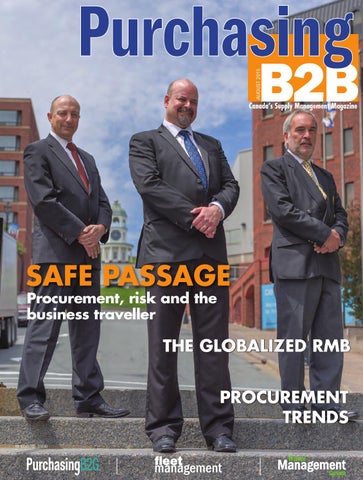
SAFE PASSAGE Procurement, risk and the business traveller
THE GLOBALIZED RMB PROCUREMENT TRENDS PM 40065710 $18.00
Our tech means business. Make your organization more productive and efficient with technology from Staples Advantage . Count on: ®
• An always-expanding selection of technology • A team of experts to help you find the right products • Easy online ordering and fast, free delivery
Shop our full assortment online and learn more at StaplesAdvantage.ca.
Table of Contents
Vol. 57, No. 4 • AUGUST 2015
Features 6 T RENDS IN PROCUREMENT
14
Three questions for procurement leaders to ask.
12
THE GLOBALIZED RMB Chinese money comes of age as a trade currency.
14
S AFE PASSAGE Procurement, corporate travel and risk management.
32
S ETTING SAIL E-procurement, shipbuilding supply chain among topics at SCMA national conference.
16 Also inside 5 BUSINESS FRONT
10 PURCHASINGB2G
7 PROCUREMENT PROFILE
34 THE LAW
18
14
Connect With Us Online We encourage you to visit us online to stay in touch with what’s happening in your industry and to view enhanced articles.
Features SUPPLY MANAGEMENT: THE NEXT GENERATION Why it’s important to redesign an organization’s systems to work in the 21st Century and beyond.
.ca
PurchasingB2B.ca
@PurchasingB2B
Michael Power
ASK MORE OF YOURSELF Earning an SCMP designation, while a great career move, doesn’t happen overnight or without challenges. Learn how one designation holder coped with those barriers. www.PurchasingB2B.ca/features
SMART INVOICING Companies have devoted time and resources to improving their accounts payable (AP) processes. But what do they need to succeed in this process? Read about how many such organizations are moving to e-invoicing and leveraging technology-based solutions that enable them to execute it. www.PurchasingB2B.ca/features
PurchasingB2B Weekly eNewsletter Sign up today for regular industry news and insights. www.PurchasingB2B.ca/e-newsletter-subscription PurchasingB2B.ca / August 2015 / 3
Up Front 80 VALLEYBROOK DRIVE TORONTO, ONTARIO M3B 2S9
www.PurchasingB2B.ca
PUBLISHER
Dorothy Jakovina 416-510-6899, djakovina@PurchasingB2B.ca EDITOR
Focus on travellers
Michael Power 416-442-5600 ext 3259, mpower@PurchasingB2B.ca ART DIRECTOR
A
t the SCMA National Conference in Halifax in June, PurchasingB2B held a panel discussing risk, procurement and the business traveller. During the panel, which you can read about on page 14, we focused on what organizations can do to keep travellers safe. Duty of care involves a company working to ensure employees are safe on the road. Organizations are legally obligated to do so, and as you’ll read in our story, procurement plays a role in ensuring duty of care. It’s important that the traveller’s needs and preferences be taken into account. Doing so can not only help keep them safe, but also ensure that they’re compliant with company policies. To that end, a theme at the Global Business Travel Association (GBTA) Convention in Orlando in July was focusing on the needs of the traveller. What can organizations do to ensure their engagement, making them more likely to comply with policy? Travel managers—and often, by extension, procurement—spend time grappling with this issue. Especially now, as more millenials hit the workforce, organizations must work on ways to ensure employees aren’t using mobile devices to book flights or hotels out of policy. At the GBTA Convention, Dan Ruch, founder and CEO of business travel platform Rocketrip, even suggested travellers be reimbursed a portion of whatever they save on trips. Boost compliance by making it worth their while. It’s smart to align travellers’ interests with an organization’s. The more that’s done, the more employees will comply. This applies to procurement generally: if you buy what suits the end user’s needs, they’re more likely to use those products or services. Staying in touch with the traveller or end user, while learning their needs, means more compliance in the long run.
Calling All Shutterbugs! Have a recent Canadian landscape photo that you’d like to share with your fellow PurchasingB2B readers?
Canada’s magazine for procurement and supply chain management professionals
Canada’s magazine for procurement and supply chain management professionals
If so, we’d love to receive it! It may be chosen for the October 2015 PurchasingB2B survey issue.
OCTOBER 2014
2013
ANNUAL SURVEY OF THE CANADIAN SUPPLY CHAIN PROFESSIONAL
2014
Focus On Professional Development PM 40069240
ANNUAL SURVEY OF THE CANADIAN SUPPLY CHAIN PROFESSIONAL
PM 40069240 $18.00
The talented entrants whose photos are selected will receive a $50 Tim Horton’s gift card! So Canadian, eh?
OCTOBER 2013
Focus on Professional Development PBB07_01_OFC2.indd 1
14-10-14 2:07 PM
Submission deadline is September 11, guidelines are provided on this page: http://goo.gl/GZUGs6 4 / PurchasingB2B.ca / August 2015
Sandy MacIsaac 416-442-5600 ext 3242, smacisaac@PurchasingB2B.ca PRODUCTION MANAGER
Karen Samuels 416-510-5190, ksamuels@PurchasingB2B.ca CIRCULATION MANAGER
Barbara Adelt 416-442-5600 x 3546, badelt@PurchasingB2B.ca ANNEX PUBLISHING & PRINTING INC.
VICE-PRESIDENT: Tim Dimopoulos (416)510-5100, tdimopoulos@annexweb.com PRESIDENT & CEO: Mike Fredericks, mfredericks@annexweb.com For over 56 years, PurchasingB2B has been a trusted source of information for Canadian purchasing/supply chain management professionals in the private and public sectors. Special features and supplements include Fleet Management, Canadian Automotive Review (CAR), PurchasingB2G, and Travel Management Canada. PurchasingB2B is published six times a year, except for occasional combined, expanded or premium issues which count as two subscription issues, by Annex Publishing & Printing Inc. © Contents of this publication are protected and may not be reproduced, in whole or in part, without the written consent of the publisher or editor. NOTICE: PurchasingB2B accepts no responsibility or liability for claims made for any product or service reported or advertised in this issue. PurchasingB2B receives unsolicited materials including letters to the editor, press releases, promotional items and images from time to time. PurchasingB2B, its affiliates and assignees may use, reproduce, publish, re-publish, distribute, store and archive such unsolicited submissions in whole or in part in any form or medium whatsoever, without compensation of any sort. SUBSCRIPTION SERVICES: To subscribe, renew your subscription, or to change your address or information, contact us at 416-510-5713 or 1-866-543-7888, ext 3258, apotal@annexnewcom.ca, or visit us at www.PurchasingB2B.ca. Subscription price per year: $99.95 CDN; Outside Canada per year: $172.95 US; Single issue Canada: $18 CDN. Annual Supply Chain Survey issue, Canada: $45; Outside Canada: $70 US. Taxes extra. From time to time we make our subscription list available to select companies and organizations whose product or service may interest you. If you do not wish your contact information to be made available, please contact us via one of the following methods: Phone: 1-800-668-2374, Fax: 416-442-2200 Mail to: Privacy Officer, 80 Valleybrook Drive, Toronto, ON M3B 2S9 Printed in Canada. ISSN: 1497-1569 (print); 1929-6479 (digital) Publications Mail Agreement No. 40065710 We acknowledge the financial support of the Government of Canada through the Canada Periodical Fund of the Department of Canadian Heritage
Business Front
A Greek Tragedy
Toronto-based Michael Hlinka provides business commentary to CBC Radio One and a column syndicated across the CBC network.
by Michael Hlinka
T
hink back to what you were doing on the Canada Day/Fourth of July weekend. I was vacationing in Las Vegas. The only things I had to worry about were getting too much sun, and where I was going to eat dinner that night. Even with the rumours of terrorist attacks swirling, it was a festive attitude across the entire US. There were similar good times for everyone in Canada. It was a very different experience for the people of Greece, as on Sunday, July 5 they voted on whether or not to remain in the Eurozone. It was an issue that split the country apart and sent an already fragile economy into an even worse tailspin. The word “tragedy” came to mind and not only because Ancient Greece was the birthplace of that art form. I googled “Greek tragedy” and found this definition: “A drama or literary work in which the main character is brought to ruin or suffers extreme sorrow, especially as a consequence of a tragic flaw, moral weakness, or inability to cope with unfavorable circumstances.” (Italics and bolding were added by yours truly.) And those highlighted phrases seemed to describe quite accurately what was unfolding. The main character, of course, is the Greek people. It’s safe to say that a country whose economy has contracted by 25 percent in the past seven years and whose unemployment rate, coincidentally enough, also exceeds 25 percent, is suffering “extreme sorrow”. As for its tragic flaw/moral weakness, let’s step back in time to the founding of the Eurozone. In 1998, Greece was one of 28 countries that signed an agreement called the Stability and Growth Pact. Its intent was clear: To enforce fiscal discipline on ALL the members of the European Union. Government deficits were never to exceed three percent of gross domestic product (GDP) and debt was limited to 60 percent of GDP. Along the way there were amendments—particularly with respect to allowing a nation that strayed to bring its finances into line gradually. But the spirit of the agreement was never in doubt. All Greece had to do—all any country in the Eurozone had to do—was keep its word to its fellow members.
It soon became clear that Greece’s commitment to honouring the pact was tepid at best. By 2006, debt to GDP was 100 percent, and after that it continued to skyrocket so by the time of the referendum, it stood at 175 percent! That’s not what I would term a small miss. For an extended period of time, there was a broad-based consensus among the Greek people that it should not be bound by the Stability and Growth Pact. It was something akin to a birthright for the country to live beyond its means. There was debate about what the problem really was. Was it that social programs were too generous? Or was it wide-spread tax evasion? How about both of the above! The “tragic flaw” or “moral weakness” of successive regimes was that they couldn’t reconcile tax and revenue policy. In the short run, Greece borrowed to enjoy a temporary and false prosperity. But the debt market is both fickle and unforgiving. You can’t make people lend you money on terms that are only favourable to you. If you’re the borrower, the onus is on you to organize your affairs and ensure that there will be timely payments made of both interest and principal and if you can’t do that, there’s no more money. The people of Greece made their bed and they have to lie in it. And I’m less interested in how it unfolds than I am in the cautionary tale it should provide both us in Canada and our friends and neighbours to the south.
“A country whose economy has contracted by 25 percent in the past seven years and whose unemployment rate also exceeds 25 percent is suffering ‘extreme sorrow’.” The Stability and Growth Pact suggested that any debt-to-GDP ratio above 60 percent should be cause for concern. Canada’s is currently about 86 percent, while the US’s is a hair above 100 percent. What I find particularly troubling in these numbers is that demographics are against us. As the years go by, there will be more and more retirees as a percentage of the population, while there will be fewer and fewer people of working age to support that cohort. Anticipating that day, both countries should be running surpluses and reducing indebtedness. I have long believed—and argued—that it should be a constitutional requirement for every level of government to balance its budget annually. It would provide the discipline that any democratically elected legislature needs. The Popeye cartoon character, Wimpy, pretty much summed it up: “I’d gladly pay you Tuesday for a hamburger today.” Tuesday arrived in Greece this past summer on Sunday, July 5. And my fear is that as blessed as we feel we are in North America right now, one day we could have our own Tuesday as well. B2B B2B
PurchasingB2B.ca / August 2015 / 5
Procurement Trends
The Big Picture Three questions to unlock procurement’s potential
Mickey North Rizza is vice-president of strategic services at BravoSolution.
by Mickey North Rizza
I
t’s easy to get caught up in the day-to-day of our jobs that it’s difficult to find time to stop and analyze what we’re doing well, where we’re struggling and what changes need to be made. However, the more frequently you analyze, the better position you’ll be in to shift and transform. In order to help my clients start to think about their own team’s maturity, I like to ask them the following three questions. Try asking yourself these three questions to see where you can focus your efforts as we move into the end of the year. What do you look for when hiring a new member of your procurement team? As more universities and colleges develop supply chain programs, it’s becoming an essential foundation for all new hires to have a supply chain focused degree. Ideally, even entry-level candidates will have internship experience, but this degree provides them with the basic theoretical knowledge that they can continue to apply to situations that arise as they move through their careers. Beyond a supply chain degree, hiring managers need to be on the lookout for candidates that are relationship-driven, yet have deep mathematical and analytics skills. It’s a rare, but necessary, combination, especially as procurement’s company-wide influence continues to grow. It is also important to have employees on your team who can demonstrate the financial impact that they, as well as procurement, are having on the business.
“For years procurement has been laser-focused on swiftly reacting to company, market and budget needs in order to drive savings and manage risk. These days though, top procurement organizations are flipping this concept on its head.”
How do you measure procurement’s success? For years procurement has been laser-focused on swiftly reacting to company, market and budget needs in order to drive savings and manage risk. These days though, top procurement organizations are flipping this concept on its head and instead are proactively influencing company direction, strategy, brand and profits. The most successful way that I’ve seen organizations make this transformation is by deepening their supplier relationship management capabilities. Managing suppliers in multiple tiers allows procurement to better manage the risks that they may face, as well as gain a clearer 6 / August 2015 / PurchasingB2B.ca
understanding of their service and product offerings. Collaborating with multiple suppliers at different tiers can help to bring about innovative solutions that otherwise would not have been uncovered. Is the technology you have in place a burden or an asset? This can be a tricky question, because often the benefit of using a certain piece of technology outweighs the challenges, frustrations and shortcomings that may accompany it. However, it’s important to home in on those issues, because they may be signaling that it’s time to reevaluate the technology in use. Technology should help you gain visibility into your suppliers and speed up the purchasing process. Today’s technology can help eliminate many of the spreadsheets that procurement often lives in, and can provide actionable insights into the best suppliers for your specific needs. This lets you focus on how you can best work with them to drive value. In the end, technology should bring out the best in your people and help you prove procurement’s value to the organization. Procurement is undoubtedly a challenging field to work in, with no single day ever the same as any other. However, when analyzing what makes a procurement organization successful, I’ve found that it often comes down to three very basic factors: the people, the processes and the technology that’s in place. Understanding how you approach each of these factors compared to your peers and industry leaders can provide you with the roadmap to begin moving your organization forward. There are always factors outside of your control that will impact your organization’s success, but by focusing on these three factors—and what you can control—you can lay the foundation to create a dynamic and resilient procurement organization. B2B B2B
Procurement Profile
The Highest Honour Peter Buscemi, FSCMP, supply chain specialist, Manitoba Hydro
What career highlight stands out for you? I have had many proud moments over my supply chain career. In June, at the SCMA National Conference in Halifax, my peers and the Supply Chain Management Association (SCMA) recognized me as the recipient of the Fellow Award. The Fellow Award is the “highest honour that the association can bestow on its members.” This was truly an honour and I am grateful to the many people whom I have had the pleasure of getting to know and working with over the years.
What’s your current position? My current position is a supply chain specialist with Manitoba Hydro, a Crown Corporation and the province’s major energy utility. In my current role in the supply chain performance enhancement program, I am working with a team of supply chain professionals who are transforming supply chain within our organization. How did you become involved in procurement/supply chain management? I became involve in supply chain out of university working with a communication technology company in the stores department. Once I realized the endless opportunities that supply chain provided, I worked towards obtaining my SCMP designation, which has opened up many doors for me. Over the years, I have worked in many industries such as utility, high-tech aviation, distribution/sales, government and started up and sold my own company in recycling technology products.
What do you enjoy most about the field? This is the beauty of supply chain—every day brings on new opportunities to learn, solve problems and contribute to the success of the organization. We meet and collaborate with many talented people from all walks of life who depend on our expertise in achieving and meeting their requirements. What are your future plans? Supply chain is my passion! My priorities will be to continue to grow and become an ambassador for the profession and for the supply community with the Supply Chain Management Association (SCMA). Working with and mentoring the next supply chain generation and the business community will support the vision of bringing supply chain to the forefront of business. In 2017, I look forward to being the chair for the SCMA National Conference that will be held in Winnipeg. Career wise, I will actively continue to develop and lead to the highest level. What advice would you give those new to the field? Two major themes have helped me with my career in supply chain. First, have a thirst for knowledge. Continuously learning throughout your career will keep you abreast of the rapidly changing business environment. Learning new ideas and finding new solutions will allow you to grow and prosper. Second, networking is critical to being successful. Seeking and developing relationships within your organization, as well as externally, will assist you in acquiring information, advice, and potential new opportunities that will benefit you in the long term. B2B B
PurchasingB2B.ca / August 2015 / 7
Professional Directory DA O Y NE O NL Y! November 10, 2015 • Mississauga Convention Centre PurchasingB2B magazine and FRASERS.com have joined forces to bring you the National Industry Expo — a one day tabletop tradeshow connecting procurement professionals and suppliers from all sectors of the Canadian economy.
Connect with suppliers from multiple industries all under one roof! This is your chance to: ➜ CONNECT with new suppliers ➜ SOURCE new products and services ➜ GAIN new insights and solutions ➜ DEVELOP new relationships ➜ EXCHANGE ideas and advice ➜ ATTEND thought leadership sessions
To learn more and register, visit: nationalindustryexpo.ca Look for the National Industry Expo Show Guide in the October issue of PurchasingB2B!
Conseil canadien des fournisseurs autochtones et de minorites visibles
Business Achievement Awards Gala
2 01 5
Canadian Aboriginal and Minority Supplier Council
PRESENTED by:
October 1st, 2015 Liberty Grand, Toronto
Let’s celebrate the innovative talents and accomplishments of successful Aboriginal and Minority-owned businesses, and the corporations that are leading the way with their supplier diversity programs. Since 2004, CAMSC corporate members have spent more than $1.7 billion with CAMSC certified suppliers. Please visit our website at www.camsc.ca Reception Sponsor:
Diamond Sponsor:
Silver Sponsors:
8 / August 2015 / PurchasingB2B.ca
Gold Sponsors:
Professional Directory 18th SCMAO annual conference
navigating change
Mississauga Convention Centre, 75 Derry Road West October 22–23, 2015
JOIN THESE IMPORTANT AND INFLUENTIAL SPEAKERS AT THE INDUSTRY’S PREMIER EVENT FOR SUPPLY CHAIN PROFESSIONALS! Change is constant and swift in the supply chain industry. Navigating Change will help you embrace and prepare for change!
FEATURED SPEAKERS
WHY ATTEND? This year’s conference brings you two full days of quality education, networking and insights into the latest industry trends and best practices.
• Learn from Top Industry Insiders (and Outsiders): Conference
Jennifer Jones Skip of the 2014 Canadian Gold Medal Olympic Curling Team
Bill Carr Communication Expert and AwardWinning Humourist
Lani Lindsay Senior Director of Supply Chain, Wal-Mart Canada
Paul Ferley Assistant Chief Economist, RBC Royal Bank
Kathy Simon Director, Indirect Procurement and Vendor Relations, Indigo Books and Music Inc.
Geoff Parsons Chief Procurement Officer, Deloitte Management Services LP
speakers, including C-suite level executives, industry leaders and professionals in diverse industries, all share an in-depth understanding of navigating change and thriving through uncertain times, a key skill set for all supply chain professionals.
• Develop Professionally: Earn credits towards your CSCMP designation—up to 10 credits!
• Engage with your Peers: The conference features several opportunities for networking, giving attendees the opportunity to reconnect with peers and meet new colleagues.
ATTEND OUR PRE-CONFERENCE SEMINAR— OCTOBER 20-21 Sustainable Supply Chain Practices for Competitive Advantage: New Strategies for a New Game Join instructor Larry Berglund for this two-day workshop focusing on social procurement and the role of the supply chain professional in this complex and somewhat controversial emerging area.
Register today at www.scmao.ca
T Join the conversation on Twitter #SCMAO15
PurchasingB2B.ca / August 2015 / 9
PUBLIC PROCUREMENT
Do The Right Thing While ethics can seem abstract, dealing with the issue is important for those under public scrutiny. By Francois Emond
E
thics: the word can be the source of numerous debates and arguments. It often pulls at emotions—but why? What can the procurement professional do when facing a situation where ethics come into question or are compromised? How can we define ethics? Most Internet definitions refer to guidelines or values that will help your decision-making. But when do you need help in your decision process to deal with an issue? You don’t need help when you have a policy, procedure, law or regulation that you can refer to. But ethics comes up when you have no documents or reference on how to deal with a situation. Many times— perhaps without realizing it—you will rely on personal values. That’s when things can get emotional. But your thinking regarding a situation might differ from a colleague, superior or a supplier. The real world Here’s a real example. Someone on your team is using his or her professional network to solicit donations for a charity in which he or she is involved. This means the individual will reach out not only to colleagues but also to suppliers. I am sure that in many organizations there are no rules for this situation. How should management react? Is it a conflict of interest? Maybe. But it’s a charity, so perhaps the conflict isn’t that bad? However, the individual is contributing to his supplier’s bottom line by buying goods or services from them, so aren’t they making a lot of profit anyway? The response will vary. Therefore, the organization may find it hard to position itself in such situations. What’s the first thing to keep in mind? The key is perception, especially in a public procurement environment where you are in the public eye. What is the worst potential public perception? The answer should guide you. What about your own principles? Should the decision be in line with them? If there are no other guidelines, then the answer is yes. But since you’re in a professional environment, it’s better that the decision be in line with the values and principles of your organization, or even your procurement department, if they’re defined. Ethics specialists often advise that the first step in a reflection on ethics is that the organization and its business units define their values and principles. Obviously, the values held by the business units should be in line with those of the organization. This will even come as a preamble to writing a code of ethics. Once defined, different situations can be addressed easily by referring to these values and principles. Management and staff can refer to something else than their own values and principles, which will prevent many potential conflicts. An ethics code Another tool is a code of ethics, and many public agencies have one. Some ethics specialists will have an issue with putting the word “code” in a document’s title because it refers to a rule, while ethics refers to unregulated situations. The main point is to at least have a document in place that is officially approved by senior management. Don’t underestimate the value of such approval and buy-in. It will help in10 / August 2015 / PurchasingB2B.ca
crease its credibility and in turn get buy-in from employees. The code must then be disseminated throughout the organization. You must never underestimate the importance of that process, and it must be seen as a continuous initiative. Handing out the document and asking people to review and sign an acceptance document is not necessarily optimal in spreading the word. Training employees requires more resources and effort but will contribute to minimizing your risk as a public entity. This must occur on a continuous basis, meaning that a refresh training will be beneficial. Why? First, the external environment evolves and related perceptions evolve, too. It’s important that your team follows that evolution and adapts to it. The outcome of the Charbonneau Commission, for instance, will change the external environment associated with the bidding and contract awarding process in Quebec. Public perception will evolve as well. It will therefore be important that procurement professionals and their internal partners get the proper training so behaviors can follow the evolution along with these perceptions. Continuous training can be an opportunity to remind people of the values and principles of the organization as well as its mission statement. It can also become a forum to share ideas and exchange on how situations can be addressed. The ideas presented above are even more important for public procurement entities and their staff. That’s because they are continually exposed to issues and situations where ethics potentially can be compromised—it’s in the nature of the profession. The same applies also to anyone involved in the contracting process whether their involvement is in defining the needs and the scope of work, or in managing the contract once its awarded and the business relationship with the supplier. We are all “together in the public eye” and we must never forget that. B2B Francois Emond is the executive director of the Canadian Public Procurement Council (CPPC) and can be reached at femond@cppc-ccmp.ca. The organization is the leading voice for professionals involved in public procurement in Canada. Visit the CPPC website at www.cppc.ccmp.ca.
Advertorial
Audit Software That Inspires Commercial Card Confidence Visa IntelliLink Compliance Auditor monitors commercial card transactions, ensures policy compliance and helps stop misuse. These days, many organizations realize the value commercial card programs can bring to their businesses. Card technology is more widespread than ever, with many public and private organizations having some sort of commercial card program in place. However, businesses are also apprehensive about potential misuse. Recent allegations of fraudulent behaviour, along with spending and expense improprieties within some private and public sector organizations, have underscored the importance of commercial card oversight and control. Recognizing a need in the marketplace, Visa has rolled out an intuitive, comprehensive and web-based application called Visa IntelliLink Compliance Auditor in North America. Suitable for medium-to-large enterprises and government entities, this app-based solution “allows for easy and convenient access to information, which can improve card misuse, detection and management”, says Paul Cargnelli, Head of Commercial Sales, at Visa Canada. While some accounting programs have audit functions, “IntelliLink Compliance Auditor is uniquely progressive and advanced”, Cargnelli notes. The application monitors all card transactions and measures them against a set of rules. Organizations can customize those rules and receive alerts identifying potential out-of-policy spend. For example, a corporation may have a spending limit of $2,500 per transaction. If a cardholder intentionally violates that policy by making a $4,000 purchase in two separate transactions of $2,000 each—a split transaction—the app will detect that. The IntelliLink Compliance Auditor can flag other suspicious transactions, such as parking claims with no associated mileage charge. The application can then send a notification to a manager or administrator, informing them of the questionable transactions.
Evaluating Transactions
The application uses proprietary algorithms to score transactions between five and 99—the higher the score the higher the likelihood of transaction misuse. Companies can set their own threshold for review. Transactions that exceed their threshold score are sent then for auditing. A manager or administrator then responds, and states whether or not the purchase is legitimate, and why. Responses and transactions are recorded within the application and stored for 27 months. Organizations can quickly search stored data by cardholder name, merchant name, MCC and other desired parameters. “This kind of oversight provides myriad benefits,” says Cargnelli. For example, organizations can be apprehensive about commercial cards due to concerns over misuse. So rather than growing a card program and reaping the benefits of doing so, some corporations end up limiting card use to select individuals. IntelliLink Compliance Auditor has the ability to detect potential misuse immediately, allowing organizations to deploy cards without worry. “Probably the biggest benefit is providing corporations with confidence that oversight is being applied,” Cargnelli says. “If they’re looking to grow their commercial card program this gives them that confidence.” Corporations can choose to monitor monthly, weekly or even daily and Visa IntelliLink Compliance Auditor works behind the scenes to assess the transactions. Knowing this, cardholders are more likely to adhere to the rules an organization sets out while thinking twice about potential misuse. The application monitors card use automatically so that managers and administrators can focus on growing the business rather than tracking purchases. “You don’t have to worry about somebody going in and monitoring every transaction against rules and policies,” says Cargnelli. “The app is doing it for you day in, day out - it never tires.”
A Single Source
Visa IntelliLink Compliance Auditor is a simple, effective way to help organizations guard against card misuse and avoid manual checking. The application allows for built-in monitoring so auditors don’t have to sift through individual transactions, thereby simplifying the process. It gives instant, around-the-clock access to transaction details, audit reports and more—all from a single, online source. Organizations can optimize their card programs for full transparency into spend while gaining insights with enhanced data. Interested in learning more about how IntelliLink Compliance Auditor can help your organization? Contact Paul Cargnelli at pcargnel@visa.com to find out how you can access this application through your financial institution.
Currency Trends
The Globalized RMB Tapping into renminbi for global growth By Andrew Skinner
I
n the wake of the global financial crisis, Chinese authorities decided to take the renminbi (RMB) international and set out a three-stage plan. The first stage was to make it a medium of global trade settlement. The second was to make it an acceptable investment currency. And the third was to make it a reserve currency. In just five years, they have achieved remarkable success. Today, the RMB is the world’s second largest trade financing currency; it accounts for 18 percent of China’s total trade settlement; the value of offshore outstanding renminbi bonds grew by 50 percent last year; and central banks in countries such as Australia have added it to their reserves. The offshore RMB is also now one of the fastest growing currency markets in the world for cross-border trade, finance and direct investment. By all accounts, 2014 was a big year for the RMB—from Taipei to Toronto, and from Seoul to Sydney, China signed agreements allowing the establishment of clearing banks and allocating capacity for local institutional investors to buy directly into China’s capital markets through the Renminbi-Qualified Foreign Institutional Investor scheme. The RMB’s numbers are a roll call of success. It is now the world’s seventh largest payment currency in value, and near the end of 2014, more than 22 percent of China’s overseas trade was settled in renminbi, up from 18 percent in 2013 and 12 percent in 2012. The advance is all the more remarkable given that the real drive to internationalise renminbi only started in 2009. These numbers need to be put in context, though: the renminbi still accounts for just 1.6 percent of global trade settlement, and the offshore market (the onshore market is only accessible indirectly) accounts for only 0.1 percent of global investment. Clearly, there are a number of hurdles that need to be cleared before renminbi can reach its full potential. The People’s Bank of China (PBC) have gone a long way towards making the currency more attractive: it is now fully convertible for trade purposes, and the PBC have encouraged the development of a vibrant offshore market. In addition, the government in Beijing and the People’s Bank of China have also clearly demonstrated that they are willing to press ahead with the reform process whatever the economic headwinds, and have followed best practice scrupulously – clearly signalling their intentions and then following through on them, even when sticking to the agenda has had a short-term political cost. For HSBC, the RMB is a strategic imperative and we believe it’s vital to consider the potential that it represents for internationallyminded businesses. The benefits are already significant for those who have switched their trade currency to renminbi, including streamlining cross-border payments, reducing foreign exchange and interest rate risk, and improved liquidity and cash management. We believe that 2015 will see authorities in China further dismantling restrictions on cross-border use of renminbi, and companies and investors 12 / August 2015 / PurchasingB2B.ca
responding with increasingly heavy usage. If you’re currently doing business in or with China, it’s crucial for you to start accessing those benefits. Accelerating use Despite the substantial widening and deepening of renminbi investment channels into and out of China, the streamlining of trade settlement paperwork and the growth of the offshore market, the renminbi still feels instinctively exotic to many potential users, including right here in Canada. That will change as more people come to realize that, for most purposes, the renminbi is a currency like any other currency. To gain a better understanding of the internationalization of the RMB, HSBC has already conducted several annual market surveys of international companies that currently do business in Mainland China or are an importing/ exporting company from Mainland China. In 2015, results revealed that renminbi use for cross-border business with Mainland China remains primarily driven by Asia Pacific markets—specifically, by Greater China, and that it’s widely anticipated that RMB-denominated cross-border business will increase over the course of the next 12 months, particularly in Hong Kong and China. Multinationals, large corporates and middle market enterprises in the Asia Pacific markets, in particular, tend to see higher levels of renminbi usage. Yet, across non-Asian markets, levels are on par across businesses of all sizes and comparatively low in all markets. Anticipated growth remains strong, too, with just over 50 percent of all businesses globally expecting to see an increase in activity. Here in Canada, only three percent of companies surveyed reported using the renminbi to settle their trade transactions, as compared to 10 percent of companies in the US and a global average of 17 percent. Additionally, just under one quarter of Canadian firms not using renminbi plan to do so in the future, while nearly two-thirds (62 percent) expect to increase trade with Mainland China over the next 12 months. It is unlikely that renminbi will replace the US dollar within the foreseeable future, but it is
Andrew Skinner is head of global trade and receivables finance, HSBC Bank Canada
already being used as an alternative by a number of traders and investors, and their ranks are growing. There has been much talk about rebalancing in global markets over the past five years: today, China is rebalancing the disparity between its outsize global economic footprint and its underweight global financial footprint. Finally, alongside general optimism that cross-border trade with China may increase, around a quarter of all businesses globally (16 percent in Canada) have told us they have initiated management discussions about the renminbi as a potential opportunity or business enabler. While requests from trading counterparts are one of the primary drivers of the currency’s current usage, those who intend to use the renminbi in the future are fully aware of its most compelling benefits: reduced FX risk and cost management. There’s also recognition that, on a
practical basis, using renminbi may help gain more competitive pricing from Chinese suppliers—in some cases, savings of up to three percent. Be part of history The internationalization of the renminbi gives the world, and Canadian companies in particular, an opportunity to buy directly into China’s extraordinary growth story. It’s a key part of China’s reintegration into the global financial system and its evolution from a command-driven to market-driven economy. Despite low current usage levels here in Canada, encouraged in part by a stronger economy in the United States and a weaker Canadian dollar, our country’s long-term economic health will depend on us diversifying beyond the historic US-Canada trade corridor and strengthening our trade ties to the world’s fastest-growing economy. To put it simply, that means not less trade with the United States, but more with China. When the historians of the future look back to our time, 2014 will go down as the year that renminbi came of age as an international currency, and 2015 will be looked upon as the year that it went mainstream. B2B
π SHIPPING SUPPLY SPECIALISTS
WAREHOUSE ESSENTIALS ORDER BY 6 PM FOR SAME DAY SHIPPING
COMPLETE CATALOG
1-800-295-5510 uline.ca
TORONTO
60 Hereford Street Brampton, Ontario L6Y 0N3
EDMONTON
11504 – 186 Street NW Edmonton, Alberta T5S 0J1
©2014 Uline
PurchasingB2B.ca / August 2015 / 13
Safe Passage Procurement, risk and the business traveller
I
Panel participants (l-r): Dirk Baerts, Egencia; Thomas Hudel, Esri Canada; Dr. Robert Quigley, International SOS.
By Michael Power
n today’s globalized economy, business travel is gaining importance for many companies and organizations. As a result, it has become an important portfolio for procurement professionals as employees spend more time on the road. But geopolitical unrest, natural disasters like floods, earthquakes and tsunamis, along with other unexpected events, highlight the importance of preparing for potential travel risks. It’s more important than ever for organizations to know where their travellers are, what risks they face and what to do should the unexpected arise. PurchasingB2B held a panel discussion June 12 at the Supply Chain Management Association’s (SCMA) national conference in Halifax to discuss issues surrounding business travel, risk and procurement’s role in keeping travellers safe. Tools that procurement can use to help mitigate risks for their company and travellers, best practices, legal obligations such as duty of care and the role of mobile technology and automation were all touched on during the discussion. Experts from procurement, risk management and corporate travel management participated in the panel, moderated by PurchasingB2B editor Michael Power. On the panel were: Thomas Hudel, CSCMP, manager, purchasing & accounts payable, Esri Canada; Dirk Baerts, managing director Canada, Egencia; and Dr. Robert Quigley, MD, D.Phil, regional medical director and senior vice-president of medical assistance, Americas region, International SOS. To begin, the group discussed the risks that travellers face on the road. Regarding traveller calls that International SOS receives, Dr. Quigley broke them down into several categories. The first was “travel disruption,” which includes injury, illness and man-made or natural disasters. Natural disasters can include tsunamis, volcanoes or weather instability, while man-made disasters can mean bombing, terrorism and so on. When it comes to injuries or illnesses, vehicle accidents are among the most common. “I can’t tell you how many weeks I hear the same
14 / August 2015 / TRAVEL MANAGEMENT CANADA
story—a business traveller decides to go to a meeting in the UK, flies overnight, decides they want to have that meeting the next day,” Quigley told the audience. “They rent a car, drive the car and forget that the driving is on the opposite side of the road—the next call we get is that the individual is in a coma in a hospital ICU in London. And I promise you that that goes on over and over.” International SOS receives calls about travellers with fevers, he said and calls also come in related to “behavioural health,” Dr. Quigley noted, where a business traveller has an undiagnosed psychological problem. When that traveller gets put in a new environment, their life gets disrupted and a condition can surface. To that list, Baerts added a traveller not arriving at a destination, or discovering their hotel is unavailable. “There’s technical risk in that,” he said. “You purchase a ticket, arrive at the airport, and there’s fog—missed meeting, missed revenue, missed opportunity. Or, you get to a hotel [only to hear] ‘oh, I’m sorry, we’re sold out.’ What do you do? Especially in a remote location it’s not the most fun situation to be in and pretty disruptive to your business plans.” Added to these risks is business travel’s emotional nature, Baerts said. Travel disruptions can affect not only business routines but day-today life as well, he noted. Passengers end up stranded overseas or with no hotel and organizations must ensure there are ways out. “You can’t make the weather change, but we can actu-
“Depending on your industry segment and special needs, you have to have a bespoke risk mitigation policy—not one that’s a cookie cutter approach.” ~ Dr. Robert Quigley ally make sure that we know more or less what’s going to happen and where we can prevent some unforeseen circumstances,” he said. Business travel is meant to provide a return on investment, noted Hudel. If unforeseen events prevent the traveller from meeting objectives, business suffers. And while sometimes overlooked, Hudel said, reputational risk is part of an organization’s overall risk assessment. To mitigate those risks, Hudel encouraged companies to provide employees with detailed information about destinations, including potential political unrest, vaccinations requirements, weather conditions, driving rules, cultural etiquette and other information. “There needs to be some kind of response plan that must be rapid and decisive, managed by individuals who understand how to implement and what the protocols are,” he said. While travel policies are important, Baerts stressed ensuring that a policy gets followed and that employees understand why the document exists in the first place. Travellers may be confused about why they must fly a certain airline or book in a certain hotel over other, possibly less expensive options, Baerts said. But it can be difficult to track employees staying in those other hotels. “We don’t know about the hotel, we don’t have the data, and that person can go off the map,” Baerts said. “There are policies to be followed but you need to explain why in order to mitigate the risks.” Dr. Quigley stressed knowing who is travelling. The employee makeup is shifting from predominantly baby boomers to also include millennials, who can be less risk averse than their older colleagues. A travel risk mitigation policy must cater to that audience as well, Dr. Quigley said. “Depending on your industry segment and special needs, you have to have a bespoke risk mitigation policy, not one that’s a cookie cutter approach,” he said.
Duty of care Integral to any plan to keep employees safe is duty of care, and the panel discussed the concept as it relates to business travellers. For Baerts, duty of care is an employer’s responsibility towards employees to ensure they’re safe. During travel, the workplace is extended outside of the office and employees are travelling on the organization’s behalf, he noted. Hudel defined duty of care as “the legal obligation of a person or an organization to avoid acts of omissions likely to cause harm to others.” In Canada, Hudel noted, the Criminal Code addresses duty of care. Companies must take reasonable steps to protect workers, and penalties for failing to do so range from fines, lawsuits or criminal charges. The courts look at what the risk to the employee was and what steps were taken to mitigate risks, Hudel said. “In terms of the Criminal Code, there would need to be a marked and substantial departure from that of a reasonably prudent employer,” he said. “Charges are reserved for something that’s wanton and reckless, something that’s very blatant.” Provincial legislation also impacts duty of care, Hudel noted, with the threshold for violations less demanding than the criminal code—typically, an employer would face a fine for violations.
Procurement’s role Procurement also plays a role in keeping travellers safe on the road, the panel noted. From a procurement standpoint, the first issue to address is whether the procurement professional is also a travel manager, noted Hudel. If the answer is yes, that person must advise the business of the risks related to duty of care. If not, then let the travel manager or travel department know about the risks involved. As well, Hudel stressed that travel policy is only one element of the equation. Tasks need to be assigned, and employees must know who’s going to perform those tasks, when and how. “Procurement, basically, then needs to assist with the travel risk management program development,” he said. “So assist in assessing the company’s risk, developing and implementing policies and procedures, communicating and educating travellers and sharing best practices internally, as well as externally, with peers.” Procurement can make the business aware of the need to incorporate risk management not only into policies, but a business’s practices and protocols, Hudel said. Procurement can also facilitate between TRAVEL MANAGEMENT CANADA / August 2015 / 15
stakeholders while getting buy-in from those stakeholders. He recommended tapping the expertise of travel management companies and other experts specializing in travel risk management. “Be open to suggestions from organizations that manage this on a fulltime basis and understand what they can bring to the table,” he said. “Don’t hide behind policy documents and from a procurement standpoint say ‘hey, I did my part, I helped develop a policy.’ The common gap for procurement is not getting the knowledge that you need from external sources when you need to.” Hudel recommended procurement professionals educate themselves on travel risk management while educating stakeholders. Address the issue proactively, rather than reacting after an incident. “It’s not a hindrance to business travel, but rather a two-way business requirement between employees and employers to ensure health and safety in accordance with duty of care requirements,” he said. Dr. Quigley compared travel risk management to a three-legged stool—organizations must have an ethos, an understanding of corporate social responsibility and a concept of duty of care. Duty of care isn’t the sole responsibility of procurement, legal, the C-suite or any single department. “It’s everybody’s responsibility,” he said. “So that concept of duty of care needs to be disseminated throughout any organization. It makes for a much healthier workforce.”
Policy While a risk management policy is an integral part of traveller safety, whether an organization has such a policy depends on its culture and how they regard their employees, noted Baerts. Some policies contain detailed, prohibitive rules that direct employees on what they can and can’t do while travelling on a company’s behalf. When such policies fail, organizations should ask whether it’s a document that exists simply to protect the organization from a legal perspective, he said. Organizations don’t consider travel policies as much as they should, Hudel noted. Senior levels within an organization in particular should focus on the topic while recognizing that travel policies require more
clarity. It’s an easy win for procurement to stress with the C-suite the importance of travel risk management. Doing so can help ensure program compliance. “Knowing where our employees are at all times is part of duty of care,” he said. “We need to know that they’re OK. We need to have a check-in process. There are a lot of different aspects to this and it’s not given the attention it needs. We just assume that employees are going to send us an email and say ‘hey, I’m here.’ But is that enough?” When building a travel risk management plan, Dr. Quigley agreed that organizations should avoid waiting until a crisis takes place to develop such a plan. Doing so can risk a company’s reputation. Organizations should understand the locations that their employees are travelling to and whether there are risks associated. If there’s civil unrest or a weak healthcare infrastructure, ensure that they’re educated about potential risks. Seasonal risks such as monsoons can affect safety. What the employees plan to do while on the road is also important; for example, work in mines, on oil rigs or places with lots of machinery can all present risk. “Finally, you have to ask yourself, ‘is this a job that needs to be done onsite or is this something that can be done remotely?’ I think if you look at the design of your risk mitigation program in the context of the five Ws (who, what where, when and why) it’s a good starting point,” Dr. Quigley said. Hudel pointed to technology in risk management, like tracking with smart phones the location of employees. Companies must balance that ability with privacy concerns. Tracking can take place on a voluntary basis, Hudel pointed out. Employees can be required to check in periodically, and for those travelling in high-risk areas, GPS options are also available. Geo-fencing, for example, allows organizations to see in detail where an employee is. Whatever the policy provisions surrounding privacy, Hudel stressed that there must be buy in
“You can’t make the weather change, but we can make sure that we know more or less what’s going to happen and where we can prevent some unforeseen circumstances.” ~ Dirk Baerts 16 / August 2015 / TRAVEL MANAGEMENT CANADA
“We need to understand that knowing where our employees are at all times is part of duty of care. We need to know that they’re OK. There are a lot of different aspects to this and it’s not given the attention it needs.” ~ Thomas Hudel from employees. “There has to be an understanding that their privacy will be respected,” he said. “But there is this requirement for understanding where they are from a duty of care standpoint to ensure that their risk is managed and mitigated.” Esure that partners are involved in implementing and running a risk management policy, noted Baerts. For example, when looking for a hotel in a remote area, ensure the building employs adequate safety standards. If the region is known for tsunamis, a beach hotel may not be the safest option. “Think about those things when you’re looking at suppliers,” he said. “In areas that are prone to natural disasters like earthquakes, look for airports where you have multiple carriers, so in an emergency you can get people out. Involve your travel management company at all times.
Involve your assistant company at all times—it becomes a group effort.” Resources exist to help ensure traveller safety during a trip, said Dr. Quigley. Simple actions like visiting a family doctor or dentist for check ups beforehand are prudent, as is speaking with other employees who have already visited a destination. Assistance companies such as International SOS have medical and security subject matter experts available around the clock to counsel travellers, he noted. Without an assistance company, it’s crucial to have a point of contact within a company that travellers can call. “There’s nothing worse than having an accident or getting sick in an area that’s remote which seems to be the case with the globalization of our workforce, where you don’t speak the language, you don’t understand the culture and you don’t know where appropriate facilities are,” he said. The panel touched on several issues related to procurement, travel and risk management to highlight the way forward for organizations to ensure traveller wellbeing. Certainly, focusing attention on mitigating risk is essential to both travel management and procurement. B2B
Business Travel Safety Tips While most business trips go smoothly, unforeseen circumstances can always arise. Below is advice for dealing with potential bumps along the road.
The “Three Rs” of travel safety The Government of Canada encourages Canadians to follow the “Three Rs” of international travel: • Read up on safety and security, local laws and customs, entry requirements, health conditions and other key travel topics by consulting the government’s Country Travel Advice and Advisories (travel.gc.ca/advice). • Register with the government through the registration of Canadians Abroad service before leaving Canada, so we can contact and assist you in an emergency abroad or inform you about an emergency in Canada (travel.gc.ca/register). • Reach us at our Emergency Watch and Response Centre in Ottawa for urgent assistance while abroad (travel.gc.ca/emergencies). If you travel frequently, it’s wise to arrange for regular medical check-ups and a pre-travel health assessment before leaving. Avoiding accidents and injuries Traffic accidents are the most common cause of death among travellers under 50 years of age. Reduce your risk by taking the same precautions you would at home and by being aware of local traffic laws. • Make sure you have travel health insurance coverage for both illness and injuries sustained in accidents. • Get information about traffic regulations, vehicle maintenance practices and the road system of the countries you’ll be visiting. • Before renting a car at your destination, check the tires, seat belts, spare wheels, lights and brakes. • Don’t get into a vehicle if you think the driver may have been drinking or taking drugs. For more information or to get free copies of the Government of Canada’s free travel health booklet, visit travel.gc.ca/publication.
Source: The Public Health Agency of Canada and Foreign Affairs, Trade and Development Canada.
TRAVEL MANAGEMENT CANADA / August 2015 / 17
BOLD AND BEAUTIFUL. 2016 OUTLANDER WORLD’S MOST ADVANCED ALL-WHEEL CONTROL SYSTEM 3.0 L SOHC MIVEC V6 ENGINE 6-SPEED SPORTRONIC® AUTOMATIC TRANSMISSION WITH IDLE NEUTRAL LOGIC 7-PASSENGER SEATING WITH 3RD ROW FLAT-FOLDING SEAT
Top Safety Pick Plus applies to Outlander GT only. Available on Outlander GT §
3,500 LB TOWING CAPACITY BLUETOOTH® 2.0 HANDS-FREE CELLULAR PHONE INTERFACE WITH STREAMING AUDIO & USB INPUT WITH VOICE CONTROL FAST-KEY KEYLESS ENTRY & IGNITION SYSTEM
5-YEAR / 100,000 KM NEW VEHICLE LIMITED WARRANTY‡ 10-YEAR / 160,000 KM POWERTRAIN LIMITED WARRANTY** AVAILABLE 6-CYLINDER 224 HP ENGINE
BUILT BETTER. BACKED BETTER.
10
YEAR 160,000 KM
POWERTRAIN
LTD WARRANTY**
§ S-AWC standard on Outlander GT. ‡ Whichever comes first. Regular maintenance not included. New vehicle limited warranty covers most vehicle parts (excluding batteries, with entertainment systems and other items excluded under the warranty’s terms and conditions) under normal use and maintenance. ** Whichever comes first. Regular maintenance not included. See dealer or mitsubishi-motors.ca for warranty terms, restrictions and details. Not all customers will qualify. FOR FURTHER INFORMATION ON OUR FLEET LINEUP, PLEASE VISIT MITSUBISHIFLEET.CA AND/OR CONTACT OUR CANADIAN FLEET TEAM BY EMAIL AT FLEET@MMCAN.CA. YOU CAN ALSO CALL OUR FLEET REPRESENTATIVES LUC GRENIER AT 1-905-214-9068, SHAWN BRYAN AT 1-905-214-9010 OR DAVID MURPHY AT 1-905-214-9048.
AUGUST 2015
20 S TREET PERFORMER
BFGoodrich’s latest tire stops short of competitors.
28
26
22 THE FUTURE IS HERE
Technology on display at ARI annual cross-Canada forums.
26 A CULTURE OF SAFETY
Edmonton’s 2015 NAFA Fleet Excellence Award.
28 DRIVERLESS FUTURE
30
Fleet management in an era of automated vehicles.
30 HITTING REFRESH Test driving the 2016 Mitsubishi outlander. Fleet Management is a special section of PurchasingB2B magazine, running in the February, June, August, and December issues. It is an important resource for Canadian procurement professionals who recommend, select and manage fleet vendors and service providers. Editorial inquiries: Michael Power, MPower@PurchasingB2B.ca. Advertising inquiries: Dorothy Jakovina, 416.510.6899, djakovina@PurchasingB2B.ca.
NAFA’s Sustainable Fleet Accreditation BSM Technologies and Webtech Program committee members Wireless to merge BSM Technologies Inc., a provider of remote monitoring, announced fleet management, and fleet diagnostics systems, and Webtech NAFA has announced the creation of an accreditation development committee to oversee its Sustainable Fleet Accreditation Program. The association, in collaboration with CALSTART, launched the program last April at its Institute & Expo conference in Orlando. The accreditation development committee consists of: • Chair—James McGonagle, CAFM, director of central fleet management for the City of Boston; • A ffiliate vice-chair—Bill Van Amburg, senior vice-president, CALSTART; and • Member vice-chair—Erin Gilchrist, fleet manager, Safelite Auto Glass. Members: • Richard Battersby, CAFM, fleet manager, City of Oakland • M ichael Cole, team lead—strategic fleet services, Ontario Ministry of Transportation Fleet Management Centre; • Ronald Gitelman, CAFM, fleet Ccoordinator, Yale University • Jeffrey Jeter, fleet manager, Chesterfield County VA Department of General Services; • Keith Leech, chief, fleet division & parking enterprise, County of Sacramento; • Christopher Lyon, CAFM; and • Claude Masters, CAFM. NAFA’s Sustainable Fleet Accreditation Program includes tools to measure emissions reduction, fuel consumption, and quantifying increases in fuel efficiency.
Wireless Inc., a GPS fleet management solutions provider, have entered into a definitive arrangement to create a telematics company. The transaction is structured as a merger of equals with a combined equity value of about $85 million. BSM will acquire the outstanding Webtech common shares plus 2.136 BSM common shares for each Webtech common share. “The merger between BSM and Webtech marks an important milestone for both companies,” said Aly Rahemtulla, president and CEO of BSM. “It is an opportunity to combine two similar sized businesses and create significant scale in a consolidating market. As a combined company, we have an opportunity to leverage our respective best business practices, leading technology and industry experience to build an even stronger organization. We are very excited about the potential to deliver accelerated growth, unlock financial leverage and establish a dominant position in targeted telematics verticals.” Both BSM and Webtech have adopted a vertical focus in their respective strategies, the companies said. BSM’s presence in rail will be complemented by Webtech’s presence in government and trucking. By uniting R&D technologies, the combined company will have the scale required to develop new innovative products. The combined company will be headquartered in Toronto and will operate under the name BSM Technologies Inc. FLEET MANAGEMENT / August 2015 / 19
Street performer
BFGoodrich’s latest tire stops short of competitors By Emily Atkins
B
FGoodrich recently rolled out its new street performance tire, the g-Force COMP-2 A/S. The launch at Canadian Tire Motorsport Park was designed to demonstrate the tire’s capabilities in the wet and dry against a couple competitors. BFGoodrich is touting the tire as its best ultra-high performance all-season tire ever, claiming 1.5-metre shorter stopping in the dry and 4.5-metre shorter stopping in the wet, as compared to its closest competitors. It replaces the BFG g-Force SuperSport A/S. The tire is designed with both performance and style in mind. It has a directional tread, and squared off shoulders to reduce wear. Its large tread blocks give the tire a more aggressive appearance and make it seem to be lower profile than it really is, as well as providing better cornering grip, the company claims. The performance tread profile is also designed to evenly distribute stresses across the tire footprint to improve long-term wear over the old g-Force Super Sport A/S Z-rated tire, as well as resisting the kind of irregular wear typically associated with directional tread designs. The tire’s structure involves a couple technologies mated together to create what BFG calls the Performance Racing Core (PRC). It combines the ETEC System (Equal Tension Containment System), Dynamic Suspension System (DSS), and g-Control Sidewall Inserts to provide a reinforced internal structure that increases control while maintaining ride comfort. Added sidewall stiffness helps resist deflection, which gives the tire better turning responsiveness. The g-Force COMP-2 A/S is made with a high-silica, cold-weather flexing compound designed for wet and dry grip, with all-season traction. The company did mention that it’s good for “light snow”, and what that means for Canadian drivers is “get winters” as well. The directional tread design and V-shaped angled lateral and longitudinal grooves are meant to improve rubber-to-road contact for dry grip while efficiently evacuating water to ensure better wet traction.
Testing the tires To help demonstrate the validity of its performance claims, BFG invited auto writers to try the tires out in a variety of conditions under the tutelage of much decorated Canadian rally driver Andrew Comrie-Picard and a team of instructors. In the dry autocross exercise, we drove 2015 Mustangs (with the Ecoboost engine) through a course designed to highlight acceleration, braking and maneuvering. The cars were equipped with the g-Force COMP-2 A/S, General G-Max AS-03, Yokohama AVID ENVigor and Continental ExtremeContact DWS. 20 / August 2015 / FLEET MANAGEMENT
Directional tread design and v-shaped angled grooves are meant to improve rubber-to-road contact while evacuating water for better wet traction. Images courtesy of BFGoodrich
For the wet autocross course, we drove Audi A4s running on the BFGs versus the competitors. In both cases the BFG tires provided more consistent grip, better acceleration and were quicker to return grip after breaking away in high-speed corners. In the wet and dry braking challenge, we drove Nissan Altimas equipped with the BFGs as well as the competitors’ tires. Using V-boxes to accurately measure the stopping distance from 70 km/h, everyone in the test group found that the g-Force COMP-2s consistently outperformed the competitor tires. Braking was more forgiving with the BFGs and there was less reliance on the car’s ABS system. Stopping distances varied up to four metres for some drivers—that’s almost a full car length, and from only 70 km/h! “We know our consumers need a tire that delivers more than just a quality ride on the pavement,” said Sabrina Garofolo, country operations marketing manager, BFGoodrich. “The new g-Force COMP-2 A/S delivers on the ABC’s of ultra-high performance (UHP) by helping drivers accelerate faster, brake shorter and have control in all seasons. It’s not just an ultra-high performance tire for Performance Seekers, it’s an ultra-high performance tire for everyone.” The g-Force COMP-2 A/S is being launched from March through October 2015, with half of the sizes available as of the beginning of May. The tire will be available in 59 sizes, with a new emphasis on bigger tires. Sizes range from 16 to 22 inches, with the 19- and 22-inch sizes being all-new. In all 31 of the sizes are new for the line. BFG expects that 50 percent of sales will come from the new sizes. The tire comes with a 70,000-km treadlife warranty. B2B
AN AWARD IS A GOOD INDICATOR OF RELIABILITY. 16 AWARDS ARE PROOF.
2015 Legacy
2015 Outback 2015 Impreza 2015 XV Crosstrek
2015 Forester
2015
§
2015
ø
‡
MODELS EQUIPPED WITH EYESIGHT® † TOP SAFETY PICK+ LEGACY OUTBACK IMPREZA FORESTER XV CROSSTREK TOP SAFETY PICK WRX / WRX STI BRZ
COMPACT CAR IMPREZA MIDSIZE CAR LEGACY SPORTS CAR BRZ MIDSIZE UTILITY (2 ROW) OUTBACK MAINSTREAM BRAND
CANADIAN CAR OF THE YEAR 2015 SUBARU LEGACY
OUTBACK
BEST NEW FAMILY CAR UNDER $30K 2015 SUBARU LEGACY BEST NEW SUV/CUV UNDER $35K 2015 SUBARU OUTBACK
When choosing what cars your team will drive, you need more than a good impression; you need a guarantee. This year alone, Subaru vehicles were awarded sixteen prizes, for their safety, residual value and overall quality. Go for a name experts trust. Go for Subaru.
To consult our Fleet ordering guide or for more information
fleet.subaru.ca
or call
1-877-293-7272
‡Ratings are awarded by the Insurance Institute for Highway Safety (IIHS). Please visit iihs.org for testing methods. †EyeSight® is a driver-assist system, which may not operate optimally under all driving conditions. EyeSight® is not designed as a substitute for due care and attention to the road. The system may not react in every situation. The driver is always responsible for safe and attentive driving. System effectiveness depends on many factors such as vehicle maintenance, weather and road conditions. Finally, even with the advanced technology activated, a driver with good vision and who is paying attention will always be the best safety system. See Owner’s Manual for complete details on system operation and limitations. §2015 ALG Canadian Residual Value Award for the 2015 Subaru Impreza in the Compact Car segment, the 2015 Subaru Outback in the Midsize Utility segment – 2 row, the 2015 Subaru Legacy in the Midsize Car segment, the Subaru BRZ in the Sports Car category, as well as for the brand in the Maintream Brand category. ALG is the industry benchmark for residual values and depreciation data, alg.com. ø 2015 Canadian Black Book Best Retained Value Award winner - Midsize Car category. Based on value retained from original MSRP for 2011 model year vehicles as published by CBB, as of January 1, 2015. See CanadianBlackBook.com for complete details.
The Future Is Here
Fleet technology and innovation displayed at ARI annual forums
O
ver the summer, ARI has been hosting its 2015 cross-Canada Fleet Forums. The annual series provides fleet professionals with best practices and a look at trends in the field. This year, “Future of Fleet” is the focus of the series of forums, with topics ranging from telematics, carbon pricing and what’s coming in the area of autonomous vehicles.
FORD F150 Winner of the AJAC award for Best New Technology, the 2015 F150 has no shortage of technology highlights. At the front of the vehicle, active grille shutters automatically open and close for ideal engine operating temperature and maximum aerodynamic efficiency. Adaptive cruise control and collision warning with brake support use radar to monitor traffic. The truck’s side boasts lighter, high-strength steel—the F150 contains 78-percent high-strength steel for 60-lb
HYUNDAI SONATA HYBRID LINE-UP Based on the award-winning seventh generation of Hyundai’s Sonata intermediate sedan, the all-new 2016 Sonata Hybrid line-up features a broad array of advanced technologies that work to reduce both fuel consumption and emissions. As well, the clever packaging of key components, such as the vehicle’s lithium polymer battery, results in class-leading cargo volume and unprecedented versatility. Also new for 2016 is the Sonata Plug-in Hybrid, Hyundai’s first-ever plug-in hybrid electric vehicle (PHEV). With a state-of-the-art lithium polymer battery pack roughly five times larger than the battery pack found in the all-new 2016 Sonata Hybrid, the Sonata Plug-in Hybrid can travel up to 39km on electric power and be recharged in less than three hours using a 240V (Level 2) charger. Once the maximum electric-only range has been reached, the Sonata PHEV 22 / August 2015 / FLEET MANAGEMENT
This year’s series kicked off June 4 in Toronto at the Angus Glen Golf Course, followed by Calgary on July 21, Vancouver on July 23 and Montreal on September 22. At the Toronto event, several companies displayed vehicles and discussed the technology and innovations that those vehicles featured. What follows is a roundup of the vehicles that attendees were able to peruse. weight savings. There are eight crossmembers with five throughwelded crossmembers extending through the frame rails on both sides. Hill descent control maintains speed at five to 32km, and curve control along with Advance Trac with RSC maintains corner control. The truck’s rear features active park assist and next-generation tailgate step for easy access to the pick-up box, plus power tailgate lock and remote tailgate release. LED lights improve visibility at the back and front of the box; side mirrors spotlights and rear and front lamps are also available. Inside the truck is BIC crew cab space and a flat rear floor. There’s a two-inch lower beltline on the two front doors for improved visibility and available Ford Telematics. A 360-degree camera with split view technology improves visibility when parking and in off-road situations. The F150 features hill start assist and lane keeping assist.
goes on to perform just like a regular hybrid vehicle. Sonata Hybrid and Plug-in Hybrid models continue to visually differentiate themselves from the traditional gasoline-powered Sonata with purposefully unique styling changes that improve aerodynamics, resulting in a classleading coefficient of drag of just 0.24.
MITSUBISHI OUTLANDER PHEV The Mitsubishi Motors narrative on product innovation continues to be written with the Outlander Plug-in Hybrid Electric Vehicle, or PHEV. Available in 2016, the company expects that the Mitsubishi Outlander PHEV will be Canada’s first plug-in electric hybrid compact sport utility vehicle with twin-electric motors and Super All-Wheel Control. PHEV technology allows for electricity to be stored in a lithium-ion battery pack while also allowing batteries to be charged via the on-board generator, powered by Mitsubishi’s 2.0-litre MIVEC engine. The energy source is shifted from fossil fuels to electricity from the grid, with the potential to reduce C02 emissions. Technological highlights include: 60 kilowatt output drive battery, Super All-Wheel Control 4WD system configuration, three distinct driving modes, six driver-select brake regeneration technology modes and a 2.0-litre gasoline engine to drive the on-board generator. Launched in Europe in 2013, Outlander PHEV is now the best-selling plug-in hybrid vehicle there, with sales above
GM CHEVROLET TAHOE The 2015 Tahoe features several new connectivity and convenience features that enhance the redesigned SUV. The new features include OnStar 4G LTE with a standard built-in WiFi hotspot provide a mobile hub, and there’s also wireless phone charging capability and hands-free liftgate. The hotspot is on whenever the vehicle is on and comes
FCA JEEP CHEROKEE For 2015, the Jeep Cherokee has expanded the availability of features. The 2015 Jeep Cherokee debuts engine stop-start (ESS) technology—an emission-lowering and fuel-saving feature on 2015 models powered by the 3.2-litre Pentastar V6 engine. ESS technology increases fuel efficiency by shutting the engine off when the vehicle comes to a complete stop. Radio, gauges, heating or air conditioning and other amenities continue to operate, making the operation transparent to the driver. The engine restarts automatically when the driver releases the brake, allowing for seamless acceleration. Also new for 2015 on Jeep Cherokee models is forward collision warning with active braking, including low-speed crash mitigation support, which in some circumstances will stop the vehicle. The parallel/perpendicular park assist system helps the driver in parallel/perpendicular parking.
40,000 units. The top-selling market is the Netherlands (17,733 sales) followed by the UK (11,975 sales). When Outlander PHEV hits Canada in 2016 it will look and drive differently from the European model. Pricing, specifications and design changes will be announced at launch. Outlander PHEV will stand out with its ability to offer go-anywhere, sport-utility convenience since it’s based on Outlander, one of Mitsubishi’s most enduring brands.
with a three-month, three-gig data trial (whichever comes first) after which the customer can purchase more data. The hands-free liftgate and wireless phone charging are included with the available Luxury Package on LT models and are standard on LTZ. The hands-free liftgate feature allows a customer with a keyless entry fob to open and close the liftgate by waving a foot under a sensor beneath the rear fascia. With the wireless phone-charging feature, a magnetic inductive charging system lets a user place his or her cell phone on a small mat in the vehicle where it then wirelessly charges. The OnStar Remote Link and MyChevrolet mobile apps allow users to perform several tasks, including starting the Tahoe remotely, scheduling service appointments and more. The available Chevrolet MyLink lets users customize the system to specific needs and sync up to 10 devices via Bluetooth wireless technology. By pairing a compatible Bluetooth-enabled smartphone with Chevrolet MyLink, users can access their contact list, personalized playlists and select mobile apps.
The ParkView rear backup camera is now standard on the Trailhawk model and automatic headlamps are standard features on North and Trailhawk models. The North, Limited and Trailhawk have the new SafetyTec Group package, which includes blind spot monitoring and rear cross-path detection, ParkSense Rear Assist and signal mirrors with courtesy lamps. FLEET MANAGEMENT / August 2015 / 23
BMW I3 The interior of the BMW i3 features the visible use of natural resources like KENAF fibres in the door panels— this cotton family member is particularly sustainable. The designers developed a naturally tanned leather with the outstanding BMW quality and feel. In addition, 25 percent of the weight of the plastic used in the interior comes from recycled material or renewable resources. The textiles on the seats consist of up to 100-percent recycled fibres, utilizing another potential for reducing CO2 emissions. The instrument panel uses eucalyptus wood from 100-percent certified, responsible forestry management. There are many ways to repurpose the high-performance lithium-ion high-voltage battery from BMW i after its use in a car, such as an intermediate power store in solar or wind power systems. BMW i is a pioneer in the processing and recycling of carbon fibres, and remnants from carbon production and the production of carbon components are
either channeled back into the production process or reused in other areas—95 percent of the materials used to produce a BMW i3 can be recycled. BMW i has manufactured the first series-produced passenger cell made of carbon, a component from BMW Efficient Dynamics lightweight construction technology. Carbon is about 50 percent lighter than steel and 30 percent lighter than aluminum, which offsets additional weight resulting from the high-voltage lithium-ion battery.
SUBARU IMPREZA—SUBARU CANADA EYESIGHT Eyesight is a driver assistance system developed by Subaru and available on most vehicle lines. Eyesight, as the name implies, uses two cameras located inside the car above the rearview mirror to “see” traffic and obstacles in front of the vehicle. It is capable of identifying vehicles, pedestrians and other objects. Eyesight provides five key functions, the first being adaptive cruise control that adjusts the vehicle’s speed to selectable distances and is capable of bringing the vehicle to a complete stop. As well, through the lead vehicle start alert, if the vehicle in front departs and there is no action taken, the system provides an audible alert. The lane sway/departure warning notifies the driver if they are deviating from a lane without signaling and, at speeds over 60km/h, lane keep assist will direct them back to the centre of the lane. Pre-collision braking means that in the event of an imminent frontal collision, the system will apply emergency braking in order to avoid or minimize the effect of the collision. Pre-collision throttle management restricts throttle input to prevent inadvertent additional acceleration into an object. When equipped with Eyesight, all Subaru vehicles achieved the highest possible safety rating by the IIHSL: Top Safety Pick +.
NISSAN MURANO With the introduction of the new third-generation design, the 2016 Murano kicks it up with concept car-like styling, premium interior and purposeful technology. The latest Murano expresses a new Nissan design direction—including its V-motion front end, LED boomerang lights and the unique “floating” roof. Available technology features include NissanConnect with navigation and mobile apps and an eight-inch colour display with multi-touch control. There’s also around view monitor; an eight-way power driver’s seat with power lumbar support, Nissan Intelligent Key with push button ignition and a Bluetooth hands-free phone system. Responsive driving is provided by a standard 3.5-litre DOHC V6 connected to an advanced Xtronic transmission. Murano is 24 / August 2015 / FLEET MANAGEMENT
available in front-wheel drive or intuitive all-wheel drive. Available technologies include moving object detection, blind spot warning, predictive forward collision warning and forward emergency braking. The new rear cross traffic alert system uses radar to detect a moving vehicle behind the Murano approaching from either side of a parking space. The vehicle’s advanced air bag system has dual-stage supplemental front airbags with seatbelt sensors and an occupant classification sensor. There are front-seat mounted side-impact supplemental air bags and roof-mounted curtain side-impact supplemental air bags with a rollover sensor for front and rear outboard occupant head protection. Also available are intelligent cruise control, blind spot warning, predictive forward collision warning, forward emergency braking and rear cross traffic alert. B2B
The right fit for any job. The Mercedes-Benz Metris. Arriving fall 2015. Introducing the mid-size van that fits your business – the Mercedes-Benz Metris. A perfect combination of size and utility, the Metris has the space to handle big jobs, and the agility to navigate narrow city streets. See more of the Metris before it arrives at TheMetris.ca. /MercedesBenzVansCA
Š2015 Mercedes-Benz Canada Inc.
@MBVansCA
A Culture of Safety
How the City of Edmonton won a 2015 NAFA Fleet Excellence Award By Michael Power
H
elping to ensure a safe workplace for over 700 municipal employees across 15 facilities is no easy task. But that’s exactly what the City of Edmonton has done through its revamped Fleet Services Safety & Environment Committee. And while certainly a challenge, the City’s efforts have paid off. Since 2008 the fleet services branch has seen a 46-percent drop in lost time injury frequency and a reduction of 50 percent in injury severity. That accomplishment led Edmonton to win a Flexy award—the 2015 Excellence in Public Fleet Safety—from the North American Fleet Association (NAFA). Christie Boone, Fleet Service’s occupational health & safety consultant and chair of the committee, accepted the award at the organization’s conference in Orlando, Florida earlier this year. Edmonton’s fleet services branch maintains a diverse fleet of 5,000-plus light and heavy duty vehicles, making it one of the largest integrated municipal fleet operations in Canada. The process began in 2012, when the decision was made to overhaul the existing safety committee, says Jason Allan, a supervisor at the City of Edmonton, since information wasn’t getting to where it needed to be and actions weren’t documented as effectively as possible. Boone and Allan, who are co-chairs, were tasked with rebooting the committee. That included creating a way of recording and documenting safety issues and concerns and how those concerns were addressed. “We restructured the committee to get the right people on board,” says Allan. “In doing that we struck a sub-committee responsible for building a structure out, making sure we involved management and frontline staff for all of our facilities. We identified a frontline representative and alternate from each facility. We also had a management rep from each area to ensure we had the support of our management team as well.” The new structure had terms of reference created to act as a guideline for the committee, as well as forms to document incidents, to share lessons learned and to ensure the decision-making body got information to and from facilities. The new committee structure involves a branch committee that’s a cross-section from all the facilities, along with a sub-committee—called the line committee—made up of foremen, supervisors as well as frontline staff which meets monthly. Frontline workers play a key role in communicating safety information, says Boone. “That’s empowering for them to be the liaison,” she says. “They come back from the branch and sit with their foreman and their supervisor and say OK, this is the stuff that we need to share with our employees. Let’s talk about how we do that.” 26 / August 2015 / FLEET MANAGEMENT
Christie Boone and Jason Allan co-chair the City of Edmonton’s Fleet Services Safety & Environment Committee.
A major initiative contributing to safety performance has been the sharing of incident investigations and lessons learned across the branch. Frontline supervisors and safety reps identify incidents that potentially could lead to harm or injury. Those incidents are then investigated to decide what actions should be taken to prevent the incident from recurring. Findings are then shared through a “lessons learned” document that’s circulated throughout the branch. This practice, says Boone, has led to a workplace culture whereby employees feel empowered to report incidents. An example of that sense of empowerment came in 2014, after a critical and potentially serious incident at one of the City’s facilities involving two fleet services employees. After an investigation of the incident, the employees developed a video explaining the circumstances and the lessons learned. The video is now a centerpiece of Stand Up For Safety, a branchwide awareness campaign that promotes the reporting of near misses in the workplace and the risks of managing hazardous energy. After recognizing the roles they played in the incident, the two employees decided to relay the experience in order to highlight the importance of safety to coworkers and prevent such incidents from taking place again. “They wanted to share what happened,” Boone says. “They wanted to ensure their coworkers across the entire branch understood what happened and how to prevent a similar incident in the future. I think that’s when we realized that we really had a special group of people that are really changing the culture of our branch.” B2B
The Mercedes 015 premiered at the consumer Electronics show in Las Vegas in January.
Driverless Future Fleet management in an era of automated vehicles By Barrie Kirk and Paul Godsmark
P
artially automated road vehicles and fully automated specialty vehicles (such as the Komatsu dump truck) are already on the market. Meanwhile, fully automated road vehicles will be commercially available in a few years. The following article describes the current status of autonomous vehicles (AVs), the trends, and the impact these developments are having on fleet management.
Current status AVs are currently being developed and tested in at least 16 countries around the world, with several pilot and demonstration projects either underway or ready to commence later this year. Based on the current rates of development and statements by developers, AVs will be here much sooner than most people expect and will lead to major changes to transportation, our cities, urban planning and society as a whole. There will be numerous benefits to safety, urban living, quality of life and the economy. As with any disruptive technology, there will also be negative impacts, in this case on some industries such as transit, taxis, auto insurance, the auto industry, lawyers who specialize in traffic collision legal cases and so on. Most car manufacturers and some technology companies are actively developing AVs. Some preliminary versions are already commercially available. Mercedes has shown off its F 015 concept vehicle at CES 2015—a tradeshow that showcases technological innovations—as well as their Future Truck 2025, which demonstrates the potential for large trucks to use AV technology. 28 / August 2015 / FLEET MANAGEMENT
Despite these advances, the technology is not yet here for fully automated vehicles on public roads. There are some development challenges and policy issues to be worked out first, as can be seen in the sidebar below.
What are the trends? It is clear that the rollout of AVs will be incremental, but there are two versions of “incremental”. Most major car manufacturers are developing AVs using an evolutionary strategy. They are adding advanced driver assistance systems (ADAS) features to familiar vehicle models. ADAS includes features such as intelligent cruise control (acceleration and braking), automatic lane keeping, automatic braking to avoid pedestrians and auto parking. The car manufacturers will continue to add more ADAS features until they achieve fully automated driving—often with the capability for the driver to drive manually when required.
Development Challenges • Reversing • Extreme weather • Work zones • Traffic signals AND police officer • Road alterations • Pedestrian prediction • Facial reading • Rare events
Legal and Regulatory Challenges • Federal regulations re vehicle standards • Provincial / Territorial Highway Traffic Acts and equivalents • Municipal planning for AVs • Insurance • Legal
On the other hand, the technology companies are moving directly to fully automated driving, often with no steering wheel, pedals, or other features. Companies such as Google, RDM in the UK and Induct in France are starting with low-speed (typically 20-to-40kph), electric, fully automated vehicles. The manufacturers will then gradually add capabilities and increase the speed so that they can also operate at regular speeds on public roads. As well as the Canadian Automotive Vehicle Centre of Excellence (CAVCOE), numerous organizations are making similar predictions, including Morgan Stanley and KPMG. The International Transport Forum (ITF), part of the Organization for Economic Cooperation and Development (OECD), recently published a report entitled Urban Mobility System Upgrade: How shared self-driving cars could change city traffic. The report predicted that: • TaxiBots (the ITF term for driverless taxis), coupled with high-capacity transit, could remove nine out of 10 cars in a mid-sized European city; • T he overall volume of car travel likely will increase because the Taxibots will be used up to 60 percent of the day compared to four-to-five percent for typical privately owned cars today; • Self-driving vehicles could change transit as we currently know it; and • For small- and medium-sized cities, shared, self-driving vehicles could completely remove the need for traditional transit.
The benefits The single biggest benefit of AVs is safety. In the US, 93 percent of traffic collisions involve human error (sometimes other factors are also involved). AVs have the ability to reduce this number dramatically. Sensors that scan 360 degrees around the vehicle 10 to 20 times a second—coupled with data fusion and analysis software that never gets distracted—will prove to be a far safer driver than any human can ever be. We can never eliminate all collisions, but hopefully we can prevent at least 80 percent of them. In Canada, this means saving 1,600 out of the 2,000 lives lost each year due to traffic collisions. A report published earlier this year by the Conference Board of Canada, CAVCOE, and the Van Horne Institute forecast that the safety and other benefits of AVs will benefit the Canadian economy by $65 billion per year.
Impact on fleet management The after-market systems that are currently available allow fleet operators to monitor driver behaviour in real-time. They can provide online alerts if the driver is too close to the vehicle in front in order to help avoid collisions. They can also provide reports on when the vehicle unintentionally departs from the lane or road. Together, these systems can save lives, prevent injuries, reduce the total cost of ownership (TCO) of a vehicle and help in achieving CO2 reduction.
Nissan has showcased its AV Leaf. Timeline for the rollout of automated vehicles 2015: Partially-automated road vehicles and fully-automated specialty vehicles are already on the market. 2020: First fully-autonomous cars are expected to be commercially available. 2026: A tipping point—AV use could reach a critical volume, leading to mass adoption.
More advanced driver assistance systems can function as an autopilot for highway use from on-ramp to off-ramp, including stop-and-go traffic. Fully automated vehicles for urban, rural and highway use will be available starting in about 2020. Improved sensors and software supporting year-round, all-weather use will be available from about 2023. Even if humans are on board, AVs will benefit fleet operators because there will be far fewer collisions, better fuel economy, reduced maintenance costs and lower insurance premiums. Another key trend that is important to fleet managers is the deployment of autonomous friendly corridors (AFCs). These are existing roads that are designed to accommodate the specific needs of unmanned AVs. The Central North America Trade Corridor Association (CNATCA) is leading this concept. This will run from Mexico to Manitoba. There are other opportunities for AFCs, including east-west across Canada, an east coast AFC from Virginia to Quebec City and a west coast AFC from San Diego to Vancouver.
Next Steps There are current opportunities to use AV technology in fleets, and even more opportunities in the next few years. CAVCOE recommends that fleet managers start planning now to take advantage of the benefits. B2B Barrie Kirk is the executive director, and Paul Godsmark in the chief technology officer, both with the Canadian Automated Vehicles Centre of Excellence. CAVCOE is dedicated to helping private- and public-sector organizations prepare for the arrival of automated vehicles. CAVCOE publishes AV Update, a free monthly newsletter. The latest issue and a link to subscribe is at http://goo.gl/UblxjK. FLEET MANAGEMENT / August 2015 / 29
2016 MITSUBISHI OUTLANDER
Price: $25,998-$38,498 Engine: 2.4L four-cylinder; 3.0L V6 Power: 166 hp, 162 lb-ft of torque for four-cylinder; 224 hp and 215 lb-ft of torque for V6 Transmission: Continuously variable transmission (CVT) for four-cylinder; six-speed automatic for V6. Fuel Economy (L/100km): City 9.5/Hwy 7.5 (ES FWD); City 9.9/Hwy 8.1 (ES AWD); City 11.5/Hwy 8.4 (AWD)
HITTING REFRESH
Test driving the 2016 Mitsubishi Outlander By David Miller
M
itsubishi sent automotive journalists to San Francisco to take one of those volume-seller tickets to safety for a spin—the 2016 Outlander. The Outlander is a compact-SUV in its third generation, redesigned in 2014. It knows a thing or two about refreshes, as this will be the second major one in two years. Last year, it had some significant changes to its front grille, but clearly that didn’t make the impact they hoped for. So for 2016, Mitsubishi has made another 100-plus changes throughout the vehicle. Let’s start with its new design language called “Dynamic Shield.” The Outlander will be the first vehicle to get this bold treatment to be utilized in future products. It’s a front fascia redesign that’s new from the front windshield forward, including the hood. Chrome elements allow the Outlander to shine, while the blacked-out grille brings edginess. Flash and flair is provided by the LEDs that adorn the vehicle in the front and the back, coupled with funky-looking skid plates. The interior has more sophistication and practicality—a combination the brand feels resonates with today’s compactSUV customer. Sophistication comes from a thicker leather steering wheel with a gloss piano-black bottom. Contrast stitching on the seats and steering wheel adds a premium element, but it still doesn’t give a true sense of luxury. As for functionality, the Outlander listened to customer feedback and worked on refining its second-row seat folding functions. With three easy manual steps involving a few pulled straps and a quick fold, the seats are flat to the ground in five seconds for extra cargo space. A big plus is the Outlander can hold three rows of seating—rare for a compact-SUV/crossover. It’s the only Japanese compact-SUV offering a V6 engine. There’s the 3.0-litre V6 with 224 hp and 215 lb.-ft. of torque, available in all-wheel drive; or the standard 2.4-litre fourcylinder with 166 hp and 162 lb.-ft. of torque. The four-cylin30 / August 2015 / FLEET MANAGEMENT
der comes in front- or all-wheel drive. New for the four-cylinder is the eighth-version of a continuously variable transmission (CVT)—the CVT8. The new version betters response time to driver inputs and provides quicker shift changes. Transmission torque loss is reduced by 26 percent, improving performance. Mitsubishi claims its zero-to-100 km/h dropped from 11.2 to 10.2 seconds. The V6 retains its six-speed automatic transmission with paddle shifters. Handling and road noise make the biggest impact. It’s unbelievable the difference a few tweaks make. Gearshifts are smooth and responsive after 31 NVH enhancements; the handling is sharper thanks to re-tuned front shocks. The V6 has additional power, but seemed to have less responsiveness that could only be attributed to the different transmission. The power change is not too drastic, making the V6 option less desirable given the price increase. However, if you like to go off-roading, the V6 and its all-wheel drive system is geared for some terrain change, along with 3,500-pound towing capabilities. Just keep in mind that the fuel recommended for the V6 is premium. In the end, the 2016 Mitsubishi Outlander has improved in almost every way including design, driving dynamics, technology and fuel economy. Special attention has focused on key areas that the crossover customer cares about most: cargo space, noise level and versatility. Mitsubishi has been known for its competitive starting price and exceptional five- and ten-year warranty packages— and all of that stays status quo for 2016. Not only are you getting a low starting price of $25,998 for the four-cylinder and $31,198 for the V6; you also get 100-plus enhancements that make the Outlander better in every way. While the 2016 version has a lot of above-average qualities, it’s not going to be the best or the worst in the segment. It’s a safe choice; the building blocks for a volume seller. B2B
It… is about being local and global. ARI is known and trusted by fleet decision-makers throughout Canada to streamline operations and control costs. We know that every customer has unique fleet challenges. Through our six regional offices, three 24-7 maintenance call centres and Canada’s largest vendor network—we dig deeper and go further to deliver customized solutions. Across Canada, North America, and the globe—our fleet management expertise is around the corner. Learn more about ARI’s professional fleet management services: 1-800-361-5882 | www.arifleet.ca
SCMA National Conference
Setting sail E-procurement and shipbuilding’s supply chain among topics at the SCMA 2016 National Conference By Michael Power
W
hen it comes to procurement, process matters. And when that process happens on paper—rather than electronically—the risk of human error can rise. That was a key message during an educational panel session entitled E-Procurement—Is Your Organization Ready? The panel took place at the Supply Chain Management Association (SCMA) 2015 National Conference in Halifax, June 10-12. The four-member panel focused on practices surrounding eProcurement, and how organizations can ensure they’re ready to adopt those technologies. The group gave tips and offered best practices for procurement professionals to begin using electronic tools in the bidding process. On the panel were: Kevin Gibson, a partner at McInnes Cooper’s construction department; Patti White from STELIA North America; Paul Bodnoff of MERX; and Dave Robertson from Infinite Source. Interest in eProcurement has grown in recent years and panelists discussed what’s driving that interest. For example, Bodnoff noted that eProcurement systems can provide those at an organization’s executive level with visibility and a sense of control over areas such as how to manage spend. Organizations these days are also concerned about potential risk and litigation exposure, he said. For example, whether a bid is received after a 2pm deadline, as well as how an organization handles that late bid, can affect the way in which vendors view and treat an organization. “The other thing they’re trying to do (by adopting eProcurement) is reduce the IT burden inside they’re own organizations,” Bodnoff said. “I think people are turning to electronic procurement certainly for building something internally versus looking at solutions that can be delivered by providers as a way to manage control, manage risk and drive visibility is very important to companies and organizations.” When asked about reasons to switch to eProcurement from paper, Robertson pointed to the role that process plays in procurement. A paper process comes with several potential pitfalls, such as the previously mentioned late bids. That can mean a real impact for many organizations, Robertson said, as a potential best bid can end up dis-
32 / August 2015 / PurchasingB2B.ca
carded if it doesn’t make the deadline. Incomplete submissions, clerical errors in forms and myriad other mistakes can also wind up disqualifying otherwise acceptable bids. But many of the most common issues get eliminated when an organization adopts an online, electronic process, he said. For example, through an eProcurement system, there’s no chance that a bid will arrive late because it becomes impossible to submit a bid past deadline. “There are lots of administrative efficiencies around this. But I think the most compelling reason to do this is to get more control over your own submission process, receive more fully compliant submissions since you’re not having to debate whether it’s an acceptable submission or not, and finally avoiding those very expensive post-tender problems, claims and disputes,” he said. “The vast majority of those virtually disappear. While advantages abound for those using eProcurement tools, challenges can also arise when building an electronic model from paper, the panelists agreed. Robertson stressed the importance of being comfortable that you know the process while reflecting that comfort in the documentation. For example, instructions must be clear regarding how bidders submit online. The panel also discussed how eProcurement affects the validity and enforcement of contracts. Gibson said that the Contract A/B paradigm was established to promote fairness in the bidding process. Indeed, in Can-
Photo courtesy of Dorothy Jakovina
ada, fairness is one of the hallmarks of Contract A, which a tendering authority owes to all who bid. Online procurement creates contractual obligations between electronic agents of actual people, Gibson noted. While procurement professionals are accustomed to those actual people offering or accepting a bid, the nature of that transaction has changed with the introduction of eProcurement methods and technologies. The question becomes, when does the obligation to fairness arise and how should it be dealt with? That, said Gibson, can depend on how the contract is formed. Clicking through on a computer screen is a different process than signing a piece of paper. But the courts are saying the two are equivalent and should be treated as close to the same as possible. But treating them as identical comes with challenges, Gibson added. For example, a hallmark of compliance is that a bid be submitted on time. With paper, a person delivering a sealed bid package can make that timeliness more certain. But complications can arise through online bid submissions, Gibson noted. For example, in one case an otherwise compliant bid was submitted before the closing time but got lost in the Internet. It therefore didn’t arrive until 28 minutes after hitting the “send” button. Since timeliness is key to the process an Ontario court ruled that the bid was late and therefore had to be rejected. Irving Shipbuilding crosses the bridge No Halifax conference would be complete without a nautical connection, which was provided this year by David Kemp, Irving Shipbuilding’s vice-president for supply chain, during a session entitled Irving Shipbuilding: A Supply Chain to Build Canada’s Navy. Irving Shipbuilding is central to the National Shipbuilding Procurement Strategy (NSPS) program in Canada, and Kemp spoke at the conference about the supply chain transformation happening in order to build a line of Artic/Offshore patrol
ships and new fleet of Canadian Surface Combatant ships. The NSPS is a complex contract structure with the Canadian government, Kemp said, noting there’s an umbrella agreement stating that Irving will be the builder of the combat ships for the new Canadian Navy. “If there’s a gun on it, it’s going to be built here,” he said during his presentation. Meanwhile, Seaspan’s Vancouver shipyards will build non-combat vessels. Production in Halifax of the 103-metre Artic offshore patrol vessels started in early June, Kemp said. A central theme of Kemp’s presentation was what kind of supply chain is necessary to support a business with such a physically large, complex product. Irving is a prime contractor to the Canadian government, he said—no small feat in terms of business development capability, program management, and subcontractor and supply chain management. “That’s a huge responsibility that we’re being entrusted with from Canada,” Kemp said. “And we’re building the navy, which will be a pretty high-profile thing when it floats away.” Kemp likened the supply chain journey to a bridge. It’s all about getting to the other side—and while the other side seems good and you think you know what it looks like, you may only be able to see pieces of it. The other side may not be entirely clear, and supply chain professionals may have to make some changes in order to get there. “We’ve got to get away from tactical buying,” he said. “We’ve got to get away from being that administrative function, just doing what everybody else asks us to do in the business.” Ultimately, that process is about satisfying the customer, managing risk and optimizing costs, he said. Shipbuilding requires specific technology, Kemp noted, which means working with the right suppliers, getting the right contracts in place and building the right arrangements to support production. Understanding the product is essential to being an effective purchasing professional, and Kemp recommended wiping the slate clean with suppliers if any outstanding disputes or issues exist. “Those things don’t get better by leaving them,” he said. “If there’s some kind of dispute out there or disagreement, it doesn’t get any better and sits there hanging over future decision making—it’s bad for us and its bad for the supplier.” The SCMA 2016 National Conference will be held in Niagara Falls, June 15-17, 2016.
PurchasingB2B.ca / August 2015 / 33
The Law
A New Digital Era Bringing human intelligence to procurement automation
Paul Emanuelli
T
o the casual observer, electronic bid submissions and electronic fund transfers may represent a brave new world of “artificial intelligence” that will take us to a higher orbit of automation. However, as this article explains, these technological innovations are relatively minor operational improvements to our procurement systems. To help solve the deeper systemic issues that lead to procurement delays, cost overruns, bid challenges and other project failures, we need to harness human intelligence by automating project design planning, digitizing tendering call drafting and leveraging procurement data analytics. Going GIGO with artificial intelligence The expression “garbage in-garbage out” (GIGO), which has its origins in the computer industry, recognizes that bad quality input leads to bad quality results. We see this every day in the field of procurement, where the failure to engage in proper project planning and coordinated RFX drafting repeatedly leads to project delays and project failures. However, rather than focusing on addressing these critical initial design planning flaws and using statistics to identify process bottlenecks, most procurement automation efforts tend to focus on the more mechanical downstream stages of the procurement cycle. For example, many organizations are implementing e-procurement systems that help them automate invoicing processes. These systems, which tend to view the payment of bills as the main event of the procurement cycle, are a classic example of the GIGO principle. These back-end systems do nothing to prevent the award of flawed contracts, and are a poor substitute for the proper automation of project design planning and tender call drafting. Moving further upstream to the middle of the procurement cycle, we see a proliferation of electronic tendering platforms that allow purchasing organizations to post their RFX documents and allow bidders to electronically submit their bids. While they bring long-overdue tactical improvements to our tendering systems, these platforms are the ultimate manifestation of procurement GIGO since they focus on the transmission of content but do little to help us create it. For example, these systems are not designed to help plan content that goes into our tendering documents, deal with delays in document drafting, or capture meaningful data on how to properly manage crucial front-end processes. Leveraging Human Intelligence Creating advanced tendering systems requires a deeper human understanding of the procurement process. To fully leverage technology in the tendering cycle, we need to integrate human intelligence into our procurement systems by automating project design planning, digitizing RFX drafting and leveraging the use of procurement data analytics. Automated project design planning should be the entry point into the procurement cycle. By taking an end-user through a series of standardized questions created by human intelligence, we can create dig34 / August 2015 / PurchasingB2B.ca
Paul Emanuelli is the General Counsel of the Procurement Law Office. He can be reached at paul. emanuelli@procurementoffice.ca.
ital project blueprints tailored to that end-user’s purchasing requirements. These design blueprints should be based on the “95/5 rule” of procurement project design planning, which recognizes that 95 percent of project failures can be traced to the failure to property address the five core design planning issues that are universal to every tendering process: (i) scoping of requirements; (ii) pricing structures; (iii) evaluation criteria; (iv) contract formation process; (v) tendering format selection. If end-users are unable to answer the core questions required to create a proper project design blueprint, this should serve as an early warning system within the procurement department and enable the deployment of proper resources to assist with design planning before the project goes GIGO. While more and more institutions are quickly adopting a broad range of professionally designed tendering formats, digitized tendering templates will bring the automation of human intelligence to a higher level. In the near future, these electronic tendering templates will “speak with” digital project design blueprints and assemble the project-specific content drafted by project teams with the push of a button. Once these systems are enabled, this will allow institutions to significantly accelerate their tendering cycles by avoiding drafting bottlenecks as they coordinate the concurrent drafting of different RFX document components. By leveraging procurement analytics, institutions can also embed their procurement departments within high functioning project teams. While current systems offer no clear window into the procurement planning and drafting process, automation can serve as the portal into the frontend of the cycle, allowing purchasing departments to monitor incoming projects, assign drafting roles and responsibilities across project teams and carefully monitor internal deadlines to better ensure that RFX documents are posted according to their project schedules. By leveraging human know-how, we can move beyond mechanical automation to reach a higher orbit of project success. That type of automation will take us light years ahead of our current practices and help us truly launch the new digital era in procurement. B2B B2B
When he reduced costs by 13% with a new RTU, he wasn’t just saving money. He was setting a precedent. Once you start seeing the benefits of our incentives for upgrading to high efficiency RTUs, you will want to look into making other parts of your building like lighting, pump systems and compressed air equipment more efficient too. When you do, you’ll be joining thousands of organizations across Ontario who are already enjoying the savings that our programs deliver. Take a look at their stories and our incentives at
saveonenergy.ca/business
Subject to additional terms and conditions found at saveonenergy.ca. Subject to change without notice. OM Official Mark of the Independent Electricity System Operator.
CONQUERS TIGHT BUDGETS AND OPEN ROADS.
ROGUE
PATHFINDER
MURANO
The 2015 Nissan Rogue, one of the Kelley Blue Book top 10 best All-Wheel Drive Vehicles under $25,000 for 2015, is part of the award-winning lineup that’s fun, affordable and reliable. Proving that a fleet of Nissan vehicles can be fun and cost-effective.
For more information, visit Kelley Blue Book’s KBB.com. Kelley Blue Book is a registered trademark of Kelley Blue BookCo., Inc. ©1998 - 2015 Nissan Canada Inc.