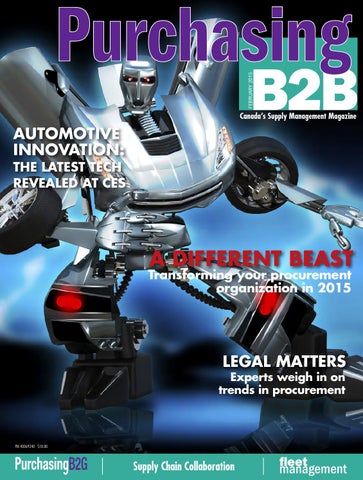
FEBRUARY 2015
Canada’s Supply Management Magazine
AUTOMOTIVE INNOVATION:
THE LATEST TECH REVEALED AT CES
A DIFFERENT BEAST
Transforming your procurement organization in 2015
LEGAL MATTERS
Experts weigh in on trends in procurement
PM 40069240 $18.00
Supply Chain Collaboration
Table of Contents
Vol. 57, No. 1 • FEBRUARY 2015
Features
12
12 P ROCUREMENT TRANSFORMATION An overhaul can help procurement make the move from good to great.
16 SUPPLY CHAIN COLLABORATION The myths of win-lose in the supply chain.
34 L EGAL MATTERS Our experts weigh in on what’s happening in the legal world affecting procurement.
Also inside 5 B USINESS FRONT
19
6 FINANCE CORNER
22 KING OF THE VANS
7 PROCUREMENT PROFILE 8 PURCHASINGB2G 33 CYBER SECURITY 37 THE LAW
See which of the Euro vans stands out
16
22
28 DETROIT AUTO SHOW Cars, trucks and concepts for the year ahead.
30 AUTOMOTIVE INNOVATION: The latest tech revealed at CES
38 IN THE FIELD
Connect With Us Online We encourage you to visit us online to stay in touch with what’s happening in your industry and to view enhanced articles from this issue!
.ca
PurchasingB2B.ca
@PurchasingB2B
Michael Power
Features A LARGE LOOK AT LEGAL ISSUES Lawyer Michael Large weighs in on some of the issues affecting procurement professionals today.
Coverage of an Association of Corporate Travel Executives (ACTE) education event in Toronto, looking at the corporate travel market, the economics of business travel, hotel savings available through non-traditional purchasing methods and more. http://www.PurchasingB2B.ca/category/5-tmc/
Salary Calculator The power of information
A look at the risks of an assurance (SA) program for purchasers of software. www.PurchasingB2B.ca/features
A game of risk
Tips to identify, mitigate and avoid risk in supply management. www.PurchasingB2B.ca/features
How does your salary measure up? Visit the online Salary Calculator for find out. http://www.PurchasingB2B.ca/salary-calculator/
PurchasingB2B Weekly eNewsletter Sign up today for regular industry news and insights. www.PurchasingB2B.ca/e-newsletter-subscription/ PurchasingB2B.ca / February 2015 / 3
Up Front 80 VALLEYBROOK DRIVE TORONTO, ONTARIO M3B 2S9
www.PurchasingB2B.ca
PUBLISHER
Dorothy Jakovina 416-510-6899, djakovina@PurchasingB2B.ca
New Year, New Look
W
hile it’s a bit early yet to herald spring, change is definitely in the air for us at PurchasingB2B. As you look through this issue, you’ll likely notice a few differences in the appearance of the magazine. With the New Year upon us, we decided that we were due for a makeover and have revamped the magazine in several ways. For starters, and perhaps most important, we’ve updated our logo, which we feel gives it a more modern appearance. It took us a while—we went through several possible iterations of the look of the publication’s name—but the one we arrived at that appears on the cover of this issue, I believe, gives us a fresh look. I hope you like it as much as we do. We’re also looking for new ways to present the information, tips, best practices and insights that we strive to bring you in each issue. One of the ways in which we’re working to do that is to find more synergies between our print publication and what we offer online. For example, more of the stories in this and future issues will also have a longer, more in-depth or enhanced version on the magazine’s website: www.PurchasingB2B.ca. To ensure we get you as much relevant content as possible, we will feature some reports in the magazine while also offering more of the same in an online version. For more context and additional opinions on select stories, I would suggest that you visit our website as directed at the end of certain stories. We also have a number of other exciting things that we have lined up this year. On September 15, we’re planning to host a one-day buyer and supplier event at the Mississauga Convention Centre, called Procurement Fair 2015. We’re holding the event in partnership with FRASERS.com, Canada’s industrial search engine. The fair will give attendees ample opportunties to network, source new products and services, gather information and exchange ideas and advice. We’ll have more on this event in future issues of PurchasingB2B, so stay tuned. As well, a few words about the content of this issue: it’s fitting that, with so much change afoot for our team, we have also focused this issue on transformation. In the following pages, we offer tips on how procurement organizations can make a major change as smoothly and effectively as possible—plus what to look for at every stage of the process. In one article, our experts stress that change is all about people and that no change can take place properly without support from both the top and bottom of an organization. While change can be tough—sometimes even traumatic—the rewards at the end of the process often make it worthwhile. To wrap up, I hope you like our new look. Going forward, I also hope that you will appreciate the way in which we choose to present the information within our pages. If you have any questions or comments about this new and updated version of PurchasingB2B, suggestions for how we might improve or anything else you’d like to see, please do let me know. I’m always happy to hear from readers. You can contact me at mpower@PurchasingB2B.ca or 416.442.5600, ext. 3259. I look forward to hearing from you.
EDITOR
Michael Power 416-442-5600 ext 3259, mpower@PurchasingB2B.ca FLEET MANAGEMENT/CAR EDITOR
Emily Atkins 416-510-5130, eatkins@PurchasingB2B.ca ART DIRECTOR
Sandy MacIsaac 416-442-5600 ext 3242, smacisaac@PurchasingB2B.ca PRODUCTION MANAGER
Karen Samuels 416-510-5190, ksamuels@PurchasingB2B.ca CIRCULATION MANAGER
Barbara Adelt 416-442-5600 x 3546, badelt@PurchasingB2B.ca ANNEX-NEWCOM LP
PRESIDENT: Alex Papanou For over 56 years, PurchasingB2B has been a trusted source of information for Canadian purchasing/supply chain management professionals in the private and public sectors. Special features and supplements include Fleet Management, Canadian Automotive Review (CAR), PurchasingB2G, and Travel Management Canada. PurchasingB2B is published six times a year, except for occasional combined, expanded or premium issues which count as two subscription issues, by Annex-Newcom LP. © Contents of this publication are protected and may not be reproduced, in whole or in part, without the written consent of the publisher or editor. NOTICE: PurchasingB2B accepts no responsibility or liability for claims made for any product or service reported or advertised in this issue. PurchasingB2B receives unsolicited materials including letters to the editor, press releases, promotional items and images from time to time. PurchasingB2B, its affiliates and assignees may use, reproduce, publish, re-publish, distribute, store and archive such unsolicited submissions in whole or in part in any form or medium whatsoever, without compensation of any sort. SUBSCRIPTION SERVICES: To subscribe, renew your subscription, or to change your address or information, contact us at 416-510-5713 or 1-866-543-7888, ext 3258, apotal@bizinfogroup.ca, or visit us at www.PurchasingB2B.ca. Subscription price per year: $99.95 CDN; Outside Canada per year: $172.95 US; Single issue Canada: $18 CDN. Annual Supply Chain Survey issue, Canada: $45; Outside Canada: $70 US. Taxes extra. From time to time we make our subscription list available to select companies and organizations whose product or service may interest you. If you do not wish your contact information to be made available, please contact us via one of the following methods: Phone: 1-800-668-2374, Fax: 416-442-2200 E-Mail: jhunter@bizinfogroup.ca Mail to: Privacy Officer, 80 Valleybrook Drive, Toronto, ON M3B 2S9 Printed in Canada. ISSN: 1497-1569 (print); 1929-6479 (digital) Publications Mail Agreement No. 40069240 We acknowledge the financial support of the Government of Canada through the Canada Periodical Fund of the Department of Canadian Heritage
4 / PurchasingB2B.ca / February 2015
Business Front
The Recession of 2015
Toronto-based Michael Hlinka provides business commentary to CBC Radio One and a column syndicated across the CBC network.
by Michael Hlinka
I
believe that the Canadian economy is going to suffer a sharp recession this year. I believe that unemployment, which ended 2014 at 6.6 percent, will likely be 8 percent or even higher 12 months from now. I believe that the job losses will be concentrated in construction and finance, two of the most important private sector employment classifications. Then the ripple effects will be felt throughout many different service occupations. And if I’m right, the responsibility should fall squarely on the shoulders of the Bank of Canada and irresponsible politicians who should have anticipated the consequences of cheap money. There is usually a precipitating event that causes any economy to go into recession, some sort of unanticipated shock. In this case, it will be the sudden drop in the price of oil. Just this past July, West Texas crude was more than US$100 per barrel. Then, in fewer than six months, its price was slashed in half. This has already led many oil and gas companies to scale back capital projects for this year, and some significant job cuts have already been announced. During more normal times, this would not be disastrous…but it’s anything but normal in Canada right now. In these pages, I have previously commented about the build-up of private debt. What we have seen in the past 25 years is a persistent increase in household debt to gross domestic product. In 1990, for every dollar we owed, we earned one dollar. Twelve years later, the ratio of debt to earnings was 1.1:1.Since then, the ratio has climbed steadily and as of writing, it’s now about 1.6:1. That is, for every dollar we’ll make this year, we’ll owe $1.60! This is unchartered territory and it’s an ominous burden to be carrying at any time. We know that people are more likely to take on debt when they feel confident about the future. And that makes sense. If I’m making $50,000 this year and I believe that next year my earnings will be bumped up to $75,000, I’m not
worried about borrowing. I anticipate having a lot more disposable income to make my interest payments and retire principal. So I leverage myself. But what if next year, instead of making $75,000, I actually bring home $30,000. Then I’ve got a serious problem. Either I must scale back my spending drastically or default on what I owe. Let me speculate how the Canadian economy will play out in the next 12 months. After lay-offs occur in the oil and gas sector, there will be a pullback in construction. For several years, spurred by low interest rates, new housing starts across the country have greatly exceeded what is needed to match population growth. I live in Toronto and have a bird’s eye view of the condo development happening all across the city. It doesn’t feel right. And even the Bank of Canada recently warned that housing across the country may be over-valued anywhere from 10 to 30 percent. If construction employment dropped to levels seen at the end of 2012, unemployment in the country would exceed 7 percent. The Canadian banks—all of which are huge employers—have already announced that “cost containment” is their priority. Even cutting payrolls by 2 percent would bump up the unemployment rate that much more. Then the ripple effects would really start to be felt: The airline industry would be hit hard, with less money spent on discretionary travel. Ditto for hospitality. A weakening Canadian dollar would mean that prices for imported goods would edge that much higher, cutting into discretionary income just oh-so that much more. Let’s assume that I’m right. What can you do to best weather the storm? First, start reducing debt if this is a personal issue for you. If I were in the market for a new home, I would seriously consider waiting because I think the Bank of Canada is right—there will be a pullback in prices this year. And if the slowdown occurs, then interest rates have nowhere to go but down. Should your mortgage be coming up for renewal, if you’ve got a variable rate, stay with it, and if it’s fixed, think seriously about assuming a bit of interest rate risk and going variable. I truly hope I’m wrong on this macroeconomic call. I am very lucky. My labour income (I’m a tenured professor in the Ontario community college system) is very safe, almost as safe as Bank of Canada Governor Stephen Poloz. He and his predecessor, Mark Carney, have overseen an era where interest rates were slashed almost to zero. It was inevitable that sort of asset bubble would develop. One did. The only thing that kept the ship afloat this long was high resource prices. And by the time they recover later this year, which I think they will, the country will be in recession, and the people who suffer won’t be the ones that deserve to. B2B B2B
PurchasingB2B.ca / February 2015 / 5
Finance Corner
A CPO’s View Of Finance
Erin Geldard, MBA, is chief procurement officer at Cogeco Cable Canada Inc.
by Erin Geldard
O
ver the past few years, there has been a definite shift towards procurement working more closely with finance. Throughout my career, finance has always been an important internal business partner. But after a recent shift in companies, I have the opportunity to report into the CFO for the first time in my career, and it is proving to be very insightful and helpful. To build a successful procurement organization, it’s important to establish your team’s credibility, and working with finance can help. Finance can derive detailed information about supplier spend either through budgets or accounts payables—the basis of good category management. Finance can also help supply chain better interpret annual reports, perform vendor financial risk audits and add pertinent financial supplier information to the category play books. Furthermore, it is sometimes difficult for a procurement department to get up-front visibility on business projects, which is why a close relationship with project management and strategic planning teams is important. But we often neglect finance, which has visibility up front on key projects and initiatives. Finance approves budgets and capital expenditure, paving the way to supplier negotiations. For procurement to add more value to negotiations we need to be involved earlier in the decision process; therefore, it is essential to ensure that you have a close working relationship with these business partners. Challenges and benefits Earlier in my career, finance helped us build ‘true should cost’ or ‘total cost of ownership’ models to understand the key cost drivers and prepare for fact-based negotiations with suppliers. It’s much easier to ask for cost reductions based on key financial information than it is to request a percentage decrease from thin air. But don’t forget that some key negotiations stem directly from our
6 / February 2015 / PurchasingB2B.ca
business partners who are looking to optimize their own processes. Finance plays a key support role in the decision-making process. I have worked closely with finance during key negotiations, which originated from some business improvement initiatives. Finance was able to elaborate business decision models using numbers stemming from supplier RFPs as well as evaluating the impact on internal costs. This helped us take some key decisions on trade-offs with our partner to find a win-win solution, both from a financial perspective and in terms of optimizing internal business processes. For procurement to become a true business partner, it must not only understand the supplier financials, but also how that supplier will interact internally with the business and how this will help improve our company’s internal productivity. Finance can provide this key support and enable us to make those critical decisions, which ultimately provide the best value to the business and to our shareholders. Finance is also a strong ally in controlling costs. Having worked in different industries, I can confirm that procurement is often solicited when times are tough. The business needs support to reduce costs and is open to negotiating with the supply base. Certain industries have less pressure on margins and it’s more difficult for procurement to get their foot in the door. Of course, good procurement practices, supply chain management and cost improvements should be important for any industry whether or not they face tough times. Finance can help provide support and open doors with the business. The benefits of working closely with finance far outweigh any challenges. Often the biggest challenges stem from timing. Procurement can get frustrated by the time required for finance to validate or provide information; therefore, transparency and understanding of each other’s requirements up front helps iron out wrinkles. However, procurement needs to be sensitive to key finance priorities. For example, do not start key discussions around their end of month, quarter and especially yearend. From my experience, finance has been willing to provide training to the supply chain on business financial accounting as well as supporting our decision process, so take advantage of this. Procurement can use finance’s power and influence to help provide creditability with respect to cost reduction and avoidance objectives. If the CPO presents numbers to the executive committee, which are supported and acknowledged by the CFO, it adds credibility from a numbers validation as well as an internal audit perspective. Also, the CFO has the power to decide whether to reduce internal budgets to reflect savings, or to reinvest money into R&D or new projects. I have had the opportunity to report into IT, engineering and other departments. While they have all provided different angles useful for understanding the supply base, reporting into finance has also been very insightful. There is a natural fit for procurement here, and if you haven’t already, ensure that you develop a close working relationship with your organization’s finance department. B2B B2B
Procurement Profile
Challenges and opportunities Michael Pacholok, J.D., chief purchasing official and director, purchasing & materials management division
opment opportunities into procurement calls and establishing a supply chain diversity approach. Both of these items are still rather new to procurement in Canada, so it’s great to be on the leading edge. What do you like most about your job? The never-ending challenges and opportunities, whether I’m trying to decide what’s the fairest decision in a particular procurement, ensuring my internal customers’ needs are met or improving the procurement process. What future plans do you have in the field? My focus now is to help improve the policies and procedures at the City of Toronto, continue to modernize technology, determine the best way to transform my division from the more traditional tactical procurement approach to a strategic procurement approach and ensuring the right supports are available for my staff. How did you get involved in procurement? I began my career as a lawyer for the City of Toronto providing legal advice to the purchasing and materials management division. I also worked with the solid waste management services division giving advice and drafting contracts used to procure goods and services. When the previous director retired, I applied and have been there for three years. What career highlight stands out the most? There are two highlights that come to mind. Becoming the chief purchasing official, which is an important position in the City of Toronto, at such an early point in my career, is one of my biggest highlights. The other is spearheading a social procurement policy with a cross-disciplinary team. We’re looking at how to build workforce devel-
Tell us something about yourself unrelated to your profession. I spent 10 years writing a science fiction novel about two reluctant people drawn into an intergalactic war that threatens the Earth. I’ve started to work on a sequel but of course I haven’t published the first novel. I really need to find a good editor to get that first novel moving again! What advice would you give those considering a career in procurement? Anyone considering a career in procurement should keep an open mind and be curious. Procurement is a career that allows you to learn about a variety of markets, but your core procurement skills will still apply. It helps to be willing to learn. If possible, experience procurement in a public and a private sector setting to understand the similarities and different constraints that exist. Above all else, work on your interpersonal skills because you’ll always encounter clients who see you as a bottleneck to what they need and disgruntled vendors who are unhappy with the procurement process, you’ll need to be able to handle both with diplomacy and tact.
Staples Advantage is your one-stop source for all your workplace needs.
getting everything you need to succeed
CALL: 1.877.272.2121
From PPE to breakroom products, office supplies to facility products and even tech products, we have everything you need to make sure your workday is more productive. staplesadvantage.ca/purchasingb2b
Connect with us:
StaplesAdvantage.ca PurchasingB2B.ca / February 2015 / 7
PUBLIC PROCUREMENT
Practitioners, experts and consultants met in Montreal last October 27-29 for the 2014 Canadian Public Procurement Council Forum. Below are highlights from presentations that caught our interest.
Defence Procurement Learning from project failures By Peter Diekmeyer
A
major added value of the Canadian Public Procurement Council Forum was the ability that it gave participants to draw lessons from others’ experiences. Paul Emanuelli, general counsel and managing director of the Procurement Office, presented case studies of public sector procurement debacles in national defence, infrastructure, transportation, healthcare and energy that helped fire up subsequent discussions. “Failures tend to recur in the same areas: failure to meet operational needs, stay within budget, deliver on time or to follow process rules,” said Emanuelli. “Project teams that ignore these everpresent risks do so at their peril.” The government’s mismanagement on the defence procurement front provides examples of all four categories of failure in acquisitions ranging from helicopters to ships. Emanuelli quoted former general Andrew Leslie, who said that the government had “the worst record” on military procurement of any government in the last 50 years and that it “can’t even buy a fleet of trucks painted green.” For example, the government’s issuance of no-bid contracts to Lockheed Martin related to F-35 Lightning II joint strike fighters, the largest procurement in Canadian military history, violated a basic rule that any private sector procurement junior learns early. According to an auditor general’s report, the government took key steps out of sequence. This led to bid specifications being drawn up at a low level in defence and public works department hierarchies, which effectively ruled out competing options. This resulted in the choice of a highly controversial aircraft, using widely optimistic forecasts as to projected costs, which were ultimately revised upwards four-fold. All this for an aircraft which Emanueilli quotes Michael Hostage, a US general, as saying is incapable of flying solo missions, as it cannot properly defend itself against enemy fighters. The botched Joint Strike Fighter initiative, currently under review, provides a perfect example of what Emanuelli calls an “optimism bias” which characterizes public sector projects. This consists of small initial cost estimates, which tend to inflate as the project is accepted and gets underway, demonstrating a need greater for rigour in initial estimates. B2B
Peter Diekmeyer is a freelance writer based in Montreal. 8 / February 2015 / PurchasingB2B.ca
Clearing Hurdles Governance in IT procurement
O
By Peter Diekmeyer
ne public sector procurement challenge relates to large-scale information technology, said Leo Gotlieb, a director of Western Management Consultants. Key to this is proper IT procurement governance, including a leaner procurement cycle, transparency, flexibility and vendor competition. Gotlieb cited a public sector client looking to install an e-commerce portal, using a softwareas-a-service (SAAS) model. The client hadn’t established a privacy policy for cloud data storage and didn’t know the legal, contractual, security or risk elements. The client estimated that to study them would cost $500,000, double the cost of the proposed IT solution.
“Complex systems increase the risk of cost and schedule overruns or project failure. Many vendors won’t bid on inflexible, one-sided contracts.”
“In public sector procurement everyone has a veto; no one can proceed alone,” said Gotlieb. “There appears to be a desire to make IT procurement perfect. However, any objective assessment signals that procurement in an imperfect world is more art than science.” Challenges include uncertainty regarding hardware, software and regulatory policy changes and more stakeholders. These lead to larger projects, with higher costs and longer-term contracts. Traditional procurement approaches are not suited to these realties, says Gotlieb. Complex systems increase the risk of cost and schedule overruns or project failure. Many vendors won’t bid on inflexible, one-sided contracts. Those that do are often high-risk bidders. Strengthening market research in the project approval process and giving stakeholder guidance is crucial. Defining responsibilities, as well as designating a senior project executive, lead agency for multi-agency projects, clear time-line restrictions and success factors are key. B2B
A case study in multi-sector collaboration
B
By By Terry Kyritsis
elow is a summary of a presentation at the CPPC forum called A Case Study in Multi-Sector Collaboration, by OECM president and CEO Terry Kyritsis. We hear the word collaboration everywhere today. Is it the newest dance craze or a whole new dance philosophy? Collaboration is fast becoming necessary for organizations to survive and thrive and, when done well, it creates value for all partners. Whether the drivers for collaboration are savings, avoiding duplication, providing access to new markets or sharing expertise, working collaboratively with willing partners can create and deliver value far more than what any single organization could achieve alone. However, establishing powerful and lasting collaborative supply chain relationships is neither easy nor quick. To be successful, potential partners must understand each other’s goals and objectives; build trust in an often competitive and multi-jurisdictional landscape; find common value; manage expectations and achieve common goals. To be successful in the long haul, relationships need to be built on common values, trust and a sense of ‘we’. All parties must be mindful of and sensitive to the importance of others’ need to retain their identity and learn to resolve issues in a win-win fashion. Successful collaboration models can be multior single partner. OECM and its collaborative partners have had significant success in driving value across education’s multi-sectors for commonly used products and services like office supplies, multifunctional devices, and so on. Equally, we have experienced successful outcomes in single-sector collaborations such as insurance broker and banking services with Ontario’s college sector. Listen to the music Keeping the customer needs always in mind will maximize the chances of success for any collaborative initiative. • Choose the right mix of products and services. Engage customers in every step of the sourcing and procurement cycle: consult with sector committees, associations and business owners to understand their business needs. Ask customers to participate on specific sourcing projects to help ensure that the products and ser-
vices meet their operational needs. • Be sensitive to the impact on local economies and integrate regional needs wherever possible. Consult rigorously with customers and suppliers to find the right balance for the sourcing strategy to reflect the supply side and the business side in considering regional versus province-wide access. • Measure supplier performance. Build KPIs in every RFP document; ensure suppliers know their performance expectations right up front; monitor supplier performance through regular business reviews, customer spend reports, individual customer issues management; request customers to rate suppliers annually on their overall performance.
“Working collaboratively with willing partners can create and deliver value far more than what any single organization could achieve alone.” Dance partners make a difference OECM’s education, BPS and supplier dance partners are reaping the rewards of successful collaboration. As of September 2014, OECM’s agreements for 34 categories of products and services are being accessed by 114 of the 118 educational institutions across Ontario and by over 150 other BPS entities that have benefited from cumulative savings of $26.8 million between January 2010 and June 2014. As of September 2014, over 72 supplier partners have seen their business grow from $15 million of spend through OECM agreements in 2010 to $116 million by December 2014 and a forecasted $144 million by the end of 2015. In addition to hard dollar savings, customer and supplier partners are benefiting from significant efficiencies and cost savings from reducing duplication of effort while ensuring full compliance with Ontario’s Broader Public Sector Procurement Directive. At OECM, collaboration starts with a talented and committed team that shares OECM’s values and respects those of the customer and supplier partners. Recruiting a team that embraces the dance is paramount. Along with strong technical skills, commitment to OECM’s values of collaboration, responsiveness, integrity, innovation and respect are the price of admission during the selection process. How we do anything is just as important as what we do and, sometimes, the how is more important than the what. B2B Terry Kyritsis, B.Sc., B.Ed., CPPO, is a founding member and president and CEO of OECM. Visit PurchasingB2B.ca for more on this topic
.ca
PurchasingB2B.ca / February 2015 / 9
PUBLIC PROCUREMENT
Willing Dance Partners
Professional Directory
2 01 5
DIVERSITY PROCUREMENT FAIR
April 14th & 15th, 2015 Toronto
ONE-TO-ONE MEETINGS NETWORKING RECEPTION BEST PRACTICES WORKSHOPS STRATEGIC SOURCING WORKSHOPS Register Now at www.camsc.ca Early Bird Discount until Feb 28th
Since 2004, corporate members have spent more than $1.2 Billion with CAMSC certified Aboriginal and minority-owned businesses.
Upcoming events
http://www.purchasingb2b.ca/topic/events/ ProcureCon Canada 2015
NAFA 2015 Institute & Expo April 14-17, Orlando, FL
ProcureCon is an interactive forum featuring continuing professional development, networking opportunities and peer-to-peer benchmarking.
The I&E provides an opportunity for fleet managers to gather tools to be successful and increase their networking power.
March 30-April 1, Toronto, ON
GBTA Conference 2015 | Toronto April 20-22, Toronto, ON
GBTA Canada Conference 2015 | Toronto is the largest travel purchasing and management event in Canada. The conference features general and education sessions, an expo floor and networking opportunities with peers from across North America.
ISM2015 Annual Conference May 3-6, Phoenix, AZ The ISM2015 Annual Conference promises to be the biggest and best of them all. Be inspired, exchange best practices and build your network.
CAMSC Diversity Procurement Fair April 14-15, Toronto, ON
This event matches corporations committed to diversity with diverse suppliers. Learn from business leaders across the global supply chain as they share best practices.
September 15, Mississauga, ON Stay tuned for further information in upcoming issues.
PurchasingB2B is on Twitter! Our team now tweets in real time to bring you coverage of conferences, seminars and other industry events. Check us out at @PurchasingB2B and join the conversation as it happens. 10 / February 2015 / PurchasingB2B.ca
Professional Directory
TO ADVANCE YOUR CAREER, LEARN FROM INDUSTRY EXPERTS. OUR PROGRAMS As the leading association in Canada for supply chain management professionals, SCMAO offers professional development and education connected to industry. • Taught by supply chain practitioners Our instructors translate real-world experience into meaningful classroom discussion that you can apply at work. • Supply Chain A-Z Whether you’re new to supply chain or managing at the highest levels, SCMAO offers programming to meet your needs. • On-Going Support As a full-service association, SCMAO offers networking opportunities and career building events allowing for maximum career growth.
Certified Supply Chain Management Professional (CSCMP) Internationally-recognized, the CSCMP designation is the highest level of professional education in supply chain management in Canada. Diploma in Procurement and Supply Chain Management Developed for skilled supply chain professionals at the intermediate level. Supply Management Training A foundational education in tactical and operational knowledge. Professional Development Seminars Keeping you informed of emerging trends and supply chain practices. Corporate On-Site Training Customized and cost-effective training delivered conveniently in your own facility.
ALIGN YOURSELF WITH SUCCESS LEARN WITH SCMAO For more information on our programs please contact the SCMAO office at education@scmao.ca or Christopher Lau at 416-977-7566 (ext 2145). PurchasingB2B.ca / February 2015 / 11
Transformation
Procurement
Transformation 12 / February 2015 / PurchasingB2B.ca
An overhaul can help procurement make the move from good to great
B
usiness moves fast these days, and factors such as commodity volatility, changing markets and global competition put pressure on companies—including procurement organizations—to realize more value. But finding that value can be tough for organizations that have already realized a few quick wins. Larger change may be necessary. Enter procurement transformation: changing the status quo to help realize savings and benefits. A commitment to initiate, lead and manage change to a procurement organization can be stressful. But tips on how to do it can help make any transformation smoother. Before any major transformation, do a current-state assessment of the organization that will see change, says Bruce Winder, senior advisor with Toronto-based JC Williams Group. That means, every three to five years, running a diagnostic on everything from vendor relations, return on investment, P&L, service levels and so on. Business variables change fast these days, notes Winder, and low oil prices, a revived US economy and other factors are affecting procurement and consequently any planned transformation of the department. “Part of this is a current state that says, ‘based on what we know, between our current state and what’s happening in the market, how do we forecast things over the next three to five years?’” Winder says. Next, organizations can draft a three to five year strategy of how to organize procurement and how it should function, he notes. That involves looking for opportunities to streamline, finding cost reductions and improving performance and service levels. “You need to make sure that wherever you’re going you have clear accountabilities, the right reporting structure, the right role clarity and you have the right people,” he says. Category management The changes wrought by transformation are usually major, sweeping and often involve implementing a category management strategy, says Siobhan Chinnery, vice-president, corporate supply chain at Sanjel Corporation. Such transformations can be initiated by consults that approach an organization saying that their services can help improve fragmented spend—along with an estimation of how much can be saved by the process. An appraisal of between five and 10 percent for smaller companies, and two to five percent for more mature organizations, is common. “I think the recent buzz is that many organizations implemented strategic sourcing 20 years ago and it kind of fizzled out—maybe they had an initial spurt and then it didn’t work and they kind of let it go. There’s the ability to go back and almost redo what you’ve done before. I think PurchasingB2B.ca / February 2015 / 13
NAFA2015 Institute & Expo W W W. N A F A I N S T I T U T E . O R G
THOUSANDS OF YOUR PEERS are coming together
AS A FLEET MANAGEMENT COMMUNITY THIS APRIL IN ORLANDO.
Register now to join us!
NAFA’s Institute & Expo April 14-17 Orlando, FL
NAFA’s International Fleet Academy April 13-17 Now co-located with I&E!
Register today at www.nafainstitute.org • #NAFA2015 14 / February 2015 / PurchasingB2B.ca
that’s why they’re using the word “transformation,” she says It’s not like they’ve never done this before, or companies have never strategically looked at their spend before.” Such transformations are valuable to procurement organizations just starting out on their journey towards a more mature structure, Chinnery notes. The perception of immature procurement departments is that they’re largely tactical in their functions, for example issuing purchase orders and performing other basic tasks. As organizations evolve they tend to become more strategic and start looking at spend in a more thoughtful way. “I think it’s foolhardy not to do that,” she says. “You’re not spending your money as wisely as you could if you don’t have the more mature supply chains.” A transformation will often begins with looking at strategic functions, Chinnery notes, for example where spend might be fragmented. From there, procurement can implement a project plan for each category in order to consolidate that spend. Large, global companies can often see business units working independently rather than communicating, she says. “That’s where I would start—bring together those silos, consolidating the spend and driving value for the company so they see the value of what you’re doing. While you’re driving that value, you need to change the organization. They go hand in hand.” For that, it’s necessary to have people who can look at spend strategically, Chinnery notes. While it’s unnecessary for them to have a procurement background, they must be able to see the big picture and think strategically. One of the main challenges is change management and managing the process properly. Change is difficult and involves people, Chinnery notes. A new process can be put in place, but it won’t come to life unless people within the organization accept and implement it. “It’s all about people,” she says. “It’s about communicating. It’s about talking about your quick wins to gain people’s support.” Chinnery noted transformation’s impact to
the bottom line. For example, in an organization with a 10-percent profit margin, it takes an additional $1 million in revenue to generate $100,000 in profit. Meanwhile, $1 million in cost reduction goes straight to the bottom line and increases profits by $1 million. Five-level matrix Kathy Simon, director of indirect procurement at Indigo Books & Music Inc., is in the process of transforming her procurement department. She has developed a matrix describing five levels of maturity that procurement organizations can go through to transform and improve. Each level outlines the attributes typical for six areas: business unit behaviour; procurement’s time of entry; procurement’s key activities; status; tools; and spend under control. For example, for business unit behaviour, at level one procurement would face avoidance and resistance. Skepticism and reluctance from the organization characterizes the second level, followed by compliance and acceptance at level three. At level four, procurement sees support and early engagement. At level five, procurement is a champion with proactive involvement. “Across these five categories, it moves to a better and better behaviour or engagement level,” Simon notes. At level one, procurement is immature and performs mostly clerical functions. At the fifth level it has achieved the highest strategic functioning possible. “There are three or four activities that I’m describing at each level,” Simon says. “For everyone who looks at this matrix, it helps them identify which category or level they’re in and what the characteristics of a higher level are. All they need to do then is develop a plan to close the gap.” After about two years, her organization is at level two, with plans to reach level four. Simon stresses getting C-level support, and suggests focusing not only on cost savings but also the overall value procurement provides. If an organization is at level one or two, procurement likely has several quick wins available. It’s more difficult to advance after savings have been realized. “My suggestion is to make sure there’s additional value that will always be there even if there’s not much net new investment, purchases or expenditures,” Simon notes. A roadblock to hitting a higher level is the relatively low status procurement has in many organizations. “We need to be regarded as an essential part of a risk averse company because this all comes down to mitigating a company’s risk exposure,” Simon says. “The same thing with legal, procurement is no different. We haven’t been emphasizing the risk aspect. There’s no doubt that transforming a procurement department can be difficult. But the benefits both to a company’s bottom line and procurement’s status within the Visit PurchasingB2B.ca company can make that process for more on this topic worthwhile. B2B
.ca
PurchasingB2B.ca / February 2015 / 15
Supply Chain Collaboration
Beyond Win-Win The myths of win-lose in the supply chain
A
By Robert Porter Lynch s a new era of supply chain managers transforms supply chains from transactional engagement into value networks, how to deal with suppliers must be addressed. Economic and negotiations theory is only as valuable as it can predict and direct operations people to take actions that will, with consistency, produce results. When eras shift, past paradigms become obsolete, ineffective, or marginally correct as new paradigms shift thinking and practices. To illustrate this, it’s useful to look at the more archaic thinking, where it came from. Below are seven traditional business assumptions.
The purpose of business is to
Myth 1 make money or to create shareholder value—this is a myth based on oversimplification solely from an investor’s perspective. Business’s real purpose is providing goods and services competitively at a profit. Customers are the only source of operational revenues for creating profits. If a business’s purpose was primarily to make money, then it should liquidate itself, take the money, distribute it to its shareholders, and call it a day. While there’s some utility in this for larger, publicly held businesses, it’s troubling when applied to SMEs. The rationale for creating startups demonstrates that the primary reason for their launch isn’t money, but to control one’s destiny or its derivative, to do it better than my big bureaucratic elephant company. The mythical understanding of business’s purpose affects negotiations, procurement, supply chain and competitive advantage. If two negotiators are trying to transact business, it’s in each business’ interests to make a profit. A win-lose strategy means one of the parties won’t be operating in its best interests. Most companies will not put up with this option. Because buyer and seller have differing assessments of value in the transaction, they have conflicting interests. This is part truth and part misconception. What is truthful is that two parties have differing value gauges to determine whether it’s in their best interests to engage in a deal. But procurement is only a small component of how supply chains create value. A supply chain is engaged in transformation of labor, materials and technology into products
Myth 2
16 / February 2015 / PurchasingB2B.ca
and services that are of more value to a customer than a competitor’s products and services. Therefore, the procurement, deal making and bargaining processes must be viewed in terms of how they affect the transformation into strategic competitive advantage. The critical element is not just price/cost, but how well the parties regard each other. The key components of this transformation are the ability to create strategic and operational synergies, trust each other and innovate. Second, as the world accelerates, the differentials of interests between buyer and seller have to be sublimated to the realities of speed, innovation and integration. There is no room for bickering or dysfunctional behavior. Third, relationships are important in any buyer-seller interaction. If it’s a one-time interaction, what they think of each other may not matter much. This changes if they’re to interact over years. If a seller is ill treated, this will impact not only the next negotiations but whether there are any future negotiations at all. There is a distinction between transactional exchanges and mutual value creation when the suppliers are strategic and with high-trust. Power is the primary basis for
Myth 3 relative strength of the buyer-supplier relationship. While there’s an element of truth, it isn’t universal. In some markets, some buyers and some sellers are dominant. But monopolies are dysfunctional because innovation is stifled. Eventually, other forces will destroy a monopoly. The issue of “who has the power” is also based on a narrow definition of how power is used. In a scarcity world, win-lose ne-
Myth 4 gotiations are the best approach.
This is dangerous and impractical. Win-lose can only be used in the short-term. But win-win isn’t just about price. Win-lose shifts focus to power, deal making and transactions instead of alliances, strategy and value creation. Win-lose may have value in commodity procurement where there is an infinite number of nearly identical suppliers, but it has no value in a world where with: • too few suppliers; • most suppliers making marginal profits; • supplier is strategic to your value creation; • possibility of killing the supply base; and • innovation is critical. The issue of win-lose is tied directly to the presumption of a world of scarcity. This is the
basis of the “haves” and “have nots” approach to economics. The Malthusian fallacy is the failure to acknowledge human capacity to innovate by increasing production methods in the food supply chain. Innovation becomes the antidote for scarcity in many situations. Win-win is fuzzy and can mean anything. Understand-
Myth 5 ing the dynamics of win-win is to understand winning
from three perspectives—the user, the buyer and the seller—and ensure they’re aligned. If the metrics of winning are misaligned, one of the three will lose. Win-win negotiations are based on knowing the “elements of victory” for each party, and then being committed to manifesting a winwin. The most effective means of engaging in a win-win is to be clear, from both party’s perspectives, what results will represent a win. When negotiating the elements of victory, understand that it’s nearly always more than money that the other party desires. The analysis for measuring the win is market impact; competitive advantage; innovative capacity; performance effectiveness; and financial return. It’s not in the interests of the buyer and seller to maxi-
Myth 6 mize their benefit. This is true only in the following
limited circumstances: • The relationship is either tactical or transactional or of limited duration; • Distrust is so prevalent that the only protection in the engagement is a strong legal contract; and • I nnovation, process improvements, and integration are not valued in the transaction. Where these conditions prevail, there is little value in trying to create synergies that will remain illusive and idealistic. But in a rapidly changing world, suppliers are strategic to the buyer, it’s imperative to maximize benefit simply to maintain competitive advantage. Exchange is at the heart of all human existence. The
Myth 7 veracity of this statement depends on what paradigm
one is in. Transactions are the centerpiece of the exchange-based procurement world, while transformations are the centerpiece of the fast-time, integrated, innovation-based value chain. A transaction-based world looks at the exchange of relative value, translating the value into monetary terms. A transformation-based world is larger. If I am a food buyer for a supermarket, I want to know not just the price today, but about logistics; temperature control; organic growing; inventory control; packaging innovations; shelf life expectation; returns policy; information technology integration; and, especially, how the consumer will react to the purchase. It’s important to align the supply chain to two moments: when the customer buys, and when the customer uses, the product. Should either of these propositions be unsatisfying, customer won’t return. A supplier’s measure of a win must link to the customer’s. Every customer is potentially a long-term relationship. How the product is transformed from the ground to the buyer’s hands is important, not just the exchange of money. Understanding business from a mutual value creation perspective changes the dynamics. B2B Robert Porter Lynch is CEO of The Warren Company.
Visit PurchasingB2B.ca for more on this topic
.ca
PurchasingB2B.ca / February 2015 / 17
STANDARD ALL-WHEEL DRIVE ISN’T SO STANDARD.
2015
An easy way to limit your expenses is to make sure your employees drive quality cars. If you opt for the 2015 Subaru Outback, they will. They’re also going to be able to count on a legendary All-Wheel Drive system, renowned safety features, high residual value and great fuel efficiency.
To consult our Fleet ordering guide or for more information
fleet.subaru.ca
or call
1-877-293-7272
FEBRUARY 2015
22 K ING OF THE VANS
22
See which of the Euro vans stands out
27 DETROIT AUTO SHOW
Cars, trucks and concepts for the year ahead
30 AUTO TECHNOLOGY SHINES CES showcases edgy ideas
30 Fleet Management is a special section of PurchasingB2B magazine, running in the January-February, March-April, May, July-August, October and November-December issues. It is an important resource for Canadian procurement professionals who recommend, select and manage fleet vendors and service providers. Editorial inquiries: Emily Atkins, 416.510.5130, eatkins@PurchasingB2B.ca. Advertising inquiries: Dorothy Jakovina, 416.510.6899, djakovina@PurchasingB2B.ca.
Hybrid cost of ownership
Seven of 29 hybrid vehicles analyzed in a recent Canadian Vincentric study were found to have a lower total cost-ofownership than their closest all-gasoline counterparts. Among the seven hybrids with lower ownership costs were the Lexus CT200h and the Lincoln MKZ Hybrid, which when compared to their all-gasoline counterparts had savings of over $11,500 and $4,000 respectively. Additional hybrids from Ford, Honda, Hyundai, Lexus, and Toyota also showed cost advantages. The average price premium for a hybrid vehicle was $5,984 with average fuel cost savings of $3,986. When the costs to own and operate all 29 hybrid vehicles were taken into account, the average five-year cost-of-ownership for hybrids was $2,976 more than their all-gasoline powered counterparts. “The higher market prices of hybrids cause several cost factors to increase including finance, opportunity costs, fees and taxes, and depreciation,” said David Wurster, Vincentric’s president. “In some cases fuel cost savings can help offset these costs, but with fuel prices decreasing approximately 33 percent in the past six months, increased fuel efficiency alone is not always enough to keep hybrids competitive with their all-gas counterparts.” “However, with nearly a quarter of hybrids still offering cost advantages, it is important that consumers look at individual models to understand the cost implications of hybrid technology for that vehicle.” To conduct the Canadian Hybrid Analysis, Vincentric measured total cost-of-ownership using eight different cost factors: depreciation, fees & taxes, financing, fuel, insurance, maintenance, opportunity cost, and repairs. The analysis assumed vehicle ownership of five years and 25,000 annual kilometres of driving. The following hybrid vehicles had cost of ownership sav-
ings compared to their all-gasoline powered counterparts: • 2014 Lexus CT 200h ($11,535) • 2014 Lincoln MKZ Hybrid ($4,074) • 2014 Ford C-Max Hybrid ($3,441) • 2014 Hyundai Sonata Hybrid ($2,909) • 2014 Lexus ES 300h ($1,418) • 2014 Toyota Prius c ($609) • 2014 Honda Accord Hybrid ($322) For those whose purchase of a hybrid is based upon minimizing the environmental impact and not strictly financially driven, the report identifies additional viable vehicles. The following hybrid vehicles had ownership costs that, although higher than their all-gas counterparts, were within $3,000 over five years. • 2014 Nissan Pathfinder Hybrid ($321) • 2014 Infiniti QX60 Hybrid ($588) • 2014 Porsche Cayenne Hybrid ($645) • 2014 Toyota Camry Hybrid ($695) • 2014 Ford Fusion Hybrid ($2,684) In addition to carbon emission improvements, hybrids are known for their improved fuel economy. The models that provide the greatest benefit and fuel cost savings over their gas-only counterparts are: • 2014 Lexus CT 200h ($7,838) • 2014 Infiniti Q70 Hybrid ($6,931) • 2014 BMW 7-Series Hybrid ($5,881) • 2014 Lexus ES 300h ($5,658) • 2014 Volkswagen Jetta Hybrid ($5,241) For those who are looking to minimize fuel purchases, it is important to know the hybrid vehicles with the lowest overall fuel costs. They are: • 2014 Toyota Prius c ($6,208) • 2014 Honda Accord Hybrid ($6,298) • 2014 Toyota Prius ($6,298) • 2014 Ford Fusion Hybrid ($7,358) • 2014 Toyota Prius v ($7,432). PurchasingB2B.ca | FEBRUARY 2015 | FLEET MANAGEMENT | 19
NAFA releases Financial Management Guide
In the end, doesn’t it always come down to the money? Once that truth is accepted, follow-up questions regarding where the money is going, how it is being used, and are the proper controls and oversight in place become crucial to success, especially in fleet management. How does lifecycle cost analysis help quantify the decision-making process for determining when a piece of equipment needs replacing? How can fleet managers use benchmarking principles to ensure their fleet operates at its optimum? Just published, NAFA’s Financial Management Guide examines these questions and more, as this latest guide provides a solid review of accounting theory and methods, cost recovery structures and fund structures, vehicle acquisition financing and reimbursement programs, personal use, and budgeting. “At the heart of almost every enterprise is a need to know where and how expenditures are flowing,” said NAFA
CEO Phillip Russo, CAE. “The people who succeed are those who have a firm grasp of what their costs are and are continually making sure those costs fall comfortably within budgeted expenses. That’s not always an easy task to accomplish, but NAFA’s Financial Management Guide is a tremendous resource for making this aspect of fleet work for fleet professionals.” Topics addressed include: · Typical costs of fleet operations · Organizational characteristics that might lead to the adoption of specific cost recovery options · Company vehicle acquisition options and various financing alternatives that should be considered in order to select the most advantageous funding method for your organization · Tax implications for personal use, both in the US and in Canada
Nissan supports fast charging in Quebec
Christian Meunier (R), president of Nissan Canada Inc and Pierre-Luc Desgagné, vicepresident, public and government affairs at Hydro-Québec, stand in front of the Nissan BladeGlider concept—a glimpse into the future direction of Nissan electric vehicle (EV) development. (CNW Group/Nissan Canada Inc.)
Nissan will support the expansion of the public charging network the Electric Circuit in Quebec with a significant investment in 25 DC Fast Charging sites. The partnership agreement is part of a new phase of development of the Electric Circuit, which targets up to 50 sites in high-traffic, major road corridors and large urban centres. “With record sales for the Nissan LEAF, more Canadians are embracing electric mobility and this growth will continue as public charging infrastructure continues to expand, making longer distance drives even easier,” said Christian Meunier, president of Nissan Canada Inc. “This is the next phase of Nissan’s commitment to supporting electric mobility in Canada and we understand that 20 | FLEET MANAGEMENT | FEBRUARY 2015 | PurchasingB2B.ca
charging infrastructure should support all electric vehicles to make maximum impact. Hydro-Québec has demonstrated considerable leadership in developing public charging infrastructure and we’re very happy to support the expansion of the Electric Circuit.” Québec City-based AddÉnergie will supply the chargers, which will be manufactured at AddÉnergie’s plant in Shawinigan, QC. Equipped with both CHAdeMO and SAE Combo plugs, the DC Fast Chargers will accommodate charging the Nissan LEAF and most electric vehicles. In under 30 minutes a fully depleted Nissan LEAF battery can be charged to 80 percent, getting drivers back on the road quickly. The agreement aims to help finance the commissioning of 20 fast charging sites for the Electric Circuit in 2015, with five more planned for in 2016. Targeted sites will coincide with short stops like restaurant chains, and convenience stores, making their use simple and convenient. The roll-out plan targets a number of roads such as: Highway 20, Highway 10, Highway 15, Highway 50, and Highway 35 towards Vermont. The first DC Fast Charging sites are already confirmed for: Drummondville (Highway 20); Rôtisserie St-Hubert – 2875, boulevard Saint-Joseph; Lévis (Highway 20); Carrefour Saint-Romuald, intersection of road 132 and 175; Magog (Highway 10); Espace Santé Globale, 2381-2389, rue Principale Ouest (road 112); St-Jean-sur-Richelieu (Highway 35) Centre commercial St-Luc/St-Jean – 170-174, boulevard Saint-Luc.
THE DRIVING TEAM BEHIND YOUR BUSINESS. The 2015 Fusion offers you a choice of powertrains: a standard 2.5L and two turbocharged EcoBoost® 4-cylinder engines; or for even more fuel-efficiency, Fusion Hybrid and a plug-in Hybrid, Fusion Energi. Each is an ideal complement to the Fusion’s responsive, comfortable and quiet chassis. The Fusion offers the choice you want without compromise. Make Ford Fleet the team behind your team. Contact us at focfhq@ford.com or 1.800.668.5515
2015 FUSION ENERGI
2015 FUSION HYBRID
2015 FUSION
Vehicles may be shown with optional features. ©2015 Ford Motor Company of Canada, Limited. All rights reserved.
KING OF THE EURO VANS
2015 Canadian Truck King Challenge – Van Division
Story and photos by Howard J Elmer
T
he Canadian Truck King Challenge has concerned itself with real-world pickup truck testing since 200—and still does. However, over the past few years a one-of-a-kind metamorphosis has taken place in the commercial van market in Canada; one that simply had to be investigated more closely. Once we approached the manufacturers about doing our brand of testing on its product they wholeheartedly agreed. Now, for those folks who buy and use commercial vans; you already know the landscape has changed. For most everyone else, let me just say that what has happened to the traditional low-roof North American box van (think Ford E-series) is a European invasion. Starting with Mercedes Benz, several years ago, we saw the arrival of the Sprinter with its distinctive high-roof and diesel engine. What followed was Ford product, designed and built in Europe–the smaller Transit Connect and now the full-size Transit. Quick on the heels of these two are the ProMaster
22 | FLEET MANAGEMENT | FEBRUARY 2015 | PurchasingB2B.ca
vans. Now badged as Rams, they started life as Fiats. They too bring a diesel powertrain as well as gas, and a unique front-wheel drive design. From the other side of the globe, Nissan brought a built-inNorth America van–the NV. Gas-powered and with various roof heights it’s a competitor to all the builders mentioned so far. And now Nissan has also offered up a smaller FWD van—the NV200. Six judges evaluated these vans over two days last fall. Each of these judges is an automotive journalist, a member of AJAC, and someone who spends a substantial portion of their working year evaluating trucks, vans and vehicles that work for a living. But, that pedigree alone is not enough (as anyone who follows the Challenge knows). We drove the vans empty to start with; then we loaded them with payload, and finally replicated downtown deliveries. In total, we drove over 1,600 kilometres while testing. For payload we used shingles, 3,070 lb on a single pallet for the full-size vans, and 1,040 lb for the three smaller ones. These were supplied by IKO and loaded at Roof Mart in Brampton, Ontario. The following day we did something rather new for the Challenge. We ran a very small route through the congested downtown that took in laneways, parking lots and alleys. And, we spent a bit of time with each van backing into narrow docks. This exercise was to see how well the mirrors were set up, what the sightlines on each vehicle were and to sense how well it steered in tight quarters. Each judge scored each van based on their own observations. While how a vehicle drives and handles is a very subjective process when scoring; determining fuel economy isn’t. Like last year we engaged a Kitchener company, MyCarma, to install electronic data readers in each of the vans to record fuel consumption over the two-day test period. Please keep in mind that these results are as “real world” as it gets. The readers run constantly and the results are a
blend of the driving styles of all six judges who circulate through the vans on a rotating basis. What we have done is tried to break out the fuel numbers for when the vans were empty, loaded and during the low-speed simulated downtown delivery segment. So, who won? The Ford Transit come out on top for the full-size vans while the Nissan NV200 squeaked out a win in the smaller category. And how did that happen? Well the story is in the details. Please have a look at who our competitors were and how the judges scored them–that’s where the story lies.
The competitors Ford Transit 250 The Transit was born and raised in Europe and Asia but is now also being built in Kansas City, Missouri. It’s a typical front engine, rear-wheel drive configuration. Ford says the Transit will average 25 percent better fuel economy than the current E-series, which has now ceased production. Variations of this include three body lengths, two wheelbases, three roof heights, and bodies that include van, wagon, chassis cab and cutaway variations. Each engine is paired with an automatic six-speed transmission Ford Transit Connect In 2009 this small van introduced the flood of new van product here in Canada. Late last year the Transit Connect got a nice makeover, taking it into this model year. It got two new engines, a tow package, two wheelbases and new trims. Order it with second-row seating, a rear view camera, 6.5-inch touch screen display with navigation, and SYNC with MyFord Touch. Ford suggests that the 1.6L EcoBoost I-4 will get in the 7.8L/100km range. We had both an EcoBoost and a naturally aspirated engine to test. Continued on page 24 PurchasingB2B.ca | FEBRUARY 2015 | FLEET MANAGEMENT | 23
Mercedes Benz Sprinter This year Sprinter has an updated body that features a higher nose, larger grille louvers, and new options like Bi-Xenon
24 | FLEET MANAGEMENT | FEBRUARY 2015 | PurchasingB2B.ca
headlamps. Along with the body update the V6 BlueTec diesel gets a new base engine partner—the 2.1L I-4 turbodiesel. This engine is said to get a
combined fuel rating of 8.9L/100km. Mercedes has also added five new assistance systems to the Sprinter to help drivers avoid accidents. Last, but
It… is about action not reaction. ARI is known and trusted by fleet decision-makers throughout Canada to minimize risk control costs. It is about keeping drivers safe. About data. Presenting it through alerts, trends and safety profiles. The result is a world with fewer violations, accidents, costly repairs, downtime—and less exposure. It is about fleet management success. Moving the needle, and the bottom line. Learn more about ARI’s professional fleet management services: 1-800-361-5882 www.arifleet.ca
unlike the Mercedes and Ford, it is a FWD powertrain giving it a lower, flat cargo floor. The two ProMasters we had for testing were both built with the 3.6L Pentastar V6 gas engine. The ProMaster is also offered with a 3L, I4 EcoDiesel which was not available at the time of testing. That falls into the “too bad” category because we were very curious to see how it stacked up to Ford and Mercedes. Again, maybe next year.
most interesting, a 4WD option is now available on these vans. While I have driven one since our event (and it worked very well); one was not available at the time. Maybe next year. Ram ProMaster The new ProMaster will cover consumer’s needs with a variety of body styles and weight categories (1500, 2500, and 3500) in Van, Chassis Cab and Cut-Away versions. However, 26 | FLEET MANAGEMENT | FEBRUARY 2015 | PurchasingB2B.ca
Nissan NV200 The NV200 is going up against the Ford Transit Connect and the coming ProMaster City. Unlike the others, it has already scored a market by being named the preferred taxi of New York City. Its small FWD platform lends itself to fleets and individual business functions. Its low pricing is certainly an advantage. These were our competitors. A very nice field—however there were a couple of vehicles missing for one reason or another. These were the full-size Nissan NV, the diesel engine ProMaster and also the ProMaster City, a smaller version of the ProMaster meant to do battle with the Transit Connect and NV200. As for GM, they are offering the NV200 now rebadged as the Chevrolet City Express for its small van market; this entry would have been redundant. And finally it still offers its full-size Savana and Express vans. These vans are old-school, and while they have their market I understand why GM didn’t enter them. B2B
BUSINESSES LOVE US.
GAS STATIONS, NOT SO MUCH. The Prius Family is Canada’s best-selling hybrid lineup for a reason. Powered by the most proven and advanced hybrid technology in the world, the Prius leads the industry, offering cleaner emissions, increased fuel efficiency, and surprising power without compromise. And the Prius lineup offers unbeatable reliability and value, with low cost of ownership and operating costs. With four different models to choose from, the Prius family has a vehicle to suit your fleet needs no matter what your business – today and tomorrow.
Prius and Prius v are proud recipients of a Top Safety Pick+ award when equipped with optional Pre-Collision System.
fleet.toyota.ca
Motor City Mashup By Emily Atkins
Highlights from the 2015 Detroit auto show
T
The Detroit auto show this year was home to 55 vehicle reveals, including trucks, EVs, lots of hybrids, concepts and performance cars. Almost 95 percent of these were global unveilings.
2016 Toyota Tacoma
TRUCKS Pick-ups were a big deal, with manufacturers following on the successful F-150 launch by Ford last year. Nissan unveiled the 2016 Titan, which is powered by a Cummins 5.0L V8 Turbo diesel engine. Toyota’s all new 2016 Tacoma is a mid-size truck with a 2.7-litre four-cylinder engine or an all-new, 3.5-litre Atkinson cycle V6 equipped with Toyota’s D-4S technolog y. Both engines will be paired to a new six-speed automatic transmission with electronic shift. The V6 gives you the option of a new six-speed manual transmission. The Ram Rebel is an off-road package for the Ram 1500. It’s got better ground clearance and a choice of power plants—a 3.6-litre V6 or a 5.7-L Hemi V8. Ford’s 2017 Raptor is based on the new aluminum F150. It will have a turbocharged 3.5-L EcoBoost engine and a 10-sped automatic.
Hyundai Santa Cruz
Images: NAIAS
2017 Ford Raptor
HYUNDAI
Images: NAIAS
The Hyundai Santa Cruz is a concept mini-pickup. It’s aimed at the newly invented niche of urban adventurers, millennials who want the flexibility of a truck in a package small enough to move nimbly through the city. Its engine will be a 2.0-litre turbo diesel delivering 190 HP and 300 lb-ft of torque, with planned fuel economy of 7.8 L/100 km. All-wheel drive and a cargo bed that extends to almost the length of a mid-size pick-up’s enhance its versatility. The Korean automaker also introduced its first plug-in hybrid. The 2016 Hyundai Sonata Plug-in Hybrid Electric Vehicle (PHEV) is expected to travel up to 35 km on electric power and can recharge in as little as two and a half hours with a Level 2 charger. PHEV is expected to deliver 93 MPGe combined in EV mode based on internal estimates. In charge sustaining mode, the Sonata PHEV is expected to return 38 mpg in the city, 43 mpg on the highway and 40 mpg combined. 28 | FLEET MANAGEMENT | FEBRUARY 2015 | PurchasingB2B.ca
Images: Emily Atkins
Images: Emily Atkins
BUICK
Buick Avenir Chevy Bolt concept
Buick’s new concept, the Avenir, is a sculpted fourseater. It’s a sedan, but looks almost like a hatchback, with a trunk lid that hinges very high on the car. The engine is slated to be a V6 with a nine-speed automatic, paddle shifters, selectable suspension settings and allwheel drive. On board WiFi is just one of the planned connectivity goodies on offer.
CHEVROLET Chevy rolled out two electric cars, the completely redesigned Volt, and its baby brother the Bolt. Bolt is still a concept, but will have a 300-km range when it comes to production. According to GM CEO Mary Barra it will be the people’s EV, with a starting price of less than $30,000. In its current form it looks a lot like the BMW i3 and will be built of lightweight materials.
Images: Emily Atkins
VOLKSWAGEN VW revealed its new Cross Coupe GTE. The mid-size hybrid SUV churns out a total of 355 HP from a combined 276-HP 3.6-litre V6 gas engine and two electric motors. It will make zero to 100 kmh in about six seconds; top speed is about 210 kmh. Fuel economy is expected to be about 4 l/100km. This seven-passenger people-mover will be built in Tennessee beginning at the end of 2016.
Images: Emily Atkins
Volkswagen Cross Coupe GTE
MERCEDES-BENZ The German automaker rolled out a couple new vehicles and showed its self-driving concept in Detroit. The new GLE Coupe family includes an AMG model. This broad crossover SUV is a five-door, and looks like a GLA on steroids (or doughnuts). The new C450 AMG 4Matic, will be available as a sedan or wagon. The self-driving F015 Concept was first revealed at the Consumer Electronics Show earlier in January. Its lounge-like interior, with four chairs arranged to face each other, reinforces the sense that the car has neither front nor back and could travel as easily in either direction. B2B
Mercedes-Benz F015 Concept
PurchasingB2B.ca | FEBRUARY 2015 | FLEET MANAGEMENT | 29
Turn on, tune in and drive Cars get connected at CES 2015 By Luigi Benetton
S
tepping into a vehicle used to mean getting away from it all. Not now. Courtesy of the Internet, automakers and their suppliers continue to develop novel and useful ways to connect our wheels to the outside world. That theme carried through many of the automotive technology announcements made at the January 2015 Consumer Electronics Show (CES) in Las Vegas. The Internet wasn’t the whole story. Companies wanted to showcase many auto-related innovations, from the future of hydrogen-powered cars and innovative scooters to smartwatch apps and systems that recognize drivers. Much of what’s at CES is “bleeding edge” and many offerings that first see the light of day in Vegas won’t survive. What follows are Fleet Management’s picks for the technologies presented at CES that stand a good chance of changing the way you—and your employees—will drive.
Vehicles that know what drivers need – when they need it Want to interest people in your futuristic automotive technology? Wrap it in a futuristic concept vehicle that screams for attention. That’s what Mitsubishi Electric Automotive America unabashedly did with the EMIRAI2 concept. This open-cabin, two-row, two-seat concept sports wheelsized blue louvered lights that sit where you’d expect to see wheels. Once you’re in the driver’s seat, you can place your hands on a wheel that resembles an airliner’s yoke and scratch your head as you figure out what to do with the touchscreen cockpit. As fantastic as this vehicle is, trim packages on future Mitsubishi cars might include some of the features stuffed into the EMIRAI2. The Intelligent Information Display
shows drivers the information they need most depending on driver preferences. For instance, when the car is parked, the driver can view navigation, music and their social networks. When the car is in motion, it only shows information needed for driving. The prosaically named “What’s That?” feature involves looking at something while driving, asking “What’s that?” and having the system match the direction of your gaze with its knowledge of the area to provide an answer. The “smart steering wheel” holds a touchscreen you can use to manage a cursor or “write” what you want to do. (I presume it will look more like a car’s steering wheel and less like an airliner’s yoke when it hits the market.)
Updating cars over the air Recalls are expensive for automakers and inconvenient for drivers. Too bad automakers can’t replace faulty parts with the same ease that software developers update their deployed products. Automakers want to take that page out of software company playbooks to update the everincreasing amounts of code that plays important roles in vehicles they sell. Over-the-Air (OTA) delivery mechanisms interest automakers for several reasons. OTA can prevent the need for costly recalls. Automakers may also use OTA to offer what CES press releases euphemistically call “revenue generating opportunities.” Sophisticated fleet management services may also deliver software and data OTA to fleet vehicles. Mobile device management system vendor Red Bend Software is working with automotive supplier Visteon to update Visteon’s OpenAir automotive infotainment platform OTA. Visteon’s Connected Vehicle Hub works with an embedded telematics module and LTE Multicast technology to receive updates of firmware (software stored on non-volatile memory that holds the first instructions a device reads when it’s powered up). Automakers can target vehicles for FOTA (firmware over the air) updates by manufacturing
TMS Senior Vice President of Automotive Operations Bob Carter announces access to Toyota’s fuel cell patents at the International CES in Las Vegas on Jan. 5, 2015. 30 | FLEET MANAGEMENT | FEBRUARY 2015 | PurchasingB2B.ca
THE 2015 NISSAN ROGUE With its agile performance and versatile interior, the 2015 Nissan Rogue makes conquering the road comfortable. Whether driving through snow, rain-covered pavement or tight turns, the available intuitive All-Wheel Drive makes getting a grip easier than ever. And with the EZ Flex™ Seating System, a sliding 2nd row and 50/50 split folding 3rd-row seat gives you the flexibility to create as much cargo space or legroom you desire.1 Plus, with the added cargo configurations afforded by the Divide-N-Hide storage feature, versatility is always right behind you.2
Nissan. Innovation that excites. For more information, visit nissan.ca or contact us at fleet@nissancanada.com
1
Slide function should not be performed with the child restraint system occupied. Passengers should not ride in the reclined position while the vehicle is in motion. 2Cargo and load capacity limited by weight and distribution. Always secure all cargo. The Nissan names, logos, product names, feature names, and slogans are trademarks owned by or licensed to Nissan Canada Inc. And/or its North American subsidiaries.
plant, region, fleet, and even other criteria like make, model, customer and location. Vehicle software management system provider Arynga Inc announced software-over-the-air (SOTA) updates that use Arynga tools to create and distribute updates, and an Arynga in-vehicle client to receive updates and send them where they’re needed.
Advancing in-car app access Many drivers tote smartphones while they drive, but the systems available to access mobile streaming apps on vehicle touchscreens haven’t quite arrived. Those apps work “on” phone operating systems. Meanwhile, automakers have been adopting other platforms to run apps they want to offer via touchscreens. Third parties like automotive multimedia middleware developer Cinemo are developing systems that enable various platforms (Apple’s CarPlay, Google’s Android Auto, various auto-specific platforms) to play together on one in-car system. Automakers who use these “all-in-one” systems enable drivers to access all apps, whether they run on their phones or their vehicles. Electronics makers like Pioneer Electronics are also catering to demand for in-car CarPlay and Android Auto support.
Third-party backup cameras For collision avoidance, backup cameras are just as useful as ABS brakes. But cameras aren’t anywhere near as widespread—yet. Enter electronics maker Garmin, which packages backup camera support into its nüvi Essential Series of navigation devices. Sold separately, the BC 30 backup camera hooks up to reverse lights for power, so the navigation unit displays the live camera feed every time the vehicle is shifted into reverse and returns to navigation mode when the vehicle is taken out of reverse. Garmin navigation devices also have Real Directions, which uses landmarks drivers can easily see to give directions. For instance, it will say “Turn left after the bank.” Garmin’s points-of-interest and destinations database recently grew by millions thanks to access to Foursquare data. Direct Access helps users navigate places like malls, airports and other “non-road” destinations. For instance, it directs users to the entrance closest to an auto rental kiosk inside an airport, as well as the actual kiosk.
Ford’s Smart Mobility Ford discussed its semi-autonomous and fully autonomous vehicles, but it also revealed its Smart Mobility plan. This isn’t a feature but a series of technology-driven data-gathering initiatives that will generate info Ford can use to determine future investments. For instance, the Fleet Insights experiment tracks driving habits displayed in 100 vehicles driven by US employees of technology giant Hewlett Packard. 32 | FLEET MANAGEMENT | FEBRUARY 2015 | PurchasingB2B.ca
The London-based Data Driven Insurance experiment allows Ford to study a driver’s behaviour. Accumulated data serves as a “driving behaviour passport” that drivers may present to insurance companies, hoping insurers will reward good drivers with lower rates.
Faster hydrogen power development Toyota may have shortened the development path for hydrogen-powered vehicles. The Japanese automaker, following Tesla’s lead, is making 5,680 hydrogen fuel cell related global patents available royalty-free. Some of these patents relate to the hydrogen-powered Toyota Mirai, limited numbers of which goes on sale this year, so it’s easy to understand why Toyota will request (but not require) that licensees share their fuel cell-related patents with Toyota for similar royalty-free use.
Connecting vehicles to watches Wearables aren’t just for the gym and picking up message alerts. Auto parts maker Continental AG is releasing smart watch technology that interacts with vehicles. Continental’s watch app connects via Bluetooth to Continental’s “gateway key,” an interface between the vehicle and the watch. The watch can serve as a key, one that ought to be more difficult to lose than the traditional key fob. The vehicle can also send information like diagnostics data to the watch, and the driver and vehicle can exchange other information via the watch app. It’s reasonable to bet that more third-party developers will take existing Android-based watches and Apple’s upcoming Watch to this space as well.
Cars that recognize their drivers You use passwords to log in to your various devices. Why not your vehicle? Intelligent systems developer Nuance used CES to preview Dragon Drive. Drivers of a Drive-equipped vehicle say a passphrase once they enter their cars to obtain content and information based on their preferences, not unlike the segregated desktops and file areas associated with different users on a shared computer. For instance, different drivers may take different routes, access their personal calendars, tune in to their preferred radio stations, and more. Video analytics solution provider AllGo Systems accomplishes the same thing using facial recognition. Based on technology used in surveillance and retail situations, AllGoVision automatically sets climate control, seating adjustments and other elements of the driver’s environment once it recognizes the driver’s face. Driver authentication may also secure the vehicle against unauthorized drivers, while parents may set criteria like mandatory seat belt use and speed restrictions for younger drivers. AllGo claims its system can detect the driver’s state so if, for instance, a driver is drowsy or distracted, AllGoVision sounds alerts to help prevent collisions. B2B
Cyber Risk
The Cyber Challenge
Timothy Hall is president of AZORCA Cyber Security. Reach him at tim.hall@azorcacyber.com.
Supply chains need new capabilities and processes to combat cyber security threats By Timothy Hall
C
yber attacks represent a greater threat to most organizations than weather, fire and social unrest combined. Supply chain managers should know how to mitigate the cyber risk while optimizing an increasingly sophisticated supply chain. This requires an appreciation of cyber challenges facing an organization, and the skills and tools to respond. Organizations frequently underestimate the impact of a cyber-event and the size, duration and operational cost of the response. Most supply chain practitioner’s knowledge of cyber risk is limited to what they glean from the news. Headlines focus on high profile losses from companies like Target, Home Depot and Neiman Marcus without discussing the techniques, tactics and procedures used to compromise the system. The response and risk mitigation is typically directed at the CIO and discussed in the context of technology and process solutions. However, the risk is broader than just the loss of credit cards and privacy related information. This misconception may stem from the fact that most discussions focus on the consequences of a “cyber breach”, which excludes cyber-related risks associated with counterfeit and tainted components, regulatory requirements and reporting and legal liability. Many firms underestimate the breadth of the attack surface and the variety of potential impacts associated with a cyber-event. The results of cyber related risk can manifest in a range of outcomes like loss of personal, financial, confidential and proprietary information; operational disruption; legal liability; extortion and collateral financial (stock price) and reputational damage. The response can vary depending on the event. It’s important to understand the variety and scope of potential cyber events. Supply chain cyber risks are becoming more complex. This awareness is driving the development of regulation and “guidance” documents that will impact global supply chain risk management. While these guidance documents are developed and intended for a specific audience, anticipate that they will be used to define best prac-
tices, which will become the foundation for legislation and regulation across most markets. As a result, liability and audit trends are likely to increase enterprise risk concerns and expand reporting requirements. The fact that audit and compliance frameworks are firming up in advance of many commercial organization’s ability to respond. Many cyber vulnerabilities come from decisions made by supply chain practitioners. The risk profile is affected by routine decisions like: • Choice and implementation of supplier and risk management tools; • Supplier selection and the selected supplier’s stability, responsiveness, cash flow, available capital and security compliance and transparency; • Supplier access and integration; • Supply chain data location and storage; • Integration of supplier development and QA functions into the product development process; • Choice of contract language; and • Supplier management and assessment methodology.
“Organizations frequently underestimate the impact of a cyber-event and the size, duration and operational cost of the response.” Mitigating cyber risk requires a cyber supply chain risk management approach coordinating the supply chain, IT, cyber security and enterprise risk management disciplines. Effectively framing cyber risk requires the participation of a cross-functional leadership team, operating from a common understanding of business and cyber issues. Supply chain professionals must also understand what an appropriate response entails. Decisions must enhance IT and network security’s ability to detect and deal with cyber compromise. This requires a broad understanding of potential challenges and mechanisms, as well as contract language, to ensure early detection, reporting, information sharing and participation in remediation and forensics activity. For damage control, supply chain professionals must create conditions that make certain all required parties participate. They must also ensure that their decisions protect the interests of their organizations. Cyber-related training and staff development must be integrated into professional standards and organizational planning. The ability to understand and apply controls, processes and contract clauses will become a key skill as risk management matures. Smaller companies should consider short-term contract support to develop the practices and processes, enabling their employees to focus on the business. After years of honing risk management skills, supply chains have been thrown a new complication: cyber risk. This is an arcane and nuanced problem requiring a new set of staff, capabilities and processes to incorporate it into traditional risk management systems. B2B B2B PurchasingB2B.ca / February 2015 / 33
Legal Trends
Legal Matters
Our experts weigh in on what’s happening in the legal world affecting procurement
W
hether it’s recently decided court cases, international affairs or long-running issues, there is no shortage of legal matters that procurement organizations face. To help readers navigate some of these issues, PurchasingB2B asked industry professionals and legal experts alike to weigh in on what you need to know to navigate the legal landscape. What follows is their answers to several legal questions we posed to them.
Lori Benson, SCMP, CPSM, Canadian procurement leader at EY
Q: What legal issues should procurement be aware of when drafting an RFP? Ensure you know exactly what you want to buy. Otherwise, you can get responses that are incomplete, inaccurate or create more work to clarify. If you can’t scope out what it is you’re buying, you’re at the supplier’s mercy for what they think you need. From a legal perspective, that can be a challenge. If you haven’t detailed your scope—and you want to terminate a contract—you’re going to go back to, ‘well, this is what you said you wanted.’ You almost have to reverse roles. If it’s a pen or pencil, it’s easy. When it’s services, it’s a different animal. Q: How can procurement protect itself during this process? We’re very clear about saying the contract award, if any, will not necessarily be made to the lowest price bid. There can be misinterpretation.
Graham Ragan, partner, Gowlings Q: What’s a recent legal case involving procurement? A recent decision of the Federal Court in TPG Technology Consulting Ltd. V. Canada, was a bid dispute case involving information technology services. Initially, TPG proceeded with four complaints to the Canadinan International Trade Tribunal (CITT). TPG started an action for damages alleging breach of contract, inducing breach of contract, intentional interference with economic interests and negligence. The claim was based on the RFP and evaluation process. The Crown brought a summary judgment motion and while successful at first was overturned on appeal. The case went to trial, where the court found the bid evaluation was not done fairly however, there was no evidence that the breach of Contract A resulted in TPGH suffering a loss. The court also found the winning bid was compliant with the RFP and there was no requirement to award the contract to TPG. The court’s main finding was that TPG failed to fully use the CITT process and this was a full defence to the claim. It’s an unusual finding, as other cases have held that actions for breach of contract go be34 / February 2015 / PurchasingB2B.ca
We reserve the right to withdraw at any time, and we’re not liable for any costs, expenses, losses or damages from any company as a result. There’s diligence when you’re scoping out or scripting your RFP. You want people to propose, but you also want to say, ‘if I change my mind you can’t tell me that we’re bound by it.’ For procurement, we’ve had to become more sophisticated and ensure that. Q: When should legal council be consulted? It depends. We’re going to take a look at suppliers, the value of the contract and the risk. If I’m buying some mugs, it’s pretty low risk. If it’s a higher risk contract, we’d go to legal and at least get advice on wording so I know it’s going to be read and understood by somebody in a legal capacity. People say, ‘this has to go to legal,’ so they just send it. They didn’t give any context. They didn’t provide information. Find out from legal, what do you want before we send this to you?
yond what could be raised before the CITT. The case is being appealed, and I anticipate a central part of the appeal will be CITT jurisdiction. Q: Four years after the Tercon decision, what have been the effects? There was a lot of buzz at the time that Tercon came out about, is this the end of limitation of liability clauses? We’ve seen that that’s not the case. Limitation of liability and exclusionary clauses are not dead. However, there’s still debate about how they will apply in individual cases. It’s still very much a relevant consideration and there hasn’t been a lot of finality either way. There’s still a need to look at the analysis in Tercon in individual cases. Owners are not going to abandon including those clauses. Bidders aren’t going to abandon the idea of challenging the application of these clauses. As long as that is still there, Tercon and the cases that haven’t followed it will continue to be reviewed.
Paul Emanuelli, general council, The Procurement Office Q: What have the effects been of the Charbonneau Commission on Canadian procurement? So far, the Charbonneau Commission’s public hearings have raised awareness of the risks that ethical challenges bring to public procurement. But the final verdict on the impact of Charbonneau is too early to tell because we haven’t yet had the report released. In the meantime, it’s heightened awareness of the risk of corruption in public procurement and how pervasive it can be if left unchecked. Charbonneau picked up where Gommery and Bellamy left off. You then had a series of high profile procurement failures that filled the void in between. Charbonneau is taking it to another level of public scrutiny. Q: Are negotiated RFPs (NRFPs) becoming
more common or more popular? What should procurement know about them? This is an irreversible trend that’s gaining unprecedented momentum. It’s proving to be a superior operating system from the standpoint of flexibility, risk mitigation and achieving the objectives of the organization that the procurement function serves. It’s irreversible given the state of the law of tenders and how high risk and involved that area of law has become. The end outcome of that legal trend in the increasing litigation under the Contract A, fixed bid tendering model has been this expansion in the use of lower risk, more flexible NRFPs. Q: What are the implications of the Canada-EU trade treaty? The strictest standards of treaty compliance will become the norm across the public sector. Historically, the only formal venue where trade treaty compliance has been challenged has been at the Canadian International Trade Tribunal (CITT). It’s at federal procurement where there’s been the most stringent challenge and enforcement of the trade treaty obligations. At the sub-federal level it’s even more difficult for suppliers to enforce their trade treaty rights. The European trade treaty will expand the international trade treaty obligations across the entire public sector in Canada and there will be an independent adjudicative body to enforce those standards in the same way the CITT has done at the federal level. That’s a tremendous game changer in stress testing the public sector’s compliance with trade treaty obligations.
laborative incentives to maximize value for the purchaser, rather than each participant having a separate contract focused exclusively on their part of a project. There is little Canadian experience with IPD and it remains to be seen how successful this method will be.
Bill Woodhead, associate, and Doug Sanders, partner, in the Vancouver office of Borden Ladner Gervais LLP. Q: What legal trends should procurement professionals be aware of? There is a general trend towards alternative mechanisms and contracts that innovate ways to procure goods and services. We’ve seen significant interest in integrated project delivery (IPD) contracts. The IPD method joins major project participants in one contract with col-
Q: What international developments are affecting Canadian procurement organizations? A significant development has been the expansion of the scope and enforcement of anti-corruption legislation in Canada and around the world. Canadian organizations, their directors and senior management may be subject to significant financial penalties or criminal charges if they are found to commit acts against relevant legislation. This expansion emphasizes the need for Canadian organizations to maintain anti-corruption compliance programs. Q: How can procurement protect their companies against some of the legal risks inherent in contracts? Procurement professionals should clearly identify the rules that apply to their procurement process and ensure that everyone in their organization who is involved in procurement is educated about the process. PurchasingB2B.ca / February 2015 / 35
ARY 2015 FEBRU
subscribe FREE to
Canada’s
travel
agement
Supply Man
Management
Magazine
canada DECEMBER 2014
Vol. 16 No. 2 September 2014
MOTIVE : N AUTO VATIO INNO TECH
TEST THE LA CES ED AT REVEAL
EASenTt T Bur REN oc em 15 DIFrmFE your pr in 20 A ns fo ing nization Tra
orga
LEGAL
RS
MATTE
in on weigh t Experts procuremen in trends
PM 4006924
0 $18.00
in Supply Cha
A special report from
NIAGARA FALLS
FALLIN for the 201G 5s
on
Collaborati
Brought to you by
In partnership with
IN THIS
www.PurchasingB2B.ca
Don’t miss a single issue of PurchasingB2B or our special supplements! Subscribe online at www.purchasingb2b.ca/subscribe or fax this completed form to 416-510-5172 m
C01_Co
ver.indd
1
ISSUE
4 2015 Car Prev iews 8 2015 Truck Prev iews 11 Roa dtest: Pro master 14 BMW i3
14-09-1
YES! I wish to receive/continue to receive PurchasingB2B magazine absolutely FREE!
I wish to recieve my publication in the following format: m Digital Edition m Print Edition m Both Digital and Print Editions Name: ___________________________________________________________ Title: ________________________________________________________ Company: ________________________________________________________ Dept:________________________________________________________ Email (required): ________________________________________________________________________________________________________________ Address: ______________________________________________________________________________________________________________________ City, Province, Postal Code: _______________________________________________________________________________________________________ Business Phone: ___________________________________________________Business Fax: ________________________________________________ Signature: _______________________________________________________________________________________Date:_____/_____/______ (Must be signed and dated to be valid) DD MM YYYY
We ask that you please provide ALL information below. This is an important requirement for audit purposes. Thank you! 1. Are you involved with sourcing, recommending and/or the purchasing/procurement of products and services for your business? m Yes m No 2. What is your primary business? (Check one only) m Agriculture, Forestry & Fishing, Mining m Chemical & Allied Products Mfg m Computer Equipment m Electric, Gas & Sanitary Services m Fabricated Metal Products Mfg m Finance /Insurance/ Real Estate Industries m Furniture & Fixtures Mfg m Government (Fed/Prov/Municipal) m Leather & Leather Products Mfg m Lumber & Wood Products Mfg m Miscellaneous Manufacturing m Petroleum Refining & Related Industries Mfg m Primary Metal Industries Mfg m Retail Trade m Textile Mill Products m Transportation Equipment Ind Mfg m Trucking and Courier Services (Exclude Air) m Storage And Warehousing m All Other Services
m Apparel & Other Finished Prods Mfg m Communication Services m Electronic & Electrical Equip & Components Mfg m Engineering and Architectural Services m Facilities for Motor Freight m Food & Kindred Products Mfg m Construction m Industrial & Commercial Machinery m Local & Suburban Transit m Measuring, Analyzing Equip etc Mfg m Paper & Allied Products Mfg m Pipelines, Except Natural Gas m Printing Publishing & Allied Products Mfg m Rubber & Misc Plastics Mfg m Tobacco Products Mfg m Transportation Services m Stone, Clay, Glass & Concrete Prods Mfg m Wholesale Trade m Others Allied to the Field (please specify)________________________
3. What is the approximate number of employees at this location? m1 - 19 m20 - 49 m50 - 99 m100 - 199 m200 - 499 m500 - 999 Mailing Address: 80 Valleybrook Drive Toronto, ON M3B 2S9
For customer service contact: Angie Potal: 416 510-5113 Fax: 416 510-5170 apotal@bizinfogroup.ca
m1000 - 1499 m1500 - 4299 m 2500+ Publisher reserves the right to determine qualification & limit distribution. To read our privacy statement, please visit our website: http://www.bizinfogroup.ca
m I consent to receive electronic messages from Annex-Newcom LP, including industry newsletters, digital magazines, updates and promotions. I also agree to receive product and/or service information from select companies that may interest me. You may withdraw your consent or update your preferences at any time. Annex-Newcom LP | 80 Valleybrook Dr. Toronto, ON. M3B 2S9 | 1-800-668-2374
0 2:51 PM
The Law
Tercon’s Legacy Liability disclaimers remain uncertain
Paul Emanuelli is the general counsel of the Procurement Law Office. He can be reached at paul.emanuelli@procurementoffice.ca
five years after landmark decision
By Paul Emanuelli
F
ive years ago, in February 2010, the Supreme Court of Canada released a controversial 5-4 split decision on tender call liability disclaimers in Tercon Contractors Ltd. v. British Columbia. While the minority was in favour of enforcing a disclaimer to shield the BC government from liability, the majority ruled against that clause and found the government liable for $3.3 million for awarding a contract to a non-compliant bidder. As this article explains, five years later, the protections provided by liability disclaimers in invitations to tender remain far from clear. The Supreme Court’s Tercon precedent The BC government relied on the following tender call disclaimer in the Tercon case: “Except as expressly and specifically permitted in these Instructions to Proponents, no Proponent shall have any claim for any compensation of any kind whatsoever, as a result of participating in this RFP, and by submitting a proposal each proponent shall be deemed to have agreed that it has no claim.” In its March 2006 decision, the BC trial court would not allow the government to shield itself behind the clause, ruling that the “Ministry acted egregiously” when it awarded to a non-compliant bidder. The trial court awarded the plaintiff bidder its full lost profits, which were calculated as $3.3 million. However, in its unanimous December 2007 decision, the British Columbia Court of Appeal reversed the trial court, finding that the disclaimer was “clear and unambiguous and effectively bars the respondent’s claim.” This set the scene for the Supreme Court’s controversial split decision, which ultimately restored the $3.3 million trial judgment after the narrow majority refused to enforce the clause to protect the government. While the Supreme Court was deeply divided on the outcome, it was unanimous on the new three-part legal test for determining whether to enforce liability disclaimers: (i) Does the clause as drafted apply to the facts? (ii) Is the clause un-
conscionable and therefore unenforceable? (iii) Should the clause be voided due to public policy considerations? The test left a great deal of discretion in the hands of future courts to determine the enforceability of legal disclaimers on a case-by-case basis. A recent application of the Tercon test The Ontario Court of Appeal’s September 2014 decision in Rankin Construction Inc. v. Ontario provides a rare case study in applying the Tercon test to tendering cases. That case dealt with a dispute over a tender call for a highway project issued by the Ontario Ministry of Transportation. Rankin’s low bid was rejected as non-compliant and it sued the Ministry for lost profits. In January 2013, the Ontario trial court upheld the government’s decision, finding that Rankin’s low bid contained misrepresentations and that the following legal disclaimer in the Ministry’s tender call shielded the Ministry from liability even if it had improperly rejected the bid: “The Ministry shall not be liable for any costs, expenses, loss or damage incurred, sustained or suffered by any bidder prior, or subsequent to, or by reason of the acceptance or the non-acceptance by the Ministry of any Tender, or by reason of any delay in acceptance of a Tender, except as provided in the tender documents.” Rankin appealed, arguing that the limitation of liability provision should not apply if the Ministry breached its process rules on a tender compliance issue. The Court of Appeal disagreed, finding that Rankin’s reasoning would render the provision a nullity since tender compliance issues are a primary cause of litigation in the bidding process. While this ruling made sense, its logic contradicted the Supreme Court’s Tercon ruling since the disclaimer in that case was found not to apply due to a fundamental process breach involving bid compliance. Reconciling divergent decisions Rather than being determined by the specific wording of the liability disclaimers, these seemingly divergent decisions can be reconciled on the fundamental issue of whether there was any breach of the tendering rules in the first place. The recent Rankin decision was in line with prior decisions where the courts have ruled in favour of enforcing disclaimers after concluding that there was no breach of the rules. In these cases, the issue was moot since there was no liability in the first place. However, the enforceability of such clauses is far less certain in instances, as in Tercon, where the courts find a breach of the rules and the only thing left shielding the purchasing institution from liability is its disclaimer clause. Institutions would be wise not to test their luck with such situations. Given the state of the law, the best limitation of liability strategy is to adopt flexible low-risk formats with clear process rules and to make sure that your institution avoids breaking its tendering rules in the first place. B2B B2B
PurchasingB2B.ca / February 2015 / 37
In The Field
Change In The Air
Steps towards procurement transformation
Eugene Fernandez, B. Eng., SCMP, CPSM, CPM, CPP, P.Log, PMP, is president of Eugene Fernandez & Associates. Reach him at Eugene.Fernandez@hotmail.com.
By Eugene Fernandez
T
he term procurement transformation refers to changes to orchestrated procurement in order to grow sales, reduce risk, use vendor innovations first, and see results in high spend savings. Some of the tools used in the process include: strategic sourcing; change management; eProcurement; eSourcing; contract management; supplier relations management; category councils; group buying; procurement centre of excellence; shared services; outsourcing; supply chain financing; global trade management; knowledge databases; talent development and supplier portals for innovation and continuous improvement. From my perspective, when it comes to procurement transformation, I have experience with multi-billion dollar spend procurement transformations in the US and Canada, with double-digit percentage savings starting within eight months. The process of procurement transformation in the US really got going between 1980 and 2000 with the automotive, food, electronics and later petroleum and aerospace sectors. Organizations headquartered in Canada, mostly in non-manufacturing, are slower to adapt to transforming their procurement departments. Canadian banks, insurance, healthcare and telecom companies made attempts to begin transformations back in 2010. Meanwhile, in 2014, the construction, real estate, furniture, mining and the public sectors all began to dabble in the process. Many US organizations have reached maturity through an orchestrated procurement organization type and have a chief purchasing officer (CPO) sitting at the CEO’s table. In three surveys conducted at procurement conferences in Canada in 2014, only one percent of Canadian CPOs sit at the table with their company’s CEO. Procurement organization types include: decentralized, centre-led, and centralized where the CPO may report to the CEO. As well, orchestrated procurement means procurement
38 / PurchasingB2B.ca / February 2015
and business jointly create strategies and have the CPO at the CEO’s table. The annual spend savings for decentralized, centre-led, centralized and orchestrated procurement are four percent, six percent, 10 percent and 14 percent respectively. The first step in a procurement transformation is to get support from the CEO. This support can be had by demonstrating that the process increases net profit (before tax) by 25 to 50 percent. This figure is based on analysis of Canadian annual reports of the top three to five organizations in industries like banking, insurance, telecom and retail. Another step that requires CEO support is to increase the “addressable spend” from, say, a current 50 percent to 95 percent of revenue. Addressable spend is the spend value in millions or billions that procurement controls. A company with $10 billion in revenue with addressable spend of $6 billion has 60 percent of its revenue as addressable spend. The larger the addressable spend percentage, the larger the savings. As with orchestrated procurement, these savings can be 14 percent of savings per year—hence the higher the impact on net profit before tax. In terms of addressable spend, procurement often excludes categories such as legal, interest, depreciation, R&D, insurance, taxes, and salaries/wages. In fact, these non-traditional category items that were neglected for decades often result in double-digit savings, becoming quick hits to support CEO initiatives and are often faster to implement. They become a source of competitive advantage and fuel for company growth. These quick hits can also help procurement continue to get C-level support for their transformation. Examples from my own experience include $3 million in tax credits through SR&ED in two months from the Canada Revenue Agency, a $5-million customs duty drawback in three months, revising payment terms from net 30 to 2 percent net 20 on $3.4 billion of spend to get $18 million in savings with $2 million realized in two weeks by blast email, and $1 million saving (a 66-percent reduction) in MSOffice licensing in eight weeks. During a transformation, it is also important not to miss the steps of communicating transformation accomplishments, change management, and also including a major vendors video address from the organization’s CEO. During the procurement transformation process we need to think outside of the box, as well as see the invisible to do the impossible. From a CEO’s perspective, and compared to a new product launch, acquisitions, or sales growth, such a transformation is one of the fastest projects to increase net profit before tax by 25 to 50 percent with savings within eight months. B2B B2B
CANADA THE ONLY PEER-LED, INTERACTIVE SOURCING EVENT IN CANADA
CANADA
30 March – 1 April 2015 Hyatt Regency Toronto • Toronto, ON “I’m very much looking forward to this year’s ProcureCon conference. I love reconnecting with my industry peers and learning new and exciting strategies in supply chain and strategic sourcing.”
ProcureMent PrActitioners
Receive 25% off
with Discount coDe:
Pcc15PB2BAG
Jill Button Director Supply Chain and Strategic Sourcing Shaw Communications
Sponsors:
ReGisteR todAy! 416.597.4778 • procurecon@wbresearch.com • www.procureconca.wbresearch.com
The Shell Fleet Navigator ™ Card VEHICLE CARD, FUEL & MAINTENANCE LOCATIONS ONLY CARTE POUR VÉHICLE CARBURANT ENTRETIEN
Shell
FLEET/PARC AUTO
Fleet Navigator
®†
CORPORATE ENTREPRISE
TM/mc
ACCEPTED AT ALL OUR STATIONS. AND MOST OF THEIRS.
Backed by more than 50 years of experience, one of the nation’s most extensive service networks and customized reporting to fit your needs, the Shell Fleet Navigator Card, with our eTRAC® program, delivers unprecedented control and customization over the information you receive to better manage your fleet program. You can use it almost anywhere - with universal access to over 1,200 Shell stations and most other service stations in Canada - wherever MasterCard is accepted. Plus, our enhanced fraud protection with Chip and PIN ensure security with every transaction. And earn AIR MILES®† reward miles too. All of which gives you the power to improve your bottom line.
TO FIND OUT MORE AND SIGN UP, CALL 888-212-8916 OR VISIT WWW.SHELL.CA/FLEETNAVIGATOR.
The Shell Fleet Navigator MasterCard Corporate Fleet Card is issued by Comerica Bank pursuant to a license by MasterCard International Incorporated. MasterCard and MasterCard Corporate Card are registered trademarks of MasterCard International Incorporated. ®†™† Trademarks of AIR MILES International Trading B.V. Used under license by LoyaltyOne, Co. and Shell Canada Products. ®