FEBRUARY 2016
CANADA’S SUPPLY MANAGEMENT MAGAZINE
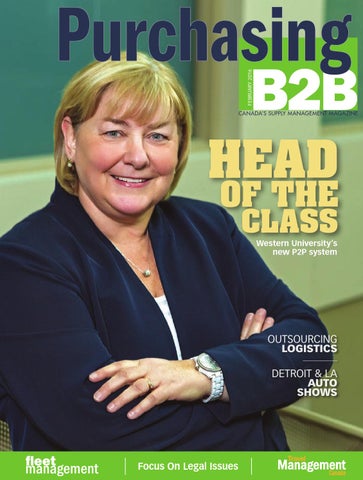
HEAD OF THE
CLASS Western University’s new P2P system
OUTSOURCING LOGISTICS DETROIT & LA AUTO SHOWS
Focus On Legal Issues PB2B_Feb2016_issue_AMS.indd 1
2016-02-08 2:56 PM
Everything your business needs. Staples Advantage is your one-stop destination for everything your business needs. Whether it’s coffee and snacks for the breakroom, or surprising new product selections, we have just what you need to keep your workplace running smoothly. To learn more about our newest products visit: StaplesAdvantage.ca/SoMuchMore
MAKE more HAPPEN Connect with us:
CALL: 1.877.272.2121
PB2B_Feb16_Staples_CSA.indd 12 PB2B_Feb2016_issue_AMS.indd
2016-02-01 2:56 2016-02-08 7:46 PM AM
01 7:46 AM
Table of Contents
Vol. 58, No. 1 • FEBRUARY 2016
Features 9 DUTY OF CARE
10
Legal responsibilities towards travelling employees.
10 LEGAL HORIZONS Trends and developments affecting procurement law. 2 HEAD OF THE CLASS 1 Western University transforms its procure-to-pay process.
12
0 OUTSOURCING LOGISTICS 3 Tips for procuring 3PL services. 2 TOUGH STUFF 3 A look at some of the rugged equipment offerings on the market.
Also inside 4 UP FRONT 5 BUSINESS FRONT 7 FINANCE CORNER 34 THE LAW 9
14 14
Connect With Us Online We encourage you to visit us online to stay in touch with what’s happening in your industry and to view enhanced articles.
.ca
PurchasingB2B.ca
@PurchasingB2B
Michael Power
Features ARE SUPPLY CHAINS STILL RELEVANT? Rather than the concept of a “chain,” think of a “supply management model” instead.
PROCUREMENT AND SECURITY A look at how procurement can work with internal and external IT security professionals to ensure data is secure, accurate and readily accessible. www.PurchasingB2B.ca/features
©donvictorio/Getty Images/Thinkstock
2016 CANADIAN PROCUREMENT FORECAST Key trends affecting Canadian Procurement professionals in the coming year. www.PurchasingB2B.ca/features
PurchasingB2B Weekly eNewsletter Sign up today for regular industry news and insights. www.PurchasingB2B.ca/e-newsletter-subscription PurchasingB2B.ca | February 2016 | 3
PB2B_Feb2016_issue_AMS.indd 3
2016-02-08 2:56 PM
Up Front 80 VALLEYBROOK DRIVE TORONTO, ONTARIO M3B 2S9
www.PurchasingB2B.ca
PUBLISHER/ADVERTISING SALES
Dorothy Jakovina 416-510-6899, djakovina@PurchasingB2B.ca
New Horizons
W
elcome to the first issue of 2016. It’s always an exciting time for us, as we like to lead off the New Year with the best issue we can bring. This year is no exception. We also enjoy changing things up a bit to keep our style fresh and to bring you new perspectives on procurement and supply chain. You might notice a fresh look to some of our pages. You may also see a few topics—logistics, for example—that we’re reviving our focus on. We know your jobs are diverse, and we want to reflect that in our coverage. Of course, some things remain constant. PurchasingB2B often starts the year focusing on trends and issues in procurement law. This time, we’ve gone to a selection of procurement law experts to ask what issues are affecting procurement professionals. You can see what they have to say starting on page 10. For many, the New Year is about change, so we’ve included an article focusing on procurement transformation at the University of Western Ontario, in London. Starting in about 2008, the school started to take a serious look at its procure-to-pay processes—what they realized was that the process needed an overhaul. You can read about that transformation on page 12. As mentioned, we’re expanding our focus into other areas, including logistics. Starting on page 30, we take a look at 3PL sourcing. Our article focuses on tips and advice for those procuring a 3PL—what to look for, pitfalls to avoid and the benefits of employing a 3PL are all covered in the report. Our Fleet Management section also takes a look forward in this issue. You’ll find coverage of several recent car shows, including last year’s LA International Auto Show and the 2016 North American International Auto Show (NAIAS), held in Detroit in January. We also feature some pre-coverage of the North American Fleet Association (NAFA) Industry & Expo (I&E), coming in April in Austin, Texas. As well, throughout this issue and during the year you can still find all our usual content in the form of regular columns, including The Law, Business Front, Finance Corner and In The Field. At PurchasingB2B we look forward to bringing you the news you need to do your job in 2016. We’ll cover several industry events and conferences, bringing highlights from each. And as always, we welcome your input and suggestions. Feel free to call me at 416-442-5600, extension 3259—or by email at mpower@purchasingb2b.ca—with feedback, story ideas, submissions or comments about our coverage. Happy reading, and have a safe and productive year ahead!
EDITOR
Michael Power 416-442-5600 ext 3259, mpower@PurchasingB2B.ca ART DIRECTOR
Andrea M. Smith 416-442-5600 ext 3582 ACCOUNT COORDINATOR
Tracey Hanson 416-510-6762, thanson@annexbizmedia.com CIRCULATION MANAGER
Barbara Adelt 416-442-5600 x 3546, badelt@PurchasingB2B.ca ANNEX PRINTING & PUBLISHING INC.
VICE-PRESIDENT: T im Dimopoulos (416)510-5100, tdimopoulos@annexweb.com PRESIDENT & CEO: Mike Fredericks, mfredericks@annexweb.com For over 57 years, PurchasingB2B has been a trusted source of information for Canadian purchasing/supply chain management professionals in the private and public sectors. Special features and supplements include Fleet Management, Canadian Automotive Review (CAR), PurchasingB2G, and Travel Management Canada. PurchasingB2B is published six times a year, except for occasional combined, expanded or premium issues which count as two subscription issues, by Annex Business Media. © Contents of this publication are protected and may not be reproduced, in whole or in part, without the written consent of the publisher or editor. NOTICE: PurchasingB2B accepts no responsibility or liability for claims made for any product or service reported or advertised in this issue. PurchasingB2B receives unsolicited materials including letters to the editor, press releases, promotional items and images from time to time.PurchasingB2B, its affiliates and assignees may use, reproduce, publish, re-publish, distribute, store and archive such unsolicited submissions in whole or in part in any form or medium whatsoever, without compensation of any sort. SUBSCRIPTION SERVICES: To subscribe, renew your subscription, or to change your address or information, contact us at 416-510-5713 or 1-866-543-7888, ext 3258, apotal@annexnewcom.ca, or visit us at www.PurchasingB2B.ca. Subscription price per year: $99.95 CDN; Outside Canada per year: $172.95 US; Single issue Canada: $18 CDN. Annual Supply Chain Survey issue, Canada: $45; Outside Canada: $70 US. Taxes extra. From time to time we make our subscription list available to select companies and organizations whose product or service may interest you. If you do not wish your contact information to be made available, please contact us via one of the following methods: Phone: 1-800-668-2374, Fax: 416-442-2200 Mail to: Privacy Officer, 80 Valleybrook Drive, Toronto, ON M3B 2S9 Printed in Canada. ISSN: 1497-1569 (print); 1929-6479 (digital) Publications Mail Agreement No. 40065710 We acknowledge the financial support of the Government of Canada through the Canada Periodical Fund of the Department of Canadian Heritage
4 | February 2016 | Purchasing B2B.ca
PB2B_Feb2016_issue_AMS.indd 4
2016-02-09 10:48 AM
Business Front
A political sign of the economic times
Toronto-based Michael Hlinka provides business commentary to CBC Radio One and a column syndicated across the CBC network.
By Michael Hlinka
T
his column is supposed to be about business/ economics—and trust me, it will get there. You just have to be a little bit patient. This November, there will be an election in the United States of America. My guess is that before it’s all said and done, two “establishment” candidates will end up on the ballot. On the Democrat side, that should be Hillary Clinton. For the Republicans, I’m guessing Marco Rubio. But the two contenders who have people excited (albeit for very different reasons) are Bernie Sanders and Donald Trump. And in this phenomenon I think we’re seeing an interesting and significant political sign of the economic times.
Trump wants to cut them. Sanders wants to see a reduced role for the US military around the globe. Trump wants to project US power…but just not on the US’s dime any more. Sanders has demonstrated throughout his career that he is sympathetic to the principles of socialism and would like to see the government more involved in the economy—Trump is a stonecold carnivorous capitalist. Yet even while they are so different, the emergence of each signals something important about the state of the US economy—and I think we can extend this to Canada as well. There is profound unease about where things are headed. The capital markets tell the same. Interest rates pretty much everywhere in the developed world are at historically low levels. Financial theory informs us that the risk-free rate on sovereign debt should reflect two different factors: real economic growth and inflation. In many European countries, short-term interest rates are either zero or negative, even while infla“There’s nervousness, a general malaise tion is positive, suggesting that those marout there, and the fact that so many Americans kets are pricing in prolonged negative are stepping outside the political mainstream economic growth. Closer to home, we just saw the Bank of Canada hold interest for answers is evidence.” rates steady early in the year, but dollars Of the two men, the Bernie Sanders story is the to donuts before the year is out, it’ll be cutting. more interesting one. From 1991 to 2007 he served The stock markets have got off to a terrible start pretty much around as an independent in the House of Representatives. the globe. Commodity prices are hitting multi-year lows, suggesting that Then he joined the Democratic Party and is in the demand even from the developing world is going to be tepid for the foremiddle of his second term in the Senate (The U.S. seeable future. I don’t agree with this prognosis, by the way, but I’m only Senate, unlike ours, is an elected body). Sanders is one vote among 7 billion. Jewish—and to many Americans, religion matters a There’s nervousness, a general malaise out there, and the fact that so great deal. He’s relatively old, in his mid 70s. And he many Americans are stepping outside the political mainstream for answers counts as one of his important influences, the socialis evidence. ist Eugene Debs. There seems to be all sorts of strikes The promise of North America, at least through my lifetime, is that each against him. generation would surpass the other. There is no question that my father There’s no need to introduce Donald Trump. enjoyed a higher standard of living and quality of life than his father did. Through his books and television shows, he’s become It’s much closer between my father and me, but I think that when everya bona fide American celebrity and that’s very powerthing is factored in, my life has been marginally better. But that promful in today’s culture. After we get past the bombast, ise is becoming increasingly difficult. We see friends and neighbours—or the Trump message seems to be: “I’m a businessman perhaps ourselves—struggling with an unprecedented burden of private and I’ll run the country as if it’s a business. We’re not debt, something I’ve addressed in these pages before. The system isn’t going to be the world’s policeman for free any more. working quite as well as it did previously, so people are looking for answers. Taxes are too high, so I’ll slash them. I’m going to Hence the turn to political outsiders like Bernie Sanders and Donald return the US to the free enterprise values that made Trump. And what is so interesting—to me, at least—is that both the it the model and envy of the world…even if I have to so-called “Left” and “Right” of the political spectrum seem to be equally crush some egos along the way.” unhappy with the status quo. And it also seems to me that were either In many ways the two men couldn’t be more difSanders or Trump elected, it could well be a case of: be careful what you ferent. Sanders wants to raise taxes on the wealthy. ask for, because you just might get it! B2B PurchasingB2B.ca | February 2016 | 5
PB2B_Feb2016_issue_AMS.indd 5
2016-02-08 2:56 PM
GET ON BOARD
with SCMA’s supply chain education and let it take you to future success. You will benefit from SCMA’s supply chain education at every stage of your career. Whether you are looking to update your skills or preparing for the next big step on your career path, SCMA has what you need for success.
Supply Chain Management Professional Designation (SCMP)
Pursue Canada’s most sought-after and widely held designation in supply chain management. This rigorous and internationally accredited program is designed to meet the needs of employers by providing graduates with the highest level of professional competency.
Supply Management Training
Courses and seminars are available for early- to mid-level supply chain practitioners that are designed to update or upgrade your skills and knowledge. You will learn to how to support supply chain functions, and related business skills to help advance your career.
Study Online
The SCMP Designation Program and Supply Management Training courses and seminars are offered online to accommodate even the busiest schedule!
Start on your journey to a successful career in supply chain management—enrol now! SCMA.com
PB2B_Feb16_SCMA_CSA.indd 1 6 PB2B_Feb2016_issue_AMS.indd
2016-01-28 2:56 2016-02-08 7:45 PM AM
28 7:45 AM
Finance Corner
Forging Collaboration The tie between finance and the supply chain
Shawn Casemore operates the consulting firm Casemore and Co.
By Shawn Casemore
E
very organization is divided, either formally or informally, into those that make money and those that save money. Sales and marketing obviously fall into the first category, whereas accounting and finance are in the latter. But what of those who invest company money? I’ve found in my work with organizations such as CPA and FEI, there’s an increasing trend towards CFO’s and financial executives (those who save company money) to be given the mandate to provide oversight to the supply chain (those who invest company money). With this increasing trend however there is
chain (reduce costs, maximize inventory utilization, reduce contractual risk) must align with finance’s goals. Any dissonance will lead to misunderstandings, ineffective collaboration and even mutual dissension. Ensuring departmental goals and metrics for both are formed in a collaborative fashion will serve to drive stronger, more supportive relationships.
Multi-directional communications It’s no secret most organizational communications flow top-down. This is no exception in communication across departments, with objectives and initiatives often flowing from the department executive down to frontline leaders and eventually employees. The problem is that it’s the employees who are interacting with customers, suppliers and contractors on a daily basis. Communication should therefore flow from the bottom up. Collaboration “To build a stronger collaboration between relies on communication flowing in mulfinance and supply chain we must focus on tiple directions at once. To therefore build introducing multi-directional communications.” a stronger collaboration between finance and supply chain we must focus on introa challenge. Many financial executives don’t really ducing multi-directional communications. This includes tools, meetings and understand the inner workings of the supply chain. methods that ensure that what’s actually happening on the front lines makes To make this relationship work, with supply chain its way to those who are making decisions around investment and initiatives. reporting into finance, there must be a mutual collaboration that supports wise investments of company Cross-functional interactions capital at lightening speed. Any procurement proIn my experience there’s often a poor relationship between finance and fessional knows if you’re negotiating with a supplier, supply chain extending across all roles. This gap typically results from a time is often a factor in “closing the deal.” Too many lack of understanding of roles and responsibilities. The solution is in creatdelays in committing to an agreement can result in ing more opportunities for both groups to work together. I’m not suggesta change in terms or even penalties in payment. In ing restructuring necessarily, although this can often be highly successful. my book Operational Empowerment: Collaborate, Innovate, A simpler and less difficult approach results from creating cross-functional and Engage to Beat the Competition, I devote a chapter teams. I once led a team of procurement professionals who battled on a to building stronger collaboration across the supply daily basis (if not hourly) with a group of engineers. The emails, ranting chain. I also discuss the key methods to build stronand battles between them had been longstanding, so to introduce a sigger collaboration between finance and supply chain. nificant organizational change seemed unlikely to succeed. To overcome Here are the top three ideas. this we moved team members so engineers sat next to procurement. We changed nothing else; they used the same computers, had the same boss, Alignment of goals and we didn’t change the reporting structure. The results were powerful— If you’ve witnessed the typical relationship between email was dramatically reduced, conversations emerged and collaboration sales and finance, you’ll often find a disdain between was a natural result. Are you placing your team members in cross-functhe two. Sales is rewarded and encouraged to spend tional teams to tap into the power of collaboration? money on client lunches, trips, product samples and There are dozens of other ideas to build stronger collaboration between the like, whereas finance is rewarded to keep costs the supply chain and finance, most of which I discuss in my book. Building low. How do these conflicting goals influence the relastronger collaboration is much simpler than we might believe if we can get tionship between sales and finance? “Negatively” past our historic desire to work in silos with individual departmental objecwould likely be an understatement. The same exists tives and instead seek to work together under supportive metrics. Solve this in finance versus the supply chain. Goals set by supply and you will be well on your way to a stronger collaborative group. B2B PurchasingB2B.ca | February 2016 | 7
PB2B_Feb2016_issue_AMS.indd 7
2016-02-08 2:56 PM
CORPORATE ON-SITE TRAINING WHY CHOOSE ON-SITE TRAINING? While you recognize the value of training, there can be many obstacles to providing your team with the opportunities they need for professional knowledge and skills development. The inability to find ‘just the right’ program, the frustration in trying to cascade new knowledge throughout an organization, and cost are among the most challenging obstacles to training. Resolving these issues are just some of the benefits to Corporate On-Site training.
WHY CHOOSE SCMAO TO PROVIDE YOUR TRAINING? You will receive all the benefits listed above and have the added confidence of our: Reputation - Over 70% of our corporate training is provided to repeat clients. The Supply Chain Management Association Ontario (SCMAO), partnered with our national association (SCMA) and institutes across the country, constitutes the leading professional association of Canada for supply chain management (SCM) education. We have established a reputation for excellence in education and professional training that is founded on a vision to be the recognized leader in the development and advancement of world-class strategic supply chain management. Program Breadth and Depth Our programs, delivered by leading supply chain academics and experienced practitioners enhance skills development, professional competence and the strategic perspective of practitioners at all levels of career progression from junior- to midand senior/executive levels of functional responsibility. Expert Instructors When you choose SCMAO to provide your on-site training you will receive personalized interaction with expert professional instructors who have real-world SCM experience. Our instructors will work with you to deliver a customized curriculum relevant to your training needs. CSCMP Maintenance SCMAO members who have their CSCMP designation will receive 5 Continuous Professional Development/Maintenance (CPD) credits per day during corporate on-site training.
BENEFITS OF ON-SITE TRAINING Cost Savings On-site training eliminates travel expenses and reduces time away from the office. Convenience Training is delivered on your schedule whenever and wherever it’s required. Customized Curriculum Training solutions are tailored to meet your organization’s requirements and focus on your business needs. Privacy/Confidentiality The customized curriculum allows confidential or sensitive information to be available for class discussion if required. Consistency and Velocity Due to the cost efficiency of on-site training, you can include as many employees as you need - from a single team or department, to everyone in your organization. This ensures that the same message has been delivered, in the same way, to everyone who needs it. It can be the fastest way to get “everyone on the same page.” Return on Investment Because the training is tailored to meet the needs of your organization, it can be applied immediately to help achieve organizational goals and objectives.
For more information on corporate on-site training with SCMAO, please contact: Carol Ship Spencer, Director, Education and Professional Programs at 416-977-7566 x2146 or csspencer@scmao.ca
PB2B_Feb16_SCMAO_CSA.indd 81 PB2B_Feb2016_issue_AMS.indd
2016-02-01 2:56 2016-02-08 1:59 PM PM
01 1:59 PM
Duty Of Care And Employee Travel Minimizing liability while employees are on the road
I
nherent in the employer-employee relationship is an employer’s duty of care for its employees’ health, safety and well-being. In today’s labour market, routine business travel and an employee’s assignment abroad are not only common, but are an integral part of the daily operations of multi-national companies. Risks inherent to employee travel remain a growing concern as companies continue to globalize their operations. When considering risks to an employee’s safety while travelling, the focus tends to be on the most obvious dangers like missing persons, hijackings, fatalities and natural disasters. But there are more frequent issues that arise and that employers must consider in their risk assessment, such as car accidents, medical incidents Below is a checklist that sets out practical solutions for employers to consider to help minimize potential liability:
» Develop and communicate to all
employees a well-structured travel management policy;
» Provide training sessions to senior
management and those responsible within the company for employee travel;
» Provide health and safety training for employees at all levels;
» Set up communication systems which allow the employer to reach the employee while travelling;
» Develop emergency procedures to be followed while the employee is travelling;
» Develop and implement corporate policies for employee travel;
» Establish a system to track and support employees while travelling;
» Prevent potential incidents by
informing the employee about changing events and circumstances;
» Set up immediate response plans in case of emergency.
By Stephanie Weschler
and travel problems like lost luggage, lost travel documents and scheduling delays. Although issues vary, key considerations remain the same: to what extent do employers have a legal obligation to prevent situations while an employee is travelling, and could the employer have prevented such situations through a more thoughtful risk management plan? There have been various situations around the world in which employers have been held liable as a result of their duty of care obligations. So, what does this “duty” consist of? The legal concept of duty of care presumes individuals and their employer have legal obligations to act towards each other in a prudent and cautious manner to avoid any risk of foreseeable injury. An employer can be deemed to have breached its duty of care obligation by failing to do what was reasonable in the circumstances to keep the employee safe from harm. In Canada, there are several sources of potential liability related to an employer’s duty of care obligation that apply while employees are travelling for work. Such sources stem from various statutes, including pursuant to applicable occupational health and safety legislation, the Criminal Code of Canada, the Civil Code of Quebec, as well as pursuant to common law principles. Employers are expected to take reasonable steps to safeguard employees against foreseeable dangers, including when they are on assignment and working abroad. What does this mean in practice? Employers are expected to analyze the level of risk an employee potentially faces, which will vary depending on where and when the employee will be travelling, and they are expected to consider what steps can be taken to mitigate any foreseeable risks, such as training the employee, setting up a communication system and developing emergency procedures.
Unfortunately, although it’s clear employers have a stake in meeting their duty of care obligation as it relates to employee travel, they often encounter many challenges in doing so successfully. Understanding and mitigating risks is important for travelling employees, their families and employers. Even companies with a good track record in safety and security might have some gaps in securing the wellbeing of their employees while travelling. While each gap in itself might seem small, it’s important that employers are fully aware that an oversight could be perceived as negligence. The list in the adjacent box provides guidelines for employers to follow as a means to prevent and reduce risks associated with employee travel. Employers have a legal and social responsibility to take reasonable steps to minimize such risks and are encouraged to work with their employees in developing strategies in this regard. It goes without saying that an employer’s duty of care obligations are evolving and must be embedded in the corporate culture if employers wish to minimize their potential exposure. While there may be no way to absolutely prevent risks associated with employee travel, there is no substitute for planning for the contingencies that may arise. B2B Stephanie Weschler presented on duty of care during an education session entitled A Lawyer’s Duty of Care Perspective at the 2015 ACTE Global Corporate Travel Conference in Montreal. Visit www.acte.org/canada. Stephanie Weschler is a senior associate and a member of the Employment and Labour Group and the Continuing Legal Education and Knowledge Management Committee in the Montreal office of Stikeman Elliot.
TRAVEL MANAGEMENT CANADA | PurchasingB2B.ca | February 2016 | 9
PB2B_Feb2016_issue_AMS.indd 9
2016-02-08 2:56 PM
LEGAL
HORIZONS
Experts weigh in with tips and viewpoints on trends in procurement law
By Michael Power
“It’s important to make sure you’re adopting (a nonbinding competitive process) for the right reasons and with the right resources in place.” —Maureen Sullivan, National Education Consulting, Inc.
legal and political risk, leverage in the marketplace and availability of expert resources. Because this kind of approach requires a very different skillset than traditional procurement, most organizations reserve it for highly complex, highly uncertain procurement scenarios.” Whether using a binding or non-binding process, the key to success continues to involve ensuring adequate time and resources for the procurement planning process, Sullivan says. “Time spent at this stage really does pay off tenfold downstream and helps to avoid unnecessary delays, challenges and political fallout that can be associated with flawed or failed procurements,” she notes. Procurement should remember their corporate reputation is shaped in part by how well-structured and fairly conducted their processes are. Due diligence helps avoid wasted time and false expectations when assessing the procurement need. Once key suppliers and vendors lose interest, it’s tough to recapture it, says Sullivan. Judicial review Paul Emanuelli, general counsel of the Procurement Law Office, cites the rise of judicial review as the most significant legal development in public procurement in the past decade. Along with potential lost profits claims based on commercial contracting remedies, losing bidders can now seek procedural remedies against public institutions under administrative law, Emanuelli says. This is a significant change in government procurement. Traditionally, procedural remedies like
“Over the last 10 years courts have become increasingly active in judicially reviewing the procurement decisions of federal and provincial governments, government agencies and the broader public sector.” —Paul Emanuelli, The Procurement Office
tender call re-draft orders, re-evaluation orders and contract cancellation orders have been restricted to federal-sector trade treaty challenges at the Canadian International Trade Tribunal (CITT). “Over the last 10 years the courts have become increasingly active in judicially reviewing the procurement decisions of federal and provincial governments, government agencies and the broader public sector,” Emanuelli says. “The courts have begun to apply very strict standards to government tendering practices and have shown an increasing willingness to strike down government contract awards when a public body fails to run a fair and procedurally correct competition.” This encourages legal challenges in previously uncharted areas, he notes. In a recent case called Airbus Helicopters v. Canada, a court ventured into the pre-bid stage of the government’s procurement. In that case, the court ruled that the government was under a fair competition duty to draft neutral specifications and to ensure those specifications were reasonably connected to the government’s oper-
©planinasum/Getty Images/Thinkstock
P
rocurement has no shortage of legal issues to consider—whether controlling risk, minding legal language in procurement documents or managing disputes. For the first issue of 2016, PurchasingB2B takes a look at some of the legal issues that procurement now deals with, recent trends, as well as tools and tips to deal effectively with challenges. Perhaps the most significant legal trend is the move away from the binding competitive process for large, complex public procurements, says Maureen Sullivan, president of National Education Consulting, Inc. By avoiding Contract A obligations, public organizations are less restricted in their conversations with suppliers—and the ideas they can entertain—as the procurement unfolds. This process, the negotiated request for proposal (NRFP), is especially helpful when no “off-the-shelf” solution exists for a particular situation. “It’s important, however, to make sure you’re adopting this approach for the right reasons and with the right resources in place,” Sullivan says. “Considerations include your organization’s tolerance for
10 | February 2016 | Purchasing B2B.ca
PB2B_Feb2016_issue_AMS.indd 10
2016-02-08 2:56 PM
ational needs, says Emanuelli. The court also allowed a legal challenge from a supplier that never submitted a bid, requiring the government to defend against allegations its helicopter specifications were biased in favour of another supplier. While the complainant lost the legal challenge, the case went into previously uncharted territory in three ways. “It expanded the scope of potential protesters to include non-bidders, where typically only competing bidders are given standing to legally challenge a government procurement process,” Emanuelli says. “It expanded the scope of legal review to include the pre-bid planning and tender call drafting stage of the government’s procurement process, where traditionally legal challenges have focused on the details of the bidding and award stages.” Third, the move allowed a court-based challenge of allegedly biased specifications, he says, where specification challenges have only been levelled against the federal government at the CITT. This sets a precedent for potential specification challenges at all levels of government. E-tendering Technology advances have affected every aspect of modern business and procurement is no exception. The field has seen the rise of e-procurement as a tool to streamline the procurement process, as well as reduce costs. But purchasers must consider potential legal pitfalls. For example, while allowing for faster and easier communication, e-procurement can make it difficult to control that communication, say Graham Ragan and Jennifer Katsuno, lawyers at Gowlings law firm. Such communication becomes particu-
“Parties engaged in e-procurement should also be aware of the security risks associated with communicating and uploading information to an electronic site.”—Graham Ragan and Jennifer Katsuno, Gowlings
larly important with complex contracts with several points of contact between purchasers and suppliers. Organizations involved in an e-procurement process should ensure all electronic communication happens with appropriate formality and according to the terms of the tender documents, they note. “Parties engaged in e-procurement should also be aware of the security risks associated with communicating and uploading information to an electronic site,” say Ragan and Katsuno. “Steps should be taken to ensure that any confidential or sensitive information is transmitted and stored with the appropriate electronic security measures.” Another trend that Ragan and Katsuno have seen is lack of effective remedies for suppliers unhappy with a procurement process. That’s especially true with federal suppliers in challenging a contract award. The CITT can pose difficulties due to the short time limit for filing a complaint. Suppliers often can’t compile the information needed to support a CITT complaint within the 10-day timeframe. The CITT’s jurisdiction is also limited to contracts falling within the relevant trade agreements, restricting the degree to which it can consider challenges. Suppliers can also file a civil claim seeking damages for lost profits from a contract award, say Ragan and Katsuno. But this is often unsatisfactory given the time and cost involved in litigation. Remedies under a civil claim can be less attractive for suppliers who want to perform the contract and challenge its award to another supplier before contract administration begins. The promise of financial compensation at the end of lengthy litigation can be unattractive to such suppliers. Due to these factors, Ragan and Katsuno anticipate suppliers will seek creative ways to challenge contract awards and procurement processes. In particular, they also anticipate applications for judicial review may prove an attractive alternative to the CITT. Alternative dispute resolution A group of techniques and concepts, known as alternative dispute resolution (ADR), exists that can carry out disputes without going to more adversarial processes like litigation, says Torontobased lawyer Marvin Huberman. ADR
“Public procurement professionals recognize and continue to embrace ADR as a way to lessen costs, save time, reduce stress, build and strengthen relationships.” —Marvin Huberman, barrister, mediator and arbitrator
includes consensual or non-binding procedures like negotiation and mediation, as well as binding adjudication such as arbitration and private judging. Such alternatives are gaining popularity in public procurement disputes. An example of ADR is arbitration, he notes, in which parties refer a dispute to one or more impartial people who review the evidence and hear arguments before rendering a legally binding decision. “Public procurement professionals recognize and continue to embrace the use of ADR as a way to lessen costs, save time, reduce stress, build and strengthen relationships, provide more flexible processes and more party-sensitive and complex solutions than a traditional litigated outcome,” Huberman notes. Advantages to arbitration include an equal opportunity to be heard and to agree on flexible procedures, as well as to maintain control and involvement in the process, Huberman says. It’s also private, consensual and confidential and can resolve procurement contract disputes fairly and efficiently. On the other hand, it can be a lengthy, inefficient, costly, and formal process—especially when external advisers like claims consultants and lawyers are involved. ADR in procurement contract disputes offers both challenges and opportunities, Huberman says. It’s a tool that, if used properly, can help enhance the process. Procurement’s legal horizon has both challenges and opportunities. The rising profile and skills level of procurement professionals help ensure Canada’s purchasing community is well equipped to deal with legal challenges that arise. B2B Want more? Check out the enhanced version of this story at www.purchasingb2b.ca/features. PurchasingB2B.ca | February 2016 | 11
PB2B_Feb2016_issue_AMS.indd 11
2016-02-08 2:56 PM
HEAD
OF THE CLASS The University of Western Ontario overhauls its procure-to-pay system
W
hen it comes to procurement transformations, handling the people involved is as important as any new system an organization puts in place. Adopting tools, technology, workflows and methods means change management becomes a primary focus. So it was with a procurement transformation at the University of Western Ontario in London, ON. Revamping the school’s procure-to-pay system kicked off in 2007, says Elizabeth Krische, director of procurement services at Western, when Lyn Logan took over as the new associate vice-president of finance and facilities. Logan realized the existing P2P system needed an overhaul, notes Krische. At the time, Western was paying vendors late, while staff spent too much time following up on those payments rather than negotiating or estab-
lishing innovative contracts. Krische started in 2008 with a mandate to look at and improve processes. At that time, Western processed roughly 120,000 invoices, mostly manually. It was behind on paying vendors and didn’t have enough staff to keep up. Shortly after Krische arrived, Western began overhauling the procure-to-pay process. The institution would improve both the end-user experience and that of procurement and accounts payable (AP). The project would streamline pushing orders through to payment and the procurement, financial systems and AP teams worked together on the task. From 2008 to 2010, Western revamped three main areas: low-value purchase orders and p-cards; the AP process and workflow; and improving communication between purchasing and AP.
P-cards With the university’s existing system, users needed multiple screens open to create a voucher. The institution’s systems team put together a new screen including all relevant data. “AP could go in very quickly and see if the invoice had all the right information and whether they’d be able to process it quickly,” says Krische. “If they couldn’t, they would put it off to a pile—it was basically a triaging system.” Western established a new p-card program that focused on when the cards could be used rather than “don’t-useyour-card-unless” situations. This, Krische says, represented an enormous change. For example, the institution raised card spend from about $3 million to $30 million by taking low-value purchase orders out of the system and putting them on p-cards. By changing the workflow within AP, Western got the vendors back to being paid on time. Communication between procurement and AP improved, Krische notes, but multiple systems still existed through which
Photo by Jay Terry Photography
By Michael Power
12 | February 2016 | Purchasing B2B.ca
PB2B_Feb2016_issue_AMS.indd 12
2016-02-08 2:56 PM
staff placed orders. So the university began searching for a new e-procurement system while identifying what needed to be fixed with the existing system. Procurement began a collaborative RFP process for a solution that would be available to all Ontario universities. Western led that RFP, with Queen’s University, the University of Ottawa and the University of Toronto participating. The RFP was issued in 2012 and, after an extensive process, SciQuest was chosen. Their solution offered research-intensive solutions, and Western needed workflows that were different for researchers, Krische says. For example, the system needed catalogues with not only a particular reagent (substance or compound used to cause a chemical reaction or to see if one occurs) but also chemical breakdowns. “SciQuest had spent a lot of time researching the Ontario market and what some of our pain points were,” Krische says. “They were able to really identify in their proposal how they dealt with all of those pain points for us.” The university also needed a solution that was easy for vendors to opt into, she notes, rather than one that they’d have to pay to participate in. SciQuest delivered. The solution, which Krische calls a “one-stop shop,” has about 50 catalogues with all of Western’s preferred vendors that make sense to be in catalogues. The homepage showcases those vendors. SciQuest provides form ordering, allowing end-users to makes one-off purchases (which get tracked), she says. Orders then go through whichever workflow process the end-user wants. There are now separate workflows for areas like facilities, the research enterprise, housing operations and janitorial operations. “The SciQuest tool allowed us to reduce a lot of the purchase orders that came through to procurement where we really didn’t add any value,” Krische notes. As well, the system allows for self-approval, Krische says. An end-user with, for example, $10,000 in signing authority need not send a PO to anyone, she notes. SciQuest automates much of AP, which was manually processing many of its orders, Krische says. Now, roughly 50 percent is electronic. The vendor can kick off the invoicing process and the university’s AP clerks don’t have to key anything
in. SciQuest also helped the university gain spend visibility, allowing procurement to be more data-driven. Krische notes it was “embarrassing” to have to go to vendors and ask for a transaction report because she otherwise lacked details into the number of SKU’s purchased. “It’s powerful to be able to share that (data) with vendors, but also to have that information when I’m negotiating to renew contracts—it gives me a ton of data to work with,” she says. Officially, the system kicked off last June, Krische says, with much of the training starting in July. The institution hasn’t yet had a full year of spend through the system—it’s at about 90 per cent of normal annualized volumes—as it didn’t shut off the previous requisitioning system until last November. “The feedback we’re hearing from our end-users has been tremendous,” she notes. Researchers report the system has cut order-processing time between 30 and 50 per cent, Krische says.
bles to be completed during each sprint. That not only kept the process on track, but clarified what needed to be finished and when. Sprint reviews were held, and report cards reviewed how teams performed. The university focused on change management and training strategies and SciQuest’s help made for a smooth implementation. “I’ve been involved in a lot of implementations,” Krische says. “It’s probably the best systems implementation I’ve ever participated in. I can’t say enough about SciQuest and the methodology they brought.” Krische says about 50 per cent of invoices are now done electronically, and the university continues to identify vendors to convert to the electronic process. End-users once had to sign in to hundreds of different systems—maintaining separate log in IDs and passwords—but can now do that through the catalogues. Procurement sees about half the POs it once did and plans to reduce that more.
“Stakeholder engagement, focus groups, pilot groups—those are all such critical elements of the implementation of a big system like this.” —Elizabeth Krische
Under the Ontario Broader Public Sector Accountability Act, the university must have a contract management system as well as assurance that anyone buying has proper approval authority, Krische says. Western’s previous system had only rudimentary control. Now, there’s the ability to manage contracts better. “That mitigates risks in terms of making sure you know exactly who owns the contract, when the contract expires, and it gives you the flags as to how many months in advance do you need to start renegotiating the contract so that you don’t get back into an auto-renew clauses,” she says. Implementation SciQuest used a program management methodology called the Agile methodology for implementation, Krische says. The project plan consisted of 16, twoweek “sprints,” with certain delivera-
Procurement has far more data and is learning to use it effectively, Krische says. SciQuest offers Spend Radar, a data analytics tool that breaks down information by who is buying on contract and who isn’t. “It gives you that detail and helps direct you to where you want to go in terms of both end-user, as well as vendor compliance,” Krische says, noting they’re looking into adopting the tool. If other organizations are considering e-procurement, Krische recommends an open mind. Don’t replicate existing manual processes with an automated system, she stresses—it won’t deliver the savings and final outcomes. “Change management becomes a huge part of what you’re doing when you’re implementing a system like this,” she says. “Stakeholder engagement, focus groups, pilot groups—those are all such critical elements of the implementation of a big system like this.” B2B PurchasingB2B.ca | February 2016 | 13
PB2B_Feb2016_issue_AMS.indd 13
2016-02-08 2:56 PM
SOME SEE FUEL CARDS
WE SEE A CHANCE FOR EASY CARD MANAGEMENT With Shell’s Online Card Management program you can quickly order and block cards, and set limits on spending. That means fewer phone calls, reduced admin and less stress for you. To find out more, visit www.shell.ca/fleetcards
YOUR PARTNER
ON THE ROAD Receive Discounts* on Select Maintenance Services with
Get AIR MILES®† reward miles
*Certain restrictions apply.10% Discount on the first $100 (before applicable taxes) worth of products and services on every visit at Jiffy Lube locations, including Jiffy Lube Signature Services Oil Changes and other preventative maintenance services. Valid for Jiffy Lube Signature Service® Oil Change services and additional preventative maintenance services which vary by location. Visit www.jiffylube.ca to locate a Jiffy Lube service center near you and view the services offered. Jiffy Lube® and Jiffy Lube Signature Service® are registered trademarks of Jiffy Lube® International, Inc. Jiffy Lube service centres are owned and operated by independent franchisees. ®†™†
Trademarks of AIR MILES International Trading B.V. Used under license by LoyaltyOne, Co.and Shell Canada Products.
Trademark of Shell Brands International AG. Used under license. The Shell Fleet Navigator MasterCard Corporate Fleet Card® is issued by Comerica Bank pursuant to a license by MasterCard International Incorporated. MasterCard and MasterCard Corporate Card are registered trademarks of MasterCard International Incorporated. ™
PurchasingB2B_Feb_SHell.indd 114 PB2B_Feb2016_issue_AMS.indd
2016-01-27 2:56 2016-02-08 3:48 PM
27 3:48 PM
FEBRUARY 2016
18 AUTO SHOW ROUNDUP
Highlights from the LA and Detroit auto shows.
18
22
20 DETROIT MUSCLE
Truck launches from the Detroit auto show.
24 FIRST DRIVE: FORD EDGE
24
Ford Edge offers a luxurious makeup and bold styling.
26 B EST SWIPE
Security, convenience and data help drive fleet card acceptance.
Fleet Management is a special section of PurchasingB2B magazine, running in the February, June, August, and December issues. It is an important resource for Canadian procurement professionals who recommend, select and manage fleet vendors and service providers. Editorial inquiries: Michael Power, MPower@PurchasingB2B.ca. Advertising inquiries: Dorothy Jakovina, 416.510.6899, djakovina@PurchasingB2B.ca.
Fleet Complete acquires ITmobile Fleet Complete, a North American fleet telematics and mobile workforce technology provider, has acquired Dutch fleet telematics company ITmobile. Founded in 2000, ITmobile provides nearly 1,000 customers primarily in the Benelux (Belgium, Netherlands and Luxemburg) region with advanced fleet, asset and mobile worker technology. ITmobile’s advanced software systems provide reliable, factual data to its customers, enabling organizations to be more transparent and efficient. Fleet Complete and ITmobile have over 230 employees, 7,000 customers and more than 140,000 subscribers across five countries.
2016 Hyundai Sonata earns IIHS TOP SAFETY PICK+ award The 2016 Hyundai Sonata has earned the Insurance Institute of Highway Safety’s highest accolade for safety, receiving a 2016 TOP SAFETY PICK+ award. The award helps consumers select vehicles with the highest level of crash protection. To qualify, winners must earn good ratings in each of the institute’s five crashworthiness tests—small overlap crash test, moderate overlap crash test, side and roof strength, and head restraint tests—and have an available front crash prevention system earning an advanced or superior rating. For 2016, the Sonata added safety equipment, making automatic emergency braking (AEB) functionality available to models previously equipped with forward collision warning (FCW).
GM unites car-sharing services under Maven General Motors said it has formed a brand called “Maven” that will run its car-sharing ventures, including a new one that will begin competing with ZipCar in Ann Arbor, Michigan, and spread to other metro areas later this year. GM executives said they expect their main business model of selling cars to people will continue to be large, but they also see big changes coming with ride- and car-sharing. Maven’s unveiling comes on the heels of two new mobility deals announced by GM this year: a $500-million investment in ride-hailing company Lyft and purchase of the remnants of defunct ride-hailing company Sidecar. The Ann Arbor project will let people rent cars for as little as $6 per hour through a smart-phone app connected to the cars’ OnStar system. FLEET MANAGEMENT | PurchasingB2B.ca | February 2016 | 15
PB2B_Feb2016_issue_AMS.indd 15
2016-02-08 2:56 PM
he fleet industry’s largest event— the North American Fleet Association (NAFA) Institute & Expo (I&E)—takes place this year at the Austin Convention Center in Austin, Texas from April 19 to 22. The I&E offers the chance to get the tools needed for success and to increase networking power, and NAFA says the 2016 event will offer the most education-packed, networking-friendly conference thus far. I&E provides opportunities to: network; peruse the show floor for services and products; get cutting-edge education and training; attend special events; hear from keynote speakers; and more. Those who manage fleets for corporations, organizations and public agencies across a broad spectrum attend the event. Monday, April 18 The conference kicks off with a main event being the International Fleet Academy Pre-Conference Workshop. This half-day workshop will explore what it means for fleet managers when their organizations go global. The workshop will provide an understanding of global fleet industry trends, culture and best practices, said NAFA. Network with peers and mentors at a roundtable discussion, review the latest global policy, get insight into intercultural communications and much more. The day’s agenda includes sessions on: globalization roadmap; intercultural communication; global policy development; developing a results-driven global RFP; a roundtable with global fleet mentors; and a dinner and reception. Tuesday, April 19 The following day is also packed with education and networking opportunities. The discussion begins with a keynote
NAFA hits the Lone Star State for the biggest fleet event of the year
presentation on big data from 9-10am. There are also education sessions, including the CAFM/S Boot Camp: Asset Management from 10:15am-12:15pm. Fleet managers are tasked with asset management responsibilities like vehicle selection, procurement, commissioning, disposal, remarketing and decommissioning. Those skilled in asset management can improve profitability and effectiveness. This session will cover the strategic sourcing process; developing a vehicle selector list; developing vehicle specifications; resale value and remarketing. I&E features several Canada-focused sessions, including the Canadian Legislative Update (April 19, 2-3:30pm). This session will include an update on legislative issues affecting Canada’s fleet industry. A discussion will follow on forming a Canadian advocacy group to bring fleet issues forward at the federal level. Also that day (3:45-5pm) is the Canadian Workshop. This two-part session will allow the Canadian fleet community to mingle and share ideas. The first topic, Fostering Health Supplier Relations, focuses on challenges inherent in working with supply chains and suppliers. The second session, Hot Canadian Issues, will focus on pitfalls and solutions in supplier relationships. The workshop is followed by a Canadian reception, 5-6pm. In the evening, NAFA will host Fleet Excellence Awards Presentation and Reception—known as the FLEXY Awards—from 6-9pm. The awards recognize fleet professionals in seven categories: NAFA Member of the Year; NAFA Affiliate of the Year; Outstanding Achievement in Corporate Fleet Management; Outstanding Achievement in Public Fleet Management; Excellence in
Corporate Fleet Sustainability; Excellence in Public Fleet Sustainability; Excellence in Corporate Fleet Safety; Excellence in Public Fleet Safety; and Excellence in Fleet Leadership. The FLEXY awards recognize the best and brightest in the field. Wednesday, April 20 Sessions on I&E’s third day begin after the 9am keynote presentation by Sun Country Highway’s CEO, Kent Rathwell. One session with a Canadian focus is entitled Differences and Similarities of Fleets in Canada and the US (3-4pm). This session will look at differences regarding laws, permitting, licensing, taxes, personal use and more. The panel will discuss challenges running fleets in both countries.
©RoschetzkyIstockPhoto/Getty Images/Thinkstock
T
NAFA Industry & Expo 2016 PREVIEW
Thursday, April 21 The high-quality content continues with several sessions including one entitled Beyond the RFP—Sustaining your Partnership with Strategic Sourcing (2:15-3:30pm). Understanding how to create a partnership that engages sourcing is critical to a fleet program’s success. To that end, this session will cover: what’s important to strategic sourcing; which metrics are most relevant; how to sustain regular engagement and more. Friday, April 22 On Friday, April 22 I&E features a keynote presentation at 9am, followed by workshops covering several areas of fleet management, including: pharmaceutical; corporate; government; and university fleets. Saturday, April 23 The expo’s final day will feature the CAFM/CAFS Exam from 9am-12pm, then again from 1pm-4pm. B2B
16 | February 2016 | Purchasing B2B.ca | FLEET MANAGEMENT
PB2B_Feb2016_issue_AMS.indd 16
2016-02-08 2:56 PM
PB2B_Fe
©RoschetzkyIstockPhoto/Getty Images/Thinkstock
The F-150 is the Vincentric Award winner for Lowest Cost of Ownership.* Plus, the 2016 F-150 has capabilities like: • Best-in-class payload of 3,270 lbs% • Best-in-class towing of 12,200 lbs^ • Best-in-class gas fuel efficiency#
Make us the team behind your team. fleet.ford.ca | 1.800.668.5515 Vehicle may be shown with optional feature(s). *Based on Vincentric 2015 Canada Fleet awards analysis of the Full-Size Pickup segment and the XL Reg Cab SWB 2WD trim level. %When properly equipped. Max. payloads of 3,270 lbs with 5.0L Ti-VCT V8 engines. Class is Full-Size Pickups under 8,500 lbs. GVWR based on Ford segmentation. ^When properly equipped. Max. towing of 12,200 lbs with available 3.5L EcoBoost V6 4x2 engine configuration. Class is Full-Size Pickups under 8,500 lbs. GVWR based on Ford segmentation. #Class is Full-Size Pickups under 8,500 lbs (3,856 kg) versus 2015 and 2016 Competitors. 2016 F-150 4x2 equipped with the 2.7L V6 EcoBoost and 6-speed SelectShift® automatic transmission, estimated fuel consumption ratings are 12.3L/100-km city, 9.2L/100-km hwy, 10.9L/100km combined, based on Government of Canada-approved test methods. Actual fuel consumption will vary. ©2016 Ford Motor Company of Canada, Limited. All rights reserved.
PB2B_Feb16_Forrd_CSA.indd 1 17 PB2B_Feb2016_issue_AMS.indd
2016-02-01 2016-02-08 10:27 2:56 PM AM
By Neil Vorano
East Coast, West Coast New reveal roundup from the LA and Detroit auto shows
T
he North American International Auto Show, held in Detroit last January, is a traditional start to the mad rush of
car shows around the world—and the most important one in North America. But let’s not forget one of the last shows of the year; the Los Angeles Auto Show, held in November, is also a place where carmakers make some big debuts. The last Detroit and L.A. shows didn’t disappoint
Chrysler Pacifica There were a few surprises in Detroit this year; the Chrysler Pacifica was a shock for everyone, as Fiat Chrysler Automobiles gave no indication it was reviving the nameplate. The Pacifica is a stylish take on the minivan and keeps FCA’s fold-and-go seating, while adding handy features such as a vacuum. But it’s the hybrid version that changes the game; FCA officials estimate it will get 2.9 litres per 100 kilometres in city driving. FCA plans to phase out the Grand Caravan and Town and Country vans, keeping just the Pacifica, which will be built in Windsor and should be available this spring, with the hybrids coming out a little later.
in that regard—let’s look at some of the more notable new cars to appear for the first time.
Lexus LC 500 Another surprise debut was the Lexus LC 500 sports coupe, a near-identical production car to the LF-LC concept that appeared in 2012. With very aggressive styling and a glass roof (a carbon fibre roof will be optional), the LC 500 is an indication of future Lexus design language. Underneath, it runs on an all-new chassis made of high-strength steel, aluminum and even carbon fibre plastic. A 5.0-litre V8 with 467 horsepower is mated to a 10-speed transmission, and Lexus officials claim 0-to-100km/h times of 4.5 seconds. It should appear in showrooms next year.
Volvo S90 After the XC90 won Truck of the Year at the Detroit show, Volvo lifted the wraps off its second stunning vehicle makeover, the S90 full-sized sedan. The S90 has a newfound elegance that Volvo is fast becoming known for, with clean lines, neon-look headlamps and a sharp chrome grille. The interior is beautifully Scandinavian, with wood, knurled chrome switches and a vertical touchscreen it shares with the XC90. Under the hood will be a 2.0-litre turbocharged-and-supercharged inline four cylinder with 320 horsepower; a hybrid version will also be offered. It should be out in the summer.
18 | February 2016 | Purchasing B2B.ca | FLEET MANAGEMENT
PB2B_Feb2016_issue_AMS.indd 18
2016-02-08 2:56 PM
Lincoln Continental Lincoln debuted the Continental concept at the New York auto show last year, and the production version is very close to the original. It has the presence of a big luxury sedan, with nice touches like electronic door handles integrated into the polished trim. Inside, passengers are swaddled in wood, leather and chrome and ride on available Eames-like, 30-way adjustable seats. An available 400-horsepower, 3.0-litre, twin-turbo V6 will provide power to all four wheels. After decades of disappointing products, this is the kind of halo car Lincoln really needs. Mercedes-Benz E-Class The latest Mercedes-Benz E-Class isn’t just a good-looking car, it rivals the space shuttle for technology. The gauges and infotainment screen are now replaced by one long, single screen along the dashboard. Thumb sensors on the steering wheel allow the driver to control every function without taking his hands off the wheel. A pad in the console can charge your smartphone wirelessly, and later, you can use that phone to “call” your car and have it come to you autonomously. With the Drive Pilot feature, the E-Class can also drive autonomously on a highway at more than 200km/h. And those just scratch the surface of available options. Fiat 124 Roadster Back in November in Los Angeles, Fiat Chrysler Automobiles finally unveiled its new Fiat 124 Roadster, appropriately here in sunny California. The 124 is based on the Mazda MX-5 chassis but has its own turbocharged, 1.4-litre four cylinder with 160 horsepower, and of course its own body design—which, to be honest, is a little disappointing compared with the little Mazda, especially coming from an Italian carmaker. No prices have been released but expect it to start a few thousand dollars more than the MX-5’s $31,900 base price here in Canada. Mitsubishi Mirage The Mirage is an important subcompact car for Mitsubishi, especially in the Canadian market, competing against the likes of the Nissan Micra. This new Mirage gets a bigger grille and various other cosmetic changes that not only make it look better but, according to Mitsubishi, also make it more aerodynamic. Inside gets a makeover, too, with new seat materials and the option of Apple CarPlay and Android Auto. Suspension is tweaked, and the power from the 1.2-litre three-cylinder jumps slightly to 78 horsepower. We should see them here this spring.
Nissan Sentra The Sentra is another important small car, this time for Nissan in a very competitive compact class. It seems to have grown up a bit, and not just in the fact that it now looks more like its bigger brothers, the Altima and Maxima, with similar side creases and a new-look front fascia. The interior is also more attractive, and now comes with optional safety features found on larger cars, such as adaptive cruise control and forward emergency braking. B2B FLEET MANAGEMENT | PurchasingB2B.ca | February 2016 | 19
PB2B_Feb2016_issue_AMS.indd 19
2016-02-08 2:56 PM
NEW ENTRIES
Story and photos by Howard J. Elmer
Honda Ridgeline The only “new” pickup to be shown at the Detroit show this year came from the segments smallest player, Honda. The original Ridgeline, introduced in 2005 was retired last year after a 10-year run and now we’ve seen what Ridgeline will become in its second generation later this year. What’s new on this truck is the body design, with the key being the removal of the behind-the-cab stabilizing triangles. These gave the Ridgeline a distinctive look and also caused many observers to say it just didn’t look like a pickup truck. Well, now it does. What have been kept are features that were unique to the original model and will still be appreciated by buyers. The exclusive under-bed storage (an idea borrowed from the Odyssey minivan) remains. It’s large, lockable and now can be hosed out thanks to removable drain plugs. Also in the back is the dual-action tailgate that opens flat or swings wide as need be. Power wise, things remain relatively the same with the new Ridgeline using a 3.5L direct injection V6 also found in the Pilot. This engine makes a snotty 280hp and will suffice for the Ridgelines needs—including the estimated 5,000lb tow rating. Curious and quirky additions to the truck bed are under liner “exciters” which act as speakers for the 520-watt stereo system. Inside the cab is refreshed and you can expect all the electronics, screens and ports to also be updated to current expectations. Honda built a Ridgeline Baja race truck and exhibited at the SEMA show in Las Vegas last fall before any other showing. This special build was also at Detroit. My question: Is Honda suggesting that the Ridgeline is moving towards a more aggressive truck image? Over the past 10 years the Ridgeline was a steady seller because it was the most un-trucklike pickup on the market. The rollout (towards a fall release of the new Ridgeline) will no doubt shed light on some of these questions.
Honda
Truck launches abound at the Detroit auto show
Nissan XD Warrior concept Nissan’s booth showed a beefed up Titan XD. This concept, called the Warrior, a desert-racing inspired design has added modified off-road suspension to the new Cummins diesel powered Titan. It’s a concept, but if Nissan is looking for a way to keep its truck in the press, they’ve found it. According to Jose Munoz, executive vice-president at Nissan, this concept is meant to explore future market territory for Titan. Nissan has an off-roading history, competing in Baja and Paris-Dakar rallies. Building a Titan racer isn’t far-fetched. The Warrior concept took real world cues from a recent crowd-sourced custom build on an original generation Titan that two US military veterans drove on an off-road adventure in Alaska.
20 | February 2016 | Purchasing B2B.ca | FLEET MANAGEMENT
PB2B_Feb2016_issue_AMS.indd 20
2016-02-08 2:56 PM
PB2B_Fe
BE ABLE TO RELY ON RELIABLE CARS. Much like a good employee, a good car should not let you down. To make sure your team is in good hands, go for quality cars whose reliability has been widely recognized. Go for award-winning security and residual value. Go for Subaru.
2016 CROSSTREK
2016 FORESTER 2016 IMPREZA 5-DOOR
1
MODELS EQUIPPED WITH EYESIGHT® 2
fleet.subaru.ca or call 1-877-293-7272 1. Ratings are awarded by the Insurance Institute for Highway Safety (IIHS). Please visit iihs.org for testing methods. 2. EyeSight® is a driver assist system which may not operate optimally under all driving conditions. EyeSight® is not designed as a substitute for due care and attention to the road. The system may not react in every situation. The driver is always responsible for safe and attentive driving. System effectiveness depends on many factors such as vehicle maintenance, weather and road conditions. Finally, even with the advanced technology activated, a driver with good vision and who is paying attention will always be the best safety system. See Owner’s Manual for complete details on system operation and limitations.
PB2B_Feb16_Subaru_CSA.indd 121 PB2B_Feb2016_issue_AMS.indd
2016-02-04 2:56 2016-02-08 3:17 PM PM
The Warrior concept is raised nearly three inches to fit the 37-inch offroad tires mounted on aluminum-alloy wheels. It’s also three inches wider than the Titan—space for the oversize tires and long-travel suspension. Designers added what they call “modern armor” to the body form giving it a machine-like, robotic quality. Front and rear bumpers have been flared and the hood got functional vents for extra cooling. Underneath a large front skidplate interlocks into the front bumper. Color schemes and trim materials (in and out) as seen in the photos are custom to the Warrior. With the Titan XD on sale, the next truck—the gas-powered Titan half-ton—arrives in spring of 2016. Whether the Warrior might fall into this yearlong product rollout is anybody’s guess. 2017 Ford Raptor The Ford Raptor, the best off-roader Detroit has ever built, took a year off as Ford made the shift from steel to aluminum pickup bodies. This was a necessary hiatus as the low-volume trucks were re-engineered to fit all that suspension gadgetry into the new aluminum setup. So while the aluminum body F-150 dropped last year the new Raptor is dubbed a 2017 and will only bow later this year. Of course, that didn’t stop Ford from driving one out onto the stage at the Detroit show to thunderous applause. While the steel to aluminum changeover is the headline, Ford has also revamped several of the Raptors’ systems, making the coming model different from the last—it’s a new generation, not a continuation. To start, this new Raptor is going to weigh as much as 500lbs less than its predecessor—a good thing for any off-roader. Despite this weight loss the suspension package has been upgraded to shocks now 2.5 to three inches larger in diameter than the previous model used. Suspension travel has also increased to 11.2-inches in the front and 12-inches in the rear of the truck. This aluminum body’s weight savings also means the new high-output 3.5L EcoBoost engine (standard in the 2017) will have an improved power-to-weight ratio. Ford says this smaller displacement EcoBoost engine will outperform the currently offered 6.2 L V8. For the first time, this 3.5L engine will also be paired with a new 10-speed automatic transmission and a unique torque-on-demand transfer case. This is a new performance advantage added to the conven-
tional 4X4 system. Called the Terrain Management System, it lets the driver select “modes” of 4x4 such as Rock mode, Baja mode, Sand and Mud mode, Snow and Ice mode and Street mode. Each mode optimizes the driving dynamics of the truck’s powertrain to suit the weather and terrain conditions. Carrying this Raptor will be either a 133-inch wheelbase that supports the Ford SuperCab or a 145inch one with the four-full doors of the SuperCrew body. Another upgrade will be dual exhaust and 17-inch wheels running BF Goodrich All-Terrain KO2 tires. These new rims will also be beadlock capable. All-new F-150 Raptor will be built at Dearborn Truck Plant in Michigan and goes on sale in the US and Canada this fall. B2B
22 | February 2016 | Purchasing B2B.ca | FLEET MANAGEMENT
PB2B_Feb2016_issue_AMS.indd 22
2016-02-08 2:56 PM
It… is about being local and global. ARI is known and trusted by fleet decision-makers throughout Canada to streamline operations and control costs. We know that every customer has unique fleet challenges. Through our six regional offices, three 24-7 maintenance call centres and Canada’s largest vendor network—we dig deeper and go further to deliver customized solutions. Across Canada, North America, and the globe—our fleet management expertise is around the corner. Learn more about ARI’s professional fleet management services: 1-800-361-5882 | www.arifleet.ca
PB2B_Feb2016_issue_AMS.indd 23
2016-02-08 2:56 PM
HITTING REFRESH The Ford Edge offers a luxurious makeup, bold styling and premium touches By David Miller
F
ord’s Edge made its debut in 2006. But after one major refresh it was time for an all-new, ground-up approach for the mid-size, five-seat crossover. Gone were the trendy and gimmicky technology tools, replaced by a luxurious makeup that appealed to not only its current markets but also for its first foray into Europe. Ford’s goal for the Edge’s evolution was
for it to separate itself in size and styling from the entry-level Escape. The overall length expands by 99mm, but the main features of attraction come down to its front fascia and sleek silhouette. The Edge receives the new grille found on the Fusion, but in a refined black colour with silver piping crossbars, instead of the typical chrome. The crossbars lean back to set up a sporty and bold appearance
AS TESTED:
PRICE: $32,299 – $45,499 ENGINE: 2.0L twin-turbo four-cylinder; 3.5L V6; 2.7L twin-turbo V6 POWER: 245 hp, 275 lb-ft of torque for 2.0L; 280 hp and 250 lb-ft of torque for 3.5L; 315 hp and 350 lb-ft of torque for 2.7L. TRANSMISSION: six-speed automatic FUEL ECONOMY: City 11.5/Hwy 7.8 (2.0L); City 13.2/Hwy 9.9 (3.5L); (L/100km) City 13.6/Hwy 9.8 (2.7L)
that continues throughout the crossover to the body, where it receives an ‘edgy’ silhouette that’s finished off by horizontally-wrapped LED taillights with 3D graphics in the rear. Under the hood, consumers will get three choices, but not all are available for each trim. The base engine for the SE, SEL and Titanium trims is the 2.0-litre twin-scroll turbo EcoBoost engine with 245 hp and 275 lb.-ft. of torque that’s matched to a six-speed automatic transmission with paddle shifters. The engine is setup to reduce turbo lag thanks to its turbocharger. All-wheel drive is available for this model, and can surprisingly tow up to 3,500 lbs. For SEL and Titanium trims, you can upgrade to a naturally aspirated 3.5-litre V6 that gets a boost in power up to 280 hp and 250 lb.-ft. of torque.
24 | February 2016 | Purchasing B2B.ca | FLEET MANAGEMENT
PB2B_Feb2016_issue_AMS.indd 24
2016-02-08 2:56 PM
But for this review, we will focus our attention on the Sport trim that’s fitted with a 2.7-litre direct-injected twin-turbo V6 generating 315 hp and 350 lb.-ft. of torque. For 2016, it now comes standard with all-wheel drive and a hands-free power liftgate. Keep in mind, the Sport model is not set up to tow, so choose your trim carefully.
commuter, the 2.0-litre improves in that territory with a rating of 11.5 and 7.8, respectively. The Edge goes through a tremendous improvement when it comes to its exterior styling and engine choices, but it all comes together in the interior, in what Ford is calling its “dynamic sanctuary.” More interior space has been created, but
a touch of class. The soft touch materials not only serve as a luxury but assist with sound acoustics. With this new Ford Edge, technology might not be flamboyantly displayed, but that doesn’t mean it’s not packed with it. In the top trims the Edge has a brake-assist feature that automatically applies its brakes to avoid an oncoming collision, as well as a 180-degrees front camera system with a built-in washer. In addition, it has an automatic perpendicular and parallel parking assist that slots you into a parking spot with the use of 12 sonar sensors. Just press the top button to the right of the gearshift and the vehicle turns the steering wheel for you, all you need to do is work the gear shift, brake and accelerator. As a bonus, it can also drive you out of the parking spot. Overall, the second-generation Ford Edge is a large step-up from what it was. It’s modernized from the inside out with bold styling, premium touches and a Sport trim that brings a big boost to its performance level. Even though it only has two rows, ample cargo space is avail-
The engine is set up to reduce turbo lag thanks to its turbocharger.
In my opinion, the Edge Sport is where the crossover comes alive. For the lack of acceleration the 2.0-litre might have, the Sport’s instant throttle action makes up for it. Acceleration is instant but, more important, smooth. If you’re in the mood for more action, make sure to press the button behind the gear shift to put it into Sport mode for longer gear sessions and higher revving. The twin-turbo engine sings while accelerating, letting you know it has a wild side. But be forewarned, the Edge gets up to speed faster than expected. For a crossover that weighs 4,400lbs, its handling was impressive on some beautifully carved out switchback roads with plenty of hairpin turns. The Edge stayed balanced and precise throughout aided by its electric power assisted steering. As for fuel economy, the Edge Sport is rated at 13.6L/100km in the city and 9.8L/100km on the highway. Not the greatest numbers in the segment, but if you’re looking for more of a cruising
Ford is calling the Edge’s interior a “dynamic sanctuary.”
the full transformation from its 2014 iteration is evident by the premium materials and comfort that surround its occupants. As you enter the crossover, you’re treated to an open and airy concept that yields a feeling of comfort and relaxation. Soft leather with stitching replaces the old hard plastics, while fancy sculpted arm rests and elongated door levers add
able when you fold the rear seats down. The 2016 Ford Edge starts at $32,299, and works its way up to a $45,599 start ing price for the Sport. The Sport version might seem like a hefty sum, but if you factor in all the enhancements from its previous generation, there’s a lot more value gained, including all-wheel drive that will come in handy in the winter. B2B
FLEET MANAGEMENT | PurchasingB2B.ca | February 2016 | 25
PB2B_Feb2016_issue_AMS.indd 25
2016-02-08 2:56 PM
BEST SWIPE By Kara Kuryllowicz
Security, convenience and data among the advantages of fleet cards
A
lready an industry standard, fleet card acceptance continues to increase with the consistent delivery of ever-better data, security and convenience across multiple sectors. “Our fleet card program, which includes an ARI and a Mastercard option, is one of our most popular programs and tends to be one of the first services our customers commit to,” says Peter Nogalo, marketing manager, ARI, Mississauga, Ont., which manages 175,000 vehicles Canada-wide. Publicly- and privately-held firms as well as government entities tend to have similar needs with security of paramount importance to every fleet, although geographic scope is most relevant to those
portfolio, about 80 per cent, use fleets cards,” adds Sumair Mirza, chief operating officer, Element, Mississauga, Ont., which manages 229,898 units in Canada. “Data is the number-one consideration and they leverage it to track everything from CO2 emissions to assessing the total cost of ownership across the one- to fiveyear average lifecycle.” Initially, decision-making focuses on selecting a proprietary fleet card, fuel card or retail credit card. The fleet card tends to offer excellent discounts and control along with detailed data and reporting. It might be accepted at 10,000 of Canada’s approximately 11,700 fuel stations, but an organization with employees working in remote locations, for example
Successful security measures for fleet cards involve two main areas: preventing fraud in the first place and detecting aberrations when the system is outsmarted. with employees and customers in remote locations. Generally, service fleets tend to focus more on controls and costs while sales fleets place more value on convenience and coverage. For-profit organizations may be more interested in the analytics and reporting, but there’s no doubt every agency is committed to maximizing value and better managing costs. “The vast majority of the firms in our
along a pipeline in Alberta or in a tiny town, wants to ensure fill-ups are possible at the mom-and-pop style, general and convenience stores that sell groceries, hardware and fuel. Fuel fleet cards, such as the Shell Fleet Card, which gives card holders access to over 1,200 Shell stations nationwide, provides very competitive discounts, top quality fuel and relevant insights from fuel experts.
“Shell has one of the biggest national networks, is recognized as one of the top, trusted fuel brands and offers 24/7customer service that is always ready to provide the best quality assistance to cardholders,” says Josh Ferguson, national sales manager, commercial fleet, Shell Canada, Calgary, which also offers the Shell Fleet Navigator Card, which can be used anywhere that MasterCard is accepted. Fleets with in-house maintenance may also opt for a fuel-only card, but most welcome combination cards that cover fuel and maintenance. Unmanned, fenced card-lock facilities that are open 24/7 can help support employees in ultra-remote spots. “Firms rarely have to sacrifice the detailed data, discounts and ‘true’ product controls for remote coverage but it can occur in unique circumstances,” says Mirza, who also notes tracking CO2 emissions is of greater interest than ever due to the growing focus on sustainability, particularly with multinationals that have European parent companies. Today’s fleet cards, especially the fleet management firm’s proprietary cards, offer Level III data, which includes the information captured in Level I and Level II plus quantities, product codes and descriptions, and much more. But fleet managers need to recognize that for the card to access that Level III data, the fuel station or retailer must first track and provide it. Level I data include total purchase amount, date, merchant category
26 | February 2016 | Purchasing B2B.ca | FLEET MANAGEMENT
PB2B_Feb2016_issue_AMS.indd 26
2016-02-08 2:56 PM
Purchasi
Work in tight spaces. Not out of them. Introducing the All-New Mercedes-Benz Metris. Starting at $33,900.* The Metris gives you plenty of room to work inside, when space is limited outside. As Canada’s only mid-size work van, it easily navigates narrow back alleys and underground garages. Smaller than a full-size van. Bigger than a compact van. The Mercedes-Benz Metris is built to fit your work — wherever your work takes you. Size it up at TheMetris.ca. #MeetTheMetris
@MBVansCA
©2016 Mercedes-Benz Canada Inc. * National MSRP for the Metris Cargo Van shown. Pricing is intended for information purposes only. Prices do not include taxes, levies, fees, freight and delivery charges, insurance and licence fees, as well as any other products or services not listed that may be available to you through your selected Mercedes-Benz dealership. Vehicle prices subject to change without notice. Dealer may sell for less. These prices do not apply in provinces with total/all-in pricing requirements. Please contact your local dealership directly by phone or in person for exact pricing details and total prices applicable in your province.
PurchasingB2B_Feb_Mercedes.indd PB2B_Feb2016_issue_AMS.indd 27 1
2016-01-28 2016-02-08 10:11 2:56 PM AM
code and supplier/retailer name. “Our cards offer Level III data from Shell stations as well as any other fuel vendors that may also offer Level III on this platform,” says Ferguson. Fleet managers can use details such as the type of fuel purchased to look at asset efficiency in the real world and further adjust vehicle selection going forward. Experience has shown that vehicles may consume more fuel and subsequently produce greater emissions than in the manufacturers’ controlled environment. Details on the frequency, cost and even the location of preventive maintenance and repairs are also available, but as always, such data has value only if it’s used effectively. When component and system repair and/or replacement are tracked over hundreds to thousands of vehicles, fleet managers can target vehicles that perform below expectations and even negotiate subsidies or reimbursements for parts and labour. “When a call comes in, our team can access Canada’s largest benchmarking database to see if that particular crewcab pick-up truck is performing below par in a specific region or nationwide,” says Mirza. “If the fleet’s operating costs increase year over year from $5 to $5.3 million due to unexpected maintenance, we may decide those assets need to be changed out earlier and adjust asset selection decisions for the upcoming year.” Successful security measures require a two-fold strategy: prevention (how to stop it from happening) and detection (how to identify aberrations when the system is outsmarted). Not that long ago, consumer credit cards were targeted by fraudsters and criminals to the point the providers significantly stepped up security with chips and PINs. As consumer card theft and fraud became more challenging and risky and fuel costs hit $1.50+/liter, perpetrators went after the more vulnerable fleet cards despite the limited range of products and services and lower spending limits. This in turn drove improved security measures on fleet cards. “Clients can set their own limits and
specify their alerts with some requiring PIN authentication only on fuel purchases over a certain value because the administrative burden is seen as outweighing the potential for fuel fraud loss,” says Nogalo. To ensure maximum security, astute fleet managers must confirm the cards’ PINs are authenticated at the pointof-purchase before the transaction is approved—otherwise the PIN is useless as a preventive device. If the PIN is not authenticated pre-purchase, an unauthorized, suspect purchase may be flagged after the fact.
“The vast majority of the firms in our portfolio, about 80 per cent, use fleets cards.” —Sumair Mirza, chief operating officer, Element “Before a fleet commits to a card product, it is critical to clarify at least four items: Is the PIN actually used for authentication purposes, verify with a station listing that 100 per cent of the stations provide Level 3 data, understand how ‘true’ product controls work, and perhaps most importantly—what is the security infrastructure supporting the card,” says Mirza. Significant-dollar transactions that quickly add up, such as repetitive, sameday, $900 per tank tractor-trailer fill-ups, were ample motivation for fleets and their fleet management firms to drastically improve their security measures. “That has happened—it’s a matter of public record and while low fuel prices are time-bound, it takes time and a significant investment to build and then implement security measures,” says Mirza, who notes that the 2010/2011 fuel prices made security Element’s number-one invest-
ment over the past three to four years. “We made a significant investment that will demonstrate an even greater pay off when fuel prices climb back up, as they inevitably will.” At Element, the company’s Element fleet card is much more challenging to duplicate or replicate as a result of the new material and design with exactly how and why they’re effective a closely-kept secret. As well, the firm’s intelliShield 2.0, a proprietary intelligent behavioural technology, quickly detects unusual behavioural patterns to identify suspicious activities and any unauthorized use of the Element card. Because intelliShield is able to learn, it adapts to changes in driver’s purchasing patterns. Its advanced geo-location radial analytics combines purchases with spatial data to identify suspicious activity. For example, more than a single fill-up in one day, unusual fuel quantities or fuel types as well as station location may point to a driver fuelling a spouse’s vehicle, the family Winnebago on the long drive south to the Florida Keys or the company vehicle for the regular Friday trek to the cottage. “intelliShield is customized according to each fleet’s policy and will also identify non-normalized patterns, geographic and otherwise, and continuously becomes smarter for each Element customer,” says Mirza. Likewise, Shell’s eTRAC online card management program has transaction control features that let users create and set multiple card policies such as purchase limits and restrictions around product categories, dollar value, time of day, day of week, volume amount and more. eTRAC reporting also lets fleet managers track card activity in real time, monitor purchases by driver, shift or specific fleet and view fuel spending by product type. “eTRAC enables fleet managers to zero in on the information that really matters to them and when necessary, our account managers can help them identify and interpret the data and reports to get the greatest insight and value,” says Ferguson. B2B
28 | February 2016 | Purchasing B2B.ca | FLEET MANAGEMENT
PB2B_Feb2016_issue_AMS.indd 28
2016-02-08 2:56 PM
CONQUERS TIGHT BUDGETS AND OPEN ROADS.
ROGUE
PATHFINDER
MURANO
The 2015 Nissan Rogue, one of the Kelley Blue Book top 10 best All-Wheel Drive Vehicles under $25,000 for 2015, is part of the award-winning lineup that’s fun, affordable and reliable. Proving that a fleet of Nissan vehicles can be fun and cost-effective.
For more information, visit Kelley Blue Book’s KBB.com. Kelley Blue Book is a registered trademark of Kelley Blue BookCo., Inc. ©1998 - 2015 Nissan Canada Inc.
PB2B_Feb2016_issue_AMS.indd 29
2016-02-08 2:56 PM
Outsourcing THE CHAIN
A working relationship with a 3PL requires deep ties and a strong match between organizations
By Michael Power
F
or companies outsourcing all or some of their supply tionships not only at the executive level, but also with those in chain needs to a third-party logistics (3PL) provider, operations and execution. Meet regularly with suppliers and involving procurement in the sourcing and selection prodevelop ways to escalate from the contract’s outset. “Not having cess has benefits. Procurement can play a key role in effective rules of engagement or a rulebook going into a 3PL relationRFP writing, supplier evaluation and other crucial areas. ship will lead to confusion on how to deal with problems as they Using a 3PL is advantageous for several reasons, says Joe arise,” he says. “But if you clearly articulate upfront during conLombardo, director of transportation and terminal operations tract negotiations what that escalation could look like, and what at Purolator. A 3PL can offer added flexibility in dealing with the key relationship points are it helps structure it longer term.” volume variations, he says. They also allow organizations to Often, organizations look to hire 3PL services to drive down scale up or down, and can leverage its infrastructure and netcosts while offloading non-core functions to an outside provider, works to do the job. A company can combine several 3PLs and says Steve Harkins, director of business development, contract their networks for better strength. logistics at DB Schenker. But that view has evolved, with orgaFor purchasers involved in procuring 3PL services, Lombardo nizations recognizing a 3PL’s competitive advantage. Harkins recommends defining business requirements as clearly as possialso warned against focusing too heavily on price when putble up front. Does the 3PL provide customer reports and score ting out a request for proposal. Purchasers can be measured on cards? Is there a dedicated account rep or clerk to contact on short notice? Are they proactive in notifications? “These are all things that, if you don’t address them through the RFP and you focus strictly on price, it can end up costing your organization to have to fill the gap,” he says. “We make sure that when we score in an RFP that those factors are considered as the gateway to get to the next step. Once you consider those factors, — Steve Harkins, director of business development, then you focus in on the price.” contract logistics, DB Schenker It also pays to survey other procurement professionals—along with other organizations using 3PL sersome form of “purchase price variance” metric, he says. The vices—about their experiences with providers, Lombardo says. total cost of ownership and other nuances are sometimes conTake comments with a grain of salt, but you can get a feel from sidered, but often these factors aren’t given sufficient weight. customer feedback. Lombardo recommends treating the proThe result can be less-than-optimal “total cost.” cess like a management position job interview. “Spend the right Harkins recommends involving stakeholders from across an amount of time to interview the candidate and understand who organization in decision-making, including areas like operthe people are that are going to be managing the account— ations, marketing, finance and the leadership team. That not what their strengths are, what they bring to the table, what only helps to increase value, but lower total cost of ownership of their operational execution plans look like,” Lombardo says. the 3PL relationship. “Where procurement can bring balance Building relationships is important when several players work that does as much as possible to truly measure and quantify together to deliver the service, he says. It pays to have good relathe total cost to serve or the total cost of ownership, that’s what
“Where procurement can bring balance that does as much as possible to truly measure and quantify the total cost to serve or the total cost of ownership, that’s what yields the best long-term financial win.”
30 | February 2016 | Purchasing B2B.ca
PB2B_Feb2016_issue_AMS.indd 30
2016-03-04 10:38 AM
yields the best long-term financial win,” he says. What aptitudes a 3PL should have depends on what service you’re looking for, Harkins notes. He offers tips for areas companies should consider: Cultural alignment: When dealing with challenges or establishing a direction, companies and 3PLs must mesh their vision, ethics and other key areas—the stronger the similarities, the better chance for a lasting relationship. Relevant experience: If a food company wants to procure a warehouse for five years, it needs a 3PL that not only understands how to deal with food products, but has done so before. Depth of resources: When challenges arise, a 3PL can better mitigate those challenges by offering layers of contingency and resources. Implementation: Look for 3PLs with formalized processes that are repeatable, have predictable outcomes and feature a good track record. Continuous improvement: Does the 3PL look for innovative ways to reduce cost and waste? Look for a methodology with continuous, consistent improvement. Risk and reward: If a 3PL is willing to share in the risks as well as rewards, there’s potential for a productive relationship. Sourcing and using a 3PL is largely about partnering with an organization that has deep expertise in logistics, says Doug Harrison, president and CEO of VersaCold Logistics Services.
A 3PL can bring to the process a larger scale, more capability and greater knowledge because logistics represents its core expertise. Outsourcing allows an organization to focus on its business while allowing the 3PL to flex up or down, bring on staff or reduce head count as need. “It’s really partnering with someone to drive more capability inside the organization, and quite frankly more economics inside the organization, whether it be getting to markets and growing top line or getting control of your balance sheet through someone else investing in assets or reducing cost,” he says. Using a 3PL lets organizations track cost of ownership, since the exact cost appears regularly on an invoice, Harrison says. Similar tasks done in-house rarely have such clarity. The decision to go with a 3PL is strategic, he notes, so understand what the cost is of doing business in-house compared to outsourcing. The most fruitful 3PL relationships involve a commitment and deep ties, he notes. It pays to ensure shared goals and a shared set of values. Have an agreed-to set of metrics that both organizations are working towards, Harrison says, and—depending on the relationship—monthly and deeper quarterly meetings as well as weekly touch points to review the relationship. In conclusion, organizations procuring a 3PL should not only keep the total cost of ownership in mind, but also view the relationship as a long-term commitment. B2B
• One-To-One Meetings • Networking Reception • Best Practices Workshops • Strategic Sourcing Workshops • Supplier Bootcamp (New)
April 12th & 13th, 2016 Toronto, Ontario
Early Bird Discounts until Feb 28th Register Now
www.camsc.ca Sponsors:
PB2B_Feb16_CAMSC_CSA.indd 1
PB2B_Feb2016_issue_AMS.indd 31
PurchasingB2B.ca | February 2016 | 31 2016-02-01 10:46 AM
2016-02-08 2:56 PM
INDUSTRIAL BUYING By PurchasingB2B Staff
Panasonic Toughpad Panasonic has launched the Toughpad FZ-R1—a seven-inch, all-in-one mobile POS tablet running Windows 8.1. With its integrated EMV reader with PIN pad, mag stripe reader and NFC compatibility, the Intel-based Toughpad FZ-R1 handles all forms of electronic payment. Powered by an Intel Celeron processor, the tablet offers security features like Trusted Platform Module (TPM). Other features include fast-charging, user-replaceable full-shift battery with optional bridge battery and high-capacity battery; ten-point capacitive multi-touch screen; integrated EMV reader with PIN pad; encrypted magnetic stripe reader; optional POS cradle; and several configuration options. Designed for retail, it features a pre-installed replaceable screen film for LCD protection. The Toughpad FZ-R1 is compatible with various accessories: hand and shoulder straps, holsters, countertop POS cradle, cases, charging solutions and mobile printers.
RockSOLID Manufacturers offer a range of rugged products for in-the-field use
It’s a tough world out there. Fortunately, several companies offer rugged equipment for employees working in all types of environments. Here is a roundup of just a few of the latest rugged offerings.
Sonim XP5 The Sonim XP5 is an ultra-rugged LTE, Push-to-talk (PTT) phone with wifi capabilities, powerful audio and long-lasting battery. Dual, front-facing loud speakers ensure clear communication in noisy environments while the powerful battery will last through back-to-back shifts. Built for heavy push-totalk users who work in extreme environments, the Sonim XP5 is water and dust proof, resistant to concrete drops from over two metres and comes with a large PTT button for ease of use with gloves. The Sonim XP5 comes with a three-year comprehensive warranty and features ultra-rugged design, Corning Gorilla Glass display, LTE, push-to-talk and wifi 802.11 a/b/g/n/r 2.4/5GHz mobile hotspot.
Brother RuggedJet 3 mobile label/receipt printer Brother RuggedJet 3 Series mobile label and receipt printers wirelessly print labels and receipts from practically any wireless or AirPrint-enabled devices. RuggedJet 3-inch models offer a color display (RJ-3150). All models feature AirPrint compatibility and dual Wi-Fi and Bluetooth radios for application adoption and expansion readiness. They also offer multiple operating system support, including iOS, Android, Windows Mobile & Windows. These rugged thermal label and receipt printers also feature six-foot drop protection and IP54 certification to withstand dust and moisture, and include a two-year “bumper-to-bumper warranty” against defects and damage. RuggedJet 3 printers are designed for thermal printing of labels, receipts and tags with output sizes from one- to three-inches wide.
32 | February 2016 | Purchasing B2B.ca
PB2B_Feb2016_issue_AMS.indd 32
2016-02-08 2:56 PM
Xplore’s XSLATE D10 Xplore Technologies has launched the XSLATE D10, a fully rugged, 10.1-inch tablet powered by Android. With 4GB of RAM, 64GB of storage and an Intel CPU, the new XSLATE D10 provides a full set of ports. It has a MIL-STD-810G with a 5-inch drop spec and IP-65 rating for dust and liquids. The Android Lollipop 5.1 OS provides a security architecture and ease of use. The battery has all-day life—up to eight hours, or 20 hours with hot-swappable external battery. The wide-viewable display is for field applications and features 500 NITS & 800:1 contrast ratio. It also has a Kensington lock slot for physical security and comes with a variety of optional features, including a suite of carrying and docking accessories, an NFC module, HDMI input, WWAN 4G LTE, a second battery, and barcode scanner.
GorillaDrive 16GB Rugged USB 2.0 Flash Drive Made from durable silicon compound and a metal loop, the GorillaDrive takes rugged to the next level, and can take on the trials of everyday life. Extremely durable, this flash drive is impact (250psi), heat (225F) and water-resistant (up to 65ft). It has a rubber texture and metal attachment loop with the capability to secure the cap when the drive is in use. It’s also made from anti-shock and anti-scratch TPU material. The GorillaDrive is USB 2.0 high-speed interface, and True Plug-and-Play connection for hot swap function. The flash drive is compatible with Windows 7, Mac OS X and gaming consoles. The GorrilaDrive comes with a two-year limited warranty. 16_0057 Purch B2B_FEB Mod: January 4, 2016 4:35 PM Print: 01/11/16 4:12:18 PM page 1 v7
π SHIPPING SUPPLY SPECIALISTS
• Over 30,000 Products IN STOCK • Order by 6 PM for SAME DAY SHIPPING • 11 North American Locations Mean FREIGHT SAVINGS and FAST DELIVERY • Pricing in CANADIAN DOLLARS • NEW! FRENCH WEBSITE – fr.uline.ca ORDER BY 6 PM FOR SAME DAY SHIPPING
COMPLETE CATALOG
1-800-295-5510 uline.ca
PB2B_Feb16_Uline_CSA.indd 1
PB2B_Feb2016_issue_AMS.indd 33
PurchasingB2B.ca | 2016-02-01 February 2016 33 7:37|AM
2016-02-08 2:56 PM
The Law
Dispute Resolution The New West Partnership Trade Agreement’s bid protest mechanism
Paul Emanuelli is the general council of the Procurement Law Office.
By Paul Emanuelli
O
n July 1 2015, the new bid protest mechanism under the New West Partnership Trade Agreement (NWPTA) took effect. The mechanism was introduced with the goal of improving NWPTA’s procurement dispute resolution process by providing a simpler and more efficient route to resolving issues in specific procurements. To ensure your purchasing institution is prepared for potential bid protests under NWPTA, it is important to understand what the bid protest mechanism is, how it is used in practice, and how it differs from the general dispute resolution mechanism under NWPTA.
subject to judicial review under administrative law. Bid protest mechanism vs. general NWTPA dispute resolution mechanism The bid protest mechanism differs from the general NWPTA dispute resolution mechanism in several key respects. The bid protest mechanism applies to complaints about specific procurements, while the dispute resolution mechanism applies to all other complaints under NWPTA, including about systemic practices of a procuring entity. The timing for a decision is also expedited under the bid protest mechanism with a written submission format. Decisions are delivered in about 75 days compared to up to six months under the general dispute resolution mechanism. In terms of
What is the bid protest mechanism? The bid protest mechanism is an administrative review process that addresses the compliance of specific procurement processes with NWPTA’s procurement rules. NWPTA applies to procurements by government or public entities in British Columbia, Alberta and Saskatchewan that meet varying procurement value thresholds, depending on the nature of the entity and the type “A supplier may choose to invoke the bid protest of procurement. A supplier may choose mechanism to obtain a timely resolution if it believes to invoke the bid protest mechanism to that a procurement process does not comply with the obtain a timely resolution if it believes that a procurement process does not compurchasing entity’s obligations under NWPTA.” ply with the purchasing entity’s obligations arbiters, the bid protest mechanism requires a single under NWPTA. The choice of whether to invoke the mechanism rests with arbiter compared to a three-person panel under the the supplier. A supplier may use either the dispute procedure available under dispute resolution mechanism. the AIT or the procedures under NWPTA. Suppliers also may exercise their However, the biggest difference between the two right to pursue litigation directly in the courts, if a cause of action exists. lies in potential monetary awards. Under the bid protest mechanism, the award can be up to $50,000 Using the mechanism to cover arbitration costs and up to an additional The bid protest mechanism involves two stages. The first is formal consul$50,000 to help a successful complainant recoup the tations between the supplier and the procuring entity. If a supplier believes costs spent in preparing a bid for the specific procurethat a specific procurement was not conducted in accordance with NWPTA, ment. The cost award and monetary penalty under a complaint must be sent within 10 days after the date on which the supthe general dispute resolution mechanism is potenplier knew or ought to have known the procurement was inconsistent with tially much higher, with a maximum of $5,000,000. NWPTA. The supplier is required to send a written request for consultations to the procuring entity, and to copy the NWPTA administrator. How purchasing institutions can The procuring entity then has 20 days following the delivery of the supprotect themselves plier’s request to resolve the issue through consultation to respond and Given the increasing complexity of bid protest proceconduct the consultation. If the complaint is not resolved, the process dures, purchasers need a well-developed, transparent moves to a second stage and a supplier has 14 days to deliver a request plan to respond to bid protests. They should ensure to the NWPTA administrator for an arbiter to be selected to adjudicate. bid protest mechanisms are properly integrated into Based on written submissions of the parties, the arbiter then may make their tendering templates and that they update their findings of fact, a determination as to whether the procurement was internal policies and procedures to address developconsistent with NWPTA, or recommendations as to how a procuring ments in bid protest mechanism to ensure they are entity can comply with NWPTA, and may also issue cost awards. The ready to respond to potential bid complaints. B2B arbiter’s decision is binding and enforceable. But the decision is also 34 | February 2016 | Purchasing B2B.ca
PB2B_Feb2016_issue_AMS.indd 34
2016-02-08 2:56 PM
Purchasi
Purchasing_Feb_Nafa.indd 1 PB2B_Feb2016_issue_AMS.indd 35
2016-02-09 2016-01-25 10:49 2:41 PM AM
Purchasing_Feb_Toyota.indd 1 36 PB2B_Feb2016_issue_AMS.indd
2016-01-28 2016-02-08 10:34 2:56 PM AM