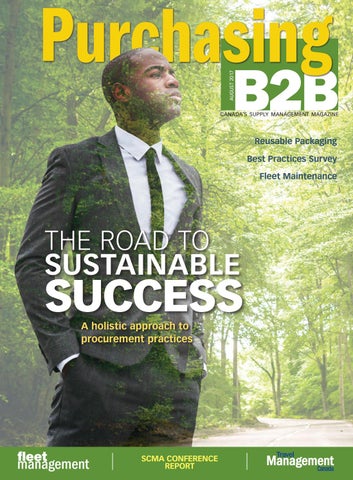
AUGUST 2017
CANADA’S SUPPLY MANAGEMENT MAGAZINE
Reusable Packaging Best Practices Survey Fleet Maintenance
THE ROAD TO
SUSTAINABLE
SUCCESS A holistic approach to procurement practices
SCMA CONFERENCE REPORT
PB2B Aug2017_AMS.indd 1
2017-08-14 10:46 AM
FOCUSED ON GREEN.
GO GREEN WITH STAPLES BUSINESS ADVANTAGE. Run a green facility with our eco-conscious line of Staples® Sustainable EarthTM products. From the breakroom to the bathroom, Staples® Sustainable EarthTM products are designed to be a safer alternative for your facility and the planet. To learn more about our sustainable product selection and environmental programs visit:
StaplesBusinessAdvantage.ca/GreenOffice
aug2017_SBA_purchasingb2b_EN.indd 1 PB2B_Staples_Sept.indd PB2B Aug2017_AMS.indd 12
03/08/2017 6:00:21 PM 2017-08-14 2017-08-08 10:46 2:52 PM AM
Table of Contents
Vol. 59, No. 4 • AUGUST 2017
Features
8
8 LINKING THE NATION Highlights from the 2017 SCMA National Conference in Winnipeg. 10 A SUSTAINABLE SUPPLY CHAIN Sustainability offers benefits in the social, environmental and economic realms. 12 BEST PRACTICES IN PUBLIC PROCUREMENT Findings from a recent public procurement best practices survey.
10
29 REUSABLE PACKAGING Transport packaging can be reused rather than simply recycled.
Also inside
4 5 6
UP FRONT BUSINESS FRONT FOCUS ON HR
16
31 3 3 3 4
FINANCE CORNER IN THE FIELD
24
THE LAW
17
Cover: Getty
Connect With Us Online
We encourage you to visit us online to stay in touch with what’s happening in your industry and to view enhanced articles.
.ca
PurchasingB2B.ca
@PurchasingB2B
Michael Power
Features The win-win of creating sustainability value through procurement. http://bit.ly/2wp5QiT
A CHANGING WORLD Typical procurement organizations can advance towards world class through digital transformation. http://bit.ly/2vlYFv0
Fotolia
HOW GREEN WAS MY CITY
PURCHASINGB2B ENEWSLETTER
Fotolia
Each week, we send out an eNewsletter that highlights industry news and insights. Sign up today and receive it each Tuesday. www.PurchasingB2B.ca/Subscribe
PURCHASINGB2B IS ON FACEBOOK! Visit us on Facebook to friend us, comment on a post or simply catch up on our online content. facebook.com/PurchasingB2B PurchasingB2B.ca | August 2017 |
3
0:21 PM
08 2:52 PM
PB2B Aug2017_AMS.indd 3
2017-08-14 10:46 AM
Up Front 80 VALLEYBROOK DRIVE TORONTO, ONTARIO M3B 2S9
www.PurchasingB2B.ca PUBLISHER/ADVERTISING SALES
Dorothy Jakovina 416-510-6899, djakovina@PurchasingB2B.ca
A Circular Solution
A
t a recent supply chain conference, a speaker showed the audience a picture of a European yogurt factory taken some 30 years ago. The facility had a relatively simple layout, with little visible machinery. He then showed a picture of that factory now. The space had become more complex, with far more conveyors, tanks and machinery than the previous, older picture—a reflection of increased demand and production complexity. In part, I saw that clutter as a reflection of the complexity of today’s supply chain. There are far more players on the field than ever before, and organizations can deal with far more suppliers. Those suppliers are geographically dispersed, and global sourcing is common. Similar to the yogurt factory, those supply chains are becoming more of a network than a chain, with many interconnected parts. And while this (relatively) new interconnectedness can offer rewards, there are also challenges. The risks to today’s supply chains include economic, social and environmental perils that must be navigated. Fortunately, the potential solutions provide a holistic approach. The circular economy views the supply chain as an ecosystem in which waste and pollution are minimal or non-existent and the materials involved in the production process can be deconstructed after they can no longer be used, with components and parts going back into new production. In a circular economy, materials like packaging can be reused multiple times without being broken down into component parts, as is the case with recycling (see page 29). The circular economy has the potential to make procurement more sustainable, an idea that some jurisdictions are adopting. Denmark, for example, has seen its regions, municipalities, and the Ministry of Environment and Food collaborate on green procurement through something called the Partnership for Green Public Procurement (GPP). Among other objectives, the partnership aims to transition to a circular economy through non-toxic chemicals, extended product lifespan and cycling of biological and technical materials. As well, companies like Phillips see procurement as an enabler of circular economy principles. In 2014, it joined Dutch GreenDeal Circular Procurement, which works to accelerate the transition towards a circular economy by implementing circular procurement within purchasing processes, policies and strategy. Many other companies and organizations are also catching on to the circular economy’s benefits. Procurement can be a major player in advancing this shift. Procurement organizations can enable economic growth while simultaneously driving social and environmental sustainability. As well, it’s often procurement that collaborates with suppliers. It’s procurement that can ask them to innovate to drive sustainability and a circular approach. It’s also procurement that can ask up front for innovative ideas when speaking with those suppliers. All of this is not only good for sustainability, but helps to create value for organizations, suppliers and consumers in the face of the modern supply chain’s complexity.
4
EDITOR
Michael Power 416-442-5600 ext 3259, mpower@PurchasingB2B.ca ART DIRECTOR
Andrea M. Smith
ACCOUNT COORDINATOR
Tracey Hanson 416-510-6762, thanson@annexbizmedia.com CIRCULATION MANAGER
Barbara Adelt 416-442-5600 x 3546, badelt@PurchasingB2B.ca ANNEX BUSINESS MEDIA GROUP PUBLISHER: Martin McAnulty, mmcanulty@annexweb.com COO: Ted Markle, tmarkle@annexweb.com PRESIDENT & CEO: Mike Fredericks, mfredericks@annexweb.com For over 59 years, PurchasingB2B has been a trusted source of information for Canadian purchasing/supply chain management professionals in the private and public sectors. Special features and supplements include Fleet Management, Canadian Automotive Review (CAR), PurchasingB2G, and Travel Management Canada. PUBLICATION MAIL AGREEMENT NO. 40065710 ISSN 1497-1569 (print); 1929-6479 (digital) CIRCULATION email: apotal@annexbizmedia.com Tel: 416-510-5113 Fax: 416-510-5170 Mail: 80 Valleybrook Drive, Toronto, ON M3B 2S9 SUBSCRIPTION RATES Published six times per year Canada — 1 Year $ 99.95 CDN Outside Canada — 1 Year $ 172.95 USD Occasionally, PurchasingB2B will mail information on behalf of industry-related groups whose products and services we believe may be of interest to you. If you prefer not to receive this information, please contact our circulation department in any of the four ways listed above. ANNEX PRIVACY OFFICER privacy@annexbizmedia.com Tel: 800-668-2374 Opinions expressed in this magazine are not necessarily those of the editor or the publisher. No liability is assumed for errors or omissions. All advertising is subject to the publisher’s approval. Such approval does not imply any endorsement of the products or services advertised. Publisher reserves the right to refuse advertising that does not meet the standards of the publication. No part of the editorial content of this publication may be reprinted without the publisher’s written permission. © 2017 Annex Publishing & Printing Inc. All rights reserved. Printed in Canada. We acknowledge the financial support of the Government of Canada through the Canada Periodical Fund of the Department of Canadian Heritage.
| August 2017 | PurchasingB2B.ca
PB2B Aug2017_AMS.indd 4
2017-08-14 10:46 AM
Business Front
The Irrelevance Of Public Policy Sometimes doing little, or perhaps even nothing, can go a long way
Toronto-based Michael Hlinka provides business commentary to CBC Radio One and a column syndicated across the CBC network
By Michael Hlinka
A
s I sit here in front of my word processor, it is about nine months since Donald Trump was elected President of the United States of America. And the last time I checked, the sky hadn’t fallen…at least, not yet. This is very different from some of the very dire predictions that I heard after the electoral votes were counted. There was a gaggle of commentators who virtually guaranteed that the stock market would crash. Last time I looked, it was up a very healthy 17.5 percent. And if there has been one defining element of the Trump presidency, it is that he hasn’t done anything. Recall the lynchpin promises of his campaign. First, he would build a wall with Mexico to end the tide of illegal immigration. Second, Obamacare would be repealed and replaced with a health-
both Canada and the US—have been finding “just right” is through the application of something called the Taylor Rule. It’s named after Robert Taylor, an economist who teaches at highly respected Stanford University. The Taylor rule goes something like this. There is a “just right” interest rate that has to be adjusted, depending on what is happening with inflation and real economic growth. If inflation is higher than it should be, that “just right” interest rate should be bumped up to cool things off. If real economic growth is lower than it should be, that “just right” interest rate should be shaved to stimulate things. It’s a framework that seems to make sense at first glance, but implicit in it is that everyone agrees on what “just right” is. Imagine the following. You think “ just right” is two percent, while I think that just right is three percent. And it just so happens that interest rates stand at 2.5 percent. You would be looking to cut interest rates while I would be looking to increase them. The Taylor Rule and the framework itself is meaningless, unless there is agreement about the “ just right” interest rate. Now here’s what we’ve learned in the “Not a single (Trump campaign) promise has been past few months: No one on the Federal kept, yet that doesn’t seem to be impacting Reserve Board (the committee in the the economy in the slightest.” US responsible for setting interest rates) seems to have the confidence to step forcare system that would allow Americans to keep ward and say what “just right” means. What does that mean? It means their own doctors, a system where there would be that those who in charge of interest rate policy are as good as shooting at increased access combined with lower costs, a sysan invisible target. tem…You get the idea. And tax relief! Millions of Therefore, no one really knows what they’re doing when it comes to setAmericans would cease paying any income tax at ting interest rate policy, yet it doesn’t seem to be impacting the economy all. Wealthier Americans would see billions of dolin the slightest. Maybe what the Central Bank does…or doesn’t do…isn’t lars returned to their rightful owners, and the usurithat important after all. ous penalties on corporate profits would fast become There are some readers who may be concerned because what this a thing of the past. suggests is that the economic ship is rudderless. But I find this strangely Not a single promise has been kept, yet that doesn’t encouraging—and it gives us a very good idea of the way forward. In a seem to be impacting the economy in the slightest. more-or-less free and open economy, our natural inclinations will lead Maybe what the government does…or doesn’t do… many of us—not all of us, but enough—to self-interestedly produce isn’t that important, after all. goods and services of real value. Then in free and open exchange, that Over the years, the public has been led to believe productive output will be traded for other goods and services of real that one of the most important determinants of value produced by others, creating a win-win for all parties. And then sound economic growth is finding the appropriate all we really need from government is that it establishes clear, transparlevel of interest rates at any one time. If you recall ent rules and enforces them quickly and even-handedly. And because the fairy tale Goldilocks and the Three Bears, you underthe belief system that we call money makes voluntary exchange possistand the gist. If interest rates are too high (hot), ble, we need central banks that control the manufacture of fiat currenthat’s no good. If they’re too low (cold), that’s not cies, so profit-maximizing actors will be properly rewarded for the value right either. There’s something in the middle that is that they have created. “ just right.” So perhaps, as it turns out, public policy isn’t irrelevant—it’s relevant The way that central bankers—including those in precisely to the extent that it does less, rather than more B2B PurchasingB2B.ca | August 2017 |
PB2B Aug2017_AMS.indd 5
5
2017-08-14 10:46 AM
Focus On HR
You’re In Charge. Now What? What to do during the first 90 days in a leadership role
Caroline Cole Power is the president and CEO of Canadian HR Solutions.
By Caroline Cole Power, BBA, MBA, M Ed, CHRL, PhD
C
ongratulations! Whether this new role is with your existing employer or a new one, many of the same dynamics come to bear. A change in leadership is, likely, a significant transition for employees. Their reaction will depend on the relationship that they had with the previous leader and how they feel about this person’s departure. The following are a few things that you can do to increase your likelihood of a successful transition. Don’t make sudden changes: New leaders often feel pressured to make a strong positive impact on the company immediately. This is understandable
ones? Ask them about their career goals, their frustrations at work, and what they need from you to be successful. Reveal enough about yourself, your leadership style and some previous experiences that you’ve had. Don’t be afraid to admit some of your vulnerabilities and areas where you will need their help. Hearing about your work background directly from you can go a long way toward building personal engagement. Depending on your operation’s size and structure, your direct reports may have direct reports of their own. In that case, ask when would be a good time to meet as a group. Let them choose the time and setting. These meetings will give you opportunities to take the pulse of employees in other departments, branches or geographic areas who come under your new chain of command. It’s a best practice that one-on-ones “Lean on the team for their expertise—it’s not a continue after the first 90 days. Keep them going as they provide a forum for good idea to begin your new role with the you to stay in touch with each direct attitude of having all the answers.” report. You can provide performance feedback, add new responsibilities, get because often during the recruitment process hiring feedback, and more. Meetings like these help you to sustain a connection managers stress the importance of the selected canto your team. Build team cohesion: Establish team meetings to create a forum for didate being able to hit the ground running. Another your new direct reports to meet with you and each other, together, message that is often played to candidates is the need on a regular basis. This is great for cross-pollination of ideas, fosters colfor them to be a change agent. Because of these and laboration and strengthens team cohesiveness. other messages newly hired leaders many times rush Lean on the team for their expertise—it’s not a good idea to begin your into the mode of changing procedures, processes, and new role with the attitude of having all the answers. You don’t. You have systems right out of the blocks, at their peril. people who are hired to do a job and, as a leader, you are more effective When you first take over a team as their new leader if you let them do it. By doing that you also free up your time to do your you don’t know what you don’t know. You need to get job, which is to lead. to know each person, professionally and personally. So, lean on them and expect them to deliver. Let them lean on you Next, you don’t know how they will relate to you as for providing access to resources, support and encouragement. Many their leader so you are unable to adjust your style unmotivated people simply need leaders who have confidence in them. to make the relationship effective. Next, you havBe clear about your goals: One of the scariest things for teams with en’t yet earned their trust. Yes, you may have their new leaders is to try to figure out what the boss’s expectations are. respect but it takes more effort and time to build Take the mystery out of that as soon as you can. After you have met with trust than to garner respect. One cannot lead well everyone, step back, reflect, and develop short-term and long-term goals without being trusted. Meet one-on-one with each direct report: Use for your operation. Communicate your goals to your team and provide these meetings to learn what’s important to each them with opportunities to ask questions. Have at least one big win: Deliver on something that you know is employee and how you can support them in achieving important to the company. The team that brought you on board or their goals. We get what we want from people when we promoted you will be watching to see what impact you have made in your help them get what they want. first few months. Whatever it is, it must be noticeable. B2B What are some talking points for the one-on-
1.
A s S a
•
•
3.
4.
2. 6
•
A L
5.
| August 2017 | PurchasingB2B.ca
PB2B Aug2017_AMS.indd 6
2017-08-14 10:46 AM
PB2B_S
TO ADVANCE YOUR CAREER, LEARN FROM INDUSTRY EXPERTS. OUR PROGRAMS As the leading association in Ontario for supply chain management professionals, SCMAO offers professional development and education connected to industry. • Taught by supply chain practitioners Our instructors translate real-world experience into meaningful classroom discussion that you can apply at work. • Supply Chain A-Z Whether you’re new to supply chain or managing at the highest levels, SCMAO offers programming to meet your needs. • On-Going Support As a full-service association, SCMAO offers networking opportunities and career building events allowing for maximum career growth.
Certified Supply Chain Management Professional (CSCMP) Internationally-recognized, the CSCMP designation is the highest level of professional education in supply chain management in Canada. Diploma in Procurement and Supply Chain Management Developed for skilled supply chain professionals at the intermediate level. Supply Management Training Foundational courses and seminars in tactical and operational knowledge. Professional Development Seminars Keeping you informed of emerging trends and supply chain practices. Corporate On-Site Training Customized and cost-effective training delivered conveniently in your own facility.
ALIGN YOURSELF WITH SUCCESS LEARN WITH SCMAO For more information on our programs please contact the SCMAO office at education@scmao.ca or Christopher Lau at 416-977-7566 (ext 2145). SCMAO is the Ontario Institute of the Supply Chain Management Association.
PB2B PB2B_SCMAO_June.indd Aug2017_AMS.indd 7 1
2017-08-14 2017-05-16 10:46 2:50 AM PM
LINKING THE
NATION
The 2017 SCMA National Conference covers topics including vendor relations, procurement and finance
elegates travelled to the geographical centre of North America for the 2017 SCMA National Conference last June. Held in Winnipeg this year, with the tagline “Link The Nation,” the conference linked attendees through networking, ideas and strategies. The event featured a range of education sessions and fireside chats. One seminar saw Ameet Sareen, general sales manager, product business development at Air Canada Cargo and Shalini Talwar, manager of strategic sourcing and supply at FedEx Express, discuss working with vendors to manage the contract lifecycle. Why leverage vendor relations? Your vendors are experts that may see things differently from you, Sareen told the audience. They may have additional tools that you lack, or may see potential issues earlier and help reduce costs and protect a company’s brand. “Vendors can bring in a different way of thinking than the way you think,” Sareen said. There are risks to neglecting to manage vendors, said Sareen, such as the potential to develop inadequate delivery to customers. And while supplier involvement has traditionally begun at the product concept development stage, Sareen recommended moving that discussion earlier to the concept creation phase. He suggested brainstorming sessions with suppliers while reserving time for pre-planning. As well, have a long-term vision and determine the true worth of a supplier. “Bring your vision to the table and give them the opportunity to come back and add on to your vision,” he said. 8
Meanwhile, plans don’t always go smoothly and sometimes it’s necessary to pull a product, so have an exit strategy ready, Sareen said. Companies now look to operate as eco-systems rather than islands or silos, said FedEx Express’s Talwar. Suppliers function as partners to businesses and effective contract lifecycle management can help build that partnership, she said. While cost savings remain a key objective, many organizations now take a broader view. Effective contract management offers several advantages, Talwar said. For example, the process can: aid in forecasting revenues and help a company to see where it’s trending; control procurement costs; manage suppliers and customers; establish service levels; protect intellectual property; and mitigate risks. Vendor and contract management tools include scorecards, business reviews, steering committees, working groups, audits and stakeholder as well as customer surveys, she said. Procurement and finance Procurement and finance work together more closely than ever, with procurement often reporting into the finance department. Another panel session focused on how the two departments could work together more closely. Among the panelists’ organizations, the operational reporting relationship between the two functions varied. Regan Windsor, business support officer at Manitoba Hydro, said her organization goes between centralized and not
Photo: Dorothy Jakovina
D
By Michael Power
| August 2017 | PurchasingB2B.ca
PB2B Aug2017_AMS.indd 8
2017-08-14 10:46 AM
centralized. Restructuring has meant more require different skills but there are several linkage between supply chain and finance, she commonalities as well. Meanwhile, Windsor noted. Aurel Tess, provincial comptroller for noted that it pays to have a mix of technical the government of Manitoba, noted a hybrid and soft skills. model with the province moving towards cenIt’s also best to have both supply chain and tralization. Meanwhile, Martin Montanti, VP, finance involved in projects early, Tess noted. corporate services, Southern Health, noted the In a department he worked in previously, two departments are linked in many ways at his different operations functioned in separate organization. silos—all doing their own purchasing. Both Procurement and finance share many of the Mike Whelan, SCMA national sides need to demonstrate value and a clisame necessary skills, said Tess. Problem solv- board chair, acted as the MC for ent-centric approach. If not, the department ing, strategic thinking and interpersonal skills the three-day national conference. will be ignored and people will go around it Next year’s conference will be are all important to both professional areas. rather than seek it out. Montanti noted that held in St. John’s, Newfoundland A common thread for those looking to bridge and Labrador. organizations must realize that supply chain the gap between procurement and finance is is a valuable asset but with limited resources. to develop skills that take you out of your comfort zone, Tess Supply chain can provide knowledge and innovation through said. Meanwhile, Montanti noted that what skills are necessary the vendor community. Developing common goals helps break depend on the industry. In manufacturing, it can be a profesdown silos, which are often built around goals, he added. sional supply chain person that’s needed, while other areas may The SCMA national conference provided not only valurequire a very tactical employee. On the financial side, it’s about able professional development opportunities but also the skills in financial reporting. It’s easier to move from a financial chance to connect and network. Truly, the event helped to position to one in supply chain, he said, adding that the roles “link the nation” of supply chain professionals. B2B
PB2B_CAMSC_Aug.indd 1
PB2B Aug2017_AMS.indd 9
3:23| PM PurchasingB2B.ca | 2017-08-03 August 2017 9
2017-08-14 10:46 AM
SUSTAINABLE SUCCESS T
he world is more interconnected than ever. Meanwhile, environmental issues like global warming have dominated headlines in recent years. Most companies have an eye on sustainability and work to integrate those initiatives into their business. But what challenges do they face in pursuing sustainability? How can suppliers help companies become more sustainable? And how can advancements in technology help to enable that sustainability? Sustainable procurement programs have morphed from a “nice-to-have” into a permanent part of the success of large organizations, says David McClintock, marketing director for EcoVadis. The 21st Century supply chain faces challenges, including monitoring for compliance, volatility resulting in higher product costs, supply disruption and others. Noncompliance can result in damages reaching into tens of millions of dollars Meanwhile, organizations are under pressure to provide transparency and external validation for sustainable practices. An EcoVadis study found that nearly every organization surveyed considered sustainability critical to procurement. “From customers, to investors, to internal teams and even the C-suite, sustainability is recognized across the board as table stakes for doing business in 2017 and beyond,” McClintock said. The benefits are real. Enhanced brand reputation, stronger supplier relationships, better sustainability rankings, improved risk management and increased revenue and sales all stem from sustainability practices. “Our study found that the majority of sustainable procurement leaders said they have seen increased revenue from the 10
sustainable and innovative products and services they have sourced,” says McClintock. But with that focus comes challenges, he notes. It’s tougher to monitor every supplier in the process. Companies can struggle with visibility, which leads not only to backed payments and lost inventory but to risks from unethical or illegal activities like slave labour or irresponsible waste disposal. When asked, only 15 percent of organizations said they have complete supply chain visibility into tier one and two suppliers’ sustainability performance, while six percent had such visibility into tier three suppliers and beyond. Supply chain leaders are therefore shifting from a compliance mindset to one of performance. That involves engaging suppliers to seek value through sustainability. Start by aligning strategically
Get ty
Sustainability practices offer several benefits to organizations, including financial ones
has taken notice, McClintock says. Organizations have begun treating sustainability as a risk management strategy. The visibility and transparency of a sustainable procurement program limits surprises, disruptions and negative media attention. Until recently, the biggest
“From customers, to investors, to internal teams and even the C-suite, sustainability is recognized across the board as table stakes for doing business in 2017.” —David McClintock, EcoVadis with suppliers, McClintock suggests. “That relationship progresses to a point where buyers and suppliers are working together to innovate, resulting in risk reduction, brand enhancement and revenue growth—not to mention that they put themselves in a better position to make a positive impact on the planet and their communities,” he says. Given its potential, sustainability has become a revenue driver and the C-suite
obstacle internally to sustainable procurement was lack of support from executives, he says. “Today, most C-level executives understand the value of sustainable procurement initiatives, but the challenge is in dedicating the resources toward tracking supplier sustainability performance,” McClintock notes. He encourages suppliers to streamline the assessment process and increase transparency into their sustainability practices, which entrenches
| August 2017 | PurchasingB2B.ca
PB2B Aug2017_AMS.indd 10
2017-08-14 10:46 AM
By Michael Power
relationships with buyers and aids sustainability performance goals. Another challenge, says Reeve Consulting president and CEO Tim Reeve, is a lack of resources for building a robust sustainability program while simultaneously putting through the specifications and standards for major procurements. The work can’t be done off the side of a desk, and people and technical resources and a budget are needed. Most organizations work hard to adopt a policy or guidelines, but then take a foot off the gas hoping the work will still get done. A second challenge lies in ensuring awareness and buy-in from the C-suite for sustainability initiatives. A company’s executive team must be engaged in the discussion surrounding how sustainability builds brands, saves money, reduces risk, engages stakeholders, improves efficiency and so on. “The C-suite cares about these issues—but managers and directors or even advisors are not positioning the work in a way that is making these connections successfully,” says Reeve. “The business case is compelling,
but it is not being presented effectively.” He suggests organizations invest onetenth of one percent of annual spend on creating and rolling out a sustainability program. Another challenge involves finding clarity surrounding what sustainability success looks like, Reeve said. It’s not about creating a policy or including certain specifications in an RFP. Rather, it’s about impacts like reduced energy consumption, less waste and packaging, more local jobs and more supply chain transparency. “The vision needs to be about impact and outcomes, not process,” he says. To embed sustainability into a company’s culture, Reeve stresses training—an often overlooked and underfunded area. Use a blend of online learning, webinars and workshops repeatedly to keep stakeholders engaged. Millennials can impact sustainability by forcing companies to “raise their game” to retain the best talent, Reeve notes. “We often hear of new hires in procurement wanting to see meaning in their work, and sustainability is a huge point of engagement for them,” he says. “Sustainable procurement is a chance to align personal and professional values and contribute to some of the most strategic goals of an organization.” The circular economy Consuming all a supply chain’s resources is not sustainable, says Larry Berglund, SCMP, MBA, FSCMP, principal at Presentations Plus Training & Consulting Inc. A holistic approach to sustainable supply chains must address environmental, economic and social values—until recently these were seen as independent. While well intended, recycling fooled consumers into thinking they could continue to consume low-cost plastic products that could later be recycled, thereby sparing the environment. But designing goods for disposal, a hallmark of the so-called linear economy, assumes infinite
resources that can be harvested and used continuously. But this assumption is incorrect. “Recycling led to an increased consumption of poorly designed goods aimed at the lowest cost to produce, to increase profits,” Berglund says. The emergence of the circular economy acknowledges resources are finite; goods are designed-for-environment; energy should come from renewable sources; waste is eliminated; and the use of indigenous materials and local labour contribute to social values. For supply chain professionals, there is a duty to explore more responsible options which consider total cost of ownership. For example, offshoring production to a low-cost producer which then reduces local employment may not be the best trade off. While offshoring drives profits for an owner in this example, the community that loses the jobs bears the cost—this is a zerosum model. There is an economic benefit with a social value offset. Environmental responsibilities may end up transferred to a region that has lax regulations, which is not sustainable, Berglund says. “The circular economy is a long-term view where at the end of a life cycle for a product, all of the materials can be repurposed into a new product,” he notes. “At the design stage, products are planned for their inevitable deconstruction and use biomimicry as a template. Metals are recaptured. Toxic materials and chemicals are contained. There is a new role for recycling in the sense that it becomes the means to recover supply chain materials for reuse in a continuous cycle. The circular economy is a strategy for conservation—supply chains in the future will be viewed as supply loops.” A circular economy repurposes materials that have already been processed into new products, reducing energy demands. Collecting and segregating goods for inclusion in new products also increases domestic and local employment. “The circular economy doesn’t mean perfect solutions but can lead to better solutions,” Berglund notes. “Better solutions meaning more responsible business practices across supply chains and increased accountability for the global resources.” B2B PurchasingB2B.ca | August 2017 |
PB2B Aug2017_AMS.indd 11
11
2017-08-14 10:46 AM
PUBLIC PROCUREMENT
By Eddy Jin
PROCUREMENT BEST PRACTICES
T
Public procurement professionals tell their stories from the trenches in survey
he public sector’s competitive procurement process provides oversight to spending for construction projects, goods and services, but the procurement practices of public agencies often go unnoticed. A survey of public agencies, including Canadian
Government
Crown
Non-profit
Public Procurement Council (CPPC) member organizations, aims to showcase these best practices. Conducted by Eddy Jin and sponsored by Biddingo.com, the survey launched June 22 and runs until September 1. The survey results show it’s not a passive environment.
Municipalities
Healthcare
Education
Agencies representing these areas of the public sector provided their best practice data for the survey.
83
Average annual number of competitive bidding projects
887
Highest annual number of projects reported
$3.8 million Typical agency annual spend
x 468 =
12
$1.78 billion
Highest reported annual spend
| August 2017 | PurchasingB2B.ca | PURCHASINGB2G
PB2B Aug2017_AMS.indd 12
2017-08-14 10:46 AM
Construction
44.4
Services
Goods
62.4
Project Delay
75%
Procurement
74.9
Although there is no statistical difference in the reported data, these averages suggest there are differences between how construction projects are run compared to goods and services. Price-based tendering is often used for construction projects and they typically reduce the evaluation requirements. Additionally, the use of standardized Canadian Construction Documents Committee (CCDC)-type documents can streamline the competitive process by reducing the need to create customized requirements for each project.
Negotiable RFPs
Negotiations
38.5%
62.9
Percentage of agencies surveyed that negotiate in their bidding projects.
Client
25%
Contract Execution
PUBLIC PROCUREMENT
Project Duration (hours)
Percentage of agencies surveyed that use the negotiable RFP format in their bidding projects.
The data suggest that many agencies continue to negotiate under the Contract A/B model or “binding” formats.
20.0
It takes typically 20 extra hours for a contract to be signed off after it has been awarded. This is in addition to the 60.4 hours on average that it takes to run the procurement. That’s an additional 33 percent of time added to a project.
The Last Word
Selected comments from some of the professionals working in the field
omplied to “We have c ents t requirem governmen e at ed to evolv but mana g me.” the same ti
“Automati on of the R FX program would enh ance transp arency and accountab ility of our end users… would also create defe It nsible just throughou ification t the RFX st ages and in particular for evalua tion and fi nal award purp ose.”
We’re proud of: “Integrity of process, respect for the suppliers submitting, outcomes for my client group.”
This survey was extended to gather input from member agencies of the Canadian Public Procurement Council (CPPC). The CPPC member responses will be combined with this dataset and a detailed analysis of this super dataset will be presented at the CPPC Forum in Ottawa, November 6-8, 2017.
Eddy Jin is the Principal Consultant of his firm Eddy Jin & Associates. He can be reached at eddy@eddyjin.ca.
PURCHASINGB2G | PurchasingB2B.ca | August 2017 |
PB2B Aug2017_AMS.indd 13
13
2017-08-14 10:46 AM
ADVERTORIAL
A CENTRAL BRAIN FOR P Biddingo.com solution lets procurement track projects, assign tasks and clear process bottlenecks before they form.
F
or the Canadian public sector, procurement is a complex, multi-step process. Purchasing organizations need a comprehensive plan in order to ensure that each step is completed as effectively as possible. But even best laid plans can be filled with risks. In fact, 35 percent of procurement projects in the public sector fail, get delayed, or experience issues that disrupt the process. Organizations therefore need tools to ensure that each step is done properly, with the right tasks completed on time by the right people, and with the appropriate stakeholders involved. To help organizations ensure the process runs smoothly, Biddingo.com has created R2CoW (Requisition To Contract On Workflow), a cloud-based solution that manages the steps in the procurement process and tracks workflow. R2CoW identifies delays and bottlenecks, exposes weaknesses, tracks work as it’s completed and identifies what remains to be done for each project step. The solution also assigns tasks, sending automatic alerts and ensuring that the right team members handle those duties at the correct time. It then tracks whether or not the assignee has completed the task. “R2CoW will identify where a bottleneck is, who is holding it, and then tell you what the progress is right off the bat,” says Jay Yoon, President and Chief Executive Officer of Biddingo.com. “It exposes the weaknesses of a process right away. That gives a good place to start to improve the process.” A CENTRAL LOCATION With a field as complex as public procurement, it pays to have all the necessary data and documents in one handy, easy-to-access location. R2CoW acts as a central repository for all the information and documentation associated with a project. For each step in a procurement the documents, tasks, instructions, forms to complete, comments regarding completed tasks and other data are all captured. The entire process is documented in a central location, with some tasks tracked manually. The system updates automatically when certain tasks are performed, for example closing a bid. Essentially, the solution acts as the central brain for procurement scheduling.
Having that knowledge storehouse not only makes the procurement process smooth and efficient, it also protects against losing vital data about processes and procedures that can result from staff changes. Knowledge transfer becomes seamless due to the system-based process management that R2CoW offers. “Much of the senior management at organizations is retiring and they leave with a lot of knowledge of the organization and its business processes,” says Yoon. “With R2CoW, organizations can maintain all the instructions related to those processes.” Visibility into that procurement matrix lets procurement see which departments’ projects are delaying progress, which are performing well, whether a specific buyer is holding things up, along with how much effort is needed to deliver the customer-centric services that clients expect. Preventing challenges from arising in the first place becomes a much easier task in the future. And while R2CoW can make individual projects easier to ex-
14 August2017 2017| |PurchasingB2B.ca PurchasingB2B.ca | PURCHASINGB2G 14| | August
PB2B_BiddingoDPS Advertorial_SVA.indd All Pages PB2B Aug2017_AMS.indd 14
2017-08-14 10:46 AM
R PROCUREMENT SCHEDULING
ecute, better organized and simpler to track, the solution also allows procurement to view the process across multiple projects over time. As projects completed through R2CoW accumulate, that history lets procurement track trends and observe what factors are routinely creating bottlenecks. “If you accumulate all the projects that you go through day in, day out over a year or two or three, you then have a total history of the trends in your organization and the type of projects that are causing issues,” says Yoon. “So next time, when you’re doing a similar project, you can address all that upfront and ahead of time. You don’t have to address those issues at the end—you prevent issues before they happen.” In a recent competitive procurement best practices survey done by Eddy Jin and sponsored by Biddingo.com, many respondents noted that that kind of data simply wasn’t available to them, or would take countless hours to dig up and analyze. But R2CoW makes the information easily available.
CONFIDENTIALITY The system is confidential, with access available only to those who are authorized to view it. During the bidding process, procurement manages the system and is responsible for status updates. But as the process moves forward the contract owner or clients of the procurement team can begin making updates. R2CoW is a purchasing process, and the procurement team finalizes who has access. “You’re getting bids from bidders, you have internal documents visible, and so you want to make sure the process is confidential and allows access only to certain individuals,” Yoon says. “As the process is moving along people that are involved in it can see what’s being done.” At the same time as it provides that confidentiality, R2CoW creates visibility into what’s happening or needs to happen with a project, since stakeholders can simply open R2CoW and see everything associated with that step. As well, organizational templates for different project types can be created in advance so that clients understand upfront what the requirements and expectations are. This helps to improve relations and eliminate friction between the purchasing department and its clients. Overall, the solution enables improved communication among stakeholders, helping to break down the siloes that can plague organizations. The number of steps that can be included for any given project is unlimited. Since it’s a cloud-based solution, R2CoW is an integrated solution and incorporates seamlessly into an organization’s existing infrastructure and systems. As well, the time needed to get the system up and running is short and user training involves only a few half-day, web-based sessions. Biddingo.com also provides a master template for projects, so organizations don’t need to create one from scratch. That template can be modified to meet the needs of individual organizations. As well, once a bid is ready to go out, the document is automatically posted to Biddingo.com. Yoon stresses that R2CoW is more than just a tool to enable project management. The system integrates closely with the bidding process, including document creation with subject matter experts, bidding from vendors and evaluations. “The standard world of project management involves three areas: scheduling, resource allocation and tracking,” Yoon says. “But R2CoW links to bidding, it links to contract management, it links to evaluations—it’s an entire documentation of you process.”
For more information on the R2CoW solution, visit www.Biddingo.com/PB2B0817. PurchasingB2B.ca| |August August2017 2017 || 15 15 PURCHASINGB2G | PurchasingB2B.ca
PB2B Aug2017_AMS.indd 15
2017-08-14 10:46 10:27 AM AM 2017-08-14
A FINE BALANCE
W
hat lies ahead for the hotel industry? Continued growth, according to Kevin Frid, COO of AccorHotels. Hotels will continue to expand the breadth of their offerings, Frid said, with no shortage of innovations on the way. Frid made the comments during the GBTA Conference 2017 | Toronto, last May. The annual event saw a record delegate turnout this year, with over 700 attendees. Balance was the theme for the conference, with one area in need of balance being business travel’s relationship with technology. Among the most significant innovations in the hotel space is the limited life of the travel app, Frid told the audience during a Q&A session on the convention’s main stage. The industry is getting closer to using voice recognition as a replacement to the typcial way that apps work today. “I think it will come to an end fast,” Frid said. “Voice recognition will replace apps as we know them.” Hotels are also working to revolutionize the guest experience, said Frid. The focus is less on bars and restaurants in hotel common areas per se, he noted. Rather, the goal of improving a hotel’s public space will be a major investment in the future. As well, home sharing, while currently a hot topic in the hotel industry, is not a particularly new issue, Frid stressed. Even 30 or 40 years ago, travellers could look in the newspaper for condos to rent. Digital-age home sharing, which uses apps such as Airbnb, expands that concept through the use of technology. Frid also addressed global volatility and its affects on the hotel industry and Canada’s economy. It’s important to “push aside the noise,” he stressed. For
16
example, controversial developments in US politics seem like a threat, but the country’s low interest rates and low unemployment make for a positive business environment. As well, Canada’s welcoming stance on visitors provides benefits that, combined with factors like currency rates, make for an “outstanding” outlook. The value of technology The technology theme continued during an education session called Proving Value: Staying plugged into the latest technology trends to increase savings and traveller productivity. Panelists discussed how consumer-based technology is putting pressure on business travel. Travel managers traditionally pushed technology that organizations want travellers to use, said Will Tate, senior vice-president at GoldSpring Consulting and the session’s moderator. Now, companies like Uber, Airbnb and UrbanDoor are pushing travellers to tell corporations what they want. Panelist Karim Zuhri, head of Egencia product marketing—hotels, noted that employees are enjoying the travel experience more, making them more productive at the office. Companies are realizing this and focusing on the travel experience, Zuhri said. Technology can improve that experience, for example by simplifying the expense reporting and the process of dealing with travel receipts. This human side of technology is what organizations should focus on, Zuhri noted. Shopify has leveraged mobile technology in various ways, said fellow panelist Nick Lalumiere, the company’s travel manager. Shopify doesn’t mandate what apps employees can use while travelling. Rather, it trusts employees to make good
By Michael Power
decisions, Lalumiere said. Shopify also takes culture seriously and employees are often tech savvy. Lalumiere touched on the Millennial generation’s travel needs and wants, which include easy experiences with minimal red tape. Also high on the list is a blend of business and leisure—the so-called “bleisure” experience—which Shopify promotes internally. Millennials also look for end-to-end travel management solutions. Rather than visiting several spots, they look to upload everything from one location at once. Fellow panelist Michelle Shry of Petco said her company is moving from a transactional travel policy to one based on relationships. Organizations must maximize productivity while not cutting into the bottom line, she noted, and a hard line on travel policy can work against a company. At one time, Petco required travellers to take connecting flights. But that meant lost time, so the company removed the restriction. Petco also capped the amount that travellers could spend on airfare— employees can now spend $100 over the lowest airfare, a policy that has built compliance. Shry describes what Petco uses as a “soft mandate.” She speaks regularly with travellers to ask them about preferences then uses feedback to improve policy. For example, she discovered that travellers don’t care much about including breakfast in a hotel deal so negotiates on that that with hotels. This year’s GBTA conference provided an informative and useful look at how corporate travel intersects with technology, employee wellbeing and other factors. This year’s event provided a “balanced” look at this important area of corporate spend. B2B
Fotolia
GBTA Conference 2017 | Toronto examined how business travel can accommodate both people and technology
| August 2017 | PurchasingB2B.ca | TRAVEL MANAGEMENT
PB2B Aug2017_AMS.indd 16
2017-08-14 10:46 AM
AUGUST 2017
18 FLEET MAINTENANCE
T ips for getting maintenance done while avoiding unnecessary work.
20
24
20 2017 AJAC ECORUN
Drive tests the fuel economy of 19 vehicles. 26
24 THE 2018 FORD F 150
The latest version of the Ford truck revealed.
26 ROAD TEST: THE 2018 TOYOTA YARIS
This perky little car is no wallflower.
Fleet Management is a special section of PurchasingB2B magazine, running in the February, April, August and December issues. It is an important resource for Canadian procurement professionals who recommend, select and manage fleet vendors and service providers. Editorial inquiries: Michael Power, MPower@PurchasingB2B.ca. Advertising inquiries: Dorothy Jakovina, 416.510.6899, djakovina@PurchasingB2B.ca.
Fotolia
Vincentric announces best fleet value winners TRAC publishes tire resource The Tire and Rubber Association of Canada (TRAC) has published an online resource, called the Get Fuel Fit Guide, to help motorists improve their fuel savings know-how by offering advice on tire selection, maintenance and driving habits that improve fuel economy and protect the environment. The Guide has three sections: • Gear—vehicle, tire and other product shopping tips to save on fuel; • Routine—fuel saving driving tips; and • Check-up—tire and auto maintenance advice. “Fuel-efficient driving not only saves hundreds of dollars in fuel each year, but it can also improve road safety, prevent unnecessary wear on your vehicle and lower harmful greenhouse gas emissions,” said Steve Akehurst, chief, personal vehicles programs, office of energy efficiency, Natural Resources Canada. “By adopting fuel-efficient driving techniques, the average Canadian can reduce their fuel use by up to 25 percent.” Natural Resources Canada, Kal Tire and TRAC all contributed eco-friendly advice to the resource, which can be found at www.betiresmart.ca.
Ford Motor Company has lead the way in the 6th annual Vincentric Best Fleet Value in Canada awards with 10 winning vehicles. MercedesBenz and Toyota also each had four winning vehicles in this year’s Vincentric Best Fleet Value in Canada award lineup. The Ford roster included the sixtime champion F-150 and four-time winner F-250 pickup trucks, as well as the Transit Connect and Transit 150 in the van segments. Both vans earned the Vincentric Best Fleet Value in Canada award for the third straight year. The Mercedes Benz Metris and
Sprinter models won for the second and sixth year in a row, respectively. The Toyota Sienna won the Vincentric Best Fleet Value in Canada in the minivan segment, the Tacoma in the small pickup segment, and the Prius C in the hybrid segment. Other brands with multiple winners included, Mazda, Mitsubishi and Infiniti. Vincentric did a cost of ownership analysis on over 2,000 vehicle configurations based on typical use in a commercial fleet. Each vehicle was evaluated in all 10 provinces using 24 different lifecycle cost scenarios and eight cost factors.
IIHS announces top safety picks The Lincoln Continental, Mercedes-Benz E-Class and Toyota Avalon come out at the top of a group of six large cars evaluated by the Insurance Institute for Highway Safety (IIHS). The three cars qualify for TOP SAFETY PICK+, the Institute’s highest award. The Tesla Model S, the Chevrolet Impala and Ford Taurus fall short of the awards because they each only earn an acceptable rating in the small overlap front test. Vehicles qualify for either the TOP SAFETY PICK or TOP SAFETY PICK+ award if they have good ratings from IIHS in five crashworthiness tests—small overlap front, moderate overlap front, side, roof strength and head restraints—and an available front crash prevention system that earns a superior or advanced rating. FLEET MANAGEMENT | PurchasingB2B.ca | August 2017 |
PB2B Aug2017_AMS.indd 17
17
2017-08-14 10:46 AM
By Kara Kuryllowicz
Time For A
TUNE UP?
Know when to get maintenance performed and how to avoid the upsell.
18
strategies and policies and deal with dayto-day questions as they arise.” Adds Vince Boldrini, supervisor, Truck Serve, ARI, “Not every fleet manager or driver has a mechanical background, that’s why ARI’s Certified Technicians and Intellifleet system safeguards help ensure repair estimates are properly vetted. Our experienced, trained maintenance experts carefully review the vehicle’s history and its current environment and operational demands as well as the OEM’s recommendations before we approve or deny any unscheduled service.” Fleet managers and drivers must be aware of their companies’ policies, for example, a commitment to OEMs’ recommended preventive maintenance as well as partnerships with national vendors. Do whatever the OEM recommends in the owner’s manual and stick to their intervals, time and mileage, as closely as possible under normal operating conditions. The reality is OEMs know their vehicles’ respective needs better than anyone else. “Preventive maintenance used to be very generic but it’s now more specific to the individual vehicle so it’s best to drop the preconceptions and focus on the owner’s manual,” says Meiklejohn. Dealerships generally cost more than the chains, quick-service and independents, but in some instances vehicle-specific parts and services are required. For example, Ford vans contain an extraordinary range of transmissions, each with
unique needs. “On the basic maintenance, go with the best price and service and in terms of parts, although generic parts usually get the job done, OEM components offer better warranties with easier claim processes in the event of issues,” says Meiklejohn. As important, exclusive, long-term vendor relationships can help ensure transparency and trust while their multiple locations and extended hours maximize driver convenience. Billing also plays a role with the setting of reasonable spending limits and authorization required for any work that exceeds that cap or is not included in the OEM’s recommended maintenance. Automated reminders can play a role in boosting maintenance compliance and awareness. “We have a very mature vendor network that understands our expectations and knows we regularly review the services they’ve performed, their hourly rates and the hours to complete a service,” says Boldrini. Scare tactics Scare tactics and unscheduled maintenance that’s suggested although there are no obvious issues such as unusual vehicle behaviour, sounds, vibrations or leaks are sure signs you are being upsold. You’re very likely dealing with a master manipulator if you’re told that skipping this repair will void the warranty, result in serious damage down the road or lead to a middle-of-the-highway breakdown.
Fotolia
U
nnecessary maintenance can be an easy upsell but fleet management firms, detailed fleet policies, carefully selected vendors, and a fleet’s own drivers remain the best defense against it. Where and when are drivers most likely to encounter the slick, compelling upsell? The upsell is alive and well anytime with national vendors, dealers, quick-service franchises, and oneoff independents in cities, towns and rural areas Canada-wide. As John Meiklejohn, national account manager, Element Fleet Management says, “You’ll always have your good and some bad apples—that’s a given.” Super smooth service and sales staff know exactly how to get customer buy-in on an upsell which makes protecting the fleet’s bottom line vital because over time, those $25 to $200-plus services can have a significant cumulative impact across an entire fleet. As a result, the onus is on fleet management firms and corporate fleet managers to develop and enforce plans and policies that set standards and boundaries. Provide the direction and guidelines upfront then monitor the fleets to confirm the plan has been properly implemented and is consistently executed. “Vehicle quality and complexity are at an all-time high,” says Meiklejohn. “As a result, we fully expect our customers to rely on our maintenance specialists to help develop their fleet maintenance
| August 2017 | PurchasingB2B.ca | FLEET MANAGEMENT
PB2B Aug2017_AMS.indd 18
2017-08-14 10:46 AM
“Preventive maintenance used to be very generic but it’s now more specific to the individual vehicle so it’s best to drop the preconceptions and focus on the owner’s manual.” —Johh Meiklejohn, Element Fleet Management “If they’re making you feel like a fool and presenting all kinds of horrible scenarios as possibilities if you don’t do whatever they’re recommending—that’s a real warning sign,” says Meiklejohn. “It’s dirty!” is invariably a red flag, because dirt rarely affects fluid performance and in some cases, the fluid isn’t even visible. Ball joints are a perfect example, because they are now sealed and greased for life although 25 years ago they needed periodic greasing. Upsellers also do well with leaky shock absorbers. “We see this one all the time
PB2B_Mitsubishi_Aug.indd 1
PB2B Aug2017_AMS.indd 19
because all shock absorbers leak a little— that’s what keeps them lubricated,” says Meiklejohn. “This $150 to $200 repair and replacement is a common upsell tactic.” Question any recommendations beyond the OEMs’ scheduled intervals whether they’re coming from the dealer, the national quick-service chain or the local independent. Call your fleet management firm so that they can say “No thank you” on your behalf when offered everything from engine, power steering and brake fluid flushes and changes to wheel alignment and balancing unless the
vehicle is pulling to one side or the wear patterns are uneven. Know that in most cases, it’s simply unnecessary because manufacturers have significantly improved the fluids and extended their life span to best protect the vehicles. As an example, coolants were once replaced at 60,000km, but today, that interval is now 160,000km and up. Cost-effective, consistent required preventive maintenance is well worth the time and effort required because of its positive effects on the bottom line during the life of the vehicle and at resale. A detailed maintenance history that adheres to the OEMs’ intervals makes it difficult for OEMs to deny warranties in the event of major component failures. As well, whether fleet vehicles are sold at auction or at retail, it’s generally accepted that fleets’ commitment to OEMs’ maintenance schedules gives their vehicles a competitive advantage at resale. B2B
| 19 AM FLEET MANAGEMENT | PurchasingB2B.ca | 2017-08-09 August 201710:21
2017-08-14 10:46 AM
2017
The
AJAC EcoRun
Yearly event highlights fuel economy
By David Miller
I
f you look back 15 or even 10 years, the automotive industry wasn’t consumed by fuel economy numbers. For most automakers today, fuel economy is top of mind and that’s reflected in many product portfolio decisions. Some of those decisions come down to the use of lightweight materials such as aluminum and highstrength steel; others are made to the type of engine, electric motor, or a combination of both that propels the vehicle. The auto industry is rapidly in flux with many new vehicles and technologies entering the market. For the average consumer, that rapid change makes it difficult to stay on top of what’s new, and that’s where an event like the sixth-annual EcoRun—a showcase of eco-friendly vehicles—can be an important tool. What is EcoRun? The EcoRun, organized by the Automobile 20
The sixth-annual EcoRun, organized by the Automobile Journalists Association of Canada (AJAC), saw 19 vehicles travel from Ottawa to Quebec City while showcasing the eco-friendly nature of those vehicles.
Journalists Association of Canada (AJAC) doesn’t home in on any particular vehicle size or alternative engine. The 19 vehicles on hand for 2017 not only ranged from subcompact cars to large SUVs, that group consisted of pure electrics, plug-in and conventional hybrids, hydrogen fuel cells, diesel-fuelled powertrains and highly-efficient gasoline options. In its six years, the EcoRun has trav-
elled throughout Canada to show off a number of vehicles and its fuel savings message. For 2017, the two-day event was held in June, starting in Ottawa and concluding in Quebec City. Along the way, there were a total of eight driving legs that featured nine cities or towns including Hawkesbury, Saint-Jovite, Sainte-Adele, Montreal, Joliette, Trois-Rivieres and Deschambault.
| August 2017 | PurchasingB2B.ca | FLEET MANAGEMENT
PB2B Aug2017_AMS.indd 20
2017-08-14 10:46 AM
Nissan.in
T:8» S:7»
S:10»
The 2017 Nissan Titan XD with Cummins® Turbo Diesel Engine* offers superior capability and performance. With over 12,000 lbs of towing capacity** and 555 lb.-ft. of torque, you can trust that a fleet of Titans can handle anything your workers throw at it. Or in it.
*Available feature. **When equipped properly. The Nissan names, logos, product names, feature names, and slogans are trademarks owned by or licensed to Nissan Motor Co. Ltd. and/or its North American subsidiaries. Always wear your seat belt, and please don’t drink and drive. ©2017 Nissan Canada Inc. All rights reserved.
PB2B Nissan.indd Aug2017_AMS.indd 1 21
2017-08-14 2017-02-06 10:46 9:02 AM
T:10.875»
ADD A FEW HARD WORKERS TO YOUR CREW.
Above: the 19 vehicles averaged a fuel economy savings of 0.842L/100km. Left: automakers have expanded their options to include everything from pure electronics to plug-in hybrids to hydrogen fuel cell vehicles.
ratings provided by Natural Resources Canada (NRCan).
But the EcoRun does more than simply showcase vehicles through a glorified drive event. The 19 AJAC journalists piloting each hauler attempt to show off how fuel efficient each car can be with respect to the rules and speed limits of the road. By applying simple driving techniques such as accelerating gently from a complete stop or coast to decelerate when driving towards a stop sign or red street light, it’s surprising how much fuel savings can be achieved. In addition, maintaining awareness of what surrounds you on the road can be vital to avoiding a quick hard brake or acceleration, all contributing to extra fuel savings. For the journalists involved in the EcoRun, there’s a competition between them adding some incentive. They are all vying for the highly-coveted Canadian Fuels Association ‘Green Jersey’ to be given to the journalist who on average drives the most fuel efficient throughout the two-day journey. All fuel economy statistics on each leg are tracked and an average fuel economy score is provided in comparison to Canada’s official fuel consumption 22
How much savings did the EcoRun vehicles provide? A friendly competition between journalists is fine water cooler talk, but the true measure of EcoRun comes down to how well the individual vehicles performed on real-world road conditions. Like every year, the numbers did the talking with the 19 vehicles averaging a fuel economy savings of 0.842L/100km compared to the official combined NRCan ratings. At times, the attention gets placed on pure electrics and hybrids, but those vehicles already have low fuel economy ratings, leaving less room for improvement. For example, the likes of the Volkswagen e-Golf, rated at 2.0Le/100km combined, could only muster as low as 1.7L/100km on EcoRun. The same can be said for the Ford Focus EV which only managed a 0.2Le/100km decrease in its 2.2 rating. The lowered EV numbers are as highly-efficient as it gets in the auto industry, but if you’re looking for the largest fuel economy disparities, that came mostly from the highly-efficient gas vehicles. Four of those vehicles provided a shaving of at least 2.0L/100km. Leading the pack was Nissan’s Versa Note 5MT
(2.3L/100km saved), followed by the Nissan Pathfinder, Mazda MX-5 RF and Mercedes-Benz GLE 550e—a plug-in hybrid, that all saved 2.0L/100km. In total, five more cars saved at least 1.0L/100km off the NRCan rating: Subaru Forester (1.5), Mazda CX-5 (1.4), Chevrolet Cruze diesel (1.3), Nissan Versa Note Xtronic CVT (1.2) and Lexus LC 500h (1.0). As well as the aforementioned entries did, the EcoRun only presents a small sample size, and these numbers are based on driving performances by individual journalists. Even though cars like the Chevrolet Bolt and Hyundai Ioniq Hybrid equalled or came close to equalling the NRCan combined totals, there’s still a lot of healthy driving achieved with registering numbers of 2.0Le/100km and 4.4L/100km, respectively, on real-world conditions. It should be noted that not all plug-in hybrids were fully charged before each leg due to a lack of charging infrastructure, so the numbers for those particular vehicles were scored based on a formula that averages its fuel economy ratings in gas only mode and when combined. The takeaways Since the EcoRun’s inception in 2012, the auto industry has expanded its portfolio of consumer options through the development of alternative choices ranging from pure electrics to plug-in hybrids to hydrogen fuel cell vehicles. The charging infrastructure has struggled to follow at such a pace, taking a much slower route, creating worry if it will ever catch up. Regardless what the automakers and politicians say, there’s no definitive answer to whether pure eletrics, hybrids or hydrogen fuel cells will eventually be the norm, but what the EcoRun can confirm is that every single vehicle in the entire auto industry has lowered its greenhouse gas emissions to the betterment of the environment, as well as the family wallet. B2B For more information and the full results of the 2017 AJAC EcoRun, you can visit: www.ajac.ca/eco-run
| August 2017 | PurchasingB2B.ca | FLEET MANAGEMENT
FleetMana PB2B Aug2017_AMS.indd 22
2017-08-14 10:46 AM
PB2B_Su
When it comes to safety, Subaru makes the most sense. 2075 L of cargo space
Rear-View Camera SUBARU BOXER® engine EyeSight®
AWD
Lineartronic® CVT
IIHS TOP SAFETY PICK PLUS (WITH OPTIONAL EYESIGHT® & HID HEADLIGHTS) (9th year in a row IIHS TSP winner)
7TH CONSECUTIVE YEAR 2011 – 2017
With a great model lineup to suit your business needs, it simply makes sense to add the safety, value and reliability of Subaru symmetrical full-time All-Wheel Drive vehicles to your fleet. Thanks to the Subaru symmetrical full-time All-Wheel Drive system, all Subaru vehicles are uniquely equipped to offer unsurpassed control and safety in all types of weather conditions and on all types of road surfaces. Affordable acquisition costs, high residual value and volume fleet incentives make Subaru vehicles an excellent value and a smart investment.
Whatever way you look at it, Subaru makes the most sense. fleet.subaru.ca or call 1-877-293-7272
FleetManagement.indd 1 PB2B_Subaru_Aug_8x10.875.indd PB2B Aug2017_AMS.indd 23 1
17-07-18 1:46 PM 2017-08-14 2017-07-19 10:46 2:59 PM AM
By Howard J Elmer For 2018, just three years after the last restyle, the F 150’s look is changing again to bring the entire line into one styling family.
100 years of
A sneak peak at the 2018 Ford F-series
I
INNOVATION
f you do anything long enough, significant anniversaries will start to pop up. So it goes with Ford trucks. Just this past July the company reached the 100th anniversary its first factory assembled pickup. This model— known simply as the TT—debuted in July of 1917. This first pickup was a basic model T with a cargo box added to a modified car body. It was an instant success and Ford has been building trucks ever since. However the real boom in pickups came after WWII with the introduction of the first F-series truck (what we could call a modern truck) in 1948. From then on its sales grew each year and by the 1970’s the trucks had established sales dominance. In fact, they have been the sales leader in Canada for over 50 years straight and 40 years in the States. Why? 24
In with the new In a word, it’s due to innovation—or as Ford likes to say, “constant innovation”. While that sounds like just a marketing buzzword, when applied to Ford’s trucks it does ring true. The company’s push to add content, meaningful content, to its F-series is an annual exercise. They don’t wait for generational changes to release updates. Instead, year in and year out, Ford changes mechanicals and add tech as it’s needed, responding to its customers’ wants. For example, in 2015 switching the body to aluminum was a major update; so you’d expect them to ride that way for several years. However, in 2016 they made powertrain changes and added features like ProTrailer backup assist. Then, in 2017, the SuperDuty F-series was not only updated but adopted the same body as the F-150
along with all its new electronics. Now, for 2018, just three years after the last restyle, the look is changing again to bring the entire line into one styling family. But past this cosmetic change they have also added three new interior décor packages, six new rims for wheels 18 to 22-inches, and brought back the mesh grille (last found on an 2008 Ford). More important, the truck has added a dozen driver-assist technologies that make this F-series that much easier and safer to drive. A couple of these are: Adaptive cruise control with Stop/Start—meaning this system will bring the truck to a halt and then start it up again as traffic begins to move, all without disengaging. The BLISS system, which is a blind spot warning system that can now also be programmed to include the length of a towed trailer. Pass a vehicle and the blind-spot
| August 2017 | PurchasingB2B.ca | FLEET MANAGEMENT
PB2B Aug2017_AMS.indd 24
2017-08-14 10:46 AM
indicator will stay on until the trailer has safely cleared the passed vehicle. Auto stop/start is also a new standard feature on all 2018’s. So, while not new the fact that it’s now standard is. Frankly, these systems work so well now that I doubt anyone wouldn’t want it. The upside of stop/ start with no input from the driver is a fuel savings of up to five percent annually. All about choice So while this mantra of constant innovation makes perfect sense—the other Ford trait that has won over (and kept) so many truck buyers for decades is choice. Choice, as it applies to trims, wheelbases, cabs, box lengths and powertrains. This last one in particular is key. No one offers as many powertrain choices as Ford and they don’t intend to lose that distinction. For 2018, the base engine in all F-150’s will be the 3.3L V6 PFDI (Port Fuel Direct Injection) with a six-speed transmission. It makes 290hp and 265lbs-ft of torque. Fuel economy is 9.4 kilometres per litre (kpl) combined (EPA approved numbers). The other PFDI engine in the line-up is the 5.0L V8. It makes a respectable 395hp and 400lbs-ft of torque. Fuel economy is 19mpg combined. Then we get into the EcoBoost engines. The 2.7L V6 is surprisingly powerful with 325hp and 400lbs-ft of torque, which comes on at a very low rpm of just 2,750. Also it gets 9.4kpl combined.
The truck has added a dozen driver-assist technologies that make this F-series that much easier and safer to drive.
The 3.5L EcoBoost V6, which first debuted in 2011, is now in its second generation and is rated at 375hp and 470lbs-ft of torque with a fuel number of 8.9kpl combined. The fifth powertrain is exclusive to the F-150 Raptor (for now anyway) and is a 3.5L EcoBoost HO version that bumps up the V6’s output to 450hp and 510lbs-ft of torque. Fuel economy dives to 16mpg combined. An innovation that was introduced late in 2017 was the all-new 10-speed transmission. With the exception of the 3.3L V6 base engine all others are coupled to this 10-speed. This tranny is non-se-
Ford’s first truck, known simply as the TT, debuted in July 1917.
quential, meaning it jumps from gear to gear (whichever is called for) without having to bump up or down through every other gear. It’s really quite something to see the indicator go from tenth to fifth as you punch the throttle. This transmission features a high-speed one-way clutch, improved kinematics, a tow/haul mode, Gen II high effciency filtration and an internal start/stop oil pump that works with that standard auto start-stop feature that is found on all 2018 F-series trucks. Just as an aside—no one talked about the diesel engine that Ford announced last winter. It was supposed to be here by now, but it’s late. Word is that it will now be offered in spring of 2018. Well, at least it’s still coming. So, no truck introduction would be complete without some bragging about the “new” capabilities. Ford has never been shy about this and for 2018 they have once again pushed the boundaries and are claiming new best-in-class numbers. These are 13,200lbs for towing. For payload they have posted a 3,270lbs figure and based on the larger axles that this F-series sports a Max GVWR of 18,500lbs. All this on what we still refer to has a half-ton. Perhaps we should rethink that label as we left half-ton territory many, many years ago. Pricing for the base 2018 F-150 will start at $30,499 rising to a price of $71,399 for the SuperCrew Raptor. Trucks should start arriving at dealers in October. B2B
FLEET MANAGEMENT | PurchasingB2B.ca | August 2017 |
PB2B Aug2017_AMS.indd 25
25
2017-08-14 10:46 AM
By Peter Bleakney
The 2018 Toyota Yaris SE
NO WALLFLOWER
T
oyota’s perky little Yaris Hatchback may be the smallWhile the five-door hatch models start at $16,815 for the LE est and least expensive car in the Japanese automaker’s with air conditioning, cruise, powered-mirrors, keyless entry stable, but it’s no visual wallflower. The Yaris comes at and five-speed manual, the volume model is the next-up $17,815 us with an angry, gaping maw that looks ready to ingest anyLE 4A that adds auto transmission. thing in its path. It’s just a ploy. This easy-driving subcompact Tested here is the top-trim $19,510 SE 4A that ramps up the hatch is more pussycat than junkyard dog, providing economiproceedings with snazzy 16-inch alloys, six-speaker audio (up cal motoring at a fairly relaxed pace. from four), leather-wrapped steering Power comes from a 1.5L four-cyland shift knob, fog lamps, projector inder that makes 106 hp and 103 lb-ft headlamps with LED running lights, “For 2018 the Yaris Hatchback of torque. You won’t be winning any rear spoiler and front sport seats. The gets slightly revised styling both drag races here, but for an inner-city only mechanical upgrade for the SE runabout, the Yaris does just fine. is the adoption of rear wheel disc front and rear, and it must be The 2018 Toyota Yaris Hatchback brakes over the standard drums. said, this tester in Absolutely starts at $15,475 for the base CE For 2018 the Yaris Hatchback gets three-door with a five-speed manual slightly revised styling both front and Red actually turned a few heads.” transmission (add $1000 for a fourrear, and it must be said, this tester in speed auto). For this, we’re getting a Absolutely Red actually turned a few decent amount of standard kit: heated front seats, steering wheel heads. Or maybe it was that in-yer-face, er…face. audio controls, back-up camera, 6.1-inch Display Audio, power The Yaris’ interior isn’t ritzy but the design is somewhat windows, Bluetooth, nine airbags, and new-for-2018 Toyota pleasing featuring a number of soft touch plastic surfaces, and Safety Sense C. The latter is a camera/laser-based suite that the sport seats in this SE proved comfortable and supportive. incorporates three active safety technologies—lane departure The standard 6.1-inch touchscreen is bright, logical and easy warning, automatic high beams and a pre-collision system that to use, and the trio of large rotary knobs for climate control are warns the driver of a potential collision, and will automatically a welcome sight. I was also pleasantly surprised with the sound apply the brakes if the driver does not respond. of the SE’s six-speaker AM/FM/CD/Aux audio with USB. It 26
A
U a t
S
| August 2017 | PurchasingB2B.ca | FLEET MANAGEMENT
ARI-Ad_C PB2B Aug2017_AMS.indd 26
2017-08-14 10:46 AM
PB2B_Ar
A friendly tip, don’t be Bill. Utilize data to control fleet costs, predict events and improve safety. Don’t get lost trying to make sense of it all.
SeenItComing.ca ARI-Ad_CA_B2B_June.indd 1 PB2B_Ari_Aug.indd PB2B Aug2017_AMS.indd 1 27
8/3/17 10:49 AM 2017-08-14 2017-08-04 10:46 9:33 AM AM
Bottom left: the Yaris gets top marks for backseat room and comfort. Top left: the interior design is somewhat pleasing with several soft touch plastic surfaces. Above: the Yaris does well for cargo space, thanks to a wide hatch opening.
filled the cabin with a rich, warm and natural sound, which in this class of car could be considered a rarity. Some might find this hatch’s driving position a bit odd, as the tilt-only steering wheel seems too close to the dash. I did get used to it, and the Yaris’ upright and airy cabin provides good outward visibility. For a subcompact, the Yaris gets top marks for backseat room and comfort. It also does well with cargo space, thanks to the wide hatch opening, 60/40 splits seats and an almost-flat load floor when the seats are folded. The front-drive powertrain in the Yaris Hatchback has been soldiering on for a while, and its fancy-named 4-Speed Automatic Super Electronically Controlled Transmission harks from another automotive era. Yes, the Nissan Micra uses a fourspeed auto too, but these gearboxes down a cog or two from just about every other competitor. That said, for zipping around town, the Yaris with fourspeed auto works just fine. It has a perky step-off and it nips and tucks its way through the urban jungle like a pro. When looking for real acceleration on the highway, however, the big steps between gears has the little four-cylinder soaring into its notso-sweet-spot. Anything above 3500rpm gets thrashy. With the right foot firmly planted, the Yaris can make more noise than progress, yet once up to speed on the highway the cabin is surprisingly serene thanks to Toyota’s targeted sound insulation. 28
Official fuel economy numbers for the Yaris Hatchback with four-speed auto are 7.8L/100km city, 6.6 city and 7.3 combined. My test week ended up at 7.1L/100km. It’s interesting to note the Yaris HB is built in France, and it sees input from Toyota’s European operations. The styling and suspension upgrades are coming from European engineers, and as we know, this part of the world takes its B-segment cars (subcompacts to us) very seriously. As such, this wee hatch shows considerable dynamic poise on the road. The structure feels solid and it courses through bends with precision and confidence. For a little car, the ride is quite grown up, and the electric steering is quick and accurate too. All this plays into that classic Toyota easy-driving signature that makes this automaker’s wares so popular with those looking for no-fuss A-to-B transport. The 2018 Yaris Hatchback, especially in top SE trim, asks little of it pilot or passengers. It does everything in a smooth, efficient, comfortable and, well… wholly inoffensive way, and for those who will be spending long hours in the saddle, these are welcomed attributes. Roll Toyota’s expected reliability into the mix, and the Yaris Hatchback, although aging, presents a strong argument. B2B
AS TESTED: Price: $15,475 – $19,510 Engine: 1.5-litre DOHC four-cylinder Power: 106 hp 103 lb.-ft. of torque Transmission: five-speed manual or four-speed auto Drivetrain: front-wheel-drive Rated Fuel Economy Auto (L/100 km): City 7.8/ Hwy 6.6 Manual (L/100km): City 7.7/ Hwy 6.1 Observed Combined Fuel Economy (L/100 km): 7.1
| August 2017 | PurchasingB2B.ca | FLEET MANAGEMENT
PB2B Aug2017_AMS.indd 28
2017-08-14 10:46 AM
REUSABLE Packaging Organizations should look to reusing—rather than simply recycling—transport packaging By Michael Power
F
ocus on systems, not just the product. That was the message from Tim Debus, the president and CEO of the Florida-based Reusable Packaging Association, who made the comments at ProMat 2017, a materials handling show held in Chicago earlier this year. The association works to connect industry and promote reusable transport packaging systems, which includes pallets, trays and bins along with similar items. Debus noted that, for the association, reusable packaging generally means transport packaging items such as pallets, bins, containers and totes
produce, for example, usually involves more stakeholders who help transfer the goods from one point to another. Sustainability’s changing definition Debus discussed the definition of sustainability, noting the importance of reusable packaging to a sustainable supply chain. What was thought of as sustainable 10 years ago has changed, he said. This can lead to confusion over the concept of sustainability, which he said had three components: the environment; social impacts like worker health
“Reuse is the preferred method. You’re preventing waste, you’re not just managing it.”
Fotolia
—Tim Debus, Reusable Packaging Association as well as trays and dunnage. The association’s focus is on business-to-business packaging rather than consumer packaging, Debus told the audience. Reusable transport packaging uses a systems approach when looking at the supply chain, Debus said, referencing both open and closed supply chain loops. As an example of a closed loop, he referenced manufacturers with “tight” supply chains with only a few players touching the packaging as it travels between a manufacturing facility and then back to the parts supplier. An open loop, however, is more complex and involves several players. Shipping fresh
and safety; and economic effects of sustainability initiatives must all be considered. To be successful, organizations must therefore look at the 3P triple bottom line: planet, people and profit. The type of packaging that organizations use impacts how sustainable a supply chain is, Debus noted. There’s an impact on the environment, he said, with areas such as natural resources, mining and deforestation as well as climate change affected. At the same time, the other two parts of the sustainability equation—social and economic—are also influenced. For example, areas like
employment, wages and benefits, as well as ergonomics, are also factors worth considering in any discussion of sustainability. Debus also defined and contrasted the concept of linear and circular economies. The linear model involves gathering and using resources to make a product, and in this traditional model the packaging supplier isn’t considered responsible for where that packaging ends up after use. Accountability for this gets passed down the supply chain. A circular economy, however, looks to extend the life of a product—packaging included—for as long as possible. Rather than dealing with waste after a product reaches the end of its useful life, the circular economy looks to prevent the production of waste in the first place. People consume 64 percent more resources than the earth can replenish, Debus said, and it’s unsustainable to use resources at this rate without replenishing them. A linear economy focuses on keeping that packaging in a continuous loop of use—but we still need to refurbish it. Such an economy emphasizes one-way use of products, one time, with a focus on recycling. Meanwhile, a circular economy is about reuse and putting things back into distribution. Recycling versus reuse While the terms have often been used interchangeably, recycling products and reusing them are not the same things, Debow said. While recycling is a valuable practice, it should be a last resort in a PurchasingB2B.ca | August 2017 |
PB2B Aug2017_AMS.indd 29
29
2017-08-14 10:46 AM
true circular economy, Debus said. When a product is broken down into its components in order to make the same product again, factors such as the labour put into its creation are lost. In contrast, reuse supports the “trifecta” of environmental, social and economic sustainability. Debus listed for essential components of reusable packaging: business model; design; collaboration; and reverse logistics. The business model revolves around a systems approach that looks to extend product life for the maximum number of uses while achieving end-of-life renewal. The design reflects the objective of reuse—products designed to last are best, while those that break down quickly are not as good. Collaboration is also key to a circular economy, he noted, with suppliers, users and 3PL providers all able to help contribute to reuse. Regarding reverse logistics, products can’t be reused unless an organization can get it back, Debus said. Retrieval, reconditioning,
repositioning and consolidation are vital to supporting sustainability. Technology Technology is the enabler of success in adopting reusable packaging, Debus said. Technology can allow for product tracking and visibility within the supply chain, and a higher level of connectivity through innovations such as the Internet of Things (IoT). Other recent technological developments like 3D printing can increase speed-to-market, while networks, Big Data analytics, cloud computing and sharing platforms can all boost collaboration. Meanwhile, consolidation hubs, fleet efficiency, route optimization, autonomous vehicles all enable reverse logistics. “It’s an exciting time,” Debus said. How will today’s economy evolve from a linear model to a more circular one? Currently, Debus said, the economy is in between, he said. All of these develop-
ments mean that we can reuse our packaging rather than simply recycling it. Organizations looking to boost value and sustainability should focus first on ways to reuse that packaging. “Recycling is great. But reuse is better,” Debus said. “Don’t be confused about when people say ‘we recycle.’ That’s great. Keep it up. But if you really want to drive performance in sustainability, if you really want to drive value associated with your supply chain, look to reuse first. Recycling is the last resort in these types of circular economies. Reuse is the preferred method. You’re preventing waste, you’re not just managing it.” The transition away from simply recycling to reuse, and from linear economies to a circular model is aided by technology and moving quickly, he said. To wrap up, Debus sounded an optimistic tone, noting that he was excited about what the industry had to offer. “I’m convinced that the best is yet to come,” he said. B2B
π SHIPPING SUPPLY SPECIALISTS
HUGE SELECTION OVER 32,500 ITEMS ALWAYS IN STOCK ORDER BY 6 PM FOR SAME DAY SHIPPING
COMPLETE CATALOG
| August 2017 | PB2B_Uline_Aug.indd 30
PB2B Aug2017_AMS.indd 30
PurchasingB2B.ca 1
1-800-295-5510 2017-08-01 10:52 AM
2017-08-14 10:46 AM
Finance Corner
From Cost Centre To Value Driver
Vincent Amanyi is the founder of P3 Source Analytics
Collaboration between procurement and finance can drive revenue By Vincent Amanyi
T
he evolution of procurement is moving quickly from tactical to strategic within most industries, a direction now seen as the best approach to creating value. Establishing a strategy that eliminates departmental barriers as a way to enable internal stakeholders requirement input is the way to go. That’s because executing the procurement process in an “enterprise” platform provides the finance department with leverage to plan appropriately and create value for the organization. There should be an agile flow of information between the two departments to enable a best-in-class business process that will allow the organization to plan well and build resilient support systems with suppliers and business partners. The finance department needs to understand the requirements of the organization through profiling spend analysis, either quarterly
never occur in a silo. Collaboration among teams, such as with finance, helps connect the dots of the organization’s value chain process. Increased visibility of information between teams also simplifies the process of aligning payment terms to every purchase order, contract purchase to an organization’s accounts payable to suppliers, vendors and contractors. The advantages from cross-functional activities between procurement and finance—apart from cost savings, eliminating legal risk with vendors or suppliers—includes the enterprise sourcing platform of which finance is not just an enabler but also a process driver. Some of the benefits from this synergy include increased cost savings; cost avoidance; a simplified process among teams; better planning and increased speed of operational execution. Such collaboration also enables information visibility, which will support effective decision-making. Also critical is the ability of the teams to learn from each other, which will help support functional activities after the departure of any staff. However, cross-functional activities risk conflicts of interest and and increased lack of cooperation among team members through job security fears, as shared information increases the skills of all team members. This can “There should be an agile flow of information give an organization a leaver to lay off between the two departments to enable a employees. Another challenge is a steep best-in-class business process.” curve on how departments learn from each other. Developing application sysor yearly. Teams from both finance and procurement tems that harmonize deliverables between finance and procurement could need to establish a synergy to develop procurement be challenging with regards to extracting report system that can trigger budget spending, which will in turn give the finance false data, which translates to poor business requirement gathering. A department superior visibility on procurement’s spend lack of communication between accounting and purchasing reduces the profile. The involvement of finance team members leaver that serves as a competitive advantage to review payment terms. early in all major procurements also retools the value These challenges can be overcome through establishing a clear stanchain. This must be consolidated through regular dard operating procedure. Such a procedure will make it easy to capture meetings to review the price impact in preparing the deliverables like cost reduction when compared to the projected financial enterprise-purchasing budget. budget, because procurement has evolved from its traditional role to a value creator. Developing a good application system that pulls the critiCreating value cal functional requirements from both departments will help minimize or Procurement and finance working together can easeliminate the challenge of cross-functional deliverables. It will also serve ily create value that will benefit the organization in as great decision support information for the finance department. the long run. An important area of team synergy is Enabling cost savings requires a data mining strategy to profile finanincreased collaboration between the two teams to cial spending during the previous year. Another way of resolving these establish a common knowledge base that can then challenges is deploying an application program allowing information vishelp execute all strategic sourcing initiatives. This ibility among business units. Cross-team training is another approach for will translates into cost avoidance, cost reduction managing functional activities that will enable organizational capabiliand continuous improvement of the business process. ties. This translates to retooling purchasing as a revenue generator, rather Executives are increasingly being tasked with developthan a cost centre. Collaboration between finance and procurement creing avenues for departments to create value, including ates variable payment terms between client organizations to supplier or dollar value. Real value creation by procurement can vendor and synergy between finance and purchasing. B2B PurchasingB2B.ca | August 2017 |
PB2B Aug2017_AMS.indd 31
31
2017-08-14 10:46 AM
subscribe FREE to
www.purchasingb2b.ca
Subscribe online at www.purchasingb2b.ca/subscribe or fax this completed form to 416-510-5172 m YES! I wish to receive/continue to receive PurchasingB2B magazine absolutely FREE! m YES! Send me the PurchasingB2B enewsletters for the latest industry news and information! I wish to recieve my publication in the following format:
m Digital Edition
m Print Edition
m Both Digital and Print Editions
Name: ________________________________________________ Title _________________________________________________ Company: _____________________________________________ Dept:_________________________________________________ Email (required): ______________________________________________________________________________________________ Address: ____________________________________________________________________________________________________ City, Province, Postal Code: ______________________________________________________________________________________ Business Phone: ________________________________________ Business Fax:__________________________________________ Signature: _____________________________________________________________________________ Date:_____ /_____/ _____ (Must be signed and dated to be valid) DD MM YYYY eWaskthat o y u please provide A Linformation below .This is an important req uirement for audit purposes.Thanko y u! 1. Are you involved with sourcing, recommending, influencing and/or the purchasing/procurement of products and services for your business? m Yes m No 2. What is your primary business? (Check one only) m Agriculture, Forestry & Fishing, Mining m Chemical & Allied Products Mfg m Computer Equipment m Electric, Gas & Sanitary Services m Fabricated Metal Products Mfg m Finance /Insurance/ Real Estate Industries m Furniture & Fixtures Mfg m Government (Fed/Prov/Municipal) m Leather & Leather Products Mfg m Lumber & Wood Products Mfg m Miscellaneous Manufacturing m Petroleum Refining & Related Industries Mfg m Primary Metal Industries Mfg m Retail Trade m Textile Mill Products m Transportation Equipment Ind Mfg m Trucking and Courier Services (Exclude Air) m Storage And Warehousing m All Other Services
m Apparel & Other Finished Prods Mfg m Communication Services m Electronic & Electrical Equip & Components Mfg m Engineering and Architectural Services m Facilities for Motor Freight m Food & Kindred Products Mfg m Construction m Industrial & Commercial Machinery m Local & Suburban Transit m Measuring, Analyzing Equip etc Mfg m Paper & Allied Products Mfg m Pipelines, Except Natural Gas m Printing Publishing & Allied Products Mfg m Rubber & Misc Plastics Mfg m Tobacco Products Mfg m Transportation Services m Stone, Clay, Glass & Concrete Prods Mfg m Wholesale Trade m Others Allied to the Field (please specify) ________________________
3. What is the approximate number of employees at this location? m1 - 19 m20 - 49 m50 - 99 m100 - 199 m200 - 499 m500 - 999 m1000 - 1499 m1500 - 2499 m 2500+ Mailing Address: 80 Valleybrook Drive Toronto, ON M3B 2S9
For customer service contact: Angie Potal: 416 510-5113 Fax: 416 510-5170 apotal@annexbizmedia.com
Publisher reserves the right to determine qualification & limit distribution. To read our privacy statement, please visit our website: http://www.annexweb.com/privacy
m I consent to receive electronic messages from Annex Publishing & Printing Inc., including industry newsletters, digital magazines, updates and promotions. I also agree to receive product and/or service information from select companies that may interest me. You may withdraw your consent or update your preferences at any time. Annex Business Media | 80 Valleybrook Dr. Toronto, ON. M3B 2S9 | 1-800-668-2374
PB2B_Subscription_June.indd PB2B Aug2017_AMS.indd 32 1
2017-05-17 10:46 2017-08-14 11:17 AM AM
7 11:17 AM
In the Field
Surviving And Thriving How to succeed as a young supply chain management professional
Katrina Daaca, SCMP is a procurement specialist and winner of the first SCMA Ascendant Award (2017).
By Katrina Daaca
M
any new graduates and young professionals are faced with a tough challenge. In today’s educated workforce, the job market has become more competitive than ever before. As a young professional speaking from experience, I was not immune to this hurdle. In 2014, I completed my Bachelor of Commerce (Honours) with a major in supply chain management. To be honest, I was never at the top of my class. Because of this, I decided the best way to pursue my dream job was to prioritize volunteering and work experience. I realized my education could take me far, but enhancing my education with real world skills and experience would give me a valuable competitive advantage. Strategically placing myself in the supply chain management job market began far before graduation. This path I’ve carved early in my career has truly helped me succeed as a student and alumna.
work is a knowledge bank. You can learn a lot from your peers and mentors—all you have to do is ask. Work while you’re in school and volunteer for things you care about: Take advantage of co-op programs at your school, and apply what you learn in the classroom to your work. Not only will this give you valuable work experience, but you’ll also improve as a student because your experiences will help you understand course material better. Volunteering allows you to influence positive change and gives you transferable skills you can take to future supply chain management jobs such as communication, planning, problem-solving and much more. Be relentless and resilient in your job search: It may take three, five, or ten interviews until you land the right job for you. Don’t get discouraged. Take rejection as a learning opportunity and ask your interviewers to debrief you. Take those debriefing notes, adjust your strategy, and keep going. Being agile and adaptable are skills you’ll need in your supply chain management career, so you should start excising those muscles now. Your employer probably doesn’t want to hear this, but even if you’re happy in your current position, my advice is to actively “window shop” for jobs. Keeping an eye on the job market helps you become strategic about your “Strategically placing myself in the current role. If there is a higher position supply chain management job market in your organization or elsewhere that began far before graduation.” requires skills you’re not working on, talk to your manager and ask how these Just three years after completing my Commerce skills can be integrated into your current role. I did a lot of window shopdegree, I’m proud to share I have three years of experiping for jobs while in university. This habit helped me understand the ence in public procurement and one-and-a-half years supply chain management job market in my region and what skills or eduof experience in Lean process improvement. I’ve sat on cation I needed to be considered for those jobs. boards, executed large-scale events, and have clocked Work like you need a favour from your boss: I say this, because some hundreds of hours volunteering for causes close to my day you will. Please don’t do all this work to get a job and start slacking heart. It’s this experience that has opened many doors once you get there. Young professionals have enough assumptions workand helped me earn provincial and national recogniing against us. Prove your millennial stereotypes wrong by saying “YES!” tion for my work in supply chain management. to projects outside your wheelhouse. Focus on value in everything you do Are you a student, recent graduate or young profesby challenging the status quo and processes in your role that add no value sional anxious to move your career forward? Here are to your customers. A professional in supply chain management has one my top four tips to get ahead in our field: ultimate goal, and that’s to provide value. Network, network, network: Almost every job offer Measure and record your outputs, successes, and instances where I’ve received was thanks to a personal connection you’ve learned from failures. These points will help you form a strong or referral. Reach out to those you admire in supcase for promotion and build job security. ply chain management and forge meaningful relaSuccess is fleeting. Once we accomplish one goal, we immediately ask tionships. While your network can provide you with ourselves, “What’s next?” employment leads, you should view your connections Don’t forget to acknowledge and celebrate your successes, because it’s an as more than a pool of potential employers. Your netequally important part of your supply chain management journey. B2B PurchasingB2B.ca | August 2017 |
PB2B Aug2017_AMS.indd 33
33
2017-08-14 10:46 AM
The Law
The Good, the Bad and the Uncertain Canada’s new internal trade deal aims for better public procurement
Graham Ragan is a partner at Gowling WLG in Ottawa.
By Graham Ragan
O
n July 1, 2017, the Canadian Free Trade Agreement (CFTA) came into force, replacing the 1995 Agreement on Internal Trade (AIT). The provinces, the territories and the federal government have signed on to this agreement. One of the aims of this agreement is to ensure better access to public procurement in Canada. The goal of the CFTA is “to strengthen and modernize internal trade”. The CFTA is expected to expand Canadian businesses and increase economic growth by enhancing the flow of goods and services, investment and labour mobility. The governments have made specific commitments to promote open procurement practices, which aim to “create a level playing field for companies operating across Canada, and boost value-for-money in government purchasing”. The CFTA procurement rules are extended from
that administrative or judicial review procedures be provided. If the former are used, findings must be made within 90 days of a complaint (unless extenuating circumstances warrant an extension of up to 45 days). The administrative body must be independent, or the supplier must have the ability to appeal its decision. Furthermore, the decision of an administrative body must be subject to judicial review, unless its procedures provide the right to: a public hearing; representation; present witnesses; disclosure of all relevant documents by the procuring entity; and, a timely, written decision with reasons. As with the AIT, the CFTA also has several notable exceptions. These include the ability of the governments to disregard procurement rules in pursuit of “legitimate objectives” (defined to include environmental and consumer protection, among other things), provided that they do not arbitrarily or unjustly discriminate or restrict trade under the guise of these objectives. The CFTA imports other exceptions for limited tenders in defined circumstances and for certain types of contracts. This includes land transactions, certain financial services, legal and notary services, as well as non-profit and government-to-government procurement. “The CFTA permits suppliers to request an Under the CFTA, the institutions and explanation of why they did not win a contract the types of procurement that are not award, which must be provided.” covered are expressly excluded by way of a “negative list”. By contrast, the AIT the former AIT. For example, the CFTA covers the used a “positive list” that set out the procurements covered. Thus, entienergy sector, among others. By extending such coverties that were not expressly included under the AIT’s “positive list” are age, it is estimated that more than $4.7 billion a year now covered by the CFTA, unless expressly excluded. However, while will open to broader competition. The governments more government entities are covered under the CFTA, many are still have also agreed to implement a single electronic porexempted from this new agreement. tal, which will make it easier for Canadian businesses A strong motivator for the CFTA was the signing of the Canada-European to locate these additional procurement opportunities. Union Comprehensive Economic and Trade Agreement (CETA). This is The CFTA includes new protocols for transparency similar to how the previous AIT was motivated by the signing of NAFTA and review procedures. While the AIT permitted the in 1994. CETA’s looming implementation and NAFTA’s renegotiations governments to request “relevant bid information” if therefore stand to further change the Canadian procurement landscape. their rights may have been affected, the CFTA perProcurement provisions in CETA are set to apply provisionally as of mits suppliers to request an explanation of why they September 21, 2017. Governments’ contracts (except utilities, construcdid not win a contract award, which must be provided. tion, and certain others) valued over $309,100 will be opened to European Other provisions require public disclosure of each bidders. Many CETA procurement provisions were incorporated into the contract award within 72 days, including its value CFTA and may possibly be included in a renegotiated NAFTA. and the winner’s name, as compared to the annual Government procurement has been raised as a consultation subject reporting of procurement totals to the Governments during NAFTA renegotiations. Comments by US and Canadian officials that was required under the AIT. While the AIT had demonstrate a guiding principle is “do no harm”, and that other negotiseparate complaint procedures for provinces and the ated agreements will be used as a starting point. The completion date and federal government, the procedures mandated by the outcome of these talks is uncertain, but they’re likely to have an impact on CFTA are the same for all governments and require Canadian procurement and the economy. B2B 34
| August 2017 | PurchasingB2B.ca
PB2B Aug2017_AMS.indd 34
2017-08-14 10:46 AM
PB2B_P PTC FUL
PB2B PB2B_Procuretech_Aug.indd Aug2017_AMS.indd 35 1 PTC FULLPAGE MAY17 JLR.indd 1
2017-08-14 2017-08-04 9:18 AM 2017-08-01 10:46 1:02 AM PM
A
P S
A 1
C T
D J
A T
C 4
S 7
T 8
RAV4 Objective:
To inspire your
B 8
M M
. employees to play as hard as they work
Experience:
20 years
· 90% of RAV4s sold in Canada in the last 1 are still on the road today.
C N
A L
Skills:
available · Responsive handling, suspension and on-demand AWD. city. · Premium interior with ample cargo capa ate and Liftg Rear er Pow ated · Available foot-activ era. standard Backup Cam 2 TM ding Dynamic · Standard Toyota Safety Sense –P inclu Radar Cruise Control.
Availability:
E B
F
P B
A F
A
id powertrains.
In both fuel efficient 4-cylinder and hybr
References:
Available at fleet.toyota.ca
Looking for a new team member who can work and play hard? Meet the 2018 RAV4. 1 Based on IHS Automotive: Polk Canadian vehicles in operation and new registrations MY 1997-2016 as of June 30, 2016. 2TSSTM-P is standard on all RAV4 models. Drivers should always be responsible for their own safe driving. Please always pay attention to your surroundings and drive safely. Depending on the conditions of roads, vehicles, weather, etc., the TSS systems may not work as intended. Please see toyota.ca, your local Toyota Dealer or Owner’s Manual for details.
1851-1854 Fleet RAV4 TCI-17-048B 8.125x10.75.indd 5 PB2B_Toyota_Aug.indd PB2B Aug2017_AMS.indd1 36
2017-07-24 2:55 PM 2017-08-02 10:46 2017-08-14 12:59 AM PM