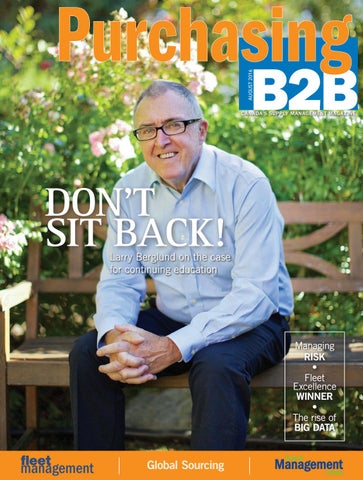
AUGUST 2016
CANADA’S SUPPLY MANAGEMENT MAGAZINE
DON’T SIT BACK!
Larry Berglund on the case for continuing education
Managing RISK • Fleet Excellence WINNER • The rise of BIG DATA
Global Sourcing PB2B_Aug2016_AMS.indd 1
2016-08-09 10:35 AM
Workplace Studio
Inspire productivity. When it comes to planning a workspace, Staples Business Advantage™ works side by side with your business on every step, from creating a custom design to furniture and fixture installation. With cubicles and nesting tables, modular storage and beyond, our dedicated furniture experts bring you nationwide solutions from over 250 top manufacturers. Plus, with our unmatched buying power, you always get competitive pricing. So you can keep your team moving every day. Get started today. Visit StaplesBusinessAdvantage.ca/Furniture or call 1.877.272.2121 to learn more.
PB2B_Staples_August.indd 21 PB2B_Aug2016_AMS.indd
2016-07-14 1:00 2016-08-08 2:34 PM
14 2:34 PM
Table of Contents
Vol. 58, No. 4 • AUGUST 2016
Features 6 SUPPLIER RISK
8
What’s shaping risk for global procurement?
8 GLOBAL SOURCING
The challenges and advantages to sourcing overseas.
11 BIG DATA Here’s what to do with all that information. 13 THE 2016 SCMA NATIONAL CONFERENCE Managed services and the merits of electronic bidding. 14 NEVER STOP LEARNING SCMA names Larry Berglund as the 2016 Fellow.
14
32 PERSONAL PROTECTION EQUIPMENT Tips for buying PPE and other safety gear.
Also inside 4 UP FRONT 5 BUSINESS FRONT 34 THE LAW 16
32
33
Cover photo: Brice Ferré
We encourage you to visit us online to stay in touch with what’s happening in your industry and to view enhanced articles.
Connect With Us Online .ca
PurchasingB2B.ca
@PurchasingB2B
Michael Power
Features SMART INVOICING Improving the efficiency and effectiveness of accounts payable systems. www.PurchasingB2B.ca/features
IT’S ALL IN THE NUMBERS Applying standard deviation calculations in RFP evaluation scoring. www.PurchasingB2B.ca/features
HOW DOES YOUR SALARY STACK UP? Visit the PurchasingB2B online salary calculator to find out where you stand compared to other supply chain professionals. www.PurchasingB2B.ca/features
PurchasingB2B Weekly eNewsletter Sign up today for regular industry news and insights. www.PurchasingB2B.ca/e-newsletter-subscription PurchasingB2B.ca | August 2016 | 3
PB2B_Aug2016_AMS.indd 3
2016-08-08 1:00 PM
Up Front 80 VALLEYBROOK DRIVE TORONTO, ONTARIO M3B 2S9
www.PurchasingB2B.ca PUBLISHER/ADVERTISING SALES
A World Of Contrasts
Dorothy Jakovina 416-510-6899, djakovina@PurchasingB2B.ca EDITOR
Michael Power 416-442-5600 ext 3259, mpower@PurchasingB2B.ca ART DIRECTOR
Andrea M. Smith
T
oday’s business world moves so fast, it seems to shrink and get bigger at the same time. Challenges lead to opportunities, while situations designed to provide opportunities—business travel, for example—are also full of risks for both the organization and the employees doing the travelling. On the one hand, the global economy—and sourcing from across that globe—has lengthened supply chains while bringing more goods and services to consumers than ever before. The accumulation of massive amounts of information (known as big data) has led to insights we couldn’t have arrived at otherwise. At the same time, all this information raises questions regarding what that data actually means and how it should be used. These are some of the contrasts in the world of procurement and supply chain today that you’ll find in this issue of PurchasingB2B. On page 8, we take a look at how global sourcing has changed in recent years, including the ways in which technology affects the process. We also explore how big data (page 11) is providing organizations with opportunities to shape customer decisions in a way that access to information never has before. Along with this coverage, I’m also pleased to profile Larry Berglund, SCMP, MBA, FSCMA, in this issue. Larry was awarded the designation of fellow at the SCMA National Conference in Niagara Falls in June. Each year, the Supply Chain Management Association recognizes individuals and organizations for their contributions to the field, through innovation, dedication and leadership. The distinction is the highest honour that SCMA gives to its members, and Larry has been a practitioner and educator in the field throughout his long career. I’ve been PurchasingB2B’s editor for six years and have been pleased to have Larry as a regular contributor and interview subject for much of that time. He as always been generous with his time and knowledge of procurement and supply chain and never misses a deadline when contributing articles—an important attribute in any writer. PurchasingB2B is happy to feature him on page 14. Along with Larry’s honour, TELUS won the Supply Chain Management Excellence Award for using its supply chain management to enhance its competitive advantage. The company has recently developed several initiatives to transform its procurement and supply chain functions. Hats off to Larry and TELUS. As always, I hope that you enjoy this issue. As a side note, another contrast familiar to most of us is the short Canadian summer, so I hope that you enjoy get a chance to enjoy it.
ACCOUNT COORDINATOR
Tracey Hanson 416-510-6762, thanson@annexbizmedia.com CIRCULATION MANAGER
Barbara Adelt 416-442-5600 x 3546, badelt@PurchasingB2B.ca ANNEX PRINTING & PUBLISHING INC.
VICE-PRESIDENT: T im Dimopoulos (416)510-5100, tdimopoulos@annexweb.com PRESIDENT & CEO: Mike Fredericks, mfredericks@annexweb.com For over 58 years, PurchasingB2B has been a trusted source of information for Canadian purchasing/supply chain management professionals in the private and public sectors. Special features and supplements include Fleet Management, Canadian Automotive Review (CAR), PurchasingB2G, and Travel Management Canada. PurchasingB2B is published six times a year, except for occasional combined, expanded or premium issues which count as two subscription issues, by Annex Business Media. © Contents of this publication are protected and may not be reproduced, in whole or in part, without the written consent of the publisher or editor. NOTICE: PurchasingB2B accepts no responsibility or liability for claims made for any product or service reported or advertised in this issue. PurchasingB2B receives unsolicited materials including letters to the editor, press releases, promotional items and images from time to time.PurchasingB2B, its affiliates and assignees may use, reproduce, publish, re-publish, distribute, store and archive such unsolicited submissions in whole or in part in any form or medium whatsoever, without compensation of any sort. SUBSCRIPTION SERVICES: To subscribe, renew your subscription, or to change your address or information, contact us at 416-510-5713 or 1-866-543-7888, ext 3258, apotal@annexnewcom.ca, or visit us at www.PurchasingB2B.ca. Subscription price per year: $99.95 CDN; Outside Canada per year: $172.95 US; Single issue Canada: $18 CDN. Annual Supply Chain Survey issue, Canada: $45; Outside Canada: $70 US. Taxes extra. From time to time we make our subscription list available to select companies and organizations whose product or service may interest you. If you do not wish your contact information to be made available, please contact us via one of the following methods: Phone: 1-800-668-2374, Fax: 416-442-2200 Mail to: Privacy Officer, 80 Valleybrook Drive, Toronto, ON M3B 2S9 Printed in Canada. ISSN: 1497-1569 (print); 1929-6479 (digital) Publications Mail Agreement No. 40065710 We acknowledge the [financial] support of the Government of Canada
4 | August 2016 | PurchasingB2B.ca
PB2B_Aug2016_AMS.indd 4
2016-08-08 1:00 PM
Business Front
Much Ado About Nothing Is the Brexit vote to leave the EU as disastrous as some say?
Toronto-based Michael Hlinka provides business commentary to CBC Radio One and a column syndicated across the CBC network.
By Michael Hlinka
I
’m certain you’re aware that William Shakespeare was an English poet and playwright who was born about 450 years ago. There is a general consensus that he’s the greatest writer in the English language. I’m not here to dispute that. Wild Bill penned some memorable tragedies: Corialanus is my favourite. Several others, particularly King Lear and Julius Caesar are terrific. But along the way he laid a bunch of eggs. Most of his comedies are not as funny as a really bad episode of the 1970’s sitcom, Three’s Company. And maybe the worst of all is Much Ado About Nothing. I’m not going to write a dissertation about why it is so truly lousy. But I will give that devil Shakespeare
economic confidence—is hitting new all-time highs almost daily. Even more surprisingly, if you look across the pond at the FTSE 100 (England’s most important bourse), it is also reaching never-before-seen levels. Yes, you read that correctly: stocks in the UK are valued higher than they’ve been, demonstrating that with the benefit of 20/20 hindsight, we can understand that the vote to leave the EU was much ado about nothing. It’s important to remember that England embraced the idea of union somewhat reluctantly. It always maintained its own currency, which meant that it had an independent monetary policy. True, the nation enjoyed (or not) free trade, similar to the arrangement that Canada has with the US through NAFTA. But unlike NAFTA, the EU also allows labour mobility across the member nations, meaning it’s possible for an English waiter to serve tables in Greece. It is equally possible for Polish tradespeople to toil in England, and this seemed to be one of the key drivers for “What the people in the UK were saying by the the Leave vote. Labour mobility is a tricky issue. On slimmest of margins was that they were not one hand, I would love the chance to fully satisfied with the current arrangement.” pursue teaching opportunities in the US. At the same time, I have to fear his due: what a great title! And those four magic that the flood of qualified professionals heading north could depress words came back to me with a vengeance in the wake my wages. GDP per capita in the UK is around US$41,000 while you of the recent vote by the people of Great Britain to can reverse the first two digits for Poland’s. It’s just a hair over $14,000. leave the European Union. On June 23 in a referenThis means that when you compare apples with apples, the wage you dum that saw the highest voter turnout in that nation have to pay a skilled Polish tradesmen working in the UK is a third of since its 1982 election, 52 percent said “Hay-ho, what a native would accept. we wanna go!” This surprised most observers and So what the people in the UK were saying by the slimmest of marimmediately after the votes were tallied, stock margins was that they were not fully satisfied with the current arrangement. kets in the developed world swooned. The country isn’t physically going anywhere, which means that whatever Hearing the commentary at the time, you would is ultimately negotiated, Europe will still be its most important trading have thought civilization itself was coming to an partner. Currently, over half the UK’s exports go there. No Brit wants end. Moreover, just when steady leadership and to see this erode. Nor do consumers want to see the goods and services guidance was more important than ever, sitting they import increase in price. This suggests that the negotiations for a new Prime Minister David Cameron announced his arrangement between the UK and its European neighbours will be both resignation. Some commentators saw the Brexit cordial and straightforward. vote as the first domino and wondered what would Mark my words: a treaty with the remaining members of the EU be next. Bond yields spiked in the anticipation that will be negotiated where there will be free trade in goods and services, a global economic slowdown was just around the just as there is now. There will be restrictions around labour mobilcorner. American presidential hopeful, Donald ity—it will be possible for Brits to work on the European mainland Trump, opined that the people of England were and vice-versa, but there will be additional paperwork required. The taking their country back, begging the question: arc of European economic history will not have been impacted and if from whom? Shakespeare were alive today to chronicle what happened, it would be It is now over a month later. The US stock neither comedy nor tragedy, rather it would be…I think you can guess market—the single best proxy there is for global where this is going! B2B PurchasingB2B.ca | August 2016 | 5
PB2B_Aug2016_AMS.indd 5
2016-08-08 1:00 PM
RISK MANAGEMENT’S
FUTURE
W
hile those working in procurement and the supply chain try to plan for contingencies, the field remains full of risk. Tremors in global markets, geopolitical shifts and natural disasters are just some of the risks that procurement professionals must deal with in their jobs on a daily basis. But while practitioners may spend a large amount of time trying to “do the right thing” when it comes to managing these and other perils, situations arise that no one thought of or planned for. Supply chain disruptions, damage, personal injury, liability, lose of product and other risks remain realities despite best efforts. And as the world changes, those risks are going to continue to arise, cautioned Mickey North Rizza, VP of strategic services at BravoSolution, at the Institute of Supply Management (ISM) global conference in Indianapolis in May. North Rizza made the comments during an education session entitled The Future of Risk Management. “Our world is going to really change more than you know, and I think the risks are going to be greater,” she told the audience. For example, the earthquakes in Japan in early 2016 affected the supply chains of Toyota and other firms in that country, North Rizza noted. As well, in the fall of 2015, Nestle found abuse and forced labour in its supply chain among seafood suppliers in Thailand. Even companies working to make ethical and sustainable procurement decisions can run into challenges, North Rizza said. As well, the UK-based clothing retailer Primark began an ethical trading initiative in 2006, only to be cited in a BBC report on child labour issues three years later. While Primark was able to get a retraction and apology from the broadcaster in 2010, the incident affected the company’s brand. “Everywhere we turn, there’s
Education session at ISM conference offers a look at what’s shaping procurement risk By Michael Power
something going on,” North Rizza said. But organizations and countries alike are making efforts to combat these risks, she noted. France has instituted tight controls when it comes to human trafficking and slavery. “If you’re going to model your supply chain, go look at France’s rules,” she advised. As well, Nestle has recently announced a new sustainable sourcing policy around sugar that outlines the ways in which the company plans to work with sugar farmers and
mechanism to escalate if something happens that puts an organization at risk; » Integrate processes across various areas and functions within an organization; and » Look at technology and value management. Supplier lifecycle management is critical to maintaining and achieving value. As well, research the technology of the future, such as robotics, data management and the Internet of Things, 3D printing and so on.
“(Technology) is a risk because it changes so many things—it changes your processes, it changes the way you look at manufacturing. It’s going to change the way you look at your entire world.”—Mickey North Rizza their communities. According to some research, the most important risk management techniques that organizations used were: inventory buffers; supplier monitoring and score-carding; and business continuity and contingency plans; as well as business conversations with suppliers and customers. What to do North Rizza also provided advice for techniques to help organizations prepare for risks. Some of those techniques included: » Research and plan for the next potential crises. Researching and understanding how such risks can affect business is important to mitigating their effects; » Collect accurate and complete spend and supplier data; » Build a catalog of risks. Organizations should look at them and decide what information is needed to limit those risks; » Consider a rule-based approach to risk mitigation; » Organizations should set up governance structure and ensure there’s a
And while technology offers many advantages to organizations, it also presents risks due to the amount of change that comes with it, North Rizza noted. Technology changes so fast that the human brain is incapable of keeping up, which can leave us vulnerable. North Rizza recommended using technology as needed but avoid focusing on what isn’t being used. “Think of it as the industrial revolution again,” she said. “Why is this a risk? It’s a risk because it changes so many things— it changes your processes, it changes the way your technology integrates, it changes the way you might look at manufacturing. It’s going to change the way you look at your entire world, where it’s going and what it’s trying to do.” North Rizza presented an insightful overview of some of the risks that organizations face in procurement and in their supply chains, as well as some methods by which those contingencies can be countered. Procurement professionals would do well to heed some of this advice when dealing with their own risks. B2B
6 | August 2016 | PurchasingB2B.ca
PB2B_Aug2016_AMS.indd 6
2016-08-08 1:00 PM
PB2B_M
PUT BULK WHOLESALE WORKWEAR TO WORK FOR YOU Set up an uninterrupted wholesale supply of compliant industrial workwear and PPE to keep workers safe, comfortable and productive.
Each industry has its own workwear requirements, but what every jobsite has in common is the need for safety. Reduce risk hazards and improve productivity with a consistent supply of high-performance workwear and protective equipment. Maintaining an ongoing inventory of high-quality wholesale workwear will improve safety, resulting in less downtime for workers and business. Longer lasting workwear and PPE will also reduce replacement frequency and cost, while comfortable workwear helps improve productivity. Talk to us about setting up an uninterrupted supply of critical workwear and safety equipment for your crew. Corporate wholesale supply programs, online ordering, direct delivery and a dedicated Client Services Team make Mark’s Commercial the only wholesale workwear supplier you’ll need when safety matters most.
See our Digital Guide markscommercialguide.ca
PB2B_Aug2016_AMS.indd PB2B_Marks_Aug.indd 1 7
2016-08-03 2016-08-08 10:17 1:00 PM AM
By Michael Power
What to consider when dealing with international supply chains
F
or many Canadian companies, global sourcing has become an essential and ingrained part of their procurement practices. But while offering many advantages, sourcing from overseas is also replete with risks that can potentially slow down supply chains, cut into profits, obscure visibility and jeopardize a company’s brand. At the same time, business has become more complex and developments in technology are changing the way organizations operate, including their global sourcing practices. So how should procurement navigate the often-turbulent international waters of global sourcing? Twenty years ago, China was the go-to location for low-cost sourcing. But that situation has shifted—at least somewhat— with slightly diminished advantages from seeking inexpensive goods there, says Garland Chow, associate professor emeritus, operations and logistics division, at the University of British Columbia. Exports from China to the US, for example, were once in the double digits but have more recently fallen to single-digit numbers. At the same time, the amount of sourcing that US companies are doing from the NAFTA countries of Canada and Mexico has increased—in the meantime it’s fallen from Asia (from eight percent to three or four percent). “There’s been a slowdown,” Chow notes. “Offshore will always be there, but the growth is slower.” The decline in the growth rates in sourcing from China began around 2010. But even before the Great Recession, Chow says, the economics hit a break-even point between China and other locations. Part of the shift came from transportation costs, with fuel prices climbing in 2008 but capacity still in excess. Then, a fuel glut has meant that the cost of getting products from Asia to a port of entry in North America has declined, but costs associated with domestic transportation have increased, says Chow. The increase isn’t a direct cost, but rather shows up as a result of delays and congestion. For example, rail has experienced trouble on the West Coast—as has the LA-Long Beach port—which can make getting goods to their destinations slower. And while some of the focus has shifted from China to other countries such as India, Asia overall—China included—does remain a viable destination from which to source, Chow says. Competitive prices have been the driving force towards these alternative locations, but underdeveloped infrastructure still presents a challenge. Other roadblocks emerge when sourcing from regions like
GLOBAL
SOURCIN
SUCCESS South Asia, Chow notes. Several clothing manufacturers won’t buy products from certain countries out of fear their image risks association with poor working conditions. That’s been especially true since the 2012 fire in the Tazreen Fashion factory near Dhaka, Bangladesh. The disaster killed at least 117 people and injured over 200 more, making it the deadliest factory fire in the country’s history.
“There’s definitely a recognition that the global supply chain is a reality, but you have to manage it.” —John Bermudez The perception of sustainability and corporate social responsibility can be paramount, depending on the product. Companies that market hygiene and personal care products, for example, base their image around being good corporate citizens, Chow says. At the same time, they must search constantly for new fragrances and products, often from small farmers in rural areas overseas. These suppliers can be tough for an organization to certify and evaluate, and the need for novelty drives a constant search for them. Part of the solution lies in visiting the locations that are supplying the products and establishing relationships, Chow says. Such relationships can include helping those suppliers improve the sustainability of their own operations—a prac-
8 | August 2016 | PurchasingB2B.ca
PB2B_Aug2016_AMS.indd 8
2016-08-08 1:00 PM
L
CING ©Fotolia
SS
tice in which coffee and chocolate companies have long engaged. These days, the amount of global sourcing that he sees is on the rise, says Calgary-based Jerome Ferber, strategic procurement manager at Versen Energy Infrastructure—but working to meet quality standards can be a challenge. Ferber notes that the costs of doing business with some regions can also be an issue, largely due to increases in local wages and transportation. Longer lead times can mean maintaining more inventory, while moving towards shorter lead times to reduce on-hand inventory—for example, through a just-in-time ( JIT) structure— requires quicker transportation. That means turning to the more costly option of air transport. “This does reduce the time significantly, a ship is four to five weeks whereas a plane is 10 to 12 hours,” Ferber notes. “This translates into less inventory but a higher transportation cost and more frequent shipments. However, it also means quicker to market, sales and revenue.” Technology Technology can increase visibility, Ferber says, which is key to forecasting, planning and scheduling, as well as proper customer service. But technology also comes with a cost, and it must be both reliable and current. Ferber sees an increase in technology use in the global sourcing process in order to enable that visibility. Proper forecasting is also needed to enable shorter lead times, as well as reduce transportation and inventory carrying costs. This all requires training through organizations like the Supply Chain Management Association (SCMA), Ferber says.
John Bermudez, vice-president of supply chain at Infor, agrees with Chow that costs associated with sourcing from China have risen in recent years. As many companies are becoming more international, they’re growing global sourcing efforts and shifting to locations like Vietnam and Indonesia for certain products. An increasing amount of global sourcing will happen in Southeast Asia as the region becomes more stable, he noted. “Like any other shift it’s starting with less complicated items— apparel, footwear, those types of things,” Bermudez says. “It’s followed by less complicated tech products. It’s really no different from 25 years ago when stuff started to shift away from Japan to China. The simpler stuff moved there first, and as the manufacturing capabilities of those regions improved then you’ll see more complicated products shift there.” In the short term, visibility has challenged many organizations as supply chains have lengthened to accommodate an international reach. And depending on the product, late deliveries can be costly. Take, for example, a fashion retailer or manufacturer making one-time buys for a fashion season—if the company wants to bring in fall fashions but the clothing arrives in September rather than August, that’s two weeks of back-toschool sales lost, which can be costly. “We see more companies going with higher-value items that are very time-sensitive— like high-end fashion items—using more air freight,” Bermudez says. “But there’s a need to have that visibility to what’s coming in because you need to make decisions. What if you’re a manufacturer and these are key components going into something that you’re making, what is the change in delivery date going to do to your ability to promise this to customers? If you’re a fashion and apparel company, you’re always worried about agreements with retailers and their sensitivity to selling days and getting it in on time.” It’s not only fashion and apparel companies, Bermudez notes. Pharmaceutical companies, for example, often want to know where everything is. “There’s a recognition that the global supply chain is a reality but you have to manage it,” he says. Technology helps in dealing with these challenges. Easyto-use, cloud-based networks can keep companies up-to-date regarding shipment location by constantly supplying updates. Infor’s cloud-based global commerce platform, GT Nexus, for example, has close to 30,000 suppliers on the network that feed the system updates on product status they provide. When goods leave the factory, the time of arrival at port and other information is now available in real time through the cloud. Technology now offers previously unavailable insights into where a product was manufactured, or “assurance of supply.” After the 2012 fires in Bangladesh, many global brands released statements saying they didn’t produce goods at the Tazreen Fashion factory or similar facilities. But it can be challenging to trace products, and some suppliers were outsourcing to sweatshops, unbeknownst to those organizations. But technology can improve traceability, as smartphones provide first-piece inspection through videos and updates during order production. “Global sourcing, coupled with better technology, can starve out PurchasingB2B.ca | August 2016 | 9
PB2B_Aug2016_AMS.indd 9
2016-08-08 1:00 PM
those types of sweatshops because we can ask for video and pictures,” Bermudez says. “We can know that the video came from a smartphone in a factory in Kuala Lumpur, not Bangladesh. And if it is in Bangladesh, we can get a factory that’s safe and treats its workers well.”
a week to complete, but don’t always reveal potential issues that dealing with a supplier may result in. A physical audit of a supplier that involves a team site visit—including standard questions for suppliers to answer—can take up to three days, Shelton says. Visits can either be done in-house or by a third party. He also recommended looking at quality systems a supplier Due diligence uses, such as ISO or TS, and validating them to ensure what a Michael Shelton, director, strategic supply chain management, supplier has registered is legitimate. Import compliance should Electrovaya Corporation, notes that 3PLs and ERP providers also be considered when dealing with overseas suppliers, since a are moving towards the cloud to obtain visibility into shipments. country could be on the federal government’s list of nations that Lower oil prices have made freight costs more attractive, Shelton Canadian companies can’t trade with. Companies should also says, while the shipping industry has consolidated so overcapac- investigate the geopolitical situation of a region they’re considity has helped promote that good pricing. If oil hit $300 per bar- ering sourcing from. Certain products or commodities may also rel as once predicted, the re-shoring trend would likely have been have import duties attached to them, so check into them. stronger, Shelton notes. China remains the main provider he “An example is anti-dumping,” Shelton says. “Years ago I was sees of globally sourced goods, while other locations also play a dealing with a supplier, buying hardware items. All of a sudden, role. Taiwan is a strong goods provider but at a higher cost than we got notification from CRA that because they were dumping China; Vietnam is popular for textile products; Mexico is still product into the country at pricing less than (it was being sold) robust and low-cost European countries are also becoming pop- domestically, they put 100-percent duty on it. We had to rerun ular sourcing options. our total cost of ownership and obviously dismiss that supplier To mitigate risk, Shelton recommends due diligence on sup- from our approved vendor listing.” plier selection. Depending on the situation, he advocates perOverall, global sourcing continues to play a role in supply forming a “desktop audit” of potential suppliers. For Electrovaya, chains and the practice is unlikely to vanish. Companies should that includes a seven-page questionnaire with certifications pro- ensure they consider as many factors as possible, including total vided, such as ISO16-0902 registration numbers. Such audits take11, about cost AM of ownership, if they plan AM to source Purchasing B2B_AUG Mod: July 2016 10:13 Print: 07/15/16 11:47:12 pagefrom 1 v7overseas. B2B
π SHIPPING SUPPLY SPECIALISTS
WE'RE BIG ON TAPE ORDER BY 6 PM FOR SAME DAY SHIPPING
OVER 2,500 TAPE PRODUCTS IN STOCK
1-800-295-5510 uline.ca
10 PB2B_Uline_August.indd | August 2016 | PurchasingB2B.ca 1
PB2B_Aug2016_AMS.indd 10
2016-07-27 12:57 PM
2016-08-08 1:00 PM
By Michael Power
HARNESSING
©pixelparticle/Getty Images/Thinkstock
A
nyone involved in business understands that the world is different today than it was yesterday, and that it will be even more different tomorrow. Advances in technology, the sharing economy and access to heaps of information (in other words, big data) are changing the landscape and putting pressure on organizations to innovate or face potential extinction. So, what’s a company to do? That was the issue addressed by Manmit Shrimali, founder and head of analytics for Dextro Analytics, at Big Data Toronto 2016, a conference held in Toronto in June. Shrimali discussed big data and its implications for organizations during an educational session entitled From Analytics To Decision Making. Not that long ago, Shrimali told the conference audience, no one could have predicted the rise of companies like Uber and Airbnb. Now, Uber has disrupted the entire transportation system while Airbnb boasts a collective booking of more than the top five franchise hotels, Shrimali said. What’s happening and how should companies react to these changes? Many organizations have reacted by turning to data science, Shrimali noted. But a focus on data and analytics hasn’t yielded the results that many companies had hoped for. In fact, Shrimali said, technology research firm Gartner Inc. found that many Fortune 200 companies said Big Data had made things worse for them. “Microsoft has a huge number of data scientists. The top 10 companies have more than 200 data scientists. There’s no lack of prediction. There’s no lack of scientists. There’s no lack of analytics,” he said. “Analytics can do this and that. But they’re
Organizations should move beyond simply collecting data to learning how to use it to their benefit
still struggling to prove the worth of analytics to senior management.” This is the situation, despite organizations spending a huge amount of time, money and effort on collecting data, Shrimali said. Social media, weather data, passive data, traffic data—collecting such a vast amount of information has led companies to the question of how it should be used. Many organizations respond by hiring data scientists—who possess a combination of programming ability, business knowledge, mathematics and statistical skills, behaviour science acumen and other skills—to help deal with the avalanche of available data. “Don’t think about having an army of data scientists,” Shrimali warned the audience. “Think about what is it that we’re doing with the data science team. Companies have huge data science teams and they’re still failing. Data science isn’t enough.” The business world needs to do some soul searching regarding data science and big data, Shrimali said. And while data is rational, markets and behaviours are not. Information may predict a customer will buy the same product for three years straight, however that same data can’t understand unknowns in the market. Decisions, for example, to buy one product over another, are a complex combination of data, intuition, experience, judgment and other factors. “You need to have a system that doesn’t talk about data science but talks about decision engineering,” he said. “How can we impact the decision, not just data?” What most organizations lack isn’t knowledge, but discriminating knowl-
edge, Shrimali said. That requires delving deeper into consumer behaviour to discover why they make the choices they do. Using different techniques and approaches can help reveal this kind of knowledge. “If you look at the history of product innovation, most of the time only those products which are able to answer and think it through differently are successful,” he said. “The products launched that are simply an incrementally better answer? They failed.” Shrimali used a case study example of an online grocery store looking to boost sales. To do so, Shirmali’s company looked at the buying patterns of everyone who visited the website—what they buy, how they buy it, where they live—and personalized the site based on visitor preferences. They also created an algorithm that recommended personalized products to each user, along with an email campaign recommending products to past customers. They were also able to determine the consumption levels of customers. They then contacted those customers once the levels fell to a certain point that they can buy from the store—while offering a 10-percent discount. “Imagine how we’re now influencing everything,” Shrimali said. “We learn well what they’re using and how they’re using it. We learn all the products they’re using. We’re going to a much deeper level.” Overall, Shrimali’s presentation, as well as Big Data Toronto 2016 conference itself, presented a fresh and innovative take on big data. Attendees left the conference with actionable advice for navigating today’s information-driven business world. B2B PurchasingB2B.ca | August 2016 | 11
PB2B_Aug2016_AMS.indd 11
2016-08-08 1:00 PM
19th Annual SCMAO Conference
DRIVING VALUE CREATION IN SUPPLY CHAIN October 21, 2016 The Westin Prince Toronto
SPEAKER Nicole Verkindt Founder, OMX “Dragon”, Next Gen Den
Join us for Ontario’s premier event for supply chain professionals! Driving Value Creation in Supply Chain brings you a full day of quality education, networking, and the most up-to-date information on industry trends and best practices. WHY ATTEND? • Learn from the leading professionals in supply chain management • Network with over 400 of your industry peers • Discover how the latest research, innovation and technology can
help you and your company achieve success
Visit www.scma.com/on today!
PB2B_SCMAO_Aug.indd 1 12 PB2B_Aug2016_AMS.indd
2016-08-03 2016-08-08 10:27 1:00 PM AM
3 10:27 AM
Generating New Ideas
By Michael Power
Managed services, e-bidding developments among topics at 2016 SCMA National Conference
Dorothy Jakovina
T
he 2016 SCMA National Conference generated not only new ideas, but also healthy attendance as delegates gathered in Niagara Falls to learn about procurement and supply chain from a wide array of speakers. The event drew delegates from across the country for three days of education seminars, keynotes speakers and, of course, mingling and networking with fellow supply chain professionals. Among the education seminars was From Best Price to Best Practices: Evolving Procurement Needs for Managed Services—Alan Spence, national manager, managed document services sales and strategic alliances at RICOH Canada Inc., led the session. The seminar focused on the fact that as managed services evolve to encompass products and services traditionally purchased separately, procurement’s focus must shift from best price to overall value. This change affects both the process and structure of what the sourcing team does to acquire managed services. Using managed services involves handing over a function to a thirdparty provider to run on an organization’s behalf, Spence said. Recently, the nature of the RFP has evolved, with new techniques and methodologies surfacing that can help companies handle managed services more effectively. The traditional approach to the RFP process has been to produce something that everyone can respond to that’s specific in scope, requirements, service levels and so on. Then, an organization will compare the cost of each bidder. And while the decision has always seemed to come down to price, Spence questioned whether the process risked stifling innovation and creativity by putting them in the same box. “These are challenges that you have to be able to address in the short period of an RFP while you’re trying to make the right decision for your organization,” Spence said. Spence advised the audience to seek a proven approach to managed services. For example, managed print requires
lots of parts to deliver the entire operation effectively, so ensure the right people are in place. Adequate change resources must be in place and an organization must ensure they have the proper governance resources, people and processes to make it happen. A supplier who says they don’t need any resources to affect changes should be treated with caution by a buying organization, Spence said. It’s also important to establish a baseline before services are provided in order to show later that the managed services procured actually provided results, he noted. As well, Spence advised audience members to look for key things from a provider, including: • Current state analysis and future state design; • Service transition; • Project management; • Organizational change management; • Governance processes; • Continuous improvement; and • Innovation. Using these as tests can help to prove that a provider can do what it says it can do, Spence said. An e-bidding perspective Also among the conference’s seminars was E-Bidding: A 360-Degree Perspective, a session focusing on the challenges and rewards of switching from paper-based to electronic bidding processes. Gord Sears, manager of procurement services for the Town of Newmarket, noted that his organization had transitioned to e-bidding because it saves time and money. Newmarket began researching e-bidding
about three-and-a-half years ago, he said, and that the process has worked well for the municipality. In setting up its e-bidding capabilities, Newmarket first consulted with experts before executing three mock bids. The town sent out a survey afterwards to collect the vendors’ perspectives—a step that Sears noted was key to improving the process. And while Newmarket hadn’t yet launched total e-bidding for digital bonds, that will likely become a reality early next year. And in the case of system failure, power outage or other calamity, Newmarket has a clause allowing the town to extend the close by however many hours it takes to resolve the crisis. “It’s easy to hit ‘extend,’” he said. “It’s better safe than sorry but we’ve never had to do that.” Leslie Williamson, purchasing, Town of Milton, who also participated in the panel, noted the town decided on a staggered start while implementing its e-bidding process. The town began by accepting e-bids for IT but quickly decided to implement full electronic bid capabilities. Williamson agreed that performing mock bids was imperative to a smooth launch, and the system is highly logical, making it relatively easy for even non-tech-savvy vendors to use it with ease. Overall, the 2016 SCMA National Conference provided a wide array of topics to suit the diverse range of delegates, truly living up to its tagline of “Generating New Ideas”. B2B For more on the SCMA National Conference, visit their website at www.scma.com/en/. PurchasingB2B.ca | August 2016 | 13
PB2B_Aug2016_AMS.indd 13
2016-08-08 1:00 PM
Each year, the Supply Chain Management Association (SCMA) recog nizes those who have contributed to supply chain management. This year, the SCMA Awards of Distinction were presented June 16 at SCMA’s National Conference in Niagara Falls. Larry Berglund, SCMP, MBA, FSCMA, was named the 2016 SCMA Fellow, the highest honour the association can bestow on its members. Fellows are recognized for demonstrating the highest excellence in supply chain management and dedication to promoting the profession.
How did you get involved in procurement and supply chain? I began as a clerk in the City of Vancouver sewers department. I was asked to order supplies and spare parts for the crews on occasion. I found the logistics and the operational issues interesting. That’s when I found out there was a course offered by PMAC on buying, so in 1974 I enrolled in the CPP program; 28 years later I came back as the purchasing manager for the City of Vancouver. What does a typical day look like? As a consultant operating as Presentations Plus Training & Consulting Inc, an author and facilitator, I must stay current on issues which can affect the profession and on the issues I think are “coming around the corner.” The latter are those issues that are scalable or have potential domestic market and global impacts. The circular economy would be an example. A typical day would include scanning publications and media, reading research papers and articles, prepping presentation materials, writing new articles or connecting with clients and colleagues. I also facilitate programs and online sessions for National Education Consulting Inc, which demands a lot of preparation and fact checking. I’m currently drafting an outline for a future book. I also like to spend a lot of time with my grandchildren.
A conversation with Larry Berglund, SCMP, MBA, FSCMA
Brice Ferré
NEVER STOP LEARNING
What career highlights stand out, and what do you like most about your job? Highlights include implementing daily cycle counts in healthcare in 1995 to eliminate an annual inventory count. As far as I know we were one of the first hospitals to do so. We also increased the inventory turnover rate of med/surge supplies from eight times per year to 25 times per year with a 99-percent fill and accuracy rate! I developed a weighted price index model, allowing organizations to track price changes. The model triangulates an internal price index on a basket of goods with external indices and cost drivers. The innovative model was recognized as a leading practice at the 2004 McMaster University Supply Symposium. I felt for years that our professional code of conduct and ethics needed revi-
14 | August 2016 | PurchasingB2B.ca
PB2B_Aug2016_AMS.indd 14
2016-08-08 1:00 PM
sion to reflect a more comprehensive value proposition. When SCMA’s president called me to assist I was more than willing. We formed a team of colleagues and completed the revision, which increases expectations and responsibilities for professionals to be considered as SCMPs. I was involved in drafting and implementing the first ethical and sustainable purchasing policy while I was at the City of Vancouver in 2005. This was a great example of participating with multiple stakeholders to look strategically at how procurement adds value. There was a lot of controversy at the time with this policy, which I think still underlies many public procurement policies affecting social and economic development. At 50, I began my MBA through Athabasca University. I credit this program with raising my strategic thinking and, in particular, supply chain management strategies to truly affect values. I then applied to teach in the undergraduate program at Kwantlen Polytechnic University where I taught part time in their operations management program for several semesters. I also taught online courses for the University of British Columbia Continuing Studies on sustainability issues in the supply chain. What I enjoy most about our profession is the ability to affect the bottom line. Many clients are in the private sector where a strong performance and profits are essential. While other public sector clients are driven by the need to demonstrate value for money. When I work with social enterprises, their need is to be able to provide cost effective services. There are many objectives to a bottom line. I have coached and mentored, helped others to become accredited instructors and hired many who have also gone on to have great careers. What’s your educational background and why is continuing education important? The early 80s recession caused me to reflect on the skills it would take to survive. Although I received my CPP diploma in 1982, I continued to take business courses to develop skills. I have been taking or teaching courses ever since— the life-long student. I saw during this recession how experienced colleagues were not able to hold
on to jobs. Their experience tended to be confined to specific industry knowledge. When these sectors changed, the procurement skills required to enable them to move to another sector were not transferable. Many had their CPP but had not continued their professional development. While my job in the forest industry was also downsized, I moved into public healthcare and eventually into municipal government and university leadership positions easily. I tried to keep my skills and knowledge base as current as possible. I never had an undergraduate degree. As a mature student, Athabasca University offered an entrance into an advanced level of business education that I found exhilarating. Attaining an MBA opens doors and adds credibility. While an SCMP is important, it’s usually the minimum requirement for most procurement roles. The increasing need for competent supply chain professionals means employers look for the differences when assessing potential employees. Ongoing educational commitments are one of the differentiation factors. Why did you write Good Planets Are Hard To Buy and why is the circular economy an important topic? I like to share best and leading practices. The book is provides a synopsis of the key CSR issues facing supply chain professionals, be they private or public sector. The book provides insights into what works or why it needs to change and how to engage in social procurement. I close the book with an introduction into the circular economy. Without the context in the book, the importance of the evolution into a circular economy gets lost. The circular economy is based on supply chains utilizing finite resources and accepting increased responsibility for their actions. What does receiving the 2016 SCMA Fellow Award mean to you? It’s hard to express the tremendous gratitude I continue to feel as a recipient of this award. A peer award is the acknowledgment from your colleagues that you have contributed to the profession in a very meaningful way. The Fellow Award committee conducts rigorous due diligence before making their decision—all
the more reason to feel the merit of this professional recognition. What future plans do you have in the field? I plan to continue to write, facilitate, lecture and mentor colleagues. I sincerely want to move the profession further into the area of social procurement. Get off the “lowest cost” bandwagon and begin to affect social and economic development in the communities we serve. Tell us something about yourself that most people in supply chain wouldn’t know. I really enjoy music and have played guitar for 50-plus years and once played before 5,000 people in Vancouver. I’ve been married for 45 years. I’m a voracious reader and try to read at least one book a week. I taught workshops in Hong Kong and Singapore. I had a case study published in the textbook Purchasing & Supply Management, 13th edition. What skills, background, knowledge or education will procurement and supply chain require in the future? Business acumen is built in many ways. Effective interpersonal skills and strategic thinking can be developed. Understand deep spend analytics. Have a high level of emotional intelligence. Polish your presentation skills. Apply the total cost of ownership in your decisions. Business process improvement skills are in demand. Appreciate the principles of quality management and operations management. Supply chain plays a critical role in the economic multiplier effect. What advice would you give those considering a career in procurement or supply chain? An SCMP is the starting point. Avoid being labelled as only a public buyer or only a steel buyer or only a food buyer. Challenge the status quo. Best practices become common practices—seek out leading practices. Be humbled by knowledge learned from others and share credit. Draw ideas from a range of publications and people. Build relationships. Take a public speaking course. Don’t be afraid to make mistakes and learn from them—I did, many times. B2B PurchasingB2B.ca | August 2016 | 15
PB2B_Aug2016_AMS.indd 15
2016-08-08 1:00 PM
It… is about being local and global. ARI is known and trusted by fleet decision-makers throughout Canada to streamline operations and control costs. We know that every customer has unique fleet challenges. Through our six regional offices, three 24-7 maintenance call centres and Canada’s largest vendor network—we dig deeper and go further to deliver customized solutions. Across Canada, North America, and the globe—our fleet management expertise is around the corner. Learn more about ARI’s professional fleet management services: 1-800-361-5882 | www.arifleet.ca
PB2B_Aug2016_AMS.indd 16
2016-08-08 1:00 PM
AUGUST 2016
18 BIG DATA
A look at how big data is affecting the fleet world.
20 BACK TO THE FUTURE
20
28
Fleet technology and innovation at ARI annual forum.
22 2016 FLEET EXCELLENCE AWARD
Jeff Meggitt wins a FLEXY.
26
26 HONDA RIDGELINE
Ridgeline gets update that won’t sacrifice cult status.
28 FUEL ECONOMY
Highlights from the 2016 AJAC EcoRun.
Fleet Management is a special section of PurchasingB2B magazine, running in the February, June, August and December issues. It is an important resource for Canadian procurement professionals who recommend, select and manage fleet vendors and service providers. Editorial inquiries: Michael Power, MPower@PurchasingB2B.ca. Advertising inquiries: Dorothy Jakovina, 416.510.6899, djakovina@PurchasingB2B.ca.
Mazda Motor Corporation has released SKYACTIV-VEHICLE DYNAMICS, a series of vehicle motion control technologies. The first in the series, G-Vectoring Control, will be featured in all new-generation models starting with the updated Mazda3. Part of the SKYACTIV series, SKYACTIV-VEHICLE DYNAMICS technologies provide integrated engine control of the engine, transmission, chassis and body to enhance the car’s connectedness between car and driver, said Mazda. The first technology in the SKYACTIV-VEHICLE DYNAMICS series, G-Vectoring Control (GVC), Mazda said the system varies engine torque in response to steering inputs to provide integrated control of lateral and longitudinal acceleration forces and optimize the vertical load on each wheel for smooth and efficient vehicle motion. Optimizing the load on each tire brings the car’s movements in line with driver intentions, the company said, reducing the need for steering corrections. Changes in acceleration forces are smoother, reducing torso sway. In addition, said Mazda, GVC improves handling and stability on wet, snowy and unpaved roads.
General Motors Co. has appointed Tony Francavilla vice-president, global quality. He will report to Mary Barra, chairman and CEO. Francavilla is now responsible for leading General Motors’ global quality efforts. The company said he has in-depth knowledge and global experience in manufacturing, engineering and supplier quality. Francavilla has served in a variety of senior roles within the quality organization, including executive director of global supplier quality. Before that, he led the company’s manufacturing operations at GM’s Lansing Grand River, Lansing Delta Township and Flint Truck plants. Francavilla began at GM in 1979 as a co-op student at GM Canada in St. Catharines, ON. He has served in various positions, including manufacturing management for a major pickup truck launch, plant manager positions in Ellesmere Port, UK and Gliwice, Poland and as managing director of GM Poland. © General Motors
GM Names New Global Quality Chief
CNW Group/Mazda Canada Inc
Mazda Releases Vehicle Motion Technology
FLEET MANAGEMENT | PurchasingB2B.ca | August 2016 | 17
PB2B_Aug2016_AMS.indd 17
2016-08-09 10:34 AM
The relationship between big data and fleet management By Paul Zikopoulos and Stephanie Trunzo
T
he poet A. R. Ammons once wrote, “A word too much repeated falls out of being.” No question, the word big data is much repeated, but we’re not counting on it falling out of being anytime soon. By applying the concept of a digital transformation with the insights potential from simply a programmed destination to the fastest route possible. The low hanging fruit Fleets spend US$85 million-plus daily on fuel. COMDATA (a payment processor and issuer of Fleet fuel cards) estimated that 54 percent of fleet drivers don’t make the most optimized fuel purchase decisions while on the road. Their data suggest that optimizing drivers’ fuel purchases could result in an average savings of $0.25 per gallon—that’s significant. How can you ensure drivers have the information in hand, when they need it, to make the best fueling decisions? Big data married to a digital transformation! PointSource are digital transformation and big data experts. They created an inflection point with the FleetAdvance app they built for COMDATA which transformed navigational course routing from paper and static facts, to digital experiences inspired by data. Mobile is a cornerstone of any fleet big data strategy because it reaches beyond printed and papers and into a driver’s cab. By leveraging data from half a million daily transactions with the complex pricing algorithms of each fleet, driver preferences, and the driver’s current location, FleetAdvance became a finely-tuned recommendation engine that optimizes the best stop
Weather If weather impacts a third of the global GDP daily, surely it has to be part of any fleet management initiative. Imagine marrying real-time weather data to understand fuel economy and recommended stops, not to mention safety, predicted traffic flow, construction and so on. Considering that a single hail storm in Phoenix once caused $20 million in damages, and that 52 percent of people that receive a weather alert take action on them with their own cars, the benefits of messaging fleet drivers about impending weather could have an incredible impact on at-risk inventories, their logistics, demand, and more. As the sophistication of analytics has matured so too have the use cases for big data. Fleet management and data initiatives used to be focused on fuel-price optimization (the low-hanging fruit—still a great place to start). But with gas prices in a trough since their April 2014 peak there’s never been a better time to
©Taylor Hinton/GettyImages/Thinkstock
The Fastest Route Possible
at any moment, in real-time. This level of optimization could never be accomplished using traditional methods based on paper-based map calculations, annually published truck spot and amenity books, and printed fuel stop discounts. Not only is this data static, but the ‘true’ real-time experience isn’t shared with others in the fleet. Any industry leaders have rich prediction and recommendation engines infused into their business. Take Netflix as an example. Recommendation engines are so key to this business they offered up a million-dollar prize in a contest that challenged anyone to build a better recommendation engine than what Netflix was using. With a robust recommendation engine, fleets can weigh their algorithm based on their forecasting and optimize fuel stops to keep costs down. What’s more, they can provide those learnings to their independent operators, who otherwise may not have knowledge of pre-negotiated loyalty rates and the fleet’s overall fuel buying strategy. Now imagine tying this into a driver reward’s program, where fleet drivers could benefit from not just using the app to save the company money, which in turn rewards the driver, but pushing data back into the recommendation engine with reviews, comments, and observations.
18 | August 2016 | PurchasingB2B.ca | FLEET MANAGEMENT
PB2B_Aug2016_AMS.indd 18
2016-08-08 1:00 PM
consider other use cases that have potentially even bigger benefits; for example, preventative maintenance and driver safety are major areas that could benefit from the power of big data. Safety. Quite simply, the fleet business needs a shared risk profile that includes the driver, not insulates them. We’d suggest that fleet needs to reward good drivers. Look at the impact this transformation has had on the consumer market with insurer-provided discounts for driver behavior. (These programs not only reward good driving, the insurance companies are learning what a good driver ‘looks’ like, how they act, how they respond to specific situations; not to mention the people that sign up for such programs are likely to be good drivers in the first place, so insurance companies can pay extra attention to those who aren’t interested in a shared drive behaviour program). In a big data-fueled fleet business, high-risk drivers can be identified and remediation techniques applied. For example, feet management operations might apply a salary-linked deductible, or deliver warning messages as ‘suspect’ drivers enter high collision zones
Security Data security will be a big thing for fleet management. The ability to hack connected cars has been well-proven and publicly documented. One car that was subject of a recent public hack had over 30 wireless access points that were compromised, allowing hackers to control everything from the car’s speed, to window wipers, to blaring heavy metal over the radio. How are updates and patches applied today to fleet? Cars have to come in to be serviced—and this creates downtime, which costs money. Fleet could partner with car manufacturers to deliver OTA (over the air) updates, else be faced with serious trade-offs between security and operations. Consider this. Fleet drivers are likely to pair their smart phones to vehicles in this hands-free commute society; when they do that they have to give permissions and trusts that would give hackers not only access to control features of the car, but also access to potential confidential company and personal information that resides on the device. When you think about it, the portfolio of uses cases for big data and fleet management are limitless. Projects could integrate with smarter city initiatives for parking (30 percent of downtown traffic congestion can be attributed to cruising around looking for parking) and traffic management (it’s been estimated that 17 percent of fuel consumed in urban areas are from idling at red lights), tolling, and so on. Remote configuration of the fleet is made possible by the Internet of Things (think connected everything) phenomena, and pay per use insurance is just around the corner if not already trialed in some areas. Fleet management is a domain where big data has just started down its impact journey—while ‘cool’ things have happened; the potential is huge. As you start this journey, think about the things we’ve talked about. For your fleet and big data initiatives, you’ll want to look at things like driver notification, behavior and profiling. Vehicle care, real-time monitoring, and automated digital logbooks with advanced logistics rise to the top of our candidate lists. Personal health monitoring, infotainment and vehicle care are other domains that come with their own uses case. Hard to deny the opportunities are endless, but so too are the potential detours that will get you off track for business outcomes. As you define what may be your first big data project, remember one thing. Without analytics, big data is just going to be a bunch of data. B2B
“Fleet management companies have a chance to know their driver behavior and vehicle reliability better than insurance companies and car manufactures.” or weather warrants reminders to drive to match conditions. While it doesn’t feel this way when you’re sitting at a gate in a hot plane, but airlines can be fined thousands of dollars for every minute they sit at the gate with a mechanical delay. Airlines, manufacturing, and fleet share a common trait: preventative maintenance can alter financial outcomes—data is a prerequisite to unlocking value here. There are many more big data opportunities for fleet—for example, think about applying open data from cities to route planning, things like planned traffic construction and so on. We’ve discussed preventative maintenance and insurance use cases, because of their high impact potential. Think about it: fleet management companies have the unique opportunity to know driver behavior and vehicle reliability better than insurance companies and car manufactures. If an accident happens, the fleet management company gets the call. Car needs repair? Call the fleet management company. A fleet company could know every detail about how their client’s car was driven and where. A big data initiative for fleet optimization can create new business models—the business of information. And that is a commodity that can be sold. Cconsider what the PokemonGo craze is really about from the provider side—behavior. A big data fleet initiative is a knowledge corpus as much as it is as a business outcome.
Stephanie Lynn Trunzo is the chief operating officer and chief digital officer for PointSource. Paul Zikopoulous is the VP of big data and analytics for IBM’s analytics platform.
FLEET MANAGEMENT | PurchasingB2B.ca | August 2016 | 19
PB2B_Aug2016_AMS.indd 19
2016-08-08 1:00 PM
ARI is hosting its 2016 cross-
BEST
Canada Fleet Forums, an annual series providing best practices
FLEET
Telematics and fleet safety among areas highlighted at ARI annual forums
and a look at trends. This year, “Best in Fleet” is the focus of the series, which includes information on areas like fleet safety and telematics. The series kicked off June 2 in Toronto, followed by Vancouver on August 9, Calgary on August 11 and Montreal on September 27. Here’s a roundup of some of the vehicles attendees could peruse at the Toronto event.
HYUNDAI IONIQ With a choice of hybrid, plug-in hybrid or all-electric powertrains, IONIQ improves access to low- to zero-emission mobility while offering the latest connectivity and safety technologies. The IONIQ Hybrid and Plug-in Hybrid feature a 1.6-litre four-cylinder engine with gasoline direct injection combined with a six-speed dual clutch transmission. The mated electric motor is powered by an advanced lithium-ion polymer battery enabling pure electric driving—for an estimated 37km range in the Plug-in Hybrid—and instant torque delivery. The all-electric range extends to an estimated 170km in IONIQ Electric. A fluid exterior shape and air curtains compliment the hatchback profile, diverting airflow around the front wheels for reduced drag.
turbo engine spools up quickly, employing all of the engine’s 273lb-ft of torque from just 1,300rpm. A new interpretation of modern luxury is evident in the way the vehicle combines sensual purity with dynamic sportiness; high-class materials featuring a handcrafted character and surfaces that embody a degree of tension and precise lines.
Hyundai
MERCEDES BENZ GLC The GLC makes its mark with high safety standards and state-of-the-art assistance systems. The vehicle features AIR BODY CONTROL multi-chamber air suspension, and the extended range of DYNAMIC SELECT transmission modes and 4MATIC all-wheel drive increase ride comfort and agility. The advanced GLC 300 4MATIC
Mercedes Benz
GM Canada
CHEVROLET MALIBU The 2016 Chevrolet Malibu features an all-new hybrid powertrain offering a fuel consumption rating of 5.0 L/100km city and 5.1 L/100km highway. The engine features Exhaust Gas Heat Recovery technology, using exhaust heat to warm the engine and cabin. The Teen Driver feature provides audible and visual warnings when the vehicle is travelling over predetermined speeds and lets parents view how their teenager drove. Parameters include speed, distance and how often safety features were engaged. Available safety features include new lane keep assist with lane departure warning, side blind zone alert with lane change alert and front and rear park assist.
20 | August 2016 | PurchasingB2B.ca | FLEET MANAGEMENT
PB2B_Aug2016_AMS.indd 20
2016-08-08 1:00 PM
NISSAN QX30 INFINITI The QX30 premium crossover offers an elevated ride height, confidence-inspiring handling and comes with an available intelligent all-wheel drive system. While sharing basic exterior and interior designs, the QX30 will be offered in three versions, each with its own front and rear fascia, wheel design and exterior themes. The QX30 has a sculpted exterior, unique crossover stance and asymmetric cabin design. The QX30S has a lower stance, cross-drilled front brake rotors, 19-inch wheels and performance tires. The QX30 AWD has an intelligent all-wheel drive system and is a higher ride height, as well as off-road inspired front and rear valence panels.
Ford Motor Company
FORD FUSION The new Ford Fusion lineup includes two hybrid models and an all-wheel-drive Fusion V6 Sport. The Fusion V6 features a twin-turbocharged 2.7-L Eco EcoBoost V6 with a projected 325 horsepower and 350lb.-ft. of torque. It adds continuously controlled damping for real-time suspension tuning. The system features pothole detection technology that adjusts the shock absorbers, reducing impact transmitted to occupants. A new stop-and-go technology, when activated, accelerates and brakes while keeping a safe distance from the vehicle ahead. The Fusion Hybrid and Fusion Energi offer an EcoGuide system providing real-time coaching for better fuel economy. Fusion also features Ford’s pedestrian detection system and hands-free parallel and perpendicular parking capability.
Nissan
SUBARU IMPREZA—EYESIGHT Subaru Eyesight uses two cameras to ‘see’ vehicles and alert the driver and, if needed, attempt to advert a frontal collision. Functions include: • Adaptive cruise control—maintains a set speed and adjusts to keep a safe distance from the car ahead. It brings the vehicle to a stop and resumes settings as traffic flows; • Pre-collision braking, pre-collision throttle management—the system detects a frontal collision and brakes to a stop; • Lane keep assist, lane departure warning and lane sway alert—activates a chime when a vehicle drifts or is too close to another lane. The system is available on the Impreza, Crosstrek, Legacy, Outback and Forester vehicles from mid-trim levels up.
CHRYSLER PACIFICA The 2017 Chrysler Pacifica has been re-engineered and has low levels of wind noise, road noise and related vibration/harshness characteristics. Active Noise Cancellation (ANC) is standard and the Stow ’n Go seating and storage system is redesigned. The front seat moves forward so the second-row seat can be stowed in the floor tub. There’s a choice of two powertrains—a hybrid and the next generation of the Pentastar V-6 gasoline engine. The Surround View camera uses four cameras to provide 360-degree views. Other features include: ParkSense Parallel/Perpendicular Park Assist; Adaptive Cruise Control with Stop and Hold; Forward Collision WarningPlus; and LaneSense Lane Departure Warning-Plus.
Fiat Chrysler Automobiles
Michael Power Subaru Canada
VOLKSWAGEN SPORTWAGEN ALLTRACK Volkswagen is introducing its 4MOTION all-wheel-drive system on the Golf SportWagen. Utilizing a haldex-coupling to move power front to rear as required, 4MOTION provides excellent traction. Powered by a 170-horsepower turbocharged and direct-injected engine, the Sportwagen 4MOTION will feature Volkswagen’s unique DSG automatic transmission. A new trim level called Alltrack takes features found on the Highline models and adds higher suspension, unique bumpers and front grille and 18” Canyon alloy wheels. The vehicle sports rain-sensing wipers, chrome roof rails and keyless access with push button start. Also available will be a technology package featuring adaptive cruise control, navigation, autonomous emergency braking, lane assist and park distance control.
FLEET MANAGEMENT | PurchasingB2B.ca | August 2016 | 21
PB2B_Aug2016_AMS.indd 21
2016-08-08 1:00 PM
Photo courtesy of Jeff Meggit
York Region’s Jeff Meggitt takes home a Fleet Excellence Award
FLEET
TRANSFORMATION W plishments during the past year that either set high examples or provided groundbreaking ideas for the industry. The Regional Municipality of York’s corporate fleet provides a wide range of vehicles and equipment to 47 divisions. The fleet boasts an array of vehicles and equipment used to meet diverse operational needs, including 312 vehicles (plug-in hybrids to tandem snowplows) and 165 pieces of construction equipment. The total annual fleet utilization is 4.3 million kilometres. When he started the position, Meggitt says he saw a “disconnect” within the organization’s fleet operations. Vehicles weren’t meeting operational needs, and there was a backlog in acquisitions. Meggitt says he also wanted to empower frontline staff by getting them more involved in the vehicle procurement process. Meggitt says that his biggest priority
was “playing catch up” to replace vehicles that were due for replacement. At the time, the region was focused largely on repairs rather than preventative maintenance. To break that cycle, the Region’s fleet services has worked towards a ratio of 60 percent preventative maintenance and 40 percent repair work. “We undertook a continuous improvement initiative to evaluate the equipment we’re purchasing and try to update the fleet at every opportunity,” he says. “It was a holistic approach to get very aggressive with capital purchasing to replace vehicles that were long overdue for replacement.” Challenge and change But the road hasn’t always been easy, since it involved changes to every fleet asset the Region bought, Meggitt says. Those changes not only to maximized asset performance, but helped to make
Photo courtesy of Jeff Meggit
hile Jeff Meggitt has managed fleet services, roads and traffic operations, transportation services at the Regional Municipality of York since 2012, he’s no stranger to either fleet or the region north of Toronto. In fact, Meggitt was manager of fleet, waste and traffic operations for the Town of Richmond Hill—part of York Region— for over 20 years before making the switch to the regional government. His dedication to the field has paid off, as Meggitt recently won a Fleet Excellence Award (FLEXY) from the North American Fleet Association (NAFA) at the organization’s annual Institute and Expo earlier this year. Meggitt took home the award for Outstanding Achievement in Public Fleet Management, the only Canadian to win this year. The accolade recognizes a public service or government fleet manager who had outstanding achievements or accom-
By Michael Power
Despite having won the FLEXY Award, Meggitt (back row, second from right) stresses the importance of his team in achieving the department’s goals. The sense of being a team is very important to the way the department functions, he says, and it leads to a culture of innovation among employees.
Jeff Meggitt, fleet services, roads and traffic operations, transportation services at the Regional Municipality of York and winner of the FLEXY for Outstanding Achievement in Public Fleet Management.
22 | August 2016 | PurchasingB2B.ca | FLEET MANAGEMENT
PB2B_Aug2016_AMS.indd 22
2016-08-08 1:00 PM
PB2B_To
Photo courtesy of Jeff Meggit
PB2B_Toyota_Aug.indd 1 23 PB2B_Aug2016_AMS.indd
2016-07-28 1:00 2016-08-08 3:23 PM
Photo courtesy of Jeff Meggitt
the operators’ jobs easier. Technology Sustainability kept him engaged with the organization. helped ease the burden on frontline staff, Under Meggitt’s stewardship, York “That support comes not only from with one of the simplest-looking yet larg- Region’s fleet has made even more strides suppliers but also from different fleet est shifts being to the purchase of auto- towards sustainability. In 2015, the managers both in the public and private matic transmission vehicles for services Region underwent a third-party green sectors that truly don’t come with any like snow removal and salting. fleet audit and is now registered in the preconceived agendas,” he says. “It’s [all “There’s enough that goes on in the cab NAFA Fleet Sustainability Program. The about] support and information sharing.” of a truck that it makes no sense to try to same year, he oversaw the establishment Meggitt stresses a team approach in change gears and manage the snowplow, of a motor pool, including plug-in hybrid his department that leads to continual the wing, and the sander all by them- vehicles and Level 2 plug-in charging sta- improvement and staff empowerment—a selves,” Meggitt says. “So we made the tions to promote alternative fuel vehi- path he says has boosted innovation. And fundamental change to go to automatics cles to staff and to minimize fuel use for although he won the award, he insists it’s and computer control systems in the truck short trips. These vehicles achieved fuel not just about him, but rather the team. to manage how much salt is distributed.” consumption of less than 4.5 L/100km. “We have to function as a team,” As a result, the region’s fleet has Meggitt notes. “It’s important to undergone a major transformation. be able to rely on what superviIn 2015, it deployed 13 new snowsors under me as well as their staff plows through an inclusive approach are conveying and listen to their from operator to manager, reppoint of view. They’ve got a differresenting a total change to the ent knowledge base than we have. Region’s historical snowplow units. The whole sense of team structure Another change involved proreally fits within our fleet operacurement, when the fleet departtion. We encourage it—it’s somement realized the tendering thing we rely on heavily and take process wasn’t always the best way While Jeff Meggitt has managed York Region’s fleet services, seriously.” to procure vehicles or services. It has roads and traffic operations, transportation services since That culture of innovation has moved towards RFPs, which allows 2012, he worked for the Town of Richmond Hill—part of the paid off in several ways for the Meggitt to evaluate more than just region—for over 20 years. fleet department. Under Meggitt’s the bottom-line price. This helps fleet ser- Idle reduction programs and technology leadership, technicians are encouraged vices to keep front-line staff involved in introductions focused on GHG reduc- to be creative which has led to, for examprocurement, and they can see what the tions and fuel savings. By introducing ple, redesigning the LED snowplow wing characteristics of each proposal are and a sustained fleet procurement strategy lighting to incorporate internal wiring whether it would fit with the job’s needs. over the past four years, 238 units worth and sealed housings to improve durabil“That’s been my position from day one— $14.9 million (mostly replacements) have ity and performance—a design that the it’s key to make sure that the guys using the been put into service. This transforma- manufacturer subsequently adopted. As equipment are involved in the selection of tion has reduced vehicle downtime and well, technicians recognized the need it. It’s their office that we’re designing and GHG emissions and allowed for a focus for an “elevated wing” for a snow blower buying so let’s make it as useful for them on preventative maintenance rather than along the Region’s new rapid transit netas possible. And if they’re involved since repair. In 2015, the fleet was available work. When no commercial product day one, I hope they take better care of the 99.7 percent of the time. was available, a hydraulically adjustable equipment and it lasts longer.” “Whatever innovation we can put into wing was manufactured in York Region’s Meggitt not only got frontline staff more the vehicle to reduce greenhouse gas garage. The wing incorporates a “floatinvolved in the procurement process, but emissions or reduce idle time is all some- ing bottom edge” to follow the top of has worked to incorporate equipment thing we’re trying to do on a case-by-case curbs and minimize damage to the tranusers in all stages of asset acquisition. basis,” Meggitt says. sit network’s boulevard streetscape feaHe encourages direct operator involveMeggitt has also been involved with tures. The technicians who invented ment in asset specifications and outfitting NAFA for the past five years. He obtained the wing are now applying for a patent. to make sure those vehicles meet opera- his CAFM in 2015 and is now the chair of “Quite honestly, that’s unheard of—I’ve tional and fleet needs. This approach has its Ontario chapter. The organization has never witnessed that in a municipal envitransformed the region’s fleet, leading been effective for networking and coop- ronment in my career,” Meggitt says. to a focus on continuous improvement, eration, he says, with members quick to “We’re doing some really good stuff and effective lifecycle management, optimi- help colleagues. Meggitt notes that it’s it’s getting noticed. I’m proud to be part zation, fleet rightsizing and sustainability. that collaboration and support that has of that change.” B2B 24 | August 2016 | PurchasingB2B.ca | FLEET MANAGEMENT
PB2B_Aug2016_AMS.indd 24
2016-08-09 10:33 AM
PB2B_N
T:8.125» S:7»
2016 NISSAN ROGUE CONQUERS TIGHT BUDGETS AND OPEN ROADS.
S:10»
The Nissan names, logos, product names, feature names, and slogans are trademarks owned by or licenced to Nissan Motor Co. Ltd. and/or its North American subsidiaries. ©2016 Nissan Canada Inc. All rights reserved.
PB2B_Aug2016_AMS.indd PB2B_Nissan_Aug.indd 1 25
2016-08-08 2016-07-26 1:00 3:56 PM
T:10.75»
For Nissan Canada Fleet Sales, contact fleet@nissancanada.com
Honda Ridgeline won’t sacrifice cult status with this update By Emily Atkins
H
Misfit gets a
MAKEOVER
The massive, lockable under-bed trunk can haul valuables or drinks and ice with equal ease. It even has a drain hole to make clean up after the tailgate party a snap.
The Ridgeline will do this with a host of new features. Most noticeable is the dramatic design change. Gone is the distinctive 135-degree angle between the back of the cab and the truck bed. Now it’s got a 90-degree angle that makes it look more like a typical pick-up. The truck also sports rounded wheel wells— replacing boxy, square ones—sleek, modern styling and a complete front-end makeover. The effect is very sporty. Inside, and under the skin, new mechanicals include a more powerful 3.5-litre V6 engine with six-speed automatic transmission. It makes 280 horsepower and 262 lb.-ft. of torque.
Emily Atkins
onda’s mid-size Ridgeline pick-up has been a beloved misfit since its introduction in 2006. With its offbeat appearance and ultra-practical utility, the truck quickly became a cult classic. The 2017 model debuts the second generation Ridgeline Honda is bringing to market to meet the “day-to-day driving and hauling needs of truck users” with no compromise in comfort, says Jeff Conrad, senior vice-president and general manager of the Honda division.
What Honda’s really excited about is the electronically controlled all-wheel drive torque vectoring system, known as i-VTM4. So far, the Ridgeline is the only vehicle in the segment–which includes the Toyota Tacoma, Chevy Colorado and GM’s Canyon—to include this technology. This allows the truck to adapt to driving conditions on the fly, and relieves the driver of the need to shift between modes when changing surfaces. It does allow you to select traction management pre-sets for snow, sand, mud and normal conditions, and although you can feel the difference, particularly in sand, the torque vectoring— which moves torque to the axle and wheels that need it—makes the Ridgeline particularly easy to drive. We tested the truck both on and off road and it performed extremely well compared to the competitive set of mid-size trucks. The Ridgeline is also the only vehicle in its class with unibody construction, and the difference in ride is dramatic.
FACTS:
2017 HONDA RIDGELINE, MID-SIZE PICKUP MSRP: Not yet available Fuel Economy (Regular; L/100km): City: 12.8 | Highway: 9.5 | Combined: 11.3 Engine: 3.5-L, V6 Transmission: 6-speed automatic Drivetrain: AWD with i-VTM4 torque vectoring HP: 280; Torque: 262 Towing: 5,000 lb /2,268kg Bed Capacity: 1,584 lb/718.5 kg
26 | August 2016 | PurchasingB2B.ca | FLEET MANAGEMENT
PB2B_Aug2016_AMS.indd 26
2016-08-08 1:00 PM
Emily Atkins
Its quirky looks gone, the new Ridgeline is all grown up and looking sharp.
R
There’s none of the loose, rear-end bounciness that is a pick-up hallmark. Instead, the Ridgeline feels like driving an SUV, which is no surprise given its commonalities with the Honda Pilot, also built on Honda’s Global Light Truck platform The interior is also very similar to the SUV, with an enormous amount of space for five adults, who all ride in comfort. With the rear seats folded, you can slide a
Although white leather might not be the most practical choice for a truck, the Ridgeline has plenty of room for five adults to ride in comfort.
flat screen TV inside the cabin, or even a mountain bike without removing a wheel. Out back, the new Ridgeline has retained some of its most beloved features. The under-bed “trunk” is still there, with its 206.7 litre capacity for valuables or ice and drinks when camping. Likewise, the dual-hinged tailgate still opens down or to the side. The bed is now wider and a little longer, and can accommodate 4x8-foot sheets of building materials flat between the wheel wells. The bed walls are now made of a proprietary composite material that is UV resistant and no longer needs paint. As well, they function as the speakers for the in-bed sound system this Ridgeline pioneers. Audio exciters are affixed to the inside of each panel, making them resonate to create sweet music. It’s a pretty cool trick for a little truck, and it sounds great, as well as being waterproof and shock resistant. It can be risky to revise a cult classic, but Honda listened to Ridgeline owners when it designed the second gen 2017 truck, keeping the best and updating the rest. Chances are when the new pick-up arrives this summer it will develop a fan following all of its own. B2B
Register Now! www.camsc.ca Reception Sponsor:
Gold Sponsors:
Silver Sponsors:
Inclusive Procurement Leadership Summit • September 30th 2016 • Radisson Admiral Hotel Toronto-Harbourfront
PB2B_CAMSC_Aug.indd 1
PB2B_Aug2016_AMS.indd 27
FLEET MANAGEMENT | PurchasingB2B.ca2016-08-02 | August 2016 27 11:40|AM
2016-08-08 1:00 PM
AJAC’s EcoRun demonstrates capabilities of fuel-efficient cars…and their drivers
Flaunting
FUEL ECONOMY By Emily Atkins
Emily Atkins
A
sking a bunch of auto journalists to drive in as ecofriendly a way as possible all the way from Toronto to Ottawa might seem like an impossible task, given our general love of all things fast and powerful. However, that’s exactly what the Automobile Journalists Association of Canada (AJAC) did this June for its fifth EcoRun. The EcoRun is AJAC’s annual showcase of environmentally friendly cars. On the line were bragging rights and a green jersey for the driver with the best fuel economy results for the trip. The variety of cars in the run added to the challenge, with a Chevrolet Colorado diesel pickup at one end of the range and an electric Nissan Leaf at the other. In between on the fuel economy scale was everything from a Porsche 911 to a Toyota Mirai fuel-cell-powered car. To be fair, the EcoRun is not really about the competition. It’s an opportunity for a group of experienced drivers to put cars through a couple days of real-world testing to see how they compare to the fuel economy ratings published by NRCan (Natural Resources Canada). Because each car or truck was driven by six different drivers,
in different conditions, that included city, major highway and country roads, it gave the cars the chance to show their true abilities as eco-friendly vehicles. The results offer consumers a chance to see how a car they are contemplating buying stacks up against its NRCan numbers as well as some competitors. How it works The AJAC EcoRun this year included 27 vehicles and 27 journalists. The trip between Toronto and Ottawa was divided into six legs of varying lengths and different types of driving. Journalists drove a different car for each leg, and at each stopover point the fuel economy results for the leg were collected. The total fuel economy for the entire trip to Ottawa was aggregated and compared to the NRCan number. Because each writer didn’t get to drive all the cars, a system to equalize results was employed to determine the green jersey winner. To do this, the scores were calculated based on the total percentage improvement over the NRCan fuel economy numbers for each car that person drove.
Emily Atkins
The “green” giant. Mercedes Benz’s S 550e Plug-in Hybrid belies its size with astonishingly good fuel economy.
2016 AJAC EcoRun co-chair David Miller (Right) presents sponsor Peter Boag, CEO, Canadian Fuels Association with a ceremonial Green Jersey.
Winning ways Because the green jersey was at stake, all the drivers had something to gain by maximizing their fuel economy. Smooth starts, coasting to stops, and avoiding high speeds on the highway are all keys to more fuel-efficient driving. Turning the car off instead of idling in traffic—something new cars equipped with auto start-stop technology do for you—and not using the AC are additional tricks that help you stay away from the pumps. Driving at or below the speed limit goes very much against my grain as an amateur racecar driver, however. And at times it can be quite dangerous. That’s where I’m putting the blame for my somewhat immoderate first leg in Toronto rush-hour traffic. However, I soon got into the economical driving zone and in the end finished the event in sixth position, with a score of 41.9 percent better fuel economy than posted for my cars.
28 | August 2016 | PurchasingB2B.ca | FLEET MANAGEMENT
PB2B_Aug2016_AMS.indd 28
2016-08-08 1:00 PM
PB2B_El
Element Fleet Management
This is not a fleet manager. She’s a cost-crushing, benchmark-busting, efficiency-is-my-middle-name superhero. CONTINUOUS COLLABORATION
GAME-CHANGING INSIGHTS
POWERFUL ANALYTICS
This woman isn’t afraid of budget meetings. She isn’t intimidated by aggressive goals or daunting demands. She’s got Element Fleet Management. Our collaborative consultants, sophisticated software tools, and world-class products and processes help her be the best fleet manager she can be – only better. Discover how we’re empowering extraordinary. elementfleet.com/discoverextraordinary | 866-877-4355
PB2B_Element_Aug.indd PB2B_Aug2016_AMS.indd1 29
2016-07-27 2016-08-08 2:12 1:00 PM PM
Emily Atkins
Of the cars I drove, my favourite had to be the absolutely contrarian, cognitive-dissonance causing Mercedes Benz S 550e Plug-in Hybrid. This car is a behemoth, looks like a limo, and drives like an absolute dreamboat. It was sheer delight cruising the Northumberland Hills in this monster, all the while marveling at the low, low instant fuel economy feedback it was giving me. Make no mistake, this is a powerful car. Its V6 biturbo engine and hybrid drive together churn out 436hp and 479lb-ft torque and it can sprint from 0 to 100km/h in just 5.2 seconds. It’s rated at 9.0L/100km, and by not testing out the zero to 100km/h capabilities as I normally do, I drove it at 7.0L/100km, the lowest result of any driver at the event. On the opposite end of the scale, the compact Ford Focus 1.0-litre was also a standout. Its tiny one-litre turbocharged Ecoboost engine sips the gas but doesn’t make you feel as though you’re in the cheap seats. In the Focus, I also managed to score first among the journalists, besting the car’s NRCan rating of 7.3L/100 km with a very economical 4.9L/100km. Amazingly, every car turned in better-than-posted fuel economy numbers for the complete trip. That demonstrates the huge influence that driving style can have on fuel economy.
2016 AJAC EcoRun participant vehicles parked in Kingston at the former Women’s Prison for a driver change. NRCan ACTUAL FUEL FUEL 2016 VEHICLES EFFICIENCY EFFICIENCY Chevrolet Colorado Diesel 10.3 7.1 Chevrolet Cruze 6.8 4.9 Chevrolet Malibu Hybrid 5.1 4.4 Chevrolet Spark 6.7 5.4 Chevrolet Volt* 5.6 1.8 Fiat 500 1957 Edition 7.9 6.3 Ford C-MAX Energi Plug-in Hybrid* 6.0 4.0 Ford Focus 1.0 Litre 7.3 5.8 Honda Civic Sedan (Touring) 6.7 4.6 Honda HR-V (EX) 7.6 5.9 Hyundai Sonata Plug-in Hybrid* 5.9 3.8 Kia Optima LX ECO Turbo 7.4 5.6 Lexus CT 200h 5.7 4.2 Lexus RX 450h 8.0 7.1 Mazda CX-3 GT AWD 8.1 6.4 Mazda CX-9 Signature AWD 10.1 7.8 Mazda MX-5 GS 7.8 5.3 Mercedes-Benz S 550e Plug-in Hybrid* 9.0 7.3 Nissan Altima 2.5 SL 7.5 5.3 Nissan Leaf SL (Le/100km) 2.1 1.5 2017 Porsche 911 Carrera 10.1 7.8 smart fortwo cabrio 6.9 4.1 Subaru Impreza 7.6 6.1 Toyota Mirai (Le/100km) 3.5 2.7 Toyota Prius 4.5 3.2 Toyota RAV4 Hybrid 7.2 5.7 Volvo XC90 T8* 9.5 5.9 * Please note that the posted numbers for the plug-in hybrid vehicles are gas consumption only and do not account for electricy used (Le).
AJAC 2016 EcoRun vehicles NRCan versus actual fuel economy, Toronto to Ottawa.
Pitfalls of new technology But even careful driving cannot always give you the extra kilometres you need to reach your destination. Two of the most fuel-efficient vehicles on the trip demonstrated that there is still a way to go before the public will be able to rely completely on these cars for all their transportation needs. As a showcase for new green technology, the EcoRun this year included the Toyota Mirai hydrogen fuel cell vehicle. Boasting an NRCan number of 3.5Le/ 100km (for non-gasoline powered cars, fuel efficiency is calculated in gasoline litres equivalent per 100 kilometres—Le/100km), the Mirai had the second lowest consumption rating on the event. Our hypermiling group of drivers managed to squeeze that down even further to an astonishing 2.7Le/ 100km. The fly in the ointment, however, is that for the second day of driving, a second Mirai had to be trucked to our stopover point.
With a hydrogen fuel cell vehicle, you can’t fill it up at any old gas station. The infrastructure for refueling these cars just does not exist yet in most of Canada. Range anxiety is nothing new for electric car drivers, and is widely cited as a limiting factor for market acceptance. While the infrastructure for charging EVs is improving rapidly, the entire EcoRun schedule and route was arranged around the availability of charging infrastructure for the EVs and plug-in hybrids on the trip. Although every effort was made to ensure the vehicles were charged up and ready for the road, one journalist ended up have to make a side trip to find a charger on the leg between Brockville and Ottawa. Fortunately, information about charging locations is readily available online, and our colleague ended up pleasantly passing his afternoon knocking down pins in Kemptville, Ontario. The Kemptville Bowling Lanes hosts a Level 2 charger as part of the Sun Country Highway.
Lesson learned Ultimately we all made it to Ottawa, posting collective fuel economy performance of 32.7 percent better than the NRCan numbers across all the cars and drivers. The EcoRun demonstrated a few key points for those considering a new car purchase. First, a car doesn’t have to be a tiny subcompact to be fuel-efficient. Both the Mercedes 550 S and the Porsche 911 on the event proved that point. Second, the way you drive a car makes all the difference in your fuel economy. Push that accelerator hard, keep the revs up and drive fast if you want to make more stops at the gas station. And third, while the auto industry is making huge strides introducing alternative fuel vehicles, the infrastructure to support them has not completely caught up. So if you really want that electric car, be prepared to adapt your schedule to its refueling needs. B2B For full details on the EcoRun, the cars and results, visit: www.ajac.ca/eco-run.
30 | August 2016 | PurchasingB2B.ca | FLEET MANAGEMENT
PB2B_Aug2016_AMS.indd 30
2016-08-08 1:00 PM
PB2B_Su
When peace of mind is the reason, Subaru makes the most sense. With a great model lineup to suit your business needs, it simply makes sense to add the safety, value and reliability of Subaru symmetrical full-time All-Wheel Drive vehicles to your fleet. Thanks to the Subaru symmetrical full-time All-Wheel Drive system, all Subaru vehicles are uniquely equipped to offer unsurpassed control and safety in all types of weather conditions and on all types of road surfaces. Affordable acquisition costs, high residual value and volume fleet incentives make Subaru vehicles an excellent value and a smart investment.
It all adds up. Subaru makes the most sense.
PB2B_Subaru_Aug.indd 1 31 PB2B_Aug2016_AMS.indd
fleet.subaru.ca or call 1-877-293-7272
2016-08-03 2016-08-08 10:10 1:00 PM AM
xposure to workplace hazards is a daily reality for many. Ideally, these hazards should be eliminated, controlled at the source or reduced through administrative measures. When all other methods are either unavailable or impossible to implement, personal protective equipment (PPE)—the last level of protection—may be used so that work can continue safely. Understanding the basics of PPE and its selection can play an important part in developing and maintaining a complete health and safety program. What is personal protective equipment (PPE)? PPE is equipment worn by a worker to reduce or minimize exposure to specific physical, chemical, ergonomic or biological occupational hazards. Examples of PPE include respirators, gloves, aprons, fall protection, and full body suits, as well as head, eye and foot protection. Using PPE is one element in a complete safety program that should use a variety of strategies to maintain a safe and healthy occupational environment.
When should PPE be used? It is important to understand that PPE does not eliminate the hazard. Therefore, it does not guarantee permanent or total protection. However, appropriate use of PPE will reduce the risk of injury. For example, wearing hearing protection reduces the likelihood of hearing damage when the earplugs or muffs are appropriate for the kind of noise exposure, and they are used properly (hearing protection does not eliminate the noise). PPE should only be used: » when no other control method is possible; » as an interim measure before other controls are implemented; » for emergencies and during maintenance activities; » for situations where other control methods don’t provide enough protection. How to select PPE Once the need for PPE has been established, the next task is to select the proper type. Two criteria need to be determined: the degree of protection required and the appropriateness of
Essentials of personal protective equipment purchasing the equipment to the situation (including the practicality of the equipment used and kept in good repair). The degree of protection and the design of PPE are integrated because both affect its overall efficiency, wearability, and acceptance of the equipment. Use the following guidelines to help you select the best PPE. Match the PPE to the hazard. There are no shortcuts to PPE selection. Conduct a hazard assessment and choose the right PPE to match the hazards. Get expert advice and shop around. Discuss your needs with an occupational health and safety specialist and trained sales representatives. Ask for alternatives, check into product claims and test data. Involve workers in evaluations. The most common reason for failure of a PPE program is the inability to overcome worker objections to wearing it. Bring approved models into the workplace for trials so workers have the opportunity to evaluate various models. Consider physical comfort of the PPE (ergonomics). If a PPE device is unnecessarily heavy or poorly fitted it is unlikely that it will be worn. Use every opportunity to provide flexibility in the choice of PPE as long as it meets required legislation and standards. Evaluate cost considerations. The cost of PPE is often a concern and disposable options are not always cheaper in the long term. Review regulatory requirements and standards. In Canada, two of the more common standards include the Canadian Standards Association (CSA) and the Bureau de normalisation du Quebec (BNQ). PPE is the last step in the hierarchy of controls, making it the last level of protection between the worker and the hazard. Therefore, it is especially important that the correct PPE is selected, worn and maintained. A complete PPE program consists of many steps from the initial workplace assessment to routine evaluation and review. B2B The Canadian Centre for Occupational Health and Safety (CCOHS) is Canada’s national resource for the advancement of workplace health and safety. Visit their website at www.ccohs.ca.
©Aleksandar Kosev/Getty Images/Thinkstock
The RIGHT STUFF For Safety E
32 | August 2016 | PurchasingB2B.ca
PB2B_Aug2016_AMS.indd 32
2016-08-08 1:00 PM
Safe Journeys Tips and best practices for safe travelling
TIP #1 • Before leaving Depending on your destination and the time of year you’re travelling, you may need to check the weather forecast to help ensure you pack appropriate clothing. If you’re going to Hawaii, you pretty much know what to expect weather-wise. But, if you’re going to Calgary in October, check the forecast to determine if you’ll need to pack summer clothing, winter clothing, or both. Also, always tell someone where you’re going. If you’re travelling alone, ensure at least one other person knows your itinerary. TIP #2 • Flying There are many risks to consider when flying. We won’t cover them all here, but below are a few you may not have thought of. The safety briefings can seem tedious, especially if you’ve flown before. One thing that does vary is where you are seated in relation to the emergency exit. Take a few seconds to figure out your escape route in the event of an emergency. Also, keep your seatbelts fastened at all times while seated. If violent turbulence sets in quick, you may not have time to get your seatbelt on. Lastly, if you’re on a long flight, make sure you get up and walk around at least once every few hours to reduce the risk of blood clots. TIP #3 • Safe driving Plan to drive during daylight hours, if possible, as daytime driving is safer than driving at night. Also, if going to a large city, driving during rush hour. In Canada we’re used to winter condi-
tions. Regardless of how experienced you are with winter driving, there are times when conditions are so bad that no one should be on the road. If the weather outside your window looks scary, check the road reports and postpone travel if it’s not safe. If you’re unfamiliar with your route, use a GPS and make sure you have the sound on so you don’t need to take your eyes off the road. Stay off your cell phone! A recent study conducted by the National Safety Council found that 27 percent of crashes involve cell phone use. You are four times more likely to have an accident if you’re talking on the phone while diving, and eight times more likely when texting. There is a misconception—partly driven by provincial legislation—that hands-free cell phone use is safe. The NSC has looked into this as well and found no conclusive evidence that hands-free cell phone use is safer than handheld. The reason is simple—when you’re on the phone, you’re not thinking about driving. There are other distractions besides cell phones—eating, changing the song on the car stereo, or talking to a passenger—that can be just as dangerous as cell phones. Bottom line: keep your eyes and your mind on the road. And, take frequent breaks. If you feel drowsy, pull over. TIP #4 • Lodging Book your accommodations before leaving home. If you’re travelling to an unfamiliar destination, identify properties that are not only nice but also safe and secure. Ask for a recommendation from someone who knows the area. Also, visit a travel website—you can see what properties are rated highest and read comments from people who’ve been there. Once at your hotel, there are things you can do to help en-
sure a safe and secure stay. If you’re staying at a motel, the property might have rooms on the ground floor. There is a greater chance of a burglary at ground level, so avoid that floor if possible. Once in your room, identify your fire escape route. Lock and chain your door for extra security. If someone knocks use, the peephole to identify him or her. If unsure, keep the door closed and call the front desk to find out what’s happening. If you leave the room, put valuables in the safe. Leave the TV on and use the do not disturb sign. A potential burglar is less likely to enter your room if he thinks you’re inside. If you leave the hotel, ask the staff if there is anything to be concerned about. Sometimes the bad part of town is only a few blocks from the good part, so make sure you stay on the right side of the tracks. Journey management checklist That’s a lot of tips. To help you remember everything, create a checklist for yourself or find one on the Internet. Taking a few extra minutes to plan a safe journey can make a world of difference. B2B Darren Hamman leads the HSE Review and Verification Services (RAVS) team at ISN Canada.
©trendobjects/Getty Images/Thinkstock
A
re you heading off on a business trip soon? While there are risks involved in corporate travel, there are also steps travellers can take to mitigate those risks. Here are some tips to keep safe and secure on the road.
By Darren Hamman
TRAVEL MANAGEMENT CANADA | PurchasingB2B.ca | August 2016 | 33
PB2B_Aug2016_AMS.indd 33
2016-08-08 1:00 PM
The Law
Keeping the bid process clean Competition Bureau targets bid rigging and infrastructure
Mark Warner (mark.warner@ maawlaw.com) is a Toronto-based competition and regulatory lawyer.
By Mark Warner
T
he Liberal government elected last fall has brought a new emphaThe bureau isn’t only interested in public procuresis on infrastructure. This is manifested in the Prime Minister’s ment. In May, it was reported the bureau is investiMandate Letter for the Minister of Infrastructure and Communities gating allegations of price-fixing and bid rigging in and the 2016 Federal Budget included a “historic” plan to invest over $120 the supply of condominium refurbishment services billion in infrastructure over 10 years. in the Greater Toronto Area. The bureau’s investiIn light of this, the Competition Bureau has indicated that it will gation appears to focus on 2006-2014 with over 100 heighten efforts to improve awareness about bid rigging and equip the condo boards compelled to produce records. While procurement community and others with tools to prevent, detect and deter the bureau conducts criminal investigations in prithis damaging and illegal behaviour. The bureau has indicated that this vate it appears that the investigation follows earlier will include presentations to key players, including procurement officials compulsory production orders served on renovation at all three levels of government and representatives from private industry. companies. The probe’s focus appears to be the renThe bureau’s focus is spurred by work of the Organization for Economic ovation firms and possibly condo management firms Cooperation and Development (OECD) that concludes that the distinctive and not necessarily condominium owners or boards. nature of public procurement and its context make it particularly vulnerRecent bureau bid-rigging enforcement includes its able to collusion and corruption, particularly in the construction sector. Industries “Illegal bid-rigging agreements can also take a variety that may give rise to bid-rigging concerns of forms, including cover bidding, bid suppression, include those with homogeneous prodbid rotation, market division and subcontracting.” ucts, simple products or services that have not seen recent technological change and ongoing international auto parts bid-rigging investiwhere there are relatively few suppliers. Illegal bid-rigging agreements can gation that has led to significant fines in Canada and also take a variety of forms, including cover bidding, bid suppression, bid abroad as well as jail terms in the US. Other recent rotation, market division and subcontracting. bureau enforcement successes include public and priThe criminal conspiracy provision of the Competition Act (Section 45) vate construction tenders in Quebec and a loss in a prohibits agreements or arrangements between competitors to fix prices, case involving the supply of information technology allocate markets or customers or limit production or supply. Bid rigging services to two federal government departments. is prohibited in a separate criminal provision of the Competition Act Given the bureau’s recently enhanced bid-rigging (Section 47). It generally relates to agreements not to submit a bid, to withenforcement and awareness efforts, it may be advisdraw a bid or to submit a bid agreed on between bidders where the agreeable for companies to consider adopting or reviewing ment is not disclosed to the person calling for the bids at or before the time competition law compliance programs and ensurthe bid is submitted or withdrawn. ing they have controls to avoid illegal bid rigging. Potential penalties for price-fixing conspiracies and bid rigging include Government agencies and other organizations that criminal fines (up to $25 million for price-fixing and no set limit for bid-rigsource construction or other services through tender ging) and/or prison terms up to 14 years. While Canadian courts have hisprocesses may consider adopting or reviewing their torically imposed conditional sentences involving home confinement and/ processes for detecting and deterring bid rigging. or community service, such conditional sentences have been eliminated Trade and professional associations whose memfor these offences increasing the risk for parties to price-fixing and bid-rigbers provide procurement-related services should ging agreements (as well as those that aid or abet such agreements). consider reviewing internal compliance processes so In general, the bureau relies on its immunity and leniency programs they don’t facilitate coordinated bidding that may to detect illegal bid-rigging activities. These programs create incentives violate the Competition Act. Companies whose perto report bid rigging to the bureau. Along with fines and imprisonment, sonnel attend trade or industry association meetings section 36 of the Competition Act provides that anyone who has suffered should determine whether those associations have loss or damage from conduct contrary to the criminal provisions of the credible and effective compliance programs in place Competition Act, or failure to comply with a tribunal or court order under as a condition for attendance. B2B the Competition Act, may start a private damages action. 34 | August 2016 | PurchasingB2B.ca
PB2B_Aug2016_AMS.indd 34
2016-08-08 1:00 PM
NIE_FP_ PB2B_N
OCTOBER 27, 2016
MISSISSAUGA CONVENTION CENTRE, MISSISSAUGA, ON
NationalIndustryExpo.ca
ATTENDANCE IS FREE! REGISTER AT: NationalIndustryExpo.ca Use Promo Code: NIEAD
CONNECT with Suppliers
SOURCE New Products
GAIN New Insights
EXCHANGE Ideas
YOU NEED TO BE HERE. IT’S AS SIMPLE AS THAT. BROUGHT TO YOU IN PARTNERSHIP BY
www.FRASERS.com
PB2B_Aug2016_AMS.indd NIE_FP_AD_SVA.indd 1 135 PB2B_NIEShow_Aug.indd
www.PurchasingB2B.ca
2016-08-08 1:00 2016-07-29 AM 2016-08-03 10:03 8:58 PM AM