AUGUST 2019
INSI DE
CONC RE T E ON-S IT E PG .39
2019
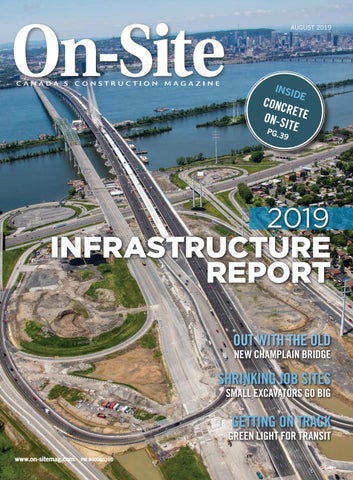
INFRASTRUCTURE REPORT OUT WITH THE OLD NEW CHAMPLAIN BRIDGE
SHRINKING JOB SITES SMALL EXCAVATORS GO BIG
GETTING ON TRACK
GREEN LIGHT FOR TRANSIT www.on-sitemag.com
PM #40065710
THE 2019 SUPER DUTY ®
OUTSMART AND OUTWORK THE COMPETITION MAX TOWING*
35,000 LBS
MAX DIESEL TORQUE** 935 LB-FT
MAX PAYLOAD^ 7,640 LBS
AVAILABLE BLIS® WITH CROSS-TRAFFIC ALERT † & TRAILER COVERAGE
FOR DETAILS, VISIT FORD.CA/SUPERDUTY Vehicle may be shown with optional features. *When properly equipped. Maximum towing capacity on F-450 Regular Cab 4x2. **When properly equipped. Maximum diesel torque on 2019 Super Duty with 6.7L V8 diesel engine and 6-speed automatic transmission (standard) conguration. ^When properly equipped. Maximum payload on 2019 F-350 DRW Regular Cab 4x2 with 6.2L gas engine. † Driver-assist features are supplemental and do not replace the driver’s attention, judgment and need to control the vehicle. ©2019 Ford Motor Company of Canada, Limited. All rights reserved.
VOLUME 64, NO.5 / AUGUST 2019
2019 INFRASTRUCTURE REPORT 17 Staying on target
Fall election looms as federal infrastructure plan progresses in fits and starts
29 Getting on track Urban transit projects roar to life, creating big opportunity for Canada’s construction sector
IN THIS ISSUE 5 Comment Don’t expect a bonanza
17
8 News
The major developments
16 Construction stats The key figures
35 Small excavators go big Compact job sites are forcing contractors to do more with less
56 Doing things differently
Getting ready for prompt payment and adjudication
29 39
COLUMNS 58 Software Artificial intelligence takes on big data
60 Risk Firming in the construction insurance market
62 Contractors and the law Mandatory adjudication: What Ontario can expect
57 Index of Advertisers
CONCRETE ON-SITE 43 Adding to the mix
51
Using admixtures to get your concrete to do what you want it to
Concrete cutting and coring equipment advances on the job site
Drilling down
on-sitemag.com / 3
COMMENT
SNC-Lavalin retreats from construction, but don’t expect a bonanza
Get the latest construction news! Follow us on Twitter @OnSiteMag
The writing’s been on the wall for months, and a few weeks back, SNC-Lavalin Group Inc. finally confirmed the speculation. Facing a laundry list of problems, the company said it plans to turn away from construction, stop taking on lump-sum turnkey contracting work and refocus its business on engineering services. The move came a month after the departure of former CEO Neil Bruce, who led the company for a relatively rocky four years. 2019 in particular, has been gruelling for the Montreal-based company, which has seemed to careen from one issue to the next. A tiff between Canada and Saudi Arabia, where SNC-Lavalin conducts a considerable amount of business, the cancellation of a major Chilean mining contract, poor financial results and a Canadian political scandal, with the company and its legal troubles at the centre, have halved SNC-Lavalin’s market value over the past few months. With shareholders reeling, the company announced the reorganization effort in late July. It will splinter off its engineering, nuclear, infrastructure services and capital businesses into one segment. Its mining, oil and gas and infrastructure construction division will form a secondary unit. While SNC-Lavalin’s oil and gas and mining businesses are focused mainly overseas, the changes to its infrastructure segment are certain to shake up the Canadian construction market. It plans to complete its current backlog of building projects by 2024, but will not pursue new lump-sum contracts. In line with this decision, it will pull out of the procurement processes for several high-profile jobs, such as Vancouver’s Broadway subway extension project and Montreal’s Louis-Hippolyte Lafontaine tunnel rebuild. SNC-Lavalin has had a hand in countless jobs across the country, and on the one hand, the company’s retreat from a major part of the Canadian construction market is a major change. There will undoubtedly be some extra
business up for grabs. Still, when looking at the amount of on-site work the company has actually done in recent years, contractors should probably temper their expectations about filling any sort of major void. According to Canaccord Genuity analyst Yuri Lynk, who has advocated the company divest its construction business entirely in recent months, only about 500 of the 6,600 people employed in SNC-Lavalin’s Infrastructure unit were working in construction roles in 2017. With the bulk of the firm’s workforce dedicated to engineering, “most” of the construction scope of projects has been subcontracted. While this is nothing novel in construction, SNC-Lavalin has taken the practice further than most. It’s also worth noting the embattled company is nearly certain to remain a major player on the engineering side. Even under a complete construction divestment scenario, which hasn’t quite happened, Lynk said in a note to clients earlier in the year that SNC-Lavalin could continue to hold a prominent spot in large-scale P3 projects coast to coast. Instead of disappearing from construction consortia entirely, it will likely take on a different – and as it sees it, less risky – role. “By exiting such contracting and splitting it off from what is otherwise a healthy and robust business, we are tackling the problem at the source, and as a result we expect to see a material improvement in the predictability and clarity of our results,” Ian Edwards, the company’s interim president and CEO, said in the corporate retooling announcement. As SNC-Lavalin exits the construction stage complaining about high risks, Canada’s contractors simply need to continue doing what they’ve always done, taking the risks in stride and out-executing their Montreal-based rival.
David Kennedy / Editor dkennedy@on-sitemag.com on-sitemag.com / 5
CONTRIBUTORS www.on-sitemag.com / Fax: 416-442-2230
MEET OUR CONTRIBUTORS FOR THIS ISSUE NATE HENDLEY / Freelance writer and author On the growing role of mini-excavators: “Powerful but compact excavators are ideal for working on tiny residential lots, or in crowded urban environments where space is at a premium. And because they’re relatively light, mini-excavators are easier to transport than bulkier equipment.”
ARIF GHAFFUR / President, Lakeland Consulting Inc., and Director of the Canada Board of the Royal Institution of Chartered Surveyors (RICS) and the Board of the Canada Branch of the Chartered Institute of Arbitrators (CIArb) On preparing for new prompt payment and adjudication rules: “These changes will apply to construction projects ranging from small scale jobs to multibillion-dollar P3 projects.”
JACOB STOLLER / Principal, StollerStrategies On how artificial intelligence is breaking down big data: “AI is being used extensively to make information… more accessible. A system can now scan a set of PDF plans and through AI, identify… information so that a supervisor in the field can quickly locate a specific part of a plan on a tablet.”
DAVID BOWCOTT / Global Director – Growth, Innovation & Insight, Global Construction and Infrastructure Group at Aon Risk Solutions On being prepared for a changing insurance sector: “In recent years, there have been several trends within the global construction marketplace that have caused traditional risk control implementation to deteriorate. We are now seeing signs the risk finance market is beginning to firm.”
ROBERT WILSON AND MARIE-ÈVE CAISSY / Borden Ladner Gervais LLP On how prompt payment and adjudication in Ontario will shake up the construction industry: “Ideally, the implementation of these changes will achieve the system’s intent and bring construction projects in Ontario to completion faster and with fewer payment delays. However, as with any major legislative change, challenges are bound to arise. Fortunately, Ontario can look to the experience of the United Kingdom.”
PUBLISHER | Peter Leonard (416) 510-6847 pLeonard@on-sitemag.com EDITOR | David Kennedy (416) 510-6821 dkennedy@on-sitemag.com ASSISTANT EDITOR | Jillian Morgan (416) 510-5201 jmorgan@on-sitemag.com MEDIA DESIGNER - TEAM LEAD | Lisa Zambri lzambri@annexbusinessmedia.com ASSOCIATE PUBLISHER | David Skene (416) 510-6884 dskene@on-sitemag.com ACCOUNT COORDINATOR | Kim Rossiter (416) 510-6794 krossiter@on-sitemag.com CIRCULATION MANAGER | Urszula Grzyb (416) 442-5600 x3537 ugrzyb@annexbusinessmedia.com Vice President | Tim Dimopoulos (416) 510-5100 tdimopoulos@annexbusinessmedia.com COO | Scott Jamieson sjamieson@annexbusinessmedia.com Established in 1957, On-Site is published by Annex Business Media 111 Gordon Baker Road, Suite 400, Toronto, ON M2H 3R1 Publications Mail Agreement No. 40065710 ISSN: 1910-118X (Print) ISSN 2371-8544 (Online) Circulation email: apotal@annexbusinessmedia.com Tel: 416-442-5600 ext 3258 Fax: 416-510-6875 or 416-442-2191 Mail: 111 Gordon Baker Road, Suite 400, Toronto, ON M2H 3R1 SUBSCRIPTION RATES Canada $49.50 per year, Outside Canada US$87.00 per year, Single Copy Canada $13.50. On-Site is published 7 times per year except for occasional combined, expanded or premium issues, which count as two subscription issues. Occasionally, On-Site will mail information on behalf of industry-related groups whose products and services we believe may be of interest to you. If you prefer not to receive this information, please contact our circulation department in any of the four ways listed above. Annex Privacy Officer privacy@annexbusinessmedia.com Tel: 800-668-2374 Content copyright ©2019 by Annex Publishing & Printing Inc may not be reprinted without permission. On-Site receives unsolicited materials (including letters to the editor, press releases, promotional items and images) from time to time. On-Site, its affiliates and assignees may use, reproduce, publish, re-publish, distribute, store and archive such unsolicited submissions in whole or in part in any form or medium whatsoever, without compensation of any sort. DISCLAIMER This publication is for informational purposes only The content and “expert” advice presented are not intended as a substitute for informed professional engineering advice. You should not act on information contained in this publication without seeking specific advice from qualified engineering professionals.
MEMBER OF
Canadian Construction Association
6 / AUGUST 2019
MAKE YOUR OPERATIONS
BETTER. FASTER. SAFER.
JOIN YOUR PEERS
AT ICUEE 2019!
North America’s Largest Utility & Construction Trade Show 1,000+ Leading Manufacturers & Service Providers More than 28 Acres of New Products 18,000+ Construction & Utility Professionals
Utility professionals worldwide use ICUEE to make informed purchasing decisions that position their businesses & teams for success.
October 1-3, 2019, Louisville, KY
|
Learn More at www.icuee.com
INDUSTRY NEWS
INDUSTRY>NEWS B.C. Supreme Court to hear construction groups’ challenge to province’s Community Benefits Agreement VANCOUVER—A year after the B.C. government set out new hiring rules for some of the province’s largest infrastructure projects, a Vancouver judge has determined a court challenge to the so-called Community Benefits Agreement (CBA) can proceed in the province’s Supreme Court. The Independent Contractors and Businesses Association (ICBA) and the Progressive Contractors Association of Canada (PCA), along with numerous other construction and business groups, began the legal challenge in court this February, while lawyers representing the government pushed to have the case referred to B.C.’s Labour Relations Board (LRB). After weighing the arguments, Justice Christopher Giaschi determined the case will remain before the Supreme Court. “The LRB does not have jurisdiction to determine whether the Minister properly exercised the statutory powers granted under the Transportation Act and does not have jurisdiction to grant the claims for
The CBA has already been put to use on numerous projects, including the major Pattullo Bridge replacement job.
relief in the nature of certiorari and prohibition,” he wrote in the July 23 judgement. “These are issues which only this court has jurisdiction to address and which I have determined are not to be struck as the claims are not bound to fail.” Giaschi did, however, strike down certain aspects of the construction groups’ court petition, citing the labour board’s jurisdiction. Among other factors for keeping part of the challenge before the Supreme Court, Giaschi cited an “additional public element” involved, pointing to the size of the projects affected and “the allegation that the Building Trades Only Requirement is being imposed for an improper purpose, including, to benefit the supporters of the current government.” The construction groups saw the decision as a clear victory. “We’re now full-speed ahead on our legal challenge of this unfair, regressive, union-only monopoly,” Chris Gardner,
ICBA president, said in a release. “We look forward to making our case against this sweetheart deal the NDP has handed their best supporters. The choice of which union to join, if any, should be made by the workers through a secret ballot, and should not be forced by government.” The province, on the other hand, pointed to the judge’s decision to refer certain aspects of the challenge to the LRB, including those invoking the Canadian Charter of Rights and Freedoms, as a positive outcome. “The court decided that certain issues raised by the petitioners challenge are in the jurisdiction of the Labour Relations Board,” said Claire Trevena, the province’s minister of Transportation and Infrastructure, in a statement. “The province argued before the court that the LRB was the appropriate body to hear these issues. It will be the prerogative of the petitioner to decide whether they will pursue this further by way of an application.”
MONTREAL—The federal government is aiming to kick-start construction on a subway extension project in Montreal that’s been promised for 40 years, but never built. Prime Minister Justin Trudeau became the latest politician to commit to the major construction project July 5, announcing $1.3 billion in federal funding for the five-stop extension to the Montreal Metro’s Blue Line. The project would stretch the transit line east beyond the Saint-Michel metro station to about Highway 25 in the city’s Anjou borough. The extension will require about 5.8-kilometres of tunnelling and around $4 billion in total funding, though a firm cost for the work has not been released. The city’s transit agency, Société de transport de Montréal (STM), has begun the preliminary planning work for the new stops. A number of question marks remain, but the aim is to begin construction in 2021 and open the new line by 2026. With work already well underway on the Réseau express métropolitain (REM) light rail project, a green light for the subway extension would be another major boost for the city’s construction market. Transit work has seen similar momentum in cities across the country.
8 / AUGUST 2019
PHOTO: STM
Feds commit $1.3B to long-planned extension of Montreal Metro’s Blue Line
Work on an existing Montreal Metro line. The extension would require about 5.8-kilometres of new tunnel. An official estimate has not yet been released, but the project will likely cost more than $4 billion and take until 2026 to fully complete.
IF YOU’RE NOT MOVING, YOU’RE NOT EARNING.
0%
for 36 MONTHS
on NEW models Contact your local dealer www.hceamericas.com
Hi MATE onboard diagnostics lets you monitor your equipment from anywhere and alerts you to potential issues before they become a problem, keeping you up and running and earning more.
COMPLETE FLEET DIAGNOSTICS
%
MOBILE& DESKTOP 5 YEARS FREE
TOMORROWSEDGETODAY.COM
You don’t get anything done by sitting around. That’s why we build trucks that never take a day off. When you’re putting in long hours in tough conditions, count on your Western Star truck to keep the project on schedule and keep you on track. FIND YOURS AT WESTERNSTAR.COM
The world is tough. Be tougher.
Western Star - A Daimler Group Brand WS/MC-A-583 Specifications are subject to change without notice. Western Star Truck Sales, Inc. is registered to ISO 9001:2008 and ISO 14001:2004. Copyright © 2019 Daimler Trucks North America LLC. All rights reserved. Western Star Truck Sales, Inc. is a subsidiary of Daimler Trucks North America LLC, a Daimler company.
INDUSTRY NEWS
The aim of the new highway is to reduce gridlock on Hwy. 401 and other key routes in the region.
WST 13817_4900TS_Striped_Mixers_1/3_OS Western Star WST 13817 InDesign CC 4cp
Title: Pub: Trim Size: Bleed Size: Close Date:
the test of need and the lack of reasonable alternatives for crossing valuable and protected lands,” the panel wrote. It added that alternative strategies, such as expansions or extensions to existing highways, congestion pricing and truck “priority” on Hwy. 407, would deliver “comparable” benefits to the costly construction project. The panel went on to advise the Liberals to continue to protect the corridor for other uses. In the time since the highway project was shelved, the Independent Electricity System Operator, which runs Ontario’s power grid, has been studying using the corridor for a transmission line. With the revival of the highway project, however, that potential power infrastructure work has been scrapped. Eventually, the new highway aims to relive gridlock and reduce travel times across the GTA, the province said. With several billions of dollars worth of goods trucked through the region daily, traffic takes a significant toll on the Toronto area’s economy, as well as on its commuters’ productivity. Ontario expects the environmental assessment to be complete by 2022.
Be productive. Master any job when you spec your Western Star truck with a Detroit™ engine, like the Detroit™ DD15®. Whatever your job calls for, Detroit™ is the engine you can count on to deliver performance and profitability for years to come. Find out more at westernstar.com/engines
File Name: Client: Job #: App: Colors:
BRAMPTON, Ont.—Ontario’s Progressive Conservatives have pulled a major Toronto-area highway project quashed by the previous Liberal government from the dustbin, relaunching an environmental assessment (EA) into the potential Greater Toronto Area West Highway Corridor. Jeff Yurek, Ontario’s minister of Transportation, was in Brampton June 19 to announce the provincial about-face on the project. The new highway would run, roughly, north from Highway 401 east of Milton, around Brampton and northeast to Hwy. 400 in Vaughan, Ont. The initial EA process was paused in 2015 and shelved entirely in 2018. “Resuming the EA for the GTA West Corridor will ensure we can build more transportation infrastructure in the future that meets the needs of the people as our economy grows,” Yurek said in a release. The previous government had decided against moving ahead with the highway project last February after reviewing a report from an expert panel that recommended stopping the planning process. “The [Greater Toronto West Environmental Assessment] did not demonstrate that the proposed highway corridor met
Be Tougher/4700SB Bulk Haul On-Site 2.125” x 10” N/A 07/24/19
Ontario revives possibility of building major new highway on northwest end of Greater Toronto Area
on-sitemag.com / 11 WST 13817_4900TS_Striped_Mixers_1/3_OS.indd 17/17/19 9:41 AM OnSite_Aug_DetroitDiesel.indd 1 2019-07-22 9:58 AM
INDUSTRY NEWS
A rendering of the building in Vancouver’s Coal Harbour neighbourhood. It will top out at 162-metres (530-feet).
12 / AUGUST 2019
150 metres (492 feet). tat’s Skyscraper Centre. By the time work Crews are aiming for early 2022 to on the Stack wraps up, however, Vancouver complete the new building. is expected to have eight buildings over
PCL among consortium picked to build new $750M hospital in Corner Brook, N.L. CORNER BROOK, N.L.—A seven-firm consortium has been picked to take on a major new hospital project on the west end of Newfoundland. Newfoundland and Labrador Premier Dwight Ball announced June 28 the government has selected the Corner Brook Health Partnership to build a replacement for the aging Western Memorial Regional Hospital in Corner Brook. The design, build, finance and maintain contract for the seven-storey hospital is worth about $750 million. PCL Constructors Canada Inc. and Marco Services Ltd. are the design/build contractors for the acute health care facility, while the Canadian arm of Plenary Group Ltd. will serve as the developer. Picking the winning consortium June 28 wraps up a nearly 18-month procurement process. It also brings an end to years of false starts on a new hospital for the region. Plans for the new site include 600,000 sq. ft. of floor space and 164 patient beds. Along with all the services offered at the city’s current Western Memorial hospital, the new facility will include an expanded cancer centre that provides radiation services. Crews are scheduled to get shovels in the ground on the project this summer. Construction is expected to be complete by 2023. A rendering of the new hospital that will replace the Western Memorial Regional Hospital in Corner Brook.
PHOTO: GOVERNMENT OF N.L.
VANCOUVER—Construction is officially underway on a new high-rise in downtown Vancouver expected to become the tallest office building in the city. The tower’s developers held a groundbreaking for the project June 20, kicking off a construction period scheduled to take about three years. Ledcor Group is taking the lead on-site as the project’s general contractor. Known as the Stack, the building extends upward through a series of four stacked boxes and will rise 162-metres (530-feet) at 1133 Melville St. in Vancouver’s Coal Harbour neighbourhood. James Cheng Architects and Adamson Associates Architects served as the building’s designers and have set out ambitious green building targets for the office tower. As well as aiming for a LEED Platinum designation, the project is one of 16 taking part in the Canada Green Building Council’s (CaGBC) Zero Carbon Building Pilot Program. Oxford Properties, the real estate arm of pension fund OMERS, and the Canada Pension Plan Investment Board (CPPIB) are the driving forces behind development, each holding a 50 per cent stake in the project. The building’s four stacked boxes will incorporate about 10 storeys each, while the tiered design allows for six outdoor terraces. All told, the Stack will have 540,000 sq. ft. of floor space. A number of prominent clients have already sign on to lease space. The start of construction on the project is another step in the Vancouver skyline’s slow creep upward. The city now has more than 100 towers taller than 100 metres (328 feet), but currently just three over 150 metres (492 feet), according to the U.S.-based Council on Tall Buildings and Urban Habi-
PHOTO: OXFORD PROPERTIES
Ledcor starts construction on new ‘stacked box’ office tower in Vancouver expected to become city’s tallest
“CONEXPO-CON/AGG HAS PROVIDED US THE RESOURCES NEEDED TO CREATE GREATER EFFICIENCIES AND SYNERGIES.” CHRIS LANE, RONALD LANE INC.
NORTH AMERICA’S LARGEST CONSTRUCTION TRADE SHOW
CONEXPOCONAGG.COM MARCH 10-14, 2020
|
LAS VEGAS, USA
With 55 years of experience, Takeuchi has earned a reputation for innovation. From the invention of the first 360-degree excavator to the very first rubber-tracked loader, Takeuchi has led the way in the compact construction equipment industry. See for yourself how our performance, power and reliability stand the test of time. Contact your nearest authorized Takeuchi dealer for details on the TB250-2 and our full line of excavators, track loaders, skid steer loaders and wheel loaders.
LEARN MORE AT TAKEUCHI-US.COM
INDUSTRY NEWS
PHOTOS: INFRASTRUCTURE ONTARIO
Renderings of a modified street crossing (left), and the new elevated guideway that will allow the at-grade rail crossing to be eliminated (right).
Graham-led consortium wins $175M contract to build rail overpass, elevated guideway in busy Toronto neighbourhood TORONTO—A construction team led by Graham Group Ltd. has been tapped as the preferred proponent for the Davenport Diamond Rail Grade Separation project, a major rail realignment job in the west end of Toronto. Provincial government agencies Infrastructure Ontario and Metrolinx said June 17 that the Graham Commuter Rail Solutions consortium will take on the design, build and finance project – though the official financial close is not expected until later this summer. Part of a wider GO Transit expansion project, the grade separation work will eliminate one of the last high-traffic rail crossings in the city by elevating tracks used by passenger trains on the Barrie GO Line over the east-west CP Rail corridor. Currently, the at-grade rail crossing functions similarly to a four-way traffic intersection, resulting in slowdowns. The residential and mixed-use make up of the surrounding area – roughly Landsdowne Avenue and Dupont Street on the city’s west end – will not make the job easy. According to engineering firm Hatch, which participated in the environmental assessment for the project, the relatively dense urban setting of the crossing presents significant design challenges. To build the grade separation, crews will need to install a 575-metre elevated guideway that’s wide enough for two tracks with approximately 400-metre berms on each end. Other aspects of the job include replacing a nearby rail bridge and modifying an existing at-grade street
crossing so the road runs under the GO Rail line. During construction, a temporary rail diversion track will also need to be installed to keep rail traffic moving. An underground tunnel was originally investigated in place of the guideway and overpass, but designers opted for the
,%33 '2)0%
latter option as fewer residents would be impacted. Final construction costs amount to $175 million. Construction is expected to begin this fall and run until 2023. At peak, the project will employ 150.
-/2% '2)0
THE EASY WAY TO BOOST PRODUCTIVITY.
Adrian Steel’s Grip Lock and Drop Down Ladder Racks are designed with ergonomics and user safety in mind. Whether you’re upfitting a single van or an entire fleet, Adrian Steel has just what you need. Increased efficiency starts now.
AdrianSteel.com
Š Adrian Steel Company 2019, all rights reserved. Adrian Steel Company is an independent equipment manufacturer, prices may vary. Please visit AdrianSteel.com to contact your local distributor for further details.
on-sitemag.com / 15 OnSite_Feb_AdrianSteel.indd 1
2019-01-25 2:27 PM
Workers Employed in Construction by Month
CONSTRUCTION STATS
2018
A selection of data reflecting trends in the Canadian construction industry
ROUGH YEAR CONTINUES FOR CANADA’S CONSTRUCTION LABOUR MARKET Aside from a big April gain, there’s been little to brag about in the Canadian construction industry’s labour market this year. And the negative news shows few signs of abating. Statistics Canada released its June Labour Force survey July 5, reporting a loss of about 7,400 construction jobs across the country. The losses translate to about 0.5 per cent of industry jobs and mark the fifth time in six months employment has dipped in 2019. Despite the less than stellar showing, employment figures for construction remain positive, though nearly flat, year-over-year. 0.4 per cent more workers strapped on their steel toes last month compared to June 2018.
2019
January 1,433.9 February 1,433.9 March 1,452.2 April 1,433.3 May 1,420.3 June 1,447.5 July 1,435.2 August 1,418.8 September 1,446.8 October 1,443.4 November 1,458.2 December 1,453.4 January 1,444.9 February 1,438.3 March 1,435.9 April 1,465.1 May 1,456.5 1,449.1 June In thousands of workers, seasonally adjusted SOURCE: STATISTICS CANADA
TORONTO REMAINS UNRIVALLED IN NORTH AMERICAN CONSTRUCTION CRANE COUNT
NON-RESIDENTIAL BUILDING CONSTRUCTION SPENDING
The seemingly endless list of new residential, office or mix-use projects have helped elevate Toronto’s building industry to one of the busiest on the continent over the past several years. Six months into 2019, little has changed. By one prominent benchmark, Rider Levett Bucknall Ltd.’s Crane Index, Toronto remains unrivalled. Crane counters spotted 120 cranes spread across the skyline in Canada’s most populous city this July. The city has held onto the top spot in the index since 2017, though the count does overlook several major North American cities, including Mexico City, Houston, Montreal and Vancouver. Trailing Toronto in a dead heat for second place in the rankings are Los Angeles and Seattle, which each boast 49 cranes. Calgary, which is also the only other Canadian city measured, placed fourth with 34 cranes. Portland’s 30 cranes round out the July report’s top five cities.
CRANE COUNT - JULY 2019
CITY
NUMBER OF CRANES
Toronto
49
Seattle
49
Calgary
34
Portland
30
Washington DC
28
Chicago
27
New York
27
San Francisco
23
Denver
18
Boston
14 4
Phoenix 3 Several major North American cities are not included in the index SOURCE: RIDER LEVETT BUCKNALL
16 / AUGUST 2019
860
1211
Jun-18 2493
862
1201
Jul-18 2510
863
1182
Aug-18 2523
871
1164
Sep-18 2556
882
1155
Oct-18 2570
885
1152
Nov-18 2579
874
1140
Dec-18 2631
873
1130
Jan-19 2676
875
1125
Feb-19 2693
882
1119
Mar-19 2707
896
1119
Apr-19 2716
897
1126
May-19 2749
911
1121
In millions of dollars
120
Los Angeles
Honolulu
Commercial Industrial Institutional
May-18 2461
NON-RESIDENTIAL BUILDING EDGES UP IN MAY Two of the three components of the non-residential building sector posted small gains in May as the segment recorded a 0.9 per cent increase for the month. Total spending on non-residential buildings climbed to $4.8 billion, up slightly from $4.5 billion in May 2018. The industrial sector gained the most ground with a 1.6 per cent increase on the month, though it is also the smallest component. Statistics Canada noted a 1.2 per cent increase in the commercial market, with B.C., Ontario and Saskatchewan posting gains. The institutional component continues to tread water, notching a 0.5 per cent decline on the month.
2019 INFRASTRUCTURE REPORT
THREE YEARS IN:
$42 BILLION SPENT OR ALLOCATED
OTTAWA AIMS TO STAY ON TARGET Page 20 FEDERAL SPENDING BREAKDOWN Page 26 A GREEN LIGHT FOR TRANSIT Page 29
A NEW WAY TO BUILD Finally, take control of your projects at every phase of construction. Find out how with InEight software.
InEight.com/site
INFRASTRUCTURE REPORT
WELCOME LETTER
I
nEight is proud to sponsor On-Site’s 2019 Infrastructure Report issue. As a leading developer of construction project management software, InEight has a rich history of partnering with Canada’s owners, contractors and engineers to help them overcome their infrastructure project challenges. With the federal government committing $190 billion dollars to infrastructure, and upwards of 48,000 projects underway across Canada, it’s never been more important for the construction industry to embrace the benefits of technology. We believe technology is the keystone of successful project delivery and this is why InEight continually strives to provide innovative software that delivers greater predictability. In highly complex infrastructure projects involving countless stakeholders and thousands of work packages, predictability is most critical during planning and field execution. Through digitalization, Canada’s owners, contractors and engineers can gain greater visibility into, and control over, their projects. Our solutions capture the dynamics and details of field execution to deliver real-time reporting that allows all stakeholders to work from a single source of project truth. Though the construction industry has lagged behind others when it comes to embracing technology, many are quickly recognizing the need to digitally transform their operations. In doing so, they are implementing the appropriate processes with the right technology to minimize risk and increase productivity. And while having the right technology and processes in place are critical to project success, nothing happens without the best people to actually do the work. That energy, experience and expertise serves as the foundation of every successful infrastructure project. InEight is honoured to support your efforts as you work toward achieving project certainty. Sincerely,
Jake Macholtz Chief Executive Officer, InEight
on-sitemag.com / 19
STAYING ON TARGET Fall election looms as federal infrastructure plan progresses in fits and starts
I
n the early morning hours of June 24, a few minutes before sunrise, a small convoy of cars drives slowly across the freshly paved asphalt deck of Montreal’s new Samuel de Champlain Bridge. With the deep blue of twilight still dominating the sky, the official first crossing of the 3.4-kilometre span marks the end of just over four years of dedicated work to replace the aging cantilever bridge now sitting
20 / AUGUST 2019
in its modern counterpart’s shadow. At peak, about 1,600 workers were on-site assembling the new bridge, which is expected to stand 125 years, twice as long its relatively short-lived predecessor erected in the 1960s. With a striking cable-stayed design that employs 600 box-girders and a main pylon extending 170 meters (nearly 560 feet) above the St. Lawrence River, the new bridge was a monumental undertaking.
As it so often is with major infrastructure work, however, meeting expectations is easier said than done. The bridge opened to traffic six months behind schedule and about $235 million over its original $4.2 billion budget. A few final pieces remain, most notably the reconfigurations of several highway links and the bridge’s central pedestrian and cyclist path, but all work is scheduled to
INFRASTRUCTURE REPORT
48,000
$
new projects underway or funded
About
100,000
PHOTO: INFRASTRUCTURE CANADA
directly or indirectly employed
wrap up by the end of October. Though it was sanctioned in 2015, before the introduction of the much-touted Investing in Canada Plan (IICP), the Champlain Bridge has been among the largest infrastructure jobs underway across the country in recent years. Still, as the federal infrastructure plan has picked up steam, crews in Montreal have had plenty of company in cities and
towns across the country. Ottawa has put shovels in the ground or allocated funding for 48,000 separate projects since the outset of its wide-reaching infrastructure plan in 2016, with many more to come. All told, the federal government has spent or allocated $42.3 billion for infrastructure work, according to the most recent available data released this May. “One-quarter of the way through the
$
$42.3 BILLION spent or allocated
plan, the government has invested more than one-quarter of its commitments to communities,” Infrastructure Canada says in a statement. “That’s on time and on track.” Initially introduced as a $180 billion plan, several years of revisions and additions have seen that figure climb to approximately $190 billion. Among the high-profile projects already
on-sitemag.com / 21
$
INFRASTRUCTURE REPORT funded are subway extensions in Vancouver and Montreal, and new light rail transit lines in Calgary, Edmonton, Montreal, Toronto and Surrey, B.C. While multibillion-dollar transit projects dominate the top end of the list, the federal funding is available for everything from small-scale wastewater and sewer upgrades to local hockey arenas.
THE BIG PICTURE
PHOTO: INFRASTRUCTURE CANADA
The 12-year infrastructure initiative has helped kick-start thousands of projects, but it’s also faced challenges meeting its targets from the outset. In Budget 2019, released this spring, the federal Liberal government admitted, “The pace of spending under the Investing in Canada Plan has been slower than originally anticipated.” For the delays, it blamed lapses between construction activity and claims for federal dollars, as well as “some” jurisdictions for being slower to move on projects than expected. The plan has moved undeniably forward, but the progress has not always been smooth. In last year’s budget, for instance, Ottawa pushed back billions in funding originally allocated for between 2018 and 2024 to the tail end of the 12-year plan. The funds remain on federal books, but won’t be spent until well into the next decade. This year, the government announced a one-time, $2.2 billion top up to the Federal Gas Tax Fund, which is doled out to pay for municipal infrastructure. The move gave cities a shot in the arm while
skirting the provinces, which Ottawa has accused of holding up spending. Moving forward, it’s clear the federal government must work more closely with other levels of government and Indigenous communities, which together own more than 98 per cent of all Canadian public infrastructure, to ensure a more consistent flow of funds. It tacitly admitted this in February by simplifying the application process and creating a new online portal for submissions. Since implementing these changes, Infrastructure Canada pointed to a new water treatment plant in B.C.’s Comox Valley and new internet service infrastructure in Quebec’s Laurentian region as two examples of how the better streamlined approval process has translated into results.
LOOKING FOR TRACTION As funds continue to leave government coffers, the Canadian Construction Association (CCA) remains firmly behind the spending plan, but would like to see more progress. “What we are concerned about is the flow of funds and that it is taking longer than really anybody could have imagined – particularly the wave two of the investments, which were set out in 2018,” says CCA President Mary Van Buren. “As of right now only two provinces, B.C. and Alberta, have commitments of greater than 50 per cent of the funds in place [for Phase 2] and the remaining provinces range everywhere from zero to about 25 per cent.” Still, Van Buren admits that with such
MUNICIPALITIES
$1 BILLION PROVINCES
$3.8 BILLION DIVERGENT PATHS Municipalities and provinces have headed into starkly separate directions on infrastructure since the introduction of the 12-year IICP. In its most recent report on the infrastructure initiative, the Parliamentary Budget Officer (PBO) pointed to a “clear difference” in how the two lower tiers of government have backed up federal funds. “It appears the IICP has contributed to increase municipal capital spending, but not provincial capital spending,” Yves Giroux wrote in the report this May. According to the PBO’s calculations, municipalities have stepped up funding, contributing a combined $1 billion more to infrastructure than they would have if the federal plan had not been implemented. Provincial capital spending, on the other hand, has been below budget since the start of the IICP. The PBO says without the slew of new infrastructure programs from Ottawa, provinces would have spent $3.8 billion more.
22 / AUGUST 2019
THE RIGHT MOBILE EQUIPMENT FOR YOUR OPERATION.
Designed with Maintenance in Mind Your ability to efficiently process materials on site depends on reliable equipment. KPI-JCI and Astec Mobile Screens design and manufacture a wide selection of mobile crushers, screens and conveyors designed with simplicity for easy operation and maintenance to keep you up and running. For unmatched customer support, our dedicated experts and distribution network will help you find a solution that fits your needs. Learn more at kpijci.com/track-mount
Let legislators know you support increased highway spending. Send them a letter at dontletamericadeadend.us KPI-JCI and Astec Mobile Screens
Astec Industries Companies
700 WEST 21ST STREET • YANKTON, SD 57078 USA • 800.542.9311 • FAX 605.665.8858 • kpijci.com
INFRASTRUCTURE REPORT
ALLOCATION OF NEW SPENDING Rural and Northern Communitie Trade and Transport
11%
2%
Public Transit
31%
Social Infrastructure
27%
Green Infrastructure
29%
a complex process, the fixes aren’t always simple. “There’s no silver bullet,” she says. “One of the lessons out of this is just how much time it takes to get municipalities ready. So, it’s one thing to put money on the table, it’s another for the municipalities to put together their project plan, then to get them approved by the province, to get them approved by the [federal] government, then go through the whole procurement process, choose their partners and then put the shovels in the ground.” Taking note of some of the issues that have hampered the 12-year plan, the CCA has begun pushing Ottawa to lay
24 / AUGUST 2019
the groundwork even further ahead next time around. A 25-year plan would take into account how long it takes to get the building cycle working, Van Buren says. The longer-term commitments could also smooth out some of the usual turmoil that follows government turnover. Matt Jeneroux, the federal Conservative shadow minister for Infrastructure, Communities and Urban Affairs, is less forgiving in his analysis of the first few years of the Liberal spending plan. “I don’t know of any stronger adjective to say than it’s been a complete failure of a plan,” he says, pointing to lots of “hype”
but too many delays and not enough focus on rural communities. “I just think the government’s had four years to, they say, build infrastructure and it seems to be shifting to a message of hope and aspiration in the first two years and now basically a message of blaming provinces and anyone else that seems to get in the way,” Jeneroux says. Unsurprisingly, Infrastructure Canada sees things differently. The department says it’s made “significant progress and delivered concrete results” that have benefited Canadians across the country since 2016, adding that it sees building modern, resilient and green infrastructure as a “generation-defining challenge.” “The government will continue to work in partnership with provinces, territories, municipalities and Indigenous communities... to ensure that they have the transformational infrastructure they need to build strong, resilient communities, while creating new economic opportunities for Canadians,” the department says.
THE $35 BILLION QUESTION One long-idle piece of the Liberal infrastructure plan that finally dropped into place 12 months ago was the Canada Infrastructure Bank (CIB). The crown corporation designed to draw private investors into spending on infrastructure made its first move last August, loaning Montreal’s Réseau express métropolitain (REM) project nearly $1.3 billion. It followed that up by extending a $2 billion debt financing package to the Toronto-area’s GO Regional Express Rail On-Corridor project this May. Even more recently, it made two smaller investments of $55 million and $20 million in Ontario and Quebec. Nevertheless, critics remain skeptical. With a $35 billion investment target by 2028 and only several billion doled out so far, the CIB needs to get moving. Jeneroux notes that the bank – with its focus on getting private capital involved in infrastructure – was one aspect of the IICP the Conservative Opposition initially saw as promising.
VACTOR MANUFACTURING, INC. INTRODUCES TRUVAC
T H E B R A N D D E D I C A T E D TO
VACUUM EXCAVATION
© 2019 Vactor Mfg., Inc. All Rights Reserved.
TRUVAC vacuum excavators deliver the strength you need, but also the safe-digging you demand. They’re built by Vactor Mfg., Inc., who set the bar on excavation excellence and innovation. That’s why digging with TRUVAC is digging smart.
Learn how to dig smart at truvac.com
INFRASTRUCTURE REPORT
VALUE OF APPROVED PROJECTS PROVINCE
“It looked like it was going to be a unique way to infuse private money into infrastructure and get things built,” he says. With the institution now established, however, Jeneroux is critical of the CIB’s added mandate of concentrating on “transformative” projects and its focus – at least so far – on urban projects and not rural communities. Van Buren, meanwhile, is keen to give the fledgling bank more time. “It’s just getting going and starting to figure out its role and how it can help de-risk some of these very complex projects,” she says. “We think that’s really important to continue.” While the Liberal’s public infrastructure commitments, the CIB included, played an important role in the 2015 election campaign, at this early stage of the 2019 race, highways, bridges and sewers appear more likely to be a backburner issue. Private infrastructure, on the other hand, may play a starring role.
TESTING THEIR RESOLVE Energy infrastructure, most notably pipelines, has been a divisive issue across Canada for years. Proponents of new pipelines argue they are vital to Canada’s economy, while critics claim the risk of spills and the downstream carbon emissions created by crude oil or natural gas transmission systems run counter to the country’s interests. The years-long battle over the project to
Alberta
$6.5 B
B.C.
$5.6 B
Manitoba
$2.2 B
New Brunswick
$716 M
Newfoundland and Labrador
$584 M
Northwest Territories
$527 M
Nova Scotia
$945 M
Nunavut
$574 M
Ontario
$12.2 B
P.E.I.
$241 M
Quebec
$6.7 B
Saskatchewan
$1.3 B $621 M
Yukon
twin the Trans Mountain pipeline between Edmonton and Burnaby, B.C. encapsulates the stark divide. The federal government purchased the pipeline last summer with plans to move forward on the project. The Federal Court of Appeal then quashed the approval in August 2018. A year later, the pipeline has been reapproved, but with construction poised to restart, opposition groups are preparing to launch fresh challenges. The reapproval of Trans Mountain and the ramp up of construction on an approximately $40 billion liquefied natural gas facility in Kitimat, B.C. are encouraging signs from a construction standpoint, but if the past few years of court challenges are any indication, neither project can be
considered entirely in the clear. By backing the pipeline, but also remaining committed to a carbon tax, the Liberals continue to attempt to straddle the two camps. At the same time, the Conservatives have established themselves as in favour of more energy infrastructure and against the carbon tax in its current form. Leader Andrew Scheer also recently revived the idea of establishing a cross-country energy infrastructure corridor where projects would be preapproved. The federal NDP swings the opposite way. It recently slammed both the pipeline reapproval and the current carbon tax, which is claims “doesn’t make the biggest polluters pay.” The Green Party is against all new raw bitumen export projects, including Trans Mountain. The issue could well determine the fall election. The latest polling from the Angus Reid Institute shows the environment and climate change issue, in which energy infrastructure plays a prominent role, is the top concern for voters. Stakes for construction are high. Along with tens of billions on the line in the energy industry, a new government could mean changes, for better or worse, to the IICP, which is scheduled to run through 2028. As parties hit the campaign trail, Van Buren says the CCA wants to see a commitment to both the CIB and the $190 billion infrastructure plan from all parties heading into the fall election.
BIG TICKET PROJECTS COAST TO COAST PROJECT
PROVINCE
ESTIMATED COST
Muskrat Falls Generating Project
Newfoundland and Labrador
$12.7 billion
Site C Dam
British Columbia
$10.7 billion
Eglinton Crosstown LRT
Ontario
$9.1 billion
Keeyask Generating Station
Manitoba
$8.7 billion
Réseau express métropolitain (REM)
Quebec
$6.3 billion
Gordie Howe International Bridge
Ontario
$5.7 billion
Green Line LRT
Alberta
$4.7 billion
Samuel de Champlain Bridge
Quebec
$4.4 billion
*NOT ALL INCLUDED IN IICP
26 / AUGUST 2019
B O B C A T. C O M / T O U G H C O N S T R U C T I O N
You go bigger. You work harder. You hang tough in all types of challenging conditions. Your compact excavator should, too. Visit your dealer to see how Bobcat® excavators are built to help you accomplish more.
Bobcat is a Doosan company. Doosan is a global leader in construction equipment, power and water solutions, engines, and engineering, proudly serving customers and communities for more than a century. Bobcat®, the Bobcat logo and the colors of the Bobcat machine are registered trademarks of Bobcat Company in the United States and various other countries. ©2019 Bobcat Company. All rights reserved. | 1386
INFRASTRUCTURE REPORT
GETTING ON
TRACK
Urban transit projects roar to life, creating opportunity for Canada’s construction sector BY: JILLIAN MORGAN
W
orking in tandem along a stretch of highway in Montreal, a pair of launching gantry cranes hoist 50-ton concrete segments into the air off flatbeds below. The gantries slide the prefabricated segments into place, steadily forming a single 30-metre span over the course of two days.
The three-year journey has just started for the cranes, affectionately nicknamed Anne and Marie. With the help of construction crews, the massive yellow beams are building more than a dozen kilometres of elevated track on which the Réseau express métropolitain’s (REM) rail cars will eventually run. Come 2023, the gantries will have launched more than 4,000 concrete segments, forming 366 spans of elevated track from Technoparc, near the airport, to the city’s western tip of Saint-Annede-Bellevue. Crews will cap off the 14.5 kilometre section as the remainder of the 67-kilometre, $6.3 billion light rail transit project is built. The use of launching gantries is unprecedented in Quebec’s construction
market, which hasn’t embarked on a public transit project of such magnitude in the more than 50 years, since work began on the Montreal Metro. “We have a lot of diversity of work to do. It’s going to be a pretty rich experience for everybody who’s going to be in touch with this project,” says Jean-Vincent Lacroix, director of media relations for the REM. “It’s pretty rare to have so much different kinds of work and so much different kinds of workers that are on the same project.” The construction consortium taking on the project, comprised of SNC-Lavalin Group Inc., Dragados Canada, Aecon Group Inc., Pomerleau and EBC Inc., have been operating at full throttle to build the ambitious light rail network since April 2018.
on-sitemag.com / 29
PHOTOS: REM
INFRASTRUCTURE REPORT
Above: A total of 15 pillars will stretch along highways 10 and 30 in Montreal, part of the Rive-Sud terminal station sector on the South Shore.
Left: Excavation work underway on the Édouard-Montpetit Station in downtown Montreal, which will extend 70 metres below ground level. Once complete, it will be the one of the deepest metro stations in North America.
This momentum for transit work isn’t confined to the GreaterMontreal area. With some credit owed to the steady flow of infrastructure funding from Ottawa and commuter demand for public transit, projects across Canada have gathered steam, unlocking opportunities for the workers bringing those structures to life, says Marco
30 / AUGUST 2019
D’Angelo, president and CEO of the Canadian Urban Transit Association (CUTA). “It’s going to be huge for the Canadian construction industry,” he says. “I think there’s really an opportunity here for the construction sector to be building transit and I think it means good things in terms of jobs and great things for the economy.”
INVESTING IN TRANSIT Once gathering dust, plans for proposed transit infrastructure and network expansions in cities across Canada have taken major steps forward in recent years thanks to newly available funds. The federal Liberal’s $190 billion infrastructure plan, underpinned by provincial and municipal investments, is one stream giving some long-sought transit projects a leg up, D’Angelo says. In July, Prime Minister Justin Trudeau committed $1.3 billion to expand Montreal’s Metro, effectively green lighting the project decades after it was first promised to the city’s commuters. On the West Coast, Trudeau pledged $1.4 billion in 2018 for two “long overdue” projects to extend Vancouver’s SkyTrain transit network and construct an LRT system in Surrey, B.C. Construction of Calgary’s Green Line LRT and the expansion of two Edmonton LRT networks are among the other projects to secure more than a billion dollars from the federal government over the last few years. “We’re really just starting to see those funds and projects get underway,” D’Angelo says. “It’s been very helpful for local transit systems to look at the backlog that they have in terms of their capital needs, look forward to a state of expansion.” The long-awaited dole out of funds from the Canada Infrastructure Bank (CIB) – first floated in 2016 – has also helped get more transit projects off the ground, D’Angelo adds. Designed to attract private sector investment for public infrastructure projects, the crown corporation inked its first deal in August 2018, loaning $1.3 billion to Caisse de dépôt et placement du Québec, the pension fund manager delivering the REM. In June, the CIB entered its second agreement, committing $2 billion to expand Ontario’s GO Transit network. President and CEO Pierre Lavallée says the need to bolster public transit is evident coast to coast. “There are major LRT projects underway in a number of places across the country. Some of them haven’t started being built yet, some of them have one phase or two phases of work done, but there’s always the next phase,” Lavallée says. “I foresee that over the next nine years of our investment period, there will be many more opportunities for us to invest in building new transformational urban transit infrastructure for Canadians.” Gordon Lovegrove, an associate professor at the University of British Columbia School of Engineering, says investing in transit projects offers considerable payback. “Every buck we invest in transit infrastructure, we’re getting three to four to 20 times back,” Lovegrove says. “In response to people who say the funds going to transit could go towards improving highways: let’s flip that on its head. Let’s look at the opportunity benefits of transit – climate change, safety, aging in place, eco-tourism, travel time… Communities that spend more on public transport free up so much of their economic funds, they have a higher quality of life, bar none.” In a recent CUTA-commissioned survey, Canadians in Vancouver, Calgary, Winnipeg, Toronto, Montreal and Quebec City were polled on public transit. Just under 90 per cent of respondents called on governments to invest more in public transit that reduces congestion and greenhouse gas emissions. “The cost of congestion is dictating billions of dollars per
IT’S TOUGH TO EXTEND DRAIN INTERVALS TO 750 HOURS BUT NOT FOR DURON™ With DURON protecting your engine you could achieve drain intervals* of up to 750 hours in even the most demanding of operations. That’s the kind of drain intervals we call tough. And it’s all proven in the real world with field testing on tough jobs like yours. We’ve talked tough. Now we’ve proven it. DURONTHETOUGHERTHEBETTER.COM
* Extending drain intervals should always be undertaken in conjunction with an oil analysis program.
™Owned or used under license.
on-sitemag.com / 31 OnSite_April_PetroCanada.indd 1
2019-04-09 1:21 PM
INFRASTRUCTURE REPORT
year right across the country,” Lovegrove says. “We’re running out of space, and we can’t afford to build our way out of congestion anymore.”
BUILDING FOR THE FUTURE
PHOTO: CITY OF CALGARY
Mapping out transit networks that can meet commuter demand in swelling Canadian cities requires long-term thinking. “It’s really an opportunity here to develop transit for the next generation,” D’Angelo says. “Looking down the road to see what the needs of our cities are from 2030 to 2050… Many of our bigger systems are already putting out plans like that.” Vancouver’s TransLink is one transportation agency plotting out its future. The transit authority launched consultation for its 30-year strategy – Transport 2050 – in May, calling on the public to envision the possibilities for Metro Vancouver’s commuters. The decades-long plan aims to account for new technologies, shifts in the global economy and the impacts of climate change on transportation. For Colin Earp, national transport leader at KPMG Canada, that generational transformation is already underway. “When we’re starting to think about what the transit services for the next 40 [or] 50 years looks like, you have to understand how urban centres and rural communities are going to act in the future from a smart perspective,” he says. The move towards urbanization has had a marked influence on transit development in Canada and globally, according to Earp. Though, there are a number of other factors reshaping transit across the country, he says. Autonomous vehicles, alternative drivetrains and electrification are poised to “critically change” transit, along with intelligent infrastructure and smart cities. Commuters are also more likely to use multiple modes of transport going forward, and transit infrastructure will need to evolve to meet that need. Delivering those projects will require greater collaboration between the public and private sectors. “The cost of building transit and big transport projects continues to go up because the scale of the projects [and] the
complexity of delivering,” Earp says. “Understanding the whole lifecycle cost means we need to take a much more portfolio view of, ‘What are the outcomes from a public sector [perspective] that we’re looking for?’” Sustainability plays a key role, too, with many urban transit systems working to lower Canada’s environmental footprint. The fully electric REM, for example, is designed to emit zero greenhouse gases, reducing emissions by 680,000 tonnes over its first 25 years of operation. “Infrastructure that facilitates climate adaptation and resiliency, building our electric and alternative fuel infrastructure… those are a couple of complementary areas where the construction industry can take the lead as well in creating the conditions for better transit,” D’Angelo says.
KEEPING UP THE PACE Throughout Greater Montreal, 34,000 trades workers are expected to mobilize to build the extensive REM. Altogether, crews will construct 18.2 kilometres of elevated track, 26 stations (eight elevated, 13 ground-level and five underground), 14 park and ride lots, 11 bus stations, two maintenance centres, five bridges spanning 1.6 kilometres and 3.5 kilometres of tunnels. Project teams will coordinate with 11 municipalities, eight boroughs and six public transit authorities, operating in both industrial environments and dense, urban centres. “We also have to implement all the electronic components, the communication components,” Lacroix says. “We always try to present it like a brand new system, a collective system… This is one of the main challenges for our team – to build the infrastructure but to really connect with the technical team that is responsible for this new transport system.” The network’s first trains are expected to get rolling in 2021, with the remaining branches coming into service between 2022 and 2023. Once complete, the fully automated light rail network will be one of the largest of its kind in the world after Vancouver, Singapore and Dubai. “At the end of the day… if it’s helping to develop here in Quebec and in Montreal an expertise for this kind of major transport system or work site or project, it’s of course a good thing,” Lacroix says.
A rendering of Calgary’s $5 billion Green Line LRT project. Construction is expected to begin in 2020 and run until 2026.
32 / AUGUST 2019
ARE YOU READY?
WE ARE. When it comes to snow removal, JCB wheel loaders get the job done. Spacious CommandPlus cabs keeps you warm, unrivalled visibility keeps you safe, and no DPF engines keep you working. Add in high torque and travel speeds up to 25 mph and moving snow has never been easier.
To learn how JCB wheel loaders can make this your best winter ever, visit www.jcb.com
/JCBNA
@JCBNA
JCBNA www.jcb.com
5323
NORTH AMERICA’S LARGEST CONSTRUCTION TRADE SHOW
CONEXPOCONAGG.COM MARCH 10-14, 2020
| LAS VEGAS, USA
SMALL EXCAVATORS
COMPACT EQUIPMENT
GO BIG
Compact job sites are forcing contractors to do more with less BY NATE HENDLEY
S
mall-sized excavators have hit the big time. And surging growth in the segment isn’t finished yet. According to a research report released this March, the global market for mini-excavators accounted for US$7.2 billion in 2017, with construction making up the largest share. By 2025, the category is projected to be worth $9.8 billion, according to Allied Market Research. Also called compact excavators, these machines are typically used on construction sites for materials handling, interior demolition work and digging basements, trenches and foundations, among a long list of other tasks. While the terms “compact” and “mini” are often used interchangeably,
some industry standards do apply to the category in terms of weight. In general, “a mini-excavator is up to eight tons,” says Greg Worley, product application specialist at Caterpillar Inc. The Allied Market Research report cites several reasons why such machines are surging in popularity, including advancements in technology that have led to higher power output and enhanced performance. Worley says housing trends are also driving mini-excavator sales. “10 to 15 years ago, we would commonly build a house in a new sub-division on a one-acre plot. Then it went down to half an acre, then a third of an acre. Now we’re at a tenth of an acre or smaller, with
BOBCAT
just a small access in between properties,” Worley says. Powerful but compact excavators are ideal for working on tiny residential lots, or in crowded urban environments where space is at a premium. And because they’re relatively light, mini-excavators are easier to transport than bulkier equipment. As for trends within the compact segment, “We’re seeing more and more interest into either ultra-low emissions or no emission vehicles,” says Tom Connor, product specialist for excavators at Bobcat Co. This interest stems from the fact that people usually don’t like exhaust fumes, he adds. Compared to diesel machines, electric and hybrid mini-excavators give off minimal or zero emissions and make little noise. They can work near schools, hospitals and residences, as well as at night, without incurring complaints about noise and fumes. No surprise then that OEMs have started embracing the electric/hybrid concept. Safety is also top-of-mind among manufacturers, which are increasingly equipping excavators with features such as ROPS (rollover protective structures), FOPS (falling object protective structures), OPS (operator protective structures), OPG (operator protective guards) and TOPS (tip-over protective structures). Zero tail swing remains another common option. This feature makes it less likely that operators will accidentally smack into walls on-sitemag.com / 35
COMPACT EQUIPMENT
JCB
CATERPILLAR or barriers, but the reduced stability does cause occasional concern for OEMs. Zero tail swing “does seem to be popular and can be useful in applications with limited space,” says Lee Padgett, product manager at Takeuchi-US. “Conventional tail swing machines still provide a much more stable digging and lifting platform, however.” Ease of use is another factor driving mini excavator sales. “A mini-excavator is a reasonably simple machine that just about anybody can get on and in a very short time, dig a hole or move dirt… This gives a lot more flexibility to a contractor,” Worley says. “[There’s] no more, ‘You can’t dig that hole because the backhoe operator is off sick.’” With this in mind, here’s a look at what’s new or newly updated in the mini-excavators sector:
first in Europe before its eventual introduction to North America, is a variation of Bobcat’s E10, a traditional diesel. The E10e has “basically the same machine capabilities” as its diesel predecessor, Connor says. Bobcat also recently refashioned its popular E26 compact excavator, which boasts a Tier 4 compliant engine, a new long arm configuration and minimal tail swing. In addition to TOPS, Bobcat utilizes ROPS and FOPS safety features and offers a depth guidance system called Depth Check. “As the term implies, it’s a guidance system, not a control system,” Connor says. “If I wanted to dig to 40 inches, it will guide me to dig 40 inches deep.” Bobcat also offers Machine IQ telematics which monitors and transmits performance data.
JCB CATERPILLAR
BOBCAT Bobcat launched its E10e electric mini-excavator at bauma earlier this year in Munich, Germany. The company has described the new machine as the industry’s first commercially available, fully-electric, zero tail swing model in the one tonne class. The E10e uses a lithium-ion battery pack that can operate for an eight-hour shift (the operator can recharge the batteries during breaks). The E10e has a retractable undercarriage that reduces the width of the machine to 710 mm (2 feet, 4 inches). The E10Ee, which is being launched
36 / AUGUST 2019
metres (7 feet, 9 inches), while a long stick option can increase dig depths to 2.6 metres (8 feet, 5 inches). Rubber track undercarriages come as a standard feature (steel tracks are available too) and the four New Generation models use a Cat C1.1 three-cylinder diesel engine that meets Tier 4 Final/Stage V emissions requirements. Worley describes the new models as “pretty powerful machines in a small package… because of their size and weight, they’re easy to transport… [Also] these machines can be lifted, craned onto buildings for internal demolition.” Caterpillar also offers a ProductLink fleet management solution, a joystick steering system called Stick Steer and well as ROPS and TOPS protective features.
Caterpillar recently introduced four new models in its Next Generation line of mini-excavators. The 301.5 is a standard tail swing, entry-level machine with a canopy and a 1.5 ton weight. The 301.7 CR has a compact radius and comes in at 1.7 tons while the 301.8 is a standard tail machine weighing 1.8 tons. The 301.8 also comes with either a canopy or a cab, which can be air-conditioned. The 302 CR, meanwhile, has a compact radius, weighs two tons and comes with either a canopy or a cab. The four Next Generation models can achieve dig depths ranging around 2.4
JCB recently released the 19C-1E, the industry’s first fully electric mini-excavator, the company claims. The 19C-1E has an operating weight of 1.9 tonnes, gives off zero emissions, can dig 2.8 meters (9 feet, 2 inches) and its three-battery pack offers enough juice for a full shift. “The power is equal, if not more powerful than the diesel engine. It’s a gamechanger,” says Wes Hester, sales manager for compact excavator at JCB North America. “This machine will go into more green environments and inner-cities, where noise pollution is a problem.” The machine, slated to be released
“BUILDING FOR THE FUTURE.” THREE GENERATIONS. “At Selge Construction, we’re a family business. My son-in-law and even grandson are involved and interested in this great occupation. I’ve built a good name in our marketplace with a reputation for quality work and integrity in the way we do business. And I choose Komatsu because they match my values. Their excavators help my crews and family carry on our goals: to provide the best job for an honest price. It’s these and many other reasons why Komatsu works for us!”
Marv Selge (with Noah & Justin) / Selge Construction, Inc. / Niles, MI
That’s why I am Komatsu komatsuamerica.com
© 2019 Komatsu America Corp. All Rights Reserved 037
COMPACT EQUIPMENT
in North America in the fourth quarter of this year, has a ROPS and TOPS certified canopy and bodywork made of 100 per cent steel. “In a congested area, you’re going to have damage. Our 100 percent steel body could protect the life of your machine,” Hester says. A safety feature known as the 2go system isolates hydraulic functions, preventing unintended movement. Using the 2go system, an operator can only start the machine in safe locked position, using two separate inputs. The 18Z-1 zero tail swing model is another new compact excavator from JCB. It has an operating weight of 1.8 tonnes, can dig up to 2.6 meters (8 feet, 5 inches), has 100 per cent steel bodywork and 500 hour greasing intervals. JCB offers LiveLink telematics for remote monitoring. “LiveLink gives diagnosis [and] health updates,” says Chris Lucas, mini-excavator product manager at JCB North America. “It lets the manager know if anything needs to be checked. We will contact the owner of the machine and say, you’re low on oil.”
redesigned to improve operator comfort and safety during use, as well,” says Jonathan Spendlove, product marketing manager for compact excavators at John Deere Construction & Forestry. The 30G offers a maximum digging depth of 2.8 meters (9 feet, 2 inches) and a maximum digging reach of 4.9 meters (16 feet, 1 inch). “We are seeing that compact excavators with zero to minimal tail-swing are increasingly popular for operators,” Spendlove says. “With our reduced tailswing design, John Deere compact excavators are made to be extra maneuverable in tight spaces.” As for safety and operator comfort, “John Deere G-Series compact excavators offer operators unrestricted sightlines to maximize safety and precision,” Spendlove adds. “The G-Series’ operator stations include large entryways and are spacious, providing comfort and convenience during use. These compact excavators are also suitable to use during all four-seasons. The 26G and up have optional heated and air-conditioned cabs.”
JOHN DEERE
TAKEUCHI
The 30G, released in 2017, is the most recent addition to John Deere’s G-Series of compact excavators. “The 30G was introduced to provide customers looking for a compact excavator with an option within the three to four metric ton class. It was
Takeuchi’s TB235-2 and TB250-2 compact excavators are designed to fill the 3.5 ton and 5-ton slots in its current lineup, according to Padgett. The TB235-2 has an EPA Final 4 engine, all-steel construction and a four-post canopy with ROPS, TOPS and
OPG safety features. The TB250-2 has an operating weight of around five tonnes, a maximum reach of over 6 metres (20 feet) and a dig depth of 3.8 metres (12 feet, 4.8 inches), plus a 39 horsepower Tier 4 final engine. As all OEMs are well aware, government regulations regarding emissions keep getting stricter, Padgett notes. “Takeuchi has answered that call with our TB216H electric-hybrid machine… The TB216H features a 15 hp diesel engine that can be used to power the machine to and from the trailer and navigate to the job site,” he says. “Then [the operator] can switch to 100 per cent emissions free operation using an onboard 14.2 hp electric motor.” For smaller jobs, Takeuchi’s TB216H has an operating weight of just under two tonnes and a maximum digging depth of 2.4 metres (7 feet 10 inches). It’s recommended for indoor demolition jobs and working around hospitals, schools and the like. When it comes to telematics, “Takeuchi Fleet Management, or TFM, is standard equipment with two years of service provided on all new machines,” Padgett says. “TFM is designed to remotely connect users to their Takeuchi machines. TFM will provide alerts and machine information including location, performance and maintenance data giving insights into where and how the excavator is being utilized”
JOHN DEERE TAKEUCHI 38 / AUGUST 2019
AUGUST 2019
DRILLING DOWN ADVANCES IN CUTTING AND CORING
PHOTO: DERRICK CONCRETE CUTTING AND CONSTRUCTION LTD./JILLIAN ILA PHOTOGRAPHY
51
IN THIS ISSUE: www.on-sitemag.com 40 Concrete
progress at Site C dam | 43 A growing role for admixtures
CONCRETE NEWS
The custom-built slipform being used to pour the tunnel linings (above) and one of the roadheaders used in the digging process (right).
FORT ST. JOHN, B.C.—After nearly a year of work with roadheaders chewing through tens of thousands of cubic metres of rock, tunnellers at British Columbia’s Site C dam project are seeing daylight. Excavation crews working on the first of two diversion tunnels broke through June 22, according to BC Hydro. Their counterparts in Tunnel 2 soon followed up on the major milestone, breaking through about three weeks later. Work on the approximately 700-metre tunnels, which will be used to temporarily reroute the Peace River, began last July. Together, the two diversion tunnels will be able to funnel about 3,000 cubic metres of water per second around the work site. With water bypassing its usual course, workers will be able to build the project’s earthfill dam across what’s normally the main channel of the river. Peace River Hydro Partners, a consortium made up of Acciona Infrastructure Canada Inc. and Samsung C&T Canada Ltd., are heading the project as the
40 / AUGUST 2019
PHOTOS: PEACE RIVER HYDRO PARTNERS
Concrete crews at Site C dam begin lining diversion tunnels using custom-built slipform
contractors for the dam’s main civil works. For the construction team on the approximately $10.7 billion project, the completion of tunnelling marks the end of one stage of work and the beginning of another. The next step is to line the walls of each tunnel with concrete. Crews have already started the process using a custom-built slipform. To support the walls of each tunnel as water flows through, the lining needs to range from about half a metre to two metres thick. After each pour, the sections take between
two and three days to cure. All told, about 41,000 cubic metres of concrete will be needed to reinforce the walls of both tunnels, BC Hydro said. With about four years of construction on the dam project already complete, lining each tunnel is the last step before the river diversion can take place. Planners are targeting fall 2020 to reroute the flow of water. Because of monthly fluctuations in the river’s water level, the diversion needs to happen in September. Overall construction on Site C is expected to take until 2024.
Construction doesn’t happen in the office.
Minimize risk and maximize profits with real-time project financials built for the field
Or trailer. Or spreadsheet. So why rely on financial tools that are tied to a desk? Cut the cord from systems that create field-to-office barriers and produce outdated financial reports. Procore’s construction management platform gives you real-time data, which means more trustworthy numbers, and more reliable profits.
Get paid faster by collaboratively collecting, reviewing, and submitting invoices
Eliminate double entry by seamlessly connecting with any accounting system
procore.com | +1 866 477 6267
“THE CONCRETE BREAKS BEFORE THE BOND BREAKS !” TM
PROTECTS RECAP FROM MOISTURE FOR UP TO 8 MONTHS.
ADMIXTURES
ADDING L TO THE
MIX
Using admixtures to get your concrete to do what you want it to
ooking up at the coffered dome of the Roman Pantheon, several thousand tonnes of ancient concrete overhead, the majesty of the nearly 2,000-year-old temple is lost on few. The building’s dome, still the largest unreinforced concrete dome in the world, spans 43-metres (142-feet) and contains a striking central opening, known as an oculus, wide enough to drive a pair of buses through. What’s less obvious about the remarkably well intact piece of architecture is the composition of its concrete. While the basic recipe of Roman concrete has been an open secret for centuries, contemporary researchers have only recently deciphered the specifics. Unlike modern concrete, which is built around Portland cement, the resilience of the mighty Mediterranean empire’s concrete relied on the use of silica-rich on-sitemag.com / 43
ADMIXTURES
volcanic ash as an additive. Concrete admixtures today take on similar, though far more diverse, roles. They offer properties like faster or slower set times, improved workability and added strength. “It’s pretty common right across the board now,” says Brian Salazar, national business development manager for Canada at the Euclid Chemical Co. “I don’t think there’s a metre of concrete that goes out that doesn’t have at least a basic water reducer in it.” Along with cutting down on the amount of water needed, water reducing admixtures let ready-mix producers use less costly cement while providing concrete crews with an equally workable mix. Air entraining admixtures are another nearly ubiquitous component of modern concrete, particularly in Canada, according to Jordan Jancev, regional sales manager for Western Canada with TM Concrete, a
44 / AUGUST 2019
unit of Sika Canada Inc. With frequent freeze and thaw cycles through winter, air entrainers enhance durability. “Having admixtures in a cementitious mix can certainly maintain the quality… through the phases of mixing of the mix, transporting, placing, handling and curing in adverse weather conditions,” Jancev says, adding that these additives typically reduce the cost of the entire construction process. “It’s a benefit for everyone – starting from the producer of the concrete, whoever is handling that concrete and certainly the end-user, the owner.”
MORE THAN WATER, CEMENT AND AGGREGATE It’s a familiar story in many big Canadian cities – an accident backs up traffic and suddenly, a trip that should have taken an hour takes two. Luckily, there’s an admixture for that.
Ross Monsour, the Ontario sales representative for concrete admixtures at Mapei Inc., pointed to set retarders and accelerators as two other key additives that let crews customize concrete for their specific job. “When you’re pouring downtown Toronto, or somewhere like that and you want it off the truck quick, or you’ve been in traffic for two hours and it’s supposed to be off the truck, you’ve got to put in some admixtures to actually retard the mix, so it can be dumped a little later,” he says. Particularly in urban areas and among larger general contractors, Monsour notes the use of a broader range of admixtures is really taking off. Water reducers, air entrainers and accelerators/retarders are well on their way to becoming standard, he says. Superplasticizers aren’t far behind, though their higher cost limits their use to more specific applications, such as
WHERE CONCRETE
MEETS TECHNOLOGY
From the lab to the field, MAPEI knows concrete inside and out. Along with offering a complete range of admixtures for concrete, our team can satisfy the high-performance demands of our customers with custom-manufactured products. With state-of-the-art laboratories and production facilities throughout North America, our experts are equipped to develop and deliver innovative, technology-driven solutions to our customers with unmatched service and technical support.
MAPEI Canada
IT’S TIME TO UPGRADE YOUR SAW FLEET WHEN SAFETY, EFFICIENCY AND PERFORMANCE MATTER - CHOOSE A HUSQVARNA. From cutting sidewalks to airport runways we have a flat saw to fit your need. Our saws have the right amount of power, efficency and productivity without compromising operator comfort - not to mention our nationwide support, service and training. Work smarter, not harder. In addition, don’t forget to pair your saw with a Z-EDGE diamond blade for the best day in and day out performance in cured concrete. To learn more or schedule a demonstration, contact your local Husqvarna representative. 800-288-5040
WWW.HUSQVARNACP.COM/CA-EN/CONTACT-US/
hcpcustomer.service@husqvarna.com Phone: 800-461-9589 Copyright © 2019 Husqvarna AB (publ.). All rights reserved. Husqvarna is a registered trademark of Husqvarna AB (publ.).
ADMIXTURES
One area that’s been gaining traction in the concrete market in recent years is the use of reinforcing fibres. Though separate from traditional admixtures, which are chemical additives in liquid or powder form, fibres represent an important step forward. concrete walls or columns that require a lot of rebar. Here, Salazar says, the goal is producing strong, workable concrete with as little water as possible. Also known as high-range water reducers, superplasticizers can cut the amount of water in the mix by anywhere from 15 to 30 per cent, compared to five to eight per cent for a conventional water reducer. “A typical metre of concrete might take 150 litres of water,” Salazar says. “If we can now put in only say 110 or 120 litres of water, we can give you very strong concrete, but with the plasticizer, we can still give you workable concrete. If you were to try and mix that concrete with only 120 litres of water, it would be dry and unworkable.” With improved performance, the industry continues to embrace new ways of working. “Some contractors will balk at the idea of paying a premium for their concrete and they’ll try to do the same sort of thing that they could be using a plasticizer for, but they’ll try and just use regular concrete and vibrate or manipulate it in some way to make it work,” Salazar says. “These days, most of the contractors understand you get a benefit from using these higher-end admixtures.” At the same time, the major concrete admixture suppliers, which generally work with ready-mix producers as opposed to directly with contractors, are developing the next generation of additives. At Sika, for instance, three per cent of the company’s revenue is poured back into research and development each year. The company has nearly 400 people working on innovations for concrete and other cementitious systems at its main research hub in Zurich, Jancev says. He adds that many of the ideas for new products stem from feed-
PROVEN. CONCRETE. SOLUTIONS. QUALITY CONCRETE PRODUCTS
back from contractors looking for concrete that pours andinnovative sets in certain ways. Through and sustainable technologies, The Euclid Chemical Company
has served as a leading supplier to the global concrete and masonry market.
FORGOING THE MESH
Our product offerings include: •
Chemical Admixtures
•
Grouts
•
Fibers
•
Repair & Restoration
•
Waterproofing
•
Mining & Tunneling
•
Decorative Concrete
•
Integral Color
•
Joint Fillers & Sealants
Euclid Canada Toronto, ON 1-877-210-4442 www.euclidchemical.com
on-sitemag.com / 47 OnSite_Aug_Euclid.indd 1
2019-07-08 11:15 AM
ADMIXTURES
Typically plastic or steel, fibres can enhance the structural integrity of the finished product, reduce plastic shrinkage when concrete sets and eliminate some of the on-site mishaps when using rebar and wire mesh, Monsour says. “Wire mesh, to be effective, has to sit in the top one-third layer of concrete,” he says. “But if you can imagine a slab being poured, the guys are standing on the wire mesh and pushing it right down. So, now when you combine the fibres right in the actual concrete, they’re dispersed uniformly and it avoids that problem. Then, you’re minimizing the cracking and shrinking that actually happens.” Polypropylene microfibres are often put to use on residential jobs such as garage slabs, while sturdier macrofibres about five centimetres (two inches) long can better enhance structural integrity. “These provide a much stronger bind for the concrete to hold it together,” Monsour adds. “They actually can replace steel rebar.” Steel fibres, which like their plastic counterparts are added to the mix at a ready-mix plant, can strengthen the concrete even further. Coming at a higher
48 / AUGUST 2019
cost, however, they’re often reserved for heavier-duty applications like industrial concrete floors that must sustain the continual stress of heavy equipment. Both steel and synthetic fibre reinforcement is also increasingly common for shotcrete, or sprayed concrete mixes, an application that’s finding broader use both in tunnelling projects and beyond.
THE NEXT WAVE Meanwhile, many additive firms are experimenting with combining separate admixtures and fibres to form hybrid solutions. At Mapei for instance, Monsour points to a new mix for jointless floors that incorporates an expansive admixture, shrinkage-reducer, superplasticizer and fibres. The company also recently released an unconventional mix called Re-Con Zero. Unlike a typical admixture, the new product takes concrete returned to the plant and makes use of it. “It turns it into an aggregate about a Granular B size in about six minutes so that it can be reused for fill [or] blended with certain concrete mixes,” Monsour says. “There’s an economic savings to the producer. Or if he gets a full load rejected,
this stuff can turn it all back into an aggregate.” Similarly, Sika is working on a range of innovations to its current product line, as well as entirely new products. Jancev says admixtures to improve the water permeability of concrete and new polymers that will be much better than those currently available are all in the pipeline. At the same time, Euclid is tackling challenges posed by the harsh Canadian winter. Last year, the company introduced a new weatherproofing admixture known as Eucon Baracade WPT. A water repelling admixture, the additive reduces the potential for weather-related damage such as surface scaling and spalling. While the focus is often on enhancing the finished product, admixtures also have a role to play in the global push to reduce carbon dioxide emissions. It’s no secret the energy-intensive process to produce cement and by extension, concrete, generates between five and eight per cent of worldwide CO2 emissions. Along with water reducers that allow ready-mix producers to cut down on cement, many are now adding slag cement or fly ash to reduce costs and emissions.
In the winter months, Salazar notes, about 10 per cent of the cement in a mix can be replaced with slag or fly ash, while in the summer, that figure can be
as high as 30 per cent. “That again helps to reduce the carbon footprint and in a lot of LEED buildings they do want mixes that have upwards of 50 per cent replace-
ment,” he says. As building codes evolve to include emissions, chemical additives are likely to play an increasingly prominent role.
Construction 2019 Canadian PHOTO CONTEST SHARE THE VIEW FROM YOUR SITE
Submissions open this December
on-sitemag.com / 49 OS_Aug_PhotoHouseAd_HalfH_LAZ.indd 1
2019-08-06 11:04 AM
Alaska DOT is ready for any weather. Powerful, durable and versatile, the Mack® Granite® can handle any job, in any condition. Toughness is just one way we earned Alaska DOT’s trust, and we’ll work hard to do the same for you. Because Mack delivers confidence and performance to get the job done. See how Mack does more, so your business earns more at MackTrucks.com/Alaska
CUTTING AND DRILLING
DRILLING DOWN
Concrete cutting and coring equipment advances on the job site BY JILLIAN MORGAN
S
Murtagh, cutting manager at Alberta-based Derrick Concrete Cutting and Construction Ltd. “There’s just a lot of things you cannot do without concrete cutting or coring,” he says. “Especially with changes in renovations to older buildings and stuff, you have
to have concrete cutting involved or you’d have to break everything up and try to redo everything. It saves a lot of costs for general contractors.” Continual repair contracts for concrete infrastructure such as bridge decks and piers fuel the demand, too, says Paul De
PHOTO: DERRICK CONCRETE CUTTING AND CONSTRUCTION LTD./JILLIAN ILA PHOTOGRAPHY
carcely any structure can be built without concrete, leaving no shortage of work for the crews that cut, core and demolish the ubiquitous building material on a diversity of job sites. The labour-intensive process is necessary to deliver most projects, says Paul
on-sitemag.com / 51
PHOTO: HUSQVARNA
CUTTING AND DRILLING
Husqvarna offers a range of conventional and telescopic drill stand systems that are compatible with most core drills. They are designed to be quick to set-up as well as to dismount, saving contractors time and money.
Berardis, the director of building science and innovation at the Residential Construction Council of Ontario (RESCON). “Reinforced concrete is one of the most common and prevalent materials in all different forms of construction, whether it be building construction, infrastructure [or] transportation,” he says. “The fact that it can be repaired and brought back to like-new condition is why you have such a high need for cutting, coring and concrete drilling.” Though concrete itself has gone largely unchanged, the tools used to cut and core concrete have steadily evolved, enabling contractors to deliver on those projects
52 / AUGUST 2019
“Any time a machine is down, it’s costing them money... They’re looking for different solutions to keep their equipment in the field.” Mark Michaels, Husqvarna faster and safer. Corey Saban, vice-president of Derrick Concrete, says the company often invests in new equipment. “Staying current is pretty important to us so we can provide the best service that we can,” he says. “We definitely rely on suppliers to help us with equipment and let us provide the innovation with the resources on figuring out how to cut this certain square footage most efficiently.”
ON THE JOB The tools used to cut and drill tough concrete largely depend on the application.
Delaminating and spalling concrete in a parking garage, for example, could call for contractors to chip off the surface or perform a full depth slab replacement, De Berardis says. Loose concrete on a deteriorating bridge deck, on the other hand, may need to be broken off and replaced; coring can be performed to test the condition of the concrete. Sawing window and door openings or coring holes for piping on new builds and renovation projects are also a significant part of the job. “In slow economic times like we’re in, [there’s] a lot of renovation work. Lots
SO, YOU SAY YOU’RE INTO CONCRETE…
DECEMBER 2018
MARCH 2019
TAKING A BREATHER
With 55 years of experience, Takeuchi has earned a reputation for innovation. From the invention of the first 360-degree excavator to the very first rubber-tracked loader, Takeuchi has led the way in the compact construction equipment industry. See for yourself how our performance, power and reliability stand the test of time.
INDUSTRY STEPS OFF THE JOB SITE FOR SHOW SEASON
Contact your nearest authorized Takeuchi dealer for details on the TB250-2 and our full line of excavators, track loaders, skid steer loaders and wheel loaders.
IN THIS ISSUE:
IN THIS ISSUE: LEARN MORE AT TAKEUCHI-US.COM
25 World of Concrete marks 10-year high | 33 Canadian industry looks to Toronto
33 World of Concrete preview | 37 Silica dust | 43 Canadian Concrete Expo preview
Then you won’t want to miss a single copy. FREE to qualified subscribers… OS_Feb_Takeuchi.indd 1
ONSITE_DEC18_LAZ.indd 29
2019-02-08 10:04 AM
ONSITE_MARCH2019_LAZ.indd 23
2019-03-08 2:28 PM
2018-12-04 10:22 AM
FREE TO QUALIFIED SUBSCRIBERS!
Please answer the following questions to renew your free subscription. Incomplete forms cannot be processed.
Please fill in the following and mail/fax today!* For faster service, go to simply visit on-sitemag.com and click on Subscriptions YES! I wish to receive/continue to receive Choose your edition:
Digital
absolutely FREE. Both
Signature (required)
Date
Name
Title
/
/
DD MM YR
Do you rent equipment?
Yes
No
What is the approximate number of employees at this location?
Company
Are you a contractor who works with concrete
related products and services?
Address City
Prov.
Postal Code
Tel
Do you wish to receive our E-Newsletter?
Yes
Do you purchase and/or approve the purchase of construction products or services? Yes No
What best describes your primary business? (Choose only one) Contractor engaged in Highway & Heavy Construction Con tractor engaged in Building Construction Distributors & Rental Houses Government & Public Works Other (please specify)
Yes
No
If Yes, please indicate which products Earth moving equipment Compact Equipment Safety Equipment Paving Equipment Dump Trucks Used Equipment Pick-Up Trucks Trailers Generators Attachments Hand Tools Compressors Lifting Equipment Power Tools Welding Tools
On-Site Magazine 111 Gordon Baker Rd., Suite 400, Toronto, ON M2H 3R1
No
visit on-sitemag.com to subscribe today
FAX: 416-442-2230
CUTTING AND DRILLING
PHOTO: BARTELL GLOBAL
Michael Cace, northeast regional sales manager for Bartell Global’s Construction Equipment Group, says diamond blades and core bits have “moved into the commodity category” over the last 30 years. “This is really not a negative thing. Prices have come down significantly because of the supply side. However, lower prices and selection have made concrete cutting more affordable,” he says. “Lower pricing has opened the door for more contractors to benefit from diamond tooling technology.” The Samurai II diamond blade, available from Bartell Global, has a ribbed core to reduce friction and keep superior tension, even when cutting at full depth.
PHOTO: HUSQVARNA
The low-weight PRIME electronic power pack from Husqvarna uses both one and three phase power, and features just two connections.
of existing buildings are being modified,” Saban says. “A new tenant will come in and they’ll have different mechanical or electrical requirements, they’ll have different door openings.” Green cutting freshly poured concrete to prevent slab cracking and diamond slab-sawing concrete for curb removal projects are other services offered by Derrick Concrete. For large-scale road resurfacing or utility installation, the team will use a Vermeer Wheel Cutter, capable of cutting depths up to 787 millimetres (31 inches).
54 / AUGUST 2019
“It’s beneficial for neighbourhood renewals or city expansion plans,” Saban says. “We can get the Vermeer in there and cut up a section of road and then they can run their utilities in there. For rehab projects, it’s a really good piece of equipment.” To precisely cut and remove sizeable chunks of concrete, Derrick Concrete crews opt for diamond wire saws, says Cutting Operations Manager Ryan Chamberlin. “Run [it] through at high speed and apply steady pressure and it will cut through large sections at a time,” he says.
Bartell Global offers diamond tools to suit a number of applications, such as sawing standard concrete blocks, concrete bridge decks or asphalt over concrete. With so many options, Cace says contractors should know what they’re looking for – whether it’s speed, longevity or price. “Price usually can be a good measure of quality. However, a good operator is just as important,” he says. “Also, a contractor needs to know the right application or what specific material the diamond blade is cutting. If not, the wrong application will have significant consequences resulting in poor performance and safety issues.” While the latest equipment can help contractors work more efficiently, concrete cutting and coring crews can run into a number of setbacks on the job. “Jobs can change as you’re doing them,” Murtagh says. “You can run into different issues.” One key trend saving contractors time is servicing agreements, says Mark Michaels, director of product management for Equipment, at Husqvarna. Through the company’s Upcare program, contractors can monitor and proactively maintain equipment. When a product fails, contractors
can access priority repair services or loaner equipment. “Any time a machine is down, it’s costing them money in one way or another… They’re looking for different solutions to keep their equipment in the field and there are a lot of them,” he says. “The big one that’s growing rapidly is service-type agreements where you can own a product or lease a product and have a pretty good programmer guarantee that if that product goes down, you either have priority for getting it repaired or, depending on the piece of equipment, it could be a loaner to keep you up and running.”
ergonomics, Michaels says. Husqvarna’s PRIME products, for example, offer features that reduce strain for the operator, such as low weight and optimally positioned handles. “You can have two products that both weigh 20 pounds and one is kind of hard to lift and carry around and the other one
is very easy due to ergonomics,” Michaels says. “For owners or the buyers… Ergonomics is a harder thing for them to put a dollar sign on. They’re often looking at safety features, so we also concentrate on the more obvious types of safety features with different guarding and being able to control the blade speed in various ways.”
DRIVING PERFORMANCE Though safety focused developments – mainly around protecting workers from silica dust exposure – have played no small role, there are a number of other trends driving the evolution of cutting and drilling equipment. “Performance is still the master,” Michaels says. “People will always gravitate towards performance if everything else is equal, because that’s where they’re going to make their money.” At Derrick Concrete, crews have a range of tools to suit the needs of any particular job, such as hydraulically powered wall saws, electric handsaws and pneumatic diamond core drilling machines. For the demolition projects it takes on, the contractor uses the Brokk line of electric remote breakers that can complete jobs without putting workers at risk. The shift from hydraulic and diesel equipment to electrical products marks a major development, Michaels says. Husqvarna’s PRIME line of high performance electric cutting equipment is one such technology. The range offers chainsaws, ring saws, wall saws and drill motors, to name a few. “We can make very, very powerful equipment that has the extra features of being much, much lighter and more controllable and safer in some instances,” Michaels says. “It’s the same type of technology that can drive both, and that’s kind of the beauty of it.” Electric equipment can also enhance
The Advantage is
Safety Worker safety drives everything we do. Vacuworx vacuum lifting systems are engineered to help your crew be more productive while keeping them out of harm’s way. From our lifters to the pads, right down to the filters and Tough Seal™, we pay attention to every detail because safety is the standard we live by. Find out how much faster, safer and smarter your crew can be using Vacuworx lifting systems and put the Vacuworx Advantage to work for you.
vacuworx.com on-sitemag.com / 55
PROMPT PAYMENT
Getting ready for prompt payment and adjudication BY ARIF GHAFFUR
T
he Striking the Balance Report, delivered back in 2016, was the catalyst for Ontario to modernize its Construction Lien Act, which had been last reviewed in the early 1980s. As part of a wide-ranging review, this report also addressed the significant lengthening of payment cycles in recent years. There have been many explanations as to why payment cycles have been elongated, including the increasing size and complexity of projects, but the fact remains, these longer payment timelines have placed immense pressure on contractors and suppliers in the construction pyramid who
THE REFORMS
often go months without payment. Following consultations, the Construction Act came into force in December 2017 with the phased implementation of many changes. Subject to a few stipulations, these changes will apply to construction projects ranging from small scale jobs to multibillion-dollar P3 projects. This impacts owners, contractors, subcontractors, suppliers and providers of professional services. Other Canadian jurisdictions are at various stages of enacting legislation around prompt payment and adjudication. Adjudication has been described by some as efficient, rough and ready justice.
The reforms set out in the Construction Act are being introduced in two phases. The first phase of the Construction Act, relating to lien modernization, came into force in July 2018. It included mandatory holdback release, increased time for preservation and perfection of liens, and the requirement for the publication of notice of non-payment of holdback. The second phase, dedicated to prompt payment and adjudication, will be coming into force this October. In addition, there are provisions to increase access to lien rights, including the ability to attach a lien to a person’s interest in
Current Practices: Delayed Payments: The process of interim payment review, agreement, and payment is prolonged due to inefficient contract administration.
Prolonged Reviews: The process of review, agreement, and payment of changes are adversarial and often prolonged.
Ongoing Disputes: The process of dispute is prolonged due to a lack of interim mechanism to resolve disputes.
Cross Project Set-Off: One of the parties sets-off monetary amounts due from one project to another project.
Contract Defaults: If a party stops work due to a dispute or delayed payment, then this is considered negatively.
Construction Act
Value of Work: Original Contract Price + Changes + Claims, Back Charges, Set-Off Changing Practices: Delayed Payments: Develop procedures for interim payment review, agreement, and payment to ensure compliance with the Act. Prolonged Reviews: Develop procedures for the review, agreement, and payment of changes to ensure compliance with the Act. Ongoing Disputes: Develop procedures for participating in adjudication and ensuring that records and resources are made available to support the process of resolution.
Cross Project Set-Off: Sets-off monetary amounts due from one project to another project is no longer available, therefore ensure that each project sets off in a timely and rationale based manner.
Contract Defaults: A party may stop work due to delayed payment or due to non-payment of an amount determined by the adjudicator.
Courtesy of:
Figure 1: www.adjudico.ca
56 / AUGUST 2019
Personnel Development Training & Tracking: Ensure that all relevant project personnel are trained in the requirements of the Construction Act and adopt mechanisms to track submissions, notices and payments in a timely manner.
Evaluation & Prompt Payment Model
Performance Measurement: Establish Key Performance Indicators (KPIs) to measure the performance of project personnel, procedures and processes such that improvement initiatives are onging.
the subject premises. These changes are geared towards introducing more rigor and efficiency to the industry and bring up to date otherwise outdated legislation. Changes relating to prompt payment and adjudication for procurements on or after Oct. 1 include the requirement for the owner to pay the contractor within 28 days of the delivery of a “proper invoice” to the owner, assuming that there is no dispute over payment. Following this, the contractor has seven days to pay its subcontractors, who then have seven more days to pay their sub-subcontractors, and this follows down the supply chain. If the owner disputes all or part of the amount invoiced, the owner is required to issue a notice of non-payment to the contractor within 14 days of receiving the invoice. Where only part of the invoice is disputed, the undisputed portion must be paid by the owner to the contractor within 28 days. Where payment is disputed, this will impact the supply chain.
ADJUDICATION The notice of non-payment along with several other situations, including disputed evaluations of work, changes, claims, set-off, back charges, etc., provide the owner (and others in the construction pyramid) the opportunity to trigger a new adjudication process, which is interim
and binding. This requires an adjudication notice from one party to another, the appointment of an adjudicator and a determination within 30 days of the dispute having been referred to the adjudicator. The adjudicator’s decision is binding, and when one party is required to pay the other, then this must happen within 10 days. If it does not, the party expecting payment has certain rights to suspend the work. Either party can challenge the determination of the adjudicator, but grounds to set aside a determination are limited based on experience in other jurisdictions where such challenges are rarely successful.
MAKING PREPARATIONS The Evaluation & Prompt Payment Model in Figure 1 to the left identifies the typical components that make up the value of the work during a project, with the intended purpose of increasing consensual evaluation and decreasing late payments. Figure 1 also shows the current practices and the changing practices which need to be implemented so these purposes are achieved. Even if they are not, then contractors and others in the construction pyramid can be positioned for a positive outcome in the event that there is an adjudication.
CONCLUSIONS There has been much written and said
particularly in relation to prompt payment and adjudication since the Construction Act hit the road in Ontario in 2017. The popular advice has been for everyone in the construction pyramid (including contractors) to enhance practices such as administering payment and evaluation in a manner that reduces the likelihood of disputes that will trigger adjudication. Other than there being disagreements around payments being late, as shown in Figure 1, the reality is that it is equally important that as a project proceeds there is consensus, to the maximum extent possible between the owner, contractor, trade contractors and others in the construction pyramid, as to the evaluation of not only the original contract work, but also changes, claims, back charges and set-off. Therefore, it is not only going to be about having good records and more records, it’s also going to be about training those with responsibilities around evaluation and payment to ensure that the emerging reality of paying on time and in a complete manner becomes the norm. Where this is not possible, adjudication will be available to those in the construction pyramid, including general contractors and trade contractors. In any event, efficient, ready and rough justice is intended and will be available in less than 100 days.
ADVERTISERS’ INDEX & WEBSITES Adrian Steel.......................... www.AdrianSteel.com .................................................. 15
KPI-JCI.................................. www.kpijci.com ............................................................ 23
B2W Software........................ www.b2wsoftware.com/OnSite-Track ........................... 28
Mack..................................... www.MackTrucks.com .................................................. 50
Bluebeam.............................. www.bluebeam.com/FreeTrial ........................................ 4
Mapei.................................... www.mapei.com .......................................................... 45
Bobcat.................................. www.bobcat.com/toughconstruction ............................ 27
Navistar................................ www.internationaltrucks.com ...................................... 63
CONEXPO.............................. www.conexpoconagg.com ...................................... 13, 34
Petro Canada........................ duronthetougherthebetter.com ..................................... 31
Detroit Diesel........................ www.westernstar.com/engines .................................... 11
Procore.................................. www.procore.com ......................................................... 41
Euclid.................................... www.euclidchemical.com ............................................ 47
Quikrete................................ www.quikrete.com ....................................................... 42
Ford....................................... www.ford.ca ................................................................... 2
Takeuchi................................ www.takeuchi-us.com ................................................. 14
Husqvarna............................ www.husqvarnacp.com/ca-en/contact-us/ .................. 46
Vactor.................................... www.truvac.com .......................................................... 25
Hyundai................................. www.tomorrowsedgetoday.com ...................................... 9
Vacuworx............................... www.vacuworx.com ...................................................... 55
ICUEE.................................... www.icuee.com ........................................................ 7, 59
Wacker Neuson...................... www.wackerneuson.com .............................................. 61
InEight.................................. www.InEight.com/site .................................................. 18
Wajax.................................... www.wajax.com ........................................................... 64
JCB........................................ www.jcb.com ............................................................... 33
Western Star.......................... www.westernstar.com .................................................. 10
Komatsu................................ www.komatsuamerica.com .......................................... 37
on-sitemag.com / 57
SOFTWARE By Jacob Stoller
Artificial intelligence takes on big data
M
Handling big data has become a significant challenge for construction firms. AI is helping them cope
uch of the popular discussion about artificial intelligence (AI) is concerned with the question, “Will a computer take over my job?” While the farther-reaching answers are subject to speculation, it’s undeniable that AI out-performs humans at handling large amounts of data. Accordingly, big data is central to most AI applications today. Big data in construction comes from two primary sources. Business documents such as plans, specs, contracts and regulations make up one bucket, and physical data collected by drones, stationary or handheld recording devices and, increasingly, Internet of Things (IoT) sensors, are the other. “With AI, we have software that will research everything for us, and put the right information into the right spots,” says Tanner Clark, director, BIM/VDC Construction Services at Calgary-based Stuart Olson. “Essentially, it takes all the big data and organizes it for us.” On the business information side, AI is being used extensively to make information from document management and project management systems more accessible. A system can now scan a set of PDF plans and through AI, identify the section numbers and organize that information so that a supervisor in the field can quickly locate a specific part of a plan on a tablet. AI apps apply a technology called machine learning, which allows them to glean insights directly from data to make more accurate determinations and predictions. This advancement has significantly expanded AI’s capabilities. “Estimating is an example of the kind of role that could be supported by AI,” Clark says. “When you have a system that can pore through plans and take measurements by itself, it’s going to be able to calculate volumes, quantities, square footage, etc. It will be able to estimate labour as well, because you can plug the basic information in and the AI system will not only remember it, but optimize it.” That said, Clark doesn’t see a large-scale AI takeover. “In my opinion, AI isn’t going to replace a lot of human jobs, but it will take parts of peoples’ jobs away, and execute those in a much more automated way. However, people will need to understand the technology to ensure that what it’s doing is correct, so those jobs will become far more technical.”
factures specialized IoT sensors that are installed in concrete and report real-time information on variables such as curing status and strength through a cloud-based interface. “We’re now getting that data on a worldwide basis, and nobody has been able to collect this much data from concrete quality and performance in one place,” says Aali Alizadeh, Giatec’s co-founder and chief product officer. “So with millions of data points collected from SmartRock sensors in different job sites, it was time to move to the next step and generate even more value from big data and give that value back to the end users.” Collaborating with the Montreal Institute of Learning Algorithms (MILA), the Giatec team developed a machine learning app nicknamed Roxi. The big leap is that Roxi can make useful predictions, such as how strong concrete will be in the days after the pour, what impact temperature and other conditions are likely to have, where anomalies exist in concrete curing and hardening, or when heaters can safely be turned off to save energy. Roxi is also integrated with the construction management app Procore through that company’s open API. “Project managers deal with a lot of information to optimize their schedules, and our sensors are one piece of the puzzle,” says Alizadeh, “With the integration, they don’t have to leave the dashboard if they want to see the sensor data and open our app. They can get automated notifications and alerts as well.”
SHARING BIG DATA The more data AI has to work with, the more it can learn. This strengthens the case for sharing data between firms. “At our last meeting of the innovation and technology committee, one of the themes we discussed was how we might work as an industry to better leverage the data and share it so that there’s better intelligence for those involved,” says Mary Van Buren, president of the Canadian Construction Association, “So we’re trying to figure out what the model could look like.” Whatever the outcome, change will be rapid. “Automation of how we gather and filter information is really going to push the industry forward, and very quickly,” says Clark. Stay tuned!
GATHERED DATA FROM THE PHYSICAL WORLD A unique use case for AI was announced this past April by Ottawa-based Giatec Scientific Inc. The firm designs and manu-
58 / AUGUST 2019
Jacob Stoller is principal of StollerStrategies. Send comments to editor@on-sitemag.com
MAKE YOUR OPERATIONS
BETTER. FASTER. SAFER. JOIN YOUR PEERS
AT ICUEE 2019!
North America’s Largest Utility & Construction Trade Show 1,000+ Leading Manufacturers & Service Providers More than 28 Acres of New Products 18,000+ Construction & Utility Professionals
Utility professionals worldwide use ICUEE to make informed purchasing decisions that position their businesses & teams for success.
October 1-3, 2019, Louisville, KY
|
Learn More at www.icuee.com
RISK By David Bowcott
Firming in the construction insurance market
T
o manage risk, you and your company draw on two key risk management areas. The first is the use of risk controls and other solutions that prevent and mitigate risk. The second is risk finance solutions, which provide capital in the event certain risks manifest and cause financial losses. These two risk management areas often play off each other, with solutions used to prevent and mitigate risk reducing the likelihood and severity of claims against the risk finance solutions. From a risk finance perspective, the claims made against the risk finance products are a rich source of data that can help create new and improved risk controls. The interplay between risk controls and risk finance is a virtuous cycle of risk management and all organizations involved in the construction sector should ensure these two risk management areas are aligned. This linkage will continuously improve the risk management platform for both your organization and the projects you work on. In recent years, there have been several trends within the global construction marketplace that have caused traditional risk control implementation to deteriorate. We are now seeing signs the risk finance market is beginning to firm. Risk finance products like professional liability, property insurance, casualty insurance and subcontractor default insurance are all showing signs of price firming in most global regions. This is a major development, as firming could mean the beginning of a hard insurance marketplace – a term used by the insurance sector signifying that the capacity for risk finance is shrinking and thus, the cost of risk financing is going up, or coverage under risk finance solutions is becoming limited. Stakeholders within the construction sector can expect to see some firming in the areas mentioned above, or can at least expect to be asked for more information from their brokers in order to better assess the risk and avoid price increases or coverage limitations. All stakeholders should do their best to understand not only which insurance product lines will be firming, but they should also be asking their broker and insurance partners what is causing this firming of risk finance terms. It is only through understanding the causes of price firming the industry can put in place the appropriate risk controls to bring the market back to a softer position. It should be noted that there are factors outside of the construction sector also driving market firming. For instance, the significant losses suffered from natural catastrophes like wildfires and flooding are taking a toll on insurers. Outside factors aside, the following are some of the high-level trends from within the construction sector that appear to be driving market firming:
60 / AUGUST 2019
Low margins – Builders are experiencing margin deterioration on a global scale. A lower margin environment means more risk. Labour Shortages – Both the design and construction sector are experiencing a deterioration in the quality of their workforces as the most experienced members retire. The supply of new experienced labour is not keeping up, and less experience leads to greater risk. Interaction between design and construction – The global construction market has been flooded with several new construction delivery models and most are creating communication disruptions between the design and construction communities. More collaboration and communication between these two communities is required to improve losses being suffered by insurers. Project size and complexity – Projects have become more complex and that adds risk. In addition, we are seeing more large projects that can cause bigger losses. This leads to claims against insurance policies that erode the entire policy limits. Lack of technology adoption – New risk-reducing technologies are coming to the market. However, construction stakeholders are slow to adopt these solutions, in part because the flood of new choices is hampering adoption. At the same time, lower margins within the industry do not help with innovation adoption. The “level playing field” assumption – When bidding against your competition, do not assume you are bidding against a competitor that is using the same labour, material, technology, supply chain, etc. In an age of massive change with so many solutions coming to market, never assume you are on a level playing field and always strive to learn about the better solutions. Owner engagement – Construction experience within the owner community is contributing to the increased frequency and severity of insurance losses. Owners need to find ways to improve their employees’ knowledge of construction risk and procurement models. Meanwhile, owners need to look at models that improve communication and collaboration throughout the value chain. Your main takeaway from all this should be to prepare for a changing insurance sector. There are several factors driving the insurance sector’s firming, so ensure you understand these factors and be prepared to help your insurance partners understand how your company, or your project, is addressing these factors through the use of strong risk controls that prevent and mitigate risk.
David Bowcott is Global Director – Growth, Innovation & Insight, Global Construction and Infrastructure Group at Aon Risk Solutions. Please send comments to editor@on-sitemag.com.
You work nonstop. Your equipment should, too. With Wacker Neuson’s industry leading warranties, we stand behind our promise of performance and reliability. With a 5-year excavator warranty and unique 3-year standard, 4-year powertrain and 5-year electrical system coverage for skid steer and compact track loaders, we offer an excellent return on investment. So, you can depend on Wacker Neuson to get the job done right. Contact your Wacker Neuson dealer today.
1-800-201-3346 www.wackerneuson.com
CONTRACTORS & THE LAW By Robert Wilson and Marie-Ève Caissy
Mandatory adjudication: What Ontario can expect based on the U.K. experience
O
n October 1st, Ontario will implement the final phase of extensive amendments to modernize and update its Construction Act. Among the most significant of these amendments is the implementation of a mandatory dispute adjudication system that allows parties to refer construction disputes to a qualified adjudicator empowered to make an interim determination of the dispute. The goal of the system is to resolve disputes quickly and on an interim basis in order to keep construction projects moving forward. With this goal in mind, adjudicators are required to render determinations within 30 days of receiving documents from a claimant, and the determination is binding on the parties unless it is set aside by judicial review, or the matter is otherwise determined by a court or arbitrator.
“Ontario’s construction industry will hopefully be able to use mandatory adjudication as a tool to quickly and effectively resolve payment disputes.” Ideally, the implementation of these changes will achieve the system’s intent and bring construction projects in Ontario to completion faster and with fewer payment delays. However, as with any major legislative change, challenges are bound to arise. Fortunately, Ontario can look to the experience of the United Kingdom, which has had a system of mandatory adjudication in place since 1998, for guidance on what to expect when adjudication comes into force in Ontario this fall. Overall implementation of mandatory adjudication in the U.K. has been accepted by the country’s construction industry and appears to have had a positive impact. Nevertheless, there has been criticism of the system and problems have emerged. The U.K. system’s legislative intent is the same as the Ontario system, and as a result, has similar short timelines within which adjudicators are expected to render determinations. These short timelines seem to be the subject of greatest concern as they have the potential to compromise the quality of arguments and evidence submitted by the parties and is relied on by the adjudicator. This has resulted in the U.K. system being criticized by some as “pay now, argue later” and as sacrificing justice on the altar of expediency.
62 / AUGUST 2019
Furthermore, abuses of the U.K. system have also been noted, with claimants repeatedly referring the same, or substantially the same issue to adjudication, and in other instances employing a strategy of “adjudication by ambush” whereby a claimant springs a complex dispute, prepared over an extended period of time, on an unsuspecting respondent who has only a number of weeks to respond. Indeed, the Ontario system may face similar challenges as the only timing requirement in the Ontario system is that the adjudication be commenced before the contract is completed. Notwithstanding these criticisms and challenges, mandatory adjudication in the U.K. has had positive benefits for its construction industry. The system has been praised for resolving disputes quickly and effectively and allowing construction companies, which typically operate with limited profit margins, to maintain cash flow and resolve payment disputes at a significantly lower cost than via litigation or arbitration. Moreover, after twenty years the system remains in regular use, averaging around 1,500 referrals per year. Perhaps the most notable effects of this use has been a marked reduction in the volume of construction litigation. In 1997 and 1998, the London Technology and Construction Court (LTCC) heard 611 and 538 claims respectively. In the eight years that followed the 1998 implementation of mandatory adjudication, the LTCC heard an average of only 369 claims annually. The U.K. construction industry’s experience with mandatory adjudication offers a roadmap for Ontario in terms of what to expect after mandatory adjudication comes into force this October. Despite the criticisms and challenges seen with the implementation of the U.K. model, Ontario’s construction industry will hopefully be able to use mandatory adjudication as a tool to quickly and effectively resolve payment disputes, keep construction projects moving towards completion and ultimately reduce the amount of construction litigation in Ontario courts.
Full citations to all works referenced are available in the online version of this column. Robert Wilson is a senior associate practicing construction law, and Marie-Ève Caissy is an associate practicing construction and employment law, at Borden Ladner Gervais LLP. This article is provided for general information only and may not be relied upon as legal advice. Please send comments to editor@on-sitemag.com.
INTRODUCING THE ALL-NEW INTERNATIONAL® TRUCK SEVERE SERVICE LINEUP Built with best-in-class driver features like a spacious cab, enhanced visibility and ergonomic design, each model is available with the International® A26™ engine, backed by a new vocational warranty. And equipped with the industry-leading Diamond Logic®* electrical system, your crew and equipment are always protected. So whether you choose the HV™ Series, a truck built to work smarter and harder for you, or the premium, unstoppable endurance of the HX™ Series, you know you’re getting a truck that works as hard as you do. LEARN MORE AT INTERNATIONALTRUCKS.COM *Only available in the HV Series. © 2019
, Inc. All rights reserved. All marks are trademarks of their respective owners.
PROJECTS CHANGE AND EXPAND, COSTS OVERRUN AND EQUIPMENT BREAKS DOWN
We can help CONNECT WITH A WAJAX CONSTRUCTION EXPERT AND LET US MOVE YOUR PROJECT FORWARD WITH: • • • •
New and used equipment Rentals New and reman equipment components Onsite service, maintenance and parts support
Coast to coast coverage provides support where and when you need it. Wajax helping you build better.
CANADA’S EXCLUSIVE HITACHI CONSTRUCTION DEALER
1 877 GO WAJAX