May/June 2016 $15.00
OFF-SITE RECEIVING AT LONDON DRUGS
p30
FISH STORY: Keeping tabs on one of Canada’s natural resources
p22
CASE STUDY: DC digitization
p28
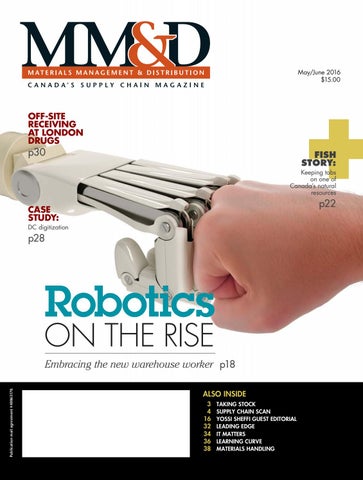
Robotics
ON THE RISE Publication mail agreement #40063170.
Embracing the new warehouse worker p18 ALSO INSIDE 3 4 16 32 34 36 38
TAKING STOCK SUPPLY CHAIN SCAN YOSSI SHEFFI GUEST EDITORIAL LEADING EDGE IT MATTERS LEARNING CURVE MATERIALS HANDLING
OmniChannel Solutions Modular. Flexible. Scalable. Dematic offers a vast array of Order Fulfillment Solutions that are modular and scalable, able to adapt to the wide variety of ever changing AND ever growing products and volumes in your business. Our flexible solutions allow you to stay ahead of the competition as consumer demands drive you to deliver goods faster and cheaper. Having supported the order fulfillment of companies that brought the world ecommerce and same day delivery, our order fulfillment offerings are designed to help you meet these challenges. Improve order accuracy, productivity and visibility with a solution tailored to your business needs and budget today . . . and the ability to grow as your business expands tomorrow.
Learn more. Visit www.dematic.com or contact us at usinfo@dematic.com or 1-877-725-7500.
We Optimize Your Supply Chain
TAKING STOCK
www.mmdonline.com EDITOR: Emily Atkins (416) 510-5130 EAtkins@mmdonline.com CREATIVE DIRECTOR: Tim Norton (416) 510-5223 tim@newcom.ca ART DIRECTOR: Barbara Burrows PUBLISHER: Nick Krukowski (416) 510-5108 nick@ctl.ca PRODUCTION MANAGER: Kimberly Collins (416) 510-6779 kim@newcom.ca CIRCULATION MANAGER: Mary Garufi (416) 614 5831 mary@newcom.ca
NEWCOM BUSINESS MEDIA INC. President • Jim Glionna Vice-President • Joe Glionna HOW TO REACH US: MM&D (Materials Management & Distribution), established in 1956, is published six times a year by Newcom Business Media Inc. EDITORIAL AND ADVERTISING OFFICES: 80 Valleybrook Drive, Toronto, ON, M3B 2S9; Tel: (416) 442-5600; Fax (416) 510-5140. SUBSCRIBER SERVICES: To subscribe, renew your subscription or to change your address or information, contact us at 416-510-5113 or 1-866-543-7888 ext. 3258, or visit our website: www.mmdonline.com/subscribe SUBSCRIPTION PRICE PER YEAR: Canada $84.95 per year, Outside Canada $159.95 US per year. Single copy price: Canada $15.00, Outside Canada $32.65 CDN MM&D is published 6 times per year except for occasional combined, expanded or premium issues, which count as two subscription issues. ©Contents of this publication are protected by copyright and must not be reprinted in whole or in part without permission of the publisher. DISCLAIMER: This publication is for informational purposes only. You should not act on information contained in this publication without seeking specific advice from qualified professionals. MM&D accepts no responsibility or liability for claims made for any product or service reported or advertised in this issue. MM&D receives unsolicited materials, (including letters to the editor, press releases, promotional items and images) from time to time. MM&D, its affiliates and assignees may use, reproduce, publish, re-publish, distribute, store and archive such unsolicited submissions in whole or in part in any form or medium whatsoever, without compensation of any sort. PRIVACY NOTICE: From time to time we make our subscription list available to select companies and organizations whose product or service may interest you. If you do not wish your contact information to be made available, please contact us via one of the following methods: Phone: 1-800-668-2374, Fax: 416-442-2191 Email: vmoore@annexnewcom.ca Mail to: Privacy Office, 80 Valleybrook Drive, Toronto, ON M3B 2S9 Printed in Canada Publications Mail Agreement #43008019, ISSN: 0025-5343 (Print) ISSN: 1929-6460 (Digital). We acknowledge the financial support of the Government of Canada through the Canada Periodical Fund of the Department of Canadian Heritage. MM&D is indexed in the Canadian Magazine Index by Micromedia Limited. Back copies are available in microform from Macromedia Ltd., 158 Pearl St., Toronto, ON M5H 1L3
Putting a halo on HAL W
ithout any input from the editor, two of MM&D’s columnists this issue invoke a reference from the movie 2001, A Space Odyssey, about HAL 9000, the sentient computer that takes control of a spaceship from its human occupants and tries to kill them. (See Dave Luton’s Materials Handling column, and Kevin Squires’s IT Matters.) For those of a certain generation, this is one vision of artificial intelligence (AI) that makes us skeptical about trusting technology with important tasks or decisions. We fear that if it gets too smart, we may not be able to control it any more But in spite of the implied humour behind Kevin’s and Dave’s references, I believe fears of AI in the forms we are contemplating in 2016—advanced robotics and smart warehouse technology—are off base. HAL could not be trusted, that’s certain. But that fantasy world is far from where we are today. Smart robots are starting to become part of the materials handling ecosystem. Unlike their earlier counterparts that were static, automated storage systems or automatic vehicles plodding along a set track to deliver materials, these new technologies are much more likely to be moving around on their own missions, or toiling next to a human worker to create maximum efficiencies in warehouse operations. Storage systems, like shuttles, are getting smarter thanks to complex algorithms that let them plan for fluctuations in demand. These technologies definitely promise to have transformational impact on DC operations. As they gain acceptance and are adapted to perform key DC tasks like order picking, put-away and trailer unloading, they are going to force a re-think of how we leverage human labour in these operations. The spectre of HAL still raises interesting points with regard to this development. Safety will continue to be an ongoing concern, as more autonomous vehicle and robots begin to share workspaces with human DC workers. Humans are unpredictable, and software not infallible. Robot workers will need to be equipped with failsafe overrides to ensure that if they do malfunction they can be disabled, or will automatically shut down before they hurt someone. Nobody wants the fear of a HAL 9000-like meltdown to hinder the deployment of robotics and smart technologies in the DC. As long as these new tools remain just that—tools—and can be used safely by their eir human work partners, we should welcome the new robot invasion.
May/June 2016 Volume 61 Number 03 3 18
22
28
30
Robots in the DC
A Fish Story
Digital DC
Space and time
Keeping tabs on what comes out of Canadian oceans and lakes
BC tile company adopts barcoding to streamline inventory control
London Drugs goes offsite to prcess inbound product
Advances in robotic technology are changing ops
Cover image: maxuser, iStockphoto
www.mmdonline.com | May/June 2016
3
SUPPLY CHAIN SCAN
BOXES
TECH
BEAR BAITING
M+S
Containers have a big anniversary, p 12
E-comm drives tech buying patterns, p 6
Guest editorial looks at how big companies throw their weight around for the greater good, p 16
Appointments and promotions, p 8
Disruption = ‘always-on’ supply chains MHI report looks at technologies that keep the supply chain moving By Emily Atkins
A
host of potentially disruptive technologies is creating digital “always-on” supply chains that will provide better efficiency, visibility and customer service across a variety of industries, while challenging companies to find the talent to manage them. The 2016 MHI Annual Industry Report, Accelerating Change: How Innovation is Driving Digital “Always-On” Supply Chains, offers insights into trends and technologies that are having a dramatic impact on supply chains and the people who run them. “The ‘always-on’ supply chain has the potential to deliver massive economic and environmental rewards for our industry and society,” said George Prest, CEO of MHI. “It can boost productivity and sustainability, drive new markets, encourage innovation and create new, high-paying jobs. As with all change, the devil is in the details.” The report explores eight key emerging technologies, including updates on their adoption rates, their ability to create competitive advantage and case study examples on how companies are using them.
It also looks at the barriers to implementation of innovations and existing and future levels of investment in them. The report offers recommendations for supply chain leaders to help manage this change. For the third year running, supply chain leaders identified “hiring and retaining a skilled supply chain workforce” as the biggest challenge facing supply chain professionals. Fully 58 percent of respondents cited this challenge. Customer demand for faster response times was cited by 56 percent, and customer demand for lower delivery costs was cited by 56 percent. The industry leaders surveyed viewed the eight technologies studied as an even greater source of competitive advantage and disruption than they were just one year ago. The technologies are: Z Predictive analytics Z Robotics and automation Z Sensors and automatic identification Z Wearables and mobile technology Z Driverless vehicles and drones Z Inventory and network optimization tools Z Cloud computing and storage Z 3D printing At least 83 percent of survey respondents (up from 75 percent last year) believe at least one of the eight technologies in the report could be a source of competitive advantage or disruption for supply chains in the next 10 years. “The innovations driving ‘always-on’ supply chains are initially disruptive,
WE DELIVER IT. WE CARE FOR IT. YOU DRIVE IT.
Glasvan rents, leases and sells the largest variety of shunt tractors that are both new and used in DOT and OFF ROAD configurations. We offer full maintenance programs with mobile service support that comes straight to your yard. Our experienced technicians work to ensure you maintain the flow of trailers in your operation. Just leave the upkeep to us, and we’ll make it easier for you. See the video at glasvangreatdane.com
Rentals, Full Maintenance, Leasing, New and Used, Diesel and Natural Gas Powered Options.
glasvangreatdane.com 4
info@glasvangreatdane.com
1∙888∙GLASVAN (452∙7826)
Five southern Ontario locations. MM&D | May/June 2016
Photo: Franck Boston – iStockphoto
SUPPLY CHAIN SCAN
but they can empower firms to optimize processes and improve efficiency, creating a more flexible experience for workers and driving measurable business outcomes,� said Scott Sopher, principal at Deloitte Consulting LLP. “According to the survey findings, adoption of the technologies covered in this report will grow dramatically over the next six to 10 years.� Again this year, industry leaders identified “lack of a clear business case,� as the major barrier to investments in new technologies, with 43 percent citing it—up from 36 percent last year. This was followed closely by “lack of adequate talent to use technologies effectively�, cited by 38 percent, and “cultural aversion to risk�, cited by 35 percent of respondents. Despite these barriers, more manufacturing and supply chain companies are increasing investments in these technologies. New technology investments over $1 million have increased from last year’s survey. Fifty-two percent of this year’s respondents said they planned investments in excess of that amount (versus 49 percent in the 2015 study). Three percent of respondents said their companies would spend at least $100 million on new technologies over the next two years. Industry leaders surveyed identified four top technologies that provide a
competitive advantage for “Always-Onâ€? supply chains: Z Robotics and Automation (51 percent of respondents cited, up from 39 percent last year); Z Inventory and Network Optimization Tools (cited by 48 percent of respondents, up from 45 percent last year); Z Sensors and Automatic Identification (cited by 47 percent of respondents, up from 42 percent last year); Z Predictive Analytics (cited by 44 percent of respondents, up from 38 percent last year). The survey uncovered shifts in the growth of some technologies. Namely, robotics and automation and driverless vehicles and drones are making bigger impacts on the supply chain sooner than previously predicted, with both technologies seeing a 12 percent growth spike over last year’s report. This year, 51 percent of survey respondents said that robotics and automation has the potential to either create competitive advantage or be a disruptive force in their industry, and 77 percent said it will have some impact. Adoption is currently 35 percent. It is expected to rise to 74 percent over the next six to 10 years. While driverless vehicles and drones are still emerging technologies, 59 percent of survey respondents said they are having some impact on supply chains, and 37 percent said they have the potential to provide competitive advantage or disruption. Adoption rates are expected to grow to 50 percent over the next six to 10 years. Cloud computing and storage and sensors and automatic identification are leading technologies in terms of current adoption rate—with 45 percent and 44 percent, respectively. But looking at the next six to 10 years, six of the eight technologies covered in this report have predicted adoption rates of 74 percent or higher. Âť pg 6
LOAD & UNLOAD Making Material Handling in the Can Safer & Faster for your Employees
Discover the benefits of the Destuff-ITTM & Restuff-ITTM machines. Ergonomic assists for manually loading & unloading unpalletized product.
GHVWXIĂ€W FRP www.mmdonline.com | May/June 2016
5
SUPPLY CHAIN SCAN DISRUPTION = ALWAYS ON, continued
Only driverless vehicles and drones and 3D printing have lower predicted adoption rates over the six-to-10 year time horizon, but they are still 50 percent and 48 percent, respectively. This accelerated pace of change will dramatically alter the way supply chains work and how they are managed in the future.
and automation “andRobotics driverless vehicles and
drones are making bigger impacts on the supply chain sooner than previously predicted.
”
Recommendations for supply chain leaders The study makes several recommendations for companies looking to remain competitive in the manufacturing and supply chain space, including: Z Invest in, test and learn these technologies Z Partner with solution suppliers, universities and trade groups Z Determine where to start generating data Z Determine how current your data needs to be Z Make sense of the data so you can act on it Z Nothing is more important than talent management “Of all the recommendations we offer leaders in the supply chain industry, the most important is the need to proactively manage talent,” Prest said. “The growth in digital, ‘always-on’ supply chains will only widen the talent gap that already exists in our industry. We need to train a new breed of supply chain professional who has technical, analytical and problem-solving skills. Much of MHI’s work is focused on providing resources to help the industry close the talent gap through education and training programs and industry collaborations.” The study is based, in part, on responses from 900 supply chain industry leaders. 6
Higher volumes driving tech investment Study shows direct-to-consumer a big factor in plans
C
onsumer expectations will drive increased investment in IT and operational functions in warehouses over the next four years as manufacturing and logistics companies continue to adjust to delivering directly to consumers. This is the key finding in a recent study by Zebra Technologies Corporation which compares input from 1,378 IT and operations warehouse professionals on expectations in 2015 versus 2020. More than 40 percent of respondents cited shorter delivery times as a key measure requiring warehouse investment. Also indicative of increased consumer demand is the expected increase by 76 percent of those surveyed in the number of warehouse locations and volume of items shipped out of warehouses. Half of the surveyed IT and operations decision makers planned to move to a more modern, full-featured warehouse management system last year, while 75 percent of them plan this in 2020 to help manage the increased number of items shipped. In 2015, 51 percent of those surveyed expected increased investment in real-time location systems that track inventory and assets throughout the warehouse; for 2020 this number escalates to 76 percent of respondents. Executives anticipate an increase in inbound items that will be barcoded in the next five years, from 66 percent of survey respondents in 2015 to 82 percent in 2020. By 2020, respondents cited plans to make investments in the following processes and tools: increasing volume of items shipped (76 percent), equipping staff with technology (73 percent), bar code scanning (68 percent), tablets (66 percent) and Internet of Things (62 percent). The October 2015 survey was completed by 1,378 IT and warehouse professionals in 12 countries: Australia, Brazil, Canada, China, France, Germany, India, Italy, Mexico, Spain, the United Kingdom and the United States. MM&D | May/June 2016
Photo: Yuri Arcurs – iStockphoto
The report concludes that while retail and consumer companies get the most publicity in discussions about disruptive technologies, they will impact all industries including manufacturers and business-to-business enterprises. The report identifies potential benefits of these technologies across a wide range of industries.
SUPPLY CHAIN SCAN MOVERS + SHAKERS Dicom Transportation Group has added Andrew Grant as CFO,
needed doing around the business. By high school he was driving
and Joseph Jaska as vice-president of operations. Grant joins the
truck every day after class. After college in BC and Alberta, he
company with more than 20 years of management experience
rejoined the family business in sales. In 1983, he transferred to
having served as CFO of OHL International, a division of Ozburn-
Calgary and took on a new position with TransX, opening their
Hessey Logistics (OHL), vice-president of finance at HD Supply,
Calgary operation.
as well as vice-president of operations for Ryder System. Jaska has more than 27 years of operations management experience, most
Garth Atkinson, president and CEO of the Calgary Airport
recently serving as vice-president of operations for FFE
Authority, has announced he will retire at the end of 2016, after
Transportation Services. Jaska also spent 13 years in the LTL industry
forty years in the airports business. Atkinson joined the industry
with Con-way Freight and Central Freight Lines. He will be
with Transport Canada in 1976 and moved to Calgary from Toronto
responsible for acquisition integration, expansion of cross-border
(Pearson) Airport in 1981. He became deeply involved in the
operations, and process planning and development.
airport transfer process in the 1980s and the establishment of the Calgary Airport Authority as an operating company. Atkinson
The Canadian Trucking Alliance has named Gene Orlick, owner
was named the Authority’s vice-president finance and CFO on
and president of Orlicks Transportation Inc, of Calgary as chairman
transfer in 1992 and was promoted to executive vice-president
for a two-year term. Orlick grew up in the trucking business. The
and CFO in 1997, chief operating officer and CFO in 1999 and
original Orlick Transport was started by his uncle, Tom, along
president and CEO in January 2001. He will continue to lead the
with his father, Max, back in the late 1940s. Orlick started working
organization through the balance of 2016 and the opening of
on weekdays after school and on Saturdays, doing whatever
the new International Terminal in the fall.
Old Dominion’s focus on premium service means every item arrives with one of the lowest claims ratios and one of the best on-time records in the industry.
Old Dominion Freight Line, the Old Dominion logo, OD Household Services and Helping The World Keep Promises are service marks or registered service marks of
owners. | May/June 2016 8Old Dominion Freight Line, Inc. All other trademarks and service marks identified herein are the intellectual property of their respectiveMM&D © 2016 Old Dominion Freight Line, Inc., Thomasville, N.C. All rights reserved.
SUPPLY CHAIN SCAN MOVERS + SHAKERS Marc Thibert joins WAGO as regional sales
Nagel Indonesia, and in 2001, he became the regional CEO of
manager for Southwestern Ontario. Thibert
the company’s South American organization. From April 2008
brings several years of experience in the
Mihok led the company’s Eastern Europe organization.
automation sector in both sales and application
Marc Thibert
support. Before joining WAGO, he was a
The Ontario Trucking Association (OTA) Board of Directors has
district application specialist at Phoenix
endorsed Stephen Laskowski, a 20-year veteran of the association
Contact for more than seven years. He has
and its current senior vice-president, to succeed David Bradley,
also held positions in automation support and
who will be retiring at the end of 2017. In the meantime, Laskowski
sales at Omron.
will assume the role of president of OTA, with Bradley retaining the CEO role. Laskowski joined OTA in 1994, and held progressively
Kuehne + Nagel has appointed Bob Mihok president of its North
more senior jobs, becoming senior vice-president in 2004. He is
American region. He succeeds John Hextall who will remain with
also senior vice-president of the Canadian Trucking Alliance. A
the company until June 30, 2016 to ensure a smooth transition.
native of Hamilton, Ontario, he holds a Masters of Public
Mihok will be responsible for the company’s Seafreight, Airfreight,
Administration from the University of Western Ontario.
Overland, Contract Logistics, and Integrated Logistics operations in the United States, Canada and Mexico. Mihok began his career
Wajax Corporation elected new directors in May. The new board
with Kuehne + Nagel in Basel, Switzerland in 1982. In 1995, he
is: Thomas Alford, Edward Barrett, Ian Bourne, Douglas Carty,
was appointed deputy head of Seafreight of Kuehne + Nagel Asia
Sylvia Chrominska, Robert Dexter, John Eby, Mark Foote, Paul
Pacific. In 1998 he took over as national manager of Kuehne +
Gagné, and Alexander Taylor.
OD Domestic offers:
• More than 220 service centers nationwide • Competitive transit times and pricing • Proactive shipping solutions
For more information, | May/June 2016visit www.mmdonline.com
odfl.com or call 1-800-235-5569.
9
SUPPLY CHAIN SCAN
Ontario material handling safety blitz nets 107 stop work orders By MM&D Staff
tion and safe practices were being followed. This included checking employers had safe load securement procedures and workplace traffic management plans.
D
uring a safety blitz last fall, Ontario Ministry of Labour inspectors conducted 1,224 visits to 1,014 workplaces and issued 4,393 orders under the OHSA (Ontario Health and Safety Act) and its regulations. This included 107 stop work orders. Some of the workplaces were visited several times. From September 14 to October 23, 2015, the inspectors visited industrial workplaces in Ontario, including retail outlets, plants, factories and workshops. Material handling involves activities related to the loading, unloading, storage, and movement of goods and supplies in workplaces. Inspectors checked for material handling hazards that could result in worker injuries and deaths. In particular, the blitz targeted workplaces with a high incidence of lost-time injuries; not previously visited by the ministry; where complaints had been received; and, where there was a history of non-compliance. The inspectors focused on: Lift trucks and other lifting devices: Inspectors checked that employers had examined lift trucks and other lifting devices (including related hardware and rigging equipment) to ensure they were being operated within their load capacity and that they were maintained in good condition. Workplace layout/design: Inspectors checked that employers were providing safe and appropriate access and egress to work areas. They also checked that workers/pedestrians were not endangered by mobile equipment or the movement of materials at the workplace. Manual handling: Inspectors checked that employers had developed and trained workers on safe manual material handling practices. They also checked that items required to be manually handled were done so in a safe manner, including while a worker was on a ladder, mobile ladder or step stool. Mobile/transport equipment: Inspectors checked that employers had ensured equipment was appropriate for use, maintained in good condi10
Blitz “ targeted
1,224
Storage systems: Inspectors checked that employers were ensuring materials were placed or stored in a safe manner and could be removed or withdrawn without endangering a worker’s safety. This included checking on bulk, rack and automated or unitizing/palletizing equipment processes and practices.
workplaces.”
Internal Responsibility System: Inspectors checked that employers, supervisors, and workers were aware of their OHSA roles and responsibilities. They also checked that required health and safety representatives or Joint Health and Safety Committees were in place, where appropriate, and were functioning as required. Worker training: Inspectors checked that employers were providing information and instruction to workers to perform material handling tasks safely, including providing mandatory basic awareness occupational health and safety training. Workplace supervision: Inspectors checked that supervisors had completed the mandatory occupational health and safety awareness training.
It was the second year in a row the ministry targeted these hazards in a blitz. They checked that employers were complying with the Occupational Health and Safety Act (OHSA) and its regulations. In 2013, musculoskeletal disorders comprised 37 percent of all injuries involving lost time at work, according to the Workplace Safety and Insurance Board (WSIB). Workers being struck by objects and equipment, as well as other contact, accounted, on average, for more than 27 percent of claims received by the WSIB in 2014 for lost-time injuries. Together, these two types of injuries have consistently accounted for between 65 and 70 percent of all lost time at work, according to the WSIB. The top three most frequently issued orders during this blitz involved employers’ failure to ensure: • Lifting devices were examined by a competent person and safely operated within their load capacity, representing seven percent of orders; • Equipment, materials and protective devices provided by the employer were maintained in good condition; 6.5 percent of orders; • Materials were moved in such a way as to not endanger a worker’s safety and were transported, placed or stored so the materials would not tip, collapse or fall. A total of 4.9 percent of orders fell into this category. MM&D | May/June 2016
SUPPLY CHAIN SCAN
Free shipping key to e-commerce success Canadians are swayed by one thing when shopping online: free shipping
Photo: Northern Stock – iStockphoto
C
anada’s online shoppers love a bargain when it comes to shipping fees, so much so that they will sacrifice fast shipping for free shipping, buy from a competitor who offers free shipping or even delay their purchase because they expect a merchant to offer free shipping soon as part of a promotion. This is the key finding in research commissioned by Canada Post to understand which combination of shipping options Canadians prefer. And with about 80 percent of Canadians shopping online, it’s becoming increasingly important. Shipping strategies have the power to drive—or to deter—online sales. Nearly two-thirds of online shoppers have abandoned their carts in the past due to shipping costs being too high. Conversely, 70 percent of shoppers would shop more often with a merchant if they were offered free shipping with a minimum purchase. The research also found that buying rates drop by as much as 50 percent if free shipping is not offered, and 66 percent of online shoppers will sacrifice fast shipping for free shipping. Of Canada Post’s top 100 e-commerce merchant customers: 56 percent offer free shipping (48 percent require a minimum purchase, and eight percent offer free shipping with no restrictions). Free shipping with a minimum purchase can tempt 40 to 60 percent of shoppers to top up their cart to qualify for free shipping. Shoppers are most
willing to top up their cart or pay for shipping for baskets worth between $50 and $100. We work “with retailers of every size to support their growth and success in e-commerce,” says Jennifer Mach, responsible for strategy and e-commerce market development at Canada Post. “This research gave us incredible data, which we’ve used to offer small- and medium-sized merchants strategies and tools they can apply as they create, adjust or even experiment with their shipping strategy.” More than 4,000 online shoppers shared their views for the research which was conducted in the fall of 2015.
DONE DEALS APICS has entered a strategic partnership with Software AG to incorporate APICS’s Supply Chain Operations Reference (SCOR) model and other frameworks into Software AG’s process analysis solution, ARIS, part of the company’s Digital Business Platform. The collaboration will allow organizations to analyze their global supply chain operations using SCOR, and take action on recommendations.
Lawson Products, Inc, a distributor of products and services to the MRO marketplace, acquired FB Feeney Hardware in Mississauga, Ontario. The transaction closed on May 9, 2016. FB Feeney Hardware served the industrial market in Toronto and the surrounding area since 1952. Tom Feeney, who has led the company for the last 38 years, agreed to join Lawson Products.
Stärke Material Handling Group has added two new dealerships. J-Spec Atelier Mécanique joins its network of independent dealerships in Quebec, serving Saint Amable, Quebec, and the surrounding areas. Owned and operated by Jean-Philip Coulombe and located 30 minutes outside of Montreal, J-Spec Atelier Mécanique offers a wide range of services, including new and used equipment sales, rentals, and lift truck repair services featuring a unique electronic service history tracking system that helps with diagnostics and future repairs. Wayco Multi-Lift Inc joins the Starke network of independent dealerships in Ontario. Wayco has been an established dealership and service provider for over 30 years in Kitchener-Waterloo and the surrounding areas. A long-term Komatsu dealership, Wayco was established in 1983 by its founder and current general manager, Jim Roth, who has overseen its expansion and growth since its inception.
KUKA, an automation provider, and Infosys, a consulting, technology, and outsourcing service provider, plan to jointly develop solutions to support companies embracing Industry 4.0. The collaboration will develop a software platform to allow customers to collect, evaluate and utilize data for improving their own processes. KUKA will work to extend the connection of machines with the Cloud by establishing an Industry 4.0 Cloud Platform. These software and services will be developed by a newly established subsidiary of KUKA, connyun.
www.mmdonline.com | May/June 2016
Waterloo-based Descartes Systems Group has acquired pixi* Software GmbH (“pixi”), a Germany-based provider of technology solutions for e-commerce order fulfilment and warehouse management. The corporate finance and M&A advisory firm, Hampleton Partners, advised on the transaction.
11
SUPPLY CHAIN SCAN
Ocean containers Turning 60 and not about to retire By Christian Sivière n April 26th, 1956, a converted oil tanker, the Ideal X, carried 58 metal containers loaded with general cargo from Newark, New Jersey to Houston, Texas. This voyage marked the beginning of a new era in ocean transport: containerization! Sixty years later, the largest containerships can carry as many as 19,000 containers (twenty-foot equivalent units or TEUs). Malcolm McLean was the pioneer behind this. He had successfully built a trucking business from scratch and was frustrated by the slow unloading of his trucks by the stevedores when he delivered cargo to ports. He rightly thought that it would be more efficient to use uniform containers and lift them on and off ships instead. So he went on to acquire this World War II tanker— then called the Potrero Hills—had a metal top installed over the piping at Bethlehem Steel in Baltimore, Maryland, to enable the loading of containers on deck. The ship was rechristened the Ideal X and containerization was born. MacLean then went on to create the ocean shipping line Sea-Land—recognized as the first container shipping company—which quickly became a market leader. Sea-Land subsequently introduced their first transatlantic container service in 1960. Many carriers followed suit and began offering container services as well, like Manchester Liners or United States Lines; names that have since disappeared. As we saw, the first container-carrying ship was a converted tanker carrying boxes on deck, but carriers began outfitting break-bulk vessels to carry containers, some having their own cranes for loading and unloading. At that time, containers were loaded mostly below deck, with some on deck. The eighties saw the beginning of fully-cellular containerships, built with a more square design in order to maximize their container-carrying capacity. Today, containership design and the use of cell guides make it possible to load as many containers on deck as below deck. Modern containerships no longer have their own cranes, except some smaller vessels built specifically to operate in niche markets where smaller ports may not have the on-dock gantry cranes necessary to unload and load containers efficiently. 12
Container Uniform ocean container sizes were adopted early on (ISO norms), with a standard width of transport eight feet, but the original standard height of is widely eight feet evolved to eight-feet, six-inches. As far as length is concerned, it is amusing to see that recognized the original 35-foot length developed by Sea-Land as an was not adopted by other carriers; the standard instead became 20 feet and 40 feet. Using an enabler of size of containers turned Sea-Land into globalization.” awkward somewhat of an oddball in the industry. Eventually, they lengthened many of their containers by five feet and adopted the same standards as the rest of the industry. MM&D | May/June 2016
Photos: shaunl, baona – iStockphoto
O
SUPPLY CHAIN SCAN
Standard “general-purpose’’ containers, as they are called, are 20- and 40-feet long, eight feet wide and eight-feet, six-inches high (outside dimensions). High cubes (nine-feet, six-inches in height) were later introduced to carry more bulky cargo. High cubes only exist in 40-foot length and there are no 20-foot high cubes. Specialized containers were quickly developed to cater to the needs of special cargoes, like “open top’’ 20s and 40s to enable loading and unloading via the top and to accommodate overheight packages, “flat-rack’’ and “platform’’ 20s and 40s to enable loading and unloading via the top
the pallet-exchange programs many industries use) are discussed on a regular basis but this concept has not taken hold yet. Going back to the early days of containerization, the name Sea-Land completely disappeared when it was bought by Maersk Line of Denmark in 1999. The new entity was called Maersk-Sealand for a while and
and/or the sides, and to also accommodate oversize packages. Then the industry developed 45-foot-long containers, to accommodate light cargo (consumer goods) shipped out of Asia, but these are not used in all trade lanes. Specialized reefer containers accommodate cargo requiring temperature control and these will be covered in a separate article. So these ocean containers come in specific, standard sizes, to enable efficient loading and unloading as well as intermodal transport. They come in different colours, usually identifying the shipping line. Not all containers are owned by shipping lines, though and many are supplied by leasing companies, who rent them to shipping lines that want to save capital costs, usually on long-term leases. The identification of containers is also standardized, with four letters denoting the owner and the type, followed by a six-digit number and a seventh control digit. The tare weight, maximum gross weight and the safety plates follow international norms as well. So-called “grey’’ containers that could be freely interchanged between carriers (somewhat like www.mmdonline.com | May/June 2016
13
SUPPLY CHAIN SCAN OCEAN CONTAINERS, continued from page 13
subsequently renamed Maersk in 2006. Ironically, the name Sealand came back in January 2015, when the carrier decided to rebrand its intraAmericas services under the Sealand name. Sounds like “back-to-the-future’’ doesn’t it ? Today, there are 6,121 ships carrying containers active on liner trades, of which 5,176 are fully cellular ships, with a total carrying capacity of 20,610,897 TEUs. Container transport is widely recognized as an enabler of globalization. It increased the speed and efficiency of ocean shipping and drastically reduced losses caused by breakage and theft. Among the various challenges faced by container carriers are the seasonality of the business, with peak periods ahead of holidays and low periods during and after holidays, and the never perfect and eternal balancing act between imports and exports that results in the need to reposition empty equipment. A bigger challenge faced by container lines today is that they build and operate bigger and bigger ships, but the promised economies of scale are not being fully realized. The main reasons are that the land infrastructure has difficulties keeping up with the flow of containers from the larger ships and even more importantly, the market is not growing as fast as the container-carrying fleet is. As a result, rate levels have been eroding and several carriers found themselves in the red. But containers are so practical and we got so used to them that they are here to stay. MM&D
Smart discharge gets nod from MHI Intelligrated’s dynamic discharge compensation (DDC) technology is a 2016 MHI innovation award winner. The IntelliSort cross-belt sorter with DDC emerged from a pool of 98 submissions before judges selected it as the winner from a group of three other finalists in the best innovation to an existing product category. The DDC technology uses the same software and hardware already included on the IntelliSort cross-belt sorter, but combines an algorithm with a vision system to determine the most accurate discharge trajectory based on item location on the carrier belt, product dimensions and chute location. This increased precision results in 99.99 percent sortation accuracy, cuts energy consumption in half and minimizes manual touches.
Robot picker wins prize Automated Item Pick (AIP), Swisslog’s human-robot picking solution, has won a 2016 INDUSTRIEPREIS. The theme of this year’s competition was “Success through Progress,” and AIP was chosen as the winner in the “Intralogistics & Production Management” category for its outstanding economic and societal benefits. The centerpiece of Swisslog’s Automated Item Pick solution is KUKA’s lightweight robot LBR iiwa, which is equipped with state-of-the-art sensor technology and a seven-axis gripper. In Swisslog’s advanced logistics application, if networked with automated goods-to-person warehouse systems such as AutoStore or CarryPick, LBR iiwa is able to assist human workers with picking tasks without the need for a barrier or fence between man and machine. Automated Item Pick has the potential to significantly boost efficiency in item picking. Smart human-robot collaboration makes order fulfillment significantly faster, less error-prone and more flexible. This gives companies the opportunity to benefit from improved quality and customer satisfaction.
THE IMPORTANCE OF GOING DIGITAL As many as 350 million businesses would begin exporting goods for the first time if they were to adopt an end-to-end digital strategy, according to the first ‘Future of Trade’ report from Dubai Multi Commodities Centre (DMCC), a Dubai government commodity hub for trade and enterprise. The report provides a view of how global trade will unfold over the next ten years, and builds on insights shared by 150 experts across five continents over twelve months. ‘The Future of Trade’ report was produced by DMCC in conjunction with Futureagenda. org and the Centre for Economics and Business Research (CEBR), a UK economics consultancy. The report’s most striking conclusion was the scale and impact of digitalization on global trade. DMCC’s research suggests that full digitalization of commerce could lead to a six-fold increase in the number of businesses that export goods. This could mean between 100 million and 350 million businesses would become engaged in global export trade for the first time. “The conclusions of our report are clear,” said Gautam Sashittal, CEO, DMCC. “Companies that want to succeed in today’s challenging marketplace must adopt a robust digital strategy, think globally and embrace change.” To highlight the importance of their findings, DMCC and CEBR created the Industry Digitalisation Index (IDI) to track the progress of change across geographies and sectors. The index will be updated regularly to provide a real-time picture of digital progress in global trade. The IDI finds that 42 percent of all business are fully digitalized today.
14
MM&D | May/June 2016
SUPPLY CHAIN SCAN
Self-driving factory vehicle recognized Clearpath, a Kitchener, Ontario-based provider of self-driving vehicle technology and services, has won a silver Edison award for the OTTO 1500 self-driving vehicle. “Our judges recognized the OTTO 1500 self-driving vehicle as a true innovation out of the many products in its category,” said Frank Bonafilia, executive director of the Edison Awards. “The OTTO self-driving vehicles leverage new technologies to enable factory operators with a more cost-effective, safe, and efficient method of moving materials in their facilities. We’re thrilled to be named a winner and to see that the Edison Awards recognizes the potential of our OTTO solution,” said Simon Drexler, director of industrial solutions at Clearpath. Being recognized with an Edison Award has become one of the highest accolades a company can receive in the name of innovation and business. The awards are named after Thomas Alva Edison (1847-1931) whose inventions, new product development methods and innovative achievements literally changed the world, garnered him 1,093 US patents, and made him a household name around the world.
www.mmdonline.com | May/June 2016
Drone pioneer gains space in Smithsonian The Flirtey drone used to make the first FAAapproved drone delivery in the United States has been accepted into the collection of the Smithsonian’s National Air and Space Museum, which displays the Space Shuttle Discovery, the SR-71 Blackbird and the first aircraft operated by FedEx. The six-rotor drone delivered medication to a rural medical clinic in Wise Virginia on July 17, 2015 after the medication was flown to a regional airport by a remotely operated NASA winged aircraft. The carbon fibre and aluminum drone has a delivery system that works by lowering the package in a controlled manner while the drone hovers in place. Built-in safety features include an automatic return-to-safe-location in case of low battery, low GPS signal or communication loss. Through participation from NASA’s Langley Research Center, Virginia Tech and the Mid Atlantic Aviation Partnership, Flirtey’s delivery showcased the massive commercial potential of drone delivery in the United States and around the world.
15
SUPPLY CHAIN SCAN
When vilifying big business, be careful what you ask for Walmart’s introduction of concentrated detergent is an example of how large companies can push positive change By Yossi Sheffi
I
16
Market“ leading
Concentrated detergent was a viable, ecoefficient alternative for everyone in the supply chain. Yet competition for shelf space and consumer misperceptions had created a disincentive for any one brand to lead the way with smaller bottles of concentrated product. Only when Walmart forced the hand of all its suppliers did all the trading partners involved reap the financial and environmental benefits. The story is just as relevant today as it was in 2008–perhaps more so in the current climate of vilifying large companies for their excessive market muscle. Consider, for example, the recent announcement by Walmart US and Sam’s Club US to transition to a 100 percent cagefree egg supply chain by 2025. Every shell egg supplier to the retailers will have to be certified and fully compliant with United Egg Producers Animal
companies are in a unique position to bring about large-scale change.”
MM&D | May/June 2016
Photo: DNY59 – iStockphoto
n May 2008 Walmart announced that it would cease stocking non-concentrated detergents. The announcement underscored the retail giant’s scale and market power—and its exceptional ability to force a market to adopt a major change for the good. Previous attempts at persuading consumers to buy concentrated detergents had not met with much success. Introduced in 1987 in Japan by the Kao Corporation, Procter & Gamble attempted to sell the product to US consumers in 1990. Concentrated Ultra Tide powder, and liquid Ultra which appeared two years later, were based on the formula developed by Kao. Other manufacturers launched similar formulations that required just a quarter-cup of detergent to clean a load of laundry. Following several years of mixed results, sales of concentrated detergents fell by 30 percent by 1994. American shoppers apparently were not willing to pay the same price for a smaller box or bottle, even if it got the same number of loads just as clean as traditional non-concentrated formula products did. Furthermore, smaller packages meant less shelf space was taken up, which created a glaring merchandising disadvantage on store shelves for concentrated products. Many detergent brands and retailers quietly curtailed their offerings of concentrated versions. As a result, concentrated detergents remained a curiosity in the American market until 2005. In that year, Walmart began a major sustainability push and asked suppliers to reduce their packaging. Several manufacturers turned again to concentrated detergents. Three years later, in a display of Walmart’s scale and market power, the retail giant announced that non-concentrated detergents would no longer be stocked on its shelves. Walmart’s announcement cemented the trend and allowed the retailer to advance its goal of reduced packaging. It estimated that the change would reduce water consumption by 400 million gallons and save more than 95 million pounds of plastic resin and 125 million pounds of cardboard a year.
SUPPLY CHAIN SCAN
Husbandry Guidelines or an equivalent standard by 2025. Compliance with the new standards will be monitored by a third party. As the largest grocer in the US, Walmart wields huge influence in the food industry. Its announcement is a game-changer that will force egg producers to switch to cage-free production, even though the move adds cost to the supply chain and requires a significant change in working practices. Market-leading companies such as Walmart are in a unique position to bring about large-scale positive change that would otherwise be difficult or even impossible to implement. Critics of their market power should remember this. In the Presidential election campaign big companies have been vilified for exporting jobs. They are accused of evading taxes by moving their offices overseas. New rules introduced this month by the US Department of Justice seek to prevent such tactics, and claimed one casualty when drug company Pfizer abandoned a merger with Allergan PLC. Leading companies also are in the firing line for using their power to sway elections and policymaking, and monopolize markets. Large enterprises can have a negative impact on society; the role of giant financial institutions in the 2008 economic meltdown is probably the best example in recent times. And their motives for imposing major change are not altruistic. Like any good business they are usually responding to shifts in customer demand, and have calculated the impact on both the bottom line
and their brand equity. But their role as change agents is irreplaceable. If we diminish it, then we all lose. I call this phenomenon the Challenge of the Commons. The Tragedy of the Commons is an economic problem that arises when every individual tries to extract the greatest personal benefit from a shared resource. The Challenge of the Commons is the inability to get to a good outcome when every player is worried about its own self-interest. As a result, society fails to achieve a positive outcome. In some cases government regulations or subsidies can help, but governments’ record is not stellar in pushing for marketplace change. It is important to recognize that large companies have an important role to play in moving society to better places. MM&D Yossi Sheffi, is Elisha Gray II Professor of Engineering, MIT, Director, MIT Center for Transportation & Logistics. This piece first appeared on LinkedIn.
19th Annual SCMAO Conference
DRIVING VALUE CREATION IN SUPPLY CHAIN
SPEAKER Nicole Verkindt Founder, OMX “Dragon”, Next Gen Den
October 21, 2016 The Westin Prince Toronto
Join us for Ontario’s premier event for supply chain professionals! Driving Value Creation in Supply Chain brings you a full day of quality education, networking, and the most up-to-date information on industry trends and best practices.
• • •
WHY ATTEND? Learn from the leading professionals in supply chain management Network with over 400 of your industry peers Discover how the latest research, innovation and technology can help you and your company achieve success Register for the SCMAO Conference, and let us know at events@scmao.ca where you saw our ad to receive a FREE webinar! Offer ends July 29th. Restrictions may apply.
Visit www.scma.com/on today! www.mmdonline.com | May/June 2016
17
D
isruptive technologies are changing supply chain operations, and robots are leading the way. This theme has become prevailing wisdom over the past couple of years, particularly since the 2012 acquisition of Kiva by Amazon. Those little orange bots grabbed the materials handling world’s attention when the giant online retailer saw their potential for DC operations. According to the 2016 MHI Annual Industry Report, adoption of robotics is expected to rise to 74 percent in material handling applications over the next six to 10 years. Adoption, at present, is reported at 35 percent by the study’s 900 respondents. Not only are robotic applications growing, they are moving into completely new areas as technology advances and improves their abilities. The more agile and responsive to external stimuli robots become, the more useful they are in environments where they need to interact with human workers. As well, in a distribution centre environment, where the majority of tasks are repetitive, simple and often physically demanding, the advantages of a tireless worker who won’t get bored are clear to see. As the MHI report points out, “Robots are increasingly able to demonstrate ‘human’ capabilities and traits such as sensing, dexterity, memory, and trainability. They are being integrated into supply chains, taking on more human-oriented tasks, including picking and packaging, testing or inspecting products, and assembling electronics.” That’s why 51 percent of those surveyed for the MHI study believe robotics and automation have the potential to either “create competitive advantage or be a disruptive force in their industry”. As the capability for “mobility, vision guidance and control software evolves, so does the ability of robots to function in more dynamic and unstructured environments,” says a recent whitepaper by Intelligrated. Calling it a new frontier, Intelligrated believes that the next generation of robots will be able to perform “unpredictable, inexact, not always repeatable tasks, and require a higher degree of spatial and object awareness.” The key will be the development of adaptive control algorithms that will enable the robots to react to their environment in real-time. This technology already exists, and was on display at the most recent Modex show in Atlanta this April. Swisslog demonstrated that it’s indeed possible to have a human and robot work side by side without RIGHT: Kiva Systems was one of the first to bring robots to the order picking process, seen here at Think Logistics in Vaughan, Ontario (see sidebar “Flashback” for more details). Amazon purchased Kiva in 2012, and now uses the orange bots in its DCs, rebranded as Amazon Robotics. (Credit: Roger Yip) TOP: The Cimcorp shuttle system uses robotics to allow very dense storage and automated retrieval. (Credit: Cimcorp) TOP RIGHT: Clearpath’s OTTO 1500 has been selected by GE Healthcare to deliver items in its repair facility. (Credit: Clearpath)
18
By Emily Atkins
DISRUPTERS
TRANSF ROBOTS TAKE THE LEAD IN THE EVOLUTION OF DC OPERATIONS
MM&D | May/June 2016
FORMERS? www.mmdonline.com | May/June 2016
19
Swisslog demonstrated the compatibility of its robotic picker and human workers at Modex. (Credit: Swisslog)
LIFT-TRUCK ROBOTICS
HUMANITARIAN LOGISTICS
Hyster-Yale Group has entered into a preferred vendor cooperation agreement with robotics specialist Balyo Inc to market self-guided trucks in North America. Through this agreement, Hyster-Yale Group will offer robotic high-productivity solutions for the materials handling industry, while Balyo aims to accelerate adoption of its innovative robotic solutions. The technology enables trucks to navigate without the help of any reflectors, wires or magnets. Instead the technology selects structural elements of the facility to build a map. Once the map is created, each self-guided truck compares, in real time, what its navigation module sees against the stored map, allowing the truck to self-locate, and move along its intended path. Balyo Inc, based in Massachusetts, specializes in the design, engineering and manufacturing of autonomous driving forklifts based on standard trucks.
The UPS Foundation has developed a partnership with Zipline, a California-based robotics company, and Gavi, the Vaccine Alliance, to explore using drones to transform the way life-saving medicines like blood and vaccines are delivered across the world. All too often, critical health products spoil or fail to reach the individuals who urgently need them. This public-private partnership combines logistics expertise, cold chain and healthcare delivery from UPS with Zipline’s drone delivery network and Gavi’s experience in developing countries focused on saving lives and protecting health in the most remote places of the world. The UPS Foundation has awarded an US$800,000 grant to support the initial launch of this initiative in Rwanda. Starting later this year, the Rwandan government will begin using Zipline drones, which can make up to 150 deliveries per day of life-saving blood to 21 transfusing facilities.
putting the person in danger. Its item-picking robotic arm comes to a stop if it detects something in its way. Likewise, smart autonomous vehicles are able to see their way around in distribution centres, and know not to run into things or people. The growing sophistication of mobile robotic applications and their ability to mimic human actions, along with their interactive capability, has gained picking and autonomous robots much of the attention now being showered on the technology, but there is more. Automated storage and retrieval systems (AS/ RS) are also growing in sophistication, driven by e-commerce demand. Collaborative item picking
Swisslog recently won a prize for the technology it showed at Modex this year—the Automated Item Pick (AIP) system that integrates a KUKA lightweight robot (LBR iiwa), with automated goods-to-person warehouse systems. The robotic arm—equipped with state-of-the-art sensor technology and a seven-axis 20
gripper—is able to assist human workers with picking tasks without the need for a barrier or fence between human and machine. The robot can be used for different tasks and is designed to work with a human to optimize processes. The robot picks the items that it is able to pick—which can be 30 to 60 percent of the customer’s product range—and a person finishes the order. The robot will stop if it senses it will bump someone, and can be operated in collaborative mode—slower—or in fast picking mode if extra safety measures are implemented. Vision
Sight used to be the preserve of human workers, but now technology has advanced to allow robots that will be able to “see” to pick from among similar items. This means that product or raw materials won’t have to be as carefully sorted for presentation to the robotic worker. Likewise, vision is ramping up the game for autonomous vehicles in the distribution centre. Kitchener, Ontario-based OTTO Motors, a spin-off from Clearpath, makes an autonomous vehicle for DC and industrial use, called OTTO. The company recently won a prize (see page 15) for the OTTO 1500, the larger of its two self-driving vehicles. The smaller OTTO 100 is intended to provide light load delivery in congested spaces such as DCs. The technology “enables new self-driving services in distribution, e-commerce, and manufacturing,” said Clearpath Robotics CEO Matt Rendall. OTTO does not rely on external infrastructure for navigation—like guides or beacons—as earlier AGVs did. This makes it as easy as taking it on a tour of the MM&D | May/June 2016
DC to set up, and making it a readily scalable system. OTTO 100 can provide autonomous transport of up to 220-pound loads at speeds up to 4.5 mph, selecting efficient pathways and avoiding collisions. OTTO was recently selected by GE Healthcare to automate just-in-time parts delivery in a repair facility being expanded near Milwaukee, Wisconsin. The fleet of OTTO self-driving vehicles will be used to load and deliver parts to work cells for repair. Once the parts are fixed, OTTO will dispatch materials to shipping for return to customers. There are several other companies making autonomous robots to help with order picking. Locus Robotics and Fetch Robotics both offer a semi-intelligent mobile platform that pairs with warehouse pickers to help gather—and carry—orders. Flight
Drones are another type of robotic application that may soon find a home in the warehouse. Their ability to leverage the empty space above a congested DC floor may offer significant benefits for order picking and inventory control. In the meantime, most of the drone development that’s been made public now centres on last-mile delivery and delivery to remote locations such as for disaster relief (see sidebar, Humanitarian Logistics). New old-school
Some of the first automation to gain traction in DCs was AS/RS (automated storage and retrieval systems) technology. These have been in use for forty-plus years now. But with advances in controls technology, shuttle AS/RS systems are burgeoning, and now have the capability to perform much more complex sequencing and storage operations. They can pack more into less space, and retrieve it faster with less labour. By delivering the goods to the picker, they save employees’ time spent traveling and also have computing power to sequence product flow to meet fluctuations in demand. Intelligrated claims new shuttle systems can achieve throughput that tops other kinds of AS/RS systems by five to 10 percent. The new breed of shuttles are also modular and can be coupled together with relative ease to adapt to growing demand. When to buy
MHI, in its report, suggests a cautious approach to adoption. Robotics are not viable in every kind of operation. You need to have a clear understanding of how the technology will contribute to the bottom line.
SINGAPORE VENTURES INTO START-UP SPACE WITH INCUBATOR PROGRAM The Port of Singapore Authority (PSA) has launched a tech incubator program to nurture startups that seek to create innovative logistics solutions, including robotics and automation in container and cargo handling operations. The program, called PSA unboxed, will have an initial fund size of S$20 million, which PSA says it is able to make available through its unique position as the world’s largest container port. Tan Chong Meng, group CEO of PSA International, said, “We want to encourage creative ideas that can improve and revamp logistics technology, increase port productivity and enhance the integration, security and performance of global supply chain logistics.” Selected start-ups will receive up to S$50,000 in seed funding, and be provided with incubator facilities at the port. They will have access to the live port environment to develop and test-bed ideas for the real market at PSA. www.mmdonline.com | May/June 2016
FLASHBACK Back at the end of 2012, just after Amazon bought Kiva Systems, MM&D published a cover feature on the Kiva installation at Think Logistics in Vaughan, Ontario. Here’s a sample to refresh your memory: “Pumpkin orange, with violet-coloured lights and white oval badges proclaiming its name—3512—a robotic drive unit rolls between the legs of a hanging garment rack pod and begins spinning in circles. As it twirls, its four-spoked metallic lifter rises, makes contact with the bottom of the pod and lifts the entire rack off the floor. Then, 3512 pivots again to face the direction it intends to travel. With the rack carefully balanced, 3512 heads for the picking station. It travels from deep inside one of the aisles of pods filled with a variety of merchandise— including items such as emergency kits, folded paper road maps and movie DVDs—and heads toward its delivery destination...” To read the rest the whole feature can be found at: http://tinyurl.com/ThinkKiva.
According to Intelligrated, there are choke points in DC operations caused by the amount of traffic on the floor. “At about 3,000 orders per hour, operations hit a tipping point in which foot traffic clogs thoroughfares and operations hit a productivity plateau,” the integrator said in a recent whitepaper. It’s at that point you need to consider your options. To implement a system such as an AS/RS shuttle, annual sales in the range of $US50 million are needed to justify it operationally. In that case, ROI can be as fast as two years. Swisslog says that costs per pick are significantly lower with its Automated Item Pick system, and return on investment can be realized in three to five years. OTTO Motors claims an ROI of 18 to 24 months, and provides an ROI calculator on its website that takes into account the number of material transport personnel operating and for how many hours a year, along with the hourly rate of pay. Truly a disrupter?
As with any new technology there are risks in being an early adopter, and also rewards. The disruptive kid at school is often in trouble, but also is often a bored genius just looking for a proper outlet. Robotics technologies can be seen the same way. Considered disrupters now, because they are forcing us to consider new ways of doing old tasks, in the near future robotics will likely be the norm, and will hopefully have ushered us into a new era of DC operations. MM&D 21
RESOURCE Industries
BRINGING THE
By Kara Kuryllowicz
22
A
meaty, perfectly grilled swordfish steak, the sweet ocean taste of seared scallops, the rich red and white flesh of a hearty lobster tail, a slab of wild-caught Coho salmon… Consumers expect fresh, quality seafood will always be available from their shop and the fishers who catch it fervently hope the fish will be there because their livelihoods depend on it. Increasingly, consumers realize just how vulnerable Canada’s and the world’s wild fish stocks have become, due in part to the ever-increasing focus on sustainability. Organizations such as Canada’s SeaChoice and Ocean Wise and the Marine Stewardship Council address unsustainable fishing, support sustainable fishing and in some cases, certify fisheries and identify more eco-friendly seafood to consumers. And as much as fishing is about a great meal, it’s also all about jobs and economics. In Canada in 2014,
40,940 commercial fish harvesters and crew worked on 18,250 registered fishing vessels and brought in 866 thousand tonnes of marine and freshwater fish valued at roughly $2.9 billion. As well, consumers, harvesters, processors and governments in Canada and around the world remember the utter collapse of Canada’s cod fishery. The horrific economic impact of the 1992 moratorium resulted in more than 35,000 workers in over 400 coastal communities becoming unemployed. “Harvesters now walk the talk because we know that we can’t assume the fish stocks will always be there,” says Ian MacPherson, executive director of the PEI Fishermen’s Association, whose approximately 1,270 active members earn about 90 percent of their income from lobster. “I really hope we all learned from what happened to the cod fisheries.” “Sustainable harvesting is the key to the future of MM&D | May/June 2016
Photo: sf foodphoto – iStockphoto
ABOARD
Sustainability guides Canada’s fishing industry
L: Atlantic lobster tagged with a unique ThisFish code from tablets and mobile phones to discover the story of their
FISH FINDER
seafood using ThisFish’s app. (Photos: Ecotrust Canada)
This Fish, launched by Ecotrust Canada in 2010, was created to help con-
Nova Scotia. R: Consumers can trace codes on computers,
sumers make informed choices about the authenticity, quality and sustain-
the fisheries—we all saw what happened to our cod stocks,” adds Bob Hanner, a professor at the University of Guelph, Ontario who has been working in DNAbased species recognition for over 20 years, and is chief technology officer at TRU-ID, which was founded in 2013 to authenticate food products using DNA. It was a painful lesson all the way around and today, Canada’s federal government is doing a better job of protecting and monitoring our wild fish resources. Meanwhile, the fishing industry knows the onus is also on them to comply with the regulations to preserve fish stocks. “So many of our fishers are into their third, fourth and fifth generations of fishing and if we want that for future generations, the resource must stay strong. So there is a real spirit of collaboration and cooperation with the Department of Fisheries and Oceans (DFO), and a willingness to comply with those stringent regulations because it’s to our own benefit,” says MacPherson. “For example, DFO’s boats do random checks which are a real deterrent to catching undersize or egg-bearing female lobsters because DFO has the power to seize equipment, lay fines and even suspend licenses.” Across Canada, the regulations vary significantly based on the fishery. Complex, even for industry insiders, the enforcement of those regulations relies on a
ability of the seafood they eat, while promoting the men and women who actually catch the fish. Right now, This Fish has about 960 vessels and fleets registered, ranging from small inshore hand-liners in Newfoundland and Labrador, to hundreds of hand-line tuna fishermen in Indonesia, to larger offshore trawlers. To date, about 90 species are registered with This Fish, typically the highervalue species destined for niche and upscale markets. Fishers upload data about where, when and how the fish was caught, then consumers visit this thisfish.info and enter their seafood’s code to connect to the fisher and get their story. The system includes online software to collect, store and share traceability data and tags or labels to identify product with unique codes. Tags or labels can be branded by the seafood businesses themselves. Fishers can register for free, but depending on their level of usage, the annual fees range from $100 to $400 annually. “Harvesters are as interested in where their catch is going as the consumer is keen to know where it came from,” says Eric Enno Tamm, general manager, Traceability Initiatives, This Fish, Vancouver. “Transparency creates accountability and fish harvesters tend to handle their catch even more carefully when they know that consumers will trace their fish.”
» pg 24
www.mmdonline.com | May/June 2016
23
RESOURCE Industries
Above: An Archipelago technician installs a video camera on a fishing vessel. Right: Archipelago’s EM Observe monitoring system, including the control centre, cameras, sensors, satellite modem, and GPS unit. (Credit: Archipelago Marine Research)
24
variety of systems that run the gamut from humans with pen and paper to low- and high-tech solutions. They’re designed to track and monitor the boats and their catches for Canada’s fishing industry, which includes commercial fishing (harvesting) and aquaculture or fish farming. If fishers are caught breaking the rules, there are tangible consequences. Fines may be a few hundred dollars to tens of thousands, with the value depending on the species and volume. Equipment forfeitures run from nets, traps and crates to capital-intensive mechanical and hydraulic equipment as well as the vessels themselves. A license may be suspended for months or years. Fisheries monitoring, generally a requirement for operation and licensing, typically ensures compliance with government regulations pertaining to where the fish are caught, the volume and species caught and the percentage that’s returned to the water. Whether the monitoring is done by human observers or by automated, electronic systems, both collect highquality, independent catch and compliance data. It’s used by fisheries scientists and managers as well as fishers to allow the best long-term decisions about the fish population and ecosystem. “Overall, the Canadian fishing industry has accepted the observer and automated, electronic monitoring alternatives as a way to demonstrate transparency and disprove public notions of abuse,” says Howard McElderry, a founder and director of Archipelago Marine Research in Victoria, BC, which has been providing marine resource management products and services to commercial fisheries, industry regulators and coastal communities for more than three decades. The data collected will vary widely depending on the location and type of fishery involved. For instance, human observers will gather biological data, such as the size and sex of the species caught and collect agedetermining structures such as scales or otoliths, “ear bones” that have growth rings much like tree rings. Electronic monitoring collects data such as location,
catch per unit and compliance with fishing regulations, such as how long a crab trap has been in the water or if fishing occurred in a prohibited location. Sensors that collect water salinity and temperatures may also be used to assess the health of an ecosystem, and video imaging can provide detailed information about the catch, such as species, size and disposition (kept or discarded). Traditionally, observers are marine sciences graduates, who are hired by third-party contractors to provide monitoring services to industry and government. They’ve been riding with Canada’s domestic fleets since 1978 when countries, including Canada, became responsible for managing the resources within their 200-mile ocean limits. While the larger operators and vessels can cover the cost of an observer and accommodate the extra person, it can be economically prohibitive and even dangerous for the smaller boats. Observers are paid 24/7 whether they’re actually performing their monitoring duties, sailing four days to and from a far-away fishing ground, stuck ashore until a storm passes, waiting for the capture equipment to be deployed or eating and sleeping. “As a result, we now have automated, electronic monitoring—which costs 75 to 80 percent less than human monitors—in place in Canadian and international waters,” says McElderry. Today, 100 percent of British Columbia’s commercial hook-and-line and trap groundfish fishing is monitored using Archipelago EM technology. This involves about 200 vessels, 1,200 trips, 10,000 sea days, and 20,000 fishing events annually. The British Columbia Groundfish Hook and Line/ Trap Catch Monitoring Program (GHLCMP), a primarily industry-funded initiative, started back in 2006 to help ensure the long-term sustainability of BC’s ground fish. Its total at-sea catch monitoring is accurate because it quantifies previously unknown at-sea catch and as importantly, the releases. The Archipelago EM Observe electronic monitoring MM&D | May/June 2016
SURFACE TRANSPORTATION 2016
ummit OCTOBER 13, 2016 NEW LOCATION
INTERNATIONAL CENTRE
Photo credit: Tim Norton
PLEASE PLAN ON JOINING THE COUNTRY’S TOP
TRANSPORTATION & SHIPPING EXECUTIVES FOR A DAY OF
EDUCATION & NETWORKING Register now at www.surfacetransportationsummit.com and qualify for the Early Bird Rate BROUGHT TO YOU BY
OUR SPONSORS
PLATINUM SPONSOR
ASSOCIATION PARTNERS NLI GROUP.ca
FROM CONCEPT TO EXECUTION
GOLD SPONSOR
RESOURCE Industries
From the foreign fishers’ and the processors’ perspective,
selling
a low-value fish as a higher-value fish is a highly profitable
fraud
.
26
system includes a GPS receiver, multiple equipment sensors, and up to eight, strategically positioned digital video cameras, all linked to an onboard control centre. It’s equipped with data logging software to manage and log fishing activity data, while providing wheelhouse crew with a real-time view of key fishing activities on deck. All video, sensor, and GPS data is recorded securely to a portable hard drive, where it can be retrieved once the vessel reaches port, and reviewed using data review software. If it took the catch three hours to come aboard, the off-site reviewer will require 60 to 90 minutes to view the footage, whereas on a boat, real-time is the observer’s only option. Meanwhile, EcoTrust Canada, a non-profit that supports green economic growth, launched its observer program in 2010, and automated, electronic monitoring the very next year. They’re both important tools in the fishery manager’s toolbox, collecting data on the location, amount and type of harvest as well as identifying the fisherman and vessel out at sea. EcoTrust worked with the Gulf of Maine research institute, the Nature Conservancy and Maine Coast Community Sector to develop its automated electronic monitoring system. It includes the technology required for collecting video, vessel tracking, hydraulic sensor data and can create an electronic log of vessel activity. “Electronic monitoring is a great alternative to observers,” says Amanda Barney, general manager of the Marine Monitoring Initiative for EcoTrust in Skeena, BC. As effective as the observer and automated, electronic systems continue to be when it comes to monitoring, traceability is often more about marketplace differentiation. Accurately identifying ocean-based proteins is considerably more complex than land-based proteins because of the number of species. While harvesters generally have the experience and expertise required to identify the catch pulled from the water, genuine mistakes are easily made with similar fish species. Whole fish right out of the water present enough of a challenge, but once it is cut up and cooked, particularly if it’s breaded or battered, a DNA test is often the only means of accurate identification to protect the consumer and our fisheries, as well as the foodservice and retail industry. “Once finfish are processed, they lose their morphological characteristics, such as the head, skin/scales, fins and tail, which are key to the identification process,” says Dane Chauvel, who with fellow independent West Coast fishermen Steve Johansen and Frank Keitsch, founded Organic Ocean in 2007 to promote oceanfriendly, sustainable and responsible harvesting of wild fish. “DNA authentication is the only reliable way of addressing concerns around fraud and illegal, unre-
ported, unauthorized or endangered species catches.” Over the last eight years, Organic Ocean’s business and fleet have grown ten-fold and additional fishers need only commit to sustainable harvesting and quality handling processes for which they’ll be paid a premium price to be part of it. TRU-ID randomly audits Organic Ocean two to four times a year, comparing tissue samples against their database to confirm the species on the Organic Ocean label. Weeks later, TRU-ID publishes a compliance report that is also posted to Organic Ocean’s website for public viewing. While Organic Ocean’s record is almost perfect, there have been instances where a product was mislabeled, for example, a Keta or Chum salmon was included with Sockeye because even the most experienced harvesters are challenged to visually differentiate the two species. “The seafood industry is in the very early adoption stage when it comes to DNA authentication,” says Chauvel, “We believe the market will acknowledge the value of species authentication, but to date, there has been no measurable, quantifiable ROI, which we believe is the lot of the early adopter. When the market ultimately catches up with us, there will be a payoff as greater consumer confidence in our Organic Ocean brand will translate to higher sales.” TRU-ID runs DNA tests in its labs, but when some customers indicated they couldn’t wait even a day for the results, the company developed an onsite, confirmatory test that will indicate for example, whether the sample is, or is not, Atlantic salmon. If the sample fails, it can then be sent to a lab for sequencing to get a species-level identification. This type of testing works best for companies that deal with a relatively limited number of commodities in high volumes. Clients using this portable system will still need to be audited to ensure their system is performing properly, but it gives them the information they need to make real-time business decisions. “Our customers need to know if they should reject that batch or shipment right away to effectively run their businesses,” says Hanner. To a consumer, a piece of wild, Ontario-caught walleye may look and taste a lot like an Eastern European Zander, but they’re willing to pay more to support the local walleye fisher and Canadian industry. From the foreign fishers’ and the processors’ perspective, selling a low-value fish as a higher-value fish is a highly profitable fraud. “We need to know that the walleye is not an Eastern European Zander and that Coho salmon is really Coho not Atlantic salmon which is actually a different species, because such misrepresentation artificially depresses the price of the higher-value catch which in the short- and long-term has a negative impact on the local fishers,” Hanner says. MM&D MM&D | May/June 2016
CASE STUDY Digitization
ROCK, PAPER, Digitizing data capture proves a winning move for stone and tile seller
By MM&D Staff
Top: The new Julian Tile DC. Bottom Left: Touchscreen mobile units allows workers to input with or without gloves. Bottom Right: The scanning software integrated with the company’s existng ERP.
28
J
ulian Tile had a problem. Everything was manual in its inbound order processing. The Langley, BC-based distributor of porcelain tiles and natural stone products was opening a new 40,000-square-foot DC, and needed to track the movement of 4,000 skids and separate dye lots (batches) of stone and tile. The company’s existing system required all inventory purchase order receipts, sales order picking, multiple bin locations and dye lot numbers to be recorded manually using a written and batch data entry process. Not only was this workflow time consuming, it also resulted in significantly increased chance of errors which could mean the wrong product or mismatched dye lot being delivered to a customer. As well, if a customer wanted to re-order matching tile, the initial order had to be found by searching through paper documents. This increased the time it took to fill orders. Clearly the company needed a better way, to improve customer satisfaction, employee happiness and productivity.
The digital frontier
The great thing about the times we live in is the ready availability of digital solutions. Companies like Julian Tile can leap-frog over the intermediate phases of automation and move straight to complete, integrated solutions. In this case, they adopted wireless automatic ID data capture devices and barcoding software that integrated with the existing ERP system. The opted for eight Honeywell units acquired from reseller AMPM Mobile Solutions. Four are rugged mobile computers and four are forklift-mounted. The CK71 mobile computer provides rapid barcode scanning technology. The CV61 forklift-mounted computers support Julian Tile’s SYSPRO enterprise resource planning (ERP) system and have a touchscreen interface with an externally backlit keyboard. Workers can input data with their gloved hands. Canadian software and hardware service provider and reseller Phoenix Systems implemented RiteScan barcoding software, which fully integrated with the ERP solution and the Honeywell devices. All of the software operates in the cloud, which eliminated the MM&D | May/June 2016
need for Julian Tile to have an on site server, reducing operating costs and the need for additional onsite technical support. Reaping the benefits
Workers at the Julian Tile warehouse can now access and update the inventory in real time. It’s easier to find inventory, and because the connected devices allowing scanning rather than manual entry, the number of errors has been vastly reduced. Sales order status is updated as the order is being picked, preventing double orders for the same product. All this makes for a happier workforce. The solution was an instant hit with the company’s warehouse workers. As a bonus, the company saw an immediate decline in the amount of time spent by staff trying to find, document and process orders. In fact, order fulfillment times decreased by 50 percent and picking accuracy increased by 20 percent. In addition to the immediate and daily gains, the www.mmdonline.com | May/June 2016
annual inventory-taking process has also been streamlined. Previously, workers had to manually find, read, write and confirm product numbers for every item in the warehouse—a process that took three full days for numerous employees. It also resulted in binders full of handwritten notes. With the automated data capture solution, this annual event was reduced to a single day with a small team of warehouse workers. The upshot for the whole team at Julian Tile is increased productivity every day, and improved customer service. Pretty good results that prove digital data about rocks beats paper, any day. MM&D 29
Bending
THE SPACE-TIME CONTINUUM London Drugs shows how to create more time and space Let me take you back to 2012…
E
very year the peak season at London Drugs begins in August and September. Vendors begin to produce and ship goods to be sold during our Christmas season. With the thousands of items London Drugs carries, it takes a lot of effort to receive the goods and get them into the building, making them available for store orders. Historically it has taken time, space and more time. In our peak season, the inbound operation suffers, with average wait times as long as seven days to book 30
an appointment. At the same time, outbound activity experiences an increase in the number of store orders. With space in the Distribution Service Centre (DSC) a precious resource, there is a constant battle between the two operations for dock door usage and staging room. 2012 was no different. Our In-Bound Department operated to its maximum capacity. The Merchandising group kept in constant contact trying to get their stock in the building: • “When can I bring it in?” • “How many days out are you booking?” MM&D | May/June 2016
Photo: Yuri Arcurs, iStockphoto
By Ray Tong
• “I need it now!” • “It’s a rush Purchase Order!” Peter Harper, DSC Manager of In-bound Operations, knew there must be a better way. He had to figure out how to get product through the door faster. Taking a closer look at the process of unloading trucks, sorting items onto separate pallets and completing system work, he uncovered that much of this process is done as soon as the truck hits the door, and can take between four and eight hours for each truck! This consumes precious time and valuable space. After all, can you imagine road construction in a busy intersection? No one goes anywhere fast! Peter had an idea: What would happen if the receiving process could take place before inbound merchandise hit the dock door of the DSC? What if most of the receiving work could be performed at the carrier’s work site? We could reduce the time that the stock and the truck sit at the door. He thought it might work. After receiving the blessing of our Director, Brian Best, Peter had to begin conversations with key contributors to make this work. The parties involved included: • IT Department • Outside Carrier Companies (“Can I use your work area for my stuff?”) • Merchandising It took a few months to develop the plan, convince the carrier companies, and invest in the technology, (implementing laptops and connectivity to our host AS400 system from a remote site), but by March 2013 product was being received by London Drugs at our carrier’s site. Instead of starting the work at our dock door, we place our employee in the carrier’s building to verify, sort and label pallets before the items hit the London Drugs floor. When the DSC evaluated the process from a “LEAN” standpoint, its value is jaw dropping. Receiving Appointment Booking:
• The Best Case scenario reduced from 3 days 50 minutes in 2012 to 1 hour 38 minutes in 2013. Saving: Two days, 23 hours, 12 minutes. • The Worst Case scenario reduced from 10 days hours 35 minutes in 2012 to 22 hours 10 minutes in 2013. Saving: Nine days, 13 hours, 25 minutes. By using the carrier’s floor space, our dock is no longer considered “road construction” but instead a “traffic light”—and one that’s usually green. Benefits in Time:
• Booking receiving appointments reduced from an average seven days to two days during the 2013 peak season; • Able to ‘cherry pick’ Hot or Ad items coming in; www.mmdonline.com | May/June 2016
• Stock available for store orders reduced from hours to minutes; • Rush POs handled with more ease; • Able to receive upstream receipts earlier and more easily; • Regular receiving at the DSC benefits with more space and time; • Claims handled more quickly (problems don’t land at the London Drugs dock). Benefits in Space:
• Increased Dock usage. Docks can be used for Outbound with no negative impacts. • Improved space management / less double handling of product with the London Drugs presence at the carrier’s location. • DSC staging space not as congested Benefits in Morale:
• Frustration levels of Receiving Staff have gone to zero. There are no emergencies. There is space to perform work. Specific items on the receiving floor are easier to find, with floor space not as crowded. • With selected staff working on the carrier’s premises, commuting time and costs are saved. Carrier Partnership
• Carriers are given a standing appointment daily. • Trucks are not tied up for four to eight hours at our door. They are on the road more often, increasing their utilization and saving them money. • More business for the Carrier Partners with London Drugs encouraging suppliers to use this NAPS (No Appointment Priority Service) preferred services. One of the benefits the carriers gain is to have a standing appointment with our Receiving department. No need to book appointments. Also, by encouraging our vendors to use this service, the carrier’s business can increase. The success was immediate and by September 2013 London Drugs was receiving off-site in three carrier terminals, using as many as six of our staff. Today, receipts at the three carrier terminals have increased, and ‘Off-site Receiving’ has branched out to specific vendor locations on occasion. MM&D
Peter Harper, DSC Manager of In-bound Operations, at London Drugs shows off a pre-processed load insiade a trailer.
Ray Tong is Distribution Service Centre Process Engineer with London Drugs. 31
LEADING EDGE
Training for the long haul Train people well enough so they can leave; treat them well enough so they don’t want to.
Ross Reimer
Ross Reimer has over 30 years of experience in transportation/ supply chain. For the last 15 years he has been president of Reimer Associates, a recruitment firm within supply chain. rreimer@reimer.ca 32
O
r, give your employees no training, treat them with zero respect and complain nonstop about high turnover. Two opposing business philosophies. I’ve seen both in action over the years. I prefer Sir Richard’s idea on how to build a business, and since he has more than 400 companies worldwide, his philosophy is worth studying. Let’s take a closer look at the idea of training. It seems completely self-evident that providing appropriate training for employees is the logical choice. Yet we’ve all seen and perhaps worked in companies where little or no training is offered. In some cases the onboarding process goes something like this: hire the new employee, tell them when to show up and who their boss is. Period. It’s expected that because of their prior experience, they know how to do the job. So they do their best to use previously acquired skills while observing coworkers to uncover additional clues. Performance for people like this will generally range from unacceptable to reasonably acceptable. This leads to customers receiving far less than superior service. The underlying philosophy of this kind of culture seems to tell the employee that we are simply too busy to take the time to ensure you fully understand your task, and that you will be measured against an appropriate standard. What it really says is that the company is far too disorganized and short-sighted to invest the necessary time and money into clearly defining the work process and building the training for each function around that process. While it may seem like the shortest route to profitability since dollars aren’t being spent on training, it actually communicates a complete lack of concern for not only the employees but also for the end product delivered to the customer. Contrast this with shining examples of a well-trained workforce. I see examples among my clients where literally every task performed in the company is fully mapped out as part of an overall process, and each expectation of the employee is broken down into training that allows the person to be fully measured and coached, and to then achieve outstanding success. The second admonition of Sir Richard’s speaks to treating people well enough so they will not want to
– SIR RICHARD B RAN S O N
leave. As a recruiter it’s my job to maintain a broad network of potential candidates for my clients. Occasionally I’ll receive a phone call or email from an angry employer, berating me for soliciting one of their employees. At times like that I’m tempted to share Sir Richard’s philosophy. If your employees are treated very well, including all the training they require, the company doesn’t need to worry much about my phone call. The only employers who need to worry are those that sorely lack foresight and a long-term strategy to retain valuable employees. Volumes of research as well as a quick study of any long-term successful company will show that treating people well enough so they want to stay pays huge dividends. Employees want and need clear direction, reasonable expectations and a reporting relationship with someone they can trust to give them appropriate and useful feedback on their performance. That’s exactly what Sir Richard is talking about. Of course there’s another powerful reward for the owner and/or executive who employs this philosophy. Not only is it the most profitable long-term strategy, but it also makes the world a better place. It just feels right in the end to treat people with the respect they deserve and build a company based on core values that go beyond a successful bottom line. It’s worth noting that even though Sir Richard’s 400 companies obviously put him in the category of big business, his philosophy can be employed successfully by even the smallest enterprises. A friend of mine recently sold his company after some three decades. The business never grew beyond five employees, but provided a great living for everyone involved. Because of his careful attention to training people appropriately and treating them well over the years he never had an employee leave. In an era when résumés seem to include more movement from job to job than ever before, perhaps it’s time to take a serious look at how to correct that. The vast majority of people want long-term stable employment with opportunity for growth. They actually don’t want to leave. And if we give them the tools they need for success and treat them like they matter, we can largely eliminate the high cost of turnover. MM&D MM&D | May/June 2016
THE ENTIRE SUPPLY CHAIN UNDER ONE ROOF
100+ 2,500 5 50,000+ SPEAKERS ATTENDEES STREAMS SQ. FT. OF EXHIBITS PORT PRODUCTIVITY SUMMIT
COMMODITIES & COLD-CHAIN SUMMIT
GLOBAL TRADE
CANADA’S ONLY
MULTIMODAL
EXPO+CONFERENCE PROUDLY SUPPORTED BY
DISTRIBUTION LOGISTICS SUMMIT
TECHNOLOGY
GET INVOLVED:
t 4VCNJU TQFBLFS TFNJOBS DPOUFOU t #PPL QSFNJVN FYIJCJU TQBDF t *ODSFBTF CSBOE FYQPTVSF XJUI UBSHFUFE TQPOTPSTIJQT BWBJMBCMF GPS FWFSZ CVEHFU
MAXIMIZE IT
Chatbots:
Can they help your business?
R
With over 28 years of experience, Kevin is Vice President, Business Technology for the Econo-Rack Group of companies (Konstant, Econo-Rack, Technirack) and can be reached at Kevin. Squires@Konstant.com 34
ight now it seems that whatever journal or blog I read, chatbots are the big topic. Most people don’t realize that they aren’t exactly “new”; they have been around for a few years in one form or another, but they have now hit the consciousness of the consumer. Getting major recognition from facebook and other companies who are implementing them in a very public way certainly does shine a very bright spotlight on them as well. So, what are they? Simply put, they are a basic conversational AI (artificial intelligence) tool used to help users complete a task. Think of going to a website to buy a plant. A chatbot interface would speak with you to find out the details like temperature and climate, indoor or outdoor, shade or sunlight and then, when it has enough information, guide you to a selection of products that fit your requirements. It isn’t hard to see the benefits to most businesses. Having said that, it isn’t what they are right now that is exciting, but what they possibly could be in the near future. I’m talking about chatbots that don’t just guide you to a product or solution but actively upsell the consumer. “On-the-fly” segmentation, gained by a few skillfully selected questions, with advanced algorithms analyzing each answer to create a user profile that deepens as the session continues, ultimately results in a highly targeted offering that may be quite different than what the consumer thought they wanted when they started. Pretty cool, right? Now, add a way to store the consumer information with their profile and you have means to send offerings that hit the sweet spot almost every time. Moreover, as the consumer interacts with your chatbot in subsequent sessions, the profile can be fine-tuned; sort of
like a modern day Closed-Loop Marketing system that is completely self-contained. The possibilities seem endless as you consider linking the consumer data with your other knowledge repositories (e.g. purchase history, frequency, seasonality etc) to create that true “Must have this now” demand. Marketing gold. Other than using chatbots for guiding a consumer to a purchase, there is a plethora of possibilities for using them to train consumers on a product or service, post sales support, scalability options, and more, customizing the experience for each consumer so they feel important and cared for. Again, marketing gold. So although chatbots are starting to get their fifteen minutes of fame, it isn’t what they are right now (which isn’t that new or unique,) but what they will morph into as companies look at new and creative ways to interact with consumers and identify the immediate true need that results in a purchasing decision. And chatbots can also identify and exploit the unique and elusive triggers that cause consumers to come back time and time again due to the perceived value you (and your chatbots) provide. This column has focused more on the business aspects of chatbots but there are many other areas they are being used in today which are more commodity-based rather than commerce focused. For example, there are chatbots which will help feed you the kind of news you find important, help you with planning what to bring on a holiday through a simple chat about what you aim to do and where you are going, and many other areas to help ease the daily grind of life on the internet. It’s a personal valet that is becoming much smarter and able to predict what we find important and relevant depending on an everchanging set of circumstances. So, stay tuned and hold on—chatbots are coming, and in a big way. You may not even recognize them at first, thinking it’s a real person or a process guiding you. Some will see this evolution as good and some will see it as the first significant step towards the inevitable man-versus-machine conflict predicted by many soothsayers. In the words of the infamous HAL 9000: Would you like to play a game of chess? MM&D MM&D | May/June 2016
Photo: Psycho Shadow Maker, iStockphoto
Kevin Squires
SURFACE TRANSPORTATION 2016
We have created an agenda that truly addresses the many challenges facing both Shipper and Carrier executives.
ummit
ON OCTOBER 13th 2016, PLEASE PLAN ON JOINING CANADA’S TOP TRANSPORTATION EXECUTIVES FOR A DAY OF EDUCATION & NETWORKING.
2016 SUMMIT AGENDA THE ECONOMY IN 2017: What Trends Will Impact your Business? KEYNOTE PRESENTATION: The Future of Trucking THE VIEW FROM THE TOP: The Transportation Executive’s Perspective on the Major Trends Driving Transportation in 2017 and Beyond SHIPPER-CARRIER ROUNDTABLE EMERGING FREIGHT TRANSPORTATION SERVICES
NEW VENUE
THRIVING IN CHALLENGING ECONOMIC TIMES
INTERNATIONAL CENTRE
CREATING THE SUPPLY CHAIN OF TOMORROW
6900 Airport Road, Mississauga, ON
LEADERSHIP AND MENTORING IN THE TRANSPORTATION INDUSTRY
Registration: 7:30 am Presentations: 8:20 am sharp
REACHING NEW HEIGHTS IN YOUR LIFE AND CAREER Register now at www.surfacetransportationsummit.com and qualify for the Early Bird Rate BROUGHT TO YOU BY
OUR SPONSORS
PLATINUM SPONSOR
ASSOCIATION PARTNERS NLI GROUP.ca
FROM CONCEPT TO EXECUTION
GOLD SPONSOR
LEARNING CURVE
W Tracy Clayson
Tracy Clayson is managing partner, business development of Mississauga, Ontario-based In Transit Personnel. tracy@in-transit.com 36
hen my forty-something client recently told me how thrilled he was to have completed his first marathon, he had a look on his face that I both recognized and envied. It was that “I slayed the dragon” look of satisfaction you only get when you really challenge yourself and still manage to come out ahead. It was a look that also reminded me how crucial it is for all of us to remain focused on making better daily lifestyle choices. And that includes me. My first career was as a trained professional performance artist in dance. Since I started my second career, I have managed to remain quite fit by making physical activity and healthy eating key priorities. Of course, I still experience the odd dips in energy of a typical gal in her fifties! As we approach our more mature years it becomes ever more important to set goals to keep our bodies moving and our minds sharp. But as we age, it also becomes more difficult to change our habits. It doesn’t help to learn, then, that costly employer investments in programs designed to motivate employees to quit smoking, lose weight, exercise more and make healthy food choices are not that effective. Yet the resulting costs of increased work absences, rising health plan premiums, lower productivity and higher turnover are startling. These costs are also causing many employers to question how they became responsible for subsidizing and managing folks who won’t make exercise, diet and healthy living higher priorities. On the bright side, workplace wellness programs that address disease management are quite effective— certainly more so than those general programs that try to motivate people to make changes. For example, a recent Rand study (quoted in the Harvard Business Review story “Meet the Wellness Programs That Save Companies Money”) examined 10 years of data from a US Fortune 100 employer’s wellness program. The study, called “Do Workplace Wellness Programs Save Employers Money?”, shows
that, “when compared against the lifestyle-management component, disease management delivered 86 percent of the hard health care cost savings, generating $136 in savings per member, per month and a 30 percent reduction in hospital admissions.” Since workplaces are made up of both employees at risk of chronic illness due to existing conditions and those in good overall health, a one-size-fits-all message does not work. Instead, an ongoing preventative action plan can ensure improvements for employees with existing conditions by targeting those who can benefit from teaching them about topics like prevention and the risks associated with disease. For those with fitnessfocused lifestyles, messaging about stress management, relaxation, prioritization or team building will be more effective. It is reasonable to assume those with more energy, better agility and lower blood pressure could have become that way by living a life with less stress and making more time for relaxation. We might also assume this will translate to better overall health, leading to better response times in a crisis, like auto or truck collisions, workplace errors and slips or falls. It could also better prepare someone for sudden health issues. Someone who drives a truck or sits at a desk likely already has some tension in parts of their body. These areas could benefit from better flexibility, more regular movement and, ideally, some rigorous activity. Taking time to walk and take the stairs during your work shift is a good start, but what’s truly needed is a commitment to set goals to raise fitness levels and improve ongoing medical test results. One program for truckers is The Healthy Fleet program, which uses a healthy competition model to get industry participants focused on exercise and weight reduction. That’s a good initiative, and there are others like it for those willing to seek them out. Yet Canadians still have a 24 percent obesity rate, according to Statistics Canada. This is more than 10 percentage points lower than the rate of Americans (34.4 percent), but there remains much room for improvement. Staying fit and healthy may be tough, but it is not impossible. It takes a willingness to try new approaches, persistence, and the patience to know that every journey starts with a single step. MM&D MM&D | May/June 2016
Photo: Shane Kato, iStockphoto
How to stay fit on the work/ life balance beam
Get your FREE TRADE SHOW PASS online at:
meetingscanada.com/incentiveworks
N O I TAT R O P S N AR T
SEUNEV EUQINU
G N I R E TA C
L AU S I VO I D UA
SREKAEPS
N O I TAR TS I G E R
S N O I TA I C O SSA
SENILRIA
SREKAEPS
S’CMD
S T R O S E R & S L E TO H
R OC E D
T N E M N I AT R E T N E
ESIDNAHCREM MUIMERP
S ’ B VC
S E R T N E C N O I T N E V N OC
N O I TAT R O P S N AR T
SEUNEV EUQINU
G N I R E TA C
L AU S I VO I D UA
SREKAEPS
N O I TAR TS I G E R
S N O I TA I C O SSA
SENILRIA
SREKAEPS
S’CMD
S T R O S E R & S L E TO H
R OC E D
T N E M N I AT R E T N E
ESIDNAHCREM MUIMERP
S ’ B VC
S E R T N E C N O I T N E V N OC
N O I TAT R O P S N AR T
SEUNEV EUQINU
G N I R E TA C
L AU S I VO I D UA
TRANSPORTATION
UNIQUE VENUES
CATERING
AUDIOVISUAL
SPEAKERS
REGISTRATION
ASSOCIATIONS
AIRLINES
SPEAKERS
DMC’S
HOTELS & RESORTS
DECOR
ENTERTAINMENT
PREMIUM MERCHANDISE
CVB’S
CONVENTION CENTRES
TRANSPORTATION
UNIQUE VENUES
CATERING
AUDIOVISUAL
SPEAKERS
REGISTRATION
ASSOCIATIONS
AIRLINES
SPEAKERS
DMC’S
HOTELS & RESORTS
DECOR
ENTERTAINMENT
PREMIUM MERCHANDISE
CVB’S
CONVENTION CENTRES
TRANSPORTATION
UNIQUE VENUES
CATERING
AUDIOVISUAL
DO YOU PLAN
MEETINGS + EVENTS?
Get everything
YOU NEED AT YEARS
August 16 + 17, 2016
Metro Toronto Convention Centre
AUDIOVISUAL | CATERING | UNIQUE VENUES | TRANSPORTATION | CONVENTION CENTRES | CVB’S | PREMIUM MERCHANDISE | E
MATERIALS HANDLING
DC robotics: the future T Dave Luton
Dave Luton is a consultant in the Greater Toronto Area. dluton@cogeco.ca. 38
he employment of warehouse robotics will ultimately depend on the evolution of the warehouse itself. From a supply chain perspective the biggest change to outbound supply chains is the continuing diversification of sales channels. Thus warehouses now have to have the capability to support the following sales channels/order selection types: A Traditional wholesale direct to warehouse: pallet/ layer pick B Retail direct to store: case/less than case pick C E-commerce direct to end consumer: less than case pick. Accompanying this diversification of warehouse order picking needs are related pressures caused by the demand for free shipping for ecommerce and the need to reduce order turnaround time. To support these multichannel needs, warehouses are evolving into order fulfillment centres. There is a potential role for robots in all of these differing distribution channel requirements. Robotic applications to support traditional wholesale warehouses are a mature technology and have been around for 50 years. They include robotic technologies like AS/RS (automated storage and retrieval systems) for order picking and AGVs (automated guided vehicles) for horizontal transportation. Initially designed for pallet-in/pallet-out order selection requirements, newer AS/RS systems can handle layer section needs. Historical fixed-path AGV horizontal transportation systems have been upgraded through the use of new laser range-finding sensing technology to locate origin and destination and to avoid obstacles. These now have true mobility and can function autonomously. Even for these traditional systems, further robotic upgrades are made possible through the use of new technology. Consider robotic devices like drones for such tasks as inventory counting and command and control trouble shooting if problems occur. The old inventory count sheets can be replaced by a video record of the count. For layer pick, case pick and less-than-case pick applications different robotic technologies are employed. There are four types of common robotic technologies and each is commonly used in different warehouse applications. The common applications include: Q Stationary Articulated Robots—These are the
familiar robots from assembly line applications (e.g. painting) or in manufacturing—palletizing applications. Many warehouse palletizing needs are different from traditional manufacturing (except for floorloaded receiving) because of the need to build multiSKU pallets. Historically this has proven more difficult because traditional robotic applications used sensing technologies like photo eyes that used electrical imputs and outputs. Newer sensing technologies combined with processing algoritiums to optimize trailer loading (e.g. more stable pallets combined with optimal truck axle loading and route planning) offer the promise of resolving this issue in future. Q Gantry Robots—These are used in case selection/ layer picking applications in which SKUs are picked from overhead using vacuum lifting heads. Q Robotic Arms—Long-term these offer the potential to pick from shelves. Q Mobile Robots—These are used for horizontal transportation applications similar to older generation AGVs. They use machine vision to provide better warehouse applications. Amazon’s Kiva technology is a good example where the improved sensors combine with processing software to move the stock on shelves to the picker/packer. Continuing safety enhancements is another key evolution in warehouse robotic applications which permit robots to work alongside humans. Earlier versions required segregation via cages with lockdown controls. The newer versions involve improved sensing (sonar, machine vision or lasers) combined with torque sensing motors. Safe robotic design such as no sharp edges is also important, along with software that slows the speed down when humans are in close proximity. In this environment each species (dare I say that) will do what each does best. Robots are good at repetitive, unpleasant and ergonomically challenging functions that result in injuries, therefore no more human saying “Oh, my back.” Humans will perform the actions that require agility and variation. This was forecast over a decade ago in a column I wrote entitled “Meet “Hal”, your new warehouse manager”. Even so-called state-of-the-art systems can be improved. An obvious opportunity is the Kiva example mentioned earlier, where while the horizontal transportation has been automated, the shelf-picking and packing look as though they might become a possible robotic application. MM&D MM&D | May/June 2016
Stop Trying to Make a Square Peg Fit in a Round Hole.
SSI SCHAEFER is a complete, data driven solutions provider. We offer: Consulting & Data Analysis In-house Manufacturing Most Extensive Range of Intralogistic Product Solutions Full Warehouse Management Software Suite Implementation & After Sales Support Give us a call. We will take care of the rest.
Schaefer Systems International, LTD. 905.458.5399 / www.ssi-schaefer.ca