November/December 2017
Going bananas Inside Walmart’s giant new DC, p14
Executive Outlook Trends to watch, p 20
Drones Hype or promise? p 26
Managing recalls
Publication mail agreement #40063170
p 28
ALSO INSIDE 3 4 30 35 37 38
TAKING STOCK SUPPLY CHAIN SCAN INSTALLATION INVENTORY LEARNING CURVE LEADING EDGE SAFETY FIRST
Your Warehouse is a Set of Math Problems Dematic Can Help You Solve Them In today’s dynamic, omni-channel environment, optimizing warehouse performance is a series of complex math problems. That’s why Dematic developed Distribution Science, a mathematical, scientific, and systematic methodology of evaluating warehouse operations. By anticipating issues, our Distribution Science methodology builds agility into your distribution center, addressing the problems that impact your ability to fulfill orders — correctly and quickly.
Improve your competitive advantage, agility and speed to market. Leverage Dematic iQ, powered by Distribution Science, to calculate the best solution to speedy fulfillment. Visit www.dematic.com or contact us at usinfo@dematic.com or 1-877-725-7500.
TAKING STOCK
www.mmdonline.com EDITOR: Emily Atkins (416) 510-5130 emily@newcom.ca CREATIVE DIRECTOR: Tim Norton (416) 510-5223 tim@newcom.ca ART DIRECTOR: Barbara Burrows PUBLISHER: Nick Krukowski (416) 510-5108 nick@newcom.ca PRODUCTION MANAGER: Kimberly Collins (416) 510-6779 kim@newcom.ca CIRCULATION MANAGER: Mary Garufi (416) 614 5831 mary@newcom.ca
NEWCOM BUSINESS MEDIA INC. Chairman & Founder • Jim Glionna President • Joe Glionna HOW TO REACH US: MM&D (Materials Management & Distribution), established in 1956, is published six times a year by Newcom Business Media Inc. EDITORIAL AND ADVERTISING OFFICES: 80 Valleybrook Drive, Toronto, ON, M3B 2S9; Tel: (416) 442-5600; Fax (416) 510-5140. SUBSCRIBER SERVICES: To subscribe, renew your subscription or to change your address or information, contact us at 416-510-5113 or 1-866-543-7888 ext. 3258, or visit our website: www.mmdonline.com/subscribe SUBSCRIPTION PRICE PER YEAR: Canada $84.95 per year, Outside Canada $159.95 US per year. Single copy price: Canada $15.00, Outside Canada $32.65 CDN MM&D is published 6 times per year except for occasional combined, expanded or premium issues, which count as two subscription issues. ©Contents of this publication are protected by copyright and must not be reprinted in whole or in part without permission of the publisher. DISCLAIMER: This publication is for informational purposes only. You should not act on information contained in this publication without seeking specific advice from qualified professionals. MM&D accepts no responsibility or liability for claims made for any product or service reported or advertised in this issue. MM&D receives unsolicited materials, (including letters to the editor, press releases, promotional items and images) from time to time. MM&D, its affiliates and assignees may use, reproduce, publish, re-publish, distribute, store and archive such unsolicited submissions in whole or in part in any form or medium whatsoever, without compensation of any sort. PRIVACY NOTICE: From time to time we make our subscription list available to select companies and organizations whose product or service may interest you. If you do not wish your contact information to be made available, please contact us via one of the following methods: Phone: 1-800-668-2374, Fax: 416-442-2191 Email: vmoore@annexnewcom.ca Mail to: Privacy Office, 80 Valleybrook Drive, Toronto, ON M3B 2S9 Printed in Canada Publications Mail Agreement #43008019, ISSN: 0025-5343 (Print) ISSN: 1929-6460 (Digital).
People matter R
obots, drones, artificial intelligence. These technologies are making headlines in supply chain lately, with their promise of faster, more efficient operations. The theory is that flawed, error-prone humans need to be supplanted—or at least supplemented—by error-free, tireless, uncomplaining and unpaid automated workers. From a purely bottom-line perspective this makes sense. If you can eliminate the wild card—the vagaries of the human creature with its big brain, uncontrollable nature, and inconvenient need to sleep, eat and socialize—the work process gets a lot simpler. No more scheduling headaches, no worries about increases in the minimum wage, no attempting to overlay demand planning on the human resources available, and no need to hire and train temps for peak periods. Sounds idyllic. The lights-out, fully automated DC hums along smoothly, 24-7, filling orders, receiving and putting away goods with 100 percent accuracy. But it’s not that simple. As I have mentioned before, achieving this type of operation may be feasible, and it has been done, but it remains the preserve of the very large corporation with a relatively stable operation, and deep pockets. For the rest, the human worker is not going to be obsolete any time soon. Supply chain managers will continue to face the challenges of human resources that are part of the reason behind the push for automation. Witness our Executive Outlook section, starting on page 20 this issue. Although we divided up our take on trends and issues, in each case the availability of skilled labour remains top of mind. Being able to find and hire enough workers with the right education and skills is a major driver in supply chain decision-making. Locations, operations planning, risk management, and customer service—all these need to take the human factor into account. As a counterpoint, check out our lead news story on page 4. Turns out millennials love their supply chain jobs. And if you find that interesting, it’s only a short wait until we reveal the results of our 2018 Survey of the Canadian Logistics Professional in our January-February issue. Stay tuned for details on salaries, working conditions, job satisfaction and more.
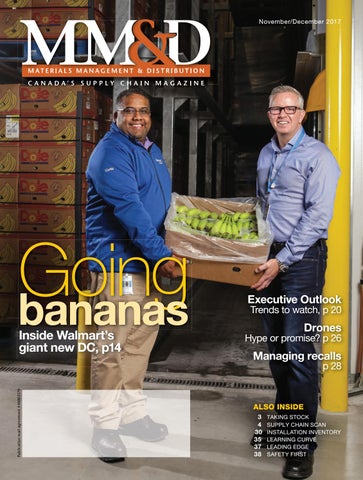
November/December 2017 • Volume 62 • Number 06 On the cover Walmart Canada’s Curtis Brumfield (on the left) and Drew Robertson with some of the retailer’s most important product at its new DC in Cornwall, Ontario. Story on page 14. (Photo by Jason McNamara) 20
26
28
30
Outlook
Drones
Recalls
Installations
A peek at trends affecting logistics management now and in the future
Will we ever see last-mile delivery by unmanned aerial vehicle?
Using software to manage recalls and achieve compliance
Robots, racking and AGVs improving warehouse ops
MM&D is indexed in the Canadian Magazine Index by Micromedia Limited. Back copies are available in microform from Macromedia Ltd., 158 Pearl St., Toronto, ON M5H 1L3
www.mmdonline.com | November/December 2017
3
SUPPLY CHAIN SCAN
3PL
M+S
UKRAINE TRADE
UNSOLD
Adaptation is key says annual report, p 11
Appointments and promotions, p 13
Canada’s little known trade agreement with Ukraine is now in force, p 6
Preventing unsaleable goods, p 9
Millennials see supply chain jobs as rewarding By MM&D Staff illennials are focused, engaged, enthused and committed to working in supply chain management; supply chain represents a sought-after, dynamic and rewarding long-term career choice for professionals in their 20s and 30s. These are among the key findings of APICS’s Millennials in Supply Chain research report, conducted by Peerless Research Group in conjunction with Supply Chain Management Review (SCMR) and the American Productivity & Quality Center (APQC). “The results of the report are eye-opening, especially when compared to the more senior supply chain professionals in leadership positions, who were part of a previous study from APICS and SCMR in 2016,” said APICS CEO, Abe Eshkenazi. “We see that more millennials started their career in supply chain, are moving around less, are highly satisfied with their jobs and see more opportunities for advancement in the field.” The report shows millennials have a diverse interest in activities that span the end-to-end supply chain. Notably, the area that holds most appeal, supply chain design and planning, is a role that touches all areas of supply chain. The millennials surveyed also said they find their careers personally rewarding. Eighty-one percent feel they can make a difference in the supply chain field, 87 percent believe working in the field will help with their personal growth and development, and 88 percent agree that there are opportunities for advancement within the field. Diversity topped the list of what millennials consider most important. Eighty-five percent noted that supply chain involves a diverse workforce and encompasses people of all types, which additional findings that 4
‘‘
We see that more millennials started their career in supply chain, are moving around less, are highly satisfied with their jobs and see more opportunities for advancement in the field.
more women are now entering the field also reflect. Respondents were roughly two-thirds male (61 percent) and one-third female (39 percent), compared to the 2016 survey of senior supply chain leaders, in which 76 percent of respondents were men while only 24 percent were women. However, just as earlier research of senior managers in 2016 showed a pay gap between males and females, there is a gender wage gap among millennials. Men and women start at roughly the same salary, but the disparity grows larger as they move up the
career ladder. This disparity is chief among complaints from millennials surveyed, along with frustration around the attitude towards millennials by older generations in their organizations and a disconnected feeling from the big picture or a lack of purpose in the workplace. “Despite some noted frustrations, millennials are continuous learners and fast movers who are eager to advance,” Eshkenazi concluded. “To address the ongoing skills gap, industry expectations, priorities and communication styles must adapt to and embrace the different needs of this younger generation. Millennials are growing and learning on the job in an era of lean, optimized, endto-end supply chains and are critical to the ongoing transformation of the industry.” Results of the survey are based on 676 respondents working in supply chain management who were pre-qualified for being between the ages of 22 and 37, born between 1980 and 1995. At a 95 percent confidence level, results are projectable at a margin of error of +/- 3.8 percent. MM&D MM&D | November/December 2017
Photo: alvarez; iStockimages.com
M
SUPPLY CHAIN SCAN
CITT elects 2018 council for GTA
Illustration: Damaratskaya Alena; iStockimages.com
T
he CITT Toronto Area Council (TAC) has elected a new council for 2018, to be led by chairman Duane Chiasson. All the members were acclaimed. “I am very much looking forward to chairing the council for another year. I am also excited that there is a good mixture of new faces and true veterans returning and some students,” Chiasson said. “I also wish a fond farewell to Tom Pauls who is stepping down completely from council activities. Tom has served the council in one capacity or another for at least 12 years, three of those years being Chair. Tom has certainly left his mark on the council and much of the success can be attributed to his hard work. Also moving on will be Bill Carter who has graciously served as secretary for the past two years.” Chair Duane Chiasson, CCLP, is in business development at Effective Logistical
Solutions (a Contractor of Yusen Logistics). Michael Gomes, CD, CCLP, CSP, CTB, a 3PL broker, is vice-chair. The treasurer is Cornelius Wong, CCLP, a recruitment consultant at SCL Search Consultants Ltd. Shaukat Khan, CCLP, manager of consulting at Farrow Consulting is secretary. The events coordinators are Demi Todorov, CCS, CTCS, CCLP, a Customs compliance consultant with DHL Global Forwarding (Canada) Inc and Victoria Jones, a logistics coordinator at Cambrian Solutions. The following were asked to sit on the council as Members at Large because of ongoing commitments from TAC 2017: Millie Jie Leng, lead hand, Customs brokerage, DHL Express (Canada) Ltd. will be responsible for the Holiday Helpers Wrapping Night. Denise Ponte, CCLP, in business development at Effective Logistical Solutions, will be the Holiday Helpers Liaison. Handling the bur-
sary award is Joyce Xu, CCLP, an analyst at CN. Mike Upwood, CCLP, president of Marbro Logistics Inc, is the golf tournament manager. Grace Di Marca, CCLP, CCS, CTCS, is national manager of the Tariff Support Unit, Customs Consulting at Kuehne + Nagel Ltd. and will be the board’s CSCB Liaison. “Participation locally is an extension of the CCLP designation, not only to achieve Certification Maintenance Units (CMUs) but it also allows us to be in front of supply chain and logistics communities in holding events such as tours, workshops and speakers series, allowing us to network personally on a scale unequaled in our small community,” Chiasson continued. “The farther the reach of the CITT vision through the area councils the more relevant the designation becomes and the more value is brought to the designates’ own personal brand.” MM&D
ADVANCE YOUR CAREER IN THE NEW YEAR TAKE THE NEXT STEP! Are you ready to advance your supply chain career through practical and relevant training? As a full service professional association, Supply Chain Management Association Ontario delivers the most extensive range of leadership and skills development programs and educational offerings available, including the Supply Chain Management Professional Designation (SCMP). Take advantage of our upcoming educational offerings:
Diploma Course Supply Management Business Administration January 17 – April 11, 2018
Diploma Seminar Inventory Management January 25 - 26, 2018
Professional Development Lean Supply Chains Industry 4.0 February 22-23, 2018
Visit us online at SCMA.CA/ON to learn more about our educational offerings and see which program is right for you!
www.mmdonline.com | November/December 2017
5
SUPPLY CHAIN SCAN
Canada’s unsung trade agreement By Christian Sivière
CUFTA, the Canada-Ukraine Free Trade Agreement, which came into effect on August 1, did not get all the attention it deserved, as it happened shortly after the Canada Free Trade Agreement between Canadian provinces and territories on July 1 and just before the long-anticipated Free Trade Agreement with the European Union on September 21. With the exception of a few agricultural goods, the CUFTA essentially eliminates Customs duties on most products, either immediately or through a tariff phase-out period. The duty elimination process, however, is asymmetrical, as Canada has opened its market immediately for 98 percent of tariff items, both industrial and agricultural goods, with only a few exceptions: 108 tariff positions in poultry, dairy products, eggs and egg products, cheese and sugar. And there is a seven-
year phase-in period for automobiles. Ukraine on the other hand, has granted duty-free access to Canadian products immediately on 72 percent of tariff items, and provides transitional periods of one, three, five and seven years for 27 percent of tariff items. The CUFTA also opened government procurement to companies from both countries, giving them non-discriminatory access to bid on public airport, railway, mail and public transportation projects. In this context, Ukraine has recently opened an online public procurement platform called ProZorro, with the objective of providing equal, fair and transparent treatment to all bidders. The Canada Border Services Agency advised the trade of the implementation of the CUFTA for August 1, as well as providing links to the tariff provisions, proof of origin and shipping requirements. A new preferential tariff treatment was
introduced, namely the Ukraine Tariff (UAT) code # 32, to enable the Customs clearance of inbound shipments in Canada. Entitlement to the Ukraine Tariff is determined in accordance with the rules of origin set out in Chapter 3 of the CUFTA. As with every Free Trade Agreement, a certain percentage of non-originating products is allowed, in some cases, providing sufficient transformation of a product takes place, evidenced by a shift in the H.S. code. Product-specific rules of origin are found in Annex 3-A and organized numerically, similarly to NAFTA’s Annex 401. Canadian exporters must familiarize themselves with these rules to determine if their products comply and will obtain the lower Customs duties in Ukraine. Unlike NAFTA, which requires a separate Certificate of Origin on a specific form, the required proof of origin under CUFTA is an Origin Declaration incor-
We make a big deal over the tiniest items.
Your business doesn’t stop at the border. Neither does Old Dominion. Our focus on premium service means every shipment arrives on time and worry free, backed by an on-time record and claims ratio that rank among the best in the industry. When shipping to or from the U.S., choose Old Dominion.
Old Dominion Freight Line, the Old Dominion logo, OD Household Services and Helping The World Keep Promises are service marks or registered service marks of Old Dominion Freight Line, Inc. All other trademarks and service marks identified herein are the intellectual property of their respective owners. © 2017 Old Dominion Freight Line, Inc., Thomasville, N.C. All rights reserved.
SUPPLY CHAIN SCAN
porated in the seller’s commercial invoice. A model declaration can be found in Annex 3-B of the Agreement. Goods may be shipped to Ukraine or to Canada with a trans-shipment, providing the remain under Customs control/in bond at all times (article 3.13). Refunds of excess duties paid after August 1 can be made within four years of the importation date. What does the current trade between Canada and Ukraine look like? In 2016, Canada’s exports to Ukraine amounted to $255 million (up from $205 million in 2015 and $137 million in 2014), led by exports of mineral products, live animals and animal products, and vehicles, aircraft and associated equipment. On the other hand, Canada’s imports from Ukraine came to $107 million (up from $67 million in 2015 and $99 million in 2014)), led by imports of vegetable products, transport equipment and machinery. Canada’s bilateral trade has been increasing steadily and will likely continue to grow further thanks to the CUFTA. MM&D
For transborder shipments, OD offers:
DONE DEALS Liftow, Toyota’s largest forklift dealer in North America with 20 branches and 525 employees in Eastern Canada and Wisconsin, announced its recent acquisition of a controlling interest in MasonLift. Terms of the transaction were not disclosed. MasonLift has been in business for more than 70 years, has a staff of 130 and operates out of 10 locations in British Columbia, representing Toyota, Kalmar and Load Lifter forklift products, Ottawa terminal tractors and Atlas material handlers. Day & Ross Transportation Group announced the US acquisition of REI Logistics and Korten Quality Systems, Ltd in Romeo, Michigan. These two businesses will operate as Day & Ross Dedicated Logistics USA, a division of Day & Ross USA Inc under the leadership of Shawn McMahon, president Day & Ross Dedicated Logistics. The companies will focus on dedicated delivery (Auto), dedicated truckload (including temperature controlled), crossdock and product sequencing including warehousing. CEVA won a delivery contract with French-headquartered, multi-national retailer Carrefour. Centered initially on the Paris region, CEVA is responsible for deliveries of soft drinks and dried products to almost 60 stores on a daily basis. Operating from its 36,000-square-metre facility close to Charles de Gaulle airport, CEVA is also handling reverse logistics for Carrefour including removing packaging and cartons post-delivery. CEVA also recently opened a specialist warehouse for healthcare and beauty products to support Carrefour’s new parapharmacy concept, which will be developed over the coming years. This 7,000-sqm facility, close to the city of Reims, will initially employ 80 staff, and will be expanded as the new business stream goes live.
• A single point of contact with a local OD shipping expert • In-house customs clearance and brokerage services available 24/7 • 100% visibility with door-to-door track and trace • Complete coverage of the U.S. with direct loading to major markets • PARS and PAPS pre-clearance that reduces paperwork issues and delays at the border
For more information, visit odfl.ca or call 1-800-432-6335.
SUPPLY CHAIN SCAN
Logistics is sweet spot for augmented reality By MM&D Staff
s one of the first markets to adopt and deploy augmented reality, logistics will continue to be a leading vertical for Augmented Reality (AR) glasses shipments and total value chain revenues over the next five years. According to a recent ABI Research report, “Augmented Reality in Warehousing and Logistics”, logistics will account for 24 percent of global smart glasses shipments in 2017. These shipments are expected to generate revenue of US$52.9 million in 2017, and will grow to US$4.4 billion in 2022. “AR smart glasses’ pick-by-vision capability frees workers’ hands of traditional paper lists and picking instructions and enables them to work comfortably, safely, and efficiently in warehouses. AR streamlines the work process, and in turn offers compelling
ROI to adopters through reduced errors and higher efficiency,” says Marina Lu, senior analyst at ABI Research. “Another primary enterprise-focused use case for AR, ‘See What I See’ (remote expertise), can drastically reduce travel costs and optimize resources by resolving issues with AR’s real-time remote support that enables communication with remote colleagues, and
displays all relevant information like guidelines, and check lists in the field of view.” After completing smart glasses trials in numerous pilot sites across the US, mainland Europe, the UK, and the Netherlands, DHL Supply Chain decided to expand AR solutions across different industry sectors globally, as average productivity has universally improved by at least 15 percent. DHL has partnered
What’s the most rewarding career decision you’ll ever make?
Your best choice for complete career-long OHDUQLQJ FHUWLÀFDWLRQ in supply chain logistics
Earning the CCLP® designation is easily the single best thing you can do to boost your career prospects. It can set you up for better pay, more advancement opportunities, and a range of management pathways and options across the sector. Plus, you’ll develop and demonstrate cross-functional capabilities that can deliver better business results—and more personal job protection. Depending on your background, your CCLP designation might be within closer reach than you think. Call or click WR ¿QG RXW LI \RX TXDOLI\ IRU DGYDQFHG VWDQGLQJ
www.citt.ca/cclp t 416.363.5696 ®CCLP & &,77 &HUWLÀHG /RJLVWLFV 3URIHVVLRQDO LV D UHJLVWHUHG WUDGHPDUN RI I & &,77
8
MM&D | November/December 2017
Photo: mikkelwilliam; iStockimages.com
A
SUPPLY CHAIN SCAN
with hardware companies including Vuzix (M100 and M300 Smart Glasses) and Google, along with software provider Ubimax, for their AR logistics solutions. General Electric has seen significant performance improvement in warehousing and logistics as well, citing a 46 percent performance increase using smart glasses on Upskill’s Skylight platform. “These early use cases, mainly pick and pack and remote expertise, will always be prevalent, although new use cases will continue to add potential market value. More universal AR use cases, including maintenance and repair, training, and navigation, can be incredibly useful in various parts of the logistic market,” concludes Eric Abbruzzese, principal analyst at ABI. “While device concerns around comfort, battery, usability, and robustness do persist, advancements in smart glasses, as well as the quickly growing AR-powered mobile device space, promise to lessen these concerns over time.” MM&D
www.mmdonline.com | November/December 2017
Report offers strategies to reduce unsaleable goods By MM&D Staff
‘‘
This report new report provides the consumer goods sector with proven, tangible solutions to effectively documents reduce the nearly $15 billion annual cost of the causes of unsaleable goods, or products that cannot be unsaleable goods and sold due to their condition. provides trading The Collaborative Strategies to Reduce partners with clear Unsaleables report was released at the Council of instruction for reducing Supply Chain Management Professionals (CSCMP) annual conference. The report ranks them and the impact solutions with a track record of success and prothey have on efficiency, vides implementation guidance. The report was sustainability and completed by CHEP for the Trading Partner profitability. Alliance (TPA), an industry affairs leadership group formed by the Food Marketing Institute (FMI) and the Grocery Manufacturers Association (GMA). “Reducing unsaleable goods is a priority for retailers, manufacturers and their
A
Continues on page 10
9
SUPPLY CHAIN SCAN REPORT OFFERS STRATEGIES TO REDUCE UNSALEABLE GOODS, continued from page 9 suppliers,� said Daniel Triot, senior director at TPA. “This report effectively documents the causes of unsaleable goods and provides trading partners with clear instruction for reducing them and the impact they have on efficiency, sustainability and profitability.� The recommendations are based on an
extensive, year-long analysis predicated on dozens of interviews with industry experts conducted by CHEP for the TPA Joint Industry Unsaleables Leadership Team (JIULT). The study captured and analyzed 48 unsaleable goods reduction strategies and placed them into seven categories based on
Gets you moving. Gets your goods moving.
/HW WKH :DONLH 3DOOHW 7UX /HW WKH :DONLH 3DOOHW 7UXFN JLYH \RXU SURGXFWLYLW\ D OLIW ,WœV SDFNHG 7 ZLWK IHDWXUHV WR PRYH JRRGV IDVWHU VDIHU DQG PRUH HIILFLHQWO\ • Maneuvers easily in tight spaces • Stronger, tougher, more durable • Smooth, controlled operation • A/C power gets the job done
frequency of use and impact: 1. Planning and Review 2. Collaborative Shelf Life Management 3. Testing Package and Unit Load Performance 4. Package Labeling 5. Receiving and Warehousing 6. Sharing UPC and POS Level Data 7. Product Rotation and Display Recommendations in the report fall into four categories – increase, continue, monitor or ignore – and each is identified as the responsibility of retailers or manufacturers, or as a collaborative opportunity. A TPA online Unsaleables Reduction educational platform is expected to launch by the end of 2017. The educational platform will contain detailed information and tools to help trading partners review their supply chains and identify and implement effective unsaleables reduction strategies and solutions. The Trading Partner Alliance (TPA) is a joint industry affairs-industry relations leadership group formed by the Grocery Manufacturers Association (GMA) and the Food Marketing Institute (FMI) to develop and address a shared retailer-manufacturer agenda on supply chain efficiency issues, the application of information technology, executed jointly by GMA and FMI and overseen by the boards of directors of both organizations. MM&D
HD R H DERXW DW W /HDUQ PRUH DERXW ZKDW WKH FDQ GR IRU \RXU EXVLQHVV Hot Bonus XSRQ UHFHLSW RI \RXU TXRWH IRU DQ \RX ZLOO UHFHLYH D IUHH FRIIHH FDUG UHGHHPDEOH DFURVV &DQDGD IRU D OLPLWHG WLPH January 31st, 2018
IN CASE YOU MISSED IT What’s happening at www.MMDonline.com Loblaw closing 22 stores, launching home delivery
Z READ MORE HERE:
For a q quote, demo or more info:
http://tinyurl.com/loblaw-home
([W LQIR#MRKQVWRQHTXLSPHQW FRP RU YLVLW MRKQVWRQHTXLSPHQW FRP
VersaCold opens first part of new Milton, Ontario DC
Z LEARN MORE HERE: http://tinyurl.com/versacold-mmd C O M P L E T E
MOVE
MANAGE
S O L U T I O N S
STORE
™
PROTECT
Trenton company fined after worker injured by steel struts
Z READ MORE HERE: http://tinyurl.com/frazier-mmd
10
MM&D | November/December 2017
SUPPLY CHAIN SCAN
Adaptation paramount for 3PLs Annual survey highlights technology, relationships By MM&D Staff
B
lockchain, automation and new talent requirements are the focus of the 2018 22nd Annual Third-Party Logistics (3PL) Study. This year’s study shows the continuation of two trends: the importance of the relationship between shippers and 3PLs, and the importance of adapting to emerging technologies, including blockchain and automation. The result of these closely-forged relationships is improved services to the end customer. Blockchain
This is the first time the 3PL study investigates blockchain. Results show that while 30 percent of 3PLs and 16 percent of shippers see blockchain as a potential application, they have yet to engage with the technology. The study describes anticipated benefits including improved supply chain visibility and potential challenges that participants will face in implementing blockchain. “Blockchain has the potential to make significant improvements in security, transparency and governance, but only in supply chains where there is value in controlling consumer risk, valuable goods or complying with regulations,” said Ken Toombs, global head of Infosys Consulting. “Shippers and 3PLs will need to work together to drive value from blockchain, using lessons collectively learned from missteps with other emerging technologies like Radio Frequency Identification (RFID).” Automation in transportation
The study looks at some of the exciting potential with on-road automation, such as driverless vehicles. It also examines many ways in which automation is already providing returns across the supply chain through digitalized load matching and warehouse robotics. Competitiveness is a key driver for a majority of 3PLs (62 percent) and shippers (57 percent) to invest in automation/ digitization.
‘‘
Organizations must now rethink their talent strategy from top to bottom. The supply chain/ logistics leader must now be agile, a strategist, a visionary and a collaborator. The entire supply chain organization must now compete with technology, and the winners will be those that elevate their people using technology, rather than replacing them with it.
However, the report also revealed a number of reasons for lack of investment in digitization and automation, including a lack of inhouse talent to develop, implement and monitor (12 percent of 3PLs and 10 percent of shippers). Technology improvements in supply chain, especially in the area of fleet operations, have had positive impacts on the industry,” said Tom Scollard, Penske Logistics vice-president of dedicated contract carriage. “It has allowed 3PLs to operate fleets that are safer and more efficient for the customer.” Logistics talent revolution
Technology is reframing the demands on the workforce, particularly within the supply chain where automation, digitization and data collection capabilities are growing rapidly. Supply chain leaders and logistics executives play even more critical roles as companies work to build more efficient and technologically advanced supply chains. “It’s no surprise that technology continues to unlock unforeseen value across the global supply chain in a variety of ways,” said Neil Collins, regional managing partner for Korn
www.mmdonline.com | November/December 2017
Ferry’s North American industrial markets. “To leverage the potential upside, organizations must now rethink their talent strategy from top to bottom. The supply chain/logistics leader must now be agile, a strategist, a visionary and a collaborator. The entire supply chain organization must now compete with technology, and the winners will be those that elevate their people using technology, rather than replacing them with it.” Risk and resilience in shipper-3PL relationships
Through all the technological advances, the opportunity to improve upon the risk versus resilience in relationships between 3PLs and shippers continues: 79 percent of 3PLs and 64 percent of shippers report they have been involved in projects in which the ability to execute quickly was directly impacted by lack of complete, accurate and consistent information provided by the shipper. The study shows a large increase in the percentage of shippers seeking information technology (IT) services from 3PLs, with 27 percent indicating outsourcing of IT services in the 2018 study compared to 17 percent in the previous year. However, the percentage of shippers indicating satisfaction dropped slightly this year from 65 percent to 56 percent, potentially due to higher expectations among shippers as technology has improved or because shippers are seeking enhanced analytical capabilities to help drive more effective supply chain decisions. The 2018 study was produced by Penske Logistics, the global logistics and supply chain management provider, Infosys Consulting, the strategy and transformation consulting arm of Infosys, Penn State University, and global talent advisory firm Korn/Ferry. The study attracted 580 respondents, a 65 percent increase over the number of participants taking part last year. The study report and additional materials can be viewed online at www.3PLstudy.com. MM&D 11
Buying from the “one-trick pony” manufacturer can put you at a disadvantage.
Buying from a Pallet Racking Systems Integrator gives you the definite edge.
We don’t don t sell our solution to your y problem... It’s ourr problem to develop yyour solution.
3D
STORAGE
SOLUTIONS
L I M I T E D
PALLET RACKING
PALLET FLOW
DRIVE-IN
CANTILEVER
PUSHBACK
CARTON FLOW
1 (877) 557-2257
MEZZANINES
INDUSTRIAL SHELVING
3DSTORAGESOLUTIONS.COM
SUPPLY CHAIN SCAN
MOVERS + SHAKERS
RANDY WRONZBERG
The Econo-Rack Group (2015) Inc, (Konstant, Econo-Rack, and Technirack) has promoted Randy Wronzberg to the position of president and CEO. Wronzberg has served as vice-president of operations for Econo-Rack Group since August 2015. Gabe Mazzetti, the out-going president and CEO, decided to leave Econo-Rack Group after more than seven years to pursue several personal ambitions.
Ann Pompilio has joined TSI Group as partner. Pompilio brings more than 25 years of executive experience in finance and supply chain, having spent 11 years as vice-president, finance and CFO for SCI Group, a subsidiary of Canada Post. While at SCI Group, she brought aboard several high-profile customers including Lowe’s and Amazon, into Canada. Pompilio will be based out of the Toronto office. Heiner Murmann has accepted an invitation to join Metro Supply Chain Group Inc’s advisory board. Murmann has over 20 years’ experience in logistics across the Americas, Europe and Asia. He spent the better part of his career at DB Schenker, serving as CEO for the Americas before becoming a member of the board of management, overseeing air and ocean freight. In his advisory role, Murmann will HEINER MURMANN work closely with Metro’s management team to help steer strategic growth in all markets with an emphasis on the company’s expanding international operations. Drone Delivery Canada (DDC) has appointed Mark Wuennenberg to the newly created position of vice-president – regulatory affairs. Before joining DDC, Wuennenberg worked at Transport Canada as a civil aviation inspector responsible for general flight standards and
the regulation of commercial drones in Canada since 2012. He is an expert in unmanned aircraft systems (UAS). As a 33-year veteran of the Royal Canadian Air Force he accumulated over 4,300 hours in numerous aircraft and held staff/instructor positions in National Defence Headquarters NORAD, United States Space Command, the Canadian Forces Instrument Check Pilot School, and the US Air Force’s Flight Standards Agency. Catherine Dyer has joined Air Canada as chief information officer. Dyer is based at the airline’s Montreal headquarters. She comes to Air Canada from Enbridge Inc. where she most recently held the role of CIO and prior to that, vice-president, Information Technology. She also previously held a number of senior management positions, including vice-president, distribution at WestJet Airlines Ltd., and director of sales, communications, CATHERINE DYER at Telus Corporation. Nanette Efird has joined Savi’s senior management team as the new vice-president of product management. A veteran in the world of supply chain logistics solutions, Efird is an expert in applying data analytics and Internet of Things technology to the global transportation industry. Efird joins Savi from GE Transportation Digital, where, as senior director for strategic data and analytics solutions, she launched GE Transportation’s ocean NANETTE EFIRD port solutions business. Before joining GE, Efird served as the director of commercial products and services at Railinc Corp, an IT and software services firm for the freight rail industry. Efird graduated with a BS in business.
Networking and mentors seen as means to move up
P
rocurement workers see networking and mentors are the best means to climb the career ladder, and only half trust their bosses to help them advance. These are a couple of the key findings in “Procurement’s Gen Next”, a recent survey by Procurious, an online procurement community. Gen Next is described as “a new breed of procurement professionals who are not defined by the year they were born, but by their positivity and commitment to proactively managing their careers,” said Hugo Britt, content director at Procurious and author of the study. From developing vital mentoring rela-
tionships, to building social media profiles that have eclipsed the importance of CVs, to seamlessly leveraging their professional networks to find a new role, to crowdsourcing a procurement solution, the members of Gen next are collaborative, proactive and ambitious. The report revealed that just under half (40 percent) of those surveyed will change jobs within two years, and 70 percent will leave within five years. More than half don’t trust their own bosses to help with their career progression, and say that 75 percent of managers “just send an email” when driving change,
www.mmdonline.com | November/December 2017
rather than using the full suite of changemanagement tools at their disposal. Two-thirds regard their online profile to be as important as their CV, and professional networks are regarded as equally important for career advancement as on-the-job performance. And, while mentors are the most trusted source of career advice, finding mentors and sponsors is an uphill battle. “In this fast-moving business environment, professionals need to look beyond their four walls to find best-in-breed practices, mentoring and solutions to complex problems,” said Tania Seary, founding chairman of Procurious. MM&D 13
yes we have Walmart’s brand-new Harmony DC in Cornwall, Ontario ensures stores across Eastern Canada have fresh food, with a special focus on the most popular tropical treat
By Emily Atkins
Main: The five banana ripening rooms
form an imposing backdrop inside the Perishables DC. Inset: Curtis Brumfield (left) and Drew Robertson show off some of the green fruit that’s headed for a ripening room.
14
D
eep in the heart of Walmart Canada’s giant Harmony DC in Cornwall, Ontario is a large series of vault-like chambers. Inside, thousands of kilograms of bananas are quietly ripening, under tightly
controlled atmospheric conditions. These banana ripening rooms use state-ofthe-art technology to ensure that every case of the tropical fruit shipped arrives in stores at precisely the right moment in its lifecycle. And that’s no easy task, says Joe Rupolo, Dole’s ripening and distribution manager for Walmart. Given that the DC ships from MM&D | November/December 2017
bananas Cornwall all the way to Canada’s east coast, the bananas need to be at varying ripeness levels as they are loaded for their journey. Ensuring the bananas reach stores at the optimal moment also means there is less food waste. “Not all bananas are the same,” Rupolo says. Coming from different countries,
under different conditions, they require close monitoring. “You are creating a new product” with bananas, he adds. As they ripen they turn latex into sugar, creating heat and gases as byproducts. The ripening rooms blow air across the fruit and control heat, humidity and ethylene gas levels to ensure perfection.
www.mmdonline.com | November/December 2017
Photos by Jason McNamara
The Walmart DC has five banana chambers that can each contain three truckloads, or about 54,400 kilos. The fruit is palletized and neatly packed into drive-in racking. They began operation this October, and Rupolo has been following the ripened bananas to the stores to verify quality. CONTINUED ON PAGE 17
15
Whether it’s across town or halfway around the world, with every shipment and every project, our customers place their trust in our hands. My hands. Because at some point, every piece of business I touch becomes a personal responsibility. It’s up to me to keep costs down, performance on schedule, and quality at a premium. Someone’s business is riding on it. And I won’t let them down. I am
pilotdelivers.com / 1-800-HI-PILOT ©2017
An employee in the Perishables DC fills up a hydrogen-powered forktruck. The entire material handling fleet uses hydrogen fuel cells.
They’re doing well, he reports. “Walmart has the tools in place to be the best place to buy bananas in Eastern Canada,” he says. “It’s one of the most critical items in the store,” adds Drew Robertson, senior director of operations with Walmart Logistics. “We need to make sure the offering is consistent across the region.” Bigger than bananas
Bananas are by no means the only product this DC is handling. Harmony contains three distinct DC operations under one expansive roof. The bananas are part of the Perishables DC (PDC), which, along with an Import DC (IDC) and High Velocity DC (HVDC), is housed in the former Target Canada building. Walmart bought the two-year-old facility—along with 12 stores—in 2015 when Target gave up its Canadian operations. The DC serves Walmart stores from Cornwall to the east coast, supporting the company’s push into the fresh grocery market. The building is large enough that the CN Tower would fit on its side within the perimeter walls. It covers about 1.5 million square feet, and sits on 169 acres. It has more than 200 dock doors, and yard that will accommodate 1,300 trailers. The facility sits close enough to Walmart’s
Regional Distribution Centre (RDC) that with a minor variance the two properties may be joined in the future, Robertson says. It is also only a couple minutes from the 401 via a brand new road that allows trucks easy access. Getting started
When Walmart took over the DC from Target, it was only two years old. But, it’s no surprise that different business would have different needs, and Walmart needed to renovate. Target only handled general merchandise at the facility, while Walmart handles a wide variety. A 135,000 square-foot freezer was added to the footprint on the east side for the PDC. Now the temperature-controlled area includes the banana rooms, a zone for fruits and hearty vegetables that’s kept at 12C, a cooler at 1C and a freezer at -23C. Walmart replaced all the racking in the building as well, upgrading for weight and picking style. Robertson notes that Target did quite a lot of single picks, while his operation is focused on case and pallet picks. Although the building was only two years old, the concrete floor at the main dock doors had to be replaced, a renovation that took place while the import DC was already operational. The building uses LED lighting both inside
www.mmdonline.com | November/December 2017
and out, reducing energy consumption by 74 percent. Operations
The Harmony facility currently sees between 700 and 900 trailer moves each day, with approximately 19,000 trucks passing through the gates every month. Most of the big Walmart stores get daily deliveries, and the DC operates 24/7 to ensure they are kept stocked with fresh food. The busiest area is in the frozen, dairy and deli (FDD) area, which receives and ships daily. Inbound trucks are unloaded and racks replenished overnight, and outbound loads are built and shipped up until four in the afternoon. All this depends on the timely arrival and departure of trucks, which is controlled through Walmart’s proprietary yard management and warehouse management systems. But, because of the building’s design, dock space is at a premium. “Doors are the commodity here,” Robertson says. “Although we have lots, we could always have more.” The building was designed with doors on one side only, he notes, which is not the way a Walmart DC would be designed if being built from scratch. It means that the same CONTINUED ON PAGE 19
17
GROUPE ROBERT YOUR SUPPLY CHAIN PARTNER Transportation • Distribution Centres • Logisitics Solutions
At Groupe Robert, we know supply chains. We know what makes them work and how to optimize them to drive your business forward. That is why we provide a comprehensive range of transportation, distribution and logistics solutions – all from the same trusted source. No matter where you are in North America, or where you need us to be, we are your “make it happen” supply chain partner.
MONTREAL
TORONTO
1 800 361-8281
1 800 300-9683
ROBERT.CA
Left: Bananas are joined by other fruits and vegetables as workers prepare outbound pallets in the Perishables DC. Right: A little perspective—the Harmony facility is big enough that the CN Tower could fit, on its side, within the building.
doors must be used for inbound and outbound loads, requiring careful timing. If a truck is late the whole sequence can be disrupted, although it is seldom an issue. In the HVDC the pace is more restrained. Five thousand SKUs of fast movers like kitty litter and diapers are stored in 40-foot-clear racking or in floor pallet positions. In the import DC the freight is all conveyable and is shipped three days a week to the regional DC and the Mississauga, Ontario distribution centre. Human resources
All this work is accomplished with a staff of 1,400, including both full- and part-time associates. General manager Curtis Brumfield oversees the big picture, with two assistant general managers reporting to him. They, in turn, have 12 operations managers and 30 team leads who keep staff up to date on each day’s requirements. With the regional DC so close by, Walmart is operating the two facilities as a campus. Brumfield says this helps with the flexibility in staffing, as people can be moved from the regional DC over to the Harmony building as demand requires. As well, many staff from the RDC were able to move to Harmony when it opened, providing a core of experienced workers that made starting up smoother.
Technology
The Harmony facility uses one of Walmart’s all-hydrogen-powered material handling fleets. Crown pallet and fork trucks supplied by Ryder rely on hydrogen filling stations that are located throughout the facility. Unlike battery powered units, hydrogenpowered material handling equipment runs at full power until it needs a fill-up. The system is supplied by PlugPower, which has been working with Walmart to work out some issues that arose with operations in the freezer area. According to Robertson, an upgraded motherboard has reduced the instances of the units timing out in the cold. Associates use Vocollect voice recognition units for picking. At the moment these are the original wired units, although Robertson notes the company is working on an upgrade to Bluetooth headsets with the transmitting unit attached to the mobile equipment. Tests have shown that the Bluetooth units provide better voice recognition and clearer sound, he says. Future Harmony
Expansion is definitely in the cards. “As we grow the pain point will definitely be recruiting,” Robertson says, noting that they are hiring an additional 100 associates now. He adds that Cornwall is an attractive location with a burgeoning urban scene, while still
www.mmdonline.com | November/December 2017
maintaining its small-town charm. The company hopes to be able to attract some former Sears Canada employees out of Brockville, Ontario, just 100 kilometres down the 401 highway. Staff can be moved around within Harmony, as well as to or from the RDC next door, and if business needs change the allocation of space between the HVDC and IDC can change. In fact, Robertson points out that the racking is labeled running in opposite directions in the two spaces so if they need to expand they can do so without having to re-label every rack. And while Walmart is exploring automation in other areas, Robertson says the Harmony DC is not a likely candidate. Down the road, AGVs could be brought into play, but because the DC is critical to ensuring the fresh food needs of eastern Canada are met, Walmart will continue to count on reliable human beings for its day-to-day picking and replenishment operations. Operating three DCs under one roof has no drawbacks, Robertson notes. Brumfield agrees: “It’s beneficial to have everything in one place,” he adds. It’s called Harmony because “we have to work three different facilities in one,” Robertson concludes. “And with the campus environment we have enough assets to be make it all work seamlessly.” MM&D 19
Trends
IN LOGISTICS MANAGEMENT Some have suggested 2018 will be a challenging year for business. That’s why we decided to share a number of our top trends that will shape the landscape in the coming year and beyond. In the following special section you’ll read about network design, customer service, supply chain visibility, cost control, automation and HR and risk management. A common thread we found this year is the prevalent concern about staffing. Whether it’s figuring out how to automate, or locating your facilities where there are qualified personnel available, finding and managing human resources is top of mind for many supply chain executives.
Network design trends Land, staffing and access remain priorities By Treena Hein
D
istribution centre location and network design have become increasingly important issues for senior management, “and never more than in the current environment of uncertainty over trade relations and agreements,” states a recent report by location consulting firm The Boyd Company of Princeton, New Jersey. Transportation issues, labour availability, customer service strategy and much more play roles in designing a distribution network that’s going to see a company thrive through the next few years, but cost is obviously an overriding factor. In terms of the least costly 20
location for a DC that would serve the huge Northeastern US megalopolis market – the richest, most highly-concentrated mass marketplace in the United States – The Boyd Company analysis puts Eastern Ontario (communities along the 401 Highway between Toronto and Montreal) on top. Human resources
Indeed, Cornwall, in that very region, has seen significant growth in supply chain activity. Of all its benefits, Cornwall’s economic development manager Bob Peters believes human resources is perhaps the most important. Cornwall puts a strong emphasis on
helping companies with their supply chain networks, he says, by providing lots of help with recruitment. City staff attend job fairs on behalf of companies, for example, and also post jobs on ChooseCornwall.ca. “We may be only Canadian municipality to run a job board for area companies,” Peters notes. “Cornwall has also heavily invested in the Cornwall Business Park, and currently offers over 300 acres along Highway 401 for immediate development. We have excess capacity in municipal services such as water, electrical rates that are as much as 25 percent below other Ontario communities and a robust fibre-optic communications network. We have supported the development of logistics and supply chain studies at St. Lawrence College.” While both Walmart and Giant Tiger have chosen Eastern Ontario for new DCs, Sleep Country Canada recently chose Brampton in MM&D | November/December 2017
southern Ontario. This will help the firm boost capacity in the Greater Toronto Area to support aggressive growth plans for years to come, which includes new store openings and growth in new categories such as lifestyle accessories, the company said in a statement. Proximity
Leon’s Furniture chose Delta, British Columbia for its new 430,000-square-foot DC for easy acces to import goods. While land prices and the reliability of the builder were also important, the firm says it choose Delta because “it’s becoming the largest seaport in Canada” and because Leon’s receives a very high volume of product from Asia. John Boyd, principal at The Boyd Company, notes that congestion and delays are becoming increasingly common at major US ports, “creating opportunities for Canadian ports to gain market share in the growing North American container shipping market”. In addition to Delta, these port locations include Saint John, New Brunswick; Prince Rupert, BC; Halifax, Nova Scotia; and Montreal, Quebec. Indeed, Delta’s port could see the addition
of a new terminal in the next few years to take advantage of the growth in trade with Asia-Pacific countries. This terminal would double the port’s shipping container capacity. In addition to port, rail and highway convenience, “with the extremely limited industrial land inventory remaining in Metro Vancouver, Delta is one of the few municipalities that has industrial-zoned land available for development,” says Delta’s director of corporate services Sean McGill. Delta also has incentives in place to encourage industrial development, a business-friendly atmosphere and safe residential communities, which McGill describes as “ideal for raising families, which means DCs are able to find quality local employees because people want to live, work and play here.” Omnichannel strategy
DC positioning aside, customer service strategy is also a large factor in network design. In the US Target is undergoing a significant network change in the name of better service as it shifts to more small stores. The firm opened 11 smallformat outlets in October this year in New
www.mmdonline.com | November/December 2017
York and four other locations, with more to come in 2018. Target also plans to remodel 1,000 of its 1,800-plus stores by 2020, stating in a press release that they will “serve as hyperlocal distribution centers to fulfill digital orders faster” as the company creates “a networked shopping experience, with stores, digital channels and supply chain working together…” Target adds that it is “transforming the way we replenish our stores.” When asked for specifics on how remodelled stores will serve as hyperlocal DCs for faster fulfilment of digital orders, Target communications lead Kristy Welker says it’s about mass customization and being locally relevant. “In the last few months, we’ve expanded ship-from-store capabilities from 1,100 to 1,400 stores in advance of the fourth quarter,” she says. “Today, more than 95 percent of ‘Order Pickup’ orders are ready to be picked up within the hour.” Welker did not comment on how Target is “transforming” the way it is replenishing its stores, other than to say that the firm’s small-format stores receive more frequent product delivery. MM&D OUTLOOK SECTION CONTINUES ON PAGE 22
21
Illustrations: exdez, iStockphotos.com
EXECUTIVE OUTLOOK
Supply chain visibility Seeing beyond the buzz By Emily Atkins
E
verybody’s talking about, but who really knows what it means? “Supply chain visibility” – try a quick online search and you’ll find a plethora of articles, papers and interviews all talking about how important it is to achieve. Defining it isn’t really that hard, but knowing what to do with it once you have it is a little tougher. We’re going to take a quick look at both. What it is
First, what is it? Supply chain visibility boils down to having actionable data in real time
that allows you to control and fine tune your supply chain operations. In theory, visibility enables better inventory control from end to end, allowing for leaner, more cost-effective operations, and ultimately a more robust bottom line. Gaining visibility is a considerably more complex matter. It requires integration of your information systems across departments (also known as eliminating silos) and the ability to gather, process and analyze reams of data in real time. You need both soft components—a complete systems overview of your supply chain—along with the right technology: mobile asset tracking, cloud computing, and data processing power.
Why you need it
For most companies, achieving total supply chain visibility will be a stretch target. But there are numerous reasons to try. In our increasingly fast-moving, data-rich, world you need to know what’s going on if you are to compete. The advantage goes to the company that can work around risks inherent in global supply chains due to natural disasters, terrorism and political upheaval. Not to mention the recently all-too-common disruptions in trade deals that might turn a supply chain from viable to wildly unprofitable almost overnight with the imposition of new tariffs and duties. Likewise, if you are operating in an omnichannel or simply e-commerce world, you need a degree of nimbleness that can only be achieved by applying the discipline of supply chain visibility. Spikes in demand, working with a major buyer or supplier, rapid product obsolescence, or the entrance of a
The customer service challenge Keeping up with retail and rising customer expectations By Treena Hein White hot’ and ‘explosive’ are common words distribution experts are using these days to describe online commerce. To establish or grow their foothold in this area, companies are making sweeping changes to their supply chain and customer service strategies. In announcing a new DC in Brampton, Ontario Sleep Country Canada, for example, described itself recently as having “quickly become a player in the growing online mattress business”. The company has launched its own mattress-in-a-box product to take on competitors, but the firm also “recognizes that mattresses are tactile and online shoppers still want to visit retail stores to try their mattress out before making a purchase.” Samples of online-order mattresses are therefore available in all their stories. Other businesses that aren’t so productspecific, such as major department store chains like Holt Renfrew, Hudson’s Bay and 22
Bloomingdale’s, are battling competition from Amazon to be sure, but they are also battling some new and disruptive e-commerce ideas, notes John Boyd, principal at location consultants The Boyd Company in Princeton, New Jersey. “Online retailer Gwynnie Bee rents—not sells—clothing items to women,” he explains, “enabling them to use the item for a while or for a special occasion and then return it, thus keeping a new and fresh wardrobe always on hand or on its way.” Digital strategy
Target is using an extensive multi-pronged approach to try and ramp up its e-commerce sales, continuing “to accelerate enhancements in stores and digital to create a networked shopping experience, with stores, digital channels and supply chain working together to meet guests’ needs.” This, says chair and CEO Brian Cornell in a recent press release, is part of “pursuing an aggressive digital strategy.”
The retailer’s more than 1,800 stores across the US are about 16 kilometres or less from three-quarters of all Americans, which enables the firm to try and deliver a shopping experience that focuses on ease and convenience, while also creating capacity to support digital growth by leveraging stores to fulfill online orders faster. Additionally, Target is working to differentiate its shopping experience from other companies by increased staffing and employee training. “We’re elevating every aspect of how we serve our guests, including reimagining hundreds of stores, opening new smallformat stores, introducing new and exclusive brands…transforming the way we replenish our stores and get products to our guests,” states Cornell. “As we open more smallformat stores in new neighborhoods across the country, we’ll be even closer to our guests, and our reimagined stores will provide elevated inspiration and ease, along with serving as hyperlocal distribution centers to fulfill digital orders faster.” MM&D | November/December 2017
EXECUTIVE OUTLOOK new competitor all require the ability to respond immediately and with full command of the relevant data. Using the tool
By now you may have already gotten the sense that supply chain visibility is not an end state but a skill set, or a tool. That’s exactly how some thinkers in the space are characterizing it. Supply chain visibility enables the immediate decision-making that is required to compete successfully in the scenarios mentioned above. It is the logical extension of the old way of doing things with dozens of analysts agglomerating, cleaning and churning through the numbers coming in from disparate systems like EDI, ERP, WMS and TMS. There was no way these human workers, even aided by numerous IT systems, could possibly keep up. They couldn’t do it then, and they certainly cannot do it now.
Fortunately, they don’t have to. With big data flowing in from integrated systems, and increasingly AI-powered capabilities, supply chain decision-making needn’t take hours; once a course of action is determined, changes can be changes can be executed within a split second. If the supply chain’s strategic objectives are clearly defined, software takes over, making the minute adjustments that are needed to turn decision-making into bottom line success. Heavyweight IT suppliers like SAP and Oracle are working hard on perfecting and integrating all the moving parts to make this work in the real world. [1] Until they have it nailed, and for the companies that don’t have the critical mass to adopt such sophisticated systems, supply chain can still continue to benefit from the collection and analysis of their data, and work to incrementally improve their own supply chain visibility. MM&D OUTLOOK SECTION CONTINUES ON PAGE 24
By building a customer-driven supply chain, we will have the right portfolio, demand and supply plan which delivers on time and in full wherever the consumer is, leading to a long-lasting relationship with a reliable consumer base.
‘‘
– VALERIE YOUNG, 3M VP OF GLOBAL SUPPLY CHAIN SERVICES AND OPERATIONS.
For example, Target is expanding its sameday delivery service in New York City from one location to four additional locations; customers have the option to have their instore purchases delivered within two hours anywhere in Manhattan and to parts of Brooklyn and Queens, for a small fee. In addition, next year Target will expand
its ‘Target Restock’ program across the USA. It involves customers placing an ‘essentials’ order until 7pm for next-day delivery. The service is already available in 11 major cities. And earlier this year, Target began testing a customer service option called ‘Drive Up’. This allows consumers to order goods through the Target mobile app and have these items brought to their cars by a store staff member. After an initial pilot program this summer, in October the retailer began offering ‘Drive Up’ to throughout the Minneapolis-St. Paul, Minnesota area. Target also recently expanded its partnership with Google, rolling out ‘Google Express’ service nationwide. In this scenario, Target stores are used to deliver items in just two days. Target is also adding new voiceactivated shopping features, and during this upcoming holiday season, staff members’ devices will be equipped to place guests’ orders online right from the sales floor, with the purchase shipped directly to consumers’ homes. Customer-driven supply chain
3M is another firm “continuously innovating” its supply chain, from receipt of customer orders through to delivery, explains
www.mmdonline.com | November/December 2017
Valerie Young, 3M VP of global supply chain services and operations. “The benefits from the approach are vast,” Young notes. “By building a customer-driven supply chain, we will have the right portfolio, demand and supply plan which delivers on time and in full wherever the consumer is, leading to a long-lasting relationship with a reliable consumer base.” She says trust is the key to making a supply chain flow, and that 3M customers “trust that we are at the cutting edge of innovation and our quality is exceptional.” Young adds that with today’s supply chains inextricably linked upstream to suppliers and downstream to customers, frequent communication between all players is also crucial. “Consumers rule in today’s competitive, complex supply chain,” Young concludes. “It’s no longer enough to anticipate the needs of our own customers, but [we need] to predict the needs of our customers’ customers, as well. Striking the right balance between supply chain efficiency and consumer satisfaction is crucial, and the organizations that do it best see a growing bottom line, higher customer retention and improved relationships across the organization.” MM&D 23
EXECUTIVE OUTLOOK
Automation and human resources Can automation really replace supply chain jobs? By Emily Atkins
T
he recent announcement by grocery chain Metro that it is updating distribution centres has once again raised the spectre of robots taking supply chain jobs. The company will be introducing automation to its distribution operations, and the changes will result in the loss of almost 300 jobs. The push for automation is understandable. Automation cuts down on costly human error and variable productivity and it can be worked 24/7 with no need for scheduling, benefits, holidays and the other requirements of human workers. From an operations perspective, well-planned automation can reduce costs and improve customer service. Every supply chain manager knows that cost reduction is the number-one priority for what is a net cost centre. So, every time we hear about another DC being automated and jobs lost, the question of whether humans will have a role at all in the near future comes to the fore. After all, major companies such as Amazon, UPS and FedEx, among others, already have fully automated DCs in operation. As well, artificial intelligence is making it easier for tasks in customer service and procurement, for example, to be automated.
Likewise, an Oxford University study found that 47 percent of US jobs would be at risk from automation. In Canada it has been estimated that between 1.5 million and 7.5 million jobs could be at risk of automation in the next 10 to 15 years, according to a report by the University of Toronto’s school of public policy and governance. At great risk are the 500,000 who drive trucks and other public conveyances for a living, should automated trucks gain quick acceptance. With job losses that significant the country could face a 12 percent unemployment rate, the report notes. A policy response
Such dramatic job loss would be a cause for great concern, which is why policymakers are beginning to shape potential responses. In the US the President’s Council of Economic Advisors has highlighted the necessity of fostering training, education and job-hunting skills. In fact, the US Department of Labor predicts that 65 percent of today’s school-age kids will end up doing jobs that do not exist now. The University of Toronto report offers a series of policy recommendations for the Canadian government that span the gamut from revamping our social safety net, to introducing more protections for workers, to boosting skills training opportunities.
Private sector prevention
While it’s true that some areas of supply chain employment will increasingly be automated, those who might be displaced—and their employers—can do something about it. As the Oxford study noted, the more skilled the job and the higher the education required to do it, the less likely it is a candidate for automation. This is why companies that are embarking on automation programs are looking to retain and retrain the staff who are at risk. They are taking the initiative to ensure that the people they have already invested in continue to be assets to their business. It’s not a new idea that advances in technology change the nature of work. Look back in history: The first industrial revolution at the end of the 18th century generated riots as machines began to take over once-manual jobs. But ultimately, that revolution completely changed our economy and ended up by creating more jobs than it destroyed. Now that we are in what is called the third industrial revolution—a time characterized by increasing digitization of production—we have the chance to take a lesson from history and apply it by preparing now for the inevitable shift in what we mean by work, both in the supply chain and beyond. MM&D
Different jobs for humans
Many see this as evidence that humans will soon be out of work. The United Nations predicts that the cheap “labour” automation represents will drive a reshoring of production to the industrialized world, leading to a stall in economic development elsewhere.
Now that we are in what is called the third industrial revolution – a time characterized by increasing digitization of production – we have the chance to take a lesson from history and apply it by preparing now for the inevitable shift in what we mean by work, both in the supply chain and beyond. 24
MM&D | November/December 2017
Cost Control Costs remain a top concern By Treena Hein
C
osts and how to cut them are always forefront in supply chain management. Indeed, survival in today’s current business climate requires “the need to be ruthlessly efficient,” says one supply chain executive quoted in a recent white paper from the ‘Beyond the Horizon’ research project, conducted by Michigan State University’s Patricia Daugherty and David Closs in partnership with the APICS Supply Chain Council. To be sure, companies are using a wide variety of cost-cutting measures in their supply and distribution networks, but one major factor is the strategic placement of large, highly efficient DCs. Leon’s Furniture, for example, just opened a state-of-the-art 430,000 square foot DC in Delta, BC that it says will “generate meaningful cost savings and efficiencies over the next several years” as its online and bricks-and-mortar businesses continue to grow. The company names good land prices, as well as the growing port traffic and their building contractor’s reliability as the main factors in deciding on Delta.
dollar for much of the past year has built up demand for DC space related to more affordable Canadian manufactured products. “Warehousing lease rates, especially for modern big box facilities, are on the upswing in all major Canadian logistics hubs from current averages of $8.10 to $11.00 in the Vancouver market; $6.80 to $7.10 in the Calgary market; $7.60 to $8.20 in the Edmonton market; $6.55 to $7.20 in metro Toronto and $4.65 to $7.95 in Montreal,” he explains. “Flat shipping rates are helping to moderate overall DC costs, but they contrast sharply with hefty increases in other DC oper-
Boyd says his clients are increasingly outsourcing staffing and HR functions to specialized third-party agencies specializing in the logistics sector in order to keep inflationary labour cost pressures in check, especially costs for recruiting, training and discretionary benefits.
Industrial rents
Besides a strategic facilities plan (including the consideration of leasing a building versus ownership), Jesse Micak, principal at LIDD supply chain consultants of Montreal and Toronto, lists labour, transportation costs and IT systems—as well as investments in the necessary human to keep them effective—as increasing areas of cost concern in supply chain roadmaps. “Industrial rents for warehousing space are also expected to see healthy increases on both sides of the border,” states a recent report by location consulting firm The Boyd Company of Princeton, New Jersey, “in the range of 6.2 to 8.5 percent nationally and well over 10 percent in hot Northeast and Eastern Canadian warehousing markets like Toronto, the Boston area and New York and New Jersey.” Principal of the firm, John Boyd, adds that the fact that the Canadian dollar has remained in the 70 to 80 cent range against the US
ating costs related to Canadian real estate, construction and labour, up 6.2, 5.9 and 2.7 percent respectively, from 2016 levels.” Outsourcing staffing
Boyd says his clients are increasingly outsourcing staffing and HR functions to specialized third-party agencies specializing in the logistics sector in order to keep inflationary labour cost pressures in check, especially for recruiting, training and discretionary benefits. Other operating costs such as taxes and utilities are also critical, given continued price pressures from off-shore competitors. “Improving the bottom line on the cost side of the ledger is the only choice for many DC operators,” Boyd notes. However, Canada is well positioned in North America for DC cost effectiveness in
www.mmdonline.com | November/December 2017
Boyd’s view, due to the exchange rate, low land costs, absence of development fees in many markets and lower benefit costs (owing to Canada’s health-care system). “Accounting firm KPMG ranks Canada first among the G7 nations in terms of tax policies because of its low corporate taxation rates,” he adds. “These advantages tend to offset administration issues at the border.” Circling back to technology, Boyd identifies “considerable” future savings in the use of semi-autonomous trucks, where trailing trucks are electronically tethered to a lead human-operated truck, a process known as platooning. Ford Motor Co. is establishing a major autonomous R&D centre in Ottawa and General Motors of Canada will be opening a similar research facility in Markham, Ontario. MM&D 25
PUBLICITY STUNT OR GAME CHANGER IN INSTANT FULFILMENT? By Khasha Ghaffarzadeh
T
he idea of drone delivery sharply divides commentator opinion: some dismiss it as a mere publicity stunt while others consider it a game changer that will bring near instant product fulfilment to e-commerce, stripping traditional shops of their last major differentiator. Here we paint a big picture of how we see the emergence of drone delivery. Drone delivery entered mainstream media in late 2013. Around that time, drone delivery of e-commerce parcels was first demonstrated while, in parallel, drones successfully delivered medicine to remote areas. Since then numerous deliveries have been made, partnerships announced, and substantial sums invested (see as example Matternet and Zipline raising a total of $12.95m and $41m, respectively). Despite these developments however, the industry is still in its infancy. The new prevalent strategy is to pivot towards commercial drones. The drones will be higher performance and potentially application-customized, leading to higher prices. This will hold true in the medium-term but there will be no escaping the ultimate fate: hardware platform commoditization. The rise of ‘prosumer’ drones—with prices already down close to the consumer end— attests to this
Photo: vchal; iStockimages.com
Fleets to boost drone productivity?
Drone delivery faces critical challenges. Individual drones offer limited productivity compared to traditional means of delivery (consider a van delivering 150 parcels in an eight-hour shift). They can only carry small payloads, and battery technology limits their flight duration, constraining them to about a 30-minute radius of their base while further lowering their productivity due to the down26
time needed for re-charging/re-loading. The limited productivity, however, is not a showstopper. This is because fleet operation will compensate for poor individual drone productivity. The unit cost of drones will be substantially lower than, say, a van, enabling the conversation of a few, highly-productive vehicles into many small drones with high productivity at the fleet level. This will require a further major reduction in hardware costs for commercial drones, but if the past is to be our guide, this will be inevitable. As a general point, autonomous mobile robotic technology is causing a paradigm shift in the way we envisage many commercial vehicles. Take an unrelated example: tractors in agriculture. Here, the traditional design objective has been to make the tractor bigger and faster
‘‘
Drone delivery faces critical challenges. Individual drones offer limited productivity; they can only carry smal payloads, and battery technology limits their flight duration and requires more time for recharging.
to amplify the productivity of the driver. Autonomous mobility can upend this by converting a few, fast, heavy tractors into a fleet of many slow, small, driverless agrobots. This process has begun and drone delivery can be MM&D | November/December 2017
with low, sprawled-out population densities. High-density urban environments will remain largely out-of-reach. Our forecast model and technology roadmaps show that delivery drone sales will remain limited to a few hundred of units sales per year between now and 2027/28. Demand will then start to take off, reaching sales volumes exceeding fifty thousand units per year by 2038. Thanks to accumulation effects, we therefore expect to see major drone delivery fleets in operation within our twenty-year forecast period. Conclusions
viewed as part of this same long-term trend. Limited payload is also not a showstopper because, according to Amazon statistics, some 85 percent of packages weigh less than two-and-a-quarter kilograms. Furthermore, the decline in delivery costs and time for customers is changing purchasing habits: frequent orders of small items are replacing that big, infrequent order. This matches well to the strong points of drones. Limited range is also not a showstopper even in suburban areas where customers do not live close to a distribution point. It will, however, mandate a gradual yet wholesale change in the location of warehouses, with more placed closer to end customers, or the use of large mobile drone carrier vans. The former is already happening in the background, while the latter has also been demonstrated at the proof-of-concept level.
Will safety concerns stop the show?
The most critical challenge is safety. This can indeed be a showstopper and will almost certainly limit the market scope to sparsely populated areas. Regulatory frameworks are already being relaxed for commercial drones, but still rightly continue to put brakes on large-scale deployment of beyond-line-of-sight commercial drones. Indeed, there are many accidents waiting to happen: mechanical failure causing crash, software failure leading to early release of payloads, and so on. Safety concerns will be a major damping factor. Together with technology limitations they will limit the market scope. Indeed, our market roadmap suggests that drones will initially be constrained only to deliveries to remote areas. Technology evolution will enable them to next diffuse towards deliveries of urgent vital items, and then towards places
www.mmdonline.com | November/December 2017
Drone delivery is still in its infancy. Its shortterm potential, we find, has been exaggerated. However, the technology has a long-term future, particularly within the context of the bigger trend to automate as much as of the logistics chain as possible. Its realization will require patient investment in R&D and trials, constant negotiation with regulators, and wholesale re-organization of distribution points and practises. This technology will be a loss-maker for its main users for years. The ultimate grand prize of instant fulfilment will, however, drive this industry forward. Players will have no choice but to continue to sink money into distribution technology/services, viewing them as marketing expenses in their battle for market share against each other as well as against traditional stores. Despite their ultimate rise however, drone delivery will remain only a small part of the much bigger commercial drone story. MM&D Khasha Ghaffarza is research director at IDTechEx. More information can be found in: “Mobile Robots and Drones in Material Handling and Logistics 2017-2037�. 27
Warehouse Execution Systems Product traceability to handle regulations and recalls By Dave Williams
Photo: relif; iStockimages.com
I
n October this year alone, the Canadian government warned consumers of 46 recalled items ranging from Halloween costumes to car parts and fresh, frozen and canned foods. Recalls and regulation requirements touch every industry. Just one recall can cost a company an average of US$10 million, not including lost sales, profits and a tarnished brand reputation, according to a study by the Food Marketing Institute and Grocery Manufacturers Association. In addition to recalls, manufacturers in many industries are facing increased regulations. These regulations have manufacturers searching for cost-effective solutions for increasing product traceability from the production line through delivery. This is where manufacturers see the benefits of a warehouse execution system (WES). Connecting a WES to both upstream and downstream systems in the supply chain increases product traceability, allowing 28
manufacturers to respond to problems within the manufacturing process more quickly, as well as ensuring that they are meeting regulation standards. The WES and recalls
By providing a high-degree of product traceability, an integrated WES can help manufacturers more quickly discover and act upon issues that have caused the recall. Earlier detection often allows manufacturers to better understand what product is to be recalled, thus potentially reducing the scope of the recall effort by targeting only affected inventory. For example, suppose a manufacturer ran a lot of a single product on a production line at midnight and then determined that there was a problem with those products. The manufacturing system can communicate to the WES and locate all of the products that were produced from that particular line during the specified timeframe. The quicker this
response can occur the greater the chance that contaminated or malfunctioning products do not leave the facility. If not caught before the products leave the facility, utilizing a WES that is tightly integrated with other supply chain systems allows manufacturers to more quickly and easily identify products to be recalled by showing: • What vehicle(s) the products are on; • Where the products are located on the vehicle; • What specific stops occurred during transit; • What other product(s) might have mixed with the contaminated products. Companies can then use this information to provide their customers with the information needed to identify and return the recalled product quickly and efficiently, saving both the company and its customers time and money. A well-managed process is crucial when processing recalled product accurately and MM&D | November/December 2017
efficiently. There are many different recall scenarios that a manufacturer must be prepared to handle. What to do with the returned products? Should the products be discarded? Is special handling required? Do the products need to be quarantined for further inspection? Are there specific reporting requirements? Many of these processes are easily automated within a WES and will guide individuals through the process, ensuring a complete, well-organized, well-documented event and efficient handling of the affected product. The WES and regulatory compliance
Increased regulations are requiring that many manufacturers are able to trace their products from production through to delivery at the retailer. For example, increased traceability regulations in the pharmaceutical industry now require manufacturers to record every movement of each pharmaceutical produced. Now
manufacturers must be able to trace: • What time the product went into/out of specific controlled environments; • What time and for how many minutes it was out of that environment; • What time it was loaded onto the vehicle for delivery; • How many minutes it was on the vehicle and at what temperature; • What time product reached its destination; • How long product sat in a particular location; • What time the product was put back into a controlled environment at delivery location. With complex traceability requirements such as these, manufacturers with a separate WMS and a separate warehouse control system (WCS) often run into traceability issues. However, with a WES, manufacturers can implement traceability and control requirements within a single solution and because the WES connects to other systems, the appli-
cation can orchestrate the process across the entire supply chain. Contaminated or malfunctioning products and regulatory non-compliance can potentially be hazardous to end customers. Certainly, they can be extremely detrimental to a company’s financial health as well. By integrating a tightly integrated WES into the supply chain process, manufacturers are able to implement traceability and control requirements throughout the supply chain and are able to quickly identify, track and efficiently recall contaminated or malfunctioning products when necessary – saving time, money and often their reputation. MM&D Dave Williams is the director of software and solution delivery for Westfalia Technologies Inc., a provider of logistics solutions for plants, warehouses and distribution centres since 1992.
Coming in the February issue of MM&D…
2018 Survey of the Supply Chain Professional Salary • Education • Experience • Scope of Operations
2WTUWKPI C ECTGGT KP VJG UWRRN[ EJCKP!|
Find out if you’re keeping up! Our Survey of the Supply Chain Professional will delve into the current state of the profession. From pay and compensation, to education and training, and more. Be sure to watch for it in the February issue of MM&D!
Sponsored by: Produced by:
www.mmdonline.com | November/December 2017
29
Installation
inventory
Material handling and inventory control installations from around the world
Compiled by Emily Atkins
Robotics trial simplifies materials handling
T
he Finland-based marine and energy technology group Wärtsilä and its logistics partner DHL have completed a successful pilot using Fetch Robotics’s mobile robots. The pilot was carried out in Wärtsilä’s central distribution centre in Kampen, the Netherlands, where the entire logistics chain of spare parts, from order intake to customer delivery, is managed. DHL runs the warehouse operations. The aim of the project was to investigate the application of technology innovations in the daily operations of the warehouse. Wärtsilä and DHL also wanted to gain more understanding of the added value of robotics in a warehouse environment and to learn about the human–technology interface between robots and employees. Point-to-point materials handling
The mobile robot system simplifies pointto-point material handling. Workflows at Wärtsilä’s warehouse can be set up and modified very quickly to accommodate dynamic environments, without the need for complex programming. Workers can interact with the robots via touchscreen and send them on their journeys with a push of a button. “Our [human] colleagues took centre stage during the trial. The robots are designed to work alongside employees and to relieve them from physically strenuous tasks,” said Denis Niezgoda, robotics accelerator lead at DHL customer solutions and innovation. “The robots alone took over a walking distance of more than 30 kilometres per day, thereby increasing productivity and safety within the warehouse working environment.” The autonomous mobile robots have a load capacity of 78 kilograms and can travel at two metres per second. When the maxi30
Above: The Fetch Robotics unit can sense moving and static objects in its path and work around them. Below: The trial took place at Wärtsilä’s DC in Kampen, the Netherlands.
mum battery life of nine hours comes to an end, the freight robot independently makes its way to the charging unit. The intelligent robots recognize their location and surroundings, and can differentiate between dynamic and static obstacles, thus enabling evasive action to work safely with and around people. “Our relationship with DHL is a great accomplishment,” said Melonee Wise, CEO at Fetch Robotics. “We were able to deploy our robots in the facility in a matter of days, rapidly improve on-site productivity, while increasing the safety of the warehouse employees.” “The pilot was a success and, as a result, we have decided to continue exploring and developing new applications of smart mobile robot technology,” said Anne
Träskbäck, general manager, parts delivery at Wärtsilä Services. “Over the coming months, we will continue to trial different robot types and technologies together with our partners to further improve productivity, quality and safety in our operations. We have exciting times ahead. Working with robots means embracing a new change, and co-operating in new, productive ways in the future.” MM&D MM&D | November/December 2017
Shining a light on rack selection
E
ven before Clay Electric Cooperative sought to build a new warehouse to consolidate maintenance materials from various storage facilities into one location, the North Florida memberowned cooperative was determined to dramatically improve logistics, reliability and productivity. However, achieving this required resolving the most pressing issues encountered at its existing facilities, and engineering a solution that would lower costs and reduce downtime in the future. The co-op, which serves approximately 170,000 accounts and services an area that stretches into 14 counties, had ongoing issues with forklifts running into and damaging the racking. Bidding for the job had to be open but would come down to more than the lowest bid. In choosing value over price alone, the co-op was looking for the best long-term solution. Because the new warehouse would not require high-volume traffic, like a distribution centre, for example, employees would not be dedicated, full-time forklift operators. In the past this had increased the instances of forklift impact related rack damage, so the racking had to be capable of withstanding unavoidable accidents with minimal maintenance. Increased rack resistance
In such cases, increasing rack resistance to impact can improve safety and operations while reducing the total cost of ownership including repair and premature replacement. There are several ways to achieve this, which involve choosing the appropriate racking materials and options. “Typical rack that uses three-sided upright columns with an open back, called open back roll form rack, is more susceptible to potential accidents by operators lifting a load too high and backing out,” says Buddy Chadwell, president of Kardex Storage, a material handling distributor in Florida. “This can place twisting, torsional loads on the rack that can shorten its lifespan and even lead to it tipping over. It is seldom the best choice when the structure must endure frequent or long term forklift impact.” A better choice is to opt for a cost-effective racking system that is designed to withstand the increased impact, and then supplement the most impact prone areas with additional protection. For the project, the co-op decision makers chose SK2000 pallet rack, a boltless, closed tubular upright product by Steel King. Compared to open-back, roll-formed columns, the closed tubular uprights are 44 times more torsion/twist resistant, with 250 percent greater frontal-impact resistance and 68 percent greater side-impact resistance. All beams are constructed of high-strength (55,000 p.s.i. minimum) steel, and holes are placed on the column’s face, not the corners, minimizing loss of strength. “The tubular rack is much more resistant to rack movement and twisting than open back channel designs,” says Chadwell. “This translates into a much longer usable lifespan and more operational uptime with minimal maintenance.” www.mmdonline.com | November/December 2017
Clay Electric chose a cost-effective racking system that is designed to withstand increased impact.
Guardrails
To make its storage racking system even more impact resistant, Clay Electric also implemented an innovative, adjustable, boltless rack column protector called Snap-Guard, which safeguards the upright rack column from forklift damage. Constructed of structural angle, with a unique four-rivet connection that automatically locks into the upright column, it can be adjusted and removed as needed to protect the desired storage level. “Instead of a typical bolt-on design, the snap on protector snaps into the rack’s tear-drop holes, which makes it very easy to install and adjust,” says Chadwell. Since a rack upright’s first six to 12 inches of column from the floor is also prone to fork truck impact, particularly at end rows and intersections where maneuvering is tight, Kardex Storage also installed Guard Dawg guardrail rack protection. The guardrail, constructed of high-strength steel angle, protects upright columns and comes in right, left or double ended guards so it is fully compatible with most end row racks. As for the end result, Chadwell says, “The closed tubular selective rack, with its accompanying guardrail and column protection, is designed to last decades longer than typical open back rack, with less maintenance and more uptime.” For its part, the co-op is already experiencing the benefits of the extra engineering that went into its new warehouse, along with its selective rack. With more than 13,000 miles of distribution and transmission lines, the co-op has received a superior Average Service Availability Index of 99.95 percent, a measure of reliability commonly used by electric utilities. By making these types of key, targeted improvements to increase uptime, productivity and safety, Clay Electric Cooperative expects to further build on its stellar reputation and overall index rating. MM&D INSTALLATION INVENTORY CONTINUES ON PAGE 33
31
Manufacturing Management online certificate of completion
“Technical knowledge is no longer sufficient to manage a business profitably. A successful manager must also have well rounded business acumen. The Athabasca University MMC is a perfect solution… encompassing all of the knowledge requirements that previously would have taken years to train. Using the Canada Job Grant, we are now able to provide the education needed toincrease our internal bench strength through the MMC.”
Jodi Lant Human Resources Manager Standard Machine
May qualify for Canada Provincial Job Grant up to 2/3 of tuition per student
Online, study when and where it's convenient for you
Learn with peers from across Canada
4 week courses, accessible 24/7
Course series completed within 12 months The Future of Canadian Manufacturing
Safety Management
Continuous Improvement & Quality Management
Strategic Supply Chain Management
Leading People Through Organizational Change
Cross Cultural Leadership for Global Advantage
Decision Making Using Financial Information
Manufacturing Project Management
In partnership with:
1-800-561-4650 lmd@athabascau.ca business.athabascau.ca/mmc
Installation inventory AGVs streamline medical equipment manufacturing
A
t GE Healthcare’s 280,000-square-foot Repair Operations Center in Milwaukee, Wisconsin, a fleet of OTTO self-driving vehicles is used to deliver parts to workstation cells to handle over 2,000 repairs of medical devices weekly. OTTO is a self-driving vehicle designed exclusively for material transport in industrial environments. The vehicles combine the reliability of an AGV, efficiency of a conveyor and flexibility of human decisionmaking by using advanced sensors and artificial intelligence. The OTTO offers flexible automation and does not require fixed infrastructure (no beacons, magnetic tape or pre-defined laser paths). Each vehicle can operate 24/7 by using opportunity charging technology to autonomously visit its charger for frequent, rapid charges between missions. The vehicles from OTTO Motors (a division of Clearpath Robotics Inc.) contribute to GE Healthcare’s lean manufacturing strategy and support its mission of providing hospitals and medical centres with reliable, fast repairs.
GE has been able to reduce the footprint of its repair stations thanks to the integration of OTTO.
GE Healthcare provides medical technologies and services. When repairs are required on medical devices, it is imperative that the quality repairs are completed quickly and efficiently, and the devices are returned to the medical facility to be put back into service for patients that rely on them. “We needed to find an on-demand solution for moving materials throughout the facility. OTTO is a perfect solution because it gets materials where they need to be, when they need to be there,” says Patricio Espinosa, director, Americas repair operations at GE Healthcare. “The system can make a decision to turn and take different routes, which was essential for us. Our process changes every day depending on what parts come in for repair, but OTTO can accommodate all of them.”
repair cell stations at the Repair Operations Center by 40 percent, much of which is due to the integration of the OTTO self-driving vehicles. Parts are delivered on-demand and navigate from the pick-up point directly to the destination, always taking the fastest route. OTTO is also able to take on multiple jobs within the plant; the same vehicle can be used in different applications across the facility, from supplying parts to repair cells and moving finished goods to shipping zones. This multifunctional capability has led to a 66 percent increase in productive floor space. “OTTO makes our jobs easier,” says Joe Germait, manufacturing technician at GE Healthcare. “Space is a shortage in our work areas, so it’s helpful that we can call OTTO on demand and have it come pick up our parts. The pick-up times are really quick, and it allows us to switch to the next part more quickly. Occasionally we meet up with OTTO in the aisle ways and it goes right around us.”
Optimizing floor space
From manual to flexible automation
GE Healthcare has reduced the size of its
Previous GE repair centres required techni-
A mandate for lean
www.mmdonline.com | November/December 2017
cians to manually push carts to move equipment into repair cells and shipping areas. Material transport was typically dependent on other manual tasks, which often led to delays. Furthermore, facilities suffered from wasted floor space due to room needed for carts and fixed infrastructure. Better care
“It’s GE Healthcare’s priority to enable the best patient care possible and it needs technology partners that contribute to its mission. OTTO plays a critical role in the Milwaukee repair centre by ensuring that materials are in the right place, at the right time, every time,” said Simon Drexler, director of products at OTTO Motors. The vehicle comes in two styles: the OTTO 1500 and OTTO 100. Both can drive over seven kilometres per hour and they can be outfitted with different attachments to fit the needs of the facility and the payload. The OTTO platform provides obstacle detection and avoidance, and dynamically moves through facilities in the most efficient manner to reach the destination point. MM&D 33
When it comes to air freight, our expertise delivers. Air Canada Cargo has shipped freight expertly for 80 years, earning the trust of our partners worldwide. With a growing network serving over 450 cities, specialized shipping solutions, and sales representation in over 50 countries, we offer countless possibilities for shipping freight quickly around the globe. Experience today’s Air Canada Cargo.
LEARNING CURVE
Technology: Are our heads in the cloud?
T
here is no longer a distinct division between work time and personal time. Be it hyper-connectivity; driverless vehicles; smart cities; artificial intelligence; manufacturing automation; robotic warehouses; drone deliveries; Siri, the intelligent personal assistant; animation; virtual reality; or holograms, the only limit to technology is our imagination. Business today is entirely digitally driven, and over 75 percent of Canadians have a smart phone that they claim to enjoy because of the ability to communicate with others, time savings, increased resources for information and the offer of a range of creative outlets. Of the 19,000 Canadian workers sampled in Statistics Canada’s General Social Survey, 68 percent reported job satisfaction in 2016. That is down 10 percent from the last survey ten years ago. This correlates to the increased use of Internet technologies and smart phones during the same time period. While the iPhone and other devices offer entertaining social apps, the downside is that smartphone for business is the new norm. From checking work emails at home to responding and engaging in work duties full on all the time, smartphone use increasingly interferes with home life. The majority of working adults today are managing to balance the demands of career, family responsibilities, home and vehicle care, while also fitting in leisure time. The good news from the Statistics Canada report is Canadians between ages 15-64 say life is better due to technology use. Think about remote work: flex work, travel activity and how much getting to the job takes away from being on the job. Setting up WiFi/remote work cuts away the travel delays, reduces costs, saves time, office resources, scheduling and planning and a raft of other traditional employee management requirements. If you do have to get to your office or onsite meetings, using the Waze app is a great tool that boosts GPS with real-time user data, especially critical in congested areas in major urban centres in Canada. As someone who spends the majority of work time in the car, tech features were a critical factor in car choice. No matter where or how you work emails, search activities, social media participation and other nonproductive, distracting and interferences are some of the negative factors that affect prioritizing goals. Now technology use can be measured and can be blocked off with certain apps. Rescue Time, for example, tracks time spent on certain applications. Having tools to www.mmdonline.com | November/December 2017
help discipline our tech usage can prevent delays, allow one to get out of the office sooner and improve job completion success. Another great tool for managing time and organizing work assignments and reducing meeting times is BaseCamp, an app that allows multiple parties participate in projects. It is reported to reduce fall-off of ownership, creates cut-off times for end-of-project deadlines and offers to-do lists, automatic reminders and connects entire teams to deadlines.
Tracy Clayson
Knowledge workers need to adapt to evolving technology regardless of age demographic. Marketability is all about an attitude of willingness to embrace the tech tools and continue to build skills necessary to advance one’s career. GoToMeeting, web portals and video conferencing for client relationship management, multi-branch meetings, and business presentations have really boosted information exchange for local and global businesses. In the recruiting space, video interviews using Facetime, Skype and HR specific platforms such as Spark Hire have replaced in-person interviews, freeing up schedules and providing access to offsite locations. Business development tools have been at the forefront of usage, with customer relationship management tools (CRMs) in existence for several decades. Now, with so many more ways to push sales and branding, leaders in the field are eight times more likely to be heavy tech adopters. On the upside, the digitized workplace is eliminating mundane tasks and preventing data errors, completing document storing, scanning, sorting and data capture from a number of sources in an automated way with business processing management tools like Yakidoo. Knowledge workers need to adapt to evolving technology regardless of age demographic. Marketability is all about an attitude of willingness to embrace the tech tools and continue to build skills necessary to advance one’s career. For those of us who are glued to screens and systems it might be wise to consider a tech diet or fast for the benefit of health, happiness and a boost of melatonin. MM&D
Tracy Clayson is managing partner, business development of Mississauga, Ontario-based In Transit Personnel. tracy@in-transit.com 35
THE PLATFORM FOR YOU TO
Featuring Speakers:
CONNECT. GENERATE. ADVANCE.
Lucia Pinheiro President, DAMCO Canada
Jack Mahoney President, Maersk Canada
REGISTRATION NOW OPEN! ACT NOW AND SECURE EARLY BIRD RATES
Jim Hourigan Chief Supply Chain Officer, BuildDirect Technologies
Presenting Media Sponsors PROUDLY SUPPORTED BY
www.cargologisticscanada.com
LEADING EDGE
Back in the saddle F
ifty years ago, when I was six, I had the opportunity to ride a pony at a church picnic in Winnipeg. Within just a few minutes my eyes swelled shut, my nose ran continuously and I sneezed over and over again. I guess you only discover you’re allergic to horses when you sit on one, and from that day forward I’ve avoided riding. Now, this hasn’t been easy since both my wife and daughter are expert riders and I’ve attended many horse shows – always with a breathing mask, allergy medicine and careful positioning so as not to get too close. To be honest, not only am I allergic to horses, but I also find them a bit intimidating given how many times I’ve seen them spook and throw their rider. I’ve helped both my wife and daughter out of the dirt and back on the horse multiple times. Thankfully there were only minor injuries along the way. Over the years, I always felt kind of okay that riding was “out” for me. So when my wife and I planned a trip to the Great Smoky Mountains in Tennessee just a few weeks ago I certainly didn’t have riding a horse on my personal agenda. In fact, I stowed my golf clubs in the trunk and planned at least a couple of games. When we arrived at the resort it was clear that horseback riding on their many trails – over 4,200 stunning acres – was very popular. Our first morning, as I sat outside sipping my coffee and watching the fog burn off to a beautiful sunrise, I noticed the horses in the paddock. The wheels began to turn. Why not? It would be an experience, it would make my traveling partner incredibly happy, and who knows? Maybe I’ll only sneeze a few times! As I floated the idea, my wife smiled from ear to ear and we headed for the barn. I was given the steadiest horse, named Bill, from the folks at the barn, and most importantly some expert instruction from my knowledgeable wife. This was a bit more than a trail ride. We were heading through a fast-moving creek (twice), up a couple of steep slopes and then back down a narrow trail through the bush. Wow, that wasn’t in the brochure! Long story short? It was loads of fun, I experienced no allergic reaction (apparently you can grow out of allergies), I arrived back at the barn still in the saddle (facing the right direction), and most importantly shared a really fun time with my best friend. As I reflected on the experience while we continued our vacation it became very clear that it’s worthwhile to try new things, not only in our personal lives but www.mmdonline.com | November/December 2017
in our career and business pursuits too. Testing the boundaries of our assumptions can lead to breakthroughs and new opportunities. A couple of clear-cut examples came to mind. Recently a business acquaintance of mine launched Ross Reimer a new business that required a significant number of speaking engagements. As we all know, this can be very intimidating, and my friend had had a couple of bad experiences years earlier and consequently avoided public speaking ever since. But because he was determined to achieve his goal he enrolled in a course with an expert public speaking teacher, practiced diligently and has now done numerous effective presentations that are contributing to his business growth. Another friend of mine has spent all of her career running a successful interior design business. Recently she got the bug to start something new and launched a sister company in the rental collection and services business, targeted at wedIt became very dings and other special events. clear that it’s It required her to become an expert in purchasing, inventory worthwhile to try management, logistics and new things...” perhaps most importantly, marketing via social media to an entirely different ferent clientele. Finally, another friend who had not been in university for nearly 30 years, and whose academic record was middling at best, decided it was time for an MBA, a plan that was not only costly but educationally challenging to him personally. He quickly became cognizant of the time commitment, the many years since Ross Reimer has over 30 years of he’d been focused on an academic pursuit and, quite experience in frankly, the doubt in himself. Along the way, it was transportation/ great to check in with him. And today he is celebrating supply chain. For the the successful completion of his degree. last 20 years he has From a relatively simple act like getting on a horse, been President of to a venture as complicated as starting a new business, Reimer Associates, focused energy, combined with some expert advice a recruitment firm can produce outstanding results. Yes, in this situation within supply chain. we’re forced to face our fears, but the reward in the rreimer@reimer.ca end makes it all worthwhile. MM&D 37
SAFETY FIRST
Keeping product safely on the racks W Norm Kramer
hile having your steel storage racks collapse into an intertwined mess of twisted steel, damaged product and potential employee injuries may be a rare occurrence, having product fall due to poor storage practices is unfortunately not. Misplaced and poorly stored product is a common recurring hazard tied directly to poor storage practices. Developing improved storage practices
Norm Kramer is a Canadian Registered Safety Professional with over 25 years’ experience. Norm provides expert, in-depth health & safety consulting services for WSPS as a Warehouse Specialist in the GTA region. Norm.kramer@wsps.ca 38
The two main risks that warehouse businesses face are their racking structure collapsing and product falling. There are a number of control methods to prevent racking collapse. They include: Row-end guards; bull-nose guards; post guards; double posting; wrap-around guards; guardrails; bollards; and heavyduty base plates and anchors. All of these various controls are designed to be an integral part of the racking structure. We have seen companies spend thousands of dollars on brand new racking structures, only to see them battered and dented within a short period of time. Why does this happen? Because there was a lacking of planning. Controls to consider might include ensuring appropriate guarding at the ends of rows where there is a steady flow of vehicle traffic turning sharp corners. If an appropriate guard is installed that provides a separation itself and the racking, the guard will be what gets struck and the racking structure will remain fully intact. The more common hazard of falling product can also often be mitigated with a variety of design controls including: Pallet safety bars; vertical netting to protect walkways; back-stop beams; back-stop vertical members; overhead protection tunnels; and taller frame at row ends. Other factors that can contribute to the risk of product falling are how loads are placed and positioned on the pallet. For example, loads that are leaning to one side, protruding past the pallet edge or bulging from the centre of the pallet, all increase your risk. Another common practice increasing the risk of product falling is the way the load is placed and positioned on the racking structure. Have you ever noticed at your workplace that pallet loads are placed too far back on the beam structure? In addition to increasing the risk of product falling, you are blocking your flue space, which may inhibit water from flowing down-
ward, a requirement in many fire codes today. You now also have a risk of the pallet being placed in the racking structure behind this pallet making contact, causing the entire load to fall. The opposite can also occur, with the pallet placed so that it is barely touching the back beam, resulting in excessive pallet overhang in the front of the beam. What’s the problem with this storage practice? Now you now have a situation where a pallet load being raised by lift truck forks can potentially make contact with the overhanging pallet and may result in dislodging the entire pallet load. Just one more scenario where product may fall arises when there is minimal space between the top of the pallet load and beam above. What can happen? The lift truck lifts the load upwards, it strikes the beam, damages the product and now the load on the beam above has a greater risk of falling. What can help?
A critical support for any business to reduce the risk of racking collapse and product falls is the new CSA 344-17, User Guide to Steel Storage Racks. This new guide recently replaced the CSA Standard A344.1-05/ A344.2-05 - User Guide for Steel Storage Racks/Standard for the Design and Construction of Steel Storage Racks. All of the situations described above that can cause loads to fall are nicely illustrated in the CSA User Guide. One of the first things you will notice when you open it compared to the prior version is the many illustrations in the new version. Most of us like to learn by both looking at pictures and reading supporting text and the new CSA guide incorporates these illustrations throughout the publication, providing clear and insightful information on design controls to protect racking, proper load placements and unsafe load conditions. These illustrations make it easy for your inspectors to know what to look for when performing their monthly inspections. The new CSA user guide packs a powerful punch of technical information in relatively few pages due to the rich graphics that it contains. The new CSA User Guide makes it easy to understand the options available to protect your racking. It provides an essential first-step in ensuring your racking is safe, well maintained, properly used and inspected. MM&D MM&D | November/December 2017
MY REPORTS ARE DUE BUT I’M LOOKING FOR SCANNERS Another Sign You Need Apex Your managers lose valuable hours each week chasing down wn lost handheld devices. Get control with AXCESS™ 6100 Automated Locker Solutions. They let employees securely check-out devices, and send alerts if any aren’t returned on time. See why they’re the choice of leading DCs at ApexSupplyChain.com/AssetManagement.
VISIT US AT
BOOTH #1875
NA-1153MMD-TS22
|
ISS 11/17
© 2017 Apex Industrial Technologies LLC. All rights reserved. Apex Supply Chain Technologies and its mark are registered trademarks, and Technology That Counts and AXCESS are trademarks of Apex Industrial Technologies LLC.