SOFTWARE: Why small business environments cannot follow the enterprise approach. p.24
ADVANCED WARNINGS: How the connected industry can help you predict and prevent failures. p.20
CYBERSECURITY: Keeping your plant floor secure in the Industrial Internet of Things era. p.12
MARCH/APRIL 2017
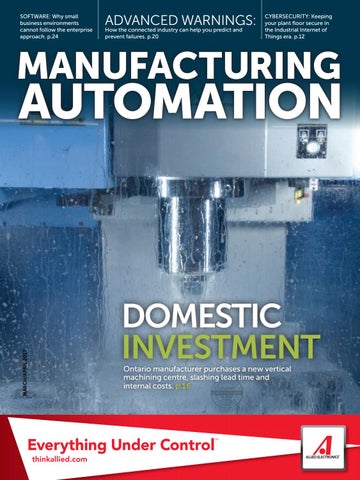
DOMESTIC INVESTMENT Ontario manufacturer purchases a new vertical machining centre, slashing lead time and internal costs. p.16
thinkallied.com
Great HMIs. Great prices.
NEW 7” WIDESCREEN TOUCH PANEL HMI STARTING AT
$465.00 (EA9-T7CL-R) C-more HMI Panels If you need an operator interface that’s reliable, easy to use, with lots of connectivity, memory, and graphics features all at a price that won’t break your budget, then you need a C-more HMI! Here are just some of the ways you get more with C-more: • • • • • •
NEW 7” widescreen model provides more space for vital information High resolution TFT color screens in all sizes (6” through 15”) 64K vivid colors (unheard of at these prices!) 800MHz CPU with 26MB to 82MB project memory (depending on model) Serial, USB, SD and Ethernet Ports Convenient project simulator
• • • • • •
Bitmap animation E-mail messaging Built-in FTP server / Web server Data logging to USB/SD Flash Drive Language support for objects in German, French, Italian, Spanish, Chinese and Japanese Much, much more...
W I D E S C R E E N
C-more Remote HMI App For only $4.99 you can have remote access and control on the go! Available now in your Apple® or AndroidTM app store.
®
Research, price, buy at: C-more.AutomationDirect.com
Orders over $49 get FAST FREE SHIPPING Our shipping policies make it easier than ever to order direct from the U.S.!
Fast free standard shipping* is available for most orders over $49 U.S., and that includes the brokerage fees (when using an AutomationDirect nominated broker). Using our choice of carrier, we can reach most Canadian destinations within 2 to 3 days. Order by 6pm ET and in-stock orders ship the same day! *2-day free shipping does not apply to drop-ships, or orders requiring LTL transport, but those shipments can take advantage of our negotiated super-low flat rates (based on weight) that include brokerage fees. See Web site for details and restrictions at: www.automationdirect.com/canada
To see all products and prices, visit www.automationdirect.com All prices shown are U.S. Dollars
Order Today, Ships Today! * See our Web site for details and restrictions. © Copyright 2016 AutomationDirect, Cumming, GA USA. All rights reserved.
1-800-633-0405
the #1 value in automation
March/April 2017 Vol. 32, No. 2
DEPARTMENTS
16
4 From the editor 5 Automation upfront
The latest industry news, deal makers, and movers and shakers
15 Centre stage
Serge Colin, ClairiTech Innovations president and CEO
COLUMNS
CONTENTS
10 Industry watch
COVER STORY
Why I’m not opposed to the XL pipeline
16 The competitive edge
12 Going digital
Keeping your plant floor secure in the IIoT era
14 Machine safety
12
Solutions to help minimize hearing loss
30 Backstory
Training the next generation
Critical first steps to achieving results in the IIoT By Mary Del Ciancio
Using the connected industry to help prevent failures By Sundeep Sanghavi
22 Waveform versus scalar data
24
MANUFACTURING AUTOMATION · March/April 2017 MA_Murrelektronik_May.indd 1
18 Entering the IIoT 20 Advanced warnings
NEW PRODUCTS 26 Electronic components 26 Programmable control 27 Automation software 27 Enclosures & workstations 28 Sensors 28 Robotics
Hand tool maker invests in new vertical machining centre, slashing lead time and internal costs By Alyssa Dalton
It’s simply no contest in the quality race By Robert Ouellette
24 Automation software
Why small business environments cannot follow the enterprise approach By Robert Jolliffe
AutomationMag.com
3
2016-04-21 10:11 AM
FROM THE EDITOR BY ALYSSA DALTON
NOTABLE TWEETS
Your resource for Canada’s industrial automation news
@PTDAorg Great to recognize outstanding women in the industry! #PTDAF #PTDA16IS RT @ AutomationMag Linda Miller receives 2016 PTDA Wendy B. McDonald award bit.ly/2ihgkdw @BMirrilees Check out Erica Wiegel @ AROmetalstamp: #NewRosie campaign honors women in manufacturing shar.es/18upln MACHINE SAFETY: Breaking down eight workplace safety motivation tips for employees. p.10
SUSTAINABILITY:
Ontario manufacturer to save tens of thousands of dollars a year by reducing water usage. p.21
MACHINE VISION: Exploring the benefits of improved read rates in logistics scanning. p.19
AutomationMag.com
Your resource for Canada’s industrial automation news
TOP 5 IN 2017 Key trends and technologies that could be hitting your plant floor this year. p.16
JANUARY/FEBRUARY 2017
PM 40065710
thinkallied.com
MA_AlliedCover_JanFeb .indd 1
2016-12-21 9:16 AM
@Jim_Szautner Thank-you Gene HAAS Foundation for this great donation RT @ AutomationMag Gene Haas Foundation chooses @SAIT for its largest donation to a #Canadian post-secondary institution @wiegeltoolworks U hear ’bout #NewRosie? Campaign encourages women to pursue careers in #mfg & honors ones who R! bit.ly/2fDfo4G via @AutomationMag
4
The rise of the machines
A
to automation. He urged the federal government to rethink skills training in two critical ways: figure out what to do with older workers whose skills are no longer sought after, and help students upgrade their skills over the course of their careers so they stay relevant. Not only does the rise of smart machines propel the era of connected manufacturing, this digitalization has also created a rapid change in manufacturing processes that has a snowball effect on other facets of the industry, in particular by redefining tomorrow’s manufacturing worker. As our Backstory contributor, Mark Humphlett, writes on page 30, today’s manufacturers need to revise their recruiting policies to properly adapt for these jobs of the future. “Manufacturers need those young people who live technology, breathe social media, and instinctively know how to collaborate and build consensus among groups. It’s not the same skills that were required in the post-war, golden era of manufacturing, when a strong back, an ability to follow directions, and a desire to provide for your family were the main prerequisites,” he says. Far from stagnant, the global manufacturing industry is at the mere beginning of a truly exciting time. Despite all the intricate machinery and technology this new world brings, humans — or rather the changing workforce — will continue to be the backbone of this business. | MA
adalton@annexweb.com
Klaus B. Pirker kpirker@annexweb.com VICE PRESIDENT & EXECUTIVE PUBLISHER
Tim Dimopoulos tdimopoulos@annexbizmedia.com ART DIRECTOR
Graham Jeffrey gjeffrey@annexweb.com ACCOUNT CO-ORDINATOR
Kathryn Nyenhuis knyenhuis@annexweb.com CIRCULATION MANAGER
Urszula Grzyb ugrzyb@annexbizmedia.com COO TED MARKLE
tmarkle@annexweb.com PRESIDENT & CEO
Mike Fredericks CONTRIBUTING WRITERS Mary Del Ciancio, Paul Hogendoorn, Rick Huijbregts, Mark Humphlett, Robert Jolliffe, Dennis Kaminski, Robert Ouellette, Sundeep Sanghavi
Manufacturing Automation is published seven times a year by: Annex Business Media 222 Edward Street, Aurora, Ontario L4G 1W6 Tel 905-727-0077 Fax 905-727-0017 Printed in Canada ISSN 1480-2996 Publication Mail Agreement #40065710
CIRCULATION email: lmalicdem@annexbizmedia.com Tel: 416-510-5187 Fax: 416-510-5170 Mail: 80 Valleybrook Drive, Toronto, ON M3B 2S9 SUBSCRIPTION RATES Canada — $40.95 per year United States — $71.95 (US) per year and Foreign — $82 (US) per year Students — $20 per year
AutomationMag.com
EDITORIAL ADVISORY BOARD AL DIGGINS, President and General Manager, Excellence in Manufacturing Consortium, and Chairman and CEO, Canadian Manufacturing Network DAVID GREEN, Technology and Business-to-Business Consultant KARIN LINDNER, founder and owner of Karico Performance Solutions DON MCCRUDDEN, Vice-President, Business Development, Festo DAVID MCPHAIL, President and CEO, Memex Automation NIGEL SOUTHWAY, Business Productivity Consultant and Author on Lean Thinking BILL VALEDIS, Vice-President, Precision Training, Products and Services Inc.
@AutomationMag
Alyssa Dalton adalton@annexweb.com PUBLISHER
utomation in its various forms, whether it’s process, support or industrial related (to name a few), is designed to improve productivity and create efficiencies; free workers from boring, repetitive or unsafe work; and improve overall quality of life. Last December, Gartner released a report that predicts smart machines will enter mainstream adoption by 2021, with 30 per cent implementation by large companies. “The use of smart machines by enterprises can be transformative and disruptive. Smart machines will profoundly change the way work is done and how value is created. From dynamic pricing models and fraud detection, to predictive policing and robotics, smart machines have broad applicability in all industries,” said Susan Tan, research vice president at Gartner. “For service providers, smart machines represent opportunities to help enterprises assess, select, implement, change and adapt talent, and for IT and business processes, the opportunity to successfully adopt smart machines for business benefits.” But the evolution of advanced robotics and artificial intelligence has also spawned a growing fear that hundreds of thousands — potentially millions — of jobs will soon be replaced by swift, efficient robots. Earlier this year, Dominic Barton, managing director of global consulting firm McKinsey & Co., made national headlines when he boldly noted 40 per cent of existing Canadian jobs will disappear over the next decade or so due
CONNECT @AutomationMag
EDITOR
Occasionally, Manufacturing Automation will mail information on behalf of industry related groups whose products and services we believe may be of interest to you. If you prefer not to receive this information, please contact our circulation department in any of the four ways listed above. The contents of Manufacturing Automation are copyright © 2017 by Annex Publishing & Printing Inc. and may not be reproduced in whole or part without written consent. Annex Publishing & Printing Inc. disclaims any warranty as to the accuracy, completeness or currency of the contents of this publication and disclaims all liability in respect of the results of any action taken or not taken in reliance upon information in this publication. We acknowledge the [financial] support of the Government of Canada.
AUTOMATION UPFRONT
FUNDING
Yukon manufacturer receives $130,000 in IRAP funding Northerm Windows and Doors, a division of RAB Energy Group, is receiving up to $130,345 in funding from the federal government to support the implementation of automation technologies and Lean manufacturing process improvement. Founded in 1985, Northerm is a Yukon manufacturer and supplier of energy-efficient home closure products such as windows, doors and commercial aluminum glazing systems. The investment, made through the National Research Council of Canada’s Industrial Research Assistance Program (NRC-IRAP), will help elevate production capacity and consolidate its Alaska-based production at its Whitehorse facility. “NRC-IRAP’s support is enabling us to increase our production capacity, create a safer work environment and improve quality,” said David Bourd, general manager of Northerm. “We can now be more responsive to the demands of our building industry while feeling confident in going out and expanding our market.”
with FIRST is embodied by the dedication of our employees who give generously of their time and skills to help mentor students and serve as competition coordinators,” said Lesley Slavitt, head of civic engagement, FCA US LLC and CEO of the FCA Foundation. “It is a continuing privilege to ensure their hard work and steadfast contributions support and further positive outcomes for youth in our
Ongoing contribution: Since 1995, the FCA Foundation has awarded more than $2.6 million in grants to FIRST Robotics teams.
communities.” Founded in 1989, FIRST aims to inspire young people’s interest
and participation in science, technology, engineering and math (STEM) careers. Under
ROBOTICS
PHOTO: DANIEL JONATHAN ERNST
FCA Foundation energizes Ontario robotics teams with US$65,000 in grants The FCA Foundation, the charitable arm of North American automaker FCA US LLC, has awarded more than US$65,000 in grants to 13 Ontario robotics teams and programs. The grants, US$5,000 per team, will help students from the high schools offset various costs, such as registration fees, parts and materials and team apparel, associated with competing in FIRST Robotics Competition (FRC) programs. “The long-standing commitment and engagement FCA has MANUFACTURING AUTOMATION · March/April 2017 MA_Beckhoff_March.indd 1
AutomationMag.com
5
2017-02-21 2:31 PM
AUTOMATION UPFRONT
HONOURS
Frost & Sullivan recognizes Memex with product leadership award Based on its recent analysis of the global machine monitoring systems market, Frost & Sullivan
has recognized Burlington, Ontario-based Memex Inc. with the 2016 Global Frost & Sullivan Award for Product Leadership. “With this award, Memex receives worldwide acclaim for its turnkey machine monitoring and automation solutions, especially its flagship product, MERLIN, a next generation scalable IIoT communication platform,” said Frost & Sullivan. Offering shop floor to top floor communication and visibility at plant- and enterprise-level along with “enhanced data collection, and tailored reporting capabilities,” MERLIN presents specific data results to help customers make strategic decisions when reducing their overall capital expenditure. The system boasts user friendliness, as the installed communications base and open machine integration software collects and houses all machinery data in a single control panel and
The PROGRAMMABLE Size 25 shaft encoder that goes ANYWHERE Program your CPR, waveform, and output! CPR – any resolution from 1 to 65,536 Waveform – choose from 32 options Output type – 6 different outputs Designed for an industrial environment, the Model 25SP comes standard with dual bearings rated 80lbs axial or radial, and offers sealing up to IP67. Call EPC today to learn how the Model 25SP can be your encoder solution.
displays the data on an interactive dashboard. Furthermore, MERLIN helps users track and understand various performance metrics displayed on its system dashboard and performance trend charts. “This parameter-driven software allows operators to quickly tailor the operator portal to display the information they need on their personal devices. It makes the machine information accessible while still channeling operator information inputs, commands, and notices through the plant’s communication platform,” said Frost & Sullivan research analyst Rohit Karthikeyan. INVESTMENT
Roquette plans new $400-million Manitoba pea processing plant
SAME DAY SHIPPING
on select configurations! 1-800-366-5412 • www.encoder.com
6
Record financing: Roquette says the $400-million investment will be the world’s largest commitment to pea-protein to date.
Portage la Prairie, Man., has been selected as the home of Roquette’s new $400-million pea-protein manufacturing site. The investment — which the company says is the world’s largest dedicated to pea-protein in the food, nutrition and health industry to date — will help expand
March/April 2017 · MANUFACTURING AUTOMATION
@AutomationMag
MA_Encoder_MarApril.indd 1
Roquette’s production capacity and meet growing customer demand for plant-based proteins. Construction is expected to start in the second half of 2017, with production to begin in 2019. The company estimates roughly 150 people will be employed by the new plant. “This new site is strategically located in Canada, the world’s largest producer of peas, with around 30 per cent of the total global production. Manitoba’s well-educated and professional workforce, strong logistic infrastructures and reliable, competitive and sustainable hydroelectric energy, make the province a very attractive environment for this new facility,” according to a statement from the French company. “This investment confirms our commitment to the highly promising pea-protein market,” said Jean-Marc Gilson, CEO. “This new site, together with our existing plant in France, confirms Roquette as the long-term leader in the plant protein specialties market worldwide, and it is a great example of how we are helping to meet customer and consumer expectations for innovative and sustainable plant-based solutions.”
2017-02-16 2:34 PM
PHOTO: ROQUETTE
strict rules, limited resources and an intense six-week time limit, FRC teams (25+ members, grades 9-12) are challenged to raise funds, design a team “brand,” hone teamwork skills, build and program industrial-size robots to play a difficult game against like-minded competitors. “The real-world experience that students gain through their participation in FIRST programs is invaluable in preparing students for the future,” said Phil Jansen, head of product development, FCA – North America.
PARTNERSHIP
PHOTO: THE UNIVERSITY OF NEW BRUNSWICK
EMC joins BC Alliance for Manufacturing Excellence in Manufacturing Consortium of Canada (EMC) and the BC Alliance for Manufacturing hope their new agreement will result in new opportunities to support growth for manufacturing in British Columbia. Founded in the mid-1980s and incorporated in 1997, EMC facilitates plant management sessions in subject-matter areas affecting industry, hands-on programs, services and a connected grass-roots network of industry peers. As the alliance’s newest member, EMC says it will work collaboratively with other members to support all manufacturing in the province. “EMC is one of the most active industry support organizations in North America,” said Al Diggins, president and
general manager of EMC. “Because manufacturing business leaders have busy days and wear multiple hats, they want practical solutions,” said Greg Hoing, executive director of the BC Alliance for Manufacturing. “No other national manufacturing industry organization offers the type of tools and peer support that EMC provides. This partnership will bring solutions to B.C. that manufacturers have been asking for.” CYBERSECURITY
New Brunswick university establishes cybersecurity institute The Canadian Institute for Cybersecurity, a hub for research, training and industry collaboration, has opened at the University of New Brunswick (UNB) with more than $4.5 million in funding
Cyber education: The institute will offer programs for various skill levels.
and the establishment of a research partnership with a global technology firm. It will offer programs for various skill levels — ranging from a one-week crash course to a doctoral degree — to address the widening knowledge gap in cybersecurity education, according to The Canadian Press. “The Canadian Institute for Cybersecurity is a culmination of more than 15 years of successful innovation and research in
cybersecurity at the University of New Brunswick,” said Dr. Eddy Campbell, UNB president and vice-chancellor. “The creation of the institute allows us to forge an even more crucial role in developing security measures necessary to protect modern critical infrastructure in Canada and beyond.” The institute was made possible with $2.27 million in funding from the Atlantic Canada Opportunities Agency’s Innovative Communities Fund and through
CARLO GAVAZZI Automation Components
Innovative Automation Solutions CARLO GAVAZZI Automation Components
SENSORS: Inductive and Capacitive Proximity Sensors • Photoelectric Sensors • Level Sensors • Ultrasonic Sensors • Magnetic Sensors • Limit Switches • Safety Interlocks
SWITCHES: Solid State Relays • Contactors and Overloads • Soft Starters • Definite Purpose Contactors • Mini Circuit Breakers • Electromechanical Relays • Pushbuttons and Pilot Devices
CARLO GAVAZZI
Whether it’s our industry leading range of solid state relays Autom tion m p o of n e sensors, nts and contactors, ora our vastC orange power Tel: 847.465.6100 Fax: 800.222.2659 supplies, USA energy meters and electromechanical contactors, Canadahas Tel: 888.575.2275 Fax:for 905.542.2248 CARLO GAVAZZI the solution your application needs. Mexico Tel and Fax: 55.5373.7042 www.GavazziOnline.com • Info@CarloGavazzi.com twitter.com/CarloGavazziNA facebook.com/CarloGavazziNA
CONTROLS: Energy Meters • Current Transformers • Transducers • Power Supplies • HMIs • Panel Meters • Time Delay Relays • Current-, Voltage- and Phase Monitoring Controls
Contact us today, and one of our field sales representatives will show you why CARLO GAVAZZI is one of the fastest growing automation companies worldwide. We’ll be more than happy to provide a free evaluation sample to qualified OEMs.
GavazziOnline.com • 888.575.2275 • Gavazzi@CarloGavazzi.com
Visit our website for downloadable MANUFACTURING AUTOMATION · March/April 2017
data sheets, MA_CarloGavazzi_MarchApril.indd brochures1 and pricing: www.GavazziOnline.com
AutomationMag.com
7
2017-02-17 11:25 AM
AUTOMATION UPFRONT
INTERNATIONAL CHINA
Fluor performing two projects for Ingevity Fluor is providing engineering, procurement and construction management services for two Ingevity facilities in Suzhou City, Jiangsu Province, and Gaolan Port Economic Zone of Zhuhai, China. Ingevity provides specialty chemicals and high-performance carbon materials and technologies that are used in a variety of applications, including asphalt paving, oil exploration and production, agrochemicals, adhesives, lubricants, publication inks and automotive components that reduce gasoline vapour emissions. At Ingevity’s manufacturing facility in Suzhou, Fluor is adding one new production line and relocating a production line from another plant. Fluor is also responsible for a new laboratory building at Ingevity’s existing manufacturing facility in Zhuhai. Both facilities produce activated carbon, which is used in automotive emission controls and water, food and beverage purification products. “Having designed and built Ingevity’s original facility in Zhuhai, we are honoured to be supporting Ingevity as they expand to meet the demand for their activated carbon products,” said Ken Choudhary, president of Fluor Energy & Chemicals business for the Asia-Pacific region. THAILAND
capacity.” Dedicated to producing closures for carton packaging, the €24-million facility will make more than 3 billion closures every year, and is expected to create around 60 jobs when it opens next year. “The new production facility will ensure faster delivery for customers across the region, offering a broad range of exciting closures that meet consumer demand for functionality and convenience,” said Michael Zacka, cluster vice president, Tetra Pak South Asia, East Asia and Oceania. “It’s another sign of the confidence we have in this region.” DEAL MAKERS
MAPP signs distribution deal with Oncam Global Oncam Global has signed a distribution deal with Manufacturers Automation for its Evolution series camera line. The St. Jacobs, Ontario-based distributor calls the addition of the Oncam 5 and 12 megapixel 360 Degree camera portfolio an “excellent complement” to its existing industrial Ethernet product lines. Specializing in 360 degree smart IP video solutions, Oncam says its technology extends beyond live viewing, adding that “by enabling high resolution recording of the entire fish eye view, playback images can be de-warped enabling the viewer to pan tilt and zoom around the entire scene.” Oncam says that by leveraging this technology, customers will have “complete situational awareness of large amounts of square footage with less cameras and far less recorded video to manage.”
Tetra Pak to open new closures facility
Pilz Canada partners with Jacmar for Quebec distribution
Tetra Pak is building a new plant at its Rayong site in Thailand to provide “much-needed local production and essential extra
Pilz Automation Safety Canada has appointed Jacmar as its distribution partner for Quebec. Jacmar, with offices in Anjou,
8
@AutomationMag
L to R: Jean-Pierre Godin, VP Jacmar, and Andreas Sobotta, CEO and GM Pilz Canada.
Boucherville and Saint-Laurent, specializes in the distribution of electronic products as well as integration services. “To support safety automation products you need knowledgeable partners to make sure the customer gets the right solution,” said Andreas Sobotta, CEO and general manager of Pilz Canada. “Jacmar is the ideal partner for us with their technical sales and support team.”
Tsubaki of Canada acquires Dia-Saw Manufacturing Tsubaki of Canada Ltd. has announced the acquisition of DiaSaw Manufacturing Ltd. of Maple Ridge, B.C. Dia-Saw has been serving customers in western Canada since 1988. Starting as a manufacturer of shake and shingle mill equipment, it has evolved into a manufacturer of sprockets and related drive components. Jos Sueters, vice president comments: “The addition of DiaSaw gives us a manufacturing base in British Columbia and will significantly enhance our ability to serve the market. We are also very pleased that David Dueck, president of Dia-Saw will be staying on to help us grow our business.”
MOVERS & SHAKERS Industry and trade association Canadian Manufacturers & Exporters (CME) is welcoming Dennis Darby as its new president and CEO. He joins CME from his role as CEO of the Ontario Pharmacists Association (OPA) where he had a “proven track record of strengthening the association and growing membership through the development of programs and services that support member success, and advocating public policy improvements for association members,” according to CME. He brings “extensive experience” in manufacturing through a 24-year career with Procter & Gamble. Andrew Hider has been appointed CEO of ATS Automation Tooling Systems, following an “extensive planning and search process” led by the company’s board of directors. Describing him as “uniquely qualified” to lead the company’s global team of 3,500 employees, ATS says Hider is an “experienced executive with a track record of success founded on his ability to drive business growth and operational performance in complex business environments
March/April 2017 · MANUFACTURING AUTOMATION
PHOTO: PILZ CANADA
the Canadian Foundation for Innovation. The provincial government provided a contribution of nearly $2 million, while UNB is adding $330,000 in funding.
Jordan will be responsible for leading IRCO’s strategic sales initiatives, including: after sales service & support programs, distributor & strategic partners and product sales.
and across multiple industries including transportation, advanced technology, instrumentation and industrial products.” Lenze SE is welcoming Ralph Rosa as its new president of Lenze Americas. Rosa brings more than 25 years of experience at Eaton in the controls, automation, power electronics, and services businesses, to his new role. At Eaton, he held various leadership positions running business units and large sales, marketing, and engineering organizations in the United States and Switzerland. Global Shop Solutions has promoted Nick Knight to new senior director of customer services. In his new role, Knight will oversee the consulting group, custom group, account representatives, and four international offices totalling nearly 70 employees. A Global Shop Solutions employee for more than a decade, Knight previously served as a member of the service team, consulting project manager and most recently as director of consulting. Song Chung has hired as the new senior vice president of global sales and marketing for Automated Precision. He comes to the company after a 20-year career with Perceptron, where he was most recently the senior vice president and chief technology officer.
Linda Considine has joined Rootstock as regional vice president, bringing her 20-plus years of experience to Rootstock Stars1_in_Automation_2017.pdf 1 users in Ontario, Quebec and
the Maritimes as well as the U.S. Great Lakes states. “I look forward to returning to my roots in manufacturing and supply chain management,” said Considine. She will be based in Toronto, Ont. Abaco Systems has appointed Kevin Campbell vice-president engineering where he will be located at Abaco’s Huntsville, Ala., 21/02/2017 10:53:06 AM “I’m particularly headquarters.
looking forward to the challenge of helping create the innovative products and solutions that can help our customers succeed, and to leading a team wholly committed to bringing those solutions to the market in the shortest possible time,” he said. | MA
Stars in Automation!
C
M
Y
CM
MY
CY
CMY
K
Pneumatic
Process
Electric
High performance and competitive pricing Look for the blue star on thousands of automation products. All available for immediate delivery!
IRCO Automation has announced Jordan Radford as IRCO’s client service manager. In this role
www.festo.ca/bluestars
MANUFACTURING AUTOMATION · March/April 2017 MA_Festo_March.indd 1
AutomationMag.com
9
2017-02-21 3:42 PM
INDUSTRY WATCH BY PAUL HOGENDOORN
Paul Hogendoorn (paulh@getfreepoint.com) is co-founder of FreePoint Technologies, “Measure. Analyze. Share.” (Don’t forget to share!) Visit www.getfreepoint.com for more information.
Why I’m not opposed to the XL pipeline
O
ver the last 50 years, the price of oil has had a direct affect on the stability of the world. When the price of oil is high, we see the rise of threatening leaders and regimes. When it’s low, we have periods of more stability. Muammar Gaddafi was in power from 1969 to 1977, a period of time when the price of oil nearly tripled. The Middle East, with the exception of perhaps Saudi Arabia, produces aggressive and peace threatening regimes, when the price of oil is high. The revenue from oil flows in very quickly and funds the building of armies and entrenchment of hostile regimes. Another example is Idi Amin, who ruled Uganda from 1971 to 1979. Saddam Hussein may not have come to power until 1979, but he helped orchestrate the coup in 1968. As part of the new regime, he nationalized the country’s oil industry, shortly before the oil boom. The country’s coffers filled rapidly. Conversely, a low price of oil is argued to have been the cause of the dissolution of the USSR, at that time, a threatening world power. As one of the world’s biggest oil producers, the price of oil through the 70s was a boon to its economy (at $50 to $60 a barrel, up from the low $20s), and then even more so in the first part of the 80s when oil peaked at $120 a barrel. By the mid 80s, it plummeted to about $25, and then hovered for many years around $35. The spending appetite of the government couldn’t be adjusted as fast as it grew, and the USSR dissolved due to bankruptcy. With over 60 per cent of the world’s oil produced by Russia and Middle Eastern countries, (and about 15 per cent produced by China), a high price of oil tilts the balance of power in favour of countries that have often been a threat to western democracies and western democratic values. Limiting the supply of oil by itself is not the right answer to the environmental issue, limiting the demand for oil is. A secure supply from a responsible, safe source is important to world stability, and who better than Canada for this?
10
@AutomationMag
Limiting the supply of oil by itself is not the right answer to the environmental issue, limiting the demand for oil is.
And here’s where I lose even more friends: the other half of the answer to the complex balance of world stability and long-term sustainability is higher taxes — far higher taxes. If prices between $80 and $120 a barrel helped place more emphasis on developing and purchasing more fuel efficient vehicles, we should take the prices up there again, but through taxes, where we all may benefit, rather than foreign countries or big oil companies. The difference is that rather than streaming all the extra revenue to the middle east (or Russia), that extra revenue could go against our deficit, or perhaps even our debts. It could even be used to help automakers develop more efficient vehicles or green technologies. Either way, it would be a dampening of demand
with zero additional revenue going to unfriendly or unstable powers. To the argument that a high price of oil hurts the economy, I point to Europe. They have had a high tax on oil for decades and it certainly has encouraged fuel economy without hurting the overall economy. The question shouldn’t be on the need or validity of the higher taxes, but what the government does with that additional tax revenue. I have to admit I do not know about all the other issues surrounding the pipeline debate, but when I think about the two biggest ‘macro’ issues (stability and sustainability), we have to limit demand without flowing all of the extra revenue out of the country. The answer to that is the XL pipeline, and higher taxes for fuel for automobiles. | MA
March/April 2017 · MANUFACTURING AUTOMATION
GOING DIGITAL BY RICK HUIJBREGTS
Rick Huijbregts is the vice president of digital transformation and innovation at Cisco Canada. He leads a team responsible for fuelling the digitization of customers across the country. He can be contacted at rhuijbre@cisco.com.
Keeping your plant floor secure in the IIoT era
T
he introduction of advanced technologies such as the Industrial Internet of Things (IIoT) to the plant floor has created new challenges for Operational Technology (OT) and Information Technology (IT) professionals. What were once physical-only systems, managed and maintained by OT staff, are now connected by an IT network to an enterprise system. Securing these new cyber-physical systems should be a priority for manufacturers as they begin their digital transformation, but leaders often underestimate the importance of cybersecurity on the plant floor. It is believed the risk of attack is low, and thus securing cyber-physical systems can be overlooked. Prepare For example, the 2017 Outlook report from It is important for manufacturers to develop PLANT (Manufacturing AUTOMATION’s a security framework that helps them align sister magazine) revealed that 17 per cent and prioritize business and security needs. of Canadian manufacturers have not taken The first step in building that framework is to any steps to defend against cyberattacks. In ask specific questions about their physical and addition, when you consider that 78 per cent cybersecurity capabilities. For example, IT and rated their concern of a cyberattack affecting OT leaders could ask the following: them as ‘low’ or ‘medium,’ why would they? • Have we outlined who has access to which Clearly, the industry believes other organizmachines and devices? ations are more suitable targets. • Do we have centralized control of both OT The Cisco 2017 Annual Cybersecurity and IT network security? Report, released in January, showed that • Can our network quickly provision and Canadian organizations rank second-tosecurely adapt to new connections? last in security capability maturity. Nearly • Have we assessed, ranked and prioritized half (48 per cent) of our businesses have our most critical assets? ‘low’ or ‘lower-middle’ maturity. Across all By understanding capabilities and potenindustries, our organizations are not nearly tial gaps in security processes, technologies prepared to deal with dynamic cybersecurity and practices, manufacturers can better threats. understand what cybersecurity solutions they Add to this the complexity of require. digitally securing a production facility or shop floor, and it is easy to Assess understand why Canadian manu- ManufacAlthough there is no silver bullet facturers want to believe cyber- turers have to cybersecurity for manufacturers, attacks are not a significant threat. been, and there are trusted partners who can But the truth is that, compared to will continue help. These partners can review the other industries, manufacturers to be, the organization’s current infrastructure operate some of the most high-risk target of and make recommendations to help applications over their networks. achieve its security goals. Many techcyberattacks. Any threat to those applications nology and cybersecurity vendors must be addressed and mitigated. That will not provide these reviews, often called And for the record, manufacturers change. security assessments. My advice is to have been, and will continue to be, evaluate the assessments offered by the target of cyberattacks. That will several vendors, then decide which not change. has the right combination of security expertise, The good news for Canadian manufactur- best-in-class products and industry knowledge ers is that securing their plant floor does not for your organization. need to be complicated. In fact, when done right, keeping a plant secure in the IIoT era Build can be as simple as 1, 2, 3: prepare, assess, It is vital that, prior to implementing a new build. cybersecurity solution, manufacturers work
12
@AutomationMag
with their selected vendor to build a security strategy and plan. This plan should include both cybersecurity and technology elements — such as whether to leverage virtualization to back up important systems — as well as physical security processes and best practices. Most importantly, a plan provides a roadmap to follow to ensure projects have measureable goals, outline expected ROI and stay on time and budget. For Canadian manufacturers who aren’t ready for the process above, there are other ways to keep their plant floor secure. I encourage all manufacturing leaders to take the following steps in their production facility to increase cybersecurity readiness: • Ensure single-use computers are actually single-use, • Change default passwords on IIoT-enables devices, • Implement change control, • Use secure protocols where possible, and • Use manufacturers’ recommended secure settings. When it comes to cybersecurity on the plant floor, doing nothing is no longer an option for Canadian manufacturers. The convergence of IT and operational networks through the IIoT has highlighted the risks of legacy control systems that were never designed with cybersecurity as a priority. Although stopping all attacks may not be possible, manufacturers can minimize both the risk and the impact of these threats by working with a trusted partner who can evaluate their current systems. The IIoT is creating incredible business opportunities for manufacturers by decreasing downtime, increasing sustainability and providing real-time visibility across the plant floor. The right IIoT partner will ensure your network, and everything connected to it, is secure. | MA March/April 2017 · MANUFACTURING AUTOMATION
You're ready. We're set. Let's move.
ith us at
Connect w
Booth 152, 0 2017 May 16–18
Your move?
Electric Drives and Controls, Linear Motion Technology, Assembly Technology, Tightening Systems: World-class automation solutions for advanced manufacturing. Rexroth’s automation solutions drive your manufacturing performance with maximized productivity throughput, precision, repeatable and efficient motion control, and maximum uptime. We’re set to help you achieve this with the industry’s most advanced conveyor technologies, electric drives and controls, linear motion components and systems, as well as production tools and tightening systems. All are equipped for fast changeovers, and ready for Industry 4.0. Smarter, more productive automation starts with the right technology. Make your move to Rexroth’s automation solutions.
For expert advice call 1-855-REXROTH (739-7684) or email us at info@boschrexroth.ca Visit www.boschrexroth.ca
Rexroth Expertise.
MACHINE SAFETY
Dennis Kaminski is the owner of SafetyMart.com, helping customers ranging from private businesses to government/municipal agencies, both large and small to address their safety needs and requirements. Visit www.SafetyMart.com for more information.
DENNIS KAMINSKI
Solutions for minimize hearing loss
M
illions of workers work every day in industrial environments. But ever wondered the impacts of the constant noise pollution they experience, on their hearing ability? Occupational hearing loss is severe. Just imagine going to work on a normal routine and constant exposure to the high level of noise results in hearing loss. It creates a lifetime of damage for any individual, and is certainly a severe issue to consider.
What causes hearing loss? Simplistically, when the inner ear is damaged, loss of hearing occurs. Factors such as ageing or one’s constant exposure to loud and harmful noises can result in hearing loss. It is the nerve cells in the cochlea in the ear that gets damaged in the process. And that is why you would need industrial earplugs. Since the hairs and the cochlea are means to send the sound motions to your nervous system, damage to these features results in the loss of hearing. Noise-induced hearing loss
— the key cause of concern Noise-induced hearing loss (NIHL) refers to one’s experience of hearing loss, which occurs from their constant exposure to a high level of noise around them. NIHL is generally caused when the noise is harmful. While we all are exposed to a certain level of noise every day which is prompted from various sources, an industrial site can well be realized to reflect such noise at a very high level, which is not usual to accept for a normal human being. Thus, such exposures result in damage to the sensitive structures within the ear, causing hearing loss.
Solutions The good news is that such NIHL can be prevented and treated too, or at least managed enough to help an affected individual to a great extent. However, a severely damaged ear may be difficult to be treated. Medications such as aspirin or taking in higher levels of Vitamin E, have been found to reduce the impacts of hearing 14
@AutomationMag
Occupational hearing loss creates a lifetime of damage for any individual, and is certainly a severe issue to consider.
loss greatly. Vitamins A, C, E and magnesium are great for the prevention of hearing loss. Hence, it is better to take preventive measures not to experience hearing loss in the first place. Particularly, if you are an industrial worker, you must learn the ways you can prevent yourself from such a suffering. If you are a worker in a manufacturing environment, here is the list of safety equipment that can prevent you from loss of hearing. • Industrial earplugs Industrial earplugs are one of the best equipment to protect your ears from the loud harmful noise on a construction site. The earplugs are reusable in nature and are available in different sizes. They have handles and flanges too, easy to carry, and easy to use, with cords connecting the two ear plugs for both the ears. However, you must ensure that you have the rightly sized plugs for your ears. You also need to fit them well to achieve maximum protection. • Roll down foam These are also devices that you can fit in your ears, and when rightly fitted, they offer a high level of protection from external harmful noises. These
devices are suitable for ears of different shapes and ear canals. Ensure you have a properly sealed fit of the foams in the ear so that you are rightly protected from the noise. • Safety earmuffs While these can be slightly hotter and heavier than earplugs or foams, they are extremely high performing for defending your ears, and protecting from the loud noise prevailing on construction sites. Since the earmuffs are placed like a headband, wherein the earmuffs in the form of padded cups, cover your ears, you need not pressurize yourself to fit in the same in your ears. This makes it quite comfortable for use, therefore. Industrial earplugs are your best bet though. While it is the concerned responsibility of manufacturing companies to make such protective devices available for their workers, making them mandatory to use them while on site; however, in case a company doesn’t provide the same, you can still make these devices available for yourself and prevent yourself from hearing damages. These are readily available in the market, reasonably priced too, and you can choose the device of your choice that rightly makes you comfortable to use. | MA
March/April 2017 · MANUFACTURING AUTOMATION
CENTRE STAGE
ClairiTech Innovations’ SERGE COLIN tells Manufacturing AUTOMATION why the company works hard to keep its operations in Canada. Fast facts Who: Serge Colin, president and CEO of ClairiTech Innovations What: ClairiTech is a developer of clean air technologies, established 25+ years ago. Where: East coast — the head office and manufacturing plant are located in Boudreau-Ouest, N.B.
innovation is [at] the base of what we do and I wanted to be able to provide our end-users with the technology they deserve. I know that sooner or later, our customers will request something that is more hightech and this is why we need to innovate everyday.
PHOTO: UNIVERSITÉ DE MONCTON
MA: How much of your manufacturing is done in New Brunswick? SC: Actually we design, develop and manufacture all the units we offer in New Brunswick. There is very little assembly that comes from [outside the country]. This is why we provide a 10-year warranty on our products to our end-users — we know that the components we use and the way we design and manufacture our units will help them reach their [desired] efficiency, and for 15 years after the purchase. Not only does this high-quality technology satisfy our customers, it is good for business too.
MA: How did you and your business partner Jean-Philippe Magot get started at the company? SC: We took over this business four years ago, and implemented many changes inside the company and [restructured] management to be more focused on customer services. Not only do we design and manufacture HVAC units for the residential market, we also provide services to professional customers in terms of sales force training and online and technical support, as well as installation guidance. After the acquisition, we did a market study and rebranded the name of the business — I changed the company name because
MA: How important is it to your customers to have your products manufactured locally? SC: I read the results of a survey a few years ago that found that Canadian customers like to support the [national] community by purchasing Canadian products as opposed to products that are made abroad; they are aware they will probably need to pay a bit more to do that. Since the company was established in 1989, it has always done 100 per cent of its manufacturing in Canada, and we do not have any plans to offshore our operations anytime soon. Our efficiency and quality control are top priorities — it is an ongoing process to [continue] to design something that is innovative and fits with
MANUFACTURING AUTOMATION · March/April 2017
“Since the company was established in 1989, it has always done 100 per cent of its manufacturing in Canada, and we do not have any plans to offshore our operations anytime soon.” what our market wants. As well, we need to consider technical, regulated and code building requirements, so there may be a point when we will have to change the business model but so far, no, we would like to keep our operations here. That said, our focus is on exportation — in fact, about 85 per cent of our products are exported. For us, the Canadian market, compared to the United States, is very small and as a result, we look south of the border to [sustain] our business. Our location is [ideal] because it allows us to be close to our customers’ territory. From New Brunswick, New York City is only a two-day truck drive away. MA: Can you tell me a bit about your operations — what type of automation does the operation use? SC: We only have one CNC right now but we are looking to purchase another one within the next several months in order to shorten our [development] time. We use several suppliers, some of which are close to us geographically, but because we design all the units we manufacture, we prototype all of them and it is easier to do that inside [our] facility. When designing what something looks like, we may create between five to 10 prototypes prior to selecting the [final] one and it can take a lot of time and, of course, using suppliers cost more. MA: In your opinion, what is one best practice all
manufacturers should try to implement if possible? SC: I would definitely say sustainable development. What I mean by that is the move toward green products, minimizing your carbon footprint through the way you manufacture, that kind of thing. This may not be a mandatory requirement from [everyone’s] customers at the present time but sooner or later, [manufacturers] will have to talk about it more and implement it inside our products and also in our production processes. We are [fortunate] because for us, this is always top of mind — it is one of our goals to provide energy efficient equipment to our end-users. We do not want to waste time designing something that [consumes] a lot of energy. | MA Open casting call! We need your help to identify manufacturing newsmakers in the Canadian industrial automation industry! These individuals bring fresh thinking to the workplace, display leadership principles, and inspire others in the business. Does someone you know fit the bill? Get in touch with our editor Alyssa Dalton at adalton@ annexweb.com and tell her who you think should be spotlighted on the Centre Stage in an upcoming issue of Manufacturing AUTOMATION.
AutomationMag.com 15
COVER STORY
The
competitive Hand tool maker commits to domestic manufacturing with new equipment investment
edge
BY ALYSSA DALTON
I
16
@AutomationMag
Selecting a solution The company explored waterjet and plasma cutting, automatic cold broaching, as well as horizontal and vertical milling machines before choosing a solution. “We looked at a ton of different options from different technologies to outsourcing to doing nothing at all,” says Dean. After an 18-month process that involved countless hours of project planning, equipment identification, creation and proof of the machining concept, consultation with partner Elliott-Matsuura of Oakville, Ont., and tooling build and integration, Gray Tools selected an Elliott-Matsuura VX-1000 VMC.
1912
The year Gray Tools Canada was established and began manufacturing hand tools
“It was a long road to [reach this decision] where we thought this would be the best way to achieve what we wanted: a reduction in cost and cycle time, and an improvement in part performance and quality,” he adds. Of the $300,000 project cost, approximately half the investment was in the machine cost, the rest went toward installation, training, tooling and fixturing. A change in operations The machine was installed in September 2016 with proof out, trialing and process refinement done over the following four to six weeks. With full production commencing in November, the VX-1000 makes large
March/April 2017 · MANUFACTURING AUTOMATION
PHOTOS: GRAY TOOLS CANADA
n today’s aggressive business environment, a number of factors can make it challenging for Canadian manufacturers to succeed, such as global competition, rising costs and difficulty finding new skilled labour, but hand tool maker Gray Tools Canada was determined to overcome these obstacles, ultimately deciding to invest $300,000 in a new vertical machining centre (VMC), fixtures and tooling last fall. “We needed to find a new way to remain competitive and overcome key uncontrollable challenges. The only certainty was any solution needed to include domestic manufacturing,” says Paul Dean, VP operations. “It was a long and sometimes frustrating process, however now that the equipment has been installed and is producing tools being sold worldwide, I am extremely proud and pleased because of what it represents to Gray Tools, its customers and Canadian manufacturing as a whole.” As the country’s only broad line manufacturer of hand tools, Gray Tools of Brampton, Ont., has been servicing industrial customers since 1912. It currently offers more than 6,000 different products — the total SKU count includes products it buys and resells, as well as its import brand of tools which it engineers and develops. It also operates three warehouses in Brampton, Edmonton, Alta., and Delta, B.C.
combination wrenches — wrenches that have one open-end and one box-end with a hex of two inches and up — for use in heavy industrial applications, such as oil rigs and gas refining. “There has been a pretty steep learning curve because we have completely changed the way we make the product in every aspect,” notes Dean. The old way of making the large combination wrenches involved multiple steps and work centres before a finished product was produced. “Now, you put the forging in the machine — and for some of the [product] families, there’s a little more finishing that is needed — then you activate the program and you have the finished product.” The company says it has retained all employees and redeployed those who were displaced by the decommissioning of other processes in favour of the new technology to other functional areas. Dean says this includes movement to the CNC department, as well as other areas. Early, yet promising results As a result of the revised manufacturing process required to make the wrenches, processing lead times have dropped, says Dean, adding that it is now possible to produce them with a reduced lead time of up to one week if required. “When we look at the total product cycle time, we’re achieving things much faster and are making a better quality, better performing product. It’s a strong product.” He says the company’s future plans include
MANUFACTURING AUTOMATION · March/April 2017
determining what other existing products could be run on the new equipment, exploring new products that could now be offered due to more efficient processing, and possibly exploring the implementation of other equipment within the CNC area. Along with boosting internal efficiencies, Dean explains the Elliott-Matsuura VX-1000 VMC is expected to increase product volume, distribution and the company’s international presence. “We’re probably going to need to hire in our distribution area and, as we continue to
upgrade our CNC department, I can see more jobs there,” he says. Keeping manufacturing at home Of the products Gray Tools manufactures and finishes, 100 per cent of the manufacturing is done within the Brampton facility — a detail that is “near and dear” to the company owners and the entire executive management team, says Dean. “There are a lot of pressures for us to do things offshore, to outsource things, but our president is committed to domestic manufacturing. It is part of who he is as a person, he really wants to keep manufacturing within Canada.” It can be difficult for businesses to keep their manufacturing operations in Canada, says Dean, but continuous investment in people, processes and equipment is something every manufacturer should pursue in an effort to remain competitive. “In order to maintain that product line being made here, in this facility and in Canada, we had to find ways to take process steps out to reduce the cycle time and internal costs so we could remain competitive internationally. We believe this is an investment in our people and in producing products here domestically,” he says. “This is an old industry. Not a lot has changed in the hand tool industry over the years, and we’re trying to be innovative, but at the same time continue to have a domestic presence, and continue to make products in Canada with Canadian people using Canadian companies as our integration partners. It’s onward and upward for us.” | MA AutomationMag.com 17
CONNECTED MANUFACTURING
ENTERING THE IIOT Critical first steps to achieving results in the Industrial Internet of Things BY MARY DEL CIANCIO
T
he Industrial Internet of Things is on track to revolutionize the manufacturing industry. Using sensors, software and other advanced technologies to accurately capture and communicate data from the plant floor promises to decrease costs and downtime for manufacturers, increase quality and savings, and make them much more efficient. The advantages are clear. Yet many manufacturers have been slow to adopt the technology that will give them these results. Why? The Industrial Internet of Things, also called the IIoT, is still in its infancy. Jumping on board requires an investment and, because it’s an emerging space, it’s difficult to determine the ROI. With so much excitement surrounding the IIoT, many simply don’t know where to start. However, experts suggest that by taking some small first steps, manufacturers will begin to see results.
with NetSuite, likening the IIoT to Lean manufacturing and a company’s efforts to add value and remove dead costs. Like Lean, it’s about driving quality and driving cost effectiveness, he says. With that in mind, the first step is to look at where the value is going to be added, and what you want to accomplish. Do you want to reduce costs, reduce waste, increase productivity, increase efficiency? Where are the areas within your facility that you can gain the most benefit from the IIoT? Perhaps it’s driving real-time scheduling, optimizing maintenance schedules or parts ordering. Maybe it’s managing capacity, catching quality issues or reducing waste. “There is a massive amount of opportunity out there for companies to become a lot more efficient and a lot more effective,” Farrell says. “Look at where you need to add the value, or where you think it’s going to take out the cost, and concentrate on doing that.”
Getting started
Success in the IIoT space requires co-operation between the interested parties within a company. What they are trying to achieve and how they are going to achieve it must be agreed
The IIoT is no different than the journey manufacturers have been on for years, explains Paul Farrell, senior vice-president of product marketing 18
@AutomationMag
Agree on the goal
$195B The IIoT market was valued at US$113.71 billion in 2015 and is estimated to reach US$195.47 billion by 2022, according to a MarketsandMarkets report.
upon at the beginning, explains Aiden Mitchell, the vice-president of IoT global sales for Arrow Electronics. Mitchell participated in a recent panel discussion at the Harting Business Conference (HBC) that discussed how to make the IIoT a reality today. “The guys who run the operations, who run the factory floor, have typically had a pretty closed-loop, tight working environment for years. The last thing they would ever want is to let an IT guy into the middle of it,” explains Mitchell. “But now that you’re talking about data coming off their shop floor and going into some ubiquitous data environment in the Cloud, you’ve really got to get them aligned in terms of how that is going to work.” An IT lead must be involved in the discussion from the start, he says. Otherwise, you go through a lot of gyrations in the definition of what the customer is seeking to achieve, wasting precious time.
Key considerations In these early discussions, there are several key factors to consider, and important decisions that need to be made. First, explains Farrell, think about how you are going to connect your machine to the IIoT. What sensors and software are you going to use? What is the protocol? What is the network? If you have legacy equipment, how are you going to bridge that serial to digital divide? Second, consider how you are going to gather the huge amount of data coming from your equipment. Is the data streamed, sent on an event or
March/April 2017 · MANUFACTURING AUTOMATION
sent at a certain time? Where are you storing it? Is it a Cloud solution or are you building the infrastructure to deal with the data locally? And third, think about how you are going to analyze the data and make sense of it. Is your system of record, ERP software or MES open enough to action the data that comes in from the IIoT? The concern for many manufacturers is that the IIoT is still evolving. Standards are emerging and technology is rapidly advancing. “There are many companies working on producing solutions that will simplify the ability to connect, integrate, analyze, understand and optimize,” explains Farrell. “There is a massive amount of investment here, so we will see standards and simplification emerge over the next couple of years.”
Find the right partner It’s a team effort, and partners — whether vendors or system integrators — play a large role in the IIoT. A good partner can make recommendations on the best products to meet the application’s requirements. Afterall, having the right solution that makes sense for the application is critical, explains Nick Hassan, VISIT US
the director of the advanced development group at Texas Instruments, who also participated in Harting’s HBC panel discussion. Indeed, there are companies in the IIoT space who provide frameworks and technologies to help businesses get started, says Farrell. Manufacturers should do their research and carefully consider partnerships and solution providers that can help them along their journey.
It’s not for everyone While the IIoT holds a lot of promise for many manufacturers, it may not be right for all, Farrell says. For example, the food and beverage industry is one market that can gain a lot of value from the IIoT because there is a great deal of information regarding quality, temperature and other variants that are gathered throughout the manufacturing process. But for a company that is assembling two components together quickly and easily, there may be less advantage, he says. “Don’t think, ‘I have to go and get IIoT implemented or I’m going to fall behind,’” explains Farrell. Instead, think, “Is it going to add value to your processes? There are some
industries that are very machine intensive that absolutely it can. But if you’re not in an industry that is, then is it going to add that value?”
Walk, don’t run For companies that can gain value from the IIoT, they will be at a competitive disadvantage over time if they fail to adopt technology. It will become more difficult for businesses that are in the IIoT space to work with them, and they will also be less efficient than their competitors. But that doesn’t mean companies should do everything at once. “There’s lots of noise out there about [IIoT] and...the fantastic things it’s going to be able to do for you. But this should be no different than any other project that a manufacturer does when it’s looking at where the value is,” says Farrell. “Take key projects, implement them, retrieve the value...and let’s get a real robust ROI behind it.” Take it one, small step at a time, he suggests. “Walk the pace rather than run.” | MA Mary Del Ciancio is a business writer who has been covering industrial topics for more than 15 years. She is the former editor of Manufacturing AUTOMATION magazine.
AT
ATE AUTOM BOOTH 1245
“It’s a fundamental paradigm shift in the way robots are viewed.” CEO Stewart McMillan, Task Force Tips
2 robots work in tandem on CNC milling.
No scripting needed.
34-day payback from productivity savings.
Huge gains in productivity and quality
34 days was all it took for fire equipment manufacturer Task Force Tips to pay for its Universal Robots through productivity savings. Three Universal Robots tend CNC machines. A fourth is mounted to a table and wheeled between tasks. The application required no scripting and was created by a journeyman machinist with minimal training.
Scan code to read case study and watch the video: www.universal-robots.com/case-stories/task-force-tips/ Find your distributor: www.universal-robots.com/distributors
MANUFACTURING AUTOMATION · March/April 2017 MA_UniversalRobots_March.indd 1
AutomationMag.com 19 2017-02-16 10:14 AM
PREDICTIVE ANALYTICS
ADVANCED WARNINGS How the connected industry can help you predict and prevent failures BY SUNDEEP SANGHAVI
H
istory repeats itself, that’s the saying. Well, the same can be said for failure. Despite being 17 years into the 21st century, it is not uncommon to see stories of product recalls, factory failures or other — avoidable — accidents repeated and claiming lives, year after year. Despite technological advances around the world, these incidents remain a regular part of everyday life. In 2016, this was no different. Samsung was plagued by the faulty Galaxy Note7, resulting in global recalls; airbag manufacturer Takata sparked a global scare after 11 people were killed by defective products in the United States, and Japanese air-carrier All 20
@AutomationMag
Nippon Airways (ANA) was forced to ground its entire Dreamliner fleet due to defective engines. The list goes on. But it really doesn’t have to be this way. Technological advances have come far enough to see machines with the capabilities to predict and forewarn where and when things will go wrong. Developments in artificial intelligence (AI), machine learning, the Internet of Things (IoT) and data science mean that humans no longer need to rely on their colleagues to spot danger — technology can do it for us. It’s just a matter of adopting these processes and technologies in the first place.
The facts as they stand This may sound like a pipedream, but
$630B The amount of money a year the global manufacturing industry could save through predictive maintenance, according to McKinsey research.
it’s not. According to reports from McKinsey, predictive maintenance — the term for using AI and machine learning to prevent future incidents — could save global businesses an incredible $630 billion a year by 2025. This is because manufacturing machines, and finished products themselves equipped with AI, can learn from previous results by applying cognitive approaches to predictive maintenance. Processes — such as building cars, planes, and even buildings — will reap the benefits of heightened levels of data analysis from machines. Motor industry analyst IHS Automotive forecasts there will be more than 150 million actively connected cars on our roads by 2020. The combined development of car features and
March/April 2017 · MANUFACTURING AUTOMATION
aftermarket devices could result in some two billion connected cars on the world’s roads just five years later. Such a staggering number will result in quantities of data that would make it humanly impossible to detect, isolate and predict incidents. Conservative estimates predict the average car will produce up to 30 terabytes of data every day. This data is a treasure trove of information regarding the health of the vehicle, including how, when and where the vehicle is driven; the driving style and preferences it is subjected to, and much more. Only proper analysis can reveal meaningful connections, trends and patterns that can help provide a better driver experience and improve vehicle quality and reliability. This leads to a stronger competitive position and new opportunities for revenue.
How does it work? What seems like an incredibly complicated process actually is not. Machines with predictive maintenance capabilities monitor results through in-built sensors and interpret this information, with the help of data science,
The power of IoT allows machines to communicate quickly and easily with the appropriate people to take the right actions. in order to predict when a failure will occur. These warnings can be communicated to human interface monitors (HMIs) long before serious problems manifest themselves. The power of IoT allows machines to communicate quickly and easily with the appropriate people to take the right actions. The combination of machine learning and AI means that advanced machines can monitor the data from those all important in-built sensors 24 hours a day. It is only by properly employing these vital developments that businesses can reverse their fortunes when it comes to incidents, accidents and recalls.
The possibilities are limitless And it isn’t just about machines on factory floors giving advance warnings about potential danger. Predictive maintenance can also help minimize downtime on the plant floor and increase productivity across the board,
Extract Your Machine Intelligence With Advantech’s Industrial IoT Gateways
saving time and money for all. The fact is that by combining telemetric data and predictive maintenance, manufacturers can maximize the lifetimes and usefulness of the machines they have at their disposal. By combining data provided by sensors — on products, machines or vehicles — with predictive techniques, this data can be used to capture the real-time status of parts and functions. This information, more easily harvested by adopting data science, machine learning, AI and IoT, can be used to improve safety and give human overseers a “heads up,” solving future problems before they even occur. | MA Sundeep Sanghavi is the co-founder and CEO of DataRPM, an industry pioneer in cognitive data science. He’s a highly accomplished entrepreneur and data junkie with more than 20 years of experience using data as the currency to perform advanced analytics.
Seamless Connection, Aggregation, & Transmission
Advantech’s wide selection of Industrial IoT Gateways are designed with Industry 4.0 in mind. With their advanced communication capabilities, these smart factory solutions make connection to the cloud easy.
www.advantech.com
MANUFACTURING AUTOMATION · March/April 2017 MA_Advantech_MarApril.indd 1
Compact Edge Computing Gateways UNO-2200 Series UNO-1200 Series
Intelligent RTU ADAM-3600 Series
Industrial Control Computer APAX-5580 Series
Wireless I/O WISE-4000 Series
IIoT Dashboard Software WebAccess
AutomationMag.com 21 2017-02-27 1:44 PM
MEASUREMENT
WAVEFORM VS. SCALAR DATA It’s simply no contest in the quality race BY ROBERT OUELLETTE
W
hat is the difference between a waveform — or digital process signature — and scalar data? Take a hockey game with your favourite team. A contentious goal is scored and the referees go upstairs for a review of the play to decide if the goal will count. Now, what would you prefer as the basis for that decision: an instant replay video or snapshots of only a few isolated points in time as the puck passed through the goalie’s crease? A process signature is that full replay, while scalar data offers only a few snapshots.
What happens when you rely on snapshots alone? We’ve seen time and time again the outcome of relying on scalar data alone to govern the quality assurance process on a manufacturing line — units that fail end-of-line tests. Productivity and profitability losses that mount as first-time yields drop and the cost of scrap and rework climbs. In these scenarios, a test station determines a part’s pass or fail based on only a few isolated data points. The plant’s engineers and operators may be relatively confident that faulty units are being caught, but because only a handful of data points are recorded from each process, there are gaps in time. These gaps make it all but impossible to obtain a clear view of what happened throughout a process or test. If an anomaly occurs during one of these gaps, staff may never know. For example, a bolt may have been stripped during a rundown operation because of a faulty nut or foreign debris. At one point during the operation, more force had to be used than normal to twist the nut home. If this point in time was not captured by the scalar data, the flaw will pass undetected. The part may only reveal its fault further down the line or after it’s in the hands of the 22
@AutomationMag
customer. There is no way to go back and trace the root cause because engineers lack that video instant replay of what happened through every millisecond of assembly and test.
Process signatures take quality control to a new level By capturing and using the entire waveform — or process signature — generated during the test cycle, much more accurate and reliable pass/fail decisions can be made by the test station. Instead of just a few data points, pass/fail can now be determined from hundreds of thousands of data points. Every signature from every test cycle and process on the line can then be collected into a single database. Consider it as a digital video library versus a collection of photo albums, which is all you have with scalar data alone. With such a complete and detailed historical record, that does not suffer from any gaps in time, it’s possible to search, correlate and visualize the data with algorithms to a degree that’s just not possible with scalar data. Users can find patterns that reveal how and why there are decreases in yield. By analyzing process data, a part failure can easily be distinguished from a test malfunction. The quality team can spot anomalies that require further investigation, pinpoint where problems occur during the process, even optimize the test station by understanding how to shorten the test. Best of all, you have complete traceability right down to the specific parts and their serial number. Track down a few dozen defective units without having to scrap, rework or recall thousands. The root cause of an issue can be tracked down in minutes or hours, rather than days or weeks. This level of insight is simply not possible with scalar data alone. It elevates quality assurance into the realm of big data analytics.
How signature analysis works Every single manufacturing or test process generates a process signature that can be recorded, interpreted and visualized. Signature analysis, in its most simple form, is the comparison of a specific process response or signature against an acceptable pre-determined response. By equipping a process or test station with appropriate sensors, such as load cells, temperature, position and pressure sensors, highly consistent and repeatable signals can be obtained that directly indicate the consistency and quality of the process or product. These signals can be physical measurements or computed values, such as horsepower or efficiency, based on specific measurements and mathematical formula. Assuming the measured variables and sensors are chosen with care, the characteristic signature will be consistent if the operation is under control and if product quality levels are maintained. Signature analysis is the process of comparing these waveforms in a systematic and automatic manner to detect defects or manufacturing operations that are out of tolerance.
Increased yield by 170 engines a month One automotive manufacturer experienced electronic throttle failures at the end-of-theline engine test, an expensive time to address. By using signature analysis, the manufacturer found the two reasons for the failures and fixed the upstream process issues to eliminate them. Seventy-seven per cent of these March/April 2017 · MANUFACTURING AUTOMATION
failures resulted from a stuck or sluggish throttle. The remainder turned out to not be failures at all, but false rejects. The manufacturer used this deeper insight to check and verify which parts under quarantine were in fact faulty, or not. What was the outcome? A 1.27 per cent failure rate was reduced to 0.07 per cent, increasing yield by 170 engines a month. The manufacturer also saved $330,000 annually on stripbacks and repairs.
GRAPHS: SCIEMETRIC INSTRUMENTS
Set the right limits for your in-line production tests By capturing all of the station’s process signature data, you have a complete historical record that allows quality engineers to manage processes based on scientific pass/fail limit management. They can reduce false failures and optimize cycle times and production output, using data models and simulations that remove the guesswork. Historic data from the line can be revisited and reanalyzed at any time to spot trends and patterns, and to understand where tweaks can be made to help optimize a station’s performance and drive continuous improvement. For example, a quality engineer can run a simulation using thousands of stored test records with process signatures, using new control limits to see the effect on yield. If a change is warranted, the new control limits can be sent down to the test stations. This is where process signature technology complements a traditional statistical process control (SPC) system that collects only scalar data. SPC can verify initial control limits and then signature analysis can be used for fine tuning.
These graphs show the difference between the amount of data collected in multiple overlaid digital process signatures for a leak test (first image) as compared to a trend of scalar leak rate values from the same test (second image).
Scalar data alone just isn’t enough The benefits of relying on process signatures and signature analysis for quality control instead of scalar data alone are obvious. The only limits are the type and quantity of available data. It all comes down to cutting manufacturing costs, increasing profitability and adding impact to your organization’s quality reputation in the marketplace.
Use SPC and scalar data as you always have to monitor and track the health of your production line. But when problems arise, trust in process signature analysis to quickly find and address the root cause. | MA Robert Ouellette is a product launch manager with Sciemetric Instruments. He works with customers to solve pressing technical challenges in leak test and other technical areas of manufacturing.
Relax, tomorrow has already been tested. Say goodbye to hardwiring with HARTING connectors.
Reduce the number of wiring errors, save time and headache. HARTING, first established in 1945, delivers unrivaled reliability, efficiency, innovation and performance in connectors. With HARTING you have a partner who ensures you dependable connections that stand the test of time. HARTING.ca MANUFACTURING AUTOMATION · March/April 2017 Hardwiring_Ad_0001_R01_MA_8x3.5_JUNE2016.indd 1 MA_Harting_MarchApril.indd 1
AutomationMag.com 23 5/16/2016 4:32:42 PM 2017-02-22 2:26 PM
AUTOMATION SOFTWARE
NO ONE-SIZE-FITS-ALL SOLUTION HERE Why small business environments cannot follow the enterprise approach BY ROBERT JOLLIFFE
E
RP implementations — those words can cause heart palpitations in the most experienced business manager. Stories abound of failed SAP projects that take two, three or four years to complete. Or, companies spending $50 million on an implementation that ultimately go out of business during or due to the project. Small business owners face a real dilemma. In today’s market, it is a competitive disadvantage to run your 24
@AutomationMag
business with Excel or homemade systems. In the Internet age, when data moves at the speed of light, staff who live in their own isolated islands of information are an incredible risk. The result is that the small business needs an ERP and needs to face all the risks and concerns that come with it. The dangers of a failed implementation are very real and can ultimately risk the survival of a company. So the big question is, how can you avoid that risk? How do you prevent the problems that happen in these huge
$48B According to Grand View Research, the global ERP software market is expected to reach US$48.22 billion by 2022.
enterprise projects? The answer can be found by understanding enterprise type ERP projects. Enterprise in my usage means a business that has many facilities or operates in multiple verticals (for instance, all distribution, discrete and process manufacturing). Larger ERP systems should not even be considered by a company with less than 250 employees in just a few facilities. That would be considered a small- or medium-sized company, not an enterprise. March/April 2017 · MANUFACTURING AUTOMATION
The dangers of a failed implementation are very real and can ultimately risk the survival of a company. So the big question is, how can you avoid that risk? a full-time IT manager. Enterprise ERP projects are run largely with internal resources, and often these large cost overruns are internal salaries. The enterprise ERP implementer is used to working with these strong IT departments, and management with lots of ERP experience. Small business projects need to be treated entirely differently. The larger ERP firms, the ones that are used to dealing with enterprise companies, are familiar with experienced management. They leave big decisions to the small business managers that have no experience with ERP. It’s not really their fault, they are used to customers that want to make the decisions. Project management is also very different. An enterprise ERP deployment is highly planned, with all decisions being documented and signed off by the customer, and project managers running the implementation against a very well-defined scope of work. This There is a very big difference be- makes a lot of sense in highly complex tween the small single (or few) facility environments. In a small business, a highly planned manufacturer and an enterprise. The biggest difference is in the size and project with detailed sign off doesn’t quality of management. In an enter- work. The reason is the small business prise, even the IT department might customer doesn’t understand the decisions. They can’t give an informed have 20 orQuarter-Page-8x3-5-color-print-ready.pdf 30 employees. In the small 1 09/11/2016 10:38:12 AM manufacturer, there might not even be consent to the project. They really
90% Gartner predicts that through 2018, 90 per cent of organizations will lack a postmodern application integration strategy and execution ability.
don’t understand the consequences of the decisions. Vendors have historically been afraid to make decisions for their customers. This is because in the enterprise, a bad decision made by a vendor could lead to six or seven figures of rework cost. So what does the small business do when selecting an ERP? These seem to be huge problems. Well, the simple answer is don’t implement using the methods an enterprise would use. Beware the ERP vendor who places all the focus project scope and documentation, and insists on your involvement in all decision-making. Find a vendor with specific and extensive experience with your type of manufacturing. A vendor that can prescribe best practices and a recommended approach is going to increase the chances of success. Decisions made by your vendor are going to be inherently better than those you would make yourself because they have so much more experience than you. | MA
Robert Jolliffe is president of Sabre Limited, a Six Sigma trained consultant, an ERP guru who has implemented and re-implemented far too many systems for his age. He lives in Kitchener, Ont., where he enjoys live music, good food, fine beer, hot tea and a good book.
FOCUSING ON ONE THING KEEPS YOU AHEAD OF THE PACK METRIC IS ALL WE DO; WE BETTER DO IT BEST
YOUR BEST SOURCE FOR METRIC MOTORS Toll Free: 1.800.661.6413 Fax: 1.905.629.2852 www.lafertna.com sales@lafertna.com
MANUFACTURING AUTOMATION · March/April 2017 MA_Lafert_March.indd 1
AutomationMag.com 25 2017-02-21 3:35 PM
NEW PRODUCTS ELECTRONIC COMPONENTS Cable widths up to M25 now compatible with Han 3 A connectors
Harting says it has expanded the choice of cables customers can use in its Han 3 A size connectors. The Han 3 A now can be assembled with cable diameters as large as M25 instead of the previous limit of M20, says Harting, explaining that this increase allows the connectors to be configured with any contact insert in the series, including those with higher rated current and bigger cross sections, such as the Han Q series. The hoods also meet the requirements of protection classes IP65/67. The new Han 3 A hood components feature a narrow external geometry overall, terminating in the cable holding area. In the plastic version, the hood is available with a bigger M25 connection, which makes additional types of mounting feasible. For metal Han 3 A, coupling hoods are available in M25 along with the existing housings. www.harting.ca
IoT-ready mini module family
covers the entire range of Intel’s latest IoT-ready embedded processors. A range of module variants (based on five different processor types) make up the COMe-mAL10 portfolio. Versions range from a dual-core Intel Celeron (2.3 GHz with 6W TDP) iteration optimized for energy-sensitive applications to quad-core Intel Atom (4x 1.6/2.0 GHz with 13W TDP) and Intel Pentium (4x 1.1/2.5 GHz with 10W TDP) versions for high-end applications. The COMe-mAL10 supports two independent displays - 1x DP++ (DP/HDMI/ DVI) 4096x2160@60Hz, 1x Single Channel LVDS with DPtoLVDS (eDP on request) 3840x2160@30Hz. In addition to having two serial ports, the series includes USB 3.0 interfaces, up to eight USB 2.0, Gigabit Ethernet, as well as four PCI-Express Gen2 lanes for customer specific expansions. www.kontron.com
phase control (phase sequence, phase position, and phase failure) for voltages from 200 to 500VAC, while the flare Control P3-LTN module boasts advanced control functions, including voltage balance, adjustable time delays, and overvoltage/undervoltage monitoring, as well as accommodates four-wire, three phase systems with a neutral connection. Both modules feature one changeover contact, in addition to multiple LEDs for monitoring and diagnostics. Wieland’s flare Control P3-L and P3-LTN phase control relays are housed in 22.5-mm wide DIN rail modules, and feature screw connections and both cURus and CE approvals. The operating temperature for the series spans -20 C to 60 C. www.wieland-electric.ca
Relays provide voltage control for three-phase power systems Wieland Electric has expanded its flare Control series of phase control relays with two new modules designed to provide phase and voltage control functions for three-phase power systems in industrial applications. The flare Control P3-L module provides basic
26
@AutomationMag
Advantech has launched the EKI-5500/5600 PN/PNMA and EI series of industrial switches, designed to communicate through Profinet or Ethernet/ IP. According to the company, the EKI-5500/5600 series are a new generation of industrial protocol managed switch products. They come with a metal housing that is IP30 rated to protect against dust. The 8.4 to 52.8 VDC power input is dedicated to operating in areas of unstable power and rugged environments. The series meets the Profinet real-time standard and support media redundancy protocol as well as ODVA certified to meet the requirements of Common Industrial Protocol (CIP) for added reassurance, notes Advantech. Features such as Ring, VLAN, and SNMP make the series “especially convenient” for setting up a network infrastructure and the inclusion of the Profinet and ODVA certification make it easier to figure large numbers of switches that can link with a variety of devices. www.advantech.com/ea
PROGRAMMABLE CONTROL PLC programming software
Kontron says its new series of credit card-sized Computer-onModules are based on the latest generation Intel Atom, Pentium and Celeron processors. According to Kontron, the COMe-mAL10 performance range of COM Express mini modules is highly scalable and
EtherNet/IP, Profinet compatible switches
Idec has released Version 8.2.2 of its WindLDR PLC programming software, a PCbased platform used to program IDEC’s FC6A MicroSmart PLC. The software can also be used to program IDEC’s entire line of PLCs. IoT capability is provided by custom web pages which can be configured for remote monitoring and control. Web pages are created with the builtin Web Page Editor using simple
drag and drop functionality with no HTML programming required, notes Idec. When used with the MicroSmart FC6A PLC, these web pages are stored in the PLC, which functions as a web server when its built-in Ethernet port is
connected to the Internet. These web pages can be accessed via any web browser running on any Internet-connected device such as a remote PC, a tablet or a smartphone. Once a program is created, it’s ready for transfer to a PLC, with the option to include accompanying comments. Programs can be downloaded with the comments attached to operands and rungs, with this information stored in the PLC processor. www.IDEC.com
March/April 2017 · MANUFACTURING AUTOMATION
AUTOMATION SOFTWARE Solution aims to improve virtual controls testing Emulate3D, a developer of industrial controls testing software, has launched a virtual commissioning solution which it says will enable users to run accurate 3D models of their industrial material handling systems within the Rockwell Software Studio 5000 Logix Emulate application from Rockwell Automation. According to Emulate 3D, users will now be able to run off-line controls testing faster than real time, slower than real time, or step forward event-by-event, while remaining synchronized with the virtual PLCs in the Studio 5000 Logix Emulate application. “This presents a significant advantage to controls engineers in the understanding and debugging of the operation of all parts of the automated system, from PLC registers to the status of individual photo eyes, motors, or bar code scanners in the system model,” it says. www.demo3d.com
Web-based PLM solution
Omnify Software says its Empower PLM product version 7.0 was redesigned on a new technology platform to offer an enhanced user experience with a “modern interface, simplified navigation and overall improved ease of use.” The Omnify Empower PLM solution provides a central location to electronically manage parts, bill of materials (BOMs), engineering changes/ECOs, documents, projects, quality/CAPAs, and training records. According to Omnify, new security features
have been added for both our On-Premises and Hosted/ SaaS customers, including an improved password framework with new retrieval options and an extended authentication platform that supports more Single Sign-On (SSO) methods and providers. As well, CADKit, Empower’s design integration tool, includes a new Design Upload Wizard to help guide engineers when uploading design data from third party tools. www.omnifysoft.com
Software platform for real-time production management and operations centres Tatsoft says it has released a “major update” on Tatsoft FactoryStudio, a development platform built completely in the Microsoft .NET Framework, delivering solutions to run on Windows PCs, Windows Compact Framework (Windows CE), Linux computers, Web browsers, tablets, virtual machines and smart devices with iOS or Android environments. Tatsoft FactoryStudio 2016 extends the concept of the real-time in-memory database used by SCADA and HMI factory-floor tools, to a set of business entities able to deliver applications ranging from standalone HMIs to IT operations centres, data aggregation and real-time asset monitoring. According to Tatsoft, release 16 provides an Object Browser to make selecting graphical objects on the screen easier, Geo-Location integration to visualize real-time Asset information by location, auto-generation of dynamic display from .CSV and .XLS files, and enhanced alarms, security and audit-trail. The new HTML5/ JavaScript display option, in addition to the native iOS and .NET Thin-client technologies, promises to be “extremely” flexible for multiple users. www.tatsoft.com
MANUFACTURING AUTOMATION · March/April 2017
ENCLOSURES & WORKSTATIONS Cabinet heater to help keep condensation at bay
In response to the continuing demand for larger cabinets, Hammond Manufacturing has added a high power 1300W thermostatically controlled cabinet heater, available in 120V 60 Hz and 230V 50/60 Hz versions, to its FLH series. The model extends the series to five different wattage alternatives, promising to give users a good choice of outputs powers to match the volume of the enclosure. According to Hammond, the heaters maintain temperature levels above equipment minimums as well as help prevent dangerous, corrosive condensation. The FLH Series boasts automatic operation. The built-in thermostat can be adjusted from -18 C to 38 C, and the integral fan can run constantly or operate automatically under the control of the embedded thermostat. www.hammondmfg.com
Enclosures boast IP66 rating
Stahlin says its non-metallic J and N enclosure series were both tested to the IEC 60529 standard and specifically, IP66
rating. Today, both enclosure product lines are UL Listed to IP66 rated for protection from dust, and protection from heavy seas or water projected by jets. Both the J and N series are designed to accommodate electrical, electronic, instrumentation, and mechanical controls for indoors/ outdoors applications. The J series complies with NEMA Type 1, 3R, 4X, 6P and 12, while the N series complies with NEMA Type 1, 3R, 4X, 12. www.stahlin.com
UL-approved lighting system designed for enclosures
Rittal Systems has added the LED System Light, calling it the first lighting system designed specifically for enclosures. The LED technology, with UL E76083 certification, claims to shine into every corner of the industrial enclosure, from the roof to the floor, promising to deliver up to three times the luminous flux of the next closest competitor. According to the company, installation is simple, with the design integrated into the TS 8 modular enclosure. Light is dispersed through an optical cover with Fresnel structure, in two designs boasting precise lighting, says Rittal, adding that the Fresnel lens uses a prism-like pattern to provide magnified light coverage. The cover rotates for adaptive light distribution. The light promises “brilliant illumination” from 900 to 1200 lumens. www.rittalenclosures.ca AutomationMag.com 27
NEW PRODUCTS SENSORS Ultrasonic distance and level sensors
Omega has introduced the LVTX-10 series close range ultrasonic distance and level sensors, describing them as lowprofile ultrasonic transmitter modules designed to provide continuous measurement of fluids, pastes, or uneven solid bulk materials in constrained working zones. Boasting “state-of-the-art” dual-sensor ultrasonic technology and processing algorithms, all LVTX10 sensors promise to provide accurate measurement for factory automation, warehouse materials control, pipe and conveyor belt blockage, or tank level applications with nonuniform surfaces. www.omega.ca
Wireless-based vibration sensor
Yokogawa Electric has developed an ISA100 Wirelessbased field wireless vibration sensor, boasting long battery life and the ability to “quickly” update data. According to Yokogawa, the new vibration sensor will meet users’ needs “for a device that can provide the quick updates on vibration levels needed to detect [equipment] anomalies at an early stage” by measuring the vibration levels of equipment such as compressors, pumps, motors, and fans. The principal components of the sensor are the FN510 field wireless multifunction module, the LN01 piezoelectric type acceleration 28
@AutomationMag
ROBOTICS sensor, and the FN110 field wireless communication module. Via a gateway device, the FN510 uses the ISA100 Wireless communications protocol to exchange data with a host-level system such as a DCS. The sensor can be set to update data as quickly as every 10 seconds. The data collected with this vibration sensor enables plant operators and maintenance staff to monitor vibration levels in real-time. www.yokogawa.com
Proximity sensors
Robot for material handling and machine tending
accelerometers with a UHT-12 sensing element. The approval now allows the two models to be classified as intrinsically safe for use in potentially-explosive environments in Canada and the U.S. www.imi-sensors.com
Flush mount models added to laser distance sensor offering
AutomationDirect now offers the Contrinex DW-series of extended and triple-distance proximity sensors in 3 to 30 mm cylindrical and 20 mm rectangular styles. With 10 to 30 VDC operating voltage and sensing distances ranging from 1 to 40 mm, cylindrical sensors are available in shielded and unshielded models with nickel silver, nickel silver/chrome, chrome plated brass, or stainless steel housings. DW-series 3 mm proximity sensors are fitted with a two-meter axial cable; other sizes offer twometer axial cable, M8 or M12 quick disconnects. DW-series proximity sensors are designed with an LED status indicator and are available with NPN and PNP, as well as Normally-Open or Normally-Closed outputs. The proximity sensors have an IP67 protection rating and boast complete overload protection. www.automationdirect.com
CSA approval for accelerometers IMI Sensors has announced CSA approval for models EX611A00 and EX611A20, two extreme temperature, charge-mode
Banner Engineering has added flush mount housings to its series of Q4X laser distance measurement sensors. The new flush mount configuration, according to the company, offers a “more compact housing to expand applications and increase mounting flexibility in constrained spaces.” The Q4X promises superior performance, ambient light resistance and durability, with reliable detection of submillimeter changes in distances ranging from 35 to 310 mm. Utilizing a CMOS imager, the unit boasts a dependable performance with “highly reflective and multi-colour surfaces,” or light-absorbing materials and low contrasts, such as black foams or rubber combined with black plastics or metals. The laser distance sensors are available with discrete, analogue (0 to 10 V or 4 to 20 mA), and IO-Link output options, says Banner. It is rated to IP69K with FDA-grade stainless steel. www.bannerengineering.com
ABB Robotics describes its IRB 1200 Foundry Plus 2 robot for material handling and machine tending as the smallest foundry robot in its class. Promising to increase flexibility and reduce cycle times for precision die casting processes, the robot meets the requirements of protection ratings IP66/67. The IRB 1200 Foundry Plus 2 is IP66/67 compliant from base to wrist, meaning that the robot’s electrical compartments are sealed against liquid and solid contaminants. ABB says the Foundry Plus 2 robot is particularly unique due to its “superior resistance” to corrosion and capability to withstand high-pressure steam washing. First introduced in 2014, the IRB 1200 comes in two variants to handle a range of applications. The 700 mm reach variant can carry a payload of up to 7 kg, while the longer reach 900 mm variant can carry up to 5 kg of payload. The IRB 1200 is also available with Clean Room protection. www.abb.com/robotics
Robot promises to eliminate calibration steps TM Robotics is now selling the BAIII Cartesian robot series from Toshiba Machine. According to the parties, unlike most Cartesian suppliers, the Toshiba Machine solution is a “true plug-and-play” as all cables, junction boxes, brackets, motors, and controllers
March/April 2017 · MANUFACTURING AUTOMATION
are supplied with the actuators, and there is no need for calibration between the motor and the actuator or between the motor and the controller. In addition to being plug-and-play, the BAIII robot offers: a range from 50 mm to 4,450 mm actuator length; and a range of combinations from single- to two-, threeand four-axis to meet different requirements and applications. The BAIII also boasts a high payload capacity, which means a horizontal mass of 250Kgs with a two-axis combination is capable of carrying up to 100Kgs, and the robot can run at a speed as high as 2000mm/sec. Applications for the robot include transfer, inspection, palletizing, assembly and sealing. AC servo-motors and absolute encoders are available in all models. www.tmrobotics.com
Cell teaches robotic concepts in the classroom
Lincoln Electric’s ClassMate Robotic Trainer promises to provide welding educators with a “complete advanced
manufacturing solution” for robotic welding training, demonstration and recruiting at every level, including community and technical colleges, trade schools and workforce development programs. The ClassMate robotic cell features a robotic arm from Fanuc Robotics and comes with a fully functional welding power source, integrated fume control and safety equipment, and an expandable surface. As well, the cell comes with more than a dozen complete project curricula designed to “encourage active inquiry, higher-level thinking and easy integration into advanced manufacturing education programs,” says Lincoln. Using available WeldPRO software, students can perform offline programming and then test their skills on the manufacturing-ready robotic cell. www.lincolnelectric.com
Six-axis robot Montreal, Que.based Mecademic has recently launched what it says is the smallest and most precise six-axis industrial robot on the market. “The Meca500 is thus extremely easy to fit inside an already existing equipment and can be considered as an automation component, rather than a complex system such as most other industrial robots,” says Ilian
Bonev, cofounder of Mecademic, adding that the Meca500 is “extremely” easy to use and interface with through Ethernet. Featuring a fully integrated control in the robot’s base, the Meca500 promises to be more compact than other similar offerings on the market. www.mecademic.com
E-commerce site digitizes the customer experience with ondemand solutions Kuka has announced the all-new Kuka Marketplace (shop.kuka. com) which aims to provide a digitized and optimal customer experience. The Kuka Marketplace allows customers to purchase and browse new Kuka products while providing user guides and videos for additional information. The first products available for purchase through the e-commerce site are Kuka Connect and Kuka College Training courses. Kuka Connect is a Cloudbased software platform that provides users access and analytics of their Kuka robots at any time and on any device. Additional products and services will be made available for customers on Kuka Marketplace in the near future. www.kuka.com
Robot palletizing cell CKF Systems has developed a range of robot handling cells designed specifically for businesses operating a manual
palletizing line. The AC25, a direct replacement for existing manual operations, is “exceptionally easy to install and operate,” says CKF, adding that the cell will typically provide a payback in under two years. The cell utilizes an ABB 4-axis robot and industry standard equipment and comes with full support, including training and spares, a 12-month warranty and the option for a range of add-on features. It is capable of handling cases with dimensions of up 400 mm long x 300 mm wide x 250 mm high and a net weight of 25kg. www.ckf.co.uk
ADVERTISER INDEX Advantech 21 Allied Electronics Inc. 1 AutomationDirect 2 Beckhoff Canada 5 Bosch Rexroth Canada 13 Carlo Gavazzi (Canada) Inc. 7 Eaton Canada 11 Encoder Products Company 6 Festo Inc. 9 HARTING Canada Inc. 23 Lafert North America 25 Murrelektronik Canada 3 SCHUNK Intec Corp. 31 Siemens Canada Ltd. 32 Universal Robots 19 TO ADVERTISE Contact Klaus B. Pirker kpirker@annexweb.com
MA’s Technology Handbooks are a series of digital magazines that focus on a single product category within Canada’s manufacturing industry. Posted on MA’s website as an interactive flip-style magazine, our Technology Handbooks provide specific market and product information, as well as trends within that specific product category, to machine builders, component manufacturers, end-users and system integrators.
For more information, contact Klaus Pirker at kpirker@annexweb.com or (905) 726-4670.
MANUFACTURING AUTOMATION · March/April 2017 MA_HandbookAd_1.4_2017_GWJ.indd 1
AutomationMag.com 29 2017-01-03 10:05 AM
BACKSTORY WHAT MA PUBLISHED IN... 1998 “A new engineering processes training program has graduated its first class of professionals who will return to their workplaces with enhanced design skills.”
2008 “Young, skilled professionals...work in different specializations, and they all came to automation in different ways, but they share one thing in common: a drive to succeed.”
2008 “Good partnerships help smaller companies meet training needs.” 2009
Why manufacturers and suppliers must train the next generation
M
uch has been written recently about the skills gap issue in manufacturing. Despite this spotlight on the issue, and some grassroots initiatives to emphasize science, technology, engineering and math (STEM) curriculum in public schools, little meaningful impact has been achieved. Manufacturers are still struggling to fill the vacancies left by retiring baby boomers. It’s estimated over the next decade, nearly 3.5 million manufacturing jobs will likely be needed. Of those, 2 million are expected to go unfilled. Without right-skilled personnel in place, manufacturers will be hard-pressed to keep up with fast-paced change. They risk becoming irrelevant and obsolete. Industry experts, like IDC
30
@AutomationMag
Manufacturing Insights, expect digitalization to be widespread by 2020. Yet, only 15 per cent of manufacturers are already deploying digitalization tactics. This means wholesale changes in operations and processes are yet to be launched. The demand will happen overnight, placing high pressure on recruiting. The positions are largely technical and most have to do with data science. This is no time to place people in key positions simply because they answered the job posting and “know someone who knows someone” already in the plant. Yet, manufacturers may feel they can’t be too picky. Applicants, especially those with IT skills, aren’t showing up in droves. Misconceptions about manufacturing are keeping applicants away. Manufacturing needs a makeover, Oprah-style. The public
“Manufacturers must improve on the current skills of their two million workers by tapping into education and training programs.” 2011 “SolidWorks ships one millionth educational licence; 13-year-old inventor inspires thousands at SolidWorks World.” 2013 “Developing the next generation by developing ourselves.”
2010 “As [manufacturers] eliminate positions...they still have unfilled job openings for high-skilled workers.”
remembers images of plants closing in the Great Recession and is skeptical about believing manufacturing is alive and thriving. But robotics, laser technology, machine learning, 3D printing, data science, virtual reality and global sensor tracking are a reality. It’s a science geek’s wonderland, a gamer’s real-life version of Minecraft, a millennial’s ultimate collaborative and social engineering experience. Manufacturers need those young people who live technology, breathe social media, and instinctively know how to collaborate and build consensus among groups. It’s not the same skills that were required in the postwar, golden era of manufacturing, when a strong back, ability to follow directions, and a desire to provide for your family were the main prerequisites. While high school shop classes provided basic skills, apprenticeship programs typically offered new hires their on-the-job training. This worked in the past. Can it work again? | MA Mark Humphlett is the senior director, Industry & Solution Strategy at Infor.
March/April 2017 · MANUFACTURING AUTOMATION
© 2017 SCHUNK INTEC, Inc
www.ca.schunk.com/robotaccessories
More than 1,200 Modules for your Robot
Feed-through Rotary feed-through DDF 2
The unique standard line of modules for mechanical, sensor and power connections of handling modules and robots.
Connecting Adapter plate
Monitoring Collision and overload sensor OPR
Joining and compensating Compensation unit TCU
Changing Quick-change system SWS consisting of SWK (quick-change head) and SWA (quick-change adapter)
Gripping SCHUNK gripper PGN-plus 2-finger universal gripper with multi-tooth guidance
Jens Lehmann, German goalkeeper legend, SCHUNK brand ambassador since 2012 for precise gripping and safe holding. www.ca.schunk.com/Lehmann
MANUFACTURING AUTOMATION · March/April 2017
AutomationMag.com 31
Register for the Innovation Tour at siemens.ca/ innovationtour2017
Your gateway to automation in the Digital Enterprise Totally Integrated Automation Portal
As a machine builder or plant operator you’ll benefit from shorter timeto-market with the help of simulation tools and other features, as well as increased productivity thanks to additional diagnostic and energy management functions. Connection to the management level gives you greater flexibility. Take advantage of these and other possibilities in the TIA Portal. It’s more than an engineering framework – it’s your perfect gateway to automation in the Digital Enterprise.
siemens.com/tia-portal 32
@AutomationMag
March/April 2017 · MANUFACTURING AUTOMATION