ETHERNET GAINS: Acadian Seaplants capacity grows by 40 per cent with new processing facility. p.20
LEAN MANUFACTURING: Defining culture as an environment favourable to continuous improvement. p.10
LIGHTING RETROFITS: Industy bakery welcomes retrofit for non-energy operational savings. p.22
AutomationMag.com
Your resource for Canada’s industrial automation news
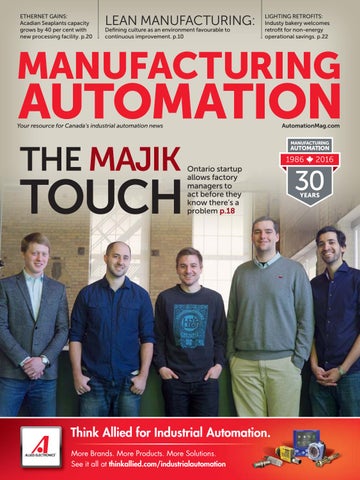
THE MAJIK
TOUCH
Ontario startup allows factory managers to act before they know there’s a problem p.18
Think Allied for Industrial Automation. More Brands. More Products. More Solutions. See it all at thinkallied.com/industrialautomation
Micro panels...Mega value.
Starting at:
$161.00
®
EA1-S3MLW-N
C-more Micro HMI Panels C-more Micro panels are small in size, packed with features, and priced for the tightest of budgets. With screens as large as 10-inch, you can effectively display text, graphics, or bitmaps easily and affordably. These value-packed panels also come with FREE programming software. When it comes to HMIs, you’ll always get more with C-more! •
Micro touch panel and non-touch panel versions available
•
The 3-inch cost-conscious panels display standard or high contrast STN monochrome graphics with five selectable background colors
•
32K color TFT displays are available in 4-inch, 6-inch, 8-inch and 10-inch models
•
Several options, including plug-and-play keypad bezels, are available for select models
•
Free programming software with simulator
•
Full 2-year product warranty
NEW! Ethernet Communications Module (EA-ECOM): • • • • • •
Adds Ethernet port for programming / PLC communications Attaches to rear of EA3 series C-more Micro panels with captive screws Power supplied from expansion port, no external power required Faster project download speed Faster firmware update speed Not compatible with EA1 Series panels Priced at:
$50.00 EA-ECOM
Research, price, buy at: www.automationdirect.com/Cmore-micro
Orders over $49 get FAST FREE SHIPPING Our shipping policies make it easier than ever to order direct from the U.S.!
Fast free standard shipping* is available for most orders over $49 U.S., and that includes the brokerage fees (when using an AutomationDirect nominated broker). Using our choice of carrier, we can reach most Canadian destinations within 2 to 3 days. Order by 6pm ET and in-stock orders ship the same day! *2-day free shipping does not apply to drop-ships, or orders requiring LTL transport, but those shipments can take advantage of our negotiated super-low flat rates (based on weight) that include brokerage fees. See Web site for details and restrictions at: www.automationdirect.com/canada
To see all products and prices, visit www.automationdirect.com All prices shown are U.S. Dollars
Order Today, Ships Today! * See our Web site for details and restrictions. © Copyright 2016 AutomationDirect, Cumming, GA USA. All rights reserved.
1-800-633-0405
the #1 value in automation
October 2016 Vol. 31, No. 6
DEPARTMENTS 4 From the editor 5 Automation upfront
The latest industry news, deal makers, and movers and shakers
18
16 Centre stage
Jon DeSouza, Harting North America president and CEO
COLUMNS 10 Lean insights
Defining culture as an environment favourable to continuous improvement
CONTENTS
12 Industry watch
COVER STORY
A refresher on the basics of effective communication
18 The MAJiK touch Ontario startup allows factory managers to act before they know there’s a problem By Treena Hein
14 Machine Safety How to establish what is a machine safety deficiency
30 Backstory
16
Encouraging innovation in manufacturing
NEW PRODUCTS 26 Test & measurement 26 Sensors 27 Hydraulics & pneumatics 27 HMI & operator interface 28 Machine vision & inspection 28 Motion control 29 Data acquisition
22 Industrial bakery waffles over freezer lighting Retrofit welcomed for non-energy operational savings By Anatoli Naoumov
20
MANUFACTURING AUTOMATION · October 2016 Murrelektronik_MA_Jan.indd 1
20 Ethernet gains
Acadian Seaplants grows capacity by 40 per cent with new seaweed-processing facility. By Wade Hazel
AutomationMag.com
3
2016-01-05 8:47 AM
FROM THE EDITOR BY ALYSSA DALTON
NOTABLE TWEETS
Your resource for Canada’s industrial automation news
@marksasmith “Are you willing to go beyond your comfort zone to get results?” - Vickie Sullivan #quote #TuesdayMotivation @SChrusten Innovation RT @ AutomationMag News » L’Oréal building solar projects at Arkansas, Kentucky plants bit.ly/2cVuM8I ETHERNET GAINS: Acadian Seaplants capacity grows by 40 per cent with new processing facility. p.20
LEAN MANUFACTURING: Defining culture as an environment favourable to continuous improvement. p.10
LIGHTING RETROFITS: Industy bakery welcomes retrofit for non-energy operational savings. p.22
AutomationMag.com
Your resource for Canada’s industrial automation news
THE MAJIK
TOUCH
OCTOBER 2016
Ontario startup allows factory managers to act before they know there’s a problem p.18
PM 40065710
Think Allied for Industrial Automation. More Brands. More Products. More Solutions. See it all at thinkallied.com/industrialautomation
AlliedCover_MA_Jan.indd 1
2015-12-23 1:58 PM
@Xerox_Canada Biz leaders & academics gather to discuss success factors for #innovation in Canada. #Industrie2030 @ Automationmag http://xerox. bz/2cwZPrA @TNBCorporate We would like to thank all members of our local and global communities for your support of our Thomas & Betts and ABB family this past week. @AbbotsfordEcDev Great article! “Agricultural robotics and drones: a complex $10B market by as early as 2022” 4
Real-world education
N
othing gives you a taste of an industry more than a tradeshow. A show, regardless of its size, is an opportunity to take in the state of a given industry firsthand, learn about the latest technologies and network with like minds. Last month, Manufacturing AUTOMATION publisher Klaus Pirker and I spent four jam-packed days at the International Manufacturing Technology Show (IMTS) in Chicago, Ill., and there was certainly no shortage of people to chat with and demos to check out. IMTS 2016 boasted 115,612 registrants and 1,370,256 net square feet of exhibit space, making it the third largest IMTS. As well, the total number of exhibitors for this year was 2,407, the highest in its 31-year history. As I navigated through the crowded aisles at the McCormick Place — is it just me or do the halls seem to get longer as the week goes on? — I couldn’t help but notice how many students had also turned up to walk the show floor. More than 17,000 students, parents and educators visited the Smartforce Student Summit, a simultaneous event put on by show organizers that offered students nine challenges to explore manufacturing technologies, including: CAD/CAM software, robotics, 3D printing, machining, tooling and automation. Open to students of all ages, the goal was to give young people a hands-on education on trade careers outside of the classroom, or a “real-world preview of the industry,” as Greg Jones, vice president, Smartforce Development, AMT, puts it. There was
CONNECT @AutomationMag
also a career fair for those looking to connect with employers for internships, apprenticeships and entry-level jobs. Throughout the week, I kept seeing groups of students walking the floor with their phones in hand, recording various exhibitor demos — the icecream-serving duAro robot at the Kawasaki Robotics booth was a real hit! It was amazing to see this level of student engagement at an industry event; it’s an opportunity I wish I had growing up. Other than taking two five-month tech classes, my knowledge of trade careers when I was in school was quite limited. It wasn’t until I started reporting on trade industries six years ago that I came to understand how vital and necessary this form of education is. I encourage you to open your doors to today’s young people. Whether it’s a lunch-and-learn, a plant tour, an open house or a school visit, these events will continue to further the discussion on the viability of skilled trades careers. By the time you receive this issue, Manufacturing Day — October 7 — will have already come and gone. Did your company do anything to celebrate the festivities? Send me an email and let me know what you and your company did to inspire the next generation of manufacturers. I’d love to hear how it went.
adalton@annexweb.com
Alyssa Dalton adalton@annexweb.com PUBLISHER
Klaus B. Pirker kpirker@annexweb.com VICE PRESIDENT & EXECUTIVE PUBLISHER
Tim Dimopoulos tdimopoulos@annexbizmedia.com ART DIRECTOR
Graham Jeffrey gjeffrey@annexweb.com ACCOUNT CO-ORDINATOR
Kathryn Nyenhuis knyenhuis@annexweb.com CIRCULATION MANAGER
Urszula Grzyb ugrzyb@annexbizmedia.com DIRECTOR OF SOUL/COO
Sue Fredericks CONTRIBUTING WRITERS
Bruce Hamilton, Wade Hazel, Treena Hein, Paul Hogendoorn, Danny C. Marmora, Anatoli Naoumov, Norm Nopper Manufacturing Automation is published seven times a year by: Annex Business Media 222 Edward Street, Aurora, Ontario L4G 1W6 Tel 905-727-0077 Fax 905-727-0017 Printed in Canada ISSN 1480-2996 Publication Mail Agreement #40065710
CIRCULATION email: lmalicdem@annexbizmedia.com Tel: 416-510-5187 Fax: 416-510-5170 Mail: 80 Valleybrook Drive, Toronto, ON M3B 2S9 SUBSCRIPTION RATES Canada — $40.95 per year United States — $71.95 (US) per year and Foreign — $82 (US) per year Students — $20 per year
AutomationMag.com
EDITORIAL ADVISORY BOARD AL DIGGINS, President and General Manager, Excellence in Manufacturing Consortium, and Chairman and CEO, Canadian Manufacturing Network DAVID GREEN, Technology and Business-to-Business Consultant KARIN LINDNER, founder and owner of Karico Performance Solutions DON MCCRUDDEN, Vice-President, Business Development, Festo DAVID MCPHAIL, President and CEO, Memex Automation NIGEL SOUTHWAY, Business Productivity Consultant and Author on Lean Thinking BILL VALEDIS, Vice-President, Precision Training, Products and Services Inc.
@AutomationMag
EDITOR
Occasionally, Manufacturing Automation will mail information on behalf of industry related groups whose products and services we believe may be of interest to you. If you prefer not to receive this information, please contact our circulation department in any of the four ways listed above. The contents of Manufacturing Automation are copyright © 2016 by Annex Publishing & Printing Inc. and may not be reproduced in whole or part without written consent. Annex Publishing & Printing Inc. disclaims any warranty as to the accuracy, completeness or currency of the contents of this publication and disclaims all liability in respect of the results of any action taken or not taken in reliance upon information in this publication. We acknowledge the [financial] support of the Government of Canada.
AUTOMATION UPFRONT
NEWS INVESTMENT
PHOTO: RICHARDSON INTERNATIONAL
Richardson invests $120 million to upgrade Lethbridge canola plant Richardson International Ltd. says it is investing $120 million in its canola processing plant in Lethbridge, Alta., to maximize operating efficiencies and modernize the facility to “significantly” increase canola crush capability. Headquartered in Winnipeg, Man., Richardson is a handler and merchandiser of Canadian-grown grains and oilseeds and a vertically-integrated processor and manufacturer of oats and canola-based products. A “modern, high throughput” seed receiving facility is now being built to increase efficiency and provide quick turnaround for farmers and truckers delivering seed to the plant, said the company in a statement, adding that the upgrades to the plant began last year with the installation of new processing equipment. Darwin Sobkow, executive vice-president, Agribusiness & Processing Operations, said increasing the speed of the receiving seed is a “top priority” to better serve customers and provide them with the “ability to deliver their seed quickly and efficiently.” The new receiving system is expected to receive 800 metric tonnes of canola per hour, a “significant increase” from the current system, said the company. “We are continuing ongoing capital upgrades in Lethbridge to increase crush capacity and realize greater efficiencies. This will allow us to better serve our customers and create a state-ofthe-art facility that is very efficient for its size, positioning us to compete with the most modern canola crushing facilities in North America,” he said. With these upgrades, Lethbridge will be able to process in excess of 2,000 metric tonnes of canola per day, increasing annual
crush capacity to more than 700,000 metric tonnes. Combined with its canola processing plant in Yorkton, Sask., Richardson said it will have the capacity to process more than 1.7 million tonnes of canola annually. “We are committed to making a significant investment in our Lethbridge plant for long-term operations to continue to grow our business,” Sobkow added.
MANUFACTURING AUTOMATION · October 2016 MA_Beckhoff_Oct.indd 1
Production boast: Richardson expects the upgrades to increase the plant’s annual crush capacity to more than 700,000 metric tonnes.
AutomationMag.com
5
2016-09-21 2:21 PM
AUTOMATION UPFRONT
INNOVATION
IMAGINiT, CCPV partner to help manufacturers innovate, validate and commercialize products Rand Worldwide, a provider of technology solutions to organizations with engineering design and information technology requirements, has announced a strategic partnership between its IMAGINiT Technologies’ Design Simulation and Visualization Services Group and the Canadian Centre for Product Validation (CCPV). According to the parties, the partnership will help clients “compress the product commercialization gap and reduce the time and cost involved in moving products from concept to market by combining IMAGINiT’s
EPC’s Tru-Tracs™ are your encoder & measuring wheel solution in one, easy-to-install unit.
simulation expertise with CCPV’s state-of-the-art innovation lab that offers leading-edge validation technologies, prototyping and testing equipment.” “Our facility shares a common goal with our manufacturing customers and that is to help organizations be competitive on the global stage by supporting the entire innovation process,” said Ben Cecil, chief business officer, CCPV. “Our partnership with IMAGINiT and their expertise in the area of design simulation now creates a one-stop-shop for product innovation, testing and validation. IMAGINiT will help manufacturers mitigate risk with a suite of simulation services, including Computational Fluid Dynamics and Finite Element Analysis and CCPV will solidify the validation and commercialization process at their innovation facility. This enables clients of both organizations access to a
When you need linear motion feedback
complete range of design review and validation expertise resulting in design changes earlier in the process when the cost of change is lowest and the chance for innovation is greatest.” “The process of bringing a product from an idea to commercial reality is filled with risk,” said Jason Pfeiffer, director of design and simulation services, IMAGINiT Technologies. “This partnership helps product manufacturers mitigate some of these inherent risks by providing customers with direct access to teams of experts that are experienced and focused on reducing design flaws that delay product launch timelines.” CONSOLIDATION
Nellson unifies Canadian operations under Jean Filion
From the compact TR1 to the robust TR3, we’ve got your motion feedback solution.
1.800.366.5412 | www.encoder.com
6
A win-win deal: The partnership aims to create a one-stop-shop for production innovation, testing and validation.
Nellson, a nutrition bar and powder provider in North America, has announced it will unify its Canadian operations in Lachine and Anjou, Que., under the leadership of Jean Filion, former CEO of MultiBar and current president Nellson Canada. According to the company, the move brings a number of co-manufacturing advantages, such as: newly commissioned Sollich line, Peerless and conical mixers, and automated line processes; additional capacity to support growth;
October 2016 · MANUFACTURING AUTOMATION
@AutomationMag
MA_Encoder_September16_CSA.indd 1
consistent quality; and in-house R&D department. The manufacturer also announced it is adding a new high-speed production line in its Lachine, Que., nutritional bar manufacturing facility. “It was important to us that we bring our Canadian operations together under one management, as it combines two great teams to share best practices, accelerates decision-making, and, together with the capital investment, strengthens our value creation potential,” said Filion. “I am extremely excited by the potential of the Canadian team with its wealth of knowledge and commitment to innovation. Like our entire Nellson team, our Canadian bar team relentlessly seeks improvement to surpass our clients’ expectations in terms of service, quality and cost.” “The unification of our Canadian operations under Jean’s leadership is another step in Nellson’s transformation over the past 18 months,” continued Jamie Better, Nellson’s CEO. “This leadership change and the capital investment demonstrates our commitment to knowledge sharing and continuous improvement in all areas of the company. Our Canadian operations are a critical component of our bi-coastal platform which enables us to provide best-in-class product development and manufacturing capabilities, exceptional speed of execution, and outstanding
2016-08-22 9:14 AM
customer service to our clients.”
SKF to consolidate North American manufacturing plants SKF recently announced plans to consolidate its manufacturing facilities in North America, including the closure of its sites in San Diego, Calif., and Baltimore, Md. According to the global supplier, production will be transferred from the group’s site in Hanover, Penn., to Flowery Branch, Ga., and the move will consolidate production of spherical roller bearings and large size roller bearings into existing bearing manufacturing operations in Flowery Branch. Meanwhile, production of rings and seals for aerospace applications will be relocated to Hanover from SKF’s existing factory in Baltimore. Manufacturing and development of condition monitoring solutions will be moved from SKF’s existing
site in San Diego to other sites in Europe, offering “customers better condition monitoring solutions, faster, as the development team will be centralized in the same region, close to the rest of SKF’s technical competence centres across Europe. A technical support team will remain in San Diego, but in a separate facility.” “With a stronger, more efficient manufacturing base, the group will be better able to serve its North American customers,” said SKF in a statement. A total investment of SEK 150 million (roughly C$23.2 million) will be made in upgrading machinery and manufacturing processes in Hanover and Flowery Branch, it added. Restructuring costs are expected to amount to around SEK 300 million (about C$46.3 million), of which around SEK 100 million (approximately C$15.4 million) will be accounted for during Q2 2016 and the remainder
as they occur, said the company, adding that the consolidation is expected to generate full year cost savings of around SEK 220 million (about C$34,014,486.11 million) from 2019. “These activities will strengthen our position in North America, making us more competitive and better able to support our customers, by improving the utilization of our manufacturing assets. They also provide the foundation for investments in the further development of our manufacturing processes and technologies,” said Luc Graux, president, bearing operations. Consolidation of the sites in Hanover, Flowery Branch, Baltimore and San Diego is expected to take approximately 18 - 24 months. As well, the Y-Bearing and Units production channels in Puebla, Mexico, which serve North American customers within the agriculture segment, will be closed, with
production transferred to other SKF sites. INTERNATIONAL UNITED STATES
GM devotes $90 million to new equipment in Indiana factory General Motors said it plans to spend about $90 million to update equipment at an Indiana factory that supplies many of the company’s assembly plants. The new equipment for the Marion Metal Center will start being installed this year at the factory where it has some 1,400 workers, company officials said. The project is aimed at improving the production capability and flexibility of the 2.7 million-square-foot Marion factory campus. “This will enable our team
Your One-Stop Source for Process Measurement and Control Votre Unique Arrêt pour la Mesure et le Contrôle de Procédes Flow Débit et Niveau
Data Acquisition Acquisition de Données
Temperature Température Pressure Pression
Same Icons in White Same Icons in White
Automation Same Icons in White Automatisation
Same Icons in White
Same Icons in White
100,000 Products Customized Solutions Expert Technical Support Easy Online Ordering Fast Delivery
100,000 Produits Solutions Personnalisées Support Technique Expert Commande en Ligne Facile Livraison Rapide
omega.ca 1-888-826-6342
© COPYRIGHT 2016 OMEGA ENGINEERING, INC ALL RIGHTS RESERVED
MANUFACTURING AUTOMATION · October 2016 MA_OmegaHalf_September16_CSA.indd 1
AutomationMag.com
7
2016-08-18 1:43 PM
AUTOMATION UPFRONT
announced plans to invest $290 million in technology upgrades at its Corvette plant in Bowling Green, Ky. DEAL MAKERS
GE to spend $1.4 billion to acquire two 3D printing companies General Electric is looking to strengthen its position in the digital world, spending $1.4 billion to acquire two European suppliers of additive manufacturing equipment, Arcam AB and SLM Solutions Group AG. Both companies will report into David Joyce, president and CEO of GE Aviation, who will be responsible for leading the growth of these businesses. “Additive manufacturing is a key part of GE’s evolution into a digital industrial company. We
3D printing power: An SLM machine at GE Power’s Advanced Manufacturing Works in Greenville, S.C.
are creating a more productive world with our innovative world-class machines, materials and software,” said Jeff Immelt, chairman and CEO of GE. “Additive manufacturing will drive new levels of productivity for GE,
our customers, including a wide array of additive manufacturing customers, and for the industrial world.” GE said it expects to grow the new additive business to $1 billion by 2020.
Versatile Panel PC for Industrial Applications Advantech’s PPC-3000S series of fanless panel PCs are designed to have high computing capacity with low power consumption. In addition, they feature a true-flat resistive touch screen and an ultra-slim chassis (only 48.3mm deep) which allows them to be installed in tight spaces. The mSATA or 2.5” SSD makes this panel PC rugged with no moving parts and fully solid state. The PPC-3000S is a great choice for the most challenging of industrial environments.
PPC-3060S
PPC-3100S
PPC-3120S 12” Fanless Panel PC with Intel ® N2930 Processor
PPC-3151S COMING SOON 15” Fanless Panel PC with Intel ® i5-6300U Processor
6.5” Fanless Panel PC with Intel ® N2807 Processor
www.advantech.com
8
10.4” Fanless Panel PC with Intel ® N2930 Processor
@AutomationMag
October 2016 · MANUFACTURING AUTOMATION
MA_Advantech_Oct.indd 1
2016-09-21 10:32 AM
PHOTO: GE POWER
to continue delivering quality to our stamping customers throughout North America,” GM North America Manufacturing manager Dan Hermer said in a statement. The company didn’t announce any additional jobs for the factory, but Marion mayor Jess Alumbaugh said the investment is a boost for the city about 50 miles northeast of Indianapolis. “We are excited to have General Motors demonstrate their confidence in our community’s bright future,” Alumbaugh said. The Marion plant supplies stampings and sheet metal assembly for cars, vans, trucks and SUVs to GM assembly plants in North America. United Auto Workers national vice-president Cindy Estrada said the project will improve the Marion factory’s competitiveness. In July, the automaker
MOVERS & SHAKERS TOA Canada has promoted Derek Hunter to product support manager and Danny Jang to product support specialist. In his new role, Hunter will be responsible for overseeing the daily activities of the technical support department and will assist the head office with product development, improvements and launches. Meanwhile, Jang will take on more responsibilities with design consultation, technical support and training. The company is saying farewell to Bill Soper, who has “provided TOA with more than 17 years of technical knowledge and expertise.” “Mr. Soper has decided to leave TOA and the staff wish him success in his future endeavours,” according to TOA. Invetech has announced the appointment of Ankush Kaul as vice president and general manager of its Dover Motion division, a provider of precision stages and engineered motion solutions for various industries including factory automation. According to the company, Kaul brings a “diverse range of skills to the role, including valuable experience in program management, new market identification, general management, and research and development.” Bruce Rodewald has been named the new president and CEO of EPLAN Americas, succeeding the retiring Raymond Gaynor, who has led the Americas division since 2011. “A mechanical engineering graduate of Western Michigan University and former captain with the US Army Corps of Engineers, he has taken on progressively more important leadership roles in the
field of industrial software and information technology since moving from the military to the private sector in 1991,” said the company. Azeez Mohammed will lead as the president and CEO of GE Energy Connections’ Power Conversion business. Described as a “seasoned leader with a strong technological background,” Mohammed has held a variety of positions in engineering, finance and business management in GE Power and GE Corporate worldwide. He most recently served as the president and CEO of GE’s Power Services business for Middle East and Africa.
.
Darius Adamczyk, Honeywell president and COO, will succeed Dave Cote as CEO on March 31, 2017, said the company. Prior to being president and COO, Adamczyk served as president and CEO of Honeywell Performance Materials and Technologies (PM&T), and president of Honeywell Process Solutions (HPS). Cote, who has been chairman and CEO since 2002, will continue as executive chairman until the company’s Annual Shareowners Meeting in April 2018. ABB has appointed Sami Atiya to its executive committee as president of the discrete automation and motion (DM) division, succeeding Pekka Tiitinen, who will return to his home country as managing director of ABB in Finland. Atiya will be based in Zürich, Switzerland. He was previously with Siemens for 18 years in the U.S. and Europe, most recently as the CEO of the mobility and logistics division. | MA
MANUFACTURING AUTOMATION · October 2016
AutomationMag.com Hiwin_MA_Jan.indd 1
9
2015-12-10 12:54 PM
LEAN INSIGHTS BY BRUCE HAMILTON
Bruce Hamilton (oldleandude.com) is the president of GBMP, a Boston, Mass.-based non-profit that provides Lean assistance to the manufacturing and healthcare industries. GBMP is also an affiliate of the Shingo Institute. In 2000, he was inducted in the Shingo Prize Academy and in 2015, was inducted into the AME Manufacturing Hall of Fame.
Eye of the beholder
M
any moons ago when I was just getting started on my Lean journey, I visited a large automotive supplier to benchmark pull systems. My own factory had started a pilot Kanban between two work centres and I was hoping to gain some insight from a more experienced source. To my disappointment, when I was escorted into the factory, the aisles were crowded with pallets of kitted orders. “What is this inventory?” I asked my tour guide. “That’s Kanban,” he said. “How so?” I asked. “Everyday the stockroom pulls stock for the floor,” he explained, emphasizing the word, pull. I thought this particular material looked just like traditional factory orders, launched before they were needed. The floor of this benchmark facility was more crowded with inventory than my own. Not wishing to be rude, I tactfully inquired, “Isn’t the Kanban supposed to stay near to the supplying work centre?” The factory manager confidently responded, “Oh yes, we have a central Kanban area. I’ll show you.” With that, he led me to a storage area that looked just like my stockroom only larger. “We pull from here,” he reiterated, once again emphasizing the operative word, pull. “Amazing,” I thought to myself, “the factory has just swapped its stockroom sign with one that reads Kanban.” (Thirty years later, by the way, that factory has been closed.) The point here is not to focus specifically on the tool, in this case Kanban, but rather to highlight the difficulty that arises when the concept behind any tool is misunderstood. If we don’t understand ‘what good looks like,’ we could be doing exactly the wrong thing. Two days ago, for example, I heard a machinist jokingly describe his factory’s use of Andons: “When there’s a problem with my machine, I set the Andon to red and that signals everyone that I’m away from the machine hunting for the maintenance department.” Unfortunately, while front line employees know this not how Andons are supposed to function, the details are less well understood elsewhere. There is not a single Lean tool I can think of which is not burdened by
10
@AutomationMag
There is not a single Lean tool I can think of which is not burdened by misconceptions.
misconceptions. Here are six common ones: • Ganging up shop orders with similar setups regardless of due date in order to amortize setup time, and then calling it “setup reduction.” This is setup avoidance. The whole idea of reducing setups to “build the customer’s exact order immediately” is lost when orders wait their turn for the right setup. • Creating dedicated “cells” which sit idle 80 per cent of the time. People tell me, “We don’t have room for cells.” No wonder. • Moving the stockroom to the factory and then referring to months of stock on hand as “point of use inventory.” • Referring to work instructions as “standard work.” In fact, having a clear work standard and job instructions build an important foundation for standardized work but too few sites understand standardized work as a dynamic choreography matching supplier capability to customer rate.
• A subset of the above, confusing Takt time with cycle time. • One of my favorite misconceptions came from an engineering manager who let me know that he appreciated the “eighth waste” (loss of creativity) because he was tired of his engineers wasting their creativity on production problems. Confronted by these kinds of misperceptions, I’m reminded of an old Twilight Zone episode, Eye of the Beholder. Visit bit.ly/2cjpoi4 to watch a two-minute clip to see how ugly things can get when we don’t have a good understanding of the concepts behind Lean tools. In the last several years, a great deal of attention has been given to creating a Lean culture rather than just implementing the tools. This is an ideal I subscribe to wholeheartedly so long as we define culture as an environment favourable to continuous improvement, and recognize that a proper understanding of the tools by both workers and managers is a key part of the culture. | MA October 2016 · MANUFACTURING AUTOMATION
The Only Switch that Matters Is the One You Need And We’ve Got It
In stock and ready-to-ship. See it all at thinkallied.com/switches
1.800.433.5700 © Allied Electronics, Inc 2016. ‘Allied Electronics’ and the Allied Electronics logo are trademarks of Allied Electronics, Inc.
An Electrocomponents Company.
INDUSTRY WATCH BY PAUL HOGENDOORN
Paul Hogendoorn (paulh@getfreepoint.com) is co-founder of FreePoint Technologies, “Measure. Analyze. Share.” (Don’t forget to share!) Visit www.getfreepoint.com for more information.
Time away on ‘Time-A-Weight’: the ABCs of communication
A
lpha. Bravo. Charlie. Delta. Echo. I thought it would be fun to teach my granddaughter the phonetic marine alphabet. We spent a lot of time on the boat this summer, and she was fascinated with the ‘old-fashioned’ ways still used to communicate. She was also interested in the maps I use, the compass, and interpreting all the nautical markers on land and sea. I was equally fascinated that someone her age would be so interested in all those things – her generation has grown up with “gigabytes of data” on cellphone plans, Google maps, and a host of other technologies I personally consider overly broad and 12
@AutomationMag
way too shallow. Boats today have bow thrusters, stern thrusters, pod drives, joy stick controls, and GPS systems that will steer them away from danger and right to dock itself, automatically. (Where’s the fun in that?) My boat is not that complicated and docking still requires some skill, and some assistance from someone on the dock to catch a line, especially when the wind is blowing. “Copy that: whiskey one seven, stern in, port side tie up. Over.” Now it was just a matter of negotiating a couple turns and a tricky little 270 degree maneuver in a tight space in front of the intended dock. With a simple radio confirmation of the
To me, anything that keeps me from hearing what is critical for me to hear is not information, it’s noise.
previous instruction, everyone was all set; my granddaughter knew her role, as did the runner on dock W-17 there to catch my line. It was a windy day, and we’d have one chance to get it right. If not, we’d be driven into the dock, or perhaps other boats. It wouldn’t be catastrophic if we failed, but it would definitely leave a mark, and the goal is always to leave as few new marks on the fibreglass hull as possible. Foxtrot. Golf. Hotel. India. Juliet. She never had too much trouble with the first 10 letters, but I found it amusing that she didn’t know what “foxtrot” meant. I told her it was an old dance, and there’d be another dance October 2016 · MANUFACTURING AUTOMATION
used for another letter later on. Similarly, Juliet would also have a natural partner in the marine alphabet. Just a couple hints to help remember the weird collection of words. She threw out the stern line at the perfect time, and the dock runner caught it. So far so good. Kilo. Lima. Mama. November. Oscar. Some use “Mike” instead of “mama”, but my preference is “mama” because it pairs up nicely with “papa,” the next word in the sequence. Each one of the 26 words is specifically chosen so that it doesn’t sound like any other word. Some are one syllable, most two, and some three. None of them rhyme with each other, and I learned this summer, that most mariners use the same phonetic alphabet, regardless of their language. Papa. Quebec. Romeo. Sierra. Tango, which is the other old dance my granddaughter didn’t know. After that, comes Uniform, but some prefer to use Utah. The dock runner caught the line and put a quick hitch on the nearest cleat, allowing me to use my engines to gently nudge the bow towards to dock, close enough to toss the bow line. One minute later, the engines were off and we were securely tied, with no new scuff marks to buff out. My vacation has been over for several weeks now, but these thoughts stayed with me. It was as fun for me to teach the basics as it was for my granddaughter to learn them, but there is another valuable lesson in there as well. We have so many layers of information technology available to us — and I don’t just mean cellphones, emails, texts and computers. We have different virtual meeting rooms, document sharing platforms, software to schedule meetings and book rooms, and all sorts of special apps for coordinating business communications, not to mention social media. Everyone seems to get CC’d to everything. Some are tempted to call all of this information, but I think of
it as mostly noise. I have missed really important messages because they are buried by dozens of unimportant messages heaped on top of them, or, because I was not using the same new “handy” tool or app someone else chose to use to send me that message. To me, anything that keeps me from hearing what is critical for me to hear is not information, it’s noise. Advanced information
technology is good, but it’s important to remember the basics. Effective communication is not just an exchange of information, it’s making sure what needs to be known is known by those that need to know it, in a timely manner. More information technology doesn’t automatically result in better communication; it can have the opposite effect. Effective communication is concise,
relevant, accurate and timely. (How does your information technology fit that description?) Victor. Whiskey. X-Ray. Yankee. Zulu. Communications are important in business and in life, and it’s never a bad thing to revisit and review the basics. “Thanks for the docking assistLake City. This is ‘Time-A-Weigh’, over and out!” | MA
We drive automation for your success. We are your partner to inspire innovation. We shape the future together.
You are looking at the future of industrial automation.
www.festo.ca/inspire
MANUFACTURING AUTOMATION · October 2016 Manufacturing Automation Island Print Ad Inspire.indd 1 MA_Festo_Oct.indd 1
15/09/2016 8:54:52 AM 13 AutomationMag.com 2016-09-19 10:33 AM
MACHINE SAFETY
Danny C. Marmora, B.Eng., P.Eng., CET, (danny@marmoraconsulting. com) is the principal at Marmora Consulting based in Stoney Creek, Ont. His firm specializes in Pre-Start Health & Safety Reviews, fire code consulting and forensic engineering.
BY DANNY C. MARMORA
Establishing what is a machine safety deficiency
A
food manufacturing client required my assistance regarding a “perceived” machine safeguarding issue. “Perceived” is used because up to the point of my involvement, the issue was considered adequately mitigated by the employer. The issue surrounded an already provided access door on a piece of packaging equipment. The door itself was a ubiquitous metal framed clear plastic interlocked door. The minimum starting distance off the floor and overall height of the door complied with CSA Z432 requirements. The provided safety interlock and safety relay was installed and operated as required. So the question remained — what would the “perceived” safety concern be? Upon operating the interlocked door of interest, a mechanical arm that indexed boxes from one area of the machine to the other would randomly fall from any position and continue to try to moving for any variable amount of time after the interlocked door was opened. The client remained concerned because they felt they had done what was required by providing a CSA Z432 compliant interlocked door and by doing do, establishing due diligence. They had used the proper interlocking switch and safety monitoring relay. A Pre-Start Health and Safety Review was also completed, satisfying O.Reg 851 S (7), but still the issue of this randomly falling arm persisted. The question remained — was there still a machine safety deficiency present? What complicated the situation was that this employer was also a unionized facility. The continuance of the randomly falling arm after the guarding and PSHSR completion was looked upon as an unresolved machinery safety deficiency, and employees servicing the machine in this area were still at risk of injury. While no injury had ever occurred, the union felt the risk was still unresolved regardless of the guarding and safety system being implemented. Given this, the union was in a legal position to file a grievance against the manufacturing and 14
@AutomationMag
By removing the variables we are certain do not contribute to the problem, we are left with those can only contribute by default.
FMEA A tool to help practitioners anticipate what might go wrong with a product or process
potentially seek a work refusal with the Ontario Ministry of Labour. My approach to this problem was simple — I needed to conduct a Failure Modes and Effect Analysis (FMEA) as my starting point. For readers familiar with this technique, you will recall FMEA as a systematic, proactive method for evaluating a process to identify where and how it might fail and to assess the relative impact of different failures in order to identify the parts of the process that are most in need of change or present a risk. Firstly, I needed to establish my FMEA framework within the context of the machine itself, specifically at the arm in question and start documenting what potential
direct and indirect sources of energy/ other variables could contribute to this random motion. As is the case with many older/existing machines, my client did not have the requisite mechanical, electrical, pneumatic or hydraulic drawings. Given this reality, much time was spent at and within the machine. As part of the investigative process, sometimes what a potential contributory factor is, is exactly what it is not. By removing the variables we are certain do not contribute to the problem, we are left with those can only contribute by default. This technique not only effectively reduces the number of potential causes, but October 2016 · MANUFACTURING AUTOMATION
also removes any potential false positives as well. A thorough inspection of the arm and associated mechanism itself indicated the system was mechanically sound and did not display any defective components or loose/ failed fasteners/welds that could contribute to the random motion. An inspection of the actuating system revealed the pneumatic valve that controlled the arms motion was only single acting. This could be a contributor to the problem. Upon closer examination, I discovered the valve arrangement was a two-position five-ported valve. Air was positively provided via the solenoid on only one side of the valve and a simple spring return was present on the other position; hence air pressure was only positively provided to keep the arm moving in one direction, the indexing direction, and not the other (the return stroke). When the air pressure was removed (for instance via the opening of the interlocked door), the associated valve would lose electric power, and the solenoid would de-energize, allowing the arms weight to counteract what remaining air was in the valve/supply line. As tested, the physical mass of the arm would overcome the
exhausted valve and the falling motion would then drive the valves spool back — causing the arm to fall time and time again. I was confident this was the source of the continued plight for this employer. What I concluded and recommended to my client was the following: replace the existing two-position five-way valve with a three-position centre blocking valve. It was fitted with double acting solenoids, piloted and spring return on both sides. By replacing the original single acting valve with this new one, we introduced control on both sides of the arms travel via the two solenoids. The spring assist on both sides of the valve ensured the valve would always go to the centre blocking position and keep the arm in its last position prior to having its air supply blocked. Having the centre block capability allowed the opportunity for air trying to leave the valve was mitigate. This centre blocking also allowed discernible control and stopping ability over the arms positions, regardless of where the arm was in its stroke when the interlocked door was opened. Given the valve was now double acting, some PLC reprogramming was required as well. The revised system also has local flow valves installed, allowing control over any
residual “springiness” the arm-stopping motion may cause. To the savvy reader, one can discern the problem described and solution implemented was not actually a machine safety related issue. The issue had to do with the design and control of a pneumatic arm. My client originally wanted to replace the non-locking switch with a timer-based solenoid locking one. While this arrangement would have addressed the falling arm, it would not have addressed why the arm was falling. Every entry would require an operator to watch the arm fall, and wait for timer to allow access — not productive at all. Once we discovered what the true problem was, implementing the valve replacement yielded the arm to stop immediately in every position with no residual motion. As the changes implemented did not affect the existing safety system (interlock or relay) nor the existing PSHSR report provided, no additional safety review was required. As a result, the “perceived” machine safety deficiency grievance was withdrawn by the union and no further issues regarding the arm have been reported. | MA
CARLO GAVAZZI Automation Components
CARLO GAVAZZI Automation Components
SENSORS: Inductive and Capacitive Proximity Sensors • Photoelectric Sensors • Level Sensors • Ultrasonic Sensors • Magnetic Sensors • Motion Sensors • Environmental Sensors • Limit Switches • Light Curtains • Safety Interlocks
SWITCHES: Solid State Relays • Contactors and Overloads • Definite Purpose Contactors • Soft Starters • Manual Motor Starters • Mini Circuit Breakers • Electromechanical Relays • Pushbuttons and Pilot Devices
Whether it’s our industry leading range of solid state relays, our new HMIs and mini-circuit breakers or our A u of t osensors, m a t i ocontactors, n Compo n e n supplies, ts vast offering power and energy meters, GAVAZZI has the solution for your USA Tel:CARLO 847.465.6100 Fax: 800.222.2659 Canada Tel: 888.575.2275 Fax: 905.542.2248 many demanding application requirements.
CARLO GAVAZZI
Mexico Tel and Fax: 55.5373.7042 www.GavazziOnline.com • Info@CarloGavazzi.com twitter.com/CarloGavazziNA facebook.com/CarloGavazziNA
CONTROLS: Energy Meters and Transducers • Power Supplies • HMIs • Digital Panel Meters • Time Delay Relays • Current- Voltage- and Phase Monitoring Controls • Current Transformers • Safety Modules • Counters
Contact us today, and one of our field sales representatives will show you why CARLO GAVAZZI is one of the fastest growing automation companies worldwide. We’ll be more than happy to provide a free evaluation sample to qualified OEMs.
GavazziOnline.com • 888.575.2275 • Gavazzi@CarloGavazzi.com
Visit our website2016 for MANUFACTURING AUTOMATION · October
downloadable data sheets, brochures and pricing: www.GavazziOnline.com
MA_March_CarloGavazzi.indd 1
AutomationMag.com 15 2016-02-12 3:24 PM
CENTRE STAGE
Manufacturing AUTOMATION caught up with Jon DeSouza, president and CEO of Harting North America, at IMTS 2016 to learn about the growth opportunities he forecasts for the connectivity company.
16
@AutomationMag
on the next tier of accounts and opportunities. MA: Speaking of western Canada, what are your thoughts on the future of our oil and gas sector? JD: I think it’ll come back and the time to invest is now, because things are slow and they have time to look at alternative technologies, they being engineers. We have one product — our explosionproof connector line — and we’ve gotten all the UL and cUL certifications to make it acceptable in the industry. When it comes back, not if, when it comes back, it’ll be crazy. It’s tough when you are deeply
involved in a market and it takes a dive as it has, it’s hard to overcome that but we don’t have much to lose. It’s a virgin market for us, now we’re not going to invest tons of resources and dollars into it but we’re doing something about it, that’s for sure. There’s [room to grow] in terms of energy, power generation and alternative energy. If you look at energy infrastructure in general, whether it’s in Canada or the U.S., it’s truly outdated and something has to happen. As you look at smart devices and the amount of data and power it’s generating... you have to do something about it.
MA: This past July, you opened Harting Mexico which consists of a new sales office and manufacturing facility. Why did you decide on Mexico? JD: The reason we decided to go that route is because Mexico, I believe, presents the most significant amount of opportunity out of the three countries in North America. [The country] is in the process of trying to decentralize Mexico City and as it continues to expand, it will bring many projects — infrastructure, energy, transportation and [the need] to invest in capital equipment. All markets connected to cabling are used and that’s the reason why we specifically went to Mexico. We believe Mexico will become a key player in the Harting technology boom. Just like what happened in Canada, I think the same growth — if not higher — will take place here. So many companies are moving there and the government has really opened its doors. Mexico now has [more than] 45 free trade agreements and China, by comparison, has about 18 or 19. We feel that as a country, it has truly opened up its doors, not only from a trade standpoint. There are a number of engineering schools right by our plant in fact, and every year, they are graduating hundreds and hundreds of students so it’s guaranteeing good employment — good skilled, technical labour. | MA Couldn’t make it to IMTS 2016? Check out our photo gallery online (bit.ly/2cCiFAY)! Want to know more about the new Harting Mexico subsidiary? Visit bit. ly/2cNxjB5 for additional quotes from company executives and photos of the opening celebrations.
October 2016 · MANUFACTURING AUTOMATION
PHOTO: A. DALTON
MA: How has the Canadian market been for Harting North America? How do you plan on developing the success you’ve experienced so far? JD: We’ll have a record-breaking month and year for Canada — to the extent that next year, we are projecting high double-digit growth, well over 20 per cent. We took a very conservative approach by focusing and building on 12 or so cornerstone accounts. Those will be our partners moving forward. By having that focus on those accounts, it really allowed us to become a partner with them throughout the projects as they grew. It’s been a partnership and that led to multimillion-dollar projects across the board. We didn’t [have] 12 partners in one particular industry, we actually went across the spectrum of our key vertical markets — such as broadcast, machinery, injection molding, transportation, energy — and that led us to a pretty good farm system. As a result of this growth, we now have dedicated resources specifically for Canada, we have field application engineers, inside sales, and customer service all focused on the Canadian market, in addition to the resources we already had in the country. All of that combined — having the resources and the right focus — led us to go from nothing, [essentially] zero dollars in 2012 to close to $10 million in revenue within the next two years. If you think about going from zero to $10 million in five to six years, that’s a pretty significant number. As we go through the next chapter of our Canadian approach, we are going to invest and have additional resources; we’re looking to add another resource out west next year and focus
Ingenious solution, cabinet-free
Exactly
More flexible and efficient automation with IndraDrive Mi With IndraDrive Mi, the intelligent drive system, you relocate the entire drive
IndraDrive Mi
technology from the control cabinet directly into your machines. That saves space, sharply reduces the wiring costs up to 90% and optimizes your energy balance. Thanks to the integrated motion logic, complex motion sequences can be achieved right at the drive level. The IndraDrive Mi is a fully-equipped automation system, with a wide variety of certified safety functions and multi-protocol interface. Put the intelligence of this system to use in your modular machine concepts as you start your journey into Industry 4.0.
Bosch Rexroth Canada 490 Prince Charles Drive South, Welland, ON L3B 5X7 www.boschrexroth.ca
COVER STORY
IT’S MAJIK Ontario-based startup allows factory managers to act before they would otherwise know there’s a problem BY TREENA HEIN
A need in the marketplace It was five years ago that Tatham and his four other co-founders formed the company, with the name created with a letter from each of their first names. These days, Tatham manages sales, Adam Singer handles interface design, Jared Evans spearheads product management, Kamal Aman directs systems architecture and Benjamin Kiefer takes the lead with hardware and software connections. But when they started, they were all still in school. 18
@AutomationMag
The MAJiK Systems team from left to right: Michael Tatham, Adam Singer, Benjamin Kiefer, Jared Evans and Kamal Aman.
The transition from students to startup mavens was gradual, which Tatham believes was a good thing. “When you are a student with a big idea, you have a lot of questions, but to see your idea through to being a successful company, you need to get to a place where you start having answers instead,” he says. “We are all U of Waterloo Engineering grads, so we started out really focused on the technology and with a passion for the problem we were solving, but we had a lot to learn about how to build that into a functioning and successful business. In a sense, once we finished school, we had to learn more new things faster than ever. Learning how to turn our challenges into business processes and becoming sales-oriented were essential to making it this far.” As the five started translating their ideas into running a business, their roles gradually diverged and diversified. “As a close team with experience working together, we knew each other’s strengths and interests, so finding our own areas of specialization and how we could all help the company the most
10
factories are currently using the MAJiK solution, including eight in Canada and two in the U.S.
happened fairly naturally,” Tatham remembers. “It just took some time to learn all the new things we needed to be thinking about.” In the early days, the biggest challenge was figuring out now to connect with the wide variety of existing factory setups and addressing a huge range of customers’ needs. “From the start, we identified and prioritized the leading technologies and customer needs and figured out how to work with them first,” says Tatham. “At the same time, we designed our system as a set of tools to make it easier for us to do all of the integrations and configurations involved in delivering customized solutions. The earlier days were heavily focused on getting our system to that level, and we are still finding and adding new protocols and capabilities all the time, but now it’s a lot easier and faster.”
The solution Because MAJiK connects to a plant’s existing equipment and IT infrastructure, it doesn’t require a costly replacement of existing hardware or October 2016 · MANUFACTURING AUTOMATION
PHOTO: MAJIK SYSTEMS
W
hat do you get when you combine the vision and talent of five University of Waterloo engineering grads with a passion to radically improve factory production? You get MAJiK, a real-time monitoring system for plant management to reach “previously unattainable levels,” that allows managers to adjust production schedules and act immediately on changes in important quality metrics. “We created MAJiK Systems after working in manufacturing during our co-op work terms and dealing firsthand with the challenges of gathering data to better understand the production operations,” explains co-founder Michael Tatham. “There was no technology available that could connect to the wide variety of machine controllers and manufacturing information systems that was necessary to solve this problem.”
“Learning how to turn our challenges into business processes and becoming salesoriented were essential to making it this far.” software packages — nor force a factory to conform to a single controls ecosystem, says Tatham. MAJiK is categorized as a Level 3 software, providing real-time connections between Level 4 business systems (such as Enterprise Resource Planning [ERP]) and Level 1 and 2 Automation Systems (such as machine and production line CNCs and PLCs, and Supervisory Control and Data Acquisition Systems [SCADA]). The company says the system is “very economical and quick to put in place,” the simplest transition available on the market to receiving all the benefits of a full Manufacturing Execution System (MES) within a factory. Like other systems of its ilk, MAJiK is based on the well-established credo, What you cannot measure, you cannot act on. With the system in place, plant managers have access to data that had previously either not been collected or were difficult to collect — or data that were collected regularly but not in amounts that were meaningful or organized in a useful way, describes Tatham. End-users are able to calculate multiple machine performance metrics during plant operation, baseline and compare the performance of work centres, understand the factors behind equipment performance, and increase the efficiency of bottlenecks, he notes, adding that they are alerted if and when a line has fallen behind and can adjust the shipping schedule. “We wanted to design a system that could connect to everything to provide the most insightful information possible, along with the customized tools needed for taking action and implementing improvements based on this information,” Tatham explains. “We tried to make it as abstracted and configurable as possible to enable the delivery of complete and customized solutions for everyone. Being able to work with existing equipment, systems and infrastructure is essential because it minimizes the cost of implementation and disruptions to production, while maintaining the value of the customers’ past investments by continuing to make use of them.”
Their success today What began as five friends with a dream has grown into a business with 10 employees, along with plans to hire “a few more” soon. MAJiK has either doubled or tripled its revenue each year over the last few years and expects to continue that growth. The system is currently MANUFACTURING AUTOMATION · October 2016
implemented in eight factories in Canada and two in the U.S. The team has been targeting ever-larger companies, and has several pilot projects about to ‘go live,’ after which each of the involved companies will hopefully expand the system into many of its facilities. “We are primarily focused on food and beverage manufacturers and automotive suppliers, but we are also working with other types of consumer packaged goods and industrial supply manufacturers,” Tatham says. “Over the last couple years, we have really zoned in on where our system is the best fit and how to work with manufacturers to make each project as impactful as possible.” Tatham believes there is a definite push for innovation in manufacturing in Canada. “This is in part being driven by new emerging technologies in the Internet of Things (IoT) space, young workers with familiarity of these technologies joining the engineering and management teams, and the need to stay efficient and reliable in such a competitive market,” he explains. “This trend is noticeably opening manufacturers’ eyes to the different places new innovations can come from, and we are seeing a growing support for startups and entrepreneurial endeavours as the potential solution. Bringing this technology and connectedness into manufacturing is definitely the next wave of industrial revolution.” When asked his best three pieces of advice for other young people thinking of starting their own tech businesses, Tatham focuses on customer service, the bottom line and passion. “Know your customers and help them with their problems,” he says. “Business is about generating value by providing value to your customers. You don’t want to start by building a solution and then looking for a problem to apply it to.” Tatham recommends the other focus to be on running a lean and mean operation. “Be business focused. Understand the economics of your operations, prioritize sales, and never stop learning and innovating. You need to stay competitive to grow.” Lastly, follow your passions but seek a balanced life along the way. “You want to work on something meaningful, be committed, and work hard,” Tatham stresses, “but don’t forget to look after yourself and have some fun.” | MA Treena Hein (treenahein.wordpress.com) is an award-winning Ontario freelance science and tech writer.
A MAJIK-CAL EXPERIENCE BY TREENA HEIN
One of the installs MAJiK recently performed was at the Guelph, Ont., plant of Blount Canada in February 2016. Blount International is a manufacturer and marketer of chainsaw and other replacement parts, equipment and accessories in more than 110 countries around the world under the brand names OREGON, Carlton and KOX. The Guelph manufacturing facility makes saw chains, chainsaw bars and sprockets. Jeroen Ahsmann, part of the Guelph plant’s ‘Chain Manufacturing Engineering’ division, says what they wanted from MAJiK was two-fold: real-time and historical reporting on equipment faults, and up/downtime tracking. “It was very important that the system connected directly to existing equipment and existing Factory Information Systems utilizing the IT infrastructure we already had in place,” he explains. “This kept the cost low for the MAJiK installation in the Guelph plant and also in the subsequent install in the Portland, Ore., factory. This was especially beneficial for the Portland plant as this is a temporary home for the equipment being monitored.” MAJiK was onsite in Guelph for about four hours to install, monitor the system and respond to questions. At first, Ahsmann says there were some issues around consistency of how the faults were labelled by the machine HMI and in the MAJiK reports, but the MAJiK team worked with Blount’s PLC programmers, engineering and operational staff to harmonize and streamline this. “We are very pleased with the system,” Ahsmann says. “We are definitely benefiting from having access to accurate, real-time and historical machine information presented quickly and easily. This has helped facilitate more productive problem-solving between the service groups, engineering and production. And there is no longer any time spent in the creation and circulation of reports.” Ahsmann describes the MAJiK team as very pleasant to work with. “They understand manufacturing and what their product needs to do to help operational teams in a given plant,” he says. “They are technically proficient and address customer requests with a high sense of urgency.” AutomationMag.com 19
AUTOMATION IN ACTION
Acadian Seaplants produces crop biostimulants in liquid and powder formats at its facility in Cornwallis, N.S., and ships branded products to more than 80 countries.
Acadian Seaplants grows capacity by 40 per cent with new seaweed-processing facility BY WADE HAZEL
S
eaweed’s natural nutritional and healing powers have been known for millennia — the Romans applied marine plants to help heal wounds and rashes, while the Japanese made it a staple of their diet. And today, processed seaweed is a key ingredient in everything from human nutritional supplements to animal feed. Acadian Seaplants is a global player in this international industry. Based in Dartmouth, N.S., the company cultivates and processes seaweed for a variety of products. One of those products is crop biostimulants, which are derived from a species of seaweed called Ascophyllum nodosum and are used to improve the health and growth of plants.
The challenge Acadian Seaplants produces crop biostimulants in liquid and powder formats at its facility in Cornwallis, N.S., and ships branded products to more than 80 countries. Its proprietary production process starts with locally harvested seaweed, then various bio-active compounds are extracted, 20
@AutomationMag
clarified, filtered and concentrated. Finally, they are tested for quality, preserved and packaged. This complex manufacturing process requires a high degree of process control. Before 2006, motor controls and facility communications were hardwired. If the company wanted to change or add a step in the production process, there would often be a need to rewire entire areas of the facility. Between 2006 and 2008, the company began automating the Cornwallis facility. But the modernization wasn’t enough to meet growing demand. In the last decade, the use of natural biostimulants in agriculture and horticulture has increased substantially and Acadian Seaplants needed to grow and upgrade its biostimulant production facility in response. The company decided to build onto its existing plant to add capacity and automate the new equipment to increase process control and manufacturing efficiency. The start of a three-year process Electrical supplier Graybar, knew
250%
The new EtherNet/ IP-based design would allow the plant to grow up to 250 per cent the prior output
Acadian Seaplants was already using Allen-Bradley CompactLogix programmable automation controllers (PACs) from Rockwell Automation. To help Acadian Seaplants grow capacity without adding hardwiring for motor controls, Graybar proposed using Allen-Bradley Centerline motor control centers (MCCs) with IntelliCenter technology. Enabled by EtherNet/ IP, the MCCs could integrate with controllers in the existing system. Acadian Seaplants continued to automate its existing space and increased its production capacity by about 50 per cent between 2008 and 2009. But by 2011, the company needed to expand again, and decided to build a much larger plant across the street. It had gained a reliable solution in the existing space, but needed to implement it on a much larger scale. It also wanted to avoid any downtime so it could continue to meet orders. In the new facility, Acadian Seaplants also wanted to expand its recently implemented integrated MCC and controller solution, and enable remote support to reduce maintenance time. Over three years, the Acadian Seaplants engineering team moved existing processes and equipment into the new facility, named the Deveau Center. The plant science division gained three times more manufacturing space, meaning they needed more equipment. Given their experience in October 2016 · MANUFACTURING AUTOMATION
PHOTOS: ACADIAN SEAPLANTS
ETHERNET GAINS
the 2009 expansion, Graybar knew how to help Acadian Seaplants implement the same MCC solution at a facility five times the size of the original operation. With counsel from Graybar, the Acadian Seaplants engineering team designed an integrated plantwide infrastructure for system monitoring and motor control over EtherNet/IP. The network became critical when the Acadian Seaplants team worked in stages to move existing processes to the new site. To start, the team built a piping system over land and under the street to move liquid product between the two facilities. As the team installed new equipment, they connected it via EtherNet/IP to the existing equipment on the other side of the street. Acadian Seaplants subscribed to the TechConnect service from Rockwell Automation, a 24/7 phone support that helped the engineering team solve issues quickly, especially in the early stages of plant automation. The engineering team installed three CompactLogix PACs to manage all system functions. The PACs seamlessly connect with other system components via the EtherNet/IP network. System information is fed to a desktop computer on-site, where staff can monitor operations in real time. The Acadian Seaplants team moved the existing Centerline MCCs and installed additional ones to provide motor control and power throughout the seaweed-processing facility. The team set up and configured the MCCs using the same software as the PACs — Rockwell Software Studio 5000 Automation half-page-ad-8-x-3-5-lafert.pdf 1 16/02/2016 11:43:17 Engineering & Design Environment. TheAM
MANUFACTURING AUTOMATION · October 2016 MA_March_Lafert.indd 1
With integrated MCCs and controllers, Acadian Seaplants gained a more connected, reliable and continuous facility.
IntelliCENTER software that monitors the MCC can also send the motor control device information directly to Studio 5000 software. The Rockwell Software Studio 5000 software recognizes the intelligent components in the MCCs, including variable speed drives and full-voltage starters, and the add-on profiles provide parameters for each component for faster configuration.
Reaping the benefits of a more
connected facility The new seaweed-processing facility was completed in 2014 with no downtime. A bigger plus — Acadian Seaplants gained the production capacity necessary to meet immediate crop biostimulant demand. Already, the facility is operating at 40 per cent higher capacity than the previous facility. With its EtherNet/ IP-based design, the facility could grow to 250 per cent depending on future market demand. The facility isn’t static. Acadian Seaplants may need to change functions one day, do improvements the next, or add processes. With all the controls connected via EtherNet/
IP, the wires became virtual, and the company was able to make changes a lot faster at a lower cost. With integrated MCCs and controllers, Acadian Seaplants gained a more connected, reliable and continuous facility. Information is now shared more seamlessly between processes and operators. In case of any issues, engineers can remotely access the desktop computer, helping to reduce downtime compared to previous on-site visits. Issues automatically appear on the operator screen (HMI) — making them more visible to operators than the previous mechanical blinking lights. Based on the success of Acadian Seaplants’ expansion, the company is considering similar changes at other facilities. The engineering team has begun to automate processes with CompactLogix PACs at the food science division’s land-based cultivation facility, and would like to move to EtherNet/IP-enabled MCCs at the animal science division’s facilities in the next few years. | MA Wade Hazel is the engineering manager for Acadian Seaplants.
AutomationMag.com 21 2016-02-22 10:39 AM
LIGHTING
INDUSTRIAL BAKERY WAFFLES OVER FREEZER LIGHTING BY ANATOLI NAOUMOV
L
ighting retrofits in industrial environments are known to be short-payback energy management solutions due to significant energy savings and incentives. In the case described below, however, the cost of a massive energy waste prior to retrofit was actually immaterial when non-energy benefits were considered. In fact, the avoided cost of wasted energy was dwarfed by non-energy operational savings resulting in a 2.6-day payback. That’s eight shifts. The case involved an industrial bakery. When we discussed the benefits of energy management with the bakery manager, he 22
@AutomationMag
showed little interest. “Our main problem is not the cost of energy; it’s an imbalance between our baking capacity and our freezing capacity,” he explained. “Our freezer is a bottleneck. If only we could get CAPEX to increase freezing capacity.” Although energy management is rarely about installing more powerful equipment, we went to see the production process.
Production floor surprise: MH lighting in the freezer Inside the walk-in freezer we saw 12 metal-halide fixtures that were never turned off. Just how expensive is this? Each fixture emits heat, effectively creating a 6.6kW
heater (12•0.55kW) inside the freezer. To offset this heat, the freezer consumes about 8.6kW (6.6kW•1.3, where 1.3 reflects freezer efficiency). This particular freezer uses two 15hp compressors that, conservatively, consume 22.5kW (2•15•0.75). Effectively, the 8.6kW of the 22.5kW freezer offsets a built-in lighting heater (24/7/365). From the 29.1kW capacity of the freezer with lighting, 15.2kW (6.6kW+8.6kW) or 51 per cent is wasted.
Lighting retrofit payback based on energy savings These numbers are actually irrelevant for the business case at hand. Now we’re getting to the fun stuff. The 15.2kW combined power of freezing and lighting for a whole year costs about $15,000 between energy and demand. The cost of installing LED lighting is about $3000, or $1500 when you take the time to apply for an incentive (where available). Unlike MH lighting, LEDs do not take time to restart, so October 2016 · MANUFACTURING AUTOMATION
PHOTO COURTESY ANATOLI NAOUMOV
Retrofit welcomed for non-energy operational savings
ATEX APPROVED... Stocked in Canada, Shipped Today!!
Can accommodate two conductors of the same size per clamping unit.
High tightening torque because of cold forged rolled threaded screws.
The changes caused by temperature variation (if any) are effectively equalised by the elasticity of steel. This provides excellent vibration resistance.
Tin plated current carrying part ensures very low contact resistance.
Head Office 3131 Pepper Mill Court Mississauga, ON, L5L 4X6 T: 905.820.6150 F: 905.820.6142 E: sales@techspan.ca
Western Canada 8176 Winston Street Burnaby, BC, V5A 2H5 T: 604.420.0425 F: 604.420.3149 E: westsales@techspan.ca
STAND OUT with...
LIGHTING
LED lighting can be turned Off/ On as needed, making energy consumption immaterial and bringing payback to about 36 days. Not bad. Now, the fun part.
Payback based on non-energy operational savings The cost of avoided energy waste barely scratched the surface. Prior to the retrofit, this bakery
shipped part of their products to a third-party holding freezer. After the retrofit, freezer capacity became sufficient to cover production needs. Exercising the option of a third-party warehouse conservatively comes to $24,000 annually: the space rental is 18,000; the food audit of the holding freezer is a minimum $5000; and third-party personnel training is
“Our main problem is not the cost of energy; it’s an imbalance between our baking capacity and our freezing capacity.” $1000. This cost only covers the option of shipping product to another freezer. The cost to ship and hold a truck of product is $250 plus
Permanent Precision, Excellent Backlash Stability • Harmonic Drive® or Harmonic Planetary® gearheads • Zero backlash and low backlash versions • Ratios: 3:1 - 160:1 • Peak Torque: 3.9 N•m - 3940 N•m • Sizes: 40mm - 230mm • Output Configurations: Hollow Shaft, Flange, Keyed Shaft, Smooth Shaft
TM
Harmonic Drive LLC 247 Lynnfield Street Peabody, MA 01960 800-921-3332 www.HarmonicDrive.net
This article was originally published in the February 2016 issue of Electrical Business, a sister publication of Manufacturing AUTOMATION.
Electromate Industrial 6221 Highway 7, Unit #15 Vaughan, Ontario, Canada L4H 0K8 (877) SERVO98 (737-8698) www.electromate.com
Harmonic Drive®, Harmonic Planetary® and Quick Connect® are registered trademarks of Harmonic Drive LLC. Electromate Industrial Sales is the exclusive Canadian distributor of Harmonic Drive® products (except the Province of Alberta).
Connect.indd 1 24 MA Quick @AutomationMag MA_HarmonicDrive_Oct.indd 1
$35 for logistics management. Each shipment causes at least 1 per cent product waste; $80 in this case, followed by the cost of waste utilization — another $35 in administrative cost. Altogether this comes to $400 per shift. The real problem, then, is the bakery runs 936 shifts per year, which brings the annual cost of having metal-halide lighting within the freezer to a mind-boggling $413,400: • $15,000 for energy • $24,000 for requiring thirdparty storage • $400•936 = $374,400 for shipment With these costs, the payback of a $3000 LED lighting retrofit comes to under three days! And consider that, in the discussion above, I did not factor in the risk of product contamination, which is always present at a multi-user warehouse. Should it materialize, losses through litigation and reputational damage could be measured in the millions. So when your client or upper management hesitates at the thought of spending money for something like a lighting retrofit, bring their attention to the total cost of energy mismanagement, and the savings that could be realized through non-energy operational savings. | MA
A managing partner at GreenQ Partners, Anatoli Naoumov, MBA, MSc, CMVP, has been involved in various areas of business analysis and development for over 15 years for companies in Canada, The Netherlands and Russia. He has been certified as measurement and verification professional (CMVP) by The Association of Energy Engineers (AEE) and The Efficiency Valuation Organization (EVO). He can be reached at anaoumov@greenq.ca.
9/20/16 11:59 AM October 2016 · MANUFACTURING AUTOMATION 2016-09-22 1:21 PM
Click here.
For easy installation.
PowerPact B circuit breakers — efficiency that clicks. The new PowerPact B circuit breakers feature one-click accessories and built-in DIN rail or plate mount capability. Put that into a space-saving size and add Everlink technology to combat cable creep, and your work clicks right into place. TM
schneider-electric.ca
Š 2016 Schneider Electric. All Rights Reserved. Schneider Electric | Life Is On is a trademark and the property of Schneider Electric SE, its subsidiaries, and affiliated companies.
TM
NEW PRODUCTS TEST & MEASUREMENT Digital panel meters
AutomationDirect’s ProSense line of digital panel meters promise to offer a “simple and cost-effective” solution to display analog process, temperature, load cell, and potentiometer inputs. With all models, configuration parameters can be totally or selectively locked out to prevent unauthorized or accidental changes to the meter’s operation, says AutomationDirect, adding that two-point direct or reverse acting linear scaling values can be entered manually or by introducing actual sensed process values in Teach mode. The models feature IP65-rated meter faces and are available with 1/32 and 1/8 DIN housings
in an effort to take up minimal panel space. The DPM1 series is designed to display analog process signals, including +/-10V and +/-20mA. The four-digit red LED display is scaled into any engineering units from -1999 to 9999 with a selectable decimal point location. Non-linear processes can be scaled by entering up to 16 scaling points. The DPM2 series displays analog process signals, temperature in either Fahrenheit or Celsius from RTD or thermocouple temperature sensors, or potentiometer inputs. Temperature inputs are pre-configured for fixed temperature ranges based on the type of temperature sensor and can be displayed with 1 or 0.1 degree of resolution. The DPM3 series offers a five-digit tri-colour red/green/amber LED display that can be scaled into any engineering units from -19999 to 39999 with a selectable decimal point location. Non-linear processes can be scaled by entering up to 11 scaling points. www.automationdirect.com
AES-128 Encryption added to wireless remote monitoring product line
accuracy, repeatability and range. Designed with a Class 2 laser emitter, the LTF provides “easy sensor alignment and high excess gain.” To satisfy applications in harsh environmental conditions, the LTF features IP67-rated die-cast zinc housing. Along with distance measurement, the LTF delivers “consistent detection of targets regardless of the angle, environmental conditions or ambient light resistance,” adds Banner. Users can also select from several Teach modes, including two-point teach, mid-point teach, switch point teach and push button adjust, to accommodate diverse
applications. www.bannerengineering.com
blocks security attacks if packets are captured and retransmitted at a later time. For example, if a message to turn on a relay is captured and sent later, operations could be at risk. www.signal-fire.com
100 kHz handheld LCR meter
In a move to provide users with a “high level” of data integrity for critical processes, SignalFire Wireless Telemetry has released a new version of its firmware that boasts a suite of advanced security features. The features include: AES-128 Encryption to support a “more reliable and secure” wireless network infrastructure within all its communication systems; Device Authentication that ensures that nodes perform an integrity check before joining the network; and Replay Prevention that claims to stop messages from being resent by a malicious device. According to the company, Replay Prevention
SENSORS Laser measurement sensor Banner Engineering has expanded its family of L-GAGE laser sensors with the LTF Series, which it says provides distance measurements out to 12 meters. By emitting a pulsed light, the LTF measures the amount of time for the light to reflect off the object and return to the sensor to calculate the distance, explains Banner, adding that this enables sensing in long-range applications, including loop control, part presence or absence and fill level. The LTF promises to deliver a combination of 26
@AutomationMag
Non-contact magnetic sensors
Steute has debuted new wireless, non-contact magnetic sensors which send a unique, coded telegram to one or more compatible, “easily-programmed” receivers. According to the company, the receiver can accept up to 10 discrete telegrams per channel. The sensor offers a maximum nominal transmission range of 40 m indoors. www.steutewireless.com
B&K Precision has expanded its current 878B and 879B 40,000-count handheld LCR meters with the addition of
a 100 kHz model, the 880. According to the company, this portable LCR meter can measure inductance, capacitance and resistance with 0.1 per cent basic impedance accuracy. Offering many features typically found in bench LCR meters, the 880 promises to provide test frequencies up to 100 kHz, selectable test signal levels, and four-terminal measurement capabilities. Boasting a fast auto ranging function, convenient single-push auto detect mode, and functions such as data recording, tolerance sorting, and relative mode, the 880 is suitable for characterizing components in the field or laboratory environments. Four-terminal shielded configurations can help minimize measurement errors and improve measurement accuracy, notes the company, adding that the 880 offers a four-terminal socket with separate sensing and current leads plus a guard terminal. Standard accessories include an AC adapter with rechargeable 9V battery, mini USB cable, shorting plate, banana-to-alligator test leads, Kelvin clip test leads, and additional tweezer accessory to measure SMD components. www.bkprecision.com
October 2016 · MANUFACTURING AUTOMATION
HYDRAULICS & PNEUMATICS Updated grippers Schunk says it has introduced several improvements on the original PGN-Plus with the release of its new PGN-Plus-E and PGN-Plus P grippers. Describing the PGN-plus-E as the world’s first digitally controlled mechatronic gripper, Schunk says the unit is “perfect” for industrial environments. It boasts improved multi-tooth guidance for higher moment capacity, a continuous lubrication pocket in the guide contour, and wedge-hook kinematics with a high surface coverage in all stroke positions. The gripper is powered by a brushless DC servo motor. Meanwhile, the PGN-Plus-P boasts an enlarged drive piston area which increases grip force so that higher workpiece weights can be handled, says the company. In addition to the larger piston, the wedge drive mechanism has been redesigned for lower friction and greater surface area to transmit more energy to the jaws creating “even more grip force than previous generations.” ca.schunk.com
Pneumatic actuators for use in vacuum chamber applications
and absolute zero leakage is paramount.” The updated prime mover actuators maintain the same level of performance, says the company, but in a “much smaller, simpler package without the added complexity and envelope of motors, controllers, grease, or power.” The new generation of actuators promise to offer axial motion with no rotational forces involved. They use all metal construction (no elastomers), so it can be used in temperature extremes, cryogenic to 450 F, it adds. Up and down stop Z-axis positional accuracy is ±0.001-in, notes Senior Operations LLC, adding that lateral positional accuracy has been improved to ±0.002-in. and repeatability is ± 0.0005-in. www.metalbellows.com
Vögtlin Instruments AG has announced the availability of a three-contact alarm module with remote alarm reset for its red-y compact 2 series gas mass flow meter. Suited for scientific gas flow measurements from 0-10 sccm up to 480 slpm, the flow meter has been “completely re-engineered” to operate on a single AA battery for up to six months, a MicroUSB power supply, or via a 12- 30VDC power supply, says
the company. Units can also be supplied with up to three different gases or gas mixtures and offer a range of up to 100:1 with accuracy of ±1 per cent of full scale, it notes. A new alarm module, which can be retrofitted to red-y compact 2 devices already in the field, features: three alarm contacts; two optical isolated input channels (to optionally reset an alarm remotely); separately settable alarms; and customer configurable hysteresis, delay and alarm duration time. www.voegtlin.com
HMI & OPERATOR INTERFACE Waterproof panelmount touchscreen Tru-Vu Monitors has introduced the VMWTRPM-17C-SS waterproof panel-mount touchscreen for use in food processing, packaging and other industrial wash-down environments. The unit features a 17-in. screen, five-wire resistive touchscreen, and VGA and DVI inputs. The NEMA 4X waterproof stainless steel panel-mount enclosure promises to mount “easily” onto panels or walls, providing “excellent process monitoring and machine control in nearly any environment.” www.TRU-VuMonitors.com
HMI touch screen
Senior Operations LLC Metal Bellows has updated its line of Prime Mover pneumatic actuators, describing them as ideal for use in vacuum chamber applications where “precision, high cycle life, clean operation,
Thermal mass flow meters with threecontact alarm module
The NS Series touch screen HMIs from Omega claims to offer built-in Ethernet communications, “exceptional” alarming/recipe/data logging capabilities and live video input/ display capabilities. Omega says the series achieves “flexible data access to a variety of devices” and enables operators to reach
MANUFACTURING AUTOMATION · October 2016
the devices on the network including special I/O units, intelligent devices, and PLCs. As well, by allowing direct resetting of faults, the HMIs promise to save time and effort in troubleshooting. www.omega.ca
both touch and non-touch versions says Advantech, adding that it can also be adapted to alternate touch technologies such as surface capacitive or surface acoustic wave for low minimum order quantities and without the need for additional NRE costs. As well, the series has an optional black powder
Industrial touch monitor series Advantech has released its IDS31 industrial touch monitor series boasting flexible mechanical design, ruggedness, long life and extended availability. Ranging from 7 in. to 32 in. in both 4:3 and 16:9 sizes, the open frame chassis system is designed for rear mounting to existing panels or new designs. The IDS31’s design allows for
coated cover to enable the user to specify a closed frame construction allowing surface, pole, arm, or other standard VESA mounting systems. The IDS31 series is fitted with its own video interface card, DVI/ VGA inputs, optional USB for touchscreen interfaces. www.advantech.com/ea AutomationMag.com 27
NEW PRODUCTS MACHINE VISION & INSPECTION which include 25 mm, 35 mm, 50 mm and 75 mm versions. www.ricoh-usa.com
Print inspection system
Optical scanner boasts “ultra-rapid” 3D data acquisition Hexagon Manufacturing Intelligence describes its Blaze 600M non-contact optical measurement solution as a flexible, manually-operated system that provides “ultra-rapid 3D data acquisition, a high level of accuracy, and actionable data for measurement, inspection, product development, line tuning, and reverse engineering.” The scanner performs feature and surface measurements of parts and assemblies in various sizes with detail and precision, says the company, adding that it combines high-resolution digital imaging with blue light LED illumination, and does not require surface treatment of OMEGA introduces our Customizable Smart Graphics Displays
The OMEGA® OM-SGD Series of panel meters with bright color TFT smart graphics displays are available in 3 screen sizes. They offer a wide operating power supply voltage range of 4 to 30 Vdc and two alarm outputs. Waterproof NEMA 6 (IP67) versions are also available. Using the provided Simple Wizard based configuration software, select from over 40 standard display configurations to program in seconds to your exact requirements. Customize colors, text labels, input scaling and units before uploading the selected display configuration to the meter via USB interface to the PC. The OM-SGD is ideal for process monitoring in industrial or laboratory applications in the following industries: Chemical, automotive, water, petroleum, R&D, HVAC, electronics, semiconductor. CA Price Starts at $119
Email: info@omega.ca http://www.omega.ca/om-sgd-series
28
metallic, plastic and composite parts. Designed for operation in industrial environments, vibration due to heavy machinery processes (stamping presses, CNC, robotics, etc.) has a negligible impact on measurement results due to the scanner’s fast data capture rate, it notes. The system is available in two projection configurations, allowing users to optimize the system for tasks such as routine dimensional control operations or measurement of workpieces with complex features. www.hexagonMI.com
Machine vision lenses Ricoh has unveiled 12 mm and 16 mm 9-megapixel lenses in an effort to help users capture high-resolution images from within “mere millimeters.” The lenses are compatible with 1-in. format cameras with up to 9-megapixel resolution. Suitable for industrial and professional settings, the series leverages a floating mechanism to enable low-distortion, high-resolution image capture at all ranges, boasting a point-blank range of 80 mm that yields “quality superior to close-up extension rigs,” says the company. According to Ricoh, the lenses can be used for a variety of visual inspection applications including: reviewing circuit boards for issues; verifying type on printed matter; and inspecting food and pharmaceuticals. These latest additions complete Ricoh’s series of 9-megapixel lenses,
Ridgid has introduced an enhanced non-contact infrared thermometer boasting more precise measurements and a higher temperature range. The micro IR-200 noncontact infrared thermometer promises “simple, quick and accurate” surface temperature readings at the push of a button. It features the same technology of earlier models; users can operate the thermometer by squeezing the trigger and pointing the dual class II lasers at the surface being measured to obtain a reading, while also incorporating three key enhancements. These include the ability to take measurements from further away (30:1 distance-to-spot ratio compared to 20:1); higher temperature measurement (-58 F to 2192 F compared to -58 F to 1472 F); and having an adjustable emissivity setting to measure the temperature of “virtually any surface.” www.ridgid.com
MOTION CONTROL Display units for rotary encoders Posital, a manufacturer of industrial position and motion sensors, has added a series of stand-alone digital display units to its catalogue of accessories. According to the company, the units are designed to connect directly to Posital’s IXARC rotary encoders, TILTIX inclinometers, LINARIX linear sensors and provide a direct readout of position,
rotational speed or angular displacement. Programming can be done through front-panel buttons or with a PC-based programming tool. Depending on the type of sensor, the display units can be ordered with Analog, SSI or incremental inputs. Builtin output conversion (D/A or A/D) is also available, with one analog and up to four digital output channels. www.posital.com
October 2016 · MANUFACTURING AUTOMATION
@AutomationMag
MA_OmegaProd_June.indd 1
Chromasens says its trueSCAN print inspection system is the first system that facilitates inline colour measurement by using Chromasens line scan technology. The system is comprised of five truePIXA multi-spectral cameras that promise to achieve a scanning width of 880 mm, along with the company’s Corona II ultrahigh brightness illumination. Sub-modules make up the trueSCAN system to provide a scanning width boasting “greater performance and precision.” The company says the key to the system’s success are the cameras that “merge high-speed imaging with the colour measurement accuracy of a spectrometer,” and enable inline colour measurement by employing 12 colour channels. www.chromasens.com
Upgraded infrared thermometer reads higher temperatures
2016-05-16 1:08 PM
DATA ACQUISITION IO-Link master gathers sensor data Manufacturers and industrial operators can now access “more detailed sensor diagnostics in harsh operating environments” using the IP67-rated, Allen-Bradley ArmorBlock IO-Link master from Rockwell Automation. According to the company, the device builds on the company’s IO-Link portfolio with event and process timestamping capabilities for on-machine applications. The new IO-Link master promises to store up to 40 timestamps of sensor events on each channel, which can help users track changes and diagnose issues. The diagnostics available through the device can reduce issue-resolution time by as much as 90 per cent, notes Rockwell. The ArmorBlock IO-Link master includes connectivity for up to eight IO-Link sensors, says the company, adding that the master
and sensors share an IP address. www.rockwellautomation.com
Integrate building management systems PcVue has released PcVue 11.2, a platform for SCADA, HMI and building management systems solutions to consolidate and integrate smart buildings, industrial automation, infrastructure and distributed energy resources. The release includes built-in drivers for energy management and smart grid interoperability, including IEC 61850, 61400-25, 60870-5-104 & DNP3. Mobility solutions are expanded with HTML5 scalable clients augmenting WebVue and TouchVue, a mobile app for alarm and event notification. www.pcvuesolutions.com
MANUFACTURING AUTOMATION · October 2016 MA_SME_Oct.indd 1
SCADA/HMI platform Progea USA says Movicon.NExT Version 3.0 is the industry’s “most complete, intuitive, open and scalable SCADA/HMI product offered today.” Development focused on features that support “innovative technology and maximum usability to ensure the product’s superior quality,” says
Progea, adding that Movicon. NExT “revolutionizes SCADA and HMI technology in a way never imagined before.” Features include: new iOS and Android apps for web client access using smartphones and tablets; function block diagram feature; and new and advanced report designer. www.progea.us
ADVERTISER INDEX Advantech Industrial Automation Group 8 Allied Electronics Inc. 1,11 AutomationDirect 2 Beckhoff Canada 5 Bosch Rexroth Canada 17 Carlo Gavazzi (Canada) Inc. 15 Encoder Products Company 6 Festo Inc. 13 Harmonic Drive LLC 24 Hiwin Corporation 9
Lafert North America 21 Murrelektronik Canada 3 Omega Engineering 7,28 Schneider Electric 25 SCHUNK Intec Corp. 31 Siemens Canada Ltd. 32 SME Canada 29 Techspan Industries Inc. 23
TO ADVERTISE Contact Klaus B. Pirker kpirker@annexweb.com
AutomationMag.com 29 2016-09-21 10:09 AM
BACKSTORY WHAT WE PUBLISHED IN... 1993 “The market is demanding more flexibility to piece together the products they want.” 1998
2011 ““The things take make this system innovative are the ease of use, the sophistication of the actual camera unit.”
“In the end, the benefits of new technologies must be substantial enough to overcome the costs of implementation.” 2008 “The true measure of success — how redefining success can help in today’s manufacturing environment.”
Encouraging innovation in manufacturing
A
cross the globe, manufacturers are looking to innovation to provide a key competitive advantage over their rivals, and in many cases, as the answer to their very survival. But innovation is such a broad term that many are struggling to implement the concept, simply because they don’t know where to focus their innovation activities. Innovation can be applied to your product, manufacturing process, business practices and model, to really anything that can be reconfigured to take your operations to the next level. The biggest innovation in manufacturing process over the last six decades has been the application of Lean principles, based on the Toyota Production System. The focus on eliminating waste and improving efficiency took Toyota from near bankruptcy in the early 1950s into the Number 1 auto
30
@AutomationMag
manufacturer today. Many manufacturers are following in Toyota’s footsteps, with varying degrees of success. Today, we’re hearing more about 3D printing. Presently, we tend to associate 3D printing with plastics and food ingredients, but as we see its development for other materials (e.g., metals) we’ll see the full integration of product design and development, rapid prototyping, and full scale production, allowing the profitable manufacture of batch sizes of one. This will also impact supply chain management. Image if FedEx or UPS installed 3D printers around the world. You would no longer build and ship a product. Order fulfillment would consist of order intake and printing the product locally. Of course it’s hard to imagine this for complex items, but who knows what the future will bring. Product and design innovation,
2011 “An innovative approach to an elaborate upgrade with limited downtime spells savings for a Canadian manufacturer.” 2013 “The next dimension in manufacturing — embracing 3D printing technology could revolutionize the modern industrial plant.”
2013 “Technology, creativity and problem solving are paramount to staying competitive in 21st century manufacturing.”
along with the attendant skill of commercialization, are essential to maintaining marketable product lines. To stay in business, it’s not enough to be efficient at manufacturing — you have to make what people want. Today’s business environment is hyper-competitive. You either innovate or die. Innovative activities are not confined to university or corporate laboratories. Management guru Tom Peters once said a great improvement idea is a group of six people deciding to move a file cabinet 12 inches to the left so it no longer interferes with the smooth flow of work. On a factory floor, this may mean moving a machine to allow better forklift access. So, the place to begin innovating is with your existing employees. Tap into their expertise on ideas to improve the product, design, manufacturing approach, et al. | MA Norm Nopper is president of Lakeport Metalcraft, a manufacturer of forklift parts. He has been in manufacturing for 28 years, and has implemented many of the innovations he lists, working with companies like Honeywell International and Magna International. October 2016 · MANUFACTURING AUTOMATION
Š 2016 SCHUNK INTEC, Inc
SCHUNK grippers. Proven since 1983
High tech from a family-owned company
The new SCHUNK Grippers PGN-plus-P und PGN-plus-E of the
With more than 4,000 standard components, the most extensive line of robust and durable small component and universal grippers sets worldwide standards in all industries.
Generation Permanent With lubrication pockets in the multi-tooth guidance.
25% higher gripping force. SCHUNK miniature parallel gripper MPG-plus pneumatic. Jens Lehmann, German goalkeeper legend, SCHUNK brand ambassador since 2012 for precise gripping and safe holding.
Closing time:
0.03 seconds. SCHUNK 2-finger small component gripper EGP 25-Speed, electric.
Easiest integration. SCHUNK 2-finger long-stroke gripper EGA, electric.
Innovative SINAMICS S110 and S120 drives
The flexible drive system for high-performance motion control applications Today, machines must be manufactured cost-effectively and should offer endusers more productivity. The Siemens motion control drive system addresses both of these needs.
SINAMICS S110 and S120 motion control applications at a glance
The modular SINAMICS drive system addresses demanding applications in plant and machinery construction. Single and multi-axis drives offer high dynamic performance with integrated comprehensive functionality and a scalable number of axes for almost any drive application. The sophisticated functionality of SINAMICS drives facilitates new and innovative machine concepts and significantly increases production yield.
• Packaging machines
• Material handling and assembly systems • Plastics machines • Printing machines • Paper machines • Test stands
For information, call 1-888-303-3353.
siemens.com/sinamics