DICK MORLEY: A glimpse into the many facets of the esteemed “Father of the PLC.” p.18
SPOT THE DIFFERENCE: How to choose the right lighting for machine vision applications. p.26
TRAINING: How you can attract millennials and simultaneously boost your business. p.17
AutomationMag.com
Your resource for Canada’s industrial automation news
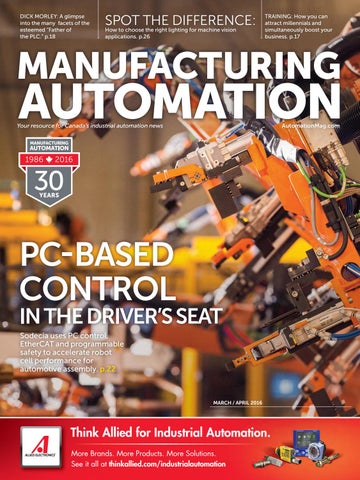
PC-BASED CONTROL
IN THE DRIVER’S SEAT Sodecia uses PC control, EtherCAT and programmable safety to accelerate robot cell performance for automotive assembly. p.22
MARCH / APRIL 2016
Think Allied for Industrial Automation. More Brands. More Products. More Solutions. See it all at thinkallied.com/industrialautomation
D
It’s time to spend less and
Do more
orePLC o-m s
®
Made in
USA
Powerful yet affordable...
See what others are saying:
The Do-more H2 series CPUs leverage industry-proven I/O hardware to create an incredibly powerful PLC - at an incredible bargain. The popular H2-DM1E CPU, available for $399, comes with:
“Best value for money CPU. Powerful, yet easy to program. Excellent features and large memory. Good communication capabilities both for MODBUS and ASCII applications. Excellent combination of new features with trusty DL205 I/O modules...” Neven in PORTLAND, OR
•
(1) USB port for programming, (1) full-duplex serial port, (1) Ethernet port
•
Several communication protocols including Modbus RTU, ASCII, Modbus TCP and EtherNet/IP
•
Over 1M bytes total memory (includes program, data and documentation)
•
Program/monitor/debug over any embedded communication port
•
Supports up to 256 I/O in one base, and thousands more with optional Ethernet-connected I/O
•
Powerful instruction set featuring easy-to-configure math, trending and motion
•
H2-DM1 CPU (no Ethernet port) also available, for $299
“This PLC is the most feature rich but easy to program PLC I have ever used. Its memory and speed is amazing...” Jordan in HAYS, KS You can see even more reviews on the Do-more CPU product page at www.automationdirect.com
and that’s not all...
“This is simply the BEST PLC CPU on the market when you combine price and performance. The software is easy to use (not to mention free) and yet powerful with hundreds of available commands...” Scott in HUNTSVILLE, AL
FREE software - with a built-in simulator! FREE 30 days online training FREE technical support FREE shipping (orders over $49)
Get more than you paid for . . .
www.automationdirect.com/Do-more-PLCs
Orders over $49 get FAST FREE SHIPPING Our shipping policies make it easier than ever to order direct from the U.S.! Fast free standard shipping* is available for most orders over $49 U.S., and that includes the brokerage fees (when using an AutomationDirect nominated broker). Using our choice of carrier, we can reach most Canadian destinations within 2 to 3 days. Order by 6pm ET and in-stock orders ship the same day! *2-day free shipping does not apply to drop-ships, or orders requiring LTL transport, but those shipments can take advantage of our negotiated super-low flat rates (based on weight) that include brokerage fees.
See Web site for details and restrictions at: www.automationdirect.com/canada
To see all products and prices, visit www.automationdirect.com
Order Today, Ships Today! * See our Web site for details and restrictions. © Copyright 2014 AutomationDirect, Cumming, GA USA. All rights reserved.
1-800-633-0405
the #1 value in automation
March/April 2016 Vol. 31, No. 2
DEpaRtMENtS 4 From the editor 5 Automation upfront The latest industry news, deal makers, and movers and shakers
22
16 Centre stage Farzad Rayegani, director, Sheridan College’s Centre for Advanced Manufacturing and Design Technologies
COLuMNS 10 Industry watch Thinking of workers as value-adders
Contents
12 Lean insights
COVER StORy
How to take advantage of real-time data analytics
22 PC-based control in the driver’s seat
14 Machine safety Upgrading interlocking switches
34 Backstory Industrial IP security
NEW pRODuCtS
Accelerating robot cell performance for automotive assembly By Shane Novacek
18
30 HMI & operator interface 30 Electronic components 31 Machine vision & inspection 32 Sensors 32 Programmable control 32 RFID 33 Enclosures & workstations 33 Automation software
MANUFACTURING AUTOMATION · March/April 2016 MA_March_Murrelektronik.indd 1
17 Industrial millennials How to attract millennials while boosting your business By Anurag Garg
18 The man behind the PLC A glimpse into the many facets of the esteemed Dick Morley By Alyssa Dalton, sidebar by Heather Angus-Lee
26 Can you see the difference? Lighting technique selection for machine vision applications By John Lewis
26
28 Projected success Five project management lessons for manufacturing By Andreas Tremel
AutomationMag.com
3
2016-02-23 10:11 AM
from tHe editor By aLySSa DaLtON
NOtaBLE tWEEtS
Your resource for Canada’s industrial automation news
@WSIB Resolution idea: Resolve to always recognize employees or co-workers for working safely @Mommakesh It was great to see firsthand! RT @automationmag Great turnout at the demo portion of the opening of Seneca’s Mechatronics Simulation & Demonstration Centre. spOtlight: highlights from our fireside chat with nathalie pilon, aBB canada managing director. p.15
Defence-in-Depth Best practices to help industrial operators deploy the internet of things securely and reliably. p.22
Machine safety: how you can prepare for the upcoming Ontario machine safety blitz. p.21
AutomationMag.com
Your resource for Canada’s industrial automation news
Top 5 in 2016 from 3D printers to industrial sensors and the internet of things (iot) — key trends and technologies that will impact your plant floor this year. p.16
JAnUARY / FEBRUARY 2016
pM 40065710
Think Allied for Industrial Automation. More Brands. More Products. More Solutions. See it all at thinkallied.com/industrialautomation
2016_MA_ISSUE.indd 1 1 AlliedCover_MA_Jan.indd
2016-01-07 2015-12-23 2:29 1:58 PM PM
@WinSPC Talk about automating your #quality checks RT @ automationmag Rise of robots, AI to cost 5 million jobs by 2020, according to @ wef report bit.ly/1QjaELR @EBMag Great Q&A with Nathalie Pilon of ABB in @ automationmag bit.ly/1ND9g2c @PlexSystems #IoT enables #mfg intelligence, accessing plant floor data for informed decision-making and improved execution: ow.ly/Xhv7w 4
The tip of the IIoT iceberg
I
usually wake up to a dozen different market reports in my inbox during any given week. Sometimes they are completely irrelevant and are automatically deleted, and other times I file them away to use as reference material for future articles. Earlier this year, I came across a report that instantly flagged my attention. A MarketsandMarkets report noted that the Industrial Internet of Things (IIoT) market is expected to reach US$151.01 billion by 2020, at a CAGR of 8.03 per cent between 2015 and 2020. Yes, billion. That’s one heck of a forecast. For comparison purposes, similar reports project that the machine safety and artificial intelligence markets will reach $4.98 and $5.05 billion, respectively, by 2020. What a massive difference. In a world where manufacturers must maximize their investments, IIoT will allow companies to collect and analyze real-time data, identify potential machine failures in advance, better manage assets, and reduce costs — all with the goal of becoming more efficient and nimble. The fast emerging field of IIoT is poised to disrupt current technologies and processes across industries while creating new market opportunities and business models, notes the agency. Translation — in terms of the possibility and opportunity of IIoT, we’re just hitting the tip of the iceberg. In case you’re wondering, 2014 is the base year used for the study and the forecast period is between 2015 and 2020. (What’s fun to think about is how IIoT will look a decade after 2020 — but that is a whole other conversation for another day.) Released this past January, Industrial CONNECt @AutomationMag
IoT Market by Industry Vertical (Manufacturing, Energy & Power, Oil & Gas, Metals & Mining, Healthcare, & Agriculture), Technology (Sensors, Networking Technology, DCS, & Others), Software, & Geography - Global Forecast to 2020 lists several key factors driving the IIoT market, including technological advancements in semiconductor and electronics, evolution of Cloud computing, standardization of IPv6, advancements in wireless networks, and government support. “The manufacturing sector is witnessing a transformation through the implementation of the smart factory concept and factory automation technologies. Government initiatives such as Industrie 4.0 in Germany and Plan Industriel in France are expected to drive the IIoT solutions in Europe. Moreover, leading manufacturing countries such as the U.S., China, and India are expected to further expand their manufacturing industries and deploy smart manufacturing technologies to increase this sector’s contribution to their national GDPs,” notes the study. At the end of April, I will be travelling to Germany for Hannover Messe, the world’s largest trade fair for industrial technology, where the smart factory, the Cloud, the Connected Enterprise, Big Data and Industry 4.0 will be the talk of the show floor. It’s no doubt the pivotal fourth industrial revolution is upon us, but how we approach and take advantage of its landscape is key. Be sure to keep an eye out for our Hannover Messe coverage in our June issue. | Ma
adalton@annexweb.com
AutomationMag.com
EDItORIaL aDVISORy BOaRD AL DIGGINS, President and General Manager, Excellence in Manufacturing Consortium, and Chairman and CEO, Canadian Manufacturing Network DAVID GREEN, Technology and Business-to-Business Consultant DON MCCRUDDEN, Vice-President, Business Development, Festo DAVID MCPHAIL, President and CEO, Memex Automation NIGEL SOUTHWAY, Business Productivity Consultant and Author on Lean Thinking BILL VALEDIS, Vice-President, Precision Training, Products and Services Inc.
@AutomationMag
EDItOR
Alyssa Dalton adalton@annexweb.com puBLIShER
Klaus B. Pirker kpirker@annexweb.com VICE pRESIDENt & ExECutIVE puBLIShER
Tim Dimopoulos tdimopoulos@annexbizmedia.com aRt DIRECtOR
Graham Jeffrey gjeffrey@annexweb.com aCCOuNt CO-ORDINatOR
Kathryn Nyenhuis knyenhuis@annexweb.com CIRCuLatION MaNaGER
Urszula Grzyb ugrzyb@annexbizmedia.com DIRECtOR Of SOuL/COO
Sue Fredericks CONtRIButING WRItERS
Heather Angus-Lee, Anurag Garg, Tom Goike, Paul Hogendoorn, John Lewis, Danny C. Marmora, Shane Novacek, Daymon Thompson, Andreas Tremel Manufacturing Automation is published seven times a year by: Annex Business Media 222 Edward Street, Aurora, Ontario L4G 1W6 Tel 905-727-0077 Fax 905-727-0017 Printed in Canada ISSN 1480-2996 Publication Mail Agreement #40065710
CIRCuLatION email: asingh@annexbizmedia.com Tel: 416-510-5189 Fax: 416-510-5170 Mail: 80 Valleybrook Drive, Toronto, ON M3B 2S9 SuBSCRIptION RatES Canada — $40.95 per year United States — $71.95 (US) per year and Foreign — $82 (US) per year Students — $20 per year Occasionally, Manufacturing Automation will mail information on behalf of industry related groups whose products and services we believe may be of interest to you. If you prefer not to receive this information, please contact our circulation department in any of the four ways listed above. The contents of Manufacturing Automation are copyright © 2016 by Annex Publishing & Printing Inc. and may not be reproduced in whole or part without written consent. Annex Publishing & Printing Inc. disclaims any warranty as to the accuracy, completeness or currency of the contents of this publication and disclaims all liability in respect of the results of any action taken or not taken in reliance upon information in this publication.
Funded by the Government of Canada
Automation upfront
NEWS Safety
School board slapped with fine after student injured in manufacturing class Peel District School Board (PDSB) pleaded guilty and has been given a $50,000 fine after a student was injured in a classroom incident that resulted in a fracture injury. On April 9, 2014, three students at Rick Hansen Secondary School in Mississauga, Ont., were attending a manufacturing program class and were assigned the task of removing four old caster wheels from a metal table. Sitting atop the metal table was a 450-lb metal industrial shear (a sheet-metal-forming device) that had been brought to the school by the teacher without the knowledge of the school administration, according to the Ontario Ministry of Labour (MOL). A warning label on the shear itself indicates that the machine should be secured for stability and safety; the manufacturer’s manual instructs that mounting holes on each of the shear’s four feet should be used to bolt the machine securely to the floor or stand, said the investigation report, adding that the shear was not secured but school administration was not aware of that. According to the ministry, the three students, as instructed by their teacher, used a floor jack to raise one end of the table and cut off one of the legs, including the old caster wheel. One of the students then got the new caster and asked another student to lower the jack to see how the new caster fit on the table leg. When the jack was lowered the table tipped forward and the shear slid off the table, landing on the back of one of the students who was crouched down by the table’s legs. The investigation found that the three students did not know that the shear was not secured to the work table and at no time
did their teacher instruct them to remove the shear from the table before cutting off the table legs. The student was transported to hospital by ambulance. As a result of being struck by the shear, the student sustained a fracture. PDSB pleaded guilty to failing as an employer to take every precaution reasonable in the circumstances for the protection of a worker in a workplace
MANUFACTURING AUTOMATION · March/April 2016
MA_March_Beckhoff.indd 1
— specifically to failing to take the reasonable precaution of ensuring that the shear was secured to the surface upon which it was set, and was fined $50,000. In addition to the fine, the court imposed a 25-per-cent victim fine surcharge as required by the Provincial Offences Act. The surcharge is credited to a special provincial government fund to assist victims of crime.
Classroom safety: School board pleads guilty after student suffers a fracture injury.
AutomationMag.com
5
2016-02-17 1:42 PM
AutomAtion upfront
Bosch Rexroth Canada achieves ISO 9001, ISO 14001 & OhSaS 18001 in all nine locations Bosch Rexroth Canada has announced ISO 9001, ISO 14001 and OHSAS 18001 certification of its nine locations across Canada, including Ontario, Alberta, Saskatchewan, British Columbia, Nova Scotia, New Brunswick and Quebec. “To ensure [our products and services] reach our customers in the fastest and most reliable way, we constantly verify and review all systems, thus ensuring consistency and best practice,” said Claudio Perin, corporate manager, QMM/HSE. “The ISO 9001 certification indicates that we will meet not only their stated requirements, we will meet more of their implied requirements.
The ISO 14001 certification by Bureau Veritas verifies that we are committed to identifying and controlling our environment impact and also improve our environment performance. The OHSAS 18001 certification shows that we have a clearly defined management system and we want to minimize risks to our workforce, visitors, sub-suppliers and contractors on our premises.” INNOVatION
Calgary opens apparel research and development centre Western Canada’s first open-access apparel research and development facility has officially opened in Calgary, Alta., and aims to provide businesses with services to test, design and manufacture innovative apparel products for the consumer
Encoder solutions that just make sense. Model TR1 for Linear Measurement • • • •
Integrated encoder and measuring wheel Easy installation Operates up to 3,000 feet per minute Adjustable, spring-loaded torsion arm
1.800.366.5412 sales@encoder.com www.encoder.com
6
apparel and industrial protective clothing markets. Western Economic Diversification Canada, through the Western Diversification Program, invested close to $3 million to enable Olds College, in partnership with AGM Wear Ltd. (Alberta Garment), to establish the Apparel Innovation Centre. Through the investment, the centre was able to purchase product testing and prototype development equipment, as well as garment design hardware and software. Claiming to house North America’s most advanced apparel research and development equipment and technologies, the Apparel Innovation Centre features hot liquid and steam protection testing chambers, allowing businesses to test personal protective equipment (PPE) for burn resistance. It is also home to a thermal comfort testing chamber, equipped with a Newton Thermal Manikin. The chamber simulates a variety of physiological conditions that replicates the human thermoregulatory system. The comfort and thermal sensation data produced will allow researchers to further study and evaluate the performance of the apparel. “We applaud the Government of Canada’s vision and commitment to help create the world-class Apparel Innovation Centre. It will become a magnet for innovative thinkers in the apparel industry as it fulfills its mission of helping entrepreneurs
EDuCatION
$263K in equipment donated to Lambton College Endress+Hauser Canada has contributed $263,000 to Lambton College’s Instrumentation & Control Engineering Technology program in Sarnia, Ont. The donation, comprised of a range of industrial measurement devices, hopes to provide students with access to sophisticated instruments available in process industries, “ensuring they gain critical hands-on experience while they prepare to enter challenging careers in the Canadian workforce,” says company representatives. It will provide and install instruments for the measurement of flow, level, pressure and temperature in Lambton’s Instrumentation & Control Engineering laboratory. “In keeping with Endress+Hauser’s continuous support of educational institutions, we are pleased to offer Lambton College students the best possible preparation in order to
Preparing for the future: Endress+Hauser Canada says students can “gain critical hands-on experience” with the new equipment. March/April 2016 · MANUFACTURING AUTOMATION
@AutomationMag
Encoder_MA_Jan.indd 1
create innovative apparel and enhancing the growth of the economy of Western Canada,” said Adrian Bussoli, president of Alberta Garment. The centre complements Olds College’s Fashion Marketing and Apparel Technology programs and is connected to the Alberta Garment Manufacturing facility in northeast Calgary.
2015-12-16 9:06 AM
pHoto: endress+HAuser CAnAdA
OpERatIONS
join the workforce in Sarnia, and across Canada,” said Tony Varga, general manager and CEO of Endress+Hauser Canada. “As we build partnerships with post-secondary institutions, it is imperative that we find schools focused not only on instrumentation and controls, but also on building the next generation of leaders in this industry. Lambton College is one of those special schools.” Since 2012, the company has donated more than $780,000 in instrumentation to Canadian colleges and universities. “We are pleased to celebrate this new partnership and very generous process instrumentation donation that will further enhance our exceptional educational programming, and the training and research opportunities for our various flagship technology programs,” said Judith Morris, college president and CEO.
MILEStONE
axalta celebrates 60 years of ajax production Earlier this year, Axalta Coating Systems, a global manufacturer of liquid and powder coatings, celebrated 60 years of production at its Ajax, Ont., facility. Employees gathered at the local Hilton Garden Inn to celebrate both Axalta’s 60th year of operations in Ajax and its 150th business anniversary. Axalta’s history in Canada dates back to 1956 when the Ajax plant opened its doors. It has produced a variety of products over the years including acrylic lacquer paints, basecoat and clearcoat technologies. In 2000, it was identified as a corporate development and manufacturing flagship for the “paint on plastics” that is used with many
Axalta in Ajax: Company officials celebrate a milestone achievement.
and vehicle components, trains, buses and diversified industrial products. “This is a special milestone in Axalta Canada’s history. We are proud to be celebrating our 60th year in Ajax and our 150th year in business,” said Brent Jamieson, Axalta Canada country manager.
automotive components. More recently, due to increased production volumes, Ajax added a new distribution centre to the campus. Today, products are shipped from Ajax to customers in Canada and the U.S. for collision repair, the production of vehicles
Wide Selection of HMI’s and Sensors at omega.ca Large Sélection de Sondes et d’IHM à omega.ca Series/Série UWBT Starts at/à partir de $ 261
Wireless Transmitter for Smart Phones and Tablets Temperature, pH, RTD & Relative Humidity Gamme de Transmetteurs Portatifs OMEGA® Bluetooth® sans fil de Température, d’Humidité et de pH
OMEGA Introduces
pHoto: AXALtA
976 Bergar Laval, Québec Canada H7L 5A1
Low-Cost Compact “All-In-One” Controllers Contrôleurs Compacts “Tout En Un” Économiques Series/Série OCS XL « Starts at/à partir de $515
Technical Learning
8/16-Channel Thermocouple/Voltage Input USB Data Acquisition Module Module d’Acquisition de Donnée USB à 8/16 Canaux pour Thermocouple/Tension OM-DAQ-USB-2401 « $635 Visit omega.ca/technical-learning
Contact Us Today
1.888.826.6342 | omega.ca
®
Prices listed are those in effect at the time of publication and are subject to change without notice. Please contact OMEGA’s sales department for current prices. Les prix indiqués sont ceux en effet au moment de la publication et sont sujets à changement sans préavis. Veuillez contacter un réprésentant des ventes d’Oméga pour obtenir les prix courants. Note: Models with wireless option are approved for use in the US, Canada and Europe only. Note: Les modèles ayant l’option sans fil sont approuvés pour une utilisation aux États-Unis, au Canada et en Europe seulement.
© COPYRIGHT 2016 OMEGA ENGINEERING, INC ALL RIGHTS RESERVED © COPYRIGHT 2016 OMEGA ENGINEERING, INC. TOUS DROITS RESERVES
MANUFACTURING AUTOMATION · March/April 2016 MA_March_Omega.indd 1
AutomationMag.com
7
2016-02-17 2:56 PM
Automation upfront
INTERNATIONAL China
New Cadillac plant features how many robots? General Motors (GM) has opened a Cadillac factory at its SAIC-GM joint venture in Shanghai, China, to produce the CT6 luxury sedan. According to the automaker’s representatives, the “flexible and intelligent state-of-the-art” 8 billion yuan (US$1.2 billion) manufacturing facility will have an annual production capacity of 160,000 vehicles. The plant includes a body shop, a paint shop, a general assembly shop, a high-speed test track and auxiliary facilities. The advanced manufacturing technologies and processes employed in the new plant’s three shops include: • Body shop: Two fully automated production lines — one steel and the other aluminum — with 386 robots. The shop has also adopted GM’s mixed material welding technologies. They include resistance spot welding of aluminum, laser brazing of aluminum (a Chinese industry first, it says), and use of the cold body connection process that uses self-tapping screws and
self-pierce rivets. • Paint shop: The paint shop utilizes robots to fully apply paint and coating. Its technologies and processes include membrane pretreatment, electrophoretic coating boasting high throwing power, second colour coating and transparent colour coating for a translucent finish. • General assembly shop: The shop supports the production of up to seven models simultaneously. The digital assembly facility has incorporated an Internet of Things (IoT) system, which can monitor torque information for every key fastening point, it notes. Cadillac says the factory serves as a “green benchmark” for vehicle manufacturing globally, claiming to be the only facility of its kind in China without a concrete chimney. The spray booth exhaust treatment system and dry venturi scrubbers make the shop nearly 300 per cent cleaner than conventional paint shops, it says.
@AutomationMag
reorganizing operations across its 24 franchise bottling plants in India according to market demand and factory upgrades, where “new state-of-the art facilities are being built and existing production capacities are being optimized.” DEAL MAKERS
INDIA
Coca-Cola suspends bottling operations Coca-Cola says it will be suspend bottling at three plants in India, including one in the parched northwest where farmers have been protesting the company’s groundwater use. In mid-February, Hindustan Coca-Cola, a subsidiary of The Coca-Cola Company, announced it is going through a process of
Production notes: The body shop is fully automated with 386 robots. 8
Operation stoppage: Coca-Cola suspends bottling at three plants.
Winnipeg’s Amsted Rail secures CN Rail deal Winnipeg’s Amsted Rail and Canadian National Railway have signed a 10-year, $500-million deal to manufacture train wheels in the city. The deal is an extension on previous contracts between the companies and will see the making of one million wheels until 2026. The wheels will be manufactured at the Griffin Wheel Co. and trucked over to the CN Transcona Shop just a few blocks away. There, the wheels will be mounted into sets before being shipped out and put on rail cars. The deal secures 85 jobs at the CN Rail shop and about 250 at Griffin. Manitoba economy minister Kevin Chief said the move will help keep more young workers in the province. “This here really solidifies the future,” said Brent Sharron, Local 144 Unifor president. — With files from The Canadian Press
Haier Group buys GE appliance unit in multibillion dollar deal Haier Group, a global home appliance maker, has bought General Electric’s appliance business for $5.4 billion, expanding its U.S. and global presence. The two companies have agreed to form a strategic partnership to co-operate in areas such as advanced manufacturing, the Internet, and healthcare. The announcement comes as Haier tries to transform itself into a premium brand. Haier, headquartered in the eastern city of Qingdao, makes a range of refrigerators, washing machines and other home appliances. It operates a string of 21 industrial parks worldwide. The manufacturer’s takeover of GE Appliances is the second biggest purchase in the household appliance sector on record, behind Panasonic Corp.’s 2008 purchase of 50 per cent of Sanyo Electric Co. for $7.1 billion, according to Dealogic, adding that Haier’s six foreign acquisitions to date total $6.3 billion. “This strategic alliance provides a new starting point for both Haier and GE and I am confident that this partnership will deliver enhanced value to the stakeholders of both companies,” said Haier Group chairman Zhang Ruimin in a statement.
March/April 2016 · MANUFACTURING AUTOMATION
PHOTOs: GM, VICHAILAO / Shutterstock.com
“We are extremely proud to call Ajax and the Region of Durham home. We look forward to the next 60 years of being a part of this vibrant community.”
MOVERS & SHAKERS Bob Fahrni has been appointed account manager for the Greater Toronto Area (GTA) and northern Ontario by Carlo Gavazzi. Company representatives describe Fahrni as bringing industrial automation component and systems sales experience, having previously sold motors, motion control and automation systems. Fahrni will focus on supporting channel partners in the GTA and Northern Ontario and will develop both new and existing relationships in his territory. He will also be concentrating on development of new business opportunities. Tamron has promoted Gregg Maniaci, a 20-year veteran of the company, to president and CEO of Tamron USA, at the start of the month. Hidekazu Suzuki was simultaneously appointed senior vice president. Maniaci has 26 years of experience in the photo imaging industry. He first joined Tamron USA as the New York Metro photo imaging sales representative in May 1995 after several years of photo specialty retail experience. Meanwhile, Suzuki became part of the Tamron operation after his previous position as product manager of Business Communication Devices for Uniden America Corporation from 2003-2007. Delcam has added two applications engineers to its customer support teams in Canada, saying the new hires
L to R: Chris Marion and Jean-Francois Landry
follow “increased interest” in Delcam’s software from manufacturing companies that “need to increase productivity to meet growing demand, improve quality and reduce waste, and shorten lead times.” Chris Marion has been added to the support team in the Windsor, Ont., office, bringing with him more than 20 years of experience in machining and tooling design. He started as a machinist/CAM operator, programming everything from small components to large molds. Jean-Francois Landry has joined the team working in Delcam’s Quebec office. He will use his 15 years of manufacturing experience to support customers using the FeatureCAM feature-based programming software.
.
Jessica Reimann has been named marketing manager of NKK Switches. The company says the appointment marks its commitment to “further growth and development” as it prepares to launch new products and explore alternate markets. Reimann, who joins NKK with a background in advertising and marketing, will oversee marketing outreach efforts in the Americas. Sandvik Coromant has announced Sean Holt as the new president of the Americas market area, describing him as an “experienced executive” in the manufacturing industry. Holt was a member of the Americas management team as the vice-president of engineering. He is now part of the global sales management team reporting to Eduardo Martin, global vice-president of sales. Holt brings with him more than 20 years of engineering, business development, sales and executive management experience. | MA
MANUFACTURING AUTOMATION · March/April 2016
AutomationMag.com Hiwin_MA_Jan.indd 1
9
2015-12-10 12:54 PM
industrY WAtCH By pauL hOGENDOORN
Paul Hogendoorn (paulh@getfreepoint.com) is co-founder of FreePoint Technologies, “Measure. Analyze. Share.” (Don’t forget to share!) Visit www.getfreepoint.com for more information.
Paying attention to what matters — a different look at things
I
’m a slow learner, I confess. Last month, along with my team, I presented the findings of a study that was done in conjunction with Fanshawe College. It showed a definite correlation between measuring and sharing routine value-adding activities and productivity improvement. The key is finding meaningful and appropriate ways to share a quantified representation of that value-adding activity in real-time. It’s a concept I’ve been working on for four years, and an event I was planning for a month. I really thought I knew this topic very well. Some call it gamification, a term I don’t really like but have come to understand better. As human beings, we all get a great satisfaction not just from what we do, but what we get done. There’s a definite distinction there that is often missed. When someone asks me what I do, I usually start to rattle off my job title, the company I work for and the details about my job in a somewhat rote fashion. If anyone, however, asks me about something I’ve recently done, I usually go into specifics and talk about it a lot more enthusiastically. For some reason, what I am doing and what I have accomplished both invoke feelings of pride, but more so with a task completed — especially one I think I have done well. That’s one of the topics I have been speaking about a lot lately as we try to introduce new ways of communicating with folks on the plant floor (it’s what I do as my job). We have proven time and again that an engaged workforce is a happier workforce, and a happier workforce is a more productive workforce. If someone asks me about a project we’ve just completed, the level of pride and detail kicks up quite a few notches. The other day when I came home from work, just shortly after our big event presentation, I was again reminded of the importance of measuring and sharing “value adding activity.” My wife met me at the front door and enthusiastically invited me to follow her to the kitchen pantry closet. “Look here,” she says, “see what I’ve done today?” Fortunately for me, she continued 10
@AutomationMag
to explain her accomplishments. “I completely reorganized the pantry. I threw out some old stuff, rearranged the cookbooks, and put partitions in to keep things from sliding around. I’ve been meaning to do this for a year, and I finally got around to it. It took me the whole day.” She works hard everyday, and everyday is filled with important activities, but this was something else; it was tactile, quantifiable and visual. Some might say that this is a good illustration of a Lean activity and Lean thinking, but I think it’s far more than that. This is a basic human thing — the need to quantify the work we do, what we have actually accomplished, and then be able to share that with the people around us. I often credit Henry Ford with the creation of the middle class by paying workers more in line with the value they add to the products they build (which “encouraged” other manufacturers looking for workers to do the same), but at the same time, the disconnection between work and value started growing. It was a lot harder for the people doing the work to connect value with the activities they were performing. Halfway through my wife’s guided tour of what she accomplished that particular day, I realized that everyday is filled with numerous activities she has gotten done that I, nor anyone one else in the house, typically ever notices. Fortunately for me (and everyone else in my family), the results of her daily efforts are sufficiently satisfying for her,
We need to start thinking of “workers” as “valueadders” and not as a “cost” or “expense.” They add value; they don’t take away value.
but that’s no excuse for not noticing. Her daily “value-adding activities” continue relentlessly, without affirmation or feedback — unless of course, if something goes wrong. Our factory floors are no different. I like to think that the most valuable people are the people actually adding value (i.e., actually doing the work), but we tend to measure everything else: uptime, downtime, changeover time, start time, parts, cycles, etc. We take it for granted that “it’s their job,” and they do it because they have to. That’s true enough, but, wouldn’t it be better for them, and the company, if the value they added each day was measured and displayed in a tactile, quantifiable and visual way? As manufacturers struggle to attract and retain workers — especially young people — this becomes increasingly important. The first thing we should do is change the terms we use. “Associate” or “employee” is not much better than “labourer” or “worker.” We need to start thinking of them as “value-adders” and not as a “cost” or “expense.” They add value; they don’t take away value. No offense to everyone else in the organization, but in most factories I’ve been in, no one in an office adds as much value to the product produced than they do. The more value-adders you have, the better. This is something we can all learn to do better. Start by measuring the value they add, and then make sure you notice. | Ma
March/April 2016 · MANUFACTURING AUTOMATION
LEAN INSIGHTS By Tom Goike
Tom Goike is the director of manufacturing excellence at Memex Inc., in charge of Roadmap to Success implementations for Memex’s flagship IIoT communications platform, MERLIN. When installed in a plant, MERLIN can achieve payback in less than four months with an Internal Rate of Return greater than 300 per cent. To learn more, visit www.MemexOEE.com.
Defeating Muda by leveraging real-time IIoT data collection
M
any companies aspire to Lean manufacturing and its power to change the way things are done on the shop floor. In principle, Lean is the reduction of waste and the focus of continuous improvement throughout a product or process’s life cycle. For decades, companies have achieved this through the collection and analysis of data driven from clipboards and subjective notes or comments. This data is then used to paint a picture of the current state and measure improvements throughout the Plan-Do-Act-Check (PDCA) cycle. The mega-trend of the Industrial Internet of Things (IIoT) that connects devices to produce real-time analytics has brought technology that catapults Lean implementation and Lean thinking into a proactive environment based on truly objective data. Lean as a data-driven method for reducing downtime relies on the speed at which data is deciphered. Waste, otherwise known as Muda, has eight key components: Motion, Defects, Overproduction, Waiting, Non-Utilized Talent, Transportation, Inventory and Extra-Processing. All Muda is anchored by one common non-recoverable asset — Time. Once Time is invested or applied to a product or process, its value is fixed. In Lean, the goal is to maximize the availability of equipment and people and minimize the non-value added time placed into a product or process.
Manual data collection is Muda at its finest:
• Motion to collect and deliver the data, • Defects from subjective data collection, • Overproduction by gathering data that may or may not be used immediately, • Waiting for the data to be manually gathered, complied and deciphered, • Non-utilized talent by requiring skilled workers to document and gather the data rather than add 12
@AutomationMag
With real-time data collection, machine utilization is collected automatically and processed into actionable reports available to those who can make a difference.
8
The number of key components that waste, known as Muda, has
value to the product or process, • Transportation through manual retrieval of the clipboards and data, • Inventory of data that has to be manually filed and tracked until needed, and • Extra-Processing by adding additional roles or responsibilities to the employees who are tasked with value-added work. Consider this example: what if this seemingly random event occurs twice on each shift in a three shift, 24-hour operation, and its total duration is 150 seconds across 32 of 40 machines in the plant each shift. That plant loses
eight hours of production, 40 hours per week, for a total of 2,080 hours per year. I encountered this situation while trying to improve productivity in a company that introduced the use of Day by Hour charts for manual data collection. Break and lunch were considered planned downtime with no operator input required. During a Kazien event, we noted that the operators left their workstations approximately two to three minutes before lunch and break. Through interviewing and reviewing the causes, it was found that the company didn’t provide enough microwaves for employees to
March/April 2016 · MANUFACTURING AUTOMATION
heat their lunches, and they felt they needed a head start to get to the scarce appliances. If real-time data collection were in place, a supervisor would have been able to review data hourly or daily, unfiltered by those who input the data into clipboard and spreadsheets. The supervisor would have instantly detected the underutilization of plant equipment during lunch breaks, uncovered the issue around lunch breaks, and addressed the loss with the purchase of a few low-cost appliances. With subjectively collected manual data, a few minutes lost due to something seemingly random and obscure most likely will not make the clipboard. With real-time data collection, machine utilization is collected automatically and processed into readable and actionable reports instantly available on the device of choice to those who can make a difference. Real-time data collection delivers Muda-free data, allowing all employees the opportunity to stop loss before it becomes unrecoverable. As a manager, imagine being able to know minute by minute or hour by hour if you will meet your daily requirements, and not just know that, but have the ability to change the course of the day based on real-time, accurate, actionable data. IIoT software systems that employ the MTConnect manufacturing communications standard capture data as it occurs from each machine and operator to provide an accurate picture of the health of any given process. If the system also offers the ability to connect machines and related assets of any make or origin, then Lean becomes a culture of accuracy and accountability based on real-time data. Analytics displayed on monitors above each machine and/ or strategically placed in work cells provide clear, consistent and unbiased data and summary reports that inspire employees to collaborate on new ways to
improve their processes and reduce the waste that lingers in the “Hidden Factory.” This way, plants that have accepted subjectively collected data and allowed it to be absorbed in the cost of the product can literally transform profitability. Real-time data is true and accurate because human decisions as to what is and is not Muda are removed. Culture is key in any
Lean implementation, and like it or not, manual data collection allows those involved to influence the results and paint the picture of the situation as they see it. An operator who feels he or she is productive and working to their limit can often question the notes or observation of the person gathering the data. Real-time IIoT software collects data from each machine,
shares it across the plant from the shop floor right up to the top floor, and removes barriers to objectivity creating consistent Key Performance Indicators (KPIs) across varying processes, equipment or systems. This helps to diffuse any potential conflicts over subjective data collection, and provides information that helps increase both consensus, and profit. | Ma
Festo proudly presents:
The pneumatic stars. Pneumatic Connections
Powerful rotation, precise guidance.
A moving combination.
You need best in class products. You want affordable prices. You require quick and reliable delivery.
WE ARE THE ENGINEERS OF PRODUCTIVITY.
These are our brightest stars! If a product in our catalogue or online shop is marked with a star, then you know it has been selected by our experts for its outstanding features and performance – the standard product range. Our standard product range promises: • a global product range • quick deliveries – outstanding availability • optimal price/performance www.festo.ca/stars
Manufacturing_Automation_halfpage_island_Festo_Ad_stars in pneumatic.indd 1 MANUFACTURING AUTOMATION · March/April 2016 MA_March_Festo.indd 1
17/02/2016 4:27:41 PM AutomationMag.com 13 2016-02-23 11:09 AM
MACHINE SAFETY
Danny C. Marmora, B.Eng., P.Eng., CET, (danny@marmoraconsulting. com) is the principal at Marmora Consulting based in Stoney Creek, Ont. His firm specializes in Pre-Start Health & Safety Reviews, fire code consulting and forensic engineering.
By Danny C. Marmora
The perils of upgrading interlocking switches
required minimum circuitry/device/safety system performance level is established. That information can then be used as part of the safety device selection process.
question I get asked often comes from industrial clientele asking me how they can bring their existing equipment up to existing safety standards. Specifically, they ask about the cost effectiveness and technical requirements of upgrading/replacing/integrating new safety switches forming/part of an interlocked door/ access panel/robot guarding perimeter, etc. To achieve the ultimate deliverable — which is a regulatory compliant, non-defeatable, fail safe interlocked system — a number of variables need to be considered. It has been my personal experience that the methodology presented herein is a good pathway to evaluating and collecting the required information to make an informed decision regarding an upgraded or new safety interlocked system.
4. What are the restrictions (if any) regarding device selection & mounting?
A
prescribed in force standards. Relying on such dubious components could compromise the integrity of the new safety system by trying to build upon those already present.
1. Can the existing interlocked system be upgraded at all?
This is really the starting point. As obvious as this may seem, I see it more often than not where attention to, and understanding the existing machines control and upgrade capabilities, has not been undertaken to any depth. Simply contacting your local supplier and replacing the non-compliant switch with one that is compliant normally does not aid in regaining/establishing compliance, and can actually make the condition worse. Depending on the age, control design and origin of the machine, trying to upgrade or integrate within the existing control architecture may not be possible. Machines that are PLC-control based can be burdensome as the interlocked switches may be run as input(s) to the PLC along with their associated outputs. Further, if the existing PLC is not a safety rated device, further complications and costs can ensue. 2. Are any existing safety devices present?
Tying into Point 1, having an existing safety system may not always equal a technical advantage or cost savings. The safety standards existing devices were built to may not comply with today’s standards. Specifically, the existing system may not have the ability to control long machine response times in a reliable manner (i.e. when stopping times are an issue), the required internal monitoring may not be present (i.e. internal fail safe capabilities), and circuit redundancy may not possible (i.e. Category B-4), as required by the 14
@AutomationMag
3. Has a recognized risk analysiS been completeD/documented?
This is another area where shortcomings commonly occur. Most of the responses I receive after I ask, “Have you completed and documented a risk analysis?” is, “Of course, it is a risk and that’s why we have to guard it!” While the latter is partially true, the level of circuitry sophistication required is a direct outcome of the documented recognized risk analysis. The reason I elude to “recognized” is that specific industries such as packaging, machine tools and robotics have well-defined risk analysis methodologies to be followed. Not completing the risk analysis begs the question, “What circuit reliability/performance level is required for the new interlock?” In lieu of a machine specific risk analysis, one can use that within CSA Z432 - Safeguarding of Machinery. It is noted that with some machine specific standards (i.e. type “C” Standards, the opportunity to evaluate safety functionality via a risk analysis is not permitted. These standards may define any number of know hazard types/classes, and establish the minimum safety circuitry performance level therein). Finally, when the risk analysis is properly completed and documented not only has the organization exercised their required due diligence, the
Traditionally, interlock switches are mounted at the edge of a door, end of a travelling gate, or another configuration that allows the internal contact arrangement of the switch to change state when the interlocks mating components “break” (i.e. the switch comes apart/back together based on the guards position). However the concern with mounting switches at the edge of a door or end of a travelling gate is the switch normally becomes part of the end stop. Hence the switch may be exposed to nuisance impact and experience premature wear. CSA Z432 and other machine standards discuss how interlocked switches should be mounted to prevent nuisance impact and premature wear. Other critical considerations include the defeatability of the switch/its mounting arrangement. Depending on the switch selected (safety rated included), if it is not mounted properly, it may become defeatable. Another specific concern deals with solenoid locking switches. These switches are selected when a machine/device has a long/non-repeatable stopping time and are essentially interlocked switches with a solenoid locking pin/cylinder. The solenoid releases (allowing the switch to open). Two critical issues to consider when selecting solenoid locking switches are: • The switch must only release the solenoid (hence unlocking the door/gate) when all hazardous motion has actually stopped, not when the signal to stop has been sent. • The switch should be the “power to unlock” actuated solenoid vs. “power to lock.” While this doesn’t seem significantly different, the prior fails to a safe condition but the latter doesn’t. 5. Are the potential devices rated & listed for safety applications?
As obvious as this may seem, there are many non-rated devices — relays, contacts, contactors, tongue/key, capacitive and magnetic switches — being used in safety applications that should not be. The difference in price is what you cannot see, what is contained within the device itself. Any device rated for a safety application will normally undergo extensive testing meeting a number of internationally established and accepted safety related performance standards. These devices have March/April 2016 · MANUFACTURING AUTOMATION
known and published (via testing) design lives. They have established performance levels ensuing confidence in safety circuit design and integration. Depending on the device, they have internal monitoring and will fail to a safe condition should the device or the safety system fail (depending on the actual device arrangement and circuit design). All the required safety related channels are “positive break” — a term indicating that a change in device state will result in a chance in position of all the required internal contacts. If you are going to take the time and invest the money, it may as well be done so properly. 6. What DOWNStREaM EQuIpMENt IS tO BE CONtROLLED VIa thE NEW DEVICES?
In many instances, when an interlocked switch, safety relay, etc., is replaced or upgraded, the integration is limited to the safety system only, not the overall machine control. Referring back to Point 1, simply replacing a switch may not necessarily make the machine any safer. Consideration to where those safety signals are going is part of the overall safety functionality. Does the safety device remove
power to a PLC, is a valve being blocked, or is air pressure being diverted and exhausted? And what are the implications of the post safety signal scenario? Is the machine in a safe state to enter? Are these risks of cylinders falling or is a released brake causing an unexpected residual motion? 7. haS thE INStaLLatION BEEN COMpLEtED IN aCCORDaNCE WIth CuRRENt SafEty StaNDaRDS & thE MaNufaCtuRER’S INStRuCtIONS?
Installing the new safety system in accordance with current safety standards and the manufacturer’s instructions not only aids in complying with standards and safety legislation, but also allows for the opportunity to potentially establish an “exemption” under the Pre-Start Health & Safety Review (PSHSR) legislation. Refer to Ontario Regulation 851 - Industrial Establishments - Section 7. If an equipment owner can obtain the required signed letters stating the aforementioned (along with the required documentation establishing due diligence), an exemption can be sought.
8. haS thE REQuIRED pShSR BEEN COMpLEtED?
In lieu of the exemption route, completing the PSHSR is the most traditional route the majority of equipment owners will undertake. Unlike the exemption which draws information from several sources, the PSHSR is specific in its review of the new installation. For those unfamiliar with the PSHSR process, this will normally include a site review, testing of the new system, a drawing review and a deficiency report preparation and submission. Depending on how much effort is placed into executing the aforementioned points prior to the PSHSR, these actions can drastically affect the number of potential issues presented in the PSHSR report of findings, and additional costs afterwards to undertake changes. Here is what I can offer all the readers considering completing safety upgrades — have your PSHSR engineer involved as early as you can in the evaluation, risk analysis, device selection and implementation process. These engineers have your best interests in mind because, like myself, we are extending our liability to your organization. | Ma
CARLO GAVAZZI Automation Components
CARLO GAVAZZI Automation Components
SENSORS: Inductive and Capacitive Proximity Sensors • Photoelectric Sensors • Level Sensors • Ultrasonic Sensors • Magnetic Sensors • Motion Sensors • Environmental Sensors • Limit Switches • Light Curtains • Safety Interlocks
SWITCHES: Solid State Relays • Contactors and Overloads • Definite Purpose Contactors • Soft Starters • Manual Motor Starters • Mini Circuit Breakers • Electromechanical Relays • Pushbuttons and Pilot Devices
Whether it’s our industry leading range of solid state relays, our new HMIs and mini-circuit breakers or our A u of t osensors, m a t i ocontactors, n Compo n e n supplies, ts vast offering power and energy meters, GAVAZZI has the solution for your USA Tel:CARLO 847.465.6100 Fax: 800.222.2659 Canada Tel: 888.575.2275 Fax: 905.542.2248 many demanding application requirements.
CARLO GAVAZZI
Mexico Tel and Fax: 55.5373.7042 www.GavazziOnline.com • Info@CarloGavazzi.com twitter.com/CarloGavazziNA facebook.com/CarloGavazziNA
CONTROLS: Energy Meters and Transducers • Power Supplies • HMIs • Digital Panel Meters • Time Delay Relays • Current- Voltage- and Phase Monitoring Controls • Current Transformers • Safety Modules • Counters
Contact us today, and one of our field sales representatives will show you why CARLO GAVAZZI is one of the fastest growing automation companies worldwide. We’ll be more than happy to provide a free evaluation sample to qualified OEMs.
GavazziOnline.com • 888.575.2275 • Gavazzi@CarloGavazzi.com
Visit our website for downloadable data sheets, brochures and pricing: www.GavazziOnline.com
MANUFACTURING AUTOMATION · March/April 2016 MA_March_CarloGavazzi.indd 1
AutomationMag.com
15
2016-02-12 3:24 PM
CENTRE STAGE
Industry-academia collaboration is crucial to strengthening our manufacturing force, says Farzad Rayegani, director of Sheridan College’s Centre for Advanced Manufacturing and Design Technologies (CAMDT).
MA: Why is it important for educational institutions to have a strong relationship with industry players? FR: [We see that] technology is moving so fast that if we don’t work with the industry, we can never catch up. If I have a professor who never leaves the cubicle, how can they really understand what’s going on? If I teach from the same book for the last 10 years, do you think I can really 16
@AutomationMag
trend now is that automation is smart, and robots are helping in an absolutely different way. Robotics was here back in the 80s, and when it was a new thing, everybody was against robotics, saying that we are losing jobs. Did they lose their jobs? No, but the behavior, the value of the job and its characteristics have changed. You will always have a job, but now it will be a value-added job. There is so much work in manufacturing, still, that we can automate. We can use robots to add value and to increase the quality of life. Automation is a horizontal sector that can touch all vertical sectors — like manufacturing, healthcare or construction.
be up-to-date? So how can I promote valuable professional development everyday for my faculty? There is no choice, the only choice is industry-academic collaboration [...] where the faculty [gets to] interact with the industry on a daily basis. To create a platform like this, a curriculum or program cannot be so rigid and taught in silos. [You can’t have] each class become a silo where students only learn individual elements and ideas... you have to interconnect the education, if you teach it separately, your structure doesn’t have the mechanism to connect it. You can’t only teach the fundamentals without the integration
of applications. Manufacturing is a complex system so you need a complex approach. MA: What are your thoughts on the move towards increased robotics in manufacturing? Some people consider automation a job killer, thinking robots will come in and make human jobs obsolete. Is that something we should be concerned about? FR: Many Canadian companies find their product development in a state of gridlock. Advanced manufacturing techniques can accelerate the design cycle, save money, boost innovation and increase compatibility. The
MA: What can Canada do to become a frontrunner in the global manufacturing industry? FR: We are doing lots of great things but our skills gap will be bigger and bigger if we don’t act. This should be a collective act of the industry and academia. We need to create and support industry-academia partnerships and technological hubs at the regional and national levels to accelerate the adaptation of advanced manufacturing technologies. If we want to stay globally competitive, Canadian manufacturers must invest in the development of new and improved products, while modernizing production processes to achieve efficiency and productivity gains. As well, academia, industry and government should launch initiatives to send more Canadian abroad to study, perform research and work in global business. | MA
Stay up-to-date on Sheridan College manufacturing news with www.automationmag.com/education.
March/April 2016 · MANUFACTURING AUTOMATION
PHOTO: a. dalton
MA: What is the CAMDT and why was it established? FR: A few years ago in Ontario, everybody was saying that manufacturing is done, we looked at that and wondered how we can help Ontario SMEs during this difficult time. From our perspective, we knew that manufacturing would never go — you cannot live without manufacturing, but the [belief] was that manufacturing was scary, it was going to China and India and never coming back. So instead of distancing ourselves from manufacturing, we decided our focus would be to show the value of manufacturing, especially in this Halton-Peel region. We wanted this technological hub to be a risk-free playground for the small, medium sized companies — a platform where companies, industry and academia could work together for solutions to their problems. Small, medium sized companies are struggling on a day-to-day basis so when there is adoption of a new technology, a business owner may wonder if they should make an investment in that. There is no one solution [for all], because a company’s product, assembly model, employees and culture are all different, and you need to go to an environment to really test it out.
Training
industrial MillenniALS How to attract millennials and simultaneously boost your business By Anurag Garg
M
illennials — they were born between the early 1980s and early 2000s, and they are admittedly different from previous generations as employees, consumers and innovators. Today, they are an active part of the North American workforce. In fact, the Pew Research Center says they currently make up nearly 1 in 3 workers, and there are more to come. As baby boomers continue to exit the workforce (leading to an estimated 3.5 million jobs being available in manufacturing), millennials and manufacturing have a clear future together. But in order for it to work well, it is key for manufacturing leaders to understand how they can become more attractive to this new generation.
Changing perceptions, all the way
around This proposed millennial/manufacturing marriage can only work if perceptions are changed. According to the Industry Market Barometer, 81 per cent of manufacturers do not plan to increase the percentage of millennials in their workforce. This could stem from 43 per cent of those surveyed perceiving this generation as lacking work ethic and discipline to succeed, despite their role in founding disruptive cultural powerhouses like Facebook, Pinterest and Airbnb. Millennials aren’t bad workers; they simply work differently and technology is often a major part of that. Similarly, manufacturing isn’t necessarily considered a glamorous job to millennials. According to the article, Attracting Future Generations of U.S. Manufacturing Workers, this generation has an outdated view of shop floor jobs. A Republic 3.0 article noted millennials view factory work as “dirty, dangerous and
MANUFACTURING AUTOMATION · March/April 2016
offering little job security.” Instead, available jobs in technology, gaming and healthcare receive an abundance of attention. If perceptions don’t shift, this could lead to a stagnant era in manufacturing.
The power of technology So what can be done to ensure that jobs in the manufacturing realm become more enticing to young workers? If manufacturing facilities
real-time stream of information regarding the status and health of their systems. Through data analytics, these tools provide real-time insights into the slightest changes in operating conditions — changes that directly affect quality, operator and machine safety, and a machine’s ability to meet production targets. This varies from traditional maintenance programs that do not offer real-time insights. The goal of continuous machine monitoring is to identify weak or poorly-implemented controls so that they can be corrected or replaced before yield is affected. Consistent operation and smoothly-running machines directly contribute to a higher yield, increased safety and decreased downtime, which will benefit companies.
Continuous monitoring = an easier
desire young talent, they need to emphasize a common passion — technology. They can use this as an opportunity to improve their workplace and/or adopt a new way of thinking. These new methods are a great way to keep millennials (who bring with them the Internet of Things) engaged. A Stable Kernel blog on the millennial workforce says, “Integration of technology in the workplace is a must for millennials.” It goes on to say that “millennials have mastered how to use technology... and they expect to take those technologies into the workplace.” Thus, companies who embrace technology faster will attract more young workers. A mutually beneficial solution The good news for companies is that an integration of technology will be mutually beneficial. Not only will it attract millennials, it can also give businesses an operational edge and enable growth. In our customer development efforts, we have found a positive correlation between a company’s willingness to adopt data-driven technologies and its ability to engage millennials as part of their workforce. An example is machinery-monitoring solutions that empower engineers with a
onboarding process Oftentimes, manufacturing companies operate with the, If it works, don’t fix it, principle, and some facilities will tolerate the oldest and the most temperamental machines for the sake of keeping the production line running. This leads to operational decisions being driven by “tribal knowledge” as opposed to data-driven intelligence. (“You’ve got to warm her up before she’ll start. She’s really sensitive.”) Continuous machine monitoring provides an easy way to glean said knowledge and apply it to technology, making the entire organization more aware of machine/ component health and operational efficiency metrics. This results in easier onboarding for new employees, better retention of operational knowledge, and faster training because the data is available to everyone, not just employees who have been around for years.
Millennials can change the workforce for the better As millennials enter the workforce, and eventually flood the market, they will steadily replace baby boomers who retire. Hiring them is a way to bridge the growing skills gap, while filling the demands of the labour force. And so the question is not “Are you hiring millennials?” but “How are you attracting them to your workforce and is it mutually benefitting your company?”. | MA Anurag Garg is the CEO of Dattus. He is a published researcher in the field of reliability and micro/nano devices, and can be reached at agarg@dattus.com. AutomationMag.com 17
Profile
The man behind the PLC A glimpse into the many facets of the esteemed Dick Morley By Alyssa Dalton
L
Time for a photo flashback! We pulled this classic Dick Morley shot from the Manufacturing AUTOMATION vault. This photo was originally published in our June 2008 issue for the article, The father of invention.
he all of a sudden became normal, if that makes any sense. He transformed into a very normal, sensitive and caring individual. He will tell you how smart he is without telling you how smart he is. Yes, he’s got all these patents and he’ll tell you about them, but he’s not throwing it in your face.”
Entrepreneurial spirit Along with the PLC, Morley’s patents include the anti-lock
“The first impression I had of Dick Morley was that he was as close to God as you could get.” 18
@AutomationMag
braking system (ABS brakes), the computer floppy disk, the parallel inference machine, the handheld terminal, personal rapid transit, and magnetic thin film, among many others. Winner of the Business Week Entrepreneur of the Year Award and namesake of the Richard E. Morley Society of Manufacturing Engineers Outstanding Young Manufacturing Engineer Award, Morley is an engineer, accredited machinist and Massachusetts Institute of Technology (MIT) dropout who has helped launch and counsel more than 100 companies throughout his career. “Dick is the kind of guy that
thinks of things long before they become mainstream,” says David McPhail, president and CEO of Memex, who asked Morley to join the Burlington, Ont.-based company’s board of directors in November 2013. “When you’ve got [that many] patents to your name, you’re definitely a visionary,” he continues. “What the PLC has done for the industry is foster the third industrial revolution in my opinion. I don’t believe the level of industrial integration and automation that we see today would be possible without it. If you look at all modern manufacturing done today, anywhere in the
March/April 2016 · MANUFACTURING AUTOMATION
PHOTO: JOHN GAVIN, STUDIO 1
egend. Visionary. Innovator. These are the words several of our regular Manufacturing AUTOMATION contributors used to describe Richard E. (“Dick”) Morley — quite fitting descriptors when you think of a gentleman who has more than 20 United States and foreign patents to his name. Famously known as the father of the programmable logic controller (PLC), it is Morley who, in 1968, led the team to develop what is considered one of the most important inventions in manufacturing. The PLC, which allows us to control processes through digital and analog input-output arrangements in real time, has greatly changed the way we automate our factories. Since its inception nearly five decades ago, the PLC is still used in countless manufacturing facilities worldwide. While you may be hard-pressed to find someone in the business who doesn’t know what the PLC is today, how many of us know about the iconic man behind it? “The first impression I had of Dick Morley was that he was as close to God as you could get,” says Jeremy Pollard, who has known Morley for about 25 years. “And when I first met him, ‘God,’
world, you will see a whole line of equipment that, for the most part, runs unattended because it’s run by a PLC. It has essentially replaced panels and panels and panels of relays.” He recalls the first time he went to meet Morley at the Barn, the office location that Morley worked out of for years. “I went there to meet him for an hour and six hours later, we were still talking. I looked down at my watch and I couldn’t believe the time. I thought that my watch had malfunctioned,” McPhail says chuckling. He says Morley was able to ask him questions that made him think different about his company’s technology and place in the market. “He basically challenged everything I said in a way that was very humble, very simple. It just made me think differently.” Sometimes, Morley would have insomnia and continued to work late into the night, reminisces Jim Pinto. “Dick Morley and I have been friends for a hundred years. At least, that’s the way he would describe it. During a visit, I stayed in the fairly well-furnished, cozy room upstairs. I remember seeing the light on in the middle of the night and coming down to find Dick fiddling with his FatMac — a well-endowed Apple Mac computer. We talked ’til early morning and the ideas flowed.”
on the humanitarian side as a result of [their] efforts. If I had to pick of all of Dick’s accomplishments which one I would be the proudest of, and this is a tough one, it would be the 40 foster children that he raised,” he says. “So many people get caught up in their career but for Dick to have the time and to give back this way, I don’t know what to say about it. I’m speechless.”
“He basically challenged everything I said in a way that was very humble, very simple.” “How many people do you know that will take in youth and young adults at risk from the judicial system and foster them for weeks, months and years at a time?” asks Pollard.
Almost 50 years later The invention of the PLC, in Pollard’s mind, is “without a doubt” at the top of the list of manufacturing milestones. “The PLC was very disruptive, probably
Providing unmatched precision. Delivering 360° performance. Advancing intuitive control.
R2000 Detection 2D Laser Scanner
Father of more than the PLC Morley is more than just a father to the PLC though, he is also a father to dozens of children. Over the course of their marriage, Morley and his late wife Shirley took in about 40 foster children, in addition to having their own biological children. “You look at all the work [he has] done, he has a list of accomplishments a mile long and he still has time to raise 40 foster children,” says McPhail, adding that he believes the true measure of a person’s character is how one lives their personal life. “I mean, 40 lives have changed
Stable,
wobble-free scanning axis for precise field monitoring
Highest
angular resolution on the market allows detection of extremely small objects
User-defined
detection fields make configuration simple, intuitive, and user friendly
www.pepperl-fuchs.us/r2000
MANUFACTURING AUTOMATION · March/April 2016 MA_March_Pepperl.indd 1
AutomationMag.com 19 2016-02-23 12:08 PM
pROfILE
the most disruptive thing that has ever hit the floor running relative to industry,” he says. “There are so many spinoffs from it, not only in terms of the software mindset, but everybody started to think and wonder about [the future of technology].
Adapting to this new disruptive technology forced so many people to get their thinking caps on and start learning again. It’s made the industry more robust and I would dare say it’s made people in the industry more relevant.” Pinto fondly thinks of Morley
The team that invented the PLC gather around their invention. L to R: Dick Morley, Tom Boissevain, George Schwenk and Jonas Landau.
“A lot of people come up with great ideas but then they don’t execute them.” as “the peripatetic inventor, the dreamer.” “[There is a] famous Morley line, ‘80 per cent of the inventions I predict never happen; I don’t know which.’ There were many instances that Dick and I were co-speakers at ISA and other events. Mostly, he brainstormed out loud, to the delight and sometimes mystification, of his audience. I followed, as the ‘straight man,’ the marketer and businessman, providing interpretations.” But what separates Morley from the majority of inventors out there, says McPhail, is his ability to follow through. “I think Dick is the kind of guy that can inspire people to come together and get the most out of that idea — foster
it, nurture it and ultimately deliver it — which I think can be a struggle for some entrepreneurs,” he says. “A lot of people come up with great ideas but then they don’t execute them and they never see the light of day.” For many years, Morley was a loyal contributor of Manufacturing AUTOMATION through his Distorted Realities column until he decided to take a very well-deserved break from regular submissions last fall. On behalf of the entire team, I would like to extend a very heartfelt and sincere thankyou to Mr. Dick Morley for his wise words, insightful anecdotes, and as you read earlier, the countless ways he has greatly developed and advanced our industry. | Ma
thE MaN, thE LEGEND, thE REaLISt By hEathER aNGuS-LEE “What business are you in?... No, no - what are you really selling?” Dick Morley’s tenacious prodding of people at every trade show and conference he attended — at which he was usually honoured with some tribute — personified his trademark curiosity and delight in turning topics on their head. If they said, “I sell networking gateways,” he’d say, “Wrong, you sell relief from bosses hanging over you demanding why the downtime!” Circa 1997, I was the new editor of Manufacturing AUTOMATION, and I had big ambitions for the publication. My first work trip state-side, it didn’t take long to learn of the Mighty Morley, and I immediately set my sights on snagging him as a writer. Of course, he’d never heard of our Canadian magazine... Dick (running into me for the 10th time that month): “Do you know who I am?!?!” Me: “Yup. That’s why I want you to write for us!” Never one to refute logic, Dick began an 20
@AutomationMag
almost 20-year relationship with Manufacturing AUTOMATION. Over the years we worked together on his delightfully disruptive columns, my favourite comment from him was: “Pig’s ear, Angus…” referring to the adage of “turning a sow’s ear into a silk purse” — a high compliment on editing, indeed, from the author of several esteemed books. I visited The Barn, his work/life hangout, on a few occasions, deep in the woods of New Hampshire (so deep I regretted not leaving breadcrumbs on my exit, truly a twisted, forested labyrinth of which he was proud). His lovely wife, Shirley (who passed away in 2012), and their artist daughter, Pat, took me whale-watching. We barbecued
and swapped stories, with Dick entertaining a host of entrepreneurs (he was a renown angel investor) alongside his brilliant buddies, beers in hand, at his annual Geek Day. I let our friendship expire, and I regret it. I talked with Dick in Feb. 2016, the first time in many years. Turning 84 this year, he lives in a N.H. retirement community. On being considered a “legend” in the industry, Dick told me in this conversation that “being called a legend, that doesn’t matter much to us folks,” referring to his low-key state mates. He added, “inventors don’t make any money, you know.” Dick always struck me as a compelling combination of ego and down-home humility. He knew he was a giant of the industry, and he liked the recognition a lot. He also wanted you to know he was a country hick, a devoted husband, and just a guy out for a good time. He is all those things, and so much more. | Ma Heather Angus-Lee is a former editor of Manufacturing AUTOMATION, who still writes about automation for clients of her business (coacheditor.com). Today she ghost-writes and edits books about technology, science, and whatever else catches her fancy. March/April 2016 · MANUFACTURING AUTOMATION
TERMINAL BLOCKS High tightening torque because of cold forged rolled threaded screws.
Can accommodate two conductors of the same size per clamping unit.
Tin plated current carrying part ensures very low contact resistance.
Head Office 3131 Pepper Mill Court Mississauga, ON, L5L 4X6 T: 905.820.6150 F: 905.820.6142 E: sales@techspan.ca
Western Canada 8176 Winston Street Burnaby, BC, V5A 2H5 T: 604.420.0425 F: 604.420.3149 E: westsales@techspan.ca
STAND OUT with...
The changes caused by temperature variation (if any) are effectively equalised by the elasticity of steel. This provides excellent vibration resistance.
COVER STORY
Sodecia accelerates robot cell performance for automotive assembly By Shane Novacek
W
ith 32 manufacturing facilities around the world, Porto, Portugal-based Sodecia is a designer of automated assembly systems for automotive applications. Sodecia strives to deliver high performance and functionality while keeping cost under control, and says it has increased reliance on PC-based control technology in recent years. Counting 12 of the world’s largest automotive manufacturers as key clients, Sodecia generates the bulk of its business in the auto industry. Sodecia operates
22
@AutomationMag
globally as a full-service supplier of manufacturing solutions for chassis, powertrain and body in white (BIW) commodities. In the automotive industry, BIW refers to the sheet metal components of vehicles that are welded together before moving components, such the motor and sub-assemblies have been attached. Based in London, Ont., Sodecia’s Global Tech & Automation Centre (GTAC) delivers automation products and engineering support to the company’s manufacturing divisions. “We pride ourselves on our ability to continue evolving,” says Brent Lekx-Toniolo, control system concept developer, Sodecia GTAC.
“Although each assembly line built is always slightly different, the core machine technology remains the same.” Unsurprisingly, cutting cost while boosting product quality is the most amplified challenge faced by Sodecia, it says, as the company operates in the demanding automotive manufacturing marketplace. Most competitive integrators rely on the end customer to select, for example, the PLC platform to be used on their projects. Sodecia GTAC says it is “active in selecting best-in-class turnkey automation technologies that deliver optimum results in every application.” The Sodecia GTAC integration group has been automating projects with PC-based control technology from Beckhoff technology since 2008. “We’ve built 49 manufacturing lines based on Beckhoff PC-based control, ranging from machines with a single robot to March/April 2016 · MANUFACTURING AUTOMATION
PHOTO: Beckhoff Automation
PC-based control in the driver’s seat
lines with over 20 articulated robots,” reflects Jon Bysma, controls specialist, Sodecia GTAC. One of the most recent Sodecia GTAC projects included 21 Kuka robots of various sizes, including payload capabilities ranging from 210 kg, 30 kg and 6 kg. The scale of this project is larger than any other undertaken by Sodecia GTAC. The PC-based control system from Beckhoff handles all sequencing aspects of the assembly line. This includes, for example, controlling fixture clamp/ unclamp sequences, part detecting and error-proofing, calling specific robots into fixtures, and deciding which tasks the robots need to perform. The PC-based controller also handles robot-to-robot interference detection, general production count and OEE tracking, while managing overall fault detection and annunciation by acting as the HMI for the machine, and integrating all safety aspects of machinery, such as e-stops, safety gates and light curtains, among others.
“Although each assembly line built is always slightly different, the core machine technology remains the same.”
21
Kuka robots were included in a recent Sodecia GTAC project, making it the largest project the company has undertaken to date
Higher automation horsepower, more safety MANUFACTURING AUTOMATION · March/April 2016
While Kuka KR C4 controllers handle the motion control for each robot, TwinCAT PLC software running on one Beckhoff CP6202 panel coordinates the entire 21-robot welding cell. “As a strong sign of continuity, Sodecia has been using the same Beckhoff panel PC type since 2008,” says Toniolo. “The device is cost-effective, robust and highly reliable.” Sodecia used software libraries in TwinCAT to speed programming of the robot work cell. “The TwinCAT development environment and Sodecia’s modular code framework based on Structured Text greatly reduced engineering time,” recounts Rob Remillard, lead controls engineer, Sodecia GTAC. “In TwinCAT, we can quickly develop sections of code in any of the IEC 611313 languages, prove them out and deploy instances of code for evaluation.”
EtherCAT industrial Ethernet technology also factors heavily in the application, handling all robotic communications, the full I/O system and programmable safety functions via the Beckhoff TwinSAFE line of safety I/O terminals. Sodecia GTAC uses TwinSAFE on all the company’s designs. Integrating 228 devices, this machine in particular is one of the largest TwinSAFE deployments in North America, notes the company. “We stress modular machine designs to streamline safety configuration,” Toniolo adds. Sodecia even uses TwinSAFE technology for safe robot teaching. “During teaching and program verification procedures, the robot technician(s) are in a safeguarded space and TwinSAFE handles robot-to-robot lockout,” Bysma explains. Sodecia manages changes to the robotic assembly cells — if the AutomationMag.com 23
COVER STORY
end-user wishes to safely move a robot while any changes are made, functionality can be disabled by the safety master to prevent servo power from enabling that robot. Each major automated component in the Sodecia GTAC robotic assembly line is connected to an EL6900 TwinSAFE logic terminal and a series of EL1904 and EL2904 safe digital I/Os to handle the processing of the safety signals, as well as communication with other safety equipment. Safety functions include e-stops, machine monitoring, “And” and “Or” functions, and decouplers. The assembly line’s offline nut welders also feature motion safety functions such as STO (Safe Torque Off) and SS2 (Safe Stop 2), as well as two-hand function for machine initiation. Sodecia GTAC integrated Beckhoff AX5103 EtherCAT servo drives with AX5805 TwinSAFE drive option cards in the nutwelder equipment, providing motion control for the application of nuts to the stampings used in the main assembly.
Machine-mountable EtherCAT Box I/O modules in IP67 protection are also used throughout the Sodecia assembly line. The EP1908 TwinSAFE EtherCAT Box boasts additional safety connectivity to switch plates at each safety gate entrance. Various EtherCAT Box modules are also used in non-safety technology settings, connecting to sensors, cylinders, air pressure switches, solenoid valves and other devices. “EtherCAT has given Sodecia the ability to generate methods of diagnostics that are simply not available with other fieldbuses,” Toniolo says. “For just one example, we’ve used information from EtherCAT to localize cable breakage right down to the exact cable in the line, resulting in indicators that blink on the HMI.”
Auto plant savings hit the accelerator To date, Sodecia GTAC has built 49 manufacturing lines based on Beckhoff PC-based control, ranging anywhere from machines with a single robot to lines with over 20 articulated robots. 24
@AutomationMag
Because unscheduled downtime in the automotive industry is especially pronounced, Sodecia says it puts “herculean efforts” into harnessing the best technology available and March/April 2016 · MANUFACTURING AUTOMATION
PHOTOs: Beckhoff Automation
“Running all the PLC tasks and HMI software in one PC-based controller saves significant floor space on its own.”
L to R: Calvin Wallace, regional sales manager, Beckhoff Automation; Jon Bysma, controls specialist, Sodecia GTAC; Rob Remillard, lead controls engineer, Sodecia GTAC; and Brent Lekx-Toniolo, control system concept developer, Sodecia GTAC.
The entire 21-robot welding cell is coordinated by TwinCAT PLC software running on one Beckhoff CP6202 Panel PC with a 15-in. screen that is equipped with an Intel Celeron ULV processor.
putting it into a “very robust, reliable and quickly-commissioned package for their high-profile clients.” “The new PC-controlled manufacturing line has achieved an average cycle time of just under 50 seconds and can produce 72 complex parts per hour and up to 355,000 parts per year,” explains Toniolo. “Today, it is automation technology from Beckhoff that has proven most capable in helping Sodecia GTAC maintain this throughput.” As a result of the functionality in PC-based control and EtherCAT, Sodecia GTAC has reduced time to market “significantly,” cutting control system commissioning time by 50 per cent, according to Mark Mierkalns, plant manager, Sodecia GTAC. “For example, a simple one or two robot system from Sodecia with four operator stations would normally take up to two months to complete from a PLC configuration and programming perspective. Through the use of TwinCAT, this timeframe has been slashed down to two weeks.” Freeing up plant floor space is another area of improvement. “Running all the PLC tasks and HMI software in one PC-based controller saves significant floor space on its own,” continues Mierkalns. “Integrating safety technology into one universal control platform is another key enabler. I suspect if we went back to a traditional architecture with separate PLCs, HMI hardware and safety system, the control platform footprint would be 50 per cent larger than it is today.” | Ma Shane Novacek is the marketing communications manager at Beckhoff Automation LLC. For more information, visit www.beckhoff.ca or www.sodecia. com.
Linear Guides Rotary Bearings Positioning Stages Available in Canada
Innovation, Know-how & Originality MANUFACTURING AUTOMATION · March/April 2016 MA_March_Ringball.indd 1
www.ringball.com AutomationMag.com
25
2016-02-22 10:54 AM
MaChINE VISION
CaN yOu SEE thE DIffERENCE? Choosing the right lighting technique for your machine vision application By jOhN LEWIS
M
achine vision systems create images by analyzing the reflected light from an object, not by analyzing the object itself. Selecting the correct lighting technique can go along way in dealing with the special issues of a particular application. Many options are available, each with pros and cons. Here are five basic techniques for lighting parts to be inspected. Back lighting creates a silhouette to accentuate the shape of a part and allows for its measurement, but totally obscures all surface detail. It creates the maximum amount of contrast by producing an image that is, for the most part, black on white. Inspection applications can use this technique for making dimensional measurements, but it would be useless for surface
Image 1a: Pictured here is a light bulb with direct illumination from a ring light. The ring light is reflected in the glass.
5
Image 2a: A sponge illuminated by direct lighting with a high angle of incidence.
Image 2b: By shifting the position of the light source, glare is reduced and the surface texture of the sponge is exposed for inspection.
inspection. A challenge to this technique is the difficulty in fixturing. Any mechanical fixture that must hold the part being inspected could obstruct the back light; refer to Images 1a and 1b. The second lighting technique is direct front lighting. Typically, the light is illuminating from a slightly off-centre angle. It is easy to set up such a lighting source and it can create excellent contrast, however it can also create shadows or produce glare depending on the surface of the part being inspected. Creating shadows may be desirable to enhance contrast where low-contrast images are a problem. And, direct lighting may be used to freeze motion with strobes. For an example of the effect of moving the light source, consider Images 2a and 2b. If shadows are to be minimized, more than one direct light can be used. For this purpose, some systems use a
ring light, which totally surrounds the part being viewed. Another lighting technique is structured lighting. Structured lighting makes use of a known light pattern (normally a plane of light creating a line) that is used to obtain dimensional information. Typically highly-collimated light sources are used, such as lasers or fiber optic line lights. This technique is an inexpensive way to measure depth and height of continuous surfaces and is often used when the light source or the surface is moving. It can also show surface details on low-contrast parts. One should make sure that the part being measured does not absorb light, however, since reflection is required for the lighting’s effect on the part to be measured. The effect of a linear light source being reflected off of perfectly flat and non-continuous surfaces is
Image 3a: A line light reflecting off of a completely flat surface will appear perfectly straight.
Image 3b: A depression in the surface means the reflection here cannot be perfectly straight.
Image 1b: A back-lighted light bulb. Using a back light, all glare is avoided and the internal features can be inspected clearly. 26
@AutomationMag
March/April 2016 ¡ MANUFACTURING AUTOMATION
pHotos: CoGneX
The number of basic techniques for lighting parts to be inspected
shown in Images 3a and 3b. Diffuse on-axis lighting, also knows as DOAL, allows for light to be shone directly at a part in line with the camera, without the light source getting in the way of the camera (see Images 4a and 4b). This is accomplished using a 50-per-cent silvered mirror to reflect light directly at the part. The camera sees through the mirror to capture the image of the part being illuminated. Diffuse on-axis lighting applications include detecting flaws on shiny, flat surfaces or inspecting the insides of small cavities. Since DOAL lights lose intensity through the silvered mirror, it may be advisable to use an additional lighting source to improve the illumination or the consistency of light on the subject. Images 2a and 2b show how using DOAL can eliminate reflected glare, making it easier to inspect surface features in some applications. The last lighting technique explained here is diffuse off-axis lighting, also known as cloudy day lighting or dome light illumination (see Images 5a and 5b). With this technique, the light is not reflected directly onto the part, but first onto a diffuse surface and then it is “bounced” onto the part. The diffused off-axis technique negates shadows as if one was looking at something on a cloudy day. It also avoids creating hot spots or glare that can cause problems in part inspection applications. When a dome light is used, where the camera shoots through a hole in the reflector dome, there can be a dead spot in the centre of the image. Therefore, when a reflector is used, it may be advantageous to add a DOAL source to fill in the dead spot. For applications that are space-constrained,
Image 4a: A dot matrix code viewed in ambient direct light coming from one side.
Image 5a: A beverage can illuminated by direct lighting, in this case a ring light, reflects glare to the camera.
Image 4b: The same dot matrix code viewed with diffuse on-axis lighting (DOAL).
Image 5b: Diffuse off-axis lighting provides a clear image of the same can.
flat dome lights are available to place between the camera and the part, producing similar results to curved ones.
to the part and the camera can negate or accentuate features as appropriate to ensure that good, consistent images are produced to meet the inspection requirements of the application. | Ma
Summary There are many lighting options available and many different ways to construct and orient the vision system. The combination of the lighting source and how it is placed respective
John Lewis is the market development manager at Cognex. He has written about machine vision and factory automation since 1996 and holds a B.S. degree in chemical engineering.
Make a lasting connection with HARTING CANADA Board Level Connectivity
Ethernet Connectivity
Industrial Connectivity
Communication Connectivity
Time tested solutions for your application. HARTING, first established in 1945, delivers unrivaled reliability, efficiency, performance and innovation. With HARTING you have a partner who ensures you dependable connections that stand the test of time. HARTING.ca MANUFACTURING AUTOMATION · March/April 2016 Branding_Chain_Ad_0005_R01_MA_8.x3.5_FEB2016.indd 1 MA_March_Harting.indd 1
AutomationMag.com
27
2/18/2016 11:32:54 AM 2016-02-23 11:05 AM
OPERATIONS
ProjectED success Five project management lessons for manufacturing By Andreas Tremel
U
nlike other industries, the manufacturing and production industry is no novice when it comes to project management. Lean, Kaizen, Six Sigma and many other methods have already contributed enormously to eliminating wastes, streamlining processes and optimizing production cycles in manufacturing. Project management (PM) can give valuable insight and help identify — and ideally eliminate — the activities and issues that may happen away from the assembly line and impact production. Nevertheless, staying focused on how best to execute project management tactics is often hard and overlooked, especially when pressured for time and/or funds. Here are five project management lessons that are worth remembering throughout your entire career:
1. Keep your PM as dynamic as your processes Manufacturing is geared towards efficiency in production and output, adapting processes to product demand, changes in resource 28
@AutomationMag
availability and innovations in the industry. However, non-value-added activities (NVAs) or processes outside the workshop can negatively impact your product/service and as a result, customer satisfaction. NVAs often happen outside the shop and can be tackled with project management methods. How is this achieved? One way is through Lean project management, which allows you to stay flexible and dynamic by eliminating waste to streamline processes. Waste is defined by the Triple M: Muda, Mura and Muri. Muda describes seven types of waste or actions that do not add any value to process, such as defects, overproduction or over-processing. Mura, waste of unevenness, and Muri, waste of overburden, are often overlooked but actually describe the root of most Muda wastes. Customer demand typically fluctuates or is uneven, so to speak, and it may seem arbitrary. However, there is usually a pattern that, if overlooked by the manufacturing company, can cause shortages or oversupply. Equally, overburdened employees are often the cause for defects, be it because of lack of training, shortage in skilled workers or unreasonable demands they cannot fulfill. Lean project management can help prevent Muda, Mura and Muri wastes by identifying which processes within your project result in the most waste. Start with a work breakdown structure that helps planning work packages and deliverables. It gives a clear structure and distributes responsibilities among the team. Make this plan available to everyone involved so that employees know what they
need to do to produce deliverables and have a clear perspective of the goals.
2. Keep your project on track An important aspect of keeping your project on track is finding out where NVAs occur in the system and have all processes and activities documented and stored where all team members can easily access them. By doing so, the team will have the valuable data they need to analyze where time, resources or money is wasted because of inefficient, ineffective or unnecessary tasks clogging work flow. As such, it is important for project managers to take on various roles. What does it take to change from one role to another and not falter? A good skill set that is comprised of hard and soft skills. If project managers are to streamline processes, they need to be detail-oriented without neglecting the big picture. Problem solving often requires aiming for small changes over a longer period of time while simultaneously troubleshooting with immediate effects. Project managers must be team-oriented and able to motivate, and cannot be afraid to display strong leadership or make unpopular decisions for the success of the project. If you have such a person on your team, congratulations! They will be able to identify wastes, streamline and standardize, and create a work environment where everyone is eager to contribute to the success of a project.
3. Keep your PM simple Creating a Lean shop that runs smoothly without producing waste does not happen March/April 2016 · MANUFACTURING AUTOMATION
overnight. Once problems that cause NVAs are uncovered, they need to be addressed, for only when they are made visible can they be tackled. So, how exactly do you streamline and standardize processes in manufacturing? Here, classic project management methods such as the creation of a project schedule, BOSCARD for strategic planning and approval, and the aforementioned creation of a work breakdown structure, are essentials. They form the basis for the project manager to identify dependencies, merge processes and standardize procedures and develop a standard inventory that needs to be at hand, not only for the current project but for future ones too. These standardizations keep project management simple because you produce best practices that employees can return to over and over. In order to find best practices for your standardization, communication within your team is key. The information each individual holds needs to be available to everyone.
4. Keep your knowledge transfer transparent Knowledge management is a fairly new method within the project management sphere and there are a range of tools out there. All tools aim at making knowledge available to those who need it, when they need it, and there are many different ways of accessing knowledge. Making employees’ expertise available to everybody starts by keeping track of all the knowledge that is kept by individuals. Useful and established tools include: keeping a project and expert database; using half-page-ad-8-x-3-5-lafert.pdf 1 16/02/2016 11:43:17 AM a document management system; and having
MANUFACTURING AUTOMATION · March/April 2016 MA_March_Lafert.indd 1
Project management can give valuable insight and help identify — and ideally eliminate — the activities and issues that may happen away from the assembly line and impact production. a debrief or knowledge transfer meeting after each project or when a member leaves the team/department. Then, the gathered knowledge needs to be made available to everyone. Sharing documents, files and emails, through PM software lets everyone get the proper kind of information they need to execute tasks on time. The next step is to identify tools that will help employees become more efficient. There are also many tried and true approaches, such as using your project management software as a collaboration management software, keeping a searchable intranet wiki, establishing a virtual forum, or having a newsgroup that alerts the right people to newly added knowledge. For this to be successful, an open work culture has to be in place where someone’s knowledge is held in esteem and sharing said knowledge is seen as contributing to the overall success of the company.
5. Always work to improve processes and products Where does this leave those in manufacturing? It all boils down to combining project management skills and tools with established methods in manufacturing to improve processes and products. In order to keep the infamous Triple M in check,
the above lessons provide a good basis to get better at getting better. Time, cost and scope of a project are interdependent and changing one affects the others. Improving the overall quality of the product is usually key as future contracts and projects depend on current customer satisfaction, but are rarely achieved without changes to time, cost or scope. This is where your Lean project manager, your knowledge database, and your streamlined processes aid you in making small changes. Improvements to costs at the expense of more time spent on one step in your project plan can free up time later when you need to allocate more resources to keep within your set time frame. Your customer may add another detail, thus, increasing the scope which you may be able to accommodate because you have documented a similar process in your knowledge database and can easily adjust it without additional resources. This is a constant process of documenting, assessing results, prioritizing and reviewing — one step at a time in the continuous cycle of improvement. | Ma Andreas Tremel, co-founder and CEO of InLoox, is responsible for strategic and product development, and marketing and communication strategy. With 15+ years of experience in developing software solutions, he focuses on building solutions that adding value to the standard procedures of task management.
AutomationMag.com
29
2016-02-22 10:39 AM
neW produCts hMI & OpERatOR INtERfaCE New alarm management system added to all-in-one pLC + hMI
The Unitronics UniStream’s built-in alarm management system claims to be designed in accordance with the ISA 18.2 standard guidelines for the implementation, operation, and management of alarm systems in the process industries. The new system in UniStream, an all-in-one PLC + HMI, is supported by a recently released version of UniLogic, an application development software. The alarm management system includes features that allow operators to detect alarms, analyze them, and take corrective actions. These features include the alarm banner, which alerts operators when alarms occur, and the alarm summary table
that enables managers to review active alarms and perform any necessary actions. Another feature is the alarm status viewer, an interface that allows operators to view all alarms that exist in the system, check their status, disable and shelve them, and even enter comments through the HMI virtual keyboard. www.unitronics.com
New functions added to Sinumerik Operate GuI Siemens has added three new functions to the Sinumerik
Operate graphical user interface, making it easier to operate turning and milling machines, it says. A new program management system, plain text reading in the high-speed setting cycle, and the new retraction function support operators during standardized turning and milling operations
using the Sinumerik 828D compact CNC, or in high-end applications, such as aerospace part manufacturing, using the modular Sinumerik 840D sl CNC. The Sinumerik Operate program manager has been supplemented with a new program management system providing direct access to all connected drives. Users can now work simultaneously on all connected drives and their file structures, says Siemens. In addition, a larger number of different file formats can now be displayed. The “high-speed” setting cycle has been simplified by plain text reading for a host of machining methods, says Siemens, adding that it supports machine tool operators in all tool- and mold-making applications by transferring the machining tolerance. www.siemens.ca
panel pC with multi-touch hMI functionality Beckhoff Automation says its CP32xx Panel PC series is an all-in-one, high-performance automation device for HMI and control applications. The mounting arm installation
ELECtRONIC COMpONENtS Ip67 bulkhead housing
Harting’s Han B IP67 bulkhead mounted housings promise to offer a compelling alternative to IP65 rated connectors. The housing provides IP66 and IP67 protection, and allows for temporary, full immersion in water, it says. The unit’s flange claims to protect the gasket seal and prevent water from penetrating the connector. The circumferential collar also prevents the seal from sliding inwards or outwards; seal 30
@AutomationMag
stability provides additional protection against water ingress, says Harting. The housing is compatible with all standard Han hoods and housings, and can be configured with any Han insert or module. www.harting-usa.com
25a solid state relay Carlo Gavazzi has launched its RF1 series compact solid state relay, which it says occupies 30 per cent of the panel space typically required for a typical panel mounted solid state relay at 36 mm x 21 mm x 24 mm. It features a green LED that indicates the presence of control voltage, as well as 5, 12
features IP65 protection and boasts best-in-class multi-touch
control panel technology in a “rugged, yet compact” housing. The area at the rear of the CP32xx Panel PC, which is required for swiveling and tilting the connected mounting arm, is also “efficiently used to accommodate the added IPC components while saving space,” it notes. The components in the solution are thermally decoupled from each other, says Beckhoff, adding that the computer is built around the integrated mounting arm in a u-shaped housing with cooling fins for passive cooling. The unit promises an operating temperature range from 0 C to 45 C. The connecting cables are laid through the support arm into the connection compartment for up to six IP65-rated connectors. In the basic configuration, two of the connection points are configured with an Ethernet interface or power supply; the remainder are optionally available for a further Ethernet, USB or serial interface, or for a Mini-PCI fieldbus interface. www.beckhoffautomation.com
Enhanced 5.7-in. hMI hG2G-5t series
or 24VDC control voltage and up to 25A load current. The zero switching type (RF1A) switches On when the voltage crosses the AC sine wave’s zero crossover point, while the instant-On type (RF1B) switches on when control voltage is applied. The solid state relay boasts cRUus, CSA, CE and VDE approvals. www.gavazzionline.com
IDEC has announced the 5.7-in. enhanced HMI HG2G-5T series, calling it a “significant upgrade” from the previous Basic 5.7-in. model. The Enhanced HG2G-5T series colour version TFT LCD HMI has a resolution of 65,536 colours and a brightness of 500 cd/m2. The monochrome TFT LCD model has a resolution of 16 shades and a brightness of 1100 cd/m2. According to IDEC, this level of resolution produces a “much improved viewing experience,” and the increased brightness allows
March/April 2016 · MANUFACTURING AUTOMATION
MaChINE VISION & INSpECtION screens to be easily seen even in direct sunlight. Viewing can be configured for either portrait or landscape. The series supports up to three different communication protocols simultaneously. The serial port can support both RS-232 and
RS-422/485 simultaneously, and the Ethernet port can support up to four Hosts and three User communication protocols at the same time. The serial port and the Ethernet port combined can support up to nine communication protocols simultaneously, two serial and seven Ethernet. It features an operating temperature range of -20 C to 60 C, and is rated IP66/ IP66F and NEMA 4X to allow for installation outdoors, or indoors in washdown areas. www.idec.com
Whole machine view Omron Automation and Safety says its NA HMI series
“makes it faster and easier to implement dynamic, intuitive user interfaces with wide screen, high-resolution graphics.” It says the screen allow for more control objects on each screen, reducing paging, so operators can visualize the whole machine at a glance. The series features three function keys for added flexibility to the operational design; 24-bit full-colour screens; and two Ethernet ports, two USB ports and one serial connection. It comes in 7, 9, 12 and 15-in. screen sizes. www.omron247.com
frame grabber BitFlow has begun shipment of its Axion-CL Camera Link frame grabbers, the sixth generation of its Camera Link frame grabber line. According to BitFlow, the Axion-CL is fully compatible with every high-speed, highperformance Camera Link camera including base, medium, full and 80-bit (10-tap) CL configurations. It can acquire from up to two 80-bit/85 MHz cameras simultaneously — with
the board appearing to Windows and application software to be two completely independent frame grabbers — simplifying multiple camera set-ups, it notes. In dual camera mode, the two cameras do not need to be the same resolution, frame rate, trigger mode or tap format. Built on a half-size x8 PCI Express Gen 2.0 board, the Axion-CL will work in x16, x8, x4 and x1 slots. www.bitflow.com
drive to set the lower limit of the head travel, which prevents the objective lens from colliding with the workpiece, it says. www.mitutoyo.ca
“World’s fastest” CCD colour line scan camera Chromasens has announced the allPIXA pro, calling it the “world’s fastest and most powerful” colour line scan CCD camera for high-speed machine vision applications on the market. The allPIXA pro, with line rates up to 87 kHz in standard models and up to 148 kHz in special OEM configurations, allows for a maximum 300-per-cent increase in speed compared to conventional CCD line scan cameras when used in CameraLink Full mode, according to the company. It also boasts improved responsivity thanks to upgraded
tri-linear CCD sensors. Several models are available in resolutions from 2048 x 3 to 7300 x 3 pixels. “Continuous white balancing compensates for minute colour differences in different types of light, while a full range of programmable features offer precise control over key performance variables,” it says. The camera is suitable for print verification, tile and flat panel inspection, sorting, and other similar applications. www.chromasens.com
YOUR PARTNER IN BUSINESS.
Z-axis measuring microscopes Mitutoyo has announced Z-axis models for the MF and MF-U line-up of measuring microscopes. The newest models include Z-axis motordrive capability while retaining manual operation on the X and Y axes, which according to the company, provides better operability and relieves operator fatigue. The viewing head is
ONE DISTRIBUTOR. COUNTLESS CAPABILITIES.
controlled using a jog shuttle placed near the remote control box. Limit the downward stroke of the head by using the motor
WESCO’s solutions include electrical, industrial, data communication and general MRO products sourced from industry-leading suppliers to help you stay ahead of your competition.
MANUFACTURING AUTOMATION · March/April 2016
To locate your nearest WESCO Branch or shop online visit buy.wesco.ca 1-866-WESCOCA (937-2622) | wesco.ca
AutomationMag.com MA_March_Wesco.indd 1
31
2016-02-17 1:34 PM
neW produCts SENSORS
pROGRaMMaBLE CONtROL makes the Q3X suitable for detecting targets with small contrast changes where a variable background needs to be ignored, says Banner. Sensors are rated to IP67, IP68 and IP69K for protection to water submergence and high-pressure washdown environments. www.bannerengineering.com
Laser contrast sensor with four sensing ranges Banner Engineering says it has expanded the maximum sensing range available for the Q3X laser contrast sensor with fixed background suppression. The Q3X now features four standard sensing ranges: 50 mm, 100 mm, 150 mm, 200 mm with fixed background suppression technology, and a 300 mm model which uses standard intensity detection. According to the company, the key innovation of the Q3X sensor is the combination of low-contrast detection within a defined sensing range. Featuring high-speed part detection of 250 µs, Banner’s Q3X laser contrast sensor promises to capture up to 2,000 events per second. This, along with background suppression, Linear Variable Inductive Transducers for Position Sensing (Heavy-Duty)
Miniature sensor with visible LED
Turck has added the Q4.7 series of rectangular inductive sensors to its range of miniature sensors. The miniature sensors in the new design (16 mm x 8 mm x 4.7 mm) have been specially developed for applications in which they have to be fully embedded in metal, such as in the stamping and metal forming industry. These kinds of applications not only require robust sensors with large switching distances, but also very small housing to reduce the amount of surrounding metal to be removed for the recesses, says Turck. www.turck.us
ultrasonic sensor The LDI-127 Series LVIT (Linear Variable Inductive Transducer) position sensors from OMEGA® are contactless devices designed for factory automation and a variety of industrial and commercial applications such as solar cell positioners, wind turbine prop pitch and brakes, chute or gate positions on off-road or agri-vehicles and packing equipment. The modular design, high end performance and excellent stroke-to length ratio make the LDI-127 sensors ideal for inplant or mobile equipment OEMs. With their compact device, superior performance, and excellent stroke-to-length ratio, the LDI-127 sensors are ideal for both industrial testing, laboratories, and OEM applications. CN Price Starts at CAD435.00
Email: info@omega.ca http://www.omega.ca/ldi-127 32
The PIL P53 Steel Head ultrasonic sensor is suitable for use in food processing and other industrial applications. Its
fully encapsulated stainless steel housing with gapless transitions boasts IP68/IP69K protection, promising to be impervious to water vapour, moisture and dust. According to PIL, the steel head sensors can withstand high pressure and steam jet cleaning. It provides a standard
Magnetic encoders Posital-Fraba says its “versatile, compact and cost-effective” IXARC magnetic rotary encoders are now available with Profinet and EtherCAT interfaces. The networking technologies supported by the new communications interfaces play important roles in factory automation control systems and in process industries, it notes. Profinet, a development of the widely-used Profibus fieldbus system, makes use of Ethernet
technology and can be used in larger installations where it is useful to integrate factory floor systems with other applications running on the larger enterprise Ethernet network, says the company. Meanwhile, EtherCAT networks, says Posital-Fraba, ensure rapid communications of interrupt signals between a controller and other devices within a control system where real-time control is essential. www.posital.com
Signal conditioner The Omega IN-UVI in-line signal conditioner is housed in a rugged stainless steel enclosure, connected between the transducer and a readout instrument. Promising easy accessibility for transducer field calibrations, the IN-UVI provides a “great solution” for applications where a transducer must be located in a hostile environment or some distance away from the display. www.omega.ca
fan-less pC controller Saelig has announces the Amplicon Impact-D 100 — a compact, fan-less embedded PC powered by the Atom processor, the Intel Atom E3845. The 6.3 in. x 3.2 in. x 5.7 in. controller is suitable for installations requiring
high reliability and where space is at a premium, says the company. With a typical power draw of 10W, the embedded system can be powered by either a battery or solar panel when installed in remote installations. According to Saelig, the processor offers an Intel Gen.7 graphics engine, high bandwidth DDR3L 1333MHz memory, Burst Technology 2.0, dynamic power sharing and quad-core power, with 64-Bit OS compatibility. The Atom quad-core technology supports 4 cores/4 threads with 2MB of L2
RfID Identification and maintenance Milwaukee Cylinder has announced its RFID solution for identifying and maintenance tracking of tie rod cylinders. The RFID tags come pre-loaded with cylinder identifying and maintenance kit information. Once maintenance is complete, the date and work comments can be recorded to the tag, tracking a cylinder’s history to help set up a maintenance
March/April 2016 · MANUFACTURING AUTOMATION
@AutomationMag
NewOmegaProd_MA_March.indd 1
analogue 0-10V / 4-20mA output and two switching outputs. In addition to these fixed settings, the P53 series can be programmed for various other custom settings. www.pil.de
2016-02-25 9:51 AM
ENCLOSuRES & WORKStatIONS Cache, which Saelig says allows multiple applications and services to run simultaneously and makes the device run faster and more responsively. www.saelig.com
additions to harsh environment I/O line New additions to Wago’s XTR line of harsh environment (-40 C to 70 C extreme temperature
and 5g vibration resistance) I/O promise upgraded functionality, smart grid technology and energy monitoring. The PFC200 controller is now available in several harsh environment XTR variants offering: varying communication interfaces; Ethernet, RS-232/RS-485, CAN, CANopen, and Profibus-DP-Slave interfaces; and DNP3, IEC 61850 and IEC 60870 protocols supporting use as a smart grid controller. www.wago.us
schedule, notes the company. Milwaukee Cylinder built its RFID solution around high frequency (HF) Balluff RFID tags, and the Milwaukee Cylinder proprietary RFID tag mounting system. www.milwaukeecylinder.com
Extenders and workstation integrator offer real-time monitoring from a distance Matrox Graphics and Portalis say that Matrox Avio F120 fiber-optic KVM extenders have been validated for use with the Portalis pro-xi workstation integrator, promising to provide high-performance monitoring, switching, extension and interaction from a distance. According to the parties, operators can better centralize, manage, monitor and control computer and video resources used in industrial control room applications. A pro-xi workstation integrator includes KVM switch and multiviewer capabilities enabling an operator to monitor and access multiple computer systems from a dual-display console with a single keyboard and mouse. Avio extends the
light textured or RAL7035 light grey textured finishes, and in 14 gauge 304 stainless steel with smooth-grain finish. They are constructed with plasma welded seams, polyurethane pouredin-place gaskets, and increased tub openings for larger size subpanels. www.automationdirect.com
dual-video output, keyboard and mouse of pro-xi up to 10 km with zero compression and zero latency so the pro-xi system can be placed at a distance from its operator, says Matrox. www.matrox.com
aDVERtISER INDEx
NEMa enclosures
Allied Electronics Inc. Allied Electronics Inc. AutomationDirect Beckhoff Canada Carlo Gavazzi (Canada) Inc. Eaton Canada Encoder Products Company Festo Inc. HARTING Canada Inc. Hiwin Corporation Lafert North America Murrelektronik Canada Omega Engineering Omega Engineering Pepperl+Fuchs Ringball Corporation Siemens Canada Ltd. Techspan Industries WESCO Distribution Canada LP
AutomationDirect has added more than 360 NEMA 4/12 and 4/4X/12 enclosures to help protect components from “harsh, dirty environments.” Streamlined designs include models with slope top and windows, as well as 1-point and 3-point latch heavy-duty handles, while models are available in heavy 14 gauge steel with ANSI gray
autOMatION SOftWaRE Software suite
reporting capabilities. It also boasts open connectivity to a range of assets and systems, and the ability to distribute functionality. “This update will allow manufacturers to better capture real-time data and orchestrate collaborative processes between machines, systems and people. This maximizes return on investment,” said Jimmy Asher, director of product strategy. www.savigent.com
Savigent Software has released version 6.0 of the Savigent suite of products, which aims to help users produce products more “efficiently, effectively and economically.” Version 6.0 of the suite promises “significant enhancements,” says the company, including advanced administration features, improved developer and engineer usability, and enhanced
MA’s Technology Handbooks are a series of digital magazines that focus on a single product category within Canada’s manufacturing industry. Posted on MA’s website as an interactive flip-style magazine, our Technology Handbooks provide specific market and product information, as well as trends within that specific product category, to machine builders, component manufacturers, end-users and system integrators.
6 13 27 9 29 3 7 32 19 25 36 21 31
HMI & Operator Interface
TECHNOLOGY HANDBOOK
CONNECTIVITY
A LOOK INTO THE PRODUCTS, TECHNOLOGIES AND SOLUTIONS SHAPING THE MARKET technology
POWER
TECHNOLOGY HANDBOOK
Sensors
Power Panel, Safety, Motion and HMI controller
SUPPLIES
hAndbook
SENSORS
B
Times are changing.
with either HD Ready or &R has added two Motion Controlnew series to its sucFull HD resolution. The larger displays and higher cessful Power Panel resolution make it possible HMI family: Power to include even more Panel T-Series terminals and information on each screen Power Panel C-Series con– an enormous advantage trollers – both featuring anafor user ergonomics. log resistive touch screens. evel detection is of great imEquipped with an embedded If space is limited yet portance in many industries. browser, Power Panel T30 large displays are still The demands on level switchterminal devices are fully necessary, a 21.5” model es can vary considerably, from web-compatible and can even in portrait format is also monitoring maximum and minimum be used as a Visual Compoavailable. With optionlevels in tanks, to protection against nents client. The terminal seal side handles, it is easy overflow not or running dry. Until now, Integrated simulation tests the whole system, individual logic, ries is being offered with four to maneuver and operate www.br-automation.com/PowerPanel needed to specify TFT display sizes ranging from 4.3” to 10.1” and comes with these devices at the machine. Two system variants with analog motion and safety programs from the engineers start of ahave machine build. from a wide assortment of different 2 Ethernet interfaces, 2 USB ports and an extensive array of resistive touch screens are also available in 4:3 format, allowsensors, depending on the specific configuration options. ing users to upgrade their operator hardware without having application. It was simplythe notbasis possiprovides for extensiveThe trace ontrols engineers know the stress Power Panel C70 controller is equipped with a 333 to modify their existing HMI applications in any way. ble to cover all applications one functionalitywith within the simulator. of the last-minute crunch to finish MHz Intel Atom CPU, 256 MB DDRAM, 16 kB FRAM and These panels are connected using affordable standard type of level switch. The CleverLevel program development, testing and 2 GB onboard flash drive. This controller provides a built-in cables run conveniently through the swing arm shaft – even has changed all of that, allowing just debugging the system to meet a One Button Simulation touch screen and is being offered in three display sizes ranging after mounting. And for those who choose Smart Display one sensor to beTest usedthe forwhole almost any from PLC promised delivery date. If only they could system, fromlogic 5.7” to 10.1”. The Power Panel C70 achieves cycle Link 3 – which allows up to 100 meters between the PC and point level application. start working out the whole program from and motion to robotic kinematics withtimes down to 1 ms. POWERLINK and standard Ethernet, panel – the slim RJ45 connector makes cabling even easier. pleLink, configuration softwareRS232, shows RS485 the user a clear graphical There are manyout factors to consider level applications, the start of the machine build instead of creating separate in configurations for2.0 such 2x USB and X2X as well as optional These swing arm systems can be equipped with buttons, representation of whatrequirements. the sensor sees, and makes setting the key switches and an integrated E-stop as foam presence,simulation viscosity, stickiness, theoperation. aggressiveness of waiting until the very end. An integrated and real and world and CAN interfaces meet all connection Both selector switches, sensor easy, for difficult applications. the media. The commonly used vibrating fork of level sensor does series development environment (IDE) with Sysmac Studio displays operation with these device have aneven extremely compact design, button as needed. Thanks to an integrated RFID reader, CleverLevel be installed in outlet any orientation. A bright not offer great performance in all of these oscilloscope. situations. program simulation provides a tool to let a built-in, high-powered minimalMeasurinstallation depth and ancanintelligent cable individual access rights can be assigned to anyone from service blue these signal LED highly visible from all directions. Thetosening errors can arise, high materials tend controls engineers control their destiny. All since sections ofviscosity code work together as to stickmaking arrangement, panelsis easy-to-mount space engineers system operators. Jotting down passwords on housing is IP67 as standard, and hard it is suitable ambient to these forks. Coarse can easilysavers. become lodged they granular would in media the real machine, whose Integrated programming and simulation And becausesor these two new series do not have smallfor scraps of paper has been relegated to the past – right temperatures between -40°C and +200°C. small it mounting between the forkshardware and alsomay cause measuring errors. The or forks not be available for fans 12 at Omron Automation and Safety means disks, batteries, they are maintenance-free. The panelThewhere belongs. of only which 15 mmmakes is a plus for devices many applications. In addiare difficult to clean.allows Also, the liquid and powder substances to 14 weeks. The simulation verification thatfront motion that a single software package, Sysmac Studio, can be used for providesre-IP65depth protection, these tion the industrial process connections, thereLearn are alsomore versions different processesquired complete their fork cyclessensor whereversions. and when expected. Large well-suited logic, motion, safety and vision system development as well as extremely fortoharsh industrial environments. about swing-arm panels with EHEDG approval for food areas and other areas with strict simulation capacity lets engineers see more machine interaction HMI. Using simple drag-and-drop configuration, all hardware < PLC + HMI = Power Panel C-Series requirements. The PEEK sensing tip is compatible with Versatile sensor with easytraces configuration instead of piecing together multiple to get a general sense can be seamlessly integrated without cumbersome handshaking Learn more about hygiene the C-/T-Series < Pure HMI = Power Panel T-Series most solid materials, oils, chemicals, and solutions. CleverLevel sensor is able tooffers reliably detect levels of what The is happening. A typical simulation 8 variables in a in virde protocols and timing issues. Typically, each of these systems is de< For I/O, drives and safety See why Simon says “CleverLevel a switch for all media”. tually any as media. on frequency sweepand technology, the speed,Based acceleration, deceleration, posiveloped separately, using software specific for the functionality. single trace—such Swing arm systems with IP65-rated panels raise theisbar B&R Industrial Automation Inc. Click the link for information or call Baumer for a demsensor continuously analyses resonant frequency aroundintroduced tion. The simulator in Sysmac Studio the provides 4 simultaneous Each one has its own programming environment. The Sysmac < POWERLINK | Ethernet | USB | CAN | RS232 | RS485 B&R recently a new linemore of swing arm systems 2501 Rutherford Road, Unit 42-43 Inaccurate readings because something is sticking onstration of this game-changing technology. the up sensor tip. variables All materials a die-electric value. The dietraces with to 192 that have can be divided among the integrated programming environment reduces time lost creating Concord, ON, L4K 2N6 CANADA that includes fully enclosed panels available in a widenew range < 4,3" | 5,7" | 7" | 10,1" electrictesting value in directly affects frequency, allowing traces whether simulation or the withresonant actual hardware. multi variables to pass information back and forth. With all these to the vibrating fork are a thing of the past. We took of variants and feature IP65 protection, allowing them to Tel: 1-905-417 9500 the sensor to reliably detect the presence of the High under one environment variables are common to them all. The bematerial. placed optimally on machines. Multi-touch widescreen Email: office.ca@br-automation.com this to the next level: Safe monitoring of filling level for dielectric constants from 1.5 to over 100are enables complex motion capabilities are further simplified by integrated Reward:sensitivity One Golden Program File panels available in sizes ranging from 18.5” to 24” www.br-automation.com detection for can all sorts of powders, and liquids. cam editors. This facilitates easy cam integration that can be On-timelimit machine delivery be achieved with granulates less stress using thanks to Baumer’s new CleverLevel series. Reliable Out of the box, theenvironment CleverLeveland factory default setting can applica graphically displayed to show position, velocity, etc.. All applicathe integrated development program simu4 MA • Technology Handbook HMI & Operator Interface differentiation of media that might be electrostatic, most media. A Teach-inintegrated function view can be used tions are in one software, with one application version to control. lation inalready Sysmacdetect Studio. The comprehensive thedeveloping sensor for the trickier applications, com Parameters for all devices are in a single file for easy loading comprovidestoa further practicalcustomize basis to start whole machine such Baumer Inc. At Omron, we deliver a comprehensive for up to 256 axespasty, that or letshave youaturn sticky, highup or low viscosity. ignoring foam, residue or other materialasstuck pared to several separate ones based on functionality. programasstarting week onesticky and refining and debugging the to the 4046 Mainway Drive, range of products and services the speed and maintain the quality level. Tanks with liquid chocolateparts are athat typical example. Even Burlington, Ontario L7M 4B9 machinetip. comes together, incorporating get changed designed to increase the speed, when empty, the sensor and container walls are coated with Phone: 1-905-335-8444 out along the way. Programming the System Bring yourself up-to-date If you are developing a new machine chocolate. When configured accordingly, the CleverLevel Fax: 1-905-335-8320 Typical simulation software often only lets the engineer check versatility, and safety of your machines. or upgrading lookmeasurement to on an theexisting latest in model, filling level at still switches only when the tank is really full or empty. A sim- www.baumer.com/cleverlevel just the PLC program or motion program in isolation with no way to verify interaction between controlled devices. The early Our Sysmac automation controllers Omron as your knowledgeable partner for www.baumer.com/CleverLevel integrated simulators showedDIGITAL the interaction between PLC and 4 MA • Technology Handbook Sensors deliver ultra-synchronized performance superior automation. SUPPLEMENT TO HMI, and eventually general motion—defined here as point-toFor I/O, drives and safety point control, gearing and camming. High end motion control Omron Automation & Safety for robotic kinematics was kept separate due to the programming 885 Milner Avenue Toronto ON M1B 5V8 PI-24-Inserat_LBFS_LFFS_8-25x11zoll.indd 1 www.baumer.com/CleverLevel Toll Free: 1-866-986-6766 and timing complexities. Integrated configuration software like MACHINE DESIGN • SYSTEMS • TECHNOLOGY Email: askomron@omron.com Omron’s Sysmac Studio automatically creates a single data table on the latest in filling level measurement at that can be referenced by all our connected control systems. This www.industrial.omron.ca
TECHNOLOGY HANDBOOK
Simon says “CleverLevel is a switch for all media”
TECHNOLOGY HANDBOOK
MOTION
ALL SHAPES. ALL SIZES. ALL COLORS.
CleverLevel LBFS/ LFFS switch – The really clever alternative to vibrating forks.
Increase Throughput with Precise, High-Speed Motion
L
Grab Control of the Programming Process from Day One
CONTROLC
A LOOK INTO THE PRODUCTS, TECHNOLOGIES AND SOLUTIONS SHAPING THE MARKET
DIGITAL
SUPPLEMENT TO
MACHINE DESIGN • SYSTEMS • TECHNOLOGY
DIGITAL
Connectivity with Wireless, Cellular, Ethernet, I/O and Surveillance Cameras
SUPPLEMENT TO
A look into the products, technologies ping the mArket rket And solutions shAping
High Tech Solutions for a High Tech World
Digital
I
n industrial applications, such as communication between off-shore oil platforms, or train-to-ground communications, a reliable wireless bridge is essential to minimize system downtime and maximize system availability. Moxa's AeroLink Protection provides a reliable wireless bridge between two networks. As we have seen above, when you are using old-fashioned wireless bridge or WDS connections, the link is exposed to at least one of two types of risks - device failure and wireless link failure. With AeroLink Protection, a network has two or more AeroLink Protection-enabled wireless client nodes connected to a single access point. One serves as the active node, while the others are passive, backup nodes. If the active node stops sending or receiving data for any reason, AeroLink Protection completely restores the communication link within 300ms by bringing backup nodes online. This includes the time required for network convergence and Address Resolution Protocol (ARP) update. Furthermore, the passive node can be connected to a different access point on a different frequency, providing frequency-level redundancy. If there is interference on the active channel, the backup path will transmit the data via a backup device and backup frequency. The technology uses the wireless radio's standard wireless protocol to detect that the link has been disconnected. As soon as a serious interruption is detected, Aerolink Protection takes action. The switchover to the passive node, and full network recovery, takes only 300ms. AeroLink Protection not only guards against both device and wireless link failure, but also offers the ability to scale
Industrial Wireless & Cellular
up your redundancy paths by adding additional hardware - providing even stronger protection for your wireless bridge network when needed. If even more robust resistance to radio frequency interference is required, three or more different backup frequencies can be used, when the 5GHz range is
available.
A LOOK INTO THE PRODUCTS, TECHNOLOGIES AND SOLUTIONS SHAPING THE MARKET MACHINE DESIGN • SYSTEMS • TECHNOLOGY
Outstanding Quality to Supplement Outstanding Reliability
Introduction to Wireless Redundancy with Moxa's Advanced AeroLink Protection
MACHINE DESIGN • SYSTEMS • TECHNOLOGY
Discover how we can overcome your machine’s throughput barriers.
AeroLink Protection offers cast-iron redundancy by automatically handling both device failure and radio interference. Relying on industry standards for security and interoperability, it offers simple "plug and play" setup and configuration—working well with existing networks. AeroLink Protection is modular and scalable: offering anything from basic redundant wireless bridges, to increasingly robust wireless network configurations for more demanding environments.
And solutions shAping ping the mArket m rket A look into the products, technologies
AeroLink Protection technology is available now in the first of Moxa's new generation of A-series AeroLink Protection-enabled devices, the AWK-3131A Industrial IEEE 802.11n Wireless AP/Bridge/Client.
Industrial Computing
Industrial Ethernet Switches
Industrial I/OLogik
How May We Help You?
Manufacturers Automation Inc.
33
rd
SHAPING THE MARKET TECHNOLOGIES AND SOLUTIONS A LOOK INTO THE PRODUCTS,
CONNECTIVITY AND SOLUTIONS SHAPING THE MARKET A LOOK INTO THE PRODUCTS, TECHNOLOGIES
TECHNOLOGY HANDBOOK
SENSORS technology hAndbook
pared toM Aseveral ones on C H I N E D Eseparate SIGN • SYS T E M S based • TECHN O L Ofunctionality. GY Parameters for all devices are in a single file for easy loading com comtions are in one software, with one application version to control. graphically displayed to show position, velocity, etc.. All applica applicacam editors. This facilitates easy camTO integration that can be SUPPLEMENT complex motion capabilities are further simplified by integrated DIGITAL under one environment variables are common to them all. The multi variables to pass information back and forth. With all these integrated programming environment reduces time lost creating Each one has its own programming environment. The Sysmac veloped separately, using software specific for the functionality. protocols and timing issues. Typically, each of these systems is de decan be seamlessly integrated without cumbersome handshaking HMI. Using simple drag-and-drop configuration, all hardware logic, motion, safety and vision system development as well as that a single software package, Sysmac Studio, can be used for
SUPPLIES
POWER CONTROL
MOTION
sticky, pasty, or have a high or low viscosity. differentiation of media that might be electrostatic, 9/17/15 5:26 PM series. Reliable
OMRON AUTOMATION AND SAFETY • Canada toll free: 866.986.6766 • www.omron247.com
www.industrial.omron.ca
your machine’s throughput this to the barriers. next level: Safe monitoring of filling level to theovercome vibrating fork are a thing of the past. We took Discover how we can
Email: askomron@omron.com Toll Free: 1-866-986-6766 885 Milner Avenue Toronto ON M1B 5V8 Omron Automation & Safety
deliver ultra-synchronized performance Our Sysmac automation controllers out along the way. machine comes together, incorporating parts that get changed program starting week one and refining and debugging as the provides a practical basis to start developing the whole machine lation in Sysmac Studio. The comprehensive integrated view the integrated development environment and program simuOn-time machine delivery can be achieved with less stress using Reward: One Golden Program File traces whether testing in simulation or with actual hardware. traces with up to 192 variables that can be divided among the tion. The simulator in Sysmac Studio provides 4 simultaneous single trace—such as speed, acceleration, deceleration, and posiof what is happening. A typical simulation offers 8 variables in a instead of piecing together multiple traces to get a general sense simulation capacity lets engineers see more machine interaction processes complete their cycles where and when expected. Large to 14 weeks. The simulation allows the verification that motion hardware may not be available for 12 they would in the real machine, whose All sections of code work together as a built-in, high-powered oscilloscope. Sysmac Studio displays operation with simulation and real world operation. out creating separate configurations for and motion to robotic kinematics withTest the whole system, from PLC logic One Button Simulation functionality within the simulator. provides the basis for extensive trace
TECHNOLOGY HANDBOOK
09.02.15 11:00
Bring yourself up-to-date OMRON AUTOMATION AND SAFETY • Canada toll free: 866.986.6766 • www.omron247.com
as ignoring foam, sticky residue or other material stuck to the Omron_MA_CAN Motion Control_Handbook_Ad_Oct2015.indd 1
that can be referenced by all our connected control systems. This Omron’s Sysmac Studio automatically creates a single data table and timing complexities. Integrated configuration software like for robotic kinematics was kept separate due to the programming point control, gearing and camming. High end motion control HMI, and eventually general motion—defined here as point-tointegrated simulators showed the interaction between PLC and way to verify interaction between controlled devices. The early just the PLC program or motion program in isolation with no Typical simulation software often only lets the engineer check
Enjoy Seamless Communication with AeroLink Protection
Manufacturers Automation Inc. 1-800-387-6268 • www.manuauto.com
One unified platform controls your entire machine
18 MA • Technology Handbook Motion Control
AeroLink Protection is a client radio feature that negotiates with every other AeroLink Protection-enabled client in range to set up the active node and passive nodes. Because AeroLink Protection works at a low level, layer 2, it is effectively invisible to higher network protocol levels, so it is easy to add an AeroLink Protection bridge to an existing network: it just works. The fast recovery time and simple setup allow users to form a reliable wireless bridge that will ensure their daily operations are uninterrupted, no matter what kind of failures occur.
1600 King Street North, St. Jacobs, ON N0B 2N0 - 1-800-387-6268 - www.manuauto.com
For more information, contact Klaus Pirker at kpirker@annexweb.com or (905) 726-4670.
15 11
tO aDVERtISE Contact Klaus B. Pirker kpirker@annexweb.com
TECHNOLOGY HANDBOOK
TECHNOLOGY HANDBOOK
1 35 2 5
versatility, and safety of your machines. designed to increase the speed, range of products and services At Omron, we deliver a comprehensive
Inaccurate readings because something is sticking superior automation. Omron as your knowledgeable partner for or upgrading an existing model, look to If you are developing a new machine the speed and maintain the quality level. for up to 256 axes that lets you turn up
controls your entire machine One unified platform
ALL SHAPES. ALL SIZES.
Times are changing.
LBFS/ LFFS switch – The really clever alternative to vibrating forks.
motion and safety programs from the start of a machine build. Integrated simulation tests the whole system, not individual logic,
Process from Day One Grab Control of the Programming
High-Speed Motion Increase Throughput with Precise, Motion Control
TECHNOLOGY HANDBOOK
MANUFACTURING AUTOMATION · March/April 2016 Handbook_MA_Jan.indd 1
AutomationMag.com
33
2016-01-06 10:46 AM
BACKSTORY What WE puBLIShED IN... 2007 “Wireless security: Do you know where your data is?” 2008
2008
“Internet-based attacks are becoming increasingly sophisticated and specialized as profit-driven criminals continue to hone their approach to stealing data from businesses, employees and consumers”
I
ndustrial operations have been slow and cautious when adopting new technologies, as losing intellectual property to a malicious incursion could be backbreaking. Historically, companies ensured absolute security from unauthorized access by severing all outside connections to the facility or machine network. However, as companies seek to integrate their operations and optimize production efficiency, ignoring high-value connected solutions found within Industry 4.0 and Industrial Internet of Things (IIoT) concepts is the fastest way to be overtaken by your competitors. Thus, eliminating unauthorized remote access by implementing cybersecurity becomes paramount. Cybersecurity generally evokes images of firewalls, routers and IT departments, and historically, these were the only necessary tools. While securing a network from external traffic is certainly important, there are other
34
@AutomationMag
aspects of security for industrial controls that must be addressed. Industrial security typically falls into three main categories for how a person may access the system: direct local access, indirect local access and remote access. Direct local access references physical access to the controller and preventing malicious intent by limiting controller access. These security measures include locking down USB ports, password-protecting source code or restricting access to the operating system. Indirect local access enables device accessibility beyond physical interaction with the device, such as a remote desktop within the same network domain. Remote access connects with the device from a remote location and/or via remote network. Remote security means securing the data being sent from its source, through the network (or the Internet if using Cloud-based services), all the way to its destination.
“Many properly deployed wireless networks are probably more secure than their wired counterparts” 2011 “Data diode technology: An approach to improving both the security and interoperability of your manufacturing systems” 2013 “Cybersecurity, globalization and IT trends fuelling busy year for control system integrators” 2015 “Annual report names cyber risks as the top challenge for Canadian businesses this year”
2010 “Secure wireless is not an oxymoron: industrial wireless standards offer unprecedented protection”
2008
Industrial IP security in the new era of “Big Data”
“Wireless insecurities: How to secure your plant’s wireless networks in an insecure world”
The most recent trend we’ve seen is the implementation of secure, platform-independent communication protocols such as OPC-UA. These protocols enable data transmission to remote storage locations while encrypting it at the source. While firewalls are a necessity, companies must also realize the full scope of industrial security by utilizing message brokers for communications. Implementing a protocol such as MQTT by using a message broker permits communications through the firewall, as both devices establish the connection using an outgoing message. This removes the requirement of other protocols to open non-standard ports on the firewall for incoming communications, increasing overall network security. As we move into the era of Big Data, next-gen communication protocols can provide a reliable platform to implement ample security and keep data safe from unauthorized access and manipulation. | Ma Commentary by Daymon Thompson, automation specialist, Beckhoff Automation. Thompson represents the Beckhoff software product management and development teams in North America.
March/April 2016 · MANUFACTURING AUTOMATION
The Only Switch that Matters Is the One You Need And We’ve Got It
In stock and ready-to-ship. See it all at thinkallied.com/switches
1.800.433.5700 © Allied Electronics, Inc 2016. ‘Allied Electronics’ and the Allied Electronics logo are trademarks of Allied Electronics, Inc.
MANUFACTURING AUTOMATION · March/April 2016
An Electrocomponents Company.
AutomationMag.com 35
Engineered with TIA Portal
SIMATIC HMI and SIMATIC IPC
The SIMATIC family offers a fast and economical way to an optimal automation solution. SIMATIC HMI and SIMATIC IPC offer powerful visualization, connectivity and data handling at the machine level. SIMATIC HMI – simple and quick to commission with a diverse range of products providing ideal solutions for your operator control and monitoring applications. SIMATIC IPC – packs maximum performance, availability and productivity into your machines and plants.
SIMATIC – Take a look!
siemens.com/hmi and siemens.com/ipc