AUTOMATION SOFTWARE: Four big-picture benefits of PLM for small manufacturers. p.24
HANNOVER WRAP-UP:
Couldn’t attend this year‘s Hannover Messe? Catch up on standout moments from the action-packed fair. p.26
LESSONS LEARNED: Tips for how you can avoid pitfalls and make the best decisions in automation. p.28
Your resource for Canada’s industrial automation news
AutomationMag.com
A RECIPE JUNE 2016
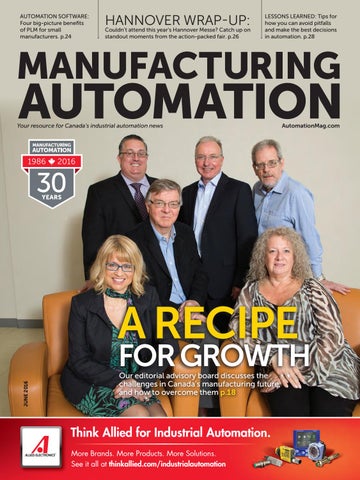
FOR GROWTH Our editorial advisory board discusses the challenges in Canada’s manufacturing future, and how to overcome them p.18
Think Allied for Industrial Automation. More Brands. More Products. More Solutions. See it all at thinkallied.com/industrialautomation
Micro panels...Mega value! ®
3-INCH (STN) $
161.00
EA1-S3MLW-N
10-INCH (TFT) $
4-INCH (TFT) $
356.
00
EA1-T4CL
8-INCH (TFT) $
6-INCH (TFT) $
299.00
NEW 6-inch TFT model features:
C-more Micro panels are one of the most popular and reliable, value-packed operator interfaces in the industrial market today. No matter the budget or system size, we have a C-more Micro operator panel for the job, from the practical, space-saving 3-inch models to the robust, budget-saving 10 inch. And all of our panels come with FREE programming software that includes a project simulator and many other timesaving features. You’ll always get the biggest bang for your buck with C-more Micro.
• • • •
749.00
EA3-T8CL
EA3-T6CL
C-more Micro Panels
• •
899.00
EA3-T10CL
Micro touch panel and non-touch panel versions available The 3-inch cost-conscious panels display standard or high contrast STN monochrome graphics with five selectable background colors 32K color TFT displays are available in 4-inch, 6-inch, 8-inch and 10-inch models Several options, including plug-and-play keypad bezels, are available for select models Free programming software with simulator Full 2-year product warranty
• • • • • • • • • •
5.7-inch touch screen display 320 x 240 dot display with up to 40 lines by 80 characters of text and graphics in landscape mode Five programmable function keys can change with every screen and can be programmed to increment/decrement values, trigger recipes, etc. 32K colors for customizing objects, screen backgrounds and displaying bitmap graphics 6MB memory Built-in USB type B programming port Built-in 15-pin serial communications port Built-in RJ12 serial communications port NEMA 4/4X, IP65 compliant when mounted correctly, indoor use only UL, cUL & CE agency approvals
All C-more Micro panels support:
Research, price, buy at: www.automationdirect.com/Cmore-micro
• • • • • • •
All AutomationDirect programmable controllers Modbus® RTU Allen-Bradley® DF1 half/full duplex, PLC-5® DF1 and DH485 Siemens PPI GE SNPX Omron Host Link and FINS serial Mitsubishi MELSEC®
See our webstore for the complete list
Orders over $49 get FAST FREE SHIPPING Our shipping policies make it easier than ever to order direct from the U.S.! Fast free standard shipping* is available for most orders over $49 U.S., and that includes the brokerage fees (when using an AutomationDirect nominated broker). Using our choice of carrier, we can reach most Canadian destinations within 2 to 3 days. Order by 6pm ET and in-stock orders ship the same day! *2-day free shipping does not apply to drop-ships, or orders requiring LTL transport, but those shipments can take advantage of our negotiated super-low flat rates (based on weight) that include brokerage fees.
See Web site for details and restrictions at: www.automationdirect.com/canada
To see all products and prices, visit www.automationdirect.com
Order Today, Ships Today! * See our Web site for details and restrictions. © Copyright 2014 AutomationDirect, Cumming, GA USA. All rights reserved.
1-800-633-0405
the #1 value in automation
June 2016 Vol. 31, No. 4
pHoto: sAnDrA strAngemore
DEpARTMENTS 4 From the editor 5 Automation upfront The latest industry news, deal makers, and movers and shakers
18
16 Centre stage Peter Voss, Shimco president and CEO
COLUMNS 10 Industry watch A tribute to the fathers and grandfathers for passing on an appreciation of manufacturing
Contents COVER STORY
12 Lean insights
18 A recipe for growth
Automation is the key to revival in manufacturing
How Canadian manufacturers can turn today’s challenges into tomorrow’s opportunities By Alyssa Dalton
14 Machine safety Future-proofing safety amid a changing workforce
34 Backstory The possibilities of 3D printing
10
24 Streamline your operations Four big-picture benefits of PLM for small manufacturers By Carl Smith
26 Hannover highlights
NEW pRODUCTS 30 Automation software 30 HMI & operator interface 31 Motors & drives 32 Robotics 32 Sensors 33 Test & measurement 33 Hydraulics & pneumatics 33 Connectivity
MANUFACTURING AUTOMATION · June 2016 MA_Murrelektronik_June.indd 1
A collection of standout moments from Hannover Messe 2016 By Alyssa Dalton
28 Lessons learned Avoiding pitfalls and making the best decisions in automation By Treena Hein
26
AutomationMag.com
3
2016-05-30 9:28 AM
from tHe eDitor BY ALYSSA DALTON
NOTABLE TWEETS
Your resource for Canada’s industrial automation news
@Carlo GavazziNA One of our finest technical minds at CARLO GAVAZZI Canada, @GuillaumeP44! RT @AutomationMag At @ManuAutomation’s Showcase 2016, we are learning about #energy management and metering with Guillaume Perraud of @ CarloGavazziNA. #mfg HMI CHECKLIST: Top factors and features to consider when shopping for an HMI solution. p.22
MOTORS AND DRIVES: An overview of the most popular rotary motion technologies. p.24
COST CONTROL: How a stronger employeecustomer connection will improve productivity. p.26
AutomationMag.com
Your resource for Canada’s industrial automation news
ENJOYING THE BENEFITS
OF RAMPED-UP AUTOMATION Automating specialized armored vehicles has paid big dividends for Inkas. p.18
MAY 2016
PM 40065710
Think Allied for Industrial Automation. More Brands. More Products. More Solutions. See it all at thinkallied.com/industrialautomation
AlliedCover_MA_Jan.indd 1
2015-12-23 1:58 PM
@leankitjon Get out of your office. To learn where to best invest improvement efforts, go to the gemba #lean #kanban #agile @Yaskawa_ Motoman Apr 6: 1954: G. Devol & J. Engleberger designed the 1st robot arm. It was the 1st industrial robot #NationalRoboticsWeek @susanalmon Nova Scotia invests $1M to support coding in schools https://shar. es/1d0QWt via @AutomationMag Is NB next? 4
Visiting the mecca of industrial technology
P
icture this: robots towering over attendees, demonstrating their strength and agility in what looks like a robotic ballet routine; business leaders speaking English, German, Mandarin, Italian and more languages, fully immersed in conversation around aisles of new product innovations; soccer performers and other entertainers that captivated crowds with impressive tricks; and what seemed like an endless stream of eager student tours visiting exhibitor after exhibitor. And to top it all off, a real, indoor roller-coaster! This is exactly what I experienced at Hannover Messe 2016 — the mecca of industrial technology — where I listened to and chatted with some of today’s most brilliant manufacturing minds. Hannover Messe 2016 was, by far, the most dynamic, exhilarating and tiring show I’ve ever attended and, as my first Hannover experience, it certainly did not disappoint. More than 5,200 exhibitors — companies of every size and technology perspective — met with more than 190,000 attendees from around the world to discuss the future of manufacturing. This year was particularly unique — the United States was the partner country for the very first time and president Barack Obama even attended the show’s opening days, arguably making him one of the most influential attendees to date. “I am here, and we are here, because we are ready to do even more business with Germany, more business with Europe and more business with the world,” said Obama, during his opening CONNECT @AutomationMag
remarks on April 24. He noted the importance of reducing tariffs and other barriers that hinder transatlantic trade and investment, all the while stressing continued partnership and collaboration amongst countries. I attended Hannover Messe as a member of Siemens’ Canadian press delegation, where we also toured the Volkswagen plant in Wolfsburg, explored the world-renowned Autostadt, and went behind the scenes at Siemens’ Amberg electronics plant (EWA). As the largest automotive factory in Europe, Volkswagen’s 6.57 km2 Wolfsburg plant churns out 3,800 vehicles daily, thanks to the help of 3,000 robots and 22,000 workers. Its organization and efficiency makes it one of the more impressive manufacturing operations I’ve seen. Meanwhile, at the Amberg EWA plant, I saw how Siemens uses its own Simatic series to build new Simatic units. In fact, the entire production process is controlled by Simatic controls — from incoming goods to delivery, almost 1,000 Simatic controls are in operation. Talk about practicing what you preach. My trip to Germany reinvigorated me. In this “meeting of the minds” marathon, there’s no doubt Hannover 2016 did the same for many others, sparking new conversations, future deals, and potential product developments... and I can’t wait to see the results. Check out the magazine and website for follow-up stories from my trip. Danke!
adalton@annexweb.com
AutomationMag.com
EDITORIAL ADVISORY BOARD AL DIGGINS, President and General Manager, Excellence in Manufacturing Consortium, and Chairman and CEO, Canadian Manufacturing Network DAVID GREEN, Technology and Business-to-Business Consultant KARIN LINDNER, founder and owner of Karico Performance Solutions DON MCCRUDDEN, Vice-President, Business Development, Festo DAVID MCPHAIL, President and CEO, Memex Automation NIGEL SOUTHWAY, Business Productivity Consultant and Author on Lean Thinking BILL VALEDIS, Vice-President, Precision Training, Products and Services Inc.
@AutomationMag
EDITOR
Alyssa Dalton adalton@annexweb.com pUBLISHER
Klaus B. Pirker kpirker@annexweb.com VICE pRESIDENT & EXECUTIVE pUBLISHER
Tim Dimopoulos tdimopoulos@annexbizmedia.com ART DIRECTOR
Graham Jeffrey gjeffrey@annexweb.com ACCOUNT CO-ORDINATOR
Kathryn Nyenhuis knyenhuis@annexweb.com CIRCULATION MANAGER
Urszula Grzyb ugrzyb@annexbizmedia.com DIRECTOR OF SOUL/COO
Sue Fredericks CONTRIBUTING WRITERS
John Brown, Barrie Hall, Treena Hein, Paul Hogendoorn, Steve Ludwig, Carl Smith
Manufacturing Automation is published seven times a year by: Annex Business Media 222 Edward Street, Aurora, Ontario L4G 1W6 Tel 905-727-0077 Fax 905-727-0017 Printed in Canada ISSN 1480-2996 Publication Mail Agreement #40065710
CIRCULATION email: lmalicdem@annexbizmedia.com Tel: 416-510-5187 Fax: 416-510-5170 Mail: 80 Valleybrook Drive, Toronto, ON M3B 2S9 SUBSCRIpTION RATES Canada — $40.95 per year United States — $71.95 (US) per year and Foreign — $82 (US) per year Students — $20 per year Occasionally, Manufacturing Automation will mail information on behalf of industry related groups whose products and services we believe may be of interest to you. If you prefer not to receive this information, please contact our circulation department in any of the four ways listed above. The contents of Manufacturing Automation are copyright © 2016 by Annex Publishing & Printing Inc. and may not be reproduced in whole or part without written consent. Annex Publishing & Printing Inc. disclaims any warranty as to the accuracy, completeness or currency of the contents of this publication and disclaims all liability in respect of the results of any action taken or not taken in reliance upon information in this publication. We acknowledge the [financial] support of the Government of Canada.
Automation upfront
NEWS FUNDING
PHOTO: Hannah Yoon, CP Images
Federal government invests $19.6 million in seven auto parts suppliers The federal government has announced funding totalling $19.6 million for seven new projects to help Canadian automotive suppliers “gain a competitive edge through the development of new innovative products and processes.” The investments are made through the Automotive Supplier Innovation Program: • Pravala Car in Kitchener, Ont., will receive up to $9.7 million to develop a platform for network connectivity; • Exco Technologies in Markham, Ont., will receive up to $4.6 million to make large high-pressure die-cast moulds for powertrain and structural parts using less steel; • Verbom in Sherbrooke, Que., will receive up to $2.6 million to develop its process used in forming complex aluminum body panels and parts; • The Electromac Group in Windsor, Ont., will receive up to $1.5 million to develop a prototype and process that involves using hot stamping technology to produce small components that are stronger and lighter; • Axiom Plastics in Aurora, Ont., will receive up to $881,000 to produce a new lighter hybrid plastic/fabric vehicle component; • Mojio in Vancouver, B.C., will receive up to $260,000 to develop Cloud-connected solutions to improve driver connectivity; and • Landau Gage in Windsor, Ont., will receive up to $121,000 to use its laser measurement technology to reduce measurement and inspection time of automotive drive train products.
The announcement was made by Navdeep Bains, minister of Innovation, Science and Economic Development, and Bardish Chagger, minister of Small Business and Tourism at Pravala Car. “These projects under the Automotive Supplier Innovation Program demonstrate how Canada’s innovative automotive suppliers are developing the green
MANUFACTURING AUTOMATION · June 2016
technologies that will shape the cars of the future,” said Bains. Launched in 2015, the program complements the government’s Automotive Innovation Fund, which has leveraged more than $3.1 billion in the Canadian auto industry since 2008, say the Feds. Each project is assessed against program criteria to ensure it meets all terms and conditions.
Funding dollars: Minister Bardish Chagger addresses the new recipients of the Automotive Supplier Innovation Program.
AutomationMag.com MA_March_Beckhoff.indd 1
5
2016-02-17 1:42 PM
EDUCATION
Yaskawa Motoman showcases STEM careers to students during National Robotics Week To celebrate National Robotics Week, Yaskawa Motoman invited student groups to take facility tours and speak with automation professionals at its Dayton, Ohio, headquarters about future job opportunities. The company hosted 350-plus students from more than a dozen nearby schools and career centres. This year’s National Robotics Week ran April 2-10, and marked the event’s seventh consecutive year. Its stated purpose is to recognize robotics as a key technology for the economy and, more importantly, to foster interest in the science, technology, engineering and mathematics (STE M) disciplines among students.
Guided tours: Student groups visited Yaskawa Motoman’s Ohio headquarters to learn more about STEM and robotics careers.
Operations
TMI Climate opens Canadian subsidiary TMI Climate Solutions, a manufacturer of air-handling, hydronic systems, and custom
The NEW encoder module that gets the job done. Need a highly-configurable encoder with resilience, accuracy, and endurance? With its compact size and flexible installation options, EPC’s new Model 30M Magnetic Incremental Encoder Module can fit in tight spaces. Its bearing-less design allows the 30M to work at high speeds – yet it’s tolerant of shaft misalignment, thanks to an air gap up to twice the size of other encoders in its class. The magnetic sensor and optional IP69K seal mean it can go into your dirtiest, dustiest, wettest applications and keep going strong.
Safety
Report shows fewer Saskatchewan workers off the job due to accidents
Call EPC today and discover how the Model 30M can tackle your toughest applications. 1.800.366.5412 www.encoder.com
6
HVAC solutions, is welcoming a new subsidiary, TMI Climate Solutions Canada, and a new 200,000-sq.-ft. manufacturing plant in Pointe-Claire, Que. The new subsidiary and plant, which became fully operational in early 2016, “significantly augments” the design and production capacity of the U.S. plant in Holly, Mich., which was recently expanded to 157,000 sq. ft. of manufacturing space. According to TMI, both plants will offer customers “greater access to custom engineering expertise, faster order processing, and unparalleled delivery times” for its HVAC solutions. “Now with two manufacturing plants, staffed by our top engineers, TMI Climate Solutions is capable of delivering air-handling, hydronic systems, and HVAC solutions that are second to none,” said CEO Jim Huff. “Our customers are already seeing an immediate improvement in our design capability and delivery times, and that will only improve.”
The 2015 annual report from the Saskatchewan Workers’ Compensation Board (WCB) shows a “year of stability and growth” as
June 2016 · MANUFACTURING AUTOMATION
@AutomationMag
MA_Encoder_May.indd 1
on-the-job injuries resulting in lost time declined 2.07 per cent in 2015 to their lowest level in more than two decades. “We’re pleased to report that our 2015 operating results demonstrate that we continue to meet our obligations in serving both employers and injured workers and that we remain committed to improving the processes necessary to deliver our services,” said Gord Dobrowolsky, WCB chair. “This year, we exceeded our target of reducing workplace injuries. The total injury rate (per 100 workers) declined from 6.99 in 2014 to 6.30 in 2015. This is arguably one of the greatest successes of the past year and brings us that much closer to reaching Mission: Zero which is to eliminate all workplace injuries.” The report also shows Saskatchewan now has the fourth-highest injury rate in Canada, down from second place in 2013. As well, workplace fatalities declined from 39 in 2014 to 32 last year. There were more than 25,000 accepted injury claims last year, with trucking, manufacturing and health care leading the way. Overall, 87 per cent of workplaces were free of any injury reports. “We’re the first to admit that we have a long way to go as we strive to better serve our customers — the workers and employers of Saskatchewan,” said Dobrowolsky. “Our customers deserve excellent service and this is what we are working towards.” WCB CEO, Peter Federko agreed, noting that every workplace injury is preventable and every workplace death is preventable. “Employers across the province are embracing the fact that workplace injuries can be eliminated and many now recognize that while it starts with leadership, everyone has a role to play in maintaining a safe workplace.” “The decrease in injury rates that we saw again in 2015 is due to the employers and workers in the province who continue to
2016-04-13 2:52 PM
PHOTO: Yaskawa Motoman
Automation upfront
commit themselves to workplace safety,” Federko said. According to The Canadian Press, only British Columbia, Manitoba and the Northwest Territories have higher injury rates than Saskatchewan. EXpANSION
New Schneider solutions centre opens in Brossard Schneider Electric says it has opened a “significant expansion” to its existing facility in Brossard, Que., giving Canadian customers “more order flexibility and reduced lead times.” The new “unique” 68,000-sq.ft. solutions centre will allow the company to build and assemble end-to-end digitized electrical distribution solutions, and encompasses production facilities for eight product lines including
station breakers, switchboards, medium voltage and low voltage switchgear. It also houses local copper and sheet metal fabrication, assembly and testing areas, allowing local customers to test their assembled solutions on-site. In total, the Brossard Campus now covers 172,000 sq. ft. in three buildings. “The expansion of Schneider Electric’s Brossard Campus is a reflection of our strong commitment to our Canadian customers,” said Juan Macias, president of Schneider Electric Canada. “The facility is the only one in North America to house not only manufacturing and testing facilities, but project management, engineering and sales teams. It is a truly integrated site, staffed by a highly skilled, multi-lingual workforce, capable of supporting our Canadian customers all the way from the initial quote through to assembly and testing.”
Smiles all around: Schneider Electric EVP Laurent Vernerey, Brossard plant manager Amany Morgan and Canada president Juan Macias cut the ribbon on the 4150 Brossard facility.
Products that are now manufactured, assembled, tested and validated at the Brossard Campus include: • Air-insulated metal-clad switchgear • Gas-insulated switchgear • Power-Zone 4 low voltage switchgear • Switchboards • Station breakers
Schneider Electric began operating at its Brossard site in 2010. According to the company, the facility not only lowers the risk of damage to equipment during transport for Canadian customers by reducing travel distance, but also helps customers meet local content requirements by providing made-in-Canada solutions.
Find Quality Automation Products at omega.ca Trouver des Produits d’Automatisation de Qualité à omega.ca
pHoto: sCHneiDer eLeCtriC, pHotogrApHer JeAn pHiLippe trottier
Series/Série OMT Starts at/à partir de $ 266
Visit omega.ca/ omt_series
General Purpose AC Motors, 56C Flange, Single Phase, Fractional and Integral HP Moteurs CA à Usage Général, Bride 56C, Simple Phase, CV Fractionnel et Intégral
OMEGA Introduces 976 Bergar Laval, Québec Canada H7L 5A1
Visit omega.ca/ omht_series
Stepper Motors Moteurs pas à pas Series/Série OMHT « Starts at/à partir de $61
Technical Learning
Visit omega.ca/ ocsxl_series
Low-Cost Compact “All-In-One” Controllers Contrôleurs Compacts « Tout en un » Économiques Series/Série OCS XL « Starts at/à partir de $555 Visit omega.ca/technical-learning
Contact Us Today
1.888.826.6342 | omega.ca
®
Prices listed are those in effect at the time of publication and are subject to change without notice. Please contact OMEGA’s sales department for current prices. Les prix indiqués sont ceux en effet au moment de la publication et sont sujets à changement sans préavis. Veuillez contacter un réprésentant des ventes d’Oméga pour obtenir les prix courants. Note: Models with wireless option are approved for use in the US, Canada and Europe only. Note: Les modèles ayant l’option sans fil sont approuvés pour une utilisation aux États-Unis, au Canada et en Europe seulement.
© COPYRIGHT 2016 OMEGA ENGINEERING, INC ALL RIGHTS RESERVED © COPYRIGHT 2016 OMEGA ENGINEERING, INC. TOUS DROITS RESERVES
MANUFACTURING AUTOMATION · June 2016 MA_Omega_June.indd 1
AutomationMag.com
7
2016-05-12 12:39 PM
AutomAtion upfront
Year one: More than 60,000 Renegrades have been sold in Brazil.
INTERNATIONAL BRAZIL
Jeep Renegade celebrates first year of production in Brazil FCA Latin America recently celebrated the first year of Jeep Renegade production at the Goiana plant in Pernambuco, Brazil. In year one of production, more than 60,000 Jeep Renegade vehicles
have been sold in the country, and the Jeep brand is now one of the top 10 automotive brands in the market, says the automaker. The Jeep vehicle lineup consists of the Cherokee, Compass, Grand Cherokee, Patriot, Renegade, Wrangler and Wrangler Unlimited. To meet consumer demand around the world, all Jeep models sold outside North America are available in both left and right-hand drive
INDUSTRIAL AUTOMATION & CONTROL AUTOMATION SAFETY MOTOR CONTROL DRIVES PROGRAMMABLE CONTROLLERS OPERATOR INTERFACES SENSORS NETWORKING SOLUTIONS ENCLOSURES TEST & MEASUREMENT
To locate your nearest WESCO Branch or shop online visit buy.wesco.ca 1-866-WESCOCA (937-2622) | wesco.ca
8
configurations and with gasoline and diesel powertrain options. CHINA
Mazda’s Jiangsu vehicle plant to implement “unique” paint system Mazda Motor Corp. is rolling out its Aqua-tech Paint System at its Changan Mazda Automobile (CMA) vehicle production facility in Jiangsu, China. Describing it as the “world’s lowest-impact water-based paint system,” the “unique” technology was first introduced at the Ujina Plant No. 1 in Japan, where installation of the system was completed in 2012. CMA becomes the company’s second plant and first overseas facility to feature the technology. According to Mazda, the transition was achieved quickly, without stopping the line or interrupting production of vehicles using traditional oil-based paints. The system at CMA is used for all body colours, and the “quality of the finish is as high as that of vehicles painted in Japan, even for designer colours such as Soul Red,” it notes. What’s unique about the system, says Mazda, is its ability to simultaneously reduce volatile organic compounds (VOC) by 78 per cent compared to Mazda’s previous oil-based paint systems without increasing energy consumption (and associated CO2 emissions) “As an automaker, we have an obligation to not only make high-quality cars, but also reduce
DEAL MAKERS
International paper to buy seven pulp mills from Weyerhaeuser International Paper (IP) says it is buying Weyerhaeuser’s pulp business for $2.2 billion, acquiring five pulp mills (including one in Grande Prairie, Alta.) and two converting facilities that produce fluff pulp, softwood pulp, and specialty pulp for a number of consumer applications including diapers, other hygiene products, tissue and textiles. “This transaction will position us as the premier global supplier of fluff pulp and will enhance our ability to generate additional free cash flow. We look forward to working with the talented employees of Weyerhaeuser as we integrate our businesses and create an even stronger company,” said International Paper CEO and chair Mark Sutton. The company will get a $300 million tax benefit for the deal, bringing its total cost for the mills down to $1.9 billion. The deal is expected to close before the end of the year.
June 2016 · MANUFACTURING AUTOMATION
@AutomationMag
MA_Wesco_June.indd 1
our impact on the environment,” said Kiyotaka Shobuda, senior managing executive officer. “Our painting technologies, which have helped KODO design gain recognition worldwide, represent Mazda’s efforts to meet that obligation. Moving forward, we’ll continue to develop innovative technologies at our parent factories in Japan before introducing them at the same high standards overseas. In this way, we’ll provide customers around the world with high-quality cars and contribute both to preserving the environment and enriching society.” The company says it is aiming to achieve “high-quality and efficient” vehicle manufacturing at its global production bases by developing technologies, such as Aqua-tech in Japan, before rolling them out at overseas facilities.
2016-05-12 11:34 AM
pHoto: fCA
• Securupt fuses • Energy automation solutions • MasterClad arc resistant (production begins September 2016) In addition to improving service to Canadian customers and partners, the Brossard campus will provide employees with an environment of collaboration and development across disciplines, says the company.
MOVERS & SHAKERS Rick Caldwell, founder and president of SCADAware, recently presented the first Control Systems Integrator Association (CSIA) Lifetime Achievement Award for Contributions to the Automation Industry to Dick Morley at the CSIA Executive Conference 2016 Awards Reception and Dinner, following CSIA CEO Jose M. Rivera’s announcement of the newly created award. Famously dubbed the father of the programmable logic controller (PLC), it is Morley who, in 1968, led the team to develop what is considered one of the most important inventions in manufacturing. He was also a longtime columnist of Manufacturing AUTOMATION. EHC Global, a manufacturer of escalator and elevator components, has promoted Steve Sabadin to the position of production manager for Canadian manufacturing operations. Based in Oshawa, Ont., Sabadin will report to Duane Cook, head of Global QHSE and operations manager, Americas & Europe. Sabadin joined EHC in 2007 and most recently held the position of Research Technologist. He is a Certified Technician (C.Tech) and member of the Ontario Association of Certified Engineering Technicians and Technologists. Mississauga, Ont.-based KSB Canada has appointed Marcus Henderson to the position of business development manager, noting that the addition will
allow the company to “provide extra support to its coast-tocoast sales teams stationed in Montreal, Calgary, Edmonton and in the Maritimes and to the growing customer base.” Henderson is a graduate of Queen’s University, where he studied chemical engineering. Mahr Federal has named Stuart Manser director of sales, Precision Gages for North America, reporting directly to company CEO Tony Picone. In this role, Manser will be responsible for planning and directing the sales team for the Precision Gage product line, including defining sales territory and hiring sales staff. He will work in conjunction with the director of sales, Metrology Systems for North America, and participate in global sales strategy meetings.
.
Palmer Wahl Instrumentation Group has promoted Michael J. Blount to the vice president position. He boasts 50 years of experience in the design, manufacture and supply of industrial temperature measurement products globally, including work experience in England, Germany and Italy. As vice president, Blount will be responsible for the development of new products and expansion of engineering capabilities. NKK Switches has introduced Masanori Honda as the president of its North American operations, bringing with him more than 25 years of international business experience. Under his guidance, NKK says it will strengthen customer relationships and offer more flexibility by adapting to the needs of the markets the company serves. | MA
MANUFACTURING AUTOMATION · June 2016
AutomationMag.com Hiwin_MA_Jan.indd 1
9
2015-12-10 12:54 PM
INDUSTRY WATCH BY PAUL HOGENDOORN
Paul Hogendoorn (paulh@getfreepoint.com) is co-founder of FreePoint Technologies, “Measure. Analyze. Share.” (Don’t forget to share!) Visit www.getfreepoint.com for more information.
In the blood: following in our fathers’ footsteps
S
ince my father’s birthday usually falls within days of Father’s Day, I often reflect on the influence he’s had on my business life around this time every year. Through my conversations with other leaders in the manufacturing world, I have discovered I am clearly not alone — many of us owe our careers, and some even our businesses, to our father’s influence and role model mentoring. My co-founder in FreePoint Technologies, Randy Hess, is a third generation co-owner of a 65-year-old manufacturing company. It was started by his grandfather, built upon by his father and uncle, and now owned and led by him along with his cousin and Each workday is filled with sister. Each generation built upon a sense of accomplishment the foundations laid by the previ- — things get done, built and ous generation; nothing was given shipped. Thirty five years later, other than opportunity. Everything he, along with three brothers else was learned and earned. and one brother-in-law at Anchor Over the years, I have con- Danly, have made manufacturing nected with quite a few other their careers. It’s a tactile kind leaders that got their first taste of satisfaction few other careers of manufacturing from their can offer. fathers. Wes DeGier, the plant Ben Whitney is a third genmanager at Anchor eration owner of Armo Danly Cambridge, Tool (near London, recalls being taken to Ont.), and Jamie Bowwork by his father as a Each workman is the third gen15-year-old one Easter day is filled eration owner of J.P. Monday. Going into with a sense Bowman (of Brantford, Anchor Machine and of accomOnt.). They have a lot Manufacturing that plishment in common, including day brought back the — things get now employing people sounds and smells he that remember them done, built remembers from when when they were just he tagged along on Sat- and shipped. kids. Both of them have urdays as a young boy. It’s a tactile told me they felt the His father was part of kind of satis- onus was on them to a group of visionaries faction few earn the respect of the who purchased Anchor other careers people that were there Machine and Manufac- can offer. before them, and not turing a couple of years the other way around. previous. Wes states, Ben told me he was “when I showed up for my first never encouraged to take over day of work at Anchor, I knew I the business, but was actually was where I should be.” encouraged to stay in school The manufacturing workplace and find work elsewhere. He did is a multi-sensory experience. work there part-time as a young 10
@AutomationMag
boy though, and that was enough to be bitten by the manufacturing bug. After graduating and working in a different company for awhile, he came back ‘home’ to work at Armo. Similar to Randy’s story, Ben and Jamie built by evolving and expanding the vision, while adhering steadfastly to the values passed down. Times were sometimes tough, and sometimes so were the decisions, but they navigated through with the skills they were taught or learned along the way. Andy Mavrokefalos is the founder of Attica Manufacturing. He also credits his father as being the primary influence in his decision to make manufacturing his career of choice. Sometimes the influence that extends from father to son is spoken, but most often it is modelled. Such was the case with mine. My father was instrumental in building Danfoss Canada and it was there I experienced my first taste of manufacturing. Similar to Wes’s first experience, I can still recall it vividly, including the tasks I took the most pride in (assembling motor starters), and the ones I hated the most (sandblasting bulbs). At times, I
was convinced my dad made sure I got all the crumby jobs just to make sure no one would think I got preferential treatment. But at the end of every day, whether it was a task I liked or hated, there was always the feeling of having accomplished something. Not every career comes with that. Like the fathers of everyone else here, my dad worked far more than 40 hours a week, often taking his work home with him. It was more than a job or to just make a living; it was an important part of his life. I could see he found it satisfying and full of meaning. Through the company, he was able to do other satisfying and meaningful things, and I saw that too. The company sponsored all sorts of sports teams, and created many jobs for refugees, many of whom still send expressions of thanks. This month, the parent company is celebrating its 75th anniversary, and although he’s been retired for 25 years or so, they’ve invited him to Denmark to mark the occasion with them. I couldn’t be more proud. This column is a Father’s Day column — a way to say thanks to all the fathers, and grandfathers, that gave us an appreciation of manufacturing. | MA
June 2016 · MANUFACTURING AUTOMATION
The Only Switch that Matters Is the One You Need And We’ve Got It
In stock and ready-to-ship. See it all at thinkallied.com/switches
1.800.433.5700 © Allied Electronics, Inc 2016. ‘Allied Electronics’ and the Allied Electronics logo are trademarks of Allied Electronics, Inc.
MANUFACTURING AUTOMATION · June 2016
An Electrocomponents Company.
AutomationMag.com
11
LEAN INSIGHTS BY Barrie Hall
Barrie Hall is SVP Fulfillment at Fujitsu Network Communications. In this role, he leads an organization tasked with ensuring the highest standards in manufacturing and supply chain operations. He has spent the past 20 years driving manufacturing quality excellence and supply chain innovation throughout the fulfillment organization.
Support automation plans with the right information
W
hile pervasive views of manufacturing in Western economies have been pessimistic for decades, the true picture is more complex. Persistent decline in manufacturing jobs has undeniably occurred, but manufacturing is still a crucial growth engine. Automation is the key to revival not just in manufacturing itself, but as a broader stimulus for innovation. Economist Martin Neil Baily says, “the biggest factor transforming manufacturing has been technology; and technology will largely determine its future.” Automation offers the promise for manufacturers in industrialized countries to make their operations more profitable and boost competitiveness in the global arena, even in areas that may have previously been considered impossible. However, fulfilling this promise is an ambitious goal requiring careful preparation and evaluation based on relevant, accurate information. Information gathering and research, therefore, is an essential foundation for automation planning. Ideally, the right information mix comprises of three foundational ingredients. The first is a clear set of objectives. Media outlets often proclaim that automation is the cure for manufacturing’s decline, but automation is a means to an end, not an end unto itself. Automation’s objectives should be uniquely derived from the specific challenges and opportunities that each manufacturer faces. They may include cost reduction, quality improvement,
lead-time reduction and capacity expansion. It is essential to clearly identify target outcomes. A reality check on the existing operation is the second foundational ingredient. This requires removing oneself from the office and travelling to the factory floor. When an existing process is under consideration, careful observation in the workplace should reveal opportunities for process improvement. Acting upon these opportunities may accomplish an automation project’s objectives, without the initial expense and disruption of actually automating. Process observation can also uncover areas where improvement is needed regardless of automation
Automation is the key to revival not just in manufacturing itself, but as a broader stimulus for innovation.
plans. This offers an opportunity to address individual steps that are poorly designed or can be omitted altogether — before wasting money on automating them. Implementing completely new processes presents the paradox of reality checking something that doesn’t yet exist. Computer simulation and simple prototypes of key process elements can offer effective means to develop the detailed process characterization needed. A well-executed reality check provides a clear baseline of existing process performance; it is a false economy to scrimp on this. This valuable baseline characterization helps to determine what can, and should be,
J-Squared Has The Brands You Need!
1-855-365-2188 12
@AutomationMag MA_JSquared_MayJune.indd 1
Email us at inforequest@jsquared.com with questions or inquiries
www.jsquared.com
June 2016 · MANUFACTURING AUTOMATION 2016-05-18 1:32 PM
addressed by automation. Most importantly, it forms the basis for credible side-by-side comparison of pre- and post-automation performance, which is required to make realistic projections of the results. Unfortunately, a reality check is often viewed as an impediment and consequently performed in a sloppy manner or skipped entirely. In these cases, successful automation becomes a matter of chance. Conversely, when projected outcomes are rigorously developed and aligned with objectives, an automation project can move forward with a high degree of confidence. The third ingredient is recognition that many automation benefits can be defined through financial analysis. Quality and customer service improvement are areas that often fall into the category of benefits that can be readily defined in a qualitative statement but may be difficult, if not impossible, to convincingly convey in terms of financial payback. Investment approval processes that are limited only to financial considerations overlook these important considerations and can lead to poor decision-making. David Halberstam cites an excellent example in his book, The Reckoning. In the 1970s, Ford engineers proposed an automated undercoating process that would greatly improve rust resistance on its vehicles and remedy customer complaints of sheet metal rust, which plagued cars of that era. Ford had no means of qualitative analysis to convey the benefit of investing, or the consequences of not investing, in this quality improvement. Ford’s investment approval process was limited to financial payback considerations, and the proposal was rejected. Ironically, this technology was invented by Ford and had already been adopted by several competitors under licensing agreements. This decision contributed to Ford losing market share to an emerging group of Japanese competitors, a loss they’ve not recovered to this day.
If not financial, in what context should these qualitative improvements be evaluated? Answers can come from several areas. Directing automation to the enhancement or protection of a company’s brand is a good strategy for qualitatively justifying investment. If Ford had been focused on building its brand on exceptional quality, the decision to invest in improved rust
MANUFACTURING AUTOMATION · June 2016
resistance would likely have been positive. In a related context, automation focused on establishing a competitive differentiator or eliminating a competitive gap can also provide a qualitative reason for investment. Whatever context is relevant for a specific automation investment opportunity, qualitative impacts should always be weighed equally with quantitative benefits.
Automation provides great promise for North American manufacturers to compete more successfully against manufacturers in lower cost regions of the world. Automation planning based on a foundation of clear objectives, reality checks, and understanding of qualitative impacts are essential if manufacturers are to realize maximum benefit from their investments. | MA
harmonic
Building a high-precision actuator is easy!
Simply couple any servomotor to one of our precision Quick Connect™ gearheads! • • • • • • •
Complete line of gearheads now available Harmonic Drive® or Harmonic Planetary® gearheads Zero backlash and low backlash versions Ratios: 3:1 - 160:1 Peak Torque: 3.9 N•m - 3940 N•m Sizes: 40mm - 230mm Output Configurations: Hollow Shaft, Flange, Keyed Shaft
TM
Harmonic Drive LLC 247 Lynnfield Street Peabody, MA 01960 800-921-3332 www.HarmonicDrive.net
Electromate Industrial 6221 Highway 7, Unit #15 Vaughan, Ontario, Canada L4H 0K8 (877) SERVO98 (737-8698) www.electromate.com
Harmonic Drive® and Harmonic Planetary® are registered trademarks and Quick Connect is a trademark of Harmonic Drive LLC.
5.875 x 7.875.indd 1 MA_Harmonic_May.indd 1
4/19/16 9:57 AM
AutomationMag.com 13 2016-04-19 11:51 AM
MACHINE SAFETY
Steve Ludwig is the safety programs manager at Rockwell Automation, where he is responsible for the development of global communication and customer programs supporting the safety portfolio. In his 29-year career, Ludwig has held positions of increasing responsibility in the military, engineering, sales and marketing.
BY Steve LudwiG
Future-proofing safety amid a changing workforce
M
anufacturers in being felt across Canada’s manuCanada and around facturing and industrial base. the world are facing Nearly 60 per cent of companies the prospect of a responding to a 2014 Canadian talent drought as their most ex- Manufacturers & Exporters perienced workers move toward (CME) survey said attracting retirement. or retaining skilled labour was Consider a 2013 workforce one of their most pressing chaloutlook report from Stokes lenges — up from 46 per cent Economic Consulting and the in a 2012 survey. The No. 1 area Centre for Spatial Economics. It that respondents said they were estimated that Canada’s process- experiencing labour shortages ing, manufacturing and utilities was in their skilled production industry will have about 253,000 workforce. The inability to retain job openings from 2013 to 2022. or fill these positions could have Yet an astonishing majority of significant productivity consethose openings — about 96 per quences. That, in turn, could cent — are expected to come in create greater worker safety chalthe form of replacement jobs lenges for manufacturers. Why? versus expansion jobs. Because workers who are under Workforce pains are already to boost productivity ManufactAuto-May2016.pdf 1 17/05/2016pressure 3:59:34 PM
C
M
Y
CM
MY
CY
CMY
K
can feel compelled to take shortcuts to meet their targets. But those shortcuts can come back around to bite them. Specifically, injuries resulting from worker shortcuts can cost a manufacturer far more in lost production and revenue than the small gain in production that the worker hoped to achieve by taking the shortcut in the first place. At the same time, both aging workers and the younger, less experienced workers taking their place present separate sets of safety challenges that need to be addressed. Older workers can be at a higher risk for certain types of injuries, such as musculoskeletal and repetitive stress injuries, and may take longer to recover from injuries. Additionally, changes in their skeletal muscle strength, vision and cognitive abilities can impact their day-to-day job performance. Meanwhile, studies have shown that younger workers tend to have much higher injury rates. This can be due to a number of factors, ranging from their inexperience and misjudgment of risks to cognitive and developmental characteristics. Rethinking machinery design
A changing workforce requires that production machinery change with it. That includes 14
Get connected
The move to connected, information-enabled operations
June 2016 · MANUFACTURING AUTOMATION
@AutomationMag
MA_SEW_MayJune.indd 1
incorporating the ergonomic and usability needs of both older and younger workers. When conducting hazard assessments, building functional specifications and designing machinery, engineers should address all potential operator and maintenance technician movements. They should identify if operators will need to lift materials or if technicians will need to bend or twist when servicing the machine, and if such behaviours can be avoided through changes in machinery design. Well-designed, contemporary safety systems — which integrate standard and safety control in one controller — are more ergonomic, which can reduce the probability that workers will override them and thus put themselves at risk. These systems also offer greater diagnostics, and can help reduce nuisance shutdowns, prolonged restarts and operational costs when compared to older systems. For example, safe-speed monitoring and zone control might be used in place of lockout/tagout in some instances, allowing technicians to service machines without completely shutting them down, improving uptime and productivity.
2016-05-18 2:59 PM
is transforming manufacturing as we know it. Embedded intelligence devices can give operators a deeper understanding of machine performance than previously possible, allowing them to stay ahead of downtime events and improve efficiencies. Remote connectivity can connect a plant manager to the plant floor whether they’re in their office or halfway around the world, and connect remote experts to plant personnel to troubleshoot problems in real-time. Plant data can be collected, contextualized and sent to different workers in the form of actionable information. Manufacturers seeking to capitalize on this potential are establishing a Connected Enterprise, in which operations are smart, secure and connected, and seamless information-sharing spans people, processes and technologies. A Connected Enterprise enables better collaboration, faster problem-solving, and improved innovation and productivity. It also enables a smarter approach to safety.
A changing workforce requires that production machinery change with it.
253,000 The number of available jobs estimated to be in Canada’s processing, manufacturing and utilities industry between 2013 to 2022
In addition to capturing process, quality, energy and other data, a Connected Enterprise can collect safety data to help manufacturers identify risks and better understand where safety-related shutdowns are occurring. This can include the specific locations, applications and operations where safety risks are highest, providing safety management professionals with information about operator and machinery behaviour. Furthermore, safety-related data analytics can go far beyond understanding where injuries are taking place in one facility. They can be used to identify common applications that are spread out across multiple manufacturing sites where injuries, near misses and safety shutdowns are occurring. Problems can be identified through analysis of factors such as raw-material chemistry, mill speed or specific processes that use hazardous substances, and solutions can be identified to reduce safety incidents or improve productivity.
A HOLISTIC SAFETY AppROACH
While redesigning machinery and embracing information-enabled operations will both be crucial to getting ahead of future safety challenges, it’s important to remember that technology is only part of the solution. To this end, Rockwell Automation recommends using the Three Cs of Safety in support of a best-in-class safety approach: • Culture: worker behaviour • Compliance: processes and procedures • Capital: technologies that help protect workers from injury Following a holistic approach that takes each of these factors into account with equal significance will help manufacturers not only adopt the latest technologies but also be proactive in setting expectations with employees that productivity should not take precedence over safety. | MA
CARLO GAVAZZI Automation Components
CARLO GAVAZZI Automation Components
SENSORS: Inductive and Capacitive Proximity Sensors • Photoelectric Sensors • Level Sensors • Ultrasonic Sensors • Magnetic Sensors • Motion Sensors • Environmental Sensors • Limit Switches • Light Curtains • Safety Interlocks
SWITCHES: Solid State Relays • Contactors and Overloads • Definite Purpose Contactors • Soft Starters • Manual Motor Starters • Mini Circuit Breakers • Electromechanical Relays • Pushbuttons and Pilot Devices
Whether it’s our industry leading range of solid state relays, our new HMIs and mini-circuit breakers or our A u of t osensors, m a t i ocontactors, n Compo n e n supplies, ts vast offering power and energy meters, GAVAZZI has the solution for your USA Tel:CARLO 847.465.6100 Fax: 800.222.2659 Canada Tel: 888.575.2275 Fax: 905.542.2248 many demanding application requirements.
CARLO GAVAZZI
Mexico Tel and Fax: 55.5373.7042 www.GavazziOnline.com • Info@CarloGavazzi.com twitter.com/CarloGavazziNA facebook.com/CarloGavazziNA
CONTROLS: Energy Meters and Transducers • Power Supplies • HMIs • Digital Panel Meters • Time Delay Relays • Current- Voltage- and Phase Monitoring Controls • Current Transformers • Safety Modules • Counters
Contact us today, and one of our field sales representatives will show you why CARLO GAVAZZI is one of the fastest growing automation companies worldwide. We’ll be more than happy to provide a free evaluation sample to qualified OEMs.
GavazziOnline.com • 888.575.2275 • Gavazzi@CarloGavazzi.com
Visit our website for downloadable data sheets, brochures and pricing: www.GavazziOnline.com
MANUFACTURING AUTOMATION · June 2016 MA_March_CarloGavazzi.indd 1
AutomationMag.com
15
2016-02-12 3:24 PM
Centre stAge
Cambridge, Ont., is the new home of Shimco, a 25-year-old shim manufacturer that recently moved from its original building in Markham. peter Voss, president and CEO, shares with us how automation has greatly boosted the company’s success.
16
@AutomationMag
now also run two other vertical machining centres that are face to face and very close to the loading station. This means that when that PalleTech is running, he can go and run two other jobs on the verticals. MA: How did you settle on Cambridge as the new location? How did the move go? pV: Well, I live in Cambridge so I’ve been commuting from Cambridge to Markham everyday for about five years — a lot of kilometres, a lot of hours on the road. I was actually looking for something in the GTA (Greater Toronto Area). I looked for many months but the price of building in the GTA is astronomical, so I looked at other locations. We ended up saved about $1.5 million just in development charges alone by building in Cambridge, and the price of land was half. We had a very detailed move plan and we were operational in February. About 70 per cent of the people in Markham moved
to Cambridge — a very high uptake — so it was really the same people, same equipment, and same processes. We gave a report to our top 20 customers and had monthly calls with them to let them how the move was progressing. We even had regular videos of the construction process they could look at. We’re going to add another 30,000 sq. ft. (2-storey – 15,000 sq. ft. per floor), where we will support our in-house processing capability on the main floor, and will also establish a Centre of Excellence with four local universities on the second floor. MA: At a time when some plants struggle to keep their doors open, how do you stay competitive? pV: It’s really through a lot of the automation. High-tech manufacturing is not about the actual processes, it’s about how you schedule, how you man the machines, that sort of thing. I’ve hired someone who will create information flow
that allows us to look at capacity by person, by machine, by cell, and by part families, and when internal people are looking to prepare quotes, they’ll type it into the system and it’ll result in a date that incorporates details like material leadtime, subcontract leadtime, internal capacity issues, so all information is available to everyone at their fingertips. We have also eliminated paper. Right now, there’s only one ticket that goes with each bin and we have up to 1,000 work orders on the floor at one time. It used to be that when we had a change order, you’d have to go find that order on the floor and there would be a person running around looking for it. Now we are moving towards RFID tags in each bin, which allows us to locate any part on the floor instantly. It’s not a huge facility — about 23,000 sq. ft. for production — but that many bins on the floor is a challenge to find. We’re also moving to higher inventory control where a light will flash on the shelf, indicating the material you’re looking for is here and available. It’s about eliminating the waste in typical Lean concepts: eliminating touch time and paper, and taking away unnecessary decisions from the people actually doing the work. It’s also about looking at what you’re really good at, and not trying to be everything to everybody. When I bought the company, we were 65-per-cent aerospace and now we are 99-per-cent aerospace. We’ve gotten rid of all the other stuff, focused on aerospace, and have tripled our sales because of that focus. | MA Did you know Shimco has its own scholarship program? Last year’s inaugural award went to Carmen Bracho, a mechanical engineering and management student at McMaster University: bit.ly/1srNStW.
June 2016 · MANUFACTURING AUTOMATION
pHoto: sHimCo
MA: What are some ways you have updated Shimco’s production? pV: When Shimco was in Markham, it was more traditional — one operator, one machine kind of thing — we had a bunch of horizontal machining centres but at one operator, one job. After we moved to the new plant in Cambridge, I decided to put in a flexible manufacturing system. I purchased a Mazak 4000 HCN horizontal machining centre two years ago and a second one recently with a higher torque head, designed for hard metals, and also bought a PalleTech system, to join the two HCNs, forming a flexible manufacturing system. The system now holds 12 pallets and will run 32 jobs at once with one operator. It’s moving towards ‘lights out.’ I designed the plant here to be Lean, so production really depends on what the order is. We do some distribution of rebuying and selling of specialty metals, and when those orders come in, they don’t go more than 100 feet of the plant. They come in, get inspected and might be put away in the storage area but they don’t go into the plant. Then, they go back out again to get shipped. If the part requires no shearing and cutting, it goes into the shearing and cutting cell, goes to QA and goes back out again, another 25 ft., if it requires laminating, it goes another 25 ft., if it requires machining, it goes 50 ft., and so on. It’s a circular flow that minimizes the steps the part has to take. We do very little of this now — our focus is on long-term supply contracts for aerospace parts with aerospace OEMs and Tier 1s. For the setup in the machining cell, the operator who loads/unloads the material can
PUSH BUTTONS & CONTACTORS STOCKED IN CANADA, SHIPPED TODAY!! • • • • • •
‘T
IME
S TE
T
D E • • • • • •
22mm Push Buttons Metal design with screw down collars Non-Illuminated, Illuminated, Pilot lights & Specialty Buttons Control stations in Metallic and Plastic CSA, CUL/UL, Ce Approved IP65/66 Rated Original design
U D IN
R ST
Y
IEC T&F Line Contactors T-Line in 9 - 95 amp, F-Line in 115 - 780 amp 3 and 4 pole styles Wide range of accessories CSA/UL Approved Overloads sold separately Large Canadian Inventory
NEW LOCATION
HEAD OFFICE
WESTERN CANADA
3131 Pepper Mill Court Mississauga, ON, L5L 4X6 T: 905.820.6150 F: 905.820.6142 E: sales@techspan.ca
8176 Winston Street Burnaby, BC, V5A 2H5 T: 604.420.0425 F: 604.420.3149 E: westsales@techspan.ca
P P A
V O R
STAND OUT with...
’ D E
COVER STORY
Missing: Al Diggins, Excellence in Manufacturing Consortium; and Bill Valedis, Precision Training, Products and Services
Our editorial advisory board discusses how the Canadian manufacturing sector can turn today’s challenges into tomorrow’s opportunities BY ALYSSA DALTON
i
n March, Manufacturing AUTOMATION’s editorial advisory board members gathered for our annual roundtable to discuss the biggest challenges facing the manufacturing industry. The dynamic 1.5-hour conversation on Canadian productivity and competitiveness resulted in a laundry list of challenges facing today’s manufacturing: a fluctuating dollar, skilled trades education and training, a global supply base, the adoption of technology, and change management, to name a few. But with challenges come opportunities, say our board members, as they offer their insight and best practices for manufacturing success.
Ma: What does the economic landscape look like now for the manufacturing industry in Canada? David Green: I think the future from a com-
petitive standpoint is good but there are a number of things that are an issue, like energy and labour costs, tax incentives, R&D, as well as the culture and attitude of companies and their ability — particularly small, mediumsized businesses — to adapt to change. If you’re going to deal with new technology, new practices, worry about hiring millennials, and how you work with the different workforce, it’s very hard for some companies to get their arms around that and that is something we
18
@AutomationMag
need to provide more help with. David Mcphail: We talk to manufacturers and
what I find is that the access to capital is not as prevalent as I would like to see. I would really like to sell our technology here in Ontario because it’d create more jobs locally but the reality is 85 per cent of the technology we sell is to the U.S. I think the reason is because the capital is much more readily available in the U.S. than in Canada. There’s a finance gap and I’m not sure exactly how the government is going to address that but in order to make a business successful, it has to invest in technology, whether it’s in new equipment or in consulting.
Nigel Southway: I’m going to be quite frank and I don’t want to use wishful thinking — the Canadian economy overall without a resource sector is going to be a rough ride. For us, Canadians, our usual hope is the U.S. will have an economy that thrives and pulls us through. We’ve always relied on that secret weapon. As for manufacturing corporations in Canada, I remain optimistic. Other than a few exceptions, they’re going to have footprints redistributed across NAFTA and offshore in their supply base, so they won’t really be Canadian manufacturers, they’ll be Canadian corporations. I’m not sure there will be many jobs actually within Canada for manufacturing. Most of them will be employed in a supply base that’s global. As for manufacturing in Canada as an entity, as a function, I’m pretty pessimistic. It looks like in certain cases like a ‘going out of business’ plan for manufacturing, locally. I think problems like a lack of funding are really symptoms of a bigger issue to do with our industrial policies. Don McCrudden: I’ve witnessed the slow,
constant decline of our Canadian manufacturing sector since 2000. I hate to say it but June 2016 · MANUFACTURING AUTOMATION
pHotos: sAnDrA strAngemore
A RECIpE FOR GROWTH
At the end of the day, it all comes down to productivity improvement and if we continue to have this productivity gap and we have no money to invest in productivity improvement, it’s not a good recipe for growth. If we don’t have access to growth capital, well, that’s going to be an important limiting factor here for us, specifically in manufacturing. I think we need more programs like FedDev that are less onerous in terms of repayment so it gives people the ramp to actually take the capital, deploy it and see the benefit, and then begin the repayment process. Access to fair-termed investment capital is going to a huge impediment, I think, if we don’t figure that out.
“I hate to say it but what stimulates our manufacturing more so than anything is the low Canadian dollar.” what stimulates our manufacturing more so than anything is the low Canadian dollar. We sell to Canadian manufacturers so our sales are a direct reflection of what’s going on. The minute our dollar goes down, our sales go up and when our dollar goes up, our sales go down. I’ve witnessed it for darn near 40 years. Southway: I want to make it very clear as you talk about the dollar. It’s not low, it’s been obscenely high for so long. This dollar did not come down in a planned manner but for reasons to do with the resource sector dropping. So what happens if the resource sector recovers, what does that do to the dollar? A concern I have are the economists saying it is now manufacturing’s turn. It’s really tough to ask a manufacturing guy to excel when his supply base has also gone offshore. What’s happening is you’ve got a low dollar, so how do you access low labour, or better labour, costs? Well you’ve got to bring in material now that’s more expensive from other parts of NAFTA or offshore with a different dollar, so just dropping the dollar is not going to help a lot of companies. It’s has to stay somewhere and we’ve got to figure out how to get all that stuff in place. Local supply chains are scary, a lot of people are forced to buy offshore now. McCrudden: Although we’ve witnessed
that decline, what has come out of that are some really strong entrepreneurial-thinking companies. What seems to be the common denominator is that these guys aren’t thinking of a Canadian marketplace but a global marketplace; clearly that has to be in the DNA of these companies — you have to be
David McPhail, president and CEO, Memex Automation
Nigel Southway, founding partner and VP Engineering, Additive Metal Manufacturing
MANUFACTURING AUTOMATION · June 2016
thinking outside the borders of Canada. McPhail: I was in a manufacturing plant (in
March) giving a tour of a customer of ours, and they have two buildings, one for all the people that operate the equipment and another that can only be described as ‘lights out.’ We walked into the building and all you hear is the equipment running, there are no lights. They have figured out a way to be competitive on the global scale by putting in automation. This mentality is now filtering down to small, medium-sized manufacturers — putting in robots, loading/unloading machines, using a system to monitor when the factory is not working so somebody can come and triage, as opposed to having them sit and just watch the equipment. There needs to be more of that to be competitive; the only way we can compete is by innovating.
Stephanie Yakimishyn: I facilitate strategic
interest group sessions within the manufacturing community and over the 15 years I’ve been with EMC, I hear the same things year after year. They’re finding it tough but some of them are very optimistic. It used to be that every discussion was around Lean manufacturing, and there’s still an element of that, but what I’ve noticed recently is that the topics are around handling conflict, performance appraisals, how do I get the best out of my people, those sorts of things. There is a real trend towards what we call the soft skills.
Karin Lindner: All of a sudden, Lean isn’t so important anymore because companies aren’t getting the people process right and without
Karin Lindner, founder and owner of Karico Performance Solutions
Don McCrudden, VP Business Development, Festo
people, Lean will never work. That is the reality of things. I understand there are a lot of external factors that influence our economy but I believe in focusing on what’s really within our reach. We can talk about the dollar all day long but it won’t change anything. I think it’s really about the level of assertiveness that people apply and the mindset they have. What I see in most companies is that people know what they don’t want, don’t like and don’t have but we need to shift the focus and express what we want and what we expect from our workers. MA: Speaking of workers, do you think we are still suffering from a skills gap? What are your thoughts on cultivating the next generation? Lindner: I disagree with the skills gap concern
because I believe our organizations have people who possess more skill, talent and creativity than their current jobs allow for — that’s the number one challenge. We need more people who are able to spot the talent, and not say that we have a skills gap in our environment. And how can we get more young people and women in? We need to make the environment more appealing. Talk to each other with a high level of respect, and give people the highest form of respect you can give by allowing them to utilize their brain. Women don’t get into manufacturing because there is often a ceiling for women. You just have to look around the management tables. How many women make it up there? In no way am I saying women are better than men, men are better than women. I think a good mix is critical in every organization because men and women just think differently and we need those differences to have good conversations.
McPhail: Isn’t the president of Ford Canada a
Stephanie Yakimishyn, Excellence in Manufacturing Consortium (EMC) field service advisor
David Green, technology and business-tobusiness consultant AutomationMag.com 19
COVER STORY
woman? I think that becomes inspirational. You’re not going to change the mindset of an entire industry overnight. It takes somebody to blaze the trail, then that person instills that type of ambition into other people, and then those people try to accomplish the same objective. McCrudden: If you look at certain employers, who are all the senior people up there? They are guys that were toolmakers, guys that are coming up off the floor. The drawback is there just isn’t a whole lot of women toolmakers that migrate up the food chain. The plant level managers are historically men and they’re historically the people that have morphed up through the organization from the lower level to the top level. That said, if there is a talented person regardless of gender or colour, they are going to flourish — that’s been my observation. Southway: I think it’s a bit of a chicken and
an egg situation. We’ve got a lot of young people, not just women but people, that avoid manufacturing because they believe it is not a career that will flourish. Instead of saying we don’t have enough young people, it’s more of a question as to whether the industry is vibrant enough to support them. How do I tell them there’s a career for them if I’m not quite sure where manufacturing is going? When it comes to the training and education students are getting, are we giving them the right kind of training and education?
Yakimishyn: I agree, from a high level per1 16/02/2016 haps therehalf-page-ad-8-x-3-5-lafert.pdf isn’t a skills gap, but I have a 11:43:17 seniorAM
20
@AutomationMag MA_March_Lafert.indd 1
on the factory floor. How do you get the next generation inspired to do that?
managers group with 15 people around the table representing 15 different companies (varying month to month) and they have a skills gap. They cannot find welders, they cannot find maintenance people, they cannot find electricians — so maybe in general we don’t have one but certainly on the ground, there is one. And now I’m seeing companies starting their own apprenticeships and doing things in-house to grow their own people.
McCrudden: That skills gap of understanding controls and writing code, I saw it a lot stronger 10, 15 years ago than I do today. In general, the skills are there. We hire these guys and I’m amazed at how quickly we can get them integrated into high-level code writing and understanding.
Mcphail: Maybe this is just me, but there is no better feeling than writing a bunch of software code, programming a bunch of robots, then hitting the button and watching it make a part. I just love that, but I grew up
Green: There’s a lot of work being done by a number of organizations; Skills Canada is just one organization that has been very involved with elementary and secondary school students. We need to start early, around Grade
June 2016 · MANUFACTURING AUTOMATION 2016-02-22 10:39 AM
5-8, to get them interested in STEM careers and the skilled trades. I think the future is going to be more attractive in terms of what’s happening with technology. I look at the young people I’ve interacted with at Skills Canada and World Skills — they want to be doing more than just pulling wires, they’re interested in the control elements and other sophisticated components, and the skills are adapting to that.
companies that are in the lead on this, they don’t want to sell you an aircraft engine, they want to sell you time on an aircraft engine. The economy is changing, so it also changes the business model. It’s one thing to sell somebody a piece of equipment, it’s another to guarantee 95-percent or 98-per-cent uptime. This knowledge-based economy is centred on having information
we presently don’t collect. Ninety-five per cent of manufacturers measure absolutely nothing on their factory floor, and the majority of the ones that do use a clipboard and aggregate it in Excel. That is not going to fly when we get to the next business model or the Fourth Industrial Revolution where we talk about selling a service as part of what you manufacture.
From a technology perspective, getting the Internet of Things into the hands of people who need it is not about the how but the why. What’s the business outcome? What’s the payback? These are more abstract conversations and in the U.S., they’ll accept that much quicker than they will in Canada. If you don’t get the value proposition associated with adopting the technology,
Southway: For the kids going
into the co-op programs, we need much more career guidance counselling in schools. You’ve got a young guy who’s 14-years-old, how do they know what manufacturing looks like? Who’s showing them their big brother can actually be doing fantastic things at co-op? We’ve got to build that learning system not only in the high schools but also in the co-op programs, the school systems and into the industry. That linkage is not yet in place.
“Women don’t get into manufacturing because there is often a ceiling for women. You just have to look around the management tables. How many women make it up there?” MA: Why do manufacturers need to embrace emerging trends and technologies of the Fourth Industrial Revolution, namely the Internet of Things (IoT)?
Providing unmatched precision. Delivering 360° performance. Advancing intuitive control.
R2000 Detection 2D Laser Scanner
Stable,
wobble-free scanning axis for precise field monitoring
Highest
angular resolution on the market allows detection of extremely small objects
User-defined
detection fields make configuration simple, intuitive, and user friendly
www.pepperl-fuchs.us/r2000
McPhail: If you look at some MANUFACTURING AUTOMATION · June 2016
AutomationMag.com 21 MA_March_Pepperl.indd 1 1 MA_PepperlFuchs_June.indd
2016-02-23 PM 2016-05-11 12:08 9:20 AM
COVER STORY
the how doesn’t matter. To be competitive in the ever-changing, evolving global economy, this technology has to be adopted or you die. The most successful companies that embrace IoT or Industry 4.0 are those that can handle change management — like when the employees are involved long before the technology hits the floor. At that point, there’s buy-in and the culture of the company is so much easier to deal with. Lindner: In manufacturing especially, we don’t learn about the emotional aspect as to why people resist change. People in general don’t like change. Look at a boardroom table, the majority of people always go to the same seat, but if I sit where Stephanie is sitting, I can get a different perspective. I don’t think we are doing a good enough job with change management and what it means emotionally and mentally for people. Are they afraid of adopting a new technology because they think “I’m too old” or “I will be too slow?” Mcphail: Or we become so efficient, my job
becomes redundant. Having brought the IoT technology sphere into manufacturing with more than 100 companies, I can tell you not one of them has fired somebody or laid somebody off as a result of becoming more efficient. I’ve seen companies take their OEE from 33 per cent to 85 per cent and more than double their top line revenue, which actually creates jobs, it doesn’t take jobs away.
Yakimishyn: For a lot of workers, it’s the
idea that it’s always worked this way so why do we need to change: “If it ain’t broke, why fix it?” But it’s understanding that it may not be broke right now but it’s heading that way. When you look at change, your brain actually has to knit new neural pathways with every change. I used to drive a standard car for years
25-something-year-old is different. You can see it everyday. Kids are so technology-oriented and driven. They’re not scared of technology at all, in fact they embrace it; they know what technology can bring, through the enhancements to their lives. I would say I rarely see in the marketplace this real aversion to modify your company processes in any way because it’s part of people’s DNA. They started off with a blackberry of some sort five years ago, and every six months, they get a new one that’s got 16 other features they just love. We’re going to breed a bunch of entrepreneurial-thinking young people. MA: What strategies or best practices can manufacturers in Canada adopt for growth? Green: Going back to when we talked about an entrepreneurial approach, we need a way of getting companies to embrace more of that, and empowering employees to think
“From a technology perspective, getting the Internet of Things into the hands of people who need it is not about the how but the why. What’s the business outcome?” and it’s been about 10 years since I’ve driven a standard but every once in a while, I come to a stop sign and my left leg starts doing all this weird stuff looking for the clutch. The pathway is still there in my brain. McCrudden: Certainly the mindset of a 50-something-year-old versus a 22
@AutomationMag
entrepreneurially: allowing people to think out of the box, to think about it as their project, giving them both the money and the resources to go ahead and solve the problem in whatever way they want with an entrepreneurial sort of approach. Mcphail: There’s a pragmatic solution for
every problem. It comes down to compartmentalizing the road map — pick a challenge in your business and then solve it with technology that fits into the vision of the company. Don’t try to figure out how all these things are going to works together and the interactions they play, because it’ll be overwhelming and you’ll do nothing. Lindner: I think we have to break it down
when we speak about the country. When we speak about Canada, it becomes really big. I always look at it as changing one company at a time, and I think we could all do this in our way, which makes it more real. When I speak about the country, I feel like I can’t do anything, but when I look at the people I touch everyday, I think all of us can do a lot.
Southway: We mustn’t forget there are a lot of high-tech opportunities for lots of traditional manufacturers. We’ve got this beautiful resource sector so how can we, as an industry, get those resources to work for us? How can we add more value to the resources or get better bang for our buck as far as what we mine, grow or harvest? We haven’t done that well in Canada. We’re a resource-based economy and we blame the dollar for it, but we’re not utilizing it as industrialists as much as we should. We need to look at the byproduct side of the raw material of resources, as well as the prime usage. We can go head to head with other countries on making cars or airplanes but they’re going to move up the value chain pretty fast but they don’t have natural resources. We have the natural resources and a bunch of bright minds, we have to put this together with technology and automation. | MA June 2016 · MANUFACTURING AUTOMATION
Easy Engineering!
You need complete systems. You want reduced complexity. We are your dependable solutions partner.
Finding the right handling system couldn’t be quicker or easier: Design a handling system in less than 10 minutes with the Handling Guide Online. All systems are delivered fully tested and assembled. Try out the new software tool today!
www.festo.ca/HGO
Automation Software
Streamline your operations Four big-picture PLM benefits for small manufacturers By Carl Smith
T
he advent of Cloudbased offerings for product lifecycle management (PLM) has reduced costs to the point where small manufacturers can afford to take advantage. Traditional PLM systems require a significant investment in IT infrastructure — making them complex and expensive — perhaps worthwhile for a large organization, but out of reach for most. With Cloud-based PLM tools, small manufacturers don’t have to buy, set up or maintain new computing infrastructure. But don’t think of PLM as just a software system. Best practices in PLM integrate people, processes and technologies to create a systematic approach to all aspects of the 24
@AutomationMag
manufacturing workflow. In fact, you probably already have some form of PLM in place via paper forms, emails, spreadsheets and maybe, a standalone quality management system. PLM systems can integrate with existing workflows you already have in place and act as a bridge between systems. Here are four ways a PLM system can help your business run more efficiently.
1. Streamline operations Formal PLM systems guide each aspect of manufacturing, from requirements gathering through build, all the way to disposal. PLM models the workflow across departments and systems and there is virtually no aspect of operations it can’t address. PLM, for example, can aggregate information about a particular part or assembly including bills of materials, drawings, product specifications, materials manufacturing schedules, orders, compliance and quality requirements — even suppliers and customers. To get the most from the technology, it is important to take the time to document existing processes step-by-step. This is not an exercise focused just on engineering; it must
PLM
is a software solution that works to help companies develop, manufacture and deliver products more efficiently
involve sales, service, production, quality, procurement and engineering and identify points in processes that commonly lead to holdups or production problems. These often occur when a document stalls on someone’s desk or when an incorrect drawing makes it to the shop floor. Because PLM brings together what were once siloed systems, more automation is facilitated. For example, purchasing can be automatically notified to order more materials when a particular part is scheduled for manufacturing and the inventory of necessary materials is low. Manufacturing schedules can automatically update when new orders come in. Drawings and other specifications are automatically linked to each order, so there is no confusion about which version is slated for production. When dealing with customers, a sales rep can more easily produce accurate quotations and fulfillment dates because bills of materials, material costs, and manufacturing schedules are all linked and made available. Even with custom orders, sales staff have better access to the information they need for accurate proposals. A good PLM system consists of the processes and technologies that help June 2016 · MANUFACTURING AUTOMATION
automate workflow to the point where everyone understands what to do next and has the information they need in real time.
2. Higher product quality Many factors contribute to a high-quality product, original design notwithstanding. Feedback from customer service about product performance can facilitate innovation. Warranties, service requests and return merchandise authorization (RMA) information can help the engineering department pinpoint product flaws. Information on change order rates, inspection defects, and corrective and preventive actions (CAPA) results enable better quality management. As a product goes through design iterations, engineering change requests can be difficult to track. A PLM system ensures each change request or change order is assigned to the correct person, escalated and tracked as the change proceeds through design, assuring drawings are not released unless all outstanding change orders have been addressed. A complete audit trail is available, and engineering can review change requests as well as the ultimate resolution.
MANUFACTURING AUTOMATION · June 2016 MA_Kuka_June.indd 1
3. Faster time to market PLM systems provide project management tools to help avoid product launch delays. Unlike stand-alone tools or spreadsheets, PLM systems provide real-time access to information on all aspects of a project. You should be able to create workflows that model each step in the process, including sub-projects and tasks. The custom workflow inside the PLM software then automatically moves the project to the right people at the right times and updates as processes move forward. The right PLM software provides a real-time view for everyone involved in the product launch. These products provide visual tools you can use to manage new product introduction via graphical charts, outlining the status of tasks completed, or those still to be finished. A system can show progress in a chart format, using colour indicators to provide an at-a-glance way to monitor project performance, allowing everyone to spot when delays may potentially occur.
4. Reduce costs Gain insight into product costs so you can make better decisions about product design.
PLM systems can connect material costs with designs through the bill of materials. This allows a design team to make informed decisions about which materials/parts to include in a product by taking costs into consideration and use materials already on hand. PLM can help reduce scrap, excess and rework by ensuring procurement, manufacturing and suppliers are working together. These benefits, once only available to big operations and large companies are now accessible to everyone using Cloud-based PLM. Recognize, however, that even though the technology comes with built-in workflows, they won’t magically mirror your processes or systems. PLM systems need to be ‘taught’ how to route documents, customize product specifications, schedule orders, trigger quality inspections, and automate many other process that can propel your business faster than the competition. | MA Carl Smith is the manufacturing solutions manager at IMAGINiT Technologies. Working as lead consultant, project manager and head trainer, Smith has gained in-depth knowledge of Autodesk products and their application in various manufacturing plants across the U.S.
AutomationMag.com 25 2016-05-17 11:33 AM
Hourly presentations took place at the Festo booth for all five days of the fair, showcasing the company’s wide product offering and perspectives on advanced manufacturing and the new age of digitalization.
PHOTO HIGHLIGHTS FROM
HANNOVER MESSE 2016 BY ALYSSA DALTON
M
ore than 190,000 manufacturing professionals from around the world travelled to Hannover Messe 2016 for an action-packed week of hands-on demos, lively exhibition halls, industry expert presentations, and intense dialogue on the digitalization of manufacturing, the connected factory, and human-robot collaboration. Arguably the largest industrial technology show, 5,200+ exhibitors participated in this year’s installment and the power of the global manufacturing industry was evident. Check out our show highlights here; visit bit.ly/1rERdWn for more photos. | MA
26
@AutomationMag
WHN Technologies won the Robotics Award for its X-Arm robotic hand, which comprises of a modular multi-axle module that is located at the end of a manually guided manipulator. June 2016 · MANUFACTURING AUTOMATION
pHotos: A. DALton; DeutsCHe messe
In his final year of office, U.S. president Barack Obama joined Dr. Angela Merkel, German chancellor, to take part in the opening ceremonies on April 24 and booth tours on April 25.
Would you be brave enough to ride this crazy Kuka Coaster from Kuka Robotics? Now that’s what I call a real hands-on demo!
Unveiled at the show, ABB’s new smart sensor technology promises to transform low voltage motors into intelligent machines that tell users when they need servicing.
Harting picked up the Hermes Award, a prestigious industrial innovation prize, for MICA, an open and modular platform consisting of embedded hardware and software which serves as a central component in the Industry 4.0 environment, it says.
The Eaton two-storey truck showcased its industrial and commercial offerings, with demos for the power quality, lighting, electrical distribution and building safety sectors.
SEW-Eurodrive highlighted a networked value chain for the production of gearmotors based on Industry 4.0 principles.
Boasting the title of this year’s largest single booth, Siemens discussed how companies can benefit from the merger of the real and virtual world. Attendees could take a break from walking the show floor with eye-catching seating at the Schneider Electric booth.
What a sports game! Hannover attendees could challenge the Lapp Group robot in a round of basketball. MANUFACTURING AUTOMATION · June 2016
Designed for use in wet rooms, the new six-axis TX90L he cleaning robot was on display at the Stäubli booth.
Rethink Robotics’ Sawyer robot made its inaugural appearance at the industrial technology show, demonstrating different manufacturing tasks: machine tending, packaging and inspection. AutomationMag.com
27
Best practices
A collection of demo equipment, including PLCs, RTUs, telemetry radios, VFDs and process analyzers, at True North Automation’s lab for bench-testing developments for clients.
How to avoid pitfalls and make the best decisions in automation By Treena Hein
O
ver the past 25 years, many companies in Canada and beyond have learned the hard way that automation must be implemented carefully. Done the right way, it can save costs and optimize processes directly and indirectly, boosting profits and opening new markets. Poorly-executed automation can cause a wide range of headaches and also create new ongoing issues that never existed before. So, although everyone knows that decisions surrounding the automation of a process — or the upgrading of systems that already exist — must be made with care, what exactly does that mean? Manufacturing 28
@AutomationMag
AUTOMATION talked to two experts about how best to navigate the minefield and come out ahead. First, let’s review reasons to automate in the first place. “Yes, automating saves labour costs, but it comes with costs for energy, programming, maintenance and more,” says John O’Rourke, president and CEO of Sigit Automation in Calgary, Alta. “You should think carefully about how you might partially automate or make other changes before you automate that can save you substantial costs.” O’Rourke gives the example of putting the right equipment in the right areas. “In many plants, there are zoned ‘explosion areas,’ and if you can
change things in that area, the area can be de-zoned,” he says. “Then you are free to use reduced-costs machines in that section and carry out processes more efficiently.” Cost savings aside, automation is also put in place when there is no choice — when a task either can’t be done manually, or the quality, repeatability and reliability required can only be achieved with automation. Lastly, automation is done for safety reasons, notes Christian Schacher, integrated solutions manager at True North Automation in Calgary. “If you automate the monitoring of critical processes, equipment will automatically shut down when it should,” he says. “An operator or even a team of them cannot be constantly checking a process to make sure it’s within limits.” He adds that automation is also used to restrict access to areas or work cells to protect people’s safety. If the need for automation is clear, here are some factors to consider to make the best decisions possible. June 2016 · MANUFACTURING AUTOMATION
PHOTO: TRUE NORTH AUTOMATION
Lessons learned
First analysis “Most customers don’t understand their needs and this is the critical first step,” O’Rourke says. “I’ve seen consultants over and over steering customers towards their own comfort zones and the project ends up being over-automated or under-automated. We can automate anything you want, but is it practical?” He says the first step any reputable automation firm should take is a thorough exploration of the client’s wants and needs, followed by a session where the firm explains that back to the client. “They have to know we are listening and they themselves need to understand their own situation,” O’Rourke explains. Keep it simple The solution to meet identified needs should be as simple as possible, in O’Rourke’s view. “Over-automating and over-engineering is a costly mistake,” he says. “We only need to solve the problem.”
Bridging the gap You just can’t build something and leave, stresses O’Rourke. “Your automation firm has to bridge the gap from engineering to operations and maintenance,” he says. “It’s critical to make sure there will be no gaps at the end of the day.”
Painstaking cost analysis
PHOTO: DARCY FUNK, SIGIT
O’Rourke advises a full exploration of the costs of each automation option. “Design and install is one thing, then there are ongoing costs,” he notes. “For example, once you get into automated data gathering, what are you going to do with the data? What are the costs with data storage and analysis and acting on that analysis? Ongoing programming fixes are another cost. The programming should not be so complex that you only have one person to call who can fix it. This scenario happens more often than you might think.”
Avoid vendor/hardware bias Schacher points out it’s very easy for an automation firm’s staff to become complacent and simply suggest the control system platform they are most comfortable with, rather than analyzing the situation and suggesting a true ‘best-fit’ solution. “We’ve had clients south of the border relying on us for their control system design, and we were considering hardware that we’re familiar with,” he says. “That hardware was proven in Alberta, but we realized we needed to pick something they are used to there. It’s up to the automation firm to understand how a system that’s best for the client works when we’re not familiar with it. It’s our responsibility to take on that MANUFACTURING AUTOMATION · June 2016
An after photo of the Sparklett water bottling plant upgrade in Katy, Texas.
burden, that learning curve.” Schacher also notes there are several popular supply brands for main automation systems but that there are many specific process situations in manufacturing where there are hundreds of solutions — and the expense of a big brand can be avoided.
Serviceability and obsolescence Automation systems must also be serviceable by local companies. In addition, parts for older systems will become impossible to purchase at some point in time, and Schacher says it’s another responsibility of your automation firm to know what’s being phased out. “There are systems still in use from the late 1980s when automation was taking off, and they’re obviously very rugged and dependable, but the hardware and software is just so outdated that they’re now being phased out,” he says. “It’s up to us to know these things and forewarn the customer when they only have a few years left with this tech, and ask if they have considered a migration strategy. This is becoming more important all the time.” Schacher remembers one customer in such a bind to find an outdated replacement component that staff had to try eBay. “What we want to avoid is the failure of a critical component that has become scarce or obsolete, which would result in extended downtime,” he explains. “You need a migration strategy, where you have a planned switchover to a new system. You may be down a week while you migrate, but it’s preferable to having no replacement parts and potentially being down much longer.” Overall, a migration strategy involves deciding to preserve as much of the original program
code and hardware as possible, or starting from scratch. Schacher says this decision is affected mainly by customer comfort level and cost. “It’s up to the automation integrator to demonstrate the tremendous value that can be realized from a complete rebuild,” he explains. “The audit process in preparation for a migration includes the system architecture diagrams, shutdown keys, control narratives, instrument indexes and control system drawings, which are all especially valuable to an older facility where they may have lost confidence in this documentation over the years.” Schacher usually favours going with a completely new control system because of the way it can help optimize plantwide processes. “New software platforms also allow for more flexibility and easier troubleshooting,” he adds. “And newer systems can interact with a wider range of end devices.” Modern control systems are also built in a modular fashion, which makes them highly flexible and of course, scalable. “The need to expand is very common, so you want to be prepared to do that,” Schacher says. “With an older system, it’s so much harder to integrate hardware additions.”
Concluding thoughts In the end, O’Rourke believes the more people you can bring in for their views and opinions, the better. “IT personnel have their perspective on networked systems and integration, programmers have theirs, maintenance have theirs, and so on and so on,” he says. “Getting everyone’s input and perspectives from all angles will go a long way to helping you make the best decisions.” Schacher agrees. “Integrators (automation firms) need to understand a bit about everything,” he says. “It’s our responsibility to see the big picture. We’re usually the last ones remaining on site to commission a plant, so we need to be able to identify any design shortcomings ahead of time. When not everything is taken into account in the upfront design, we are faced with a lot of decisions, and companies need to understand there is sometimes no way to fix a poor design with more automation. It might have to do with improper sizing of some process component or misuse of a machine function, and simply adding a timer or trying to change the function just won’t help. Sometimes we have to take a step back and have the other engineering disciplines re-look at their design. We have to have that hard conversation.” | MA Treena Hein (treenahein.wordpress.com) is an award-winning Ontario freelance science and tech writer. AutomationMag.com 29
new proDuCts
MARK YOUR CALENDAR & REGISTER!
AUTOMATION SOFTWARE Blog for Canadian manufacturers
and eBooks, product updates, company news, and customer achievements. blog.canadasyspro.com
An exclusive two-day event that connects suppliers of ERP software with focused buyers through informed discussions, presentations and networking opportunities.
2016 October 4 & 5, 2016 Four Points By Sheraton Meadowvale, Mississauga, ON
New corporate website
Syspro says its new blog will provide content to Canadian manufacturers and distributors that will help them improve their business performance. The Syspro Canada Blog is dedicated to sharing “deep industry insights into the state of manufacturing and distribution in Canada” by shedding light on “innovative and emerging” topics and trends and recommending best practices to boost competitive advantage. Additionally, the blog will serve as the company’s local newsroom with posts about upcoming webinars, industry events, whitepapers
Register at: erpvendorcongress.com For sponsorship opportunities, please contact:
Klaus B. Pirker
Group Publisher, Manufacturing AutoMAtion kpirker@annexweb.com • 905.726.4670 Brought to you by:
PEMECO C O N S U LT I N G
30
IIoT-ready HMI solution
be mounted behind the glass to secure user access. Displays are available in 10.1-in., 15.6-in., 18.5-in. and 21.5-in. sizes. www.kontron.com
Customizable smart graphics displays Kontron says its latest generation of HMI solutions, FusionClient, is a “crucial part” of its IIoT-ready industrial computer platform family. Noting “user experience, reliability, scalability and connectivity” as top priorities, the company says the HMI combines an edgeless, pure glass multi-touch interface with the Kontron COM express computer-on-module. Wi-Fi-enabled for increased connectivity with plant machinery and other connected devices, the unit is suitable for use with real-time SCADA and MES monitoring and control applications. An RFID reader can
The Omega OM-SGD series of panel meters with bright colour TFT smart graphics displays are available in three screen sizes, with an operating power supply voltage range of 4 Vdc to 30 Vdc and two alarm outputs. Waterproof NEMA 6 (IP67) versions are also available. Users can select from more than 40 standard display configurations to program to exact requirements, as well as customize colours, text labels, input scaling and units before uploading the selected display configuration to the meter via USB interface to the PC. The OM-SGD is suitable for process monitoring in a range of industries. www.omega.ca
June 2016 · MANUFACTURING AUTOMATION
@AutomationMag
MA_ERP_June16_GWJ.indd 1
ists and customers in mind, and provides an “immediate and immersive experience” of CAD/CAM software for visitors around the world. Visitors can visit the 5-axis product page for technical content, success stories, videos and machine tool compatibilities. www.espritcam.com
HMI & OpERATOR INTERFACE
Attend and you will: • Evaluate multiple ERP solutions • Define business requirements for your project • Build a business case including planning and budgeting documents • Prepare for ERP implementation • Learn best practices for ERP implementation
Esprit has launched its new corporate website, which features a new URL, logo and brand identity. Esprit says the website was built with machin-
2016-05-19 10:30 AM
MOTORS & DRIVES Servo drive configuration software Advanced Motion Control has released DriveWare 7.3
(DW7.3) software for DigiFlex Performance servo drives, which it says enables new capabilities in DigiFlex Performance servo drives. The DW7.3 user interface promises to streamline and simplify setup and configuration of DigiFlex Performance digital servo drives. The colour-coded organization of the Drive Status screen helps identify events and faults while the integrated help browser highlights appropriate help topics in the table of contents. The
caption and status bars provide visibility of various settings such as mode, command source, bridge state, gain settings, feedback sources and more. Toolbars are organized into groups for common tasks such as standard navigation, drive configuration, command configuration and motion engine. According to the company, the motion engine turns DigiFlex Performance servo drives into stand-alone smart drives. www.a-m-c.com
Brushless DC motors ElectroCraft, a global fractional horsepower motor and motion solutions provider, has expanded its brushless DC motor offering with the RPX22 and RPX32. The 22-mm and 32-mm diameter motors are the first in a complete line of BLDC motors and gear motors planned
for release, says the company. Starting at 58 mm (2 in.) in length, the RPX range boasts “remarkably high torque and very high efficiency compared to other products in the market today.” The units are available in three standard voltages with environmental designs with IP65. www.electrocraft.com
AC drive for packaging machine builders Danfoss says its Vacon 20 AC drive’s “compact size,” power range, and built-in PLC functionality makes the unit “one of the most adaptable, cost
Intelligent RTU
efficient AC drives for packaging machine applications.” Available in 110V - 600V and a power range up to 18.5kW/25HP, the Vacon 20 promises to “offer something for OEMs all over the world.” According to the company, the Vacon 20 is ideal to cut cycle times and provide maximized control. The built-in RS-485 interface boasts a simple serial control interface for the drive. With optional modules, the drive can be connected to various communication systems including CANOpen, Fieldbus, DeviceNet and Profibus DP. www.danfoss.com
The ADAM-3600 RTU is an unique combination of a rugged RTU and versatile protocol gateway. It easily integrates and controls field devices such as motors, valves, smart meters, and sensors via its flexible Advantech TagLink and IEC 61131-3 software. The ADAM-3600 has many Cloud-Ready connectivity and protocol options to enable rapid Industrial IoT application development.
Cloud-Ready for Industrial IoT
Robust & Open Control Kernel
• High performance RISC CPU with real-time Linux • Supports both IEC 61131-3 and Linux C programming • Built-in SQLite databases for time stamped data logging
Cloud-Ready Communications & Protocol Gateway • Modular wireless support • Supports Modbus, DNP3, IEC-60870, RESTful, NTP protocols • Pre-integrated with Advantech WebAccess/SCADA software for true edge-to-cloud communications
ADAM-3600-C2G
ADAM-3651
ADAM-3656
ADAM-3617
Linux-based Intelligent RTU with 8x AI, 8x DI, 4x DO, and 4-slot expansion
8-channel Digital Input module
8-channel Digital Output module
4-channel Analog Input module
WebAccess
Cloud-Ready SCADA Software
www.advantech.com MANUFACTURING AUTOMATION · June 2016 MA_Advantech_June.indd 1
AutomationMag.com
31
2016-05-12 11:52 AM
new proDuCts ROBOTICS Medium track motion platform for robot and transfer applications
The ABB IRBT 2005 is a flexible, modular medium track motion platform for both robots and transfer applications, designed to accommodate “rapid product changes in applications that require an extended working range and high degrees of speed and accuracy,” says the company. Specific applications include arc welding, material
handling, machine tending, and sealing and dispensing. The IRBT 2005 is available with up to two carriages as a robot track, with additional carriage plates available to carry process equipment, and up to three carriages as a transfer track. According to ABB, the track provides greater accuracy and up to 50 per cent shorter cycle times. www.abb.com
Vertical multi-joint robot
packaging and material industries. According to Delta, the series is a “highly flexible solution,” and is suitable for various applications, including insertion, assembly, screw driving, glue dispensing, soldering, loading and unloading, inspection, staking, and packaging for electrical/electronics, rubber and plastics, metal fabrication, machinery manufacturing and other industries. www.deltaww.com
Delta has releases its DRV90L series vertical multi-joint robot, which the company says will improve daily productivity by three times for the electronics,
Soldering robots
differential sensing technology, the sensors promise to deliver precise path length measurements in applications with highly confined spaces. The actuation takes place via an unguided core, with the sensors being connected via a 1-mm cable, optionally available in other lengths. The contactless sensors for displacement and position detection achieve a linearity tolerance of ± 0.5 per cent (optionally 0.25 per cent) and are designed for measuring ranges of 1, 2.5 and 5 mm, it says. www.hoffmann-krippner.com
inductive proximity sensors. By extending the sensing range up to 10 mm (M12), 20 mm (M18) and 40 mm (M30), a broader range of applications is now possible, says the company. The microprocessor-based design allows calibration after the assembly, it adds, “enabling greater temperature stability, reliability and repeatability.” The sensors are cULus listed, and rated for operation from -25 C to 70 C. www.gavazzionline.com
Enhanced sensing range of inductive proximity sensors
Inductive proximity sensors
Fisnar says its new line of desktop soldering robots combines the “easy-to-use robotics that Fisnar is famous
for with precision soldering equipment.” According to Fisnar, the F7000SR series offers “high repeatability” that minimizes the amount of rejects while keeping the cost of ownership low. The line is suitable for replacing current hand soldering applications or to bring outsourced applications in-house, says the company. www.fisnar.com
SENSORS Tiny displacement and position sensors Hoffmann-Krippner has announced tiny 4 mm displace-
ment and position sensors for industrial, testing, agricultural and other applications. Boasting OMEGA introduces our Customizable Smart Graphics Displays
The OMEGA® OM-SGD Series of panel meters with bright color TFT smart graphics displays are available in 3 screen sizes. They offer a wide operating power supply voltage range of 4 to 30 Vdc and two alarm outputs. Waterproof NEMA 6 (IP67) versions are also available. Using the provided Simple Wizard based configuration software, select from over 40 standard display configurations to program in seconds to your exact requirements. Customize colors, text labels, input scaling and units before uploading the selected display configuration to the meter via USB interface to the PC. The OM-SGD is ideal for process monitoring in industrial or laboratory applications in the following industries: Chemical, automotive, water, petroleum, R&D, HVAC, electronics, semiconductor. CA Price Starts at $119
Email: info@omega.ca http://www.omega.ca/om-sgd-series
32
Carlo Gavazzi says it has expanded its ICB series of inductive proximity sensors. The “extra extended” range
sensors claim to provide sensing distances up to three times the sensing distances of standard
Spring loaded LVIT series H.G. Schaevitz LLC Alliance Sensors says its LRS-18 spring loaded linear variable inductive transducer (LVIT) series is designed for dimension or position measuring applications in factory automation and other industrial applications, such as automotive testing, robotic arms, packaging equipment and mil/aero test stands, where the sensing element cannot be attached to the object being measured. The LRS-18 series features: 12.5 mm to 100 mm range; M18 x 1 threaded aluminum or stainless steel body with mounting nuts; and 0.25 inch diameter probe equipped with an AGD No. 9 contact tip. www.alliancesensors.com June 2016 · MANUFACTURING AUTOMATION
@AutomationMag
MA_OmegaProd_June.indd 1
Eaton has released its E57 series of inductive proximity sensors, which it says are designed to “enhance equipment performance in a wide range of industrial applications.” Available in general purpose and high performance models, the series promises to provide a solution for the “reliable detection, measurement and analysis of mechanical processes” to help reduce unplanned downtime and maintain operations. The three E57 models boast a stainless steel body, shock resistant front caps, impact absorbing
potting compound, and 360° LED indicator lights. www.eaton.com
2016-05-16 1:08 PM
TEST & MEASUREMENT Battery capacity analyzers B&K Precision says its 600B and 601B handheld battery capacity analyzers offer an “enhanced design” over former models 600 and 601. Both new version provide Kelvin clamps and can measure the capacity of sealed lead acid (SLA) batteries with Ah ranges up to 100 Ah. According to the company, these new models offer an “affordable solution” to anyone responsible for the test and maintenance of SLA batteries used in backup power UPS, emergency lighting,
CONNECTIVITY fire alarms, and other electrical systems. Notable improvements to the previous models are the new rubber keypad and “high quality” Kelvin clamps that are attached to the instruments via strain reliefs, explains B&K, adding that the battery analyzers “continue to provide the same easy-to-use interface as their predecessors and are powered by the battery under test, eliminating the need for external power to use the instrument.” www.bkprecision.com
HYDRAULICS & pNEUMATICS Magnetic gripper Schunk has extended its series of digitally controllable magnetic grippers with the EGM-M monopole gripper. According to the company, no compressed air or vacuum is required to actuate the monopole grippers. Schunk says that since no energy supply is required in activated condition, the parts
remain “securely gripped even in the case of an emergency stop or a sudden loss of power.” The gripper measures 26 mm x 98 mm and is suitable for handling parts weighing up to 10 kg. For handling of thin sheets, the gripping force can be reduced in eight stages with an additional control unit. www.us.schunk.com
High-speed photocoupler
Toshiba America Electronic Components (TAEC) has launched the TLP2768A highspeed photocoupler, which promises to offer protection against extreme operating temperatures. The unit is capable
of sustaining data rates up to 20 Mbps, says the company, making it suitable for use in high-speed communication interfaces in factory automation systems, measurement and control equipment and plasma display panels. Featuring an operating temperature range of -40 c to 125 C, the photocoupler offers a maximum height of 2.3 mm and a minimum isolation voltage rating of 5000Vrms. An open-collector output allows for both sink and source drive implementations. www.toshiba.com
ADVERTISER INDEX Advantech Industrial Automation Group Allied Electronics Allied Electronics AutomationDirect Beckhoff Canada Carlo Gavazzi (Canada) Inc. Encoder Products Company ERP Vendor Congress Festo Inc. Harmonic Drive LLC HARTING Canada Inc. Hiwin Corporation J-Squared Technologies
31 1 11 2 5 15 6 30 23 13 33 9
KUKA Robotics Canada Lafert North America Murrelektronik Canada Omega Engineering Omega Engineering Pepperl+Fuchs SCHUNK Intec Corp. SEW-Eurodrive Siemens Canada Techspan Industries WESCO Distribution Canada LP
25 20 3 7 32 21 35 14 36 17 8
TO ADVERTISE Contact Klaus B. Pirker kpirker@annexweb.com
12
Relax, tomorrow has already been tested. Say goodbye to hardwiring with HARTING connectors.
Reduce the number of wiring errors, save time and headache. HARTING, first established in 1945, delivers unrivaled reliability, efficiency, innovation and performance in connectors. With HARTING you have a partner who ensures you dependable connections that stand the test of time. HARTING.ca MANUFACTURING AUTOMATION · June 2016
Hardwiring_Ad_0001_R01_MA_8x3.5_JUNE2016.indd 1 MA_Harting_June.indd 1
AutomationMag.com
33
5/16/2016 4:32:42 PM 2016-05-17 11:06 AM
BACKSTORY WHAT WE pUBLISHED IN... 2012 “While additive manufacturing and 3D printing are around 20 years old, their use in manufacturing is increasing.” 2013 “Resistance is futile. 3D printing is here to stay. And if you want to reap the benefits, like reducing production costs, time and waste, it would be wise to welcome this technology with open arms.”
2014 “First Canadian named president of Additive Manufacturing Users Group”
2016# “CRIQ signs deal with CME to boost 3D printing in Quebec”
2014
The many possibilities of 3D printing
I
n just a few years, 3D printing has moved from a “nice-to-have” to “must-have” technology. It’s well known by manufacturers who have purchased a printer or used a service to make non-functional prototypes; they have enjoyed seeing their designs come to life quickly and at low cost, while decreasing their time to market. Prototyping is a common starting place, but it’s time to think bigger. It’s time for Canadian manufacturers to see additive manufacturing as more than mysterious magic that happens when you hit the Print button. It’s time to design and incorporate an entirely new process that allows for a new way of making things. It’s a big leap. As a group, Canadian manufacturers are not known for jumping into parts unknown with two 34
@AutomationMag
eager feet. Many seek out government funding for R&D, but are less likely to make innovation a priority without that incentive. Yet that’s where an investment in 3D printing tends to sit. Manufacturers who bring a quarter-million-dollar printer into their shop must be comfortable with not yet understanding the full extent of how it will be used in the future. They need to know its potential for transforming the way the company will do business. As print material selection and properties have advanced, and because creative people have been willing to experiment, companies are now making usable parts that stand up to real world conditions. And imagine producing machine parts, customized in any way? Not only are they fast to produce, at a reduced cost, but they
“There will be millions of small and medium-sized businesses that will benefit from new materials, cheaper robots and 3D printers that can economically produce a wide variety of products in small numbers.” 2015 “Today, manufacturing is possible without tooling, large assembly lines or multiple supply chains. The idea of do-it-yourself manufacturing is really coming to the forefront.”
can be easily switched out later. Why wait months for an injection molded tool that might not fit or work as it should when it arrives? The hype around 3D printing is undeniable. To understand the applications and ROI in your business, you have to change the way you think about every step of production. Don’t wait — do some research, talk to some experts, and come up with your own transformational ideas for improving your operations. | MA
John Brown co-leads the team of 3D printing specialists at Javelin Technologies, known across Canada as a partner in 3D technology, including SolidWorks 3D CAD software and additive manufacturing. Since beginning at Javelin as an applications engineer, Brown has been on the front lines for major company successes, including the game-changing launch of Stratasys 3D printing products and services June 2016 · MANUFACTURING AUTOMATION
Š 2016 SCHUNK INTEC, Inc
SCHUNK grippers. Proven since 1983
High tech from a family-owned company
The new SCHUNK Grippers PGN-plus-P und PGN-plus-E of the
With more than 4,000 standard components, the most extensive line of robust and durable small component and universal grippers sets worldwide standards in all industries.
Generation Permanent With lubrication pockets in the multi-tooth guidance.
25% higher gripping force. SCHUNK miniature parallel gripper MPG-plus pneumatic. Jens Lehmann, German goalkeeper legend, SCHUNK brand ambassador since 2012 for precise gripping and safe holding.
MANUFACTURING AUTOMATION ¡ June 2016
Closing time:
0.03 seconds. SCHUNK 2-finger small component gripper EGP 25-Speed, electric.
Easiest integration. SCHUNK 2-finger long-stroke gripper EGA, electric.
AutomationMag.com
35
Totally Integrated Automation Portal
Your gateway to automation in the Digital Enterprise As a machine builder or plant operator you’ll benefit from shorter time-to-market with the help of simulation tools and other features, as well as increased productivity thanks to additional diagnostic and energy management functions. Connection to the management level gives you greater flexibility. Take advantage of these and other possibilities in the TIA Portal. It’s more than an engineering framework – it’s your perfect gateway to automation in the Digital Enterprise.
siemens.com/tia-portal