Cybersecurity Annual report names cyber risks as the top challenge for Canadian businesses this year
Omni-channel fulfillment ERP and other software help to maintain long-term customer relationships
Machine safety upfront Inspectors issue 130 stop work orders during recent material handling safety blitz
M a r c h / a p r i l 2 015
www.AutomationMag.com
M AC H I N E D E S I G N • S YS T E M S • T E C H N O L O G Y
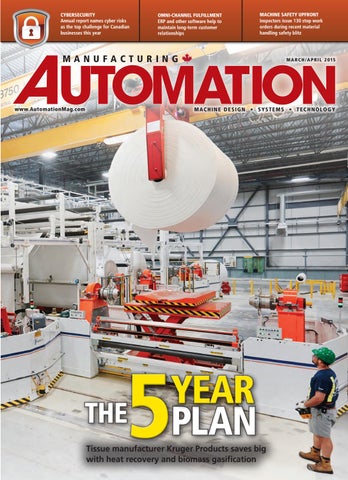
The
year plan
Tissue manufacturer Kruger Products saves big with heat recovery and biomass gasification
MA_MarApr2015.indd 1
2015-02-27 3:02 PM
Now simply CLICK for analog
The best little PLC keeps getting better
Level
Pressure
Temperature
Variable Speed Control
Flow Control
Shown at actual size
Current
$29.00 u.s. (C0-00AC)
$69.00 u.s. (C0-00DD1-D)
$89.00 u.s.
(C0-04AD-1)
Connect to lots of process devices with analog I/O modules for the CLICK PLC The CLICK PLC now has more ways to help you with simple control applications. Monitor pressure, level, current, even thermocouples and RTDs directly. Perform simple variable control* with analog outputs connected to devices such as drives. These high-resolution modules offer fast setup (no DIP switches) with software scaling to make your life (and program) easier. Choose from: • 4-channel, current or voltage in (13-bit) $89 each • 4-channel, thermocouple or RTD in (16-bit) $149 each • 4-channel, current or voltage out (12-bit) $119 each • Combo 4-channel in / 2-channel out, current or voltage $149 each * no PID
$149.00 u.s. (C0-04THM)
$119.00 u.s. (C0-04DA-1)
Mighty as a stand-alone unit, or expand to 142 total I/O With CLICK PLCs, you get a lot of application control in a small package. You can replace even just a few relays cost-effectively, but do a whole lot more with the easy-to-understand instruction set. An 8-input / 6-output base unit with built-in serial ports can stand alone (starting at just $69), or add any combination of up to 8 discrete and analog I/O modules. Simple! Also Available... stand-alone combination CPUs with 2 analog inputs, 2 analog outputs, 4 discrete inputs and 4 discrete outputs built in (starting at $129.00)
And with FREE programming software, we’ve made it even easier to give CLICK a try.
Download the free software so you can see just how simple control can be.
Configure, price, and buy at: www.automationdirect.com/click-plc
Orders over $49 get
FAST FREE SHIPPING
Our shipping policies make it easier than ever to order direct from the U.S.! Fast free standard shipping* is available for most orders over $49 U.S., and that includes the brokerage fees (when using an AutomationDirect nominated broker). Using our choice of carrier, we can reach most Canadian destinations within 2 to 3 days. Order by 6pm ET and in-stock orders ship the same day! *2-day free shipping does not apply to drop-ships, or orders requiring LTL transport, but those shipments can take advantage of our negotiated super-low flat rates (based on weight) that include brokerage fees.
See Web site for details and restrictions at: www.automationdirect.com/canada
For more information go to: www.AutomationDirect.com/Canada
Order Today, Ships Today! * See our Web site for details and restrictions. © Copyright 2014 AutomationDirect, Cumming, GA USA. All rights reserved.
AutomationDirect_MA_March.indd MA_MarApr2015.indd 2 1
1-800-633-0405
the #1 value in automation
2015-02-10 3:02 2015-02-27 3:08 PM
10 3:08 PM
W H A T ’ S
I N S I D E
DEPARTMENTS 4 5
FEATURES
FROM THE EDITOR AUTOMATION UPFRONT
In brief Deal makers Movers and shakers
COLUMNS 8
Machine Safety
9
Industry Watch
Franco Tomei addresses the question to lockout, or not to lockout Paul Hogendoorn discovers that data analytics can be used to predict possible behaviours
26 Distorted Realities
Dick Morley discusses how 3D farming could impact our future
NEW PRODUCTS 20 20 21 22 23 23 24 25
Enclosures & workstations RFID HMI & operator interface Sensors Programmable control Electronic components Automation software Machine vision & inspection
Murrelektronik MA March 2015.indd 1
MA_MarApr2015.indd 3
cover Photo © Pierre Charbonneau
12
The five-year plan
Heat recovery and biomass gasification score big savings for Kruger Products By Alyssa Dalton
integration and agility 10 Organizational How to maintain long-term customer relationships By Jonathan Gross
energy hogs here! 16 No Shining a light on industry players saving energy and money Compiled by MA Staff
Cybersecurity Q&A 18 Are cyber risks your top challenge this year? By Alyssa Dalton
www.AutomationMag.com • March/April 2015 3 2015-02-23 11:26 AM
2015-02-27 3:02 PM
F R O M
T H E
E D I T O R www.automationmag.com • Vol. 30, No.2 Canada’s leading publication providing industrial automation news and technology information aimed at the discrete and process industries.
The “I” in team
I
started covering the industrial automation market last November, and since then, I have reported on the investigation findings of nearly a dozen recent injuries and fatalities that occurred in the Canadian workplace. In my opinion, that’s nearly a dozen too many. The investigation into one case determined the hydraulic press that killed a 19-year-old worker had ineffective guards and no stop blocks. Another found that a worker suffered second-degree burns because a production line’s screen changer was not equipped with a shield to help protect against hot plastic. We’ve actually had to create a separate Machine Safety tab on our website to accommodate all this coverage. Manufacturing AUTOMATION takes its role as the industry’s authoritative voice very seriously. We strive to keep you informed of the latest manufacturing technologies, industry news and products, as well as training and safety news. This is why we have partnered with Precision Training, Products & Services Inc., a provider of industrial automation training solutions, to bring you the Safety Compliance Workshop. Scheduled for April 29-30 in Mississauga, Ont., the event offers interactive workshops highlighting machine safeguarding, control of hazardous energy and electrical safety — all of which are important safety concerns for the Canadian manufacturing industry. Attendees can also expect to gain in-depth understanding of CSA Z432, CSA Z460 and CSA Z462. My friend, a former hockey coach, once told me the saying, There’s no I in team, was absolutely wrong. “Even though there isn’t the letter I in the word, if I don’t do the best I can, how can the rest of my team play to its full potential?” he asked. This same reasoning can be applied to safety. Creating a culture of safety is a team sport that begins with each and every one of us. We must all play our part to champion and advocate machine safety best practices with the goal of bringing these numbers down. Hopefully together, we can ultimately turn the industry into an injury-free workplace. •
Editor Alyssa Dalton adalton@annexweb.com
Art Director Svetlana Avrutin savrutin@annexweb.com
Editorial Director Paul Grossinger pgrossinger@annexweb.com
Account Co-ordinator Kathryn Nyenhuis knyenhuis@annexweb.com
Group Publisher Klaus B. Pirker kpirker@annexweb.com 905-726-4670
Circulation Co-ordinator Lisa Thomson 866-790-6070 ext. 201 Fax: 877-624-1940 lthomson@annexweb.com
Columnists Dick Morley Paul Hogendoorn
President Mike Fredericks mfredericks@annexweb.com
Editorial Advisory Board Piero Cherubini, Dean, Faculty of Skilled Trades and Apprenticeship, Mohawk College of Applied Arts and Technology Al Diggins, President and General Manager, Excellence in Manufacturing Consortium, and Chairman and CEO, Canadian Manufacturing Network David Green, Technology and Business-to-Business Consultant Sherman Lang, Industrial Technology Advisor, Industrial Research Assistance Program, National Research Council of Canada Don McCrudden, Vice-President, Business Development, Festo David McPhail, President and CEO, Memex Automation Nigel Southway, Business Productivity Consultant and Author on Lean Thinking Bill Valedis, Vice-President, Precision Training, Products and Services Inc. Manufacturing AUTOMATION is published seven times a year by Annex Publishing & Printing Inc. 222 Edward Street, Aurora, Ontario L4G 1W6 Tel: (905) 727–0077 • Fax: (905) 727–0017 • PM # 40065710 The contents of Manufacturing Automation are copyright ©2015 by Annex Publishing & Printing Inc. and may not be reproduced in whole or part without written consent. Annex Publishing & Printing Inc. disclaims any warranty as to the accuracy, completeness or currency of the contents of this publication and disclaims all liability in respect of the results of any action taken or not taken in reliance upon information in this publication. Send address changes and return undeliverable Address Blocks to: Manufacturing AUTOMATION, P.O. Box 530, Simcoe ON N3Y 4N5. Return postage guaranteed. Subscription rates: Canada — $40 per year. United States and Foreign — $60(US) per year. Student subscription rate $20 per year. ISSN-1480-2996
Members of
Alyssa Dalton adalton@annexweb.com Follow me on Twitter @AutomationMag
Funded by the Government of Canada
CARLO GAVAZZI Automation Components
Your Source for Innovative Automation Solutions CARLO GAVAZZI Automation Components
SENSE: Inductive and Capacitive Sensors • Photoelectric Sensors • Level Sensors • Ultrasonic Sensors • Magnetic Sensors • Motion Sensors • Environmental Sensors • Wind Sensors • Limit Switches • Light Curtains • Safety Interlocks
SWITCH: Solid State Relays • Contactors and Overloads • Definite Purpose Contactors • Soft Starters • Manual Motor Starters • Mini Circuit Breakers • Electromechanical Relays • Pushbuttons and Pilot Devices
CARLO GAVAZZI
CONTROL: Energy Meters and Transducers • Power Supplies • HMIs • Digital Panel Meters • Timer Delay Relays • Current- Voltage- and Phase Monitoring Controls • Current Transformers • Safety Modules • Counters
A uHMIs t o m a t iContact o n C o mus p otoday, n e n t sand one of our field sales representatives will show you Whether it’s our industry leading range of solid state relays, our new USA Tel: 847.465.6100 Fax: 800.222.2659 and mini-circuit breakers or our vast offering of sensors, contactors,Canada power why CARLO GAVAZZI is one of the fastest growing automation compaTel: 888.575.2275 Fax: 905.542.2248 Mexico Tel and Fax:nies 55.5373.7042 supplies, and energy meters, CARLO GAVAZZI has the solution for your worldwide. We’ll be more than happy to provide a free engineering www.GavazziOnline.com • Info@CarloGavazzi.com many demanding application requirements. sample to qualified OEMs. twitter.com/CarloGavazziNA facebook.com/CarloGavazziNA
Visit our website downloadable data sheets, GavazziOnline.com • 888.575.2275 •forGavazzi@CarloGavazzi.com brochures and pricing: www.GavazziOnline.com
4
March/April 2015 • Manufacturing AUTOMATION
CarloGavazzi_MA_March.indd 1
2015-02-17 2:42 PM
CARLO GAVAZZI Automation Components MA_MarApr2015.indd 4
2015-02-27 3:03 PM
A U T O M A T I O N
U P F R O N T
Ontario announced funds for two auto parts manufacturers in January
“Advanced manufacturing is a key sector for Ontario’s economy, and partnering on expansions like this one are important opportunities for the province,” said Charles Sousa, minister of finance. He notes that providing financial support for expansions are important opportunities for the province, and will help increase a company’s global competitiveness.
In brief • Saputo is selling its bakery division, which makes Joe Louis and May West snack cakes at a Quebec manufacturing plant, to Canada Bread Company for $120 million. • Premium Brands Holdings will close its Toronto, Ont.-based processed meat plant this December, a move that will affect about 200 workers. Production at the plant will gradually move to other Ontario facilities starting in the spring. • Toyota sold 10.23 million vehicles last year, beating out Volkswagen and General Motors to claim top global auto sales for the third straight year.
With files from the Associated Press and the Canadian Press
The federal and Ontario governments announce they will each contribute more than $50 million towards Linamar’s $506.8-million expansion to produce lighter automobile transmission and power train parts.
The federal and Ontario governments will each contribute more than $50 million towards a $506.8-million expansion by Linamar, an auto parts manufacturer based in Guelph, Ont. The expansion to produce lighter, more efficient automobile transmission and power train parts is expected to create another 1,200 jobs in Guelph over the next 10 years. “Our Canadian plants are our most productive globally thanks to a talented, skilled workforce with an amazing work ethic and a dedication to process and product innovation throughout our company,” said Linda Hasenfratz, Linamar CEO, adding that the combination of innovation and efficiency is “what makes us competitive on a global scale.” The province is providing a $50.25-million grant to the company while the feds’ $50.7-million contribution is in the form of a repayable loan. Meanwhile, Nemak of Canada plans to upgrade its production line and create 80 new jobs over the next four years with the help of a $1.5-million grant from the province. By increasing the production capacity of aluminum engine blocks it sells to Shanghai General Motors of China, 200 existing jobs will be preserved at its Windsor, Ont., operations, said the auto parts maker. “Here at Nemak, we continue to innovate casting technology and lead the industry,” said Dr. Glenn Byczynski, technical manager at Nemak of Canada, adding that with this support, the company is forging a partnership within China’s growing automotive industry. The grant comes from the Southwestern Ontario Development Fund, which is used to encourage regional businesses to pursue innovation and new markets.
2014 WINNER
Beckhoff_MA_March.indd 1
MA_MarApr2015.indd 5
www.AutomationMag.com • March/April 2015 5 15-02-20 11:07 AM
2015-02-27 3:03 PM
A U T O M A T I O N
U P F R O N T
PM Harper visits Bosch Rexroth Canada head office
Prime Minister Stephen Harper took some time last month to visit Bosch Rexroth Canada at its headquarters in Welland, Ont. “This was a unique and tremendous opportunity for our company. I was honoured that the prime minister took the time out of his busy schedule to visit and tour
our headquarters and meet with our associates, as well as witness our unique technology first hand,” said Tom Light, Bosch Rexroth Canada president. According to the company, Harper took a “keen interest” in speaking with the engineering staff, and received a brief overview about Bosch Rexroth’s applications and solutions. The tour was rounded out with a final walk through of the machine, fabrication and assembly facility. The Welland facility and head office is a strategic operation for the company’s business and activities in Canada, said Bosch Rexroth. The 140,000-square-foot space manufactures hydraulic systems, hydraulic manifold assemblies and electric/electronic control panels. After the tour, Michael Langstaff, vice-president of finance and administration for Robert Bosch, and Dino Paladino, director systems for Bosch Rexroth Canada, presented Harper with a plaque to commemorate the visit.
DEAL MAKERS Canada Goose acquires second Toronto plant Outdoor apparel maker Canada Goose has acquired a 45,000-square-foot manufacturing facility in the Toronto, Ont., area from its contractor, Grand Harbour Clothing. Located in Scarborough, this is the company’s second manufacturing plant in the Greater Toronto Area (GTA). The HyBridge Lite collection, a line of lightweight jackets and vests, will be produced at the site. The acquisition is expected to increase efficiency by 25 per cent and add 70 employees to its staff, said Canada Goose. Additionally, the company plans to invest in new technologies and infrastructure to retool the facility. Continental finalizes Veyance acquisition Continental concluded its acquisition of the U.S. rubber company Veyance Technologies Inc. of Fairlawn, Ohio, on January 30. The day before, the Brazilian antitrust authority CADE (Council for Economic Defence) cleared the transaction with certain con-
ditions, thus providing the approvals necessary for completion. International automotive supplier and tire manufacturer Continental said it is boosting its worldwide industrial business with this acquisition, which is valued at 1.4 billion euros (US$1.9 billion). Veyance operates globally in the field of rubber and plastics technology with its product focus on conveyor belts, hoses and power transmission belts. “This acquisition will bring Continental a significant step closer to its strategic goal of further increasing the proportion of industrial and end-customer business in its sale,” said Dr. Elmar Degenhart, chair of Continental’s board in Hanover, Germany. “Another very important point is that the acquisition will enable us to significantly expand our industrial and end-customer business and, as a result, enable ContiTech to achieve a share of almost 60 percent of its sales outside the automotive original equipment sector,” continued Heinz-Gerhard Wente, a member of Continental’s board and CEO of ContiTech.
Complete Control In One Unit
Encoder solutions that just make sense.
Robust, all-in-one PLC 12.1” color-touchscreen HMI Up to 1000 I/Os Intuitive, single environment programming software
Model TR1 for Linear Measurement
Vision 1210™
• Integrated encoder and measuring wheel • Easy installation • Operates up to 3,000 feet per minute • Adjustable, spring-loaded torsion arm
PLC + HMI in One Unit
1.800.366.5412 sales@encoder.com www.encoder.com
6
Unitronics, Inc. 1 Batterymarch Park Quincy, MA 02169 USA Tel: 617-657-6596, Toll Free: 866-666-6033 om
usa.sales@unitronics.com
Movers & Shakers CenterLine has named Steve Renaud vice-president of operations. Boasting nearly 22 years of service at the company, he was most Steve Renaud recently general manager of the machinery division. In his new role, Renaud will leading all of CenterLine (Windsor)’s design and manufacturing activities to “ensure that these operaJim Komar tions continue their growth and development and maintain operational excellence.” He is succeeded by Jim Komar, who served as the division’s plant manager. Komar brings 30 years of automotive industry experience to the position. Pat Wheeler of Motion Industries Canada has been recognized with the inaugural Wendy B. McDonald Award for establishing “herself as a Pat Wheeler critical contributor to her company’s success” and for affecting “positive change within the power transmission/ motion control industry.” Launched by the Power Transmission Distributors Association (PTDA) Foundation, the award honours the memory of Wendy B. McDonald, a true pioneer of the industry, it says. Appleton Group LLC has appointed Harish Shinde as vice-president of its Canadian Business Unit, where he will be responsible for all sales, Harish Shinde marketing and operations in Canada. Shinde joined Emerson in 2011 as director, Planning for Commercial Industrial Solutions. In this role, he was responsible for global strategic planning for the business group. The Lincoln Electric Company has promoted Steven Hedlund to president of global automation. Previously serving as senior vice-president Steven Hedlund of strategy and business development, his new role will focus on Lincoln’s global automation initiative, a growth program in the company’s 2020 Vision and Strategy that is targeting accelerated growth in sales and profitability. Applied Robotics Inc. has added Kevin Drummond to its management team, where he will assume the role of sales and marketing director. Based out of Kevin Drummond the company’s Glenville, N.Y., headquarters, he brings 25 years of experience to the position.
March/April 2015 • Manufacturing AUTOMATION
Encoder_MA_Jan.indd 1
MA_MarApr2015.indd 6
2015-01-13 Unitronics_MA_March.indd 9:33 AM 1
2015-02-18 8:41 AM
2015-02-27 3:03 PM
A U T O M A T I O N
U P F R O N T
130 stop work orders issued in Ontario’s fall safety blitz
Stock photo © Lisa F. Young
Ontario inspectors issued almost five orders on average to each workplace visited during last fall’s safety blitz targeting material handling hazards, announced the Ministry of Labour (MOL). This translates to 3,263 orders for violations of the Occupational Health and Safety Act and its regulations, which includes 130 stop work orders. About 701 plants, factories and other industrial sector workplaces were visited across the province during the September 15 to October 26 blitz. During the visits, inspectors looked at whether employers were taking appropriate action to assess and address possible material handling hazards. “The safety of workers in Ontario is our top priority,” said Kevin Flynn, minister of labour. “Blitzes such as this one send a strong message that
non-compliance will not be tolerated. We must all work together to prevent injuries and deaths. We want workers in Ontario to return home safe and sound after a hard day’s work.” As of December 19, 75 per cent of the orders were complied with. “Workers can be seriously injured or even die as a result of incidents involving material handling. We’re working to improve the health and safety of workers in Ontario. But we can’t do it alone. Everyone has a shared responsibility to keep workplaces safe,” continued George Gritziotis, chief prevention officer.
Allied Vision’s Canadian office moves to new home
Allied Vision Technologies Canada, a manufacturer of high-performance digital cameras for industrial image processing, has moved to a new Burnaby, B.C., 18,565-squarefoot office space. The new location will provide additional space for research and development, production and office areas for current and future employees. “After record-breaking sales in 2014 and continued strong demand, the new office will provide the necessary space and resources needed to further Allied Vision’s commitment of producing the highest quality
products,” said the company. According to Jeff Bisacquino, director of operations, the new office will “continue the strong collaboration Allied Vision has with its customers and partners.” The move began in October and was completed in December.
Canada Apprentice Loan aims to help apprentices complete their training
The government has launched an initiative that provides apprentices registered in a Red Seal trade program with access to loans of up to $4,000 per period of technical training. Through the Canada Apprentice Loan program, the loan remains interest-free until after the recipient completes or leaves their apprenticeship training program, for up to a maximum of six years. It is estimated that at least 26,000 apprentices a year will apply for
over $100 million in Canada Apprentice Loans. During a roundtable at Saskatchewan Polytechnic, agriculture minister Gerry Ritz stressed the importance and value of the skilled trades for the Canadian economy and said that apprenticeship training is essential to keep Canada’s economy strong. According to the Canadian Apprenticeship Forum (CAF-FCA), the loan program also helps correct the misperception of apprenticeship as a second-tier option, sending a message to young people and their parents that apprenticeship is a valued post-secondary pathway leading to a rewarding career in high-demand professions. “[The program] sends an implicit message that, like college and university students, we want to see you succeed. Your certification is an important achievement — the foundation for career that we value in Canada,” said Sarah Watts-Rynard, CAF-FCA executive director. •
Do you have something to say? Let us know what you think about our magazine and content. Send your comments and thoughts to editor@automationmag.com.
Your One-Stop Source for Process Measurement and Control Votre Unique Arrêt pour la Mesure et le Contrôle de Procédés!
© COPYRIGHT 2011 OMEGA ENGINEERING, INC. ALL RIGHTS RESERVED
© COPYRIGHT 2012 OMEGA ENGINEERING, INC. ALL RIGHTS RESERVED
Handheld OMEGA® Bluetooth® Wireless Temperature, Humidity & pH Transmitter Gamme de transmetteurs portatifs OMEGA® Bluetooth® sans fil de Température, d’Humidité et de pH
Intelligent Relays, the Programmable Smart Logic Relay Relais Intelligents, des Relais Programmables Avec Logique Intelligente Series/Série EZ Series Starts at/à partir de $167
Series/Série UWBT Starts at/à partir de $332
Visit/Visite omega.ca/ezser_intrelays
Tablet not included. Tablette non incluse.
Web Enabled Operator Interface Interface Opérateur Activée par le Web
• Free App Available for Android™ and iOS Devices, Configurable in 9 Different Languages • Turn Your Smartphone or Tablet into a Data Logging Device • Application gratuite disponible pour les appareils Android™ et iOS™, configurable en 9 langues différentes • Transformez Votre Smartphone ou Tablette en Dispositif d’Enregistrement de Données
Series/Série G3 HMI Starts at/à partir de $625 Visit/Visite omega.ca/g3_hmi303
1-888-826-6342
Visit/Visite omega.ca/uwbt
omega.ca
976 Bergar Laval, Québec Canada H7L 5A1
© COPYRIGHT 20152011 OMEGA ENGINEERING ALLRIGHTS RIGHTS RESERVED © COPYRIGHT OMEGA ENGINEERING,INC. INC. ALL RESERVED © COPYRIGHT 2015 OMEGA ENGINEERING, INC. TOUS DROITS RESERVES ® Prices listed are those in effect at the time of publication and are subject to change without notice. Please contact OMEGA’s sales department for current prices. Les prix indiqués sont ceux en effet au moment de la publication et sont sujets à changement sans préavis. Veuillez contacter un réprésentant des ventes d’Oméga pour obtenir les prix courants.
Omega_MA_March.indd 1
MA_MarApr2015.indd 7
www.AutomationMag.com • March/April 2015 7 © COPYRIGHT 2012 OMEGA ENGINEERING, INC. ALL RIGHTS RESERVED 2015-02-18 11:46 AM
2015-02-27 3:03 PM
M achine
S afety
To lockout, or not to lockout, that is the question BY FRANCO TOMEI
W
hen performing a pre-start review as per section 7 of the Regulations for Industrial Establishments, one needs to identify the measures to be taken to fulfill the requirements of the relevant provision of the regulations identified in the table. The decision that needs to be made is whether or not to provide a protective element that signals that apparatus to stop or to provide a protective element that does not signal a stop. It must be very clearly stated here that the protective elements that signal a stop are not to be considered lockout devices, as the lockout theme is a very broad subject. It should also be pointed out that this article is written within the context of machine guarding i.e. item 2 of the Table. From a strict regulatory standpoint, the section that specifically identifies “lockout” requirements is section 40 of the Regulations for Industrial Establishments. Nonetheless, there are other sections (74, 75 and 76 in particular) where lockout (including but not limited to blocking, bleeding, discharging, etc.) is not cited but standards and best practice would dictate a full lockout is required. The standard CSA Z460 Control of Hazardous Energy – Lockout and Other Methods, as well as other standards, does recognize that while lockout is the preferred method of controlling hazardous energy, it is not always practicable to do so. Referencing Oxford Dictionaries1, the definition of practicable (in part) as follows: Able to be done or put into practice successfully: the measures will be put into effect as soon as is reasonably practicable. I have at times encountered situations where people have identified lockout as “not practicable” because the switch is far from the machine, but inconvenience should not be confused with “not practicable.” In applying this to machine safety, we can state that loading a workpiece onto a machine with powered holding device would not be practicable to lockout because the powered holding device would not be operable and the task could not be performed. In a situation where (despite the optimal performance of a machine) jams do occur, it may not be practicable from an economic viewpoint to lockout each and every time the jam occurs. However, let us be very cautious here in that while a full lockout may not be practicable, it is still necessary for the employer to ensure that the risk the worker is exposed to is as low as reasonably practicable. Impracticable economic interest cannot be taken to imply that the safety of the worker is trumped. Section 7.4 of CSA Z460 states that: Traditional lockout to a full zero energy state is not practicable in all situations. When lockout affects the tasks that are integral to the production process by design or traditional lockout prohibits the completion of a specific task, other hazardous energy control methods shall be used control options such as those specified in clause 7.4.6 to 7.4.10 shall be used in accordance with the hierarchy specified in clause 7.4.5 to ensure effective protection. Clause 7.4.6 to 7.4.10 identifies various engineered safeguards, such as individual personal controls, area scanners, fixed and moveable guards, holdto-run devices, light curtains and single opto-electronic beams, pressure mats, safety rated switches, stop devices, and trapped key devices, etc. I interpret this to mean that the identified safeguards can be used for controlling hazardous energy only for tasks that are integral to the production process. This, of course, begs the question as to what determines if a task is integral to the production process. The standard provides us with the answer in section 7.4.2 where it states that a task can be deemed integral if it exhibits most of the following characteristics: 1. The task is short in duration. Since CSA Z460 doesn’t define what “short” is, it is recommended that each situation be analyzed separately and the time be defined within the context of the situation. 8
2. The task is relatively minor in nature. Once again, this can differ, but a reasonable measure for “minor” tasks could be those requiring one specific tool or no tools at all. 3. The task occurs frequently during the production shift. In other words, if the jam occurs only every couple of days, it can be reasonably concluded that the jam is a result of some malfunction and not inherent in the production process. 4. The task is usually performed by operators or others functioning as operators. The message here is that if maintenance personnel need to be called then the task is no longer simple. We must be careful here since many operations personnel often act as maintenance workers. Adequate supervision must be provided to control the situation. 5. The task represents predetermined cyclical activities. An example of this could be where the welding tip of a spot welding machine needs to be changed every 5000 welds. 6. The task minimally interrupts the operation of the production process. Minimal interruption is not defined but I would suggest an assessment for each specific process. 7. The task exists even when optimal operating levels are achieved. If we take the case of where jams occur because a machine component is excessively worn then the jam is a result of poor maintenance and not integral to the production process. If the jam occurs because of the variances in the product that can result from the production process, then we have a different case. 8. The task requires task-specific personnel training. In this case, a worker is trained and given specific instruction on performing a particular task. If the problem is not resolved, then the supervisor should be called. The worker must go beyond the specific instructions given during the training. What has your experience been? Any feedback you can provide would be appreciated. • Note: 1. “Practicable: definition of practicable in Oxford dictionary.” Oxforddictionaries.com, Oxford Dictionaries. Visit bit.ly/1CMvm2k. Franco Tomei, B.A.Sc. P.Eng., (ftomei@yahoo.com) is a professional engineer with more than 40 years of industrial experience, including 12 years in the safety field.
March/April 2015 • Manufacturing AUTOMATION
MA_MarApr2015.indd 8
2015-02-27 3:03 PM
I ndustry
W atch
After ‘Elvis’ BY PAUL HOGENDOORN
I
saw Elvis last night, not the Elvis, but a play at the Grand Theatre in London, Ont., that chronicled his life, music and relationship with Tom Parker (the Colonel). I was not a big Elvis fan growing up, but the play moved me and the story it told left me with a simple thought: his was a remarkable life, and an unfortunate death. I wanted to know and experience more, so I did what many of us frequently do; I started YouTubing him. I started with my favourite songs — Suspicious Minds and In the Ghetto — and then I came across a suggested link for Unchained Melody, a song made famous by the Righteous Brothers. I was awe-struck by his talent and passion; he took an already great song to a higher level. From there, I had to check out the Righteous Brothers’ own version of the song, and then onto the soundtrack for the movie Ghost (with Patrick Swayze and Demi Moore). From there, I followed the suggested link to Sinéad O’Connor’s version of Nothing Compares 2 U. Near the end of the video, I asked myself the same question from other nights spent music surfing: “how did I get here?” It’s the power of big data, analytics, search optimization and profiling — all the new technologies developed during the still gestating Internet and information explosion age. Every link I clicked on in that recent journey was a suggested link — a link “they” (the technology creators) believed I would want to experience next. All I did was input the initial emotional clue; I was thinking about Elvis and was moved by the passion of a song. The rest was technology. It was an equally scary, and mind-boggling, revelation. Every step we take, and every click we make, is added up, logged somewhere, and then analyzed and used to predict our next purchase, impulse or action. There’s a huge data collection engine at work, and it not only follows our steps and actions, it tries to nudge them towards a purchase or desired outcome. We tend to think of information technology as an outbound medium that delivers content to us, be it information or entertainment, but that’s only the obvious part of the picture. The other part is its tremendous capacity for gathering up information, sensing and storing it, analyzing it all to derive meaningful information, and acting on it. Actionable information is king. Speaking of king, or in this case, the king of rock and roll, Tom Parker realized this connection when he discovered Elvis Presley. Others may have noticed the unique talent that the young man had, but what really convinced the Colonel of Elvis’ future success was his observation of the reaction of the fans. While other talent scouts noticed the performers, Tom Parker took notice of the audience. To him, that was the key information, and he acted on it. When the media was present at any event, he directed their attention not to Elvis, but to the hysterical audience. He saw the local frenzy and he broadcasted that. He used television (and before that, the press) to capture that critical information. A few years later, the same technique was employed when the Beatles landed in New York. (You can barely hear the Beatles music on the Ed Sullivan show over top of the noise of the hysterical audience. That was by design.) As I sit here and write this column, I realize that I am unintentionally heading towards an unexpected conclusion — that it is possible to shape future habits and patterns in human beings by making objective observations, drawing intelligent conclusions from those observations, and then presenting actionable information in a timely and appropriate manner. The actual inputs are all empirical (they are what they are), and the decision to act or respond is still the individual’s, but in between is the power of technology’s ability to derive and convey actionable information. “Big data analytics” make intelligent predictions of future possible behaviours based on empirical observation and accurate analysis of past events. The late 1970s are said to be the start of the information age — for better or for worse. Emotions move us, but information shapes the way we feel. Perhaps it has always been this way, but the multiplier in this information age is technology. Like all other technologies, it’s ours to choose to use wisely. It shouldn’t be ignored. • Paul Hogendoorn (paulh@getfreepoint.com) is co-founder of FreePoint Technologies, “Measure. Analyze. Share.” (Don’t forget to share!) www.AutomationMag.com • March/April 2015 9 Hiwin_MA_Jan.indd 1
MA_MarApr2015.indd 9
2014-12-17 3:17 PM
2015-02-27 3:03 PM
O mni - channel
demands
Organizational
integration and agility: a recipe for long-term customer relationships
By Jonathan Gross
D
ownward pressure on the loonie and steep drops in oil prices are creating exportfriendly market conditions. Canadian manufacturers and exporters will undoubtedly look to convert these export opportunities into stable, recurring, long-term business. However, higher costs associated with managing business partnerships are partially offsetting currency benefits. Historically, quality, price, lead time, and fill rate were the main ingredients to building sustainable customer relationships. Today, interaction has been added to the recipe.
Coping with relationship fulfillment
Better known as omni-channel, interaction requirements demand that manufacturers provide their customers with a seamless experience across multiple interaction channels. An example could be allowing a customer to partially build an order by telephone and seamlessly complete that same order on a web-based configurator. Another example could be a requirement to provide periodic electronic data interchange (EDI) status updates as an order progresses through the supply chain. A key driver of omni-channel requirements is a desire to reduce frictions that impede the efficient flow of data and product between supply chain players. Consider, for example, the use of safetystock to hedge against unreliable data and logistics. Better information and a more reliable supply chain can reduce hedging requirements. It stands to reason that better visibility into lead times can give companies an opportunity to reduce safetystock levels and the cash that those stocks consume. Some pundits are predicting that this omnichannel movement is merely the front end of a supply chain revolution that will ultimately see all players — from raw material process manufacturing to retailing — operate in an efficient network where a ripple at one end of a supply chain can be felt at the other. Whether this vision ever materializes is up for debate and is beside the point. The more pressing issue relates to how manufacturers can respond to increasingly onerous customer demands. For 10
many, the economics of employing full-time estimators, data-entry clerks, operational liaisons, and EDI technical experts no longer justify serving an existing customer segment. The solution, though, is not to cull customers, particularly since this segment is quickly becoming the majority. Rather, the solution is to pause and evaluate whether the existing business model is optimally structured to respond to this paradigm shift. As business leaders dig into their business structures, they will probably discover functional silos, informational silos, and disjoint processes that create costly inefficiencies. The companies that will be well-positioned for long-term success are those that can eliminate these types of friction. More often than not, this involves transformative changes to organizational structures, roles and skills, business processes, and information technology. Changes might include a need to redraw reporting lines. People will inevitably have to work more collaboratively with those in other functional departments. Ownership of processes and data might have to change hands. And, almost certainly, new enterprise technologies — enterprise resource planning (ERP) system, quality management, transportation management, and business intelligence, for example — may have to be implemented.
An overview of integrated technologies
Generally speaking, ERP software is a foundational requirement for enterprise integration. This software acts as a central planning hub and integrated execution engine. From a planning perspective, companies rely on ERP to process forecasting, material requirements planning (MRP), master production scheduling (MPS), and capacity requirements planning (CRP) functions. From an operational perspective, ERP generally supports core functions, including: sales, order entry, inventory management, shop floor control, and purchasing. Finance functions are fully integrated, meaning that customer credit, accounts payable, accounts receivable, and general ledger
functions automatically flow relative to associated operational transactions. Once a company has integrated and automated key business functions with ERP, it can then turn its attention to the automation of peripheral functions. Common examples include quality management, warehouse management, transportation management, customer relationship management, and human resources. From an execution perspective, business leaders should resist the urge to dive headfirst into an implementation project. Instead, they should take the time at the front end to properly scope and blueprint the requirements for organizational integration. Ultimately, the business blueprints provide an analytical basis to plan projects, as well as schedules, budgets and scopes. As with any architectural project — whether buildings, municipal infrastructure, or organizational integration — a solid foundation is a prerequisite to a successful project. In the present context, the foundation includes ERP and associated core operational and planning processes. A critical success factor in the design of a sustainable, long-term business structure is to create a model that 1) addresses current critical needs, and 2) has a scalable and flexible structure to respond to future needs, some of which might not yet be known.
The project planning foundation
The discovery and analysis process that yields a business blueprint is typically referred to as a business requirements assessment. Under this process, a company evaluates its current business state against best-practice benchmarks that are defined relative to business goals and industry standards. Then, through business process mapping and other techniques, it designs a future state to meet defined targets. Finally, it plans various projects to incrementally close the gap between current performance and future targets. Drafting a realistic, appropriate, and executable business plan requires certain skill sets. At a
March/April 2015 • Manufacturing AUTOMATION
MA_MarApr2015.indd 10
2015-02-27 3:03 PM
minimum, the person or team leading an assessment should possess the following: • Knowledge of industry trends and best practices; • Expertise in organizational design and change management; • Expertise in cross-functional, integrated business processing; • Expertise in modern integrated software systems and underlying technologies; • An impeccable track record in the planning and execution of complex transformation projects; and • An ability to lead high-performance, cross-functional teams.
Implementation Program designed to provide up to $40,000 of funding for export-oriented businesses; and • P.E.I.’s Information Technology Planning program designed to fund consulting services in an amount up to 50 per cent of consulting costs to a maximum of $5,000. The above list is not intended to be exhaustive. Additional details and funding programs can be found at the Government of Canada’s
Canada Business Network website, www.canadabusiness.ca. Instead of asking whether they can afford to undertake these types of projects, manufacturers should be asking whether they can afford not to. Business-to-business market dynamics are creating an increasingly hostile environment for companies with unintegrated systems and inefficient processes. The good news is that beneficial currency conditions
and supportive funding programs present Canadian manufacturers with an excellent opportunity to leapfrog their competitors and become their customers’ trusted long-term business partners. • Jonathan Gross, LL.B., M.B.A. is vice-president at Pemeco Consulting, a firm that leads technology-related transformation projects for manufacturers and distributors, and a Qualified Service Provider for CME-SMART.
Most companies do not readily have this expertise on staff, and many will look to outside consulting firms for assistance. The good news is that government and industry are teaming up to offer financial assistance that could partially offset consulting costs.
A range of funding opportunities
In November 2014, the Canadian Manufacturers & Exporters (CME) announced two non-refundable grant programs, collectively under the umbrella of the CME-SMART Program, designed to fund a portion of assessment and project implementation costs for Ontario-based manufacturers. Specifically, CME partnered with FedDev Ontario on a $20-million program to fund eligible southern Ontario manufacturers, while a parallel $2.4-million program between CME and FedNor funds eligible northern Ontario manufacturers. Under the program, approved participants can retain a Qualified Service Provider to perform technology-related assessments. Business process improvement, ERP, MRP, quality management, shop floor control, and material handling are among the projects identified as potential candidates. Approved assessments are eligible for funding in an amount up to 50 per cent of costs to a maximum of $15,000. The program also provides project implementation funding in an amount up to 35 per cent of costs to a maximum of $100,000. Other relevant programs include: • New Brunswick’s Innov8 program that offers aerospace and defense, industrial fabrication, wood, food, and exporting manufacturers up to $25,000 per project to a maximum of $100,000 for the development of intellectual property, specialized software, hardware, or equipment, or to do research, development or prototyping; • P.E.I.’s Information Technology
National Manufacturing and Distribution Centres: Calgary, AB • Edmonton, AB • Airdrie, AB • Milton, ON Mississauga, ON • Etobicoke, ON • Perth, ON Regional Manufacturing Facilities: Delta, BC • Calgary, AB • Edmonton, AB • Saskatoon, SK Winnipeg, MB • Mississauga, ON • Lachine, QC • Dartmouth, NS
Call toll-free: 1-800-268-3578
Eaton MOEM ad E 6.375 x 9.75 final.indd 1 Eaton_MA_March.indd 1
MA_MarApr2015.indd 11
15-02-03 10:59 AM
www.AutomationMag.com • March/April 2015 11 2015-02-11 8:38 AM
2015-02-27 3:03 PM
C over
S tory
The
year plan
Heat recovery and biomass gasification score big for
Kruger Products
Photos © Pierre Charbonneau
By Alyssa Dalton
Y
ou have to spend money to make money — is that how the old saying goes? In learning more about the sustainability efforts at Kruger Products, a Mississauga, Ont.-based manufacturer of tissue and paper products, it appears the popular phrase should be rewritten as, You have to spend money to save money. Five years ago, Kruger Products, set out with Sustainability 2015, an aggressive plan to reduce its environmental footprint through nine separate targets, including energy, greenhouse gas emissions, water, waste, packaging and transportation. Known for its Cashmere, Scotties and SpongeTowels brands, Kruger Products operates five plants across North America: Crabtree, Sherbrooke and Gatineau, Que.; New Westminster, B.C., and Memphis, Tenn., all of which are involved with the program. With 2009 as a benchmark year, the company determined which objectives it wanted to reach, and the specific measures to hit. In terms of energy reduction, Kruger reached out to consultants to help identify large areas of opportunity where each of the five facilities 12
could make “significant differences” toward the 15 per cent — or 985,000 gigajoules — target. As the program comes to a close at the end of this year, Steven Sage, vice-president of sustainability and innovation, estimates Kruger Products will come close to achieving a 13-per-cent energy decrease. “We’re a company that is heavily dependent on natural resources — paper requires trees and it requires a lot of energy and water. Our preservation for those sorts of resources is critical to ensure we have an ongoing business,” he said. “And obviously cost reduction is one of the benefits that come with these [reductions].”
Bringing the targets to life
“We’ve come a long way from the days of greenwashing and saying ‘oh we’re doing great, green things’ and not being held accountable. Beyond our own internal accountability, major customers are leading the way and holding manufacturers’ feet to the fire,” he says. He points to Walmart as an example, who pledged to reduce greenhouse gas emissions from its global supply chain energy by 20 million metric tons by 2015 (as
noted in the Walmart Global Sustainability Report - 2010 progress update). “[Our customers] want to know what is in the actual products we sell to them, and where they come from,” says Sage. “They’re making differences in the environment and they’re looking for other companies that supply to them to do that as well. There needs to be a collaboration of people to cause change. It’s not just the people at Kruger on an island solving these problems.” The company invested in three major energy-reduction projects throughout the five-year period. “Capital investment and significant investment will achieve long-term benefit. You have to spend money to save money,” he continues. “This is a big company and our operations are very large, so a very tiny percentage
of this is driven by behaviour. This isn’t as simple as turning off the lights when you leave a room.”
Biomass gasification
One of the first sustainability projects Kruger embarked on was at the New Westminster plant, where it teamed up with Nexterra Energy to build what they say is the first biomass gasification system in Canada, and the pulp and paper industry. The core technology slowly heats unprocessed wood waste to produce a clean-burning syngas, which instead of natural gas, is fired into a boiler to generate stream for the production process. Along with stream from three other boilers, this supplies the plant’s total thermal energy needs. The syngas then exits the gas-processing chamber and in most situations requires little
March/April 2015 • Manufacturing AUTOMATION
MA_MarApr2015.indd 12
2015-02-27 3:03 PM
The biomass gasification system at the New Westminster, B.C., plant.
Software supporting continuous improvement www.syspro.com/ma
“ I can get behind
SYSPRO because they get behind me. ” Outcomes • Time to create a PO reduced by 80%
Photo © Kruger Products
to no additional pollution control measures, says the company. The $14.5-million project received support from Natural Resources Canada (NRCan), the British Columbia Innovative Clean Energy Fund (ICE) and Ethanol BC. Biomass gasification began in December 2009, and the plant has since reduced its greenhouse gas emissions by 54 per cent annually. “It’s perfect because that plant is literally in metropolitan Vancouver, where people live and work around,” says Sage.
Heat recovery
In October 2010, the Gatineau tissue facility successfully implemented heat recovery technology, estimating to lower the plant’s total energy consumption by 11 per cent and greenhouse gas emissions by 14.5 per cent annually, it says. “One project where you can make that kind of a difference in a facility is significant,” says Sage. “You start cumulating those projects and you start to get the results you’re looking for.” Hot, humid air from two of its three paper machines is captured and forced through an energy recuperation tower, into which
water is sprayed. The energy is drawn from the exhausted air to the water, through the technology, and filtered and circulated through heat exchangers to transfer the energy to the process. This air is reused to heat process water and the facility itself during winter. The third paper machine is already using heat recovery technology. Kruger Products partnered with Thermal Energy International to develop and install the $4.8-million project, and it was financed in part by Quebec’s Agence de l’efficacité énergétique, which granted $1.9 million in financial assistance through its Heavy Oil Consumption Reduction Program. According to Kruger, the solution is unique because it allows a combination of multiple heat sources into a single recovery unit. The Crabtree facility features a similar heat-recovery system, which came online in 2014. According to Sage, it has reduced energy usage by 6 per cent and greenhouse gas emissions by about 8.4 per cent. Other energy-efficiency projects the tissue plant has implemented in recent years include lighting upgrades (savings of 7,700 MWh/ year); an upgrade of the recycled
• Auto-generate job cards with production drawings
Michael Easton President & CEO Argus Industries
Accounting MAnufActuring Distribution
Visit www.syspro.com/ma Call 1-888-259-6666 ext 5250 Email sales@ca.syspro.com
www.AutomationMag.com • March/April 2015 13 Syspro_MA_March.indd 1
MA_MarApr2015.indd 13
2015-02-17 3:26 PM
2015-02-27 3:03 PM
KRuger’s Sustainability 2015 by the numbers Manufacture products using only 100 per cent third-party-certified fibre, ensuring that the fibre in products comes from only sustainably harvested forests and/or recycled material containing a high percentage ed! of post-consumer waste. Achiev TARGET
#1
Receive Forest Stewardship Council Chain of Custody Certification ensuring accountability from forest ! to product to shelf. hieved TARGET
#2
Ac
Reduce packaging by 5 per cent without compromising product protection standards, while also increasing use of recycled, recyclable and biodegradable packaging materials. ieved! TARGET
#3
Photos © Pierre Charbonneau
Ach
Add to our more than 90 third-party-certified products and continue to be the leading manufacturer of such innovative ! tissue paper products. hieved TARGET
#4
Ac
Reduce overall energy consumption by 15 per cent by streamlining manufacturing processes and implementing an array of energyreduction and efficiency initiatives. TARGET
#5
Reduce greenhouse gas emissions by 15 per cent by reducing consumption of traditional energy and increasing use of alternative and o renewable energy. soon te! TARGET
#6
Achiev
Reduce emissions from transportation by 15 per cent through improved logistics and shipping efficiencies, and increased use of lower carbon-emitting modes of transportation, such as rail. TARGET
#7
Reduce total water consumption by 15 per cent, without compromising wastewater treatment standards that are already substantially in excess of government requirements. to TARGET
#8
soon ve! Achie
Reduce the amount of solid waste and manufacturing byproducts that we send to landfill by 20 per cent through a systematic program of industrial-grade recycling, reuse and reduction initiatives. TARGET
#9
Source: www.sustainability2015.ca
14
screening system (savings of 300 MWh/year); and improvements to the compressed air system (savings of 1,200 MWh/year). Last June, the plant was named a member of réseau Écolectrique d’Hydro-Québec for its work in energy efficiency. As part of the program, recognized companies must have reduced energy consumption by at least 5 per cent or 50 GWh/year, adopted a formal energy efficiency policy, and have a dedicated employee responsible for energy management.
A multi-layer approach
Francis Fournier works as the energy conservation manager for all five Kruger Products plants. Based in Crabtree, he routinely meets with each facility’s energy committee to see its progress and make recommendations on energy, greenhouse gases and water consumption. Representatives from the production, maintenance, engineering, environment and directorial departments comprise the various committees. “Part of my role is to work with the sites to identify the energy-reduction initiative which would be the most beneficial for the company,” says Fournier. “By identifying the priorities, we make sure we will not duplicate efforts between sites.” He promotes the use of a three-tiered monitoring system at the facility: • Level 1 - Individuals at the operations and plant floor level gain daily feedback on their energy usage and can take immediate action; • Level 2 - At the end of the week, the committee looks at how the individual site has performed over the last seven days; and • Level 3 - Energy consumption data and trends over the past month are observed.
“Once it is explained to [employees], the reason why we’re doing it and the importance of going through these initiatives, people are more than willing to participate,” says Fournier, “but it has to be well explained.” Documentation in this part of the process is critical, Sage says, as it helps a company know exactly where it’s starting and going. But to fully entrench a company into a sustainability program, it also requires the company president or CEO’s endorsement, “which we have,” he adds. “It’s just too difficult to do and it requires too much energy from the organization not to have that [commitment].”
The next five years
In fact, a lot of companies are already working to reduce their energy consumption, and a strategy like this merely “puts an external face on that,” says Sage. “It can be from afar very overwhelming, but there is no rule about how to do this. The most important thing is determining what are the few most important places where you can have impact.” “Of the nine [targets], we have achieved many but that are a couple that are going to be tough to achieve. I think we now have a much greater understanding of all the components that contribute to these metrics,” he adds. And that knowledge will help form Sustainability 2020, the next five-year program, set to roll out early 2016. Kruger Products plans to conduct an engagement study with key stakeholders to better understand their expectations as new targets are developed. “In five years, we can’t reverse years of activity to make improvements in terms of our environmental footprint with just the flip of a switch,” he says. “Could we ever truly be a sustainable company that has no outputs? Maybe not, but we can be constantly trying to improve.” •
March/April 2015 • Manufacturing AUTOMATION
MA_MarApr2015.indd 14
2015-02-27 3:03 PM
Asco_MA
Asco_MA_March.indd 15 MA_MarApr2015.indd 1
2015-02-11 3:03 2015-02-27 9:12 PM AM
www.asconumatics.ca
For over 50 years, ASCO Numatics Canada has been pioneering innovations in fluid automation and today, our trusted products are locally available and globally supported and accessible to thousands of customers worldwide. But the world is an ever-changing place and we know that staying one step ahead is the key to our customers’ success. You can count on ASCO Numatics to develop tomorrow’s products today and pave the way to a sustainable future. ASCO Numatics... we know flow.
After 50 years, we’ve learned to look at things differently
, Business Development Analyst
E nergy
management
No Energy hogs here! Shining the spotlight on energy conservation champions
Beverage plant retrofit achieves 60% energy savings
Cott Beverages Canada, a division of Cott Corp., expects to see more than 60 per cent energy savings after retrofitting one of its Mississauga, Ont., production facilities with the help of Eco-Shift Power Corp. (ECOP), an energy management and lighting firm. The annual energy reduction forecasted is 1,027,364.72 kWh, said Cott, which translates to more than $170,000 in annual cost savings. The project consists of a full LED retrofit/upgrade for a 220,000-squarefoot facility, including the production plant, warehouses, storage space, office spacing, parking and other external lighting. A total of 972 fixtures — HID metal halides, T12 and T8 fluorescents, and halogen PAR lamps — were upgraded to LED equivalents. The replacement solutions include ECOP’s NetZero 210W LED high-bays; 28W LED wallpacks and floodlights; 12, 16 and 24W LED linear tubes; and 17W LED Par lamps. As well, ECOP will be integrating its light management system into all NetZero LED high-bays located in warehouse and production areas. Energy savings — experienced through dimming, scheduling and internal fixture diagnosis — will be provided in real-time to the centralized desktop PC controller. The display will also highlight where energy improvement can be made.
“With the idea of a smart grid becoming more predominant, more clients are starting to understand the importance of completing building upgrades with a smart building control component,” said ECOP CFO Jim Hughes. “This is important not only because it prepares your facility for what’s to come, but allows the end-user to measure consumption on a rolling basis and use these measurements to help facilitate decision-making surrounding a building’s energy efficient investments.”
Ford plants worldwide to see LED lighting upgrades
Ford Motor Company says it is investing more than $25 million to install LED lighting at manufacturing facilities across the globe. The 25,000 new LED fixtures will replace traditional high-intensity discharge and fluorescent lights, and are expected to reduce Ford’s energy use at its plants by 56 million kWh annually. That equates to an up to 70 per cent reduction in lighting energy
consumption compared to traditional technologies, said the automaker. Annual energy costs are expected to be reduced by about
HARTING ONE STOP M8, M12 & 7/8th connector solutions
Standard stocked lengths with custom lengths and configurations available. ■ M8, M12 and 7/8” Sizes ■ Robust IP67 Cordsets ■ A, B and D Coding Types HARTING.ca
HRT_Ad_0003_REV-1_MA_8.5x4.75_FEB2015.indd 1 16 Harting_MA_March.indd March/April 2015 1 • Manufacturing AUTOMATION
MA_MarApr2015.indd 16
■ 3, 4, 5, 8 and 12 pole options ■ PVC and PUR cable jackets ■ Single and double ended assemblies available in straight, angled, male and female
Download Selection Guide
2/19/2015 8:50:45 AM 15-02-19 12:25 PM
2015-02-27 3:03 PM
$7 million. Ford predicts the need for maintenance will diminish with the LED lighting as well. “We are extremely pleased to install this leading-edge technology in our manufacturing facilities worldwide,” said John Fleming, executive vice-president, global manufacturing and labour affairs. “This is a long-term investment in our future that highlights our aggressive approach to lead in environmental improvements and achieve operating efficiencies.” In 2011, Ford embarked on a program to lower its energy use 25 per cent per vehicle produced at its facilities by 2016. The company said it is well on its way toward meeting that goal, having achieved 20 per cent energy efficiency already, explained George Andraos, director of energy and sustainability at Ford Land. “Moving to LED gives us impressive efficiency improvement,” said Andraos. “Ford worked closely with its scientists and suppliers to investigate and closely follow the rapid development of LED lighting.” Work began at Michigan’s Dearborn truck plant last fall to replace worn and outdated overhead lighting. The LED replacement program will continue at 17 other Ford manufacturing facilities, including Oakville Assembly and Essex Engine in Oakville, Ont., and Windsor, Ont.
end of Q3 2014, it exceeded program targets by reducing core energy consumption by almost 13 per cent. Meanwhile, Siemens Energy received the Leading Technology Award for Commercial Application for its Clean-Ramp technology, which it says allows plants to put megawatts on the grid faster with reduced startup emissions. Schneider Electric and Siemens Energy A successful demonstration of representatives pose with the award.
Clean-Ramp took place in June 2014 at California’s NRG El Segundo Flex-Plant combined cycle facility. During the first run, the steam turbine was kept off-line while the gas turbine was ramped continuously at more than 30 MW/min, while the gas turbine load ranged between about 115MW (about 65 per cent load) and 180MW full base load, said the judges. •
We drive automation for your success. We are your partner to inspire innovation. We shape the future together. WE ARE THE ENGINEERS OF PRODUCTIVITY.
Schneider, Siemens recognized for energy contribution at annual Platts awards
Two industry players were honoured for their “leadership, innovation and performance” in the energy industry at the 2014 Platts Global Energy Awards. Schneider Electric picked up the Stewardship Award Efficiency Initiative - Commercial End-User for its efforts to conserve and manage energy consumption at more than 300 company facilities around the world. “Energy efficiency is in our DNA, so we are especially proud to be recognized for the extensive efficiency programs we’ve implemented in our own facilities,” said Chris Hummel, Schneider’s chief marketing officer, adding “this honour from Platts is strong recognition of that record of achievement and our commitment to adopt best practices internally.” Recognized for its Energy Action program, Schneider embarked on a plan in 2011 to employ its own best practices and develop new energy savings techniques at its own facilities around the world through a focus on innovation, sustainability and operational excellence. By the
40 years at the forefront of industrial automation in Canada.
www.festo.ca Manufacturing automation.indd 1 Festo_MA_March.indd 1
MA_MarApr2015.indd 17
17/02/2015 2:37:33 PM
www.AutomationMag.com • March/April 2015 17 2015-02-18 11:51 AM
2015-02-27 3:03 PM
C ybersecurity
Anticipating the
attack
W cyber ill secur be yo ity bigge ur st this y risk ear?
By Alyssa Dalton
S
everal months ago, Borden Ladner Gervais LLP released its annual Top Ten Business Risks round-up with cyber risks topping the list for 2015. The Toronto, Ont.-based law firm noted that “even as organizations invest millions to protect their data, the question is unfortunately when and not if it will happen” — but why is that exactly? How can BLG be so sure all organizations are at risk? Manufacturing AUTOMATION chatted with Ira Nishisato, partner, Commercial Litigation Group, to find out why cybersecurity must be seen as a problem for the entire organization, not just the IT department.
MA Why did BLG choose cyber risks as the leading business risk of 2015? Ira Nishisato: It topped our list this year because cyber risk affects all businesses, small to large, irrespective of the industry they’re in. Today, about 98 per cent of all information that is produced is stored electronically and as a result, all businesses have concerns with potential data breaches and security 18
lapses in their IT infrastructure. This isn’t a new [concern]. We’ve seen a tremendous growth in the volume of data that is now stored electronically, so businesses need to be increasingly aware of what they can do to secure information — a critical asset.
MA What kinds of cyber risks and attacks are unique to a manufacturer? Ira Nishisato: Manufacturers have always had in their possession confidential and proprietary information, as well as intellectual property. This can be information that belongs to the manufacturer itself or its customers. Some may be [more] secure than others but I don’t think anyone would suggest that their business is immune to cyber attacks. As a result, we advise clients that they should not put their head in the sand and just hope this will not happen to them. We’ve seen [attacks] happen to all levels of organizations: small and large businesses, government agencies, charities and even huge corporations. It’s not a question of if it will happen, but when.
MA How can a successful cyber attack affect a manufacturer? Ira Nishisato: [A breach] can turn into a nightmare because so much of a company’s reputation these days relates to its competitive advantage, and the confidential information we’re discussing is really key to the entire value of the [operation]. There are many businesses that for them, a single product or line of products makes the brand. If information like confidential designs, pricing, customer and supplier information, and contracts are leaked, it can be absolutely devastating to the business. Today, information is overwhelming stored electronically and manufacturers need to be particularly concerned that they have appropriate safeguards in place to protect that information.
MA Speaking of which, what are some cybersecurity best practices a manufacturer can adopt? Ira Nishisato: In terms of data security, it’s essential that businesses be aware of how and where their data is stored. They need to be proactive
in providing security plans and if necessary, seeking expert advice on how that data is best secured. For example, in some smaller, midsized businesses, it’s not unusual for there to be a single server where all documents are stored, and virtually anyone can access that information. Some [data breaches] are caused by hackers, but a great deal of them actually involve internal attacks where you may have a disgruntled employee or industrial espionage. There have been cases where an employee leaves a business to join a competitor — which of course [they] are entitled to do — but some actually remove confidential information in the process. In the olden days, you’d have to smuggle out boxes of documents. Today, you can have a single USB key that contains really sensitive information that gets to the core of a business.
MA How can an employer help reduce the risk of an internal attack? Ira Nishisato: You need very clear and strict security protocols, so that even before an employee leaves, the business is clear as to who has
March/April 2015 • Manufacturing AUTOMATION
MA_MarApr2015.indd 18
2015-02-27 3:03 PM
access to what. Security measures should also be in place to carefully monitor that the appropriate access restrictions are in place. In cases of employee terminations, the business has to shut down internal and external access immediately. There have been [instances] where a business may terminate an employee and shut down their internal email access but neglected to shut down external access and, of course, that
can lead to a problem. So much of this comes down to anticipating these risks. In terms of the security of the network, there’s a great deal businesses can do. They can retain experts to come in and study their infrastructure, identify weaknesses in the system, and recommend measures to correct all of that. I think the difficulty is that some businesses can be reluctant to spend money until they have to, but when
[you] look at the scale of these risks and just how much damage can be done, taking [these] preventative measures is definitely warranted.
MA How do you think the face of cybersecurity will evolve? After all, more and more information will continue to be stored online. Ira Nishisato: Technology evolves in unpredictable ways. Cybersecurity
is a bit of a cat-and-mouse game. Greater awareness of cybersecurity risks can result in improved security measures but hackers are innovative and seem able to find weaknesses in any system. We should expect cyber attacks from outside organizations (i.e. hackers) to become more creative and sophisticated, and cyberattacks from inside organizations (i.e. rogue employees) to remain a problem in the future. •
It’s interesting to note that the 1975 manufacturing court case, Anton Piller K.G. vs. Manufacturing Processes Ltd., opened the door to civil search and seizure orders — a court order that grants the right to search a premise and seize confidential documents, servers and other evidence without warning. Known as the Anton Piller Order, this order has become common in the digital age, said Nishisato, where electronic data stolen in a cyber breach can be readily deleted and removed from a computer or server. A little background The plaintiff Anton Piller was a German manufacturer of motors and electric generators used in the computing industry, who worked with Manufacturing Processes, an English agent that sold Piller machines to customers in England. The plaintiff said it supplied the agent with confidential information about the machines, including “a manual showing how they work, and drawings which are the subject of copyright,” as referenced from a transcript of the case’s shorthand notes. According to Piller, it found out Manufacturing Processes was in secret communication with rival companies about supplying those drawings and other confidential information, so that competitors could manufacture similar power units. Piller was afraid that if given warning of an impending lawsuit, Manufacturing Processes would destroy all incriminating documents and no supporting evidence would be available at the time of the search. In this case, the order allowed the authorities to enter the business premises of Manufacturing Processes in order to inspect, remove and make copies of documents. To learn more, visit bailii.org/ew/ cases/EWCA/Civ/1975/12.html •
© 2014 SCHUNK GmbH & Co. KG
The case of Anton Piller K.G. vs. Manufacturing Processes Ltd.
ES Hydraulic expansion toolholder
contours – 0 interfering more freedom of movement in the machining area
Magnetic clamping technology
workpiece 5 -sided machining
Your machining center. It’s time to use your machine’s full potential. Jens Lehmann, German goalkeeper legend, brand ambassador of SCHUNK, the family-owned company, since 2012
SCS_14_0195_AnzSynergie_Magnos_TENDO-ES_CA_162x248.indd 1 Schunk MA March 2015.indd 1
MA_MarApr2015.indd 19
www.ca.schunk.com/machine-potential
www.AutomationMag.com • March/April 201506:5819 26.05.14 2015-02-23 11:31 AM
2015-02-27 3:03 PM
P R O D U C T S
ENCL O SURES
&
W O R K STATI O NS
Stainless steel TS 8 freestanding enclosure
Rittal has announced the newest addition to its TS 8 freestanding enclosure series. Constructed of 316 stainless steel, the UL Type 4X modular enclosure claims to be the most rugged and durable yet. The wash-down friendly, corrosion resistant enclosure promises to maintain a clean, consistent internal environment in extreme conditions without sacrificing modularity, functionality and innovation. According to the company, the unit features a four-point latching system; continuous foamed-in-place gasket for water- and dust-proof environmental seal; 30 per cent more available mounting space than traditional unibody enclosures of equal dimensions; padlock-able handle for easy access and security; overall load capacity of 3,150 lbs; and spring-loaded, quick-release hinges. www.rittal.com/ca-en
Large format dispensing table
Dispense Works says its RD 2500 large format dispensing table combines a smart work bench with a built-in precision overhead servo XYZ gantry system with the mechanism neatly tucked in, says the company, adding that its easy
access from the front, sides, and top make for less operator reach to the centre of the table. The machine base is fabricated from steel tubing, and then is ground to a specified flatness, offering 25 full length slots for various fixturing possibilities. The standard machine can travel at more than 32 in./sec and is available in the following travels: 100 x 50 in. and 50 x 50 in. www.dispenseworks.com
Height-adjustable rotating circular workstation
American Sales Development (ASD) says its height-adjustable rotating circular workstation is best suited for close engine work or complex mechanical assembly tasks. Promising to be smooth and precise, the micro hydraulic lift is hand-crank operated with height adjustments from 30 in. up to 38 in. Additional heights of 42 in. or 46 in. are available. The 36-in. diameter rotating tabletop spins with up to 1000-lb loads and manually locks into position. It is available painted or in stainless steel. americansalesdevelopment.net
RFID RFID reader transmits data in bundles
Read 2-D matrix, DPM codes without visible perimeters
Pepperl+Fuchs has introduced the F190 UHF read/write head, which boasts a sealed metal housing and a compact footprint for reliable operation in adverse environmental conditions and simple installation in tight spaces. Because several products in a container can be detected at the same time using multi-tag reading, the F190 simultaneously simplifies processes and reduces processing time, notes Pepperl+Fuchs. UHF-labels are directly attached to the products, and when the labels move into the read field, the label information is transmitted to the read head and then to the IDENTControl interface. The unit transmits data in bundles, enabling information from up to 40 tags to be transmitted to the read head in a single step. It can be integrated into existing IDENTControl systems, enabling users to connect to standard protocols, which include Ethernet/ IP, PROFINET, TCP/IP and EtherCAT. The typical read range is 0.2-1.5 m. www.pepperl-fuchs.us
says the company. PowerGrid claims to dramatically increase read rates in 2-D barcodereading applications where a part’s geometry, poor lighting, occlusion, or print-registration errors make it difficult to capture an image of the entire code. Unlike previous solutions, PowerGrid technology can locate and read codes even when they exhibit significant damage to or complete elimination of the finder pattern, clocking pattern, or quiet zone, it adds. PowerGrid technology is now available on the X models of the DataMan 300 series fixedmount barcode readers. www.cognex.com
Cognex has introduced its PowerGrid technology, a texturebased location algorithm that takes an inside-out approach to reading 2-D matrix and Direct Part Mark (DPM) codes. While conventional feature-based algorithms start by locating the finder pattern, Cognex’s PowerGrid technology looks for a pattern of alternating light and dark modules within the code,
SKILLS CANADA
NATIONAL COMPETITION CONNECT WITH CANADA’S FUTURE SKILLED TRADES AND TECHNOLOGY WORKFORCE CONSTRUCTION / TRANSPORTATION / MANUFACTURING SERVICES / INFORMATION TECHNOLOGY / EMPLOYMENT
40+ SKILL CONTEST AREAS 500+ COMPETITORS FROM ACROSS CANADA NETWORKING EVENTS WITH INDUSTRY LEADERS
SKILLSCOMPETENCESCANADA.COM
20
March/April 2015 • Manufacturing AUTOMATION
MA_MarApr2015.indd 20
2015-02-27 3:03 PM
P R O D U C T S
HMI
&
O PERAT O R
HMI systems - BPC1500, DD1500, DF1500
Bachmann says its next generation of HMI systems are brilliant, fast, smooth and efficient at operating and monitoring complex plants. With the new web terminal OT1200, the panel PC OT1200 and the new remote series (BPC1500, DD1500, DF1500), Bachmann promises a comprehensive portfolio for different applications and performance classes. The displays offer a high-end processor Intel Corei7; a choice of CFast, SSD or HDD storage media; and 7-21.5-in. screen diagonals. www.bachmann.info
INTERFACE is equipped with a NEMA 4/IP65compliant aluminum front bezel, and corrosion resistant surface ideal for tough and abusive environments. Powered with Intel’s Celeron N2930 processor, the series comes with on-board non-volatile DDR3L-1333 memory and a standard SD card slot. The company says it has lowered
overall HMI system costs by using an aluminum die-cast housing which
results in a lightweight frame, highdimensional stability, improved mechanical properties, high thermal and electrical conductivity, and the ability to retain strength at high temperatures. It is UL/cUL/ CB 61010 and UL/cUL/CB 62368 certified. www.aispro.com
R2000 Series 2D Laser Scanner • Time-of-flight distance measurement with PRT • Gapless, 360° detection angle • Razor-sharp scan plane • High angular and positioning accuracy • Compact design with LED display
No more hard wiring with openSAFETY control panels
www.pepperl-fuchs.us/r2000
The new openSAFETY control panels from B&R Automation promise safe data exchange over the bus system. The integrated openSAFETY interface renders the hard wiring of E-stop, operating mode and start buttons obsolete, says B&R. According to the company, openSAFETY control panels only require a bus and power connection, allowing the systems to be placed exactly where they are needed without having to deal with unwieldy cable harnesses. The control panels are available in a range of configurations and touch technologies rated up to IP65. Users can also configure the number and arrangement of buttons, switches and the E-stop button. www.br-automation.com
Touchscreen HMIs for machine control, monitoring
American Industrial Systems (AIS) says its Value Line series of smart touchscreen HMIs is suited for IT-OT convergence, M2M communications, Industry 4.0 and is Internet of Things (IoT) ready for future requirements. Designed for OEMs that need machine control and monitoring functionality, the HMI PepperlFuchs_MA_March.indd 1
MA_MarApr2015.indd 21
www.AutomationMag.com • March/April 2015 21 2015-02-17 4:12 PM
2015-02-27 3:03 PM
P R O D U C T S SENS O RS cULus APS inductive proximity sensors
normally-open or normally-closed NPN, normally-open PNP or normally-open NPN/PNP outputs. These sensors have an embedded two-meter connection cable and are cULus, CE and RoHS approved. www.automationdirect.com
Industrial differential pressure transducers AutomationDirect’s APS series inductive proximity sensors are IP67-rated rectangular compact DC sensors available in top or front sensing models with 2.5 mm and 4 mm sensing ranges. Available in twowire or three-wire configurations, the 10-30 VDC high-frequency oscillation type sensors are fitted with polycarbonate unshielded housings and LED status indicators. Users can choose between
The Omega PX509HL series industrial differential pressure transducers are rugged shock and vibration rated with high accuracy, says the company, adding that they are specifically designed to provide long life in demanding industrial areas. Features include welded stainless steel construction, user accessible potentiometers for zero and span, and demountable electrical terminations or a fixed conduit fitting without trim pots. The pressure transducer is
temperature compensated over a broad range providing excellent thermal properties and high longterm stability, boasts Omega. A precision micromachined silicon sensor is at the core and promises a reading with 0.08 per cent accuracy and a compensated range of -20 to 85 degree C on most ranges.
LR-19 inductive linear position sensors
dongle uses a USB CDC ACM driver, which will work as a serial port in Artila’s Matrix Linux computer. Using the AT command provided by Nietzsche, the user can communicate the wireless sensor with the Matrix computer. When using the ZigBee to Ethernet converter, the converter is configured as a TCP server device with default IP address at 192.168.1.2, and with fixed port number at port 10010. A web browser can be used to configure the IP address for the Ethernet converter. Once done, the user can use AT command to communicate the ZigBee sensor by using Artila’s Matrix computer, which acts as a TCP client. www.artila.com
Laser distance sensor
The LR-19 series of inductive linear position sensors has been added to Alliance Sensors Group’s product offering. The contactless devices are designed for factory automation and are suitable for a variety of industrial applications including packaging equipment, motor sport vehicles, automotive testing, solar cell positioners, wind turbine prop pitch, and brake position. Boasting compact design, superior performance, and excellent stroke-to-length ratio, the sensors are ideal for both industrial testing laboratories and OEM applications. Operating from different DC voltages, the series offers a choice of four analog outputs, all with the company’s proprietary SenSet field recalibration feature. www.alliancesensors.com
Wireless automation
Artila recently announced it is co-operating with Nietzsche in the wireless automation of the environment monitoring and safety alert. Nietzsche’s ZigBee wireless sensors work perfectly with Artila’s Matrix Linux embedded computer by using a ZigBee USB dongle and ZigBee to Ethernet converter, the company says. The ZigBee USB 22
Banner Engineering says its Q4X laser distance sensor detects distance changes as small as 1 mm and covers a 25-300 mm range across multiple target colours, materials and surfaces. According to the company, it easily detects objects regardless of target surface reflectivity, including black foam on black plastic, black rubber in front of metal, multicolour packaging and targets all colours. Additionally, it promises to provide superior resistance to ambient light interference. Boasting a simplified user experience, the Q4X claims to provide a clear distance readout from a highly visible, angled fourdigit display that is easily viewed from multiple vantage points. Its IP69K rated housing makes it suitable for use in wet and highpressure washdown environments in automotive, robotic, packaging and other automated assembly processes. www.bannerengineering.com
March/April 2015 • Manufacturing AUTOMATION
EMC_MA_March.indd 1
MA_MarApr2015.indd 22
2015-02-26 10:40 AM
2015-02-27 3:03 PM
P R O D U C T S PR O GRAMMABLE
C O NTR O L
PLC integrates intelligent devices for smart factories
Encryption function for programmable safety controllers
New heat sinks for solid state relays
With the combination of IEC 61131-3 functions and secure OPC UA communication, Beckhoff Automation’s SOA (service oriented architecture) PLC promises more efficient, data-consistent, secure and standardized communication for the implementation of smart factories. The controller integrates OPC UA client function blocks in the PLC, and can play the active, leading part, in addition or as an alternative to the conventional role allocation. The PLC is thus able to exchange complex data structures horizontally with other controllers, or it can vertically call methods in an MES/ERP system via an OPC UA server, e.g. to retrieve new production orders or write data to the cloud, says Beckhoff, so the production line can become autonomously active. www.beckhoffautomation.com
Wieland Electric has developed a robust encryption feature for its samosPro family of programmable safety controllers, providing machine design engineers a means to prevent unauthorized tampering with the intellectual property in their safety software programs, it says. Customers use the standard samosPlan programming software to design the logic and hardware configuration of the machine. Once complete, the LogicProtect feature is activated and prevents the program from being viewed or altered in any way. It provides an additional layer of security for machine safety controller programming, it notes, by preventing reverse engineering and theft of safety programming. www.wieland-safety.com
Carlo Gavazzi has announced a range of heat sinks for panel mount solid state relays, comprised of 17 new models optimized for use with RM, RS, RA, RZ and RGS series relays. The new types include a variety of sizes, different mounting methods (such as DIN rail, panel and through-wall mounting) and options for single or multiple SSR assemblies. Thermal resistance ranges from 4 to 0.12 degree C per watt. As well, an interactive web tool specifies the optimal heat sink based upon type and number of solid state relays, along with panel temperature and amperage size. www.gavazzionline.com
ELECTR O NIC
C O MP O NENTS Embedded Ethernet switches
Belden’s new Hirschmann embedded Ethernet switches promise to allow automation devices to be quickly and reliably equipped with Gigabit switch technology. According to the company, the EESX20 and EESX30 switches eliminate the need to worry about challenging switch technology, as well as reduce time to market and the length of the overall development process, allowing manufacturers to focus the recaptured time on core capabilities. Both models can be mounted on the main circuit board of automation devices with an Ethernet interface. www.belden.com
Compact, True-flat, Robust
Advantech’s new touch panel computers use the latest Intel ® Atom™ dual-core processor which increases computing power by 2.7x’s. The wide operating temperature range of -20 - 60 o C and seamless IP66 screen supports the harshest of applications. Advantech’s iDoor technology allows for easy I/O expansion while maintaining a compact design.
TPC-651T 5.7” VGA TFT LCD Intel Atom Touch Panel Computer
TPC-1251T 12.1” XGA TFT LCD Intel Atom Touch Panel Computer
COMING SOON
www.advantech.com
Advantech_MA_March.indd 1
MA_MarApr2015.indd 23
TPC-1551T 15” XGA TFT LCD Intel Atom Touch Panel Computer
TPC-1751T 17” SXGA TFT LCD Intel Atom Touch Panel Computer
www.AutomationMag.com • March/April 2015 23 2015-02-26 10:48 AM
2015-02-27 3:03 PM
P R O D U C T S
AUT O MATI O N
S O FT W ARE
Voyage & Container Tracking solution
Syspro says it has released Voyage & Container Tracking, a threepart supply chain management solution for global manufacturers and distributors to streamline, analyze and gain predictability into container shipping activities. Built from requirements outlined by the company’s global client base, the solution is now available as part of the Syspro ERP solution in either an on-premise or cloud deployment model. Voyage & Container Tracking has three major components: release matrix (identification/management of items available for shipment); container management (determining which of the released products will travel in which containers and at which times); and disposition management (managing the delivery and processing of multiple containers in a single voyage or shipment number as required). www.syspro.com
Release 2 Smartdac+ GA10 data-logging software
Yokogawa has developed an enhanced version of the GA10 data-logging
software for the Smartdac+ data acquisition and control system. Release 2.0, according to the company, can collect, display, and record data from multiple data acquisition and recording devices and measuring instruments, such as temperature, voltage, current, flow rate and pressure. It comes with new optional real-time calculation, customized reports and enhanced connectivity with host systems, which Yokogawa says will help customers improve their work efficiency and share information more effectively. www.yokogawa.com/ca
workflows with effectivity; project portfolio dashboards; stage-gate project management and more, says the company. It describes Azure as the only major cloud platform ranked by Gartner as a leader for both infrastructure-as-a-service (IaaS) and platform-as-a-service (PaaS). www.aras.com
Mobile app for automation
Cloud PLM suite
Aras has announced the availability of a Microsoft Azure Certified version of the Aras Innovator enterprise PLM solution in the Azure virtual machine gallery of cloud applications. The offering is designed to help global companies with an Azure account that need to quickly deploy a full PLM suite for the supply chain, joint ventures, fast moving product lines, and other applications. With the Azure Certified version, companies can provision a secure, fullfeatured PLM solution in minutes, complete with bill of materials/ BOM management; document management, revision and versioning; check-in/out file vaulting; item and file relationships; classification; configuration management; change
Wago has released its WebVisu mobile application that promises easy access to equipment status, process data and production levels. Using the app, floor operators and maintenance personnel can monitor and control operations for the plant floor, shipboard or machine automation directly from their smartphone or tablet. The app operates exclusively with Wago programmable controllers (such as PFC200, Ethernet 2.0 or BACnet/ IP Controller). Up to 100 controllers can be defined for direct and quick access via URL. Visualization screens are built within Wago-I/O-Pro, the same software used for programming, to provide an all-in-one solution, says
I'LL CATCH IT.
Your continuous improvement partner.
www.balluff.ca/errorproofing March/April 2015 • Manufacturing AUTOMATION
Balluff_MA_March.indd 1
MA_MarApr2015.indd 24
Manufacturing execution system (MES) software
The updated Rockwell Automation FactoryTalk ProductionCentre manufacturing execution system (MES) software claims to improve application performance and scalability, speed deployment, and support mobile and cloud infrastructures. The new I/O server supports clustering and load balancing, and provides store and forward services for controlled, realtime data exchange with remote or cloud-based databases. Users can run the application in a Web browser, integrate it into an HMI terminal, and implement it across multiple networks without the need for local installation. The notification service drives alerts based on work flow. They are triggered by systembased events, such as an order start, and let operations know it is time to perform critical tasks before, during or after production. www.rockwellautomation.com
New software monitors laser-cutting process
MC Machinery Systems says its new software solution provides production monitoring, support and transparency to the laser-cutting process. The machine-monitoring module offers the ability to monitor MC Remote 360-enabled machines from a PC or mobile device. Various aspects of the machine, such as run, stop and idle time, are tracked and analyzed to provide insight on potential process improvements. Its features include real-time access to data about machine state, machine status and production performance, as well as a view of the program header. According to the company, the Remote Support Service allows issues to be diagnosed and resolved while using the remote support module, potentially eliminating the need for an onsite visit. Current machines supporting MC Remote 360 are the NX, NX-F, RX, eX and XL series. www.mcmachinery.com
WITH MY ERRORPROOFING PARTNER, NOTHING GETS PAST ME.
24
the company. The app is available free of charge for both iOS and Android devices. www.wago.us
2015-02-27 2:45 PM
2015-02-27 3:03 PM
P R O D U C T S
MACHINE
VISI O N
Eight lens options for infrared camera
Fluke has introduced what it says is its highest resolution infrared camera ever: the TiX series infrared camera. The TiX1000 (with 1024 x 768 resolution), TiX660 and TiX640 (both 640 x 480) boast up to 10 times the on-camera pixels available on standard 320 x 240 cameras and a 5.6-in. articulating display to help identify issues while still in the field. Meanwhile, the TiX Expert series promises to deliver highly detailed image quality, the most advanced focusing options available on one infrared camera, and the versatility to capture accurate measurements from targets that are challenging, dangerous or moving too fast. With eight lens options (two telephoto, two wide angle, three macro and one standard), the TiX series can capture images from a range of distances to accommodate various applications. SmartView software combines the images taken from multiple focal distances and creates an image that sharpens the detail of not just the initial focal point, but the elements around the focal point, providing an in-focus image for objects at different distances, says the company. The series is part of the Fluke Connect system, a portfolio of connected tools allowing technicians to wirelessly transmit measurement data from their test tools to smartphones and tablets. www.fluke.com 10 MP industrial camera
&
INSPECTI O N
logistics. More than 10 image resolutions between VGA and 10 MP can be selected with a maximum frame rate of 7 fps at 10 MP, 30 fps at full HD and 94 fps at VGsA. To attain optimal image quality in varying light conditions, a number of automatic modes can be set. www.theimagingsource.com
2-D vision measuring systems
Mitutoyo has added two new systems with advanced one-click measuring functionality to its Quick Image series 2-D vision measuring system. This function enables automatic detection of a workpiece position and inclination and batch measurement of multiple parts with the same shape, up
to a maximum of 1,000 workpieces at one setting. As well, the telecentric lens delivers a wide field of view and depth of focus, says the company, enabling easy measurements on workpieces with multiple heights. Real-time results are displayed on the video image. www.mitutoyo.ca
BROUGHT TO YOU BY
THE SAfETY COMPLIAnCE wORkSHOP DATE: APRIL 29 & 30
LOCATIOn: fOUR POInTS BY SHERATOn MISSISSAUGA, OnT.
Machine safety, the control of hazardous energy, and electrical safety are important concerns for the Canadian manufacturing industry. Get an in-depth understanding of the relevant CSA standards by taking one of these day-long interactive workshops.
CSA Z432 - Safeguarding of Machinery CSA Z460 - Control of Hazardous Energy CSA Z462 - Workplace Electrical Safety
SELECT 2 wORkSHOPS & SAvE MOnEY!
The Imaging Source has introduced its 10 MP industrial camera with a USB 3.0 interface. Shipping with the Aptina MT9J003 sensor, the camera claims to be the perfect solution for applications that require high resolution, high speed and outstanding image quality. The monochrome and colour cameras are suitable for various applications in production automation, quality assurance and
SPACE IS LIMITED!
REGISTER nOw!
www.AutomationMag.com/Safety-Compliance-Workshop MA_SafetyComplianceWorkshop_ad.indd 1
MA_MarApr2015.indd 25
www.AutomationMag.com • March/April 25 15-01-192015 2:14 PM
2015-02-27 3:03 PM
R E A L I T I E S
A future based on 3D farming BY DICK MORLEY
P
eople keep asking me what a physics major thinks about of the “going green” discussion. Right now, I’m thinking about 3D farming. Currently we farm on a twodimensional basis, however, 3D manufacturing is coming into its own and, I believe, coming up fast. This gets its impetus from the existing hothouse businesses growing specialized plants. We assume that eventually all material growing will be controlled by automatic environmental assumptions. By this, I mean the environment will be adapted to the plant, not the plant to the environment. With automation controlling lighting and humidity we can get a significant amount of growth using only electric power. This power problem is real. We have designed the lighting for narrow-banded LED transmitted light. These frequencies are widely available on the Web. We have to be able to consider from 480 nm to 680 nm as a light source. I assume this combination could be narrowed to quantum bands. The plants don’t need illumination on all energy bands in the photon stream, just the ones they’re designed to receive. We can imagine single frequency lasers tickling the leaves are antigen receptors in the plants. To optimize growth at minimum power using these techniques, we should be able to have buildings in the city that will grow fresh material suited for the consumer instead of the shipping expert. This environment will be controlled constantly for stress, temperature, humidity, food (carbon dioxide) and presumably simulating sunrises, sunsets and the different seasons. I’m not sure we need all this, but the fact that we can means that we will. The concept of matching the environment
to the existing plant is the key. We don’t have to try to make the plant match the available natural environments, but we can feed them what they like. The human, for example, modifies its environment by evolving the environment into something compatible with what we are. Since we are now, or soon will be, able to grow any plant conceivable, flying in flowers from South America for your wife’s birthday will be a thing of the past. The flowers will be grown at the supermarket and not on another continent; the transportation will electric and through the electronic grid. The cost of the physical transportation is high. I don’t care how cheap gasoline becomes, not shipping the plants is the real answer. We do much of this already with chicken houses, hothouses and research laboratories — all in controlled environments. For example, tomatoes can be soft again and not hard to survive the shipping process. Raspberries will become a popular berry, I think. How will we do all this? If we can run hothouses, wheat farmers and manufacture automobiles with automation technology, we should have a hot market for innovation. I could envision an overhead LED special lamp costing about $0.10 an hour to control all illumination cycling, season stress, humidity and all the things that make for growth, and it will run on electricity. Luckily, despite the U.S. approach to atomic power, we will have adequate electricity in every country in the world, even if not in the U.S. With full automation, the farmer can take a day off. (When I was a mere child of 40 or so, the farmer could not leave the farm.) Illegal growth
Don’t miss out
techniques make environmental controls small and available in every garage in this country. Growth would be local and a full process. To some extent, we must genetically modify the environment, not the plant. That makes us efficient since we will not have much social resistance to environmental concerns. The technology that made Detroit and Silicon Valley will be used in the food business. We will be moving Detroit technology to the needs and technologies of farming. These are five- to 20-year growth projections. The quantum states of leaves, chlorophyll physics and the growth process are something beyond the scope of this column, but I expect we’ll be hearing a lot more about that in the near future. In the meantime, we need to market this change in a positive way so we don’t get the NIMBY (not in my backyard) reaction. Economics will change the cities. The World Wide Web and electric power over the next 50 years is coming. I hope the leaders of this promising technology recognize the health and prosperity and all the other things that make for economic growth. We will not run out of food with enough electricity. • Dick Morley (morley@barn.org) is the inventor of the PLC, and author, speaker, automation industry maverick and self-proclaimed ubergeek.
OMEGA Introduces Handheld Wireless Bluetooth® Transmitter
on your next issue of it’s fast, it’s easy and it’s free! For fastest service visit www.automationmag.com and click the subscription button MACHINE SAFETY
FINDING FUNDS
The challenge of developing a custom guarding solution for a sterile environment
Government funding that supports HR and training
ROBOTIC SIMULATION Software helps build advanced assembly systems for an Ontario manufacturer
AUTOMATION TRENDS
The top technologies that will impact the plant floor in 2014
INVESTING IN ERP Food manufacturer optimizes business processes with ERP software
FUNDING NEWS Feds invest in Centre for Smart Manufacturing in Ontario
J U N E 2 014
J A N . / F E B. 2 014
CYBER WARFARE Manufacturers arm themselves for battle
www.AutomationMag.com
M AC H I N E D E S I G N • S YS T E M S • T E C H N O L O G Y
SAFETY Q&A Important questions to ask machine builders when buying new equipment
AUTOMATION UPFRONT Ontario unveils new vision for education
www.AutomationMag.com
M AC H I N E D E S I G N • S YS T E M S • T E C H N O L O G Y
M AY 2 014
www.AutomationMag.com
PM #40065710
Investing in
EMPLOYEE EDUCATION Ottawa-based manufacturer launches work-supported apprenticeship program
M AC H I N E D E S I G N • S YS T E M S • T E C H N O L O G Y
THE
BRIGHT SIDE
Our editorial advisory board discusses positive trends in the manufacturing industry, and where we go from here
www.automationmag.com 26
The UWBT Series of Bluetooth® wireless transmitters turn your smart phone or tablet into a data logging and monitoring device. These transmitters measure different sensor inputs such as thermocouple, RTD, temperature/relative humidity and pH and transmit the data via Bluetooth wireless technology to your smart phone or tablet. A free app is available for Android™ and iOS devices that is configurable in 9 different languages. The UWBT app allows you to pair with and set up multiple transmitters and view their data in either digital, gauge or graph format. For more information go to omega.ca/uwbt OMEGA • Laval, Quebec • 1-800-826-6342
A d
I n d e x
Advantech Industrial Automation Group...................23 Allied Electronics Inc................................................ IBC ASCO Numatics..........................................................15 AutomationDirect......................................................IFC Balluff Canada Inc......................................................24 Beckhoff Canada..........................................................5 Carlo Gavazzi (Canada) Inc..........................................4 Eaton Canada.............................................................11 Encoder Products Company.........................................6 Excellence In Manufacturing Consortium..................22 Festo Inc.....................................................................17 HARTING Canada Inc.................................................16 Hiwin Corporation........................................................9 Murrelektronik Canada................................................3 Omega Engineering, Inc......................................7 + 26 Pepperl+Fuchs............................................................21 Safety Compliance Workshop.....................................25 SCHUNK Intec Corp....................................................19 Siemens Canada Ltd................................................OBC Skills/Compétences Canada.......................................20 SYSPRO.......................................................................13 Unitronics, Inc...............................................................6
March/April 2015 • Manufacturing AUTOMATION NewOmegaProd_MA_March.indd 1
MA_MarApr2015.indd 26
15-02-19 1:30 PM
2015-02-27 3:03 PM
Allied_M
Au
tho
riz
Your 1 Choice for Automation & Control ST
ed
Di
str
ibu
tor
1.800.433.5700 © Allied Electronics, Inc 2015. ‘Allied Electronics’ and the Allied Electronics logo are trademarks of Allied Electronics, Inc.
Allied_MA_March.indd 27 MA_MarApr2015.indd 1
An Electrocomponents Company.
2015-02-11 3:03 2015-02-27 9:06 PM AM
E20001-F811-P871-X-7600
SIMATIC RF600
Taking RFID to the Next Level Control your production and optimize your logistics. Rely on superior tracking and tracing, and manage your assets more transparently than ever. With SIMATIC RF600, you always have your processes under control. Not to mention simplified commissioning, operation, and diagnostics. Just open the SIMATIC RF600 user interface with a web browser or the TIA Portal, and you’re ready to start. SIMATIC RF600. Simple logistics. Efficient production. Whether for logistics, production, harsh environments, or the most demanding applications – SIMATIC RF600 is flexible.
siemens.com/RF600
Siemens_MA_March.indd MA_MarApr2015.indd 28 1
2015-02-10 3:03 2015-02-27 3:23 PM