>>>
Researching SAFER NUCLEAR POWER
3 >>>
PLASMA RESEARCH FOR SUSTAINABLE ENERGY 10
>>>
SIMPLE AND RAPID SAMPLE PREP 14
>>>
FEBRUARY 2016
labcanada.com ACCELERATING FOOD SCIENCE RESEARCH 8
Where Innovation Goes to Play.
Pittcon is the leading conference and exposition for the latest advances in Laboratory Science. Attending Pittcon gives you a unique opportunity to get a hands-on look at cutting-edge
March 6-10, 2016 Atlanta, GA Georgia World Congress Center
www.pittcon.org Follow us for special announcements
product innovations from leading companies. Participate in any of the more than 2,000 technical presentations to learn about recent discoveries from world-renowned members of the scientific community. Improve or develop your skills by taking a short course taught by industry experts.
In This Issue
>>>
3
INDUSTRY NEWS
8
FOOD & BEVERAGE RESEARCH
>>> >>> >>>
>>>
10 GREEN ENERGY
13 MICROSCOPY
14 SAMPLE PREP
19 WHAT’S NEW IN LAB PRODUCTS
>>>
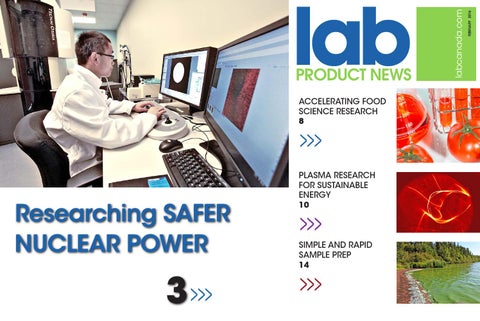
On the cover – Operator at Queen’s University’s reactor materials testing laboratory (RMTL) is studying the microstructure of a zirconium alloy with an FEI Technai Osiris transmission electron microscope. Image courtesy of Queen’s University.
Annonce_uk_276x210:Mise en page 1
4/02/14
12:35
Page 1
www.goodfellow.com
Metals and materials for research 70 000 PRODUCTS
SMALL QUANTITIES
Goodfellow Cambridge Limited Ermine Business Park Huntingdon PE29 6WR UK Tel: 0800 731 4653 or +44 1480 424 800 Fax: 0800 328 7689 or +44 1480 424 900 info@goodfellow.com
FAST DELIVERY
CUSTOM FABRICATION
ON-LINE CATALOGUE
page page73
Industry News
NEW LAB STUDIES SAFER NUCLEAR POWER
A
$17-million reactor materials testing laboratory (RMTL) opened recently at Queen’s University’s Faculty of Engineering and Applied Science. Using a proton accelerator, researchers will investigate
how materials respond to stress and temperature inside a nuclear reactor, leading to the safer and more efficient design and maintenance of
>>>
At the opening, l –r: Rick Holt, emeritus professor, Queen’s University; Mitch Mattucci, MASc candidate in Dept Mechanical and Materials Engineering, Queen’s University; and Dr. Basma Shalaby, president, University Network of Excellence in Nuclear Engineering. They are standing beside the target vacuum chamber at the end of the accelerator beamline. Image courtesy of Queen’s University.
February 2016
>>> INDEX
INDUSTRY NEWS
FOOD & BEVERAGE RESEARCH
GREEN ENERGY
MICROSCOPY
SAMPLE PREP
LAB PRODUCTS
Quality
in product
precision in process
strength in people
• Extensive application experience. • Laboratory layout, design and planning capabilities. • Excellent on time delivery performance. • Extensive line of high quality flexible, mobile & fixed laboratory furniture systems. • Standard, “high performance” & custom fume hoods all designed for wide variety of laboratory applications. • Ability to meet customers’ exact needs including special requirements. • Canada wide coverage. mADE IN CANADA
...more than just laboratory furniture
So when you require a solution to your laboratory needs ... think of... 5230 south service road, Burlington on l7l 5K2 phone: (905) 331-1877 3110 avenue Francis-hughes, laval, Quebec h7l 5a7 phone: (450) 663-2525
www.mottlab.com For more details click # 113 on www.labcanada.com/rsc
page page94
Industry News
the reactors. The lab is being led by Mark Daymond, NSERC/UNENE industrial research chair in nuclear materials, and Canada research chair in mechanics of materials. Similar accelerators are quite common around the world. However, the combination of RMTL’s dedicated capabilities and the strong nuclear materials research group at Queen’s, which has been assembled under the Industrial Research Chair program to exploit these capabilities, sets this lab apart, according to Daymond. “The uniqueness of this facility is a testament to the innovative approaches being used by the Faculty of Engineering and Applied Sci-
>>>
Micromaterials nanotester system. Image courtesy of Queen’s University.
February 2016
>>> INDEX
INDUSTRY NEWS
FOOD & BEVERAGE RESEARCH
GREEN ENERGY
MICROSCOPY
SAMPLE PREP
LAB PRODUCTS
Vacuum Pump Sales & Repair • Only certified Oerlikon Leybold Vacuum Repair Facility in Canada • Fully equipped state-of-the-art vacuum pump repair facility • Servicing all major makes and models • Consistent, high-quality repairs with fast turnaround to get you up and running • We can also provide consultation on your pump system requirements • Free pick-up and delivery in the GTA
Providing Technology Solutions
Intlvac Inc. 247 Armstrong Ave, Halton Hills, ON, L7G 4X6 P: 905.873.0166 TF: 800.959.5517 www.intlvac.ca
FreeStyle ( Bee Free! ) Let FreeStyle Automated Sample Clean-up system do all the busy work. SPE, GPC, Immunoaffinity Columns, Concentration & Fractionation. Flexibility in the lab that frees-up time for you! www.pickeringlabs.com
CATALYST FOR SUCCESS
page 5
Industry News
ence to enable world-leading research and to educate our students,” he said. “Internationally there is a worldwide resurgence of investment in nuclear power,” said Kimberly Woodhouse, dean, Faculty of Engineering and Applied Science.“This is an exciting opportunity for the Faculty of Engineering and Applied Science and our students, particularly our graduate students who now have access to a world-class facility in which to con-
>>>
duct their research.”
Operator is studying the microstructure of a zirconium alloy with an FEI Technai Osiris transmission electron microscope (TEM). Image courtesy of Queen’s University. February 2016
>>> INDEX
INDUSTRY NEWS
FOOD & BEVERAGE RESEARCH
GREEN ENERGY
MICROSCOPY
SAMPLE PREP
LAB PRODUCTS
Industry News
Partners in the project include McMaster University, Western University, Royal Military College, University of Toronto, the Ontario Institute of Technology, Imperial College, Manchester University (UK), Pennsylvania State University, and the Australian Nuclear Science and Technology Organization. The project was endorsed by Ontario Power Generation Inc., the CANDU Owners Group Inc., the University Network of Excellence in Nuclear Engineering (UNENE) and Atomic Energy of Canada Limited (now Canadian Nuclear Laboratories).
Outside the new RMTL lab. Image courtesy of Queen’s University.
Visit us on line www.labcanada.com INDEX
INDUSTRY NEWS
FOOD & BEVERAGE RESEARCH
GREEN ENE
>>>
ERGY
page 6
Industry News
Awards salute women in science
S
even Canadian women researchers have been awarded top honours under the L’Oréal Canada for Women in Science Program with the support of the Canadian Commission for UNESCO. The partners
also launched a new program called L’Oréal Canada for Girls in Science, an initiative to encourage high school girls to pursue careers in science. “The 2015 winners of the L’Oréal Canada For Women in Science Program fellowship embody the values of excellence, hard work, and innovation we want to encourage and support, in cooperation with the Canadian Commission for UNESCO,” said Frank Kollmar, president & CEO, L’Oréal Canada. The 2015 L’Oréal-UNESCO Excellence in Research fellowships, worth $20,000 each, are aimed at supporting major projects carried out by Canadian women conducting postdoctoral research. Recipients are Dr. Alicja Gasecka, physics, optics, and microscopy, neuroscience postdoctoral fellow, Centre de recherche de l’Institut universitaire en santé mentale de Québec, Université Laval; and Dr. Kathryn Hargan, W. Garfield Weston postdoctoral fellow for northern research, University of Ottawa. Recipients of $5,000 France-Canada Research Fund fellowships are Megan Eva, human genetics, McGill University; and Nausheen
>>>
February 2016
>>> MICROSCOPY
SAMPLE PREP
WHAT’S NEW IN LAB PRODUCTS
Industry News
Sadiq, analytical chemistry, Queen’s University; and the recipient of a $5,000, 2015 L’Oréal-UNESCO For Women in Science – NSERC Postdoctoral Fellowship Supplement is Michelle Annett, NSERC postdoctoral fellow, DGP Lab at the University of Toronto and User Interface Group at A utodesk Research. Also honoured were two Canadian women scientists through the international For Women in Science Program for their noteworthy achievements. Professor Molly S. Shoichet of the University of Toronto was selected as one of five global laureates for her work in polymer chemistry, and University of Toronto postdoctoral fellow Vanessa D’Costa took home one of fifteen fellowships awarded to young talent.
Nausheen Sadiq, B. Mario Pinto, Vanessa D’Costa, Christina Cameron, Megan Eva, Nicolas Chapuis, Jean-Christophe Auffray, Michelle Annett, Mona Nemer, Paul Davidson, Kathryn Hargan, Alicja Gasecka, Frank Kollmar. Credit: CNW Group/L’Oreal Canada Inc.
Visit us on line www.labcanada.com INDEX
INDUSTRY NEWS
FOOD & BEVERAGE RESEARCH
GREEN ENE
>>>
ERGY
page 7
New health sciences building breaks ground
T
he groundbreaking recently took place for a new $52-million Health Sciences Building at Carlton University. The seven-storey, 120,000-sq-ft building designed by Montgom-
ery Sisam and NXL Architects will house neuroscience and a new health sciences department. Occupancy is set for August 2017. The facility will include open-concept research labs the university says will encourage interdisciplinary collaboration and closer interactions within departments. Collaborations will include topics such as infectious and chronic diseases, prenatal influences and healthy aging. “The idea is that many researchers will be sharing those large spaces,” said John Stead, chair of the department of neuroscience.“It will make it easier for research groups to expand and contract over time. Because we are all going to be working in that same space, it will make cross-pollination Dignitaries gather for the groundbreaking in December 2015. Photo credit: Justin Tang.
between labs and r esearchers much easier.” February 2016
>>> MICROSCOPY
SAMPLE PREP
WHAT’S NEW IN LAB PRODUCTS
Food & Beverage Research
Accelerating FOOD SCIENCE Research Food and beverage organizations are challenged by short product lifecycles requiring continuous, rapid innovation while ensuring high quality. This article looks at how food scientists are improving R&D efficiency, collaborating more effectively, enhancing quality and accelerating innovation through the use of cost-effective electronic lab notebooks (ELNs). BY DANIELA JANSEN, PH.D., DASSAULT SYSTĂˆMES BIOVIA
Visit us on line www.labcanada.com INDEX
INDUSTRY NEWS
FOOD & BEVERAGE RESEARCH
GREEN ENE
>>>
ERGY
page 8
F
ood and beverage (F&B) companies today must innovate continuously – in fields and seed research labs where tomatoes and potatoes are bred and grown; in kitchens and dairies where recipes
are developed, tested and tasted; and in production facilities where new sauces, yogurts and cheeses are created. Most importantly, food scientists must respond to new market opportunities, constantly shifting consumer demands and competitive challenges as quickly as possible while also delivering the highest quality products to consumers. The most successful companies are those that can capitalize on a marketplace whim by moving new or enhanced products from early research to store shelves in just months. To collaborate more efficiently and productively in this “pressure cooker” environment, food scientists are moving from paper lab notebooks to flexible electronic lab notebook (ELNs) systems that help drive continuous, rapid innovation and improved research efficiency, quality and compliance. As well as making experimental information easier to read, search, share and reuse, ELN systems can also be both cost-effective and easy to deploy and use across global sites. The ultimate goal is a fully integrated scientific enterprise where information flows from early food research to QA/QC testing, scaleup, manufacturing and distribution as seamlessly as possible. What are the most important capabilities of a truly valuable ELN for food scientists today? Of course, every F&B organization
>>>
February 2016
>>> MICROSCOPY
SAMPLE PREP
WHAT’S NEW IN LAB PRODUCTS
Food & Beverage Research
will have its own needs, but 足several key benefits typically follow from a 足successful paper-to-ELN transition. Powerful searching Digitizing data is meaningless if scientists cannot find and share information quickly. An ELN that keeps information locked within departments or disciplines (such as chemistry data that is only available to chemists, but not process engineers, and vice versa) only offers minimal value. A good ELN will include search functionality capable of mining all kinds of scientific data relevant to R&D including text, images and chemical 足formulas, and the ELN should make this information accessible to a broad array of organizational stakeholders from research to commercialization. This capability turns tribal knowledge into valuable corporate capital that can be mined by the entire organization. Collaborative knowledge sharing Improved knowledge sharing is a major reason for shifting from paper notebooks to ELNs. The ability to search experiments to see what has been done before enables scientists to benefit from the collective wisdom of their corporate peers. These collaborative insights can help not only with creating new products, but with troubleshooting product problems with customers; reformulating existing products to make them better, different or less expensive to produce; or selecting product concepts that will be Visit us on line www.labcanada.com INDEX
INDUSTRY NEWS
FOOD & BEVERAGE RESEARCH
GREEN ENE
>>>
ERGY
page 9
most profitable or productive. The same ideas tend to be tried over and over in the F&B sector. It is important to have a centralized digital information repository that is accessible to everyone through a simple search. Streamlined reporting Instead of sending reports and other experimental information back and forth via email, the ELN makes it possible to track entire experiments in a single place by linking to experimental pages created by other scientists, chefs or engineers. For example, a food scientist who has developed a new process for producing bacteria can document the fermentation steps, how to grow the culture, the optimal method to produce it – and the calculations can link directly to the results that an analytical chemist has reported in his notebook. Improved quality The demand for better quality food products is increasing and regulatory requirements are becoming more stringent. To ensure compliance with international food regulations, high-quality products and consumer safety, F&B organizations need to support quality processes and data integrity more than ever before. ELNs ensure the integrity and traceability of all laboratory data by supporting managed data access and audit trails documenting the time the data or content were recorded, by whom and any
>>>
alterations of entries.
February 2016
>>> MICROSCOPY
SAMPLE PREP
WHAT’S NEW IN LAB PRODUCTS
Food & Beverage Research
Fast, simple deployment The fast pace of the product development lifecycle in the F&B industry means rapid time-to-value for an ELN deployment is absolutely critical. No scientist wants to be hamstrung by an IT project that drags on for months. Today’s proven off-the-shelf ELN solutions do not require extensive customization or IT resources to implement. They can be simple to deploy, easy to adapt and scale as needed, and they do not require extensive training to get end-users up and running. In addition, cloud-based options offer fast time-to-value by eliminating the installation step completely. An Internet connection and a computer or mobile device is usually all that is needed to get started. Today’s digital laboratory is perfectly suited to the needs of fast-paced F&B companies where product development times can be as short as a few months and product lifecycles only a couple of years. Electronic lab notebooks are the backbone of the digital lab. Perhaps more than any other scientific tool, they are helping food scientists to deliver highquality products that keep pace with today’s kaleidoscopic consumer expectations. About the author: Daniela Jansen, Ph.D., is senior product marketing manager at Dassault Systèmes BIOVIA, an organization that provides a scientific collaborative environment for advanced biological, chemical and materials experiences supporting science- and process-based industries. She has more than 20 years of experience in laboratory informatics and instrumentation, with expertise in 21CFR Part 11 compliance and Lean Six Sigma. Visit us on line www.labcanada.com INDEX
INDUSTRY NEWS
FOOD & BEVERAGE RESEARCH
GREEN ENE
>>>
ERGY
page 10
Green Energy
Plasma research for SUSTAINABLE energy Wendelstein 7-X, the world’s largest stellarator-type fusion device, is located at Germany’s Max Planck Institute for Plasma Physics and will help to investigate the suitability of this type of device for sustainable power generation. Its first experimental helium plasma was produced in December with a system that includes highly specialized vacuum technology. The first plasma generated in the Wendelstein 7-X stellarator. It consisted of helium and reached a temperature of about one million degrees Celsius. Copyright Max-Planck for Plasma Physics, IPP
>>> February 2016
>>> MICROSCOPY
SAMPLE PREP
WHAT’S NEW IN LAB PRODUCTS
Green Energy
T
he first helium plasma was successfully generated at the Max Planck Institute for Plasma Physics (IPP)’s Wendelstein 7-X nuclear fusion reactor on December 10 2015, after more than ten years of
construction and preparation. With the generation of this plasma, the researchers of the IPP succeeded in taking the world’s largest fusion plant of the stellarator type into pilot operation. After all the years of construction work and more than a million assembly hours, the main assembly of the Wendelstein 7-X was completed in April 2014. Operational preparations then began. Each technical system was tested in turn: the highly specialized vacuum system in the vessels, the cooling system, the superconducting coils and the magnetic field they produce, the control system, as well as the heating devices and measuring instruments. On December 10, the operating team started up the magnetic field
Inside view of the stellarator.
Copyright Max-Planck for Plasma Physics, IPP
and initiated
Visit us on line www.labcanada.com INDEX
INDUSTRY NEWS
FOOD & BEVERAGE RESEARCH
GREEN ENE
>>>
ERGY
page 11
the computer-operated experiment control system. It fed one milligram of helium gas into the evacuated plasma vessel, switched on the microwave heating for a short 1.3 megawatt pulse – and the first plasma could be observed by the installed cameras and measuring devices. “We’re starting with plasma produced from the noble gas helium. We’re not changing over to the actual investigation object, a hydrogen plasma, until next year,” said Professor Thomas Klinger, the project leader.“This is because it’s easier to achieve the plasma state with helium. In addition, we can clean the surface of the plasma vessel with helium plasmas.” The first plasma in the machine had a duration of one tenth of a second and achieved a temperature of around one million degrees. “We’re very satisfied,” said Dr. Hans-Stephan Bosch, whose division is responsible for the operation of the Wendelstein 7-X, at the end of the first day of experimentation.“Everything went according to plan.” The next task will be to extend the duration of the plasma discharges and to investigate the best method of producing and heating helium plasmas using microwaves. Confinement studies are now continuing, which will prepare the way for producing the first plasma from hydrogen. Ultimately it is hoped this technology will play an important role as an ecofriendly energy supply. One contribution to the successful implementation of this innovative concept can be attributed to the implementation and maintenance of the vacuum systems in use since the early stages of the project.
>>>
February 2016
>>> MICROSCOPY
SAMPLE PREP
WHAT’S NEW IN LAB PRODUCTS
Green Energy
From the start, Cologne-based high tech vacuum developer Oerlikon Leybold Vacuum GmbH has been supplying the IPP with these specialized vacuum systems. The vacuum systems encompass high vacuum, forevacuum, cryogenics and leak detectors.“The installed forevacuum pumping systems are used to start pumping the stellarator and enable the operation of the turbomolecular high vacuum pumps like the Turbovac MAG 2000 W, which are used to recuperate the helium in use,� said Dr. Michael Pschyrembel, who is responsible for the project for Oerlikon Leybold Vacuum. The demands are enormous, as the generation of helium plasma is only feasible with temperatures of several million degrees Celsius. To achieve this, the particle mixture of ions and electrons must be held by magnetic fields in order to ensure contact-free floating within the vacuum vessel. The ring of 70 superconducting, 3.5-meterhigh solenoids, surrounded by an annular steel shell, is The COOLVAC 60000 cryogenic high vacuum pump. Copyright Oerlikon Leybold Vacuum
the heart of the plant. In its evacuated interior, the coils are
Visit us on line www.labcanada.com INDEX
INDUSTRY NEWS
FOOD & BEVERAGE RESEARCH
GREEN ENE
>>>
ERGY
page 12
cooled down to superconducting temperatures close to absolute zero, so that the energy consumption after creation of the magnet field is minimal. This successful achievement represents only the beginning of a series of experiments. “In 2016, we will face some challenges, but eventually we will change to the actual research subject, the hydrogen plasma,” said Professor Dr. Thomas Klinger, project manager of the IPP.“Then it will really get hot, because hydrogen plasma is ignited only when temperatures reach more than 100 million degrees Celsius.” “This success makes us proud and shows once again that our technologically leading vacuum solutions contribute to basic research and pave the way for groundbreaking results,” said Dr. Martin Füllenbach, CEO of Oerlikon Leybold Vacuum.
February 2016
>>> MICROSCOPY
SAMPLE PREP
WHAT’S NEW IN LAB PRODUCTS
Microscopy
RAMAN MICROSCOPE helps art conservation Renishaw recently reported on how its Raman microscope assists in the conservation work of the Rijksmuseum in Amsterdam, the Netherlands.
T
he Rijksmuseum is the iconic museum of the Netherlands and in 2013, following extensive renovation and restoration, it re-opened its doors to the public. At the museum, art and history take on a new
meaning for a broad-
Jolanda van Iperen, from Department of the Rijks with the Renishaw inVia
based, contemporary national and international audience. As a national institute, the Rijksmuseum offers a representative overview of Dutch art and history — from the Middle Ages to the 20th century — and of major aspects of European and Asian art. The Rijksmuseum has Visit us on line www.labcanada.com INDEX
INDUSTRY NEWS
FOOD & BEVERAGE RESEARCH
GREEN ENE
>>>
page 13
a long history and not only keeps artistic and historical objects, but also conserves, restores, researches, prepares and presents them, both on its own premises and elsewhere. Jolanda van Iperen works as a research technician in the Conservation Department of the Rijksmuseum, where she carries out technical research on objects of art. She is involved in several research projects, including studies of red ground paint layers, chalk in frames and showcase materials. She works in collaboration with the Faculty of Humanities at the University of Amsterdam and with the research centre of the Dutch Cultural Heritage Agency. Her main interest is understanding
m the Conservation smuseum inAmsterdam, a Raman microscope.
ERGY
material use in the context of history, and unravelling the underlying chemical processes. They use several analytical techniques, including micro Raman spectroscopy, to solve research questions. Raman can solve a multitude of questions such as: Which pigments did the painter use? What is the corrosion product in the damaged part of the enamel? Does the treatment of this bronze leave residues on the surface? From where does the clay in the ceramic object originate? The Conservation Department purchased a Renishaw inVia confocal Raman microscope equipped with a polarized light microscope and 785 nm and February 2016
>>> MICROSCOPY
SAMPLE PREP
WHAT’S NEW IN LAB PRODUCTS
Microscopy
532 nm lasers. The polarized light microscope is essential for this work as cross sections of paint layers, which typically consist of multiple coloured pigment grains, are impossible to visualize in reflected light with bright field illumination only. By using Raman spectroscopy in combination with other analytical techniques, they are able to find relationships between contemporary artists’ use of paint materials. This includes, for example, discovering whether artists worked in the same workshop or shared their knowledge or materials. Speaking about their use of the inVia, van Iperen says,“We like the polarized light option and we are also impressed with the sensitivity of the system, the reproducibility of the results and the stability of the 532 nm laser. I am very much looking forward to starting to use our recently purchased steerable arm with which we can directly analyze the surfaces of paintings.” The Rijksmuseum in Amsterdam.
Visit us on line www.labcanada.com INDEX
INDUSTRY NEWS
FOOD & BEVERAGE RESEARCH
GREEN ENE
>>>
ERGY
page 14
Sample Prep
Simple and Rapid SAMPLE PREP Scientists at the University of Connecticut developed a simple and rapid sample preparation method for the detection and quantification of algal toxins in surface water. BY ANTHONY A. PROVATAS, ALIAKSANDR V. YEUDAKIMAU, ELIZABETH GUERRERA, EMMA GATLEY, JAMES D. STUART, CHRISTOPHER R. PERKINS, ALISON WAKE
Introduction Lakes of the Northern United States have recently seen a rise in occurrences of cyanobacteria blooms which can generate cyanotoxins in
>>>
February 2016
>>> MICROSCOPY
SAMPLE PREP
WHAT’S NEW IN LAB PRODUCTS
Sample Prep
the presence of warming environmental conditions. With surface water a major source of drinking water, the presence of cyano bacterial blooms pose a potential threat to human health. Pilot studies have been implemented in order to develop suitable analytical methods for fast screening and quantification of individual toxic compounds.
Figure 1. Genevac EZ-2 Evaporator
Several non-spectroscopic methods are currently used for the detection of algal toxins, including microcystins (MCs) and anatoxins, which are responsible for health issues. These include the protein phosphatase inhibition assay and enzymelinked immunosorbent assay (ELISA). More recently, high performance liquid chromatography-tandem mass spectroscopy (HPLC-MS/MS) has become the method of choice for the analysis of specific MCs and other Visit us on line www.labcanada.com INDEX
INDUSTRY NEWS
FOOD & BEVERAGE RESEARCH
GREEN ENE
>>>
ERGY
page 15
toxic metabolites. Ultra-high performance liquid chromatography (UPLC) has been found to improve the overall analytical method further with improved analyte separation, sensitivity and increase the speed of analysis. The majority of published studies utilize solid-phase extraction (SPE) as a sample preparation technique, however, the process can be very time consuming. Direct solvent evaporation utilizing the GeneVac EZ-2 evaporator was therefore evaluated as a means to reduce lengthy sample preparation process and to improve efficiency. A series of lake water samples were analyzed for the presence of four microcystins and anatoxin-a by UPLC-MS/MS. A novel direct evaporation method of sample preparation was evaluated and compared to SPE methods. Method Mass spectrometric conditions were optimized to maximize the sensitivity and selectivity of the targeted analytes. Standards and Calibration Solutions: Stock solutions of MCs and anatoxin-a were prepared in methanol at a concentration of 1.0 µg/mL. Calibration standards of 100, 50, 25, 5, and 0.5 ng/mL were prepared from the original stock by serial dilution. A surrogate compound (SUR), Leucine enkephalin acetate salt hydrate, was prepared in original stock and spiking solutions at a 0.9 mg/mL and
>>>
1.0 µg/mL, respectively.
February 2016
>>> MICROSCOPY
SAMPLE PREP
WHAT’S NEW IN LAB PRODUCTS
Sample Prep
Stock and spiking solutions of ketoprofen-d3 for use as internal standard (IS) were prepared at 1.0 mg/mL and 1.0 µg/mL, respectively. Quality Control Samples: A set of quality control samples were prepared: — Laboratory control sample (LCS): LC-MS grade water spiked with SUR and all analytes of interest at concentration of 1.25 ng/mL for all — Matrix blank (MBK): LC-MS grade water spiked with SUR compound at 1.25 ng/ml — Calibration verification (CV): analyte standard at 50 ng/mL — System blank (SBK): LC-MS grade acetonitrile solvent Sample Preparation: SPE method (non-acidic) – Unfiltered samples were subjected to an autoclave process and filtered to remove particulates. A 200 mL aliquot of each water sample was extracted in triplicate using either Waters HLB (200 mg, 6cc) or a Biotage-Isolute C-18 (1 g, 6cc) SPE cartridges using identical methods [1]. All samples were spiked with SUR (1.25 ng/mL final concentration) and gently mixed by hand. The cartridges were pre-conditioned with methanol followed by UPLC grade water. Samples were loaded on the cartridges at a rate of ~ 5 mL/min and the analytes were eluted with 2.0 mL of methanol. The extracts were concentrated down to 1.0 mL under gentle nitrogen flow (~180 mL/min), spiked with IS and transferred into LC vials for subsequent analysis by UPLC-MS/MS. Visit us on line www.labcanada.com INDEX
INDUSTRY NEWS
FOOD & BEVERAGE RESEARCH
GREEN ENE
>>>
ERGY
page 16
Direct Evaporation – Unfiltered samples were subjected to an autoclave process and filtered to remove particulates. A 20 mL aliquot of each water sample was pipetted into individual 50 mL glass tubes. All samples were spiked with SUR (1.25 ng/mL final concentration) and gently mixed by hand. This was followed by automatically evaporating water samples to dryness using the Genevac EZ-2 evaporator (Figure 1) using the aqueous setting. The residues were then reconstituted in 500 µL of methanol, spiked with the IS at a concentration of 50 ng/ mL and sonicated for 5-10 seconds. Each sample was transferred into LC vials for subsequent analysis by UPLC-MS/MS. UPLC and Mass Spectrometric Conditions – Quality control and water samples were analyzed using a Waters Acquity UPLC coupled with an Acquity TQD tandem mass spectrometer. SBK was periodically run between samples to monitor any analyte carryover. Results When utilizing non-acidic SPE methods, unusually high recoveries for most microcystins were initially obtained (Table 1). It was observed that the introduction of water to the final solution contributed to this elevation. An attempt to improve analyte recoveries by varying the methanol/water ratio of the final solution was made. However, the targeted ratio was hard to maintain, mainly due to water being a sample matrix, and even the
>>>
February 2016
>>> MICROSCOPY
SAMPLE PREP
WHAT’S NEW IN LAB PRODUCTS
Sample Prep
smallest deviation was found to influence analyte recoveries. In contrast, the direct evaporation procedure, utilizing the Genevac EZ-2, both simplified sample preparation and eliminated variability in percent water of the final solution. All samples were brought to complete dryness with methanol chosen as the final reconstitution solvent. Method detection limit, precision and accuracy studies were conducted with results shown in Table 2. The limit of detection for all analytes was Table 1. SPE recovery results Anatoxin-a MC-LA MC-LR % recovery, 77.9 +/– 14.7 46.5 +/– 8.9 192 +/– 7.0 Waters HLB % recovery,
123 +/– 7.1
MC-RR MC-YR 266 +/– 2.6 172 +/– 7.9
18.9 +/– 26.7 74.8 +/– 28.1 119 +/– 25.5 77.9 +/– 44.1
BiotageIsolute C-18 Table 2. Direct evaporation: limits of detection, recovery, precision and accuracy study results. Anatoxin-a Detection limit study (n=7) Concentration 0.50 (ng/ml) % Recovery Method
MC-LA
MC-LR
MC-RR
MC-YR
0.50
0.50
0.50
0.50
95.4 +/– 5.0 81.4 +/– 9.6 67.1 +/– 15.8 129 +/– 8.5 85.1 +/– 8.9 0.0745 0.123 0.167 0.172 0.118
detection limit Precision and Accuracy study (n=4) Concentration 1.25 1.25 (ng/ml) % Recovery
111 +/– 3.5
1.25
1.25
75.2 +/– 3.2 103 +/– 1.8
1.25
113 +/– 2.2 80.0 +/– 7.5
Visit us on line www.labcanada.com INDEX
INDUSTRY NEWS
FOOD & BEVERAGE RESEARCH
GREEN ENE
>>>
ERGY
page 17
excellent and over a range of calibration standards (0.5-100 ng/mL) good correlations were obtained. Recoveries for SUR and QC samples were good, with correlation between analytical batches being within acceptable ranges. Results for QC samples can be seen in Table 3. For system and method blank samples results were below detection limits, signifying that neither matrix contribution to signal enhancement nor analyte carryover were an issue. Elevated recoveries (> 100%) were observed in some LCS and CV standards subjected to direct evaporation. It was concluded that analyte degradation had occurred over the study period (three weeks), as has been previously described. We therefore advise that new calibration standards be prepared weekly from stock solution which had been stored at -20°C. Excellent correlation was still obtained however, between the CV and LCS for target analytes (with the exception of MC-RR), indicative of
>>>
Table 3. Direct evaporation QC sample results. Average recoveries with relative standard deviation. (ND = non detected) Anatoxin-a MC-LA MC-LR MC-RR Calibration 122 +/– 3.5 126 +/– 11.8 88.5 +/– 11.7 99.7 +/– 1.8 Verification Laboratory
129 +/– 1.5 128 +/– 6.1
MC-YR 83.5 +/– 6.6
88.9 +/– 7.8
71.8 +/– 13.0 81.3 +/– 30.1
Control Sample Matrix Spike 63.4
75.0
62.0
71.8
67.6
Sample System Blank Method Blank
ND ND
ND ND
ND ND
ND ND
ND ND
February 2016
>>> MICROSCOPY
SAMPLE PREP
WHAT’S NEW IN LAB PRODUCTS
Sample Prep
analyte stability during the evaporation step. For the preliminary 14 water samples tested, all MCs were below the level of concern (< 1.0 μg/mL) with only MC-RR being detected. Conclusion It has been shown that the direct evaporation sample preparation method has distinct advantages over solid phase extraction by eliminating the sample clean-up step, improving reproducibility, decreasing analysis time, minimizing waste generation and being more cost effective. In addition, minimal sample handling was required, reducing the risk of cross contamination and analyte loss. This method has been validated by testing a set of fresh water samples, detecting total microcystin-RR at trace level concentrations with all QCs results within expected criteria. Analyte sublimation or degradation was minimal for this method and as a result, recoveries for all analytes were excellent. Consequently, this methodology has been successfully utilized in routinely screening surface water samples with various MCs detected and reported in approximately 30% of the samples. Note: The information presented in this paper does not constitute an endorsement of any instrument, consumable or manufacturer by the authors, university, or the state of Connecticut.
Visit us on line www.labcanada.com INDEX
INDUSTRY NEWS
FOOD & BEVERAGE RESEARCH
GREEN ENE
>>>
ERGY
page 18 About the authors Anthony A. Provatas, Aliaksandr V. Yeudakimau and Christopher R. Perkins are with the Center for Environmental Sciences and Engineering at the University of Connecticut, USA. Elizabeth Guerrera and Emma Gatley are with the Department of Chemistry at the University of Connecticut, and Alison Wake is with Genevac Ltd, Ipswich UK. James D. Stuart is with the Center for Environmental Sciences and Engineering and the Department of Chemistry at University of Connecticut. Reference 1. Provatas A.A., Yeudakimau A.V., Guerrera E., Gatley E., Stuart J.D. and Perkins C.R. Rapid Screening and Quantitative Determination of Algal Toxins in Surface Water Samples by Direct Evaporation and UPLC-MS/MS Analysis; Trends in Chromatography, Vol 9, 2014.
February 2016
>>> MICROSCOPY
SAMPLE PREP
WHAT’S NEW IN LAB PRODUCTS
WHAT’S NEW IN LAB PRODUCTS
Easy aspiration of biological liquid waste The Vacusip is a portable bench-top vacuum aspiration system that can be placed where needed. Besides increasing mobility, the battery version makes it suitable for use in a Class II safety cabinet. Typical applications include aspirating small volumes of liquid out of microcentrifuge tubes or microplates. Integrated pump runs silently and stops automatically when the vacuum is established. Integra Biosciences www.integra-biosciences.com/ sites/vacusip.html
Flexible AFM can track dynamic processes
The NanoWizard 4 NanoScience atomic force microscope (AFM) features a powerful fast scanning option that delivers images every three seconds, enabling users to track dynamic processes. Quantitative imaging is possible with very high resolution. The system provides specific solutions for mechanical and electrical sample characterization and delivers flexible, advanced research capabilities that address the increasingly complex challenges faced by materials scientists. JPK Instruments http://www.jpk.com/ Visit us on line www.labcanada.com INDEX
INDUSTRY NEWS
FOOD & BEVERAGE RESEARCH
GREEN ENE
>>>
ERGY
page 19
Halogen moisture analyzer is convenient, robust The HC103 halogen moisture analyzer measures moisture content in minutes, enabling fast response times for quality control and in-process control. A large colour touchscreen, graphical user guidance and real-time drying curve make it easy to use, even for untrained operators. Easy to use for operators who can access drying methods directly from the home screen with a single click. Mettler Toledo www.mt.com/moisture
Digital flowmeter is simple to program
Offering the flexibility of panel, wall or surface mounting, the Pulsite Solo batterypowered rate and total flowmeter is intended for use with switch, coil and magnetic sensor inputs. With housing constructed from durable polymer, and sealed to IP65 specifications, the flowmeter can be used in many different operating environments. Programming is simple with two push buttons and logical prompts on the LCD display. Titan Enterprises Ltd. www.flowmeters.co.uk February 2016
>>> MICROSCOPY
SAMPLE PREP
WHAT’S NEW IN LAB PRODUCTS
WHAT’S NEW IN LAB PRODUCTS
Crossflow filtration system for process development
Bench-top crossflow filtration system is for optimized for ultra- and diafiltration applications. The Sartoflow Smart system is suitable for many downstream processes, such as purification of vaccines, monoclonal antibodies and recombinant proteins, as well as laboratory process development and clinical trials and cGMP environments. Comes equipped with a low shear 4-piston membrane pump enabling high product yields. Sartorius www.sartorius.com
Magnetometer offers enhanced performance Vibrating sample magnetometer offers higher field strengths and enhanced performance for demanding magnetic material characterization applications. The 7400-S Series VSM combines high sensitivity, precision electronics and flexible software with the ability to characterize temperature dependence of magnetic material properties over a wide 4.2 K to 1273 K temperature range. Lake Shore Cryotronics http://www.lakeshore.com/products/ Vibrating-Sample-Magnetometer/ 7400-S-Series-VSM/Pages/Overview.aspx Visit us on line www.labcanada.com INDEX
INDUSTRY NEWS
FOOD & BEVERAGE RESEARCH
GREEN ENE
>>>
ERGY
page page41 20
In-line heater is fast, efficient
Small, lightweight, high-performance in-line heater is for use in medical and analytical fluid-heating applications. The Fluent heater enables on-demand heating with an ultra-fast response, leading to higher system performance. Includes an internal baffle that promotes turbulent flow and high efficiency, high watt density layered heater circuit, low profile axial lead exit and an internal thermocouple for high limit control. Watlow www.watlow.com/fluent
PUBLISHER/EDITOR
Leslie Burt (416) 510-6835 lburt@labcanada.com
LAB PRODUCT NEWS is published by Annex-Newcom L.P. CHANGE OF ADDRESS/EMAIL: Please call (416) 442-5600, ext 3548 or email mmarasigan@annexnewcom.ca for changes and updates to your subscription. Lab Product News assumes no responsibility for validity of claims in items reported.
ART DIRECTOR
Ron Taylor CIRCULATION DIRECTOR
Diane Rakoff (416) 510-5216 drakoff@annexnewcom.ca
From time to time we make our subscription list available to select companies and organizations whose products or services may interest you. If you do not wish your contact information to be made available, please contact us via one of the following methods: Phone: 1-800-668-2374; Fax: 416-442-2191; E-Mail: privacyofficer@businessinformationgroup.ca; Mail to: Privacy Officer, Annex-Newcom L.P., 80 Valleybrook Drive, Toronto, ON M3B 2S9 Produced in Canada. Digital edition:
PRESIDENT
ISSN 1923-3043
Alex Papanou 80 Valleybrook Drive, Toronto, ON M3B 2S9 Fax (416) 510-5140 Telephone direct (416) 510-6835
Member of the Member/Canadian Canadian Business Business Press Press
Visit us on line www.labcanada.com MICROSCOPY
February 2016 SAMPLE PREP
WHAT’S NEW IN LAB PRODUCTS