June 2018 An Annex Business Media Publication
Volume 30 / Issue 3
www.ippt.ca
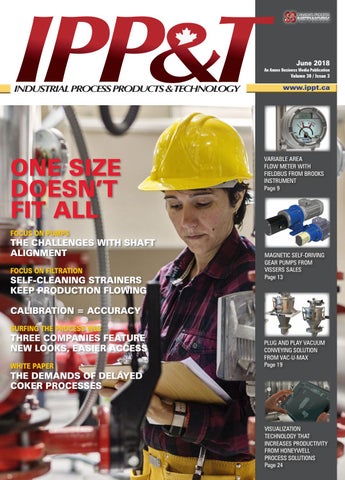
ONE SIZE DOESN’T FIT ALL
VARIABLE AREA FLOW METER WITH FIELDBUS FROM BROOKS INSTRUMENT Page 9
FOCUS ON PUMPS
THE CHALLENGES WITH SHAFT ALIGNMENT FOCUS ON FILTRATION
SELF-CLEANING STRAINERS KEEP PRODUCTION FLOWING
MAGNETIC SELF-DRIVING GEAR PUMPS FROM VISSERS SALES Page 13
CALIBRATION = ACCURACY SURFING THE PROCESS WEB
THREE COMPANIES FEATURE NEW LOOKS, EASIER ACCESS WHITE PAPER
PLUG AND PLAY VACUUM CONVEYING SOLUTION FROM VAC-U-MAX Page 19
THE DEMANDS OF DELAYED COKER PROCESSES
VISUALIZATION TECHNOLOGY THAT INCREASES PRODUCTIVITY FROM HONEYWELL PROCESS SOLUTIONS Page 24
www.ippt.ca June 2018 1
IPPT_JUNE18_BAS.indd 1
2018-05-30 10:53 AM
The Secret To Keeping Electronics Cool! NEMA 12 Cabinet Coolers
The NEMA 12 Cabinet Coolers for large heat loads up to 5,600 Btu/hr. are ideal for PLCs, line control cabinets, CCTV cameras, modular control centers, etc.
A bad choice could cost you thousands! Look Familiar?
• Measures 8” (203mm) high • Mounts top, side or bottom • Enclosure remains dust-tight and oil-tight
NEMA 4 and 4X Cabinet Coolers
NEMA 4 and 4X Cabinet Coolers for large heat loads up to 5,600 Btu/hr. They are ideal for PLCs and modular controls. • Enclosure remains dust-tight, oil-tight and splash resistant • Suitable for wet locations where coolant spray or hose down can occur
Type 316 Stainless Steel Cabinet Coolers
Type 316 Stainless Steel Cabinet Coolers for NEMA 4X applications are available for heat loads up to 5,600 Btu/hr. • Resists harsh environments not suitable for Type 303/304 • Ideal for food and chemical processing, pharmaceutical, foundries, heat treating and other corrosive environments
The Real Solution!
When hot weather causes the electronics inside a control cabinet to fail, there is a panic to get the machinery up and running again. The operator might choose to simply open the panel door and aim a fan at the circuit boards. In reality, the fan ends up blowing a lot of hot, humid, dirty air at the electronics and the cooling effect is minimal. If the machinery starts functioning again, the likelihood of repeated failure is great since the environment is still hot (and threatens permanent damage to the circuit boards). Worse yet, that open panel door is an OSHA violation that presents a shock hazard to personnel.
Stop electronic downtime with an EXAIR Cabinet Cooler® System! The complete line of low cost Cabinet Cooler Systems are in stock and can ship now. They mount in minutes through an ordinary electrical knockout and have no moving parts to wear out. Thermostat control to minimize compressed air use is available for all models. All Cabinet Coolers are UL Listed to US and Canadian safety standards.
Watch The Video!
https://exair.co/20_ccv_ad
The only compressed air powered cooler that is CE compliant!
Mini NEMA 12, 4, and 4X Cabinet Coolers
High Temperature Cabinet Coolers
Non-Hazardous Purge Cabinet Coolers
The mini NEMA 12, 4 and 4X Cabinet Coolers for small heat loads up to 550 Btu/hr. are ideal for control panels, relay boxes, laser housings, and electronic scales.
High Temperature Cabinet Coolers for NEMA 12, 4 and 4X applications are available for heat loads in many capacities up to 5,600 Btu/hr.
NHP Cabinet Coolers keep a slight positive pressure on the enclosure to keep dirt from entering through small holes or conduits. For use in nonhazardous locations.
• Suitable for ambients up to 200°F (93°C)
• Uses only 1 SCFM in purge mode
• Ideal for mounting near ovens, furnaces, and other hot locations
• For heat loads up to 5,600 Btu/hr.
• Measures 5” (127mm) high • Mounts top, side or bottom • Enclosure remains dust-tight and oil-tight
• NEMA 12, 4 and 4X If you would like to discuss an application, contact:
“It took us three days to get a replacement computer cabinet and we didn’t want to risk another heat failure. Fans weren’t an option since they would just blow around a lot of hot air. Freon-type air conditioners like those on some of our other machines were a constant maintenance project of their own. We purchased EXAIR’s Model 4330 NEMA 12 Cabinet Cooler Jeff Hauck, Lasercraft Inc. Cincinnati OH System since it was easy to install and requires no maintenance.”
SKEC_IPPT.indd 1 IPPT_June_Exair.indd 1 2 IPPT_JUNE18_BAS.indd
11510 Goldcoast Drive Cincinnati, Ohio 45249-1621 (800) 903-9247 / fax: (513) 671-3363
https://exair.co/20_440
@exair
5/16/18 10:07 AM 2018-05-18 10:54 2018-05-30 11:19 AM
l!
Volume 30 Number 3 June 2018 www.ippt.ca
CONTENTS Focus: Pumps Challenges With Shaft Alignment
6
Misalignment can result in compromised pumping system uptime, reliability and safety.
Additel 681 Digital Pressure Gauge
Additel 901 Low Pressure Test Pump
• Pressure ranges to 36,000 PSI
• Generate 6 PSI vacuum to 6 PSI pressure
• 0.025%, 0.05%, 0.1% or 0.2% FS accuracy
• Great stability and high resolution
• % pressure indication with fan-shaped graph scale for visual reference
• Minimal maintenance
• Fully temperature compensated accuracy
• Hand-tight quick connectors
• Panel mount gauges are available
• Media: Air
• CSA/FM/ATEX certified intrinsically safe
• Portable, only 3.5lbs
One Size Doesn’t Fit All A guide to selecting and sizing compressors for industrial use.
10
Additel 927 Hydraulic Pressure Test Pump • Generate 85% vacuum to 10,000 PSI pressure
Focus: Filtration
• Portable, only 7lbs
Straining for Flow Self-cleaning strainers help keep paint powder production flowing.
Additel 920 Pneumatic High Pressure Test Pump • Generate 95% vacuum to 3,000 PSI in 40 seconds • Minimal maintenance
• Minimal maintenance
• Generate 95% vacuum to 3,000 PSI in 40 seconds
• Increase and decrease pressure smoothly
• Hand-tight quick connectors
• Hand-tight quick connectors
• Weight: 14 lbs
• Media: Oil or deionized water
• Media: Air
16 Isotech milliK Precision Thermometer
Calibration Equals Accuracy
20
5 28
ge
pa he m es n-
Proper equipment calibration essential for accurate gas sample analysis.
Making a Case for Plasma Treatment Equipment By Michael Barden / PVA TePla America
• Range: -270°C to 1820°C
• Accuracy: ±0.005°C (±5mK) full range for PRTS
• Temperature Range: -25°C to 140°C (Hyperion), 35°C to 250°C (Drago)
• Full colour graphical display
• 65mm (2.5”) Diameter Calibration Volume
• Store up to 180 days of measurements
• Portable Liquid Bath or Dry Block
• 4 AA batteries or universal power supply
• Calibrates All Sensor Types • Windows Software and PC Interface
Michell Instruments MDM300 & MDM300 I.S. Dew Point Hygrometers
Departments Feature Products White Paper Process Websites Process News CPCA Corner Advertiser Index
• 6 Calibrators in one
• Resolution: 0.0001°C (0.1mK)
Engineers Can Play a Role in Lowering Costs By Donald Horne / IPP&T
9, 13, 19, 24 22 26 27 29 30
Isotech Isocal 6 Multi-Bath Temperature Calibration System
• Range: -100ºC to 20ºC Dew Point • Operating Pressure: 6,000 PSI max. with External Sensor Sampling System • Data logging • CSA/FM/ATEX approved • Increases Protection: NEMA 4 • 4-20mA external device input for transmitter calibration and validation • Lightweight: less than 1.5kg
Beamex MC6 Advanced Field Calibrator & Communicator
• High-accuracy calibrator for pressure, temperature and electrical signals
• Full multi-bus communicator for HART, Foundation Fieldbus and Profibus PA instruments • Five operational modes: meter, calibrator, documenting calibrator, data logger and communicator • Combines advanced functionality with ease-of-use • Automates calibration procedures for paperless calibration management
ntact:
www.ippt.ca June 2018 3 IPPT_June_Arjay.indd 1
2018-05-24 11:29 AM
10:07 AM
8 11:19 AM
IPPT_JUNE18_BAS.indd 3
2018-05-30 10:54 AM
Focus: Pumps and Filtration You can’t have one without the other – at least, if you want to ensure that you don’t have problems with clogging and breakdowns. Our first article on Pumps comes from Geoff VanLeeuwen, of Blackmer and PSG, who looks at the challenges with shaft alignment and how a misalignment can result in compromised pumping system uptime, reliability and safety. Glenn Webb, also of Blackmer and PSG, explains that one size doesn’t fit all when it comes to selecting and sizing compressors for industrial uses.
Eaton Filtration provides insight on how self-cleaning strainers help keep paint powder production flowing. Dan McCarty of QED Environmental Systems shows how calibration equals accuracy when it comes to maintaining equipment for accurate gas sample analysis. Revisiting flow, ABB shares its expertise on how the timetested wedgemeter has provided flow measurement in hightemperature and high-pressure environments, with a focus on delayed coker processes. Donald Horne Editor
IPP&T - Industrial Process Products & Technology is published six times per year for the chemical process industries and other primary and secondary manufacturing industries utilizing chemicals or chemical engineering processes. Established 1987 Volume 30 Number 3 ISSN 0836-737X www.ippt.ca
Michael H. Swan Publisher / Director of Marketing 905.649.8966 mswan@ippt.ca Stephen Kranabetter Associate Publisher 416.510.6791 skranabetter@ippt.ca Donald Horne Editor 416.510.5162 dhorne@ippt.ca
We understand how you need to reduce complexities at your plant.
CLEAN PROCESS + CLEAR PROGRESS You strengthen your plant’s safety, productivity, and availability with innovations and resources.
Barb Adelt Circulation Manager badelt@annexbusinessmedia.com Glen Scholey Contributing Editor 403.995.8514 gscholey@ippt.ca Stephen Kranabetter Advertising Sales 416.510.6791 skranabetter@ippt.ca
Published by Annex Business Media 111 Gordon Baker Rd., Suite 400, Toronto, ON M2H 3R1 PUBLICATION MAIL AGREEMENT NO. 40065710 CIRCULATION email: mchana@annexbusinessmedia.com Tel: 416-510-5109 Fax: 416-510-6875 or 416-442-2191 Mail: 111 Gordon Baker Rd., Suite 400, Toronto, ON M2H 3R1 Subscription Rates Published six times per year Canada — 1 Year $103.00 CDN Outside Canada — 1 Year $178.00 USD Occasionally, IPP&T will mail information on behalf of industry-related groups whose products and services we believe may be of interest to you. If you prefer not to receive this information, please contact our circulation department in any of the four ways listed above.
Promass Q – for increased plant productivity
Annex Privacy Officer Privacy@annexbusinessmedia.com Tel: 800-668-2374
• Error-free flow measurement in custody transfer applications in mass or volume units due to unmatched accuracy for density determination • Ideal for hydrocarbons with entrained gas thanks to the patented Multi Frequency Technology (MFT) • Patented “Heartbeat Technology” for device verification during operation and permanent self-diagnostics
Opinions expressed in this magazine are not necessarily those of the editor or the publisher. No liability is assumed for errors or omissions. All advertising is subject to the publisher’s approval. Such approval does not imply any endorsement of the products or services advertised. Publisher reserves the right to refuse advertising that does not meet the standards of the publication. No part of the editorial content of this publication may be reprinted without the publisher’s written permission. © 2018 Annex Publishing & Printing Inc. All rights reserved.
Do you want to learn more? www.ca.endress.com/promass-q300
4 June 2018 www.ippt.ca IPPT_June_Endress1.indd 1
IPPT_JUNE18_BAS.indd 4
2018-05-18 1:32 PM
2018-05-30 10:54 AM
Making the Case for the ROI of Plasma Treatment Equipment Plasma treatments for surface modifications are a powerful tool, but not completely understood By Michael Barden Despite its effectiveness, plasma treatments for surface modification and chemical deposition remain less than fully understood. So, too, are the tool selection choices. For this, vendors work with customers to select equipment and help justify the ROI. Plasma treatments are a powerful technique for solving challenging surface issues whether through precision cleaning or by increasing surface wettability to promote adhesion. Plasma can also be used to deposit a wide range of chemistries onto surfaces. So, when surface challenges arise and engineers and production personnel are tasked with evaluating plasma as a possible solution, it often involves a quick immersion into the physics and chemistry behind the technology. But, it also extends to how plasma is applied to each part, the type and size of chamber, tooling options, and facility requirements. Because any investment in technology must be justified based on ROI, factors such as budget, throughput and maintenance costs, must be considered prior to equipment purchase. Therefore, whether looking to purchase equipment for full-scale manufacturing or for R&D, here are some of the key factors that should be considered when approaching an equipment vendor.
Plasma Consideration
With the right type and configuration of equipment, the collective properties of the plasma (ions, electrons and radicals) produced in the chamber can be controlled to alter the properties of surfaces without affecting the underlying materials. For example, surface etching can be achieved through pure chemical etching of the surfaces or through physical etching, or through both chemical and physical etchings. In chemical etching, plasma activated gas species attack the material surfaces forming volatile derivatives of the materials that leave the surfaces. In physical etching, ions in the plasma are accelerated towards the substrate surfaces. On their way to the substrate surfaces they may collide with other neutral atoms/ molecules to ionize them while the original ions may become neutrals. The ionized atoms/molecules start accelerating toward the substrates and the newly created neutrals continue heading toward the substrate surfaces by maintaining their pre-collision velocities. As a result large number of ions and neutral species bombard the substrate surfaces causing substrate materials to eject from the surfaces. In fact, there are so many combinations and potential chemistries involved, that equipment vendors such as PVA TePla in Corona, Calif. often reach out to customers to answer their questions and assist in the
selection of the right tool for their applications. Many customers don’t care how the plasma is generated; they care about the cost, throughput and the outcome.
Equipment Selection
Although there are atmospheric systems for inline manufacturing, the majority of plasma treatments are conducted in low pressure vacuum chambers. So, from an engineering perspective, it can be important to understand the basics of what occurs within the plasma chamber. Most low pressure plasma systems involve a chamber, vacuum pump, power supply, electrodes, the system interface and control, electrical components, gas/ monomer distribution components, and exhaust system.
The temperature requirements for the processes conducted in the chamber will determine the required maximum substrate temperature for the system. Understanding the thermal budget of the substrates may require adding a temperature controller/chiller to the system. Another key factor is whether the tool will be used for production or R&D. If for production, will it be fully automated or semi-automated? For R&D, will it be semi-automated or manual?
Facility Considerations
For production engineers, the facility considerations such as the footprint of the system, types of connections required and accessibility for maintenance are equally important.
"Understanding the budget constraints going in can help companies configure the tool based on customer prioritized process requirements." In general, these components have multiple options to accommodate the various processes that will be performed in the chamber. In other words, if the vacuum chamber will be used for chemical deposition, surface functionalization, etching or cleaning, it likely will require a slightly different gas delivery system, power generator, temperature controls or chamber pressure. There are three primary cost drivers in any plasma system – the type and size of chamber, power generator and vacuum pump. The vacuum chamber is a rigid enclosure from which air and other gases are removed by a vacuum pump. The size of the chamber is dictated by the largest size of substrate that will be processed in the chamber. This volume requirement directly influences the size of vacuum pump required. Vacuum pumps come in wet and dry configurations. Wet pumps use low vapour pressure oil to seal in gas to create vacuum and also lubricate its components. Dry pumps do not use any oil to seal in gas, but they may or may not use oil to lubricate the components. The size and speed of the pump have a direct impact on processing speed as well as actual process results that can be achieved. In addition, a whole variety of factors including size of the chamber, the distance the pump is from the chamber, the length and diameter of the hose connecting the pump and the chamber, the base processing pressure required, time required to reach the base pressure, process pressure and gas load during processing can play a role in efficiency. As for the power generator, the type and size of substrate is a determining factor. If it is a conducting substrate, a dc or rf or mw power supply can be used. Non-conducting materials require an rf or mw power supply. There can be other important considerations as well.
So, too, are the ongoing consumable costs for electricity, gas, compressed air, reagents and chemicals involved. The production volumes factor heavily in this consideration as the cost-per-piece for 100,000 parts is very different than production of 8 million parts. The duty cycle of the equipment can determine whether the most cost-effective vacuum pump option is wet or dry, for example. Estimating the number of hours each day the tool will be utilized is also important to calculate cost of ownership (COO).
Budget Considerations
Most potential customers arrive with a pre-determined budget and delivery timeline. For this reason, companies like PVA TePla prefer to understand the parameters up front so they can tailor a solution that meets the requirements and throughput of the applications. Understanding the budget constraints going in can help companies configure the tool based on customer prioritized process requirements. This may involve configuring the system to meet some of the process requirements while keeping options open for future upgrades to meet the other requirements when more money becomes available. PVA TePla America www.pvateplaamerica.com
As Head of Research & Development and Lead Scientist for PVA TePla America, Michael Barden designs and develops custom surface coatings for the medical device and electronics industry. He specializes in nanoscale plasma enhanced chemical vapor deposition (PECVD), silane chemistries and self-assembled monolayers (SAMs). www.ippt.ca June 2018 5
IPPT_JUNE18_BAS.indd 5
2018-05-30 10:54 AM
Challenges With Shaft Alignment Misalignment can result in compromised pumping system uptime, reliability and safety By Geoff VanLeeuwen, PE
The general impression is that the pumping systems used in high-volume, heavy-duty chemical fluid-transfer applications are rough-and-tumble beasts, able to – as the old Timex watch television commercials used to promise – “take a licking and keep on ticking.” In reality, they are delicate ecosystems in which all of the components must be kept in balance and operate in harmony, lest system failures and breakdowns occur that will lead to excessive downtime and repair or replacement costs. In today’s chemical-transfer universe, some estimates say that centrifugal-style pumps with motor-speed capabilities are the choice of operators as much as 75 per cent of the time in critical chemical fluid-transfer applications. However, this article will illustrate how recent advancements in the design and operation of another type of pump technology – positive displacement sliding vane – can be a more efficient, reliable and a safer option when transferring critical chemicals in both fixed and portable systems.
The Challenge
It’s an unavoidable fact of pump operation: mating shafts require alignment. Perhaps it is a direct-coupled pump with alignment between the motor and pump; or a reduced-speed pump with alignment between the gear motor and pump. In either case, a coupler or multiple couplers transfer torque from the prime mover to the pump, possibly through an intermediate speed-reduction device. Each of these components (motor, gear reducer and pump) must be accurately leveled so they align the shaft centerlines. Once leveled, each component must be carefully positioned to eliminate all angular and axial offsets. Couplings are installed only after these steps are complete.
SALES CORP
We Know Pumps!
There are many coupling types. Some couplings are more forgiving to misalignment than others, but each will fail if careful alignment procedures are not performed. This causes expensive downtime, lost reliability and increased maintenance expenses. Shaft fatigue is an additional consideration. Initially, a misaligned shaft will absorb the induced load. That load is transferred two times per revolution, which is even more significant at motor speeds of 1,800 rpm. Several hours later, that shaft has absorbed tens of thousands of cycles. Eventually, the stress from repeated load-deflection cycles will cause the shaft to fail. When the shaft breaks, the downtime is problematic for end users, because the pump unit is not moving fluid and production schedules are not met. The nirvana for pump operators is a set-and-forget system that
BELOW: Any pumps that require the mating of shafts to a gear reducer or pump motor must be aligned properly. Failure to do so will eventually lead to shaft fatigue and failure that will knock the pump out of service and halt production operations.
M-Pump
Air Operated Diaphragm Pumps
¼” through 3”
Lower Air Consumption
Energy Savings
Ease of Maintenance
Great Price
Pump Specialists
Access our complete line at:
www.VissersSales.com
Tel: 905-841-4073 Fax: 905-841-4018 1-800-367-4180 6 June 2018 www.ippt.ca IPPT_Feb_Vissers.indd 1
IPPT_JUNE18_BAS.indd 6
2018-02-02 9:20 AM
2018-05-30 10:54 AM
While many chemical fluid-transfer operations may take place in harsh environmental conditions, the pumps and systems used to facilitate product transfer are in actuality delicate ecosystems that must be kept in balance and operate in harmony. Any upset in the system - including improper shaft alignment - can result in breakdowns that can lead to excessive downtime and high repair or replacement costs.
A positive displacement sliding vane can be a more efficient, reliable and safer option when transferring critical chemicals in both fixed and portable systems.
eliminates any chance of the shafts coming out of alignment, but the reality is that there are a wide variety of things – both operationally and in the way the pump is handled – that will cause pumps to fall out of alignment. The first is vibration, which occurs whenever a pump operates. It’s undeniable that some amount of vibration will take place when a pump is running; it is when the level of vibration is excessive that components loosen and cause the shafts to come out of alignment. A second major cause of misalignment
is maintenance. When pump or system maintenance is required, the pump is often decoupled from the motor. If the reinstallation is done in haste, the pump will be out of alignment when recoupled. This could be caused by a technician that has not been properly trained, or perhaps by someone who is rushing to complete the job because he has been stretched thin. In either case, that technician will be surprised by an unexpected and urgent maintenance event when that shaft or couplings fail. Simply put, the shafts must be properly realigned every time the pump unit is maintained or relocated. The ultimate repercussion of a misaligned shaft is the shaft or the coupling will eventually break or fail, which will necessitate the need for another costly maintenance call to either repair or replace the pump, all while the downtime is hampering the producer’s ability to meet the requirements of strict production cycles. Some pump manufacturers have been able to work around vibration problems or misaligned shafts with the development of close-coupled motors, where the motor shaft also operates as the pump shaft, a design that is popular with centrifugal pumps. While this design does eliminate the need for shaft alignment, the operational window of close-coupled pumps is relatively
)ORZ 0HWHUV )ORZ 0HWHUV
-
-
Metal Tube Rotameters
ďż˝ a
Industrial Turbine Flow Meters
�j 11�;
Battery Powered Turbine Flow Meters
ďż˝ ďż˝
-
Low Cost Acrylic Rotameters
- ZZZ PXLVFRQWUROV FRP ďż˝ a
�j 11�;
ďż˝ ďż˝
Threaded and Flanged Sight Flow Indicators
-
-
�Glass Tube a
�j 11�;
Rotameters
�� � a
�j 11�;
ďż˝ ďż˝
Chemical Resistant Rotameters
Digital Display Flow Transmitters
Positive Displacement Flow Meters
ZZZ PXLVFRQWUROV FRP
www.ippt.ca June 2018 7
IPPT_MUISAPRIL7x5_ AD_LAZ.indd 1
IPPT_JUNE18_BAS.indd 7
2018-04-02 2:48 PM
2018-05-30 10:54 AM
small (requires clean liquids, cannot run dry, small viscosity range, sensitive to high vapour-pressure liquids), which does not make them viable for use in most chemical-handling applications.
The Solution
The design of the new Blackmer® GNX Series Sliding Vane Pump eliminates the couplings between the gearbox and the pump and motor by rigidly connecting them in alignment with a C-face (or similar) motor on both the high-speed and low-speed sides of the setup. The result is a pump that will not need to be realigned either at initial installation or following a maintenance procedure, resulting in improved peace of mind for the operator.
The permanently connected gearbox in the Blackmer® GNX Series Sliding Vane Pump eliminates all couplings and allows all rotating components to be totally enclosed without the need of guards, making it an alignment-free pump.
Recognizing the various shortcomings of centrifugal pumps, as well as the deleterious effects caused by shaft misalignment, the search has been on for a technology that can be classed as “alignment free,” while still possessing the ability to deliver the high flow rates and transfer volumes that are the backbone of chemical fluid-transfer operations. In essence, what was needed was a design that eliminates the couplings between the gearbox and the pump and motor by structurally connecting them rigidly in alignment with a C-face (or similar) motor on both the high-speed (or motor) and low-speed (or pump) sides of the setup. Blackmer® has found the solution with its new GNX Series Sliding Vane Pump. The GNX Series pumps are an enhancement of Blackmer’s legacy GX Series models, which have been in service since 1959 and are cast-iron pumps with an internal gear reducer for use in the transfer of various chemicals. The GNX pumps use the proven features of the GX pumps and take them to the next level with the incorporation of a commercial-grade, singlestage gearbox. This innovative new gearbox fits between the motor and pump and is held in place by a permanent dowelled connection that creates a structural link between the high-speed and lowspeed sides of the system. This redesigned gearbox is constructed of rigid aluminum housings (for 2 to 2.5-inch pumps) and cast-iron housings (for 3 to 4-inch pumps) and has NEMA C-face or IEC D-flange motor-input connections. The gearbox output has a proprietary hollow shaft that is compatible with the pump’s keyed shaft. This capability results in the industry’s first alignment-free pump that can produce flow rates from 20 to 500 gpm (76 to 1,893 L/min). The alignment-free design is well suited for both fixed and portable applications with the gearbox possessing the ability to create turndown ratios ranging from 2:1 to 13:1, resulting in more precise flow rates. Typical commercial-grade gearboxes have more moving parts and a beefier housing, which can result in higher purchase costs. Many rely on two-stage or three-stage speed reduction, which means that the lowest speed ratios between the high- and low-speed sides of the system are 3.0 or 4.0. This creates a maximum pumping speed that is usually less than 600 revolutions per minute (rpm), which is not enough for the demands of high-volume fluid-transfer operations. The new GNX pumps have also been designed to fit into the same footprint as the original GX pumps. This allows the alignment-free pumps to retain a compact footprint and to be a drop-in replacement in existing installations. The GNX features a traditional 90-degree ported option; the new GNXH model offers a new 180-degree ported option for use wherever horizontal discharge piping or vertical pump mounts are desired. A final benefit of the alignment-free pumps is that the permanently connected gearbox eliminates all couplings and allows all rotating components to be totally enclosed without the need of guards. This eliminates pinch points for the operator or technician, resulting in improved safety. Furthermore, seal leakage and product
8 June 2018 www.ippt.ca
IPPT_JUNE18_BAS.indd 8
2018-05-30 10:54 AM
spillage are reduced by incorporating Blackmer’s locked-rotor design into the GNX pumps (which was not available on the legacy GX pumps). These safety improvements are important to successfully pass U.S. Occupational Safety and Health Administration (OSHA) inspections or audits as well as those utilized by other governments globally. Operationally, the alignment-free pumps maintain the best traits of the legacy series, namely the high efficiency and dry-run capability, without damage during the self-priming or line-stripping stages. Other benefits of the alignmentfree pumps include integral head-mounted drive with oil-lubricated, helical gears; sliding-vane pump design that adjusts for wear to maintain flow rates; and adjustable relief valve for protection against excessive pressures. This combination of time-proven operational features and the new alignment-free gearbox means that the pumps will deliver increased reliability, uptime, seal life, bearing life, shaft life and safety, with decreased and simplified maintenance.
FEATURE PRODUCT Variable area flow meter with Fieldbus
Brooks Instrument has added a new FOUNDATION™ Fieldbus transmitter to their popular MT3809 variable area flow meter, making it easier for users to integrate the unit into automation control systems for more efficient data capture and digital communication across the plant enterprise. This metal tube variable area flow meter is designed for extreme conditions in chemicals, petrochemicals, oil and gas and LP gas applications.
BROOKS INSTRUMENT www.brooksinstrument.com
People for Instrumentation, Valves and Solution
Pressure Regulators Coriolis Meter Delivery and cost competitive Micro / Big Bore / High Pressure Competitor Face to Face replacement CRN and CSA Approved
Tank Blanketing / PVRVs Thief Hatch /
Flame Arrestors Safety Relief Valves Control Globe, V-Ball & Eccentric
Flowmeters Usable for liquid and gas Durable to 600 psi High Pressure/ Temp Application Standardized 250mm Face to Face
Conclusion
We may think of pumps as rugged, robust pieces of machinery — and, when operated in a vacuum, they are — but because pristine operating conditions are rarely achieved, it is imperative that pumping systems are designed and operated in a way that reduces the amount of harmful stress placed on components. One area that has been difficult to achieve and maintain is shaft alignment, but with its new alignment-free GNX Series Sliding Vane Pump design, Blackmer anticipates that this worry may soon become a thing of the past.
Ball / Butterfly Valves Lined / Sleeved Plug Valves
Lubricated Plug Valves Rising Stem Ball Valves Gate / Globe / Check Valves P / T / DP Transmitters
1078 Tank Blanketing Valves Simple Construction Easy to change capacity Low temp option Precise control Economical usage of blanket gas
Pressure / DP Gauges
Water Cut Meters Coriolis Flow Meters Variable Area Flow Meters Flow Elements: Wedge / Orifice / Pitot
Magnetic Level Gauges Patented Wide-Flag Custom designed No pressurized floats Replaces sight glasses Industry leading delivery
About the Author:
Geoff VanLeeuwen is a Product Manager for Blackmer® and PSG®. He can be reached at geoff. vanleeuwen@psgdover.com. Blackmer www.blackmer.com
(403) 261-8008 sales@enerfest.com www.enerfest.com
Vortex / Turbine Flow Meters PD / Magnetic Flow Meters Instrument Valve Manifolds Magnetic / Reflex Gauge
We supply Pipe Fittings and Flanges with CRN. www.ippt.ca June 2018 9 IPPT_April_Enerfest.indd 1
IPPT_JUNE18_BAS.indd 9
2018-03-29 10:50 AM
2018-05-30 10:54 AM
One Size Doesn’t Fit All MagneticA Inguide ductiveto selecting and sizing Flowmeter compressors for industrial uses
The venerable oil-free reciprocating piston compressor is often the best choice for the transfer of a wide range of industrial gases, from ammonia to vinyl chloride, thanks to a design (above) that protects the commodity being handled while controlling leakage. However, like any technology, proper consideration must be given to the demands of the product-transfer application and operational parameters before an educated decision can be made.
MIK
By Glenn for Webb An economical substitute paddle & turbine flowmeters
Oil-free reciprocating piston compressor technology is just like any other. It only achieves its desired effect if it is utilized in the proper applications; and then, only after the proper amount of consideration and study has been performed before the final technology choice is made. In other words, there are no cookie-cutter solutions for any applications that involve the handling and transfer of industrial gases. Therefore, making assumptions based on past experience, or what the other guy is doing, can only get you in trouble. In order to help ease the burden of selecting the proper compressor technology for the handling of industrial gases, this article will lay out a general framework that can be used to help the end user identify and select the proper solution for all of his unique applications.
• FLOW
Positive netic IDisplacement nductive Flowmeters
FlowmeterDON
•
I o mo a
•
v
e i ent out es, and contro
•
• • • • •
Know your application
b body
s
FEATURES 0.18-7.8 GPH • Oval gear design ressure: 145 PSIG or stainless 0 • Aluminum steel bodies • Features: Measures liquids with viscosities to 1000000 cPs (with special cut gears) rated flow • •Operating pressures technology to 5800 PSIG (model dependent) Magneto-Inductive • Electronic outputparts options include analog and frequency outputs with no moving • •LCD totalizers and batch controllers Use with a variety of conductive • Mechanical totalizer liquids, acids, and caustics • •Bi-directional with optional quadrature output Ryton® bodyflow withsensing SS electrodes PVDF body h H y® C Visit our website www.koboldusa.com or Tantalum electrodes or call • Electronics include frequency KOBOLD or current outputs, adjustableCANADA 1-888-769-5550 switches Visit our website, and at: integral totalizers
When a customer calls and says he has an application where he needs to move some product – which, in the industrial realm, can easily mean anything from ammonia to vinyl chloride – the first job of the equipment supplier’s application engineer, and his overriding priority, is asking the most obvious question: Is this even a compressor application? Attempting to define the application requires the operator to explain what needs to be accomplished through the product-transfer process. Only after the parameters of the operation are established will the application engineer know if a compressor is an appropriate technology for use in completing the process. Generally speaking, there are typically three product-transfer-based applications that will fit into the sweet spot for compressors: • Vapour Recovery. This process involves the capture of gases that remain in a storage vessel that would, in years past, have been vented to the atmosphere. Today, these gases must be recovered due to stricter environmental and safety regulations, or economic considerations since gases that escape into the atmosphere can also be quite valuable. Typical examples where vapour recovery is used are for liquefied gas vapours remaining in a vessel after the liquid has been transferred out, natural gas vapours in stock tanks, sulfur hexafluoride in electrical transformers, seal leakage from process compressors in larger plants and the emptying of storage vessels prior to their maintenance, reconditioning or replacement.
10 June 2018 www.ippt.ca • Ranges: IPPT_June_Kobold.indd 1
0.18-7.8 GPH through 9-180 GPM water • Max Pressure: 145 PSIG @ 70°F
IPPT_JUNE18_BAS.indd 10
2018-05-18 11:32 AM 2018-05-30 10:54 AM
• Pressure Boosting: This process consists of moving a gas from one location to another. This is accomplished by boosting the gas pressure to a level that allows it to be transferred to another storage-tank location or process for use at that higher pressure. A simple example of this would be a nitrogen-boosting system that lifts the pressure of nitrogen gas that is stored at 125 psig (8.6 barg) to a boosted pressure of 300 psig (20.6 barg) in order to meet a customer’s process demands. Pressure boosting can also be used for the transfer of refined natural gas from a low-pressure distribution line into a storage tank that feeds a burner in a heat-treating process. Compressors excel in the pressure-boosting process because they can handle a wide range of pressure-boosting conditions. • Liquefied Gas Transfer: This operation generally takes place during the loading, unloading or transloading of railcars and can involve both liquid transfer and vapour-recovery applications. Common products handled at this stage can include propylene, carbon dioxide, a large range of refrigerants, propane and a host of other liquefied gases. Basically, almost any liquid that is stored under its own vapour pressure in pressurized tanks is a candidate for the liquefied-gas transfer or vapour-recovery processes.
Know your conditions
Once the actual process is identified, the application conditions must be determined. To ease this process, many equipment suppliers have created a Data Sheet that they will give to their customers to complete. In addition to general information like the site location and elevation, and whether the equipment is located indoors or outdoors and stationary or mobile, the questionnaire will ask for more specific operational parameters, which can include: • Required inlet and discharge pressures and temperatures; • Ambient temperature range; • Atmospheric pressure (determined by the site elevation); • Electrical-area classifications, such as NEMA 1, 4, 7, 9 or 13; • Operational noise levels that can be allowed (generally specified by a maximum decibel level); • A gas analysis of the product being handled (including the molecular weight and molar percentage of the gas or liquid product(s) being handled); • Required flow capacity; • Number of production cycles per day. High-duty cycles will generally require the compressor to run continuously, or on some type of load/unload cycle; • On-and-off cycle times and their duration/frequency; • Types of control switches; and • What safety switches and alarms are required to protect the equipment (compressor) and the customer’s process. Once these operational parameters are compiled, they can be sent back to the application engineer, who will initiate the process of selecting the proper compressor for the operation. This does not mean that a definitive answer is ready to be communicated. In many cases, the operational parameters may have enough wiggle room that more than one size or type of machine could be safely recommended for the job. As mentioned, though, this does not mean that there is a one-size-fits-all solution available. It pays to reiterate that every technology and every model design within that technology has very concrete limits on what its operational capabilities are. This can also require some outside-the-box thinking. For example, if an application requires a flow rate of 500 scfm (849 m3/hr) at a pressure of 800 psi (55 bar), a single compressor may not be able to meet that standard, but if it is deployed in a series
In order to ensure that the best type of reciprocating piston compressor is selected, suppliers will ask their customers to complete a Data Sheet that details the specific operational conditions.
The different types of reciprocating piston compressors – oil-free, non-lube, lubricated and oil-less – give the user options that can lead to optimized performance in the field. www.ippt.ca June 2018 11
IPPT_JUNE18_BAS.indd 11
2018-05-30 10:54 AM
The increased demands of stricter environmental regulations regarding the control and release of fugitive emissions into the atmosphere are now a critical consideration when selecting a compressor technology.
speaking, reciprocating piston compressors are among the most cost-effective technologies available to the market. That being said, the operation’s process parameters and requirements will play a large role in the final cost of the equipment required for the application. Machines that must meet API-618 design requirements, for instance, will have a much higher purchase price than a non-API-618 design. While many systems will be able to utilize a “standard” machine “as is,” once the proper one has been selected, there will always be some applications in which a specially designed or configured machine is required. In this case, there are bound to be added system costs as the compressor and/or system are modified to fit the unique needs of the operation. By asking the right questions that result in the selection of the compressor type that meets the needs of the application, operations that require the handling and transfer of industrial gases can be more easily optimized, resulting in an increased level of operational reliability, safety and cost-effectiveness.
or parallel with a second compressor, the operational parameters may be able to be met.
Surveying the field
Let’s take a moment to survey the compressor field. While the focus here is reciprocating piston compressor technology, there are many other options for the operator to consider. Reciprocating piston compressors are positive displacement machines, as are their diaphragm cousins. There are also positive displacement rotary compressors, such as the vane, screw, liquid ring and blower types. Finally, there are axial or radial turbo compressors. All excel in their own operational niche within the world of industrial-gas transfer, whether it be the ability to produce high flow at high pressure, high flow at low pressure, low flow at low pressure or low flow at high pressure. Again, the operational parameters of the process will provide a road map to the best compressor technology. Another significant factor is cost – especially in today’s world of highly scrutinized and controlled capital-investment and operating budgets. Generally
Narrowing the focus
Even when it has been determined that a reciprocating piston compressor is the best choice for the operation, there are still other considerations to be made before making a final decision. Within the family of reciprocating piston compressors there are oil-free, non-lube, lubricated and oil-less designs. Again, knowing the operational parameters and requirements will create a path that leads to the selection of the proper technology. For example, the transfer of crude natural gas may not require an oil-free compressor because there are already impurities in the gas itself so that any small amounts of oil carryover from the compressor that enters the gas stream will not harm the product or the process. Emission-compliance requirements, however, could mean that an oil-free design might still be the best solution due to its leak-control capabilities. In other words, why offer the customer a technology he doesn’t need? Also, oil-free compressors are normally more expensive due to the elevated technical requirements of the oil-free design. An oil-free machine will usually always be required if the gas purity of the customer’s process gas must not be contaminated by the compressor. In these kind of application requirements, an oil-free compressor is usually an excellent choice. Another growing environmental consideration that may lead to the use of an oil-free compressor design
is a fugitive-emissions requirement that will require more comprehensive leakage control. Some lubricated compressor designs that require oil lubrication in the upper cylinder and valve area do not have a gas-sealing section (distance piece). This design can be prone to significantly higher leakage rates, which can be an environmental hazard. With the increased scrutiny being given by regulatory agencies to fugitive emissions and leaks, operators must be aware of their percussions. These can include significant fines and, in the worstcase scenario, shutdowns if their operations continue to run afoul of any regulatory mandates. So, if the choice is an oil-free reciprocating piston compressor, the actual environmental operating conditions must also be considered. Oil-free designs have very specific discharge-temperature limitations. In this instance, the top end of the machine is designed to operate without lubrication, so it has non-metallic wear parts (e.g., piston rings, packing seals, etc.) that become sacrificial wear parts because they operate without any lubrication. By design, those parts will need to be serviced and replaced on a regular basis. Typically, this is done as an annual “preventative maintenance” program. That’s the nature of the beast. In some applications where operating temperatures are low, and operating pressures and compressor rpms are in a moderate range, a user can see the compressor operate for a few years without any need for significant maintenance. In other applications where temperatures are high and pressures more demanding, the operator may only get 2,000 hours of service out of the compressor before it needs to have those top-end wear parts serviced. Note that this situation typically occurs in applications that have very high discharge temperatures that are driven by the overall compression ratio of the application. The bottom line here is that these possibilities must be communicated to the operator on the front end of the selection process in order to minimize complaints or recriminations on the back end. Finally, and most importantly, the performance of the reciprocating piston compressor must meet or exceed the requirements of the process that it is operating in. Oftentimes, this can mean that the compressor manufacturer will need to reach out to other professionals in the field – distributors, fabricators, system integrators, etc. – for assistance in completing a turnkey gas-compressor system for the application. In the end, everyone involved has the same end result in mind – getting the job done reliably, efficiently, safely and cost-effectively.
Conclusion
In the end, reciprocating piston compressors – like any comparable technology – are only effective in performing their duties if they are put in a position to be successful. Reaching a state of ideal operation can be attainable if the proper legwork is done to ensure that the compressor can satisfy the many unique and varied needs of the application. By asking the right questions, performing the required research and working closely with the customer and other channel partners, the unknowns will be removed from the compressorselection process, resulting in an optimized operation and contented clients.
About the Author:
Glenn Webb is the Business Development Manager – Blackmer Compressors for Blackmer® and PSG®. He can be reached atglenn.webb@psgdover.com. PSG Dover www.psgdover.com
12 June 2018 www.ippt.ca
IPPT_JUNE18_BAS.indd 12
2018-05-30 10:54 AM
FEATURE PRODUCT Magnetic self-driving gear pumps
MARCH Series TEF-MAG pumps are magnetic driven, external gear, rotating positive displacement pumps. The pump housing is made of chemical-resistant solid block plastics such as PP, PVC, PVDF or PTFE. The hydraulic parts, gears, shafts and bearings are made of non-metallic materials. The power transmission is contactless, using strong permanent magnets. The pump is able to work without any shaft seal without leakage of corrosive, toxic and explosive fluids. Pumps for potentially explosive areas in zone 1 and 2 are available.
Vissers Sales 7x10 Flare gas flow meter IPP&T_2018-06_SPA2IS_AlarmTrips_Stdpg_MII.pdf www.visserssales.com with in-situ calibration The VeriCal In-Situ Calibration System verifies the ST100 Flow Meter’s flare gas calibration is accurate without removing the meter from the process. With a unique graphical, multivariable, backlit LCD display/readout, it provides comprehensive information with continuous display of all process measurements and alarm status, and the ability to interrogate for service diagnostics. It stores up to five unique calibration groups to accommodate broad flow ranges, differing mixtures of the same gas and multiple gases.
Safeguard Your Facility with Layers of Protection
Fluid Components International www.fluidcomponents.com
Containment system protects working environments The “CCS” Controlled Containment System is engineered to safely contain and control airborne particulate from sampling procedures. Drums or equipment can be easily rolled into the enclosure through the strip curtain entrance. Both the process and surrounding environment are protected from contamination. A downward flow of HEPA filtered air maintains a cleanliness level at drum or working height. The interior is under slight negative pressure to ensure that no contaminant escapes out of the enclosure.
HEMCO www.hemcocorp.com
Now Get Moore Industries Alarm Trips with Intrinsically-Safe Field Connections. Moore Industries’ family of rugged and reliable alarm trips now includes the SPA2IS for process areas requiring intrinsically-safe methods of protection. The new SPA2IS alarm trip lets you directly connect temperature sensors and transmitters in Class I, Div1 or Zone 0,1 hazardous locations without having to use intrinsically-safe barriers, cutting wiring and maintenance expenses. Add a layer of protection to keep your facility safe and reduce costs with the SPA2IS with intrinsically-safe field connections.
Demand Moore Reliability
50
Years of R
e li a b
ilt y
1968 - 2018
To learn more about the SPA2IS and Moore Industries family of Programmable Alarm Trips, call 800-999-2900 or visit:
www.miinet.com/alarmtrips www.ippt.ca June 2018 13
IPPT_June_Moore.indd 1
IPPT_JUNE18_BAS.indd 13
2018-05-18 1:11 PM
2018-05-30 10:54 AM
CORRECTION
The Product announcement that appeared in the April issue of IPP&T on page 28, “Non-metallic centrifugal pumps for difficult fluids” contained incorrect information. It should read as follows.
Non-metallic centrifugal pumps for difficult fluids The FTi UC Series UltraChem Pumps from Finish Thompson are an ANSI Dimensional, End Suction Centrifugal pump that are magnetically driven. The pumps are constructed out of ductile Iron lined generously and intricately with DuPont Tefzel (ETFE) for superior corrosion resistance. The absence of a mechanical seal eliminates seal support system requirements as well as the primary leak point of the pump, providing a robust, economical, fully contained solution. The 17 available models offer an Optional Run-Dry bushing system with a diamond like Dri-Coat Silicon Carbon where superior chemical resistance is required. All UltraChem pumps are backed by a 2 year manufacturer warranty. With a flow and pressure envelope of up to 1,450 USGPM and 492 ft. respectively, the UC Series pump are a versatile, well built, long term fit for even the most challenging applications..
John Brooks Company www.johnbrooks.ca/manufacturer/finish-thompson IPP&T regrets any confusion or inconvenience this may have caused our readers.
Low profile rotary air bearing stages
CONVEYING CAPACITY
UP TO 500 USGPM PRESSURE
UP TO 120 PSI
INDUSTRY LEADING PERFORMANCE GUARANTEE
The PI glide RL rotary stages offer superior accuracy, flatness and wobble performance. Featuring 3-phase, low-cogging slotless torque motors with velocity to 500rpm and optical encoders, these stages provide excellent performance such as 0.0015µrad resolution ±2µrad bidirectional repeatability with absolute accuracy of ±6µrad. Geometric performance is also excellent with 50nm flatness, ±50nm radial runout and 1µrad wobble. Available in 2 motion platform diameter sizes of 200 or 300mm, various options can be combined to create a solution ideal for point-to-point indexing or constant velocity scanning.
PI www.pi-usa.us
Pressure gauge for use in harsh environments The new Ashcroft 1209 pressure gauge provides maximum safety in harsh environments. A 316L SS solid front case and ring along with a pressurerelief back ensure that the process fluid will be directed away from the operator in the event of an internal failure. Optional liquid fill or the patented PLUS!™ Performance option dampens shock, vibration and pulsation. With a 4-1/2" dial size and accuracy to ±0.50% of span, the gauge meets the requirements of ASME B40.100, Grade 2A.
For a limited time get the Three Year Wear / Performance Parts Guarantee when you: REPLACE: Trade in any brand of progressive cavity pump for a SEEPEX Smart Conveying Technology (SCT) pump RETROFIT: Convert an existing SEEPEX pump to SCT
Ashcroft
We will help coordinate installation.
www.ashcroft.com
www.johnbrooks.ca/manufacturer/seepex
Combustion gas and emissions analyzer
PW_Feb_JohnBrooks2.indd 1
2018-01-18
The E6000 allows users to select an exact number of data points for a given time interval. It has an internal data memory of up to 2,000 tests and can save data every 15 seconds with a 30 minute test for a total of (120) test points. It includes up to six gas sensors and a dilution pump for CO auto-range measurements up to 11:1450,000 AM ppm. It also features a Built-In Printer and a software package with USB and Bluetooth.
E Instruments www.e-inst.com
Linear position sensors for harsh environments The ILPS-45 series inductive, contactless linear position sensors are designed for measuring applications requiring rugged devices. They can withstand high vibration and shock environments as well as extremes of temperature and humidity. They are available with optional mounting flanges, rod eye ends, connector or cable terminations, and a captive connecting rod assembly that cannot break loose. The SenSet™ range adjustability feature allows the user to scale the sensor’s zero and full span output to the actual range of motion.
Alliance Sensors www.alliancesensors.com
Vibratory hopper feeder for food grade applications The Model HFE-830-7-1/2-(3) vibratory hopper feeder features a 8" X 30" flat trough and 3 cubic-foot capacity hopper and is manufactured to F.D.A. food grade standards. The trough frame and hopper supports are fabricated from 304 polished stainless steel. Typical applications include feeding to packaging, batching, mixing and drying. Hot and cold materials are easily handled.
Best Process Solutions www.bpsvibes.com 14 June 2018 www.ippt.ca PW_Feb_Johnbrooks3.indd 1 IPPT_JUNE18_BAS.indd 14
2018-01-18 11:17 AM 2018-05-30 10:54 AM
High viscosity liquid level sensor Gill’s new High Viscosity Liquid Level Sensor Model 7014 uses conductive technology designed for monitoring highly viscous liquids. The sensor features an electrically sensitive probe surface and no moving parts or floats. There is nothing to wear, freeze or clog, allowing for a reliable signal reading while reducing maintenance costs. The probe also features a wetted area with excellent non-stick properties. The smooth sensing surface can differentiate between being immersed in thick liquids versus air.
Gill Sensors & Controls www.gillsc.com
Encoders monitor rotary motion These new through-hollow incremental encoders are installed with the machine shaft passing through the sensor. They monitor rotary motion in a wide variety of applications. They are available for shaft diameters ranging from 3/8" (9.5 mm) to 1-3/4". Available resolutions range from 360 PPR to 4096 PPR (pulses per revolution). These encoders are an attractive option for users looking for accurate motion feedback devices that are easy to build into new or existing designs.
POSITAL www.posital.com
DC ground fault detector
Mill grinds fragile materials into uniform particle sizes The Kason model CGM 750 is a new 29.5" (750 mm) diameter cone mill that gently grinds fatty, heat-sensitive, sticky, moist or fragile materials into uniform particle sizes. Vertical material flow and lowenergy grinding action with short residence times yield close particle size distribution from 125 to 250 microns. Ideal for bulk pharmaceuticals, foods and contamination-sensitive chemicals, the sanitary unit is suitable for wet and dry milling, pre-conditioning and de-agglomerating of a wide range of bulk products.
Kason www.kason.com
Low profile bulk bag filler with explosion proof controls The TWIN-CENTERPOST™ Bulk Bag Filler with XP controls and reduced height posts is ideal for low headroom applications. It’s equipped with a manual fill head height adjustment for smaller bag sizes, pneumatically retractable bag hooks, an inflatable connector to seal the bag inlet spout, and a feed chute outlet port for dust-free air displacement. A NEMA 7/9 explosion-proof electrical system controls the automated vibratory densification/deaeration deck, which stabilizes the bag for storage and shipment.
Flexicon www.flexicon.com
New functional safety modules KEB America has announced the addition of functional safety modules to the latest generation of their drive products. When paired with a Safety PLC, KEB Functional Safety Drives provide a costeffective control and automation solution with standardized safety features. New generation drives from KEB, like the S6 Servo Drive, feature SIL3 Safe-Torque-Off (STO) as standard. In addition to STO, Safety Module 1 adds Safe-Brake-Control and the newly designed Safety Module 3 will add safe motion functionality according to IEC 61800-5-2.
The DG Series DC Ground Fault Detector keeps operators and machinery safe from accidental shocks by detecting fault currents quickly and easily. The one-piece, solid-core design allows for installation over wires feeding loads to about fifty amps. The output relay will change state at factory setpoint between 5 and 50 mA of DC current to ground. It’s externally powered with a choice of fail safe or standard auto reset, or latching contact. The solid core case provides an ample sensing window for multiple conductors.
KEB America www.kebamerica.com
NK Technologies www.nktechnologies.com
Flow meters with self-checking option The MT100 Series Flow Meters’ optional CEMS applications package includes automated and ondemand self-checking of calibration drift (CD) and sensor interference. The results of the CEMS tests are presented as a simple pass or fail message on the LCD readout. The CEMS option includes two relay outputs for connection to external devices, one to signal test in progress and the other to signal a fail-test mode. The flow meters combine electronics technology with precision flow sensors in a rugged package designed for demanding environments.
fact
bbl/h
OPTISONIC 3400 – technology driven by KROHNE • Inline ultrasonic flowmeter for liquids in oil, gas, petrochemical, chemical, energy and utility applications
Flow measurement of low viscosity liquids
Kobold Instruments www.koboldusa.com
ft/s
Covering standard and demanding flow applications with one device
Fluid Components International www.fluidcomponents.com
The DPM Series flow sensor uses the pelton wheel principle to measure the flow of water and water-based, low viscosity liquids that are optically transparent. Liquid passes through a nozzle at the inlet of the flow body and is precisely directed onto a flat-blade pelton turbine. The movement of the pelton wheel is detected optically, and the signal from the optical sensor is processed as an amplified pulse or 4-20 mA signal, both of which are proportional to flow rate.
cf/h
• 3 parallel ultrasonic paths: measurement independent of flow profile and installation conditions, e.g. short in-/outlets • 1…120“, process temperatures -328…+482°F, viscosities up to 1000 cSt • CL1, Div1 with HART® 7, FOUNDATIONTM Fieldbus, PROFIBUS PA, Modbus
products
solutions
services
More facts about the OPTISONIC 3400: optisonic3400.krohne.com www.ippt.ca June 2018 15 IPPT_June_Krohne.indd 1
IPPT_JUNE18_BAS.indd 15
2018-05-18 11:54 AM
2018-05-30 10:54 AM
Straining for Flow
Self-cleaning strainers help keep paint powder production flowing Powder coating is a widely-used alternative to liquid paints that is preferred in many applications because it does not require the use of a volatile solvent. The process uses fine, dry thermoplastic or thermoset powders that are electrostatically attracted to the object being coated and then thermally set and fused to form a tough, hard skin that typically is thicker and more durable than conventional paint. A successful powder coating operation depends on consistent powder characteristics from batch to batch including purity, particle size, colour, chemical composition and thermal properties. Naturally, powder production technologies are closely guarded trade secrets.
Challenges
Major powder suppliers tend to be experienced paint manufacturers because the two technologies are so closely related. When one of the largest powder producers moved an east coast operation to a new location in a 20-year-old industrial building, they immediately began to experience both production and product quality issues. The production issues centered around clogged spray nozzles used in the production process, chillers fouled with sediment and excessive wear on other production equipment. More importantly their customers were noticing a decrease in the quality of the powder being supplied with a higher than acceptable number of inclusions that produced defects in the finished surface of the customer’s products. Both issues were quickly traced to the plant’s aging water supply system. The multiple process lines in the plant use 600 GPM (gallons per minute) of water originally sourced from the municipal supply.
Eaton’s MCS 1500™ high flow strainer is ideal for high-capacity straining needs. Its magnetically coupled actuation eliminates the need for dynamic seals. This technology provides quick and easy access for maintenance, reduces potential leaks, and requires few moving parts while providing a long service life.
The water is chilled to various temperatures used in the process and then recirculated through a cooling tower in a semi-closed loop that requires only makeup water from the municipal system. Upon inspection it was discovered that the plant piping was heavily corroded and clogged with sediment. One section of 6” supply piping, for example, was more than 50 per cent blocked with scale and sediment, robbing the downstream processes of adequate flow. Plant managers initiated a program to replace the worst of the piping and performed an acid wash to free up accumulated scale in the system. Given the extent of the contamination, however, it simply was not economically feasible to replace all of the piping in the plant and an alternative solution was required. In Eaton’s MCS mechanically cleaned filter unit, incoming fluids (1) are channeled from the interior cylinder through a wire screen (2) to the outer cylinder and out the discharge port (3). A magnetically coupled cleaning disc (4) travels down and up inside the cylinder to periodically clear the filter screen. Particles are collected at the bottom of the housing where they can be discharged (5).
Solution
At that point the facilities management team called in Engineering Sales Associates (ESA) to explore the possibility of creating a filtration solution to eliminate the contamination at point-ofuse. The task was assigned to ESA Solutions Manager Brandon Pue. “The customer’s initial request was for point-ofuse strainers at each critical device in the production system,” said Pue, “so that’s where we started. We installed eight, two-inch Eaton Model 72 strainers with 400 mesh elements to protect key equipment, but it didn’t take long to see that a more comprehensive solution was going to be required. “The strainer installations included flow meters and valving that allowed us to monitor each station independently. What we found is that the amount of contamination still in the system quickly filled the strainers, which created a maintenance requirement, negatively impacting production. We needed an additional solution to clean up the whole system and not just the points-of-use.” EAS’s analysis determined that the optimum solution was to filter the entire 600 GPM flow to 25 microns continuously. Achieving that result was complicated by the customer’s strong preference for a non-backwashing filter system and the physical space limitations of the plant. “We looked at an Eaton MODULINE™ bag filter and the self-cleaning Eaton DCF series, but to meet the flow and filtration requirements both of them required more floor space than was available,” said Pue. “We sat down with the Eaton Filtration engineers to develop a solution, and it turned out to be a pair of Eaton MCS 1500 series magnetically coupled strainers.” Eaton MCS strainers are mechanically cleaned by moving a disc over the surface of a cylindrical wire filter
16 June 2018 www.ippt.ca
IPPT_JUNE18_BAS.indd 16
2018-05-30 10:54 AM
screen. In the MCS series the cleaning disc is magnetically coupled to the actuating piston, which eliminates the need for shaft and external drive seals and greatly reduces system maintenance requirements. Process liquid is introduced in the centre of the media and flows through it to be discharged on the outside. Contaminants are collected on the inside surface of the media and when the flow restriction reaches a pre-determined value, the disc moves up and down to remove the contaminants and deposit them at the bottom of the filter housing where they can be purged. Very little process fluid is lost during the contaminant purge, and the entire process is accomplished while the filter is operating at full capacity with no interruption of liquid flow through the system. “We installed a pair of MCS 1500 strainers to handle the full 600 GPM flow in the main circuit,” said Pue. “We used two strainers to make sure we could meet both the flow and retention requirements of the system. “They are installed on a common header with a butterfly valve to divert all of the flow through one strainer during maintenance. We designed it that way to eliminate costly downtime whenever one of the strainers was out of service for maintenance or any other reason.” The installation also includes an Eaton FLOWLINE II™ bag filter in a side loop of water from the cooling tower. “The FLOWLINE II is really just there to catch anything that may have been picked up in the cooling tower before the water is returned to the process loop,” said Pue. “The customer also chose to leave the Eaton Model 72 point-of-use strainers in place as an extra precaution.”
production since the flow is simply diverted from one strainer to the other. The efficient, self-cleaning MCS strainers have allowed the plant to increase production while eliminating the downtime previously required to service clogged spray nozzles and fouled chillers as well as saved them the cost of replacing hundreds of feet of contaminated pipe. Even more important, however, is the fact the customer complaints about powder quality have diminished from a roar to a whisper. Eaton Filtration www.eaton.com/filtration
We understand how critical it is to find sustainable business process improvements in an ever-changing world.
PERSPECTIVE + PERFORMANCE You streamline and automate your processes while complying with regulations and minimizing risks.
Remain compliant and minimize risk. “We help you focus on producing higher-quality products at a lower cost. To reach this goal, we provide a global calibration program, standardized for both on-site and laboratory calibration.”
Summary
Once installed, the filtration solution immediately produced an increase in powder production primarily due to the elimination of contamination-related maintenance downtime. The new MCS strainers are being serviced annually, and even that does not interrupt
A pair of mechanically cleaned filters installed in a large powder coating operation handle the 600 GPM flow in the main circuit. Two strainers were installed to meet both the flow and retention requirements of the system.
Kyle Shipps Calibration Manager
Learn more about our calibration capabilities: www.ca.endress.com/en/service_portfolio
www.ippt.ca June 2018 17 IPPT_June_Endress2.indd 1
IPPT_JUNE18_BAS.indd 17
2018-05-18 1:47 PM
2018-05-30 10:54 AM
Vibratory feeders for handling aggregate materials Eriez has announced that Models 65B, 75B and 85B from the Heavy Duty Electromagnetic Vibratory Feeders line are now in stock and available for quick shipping. These units, built to withstand the harsh demands of the aggregate industry, provide an ideal solution for handling high volumes of aggregate materials quickly and efficiently. In addition to a wide variety of standard trays, Eriez can design specialized trays for Heavy Duty Electromagnetic Vibratory Feeders with screens, grizzlies, dust covers, abrasion-resistant liners and heated liners.
Weighing components for use in hazardous areas Hardy Process Solutions now offers certified weighing components for use in classified hazardous areas. Hardy’s scales, load cells and junction boxes meet common safety standards with appropriate levels of certified protection for different application environments such as Class I / Division 1 and Class II / Division 1. Hazardous (classified) locations might exist in any manufacturing location with vapours, dust or flyings, but are common in large bakeries, plastics manufacturing plants, chemical plants, paintfinishing locations and grain silos.
Hardy Process Solutions www.hardysolutions.com
New mobile app for controllers Watlow has launched its EZ-LINK™ mobile app and added an option for Bluetooth® wireless technology to 1/16 DIN EZ-ZONE® PM products. EZLINK is available free-of-charge from the Apple and Android app stores for phones and tablets, and provides access to the controller’s parameters with fully spelled out names in plain text with help topics that explain each parameter and option. The app provides wireless access to Watlow’s EZ-ZONE PM controllers from up to 70 feet (21.3 meters) away.
Eriez www.eriez.com
Programmable electric moving coil servo actuator The 35mm diameter CBL35C electric cylinder with built-in controller from SMAC Corporation controls force, position and velocity and features simple installation. Ideal for applications with limited space but requiring accurate control, it provides significantly longer life, programmability, high speed, accuracy, and energy efficiency. The new CBL35C series also enables the direct replacement of existing pneumatic cylinders and retrofits without any machine modifications required. The Graphical User Interface allows for easy setup of parameters and permits the user to change product profiles easily.
Electromate www.electromate.com
System collects samples of low vapour pressure liquids The RSS RAM Sample System is designed to collect representative samples of low vapour pressure liquids without exposure to the operator collecting the sample while also ensuring zero emissions to the environment. It utilizes a ram or piston type sample valve for collecting high viscosity and hot samples directly from the main line or the side of a vessel. The utilization of a unique ram adapter and needle technology combined with the benefits of the ram valve provides an ideal solution for grabbing samples safely and effectively.
SOR Controls Group www.sorinc.com
Oscilloscopes with capacitive touch capabilities The Teledyne LeCroy WaveSurfer 3000z 4-channel Oscilloscope range offers 100 MHz - 1 GHz bandwidth, capacitive touch capabilities and a comprehensive tool box. Featuring an advanced user-interface on a 10.1" capacitive touch screen, the scopes feature 20 Mpts of memory, powerful internal test tools and a sample rate of up to 4 GSa/s. Clearly marked controls are provided for channel control, zooming, math and memory access. “Push” knobs add shortcuts to common actions, while dedicated buttons can quickly access popular debug tools.
Saelig www.saelig.com
Watlow www.watlow.com
Two-way brass ball valve The Series WE08 Two-Way Brass Ball Valve is ideal for flow rates with minimal pressure drop. It features a blowout proof stem for added safety, reinforced PTFE seats and seals for longer life, and a brass ball for better performance. Actuators are direct mounted for compact assembly in tight spaces. It can be configured with either an electric or pneumatic actuator. Electric actuators are available in weatherproof or explosion-proof, a variety of supply voltages and two-position or modulating control.
Dwyer Instruments www.dwyer-inst.com
Distribution blocks offer simple connections PTFIX distribution blocks with Pushin connection technology come ready to connect with different numbers of positions, mounting options and colours. These ready-to-use blocks are designed for fast assembly without manual bridging, offering time savings of up to 80 % in comparison to traditional terminal block setup. Mounting options include DIN rail, direct or adhesive. They come in different colours for intuitive and safe installation.
Phoenix Contact www.phoenixcontact.com
Eddy current separator with quick change belt system The latest generation of the Eriez® RevX-E® product line combines the same high performance separation of previous models with a variety of maintenancefriendly enhancements. They offer a direct drive for both the rotor and conveyor. Larger side panels allow complete open access to the ECS conveyor for easier maintenance. The hood with adjustable splitter gives users the ability to switch back and forth between the fines adjustment for processing small particles and the rack and pinion adjustment for coarse materials.
Eriez www.eriez.com
New pressure measurement modules Fluke has introduced the new PM500 Pressure Measurement Modules, a set of 46 modules ranging from low differential pressures up to 20 MPa (3000 psi). Designed for use with the Fluke Calibration 6270A Modular Pressure Controller/ Calibrator and the 2271A Industrial Pressure Calibrator, the PM500 modules provide calibration solutions across a wide range of applications. The modules have a 0.01% reading measurement uncertainty from 50% - 100% for most ranges, allowing for a diverse workload coverage.
Fluke www.flukecanada.ca
Measure flow from outside a pipe The PTFM 1.0 Portable Transit Time Flow Meter from Greyline operates by measuring the “transit time” or “time of flight” for ultrasonic sound pulses transmitted from one transducer to another. The ultrasonic transducers clamp-on the outside of pipes from 2" to 48" (50 to 1200 mm) in diameter. Transducers can be mounted without shutting down flow and there is no obstruction or pressure drop. It measures and totalizes forward and reverse flow.
Alpha Controls & Instrumentation www.alphacontrols.com
18 June 2018 www.ippt.ca
IPPT_JUNE18_BAS.indd 18
2018-05-30 10:54 AM
Level transmitter uses a non-contact ultrasonic sensor
FEATURE PRODUCT Plug and play vacuum conveying solution
The VAC-U-MAX Signature Series offers a “plug and play vacuum convey” solution consisting of 5 easy-to-use parts including a pick-up nozzle, convey tubing, vacuum receiver, vacuum producer and UL-listed controls. It features static conductive filters and pulse filter cleaning for continuous “keep clean” filters, maximizing system performance and plant hygiene. Features include four airflow options including single or twin-jet venturi power units which operate using compressed air, positive displacement pumps for dilute and semi-dilute applications, high vacuum pumps for dense phase conveying, and regenerative blowers that offer lower vacuum at higher airflow that are ideal for conveying granular or pelleted product. Convey rates range from 1,500 to 3,500 lbs/hr (6801600 kg/hr) with various finishes and discharge types available.
VAC-U-MAX www.vac-u-max.com
The Drexelbrook Usonic-R Series level transmitter provides a level measurement utilizing a non-contact ultrasonic sensor. The multifunctional level measurement system can be used for a wide range of applications ranging from simple indication of level to more demanding two channel inputs such as differential level and submerged flow. This ultrasonic level transmitter is easy to use. Simply set the measurement range directly in inches, feet, millimeters, centimeters or meters via the menu driven display.
Drexelbrook www.drexelbrook.com
Custom engineered metering pumps
Vissers Sales www.visserssales.com
TKM Industries manufactures custom engineered metering pumps for the chemical, wastewater and mining industries. The pumps utilize a modular design using common components across the product line, providing the user with highly reliable, low maintenance costs and extended pump longevity. They have been designed for specific applications with quick delivery and service reliability for the chemical, water, wastewater, oil and gas, mining, pulp and paper and agricultural industries.
Flow sensor uses Hall effect sensor Extreme force electric linear actuator Tolomatic’s highest-force actuator, the RSX, has been expanded to a 1.5 m length. It utilizes a tie-rod design, provides forces up to 133.5 kN (30,000 lbf ) and is ideal for hydraulic replacement applications. The RSA HT is available in four sizes, forces up to 58 kN (13,039 lbf ) and is the most flexible product line for fluid power replacement. The ERD stainless steel hygienic electric actuator is rated IP60k for food and beverages and is available with forces up to 35 kN (7868 lbf ).
The KOBOLD DRG Series paddle-wheel flow sensor combines compact size, low cost and versatility. It uses a Hall effect sensor to detect the passing of permanent magnets embedded within the rotating paddle wheel. The sensor can be supplied with either a frequency output, 4-20 mA output or a versatile compact electronics package providing an LED flow rate display with a 4-20 mA analog output or two programmable setpoint switches. An all-plastic version is available.
Kobold Instruments www.koboldusa.com
Tolomatic www.tolomatic.com
New drive series for lightweight applications The new ELGC/EGSC drive series is a solution for users requiring high precision in large-volume, lightweight applications. The series includes ELGC spindle axes and toothed belt axes, EGSC mini-slides as well as axial and parallel kits of ideally paired servo and stepper motors. These drives and mini-slides are well-suited to a wide range of applications such as printed circuit board production, desktop systems, electronics testing, pick and place sampling in medical laboratories or sub-processes like handling, gluing and dispensing, even under clean room conditions.
WARNING Not suitable for repairing flimsy connectors
Festo Canada www.festo.ca
Compact surge protection for signals and data TERMITRAB Complete provides surge protection for signals and data in a narrow package. The product range includes a complete system kit ranging from simple single-stage surge protection, right through to multistage, pluggable versions with knife disconnection, mechanical signaling and the option of remote signaling.
Phoenix Contact www.phoenixcontact.ca
(or your reputation).
Rugged, reliable industrial automation products from Turck are built to perform in the toughest conditions, and our engineered solutions are customized to meet your application challenges. Cheap knock-offs can’t compare. Turck works! M8 Ethernet Connectivity Turck’s smallest Industrial Ethernet connectivity solution to date, with uncompromised functionality and the ability to transfer up to 100 Mbps of data.
S E N S O R S | C O N N E C T I V I T Y | F I E L D B U S T E C H N O LO G Y
IPPT_Feb_TurckThird.indd 1
IPPT_JUNE18_BAS.indd 19
Call 1-877-513-7769 or visit turck.ca
www.ippt.ca June 2018 19 2018-02-01 2:43 PM
2018-05-30 10:54 AM
Technician using a LANDTEC GEM™5000 portable gas analyzer to monitor landfill gas in a gas collection and control system (GCCS) well.
Calibration Equals Accuracy Proper equipment calibration essential for accurate gas sample analysis By Dan McCarty, Calibration Lab Manager, QED Environmental Systems Gas sampling equipment is one of the most widely used tools in food processing, brewing and landfill gas (LFG) monitoring applications. Units range from gas extraction meters, gas analyzers, and carbon dioxide (CO2) analyzers, to nitrous oxide (N2O) and carbon monoxide (CO) analyzers. Proper equipment calibration is essential to ensure sample accuracy and equipment reliability, reduce equipment downtime, and eliminate safety risks.
Ensuring samples are within analyzer specifications
Proper calibration ensures that the measurement samples being taken are within the analyzers’ specifications and are as accurate as possible. Calibration verifies that equipment and work spaces are within the desired gas ranges and not out of control. If users conduct a gas check with an analyzer and the ranges are not as expected, they can identify the issue and make necessary adjustments. This helps them maintain regulatory compliance and maximize the equipment’s effectiveness. Calibration is also important for workplace safety. For example, gas analyzer units are used to evaluate the amount of landfill gas flowing from an LFG well. Amounts above certain thresholds can cause environmental and health hazards for those working nearby. If gas analyzer units detect methane above recommended threshold levels, technicians know they need to adjust the wells to regulate the methane by opening up the wells or making other adjustments to tune the well. Since government agencies regulate
LFG emissions, gas analyzer equipment accuracy plays a big part in maintaining landfill compliance.
Calibration procedure basics
Equipment should be calibrated at least annually; in some cases, bi-annual calibration is recommended. A rigorous calibration process should include a robust quality assurance/quality control process filled with manual and automated checks to verify the calibration was done precisely. When repairs are necessary, expert technicians should seek the root cause to correctly repair and service the instrument. Make sure the calibration laboratory is fully certified to ISO/IEC 17025:2005 requirements for carrying out calibrations. For example, when QED receives one of its LANDTEC analyzers for calibration and/or repair at its calibration laboratory in Dexter, Mich., the unit
Calibration chamber at QED’s calibration lab.
is typically placed in a calibration chamber, and goes through an automated programming process. First, the process verifies the type of analyzer and exactly what is needed to calibrate the specific model. Next, it will perform several pre-calibration tests of the equipment. Then the analyzers are purged with gas to obtain a baseline reading and reach a stabilization period before the actual gas calibration process beings. The gas calibration technician pushes a highly graded research gas through the analyzer at all ranges needed by each model to make sure each one reads within the specifications. The gases used, special mixtures contained in high-pressure compressed gas metal cylinders, should be certified by the National Institute of Standards and Technology (NIST). For example, for Environmental Protection Agency’s (EPA) gas protocol, the gas is made by specialty gas companies that follow an EPA document to blend and analyze individual mixtures using NIST guidelines for their certification. As that is occurring, a programming process is implemented to save the data the chamber is writing and reading to the electronics in the analyzer. The chamber performs a thermal test and increases the temperature to verify that the analyzer will read the correct parts per million (PPM) of the gases when the environmental changes occur. This is important because gases can change their properties as a result of these environmental changes. Once the thermal check is verified as effective, a final programming step is taken within the analyzer and the chamber’s computer. After the electronics have finalized the programming, calibration
20 June 2018 www.ippt.ca
IPPT_JUNE18_BAS.indd 20
2018-05-30 10:54 AM
technicians run a verification check. This doublechecks that the analyzer is reading gases correctly and that the programming was performed successfully. This step basically duplicates all the prior actions to determine if the unit sustains its readings. At the QED calibration lab, technicians conduct more than 200 annual and semi-annual calibrations a month, and program the motherboards and port control protocol (PCP) inside the equipment to proper specifications.
uses the gas ratio specific to their application. One of the most widely used is a kit for landfills, in which the gas is 50 per cent methane and 35 per cent CO2.
Tracking required calibration
The best practice is to keep track of equipment and send it in before it is due, rather than when prompted. For example, each QED analyzer has a device information screen that indicates when service is due. If users operate the device after this due date, the analyzer will display a prompt on the self-test screen that comes up each time the analyzer is powered on. Users would have to press a key (skip button) to continue past the screen when prompted that service is overdue.
With the level of investment many companies make in these analyzers, it makes good economic sense to stay on top of calibration requirements. For example, QED maintains calibration schedule records for all of its equipment. These records are required for accreditation purposes. Hard copy and electronic copies of equipment service history are kept until the end of life for all equipment sold. Gas analyzers play a key role in important processes. Maintaining timely and proper calibration ensures they can contribute to the fullest extent and avoid wasted time and effort. QED Environmental Systems www.qedenv.com
Stan for In dard an dust d Cust rial and om Engi Mun ne icip ered Sy al Ap plic stems atio ns
OPTI Dosin -MAX g Sy X Stan stem dard Whe s or
Custo Sta ther yo nd mM Meter ard Meu requir eter ing comp ing an tering e a co and mp Comp onen d Dosin and Do lete any ts to bu g Sy sing Pre-E has ild on stem, Syste ngine the With m or ered solut e yours or you partn John are a Custo ion Br lookin mi for elf - Jo from er wh ooks you. zed hn o Broo g for throu Pre-E can su Compan the ks pport y, yo gh to ngine u ge On-G ering, all Appli You oing Cons phases t a ful wi catio l-s tru Opera quali ll ha of erv cti ns In ve tions on, an your pro ice acce ty, reliab acce clude jec & Ma d Co Acids manussories, le an ss to a : inten mmiss t Alu ance ioning ensu factur from d durab broad m se we . Boile pro re tha ers and ll-kno le pump lectio duct t the n wn a Addit r & Co solut and s, comp of high most Comp an well-r onen Caus ives oling Wa ion is ch appropri y wh tic ts es ter o Ch osen will pecte and ate ela Dyes d wo an for CIP nts your d mo rk wi globa Ferri Foam& Clean spec st co th yo l stHydroc Chlor u ific Enzy ers; Sa ing Ch appli effectiv to Phos gen Peide nitize emica catio e, Coati mes ls rs; Pigmephate roxide ns. ngs s Polym nts Call Sodiu ers assis 1-87762 t yo Spec m Hy u wi 4-57 po th an 57 for Sta ialty Ch chlor rches y of emica ite a your syste ls appli ms ex catio pert n req who uirem will ents.
Tips for keeping equipment properly calibrated
There are several tips that will ensure equipment remains properly calibrated: 1. First and foremost, always follow all manufacturers’ guidelines and recommendations concerning equipment use and maintenance. 2. Seek out and use preventative maintenance kits and protective filters, which live inside the case and protect the equipment from damage. One example is water trap filters, which can protect against condensation in the line or at sites with a high-water table. This condensation can have a negative effect on equipment accuracy. Water trap filters that provide built-in gas moisture removal are also widely used in medical device analyzers, including those designed to monitor CO2 for verification of incubators in in-vitro fertilization, medical research, and pharmaceutical applications. The use of filters is essential for ensuring data accuracy. Conduct field calibration 3. at least once a day. This ensures the analyzer is reading precisely for the specific application and verifies the unit is reading correctly each time with the factory settings. The field calibration is done using a kit containing a small, handheld 24-inch gas canister and a regulator inside a special carry case. Users hook up their equipment to the canister with the special concentrated blend that
Cus
tom
OPTI-
MA
XX
- Op
Add
itive
System
tim
al Per
in Sta
inle
forma
nce
with
ss Ste
el
Maxim
um
Resul
ts
Meter
ing
Pump
Skid
ww
w.john
bro
oks
with
.ca
Maked
own
| 1-8
Tanks
77-62 4-5 757
www.johnbrooks.ca
OPTI-MAXX - Optimal Performance with Maximum Results Whether you require a complete Pre-Engineered Standard Metering and Dosing System or a Customized Metering and Dosing System, or you are looking for the components to build one yourself - John Brooks Company has the solution for you. With John Brooks Company, you get a full-service partner who can support all phases of your project from Pre-Engineering, Construction, and Commissioning through to On-Going Operations & Maintenance. You will have access to a broad selection of high quality, reliable and durable pumps, components and accessories, from well-known and well-respected global manufacturers and a Company who will work with you to ensure that the most appropriate and most cost-effective, product solution is chosen for your specific applications.
Call 1-877-624-5757 for a systems expert who will assist you with any of your application requirements.
Chemical Metering System
Polymer Metering System
Custom Metering System in Fibreglass and PVC
Polymer Makedown System
www.johnbrooks.ca | 1-877-624-5757 www.ippt.ca June 2018 21 IPPT_June_JohnBrooksStd.indd 1
IPPT_JUNE18_BAS.indd 21
2018-05-29 1:11 PM
2018-05-30 10:54 AM
White Paper
The Demands of Delayed Coker Processes Maintaining redundant safety and avoiding downtime are critical when choosing a flowmeter
The wedgemeter has endured the test of time. Since the 1950s, it has proven to be the solution to the most challenging of applications. This is most evident in various refinery processes including the delayed cokers. Flow measurement of high-temperature and high-pressure processes present challenges to the ability and integrity of the overall system to ensure that economic returns are met. In the case of delayed coker processes, maintaining redundant safety and avoiding downtime are the most critical considerations when choosing a flowmeter.
Furthermore, leak paths are reduced and measurement redundancy is achieved with a single integrated wedgemeter system. Multiple tappings are allocated without increasing the installation footprint. Dual pressure ports with isolation valves and purging systems are the norm, triple and quadruple tappings (Figure 2) can be suited on spools six inches and larger. This configuration satisfies measurement redundancy and safety requirements without the need for multiple flowmeters.
The Delayed Coker System
Various types of flow measurements are required within a Delayed Coker system. In each case, wedge flowmeters can provide the measurement solutions to high temperature and high pressures. They should be capable of withstanding abrasive fluids, offer reduced piping requirements, and be available in a variety of materials of construction compared to conventional flowmeters. When coupled with ABB’s all welded 266 remote seal and pressure transmitter systems, the wedgemeter is able to maintain operating performance while reducing capital costs and maintenance downtime.
Delayed Coking is the thermal cracking process used by petroleum refineries to further break down bottoms and vacuum distillates after crude oil has been processed. This process employs furnaces, transfer lines, coking drums and ancillary transportation lines that must be operated on a continuous basis to meet production demands. As fluids move through the process, measurement points become more demanding and require incrementally higher pressures and temperatures. Figure 1 shows the typical delayed coker processes found after atmospheric and vacuum distillation, which yields gasoline and diesel fuels as well as other light distillates. In most cases, the processes are duplicated to facilitate routing cleanup of one drum while the other continues the distillation process. Details of coking processes can vary, but the principles remain the same when considering the fluid measurement of hot, viscous, abrasive fluids. Wedgemeters and ancillary equipment must perform within strict boundary requirements while withstanding the aggressive nature of these processes.
Coker Process Points that Employ Wedge Flowmeters
VRC Feeds
Typically, vacuum-reduced crude is fed from storage tanks but may also be delivered hot directly from the distillation unit. The fluid is pumped into a fractionator that will eventually separate vapours and liquids to produce butanes, naphthas, heavy and light coker gas oils as byproducts of the coke drum processing. The bottoms of this unit are then fed to heater furnaces at temperatures of 650-720F, which exceed process limits of most flow devices. FPD470 Wedge flowmeters, coupled with 266DRH Pressure transmitter systems, are able to easily overcome said temperature limitations.
Distillation
Distillation of the heated coke produces gases (C4), cracked gasoline, light and heavy gas oils and waste products. Each of these output streams are at elevated temperature and pressures that cannot be measured by commodity type flow meters such as vortex, turbine or would require complicated installation, such as long lead impulse lines from DP orifice to reduce diaphragm facing temperatures. Relying on the high temperature capability of remote seal DP pressure systems, these measurements are handled with a higher degree of confidence and less maintenance.
Charge Pass Heater Figure 1
The FPD470 Wedgemeter stands apart from other devices by virtue of providing true differential pressure (DP) flow measurement, combined with unique enhancements well-suited for coke processing. Relying on a noncontact, non-wear solid restriction, maintenance issues relating to wear, plugging and the effects of abrasion are either reduced or completely eliminated. By design, wedgemeters employ large diameter remote seal transmitter sensors at the highand low-pressure ports; they maintain accuracies that exceeds Figure 2 competing DP technologies.
Feeds from the fractionator can be sludge or tar-like with high viscosities and must be heated to temperatures up to 750F to allow downstream processing without the formation of coke solids in the system. Most heater charges have two to four passes per furnace, using nine per cent chrome alloy piping in generally a four- or six-inch size. Fabricated in the same alloy as the heater tubes, wedgemeters provide a high resistance to abrasion, which permits for longer life cycles than other flow devices. By employing redundant pressure tap connections within a single spool body, safety and backup measurements are achieved at reduced cost levels over conventional flow devices.
Heater Tube De-Coking
When coke forms inside the heater tubes, maintenance must be performed while in process or with a system shutdown. Steam spalling allows controlled cleaning without the need for a mechanical system shutdown. Steam is injected in the charge pass tubes as it peels the attached coke and is then sent to the drums. The steam injection must be controlled to maintain proper velocity.
22 June 2018 www.ippt.ca
IPPT_JUNE18_BAS.indd 22
2018-05-30 10:54 AM
Multivariable transmitters coupled with wedgemeters can offer a compensated mass flow in a factory assembled unit to ensure for a controlled process.
New portable emissions analyzer The new E8500 PLUS emissions analyzer is a complete portable tool for EPA compliance level emissions monitoring and testing. This model has been upgraded to measure up to 50% CO2 using an NDIR sensor. It’s ideal for regulatory and maintenance use in combustion applications. Features include a new PID VOC sensor option, up to nine gas sensors, upgraded software with automatic data logging, internal thermoelectric chiller with automatic condensate removal and a new sample conditioning system for low NOx and SO2.
Transfer Lines
Transfer lines originate from the heater outlet and carry coke fluid to the bottom feed of the coker drum. The process continues to have high temperature ranges of 680-750F. Lines must be insulated to maintain proper temperatures to prevent coke solidification around flanges and other joints. The wedge flowmeter reduces risks of leaks or plugging when coupled with remote seals, and avoids the use of impulse lines or manifolds.
E Instruments www.e-inst.com
Quenching Lines
To prevent coking in vapour lines and other service points, hot coker gas oils can be introduced into these lines as a quench fluid which decreases temperatures by 50-70 per cent. This quench fluid is used to coat the inside of piping and prevent liquid layers from drying out, caking lines and ultimately aid in controlling line pressure to increase or decrease coke yields. At the required temperatures, flowmeters with moving parts or frequency-driven sensors may not provide the needed longevity.
Hydraulic Coke Cutting Systems
Cutting systems (decoking) employ water streams at pressures of 4,600 psi and greater and pass on to spraying nozzles. Pilot holes are drilled through the coke drum and spray nozzles fitted into it. As the nozzle is lowered into the coke drum, the high-pressure water cuts through the coke, releasing lumps that drop to the bottom of the drum which are then removed to staging areas (Figure 3). Flange tapped wedgemeters, fabricated to sustain pressures up to 6000 psi, offer control when coupled with ABB’s high-pressure DP remote seal transmitter systems.
LVITs now include spring loaded version Alliance Sensors’ line of LVITs has been expanded to include a spring loaded version. LVITs are contactless devices designed for factory automation and a variety of heavy duty industrial applications. The new LZ-25 can be mounted on hydraulic cylinders. Contactless operation prevents wear out from dither or cycling. The radial cable exit version comes with swivel rod eye ends. Axial termination versions come with either an M-12 connector or 1m cable.
Alliance Sensors www.alliancesensors.com
The DCAP Hand Pump
helps technicians get the job done faster while precisely controlling pressure in multiple applications
Calibrating pressure transmitters Figure 3
•
Generate and control pressure easily and precisely — the same pump can be used to calibrate both the static and differential side of a DP transmitter
•
Works with the Ralston FieldLab system to log the complete calibration
Summary
The benefit of installing wedge flowmeters in coking applications lies with its ability to eliminate downtime while maintaining performance expectations. It does not depend on moving parts or critical surfaces. Continuous maintenance is eliminated and performance does not suffer from worn surfaces. Design boundaries are flexible enough to satisfy several coker applications with regard to wetted materials. High pressures and temperatures are not a limitation, and erosion resistant options extend the robustness of this versatile system in terms of erosion and corrosion resistance. The need for redundancy can easily be handled with a single primary element fabricated with multiple pressure taps. While the history of wedge technology of more than 60 years may be shorter than other flowmeters, increased confidence of its capabilities continues to attract engineering and procurement professionals into licensing, employing and recognizing this flow measurement technology as the solution for aggressive oil and gas applications. Written by the ABB DP Flow Team
Calibrating analog or digital pressure gauges •
Control pressure efficiently without worrying about leaks
•
Quickly connects to each adapter without a wrench or thread tape when used with the Ralston Quick-test™ system of hoses and connectors
Setting a pressure switch •
The fine adjust piston lets the technician open and close pressure switches easily to quickly adjust set-points
Custody transfer flow computer calibration in gas pipelines •
Low volume pump and hoses help save time getting to pressure
•
Easily connects without a wrench or thread sealant using Ralston Quick-test™ adapters
Visit ralstoninst.com/ippt or scan the QR code to find out more +1-440-564-1430 | (US/CA) 800-347-6575 ISO 9001:2008 Certified
Made in the U.S.A.
www.ippt.ca June 2018 23 IPPT_June_Ralston.indd 1
IPPT_JUNE18_BAS.indd 23
2018-05-18 1:23 PM
2018-05-30 10:54 AM
Servo drives with variety of network options This new line of servo drives from Advanced Motion Controls comes with a variety of network options including EtherCAT, CANopen, POWERLINK, Modbus and more. Safe Torque Off (STO) functionality is included as a standard feature. These models offer high efficiency in a compact design and are targeted towards AGVs and mobile applications. Features include 100 A peak current output, 60 A continuous current output and 20 – 80 VDC supply voltage.
Electromate www.electromate.com
Controller for electroless plating and etching processes The new WCU/WNI600 Series Controller provides reliable, flexible and powerful control for electroless plating and etching processes. With easy, icon-based programming on the large touchscreen display, the W600 can be configured to control up to six outputs. The new metal sensor input card allows the use of either a copper or nickel sensor along with a pH electrode. The optional universal sensor input permits exceptional flexibility to use almost any type of sensor including pH/ORP, conductivity, or disinfection.
Walchem www.walchem.com
New compact power distribution system The new RiLine Compact system is designed for compact power distribution in enclosures and small control cabinets. The screw-free spring terminal technology allows conductors to be connected safely and quickly, and the contact point is maintenance-free. The system is topmounted to save space and the components are secured without the use of tools to ensure a secure electrical connection. The RiLine Compact system meets required IEC and cUL standards.
Rittal Systems www.rittal.ca
Sampling system uses new needle design This SENSOR Sampling System takes two needles and combines them into one with the new CONCENTRIC Needle System. Two different sized needles are combined into one concentric combination, one within the other. Process liquid travels through the inner needle into the bottle and the vapors are vented back through the annulus between the two needles. Standard bottle systems from SENSOR utilize one process needle for filling the bottle and another separate needle for venting it.
SOR www.sorinc.com
FEATURE PRODUCT Visualization technology increases productivity for batch operations
Honeywell’s Experion® Batch uses visualization technology to provide batch automation processes with the benefits of distributed control capability. This approach provides operators with insights into upcoming events or potential delays, which make it easier for them to conduct multiple tasks, take appropriate actions sooner and adjust next steps accordingly. It also makes operations less critically dependent on individual operator experience, which helps manufacturers overcome skill gaps at a time when more veteran operators are retiring. Experion® Batch is designed for industries such as pharmaceutical, specialty chemical and food processing, where manufacturers are challenged to increase operator efficiency and product quality while using fewer resources to reduce costs. The technology simplifies ongoing maintenance by eliminating the need for a centralized, dedicated batch server. This provides added benefit to customers by enabling engineering and maintenance personnel to take a unit controller out of service without affecting other units. Experion® Batch also allows plants to easily and quickly transition from recipe testing to execution while reducing testing and validation efforts, and it is aligned with international batch standards ISA S88 and IEC 61512-1.
Honeywell Process Solutions www.honeywellprocess.com
Particulate analyzer with automatic functionality check Engineered with single side stack mounting and with full audit capability, the QAL 260 is ideally suited for measuring particulate in stacks typically found in power, incineration, combustion, cement and steel industries or processes containing hot or aggressive gases. Utilising ProScatter™ Backscatter sensor technology with superior minimum detection of less than 1 mg/m3, both manual and remotely activated Zero and Span checks are available to ensure optimal instrument performance together with an automatic functionality check.
Avensys www.avensys.com
New programmable free chilling incubators These EchoTherm™ programmable, vibration free chilling incubators improve the rates of success for protein crystallizations. They can be programmed to vary temperatures precisely from one set point to another repeatedly in a programmed routine. Temperatures are settable from 4.0°C to 70.0°C. The units are Peltier based for heating and chilling. There are three programmable models with chamber sizes of 27.5 liter, 55.0 or 100 liter. They are settable to 0.1°C from 4.0° to 70.0°C and are accurate to ±0.1°C.
Torrey Pines Scientific www.torreypinesscientific.com
Force testers for plastic testing CS2 Series force testers from AMETEK Sensor, Test & Calibration are an excellent choice for plastic testing. They make plastic testing easy and offer a low-cost alternative when advanced material testing functionality is not required. The CS2 Series force testers can perform most commonly used tests within the plastic industry including basic static force testing to multistage testing and cyclic testing. They feature a large working area of up to 180 mm that allows the operator to not only test the plastic product but its packaging as well.
Ametek www.ametek.com
Variable intensity continuous blender for pastes, slurries The Variable Intensity Blender model VIM-124-SS includes six injection ports, allowing liquid additions in small to large volumes to be combined with materials to produce pastes and slurries at high rates. Constructed of stainless steel, the sanitary unit can achieve homogenous blends in as little as 20 seconds residence time depending on material characteristics, yielding up to 57 m3 of throughput per hour. A large-diameter solid main shaft rotating within the cylindrical vessel is supported by externally mounted bearings with air-purged seals.
Munson Machinery www.munsonmachinery.com
24 June 2018 www.ippt.ca
IPPT_JUNE18_BAS.indd 24
2018-05-30 10:54 AM
Measurement of humidity and temperature in explosive atmospheres The new HygroFlex5-EX series from Rotronic is the latest development in twochannel transmitters for the exact measurement of humidity and temperature in explosive atmospheres. This device conforms to the latest international standards. The HF5-EX series consists of a robust aluminum transmitter with or without display. The attached probes are cast into a stainless steel tube, and are certified for operation in Zone 0/20. The transmitter itself is certified for Zone 1/21.
Alpha Controls & Instrumentation www.alphacontrols.com
Direct drive rotary screw compressors Kaeser’s redesigned DSD 200 and 250 direct drive rotary screw compressors deliver excellent reliability, simple maintenance and energy savings with flows from 544 - 888 cfm for the DSD 200 and 678 – 1059 cfm for the DSD 250, and pressure up to 217 psig. Additional built-in heat recovery options increase the energy savings potential.
Kaeser www.kaeser.ca
New in-line planetary gearbox The SPH in-line planetary gearbox is GAM’s latest solution for demanding motion control installations. With helical gears, the SPH is designed for dynamic and cyclic applications and can also be optimized for high speed and continuous duty applications. It is available in six frame sizes with nominal torque ratings from 15 to 900Nm. It features precision cut helical gears that are ground for smoothness, quiet operation and high accuracies.
Electromate www.electromate.com
Filtration systems eliminate filter replacements Eriez HydroFlow Superfiltration Systems remove particles down to 3-micron nominal and eliminate the need for filter replacements. They also provide a consistent flow rate output to eliminate clogging issues. Eriez HydroFlow also offers users monitoring technology for greater control and flexibility. Users can use a PC, tablet or smartphone to remotely monitor, manage and adjust the system. With the remote app, it’s possible to monitor the system in real-time and immediately choose an Adaptive Optimization Cycle.
Eriez www.eriez.com
Hand pump for pressure calibration and test applications The Ralston Instruments DCAP 650 psi / 45 bar pneumatic hand pump is ideal for use in pressure calibration and test applications. It’s designed to reach 650 psi with minimal effort and integrates with the Ralston Quick-test Stainless steel system of hoses and adapters, making this pump exceptionally durable. The soft seat vent valve makes venting pressure very precise and the unique fine adjust is precise and easy to operate, even at high pressures.
Cameron Instruments www.cameroninstruments.com
Progressive cavity pumps offer easy maintenance Seepex Progressive Cavity Pumps (PC Pumps) equipped with Smart Conveying Technology (SCT) offer quick maintenance, significantly reduced life cycle costs and the shortest maintenance downtime. The design of SCT enables the rotor/stator sealing line to be adjusted to suit the application and compensate for wear, leading to more than double the lifetime of the rotor and stator. SCT also shortens the maintenance time on the rotor and stator by up to 85%. SEEPEX pumps with SCT are successfully used in virtually all industries, applications and media.
John Brooks Company www.johnbrooks.ca/manufacturer/seepex
Measuring multiple process variables simultaneously
Endress+Hauser www.ca.endress.com
The Proline 300/500 allows universal flow metering in all applications in the process industry, from quantity measurement and process monitoring to custody transfer applications. The Proline also provides a view into the process, ensuring that plant operators receive important diagnostic and process data. The transmitters can be freely combined with any of the Promass and Promag sensors. Several process variables can therefore be measured simultaneously using only one device.
New range offered for digital pressure gauge Crystal Engineering has added a new 1.1 bar (16 psi, 110kPA) range to its XP2i digital pressure gauge product line. Gas distribution testing is among the most popular applications for the XP2i digital pressure gauge. The ultra-rugged, intrinsically safe gauge offers high-accuracy pressure recording. Key features include an IP-67 rated, marine-grade enclosure (submersible up to 1 meter), a fast pressure safety valve (PSV) mode, custom engineering units, and a leak-free Crystal pressure fitting connection.
Ametek www.ametek.com
Magnetic level gauges in a variety of materials Process Level Technology (PLT) produces magnetic level gauges for a wide range of applications. Gauges are available with high/low temperature insulation, bridles and magnetostrictive transmitters/switches. Floats and gauges are available in a range of materials. When the need arises, floats can be made of carbon fibre for SG as low as 0.3.
Enerfest www.enerfest.com
Differential pressure gauges Orange Research differential pressure gauges are designed to measure the difference in pressure between two points in a system and present the resultant differential pressure directly on a single gauge dial. A magnetic movement allows the simultaneous sensing of both pressures while completely isolating the differential pressure gauge function from the pressure chamber without the use of mechanical seals. Unlike ordinary pressure gauges, these gauges can indicate small values of differential pressure even when used at high line pressures.
Cameron Instruments www.cameroninstruments.com
New high-voltage differential probes The Teledyne LeCroy HVD3000A High-voltage Differential Probes provide excellent CMRR over a broad frequency range to simplify measurement challenges found in noisy, high common-mode power electronics environments. The probe’s design makes it easy and safe to make precise high voltage floating measurements. They provide 1% gain accuracy, a differential-voltage range of up to 1500 V (DC + peak AC), and high offset ranges. The probes can perform an AutoZero functionality without having to remove the probes from the device.
Saelig www.saelig.com
www.ippt.ca June 2018 25
IPPT_JUNE18_BAS.indd 25
2018-05-30 10:54 AM
Curry Supply launches new website design
Kobold launches new site Kobold USA launched their new website at the beginning of April, which now features a mobile-friendly design, enhanced navigation and increased product representation. www.koboldusa.com
New site has responsive design, ease of viewing on any device Magnatrol Valve Corporation, a manufacturer of full port, internal pilot operated and direct acting solenoid valves, has recently launched a new website featuring a responsive design that provides customers and prospects ease of use and viewing on desktop computers and a variety of mobile devices such as cell phones, laptops, tablets and iPads. The all-new site features a fresh design and simple navigation that allows users to access products and related services information with a few quick clicks. Available tabs provide information about the company, available valves, strainers and coil products, available options, product literature, support and technical information, contact and quote forms. The site Homepage also contains a News & Events section along with links to the company’s General Service Solenoid Valves Catalog 3006, Price Booklet, and Clark Cooper Division for advanced applications involving solenoid valves larger than 3” and pressures up to 10,000 psi. www.magnatrol.com
Easy to navigate and designed with the customer in mind, Curry Supply recently announced the launch of its new website. The new site features everything that Curry Supply brings to heavy-duty commercial service vehicle manufacturing, with striking photography and video treatments, and user-friendly access on any device. The website showcases the new look of the Curry Supply brand, photo galleries, workready truck inventory and the full line of product offerings for the mining and oil and gas sector. Visitors can quickly view specs on trucks or products and download or share information within seconds. “We made this update to streamline your experience as you search for the perfect new addition to your fleet,” says Jason Ritchey, President, Curry Supply Co. “You can search by product, inventory, parts, service, and the many unique industries we serve. We are very excited about our new website and hope that current and new customers will be able to navigate easily to find the perfect mix of solutions and services from Curry Supply.” Curry Supply Company is a family-owned business that was established in 1932, having grown into one of America’s largest manufacturers of commercial service vehicles. Curry Supply delivers internationally, with sales, parts, and service provided throughout North America. www.currysupply.com
Accurate measurement of oxygen and COe The ABB AZ40 oxygen and combustibles analyzer continuously samples and analyzes combustion waste gases. It determines the levels of excess oxygen using a zirconia-based oxygen sensor and unburned fuel with an enhanced carbon monoxide detector to measure the carbon monoxide equivalent (COe). By monitoring oxygen and combustible levels in the exhaust gas, it optimizes the air to fuel ratio and reduces soot and slag build up.
ABB www.abb.ca/measurement
The Original Chainwheel Company
Metal detector for food processing environments Eriez has introduced a new Xtreme® Vertical Form, Fill & Seal (VFS) Metal Detector. This compact unit requires no metalfree area above or below the sensing head, making it ideal for installation in space-restricted areas. It connects directly to an existing stainless-steel hopper and forming tube with simple Jacobs connectors and meets stringent standards for food processing environments. These units, suitable for washdown, detect millimeter-sized metal spheres and feature food grade pipe and stainless steel construction.
Eriez www.eriez.com
Optical profiling instruments measure surfaces The Nexview™ NX2 and NewView™ 9000 3D optical profiling instruments precisely measure surface area topography quickly for enhanced productivity and versatility, addressing a broad range of applications. The latest offerings deliver significant improvements in both performance and functionality. ZYGO’s unique Coherence Scanning Interferometry (CSI) technology and innovative optical techniques enable non-destructive and precise 3D surface area measurement, including step heights, roughness, film thickness and surface form on a wide variety of sample types.
Zygo www.zygo.com
www.babbitt.com
26 June 2018 www.ippt.ca IPPT_Feb_Babbitt.indd 1 IPPT_JUNE18_BAS.indd 26
2018-02-02 9:45 AM 2018-05-30 10:54 AM
RITTAL takes Supplier of the Year Award Rittal Systems Ltd has been awarded the prestigious Supplier of the Year Award at the E. B. Horsman Annual General Meeting held recently in Vancouver, B.C. Throughout the year, E.B. Horsman has collaborated with Rittal to execute a myriad of sales and marketing activities such as the Summer Cooling Promo, REV Truck events, Power Distribution and Hygienic Design Campaigns, that have not only led to enhanced ROI, but more importantly, increased levels of innovation and efficiency, resulting in great customer satisfaction. “Rittal is delighted to win this prestigious award which is the ultimate testament of our joint sales strategy,” said Tim Rourke, President, Rittal Systems Ltd., “marketing activities and product innovation to satisfy the demands of our customers.” E. B. Horsman chose Rittal for the award after soliciting feedback from its sales force, taking into account significant and strategic sales wins, and analyzing the effectiveness of team work and marketing campaigns, to ensure their core values of team work and collaboration are achieved at all levels of their relationship. “As a Rittal Gold Partner, we work closely with Rittal to execute a solid sales and marketing plan,” said Tim Horsman, President, E.B. Horsman & Sons. “We are pleased to award Rittal with the Supplier of the Year award, which is well deserved.” All through 2017, the two companies worked closely to execute sales and marketing activities to profitably grow their businesses, focusing on a variety of key operational performance. Established in 1900, E.B. Horsman & Son is the largest independently owned full-line electrical distributor in Western Canada. Headquartered in Mississauga, Ont., Rittal Systems Ltd. is the Canadian Subsidiary of Rittal GmbH & Co. KG, Germany, which is the world’s
New multipole industrial connectors
Left to right: Javi Richmond VP Sales, Tyson Carvell VP Marketing, Renee Lytle Chief Financial Officer, Scott Paish Rittal Alberta Technical Rep, Sean Northcott Rittal BC Technical Rep, Neil Bowman Rittal BC Technical Rep, Todd Taverner VP Purchasing, Roy Bragg VP Operations, Tim Horsman President & CEO, Julie Kristoff VP Information Technology
leading system supplier for enclosures, power distribution, climate control, IT infrastructure and software & services. Founded in 1961, the group is now active worldwide in over 100 countries, with 18 production sites, 80 subsidiaries and over 11,000 employees worldwide.
Join Canada’s most successful process companies and discover the benefits of the CPCA for yourself... • Industry Statistics • Industry Surveys • Industry Voice • Peer Networking • Free Publicity • Professional Development • Academic Liaison
These multipole industrial connectors now include the new CDS line of 10A spring-contact inserts. They feature greater resistance to vibration, due to the spring contact and offer a maximum wire section of 14AWG (solid Cu wire) or 16AWG (stranded wire w/ferrule) with a rated current of 10A and rated voltage of 600V. The only tool required for wiring is a 2.5mm screwdriver to operate the spring-loaded terminal. They’re UL recognized, are RoHS compatible and bear the CE-mark.
ITC Products www.itcproducts.com
www.ippt.ca June 2018 27 CPCA_PW_April 2018.indd 11 PW_MayJune_CPCa.indd
IPPT_JUNE18_BAS.indd 27
2018-03-13 2018-05-11 12:03 10:01 PM AM
2018-05-30 10:54 AM
Paperless application for calibration and inspection Beamex bMobile 2 is an application for mobile devices for paperless execution and documentation of calibration and inspection activities in the field. It works in conjunction with Beamex CMX calibration management software. It works off-line, complementing the on-line Beamex CMX calibration management software where users don’t always have a reliable network connection. It supports Beamex’s “Mobile Security Plus” technology, a solution to ensure the integrity of calibration data throughout the calibration process.
Beamex www.beamex.com
Non-hazardous location control panel The SERIES C1 extrasmall, non-hazardous location control panel is a new addition to Watlow’s WA T C O N N E C T ® control panel family. It’s simple to setup and incorporates Watlow’s thermal components in a UL® recognized package. The singlephase, standard control panel is quickly configured for one or two loops. The panels integrate Watlow’s highquality process temperature controllers coupled with DIN-A-MITE® power switching devices for superior thermal performance and tight process temperature control, offering a full-system solution for a variety of applications.
Watlow www.watlow.com
New connectors accommodate higher power WAGO 221 LEVER-NUTS now include a new 10 AWG version. The leveractuation, clear body, reliable connections and 600 V rating are part of the new version of the 221 splicing connectors that can now accommodate larger conductors. The 221 application scope has expanded in order to provide connections for higher power and with the goal of effectively reducing voltage drops for long cable runs. Applications include connections to three-phase sockets, air conditioners and other large consumption devices.
WAGO www.wago.us
Bulk bag conditioner with laser safety curtain A new BLOCK-BUSTER® Bulk Bag Conditioner from Flexicon Corporation features a laser safety curtain that automatically stops the system’s hydraulic rams, scissor lift and turntable if the laser beam is obstructed. The conditioner loosens densely packed bulk solid materials in bulk bags by means of hydraulic rams with specially contoured end plates that press and release opposing sides of the bag. A hydraulically-actuated, variable-height scissor lift with accordion style dust skirt and turntable allows conditioning of the bag on all sides at all heights.
Flexicon www.flexicon.com
Engineers can play a role in lowering production costs, says the head of the Consulting Engineers of Ontario IPP&T sat down with Bruce G. Matthews, P.Eng., Chief Executive Officer at Consulting Engineers of Ontario, for an exclusive interview on where he saw Canada’s economy headed, and how this will affect the process manufacturing sector. IPP&T: The pulp and paper producers, mines, metal and petroleum processors and food and beverage manufacturers are all facing unique challenges given Bruce G. Matthews the protectionist climate that currently exists south of the border. From your experience on the engineering side, can planning engineers play a role in ensuring that these industries can remain competitive? Matthews: Protectionist actions are taken to defend domestic production industries that, for myriad reasons, appear unable to compete effectively with foreign-based supply. Quite often the foreign-based supply is either priced artificially low (i.e. “dumping”) or reflects a lower cost-of-production environment where the socio-economic systems, social safety nets, worker protection regulation, etc., that we have in Ontario do not exist. I certainly would not support dismantling those things that make Ontario and Canada such a great place to live simply to lower the cost of our manufactured products. The answer, therefore, has to be in finding other ways of lowering the cost of production – and this is where engineers can play a significant role. Industrial engineers, process engineers and planning engineers all have a role to play to find innovative ways to address these issues. The relationship between “cost” and “value” are not well understood and are often misunderstood as being directly correlated. Further, the timeframe under which “cost” and “value” are considered typically reflects only the phases of design and construction of a project; and attention to life cycle is critical. The cheapest plant to build, or the cheapest process to implement, doesn’t guarantee the lowest product cost going out the door for years to come. IPP&T: Robotics and smart automated systems are the future of industry. Where do you see these technologies coming in to play on projects, and what can the industrial process sector do to properly prepare for this? Matthews: It would appear that there are no limits as to the potential for robotics and smart technology to play a role in the design and delivery of infrastructure projects, or other engineering projects for that matter. While we often think of these technologies in the context of manufacturing, more and more we are seeing them applied on a grander scale and in the outside world. The first 13 years of my engineering career were applied in the area of human factors engineering – looking at the interface between people and the equipment, machines and systems that they interact with. While most of my applications were in aerospace and defense systems, there are general considerations in human factors regarding the kinds of tasks that should be performed by humans vs. automation. As technology has evolved, however, the “skill set” of automation has been greatly expanded and that comparative list has changed. My advice to those in the industrial process sector, and to anyone being impacted by automation and smart technologies, is to cautiously embrace the change. There is great potential in these systems to increase productivity, enhance safety and improve quality. The trick is to select and employ these technologies wisely, using the right type of automation for the right application. Proponents of automation and smart technology would have us believe it is a panacea for all that ails the worlds of manufacturing, industrial process and construction. Careful consideration must be given to the realities of those worlds so that the technology can still provide benefits in a worst-case scenario. I encourage the industrial process sector to investigate the potential for these technologies to make improvements. However, it will be necessary to play devil’s advocate and consider the realities of the environments in which these systems will be employed. IPP&T: Infrastructure is in desperate need of updating and expansion in this country. What can governments do to facilitate these projects, and can working with the private sector more closely help to do this? Matthews: Over the past couple of years, governments at every level have made announcements committing significant funding to infrastructure projects in Ontario over the coming decade. From transit to roads to facilities, there appears to have been recognition that infrastructure investment has been lacking in the past, and acknowledgment that infrastructure is the foundation on which future economic growth and social prosperity are built. That’s the most important thing that governments can do – recognize the need and keep funding. But even with funding approved, these projects face risks that government can mitigate. First, politics has a way of interfering with the timely implementation of approved projects. A current example is the Scarborough subway extension in Toronto (previously planned as an LRT system). Uncertainty and change have resulted in delays and wasted resources. Second, the relationship between “cost” and “value” are not well understood and are often misunderstood as being directly correlated. Governments need to understand that “lowest cost” does not equate to “best value” for taxpayers, and failing to consider the full life-cycle costs of a project (including the operating and maintenance costs) skews the value proposition of a project. A design that is the cheapest to build may not be the cheapest to operate and maintain. The challenge is that infrastructure projects have a very long life-cycle, and political decision makers tend to be focused on election cycles. Working more closely with the private sector can alleviate these risks. Anything that minimizes the impact of politics on infrastructure projects, and that supports objective, evidence-based decision making that reflects the true life-cycle of the infrastructure in question, is going to be a good thing. Our member firms stand ready to provide that kind of support and make a positive change when it comes to the planning, design and execution of infrastructure projects.
28 June 2018 www.ippt.ca
IPPT_JUNE18_BAS.indd 28
2018-05-30 10:54 AM
COMING PROCESS EVENTS 2018 LEAN Conference
The Canadian Process Control Association is the only Association representing suppliers to this industry in Canada. We will use this regular column to make the process community aware of association activities, events and outreach, as presented by various association members. CPCA Annual General Meeting 2018 This year’s AGM will be hosted at the Sherwood Inn, a lovely resort right on Lake Joseph in Muskoka, Ont. Delegates will enjoy a gorgeous lakeside retreat while participating in a series of activities and meetings to sharpen your mind and to subsequently unwind in the company of your peers; who are most often leaders in both their companies and fields. As the CPCA’s premier meeting, the AGM is a wonderful event not to be missed by senior process specialists. During the General Meeting, delegates will learn about trends in the Canadian market, regulatory liaison, academic liaison and process related events.
OPERATIONAL EXCELLENCE in Energy, Chemicals & Resources June 4-6, 2018 BMO Centre Calgary, Alta. www.opexsummit.iqpc.com
CERI 2018 Petrochemical Conference June 10-12, 2018 Delta Lodge Kananaskis, Alta. www.ceri.ca
Global Petroleum Show 2018 June 12-14, 2018 Stampede Park Calgary, Alta. www.globalpetroleumshow.com
CPCA Annual General Meeting 2018 May 31-June 3, Sherwood Inn | Lake Joseph, Muskoka, Ont. 2018 CPCA AGM Overview - Technical Sessions Presentations: “Legendary Leaders” Gary Gzik, CEO, Bizxcel Gary will give an in-depth look at what it takes to truly be a legendary leader in today’s business environment and the transformational difference this makes to teams and organizations. Key topics which will be covered include: • Understanding the new leadership role; • Building your community of followers in a positive and supportive environment; • Managing culture; • People first, employees second: one size doesn’t fit all; • The importance of influence and persuasion; and • Rule of one per cent. Gary is an international presenter, trainer, consultant and author who has been inspiring people and organizations for over 30 years. Gary has worked with hundreds of organizations and over 10,000 individuals through his training and consulting work in the areas of: leadership development, teambuilding, personal development, conflict resolution, train the trainer models, effective communication skills, strategic planning and customer service improvement. “Innovate. Or Evaporate.” Codi Shewan Disruption is bound to affect almost every business. Smart organizations embrace innovation and creativity and avoid being disrupted. Those who don’t, become the disrupted. Innovate or Evaporate pulls back the veil on innovation and dials participants into their core values; and builds on their fundamental principles. Being laser-focused on your value proposition, enables you to see gaps and respond accordingly, before someone else does – capturing your market share and leaving you wondering what happened! After 15 years of fast-paced, hyper-growth in the corporate world, Codi has become a recognized authority in business, guaranteed to engage audiences from the moment he steps on stage, always ensuring they are equipped with takeaways they can immediately put into practice. Using real-life examples and results-driven insights, Codi gives leaders and their teams the tools to achieve a sustainable competitive advantage in their profession. His mission is to inspire you to futureproof your organization and establish a clear path to success. FOR ONLINE REGISTRATION: cpca@cpca-assoc.com (519) 833-7417 | www.eventbrite.ca/e/cpca-annual-general-meeting-tickets-43666966071
June 4-7, 2018 RBC Convention Centre Winnipeg, Man. www.embracingexcellence.ca
Canadian Well Site Automation 2018 and the Internet of Things June 27-28, 2018 Met Convention Centre Calgary, Alta. www.canada.wellsite-automationconference.com
The Harting Roadshow Truck Tour July 9, 2018 Throughout Ontario July 19, 2018 Throughout Quebec www.hartingroadshowtour.com
Oil Sands Trade Show
September 11-12, 2018 Suncor Community Leisure Centre Fort McMurray, Alta. www.oilandtradeshow.com differential ad 88mx122m.pdf 1
4/28/15
2:24 PM
C
M
Y
Notes: 1. Members will be responsible for paying for their own room accounts, taxes & incidentals. 2. The Association will cover the cost of some items (i.e. tours, green fees, meals, etc.), which will be billed to members following the conference. Members are billed only for those activities in which they participate. 3. In order to ensure that we have space for you, please return your registration form, with deposit of $300, to the CPCA office. 4. Due to the adult nature of the conference, children are not allowed to attend the group dinners.Children under 18 cannot participate in the social activities due to insurance issues.
CM
MY
CY
CMY
K
“Who is the CPCA for?” Manufacturers, Distributors, Academia, Certification Bodies Benefits: Market Insight – Publicity – Industry Voice to Government and Regulatory Bodies – Professional Development – Networking Contact cpca@cpca-assoc.com to learn more. www.ippt.ca June 2018 29 IPPT_Feb_PlastoMatic.indd 1
IPPT_JUNE18_BAS.indd 29
2018-02-02 9:33 AM
2018-05-30 10:54 AM
Magnetic Ind
Compact, Economical Flowmet with CRN Regi
ADVERTISER INDEX
MIK NBK-M
Features: • Magneto-Inductive technology An economical sub with no moving parts
paddle & turbine flo • Maximum measu • Maximum temp • Maximum pressu • Ryton® body with SS electrodes PVDF body with Hastelloy® C • Maximum viscos or Tantalum electrodes • Fittings: 1/2" - 1 • Electronics include frequency • Transducer accur or current outputs, adjustable www.cpca-assoc.com switches , and integral totalizers • Features of stand page 27 or batch controllers • Economical choi Specifications: shorter length ap • Ranges: 0.18-7.8 GPH through • Quick delivery 9-180 GPM water • Optional switche • Max Pressure: 145 PSIG @ 70°F • Max Pressure Drop: 3.6 PSI • 316 SS tube and Features: @ 100% rated flow • Titanium float • Accuracy: ± 2.0% of full scale• Magneto-Inductive tech • Polypropylene with no moving parts or Areas of Application: • Optional pl • Welding and Casting Machines• Use with a varietyvent of co www.exair.com page 2 • Optional SPDT • Chillers and HVAC liquids, acids, and caus • Use with a variety of conductive liquids, acids, and caustics
www.arjayeng.com
www.babbitt.com
www..ca.endress.com
www.enerfest.com
page 3
page 26
pages 4, 17
page 9
• Water Filtration and Purification • Ryton® body with SS el • Process Cooling
PVDF body with Hastel
Visit our website or Tantalum electrodesw or • Electronics include freq KOBOLD CANAD or current outputs, adju
www.festo.ca
www.johnbrooks.ca
page 11
pages 14, 21, 31
Visit our website at:
wwwww.kobold.ca .k c page 10
12-7
IPPT_Feb_Kobold.indd 1
www.ca.krohne.com
www.miinet.com
page 15
page 13
www.phoenixcontact.ca
www.plastomatic.com
page 32
page 29
switches, and integral t o b ch contro s Specifications: • Ranges: 0.18-7.8 GPH t 9-180 GPM water • Max Pressure: 145 PSI • Max Pressure Drop: 3.6 @ 100% rated flow • Accuracy: ± 2.0% of fu
www.muiscontrols.com Areas of Application page 7
• Welding and Casting M • Chillers and HVAC • Water Filtration and Pu • Process Cooling
www.ralstoninst.com/ippt page 23
Visit our websit
www.koboldusa
or call 412-788-
www.srpcontrol.com
www.turck.ca
page 3
page 19
BE SEEN
Your customers are reading the magazine… you should be here too
www.ippt.ca
www.visserssales.com page 6
ADVERTISE WITH US
Stephen Kranabetter, Associate Publisher 416-510-6791 • skranabetter@ippt.ca
30 June 2018 www.ippt.ca
IPPT_JUNE18_BAS.indd 30
2018-05-30 10:54 AM
IPPT_Jun
Products to Improve Your Process Efficiency
IPPT_June_JohnBrooksTab.indd 1 IPPT_JUNE18_BAS.indd 31
2018-05-29 2018-05-30 12:56 10:54 PM AM
QUINT4 DC UPS – Intelligent and Communicative The new QUINT4 DC UPS device variants are each available with an interface (USB, PROFINET, EtherNet/IP™, EtherCAT®) or only with signal contacts. This enables the system to be monitored, parameterized or shut down in a safe state. The QUINT4 DC UPS continues to supply loads in the event of mains failure and indicates the operating and battery state. The battery management system (BMS) with IQ technology and powerful battery charger ensures superior system availability. For additional information call 1-800-890-2820 or visit www.phoenixcontact.ca
© PHOENIX CONTACT 2018
IPPT_June_Phoenix.indd 32 IPPT_JUNE18_BAS.indd 1
2018-05-28 10:54 2018-05-30 10:44 AM