C A N A DA’ S S U P P LLYY C H A I N M AAGG A Z I N E
FORMERLY
MATERIALS MANAGEMENT & DISTRIBUTION
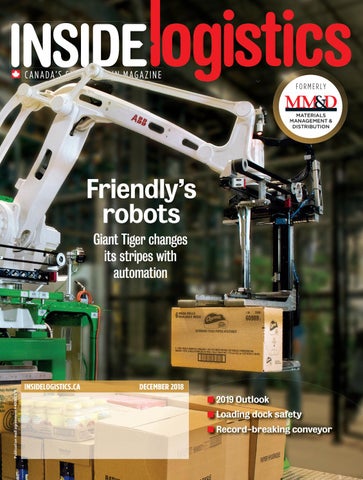
Friendly’s robots
Publication mail agreement #40063170
Giant Tiger changes its stripes with automation
INSIDELOGISTICS.CA
DECEMBER 2018
Q 2019 Outlook Q Loading dock safety Q Record-breaking conveyor
Track daily progress. Identify trends. Fine tune operations. Using IIoT active intelligence, Dematic iQ InSights maximizes overall warehouse logistics effectiveness by allowing you to make smart data-driven decisions. It enables receiving-to-shipping visibility across processes, labor, equipment and automation to monitor current conditions, measure work progress, and interpret information.
Visit www.dematic.com/insights or contact us at usinfo@dematic.com or 1-877-725-7500.
OPERATIONS MANAGEMENT % WORK COMPLETE BY AREA LABOR PRODUCTIVITY PICK RATES ORDER CYCLE TIMES STORAGE UTILIZATION SORT ACCURACY SHIPPING STATUS WORKFLOW INTERRUPTIONS OPERATIONAL ANALYTICS PREDICT COMPLETION TIME CURRENT TO HISTORICAL EVENT METRICS TREND IDENTIFICATION LIFECYCLE MANAGEMENT PREDICTIVE & PROACTIVE MAINTENANCE EQUIPMENT RUNTIME SCHEDULE PM TASKS ORDER & INVENTORY SPARE PARTS
CHECK OUT OUR MOVERS & SHAKERS SECTION
page 10
C A N A DA’ S S U P P LY C H A I N M AG A Z I N E D EC EM B E R 2 0 18 • V O L U M E 6 3 • NU M BER 0 6
20
CONTENTS In every issue:
5
2019 Outlook: How four Canadian sectors see their challenges for the next year.
Taking Stock
Editor’s analysis
32 Innovations
New products for supply chain efficiency
34 Supply Chain Smarts
Employee efficiency
35 Learning Curve Getting it right
37 Leading Edge
Look before you leap
38 Safety First
Your health & safety committee
ON THE COVER
Giant Tiger’s huge new DC in Johnstown, Ontario, hides impressive robotic technology under a gorgeous, employee-friendly exterior. Learn how the new building supports ambitions and plans for expansion. Story on page 14.
insidelogistics.ca
6
SUPPLY CHAIN SCAN
26
Loading dock safety
Last-mile challenges, e-commerce transparency, combatting nationalism, logistics report card
New technologies boost worker safety at the docks, inside and out.
28
Installations
Chinese cement conveyor, efficient refrigeration, candy boxes.
31
Racking
Buying cheap may end up costing more in the long run.
3
WE MAKE TRANSBORDER SHIPMENTS EASIER.
ONE SOURCE FOR ON-TIME, WORRY-FREE DELIVERIES Your business doesn’t stop at the border, neither does Old Dominion. Our people provide 100% real-time freight visibility for your shipments between Canada and the U.S., with direct loading to major U.S. markets. Your transborder crossings are pain-free with OD’s in-house 24/7 customs clearance and brokerage services and a single point of contact. Plus, OD’s industry-leading on-time record and low claims ratio provide confidence with every shipment.
For more information, visit odfl.ca or call 1-800-432-6335.
Old Dominion Freight Line, the Old Dominion logo, OD Household Services and Helping The World Keep Promises are service marks or registered service marks of Old Dominion Freight Line, Inc. All other trademarks and service marks identified herein are the intellectual property of their respective owners. ©2018 Old Dominion Freight Line, Inc., Thomasville, N.C. All rights reserved.
TA K I N G S T O C K
insidelogistics.ca EDITOR: Emily Atkins (416) 614-5801 emily@newcom.ca WESTERN EDITOR: Derek Clouthier (403) 969-1506 derek@newcom.ca DIRECTOR OF BUSINESS DEVELOPMENT: Delon Rashid (416) 459-0063 delon@newcom.ca CREATIVE DIRECTOR: Tim Norton (416) 510-5223 tim@newcom.ca PRODUCTION MANAGER: Kimberly Collins (416) 510-6779 kim@newcom.ca CIRCULATION MANAGER: Mary Garufi (416) 614 5831 mary@newcom.ca MANAGING DIRECTOR, TRUCKING & SUPPLY CHAIN GROUP: Lou Smyrlis lou@newcom.ca
NEWCOM BUSINESS MEDIA INC . CHAIRMAN & FOUNDER: Jim Glionna PRESIDENT: Joe Glionna Inside Logistics, established in 1956, is published six times a year by Newcom Business Media Inc. HEAD OFFICE 5353 Dundas St W. Suite 400, Toronto, ON, M9B 6H8 SUBSCRIBER SERVICES To subscribe, renew your subscription or to change your address or information contact mary@newcom.ca or 416 614 5831 or visit our website: www.insidelogistics.ca/subscribe SUBSCRIPTION PRICE PER YEAR Canada $84.95 per year, Outside Canada $159.95 US per year. Single copy price: Canada $15.00, Outside Canada CA$32.65 Inside Logistics is published six times per year except for occasional combined, expanded or premium issues, which count as two subscription issues. ©Contents of this publication are protected by copyright and must not be reprinted in whole or in part without permission of the publisher. DISCLAIMER This publication is for informational purposes only. You should not act on information contained in this publication without seeking specific advice from qualified professionals. Inside Logistics accepts no responsibility or liability for claims made for any product or service reported or advertised in this issue. Inside Logistics receives unsolicited materials, (including letters to the editor, press releases, promotional items and images) from time to time. Inside Logistics, its affiliates and assignees may use, reproduce, publish, re-publish, distribute, store and archive such unsolicited submissions in whole or in part in any form or medium whatsoever, without compensation of any sort. PRINTED IN CANADA
Publications Mail Agreement #43008019, ISSN: 0025-5343 (Print) ISSN: 1929-6460 (Digital). Inside Logistics is indexed in the Canadian Magazine Index by Micromedia Limited. Back copies are available in microform from Macromedia Ltd., 158 Pearl St., Toronto, ON M5H 1L3
FUNDED BY THE GOVERNMENT OF CANADA
insidelogistics.ca
Tigers can change their stripes FOR THOSE FAMILIAR with discount retailer Giant Tiger, our cover feature may surprise you. Why? Well, I don’t want to spoil the story, but let’s say they’ve taken a brave leap into the future and pounced upon some forward-thinking technology in their new DC. This privately owned Canadian store has devoted a lot of planning and resources to creating a sustainable distribution model for its growing suite of outlets across the country. But even those on the inside thought the gambit would be shot down at the board level. Discount retail is not often thought of as the place for cutting edge technology firsts. Read the full story starting on page 14 to find out their plans. I love this story because it illustrates the kind of audacious planning that will carry a company into the future. It’s a long-term plan, and one that carries no small amount of risk. Fortune favours the bold, they say, and Giant Tiger is proving to be like its namesake – a cunning, fierce hunter. I also love the story because it has a softer side. Part of GT’s reasoning behind the decision is protecting their operations against the growing labour shortage. But far from squeezing out the human element, the company is going to great lengths to nurture its employees. Read the feature to find out some of the reasons why 80 per cent of the company’s Ottawa, Ontario-based warehouse workforce has made the move to the new facility 100 km down the road in Prescott, Ont. We will be following the Giant Tiger as it continues its cross-Canada expansion plan. Will the competitive advantage it’s hoping to gain pan out? Stay tuned for updates. If you need other reasons to keep reading, let me suggest the story on page 28. It’s part of our Installation Inventory section, and it details an amazing 26-km conveyor line in China. Here’s another example of creative thinking overcoming a major operational challenge. As always, we are on the lookout for great supply chain stories. If you’d like to share your ideas with the rest of our supply chain community at Inside Logistics, please drop me a note at emily@newcom.ca. I look forward to hearing from you.
2019 OUTLOOK – TURN TO PAGE 20 FOR INSIGHTS INTO FOUR CANADIAN INDUSTRY SECTORS.
5
SU PPLY C H A I N S C A N
| by MM&D Staff
Last mile makes or breaks consumer experience One bad event will make them switch brands
ADJUST
Manufacturers will shift supply chains to combat nationalism
8
RISE OF THE COBOTS Market booms
MOVERS + SHAKERS
Appointments and moves in the supply chain sector
10
LOGISTICS REPORT CARD How Canada measures up
13
6
ALMOST ALL ONLINE SHOPPERS (98 per cent)
confirm that shipping impacts their brand loy-alty and 84 per cent report that just one poor experience makes them likely to switch. In 2017, only half of consumers said they would switch after a bad experience. This is the key finding of the third annual consumer expectations study conducted byy Convey, which spoke to 1,500 online retail customers. “Delivery expectations have clearly increased year-over-year as Amazon continues to raise the bar and customers take the bait,” said Kirsten NewboldKnipp, chief marketing officer at Convey. “Today, simply tracking a package isn’t enough. Retailers and brands that want to thrive need to invest in people, processes and tools that positively impact last mile delivery and customer loyalty.” The way a retailer responds to a negative situation can have a positive impact on repeat purchases. Consumers who cite previous delivery experiences as a key factor in their retailer selection are 60 per cent more likely to return to a brand that has positively resolved a prior issue.
“Today, simply tracking a package isn’t enough. Retailers and brands that want to thrive need to invest in people, processes and tools that positively impact last mile delivery and customer loyalty. – Kirsten Newbold-Knipp, CMO, Convey
Delivery cost is cited by 62 per cent as the most important factor in e-commerce delivery. As far as errors go, 87 per cent expect brands to make amends when they miss a delivery date and 52 per cent expect that to be in the form of a refund or discount on shipping costs. Shoppers also want flexibility from their e-tailers, with 55 per cent needing to reschedule appointment windows at least 20 per cent of the time, and 70 per cent expecting to be able to make some kind of routing change, whether to a new address, terminal or pick up locker. That’s a 41 per cent increase from 2017. INSIDE Logistics DECEMB E R 2018
photo: PeopleImages, iStockphoto.com
9
SU PPLY C H A I N S C A N
photo: ipopba, iStockphoto.com
Online retailers missing opportunities Fewer than half of retailers provide shoppers with access to basic inventory visibility, a recent study has found. Out of the 2,000+ retailers, only 38.1 per cent show basic inventory visibility on product pages. A strict like-for-like, year-over-year comparison found a 30.7 per cent drop in active online inventory visibility. This is a dramatic drop in an industry experiencing so much change. Passive inventory visibility is a factor in this drop. Unlike active inventory visibility, a passive approach only signals when a product is out of stock. “To increase sales and retain customers, omni-channel retailers today need to provide customers with clarity,” said Nick McLean, CEO of OrderDynamics, which commissioned the study. “The [study] reveals where retailers are strong, and other areas where they are lacking, across a variety of metrics. Whether it is low stock
insidelogistics.ca
visibility or general service awareness about cross-channel fulfillment, these are opportunities to get closer to what drives customer demand.” Based on data collected from retailers in a variety of sectors across the U.S., U.K., Canada, Australia, France, Germany and Austria, the report revealed: • 37.6 per cent of retailers offer click and collect(buy online, pick up in store, or BOPIS) today.
• 34.8 per cent of BOPIS retailers commit to having orders ready within 24 hours. • 72.6 per cent of omni-channel retailers offer BORIS (buy online, return in store). • 11.4 per cent of omni-channel merchants have a site optimized for mobile commerce. For the second year in a row, the U.K. is the leading country in click & collect, with 64 per cent of retailers offering the service. Consistent with last year’s results, the U.S. lags, ranking lowest of the countries assessed, with only 27.5 per cent of retailers providing BOPIS. Over 69 per cent of consumers acknowledge having tried omni-channel retailing and would like to see more of it. Further, only 57.1 per cent of retailers offering the service advertise it on their website’s front page. The “Omni-2000 Research: Global” report highlights the omni-channel offerings of over 2,000 retailers worldwide.
7
SU PPLY C H A I N S C A N
Economic nationalism will prompt supply chain changes A new global study found that 66 per cent of manufacturers would change their supply chains in order to tackle economic nationalism. In addition, 50 per cent of respondents said economic nationalist policies will increase operational costs,
and 45 per cent are considering alternative suppliers, representing almost $3.1 trillion worth of business globally. The LLamasoft survey of 725 senior supply chain decision makers in manufacturing organizations in the U.K., France, Germany,
the United States, China, Japan and Mexico, found that economic nationalism is recognized as one of the most severe challenges facing manufacturing supply chains. When asked to choose their biggest global concerns, respondents placed economic nationalism (46 per cent) second only to taxes and duties (50 per cent). In the U.K., the world’s sixth largest economy, 64 per cent of respondents are most worried about economic nationalism, namely Brexit – but that concern is not limited to the region. As a result of Brexit, 45 per cent of respondents globally are likely to change their supply chain design. This figure increases to 53 per cent in the U.K., 54 per cent in France, 56 per cent in Germany and 51 per cent in North America. “Today’s global economy – and the supply chains that keep it moving – are truly interconnected; shifting regional economic policies are having major impacts on manufacturers’ supply chains globally, causing them to re-evaluate their current designs more frequently than ever before,” said Razat Gaurav, LLamasoft ‘s CEO.
DONE DEALS The Jobe’s Company has chosen Transplace to manage its transportation throughout North America. Transplace will employ its proprietary Transportation Management System (TMS) to optimize inbound and outbound shipments, and manage the daily execution of all transportation activities, including carrier and mode selection and freight audit and payment. Dematic will implement an automated meat buffering and storage solution in a meat processing facility for Australian Lamb Company. It will be used to buffer meat products in a chilled and frozen environment and prepare shipments of meat products. The system includes Dematic warehouse execution software, a host interface, and an automated case storage/retrieval sub-system. It is scheduled to begin operations during the second quarter of 2019.
8
INSIDE Logistics DECEM B E R 2018
SU PPLY C H A I N S C A N
photo: wellphoto, iStockphoto.com
Collaborative robots taking over The nascent collaborative robot market is set to grow by more than 60 per cent this year according to a report from Interact Analysis. The industry was worth less than US$400 million last year but is set to grow to nearly $600m in 2018. Growth is forecast to accelerate due to the wider availability of collaborative robots from mainstream industrial robot vendors, the greater awareness in SMEs, and the wider adoption by major OEMs. By 2027, revenues are forecast to reach $7.5 billion and account for 29 per cent of the industrial robot market. Many of the drivers of demand for collaborative robots are the same as those for other automation products: a lack of available workers, increasing labour costs, shortening of product cycles and higher product mixes. However, other specific drivers will support demand for collaborative robots, such as the need for greater automation flexibility and the requirement to save floor space and eliminate safety fences. Revenues are forecast to grow at an annual pace of more than 60 per cent over the next two years, and at a CAGR of more than 35 per cent until 2027. The largest customer base so far has been small- and medium-sized enterprises which have been unable to use industrial robots due to their large size and cost; but instead can incrementally add collaborative robots to automate certain processes. SMEs will continue to drive short-term growth, both through new SMEs adopting collaborative robots due to increased awareness, and existing customers choosing to further automate and purchase additional cobots. The shortage of skilled and available workers will help to accelerate this trend. Despite the high growth of the industry now and in the anticipated future, all is not rosy for the suppliers of collaborative robots. The recent exit and winding up of cobot pioneer, Rethink Robotics, highlights the challenges that manufacturers currently face. The market is still relatively small, yet sees an increasingly large number of active vendors. Coupled with this is the challenge of fragmented and diverse customer demand – the report estimates that customers average one to 10 cobots per facility (tending more towards the lower end). This indicates average sales per automation project of just $30,000 to $350,000 (again towards the lower end) meaning considerable effort and investment will be required to build up a sizeable business. Of course, most cobot manufacturers are not selling directly to end customers, instead relying upon a network of distributors and integrators; yet the fragmented demand will still place huge demands on the manufacturers. Although Universal Robots still dominates this industry – it held a 46 per cent market share last year – new suppliers continue to emerge. Most of these new entrants tend to either be Chinese and Taiwanese collaborative robot vendors (which have often spun out of other ventures) or large, well-established industrial robot vendors. Both sets of companies are likely to make the
insidelogistics.ca
industry much more competitive for differing reasons, and it is inevitable that weaker suppliers will be unable to compete. The report identified over 30 vendors with more than 90 collaborative robot products available on the market.
π OVER 6,000 MATERIAL HANDLING ITEMS IN STOCK
ORDER BY 6 PM FOR SAME DAY SHIPPING
COMPLETE CATALOG
1-800-295-5510 9
SU PPLY C H A I N S C A N
MOVERS + SHAKERS working on the same objectives, with the endorsement of a supportive board.”
CIFFA executive director Ruth Snowden has notified the board of her intention to retire from full time employment at the association by mid-2019. The executive committee of the board has met and succession planning is well underway, a process in which Snowden is fully engaged. “It was an item in LinkedIn last January announcing my 10th anniversary at CIFFA that made me stop for a moment and look up,’ she said. “When I joined the association in 2008 I promised myself that it would be for only five years. Imagine my surprise when I realized that ten years had flown by,” she continued. “We have a strong management team at the association, all
Freightera CEO Eric Beckwitt has won the 2019 Clean50 Award for his contribution to the cause of sustainability and clean capitalism in Canada over the past two years. The award winners were selected from more than 600 nominees and competed in 16 categories including Manufacturing and Transportation, where Beckwitt won the award. Freightera is automating and transforming the $10 trillion global freight market, increasing efficiency and profitability, and sharply cutting shipping costs and emissions from freight. Edward Monser has been appointed to Canadian Pacific Railway Limited’s board of directors, effective December 17, 2018. Monser began his engineering career in 1981 and has served as an executive vicepresident, chief operating officer, and president at Emerson, a global technology and engineering company. Monser retired as the president of Emerson on October 1,
2018. He serves on the advisory Economic Development Board for China’s Guangdong Province. Wajax Corporation appointed Anne Bélec to its board of directors. Bélec has over 33 years of experience. She had an extensive career at Ford Motor Company, holding successively senior positions, including director, global marketing. She was also president and CEO, Volvo Cars N.A. Bélec was also vice-president and chief marketing officer of Navistar, Inc. and senior vicepresident at Bombardier Recreational Products, Inc. CHEP has appointed Jake Gilene to the role of senior vice-president, sales and customer service, CHEP USA. This position was previously held by Dan Martin, who was recently named president, IFCO North America. Over the last 12 years, Gilene has served in numerous customer-facing roles, including vice-president of retail supply chain solutions and vice-president of global business development.
St
W i ar nte tJ rC an ou ua rs ry es 21
What’s the most rewarding career decision you’ll ever make?
Your best choice for complete career-long OHDUQLQJ FHUWLÀFDWLRQ in supply chain logistics
Earning the CCLP® designation is easily the single best thing you can do to boost your career prospects. It can set you up for better pay, more advancement opportunities, and a range of management pathways and options across the sector. Plus, you’ll develop and demonstrate cross-functional capabilities that can deliver better business results—and more personal job protection. Depending on your background, your CCLP designation might be within closer reach than you think. Call or click WR ¿QG RXW LI \RX TXDOLI\ IRU DGYDQFHG VWDQGLQJ
www.citt.ca/cclp • 416.363.5696 ®CCLP & &,77 &HUWLÀHG /RJLVWLFV 3URIHVVLRQDO LV D UHJLVWHUHG WUDGHPDUN RI I & &,77
10
INSIDE Logistics DECEM B E R 2018
EDC tags 2019 as good year for exports Canadian exports of goods are expected to grow another four per cent in 2019, following a six per cent boost this year, according to Export Development Canada’s (EDC) fall Global Export Forecast. “There have certainly been some ups and downs among the provinces this year,” said Peter Hall, chief economist at EDC. “It isn’t surprising, given the major economic and trade-related stories that Canadian exporters lived through during 2018. We expect conditions to stabilize in 2019, with growth forecast across every province and territory.” Newfoundland and Labrador is looking at a 33 per cent increase in exports this year and should see another double-digit increase in 2019 thanks to increasing oil production and nickel processing. Prince Edward Island’s exports are expected to contract by four per cent this year, but frozen food manufacturing – PEI’s largest export industry – will support a rebound of eight per cent growth for 2019. In New Brunswick, exports should rise by 10 per cent this year – double the five percent projected last spring – thanks to improved conditions in the fishing sector and the decision to rescind duties on Canadian newsprint exports. In Ontario, maxed-out US auto sales and the uncertainty around the future of NAFTA weighed negatively on the outlook for much of 2018. EDC suggests the province’s exports will grow by only one per cent this year (revised down from the four per cent forecast in the spring). Exports from British Columbia have also been softer than expected this year. The province will likely end up with a four per cent increase, down from the spring forecast. Expectations for 2019 are up, with another four percent increase coming. Alberta enjoyed 11 per cent growth in 2018, driven in part by the ramping up of oil production for the Fort Hills oil sands project. 2019 will build on this growth with another three per cent increase, thanks to new export capacity growth in the energy sector and the anticipated opening of the Cavendish Farms frozen potato processing plant.
insidelogistics.ca
Commodities and manufactured goods continue to make strong contributions to the bottom line. The Aerospace sector is still expected to see the biggest gains, rising 10 per cent in 2019 on the heels of a 19 per cent gain this year that saw foreign
sales reach $19 billion. In contrast, automotive exports will dip in 2018 before a modest bounce-back next year. While foreign sales of auto parts and heavier transportation equipment will be steady, exports of passenger cars and light vehicles are expected to fall slightly due to sales reaching peak levels in the US and related temporary plant closures.
11
DON’T WAIT TILL IT’S TOO LATE!
Pallet Racking & Warehouse Inspections Pallet Racking System Maintenance & Repairs Pre-Start Health & Safety Reviews (PSR’s)
We don don’tt sell our solution to your y problem... It’s ourr problem to develop your y solution.
3D
STORAGE
SOLUTIONS
L I M I T E D
PALLET RACKING
PALLET FLOW
DRIVE-IN
CANTILEVER
PUSHBACK
CARTON FLOW
1 (877) 557-2257
MEZZANINES
INDUSTRIAL SHELVING
3DSTORAGESOLUTIONS.COM
By Christian Sivière |
SU PPLY C H A I N S C A N
How does Canada measure up in logistics performance? The LPI is a benchmarking tool developed by the World Bank in 2007 to help countries identify the challenges and opportunities they face in their logistics performance and therefore where to focus efforts to improve it. Always expanding its scope, the 2018 LPI makes comparisons among 160 countries. Broadly defined, logistics is the network of services that supports the physical movement of goods within a country as well as across its borders. In order to gauge their efficiency, the LPI examines each country, compiling feedback from a worldwide survey of stakeholders on the ground. The scores are derived from a worldwide survey of operators on the ground (global freight forwarders and express carriers), providing feedback on the logistics “friendliness” of the countries in which they operate and those with which they trade. Feedback from operators is supplemented with quantitative data on the performance of key components of the logistics chain in the country of work. The maximum score on each question is five points. The LPI works on the following six key elements: 1 Customs: the efficiency of the import Customs clearance process, i.e. its predictability, simplicity, speed and cost; 2 Infrastructure: the quality and reliability of its trade and transport-related infrastructure, i.e. roads, rail lines, inland waterways, ports and airports, and their associated information technology; 3 International Shipments: the ease of organizing cost-effective shipments; 4 Logistics Competence: the availability and the competence of service providers, i.e. freight forwarders, Customs brokers, third-party logistics providers and transport operators; 5 Tracking and Tracing: the ability to track and trace shipments reliably; 6 Timeliness: the timeliness of shipments reaching their intended destination within the scheduled or expected time of delivery. The top 10 countries of the LPI 2018 are: Germany, Sweden, Belgium, Austria, Japan, Netherlands, Singapore, Denmark, United Kingdom, and Finland. And the bottom 10 countries are: Afghanistan, Angola, Burundi, Niger, Sierra Leone, Eritrea, Libya, Haiti, Zimbabwe and the Central African Republic. Where does Canada stand? Canada ranked 20th in the 2018 LPI, while our main trading partner, the United States, ranked 14th. In the 2016 LPI, Canada was 14th and the US 10th; in the 2014 LPI, we stood 12th and the US was ninth. So as our ranking and the ranking of our neighbours to the South have both been sliding down, let’s look at our individual country score cards to try and determine where this comes from. On Canada’s score card, Customs has gone down from a score of 3.95 to 3.6, Infrastructure is way down from 4.14 to 3.75, International Shipments was moderately down from 3.56 to 3.38, Logistics Competence was stable at 3.9, Tracking and
insidelogistics.ca
Tracing was substantially down from 4.1 to 3.81 and Timeliness was slightly down from 4.01 to 3.96. On the US score card, Customs improved slightly from 3.75 to 3.78, Infrastructure went down from 4.15 to 4.05, International Shipments went down 3.65 to 3.51, Logistics Competence went down quite a bit from 4.01 to 3.87, Tracing and Tracing went down from 4.2 to 4.09 while Timeliness went way down from 4.25 to 4.08. Thus, we follow relatively similar trends as our main trading partner the United States, and there is a logic to this, thanks to our closeness and resulting economic integration. Looking at other countries and regions, although large differences in logistics performance persist, the gap between the best performing countries and the worst one had shrunk between 2007 and 2014. That gap between the top and the bottom had widened in 2016 but it shrank again in 2018, where the average score for the top 10 countries dropped to 4.03 whereas the bottom 10 countries scored an all-time high of 2.08. This suggests that in spite of the still substantial disparities between the developed world and the developing world, trade ecosystems may be becoming more equal.
Software suited to meet the unique needs and business processes of single or multiple warehouse sites, 3PL distribution environments and mobile workforces
www.rfpathways.com www.rfpathways.com AUTOMATION ASSOCIATES INC. 6705 Tomken Road, Suite 211 • Mississauga, Ontario L5T 2J6 P: 905-565-6560 • Toll Free: 866-823-6114
13
COV E R F E AT U R E
| By Emily Atkins
TECHNOLOGY FRIENDLY
I
Giant Tiger is a Canadian robotics pioneer with a human touch
f you’ve ever seen Giant Tiger’s mascot, Friendly, you might wonder why he looks so happy. His smiling, stripy mug adorns countless trailers, more than 245 stores across the country and, notably, the side of the discount retailer’s giant (pun intended), new distribution centre near Prescott, Ontario. But once you’ve been inside that DC you’ll understand Friendly’s cheerful demeanor. From the sunny and welcoming entry hall, through the staff facilities and out onto the operational floor, everything in the building is centered around creating a positive work environment.
What’s surprising, though, is that inside this people-centric facility beats a massive, robotic heart. At the building’s core is a Canadian first – a Symbotic robotic AS/ RS complete with 220 high-speed robotic runners and fully automatic robotic palletizing equipment. It’s a high-tech supply chain geek’s dream come true. So how does the privately owned retailer reconcile the human face with its reliance on pricey robotics? Mike Quinn, vice-president of warehousing and distribution, explains: “Knowing that labour would always be a concern going forward, we said ‘let’s get a good mix of robotics and
manual or conventional-type warehousing, and let’s build and design a facility that people are going to want to work in’, because this would be our competitive advantage.”
People first The discount retailer prides itself on its people-first attitude, which makes a lot of sense with the labour shortages many companies face in their distribution operations. And given that the company has moved its DC operations from Ottawa to Johnstown, Ontario, almost 100 kilometres away, but managed to retain more than
“The robotics can enhance the work, but they can’t replace all the people, so what we did here was create an environment where people are really, really enjoying coming to work.”
Images: Giant Tiger
– Mike Quinn
14
INSIDE Logistics DECEM B E R 2018
Once you step inside the new Giant Tiger DC you’ll understand why Friendly, the company’s mascot, is so happy.
80 per cent of their distribution staff, clearly they are doing something right. On the surface you can see the appeal of working in this building. There is an apple orchard for staff to use, the cafeteria is large enough to accommodate 50 to 60 people at once, with enough microwaves and fridge space for everyone who brings a lunch. Its soaring cathedral windows that provide a stunning view of ships on the St. Lawrence River also illuminate a games room mezzanine complete with pool tables and other diversions. Next to that is a fully equipped gym and a separate room for prayers or quiet reflection. The company lays on catered and subsidized lunches and dinners, which can be prepared in the commercial kitchen by the lunchroom, and in the summer there is a free BBQ at least once a week on the patio outside the lunchroom doors. Along with the apple orchard, the company is planning community gardens next summer so staff can grow their own veggies, doing the weeding and watering on their breaks if they like. The view from the games room overlooking the welcoming, sunny lunch area.
insidelogistics.ca
Mike Quinn
Planned for growth The new DC is part of the company’s carefully planned expansion strategy, which will see it adding 10 to 15 new stores a year across the country. Work on the DC to serve those stores started back in 2014. A study showed that the optimal location would be along the 401 highway corridor in eastern Ontario. “Armed with that analysis and a timely Google search, we discovered this fabulous site in 2015, nestled between the 401, and the St. Lawrence, and at the intersection of the 416 [highway],” said Paul Wood, the company’s CFO, at the DC opening in September. With the 300-acre parcel secured, the company hired Deloitte and GKC Architects to help design a facility. According to Quinn, making the building pleasant and attractive for the staff was a first principle. But getting to the robotics was more of
a stretch. After Deloitte put forward a number of manual options for material handling systems, they also suggested a robotic option. “‘This is Giant Tiger. We don’t do robotics’,” said Mike Quinn, explaining the planning team’s surprised reaction. Further, the supplier being suggested was an unknown. At that time Symbotic had no installations in Canada. Quinn said although their initial reaction was skepticism, after talking it through the ROI made sense and they decided to pitch it to the board of directors. He continues the story: “We sat in that room – there were two or three Deloitte people, and John [Hubbard, AVP warehousing] and myself, and we said okay, if we’re going to present this, we better be united on this one because they’re going to say the same thing. They’re going to say. ‘Gee, robotics? No way! What are you guys thinking?’” But after weeks of practice, it turned out their pitch was perfect, and they got the board’s approval.
On the floor Now complete but nowhere near full, the DC floor has a reserve area with up to 40,000 pallet positions. It’s all manually organized, using a fleet of Raymond mobile equipment. The bulk of the DC’s product will evencontinued on page 17
15
Greg Blanchard Transportation Terminal Manager 1 year, VersaCold
VersaCold is a food-first company. With over 70 years of supply chain experience, we’re a diverse team dedicated to ensuring the safety, quality and freshness of the food families eat—every step of the chain.
versacold.com
John Hubbard
The AS/RS unit dominates the DC floor. The three outbound palletizing cells, with their white robotic arms, can be seen atop the mezzanine.
“The technology is super cool. It literally brings tears to my eyes, and I could watch it all day long.”
Images: Giant Tiger
– Jess Godin
One of the palletizing cells in action. An algorithm sequences cases to arrive in the correct order to build a study, secure pallet for outbound store orders.
tually be held in the AS/RS shuttle unit, which covers 90,000 square feet. The structure is 15 levels high, and each level has double-high shelving. Those 30 shelving levels can store 440,000 cases, although at the time of the opening tour there were only 135,000 loaded in. According to Quinn, about 90 per cent of the DC’s SKUs will be managed through the Symbotic unit, which has a maximum cube size of 24 by 24 inches. Inside, the 220 shuttle bots that can move at 45 km/h are “like little race cars,” said John Hubbard. “Those are the coolest things. They fly around and pick and receive. They put away cases. As they put away, they bring cases out to be
insidelogistics.ca
palletized.” Because only the front 20,000 square-foot portion of the shuttle structure is powered, Hubbard added: “If something were to happen, it’s up front, we don’t have to shut down the structure, we can actually troubleshoot it right at the front of the system.”
Palletizing magic Working with the shuttle system are two automated inbound robots that pull cases off pallets and induct them into the system (at a pace of 1,750 cases an hour per station), and three outbound automated palletizers. These are all made-in-Canada robotics systems that use ABB robotic arms
and are assembled by Axium out of Montreal. The outbound units each have two tandem arms that work in sequence. They can palletize approximately 1,350 cases per hour. At full tilt, a pallet is built, wrapped, and sent on through the conveyor every two minutes. The robotic palletizers are the showstoppers in this DC. “The technology is super cool. It literally brings tears to my eyes, and I could watch it all day long,” said Jess Godin, senior vice-president, supply chain. It’s true: Watching the robotic arms reach and rotate, keeping out of each other’s way as they build a pallet is mesmerizing. And the pallets they build look solid. The pallet-building algorithm takes the store orders and calculates for about 15 minutes to plan the best, densest, tallest pallet. It uses the heaviest case for the bottom to ensure that as the pallet gets taller, the lightest pieces are on top. “With the robotics, we’re able to build dense pallets to the stores within which goods are positioned strategically to maximize the use of our trailers, minimize continued on page 18
17
Jess Godin
“I equate this to doing open heart surgery on a marathon runner while they’re scaling a mountain.”
damage and facilitate quick and efficient product unload once the pallets reach the stores,” Godin said. In fact, the pallets are designed so that as the stores unload them products are grouped according to the part of the store they will be displayed in. Orders are downloaded twice a day; stores get up to three deliveries a week, and the DC can pick, pack, and ship each day’s orders on the same day. Approximately 50 loads (or 100 store orders) leave the DC daily, much of it LTL, although in the holiday season those loads get bigger. The system is able to forecast by looking at historical order data. It also looks at advertised volume and when Giant Tiger is expecting a spike in certain goods, it’ll pre-forecast those items. All this helps prevent out of stocks, Godin said. “The most important thing is making sure that there’s no interruption to our stores.”
Perfecting the system Quinn noted that the implementation of the Symbotic system was seamless. “We’ve
18
Image: Emily Atkins
– Jess Godin
A finished pallet has lowered through the mezzanine floor, been shrink-wrapped and is ready to be picked up and delivered to an outbound trailer.
had no hiccups,” he said, but added that the goods-to-person picking of eaches and co-packs has not yet been perfected. Because goods-to-person is a new process for Giant Tiger and Symbotic, the IT department “likes to test and test and test.” Ultimately the less-than-case picks will amount to about 15 percent of the DC’s throughput, Quinn said. Godin said the migration from three facilities to one was a delicate operation: “Doing all of this without interruption to our stores and customers was absolutely crucial and I equate this to doing open heart surgery on a marathon runner while they’re scaling a mountain.”
Room to grow Even though they’ve just moved in, Giant Tiger is looking a long way down the road. By 2027 they expect to need to build out the DC, adding another 500,000 square feet. Quinn noted that the utilities are already in place for the expansion. The Symbotic system is also designed to expand. “We knew we were going to grow with that type of system as well, so there was space at the far end of it, the north end for another cell of outbound,” Quinn said. “If you could lift up the floor panel, you’d see that it’s all prepped.” For Godin, the growth challenge comes not in volume, but SKU variation. “If we INSIDE Logistics DECEM B E R 2018
Image: Giant Tiger
The induction robot autonomously depalletizes and loads cases into the AS/RS.
just continued to grow with really beautiful, square boxes, my job would be really easy, but where I find the biggest challenge is translating what the growth, in terms of specific product categories are, into what the supply chain handling and distribution requirements are going to be,” she said. In practical terms that means figuring out how to manage picking more individual units either to satisfy the stores so that they can increase their store turns and have a larger assortment in store with the same footprint, or if they start picking more e-commerce orders from the DC. If this happens, Godin said they will need to ramp up the each-picking technology faster than the case-pick options. As for e-commerce, Giant Tiger now offers about 6,000 items online, with home delivery or in store pick-up. Godin said the long-term plan is to begin picking e-commerce orders in the DC. “We’re also really trying to not focus on the fact that it’s e-com. We’re trying to focus on the fact that it’s just retail and integrating any type of order, whether it’s a business-
insidelogistics.ca
DC Purrticulars Location: Size: Height: Technology:
Johnstown, Ont. 600,000 square feet 50 feet clear Symbotic robotic AS/RS 220 robots Robotic palletizing & depalletizing Staff: 300+ full-time Throughput: 100 store orders/day Hours: 2 shifts, 20 hours/ 7 days a week
to-business order to the store or whether it’s a business-to-customer order, it’s just it’s part of the operations. As the e-com side of the business evolves, we’re continuing to figure out how to fit that into our operations productively.”
The Friendly philosophy Giant Tiger is clearly very serious about its ambitious plans. The investment in this
tech-heavy DC, potential omni-channel offerings and multiple new store openings all attest to the retailer’s commitment to growth. The robotics will help the company alleviate the labour shortage. “It’s almost like you have a crystal ball and you can see the labour is not going to get better so you better be doing something different, and building the right culture and the people is something we’ve always done, and we just ramp it up every chance we get,” Quinn said. “The robotics can enhance the work, but they can’t replace all the people, so what we did here was create an environment where people are really, really enjoying coming to work.” The bottom line is the company built the DC to be as welcoming and pleasant as possible to give themselves a competitive advantage. “We’re not as big as some of those other companies, but we can make it a place where people would love to work, and maintain that culture, and then we’ll get the people wanting to work for Giant Tiger,” Quinn said.
19
O U T L O O K 2 019
| By Kara Kuryllowicz
SPEEDING TO KEEP UP
Supply chain challenges in 2019
Uncertainty is in the Canadian air as 2018 comes to a close. Questions about trade deals, interest rates, housing values, oil prices and the GM plant closure are all weighing on the collective mind as we close out what has been a strong year. Economists say we should expect further growth in 2019, in spite of an overall gloomy outlook for world economies. In fact, the OECD revised Canada’s GDP growth outlook for 2019 upwards in a November update.
Manufacturing: The connected supply chain Innovation is a challenge to Canadian manufacturers’ supply chains when tried-and-true methods can’t deliver the necessary results. For manufacturers, the “demand, supply, inventory and production planning” approach is an innovation that provides the visibility and transparency required to accurately analyze demand for the finished product. It outlines a procurement plan along with operational and distribution requirements. “The impact on cost, efficiency and customer satisfaction is significant as there is a one-to-three ratio between improvement in demand accuracy,
Of course, a lot of our economic success is predicated on factors beyond the control of our own businesses, like politics south of the border, trade deals and wars, interest rates and oil prices. And with that knowledge business continues, dealing with many familiar challenges. To get some insight into how several of Canada’s key sectors are faring, freelance writer Kara Kuryllowicz spoke with business leaders and asked them about the challenges they see for 2019. Here’s what she found out. 20
INSIDE Logistics OCT O B E R 2018
inventory decrease, and cash flow position,” says Jérôme Thirion, partner, management consulting, national lead supply chain, KPMG Canada, Toronto. Demand, supply, inventory and production planning in a connected enterprise may seem like the only logical approach now that labour and warehouse costs, as well as customer expectations have skyrocketed. In this new era, a disconnected enterprise can’t be as competitive, and collaboration with both customers and partners is paramount. There was a time, however, that customer, procurement, production and distribution departments operated independently within the same organization with acceptable results. “A connected supply chain is a strategic advantage, allowing manufacturers to gain market share and increase revenue and margins, but the challenge of connecting the value chain is compounded by the speed at which it must be achieved, and conservative past investments,” Thirion says. “Manufacturers have no
choice but to adopt smart, cloud-based technologies, or better, to transform their operational processes.” In 2017, a KPMG survey of supply chain professionals ranked full supply chain visibility as the third most important strategic priority. Yet, just six per cent of those supply chain professionals said they had achieved that goal. Top-tier manufacturers will be more selective and demanding when committing to suppliers and even customers, because such visibility requires deeper, longer-lasting relationships and an ability to secure sensitive, confidential data. As a result, Canadian manufacturers are seeking new talents such as data specialists with superior analytics, statistics and operational research backgrounds; distribution centre equipment and software engineers, and business transformation specialists. “Manufacturers, their suppliers and customers will need to collaborate at unprecedented levels to consider the overall landed cost and cost to serve,”
85% of Canadian CEOs expect significant returns on digital transformation.
says Thirion. “Together, they need to determine how many distribution centres are required and identify the most efficient locations versus fast-changing customer service levels.” Manufacturers that source parts and components globally and ship finished products worldwide also need to be more agile and in turn, they’re asking their suppliers for comparable flexibility. In certain industry sectors, a component may take eight or more trips to various locations before arriving at the OEM’s plant and leaving as part of a finished product. “The unpredictability of tariffs and trade agreements is forcing manufacturers and their suppliers to reconsider the locations of their warehouse, distribution, production and assembly facilities to get closer to their customer base,” Thirion says. KPMG’s recent “Global Manufacturing Outlook – Transforming for a Digitally Connected Future” report surveyed 1,300 CEOs in 11 countries in early 2018. Nearly two-thirds of manufacturing CEO respondents said acting with agility is “the new currency of business; if we’re too slow, we will be bankrupt”.
(Source: KPMG 2018 Canadian CEO Outlook)
The rapidly-evolving retail sector’s fundamental, consumer-focused guiding principles will continue to challenge supply chains in 2019 and beyond. As always, consumer satisfaction depends on competitively priced, quality products. But more than ever, consumers are now willing to look beyond the traditional retailers and tried-and-true delivery methods. “Retailers will be assessing their supply chains to cut costs and maximize availability in 2019, because they’re fully aware that consumers have lots of choices online and in bricks-and-mortar, and those supply chain costs are going to be critical to pricing,” says David Johnston, director of the York University Schulich School of Business’s new Master of Supply Chain Management Program which launches in May 2019. Consumers expect on-time, complete orders in perfect condition and consider a store visit a waste of their precious time. It’s perfectly legitimate to switch retailers if the products they seek are out-of-stock or turn out to be available only online. “Consumers know that if they can’t get what they want from you, there are plenty of other options,” says Johnston. Increasingly, sophisticated analytics departments leverage the companies’ data to give retailers like Canadian Tire a competitive edge. Current technology provides an continued on page 23 insidelogistics.ca
21
photo: Zapp2Photo; iStockimages.com
RETAIL: Big data serves the big
CANADA’S LARGEST
SUPPLY CHAIN
EXPO+CONFERENCE! 2,500+ 100+ 30+ 50,000+ ATTENDEES
SPEAKERS
SEMINARS
SQ. FT. OF EXHIBITS
Register NOW! Use code CBNCLC19 by February 7, 2019 to receive a Complimentary Trade Show Access Pass CARGOLOGISTICSCANADA.COM
photo: cnythzl; iStockimages.com
incredible range of highly detailed, realtime data, but it’s meaningless unless retailers and their analysts understand and act on it. Better-informed retailers make more timely business decisions that satisfy their CFOs and stakeholders as well as consumers’ demands for product quality, price and availability. Analysts use a range of tools to leverage data and match supply to demand in order to maximize sales and minimize the cutrate pricing that moves product off retail shelves and out of expensive warehouse and DC space. Retailers that ignore or mishandle data are giving their competitors the opportunity to outperform them. “The major retailers have the scale and budget to support and justify analytics departments and leading-edge tools, but many of the small to mid-size retailers still depend on that ‘killer app’ – the Excel spreadsheet,” Johnston says. “Small- to mid-size retailers often have to put all of their efforts into selling, purchasing and shipping, and lack the resources required to focus on collecting and mining their data for opportunities.” Increasingly, retailers also rely on data to determine which suppliers offer the best long-term service, beyond price and availability. For example, they’ll consider data that supports their abilities to manage risk to avoid disruptions to supply, product failure and socially unacceptable practices such as poor health and safety or environmental practices. “The large retailers have the power to ask for whatever they want – it’s behind every business case they make and the data helps technology-savvy copmanies understand, manage and control their suppliers,” says Johnston. That data matters as much to the retailers’ suppliers, many of which have been relying on collaborative partnerships that respect privacy, security and confidentiality to know what’s selling and to plan their production and deliveries. A lean supply chain is efficient and cost-effective but as importantly in a volatile world, retailers must be agile. Natural disasters, trade deals, currency fluctuations and politics can all affect retailers’ most trusted sources with little to no advance notice, which means that without alternative arrangements they could lose certain
consumers forever. The bottom line still rules, but it has broadened as retailers are expected to do right by the planet, its communities and its people. The news cycle is the shortest it has ever been and social media instantly and widely shares information retailers most want to keep quiet.
“Transparency is the retailer’s right because no one wants to see their private label on a shirt protruding from the rubble of a building that just collapsed due to negligent health and safety practices,” says Johnston. “Retailers need to know that their suppliers are up to their consumers’ ethical and sustainability standards.”
52% of CEOs see adapting sales and distribution models as their top challenge in meeting the needs of Generation Y. (Source: KPMG 2018 Canadian CEO Outlook)
FOOD: Visibility and collaboration Canadian consumers demand a lot when it comes to their food and whom they trust to make it for them. Year-round, consumers eagerly anticipate fresh, readyto-eat produce, dairy, seafood, meat and packaged goods, and regardless of the country of origin, the distances travelled or the many modes of transport involved, they assume it will be safe to eat and arrive well in advance of the “Best Before” or “expiry” date. “As the largest food company in the world and a trusted brand that is in 95 per cent of Canadian homes, we have to execute flawlessly to live up to the trust consumers have in us,” says Greg Christopher, senior vice-president, supply chain operations at Nestlé Canada. “The entire company thinks and acts with this trust in mind, end-to-end across our consumer value chain. This means we must have transparency in terms of route-to-market flows and how we commercialize our products. A shorter upstream consumer value chain is more important now than ever as consumers are moving away from the very things that can extend shelf life, for example, product ingredients and complex packaging barriers.” Sluggishness in the supply chain creates activity or facility waste as well as inventory buffers that are costly and often unnecessarily wasteful. Food manufacturers and retailers are working now to build a collaborative approach, using vendor-managed inventory strategies to streamline replenishment and ensure fewer stockouts, as well as product quality. The trend to omnichannel commerce in the food and grocery marketplace also means more grocers are opting for smaller, more frequent deliveries to keep up with demand. Such strategies also help eliminate food waste, which is being targeted as a significant contributor to greenhouse gases and an environmentally unfriendly and unacceptable outcome in a world where people go hungry. continued on page 25
insidelogistics.ca
23
PROMAT 2019 | APRIL 8-11, 2019 | MCCORMICK PLACE, CHICAGO IL
IIoT
FIND YOURS.
FIND THE WOW YOU NEED TO TRANSFORM YOUR MA MANUFACTURING AND SUPPLY CHAIN OPERATIONS INTO A TRUE COMPETITIVE COMPETI ADVANTAGE. With over 1,000 solution providers, ProMat 2019 is where manufacturing and supply chain innovation comes to life – in person and in action. So come find WOW-worthy solutions, network with your peers and learn from the industry’s brightest minds in keynotes and over 100 conference sessions. Find your supply chain WOW. Only at ProMat 2019.
LEARN MORE AND REGISTER TO ATTEND FOR FREE AT PROMATSHOW.COM
Collocated with ProMat
“Food safety and the elimination of food waste have always been important to us, and in the next three to five years, we will increase our collaboration and leadership with industry groups and across our value chain to further improve transparency,” says Christopher. Yet, transparency is more complex and challenging than consumers may realize. As the food and grocery industries globalize and consolidate, a single organization’s raw ingredients are grown by multiple farms, collectives and co-operatives in various countries. They’re then shipped to facilities worldwide for processing, production and packaging, before their journey to Canadian distribution centres and retailers. Transparency helps ensure the integrity of food products and eliminate food waste,
so companies like VersaCold Logistics Services based in Vaughan, Ontario, rely on technology to plan and monitor everything from the product’s route to Canada, temperature variances and weather, to monitoring vehicle equipment performance to predict and respond to any mechanical failures. “In our warehousing operations, we use building temperature sensors as well as various equipment sensors to monitor the performance of material handling equipment and building systems to ensure operational performance and minimize energy consumption,” says Douglas Harrison, president and CEO of VersaCold. “We need to access, analyze, manage and react to that data to preserve the integrity and safety of the food products entrusted to us.” Artificial intelligence, automation and
robotics are some of the systems used to monitor, transport, track and handle products to better expedite and facilitate supply chain processes. More affordable, smarter technology that’s easier to set up, program and use now offers a better return on the investment, which makes it more accessible to a wider range of businesses. “Technology has a place in the toolbox we’re developing to ensure we’re lean in the supplier ecosystem, and it lets our talent work on the most important parts of our business,” says Christopher. “At the moment, a lot of the technology is testand-learn with plenty of proven wins that can be adopted. For example, collaborative forecasting and replenishing with artificial intelligence capabilities and the simple use of SAP and decision-support software to codify the value chain.”
photo: BMW Group Canada
AFTERMARKET AUTOMOTIVE: Network design and human resources Vehicle owners have high expectations and OEMs like BMW know that location plays a significant role in giving drivers what they want. “BMW recently relocated its Ontario warehouse from Whitby to Mississauga to enhance customer service and improve its supply chain logistics efficiencies, namely expediting parts delivery to 16 dealerships province-wide,” says Ian Sant, manager of the new Mississauga Regional Distribution Centre (RDC) for BMW Group Canada. The Mississauga RDC opened in April 2018, after Sant and his colleagues had thoroughly assessed four contenders with proximity to rail hubs and airports and routes to markets such as Barrie, Hamilton, Kitchener-Waterloo and Burlington. At 285,000 sq. ft, the Mississauga facility is 50 per cent larger than its predecessor and will handle more than 41,000 SKUs and over one million parts annually. (For more details on the DC see our Inside Logistics feature at: http://alturl.com/jgpy7) “We will never be short a part because we can now increase our minimum on every part,” says Sant. In late 2019/early 2020, BMW’s first
insidelogistics.ca
continental distribution centre will open in Pennsylvania as part of a global parts supply chain decentralization, and in 2020 a second new Canadian DC will open in Vancouver. As BMW prepares to launch its 2019 models, every single part required by each new model will be stocked, because as Sant sees it, new car owners want their
In August 2018 41% of Canadian businesses reported shortages of skilled labour, and 58% of large Canadian organizations were short staffed. (Source: ManpowerGroup Canada)
vehicle back as soon as possible. Parts availability is a challenge that can be addressed through network design, but finding a skilled, reliable workforce is a constant and growing problem. BMW is tackling the challenge with a creative, forward-thinking strategy. “Do what you can to create an amazing workplace to help attract the people you need and keep them fully engaged,” says Sant. Staff was top of mind in the design of the
DC. While the location facilitates the commute, the workplace environment – with leather sofas, MINIs mounted on the walls and giant TVs – is fun and welcoming. Last spring, employees at the Mississauga RDC discovered an i8 Roadster when they arrived at work and in October, employees were treated to a ride-and-drive event that let them experience the cars as more than the parts they pick. “Our DC employees are still talking about it,” Sant says.
25
L OA D I N G D O C K S
| By Chad Dillavou
WATCH
A
s any logistics expert knows, the loading dock is a vital component of a business. However, loading docks can be one of the most dangerous places at any warehouse, manufacturing facility or processing plant. In fact, approximately 25 per cent of all industrial accidents happen in the shipping and receiving area. The pace has rapidly increased at most warehouses thanks to a variety of reasons, most notably the “Amazon effect”. This effect has made many consumers accustomed to almost immediate results from purchase to delivery. The probability of an accident in the DC increases as speed increases, and unfortunately, no single piece of loading dock equipment can guarantee safety. Fortunately, thanks to new communication technology, these critical work areas do not have to be as dangerous as they once were. Some new dock safety products incorporate activity-detecting sensors, LED
26
lights, audible/visual alarms and interlocking controls. These breakthrough products allow state-of-the-art facilities to implement comprehensive, systemic safety protocols into their dock operations. In some cases, they can also be added as retrofit projects, assuming the facility originally installed upgradeable equipment.
Approximately 25 per cent of all industrial accidents happen in the shipping and receiving area
Sensors, lights, safety The newest of these products are sensor-based systems designed to protect workers both inside and outside the dock. One system projects a blue light onto the leveler whenever activity is detected inside a trailer, alerting workers nearby that a
forklift, pallet jack or pedestrian could be coming out at any moment. Pedestrians have additional warning time to react, as this projection system works as a complement to the blue safety lights on forklifts. It can be added to almost any dock as a standalone item, or can be integrated with advanced control boxes in the future to keep the vehicle restraint engaged until activity in the trailer stops, ensuring the truck does not pull away with a forklift operator still inside. The drive approach outside of the loading dock is equally dangerous, although collisions here typically involve a semi-tractor trailer rather than a forklift. The U.S. Occupational Health and Safety Administration (OSHA) is currently considering a new rule that addresses backing vehicles and equipment, which are common causes of “struck-by” injuries. “Struck-by” and “caught-between” injuries are two of the four leading causes of workplace fatalities. Given ambient noise and the distance between a loading dock and the engine of a semi-tractor trailer (which can be in excess of 70 feet or more), inattentive dock INSIDE Logistics DECEMB E R 2018
Photo: topae; istockimages.com
OUT!
ADVANCES IN LOADING DOCK TECHNOLOGY CLEARLY COMMUNICATE DANGER
dock control systems (tying their colour display to vehicle restraint engagement) sets the stage for further technological advances involving the integration of a wider array of equipment.
A safe sequence of operation
In this illustration a blue light illuminates the dock floor outside of the trailer to alert pedestrians that a forklift is active inside.
Audible and visual alarms are now available to alert yard workers that a tractor trailer has begun moving in the immediate area.
yard workers may not hear a trailer backing toward them until it is too late. In the United States, OSHA cites 40 fatalities involving backing tractor-trailers in a sixyear span. Tractor trailer rigs are the second leading cause of back-over accidents. Countries such as France and New Zealand, have already put measures in place to prevent these potentially fatal accidents. Vehicle restraints can now incorporate an external sensor, which triggers an audible and visual alarm to alert workers outside the dock when a trailer begins moving in the area. These types of multisensory warnings immediately gain the attention of workers who might be in harm’s way and provide them time to remove themselves from danger. With certain vehicle restraints, this sensor system can be added as an upgrade or purchased as standalone equipment.
insidelogistics.ca
The LED trend continues Red/green dock lights, indicating to forklifts that a trailer is locked and safe to enter (or, to the truck driver, unlocked and safe to pull away) have been standard for some time. However, while these lights are generally visible outside, they are not always visible inside, as stacked pallets can obscure a lifttruck driver’s view of them on the control panel. To solve this common issue, enhancements have been developed, such as highly visible LED lights placed in the upper corners of dock doors – allowing forklift operators to see the red/green signal even if the control box lights are not visible. Additionally, red/green lights were also placed on the leveler, letting forklift operators inside the trailer know that it is still safely secured the loading dock. The integration of these LED lights into
Dock controls now can connect the operations of vehicle restraints, dock levelers, overhead doors, safety barriers and LED signal lights. Significantly, the most sophisticated controls can be programmed to operate only in a safe sequence of operation, with individual elements of the system interlocked. For instance, some dock control systems can be programmed with a green light interlock, which disables the use of the push button dock leveler or overhead door until the vehicle restraint is safely engaged. They can also be programmed with an overhead door interlock, which requires overhead doors to be opened prior to leveler operation; or a stored leveler interlock, which ensures that the leveler is stored safely before the restraint can be unlocked to release the trailer. If a worker presses the control box button for an individual system element in the wrong sequence, it will not work – ensuring no safety procedures can be skipped. While the advent of hydraulic, push-button equipment made life easier (and safer) for dock workers, it did not eliminate mistakes. If a leveler is lowered too early, for example, a backing trailer can damage it. If a restraint is unlocked before the forklift exits and the leveler is stored, a serious risk of injury and product damage is at hand. Eliminating these possibilities is a clear benefit to the facility, its customers and most importantly its valued employees. The last few years brought about great technological advancements in loading dock safety. As technology makes new advances every day in 2019 and beyond, it is important to consider equipment that is not just good for today’s loading dock, but offers upgradeable features to enhance safety long-term and reduces future costs.
Chad Dillavou is product manager for Rite-Hite Products
27
C A S E S T U DY
| Compiled by Emily Atkins
installation INVENTORY
Material handling and inventory control solutions from around the world
A long haul Cement conveyors wind 26 kilometres through the Chinese landscape WHAT DO YOU DO when the govern-
ment suddenly decides to flood the roads you use to get raw materials to your production facility? That’s what happened to the Sichuan Yadong Cement Co, Ltd. located near Chengdu, the capital of Sichuan, in southwestern China. As they were building a new cement plant in 2004, the local government opted to build a dam and flood the route of an abandoned railway that was to take from the limestone quarry to the plant. Alternate trucking routes were too long, so the manufacturer got creative. They contracted the Beumer Group to instead build a conveyor line from the quarry to the plant. The 12.5-km troughed belt conveyor navigates through hilly terrain and nature reserves, over streams and unstable ground. Beumer Group managed the mechanical and electrical engineering, supplied the core components for the overland conveyor and monitored and commissioned its installation. “Our colleagues at Chinese subsidiary Beumer Machinery Shanghai were able to work closely with the customer. They know the specific local customs, speak the language and are familiar with the particular market and customer requirements,” said Andreas Echelmeyer, director of conveying and loading systems at Beumer Group.
Mountains and mules The terrain is hilly and covered with dense bamboo forest, parts of which are listed as nature reserve. For this reason, the government would approve neither a service route nor deforestation to build the conveyor. The ground also presented a major challenge for the engineers. “The ground
28
1 1. From the quarry to the cement plant: Beumer Group built a 12.5-km-long conveyor through hilly terrain and unstable ground in the Chinese province of Sichuan. 2. The troughed belt conveyor runs through rough terrain and over unstable ground.
2 is unstable due to previous coal mining. In other areas, the ground consists mostly of granite that could only be partially removed,” Echelmeyer said. Another 1.5-km section of had to be guided across a river. These conditions meant that 90 per cent of the system was installed manually on site. As it was impossible for trucks to transport the components, they were carried by mules, one part at a time, to the installation location. The route of the overland conveyor was coordinated between Beumer Group and the cement manufacturer. The supplier calculated the tractive forces of the belt, considering the eight horizontal curves with radii of 1,000 to 5,000 metres.
The routing was checked for its feasibility by employees working on foot, passing through rough terrain, in order to verify the predefined positions for the 460 supportsit required. Whenever technically possible, the routing of the conveyor was adapted to the topography. Height differences of up to 100 metres had to be overcome within the shortest possible distances, so several sections were equipped with bridges of up to 55 metres. One section required a 130-metre-long tunnel. The supplier developed, built and supplied the core components for the drive and take-up station as well as a belt of an overall length of 25 kilometres, the idlers INSIDE Logistics DECEM B E R 2018
and the drive technology. On commissioning, the overland conveyor could reach a mass flow of 1,500 tons per hour and a conveying speed of four metres per second. “Compared to other conveying solutions, the open troughed belt conveyors are suitable for higher throughputs. Horizontal as well as vertical curve radii
increased in two steps. Today, the system conveys 2,200 tons per hour at a conveying speed of 4.5 metres per second.
The longest belt conveyor in company history
In July 2013, Asia Cement contracted Beumer Group again for an additional overland conveyor to replace the trucks transporting limestone from the bulk loading system to the cement plant. A mass flow of 2,200 tons of limestone per hour was necessary to meet the plant’s requirements. “We were planning a second troughed belt conveyor with an overall length of 13.7 kilometres,” Echelmeyer said. “This is the longest system in our company history.” During the planning phase, the cement manufacturer acquired another plant in Lanfeng, approximately ten kilometres away. “Now we had to design the system so that 3 both plants could be supplied with limestone,” explained Echelmeyer. The team had to divide the overland conveyor in two parts. In February 2015, Beumer started with the installation of the conveyor frame. Both overland conveyors have four horizontal curves with radii of 1,200, 1,500 and 1,800 metres. “We provided the engineering and the individual parts such as pulleys, motors, drive and control technology and the 3. Whenever technically possible, the routing of the 4 conveyor was adapted to the topography. entire automation,” Echelmeyer 4. View of the enclosed conveyor flight in the area said. The troughed belt conveyor of the bridge. is now supplying three kiln lines; a fourth line is planned. are possible,” Echelmeyer explained. “They can be adapted to the specific task Quiet conveyance and topography. Using BEUMER calcu- The requirements were different for the lation programs, we can precisely calculate two projects. The challenges for the first the static and dynamic tractive forces of project were the hilly terrain, unstable the belt during the development phase ground and crossing through conservaof the system. This is a prerequisite for tion areas and over waterways. For the the safe dimensioning of horizontal second project the system had to be built curves. The type of drive technology and crossing through populated areas. The conveyor belts needed are based on these Chinese government set out exact regucalculations. This ensures longevity of the lations on the noise emission levels so entire system.” that the residents would not be impacted. In February 2009, the overland con- “We had to minimize the noise to an veyor began transporting material from extremely low level,” Echelmeyer noted. the quarry to the bulk loading system. “We used noise-reducing idlers and cusSince commissioning of the first section, tomised protective covers on the drive the mass flow of the conveyor was stations.”
insidelogistics.ca
Energy savings for refrigerated warehouse A RECENT STUDY of a frozen food
centre demonstrated a 43-per-cent reduction in peak-period energy consumption using a Viking Cold solution. A measurement and verification (M&V) study on Viking Cold’s Thermal Energy Storage (TES) technology at Dreisbach Enterprises’s 93,000-squarefoot frozen food distribution centre in Richmond, California showed significant operational and financial benefits for utilities and the cold storage industry. The system was able to reduce peak period energy consumption by up to 43 per cent; reduce peak demand within this peak period by up to 29 per cent; and, maintain 50 per cent more stable temperatures. Refrigeration is the third highest electricity consuming utility category, and the cold storage industry is a prime target for load distribution management solutions. Cold storage operators, the grocery industry, and utilities challenged with managing peak loads on the electrical grid can all benefit from the refrigeration efficiency and load shift capabilities of TES. “This study shows cold storage operators can safely reduce energy costs and utilities can significantly lower demand on the electrical grid during peak periods to defer costly infrastructure investments,” said Collin Coker, VP of sales and marketing at Viking Cold Solutions. Post-study load analyses validated the study results. Each of the three months beyond the test period showed reduced average demand by 20 per cent; daily peak demand shifted outside of the 13-hour peak period; and reduced peak demand between 300kW and 400 kW for the entire 13 hours. Dreisbach Enterprises and Viking Cold are in discussions to deploy TES systems in more Dreisbach cold storage facilities to take advantage of these operational and financial benefits.
29
C A S E S T U DY
| continued
Sweet boxes CAMPBELL’S SWEETS FACTORY is a
Cleveland, Ohio, store which, since 1975 has manufactured and sold a wide variety of gourmet popcorn, cupcakes and other sweet treats. But until recently the company had a problem with its storage and transport containers. Owner Jeff Campbell says they were using different sized tubs with separate lids, along with cardboard boxes, which ended up being problematic. The lids kept getting separated from the tubs and the cardboard presented a disposal issue. While searching for a lasting solution, Campbell began his search online. He came across Akro-Mils products, and noticed the KeepBox right away. Since Campbell switched to the AkroMils product, he has seen a cost savings, along with efficiency improvements. He says the KeepBoxes can nest in each other when empty, “we can stack these six to seven layers high, they fit perfectly on shelves, and they’re reusable.”
Popcorn is stored and transported in the clear boxes.
“Being able to see through it is a valuable feature,” Campbell says
Campbell had specialty shelving specifically designed to hold the KeepBox and allow them to slide from one end to the other for product rotation. “We have four store locations, all of which use the KeepBox for our storage needs,” he says. “Christmas is the busiest time of year for us. We start making popcorn ahead of time; date the containers and store the popcorn in the KeepBoxes. We build up inventory during the early winter as we prepare for our busy season, so the KeepBox is a great way to store the finished product.” Reaction from employees has been positive since switching to attached-lid containers. Employees say the KeepBox is much easier to pack popcorn in, and
30
Special shelving was constructed to allow for flow through storage.
Jeff Campbell says the boxes are keepers for his business.
easier for one person to carry. They call them the “Blue Tops”, because of the blue, attached lids. The boxes have an advantage when transporting bagged popcorn from one store to another, Campbell noted. It’s easier and more convenient, and less time-consuming than the old system of cardboard boxes, and tubs with lids. The lids would crack, break, or separate from the tubs; with the KeepBox they do not
have this problem. They are a uniform size, making it easy to maximize the space in their trucks. They last a long time, eliminating having to regularly order new containers. The transparency of the container is vital for quickly identifying the box’s contents. “Being able to see through it is a valuable feature. It is a fine product, I wouldn’t change anything,” Campbell said. INSIDE Logistics DECEM B E R 2018
S T O R AG E S YS T E M S
| By Inside Logistics Staff
THE REAL COST OF PALLET RACK W
hen shopping for pallet rack, buyers may find differently priced options in the market that, on the surface, seem quite similar. The savvy buyer will find, however, that with all that is riding on a pallet rack decision, doing the homework up front can pay dividends in the end. From the warehouse environment, to the gauge of steel, to the “recipe” of the steel itself, the true cost of a pallet rack over the life of the system can be difficult to determine. While the dimensions of the rack components certainly contribute to a rack’s capacity rating, many factors can adversely affect its performance and long-term cost. “It is all about price – pay on initial purchase or pay much more later to upgrade a sub-standard system to meet requirements,” says Raymond Weber, Steel King’s eastern regional manager. The dimensions and gauge of steel are not the only measures of rack quality. When comparing two seemingly identical rack systems, for example three-inch columns of the same gauge of steel, there can be profound capacity differences that can lead to frequent repair/replace situations. It’s important to consider the following attributes. How much bracing is designed into the system? Inadequate bracing will affect both capacity and impact resistance. How much weld surface connects your uprights and braces? Frames are only as impact-resistant as the welds that hold them. Are upright columns a fully closed tube design or the common open-back configuration? A closed tubular column can withstand far more impact. Once a load-bearing component of a rack has been damaged, its capacity is reduced, increasing risk. Since replacement parts and labour often cost far more than parts in the original rack system, a lower-cost rack will often require large
insidelogistics.ca
investments in maintenance and repair. And it’s not just the cost of the repair itself. “Workflow disruption and downtime during rack replacement is a cost that few companies take into account when assessing the cost of rack, but it’s a very quantifiable budget item,” Weber says.
Quality of steel Not all steel is alike, and there can be considerable differences in strength. Steel is an alloy of iron and carbon, with the flexibility of having other elements “alloyed” into it. Steel made in North America is carefully regulated and will have mill certification that it’s been manufactured using the correct mix of metals for optimal performance.
Cold storage and seismic zones While all rack applications run the risk of collision or improper loading, some warehouse environments cause even greater wear and tear. Cold storage applications can be particularly brutal. Food and pharmaceutical inventories are time-sensitive. Products are moved through and the stock is rotating far more frequently than other products, making these facilities hightraffic areas. To reduce the cost of refrigeration, facilities opt for denser product storage, and fork trucks have to navigate narrower aisles, increasing the chance of collisions. Cold storage facilities are harsh work environments for workers as well. Bundled in cold- weather gear, drivers operating in -18 to +13°C facilities are often in a hurry to get in and get out, which can also affect their level of precision. In addition, the slippery conditions of blast freezers can contribute to the vulnerability of the racking. Since a pallet rack is classified as a building element, it therefore must be permitted as such. Increasingly, building codes
require that pallet racks meet seismic standards. In practical terms, this means that pallet rack systems must be strong and durable enough to withstand seismic forces. Pallet rack systems built from “stock” components often do not meet these rigorous building codes. High-quality racking can be customized and built to meet the load rating capacity to withstand tremors. Thoroughly researching the applicable codes and permitting requirements in your municipality ahead of time can save a lot of cost and headache. Retrofitting a budget system to bring it up to code is not advised. The Rack Manufacturers Institute (RMI) warns against adding products from one manufacturer to the rack of another: “Mixing of products from various manufacturers may cause fit and/or function issues and may void the original equipment warranty. The beam-to-column connection properties are of vital importance in the proper structural analysis of the rack system.”
Look for hidden costs When evaluating the purchase of a pallet rack system, it’s important to look for hidden costs that can dramatically increase the Total Cost of Ownership (TCO) over the lifetime of the rack. As well, since forklift impact is inevitable and under-reported, rack systems should be inspected regularly, and maintenance performed promptly, in order to mitigate dangers and keep large-scale maintenance costs low. A reputable rack design firm will also take into consideration the storage environment and work flow. By installing options such as oversized base plates, reinforced columns where rack may be impact-susceptible, a majority of serious damage can be prevented up front. An investment in post protectors, end of row guards, safety guard rail, or other accessories will also contribute to the longterm durability and cost savings of your pallet rack system. “Ultimately, even though they may cost more up front, pallet rack systems that are built better from the beginning can save on costs throughout the lifetime of a pallet rack system,” Weber says.
31
P R O D U C T I N N OVAT I O N S
NOW IN STOCK
The latest and greatest solutions on the market for warehousing, inventory control and distribution
FALL PREVENTION JLG Industries, Inc., a manufacturer of aerial work platforms and telehandlers, is offering a new fall-arrest system that bolts on to existing JLG platforms in the field. This feature allows an occupant to exit the platform at height and step onto adjacent structures while being tied off to an approved lanyard anchor point on the platform. The Bolt-On Fall Arrest System consists of two large steel brackets securing a six-foot cable with a ring that can move from one end of the cable to the other. Attaching the lanyard to the ring improves maneuverability and allows the operator to perform tasks outside of the platform. “Machine operators can often save time by having access beyond the work platform,” said Bill Dovey, senior product manager, booms, JLG Industries, Inc. “Our External Bolt-On Fall Arrest System gives operators the confidence to maneuver safely and securely outside the platform.” The system meets both ANSI A92.5 and CSA B354.4-02 standards and can be installed on any 36x72-inch or 36x96-inch platform mounted to a JLG boom lift. The system is portable and can be moved from one platform to another. It does not require a reinforced platform and does not de-rate platform capacity.
DIESEL FORKTRUCKS Kion North America released the Baoli Series 6012. With the introduction of this series, Baoli now offers forklifts with load capacities ranging from 3,500 lbs. all the way up to 10,000 lbs. Offered in two different models, KBD40 and KBD50, the Baoli Series 6012 is a diesel, four-wheel truck equipped with single or dual SE or pneumatic drive tires, making it suitable for a variety of environments. KBD40’s lift capacity is 8,000 lbs. KBD50 can lift 10,000 lbs. The Kohler Tier4 turbodiesel engine delivers 74 hp and plenty of torque for heavy loads. With Kohler’s advanced, common rail direct injection system and Electronic Control Unit (ECU) with fuel mapping, these trucks are very fuel efficient. The Baoli KBD40/KBD50’s standard features include a tilting, adjustable steering column and a comfort suspension seat with a high-visibility orange seat belt. A roomy, cushioned operator compartment makes these trucks comfortable for any size operator. Baoli brand equipment is now fully integrated into Kion North America’s supply chain and service system.
32
STACKER CRANE Witron has introduced a next generation AS/RS crane. It is a fully networked, intelligent system specifically designed for high-volume distribution centres, e-commerce operations and food distribution channels. Witron’s stacker crane is suited for continuous operation in fresh and frozen food areas, 365 days a year, 24/7. With a conveying speed of over six metres per second, and acceleration of more than four metres per second-squared, the cranes can transport totes and trays or corrugated boxes with a payload of 200 kg per cycle. With two dynamic loading device units per vehicle, cranes are able to move up to eight transport units at the same time. This allows for simultaneous storage and retrieval operations, maximizing productivity. Each crane is capable of moving up to 600 transport units per hour. The stacker crane system is also extremely energy efficient, which helps to lower distribution centre operating costs. The advanced control logic links all drives, synchronizing operation and optimizing movements to reduce energy consumption without limiting system throughput. Efficiency is improved through the adaptation of regenerative modules which harness braking energy of the crane and return it to the grid for immediate reuse by other elements within the logistics system.
LOCAL DELIVERY SOFTWARE DeliveryCircle, LLC, a same-day delivery solution for shippers, has introduced its Software-as-a-Service (SaaS) platform, KrewZen, which gives retailers, 3PLs and distributors the tools to build a local delivery network for same-day, last-mile delivery. The platform is designed for quick implementation, so shippers can reduce costs and increase delivery service levels. The components of the DeliveryCircle platform include software tools for driver onboarding and payment; last-mile shipping and dispatch; courier routing, visibility, and reporting. DeliveryCircle’s SaaS platform reduces costs dramatically and creates visibility. DeliveryCircle’s new SaaS-based platform provides key functionality for: Dashboard SLA monitoring, reporting and driver schedule management; online logistics tracking and tracing; route optimization; and, document and signature capture. INSIDE Logistics DECEM B E R 2018
ULD TRACKING EXTENDED OFF-AIRPORT
» Delta Cargo customers can now take advantage of Bluetooth tracking of ULDs away from the airport.
Following the announcement earlier in the year that Delta Cargo will be providing real-time tracking for unit load devices (ULDs), the offering has now been extended to cargo businesses based off-airport. This will give customers end-to-end tracking of the ULDs starting in their own warehouses and throughout the journey to the final destination. This new service provides a number of customer benefits by eliminating all paperwork at the dock door when units are loaned out and producing a digital Uniform Control Receipt (UCR), which is emailed directly to the shipper. In addition, customers will receive customized push notifications with full tracking available on deltacargo.com in 2019. Since March 2018, Delta has deployed Bluetooth readers at 80 Delta and partner airline warehouse locations across six continents, including all U.S. hubs and major trucking stations with 70 locations remaining. Nearly 40 percent of the ULD fleet has been tagged with Bluetooth asset trackers. Real-time ULD tracking information will allow Delta’s Cargo Control Center to more accurately monitor and reroute shipments that are delayed due to irregular operations, like inclement weather.
DIRECT-DRIVE FAN
AGV CASTERS
The new Direct Drive high-volume, low-speed (HVLS) fan from Rite-Hite operates silently and with no oil. The lack of gears reduces noise in commercial and retail stores, while no oil means the fan eliminates contamination in food and pharma facilities. With three blades, the Direct Drive HVLS fan offers the same performance that other fourblade and two-blade Rite-Hite HVLS fans deliver. It comes standard with 24-foot diameter blades. It also comes in 20-, 16-, 12-, and 8-foot diameters. A single Direct Drive HVLS fan can circulate air up to 85 feet from its centre in an area encompassing up to 22,000 square feet. The Direct Drive HVLS fan can be controlled with a digital touch screen or wirelessly through a smart device or incorporated into a building management system. Up to 24 HVLS fans can be coordinated with a single control panel. The Direct Drive HVLS fan can be installed in roughly half the time it takes to install a traditional HVLS gear-motored fan.
Hamilton has developed an AGV caster deisgned for 24/7 use. The casters use two different polyurethane treads – ErgoGlide and DuraGlide – and upgraded wheel bearings to stand up to continuous use. The wheels work with forged steel casters that use Hailton’s own swivel technology that has double the contact points of traditiona swivels. Every wheel is molded with a one-inch thick tread, with wheel sizes ranging from six-inch diameter by two-inches wide up to a 12-inch diameter by five inches wide.
INDEX OF ADVERTISERS COMPANY
WEBSITE
PAGE
3D Storage.................................................................... 3Dstoragesolutions.com ............................................................................ 12 Canadian Shipper ......................................................... www.canadianshipper.com ....................................................................... 36 Cargo Logistics Canada ............................................... www.cargologisticscanada.com ............................................................... 22 CITT .............................................................................. www.citt.ca/cclp ........................................................................................ 10 Dematic
....................................................................... www.dematic.com ......................................................................................
2
Engineered Lifting Systems ......................................... www.destuffit.com ...................................................................................... 6 Johnston Equipment..................................................... www.johnstonequipment.com ................................................................. 11 Konstant........................................................................ www.konstant.com .................................................................................... 40 ODFL
........................................................................... www.odfl.ca.................................................................................................
Penske .......................................................................... www.gopenske.ca
....................................................................................
4
39
ProMat .......................................................................... www.promatshow.com ............................................................................. 24 RF Pathways.................................................................. www.rfpathways.com................................................................................. 13 Starke ............................................................................ starkeforklift.com ......................................................................................... 8 ULine
........................................................................... www.uline.ca ...............................................................................................
9
Versacold ...................................................................... www.versacold.com ................................................................................... 16
insidelogistics.ca
33
SU PPLY C H A I N S M A R T S
CAN’T KEEP UP WITH E-COMMERCE? Here’s four ways to boost your DC efficiency
E-COMMERCE IS NO LONGER the
future, it’s the present. The rise of e-commerce and its front man, Amazon, has revolutionized the way we buy and consume goods. In a recent poll conducted by U.S. public broadcaster NPR almost 66 per cent of Americans admit they’ve bought on Amazon. Who would have thought 10 years ago, we’d be buying our groceries and purchasing (and returning) clothes without leaving our home? E-commerce may make consumers’ lives easier but puts great strain on DC operations. With the increased demand for consumer goods conveniently delivered in a day or two, consumers might think DCs have increased operations to meet demand. I mean, we have robots, and high-tech gadgets flying all over the warehouse, don’t we? Well, no. While robotics and futuristic technology are advancing, we’re still a long way from full implementation for most DCs. In 2019, a human workforce will be more important to DC operations to meet consumer demand. It’s about maximizing the labour force on hand to increase efficiencies. Efficiency gains will result in improved speed and accuracy, and the reduction of picking errors and mislabeling. Given the demand, and competitiveness of the industry, every efficiency gained is a leg-up on competition. Here are four ways to improve efficiency within your DC in 2019:
1
Invest in your workforce – Unfor-
tunately, the rise of e-commerce has coincided with an industry labour shortage. This puts extra strain on DCs to remain efficient, while managing through constant turnover. The more DCs can do to retain and recruit talent, the more efficient and productive they’ll become. Improving in this area in 2019 starts by investing in company culture – show workers there is room for growth and they have a voice through mentorship and
34
40 hours per week – that’s wasting roughly $4.24 billion per year and roughly $16.3 million per day.
JOHN O’KELLY is the founder and CEO of Newcastle Systems.
‘‘In 2019, a human workforce will be more important to DC operations to meet consumer demand.” training programs, emphasize safety practices, and re-think performance incentives and wage structure. Investments up front with labour will go a long way to running a smooth and efficient DC in 2019. In addition, reducing the physical stress on employees will help reduce turnover. DC operations are tough jobs featuring primarily manual labour. DC managers need to be strategic in how they are using their labour force and equip employees properly.
2
Reduce Steps – It’s estimated that
each step a warehouse associate takes costs the company three to four cents. If each DC worker wastes just eight minutes each hour performing “wasted motion tasks”, that adds up to 6.9 weeks per year per person. There are nearly one million workers in DCs across the U.S., with an average pay of US$16 an hour working
3
Go paperless – Nothing cuts into
4
Prioritize quality assurance – Quality
efficiency in 2019 more than paper. It’s an unnecessary supply and wastes space and time. Paperless practices such as mobile applications, RF-scanning paperless picking, and MES and ERP software add a major level of efficiency and accuracy to DC operations. Printing paper not only wastes time, it also wastes steps as oftentimes workers need to walk back and forth from one fixed printer to the next. One goal for a forward-thinking DC manager in 2019 should be to reduce the amount of paper used.
Assurance (QA) is a set of activities for ensuring quality in the processes by which products are developed. This differs from Quality Control but is vital in adding efficiencies in DC operations. QA is a proactive process that reduces defects in the DC. Investing up front in QA in 2019 will add a level of efficiency and give DCs a leg up on process and speed. DCs should take time to plan what they want to accomplish with their QA process, and clearly define standards and set goals with Key Performance Indicators in an effort to measure the results they’re aiming to achieve. Eliminating errors before they arise through QA implementation will be a major efficiency gain for any DC, a strong QA process completes this. Next year will be even more competitive for the DC market than the year before. While full robotics and automation are exciting and flashy, DC managers cannot underestimate the impact their human labour can make on operations. A goal in 2019 for all DCs should be to equip their staff with the necessary tools and support to increase efficiency and accuracy. Investing and supporting labour is a great place to start. INSIDE Logistics DECEMB E R 2018
L E A R N I N G CU R V E
GETTING EVERYTHING RIGHT Focus on what you’re good at
A COMPANY MAKING great products
that does not market them well will fail. You can’t buy what you’ve never heard about. A distributor who stocks great products and markets them well but consistently ships late will fizzle out too. Clients will lose their patience and start ordering from someone else. Then there’s customer service, fraught with the potential to upend any firm. For your company to be successful in the long term, you have to get everything right. Getting everything right also means knowing your limitations. For example, if you have pinch points in your supply chain because you can’t source a resource efficiently or cheaply enough – and someone else can – you should outsource. We know a company’s most important resource is its people. But what if one set of your staff was extremely scarce? And what if those you were able to find cost an awful lot to hire, train and retain? Based on the trend over the last two years, and what is projected for the foreseeable future, shippers trying to hire truck drivers are going to struggle. Idle trucks mean lost money, but you can’t keep them moving if you can’t find drivers. And while those drivers are getting more expensive to hire and keep, it’s worth noting that truck drivers are more prone to injury and accidents than most workers, whether they’re driving, or physically handling heavy freight. When workplace injuries take your drivers off the road for a long time, your clients see service disruptions. This also ratchets up your workers compensation spend. Poor handling of your employees’ claims can also lead to delays and bad feelings between you and your drivers, and even higher driver churn. Consider that the pace of driver turnover at big motor carriers rose to 95 per cent in the third quarter of 2017, up 14 percentage points from the same period a year earlier, according to the American Trucking Association.
insidelogistics.ca
TRACY CLAYSON is director of client development, In Transit / CPC Logistics Canada. Tracy@in-transit.com
‘‘For your company to be successful in the long term, you have to get everything right. Getting everything right means knowing your limitations.” If you are getting the sense that the risks, costs and inconveniences associated with hiring your own truck drivers make it a losing proposition for most shippers, you are on the right track. But what can you do about it? You could outsource. A good third-party staffer will already have drivers in its fold, ready to work. This will let you onboard those drivers quickly and eliminate the overhead costs and HR burden of constant recruitment and training. If you want to keep drivers from jumping to any other fleet offering an attractive sign-on bonus, you need to make staying put worthwhile. Driver turnover has been so high for so long that many companies have simply accepted it as a cost of doing business.
Quality of service also suffers when a big percentage of your fleet is made up of drivers who have been with you for less than one year. And drivers are regulated in ways that the rest of your employees aren’t, which makes them a unique liability for your HR team. You really need to pay attention to their health, because the sicker drivers get, the less likely they’ll stick it out in such a physically demanding job. But it’s overwhelming for most companies to build those close relationships with people who work beyond nine to five, often in remote locations. Wouldn’t it be helpful to be able to hand off driver safety, your medical claims and benefits liability, and all other training to someone else? It is important to bring wellness to drivers, since they are most in need and least likely to act. An external company could help your drivers identify and reduce unhealthy lifestyle choices, which translates to improved productivity and morale. Workplace injuries and accidents aren’t just expensive for your business; they are horrible for your drivers. And their health, productivity, and morale will suffer if they even just feel that their work environment is unsafe. Lost-time injuries can be the permanent kind. In 2016 there were 24.7 fatal injuries per 100,000 truck drivers, and 80 per cent of those resulted from motor vehicle accidents. Outsourced driver staffing can also eliminate your legal liability for employment-related claims. On-staff legal counsel assume the legal responsibility and handle the legwork so you don’t have to worry about legal and compliance. This frees up your HR team for other important work. A good company knows not to spend time struggling with a problem when a third party can handle it efficiently for a reasonable price. And that’s how a successful company gets everything right – inside and out.
35
ALL MODES, ONE MAGAZINE
Award-winning media for Canada’s supply chain professionals. VISIT US AT CANADIANSHIPPER.COM TO SUBSCRIBE TODAY.
LEADING EDGE
ADVANCING YOUR CAREER Look before you leap
“WHAT CAN I DO to get the promotion?
It feels like the only solution is to leave the company and look for a new opportunity.” This was the question posed to me earlier this week by a business development representative working in the transportation industry. Because I’m in the recruitment business, it’s not an unusual question for me to be asked. My answer may have been a surprise. “There are a few things you need to carefully review before looking outside your current company,” was my response. While we don’t know each other well, I was certainly happy to chat for a few minutes about some key issues that need to be considered when seeking career advancement. In this particular case the individual’s career has been focused on sales and the desire was to move into sales management. Regardless of the specific area of the business, here are a few things that need to be considered when looking at career advancement and a potential move. The first is to focus on staying in your current organization. This is particularly true in the case of the individual I spoke with, who had invested a considerable number of years in her organization. In today’s environment companies place an ever-increasing value on employees with longevity who understand and fit into their specific culture. While the grass may often look greener on the other side of the fence, I firmly believe that careers are best built with substantial periods of time with a single employer. It takes time to learn a new environment and the specifics required for a new position; therefore effectiveness is limited significantly with too many career moves. Second, it’s important to have honest and open discussions with management about your career aspirations. There’s no question that every successful company wants a strong bench of talent that can be relied upon when management positions become available. insidelogistics.ca
ROSS REIMER has over 30 years of experience in transportation/supply chain. For the last 20 years he has been president of Reimer Associates, a recruitment firm within supply chain. rreimer@reimer.ca
“Before you jump ship take the time to carefully review your options with your current employer.” It may sound simple, but I’m surprised at how many people have not sat down with their manager to share their career goals. The feedback that goes both ways in a discussion like this has tremendous impact on both the future of the business as well as individual career moves. In almost every situation senior management wants to know who the up-and-coming potential managers will be, and straightforward discussions around this issue are the best way for both sides to plan for the future. In the same vein, discussions with trusted peers and subordinates can be very helpful in becoming self-aware about specific strengths and weaknesses and how these will affect future advancement opportunities. Of course, this requires a tremendous desire for honesty and focused inner reflection on the informa-
tion received. It’s possible you may hear lots of positives, but be prepared for critical information as well. Being willing to act on these perceived weaknesses can be a key determining factor in whether or not a promotion will be warranted. Third, seeking out a career mentor can be an extremely valuable decision. Likely it’s someone who’s further down the road with experience and expertise who’s willing to honestly share insight about their own path and how it might influence the decisions you make. This doesn’t need to be a formal relationship, although that can be very helpful. It can be as simple as seeking out a person who has some time to share. It’s been my experience that many people who have achieved significant positions of responsibility are more than happy to talk about their experiences, and lend a hand to those who are truly interested and motivated. Finally, make sure you fully understand the business you work in. I am often surprised when I meet people who have worked for a number of years within a company yet don’t have a crystal clear understanding of their company’s core business. For example, if you’re a salesperson with a trucking company I believe it’s important for you to spend time on the freight dock with operations staff to fully understand exactly what’s going on. If possible, spend time in a truck witnessing what a driver’s day actually looks like. This would apply to anyone who’s in a function that supports the core. Those employees who understand the essence of the business have a much greater opportunity for career advancement. So before you jump ship, take the time to carefully review your options with your current employer. Be fully prepared to hear about your strengths as well as those areas you need to work on. Your self-awareness and willingness to act on the information you receive will have a significant impact on your potential career advancement.
37
SA F E T Y F I R S T
YOUR HEATH & SAFETY COMMITTEE How to get the most out of it
A HEALTH AND SAFETY COMMITTEE
(HSC) is an integral part of an organization’s Internal Responsibility System (IRS). To explain the IRS in a simple way: everyone in the workplace is responsible for health and safety. An effective Health and Safety Committee can promote the IRS by monitoring the organization’s occupational health and safety program (OHS) by identifying and suggesting how to correct breakdowns (e.g., information about hazards is not communicated to workers). Most Canadian Occupational Health and Safety Legislation ensures that the spirit of the IRS is reflected in the HSC by requiring members from both management and workers. Creating a vision for the Health and Safety Committee is one of the keys to success. It is important to set a direction for the HSC to help it meet its goals to be as meaningful and productive as possible. The benefit of knowing where the organization is going and how it intends to get there ensures that the HSC’s recommendations will be written in consideration of these goals and objectives and therefore be realistic and sustainable. The following questions help the Health & Safety Committee align itself with the goals and objectives of the organization: • What roles will the Health & Safety Committee play in contributing to the organization’s goals and objectives? • What are the organization’s goals and objectives? • What are the priorities of the organization? • What are the priorities for the HSC? One of the most important characteristics of a successful Health & Safety Committee is effective teamwork. A team is a group of individuals with a common purpose, each with a valuable role to play in achieving that purpose. Effective teamwork is built on: • Shared values and goals; • Mutual respect and consideration;
38
JENNIFER MACFARLANE is a Safety Engineering Technologist. She is a Certified Health & Safety Consultant and a Canadian Registered Safety Professional and is a Senior Account Manager for Workplace Safety & Prevention Services. jennifer.macfarlane@wsps.ca
• Valid debate and differing points of view; • Consensus-building; • Personal commitment; • Consistency of process; and, • Active participation. What are the benefits to an organization of a Health & Safety Committee working as team? A team can be greater than the sum of its parts. By having a depth of expertise and a sharing of knowledge between positions, groups of individuals who operate as a cohesive team can provide a higher quality and more consistent service than individuals working alone. An effective HSC can increase engagement and productivity throughout the organization. It has been shown that meaningful occupational health and safety programs have high levels of worker involvement. Worker participation in the development of the program is particularly important to create ownership and overall buy-in into the health and safety program. Additionally, worker participation in the development of an occupational health and safety pro-
gram will help ensure a better fit with the culture of the organization. To promote worker participation, actively involve the committee in the development of hazard assessment, inspections, preventative maintenance, training, emergency response, and incident reporting systems. Look for opportunities to get workers from all areas of the organization involved, and provide regular updates on the progress of system development to keep the feedback loop open. This type of worker and Health & Safety Committee participation is essential to taking an OHS program to the next level of full implementation. An effective Health & Safety Committee can address issues that cannot be dealt with in the course of daily work, and offer recommendations for improvement to the organization’s health and safety. The HSC is responsible for recommending how health and safety challenges might be solved, not for carrying out the necessary changes. Employers are obligated to take reasonable precautions to ensure the health and safety of their workers. Communication from Health & Safety Committee members through regular meetings, and by posting meeting minutes allows everyone in the organization an opportunity to bring concerns forward for consideration. What makes Health & Safety Committees meaningful and productive as possible? • Going beyond legal compliance; • Clear direction and focus; • Effective team communication; • Training and education; • Goals that align with the organization, creating a relationship between the position of the organization and HSC; • Written terms of reference that include roles and responsibilities; • Sharing and celebrating successes. The next step is to recognize opportunities to make the Health & Safety Committee as meaningful and productive as possible. INSIDE Logistics DECEMB E R 2018
© 2018 Penske. All Rights Reserved.
Delays not only hurt your reputation, they also damage your bottom line. It’s why we’re dedicated to getting perishable products to market quickly and efficiently. All so you can keep your promises and your profits. It’s how we deliver confidence. Learn more at gopenske.ca.