AUGUST 2019
C A N A DA’ S S U P P LY C H A I N M AG A Z I N E
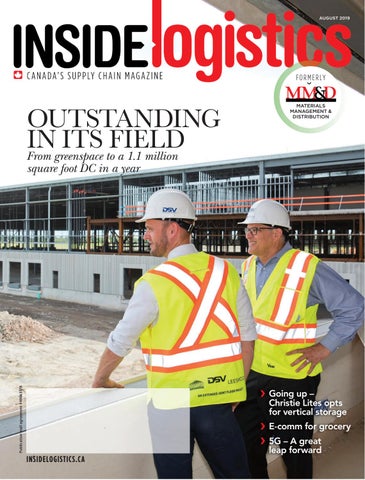
OUTSTANDING IN ITS FIELD From greenspace to a 1.1 million
FORMERLY
MATERIALS MANAGEMENT & DISTRIBUTION
Publication mail agreement #40063170
square foot DC in a year
Going up – Christie Lites opts for vertical storage E-comm for grocery 5G – A great leap forward INSIDELOGISTICS.CA
T H E S U P P LY C H A I N I N D U S T R Y ’ S P R E M I E R E D U C A T I O N A L E V E N T
mhlc.com September 8–11, 2019 park city | utah *Dematic *Dem em emat matic attic c rreserves eser es erve vess th ve the e riright igh ght g ht to to rrestrict esttri es tric ict re regi registrations. egi gist stra atitions.
CHECK OUT OUR MOVERS & SHAKERS SECTION SECT ION
page 1100
C A N A DA’ S S U P P LY C H A I N M AG A Z I N E A U G US T 2 0 19 • V O L UM E 6 4 • NU M BER 0 4
CONTENTS In every issue:
5
Taking Stock
6
Supply Chain Scan
Editor’s analysis
News and numbers from around the world
32
Innovations
35
Learning Curve
New products for supply chain efficiency
Protect your brand
14
37 Leading Edge
Hiring the A team
Bright Lights, Big City
38
Safety First
Preventing forktruck incidents
Christie Lites looks up to accommodate growth
ON THE COVER
6
SUPPLY CHAIN SCAN
AI cluster announces projects | Loblaws in the Loop | Logistics costs soar | Subcom challenges
7 DSV’s greenfield gambit. How the 3PL came to build a 1.1 million square foot DC in Milton, Ontario. Story on page 18.
insidelogistics.ca
7
25 Loblaw Loops
Presidents Choice fans will be able to buy cookies in reusable, returnable containers
25
28 The leap to 5G
How the new mobile protocol will affect logistics
28
The future of grocery Should you go with Ocado?
3
WE MAKE TRANSBORDER SHIPMENTS EASIER.
ONE SOURCE FOR ON-TIME, WORRY-FREE DELIVERIES Your business doesn’t stop at the border, neither does Old Dominion. Our people provide 100% real-time freight visibility for your shipments between Canada and the U.S., with direct loading to major U.S. markets. Your transborder crossings are pain-free with OD’s in-house 24/7 customs clearance and brokerage services and a single point of contact. Plus, OD’s industry-leading on-time record and low claims ratio provide confidence with every shipment.
For more information, visit odfl.ca or call 1-800-432-6335 1-800-432-6335.
Old Dominion Freight Line, the Old Dominion logo, OD Household Services and Helping The World Keep Promises are registered service marks of Old Dominion Freight Line, Inc. ©2019 Old Dominion Freight Line, Inc.
TA K I N G S T O C K
insidelogistics.ca EDITOR IN CHIEF: Emily Atkins (416) 614-5801 emily@newcom.ca WESTERN EDITOR: Derek Clouthier (403) 969-1506 derek@newcom.ca DIRECTOR OF BUSINESS DEVELOPMENT: Delon Rashid (416) 459-0063 delon@newcom.ca QUEBEC ACCOUNTS MANAGER: Anthony Buttino (514) 292-2297 anthonyb@newcom.ca CREATIVE DIRECTOR: Tim Norton (416) 510-5223 tim@newcom.ca PRODUCTION MANAGERS: Alicia Lerma & Jwad Khan (416) 510 6845 alicia@newcom.ca, jwad@newcom.ca CIRCULATION MANAGER: Mary Garufi (416) 614 5831 mary@newcom.ca MANAGING DIRECTOR, TRUCKING & SUPPLY CHAIN GROUP: Lou Smyrlis lou@newcom.ca
NEWCOM MEDIA INC . CHAIRMAN & FOUNDER: Jim Glionna PRESIDENT: Joe Glionna Inside Logistics, established in 1956, is published six times a year by Newcom Media Inc. HEAD OFFICE 5353 Dundas St W. Suite 400, Toronto, ON, M9B 6H8 SUBSCRIBER SERVICES To subscribe, renew your subscription or to change your address or information contact mary@newcom.ca or 416 614 5831 or visit our website: www.insidelogistics.ca/subscribe SUBSCRIPTION PRICE PER YEAR Canada $84.95 per year, Outside Canada $159.95 US per year. Single copy price: Canada $15.00, Outside Canada CA$32.65 Inside Logistics is published six times per year except for occasional combined, expanded or premium issues, which count as two subscription issues. ©Contents of this publication are protected by copyright and must not be reprinted in whole or in part without permission of the publisher. DISCLAIMER This publication is for informational purposes only. You should not act on information contained in this publication without seeking specific advice from qualified professionals. Inside Logistics accepts no responsibility or liability for claims made for any product or service reported or advertised in this issue. Inside Logistics receives unsolicited materials, (including letters to the editor, press releases, promotional items and images) from time to time. Inside Logistics, its affiliates and assignees may use, reproduce, publish, re-publish, distribute, store and archive such unsolicited submissions in whole or in part in any form or medium whatsoever, without compensation of any sort. PRINTED IN CANADA
Publications Mail Agreement #43008019, ISSN: 0025-5343 (Print) ISSN: 1929-6460 (Digital). Inside Logistics is indexed in the Canadian Magazine Index by Micromedia Limited. Back copies are available in microform from Macromedia Ltd., 158 Pearl St., Toronto, ON M5H 1L3
The space race WE’VE GOT TWO STORIES that hinge on the price of real estate this
issue, but neither is a real estate story. Both are about companies that have tailored their logistics to adapt to the rising cost of land. What’s cool is that they come at the solution from totally opposite directions. Christie Lites (featured on page 14) has an enviable location right on the edge of downtown Toronto that is expedient for its business model. But, as you might expect, there’s nowhere to grow there – at least not with a larger footprint – and moving is also prohibitively expensive. Their solution to running out of space on the warehouse floor is to look up, way up. The company installed vertical lift modules to store wiring for stage lighting, saving space, saving time and improving ergonomics for staff. DSV, on the other hand opted to go big (see page 18). Planning for growth, and trying to accommodate merged businesses, the company saw the opportunity to create efficiencies by combining facilities for three divisions into one. But to do that they needed 50 acres, prompting a search far and wide, away from the prime real estate of the GTA. They chose Milton, Ontario as the site for their 1.1 million square foot facility. And even with that much space, DSV is building the DC with a 40-foot clear roof, to maximize the cube. That’s logistics these days. Real estate calculations are driving decisionmaking for not only site selection and network design, but also increasingly the configuration of buildings and the technology chosen for operations. When you run out of space operations get messy and costs creep in, along with errors and unhappy customers. Creative solutions are the answer. Going up in an existing space – as Christie Lites did – is one way to solve the space dilemma. Micro-fulfillment is another, and giant, million-square-foot-plus DCs like DSVs are yet another. A common thread in all these solutions is that new technologies are facilitating better space utilization. From vertical lifts, to micro-DCs, to VNA applications and massive, fully robotic AS/RS units, the choices are growing and new solutions are showing up all the time. Are you making space-optimizing adaptations in your operation? We’d love to hear about your experiences in the space race. Please drop me a note! Emily@newcom.ca
MEDIA INC. FUNDED BY THE GOVERNMENT OF CANADA
insidelogistics.ca
INTERESTED IN THE GROCERY BIZ? READ OUR SURPRISING ANALYSIS OF THE OCADO MODEL ON PAGE 28.
5
SU PPLY C H A I N S C A N
Supercluster launches first AI projects Four projects will apply artificial intelligence to supply chain challenges and traceability, increase demand forecasting accuracy, optimize task assignment for field employees, and increase planning efficiency to avoid overstocking and waste. The selected projects will provide the following solutions: Ray-Mont Logistics, SimWell and Ivado Labs Decision are exploring support system for operations planning, storage allocation and crane scheduling. Bell Canada, Exfo, VuPoint Systems and Ivado Labs are working on forecasting the complexity of field repairs and technician management. Local Line, Flanagan FoodService, Ontario Fresh, and a collective of seven farmers will work on a community
COST OVERRUNS Logistics budgets getting blown
9
MOVERS + SHAKERS
10
OPINION Industry 5.0 is now
11
DIGITAL TWINS Virtual copies will allow for modelling and in-process adjustments to logistics
12
6
SCALE AI, (Supply Chain and Logistics
“I encourage all companies interested in applying AI to their supply chain to contact our teams to present their project proposals.” – Julien Billot, scale ai CEO
Excellence AI) Canada’s AI supply chain supercluster, has revealed its first four collaborative projects, which are intended to address supply chain challenges through the application of artificial intelligence (AI). Each industry-led project is composed of three to seven partners, and may include industry adopters, technology leaders, small and medium-sized enterprises, universities and research centres. “With these first selected projects, scale ai is entering its operational phase,” says Julien Billot, CEO of scale ai. “Since the official launch of our activities we have received a significant number of project submissions and are working with our partners to select other projects very soon. I encourage all companies interested in applying AI to their supply chain to contact our teams to present their project proposals.” The selected projects will tackle core issues identified by various sectors, including retail, manufacturing, agriculture and transport, by implementing artificial intelligence models. Ultimately, these projects will deliver concrete innovative solutions that will, among other benefits, improve product routing
co-loading platform for farmers. Nulogy, Mars Canada, Schenker Canada, Alliance, Linsey Foods, LakeCityFoods, and Menasha are building an intelligent platform for agile customization. Altogether the projects will cost $5.1 million, including $2 million co-invested by scale ai. “In a context of globalization, the development of international trade inevitably involves the optimization of our supply chain,” said Charles Raymond, CEO of Ray-Mont Logistics. “As a founding member of scale ai, we are proud to see that our smart terminal project is part of this shared vision of propelling the supply chain to another level.” One of Canada’s five innovation superclusters, scale ai is based in Montreal. Its mission is to develop the next generation supply chain and promote Canada’s leadership in artificial intelligence applied to the industry. To date nearly 120 industrial partners, research institutions and other players have joined. INSIDE Logistics AU GUST 2019
photo: Iaremenko, iStockimages.com
Appointments and moves in the supply chain sector
SU PPLY C H A I N S C A N
Loblaw expects seamless Loop integration LOBLAW COMPANIES will not need to make any up-front
investment in or changes to its logistics cycles to incorporate reusable packaging partner Loop into its operations, a spokesperson for the company says. “In the first phase, Loop is responsible for the logistics from the storing and delivery of the goods to consumers, so there will be no impact on our logistics,” Catherine Thomas, senior director of external communication for Loblaw Companies Limited, told Inside Logistics. Loop, a subsidiary of New Jersey-based Terracycle, integrates reusable packaging product cycles into existing retail environments. It will kick off the service by selling President’s Choice products in reusable packaging entirely through the Loop + Loblaw online purchasing platform. This system will be accessible via the PC Express website but will transact independently. Should the Canadian pilot be successful with its Toronto launch, both parties intend for Loblaw to become more involved as Loop’s processes become integrated directly into the retailer’s online platform and, eventually, into in-store applications and across additional markets. Product returns will also fall under Loop’s purview, which will not present logistics challenges. “A return will not impact the
| by Stephanie Wallcraft
Loop provides reusable containers in which Loblaw will package selected Presidents Choice products.
logistics cycle in any way,” says Lauren Taylor, Loop Global’s vice-president of creative and communications. “Each Loop company owns its own package, so each company will handle any product dissatisfaction.” Loop maintains a rigorous sanitation process that ensures high hygiene standards as containers are reused. They will be washed above 150°F with a sodium hydroxide solution, then rinsed over 180°F with a mild acid sanitizer. Last, the containers will be rinsed with deionized water. “Loop has partnered with manufacturers to implement stringent Quality Assurance processes throughout each stage of our cleaning and fulfillment systems, so consumers are receiving products that are entirely safe for consumption. Loop will also follow strict reporting processes to ensure that any adverse events or quality complaints are immediately escalated and addressed by both Loop and the manufacturer of the product.” The Toronto pilot project is one of several worldwide. Loop is currently active in Paris and New York, and launches are in the works for London (U.K.), Tokyo, Germany, and California.
Looking for low-cost industrial land?
WE WERE BORN YESTERDAY New infrastructure and room to grow make Calgary the cost leader in industrial land. Grow your business on City of Calgary land.
calgary.ca/movehere
19-00113617
insidelogistics.ca
7
Buying from the “one-trick pony” manufacturer can put you at a disadvantage.
Buying from a Pallet Racking Systems Integrator gives you the definite edge.
We don don’tt sell our solution to your y problem... It’s ourr problem to develop your y solution.
3D
STORAGE
SOLUTIONS
L I M I T E D
PALLET RACKING
PALLET FLOW
DRIVE-IN
CANTILEVER
PUSHBACK
CARTON FLOW
1 (877) 557-2257
MEZZANINES
INDUSTRIAL SHELVING
3DSTORAGESOLUTIONS.COM
SU PPLY C H A I N S C A N
Logistics costs up Report finds major companies blowing their supply chain budgets
AMID A BOOMING ECONOMY, United States Business
Logistics Costs (USBLC) rose 11.4 percent to reach US$1.64 trillion, or eight percent of 2018’s $20.5 trillion gross domestic product (GDP). The 2019 State of Logistics Report notes that supply chain capacity is tight enough that a number of major companies have reported in their Securities and Exchange Commission (SEC) filings that they exceeded their 2018 supply chain budget spending. “The logistics industry is at a new crossroads,” explained Michael Zimmerman, partner with A.T. Kearney and co-author of the 2019 report. “It has overcome a tough and exhausting year. Now, demand has softened, and growth is in doubt – but not to the point where a steep decline is visible, a context we summarize in the report’s title, ‘Cresting the Hill.’” The report took and optimistic tone, saying, “neither shippers nor suppliers seem satisfied with business as usual and the opportunity to leverage technology and collaborative practices is driving tangible efficiencies and shared gains.” It explores how cost overruns were driven by the spike in online purchasing. It increased by 14.2 percent last year, forcing
omni-channel sellers to retool their supply chains in response to the Amazon effect, which has shoppers expecting faster and faster delivery times. The need for smaller, more costly warehouses has spiked. Attracting and retaining labour in general remains challenging for transportation and logistics companies. Higher wages and competition from distribution centres, along with a generational change in the labour pool are making for a tight and uncomfortable labour market for both shippers and carriers. The report notes that in the U.S. alone there will be an additional 452,000 warehouse and DC jobs by 2020. In the warehousing world, the labour shortage is prompting the consideration and adoption of automation like never before, the report asserts. The report notes that “logistics is on the cusp of technological change,” and suggests that every sector could be transformed by the adoption of new technologies. The report identifies automated storage and retrieval systems (ASRS), improved order picking technologies like vision picking or goods-toperson solutions, and automated goods transport such as continued on page 13
LOGIMAT® VERTICAL LIFT MODULE (VLM) SSI SCHAEFER provides a complete line of material handling and automated storage and retrieval systems for various industries—including cold storage and e-commerce solutions. ssi-schaefer.com
insidelogistics.ca
9
MOVERS + SHAKERS Hamilton Port Authority has hired Jeremy Dunn as its new commercial vice-president. Before joining HPA, Dunn served in successive leadership roles at The Miller Group. His most recent role was as general manager of Miller Maintenance, responsible for managing and growing Miller’s highway maintenance business in Ontario. Dunn earned a Bachelor of Commerce (Hons) from Queen’s University, and holds a Master’s Certificate in Project Management. Michael Zahra has been appointed CEO of Drone Delivery Canada. Former CEO and director, Tony Di Benedetto, moves into the position of business strategy. Zahra who previously held the role of senior vicepresident of operations and strategy at DDC previously held positions as president of Staples Advantage Canada and president of Yahoo Canada. He also brings close to 20 years experience in various Board positions. Zahra has a BASc. in Electrical Engineering, an MBA from City University, Seattle and holds the P.Log designation from the Logistics Institute.
Sabih Khan, a 24-year Apple veteran, has been named the company’s senior vicepresident of operations. Khan will be in charge of Apple’s global supply chain, ensuring product quality and overseeing planning, procurement, manufacturing, logistics and product fulfillment functions, as well as Apple’s supplier responsibility programs. Before joining Apple’s procurement group in 1995, Khan worked as an applications development engineer and key account technical leader at GE Plastics. He earned bachelor’s degrees in economics and mechanical engineering and a master’s degree in mechanical engineering from Rensselaer Polytechnic Institute (RPI).
The American Association of Port Authorities (AAPA) unanimously chose Christopher Connor as the association’s next president and CEO. Connor, the former global CEO of Wallenius Wilhelmsen Logistics (WWL) will begin transitioning into his new role on September 23, eventually succeeding Kurt Nagle, AAPA’s president and CEO since 1995. Connor joined WWL in 1994 and held several key commercial and operational positions before being named CEO in 2013. Sealed Air Corporation’s board terminated the employment of William G. Stiehl as CFO, for cause, and appointed James Sullivan as CFO to replace him. Sullivan has more than 20 years of experience in leadership roles. Until 2017 he was executive vice-president and CFO at Joy Global. He was CFO of Solutia from 2004 until its acquisition by Eastman Chemical Company in 2012.
St
ar Fall tS C ep ou te rse m s be r1
What’s the most rewarding career decision you’ll ever make? Earning the CCLP® designation is easily the single best thing you can do to boost your career prospects. It can set you up for better pay, more advancement opportunities, and a range of management pathways and options across the sector. Plus, you’ll develop and demonstrate cross-functional capabilities that can deliver better business results—and more personal job protection. Depending on your background, your CCLP designation might be within closer reach than you think. Call or click WR ¿QG RXW LI \RX TXDOLI\ IRU DGYDQFHG VWDQGLQJ
www.citt.ca/cclp • 416.363.5696 Your best choice for complete career-long OHDUQLQJ FHUWLÀFDWLRQ in supply chain logistics
10
®CCLP &,77 &HUWLÀHG /RJLVWLFV 3URIHVVLRQDO LV D UHJLVWHUHG WUDGHP HPDUN RI &,77
INSIDE Logistics AU GUST 2019
OPINION
Industry 5.0 is now SCREWS THAT communicate with assembly robots, forklifts that store goods on high shelves, intelligent machines that independently coordinate production processes. The fourth industrial revolution: everything is intelligently networked, people, machines and products. But it’s not just the globe that keeps turning. Industry 4.0 is standardized in many industries and companies, but now the biological part is being added, making Industry 5.0, a collaboration between robots and humans. For the automation of production processes to develop its full potential, human creativity is necessary. Automated production with conventional industrial robots alone will only ever do what is prescribed in long and tedious programming. Collaborative robots, on the other
SU PPLY C H A I N S C A N
hand, work flexibly and directly with employees. This gives production a new dynamic and releases new potential: While the robot can take over standard processes, the human being is involved in other value-adding activities. The employee is relieved, because he uses the robot – the so-called Cobot – as a multifunctional tool: such as a screwdriver, or packaging machine, or palletizer, and so on. The robot cannot replace human labour, but it can supplement it by performing strenuous or routine or even dangerous tasks. And employees use their creativity for more complex tasks, because that’s where it’s needed. Artificial intelligence also plays a more demanding role in Industry 5.0. It does not only perform its tasks within the structures assigned to it. Rather, it develops its own solutions through lateral thinking and independent analysis and also organizes them directly. In this way, employees save time because they can immediately continue working with
If you’ve already learned the business of logistics
| by Martin Krill
concrete results. The next industrial revolution seems to be a collaboration between man and machine. Whereas one side has a rather defined area of work that must be programmed, the other (human) side will benefit from those results and can perform more efficiently. Sometimes, it is just not easy to find the fitting partner. Is the software smart enough to support the person and to cover all boring tasks? Or is the human being flexible and intelligent enough to really find strategic opportunities with the robot’s results? Even if this can be confirmed, the person must be eloquent and versatile to properly communicate the results and to remain a team player.
M Martin Krill is managing ddirector of Hager Unternehmensberatung, an U eexecutive search firm based in FFrankfurt, Germany.
CITT can now certify you without sending you back to class Introducing CITT’s new Challenge On-Ramp to industry’s most valued professional designation. Finally, there’s a fast, accurate and affordable way for experienced people to demonstrate their competencies and qualify for industry’s most respected logistics designation and full CITT membership.
citt.ca/challenge_onramp • 416.363.5696
®CCLP &,77 &HUWLÀHG /RJLVWLFV 3 V 3URIHVVLRQDO LV D UHJLVWHUHG WUDGHPDUN RI &,77
insidelogistics.ca
11
SU PPLY C H A I N S C A N
Seeing double Meet the digital twins THE MARKET FOR digital twin technologies is expected to grow significantly over the next five years. A digital twin is a unique, virtual representation of a physical object
that monitors and simulates both the physical state and behaviour of the object. The digital copy is continually connected to its physical counterpart(s) and updates itself to reflect real-world changes. Applied to products, machines and even entire business eco-systems, digital twins can reveal insights from the past, optimize the present and even
predict future performance. The technology is made possible through the use of Internet of things sensors and data collection, which allows for the continuous monitoring of equipment and its performance. “The market for digital twins is expected to grow more than 38 percent each year, passing the US$26 billion mark by 2025,” explained Matthias Heutger, senior vice-president, global head of innovation and commercial development at DHL, which recently published a report Digital Twins in Logistics. “Digital twins offer unparalleled capabilities to track, monitor, and diagnose assets. They will change traditional supply chains, with a range of options to facilitate data-driven decision-making and collaboration, streamlined business processes, and new business models.” In the report, DHL examines challenges to implementation, such as cyber security concerns, but stresses that business cases for implementing digital twins are becoming more compelling. As related technologies get to be more dependable and affordable, businesses in a number of industries will find digital twins invaluable in managing complex systems of assets in real time and increasing efficiency in their processes. The report concludes by considering the investments and changes necessary for the successful implementation of digital twins in logistics.
DONE DEALS Coop picks Witron Norwegian food retailer Coop is expanding its central goods distribution centre in cooperation with Witron. The 560,000 square foot DC located near the Oslo airport will be expanded to 900,000 sq. ft. and have a total order picking volume of 600,000 cases when it is complete in May 2022. The expanded facility will use a total of 42 Witron machines, extra automated pallet aisles, tray AS/RS aisles, stacker cranes, and conveyor system components operating in all temperature zones. The capacity of the fully automated shipping buffer will also be doubled.
12
INSIDE Logistics AU GUST 2019
Subcom faces fulfillment challenges SUBSCRIPTION COMMERCE – automatic replenishment services for households, also known as subcom – is growing in popularity with adults in the 25 to 34 demographic. Most companies expect to grow, with 37 percent anticipating growth of 26 to 100 percent, and 21 percent expecting to grow more than 100 percent. While these companies remain relatively small, with 74 percent earning less than US$5 million in 2018 and with 60 percent employing five or fewer staff in their fulfillment operations, they are facing significant fulfillment challenges, according to a recent study by the Subscription Trade Association (SUBTA) and Snapfulfil. Demand forecasting, on-time shipping, inventory accuracy and kitting are the largest challenges these companies
report. Meanwhile, only 28 percent use third party logistics services to manage fulfillment and two thirds don’t plan to engage one in the foreseeable future. Of those that do use a 3PL, 79 percent report improved efficiency, 50 percent say performance has improved and 43 percent report lower costs.
LOGISTICS COSTS UP, continued from page 9 autonomous mobile robots as some of the most promising uses of new technologies being introduced into distribution operations. Software is also becoming crucial, with warehouse control systems (WCS) now required to mange the interface with automated equipment, and warehouse execution systems (WES) to mange flow, in combination with the more ubiquitous WMS. “Both WCS and WES must interface efficiently with WMS to serve as the warehouse brain and direct robot muscles,” the report notes. Automated order processing has challenged WMS providers, creating an opportunity for WCS providers to fill the need. The annual State of Logistics Report is produced by the Council of Supply Chain Management Professionals (CSCMP). It is written by A.T. Kearney and presented by Penske Logistics.
Follow Us On insidelogistics.ca
13
INSIDE STORY
| By Emily Atkins
Photo: Emily Atkins
BRIGHT LIGHTS
14
INSIDE Logistics AU GUST 2019
DISTRIBUTION CENTRES aren’t typically in the central parts of major cities, but the Christie Lites facility in Toronto is far from typical in many ways. The company provides stage lighting – and lighting only – to theatrical and musical productions from its locations in the UK, all over the U.S. and in Toronto, Vancouver, Calgary, Ottawa and Winnipeg. Because it’s a rental model, the product Christie Lites moves into and out of its warehouse will eventually be returned to storage. Inventory includes lights, cabling, trusses, and all the pieces needed to stage the lighting for major shows – rock concerts, stage productions, special events, you name it. In all, they store about 4,000 lines in, covering about three million individual assets. Speed is critical. “We’re a very different kind of a model from a distribution centre – we can’t be late. We are NOT late,” says Dan Souwand, who is vice-president of equipment, systems, and warehousing for Christie Lites, North America. In his time with the company since 1991 he recalls only two late deliveries, and the company was not able to bill for them because “we’re always the first ones in and the last ones out, because we’re doing the rigging and all the support. If you’ve got 100 union guys waiting on a loading dock to start working on a show, and we’re late, we’re holding everybody up. Late just isn’t in our vocabulary.” Business is seasonal and spiky, with volumes as high as 30 trailers in a day, right down to a single courier box. Big holidays, like Canada Day celebrations, mean a huge spike in business followed by a couple days when the all the kit from various shows is returned. To manage the ebb and flow, Christie Lites has 20 full-time staff in the warehouse. At busy times that burgeons to over 70 working on the floor, including clients who do some of their assembly work in the facility’s dedicated prep area. Everything is boxed to a standard, says Souwand. “When you’re doing a concert or a very fast-deployed show, the guys that are actually putting it together on-site will
BIGCITY Christie Lites sets the stage for growth with vertical storage
L-R: Kevin Pearce, Carlo Isetta and Dan Souwand in the Christie Lites warehouse.
insidelogistics.ca
come and pre-label wires and parts, so when they get on site, they can just plug the right ones in together. There’s no thinking.” The 45,000-square-foot Toronto facility, which is also the 36-year-old company’s head office, is located in a light industrial area on the western fringe of the downtown core, near the confluence of the QEW and 427 highways. It’s unbelievably convenient, allowing the company to easily serve shows in the core – it’s only half an hour away, even with traffic – as well as giving truckers easy access to main arteries to move equipment out of town. About four years ago, Souwand realized they were running out of space in the Toronto unit. It’s his job to ensure the smooth operation of the DC as well as to manage the company’s real estate. But moving was not an option with the cost of real estate in the city, not to mention the logistics of moving a head office. “Last time we renewed our lease, we looked as far out as Milton and Hamilton,” he says. “At that point, when you start looking at the cost to get into the city, and our client-base that don’t want to go to Hamilton to prep a show, being close to a city is really, really important to us.”
Setting the stage So he started scouting around for a way to maximize the cube of the warehouse. “We didn’t have a lot of floor space, but we had a lot of air that we weren’t using,” he says. As well, because of the constant return requirements of the business, “finding a machine that actually allowed us to restock very quickly was one of the high points on the need list.” His research brought him to the idea of vertical storage and Modula, which makes vertical lift modules. After seeing Modula products in action at ProMat, Souwand was impressed. “Whoever actually came up with the initial idea, they deserve mad props,” he says. Here’s where Carlo Isetta and Kevin Pearce come into the story. Isetta is a regional storage specialist with Swiss Instruments Limited, and Pearce is Modula Inc.’s regional sales manager, based in Toronto.
15
Dress rehearsal When he made the initial purchase decision Souwand opted to try batch picking, but quickly realized it didn’t suit the business model. Because not all the pieces for an order would be stored in the machines, it created a hiccup in the flow. If, for example, there were five different shows being picked they’d find that an item for one would still be inbound from its previous user, holding up the whole process. Once he realized that this was slowing everything down, Souwand abandoned batch picking and shifted to an order-byorder system. Now orders are organized by the WMS overnight and when the operator starts work in the morning he’ll enter an order number and the machine starts working, delivering the trays in the order they want the product packaged.
The lower computer shows orders and quantities to be picked, while the upper one shows an image of what’s in the drawer.
the items into the shipping cases. Because the inventory would make it onto an order sheet in the order it’s listed, not in the order it needed to be packed, the process was cumbersome and time consuming. But the Modula software allowed the company to update the asset base with new attributes that let it prioritize picking based on certain attributes. “We could say, ‘okay, pull the longest, heaviest, pieces first, and work the way up to the lightest ones’. And then that would cycle through the different product lines that we have,” Souwand notes. It allows the order pickers to build an order in a way that is efficient for loading. As well, before the Modula units were installed the cables were stored in wire mesh bins that were stacked five high. That meant, of every five bins, only one of them was actually ergonomically reachable, Souwand recounts. “You either were up a ladder, or basically on your hands and knees pulling product out.”
A standing ovation Opening night Before the Modula units were installed, picking was completely manual. Operators would walk the aisles with a pick sheet and it was up to them to know how organize
16
Aside from implementing goods-to-person picking, which saves time and travel, the Modula units also have the ability to pre-cycle the next drawer into position, so that there’s no waiting between picks.
“If the operator is picking from one tray, the elevator’s already gone to get the next tray, and it stages it in the internal bay, and as soon as the operator’s finished with the first tray, the next one is right there,” Pearce says. “That took our turnaround time and shortened it, so the guys are never waiting for product, or there’s always a tray there, so we’re not losing 15, 20 seconds at a pick, we’re now five seconds between picks,” Souwand adds. That increased speed has added up to an estimated increase in efficiency of 40 percent in the cable department. “Because we have not added any staff, and our volume has gone up over six years, our throughput’s gone up probably about 50 percent,” Souwand says. “We went from five guys picking full-time, down to two guys picking full-time out of the machines, and one guy outside of the machines.” And because the product is presented at the picker’s fingertips there are huge ergonomic benefits. Since the Modula units have been installed Souwand says he hasn’t seen any injuries. “The staff really aren’t having to bend over to pick product anymore; they’re picking it at a waist-level. So from an ergonomic standpoint it’s fantastic. The guys were just INSIDE Logistics AU GUST 2019
Photos: Emily Atkins
After a thorough survey it was decided that cable storage – the cables are various sizes and weights and are awkward and heavy – was the biggest area of need and one where the vertical storage would be practical. Based on the parameters of the various cables, Isetta recommended two ML units that each take up about 150 square feet of floor space and store items in vertical towers 24 feet high (a third was added when space got tight again, two years later). “The machine can be anywhere from a six-foot-wide tray up to a 13.5-foot-wide tray. And then we calculate the weight on that. We can go anywhere from 551 pounds per tray up to one ton,” Isetta says. “Previously, our cable area – just our storage area – was over 15,000 square feet,” Souwand says. “And that was reduced to below 8,000.” He went with Modula because it was self-contained, and for the software, he says. The integration with the company’s proprietary WMS was seamless, taking only a week from installation to being completely operational.
The Modula unit allows picking from one tray while the next one to be needed cycles into position.
getting a little worn, but we haven’t had any back injuries reported since we’ve had the machines.” Inventory control has also seen a boost with the new system. Previously items were not scanned into storage, but with the new software there’s a double scan in place – on the way in and the way out. “It just gives us that double-check that our inventory’s 100 percent correct,” Souwand says. Local sales managers have insight into exactly what’s in storage so they can confidently tell a customer that it will be ready on a short turnaround, if necessary. “That immediacy really helps,” he adds. “We could get a call this morning: ‘Hey, we need to have three trailers at the MTCC (Metro Toronto Convention Centre) tomorrow morning, can you do it?’ We regularly do.” Part of the deal for the storage units was a maintenance program, which entails regular annual preventative checkups for each unit. Since they’ve been installed the units have had zero downtime. “That to me is the pot of gold,” Souwand says. “Because we can’t be late.” Reliance on the units means the company has a plan in place to bring in generators in the event of a power failure to
insidelogistics.ca
The old way of storing cables at Christie Lites.
ensure cables can be retrieved from the units. So far they haven’t had to use it.
All for show In an unexpected plot twist, Christie Lites has found that the Modula units also work as a marketing tool. “Our marketing budget at Christie Lites is pretty much zero,” Souwand laughs. “Most of our marketing is our warehouses. Because our clients come into our distribution centres and see it, we really have to be on top of making ourselves presentable.” Clients who visit and see the Modula units are impressed, he says. “They go ‘Wow, it’s organized, it’s clean.’ So when we have a promoter or a purchaser from one of the big companies come in, our sales reps can say, ‘Hey, if we’re this good in our warehouse, just think what we can do out on show site for you. I can tell you exactly where this piece of cable is in my inventory system.’”
For an encore Even with all the benefits that Christie Lites has realized by going vertical, Souwand is still looking for improvements. At the moment they are still working on barcoding inventory, a process that leaves them wrestling with how much detail they
actually need. “How far down do you barcode something that’s a rental?” Souwand asks. If a $3 piece costs 50 cents to barcode it, and then every time it’s scanned it costs another three cents, is it worth it? “If that piece doesn’t show up on a show site, that could cost me $50,000. So what’s your cost-benefit off of equipment tracking?” He recounts having to put an employee on a plane with a bag full of three-cent truss pins that had been left out of a shipment. Nothing could be built without them. If they had been barcoded and part of an order they would not have been forgotten. With the Modula units coming in at a four-year ROI, inside Souwand’s stipulated five-year payback window, and with a projected life of at least 20 years, the Toronto DC is set for a long run. But business is booming, and although he just finished moving the company’s Las Vegas DC into a larger space, Souwand has his eyes on more vertical storage. “When I hit the same volume and space limitations we had here, or speed limitations that we started having here, Vegas is actually lined up and designed to take nine machines,” he says. The show must go on.
17
D C PL A N N I N G
| By Emily Atkins
OUTSTANDING IN ITS FIELD
From greenspace to a 1.1 million square foot DC in a year Rising out of the fields surrounding the fast-growing town of Milton, Ontario, is a massive structure that you can see from kilometres away. Still only partially walled-in when we visited in June – its exoskeleton still rising from the ground – it is the shell of DSV’s new distribution centre.
Watch the build! Timelapse photography at the Milton site:
Photo courtesy of Herman Custodio
http://tinyurl.com/DSVMilton
18
INSIDE Logistics AU GUST 2019
A
t 1.1 million square feet, the new DC will be the largest in DSV’s global network of over 80 countries. It will be home to a multi-client warehouse as part of the company’s Solutions division, and will house operations for the Air & Sea and Road divisions, as well as a three-story, 35,000 square foot office annex.
The seed DSV has been busy making large acquisitions. With UTI joining the fold in 2016 DSV became the fifth largest freight forwarder in the world, and more recently
DSV managing directors Rob Chanona (L) and Martin Roos stand in the office area.
insidelogistics.ca
its agreement to merge with Panalpina bumps it even higher. The new company will have about $23 billion in revenue and a workforce of more than 60,000 employees operating in 90 countries. Accommodating growth like this takes foresight, and the decision to build the giant new facility began shortly after the UTI acquisition in the company’s HQ in Denmark, where the global footprint is under constant analysis. DSV’s Group Property division reached out to the Canadian managing directors, Rob Chanona from Solutions and Martin Roos of Air & Sea to determine what their divisions would need in terms of space and location, and if they could work together in one building. The company’s objective is to gain synergies by eliminating disparate facilities and grouping the businesses together into one location where assets can be shared. “We had five, six buildings in the Greater Toronto area that will move into this Milton site,” Chanona said. Part of the discussion with HQ was also to anticipate growth, “to build it with strategic space to sell into,” Chanona added. “In hindsight, that vision was 20/20 because now we’re realizing that in the GTA the vacancy rate is getting to historical lows, and we’re sitting on a 1.1 million square foot facility.” Finding a suitable location was left to the local staff, Roos said. “I think that’s very unique but also defining of DSV. There’s a lot of autonomy in the countries. The decisions are ultimately left with the businesses from the philosophy that
the local business knows and understands the local market the best.” Unlike many of DSV’s Air & Sea operations, Roos’s business already had a crossdock operation, which will be incorporated into the new building. “We all knew there would only be benefits from being open, transparent, and working together as opposed to working against each other. It’s the same company, and we need to see the bigger picture, even though that sometimes can be a little bit difficult when there are many chefs involved,” he said.
Site selection The Solutions division drove the site selection – it will be the largest tenant and needs the most labour, making it important to locate near transit and highways so that people could get to work there. Air & Sea wanted to be near the airport, but the plan required a 50-acre parcel, and that’s just not doable close to Pearson International Airport. Chanona recounts a search far and wide, looking at infill, greenfield possibilities and even a foray to the north. “We even had a meeting with two farmers where we were looking out the window at a hundred cows as we were discussing whether they wanted to sell the land or not,” he said. “So we looked at everything and then settled on Milton based on all the constraints in the GTA.” The town of Milton was very welcoming, Roos noted. “I don’t think permits had ever been approved this fast as they were with this particular site. It was quite evident that they were going to be an
The site is designed so that the office building doesn’t cut into the DC space, while also providing a more pleasant work environment. Trucks will be required to drive under the office annex to leave the site.
19
Chris Sheffield Warehouse 2 years, VersaCold
VersaCold is a food-first company. With over 70 years of supply chain experience, we’re a diverse team dedicated to ensuring the safety, quality and freshness of the food families eat—every step of the chain.
versacold.com
extremely supportive community to establish ourselves in. It’s important for us to establish a partnership with the city and become an active community member.”
Photos: Emily Atkins
Getting the right mix Building a DSV DC is based on a formula that’s being refined with every new facility. “Each building is the next version of the previous,” Roos said. “So we take all the good experiences and integrate that into what we’re building here.” The design is coordinated between the principal Danish architect and a local architect, and takes into account local requirements like managing for snow, the number of bicycle parking spots that might be required – fewer in Canada – and the size of parking stalls – larger in Canada, thanks to the SUVs and pickup trucks we love. Chanona describes design and planning as falling into three buckets. The first is the cultural and climate planning as well as how the traffic would flow around the site, how access would be controlled and the major design features of the interior, such as where power supply would enter the building and so on. The second piece is communicating to clients and partners about the move. “We have to make sure that they’re aligned,” Chanona said. “That’s a significant element of the project itself because you have an existing supply chain that’s run-
DSV MILTON TIMELINE • April – Nov 2018: Site Plan & Building Permits • May 25, 2018: Mobilize on-site; Site began to be backfilled (the entire site was 12 to 16 feet below surrounding grade) • Nov 22, 2018: Ground-breaking • Nov 2018 – Nov 2019: Warehouse Construction • Jan 2019: Structural Steel Erection Begins • Dec 2019: Expected Completion/Initial Move-in date • Dec 2020: Fully Operational
ning out of a building in Brampton, how do you relocate that seamlessly and move that to Milton?” The third bucket is looking at the future, once the dust has settled and everybody is moved in. “One of the directives that came from the local management team is that whatever happened in Milton could not be simply a copy and paste of existing operations,” Chanona added. “We wanted the future state to be improved, maximizing efficiency. That took thinking outside the box. How do you create that synergy from a large building that you never had before?”
From a distance the DC is hard to miss, even without walls.
insidelogistics.ca
Technology assist The groups sharing the new building have very different operational needs. Roos pointed out that Road and Air & Sea want to move cargo as fast as possible, while Solutions wants to hang onto it and add value. The DC will be 90 percent dedicated to the Solutions business, while 90 percent of the office space will be used by the freight forwarding side. Chanona is looking at software to help with scheduling and planning across multiple clients. Some are pallet-in, pallet-out, some are case-in, case-out, and there is a significant group of clients that are either pallet- or case-in, but eaches out – e-commerce operators. “And in Milton, having all three of these profiles in one building, we had to come up with labour scheduling, we needed software,” he said. With more than 800 staff, labour management will be an important part of that technology buy. The company is looking at solutions that will allow staff to schedule their work easily using mobile devices. Not only will it smooth scheduling, it will allow for better pricing accuracy and transparency for the clients. “If the volume of work that the client gives us requires 5.6 forklift operators, traditionally you might have to price it at six because you literally can’t do 5.6,” Chanona said. “What we’re building is the ability to give the client exactly 5.6 continued on page 23
The road-facing side of the building getting cladding in June, while trucks roll through with more fill.
21
REACH CANADIAN SHIPPERS
ADVERTISE IN
MAGAZINE
Get your message in front of those who have freight to move. Advertise in Canadian Shipper magazine — the most-trusted and widest-reaching Canadian publication for shippers.
NATIONAL ADVERTISING Delon Rashid Director of Business Development 416-459-0063
QUEBEC ADVERTISING Anthony Buttino Director of Business Development 514-292-2297
canadianshipper.com
work effort in terms of resources, and that drives costs and value.” The building will be 40 feet clear, and not a narrow-aisle set-up, which Chanona said is too limiting in a multi-client facility. They are looking at an AGV forklift solution, and are working with a manufacturer to develop a machine that can manage heights of 40 feet. “The automated guided forklifts are a better long-term alternative to provide us with flexibility that we see the market requires,” he said. The 40-foot roof height will give the facility a 25 percent better space utilization than the average 30-foot clear building, Chanona said. And with 1.1 million square feet, that adds up to a lot of extra cube.
“We take all the good experiences and integrate that into what we’re building here.” – Martin Roos
Photos: Emily Atkins
Timelines With just over a year for the build, the contractor, Leeswood Construction, has been hitting deadlines without fail. And they’ve had to contend with poor weather and a challenging site that was so far below grade that it has required thousands of truckloads of fill to level, sometimes at a rate of 200 to 500 a day. The initial work on the building’s footprint was essentially on an island in the middle of a lake, as they built that area up first, said construction manager Chris Prior. The first to move in will be the freight
A catchment basin on the back side of the facility.
forwarding divisions, with Solutions transitioning clients over through the course of 2020. “We’ve taken a very conservative, safe relocation plan where we’re going to be moving buildings, existing buildings, over a period of nine months,” Chanona said. “Some people might say that’s a luxury. But to us, that’s the only safe way to move clients in.”
Scale is hard to comprehend on a building that’s 1.1 million square feet. Inside a working DC there is no sense of magnitude, but on the ground inside the unfinished DSV DC it seems a small town could be accommodated under the roof.
insidelogistics.ca
Future DSV’s decision to go big looks set to pay off from a real estate perspective, but as the managing directors both acknowledge, the future is unknown. Chanona talked about the risks of committing to technologies. “It’s sometimes hard to predict the future. What I think we’re trying to do – and to me this is very conceptual, but we’re partnering with certain technology companies and we want to work with them closely because we could influence how they react to the market,” he said. “Is there something that’s going to be radically different in the future? I’m sure there will be. It’s just hard to put your finger on what that is.” The new Panalpina deal forced the team to “take another deeper look at how do we make all of these pieces fit into the model we’re building, but the pieces are at this point by and large still unknown. So it becomes to an extent guesswork or a guesstimate of how you intend to run it, with best case and worst case scenarios,” Roos said. “There are still a lot of moving parts, but we of course hope that we can benefit from this increased footprint and size and continue with the DSV model which is to build long lasting partnerships and continue to develop the existing partnerships.”
The last section of the site being leveled up.
23
Ear End lybird s A Pric ug 15t ing h
SURFACE TRANSPORTATION SUMMIT
Don’t miss the summit that DELIVERS OCTOBER 16, 2019 International Centre 6900 Airport Road, Mississauga, ON
GET Expert insights into your industry. Networking Opportunities with fellow supply chain leaders. Practical Knowledge you can put to work today. Card Exchange & Networking Driver Recruitment Best Practices Freight Management Best Practices Shipper-Carrier Roundtable | Workplace Safety Economic Outlook | CEO Track | Shipper of Choice
Silver Luncheon
Bronze
ŽīĞĞ ƌĞĂŬ Breakfast Sponsor
Association Partners
Produced by
DŽƌŶŝŶŐ
ŌĞƌŶŽŽŶ
Media Sponsors
MEDIA INC.
www.surfacetransportationsummit.com
Lanyard
TECHNOLOGY
| By Jacob Stoller
5G WILL POWER THE LOGISTICS OPERATION OF THE FUTURE, BUT HOW WILL IT GET THERE?
Photo: sompong tom, iStockimages.com.
T
he hype wars around tech trends can get pretty animated, but things had clearly gotten ugly in February when U.S. telecom carrier Sprint filed a lawsuit claiming that its competitor, AT&T, “has sought to gain an unfair advantage in the race to 5G by embarking on a nationwide advertising campaign to deceive consumers into believing that its existing 4G LTE Advanced network is now a 5G network.” The controversy has clouded an already confusing landscape. There are, in fact, two separate technologies that bear the name 5G. One is an abbreviation for “5GHZ Wi-Fi”, the current standard for Wi-Fi routers which happen to utilize the 5GHZ frequency band. The other is the acronym for “5th Generation” of the international cellular standard.
insidelogistics.ca
The latter is drawing all the attention, reflecting that it is far more than an upgrade of the existing 4G. It is this 5G that experts see as a huge leap forward in wide area communications that will significantly accelerate developments in areas such as artificial intelligence, robotics, Internet of Things (IoT), and virtual and augmented reality (VR/AR).
The 5G promise 5G is expected to deliver data rates of 10GB per second, roughly 20 times faster than 4G, allowing a consumer to download a high-resolution movie in two seconds. Of more interest to industry, however, is the significant reduction in what’s called latency – the time it takes for a device to receive and respond to a message. “Latency improvement, or improved response time, excites many network engi-
neers more than the faster speed,” says Lawrence Surtees, vice-president, communications research at Toronto-based technology research firm IDC Canada. “5G promises response time of below one millisecond for a message, compared with between 50 and 70 milliseconds for 4G.” Low latency, Surtees points out, will be essential for autonomous vehicles and other emerging applications. “Driverless vehicles will need this fast response time to make split-second decisions with 5G sensors along the road to potentially avoid an accident.” But 5G’s impact will be even more far-reaching. 5G’s architecture is based on two other leading-edge networking standards, and Surtees says that this will usher in a new era of interoperability. “I believe the combination of 5G, Software Defined Networks (SDN), and its com-
25
panion Network Functions Virtualization (NFV), will be the most profound development to occur in telecom in our lifetime.”
The impact on logistics There’s a clear role for 5G in the fully automated logistics operation of the future, where shipments arrive at a distribution centre in driverless trucks, are broken down and re-packaged by robots, and then delivered to stores by drone or autonomous van. Here, 5G will provide a seamless platform for integrating a wide range of high-speed equipment and communications infrastructure. In the near term, however, existing technology is more than adequate for applications both within facilities and on the roads, and 4G will continue to support new software innovations. “We’re putting more and more computing power into the wireless side of things, which puts more functionality in the hands of the drivers,” says Greg Braun, senior vice-president, sales and marketing for Montreal-based logistics software provider C3. The real challenge is that cellular coverage is inconsistent in many parts of Canada. “The problem is when we don’t have 4G,” says Braun. “Outside of urban areas you’re going to be running into 3G or possibly even less than that. For our applications, we don’t need higher bandwidths than 4G, but we do need 4G speed consistently.”
Low frequency, high impact An important aspect of 5G is that it will operate at various frequencies, and at the lower end of the spectrum, will utilize bands are currently occupied by 4G. The higher frequencies, typically in the 25 GHZ range, are necessary for the speed required by autonomous vehicles, but have the disadvantage that they don’t transmit through walls, and therefore are unsuitable for use within a facility. This is particularly relevant for applications in distribution centres and warehouses that employ Internet of Things (IoT) technology. “IoT is narrow band data, ” says Michael Martin, national IoT executive for IBM
insidelogistics.ca
Canada, “so we can live quite comfortably in the lower bands – 8 or 900 MHZ, or 3.5 GHZ.” This will allow 5G IoT applications to operate without the transmission restrictions of the higher frequency wavelength bands. “When you connect logistics,” Martin says, “I would suggest that you want lower frequencies – frequencies where the normal 4G will be converted to 5G with higher orders of modulation. So you’ll have the same spectrum, but a higher data rate, which will allow more to be done in those low frequencies.” Martin also points out that IoT can work well with today’s technology. “A lot of the core infrastructure is there,” he says. “If somebody wants to deploy IoT, I would say that the carriers are ready for it today.”
“5G...will be the most profound development to occur in telecom in our lifetime.” Another important factor is that Wi-Fi 6, the latest Wi-Fi standard, incorporates many of 5G’s leading-edge features, and Wi-Fi 6 products are now available. “WiFi 6 is designed to have not just a greater bandwidth,” says Surtees, “but reduced latency as well, which will provide a degree of compatibility with 5G.” As Surtees explains, Wi-Fi 6 also includes 5G-like features that will make the transmission and reception of data more efficient. For example, a Wi-Fi 6 router will be able to communicate with multiple devices simultaneously rather than having to broadcast to each one-at-a-time (known as multi-user multi-input multi-output or MUMIMO). It will also be possible to send data to multiple devices in a single transmission (orthogonal frequency-division multiple access or OFDMA). Wi-Fi 6 devices also support regular check-ins with the router, reducing the
amount of time IoT devices need to power up antennas, thereby increasing their battery life. Essentially, Wi-Fi 6 makes it possible to develop next-generation functionality within facilities that can be transferred to a future 5G environment.
5G comes to Canada Compared with the U.S., the 5G conversation in Canada is less adversarial. Forecasts of the time frames are also more nuanced – while U.S. providers are announcing rollouts in multiple cities, Canadian providers are saying very little. Experts say wide availability here is still several years away. One factor affecting timing is that the details of the 5G standard won’t be finalized until March 2020. “We had a version ratified in March 2019, which set the stage,” says Martin. “But, for example, the spectrum options are still not resolved in Asia, Europe, Canada, and parts of the US, so we still don’t know what frequencies we’re going to be dealing with.” 5G will also require a major infrastructure overhaul that will be particularly challenging given Canada’s geography. “5G uses a very high frequency spectrum, which is called the millimeter wave (mmwave) spectrum,” says Jeet Narsing-hani, a Torontobased systems engineer, “and signals have a much shorter range and are easily obstructed. So instead of today’s cell towers, which can have a range of many kilometres, 5G access points will have to be installed on every second electrical pole on the roads, and they will have to be interconnected with fiber optic cabling. So this is a very significant project.”
Moving forward The wide availability of 5G in Canada is likely to be further away than many people expect. However, application developers have plenty work with in today’s networking environment. “People need to ask in which applications it would be preferable to have 5G,” says Surtees. “Many applications – advanced driver assistance systems, platooning, vehicle management systems, dynamic routing systems, driver scorecard – are developed and can be put in place now using 4G.”
27
A N A LYS I S
| By Charles Fallon and Sean Butler
The online grocery
FORMULA
O
cado Group is one of the most ambitious online grocers worldwide. The 100 percent homedelivery U.K.-based company is investing heavily in automation and robotics and has announced agreements to export its services platform to retailers in five countries. In 2018, the company posted revenue growth of 11 percent, year-over-year, reported positive EBITDA and saw its public profile explode. Is Ocado the future of online grocery? Is the hype justified? We analyze Ocado’s performance to reveal never-before reported risks to its model, and identify best practices available to online grocers in every global market.
What is Ocado? Ocado has slowly built its profile over 17 years. In 2002, the company opened its
28
Grocers should understand that the Ocado Smart Platform is an impressive achievement but not a significant advantage to any of Ocado’s partners.
14
%
Ocado controls 14 percent of the online grocery market in the U.K.
online grocery store, Ocado Retail, which today offers nearly 55,000 products to 74 percent of households in the U.K. The company controls 14 percent of the highlycompetitive online grocery market in its home country. Ocado’s strategy is aggressively premised on the construction of centralized fulfillment centres, and the relentless pursuit of automation and robotization of these facilities. The company operates four Customer Fulfillment Centres (CFCs) in the U.K. At each CFC, Ocado deploys a range of self-developed technologies, from a homegrown WMS to self-built autonomous robots. It brands this ever-evolving bundle of hardware and software as the “Ocado Smart Platform” (OSP), which the company describes as “a cloud-based bundle of software modules and fulfillment hardware – essentially everything necessary to INSIDE Logistics AU GUST 2019
Photo: alexsl, iStockimages.com.
Does Ocado’s promise measure up?
Ocado has committed to building more than 20 fulfillment centres for partners over the next three years. This incredible pace means enormous risks for the company and its customers.
conventional system – a 40 percent reduction in fulfillment costs.
At what cost?
build an online grocery operation.” Ocado resells the OSP platform to grocers around the world, allowing them a single source for design, implementation and support of online grocery operations.
What is the value of Ocado’s technology? Operationally, Ocado’s results are solid: for 2018, the company reports total throughput of 164 units per hour across its facilities. By comparison, an extremely low-capital operation can only reach total throughput productivity of approximately 100 units per hour. Such an operation would employ simple carts and shelves, with no further automation. If we assigned an average fully-loaded wage rate of US$25 per hour to these two models, then Ocado’s fulfillment cost per unit would be $0.15 versus $0.25 for the most basic
insidelogistics.ca
In its published case study of its Dordon, U.K. fulfillment centre, Ocado reports that total capital costs for the project were $301 million, of which only $105 million were “land and buildings”. Ocado spent the balance, $196 million, on “mechanical material handling equipment (cranes, conveyors and storage racking) and technology investment.” A cart and shelf system for an equivalently sized building could, in an extremely expensive scenario, require a $10 million investment. The net increase in capital investment for the Dordon FC is $186 million. Do the savings justify the investment? • Dordon’s rated capacity is 180,000 orders per week. • Assuming 25 units per order, Dordon’s capacity is 4.5 million unit picks per week. • The $0.10 per unit differential would generate savings of $450,000 weekly or $23.4 million annually. • The payback period on this investment is eight years. As a payback period, eight years is reasonable for investments in assets with long useable lives. So on its face, this may tempt some to strike a “long-view pose” to justify Ocado’s investment. However, there are two key points to consider: Equipment depreciates over seven to 10 years because that is the useful life of the equipment. An eight-year payback scenario disregards the significant invest-
ment required to maintain, upgrade and expand this proprietary and immature platform over its life. This will be inevitable and will push payback well beyond an eight-year horizon. This payback calculation compares the Ocado Smart Platform to the most basic, labour intensive option possible (i.e., carts and shelves). Much more capable systems exist at reasonable cost. Building a model to justify the capital expenditure required to implement Ocado’s system requires very high labour costs. In extreme situations, for grocers with labour costs much higher than those used in our calculations, the Ocado Smart Platform could present an attractive option.
Risks of buying in The sum of their marketing efforts is intended to leave viewers with a very clear message: Ocado is a pioneering technology company, constantly innovating, constantly becoming more efficient. In the short-term, Ocado has committed to building more than 20 CFCs for partners over the next three years. This incredible pace means enormous risks for both the company and its customers, who must now wait for delivery of these turn-key operations. Ocado and its auditors consistently highlight the risk of execution failure. Each CFC is expected to go live two years from its order placement and they likely will have varying levels of automation. Ocado collects signing fees, long-term capacity fees and preparation fees as it adapts its platform to each partner’s needs. Solutions contracts have no defined period – but without Ocado and its hardcontinued on page 31
29
Saturday, September 14, 2019 • 11 AM – 5 PM International Centre | Conference Centre | 6900 Airport Rd, Mississauga, ON
Career Opportunities in Trucking and Logistics just waiting for you! REGISTER TODAY AT WWW.RTTNEXPO.COM
GET YOUR RESUME READY!
Professionals in distribution, logistics, supply chain, transportation, warehouse and more… FREE ENTRY • FREE PARKING
www.rttnexpo.com
Event Sponsors
Deploying greater sophistication in materials handling systems can create productivity outcomes that rival Ocado with much lower capital investment.
ware, software, and licenses – partners will have no way to operate these essential facilities. In the long term, the risks for Ocado’s customers are significant: • They become captive with no alternatives or competition when seeking system upgrades or modifications. • Expansions to initial infrastructure will always require significant capital investments. • Superior technology from alternative vendors may supersede Ocado’s Smart Solutions. Existing Ocado customers will be too bound to OSP to migrate.
How to Solve for Online Grocery When the shock and awe of Ocado’s marketing subsides, grocers should understand that the Ocado Smart Platform is an impressive achievement but not a significant advantage to any of Ocado’s partners. Highly competitive alternative solutions at many sizes and investment levels exist for all large and mid-sized competitors. Better still, this can be done incrementally and across a wide supplier base freeing companies from the constraints of a single-sourced solution. The two basic components of an online grocery operation are WMS and the materials handling system. Between these two components, WMS is far more important. To be successful, each retailer must design and operate a fulfillment centre based on their brand’s characteristics – its labour rates, assortment profiles, customer density and so on. Location, level of automation and layout should all be tailored in response, but above all, success in online grocery requires a high-performance WMS. Deploying greater sophistication in materials handling systems can create productivity outcomes that rival Ocado with much lower capital investment. Moreover, smart investments in appropriate mechanization and automation can generate attractive returns on investment and compelling productivity outcomes.
Moving quickly today will create a lasting competitive advantage. Grocers should conduct detailed studies of their item, transaction and customer data to illuminate the optimal design of their own online grocery operation. They should retain industrial engineers to design the operations of their fulfillment centers, engage an industrial real estate team to survey sites, and immediately begin a WMS and materials handling selection process to identify the best platforms and implementation teams. Lastly, grocers should engage an expert to commission a new facility’s construction and manage everything from permitting to construction, materials handling equipment installation and software integration. In this way, any grocer can create an efficient and profitable online grocery facility at a reasonable capital investment. Charles Fallon is president and Sean Butler is managing director at LIDD supply chain consultants.
Software suited to meet the unique needs and business processes of single or multiple warehouse sites, 3PL distribution environments and mobile workforces
In conclusion Executive decision makers at grocers worldwide are in a challenging position. Change is occurring so quickly in their industry that they are compelled to make bold moves. However, it is difficult to select the appropriate partnerships, formats and strategies that will create enduring advantage. Online capabilities are a requirement. After careful study, we must advise: entering into a turn-key partnership is not advisable except in the rarest of circumstances. Fortunately, online grocery operations that incorporate all best practices can be designed from strategy to go-live in a very reasonable period of time.
insidelogistics.ca
www.rfpathways.com
www.rfpathways.com
AUTOMATION ASSOCIATES INC. 6705 Tomken Road, Suite 211 • Mississauga, Ontario L5T 2J6 P: 905-565-6560 • Toll Free: 866-823-6114
31
P R O D U C T I N N OVAT I O N S
NOW IN STOCK
The latest and greatest solutions on the market for warehousing, inventory control and distribution
Overhead alarm bar
The product is suited to any facility where there is a restriction on height and damage can be caused by impact.
Baltimore, Maryland-based A-Safe Inc., a manufacturer of protective guarding, has launched the Alarm Bar, a tubular unit that responds on impact to protect overhead assets from moving vehicles. The Alarm Bar is made from a proprietary material that absorbs impact without causing damage. The bar is 78¾ in and has a diameter of 5 in. These are standard dimensions, although bespoke systems are available if ordered in quantities greater than 100. The 28-pound Alarm Bar is easily installed, hung from two thin cables towards either end. It is self-powered, with a 12-volt battery providing more than two years of constant power. Audio and visual alarms alert the operator of contact; two 102dB buzzers sound (the equivalent of a car horn three feet away) for 20 seconds after impact and light-emitting diodes (LEDs) display two red flashing indicator strips that span the length of the bar, lasting for 40 seconds. The product safeguards doorframes, loading docks, infrastructure, and overhead walkways, as well as key safety assets such as sprinkler systems and ventilation pipes. It is suited to use in temperatures ranging from +41°F to 122°F.
Vertical-storing dock leveler Counting scale Adam Equipment is now offering its Cruiser CCT bench counting scales for use in warehouses, manufacturing processes, and production facilities. Constructed of durable grade 304 stainless steel, CCT platforms are easy to clean and have contours to help keep items on the pan. Cruiser CCT is suited for inventory and stock control tasks or check counting during packaging processes. Its operating software keeps track of the count, automatically optimizing the unit weight for greater accuracy. Easily visible in any lighting conditions, three separate backlit displays simultaneously show total weight, piece weight, and count in one convenient location. For fast configuration and easy operation, the CCT stores up to 199 PLUs in memory. Colour-coded keys allow fast recognition of the most frequently used buttons, speeding up counting tasks. Known sample weights can be easily entered on the full numeric keypad. Transmit results to computers or printers using the RS-232 connection. An optional USB interface is available. The level indicator and non-slip adjustable feet ensure proper scale setup to ensure optimum weighing results. Cruiser CCT contains load cell protection, helping prevent damage to internal components from overloads. To conserve battery life, the display is programmable to be “always on” or “always off”, or to light only when weighing. The CCT is compact, making it easy to transport between locations within a facility during inventory procedures.
32
Rite-Hite’s redesigned RHV-4100 Vertical-Storing Hydraulic Dock Leveler has been created to help protect workers from injury and to improve efficiency and security at the loading dock. Installed as part of a “drive-through” application, trucks back up to the loading dock with their doors closed. When they are secured, the doors are then opened into the building. This process ensures cold chain integrity, in addition to increased security. It is also quicker for loading/unloading because truck drivers don’t have to leave the cab. Another benefit is increased control of humidity and temperature at the dock, as the leveler allows the overhead dock doors to close directly onto the pit floor. The tight seal also prevents dust, insects and rodents from entering the facility, while also minimizing entry points when the dock is not in use for added security. To minimize dock shock, the RHV has a constant-radius rear hinge to create a smooth transition between the leveler and the warehouse floor, while a two-point crown control on the front lip hinge distributes the load evenly, smooths out the transition between the leveler and the trailer bed and extends the hinge life. The unit requires constant pressure on the controls to keep the operator in control of leveler movement. The lip can also be extended or retracted at any time during the cycle. Safe-T-Pit is a standard feature on the RHV and provides an additional layer of protection with an automatic safety stop that is activated when movement is detected in the leveler pit area during operation. The RHV stores vertically, allowing for easy, routine pit cleaning or full wash-down. Additionally, in its stored position, it acts as a visual/ physical barrier helping prevent potentially dangerous loading dock accidents and door damage. INSIDE Logistics AU GUST 2019
Packaging for lithium-ion batteries
Warehouse design and simulation In the age of digitalization, the days of hand-drawn and computergenerated drawings are numbered. inconsoClass is logistics software specialist inconso’s warehouse design and simulation solution for the simplified 3D layout planning of warehouses and yards. It has intuitive menu and user assistance, which makes simulation scenarios possible without detailed prior knowledge. Users have access to object libraries with basic elements, e.g. for building envelopes, truck docks, floors and storage systems. The processes commonly used in manual warehouses are predefined and only need to be parameterized and modified for the particular environment. Afterwards, the program generates 2D and 3D views. Finally, it creates dynamic videos of the storage process. Statistics and key performance indicators (KPIs) are used to simulate continuous optimization in the model. Heatmaps provide information about hot spots in the warehouse, enabling inconsoClass to analyze and verify process efficiency as well as exactly calculate the costs of the simulated measures. The analysis increases the information available on which to base decisions concerning warehouse and yard management. When the measures are implemented in an live operation, the results can be traced and further optimized by including the actual data in the model. The solution can be integrated with existing warehouse management systems via standardized interfaces.
Labelmaster has expanded its line of Obexion packaging. Engineered specifically for shipping and storing lithium batteries and devices that contain them, Labelmaster’s Obexion protective packaging mitigates the risks of lithium battery fires and is compliant with the latest hazmat shipping regulations. Obexion Max, Labelmaster’s original Obexion product, is a lightweight, fiberboard box for shipping damaged, defective and recalled lithium-ion batteries and devices. Its innovative, fireretardant material and a proprietary heat shield contains pressure, fire, gasses and projectiles without requiring the use of gel packs, heavy liners, pellets or fillers. With U.S. DOT Special Permit 20432, Obexion Max lets users ship these goods as “Excepted” shipments by ground or vessel without requiring the hazard class labels, hazmat shipping documentation, specialized training or carrier surcharges typically associated with fully regulated Class 9 shipments. Obexion Recycler provides compliant fire retardance for batteries being shipped for recycling or disposal. U.S. DOT Special Permit 20527 lets users ship mixed loads of used lithium-ion, lithium metals and non-spillable batteries by ground vessel. Obexion Vault is an armored, multi-use receptacle designed for lithium batteries and devices that have gone into thermal runaway or are at high risk. Its enhanced flame arrestment and ballistic protection can contain a thermal runaway incident that is already in progress. It is tested with fully charged, brand-new batteries.
π COMPLETE LINE OF STRETCH WRAP IN STOCK – READY TO SHIP
ORDER BY 6 PM FOR SAME DAY SHIPPING
FOR MORE NEW PRODUCT REVIEWS VISIT
WWW.INSIDElogistics.ca/products
COMPLETE CATALOG
1-800-295-5510 uline.ca
insidelogistics.ca
33
P R O D U C T I N N OVAT I O N S
Mobile computer Honeywell has a new mobile computer. The CK65 offers software that includes Honeywell’s voice-guided software, Honeywell Operational Intelligence, and a complete set of deployment utilities that integrate with popular mobile device management and enterprise mobility management solutions. The CK65 is built on Honeywell’s Mobility Edge platform, that guarantees support through Android R. Mobility Edge enables IT departments to reuse their investment in solution development and software certification across multiple computers. With a Honeywell Edge Services contract including five years of Sentinel security patches, CK65 users can expect secure, productive use through 2028. The CK65’s hardware design reduces downtime. It is the most rugged device in its class, surviving drops of eight feet to concrete across the operating temperature range. The 7,000 mAh battery allows the CK65 to run for 28 hours between battery changes in representative tests, further reducing downtime. The CK65 features a fast seventh-generation scan engine that is motion tolerant. With standard and long-range options, the CK65 reads a complete range of linear and 2D codes, including – with additional software – dot peen and laser-etched direct-partsmarked codes employed in automotive and other manufacturing environments. The mobile computer is meant for applications across the logistics and manufacturing sectors, including receiving, put-away, cross docking, shipping accuracy, parts/material/ work in progress tracking and inventory management.
Large material racks JLG Industries, Inc. has released material racks for Large Rough Terrain (LRT) and Rough Terrain (RT) Scissor Lifts. The racks allow operators to transport larger materials around the workplace in a safer and more organized manner. The racks offer a solution for transporting items, with nylon straps to hold heavy materials in place. Rated for outdoor use, they include a foldable cradle that accommodates a variety of building supplies including piping and flat materials. The racks have extendable arms for loading. The racks include fixed deck footers that allow the extension deck to expand and retract. The racks can support up to 860 pounds of material while allowing two operators in the platform.
INDEX OF ADVERTISERS COMPANY
WEBSITE
PAGE
3D Storage Solutions ................................................... www.3Dstoragesolutions.com .................................................................... 8 Automation Associates ................................................ www.rfpathways.com................................................................................. 31 CITT .............................................................................. www.citt.ca/cclp................................................................................... 10, 11 City of Calgary.............................................................. www.calgary.ca ........................................................................................... 7 Dematic ........................................................................ www.dematic.com ...................................................................................... 2 Engineered Lifting Systems.......................................... www.destuffit.com ...................................................................................... 7 Johnston Equipment .................................................... www.johnstonequipment.com.................................................................. 26 Konstant ....................................................................... www.konstant.com ................................................................................... 40 Newcom Creative Services........................................... www.newcom.ca/creative ......................................................................... 36 Old Dominion Freight Line........................................... www.odfl.ca ................................................................................................ 4 Penske .......................................................................... www.gopenske.ca ..................................................................................... 39 RTTN Jobs Expo .......................................................... www.rttnexpo.com ................................................................................... 30 SSI Schaefer .................................................................. www.ssi-schaefer.com................................................................................. 9 Starke............................................................................ www.starkeforklift.com .............................................................................. 12 Surface Transportation Summit.................................... www.surfacetransportationsummit.com .................................................. 24 Uline ............................................................................. www.uline.ca ............................................................................................. 33 Versacold ...................................................................... www.versacold.com .................................................................................. 20
34
INSIDE Logistics AU GUST 2019
L E A R N I N G CU R V E
MAKE YOUR BRAND IMPECCABLE And keep it that way…or else
photo: kupicoo, iStockimages.com
WHETHER COMPANY EXECUTIVES
acknowledge it or not, people are no longer interested in working for them only because their sales are strong, or have been lately. Sure, it’s nice for prospective employees to feel they have some job security, but as we have seen over the last decade, firms that are unable to adapt to new realities – such as Blockbuster, Sears and Toys “R” Us – don’t always last. Besides, people beginning their careers these days want to be part of something more meaningful. They also want to work for employers that are inclusive, and hire based on merit, regardless of gender or race. They are often seeking more responsibility, better learning or mentorship opportunities, or clear pathways to career advancement. More than that, young people want to be proud of where they work. The brand is important. Working at Apple or Samsung at a time when almost every one of your friends wants the latest iPhone or Galaxy is cool. That’s because while you represent the company, the company also represents you. If you love the products, the brand and the culture, and you respect the way they treat customers and employees, you’re going to be all-in. Creating a corporate culture that induces people to go all-in is not easy. It involves many tangible elements (benefits, pension, flexible working hours) and some intangibles. One of the intangibles is integrity. Another is walking the talk. Let me explain what I mean. A few years ago, I noticed a very low review of our company online. Someone wasn’t happy with us and had let the world know. I didn’t like it – who would? – and I didn’t want to just let it go. I called the gentleman and invited him to share what happened. He said he’d been told he might get some work with us as a driver and to hang tight and wait for a call, and then we never
insidelogistics.ca
TRACY CLAYSON, Director of Client Development, In Transit/CPC Logistics Canada Tracy@in-transit.com
‘‘Creating a corporate culture that induces people to go all-in is not easy. It involves many tangible elements and some intangibles. One of the intangibles is integrity.”
called back. We’d wasted his time, and he didn’t want anyone else to have the same experience. I’m glad I called him. This gentleman
had been frustrated by another company before mine, and we were the straw that broke back the camel’s back. I told him we could do a better job and asked him if he was open to letting us try. I explained this wasn’t typical and told him how much we valued what our customers and our employees think. I promised to help. Instead of calling back, I could have said “who needs him?” and written off the review as an anomaly, or assumed it was written by someone who didn’t have a positive thing to say about anything. But I thought that was the wrong attitude. He represented a possible learning opportunity – a chance to find out how we could improve. In the end he felt heard and he was at least open to working with us again. He also left our company another review. It was five stars. Since that happened I have seen even more evidence that those who care about your brand will keep you honest, including both clients and employees. It is also clear that what people think of your company matters more today. But you must listen. You don’t need to be a pushover. Don’t humour everyone who comments online or complains daily via the suggestion box – you will never please full-time malcontents – but do remember there’s a new playbook to follow. If you fail to deliver on your promises it will be made public. And it will hurt. We’re all walking billboards for our company. We need to be impeccable. We always need to be winning people over. If we’re not doing that, we’re losing them. And we need to make amends. Wayne Gretzky said we miss 100 percent of the shots we don’t take. I’d add that we lose 100 percent of the employees – and customers – we give up on. Not giving up on one taught me a great deal. And I’m still walking the talk on an ongoing basis today. My brand is worth it.
35
NEED MARKETING? A D V E RTI S I NG S TR ATE GY ❘ PR OMOTION S ❘ DESIG N ❘ VIDEO
USE THE INDUSTRY’S CREATIVE EXPERTS! Whether you need impactful branding, well thought-out advertising, lead generating promotions, videos with “wow” or SEO, we’ve got the talent, know-how, and expertise to meet your marketing objectives. Not only do we publish Inside Logistics magazine, our experts can apply their knowledge to connect you with your target audience.
SEE WHAT WE CAN DO FOR YOU N E W C O M . C A / C R E AT I V E C R E AT I V E @ N E W C O M . CA
LEADING EDGE
THE WAR FOR TALENT Does it really exist? THE “WAR” FOR TALENT is often used
when talking about the challenges of attracting and retaining the very best employees, but perhaps “war” is a bit excessive. However, there’s no doubt that the current employment marketplace presents significant challenges for employers who are intent on building an outstanding team. If we group potential employees into three categories of As, Bs and Cs, there is no shortage of Bs and Cs who will apply for most available positions. But employers are all looking for As. To use the hockey analogy, “first-line players” – winners who can take the team to the top. But these make up a small percentage of potential employees. So how do you attract them to your team? Like most solutions to complicated challenges, there is not only one answer. The companies that successfully attract top talent follow a formula that depends on a number of key components. Of course the most obvious revolves around compensation and other employment benefits. While it’s true that compensation must be highly competitive within the marketplace, along with benefits to attract the particular type of employee being sought, it is certainly not the only key and perhaps not even the most important one.
Culture Company culture stands out as a critical part of the solution. Employees absolutely want to work in a company where the values and the actions of the leadership team are strongly aligned. Does management “walk the talk”? Employees want to be valued for their contributions, and to work for leadership teams that set clear and obtainable targets. By the way, targets can be aggressive and even be referred to as stretch goals; they just have to be perceived as attainable with maximum effort. We’ve all heard the expression: “You
insidelogistics.ca
When they reflect on their careers, A players will often say that a particular boss or two were highly instrumental in their development. Extremely successful companies always feature outstanding leaders who are devoted to developing the next generation of leaders.
Marketing
ROSS REIMER has over 30 years of experience in transportation/supply chain. For the last 20 years he has been president of Reimer Associates, a recruitment firm within supply chain. rreimer@reimer.ca
don’t quit your company; you quit your boss.” In my experience as a recruiter, this is 100 percent correct. My phone rings most often when an employee feels mistreated by his or her supervisor. There can be a multitude of reasons why they feel mistreated, but they all boil down to fairness. Is the boss treating employees in a fair and reasonable manner given the responsibilities of their positions? Another key that must be in place is a clear and obtainable path towards growth within the company. The very best potential employees are looking for a career, not merely a job. They have their sights set on reaching their own personal goals and are looking for companies where progression and promotion are achievable. So, companies need a focused plan for developing leaders, mentoring, teaching and challenging them. This may involve assisting them with specific training and education outside the organization, and it absolutely involves mentoring from within the organization.
Great companies that have established a consistent culture and clear leadership development can focus on the fact that attracting top talent does require a well-developed marketing effort that successfully shares the company’s story. It’s so much more than just posting a position. It’s painting a picture so the prospective employee is eager for the opportunity to join something special. At the same time, the organization must deploy a wide variety of marketing efforts designed to attract top-level employees. This includes advertising, social media and a consistent recruitment strategy. All of these efforts come from the realization that the competition for top talent is very real. The A players have choices not just among the myriad of industries, but also among specific companies within various industries. Occasionally I’ve encountered companies that act like they’re the only game in town. There’s an arrogance to their culture and a belief that top talent will naturally flow in their direction. They clearly misunderstand that both sides – employer and prospective employee – are assessing each other and looking for key components in the search. Ultimately this kind of corporate arrogance will lead top people to look elsewhere. Attracting top talent doesn’t happen by chance. It is the result of an intentional effort to build a great culture, provide employees with opportunities to achieve their career aspirations, and successfully tell the company’s story in a way that captures the imaginations of the very best potential employees.
37
SA F E T Y F I R S T
LIFTING EQUIPMENT PROSECUTIONS Learning from others’ mistakes PREVENTABLE INCIDENTS involving lift
remained in operation and tipped over while hoisting a load of aluminum joists, fatally crushing a worker. How the incident could have been prevented: ”Why wasn’t the crane shut down? Who was responsible for doing that? Why was the crane allowed to be in such a state of disrepair that it posed a danger to workers?” Leon asked.
trucks continue to take a heavy toll on workers and employers each year. The headlines say it all: workers suffer permanent injuries or death and employers face tens of thousands of dollars in fines. We asked Workplace Safety & Prevention Services’ Warehouse and Racking Specialist Chuck Leon what employers can learn about managing lift truck safety from five recent incidents. Here’s what he had to say.
Snapshot of incidents 1. $53,000 fine: Two employees hopped on a forklift to complete a task on the other side of their building. One drove and the other stood on the forks, obstructing the driver’s view. Neither had received forklift training or had authorization to operate one. The truck drove into a steel column and the worker on the forks suffered a permanent injury. How the incident could have been prevented: “The forklift should have been safeparked with the keys removed,” said Leon. “Also, the driver should not have used the forklift as a taxi service.” 2. $75,000 fine: A reach truck operator making a left turn lost control on a watery floor and struck a wall. The worker suffered a permanent injury. How the incident could have been prevented: “The workplace floor should have been kept clear of water, and the driver should not have driven through water. The truck wouldn’t have been able to stop until it hit something,” Leon said. 3. $85,000 fine: A forklift operator loaded two skids of drums on the forklift, which obstructed his view. The operator drove forward and struck another forklift operator who was standing nearby and occupied with paperwork. The second operator suffered a permanent injury. How the incident could have been prevented:
38
Common threads SCOTT WILLIAMS is a writer with Workplace Safety & Prevention Services
“When a driver’s view is obstructed, it’s standard to have a spotter or to drive backward instead,” Leon said. “This didn’t happen. In addition, the second driver should not have been standing reading in that area.” 4. $110,000 fine: A fork truck operator was asked to load a one-person aerial lift onto a truck at the loading dock, so the lift could be removed for service. The dock was equipped with a power dock leveller. As the fork truck began passing from the dock leveller to the truck trailer, the truck moved away. The fork truck, its operator and the aerial lift fell to the ground. The employee sustained injuries. Meanwhile, the truck came to rest only when it struck a low concrete wall. How the incident could have been prevented: “The fork truck operator was responsible for ensuring the trailer is secure. Numerous locking options and chocks could have been employed. It also appears the truck driver had not applied the vehicle’s emergency brake,” Leon said.
“These incidents speak to big gaps in each company’s lift truck safety program,” said Leon. “The workers were not properly trained, safe procedures were not followed, enforcement was lax, communication was poor, and/or best practices for lift truck safety were not followed.” Leon recommends employers take a managed systems approach (e.g. CSA Standard Z1000) to cover off all factors affecting lift truck safety, including: • training • maintenance and installation • inspections and Pre-Start Health and Safety Reviews • housekeeping • traffic flow and pedestrian safety • loading dock safety “With a management system approach, these incidents might never have happened,” Leon said. Also, train operators to the CSA Standard B335-15 for lift trucks. There are four parts to training: theory (classroom), knowledge verification (a practical test), hands-on training with an experienced operator, and skills evaluation. “It’s important that all four levels of training are covered off to ensure the instruction is understood and absorbed,” Leon noted. Separate training is required for each type of equipment.
How WSPS can help 5. $313,000 fine: A crane operator told a supervisor the crane was a danger, who said to shut it down. However, the crane
Check out WSPS’ full suite of training resources for lift trucks and other lifting devices: http://tinyurl.com/wsps-lift INSIDE Logistics AU GUST 2019
© 2019 Penske. All Rights Reserved.