JUNE 2019
C A N A DA’ S S U P P LY C H A I N M AG A Z I N E
:M\ZWÅ\ COOL
FORMERLY
MATERIALS MANAGEMENT & DISTRIBUTION
Publication mail agreement #40063170
VersaCold’s cold storage transformation
ProMat’s exciting trends Mobile devices in the DC Selecting an AGV INSIDELOGISTICS.CA
GOT RETURNS ? Convert them to “sale-ready� The Dematic Returns solution processes returned items quickly and efficiently, enabling you to restore salable merchandise to primary or short-term storage, depending on demand. The Dematic Merchandise Returns System is a reverse logistics solution that accelerates and streamlines the processing steps required to prepare each item for resale, typically within 24 hours of receipt. The solution leverages Dematic iQ software to facilitate the inspection and reconditioning of workflows required before items are returned to stock, a clear labor-saving advantage for time-sensitive and perishable materials, especially in e-Commerce and apparel applications. Learn more about optimizing your distribution center with the Dematic Merchandise Returns Systems.
Visit www.dematic.com/returns Contact us at usinfo@dematic.com or 1-877-725-7500.
CHECK OUT OUR MOVERS & SHAKERS SECTION SECT ION
page 1100
C A N A DA’ S S U P P LY C H A I N M AG A Z I N E JU N E 2 0 19 • V O L UME 6 4 • NU M BER 0 3
CONTENTS In every issue:
5
Taking Stock
Editor’s analysis
28
Supply Chain Smarts Planning for AGVs
33
Innovations
35
Learning Curve
New products for supply chain efficiency
Women in supply chain
37 Leading Edge
Optimists vs pessimists
Retrofit cool
38
Safety First
Pre-start tips
VersaCold renovates to create its latest cold storage facility
ON THE COVER
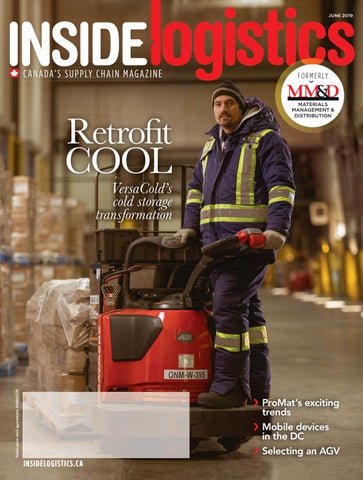
Follow the story of VersaCold’s takeover and retrofitting of the former Sobeys DC in Milton, Ontario. From ripping out floors, to building a freezer inside the existing building for a big ice-cream supplier – we’ve got the scoop. Story on page 14. Photo courtesy of VersaCold insidelogistics.ca
6
SUPPLY CHAIN SCAN
6
WSPS conference
Getting enough sleep | Hearing protection | Preventing lost time incidents | New DC starts | International MHE awards |
MSDs, sleep, hearing, lost time incidents
20
ProMat 2019 roundup
All the buzz from the biggest ProMat on record.
26
Mobile in the warehouse Are smartphones the way of the future?
3
WE MAKE TRANSBORDER SHIPMENTS EASIER.
ONE SOURCE FOR ON-TIME, WORRY-FREE DELIVERIES Your business doesn’t stop at the border, neither does Old Dominion. Our people provide 100% real-time freight visibility for your shipments between Canada and the U.S., with direct loading to major U.S. markets. Your transborder crossings are pain-free with OD’s in-house 24/7 customs clearance and brokerage services and a single point of contact. Plus, OD’s industry-leading on-time record and low claims ratio provide confidence with every shipment.
For more information, visit odfl.ca or call 1-800-432-6335 1-800-432-6335.
Old Dominion Freight Line, the Old Dominion logo, OD Household Services and Helping The World Keep Promises are registered service marks of Old Dominion Freight Line, Inc. ©2019 Old Dominion Freight Line, Inc.
TA K I N G S T O C K
insidelogistics.ca EDITOR IN CHIEF: Emily Atkins (416) 614-5801 emily@newcom.ca WESTERN EDITOR: Derek Clouthier (403) 969-1506 derek@newcom.ca DIRECTOR OF BUSINESS DEVELOPMENT: Delon Rashid (416) 459-0063 delon@newcom.ca QUEBEC ACCOUNTS MANAGER: Anthony Buttino (514) 292-2297 anthonyb@newcom.ca CREATIVE DIRECTOR: Tim Norton (416) 510-5223 tim@newcom.ca PRODUCTION MANAGERS: Alicia Lerma & Jwad Khan (416) 510 6845 alicia@newcom.ca, jwad@newcom.ca CIRCULATION MANAGER: Mary Garufi (416) 614 5831 mary@newcom.ca MANAGING DIRECTOR, TRUCKING & SUPPLY CHAIN GROUP: Lou Smyrlis lou@newcom.ca
NEWCOM MEDIA INC . CHAIRMAN & FOUNDER: Jim Glionna PRESIDENT: Joe Glionna Inside Logistics, established in 1956, is published six times a year by Newcom Media Inc. HEAD OFFICE 5353 Dundas St W. Suite 400, Toronto, ON, M9B 6H8 SUBSCRIBER SERVICES To subscribe, renew your subscription or to change your address or information contact mary@newcom.ca or 416 614 5831 or visit our website: www.insidelogistics.ca/subscribe SUBSCRIPTION PRICE PER YEAR Canada $84.95 per year, Outside Canada $159.95 US per year. Single copy price: Canada $15.00, Outside Canada CA$32.65 Inside Logistics is published six times per year except for occasional combined, expanded or premium issues, which count as two subscription issues. ©Contents of this publication are protected by copyright and must not be reprinted in whole or in part without permission of the publisher. DISCLAIMER This publication is for informational purposes only. You should not act on information contained in this publication without seeking specific advice from qualified professionals. Inside Logistics accepts no responsibility or liability for claims made for any product or service reported or advertised in this issue. Inside Logistics receives unsolicited materials, (including letters to the editor, press releases, promotional items and images) from time to time. Inside Logistics, its affiliates and assignees may use, reproduce, publish, re-publish, distribute, store and archive such unsolicited submissions in whole or in part in any form or medium whatsoever, without compensation of any sort. PRINTED IN CANADA
Publications Mail Agreement #43008019, ISSN: 0025-5343 (Print) ISSN: 1929-6460 (Digital). Inside Logistics is indexed in the Canadian Magazine Index by Micromedia Limited. Back copies are available in microform from Macromedia Ltd., 158 Pearl St., Toronto, ON M5H 1L3
Meeting the tech rockstars GETTING INTO AND MOVING AROUND AT PROMAT IN CHICAGO
this April was like being at a rock concert. The crowds were thick, excited and vibrating with possibilities. It was as though everybody wanted an autograph, but the rockstars here were the technologies on display. In my 16 years of attending this show I’ve never seen anything like it. And MHI, which produces the tradeshow and conference every other year, reports that 2019 was the biggest show ever. It was fabulous to see our industry so amped up. Solutions providers were swamped, with people lined up to see products and demos. And the visitors were anxious to take in as many options as they could. It’s easy to understand why. The competitive stresses on distribution operations right now are enormous. The “Amazon effect” is real, and it is pushing distribution operations to fulfill orders faster and more accurately than ever. It’s upping the pressure on physical systems and the software connecting it all to be hyper-efficient or lose out to the competition. With the well-documented and continuing labour shortage, it’s just not possible to increase production by adding more people. Likewise, real estate costs have skyrocketed and combined with the trend towards hyperlocal fulfillment, adapting to smaller distribution spaces is a new requirement for many. Technology has become the solution that everyone is seeking. From automated storage and retrieval, now available on increasingly tiny footprints, to robotic picking, to automated vehicles, to faster battery solutions, AI and more, it was the promise of a tech solution that brought the crowds to ProMat. There is so much to choose from; how is a distribution manager to figure out what will stick and what will turn out to be a fad? Recall the RFID craze in the early 2000s – it did not turn out to be the solution many expected it to be. I don’t have the answers. There is so much to choose from, so much of it is sexy-geeky and cool, and the sales pitches are smoothly convincing. But I suspect that many of you have an idea of what will last and what will fizzle. Will you share your picks for the new tech that’s ‘most likely to last’? Please drop me a note! Emily@newcom.ca
MEDIA INC. FUNDED BY THE GOVERNMENT OF CANADA
insidelogistics.ca
ARE SMARTPHONES SMART DISTRIBUTION CENTRE TECHNOLOGY? FIND ANSWERS ON PAGE 26.
5
SU PPLY C H A I N S C A N
Preventing lost time With labour in scant supply, everyone is looking to ensure they get the best from the employees they have. That’s why we sent reporter Stephanie Wallcraft to bring back tips from the recent Workplace Safety and Prevention Services 2019 Partners in Prevention conference. Here’s what she learned:
WSPS offers new online resources
7 Joy Inouye, research associate with the United States National Safety Council, explained that incident targets may discourage reporting.
NIGHT SHIFT The importance of getting enough sleep
9 MOVERS + SHAKERS Appointments and moves in the supply chain sector
10 IFOY AWARDS Find out which material handling tech wins this year
11 6
INCIDENT REDUCTION TARGETS MAY BE COUNTERPRODUCTIVE
Early research into how serious injury and fatality incidents and near misses are reported at workplaces is shedding light on the concept that incident reduction targets could be counterproductive to their own goal. Joy Inouye, Research Associate for the U.S. National Safety Council, said that setting targets may discourage reporting and therefore result in a smaller pool of examinable data that can assist with future incident reduction. She cited research undertaken by the Campbell Institute – the environmental, health, and safety arm of the U.S. National Safety Council. “What I found interesting from interviews with [Campbell Institute member] organizations is that they have deliberately not set targets for those metrics,” Inouye said. She presented these and other findings during a session titled Serious Injury and Fatality Prevention: Perspectives and Practices. “They don’t want to provoke reluctance to report on their actuals or near-misses. They want to encourage that reporting. “It’s still yet to be teased out, but that is a good sign.” Inouye said the Campbell Institute’s most recent study on serious injury and fatality prevention, which investigated the practices of six of its member companies operating in a wide variety of industries, showed that the last 20 years have seen enormous gains made in reportable injuries in the United States, going from 8.5 incidents per 20,000 working hours
Bev Borst, ad advanced vanced safety specialist for 3M Canada, recommends worker audiograms be performed to identify those at addition addi tional al risk.
SELECTING THE RIGHT EQUIPMENT TO MITIGATE HEARING LOSS
Ensuring workers with pre-existing hearing loss are given hearing protection that is neither under- nor overprotective is critical to ensuring that they use the equipment correctly, according to Bev Borst, Advanced Specialist for the Personal Safety Division of 3M. “Those with hearing loss are people that need to INSIDE Logistics J UNE 2019
photos: Stephanie Wallcraft
MSD PREVENTION
to less than three by 2016. (Canadian statistics were not available.) However, the same study demonstrated that the decline in the number of life-altering and fatal incidents has been slower over that same period and even showed a slight uptick over the last three years. Three key precursor aspects were highlighted as root causes: a high-risk situation, management controls that are ineffective or not complied with, and an environment that allows those breaches in control to continue. “Humans are error-prone,” Inouye said. “However, we can’t make the workplace safer and get to zero by simply fixing the workers. Instead, we have to look at the broader picture like the design of work. Can the workplace be designed in such a way as to eliminate error? “Corrective action should be developed according to a hierarchy of controls and have safety depend less on employee behaviour and more on the safety management system.”
SU PPLY C H A I N S C A N
be looked at in the workplace to make sure they have the right hearing protector,” Borst commented after leading a session titled Moving Beyond Hearing Protection: The Importance of Critical Communication. “You don’t want to give them earplugs with the highest protection if that’s not what they need.” Borst said workers with hearing loss who are improperly protected may remove their hearing protection devices to better communicate with colleagues or to hear machine operation or warning signals, which may worsen the hearing loss and create a spiral effect that makes the worker increasingly difficult to protect adequately. Data from a 2015 study titled Association between ambient noise exposure, hearing acuity, and risk of acute occupational therapy, which examines injury rates related to hearing loss at six aluminum manufacturing facilities in the United States, draws a clear line between worsening hearing loss and risk of worker injury. The study found that workers with a mild hearing loss have a six percent increase in injury risk in higher noise environments, while those with moderate to severe loss have a 21 percent risk increase. These figures stay consistent regardless of the type of hearing protection used. Of the study’s 9,220 participants with pre-existing hearing loss, 3,370 workers suffered 5,566 acute injuries as a result of working in high-noise environments, 1,100 of which were minor and 1,300 were serious in nature, meaning they required medical treatment or resulted in work restrictions or lost work time. Borst recommended worker audiograms be performed to identify those at additional risk and that hearing protection for those workers be selected based on individual needs, not as a one-fits-all style solution. “If I’m wearing an earplug that has a noise reduction rating of 31 decibels, and I’ve put it in perfectly and my noise is at 88 or 89, there’s less than 70 decibels reaching my inner ear,” Borst said. “I’ve got too much protection. “The CSA standards recommend they get into an electronic earplug or earmuff so that they can accentuate the sounds around them to hear them easier, so that they’re not feeling isolated and they’re not missing out on communication or warning signals.”
Don Patten, ergonomics specialist at WSPS, and Lisa Beech-Hawley, manager for the health and safety program at Ontario Power Generation (OPG). B Beech-Hawley eech-Hawley presented a case study demonstrating that implementing an MSD prevention program reduced OPG’s MSD injury rates from as high as 50 percent down to 23 percent. percent.
appropriately sized tools and gloves, and taking breaks for recovery. For medium and large companies that already have a health and safety program in place, the basic guideline provides clickable dropdowns that flow through 10 steps that can be followed by those seeking to improve their problem-solving approach to prevent MSDs. continued on page 9
Great Companies Need Great Spaces But finding you the right building is just one piece of the puzzle. It’s all the work leading up to it – where you should be, what type of space you need, and how it fits into your network that sets us apart.
NEW RESOURCES FOR MSD PREVENTION
Workplace Safety and Prevention Services has launched a new website (www.msdprevention.com) designed to assist stakeholders with implementing the recently updated MSD Prevention Guidelines. The site, www.msdprevention.com, lays out three tiers of resources related to the 2018 version of the Guidelines, which are designed to help employers identify and reduce workplace risks that can lead to musculoskeletal disorders. MSDs are categorized as injuries or disorders that affect movement in the human body such as, for example, chronic back pain, carpal tunnel syndrome, or tendinitis. The Quick Start level, intended for use by small and very small businesses, gives easy access to resources such as posters that share safety advice such as storing objects off the floor, using
insidelogistics.ca
Find out how your real estate can work for you by connecting with one of our industrial advisors at collierscanada.com/industrial
Accelerating success.
7
OUTLANDER PHEV
THE PLUG-IN HYBRID ELECTRIC SUV
GOOD FOR YOUR COMPANY, YOUR POCKETBOOK AND YOUR PLANET. Now the vehicles in your fleet can have the efficiency of an electric vehicle with the performance of our proprietary 4WD system, Super All-Wheel Control. You can go farther with the Outlander PHEV, as it seamlessly transitions between its twin electric motors and its highly efficient gas engine.
Visit Mitsubishi-motors.ca/fleet to learn more about adding an Outlander PHEV to your fleet. * See Owner’s Manual for proper use when towing. ** Whichever comes first. Regular maintenance not included. See dealer or mitsubishi-motors.ca for warranty terms, restrictions and details. Some conditions apply.
Charge anywhere with 4 different charging options.
Ample cargo space and 1,500 lb towing capacity.*
SU PPLY C H A I N S C A N
Preventing lost time, continued from page 7 The comprehensive program is laid out similarly and integrates additional resources for companies that wish to integrate MSD prevention at an organizational level. Within the Stakeholders tab, information is separated to highlight the pieces that are most relevant to people in various roles such as managers, workers, Joint Health and Safety Committee members, small businesses, healthcare professionals, engineering professionals, and more. The MSD Risk Assessment section houses graphics and tools to assist with prioritizing risk resolution and selecting the best tools from the Guidelines for certain tasks with the Tool Picker. The website will be updated on an ongoing basis as new tools and resources become available, said Don Patten, Ergonomics Specialist for WSPS, who presented it at this year’s Partners in Prevention Conference.
effects such as a loss of situational awareness, more time spent on tasks, lowered risk assessment abilities, flawed logic, hindered visual perception, reduced reaction time, and more. What’s worse, Harnett said, is that fatigue-related incidents are often attributed to human error without further investigation. “So many companies don’t know if they have a fatigue problem because they haven’t been looking for fatigue metrics,” Harnett said. “But what they have been doing is going, oh, he turned off a valve, but he didn’t turn it back on: human error. “Human error is never a cause. Human error is a consequence. Why were they tired? Maybe because they put in overtime, or maybe because they’re working a ridiculous shift schedule. “We need to look for flaws in the system and stop quitting when we get to human error because it goes beyond that.” On top of examining work hours, Harnett said that shift and night workers may find that programmable sun lamps that produce UVB rays can often be of help and that employers should consider offering support for them in benefit programs. “What that’s going to do is give you the sunlight that you need to produce serotonin in your body, which can then be made into melatonin later on and help you sleep better,” she said. “If you give access to these types of devices, if it’s included in the benefits program, it’s going to be a great help.”
Mike Harnett, president of Solaris Fatigue Management, says night shift workers shouldn’t be on the job for more than 10 hours a day.
NIGHT-SHIFT WORKERS SHOULD WORK FEWER HOURS
insidelogistics.ca
Relocating to Calgary?
ALL YOUR FRIENDS ARE DOING IT Affordable land and strategic locations have lured Home Depot and Canadian Tire here. Grow your business on City of Calgary land.
calgary.ca/movehere
19-00113617
Employers who make an effort to understand the sleep needs of workers, particularly those who perform shift or night work, can see significant improvements in safety and performance outcomes, says Mike Harnett, president of Solaris Fatigue Management. Harnett, who presented on the topic of Fatigue Management: Cheaper than Therapy at the WSPS 2019 Partners in Prevention Conference, explained that human body clocks are unable to ever truly adjust to unconventional work schedules due to factors such as our biological responses to sunlight and darkness. “If you’re on a daytime schedule, you can put in probably 12 hours of work if it’s not overly demanding,” she said. “If you work a night schedule, ideally we would want you to work no more than 10 hours. “(Employers) have to understand that there’s going to be more inherent risk on the night shift because you don’t get enough recuperative time.” Workers should work no more than 12 hours in a 24-hour period and 60 hours in a seven-day period, Harnett said, and those who do are more likely to make critical errors due to the cognitive impairment that accompanies fatigue. This can have
9
MOVERS + SHAKERS Darren Yaworsky announced he would resign from his position as senior vicepresident, finance and CFO, at Wajax Corporation for personal reasons. Yaworsky planned to remain with Wajax until the release of its 2019 first quarter financial results. Shawn McMahon is the new president dedicated logistics and e-commerce for Day & Ross (Sameday Worldwide). McMahon has led the growth of the company’s dedicated logistics services in Canada and the expansion into the United States, including the acquisition of the Romeo Expeditor Inc. business in Michigan. Drone Delivery Canada Corp. has appointed Spencer Todd and Duncan Card to the board of directors. Todd is an analyst in the Technology Consulting practice at Deloitte, working within the Digital Studio (D Studio). He holds a Bachelor of Commerce from Ryerson University in Toronto, Ontario. Card is a senior partner at the law firm of Bennett Jones LLP, where he co-chairs the technology
law practice and chairs its government contracting, procurement and intelligent infrastructure practices from that firm’s Toronto and Ottawa offices. Jeff Schnarr has assumed the role of chief information officer for Day & Ross. Schnarr started his career at McCain Foods Limited in 1999 and held progressively senior roles within the business, including director, integrated supply chain, head of IS for Great Britain and global deployment lead – One McCain SAP Program. Michelle Allard has joined Day & Ross as director, communications. Allard has many years of communications and leadership experience, most recently at Inscape, where she was director of communications and market insights. Her experience also includes more than a decade at marketing agencies, leading strategy for clients in a wide range of industries. BSM Technologies Inc. has appointed Michael Morrissey COO. Morrissey has
a long history of leading both large and medium-sized software delivery teams. Before joining BSM, he served as senior vicepresident of research and development at Nuance Communications Inc., a multinational computer software technology company. Previously Morrissey was chief technology officer at PerspecSys Inc., vice-president, cloud and platform services at BlackBerry Ltd., and vice-president, program management at Descartes Systems Group. He replaces Douglas Swanson. James Cherry has been appointed chair of the Logistec Corporation board of directors. An independent director since 2011, he has been a member of the Logistec audit committee since 2012, and has been its chair since 2014. Cherry has over 35 years of hands-on experience in general, project and financial management in the international aerospace, defence and rail sectors. He has held senior executive positions, namely with Bombardier, Oerlikon Aerospace, CAE, ALSTOM Canada, and for 15 years at Aéroports de Montréal as CEO.
St
ar Fall tS C ep ou te rse m s be r1
What’s the most rewarding career decision you’ll ever make? Earning the CCLP® designation is easily the single best thing you can do to boost your career prospects. It can set you up for better pay, more advancement opportunities, and a range of management pathways and options across the sector. Plus, you’ll develop and demonstrate cross-functional capabilities that can deliver better business results—and more personal job protection. Depending on your background, your CCLP designation might be within closer reach than you think. Call or click WR ¿QG RXW LI \RX TXDOLI\ IRU DGYDQFHG VWDQGLQJ
www.citt.ca/cclp • 416.363.5696 Your best choice for complete career-long OHDUQLQJ FHUWLÀFDWLRQ in supply chain logistics
10
®CCLP &,77 &HUWLÀHG /RJLVWLFV 3URIHVVLRQDO LV D UHJLVWHUHG WUDGHP HPDUN RI &,77
INSIDE Logistics J UNE 2019
International awards recognize materials handling innovation CARGOMETER, Jungheinrich, ProGlove, The Raymond Corporation, Still and UniCarriers Europe all walked away with prizes at the International Intralogistics and Forklift Truck of the Year Award (IFOY) in April. Cargometer GmbH won the Intralogistics Software award for its On-the-fly Freight Dimensioning tool. The Austrian company provides freight dimensioning on moving forklifts. 3D object measurement is performed by cameras installed on dock doors, allowing for fast, accurate measurements. German manufacturer Jungheinrich AG won in the Warehouse Truck category. The ETV 216i reach truck is the world’s first with a fully integrated lithium-ion battery. It convinced the jury not only with its performance, but also with its design. Because the conventional lead-acid battery was replaced
The IFOY award-winning teams celebrate at the gala on April 26, 2019.
by a smaller lithium-ion battery, completely new design possibilities arose for the developers. U.S. forklift truck specialist The Ray-
If you’ve already learned the business of logistics
mond Corporation won the Special of the Year category for its Virtual Reality Simulator. With the help of virtual continued on page 12
CITT can now certify you without sending you back to class Introducing CITT’s new Challenge On-Ramp to industry’s most valued professional designation. Finally, there’s a fast, accurate and affordable way for experienced people to demonstrate their competencies and qualify for industry’s most respected logistics designation and full CITT membership.
citt.ca/challenge_onramp • 416.363.5696
®CCLP &,77 &HUWLÀHG /RJLVWLFV 3 V 3UURIHVVLRQDO LV D UHJLVWHUHG WUDGHPDUN RI &,77
insidelogistics.ca
11
SU PPLY C H A I N S C A N
International awards recognize materials handling innovation, continued from page 11 reality glasses, forklift drivers can be trained and tested on a real Raymond truck. The solution not only provides a realistic view of the working environment, but also generates data for individual training of forklift drivers. The Raymond simulator also took home an
innovation award from MHI at Modex in 2018. The AGV & Intralogistics Robot award went to Still GmbH. The Hamburg-based company was recognized for its LiftRunner tugger train with the LTX 50 tugger and automatic load-
ing and unloading. The cost-effective and easily scalable solution is simple to implement and offers benefits, for production line supply. UniCarriers Europe AB won in the Counter Balanced Truck category. The TX 3 3-wheel truck has a load capacity of 1.6 tons and was recognized for its low energy consumption, excellent allround visibility, comfortable all-electric steering and ergonomic improvements. The most important innovation: a free-swinging, ergonomic armrest, available with either a mini steering wheel, familiar from the reach truck segment, or a normal steering wheel. The new Startup of the Year award went to Munich-based manufacturer ProGlove (Workaround GmbH). The company’s intelligent glove scans barcodes and 2D codes. Its innovation is a powerful scanner the size of a matchbox, which can be clipped easily on a glove, leaving the operator with both hands free for work. The awards are decided based on the IFOY Audit. The devices and solutions are subjected to individually tailored driving or function tests, including the IFOY test protocol, comprising around 80 criteria, and the scientific IFOY innovation check. In addition, jurors and advisory teams assess the finalists personally before voting. The nominees are compared not with each other, but with their competing devices on the market.
IN CASE YOU MISSED IT what’s happening at
insidelogistics.ca Plans for growth at Prince Rupert ] http://tinyurl.com/IL-Rupert7 CCLP offers fast track option ] http://tinyurl.com/IL-CCLP Ontario dope delivery extinguished ] http://tinyurl.com/IL-OntPot
12
INSIDE Logistics J UNE 2019
DC Digest Who’s breaking ground, starting up Vancouver, B.C.-based third-party logistics provider Canadian Alliance Terminals Inc. has made a long-term commitment to a new 250,000 square foot facility. The property is located adjacent to Port Metro Vancouver’s Delta Port, in iPort Phase 2. To be occupied in July 2020, the facility will have 42 doors and capacity of over 16,000 storage positions.
Supply chain pros love their jobs IN A RECENT ASCM survey 80 percent of respondents provided a rating of eight out of 10 and above for job satisfaction and 82 percent said they are likely to stay working in the supply chain field for the next five years.
The gap between men’s and women’s salaries appears to be narrowing, especially for supply chain professionals under 40, where the difference between salaries is less than US$1,000. Overall, salaries were on the rise.
Volvo Group has opened a massive new parts distribution centre (PDC) in Milton, Ont., triple the size of its former Mississauga location, about 20 kilometres away. Volvo Group took over the new 184,000 square-foot warehouse at the end of 2018. PACCAR Parts celebrated the opening of its new Toronto-area distribution centre, a 160,000-squarefoot facility in Mississauga, Ont., situated at the confluence of highways 401 and 407, the Greater Toronto Area’s major arterial routes. From this new location PACCAR Parts will serve 65 dealers and TRP stores (the company’s parts stores) in Eastern Canada and will also be tapped to serve dealers in the Northeastern U.S. QSL will build three new warehouses in 2019 and launch a pilot project with advanced new equipment newly imported from Combilift in Ireland. The projects, to be located in the Sorel-Tracy area of Quebec, will see $15 million in investments. Empire Company is building a second Ocada-based grocery fulfillment centre, in Point Claire, Quebec. Opening in 2021, the centre will support the company’s new home delivery e-comm offerings in Ontario and Quebec along with the company’s Vaughan, Ontario facilty. Each will cost $95 million.
insidelogistics.ca
13
INSIDE STORY
| By Emily Atkins
Retrofit
COOL
VersaCold builds capacity and versatility with updated DC
In the freezer at VersaCold’s Milton, Ontario distribution centre, -25° Celsius on a sunny May afternoon is a shock for visitors but a sign of success for the cold storage 3PL. After starting the project in October 2016, the company opened phase one of the facility in January 2018. And now the full facility is open with 550,000 square feet of cold storage, 50,000 pallet positions and 150 full time staff. 14
INSIDE Logistics J UNE 2019
T
he project is a joint venture between VersaCold and its 10-year-plus partner Nestlé Canada. The food manufacturer had conducted a business analysis, and felt their distribution operations needed an overhaul. “They identified the desire to have one single location for all Nestlé frozen categories so they could ship one order, on one truck, with one delivery. That really was the starting point of the discussion,” said Mark Dienesch, VersaCold’s chief commercial officer. “Our frozen network was in three different warehouses, three different directto-market systems. As we are endeavoring
to become a lean enterprise, taking as much waste out of the system as possible, it’s a lot of bulk and a lot of pallets and a lot of SKUs that need to be managed,” said Shelley Martin, Nestlé Canada president in an interview with Inside Logistics at the opening in 2018. Partnering with VersaCold on the new building “was how to we get everything – these three big businesses – into one…more efficient way that we can take some cost out and improve the service level to consumers, our customers.” While VersaCold was Nestlé’s long-time supplier, the 3PL was competing with other cold storage providers for the new business, which was specified to be in the greater Toronto area. Dienesch said this
prompted a very close look at capabilities and capacity, with the conclusion that an expansion was required. Working with commercial realtor Colliers, VersaCold found the Milton site, a recently vacated Sobeys distribution centre. It was about 550,000 square feet and a mix of ambient and freezer space. “Originally we didn’t know if we were going to need the whole building or just a portion of the building,” Dienesch said. “But when we really looked at the forecasted growth, and knowing it wouldn’t be a dedicated facility just for Nestlé, we opted for a long-term lease of the entire facility, but at the same knowing it would be a total retrofit from the inside out.”
Retrofit
“We opted for a long-term lease, knowing it would be a total retrofit from the inside out.” – Mark Dienesch, VersaCold’s chief commercial officer
Once the decision was made to take over the facility, work went quickly. From the project’s initial planning until the first product started moving in was only a matter of nine months and by December 2017 “we really started flowing product in,” Dienesch said. The first phase of renovation was the pre-existing freezer area of the old facility. At about half the building’s area, it was the simplest to get up and running to VersaCold’s specifications, although it was not without challenges. “We’re running at much lower temperatures than previously so we had to add additional insulation, and make sure the vapor barrier was done properly,” said VersaCold’s vice-president of engineering, Joe Sammon. As well, because they had to begin operations in phase one before the rest of the building was ready, they needed Canadian Food Inspection Agency (CFIA) approval to operate while construction was continuing elsewhere. Now, the phase one freezer can be subdivided into different temperature zones thanks to the addition of doors between sections of the space. While we toured
All smiles at the 2018 grand opening of VersaCold’s Milton, Ontario, facility. LL-R: R: VersaCold’s Mark Dienesch; Milton Milton mayor Gordon Kranz; Milton MP Lisa Raitt; Shelley Martin, president of Nestlé Canada; and Douglas Harrison, VersaCold’s (then) CEO.
insidelogistics.ca
15
Photo: Emily Atkins
continued on page 17
SURFACE TRANSPORTATION SUMMIT
Don’t miss the summit that DELIVERS OCTOBER 16, 2019 International Centre 6900 Airport Road, Mississauga, ON
GET Expert insights into your industry. Networking Opportunities with fellow supply chain leaders. Practical Knowledge you can put to work today. Card Exchange & Networking Driver Recruitment Best Practices Freight Management Best Practices Shipper-Carrier Roundtable | Workplace Safety Economic Outlook | CEO Track | Shipper of Choice
Association Partners
Produced by
Media Sponsors
MEDIA INC.
www.surfacetransportationsummit.com
Photos: Emily Atkins
The battery room at break time. Staff leave the equipment to allow for opportunity charging throughout the day. Once a week the batteries are run through a complete charge cycle.
everything was about -25°C, but Sammon explained that if a new zone were required it would actually take about two weeks to change the temperature. “You change the temperature slowly so you don’t shock the building,” he said. For phase two the challenges were larger, even if the space was smaller, at 250,000 sq.ft. The existing floor had to be removed, Sammon noted, which meant cutting it into manageable sections, carting it out, then excavating. Once that was done they installed an under-floor heating system with insulation and vapor barrier and re-poured the concrete floor. The new floor is seamless, which means no rough expansion joints for the material handling equipment to bump over. A major part of the new design meant creating a box within a box, which required building a giant cooler inside the existing building. Engineering the new insulating walls has left some interesting quirks, like a narrow corridor dividing phase three into sections. It came about because of the expansion joints in the original building’s roof. “We didn’t want to cross over that expansion joint with the freezer – with the box in box – as it was likely to cause problems due to movement of the structure,” Sammon said.
insidelogistics.ca
The chargers are all plug-in so that they can be moved if a reconfiguration is needed.
The design and contracting work was carried out by Burlington, Ontario-based ColdBox Builders. “That was a really positive experience,” Sammon said.
Moving parts Orders flow into the facility from customers’ systems. VersaCold operates 24/7 to fill them, working with each customer to ensure that replenishment keeps up with outbound orders. Inbound and outbound is all handled continuously, managed by VersaCold’s proprietary scheduling, WMS, and TMS software. Up to 200 or 300 loads are handled each day, with a team of 150 that expands by 20 or 30 during the summer ice cream season, which is a key time for Nestlé. About 80 percent of inbound is full pallet, with the rest being hand palletized on arrival. Outbound, the ratio is about 70:30. The facility exclusively employs Raymond equipment, provided by Johnston Equipment. It’s all battery powered, and designed for opportunity charging. The two connected charging rooms are centrally located between phase one and phase two so that workers can drop their equipment off for a top-up while they are on break. Sammon pointed out a unique, low-tech
feature of the charging room: “Rather than build stands or install a complicated charging infrastructure, we just poured a wide curb and placed the chargers on that. We then have twist-lock plugs. So if we want to re-configure where equipment is parked we don’t need to call in an electrician. We shut off the charger, unplug it and move it to a different location.” Shifting to plug-in units also meant a huge space saving for VersaCold, allowing them to reclaim space that Sobeys had used for battery changing and turn it into a new compressor room.
Human power The VersaCold building is draped with a huge banner proclaiming “We’re hiring!” As with every warehousing operation, the struggle to find staff is real. And although the Milton location is well situated from an inbound and outbound freight perspective, the lack of public transit in the area compounds the challenge. As well, not everyone can work in the cold. VersaCold uses a four-part screening process, said Richard Kunow, the company’s general manager of warehousing solutions. Once people pass the external checks they are given a tour of the facility continued on page 19
17
FROM
WE’VE GOT YOU COVERED
Building a successful business, whatever its size, is an extraordinary journey – and we get it. That’s why Husky and ESSO have come together to form Canada’s strongest cross-national cardlock network. Experience the freedom of filling up 24/7, 365 days a year at strategically located sites across
North America that are designed for large trucks and hard-to-maneuver vehicles. Every part of our business is fueling our partners journeys throughout Canada, ensuring you have the resources you need to keep moving forward. Focus on your extraordinary journey and leave the fuel to us.
Learn more at huskyroadsolutions.ca
Photos: Emily Atkins
Inside the phase one freezer, it’s possible to see from one end to the other, but the space can be subdivided if different temperature zones are needed.
to almost literally freeze out those who find it too chilly. But it’s actually the limitations of the human inner ear that end up eliminating quite a few candidates. “Many people are very good in a one-dimensional or a two-dimensional environment, but a third dimension, where you try to gauge depth, when you’re up in the air, and even though we have video cameras showing you where you are, for some people that can cause vertigo,” Kunow said. Although the company tries to find a place for good candidates who may have vertigo, because the workforce needs to be flexible, everyone is eventually trained on all the equipment, working up from a walkie rider to a full stand-up to a deepreach truck. “The nature of the business is that demand signals can change from the customer, daily. You need to have employees trained on all types of equipment to be effective,” Kunow explained.
Food safety VersaCold is proud of the Milton facility’s BRC certification (a globally recognized food safety certification recognized by the GFSI), which makes it the 23rd of the company’s warehouses to achieve the designation. “Over 85 percent of our sites in Canada are BRC certified, and we’re the only provider in Canada in this space to do that,” said Dienesch. “And that isn’t because we had to, it’s because that’s been
insidelogistics.ca
A worker moves cartons in the freezer.
VITAL STATISTICS VERSACOLD MILTON 550,000 sq.ft. +4°C to -35°C 150 employees 84 dock doors 50,000 pallet positions 200 -300 loads per day 2 anchor customers, plus 10 -12 smaller Raymond (MHE) Frazier (racking) Coldbox Builders (building design and construction) Colliers (real estate)
our commitment to our customers and to our employees. Our commitment to food safety is our priority.”
Continuous improvement With phase three of the Milton facility filling up, and just a few final tweaks remaining on the engineering, the VersaCold team is focused on making sure everything is running optimally. “The biggest opportunity lies in really understanding, and getting better data around how customers shop to better manage demand planning overall. And demand planning is a huge component that is very underdeveloped in the industry,” Kunow said. A lot of it can be traced to rapid consol-
The box-within-a-box can be seen at the dock doc k doors.
idation in the cold storage industry, and companies not understanding the demand profile for the products they’ve just acquired. “There’s a lot of work going on to understand it. Some of the big players are now looking at AI as a way to get better at forecasting. You’re talking very expensive plants to make product, and if they’re not running at an optimal rate, you’re going to lose money. On the flip side, if you don’t build them at the right scale you’re going to lose money as well because you’re going to be out of stock,” he explained. Dienesch agrees: “Now more than ever, the collaboration with customer and accuracy of forecasting is critical. Historically we would receive the customer forecast and essentially cross our fingers and hope. You can’t do that anymore. We get that you may not be fully accurate three to four weeks out, but we can’t see 30, or 40, or 50 percent swings in the daily forecast from one date to the next.” For Dienesch, continuous improvement means keeping an eye on current trends in the marketplace. Some customers need the space to be able to increase production and fill bigger orders, while others are looking for smaller, more frequent orders. This means assessing locations, looking at automation and considering what skills will be needed to manage demand in the future, he said. “The landscape is changing very quickly.”
19
PR O M AT 2 019
| By Emily Atkins
FEELING A POSITIVE VIBE
I
f you hadn’t known it was a materials handing show you might have been excused for thinking the huge, dense crowd at the gates to the 2019 ProMat expo was waiting for a celebrity or big-ticket concert.
20
But no, it really was materials handling, and people are truly excited this year. Indeed, the show at McCormick Place in Chicago this April was buzzing with activity and excitement for the entire four days. Whether it’s the incredible demand for
e-commerce fulfillment solutions, the labour shortage, a fascination for automation, or perhaps the three factors coming together, ProMat was at its biggest this year. According to organizers MHI, registrations were up 11 percent over the last INSIDE Logistics J UNE 2019
Photo: MHI
2019 was the largest in ProMat’s 34-year history
show, at 49,718. All these folks crowded into 425,000 square feet of floor space to see 938 exhibitors. ProMat visitors included key decision-makers in virtually all manufacturing and supply chain industries including a majority of the Fortune 1000 and Top 100 Retailers. A large number of buying teams from key firms attended the show. According to registration data, 82 percent of attendees had buying authority and 34 percent plan on spending $1 million or more over the next 18 months on equipment and systems. “Investment in supply chain innovation is at a critical inflection point, with a trend of declining investment from 2015 to 2018 being more than countered by a 95 percent increase in projected spending for 2019,” said George Prest, CEO of MHI. “As a result, the energy level among visitors and exhibitors was at an all-time high as more attendees were actively seeking best-in-class solutions for their manufacturing and supply chain operations.”
Cargill; Leanne Kemp, Queensland chief entrepreneur, C3PO First CEO, and founder of Everledger; and Michael Reed, director of the Blockchain Program at Intel Corporation. Lakhani started out by explaining the basics of blockchain, but disputed conventional wisdom that it is disruptive. He sees it as a “foundational” technology that will take time to reach maturity, notwithstanding the World Economic Forum’s prediction that 10 percent of global GDP will be stored in blockchain by 2027. Because it can be used for any transaction that requires a binding contract it is well suited to numerous different industries and processes, especially supply chain. Lakhani posited that within the next 10 years blockchain will be driven by the devel-
understand that everyone can see everything on the chain,” he added. And they need to lose the misconception that blockchain knows the truth. “It only knows what’s recorded,” he said, and if that’s false, whether deliberately or through an error, it’s there in perpetuity. He believes that it will be very difficult to get companies to the point of agreeing on the rigid business rules that will be required for it to work. “You can’t use post-it notes stuck beside the phone any more” to manage processes in a blockchain-enabled business world, Cecchi said. Intel’s Michael Reed agreed that the real hurdle will be normalizing processes. “Blockchain as a ‘team sport’ will only be interesting when lots of companies are playing,” he said. He sees the develop-
Trending Alongside the obvious theme of automation in operations, which was impossible to miss with the massive installations that dominated the show floor, exhibitors and attendees were talking about digitization, hyperlocal fulfillment and developments in battery technology. Along with the healthy traffic on the show floor, other highlights included the educational conference that accompanied the ProMat exhibition. This included keynotes on blockchain in supply chains, and a panel discussing the findings of the 2019 MHI Annual Industry Report – Elevating Supply Chain Digital Consciousness.
Photo: Emily Atkins
Blockchain This keynote panel discussed how incorporating blockchain technology into your operations can have a tremendous impact on transparency, identity and trust, payments, flexibility and responsiveness — and result in a more efficient, cost-saving, risk-reducing supply chain. It was chaired by Karim Lakhani, a professor of business administration at the Harvard Business School. He was joined by David Cecchi, senior director of enterprise data at
insidelogistics.ca
Karim Lakhani (left) leads the blockchain panel discussion with (L-R) David Cecchi of Cargill, Intel’s Michael Reed, and Everledger founder Leanne Kemp.
opment of smart contract technology. David Cecchi professed himself “deeply skeptical” of blockchain as a business panacea, but believes that it has application potential for tracking of products from provenance to end user. Cargill, an agricultural products manufacturer, is using a blockchain app now to offer “Turkey Traceability” that allows customers to track their holiday bird back to the farm it was raised on. The drawbacks of the technology are legion, however, with “a fundamental lack of understanding of the implications” being the primary problem, he said. To remedy this Cargill has added a primer on blockchain to its executive education program. “People have to
ment of consortia as the key to the technology’s ultimate success. When asked about the risks in blockchain, Leanne Kemp said the biggest danger is that it will fail “because humans are involved”. She is a strong advocate for the technology, however, recounting how it has been a useful tool for the diamond industry, which was a tech dinosaur – using paper tracking techniques – but essentially an ideal candidate for blockchain because of the unique properties of the gems and their high value. However, her caution stems from the difficulties that will be inherent in achieving the agreement necessary among corporations for the technology to develop a wider scope. continued on page 22
21
PR O M AT 2 019
|
INNOVATION RECOGNITION MHI hands out awards for products and people
T
he MHI Innovation Award serves to educate and provide valuable insights on the latest manufacturing and supply chain products and services to ProMat attendees. ProMat 2019 exhibitors were called to submit a new product, product line, technology or service, or new application of existing products or technology that create quantifiable and sustainable results in terms of ROI, cost savings, customer satisfaction, etc.
INNOVATION AWARDS Best Innovation of an Existing Product RIGHTPICK: The Piece Picking Solution by RightHand Robotics Inc. Best IT Innovation Winner redPILOT by KNAPP Inc. Best New Product: Pick2Pack by CMC srl.
2019 MHI YOUNG PROFESSIONAL NETWORK (YPN) AWARDS 2019 YPN Mentor Award Winner ROSALEE BROWN of Rasco Industries
The Knapp team celebrates winning the MHI software innovation award for the company’s redPILOT cloud warehouse optimization solution. solutio n.
DOOR PRIZE ELIZABETH BUZA of Raymond Corporation won the door prize, a U.S.$30,000 trip of a lifetime.
LOGIMAT® VERTICAL LIFT MODULE (VLM) SSI SCHAEFER provides a complete line of material handling and automated storage and retrieval systems for various industries--including cold storage and e-commerce solutions. ssi-schaefer.com
22
Western W t Manufacturing M f Technology Show June 4-6 Booth# 408
INSIDE Logistics J UNE 2019
Photo: Knapp
2019 YPN Outstanding Young Professional Award Winner BEN MOYER of Hytrol Conveyor Company
HOT TOPICS Inside Logistics picks the hottest product categories at the SHOW
Waypoint’s Patty Katsaros and Jason Walker. Flexibility in automation is key.
Righthand Robotics made news at the show by winning the MHI award for best innovation of an existing product with its piece picking robot that combines an intelligent gripper, computer vision, artificial intelligence and machine learning, resulting in what the company calls “handeye coordination.” Its new skill is put-wall automation, combining barcode identification, placement to an array of cubbies (horizontal bin locations), and an integration with conventional put-to-light systems. Kitchener, Ontario’s OTTO Motors presented a 750-kilo payload “Goldilocks solution” at the show. The new OTTO 750 is designed to carry the middle-sized load between a 100-kg human-powered cart and a 1,500-lb forklift load. OTTO 750 is built on the OTTO 1500 chassis, which is already used by large industrial customers like GE, Katerra and Musashi. “Our customers have been asking for something just right for quite a while, and now we finally have it,” said Matt Rendall, CEO of OTTO parent Clearpath.
Photos : Emily Atkins
Robotics From brand-new startups to global suppliers, companies offering robotics solutions were on every corner at the show. From picking arms to robotic tuggers, forklifts and cellular AS/RS, there is robotics solution for almost every warehousing need, and many that might just be a solution in search of challenge. Whether robotics is a fad or not is yet to be seen, but the dynamic driving innovation – the labour shortage – is not going to change soon. Robotics makers and integrators are counting on that fact to help them build interest and buyers in the distribution space. For the team at two-year-old Waypoint Robotics, the key is making a product that is flexible, simple and easy to integrate. Their simple AGV is driven with a PlayStation controller to learn its route, and a reasonably skilled operator can map over 3,500 square feet in 10 minutes, making it a very easy set-up. “It’s designed for an ever-changing environment,” said CEO and co-founder Jason Walker.
insidelogistics.ca
Hyperlocal fulfillment Knapp took the wraps off an expanded partnership with micro-fulfillment innovator Takeoff. Knapp and Takeoff announced their initial partnership in 2017 and have now confirmed a US$150 million, 50-site order for Knapp. Takeoff offers a micro-fulfillment solution that allows grocers to fill orders faster and at a fraction of the cost of traditional methods. The solution is powered by their grocery expertise and technology, paired with Knapp’s automation. The two companies are implementing a second-generation design that will increase throughput and reduce the complexity of construction. One key element of this design is a new open-shuttle technology that will optimize the space needed for order sorting, while adding flexibility to the overall design and operation. In addition to these upgrades, Takeoff is assembling dedicated implementation teams that will allow them to deploy multiple sites per week.
“It is extremely exciting to take our partnership between Takeoff and Knapp to the next level, and deliver on our promise of reliability, affordability and scalability,” said José Vicente Aguerrevere, co-founder and CEO of Takeoff.
Dematic’s Hassan Dandashly explains the company’s interest in micro-fulfillment.
Capitalizing on the micro-fulfillment trend, Dematic is also offering a rapid response e-commerce order assembly system designed to support home delivery, as well as click and collect. Micro-fulfillment systems are usually inside a retail store or in an urban distribution centre, using part of an existing real estate footprint to allow e-commerce fulfillment and in-store shopping under the same roof, but without getting in each other’s way. Dematic president and CEO Hassan Dandashly said the trend is driven by labour shortages, high real estate prices and the continual pressure to increase e-commerce order fulfillment speed. “The solution is a powerful process improvement for businesses that are looking to optimize their omni-channel distribution strategy by more effectively using existing retail stores or urban service centres for e-com order assembly,” said continued on page 24
23
PR O M AT 2 019
|
Dandashly. “Customers can pick up their orders at the closest retail store or service centre, as well as receive them using a delivery service to their homes.” The system is configurable to accommodate the SKU capacity and order volume. Micro-fulfillment works for grocery, auto parts, consumer electronics, sporting goods, apparel, industrial supplies and department stores that are re-purposing
24
retail store space. The order management and execution software coordinates labour, inventory and robotic shuttles to assemble orders with accuracy and speed.
Battery technology Thanks in part to the rise of the electric car and the innovative technological developments that are improving range, numerous battery suppliers are now mak-
ing lighter, more energy-dense lithium-ion (and other chemistries) products for forklifts and other equipment. The technology for charging batteries is also benefitting from new ideas. At Enersys Chad Uplinger and Harold Vanasse explained the benefits of their new NMC (nickel, manganese cobalt) battery chemistry. The company’s NexSys iON batteries are engineered with large format prismatic cells and Nickel Manganese Cobalt (NMC) cell chemistry. Enersys is also offering interchangeable batteries and smart chargers that know whether they are feeding a lead acid cell or an ion cell and behave accordingly. In the lab the company is working on wireless charging that will see embedded wireless charging in select aisles in the warehouse. When a forktruck is low on power, the smart management system would work with the WMS to direct the worker or the autonomous truck to pick in that aisle for an opportunity charge, without having to stop working. Vancouver-based Delta-Q Technologies was showing its ICL lithium battery chargers. The high-frequency ICL 1200 and 1500 chargers are the latest additions to Delta-Q’s first lithium specific charging line and are available in 85V and 120V models. The 85V models are designed to charge lithium battery systems of any lithium ion chemistry from 14 to 24 cells in a series, while the 120V models can charge lithium ion chemistries within 21 to 34 cells. “We designed the ICL Series to provide customers with unparalleled performance capabilities for their lithium-technology needs,” said Trent Punnett, executive vice president and head of sales, product management and marketing at Delta-Q. “A higher voltage charger allows our material handling customers to access customizable solutions that best suit their electric portfolio.” The ICL Series is suitable for use on any electric machine including light electric vehicles, lift trucks, unmanned aerial vehicles, scooters, and aerial work platforms. East Penn Manufacturing Co. has recently released its new Deka Ready Power Li-ion forklift battery. And Storage Battery Systems LLC was demonstrating the Sunlight LiON Force battery. Lighter batteries are going to mean INSIDE Logistics J UNE 2019
| change in forklift design. German manufacturer Jungheinrich AG has won an award for its ETV 216i reach truck, the world’s first with a fully integrated lithium-ion battery. Because the heavy, conventional lead-acid battery was replaced by a smaller lithium-ion battery, the truck had completely new design parameters. Yale’s research and development initiatives have resulted in the company’s first counterbalanced lift truck with a factory-integrated lithium-ion battery pack along with a concept vehicle featuring its next-generation power chassis. The lighter truck uses less power and delivers better acceleration. The Raymond Corportation has also introduced its first Raymond’s single-and double-capacity lithium-ion batteries that deliver steady performance throughout the duty cycle.
Photos : Emily Atkins
Most underreported innovation: The exoskeleton The current robotics limelight tends to focus on the ability of new innovations to automate tasks, but a less publicized development is taking place with passive exoskeletons that augment the capability of human workers. We visited with Levitate, whose Airframe exoskeleton product has just been made required equipment for 24 workers in the welding shop at the Toyota Motor Manufacturing Canada plant in Woodstock, Ontario. The Airframe is a backback that has spring-loaded arms, which support the wearer’s own arms, just under the triceps area. They provide a lifting assist when the wearer raises his or her arms. The Airframe is an ergonomic device that supports the upper extremities of workers, surgeons and builders. It can lower exertion levels by up to 80 percent. Last year Toyota’s Woodstock plant mandated 24 employees in the welding shop to use the Airframe exoskeletons. Toyota’s Princeton, Ind., plant has followed suit, with nearly 200 of the facility’s 7,369 workers now required to use the devices. Toyota has made the Airframe mandatory personal protective equipment (PPE) just like a pair of safety glasses, closed-toe shoes or
P R O M AT 2 019
earplugs. This is a significant milestone not just for Levitate but for the entire exoskeleton industry. “We identified risks of working overhead as a primary factor and contributor to injuries, so we tried to find ways to eliminate those risks, and the exoskeleton fit the bill quite well,” said Marc Duplessis, the Woodstock plant’s health and safety manager.” The passive exoskeletons are expected to propel development of active suits. ABI Research estimates that by 2028, global exoskeleton revenues will reach US$5 billion with hundreds of thousands of active exoskeletons deployed. Powered suits will eventually provide significant augmentative capability to the industrial workforce. “We are only talking about thousands of units being deployed so far, and the majority of these are passive. The first challenge of getting exoskeletons deployed and mandated as part of protective equipment practices in high-wage OEMs has been achieved,” said said Rian Whitton, senior analyst at ABI Research. “The next stage is to integrate the use of exoskeletons with robotic arms, collaborative robots, and mobile robots through advanced location technologies, haptics, and gesture control.” This is a long-term vision, and the industry should not expect the exoskeleton opportunity to exceed hundreds of thousands of units or billions in revenue within the next two to three years, with the global market to surpass US$ 1 billion in 2022.
Software suited to meet the unique needs and business processes of single or multiple warehouse sites, 3PL distribution environments and mobile workforces
www.rfpathways.com www.rfpathways.com AUTOMATION ASSOCIATES INC. Inside Logistics business development manager Delon Rashid tested the Airframe exoskeleton at ProMat and found it relaxing.
insidelogistics.ca
6705 Tomken Road, Suite 211 • Mississauga, Ontario L5T 2J6 P: 905-565-6560 • Toll Free: 866-823-6114
25
MOBILE DEVICES
| By Jacob Stoller
IS SMART SAVVY? THE PROS AND CONS OF SMARTPHONES IN THE DC
26
manager for Vancouver-based cannabis provider Emerald Health Therapeutics, smaller warehouse operations are beginning to deploy smart phones in the place of RF guns and other traditional devices. “With the kind of technology we have today, it would be very inexpensive to set up an operation using an iPhone or similar device, and that’s how I’d do all my picking, packing, and scanning,” he says. “The training curve is almost nonexistent – if I hand an iPhone to a 20-year-old, he’ll be training me after five minutes.” The trend isn’t showing up yet in DCs, MacKenzie says, but he believes it eventually will. “The question is, how do we take advantage of this?” For now, warehouse managers are resistant to the idea of even allowing employees to bring their smart phones into the facility, and it is causing some discord in organizations. “This is a growing issue,” says MacKenzie. “In just about any office you work in, they hand you a phone when they hire you, and you’re using it at work, at
home, and around the clock. But in the distribution world, they say it isn’t safe, or it will distract people from their work.” Many of these fears may be overblown. “There have to be guidelines, of course,” he says. “If you’re operating a piece of equipment, or going up and down wearing a tether, I totally understand the reasoning of figuring out how we do this safely. But for those who say that people are just going to sit at their phone all day and not work, I would answer that most of our work is measured today anyway. I know how much work somebody’s done whether they’re on their phone or not.”
Seize the opportunity MacKenzie has been urging his peers to see smart phones not as a threat, but as an opportunity. “A lot of warehouse managers and supervisors are struggling with why they’re having turnover, and why people don’t want to go into this industry,” he says, “and we talk about engagement a lot. So I’ve been a big proponent of the INSIDE Logistics J UNE 2019
Photo: ipopba, iStockimages.com.
W
hether or not one believes that smart phones can be addictive, it’s undeniable that a growing segment of the workforce has a close relationship with their personal devices that spills into their day-today work. As well, the smart phone is becoming, for many, the platform of choice for accessing ERP, workflow, sales force automation, and other enterprise apps, and the trend is likely moving into warehouses and distribution centres. This is putting pressure on companies to keep pace with a new set of employee expectations. “In some way or other, you’re going to have to deal with the fact that a large and expanding part of the workforce wants to be able to work with a smart phone as a key business tool,” says Michael O’Neil, principal analyst at Toronto-based InsightaaS. According to Ian MacKenzie, who has headed several national logistics operations and is currently national logistics
percent of employees surveyed feel they are more productive when using their own devices. As well, company-owned devices often get turned off when the employee leaves the office, while a personal device typically remains on, ensuring the person can be contacted if an important issue arises. In logistics, however, the BYOD option raises some thorny issues, according to
sometimes to walk from one end of the site to the other might take you ten minutes, so it’s easy to get lost. So with BYOD, you have to be very stringent about what the rules and regulations are.” This might mean having employees buy kits to “ruggedize” their phones against breakage or water damage, or carry mobile charging units to ensure that the battery life extends through their shift. Stipulations about phone models, carrier coverage, and of course, safe computing practices need to spelled out clearly and kept up to date. “There are a lot of contractual complexities that arise with BYOD,” says McEvoy. “It’s quite hard to do with huge teams.”
“Thanks to cloud computing, a growing number of logistics apps can now be operated from a smart phone, offering new possibilities for Advancing technology logistics managers.” On the other side of the smart phone
idea that the smart phone is a great engagement tool that the workforce carries around – instead of asking people to put it down, let’s figure out a way to use it to engage people in the workplace.” For example, a company could use smart phone apps to push out messages and company announcements, send pay notifications, provide career guidance, or exchange information in emergencies.
The “bring your own device” (BYOD) option The growth of the smart phone as a computing platform has accelerated the adoption of company policies that allow or mandate BYOD practices. The BYOD market in the U.S., according to Global Market Insights, is on track to grow to US$367 billion by 2022, or roughly ten times what it was in 2014. The strategy has clear advantages. According to a Cisco-sponsored study, companies with BYOD policies save US$350 annually, per employee, and according to a CITO Research report, 53
insidelogistics.ca
Neil McEvoy, an Oxford, UK-based management consultant who in previous roles provided senior management oversight of BYOD programs for first-line managers at two major UK-based delivery companies, DPD and Arrow XL. “At Arrow XL, we used an incentivized system where the company paid the employee the purchase cost for the equivalent company-bought device,” he says. “To ensure these devices were safe on our network, we installed a fairly extensive security management system on each device that tracked what the device was doing, and could even shut it down if, say, the employee tried to visit a gaming site. Some people saw it as overly intrusive and an invasion of their privacy.” In response to employee pushback, the company offered an inexpensive company-owned phone as an alternative, but interestingly, 98 percent of employees decided to stick with the BYOD option, security management system and all, rather than work with a low level smart phone. “People complained, but the system worked well,” says McEvoy. Losing contact with employees is another concern. “A problem we had is that people would have their phone go down, and they couldn’t be contacted,” he said. “In logistics and supply chain,
question, enterprise mobile devices designed specifically for logistics functions offer significant advantages over consumer-grade technology, and they keep getting better. For example, wearable devices such as ring scanners from vendors like Zebra Technologies are ergonomically designed, have long battery life, and provide reliable operation in freezers and other harsh environments. “Consumer devices cost less initially, but our customers find that the total cost of ownership (TCO) for rugged enterprise devices is actually lower,” says Ralph Lieberthal, principal, transportation and logistics at Zebra Technologies based in Lincolnshire, IL. Enterprise mobile devices also provide leading edge capabilities, such as location tracking of assets using low-cost passive RFID tags. “If I know where my people and my assets are, I can optimize their movement,” says Lieberthal. “It’s all about location and visibility.” Innovation will continue to rapidly improve capabilities of both consumer and enterprise devices. Technology, however, is ultimately just a tool that helps people do their work. “If you’re not out on the floor every day, just walking and talking throughout your facility, it doesn’t matter how much technology you have there,” says MacKenzie. “The human connection point is the biggest single thing.”
27
SU PPLY C H A I N S M A R T S
| by Chuck Russell
Using AGVs for pallet
MOVEMENT Conveyor Deck AGV System • Single- or dual-conveyor; • Offboard power requirements; • Payloads up to 60 tons; • Dual-steer drive, quad movement.
AUTOMATED guided vehicles (AGVs) have
Tugger AGV System • Braking – negative g-force to stop vehicle safely; • Grades – much more torque required to go up grades; • Automatic coupling and hitching; • Floor flatness critical.
Weight
Automated pallet trucks such as this new Raymond unit are increasingly part of DC operations.. operations
AGV system types for pallet movement
• • • •
Four types of AGVs are commonly employed, with the following characteristics: Fork AGV System • Outrigger, counterbalanced or under-rigger;
Lift Deck/Unit Load AGV System • Turning radius; • Electric lift versus hydraulic lift; • Differential steering versus single-steer drive.
28
Pantograph or traversing-mast reach; Single- or double-fork; Side-shift forks; All-wheel steer, omnidirectional.
There is a linear relationship between the run time of an AGV and its weight. Given any battery size, if 10 percent of the weight is taken off of the vehicle, it will travel 10 percent longer. Commensurately, if 20 percent of the weight is reduced, it will travel 20 percent longer. When considering a forked vehicle system, for example, this weight-to-travel ratio will have considerable implications. A counterbalanced vehicle will need to add 40 to 50 percent of the vehicle’s weight for the counterbalance. Whereas with an outrigger design, or under-rigger design (for European-style pallets), the extended wheels support the load, so that vehicle design is 40 to 50 percent lighter. Other factors come into play with weight, as well. A vehicle of this size with a 40 to 50 percent weight reduction has tremendous impact. Lighter vehicles will need less frequent battery charging, meaning fewer battery chargers will be needed to support a fleet. Maintenance and wear requirements for these lighter vehicles are likewise diminished. Energy draw needed from AGV batteries is reduced. And repairs required for plant floors, caused by the AGVs and their load INSIDE Logistics J UNE 2019
Photo: Raymond Corporation
played a pivotal role in facilitating process and throughput efficiency in manufacturing and distribution operations. Interfacing with multiple auto-transfer devices, AGVs provide reliable raw material and product handling, with less potential for product damage, as compared to manual methods of transport. Using a combination of logic software, and wired or wireless navigation, AGVs can perform tasks that are not possible with other transport systems – such as the uniform movement and positioning of loads to within a fraction of an inch of their designated targets, without rush and noise, and with a high degree of safety for workers and the operating environment. Transporting these heavy loads, however, imparts huge forces on these vehicles, resulting in significant maintenance and power requirements to keep AGV fleets functioning. Newer models incorporate design, navigation, sensor and power improvements that significantly streamline their operational performance, cost of maintenance and ROI, over and above earlier automated guided vehicles. Many types of AGVs exist for use in different industries, including those vehicles designed for extremely heavy or oversize loads. But for a large number of applications in manufacturing and distribution, AGVs are used for pallet movement.
weights, are also significantly reduced. Although the outrigger and the under-rigger avoid the counterweight, the beauty of the counterbalanced vehicle is that it is a more narrow truck – which will permit movement in more narrow aisles, allowing for denser pallet storage and a smaller floor footprint. AGVs have typically been designed so that the weight of the AGV is 40 to 60 percent of the expected load. This 40:60 percent ratio has been the conventional AGV design practice for decades. This has now changed with the introduction of lighter, more efficient AGVs, which weigh considerably less than conventional AGVs, and are engineered to reduce wear and energy usage. They not only match the payload requirements of contemporary heavier models, but match or exceed those vehicles’ structural stress thresholds.
Wheel steering Many AGVs in operation within manufacturing plants, and many of those first put into operation before 2000, were often equipped with Ackermann steering links. These linkages, commonly used for steering automobiles and trucks, remedy the problem of setting wheel angles in a turn, given that each wheel needs to trace out a circle of a different radius. The problem is that Ackermann steering geometry only approximates the required steering angles, allowing inaccuracies, which result in wheel scrubbing. With such heavy loads in transport, the end result is a requirement for considerable repair and maintenance. The wheel scrubbing not only increases amp draw, but can also cause concrete and tire wear. Newer AGVs may also be engineered with electronic independent-wheel steering, which has implications for AGV operability, maintenance and repair, and damage to plant floors. Electronic independent-wheel steering does away with Ackermann steering geometry completely, and the issues it creates. The vehicle can now drive sideways or in any direction, enabling shorter trips, thereby reducing the fleet size. The four-wheel independent steering provides tight manoeuvring and smoother cornering.
insidelogistics.ca
Battery performance Options for battery power in AGVs are predominantly lead acid and lithium chemistries. The most conventional power source used in AGVs has been, and still is, lead acid. But lead is heavy. Since battery run time is directly proportional to vehicle and payload weight, reduction in vehicle weight in AGVs directly impacts the run time of its batteries. Therefore, any weight reduction exhibited by AGVs translates into longer run time from the batteries before requiring recharge. New battery technology also contributes to weight reduction. A lithium ion solution, for example, with the capability of putting out 140 amp hours of power would weigh about 150 pounds. Compare this to a lead acid battery putting out the same
‘‘AGVs deliver efficiencies to distribution and production operations. They improve product flow, reduce cycle times and can reduce labour costs.”
power, but weighing 700 pounds. For the same power, 550 pounds have been removed from the vehicle. The recharge time for lithium ion solutions is approximately four times faster than lead acid. And typical lead acid recharge cycles are about 1,000, while lithium ion phosphate is closer to 4,000 cycles. In short, the lithium ion phosphate battery is charging four times faster and delivering four times the life, compared to lead acid.
Navigation AGV systems are equipped with navigation systems, based on laser and/or inertial guidance. Each system varies in performance, flexibility and cost.
Laser navigation Laser navigation systems are based on target triangulation to keep the vehicles on course. The vehicle is equipped with a rotating laser beacon, which scans 360 degrees around the vehicle for laser targets mounted on columns, walls and stationary machinery. The reflections from these targets are measured relative to angles from the vehicle, and triangulated to allow the vehicle to determine its position. This position is compared to a map stored in the vehicle’s memory. The system uses positive-positioning feedback in real time, computing algorithms hundreds of times per second. The targets are typically located 20 to 50 feet apart, on both sides of the path to provide sufficient navigation resolution. The steering is adjusted accordingly to keep the AGV on track. It can then navigate to a desired target using the constantly updating position. Laser navigation can obtain tracking accuracy of about +/- .75 inch on vehicles of this size. Inertial navigation Inertial navigation systems use a gyroscope onboard the AGV to detect changes in vehicle direction and attitude. Each vehicle has a map of the system layout in its memory. The vehicle steers by comparing information from the gyroscope and odometer sensors (which estimate change in position) to the map, and making necessary course corrections each time it passes over a magnet or transponder. Typically, the tracking of inertial navigation systems is +/- one inch of the true path. Magnets or transponders are embedded in the floor every 30 to 60 feet to maintain the tracking accuracy. Multi-navigation Both navigation methods can be seamlessly combined in a concept called multi-navigation, which switches back and forth from laser to inertial guidance without stopping the vehicle. This allows the AGVs to move throughout a plant and outside, where one system alone may not have access to the physical surroundings or weather conditions necessary to support that system. continued on page 31
29
PICK MODULES & MEZZANINES
Engineered systems designed to move your products more efficiently.
We don’t sell our solution to your problem... It’s our problem to develop your solution.
3D
PALLET RACKING
PALLET FLOW
DRIVE-IN
CANTILEVER
PUSHBACK
CARTON FLOW
MEZZANINES
INDUSTRIAL SHELVING
STORAGE
SOLUTIONS
L I M I T E D
1 (877) 557-2257
3DSTORAGESOLUTIONS.COM
Photo: Transbotics
With conventional AGVs, access to wheels, gears and other moving parts is usually covered, requiring the vehicle to be hoisted or moved into a pit to be serviced. This difficulty has been resolved in some recent AGV models.
AGVs travel nominally at two mph, and are equipped with outboard laser bumper sensors for object detection. Covering the vehicle 360 degrees, including upwards, the sensors are designed to cause the vehicles to adjust their speed, or stop if necessary, if an obstacle is detected in their path. Once the path is clear, the AGVs will automatically continue their mission. Some bumper sensors have a range starting at about 1,500 lux (the SI unit of illuminance and luminous emittance). These new AGVs use the latest in safety laser technology, incorporating 15,000 lux systems, with a 10 times higher tolerance to light.
A conveyor type AGV from Transbotics.
Real-time controls
The AGV below is a tugger type unit designed to pull carts.
The smooth functioning of AGVs depends on the control system, which has the task of coordinating the orders received from the plants’ process system or warehouse management system, or ERP, then directing the work for the automated guided vehicles. More advanced controls systems may be using a Windows and SQL database architecture that is able to uniquely operate within a single platform. Communication is provided by two-way radio transmissions between the vehicles and the computer. The controls provide real-time management of the system’s operation, including management information, load prioritization, load status, productivity statistics and reports, and workload analysis. It allows associated functions to be automated – such as with receiving, raw materials storage, hot line processes, roll mill processes, cold mill processes, finished product storage and shipping. The positional status of each AGV is continuously updated through the controls system, at least once per second, regarding such factors as whether it is loaded or unloaded, emergency stopped or soft stopped, operating in manual mode, and battery level. A simulation module simulates the AGVs in the system. A graphical interface gives the operator an overview of the AGV locations in the system and monitors each in real-time. Operational flexibility is a key factor with newer controls systems. Not just in its capability to direct and manage the fleet of AGVs, but also in its expandability.
insidelogistics.ca
Simulations AGV system simulations can provide excellent system development guidelines for perfect conditions. But such conditions seldom exist in manufacturing and logistics facilities. What-if conditions need to be factored into the simulation, such as the variable of human interaction on the floor where AGVs are in motion. Fleet size is monitored by volume of product transported per move and length of route. The bigger the AGV system, the more important is the need for simulation. In a system larger than five or six vehicles, simulation would be a requirement, as mathematics calculations alone cannot adequately profile vehicle-to-throughput ratios.
Environmental factors Also influencing the performance of AGV systems is temperature and humidity, Wi-Fi coverage over the area of transport, electromagnetic interference (EMI), conductivity of the floor coating, and flooring drains, slopes and grades. These factors must be considered when determining the best approach for an AGV system.
Flexibility
Any number of automated guided vehicles can be added to the network, whenever required for production or distribution.
Maintenance AGVs with weight reduction and electronic independent-wheel steering deliver a sizable reduction in maintenance and repairs. As much as a 60 percent reduction in annual maintenance per vehicle can be achieved. Contributing to this is the accessibility of the AGV for maintenance or repairs.
AGVs can deliver significant efficiencies for manufacturing and distribution. They improve production flow by bringing material to the operators, cutting cycle times, and eliminating wait, walk and search time. They reduce work-in-progress inventory. They cut labour costs by eliminating jobs related to material and movement, and permit reassignment of those workers to areas where they can add more value to the facility. AGVs virtually eliminate product damage with gentle handling of loads, and provide flexibility in process flow and throughput. Chuck Russell is vice-president of sales at Transbotics Corporation
31
Looking for a Career Change in Trucking or Logistics? REGISTRATION IS NOW OPEN Saturday, September 14, 2019 • 11 AM – 5 PM International Centre | Conference Centre | 6900 Airport Rd, Mississauga, ON
GET YOUR RESUME READY!
Professional drivers, mechanics, warehouse staff, office staff and more
Event Sponsors
FREE ENTRY • FREE PARKING
www.rttnexpo.com To exhibit, contact Kathy Koras kathy@newcom.ca or Manan Gupta manan@newcom.ca
P R O D U C T I N N OVAT I O N S
NOW IN STOCK
The latest and greatest solutions on the market for warehousing, inventory control and distribution
Removable, adjustable dunnage ORBIS Corporation has launched the AdjustaPak, a removable, adjustable sliding dunnage system that accommodates large, bulkier automotive parts when full and can be returned for part replenishment or reconfiguration when empty. The system is composed of a frame, multiple rails and hanging fabric bags. The frame fits within a standard ORBIS BulkPak container and the rails and fabric bags are designed for durability. The rails include multiple assembly holes that allow height adjustment and fabric bag reconfiguration, as needed. The frames also are removable and can easily be transferred from one standard BulkPak to another. “If the host container changes at any point along the supply chain, the sliding dunnage system can easily be moved to a different container, reducing replacement needs and costs,” said Sean Momsen, market manager at ORBIS Corporation. The fabric bags are oriented vertically so there are no layers to remove at the assembly line. The AdjustaPak is available in a variety of sizes, ranging from 48 by 45 inches to 78 by 48 inches.
π
WE'RE BIG ON TAPE
Transport and picking robots IAM Robotics has a new Swift robot design complete with conveyor integration and a transport robot that works in conjunction with Swift to exchange full or empty totes. The sleeker Swift redesign includes a smoother lift and is available with a fixed tote or integrated MDR (motorized drive roller) for automatic tote transfer. The adjustable carriage can match the height of a facility’s existing conveyor infrastructure for simpler integration. The company’s new transport robot, Bolt, improves the throughput and ROI of the Swift solution by exchanging totes with Swift, delivering the full tote to the next process in the fulfillment cycle such as packing and shipping. By leveraging Bolt for transport, Swift remains focused on picking. insidelogistics.ca
ORDER BY 6 PM FOR SAME DAY SHIPPING
COMPLETE CATALOG
1-800-295-5510 33
P R O D U C T I N N OVAT I O N S
Modular pallet rack safety net
Modular robotic palletizers
Adrian’s Safety Solutions has launched new Modular Pallet Rack Safety Netting, designed for walkway and work area product fall protection. The modular design allows for overlapping or tiling, so any space can be protected right out of the box. Modular Safety Netting keeps loose items or cartons from falling into a work space or aisleway. It can be installed without retrofitting, tools or long periods of downtime for complicated installation. The netting will be manufactured with the same hardware connectors that Adrian’s uses in their existing no-tools-needed products. Optional carabiner hardware assemblies are also available.
Brenton, a brand of ProMach, debuted the RPX-SW series of modular robotic palletizers integrated with an Orion automatic stretch wrapper. The RPXSW series gives small- to medium-sized businesses the opportunity to advance from manual to automated robotic palletizing and stretch wrapping with a compact solution. Pre-engineering and modularity lowered the relative cost of the RPX-SW compared to custom systems. The series includes four palletizer configurations, including two with automated pallet-handling modules. These RPX-SW robotic palletizers require minimal floor space – anywhere from 200 to 350 square feet, depending on the configuration. RPX-SW palletizers are rated at up to 14 cases per minute. The RPX-SW offers the flexibility of being both a slipsheet unitizer and/or a palletizer with the addition of a pallet dispenser module. The system can be delivered in as little as 10 weeks and installed in a matter of hours. A quick connect and disconnect feature allows RPX-SW robotic cells to be easily disassembled, moved, and redeployed as needs change. Each RPX-SW palletizer comes standard with two pack patterns pre-programmed. New pack patterns are easily entered via touchscreen.
Universal vehicle restraint Rite-Hite’s Dok-Lok SHR-5000 is a new restraint that uses a patented “shadow hook” design to secure traditional trailers, as well as intermodal container chassis and trailers with rear-impact guard obstructions. The universal design of the Dok-Lok SHR-5000 is intended to meet the evolving needs of loading dock operators and the rise in intermodal container traffic. In addition to having the most substantial wrapon rear-impact guards and the widest vertical engagement range (nine to 30 inches), the Dok-Lok SHR-5000 incorporates a shadow hook that provides an additional layer of safety when dealing with rear-impact guard obstructions. When the Dok-Lok SHR-5000 is activated, the hook attempts to wrap around the rear-impact guard. If the hook comes in contact with a rear-impact guard obstruction, the shadow hook pivots to secure the trailer in place. If the trailer moves, the shadow hook locks in the safety stop, which helps prevent a wide variety of trailer separation accidents. The Dok-Lok SHR-5000 is also a physical theft deterrent and can interface directly with security systems to help prevent trailer theft.
INDEX OF ADVERTISERS COMPANY
WEBSITE
PAGE
3D Storage.................................................................... www.3Dstoragesolutions.com .................................................................. 30 Automation Associates ................................................ www.rfpathways.com ............................................................................... 25 CITT .............................................................................. www.citt.ca/cclp .................................................................................. 10, 11 City of Calgary.............................................................. www.calgary.ca .......................................................................................... 9 Colliers International .................................................... www.collierscanada.com ........................................................................... 7 Dematic ........................................................................ www.dematic.com ..................................................................................... 2 Husky ............................................................................ www.huskyroadsolutions.ca ..................................................................... 18 Johnston Equipment .................................................... www.johnstonequipment.com .................................................................. 13 Konstant ....................................................................... www.konstant.com .................................................................................. 40 Mitsubishi Motors ......................................................... www.mitsubishi-motors.com ..................................................................... 8 Newcom Creative Services........................................... www.newcom.ca/creative ........................................................................ 36 Old Dominion Freight Line........................................... www.odfl.ca ............................................................................................... 4 Penske .......................................................................... www.gopenske.ca .................................................................................... 39 RTTN Jobs Expo .......................................................... www.rttnexpo.com .................................................................................. 32 SSI Schaefer .................................................................. www.ssi-schaefer.com .............................................................................. 24 Starke............................................................................ www.starkeforklift.com ............................................................................. 12 Surface Transportation Summit.................................... www.surfacetransportationsummit.com .................................................. 16 Swiss Instruments ......................................................... www.swissinstruments.com ..................................................................... 22 Uline ............................................................................. www.uline.ca ............................................................................................ 33
34
INSIDE Logistics J UNE 2019
L E A R N I N G CU R V E
REACH BEYOND YOUR GRASP Advice for women in logistics HAVING SPENT A fairly long career in
business as a boss, leader and a woman, I say this without bitterness: there’s still a long way to go before we can call most industry sectors fair for women. But remember what I said up front, I’m not bitter. I’m moving through it. And I’m doing that because I can see things getting better, and because personally I have learned some tricks to navigate the waters, from some great and inspiring people along the way. So today I’d like to offer some suggestions, based on my experience, for women who are able to see their value, articulate it, and get ahead.
come a long way. Today, when I meet people on these calls, they most likely grew up with a working father and mother. You can’t legislate morality or ethical behaviour, but today there’s more resistance to, and protection from, harassment and other unfair treatment that can hold women back.
3. Demonstrate why you should be included TRACY CLAYSON, Director of Client Development, In Transit/CPC Logistics Canada Tracy@in-transit.com
1. Get help As a woman, you should not be bashful about asking for advice from people – male or female – who can unlock critical information that could help you move your career forward. Learn from those who are successful. Women can do that well. Asking is not a sign of weakness, it’s a sign of intelligence and strength. Learn from men who can be your advocates. They are married and have daughters, and they have working wives. Ask them what they did to get ahead and tell them what you hope to achieve. Speak to women you are striving to emulate. They’ll all have some gold to share. Above all remember: You need help – like everyone who ultimately excels – and you don’t have to feel bad for asking for it.
‘‘You’ve got to set your sights on something you can reach. Then you’ve got to reach beyond your grasp.”
photo: fizkes, iStockimages.com
2. Set your sights high Legendary Greek fabulist Aesop said, “The level of our success is limited only by our imagination.” As you move through your career you must figure out where you’re headed and how you’re going to get there. You’ve got to set your sights on something you can reach. Then you’ve got to reach beyond your grasp.
insidelogistics.ca
Making your own way will require you to find your voice. No one’s going to give it to you. Doors don’t open automatically for women. When I started off in the trucking industry there were explicit pictures on the wall at almost every sales call I took. We’ve
To get ahead, you must have merits and you must be able to express what they are. For a woman, it’s not necessarily about telling the world you’re better than everyone else (though you may be), it is about being included. And you won’t be included if you don’t speak up. On this theme, Barbara Corcoran, real estate expert, founder of The Corcoran Group and a television personality – a “Shark” investor on ABC’s Shark Tank – said women sometimes hesitate when it comes to speaking up on salary increases. “I can tell you, I’ve employed thousands of women over my lifetime. They do not ask for raises unless they absolutely must. And men ask all the time.” Corcoran recommends scheduling a meeting with your manager, listing the responsibilities you had when you started in your current role and listing those you handle now. Indicate you are happy to have taken on a lot more, but that you should be compensated appropriately. This may not get you the raise, says Corcoran, but it will likely set you up for your next meeting, when you do get it. While confidence is sometimes criticized as a negative aspect of a woman’s character, there’s really no way around it. Women excel at many things, and if you’re just as good as the next guy you should appear just as confident. As women, we have a personal responsibility to be intentional in our actions, mindful, genuine, and yes, confident that our personal brand is meaningful and useful. Find your voice – and use it.
35
NEED MARKETING? A D V E RTI S I NG S TR ATE G Y ❘ PR OMOTION S ❘ DESIG N ❘ VIDEO
USE THE INDUSTRY’S CREATIVE EXPERTS! Whether you need impactful branding, well thought-out advertising, lead generating promotions, videos with “wow” or SEO, we’ve got the talent, know-how, and expertise to meet your marketing objectives. Not only do we publish Inside Logistics magazine, our experts can apply their knowledge to connect you with your target audience.
SEE WHAT WE CAN DO FOR YOU N E W C O M . C A / C R E AT I V E C R E AT I V E @ N E W C O M . CA
LEADING EDGE
A GRIP ON REALITY Walking the fine line between pessimism and optimism “The pessimist complains about the wind; the optimist expects it to change; the realist adjusts the sails.” – WILLIAM ARTHUR WARD
DO YOU KNOW A PESSIMIST? How
about an optimist? Do you know any realists? I think it’s safe to say we all know people who fit into each category. In fact it’s quite likely that names pop into your mind the minute you hear the words “optimist, pessimist and realist.” For most of us there are likely times in our lives when we fit into each category. The trick to a productive and rewarding life seems to be spending as much time in the realist category as possible. A pessimist is a person who tends to see the worst aspect of things or believe that the worst will happen. The truth is, it’s draining to be around a pessimist, and it’s equally exhausting to spend time in our own pessimistic thoughts. Going all the way back to high school, I remember well a teacher who carried a pessimistic attitude towards everything. Whether he was teaching us about chemistry (which seems pretty fact-based to me and almost impossible to be pessimistic about), or any other aspect of our high school lives, he was always “glass half empty.” Granted, as his students we didn’t know the issues that may have caused his pessimistic attitude, but I can tell you no one looked forward to the class, and we were thrilled when the buzzer rang. He even found a way to take the excitement out of anticipating summer holidays. The optimist is hopeful and confident about the future. No question: It’s way more fun to be around the optimist. As a kid growing up, golf was my passion (and still is), and I’ll never forget how optimistic our club professional was, particularly with the junior golfers that he devoted so much time to. Anyone who plays golf knows that it’s a game that can drive you crazy. A whole lot needs to go
insidelogistics.ca
ROSS REIMER has over 30 years of experience in transportation/supply chain. For the last 20 years he has been president of Reimer Associates, a recruitment firm within supply chain. rreimer@reimer.ca
“No question, it’s a lot more fun to be around an optimist.”
right to hit a golf ball in the proper direction. So you can imagine a bunch of junior golfers at various stages of learning, and the wide variety of golf shots that were hit with attitudes in various states of disrepair. I’ll hand it to our former pro – he kept us enthusiastic and optimistic, even in the face of evidence that suggested we were nowhere near high-quality golfers. The fact is most golfers show up with unrealistic optimism. It’s what keeps us coming back. And then there is the realist – a person who accepts a situation as it is and is prepared to deal with it accordingly. History
demonstrates several examples of realists who have accomplished extraordinary things. Winston Churchill comes to mind immediately. His ability to accurately assess Britain’s grave situation and devise a plan of action was exemplary and serves as a benchmark for what a realist can accomplish. Churchill faced opposition from many pessimists who didn’t believe for a moment that his plan would succeed. Interestingly, he was equally criticized at the time by optimists who didn’t comprehend the gravity of the situation. A more recent example of a realist who acted instantly and appropriately in a critical situation was Chesley “Sully” Sullenberger, the captain of US Airways flight 1549 on January 15, 2009. Just minutes after takeoff from New York City’s LaGuardia Airport the aircraft hit a flock of geese and lost power in both engines. While immediately trying to restart the engines, the pilot assessed the overall situation in mere seconds and ultimately took the realistic approach. He had to focus on his available options, and he concluded that landing in the Hudson River was the only viable chance to save lives. He remained calm beyond all human expectations and expertly and realistically did what few aviation experts would say was even possible. We all know the conclusion; he saved every life on board. Very few of us will face situations as demanding as defeating Hitler to win World War II or landing an aircraft without engine power. Yet we can learn great lessons in both our personal and professional lives from these individuals who were neither optimistic nor pessimistic, but rather incredibly realistic. They truly had the ability to assess the situation so as to avoid defeat through pessimistic thinking, and equally escape disaster caused by optimistically steering clear of important facts. Rather, they were able to calmly see the situation and then execute realistically.
37
SA F E T Y F I R S T
PRE-START HEALTH & SAFETY REVIEWS Best practices from an expert panel HOW TO LEVERAGE the full value of
your Pre-Start Health and Safety Reviews (PSRs) was the goal of an expert panel session at Workplace Safety & Prevention Services’ (WSPS) recent PSR Summit. PSRs are legally mandated safety examinations, conducted by a professional engineer, of new or modified apparatus, structures or protective elements before they go into use. The intent is to prevent injuries by building safety into the equipment or process. The panel session gave a capacity crowd access to five health and safety professionals with PSR experience and expertise: • Adrian Khan, senior manager, environmental, health safety and security, Mother Parkers Tea and Coffee; • Chuck Leon, warehouse and racking specialist, WSPS; • Dave Smith, equipment and construction safety specialist, Honda of Canada Manufacturing; • Miles Purvis, president, ProSafe Inc., an engineering firm that provides PSRs and compliance evaluations; • Rob Vomiero, machine and robotics safety specialist, WSPS. The resulting discussion of challenges and solutions touched on multiple stages in the PSR process, from selecting an engineer to maintaining safety once the equipment or process is operating.
Finding the right engineer Rob Vomiero: On the Professional Engineers Ontario (PEO) website, you can look up engineers and find basic information on their discipline and whether the engineer or the firm has a certificate of authorization. The Ministry of Labour’s PSR guidelines provide workplaces with additional clarity and understanding of the PSR legislation (O.Reg. 851 – Section 7), including their obligations, due diligence considerations and guidance regarding report contents. Adrian Khan: Look for an engineering firm that has PSR experience compatible
38
SCOTT WILLIAMS is a writer with Workplace Safety & Prevention Services
with your equipment or processes. Ask for sample PSR reports and review them to see if they meet your requirements. Request references so you can speak to end users. Chuck Leon: “Bring in the most competent people possible. I work with engineers weekly and you need to be sure that you work with qualified engineers on any of these projects.” Dave Smith: “We have a vendor expectation document that must be signed by the president of the engineering firm. It’s to ensure they meet all our expectations, including quality and consistency requirements throughout the 14 departments and four plants on our site. We also make sure that the vendor reviews our drawings and risk assessments in detail at the concept or design stage.”
Ensuring implementation A common misconception is that the PSR process ends when the employer receives the engineer’s report. Reports may contain recommendations that must be acted on to ensure compliance with legal requirements. Panelists offered the following tips: Miles Purvis: “We send electronic doc-
uments notifying recipients that the reports contain recommendations that must be addressed. We also supply an “approved-for-use” document for sign-off that indicates all previous deficiencies (if any) are complete.” Rob Vomiero: Have the engineer present an overview of the report to your team, your Joint Health & Safety Committee and other stakeholders. Adrian Khan: “We review the PSR when we receive it and if there are recommendations we make sure we comply with them. We also go over this document with the Joint Health & Safety Committee and then do a field evaluation just to make sure all the guarding is in place and complies with requirements.” Dave Smith: “We have the engineer attend the equipment start-up to ensure all compliance measures are complete, which must be confirmed via a dynamic check of the equipment’s safety performance.”
Keeping equipment safe Your PSR report reflects a specific moment. Keynote speaker Frank O’Rourke, vice president, safety, health, environment and sustainability for Weston Foods, observed, “things happen over time. The equipment vibrates, things loosen, guards are removed.” So how do you maintain the safety standard set by your PSR? Here’s what two panelists suggested: Miles Purvis: Once a PSR has been signed off, establish a way to identify whether a hazard is introduced later. Someone in your organization must be able to identify and assess potential new hazards. Adrian Khan: “We have labels on our equipment with the date of the report and a file number. It provides a trail if we need to access the report. We also make sure proper procedures are being followed and regularly conduct internal checks.” INSIDE Logistics J UNE 2019
© 2019 Penske. All Rights Reserved.
Delays not only hurt your reputation, they also damage your bottom line. It’s why we’re dedicated to getting perishable products to market quickly and efficiently. All so you can keep your promises and your profits. It’s how we deliver confidence. Learn more at gopenske.ca.