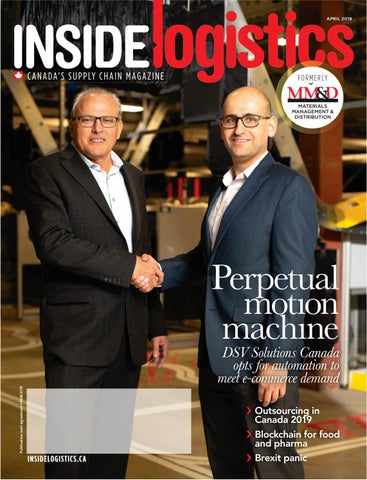
APRIL 2019
C A N A DA’ S S U P P LY C H A I N M AG A Z I N E
FORMERLY
MATERIALS MANAGEMENT & DISTRIBUTION
Perpetual UW\ÜWV UIKPÜVM Publication mail agreement #40063170
DSV Solutions Canada opts for automation to meet e-commerce demand Outsourcing in Canada 2019
INSIDELOGISTICS.CA
Blockchain for food and pharma Brexit panic
GOT RETURNS ? Convert them to “sale-ready� The Dematic Returns solution processes returned items quickly and efficiently, enabling you to restore salable merchandise to primary or short-term storage, depending on demand. The Dematic Merchandise Returns System is a reverse logistics solution that accelerates and streamlines the processing steps required to prepare each item for resale, typically within 24 hours of receipt. The solution leverages Dematic iQ software to facilitate the inspection and reconditioning of workflows required before items are returned to stock, a clear labor-saving advantage for time-sensitive and perishable materials, especially in e-Commerce and apparel applications. Learn more about optimizing your distribution center with the Dematic Merchandise Returns Systems.
Visit www.dematic.com/returns Contact us at usinfo@dematic.com or 1-877-725-7500.
CHECK OUT OUR MOVERS & SHAKERS SECTION SECT ION
page 1100
C A N A DA’ S S U P P LY C H A I N M AG A Z I N E A PR I L 2 0 19 • V O L UM E 6 4 • NU M B ER 0 2
CONTENTS In every issue:
5
Taking Stock
26
Installation Inventory
Editor’s analysis
Case studies from around the globe
31
Innovations
34
Supply Chain Smarts
New products for supply chain efficiency
Managing risk
14
35 37
Leading Edge
Perpetual motion machine
38
Safety First
DSV opts for automation to meet e-commerce demand ON THE COVER
6
insidelogistics.ca
13
Ralph’s regret
Coca Cola’s success
SUPPLY CHAIN SCAN
Real estate boom | Audi’s lithium-ion experiment | Job losses | Supply chain women | Convictions | Execs thinking about AI, labour
Audi’s experiment, page 7
13 Find out how DSV Solutions Canada has adopted a highspeed automation solution to help meet the growing demand of an omni-channel client in its Brampton,Ontario distribution centre. Story on page 14.
Learning Curve
Change management
Brexit panic
Logistics will be a nightmare if Brexit goes ahead.
21
Blockchain for food and pharma
How to effectively employ blockchain technology.
6
22
Outsourcing in Canada 2019
Find out who uses third-party services and why. 3
WE MAKE TRANSBORDER SHIPMENTS EASIER.
ONE SOURCE FOR ON-TIME, WORRY-FREE DELIVERIES Your business doesn’t stop at the border, neither does Old Dominion. Our people provide 100% real-time freight visibility for your shipments between Canada and the U.S., with direct loading to major U.S. markets. Your transborder crossings are pain-free with OD’s in-house 24/7 customs clearance and brokerage services and a single point of contact. Plus, OD’s industry-leading on-time record and low claims ratio provide confidence with every shipment.
For more information, visit odfl.ca or call 1-800-432-6335 1-800-432-6335.
Old Dominion Freight Line, the Old Dominion logo, OD Household Services and Helping The World Keep Promises are registered service marks of Old Dominion Freight Line, Inc. ©2019 Old Dominion Freight Line, Inc.
TA K I N G S T O C K
insidelogistics.ca EDITOR: Emily Atkins (416) 614-5801 emily@newcom.ca WESTERN EDITOR: Derek Clouthier (403) 969-1506 derek@newcom.ca DIRECTOR OF BUSINESS DEVELOPMENT: Delon Rashid (416) 459-0063 delon@newcom.ca QUEBEC ACCOUNTS MANAGER: Anthony Buttino (514) 292-2297 anthonyb@newcom.ca CREATIVE DIRECTOR: Tim Norton (416) 510-5223 tim@newcom.ca PRODUCTION MANAGERS: Alicia Lerma & Jwad Khan (416) 510 6845 alicia@newcom.ca, jwad@newcom.ca CIRCULATION MANAGER: Mary Garufi (416) 614 5831 mary@newcom.ca MANAGING DIRECTOR, TRUCKING & SUPPLY CHAIN GROUP: Lou Smyrlis lou@newcom.ca
NEWCOM MEDIA INC . CHAIRMAN & FOUNDER: Jim Glionna PRESIDENT: Joe Glionna Inside Logistics, established in 1956, is published six times a year by Newcom Media Inc. HEAD OFFICE 5353 Dundas St W. Suite 400, Toronto, ON, M9B 6H8 SUBSCRIBER SERVICES To subscribe, renew your subscription or to change your address or information contact mary@newcom.ca or 416 614 5831 or visit our website: www.insidelogistics.ca/subscribe SUBSCRIPTION PRICE PER YEAR Canada $84.95 per year, Outside Canada $159.95 US per year. Single copy price: Canada $15.00, Outside Canada CA$32.65 Inside Logistics is published six times per year except for occasional combined, expanded or premium issues, which count as two subscription issues. ©Contents of this publication are protected by copyright and must not be reprinted in whole or in part without permission of the publisher. DISCLAIMER This publication is for informational purposes only. You should not act on information contained in this publication without seeking specific advice from qualified professionals. Inside Logistics accepts no responsibility or liability for claims made for any product or service reported or advertised in this issue. Inside Logistics receives unsolicited materials, (including letters to the editor, press releases, promotional items and images) from time to time. Inside Logistics, its affiliates and assignees may use, reproduce, publish, re-publish, distribute, store and archive such unsolicited submissions in whole or in part in any form or medium whatsoever, without compensation of any sort. PRINTED IN CANADA
Publications Mail Agreement #43008019, ISSN: 0025-5343 (Print) ISSN: 1929-6460 (Digital). Inside Logistics is indexed in the Canadian Magazine Index by Micromedia Limited. Back copies are available in microform from Macromedia Ltd., 158 Pearl St., Toronto, ON M5H 1L3
MEDIA INC. FUNDED BY THE GOVERNMENT OF CANADA
insidelogistics.ca
Up with women! THERE ARE MANY MORE THAN 100 WORTHY WOMEN IN CANADA.
But 100 is the number that the Supply Chain Management Association (SCMA) has chosen to honour in its first-ever listing of influential women in Canadian supply chain. And, to be fair, the number is actually 200, including the women-to-watch list. SCMA chose the number 100 because 2019 is the association’s centennial year and probably because it’s a nice round number. (Our coverage of the announcement is on page 12 in this issue.) But I imagine they had a hard time winnowing it down to just a century. Look around and you’ll see plenty of women working hard in supply chain jobs. As one of the women on the list, I’m honoured to be included, and lament that we even need to make a distinction for women in this industry. It actually makes me sad and little angry that we need to highlight the achievements of one sex over another. But, our annual salary survey has shown for as many years as I’ve been on this magazine (that’s 17 if you’re counting), that women consistently make 25 to 30 per cent less than their male counterparts in supply chain jobs. Overall, based on 2016 data, Canada had the eighth-highest gender pay gap out of 43 countries, including the EU, which was counted as one. According to data shared by the Canada Women’s Foundation, women with a bachelor’s degree in this country earn about $69,000 while men with the same credential make almost $98,000. In 2016 three out of Canada’s 100 best paid CEOs were women, and in Ontario, the best paid 10 per cent of the female workforce still earns 37 per cent less than the top 10 per cent of men. The existence of this salary gap alone is enough to legitimize the recognition of female contributions as a means of showing how hard we work and how amazingly good we are at our jobs. Because apparently we still need to make the point, even in 2019. I’d love to hear from women in supply chain. What do you think about working conditions, pay, and recognition in our niche? Please drop me a note! emily@newcom.ca FIND OUT HOW ONE EXEC PAID THE PRICE FOR TURNING A BLIND EYE TO THE MISDEEDS OF A DIRECT REPORT. FIND THE STORY ON PAGE 37.
5
SU PPLY C H A I N S C A N
WOMEN SCMA names 100 influential Canadians
Commercial real estate to remain tight Modern warehouse space at a premium in major centres
12 JOB LOSSES February shows fewer logistics jobs in Canada
9 Appointments and moves in the supply chain sector
10
Buffer-stock warehouses for e-commerce will drive the market in 2019
Relocating to Calgary?
ALL YOUR FRIENDS ARE DOING IT Affordable land and strategic locations have lured Home Depot and Canadian Tire here. Grow your business on City of Calgary land.
calgary.ca/movehere
6
FOR CANADIAN COMMERCIAL real estate, 2019 presents a
once-in-a-generation moment shaped by record low vacancy rates, rising rents, waves of new construction and an unprecedented bargaining position for landlords, particularly in gateway markets like Toronto and Vancouver. This is a key finding of CBRE Canada’s 2019 Canadian Real Estate Market Outlook Report. Strong demand for warehouse and distribution space will continue to fuel Canadian industrial markets. Landlords are increasing rents for top-tier product at some of the fastest-growing rates in the world and will commonly push for 15-year lease terms. Vancouver is leading the world in rental rate growth as overall industrial availability fell to 2.3 per cent in 2018. “As we move into 2019, Canadian property market fundamentals remain incredibly strong, and technological change, tech business growth, and tech talent are the dominant factors driving demand across all commercial real estate sectors,” commented Paul Morassutti, vice-chairman for CBRE Canada. “Growth is often synonymous with discomfort. In many Canadian cities, real estate will remain at the forefront in both regards.” Strong demand, record-low vacancy and changing tenant needs are spurring a wave of new development nationwide,18.5 million sq. ft. of industrial product under construction in 2019, most of it in Toronto and Vancouver. Despite over-supply concerns, this development is desperately needed to meet record tenant demand. What’s more, this new office and industrial construction is helping drive economic growth, enabling companies to respond to client needs and evolve their business strategies. Buffer-stock warehouses, which hold reserve stock to safeguard against unforeseen shortages in the e-commerce supply chain, will drive the market in 2019, as will robotics INSIDE Logistics APR I L 2019
photo: RonFullHD, iStockphoto.com
MOVERS + SHAKERS
SU PPLY C H A I N S C A N
Audi tests used li-ion batteries in factory MH vehicles AUDI IS TESTING FACTORY vehicles powered by used lithium-ion batteries at its main plant in Ingolstadt, Germany. Like all automobile manufacturers, Audi is obliged by law to take back energy carriers after they have been used in cars. Because they still have a large proportion of their original charging capacity, an interdisciplinary project team is now investigating how batteries from Audi e-tron test vehicles or from hybrid models such as the Audi A3 e-tron and Audi Q7 e-tron, can continue to be used. Factory vehicles in Audi’s production plants, such as forklifts and tow tractors, have so far been powered by lead-acid batteries, with their long-charge times, and awkward removal processes. Lithium-ion batteries, by contrast, can be charged directly where the vehicles are parked during normal downtimes, in breaks between shifts, for example. This saves battery room space and eliminates the high manual effort required to replace the batteries. Audi estimates it would save millions of dollars if it converted its entire fleet of factory vehicles to lithium-ion batteries at its 16 production sites worldwide. “Every lithium-ion battery represents high energy consumption and valuable resources that must be used in the best possible way,” said Peter Kössler, member of the board of management for production and logistics at AUDI AG. “For us, a sustainable electric-mobility strategy also includes a sensible second-use concept for energy carriers.” The remaining charging capacity of a lithium-ion battery after use in a car is more than sufficient for the requirements of material handling vehicles. Their driving characteristics actually improve considerably: They can keep their speed constant even on ramps – vehicles powered by lead-acid batteries cannot do that. In addition, regular charging during
and automation systems. And this could be the year Canada sees its first two-storey distribution facility, a direct response to land constraints and rising rents. Constraints hindering development include record land prices, increasing development charges, rising material and labour costs, plus a prolonged and more involved planning and approval process. “Approval delays are the most problematic factor limiting much needed new construction,” Morassutti said. “There is already a shortage of almost all types of quality commercial property, and rising costs and red tape threaten to create an even greater imbalance. Commercial developers are now facing similar bottlenecks to those experienced by the residential market, where the effects of demand outstripping supply over a prolonged period have been detrimental. Government and business interests need to align to ensure that the Canadian economy has the physical space required to grow and our cities can continue to prosper.”
insidelogistics.ca
Audi is testing used automotive lithium-ion batteries for its factory material handling equipment.
breaks prevent downtime during working hours. The battery of an Audi e-tron consists of 36 individual battery modules and is located under the car’s passenger cell between the axles, in the form of a flat, wide block. After batteries are taken back, the project team checks each individual module for its continued usability. They then install 24 continued on page 8
Great Companies Need Great Spaces But finding you the right building is just one piece of the puzzle. It’s all the work leading up to it – where you should be, what type of space you need, and how it fits into your network that sets us apart. Find out how your real estate can work for you by connecting with one of our industrial advisors at collierscanada.com/industrial
Accelerating success.
7
OUTLANDER PHEV
THE PLUG-IN HYBRID ELECTRIC SUV
GOOD FOR YOUR COMPANY, YOUR POCKETBOOK AND YOUR PLANET. Now the vehicles in your fleet can have the efficiency of an electric vehicle with the performance of our proprietary 4WD system, Super All-Wheel Control. You can go farther with the Outlander PHEV, as it seamlessly transitions between its twin electric motors and its highly efficient gas engine.
Visit Mitsubishi-motors.ca/fleet to learn more about adding an Outlander PHEV to your fleet. * See Owner’s Manual for proper use when towing. ** Whichever comes first. Regular maintenance not included. See dealer or mitsubishi-motors.ca for warranty terms, restrictions and details. Some conditions apply.
Charge anywhere with 4 different charging options.
Ample cargo space and 1,500 lb towing capacity.*
SU PPLY C H A I N S C A N
Audi tests used li-ion batteries in factory MH vehicles, continued from page 7 modules in each new battery tray. This has the same dimensions and weight as the previous lead-acid batteries of the factory vehicles, so the company can continue to use all of those vehicles without any major investments. In the future, Audi sees the possibility of a team of specialized employees that could take over the assembly of the
second-use batteries in the company’s own battery centre. A project team from production, logistics and development has been working on this second use of used battery modules for about two years. After the first tests were successful, they are now testing the first converted factory vehicles in everyday production.
Audi is also looking at the possiblity of using used battery modules in mobile charging containers for electric vehicles or in stationary energy-storage systems. Audi is also developing recycling concepts: At the end of the battery lifecycle, valuable elements from them are to flow into new products and will thus continue to be used.
Warehousing jobs lost in February WHILE THE NATIONAL labour market outlook improved in February, the transportation and warehousing sectors lost 11,200 jobs from the previous month. Only the accommodation and food service sectors lost more jobs in the period with a decline of 14,200. Leading the way on the positive side was a solid increase in professional, scientific and technical services jobs. Those industries created 18,300 net new positions in February (an increase of 1.2 per cent), adding to the 28,500 jobs created in January. There were also solid gains in wholesale and retail trade employment (12,100 new jobs), as well as in the public service (14,200 jobs). The information was reported by Canadian Manufacturers and Exporters (CME) as part of its February 2019 labour force survey.
IN CASE YOU MISSED IT what’s happening at
insidelogistics.ca Container trade opening door for smugglers ] http://tinyurl.com/IL-smugglers U.S. changes lithium battery shipping rules
]
http://tinyurl.com/IL-Lithium
Unifor ratifies agreement at Loblaws Ajax DC
]
http://tinyurl.com/IL-UNIFORAjax
insidelogistics.ca
9
SU PPLY C H A I N S C A N
MOVERS + SHAKERS Kevin Sherkin has been appointed to the board of directors for Drone Delivery Canada (DDC). He is the founding member and is the current managing director of Levine Sherkin Boussidan Professional Corporation. Sherkin replaces Richard Buzbuzian on the board of directors. Previously, Buzbuzian was also president of DDC and will assume the new role of head of capital markets, remaining responsible for corporate finance matters, investor relations and day-to-day finance activities of the corporation. Buzbuzian has also joined DDC’s Advisory Board.
Dominic Porporino has been appointed president of UPS Canada. Porporino, a Montreal native and UPS’s second Canadianborn president, returns to Canada from Belgium where he was vice-president of operations in UPS’s European headquarters. Porporino began his career with UPS in 1989 as a preloader, before becoming a driver. In 2011 he accepted a special assignment coordinating the company’s Atlantic Canada
expansion project. In 2013, he served as the vice-president of operations at UPS Canada. Porporino was then promoted in April 2017 to his operations role in Europe, relocating to Brussels, Belgium.
Brian Storseth is the new chairman of the board of directors for ParcelPal Technology Inc. Storseth was a member of parliament for the Conservative Party of Canada for nine years until 2015. He currently serves as chairman of Reliq Health Technologies’s board of directors and a managing partner of Maverick Capital Fund. Storseth is the founder of the Westlock Women’s Hope Resource Centre and currently is on the Board of Progress Mental Health.
Rodney Corrigan has been named president of Logistec Stevedoring Inc. He will report directly to the president and CEO of Logistec Corporation, Madeleine Paquin. Corrigan was appointed executive vice-president,
operations in May 2017, based in Montréal. He came to Logistec in 2010, as regional vice-president, U.S. and Maritime Ports, after having held key senior management roles for various companies. He completed an Executive MBA at the John Molson School of Business.
Natalie Kinloch has been appointed CEO of The Federal Bridge Corporation Limited (FBCL) for a five-year term. Kinloch has held several key senior roles within the corporation since joining FBCL in 2009, including her most recent role as chief financial and operating officer. In addition to her executive role, Kinloch is a member of the FBCL board of directors, chair of the board of directors of the Sault Ste. Marie Bridge Authority and a member of the board of directors of the Thousand Islands Bridge Authority and the Seaway International Bridge Corporation. Previously, she held a number of senior-level positions at the National Capital Commission.
Sp St ring ar C tA o pr urs il es 29
What’s the most rewarding career decision you’ll ever make?
Your best choice for complete career-long OHDUQLQJ FHUWLÀFDWLRQ in supply chain logistics
Earning the CCLP® designation is easily the single best thing you can do to boost your career prospects. It can set you up for better pay, more advancement opportunities, and a range of management pathways and options across the sector. Plus, you’ll develop and demonstrate cross-functional capabilities that can deliver better business results—and more personal job protection. Depending on your background, your CCLP designation might be within closer reach than you think. Call or click WR ¿QG RXW LI \RX TXDOLI\ IRU DGYDQFHG VWDQGLQJ
www.citt.ca/cclp • 416.363.5696 ®CCLP &,77 &HUWLÀHG /RJLVWLFV 3URIHVVLRQDO LV D UHJLVWHUHG WUDG GHPDUN RI &,77
10
INSIDE Logistics APR I L 2019
Execs keeping their eyes on labour, AI, ELDs: report LABOUR SHORTAGES continue to plague logistics employers, according to new survey data. Seventy-two per cent of respondents in retail and 53 per cent in technology indicated they have experienced labour-related disruptions to their operations in the past two years. About half of logistics providers and retailers, manufacturers are using training and retention strategies to help overcome the problem, while just over a third are employing automation. A quarter say that better visibility tools will help predict peaks and valleys in demand and allow for labour force planning. The report, EFT and JDA’s “Global Logistics Report 2019”, also asked its 533 respondents – global supply chain executives from logistics providers, manufacturers, retailers and technology solution providers – about the role artificial intelligence (AI) will play in operations. Sixty-two per cent of logistics providers said the technology would be most practical in transportation management applications, while 58 per cent saw control tower applications that provide better visibility as the best use. The vast majority of all respondents (72 per cent of technology providers, 70 per cent of logistics providers, and 60 per cent of retailers, manufacturers and distributors) agreed that AI and Internet of Things (IoT) technologies would be critical to future business success. Predictive analytics is the benefit that two thirds of logistics providers, retailers, manufacturers and distributors see resulting from AI adoption. While ELDs caused a furor and implementation headaches, now that the mandate has been in effect for a year perspectives are changing. Many respondents (18 per cent) did report an increase in costs and almost six per cent of logistics providers noted an increase in delayed shipments. However, 28 per cent of logistics providers, 19 per cent of retailers, manufacturers and distributors and 17 per cent of technology providers agreed that ELDs
insidelogistics.ca
were resulting in more data and better visibility. Half of logistics providers and 40 per cent of retailers see the ELD mandate as beneficial to drivers, while 23 per cent of logistics providers and 29 per
cent of retailers, manufacturers and distributors think it will make the driver shortage worse. As well, 22 per cent of retailers, manufacturers and distributors worry that truck capacity will be negatively affected.
11
SCMA names influential women in supply chain TO CELEBRATE ITS 100th anniversary
and honour outstanding women in the profession, the Supply Chain Management Association (SCMA) revealed its first-ever list of the 100 Influential Women in Canadian Supply Chain and its first-ever list of Women to Watch in Canadian Supply Chain on March 8th, International Women’s Day. The 100 Influential Women in Canadian Supply Chain list is a diverse and powerful group that includes C-Suite executives and corporate leaders, academics, professional service leaders, and other experts and influencers within Canada’s supply chain sector. Emily Atkins, the editor of Inside Logistics magazine, is one of the women chosen for the honour by the association. “It’s a great distinction to be chosen by SCMA for this recognition,” Atkins said. “After more than 20 years reporting on the trends and people in this industry, I can easily see why we need to highlight the achievements of women working in supply chain in Canada. We are a bold and powerful group, and I am proud to stand along side so many great women in this business.”
“Individually, each of these women plays a critical role in driving value for their organizations, and, collectively, these 100 leaders are truly driving the Canadian economy,” said Christian Buhagiar, president and CEO, SCMA. “We are delighted to honour the career achievements of these 100 Influential Women in Canadian Supply Chain by conferring upon them the Supply Chain Management Professional (SCMP) designation, Canada’s most sought-after professional designation in supply chain.” The Women to Watch in Canadian Supply Chain list recognizes additional supply chain professionals who are stepping up within the community. These women have also positioned themselves as leaders in the profession and are poised to continue growing their impact on their organizations and on the profession itself. The SCMA will honour these outstanding women at a special breakfast event in Montreal on Friday, May 31 as part of its 100th anniversary national conference and gala.
In the headlines: News hits from across the country SAQ orders all-electric delivery trucks Quebec’s Société des Alcools du Québec (SAQ) is ordering all-electric Class 8 delivery trucks from Lion Electric Co. The EV has a range of 400 kilometres and is custom-built and engineered in Quebec to withstand Canadian weather and road conditions.
Leavitt Machinery buys Lift Depot Leavitt Machinery buys Lift Depot London, Ontario-based lift Depot has been acquired by one of North America’s largest material handling equipment dealers, Surrey, British Columbia-based Leavitt Machinery. The deal will support Lift Depot’s growth in Ontario.
Winnipeg airport gets autonomous plow Winnipeg Richardson International Airport introduced ‘Otto’, the first autonomous airport snowplow in North America. The plow comes from a partnership with Manitoba companies Northstar Robotics Inc. and Airport Technologies Inc. (ATI). It can operate autonomously in parts of the airport.
Port of Vancouver posts traffic record Cargo volume grew to a record 147 million tonnes last year, up 3.5 per cent from 2017. Container volume increased 4.4 per cent in 2018, driven by Canadian demand for clothing, appliances and other consumer products. The port notched a record 3.4-million TEU equivalents. Auto sector volumes decreased one per cent to about 425,000 units.
12
Health and safety convictions roundup Recent court decisions on violations • Ventra Group Company was fined $130,000 after a guilty plea in the case of a worker who got caught in machinery at its plant in Peterborough, Ontario. A cleaner bypassed a safety cage to clean underneath a conveyor and was critically injured when their hair got caught by the conveyor’s driveshaft. The court found the company guilty of failing to ensure proper machine guarding. • Mississauga, Ontario-based Argo Lumber Inc. pleaded guilty and was fined $75,000 after a worker was critically injured while unloading large beams of lumber from a delivery truck. The worker attempted to push two 28-foot beams from the truck and fell more than seven feet to the ground, sustaining critical injuries. The court ruled the company failed to provide proper training to its employee. • Monaghan Mushrooms Ltd. of Campbellville, Ontario, pleaded guilty and was fined $90,000 after a worker was seriously injured in a collision between a pallet truck and forklift. A worker driving a small pallet truck was struck and thrown after being hit by a reversing forktruck. The company was cited for failing to develop or implement policies about which vehicles had right of way. • Welded Tube of Canada Limited, based in Concord, Ontario, pleaded guilty and was fined $120,000 after a worker was critically injured at a worksite in Welland, Ont. The worker was crushed by a one-ton steel pipe after a radio miscommunication between the worker and another employee. The investigation found quality and clarity issues with the twoway radios being used, and that some staff had not been properly trained in their use. INSIDE Logistics APR I L 2019
By Emily Atkins and Christian Sivière |
T R A D E U P DAT E
Brexit versus reality
photo: egal, iStockphoto.com
WHETHER BREXIT IS hard or soft, with a “deal” or “no deal”, the impact on logistics will be very important, maybe even dramatic, and the UK government seems to have largely ignored the topic. There are still lastminute dramatic scrambles to work things out, even just days before the planned Brexit date of March 29, 2019. As far back as 2017, a survey of found that 58 per cent of top UK executives believed Brexit had already negatively affected their business, and 66 per cent expected the situation to worsen. Early reactions included delayed investments, and strategic decisions to move jobs out of the UK. Unilever, for Regular delays of example, moved its HQ to the just 15 minutes per truck Netherlands while Jaguar Land at the European border Rover moved some production to could cost Honda, Slovakia, followed by Nestlé, which for example, shifted jobs to Poland.
checks as they make the crossing, but with all 10,000 suddenly needing to clear Customs it’s estimated the line-up of trucks could extend 17 miles from Dover into the UK. According to a DHL report, regular delays of only 15 minutes about 850,000 British Pounds would cost Honda operations UK logistics each year. about 850,000 British Pounds a The EU27 represents by far the year. Other scenarios suggest an UK’s biggest export destination, immediate shortage of fuel in the UK as the trucks that carry absorbing 46.6 per cent of its exports, the biggest markets it won’t be able to cross in a timely manner, and food shortbeing Germany the Netherlands, France, Ireland and ages will follow. Belgium. Some have already started to stockpile products in anticiThe UK imports about 30 per cent of its food from the pation, both on the consumer and industrial side. Industrial EU. Approximately 76 per cent of UK vegetable imports and customers who operate just in time from automobile to 41 per cent of its fruit imports come from the EU. aerospace are also trying to prepare. For example, the prosTherefore, having a border and re-introducing a Customs pect of slowed-down flows has led to a halt in investments by clearance process, with the additional steps, documentation, Honda and Toyota, plus a threat by Airbus to move producformalities, controls, inspections, checks, etc. that come with tion of parts out of the UK. it, will greatly slow down the flows, create uncertainties as An example of the lack of preparation is the new, untested well as additional costs for all industries. In a worst-case sceprocesses just being put in place by H.M. Customs & Excise, nario, the logistics impacts and costs could be catastrophic. to replace the EU’s Single Administrative Document. New Aidan Flynn, general manager of the Freight Transport processes, new forms, hiring of additional Customs officers Association of Ireland (FTAI), said in March: “Whatever the and more importantly their training, seem to have been outcome of the Brexit negotiations – deal or no deal – it largely improvised at the last moment. Developing holding will have a seismic impact on the UK’s trading environment areas/parking lots for trucks awaiting export or import Cusand in turn, the freight distribution and logistics sector on toms clearance is lacking. There are many more unresolved both sides of the Irish Sea. By leaving the Customs Union issues, like cabotage rights for UK trucking companies, flying and the Single Market, the UK will trigger notable friction rights for UK airlines and so forth. in the supply chain. There will inevitably be multi-agency According to the British Chambers of Commerce, it will checks at ports and the administrative burden placed on the take the UK at least three to five years to develop and implelogistics industry – particularly road haulage – will hinder ment a new Customs IT system, as well as hire and train staff business development and, in some cases, cripple the small and create new border infrastructure. to medium enterprise sector.” The costs of this chaos are very hard to quantify but will Up to 10,000 trucks roll on and off ferries on both sides of be real. In the end, UK citizens will be the ones feeling the the Channel between Continental Europe and Britain every pain of layoffs, shortages and disruptions. That may be when day, plus an additional 6,000 trucks cross via the Chunnel, those who voted for the departure may realize that Brexit the Channel’s Tunnel between Folkestone and Calais, wasn’t such a good deal. France. At present only about 500 of these vehicles require
insidelogistics.ca
13
INSIDE STORY
14
| By Emily Atkins
INSIDE Logistics APR I L 2019
motion Perpetual
machine
DSV opts for automation to meet growing e-commerce demand
Analysis and creativity
T
he motion never stops at DSV Solutions Canada’s Brampton distribution centre. Human order pickers are a blur of movement, some of them using a foot-powered scooter to whizz around the aisles. On the periphery AGVs stop and start, waiting to deliver bins of product to an overheard conveyor system that looks – at first glance – like the automated racking at the dry cleaner. It’s in constant action as well, delivering pouches of product to the final packing stations. This perpetual-motion machine is the product of a 25-month project for the third-party logistics provider. Two years ago DSV Solutions Canada was facing explosive growth in a large client’s fast-moving consumer goods e-commerce business. To handle the increased volume at its Brampton, Ontario distribution centre the 3PL was bringing in extra, temporary labour, and experiencing human traffic jams in the picking aisles. And it was obvious the challenge was only going to grow. Rob Chanona, managing director for DSV Solutions, Canada, takes up the story: “We did a volume projection, five years out, and realized that in this facility we wouldn’t have the capacity to house the number of employees
needed to keep up with the orders.” DSV analyzed transaction and WMS data along with projections from its client, and figured out that the best solution would be to add technology at the existing site. Moving to a larger facility was not an option, Chanona said, because it would not have been a cost-effective move.
Once this was decided, the search for a solution partner led the DSV team to SSI Schaefer. “SSI Schaeffer was one of several that we looked at. And in the sales process, they convinced us they were the subject matter experts and they truly understood our needs as they understood where the market was going,” Chanona said. SSI Schaefer brought an engineering perspective to the table, said Saif Sabti, vice-president sales and operations and managing director for SSI Schaefer Canada. Using the combined expertise of the local team and DSV’s global engineering team, they “really looked at different processes as well as different solutions,” he noted. They needed to work within the existing footprint and allow for continuing growth, while also being able to complete the installation without disrupting operations. As well, the system needed to be able to adapt should the client or its needs change. To meet these challenges they considered a number of options including using an automated storage and retrieval system (AS/RS), put walls or a conveyor system. “As with many of these systems, the challenge is that there are lots of difcontinued on page 16
Left: Workers process orders into the overhead sorter bags at these induction stations. Above: DSV’s Rob Chanona (left) and SSI Schaefer’s Saif Sabti.
insidelogistics.ca
15
ferent ways you can solve the logistical problem,” Sabti said.
Weasels in motion Ultimately SSI Schaefer proposed using its Weasel AGVs combined with an overhead SSI Carrier pouch system. Twenty Weasel AGVs, which run on lines on the DC floor, autonomously convey batchpicked orders to five induction stations. There the items are scanned by an operator and placed into a pouch, which hangs from the overhead carrier system. The pouch carrier system then sorts the items from the batches into orders and sends them to one of 29 pack-out stations where the orders are packaged, sample products added, and the orders are completed.
Continuous operation One of the requirements of the installation was being able to operate the facility without interruption. This was complicated by the client’s seasonal operational requirements, and by the fact the DC
“We did a volume projection, five years out, and realized that in this facility we wouldn’t have the capacity to house the number of employees needed to keep up with orders.” – Rob Chanona, Managing Director, DSV Solutions Canada
required some renovation to accommodate the SSI Schaefer automation. “One of the challenges was to work around certain blackout periods (promotional peaks) in the year and we couldn’t do anything during those periods,” Chanona said. “We were ready to go earlier, but we needed sufficient runway to
safely commission it.” As well, some racking had to be removed and some repurposed to make space for the sorter. A mezzanine had been installed when the DC ran out of storage capacity. It was redeployed for the pack-out stations. There were numerous considerations in the renovation process. The installation team had to work around the existing racking and the mezzanine and make sure the loads were appropriate for the mezzanine when mounting equipment. “Of course we also had to address the safety aspect of moving large pieces of steel and racking and mezzanines while operators were fully picking,” Sabti noted. “That was an amazing aspect of this project,” Chanona said. “I give a lot of credit to the DSV employees for their flexibility and their ability to respond to constant changes. At one point we had the receiving in one area of the warehouse and then a month later the receiving was in another area of the warehouse as the construction went on.”
Weasels in waiting. The AGVs carry totes of batch-picked product from the pickers to the induction stations.
16
INSIDE Logistics APR I L 2019
Once the technology was in place DSV also needed a seamless transition for the staff in order to maintain continuous operations. To help facilitate the changeover, everyone had a two-hour classroom session and was able to take part in mock-up demos. “It went relatively easily when it came time to do it live, because they had the training,” Chanona explained. “As we moved from manual to automation, nobody wants to look back at the manual process; everybody prefers the new system.” It also helped that SSI Schaefer had set up a demo Weasel loop so employees could see how it operated. They were able “to become familiar with and learn to work in conjunction with an automated system,” Sabti said. “It was also creating buzz and excitement about automation. We were part of the big intro and I was sensing people were excited.”
Challenges While the installation went smoothly, the
team did raise a question in the planning phase about how the pouches would handle delicate items being fulfilled. “One of the initial concerns we had was potential product damage, because the pouches in the matrix sorter could hit another pouch,” Chanona said. So they went to SSI Schaeffer’s European validation centre for the pouch sorter and inducted 24 champagne glasses. “If it didn’t break the champagne glass, we knew we’re okay. And it didn’t.” With automation comes a high requirement for electrical power. Upgrading the backup systems was a key part of the installation as even the slightest interruption in power means a time-consuming re-start procedure. “We actually ran a few tests together to see the impact of completely losing power and the time it takes to recover to fully operational,” Sabti said. The study determined that installing a universal power supply was the best option. “We’ve got a UPS out there that’s probably the size of a small pickup truck,”
INSIDE NUMBERS Facility size: 230,000 sq. ft. Surface area for order picking: 130,000 sq. ft. (racking area for entire warehouse) 5 induction workstations 20 Weasel AGVs SSI Carrier pouch sortation unit A worker scans an item at one of the five induc ind uction tion stations. stations.
29 pack-out workstations Key Staff: SSI SCHAEFER CANADA Saif Sabti, vice-president sales and operations and managing director DSV SOLUTIONS, CANADA Rob Chanona, managing director Burak Balki, senior manager, engineering Maggie Dong, general manager, airport road
A worker places the scanned item into one of the pouches, which will then be drawn into the sorter.
Daniel Erwin, senior control tower specialist
Chanona added, “but we simulated a shutdown and it works.” Another side-effect of the automation has been a change in the way operations are supervised. Chanona notes that with the speed of the system it was quickly apparent that they needed someone to coordinate between the human and machine components. So they hired a control tower specialist, Daniel Erwin, who works with the warehouse supervisors to level out the workload. “In order to maximize the output and the efficiency of the sorter it is crucial that we always have a balanced workload throughout the day. The control tower position is key to maintaining the proper buffer size on any given day; which allows for an even flow of work from start to end. We needed individuals that had mechanization, automation experience. It’s definitely become a key role for us,” Chanona said.
Fulfillment process In the old system orders were picked individually to carts loaded with 40 cartons. Pickers would roam the aisles collecting each order and then deliver them to the packing stations. Now orders are batched, and allocated using dynamic zones. Pickers put all the items from a batch together in a single tote and then move the tote to a Weasel AGV. It runs the totes around the perimeter of the racking to one of the five induction stations. There a human worker scans each item and places it into its own pouch. As soon as the pouch senses there is an item onboard it moves off into the matrix – as the array of hanging pouches is called – waiting to be grouped together with the other items in its order. “So they’re constantly inducting, and a new pouch is presented in less than a second,” Sabti said. “The operator is presented a pouch automatically, the item is inducted, then it goes into a pouch buffer waiting for sortation. From the induction point onwards, it’s fully automated until the pack-out stations. The buffering process, using goods-on-hanger conveyor lines, is installed on the mezzanine to utilize vertical space. After that, the pouches are sorted and drop in sequence into the pack-out station.” continued on page 19
insidelogistics.ca
17
SURFACE TRANSPORTATION SUMMIT
Don’t miss the summit that DELIVERS OCTOBER 16, 2019 International Centre 6900 Airport Road, Mississauga, ON
GET Expert insights into your industry. Networking Opportunities with fellow supply chain leaders. Practical Knowledge you can put to work today. Card Exchange & Networking Driver Recruitment Best Practices Freight Management Best Practices Shipper-Carrier Roundtable | Workplace Safety Economic Outlook | CEO Track | Shipper of Choice
Association Partners
Produced by
Media Sponsors
MEDIA INC.
www.surfacetransportationsummit.com
A Weasel is lined up at the induction station, ready for the worker to remove items and scan them. When they are done they hit a button and the Weasel returns to work.
The system drops one order at a time, so packers know to scan the items and put them in a box. The receipt prints out the packing list, it goes in the shipping label and the box gets pushed onto a conveyor and eventually onto to a truck. Chanona explained that the pouch sorter is essentially a virtual put wall: “The orders are sent off randomly, the machine actually does the matrix calculations and brings it out at the end fully lined up to the e-comm order.
Efficiencies gained With the pouches capable of moving though induction at a pace of one per second, this system flies. The sorter can handle more than 6,500 pieces per hour, and the batch picking system significantly increases individual productivity rates. As advertised, it has also alleviated traffic in the aisles. “It has reduced the congestion in the warehouse,” Chanona said. With the old system all the high-velocity items were traditionally organized in one area, which caused traffic problems, especially with promotional periods when orders could jump 100 per cent overnight. “It became more and more obvious as we neared the end of the two year implementation that we were on the right track,” he added. For this particular customer DSV and SSI Schaefer designed a unique induction
insidelogistics.ca
“I give a lot of credit to the DSV employees for their flexibility and ability to respond to constant changes.” – Rob Chanona
process for sample products that customers can request with their orders. Because these items are not barcoded they cannot be included in the main batch picking process. “Because it’s not in inventory, it’s very difficult to match to the orders that are picked from inventory,” said Chanona. So the system was designed to induct the samples separately then match them with the right order in the matrix sorter. It gets even more complex, however, Sabti noted, as sample inventory is not guaranteed, meaning there are sometimes substitutions, and that also has to be accounted for in the induction process. But by the time the order gets to the pack-out station its seamless. “It’s just one more item an operator has to pick from the pouches,” he said.
Fast tech The pace of the client’s online orders, as well as the ability of the SSI Schaeffer system and the human workers to keep
Pickers build orders and deliver the totes to the Weasel AGVs.
up with demand, together dictate the speed of operations at the DC. And the people working there have a special tool to help them keep up. Called ‘mouse carts’ these are human-powered scooters attached to picking carts that some staff use to navigate the aisles. Capable of carrying multiple totes, they are fast, fun and dramatically reduce the number of steps the user must take to fulfill a batch. These were the brainchild of DSV Canada’s senior manager of engineering, Burak Balki, who saw them in action during a site visit to another company’s DC. Chanona said at first they expected to have to teach staff to use the mouse carts. But instead they had to make people wait until construction was done. “We had to actually rope them off so people wouldn’t start using them,” he said. Now, to facilitate their speed of movement the DC is equipped with one-way aisles and, like any safe material handling equipment, they have bells to warn they are coming and a braking system. The carts are a low-tech solution juxtaposed against the stunningly advanced SSI Schaefer automation. But the two work seamlessly together. “We’ve added a very high-tech system, but we haven’t ignored that sometimes low tech gives us some benefits as well,” Chanona concluded.
19
Creating the right storage solutions for your warehouse racking is about more than just the racking itself. It’s important to combine the right elements to optimize your storage, warehouse racking and material handling workflow within your space. Being prepared to embrace the accelerated pace of change with optimized storage solutions is vital.
•
Functional Consulting
•
Design Optimization
•
Project Management
•
Solution Integration
•
Support Services
VALUE-ADDED SOLUTIONS
3D STORAGE SOLUTIONS
Our client partnerships and experience have elevated us to the material handling and product storage integrator of choice. We don’t sell our storage solutions to your problems. It’s our problem to develop your ideal storage solution.
3D
STORAGE
SOLUTIONS
L I M I T E D
1 (877) 557-2257
3DSTORAGESOLUTIONS.COM
PALLET RACKING
DRIVE-IN
PUSHBACK
MEZZANINES
PALLET FLOW
CANTILEVER
CARTON FLOW
INDUSTRIAL SHELVING
M A N U FAC T U R I N G
| By Angel Versetti
A DIGITAL REVOLUTION Blockchain for the food and pharma industries
T
he food and pharmaceutical industries are at a crossroads in their development. Increasingly complex supply chains, a significant lack of consumer trust, and rising regulations are challenging traditional management, quality and logistics systems. In light of the wave of disruptive innovation, many food, beverage, flavour, and pharmaceutical industry pioneers are turning to blockchain to help solve their challenges of the 21st century. Beyond the hype, blockchain technology promises to redefine how products are presented to consumers, how enterprises in a supply chain can share information with one another, and the underlying safety of food and pharmaceutical products as they travel across borders to reach new consumers. The globalization of the food and pharmaceutical industries is nothing new: since the turn of the century, more cost-effective shipping operations and transportation technologies have allowed a wider array of products to move across the globe to reach diverse populations. An unfortunate side-effect has been the rise of a US$460 billion dollar counterfeit goods industry, a record amount of consumer distrust of product labels, large and convoluted supply chains, and a rise in health standards and Customs controls. At the same time, as food and medicine traverse larger distances on their journeys to consumers, the cost of recalling products has risen apace. As of 2017, the average cost of a recall for a company came out to be an astounding $10 million in direct costs. Based upon these trends, how can blockchain technology help manufacturers improve product traceability and consumer safety. While often associated with digital currencies blockchain technology is equally applicable to supply chain dynamics, quality assurance, and logistics processes. More concretely, Internet of Things (IoT) sensors, permissioned data inputs (such as
insidelogistics.ca
from a mobile device), digital certificates, and even images and videos can all be transmitted to a distributed network using a blockchain at its core. As data is automatically written onto the chain it becomes publicly visible to and unchangeable by any interested third party. Information about specific products can then be aligned and configured in real-time, as the product travels throughout its supply chain. As a result, a digital network is created in which products can be publicly examined by third parties such as governments, insurance companies, consumers and other enterprises, before or after they reach the aisle. Most importantly, all data written onto a blockchain is collectively agreed upon by a group of ‘consensus’ operators who determine the validity of the information being processed. Once agreed upon, data cannot be modified unless all operators consent to such a change. By distributing responsibility, new forms of transparency, oversight, and accountability are created. Consider the need to track and trace cold chain pharmaceutical products. Using the blockchain, a pharmaceutical manufacturer, transportation company, client, and insurance company can all monitor the conditions of a product batch as it moves from one destination to the next. As long as the product pallet is scanned (either automatically or manually) each time it reaches a new destination, a digital trail is created for the particular product. In such a manner the parties involved can more easily demonstrate compliance with regulation, ensure the quality of the product is maintained, and improve records of a particular shipment. Traceability solutions can be designed to allow multiple parties to publicly verify the quality of the product ‘from farm to fork’ including proof of origin. Since all information that is inputted must contain a timestamp, supply chain stakeholders
are heavily incentivized towards being more transparent. From such a perspective, using blockchain to track and trace products re-centres business models around honest and accountable product management by providing easy mechanisms to identify fraud. However, beyond mere track and trace, blockchain can also be used as a more comprehensive ‘supply information system’ (SIS). Once clear data flows are established between different stakeholders in a supply chain, it is a short step to improve or diversify the type of data sent to the blockchain and additional solutions for managing different parameters of a product can be created. While enterprises are only beginning to experiment with blockchain-based supply chain solutions, an entirely new digital economy awaits implementation. Altogether, as consumer trends indicate the need for greater transparency, accountability, and traceability in food and pharmaceutical supply chains, blockchain technology provides a means for incorporating trust into the process itself. Whether this is to demonstrate the origin and journey of a particular product, file for insurance using newly available data, or for managing product recalls, blockchain functions as both a cost-effective and sustainable solution that can include an entire supply chain at one time. Most importantly, the consumer is at the centre of the value chain, while a new emphasis on transparency and authenticity provides honest businesses with a clear means of differentiating themselves from the competition.
Angel Versetti, co-founder and CEO, Ambrosus
21
OUTSOURCING IN
2019 The 2019 Canadian Third-Party Logistics Survey Companies outsource logistics for a variety of reasons, but the prime motivator seems to be cost savings. These are the results of the annual Inside Logistics Canadian Shipper survey of Third Party Logistics use in Canada. We ask why companies outsource their logistics, what they outsource and how they feel about the results. We also ask them what they would do when they have an issue with their provider. If you are a 3PL, check page 23 for the top sins and misdemeanors that might get your fired. You might be surprised to learn what shortcoming is enough to warrant a conversation with a 3PL partner versus those that might be terminal! Demographic details are across the fold on page 2 .
22
MAJOR SUPPLY CHAIN CHALLENGES
45%
12%
9%
Need to reduce costs
Need to enhance customer service
Need to improve supply chain management execution
7%
4%
3%
Need to keep up with logistics software technology
Need to improve supply chain management information
Need to expand or improve service to new markets
HOW OUTSOURCING HAS IMPROVED LOGISTICS OPERATIONS
37%
Service has improved
24%
Logistics costs declined
7%
Logistics assets declined
4%
Average order cycle length shortened
3%
Overall inventories declined
INSIDE Logistics APR I L 2019
OUTSOURCING PHILOSOPHY We prefer to outsource non-core business activities wherever possible
20% 37
%
We prefer to own/ control functions in-house, but will sometimes outsource
43%
We review costs between ownership & outsourcing before making decisions
WHO WE TALKED TO A look at some of the attributes of our 3PL Survey respondents This year our respondents had logistics responsibilities as follows:
Canada Domestic Canada/U.S Global
14% 41% 23%
Company sectors broke out as follows:
QUANTIFYING COST REDUCTIONS 33 percent said costs decreased by less than 10 percent, while 17 percent said costs had decreased by 11 to 20 percent; and 9 percent said costs had declined by 21 to 30 percent.
OUTSOURCING STRATEGIES
Manufacturing Service provider Distributor Retail Wholesale
34% 35% 15% 4% 8%
In these industries:
Transportation Consumer products Services Food and kindred products Industrial Products Automotive Pharmaceuticals/Medicine/Health
35% 16% 13% 12% 8% 8% 3%
Their approximate annual logistics budget broke out like this:
Not currently outsourcing but considering doing so
Have never outsourced & have no immediate plans to do so Have outsourced in the past & considering doing so again
insidelogistics.ca
8% 12%
15
%
4%
61%
Less than $500,000
42%
Have outsourced in the past but have no plans to outsource in the future
$500,000 to $5 million
36%
Currently outsource some or all logistics functions & will continue to do so
And their annual spending on
$5 million to $20 million
13%
Over $20 million
10%
transportation like this:
Less than $500,000 $500,000 to $5 million $5 million to $20 million Over $20 million
50% 32% 9% 9%
23
3PL SURVEY RATING OF TOP PROVIDERS
PERCENTAGE OF LOGISTICS EXPENDITURES DIRECTED TO OUTSOURCING
(results are the average scores on scale of 1 to 5) Managing and servicing your account Understanding the intricacies of your business Meeting promises on execution and performance Reacting quickly to changes or problems Being price competitive
3.87 3.79 3.77 3.74 3.72
The lowest scores were for the 3PL’s ability to “proactively” seek ways to grow clients’ business and reduce costs, with averages of 3.18 and 3.2 respectively.
TOP 10 SERVICES CURRENTLY OUTSOURCED 35% said:
20% said:
10% said:
15% said:
20% said:
Less than 20%
21 to 40%
41 to 60%
61 to 80%
81 to 100%
MAIN REASON FOR USING MULTIPLE 3PL PROVIDERS Compare service levels
Utilize different technology platforms Less reliance on any one provider
Gain greater leverage on pricing
% 5 2 %
17
%
13% 10
%
Utilize greater range of expertise
24
53
%
Serve different geographic areas
68%
Outbound transportation
61%
Inbound transportation
59%
Customs brokerage
51%
Customs clearance
31%
Warehousing
33%
Freight forwarding
14%
Shipment consolidation/ distribution
13%
Cross-docking
10%
Information technology
8%
Carrier selection INSIDE Logistics APR I L 2019
WHY WE DON’T OUTSOURCE
ADDITIONAL BENEFITS While many companies report high levels of savings and satisfaction with their third-party provider, there are other benefits as well. We asked our respondents how much they have been able to reduce logistics assets and inventories through the use of third parties. On the assets side, 28% said they had reduced assets by less than 10% by using a 3PL. Another 13% found reductions of 11 to 20%, while 11% said assets had declined by 21 to 30%. About four per cent saw reductions of both 31 to 40% and 41 to 50%. Inventory reductions were less than 10% for 36% of respondents. Seven per cent saw declines of 11 to 20% and 8% had inventory fall by 21 to 30%.
What would make you cancel your 3PL contract? 30% of our respondents would do it over lack of flexibility and innovation, and another 27% said lack of evolution to meet changing needs would be sufficient reason. 21% said lack of global capability would be enough.
31%
Don’t believe costs would be reduced
27%
Concerned about loss of control
22%
Logistics too important to outsource
19%
Service levels would be jeopardized
14%
Customer complaints may increase
10%
Time/effort on logistics would not decrease
10%
Insufficient expertise available from potential outsourcing providers
4%
Internal labour issues
ACTIONS TAKEN DUE TO CONCERNS WITH 3PL 70% 60% 50% 40% 30% 20% 10% 0%
Q Nothing Q Meet with supplier to discuss performance improvement Q Impose penalties Q Renegotiate contract Q Cancel contract Cost ‘creep’ & price increases once relationships has commenced
insidelogistics.ca
Lack of continuous ongoing improvements & achievements in service offerings
Service level commitments have not been realized
Cost reductions have not been realized
Time & effort spent on logistics not reduced
Contract has not evolved to reflect my changing logistics needs
25
C A S E S T U DY
| Compiled by Emily Atkins
installation INVENTORY
Material handling and inventory control successes from around the world
Cheese please
Saputo has seen significant savings and efficiencies from implementing routing software.
SAPUTO INC. IS A Montreal-based company, founded in 1954
by the Saputo family, which makes and sells dairy products, including cheese, milk and dairy ingredients. Its biggest-selling product is fresh mozzarella. Saputo uses its own fleet purely for larger, repetitive, inter-warehouse deliveries. For direct-to-store deliveries, the company uses 45 contractor-distributor routes, and that’s where Paragon software is being deployed. The company makes an average of 5,000 direct-to-store deliveries a week, largely from two Montreal-based warehouses to the urban region, but also around Quebec City and Ottawa, sometimes cross-docked from a satellite warehouse. Customers typically receive deliveries two to three times a week, up to 900 kilograms, and can generally place orders up to 4:30 pm to receive them the next day. The impetus to adopt Paragon routing software, which factors in constraints such as truck sizes and delivery windows and monitors the kilometres driven against the distance planned, came when Saputo decided to integrate its milk and cheese deliveries, which had previously been delivered from separate warehouses. Managing the resulting delivery routing complexity proved difficult. Routes unnecessarily crisscrossed, and trucks were duplicating kilometres driven. Also, delivery windows at each location were not considered as carefully as they should have been. “We realized we just couldn’t lick a finger and put it in the air to determine our routes any more. We brought in Paragon
26
to help us map out and determine the best routes, the most efficient order of deliveries – the best approach in general,” explained Danny Panunto, manager of distribution for Quebec at Saputo Inc. “After we put all the constraints into the Paragon system, that really changed. We’ve eliminated many of the habitual problems we faced, like trying to deliver to a store when it’s closed.” When Saputo launched its newly optimized route plan, the company instantly reduced truck miles by 35 per cent, triggering knock-on benefits like lower fuel and maintenance costs. But Panunto notes that the benefits of automated route planning were as much about improved decision-making as cutting truck kilometres. “We can now measure changes on any aspect of the business. For example, if we lose or gain a customer, we can immediately measure the impact of that change. That has been a very big benefit. It has allowed us to make much more intelligent business decisions about when we should deliver, where we should deliver, and even if we should take on that business in the first place.” The Paragon implementation has also helped Saputo: » Manage seasonal demand spikes. The software helps to assess what extra equipment is needed for more or bigger deliveries. » Set accurate time windows. In a manual planning environment, this had been a challenge, given the wide range of delivery locations Saputo handles, from urban grocery stores with frontdoor drop-offs, to supermarkets with long waits at the loading INSIDE Logistics APR I L 2019
Operations overhaul BG PRODUCTS, INC. manufactures auto-
motive fuel and oil conditioners, specialty chemicals, greases, tools and equipment. Based in Wichita, Kansas, the company manufactures and ships its automotive products to a worldwide network of distributors who then distribute to automotive dealerships, franchises, and independent shops. With aggressive future growth projecLeancor was chosen for its peopleAs part of the analysis Leancor mapped BG’s tions, BG’s existing 50,000-square-foot oriented approach distribution processes. distribution centre (DC) couldn’t accommodate efficient material flow to support the impending volume. Weary of stereotypical “pushy” consultant approaches, BG Challenges included: sought a supply chain partner that could teach the engineering • Finished good kitting functions were performed off-site due and thinking behind logistics excellence in order to build capato lack of space and capacity in the current facility. bilities within its own teams. After being introduced by consulting • Manual activities and multiple touchpoints slowed firm Valentine Solutions, BG partnered with supply chain and transportation management company, LeanCor Supply Chain processes. Group, for its practical, people-oriented approach. • The DC’s racking didn’t support the SKU profile. The project began with a DC assessment of several key dis• The facility’s design conflicted with a picking strategy for optimal productivity. tribution process including: manufacturing transfer, receiving, • Poor traffic flow inhibited pallet-building. continued on page 26
dock. Better planning has greatly reduced the risk of a morning delay threatening an afternoon delivery. » Improve competitive stance. “What differentiates us is our service, delivery and the customer experience. Paragon has allowed us to focus on the areas where we’re strong, and to improve on areas where we’ve been less competitive,” Panunto said. » Manage complex delivery schedules. Alongside Paragon route optimization software, Saputo is using Multi Period Planner to help manage all the different delivery patterns their customers need them to meet. » Reduce carbon emissions. Saputo is serious about managing a sustainable business. Reduced mileage cuts carbon emissions too. One requirement of the route-planning project is that Saputo had to make sure all the data it was feeding into the routing software was timely and reliable. “We went through a process of filtering and cleaning up, which was very good, because it forced us to clean up the data in our AS 400 system. Now, we can take that data and feed it into any other system, making our operations overall much more effective,” Panunto said. “Our business decisions are now based on palpable results, solid data and real metrics, instead of in the past, when X more kilograms of product meant Y extra kilometres of delivery routes,” he added. “Now, it’s more like a science than guesswork.”
insidelogistics.ca
π SHIPPING SUPPLY SPECIALISTS
THE FASTEST SERVICE IN NORTH AMERICA
SEATTLE
EDMONTON MINNEAPOLIS
TORONTO
CHICAGO LOS ANGELES MEXICALI
NYC/PHILA
DALLAS
ATLANTA MONTERREY
ORDER BY 6 PM FOR SAME DAY SHIPPING
1-800-295-5510
uline.ca 27
inspection, put-away, storage, inventory control, order processing, packing, staging, and shipping functions. “After mapping the existing overall distribution process, we observed that the warehouse management system (WMS) was driving inefficient part presentation,” said Brent Cable, senior supply chain engineer at LeanCor. “There were also opportunities to improve material flow, part presentation, storage solutions, and material handling equipment types.” LeanCor also recommended that the client convert to an efficiently designed 120,000-sq-ft DC that would enable productivity improvements and support an effective inventory management system. This would also enable the kitting function to be moved back into the distribution centre. Together, LeanCor and BG designed the new DC with a layout and processes based on the following operating principles: Safety; stability; standardization; visibility; quality at the source; material flow; teamwork collaboration; continuous improvement. A new warehouse management system (WMS) would drive replenishment to support a strategically designed picking process. Changing from pushback storage to selective racking would align the picking strategy with the SKU profile and yield a payback period of three years on racking material costs.
Software suited to meet the unique needs and business processes of single or multiple warehouse sites, 3PL distribution environments and mobile workforces
www.rfpathways.com www.rfpathways.com AUTOMATION ASSOCIATES INC. 6705 Tomken Road, Suite 211 • Mississauga, Ontario L5T 2J6 P: 905-565-6560 • Toll Free: 866-823-6114
28
Instead of using sit-down forklifts for most activities, BG could use reach trucks for its put-away, bulk picking, and replenishment functions. Centre riders could be used for case picking. “These improvements will yield significant cost and performance results for BG,” said Derek Browning, consulting director at LeanCor. “Working with LeanCor for several years has been outstanding, said Jeremy Henry, director of operations at BG Products. “Before this, our company had some bad experiences implementing lean concepts and principles. We have not only grown to value our partnership with LeanCor, but members of my team consider them friends.” In the next phase of the BG-LeanCor partnership, the companies will work together to develop an RFP evaluation process for procuring pick modules and selective racking.
Not-hot chocolate VALOS CHOCOLATES has been producing high-quality boxed
and novelty chocolates since 1947 in Pennsylvania. As with any fine chocolatier, the quality of their product is of the utmost importance. Valos purchased a simple Blulog RF temperature monitoring system to monitor temperatures in their factory to ensure that the end product would be produced and kept in ideal temperatures for product quality and consistency. Valos installed one RF temperature logger along with an RF Hub. Since the system is wireless, installation was extremely simple and took less than 30 minutes. “The RF logger takes a temperature every 10 minutes and sends that information to the hub, which is LAN-connected to their Internet provider,” explained Ted Wilkes from Bluline Solutions. “The information is uploaded to the cloud where it can be accessed via the customer’s BluConsole dashboard.” Temperature alerts can be set for high and low temperature limits and the system will send alert emails, texts, or optional telephone alerts. Reports can be generated by date range and printed as pdf or csv files. In case of temperatures outside of ideal ranges, the manager is alerted so that corrective action can be taken immediately, reducing the risk of product quality issues. Within a few months of purchasing the Blulog RF system, Valos’s owner was alerted to out-of-temperature conditions due to a failed HVAC system. Having the Blulog system in place enabled Valos to take action quickly and have the system repaired. Blulog RF systems can be utilized in many steps in the chocolate process including raw material storage, production, final product storage, and transportation. A simple two zone monitoring system, like the one installed at Valos, costs under US$500 and has no monthly service fees. INSIDE Logistics APR I L 2019
Fashion fix SOUTH AFRICA-BASED omnichannel
fashion retailer Mr. Price Group Limited needed to automate its distribution operations. The company was experiencing the effects of stressed traditional logistics systems, new business models and deconsolidating networks. They turned to HighJump, Fortna and iWMS for a solution and in just four months, the project team migrated the entire business, consisting of five business divisions, from two non-automated sites to a single, highly automated 61,000square-metre facility. Mr. Price Group Limited’s new facility utilizes carton and unit sortation combined with inline label printing. The transition also required onboarding 500 new employees. Capitalizing on the simplicity and adaptability of the HighJump WMS to evolve with the business and enable the latest technologies, the companies worked together closely to assure the design of the building, automation requirements, processes and the
A master planned industrial business park unlike any other
FortnaWES (Warehouse Execution System) integrated smoothly. The entire move was seamless and completed ahead of Mr. Price Group Limited’s peak trading season. The migration could not have been as successful without the collaboration of all parties involved. The project required the adoption of an innovative, problem-solving approach, during which HighJump and Fortna were pivotal in working with Mr. Price Group Limited’s logistics and IT teams during testing and implementation. The requirement to migrate quickly demanded a flexible support, testing and development resource strategy across the existing and new distribution facilities. “This distribution centre in Hammarsdale is one of the most automated facilities on the continent,” said Marc Austin, managing director for Fortna EMEA. “Fortna and Mr. Price designed and implemented all of the operations and systems to meet Mr. Price’s specific requirements and make this a world-class facility that will allow them to best serve their customers going forward.”
4 million SF of state-of-the-art logistics space designed with the modern occupier in mind
“Given the size, complexity and length of the project, Mr. Price and iWMS created a unique engagement model to assure we removed the complexity around having multiple vendors heavily involved in implementing HighJump,” said Richard Evans, CEO of iWMS. “Both companies continue to see substantial benefit in challenging the traditional thinking around the supplier-vendor relationship to ensure a successful outcome for everyone involved.” Based on this project, Mr. Price was honoured as one of HighJump’s Customer Innovation Award winners. “This is a revolutionary time for the supply chain industry, with technologies emerging rapidly to enhance processes like never before,” said David S. Houser, senior vice president, international sales and operations at HighJump. “The success of this project with our long-time customer Mr. Price Group Limited is a testament of our and our partners’ commitment to empower companies worldwide with creative, automation-aware solutions to reach their full potential today and in the future.”
Flexible, phased speculative buildings & built-to-suit opportunities of various sizes
Coming Spring 2020
Draw a straight line from your suppliers to your customers with exceptional connectivity
Graham Meader Executive Vice President +1 416 620 2841 graham.meader@colliers.com
www.collierscanada.com/26087 Accelerating success. insidelogistics.ca
29
MILLIONS OF ORDERS PROCESSED DAILY SSI SCHAEFER is an industry leader in e-commerce supply chain automation. Our fully integrated software suite, WAMAS®, optimizes order efficiency, increases stock availability, manages labor resources, and streamlines shipping flexibility. ssi-schaefer.com
WMS Software & Controls Storage & Retrieval Systems Shuttle Systems Automation Solutions Automated Guided Vehicles
P R O D U C T I N N OVAT I O N S
NOW IN STOCK
The latest and greatest solutions on the market for warehousing, inventory control and distribution
HD Pneumatic tire forklifts UniCarriers Americas (UCA) has launched its PD6 Series (IC) Pneumatic Tire Forklifts. The PD6 next-generation Platinum Series replaces the outgoing G06 Series and is UCA’s most heavy-duty pneumatic tire lift truck with a 13,000 to 22,000-pound capacity range. The new series adds three models to the lineup, including 6T low-power and high-power offerings and a 7T low-power model. Under the hood is a Kubota v3800 Tier 4/CARB compliant diesel engine with improved fuel consumption. A large LCD panel replaces the G06’s mechanical screen, improving operator feedback. New standard features include wet disc brakes, a dual-element air cleaner and a rearview mirror. All models have a hydraulic oil cooler. In addition, the PD6 Series has a seat-actuated operator presence system with seatbelt and parking brake warnings and a five-piece overhead guard that cuts replacement time by 75 per cent.
Modular sortation system Designed for versatility, portability and sortation efficiency, the new GreyOrange Flexo modular sortation system is a high-performance system, capable of operating 24/7. The AI-enabled robotics system can be easily scaled to handle large peaks, and reduced during non-peak hours to minimize operating costs. Flexo components are designed to allow for fast implementation in as little as 15 days. The modular sortation system uses a fleet of automated robots to carry parcels from induction stations – where parcels arrive – to the sort destination, using the most efficient path determined by Artificial Intelligence and Machine Learning algorithms. Its plug-and-play modular components, can be added at any time without incurring downtime. Designed with no single point of failure, Flexo can handle up to 12,000 parcels per hour sorting up to hundreds of destinations; including common post and courier items up to 15 kilograms (33 pounds). insidelogistics.ca
Automated barrier door Rite-Hite Machine Guarding has introduced an automated barrier door, the Defender. Designed to guard machinery, contain processes and protect employees from robotic/machine movement zones, the new door has patent-pending upgrades to its non-contact safety switch configuration, control systems and interlocking capabilities. The door has a new, more resilient curtain material that resists a wider array of application driven hazards and offers optional variable frequency drive to control curtain speed. In addition, its new quick-disconnect cables allow for easier installation and integration than comparable barrier doors. The Defender is designed for safeguarding device for robotic welding cells, material handling, automated assembly, palletizing/packaging machinery and other applications. It also contains fumes, sparks, smoke, mist, flying debris, excess noise and other common manufacturing process by-products. The Defender’s roll-up design uses a small footprint in a typically crowded manufacturing cell. It takes into account all aspects of new regulations – OSHA (ISO 13849-1) and RIA (EN 10218-1) regulations. Other innovations include: a PLe holddown mechanism, which locks the door in the “down” position to allow for machine “de-energizing” time (necessitated by issues such as roll inertia in the paper industry).
31
P R O D U C T I N N OVAT I O N S
Inventory mobile app
Low-profile lift table LiftMat low profile lift tables from Southworth Products have a lowered height of just 3.25 inches, substantially lower than conventional lift tables. Suited for palletizing, the LiftMat gives workers unobstructed access to all four sides of a palletized load. As boxes are added or removed, the platform is raised or lowered to the most comfortable height with a powered foot switch, or a hand-held push-button remote. The need for bending and stretching is eliminated, reducing worker fatigue and minimizing the risk of injuries. Some units can be equipped with an optional turntable which sits essentially flush to the platform and allows users to spin the load so they can remain in one position throughout the entire loading and unloading process. A rotational lock prevents the turntable from spinning when not use. The lift’s capacity is 2,200 pounds with a raised height of 31.5 inches. A full-perimeter toe guard stops downward travel if the lift comes in contact with any obstruction. An optional ramp allows workers to load and unload the platform with a hand pallet jack making the LiftMat useful in areas that can’t be accessed by a forklift. The LiftMat uses an external power unit that comes prewired with a cord and plug for 115volt power. Platforms sizes from 24 by 60 inches up to 48 by 96 inches are available.
Dynamic Systems, Inc. has launched a new application that uses barcodes to manage inventory and upload the information to any accounting system. The Advanced Checkmate Mobile application records inventory from receiving through storage and shipping and has a feature to count inventory and print a discrepancy report. It provides accurate, detailed inventory information. The application is designed to reside on the mobile device and has middleware that stores the information collected by the scanners or tablets and uploads the appropriate data to an ERP or accounting system. The data includes inventory totals, receipts, and shipping information. The Checkmate Mobile System helps to increase productivity; provides real-time, accurate inventory reports; eliminates of duplicate data entry and allows for invoicing at time of shipping.
FOR MORE NEW PRODUCT REVIEWS VISITT VISI
WWW.INSIDElogistics.ca/
products
INDEX OF ADVERTISERS COMPANY
WEBSITE
PAGE
3D Storage.................................................................... www.3Dstoragesolutions.com .................................................................. 20 Automation Associates ................................................ www.rfpathways.com................................................................................ 28 Calgary ......................................................................... www. calgary.ca/movehere ........................................................................ 6 Canadian Shipper ......................................................... www.canadianshipper.com ....................................................................... 36 CITT .............................................................................. www.citt.ca/cclp ........................................................................................ 10 Colliers.......................................................................... www.colliers.com/industrial & www.colliers.com/26087 ................... 7, 29 Dematic ....................................................................... www.dematic.com ...................................................................................... 2 Engineered Lifting Systems ......................................... www.destuffit.com ...................................................................................... 7 Johnston Equipment..................................................... www.johnstonequipment.com ................................................................. 11 Konstant........................................................................ www.konstant.com .................................................................................... 40 Mitsubishi ..................................................................... www.mitsubishi-motors.ca ......................................................................... 8 ODFL ............................................................................ www.odfl.ca ................................................................................................ 4 SSI Schaefer .................................................................. www.ssi-schaefer.com............................................................................... 30 Starke ............................................................................ www.starkeforklift.com ............................................................................... 9 Surface Transportation Summit.................................... www.surfacetransportationsummit.com ................................................... 18 ULine ........................................................................... www.uline.ca ............................................................................................. 27 Versacold ...................................................................... www.versacold.com .................................................................................. 39
32
INSIDE Logistics APR I L 2019
P R O D U C T I N N OVAT I O N S
Modeling software
Powered stackers The PowerStak family of high-performance, fully powered stackers from Presto ECOA feature both powered lift and powered drive, making operation nearly effortless for any user regardless of size or physical strength. All models have an ergonomically designed control handle that puts all functions including lift, lower, forward and reverse within easy reach for operator comfort and convenience. Redundant design allows all controls to be accessed by the operator’s right or left hand. An instrument control panel features a key switch, emergency e-stop, battery status indicator and hour meter. For operator safety, an auto-reversing belly switch protects operators from potential injury when walking the unit backwards, while an automatic brake halts travel when the drive/ steering handle is released. A Turtle Speed switch reduces drive speed by 50 per cent to give operators more precise control when working in high traffic areas, tight quarters, or accessing items in racks. Base and straddle legs fabricated from solid steel provide additional rigidity and eliminate deflection, even under maximum load. Power is delivered by two sealed, maintenance-free AGM batteries. PowerStak Stackers are available in multiple configurations including fork-over for use with open bottom pallets; straddle for use with any style pallet including closed bottom and, counterbalanced for loading and unloading trucks or for use where straddle legs would cause interference use. Available capacities range from 1,000 to 3,000 pounds with lifting heights up to 150 inches.
Parcel sortation system Tompkins Robotics has debuted t-Sort Plus for its parcel sortation system suite. The t-Sort system uses independent robots that can go to any divert and induction station autonomously along the shortest path. Robots, chutes, and induction stations can be added at any time with no interruption to operations. Additionally, robots can be added for peak seasons and taken out of service when not needed. The t-Sort Plus standard payload is up to 30 kilograms with a load size of up to 19 by 40 inches. An optional configuration allows for up to 55 kg. Induction can be manual or automated. t-Sort Plus moves in any direction and is easily programmed to meet large item or parcel sorting needs. The robots run up to four hours on a five- to eight-minute charge, recharging automatically when needed.
insidelogistics.ca
Dematic has introduced iQ Virtual, a new emulation and simulation platform, that is used to validate and visualize operational aspects of automated systems for the warehouse. Dematic iQ Virtual allows users to thoroughly explore a proposed system configuration in a virtual environment and gain a true perspective on precisely how the system will perform in actual operation. The virtual emulation model uses graphicrendering technology to accurately portray labour productivity, inventory flow and the efficiency of material handling automation. A direct connection to Dematic iQ Optimize Warehouse Execution Software (WES) enables the model to verify efficient system operation, confirm functionality of the software integration and determine how the system will perform during a variety of operating conditions. Dematic iQ Virtual can evaluate various “what if� scenarios to determine impact on system performance. This evaluation process drives engineering improvements to system design. The emulation modeling software is used to evaluate the designs of both production and distribution intralogistics systems.
Boom lift entry platforms JLG Industries, Inc has added six-foot and eight-foot platform options for most JLG engine-powered boom lifts. The new platforms give both single and multiple occupants additional options to enter or exit. The platforms include two drop bars and one self-closing gate for entering and exiting, and are available in 72 inch by 36 inch or 96 inch by 36 inch dimensions. The six-foot and eight-foot tri-entry platforms are available as an aftermarket purchase or on new whole goods orders. JLG Industries, Inc has added six-foot and eight-foot platform options for most JLG engine-powered boom lifts. The new platforms give both single and multiple occupants additional options to enter or exit. The platforms include two drop bars and one self-closing gate for entering and exiting, and are available in 72 inch by 36 inch or 96 inch by 36 inch dimensions. The six-foot and eight-foot tri-entry platforms are available as an aftermarket purchase or on new whole goods orders.
33
SU PPLY C H A I N S M A R T S
| by Gerran Ferry
FROM THE DRAMATIC TO THE MUNDANE Risks to consider in global shipping BETWEEN DEPARTURE PORTS, entry
ports, and many different modes of transportation, numerous factors can threaten the integrity of a shipment and its smooth transit through the supply chain. Appropriately managing risk to create acceptable exposure can be a difficult task and, in light of day-to-day operations, it is one that often slides to the bottom of the priority list. Yet if global shippers hope to stay competitive, knowing how to see and mitigate risk should be a core concern.
Types of risks When most shippers consider risk, catastrophic events frequently come to mind. These could be severe weather, civil unrest, structural failures, collisions, theft, or any other danger to the physical cargo itself. While these incidents are relatively rare and often unforeseeable, businesses can stay ahead of potential problems by insuring their goods for the proper amount and building alternate pipelines, such as safety stock, into their supply chains. This often begins with knowing the true value of cargo, in terms of not only raw currency but also its place within the larger supply chain. Seeing connections from start to finish promotes proactive thinking and can help companies identify procedural gaps where unexpected issues could cause the most harm. Whether importing or exporting, shipments can be interrupted at many points along the way for inspection, compliance checks, Customs declarations, or other verifications. If not properly anticipated, these sorts of administrative tasks can introduce drastic delays, hold up other shipments, or even result in seized cargo. The impacts can ripple across your global logistics plan. To reduce the likelihood of these scenarios, invest time at the outset to understand the regulatory environment in which shipments are moving. Better preparation can minimize impeded ship-
34
GERRAN FERRY Director of Global Freight Forwarding at C.H. Robinson
with the business, any number of problems could result in unexpected and severe expenses. Internal silos can also constitute a frequently overlooked source of risk. Within an organization, there can be disconnects between different global shipping priorities. When one department focuses on speed and efficiency while another concentrates on rules and regulations, costly mistakes and delays further down the supply chain are more likely. By investing energy to align departments under a common direction, companies can stop generating risk.
Critical steps to reduce risk ments. This begins with research into how specific countries permit you to move certain goods, including any unique limitations, distinctive requirements, or special trade agreements. Checking for trade sanctions, import or export restrictions, and extra processes related to sensitive cargo (such as oversize or dangerous goods) can also greatly reduce lost time and revenue. Also, be sure to research what sorts of inspections and documentation officials will require (and when), have the proper forms prepared (and ready), and make officials’ access to cargo as easy as possible. Businesses should also consider administrative risk when moving goods globally. It is vital to have a current and comprehensive knowledge of International Commercial Terms (Incoterms), the conditions that govern buyer and seller obligations when transporting goods. By understanding how Incoterms inform contractual requirements, companies will have a better sense of how and when risk and responsibility are transferred during a shipment’s journey. This can reduce situations where a business believes liability for losses resides with the shipper. If, in fact, the liability still resides
Fortunately, the path toward better risk management practices is often direct. A crucial starting point is creating and maintaining comprehensive compliance manuals for importing and exporting. An industry best practice, these manuals should clearly outline shipping and compliance processes to delineate who is responsible for each aspect of a transportation transaction and who does what. Establish subject matter experts in key areas of risk to transactions, and then document the processes they implement to promote compliance. Proper risk management begins with improved compliance, and improved compliance directly translates to lower risk across the supply chain. Compliance documentation is valuable in the event of an audit and is essential in seeing business practices end to end, leading to better procedures as well as better contingency planning. From this, it is much easier to identify, assess, and prevent events that have the potential to disrupt. Risk management offers a clear competitive advantage to businesses that prioritize it. Companies that do not see value in compliance and risk mitigation may be able to get away with that approach initially, but when challenging circumstances arise, they may find themselves in dire situations indeed. INSIDE Logistics APR I L 2019
L E A R N I N G CU R V E
CHANGE MANAGEMENT Communication, objectives and driving results FOR ANY COMPANY, a major shift in
consumer behaviour, marketplace conditions – or even the retirement of the big boss – can cause a shakeup that requires a complete rethink of the corporate direction. Over my career I have learned a lot about meeting and overcoming obstacles that accompany major change, and about being part of something larger than yourself, corporately speaking. When a big change hits an organization, three of the biggest challenges are communicating goals to others in that organization; guiding employees’ performance objectives; and, continuously driving results. Here are some thoughts about how to approach each of these.
Communicating strategic goals to others If you want to implement strategic and business goals and convince others that your direction is the right one, you have to communicate those goals effectively. You must have your facts straight so you can make a clear argument, supported by relevant and comprehensive data. With these in place you have a far better chance of winning the confidence of decision makers. And you’re definitely going to need to do that. After all, your plans likely need their approval, and you will be proposing, directly or indirectly, new ways for them to spend their time and money. Because your pitch – if that is what you want to call it – will also have to convince the naysayers, including the “we’ve-alwaysdone-it-this-way” crowd, it had better be watertight. One way to ensure those naysayers stay engaged is to make sure they understand you are speaking, and listening, directly to them – and by not dismissing their ideas. This can be done in a number of ways, but the most effective is to avoid overt criticism of existing strategic goals, programs or processes, even if it is your aim is to replace them. Criticism breeds defensiveness, it’s not positive, and it won’t help
insidelogistics.ca
TRACY CLAYSON, Director of Client Development, In Transit/CPC Logistics Canada Tracy@in-transit.com
‘‘A common reason for a change initiative failing is that all areas of the organization are not accounted for.” your argument. Instead, convince them why your strategy will work because it is built upon the successful foundation of the previous one. Or, explain that the way to reach your strategic goals is to embrace old ones in spirit but add a whole new plan that takes into account present circumstances. Just don’t knock down what they’ve built, or believe strongly in.
Guiding performance objectives When a company goes through changes it can mean major challenges in the areas of assets and operations – requiring the integration or conversion of systems, administrative processes and assets, and assignment work spaces, locations and equipment. In human resources it requires establishment and maintenance of a healthy workplace environment, while handling potential frustrations and fears (especially if trust has not yet been
developed and expectations may have not been relayed well). It is important to acknowledge the discomfort a company’s employees could experience due to new expectations and demands put on them, changed reporting structures or territories, a smaller or larger employee count or new product lines or services. If you can acknowledge the changes – while providing clear direction on what is expected under the new regime – you will be successful in meeting your performance objectives.
Continuously driving results In order to have true success, you need to know what it looks like. A high-functioning organization usually has a well-defined mission, strategy and tactical roadmap. A common reason for a change initiative failing is that all areas of the organization affected by the change are not accounted for. A typical pain point in a larger organization is the so-called silo effect – where groups are working in isolation and not participating or collaborating in a shared effort to meet the overall business goals. To combat this, your business goals must include detailed plans. In other words, each department and functional team should have an outline of the actions – and level of effort – required to ensure a successful outcome. To drive results, financial data is helpful, but it can only tell you what has already happened – your revenue, costs and profits, based on your company’s past performance. Instead, set new targets and objectives and track them in real time, at frequent intervals, so you can highlight where the potential shortfalls are in your performance results. A more forward-looking view will create a better focus on the current state, helping people see the connection between conscious effort and improved success. And it is far better than a blind attempt to meet goals without hard data.
35
REACH CANADIAN SHIPPERS
ADVERTISE IN
MAGAZINE
Get your message in front of those who have freight to move. Advertise in Canadian Shipper magazine — the most-trusted and widest-reaching Canadian publication for shippers.
NATIONAL ADVERTISING Delon Rashid Director of Business Development 416-459-0063
QUEBEC ADVERTISING Anthony Buttino Director of Business Development 514-292-2297
canadianshipper.com
LEADING EDGE
RALPH’S REGRET (Names have been changed to protect the innocent) RALPH COULD FEEL the sweat beginning
to form, his chest tightening as he sat outside the boss’s office waiting for the hastily called meeting. It was last night at 10:30 when he received the text: “7:30 tomorrow morning, my office.” The boss was rarely so blunt in his communication. So here Ralph sat, his mind racing with the possibilities. The mind can be an interesting thing and Ralph’s mind was feeding him lots of options. Hey, maybe it’s a promotion. After all, the division numbers have never been better. Month after month of top-line and bottom-line improvement. But, there was also the more concerning thought that some of the things Ralph was keeping from the boss had finally come to light. As he sat waiting for the clock to strike 7:30, Ralph began to think about the realities of the last year. Three key managers reported to him, and when the best one resigned, the pressure was on to find the right person. The usual interview process ensued and Ralph felt fortunate to have three strong contenders. With the panel interviews and behavioural testing complete, it looked like Mark was going to be the right call. Only the reference checks remained. With demand from above to put a new manager in place ASAP, Ralph rushed to complete the telephone reference checks. Unfortunately, one of the references reported that Mark had never directly reported to him. Ralph called the second individual three times but was unable to connect. Then, the final reference check gave cause for concern. Ralph clearly heard the hesitancy and caution in the reference’s voice, but quite frankly everything else seemed to line up so well. His next call was to Mark: “Congrats, you have the job.” The first sign of trouble arrived early, on day three of Mark’s employment. With only a thin wall separating their offices, Ralph overheard a raised voice and a couple of thumps on the desk. While he
insidelogistics.ca
ROSS REIMER has over 30 years of experience in transportation/supply chain. For the last 20 years he has been president of Reimer Associates, a recruitment firm within supply chain. rreimer@reimer.ca
“Ralph, take a seat. Some information has come to my attention that causes me great concern. I’m going to need your explanation.” couldn’t make out the words, he knew that this kind of interaction was way outside of the company’s culture. Chalking it up to a one-off incident, Ralph decided to stay busy with the many other things on his plate. Only three weeks after Mark’s hiring, Ralph received an unusual request: a text at home from one of Mark’s subordinates asking if they could have a confidential conversation. Ralph agreed and was unhappy to hear that Mark had been placing tremendous pressure on his team with unrealistic deadlines, accompanied by inappropriate outbursts of anger. Ralph listened and promised to look into the matter, but he never did, given his
own significant workload and hopes that things would improve. The all-important revenue and bottom-line numbers were improving. Over the first four months of Mark’s employment all the stats displayed the right trends. Mark was working admirably long hours and exceeding the targets that had been set. Hard numbers are easy to measure; morale is more subjective. Ralph decided that business as usual was in order. By the end of the third quarter, it was clear that a record year for Ralph’s division was a distinct possibility. The only apparent downsides? Turnover in the team was an issue, and several exit interviews offered information about Mark that was concerning, if not alarming. Still, Ralph’s support remained. Then Ralph made the biggest mistake in his career. He received a call from a long-time customer, also a business friend with whom he had been connected for 15 years. The client was hesitant to make the call, but felt the relationship demanded it. He gave Ralph evidence that Mark had told a series of lies to cover up a significant mistake he had made. Mark didn’t think the customer would discover it, and he was unaware of the close relationship between Ralph and the client. If Ralph acknowledged the client’s version of events, there would be no choice but to release Mark from employment. It would also mean a significant adjustment to the quarterly profit. If he disregarded the information, maybe there was a way through this mess? The conversation that happened next was inevitable, given Mark’s behaviour and Ralph’s reaction to it: At 7:29 the boss opened his door. “Ralph, take a seat. Some information has come to my attention that causes me great concern. I’m going to need your explanation and I suggest you think very carefully about the words you are about to say.”
37
SA F E T Y F I R S T
SAFETY AT COCA-COLA Initiative boosts warehouse performance IN 2016, COCA-COLA CANADA launched
an initiative to assess and improve pedestrian safety at its largest manufacturing warehouse and distribution centre in Canada. At over 700,000 plus square feet, the facility is a 24-hour operation with 1500+ employees. National safety and environment manager David Roberts expected the initiative would have positive safety results, but the facility also realized improved workflow and reinforced a company-wide commitment to the Internal Responsibility System, in which everyone in the workplace — employers, supervisors and employees — is responsible for his or her own safety and the safety of co-workers. When Roberts joined Coca-Cola in 2013, he became aware of near misses involving pedestrians and mechanized equipment, and reviewed past approaches to prevention. He found that most of these approaches had depended mainly on behaviour, such as expecting pedestrians to stay within painted walkways. Coca-Cola’s first step was to bring in a set of fresh eyes to update the facility’s existing traffic hazard assessment. A team from Workplace Safety & Prevention Services (WSPS) and led by consultant Norm Kramer toured the facility, reviewed related documentation, interviewed internal stakeholders (managers, lift truck operators, joint health and safety committee members, and others), and proposed solutions. Roberts’s next step was to involve employees. He created multi-level functional work teams of supervisors and employees, assigned each team to a specific area of the facility, reviewed with them the identified hazards and proposed solutions, and asked them to respond in a project management framework with controls they would like to see that would also maintain efficiency and avoid introducing new hazards. The facility eventually implemented a number of solutions, including:
38
SCOTT WILLIAMS is a writer with Workplace Safety & Prevention Services
Physical separation of pedestrians from high risk areas (e.g., removal of walkways in areas where pedestrians did not need to access — about one third of all walkways); Application of high-visibility paint to edges of loading/unloading bays; Installation of enhanced guarding solutions (e.g., bollards, guardrails, gates) and safeguards (e.g., mirrors, stop signs, forward and reverse activated warning spotlights on powered mobile equipment, and enhanced crosswalks, especially at blind turns and intersections); Employee training on the changes. “It’s very important that you don’t just place employees in an environment where equipment is being operated without providing adequate training, such as right of way rules, site speed limits, and other safety rules and procedures that pedestrians and operators need to follow,” Roberts said. “Our goal was to move away from behaviour-dependant controls and
towards physical barrier separation and other engineering controls, which are critical for success when you’re talking about pedestrian safety in a mechanized material handling environment. It provides a framework for workers to operate quickly and safely within.” But this isn’t all the initiative achieved. “Work team suggestions also helped improve the way we operate,” Roberts noted. For example, employees suggested Coca-Cola relocate two parts of the operation. The relocations gave forklift operators a straight run in a no-pedestrian area, which allowed them to move goods more quickly and moved manual picking areas away from traffic areas, so that pickers could work more efficiently without any concerns about what may be going on behind them. “Employee engagement is critical to the success of an initiative like this,” Roberts said. “Employees who work in the area sometimes have the best solutions, and all you have to do is ask them for ideas as part of your process. Their input helped make the forklift and manual picking operations safer and more efficient – a win/win situation. Plus, we were able to increase the volume of product in the warehouse.” Actively engaging employees also helped them to better understand and appreciate the value of the Internal Responsibility System, an ongoing corporate goal. “Coca-Cola has been making great effort to move our culture to a higher level of maturity so that the employees at all levels actively embrace the framework of internal responsibility,” Roberts explained. He and his colleagues are now sharing lessons learned with the company’s 50+ distribution and warehouse operations across the country. “Not necessarily replicating what we did here, but applying lessons learned to expand and enhance safety.” INSIDE Logistics APR I L 2019
Tyler Gore Director, National Accounts 3 years, VersaCold
VersaCold is a food-first company. With over 70 years of supply chain experience, we’re a diverse team dedicated to ensuring the safety, quality and freshness of the food families eat—every step of the chain.
versacold.com