www.claimscanada.ca
February/March 2017
5LVN E EDURPHWHU UUHÁHFWV 5LVN EDURPHWHU UHÁHFWV evolving threats threats to to business business evolving
PM40063170
Forensic Engineering We provide world-class engineering and consulting expertise in: • • • • • •
Civil/Structural Geotechnical Mining Construction Claims Personal Injury and Biomechanical Collision Reconstruction
• • • • • •
Electrical and Renewable Energy Environmental Health and Safety Remediation Materials Failure/HVAC Fire and Explosion Investigations Transportation Safety
-30- Forensic Engineering is a fully-independent, multi-disciplinary forensic firm. Our core team of 60+ professional investigators is enhanced through relationships with some of the top scientists, standard-makers and specialized consultants in North America.
The last word in forensic engineering www.30fe.com
Contents February / March 2017 • VOLUME 11 • NUMBER
1
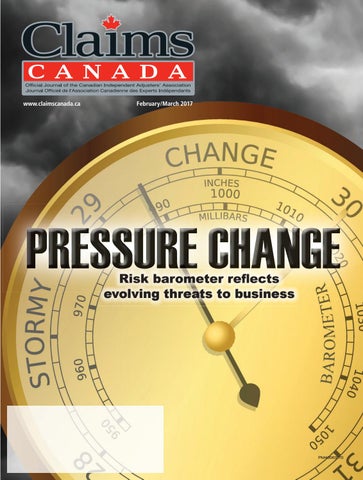
Cover Feature 10 Pressure change – Risk barometer measures threats to business
10
Business interruption is the greatest threat businesses perceive and it can come in many guises. Here’s a look at some of the biggest risks to business in 2017. BY EMILY ATKINS
Spotlight 16 Discovering a work-life balance Flexibility is key to success for Discovery Claims BY EMILY ATKINS
18
News Features 28 What limitation period governs a personal injury claim by tenant vs. landlord? BY BRUCE COOK & RACHEL RUNGE
21 January 1, 2017 Legislative changes: Will they mitigate motor vehicle property claim costs?
40
BY LISA CARR
24 Traditional Homeowners’ Insurance on a Collision Course with the Sharing Economy BY LAURA L. EMMETT AND KAITLYN E. ARMSTRONG
27 Property Loss Update: A review of recent cases, Part 1 BY GLENN GIBSON ICD.D, CIP, FCIAA, FCLA, CFE
Departments
21
4 First Notice 30 On The Scene
Columns 7 President’s Message
• first notice FN University offering certificate in forensic engineering The University of Toronto (U of T) will be offering a new certificate in forensic engineering, something the university calls a “first in Canada.” The new certificate is offered by the university’s Faculty of Applied Science & Engineering. It will be offered to undergraduate students beginning in 2017-18. Forensic engineer Doug Perovic, a professor in the Department of Materials Science & Engineering at the university, will teach students how to analyze and prevent disasters. Perovic has led more than 500 product liability investigations over a 25-year career. In this course, students will be exposed to investigative techniques such as how to conduct destructive and non-destructive testing, how to interpret the evidence left behind on a fracture surface or at the scene of a vehicle collision, and how to narrow down the origin and cause of a fire. The course will also feature renowned guest experts from Canada’s top forensic engineering firms to cover principles of investigation involving product failure, auto and aircraft accident reconstruction, and fire and explosion. It will conclude in a mock trail, with lawyers from top law firms participating in demonstrations of expert witness cross-examinations. “Most importantly, this course teaches students how to
apply their engineering knowledge to ask the right questions when investigating a complex, often messy, real-world problem from beginning to end,” Perovic said. Forensic engineers are trained to find and analyze data from disasters, accidents and failures, and present an unbiased assessment of what the underlying cause may have been. “Unlike some witnesses, physical evidence has no opinion, no bias and never lies,” Perovic said. A key case-study for the course will be the Sunrise Propane explosion that occurred in Toronto in August 2008. Other cases taught will include the Radiohead stage collapse in Toronto in 2012, falling glass from Shangri-La hotel in Toronto in 2014 and the painful fracture of an Ottawa woman’s prosthetic hip implant. Jamie Catania, vice president of forensic consulting at -30Forensic Engineering, said that “along with having the practice of forensic engineering formally recognized by our provincial licensing and regulatory body, this new University of Toronto certificate program is truly a fantastic development, and something that elicits obvious long-term benefits for both the field of forensics and the insurance industry.” ●
Cat losses in 2016 total US$210 billion
Ford investing in autonomous vehicle development
Three hundred and fifteen natural catastrophe events in 2016 generated economic losses of US$210 billion, the highest loss amount in four years and 21 percent above the 16-year average of US$174 billion, according to Aon Benfield’s 2016 Annual Global Climate and Catastrophe Report. The 2016 report evaluates the impact of natural disaster events that occurred worldwide during the last 12 months. For historical context, 2016 was the seventh highest year on record with the combined economic loss exceeding the US$200 billion threshold for the first time since 2013. The top three perils— flooding, earthquake and severe weather—combined for 70 percent of all economic losses in 2016. While at least 72 percent of catastrophe losses occurred outside of the United States, it still accounted for 56 percent of global insured losses. Overall, just 26 percent (US$54 billion) of overall economic losses were covered by insurance in 2016 due to a higher percentage of damage occurring in areas with a lower insurance penetration. However, public and private insurance industry losses were seven percent above the 16-year average and were the highest insured loss total since 2012. ●
Ford Motor Company is investing US$1 billion during the next five years in a company that’s developing a virtual driver system for the automaker’s autonomous vehicle coming in 2021—and for potential license to other companies. Founded by former Google and Uber leaders, Argo AI is bringing together some of the “most experienced roboticists and engineers working in autonomy from inside and outside of Ford,” the automaker said. The team of experts in robotics and artificial intelligence is led by Argo AI founders Bryan Salesky, CEO, and Peter Rander, chief operating officer. Both are alumni of Carnegie Mellon National Robotics Engineering Center and former leaders on the self-driving car teams of Google and Uber, respectively. “The next decade will be defined by the automation of the automobile, and autonomous vehicles will have as significant an impact on society as Ford’s moving assembly line did 100 years ago,” said Ford president and CEO Mark Fields. The current team developing Ford’s virtual driver system—the machinelearning software that acts as the brain of autonomous vehicles—will be combined with the robotics talent and expertise of Argo AI. ●
4
Claims Canada
February/March 2017
www.claimscanada.ca
• first notice FN “Insular” claims world encouraged to see bigger picture Although the claims world can be “very insular,” there are efforts underway to understand how the industry fits into the “greater whole,” Joe Fidilio, vice president of financial lines claims with AIG Canada, said during a recent industry event. Speaking at the 50th Annual Joint Conference of the Ontario chapters of the Canadian Insurance Claims Managers Association and Canadian Independent Adjusters Association in January, Fidilio noted the claims industry can be very “inward-looking.” He was one speaker on a panel sharing tips and strategies for effective leadership. “For me, one of the things that is very important for my team is to understand, to justify, how they fit into the greater whole,” Fidilio said. “So what is it that we do on the claims side? How does that impact underwriting? What’s going on in the underwriting side that impacts the claims world and how do we get that communication flow back and forth so that they understand they’re not just a member of a small team, we’re part of a bigger organization and we have an impact on that organization?”
Part of the process in fitting into the big picture involves scheduling coaching and establishing formal mentoring, Fidilio suggested. For example, some of the more senior people in his organization work with some of the more junior people to ensure they are “attached,” and that the team communicates and coordinates together. As well, some junior staff members shadow the senior people. “On the claims side, you have your pending and somebody else has their pending,” Fidilio said. “It doesn’t sort of work like that in law firms. We have a senior person working on a serious file; they can delegate some of those tasks out to a junior person,” he said, adding that his company is also “starting to get into filesharing.” Bringing the team together as a whole is also important, Fidilio noted, even though “it may not be the most productive time. There’s a lot of chitchat, a lot of conversations, a lot of water cooler talk, but that actually builds the team and it actually gets them to work together better when they are actually looking to be productive,” he suggested. ●
Manitoba at risk of flooding
Zurich and Deloitte collaborating on cyber risk
Normal to well-above normal soil moisture and winter precipitation to date, combined with future unfavourable weather conditions, will result in the risk of moderate to major overland flooding across the province of Manitoba. “We have experienced some unusual winter weather to this point that has contributed to an expanded risk of overland flooding in Manitoba,” Manitoba Infrastructure Minister Blaine Pedersen said in a press release. “At this time, we need to be aware of the potential for flooding with the understanding that we have a couple more months of winter weather and the uncertainty of the spring melt rate.” With future unfavourable weather conditions the Red, Souris, Pembina, Lower Assiniboine and Roseau rivers and the southwest region are currently at risk for major flooding; the Upper Assiniboine River, eastern region, Winnipeg River, northern Manitoba and The Pas regions, including the Saskatchewan, Carrot and Swan rivers, are currently at risk for moderate to major flooding, and; the Interlake region and the Fisher River are currently at risk for moderate flooding, according to the province’s 2017 January Conditions Report. ●
Zurich North America and Deloitte are working together to provide services to help customers better understand and protect themselves from cyber-related risks. Initial offerings include risk transfer options provided by Zurich, and risk mitigation options provided by Deloitte Risk and Financial Advisory Cyber Risk Services. “Through our work with clients in the aftermath of cyber attacks, we see that organizations are often unprepared for the magnitude of the financial impact,” said Ed Powers, principal, Deloitte & Touche LLP, and US leader for Deloitte Risk and Financial Advisory Cyber Risk Services. “A decision to invest in cyber insurance as a part of a broader cyber risk management program is important to help improve a company’s cyber resilience posture and take stock of the potential damage resulting from a cyber attack. ”Businesses carrying Zurich’s Security & Privacy insurance coverage will have an opportunity to complement the coverage with a menu of pre-breach cyber risk assessment and management services through Deloitte to assist businesses in understanding their level of cyber exposure and resilience. ● continued on page 6...
www.claimscanada.ca
February/ March 2017
Claims Canada
5
• first notice FN
continued from page 5...
Aviva makes homeshare insurance available in Canada Aviva Canada is now offering insurance coverage for homesharing across Canada. The company is offering hosts two homeshare coverage options that can be tailored to their rental needs: a simple add-on to an existing Aviva Canada homeowner policy, or standalone coverage for a secondary income property rented to short-term guests year-round (i.e. cottage, house/condo). Homesharing, short-term accommodations marketplaces that connect hosts with guests through an online platform or website, continues to increase in popularity. Rental networks such as Airbnb, Corporate Housing by Owner, Flipkey, HomeAway, Roomorama, VRBO and Wimdu have millions of listing worldwide. “More and more Canadians are looking to supplement their income by temporarily renting their property through online networks,” said Steve Cohen, Aviva Canada’s executive director of personal lines. “Our research shows that one in five Canadians have rented their property in the past, or would consider doing so in the future.” In September 2016, Aviva Canada surveyed more than 2,000 Canadians, aged 25 and over, who are currently home insurance consumers or planning to purchase home insurance
over the next five years. In that survey, 51 percent of those who are currently, or considering, renting their property are unaware that their existing homeowner policy does not cover homesharing. “This means in the event of loss or damages, the homeowner’s claim may be denied or worse, their home policy voided by their insurer,” Aviva said. Although some homeshare networks provide a measure of guaranteed protection as an automatic feature, it should not be considered a replacement for home insurance, the insurer cautioned. Examples of what Aviva Canada’s solution covers and are not provided by homeshare networks includes: liability when the property is deemed uninhabitable (i.e. electricity, fire); loss or damage to buildings; loss or damage to personal possessions caused by the guest; and loss or damage to guest’s possessions while they are renting the property (i.e. electronics). This homesharing coverage means customers have 24/7 access to claims support from Aviva Canada and are not required to secure liability coverage from their homeshare rental network or rental guests first. The coverage will be available to new and existing Aviva Canada customers with eligible primary and income properties. The coverage is independent of any homesharing networks and providers. ●
Published by:
NEWCOM BUSINESS MEDIA INC.
Christine Hirst Account Manager (416) 510-5114 christine@newcom.ca
Mike Wells Account Manager (416) 510-5122 michael@newcom.ca
Emily Atkins Editor (416) 510-5130 emily@claimscanada.ca
Karen Samuels Production Manager (416) 510-5190 karens@newcom.ca
Subscription inquiries (416) 614-5831
Ian Portsmouth Managing Director, Insurance Media Group (416) 510-6800 ian@newcom.ca
Chairman and Founder Jim Glionna
President Joe Glionna
Vice President, Operations Melissa Summerfield
Controller Anthony Evangelista
Gerald Heydens Art Director
Director of Circulation Pat Glionna Head Office 451 Attwell Dr., Toronto, ON M9W 5C4 (416) 614-2200 • fax: (416) 614-8861
www.claimscanada.ca Produced by the publishers of Canadian Underwriter magazine
A bi-monthly magazine (6x per year), Claims Canada is published by NEWCOM Business Media Inc. is located at: 80 Valleybrook Drive, Toronto, ON, M3B 2S9. Claims Canada magazine is the Official Publication of the Canadian Independent Adjusters’ Association [CIAA] and through its editorial content and circulation brings together the ‘entire property & casualty insurance claims market nationally’ with information and insight into the profession, business and people of insurance claims and loss adjusting. All key claims process stakeholders are reached as part of our readership community – including: both CIAA member and non-member independent claims adjusting firms; insurance and reinsurance company executive, claims management and
6
Claims Canada
February/March 2017
Regional Office 80 Valleybrook Dr., Toronto, ON M3B 2S9 (416) 442-5600 • fax: (416) 510-5169
claims adjusting personnel; corporate risk managers and loss control professionals; insurance brokers; insurance law firms; forensic engineers and accountants; appraisal, restoration, rehabilitation and collision repair professionals; Insurance Institute chapters; insurance associations, regulators and related claims market recipients. The contents of this publication may not be reproduced or transmitted in any form, either in part or in full, without the written consent of the copyright owner. Nor may any part of this publication be stored in a retrieval system of any nature without prior written consent.
www.claimscanada.ca
HEATHER MATTHEWS
The industry is abuzz about change. You hear such tag lines as “leverage the disruption for growth”, “humans represent the why of change”, and, most recently, I heard the phrase “lean into the grey” which essentially means to get comfortable with the uncertainty and get involved in the change, lean into it. All of these phrases are challenging us to accept, manage and lead through the change that surrounds us daily. I have always found it interesting that people are accepting change in almost everything but their jobs. You buy the latest phone and flat screen TV, remodel or change your home entirely, change your hairstyle—thank goodness those 80s styles are gone!—buy the latest fashions, and even change our family situations. But when technology or client preferences demand that your job changes, that is when most people become resistant and express their opinions strongly about that change. A “light bulb” moment for me surrounding change management and preparedness came many years ago while attending a week-long leadership development course. It was an intense course with participants from all over the globe. The exercise was simple; I was to lead a group to build a bridge out of Popsicle sticks. We were provided supplies and staff and in one hour we were to design and build a bridge that would hold a 20-pound weight. My team included an engineer. I was thrilled. He was the key to our success. But 20 minutes into the exercise the facili-
On entend beaucoup parler du changement dans l’industrie. Vous entendez des slogans comme « tirez parti des perturbations en vue de la croissance », « les êtres humains représentent la raison du changement » et plus récemment, j’ai entendu l’expression « tendre vers le gris », ce qui signifie essentiellement être à l’aise avec l’incertitude et opter pour le changement. Toutes ces phrases nous mettent au défi d’accepter et d’assurer la gestion et la direction dans le contexte du changement auquel nous faisons face au quotidien. J’ai toujours trouvé intéressant le fait que les gens acceptent le changement dans pratiquement tous les aspects de leur vie, sauf lorsqu’il s’agit de leur emploi. Vous achetez les derniers modèles de téléphones et de téléviseurs à écran plat, vous modernisez ou transformez votre maison entièrement, vous changez de coiffure (heureusement que les styles des années 1980 font partie du passé!), vous adoptez la dernière mode et vous changez même votre situation familiale. Lorsque la technologie ou les préférences du client exigent des changements en matière d’emploi, la plupart des gens résistent et expriment avec vigueur leur opinion à propos des changements. J’ai eu un éclair de génie concernant la gestion et la préparation du changement il y a plusieurs années lorsque j’ai suivi un cours d’une semaine sur le développement du leadership. Il s’agissait d’un cours intensif et les participants venaient du monde entier. L’exercice était simple : je devais diriger le groupe pour la construction d’un pont en bâtons de sucette glacée. Nous avions à notre disposition des fournitures et du personnel et en une heure, nous devions concevoir et construire un pont qui pourrait supporter un poids de 20 livres. Il y avait un ingénieur dans mon équipe. J’étais trop contente : il était l’élément essentiel à notre réuscontinued on page 8...
www.claimscanada.ca
February/March 2017
Claims Canada
7
...continued from page 7
tator entered the room and removed him. We were devastated, but more importantly, blind-sided. We were not prepared to lose staff and in particular key staff integral to this project. Did we learn our lesson and start to prepare? No. A few minutes later that same facilitator once again entered the room and removed half of our supplies. Apparently we now had a supply chain issue! Once again we did not see it coming. This exercise, as simplistic as it seems, resonated with me and shone a light on the fact that we were not prepared for change or disruptors. Many years later I still think of that exercise. I think through what can go wrong: what if I don’t have specific staff? What if I have to do this with half of the resources? What if my budget is cut? What if my client doesn’t want what I am selling? What are plans B, C and D? The lesson? Start planning early and continually. Adopt creative thinking around resources and assignments. Be mindful of your stakeholders and partners and engage them in the process early on. Recognize that it takes time to reorganize and redesign organizational structures and working relationships. One of the biggest challenges is that many people think things are fine and that you don’t need to change. Change breeds fear and it is fear that you must help them overcome. Remember where you are in the thought process, and that in most cases you will need to bring your colleagues and clients along to catch up to those ideas. Help them through that journey. Let’s embrace change and be leaders of change—not victims of it—in the insurance industry, and more specifically, in claims. ■
site. Vingt minutes après le début de l’exercice, l’animateur est entré dans la salle et a retiré l’ingénieur de notre équipe. Nous étions abattus et surtout désagréablement surpris. Nous n’étions pas prêts à perdre du personnel, surtout des membres essentiels à ce projet. Avons-nous tiré une leçon et commencé à nous préparer? Non. Quelques minutes plus tard, le même animateur est revenu dans la salle pour nous enlever la moitié de nos fournitures. Nous avions manifestement un problème de chaîne d’approvisionnement! Encore une fois, nous n’avions rien vu venir. Malgré sa simplicité apparente, cet exercice m’a beaucoup fait réfléchir et a mis en lumière le fait que nous n’étions pas prêts au changement et aux bouleversements. Plusieurs années plus tard, je pense toujours à cet exercice. Je réfléchis bien à ce qui peut mal tourner : qu’arriverait-il si certains membres du personnel particuliers n’étaient pas disponibles, si je devais réaliser le projet avec la moitié de mes ressources, si mon budget était réduit, si mon client ne voulait pas de ce que je vends? Quels seraient les plans B, C et D? Commencez à planifier tôt, et planifiez continuellement. Adoptez une façon de penser créative lorsqu’il s’agit des ressources et des tâches. Soyez attentif à vos intervenants et vos partenaires et amenez-les à participer au processus très tôt. Reconnaissez qu’il faut du temps pour réorganiser et remodeler les structures hiérarchiques et les relations de travail. L’un des plus grands défis, c’est que beaucoup de gens pensent que les choses vont bien et qu’il n’est pas nécessaire d’effectuer des changements. Le changement crée de la peur et c’est cette peur que vous devez les aider à affronter. Souvenez-vous de l’étape où vous êtes arrivé dans le processus d’évolution des idées et du fait que vous devez amener vos collègues et vos clients à se rapprocher de ces idées. Aidez-les dans ce cheminement. Soyons ouverts au changement dans l’industrie de l’assurance, en particulier dans le domaine du règlement des sinistres et dirigeons le changement au lieu d’être des victimes du changement. ■
NATIONAL EXECUTIVE 2016 - 2017 PRESIDENT Heather Matthews, CIP, CRM, CIOP Crawford & Company (Canada) Inc. 539 Riverbend Dr. Kitchener, ON N2K 3S3 Phone: (519) 578-5540 Fax: (519) 578-2868 E-mail: Heather.Matthews@crawco.ca 1ST VICE-PRESIDENT Monica Kuzyk, FCIP, CRM Curo Claims Services 125 Northfield Dr. W., P.O. Box 218 Waterloo, ON N2J 3Z9 Ph: (866) 952-2876 • Fax: (519) 888-9704 E-mail: mkuzyk@curocanada.com 2ND VICE-PRESIDENT Lee Powell Cunningham Lindsey Canada Claims Services Ltd. 1102 – 50 Burnhamthorpe Rd. W. Mississauga, ON L5B 3C2 Ph: (905) 896-8181 • Fax: (905) 896-3485 E-mail: lpowell@cl-na.com SECRETARY Jeff Edge, CIP, CFEI Leading Edge Claims Services Inc. P.O. Box 1399, 78 Highway 20 West Fonthill, ON L0S 1E0 Phone: (289) 897-8676 Fax: (289) 897-8677 E-mail: jeff@leadingedgecs.ca
8
Claims Canada
TREASURER John D. Seyler, CIP Integrated Insurance Resources 5080 Timberlea Blvd., Suite 214 Mississauga, ON L4W 4M2 Phone: (905) 238-4985 Fax: (905) 238-2735 E-mail: jseyler@integrated-ins.ca PAST-PRESIDENT Fred R. Plant, AIIC ClaimsPro 85 Englehart Street Dieppe, NB E1A 8K2 Phone: (506) 853-8507 Fax: (506) 853-8501 E-mail: fred.plant@scm.ca EXECUTIVE DIRECTOR Patricia M. Battle Canadian Independent Adjusters’ Association/ L’Association Canadienne des Experts Indépendants Centennial Centre, 5401 Eglinton Avenue West, Suite 100 Etobicoke, ON M9C 5K6 Phone: (416) 621-6222 Toll Free: 1-877-255-5589 Fax: (416) 621-7776 E-mail: pbattle@ciaa-adjusters.ca
February/March 2017
DIRECTOR Paul Féron, FCIP, CRM – ClaimsPro 210 – 746 Baseline Rd. East London, ON N6C 5Z2 E-mail: paul.feron@scm.ca DIRECTOR Lorri Frederick – ClaimsPro 120 Adelaide St. W., Suite 2401 Toronto, ON M5H 1T1 Ph: (905) 308-6292 • Fax: (416) 360-7335 E-mail: lorri.frederick@scm.ca DIRECTOR James B. Eso, CIP, CIOP Crawford & Company (Canada) Inc. 539 Riverbend Drive Kitchener, ON N2K 3S3 Ph: (519) 578-5540 • Fax: (519) 578-2868 E-mail: Jim.Eso@crawco.ca DIRECTOR E. Grant King, BA, B.Ed., CIP Crawford & Company (Canada) Inc. 120 – 237 Brownlow Avenue Dartmouth, NS B3B 2C7 Ph: (902) 468-7787 • Fax: (902) 468-5822 E-mail: Grant.King@crawco.ca DIRECTOR Albert Poon, CIP Cunningham Lindsey Canada Claims Services Ltd. 1102 – 50 Burnhamthorpe Rd. W. Mississauga, ON L5B 3C2 Ph: (905) 896-8181 • Fax: (905) 896-3485 E-mail: apoon@cl-na.com
DIRECTOR Lee Powell Cunningham Lindsey Canada Claims Services Ltd. 1102 – 50 Burnhamthorpe Rd. W. Mississauga, ON L5B 3C2 Phone: (905) 896-8181 Fax: (905) 896-3485 E-mail: lpowell@cl-na.com DIRECTOR Marie C. Gallagher, FCIP, CRM Kernaghan Adjusters Limited 602 – 1 St. Paul Street St. Catharines, ON L2R 7L3 Phone: (289) 786-1074 Fax: (289) 723-1979 E-mail: mgallagher@kernaghan.com DIRECTOR Craig J. Walker, CIP, FCIAA, FIFAA Maltman Group International 2001 Sheppard Ave. East, Suite 810 Toronto, ON M2J 4Z8 Phone: (416) 492-4411 Fax: (416) 492-5657 E-mail: cwalker@maltmans.com DIRECTOR Gary Ellis, BBA, FCIP, RF, FCLA, FCIAA, FIFAA AMG Claims Inc. P.O. Box 20102 Sherwood Charlottetown, PE C1A 9E3 Phone: (902) 628-9091 Fax: (902) 628-9093
www.claimscanada.ca
CIAA REGIONAL PRESIDENTS 2016 – 2017 NEWFOUNDLAND & LABRADOR TBA
NOVA SCOTIA Michael Connolly, BA, CFEI, CIP ClaimsPro 238 Brownlow Avenue, Suite 300 Dartmouth, NS B3B 1Y2 Phone: (877) 514-6269 Fax: (902) 425-9918 E-mail: michael.connolly@scm.ca
NEW BRUNSWICK & PRINCE EDWARD ISLAND Greg Potten, BPE, CIP, CFEI AMG Claims Inc. 212 Queen Street, Unit 308 Fredericton, NB E3B 1A8 Phone: (506) 458-9000 Fax: (506) 458-9595 E-mail: greg.potten@amgclaims.ca
QUEBEC/AESIQ Michel Lacelle, PAA/CIP ClaimsPro 255 Crémazie Est, 2e étage Montréal, QC H2M 1M2 Phone: (514) 340-8959 Fax: (514) 342-5474 E-mail: michel.lacelle@scm.ca
ONTARIO Maria Joshua, FCIP Sedgwick CMS Canada Inc. 5915 Airport Road, Suite 201 Mississauga, ON L4V 1T1 Phone: (905) 671-7805 Fax: (905) 671-7819 E-mail: maria.joshua@sedgwickcms.ca
MANITOBA Craig Shanks, BA, CIP Wheat City Claims Services Ltd. 64 Regent Cres. Brandon, MB R7B 2W9 Phone: (204) 725-7436 Fax: (204) 725-7437 E-mail: craig.shanks@mymts.net
SASKATCHEWAN Justin Braaten, FCIP, CRM, XAT Capital Claims Adjusters Limited 3500 – 13th Avenue Regina, SK S4T 1P9 Phone: 1 866 550-0516 Fax: 1 866 725-4794 E-mail: justin@capitalclaims.ca
WESTERN TBA
PACIFIC Stacy Phillips, B.Comm., CRM, FCIP ClaimsPro 600, 1111 Melville Street Vancouver, BC V6E 3V6 Phone: (888) 681-6331 Fax: (604) 681-6388 E-mail: stacy.phillips@scm.ca
www.claimscanada.ca
National Standing Committees 2016-2017 ADVISORY Monica Kuzyk, FCIP, CRM Curo Claims Services 125 Northfield Dr. W., P.O. Box 218 Waterloo, ON N2J 3Z9 Phone: (866) 952-2876 Fax: (519) 888-9704 E-mail: mkuzyk@curocanada.com Lee Powell Cunningham Lindsey Canada Claims Services Ltd. 1102 – 50 Burnhamthorpe Rd. W. Mississauga, ON L5B 3C2 Phone: (905) 896-8181 Fax: (905) 896-3485 E-mail: lpowell@cl-na.com Fred R. Plant, AIIC ClaimsPro 85 Englehart Street Dieppe, NB E1A 8K2 Phone: (506) 853-8507 Fax: (506) 853-8501 E-mail: fred.plant@scm.ca Paul Féron, FCIP, CRM ClaimsPro 210 – 746 Baseline Rd. East London, ON N6C 5Z2 Phone: (519) 645-6500 Fax: (519) 645-2250 E-mail: paul.feron@scm.ca Lorri Frederick ClaimsPro 120 Adelaide St. W., Suite 2401 Toronto, ON M5H 1T1 Phone: (905) 308-6292 Fax: (416) 360-7335 E-mail: lorri.frederick@scm.ca James B. Eso, CIP, CIOP Crawford & Company (Canada) Inc. 539 Riverbend Drive Kitchener, ON N2K 3S3 Phone: (519) 578-5540 Fax: (519) 578-2868 E-mail: Jim.Eso@crawco.ca E. Grant King, BA, B.Ed., CIP Crawford & Company (Canada) Inc. 120 – 237 Brownlow Avenue Dartmouth, NS B3B 2C7 Phone: (902) 468-7787 Fax: (902) 468-5822 E-mail: Grant.King@crawco.ca Albert Poon, CIP Cunningham Lindsey Canada Claims Services Ltd. 1102 – 50 Burnhamthorpe Rd. W. Mississauga, ON L5B 3C2 Phone: (905) 896-8181 Fax: (905) 896-3485 E-mail: apoon@cl-na.com Marie C. Gallagher, FCIP, CRM Kernaghan Adjusters Limited 602 – 1 St. Paul Street St. Catharines, ON L2R 7L3 Phone: (289) 786-1074 Fax: (289) 723-1979 E-mail: mgallagher@kernaghan.com Craig J. Walker, CIP, FCIAA, FIFAA Maltman Group International 2001 Sheppard Ave. East, Suite 810 Toronto, ON M2J 4Z8 Phone: (416) 492-4411 Fax: (416) 492-5657 E-mail: cwalker@maltmans.com CIAA NATIONAL INSURANCE INDUSTRY ADVISORY BOARD Patti M. Kernaghan, FCIP, CRM Kernaghan Adjusters Limited 300 - 1445 West Georgia Street Vancouver, BC V6G 2T3 Phone: 1-800-387-5677 Fax: 1-800-387-5644 E-mail: pkernaghan@kernaghan.com Heather Matthews, CIP, CRM, CIOP Crawford & Company (Canada) Inc. 539 Riverbend Dr. Kitchener, ON N2K 3S3 Phone: (519) 578-5540 Fax: (519) 578-2868 E-mail: Heather.Matthews@crawco.ca Monica Kuzyk, FCIP, CRM Curo Claims Services 125 Northfield Dr. W., P.O. Box 218 Waterloo, ON N2J 3Z9 Phone: (866) 952-2876 Fax: (519) 888-9704 E-mail: mkuzyk@curocanada.com
Fred R. Plant, AIIC ClaimsPro 85 Englehart Street Dieppe, NB E1A 8K2 Phone: (506) 853-8507 Fax: (506) 853-8501 E-mail: fred.plant@scm.ca Patricia M. Battle Canadian Independent Adjusters’ Association/L’Association Canadienne des Experts Indépendants Centennial Centre, 5401 Eglinton Ave. West, Suite 100 Etobicoke, ON M9C 5K6 Phone: (416) 621-6222 Toll Free: 1-877-255-5589 Fax: (416) 621-7776 E-mail: pbattle@ciaa-adjusters.ca Albert Poon, CIP Cunningham Lindsey Canada Claims Services Ltd. 1102 – 50 Burnhamthorpe Rd. W. Mississauga, ON L5B 3C2 Phone: (905) 896-8181 Fax: (905) 896-3485 E-mail: apoon@cl-na.com Marie C. Gallagher, FCIP, CRM Kernaghan Adjusters Limited 602 – 1 St. Paul Street St. Catharines, ON L2R 7L3 Phone: (289) 786-1074 Fax: (289) 723-1979 E-mail: mgallagher@kernaghan.com Craig J. Walker, CIP, FCIAA, FIFAA Maltman Group International 2001 Sheppard Ave. East, Suite 810 Toronto, ON M2J 4Z8 Phone: (416) 492-4411 Fax: (416) 492-5657 E-mail: cwalker@maltmans.com
FINANCE John D. Seyler, CIP Integrated Insurance Resources CAREER RECRUITMENT PLANNING 5080 Timberlea Blvd., Suite 214 Richard Swierczynski, BA, CIP Mississauga, ON L4W 4M2 AZ Claims Services Inc. Phone: (905) 238-4985 1500 Upper Middle Rd., Unit #3, Fax: (905) 238-2735 P.O. Box 76041 E-mail: jseyler@integrated-ins.ca Oakville, ON L6M 3G3 Phone: (905) 825-0027 Heather Matthews, CIP, CRM, CIOP Fax: (905) 825-5543 Crawford & Company (Canada) Inc. 539 Riverbend Dr. E-mail: richard@azclaims.ca Kitchener, ON N2K 3S3 COMMUNICATIONS Phone: (519) 578-5540 Richard Swierczynski, BA, CIP Fax: (519) 578-2868 AZ Claims Services Inc. E-mail: Heather.Matthews@crawco.ca 1500 Upper Middle Rd., Unit #3, Fred R. Plant, AIIC — ClaimsPro P.O. Box 76041 85 Englehart Street Oakville, ON L6M 3G3 Dieppe, NB E1A 8K2 Phone: (905) 825-0027 Phone: (506) 853-8507 Fax: (905) 825-5543 Fax: (506) 853-8501 E-mail: richard@azclaims.ca E-mail: fred.plant@scm.ca John D. Seyler, CIP IBC: LIAISON, LEGISLATIVE & FORMS Integrated Insurance Resources Paul Hancock, B.Sc., CIP 5080 Timberlea Blvd., Suite 214 Crawford & Company (Canada) Inc. Mississauga, ON L4W 4M2 300 – 123 Front Street West Phone: (905) 238-4985 Toronto, ON M5J 2M2 Fax: (905) 238-2735 Phone: (416) 867-1188 E-mail: jseyler@integrated-ins.ca Fax: (416) 867-1925 E-mail: Paul.Hancock@crawco.ca Fred R. Plant, AIIC Phone: 1-877-464-9675 E-mail: tina.gardiner@york.ca
ClaimsPro 85 Englehart Street Dieppe, NB E1A 8K2 Phone: (506) 853-8507 Fax: (506) 853-8501 E-mail: fred.plant@scm.ca
CONSTITUTION & RULES Paul Féron, FCIP, CRM ClaimsPro 210 – 746 Baseline Rd. East London, ON N6C 5Z2 Phone: (519) 645-6500 Ian Frost, FCIP Wawanesa Mutual Insurance Company Fax: (519) 645-2250 E-mail: paul.feron@scm.ca 191 Broadway Winnipeg, MB R3C 3P1 CONVENTION Phone: (204) 985-3886 Paul Hancock, B.Sc., CIP Fax: (204) 942-7724 Crawford & Company (Canada) Inc. E-mail: ifrost@wawanesa.com 300 – 123 Front Street West Toronto, ON M5J 2M2 Tim Guernsey Phone: (416) 867-1188 RSA Canada Fax: (416) 867-1925 18 York Street, Suite 800 E-mail: Paul.Hancock@crawco.ca Toronto, ON M5J 2T8 Phone: (416) 366-7511 DESIGNATION/EDUCATION Fax: (416) 367-9869 Gary Ellis, BBA, FCIP, RF, FCLA, E-mail: tim.guernsey@rsagroup.ca FCIAA, FIFAA Peter Hohman AMG Claims Inc. Insurance Institute of Canada P.O. Box 20102 Sherwood 18 King Street East, 6th Floor Charlottetown, PE C1A 9E3 Toronto, ON M5C 1C4 Phone: (902) 628-9091 Phone: (416) 362-8586 Fax: (902) 628-9093 Fax: (416) 362-1126 E-mail: gary.ellis@amgclaims.ca E-mail: phohman@insuranceinstitute.ca Robert V. Pearson, CLA, FCIAA Glen Hopkinson CIAA Honorary Life Member XL Insurance Company SE c/o CIAA National Office 100 Yonge Street, Suite 1200 5401 Eglinton Ave. W., Suite 100 Toronto, ON M5C 2W1 Etobicoke, ON M9C 5K6 Phone: (647) 277-8650 Phone: (416) 621-6222 E-mail:glen.hopkinson@xlcatlin.com Fax: (416) 621-7776 E-mail: info@ciaa-adjusters.ca Dan Langer CICMA Ontario Chapter President Lorne Montgomery CIP, FCIAA, FCLA c/o CIAA Crawford & Company (Canada) Inc. 5401 Eglinton Ave. W., Suite 100 300-123 Front St. W. Etobicoke, ON M9C 5K6 Toronto, ON M5J 2M2 Phone : (416) 621-6222 Telephone: 416-867-1188 Fax : (416) 621-7776 Fax: 416-867-1925 E-mail: danlanger@sympatico.ca E-Mail: lorne.montgomery@crawco.ca Justin MacGregor Governor, IBAC 151 Rose Glen Rd. Port Hope, ON L1A 3V6 Phone: (905) 885-1551 E-mail: 2justinmacgregor@gmail.com Penny McCune SGI Canada 2260 11th Avenue Regina, SK S4P 0J9 Phone : 844 855-2744 E-mail : pmccune@sgicanada.ca
EDITORIAL Mary Charman, CIP Crawford & Company (Canada) Inc. 1 – 120 Mulock Dr. Newmarket, ON L3Y 7C5 Phone: (905) 898-0008 Fax: (905) 898-1705 E-mail: Mary.Charman@crawco.ca John M. Sharoun, FCIP, FCIAA, CRM Crawford & Company (Canada) Inc. 300 – 123 Front Street West Toronto, ON M5J 2M2 Phone: (416) 867-1188 Fax: (416) 867-1925 E-mail: John.Sharoun@crawco.ca
Alex Walker, CIP Aviva Canada 2206 Eglinton Ave. E. EMERGENCY MEASURES Toronto, ON M1L 4S8 Richard Van Horne Phone: (866) 692-8482 E-mail: alex_walker@avivacanada.com Action Investigations Inc. 2 Catelina Court Dartmouth, NS B2X 3G9 Tina Gardiner, B.Sc.,CRM, CIP Phone: (902) 462-1222 The Regional Municipality of York Fax: (902) 462-3688 17250 Yonge Street Newmarket, ON L3Y 6Z1 E-mail:richardvanhorne@actioninvestigations.ca
February/March 2017
LICENSING J. Miles O. Barber, B.Comm. (Hons.), FCIP, CRM, RF Network Adjusters Ltd. 67 Folkestone Blvd. Winnipeg, MB R3P 0B4 Phone: (204) 897-5793 Fax: (204) 897-5797 E-mail: mbarber@mts.net MEMBERSHIP & QUALIFICATIONS Marie C. Gallagher, FCIP, CRM Kernaghan Adjusters Limited 602 – 1 St. Paul Street St. Catharines, ON L2R 7L3 Phone: (289) 786-1074 Fax: (289) 723-1979 E-mail: mgallagher@kernaghan.com NOMINATING Fred R. Plant, AIIC — ClaimsPro 85 Englehart Street Dieppe, NB E1A 8K2 Phone: (506) 853-8507 Fax: (506) 853-8501 E-mail: fred.plant@scm.ca Heather Matthews, CIP, CRM, CIOP Crawford & Company (Canada) Inc. 539 Riverbend Dr. Kitchener, ON N2K 3S3 Phone: (519) 578-5540 Fax: (519) 578-2868 E-mail: Heather.Matthews@crawco.ca Lorri Frederick — ClaimsPro 120 Adelaide St. W., Suite 2401 Toronto, ON M5H 1T1 Phone: (905) 308-6292 Fax: (416) 360-7335 E-mail: lorri.frederick@scm.ca James B. Eso, CIP, CIOP Crawford & Company (Canada) Inc. 539 Riverbend Drive Kitchener, ON N2K 3S3 Ph: (519) 578-5540 Fax: (519) 578-2868 E-mail: Jim.Eso@crawco.ca Craig J. Walker, CIP, FCIAA, FIFAA Maltman Group International 2001 Sheppard Ave. East, Suite 810 Toronto, ON M2J 4Z8 Ph: (416) 492-4411 Fax: (416) 492-5657 E-mail: cwalker@maltmans.com PRIVACY James B. Eso, CIP, CIOP Crawford & Company (Canada) Inc. 539 Riverbend Drive Kitchener, ON N2K 3S3 Ph: (519) 578-5540 Fax: (519) 578-2868 E-mail: Jim.Eso@crawco.ca Keith P. Edwards, FCILA, CLA, FUEDIELAE — ClaimsPro 120 Adelaide St. W., Suite 2401 Toronto, ON M5H 1T1 Ph: (416) 777-4479 Fax: (416) 360-7335 E-mail: keith.edwards@scm.ca PROFESSIONAL PRACTICES Fred R. Plant, AIIC — ClaimsPro 85 Englehart Street Dieppe, NB E1A 8K2 Phone: (506) 853-8507 Fax: (506) 853-8501 E-mail: fred.plant@scm.ca
Claims Canada
9
5LVN EDURPHWHU UHĂ HFWV evolving threats to business
By Emily Atkins
Business interruption, a risk as broad as the world of business itself, tops the list of threats that enterprises around the world have identified for 2017. This is a finding of the 2017 Allianz Risk Barometer study, global research that Allianz has conducted for six years running. It’s research that provides anyone working in insurance, and in claims, a valuable perspective on the kinds of threats companies perceive, as well as offering insights into how the world of exposure and coverage is evolving. Read on for an
overview of the top risks reported in Canada and around the globe. Business interruption Globally, business interruption (BI) is ranked the most serious threat by 37 percent of respondents. But in Canada and the US it ranks first at an even higher rate, at 43 and 42 percent respectively. We spoke to Bernard McNulty, head of claims for Canada with Allianz, to gain some perspective on the Canadian outlook. He cites the competitive nature of the economy, with rivals ready to pounce. “If a business is shut down for whatever reasons, [there is] very often a competitor right there looking to pick up that market share, and companies may struggle to regain that share after losses, if they ever can,” he says. The days are long gone when a company has the luxury of taking months to recover, he adds. Canadian companies are additionally at risk of contingent BI, McNulty says, because they “import far more product that is components of their finished products. So if they’re importing components from China, from Japan—
specialized components that are not easily replaced— if they lose that supply chain, their business can be significantly affected.” Indeed, according to the Allianz report, non-damage triggers that cause BI events are growing. Supply chain disruption, as McNulty suggests, is ranked a top concern by 33 percent of businesses, landing at third overall, after fire and explosion at 44 percent, and natural catastrophes at 43 percent.
Market developments Evolution in markets is the second most troubling concern for global businesses, with 31 percent of responses. In Canada, however, market forces were ranked by only 25 percent, but held second place. In the Americas overall, market forces were ranked fourth. Companies are concerned about factors such as intensified competition, mergers and acquisitions (M&A) and market stagnation. But they are also paying attention to the increasing dependence on technology and automation
Differences in Risks by Enterprise Size 0
10
20
30
40
50
Business interruption (incl. supply chain disruption, and vulnerability)
45% 35% 27%
Cyber incidents (cyber crime, IT failure, data breaches, etc.)
36% 29% 22%
Changes in legislation and regulation (goverment change, economic sanctions, protectionism, etc.)
22% 24% 26%
Political risks and violence (war, terrorism, etc.)
17% 10% 14%
Loss of reputation or brand value
16% 14% 8%
Theft, fraud, corruption
6% 13% 11%
Human error
6% 11% 12%
Talent shortage
Source: Allianz Global Corporate & Specialty
www.claimscanada.ca
4% 5% 10%
continued on page 12...
February/March 2017
Claims Canada
11
...continued from page 11
;YfY\Y k Lgh Jakck 1 2
Business interruption (incl. supply chain disruption, and vulnerability) Market developments (volatility, intensified competition/ new entrants, M&A, market stagnation, market fluctuation)
42% 25%
2016 Rank 2 (37%) 6 (20%)
Trend
3 4
Natural catastrophes (e.g. storm, flood, earthquake) Macroeconomic developments (austerity programs, commodity price increase, deflation, inflation)
24% 22%
3 (23%) 6 (20%)
-
5 6
Cyber incidents (cyber crime, IT failure, data breaches, etc.) Changes in legislation and regulation (goverment change, economic sanctions, protectionism, etc.)
20% 17%
1(57%) 3(23%)
T
7 8 9
Quality deficiencies, serial defects, product recall Loss of reputation or brand value New technologies (e.g impact of increasing interconnectivity, nanotechnology, artificial, intelligence, 3D printing, drones, etc.)
15% 14% 12%
NEW 3(23%) NEW
S
10
Talent shortage
12%
NEW
S
Trendd -
S S
S
T
T S
Source: Allianz Global Corporate & Specialty
L`] 9e]ja[Yk Lgh Jakck 1 2 3 4
Business interruption (incl. supply chain disruption, and vulnerability) Cyber incidents (cyber crime, IT failure, data breaches, etc.) Natural catastrophes (e.g. storm, flood, earthquake) Market developments (volatility, intensified competition/new entrants, M&A, market stagnation, market fluctuation)
43% 31% 28% 26%
2016 Rank 1 (58%) 2 (46%) 3 (37%) 4 (35%)
5
Changes in legislation and regulation (goverment change, economic sanctions, protectionism, etc.) Fire, explosion Macroeconomic developments (austerity programs, commodity price increase, deflation, price increase, deflation, inflation)
19%
5 (28%)
-
15% 15%
6(25%) 8 (20%)
-
6 7
S
8 9
Loss of reputation or brand value New technologies (e.g impact of increasing interconnectivity, nanotechnology, artificial, intelligence, 3D printing, drones, etc.)
14% 12%
6 (25%) NEW
T
10
Theft, fraud, corruption
12%
9 (20%)
T
S
Source: Allianz Global Corporate & Specialty
12
Claims Canada
February/March 2017
www.claimscanada.
continued on page 14...
that is leading to rapid disruption across industry sectors. More than half of respondents (53 percent) cited increasing digitization and use of new technologies as the most salient trends transforming their respective industry sector. The biggest concern about digitization is the increasing sophistication of cyber attacks, data fraud and data theft, with 45 percent citing these.
Cyber incidents Indeed, cyber threats are rapidly climbing the ranks of risks. Over the past five years, cyber has climbed the risk ladder from 15th place in 2013 to third in 2016, where it remains this year, with 30 percent of responses. “Cyber risk is not going away and people around the world are right to be concerned,” says Emy Donavan, head of cyber North America, Allianz Global Corporate & Specialty (AGCS), in the th report. Companies are concerned beCompanie cause the cyber threat is still very c unpredictable, and, the report unpredic notes, is “not isolated to a particular ticula segment and spans different industries and diffe sizes of companies, from size an online retailer through to a heavy manufacturer to an a oil refinery.” Counter to trend, CaC nadian businesses did not nadi place much emphasis on cyber threats, ranking them only thre fifth this yyear, with 25 percent of responses, versus last year’s rankv ing of first, with 57 percent. Globally, cyber was ranked third (30 percent) and second percent) for the Americas. d (31 p Small business, too, seems to downplay the cyber threat, ranking it sixth overall. Yet recent research by consultancy EY shows that only 43 percent of Canadian companies would even be able to detect a sophisticated cyber attack, versus 50 percent of companies globally. “Many [small businesses] underestimate their exposure and are not prepared for, or are able to respond to, an incident,” Jens Krickhahn, head of cyber insurance Central and Eastern Europe, AGCS says in the Allianz report. “Many do not have the resources to build a response team. This can be fatal if they become the target of a cyber-attack.” McNulty suggests that part of this apparent lack of concern may be that cyber attacks are dealt with as quietly as possible, so their numbers and severity may www.claimscanada.ca
not be clearly understood. But companies should be aware that every organization is vulnerable to cyber threats. Loss of data or exposure of client data are critical in regards to reputational risk and the market reaction to this. How swiftly they respond to mitigate it, once the security incident has been detected, is key, he adds.
Natural catastrophes It is no surprise that cats are a significant concern for Canadian companies.
Canadians—along with the rest of the Americas—rank cats third, with 24 percent of responses. Globally, however, cats rank fourth. According to the AON 2016 Annual Global Climate and Catastrophe Report, natural disasters around the world in 2016 engendered economic losses of US$210 billion. The disasters caused insured losses of US$54 billion. This is the highest insured loss total since 2012. And with major events like the Fort Mc-
Your customer has a list of the vehicles that are covered by your fleet policy. You have a list of the vehicles that are covered by that policy. And your lists aren’t the same. When the one vehicle that is involved in an accident is the one that doesn’t appear on both lists, do you know what happens next? ARC does.
ARC Group Canada is a national network of independent law firms, each intimately connected to their local market. Insurance and risk management experts. Regional strength. National scope. Go to AskARC.com
A National Network of Independent Law Firms
February/March 2017
Claims Canada
13
...continued from page 13
Murray fire dominating headlines in this country and causing massive losses, set to surpass $9.5 billion, and with insurance payouts estimated at $3.7 billion, it’s no wonder companies see their potential impact as a major threat. Although small, medium and large companies all ranked the cat threat similarly in the study, different sized businesses have different risk profiles to catastrophic events, McNulty says. “A small business may be more challenged to think through what options they may have to protect themselves. If they’re regionally located in a cat-exposed area, there’s perhaps nothing they can do to change their risk profile,” he notes. But larger companies have more options, like minimizing inventory in high-risk locations, or moving to a location that’s better fire- or flood-protected. “They can minimize their profile in that area and service that particular geography from other locations they may have,” McNulty adds.
Politics and protectionism Political developments are making many edgy these days, with the new US administration’s anti-trade, America-first
pronouncements causing companies that trade with the US and globally to start making contingency plans. Although Canadians only ranked this their sixth most pressing concern (17 percent of responses), the study was done before Donald Trump was elected President of the United States. With such possible disruption on the near horizon, “companies will need to invest more resources into better monitoring politics and policy-making around the world in order to gather the economic intelligence that will enable them to anticipate, and adapt to, any sudden ‘abrupt and massive’ changes of rules that could impact business models, amid fears of increasing protectionism and anti-globalization” the Allianz report says. For Canadian companies, McNulty says concern is real. “Given that Canada and US are each other’s largest trad-
ing partners and the economies are tremendously linked—everything from auto manufacturing to various other business and services—the protectionism that Trump promised may well be intended for other countries such as China or Mexico,” he says. “But I think there’s a lot of Canadians who feel that we may be caught up in that or affected by that or, or we’ll be collateral damage.” Beyond the threat to trade deals McNulty notes there’s also concern around Trump’s tax policies. “We know there’s legislation in the works right now that could impose greater tariffs on Canadian imports and possibly start a bit of a trade war. So again, there are tremendous concerns that goods and services from Canada are not going to flow across the border as easily as they always have.” The report notes there will be additional impacts on global trade and supply chain operations as the full implications of Brexit and the US decision not to take part in the Trans-Pacific Partnership become clear. Coming European elections might also result in even more protectionist governments being elected, adding to the threat.
Gn]jYdd Lgh Jakck 1 2
Business interruption (incl. supply chain disruption and vulnerability) Market developments (volatility, intensified competition/new entrants, M&A, market stagnation, market fluctuation)
37% 31%
2016 Rank 1 (38%) 2 (34%)
Trend -
3 4 5
Cyber incidents (cyber crime, IT failure, data breaches, etc.) Natural catastrophes (e.g. storm, flood, earthquake) Changes in legislation and regulation (government change, economic, sanctions, protectionism, etc.)
30% 24% 24%
3 (28%) 4 (24%) 5 (24%)
-
6
Macroeconomic developments (austerity programs, commodity price increase, deflation, inflation) Fire, explosion Political risks and violence (war, terrorism, etc.) Loss of reputation or brand value New technologies (e.g impact of increasing interconnectivity, nanotechnology, artificial intelligence, 3D printing, drones, etc.)
22%
6 (22%)
-
16% 14% 13% 12%
8 (16%) 9 (11%) 7 (18%) 11 (10%)
S
Theft, fraud, corruption Human error Quality deficiencies, serial defects, product recall Climate change/increasing volatility of weather Talent shortage Brexit, Euro-zone disintegration Environmental risks (e.g. pollution) Power blackouts Health issues (e.g. pandemics) Machinery breakdown
9% 9% 8% 6% 6% 5% 5% 2% 1% 1%
10 (11%) 12 (9%) 14 (7%) 16 (4%) 13 (8%) 18 (2%) 15 (5%) 17 (3%) 19 (1%) 20 (1%)
T
7 8 9 10 11 12 13 14 15 16 17 18 19 20
S T S
S S T S T T
-
Source: Allianz Global Corporate & Specialty 14
Claims Canada
February/March 2017
www.claimscanada.ca
Future risk The study also asked about future concerns—on the 10-plus year horizon. Cyber incidents topped the list at 42 percent, followed by new technologies at 40 percent and market developments at 33 percent. In fact, new technologies entered the top 10 for the first time in 2016, highlighting that this risk is more than just a future concern, it is happening now. The Allianz report notes that “increasingly, connected industries and their insurers will experience new liability scenarios. For example, human error—a leading cause of losses in many sectors—could increasingly be replaced by technical failure.” Digitization is also expected to cause a bump in non-physical losses as corporate assets becoming increasingly IT based, and in the cloud, for example. But it’s also a double-edged sword, with
Methdology The sixth annual Allianz Risk Barometer was conducted among Allianz corporate clients and brokers. It also surveyed risk consultants, underwriters, senior managers and claims experts of Allianz entities around the globe, during October and November 2016. The survey focused on large and small to mid-sized companies. There were 1,237 respondents from a total of 55 countries. As multiple answers for up to two industries were possible, 4,679 answers were delivered. Participants were asked to select industries about which they are particularly knowledgeable and name up to three risks they believe to be of most importance. Most answers were for large enterprises (over €500m/$520m revenue) with 2,325 responses, or 50 percent. Small enterprises (below €250m revenue) contributed 1,275 responses (27 percent) while mid-sized enterprises (€251m to €500m revenue) produced 1,079 responses (23 percent). Risk experts from 21 industry sectors were featured.
www.claimscanada.ca
benefits accompanying the risks. “Interconnectivity enables growth, cost optimization and more flexible business models close to the final customer,” says Georgi Pachov, global practice group leader, cyber, AGCS, in the report. “However, it also poses significant risks related to inability to deliver the product or services. The utiliza-
tion and application of machine learning, artificial intelligence, big data and, in general, solid analytics contributes to the everincreasing cyber exposure. Implementing proper cyber risk management and mitigation procedures will become an indispensable part of every company’s top management priorities.”
Af\mkljq K][lgjk Egkl Ka_faÚ [Yfl Jakck Business interruption Food & Beverage (manufacturing and supply) Manufacturing (incl. Automotive) Power & Utilities Transportation
42% 59% 56% 35%
Market Developments Aviation, Aerospace & Defence Financial Services Marine & Shipping
45% 41% 35%
Cyber incidents Retailing. Wholesale Telecommunications, Technology & IT
40% 60%
Natural Catastrophes Engineering, Construction. Real Estate
40%
Source: Allianz Global Corporate & Specialty
February/March 2017
Claims Canada
15
• spotlight S Discovering a work-life balance Flexibility is key to success for Discovery Claims BY EMILY ATKINS
S
ince its start in Pat Lodewijkx's converted laundry room almost 13 years ago, Discovery Claims is proof that vision plus hard work can pay off for the risk-taking entrepreneur. The Surrey, British Columbia-based independent adjusting firm has overcome hurdles and demonstrated the importance of flexibility for business success. For Pat, who started on his own and now runs the business in partnership with his wife, Jane Lodewijkx, it was a matter of adapting to create a balance between the work he loves and maintaining an active family life.
Inception Pat started his career as an independent adjuster after several years working at the Insurance Corporation of BC (ICBC) in various capacities from customer service to adjusting and ending up in the special investigations unit. He left the public insurer to work at a small firm in Vancouver, gaining exposure to the world of independent adjusting. But after three years he was tired of the commute from the Lower Mainland where he lives and knew it was time to go into business for himself. "I decided to take a chance. When I was growing up my father was an entrepreneur as well, so I guess I had the bug to run my own business," he says. "I always had the intention of opening up a branch office or doing something on my own." With the timing feeling right, Pat considers in hindsight that he took only a medium-sized risk in opening his own shop, out of his former laundry room. "It was in an industry that I was comfortable with," he says, although there were aspects of running his own business that were new. While he knew how to write a busi16
Claims Canada
February/March 2017
ness plan, and sought the help of legal and financial professionals, it was a piece of advice from his accountant that he credits with a lasting impact on his success. "When you start up your own business you're going to be wearing lots of different hats," he notes. "It's a really good idea to be able to push back and focus on what you're good at, and let other people—accountants, lawyers, bookkeepers—take care of that other stuff." That allowed him to focus on building the business and doing the work to maintain the cash flow that is "critical to any small business".
Ups and downs The company grew quickly, precipitating a move to a shared office, and then the addition of admin staff and more adjusters. Discovery Claims focuses on automotive claims, as well as working with several law firms. The reliance on automotive meant the company suffered a setback when ICBC revamped its contracting processes. Discovery Claims shrank for a time, and Pat worked from home again, until he was able to rebuild the volume of files sufficiently to contract office space in Surrey. During that time, Jane decided to return to work after having two kids, and joined the company as co-owner. Now Discovery Claims employs seven adjusters and two admin staff out of the Surrey office. Business is definitely on the upswing. "We seem to be expanding at this time," Pat says. "But who knows what the future is going to hold. The best thing we can do is be flexible."
Finding balance From the very beginning, when he sought to avoid the 40 to 50-minute commute to Vancouver, Pat's objective with Discovery Claims has been to ensure a good work-life balance, while providing excellent service to his customers. And balance is not always easy when you are running a small business. One of the challenges is separating the work from the personal, but it is key, Pat maintains. It was a particular challenge while he was taking his FCIP certification courses at night school. And it's especially important when you work with your spouse. Key to managing that relationship, he says, is being able to laugh. "First of all, have a sense of humor," he chuckles. "That's a big one. And love what you do, and be involved, and try to touch base regularly. Communication is very important." The Lodewijkxs reap the benefits of independence by being able to set their own calendars for vacations and getaways, not to mention the day-to-day challenge of managing an active family with two young boys and all their activities. "The nice thing is we work close to where we live," Pat says. "If we had to commute two hours every day I think that'd be much more challenging." The balance they've achieved extends to the staff. The company uses a secure document management system that allows all the adjusters to work remotely and whenever they need to. Although there was a bit of a learning curve at first, the adjusters like it. "They enjoy working in that sort of environment," Pat says. "In our job it's very much results driven," requiring www.claimscanada.ca
Jane and Pat Lodewijkx of Discovery Claims
work on evenings and weekends, which the IT set-up allows. "The adjusters that work for us work more or less remotely throughout the lower mainland. They're not in the office every day. It's their schedule," Pat notes.
Discovering the truth The company got its name as a tribute to the investigative side of the business. The search for the facts, "finding the truth in the matter, is the reason the company exists," Pat says. This informs its customer service ethos to this day. "The people that we bring on board are people of high quality, and they all have strong work ethics," he adds. "We're committed to doing a thorough job and finding out the facts and to assisting both the insurance company and the claimant. I think the name captures a lot."
The big picture While Discovery Claims is running smoothly, Pat is watching larger trends shaping the industry that may ultimately have an impact on his business. "One of the concerns moving forward is techwww.claimscanada.ca
nological advances that are going to impact various industries," he says. "One of the biggest ones I see is autonomous vehicles." He foresees a scenario where the dramatic reduction in motor vehicle collisions will "impact not only the insurance adjuster but the fireman, the policeman, the medical community." As the automakers roll out better and better safety systems, it will be good for society as a whole, he says, but the set of people who deal with the aftermath of accidents will have to adapt somehow. "The downside for our industry is for the people who are dealing with those issues. What do they do?" he asks. Another concern relates to the nature of the auto insurance business in BC, dealing as a group with a public provider. This is where he sees the value of the CIAA, to provide a forum to represent the interests of independent adjusters. To that end, he is strongly in favour of the association taking on an advocacy role to "promote the professionalism of the association." Pat says it's important to develop
a unified voice for the BC chapter. He believes it should "promote events that will foster that, and have annual meetings or quarterly meetings" to keep members informed about what's going on in the province.
Joy in the job Although affecting the big picture is clearly important, for Pat it's the daily victories that create the joy in being an IA. It can sometimes be a challenge to overcome communication barriers, he says. "But the ultimate goal is when you are on the same wavelength, on the same page then it's euphoric. There's a lot bonuses to that. If there weren't the challenge, there wouldn't be the reward at the end." "It's human to want to assist," he says. "I'm able to contribute to society and my community in a good way and at the same time provide for my family." Key to achieving that are the adaptability and life-long learning that let him grow and weather the challenges of running a business. Along the way he's discovered the balance that gives him the greatest satisfaction. February/March 2017
Claims Canada
17
What limitation period governs a personal injury claim by tenant vs. landlord? BY BRUCE COOK & RACHEL RUNGE
Should a personal injury claim, normally subject to a two-year limitation period, attract a one-year limitation period simply by virtue of the fact that the plaintiff is the defendant’s tenant? A recent decision of the Ontario Superior Court of Justice suggests it does. Letestu v. Ritlyn Investments Inc.1 was a personal injury action commenced by the estate of the late Armand Letestu against Ritlyn Investments Ltd. Letestu was a tenant in a residential apartment owned and managed by Ritlyn. On January 11, 2010, Letestu tripped and fell on “worn, torn and unsecured carpet” in his living room. He sustained injuries and required several months of hospitalization. Letestu subsequently passed away from cancer. On December 15, 2011, one month short of the two-year limitation period under the Limitations Act, 20022, an action was commenced by his Estate. The Estate claimed general damages in the sum of $500,000.00. 18
Claims Canada
February/March 2017
An OHIP subrogated claim was also advanced in the sum of $98,497.37. The Estate’s action was framed as an occupiers’ liability claim, but pled provisions of the Residential Tenancies Act, 20063 (“the RTA”). The Landlord and Tenant Board (“the Board) has exclusive jurisdiction to hear all matters where the RTA confers jurisdiction to it.4 The Ontario Superior Court of Justice may have jurisdiction to hear a matter where the monetary relief is in excess of the jurisdiction of the Small Claims Court ($25,000.00); however, the applicant must still be “entitled” to apply to the Board for the Ontario Superior Court of Justice to inherit jurisdiction over the claim5. The RTA has a one-year limitation period for applicants to bring a claim before the Board.6 In Letestu, Ritlyn brought a motion to strike the action on the basis the Ontario Superior Court of Justice did not have jurisdiction because the claim was not brought within the one-year limitation period prescribed by the RTA. Ritlyn’s argument was the Board had exclusive jurisdiction to hear the claim because it arose out of allegations of disrepair in the plaintiff’s residential apartment, a matter within the jurisdiction of the RTA. The plaintiff
opposed the motion, arguing the claim was framed pursuant to the Occupiers’ Liability Act7 (“the OLA”) and relied on the RTA. Applying the reasoning of Perell, J. in Mackie v. Toronto (City) and Toronto Community Housing Corporation8, Justice Sloan accepted Ritlyn’s argument that alleged instances of disrepair and unsafe living conditions were “repair claims” falling within the exclusive jurisdiction of the Board (as set out in section 29 of the RTA). Applying the reasoning of Horkins, J. (sitting as a single judge in the Ontario Divisional Court) in Efrach v. Cherishome Living9, Justice Sloan accepted that, because the Estate’s claim had been commenced outside of the one-year limitation period prescribed by the RTA, the Estate was not “entitled” to bring a claim before the Board. Sloan agreed that the Ontario Superior Court of Justice did not have jurisdiction to hear the Estate’s claim and dismissed the Action. The effect of this decision is to suggest that a claim arising out of a residential landlord’s negligence where the claimant is the tenant, in the context of occupiers’ liability, is subject to a more restrictive one-year limitation period. In Mackie, the plaintiffs claimed www.claimscanada.ca
continued on page 20...
damages (i.e. mental suffering) arising from the defendant landlord’s breach of the RTA and their failure to repair rental units over a period of many years. The action was to enforce the landlord’s obligations under the RTA. In Mackie, Justice Perrell quickly dismissed other causes of action that were advanced pursuant to Human Rights and Charter legislation, finding they were baseless. His Honour accepted that the true nature of the claim was for repair of rental units. The modern or purposive approach to statutory interpretation provides that the words of an act are to be read in their entire context and in their grammatical and ordinary senses, harmoniously with the legislation and its objective and the intention of Parliament. This is the prevailing and preferred approach to statutory interpretation and has been adopted by the Supreme Court of Canada. 10 The purpose of the OLA is set out at section 2 of that Act: The OLA ex-
www.claimscanada.ca
pressly provides that it is intended to address an occupier’s liability in respect of damages to persons entering on the premises. To paraphrase section 1 of the RTA, its purpose is to provide protection for residential tenants against unlawful rent increases, to regulate residential rent, to balance the rights and responsibilities of landlords and tenants, and to provide for the adjudication of and for other processes to informally resolve disputes. The RTA balances the
rights of landlords and tenants. In Letestu, the Estate claimed damages for pain and suffering arising from physical injuries sustained when the plaintiff tripped and fell. In Letestu, the plaintiff was deceased. The action was commenced by the Estate, not to enforce an obligation under the RTA, but to compensate the Estate for the deceased’s pain and suffering (and to compensate OHIP for costs incurred on behalf of the plaintiff). Arguably, the “true nature” of the claim in Letestu was in fact a personal injury action arising as a result of the occupier’s breach of duty to ensure the premises were safe for those entering onto the premises. The OLA was intended to replace and supersede the common law rules of negligence that imposed liability upon landlords and tenants of property and differentiated between, for instance, invitees and trespassers. Certain statutory obligations were preserved by the OLA. Section 9 of the OLA preserves
February/March 2017
Claims Canada
19
...continued from page 19
certain “higher duties” on particular cl asses of persons. While not expressly enunciated in section 9 of the OLA, Perell, J. in Miaskowski v. Persaud, accepted that the duties of a landlord, as set out in the RTA, was an example of non-delegable duties for the purposes of section 9 of the OLA. It follows, then, that a claim can be framed pursuant to the provisions of the OLA and rely on the provisions of the RTA. In this case, in our view, it would be appropriate to
apply the two-year limitation period under the Limitations Act, 2002. Letestu is not a case about limitation periods per se; rather, it is a case about the “true nature” of a claim between a residential tenant and his landlord. We think this decision requires further consideration because counsel may consider an action to be a personal injury matter, yet the one-year limitation period may apply by virtue of the residential tenancy relationship between
COMMERCIAL PRODUCER
20
Claims Canada
February/March 2017
the plaintiff and defendant. We understand a Notice of Appeal has been filed in Letestu. What the Court of Appeal will do remains
to be seen; however, we wonder if, by applying a purposive interpretation of the RTA and the OLA, Mackie may be distinguished or limited to its facts.
1
2016 ONSC 6540.
2
SO 2002, c 24, Sch B.
3
SO 2006, c 17.
4
Residential Tenancies Act, 2006, 2006, c. 17, s. 168 (2).
5
Residential Tenancies Act, 2006, 2006, c. 17, s. 207 (1).
6
Residential Tenancies Act, 2006, 2006, c. 17, s. 29 (2).
7
RSO 1990, c O.2
8
2010 ONSC 3801.
9
2015 ONSC 472
10
Rizzo & Rizzo Shoes Ltd., Re (1998), 1998 CarswellOnt 1 (S.C.C.);
11
Musselman v. 875667 Ontario Inc. (Cities Bistro), 2010 ONSC 3177 at para. 171, aff’d 2012 ONCA 41.
12
2015 ONSC 1654
www.claimscanada.ca
January 1, 2017 Legislative changes:
Will they mitigate motor vehicle property claim costs? BY LISA CARR
The Fighting Fraud and Reducing Automobile Insurance Rates Act, 2014, was enacted to amend various statutes in the interest of reducing insurance fraud, enhancing tow and storage services and other matters. This article addresses the amendments to the Repair and Storage Liens Act and Consumer Protection Act, 2002, and Regulations thereunder, that came into force on January 1, 2017. A statutory lien arises under the Repair and Storage Liens Act when a vehicle is towed, repaired and/or stored. This lien permits a person, providing tow, repair and/or storage services (“lienholder�) to withhold vehicles from their owner or insurer. But this lien may not arise if the lienholder fails to comply with the new amendments that came into force on January 1, 2017. The amendments are discussed in more detail below. How does the Repair and Storage Liens Act affect motor vehicle property claims? Motor vehicles must be cleared from accident scenes as quickly as possible for the safe and orderly movement of traffic. Given the urgency of the situation, the insured person must www.claimscanada.ca
use the tow operator on scene. The insured is usually more concerned about personal safety than tow fees. Too many insured persons mistakenly believe that tow companies have an agreement with insurers on the fees to be charged, and thus do not discuss fees. The insured signs any documentation the tow operator may request. The documentation could include an authorization to repair the vehicle. The vehicle is then towed to a storage facility or repair facility. The Insured then reports the motor vehicle accident to his/her insurer. The insurer requests the location of the vehicle and where the insured wants it repaired. It is not uncommon for these locations to be different. Problems may arise when the insurer tries to move the vehicle to another repair facility or salvage yard. The lienholder, having possession of the vehicle, may demand payment of excessive fees or refuse to release the vehicle altogether, alleging it is authorized to repair the vehicle. In some cases, vehicles are torn down and repairs started without the insured’s consent and before the insurer can inspect the damage to the vehicle. The insured is a consumer with rights protected by the Consumer Protection Act, 2002. The insurer is subrogated to all rights of the insured consumer, including rights under the Consumer Protection Act, 2002.
Historical shortfalls of the Consumer Protection Act, 2002 Part VI of the Consumer Protection Act, 2002, deals specifically with repairs to motor vehicles. The definition of repair includes the towing and storage of motor vehicles. Part VI requires that the lienholder obtain authorization before providing services and provide invoices, all of which must contain specific information for the consumer. Authorizations and invoices in writing must include ancillary services such as storing the vehicle, picking up or delivering the vehicle, among other things. In 2009, the Divisional Court held that Part VI of the Consumer Protection Act, 2002 does not apply to accident tows or subsequent storage, if the vehicle is not repaired. It does not matter if the service is performed by a tow company or repair facility. Part VI only applies if the lienholder repairs the vehicle. Avoiding application of the Consumer Protection Act, 2002 is important because failure to comply negates any claim in quantum meruit. In other words, it cannot be argued that a service was performed, for which a benefit was received and therefore the lienholder ought to be compensated. After the Divisional Court decision, February/March 2017
Claims Canada
21
the Consumer Protection Act failed to protect insured consumers when the vehicle was not repaired after an accident. The Fighting Fraud and Reducing Automobile Insurance Rates Act, 2014 has changed this by adding Part VI.1 titled “Tow and Storage Services”. Part VI.I is similar to Part VI and has some additional provisions that specifically address the tow and storage of vehicles.
January 1, 2017 Legislative Amendments As noted above, the Repair and Storage Liens Act creates the lien that permits the lienholder to withhold vehicles from the owner or insurer. But this lien no longer arises under the Repair and Storage Liens Act if the lienholder fails to comply with new sections of the Consumer Protection Act, 2002. If the lien does not arise, the lienholder cannot withhold the vehicle. The following sections of the Consumer Protection Act, 2002 will prevent the lien from arising under the Repair and Storage Liens Act: • Section 65.3: a Tow and Storage Provider shall not charge for any tow and storage services, unless it provides the consumer with specific information including its company name and contact information, a statement that its rates comply with the Consumer Protection Act, 2002, the amount of the fee, address and location where the vehicle will be towed including every anticipated stop, a statement that it accepts payment by credit card and if the information is not given in writing, it must be recorded and retained. • Section 65.4(1): a Tow and Storage Provider shall not charge for any tow and storage services, unless the service is authorized. The Regulations set out the requirements of proper authorization and more importantly, authorization is not effective unless given to the consumer before the tow and/or storage service is commenced. • Section 65.6: a Tow and Storage Provider shall not demand payment until it has delivered an invoice detailing the services provided. The invoice shall be in writing, include 22
Claims Canada
February/March 2017
the consumer’s name, service provider's name, telephone, unique number identifying tow truck providing service, business license number, make model VIN and license number, date and time the service commenced, address where service commenced, address where the vehicle was towed including all stops, unique invoice number, name of tow truck driver and payment by credit card or cash is accepted. • 65.7(2): a Tow and Storage Provider is required to carry minimum insurance coverage, including coverage for damage to vehicles in its care, custody or control and cargo liability. • 65.10(2): a Tow and Storage Provider shall not demand payment before disclosing the nature and extent of its interest in a location where the vehicle may be towed for repair or storage. The following are some additional amendments that ought to assist the day-to-day adjusting of motor vehicle property claims, although they will not affect the lienholder’s rights to withhold vehicles: • Section 65.8: a Tow and Storage Provider shall maintain a current statement of its rates to be charged and make the rates publicly available. • Section 65.9: a Tow and Storage Provider shall not charge more because
the charges will be paid by an insurer. • Section 65.11: a Tow and Storage Provider shall provide consumers with a copy of the Tow and Storage Consumers Bill of Rights. • 65.12(1): a Tow and Storage Provider shall provide access to the vehicle to permit removal of personal property inside the vehicle. The Tow and Storage Provider must be open from 8:00 am to 5:00 pm on all business days and provide a telephone number to call after business hours to gain access to the vehicle. If access is refused during business hours, this amounts to an unfair practice which is another breach of the Consumer Protection Act, 2002. • 65.15: a Tow and Storage Provider shall accept payment by credit card or cash. • 65.19: a Tow and Storage Provider is required to maintain copies of all authorizations or records of authorizations, invoices, insurance policies, statements of rates, disclosure of interest or record of disclosure for three years. Lisa M. Carr focuses her litigation practice on motor vehicle property disputes, special investigation disputes, fraud disputes and coverage disputes. Lisa is recognized by many insurers as an expert on the Repair and Storage Liens Act. www.claimscanada.ca
Announcing the
QUARTER CENTURY CLUB 58th Annual Reception
Wednesday, May 24th, 2017
The Albany Club 91 King Street East Toronto, ON, M5C 1G3 Reception – 12:00 p.m. Cost - $75.00 58th Annual Reception Committee: John Cherrie - 416-737-7525 John Sharoun - 416-957-5001 Ford Blow - 416-457-7072
Send Contact Info and Cheque Payable to (or VISA, provide exp. date):
Featuring… ‘The Roasting of Tim Guernsey’
John Sharoun Quarter Century Club c/o Crawford & Company (Canada) Ltd. 123 Front St, Suite 300 Toronto M5J 2M2 Email: John.Sharoun@crawco.ca Phone: 416-957-5001
Thank you for the support of these generous event sponsors:
Once again this year, The Quarter Century Club plans to continue to make donations to Children’s Charities & the Insurance Institute Scholarship Fund. Design and Space Compliments of:
Traditional homeowners’ insurance on a collision course with the sharing economy BY LAURA L. EMMETT AND KAITLYN E. ARMSTRONG
The Rise of the Sharing Economy Consumers are increasingly interested in leasing and sharing products rather than buying and owning them. The aptly named “sharing economy” is growing rapidly, fueled in part by social media, which facilitates communication between peers willing to share their possessions. While estimates of the current size of the market vary, the consultancy firm Pricewaterhouse Coopers believes that by 2025, five main sectors of the sharing economy could represent US$335 billion in revenue worldwide, up from approximately US$15 billion in 2015. The sharing economy is transforming the way commerce is conducted and, as a result, insurance companies will need to adapt their business models to provide new products to support this growing area. 24
Claims Canada
February/March 2017
There are numerous examples of the growth of the sharing economy across Canada. Last year, two Toronto roommates used a bartering website, Bunz, to launch a restaurant in their condo. The well-known car hire service, Uber, has been making headlines as it adds drivers and expands to more cities. Some car owners also list their cars for rent on websites, such as Turo, without realizing that the insurance offered by these services may not cover all eventualities and that it is not possible to insure that risk under a standard automobile policy.
Home Sharing through Airbnb The San Francisco-based online accommodations marketplace Airbnb is another example of a platform which allows mainstream consumers to take advantage of the sharing economy. Airbnb boasts over two million listings worldwide. The website “Inside Airbnb” aggregates publicly available data and identifies that there are currently more than 12,000 listings in Toronto, over 10,000 listings in Montreal, and
almost 5,000 listings in Vancouver. According to data released by Airbnb, the majority of Canadian hosts list their primary home for rent and the typical host earns $3,900 annually from their listing. However, there are risks involved. The unfortunate experience of a Calgary family highlights some of the potential liability issues facing Airbnb hosts and their Insurers. In April of 2015, Mark and Star King rented out their two-storey home to four adults who claimed to be in Calgary for a wedding. Instead, their home was used for a drug and alcohol-fuelled party attended by dozens of people. The Kings returned to find their house and possessions trashed, with an estimated cost of $150,000 to clean and repair the home. Traditional homeowner and tenant’s insurance policies do not cover this type of damage, leaving owners to rely on Airbnb’s coverage options. The Insurance Bureau of Canada commented on the King's experience, stating it was “a reminder that typical homeowner insurance www.claimscanada.ca
continued on page 26...
policies only provide coverage when you’re occupying your own home.” There have been other unfortunate incidents involving Airbnb guests in Canada. In August 2016, a Montreal woman was robbed by a guest. She later found out that her cousin had been a victim of theft by the same Airbnb guest after listing his own apartment on the website.
The Risk for Insurers There are a number of risks involved for Airbnb hosts and their insurers. Hosts may not realize they require additional coverage when renting out their homes. Many people wrongly believe that personal liability coverage through their home or tenant’s insurance policy is sufficient to cover damage caused by a temporary renter. Insurers treat owner-occupied homes differently than homes rented to third parties. Landlords and tenants have different rights and responsibilities. Some policies do not permit the homeowner to rent the home to someone else, even for a short period of time. Many Canadians have typical home insurance policies that are meant to cover the activities of the homeowner and offer liability coverage for guests. When a “guest” pays to stay, they are considered to be a “renter” and the homeowner usually needs to change their insurance policy to allow for such activities. Homeowners’ policies typically carry a “business activity exclusion,” which means that any claim involving a “business activity” could be denied. According to CBC, a Canadian homeowner, John Kidder, was contacted by his insurance broker in February 2015 and advised that his insurance policy would be revoked if he continued to list his home on Airbnb. The insurance broker advised Kidder that homeowner insurance policies do not cover short-term rentals, and that these types of rentals are considered a commercial risk. From the insurers’ perspective, the main concerns with short-term rentals are liability exposure, theft, and vandalism. Some insurers, such as Aviva, Square One and APRIL, offer Airbnb and shortterm-rental specific insurance policies. Other insurance companies do not yet www.claimscanada.ca
offer a product designed for home-sharing, but are evaluating the need in light of the changes in the market.
Airbnb Host Protections In 2011, Airbnb offered a $50,000 Host Guarantee to cover damage to property rented through its service. The amount has increased considerably since then. Today, the Host Guarantee provides protection to hosts for up to $1 million in damages. However,
the Host Guarantee does not protect cash and securities, pets, personal liability, or shared or common areas. Airbnb has been prompted to provide solutions for the gaps in insurance coverage for its hosts. Airbnb now advertises that its Host Protection Insurance program will act as primary coverage for eligible losses. The Host Protection Insurance program went into effect in the United States in January 15, 2015. As of October 22, 2015,
With over 40 offices on 5 continents, over 30 language fluencies, 18 distinct professional designations and a work history that spans more than 130 countries and 800 industries, we are truly world-class experts with a global reach. To work with a member of our respected team contact any one of our Canadian offices or visit us at mdd.com.
February/March 2017
Claims Canada
25
...continued from page 25
it was expanded to include additional countries, and is now available for Canadian hosts. Host Protection Insurance is designed to protect hosts against thirdparty claims for bodily injury or property damage. The policy is included with every booking on Airbnb and covers hosts for up to $1 million in liability, including liability coverage to hosts and, where applicable, their landlords, subject to certain conditions, limita-
tions, and exclusions. Hosts must agree to be covered under the Host Protection Insurance program in order to list a property on Airbnb. The policy is provided through Lloyd’s of London and Airbnb is the policyholder under
KNOWLEDGE YOU NEED FROM THE PEOPLE YOU TRUST As a claims adjuster, building a strong team is essential to help you fairly assess the income losses sustained by injured parties. We provide enhanced services that insurance professionals depend on as they pertain to: •
Accident Benefits
•
Tort and Personal Injury Claims
•
Commercial Losses
•
Business Interruption
•
Forensic Investigations
With over 100 offices, BDO has the industry knowledge and expertise to help you promptly resolve claims. Greg Hocking 416 775 7800 ghocking@bdo.ca
Janet Olsen 416 233 5577 jolsen@bdo.ca
www.bdo.ca
Chetan Sehgal 416 775 7812 csehgal@bdo.ca
the policy. Airbnb hosts and, where applicable, their landlords, are the insured parties. Hosts are not required to pay an insurance premium. Although Airbnb has taken steps to insure its hosts, some argue that the policy does not provide enough coverage. HomeAway (a holiday rental company) co-founder Carl Shepherd criticized the Airbnb Host Protection Insurance program, calling it “great marketing,” due to excessive terms and conditions, such as the requirement for hosts to show evidence they have screened guests adequately before accepting them. Malicious damage and assault are specifically mentioned as two areas not covered by the policy. The $1 million liability limit may also be insufficient, considering the value of some homes that are listed on the website and the damage that could potentially occur.
Conclusion Given the pace at which the sharing economy continues to grow, and the popularity of home sharing websites, such as Airbnb, insurance companies will need to consider adjusting their policies to accommodate the changing market. In Evans v. State Farm Fire & Casualty Co., ([1993] O.J. No. 1931), Justice Ground held that the Plaintiffs suffered damages as a result of the failure of an insurance broker to place adequate insurance on a house that the Plaintiffs rented out occasionally. The insurance broker in this case was held partially liable for the damages caused by a fire while the house was being rented. As more and more homes are added to Airbnb and similar websites, it will be important for insurance brokers to inquire whether their clients plan to list their home or parts of their home for rent and to ensure their clients are adequately covered by their selected policies. Insurers should also consider how Airbnb coverage issues exemplify insurance concerns that arise in other sharing economy forums. Laura Emmett is a Partner at Lerners LLP in London, Ontario, and Vice President of Canadian Defence Lawyers; Kaitlyn Armstrong is Student-AtLaw at Lerners LLP.
26
Claims Canada
February/March 2017
www.claimscanada.ca
Property Loss Update: A review of recent cases, Part 1 BY GLENN GIBSON ICD.D, CIP, FCIAA, FCLA, CFE
There have been a number of very important cases in recent months involving coverage issues, which are worthy of note. The Supreme Court of Canada has now become involved in trying to clarify the process that should be followed in determining coverage on “standard contracts”. Most of the cases involve an attack on the language of the policy. Is it ambiguous? Is the wording open to more than one interpretation? Does it have a double meaning? It will be interesting to see the response of the insurance industry to legal decisions where the courts have felt there is a lack of clarity.
Ledcor Construction Ltd. V. Northbridge Insurance et al, Supreme Court of Canada, September 15, 2016 This decision of the top court in our land was on Appeal from the Alberta www.claimscanada.ca
Court of Appeal. There were nine Supreme Court justices reviewing this case. Justice Richard Wagner wrote a lengthy decision, which was followed by a concurring opinion written by Justice Thomas Cromwell. A large construction project was in its final stages when the general contractor hired a window-cleaning firm. They were being paid $45,000. An All Risk Builders Policy protected them on the job. Unfortunately, they used improper equipment and methods to clean window glass resulting in damage requiring replacement of many windows. The repair cost was $2.5 million. The insurers, in this instance, denied coverage based on this exclusion: “This policy section does not insure…the cost of making good faulty workmanship, construction materials or design unless physical damage not otherwise excluded by this policy results, in which event this policy insures resulting damage.” (Emphasis added) In 2013, the initial trial judge looked at the fact situation and he agreed with the insured that the cost of making good on the damages for the contrac-
tor was simply the cost of re-cleaning the windows. He did not agree with the insurers that this also extended to cover the cost of replacing the windows as well. Part of the judge’s rationale was that he felt the exclusion being relied upon by the insurers was “ambiguous” and he invoked the “rule of contra proferentem” into the analysis. In 2015, the Alberta Court of Appeal didn’t agree and reversed the decision. They felt the damage was “…physically or systematically connected to the very work the contractor performed.” They did not feel that the exclusion clause was ambiguous and that the lower court judge had improperly applied the rule of contra proferentem. The Appeal Court designed their own ‘new’ test, eventually concluding that the damage was not an accident or fortuitous but was “highly likely” given the way the contractor performed the cleaning. The Supreme Court clearly felt that it was time for them to provide their February/March 2017
Claims Canada
27
guidance on how contracts should be interpreted taking into account the language of the policy and the intention of both parties. When the Supreme Court of Canada took on their review of this case they were mindful that the Builder’s Risk policy was a “standard document”. It was not a contract negotiated between two sophisticated parties. There was no negotiation on the wording. The insured might negotiate on the price but not on the wording. This means there is a need for “standard contracts” to be interpreted in a consistent fashion. And, it is part of an appeal court’s responsibility to operate at a higher level so “…the same legal rules are applied in similar situations”. Given the high number of people who could be impacted by any contract interpretation there is a need to achieve consistency on this front. In reviewing the fact situation and this specific exclusion, the SCC followed the usual pattern of answering these questions: 1. Was the policy language ambiguous? 2. What were the “reasonable expectations of the parties” when entering into this contract of insurance? 3. Would providing coverage in this instance be considered an “unrealistic” result that the “parties would not have contemplated in the commercial atmosphere in which the policy of insurance was contracted…”? These questions must be answered before the contra proferentem rule can be considered. The SCC was critical of the “new test” that the Alberta Appeal Court had come up with to analyze this situation. It was a test requiring a “…degree of physical or systemic connectedness”. This was designed to provide a way to determine a boundary between making good on faulty workmanship and what was considered “resulting damage”. The Supreme Court provided comments on interpreting a standard builder’s risk policy: “This interpretation is consistent with the reasonable expectations of the parties and reflects and promotes the purpose of builder’s risk policies. The broad coverage pro-
28
Claims Canada
February/March 2017
vided in exchange for relatively high premiums provides certainty, stability and peace of mind, and ensures construction projects do not grind to a halt because of disputes and potential litigation about liability for replacement or repair amongst the contractors involved. Any interpretation of the exclusion clause that precludes from coverage of any and all damage resulting from a contractor’s faulty workmanship merely because the damage results to that part of the project on which the contractor was working would undermine the purpose behind builder’s risk policies and would deprive insureds of coverage for which they contracted. Moreover, interpreting the exclusion clause to preclude from coverage only the cost of redoing the faulty work aligns with commercial reality and leads to realistic and sensible results given the purpose underlying builder’s risk policies and their spreading of risk on construction projects. Such an interpretation is also consistent with the jurisprudence.” (Emphasis added) The SCC felt that the insured’s interpretation of the exclusion clause was more closely aligned with the purpose of the policy. Of interest was the reference to a 1983 article by insurance industry icon, Maurice Audet. He was writing about the original intention behind this exclusion. He said, …the faulty workmanship, materials and design exclusion was meant to be narrow, to exclude only the cost of replacing the fault or defect but to provide coverage for damage caused by it. Our top court did not feel that to interpret the exclusion in favour of the insured was going to create the policy into a construction “warranty”. It also was not going to open the door for contractors to perform their work in a careless or negligent fashion. The Supreme Court ruled that the cost of re-cleaning the windows was the cost of redoing faulty work. It did NOT extend into the cost of replacing the windows. The cleaning company had not installed the windows they were
only cleaning them. Justice Wagner expressed all these views in the first 97 paragraphs of this 72-page decision. Justice Cromwell, who arrived at the same decision to overturn the Alberta appeal court, wrote the remaining 31 paragraphs BUT he did not agree with his fellow judge’s interpretation on several points. Justice Cromwell supported the process and thinking that went behind the original trial judge’s decision. He felt that both sides in this case had provided interpretations that were “…reasonable, as the policy did not clearly suggest one alternative over the other.” The trial judge then considered the rules of contract construction; the context; the language; and the nature and purpose of the all risk policy. This all led to being able to establish the reasonable expectations of each party. This led to applying the contra proferentum principle with the exclusion applying. It shouldn’t be lost on anyone reading this case that two SCC judges came to the same conclusion, to allow the appeal BUT they took different routes to get there.
Case Summary A few things stand out from this decision: 1. The insurance policy is a “standard contract”. There is usually no negotiation on the contract wording. Therefore, when you are interpreting the language of a contract this type of contract is viewed differently from other ‘negotiated’ contracts. 2. Too often, we overlook the underwriting intent of the policy. When the transaction is concluded between insured and insurer - was there a meeting of the minds on what is being covered? More importantly, what is not covered? 3. On a similar note, we have insurers who create a policy of insurance. They are seeking to provide financial protection for an unmet need of a customer. The purpose of the policy that is being underwritten will form part of any coverage analysis.
www.claimscanada.ca
Hojjatian and Kermani V. Intact Insurance Company, Ontario Court of Appeal, November 29, 2016 This was an appeal from an order issued on April 6, 2016 by Justice SAQ Akhtar of the Ont. Superior Court. The three-member panel of the appeal court issued an “endorsement” following their review of the case. This is done on less complicated cases. Justice Akhtar heard evidence on February 5, 2016 on a request for a Summary Judgment on a $2 million water damage claim. It was found there was sufficient factual evidence to allow the judge to make a decision without a trial. The loss took place at a residence in Toronto as a result of a heavy rainstorm on June 24, 2011. The opening remarks of Justice Akhtar are worthy of note: Water damage to a homeowner’s property is, in today’s world, not an uncommon occurrence. Insurance policies once widespread in their coverage of such claims have, in the face of rising claims by policyholders, retreated to the position that
www.claimscanada.ca
only a very narrow class of this type of damage will be covered. Claimants generally assume that any disaster befalling their home will be compensated for by the policy that cost them a generous premium. In cases of water damage, however, they now find that the damage suffered is excluded from general coverage. The damage may, in some instances, be cured through affordable piecemeal repair. In other instances, the damage may be catastrophic and render property unfit to live in as a home. This case, regrettably, involves the latter. At the heart of this summary judgment motion is an insurance policy notable not for what it covers but what it excludes. It was interesting to note that part of the journey of the policyholder to seek coverage on this matter was to enter the Appraisal process, which quantified the amount of loss in front of an Umpire. The trial judge considered the expert evidence of four witnesses including that of an engineer hired by the insurer. He concluded that none of the reports … “point to any damage caused
by “sudden and accidental escape” of water within the residential plumbing system. There was some evidence of a leaky faucet but that did not equate itself to a “sudden” escape of water. The trial judge found in favor of the insurer and went on to state he found “…no evidence of defamation or any conduct requiring punitive damages”. At appeal the policyholders continued to represent themselves in court. They attempted, for the first time, to try to introduce new evidence alluding to a sewer backup. They also argued new issues relating to what they felt was “extended insurance coverage” and they felt the trial judge erred in dismissing their punitive damage claim. The appeal court noted it was open to the trial judge to consider the expert evidence. And, new issues could not be raised at the appeal court level. Having made that declaration they did comment, that in any event, there was “no support for these allegations.” There was unanimous agreement in supporting the decision of the trial judge.
Case summary It was interesting to see another case where the policyholder represented himself or herself at trial including filing for an appeal. Good facts lead to good decisions. Clearly the expert reports were critical to the decision-making on this situation. Conclusion The insurance industry does an excellent job of responding to the vast majority of their property claims. But there are always claims where there is a legitimate difference of opinion on the “amount of loss”. It is puzzling that the “Appraisal” process built into the provincial Insurance Acts is not utilized more proactively to effect a cost-effective, speedy solution. This article will be continued in the next issue of Claims Canada. Glenn Gibson, ICD.D, CIP, FCIAA, FCLA, CFE is President & CEO of The GTG Group.
February/March 2017
Claims Canada
29
• on the scene OTS
Marcel A. Lacoste
It is with a great sense of sadness and sense of loss, the Canadian Independent Adjusters’ Association (CIAA) announces the passing of Marcel A. Lacoste, AIIC, CLA, FCIAA on December 19, 2016. Marcel gave generously of his time and expertise serving the association unconditionally in a wide variety of roles and responsibilities at all levels of the organization. He served as CIAA National President, 1986/87
Lory Perizzolo has joined the DKI Canada team as Sr. Vice President of Operations. He will report directly to CEO Chris Schmidt. Before joining DKI, Lory served as Vendor Manager with a large national insurer, where he was responsible for vendor program management and partnerships across Canada. Lory has held auto, property and catastrophe team leadLory Perizzolo ership positions, Project Management & Quality Assurance Management positions with the Contracting community. He attended the University of Calgary and completed his CIP in 2003. O
and received the prestigious Honourary Life Member distinction in recognition of his tireless efforts in furthering the objectives of the association on behalf of the Independent Adjusting fraternity and the industry at large. A true statesman in the P&C industry, Marcel’s professionalism, integrity, loyalty, and great sense of humour will be sincerely missed by the many friends and colleagues he made throughout his distinguished 50-year FDUHHU 3OHDVH MRLQ XV LQ D PRPHQW RI UHÁHFWLRQ WR KRQRXU WKH PHPRULHV DQG LQÁXHQFH RI WKLV WUXH JHQWOHPDQ WR RXU LQGXVWU\ and the many people touched personally and professionally by his wonderful legacy. O
Everett Porter, CIP, has joined Cunningham Lindsey Canada Claims Services Ltd. as District Manager. Everett will be overseeing the Atlantic operations to develop and execute new business initiatives. He brings Cunningham Lindsey over 35 years of independent adjusting and management experience across all core insurance functions as claims Everett Porter manager, manager of business deYHORSPHQW DQG GLUHFWRU +H LV D &HUWLÀHG ,QVXUDQFH 3URIHVsional and a member of the Honorable Order of the Blue Goose Nova Scotia. O
continued on page 32...
30 Forensic Engineering made two new appointments. Shahram Almasi, B.Eng., M.A.Sc., E.I.T. joined as Associate within the Road Safety group, and Paul Reinis, M.Eng., P.Eng. is Senior Associate in the Civil/Structural department. Shahram is specialized in the road safety aspects of transportation engineering. He has participated in research projects with the Ministry of TransportaShahram Almasi WLRQ 072 GHYHORSLQJ &UDVK 0RGLÀFDtion Factors where he used advanced statistical concepts and analysis in order to quantify the safety effects of passing lanes and rumble strips on rural Ontario Highways. Paul brings over 20 years of experience in consulting engineering to WKH ÀUP SULPDULO\ ZRUNLQJ RQ DQDO\VLV and design of buildings, silos, furnaces, converters, crane beams etc. for heavy industry. Beginning his career in telePaul Reinis communications towers, he joined HG Engineering/Worley Parsons where he used advanced numerical analysis techniques for design, bridging the gap between structural and mechanical engineering. He later joined the Canadian Institute for Steel Construction, where he co-authored and presented the course on Industrial Building Design to engineers across Canada. O
CEP has a new office in Moncton, New Brunswick. Charles LeBlanc and François d’Entremont have also joined the company as investigators and will be based out of the Moncton office. Charles joins the team as a fire and explosion investigator. He has considerable experience in this Charles LeBlanc area, having served as Fire Chief for the City of Dieppe. He has also led extensive improvements in fire and rescue operations, and emergency medical services. François joins CEP’s structural / civil engineering team. He holds a Civil Engineering bachelor’s degree from UniversitÊ de Moncton, and is working on François d’Entremont his master’s degree. His experience involves contract management, resolution of contractual disputes and claims as well as cost analysis for industrial and commercial construction projects. François is a published author in the Canadian Journal of Civil Engineering. O
• on the scene OTS
...continued from page 31
Sedgwick and its subsidiary Vericlaim KDYH RSHQHG QHZ RIÀFHV LQ Edmonton and Winnipeg. In Edmonton Daryl Doiron has joined the team as executive general adjuster and Shauna Dobson as senior adjuster. Harry Toews has joined the team as executive general adjuster and will manage the Winnipeg branch. Daryl brings more than 30 years Daryl Doiron of experience in independent adjusting and management to his new role with Vericlaim. He is licensed in all lines in Alberta, British Columbia, Saskatchewan and the Northwest Territories, with specialties in large loss, commercial and residential, course of construction, professional and products liability, amusement liability and rail liability. He will lead WKH QHZ (GPRQWRQ RIÀFH Shauna Dobson Shauna has nearly 20 years of experience in independent adjusting and management. Her specialties include commercial and residential property, personal and commercial liability, professional liability, wrongful dismissal, E&O, D&O, auto liability, ERGLO\ LQMXU\ DFFLGHQW EHQHÀW FODLPV hospitality and retail. Harry brings more than 30 years of independent adjusting and manHarry Toews agement experience to his new role with Vericlaim. He is licensed in nine provinces. His specialties include commercial and residential property, general liability, cargo survey, auto liability, product liability, business interruption DQG ÀGHOLW\ ERQGV +H LV D JUDGXDWH RI 5HG 5LYHU &ROOHJH¡V %XVLness Administration program and also holds his chartered insurance professional designation. O
Xpera Risk Mitigation & Investigation, an SCM Insurance Services company, has appointed Len Copp its new President. Len brings a wealth of industry and leadership experience to this role. He has been with the SCM Group of Companies since 2000. He previously served as the President of Forensic Investigations Canada (FIC) Len Copp until FIC merged with CKR Global in 2015 to form Xpera Risk Mitigation & Investigation. He was apSRLQWHG ;SHUD¡V &KLHI 2SHUDWLQJ 2IÀFHU ´/HQ KDV EHHQ D ORQJ serving member of the Xpera and SCM family, and his ascension in the company speaks to his drive and knowledge of the industry,� said 5RVV %HWWHULGJH &KLHI 2SHUDWLQJ 2IÀFHU of SCM Insurance Services. Len has been a licensed private investigator since 1996 and has conducted countless insurance investigations throughout Canada. He will continue to be based out of Xpera’s Edmonton branch. O 32
Claims Canada
February/March 2017
ServiceMaster Restore has a new location in Moose Jaw, Saskatchewan, owned by Jerry and Wyndi Breti. Jerry brings with him over 15 years of experience in the construction industry. “This is a new and exciting direction for us after being in the construction industry for a number of years. We have recently been focusing on the reconstruction side of the business and given our background it was a natural progression,â€? he said. Jerry and his eldest son Eric attended the ServiceMaster Academy of Service this past August in 0HPSKLV 7HQQHVVHH DQG JUDGXDWHG IURP WKH FHUWLĂ€FDWLRQ training program. The company also opened a new ServiceMaster Restore franchise in Whistler & Squamish, BC. David Benoit is the successful owner of four ServiceMaster Clean licences and brings with him an 18-year history with the company. After several years of success, his ServiceMaster Clean Residential Vancouver franchise acquired the residential, commercial and janitorial licenses for the Whistler and Squamish areas. “We’ve built a strong customer base through the homes, businesses and institutions we service so opening a ServiceMaster Restore location in the area was a natural addition,â€? says Benoit. Stephan Roy, National Director of ServiceMaster Restore commented, “We are thrilled to have someone with David’s commitment to ServiceMaster as part of our Disaster Restoration team. He brings an infectious enthusiasm and dedication to his work every day.â€? O Nowell R. Seaman will lead RIMS, the risk management society, as its 63rd president for the 2017 term, which took effect January 1. Nowell, RIMS-CRMP, FCIP, CRM, has been a member of RIMS for 21 years and on its board of directors for nine years. He is currently the director of global risk management for Potash Corporation of Saskatchewan Inc. Previously, he served as RIMS’s vice Nowell R.Seaman president. He also served as the chair of the RIMS Canada Council from 2003 to 2005, a director of the RIMS Saskatchewan chapter from 1997 to 2007 and chaired the secretariat responsible for the creation of the William H. McGannon Foundation. O DSB Claims, based in Brampton, Ontario announced is celebrating its Ă€YH \HDU DQQLYHUVDU\. Started as a oneSHUVRQ Ă€UP Ă€YH \HDUV DJR '6% &ODLPV now has multiple veteran independent adjusters on its team. These adjusters serve clients throughout the greater Toronto and Ontario areas. “I’d like to thank our clients, our future clients and our dedicated team for making this growth Dara Banga possible. I’d also like to thank my wife Mandy Banga for having faith in me and supporting me throughout this journey,â€? says DSB President, Dara Banga. DSB Claims specializes in commercial and residential property claims, high value homeowner claims, municipality claims, title insurance claims, construction claims and commercial general liability claims. O
www.claimscanada.ca
continued on page 34...
Reisler Franklin LLP KDV DFTXLUHG :LQGVRU EDVHG ODZ Ă€UP Donaldson Donaldson Greenaway LLP. Walter Donaldson and Mason Greenaway are retiring from practice after more than 40 years of outstanding service to their clients, and to the profession at large. Reisler Franklin welcomes Elizabeth Essex, Michael Stocks and Jonathan Wiesenthal as AssociDWHV WR LWV :LQGVRU RIĂ€FH O Crawford & Company has acquired a majority interest in WeGoLook, LLC, an online and mobile collaborative economy platform headquartered in Oklahoma City, Oklahoma. The acquisition of 85 percent of the membership interests of WeGoLook by Crawford, which is subject to certain conditions, has been approved by the Boards of Directors of both companies IRU PLOOLRQ :H*R/RRN LV DQ RQ GHPDQG Ă€HOG LQVSHFWLRQ DQG YHULĂ€FDWLRQ VHUYLFH :LWK LWV ZHE DQG PRELOH SODWform, the company empowers a 30,000+ mobile workforce, NQRZQ DV /RRNHUV WR FROOHFW DQG YHULI\ LQIRUPDWLRQ DQG IXOĂ€OO custom tasks for businesses and consumers alike. “I am very pleased to welcome WeGoLook’s employees, contractors, and customers to Crawford given the tremendous potential that I see as we combine WeGoLook’s innovative technology with Crawford’s global reach and client relationships,â€? commented Harsha V. Agadi, SUHVLGHQW DQG FKLHI H[HFXWLYH RIĂ€FHU of Crawford & Company. O
www.claimscanada.ca
Kernaghan Adjusters (KA) has opened a Hamilton, Ontario Branch run by a recognized senior adjuster, and strengthened its Toronto, Ontario Branch team with the addition of a new multi-line adjuster. Senior Adjuster Peter Doublard services the Golden Horseshoe region from the Hamilton Branch. Peter brings 30 years of experience in the insurPeter Doublard ance industry, specializing in large loss commercial and personal lines property and specialty losses requiring strong investigative skills. “It’s Peter’s specialized knowledge and trusted reputation that makes him a valuable addition to our Ontario team,� said Dennis Schembri CIP, CFEI, Vice President Ontario Operations. John Michailidis joins KA as the newest member of the Toronto John Michailidis Branch. His considerable experience in the insurance industry coupled with his diverse claims handling skills including a range of claims from large commercial property to transportation, makes him a welcome addition to our Ontario group of professionals. O
February/March 2017
Claims Canada
33
• on the scene OTS
...continued from page 33
BrokerTeam Group has launched Idea Insurance, a Hamilton-based digital insurance brokerage that will be operated and owned by Sean Graham 6HDQ LV D ZHOO HVWDEOLVKHG ÀJXUH in the insurance community, having spent the past ten years as a Principal Broker at Kanetix. BrokerTeam has partnered in this venture with Sean “because of Sean’s tremendous talent, Sean Graham deep industry knowledge and appetite for innovation, all things we value greatly at BrokerTeam,” says Royle Leung, President of BrokerTeam Group. “He’s already accomplished great things at Kanetix and I know we will accomplish many more together.” Idea Insurance will launch its full website in March 2017 and offer auto, home, motorcycle, business, life and travel insurance through both online and traditional channels. O
AssessMed has promoted Christopher Coe from Business Relations Advisor to Director of Business Development, Western Region, effective immediately. Christopher is the heart and soul, as well as the solid foundation of the AssessMed western operation. AssessMed President Donald Kunkel notes, “Christopher has the unique skill set that allows him to genuinely and Christopher Coe conscientiously mesh the needs of the business with the needs of the person; whether it be the client, his colleagues, our assessors, or quite frankly anyone he crosses paths with. Chris’s caring and ever wanting to please demeanour have endeared him to all and helped in transitioning him into an elevated leadership role within the organization.” O
Sharp Insurance has acquired Rogers Insurance Group Home and Auto insurance program. Sharp Insurance is part of the Rogers Group of Companies, specializing in digital innovation and multi-channel services. The two companies share a strong collaborative relationship and work together on many projects that seek to modernize the brokerage industry in Canada. Sharp Insurance is looking forward to managing and growing the Group Services line, offering special rates and services to employer groups. Sherif Gemayel, President of Sharp Insurance, states, “As Rogers’ sister brokerage, we are proud to bring a new dynamic by enhancing the customer experience for these employee groups.” Sherif also notes that “our priority is to provide best-in-class service and new technology, giving consumers WKH ÁH[LELOLW\ WR LQWHUDFW ZLWK WKHLU LQVXUDQFH SROLF\ RQ WKHLU RZQ terms.” Rogers Insurance will be providing support to Sharp Insurance and their clients during the transition. “Group services clients will now have access to a level of speed and convenience that Sharp Insurance has become well known for in the industry,” states Lee Rogers, President of Rogers Insurance. O
CIAA New Members — December 2016 INDIVIDUAL MEMBERSHIP
Cunningham Lindsey Ray Bedard Sarah Brennan Jonathan Crisostimo BH. Hons. Eleanor Friesen, CIP Howard Friesen, CIP Soheil Khamisizadeh Bryan Levisauskas Liana Lewiski, HCRI Larry Rollins, CIP Tania Schwartzenberger
St. Catharines, ON Saint John, NB Mississauga, ON Calgary, AB Calgary, AB Mississauga, ON Mississauga, ON Edmonton, AB Dartmouth, NS Calgary, AB
Kernaghan Adjusters (Patricia) Nadine Furnell Surrey, BC Julie George Vancouver, BC Zoë Hunt Vancouver, BC
Level 1 Level 1 Level 2 Level 3 Level 3 Level 1 Level 1 Level 1 Level 2 Level 1
Level 2 Level 1 Level 1
CIAA New Members — February 2017 INDIVIDUAL MEMBERSHIP
Cunningham Lindsey
Heather Bouzane John Crutchfield Ashlinn Kavanagh, CIP Stephen Kauk Shane Maharaj, CIP, CRM Patricia Washuta, CIP
Vericlaim Canada
St. John’s, NL St. John’s, NL Calgary, AB Guelph, ON Edmonton, AB St. Catharines, ON
Level 1 Level 2 Level 1 Level 1 Level 3 Level 3
Mississauga, ON Mississauga, ON Mississauga, ON Mississauga, ON Mississauga, ON
Level 1 Level 3 Level 3 Level 3 Level 3
Sedgwick CMS
Ashley Barich Lisa Bodemann, CIP, CRM Linda J. Heggarty, CIP, CRM Elaine Obcena, CIP Valerie Watson, CIP
34
Claims Canada
February/March 2017
William Bryan Coleshill Don Giles Robert Ginn Karen Heaslip Ross Macdonald Michele Quirk Deborah Sherren Terrence Soltys
Mississauga, ON Mississauga, ON Mississauga, ON Mississauga, ON Mississauga, ON Mississauga, ON Mississauga, ON Mississauga, ON
Level 3 Level 1 Level 3 Level 2 Level 3 Level 1 Level 3 Level 3
www.claimscanada.ca
• on the scene OTS Leadership development was the focus of the 50th Annual Joint Conference of the Ontario chapters of the Canadian Insurance Claims Managers Association (CICMA) and Canadian Independent Adjusters’ Association (CIAA), held January 30 in Toronto. HR expert Giselle Kovary delivered a revealing keynote on managing the multigenerational workforce, and executive coach Tammie Norn led a panel discussion on effective leadership strategies for today’s insurance professionals. But the serious business of the morning gave way to after-lunch laughs courtesy of comedian and CBC’s “The Debaters” regular Erica Sigurdson, whose gutbusting routine covered such disparate topics as the benefits of faking motherhood and the perils of Spanx. O
www.claimscanada.ca
February/March 2017
Claims Canada
35
• on the scene OTS It’s called The Big Mingle for good reason. On January 30, one of the insurance industry’s most anticipated annual events again packed drew several hundred partygoers into the stylish Fifth Social Club in downtown Toronto. Cohosts Blouin Dunn LLP and -30- Forensic Engineering treated a pan-Canadian assortment of industry professionals — many attending the week’s CICMA/CIAA and OIAA conferences — to the perfect venue for networking, boisterous conversation and defying the winter cold. O
36
Claims Canada
February/March 2017
www.claimscanada.ca
• on the scene OTS
APPOINTMENT
Ian Portsmouth Ian Portsmouth has been appointed Managing Director of Newcom Business Media’s Insurance Group, effective January 30. The Insurance Group publishes Canadian Underwriter magazine, Claims Canada, the Ontario Insurance Directory, the Insurance Marketer and the Statistical Issue, as well as a number of other online vehicles for property and casualty insurance professionals in Canada. Portsmouth was previously Group Publisher, Business & Personal Finance at Rogers Media, where he oversaw Canadian Business, MoneySense and PROFIT. “Ian will be a strong addition to Newcom’s management group and it’s my opinion that his experience with PROFIT and Canadian Business magazines will translate seamlessly to the insurance market,” said Joe Glionna, President of the Newcom Group of Companies. Portsmouth brings a diverse skillset and wide range of experience to Newcom. He is best known for his award-winning editorial work and small-business ambassadorship at PROFIT, Canada’s first publication dedicated to entrepreneurs, where he was editor-in-chief from 2002 through 2013. He is also the author of Marketing Masters: The Best Ideas, Tips and Strategies of Canada’s Savviest Marketeers (John Wiley & Sons) and a sought-after commentator and public speaker on the topics of entrepreneurship and business management. As a publisher, Portsmouth has won several awards for business and marketing innovation, and conceived numerous multiplatform programs for some of Canada’s largest companies in the insurance, banking, accounting and investment industries. Portsmouth replaces Steve Wilson, who has left Canadian Underwriter after 23 years of service with the Insurance Group.
www.claimscanada.ca
February/March 2017
Claims Canada
37
• on the scene OTS When Ontario Independent Adjusters Association (OIAA) leaders conceived their annual Professional Development and Claims Conference 25 years ago, they never could have dreamed that “Game of Drones” and “Uber and Marijuana” would be seminars offered in the event’s silver anniversary year. But so it was on January 31 in Toronto, where hundreds of conference delegates took in a robust tradeshow and other sessions from industry experts on such topics as condominium insurance, disaster recovery and personal-injury case law. O
38
Claims Canada
February/March 2017
www.claimscanada.ca
“GET ALL THE RIGHT CONNECTIONS!”
2017
Ontario Insurance Directory This outstanding directory is your personal address and telephone book dedicated solely to the Ontario Insurance Industry… find the company contacts you need immediately! Used on a daily basis by all segments of the Industry — the O.I.D. is the Undisputed Source for Insurance professionals to make contact with companies quickly and easily.
The coil bound O.I.D. contains: • 300+ pages of information • 2,200+ company listings
• 130+ advertisers • 10+ key industry sections:
• Insurance Companies / Wholesalers • Restoration Services • Brokers • Engineers / Accountants • Independent Adjusters • Bodyshops / Collision Repair • Appraisers • Insurance Industry Associations • Rehabilitation Services 2017 Ontario Insurance Directory: $59.00 each (plus $5.00 Shipping & Handling plus applicable taxes)
Order online:
www.bit.ly/oidorder Or call (416) 614-5831 Or email: mary@newcom.ca
Completely Updated for 2017- over 10,000 changes!
Service Solutions to Meet Your Unique Needs Crawford’s comprehensive portfolio of service offerings means no matter what you need, we’ve got you covered. For more information on our vast range of services, contact us at info@crawco.ca. Claims Management
Professional Services
Consulting
Vendor Management Programs
Your single solution provider
www.crawfordandcompany.ca