Publications Mail Agreement No. 40065710
electronic electronic products products and andtechnology technology -
NOVEMBER/DECEMBER 2017
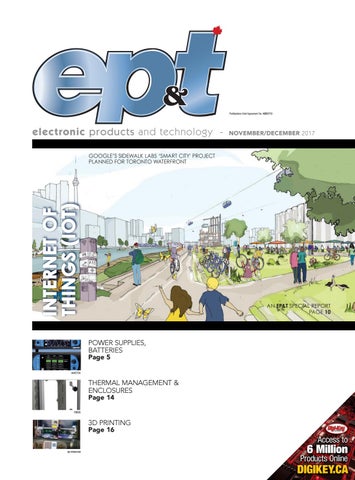
INTERNET OF THINGS (IOT)
GOOGLE’S SIDEWALK LABS ‘SMART CITY' PROJECT PLANNED FOR TORONTO WATERFRONT
AN EP&T SPECIAL REPORT PAGE 10
POWER SUPPLIES, BATTERIES Page 5 AMETEK
THERMAL MANAGEMENT & ENCLOSURES Page 14 FIBOX
3D PRINTING Page 16 3D PRINTER
EPT_NOVDEC17_LAZ.indd 1
2017-10-30 12:07 PM
RSN
170928_LIMIT_EPT_CA.indd 1 EPT_NOVDEC17_LAZ.indd EPT_DigiKey_Nov.indd 1 2
9/28/17 3:03 PM 2017-10-30 12:07 PM 2017-10-11 11:45 AM
7 3:03 PM 1 11:45 AM
e d products i t oonrreview i a l
electronic products and technology • november-december 2017
3
Toronto to receive smart city project by Sidewalk Labs electronic products andtechnology technology electronic products and Volume 39 Number 8
November-December 2017
Stephen Law Editor 416.510.5208 slaw@ept.ca
Sohail Kamal
West Coast Correspondent sohail@nextgear.ca
The futuristic realities of IoT have seemingly been set in motion in this country, as Sidewalk Labs, a subsidiary of Google parent Alphabet Inc., unveiled its plans for a new tech-focused neighbourhood on the eastern Toronto waterfront. (See artist’s rendering on front cover of this issue). This ‘Sidewalk Toronto’ project aims to create a new kind of mixed-use, ‘test bed’ community combining forward-thinking urban design and new digital technology. It comes with a USD$50-million investment, which should cover the initial planning and testing phase of the project. The objective will be for Sidewalk Toronto to become a community that is built on innovations launched by people, companies, startups, academic centres and local organizations over many years. Some of the technology to be featured includes building sensors monitoring air quality and conditions; adaptive traffic lights prioritizing pedestrians and cyclists; parking systems directing cars to available slots, as well as delivery robots, advanced energy grids, automated waste sorting and ubiquitous self-driving cars. Sidewalk Labs CEO Dan Doctoroff said the firm had “scoured the globe” for the ideal location to build a technology-focused neighbourhood before settling on Toronto because of its diver-
sity and growing tech industry. The goal will undoubtedly be to tap into Toronto’s already-thriving tech sector and develop innovations that could benefit communities and neighbourhoods elsewhere in the city. Some criticisms were heard amid the exalt of joy in town, suggesting that the smart-city industry is a Trojan horse for technology companies such as Google to come in under the guise of environmentalism and urbanism – while the reality is they are here for the money. Critics would agree that data and technology can be helpful when they support, not lead, the city-building that governments and planners know best. Sidewalk Labs can be credited for suggesting that “Platform components and applications will be published under opensource licenses, where doing so results in significant additional value to the ecosystem as a whole.” While residents of this techified community will likely be attracted by the idea of living in a place that will continuously improve, I expect the project to demonstrate that Canada is a leading player and participant in the technology field. Stephen Law, Editor slaw@ept.ca @EPTmagazine
Joanna Malivoire
Scott Atkinson
Account Manager Direct: 866.868.7089 jmalivoire@ept.ca
Associate Publisher 416.510.5207 satkinson@ept.ca
Presents ebm-papst
Lisa Zambri Art Director
Anita Madden
Circulation Manager 416.442.5600 ext 3596 amadden@annexbusinessmedia.com
Bona Lao
Subscription Inquiries 416.442.5600 ext 3552 blao@annexbusinessmedia.com
Tracey Hanson
Account Coordinator 416.510.6762 thanson@annexbusinessmedia.com
Tim Dimopoulos
Executive Publisher
Ted Markle
COO tmarkle@annexweb.com
Mike Fredericks President & CEO
EP&T (Electronic Products & Technology) is published nine times per year: Monthly in February, May, August, September, October, Bi-Monthly January/February, March/April, June/July, November/December by:
Annex Business Media
80 Valleybrook Drive, Toronto ON M3B 2S9 info@ept.ca Website: www.ept.ca Tel: 416.442.5600 Fax: 416.510.5134 Sales: 416.510.5207 • Editorial 416.510.5208
ebm-papst fans will blow you away …and here’s why!
ISSN 0708-4366 (Print) • ISSN 1923-3701 (Online)
Subscription Rates: Canada: $56.00 per year, US: $98.00 per year, International: USD$134.00 per year, Single copy: $15 (Canada); $20 (all others) Editorial Purpose: Electronic Products & Technology provides timely, comprehensive coverage of the latest worldwide developments and trends in electronic products, equipment and systems, and interprets their significance to manufacturers and end-users in the Canadian marketplace. Publications Mail Agreement No. 40065710 Canada Post: Return undeliverable Canadian addresses to: EP&T Circulation Dept., 80 Valleybrook Drive, Toronto, ON M3B 2S9, Subscription Inquiries: 416.442.5600 3552 customercare@annexbusinessmedia.com EP&T (Electronic Products & Technology) assumes no responsibility for the validity of claims in items reported.
© 2017
ebm-papst is an innovator and market leader in fans, blowers, and motors with solutions for a variety of industries including Agriculture, Alternative Energy, HVAC, Industrial and Medical. Electro Sonic offers a breadth and depth of ebm-papst product - with over 1,500 in-stock part numbers and over 5,000 SKUs available for purchase, Electro Sonic has what you are looking for! Whatever your thermal management challenge, ebm-papst has the knowledge and resources to supply the optimal air movement solution. When you need a cooling solution, Electro Sonic and ebm-papst will blow you away…
This publication or any part of it may not be reproduced, stored or transmitted in any form whatsoever without the express written consent of the publisher. From time to time we make our subscription list available to companies and organizations whose products and services we believe may be of interest to you. If you do not want your name to be made available, please contact EP&T with your subscription number.
R I G HT P R O DU CTS . R I G HT P RI C E. RI G HT NOW.
Printed in Canada
We acknowledge the [financial] support of the Government of Canada.
e-sonic.com | 1-800-56-SONIC http://ept.hotims.com/65992-1 EPT_Nov_Ebmpapst.indd 1
EPT_NOVDEC17_LAZ.indd 3
2017-10-24 3:15 PM
2017-10-30 12:07 PM
NEWSWATCH N E W S WAT CH NE WSWATCH
4 00
electronic products and technology • november-december electronic products and technology • november-december 2017 2017
Myant commits $100M to advanced manufacturing supercluster
Intel's self-learning chip promises to accelerate AI
Myant Inc., a rapidly growing technology and advanced manufacturing company in Toronto, has committed $100-million to the advanced manufacturing supercluster that has been short-listed by Navdeep Bains, Minister of Innovation, Science and Economic Development, as part of the $950-million national supercluster proMinister Navdeep Bains gram from the Government of Canada’s Innovation and Skills Plan. (left) and Tony Chahine, This is the kind of foresight innovation the world needs, as CEO of Myant, discussing Minister Bains basically just turned the lights on for Canada’s future innovation and advanced manufacturing in Canada. as a global leader in advanced manufacturing,” says Myant CEO and founder Tony Chahine. “I am very proud that Myant is a member in this supercluster that brings together over 100 academic institutions, not-for-profit organizations, healthcare groups and manufacturers to establish high quality and resilient jobs and talent and training in leading industries that intersect manufacturing and technology. It’s time to repatriate ‘Made in Canada’ manufacturing solutions.” Myant is a recognized industry leader in the emerging field of ‘textile computing’ with a revolutionary R&D facility and full-scale production that includes end-to-end fiber-to-fabricto-system product design and rapid prototyping capabilities. The unique infrastructure of expertise, capabilities and secured IP allows Myant to transition from idea to prototype to full-scale production. Myant currently employs a world class interdisciplinary team of over 80 engineers, data scientists, software developers, fashion designers and user experience experts who are building the next computing platform that ambiently interfaces with humans through textiles. Myant seamlessly embeds sensors and actuators into everyday textiles allowing for 24/7 connectivity. Working with global partners, Myant develops smart-textiles for the automotive, aerospace, energy, health/wellness, defense, AR/VR, and other sectors. Myant is expanding its facilities and adding new equipment and staff as it begins manufacturing its own in-house brand, SKIIN (with two ii’s for intelligent interface), a line of smart textile and apparel which includes underwear, bras, base layers, socks, mattress covers, seat covers, etc. that provide a direct conduit to the human body. SKIIN’s smart clothing and textiles, combined with the app and cloud infrastructure, will create access to the ‘Internet of Things’ and enable a person to continuously monitor the body’s vital signs, measure activity, understand one’s mood, control the connected environment, heat up when you’re cold, anticipate illness, and deliver therapy, with more advanced functionality than the world has ever seen in textiles.
Microart injects speed to production lines Markham ON-based electronics manufacturing services (EMS) provider Microart Services Inc. has added two high-speed SMT production lines to its ISO 9001:2008 and 13485:2003 registered facility. The firm's 40,000-sq-ft production space now boasts a total of eight lines, consisting of five high-speed lines, two low volume lines and a dedicated 24-hour NPI line. "We are extremely pleased with the continued growth we are seeing not only with our existing customers, but, with some new partners that have entrusted us with their production orders," says Mark Wood, COO, Microart. "Not only are we seeing growth with our pcb assembly services but also final assembly and logistics services." Founded 33-years ago, Microart has plans for continued growth this year, which may include adding at least one more high-speed line and multiple selective soldering machines. Within six months Microart expects to add AS9100, a widely adopted and standardized quality management system for aerospace designs.
Intel has developed a first-of-its-kind self-learning neuromorphic chip, as part of an effort within Intel Labs. Codenamed Loihi, the chip mimics how the brain functions by learning to operate based on various modes of feedback from the environment. This extremely energyefficient chip, which uses the data to learn and make inferences, gets smarter over time and does not need to be trained in the traditional way. It takes a novel approach to computing via asynchronous spiking. "We believe AI is in its infancy and more architectures and methods like Loihi will continue emerging that raise the bar for AI," says Dr. Michael Mayberry corporate vice president and managing director of Intel Labs at Intel Corp. "Neuromorphic computing draws inspiration from our current understanding of the brain's architecture and its associated computations. The brain's neural networks relay information with pulses or spikes, modulate the synaptic strengths or weight of the interconnections based on timing of these spikes and store these changes locally at the interconnections. Intelligent behaviors emerge from the cooperative and competitive interactions between multiple regions within the brain's neural networks and its environment." The Loihi research test chip includes digital circuits that mimic the brain's basic mechanics, making machine learning faster and more efficient while requiring lower compute power. Neuromorphic chip models draw inspiration from how neurons communicate and learn, using spikes and plastic synapses that can be modulated based on timing. This could help computers self-organize and make decisions based on patterns and associations. Intel released a firstThe Loihi test chip offers highly flexible on-chip learnof-its-kind self-learning ing and combines training and inference on a single chip. neuromorphic chip – codenamed Loihi. This allows machines to be autonomous and to adapt in real time instead of waiting for the next update from the cloud. Researchers have demonstrated learning at a rate that is a 1-million times improvement compared with other typical spiking neural nets as measured by total operations to achieve a given accuracy when solving MNIST digit recognition problems. The Loihi test chip features: • Fully asynchronous neuromorphic many core mesh that supports a wide range of sparse, hierarchical and recurrent neural network topologies with each neuron capable of communicating with thousands of other neurons. • Each neuromorphic core includes a learning engine that can be programmed to adapt network parameters during operation, supporting supervised, unsupervised, reinforcement and other learning paradigms. • Fabrication on Intel's 14nm process technology. • A total of 130,000 neurons and 130 million synapses.
Innovation space opens in Ottawa A brand-new innovation centre has opened in Ottawa, aiming to provide businesses in the region with access to the technology and expertise they need to create jobs, grow and compete in the global marketplace. The facility was made possible through a partnership with Ontario Centres of Excellence, IBM Canada and Invest Ottawa - is part of the IBM Innovation Incubator Project. Announced in 2016, the project helps small and medium-sized enterprises (SMEs) fasttrack the launch of new technologies and products to international clients by leveraging IBM’s technical resources. This includes cognitive business technology and a cloud-based development platform, as well as its physical space and network of customers.
Canada’s first virtual reality hub opens in Vancouver Vancouver’s tech industry welcomed the opening of BC Tech Cube (The Cube), Canada’s first virtual, augmented and mixed reality hub. Its creation marks continued growth for 3D development in the city, which has already resulted in 17,000 jobs and 2.3B in revenue, and will stimulate the creation of new startups. The Cube is designed to support the growth of companies in the AR/VR/MR space and serve as a platform for the community to connect, collaborate and learn from one another. It was established as an extension of the BC Tech Innovation Hub in collaboration with local tech companies and industry leaders. The 6,000-square-foot hub supports early stage entrepreneurs and corporate innovators, enabling connections with partners, customer applications and investment opportunities, ultimately leading to faster growth. “By providing entrepreneurs with the tools, support and environment, we’ll be able to supercharge the growth of BC’s burgeoning AR/VR/MR sector and reinforce our reputation as one of the top ecosystems to grow a tech company,” says Bill Tam, CEO of the BC Tech Association.
Apple iPhone 8 teardown reveals BOM cost The new Apple iPhone 8 Plus, equipped with 64 gigabytes (GB) of NAND flash memory, carries a bill of materials (BOM) cost that comes out to US$288.08, higher than any previous versions of the company's smartphones, according to a preliminary estimate from IHS Markit, a world leader in critical information, analytics and solutions. After $7.36 in basic manufacturing costs are added, Apple's total cost to make the iPhone 8 Plus rises to $295.44, $17.78 higher than that of the iPhone 7 Plus. IHS Markit also estimates that the iPhone 8 bill of materials is $247.51, or $9.57 higher than the iPhone 7 at the time of release. The unsubsidized price for a 64GB iPhone 8 starts at $699, which is $50 more than the starting price for the iPhone 7 at launch. The iPhone 8 Plus starts at $799, which is $30 higher than that of the iPhone 7 Plus at launch. IHS Markit is in the process of performing an analysis of the iPhone 8, which will explain how the price differential on the iPhone 7 and 7 Plus was $120 last year, while the iPhone 8 price differential returned to $100. “The higher total BOM cost for the iPhone 8 Plus can't be tied to a single area or feature. The higher cost is the result of slower annual component cost erosion tied in with additional features," says Andrew Rassweiler, senior director of cost benchmarking services for IHS Markit. "From a teardown perspective, the biggest cost adders would be the increased NAND flash memory content and new wireless charging components.” http://ept.hotims.com/65992-2
EPT_Nov_Brother.indd 1
EPT_NOVDEC17_LAZ.indd 4
2017-10-26 10:44 AM
2017-10-30 12:07 PM
5
electronic products and technology • november-december 2017
Power Supplies, Batteries
More power to Zigbee 3.0: The power of Green Power Wi-Fi, Zigbee and Thread ‘unmeshed’
By Cees Links, GM of Qorvo Wireless Connectivity Business Unit (formerly CEO & founder, GreenPeak Technologies)
MORE AND MOST COMPLEX Since Green Power became a standard feature of Zigbee 3.0, can we now expect Green Power sensors everywhere? Indeed, the Green Power specification enables extremely lowpower and low-cost coin cell-based sensors, because it offloads all the complexity related to meshing. But where did the meshing go? Don’t we need it anymore? And by the way, just when it becomes possible to build an ‘unmeshed’ Zigbee network, Wi-Fi ‘meshing’ seems to be gaining popularity in the market. So what is going on? Let’s give this a closer look. Meshing has always been an intriguing concept in networking technology. It implies an alignment with the concepts of sharing and helping – values usually highly rated in the world of technology pioneers. So, it’s no surprise that meshing networking usually attracts serious attention and consideration among technologists. Its positive qualities are usually described as ‘self-managing, selfconfiguring and self-healing.’ Who wouldn’t want that?
Figure 1: A fully meshed home network with nodes all talking to each other, with one of them connected to the cloud.
In fact, on the heels of Zigbee and Thread meshing news, Bluetooth SIG recently announced the development of meshing products. Interestingly, and despite all the meshing chatter, Zigbee and Thread meshing have not been used extensively – most successful Zigbee applications in the market today do not require meshing. And although Wi-Fi also supports and has even standardized meshing (under IEEE 802.11s), it is hardly used. But let’s take a closer look at Wi-Fi meshing. The basic home Wi-Fi setup today is a cable or DSL router that wirelessly connects with our tablets and smart phones. If it doesn’t work so well, we install a repeater as an intermediate. These days there are sets of router boxes available that are preconfigured to wirelessly work together to cover our sprawling mansions or tidy cottages, as the case may be, including that room behind the garage where we escape to play video games. Reliable, speedy coverage.
“Meshing is generally self-configuring: everyone on the network helps everyone else to reach the router via the internet.”
EPT_NOVDEC17_LAZ.indd 5
So how can meshing help? The concept is a simple one. If I am in one corner of the house with my smartphone and a laptop is closer to me than the router, then I just hop (mesh) via the laptop – as long as it is powered on. Meshing is generally self-configuring: everyone on the network helps everyone else to reach the router and via the router, the internet. And if that intermediate laptop is turned off, then my smartphone finds another device. Meshing can also be self-healing; it’s no problem if one link to the router breaks down, as the network will (hopefully) find another one. So what’s the downside? This is one of those situations where sympathetic, pioneering technology clashes with the day-to-day grumpy consumer, who wants reliable connectivity all the time without being bothered with elegant technology solutions for intermittent network failures. It’s the difference between a good network with no problems and a not-so-good network that maybe can solve its own problems. Whether it is Wi-Fi or Zigbee (or Thread), there are three general problems with meshing. The first is intermittent failures, the second is related to battery life, and the third is cost. Let’s go through each and see how Green Power solves it for Zigbee 3.0. Intermittent failures are usually recognized as a nasty type of problem – sometimes it works, sometimes it doesn’t. Nobody understands why, exactly, so nobody can really fix it. In the meshed Wi-Fi example above, maybe your smartphone network connection depends on whether your son leaves his game station on or off – and good luck figuring out that one.
Figure 2: How meshing runs into trouble with nodes all talking to each other, but one node at the side can only reach one nearby node.
And then there’s battery life. In a meshed Wi-Fi network, your laptop might become an intermediate node. Suddenly, your laptop is running low on battery, because someone else in the family was (perhaps unknowingly) using your laptop as a hopping point (‘meshing node’) for watching YouTube videos on his tablet. The meshing network has actually created a battery issue for a device that wouldn’t have had a problem otherwise. And finally, there’s a cost issue. Every node in the network is not only an edge node (‘a node doing something’), but it also needs to be able to function as a meshing node – and it needs to be equipped to do so. In practice this means running more software on a larger processor with more memory. And meshing nodes may also have to be ‘on’ constantly, which requires a larger and more expensive battery, while an edge node only has to be turned on when triggered. So while meshing sounds great, its costs include the loss of reliable, predictable con-
nectivity and a higher price tag. But here is where the Zigbee 3.0 with Green Power saves the day. Zigbee enables meshing, but does not require it. Edge nodes can easily be Green Power networked, and if the area to be covered exceeds the range of a single router, multiple routers can work together to establish a backbone network that all the edge nodes can connect to, without carrying the overhead themselves to be meshing nodes. This leads to another point. In the context
Figure 3: How a star solves mesh trouble.
of a home, meshing is a band-aid solution for a poor radio that lacks range. Meshing would not be necessary with a powerful enough radio, running on a coin cell battery, that enables you to reach the router – even if it is not located in the most optimal center of the home. These radios may not have existed 10-years ago, but they exist today. This makes meshing a fringe solution for exceptional radio coverage problems. And these days, multiple radio frequency Wi-Fi channels are more often implemented, not meshing. Zigbee can do that, too. The self-healing ‘benefit’ of meshing is also a bit of a relic from the days when networking equipment was not as reliable as it is today. Single points of failures were red flags, and mesh networks with multiple paths were seen as a great plus – enabling rerouting via alternative connections at the moment of breakdown. But with today’s reliable networking equipment, the need for avoiding single points of failures is more or less gone.
“This makes meshing a simple fringe solution for exceptional radio coverage problems.”
As a standard feature of Zigbee 3.0, Green Power’s simple networking protocol essentially brings all the complex networking features to a proxy (usually the router), while the Green Power node focuses on making sure that the essential signal – whether a temperature measurement, a command to turn on a light, reporting whether a door or window is open or closed—reliably reaches a router for further consumption. As mentioned, Zigbee Green Power features ultra-long battery life – and in the case of energy-generating light switches, there is no need for batteries at all. Zigbee Green Power is fully integrated with Zigbee 3.0 and fully compatible with all the services that the Zigbee 3.0 delivers, from installation to security, and from ease-of-use to maintenance.
THE POWER OF ZIGBEE GREEN POWER What are the advantages of using Zigbee with Green Power? First, it enables simple, low-cost implementations of standard, standalone solutions. This covers most of the Zigbee applications in the market today. For example, if you have a few lamps, a dimmerswitch and a gateway, then to connect the lamps to the internet, you only need Green Power. As simple as that – no meshing capability required. For more extensive solutions, Green Power enables the building of a simple Zigbee star network in your home. Or there can be multiple stars dropping from a single backbone, in the case of a larger building installation. Either way, Green Power eliminates the disadvantages of meshing – intermittent connections that are difficult to diagnose, and unexpected situations where sensor nodes suddenly and quickly run out of battery power. Green Power also allows for a Zigbee infrastructure that is fully aligned with the Wi-Fi infrastructure in a building. It is useful to note that a Zigbee radio has a comparable or better range than a Wi-Fi radio. Zigbee (IEEE 802.15.4) is essentially low-power Wi-Fi (IEEE 802.11), although that is routinely denied by even the largest companies for what are surely political reasons.
Figure 4: How a layered star solves mesh trouble.
The practical fact is that both Zigbee 3.0 (with Green Power) and Wi-Fi integrate in a single router box, simplifying and costreducing the overall networking infrastructure for consumers or enterprise customers, and paving the way for the real Smart Home as part of the Internet of Things. But only Zigbee 3.0 networks use meshing when it really adds value – the real power of Green Power. WI-FI MESHING Given all of that, what do we now know about Wi-Fi meshing? That it is not meshing at all. And for that exact reason, there is a new term emerging – ‘Distributed Wi-Fi’. This is indeed a more precise description of the situation. Distributed Wi-Fi is a star network. It consists of a few (3 or 4) preconfigured routers (access points) in one box. One of these, the main router, supports the connectivity with the internet; the others use one Wi-Fi-channel to connect to the main router and another Wi-Fi channel to service the devices in close proximity. If a device moves from one service area to another service area, the ‘hand-off’ happens seamlessly. Remember, the point of all of this is to have better coverage in the home – on all continued on page 6
2017-10-30 12:07 PM
6
power supplies, batteries
electronic products and technology • november-december 2017
continued from page 5
being a real mesh itself. In conclusion, it seems clear that the standardization of home network architecture
“Consumers are looking for simple products that work.” Figure 5: Distributed Wi-Fi is a star network.
floors, from attic to basement, out on the patio, in the garage, etc. – and to maximize performance by using as many channels as possible. And, here’s something that makes it all even more interesting. The network structure of Distributed Wi-Fi forms a perfect ‘backbone’ for Zigbee Green Power, essentially overlaying Figures 4 and 5. In other words, when every router also supports Zigbee (or Thread), there is truly no need for any meshing of Zigbee, Thread or (in the future) Bluetooth. How ironic! Wi-Fi Mesh made the need for other meshing technologies go away, without even
is still in development. But it is good to remember that consumers are probably not particularly interested in technology, and they are even less interested in technology architecture. Consumers are looking for simple products that work, that can be installed easily and that function as promised. A wireless network that is easy to install and works “outof-the-box” is key. Ultimately, whether it is actually meshing, or just called meshing, will only be of interest to networking enthusiasts.
Ac sources boost power density, touch screen simplicity Asterion AC series of ac power sources includes three new units, including model 1503 that supplies up to 1,500VA or 1,500 W; Model 2253 supplies up to 2,250 VA or 2,250 W; and Model 3003 supplies up to 3,000 VA or 3,000 W. All units come in a 2U enclosure and in both single and three phase models, providing a combination of intelligence, performance and modularity. Units utilize firm’s iX2 current-doubling technology, as the output voltage decreases from the maximum value to one-half the maximum value, the available output current increases up to two times the rated output current. iX2 technology eliminates the need to buy multiple sources or overpowered sources to run tests at different voltage levels, such as when performing low line voltage testing. AMETEK
For more information on Green Power sensors from Qorvo, go to http://ept.hotims. com/65992-200
Board mount power supplies operate from a 90 to 305Vac input KAS series ac-dc power supplies are rated at 2W and 4W and accept a very wide 90 to 305Vac, 47-440Hz input. These board mounted converters operate from 115V, 230V and 277V nominal inputs. Product series has a double insulated Class II construction, requiring no earth ground connection and has a 3,000Vac primary to secondary isolation. Available output voltages are 3.3, 5, 8, 9, 12, 14, 15 and 24V and have a no-load power consumption of less than 300mW. Units are encapsulated in a plastic resin fiberglass case, providing additional protection against shock and vibration. The 2W KAS2 measures 28.5 x 25.8 x 17.0mm and operates in ambient temperatures of -40 to +80°C, derating linearly to 40% load above 60°C. The 4W KAS4 37.0 x 27.5 x 17.5 mm. The KAS4 has a temperature range of up to -40 to +70°C, with model dependent derating. TDK-LAMBDA AMERICAS
http://ept.hotims.com/65992-24
Bi-directional 15kW / 500V dc power supply DELTA SM500-CP-90 15kW standard power supply provides a bi-directional output and operates easily. Unit provides a flexible constant power output characteristic-the lower the voltage, the higher the current. For example: 500V = -30 to +30A; 250V = -60 to +60A, and 166V = -90 to +90A. Voltage, positive current and negative current can all be adjusted from zero to maximum. In sink mode, Delta’s Power Regeneration Technology returns energy back to the grid with an efficiency of 95%. Due to this high efficiency, the cabinet height is just 3U, without compromise to the product lifespan. Dynamic response to load changes is improved, allowing very fast load variations between -90 and +90A. The all-digital control makes it possible to adapt regulation to match load type. GLOBAL TEST SOLUTIONS http://ept.hotims.com/65992-25
http://ept.hotims.com/65992-21
Dc-dc converter range serves embedded applications 1000W, 3-phase, high input voltage ac-dc power supplies HTP 1K-F6W line of compact, three-phase, high input voltage ac-dc power supplies operate from a 3-phase line input of either 400Vac (360-440Vac range) or 480Vac (430-530Vac range). The 1000W supplies provide a single output of 24V, 48V, 125Vdc or custom and measure a mere 254 x 65 x 34mm chassis. Devices are suitable for rugged industrial applications including factory automation, industrial machinery and equipment. Products are ruggedized and the printed circuits are conformal coated for protection against humidity and airborne contaminants. Cooled by high quality internal fans and by conduction, units operate over a 0°C to +50°C temperature range at full load without derating. ABSOPULSE ELECTRONICS http://ept.hotims.com/65992-22
Medical, ITE power supply delivers 61000-3-2 class C compliance GTM96900P90VV.V-T3 family of power supplies provides an optional factory configurable version with 61000-3-2 class C compliance. IEC 61000-3-2 Electromagnetic compatibility (EMC) - Part 3-2: Limits - Limits for harmonic current emissions (equipment input current ≤ 16 A per phase) is an international standard concerning the harmonics emitted by electric equipment. The analog European standard is called EN 61000-3-2 EN61000-3-2. Model is certified to IEC60601, 60950, 62368 and 60335 providing a solution to manufacturers of unique lighting in equipment or non-lighting equipment being held to the Class C standard. GLOBTEK http://ept.hotims.com/65992-23
EPT_NOVDEC17_LAZ.indd 6
OKI-78SR series of non-isolated switching regulator dc-dc power converters for embedded applications. The fixed single output converter provides both tight regulation and high efficiency directly at the power usage site and is a direct plug-in replacement for TO-220 package 78xx series linear regulators. Product incorporates advanced assembly techniques and improved fixed switching frequency technology for power conversion. Product provides a highly efficient alternative to a linear regulator; eliminates the requirement for a heat sink, and uses less board space. Suitable for applications that require 12V@1A with a system source in the range of 15-36Vdc. MURATA http://ept.hotims.com/65992-26
Flexible transformer provides enhanced voltage stability WE-FLEX HV (Flexible Transformer High Voltage) line of transformers for SMT assembly deliver flexible capabilities in various applications making them suitable for fast prototyping. Different circuit configurations enable more than 375 transformer solutions and around 125 choke solutions. Applications include flyback converters, forward converters, pushpull converters, step-up and step-down converters or single-ended primaryinductor converters (SEPIC). With their isolation voltage of 1.5kVac, these transformers are currently unrivaled on the market. The newly developed MnZn core material reduces core losses by up to 30% as compared with classical products - available in four sizes, each with five different air gap lengths. The working temperature is specified as -40°C to +125°C. WURTH ELEKTRONIK http://ept.hotims.com/65992-27
2017-10-30 12:07 PM
power supplies, batteries
electronic products and technology • november-december 2017
7
newswatch
Silicon solves problems for next-gen battery technology
Dc-dc buck converter features innovative control topology TPS543C20 SWIFT 16-V input, 40-A synchronous dc-dc buck converter comes with an internally compensated advancedcurrent-mode (ACM) control topology supporting frequency synchronization. Device provides enhanced efficiency by integrating its latest generation of low resistance high- and low-side MOSFETs into a thermally efficient small-footprint package. Designers can stack two converters side by side to drive loads up to 80A for processors in space-constrained and power-dense applications. Device maintains stability over a wide range of input and output voltages. TEXAS INSTRUMENTS
Silicon - the second most abundant element in the earth’s crust - shows great promise in Li-ion batteries, according to new research from the University of Eastern Finland. By replacing graphite anodes with silicon, it is possible to quadruple anode capacity. Researchers introduced new technology to Li-ion batteries by replacing graphite used in anodes by silicon. The study analyzed the suitability of electrochemically produced nanoporous silicon for Li-ion batteries. It is generally understood that in order for silicon to work in batteries, nanoparticles are required, and this brings its own challenges to the production, price and safety of the material. However, one of the main findings of the study was that particles sized between 10 and 20 micrometres and with the right porosity were in fact the most suitable ones to be used in batteries. The discovery is significant, as micrometre-sized particles are easier and safer to process than nanoparticles. This is also important from the viewpoint of battery material recyclability, among other things. “In our research, we were able to combine the best of nano- and micro-technologies: nano-level functionality combined with micro-level process-ability and all this without compromising performance,” says researcher Timo Ikonen, University of Eastern Finland. “Small amounts of silicon are already used in Tesla’s batteries to increase their energy density, but, it’s very challenging to further increase the amount,” he adds.
http://ept.hotims.com/65992-28
Verify
Test Export
With the Interpower® International Power Source
AEC-Q200 Qualified power inductor lowers resistance Models PQ2614BLA, PQ2614BHA and PQ2617BHA of AEC-Q200 qualified high current shielded power inductors are designed with a flat wire winding providing low dc and ac resistance and high saturation current of over 100A. The flat wirewound design also provides a compact, highly efficient inductance solution. Products are suitable for automotive power conversion applications as well as dc-dc converters, switch-mode power supplies and filtering applications in consumer, industrial, medical and communications electronics. BOURNS http://ept.hotims.com/65992-29
Dc-dc power IC brings ‘zero power’ to applications HS200 dc-dc power IC converts 48V to extremely low voltage and delivers greater than 97% efficiency at 2.6W and greater than 90% efficiency at 15W. The no load power of the device consumes 0.5mW, exceeding Zero Power. Device operates on a three-stage process, each of which divides its input in half. Power can be pulled from any of its three outputs simultaneously up to 15W. HELIX SEMICONDUCTOR http://ept.hotims.com/65992-30
The Interpower International Power Source is an AC power source used to verify your product design and for product testing. The unit can be used on a bench top or is rack mountable. Interpower has four models available which have an input of 100–240VAC/50–60Hz. The first two models are supplied with a NEMA 5-20 plug and have an output of 2200VA maximum with a Low Range variable of 10–138VAC at 16A RMS maximum and High Range variable of 10–276VAC at 8A RMS maximum, 47–450Hz. The second two models are supplied with a NEMA 5-15 plug and have an output of 1725VA maximum with a Low Range variable of 10–138VAC at 12.5A RMS maximum and High Range variable of 10–276VAC at 6.25A RMS maximum, 47–450Hz. For each output option we offer a model with a RS232 and USB port and a model with no communication ports. The Interpower International Power Source can also be ordered for international use with a country-specific input power plug. We offer a 1-week U.S. manufacturing lead-time on non-stock Interpower products and same day shipping on in-stock products. From 1 to 1,000 pieces or more, we have no minimum order or dollar requirements. Lock in your price with blanket or scheduled orders.
• Remote control operation ideal for automated test applications using optional IPS Interface Software • Software available for use with models equipped with RS232/USB interfaces which are easily integrated into ATE systems • Made in Iowa, U.S.A. • Interpower carries a variety of North American and international power cords and cord sets • Rental units are available
Order Online! www.interpower.com ORDER A FREE CATALOG TODAY! E-mail catalog@interpower.com or call toll-free.
®
®
Business Hours: 7 a.m.–6 p.m. Central Time
INTERPOWER | P.O. Box 115 | 100 Interpower Ave | Oskaloosa, IA 52577 | Toll-Free Phone: (800) 662-2290 | Toll-Free Fax: (800) 645-5360 | info@interpower.com
http://ept.hotims.com/65992-3 EPT_Interpower_Nov.indd 1
EPT_NOVDEC17_LAZ.indd 7
2017-09-27 9:22 AM
2017-10-30 12:07 PM
Klippon® Connect Always the best choice for your connection Flexibility • Release the conductor with any tool • Large marking surfaces make maintenance work easier • Clip-in foot compensates for differences in terminal rail dimensions
Time Saving • Mounting foot makes unlatching the terminal easy • Clear distinction made between all functional areas • Easier marking and wiring
Space Saving Design • Slim design saves a large amount of space in the panel • High wiring density despite less space being required on the terminal rail
Safety • Standardized test point • Optical and physical separation of operation and conductor entry • Vibration-resistant, gas-tight connection with copper power rails and stainless steel spring
Let’s connect. www.weidmuller.ca http://ept.hotims.com/65992-4
EPT_NOVDEC17_LAZ.indd 8 EPT_WeidmullerLeft_NovDec.indd 1
2017-10-30 2017-10-06 12:07 3:14 PM
EPT_We
06 3:14 PM
Weidmuller. Let’s connect. At Weidmuller, our name has been synonymous with power, competence and reliability in machine construction, the process industry, device manufacture, the energy sector and industrial engineering for more than 160 years. In more than 80 countries, we support both our customers and our partners by supplying innovative solutions and services, as well as being a partner that you can depend on. With a focus on Industry 4.0 (IIoT), digitalization and automation data is the gold of the 21st century — its importance and the demand for components and solutions that record, evaluate and establish connections in this data will grow unabated in the next few years. Weidmuller is developing numerous communication-capable components at the same time. The company is investing in measures to boost our core business and is expanding our product portfolio for panel building and device connectivity.
Our Klippon® Connect Terminal Blocks reduce planning and development
times for control cabinets. With the Weidmuller Configurator software tool, terminal blocks and other Weidmuller terminal rail components can be selected, configured, and ordered as required. The synergic implementation of the two offerings extends beyond traditional modular kits and results in complete application solutions for recurring panel applications. “Throughout the panel building process chain—starting with planning and moving on to installation and, finally, operation—we are tapping into the potential for optimization, that when combined translates into measurable extra added value,” says Michael Matthesius, EVP, Division Automation and Production at Weidmuller.
efficiencies and potential energy savings within the relevant system. Weidmuller’s Industrial Analytics solutions can collect and process data from the system in question and analyzes it using intelligent processes. With innovative communication-capable signal converters, I/O systems, routers, M2M technology, wireless and switches, Weidmuller also makes data available in the network and ensures IT security as a result. The company works closely with clients to deliver customized solutions that match their expectations.
Migration Systems and PLC front-panel adapters from Weidmuller make changes to the PLC or DCS structure simple. In addition, users of the Rockwell PLC5 systems, Honeywell IPC620 and other major platforms can now save time and money when performing the necessary migration to more modern systems.
With the implementation of new technologies in both IP20 and IP67 solutions, Weidmuller has expanded the functionality and communication platforms that include PROFINET, PROFIBUS, EtherCAT, EtherNet/IP, DeviceNET, Modbus TCP, CANopen, POWERLINK, and IO-Link.
The Wireless and Network Portfolios expanded with industry unique features like a 2.4GHz modem for I/O plus gateway device and access point modem in one! Additionally the licensed modem family expands into the 320-960MHz ranges with I/O and modem MESHing technology to easily combine all aspects for data acquisition for large scale municipal and automation applications.
Weidmuller is a leader in DIN-Rail Mounted Terminal Blocks. Our selection
of screw-type SAK and W-Series terminal blocks is the industry’s most comprehensive lineup. This experience extends into the Z-Series tension clamp and new PUSH-IN style terminal blocks. All of which can be tagged and marked using our combination printers.
IIOT and digitalization are other fundamental
focus areas for Weidmuller. We provide an integrated solution portfolio that envelopes everything from individual components through to complete solutions that are already fully-tailored to the requirements of IIOT. As such, Weidmuller caters to distinct application areas, such as industrial analytics, cloud services, energy management, digitalization, networking, and data consistency. Moreover, the company’s web-based services allow for intelligent information processing from virtually anywhere in the world. The Weidmuller Energy Management Solutions help to highlight
Weidmuller’s Innovative u-remote Remote I/O System’s modular set-
up makes system design easier, and the installation process is sped up. u-remote not only increases in the cost effectiveness of the machines but also more efficient in every respect.
Our On-site Services include engineering,
complete wireless solution enclosures, custom rail assembly, electronic development and interface board design.
We design our products to be much more than functional. At Weidmuller, our goal is to offer solutions that can help you save cabinet space, lower installation time, provide touch safe connections and eliminate down time.
www.weidmuller.ca
EPT_NOVDEC17_LAZ.indd 9 EPT_WeidmullerRight_NovDec.indd 1
2017-10-30 2017-10-06 12:07 3:18 PM
10
electronic products and technology • november-december 2017
Internet of Things (IoT)
IoT applications require end-to-end security — from device to Cloud
As IoT devices proliferate, they are utilizing a host of specialized wireless protocols, which serve the needs of these devices well. However, they must all connect to the Internet and Cloud applications and that means ensuring security all along the path. By Rusty Stapp, CEO, UbiquiOS
The Internet of Things is presenting us with myriad small devices that affect industry, medicine, sports, and banking, as well as our vehicles, and ultimately our daily lives. While their small size and convenience may be the initial attraction, their true value is only realized by their connection—via the Internet—to the “Cloud.” This somewhat nebulous term has real significance because the data collected and used by IoT devices really only gains value when it can be analyzed, compared and processed with other data and acted on by sophisticated applications that cannot reside on a small device, but instead, depend on those devices connection to the wider world of the Internet. That means that the data the IoT devices send and the data they receive—along with control commands sent back from the cloud—is the most important commodity and the basis for their value. That data must be protected from corruption, theft and unauthorized use. It is not enough to simply secure a wearable medical instrument, for example. The path of the data from that instrument to say, a router, and from that router to a local server on a private network and from there to an actual corporate or hospital data center in the Cloud must be protected along its entire path (Figure 1). SECURITY FROM IOT TO CLOUD According to a study by the Ponemon Institute, 75 percent of respondents say the use of IoT applications significantly increases security risk, with nearly the same number being very concerned about the use of insecure IoT applications. Despite that concern, 44 percent of respondents say their organization isn’t taking any steps to prevent attacks. For IoT device developers to enjoy a ready market and realize maximum growth, something needs to change. In the IoT world, there are a number of wireless protocols that have been developed to meet the needs of various scenarios and application areas. For example, a medi-
Figure 2: Device security is built on a hardware processor platform with built-in security mechanisms to establish a root of trust. The operating system level mechanisms built on that manage encryption/ decryption and key management and interface to the IP stack, which carries that security out to the cloud.
cal device monitoring heart rate and blood oxygen for a person engaged in normal day-to-day life might work very well using a Bluetooth link to a smartphone carried by the patient. In contrast, tracking an shipment container being trucked across country would need another form of wireless connectivity— hence the availability of different wireless options. These protocols include the more familiar ones like Wi-Fi, Thread and Bluetooth, but also others like LoRa, Sigfox and NB-IoT. While these protocols do provide security at the link layer, enabling devices to communicate securely with each other and with a web gateway device, they do not themselves address the issue of security beyond the IoT endpoint. The connection from endpoint to Cloud must use the Internet Protocol—an IP stack—and the specific wireless protocol must interface with the stack and be able to maintain security all the way to the Cloud. This should ideally include a root of trust founded in secure hardware. The most important concerns for security are authenticity—assuring that the proper entities are actually the ones communicating, integrity—assuring the messages received are actually the same as those that were sent, and privacy—assuring that no content is divulged to a third party. In the past, enterprises have relied on the
Figure 1: Security must be guaranteed from the IoT device to the cloud. This means encryption over its chosen wireless protocol, which then connects to the gateway/edge device. This must then take the IoT device’s data on to a server in the cloud using security measures like TLS in the IP stack.
EPT_NOVDEC17_LAZ.indd 10
Secure Sockets Layer (SSL) within the IP stack for secure communication. However, the more recent Transport Layer Security (TLS) protocol provides newer, state-of-the-art algorithms aimed at securing communications between an IoT endpoint such as a gateway device or another device connected directly to the Internet. It is specifically designed to meet the three requirements listed above (Figure 2). The first is to authenticate the identities of the communicating parties such that the end-point connects only to the proper server and that the server accepts connections only from authenticated end-points. This is done using public key cryptography and can be made optional, but it is generally required for at least one of the parties (typically the server). The connection must also safeguard integrity by ensuring all messages exchanged between end-point and server are received accurately. The recipient must be able to detect intentional or unintentional changes or corruption to a message. SECURITY FROM ENDPOINT TO CLOUD To do this, each message transmitted includes a message integrity check using a message authentication code to prevent undetected loss or alteration of the data during transmission. Messages must also be kept private so that no content is divulged to a third party. Symmetric cryptography is used to encrypt the data transmitted. The keys for this symmetric encryption are generated uniquely for each connection and are based on a shared secret negotiated at the start of the session. A common thread running through these TLS security features is asymmetric public key cryptography. Public key cryptography actually relies on a private key as well as a public key. This works by assigning each communication device a unique and strong private key, which must be kept secure with its owner and not divulged to any third party. A mathematically related public key can be generally distributed because it is almost impossible to use it to discover the private key. The public key is used to encrypt a message so only its corresponding private key can decrypt it. Such public keys can therefore only be used to communicate with one specific device. The public key can also verify that the device
holding the corresponding private key signed a given message. A crucial requirement for secure communications is that an end point’s private key be reliably protected so that no attacker can retrieve it to impersonate the legitimate device. It is also necessary to ensure than an IoT end-point is able to verify the authenticity and validity of the public key certificate offered by the server to which it is attempting to connect. USE SECURE HARDWARE Given the importance of the private key in also verifying the identity of the server, it must be protected from access or compromise with tamper-resistant storage. The best way to securely store that private key is to use hardware with built-in security features, but not just any hardware. Many modern microcontrollers implement mechanisms to protect non-volatile memory and incorporate cryptographic co-processing engines, but such platforms can still be susceptible to attacks using measurement of dynamic supply currents or analysis of electromagnetic emissions and cannot be considered reliably secure. For applications with the highest security requirements, developers should choose a hardware secure element – a device built on tamper-resistant hardware. It must be able to store the private key so that it is irretrievable by all practical means as well as perform the cryptographic operations necessary to sign and/or decrypt data using the private key. ESTABLISHING DEVICE ON THE NETWORK IoT products typically have a small footprint, with many sold as consumer products that often need to be installed and commissioned by lay persons or non-experts. Therefore, the process of provisioning them must be straightforward and easy to follow without compromising the security of the overall system. With the device identity and root of trust embedded within a hardware secure element in the IoT end-point, the provisioning process can—without compromising security—provision the device with credentials and details continued on page11
2017-10-30 12:07 PM
internet of things (Iot)
electronic products and technology • november-december 2017
11
Why we should celebrate (and not fear) quantum computing By Bob Sutor, vice-president, AI, blockchain and quantum solutions, IBM Research
Over the past year, various headlines have warned ominously about the impending threat of quantum computing to encryption and security. As a scientist and executive for the leading corporate program of quantum research, I can assert these fears are unnecessary. We are still decades away from breaking modern encryption with this technology, when it won’t matter anyway, for reasons I’ll explain. More importantly, this preoccupation distracts us from what we should really be thinking about: how quantum computing will accelerate human discovery and benefit our lives. Rather than fear quantum advances, we should celebrate them. The power of quantum computing lies in its unique properties. It exploits the laws of quantum physics to perform operations on data that go well beyond the capacity of the binary digits, or bits, upon which today’s computers are based. Quantum systems do this by using extraordinarily delicate quantum bits, or qubits, which are extremely difficult to manufacture and keep stable. These qubits exhibit states known as superposition, entanglement, and quantum interference. By manipulating them we can massively increase our ability to compute. We believe it will take a system with at least 50 qubits to begin handling certain problems that no classical computer can ever solve on its own, no matter how large. Modern encryption is based on the premise that the factoring of numbers required to break encoded information is nearly impossible to do with current systems. In fact, it would take many thousands of years even for the most powerful supercomputers to figure out. However, in 1994 MIT mathematician Peter Shor developed his famous quantum algorithm demonstrating that factoring would be exponentially faster on a quantum computer. But here’s the catch: factoring the kinds of numbers used for encryption on a quantum computer will require tens of millions of qubits that achieve fault tolerance. That’s tens of millions
more physical qubits of higher quality than we have in quantum computers today. Systems like this are many years away and will require advances in physics, mathematics, and engineering. To put this into perspective, earlier this year IBM successfully built and tested its most powerful universal quantum computing processor, which contains 17 qubits. It will serve as the core prototype processor for IBM Q, an industry-first initiative to build commercially available universal quantum computing systems. With this foundation, we anticipate scaling future processors to include 50 or more qubits within the next few years. We continue to make many advances toward this goal. But neither we nor anyone else in the industry are anywhere close to posing a threat to encryption. By that time, researchers will have discovered new encryption protocols that are either “quantum proof” or that leverage quantum mechanics for even higher levels of security. This work is already underway. What is far more exciting to us are the many benefits early quantum computers are expected to provide to society in just the next few years. In that time, we anticipate the discovery of new algorithms that can run on these systems that untangle the complexity of molecular and chemical interactions, address complex optimization problems, and make artificial intelligence much more powerful. Such advances could open the door to new scientific discoveries, life-saving drugs, and huge improvements in supply chains, logistics and the modelling of financial data. This is a pivotal time for quantum research, when we should focus our energies on the true promise of this emerging technology, and not imagined threats. The truth is we are on the verge of a new age of human discovery with quantum computing. And that is something worth celebrating. For more information on quantum computing from IBM Research, go to http://ept.hotims. com/65992-202
Figure 1: IBM Research builds its most powerful universal quantum computing processors. Photo credits: IBM Research
42 Thousand Servers. 21 Megawatts of Power. Zero Margin of Error.
Figure 2: IBM 16 Qubit Processor
Figure 3: Input microwave lines
continued from page 10
for access to the wireless network and/or gateway via which it will access the Internet. Having the device identity and root of trust securely embedded in the hardware means that attackers cannot get at it and the user need not even be aware of it. The user need only follow a simple set of instructions to set up the device. One way this can be done by providing a separate user-friendly interface through a different wireless link such as Bluetooth Smart or Wi-Fi. The user can then follow the instructions using a smartphone app, for example, to provision the device and link it to the appropriate cloud server and account. IoT implementations are a valuable tool in many applications for improving product features and capabilities. They often serve very specialized functions in support of larger cloud-based applications and are in
turn dependent on those applications. This requires such devices to connect beyond their local network and on up to the cloud, and as a result, securing that connection is vital. Thus, in addition to security for their local protocols, rigorous security is required for their connection to the greater Internet and their applications through the use of welldesigned protocols that ensure end-to-end security. Only the strict establishment of connected secure elements from hardware-based root of trust through secure wireless protocols communicating with a compact and secure IP stack can assure security from the smallest distributed devices up to vital enterprise applications running in the cloud.
When you’re managing a data center that draws more power than a small city, you can’t afford a meltdown. At Positronic, we build high reliability, power-efficient connectors. But our true call is to provide certainty. Rock solid, mission-critical performance upon which you can bank life and limb, family and fortune. We consider it an honor. We consider it an inviolable trust. POSITRONIC. THE SCIENCE OF CERTAINTY. // www.connectpositronic.com/ept
For more information on embedded wireless connectivity for IoT from UbiquiOS, go to http://ept.hotims.com/65992-201 http://ept.hotims.com/65992-5 EPT_Positronic_Nov.indd 1
EPT_NOVDEC17_LAZ.indd 11
2017-10-11 1:39 PM
2017-10-30 12:07 PM
12
internet of things (Iot)
electronic products and technology • november-december 2017
What’s new about the industrial IoT? By Alan Griffiths, principal consultant, Cambashi
tomer relationship management) or perhaps sales order processing system that has this information.
Figure 1: The 6 layers of IoT. includes a range of methods from ‘proprietary’ to ‘standards-based.’ Of course, it has been possible to connect devices for some time, but historically this has used proprietary, custom-built systems. Today, cloud computing provides a more convenient and cost-effective way to connect to other systems. Two other areas where innovation is improving connectivity are: • Edge computing – i.e. servers located close to the smart products or factories that act as a ‘collection point’ for the data. Let’s look at the layers in more detail and Because vast amounts of data can be collected from the billions of devices in the field, see ‘what’s new’ about each one: it makes sense to do as much data processing and ‘selection’ as possible, near to the devices 1. MECHANICAL PARTS This can cover anything from vehicles to or sensors. This means that less data has to component parts. Most publicity has so far be transmitted to the cloud and less processbeen around personal ‘IoT’ devices such as ing will later be required. • Evolving connectivity standards: the fitness monitors and home appliance controls. But recent surveys show that the ‘Industrial’ Industrial Internet of Things Connectivity Framework (IIC:PUB:G5:V1.0:PB:20170228) applications of IoT are now growing faster. from the IIC (Industrial Internet Consortium) lists ten Core Standard Criteria ranging 2. ELECTRONICS, SOFTWARE, SENSORS AND ACTUATORS from ‘Providing syntactic interoperability’ These days, every consumer and indus- to ‘Having readily-available SDKs.’ Against trial item with a battery or an on/off switch these, it rates four Connectivity Standards almost certainly includes software-controlled – DDS; Web Services; OPC-UA and oneM2M. electronics (this is what makes it a ‘smart Each of these standards is evolving to provide product’). These technologies have been specific advantages in IIoT implementation. around for decades. A recent trend is that For example, DDS is an emerging, new stancomponent providers who offer all the digital dard; its main distinguishing feature is that, metadata that describes their components unlike the other three, DDS has no concept of may well have an advantage at this stage, messages – the software application talks to because the metadata can feed into systems the ‘databus’ thus providing a more efficient engineering and other tools, thus helping the solution when the data has many destinaproject team structure, simulate, then plan the tions. development project. Many teams responsible for control software are used to developing 4. PRODUCT ACCESS AND DATA ROUTING Almost every connected product has more for the closed environment of a standalone machine. Making use of new network connec- than one organization interested in readtivity can be quite a disruptive but positive ing its data, and sending it commands. The Product Access and Data Routing layer conchange for these teams. trols and manages who has access to what. 3. CONNECTIVITY For example, the manufacturer of a machine, This is the means by which ‘products’ com- and a third-party service company may offer municate with the back-end systems and machine monitoring, optimization and predictive maintenance. What data will they Cambashi has just completed a research project into the ‘industrial’ application of the IoT (Internet of Things). The aim was to establish the market’s structure and direction based on interviews with many of the major players combined with desk research. Many of the technologies that make up ‘Industrial IoT’ are actually well established in their own right. The diagram below shows six ‘layers’ that make up what most people consider to be the ‘Industrial IoT.’
see? What settings can they change? If something is changed, who is responsible for documenting the change and matching it to other records of use of the machine (for example, batches of food production)? Can the machine owner, or a local operator, or an on-site service technician control this access? The company that supplied the electric motors inside the machine may offer an automated motor monitoring service. Who will authorize their computer systems to gather data from the motors? These data flows form a complex network, but it is worth noting that PLM (Product Lifecycle Management) systems have for many years handled access control to manage these kinds of data flows to and from design data. Repurposing and scaling this to cover all operational machines may not be straightforward, but PLM contains relevant experience of the necessary business logic and procedures.
There is little doubt that the Industrial IoT will continue to be disruptive – changing conventional business and software implementation models
5. PRODUCT-SPECIFIC SOFTWARE This is the heart of many new capabilities of smart, connected products. For example, a new capability to observe and analyze the status of a set of connected devices, and make a plan to operate or service them, will be provided by software in this layer. This layer also has the vital role of making appropriate connections and integration with other enterprise applications. For example, an update to embedded software will only be sent to devices being used by customers with a valid subscription – and it is the CRM (cus-
6. OTHER ENTERPRISE APPLICATIONS MRO (Maintenance, Repair, Operations) may well be the focus of a smart connected product initiative, perhaps a switch from fixing breakdowns to usage-based or predictive maintenance. But many MRO issues stay the same: fault handling, whether real or predicted; configuration; part or software availability for fix; schedule technician or online access to product; fix problem, report the fix; share the know-how; customer acceptance. So the emphasis on the use of tools is probably on tracking orders and configurations, scheduling technicians and parts for maintenance and fault fixing. Good integration of these applications enables ‘servitization’ – enabling companies to supplement their products with additional services. To summarize, ‘smart products,’ such as diggers (Komatsu etc.) and industrial machines (Siemens, GE etc.) have been around for 20 years or more. But these were only used on high-value, long-life equipment. What is leading to the well-publicized multi-trillion dollar market with billions of sensors on-line? This is answered succinctly by Rhonda Dirvin, director IoT vertical markets for ARM (now part of Softbank): “The first driver for the spread of IIoT was the proliferation of mobile phones, which drove down the cost of sensors – cameras, GPS, accelerometers. “This drove down the cost of acquiring data. At the same time, Cloud computing emerged, which provided a platform where this data could be stored and analyzed relatively cheaply. Altogether, this provides the basic framework for IoT. Other technologies such as Big Data, AI (artificial intelligence) and Machine Learning are now coming into play to help make sense of this data, taking it to a whole new level.” There is little doubt that the Industrial IoT will continue to be disruptive – changing conventional business and software implementation models – and that the main elements, shown in the six-layer model above, are in place to support this. But there is still plenty of room for innovation in the way the Industrial Internet of Things is applied, the way smart-connected devices are developed and manufactured, and the capabilities of the tools and components used across all six layers of IOT. This innovation will increasingly be in response to business rather than technical needs or opportunities as the supporting technology becomes more mature and affordable. For more information on the Industrial Internet of Things (IIoT) from Cambashi, go to http://ept.hotims.com/65992-203
Configurable display switch uses capacitive touch technology CDS1 switch sized input system uses capacitive touch technology to deliver intuitive operation with the touch of a finger, swipe or rotation on the touchscreen conveniently resembles that of a smartphone, providing users with visual and sophisticated taste. Next generation human-machine interface is plug-and-play - unpack, connect and immediately begin using the machine simulator (Windows) provided. Fully configurable, the user decides on the imagery to be used for selection. The selection is then activated with just a swipe of the bright round OLED display. All images, graphics and animations can be loaded to its 4 MB internal mass storage via Micro USB 2.0 interface. Standard machine control communication interfaces I2C, SPI or RS232 are available. SCHURTER http://ept.hotims.com/65992-31
EPT_NOVDEC17_LAZ.indd 12
2017-10-30 12:07 PM
product on review
electronic products and technology • november-december 2017
13
west tech report
Ecoation acknowledged for its crop health management technology
By Sohail Kamal, west coast correspondent
Passive component design kit serves IoT applications Passive Components for the Internet of Things Design Kit (Part Number: KIT-IOT) is comprised of a broad sampling of passive components suitable for use in the three primary IoT device networks — input voltage filtering and decoupling networks, timing device networks,and output impedance RF matching networks. Kit allows engineers to quickly identify effective solutions for IoT devices with widely varying requirements for power, data-processing speed, form factor, and price, among other specifications. Kit contains RF microwave components, including: capacitors, inductors, circuit protection and SAW filters; input voltage filtering and decoupling devices, including: filter capacitors and low profile power inductors; and small, high precision crystal products, including: MHz crystal units, tuning fork crystal units, clock oscillators, temperature compensated crystal oscillators (TCXOs), and capacitors for crystal unit loading. AVX http://ept.hotims.com/65992-32
RF system-in-package aids low power IoT designs
The team from Ecoation Innovative Solutions received the $110,000 BC Innovation Council (BCIC) First Prize package for its platform that predicts the type, location and level of crop stress using plant signals and communicates this information to growers via smartphone or computer.
With a goal of helping the world change the way it produces food, North Vancouver’s Ecoation Innovative Solutions Inc. has created a product that autonomously scans plants, using the information to let farmers know which and how crops were stressed, so that solutions could be implemented to eliminate the use of pesticides. What does this mean for the world? On top of helping farmers grow more food at a lower cost, limiting the need to use pesticides, Ecoation is changing the way we produce food in a world where really harmful pesticides such as DDT are still used in parts of Africa. With technologies like Ecoation’s platform, we can democratize food quality and enable accessible, affordable clean food for all. After placing in the top 10 in the BCICNew Ventures Competition in 2014, they came back this year to win the big prize, announced in late September, of the BCIC New Ventures competition $110,000 first prize award as well as a $22,000 BC Resource Industry prize package. West Tech Report recently had the opportunity to speak to Saber Miresmailli, founder and CEO of Ecoation, about the recent award and what has helped them succeed thus far. In an effort to eliminate pesticide use altogether, the entrepreneur became obsessed and focused on catching issues early. “I studied biopesticides during my Masters and my focus was on finding a safer alternative for chemical pesticides. About 14 years ago, I had an ‘aha’ moment and I asked myself, why do we use pesticides in first place? The answer was of course because by the time we find issues on the farm, the damage is so advanced that we need to reach for the strongest weapon in our arsenal,” explains Saber Miresmailli. KEY TO EARLY SUCCESS Like they say, failure is the mother of success, and by the sounds of it, Ecoation has successfully jumped through a few hurdles and even a few fires to get to where they are today. “Persistence! During the past seven years, four of which we were under the radar, we faced several near death moments as a company where our technology failed several times, our business model crashed, we ran out of money and were running on fumes as some key members left us,” says Miresmailli. “Throughout all this time, the one thing that helped us move forward was our belief in
our concept and our conviction that we can tackle this problem and solve this issue, and so we did!” The firm successfully participated in the BCIC New Ventures competition, which benefited Ecoation’s team in multiple ways and delivered lots of positive media exposure. “Canada is the best place for entrepreneurs and the BCIC NVBC is a good example of the type of support and help that companies can receive which [can] ensure their success. Besides the financial reward, we received excellent mentorship and support [from those] who have been there and done that,” says Miresmailli. The BCIC New Ventures competition has been running annually for 17 years, promoting entrepreneurship through innovation, offering education, coaching, and over prize money to BC startups. “The process was extremely educational and while we were competing for the prize, the process polished our pitch and our overall message. I highly encourage other fellow start-ups to participate in the competition.” AVOIDING SIMILAR PITFALLS Ecoation has had to overcome some pitfalls along its way and graciously provided some advice on how other tech firms could avoid similar setbacks in their future? “Cash is king! At the beginning, we didn’t have enough money and my co-founder and I were basically moon-lighting our way through the process. We started to do lots of consultation projects to generate enough money to run our main idea. At that point, we were not aware of all the amazing programs that existed to support entrepreneurship and we felt extremely under pressure,” says Miresmailli. Then, these entrepreneurs learned about NRC-IRAP and through them they learned about other programs that completely changed the trajectory of their venture. “Validate your market as early as you can before you plunge in head first. Make sure that what you are building is solving a big pain,” says Miresmailli. Ecoation is helping farmers grow more food at a lower cost, and they are changing the way we protect our food, following the idea that access to clean food is a human right.
AX-SIP-SFEU programmable RF transceiver System in Package (SiP) integrates an advanced RF Systemon-Chip (SoC) with all surrounding Bill of Material (including a TCXO). Device provides the integrated Sigfox solution for both uplink (transmit) and downlink (receive) communications. Product range of ready-to-use, turnkey radio frequency (RF) solutions supports applications requiring Internet of Things (IoT) connectivity. The 7mm x 9mm x 1mm SiP transceiver has almost one-third the footprint and is one-tenth the overall size of a module-based solution, providing greater design freedom. ON SEMICONDUCTOR http://ept.hotims.com/65992-33
Design More Competitive Equipment with Fewer Components & More Functionality Are you looking for ways to systematically reduce the
number of components in your equipment? This is one of the keys to develop efficient & competitive products.
E-T-A’s 3120 switch/circuit breaker combination will help you: •
& LED indicators with a single 3120 multi-functional device
•
Save time: no longer spend time connecting wires to switches and fuses
Watch E-T-A’s 3120 video at www.e-t-a.ca/3120Vid to learn more.
For more information on crop health management technology from Ecoation Innovative Solutions Inc., go to http://ept. hotims.com/65992-204 PA-2017-11-EPT-EQU-3120.indd 1 EPT_Nov_ETA.indd 1
EPT_NOVDEC17_LAZ.indd 13
Reduce components: replace fuse holders, fuses
http://ept.hotims.com/65992-6
10/26/17 4:49 PM 2017-10-27 10:01 AM
2017-10-30 12:07 PM
14
section electronic products and technology • november-december 2017
electronic products and technology • november-december 2017
Thermal Management & Enclosures
11 Myths about the MicroTCA backplane-based architecture
We help clear up misunderstandings and misconceptions surrounding the high-performance MicroTCA backplane-based embedded architecture. By Justin Moll, Pixus Technologies
1. MICROTCA IS JUST A COMMUNICATIONS-BASED ARCHITECTURE. The name MicroTCA can be misleading. Although TCA stands for Telecom Computing Architecture, most new applications are outside of telecom. They range from high-end industrial, military, and aerospace to lab/research and physics applications, among others. Some of the more interesting ones include an advanced money-counting system, NASA Space Ground
FIG. 1: With horizontalmount plugging in a 1U size, several AMCs can be utilized, as is the case with this modular PCIe Gen3 chassis from Pixus Technologies.
Segment Sustainment project, naval towed array, mobile ground radar vehicle, fixed ground radar, and the x-ray free-electron (XFEL) laser. 2. MICROTCA DOESN’T HAVE ANY COMPETITIVE ADVANTAGES OVER VPX. Now that OpenVPX offers system management (which leverages the MicroTCA/AdvancedTCA Hardware Platform Management specification), some think the technology playing field is even. First let’s look at SWaP (size, weight and power), which is critical in many mil/ aero, physics, radar, and other applications. MicroTCA can fit in a much more compact space, where it’s impossible for VPX to fit. With common horizontal-mount configurations, up to 12 advanced mezzanine cards (AMCs) can fit in a 1U chassis (with modules plugging in the front and rear). Figure 1 shows an example of a modular 1U horizontal-mount MicroTCA chassis offering a wide mix of MicroTCA carrier
The only limit is the imagination Modular enclosure solutions and components
• OpenVPX, MicroTCA, AdvancedTCA, and more
Pixus offers virtually unlimited configurations for 19” rackmount, desktop, and rugged enclosures.
• Electronics Cases
From electronics instrumentation cases to embedded systems in the latest backplane architectures, Pixus has a solution for you.
• Subrack and faceplate components • Rugged options for Mil/Aero, Railway
sales@pixustechnologies.com | pixustechnologies.com
hub (MCH) and AMC sizes and power-module options. Most OpenVPX systems are semi-custom, as a backplane needs to be designed to meet the routing configurations and slot sizes. MicroTCA offers flexibility, but also specific pinouts for the fat pipes of data, making interoperability easier. In MTCA systems with an integrated MCH, the price is almost always better (with a pluggable MCH it’s usually better as well). Finally, advanced clocking options, JTAG switch modules, chassis locators, and other features are defined in the specification. 3. MICROTCA IS NOT RUGGED. There are multiple styles of ruggedized conduction-cooled MicroTCA systems. This includes air-transport-rack (ATR) style designs with clamshells around the modules (MicroTCA.3), a light-rugged version with a locking mechanism to secure the handles (MicroTCA.1), as well as purpose-built designs. The connector for MicroTCA went through the same testing as the OpenVPX connector—and at the same lab (and passed). As described in Myth #1, the architecture is well-proven in defense and space applications. 4. THE SOLUTIONS FOR MICROTCA AREN’T INTEROPERABLE. In the very early days of MicroTCA in 2005, there was a large rush-to-market by various vendors, even before the spec was ratified. The use of the MCH, which acts as both a switch and a shelf manager, was a new concept to a lot of vendors. Non-compliant products rushed out the doors at some companies, causing issues with a few significant early adopters. Now into its 11th year, the architecture has gained maturity. There are also interoperability workshops held by key vendors, typically once per year. 5. YOU CAN’T HAVE REAR TRANSITION MODULES WITH MICROTCA. The MicroTCA.4 specification offers RTM modules; however, it’s in the double-module format (150 x 180 mm) rather than the typical single module format (75 x 180 mm). These types of chassis have been deployed many in physics, transportation, and military applications. With the common use of midplanes, I/O modules can also be plugged in the rear of the enclosure. 6. SYSTEM MANAGEMENT MAKES MICROTCA EXPENSIVE. The MCH does add cost, but as mentioned earlier, some vendors have integrated it into the chassis to reduce the price. Still, it’s typically apples-to-apples less than OpenVPX. This might be called an AMC chassis versus a MicroTCA chassis. PICMGmembers are also considering a “MicroTCA Lite” with just basic monitoring features. Furthermore, there are some simpler point-to-point designs without an MCH. If backplane routing is used from slot to slot (like a lot of VPX systems), each board can turn on autonomously without an MCH present. 7. ETHERNET SPEEDS ARE LIMITED TO 10 GIGABIT ETHERNET. There are 40-GbE versions of MicroTCA in the market today. However, it should be noted that the specification for this speed is still in draft. A nice feature of MicroTCA is that defined
FIG. 2: By using a second connector ‘tongue’, additional I/O and power pins are available, as in this AMC from VadaTech.
options exist for Ethernet and PCIe signals. So, you can have PCIe Gen3 across a fat pipe (lanes 4-7) and 40 GbE across the extended fat pipe (lanes 8-11). 8. THERE AREN’T ENOUGH MODULE OPTIONS FOR MICROTCA. With the name of advanced mezzanine card (AMC), many people don’t associate it immediately to the pluggable module for MicroTCA. One vendor alone has over 350 AMCs in its offering, with multiple configurations of each therein. In fact, there’s a much larger I/O and CPU/NPU/GPU offering in AMC form factor versus VPX due to the fact that AMC cards are truly commercial off-the-shelf (COTS), used in defense, communications, test/measurement, transportation, physics, and other applications. For example, in the AMC form factor, you can find NPUs such as Tilera, Cavium, and high-end Intel and Freescale. 9. MICROTCA WON’T SUPPORT POWERFUL DIGITIZERS. Even in the single module size, there’s a 56 Gsample/s (yes, with a “G”) analog-to-digital converter with an UltraScale FPGA. Even more capability is available in the double-module size. 10. MICROTCA WON’T SUPPORT POWERFUL PROCESSORS. AMC modules have enough pins to support about 84 W. However, the specification allows for the use of a second tongue to be utilized. This provides more I/O and higher power capability. Processors above 110 W are possible with the second tongue. AMC modules in the market do have high-power processors on them, such as an 8-core Intel E5-2648L. Figure 2 shows an example AMC with a second tongue. 11. ONLY A FEW VENDORS OFFER MICROTCA PRODUCTS. MicroTCA has at least eight chassis platform manufacturers, a few full-system providers, and at least a couple of dozen AMC vendors. A vast range of standard and specialty AMCs are available for all types of applications from physics to communications to military to transportation and much more. For more information about MicroTCA Backplane-Based Architecture from Pixus Technologies, go to http://ept.hotims. com/65992-205
http://ept.hotims.com/65992-7 EPT_Pixus_NovDec.indd 1
EPT_NOVDEC17_LAZ.indd 14
2017-10-13 10:46 AM
2017-10-30 12:07 PM
thermal management & enclosures
electronic products and technology • november-december 2017
15
Thermal management materials get re-branded
Enclosure’s IPW minimizes chances of arc flash
Circuit materials electrical, thermal/mechanical demands
CoolTherm brand of thermal management solutions and technical services includes products that deliver customized materials that can help electric and hybrid vehicle manufacturers worldwide manage heat issues and increase power density. Product brand spans a variety of thermal management products including encapsulants, structural adhesives, gap fillers, gels and greases. Existing LORD thermal management brands such as Gelease, Circalok and Thermoset are now renamed CoolTherm to better align the products with new brand and service initiatives. LORD
Enclosures feature a non-conductive polycarbonate plastic Instrument Protection Window (IPW), providing an easy way to minimize the chances of an arc flash. The IPW creates a safe and secure environment to allow access to only certain sections within the underlying enclosure. With no need to open the entire enclosure to view electronics or perform maintenance, the IPW decreases arc flash risks and other safety hazards. The IPW is fully UL listed and rated NEMA 4X and can be attached to any manufacturer’s enclosure. It is available in two sizes (12x10x3.3 inches and 16x14x3.3 inches) with either an opaque or transparent cover and several locking options. FIBOX
RO1200 circuit materials meet the electrical and thermal/mechanical demands of high-speed designs, helping to maximize data throughput and minimize latency. With a low dielectric constant (Dk) of 3.05 and a maximum dissipation factor of 0.0017 @10 GHz, products provide improved signal integrity (SI), reduced signal skew and reduced cross-talk. Combined with superior thermal/ mechanical performance, low CTE, and a halogen-free UL 94 V-0 rating, products are suitable for demanding high-layer-count applications. ROGERS CORP
http://ept.hotims.com/65992-34
http://ept.hotims.com/65992-35
P
P
http://ept.hotims. com/65992-36
newswatch
Rittal installs Perforex to boost automation, modification of enclosures
PROTOCASE DESIGNER® 4.6
FREE Professional-Grade 3D Enclosure Design Software Save Time By Designing Your Next Custom Enclosure, Panel or Parts in Protocase Designer
10 hours of production work in 90 minutes, capacity to handle up to 3600x2300mm panels Rittal Systems Ltd., Mississauga ON, manufacturer of enclosures and thermal management of electrical, electronic and IT equipment, has stepped up the capabilities of its Mississauga modifications centre with the integration of a Perforex machine, helping augment the Rittal Automation System Plan. The Perforex machine is extremely precise, fully automated and can be deployed for drilling, thread tapping, and milling when machining enclosures. Rittal Automation System is a producer of machining centers for enclosure assembly, cutting centers, automatic assembly systems for terminal strips, assembly tables and enclosure test units, into the overall Rittal organization. The system extends Rittal’s comprehensive range of solutions for panel building and switchgear engineering through key machining and handling technologies. Now with a full range of equipment available for professional workshop operation, from manual tools to sophisticated fully automated mechanical engineering, Rittal provides a one-stop portfolio for customers across the world. “With the integration of the Perforex, we can provide our customers enhanced productivity by automating and streamlining manual modification and wiring processes,” says Rittal president Tim Rourke. “Our experienced staff in our state-of-the-art modifications centre are well equipped to modify our enclosures in record time, leading to cost-effective production and enhanced quality, while adding repeatability to processes and reducing lead-times for customers.”
Why Use Protocase Designer? Design Custom Electronics Enclosures in Minutes Start with templates that match your specifications.
Save Valuable Design Time
Design only what can be manufactured.
Customize Your Enclosure
Add cutouts and hardware from our massive library.
Quote and Order Instantly Price your design as you go.
Download Today!
New Features Protocase Designer 4.6 includes:
Protocasedesigner.com/EPT info@protocasedesigner.com
Streamlined user interface, with additional help and
1.866.849.3911
tool tips Ability to export Protocase Designer files as IGES files*
Ability to upload your own fonts 13 new fonts added to the font library Interface now compatible with 4K monitors and high-resolution screens
Protocase allows you to buy custom electronic enclosures with a whole new level of speed and convenience. Our friendly and knowledgeable sales representatives will be happy to assist you in placing your order.
Ability to import Scalable Vector Graphics files * Compatible with most CAD and SolidWorks 2018
Order online from Protocase, and have your custom
P R O TO C A S E
enclosure manufactured in 2-3 days The Perforex at the Rittal Mod Centre in Mississauga.
PROTOCASE
Built in 2-3 Days
Professional Grade
No Minimum Orders
http://ept.hotims.com/65992-8 EPT_Protocase_Nov.indd 1
EPT_NOVDEC17_LAZ.indd 15
2017-10-11 1:32 PM
2017-10-30 12:07 PM
16
section electronic products and technology • november-december 2017
electronic products and technology • november-december 2017
3D Printing
3D printing augmenting the traditional way of producing printed electronics By Amritpal Singh Bedi, Sr. research associate, MarketsandMarkets research
3D printing, also known as additive manufacturing, rapid prototyping, or freeform fabrication, is a process in which threedimensional complex-shaped solid objects are made by forming layers of materials such as polymers, metals, ceramics, paper and certain edibles (e.g., chocolate). The capability of this “additive manufacturing” has already surpassed the imagination of every industry. There is hardly any industry untouched by the knowledge of 3D printing technology. TECHNOLOGY OVERVIEW Three-dimensional (3D) printing is the process of building a 3D object from a digital model by joining thin layers of materials (which might be in solid, powder, or liquid forms), usually layer upon layer, in horizontal cross-section as opposed to the subtractive manufacturing methods. Based on the printing process, 3D printing can be classified into binder jetting, direct energy deposition, material extrusion, material jetting, powder bed fusion, sheet lamination, and vat photopolymerization. Material extrusion is the most commonly used 3D printing process in which a nozzle is used. In this process, the plastic material is heated and deposited in a layer-by-layer manner. The fused filament technology, most commonly known as fused deposition modeling (FDM), is used in the material extrusion process for 3D printing. Aerosol Jet Printing (AJP), Light Beam Sintering (LBS), Selective Laser Sintering (SLS) are some of the popular printing technologies used in printed electronics. 3D PRINTING USHERING IN AN ERA OF PRINTED ELECTRONICS The 3D printing technology allows engineers and designers to design and prototype novel devices, such as 3D-printed antennas, sensors, actuators, and coils and to stack integrated circuits in ways that weren’t previously possible. These quick-printed circuit boards may offer ways for niche markets to make inexpensive, even flexible circuit boards and to prototype quickly so that the user wouldn’t have to wait for economical boards to come from China or order expensive boards from the US. Therefore, if users want to build a prototype or produce a small batch of some complex electronic circuitry, they can easily get it done with the help of 3D printing technology. This technology further provides complete control over shapes and other physical attributes of printed electronic components to cater to the requirement of a particular product, thereby optimizing the design for better functionality. By following this “additive manufacturing” approach, rather “subtractive manufacturing” one, users have full control over the design and manufacturing process at their fingertips. This significantly enhances the quality of a product by narrowing the gap between the decisions regarding the implementation of any essential last-minute change and actually getting it done. According to MarketsandMarkets research, the 3D printing market for printed electronics industry is expected to be valued nearly USD$1-billion by 2023 growing at a CAGR of over 30% between 2017 and 2023.
EPT_NOVDEC17_LAZ.indd 16
BUSINESS MODEL AND ITS IMPACT ON THE BOTTOM LINE 3D printed electronics are majorly used in printed circuit boards (PCBs) on a flexible substrate for the simple construction of conductive patterns. Although currently available printed electronic devices are not ‘fully 3D-printed’ electronic devices, PCB designers, by using the 3D-printing technique, can shorten their prototyping time for sure. The term is interchangeably used for several applications, the most common being the fabrication of passive components (resistors, inductors, capacitors) and circuits (filters, waveguides) by using available 3D printing techniques utilizing advanced nanoparticle conductive metal inks or polymers that are subsequently metalized. Another common usage of 3D printing across the printed electronics ecosystem is based on jetting the ink containing metal particles or a low-melting-temperature metal/ metal alloy and creating conductive tracks, antennas, passive filters, and so on. 3D printing is still regarded as a planar technology, some active components, such as transistors, can be printed either by superposing organic semiconducting layers having different types of conductivity (p, n) or by using the field effect. This method has been successfully deployed for the creation of printed solar
Thus, 3D printing currently seems propitious for future mass customization and product development needs of the printed electronics industry.
panels and displays, by printing organic compounds and by creating some sort of transistors and diodes, for example, OLEDs. But, 3D printing is still considered incipient for the creation of an array of other electronic components and for the successful transition toward making it a ‘production tool’ in the electronics industry rather than just a ‘prototyping tool.’ Many players associated with 3D printed electronics are currently focusing on 3D printed integrated circuits (ICs), not necessarily very complex as in the case of multi-layered circuits, that have performance close to that of similar Silicon-based ICs. Optomec (US), Nano Dimensions (Israel), Neotech AMT GmbH (Germany), Graphene 3D Lab, Inc. (US), Voltera (Canada), BotFactory, Inc. (US), and Cartesian Co. (US) are some of the providers of 3D printing technology (products and related solutions) to printed electronics OEMs and other associated market players. Currently, the market speculations are toward 3D printing micro-optical components and photonic integrated circuits (PICs), practical realization of which is currently restrained by certain challenges such as a quite limited range of materials. The market
of printing organic and flexible electronics using traditional printing methods (such as photolithography, flexography, screen printing, and others) is well-established, while the scope of 3D printed electronics has started shaping up with the successful deployment inside smart devices and IoT platforms, practical applications of which are multitudinous across consumer electronics, automotive, aerospace, defense, medical devices, drones, power generation, and several other end-user industries. Engineers and scientists are continuously increasing efforts toward R&D activities to further increase the scope of 3D printed electronics. For instance, Missouri University of Science and Technology demonstrated a creation of “stretchable” electronics, which can be embedded inside electronic gadgets, onboard systems of vehicles, fitness trackers, skin patches, smart clothes, and various other products. Such developments are further expected to unleash new design possibilities in the nearest future. UNDERLYING PROS AND CONS AND FUTURE PERSPECTIVES 3D printing not only provides cost-efficient means to verify the proof of concept during the initial product development stages (compared to the standard silicon technology) but it also reduces the time to market printed electronics. Creation of 3D printed ICs, microoptical components and photonic integrated circuits (PICs) are currently most demanding application area across this industry. Players in the 3D printing market are facing certain challenges, such as the creation of printed electronics at micro-nanoscale, with a resolution of just a few tens of nanometers, which need to be overcome. Research and developments are already testing the concept of Micro-Electro-Mechanical Systems (MEMS) technology-based devices. The limited characteristic features of printing materials and need to drive down the overall cost of 3D printed electronic devices are some additional factors that hinder the 3D printing market growth. Other challenges are associated with the object size, spatial
resolution, surface finish, palette of materials, functionality (especially conductivity of printing materials), less post-processing, material/structure properties, and fabrication speed. The lack of process standardization, miniaturization, and creation of more complex 3D shapes at micro-nanoscale, and creation of active components (transistors, either bipolar, unipolar, or field effect) are some of the other challenges. FULLY PRINTED MICROPROCESSOR TECHNOLOGY 3D printing has not yet realized as a fully printed microprocessor technology. However, starting with the small-to medium-scale production of less demanding ICs (such as less complex controllers, sensors, and audio amplifiers), and then shifting toward realizing economies of scale will surely uncover the true potential of 3D printing technology. This would help in de-centralizing the current IC fabrication ecosystem, which is currently confined to big companies having strong financial capabilities. In contrast to the traditional fabrication methods requiring fabrication, assembling, and quality inspection of different individual parts and components of an electronic device from different places, 3D printing can realize the full system in just one run. Thus, the usage of a significant amount of workforce in traditional printing and fabrication approach (such as lithography) becomes disposable, thereby retrenching associated production costs. Also, the lower impact on the environment resulting from minimal material wastage, elimination of the need for harmful chemicals used for “etching” during electronics manufacturing, and efficient energy consumption represents a direction of interest for 3D printing of ICs. Thus, 3D printing currently seems propitious for future mass customization and product development needs of the printed electronics industry. For more information on 3D printing from MarketsandMarkets research, go to http:// ept.hotims.com/65992-206
2017-10-30 12:07 PM
products on review
electronic products and technology • november-december 2017
Ultra-miniature USB 3.0 connectors are lightweight
17
Power distribution blocks reduce installation cost, improve safety
MiniMax Series of Ultra-miniature USB 3.0 connectors are lightweight and high-density. Product Series has been extended to include a new dedicated USB 3.0 contact block in the 08 size; a robust, IP68 solution that meets needs for even faster data transfer, higher performance and greater functionality in small devices. With multiple combinations of signal and power contacts in a high-density body, devices are ultra-compact, light and easy to use. Devices can be used in several applications where weight and space are paramount. FISCHER
IP 20 Power Distribution (WPD) Blocks provides finger safety and reduced installation cost, when compared to conventional terminal blocks, by joining individual blocks to create small bus modules in the control cabinet. The compact, single bus modules have the ability to manage multiple load connections from one to nine poles. Product’s transparent top cover delivers a clear view of wire termination points and bussing configurations. Devices can be DIN-rail or direct mounted and ganged together via built-in joiners to create multi-pole assemblies of two- and three-phase groupings. WEIDMULLER
http://ept.hotims.com/65992-37
http://ept.hotims.com/65992-41
Push-in wire connectors serve as alternative to traditional twist-on style
Tiny development board suitable for wearable designs
WPC300 Clear Connects Series of push-in wire connectors provide a fast and easy alternative to traditional twist-on wire connectors, now available for LED lighting applications. Suitable for prefabricated wiring systems, products provide screwless connection technology. Installers no longer have to twist 2, 3 or 4 wires together and try to jam them into a twist-on wire connector. Products are easy to use, as its transparency provides visual confirmation for a good connection every time. They also come with a Strip Guide so you know the proper length to strip your wire. The connectors accept solid and tinned stranded wire 22-12 AWG, and have a built-in slot for access to test the circuit. BLOCKMASTER
Adafruit GEMMA M0 development board is a tiny 28mm × 7mm microcontroller board with alligator-clip sew pads for solderless wearable applications. Product adds power on top of the original Gemma board’s ease of use, replacing the ATtiny85 microcontroller with a more powerful Microchip ATSAMDa1E18 Arm Cortex-M0+ microcontroller, 32 kBytes of RAM, and 256 kBytes of flash. The microcontroller features native USB supported by every operating system, which removes the need to download additional software for use. The board ships with Adafruit’s CircuitPython programming language, so makers and engineers of all skill levels can use the GEMMA M0 out of the box without downloading software. Product supports the Arduino integrated development environment (IDE) and features an on/off switch, reset switch, JST battery connector, plus a built-in Adafruit DotStar RGB LED. MOUSER ELECTRONICS
http://ept.hotims.com/ 65992-38
http://ept.hotims.com/65992-42
Simulation software enables 5G design, verification process
3GHz coaxial contacts fit with RG 179 B/U type cable 3B series of 3GHz coaxial contact (75 ohm) designed for RG 179 B/U type cable, can be used in various insulator types, providing an alternative solution to HD – BNC in the broadcast market (HDTV, 4K, 8K). Device can be used in various insulator configurations: 3 x coaxial, 4x coaxial, 10 x coaxial, as well as in combinations of coaxial and low voltage signal contacts. Devices can be built into watertight connectors (IP 68) such as firm’s Push-Pull connectors of the K, T or even W series. LEMO
SystemVue 2017 electronic system level (ESL) software provides phased-array antenna and other 5G functionality. The simulation platform for 5G design and verification enables users to combine existing baseband, RF and channel models for evaluation of the entire system. Product allows designers to accurately design phased-array antennas for 5G mobile networks. Product can account for RF effects like S-parameters of off-the-shelf phase shifters and attenuators, and X- or Sys-parameters of nonlinear amplifiers and mixers. This allows users to characterize radiation of spurious intermodulation signals from the array in terms of direction and power. KEYSIGHT TECHNOLOGIES RSN
CLEAR, CUT, PRECISE
ROTARY STRIP WITH KOMAX WIRE
http://ept.hotims.com/65992-39
Non-isolated switching regulators are compact K78xxM-1000R3 Series compact size non-isolated switching r e g u l a t o r s boost efficiency, meeting the market demand for 1A output. Devices are fully encapsulated in a compact 11.6 x 10.4 x 8mm plastic case, compatible with K78-500R3 series. Products provide an ultra-wide input voltage range of 6-36V, continuous short-circuit protection, low ripple noise (typ.: 25mV), etc., targeting a diverse range of industrial control, grid power, instrumentation, mining and other related industries. Devices can accommodate operating temperature from -40∞C to +85∞C and deliver conversion efficiency up to 96% without heat sink, which is the best alternative to traditional LM78xx linear regulators. MORNSUN POWER
Rotary Strip with the Komax Wire precision expert Cosmic 48R. The Cosmic 48R is a wire stripping machine used to strip coaxial, triaxial, and multilayers cables from AWG 36 to AWG 6. With its two blade rotary head and centering units, cuts made into the insulation are clear and precise. Gain a lasting edge with the Cosmic 48R.
komaxwire.com
http://ept.hotims.com/65992-40
http://ept.hotims.com/65992-9
EPT_NOVDEC17_LAZ.indd 17
2017-10-30 12:07 PM
18
ProductSource product source feature
Ad at 100%
|
product source feature
AEC-Q200 Qualified 3D Transponder Coils TDK’s new series of 3D transponder coils with high sensitivity level is especially well suited for passive entry passive start (PEPS) and other access systems. Sensitivity levels have increased by 20% from predecessor or competitor components with similar geometries. With this improvement, the wake-up function needed in vehicle applications can be activated at greater distances. Download the specifications today.
|
electronic products and technology • november-december 2017
product source feature
|
product source feature
Strip Wire and Jacketed Cables with Ease The UniStrip 2300 stripping machine strips wires ranging in size from 0.03 – 6 mm² (32 – 10 AWG) and jacketed cables up to 5.5 mm (0.22“) in diameter. It’s fully programmable and doesn’t require any mechanical adjustments when processing different wire sizes and types. The first in its class, this innovative machine combines precision mechanics, short cycle times, and userfriendliness for increased productivity. SCHLEUNIGER www.schleuniger-na.com
www.epcos.com http://ept.hotims.com/65992-10
New Ka Shield Rack Cabinet Blocks Signals Up To 40 GHz For Positive EMI/RFI Protection Equipto Electronics New "Ka Shield" Rack Enclosure far exceeds the toughest standard for EMI/RFI defense, with performance certified to 40GHz... TEMPEST requirement NSA 94-106; Custom sized; Front, rear or combination front/rear doors or panels; Line filters/wave guides; Honeycomb air filters • Many options; RoHS Compliant.
Enlarged for proofing purposes
905.827.1166 | sales@schleuniger.com Ad at 100%
UCS Housing: Embedded systems have a new solution: The design-oriented electronic housings from the UCS series. The IP40 housings reliably protect PCBs from external influences. Thanks to the removable side panels, the UCS universal electronics housings enable modular electronic solutions with easy integration of individual interfaces for signal, data, and power transmission. www.phoenixcontact.ca/ucs
AEC-Q200 Qualified 3D Transponder Coils
EQUIPTO ELECTRONICS www.equiptoelec.com
Video: https://youtu.be/DSJFCcX8pGU
TDK’s series of 3D Ad atnew 100% http://ept.hotims.com/65992-13 http://ept.hotims.com/65992-14 transponder coils with high sensitivityMetal level especially SCHURTER LineisSwitch Integrates Illumination in Smaller Diameter Pushbutton well suited for passive entry SCHURTER’s compact MSM 16 mm passive start (PEPS) and momentary switches are sleek looking with a homogeneous ring style or other access systems. complete surface area illumination. Available in five colors, the standard Sensitivitysupply levels have increased voltage is 24 VDC. Power switches are rated up to 250 VAC at by 20% from orto competitor components with 10 A, predecessor and signal switches up 30 VDC at 100 mA. IP67, IK07 rated for harsh environments.. similar geometries. With this improvement, the wake-up function needed in vehicle applications can be activated at Schurter Electronic Components Download the specifications today. greater distances. https://www.schurter.com/en/datasheet/MSM_16 Tel: 800.204.RACK (7225) • sales@equiptoelec.com
http://ept.hotims.com/65992-16
http://ept.hotims.com/65992-12
http://ept.hotims.com/65992-11
NEMA 6 Enclosure has Highest EMI and Environmental Protection Equipto Electronics watertight N6 Heavy Duty NEMA Type 6 enclosure protects equipment in applications anywhere that sensitive circuits must be protected from hostile environments or water. Handles the most strenuous shock and vibration. • High-level EMI/RFI shielding • Custom sized EQUIPTO ELECTRONICS www.equiptoelec.com Tel: 800.204.RACK (7225) • sales@equiptoelec.com http://ept.hotims.com/65992-15
FREE OrCAD Capture Start Your Next Project The Right Way
Don’t let budget choose your software. Get the th only PCB design solution built to grow b er 3 0 ovemwith stoN d your business. All e you have do is pay n E r Of f the maintenance. To find out how, visit: go.ema-eda.com/FreeOrCAD17
http://ept.hotims.com/65992-17
www.epcos.com
+PCB
http://ept.hotims.com/65992-18
ADVERTISERS’ INDEX
products on review
Enlarged for proofing Easy-mount cable entry purposes delivers IP66 ingress protection
CONTA-CLIP KDSClick IP66 cable entry system allows for quickly feeding open-ended cables or pre-assembled cables into enclosures or through cabinet walls. With sealing elements that fit absolutely tightly, the system ensures DIN EN 62444 compliant strain relief for the cables. Product is based on three components that include frames, inlays, seals and operates on a simple modular design principle. Products are equipped with a robust, one-piece plastic frame that is PT_PS_TDK_Nov17_LAZ.indd 1 available in four sizes for 4, 6, 8 or 10seals. The one-piece plastic frame allows a fast and simple installation. The foamed gasket ensures IP66 ingress protection even with painted or rough surfaces. TCH SALES
4mm pitch mating target connectors serve rugged applications
Allied Electronics, Inc. ������������������������������������������������ OBC BEA Lasers ����������������������������������������������������������������������18 Blockmaster ��������������������������������������������������������������������18 Brother International Corp. (Canada) Ltd. ��������������������������4
SCHURTER Metal Line Switch Integrates Illumination in Smaller Diameter Pushbutton
Digi-Key Electronics ������������������������������������������������������� IFC
SCHURTER’s compact MSM 16 mm momentary switches are sleek looking with a homogeneous ring style or complete surface area illumination. Available in five colors, the standard http://ept.hotims.com/65992-44 supply voltage is 24 VDC. Power switches are rated up to 250 VAC at 10 A, and signal switches up to 30 VDC at 100 mA. IP67, IK07 rated for harsh environments..
EPCOS Inc., a TDK Group Company ��������������������������������18
858 series ruggedized spring loaded target connector on 4mm pitch is suitable for rugged applications, incorporating a flanged base and hardware options for secure mounting. Device is the mating half to firm’s 858 series. Offered in 2-6 positions in through-hole, SMT and SMT with alignment pin versions, device is made of high temperature molded Nylon 46 housing that is compatible with RoHS soldering processes. Mounting tabs, integrated into the housing, provide a means for secure attachment to the pcb or product assembly. The tab holes may be specified with threaded inserts or left empty for other hardware requirements. The flanged base provides stability for the connector. MILL-MAX
http://ept.hotims. com/65992-43
Digi-Key Electronics �����������������������������������������������������OFC Electro Sonic Group Inc. ��������������������������������������������������3 EMA Design Automation ������������������������������������������������18 Equipto Electronics ��������������������������������������������������������18 E-T-A Circuit Breakers ������������������������������������������������������13 2017-10-27 10:40 AM
Hammond Mfg Co. ��������������������������������������������������������IBC
Interpower Corporation ����������������������������������������������������7 Komax Corporation ��������������������������������������������������������17 Phoenix Contact Ltd. ������������������������������������������������������18 Pixus Technologies ����������������������������������������������������������14 Positronic Industries, Inc. ������������������������������������������������11 Protocase ������������������������������������������������������������������������15 Schleuniger ��������������������������������������������������������������������18 Schurter Inc. ��������������������������������������������������������������������18 Weidmuller �������������������������������������������������������������������� 8-9
Schurter Electronic Components https://www.schurter.com/en/datasheet/MSM_16 PhoenixContact_PrdtSrc_Oct17.indd 1 EPT_NOVDEC17_LAZ.indd 18
2017-10-26 9:42 AM 2017-10-30 12:07 PM
Need It Now?
We’re Ready For You Hammond Manufacturing is a leading sup-
plier of enclosures, transformers and datacommunications infrastructure with stocking distributors across the globe. Plus with over 10,000 products in stock in our massive distribution center, we have what you need when you need it now. Call your favorite authorized Hammond distributor for fast service.
Hammond Manufacturing 394 Edinburgh Rd North Guelph, Ontario, N1H 1E5 Canada Phone: (519) 822-2960
www.hammondmfg.com http://ept.hotims.com/65992-19
EPT_NOVDEC17_LAZ.indd 19
2017-10-30 12:07 PM
MAY17 AC Branding Ad (Canadian).qxp_EP&T 3/30/17 2:56 PM Page 1
Your Source for Automation & Control
Over 3.5 million automation, electromechanical, cabling, and interconnect products from 300+ manufacturers.
thinkallied.com
•1.800.433.5700
© Allied Electronics, Inc 2017.
http://ept.hotims.com/65992-20
EPT_NOVDEC17_LAZ.indd 20
2017-10-30 12:07 PM