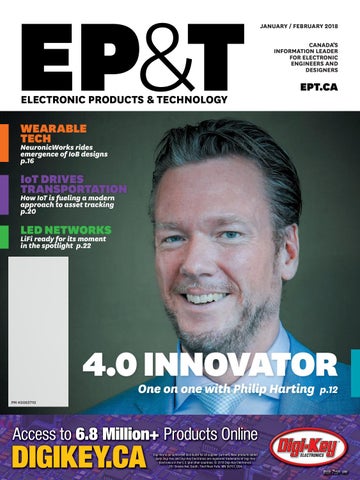
JANUARY / FEBRUARY 2018 CANADA’S INFORMATION LEADER FOR ELECTRONIC ENGINEERS AND DESIGNERS
EPT.CA
WEARABLE TECH
NeuronicWorks rides emergence of IoB designs p.16
IoT DRIVES TRANSPORTATION How IoT is fueling a modern approach to asset tracking p.20
LED NETWORKS LiFi ready for its moment in the spotlight p.22
4.0 INNOVATOR One on one with Philip Harting
PM 40065710
p.12
16 20
INSIDE Cover photo: HARTING AG & Co. KG Photos (this page, from top): NeuronicWorks; Blackberry; pureLiFi; Mirna Chacín
Columns
4 EDITORIAL Failure may lead to success 10 THINK GREEN Environmental compliance issues 11 WEST TECH REPORT Digital currency blockchain
In every issue
7 NEWSWATCH 25 PRODUCT SOURCE 25 AD INDEX 26 TEARDOWN Apple’s iPhone X
JANUARY / FEBRUARY 2018
COVER STORY
12
16 20 22
INTERCONNECT DEVICES An interview with Philip Harting on the state of Industry 4.0 and IoT and IIoT convergence 14 New products WEARABLE TECH & SENSORS NeuronicWorks rides emergence of IoB designs 18 New products TRANSPORTATION TECHNOLOGY Trucking for the long haul: How IoT is fueling a modern approach to asset tracking 21 New products
22 7
OPTOELECTRONICS LiFi ready for its moment in the spotlight 24 New products
Miniature RF & Power Magnetics
for Wearable Technology • Wirewound RF chip inductors as small as 0201 size • Shielded power inductors as thin as 0.5 mm • Coupled inductors as small as 2.2 x 1.5 mm for LED display drivers
Learn more @ coilcraft.com @EPTmagazine
January / February 2018 / EP&T
3
EDITORIAL
Go ahead and fail – it might lead you to success Learning how to tap into the power of artificial intelligence (AI), cloud and data can be a very useful thing if you are hoping to join the ranks of those seeking to disrupt the markets they serve. At least that is what I discovered while attending IBM’s Disruptive Innovation Forum, held in Toronto near the end of 2017. Among the industry thought leaders who contributed their insights at the event were Dino Trevisani, president of IBM Canada and Arlene Dickinson, entrepreneur and venture capitalist. Self titled Champions for Disruption, Dino and Arlene applied their focus on how Canadian companies are using disruptive technology, data intelligence and demand driven innovation to tackle today’s business challenges. Both pundits agreed that AI is poised to lead new product
development in the tech space. As AI emerges as the new user interface (UI) companies should look at ways to enhance customer experience, as it is the cornerstone to why customers do business with you. “AI is here and it will incorporate itself into your world. It is important to find context – as it is so easy to be left behind,” said Trevisani. “You must go out and
Dickinson says it is important to think about what your customers want – not what your competitors are doing. talk to the younger generation and find out how they think.” Dickinson says it is important to think about what your customers want – not what your competitors are doing. And, when it
EP&T MAGAZINE GETS A MAKEOVER
JANUARY / FEBRUARY 2018 CANADA’S INFORMATION LEADER FOR ELECTRONIC ENGINEERS AND DESIGNERS
EPT.CA
In the event that you haven’t already noticed, EP&T has a new style. You noticed the cover and the logo are different – and I’m glad you still cracked it open, even if you didn’t recognize us. We’re proud of this new look. 4.0 INNOVATOR We hope you like what you see. We have worked diligently to develop and implement a completely redesigned publication that’s fresh, slick, eye-catching and easy to navigate. Not to mention the content, which maintains relevancy to our audience in the quickly changing world of technology and electronics. As the editor, I believe that good design is essential to the experience of reading a great print publication – elegant fonts, striking illustrations, excellent photography. We have reconceived the magazine’s overall look and created exciting designs that fill the pages of our first issue. Following the lead of the tech world, EP&T is moving forward, evolving and reinventing itself – aiming to honour the past, look to the future and engage your senses. We hope you enjoy our new look and invite your feedback. WEARABLE TECH
NeuronicWorks rides emergence of IoB designs p.16
IoT DRIVES TRANSPORTATION How IoT is fueling a modern approach to asset tracking p.20
LED NETWORKS LiFi ready for its moment in the spotlight p.22
One on one with Philip Harting p.12
180110_6-8Mill_CoverBanner_EPT_CA.indd 1 1_JAN_FEB_EPT_ISSUE.indd 1 1 EPT_JanFeb_DigiKeyBanner.indd
Connect with EP&T magazine @EPTmagazine
4
facebook.com/EPTmag/
1/10/18 11:11 AM 2018-01-11 2:23 2018-01-10 5:43 PM
info@ept.ca
ELECTRONIC PRODUCTS & TECHNOLOGY / January / February 2018
comes to new product design – don’t keep re-engineering in hopes of achieving perfection. If you hesitate, the second best widget designed by a competitor will make it to market first. Trends show traditional business structures are afraid or slow to implement AI into their models, especially once they find out how much it costs or try to figure out how to implement it. Large companies are usually bound by bureaucracy, red tape and are reluctant to move quickly. On the other hand, entrepreneurs or start-ups are more flexible and fluid, often demonstrating an open willingness to implement. Smaller firms also view failure as part of the journey. “Employees within large corporations see making a mistake as the way to lose their job,” says Dickinson. “Corporations need to let ideas rise to the surface, but we don’t do it that way today. Big companies need to let their people try – let them make mistakes. It takes courage to try something different or risky and it takes tenacity to stick with it.” Dickinson described Canada as somewhat of a social state – and not as risk adverse. “It is almost un-Canadian to be aggressive within the global competitive space. This can create obstacles and it is important to work against these obstacles,” Dickinson says. “You do have to think differently and dream big. Entrepreneurs have to be willing to say there is nothing I can’t do.” Any way you look at it, this change is inevitable, so, how do you capitalize on it? Go ahead and fail – it might lead you to success. STEPHEN LAW Editor slaw@ept.ca ept.ca
Canada’s information leader for electronic engineers and designers JANUARY / FEBRUARY 2018 Volume 40, Number 1
EDITOR Stephen Law slaw@ept.ca · (416) 510-5208 WEST COAST CORRESPONDENT
Sohail Kamal sohail@nextgear.ca
ASSOCIATE PUBLISHER Scott Atkinson satkinson@ept.ca · (416) 510-5207 ACCOUNT MANAGER Joanna Malivoire
jmalivoire@ept.ca · direct 866-868-7089
MAGAZINE REDESIGN Janice Van Eck
www.janicevaneck.com
CIRCULATION MANAGER Anita Madden amadden@annexbusinessmedia.com ACCOUNT COORDINATOR Tracey Hanson thanson@annexbusinessmedia.com EXECUTIVE PUBLISHER Tim Dimopoulos COO Ted Markle PRESIDENT & CEO Mike Fredericks
EP&T is published eight times per year by ANNEX BUSINESS MEDIA
111 Gordon Baker Road Suite 400 Toronto, ON M2H 3R1 Tel (416) 442-5600 Fax (416) 510-5134 www.annexweb.com SUBSCRIPTION RATES
Canada – $57.50 one year; $92.50 two years USA – $101.00 per year International – US$138.00 per year Single copy – Canada $15; all others $20 TO SUBSCRIBE 416-442-5600 x3552 customercare@annexbusinessmedia.com ISSN 0708-4366 (print) ISSN 1923-3701 (digital) PUB. MAIL AGREEMENT NO. 40065710
Return undeliverable Canadian addresses to: EP&T Circulation Dept., 111 Gordon Baker Rd. Suite 400, Toronto, ON M2H 3R1
© 2018 EP&T. All rights reserved. Opinions expressed in this magazine are not necessarily those of the editor or the publisher. No liability is assumed for errors or omissions or validity of the claims in items reported. All advertising is subject to the publisher’s approval. Such approval does not imply any endorsement of the products or services advertised. Publisher reserves the right to refuse advertising that does not meet the standards of the publication. Occasionally, EP&T will mail information on behalf of industry-related groups whose products and services we believe may be of interest to you. If you prefer not to receive this information, please contact our circulation department. PRINTED IN CANADA We acknowledge the financial support of the Government of Canada.
CNC MACHINING 5-Axis & 3-Axis Milling and Turning
Professional Grade
Made in 2-3 Days
No Minimum Orders
Keep Your Projects Moving with Reliable CNC Machining You Can Count On 5-Axis and 3-Axis Milling in 2-3 Days
Wide Variety of Stocked Tooling
High-Precision Parts, Panels and Enclosures
Fully Custom, Fully Finished
Aluminum, Copper and Other Metals
Powdercoat, Graphics, Engraving & More
P R O TO C A S E
Professional Grade
CONTACT US TODAY! 1.866.849.3911 | www.protocase.com No Minimum Orders
Made in 2-3- Days
NEWSWATCH TRANSPORTATION
CANADIAN NORTH AIRLINES LANDS MMRO FACILITY
Canadian North Airlines revealed plans to establish its own manufacturing, maintenance, repair and operations (MMRO) facility, expected to open during the first quarter of this year within its 90,000 square foot hangar at Edmonton International Airport. This facility, which represents a multimillion-dollar investment in hiring, equipment purchases and facility upgrades, has been made possible through strong support from the airline’s parent group Inuvialuit Development Corp. Once operational, Canadian North will have the capability to fulfill all of its line maintenance, heavy maintenance and manufacturing requirements for its fleet of Boeing 737-300, Boeing 737-200 and Bombardier Dash-8 aircraft under its own roof. The airline has launched a campaign to recruit an initial complement of 30 full-time positions for this facility, which will include aircraft maintenance engineers and other supporting roles.
TECHNOLOGY
Photos: Mirna Chacín; Borealis AI
WATERLOO NOW CANADA’S FASTEST GROWING TECH TALENT MARKET
Waterloo Region is now Canada’s fastest growing tech talent market, having grown by almost two thirds over the last five years, while Toronto leads in terms of the absolute growth of its tech labour pool, according to CBRE’s 2017 Scoring Canadian Tech Talent Report. The report results show the Waterloo Region has added 8,400 tech jobs from 2011 to 2016, a 65.6% growth rate, and the second fastest rate of tech labour pool growth in North America after Charlotte, NC, at 77.1%. However,Toronto remains the undisputed magnet for tech employers and employees, expanding by 51,300 tech jobs, a 31.8% increase for the city, over the same period. “Cities across North America are jockeying for the attention of leading tech firms and its increasingly clear which cities are leading the pack. Waterloo Region continues to show its strength as one of Canada’s top tech markets and a major engine of innovation for the Canadian economy,” says Paul Morassutti, executive @EPTmagazine
Participants at a recent Tech Waterloo Region (TWR) gathering experiencing virtual reality.
65.6% Growth rate of Waterloo Region’s tech labour pool between 2011 and 2016—that is 8,400 tech jobs
managing director at CBRE Canada. “Not only is it the fastest growing over the five-year period, it is also the fastest growing market year-over-year, adding 5,600 jobs alone in 2016, an increase of almost a third in a single year%. Even after the fall of Blackberry, which was once one of Waterloo Region’s top tech employers, the region continues to benefit from clustering of the high-tech industry.” As a whole, Canada added 138,300 tech jobs between 2011 and 2016, an increase of 21.7%, 34,500 of which were added in 2016 alone.
ARTIFICIAL INTELLIGENCE
BOREALIS AI TO OPEN MONTREAL LAB
Continuing its investment in the Canadian artificial intelligence (AI) ecosystem, Borealis AI, an RBC Institute for Research, announced that it will open a lab in Montreal, one of Canada’s most prominent AI hubs. Borealis AI has partnered with McGill University Professor, Jackie Cheung, as academic advisor for the lab and will work closely with the Montreal Institute for Learning Algorithms
31.8%
Growth rate of Toronto’s tech labour pool between 2011 and 2016 —that is 51,300 tech jobs
Professor Jackie Cheung
(MILA).The team anticipates opening the new location early this year. “Montreal has emerged as a global centre for research in artificial intelligence and I’m excited to be participating in this community,” said Dr. Foteini Agrafioti, head, Borealis AI and chief science officer, RBC. “We’re committed to helping advance the field through the creation of intellectual property and look forward to providing new opportunities for the enormous talent already doing exceptional research in the region.” Montreal has emerged globally as an AI powerhouse, buoyed by research institutions like the MILA and a rich AI startup ecosystem. Borealis AI will collaborate closely with MILA and Professor Yoshua Bengio, and continue to grow its research partnerships with McGill University and the Université de Montréal.
ACQUISITION IN EDA SPACE
SIEMENS ACQUIRES SOLIDO DESIGN AUTOMATION
Global tech giant Siemens AG has acquired Saskatoon-based Solido Design Automation Inc., a leading provider of variation-aware design and characterization software to semiconductor companies worldwide. Solido’s machine learning-based products are currently used in production at over 40 major companies, enabling them to design, verify, and manufacture more competitive products than ever before. The deal is the first acquisition in the EDA arena for Munich-based Siemens since it purchased Mentor Graphics for $4.5 billion in 2017. Solido will become part of Mentor’s IC verification solutions division. January / February 2018 / EP&T
7
NEWSWATCH HMI PLATFORM
screen in the meter screen. Furthermore, by updating the performance of one microcomputer both devices are updated, which contributes to improved increase in R&D productivity and cost reduction.
BlackBerry Ltd., Waterloo ON, and Denso Corp., Kariya Japan, have jointly developed what they are calling the ‘world’s first’ integrated Human Machine Interface (HMI) platform. Intel Corp. also collaborated in the development of this product. The integrated HMI platform will enable a system that optimally cooperates and coordinates various HMI products such as display and sound inside the automobile cockpit at a low price. The joint solution will appear in successive car models scheduled for release after 2019. With the improvement of automobile safety and convenience in recent years, the amount of data the vehicle transmits to the driver is increasing. Vehicles today are equipped with multiple HMI systems, which require several device-specific operating systems to work in unison. Because the operating systems are independently controlled by multiple microcontrollers, it has not been possible to cooperate and coordinate them to display content and sound uniformly. The integrated automotive HMI platform is believed to be the first of its kind and was developed by Denso and BlackBerry using the QNX Hypervisor for virtualization and the Intel Atom processor A3900 series. The hypervisor technology enables the independence of several operating systems with different characteristics and controls the integration with one microcomputer. This architecture allows various HMI products to cooperate allowing necessary information to be displayed to the correct devices with appropriate timing. For example, it will be possible to communicate a heads-up or a warning through easy-to-understand expressions on the display with the right timing. Additionally, through cooperation between instrument cluster and navigation center displays, it is now possible to show animation with a sense of unity between the navigation 8
AUTOMATED VEHICLES
NETWORK AIMS TO ASSERT ONTARIO AS AUTONOMOUS VEHICLE LEADER
150
Number of companies active in Ontario’s autonomous vehicle industry
Ontario is reinforcing its status as a go-to destination for developing automated vehicles by launching AVIN, the Autonomous Vehicle Innovation Network, in Stratford, ON. This unique demonstration zone is among the first of its kind in Canada and will allow researchers to hone the technology and test an AV in a wide range of everyday, real-life traffic scenarios. The province is partnering with Ontario Centres of Excellence in AVIN, which will bring together industry and academia to capitalize on the economic opportunities of connected and autonomous vehicles (C/AV), while developing the emerging technology and infrastructure. Ontario is uniquely positioned to lead in C/AV technologies and to attract related investments and jobs. The province is North America’s top vehicle-producing jurisdiction and second only to California for information and communications technology companies. More than 150 Ontario companies and organizations are active in the province’s C/AV industry, employing almost 10,000 people.
HEALTH AND SENSORS
NATIONAL INNOVATION HUB FOCUSES ON SENSORS, ANALYTICS
Schematic of Blackberry and Denso’s new integrated Human Machine Interface (HMI) platform
ELECTRONIC PRODUCTS & TECHNOLOGY / January / February 2018
The AGE-WELL Network of Centres of Excellence (NCE), Bruyère Research Institute and Carleton University have unveiled the newest national innovation hub, aimed at advancing the development of sophisticated sensor systems that address mobility and memory challenges among older people. The Sensors and Analytics for Monitoring Mobility and Memory (SAM3) hub will focus on smart technologies that monitor seniors’ health and wellbeing—to keep them as healthy, safe and independent as possible. The hub is located in Ottawa at Bruyère Continuing Care’s Élisabeth Bruyère Hospital site, where an
Dr. Frank Knoefel (left) and Dr. Bruce Wallace with a pressure-sensitive mat under development at the new SAM3 hub in Ottawa, Ont.
apartment laboratory resembling a typical home setting has been set up to test embedded smart sensor technologies. Some sensors will be able to monitor cognitive impairment, while others will screen for declining balance or strength, to predict and decrease the risk of falls. The hub will advance research that is already underway on pressuresensitive mats that fit under a mattress and are designed to alert seniors, caregivers and medical professionals to deviations in a person’s vital signs, activity and mobility. It represents real opportunities for Canadian companies with sensor products that can be incorporated into sophisticated and complex systems to support quality of life.
WEARABLES
SMART CLOTHING WEARABLES FORECASTED FOR CONTINUED GROWTH
ABI Research, a leader in emerging technology intelligence, forecasts that the smart clothing market will top 31 million device shipments annually by 2022, increasing from just under 5 million in 2017, a 45% CAGR. Smart clothing will have the second highest growth rate among wearable devices behind hearables over the forecast period, but will continue to have one of the lowest market shares of wearable devices. While smart clothing has yet to reach mass market appeal, the industry is continuing to grow due to current highly targeted consumer applications within the sports, fitness, and wellness markets. “The majority of smart clothing shipments will be primarily driven by consumer applications, with growing enterprise applications in worker safety and monitoring over the next few years,” says Ryan Harbison, Research Analyst at ABI Research. “Today’s market targets mostly sports pros.” Visit ept.ca for the latest new products, news and industry events. EPT.CA
Photos: SAM3; Denso
BLACKBERRY AND DENSO CO-DEVELOP INTEGRATED AUTOMOBILE HMI PLATFORM
RAZOR-SHARP PRECISION
MIRA 340 wire stripper Thanks to its rotating 4X-blades, the new Mira 340 is a pioneer in the processing of demanding wires. Tough Teflon®, hard Kapton® or flexible silicone, individual, multi-conductor or multi-layer cables – no matter what it is, Mira 340 cuts, strips and twists with outstanding precision. The intuitive user interface, article library and bar code scanning minimize input errors and dramatically increase productivity.
komaxwire.com
THINK GREEN
Environmental issues Turmoil of product environmental compliance coming for 2018-19 BY AURY HATHOUT As our attention turns to the hazards of wintery weather at this time of year, members of the electronics industry must begin to pay heed to a completely different type of storm that could rock their world in the coming months and years. Significant changes in environmental compliance are approaching and expected to impact the electronics industry here in Canada. The following are some of the elements of this global regulatory movement.
EU RoHS
First of all, the European Union Restriction of Hazardous Substances (EU RoHS) scope is wider than ever. Various product categories are now covered, from household to professional equipment, including most medical devices, monitoring and control instruments, etc. A list of products that will be explicitly excluded is expected in the coming months. In other words, products that won’t clearly be listed will have to be EU RoHS compliant by default and CE marked accordingly. Secondly, some EU RoHS exemptions will expire, such as the exemption 39-B – Cadmium in downshifting cadmium based semiconductor nanocrystal quantum dots for use in display lighting applications (< 0.2 μg Cd per mm2 of display screen area) – which will no longer be valid after June 30th, 2018. If you require your products to remain compliant, then you may consider looking for replacement parts that benefit from these exemptions that are about to expire. A third major change is the addition of substances to the list of restrictions. Indeed, by passing the delegated Directive 2015/863 (referred to RoHS 3), the European Union has amended the annex II of Directive 2011/65/EU and has added 4
restricted phthalates, which are linked to public health issues such as cancer: • Bis(2-ethylhexyl) phthalate (DEHP) • Benzyl butyl phthalate (BBP) • Dibutyl phthalate (DBP) • Diisobutyl phthalate (DIBP) The restrictions of these phthalates in homogeneous materials of Electrical and Electronic Equipment (EEE) apply
certificates of compliance for all the 10 restricted substances.
China RoHS
The Chinese Ministry of Industry and Information Technology (MIIT) has published a new China RoHS regulation called Management Methods for the Restriction of the Use of Hazardous Substances in Electrical and Electronic Products (Order 32). A Compliance Management Catalogue and a Conformity Assessment System are planned. The question looms over their implementation.
A growing number California Prop. 65 of suppliers are In the middle of the Silicon Valley, already able to the California’s OEHHA (Office provide certificates of Environmental Health Hazard Assessment) provides new warnof compliance for all the 10 restricted ing requirements under the Proposition 65, as of August 30th, substances. starting on July 22, 2019. Nevertheless, product categories 8 (medical devices) and 9 (monitoring and control instruments) are exempted until July 22, 2021, for these 4 phthalates. They are typically used as plasticizers and may be found in adhesives, inks, coatings, cables, polymer foils, PVC compounds or other plastic materials. Phthalates are especially present in computers, electronic and electrical equipment, optical products, machinery and transport equipment. The previous 6 restricted substances remain: • Lead (pb) • Cadmium (Cd) • Mercury (Me) • Hexavalent chromium (Cr 6+) • Polybrominated biphenyls (PBB) • Polybrominated diphenyl ethers (PBDEs) A growing number of suppliers are already able to provide
10 ELECTRONIC PRODUCTS & TECHNOLOGY / January / February 2018
2018, according to amendments of Article 6 of Title 27 – California Code of Regulations, Clear and ReasonableWarnings.
Global regulations
Regulations similar to RoHS, REACH and WEEE (Waste of Electrical and Electronic Equipment) have recently multiplied worldwide. For example Bangladesh, California, the Eurasian Economic Union (EAEU), India, Singapore, Switzerland, Taiwan, Turkey, Ukraine, the United Arab Emirates (UAE) and Vietnam have either drafted or enacted regulations for electrical and electronic products environmental compliance. In order to be enforced, some of these regulations such as the UAE RoHS will require further clarifications.
Brexit
The exit of the United Kingdom from the European Union has brought its share of uncertainties. What will happen to the harmonized regulations? Will the UK keep the same rules or adopt slight national deviations from the current state or implement new rules for REACH, RoHS etc.? One thing is certain, up to 2019, the same rules are going to apply in the UK as in the European Union. However, renegotiations will occur in 2019 at the earliest. The current UK government seems to be inclined to keep the same REACH and RoHS rules as the rest of the EU after Brexit. The future can only tell what the outcome of the renegotiations will be.
Conclusion This is an example of a Prop. 65 label you may have to provide with electronic equipment you export to California.
Conflict minerals
Despite the amendments to the Dodd-Frank act and the step back on Conflict Minerals ban declarations at the Securities and Exchange Commission (SEC) in the USA, Europe takes over with Conflict Minerals regulations. The main target of these Conflict Minerals rules is to ensure sustainable imports of tin, tantalum, tungsten and gold (3TGs), i.e. banning both human rights abuses and armed conflict financing.
In Canada, we benefit from excellent opportunities to develop new products and spread them all over the world. The Comprehensive Economic and Trade Agreement (CETA) enables free-trade between Canada, the European Union and its member states. Therefore, product environmental compliance is being a growing concern. In spite of this regulatory storm, it is time to leave confort zones, take risk and grasp the opportunity to surpass our competitors on new markets! Aury Hathout M.Env. is a certified environmental auditor at Enviropass. For more information on environmental compliance in the electronics industry, see www.enviropass.ca. EPT.CA
THE ORIGINAL PUSH-PULL CONNECTORS
WEST TECH REPORT
Digital currency mining boom
Vancouver-based HIVE Blockchain’s major expansion BY SOHAIL KAMAL Bitcoin’s boom has caused mining companies to trade in their picks and axes for graphics processor units. The price of bitcoin continues to rise and has ignited comparisons to a financial bubble. The growth of digital currencies has had a significant impact on Graphics Processing Unit (GPU) manufacturers such as Nvidia and AMD and has opened opportunities to Canadian entrepreneurs. Tech-savvy companies such as Vancouver-based HIVE Blockchain Technologies Ltd. have reaped enormous rewards and share prices have soared. The blockchain infrastructure firm garnered an estimated market value of over C$600 million after they transitioned from a gold mining company to a digital currency miner. So what is bitcoin mining and how do they use computers to dig for ‘digital gold?’
What is Bitcoin mining?
Bitcoin was designed to rely on a network of miners. As opposed to digging in the ground to mine precious metals, digital currency ‘mining’ is the process of earning digital coins by performing complex mathematical puzzles. Miners are not just paid in new Bitcoins, but in fees for confirming transactions that take place on Bitcoin’s ‘blockchain.’ These blocks in the blockchain independently validate and record transactions in a secure and immutable record thereby replacing traditional banks by decentralizing the recording of the transactions through a public online ledger. Much like success in traditional mining, the key to successful digital mining is minimizing costs associated with the process. Bitcoin mining requires massive amounts of electricity. It has @EPTmagazine
been said that the entire world’s digital currency mining takes up as much electricity as the entire country of Ireland. As popularity increases so does the difficulty setting for mining bitcoin. Engineers should note that mining could once be achieved with home computers, but given its current value and scale, the majority of profitable operations are those with huge rigs of GPUs on an industrial scale.
Multipole low voltage connectors Push-Pull connectors from 2 to 114 contacts
Huge rigs of GPUs
Hive was initially a gold mining company who changed directions in early 2017. “We’re quite lucky to be first out of the gate,” said Hive chief executive officer Harry Pokrandt, in a recent interview. Hive paid Hong Kongbased Genesis Mining Ltd., builder of the world’s largest ether mining facility, $9 million and gave it a 30 percent stake to acquire a new data center in Reykjanes, Iceland. Hive plans to mine different cryptocurrencies, depending on which ones offer the best margins and build an inventory of coins on the expectation they’ll appreciate. They set up mining operations in both Iceland and Sweden to take advantage of cheaper cooling and electricity costs with Iceland’s geothermal and hydroelectric power generation costing less than other generation methods. Hive recently announced their Phase 3 Expansion at the Sweden GPU Data Centre that will be constructed this April for an estimated US$22M. Fellow Canadian tech firms could follow Hive’s lead here.
Cable, connector and Media converters Hybrid electrical-fibre optic self-latching connector for HDTV applications (SMPTE).
REDEL P & SP plastic series Self-latching plastic connectors, sterilizable for medical applications.
01 coaxial miniature series Smallest self-latching coaxial 50 Ω connectors.
LEMO Canada Inc.
T: 905-889-5678 Info-canada@lemo.com
Sohail Kamal is EP&T’s West Coast correspondent. sohail@nextgear.ca
Contact your local partner on www.lemo.com
January / February 2018 / EP&T
11
INTERCONNECT DEVICES
COVER STORY
We sit down with PHILIP HARTING to talk about Harting Technology’s focus on it’s Industry 4.0 customer base of industry and society. This applies both to people’s everyday lives, their private lives, and above all the way in which work and manufacturing is done, company-internal structures, training and qualification, communication with customers, and partners and suppliers. The essential core of Industry 4.0 is the digitization of the value chain in vertical and horizontal directions. Companies’ future welfare and competitiveness, as well as that of whole economies, will depend on the success of digitization. But digital transformation is not an end in itself, but rather a means to an end. Customer value is the decisive factor here. Anyone who doesn’t think in terms of the customer will lose the customer.
Initially established and often recognized throughout the electronics industry as a leading global connector or interconnect solution provider, Harting Technology Group of Germany has found its stride serving its industrial customer base globally, as it conforms to the emerging model of Industry 4.0, responsible for driving IoT and IIoT convergence. Here, EP&T sits down with Philip Harting, Chairman of the Board, to discuss his views on these subject areas.
Q
How has the role of the connector or interconnect device itself altered with the emergence of these new technologies – especially the digital era? Industry 4.0 brings a significant increase in importance to the classic industrial connector. The connectors’ simple and quick handling, their robustness, and an extended range of applications are all highly important. The modularization, customization and flexibility of production processes require a corresponding adaptation of machinery and systems in the shortest possible time. For production of e.g. lot size 1, new or re-configuration has to be quick and easy. This is what classic industrial connectors do thanks to new functionality. Connectors play a central role when adding or replacing a module. This is done by our Han-Modular, by way of example. Its docking and undocking, active locking, visualisation and communication capabilities transform it from a passive installation into a smart infrastructure component.
A able to respond in a timely and cost-effective manner. This creates added value for the customer, regardless of whether for specialized mass production or serial mass production. How will this repositioning affect the product portfolios you are known for, including board-level connectors? Are you going to move away from certain product areas to invest more in other, newer fields? Harting is an innovative technology group. Analyzing trends, developing new components, applications and solutions – this expands the application possibilities of our products and opens up new potential uses and additional markets. Digitization plays a decisive
12 ELECTRONIC PRODUCTS & TECHNOLOGY / January / February 2018
role here. Accordingly, our portfolio is expanding towards miniaturization, modularity and high component variability. A good example of this is our MICA (Modular Industry Computing Architecture). This is an open and modular platform that enables customers to easily, quickly and cost-effectively implement their Integrated Industry projects and optimize their business model. Industry 4.0 is driving IT/OT convergence, leading to more smart technologies and systems. Looking ahead five years, what capabilities should we expect to see in widespread usage, especially in terms of field level productivity? Digitization is an irreversible process that will accelerate further in the years ahead and extend to all areas
Describe the importance of your relationship with the customer when developing new products and solutions – especially as they EPT.CA
Photo: HARTING AG & Co. KG
Harting has always had a reputation as an innovative and highly reliable component manufacturer. Now, the company is positioning itself as a solutions provider for industry. How are you accomplishing this change and how will this impact the customer? Harting has developed from a pure component manufacturer into a provider of systems and complete solutions that offers hardware and software under a single roof. Customer requirements – and consequently production – are thus more customized. Operators and users require products and services which meet their special needs structure. The number of possible variants and areas of application of the products, along with the complexity of the systems, machines and processes, all require holistic, networked thinking in conjunction with manufacturing that implements information technology. This is possible with turnkey solutions and offerings that are developed in collaboration with customers. In addition, Harting has initiated a comprehensive process to digitize the company, together with all its manufacturing and business processes. This process extends from production, with a significant increase in flexibility and efficiency, to the development of customized, service-oriented products, all the way to collaborative undertakings with our customers to jointly develop innovations. The goal is to be flexible, customer-oriented, and be
Push Pull: HARTING’s modular PushPull V4 housing accommodates mating faces for all lifelines of Industry 4.0 – data, signal and power. PushPull V4 is a fast, secure and tool-free solution for device cabling.
Han Pneumatic Module: HARTING has developed a new compressed air module to meet the increased demands on interfaces for flexible production processes – the Han Pneumatic Module Metal. It employs robust, durable high mating cycle contacts made of metal that can be plugged and unplugged at least 10,000 times.
ix Industrial: HARTING’s ix Industrial helped the company win the “Innovator of the Year” award in November 2017. @EPTmagazine
relate to their application specific needs. The production of the future is more flexible, more customized, and more individual, down to lot size 1. The motto is made-to-measure rather than mass production. Together with the customer, we develop tailor-made components and solutions for a wide variety of applications and conditions. Thus, the topic of partnering is becoming more and more important in industry. Customers’ requirements and the products developed together with them are decisive for mutual success. Being close to regional/national markets, we know the respective trends and tendencies and are able to proactively develop new concepts and technological innovations. How does Harting remain at the forefront of its field amid the intensity of competition in a global marketplace? Harting is a development-intensive and innovation-driven technology company with decades of experience and a global network of development, production and sales companies. Our highest maxims are quality, continual new developments and innovation. Leadership in the relevant markets and success in global competition is made possible through permanent contact and close proximity to our customers, as well as collaboration with science and the relevant university institutions. “We want to shape the future with technologies for people” – this aspiration is part of our corporate vision and commitment. We want to be drivers and shapers of technological development. What advantages does Harting have as a privately held or family-owned company, versus that of a publicly-traded concern? Since being founded in 1945, Harting has been an independent family-run business, 100% owned by the family, which is now in the second and third generation. Economic independence is the supreme maxim of our company philosophy. Independent family-owned businesses follow their own, long-term strategy based on ethical-social values and principles. They have a special creative will and are generally more successful because, unlike listed corporations, they aren’t con-
strained by the rationale and compulsion to seek short-term profits for the shareholders. Family-run businesses usually feel an obligation to their locations, the home region and their employees, and are engaged both socially and locally. This results in employees feeling a high degree of identification and loyalty towards the company, as well as solidity and trust, and there are also entrenched, typically long-standing relationships with customers and suppliers. These characteristics justify the good reputation of family businesses and form the basis of their special competitive advantage compared to “faceless”, large corporations which are beholden to their shareholders.
€ 672 million (FY 2016/17) are now attributable to the Asia/Pacific region. Harting is a global player and is at home in the most important international growth markets and future industries. Digitization and artificial intelligence (AI) are contributing greatly to Industry 4.0, where do those elements fit into Harting own manufacturing and logistics plans in the coming years? The digitization of all our structures and processes with the appropriate training and participation of our employees is a fundamental strategic decision at Harting. We achieve higher efficiency and flexibility as a result, and we explore
“Partnering is becoming more and more important in industry.” Despite growing resistance in some countries, efforts continue to build more free trade zones? How has this movement benefited you and how might it change your business in the years ahead? Conversely, what would be the impact if more countries retreat into protectionism? Competition and progress require open markets and international exchange. As a globally operating company, Harting is firmly committed to this. We know that compartmentalization, trade barriers and other obstacles hinder development, inhibit growth, and harm prosperity. The economic challenges of the future can only be mastered through free access to all markets. Harting has taken recent steps to expand its footprint within parts of Asia. Describe how this represents the firm’s move from being perceived as a European player to a global player. Asia has long been a key region for Harting and we have several subsidiaries there, e.g. in China, Singapore, Korea, Taiwan, Malaysia and Japan, as well as our own production facilities in Zhuhai/China and Chennai/India. As a result, we’re close to our customers, know the region, the markets, our customers’ needs and specific requirements, and are able to co-determine and anticipate technological trends. Around 24 percent of Group sales of
the possibilities and implementation of the smart factory in our own production. Harting finds answers to how digitization works not only in theory, but above all in its own, in-house practice. For example, our Harting MICA assumes condition monitoring on injection moulding machines. Furthermore, we use different RFID solutions in the warehouse area. Many processes will be completely digital in our European Distribution Center (EDC), our new logistics centre which will be completed in 2019. Has Harting faced any specific challenges in sourcing within supply chain specific material requests for the construction of its interconnect devices? To date, we haven’t faced any significant challenges on this issue. Harting places high priority on trustworthy, reliable cooperation with suppliers and partners, and this is gaining even more significance as part of Industry 4.0. Harting regularly receives awards for its long-term cooperation and its high quality, most recently in the transportation sector, for example from rail vehicle manufacturer Bombardier in 2015 and Deutsche Bahn in 2017. For more interconnect solutions related to Industry 4.0 applications from Harting Technology Group, go to www.harting.com. January / February 2018 / EP&T 13
INTERCONNECT DEVICES
NEW PRODUCTS easy-on, easy-off bayonet lock system and is rated for 75�, but can be mated with 50�-based BNC connectors. The miniature radio frequency (RF) device delivers an optimized center contact design that simplifies pcb layout and supports SMT processing, decreasing labour and assembly time. Product is reliable at high frequencies (up to 12GHz) and provides 150Vrms ac rated voltage. www.heilind.com
3GHZ COAXIAL CONTACT PAIRS WITH RG 179 B/U TYPE CABLE
LEMO 3GHz coaxial contact can be used in
INDUSTRIAL CIRCULAR CONNECTORS BOOST RELIABILITY
BULGIN M-Series range of circular connectors provides reliable and uncompromised data, signal and power transmissions for industrial automation systems in harsh environments, designed to decrease downtime and increase production efficiency. Featuring an M-style threaded locking nut, device provides an extensive choice of robust industry standard interconnect solutions for automation and control applications including: M5, M8, M12, M16 and M23 variants. www.bulgin.com
MINIATURE, QUICK CONNECT RF CONNECTOR SUITS COAXIAL CABLES
HEILIND ELECTRONICS Hirose BNC75 Series serial digital interface (SDI) compliant connectors support high transmission speeds up to 12Gbps. Devices provide an
various insulator types, providing an alternative solution to HD – BNC in the broadcast market (HDTV, 4K, 8K). Device can be used in various insulator configurations: 3 x coaxial, 4x coaxial, 10 x coaxial, as well as in combinations of coaxial and low voltage signal contacts. Products can be built into watertight connectors (IP 68) such as firm’s Push-Pull connectors of the K, T or even W series. lemo.com
LOW PROFILE, REMOVABLE CARRIERS SERVE MALE PCB PINS, TERMINALS
MILL-MAX 3169-0-61-15-00-00-03-0 male pin carrier utilizes thin Kapton film to create ultra-low-profile interconnects. Device provides a double tail pcb pin mounted in .005” thick Kapton film/tape. The Kapton can be easily removed after soldering but if left in place does not add to the interconnect height of only .030” (,762 mm). The pins are spaced at .100” (2,54 mm) pitch, allowing for multiple pins to be assembled onto the circuit board at once. www.mill-max.com/PR682
RF CONNECTOR LINE INCLUDES OPTIONS FOR SMALL PACKAGE APPLICATIONS AMPHENOL RF SMPM RF connector line has expanded to include several new connector configurations. Devices utilize the micro-miniature interface and perform at a frequency range of dc to 65 GHz.
Connector Craftsmen for Over 35 Years Learn about our Connector Customization Capabilities by viewing our new video. WWW.ADVANCED.COM
Prototype to Production Volumes | IC Sockets | Adapters | Board to Board Connectors
14 ELECTRONIC PRODUCTS & TECHNOLOGY / January / February 2018
401.823.5200 | info@advanced.com | Made in the USA
EPT.CA
Products are used in high-frequency coaxial applications with small package design requirements. Line is available in full detent and smooth bore, both of which provide secure engagement and disengagement forces. The floating bullet provides a link between the mated pairs and compensates for radial and axial misalignment. www.amphenolrf.com
UHF RFID 4 FIELD READER COMES WITH M12 AND M8 CONNECTIONS
alloy construction and electroless nickel plating, can be applied to new installations or alternatively for carrying out mid production modifications. Devices add increased levels of mechanical robustness, as well as providing the necessary EMI/RFI protection. Incorporated into the female cable versions is a highly convenient attachment feature via which braid screening can be achieved with maximum effectiveness. www.harwin.com
HIGH-SPEED PCI EXPRESS EDGE CARD CONNECTOR DELIVERS LOW-PROFILE
SAMTEC PCIE-LP Series low-profile PCI Express edge card connector provides Edge Rate contacts for optimized signal integrity. Device is PCI Express Gen 4 compliant and supports one, four, eight and 16 links for different bandwith requirements. The 1mm pitch device has a low 8mm profile, 3mm less than the standard 11mm
profile with an identical 3.50mm contact wipe. This provides more vertical space in a standard size chassis with a set form factor allowing for greater system air flow and space to route other components. www.samtec.com Visit ept.ca for the latest new products, news and industry events.
HARTING Ha-VIS RFID Reader (RF-R400) provides concentrated RFID performance with robust M8 and M12 connectors. Compact and robust, product comes with two antenna connections, 500mW power output and comprehensive software
take off
EcoStrip 9380
Welcome to the Future of Entry Level Cut & Strip functions. Network, power supply, RS232, two digital trigger signal inputs and four digital signal outlets are available via circular connectors. Each with a maximum power output of 2W, the four antenna connections remain in the usual SMA format. www.harting.com
The EcoStrip 9380 offers the most complete feature set at an economical price point. This flexible machine can be configured with rollers or belt feeding untit capable of short mode processing and is easily operated via the 5.7� color touchscreen and underlying Schleuniger S.ON software. Turn the EcoStrip 9380 into a fully automatic processing line with a wide range of accessories for prefeeding, marking, stacking, coiling and tying. schleuniger-na.com/es9380_ept 905.827.1166
METAL BACKSHELLS WITH BUILT-IN SHIELDING ENSURE ELECTRICAL INTEGRITY
HARWIN Comprehensive range of metal backshells with a rugged aluminium
To Be Precise. @EPTmagazine
EPT_JanFeb_Schleuniger.indd 1
January / February 2018 / EP&T 15 2017-12-18 2:24 PM
FEATURE
NeuronicWorks’ ARAIG gaming vest let’s the player feel what’s happening to their character as they play.
NeuronicWorks rides emergence of IoB designs Convergence of wearables and IoT gives birth to Internet of Bodies device sector BY STEPHEN LAW The convergence of IoT devices into the wearable electronics’ space has spawned an emerging design sector referred to as the Internet of bodies or IoB. Driven by the merger of personal monitoring technology and advanced wireless communication, IoB represents a significant design opportunity within electronic design circles, according to Titu Botos, VP engineering of NeuronicWorks Inc., a Toronto-based turnkey custom electronic product design company that specializes in hardware, firmware and software development. Tremendous innovation in personal monitoring and in therapies catering to a ballooning elder care segment of the population has put greater emphasis on IoB healthcare applications. Botos says he has seen the demands rise within his customer base, which ranges from the industrial controls and IoT area to smaller OEMs and/or start-ups that dabble in wearable and consumer electronic designs.
“These customers all want to build the next big thing or ‘cool thing’,” says Botos, adding that these “…gadgets will end up on your body, in your pocket or attached to your clothes.” Botos says IoB devices continue to evolve – from those that measure the body’s blood pressure, heartbeat, movement (speed), etc. as many of these wearable health devices are moving from wristbands and pendants to skin patches, that are worn for 3 or 4 days at a time.This is an area Botos expects will continue to grow and evolve to long lasting patches, along with the more exotic area of implants and ingestible sensors. Before it was recognized as IoB, athletic and fitness devices debuted with such brands as FitBit, Push, Moov. Today, the market is crowded with startups all the way to well established players like Apple, Garmin and Samsung. Personal care is the other niche market that opened a lot of possibilities for IoB devices. The growing sector of aging baby boomers are now
16 ELECTRONIC PRODUCTS & TECHNOLOGY / January / February 2018
30 Number of enginers working on developing new wearable technology at NeuronicWorks
benefitting, as well as their care givers. Some of these devices include ‘trackers’ that can not only remind someone about taking their medicine, but it can also detect a fall and automatically dispatch help, for example At the other end of the spectrum, the second application of IoB personal care is children, including teens, whereby parents can keep track of their whereabouts (via geo-facing) and listen in real time to their surrounding environmental sounds. The third application of IoB in personal care is remote monitoring of workers in hazardous environments, like mining for example. Here a remote supervisor can talk in real time with the worker, receive a low-resolution-low-frame-rate-image of the worker’s environment and can detect vital signs of his/her body. That tremendously increases safety and makes rescue operations more efficient. “Besides the coolness factor of having something blinking and buzzing, the other helpful thing is that we are able to sense and monitor in real time what that person is doing/ experiencing, or what happens in the surrounding environment. Always detecting and monitoring what is happening in that environment – around us or to us,” says Botos. Emerging from literally a small basement design operation almost 10-years ago with three staff members, today NeuronicWorks Inc. employs 30 engineers along with others in operations. Collaboration amongst the various design departments is key to delivering exactly what the customer wants, according to Botos. “I don’t believe that we can design in a vacuum. Half of the design comes from the concept of your customer, who is reaching out for that next level of input – from our team of design experts. For us, the magic happens when seated around the same table working on a design, we get conversations between the mechanical, the hardware, the firmware, and the software engineer. Something special happens when we get all of those minds around the table at the same time. That is the moment when the system takes life,” enthuses Botos. “If they were to conduct their duties at different tables and different time zones, you will often hear a disconnect between design teams, where the message is being lost in translation somewhere.When we work concurrently on the project – together, collaboratively, we get real action through the troubleEPT.CA
Photo: NeuronicWorks
WEARABLE TECH & SENSORS
shooting and actual design process.” Steering a close-knit team that works together on a regular basis, helps the various and diverse team members learn each other’s strengths and weaknesses – which, in the end, lends itself to a more effective design process, according to Botos. “Having an open channel with the customer and between ourselves brings trust. Working together over a period of weeks or months on a project develops the lines of trust between all parties. In the end, the customer is the master. We always consider that the customer knows his product and market best, as he is the one who came up with the idea in the first place.” Deeply entrenched with an altruistic commitment to the electronics ecosystem in Canada, Botos says he seeks to keep almost every aspect of the product design process within Canada, including pcb boards, pcb-assembly, metal forming, cutting and stamping, plastic moulding, fabric all sourced in Ontario – even the boxes that the end product is shipped in. Depending on the level of com-
Photos: NeuronicWorks
“The magic happens when seated around the same table working on a design, we get conversations between the mechanical, the hardware, the firmware, and the software engineer.” plexity, Botos remains confident that NeuronicWorks can still get fairly large production runs completed in Canada. “By the time you add in time, freight, taxes, communication barrier with off-shore manufacturer, heaped with concerns over potential loss of IP, it is simply not worth it in the end,” he says in response to outsourcing production to offshore CEMs. “We don’t exist in a vacuum – our success is based upon three pillars of support, the Toronto design community, the GTA manufacturing ecosystem, and component distribution partners – such Avnet, Arrow, Future Electronics, Astec Components Ltd., Solutions Design Inc., and Symetry Electronics. These disty players perform an integral role in keeping our engineers up to speed on the latest technology development.” Botos concludes. @EPTmagazine
Wearable devices NeuronicWorks has designed for its OEM customers Lotus
Personal security device that provides two-way audio communication through your phone to your friend, parent, guardian or assistant. Users who may find themselves in a non-secure environment can reach out for help when needed without fumbling for their phone. The device together with the accompanying app records the sounds around you, as well as track your travels. Device can be either clipped onto clothing or hung around the neck as a medallion.
ARAIG (see opposite page) As Real As It Gets (ARAIG) gaming vest lets the player feel what is happening to the game character they are playing, as it provides haptic feedback, muscle stimulation, and 7+1 surround sound system on the neck, to enhance gamers’ experience. You can feel the effects of receiving a punch, being stabbed, recoil of firearm discharge, all while hearing the various sounds related to your environment. Botos says this product helps eliminate some of the criticisms related to virtual reality (VR) gaming, which only focuses on one sense – visual. The vest now connects the body and the ear to the user experience, making it a more natural or real environment. Domio
The NeuronicsWorks team developed this helmet unit that allows music to be wirelessly delivered via BT from the users’ phone, producing sound through helmet vibration. The novelty of the approach brings with it the increased safety for the wearer. Because the user’s ears are not plugged, they can also hear the surrounding sounds, avoiding dangerous situations while enjoying their beats.
Lynk
Lynk is an electronic wallet, that gets attached to your key chain and performs multiple functions. Working in conjunction with an accompanying app, users can easily choose one of the three privacy settings: home, office and city. Each with more and more demanding spatial constraints, because if the distance between the link and the phone increase then it begins alarming – thus, avoiding the loss of either phone or keys. In addition, a multiple layered security link is able to securely store user passwords and personal data.
iMerciv
The BuzzClip is an assistive wearable for people living with blindness or partial sight. The device employs ultrasonic technology to detect obstacles that may lie directly in one’s path. It notifies the user of these obstacles through vibrations both in frequency and amplitude, allowing the user to safely navigate his/her path. The BuzzClip offers essential head level obstacle detection and can be easily held or attached to many forms of clothing, making it a highly versatile and useful device.
For more information on wearable designs from NeuronicWorks Inc., see neuronicworks.com. January / February 2018 / EP&T 17
WEARABLE TECH & SENSORS
NEW PRODUCTS
OPTICAL PULSE MEDICAL SENSORS MONITOR LOW POWER SOLUTIONS
monitor wellness/fitness and prevent health problems before they even begin. Devices can be used to measure PPG signals on the wrist, finger, and ear to detect heart rate, heart rate variability and pulse oximetry. www.maximintegrated.com
MAXIM INTEGRATED MAX86140 and MAX86141 optical pulse oximeter/heart rate sensors and the MAX30001 electrocardiogram (ECG) and bioimpedance (BioZ) analog front end (AFE) are suitable for designing preventive healthcare and continuous monitoring solutions. Through compact, low power solutions, devices enable accurate monitoring of vital signs to
ULTRA-SMALL RFID TAG FOR WEARABLE DESIGNS MURATA LXMSJZNCMF-198 (LXMS-198) ultra-small RAIN RFID Tag with integrated antenna measures 1.25 x 1.25 x 0.55mm and is capable of withstanding over-molding and embedded processes and provides tracking and tracing capabilities to
Empowering automotive innovation As cars get more intelligent, consumers’ expectations are raised. The need for smart and reliable electronic components becomes even greater. With a huge array of products for automotive applications, Murata is proud to help you meet those expectations.
support product authentication and brand protection. Device delivers a typical read range of 10mm using a 500mW reader and supports the global UHF band from 865MHz to 928MHz. www.murata.com
Get empowered with Murata. Visit murata.com
SOP WITH SILICON THICKNESSES LESS THAN 5UM IS FLEXIBLE
Connectivity modules
Sensors
For ADAS, VAV/V2X, GNS, GPS, Galileo, SBAS, GLONASS, Beidou2 Bluetooth® & Bluetooth Smart® Wi-Fi®+ Bluetooth® combo Embedded Wi-Fi® FHSS Radios – 900MHz, 2.4 GHz IEEE 802.15.4
For ABS and chasis stability and parking assistance Pyro infrared Ultrasonic Magnetic pattern recognition Magnetic switches – AMR Temp/Current – NTC/PTC thermistors MEMS accelerometers & inclinometers MEMS gyro & combo Shock & rotary position
Wireless platforms Wireless networking/telemetry Wireless services M2M & sensor networking
Cypress’ CapSense capacitive touch-sensing technology, making it suitable for wearable applications. www.americansemi.com
18 ELECTRONIC PRODUCTS & TECHNOLOGY / January / February 2018 EPT_MURATA__HALFIsland_JanFeb18_LAZ.indd 1
AMERICAN SEMICONDUCTOR FleX-SOC physically flexible microcontroller system-on-chip with high-density flash nonvolatile memory and silicon thicknesses less than 5um. Firm has converted Cypress Semi’s PSoC microcontroller (MCU) wafers into physically flexible Semiconductor-on-Polymer (SoP) device. PSoC device integrates an MCU core, programmable analog circuitry and digital logic and
EPT.CA 2017-12-11 10:44 AM
DIGITAL BAROMETRIC PRESSURE SENSOR SERVES WEARABLES
INFINEON TECHNOLOGIES DPS310 miniaturized Digital Barometric Air Pressure Sensor provides a high accuracy level and low current consumption, serving as both a pressure and temperature
BIOSENSORS ADD ECG MEASUREMENT TO WEARABLES
SILICON LAB Si117x family of optical biometric sensors deliver high heart rate monitoring (HRM) accuracy while minimizing power consumption for all-day monitoring. Devices deliver electrocardiogram (ECG) capabilities for a wide range of wearable fitness and wellness products. Devices combine ultra-low power, high sensitivity and exceptional
integration. Sensors consume less than 50µA (sensor and LED combined) while performing continuous HRM. A built-in buffer and accelerometer synchronization capabilities save even more system-level power. Devices provide fast sampling speeds, a high signal-to-noise ratio
(SNR >100dB) and the ability to cancel out ambient noise and erroneous data. www.silabs.com Visit ept.ca for the latest new products, news and industry events.
sensor. The pressure sensor element is based on a capacitive principle that guarantees high precision during temperature changes. The small package makes device suitable for mobile applications and wearable devices. www.infineon.com
ULTRA-LOW POWER E-PAPER SCREEN BOOSTS IOT DEV BOARD
PERVASIVE DISPLAYS Cypress Semiconductor PSoC 6 BLE Pioneer Kit and Internet of Things (IoT) development board incorporates ultra-low power 2.71” e-paper displays that enables device designers to benefit from a human-readable screen requiring very low amounts of power. Created for use in a variety of IoT applications, such as fitness & health wearables, smart home and smart metering, the
kit helps engineers take advantage of the benefits of displays in their designs, without significantly impacting the power budgets. E-paper displays use much less energy than a traditional TFT liquid crystal display (LCD), because they require no backlight and do not need to be refreshed constantly to maintain a visible image. www.pervasivedisplays.com @EPTmagazine
EPT_Jan2018_Southwest.indd 1
January / February 2018 / EP&T 19 2017-12-08 1:44 PM
TRANSPORTATION TECHNOLOGY
FEATURE
Trucking for the long haul
How IoT is fueling a modern approach to asset tracking BY PHILIP POULIDIS expected by a customer is paramount to a carrier’s reputation and success as a supplier. Reliable trailer intelligence is required to achieve this. Trailer intelligence can help shippers become better suppliers and improve both top and bottom line. It can boost revenue by capturing once-missed opportunities, such as knowing when to charge detention fees, as well as by improving trailer utilization, maintenance
The IoT-based system monitors the location of containers and delivers timely, actionable data… via a secure, online portal. schedules and productivity. “Indeed, precise, real-time tracking of freight as enabled by IoT is ‘a new gold standard’ in the freight industry,” says Andy Castonguay, principal analyst at Machina Research. Benefits include real-time tracking of the precise location of assets, monitoring of their detailed physical condition, and associated data analytics. Rich, timely data boosts operational
efficiencies and can maximize revenue from every trailer and shipping container. Over the next decade, the American Trucking Associations project significant growth for freight transportation overall and for the trucking industry. In 2017, 15 billion tons of freight will be moved by all modes, according to a recent ATA forecast – rising 36.6% to nearly 21 billion tons in 2028.
Maximizing efficiency and the bottom line
Taking time, money and guesswork out of the supply chain is a top priority for executives across transportation logistics sectors to support that growth. The recent spate of natural disasters highlights the pressures on supply chain management. BlackBerry Radar addresses many of these challenges, with a secure, end-to-end solution for tracking and monitoring cargo and mobile fleet assets. It is also cloud-based, which means there’s no need for investment in costly IT infrastructure. Prior industry solutions largely focused on the cab and didn’t address the need for a truly secure, efficient and comprehensive trailer management service. Most current methods of
The BlackBerry Radar family of products is an all-encompassing asset tracking solution that gives fleet assets such as trailers, vans, containers, flatbeds, chassis and equipment the intelligence to securely communicate in near real-time. 20 ELECTRONIC PRODUCTS & TECHNOLOGY / January / February 2018
obtaining information about a trailer or intermodal container are insufficient because the data is typically not real-time or updated frequently enough to make timely decisions. To solve this issue, BlackBerry leveraged its deep technology portfolio and expertise in security, mobility and enterprise software to deliver near real-time information, analytics and reports to boost operational efficiencies. With multi-sensor measurement intervals taken every five minutes and a configurable data upload rate, BlackBerry Radar devices collect up to 100 times more data than traditional GPS based track and trace solutions.
BlackBerry leverages its expertise
The system includes an easy-toinstall and low-maintenance device, industry-specific webbased applications for powerful and intuitive business analytics with cellular connectivity and continuous product improvements via regular over-the-air software updates. The IoT-based system monitors the location of containers and delivers timely, actionable data to transportation managers via a secure, online portal. Unlike previous truck tracking technologies, it takes only minutes to install and immediately generates rich, real-time information in an intuitive user interface. BlackBerry Radar devices can be installed and activated in under 10 minutes by virtually anyone. There is no requirement to connect to external power sources or additional sensors – everything is self-contained in the device. Operating on the highest-performing battery in the industry, BlackBerry Radar is a secure solution with a multi-year life. The portal is accessible from EPT.CA
Photos: BlackBerry
The expansion of Internet of Things (IoT) technology is driving transformation in the global freight shipping market. With shipping volumes higher than ever, the need for efficiency in the trucking and logistics industry has never been more important. Improving trailer utilization and reducing theft and delayed or spoiled cargo are a few examples of problems that must be solved. ‘Trailer intelligence’ that leverages IoT is a key part of the solution. For decades, many big and complex industries were managed by the intuition and the experience of decision makers. Now, IoT tools for collecting and analyzing data are dramatically changing how business gets done. Fleet management is undergoing a similar shift as the technologies for collecting, analyzing and sharing data become more powerful, cost-efficient and easier to use. Any trailer asset being hauled – whether it’s a dry van trailer, chassis or flatbed – represents valuable cargo, essentially a shipper’s source of revenue. Ensuring that a payload is picked up, transported and delivered on time and in the condition
TRANSPORTATION TECHNOLOGY practically any location on any smartphone, tablet or computer. The system optimizes usage of trailers and shipping containers, improves on-time delivery and lets operators generate more revenue per trailer. Operations managers, load planners and dispatchers can use the data to determine where their trailers and shipping containers are located, how they’re being used and identify (and prevent) potential opportunities for theft or drains on efficiency. In addition to monitoring a truck’s location via GPS, the system can send custom, near real-time alerts about events such as when a truck has crossed a user-defined geofence or when a trailer door has opened or closed. It also monitors temperature, humidity and the presence of cargo to check for problems that might increase the risk (and expense) if shipments are damaged or lost. It can also automatically notify warehouse staff of a trailer’s impending arrival so they’re ready to load or unload it when the truck gets there. Like others before it, the trucking and logistics industry is not only ripe for disruption but ripe for numerous improvements
The trucking and logistics industry is not only ripe for disruption but ripe for numerous improvements… that are just waiting to be achieved. However, performance gains such as improved utilization and efficiencies can only happen if a business owner has continuous visibility into all assets in their transportation fleet. BlackBerry Radar offers an easyto-use and intuitive tracking and monitoring solution that takes the elements of data, security and reporting to deliver industry-leading visibility into cargo and mobile fleet assets – in other words, industry-leading intelligence that allows operators to build a smarter fleet and sharpen their competitive edge. Philip Poulidis is SVP and GM of Radar at BlackBerry. www.BlackBerry.com @EPTmagazine
NEW PRODUCTS 30W MEDICAL DC-DC CONVERTER DELIVERS WIDE 4:1 INPUT RANGE
CONTROL JOYSTICK WITH A USB OPTION
OTTO G2 Commander Grip control joystick comes with a USB option, while providing a rugged control grip suitable for demanding applications. The standard unit provides nine different faceplate configurations that include pushbutton, toggle, transducer, split trim and Hall Effect switches. Product has been enhanced with a USB option that enumerates as a standard human interface device (HID) joystick. No software drivers are required. The USB device supports up to 18 buttons and 8 analog inputs. It is easy to install, however some calibration may be needed. www.ottoexcellence.com/ ottocontrols
TRACO POWER THM 30WI series of medical 30 Watt dc-dc converters with ultra-wide 4:1 input range in the industry standard 1 x 2” footprint. Devices provide reinforced insulation with high isolation of 5,000VACrms (250VACrms working voltage) and low leakage of less than 2.5uA. All models are certified to IEC/EN/ES 60601-1 3rd Edition for 2xMOPP applications and are suitable for BF rated applications. Products consist of 14 models providing either 9~36 or 18~75Vin and outputs of 5 / 12 / 15 /
24 / ±5 / ±12 / ±15 V. www.tracopower.com Visit ept.ca for the latest new products, news and industry events.
“I’ll see you at EPTECH…”
TVS DIODE DELIVERS AEC-Q101 COMPLIANT OVERVOLTAGE PROTECTION
EP&T’s EPTECH trade shows deliver an audience of key decision makers in the OEM, CEM and MRO market and links them to your products, services and technology; in a hands-on, faceto-face environment. Key market segments covered include: production materials, board-level components, test and measurement, printable electronics, 3D printing, product development/manufacturing, IoT, wearable tech, supply chain mgmt., industrial automation and robotics.
LITTELFUSE 16 series of Automotive Qualified TVS Diode Arrays (SPA Diodes) that are Production Part Approval Process (PPAP) capable. Devices assure
confidence of a known and reputable single origin flow from wafer creation through testing of the devices used in their products. The AEC-Q101 qualified devices offer a durable and compelling protection approach for current and emerging interfaces in the automotive ecosystem for data lines, charging lines, control lines, and drivetrain, as well as for communication ports, including antennas, against damage due to electrostatic discharges (ESDs), electrical fast transients (EFTs), and other overvoltage transients. www.littelfuse.com
EPT_EPTECH_AD_MAR.indd 1
January / February 2018 / EP&T 21 2018-01-08 1:48 PM
OPTOELECTRONICS
FEATURE
LiFi ready for its moment in the spotlight New developments mean light fidelity (LiFi) is headed for mainstream implementation BY JOHN GILMORE Mainstream adoption of LiFi wireless optical data transmission is now possible with LED light bars that replace the most widely utilized light source in the word – fluorescent tubes. The promise of LiFi (light fidelity), which utilizes the very LED lights that illuminate a work space to transmit more secure, high speed, wireless data at rates that can go well beyond those possible with Wi-Fi, has now advanced to the point of introducing a new form of mainstream implementation. This new development results from the introduction of the first LED ‘light bar’ fixtures equipped with the required transmission technology and designed to replace the most ubiquitous form of lighting in commercial and industrial facilities: fluorescent tubes. With an estimated 3-4 billion installed fluorescent tubes throughout the world, the integration of built-in LiFi transmission technology in new and retrofit LED light bars is now moving LiFi beyond the pilot stage to full-scale implementation in offices, schools, warehouses and other facilities. “LiFi is not a concept, it is really here,” says Harald Haas, co-founder and Chief Science Officer of pureLiFi, a company that is spearheading the development of the technology. “If people want to engage, they can purchase the products right now.”
What is LiFi?
LiFi is a high-speed, secure, fully networked wireless communication technology similar to Wi-Fi. However, LiFi utilizes the entire light spectrum where Wi-Fi utilizes radio frequencies (RF). To do this, the LED light fixtures used in many energy-conscious homes and offices are outfitted with a module that controls the light for optical data transmission. The high speed light pulses are invisible to the naked eye, yet can be used to transmit data at extremely high speeds to a receiving device located in a laptop, computer tower, cell phone or other smart device. In the future, LiFi will be
LiFi is a far more secure form of data transmission than Wi-Fi because a receiving device must be directly within the cone of light to receive a broadcasted signal. embedded into the mobile devices we use every day, as well as play a key role in machine-to-machine communication and the Internet of Things (IoT). The utilization of visible light provides a host of intriguing benefits that far outpace what is currently possible with the radio frequency waves used by Wi-Fi and cellular networks. When compared to the overloaded full RF spectrum, the light spectrum is 1,000 times larger and is currently unregulated with no licensing fees. In lab conditions the technology is already capable of 10 Gbps speeds, and with the available bandwidth potential, data transmission speeds up to 100 times
22 ELECTRONIC PRODUCTS & TECHNOLOGY / January / February 2018
43 Mbps
Clocked data speeds (up and down) of LiFi enabled LED light bars retrofitted into fluorescent fixtures in Calif.
faster will be possible in the near future as the technology advances.
LED LiFi makers push adoption forward
According to Haas, who is considered the ‘father of LiFi’ and has been working in the field for the past 15 years, the implementation of the technology into lighting fixtures has necessitated a close partnership with LED light manufacturers. “The lighting manufacturers are very important to move LiFi forward,” says Haas. “They know how to design lights and fixtures and we know what needs to be done to create high speed data networks out of light and add communication capability to it.” Until recently, most of these fixtures were small lamps or recessed can lights. Now, one of its partners, Linmore LED, is introducing the first LiFi enabled LED light bars designed to replace fluorescent tube lighting. For those that want to experience the technology in action, the company is demonstrating a complete, functional LiFi system using the new linear LED light bars at its facility in Fresno, CA. With the technology, data speeds have been clocked at 43 Megabitsper-second (Mbps) up and down. “This is the first company in the world to bring this technology not only into new light bar fixtures, but also be able to retrofit linear fluorescent fixtures that employ the LiFi technology,” says Haas. The company originally built its reputation in the retrofit market, utilizes its own proprietary designs involving optics, thermal dissipation and a number of other techniques to ensure its LED products perform in the top 1% in energy efficient in the industry. “In the future, LiFi will be embedded into the mobile devices we use every day, as well as play a key role in machine-to-machine communication and IoT.” The partnership with pureLiFi was a good fit due to the modular nature of the company’s LED light bars. The product’s design allowed for the integration of the LiFi modules in the ideal position on the light bar, without affecting critical aspects such as lighting distribution, thermal dissipation or overall performance. Retrofit fixtures, even those that are not LiFi enabled, are in great demand as many facilities seek to drive down energy costs by as much as 70-80% by converting to LED technology. This trend is also being driven by the EPT.CA
Photo: TEDTalks
Harald Haas, co-founder and Chief Science Officer of pureLiFi, is considered the ‘father of LiFi.’
increased operating life of LEDs Wi-Fi, on the other hand, utiand concerns about the toxic lizes radio waves that are widely mercury utilized within fluores- broadcast even outside a buildcent lamps that complicates ing where it can be easily interdisposal. cepted for malicious purposes. This provides a very real sce- In a man-in-the-middle attack the nario where building owners and attacker must be able to interfacility managers can adopt LiFi cept all relevant messages passtechnology while dramatically ing between the two victims and decreasing lighting-related ener- inject new ones. This is straightforward in many circumstances; gy costs at the same time. Businesses want to leverage an for example, an attacker within LED upgrade and get more than reception range of an unencryptjust lighting. Utilizing an existing ed wireless access point(Wi-Fi) part of a building’s infrastructure – “In the future, LiFi will be lighting – opens up embedded into the mobile endless possibilities devices we use every day, as for many other well as play a key role in technologies to machine-to-machine have a deployment communication and IoT.” backbone. Internet of Things (IoT), RFID, product and people move- can insert himself as a man-inment systems, facility mainte- the-middle. Because visible light is easily nance, and a host of other technologies are taken to the next containable within a space, it level with LiFi available through- could eliminate classic man-inthe-middle attacks where eavesout a facility. droppers located outside an area Security benefits are able to intercept communicaAmong the expected early adopt- tions from radio waves emanating ers of the technology are those outside building. In addition, that seek greater security of data traditional encryption and autransmission than is possible with thentication protocols used for Wi-Fi. For this reason, initial Wi-Fi provide an additional layer markets expected to adopt LiFi of security for the LiFi network. technology include government The ability to direct or shape light and defense, banking, financial into defined areas of illumination institutions and hospitals. allows precise partitioning of any LiFi is a far more secure form environment. of data transmission than Wi-Fi File access is permitted only if because a receiving device must a device is connected to the LiFi be directly within the cone of network. Once a user connects to light to receive a broadcasted the LiFi network, they can downsignal. Visible light, including load and modify certain files. It is near-infrared wavelengths, can- also impossible for a nearby emnot penetrate opaque objects ployee to intercept information such as walls, which means that sent to the server/network by anthe wireless signal is constrained other employee, since the uplink to within a strictly defined area communication is on a different of illumination. frequency from the downlink. @EPTmagazine
Further increasing security, every device that can connect to the network can be localized and tracked using the technology. The same LiFi module enables “communication on the move” by tracking the transmission source electronically, with no moving parts. “You can walk through a building, into different [light] zones and it will keep you connected as you move along in the building,” says Haas.
The future
Now that one of the final barriers to full-scale implementation has
been overcome with the introduction of LiFi enabled LED light bars, the technology is expected to continue to advance under an “aggressive strategy of miniaturization and lower costs,” says Haas. Although current technology requires use of a dongle, much like early Wi-Fi, Haas says the major mobile device manufacturers are already expecting to adopt the technology within the next 3-5 years. John Gilmore is VP of Linmore LED. linmoreled.com
“Great to meet you!” Show Dates March 1: Markham April 24: Montreal April 26: Ottawa June 5: Vancouver June 7: Calgary Sept 18: Winnipeg Oct 2: Mississauga Oct 4: Waterloo
Register to exhibit today! ept.ca/eptech/exhibit Exhibitor positioning is on a “first-come” basis at time of registration.
EPT_EPTECH_AD_MAR.indd 2
January / February 2018 / EP&T 23 2018-01-08 1:48 PM
OPTOELECTRONICS
NEW PRODUCTS TWO-STAGE, COOLED PACKAGED IR DETECTOR BOOSTS PERFORMANCE
PLANAR DIFFUSED SILICON (SI) PHOTODIODES ARE UV-ENHANCED
OSI OPTOELECTRONICS UV-enhanced planar diffused silicon photodiodes are specially designed for low-light-level detection in the ultraviolet spectral range. Product series includes the UVD planar diffused and UVE planar diffused IR suppressed devices, improving UV response. UVD photodiodes peak at 970nm, while the UVE devices peak at 720nm and suppress the near-infrared, making them particularly useful in applications where blocking the NIR spectral region is required. Both products can be biased for lower capacitance, wider dynamic range, and high speed response times. www.osioptoelectronics.com
‘PON-AWARE’ POWER METER DETECTS, TESTS NEXT-GEN OPTICAL NETWORKS
EXFO PPM-350D PON Power Meter for testing next-generation and legacy PON technologies automatically detects and adapts test parameters for the PON technology in use at the customer premises. The ‘PON-aware’ unit eliminates costly guesswork by field technicians during the critical service activation phase. The product serves multiple markets, as each home, school, business or other CSP customer has different requirements for the
upstream and downstream speeds of broadband delivered over fiber, ranging from basic to ultra-fast. www.exfo.com
LED ILLUMINATED HALO INTEGRATES WITH SWITCHES APEM QH series LED illuminated halo integrates with 16, 19 and 22mm panel cutout switches, indicators and firm’s range of emergency stop switches. Panel sealed up to IP67, products deliver zero behind panel depth, along with 200mm 26AWG UL1061 wire terminations. Device provides anti rotation pin as standard. www.apem.com
HIGH-EFFICIENCY VIOLET LEDS AVAILABLE AT 415NM LG INNOTEK DIODES Violet LEDs provide high power in an extremely small space, with up to 2.5 W per single chip. The 415nm LEDs come in standard (130°) and narrow (55° and 75°) aperture angles. Both versions are integrated in a 3.5mm x 3.5mm SMD housing and feature a long lifespan of approx. 20,000 hours. Depending on the application, products come in two versions: Category G1 (General Performance) with an optical power level of up to 1.3W at 0.7A. led.lginnotek.com
24 ELECTRONIC PRODUCTS & TECHNOLOGY / January / February 2018
OPTO DIODE BXT2-17TF single-channel, infrared (IR) detector comes with an integrated 4.67µm optical bandpass silicon filter. The high-performance lead selenide (PbSe) cooled device provides improved sensitivity for industrial carbon monoxide (CO) detection in harsh environments. The two-stage, thermoelectrically-cooled, packaged device with integrated thermistor boosts performance and reliability. Device provides additional sensitivity for low-level-emissions detection and enhanced temperature stability. www.optodiode.com
to the desired surface. No physical connection between the light pipe and LED (SMT or through hole) is required, providing versatility for assembly. The front panel mount light pipe features crushable ribs that also simplifies installation and maintenance. vcclite.com
COMPACT LED DRIVER DELIVERS 5X POWER DENSITY
SEOUL SEMICONDUCTOR MicroDriver ultra-compact LED driver series provides a power density 5X higher than conventional
ONE-ACTION LEAD SOCKET CONNECTOR SPEEDS ASSEMBLY
YOKOWO AMERICA Lead Socket Connector enables easy one-action lead wire connection to a printed circuit board (pcb) for improved stability and decreased assembly time. Device is suitable for LED/lighting market, where lead wire is a major component used in connecting a board to a lighting module. The conventional method of
manually soldering the wire to a board presents limitations that result in a complicated assembly process and an unstable connection. Product eliminates wire soldering. www.yokowoconnector.com
LOW PROFILE LIGHT PIPE REDUCES GLARING, SHADOWING
VCC LPCR Series rigid light pipe delivers bright, focused light and eliminates glare and shadowing. Device has a low-profile Fresnel lens that provides a 160-degree viewing angle. Suitable for a wide range of medium to high volume applications, the 0.171” (4.34mm) diameter product series easily extends light from the board
LED drivers. Based on firm’s patented Acrich technology, devices deliver more than 24W of output power with a power density of 20W/cubic inch cubic inch. Measuring 38mm x 28mm x 20.5mm, product is 80% smaller than conventional LED drivers. Product are rated to IP66 and available in 10 models, rated for 8 – 24W in 120V or 230V versions, for LED assemblies from 900-2400 lumens. www.seoulsemicon.com
HIGH SPEED PIN PHOTODIODES PROVIDE RELIABLE SIGNAL DETECTION VISHAY INTERTECHNOLOGY VEMD5510C and VEMD5510CF high speed silicon PIN photodiodes deliver enhanced sensitivity for visible light. Devices provide infrared radiation suppression filters and black packages for an improved signal-to-noise ratio and deliver fast switching times and low capacitance in compact top-view, surface-mount packages. www.vishayopto.com
Visit ept.ca for the latest new products, news and industry events. EPT.CA
PRODUCT SOURCE GUIDE SCHURTER’s Configurable Display Switch, CDS1 for Distinguished Applications
High Performance Laser Wire Stripping Machine The Mercury-4 is a powerful benchtop laser stripping machine that can process wires and shielded cables ranging in size from 50-6 AWG and provides high quality, completely nick-free stripping every time. The Mercury-4 can be used as a stand-alone machine or can be interfaced with any Cut & Strip machine for window stripping with a 100% circumferential strip.
SCHURTER’s new human-machine interface, CDS1 uses capacitive touch technology in a switch styled input system. Fully configurable, the user decides on the imagery and uploads using a software simulator.
schleuniger-na.com
http://cds1.schurter.com/
905.827.1166
NEMA 6 Enclosure has Highest EMI PANEL MOUNT EPT_Jan18_PS_Schurter.indd 2:40 PM 1 and Environmental Protection 2017-12-18 BEEPERS & BUZZERS
EPT_Jan_PS_Schleuniger.indd 1
Equipto Electronics watertight N6 Heavy Duty NEMA Type 6 enclosure protects equipment in applications anywhere that sensitive circuits must be protected from hostile environments or water. Handles the most strenuous shock and vibration. • High-level EMI/RFI shielding • Custom sized
In Stock! Competitive Prices! Free Samples! IP65 RoHS High Audio / Lighted Output! Listen to Our Product Selection Online!
EQUIPTO ELECTRONICS www.equiptoelec.com Tel: 800.204.RACK (7225) • sales@equiptoelec.com
AD INDEX
EPT_Jan_EquiptoPS.indd 1
BlockMaster Terminal Block 115A, 175A, 255A & 380A / 600 Volts
Presenting BlockMaster Electronics’ HP (High Power) Series panel-distribution terminal blocks. BlockMaster’s family includes 115 Amp, 175 Amp, 255 Amp and 380 Amp / 600 Volt terminal blocks. Terminations include wire clamps, 1/4” studs and screw clamp terminations. 1400 Howard Street Elk Grove Village, IL 60007 Phone: (800) 595-8881 www.BLOCKMASTER.com
(847) 956-1920 www.TUSAINC.com
THERE ARE ONLY 10.
2018-01-10 EPT_JanFeb_Tusainc.indd 10:01 AM 1
Advanced Interconnections . . . . . . . . 14 Allied Electronics & Automation . . . . . . OBC BEA Sensors . . . . . . . . . . . . . . . . . . . . . 25 Blockmaster . . . . . . . . . . . . . . . . . . . . . 25 Coilcraft . . . . . . . . . . . . . . . . . . . . . . . . 3 Digi-Key Corporation . . . . . . . . . . . . . 1, 2 Electro Sonic Group Inc. . . . . . . . . . . . . 5 EPCOS Inc., a TDK Group Company . . . . 25 EPTECH . . . . . . . . . . . . . . . . . . . . . 21, 23 Equipto Electronics . . . . . . . . . . . . . . . 25 Hammond Mfg Co. . . . . . . . . . . . . . . . . IBC Komax Corporation . . . . . . . . . . . . . . . 9 LEMO Canada Inc. . . . . . . . . . . . . . . . . 11 Murata Americas . . . . . . . . . . . . . . . . . 18 Phoenix Contact Ltd. . . . . . . . . . . . . . . 25 Protocase . . . . . . . . . . . . . . . . . . . . . . . 6 Schleuniger . . . . . . . . . . . . . . . . . . . 15, 25 Schurter Inc. . . . . . . . . . . . . . . . . . . . . 25 Southwest Energy Control Systems . . . 19 Transducers USA . . . . . . . . . . . . . . . . . 25
EP&T’s Product Source is the best way to get your message into the hands of electronic engineers and designers. We limit the number of products per blast to ten to ensure your message won’t get lost. We supply fully CASL compliant leads post deployment.
Ad at Piezo 100% Ad at 100%Actuators for Active
2017-12-08 EPT_JanFeb_Blockmaster.indd 2:07 PM 1
2017-12-08 9:47 AM
Haptic Feedback Piezo Actuators forTMActive Haptic TDK’s new PowerHap piezo actuator with Feedback haptic Piezo Actuators for Active Haptic Feedback
feedback is a compactpiezo and powerful actuator TDK’s new PowerHap™ TDK’s new piezo designed to enhance the actuator withPowerHap™ haptic feedback withexperience haptic feedback isactuator a sensory compact and powerful of is a compact and powerful actuator designed to enhance HMIs significantly. With actuator designed to enhance the sensory experience of sensors, the theintegrated sensory experience of HMIs significantly. With actuator features unrivalled HMIs significantly. With integrated sensors, the integrated sensors, the of performance inunrivalled terms actuator features actuator featuresforce unrivalled acceleration, and performance forceand andresponse responsetime, time, performanceininterms terms of of acceleration, acceleration, force time, and thus offersquality an unprecedented quality and thus an quality ofhaptic hapticfeedback. feedback. andresponse thusoffers offers anunprecedented unprecedented of of haptic feedback. Prototype quantities available! Prototype quantities available! Prototype quantities available! www.epcos.com www.epcos.com
UCS Housing:
EPT_PrdSrc_TDKEpcos.indd 1
2018-01-08 9:42 AM
Embedded systems have a new solution: The designoriented electronic housings Enlarged forseries. proofing purposes from the UCS The IP40 housings reliably protect PCBs from external influences. Thanks to the removable side panels, the UCS universal electronics housings enable modular electronic solutions with easy integration of individual interfaces for signal, data, and power transmission. www.phoenixcontact.ca/ucs Video: https://youtu.be/DSJFCcX8pGU
Enlarged for proofing purposes
Piezo Actuators Actuators for Piezo for Active ActiveHap Hap
TDK’s new new PowerHap™ PowerHap™ piezo TDK’s piezo actuator with haptic feedback Contact your EP&T rep today to guarantee your spot. actuator with haptic feedback Scott Atkinson – satkinson@ept.ca 416.510.5207 is a compact and powerful acJoanna Malivoire – jmalivoire@ept.ca 866.868.7089 istuator a compact andtopowerful designed enhanceac thetuator designed to enhance sensory experience of HMIs the January / February 2018 / EP&T 25 sensory experience of HMIs significantly. With integrated significantly. With1 integrated2018-01-12 EPT1-6VHOUSEAD_LAZ.indd 1 2018-01-08 2:41 PM EPT_PS_PHOENIX_JANFEB18_LAZ.indd
TO ADVERTISE in an upcoming issue of EP&T, contact Scott Atkinson, Associate Publisher, satkinson@ept.ca or (416) 510-5207) or Joanna Malivoire, Account Manager, jmalivoire@ept.ca or direct 866-868-7089. @EPTmagazine
2017-12-19 1:34 PM
8:49 AM
TEARDOWN Revealed: iPhone X costs Apple $370 in materials
AMOLED screen and TrueDepth sensing are key hardware differentiators BY ANDREW RASSWEILER, JÉRÉMIE BOUCHAUD, WAYNE LAM, DAVID HSIEH, IHS MARKIT Teardown engineers at IHS Markit delivered a physical dissection of the Apple iPhone X and found that the model A1865 version of the smartphone with 64 gigabytes (GB) of NAND memory carries a bill of materials (BOM) of USD$370.25. With a starting price of $999, the iPhone X is $50 more than the previous most expensive iPhone, the 8 Plus 256 GB. As another point of comparison, Samsung’s Galaxy S8 with 64 GB of NAND memory has a BOM of $302 and
retails at around $720. “While the iPhone X represents Apple’s biggest step forward in design since the iPhone’s debut in 2007, its underlying architecture is analogous to the iPhone 8 Plus,” says Andrew Rassweiler, senior director of cost benchmarking services at IHS Markit. “Both models share platform-common components, but the X’s superior screen and TrueDepth sensing set the phone apart and contribute to its higher cost.”
iPhone gets edge-to-edge AMOLED display
TrueDepth sensing: lots of components, many suppliers
The standout feature on the iPhone X is Face ID, a facial recognition system that takes the place of Touch ID for
unlocking the phone and authenticating payments. It also makes possible new capabilities such as studio-quality lighting in portrait mode and augmented reality experiences in games and apps.
Face ID is enabled by the TrueDepth sensing system, which is housed in the black ‘notch’ at the top of the phone. An infrared (IR) camera projects and analyzes more than 30,000 invisible dots to create a
26 ELECTRONIC PRODUCTS & TECHNOLOGY / January / February 2018
precise depth map of a human face and it employs machine learning to adapt to physical changes in appearance. The teardown of the iPhone X revealed that its IR camera is supplied by Sony/Foxconn
while the silicon is provided by ST Microelectronics. The flood illuminator is an IR emitter from Texas Instruments that’s assembled on top of an application-specific integrated circuit (ASIC) and single-
photon avalanche diode (SPAD) detector from ST Microelectronics. Finisar and Philips manufacture the dot projector. IHS Markit puts the rollup BOM cost for the TrueDepth sensor cluster at $16.70.
For more teardowns by IHS Markit, check out technology.ihs.com. EPT.CA
Photos: IHS Markit
For the iPhone X, Apple utilizes a 5.85-inch 19.5:9 aspect ratio active matrix organic light-emitting diode (AMOLED) panel with a Force Touch sensor beneath the polarizer film. The aspect ratio is the longest of any phone on the market today – a design decision Apple likely made to accommodate the notch while providing a viewable area akin to 18.5:9 aspect ratio smartphones. IHS Markit estimates the cost of the display module, including the cover glass, AMOLED panel and Force Touch sensor, at $110.
Polycarbonate Enclosures
Glass-Reinforced Polyester Enclosures
Die-Cast Aluminum Enclosures
Industrial Wall-Mount Enclosures
Stainless Steel Enclosures
Automation & Control Freak? Same here.
We carry more automation & control brand names than any other distributor in North America. It’s true – we checked.
© Allied Electronics & Automation, 2018
Get your A&C fill at
alliedelec.com
1.800.433.5700