CANADA’S INFORMATION LEADER FOR ELECTRONIC ENGINEERS AND DESIGNERS
EPT.CA
JANUARY / FEBRUARY 2019
MICROLEDS
Tiny LEDs illuminate the future of display technology p.14
PRINTED COMPONENTS
Proprietary electrochromic displays seek to disrupt lighting space p.18
TRANSCEIVER STANDARDS
QSFP form factor puts 100G within the cost reach of data center operators p.22
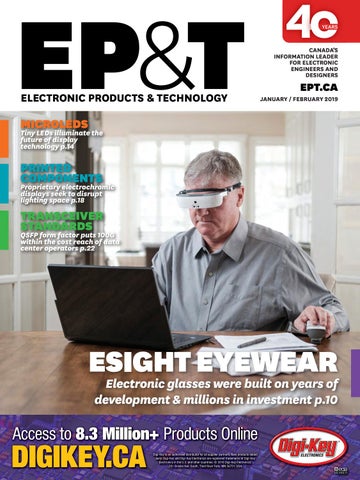
ESIGHT EYEWEAR Electronic glasses were built on years of development & millions in investment p.10
10 14
Cover photo: eSight Corp. Photos (this page, from top): eSight Corp.; Getty Images; Ynvisible Interactive Inc.; Getty Images
INSIDE Columns
4 EDITORIAL electronica lives up to expectations 9 WEST TECH REPORT Van City’s gaming biz yields VR arcades
In every issue
7 NEWSWATCH 25 PRODUCT SOURCE 25 AD INDEX 26 A LOOK BACK EP&T 40th anniversary
JANUARY / FEBRUARY 2019
COVER STORY
10
14 18 22
WEARABLE TECH Built on years of development and millions in investment, eSight glasses help visually impaired. 12 XCO Tech to launch sport performance wearables.
OPTOELECTRONICS Tiny LEDs called MicroLEDs are lighting up the future of display technology.
18
PRINTED ELECTRONICS Electrochromic display components disrupt lighting sector 20 New products DATA CENTRE UPGRADES Emergence of the QSFP form factor puts 100G within the cost reach of small and hyper-scale data center operators.
22
Connector Craftsmen for Over 35 Years Learn about our Connector Customization Capabilities by viewing our new video. WWW.ADVANCED.COM
Prototype to Production Volumes | IC Sockets | Adapters | Board to Board Connectors @EPTmagazine
401.823.5200 | info@advanced.com | Made in the USA January/February 2019 / EP&T
3
EDITORIAL
Electronica lives up to hype World’s largest B2B trade show for electronics designers grows in exhibitors, attendees
Canada’s information leader for electronic engineers and designers JANUARY / FEBRUARY 2019 Volume 41, Number 1
EDITOR Stephen Law slaw@ept.ca · (416) 510-5208 WEST COAST CORRESPONDENT
Simply put – it is the largest trade show on the planet relating to electronic components and design. It is also the best place to gain insights for our technology sphere. It is electronica, and it was held this past November in Munich Germany. The biennial B2B event drew more than 80,000 visitors from around the globe, exploring the latest developments in our world. Despite the continuing rise in access to information these days via social media and other internet related means, electronica’s relevance still resonates today. This was reflected by an 8% increase in exhibitors, a 20% boost in exhibit area - along with 10% growth in the number of visitors. Having attended electronica first-hand, the show had no trouble living up to its slogan of ‘connecting everything — smart, safe and secure’. Many were focused on three main technologies: artificial intelligence (AI), home automation systems and medical electronics. It should be no surprise that AI was a core theme at the event, as it is becoming prominent in every sector, including the medical and home automation
market. Echoing the growing influence of AI in everyday life, Kurt Sievers, president NXP & CEO NXP Semiconductors Germany offered, “first, AI needs a functioning communications infrastructure. Second, consumers will only embrace AI if they can approach it with a sense of security and trust.”
AI Inside
A number of industry leaders huddled to discuss the importance of AI in electronic designs - from an educational perspective. Participants in a CEO round table included Reinhard Ploss of Infineon, who emphasized the need for a sustainable approach to AI issues. “We need to understand what we can use AI for and what not. Big data plays a major role in communication, energy and transportation. AI makes sense in those sectors in order to increase efficiency and cut costs,” added U.S. economist Jeremy Rifkin on the first day of the fair. “We have a raft of strong industries in Germany. Artificial intelligence will enter them everywhere and supplement or even replace existing things. It’s therefore important to develop an AI strategy in order to establish a digital industry,” Ploss added. Recognizing the shortage of
EP&T CELEBRATES 40 YEARS
Can you remember when a CRT-screen computer terminal operating with a Megabyte dual floppy-disc operation was ‘advanced’ technology? Well, we can. The magazine you hold in your hands has just entered middle-age, celebrating its 40th anniversary of publishing. Launched in June of 1979, Electronic Products and Technology (EP&T) magazine began its journey evolving to become the go-to source for new products, application articles and news directed to electronic OEM engineers and designers in Canada. In honour of the four decades we have delivered the latest innovation information, we have dedicated our editorial backpage to a regular feature throughout this year. So, be sure to spend some time on page 26 reminiscing about where we began.
Connect with EP&T magazine @EPTmagazine
4
facebook.com/EPTmag/
skilled labour in electronics design circles, electronica formed a successful format to inspire students to engage in electronics. It focused on networking between exhibitors, students and trade visitors. On all four days of the trade fair, applications, live demos and a jobs fair provided insights into professions relating to electronics. Our industry continued to see significant growth in the adoption and development of smart wearables in the past year. Such innovation was on display, from smoking cessation patches to devices that can monitor the breathing of sleep apnoea sufferers. There is no doubt wearable medical devices have the potential to revolutionize healthcare. This year’s electronica marked the successful premier of Medical Electronics Conference (eMEC), which was devoted to the topic of engineers and physicians together - to network. The topic of their discussion was ‘The Connected Human: Healthier thanks to electronics and data?’ Digitalization of our health systems is already leaving its mark. The vision ‘Medicine 4.0’ from electronic patient records (ePA) to intelligent neuroprostheses – these technologies will not become reality without sensors, mobile devices and secure software solutions. All this is the task of electronics, but in the end patients and medical staff decide what will prevail. Based on the continued incorporation and complexity of electronics into every aspect of our lives, the next generation of innovation will continue to expand into new areas yet. STEPHEN LAW Editor slaw@ept.ca
Sohail Kamal sohail@nextgear.ca
PUBLISHER Scott Atkinson
satkinson@ept.ca · (416) 510-5207
ACCOUNT MANAGER Joanna Malivoire
jmalivoire@ept.ca · direct 866-868-7089
MEDIA DESIGNER Mark Ryan
mryan@annexbusinessmedia.com
CIRCULATION MANAGER Anita Madden
amadden@annexbusinessmedia.com Tel: 416-442-5600 ext. 3596
ACCOUNT COORDINATOR Tracey Hanson thanson@annexbusinessmedia.com VICE PRESIDENT - EXECUTIVE PUBLISHER
Tim Dimopoulos tdimopoulos@annexbusinessmedia.com PRESIDENT & CEO Mike Fredericks
EP&T is published eight times per year by ANNEX BUSINESS MEDIA
111 Gordon Baker Road Suite 400 Toronto, ON M2H 3R1 Tel (416) 442-5600 Fax (416) 510-5134 www.annexweb.com SUBSCRIPTION RATES
Canada – $58.50 one year; $94.00 two years USA – $103.00 per year International – US $141.00 per year Single copy – Canada $15 CIRCULATION
blao@annexbusinessmedia.com Tel: 416-442-5600 ext. 3552 Fax: 416-510-6875 or 416-442-2191 ISSN 0708-4366 (print) ISSN 1923-3701 (digital) PUB. MAIL AGREEMENT NO. 40065710
Return undeliverable Canadian addresses to: EP&T Circulation Department, 111 Gordon Baker Rd. Suite 400, Toronto, ON M2H 3R1
© 2019 EP&T. All rights reserved. Opinions expressed in this magazine are not necessarily those of the editor or the publisher. No liability is assumed for errors or omissions or validity of the claims in items reported. All advertising is subject to the publisher’s approval. Such approval does not imply any endorsement of the products or services advertised. Publisher reserves the right to refuse advertising that does not meet the standards of the publication. Occasionally, EP&T will mail information on behalf of industry-related groups whose products and services we believe may be of interest to you. If you prefer not to receive this information, please contact our circulation department. PRINTED IN CANADA
info@ept.ca
ELECTRONIC PRODUCTS & TECHNOLOGY / January/February 2019
ept.ca EPT.CA
Transformers
Enclosures
Call us at 1-800-463-9275
newark.com
Discover Over a Million
Engineering Products from Suppliers You Know and Trust
ยง 900+ new products added each week ยง Custom services such as kitting, panel meters, enclosures, and many more! ยง Market-leading online community of over 500,000 engineers
NEWSWATCH EMC WIRELESS TEST
NEMKO UNVEILS TESTING FACILITY IN KW REGION
Nemko Canada Inc., has firmly established a beachhead in rapidly growing Kitchener/Waterloo tech region with its recent opening of a 10,000-squarefoot EMC / wireless testing and certification facility in Cambridge ON. A division of Nemko AS, an 85-year-old product testing and certification firm headquartered in Oslo, Norway, delivers resources that accelerate all aspects related to commercialization of new technologies onto the market. Nemko provides assess compliance with standards & regulations relating to products, systems, facilities or personnel. Sim Jagpal, GM of Nemko Canada underscores the importance of being in close proximity to Waterloo’s burgeoning tech market, especially as it relates to the explosion of IoT designs.
PROCESS CONTROLS
OMEGA ENGINEERING UPDATES CAN CON SITE
Sensing and process control experts Omega Engineering, Norwalk CT, has created a Canada-specific website that delivers cutting-edge functionality, as well as improvements that make it easier and more seamless to order products, search for content, or manage accounts. “We tried to create everything with the idea of ease of use,” says Joe Vorih, CEO of Omega. “Even very complicated processes like paying with credit or Net 30, we’ve tried to make simple and limit friction for our customers.” Part of the new website launch also includes revamping other digital properties, such as a integrating a new CRM, a new order-tracking system, and more secure and organized data management. Improvements in order placement have also been added to the site, such as improved processes for customer updates on order status and shipping.
Photos: Nemko Canada; Tulsar Canada
PANEL BOARDS
TULSAR CANADA CONTINUES TO GROW PANEL BOARD BIZ
The move to Brant County, Ontario has supported a period of unprecedented growth for Tulsar Canada — and there is more to come in 2019, according to company president @EPTmagazine
Nemko unveiled a 10,000-square-foot EMC / wireless testing and certification facility in Cambridge ON.
George Micevski. A leading designer and manufacturer of custom, hand-assembled electronic control panels, Tulsar has tripled to roughly 100 employees Tulsar Canada since relocating in president George the spring of Micevski. 2017. “It has unquestionably been a good time for Tulsar since moving to Brant County (West of Hamilton),” Micevski adds. “We will have some new product launches and rollout direct to consumer sales through a major retailer over the next few months. One of the biggest challenges we have had is filling the jobs we have available.”
CONTRACT MANUFACTURING
DORIGO INSTALLS 3D SOLDER PASTE SYSTEM
3Xs
Maker of custom, hand-assembled electronic control panels, Tulsar has tripled its staff to 100 employees since relocating in the spring of 2017
VARITRON EXPANDS ITS EMS REACH
Varitron Inc., Saint-Hubert QC, a leading integrated electronic manufacturing services (EMS) provider, has acquired all the assets of XCELSIA Technologies, a Mirabel QCbased manufacturing services provider specializing in electronic circuit assembly. “This new site will be dedicated to prototyping and small-batch production, in an effort to better serve our customer base,” explains Michel Farley, president and CEO, Varitron Group. “With this move, we will enhance our overall capacity. And, with this strategic positioning in Montréal, we will be able to better serve the Greater Ottawa Region and access a broader pool of talent,” Farley adds.
EMS
Varitron’s new site in Quebec will be dedicated to prototyping and small-batch production
Looking at ways of speeding up its production processes, electronics manufacturing services (EMS) provider Dorigo Systems Ltd., Burnaby BC, has integrated the Koh Young KY8030-3 Solder Paste Inspection (SPI) and 3D AOI system into its high speed printed circuit board (pcb) assembly lines providing true 3D optical inspection. According to Dorigo business development manager Paul Vasvary, the EMS provider is one of only a few in Canada that uses a true 3D measuring system providing foreign material inspection for the entire PCBA – vastly improving the ability to detect board defects during the manufacturing process.
CYBERSECURITY
BLACKBERRY ADDS AI, CYBERSECURITY SKILLS
BlackBerry Ltd. has agreed to acquire Cylance, an artificial intelligence and cybersecurity leader, with the deal expected to close in February, 2019. “Cylance’s leadership in artificial intelligence and cybersecurity will immediately complement our entire portfolio, UEM and QNX in particular,” says BlackBerry executive chairman and CEO John Chen. “We are very excited to onboard their team and leverage our newly combined expertise. We believe adding Cylance’s capabilities to our trusted advantages in privacy, secure mobility, and embedded systems will make BlackBerry Spark indispensable to realizing the Enterprise of Things.” Cylance is a pioneer in applying artificial intelligence, algorithmic science, and machine learning to cybersecurity software. January/February 2019 / EP&T
7
NEWSWATCH DISTRIBUTION
DIGI-KEY UNVEILS IOT DESIGN TOOL
Global electronic components distributor Digi-Key Electronics has introduced a new design tool called the DK IoT Studio, an integrated development environment (IDE) that aims to provide a radically simple way for developers and providers to create IoT solutions.
The aim of the studio is to allow users to move from idea to prototype in minutes without writing any code. The new tool, developed in partnership with Atmosphere IoT, has an intuitive user interface along with dragand-drop functionality. Simply dragging sensors, processors, and other library elements and dropping them onto the design panel allows a user to make connections and start collecting data and sending it to a mobile device
or the cloud. The web tool also generates the embedded code (firmware), as well as the web and mobile application code. Digi-Key is also providing $15K in financial support to assist the launch of the Independent Manufacturers’ Representative Council within the Electronic Component Industry Association (ECIA). “This group has aggressive initiatives and this pledge will
help make them a reality benefiting the industry while strengthening the association to become an even more vital advocate of the authorized channel,” says Alan Ahern, president of Crowley Associates & chairman of the rep council.
ALLIED ADDS WERA TOOLS
Allied Electronics & Automation, Fort Worth TX, has signed a distribution agreement with Wera Tools, a German-based tool manufacturer specializing in high-quality fastening tools. Wera Tool has 1,042 solutions available, including screwdrivers specifically designed for various applications (including anti-static, insulated, etc.), a wide range of screwdriver bits, for either hand or power use, ratchets, wrenches and torque tools.
IRWIN TO DISTRIBUTE PEM FASTENERS
PennEngineering, a global leader in the development and manufacture of precision fasteners, expanded its sales channels in Canada by signing an agreement with Irwin Industrial, Aurora ON, to distribute its PEM fasteners product range PEM brand fasteners utilize self-clinching, broaching, flaring, surface-mount, bonding, or welding technology to provide strong, reusable, and permanent threads, and mounting points, in thin sheet metal, P. C. board, or other rigid material.
CoaxStrip 6580
New High-Performance Coaxial Cable Stripping Machine The CoaxStrip 6580 is a fully programmable multi-step stripping machine for coaxial, triaxial, and multi-conductor cable as well as single conductor wire. State-of-the-art electronics, a clear user interface, and precision mechanics guarantee repetitive, unmatched Schleuniger stripping quality. The CoaxStrip 6580 is ideal for low volume, quick changeover applications as well as high volume production runs, giving the best possible flexibility and productivity to your production methods. schleuniger.com/cs6580_ept To Be Precise. 8
ELECTRONIC PRODUCTS & TECHNOLOGY / January/February 2019 EPT_JanFeb_SchleunigerHalf.indd 1
Newark element14 has launched an AI Configurator tool that allows engineers to quickly select the most appropriate development solution for their artificial intelligence (AI) projects. The configurator, found at https://canada.newark.com/ ai-configurator, enables users to identify the development boards, associated add-on boards, accessories and software that best meet their needs from a wide range of vendors. The web tool means that engineers don’t need to be experts on products from every vendor to ensure they are using the best technology to support their designs. EPT.CA
2019-01-08 3:37 PM
Photo: Digi-Key
NEWARK LAUNCHES AI CONFIGURATOR
WEST TECH REPORT
Vancouver’s powerhouse film, gaming industries yields VR arcades
Photo: YDreams
Daniel Japiassu, director & chief executive officer, YDreams
It shouldn’t surprise anyone that Vancouver’s fast emerging virtual reality (VR) and augmented reality (AR) sectors have emerged from its strong existing film, video game and tech industries. Vancouver has built the third largest film & TV production centre in North America and one of the top visual effects and animation clusters globally, but it is the convergence of film, visual effects, animation, games and technology that might explain the growth of YDreams. Since 2013,YDreams has been working with virtual reality for its clients. They were originally based in Brazil, but with Vancouver’s VR strength, as well as the grants and funding available to tech companies,YDreams decided to move its head office to Vancouver. West Tech Report spoke recently with Daniel Japiassu, an avid gamer, director and CEO of YDreams. VR has been a fast-growing industry over the past decade, as the hardware has seen a lot of improvements. More recently, it led YDreams to launch a location-based, entertaining VR solution called Arkave VR. The Arkave virtual reality platform is an ultra-modern arcade, or more specifically, a gaming arena that brings the most immersive @EPTmagazine
experience of virtual reality. The firm plans to open a location in both Vancouver and Toronto in 2019 to mimic the success of their first virtual reality arcade in Brazil. “Arkave VR was a product that would have what we considered the most important features for gamers in VR: multiplayer. So it would be a social encounter, [with] freedom of movement to create fully immersive content and that included a full-body gameplay,” explains Japiassu, who leads a team of about 40. Since then, the technology continued to develop, which allowed for certain upgrades to the Arkave VR product. Partnering with HTC, their systems feature the HTC Vive and conventional computers, building some of the world’s most advanced multiplayer virtual reality experiences.
Government help
When asked about their decision to move from Brazil, Japiassu explained that their choice of location was made due to Vancouver’s strength as an amazing hub for VR: “There are a large number of companies here generating great content. The community is very open to collaboration and there is a sense of growing together that is hard to find.” Another key element was how active the BC and Federal governments were in helping companies develop. “We were looking for different options for bringing YDreams to North America and different options for investment and funding,” Japiassu says, adding that funds for startups and tax incentives for growing tech firms were very helpful, but it also helped that there were people interested in investing directly. “We were invited by a group from Vancouver to take the
company to the Canadian Ventures exchange, and we discovered the VR ecosystem there and loved it.” YDreams has seen its share of challenges as well. The project and service-based business model is still difficult to work through, explains Japiassu. “Although it is great to work with big brands in highly innovative, customized projects, it pushes our team to keep ahead of the game, to keep up with new equipment and techniques. At the same time, it forces us to be nimble.”
Unpredictable workload
YDreams Global has developed more than 1,300 projects for clients all over the world, such as: Disney, NBA, Adidas, Cisco, Nokia, Nike, Mercedes Benz, Coca-Cola, Santander, AmBev, Qualcomm, Unilever, City of Rio, and Fiat. “The workload from these clients can be unpredictable,” says Japiassu.”This makes it hard to plan ahead and keeps us on our toes.” YDreams have been successful by making sure that the company has different sources of revenue
and ideally at least one product that has the potential to scale and offer a steady flow of income to the company. That makes it easier to navigate the rapid changes that they see in technology. “Have something for the present, while working on something for the future,” advises Japiassu. “You can´t slow down your innovation or you will be left behind, but, you can´t be solely innovative; you have to offer something that will be useful for a while and provide some stability. That´s how we see it.” Overall, Japiassu feels that this is a great time to be an entrepreneur and to work in technology. “Evolution in the whole ecosystem has been tremendous in the past 10 to 15 years. There is a formula for creating startups that you learn along the way, and different levels of investors who can give you boost at every milestone.” Perhaps one day, our gaming world will converge on other areas such as education. It may present new ways to train a police team, or it might teach kids how to use math in a group setting. Either way, YDreams continues to alter reality. January/February 2019 / EP&T
9
WEARABLE TECHNOLOGY
COVER STORY
Electronic eyewear helps the visually impaired see eSight eyeglasses are built on innovative technology and years of development and millions of dollars in investment
Brian Mech, ph.D, president & CEO of Toronto-based eSight Corp. says his engineering team requires a diverse set of skillsets and capabilities to develop these electronic glasses.
eSight eyewear enables the visually impaired to see better. The glasses provide a number of special features, ranging from spot zoom to Bluetooth/WiFi connectivity.
Describe the technology behind the eSight glasses and how they operate. eSight leverages multiple leading-edge technologies to deliver sight, and is the only medical device in its space to do so. eSight uses its own high definition camera and lens to capture the surroundings of the wearer. Then it uses our patented prism technology and display integration to provide high quality images to each eye. eSight also has proprietary image processing algorithms that run on the latest mobile ASIC chips for very low latency processing, enabling seamless 10 ELECTRONIC PRODUCTS & TECHNOLOGY / January/February 2019
viewing of the environment for our wearers. Finally, the custom-built eSight frame allows for our proprietary / patented Bi-optic Tilt capability, providing wearers with the ability to use their peripheral vision and be mobile while also supporting prescription lenses via the carrier frames – a feature unparalleled in the industry. Further explain some of the features and functions of these electronic glasses. Spot Zoom – Ability to zoom out quickly for a full look at your surroundings, and then quickly zoom into a more detailed perspective as soon as any desired object of focus is determined. Auto Focus – Allows the user to view objects with maximum clarity and sharpness. Zoom Function – Supports a maximum zoom function of up to 24x. Contrast Modes – Provides the wearer with an ability to increase and decrease contrast, along with additional contrast modes in varying colors that can enable even greater visibility. Brighter Images – Supports a wide range of brightness modes that go well above natural, ambient levels. HDMI Input – Allows our users to connect HDMI to their personal devices to view movies, TV games and other media directly on their eSight.
Video / picture storage – Provides wearers the ability to shoot and store videos and pictures onto the SD card embedded into the device. Optical Character Recognition (OCR) – Allows wearers to do text-to-speech synthesis, enabling wearers to listen to books and other text should they choose to do so. eReader – Support for PDF format, allowing wearers to open and view their digital files in the device directly. LED Light – Provides further lighting should the wearer require it. Bluetooth / Wi-Fi Connectivity – Enables eSight to be easily connected to the Internet. Power Consumption – Able to support up to 8 hours of use as needed. What is the background of your engineering team and what technology disciplines of expertise were required to create
these glasses. Our engineering team requires a diverse set of skillsets and capabilities in order to be able to develop this revolutionary and breakthrough product. It consists of optical engineers to design the lenses and sensors, hardware engineers to design the printed circuit boards and chips, real-time software engineers to do the low latency programming, mechanical engineers to do EPT.CA
Photo: eSight Corp.
Leveraging multiple leading-edge technologies, Toronto-based tech firm eSight Corp. has designed and developed a set of electronic glasses that let the visually impaired see. Representing the only clinically-validated device on the market that enables those living with vision loss to see, the eSight glasses are worn comfortably like a normal pair of glasses, allowing the user to be mobile and engage in virtually any activity of daily living. Almost instantly after putting them on, an individual with low-vision can see in virtually the same manner as someone who is fully sighted can. eSight is a breakthrough technology, packed into a lightweight, wearable and clinically-validated device. There are several patents and technological innovations built on years of development and tens of millions of dollars in investment. Here, EP&T Magazine speaks with Dr. Brian Mech, Ph.D, president and CEO of Toronto-based eSight Corp.
the headset design, digital signal processing engineers to implement our proprietary image processing, system test engineers to verify the full function / capability of our product, compliance engineers to enable proper compliance to certifications / medical devices, and manufacturing engineers to ensure stable high quality manufacturing of our glasses in our Ottawa plant. Our technology team comes from well-known companies such as Lockheed Martin, General Dynamics, Alcatel-Lucent, Nokia, Honeywell, with backgrounds in products developed for use in all industries: Everything from consumer, telecom, aerospace and beyond - even tech from within the NASA Shuttle. In addition to their engineering degrees, more than half of our team have specialized postgraduate degrees as well. Outline the components used to create eSight glasses. We use high speed mobile ASIC chips, along with our proprietary prism design and high brightness / contrast OLEDs for displays. The mechanical design is intended to reflect a lightweight, comfortable, glasses-based form factor which can best enable peripheral vision. We also have a custom controller made to enable intuitive usage, and an easy-to-use user interface within the device itself.
Photo: eSight Corp.
How long did the design process take from start to finish and share some of the key design challenges. It took us more than two years to complete the full design of eSight 3, with the primary design challenge being the development and creation of the prism that allows our device to gather the light and then focus it onto the correct part of the eye for our wearers. The precise tolerance / accuracy levels we needed were challenging to implement in a manufacturing environment, so we had to devise new processes and controls to ensure that they were kept tight and accurate. What is the size and scope of eSight’s engineering team. How important is it to have all the different levels of engineering disciplines communicating openly with each other? We have about 20 dedicated and experienced engineers who work to @EPTmagazine
The most critical design element of these electronic glasses is that they enable sight and improve the quality of life to the user
The precise tolerance/accuracy levels we needed were challenging to implement in a manufacturing environment, so we had to devise new processes and controls to ensure that they were kept accurate make eSight a reality. We believe it is critical to ensure that all of our engineering disciplines work together as one to ensure the best possible technology, as we constantly have to deal with tradeoffs between size, weight, power, heat, and form factor, as well as the realities of timelines and resource requests. Does the eSight engineering team work in collaboration with research or medical experts in other fields? Yes. We have done collaborative work with world-renowned organizations such as the University Health Network, Johns Hopkins, and the Kellogg Eye Centre just to name a few. Aside from the eSight electronic glasses, what other future design projects are you working on? Our research and development is currently
focused on leveraging core eSight technology to help those who are not visually impaired perform tasks that may be difficult or impossible with regular sight. While continuing to refine our technology for the visually impaired, we also intend to explore how that work can improve the safety, efficiency and effectiveness of how people can work in fields such as medicine, manufacturing, security and beyond. Which design element do you consider as the most critical to the success of the electronic glasses? The most critical design element to the success of our electronic glasses is how it focuses on the consumer, and how we can enable sight in a way that will best improve their quality of life and ability to live independently. We understand the experiences of the visually impaired, and we do our best to figure out the best way to bring them vision exactly where and how it is needed – for example, this is why enabling mobility is particularly important to us. We want eSight wearers to see the world and change the world. January/February 2019 / EP&T
11
WEARABLES
PRODUCTS
XCO Tech prepares to launch sport performance wearables BC firm secures Government funding for its precision medicine products XCO Tech Inc., Penticton BC-based wearable tech firm is hoping to expedite the commercialization of its proprietary wearable XPS and BioAnalytics technologies, now that it has received the backing of the Federal Government. The breakthrough products for sport performance training and concussion assessment will receive $800,000 in funding via the Western Innovation (WINN) initiative, a program of Western Economic Diversification Canada (WD). The firm uses its proprietary technology in creating XPS and BioAnalytics, aimed at delivering an innovative sport performance training and rehabilitation product together with a comprehensive concussion assessment system. These devices provide insightful digital biomarkers to better
guide training, rehabilitation and treatment. Precisely analyzing human motion, biometrics and cognition, XCO’s products are enabled by the firm’s technology platform, which fuses motion tracking outcome measures with biometrics and cognitive digital biomarkers to provide objective insight into human performance and health. XCO’s biomed solutions will enhance the performance of athletes in professional and amateur sports, as well as, aid in the treatment and rehabilitation of concussed and injured individuals, according to Scott McMillan, CEO of XCO.
“The WINN funding complements the financial support from other government programs and from the company’s private investors,” McMillan says. “The funding will accelerate our testing and manufacturing of the sport performance and concussion products and as a result, XCO is on track to achieve its goals of commercial market introduction in 2019.” Pre-commercial versions of the firm’s technology were tested by the Canadian National Short Track Speed Skating team and in the training of youth soccer players that aspire to be tomorrow’s sport stars. Held to a high standard, all of XCO’s products are undergoing thorough evaluations at the world renowned Human Performance Lab at the University of Calgary.
Wireless data glove incorporates haptics, rapid sensing BeBop Sensors’ lightweight & one-size-fits-all for comfortable, wireless use
Bring Designs to Life in 3D
Patrick Lucas Austin, a technology columnist with TIME, thinks that the ability to have digital ‘hands’ in virtual
reality could be a game changer for creative professionals, allowing them to bring their designs to life in a three-dimensional VR space. “California-based BeBop Sensors is making that possible with its Forte wireless gloves, which allow users to grab and manipulate digital objects as if they actually existed in real life. Thanks to flexible sensors embedded in their fabric design, the Forte gloves can track more of a wearer’s hands than other virtual-reality gloves (most of which are designed for simpler uses in video games). That translates into far better accuracy when replicating a wearer’s movements. Architects, for instance, are already using the Forte
12 ELECTRONIC PRODUCTS & TECHNOLOGY / January/February 2019
gloves to assemble VR models of their buildings that make it easier to see how they will look when constructed in real life,” Austin concluded. “Our gloves help the user blend with the VR environment, with embedded haptic actuators that allow you to feel the texture of different surfaces, as well as provide feedback when you pick up something or push against an object,” says Keith McMillen, founder and CEO, BeBop Sensors.
Behind the design
BeBop Sensors uses smart fabrics to create elegant sensor solutions for OEMs. Where things or people interact, BeBop Sensors comprehends force, location, size, weight, bend, twist and presence across any size, resolution and geometry. BeBop’s technology is robust and proven with over two million sensors in daily use. EPT.CA
Photo: XCO Tech Inc.; BeBop Sensors
BeBop Sensors, a Berkeley California-based creator of smart fabric sensor technology recently released the first fully featured affordable wireless data glove to incorporate haptics and super accurate rapid sensing. The BeBop Sensors data glove is suitable for a wide variety of applications, including industrial, medical, human factors, virtual reality, gaming, design, to name some. The ultra-comfortable gloves are created for over 15 hours of wireless use, in a light-weight, one-size-fits-all format. Adding to its consumer street cred, the Forte Wireless Data Glove recently gripped TIME Magazine’s Best Inventions 2018 Award.
The Smart Choice for Small Spaces
Coilcraft is the brand engineers trust most when specifying tiny inductors for compact devices Boost the performance and battery life of your smallest designs with these tiny RF and power inductors from Coilcraft: • Wirewound chip inductors as small as 0201 size for wireless communications • Shielded power inductors as thin as 0.71 mm for power management • Coupled inductors as small as 2.2 x 1.45 mm for LED display drivers
You can get started by using our suite of web tools to quickly locate the perfect inductors for your design. Compare and analyze multiple parts based on your true operating conditions, and then order free evaluation samples with just a click. Learn why we’re the biggest name in ultra-miniature inductors. Visit us at www.coilcraft.com.
®
WWW.COILCRAFT.COM
OPTOELECTRONICS
FEATURE
The future of display technology lies with MicroLEDs In creating MicroLED technology, engineers have crammed dramatically smaller LightEmitting Diodes (LEDs) onto the same surface area than previous generations of LED screens - millions more BY ANNA KUCIRKIVA, IQS DIRECTORY Over the years, many hightech screen technologies have come and gone. From traditional tube televisions to projectors, plasma screens to LCD and now oLEDs, the consumer market has seen all manner of screen formats, definitions and materials. As the smartphone, tablet, and highdef TV markets have exploded, there is a non-stop arms race between manufacturers to make screens that are thinner, smaller, brighter and higher-definition than the competition. Usually, these factors are measured as single percentage point differences–until now. The advent of MicroLED technology promises to radically redefine how screens are made, what specs can be packed into screens of all different sizes and the level of resolution LED screens are capable of. MicroLED technology is, at least in name, relatively straightforward. Engineers have created dramatically smaller Light-Emitting Diodes (LEDs) and crammed more of them onto the same surface area than previous generations of LED screens. Millions more. LEDs are the miniature ‘bulbs’ that create light in screens, as well as in more traditional applications like flashlights, car head and tail lights, and traditional light bulbs. The difference between LEDs and filament bulbs is as dramatic as the difference between the first telegraph and today’s smartphones, but in both cases, they aim to achieve the same function. So, microLEDs are a multifaceted
microLED technology in consumer products–until now. To-date, there’s been a limit to how small manufacturers could make LED boards, not only because of the size of diodes, but because of the ‘pitch’ size, which is the space between each LED and what that spacing means for the screen’s resolution. Hardware technology and manufacturing processes are often limiting factors, because LEDs could only be made so small and mounted to circuitry of a certain size and efficiency. Instead of the few dozen yellow-blue traditional LEDs in today’s LED screens, microLED screens contain millions of LEDs, or one for each pixel. This number is then tripled, because microLED screens utilize red,
There has been a limit to how small manufacturers could make LED boards, based on diode size and the diode’s ‘pitch’ size
14 ELECTRONIC PRODUCTS & TECHNOLOGY / January/February 2019
Photo: Getty Images
What is MicroLED?
improvement in the technology that links LEDs and images produced on a screen. MicroLEDs shrink the size of LEDs by a lot, which means more of them can fill the same space previously occupied by one diode. This increases resolving power and ability to render detail, but comes at the expense of brightness. That has historically been the sticking point for shrinking LEDs in screen applications. Making microLEDs as bright as their traditional counterparts requires more power, greater diode efficiency, or both. Cranking more energy into more, smaller LEDs means more heat, greater battery drain and increased manufacturing complexity. All of these drawbacks have been enough to prevent manufacturers from pursuing and implementing
EPT.CA
Connect to the World Interpower® Accessory Power Strips make it easier to connect to the world. Product designers can design electrical equipment to be sold globally by simplifying power supply connections using an Accessory Power Strip with IEC 60320 components. At its core, this power strip incorporates an AC power inlet with multiple AC power outlets. Other features may include power on/off switches and circuit protection. The Accessory Power Strip allows different components to work together in one system. For example, instead of making five different systems to export to five different countries, use this one system and add a cord set with a country-specific plug. This allows the same system to be exported globally with cost-saving benefits. To help prevent accidental power interruptions, some Interpower Accessory Power Strips include the new Interpower Connector Locks. This patent-pending design does not require tools for use.
Pursue Quality Products that Can Power Your Business •
1-week U.S. manufacturing lead-time on non-stock Interpower products
•
Same day shipments on in-stock products
•
No minimum order or dollar requirements
•
Lock in your price with blanket or scheduled orders
•
Value-added options available
•
Free technical support
Contact Customer Service at Interpower for more details.
Order Online! www.interpower.com
®
®
Business Hours: 7 a.m.–6 p.m. Central Time
INTERPOWER | P.O. Box 115 | 100 Interpower Ave | Oskaloosa, IA 52577 | Toll-Free Phone: (800) 662-2290 | Toll-Free Fax: (800) 645-5360 | sales@interpower.com
microLED display research and on the opposite end of the spectrum. Apple believes that microLEDs could make future iPhones even thinner and brighter than the latest-generation organic OLED displays. MicroLEDs are currently regarded as the sort of futuristic technology that OLEDs were considered three to 5 years ago.
OLED vs. MicroLED
green and blue LEDs. Each RGB trio delivers one ‘pixel,’ which you can imagine adds up quickly on a TVsized 1080p screen. Thousands of pixels comprise individual modules, and multiple modules make up a given screen. Shrinking LEDs provides resolving power, but it entails hardware complexity. Only recently have hardware and manufacturing technology advanced to a point that LED screens can feasibly make the shift towards microLED. The first MicroLED TV to debut is Samsung’s ‘The Wall,’ a frameless, modular screen that offers industry-leading resolution and an industry-first modular capability that could allow end users to expand their TVs as applications change. At CES 2018, Jonghee Han, president of Visual Display Business at Samsung Electronics, said, “As the world’s first consumer modular MicroLED television, ‘The Wall’ represents another breakthrough. It can transform into any size, and delivers incredible brightness, color gamut, color volume and black levels.” These points highlight many of the promising breakthroughs and benefits of microLED technology, from the ability to deliver brightness and resolution and clearly defined black levels, all issues with generations of plasma and LED HD TVs. Even most of today’s LED screens are actually hybrid LCD/LED screens
that use one element (Liquid Crystal Diodes) to create the picture and another (the LEDs behind them) to backlight the screen. In essence, this is an extremely high-tech take on old projector TV screens and they come with their own set of problems; including: image distortion or blackout from wide viewing angles, light bleed in dark sections of the screen, thick screens that require two different layers, and limitations on maximum brightness due to the pass-through nature of the screen element.
In essence, this is an extremely hightech take on old projector TV screens and they come with their own set of problems Despite that the Samsung Wall is a massive screen, debuting in 120-inch format, the manufacturer has not mastered microLED technology at smaller screen sizes. The complications surrounding scale of LEDs, power and heat generation, and cost and complexity mean that for now microLED is only being presented as a solution for massive, high-end screens. However, like many other technologies, what starts as a premium niche product may soon become the norm. It has been widely reported that Apple is working on its own
16 ELECTRONIC PRODUCTS & TECHNOLOGY / January/February 2019
Welcome to the future
The future of screen technology is almost certainly MicroLEDs. As with every cutting-edge technology, there is a learning curve for manufacturers as materials science and manufacturing processes struggle to catch up to the theoretical potential of this technology. Once manufacturing potential catches up to the rendering benefits of microLEDs, the leap from OLED to microLED could be rapid, leaving OLEDs behind as a single-generation technology that served as an interesting bridge to a new standard for screens from smartphones to TVs. Samsung has stated it plans to release consumer-facing microLED TVs sometime in 2019, while Apple has hinted that it believes the technology could appear in its phones within three years. As with all technological advances, if the first few products are successful, the floodgates will soon open. Combined with more efficient batteries, microLEDs will soon power all screen-dominated devices, bringing stunning resolution and brightness from the palm of your hand to filling an entire wall in your home. EPT.CA
Photo: Getty Images
Only recently have hardware and manufacturing technology advanced to a point that LED screens can feasibly make the shift towards microLED.
OLEDs are behind today’s cutting-edge screen technology for smartphones and tablets; their materials make them somewhat more cost-effective to produce than microLEDs given today’s manufacturing constraints. However, OLEDs suffer from one major drawback that will continue to create manufacturing demand for microLEDs; the O, which stands for ‘organic,’ means that OLEDs are manufactured using organic compounds. That means they are expensive to make and the cost likely will not subside due to raw material costs. It also means they are limited in maximum brightness as materials cannot be pushed further; similarly, extreme applications like always-on displays suffer from burn-in similar to early plasma screens.
P R O TO C A S E
Professional Grade | Made in 2-3 Days | No Minimum Orders
Custom Sheet Metal Parts & Precision Components For Engineers, Designers & Scientists
Your one-stop source for custom, fully-finished precision sheet metal parts
Powdercoat in a variety of textures Add graphics with digital print & silkscreen Variety of materials, hardware & fastener options Spot welding and seam welding Anodizing Chem-film coating
P R O TO C A S E
P
Customize your sheet metal parts to your needs:
P
Protocase manufactures custom sheet metal parts, such as brackets, plates, frames, arms, bus bars, fixtures and more, in 2-3 days, with absolutely no minimum order.
PROTOCASE DESIGNER® Free Downloadable 3D Enclosure Design Software
Protocase Designer is the fastest and easiest way to design, price and build your custom sheet metal parts. • Free 3D Enclosure Design Software • Instant Price Quotes • Buy Your Custom Parts Online • 2-3 Day Turnaround
protocasedesigner.com
Contact Us Today!
1.866.849.3911 | protocase.com
FEATURE
Ynvisible Interactive lights up display space with printed components Vancouver-based tech firm seeks disruption with its proprietary electrochromic displays With its goal of shedding new light onto the electronic display devices, Vancouve r - b a s e d Y nv i s i b l e Interactive Inc. hopes to disrupt the component sector with its proprietary electrochromic displays. The firm specializes in creating ultra-low power displays in printed electronics and has more recently created an advisory board - appointing its first members - Dr. Michael Okoroafor, Dr. Harlan Byker and Dr. Harri Kopola. “Ynvisible’s Advisory Board is meant to provide strategic input and support to the company as we grow our business,” says Ynvisible CEO Jani-Mikael Kuusisto. “Their trailblazing work to build strong collaborative networks across different industries and disciplines has brought ground-breaking innovations to fruition and wide market adoption.”
Ynvisible’s proprietary electrochromic displays are printable on plastic or paper and can be the face of every smart label.
Protective Layer Electrode Electrochromic layer
Electrolyte
Chromogenic systems
Dr. Michael Okoroafor, vice-president, global sustainability & packaging innovation at McCormick & Co., is highly acclaimed for his achievements in the consumer packaging industry. This fall, he was inducted into the Packaging and Processing Hall of Fame. Okoroafor is an innovation leader and has over 40 patents to his name and career with 30 years of experience building off his PhD in Polymer Chemistry from Michigan State University. Okoroafor has a unique background in working both with colour changing (chromogenic) systems, as well as novel packaging materials and concepts, including interactive packaging. Dr. Harlan Byker, founder and CEO of Pleotint, LLC, is a leading expert on electrochromism and thermochromism. He has over 30 years of scientific R&D, invention, manufacturing and patent experience. Byker gained his PhD in Physical Chemistry at Montana State University. He is an
inventor and/or co-inventor on 53 US patents. As a research scientist at Battelle Laboratories, Byker invented the chemistry portion of the first commercially successful electrochromic device, an automatic dimming rear view mirror for motor vehicles commercialized by Gentex, a company in which Harlan became a Board member and VP of Research, before founding Pleotint, a company focused on self-tinting building windows. Dr. Harri Kopola is a pioneer in the printed electronics industry, who
Electroactive layer Electrode Substrate
started his research on flexible substrates in the late 1990s within VTT Technical Research Centre of Finland, one of Europe’s leading applied technical research centers. From 2006-2009, Kopola led VTT’s spearhead program ‘Center for Printed Intelligence’ and in 2008 headed the founding of the PrintoCent printed intelligence industrialization community, which has produced 26 spin-off companies to date and linked these to a network of global scale companies.
Displays combine with sensors
Ynvisible’s displays use almost no power, while the firm’s proprietary electrochromic displays can be the face of every smart label. They are ultra-low weight, microscopically thin, flexible, yet robust. When combined with various sensors they bring functionality and life to smart products, ranging from smart cards to consumer-packaged goods. Given the cost and power-consumption advantages over conventional electronics, printed electronics are a key enabler of mass adoption of the Internet of Things (IoT). Electrochromics-based smart labels offer simple non-obtrusive human interfaces to smart IoT objects. Ynvisible’s mix of services, materials and technology is a diverse combination, which is winning favor among brand owners developing their IoT products for a huge market in its infancy. Since Ynvisible’s displays are printed, product designers can easily adapt electrochromics to the desired product design and required user experience.
Ynvisible’s displays are ultra-low weight, microscopically thin, flexible, transparent, and use almost no power.
18 ELECTRONIC PRODUCTS & TECHNOLOGY / January/February 2019
Photo: Ynvisible Interactive Inc.
OPTOELECTRONICS
EPT.CA
EPTECH 2019 MISSISSAUGA Mar. 7
MONTREAL Mar. 5
VANCOUVER June 12
CALGARY Apr. 16
WATERLOO Oct. 29
QUEBEC CITY Sept. 26
OTTAWA Oct. 31
Employing a highly time-efficient table-top display format, EPTECH shows target electronics designers, engineers, technicians, technologists, purchasers, technical managers and researchers. CONTACT US TO BOOK YOUR EXHIBITOR SPACE TODAY! EPT.CA/EPTECH/EXHIBIT/ Scott Atkinson, Associate Publisher: Tel: 416-510-5207 email: satkinson@ept.ca Joanna Malivoire, Account Manager: Tel: 1-866-868-7089 email: jmalivoire@ept.ca
OPTOELECTRONICS
NEW PRODUCTS
LCDS ARE TEMPERATURE, HUMIDITY RESISTANT
AZ DISPLAYS LCD monochromatic modules have integrated high-end polarizers and liquid crystal fluid, capable of passing stringent 85° C /85% RH (Relative Humidity) 1000-hours reliability test conditions. LCDs provide an enhanced operating temperature of -30°C to 80°C. At low temperatures, the liquid crystal fluid maintains its viscosity, allowing the IC to refresh the data logic without any latency in the response time. At the high extreme of the operating temperature spectrum, the polarizer and adhesive materials are able to withstand the heat without warping the film and damaging the optical performance of the LCD module. https://www.azdisplays.com
RIGHT-ANGLE SMD LED DOME LENS INCREASES INTENSITY
DIGI-KEY SunLED right-angle SMD LED dome lens measures 1.8mm x 0.6mm x 1.5mm and provides more flexibility in design. Product series offers an industry leading option of focused intensity in a 25° degree viewing angle for brighter illumination in the desired region. Devices achieve up to 15 times increased intensity over traditional right-angle LEDs. Narrower angles come with the benefit of eliminating light bleeding which further increases design appeal. Devices are suitable for light pipe applications due to a lower angle of incidence. Light rays can be reflected more efficiently and a brighter illuminated region results in stronger back-light and a more defined user interface. A full-color spectrum is available for a wide range of applications. https://www.digikey.ca
THINK
THIN 20 ELECTRONIC PRODUCTS & TECHNOLOGY / January/February 2019 EPT_JanFeb_Murata.indd 1
ULTRA-COMPACT, HIGHPOWER LED BOOSTS RELIABILITY OSRAM OSLON Square Series LED family of compact high-power LEDs that BOOST performance in a wide range of high-density lighting applications. Designed for both indoor and outdoor general lighting applications, devices feature an ultra-compact 3mm x 3mm (3030) package, with a range of color temperatures (CCT) from 2700K - 6500K , and a color rendering index (CRI) of 70, 80, or 90. Devices are binned by key parameters at 85°C, which more closely matches real-world application conditions. www.osram.com
PANEL MOUNT LED INDICATORS COME IN MANY COLOURS, STYLES X TRONICS APEM Q series of panel mount LED indicators are available in a very
large choice of colours, bezel styles and voltages. The construction of the stainless steel 316L Q22 device is paramount to withstand all weather conditions and applications. Bezel is made from 316L stainless steel and the superbright LED comes with an all-round homogenous light output. Devices are available in 2V through to 220Vac, with option of customized resistor values. Product’s potted back-end stops ingress of dirt, grit or moisture. Device operates within a temperature range of -40 to + 85°C xtronics.ca/
D1U54 Series The leader in 54mm high density Front End power supplies Designed to meet the requirements for mission critical telecom, server and networking applications Power
Efficiency
Density
Performance
Protection
Communication
AC-DC and DC-DC models ranging from 400 to 2000 Watts
www.murata-ps.com
EPT.CA 2018-12-18 11:54 AM
SOLUTIONS FOR HARSH ENVIRONMENTS
OPTO DIODE AXUV63HS1 high-speed photodetector with a circular active area of 9mm diameter, is suitable for electron detection. Device has a typical rise time of 10nsec and a maximum dark current of 100nA, with a minimum reverse breakdown voltage of 160 Volts. Product is shipped with a cover plate to protect the photodiode chip and the wire bonds. www.optodiode.com
PHOTONIC COMPONENT DESIGN SUITE SERVES AR/VR SYSTEMS SYNOPSYS Version 2018.12 of RSoft Photonic Component Design Suite advances the design of optics used in augmented reality and virtual reality (AR/VR) systems. Product supports firm’s optical design workflow for nano-textured diffractive optical elements that enable smaller, lightweight AR/VR devices with improved displays and immersive experiences. www.synopsys.com
DEVELOPMENT PLATFORM CUSTOMIZES LCD DISPLAYS AVNET SimplePlus Display Solutions is a platform that simplifies the process of customizing LCD touch display solutions for multiple applications. Platform provides the ability to meet user experience requirements without placing time to market and budget at risk. Platform shortens product development cycles by delivering @EPTmagazine
customers their first working unit within 48 hours, instead of the typical weeks or months for traditional samples. https://www.avnet.com
12-BIT, 29KHZ RGB LED DRIVERS ENABLE VIVID COLOUR
TEXAS INSTRUMENTS LP50xx family of LED drivers have integrated, independent colour mixing, brightness control and a power-saving mode. Models LP5018, LP5024, LP5030 and LP5036 enable smooth, vivid colour and reduce system power consumption. Devices offer a 29kHz dimming frequency, above human-audible range, to help designers of applications that use a human-machine interface. Devices permit smoother colour and brightness-level adjustments. www.ti.com/lp5018-pr
© Crown Copyright
9MM² CIRCULAR PHOTODIODE SERVES ELECTRON DETECTION
LEMO’s range of rugged quick release connectors are smaller, lighter and greener for harsh environment applications.
800V OFF-STATE
• T, M & F Series • IP68 rating
OPTOCOUPLERS BOOST ROBUSTNESS
• Space saving
VISHAY INTERTECHNOLOGY VOT8024AM and VOT8121AM optocouplers provide a phototriac output in a compact flat SOP-4 package. Devices deliver high off-state voltage of 800V and dV/dt of 1000V/μs, as well as high robustness and noise isolation. Devices isolate low voltage logic from 120Vac, 240Vac, and 380Vac lines to control resistive, inductive, or capacitive loads, including motors, solenoids, high current thyristors, or TRIACs and relays. Reducing design costs and saving board space, the devices consist of a GaAs infrared LED optically coupled to either a zero-crossing TRIAC (VOT8024AM) for EMI reduction without the need for external snubber networks, or a random-phase TRIAC (VOT8121AM) to enable phase-independent switching. www.vishay.com
• Robust design • Quick release mechanism • Light weight material options • RoHS & REACH 2017 compliant plating options
Cable assembly service Expand the quality of your connector to the cable assembly with LEMO onestop shop value-added cable assembly services. LEMO Canada Inc. T: 905-889-5678 Info-canada@lemo.com facebook.com/lemoconnectors/
High Quality Connectors and Cables
linkedin.com/company/lemo-sa
Contact your local partner on www.lemo.com
Ann_Military_TMF_85x279_en_2019.indd 1 EPT_Jan19_Lemo_.indd 1
January/February 2019 / EP&T 21
29.11.18 16:15 2018-12-10 10:20 AM
DATA COMMUNICATION & DATA CENTRES
FEATURE
Recent transceiver standards solve data center upgrade issues Emergence of the QSFP form factor puts 100G within the cost reach of both small and hyper-scale data center operators BY RAY HAGEN, CONSULTING SYSTEMS ENGINEER, ADDON NETWORKS
realize the cable infrastructure costs may not end there. Additional considerations for the cable network infrastructure must be considered. Technicians must be trained beyond basic fiber cleaning procedures to handle MPO connectors. Accurately specifying the correct MPO cable for the application requires a firm understanding of MPO polarity as it relates to the transceiver and the fiber cabling
Network infrastructure
thought of as the building blocks to supporting the rising capacity needs. Duplex OM3 and OM4 cables are terminated with duplex LC connectors. Earlier generation 10G networks are reliant upon SFP-type transceivers that accept duplex LC connectors. Duplex LC patch cables are easy to clean and install, reducing technician training and overall complexity. 100G short-reach transceivers use a multi-fiber MPO-type connector to transmit and receive over four fiber pairs, rather than a single transmit and receive fiber pair used by 10G shortreach transceivers. Thus, the fiber requirements for an upgrade to 100G may be four times of what are necessary for 10G networks. In this scenario, network operators must evaluate their options that may include installing new patch cables, patch panels or fiber. However, it is important to
Network operators understandably want to stay ahead of network bottlenecks – however, careful consideration of existing cabling infrastructure and future compatibility must be addressed prior to rushing to replace individual network elements. Operators migrating to 100G will find that their upgrade costs may extend far beyond just the initial switch and transceiver. Take data centers and enterprise networks, for example. OM3 and OM4 duplex multi-mode fiber are ubiquitous and are often 22 ELECTRONIC PRODUCTS & TECHNOLOGY / January/February 2019
environment. Some network operators may feel the need to re-evaluate their cable infrastructure, considering a partial or complete upgrade to a duplex single-mode fiber cable plant in comparison to a multi-fiber connector approach. Current data center architectures connect Ethernet switches located at the top of each rack or cabinet to aggregation points elsewhere in the network. This ‘Top-of-Rack’ architecture has dramatically increased the scope and scale of data center upgrades that cannot be understated given the massive size of today’s data centers. Medium or large data centers may house anywhere from 200 to 3,000 racks, let alone hyper-scale facilities that may house over 9,000
Photo: AddOn Networks
As more applications and data migrate into the cloud, core and edge networks must keep pace with the increased demands to avoid network bottlenecks. While once cost prohibitive, 100G network upgrades are now a viable option to improve network performance. The emergence of the QSFP form factor has brought economies of scale to 100G upgrades, putting 100G within the cost reach of both small and hyper-scale data center operators. With a small profile and reduced power consumption, the QSFP form factor is the choice of switch manufacturers for 100G platforms. Despite the economies of scale at the switch level, the urgency to upgrade can inevitably lead to unforeseen compatibility and budget issues.
Despite the economies of scale at the switch level, the urgency to upgrade can inevitably lead to unforeseen compatibility and budget issues
First Generation 100G - CFP Form Factor Current Generation 100G – QSFP28 Form Factor EPT.CA
MPO 12/24 – 12 or 24 fibers terminated in single connector for short reach interconnects. Duplex LC – Two fibers – one fiber for transmit, one for receive.
racks. Only simple math is required to understand that even small missteps in cable plant configurations can add up to significant cost increases. To avoid feeling the pinch when it comes to upgrading network infrastructure, the SWDM4 standard was developed to be an affordable solution that does not compromise on quality and can be adapted for future needs.
proprietary protocol, meaning it cannot connect with transceivers produced by other OEMs.
The Smart choice
The smart choice for compatibility and cost, SWDM4 transceivers are ideally suited for data center
and enterprise needs.We are in the midst of a digital transformation where cable upgrades and capacity increases are crucial due to capacity demands and overly tapped budgets. High-speed SWDM4 makes this possible without inflated costs and the
need for building additional network infrastructure.
Ray Hagen, consulting systems engineer, AddOn Networks
™
Photo: AddOn Networks
Make the shift to SWDM4
Shortwave wavelength division multiplexing (SWDM) is a clear front runner in technology for preventing a financial sting of upgrades. SWDM, as defined by the SWDM Alliance, is a “cost-effective means to transmit multiple channels on one duplex multimode fiber pair.” SWDM4 technology has been designed specifically to support 100G over two-fiber multimode cable infrastructure. SWDM4 offers an operating range up to 75m over an OM3 fiber pair and up to 100m over an OM4 fiber pair. Similar to the concept used in other wavelength division multiplexing standards, SWDM4 combines multiple signals onto a single fiber. SWDM4 is unique in that it combines four wavelengths generated by lower cost VCSEL technologies onto multi-mode fiber. SWDM4 transceivers meet the intended result of delivering 100G connections in the same manner as standard 10G transceivers – using a duplex, multi-mode fiber infrastructure. It’s not just 100G – SWDM4 also offers the ideal solution for 40G speeds, with a reach of up to 400m. SWDM4 differs from a legacy 40G QSFP+ bi-directional (BiDi) transceiver deployed by a dominant OEM switch manufacturer. SWDM4 is standards-based, ensuring that SWDM4 technology is interoperable with each other, no matter the manufacturer. The 40G QSFP+ BiDi relies upon a @EPTmagazine
dESIgN
SOLuTIONS
… with Interconnect Components & Hardware
Battery Clips, Contacts & Holders
Fuse Clips & Holders
Terminals and Test Points
Spacers & Standoffs
Plugs & Jacks
Multi-Purpose Hardware
It’s what’s on the InsIde that counts ® E L E C T R O N I C S
C O R P.
EMX Enterprises Ltd Vancouver • Toronto • Montreal Tel: (905) 764-0040 • 1-800-268-6822 • Web: www.emx.ca • e-mail: sales@emx.ca
REquEST CaTaLOg M65
EP&T-THiNK Corp_1-19.indd 1 EPT_Jan_EMX.indd 1
January/February 2019 / EP&T 23 1/9/19 10:30 AM 2019-01-09 12:35 PM
ELECTRONIC DESIGN SOURCE
NEW PRODUCTS
LOW PRESSURE SENSORS CALIBRATE PERFORMANCE
AMPHENOL ADVANCED SENSORS NPA Series surface-mount low pressure sensors provide a solution for applications requiring calibrated performance. Packaged in a SOIC14-pin surface mount, product series is available in gauge, absolute and differential pressure ranges with mV, amplified analog or digital outputs. Devices handle temps ranging from -40 to +125C and provide a miniature footprint for optimal pcb mounting in tape and reel form. https:// www.amphenol-sensors.com/en
LOW-PROFILE COMMON MODE CHOKE SUPPRESSES NOISE
COILCRAFT 1812CAN Series common mode chokes provide noise suppression on CAN (1 Mbps) or CAN FD (5 Mbps) data lines in automotive and industrial automation applications. CAN Common Mode Chokes are the most commonly-used filter component to attenuate common mode noise at the CAN bus (Controller Area Network) transceiver’s output. Low-profile devices measure 4.95 X 3.18 X 3mm and deliver inductance values from 11 to 100µH to filter a broad range of common mode noise frequencies. www.coilcraft.com
600V, 1A POWER SIP RELAY DELIVERS UP TO 4000V LITTELFUSE IXYS Integrated Circuits CPC1984Y 600V, normally open power SIP relay is rated for up
to 1A dc/1Arms continuous load current. High-reliability device uses optically coupled MOSFET technology to provide 4000Vrms of input-to-output isolation. Optically coupled outputs employ firm’s ICD’s patented OptoMOS architecture and are controlled by a highly efficient infrared LED. Littelfuse.com
RACK MOUNT ENCLOSURES COME IN EXTRA SIZES
HAMMOND MANUFACTURING RM family of 1U - 4U 19-inch rack mounting and desktop enclosures now includes 4U high versions and added extended 559mm depths to all heights. 1U to 3U half-width versions are also available. The all-aluminum construction consists of a heavy-duty extruded frame with removable vented or plain top and bottom covers. 19 inch units are supplied with rack mounting angles; both 19 inch and half width variants come complete with self-adhesive rubber feet for when the enclosure is to be used as a desktop unit. The front and rear panels are removable and interchangeable; their flat design makes machining and printing a simple process. Front panel handles are optionally available to assist with insertion and removal of the 19 inch units from a cabinet. www.hammondmfg.com
CERAMIC CAPACITORS COME IN MODULAR FLEX-ASSEMBLY
TDK CORP. CeraLink FA capacitors provide modular flex-assembly technology and save space by connecting two, three or 10 identical capacitors in parallel over the same terminals in order to increase the capacitance. Devices are available for rated voltages of 500Vdc, 700Vdc and 900Vdc.
24 ELECTRONIC PRODUCTS & TECHNOLOGY / January/February 2019
Depending on the voltage and number of capacitors, this results in rated capacitance values of between 0.5µF and 10µF. www.tdk-electronics.tdk.com/ ceralink
EC FANS COOL TOWERS EFFICIENTLY
EBMPAPST W3GZ50 Axial fan with AxiTop diffuser and 1.250mm double flange housing size is for use in cooling towers. Product’s robust design includes a special coating for metal parts and electronics circuit boards, protecting it from extremely harsh ambient conditions with 100% humidity. Designed with Electronically Commutated (EC) technology, units cut air flow in half, thus reducing noise level by 15dB, whereas an improvement of only 3dB is attained with ac fans. www.ebmpapst.com
120W - 240W DIN RAIL POWER SUPPLIES HAVE NARROW WIDTH, LONG FIELD LIFE
TDK-LAMBDA AMERICAS DRB series of ac-dc DIN rail mount power supplies includes 120W and 240W rated models with narrow width, allowing additional devices to be installed on the rail, saving cabinet space. The high 93% efficiency produces less internal waste heat enabling electrolytic capacitors to run cooler, extending field operating life to greater than 7 years at 75% load, 230Vac input. Rated for continuous operation at 120W and 240W, units can deliver a +20% peak load for up to 10 seconds. Products are available with a 24V output, adjustable from 24V to 28V and can accept an 85 to 264Vac input withstanding surges of up to 300Vac for 5 seconds. https://us.tdk-lambda.com/lp/ products/drb-series.htm
CERAMIC FUSE SUSTAINS HIGH INRUSH CURRENTS SCHURTER SUT-H 6.3x32mm ceramic fuse with a rated current range from 10A to 50A is suitable for applications with high inrush currents. Device provides a high melting integral, which makes it extremely pulse resistant to high inrush currents, as in providing absorption of such occurrences in power supply units. Product series also has a high breaking capacity up to 500A @ 250Vac, 10kA @ 125Vac. Device comes with axial leads for direct mounting on the pcb or without leads for insertion into firm’s solid beryllium-copper fuse clips, series CQP. Clips are rated for use up to 30A, which is substantially higher than conventional tin-plated clips, which are often limited to a maximum operating current of 10A. www.schurter.com
CONNECTOR DESIGNED FOR RUGGED INDUSTRIAL APPLICATIONS
POSITRONIC Panther II connector is specifically designed to withstand harsh conditions for rugged, high power applications where reliable electrical current is required for operating in harsh environments. Devices provide a consistent power connection and represents one of the few IP68 and IP69K rated products on the market. Products withstand shock and vibration, high temperatures and exposure to sunlight, salt spray, and boosts chemical resistance. The large, touch-safe cable-to-cable device assembles quickly, and meets industry standard safety features for fire, smoke and toxicity. Product features a robust stainless-steel locking mechanism for a multiplicity of mating cycles and the material is certified to a UV level of F1. www.connectpositronic.com EPT.CA
PRODUCT SOURCE GUIDE 65 - 130 AMPS on a P.C. BOARD
PANEL MOUNT BEEPERS & BUZZERS
AD INDEX
We
Go Absopulse Electronics Ltd. . . . . . . . . . . . 25 t It ! Advanced Interconnections . . . . . . . . . . . 3 Allied Electronics and Automation . . . . OBC BEA Lasers . . . . . . . . . . . . . . . . . . . . . . . 25 Metal pushbutton switch with Blockmaster Blocks . . . . . . . . . . . . . . . . 25 Coilcraft . . . . . . . . . . . . . . . . . . . . . . . . . .13 Digi-Key Corporation . . . . . . . . . . . . . . . 1,2 In Stock! Competitive Prices! Free Samples! EMA Design Automation Inc. . . . . . . . . . 25 www.BLOCKMASTER.com IP65 RoHS High Audio / Lighted Output! Listen to Our Product Selection Online! EMX Enterprises Ltd. . . . . . . . . . . . . . . . 23 847-956-1680 Hammond Mfg. Co. . . . . . . . . . . . . . . . . . 5 (847) 956-1920 Interpower Corporation . . . . . . . . . . . . . .15 www.TUSAINC.com LEMO Canada Inc. . . . . . . . . . . . . . . . . . .21 Mouser Electronics . . . . . . . . . . . . . . . . .IBC Murata Americas . . . . . . . . . . . . . . . . . . 20 SCHURTER’s Engineering TouchKit Newark element 14 Electronics. . . . . . . . . 6EPT_JanFeb_Tusainc.indd 1 2017-12-08 EPT_PS_June2018_Blockmaster.indd 2:07 PM 2018-05-23 for PCAP Touch1 Screen Development Protocase . . . . . . . . . . . . . . . . . . . . . . . .17 TouchKit is designed for development engineers to Schleuniger . . . . . . . . . . . . . . . . . . . . .8, 25 experience the advantages of projected-capacitive technology. Touchscreen is 10.1” and features Schurter Inc. . . . . . . . . . . . . . . . . . . . . . 25 multi-touch capability, two sensitivity modes, TDK Electronics Inc. . . . . . . . . . . . . . . . . 25 and simultaneous detection of up to ten fingers. Transducers USA . . . . . . . . . . . . . . . . . . 25 Included stylus offers high
TO ADVERTISE in an upcoming issue of EP&T, contact Scott Atkinson, Publisher, satkinson@ ept.ca or (416) 510-5207) or Joanna Malivoire, Account Manager, jmalivoire@ept.ca or direct 866-868-7089.
accuracy and pressure sensing. Touchscreen is Electromagnetic Compatible, immuned to conducted interferences up to10Vrms and radiated interferences up to 10V/m.
Whether cutting, stripping, crimping, sealing or marking, Schleuniger‘s automatic and semiautomatic machines process cables reliably, economically and precisely. Schleuniger.com
9:37 AM
To Be Precise.
http://engineering-touch-kit.schurter.com/
Join us at
EPTECH
2019
MISSISSAUGA VANCOUVER Mar. June 12 at7a location near you!
MISSISSAUGA Mar. 7 MONTREAL Mar. 5 MISSISSAUGA Mar. 7 MONTREAL Mar. 5
SSAUGA MONTREAL ar. 7 Mar. 5
VANCOUVER CALGARY June 12 Apr. 16
WATERLOO Oct. 29 VANCOUVER June 12 CALGARY Apr. 16
EC CITY t. 26 CALGARY Apr. 16
WATERLOO QUEBEC CITY Oct. 29Sept. 26
WATERLOO Oct. 29 QUEBEC CITY Sept. 26
OTTAWA Oct. 31 QUEBEC CITY Sept. 26
WATERLOO Oct. 29 QUEBEC CITY Sept. 26 CALGARY Apr. 16
OTTAWA WATERLOO Oct. 31 Oct. 29
OTTAWA Oct. 31 QUEBEC CITY Sept. 26
OTTAWA Oct. 31
OTTAWA Oct. 31
Compact Overvoltage Protection with 2018-10-24 Integrated Fuse
EPT_NovDec_Absopulse.indd 1
IF IT’S NOT
OTTAWA Oct. 31
REGISTER OTTAWA TODAY! Oct. 31
ReaL-tIMe IT’S OVER-TIME
Create error-free boards in record time with OrCAD real-time design.
Tracy Lelyk Event Manager 437.772.7557 • tlelyk@annexbusinessmedia.com
go.ema-eda.com/errorFree
Melissa Damota Event Coordinator 226.931.6288 • mdamota@annexbusinessmedia.com
2018-05-31 10:35 9:10 AM 2018-08-08
WATERLOO Oct. 29
WATERLOO Oct. 29 QUEBECVANCOUVER CITY Sept. 26June 12
VANCOUVER June 12 CALGARY MISSISSAUGA Apr. 16 Mar. 7 VANCOUVER June 12 CALGARY Apr. 16 MONTREAL Mar. 5
EPT_PS_June_Schurter.indd 2019-01-08 EPT_Sept_SchurterPS.indd 3:42 PM 11
EPT_JanFeb_SchleunigerPS.indd 1
EPCOS ThermoFuse™ NT14 and NT20 series by TDK are compact fuse protected varistors connected in series with a thermally coupled fuse. If the varistor overheats, the patented fuse trips and isolates the varistor providing unrivalled safety and dependability. Available in 14 mm and 20 mm diameter. Choose between 2 or 3-leaded types. Download the all-new product brochure.
WWW.EPT.CA/EPTECH/ EPT_JanFeb_EMAPS.indd 1
8:59 AM
www.tdk-electronics.tdk.com
EPT_JanFeb_TDKPS.indd 1 2019-01-10 11:53 AM
2019-01-03 2:26 PM
A Look Back EP&T is proud to be celebrating its 40th anniversary this year, recognizing the official launch of this magazine during the summer of 1979. In each issue of 2019, we will pay homage to our history with this regular column. A Look Back will focus on where our industry stood during the emergence of the 1980s, which heralded the computer age and many of the most popular consumer products, that are still around today. For many, the technology that we use and take for granted today would have been unimaginable when EP&T first appeared. For some, A Look Back may elicit a chuckle at how far technology has leaped after four decades of chasing Moore’s Law. Or, maybe you will shed a tear over how dramatically the tech landscape has been altered, losing familiar names as vendors, OEMs and industry personnel. Prior to the world-beating rise of Research in Motion (aka: BlackBerry) in the mid-eighties, there was Mitel Networks and Nortel representing the pre-eminent anchors of the electronics ecosystem in Canada. Looking back at the opening address in our charter issue delivered by Cliff Hand, publisher and editorial director of the magazine at that time, “Designing an editorial programme to meet the needs of a broad spectrum of electronic product designers, manufacturers and end-users has been an exciting challenge to the editors of EP&T.” Thus, it remains – given its broad and diverse scope of readers within the electronics design sphere, EP&T
(Above) EP&T’s first publisher & editorial director, Cliff Hand greets readers in the charter issue. (At right) Front cover of EP&T’s first issue in 1979.
26 ELECTRONIC PRODUCTS & TECHNOLOGY / January/February 2019
is committed to maintain and exceeding this challenge today. One thing is for sure, electronics remains one of the world’s fastest growing business sectors, and it has a major effect on other industries because of the products it produces, which can increase productivity, change cost structures and make possible new products and services. Today, we are witnessing a tech revolution of sorts, as emerging sectors such as IoT, wearables and robotics continue to disrupt traditional models across the country and around the globe. Many upstart Canadian companies have been reseponsible for
unveiling the latest transformative technologies that will redefine industries, improve lives and solve some of today’s most pressing global challenges. We should finish up with the closing statement from our early pioneer, Cliff Hand: “The editors and staff of EP&T are determined to make this the best electronics magazine in Canada. Your continuing feedback, coupled with a receptive ear on our part, will go a long way to ensuring that this will happen.” So keep reading, and who knows where we will end up in the next 40 years from now? EPT.CA
Photo: Credit tk here
– Celebrating four decades of electronics design
Join the Band
ORDER CONFIDENCE WITH
Purchase the products you know and trust from the distributor with the widest selection of electronic components in stock.
Authorized Distributor
Call (800) 346–6873 or visit mouser.com
POWER We stock enough power to brew a 12 oz. cup of coffee for the entire population of New Orleans. Put that in your mug and drink it.
Š Allied Electronics & Automation, 2019
Get your A&C fill at
alliedelec.com
1.800.433.5700