EBMAG.COM
r Cable
2017-02-24 2:03 P
H ACTH
INSIDE
+ Setting safety
priorities for service contractors + Energy storage systems
Our AC90, made with RW90 -40° LSZH - ST1, meets all requirements CEC 12-102 Insulated Conductors
1.888.524.5050
canadiansales@northerncables.com
P RO u d Ly CAnAdIAn
AC-90 Made in Canada, for Contractors that demand a product that will perform inside and out in our Canadian winter!
lid HN So MC TH nductor Co Multi-
No ExCEptioNs No CrACkiNg!
anded MC Str ized rs e Ov al Neautr
HN MC TH Solid
HN MC TH d e Strand
HCF
ed Strand HCF
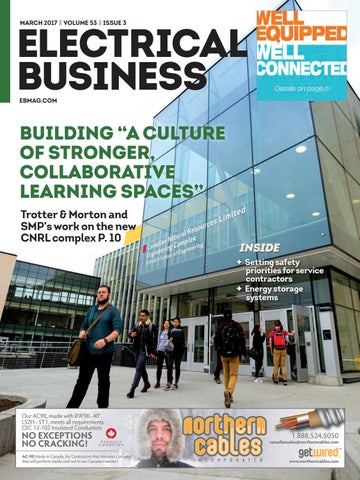
Trotter & Morton and SMP’s work on the new CNRL complex P. 10
ed Strand H ACTH
H ACTH ge olta V h ig H
BUILDING “A CULTURE OF STRONGER, COLLABORATIVE LEARNING SPACES”
EB_TBCover_March.indd 1
lid MC S o d ize rs e v O al Neautr
co Multi- COPPER 90 TECK
MARCH 2017 || VOLUME 53 || ISSUE 3
www.northerncables.com
Š2017 LEDVANCE LLC Licensee of product trademark SYLVANIA in general lighting
www.sylvania.com
Light is personal SYLVANIA LED Contractor Series SYLVANIA Contractor Series LED 11,000 hour lamps are available in a full portfolio of form factors, offering long life, and a reduction in energy and maintenance costs. Start saving energy today. For more information, visit www.sylvania.com
from the EDITOR ANTHONY CAPKUN
The operative word is gradual
CONTENTS MARCH 2017 || VOLUME 53 || ISSUE 3
I
can’t say I’m very familiar with Jim Carr, Canada’s minister of Natural Resources, but I stumbled upon—and have to applaud—the speech he gave at the Energy Council of Canada’s “Canadian Energy Industry: Updates and Insights” event in Ottawa back in February. During his talk, Carr noted the world is in the midst of a “gradual move” away from traditional sources of energy toward new (clean) ones, but conceded some Canadians feel a clean energy future could be jeopardized with the government’s recent approval of pipeline projects. “The operative word is gradual,” Carr reminded. For my part, I’ve met and chatted with numerous Canadians across the country, and a lot are like me: we see decarbonization as a good thing, but see it happening gradually over a long transition period. This period represents great opportunities for electrical professionals in the realms of energy-efficient products, controls, energy management, and so on. Other Canadians typically fall into one of two camps: those who want 100% clean energy tomorrow, and those who would burn fossil fuels until they ran out. “For those who would want to move to 100% clean energy immediately, the pace can seem frustratingly slow [...] But the reality is we’re not there yet,” Carr admitted. It is impractical, he continued, to just wave a magic wand and say “No more pipelines”: we would lose jobs across Canada (not just Alberta) and be forced to import energy, and governments at all levels would lose tax revenues from the oil companies. Meantime, Carr noted we already have a solution for significantly cutting GHG emissions by the middle of the century: According to the International Energy Agency, energy efficiencies can get us almost halfway there. “Imagine if it was announced tomorrow that some new technology could get us halfway to meeting our climate change goals? It would be the lead story on every newscast and every newspaper around the world, and rightly so. [...] And yet that breakthrough already exists. We just have to use it.” So why aren’t we all rushing out and retrofitting our homes and businesses with the latest energy-efficient technologies? Why haven’t we all run out and purchased an electric vehicle? “It’s because it’s not always possible or practical to make those changes all at once,” Carr said. “It’s the same with governments [...] We have to rely on the old, even as we introduce the new.” Well said, Mr. Carr.
14
10
10
Building “a culture of stronger, collaborative learning spaces”
14
Setting electrical safety priorities for service contractors
The labs at the University of Calgary’s Canadian Natural Resources Ltd. (CNRL) Engineering Complex are not just any labs: they are brand-new, high-intensity research labs, designed to bolster a “collaborative learning space”. The $174-million complex opened its doors this past fall, and Calgary-based Trotter & Morton, the electrical construction manager on the project, was involved right from the beginning, collaborating on the designs for cost savings and constructability issues.
Contractors face many difficulties when making safety practical for service electricians. Any work involves some degree of risk, and well-intentioned rules and regulations do not necessarily translate as practical on a job. Short of closing shop, the only practical alternative for the conscientious contractor is to minimize risk as much as the real world allows. That’s right, not eliminate, but minimize. This means setting priorities, because resources are limited. Then make safety simple and practical.
COLUMNS
DEPARTMENTS
8 Electrical Safety 360 Shock risk assessment in the workplace
4 Industry News 6 Calendar 8 Personalities 21 Products & Solutions 21 Code Conundrum
acapkun@annexweb.com Read Jim Carr’s whole speech on NRCan’s website at tinyurl.com/j5cbdde. EBMAG.COM
6
22 Code File Energy storage systems
March 2017 · ELECTRICAL BUSINESS
3
INDUSTRY news
Wheatland Tube parent Zekelman acquiring Western Tube Zekelman Industries recently announced it has entered into a definitive agreement with Nippon Steel & Sumitomo Metal Corp. (and other minority shareholders) for Wheatland Tube (www.wheatland. com) to purchase Western Tube & Conduit Corp. (westerntube.com). Zekelman Industries sells electrical conduit, fence pipe and mechanical tube products through its Wheatland Tube division. Its other operating divisions include Atlas Tube, Picoma, Energex Tube, Sharon Tube and Z Modular. “Western Tube and Wheatland Tube offer complementary products and services,” said Jim Hays, president of
EXCLUSIVELY AT
EBMAG.COM “The way we light spaces, particularly offices and commercial spaces, hasn’t changed for about 30 years,” noted Jake Dyson when we spoke with him this past fall. He discussed the technology behind Dyson’s new Cu-Beam Duo, which tackles both indirect and task lighting in one fixture, and promises about 40 years (12 hours a day) of light output. Check out the video interview at tinyurl.com/j7mtvbw. Have you checked out our growing roster of webinars lately? Take a tour what’s available over at our YouTube channel at tinyurl.com/ hbnw8cg! Among them, you’ll find Ron Coleman’s webinar on how to Sell Your Business and Buy Your Freedom (tinyurl.com/zy85cnk). Hear how to snag the retirement of your dreams by preparing now for eventual sale. All this and more—no registration, no hassle! For the latest industry news, events, solutions, stories and more from the industry, go to EBMAG.COM. 4
ELECTRICAL BUSINESS · March 2017
electrical, fence & mechanical for Zekelman. “Each company will continue to operate in the marketplace as it does today.” Zekelman Industries (www.zekelman.com) intends to offer customers products under both the Wheatland Tube and Western Tube brands.
2016 AD Canada member sales up 5%
March 2017
|| Volume 53 || Issue 3
ELECTRICAL BUSINESS is the #1 Canadian resource for electrical contractors, maintenance & engineering professionals, distributors, manufacturers and their agents, and associated stakeholders.
Editor Anthony Capkun acapkun@annexweb.com Group publisher John MacPherson jmacpherson@annexweb.com Account manager Deborah Taylor dtaylor@annexweb.com Assistant editor Renée Francoeur rfrancoeur@annexweb.com
Sales for Affiliated Distributors (AD) Canada was up 5% in 2016, AD reports, and sales for all members, across all seven divisions in Canada, the United States and Mexico grew by 9% (www.adhq.com). On a same store basis, AD members grew 3% and by industry, electrical was up 1%; PHCP (plumbing, PVF & HVAC) was up 3%; industrial was down 4%; bearings & power transmission was flat; and building materials was up 16%. “Despite headwinds in industrial and energy markets and price deflation within certain large product categories, member purchases from AD Suppliers grew by 9% and net distributions to AD members grew by 15%,” said Bill Weisberg, AD’s chair and CEO. “We also had huge advancements in eCommerce, HR and procurement services. For instance, we created over 1 million enhanced, normalized and attributed SKUs and are playing a support role to help our members refine their digital strategy and launch their webstores. Our role is to help our members compete and win, now and in the future.”
CLARIFICATION The Alberta Electrical Association would like to clarify the statement that it will have a stronger voice when lobbying government (EBMag Feb 2017, pg.3). AEA defers direct provincial government lobbying to the ECAA (Electrical Contractors Association of Alberta), and is pleased to play a supportive role in their efforts to lobby for improvements for the electrical industry in Alberta. Visit albertaelectricalassociation.com.
Art director Svetlana Avrutin savrutin@annexweb.com Account Coordinator Kathryn Nyenhuis knyenhuis@annexweb.com Circulation manager Urszula Grzyb ugrzyb@annexbizmedia.com COO Ted Markle tmarkle@annexweb.com President & CEO Mike Fredericks Published by Annex Business Media 222 Edward Street, Aurora, Ontario L4G 1W6 Tel. 905-727-0077 • Fax 905-727-0017
Printed in Canada ISSN 0013-4244 Publication Mail Agreement #40065710 Circulation email: blao@annexbizmedia.com Tel: 416 442 5600 ext.3552 Fax: 416 510 5168 Mail: 80 Valleybrook Drive, Toronto, ON M3B 2S9 Subscription rates Canada: Single issue $7.00 12 issues: $35.95 USA: $62.95 (US) International: $76.00 (US) per year Occasionally, Electrical Business will mail information on behalf of industry related groups whose products and services we believe may be of interest to you. If you prefer not to receive this information, please contact our circulation department in any of the four ways listed above. The contents of Electrical Business are copyright ©2017 by Annex Publishing & Printing Inc. and may not be reproduced in whole or part without written consent. Annex Publishing & Printing Inc. disclaims any warranty as to the accuracy, completeness or currency of the contents of this publication and disclaims all liability in respect of the results of any action taken or not taken in reliance upon information in this publication. We acknowledge the [financial] support of the Government of Canada.
Visit EBMAG.COM for the latest news, stories, products, videos, photo galleries and industry events. EBMAG.COM
With the purchase of a Microlectric meter socket* ®
Starting April 3, 2017 at participating electrical distributors
GET YOUR FREE BOX FULL OF PRODUCTS ! 50 - Marrette 833 wire connectors 50 - Iberville CIS-2 cable staples 25 - Iberville CI66 cable protector plates Iberville BC2304-LHTQ 3 - steel device boxes — non-gangable ®
® ® ®
®
BC1304-LHTQ 2 - Iberville steel device boxes — gangable ®
®
1 - Iberville CI66-T tube cable protector BCBK-01 1 - Iberville adjustable wood stud bracket ® ®
Offer valid while quantities last.
* Applies to purchases of these models: BE1-TCV, BQ2-V, BQ2-VGN, BS2-TCVBC, MO2-V and MO2-VO
BONUS GET 10% OFF ON BLACKBURN GROUND RODS UNTIL MAY 31, 2017 ®
Thomas & Betts. Your best connection for innovative solutions.
w w w . t n b . c a
INDUSTRY news
Ouellet Canada celebrating 50 years in 2017
From left: Christian Guillemette, Gilbert Lemieux, Louis Beaulieu, Jocelyn Deschênes, Dave Gagnon and Bruno Michaud. Photo courtesy Ouellet Canada. “This is a historic moment [...] We want to recognize it throughout the year, and we will therefore be organizing celebratory events every month,” said Martin Beaulieu, president of Ouellet Canada, which is celebrating its 50th anniversary this year. Congratulations! To kick-off the celebrations, Ouellet’s CEO Louis Beaulieu unveiled the company’s new 50th anniversary sign in front of the
company’s head office in L’Islet, Que. For the occasion, he was accompanied by five of the plant’s longest-serving employees. “I want our employees to be at the heart of the celebrations, because the company’s success over the years is down to them,” explained Beaulieu. According to Ouellet’s website, CharlesÉmile Ouellet began manufacturing residential warm-air heating equipment in a workshop next to his home in 1960, but the company was not incorporated until 1967.
College of the Rockies’ trades facility receives $10 million A joint federal-provincial investment of $10 million is being funnelled towards College of the Rockies (with its main campus in Cranbrook, B.C.) for a new trades-training facility. The 19,400-sf facility will consolidate and increase capacity by 43 full-time equivalent spaces for a total of 325 fulltime spaces for the electrical, millwright and heavy-duty equipment technician
College of the Rockies (COTR) students and administration welcomed Kootenay East MLA Bill Bennett on behalf of Minster of Advanced Education Andrew Wilkinson to announce $10M in funding toward a new trades training facility. Photo courtesy: B.C. Government.
programs, the province notes. “A lot of companies are looking to increase their diversity and are interested in hiring more women with a skilled trade,” said Maya Strelloff, College of the Rockies (www.cotr.bc.ca) electrical foundation trades student. “A new trades building that is at the main College of the Rockies campus, with all of the other students, can make it more appealing for women to consider trades training.” With a 36,600-sf trades yard, the new building will be designed to LEED Gold standard, and construction should wrap up in Spring 2018, says the province.
CALENDAR Electrifest XI Nedco Ontario buying show April 24, Mississauga, Ont. Visit electrifest.com
Next Generation in Technology.
MCEE Mécanex • Climatex • Expolectriq • Éclairage April 26-37, Montreal, Que. Visit mcee.ca Global Sustainable Electricity Partnership Summit May 1-2, Montreal, Que. Visit www.globalelectricity.org
Charge Faster with HUBBELL!
OEL Annual Conference Ontario Electrical League May 3-6, Niagara-on-the-Lake Visit www.oel.org BICSI Canadian Conference May 8-11, Vancouver, B.C. Visit bicsi.org/canadian/2017 ECAA Technical Training Day & AGM Electrical Contractors Association of Alberta May 25-28, Banff, Alta. Visit www.ecaa.ab.ca EFC Annual Conference Electro-Federation Canada May 30-June 1, San Diego, Calif. Visit www.electrofed.com
Indicates EB will be there. Visit EBMAG.COM for a massive list of upcoming industry events.
EBMag’s Webinar-of-the-Month Club! HOW TO GET BACK CONTROL OF YOUR TIME
Are you constantly working crazy hours helping out your team and wearing too many hats, only to see little to no progress in your business? Don’t miss this webinar on March 29, 2017, at 2 pm EST.
www.hubbell-canada.com/wiring
Busy on March 29? Register anyway, and we’ll send you the recording.
To Register, visit EBMag.com/Webinars
6
ELECTRICAL BUSINESS · March 2017
EB-Feb2017-HubbellUSB.indd 1 EB_Hubbell_March.indd 1
EBMAG.COM 2/3/2017 1:00:02 PM 2017-02-16 3:10 PM
A
B
C
B
A
C
B
A
C
B
A
C
N
N
N
N
PERSONALITIES
ELECTRICAL SAFETY360 MIKE DOHERTY
Hammond Manufacturing Co. Ltd. (Guelph, Ont.) welcomed Patricia Dennison as its new datacom product manager for Ontario (www.hammfg.com). Patricia has over 16 years of experience working in wholesale distribution, says the company, specializing in datacom for over 10. In her most recent position, Patricia managed accounts in Southern Ontario and coordinated multiple large projects for Anixter. Prior to that, she also worked as a Licensed Electrician. François Deschênes has been appointed president & CEO, Groupe Deschênes Inc. (GDI)—the 5th family member to do so. When François started at GDI in 2000, he served as a representative to the Canaplus Limited Partnership buying group, which became AD Canada P&H in 2016. Last year, he was appointed VP of Operations for the Quebec Region. Headquartered in Montreal, GDI (www. groupedeschenes.com) is a private family-owned wholesale distributor of plumbing & heating products, electrical supplies and more. Electro-Federation Canada has appointed Carol McGlogan as its new president & CEO, effective April 1, 2017, replacing Jim Taggart, who is retiring from the position (www.electrofed.com). Carol is a long-time supporter of EFC, says the association, having served as chair of the board (2006) and the former Supply & Distribution Council (2002). She has also participated on numerous committees. She comes to EFC from Philips Lighting, where she served as director of marketing. (Photo A. Capkun) Michael Brennan has joined Connectrac (connectrac.com) as the regional sales manager for Canada. He comes with 17 years of sales management experience within the building materials industry, Connectrac says, and is based in Buffalo, N.Y. 8
ELECTRICAL BUSINESS · March 2017
Shock risk assessment in the workplace
T
he source of risk assessment completing a good shock risk assessment. procedure best practices that you Specific details are in Z462 but, on page find in CSA Z462-15 “Workplace 35, you will find Clause 4.3.4.1 “Shock risk electrical safety” (Clause 4.1.5.7) assessment”, for which there are three basic is CAN/CSA-Z1002-12 “Occupa- determinations: tional health and safety - Hazard identification and elimination and risk assessment 1. Voltage to which personnel will be exposed. and control”. Z1002’s committee has done an outstand- 2. Boundary requirements. ing job of compiling a common language for 3. PPE necessary to minimize the possibility of electric shock. leading-edge job planning techniques, resulting in a generic risk assessment procedure (RAP) that can be used for any hazard When they know the work at hand, a competent and qualified electrical person can usually on any worksite. In the electrical workplace, a comprehen- quite easily determine the voltage(s) to which sive electrical RAP must be completed by personnel could be exposed. As for the second point, there are two safety-qualified personnel; that is, someone qualified to CSA Z462-15 “Qualified per- boundary requirements in Z462-15 (the 3rd sons”. Specifically, look at Clause 4.1.6.4.1 boundary requirement—Prohibited—was removed from the 2015 version). Clause (b)(iv), (1), (2), (3) and (4). 4.3.4.3 gives specific details for the You may be a licensed electrician or professional electrical engineer, You may be Limited Approach Boundary, which but that does not necessarily mean a licensed applies to unqualified persons. Requirements for the second you are a qualified person when electrician boundary—Restricted Approach— it comes to electrical safety. It is or can be found in Clause 4.3.4.4, critical your licensed electricians and engineers (and those you professional which also provides guidance for contract) are truly safety-qualified electrical qualified and unqualified personnel. Tables 1A and 1B on pages 36 in alignment with Clause 4.1.6.4.1. engineer, and 37 give the particulars for AC Only when due diligence rebut that and DC equipment, which are, quirements are met can comprein fact, distances calculated from hensive and effective electrical job does not planning begin. necessarily specific voltages. The PPE requirements for the Using the principles of the genmean identified shock hazard can be eric RAP, the path for any electricyou are a found on page 130, Table H.3 al work splits into two sections: I “Summary of specific sections always start with a comprehensive qualified describing PPE for electrical hazshock risk assessment. (While person ards”. Your next source of guida comprehensive arc flash risk when it ance is found on page 42, Clause assessment should also be comcomes to 4.3.7.3.7(a) “Shock protection”. pleted as required, I will primarily For the sake of due diligence, afdeal with the former here.) electrical ter you’ve transposed Z462’s shock To execute a thorough assesssafety. risk assessment requirements into ment, you need to be able to navigate CSA Z462 which, admittedly, is not laid a simple, effective business-specific elecout so as to provide a simple walkthrough. trical procedure, have your efforts signed No, you need to make your way through the and dated by the accountable management standard to ensure you have all the details, team. then document them in your own written A subject-matter expert on electrical safety, Mike electrical work procedures. Doherty is an independent electrical safety consultant You cannot expect your supervisors and and trainer for eHazard in Canada and the president and of Blue Arc Electrical Safety Technologies Inc. He workers to use Z462 to execute efficient owner is a licensed electrician and an IEEE senior member, and work without first transferring its RAPs to a has served as the Technical Committee chair for CSA Z462 since its inception in 2006. His specialties include logical flow for an electrical workplace. electrical safety management, consulting, training, Depending on how you break it down, auditing and electrical incident investigations. Mike can there are about seven steps in Z462-15 for be reached at mike.doherty@e-hazard.com. EBMAG.COM
BUILT FOR WHAT MATTERS
POWERED
®
BY SUN.
CONNECTED BY BRIDGEPORT.
PV COMBINER BOX
1060-RT SERIES MIGHTY-SEAL® RAINTIGHT REDUCING WASHERS
ROOFTOP TRANSITION BOX
160-G SERIES GROUNDING LOCKNUTS 190 SERIES LOCK-A-LINER BUSHINGS
SOLAR POWER INVERTER
SGB SERIES MIGHTY-RITE® SPLIT GROUNDING BUSHINGS RT2XL SERIES EXTRA LONG MIGHTY-SEAL® CONNECTORS
LOOK FOR BRIDGEPORT ORANGE
BRIDGEPORT’S WORLD-CLASS QUALITY AVAILABLE THROUGH NESCO With two decades of on-time delivery, competitive pricing, exceptional service and same-day shipping, NESCO delivers the Bridgeport innovation that helps your customer do their job faster and for less.
SEE THE DIFFERENCE ORANGE MAKES
TM
BPTFITTINGS.COM/SOLAR
Call (866) 446 3726 or visit nescocanada.com and start saving today.
collaborative learning
BUILDING “A CULTURE OF STRONGER, COLLABORATIVE LEARNING SPACES”
Trotter & Morton and SMP’s work on the new CNRL complex /RENÉE FRANCOEUR
T
he labs at the University of Calgary’s Canadian Natural Resources Ltd. (CNRL) Engineering Complex are not just any labs: they are brand-new, high-intensity research labs, designed to bolster a “collaborative learning space”, says Bill Rosehart, dean of engineering. “It was critical in this new space to have the infrastructure to support research activities that tend to require more services from the building, like fume hoods, electrical demand, air circulation,” he continues. That also meant a lot of cable, as you’ll soon find out. The $174-million complex, part of the Schulich School of Engineering, opened its doors this past fall, adding 18,300 m2 to the engineering complex and renovating an additional 11,000 m2 of existing space within the Schulich facility. A combination of renovated and new spaces, “the project is truly transformational to the entire school,” Rosehart adds, as it “holds onto tradition but, at the same time, walking through the new parts, there is an energy toward the future.”
Interconnection intricacy
The complex features a combination of LED (around 3000) and fluorescent fixtures, and a
Calgary-based Trotter & Morton, scalable Encelium lighting control system by Osram. Photo Riley Brandt, University of Calgary. the electrical construction manager ment, Experiential Learning) facility, (labelled A through F) in a shape on the project, was involved right which uses the sun for heating and loosely resembling a horseshoe. The from the beginning, collaborating on less than 78% of energy as compared addition—G Block—was erected in the designs for cost savings and con2 to other conventional laboratory the hollowed out space in the centre structability issues, because “it was buildings, the company claims. Even of this horseshoe, then connected to such a complex project,” says Russ size of addition so, nothing has been as intricate as the remaining blocks. Webb, Trotter & Morton’s project the CNRL complex, according to manager for the endeavour. “There was difficulty in doing this Webb. Trotter & Morton have worked on because we were dealing with an Prior to construction, the complex operating post-secondary facility as a number of other U of C buildings, was made up of a number of blocks we were building the new block; plus like the 2012 EEEL (Energy, Environ-
18,300 m
10
ELECTRICAL BUSINESS · March 2017
EBMAG.COM
Fluorescents welcome... with controls
the fact we had to interconnect all the electrical systems from G Block to the existing ones and make it one big operating facility,” Webb says. The team put in 600V switchgear as well as a new high-voltage switchgear to provide redundancy to the existing systems in the other blocks. “So, at any given time, if the power is out or there is a maintenance situation, they can feed the old, existing building from this new G Block service,” Webb notes, adding no other building on campus features something like this setup. “And, so far, it’s been working flawlessly.” Which came as a pleasant surprise to Trotter & Morton, as some of the engineering blocks are the oldest on campus, and the team was handling electrical gear from 60 years ago. “To tie into something like that and make sure it’s up to code, up to standard and can stand up to new technology... we thought there would be more difficulties,”Webb says. “But there was very little downtime, which made the owner happy.”
11,000 m2 of renovations
3000 LED light fixtures
The complex features a combination of LED (around 3000) and fluorescent fixtures, and a scalable Encelium lighting control system by Osram, which works in both hardwired and wireless environments, can integrate into other BMSs (building management systems) via a BACnet interface, and boasts 3-D graphical control and reporting. “In some areas you can control individual lights,” Webb notes, adding that each space—whether it was a lab, classroom or washroom—was modelled with lighting calculation software to determine appropriate lighting levels, fixture positions, etc. Encelium relies on occupancy sensors, relaying information from 8-10 sensors in various areas of the complex back to the BMS. While Trotter & Morton didn’t work with the HVAC system, Webb mentions Encelium’s sensors could integrate with that, too, to control how heat/air-conditioning is pumped into certain rooms.
“When it came to the procurement of lighting products, we put it out to many different suppliers, and did an engineering and cost-savings process to see if we could match fixtures that were spec’d to an equivalent fixture for perhaps a lower dollar value,” Webb explains. Regarding the decision to incorporate fluorescent fixtures, Steven Holland, electrical engineer and associate at SMP (which was also a part of the project), says a lot of people don’t realize fluorescents are morethan-capable of achieving decent energy savings. “We’re able to achieve energy efficiency in fluorescents, not by necessarily lowering the wattage, but by using the control system we installed,” Holland explains. LEDs were No. 1, he adds, but when it came to certain fixture demands, fluorescents were selected due to a cost-savings factor and to appease the architect’s vision. “For example, corridors where we have hundreds of metres of con-
We’ve Got You Covered TM
New
New
HINGED COVER
• Nema 1,2,3R,4,4X,12,13 • Back panels available for all sizes • Hand-close fastener tabs • 100% nonmetallic
NEW LARGER SIZES 14" & 16"
• Nema 1,2,3R,4,4X,12,13 • 100% Nonmetallic • Hand-close fastener tabs • Back panels available for sizes 6" to 16"
Fully certified to:
CSA C22.2 No. 40, CSA C22.2 No. 85, UL 50/CSA C22.2 No. 94.1, UL 5-E/CSA C22.2 No. 94.2
ipexna.com
❘
1-866-473-9462
New
SCEPTALIGHT LED NONMETALLIC LIGHT FIXTURES
• Lumen output of 1000 lm • 50,000+ hours of life • Easy retrofit option for existing fixtures
• NEMA 4X and IP66 rated • Dimmable down to 5% • 5-year limited warranty
Certified to latest LED retrofit and luminaire standards: CSA C22.2 250.0, CSA C22.2 250.13, CSA T.I.L. B-79A, UL 1598, UL 1598C, UL 8750
Electrical Systems
Products manufactured by IPEX Electrical Inc. Scepter JBoxTM and SceptalightTM are trademarks of IPEX Branding Inc.
EBMAG.COM EB_Ipex_March.indd 1
March 2017 · ELECTRICAL BUSINESS
11
2017-02-24 8:38 AM
Collaborative learning
tinuous-run fixtures, we went [with] fluorescent,” Holland says.
Tons of wireless points & data cabling Holland says one of the first things SMP did was lay out the design of the cable tray system—the routing and the pathways—because there is usually a lot of data cable at any university building. They had to ensure the tray layout allowed access to any part of the building without exceeding the maximum run length of the data cable. This was then incorporated into the building design and co-ordinated with mechanical, architectural and structural expertise. “So the cable tray system was built into the building as the core infrastructure for communication,” Holland says. “I didn’t count how much cable, but there was a lot,” says Craig MacLellan, another project manager form Trotter & Morton involved with the build. “It was a staggering amount,” Webb agrees.
$174 million total cost of project
Capacity for
400 additional students
“While there’s a lot of data cable, there’s a ton of wireless access points in the building, too,” Holland notes, which reduced the drops needed, cutting costs.
Glass with a “View” Walking up to the CNRL complex from the south, you’re faced with a 6-storey, boxy tower of glinting glass: View Dynamic Glass, that is. The façade on the west side of the building is also made up of this product, which automatically dims based on the external lighting levels thanks to nano-layers of electrochromic coating. “It’s an electrical product with its own dedicated control system,”Webb says. “And it reduces the need for cooling and heating at certain times of the day, and at certain times of the year, as well.” Each individual pane is, basically, a pixel, capable of being controlled independently and, according to Webb, the CNRL building is the first in Canada to boast this particular brand.
Giving them the power to learn Medium-voltage rings circulate the entire campus, Holland notes and, like the other facilities, the CNRL complex has a redundant MV system, but it also taps into the high-voltage ring with two 2500kVA transformers, “which are sized individually to be able to handle the entire load of the complex. In normal conditions, each transformer is essentially half-loaded”. Were one transformer to go down or require maintenance, re-routing power for the entire building can be done through the other transformer without losing power at a 600V level. There are also two 500kW dieselfired generators: one intended for life safety system backup, the other for non-life safety systems. Energy-efficient lighting, reliable electricity and View Glass aside, the enhanced engineering facility benefits the entire school, according to Rosehart. “It’s all part of a culture of stronger, collaborative learning spaces,” he says.
IEM is North America’s largest independent full-line manufacturer of electrical distribution equipment and control systems From panelboards to MV arc-resistant switchgear, integrated control systems and paralleling solutions to 38kV switchgear, learn more about how IEM can help solve your power distribution challenges. www.iemfg.com | 778.373.9601 Fremont CA | Jacksonville FL | Vancouver BC 12
ELECTRICAL BUSINESS · March 2017 EB_IEM_MarchNEW.indd 1
Tradition. Technology. Innovation. EBMAG.COM 2017-02-24 1:46 PM
Safety Priorities
HOW DO I WORK
SAFELY?
Setting electrical safety priorities for service contractors / RON BERGERON, P.ENG., ME Photo 1
Photo 2
switchgear that’s been untouched for 30 years. There are no drawings and no labels, much less arc flash analyses. Here’s the reality: when a contractor refuses the work, a willing contractor (or plant employee) will be found. We have lost clients because of refusing to work live, without permits, or to connect unapproved equipment. 4. (TOO) MANY RULES; LIMITED RESOURCES
A 2013 ESA survey shows that, of some 7500 licensed electrical contractors in Ontario, 86% have fewer than 10 employees. Obviously, these outfits cannot afford dedicated support staff, yet the contractor is swamped with information and rules, from numerous sources, such as: Ontario Electrical Safety Code (OESC); Confined Spaces; Fire Code; WHMIS; Privacy Act; WSIB, and so on. The service electrician also has to know all the safety policies of each customer: in one chemical plant we service, the safety policy binder is an inch thick. 5. TRAITS OF SERVICE ELECTRICIANS
C
ontractors face many difficulties when making safety practical for service electricians. All work involves risk. Well-intentioned rules and regulations do not necessarily translate as practical on a job. I’ve identified 5 barriers that limit the application of the many rules and regulations in our industry:
1. ELECTRICITY IS NOT DANGEROUS
This notion is pervasive, and it undermines electrical safety. Unlike gas, there seem to be little fear of electricity. This undue comfort is reinforced by the retailer mantra “You can do it”. 2. DOUBLE-STANDARD IN GOVERNMENT REGULATIONS
In Ontario, everyone is allowed to do electrical work in their own home. As 14
ELECTRICAL BUSINESS · March 2017
“Why do I have to follow all these rules when janitors are allowed to do this work?”
well, the province has over 300,000 employers in over 500,000 facilities. They can all designate— to their own interpretation of “competent worker”—any of their over four million employees to do electrical work. Service contractors, meantime, are subject to compliance through strict enforcement by licensing and inspection by some 166 Electrical Safety Authority (ESA) inspectors and 116 Ministry of Labour (MoL) construction inspectors. Electricians ask “Why do I have to follow all these rules when janitors are allowed to do this work?”.
Changing the safety culture Meeting all safety regulations is overwhelming, impractical and costly. Some contractors don’t even bother. Short of closing shop, the only practical alternative for the conscientious contractor is to minimize risk. This means setting priorities, because resources are limited, then making safety simple and practical. Electricians will learn and apply safety information only when:
3. CLIENT PRIORITIES
Clients have the same mindset as everyone else: electricity is not dangerous. They want the work done quickly and at the lowest cost. To them, it’s only about fixing what’s broken. It is not uncommon to work on electrical
• It is concise. • It offers concrete examples relating to fieldwork. • The personal protective equipment (PPE) is practical and easy to use. • The information is repeated. EBMAG.COM
Photos courtesy Bergeron Electric, © IEEE.
Typical gear includes safety glasses, Category 2 shirt and pants (assuming non-melting clothing underneath), and safety boots. Meantime, the full flash suit is only very rarely required.
Electricians are hands-on, visual learners. Perhaps the biggest hurdle to changing their mentality is many of them have 10, 20, 30 years of trade experience and nothing has ever happened to them. Unlearning old habits takes a long time. A contractor cannot simply hand out a 100-page binder of rules and regulations and insist/expect his electricians to read and use them.
2-HOUR FIRE RATING
LOW PROFILE • NON-METALLIC
Made in USA
ONE BOX
LOW COST CONNECTOR
TM
3 SIZES HANDLE THE WI DEST CORD RANGE IN THE INDUSTRY... 22-2 TO 6-3
STU D MOU NT • I N N E W O R O L D WO R K
Box set too far forward or back? Back out the screws, reposition.
Single gang
F101HGC Single Horizontal
LPCG50BL Black
LPCG50W w/ white sealing ring
LPCG50 Gray
Arlington
Patented
LOW COST • ZINC
! NG N EWW O-GA nge T Fla rger w La
E
BE2X BE1X
BE2X Two-gang w large perforated flange
Arlington
© 2014 Arlington Industries, Inc.
8413
8414
8415 8416 8417 Patented
.780
Wire Bundle O.D. Min Max
1.000
1-1/4" 1.000 1.460
.870
1.370
1-1/2" 1.360 1.770 1.250
1.590
1.700 2.200 1.550
2.050
2-1/2" 2.100 2.700 1.950
2.400
2.500 3.300 2.350
3.000
3"
• Complies w/ NEC (314.20) for set back boxes
BE1X
• 2-hour fire rating
Trimmable to fit standard wall plates
• Offered in a variety of styles
CONVENIENT • STEEL BOXES WITH METAL COVERS
CSA LISTED
FLOOR BOX KIT Arlington’s FLOOR BOX KITS are the low cost, convenient way to put a receptacle in the floor.
NEW
8415 2" trade size
.660
2"
Larger flanges cover miscut openings
FLUSH-TO-THE-FLOOR RECEPTACLE INSTALLATIONS
1.120
1"
Made in USA
© 2016 Arlington Industries, Inc. Patented/Other patents pending
Reduce inventory... Cost much less than steel or malleable iron fittings...Built-in end stop in fitting.
8412
Meets UL 35 lb pullout test. *UL not applicable to wire dia. under .240
Both ‘larger flange’ versions cost the same as our regular’ BE1 and two-gang BE2 so if you normally BE2X BE2 use a midi plate these are the box extenders for you!
Single gang
Save time and money! Arlington’s low cost, zinc MC cable fittings for dry locations only are superconvenient and cost-effective. End stop bushings vary the size of the opening so that ONE trade size fits several cable sizes!
on Nyl t Nu
et
mm
Gro
NEW! TWO-GANG style with larger flange to cover miscut openings. Perfect for both midi and max plates – the flange is trimmable for use with standard cover plates.
S
Cable O.D. Min Max
per
Grip
Our non-conductive plastic UL/CSA Listed Box Extenders extend set back metal or non-metallic electrical boxes up to 1-1/2". They level and support a wiring device. There’s no need to tape the sides of a receptacle to prevent arcing in a metal box.
IZES
Trade Size
on Nyl y Bod
EXTEND SET BACK ELECTRICAL BOXES UP TO 1-1/2 INCHES
IPL ULT IN M
Catalog Number
t knu ealing S g Rin
Loc
BOX EXTENDERS
Cost SameBE2 as
F IT SEVER AL CAB LE SIZES
Grommet tightened
Sealing ring / locknut assure liquid-tight seal in knockouts.
CSA LISTED
MC CABLE FITTINGS
Changing bushings is fast and easy. There’s no need to remove the strap. Insert the bushing that works best with the cables you’re installing.
• Unique grommet and gripper deliver superior pullout resistance... and a liquid-tight, oil-tight seal when Grommet BEFORE tightening the nut is tightened.
© Arlington Industries, Inc. Patented
F101GC
Arlington
3/4 Trade Size LPCG753* .100 - .300 LPCG754 .240 - .472 LPCG757 .385 - .750
NEW
OLD Secure mounting to stud, not the drywall
Arlington’s non-metallic, low profile cord grips offer the largest cord range in the industry, so you’ll have fewer items to stock!
Designed for new or retrofit work, FLB5331NL our UL/CSA Listed FLOOR BOX KITS feature Steel Boxes with Metal Covers that deliver flush-to-the-floor installation.
Conductor size # of Conductors* (AWG/KCMIL)
6/3, 6/4, 4-3, 4-4, 2-3, 2-4, 1-3 2-3, 2-4, 1-3, 1-4, 1/0-3, 1/0-4, 2/0-3, 2/0-4, 3/0-3 2/0-4, 3/0-3, 3/0-4, 4/0-3, 4/0-4, 250-3, 250-4 250-4, 300-4, 350-3, 350-4, 500-3 500-3, 500-4, 600-3, 600-4, 750-3 600-4, 750-3, 750-4
* Examples of 3- and 4-conductor cables accommodated.
• Oversized brass and nickel-plated brass metal covers hide miscut flooring; gaskets prevent water intrusion; flip lids or threaded plugs protect box when not in use. Patented
FLB5331MB
• Metal Covers fit our boxes and other manufacturers’. Covers also sold separately.
FLB5321MB
www.aifittings.com • Scranton, PA 18517 • 800/233-4717
FLB5321NL
Arlington
© 2015 Arlington Industries, Inc.
F102GC 2-gang
EE THR RS O COL
1/2 (gray Catalog Nos.) LPCG503* .100 - .300 LPCG50* .200 - .472 LPCG507 .385 - .750
© 2005-2010 Arlington Industries, Inc.
ONE-BOX mounts directly to a wood or steel stud for an extra-secure installation. • Angled screws INSIDE attach ONE-BOX to stud. No wobble • Fast, easy to install • Extra-large 22 cubic inch capacity (single gang) NM cable connector supplied
Made in USA
Safety Priorities
TABLE 1
TABLE 2
The importance of electrical safety becomes relevant only when electricians realize: • There is no cure for electrocution. • Electrical injury impacts not only them, but their loved ones. After over 45 years of observing the world of the service contractors across the province — my team and I have come up with a practical safety approach that we use at our firm to advance a culture of safety and minimize risk. We look at: A. Policies B. Personal protective equipment C. Simplified tables D. Knowledge A. POLICIES
Risk Assessment is the first priority on any site. CSA Z462-15 focuses on electrical, but there are many other risks. Ontario data for 2013 shows 73% of jobsite injuries are strains, fractures, cuts, bruises and pain. Only 0.1% are electrocution and 0.1% are electrical burns.That said, when something goes wrong in electrical, 25% of incidents result in death or critical injury. Considering all the data and situations, we developed and continue to modify a Daily Safety Plan form for field use. From the vast array of electrical safety information, we prioritized our three most-important policies. Why three? To make it simple to Learn, to Repeat and to Check. (Making things simple actually takes a very long time!) The benefit is that our electricians learn and apply that safety knowledge. 16
ELECTRICAL BUSINESS · March 2017
1. No live work. Three exceptions: breaker/switch operation, cover removal, diagnostics. 2. Establish safe work conditions. Three basics: disconnect all energy, lockout/tagout, test to confirm. (Confirmation is crucial. Handles may move. At times, one or more blades do not!) 3. Use your PPE. In particular: voltage-rated gloves, Cat III testers, fused leads (50KA min.). B. P ERSONAL PROTECTIVE EQUIPMENT (PPE)
Selective PPE minimizes jobsite decision-making. When arc flash is mentioned, electricians think about guys in full flash suits (Photo 2), which they see as highly impractical for everyday use. They don’t realize the suit is only very rarely required. Photo 1 shows an electrician prepping for diagnostics with gloves, Cat III tester and fused leads. He wears what is required for a lot of our work, which has no Category rating: safety glasses, Category 2 shirt and pants (assuming non-melting clothing underneath) and safety boots. The only difference from what he normally uses is the Category 2 clothing. (This is about 50% more than the cost of normal workwear). The balance of our work is Category 2 or lower. The barricade tape we use is very specific yet readily available. It is yellow, not red. The tape clearly states: CAUTION: DO NOT ENTER. In my opinion, the tape is the most underrated part of PPE. It is pivotal for establishing the correct mindset, and a physical affirmation of safety.
“The notion that electricity is not dangerous is pervasive, and it undermines electrical safety.”
The electrician who uses the tape usually follows all safety procedures. I tell our electricians: “Be a lion. Mark your turf”. When the tape is not set, other people will come by to see what is going on. They will interrupt and distract the electrician.When the tape set, this rarely happens. Those most likely to ignore the tape are managers wearing crisp, flammable clothing. Electricians are instructed to be polite, but firm and clear: “Please return behind the tape. If something goes wrong here, you could die”. As for cost, it’s $950 to equip each person with five shirts, three pairs of pants, coveralls, a face shield kit and tape. The upkeep is $300 per year. C. SIMPLIFIED TABLES
Another example of keeping things simple is the 1-sheet grid we created regarding shock and burn hazards (Table 1). We use this for jobsites where there is no arc flash data... which is virtually all sites! Infused with CSA Z462-15 and OHSA—plus our best judgment— Table 1 summarizes our interpretation of regulations concerning work permitted. It took several feedback sessions with electricians to ensure the table made sense and was easy for everyone to use. The work permitted is shown on the vertical axis. Most of the time, our electricians perform only the first three items. When they encounter the last two, they call in our specialists: two are trained in applying safety grounds, and one is trained in thermography. Gloves... electricians do not like wearing them. They’re “too clumsy”, and there’s a perception that gloves are EBMAG.COM
TRANSFORMING THE FUTURE OF LIGHT AND TECHNOLOGY PHILADELPHIA, PA USA
Pennsylvania Convention Center PRE-CONFERENCE
May 7 – 8, 2017 TRADE SHOW & CONFERENCE
May 9 – 11, 2017
LIGHTFAIR.COM
Safety Priorities
Prepping for diagnostics: gloves, Cat III tester and fused leads.
to be worn all the time. In the three most-common work situations, gloves are required in two cases: removing covers and diagnostics. Going to the horizontal axis, the electrician first checks whether the system is AC or DC. (We have not yet encountered DC situations, but have the data from Z462-15.) For AC, the electrician next determines the voltage. The left-hand column shows no hazard at 50V or less. However, a shock is possible. There are three indicators for electricians. It is easiest when the KA rating is known, but it is often unclear. The amps and KVA help with identification (KVA calculations are based on 4% impedance). The second column from the left shows when there is no threat of arc flash, namely ≤250V <125 KVA. However, nasty arcing of up to 8KA and electrocution are possible. Electricians are to wear the basics (Table 2). All the other situations are based on ≤600V 65 KA @ 2 cycles. We do not consider the option of lesser PPE when it comes to current-limiting devices at 200A or less.To be practical in cost and procedure, we use only Cat 2 & 4 raising the standard from Cat 1 & 3, respectively. For consistency, we “massaged” the calorie values. In our area, the local utility voltage is 12.47kV. In the six arc flash studies we have done, none exceeded Category 2. Regarding barricades, the arc flash boundaries exceed other boundaries for Category 2 in AC and 18
ELECTRICAL BUSINESS · March 2017
Here’s the reality: when a contractor refuses the work, a willing contractor (or plant employee) will be found.
DC. These boundaries are 5 ft and 4 ft, respectively. We selected 5 ft at 600V or less. For the HV category, no distances calculated exceeded 20 ft. When the Category from Table 1 is known, the page is flipped to Table 2, which also reminds of the Basics. In all arc flash categories, basic gear and earplugs are common. Since the electrician already wears Category 2 clothing, the only additional requirement is the combination hardhat, balaclava and face shield.(Photo 3). Simplicity is key. The electrician has only one decision to make: Put on the face shield kit or not. Our policy is: When in doubt, wear the kit. (No one likes wearing the balaclava.) The kit is in a portable, durable case. It includes arc-rated coveralls for calorie readings of 8 to 12; as a bonus, they act as padding when service vans bounce from one site to another. The Category 4 flash suit is a “steam bath”, but a fan in the hood helps. Procedure is paramount. The flash suit is worn only for 5-10 minutes, then removed to allow for a cool-down period of 5-10 minutes. Special cooling gear is available for up to 30 minutes of wear. Disconnects and breakers can be turned ON /OFF without PPE under specific conditions listed in Z462. It takes training to know this. Note: These simplified tables are given to electricians after they have completed all safety training on policies, PPE and knowledge, and get a full day of training on arc flash. Yes, a full day.
Knowledge is also enhanced electronically. All technicians can access the company server to check the OESC, Fire Code, etc. They have also been issued iPhones for greater efficiency. Our arc flash charts are in iBooks. We do not instruct anyone on obtaining “Energized electrical work permits”. We do not work live. We have yet to encounter a situation where there is no other option. It is important that electricians know what they can do, but it is just as important they recognize what they cannot do, and call for assistance when required. Brains trump macho.
D. KNOWLEDGE
There is no absolute safety: whether it’s cooking, driving, or working, all activities involve risk. It can be minimized with good standards and practices, and setting priorities. Service contractors face economic pressures and challenges in the field. That is why safety must be simple to do and easy to manage.
The bulk of safety knowledge is presented during one-hour meetings every two months.Topics covered include fall protection, vehicle safety, static grounding and Code bulletins (among others). The information given is supported by courses such as First Aid, Lockout/ Tagout,Working at Heights , Defensive Driving, to name a few. Every month, we have a 45-minute breakfast meeting where we share safety experiences and examine equipment. For example, using checklists, colleagues inspect each other’s voltage-rated gloves. Finally, random field visits are conducted monthly by an independent third party; they check housekeeping, inspect scissor lifts, fire prevention, etc., to confirm knowledge is being applied.
Prioritize to survive Prioritization is the only way to survive for the service contractor. He must inform, train and supervise to ensure the job gets done safely—all while meeting customer needs. The authors of safety rules and regulations strive for the ideal. Implicit in this approach is that everyone will understand the danger and will have vast resources at their disposal to implement the ideal. Reality paints a different picture. In his article, “Managing Risk in the Public Interest” (June 2010), Dr. Nathwani from the University of Waterloo’s Faculty of Engineering summarizes our reality: The focus is not on risks as such... but on what can be done practically about the efforts required to reduce risk, given available resources.
A regular contributor to Electrical Business Magazine, Ron Bergeron is a master electrician, professional engineer since 1969 and an electrical contractor since 1971. He was also involved with Ontario’s Electrical Safety Authority as a member of the Industry Advisory Council, Fee Restructuring Committee and Contractor Advisory Council. He is currently on the Board of the Ontario Electrical League and a Council member of the Electrical Contractor Registration Agency for Ontario. He can be reached at ronb@bergeronelectric.com. This article is based on a paper presented at the IEEE Industry Application Society’s Electrical Safety Workshop (ESW) in Toronto, Ont., January 2011. EBMAG.COM
Photo courtesy Bergeron Electric, © IEEE.
Photo 3
DECEMBER 2017 || VOLUME 53 || ISSUE 12
WWW.I-GARD.COM
EBMAG.COM
Experts in the application of highresistance grounding technology & arc flash hazard mitigation
THIS COULD BE YOU!
INTRODUCING
THE CANADIAN ELECTRICAL AWARDS
INSIDE
+ An exciting new
+
awards program showcasing the great work performed by electrical pros across Canada Details in your April issue!
products and solutions
CODE conundrum
Leviton Decora Smart dimmers & switches
Leviton has announced Decora Smart Apple HomeKit-enabled lighting control accessories for use with an iPhone or iPad, including in-wall dimmers and switches. The three accessories include: 1000W universal dimmer (up to 450W LED), 600W universal dimmer (up to 300W LED) and 15A universal rocker switch (up to 600W LED) www.leviton.ca
AEMC power logger PEL 105
AEMC’s model PEL 105 is a power and energy data logger that monitors both traditional and renewable energy sources. It also monitors and records cost and harmonics for 50Hz, 60Hz, 400Hz and DC distribution systems. It’s available with an Android app as well. www.aemc.com
Sherman+Reilly’s Revolution series T-1608 tensioner
Bosch upgrades “Impact Tough” bit tips
Bosch Tools says its “Impact Tough” titanium drill bits (TI91M) provide 2x the life versus standard impact drill bits and are specifically designed for use in high-torque impact drivers. They include longer flutes, impact-rated shanks and a titanium-cooling shield (titanium nitrate coating) for lower friction and less heat. www.boschtools.com
Dymo’s XTL 300, 500 labellers
Dymo’s XTL 300 and XTL 500 labellers now feature “lifelike” on-screen print previews, which show “exactly how labels will look when applied to cables, pipes, panels and more,” the company says. Both labellers also feature “impact-resistant” rubber bumpers and pre-set layouts. www.dymo.com
TiX620 infrared camera joins Fluke’s Expert series
TACKLE THE CODE CONUNDRUM IF YOU DARE! Answers to this month’s questions in April’s Electrical Business.
Compiled by Ontario’s Electrical Safety Authority www.esasafe.com
QUESTION 1 Does the CE Code permit a bare neutral in a consumer service (when the conductor is made of copper and run in a raceway)? a) Yes b) No
QUESTION 2 Overload protection shall not be required for a manually started motor rated at ___ hp or less when: it is continuously attended while in operation, and is on a branch circuit having overcurrent protection rated at (or not set at more than) 15A; or on an individual branch circuit having overcurrent protection (as required by Table 29) when it can be readily determined from the starting location the motor is running. a) 1/2 hp c) 2 hp b) 1 hp d) 5 hp
QUESTION 3 Plug fuses and fuse holders shall not be used in a 240V singlephase, 3-wire grounded system. a) True b) False
ANSWERS Electrical Business, February 2017
Question 1 The maximum ampacity for #6 AWG T90 nylon run in a conduit containing 6 #6AWG T90 nylon, 12 #14AWG TWU75 and 7 #12AWG TW75 is: d) 33A. Rule 4-004(15) and (14).
Question 2 Electrical equipment suitable for non-hazardous locations may be installed in a ventilated Zone 2 area when it is continuously monitored by a combustible gas detection system that automatically de-energizes the equipment when gas concentration reaches ___ of the lower explosive limit. d) 40%. Rule 18-068. Question 3 Pendant lampholders in Category 1 locations must be weatherproof, unlike Category 2, where corrosive liquids exist. b) False. Rule 22-104.
Sherman+Reilly’s new Revolution series T-1608 bullwheel tensioner delivers a maximum tensioning capacity of 8000 lb through a pair of 60-in., 5-groove bullwheels, the company claims, and is also designed to be able to provide low-force tensions compatible with lighter weight conductors, like fiber optic cable. sherman-reilly.com
The Fluke TiX620 infrared camera joins the TiX640, TiX660 and TiX1000 models as part of the Fluke Expert series, boasting a 640 x 480 resolution and 5.6-in. high-resolution LCD screen. It also provides users with EverSharp multifocal recording and SmartView software. www.fluke.com
Visit EBMAG.COM for the latest news, stories, products, videos, photo galleries and industry events. EBMAG.COM
How did YOU do?
3 • Master Electrician 2 • Journeyman 1 • Apprentice 0 • Bricklayer ?!?
ADVERTISER INDEX AD Rewards Arlington Industries Bridgeport Fittings CSA Group Canadian Electrical Awards Eaton Canada FLIR Canada Hubbell Canada
24 15 9 22 20 13 23 6
IEM Manufacturing 12 IPEX 11 Lightfair 17 Northern Cables 1 Schneider Electric 19 Sylvania LEDVANCE 2 Thomas & Betts 1,5 United Wire 7
TO ADVERTISE John MacPherson • jmacpherson@annexweb.com March 2017 · ELECTRICAL BUSINESS
21
CODE file TATJANA DINIC, P.ENG.
Energy storage systems
A
s the name suggests, energy storage systems (ESSs) are mechanisms capable of storing energy for use at a future time. These mechanisms could be electrochemical (batteries, which are typical for residential solar PV installations), chemical (hydrogen fuel), mechanical (flywheel systems or compressed air) and thermal. For homes and commercial facilities, ESSs provide the benefit of having electricity available onsite to help reduce peak utility demand and/or usage when generation is unavailable. With ongoing grid modernization incorporating increased levels of distributed generation and renewable energy sources, we must ensure we’re installing safe home energy storage systems.
Typical ESS configuration In addition to energy storage, ESSs may include equipment for charging/discharging, control, ventilation, illumination, fire suppression, monitoring and alarms. Battery-based ESSs (which may have AC or DC output) may include battery management systems, inverters and charging equipment. The layout and configuration of generation systems with an ESS vary based on the specific design and purpose, such as: • Energy management: timeof-use shifting, peak-shaving capabilities, storing excess electricity production.
FIGURE 1
• Backup power: automatically provide power to backed-up loads in the event of grid interruption. ESSs may be designed as self-contained units or composed of individual devices assembled and connected onsite. By their nature, self-contained systems are compact, as all components are enclosed in a single unit, and they are the focus of this column.
Approval and safety ESSs can store very large amounts of energy, posing a potential fire or shock hazard when handled incorrectly. The short circuit current for lead acid batteries, for example, can be extremely high: 100 to 1000 times the typical discharge current. It is, therefore, crucial these systems be evaluated and tested to ensure safe operation. CE Code Rule 2-022 requires ESSs to be Approved for use and/ or sale in each province/territory (Reg. 438/07 in Ontario). To obtain Approval, manufacturers must engage a certification agency accredited by the Standards Council of Canada, and meet the requirements of ANSI/ CAN/UL 9540-16 “Energy storage systems and equipment”. Approved ESSs will bear the Mark of the respective certification agency. An ESS with batteries is required to have those batteries and its management system tested in accordance to UL
Basic layout of a grid-tied solar PV system with a self-contained energy storage system (ESS).
1973 “Standard for batteries for use in light electric rail (LER) applications and stationary applications”. Rules 84-020 and 14-414 require a disconnecting means to simultaneously disconnect all ungrounded conductors derived from an ESS, and it must be readily accessible (integral with, or adjacent to, the ESS). In the case of a grid-interconnected ESS, the system must comply with the requirements of CE Code Section 84. Associated inverters (integral within ESSs or installed separately) must be certified and identified as UTILITY INTERCONNECTED (or equivalent). Each year, energy storage systems become more practical and affordable, and it’s only a matter of time before they become commonplace in homes and commercial facilities. Regulators must be prepared to meet this challenge by ensuring they are equipped with the necessary
tools and expertise to ensure ESS installations adhere to all the necessary codes and regulations. In the U.S., the National Electrical Code (NEC) requires stand-alone ESSs in facilities to be identified with “a permanent plaque or directory installed on the exterior of the building or structure at a readily visible location acceptable to the authority having jurisdiction”. It would be prudent to have similar requirements introduced in the next edition of CE Code. Tatjana Dinic is the acting director for Engineering & Program Development at Electrical Safety Authority (ESA) where, among other things, she is responsible for product safety, code development, improving harmonization and alternative compliance, and aging infrastructure programs. She is Professional Engineer with an M.Eng. from the University of Toronto, and a member of CE Code-Part I, Sections 4, 10, 30 and 68. She can be reached at tatjana. dinic@electricalsafety.on.ca.
Always consult your AHJ for more specific interpretations.
NEW 2015 CE CODE UPDATE - OVERVIEW THE CHANGES Enhance your working knowledge of the 2015 CE Code, Part I, with a review of key changes, updates, new tables, definitions, and additions – including newly incorporated technologies - and how they can potentially impact your business. Order Now Winter Dates Still Available!
22
ELECTRICAL BUSINESS · March 2017 EB_CSA_March.indd 1
EBMAG.COM 2017-02-17 11:29 AM
REIMAGINED WITH PROS IN MIND. SEE PROBLEMS CLEARLY WITH THE RE-IMAGINED, SIMPLE-TO-USE
FLIR E75, E85, and E95 cameras offer the superior resolution and range performance needed to quickly identify hotspots and discover potential points of failure in electrical distribution and mechanical systems. Avoid costly shutdowns and lost production time through regular predictive maintenance routines with these rugged, intuitive cameras. Learn more at www.flir.ca/instruments/e75-e85-e95/.
With AD Rewards, customers are rewarded for purchasing participating suppliers’ products from an AD Canada Distributor. You earn one point for every dollar spent (1) at any AD Rewards Distributor (2) across Canada. You may already have points from purchases and not even know it. It’s the best rewards program in the industry. Isn’t it time you started rewarding yourself today?
Browse our catalogue at ADRewards.ca
EXCLUSIVE PROMOS & GIVEAWAYS | NO CARDS, NO HASSLES | FAST DELIVERY | EASY ENROLLMENT
(1)
Points earned on purchases from participating AD Canada Distributors and participating suppliers only. (2) Rules on website apply.
ADRewards.ca