SEPTEMBER 2016 || VOLUME 52 || ISSUE 9
The future has arrived.
Are you ready to respond? See page 5.
EBMAG.COM
INSIDE
+ Don’t worry about arc flash... control it! + We’ve completely lost control of the grid + Wind farms and distracted driving
NOT ALL
LIGHTNING PROTECTION
IS CREATED EQUAL Conventional air terminals are proven performers... but what about the other kinds? P.12
EB_TBCover_Sept.indd 1
2016-08-15 10:18 A
new
Sceptalight LED Introducing the NEW Sceptalight LED light fixture and adapter kit. Sceptalight LEDs offer significant energy savings and can last beyond 50,000 hours without a single need for maintenance. Certified and tested for use in indoor, outdoor, wet locations, wash down and corrosive environments, Sceptalight LEDs are certified to the latest LED light fixture standards and NEMA 4X approved.
STANDARDS LIGHT FIXTURE (LVPF/LVPE-LED) LIGHT ENGINE (LLED-15)
CSA C22.2 250.0 UL 1598 CSA T.I.L. B-79A UL 1598C
RETROFIT OPTION
Sceptalight LEDs can easily retrofit onto existing installations for increased energy savings.
CORROSION RESISTANT
Heat sink is coated with a durable e-coat layer that prevents corrosion.
NEMA 4X AND IP66 RATED
Approved for wet locations, wash down and corrosive environments.
HEAT DISSIPATION
Specially designed heat sink ensures long life and optimum performance for over 50,000 hours.
DIMMABLE
Lights are dimmable down to 5% for maximum control of the lighting environment.
ENERGY EFFICIENT
1,000 lumens of light output is produced with only 15 Watts of electricity.
POLYCARBONATE GLOBE
Impact and weather resistant for tough environments.
visit ipexna.com Products are manufactured by IPEX Electrical Inc. Sceptalightâ„¢ is a trademark of IPEX Branding Inc.
from the EDITOR ANTHONY CAPKUN
The curse of energy efficiency
CONTENTS SEPTEMBER 2016 || VOLUME 52 || ISSUE 9
J
ean-Pascal Tricoire—the global chair and CEO of Schneider Electric—made a rare trip to Toronto several weeks ago; while here, he and Schneider Electric Canada president Juan Macias spoke with several industry editors at an intimate media roundtable to discuss the company’s perspective on global innovation and sustainability, and the trends impacting global energy demands. Macias and Tricoire also answered just about any question we threw at them. Considering the company is a global player in energy management—and we see great market opportunities for energy retrofit and designing for efficiency—I opened with, “How do we make energy efficiency sexier? How do we make people want it?”. Juan Macias, Schneider Electric Canada president (left) and Jean-Pascal Tricoire, chair and CEO of Schneider Electric globally (right).
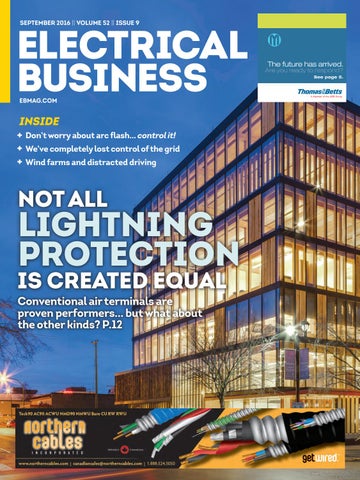
COVER Photo by Ema Peter, courtesy MGA|Michael Green Architecture.
Photo A. Capkun.
Tricoire grinned. “The curse of energy efficiency is that it’s profitable and cheap,” he answered. “It’s not like opening a new solar farm,” he admitted. Occasions like those usually get a lot of attention and ceremony, which is why the road toward making energy efficiency both visible and desirable can be “a long, long [and] sometimes depressing journey.” But Tricoire describes himself and the company as “energy optimists,” even when “digitization is a guzzler of energy” and 2 billion of the world’s citizens “don’t have acceptable access to energy, if any at all”. To that point, Tricoire noted about 50% of the company’s business is in emerging economies, where there are no legacy systems. This isn’t necessarily a bad thing, according to Tricoire, because “you can rethink everything you do”. But with all of its software, energy intensity, Internet of Things, and so on, Tricoire explained digitization is actually what helps “drive major efficiencies”. Furthermore, “renewables and energy storage have come a long way, and costs are coming down”. And Tricoire said he “noticed progress” at the COP21 climate conference in Paris “because it wasn’t politicians but businesses and cities [who] took over the conversation—for their own benefit”. After all, “the fastest, greenest source of energy is efficiency”. acapkun@annexweb.com EBMAG.COM
12
18
24
12 18 22 24 26
Not all lightning protection is created equal Conventional air terminals (a.k.a. lightning rods) are remarkably simple in design and proven performers, while the non-conventional variety simply does not provide the protection advantages claimed.
Don’t worry about arc flash... control it!
Little has changed over the past 10 years with respect to non-fatal electrical injuries, and the problem is a lack of effective action—a lack of control.
Wind farms, distracted driving and high-performance homes
EBMag was at the OEL’s annual conference with notepad and camera in hand to record some of the action.
We’ve completely lost control of the grid!
A U.S. utility’s worst nightmare came true when its control room had lost all computer systems, UPS power, utility power, back-up generator power and phone systems.
Selecting the correct lightning current and surge arrester
When selecting the correct lightning current arrester and surge arrester, we first have to perform risk analyses and apply the Lightning Protection Zone concept.
COLUMNS
DEPARTMENTS
16 Electrical Safety 360 Benchmarking risk assessment procedure for electrical safety
4 Letters 6 Industry News 11 Personalities 16 Calendar 30 Products & Solutions 32 Code Conundrum
34 Code File Converting an existing ungrounded delta supply to a grounded wye
September 2016 · ELECTRICAL BUSINESS
3
LETTERS
For taking the time to write, we’re sending Leonard F. a massive Dewalt tool bag, safety glasses and 20V Max USB charger, and Stanley FaxMax tape measure and hammer, both courtesy of our friends at Stanley Black+Decker (stanleyblackanddecker. com). To James A., we’re sending a variety of useful pliers, screwdriver and utility knife, courtesy of our friends at Milwaukee Tool (milwaukeetool.com).
To ESA: your approach is wrong
For some background on this letter, check out our online news item “Wiring fees increase 2016” at tinyurl.com/jalk7kz. To the Electrical Safety Authority: I’m troubled by your desire to increase inspection fees. Those who do not abide by the rules do not have to finance these fees, nor see any increase, meaning it is Ontario’s licensed electrical contractors (LECs) who suffer financial penalties for playing by the rules as law-breakers get off scot-free. Those who abide by the rules should not have to pay for those who do not. How about a more fair and reasonable structure? How about LECs continue to pay the same rates as now? Better yet, how about charging us a flat rate for inspections based on the square footage of the project? One rate for residential, one for commercial, etc. Now, those who do not take out permits, or perform work without a licence or have somehow circumvented the entire inspection process, must face an immediate $5000 fine plus a mandatory jail term of, say, five years. Make this a true punishment to law-breakers rather than just the cost of doing business. Don’t make it worth their while to get away with anything less than by what everyone else has to abide. If you want to increase your income levels, then go after the industry problems and cheats, not the low-hanging fruit of LECs because it’s easier. When you increase inspection rates, all you do is punish law-abiders while rewarding law-breakers. Use your time and effort to control this industry instead of watching it degrade into an underground system of tax 4
ELECTRICAL BUSINESS · September 2016
cheats and hazard creators. Anyone can buy wire and boxes at a big box and call themselves an electrician or contractor. The economy is so full of so-called electrical contractors that we’re now a dime-adozen, but less than half of the operators out there are legitimate. They take food from our mouths and income out of our pockets, yet your answer is to simply increase our financial burden. Really? You need to start showing respect to those who are legal and punish those who flout the rules. By increasing rates, you simply promote the growth of the underground economy, and no amount of fancy radio or television ads will change that. You have to make it illegal for people to perform their own wiring; after all, what do they know about the code? Make it illegal to sell electrical components to anyone without an electrical contractor licence. For that matter, don’t sell anything to someone calling themselves “an electrician”. Only then can you control who performs electrical work; you’ll be able to trace who bought what, where it went, and whether any permit was attached to that person, place or thing. Now you’re talking control, plus respect for the people legitimately associated with this industry. — Leonard F., Ontario
When will government and insurers stand up to the underground?
The following comments follow our online news item “Spada learns hard way that unlicensed electrical contractors will be found, even on Kijiji” at tinyurl.com/gpnrl2y. More often than not, many homeowners actively seek to hire any willing individual who may have some electrical ability to do electrical work on a cash basis. This is a sad situation. There must be a better way to combat this illegal work. For instance, why isn’t there a joint effort between government and the home insurance industry to give homeowners a financial reward for using a legitimate, licensed electrical contractor? And both could do a better job of making it very clear to the public their risk of not being able to obtain building insurance unless they have documented proof of a legitimate ECRA contractor doing the electrical work. Now the onus is on the homeowners to abide by the law, also. — James A.
September 2016
|| Volume 52 || Issue 9
ELECTRICAL BUSINESS is the #1 Canadian resource for electrical contractors, maintenance & engineering professionals, distributors, manufacturers and their agents, and associated stakeholders.
Editor Anthony Capkun acapkun@annexweb.com Group publisher John MacPherson jmacpherson@annexweb.com Account manager Deborah Taylor dtaylor@annexweb.com Account manager Melanie Kirk mkirk@annexweb.com Assistant editor Renée Francoeur rfrancoeur@annexweb.com Art director Svetlana Avrutin savrutin@annexweb.com Account Coordinator Kathryn Nyenhuis knyenhuis@annexweb.com Circulation manager Urszula Grzyb ugrzyb@annexbizmedia.com Director of soul/COO Sue Fredericks Published by Annex Business Media 222 Edward Street, Aurora, Ontario L4G 1W6 Tel. 905-727-0077 • Fax 905-727-0017
Printed in Canada ISSN 0013-4244 Publication Mail Agreement #40065710 Circulation email: stelian@annexnewcom.ca Tel: 416 442 5600 ext. 3636 Fax: 416-510-5170 Mail: 80 Valleybrook Drive, Toronto, ON M3B 2S9 Subscription rates Canada: Single issue $7.00 12 issues: $35.95 USA: $62.95 (US) International: $76.00 (US) per year Occasionally, Electrical Business will mail information on behalf of industry related groups whose products and services we believe may be of interest to you. If you prefer not to receive this information, please contact our circulation department in any of the four ways listed above. The contents of Electrical Business are copyright ©2016 by Annex Publishing & Printing Inc. and may not be reproduced in whole or part without written consent. Annex Publishing & Printing Inc. disclaims any warranty as to the accuracy, completeness or currency of the contents of this publication and disclaims all liability in respect of the results of any action taken or not taken in reliance upon information in this publication. We acknowledge the [financial] support of the Government of Canada.
Visit EBMAG.COM for the latest news, stories, products, videos, photo galleries and industry events. EBMAG.COM
The future has arrived.
Be ready to respond.
Discover the
Microlectric
®
BP320 Series
320 A Self-contained meter socket More and more systems powered by electricity are a part of our daily lives and our homes. 200 A service entrances are rapidly becoming overloaded. As electric vehicles become more mainstream, Canadian houses also need to have the infrastructure to accommodate charging stations. Thomas & Betts is pleased to launch the Microlectric® BP320 series meter socket: the first 320 A self-contained meter socket designed and manufactured in Canada. Developed to meet the increasing demand for larger service entrances, the BP320 series offers unparalleled safety features and requires no current transformer. It also meets the requirements of the 2015 Canadian Electrical Code. The future has arrived. To learn more about this exciting new product, take a look at our video and brochure at www.tnb.ca. Or, simply scan the QR code below.
Microlectric ®. Tomorrow’s solutions. Today.
w w w . t n b . c a
INDUSTRY news
New division & acquisition for Robertson Electric
Robertson Electric Wholesale (www. robertson-electric.com) has acquired Espo Electric Supply, an independent electrical distributor in Oakville, Ont., and launched a new division dedicated exclusively to wire and cable to support five new verticals: utility, wind and solar, traffic, transit and communications. The Wire & Cable division is located at 625 Zenway Blvd., Unit 4, Vaughan, Ont., in a new 32,000-sf facility. Meanwhile, Espo’s (espoelectric.com) Franco Esposito is staying on as general manager, whereas Judi Esposito will be retiring after a transition period. Katie Campbell will immediately assume operational manager responsibilities, including A/R and A/P.
$820k boost for Northern Cables’ key projects till 2020 Northern Cables (northerncables.com) is happy to announce it has secured some financial help for its key projects over the next five years. With $820,000 in support from the Eastern Ontario Development Fund, the company says it will expand production and grow its business in Prescott and Brockville, creating 18 jobs and retaining 163 positions. A 40,000-sf expansion at the main plant in Brockville is already underway, plus a 5-acre addition of yard, said Todd Stafford, president of Northern Cables. The funding will also help add equipment to manufacture aluminum products in the Prescott location. “We are long term planners when it comes to capital and our current projects— scheduled for completion by 2020—have a total value of $8.2 million,” Stafford added.
Same store basis sales for AD Canada up 8% (2016 Q2)
Sales for Affiliated Distributors (AD, www. adhq.com) Canada on a same store basis was up 8% in Q2 this year, and for the company overall (Canada, Mexico and the U.S.), sales grew by 5.3% to 7 billion, according to AD. “Economic conditions are mixed; but the AD community is diversified, strong and growing,” said Bill Weisberg, AD’s chair and CEO. 6
ELECTRICAL BUSINESS · September 2016
By industry, Electrical was flat, HVAC was up 9%, Bearings & Power Transmission was down 1%, Industrial was down 5%, and Building Materials was up 16%.
Celebrating Shortall’s Lumispec Design Centre renovation
Photo courtesy Eli Weissman.
Shortall Électrique (www.shortall.ca) says it has taken “lighting to a new level” with its recently renovated Lumispec lighting design centre (www.lumispec.lighting), located in Saint-Laurent, Que. Designers, architects and contractors gathered in June to celebrate Lumispec’s official opening since its renovation. Dubbed “Lumifest 2016”, guests were able to experience Wi-Fi-controlled systems, such as Lutron Caseta, Ecobee3 thermostat, and Adorne switches and outlets.
Habitat Canada succeeds Power2Feed as EFC “charity of choice” Electro-Federation Canada announced on Friday it has selected Habitat (for Humanity) Canada as its official charity of choice (www.habitat.ca). “Habitat Canada is a natural fit for EFC,” said Jim Taggart, EFC’s president & CEO. “Our members manufacture and sell innovative, sustainable and safe electrical products required for new home builds today.” EFC is a national, not-for-profit association representing over 250 member companies that manufacture, distribute, market and sell a range of electrical products, including distribution equipment, lighting, wire and cable, wiring supplies and electric heating (www.electrofed.com). “Many of our members are currently long-standing partners of Habitat Canada,” continued Taggart. “Through this partnership, all members can now participate in this program and help strengthen our industry’s commitment to electrical safety and addressing the issue of affordable housing.”
First Nation becomes NWT’s first independent power producer
OSHA cites Missouri machine shop after welder electrocuted
Federal investigators in the U.S. have found the electrocution of a 43 year-old welder could have been prevented if his employer had de-energized conductors and followed electrical safe work practices at a Missouri machine shop. OSHA (Occupational Safety and Health Administration) investigated the May 4, 2016, incident at Homeyer Precision Manufacturing and cited the company for 11 serious and one other-than-serious safety violations on July 29, 2016. Investigators believe the welder was disassembling a live, 480V flexible cord when he received the shock. OSHA (www.osha.gov) proposed fines of $59,000. Video killed the radio star! If video is king, then we are the power behind the throne. Onsite or in our studio, we provide full-service corporate video filming and production. Cue the red carpet! Visit EBMAG.com/advertise
Photo courtesy Bullfrog Power.
Bullfrog Power and the Lutsel K’e Dene First Nation (LKDFN) have launched a solar project that will assist the community’s transition from fossil fuels to renewable power. Lutsel K’e is a tiny and remote community located east of Yellowknife on the Northwest Territories’ Great Slave Lake. The LKDFN (lutselke.com) own the solar array and were able to negotiate a power purchase agreement with Northwest Territories Power Corp. (ntpc.com). That agreement gives the LKDFN “the distinction of becoming the first independent power producer anywhere in Canada’s northern territories”. The LKDFN is now the “first nongovernment entity to generate electricity and reap the economic benefits on behalf of the people who live in the community”, Bullfrog added (www.bullfrogpower.com). The 35kW project consists of 144 solar panels and is built on repurposed land that had previously been used as a diesel fuel tank storage site. EBMAG.COM
• Free Air Ampacity Rating in ABOVE and BELOW GRADE Installations • Up to 8000 AMP / 600 V to 230 kV • Reduced Power Losses • Lowest Cost System • Suppresses EMF’s • Expandable Enclosure • Quick & Easy Installation • Underwater Installations
A
B
C
B
A
C
B
A
C
Patent Pending
B
A
C
N
N
N
N
Trefoil Cable Configuration.
Replaces BUS DUCT, ARMORED CABLE IN TRAY, UNDERGROUND DUCT BANK, DIRECT BURIED and CONDUIT SYSTEMS United Wire & Cable’s expertise in cable and enclosure design, manufacture and application engineering ensures a reliable, versatile and cost effective MAXIAMP cable bus system.
For further information please email us at: sales@unitedwc.com Tel: 1-800-265-8697 • Fax: 1-800-461-4689
Going to great lengths to serve you
unitedwc.com ISO 9001 Certified
INDUSTRY news
EXCLUSIVELY AT
EBMAG.COM The grill was smoking at Chatsworth Products (CPI) in Vaughan, Ont. not too long ago as the global manufacturer of IT infrastructure equipment celebrated five years in Canada. Since opening its doors in Canada in 2011, the company says it has hosted over 1200 industry professionals. Catch the celebration photos at tinyurl.com/z556asb. We braved strong winds earlier this year and stopped by the Wesco Canada Tradeshow (co-hosted with TVC and Hazmasters) at its Mississauga distribution centre to catch up with United Wire & Cable, Flir, Mersen and many others. See all the photos at tinyurl.com/htpsjgd. For the latest industry news, reviews, products, stories and people in the electrical industry, go to EBMAG.COM
Calgary swaps 30,000 streetlights with LEDs
Two years ago, we brought you news of GE (www.gelighting.com) planning with the City of Calgary’s Department of Transportation to replace and upgrade existing streetlight fixtures with LED technology. 30,000 streetlights later, the municipality announced it is almost finished phase one of the project. According to GE, 99 residential neighbourhoods are now being lit up with LEDs from Current, powered by GE, and crews were replacing about another 10,000 streetlights in the downtown core over the past few months. Once the program is complete, over 80,000 LED lights will be installed, saving the city over $6 million in annual maintenance costs, GE said, and energy consumption will be cut in half.
Feds help fund Inventys CO2 capture technology
“There’s a more solid way to capture CO2”, says cleantech company Inventys (inventysinc.com) and—thanks to the Government of Canada and $275,000—it may soon be more accessible to the world. This funding will go toward the development of Inventys’ VeloxoTherm system, a non-toxic technology that captures CO2 from post-combustion emissions. VeloxoTherm uses “patented adsorbent structures and a rapid cycle thermal swing process to avoid the high costs associated with other conventional carbon capture processes”, the company notes. The investment is made through the National Research Council of Canada Industrial Research Assistance Program (NRC-IRAP). NRC-IRAP (www.nrc-cnrc.gc.ca) says it has worked with Inventys (based in Burnaby, B.C.) since 2008, “attracting other investors and influencing the company’s growth from three to 22 employees”.
When will Halls Heat & Cool learn to take out permits? Halls Heat and Cool Inc.—a furnace and air-conditioning contractor operating in the Guelph, Ont. area—was convicted in court April 27, 2016, and fined $25,000 on charges relating to doing electrical work without an electrical contractor’s licence plus failing to take out the proper electrical permit. According to Ontario’s Electrical Safety Authority (www.esasafe.com), this is the second time in eight months the company has been convicted for 8
ELECTRICAL BUSINESS · September 2016
violations of this nature. ESA explains heating and air-conditioning contractors in Ontario may perform limited electrical work according to their trade qualifications, such as connecting an A/C unit to an electrical panel or a furnace to an existing electrical circuit. For this work, they are required to take out electrical permits. Any electrical work beyond their scope must be done by a Licensed Electrical Contractor.
Liteline invests big with new facility
Liteline Corp.—a Canadian manufacturer and distributor of LED lighting solutions—is moving from Abacus Road into a new facility in Richmond Hill, Ont. that is 3x the size of its current location (over 160,000 sf). “The new facility in Richmond Hill will give us the ability to significantly scale our distribution and sales efforts, and expand the Liteline team,” said Mark Silverstein, VP, sales & marketing. Liteline (www.liteline.com) says the new location at 90 West Beaver Creek Road will support its commitment to customer service (e.g. onsite pick-up), the environment (e.g. EV charging stations and product recycling), and growth. Visit tinyurl.com/h2jxh9j to see a video showcasing the new spot.
Legrand turning up the shade with Solarfective acquisition
Legrand (www.legrand.ca) has acquired Solarfective Products Limited, a company that specializes in standard and custom shading systems for commercial applications. Solarfective will become part of Legrand, North America’s Building Control Systems business. “We are thrilled to be joining Legrand,” said Anise Odeh, owner and president of Solarfective. “I am confident this partnership will continue Solarfective’s growth into new markets and provide further technological advancements in commercial shading and lighting systems integration.” This news follows another recent acquisition for Legrand of Qmotion Advanced Shading Systems for residential markets. “High-performance buildings and energy codes are continually evolving. This acquisition is about providing our customers better, more integrated solutions for passive and active lighting control to meet the evolving demands of today’s buildings,” said John Selldorff, president and CEO of Legrand, North America. EBMAG.COM
CANADA’S
NEW PRODUCT
SPOTLIGHT
SOURCE FOR
ELECTRICAL PRODUCTS • Roughing-in Products • Conduits – EMT, Rigid & Aluminum • Liquid Tight & Aluminum Flex • Conduit Bodies • Explosion Proof Fittings • Weatherproof Products • Signaling & Switches • Custom Manufactured Products
BRIDGEPORT AMC-50QI E-Z LOCKTM QUICK INSTALL CONNECTOR
Nesco has been manufacturing and distributing electrical conduit and fittings to electrical wholesalers across Canada since 1993. Nesco is a Canadian company built on providing exceptional customer service. Our manufacturing, warehouse and distribution facility in Brampton, Ontario is close to major transportation routes and our large inventory ensures that most orders are shipped complete the same day the order is placed. Our inventory includes all types of conduit and fittings up to 6” in diameter. Standard and large radius EMT, rigid and aluminum bends are available along with custom length conduit nipples, stems, full thread and powder-coating options.
STANDARD & LARGE RADIUS EMT ELBOWS
Nesco provides custom manufacturing solutions and we are continually adding to our inventory with innovative new products that keep end users working efficiently. Visit us on the web for more information at www.nescocanada.com
FLEXIBLE ALUMINUM CONDUIT
216 Wilkinson Rd. Brampton ON L6T-4M4 | Toll Free: 1 (866) 446-3726 | Fax: (905) 793-2268
INDUSTRY news
600 changes for Codes Canada
About 600 changes were introduced in the 2015 editions of the National Model Construction Codes, now known as Codes Canada. The federal government has announced an additional $40 million over five years to integrate climate resilience into building design guides and codes, says National Research Council of Canada (NRC). Funding will support revised national building codes, and the guides integrating climate resiliency into the design and rehabilitation of public infrastructure will be ready for adoption in 2020.
Siemens and Algonquin unveil Ottawa campus cogen plant The only comprehensive
BUYERS’ GUIDE for the electrical and communications markets in Canada
CREATE/
UPDATE
YOUR
FREE
LISTING Are you a manufacturer, distributor, association, service provider or independent sales representative? Available both in print and as an online searchable directory, the BlueBook is Canada’s buyers’ guide for the electrical industry. Make sure customers can find you when they are looking for new suppliers, products and services.
To update or create your free listing, visit www.ebmag.com/bluebook/ Or contact Anthony Capkun at acapkun@annexweb.com 10
“This project is a game changer in our efforts to maintain our facilities, control our costs, and expand the learning opportunities for our students,” said Cheryl Jensen, president of Algonquin College (www.algonquincollege.com) as she and Robert Hardt, CEO of Algonquin College Siemens Canada (www.siemens. president Cheryl Jensen com), unveiled a new co-generation and Siemens Canada CEO natural gas power plant at the Robert Hardt tour the college’s Ottawa campus. college’s new co-generation plant. Photo courtesy Tracy Wall, The organizations also strengthened ties by signing a Algonquin College. Memorandum of Understanding (MoU) that aims to benefit students by providing opportunities to learn in a “living lab for the future of energy systems”. The cogen natural gas plant will generate 2MW of power, which is enough to cover the baseline power needs of the Ottawa campus. In addition, the college has announced a new graduate certificate program to debut in Fall 2017—Energy Management—which is aimed at students with existing credentials who are looking to further their careers in the energy sector.
Greer and MacKay-Lyons building Trades Monument
Canada’s Building Trades Unions (CBTU) has named sculptor John Greer (www.artistjohngreer.com) and architect Brian MacKay-Lyons (www.mlsarchitects.ca) as the winning design team for the Canadian Building Trades Monument, which will be built in Ottawa. Slated for installation in 2017, the monument will be built with Cambrian black granite, quarried in Quebec. Its most prominent feature will be a pair of oversized plumb bobs. It will also feature 14 tools, to be chosen by the 14 different trade unions sponsoring the monument, each of which will choose the tool that is iconic for their membership. The site will be a place to celebrate the great achievements of Canada’s many skilled building tradesmen and women, says CBTU (www.buildingtrades.ca).
ELECTRICAL BUSINESS · September 2016
BB_EB_HPV_Ad.indd 1
Expose yourself online! EBMag.com boasts over well 28,000 page views per month. That’s a whole lot of good online exposure for very reasonable rates! Visit EBMAG.com/advertise EBMAG.COM
2016-08-19 11:33 AM
PERSONALITIES
During its annual conference and Committee Week in Vancouver, CSA Group (www.csagroup.org) bestowed its 2016 Awards of Merit, which are given to Photo courtesy CSA individuals who have demonstrated leadership in developing voluntary standards. Schneider Electric’s Richard de Lhorbe (photo, right) was one of seven winners. For a full list and photos, see tinyurl.com/hdw57x9. Dave Matthews is the new product line manager for Eaton Canada’s (www.eatoncanada.ca) power distribution and control assemblies. Matthews will be located in Edmonton, Alta., and provide coordination between the U.S. product lines, the Champs quotations group and the Canadian sales districts for MV and LV assemblies, MV Underground Fabricated Duct Spacer control and drives,Devices and Busway.
Beghelli Canada (beghellicanada.com) welcomes Justin Arghittu to his role as national sales manager. Arghittu most recently served as the national sales manager at Priority Wire & Cable. Santiago Martin is the new head of Danfoss Drives (a manufacturer of variable speed drives) for the Americas. He is responsible for the business in Canada, the United States and Latin America. Martin was previously vice-president at Danfoss Drives in Latin America. Leviton (www.leviton.com) welcomes Calgary-based SS Lighting (sslighting.ca) as its new lighting controls and energy management representatives in the southern Alberta region. Paul Cassley of Leviton will support SS Lighting locally as the technical resource and product Ad - EB - Half Page.pdf application specialist.1 12/11/15 12:12 PM
Congratulations to Canadian Robert Arseneault, awarded the International Electrotechnical Commission (IEC) 2016 Thomas A. Edison Award. This award recognizes “exceptional achievement, dedicated service and significant contributions to the IEC” (www.iec.ch). Nominated by the IEC Canadian National Committee, Arseneault has been the international secretary of IEC TC4 Hydraulic Turbines since 1992. Mike Rencheck has been recently appointed president and CEO of Bruce Power (www.brucepower.com). He takes the reins from Kevin Kelly, who served as acting president since March 2016. Novinium (www.novinium. com) has hired Dean Stone as regional sales manager for Canada. Novinium, headquartered in Seattle, Wash., provides services and products for underground cable rejuvenation.
C
M
Y
CM
MY
CY
CMY
PHOTO: TK FOR HERE
K
EBMAG.COM Underground_EB_Jan.indd 1
September 2016 · ELECTRICAL BUSINESS
11
2015-12-11 3:08 PM
Lightning Protection
LIGHTNING PROTECTION Tried and true versus non-standard and non-accepted / MICHAEL CHUSID, RA FCSI
A
lso known as lightning rods, conventional air terminals are remarkably simple in design... they are just electrically conductive metal rods as few as 10-in. tall with diameters as slender as 3/8 in. Non-conventional air terminals compete in the marketplace with conventional rods; they are equipped with design elements that manufacturers claim improve their performance in the field. Unfortunately, the considered opinion of almost all independent scientists and public safety authorities is that lightning protection systems (LPS) using non-standard products do not provide the advantages claimed. University of Florida lightning researchers, Uman and Rakov, for example, find
documented 11,000 lightning-related building fires from 1924 through 1938, and reported In no case has a building rodded under the Lightning Rod Act been destroyed by lightning after having been inspected by the Fire Marshal’s Office.
3,000,000 Voltage that can be achieved by a lightning surge
the suggested advantages of non-conventional methods over the conventional techniques are not supported by the available experimental data or by theory.
This article provides brief overviews of both conventional and non-standard systems, and summarizes real-world performance so you can be the judge. CONVENTIONAL LIGHTNING PROTECTION SYSTEMS
Conventional LPSs have an exceptionally high level of reliability and performance. For example, Ontario’s Office of the Fire Marshal 12
ELECTRICAL BUSINESS · September 2016
In
2005 U.S. District Court orders ESE device manufacturers to stop making false advertising claims
The systems used under Ontario’s Lightning Rod Act have continued to be refined, and are the basis for North American and international standards, including NFPA 780 “Standard for the Installation of Lightning Protection Systems” and CAN/CSA-B72-M87 (R2013) “Installation Code for Lightning Protection Systems”. An LPS using conventional air terminals creates a continuous, low-resistance network of pathways through which lightning can flow from the top of a structure into ground without causing damage to the building, its contents and occupants. Such a system consists of air terminals strategically located at high points on the building and connected through multiple conductors to ground electrodes. These components are listed under UL 96 “Standard for Lightning Protection Components” and are sized to handle lightning surges that can be as powerful as 3 million volts. The LPS must be bonded to other building systems and metallic building components to create equipotential conditions that prevent arcing and side
flashes. In addition, service entries into a building are typically equipped with surge protective devices. A lightning strike occurs when static electric charges in the atmosphere and earth attract each other sufficiently to create a spark that jumps across space to connect each to the other. The striking distance across which the spark can form is key to determining the effective spacing of air terminals. Based on historical evidence, field trials and theoretical calculations, North American standards assume a 150-ft striking distance is 99% effective. Engineers model this by visualizing a sphere with that 150-ft. radius being rolled over the exterior of a structure. Anywhere the sphere touches the structure is a point at which lightning can strike the building. Air terminals are installed above at-risk surfaces to intercept strikes and conduct the lightning safely into the ground. Creating this zone of protection generally means air terminals are required at high points and corners of roofs, 20-ft on-centre around the roof perimeter, distributed across the field of the roof, and on top of roof-mounted equipment. EBMAG.COM
Various types of air terminals are available (left to right): early streamer emission (ESE) device; conventional (conforms to North American standards); a device intended for use with collection volume method calculations; and another ESE device. The non-conventional air terminals were removed from several buildings whose owners opted to replace them with lightning protection systems complying with North American standards. Courtesy East Coast Lightning Equipment Inc.
The LEED Gold-certified Wood Innovation & Design Centre at University of Northern British Columbia is the tallest cross-laminated timber building in North America. Naturally, owing to concerns over the combustibility of timber structures, the building has lightning protection (which can see at the skyline). Photo by Ema Peter, courtesy MGA|Michael Green Architecture. EARLY STREAMER EMISSION AIR TERMINALS
Early streamer emission (ESE) air terminals have proprietary configurations or contain electrical charging capacitors. These so-called enhancements are advertised as providing a larger zone of protection than that of conventional air terminals and permitting the use of fewer air terminals, bonds, and grounds.The manufacturers claim that a single mast-mounted ESE device can protect even large buildings and open areas. Manufacturers of ESE air terminals extrapolate data from laboratory tests to natural lightning, but static electric discharges made with manmade apparatuses do not scale to actual lightning strikes that can travel many miles before striking a building. Lab tests also fail to account for surrounding objects, weather and other external conditions. Moreover, the research supporting ESE claims was published in journals EBMAG.COM
that are outside the lightning protection field; its validity has been challenged by Canadian scientist Abdul Mousa and other researchers with bona fide expertise in atmospheric physics and the lightning attachment process. Incontestable evidence proves lightning strikes have occurred well within the zone of protection claimed by ESE advocates. When, for example, conventional air terminals and ESE devices were both installed at a mountaintop research facility operated by the New Mexico Institute of Mining and Technology, all the lightning strikes attached to the conventional air terminals and none to the ESEs, proving the ESEs do not have an enhanced protective range. In 2005, a U.S. District Court ordered ESE device manufacturers to stop making false advertising claims about the radii of protection provided by their products. The Court found unrefuted evidence that
The owner of this hotel expected a single early streamer emission (ESE) device rising above the penthouse to protect the entire building. It did not. A lightning strike hurled concrete roof tiles nine storeys to the ground. Luckily, no one was injured. Courtesy East Coast Lightning Equipment Inc.
The corona effect can be demonstrated in a lab, but does not protect structures from forces acting under actual meteorological conditions.
the tests on which [ESE manufacturers] base their advertising claims are not sufficiently reliable to establish that [their] air terminal products provide an enhanced zone of protection
Unfortunately, ESE air terminal manufacturers remain undaunted. One of their marketing tactics is to rebrand their products to stay ahead of competitors that do not make exaggerated claims. ESE devices were once sold as “radioactive air terminals” with the claim that radioactivity enhanced effectiveness. When government agencies banned the radioactive components, the products were rebranded as ESE air terminals, but the performance claims were not adjusted to compensate for the loss of the radioactive agent. One company now promotes a “collection volume method” for the placement of its devices. New name, but the lack of results appears to be the same. September 2016 · ELECTRICAL BUSINESS
13
Lightning Protection
Adding to the confusion, ESE devices are now included in French and Spanish standards that are premised upon evidence that has been repeatedly rejected by the NFPA and other standards-development organizations (SDOs).
accepted standards. However, using ESE and CTS devices in this way is impractical because they are sold at many times the cost of conventional air terminals. Despite rejection by the scientific community and SDOs, non-conventional device producers continue to aggressively market their wares. The catchphrase caveat emptor—let the buyer beware—pertains to this market situation perfectly. If something sounds too good to be true, it probably is.
CHARGE TRANSFER SYSTEMS
Another non-standard product is the charge transfer system (CTS). A patent [US 5043527 A] for one of these proprietary devices says CTSs neutralize the charge differential between the cloud and the protected facility before the flashover point occurs. The flashover point is seen as lightning. The present dissipative systems leak off the charge differential slowly before the flashover point is reached.
This is followed by the inventor’s confident claim these systems “provide up to 100% prevention protection from lightning [strikes]”. Instead of providing a path to safely conduct lightning into the ground, CTSs are purported to prevent lightning from even occurring in the vicinity of a structure equipped with one. CTS products are also called lightning eliminators and dissipation array systems. They are fabricated with a large number of small metal points; some look like umbrellas wrapped with barbed wire and others like a dandelion or sea urchin with fine wires radiating from a hub. The metal points are said to leak ions from the earth into the atmosphere, thereby creating a corona that inhibits lightning. The corona effect can be demonstrated in a lab but does not protect structures from forces acting under actual meteorological conditions. Nigerian researchers, Ette and Utah, for example, report palm trees are vulnerable to lightning despite having a corona similar to that of a CTS. As one lightning protection professional says 14
To model where air terminals are required, a 150-ft radius sphere is rolled over a building’s exterior. Points where the sphere touches the building (shown in red) are vulnerable to lightning strikes and need protection. Courtesy lightningsafetyalliance.org.
tion—claimed tapered lightning rods are the most effective, and his theory held fast for two centuries. When tested with modern experimental techniques, howThe Federal Aviation Adminis- ever, researchers determined tration (FAA), Kennedy Space blunt-tipped air terminals were Center, the U.S. Air Force and as good, or better, than pointed other authoritative sources ones. The research was vetted have documented the failure by other scientists, analyzed in of CTSs. Studies comparing light of contemporary physics, similar buildings with and with- tested under actual lightning out CTS devices have found conditions, and incorporated no significant difference in the into internationally recognized codes and standards. frequency of lightning strikes. The same open-minded approach has been given to claims Best practices Scientific and technical progress about ESE and CTS air terminals, requires rigour to challenge but instead of embracing these alternative products, long-assumed the overwhelming contheories and beliefs. The lightning Unfortunately, sensus of the worldwide protection comscientific community in the munity has been and SDOs is considered ready to embrace opinion of findings emerging the characteristics of from new research special air terminals almost all techniques, such independent are not superior as rocket-triggered a simple rod for scientists and to lightning strikes lightning... (Lee, et al). that enable LPS public safety system testing with authorities, As this quote from real lightning, and Korean investigators these new techniques for implies, ESE and CTS alternative monitoring lightdevices can function products ning strikes with as simple air terminals increased precision. when used at the same do not Benjamin Frankspacings and locations provide the lin—recognized as for convenadvantages required the progenitor of tional air terminals claimed. lightning protecinstalled pursuant to after travelling for miles looking for a place to attach to ground, lightning isn’t going to let a few metres of corona get in its way.
ELECTRICAL BUSINESS · September 2016
References • CAN/CSA-B72-M87 (R2013) “Installation Code for Lightning Protection Systems”. • Ette, A.I.I., and E.U. Utah, 1973, “Studies of point-charge characteristics in the atmosphere. J. Atmospheric and Terrestrial,” Physics, 35, 1799-1809, tinyurl.com/z9yjbbe. • Lee, J.B. et al, “Experimental Study on Lightning Protection Performance of Air Terminals,” Proceedings, PowerCon 2002 International Conference on Power System Technology, 2002. • Mousa, Abdul M., “Failure of the Collection Volume Method and Attempts of the ESE Lightning Rod Industry to Resurrect it,” Journal of Lightning Research, 2012, 4, (Suppl 2: M9) 118-128, tinyurl.com/hk5lc26. • Ontario Office of the Fire Marshall. See “The Basis of Conventional Lightning Protection Technology,” Federal Interagency Lightning Protection User Group, 2001, p. 26, tinyurl.com/hbxspjf. • Patent: US 5043527 A, “Dissipation Array Systems for Lightning Protection,” 1991, google.com/patents/US5043527. • NFPA 780 “Standard for the Installation of Lightning Protection Systems”. • UL 96 “Standard for Lightning Protection Components”. • Uman, M.A. and Rakov, V.A., “A Critical Review of Non-conventional Approaches to Lightning Protection,” Bulletin of American Meteorological Society, December 2002, tinyurl.com/lv6wvh. • U.S. District Court for District of Arizona, Heary Bros et al vs. National Fire Protection Association et al, Judgement CIV 96-2796 PHX/ROS, tinyurl.com/z5od43g. See also litigation summary at tinyurl.com/ese-litigation. Michael Chusid, RA, FCSI, is a registered architect and Fellow of the Construction Specifications Institute, and an authority on building sciences and construction materials and systems. He is a consultant to East Coast Lightning Equipment (ecle.biz), certified by the Lightning Safety Alliance (www.lightningsafetyalliance.org) to present continuing education programs about lightning protection systems. Michael can be reached at www.chusid.com. EBMAG.COM
NON-METALLIC EMT
TM
DE
TH E B EST CAB LE P R OT EC T I O N • Fast, easy press-on installation
THE ONE FOR INSTALLING A FAN OR FIXTURE!
Captive joist mount fan mounting screws
• Holds tight as cables are pulled
EMT400
• Protects cable
Patented
©2001-2011 Arlington Industries, Inc.
- EMT - Rigid - PVC
Listed for Air Handling Spaces
For FANS...installation screws ship captive. For Fixtures... threaded #8 screw holes for installing the fixture. • 23.0 cu. inches, 2-3/8" box depth
CSA rated 50 lb fan or fixture
Threaded Holes for fixture screws
Arlington
© 2012 Rev2014 Arlington Industries, Inc.
SAVES TIME • LOOKS GREAT!
Made in USA
FIXTURE BOX FOR ANY SI DI NG T Y P E
™
Made in USA
RECESSED BOX
E X T R A D U T Y W E AT H E R P R O O F I N U S E COV E R • LOW P R O F I L E
8141FGC
Arlington’s ONE-PIECE fixture box is the fastest, easiest way to install light fixtures or receptacle on siding.
Arlington’s steel One Box™ mounts to a joist for an extra-secure, fan-rated installation.
• Side-mounts to joist in new construction or retrofit
In a variety of sizes for 1/2" to 4"
ONE-PIECE
FBS1423
Captive fan installation screws
Also for rigid, IMC and PVC rigid conduit
• Less expensive alternative to costly fittings when used just for wire
Made in USA
STEEL ONE BOX
NESIW GN
BUSHINGS
Arlington
SUPER SECURE • FAN-RATED INSTALLATION
Made in USA
Patented
DHB1BRCGC
©2007-2016 Arlington Industries, Inc.
• Easy to install before or after siding • Ground clip for fixture installations; NM cable connector • UV rating for long outdoor use • Textured, paintable finish
ONE-PIECE No extra cover to lose or store
Arlington NON-METALLIC
for New Brick in brown or white for New & Existing Vinyl Siding
for Textured Surfaces, Rigid Siding
for Retrofit Flat Surfaces including brick
Made in USA
QUICKLATCH
®
BETTER...USE IT LIKE A PIPE HANGER
DBVS1CGC
2-1/2" to 4" SIZES
DBVM1CGC
DBVR1CGC
• Mounts to wall, strut, stud
With IN BOX™ there are no extra parts to purchase or handle. You’ll save big on labor and materials.
• Fast, easy installation... Press pipe Patented firmly into QuickLatch to lock it in place. That’s it!
One-piece IN BOX, the recessed electrical box for exterior use, eliminates installing multiple pieces – an electrical box, bubble cover assembly and a siding block on siding. The job looks great because IN BOX installs in the wall – so less shows outside. It’s that simple.
MOUNT Scan for Info
• QuickLatch... for 1/2" to 4" rigid, EMT, IMC and PVC
about $1.00/minute at $60/hr labor!
PRESS IN
Listed for environmental air handling spaces Size
Cat. No.
2-1/2" 3" 3-1/2" 4"
NM2060 NM2070 NM2080 NM2090
for RIGID, EMT, PVC, IMC
LOCKED!
© 2005 Arlington Industries, Inc.
• Single and two-gang, vertical and horizontal, for a variety of applications in new and old work
SAVES ABOUT 25 SECONDS PER INSTALLATION!...
Arlington
Cost savings. Time savings. A great-looking job. • Non-metallic, 22.0 cu. inch electrical box with extra duty weatherproof-in-use clear or white cover
Patented.
• Accepts single-gang devices no gaskets required
/
IN BOX meets 2015 CEC (Rule 26-702), NEMA 3R, NEC 406.8 (b) Where a weatherproof in use cover is required for 15 or 20 amp receptacles installed outdoors.
www.aifittings.com • Scranton, PA 18517 • 800/233-4717
Arlington
ELECTRICAL SAFETY360
CALENDAR
MIKE DOHERTY
Benchmarking risk assessment procedure for electrical safety
D
id you know the Annex A, Table A.1 goes on Z462 with Z1002 leads to the original health and to draw links between Z462 very best in risk assessment safety management and other recognized OH&S procedure and electrical safety system standard management standards, as noted work procedures. Of course, was the British BS above. (Our committee has both of these standards are OHSAS 18001? This was the always recognized that aligning aligned with the management precursor to not only CAN/ electrical safety with the very best principles of Z1000, providing CSA-Z1000 “Occupational in OH&S management princi- clarity with the three basic risk health & safety management” ples from these other standards assessment procedure steps: but also ANSI/AIHA/ASSE Z10 is a world-class concept.) “Occupational health & safety CSA Z463 “Guideline on 1. Identify hazards management systems”, which is maintenance of electrical sys- 2. Assess risks used in the United States. tems”, CSA Z1001, CSA Z462 3. Implement risk control, and the ever-important according to a hierarchy Meanwhile, CSA CSA Z460 “Control of of methods Z1000 is incredibly Aligning hazardous energy: lockimportant here in Z462 with and other methods” I will go over the specific electricCanada—the true Z1002 leads out are all tools that build al safety uses of the risk assessfoundation to the to the very upon the principles of ment procedure from Z1002 in rest of the health and safety standards best in risk CSA Z1000. (Another upcoming columns, including within CSA. It assessment example of the ongoing the shock risk assessment profor excellence is cess and the two arc flash risk helps organizations procedure push CSA Z1005 “Incident assessment methodologies. improve their perand investigation and preAs aligned standards, these formance in health vention”, is currently tools are second-to-none and, and safety, reduce electrical with some practise and reasoninjuries and fatal- safety work under development.) ities, and follows In an effort to make able rigour, they can greatly procedures. a quantum change to assist with the safety of workthe Plan-Do-CheckAct model as first worker electrical safety, ers, supervisors and managers prescribed within the Deming our Z462 Technical Committee within the electrical sector. Cycle (a continuous quality decided to benchmark one of improvement model). these other CSA standards. A subject-matter expert on electrical safety, Mike Doherty is a consultant and Those of us on the CSA Z462 When looking for the leading trainer for e-Hazard in Canada (e-hazard. “Workplace electrical safety” edge, it was evident CSA Z1002 com), and the president and owner of Arc Electrical Safety Technologies Technical Committee have our “Occupational health & safety: Blue Inc. He is a licensed electrician and an own favourite portions of the hazard identification and elim- IEEE senior member, and has served as standard. One of mine is in Annex ination and risk assessment and the Technical Committee chair for CSA Z462 since its inception in 2006. His A: “Aligning implementation of control) was the place to go. specialties include electrical safety this standard with occupational While Z1002 is not specific to management, consulting, training, auditing and electrical incident health and safety management electrical safety, it does point the investigations. Mike can be reached at standards”. I call it one of the way to a best practice: aligning mike.doherty@e-hazard.com. Z462 jewels, as it describes the essence of Annex A: Gutenberg would be proud! By itself, however, this standard does not constitute a comprehensive and effective electrical safety program. The most effective application of the requirements of this standard can be achieved within the framework of a recognized [OH&S] management system standard. 16
Electrical Business Magazine is published by Canada’s largest B2B publisher, Annex Business Media... and we have our own presses! Talk to us about your custom publishing needs. Visit EBMAG.com/advertise need help prospecting? Has Canadian Anti-Spam Legislation reduced your email prospects list? EBMag’s newsletter reaches 14,800 CASL-compliant subscribers, and it does so every week! Visit EBMAG.com/advertise
ELECTRICAL BUSINESS · September 2016
ECAO Industry Conference Electrical Contractors Association of Ontario Sept. 21-25, Minett, Ont. Visit ecao.org/events_ecao2016.asp EFC’s Economic Forecast Day Electro-Federation Canada Sept. 22, Brampton, Ont. Visit www.electrofed.com CanSIA Solar West Canadian Solar Industries Assoc. Oct. 5-7, Edmonton, Alta. Visit solarwestconference.ca NECA Show 2016 National Electrical Contractors Association Oct. 8-10, Boston, Mass. Visit www.necashow.org Connected+ Oct. 12-13, Toronto, Ont. Visit www.connectedplusshow.com IEEE Canada EPEC Electrical Power & Energy Conference Oct. 12-14, Ottawa, Ont. Visit www.epec2016.ieee.ca Affiliated Distributors North American Meeting Electrical Supply Division Oct. 19-22, Washington, D.C. Visit www.adhq.com CanWEA 32nd Conference & Exhibition Canadian Wind Energy Association Nov. 1-3, Calgary, Alta. Visit windenergyevent.ca BCEA LINK (Leadership Integrity Networking Knowledge) Conference British Columbia Electrical Assocation Nov. 2-3, Vancouver, B.C. Visit www.bcea.bc.ca EFC Future Forum Electro-Federation Canada Nov.2, Brampton, Ont. Visit www.electrofed.com
Indicates EB will be there. Visit EBMAG.COM for an extensive list of upcoming industry events. EBMAG.COM
NEW!
CUSTOMIZE. TRACK. MANAGE.
SMART TOOLS
SYNC WIRELESSLY
UNLIMITED TOOL CUSTOMIZATION
ONLINE + MOBILE RECORD KEEPING
TOOL TRACKING
INTEGRATED TOOL TRACKING
NO BATTERY NECESSARY FOR TRACKING
Map Data ©2016 Google
• Dial in speed & power for your materials • Automatically adjusts based on application
• Identify your ONE-KEY™ devices up to 100 ft from your smart phone • View last known location of your tool • If lost, alert when found
milwaukeetool.ca/one-key
Arc Flash Safety
burn injuries from arc flash—were caused by working directly on energized electrical equipment. According to statistics compiled by CapSchell Inc. (a Chicago-based research and consulting firm specializing in preventing workplace injuries and deaths), 5 to 10 arc flash explosions resulting in hospitalization occur around electrical equipment every day in the North America. The direct cost (WSIB premiums) of a new lost-time injury (LTI) in 2007 averaged around $21,300. The indirect cost of each LTI in 2007— including re-hiring, re-training, lost productivity, etc.—was $85,000.
Designing for electrical safety
Tackle the arc flash hazard right at the design phase / SERGIO PANETTA
A
t some point in our lives we have all heard—or perhaps even repeated—variations of the common phrase: Don’t worry about things you can’t control. With respect to workplace electrical safety, there has been little change over the past 10 years with regard to non-fatal electrical injuries, and the issue isn’t a lack of awareness, intent or budget, but rather a lack of effective action. It is a lack of control. When considering the arc flash hazard, we need to ask two questions
18
ELECTRICAL BUSINESS · September 2016
(which are, in fact, the same for any hazard): • What is the likelihood of an arc flash event? • Were it to happen, how severe would it be? Electrical hazards have been identified in the Ontario Ministry of Labour’s “Safe At Work Ontario” strategy as requiring attention to reduce injuries and create safer workplaces. Roughly half of electrical incidents causing injury—includes deaths and serious
500 ms
An arc of this duration will cause catastrophic damage to equipment, and personnel are likely to suffer serious injury.
1. Reducing the likelihood of exposure 2. Reducing the magnitude or severity of exposure The conventional approach to workplace electrical safety has been to conduct an arc flash study after the installation is complete, calculate incident energy levels, post warning signs and labels, provide training on safe work practices, then purchase appropriately rated PPE (personal protective equipment). Done. But think about it... warnings, awareness training and PPE do nothing to reduce the likelihood of an arc flash event or its magnitude! For those insisting PPE does, in fact, reduce the severity of arc flash exposure, let’s pause and consider what it means to hang your hat on arc-rated clothing: there is still a 50% probability the wearer will receive second degree burns from an arc flash event. EBMAG.COM
PHOTO: www.shutterstock.com
DON’T WORRY ABOUT ARC FLASH... CONTROL IT!
Thankfully, both CSA Z462 “Workplace electrical safety” and, in the States, NFPA 70E “Electrical Safety in the Workplace” have been aligned with the Hierarchy of Risk Control in ANSI Z10 “Occupational Health & Safety Management Systems”, which neatly addresses the two questions above. CSA Z462 Annex 0, “General Design Requirements 0.2.2”, provides you with a design option that enables you—right from the design stage—to eliminate hazards or reduce risk by:
© 2016 LEDVANCE LLC PRODUCT LICENSEE OF TRADEMARK SYLVANIA IN GENERAL LIGHTING
www.sylvania.com
The SubstiTUBE® Solution Transition your coated traditional T8 Fluorescent technology to the SYLVANIA SubstiTUBE
SubstiTUBE® IPS LED T8 Lamps Energy saving alternative to directly replace traditional fluorescent T8 lamps with minimal labor and recycling costs. — — — — — — — — — —
2, 3 & 4ft lengths & u-bend High efficacy up to 127 lumens per watt Long life: 50,000 hour life (L70) Operates on existing instant start and select programmed rapid start (parallel wiring) electronic T8 ballasts Glass free, vibration and impact resistant No warm-up time and instant-on, Full light output temperature range (-20°C to +50°C) Suitable for dry and damp locations QUICK 72SUB+ system warranty Frosted lens minimizing glare and providing great light quality
Arc Flash Safety
The first and obvious step is to de-energize the circuit before conducting any work whenever practical. When this is impractical or unsafe, then consider options for reducing the likelihood of an arc flash event occurring. Again, referring to CSA Z462, Annex 0, Clause 0.2.4, 3) A great majority of electrical faults are of the phase-to-ground type. High-resistance grounding [HRG] will insert an impedance in the ground return path and below (at 5 kV nominal or below), leaving insufficient fault energy and thereby helping reduce the arc flash hazard level.
This is consistent with the “Industrial Power System Grounding Design Handbook” (J.R. Dunki-Jacobs, F.J. Shields, Conrad St. Pierre), which states 95% of all electrical faults are phase-to-ground faults. Meantime, IEEE 141 “Recommended Practice for Electric Power Distribution for Industrial Plants” 7.2.2 states “there is no arc flash hazard [on HRG systems] as there is with solidly grounded systems, since the current is limited to approximately 5 amps”. Finally, FM Global 5-18 “Protection of Electrical Equipment” states: Sustained arcing faults in lowvoltage apparatus are often initiated by a single-phase fault to ground which results in extensive damage to switchgear and motor control centres.
Whether the specifics are actually 95%, 89%, or what have you, the sim20
ELECTRICAL BUSINESS · September 2016
Hierarchy of Hazard Control Measures From ANSI Z10
The light intensity level of an arc
35,000 C Temperature achieved by some electric arcs
Energy = I2t Energy discharged in an arc is directly proportional to the square of the short circuit current and the time the arc takes to develop
Elimination Eliminate the hazard during design Substitution Substitution of less hazardous equipment, system or energy Engineering Controls Design options that automatically reduces risk Warnings Automatic or manual, permanent or temporary, visible or audible warning systems, signs, barrier and labels Administrative Controls Planning processes, training, permits, safe work practices, maintenance systems, communications and work management Personal Protective Equipment Available, effective, easy to use
ple fact is the vast majority of arcing faults start as single phase to-ground faults, so by employing high-resistance grounding—which has been around for some 50 years and used in all manner of industries, from petrochemical and food processing to automotive and data centres—we can significantly reduce exposure to the arc flash hazard. (Granted, HRG does not protect against phase-to-phase faults, nor does it lower the incident energy calculation and, therefore, additional control steps must be taken to be sure of an electrically safe workplace.) All this, of course, begs the question: why isn’t high-resistance grounding the standard practice for grounding industrial facilities? HRG as a technology is recommended by IEEE, recognized by CSA Z462 and NFPA 70E, and promoted by FM Global, yet it is still not the default option when making grounding decisions for industrial facilities.
An arc develops in milliseconds, leading to the discharge of enormous amounts of energy. The energy discharged in the arc is directly proportional to the square of the short circuit current and the time the arc takes to develop (i.e. energy = I2t). The damage resulting from the arc depends on the arcing current and time; of these two factors, time is the most easily controlled and managed. Rules of thumb for different arc burning times are:
Reduce the magnitude of exposure
The goal of arc mitigation technology is to protect personnel and property but, to effectively accomplish this, we must first detect the arc then cut the flow of current to it in as quickly as possible. The target is to achieve a total reaction time of 100 ms or less from the point of arc detection to circuit isolation. Arcs produce light at intensity levels exceeding 20,000 lux. This light can be detected through special arc detection optical sensors, which are
Referring once again to CSA Z462, Annex 0, Clause 0.2.4,
$85,000 Indirect cost of each Lost-Time Injury in 2007
Life Cycle Value
Control the likelihood of exposure
20,000+ lux
Control Effectiveness
Surely we cannot accept this as safe. Electric arcing may produce temperatures as high as 35,000 C and, in addition to causing severe burns, there is the very real possibility of hearing loss and eye injury, as well as lung damage and blast injury from the pressure wave of an arc blast. The positive news is we can control both the likelihood of exposure as well as its magnitude with proven technology that is readily available and already being used by companies who strive to be leaders in workplace electrical safety.
2) Arc flash relay. An arc flash relay typically uses light sensors to detect the light produced by an arc flash event. Once a certain level of light is detected the relay will issue a trip signal to an upstream overcurrent device.
• 35 ms or less: no significant damage to persons or switchgear, which can often be returned to use after checking for insulation resistance. • 100 ms: minor damage to switchgear that requires cleaning and, possibly, some minor repair. Personnel could be at risk of injury. • 500 ms: catastrophic damage to equipment, and personnel are likely to suffer serious injury.
EBMAG.COM
Arc Flash Safety
connected to a relay system with a typical operating time under 1 ms, making it the fastest arc flash detection technology currently available. The operating time is independent of the fault current magnitude, since any current detector elements are used only to supervise the optical system. With optical arc protection technology installed, the relay operating time is essentially negligible compared to the circuit breaker operating time, and the cost is fairly low since current transformers are only needed on the main breakers. When we sum up the circuit breaker operating time and the optical arc detection time, we are well below the target of 100 ms—regardless of the age and speed of the circuit breaker— and have mitigated damage to a lower, safer level. By simply changing from standard coordination and instantaneous settings on the relay (suggested by some consultants as sufficient) to a protection system using optical arc detection, you substantially reduce incident energy levels. CSA Z462, Annex 0, Clause 0.2.4 states: 1) Energy-reducing active arc flash mitigation system. This system can reduce the arcing duration by creating a low-impedance current path, located within a controlled compartment, to cause the arcing fault to transfer to the new current path, while the upstream breaker clears the circuit. The system works without compromising existing selective coordination in the electrical distribution system.
Arc quenching has been used in Europe for more than 30 years but, due to concerns over the
mechanical stresses caused by initiating a 3-phase bolted fault, it is yet to be fully embraced in North America. The solution may be as simple as modifying the approach to add an impedance into the circuit; the arc is detected by an optical detection relay, then a signal is sent to initiate the arc quenching device which, in turn, closes onto a resistor placed between the quencher and each phase of the busbar. The high levels of fault current are dampened and controlled by a resistor on each phase, thereby eliminating concerns over mechanical stresses. The addition of arc quenching technology, controlled through an impedance, could result in lowering the incident energy levels in the event of an arc flash to very low and even safer levels.
Achieving a safer workplace A safer workplace can be easily achieved when we simply change our approach by conducting risk assessment during the design phase of the project. Then we move forward and conduct the arc flash study, define the risk and quantify the hazard. Next we employ elimination technology (like high-resistance grounding) and technology to lower the hazard level (arc flash detection relay or active arc mitigation system), redo the study, and re-quantify the hazard and the risk (which will be much lower). Only then do we post the warning labels, purchase the PPE and conduct the necessary training. A workplace where the likelihood of an arc flash is 95% lower, and where the impact of an arc flash can be minimized to very low levels, is possible right now. We just need to take control and use technology already available.
STOP FOCUSING ON JUST PPE! START WITH THE DESIGN PHASE
Safer workplaces start with the ins and outs of risk assessment, and undertaking this practice at the design stage will significantly help you reduce the likelihood of a dangerous event. Mike Doherty—electrical safety subject-matter expert and Electrical Safety 360 columnist—will discuss your electrical safety program i.e. identifying hazards, assessing risks and implementing the hierarchy of risk control methods, with a specific focus on:
ELECTRICAL SAFETY BY DESIGN... NOT CHASING SAFETY AFTERWARD! A special Thank You to our webinar sponsor, I-Gard. Long-established in electrical safety circles, I-Gard’s core competence is in the application of high-resistance grounding (HRG) technology in combination with a product portfolio that helps industrial customers reduce arc flash hazards. Join us September 14, 2016, at 2 pm EST to learn more about elimination, substitution and the other components in the hierarchy of risk control methods.
Thanks to our Associates, Customers and Suppliers for 90 Years of Business
Sergio Panetta is the vice-president of engineering at I-Gard Corporation. With over 26 years of electrical engineering experience (including switchgear design, commissioning and troubleshooting), Sergio actively promotes awareness of electrical safety on a global front. A senior member of the Association of Professional Engineers of Ontario, he was recently awarded Consulting Engineering status with the APEO professional body. In addition to working on a number of industry working groups dealing with electrical safety and best practices (e.g. UL, IEC, CSA and IEEE), Sergio is the author and owner of several U.S. Patents related to power resistors. He received his Masters of Electrical Engineering from McMaster University. EBMAG.COM
September 2016 · ELECTRICAL BUSINESS EB_Ideal_Sept.indd 1
21
2016-08-15 10:34 AM
Conference Notes
WIND FARMS, DISTRACTED DRIVING AND HIGH-PERFORMANCE HOMES Highlights from 2016 OEL conference
“Where contractors and the industry work together”. That was the motto behind Ontario Electrical League’s 2016 annual conference, held outside of London, Ont., in the spring, and EBMag was there with notepad and camera in hand to record some of the action. JOHN KIRBY is the director of wind operations at the Erie Shores wind farm, and he spoke to delegates about the maintenance nuances involved with keeping those big blades turning and producing electricity. In fact, they’ve used just about every piece of equipment that exists as part of their maintenance regimen, including buckets, cameras, spotting scopes, drones (UAVs) and rope access. The team uses vibration monitoring on the gearboxes to catch failures before they happen, and they’ve started using LIDAR (light detection and ranging) to better understand how the wind blows and, by extension, manage the turbine blades better. I think we often forget how tall these things can be; Kirby reminded us the wind blows quite differently from top to bottom. “The best-performing turbines in the wind farm industry operate around 40% of the time.” DOUG TARRY of Doug Tarry Homes focused his discussion on “tight” homes, making them as energy-efficient as possible. “Balancing” the home with the correct heating and cooling is a real issue, he explained, made worse by customers (homeowners) who don’t understand mechanical systems... and why should they? “Make it easy for them. Set it and forget it,” he said. In a high-performance home, Tarry explained 3/4 of total energy expenditure is caused by its occupants, whereas 1/2 the energy load in a typical home is caused by space heating. He added he is very interested in home energy storage technologies for peak shaving.
Via role-playing, Sundeep Gokhale, Patrick Ganley and Edward Snetsinger of SHERRARD KUZZ LLP discussed what an owner must not do to his employees who may be organizing: TIPS, which stands for Threaten, Interrogate, Promise, Spy. Briefly, you cannot threaten your employees with statements like “If you organize, I will shut down the business and put everyone out of work”. You must not interrogate your employees to ascertain whether they’ve been thinking about organizing (or speaking with others about it), nor should you spy on who is chatting with whom. And you must not promise any particular actions to employees to keep them from organizing. As part of the Transportation Panel, MAURO DI TULLIO (right) of Federated Insurance discussed the nuances of insurance coverage: the options and enhancements you should consider, and where you simply must have good coverage. Meantime, BRIAN PEARCE (left) of Infrastructure Health & Safety Association (IHSA) warned delegates that driver error is the major cause of 85% of all vehicle collisions and, these days, the biggest problem on our roads is distracted driving. Something to consider for yourself, and any technicians who drive your vehicles.
22
ELECTRICAL BUSINESS · September 2016
Photos A. Capkun.
Check out our Photo Gallery (tinyurl.com/gvmr4p6) from this year’s conference, which includes photos from the conference and tradeshow, as well as the awards dinner. Ontario Electrical League is hosting its 2017 Electrical Industry Conference May 3-6, 2017, at the White Oaks in Niagara-on-the-Lake, Ont. EBMAG.COM
CANADA’S FIRST INTEGRATED 120 V SYNCHRONIZED*
3-IN-1 LED STROBE 10-YEAR AND
TALKING SMOKE & CARBON MONOXIDE ALARM
FROM THESE …
GREAT FOR HALLWAYS
… TO THIS
ONE ALARM. TEN YEARS. ZERO WORRIES. Introducing the P4010ACLEDSCOCA. At only a half inch taller than the average smoke alarm, the new 3-in-1 packs a talking smoke alarm, CO alarm, synchronizing strobe light and a sealed 10-year battery backup*, all in one alarm – saving you the hassle of installing multiple alarms and never needing to change the batteries for the life of the alarm.
P4010ACLEDSCOCA 120 V 3-IN-1 LED STROBE AND 10-YEAR TALKING SMOKE & CO ALARM
GREAT FOR BEDROOMS
NEW PACKAGING
Only Kidde provides a fully synchronized strobe solution for your home. When interconnecting multiple 3-in-1 or 2-in-1 LED strobes, they will automatically synchronize (flash at the same time) during an alarm, helping homeowners and first responders safely navigate their way to safety. Both models fully comply with the new Ontario Building Code providing a complete solution for hallways and bedrooms in one synchronized, 10-year package. Call your local distributor and ask about the P4010ACLEDSCOCA and P4010ACLEDSCA today. *Will synchronize with matching P4010ACLEDSCOCA and/or P4010ACLEDSCA units, in an alarm condition. This unit provides 10-year battery backup on the smoke and CO alarm. Battery backup will not power the strobe.
P4010ACLEDSCA 120 V 2-IN-1 LED STROBE AND 10-YEAR TALKING SMOKE ALARM
Grid forensics
WE’VE COMPLETELY LOST CONTROL OF THE GRID PATRICK J. LYNCH P.ENG.
Electrical engineering forensic investigation begins Our company was commissioned to investigate this rather bizarre and tragic sequence of events. To begin with: 24
• Smoke damage in the building was minimal. • No employees were injured. • Grid control was reacquired within 6 hours. This was the Good News. Now for the Bad News: • The main electrical switchboard is a complete disaster area. It suffered a major electrical hit and was hanging on by a thread. • There was no longer any electrical backup diesel generator power available at this site. Uninterruptible power supply and computer systems have also been compromised. We arrived at the site a day after the disaster had struck, where we discovered the severely damaged switchboard was still energized, powering the entire 20-floor building. All staff had returned to work. The utility carried on business as usual. Who had authorized this? This was completely unacceptable! Electrical busbars had melted
ELECTRICAL BUSINESS · September 2016
8 hours, this generator within this switchThis led was electrically spliced board (see Photo to severe into the electrical sys1). Electrical busbar electrical tem, downstream from standoff insulators arcing in the failed switchboard. and all the switchThe site was running gear were full of the main black, electrically switchboard, on diesel power alone, hours a day until conductive, carbon phase-to- 24 the main switchboard soot flash residue. It phase and could be repaired. could flashover again (Utility power was at any time. This was phase-tofinally restored 23 a potential second ground days later to the failed catastrophe waiting flashovers, switchboard, which to happen, and it resulting in now sported newly could be much worse fabricated switchgear than the first one. complete components.) We met with the electrical The results of our general manager to destruction. failure investigation explain the severity revealed the following... of the situation. Bottom line? Power down this main switchboard as quickly as Following the clues possible. We learned diesel generator Their four diesel generators operational power transfer (each 750kW/480V) and switching tests were never persynchronizing switchboard formed at this site. Staff were had also been involved in this concerned that power blips may electrical failure. The client cause computer system operhad no backup power, so an ational problems. additional 2MW diesel genThe transfer switch scheme alerator was quickly rented and lowed all four synchronized diesel set up at the site. With the site generators to be directly connectcompletely powered down for ed (in parallel) to the utility power EBMAG.COM
PHOTO: Alessia Pierdomenico / Shutterstock.com
T
his was the local U.S. utility’s worst nightmare. Its control room had lost all computer systems, UPS power, utility power, back-up generator power and phone systems... and smoke was quickly filling up this now pitch-black room. They completely lost control of the grid. This utility has failure contingency plans stacked on top of other failure contingency plans. They conduct failure contingency meetings six times annually. A system risk assessment reliability engineer is also on staff. They have triple redundancy on many of these systems, yet everything seems to be completely failing all at once. Smoke was detected on most floors, and the entire building was evacuated. How could this happen? The final back-up was a small, old unoccupied control room left over from the “old school days”, which was located about two hours away. They would have to “patch together” some sort of makeshift control system from there. Was this a terrorist attack? It would appear everything had been perfectly timed and coordinated: loss of all power, crashed computer and phone systems, and the building filling up with smoke... all of this had occurred at the exact same time. Was this simply a crazy coincidence? Was there a logical explanation?
Grid forensics system before transferring to pick up the electrical load within the building (make-before-break switching arrangement). A building water pipe had burst nine weeks earlier. Some of this water had found its way into the synchronizing/ paralleling control circuits for these generators, blowing up the circuit boards. While the damaged circuit control boards were replaced at the time, • The backup generator system was never tested after those repairs. Again, there was a staff concern over a potential power blips affecting operations. • The overall backup electrical system was never thoroughly examined for any other additional failure points. It appeared the electronic paralleling sequence control boards for this main switchboard transfer switch were also damaged
EBMAG.COM EB_April_Leviton.indd 1
during the water leak, but went undetected until the complete power failure occurred. Moments before the disaster, this commercial area had a “temporary loss of power” situation. This “defective” main switchboard transfer switch attempted to operate, then erroneously connected 3 MW of full diesel power out of phase directly onto the now fully energized utility power grid system. This led to severe electrical arcing in the main switchboard, phase-to-phase and phase-toground flashovers, resulting in complete electrical destruction. The enormous amount of electrical flashover energy then transferred through to all the other building electrical loads, knocking out the UPS, phone and computer systems, etc. In several instances, electrical components on each floor caught fire, producing smoke.The damage to this building and operational downtime was extreme.
PHOTO 1
photo: Patrick J. Lynch.
For every problem, a solution In the end, the entire electrical system required a major redesign to eliminate all single points of failure, including: • System grounding • Electrical isolation points • Wraparound/bypass electrical options • Load banks (permanently installed for system testing) Note that a single point of failure in the initial electrical design crippled the entire grid control computer system. Both
utility and diesel power were left stranded with no alternate electrical path to power up these critical loads. Finally, staff and management were made to understand that mandatory monthly full-power system transfer tests for a critical site (like this one) is never optional, but a requirement! Patrick J. Lynch, P.Eng., has been the president of Power Line Systems Engineering Inc. since 1986. He graduated Electrical Engineering from the University of Waterloo in 1975, and has successfully directed Power Line’s completion of over 1100 complex electrical engineering site disturbance investigations around the globe. Visit www.powerlinesystems.ca.
September 2016 · ELECTRICAL BUSINESS
25
2016-03-04 11:30 AM
Lightning & surge arresters
SELECTING THE CORRECT LIGHTNING CURRENT AND SURGE ARRESTER RUUD ROELEVELD the flow of the electron, you will create a surge. The same situation is applicable for instrumentation wires/installations. The best way to avoid an increase in potential differences is to bond all metal pipes (e.g. water, gas) and all electrical lines (e.g. power, telephone, LAN, instrumentation lines) to an equipotential bonding bar which, itself, is connected with the main ground/earthing system. Because electrical lines cannot be connected to ground directly, lightning current arresters and surge arresters are used for indirect grounding, short circuiting the electrical lines to ground during the time of the disturbance (Figure 1).
W
hen selecting the correct lightning current arrester and surge arrester, we first have to perform risk analyses and apply the Lightning Protection Zone concept (LPZ) to determine what the situation requires exactly to protect human lives, buildings and objects, electrical systems, and prevent downtime. The analyses also indicate what Lightning Protection Level should be used, as well as the location for lightning current arresters and surge arresters. It is a very simple process for smaller installations (i.e. residential and small commercial buildings) but could be more complex for, say, production plants. One of the most important aspects of modern lightning current and surge protection for electrical systems is the management of high energy 26
ELECTRICAL BUSINESS · September 2016
100k200k amps Range of maximum lightning peak currents defined by the International Electrotechnical Commission (IEC)
lightning currents and low The International Elecenergy surges/transients. trotechnical Commission Basically, The key to adequate proevery time (IEC) defines maximum tection is the equipotential peak currents you change lightning bonding of all incoming in the range of 100,000 the flow of amps to 200,000 amps, and outgoing services to avoid any harmful potential the electron, with a duration of some difference within the instal100 µs, finally described you will lation. by a 10/350 µs waveform create a For example, your PLC (Figure 2). Considering surge. is built for a power supply the grounding system will of 120V, which means the be able to absorb about potential difference between the hot 50% of this energy, about 50,000A wire and neutral is 120V. A higher to 100,000A of lightning current potential difference will damage your could be fed into the installation, equipment. This difference can be which means each lightning current initiated by lightning, surge currents arrester has to handle somewhere from indirect lightning, switching between 12.5 kA to 50 kA per pole operations in the power supply sys- for a couple of 100 µs, depending on tems, and/or induction; the electric the power system (2-, 4- or 5-wire). utility; or internally from the switchFor example: 50 kA divided by 4 ing on and off of copy machines, wires means you will need a lightning motors, etc. current arrester (10/350 µs waveform) Basically, every time you change with a minimum discharge capability EBMAG.COM
PHOTO: www.shutterstock.com
Requirements for a lightning current arrester
National Manufacturing and Distribution Centres: Calgary, AB • Edmonton, AB • Airdrie, AB • Milton, ON Mississauga, ON • Etobicoke, ON • Perth, ON Regional Manufacturing Facilities: Delta, BC • Calgary, AB • Edmonton, AB • Winnipeg, MB Mississauga, ON • Lachine, QC • Dartmouth, NS
Call toll-free: 1-800-268-3578 Learn more at eatoncanada.ca
Lightning & surge arresters
FIGURE 1
of 12.5 kA per pole, or 50 kA in total when it concerns one pack of 4 poles (sometimes called lines or modes).
Requirements for a surge arrester Surge arresters have always been tested with an 8/20 µs waveform (introduced by the Telcordia/ Bellcore standard, back in the day) to simulate induced transients caused by no direct flashes into the structure. A comparison of these two waveforms (Figure 2) shows the charge of a lightning current (10/350 µs) is much higher than the charge of an induced transient (8/20 µs) at the same peak current level. On a mathematical basis, this relation is about 25! Consequently, a surge arrester (8/20 µs) is not capable of discharging a lightning current (10/350 µs). Most of the arresters are parallel devices, which means we have to select devices on line-to-ground voltage. For a 347/600V system, the line-toground voltage is 347V, so the operating voltage for the device will be 347V, not 600V. With respect to discharge capability, we tend to say the higher the better, but also more expensive. A more reasonable approach is to determine what is really needed and how much current can be expected. The Lightning Protection Zone (LPZ) concept can assist you with this process. 28
FIGURE 2
Any manufacturer of lightning current and surge arresters is required to publish the above parameters, such as the test wave form 10/350 µs or 8/20 µs on either the product or product data sheet. N.B. joules alone is insufficient!
Arrester life expectancies
You can use both lightning current and surge arresters at the same location when they are energycoordinated with one other.
Lightning current arrester are based primarily on switching technologies like the RADAX modern spark gap. These components are capable of discharging lightning currents based on the waveform 10/350 µs. Modern spark gaps are not sensitive to degradation and have a long life expectancy. Surge arresters are based on voltage-limiting components, such as the MOV (metal oxide varistor) technology or a combination of MOV and SAD (silicone avalanche diode). The advantage of an MOV is that it is quick to respond and can discharge a reasonable amount of energy. The disadvantage is that all MOVs have a so-called “aging” process. Surge arresters based on MOVs will fail over time, and will need to be replaced. The life expectancy of such a device is determined by the number of discharges, the amount of energy involved
ELECTRICAL BUSINESS · September 2016
and the quality of its components, as well as the environment to which it is exposed. Besides discharge rating and waveforms, the clamping voltage or protection level is also regarded as a major parameter that needs to be taken into account. But what is the maximum acceptable protection level voltage? Fortunately, IEC 60664-1 “Insulation coordination for equipment within low-voltage systems - Part 1: Principles, requirements and tests” gives us an indication: the impulse voltage rating is 800V for a 120V power system, and 1500V for up to 347/600V. Consequently, these levels are taken as the limits in most countries for maximum protection level voltage. Lightning current arresters and surge arresters with a lower protection level voltage or clamping voltage than the above values (which are based on power systems) are suitable and safe to use in an electrical installation.
Combining lightning current arresters and surge arresters Lightning current arresters are mainly installed at the main service entrance, which is where we
can expect lightning currents. You can use both lightning current and surge arresters at the same location when they are energy-coordinated with one other. Basically, the surge arresters will not be exposed to lightning currents. A manufacturer has to confirm energy coordination between the different types of devices is achieved. Another option is to use a one-unit combined lightning current and surge arrester.
Summary Equipotential bonding is the key to adequate protection. The Lightning Protection Zone (LPZ) concept is a systematic approach for determining the potential risks and what the situation requires with respect to the use of lightning current arresters (10/350 µs), surge arresters (8/20 µs) or both. The required discharge capability of a device should be calculated and devices should be chosen based on the calculated value rather than going for the highest bidder and, conceivably, a higher cost. A protection level or clamping voltage lower than 800V for 120V systems (and up to 1.5kV for 347/600V) is sufficient.
Ruud Roeleveld is the president of R3&A Limited, an independently owned Canadian company specializing in lightning and surge protection, and domotics (home automation) systems. EBMAG.COM
ADVERTISER 1/4 PG STD 3.875” X 5.4375"
ADVERTISER 1/4 PG STD 3.875” X 5.4375"
WORK SAFER AND MORE EFFICIENTLY with the new FLIR® CM174 clamp meter with built-in thermal imaging camera. Featuring Infrared Guided Measurement (IGM) technology, the CM174 visually points you to the precise location of potential electrical issues. You’ll find problems faster, get more done, and boost your credibility. TO SEE IGM IN ACTION GO TO WWW.FLIR.CA/CM174
products and solutions
Eaton redesigns mounting brackets
Eaton has unveiled the redesign of its largest B-Line series mounting bracket sets: the BB2-16T and BB2-24T. Now available in the Canadian markets, the brackets have a telescoping design that allows for varying stud wall spacing and a centre channel for “better rigidity”. EATON www.eaton.com
Milwaukee M18 RedLithium 9.0 battery pack
Milwaukee recently unveiled its M18 RedLithium “High Demand” 9.0 battery pack, which promises up to 5x more run-time and 35% more power while running 60% cooler than standard lithium-ion batteries. While fully compatible with Milwaukee’s entire M18 platform, the new pack is optimized for high-draw M18 Fuel tools and solutions used in demanding
drilling, chipping, cutting and grinding applications. The 9.0 battery pack will be sold as an accessory to the M18 system and in select M18 Fuel kits. MILWAUKEE TOOL www.milwaukeetool.com
Fluke 438-II analyzer
HD Electric’s Double Vision voltmeter
and feature a three-prong NEMA twist-lock photocell that can be programmed to automatically turn lights On at dusk and Off at dawn. MAXLITE www.maxlite.com
Outdoor charging stations from Legrand The Fluke 438-II power quality and motor analyzer uses algorithms to analyze, not only 3-phase power quality, but also torque, efficiency and speed to help you determine system performance and detect overloaded conditions. According to Fluke, this eliminates the need for motor load sensors. FLUKE www.fluke.com
MaxLite barn lights
MaxLite says its LED barn lights replicate the form and function of 150W high-pressure sodium or 175W MH fixtures while consuming 35W (BLP35) and 50W (BLP50). The fixtures operate at 120-277V
Legrand says its new outdoor charging stations for mobile devices include a combination of two or three gangs of power devices—including USB charging—but can also be used for A/V or communications connectivity. The model with the accent light includes a small LED locator light, while the second version, the Power Pedestal, is designed for areas that are already illuminated. LEGRAND www.legrand.ca
EBMag’s Webinar-of-the-Month Club!
GET AIRBORNE (ULTRASOUND) FOR
ELECTRICAL RELIABILITY Reduce arc flash AND create a safer inspection? That’s where airborne ultrasound comes in! When apparatus such as switchgear, transformers, insulators or disconnects and splices fail, the results can be catastrophic. When left undetected, these conditions can become sources of an arc flash incident. Arcing, tracking, corona? Nip them in the bud! Certified maintenance & reliability professional Sean Miller will show how airborne ultrasound can be used on open or enclosed systems to detect and analyze corona, tracking and arcing, and takes your electrical maintenance and reliability program to the next level.
Join us October 6, 2016, at 2 pm EST.
Busy on October 6? Register anyway and we’ll send you the recording.
To Register, visit tinyurl.com/z4vkvzh 30
ELECTRICAL BUSINESS · September 2016
The Double Vision from HD Electric (model DDVM-40) is a dual display digital voltmeter that can be used in both overhead and underground applications and is accurate and repeatable to within 1%, according to the company. It measures voltage from 5V to 40kV. HD ELECTRIC www.hdelectriccompany.com
Sonim’s XP7 & XP5 phones
Sonim Technologies says its XP7 and XP5 smartphones are dust, water, oil and chemical, temperature, extreme-pressure and drop resistant, and can be used with work gloves. They also come with “extra-loud” speakers and noise cancellation. SONIM www.sonimtech.com
Stanley inspection camera
Stanley’s battery-powered inspection camera (STHT77363) has a small head—8mm compared to the 17mm heads of some other cameras on the market, Stanley notes—and rotates 90-degrees. The product also comes with a 1-m long, IP67 camera wand. STANLEY www.stanleytools.ca EBMAG.COM
Lighting Solutions that Save
®
®
LED Center Basket Luminaires
▶ Available in 2’x 2’, 1’ x 4’ and 2’ x 4’ sizes ▶ Colour temperature: 3 500 K, 4 000 K and 5 000 K ▶ Up to 7 000 lumens ▶ Easy to install into any T-grid application
LED T8, T5 and U-Bent Lamps
▶ Compatible with existing fixtures ▶ 3 000 K, 3 500 K, 4 000 K, 5 000 K and 6 500 K ▶ Instant-on ▶ Also available with a protective coating option
Whether you keep your existing fixtures and replace your fluorescent lamps with STANDARD’s LED tube lamps or simply choose to replace the entire fixture with the modern sleek look of the a centerbasket luminaire, your cost savings on energy, installation and maintenance are significant.
www.standardpro.com
products and solutions
CODE conundrum
Greenlee’s IntelliPunch knockout driver
translated into BACnet inputs using Magnum’s eBox gateway, according to the company. MAGNUM ENERGY SOLUTIONS magnumenergysolutions.com
Schaffner’s PQS
Greenlee Textron says its new Intelli-Punch 11-ton, battery-hydraulic knockout driver features patent-pending Auto-Retract technology that senses pressure to detect punch completion and automatically retract the ram, preventing damage to punch parts. The tool boasts a maximum cycle time of eight seconds, Greenlee says, and is capable of punching up to 4-in. conduit-sized holes in 10-gauge mild or stainless steel and 6-in. conduit-sized holes in 14-gauge mild steel. GREENLEE www.greenlee.com
Hilti hammer TE 4-A18
The Hilti cordless rotary hammer TE 4-A18 (item 3524558) is now available with a dust removal system (DRS) attachment, powered by a 18V battery. By collecting up to 97.8% of the dust caused by drilling and no power cords to round up, Hilti says the DRS helps reduce the amount of clean-up time. HILTI www.hilti.ca
Opus from Magnum Energy Solutions
Magnum Energy Solutions has introduced the Opus node, a fixture-embedded smart lighting system. Light status, dim levels, occupancy sensing, temperature data and even power consumption can be gathered through lighting and 32
Schaffner says its PQS, a power quality simulation tool, allows planners, consultants and application engineers to model and simulate low-voltage 3-phase network topologies. Users can select medium- and low-voltage transformer parameters (voltage, power, short circuit current and impedance), specify cable (length, diameter, and material), and then add loads and harmonic filters. SCHAFFNER www.schaffnerusa.com
Skilsaw worm-drive, dry-cut, abrasive-chop saws
Skilsaw has three saws for cutting metal, including an 8-in. worm-drive metal saw, a 12-in. dry-cut saw and a 14-in. abrasive-chop saw. Skilsaw says the Outlaw worm-drive saw, model SPT78MMC, is the first true worm-drive specifically optimized to cut through metal. The SPT62MTC dry-cut saw is one of the lightest weight saws in its class, according to Skilsaw, and the SPT64MTA-01 abrasive saw comes with a stamped steel base 11 x 18-1/2 in. SKILSAW www.skilsaw.com Special digital delivery! Looking for that special something to reach new customers? Reach our 100% CASL-compliant subscriber list with one of our custom eBlasts and go directly to your prospective customer’s Inbox. Visit EBMAG.com/advertise
Visit EBMAG.COM for the latest news, stories, products, videos, photo galleries and industry events.
ELECTRICAL BUSINESS · September 2016
TACKLE THE CODE CONUNDRUM IF YOU DARE! Answers to this month’s questions in October’s Electrical Business.
Compiled by Ontario’s Electrical Safety Authority www.esasafe.com
QUESTION 1 The metal assembly of a raised floor in a computer room must be bonded with a copper conductor to form an effective equipotential plan. a) #12AWG c) #8AWG b) #10AWG d) #6AWG
QUESTION 2 The CE Code allows two supply services of the same voltage (from the same system of any supply authority) to enter a building, if one will only be used for supplying a fire pump. a) True b) False
QUESTION 3 If a service switch is marked for continuous operation at 100%— and is supplied by single conductor cable in free air—what is the maximum load? a) 100% c) 85% b) 80% d) 70%
ANSWERS Electrical Business, August 2016 Question 1 While it is permitted to use electrical non-metallic tubing (ENT) underground and in concealed locations, it is not permitted in exposed locations. b) False. Rule 12-1500. Question 2 When installing receptacles for dwelling units, the CE Code requires that no point along the floor line of any usable wall space is more than metres horizontally from a receptacle in that or an adjoining space. c) 1.8 m. Rule 26-712(a). Question 3 For a mobile home, the minimum length of #6AWG power supply cord measured from the attachment plug to the point of entrance to the unit is: d) 7.5 m. Rule 70-108(1)(e). How did you do? 3 • Master Electrician 2 • Journeyman 1 • Apprentice 0 • Plumber?!?
ADVERTISER INDEX AD Rewards Arlington Industries Bluebook Source Guide Bridgeport Fittings CSA Group Eaton Canada Electrical Safety Champion Awards FLIR Canada IPEX Electrical ITC Electrical Components
36 15 10 9 34 27 33 29 2 8
Ideal Supply 21 Kidde 23 Leviton 25 Mersen 35 Milwaukee Tool 17 Northern Cables 1 Standard Products 31 Sylvania 19 Thomas & Betts 1,5 Underground Devices 11 United Wire & Cable 7 EBMAG.COM
DECEMBER 2016 || VOLUME 52 || ISSUE 12
WWW.I-GARD.COM
EBMAG.COM
Experts in the application of highresistance grounding technology & arc flash hazard mitigation
THIS COULD BE YOU!
MEET CANADA’S
2016
ELECTRICAL SAFETY CHAMPIONS P.10
INSIDE
+ Visit EBMag.com/ESCA + +
to Nominate Deadline for Submissions is Septermber 16, 2016 Join industry leader I-Gard and Sponsor *Not the actual cover
CODE file NANSY HANNA, P.ENG.
Converting an existing ungrounded delta supply to a grounded wye
I
n 2013 I Remember, Business July 2013 (ebmag.com/Archive) published a it is never us that we column very safe to install remind always need to be similar to this a solidly aware of the basic one to raise engineering concepts awareness about the grounded hazards with delta transformer for electricity distri(ungrounded) to wye It illustrates and supply bution. (grounded) converhow any changes in a customer the system need to sions. Delta systems with 3-wire be carefully reviewed, have become increasingly less common— ungrounded and that required changes be identified many of the experts service. and completed. on these systems have Caution should be retired and lessons exercised when local utilities learned have been forgotten. Earlier this year, it was discov- decide to convert existing unered that a delta transformer was grounded delta system to wye changed to a solidly grounded grounded. By design, a ground transformer, and the supply to fault condition on a delta system the customer remained 3-wire will not operate an overcurrent ungrounded service. This, device, but will only indicate combined with a fault in the a grounded phase conductor. customer’s electrical equipment, When the supply transformers could have been the cause of an are changed to a wye grounded electrical fire. An investigation secondary system, and a neutral revealed that as part of a voltage conductor is not brought to the conversion by the local utility, existing service, a ground fault multiple transformers had been with high impedance at the changed to solidly grounded— customer side will allow fault without the installation of a current to flow, without the grounded or neutral conductor. overcurrent device operating, In some cases, there were cus- eventually leading to fire. Where the utility and customtomers with both grounded and ungrounded services being sup- er are agreeable, conversions plied from the same transformer. should be preceded by a general Remember, it is never safe to inspection to check the condiinstall a solidly grounded trans- tion of equipment, grounding former and supply a customer and overcurrent protection. with 3-wire ungrounded service. In particular, any pre-existing Incidents like the one I de- phase-to-ground faults need to scribe on page 30 of Electrical be rectified.
• All existing ground fault indicators are to be removed and all openings filled. • The main overcurrent protection must be adequate for the available fault current it must interrupt (Rule 14-012). • A new grounded (neutral) conductor must be installed, even if line-to-neutral loads are not added. • Where the existing service equipment grounding conductor meets the requirements of Rule 10-812, it can be re-used and shall be terminated so as to ground the new system grounded conductor (Rule 10-204[1] [b]). Adequate provisions shall be made to ensure that the service box enclosure is bonded to ground. • There must be space and provision in the service box (main disconnect switch) for the termination and grounding of the new grounded (neutral) conductor (Rules 4-026 and 10-204). A new bonding jumper shall be installed to bond the service box enclosure to the new neutral block installed inside (Rule 10-624). • The grounded conductor shall not be smaller than that permitted by Rule 10-204(2) and Table 16A or 16B, and shall comply with Rule 4-022(3). The grounded conductor shall be installed in the same
manner as the ungrounded service conductors. • For services operating at more than 150V to ground and 1000A or more, or less than 150V to ground and 2000A or more, ground fault protection shall be provided as required by Rule 14-102. Converting a delta service to wye without the inclusion of ground fault or similar protection exposes the service equipment to significant risk in case of a fault. The changes outlined above need to be completed for converting existing ungrounded delta systems to wye grounded systems for safe, compliant installations. CE Code Rule 10-204 requires that 3-phase, 4-wire systems be connected to a grounding conductor at each individual service and have a grounded conductor installed and connected to the service box enclosure. Nansy Hanna is the director for Engineering & Program Development at Electrical Safety Authority (ESA) where, among other things, she is responsible for product safety, code development, improving harmonization and alternative compliance, worker safety, and aging infrastructure programs. She is a LEED-Accredited Professional and a member of CSA CE Code-Part I, Sections 24, 32, 46, 50 and 64. Nansy can be reached at nansy.hanna@ electricalsafety.on.ca.
Always consult your AHJ for more specific interpretations.
UPDATED PRE-MASTER ELECTRICIAN ONLINE COURSE NOW AVAILABLE This online course maximizes the development of problem-solving skills that are critical to the trade. And the flexible independent study format means you learn at your pace, helping to bring you closer to success on the Master Electrician Examination – administered by the Electrical Safety Authority (ESA).
34
ELECTRICAL BUSINESS · September 2016
EB_CSA_Sept.indd 1
EBMAG.COM
2016-08-15 2:16 PM
P R OT E C T YO U R PEOPLE AND EQUIPMENT
MERSEN S U R G E -T R A P ® SURGE PROTECTIVE DEVICES With a minimal investment, you can protect your entire facility from surge events. Mersen’s Surge-Trap product line offers a world-class suite of surge protection products designed to protect your facility from harmful and preventable surge damage.
E P - C A . M E R S E N .C O M
•
Designed with the industry leading Mersen TPMOV® Technology
•
For use in ANSI/UL/CSA Type 1 SPD installations
With AD Rewards, customers are rewarded for purchasing participating suppliers’ products from an AD Canada Distributor. You earn one point for every dollar spent (1) at any AD Rewards Distributor (2) across Canada. You may already have points from purchases and not even know it. It’s the best rewards program in the industry. Isn’t it time you started rewarding yourself today?
Browse our catalogue at ADRewards.ca
EXCLUSIVE PROMOS & GIVEAWAYS | NO CARDS, NO HASSLES | FAST DELIVERY | EASY ENROLLMENT
(1)
Points earned on purchases from participating AD Canada Distributors and participating suppliers only. (2) Rules on website apply.
ADRewards.ca